Review

The Irrigation Efficiency Paradox: A Critical Synthesis of the Rebound Effect from Hydrological Mechanisms to Transformative Governance


1
Key Laboratory of Soil and Water Conservation on the Loess Plateau of Ministry of Water Resources, Yellow River Institute of Hydraulic Research, Yellow River Conservancy Commission, Zhengzhou 450003, China
2
Henan Water Environment Survey and Design Co., Ltd., Sanmenxia 472000, China
3
Water, Environmental and Agricultural Resources Economics Research Group (WEARE), Universidad de Cordoba, Campus de Rabanales, 14014 Cordoba, Spain
*
Author to whom correspondence should be addressed.
Water 2026, 18(7), 802; https://doi.org/10.3390/w18070802
Submission received: 5 March 2026 / Revised: 24 March 2026 / Accepted: 26 March 2026 / Published: 27 March 2026
(This article belongs to the Topic Water Management in the Age of Climate Change)

Abstract

Promoting irrigation efficiency is a central pillar of global water sustainability strategies but empirical evidence shows a counterintuitive outcome named the irrigation efficiency paradox or rebound effect. This occurs when on-farm water savings do not translate into basin-scale conservation and may even intensify water scarcity. This paper critically re-examines the rebound effect, moving beyond conventional hydrological and economic explanations toward an integrated socio-hydrological perspective. We argue that the paradox is not merely a technical accounting issue or a form of the Jevons Paradox, but a systemic problem arising from interactions among behavior, institutions, and political economy. The review traces the concept’s evolution and synthesizes global evidence on its main drivers and controversies. It critically evaluates dominant research paradigms, emphasizing the need for greater methodological pluralism. Significant gaps remain, particularly regarding behavioral economics, political economy, and social and environmental externalities. We conclude that overcoming the efficiency paradox requires a policy shift from technological fixes to transformative governance.

1. Introduction

For decades, the logic seemed unassailable: in a world of growing water scarcity, improving the efficiency of agriculture, the world’s largest water user, represents a critical and self-evident solution [1]. The promotion of advanced irrigation technologies, from sprinkler systems to drip irrigation, has been a cornerstone of policies by national governments and international organizations, all premised on the goal of producing “more crop per drop” [2,3]. The anticipated outcome was a reduction in non-beneficial water losses, which would “save” water that could then be reallocated to sustain growing cities, support depleted ecosystems, or buffer against drought.
However, the empirical record has delivered a pervasive sense of disappointment. A vast and growing body of evidence from diverse hydrological and socio-economic contexts points to the frequent occurrence of the irrigation efficiency paradox, or rebound effect [4,5,6,7,8,9]: on-farm efficiency gains often fail to translate into basin-scale water savings and, in many documented cases, have led to an increase in total water consumption [3,10,11,12,13,14,15,16,17]. This counterintuitive outcome has profound implications for water security, challenging the very foundation of mainstream water conservation strategies [18,19,20,21,22].
The academic debate surrounding the rebound effect has evolved significantly. Early research focused primarily on hydrological accounting, clarifying the crucial distinction between non-consumptive water “losses” (return flows) and true consumptive use (evapotranspiration) [23]. These studies established that much of what is “saved” at the farm level was never truly lost to the basin but was simply re-routed. This affirmation holds when return flows are discharged into the same system (river, aquifer) but on the contrary, real savings are achieved when water is discharged in the sea or another unrecoverable sink.
Subsequent research integrated an economic dimension, framing the rebound effect as a manifestation of the Jevons Paradox [24]. Some authors have argued (wrongly on our opinion) that the reason behind this area expansion is that water cost is reduced while in practice, the unit cost (per m3) increased due to: a) cost of investment depreciation and financing; b) equipment maintenance; c) energy cost [11]. Farmers simply try to use ‘water saved’ to expand irrigated areas or switch to more water-intensive crops, thereby potentially increasing overall consumption (if policy measured are not adopted to prevent this expansion). More recently, the focus has shifted towards an institutional analysis, highlighting how the structure of water rights (specially the definition of the owner of return flows [4], the absence of effective regulation, and perverse subsidies create a governance environment where rebound is not just possible, but probable [25].
Despite this progress, the literature remains fragmented. Hydrological, economic, and institutional analyses are often conducted in parallel with insufficient integration. Most reviews tend to be descriptive, summarizing case studies without providing a critical assessment of the underlying research paradigms. There is a critical need for a review that not only synthesizes what we know but also critically evaluates how we know it and where the most significant blind spots remain. This requires moving beyond a simple summary of findings to a critical review of the concepts, methods, and assumptions that have shaped the field.
This paper aims to fill this gap by providing a critical re-examination of the irrigation rebound effect. Our contribution is threefold:
First, we offer a thematic and critical synthesis. Instead of a country-by-country summary, we organize the review around key theoretical themes, methodological paradigms, and central controversies. This approach allows for a deeper and more critical analysis of the state of the art.
Second, we identify knowledge gaps. We systematically identify the major theoretical, methodological, and empirical gaps in the current literature, particularly concerning the roles of behavioral science, political economy, and unquantified externalities.
Third, we propose a new research agenda. Based on this gap analysis, we propose forward-looking research questions designed to guide the next decade of inquiry into the rebound effect.
By doing so, we aim to shift the conversation from simply documenting the paradox to building a more robust, integrated, and critical understanding that can inform the development of more effective and resilient water governance systems.

2. Theoretical Framework: Deconstructing the Rebound Effect

The theoretical basis of the irrigation rebound effect comes from the Jevons paradox in energy economics. In the 19th century, William Stanley Jevons observed that improvements in coal-use efficiency did not reduce overall coal consumption. Instead, they increased it. Higher efficiency lowered the effective cost of coal, making it cheaper compared to other inputs (labor). This encouraged substitution toward coal and expanded its use across more activities. As a result, total coal consumption rose rather than declined [24]. This counter-intuitive principle provides a powerful lens for understanding the consequences of improving irrigation efficiency [18,19,20,22,26]. In addition, technological improvements in coal use enabled entirely new applications—such as the expansion of railway transportation—that extended coal use beyond Jevons’s original analysis focused on the existing applications at the time of his analysis.
Furthermore, integrating a socio-hydrological perspective is crucial for understanding this paradox. Socio-hydrology explicitly captures the co-evolutionary feedback loops between human behavior (e.g., farmers’ adaptation to new technologies) and water availability, moving beyond static economic models to reveal how human-water interactions dynamically shape long-term basin trajectories [27].
A clear understanding of the rebound effect in water policy requires precise definitions of several core hydrological concepts (Table 1), as terminological ambiguity often leads to confusion in both scientific literature and policy debates. The most critical distinction is between water use (also known as water withdrawal or diversion) and water consumption (also known as consumptive use or depletion). Following established definitions, water use refers to the total volume of water diverted from a source (e.g., a river or aquifer) for irrigation purposes. In contrast, water consumption refers only to the portion of that water that is removed from the local hydrological system through evapotranspiration (ET), the combination of evaporation from the soil surface and transpiration from plants. Water that is used but not consumed does not disappear; it becomes return flows [13,28,29,30,31].
It is important to note, however, that when irrigation water flows into ‘unrecoverable sinks’—such as highly saline aquifers or the sea—efficiency gains that reduce these specific return flows do indeed lead to real, basin-scale water savings. In these specific contexts, the paradox is avoided, highlighting the necessity of spatially explicit water accounting [23].
Return flows are a central element of the irrigation efficiency paradox. In traditional, less efficient irrigation systems (e.g., flood or furrow irrigation), a significant portion of the applied water may be “lost” at the field level through surface runoff or deep percolation. From a river basin perspective, these “losses” are often not real losses. Runoff flows back to drains or rivers, and percolated water recharges aquifers. This water can then be used by downstream users, sustain aquatic ecosystems, or replenish groundwater reserves [2]. The fate of these return flows and their potential for reuse is heavily dependent on the hydraulic arrangement of irrigation units within a basin.
Mateos (2020) [32] highlights the critical role of configuration in determining whether efficiency gains at the farm level lead to water savings at the basin scale. In a “series arrangement”, drainage from an upstream unit supplies a downstream unit. In this case, overall system efficiency increases quickly as more units are added. In a “parallel arrangement”, all units draw water from the same source, such as a river or canal. Here, improving efficiency on one farm has little effect on the overall system because excess water is not reused by others. This difference shows that the impact of on-farm efficiency improvements depends on how much return flow is reused. Modern high-efficiency systems, such as drip irrigation or sprinkler irrigation, reduce field-level losses by delivering more water directly to the crop’s roots. Although this improves field efficiency, it also reduces return flows. As a result, total water consumption at the basin scale may increase, leaving less water available for other users and ecosystems.
This highlights the fundamental issue of scale. The hydrological and economic outcomes of an intervention can differ dramatically when viewed from the field scale versus the basin scale. A decision that is rational and beneficial for an individual farmer—such as investing in a drip irrigation system to maximize crop yield per unit of applied water—can lead to collectively detrimental consequences, such as aquifer depletion or reduced river flows, when adopted by many farmers across a basin. This phenomenon has been described as the “irrigation efficiency trap” [10,16,33,34]. Therefore, establishing a comprehensive water accounting framework that tracks all components of the water balance (withdrawals, consumption, and return flows) across multiple scales is not merely a technical exercise; it is a necessary prerequisite for designing effective water management policies that avoid the pitfalls of the efficiency paradox [13].

3. An Integrated Analytical Framework

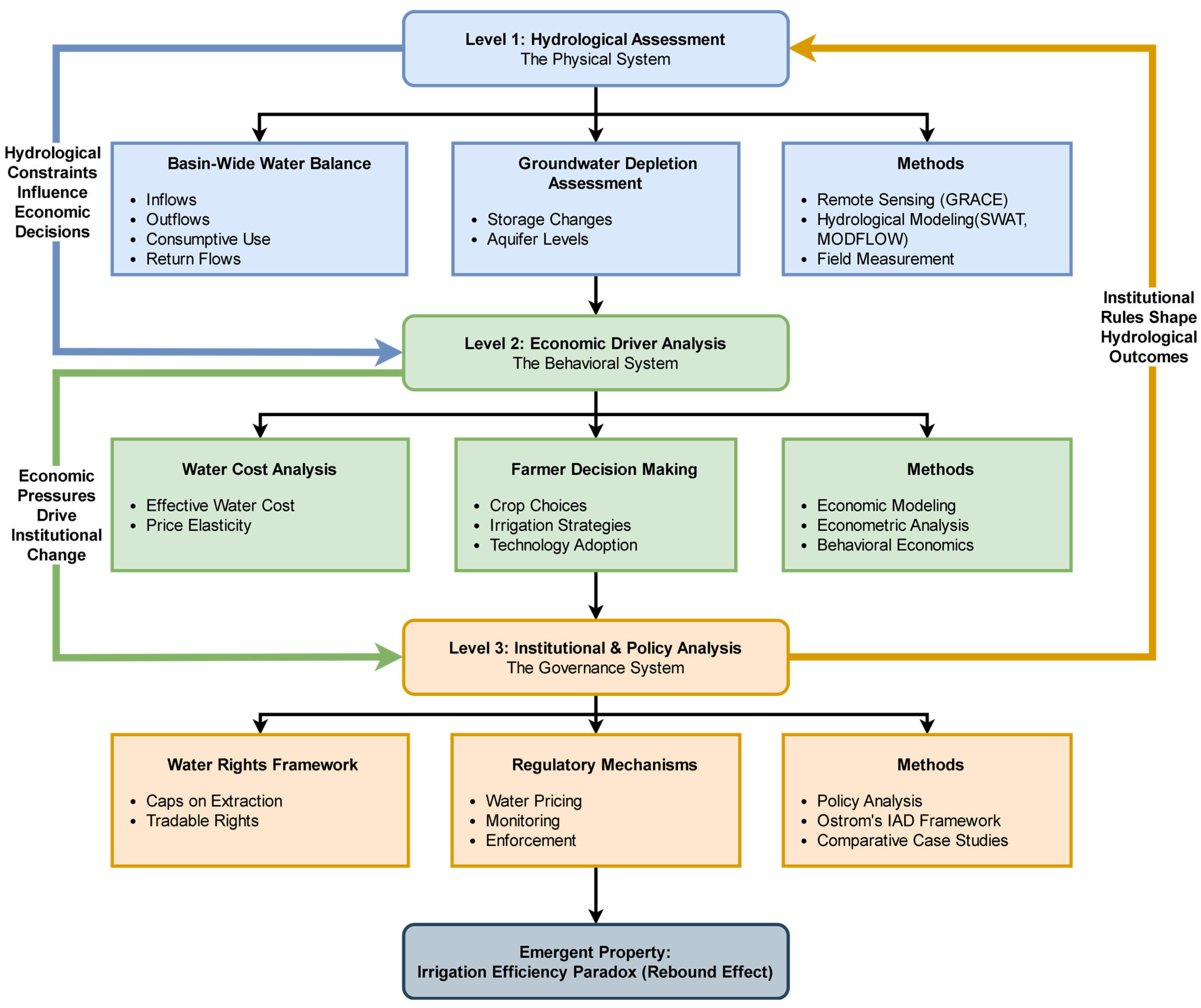
To analyze and address the rebound effect, we propose a multi-layered framework. Presented as a technical roadmap in Figure 1, it offers a structured approach that moves from basic theory to policy design.
The framework proceeds through three levels of analysis:
Level 1: Hydrological Assessment (The Physical System): The objective is to establish a basin-wide water balance. Key questions include: What are the total water inflows and outflows? What is the current level of consumptive use versus return flows? How much water is being depleted from storage (especially groundwater)? Methods include remote sensing (e.g., GRACE for groundwater), hydrological modeling (e.g., SWAT, MODFLOW), and field measurements.
Level 2: Economic Driver Analysis (The Behavioral System): The objective is to understand the economic incentives driving farmer behavior. Key questions include: What is the effective cost of water for farmers? How does this cost change with new technology? What is the price elasticity of demand? What are the profit-maximizing crop choices and irrigation strategies? What other objectives are relevant for farmer decision making (besides profit)? Methods include farm-level economic modeling, econometric analysis of farm survey data, and behavioral economics experiments.
Level 3: Institutional and Policy Analysis (The Governance System): The objective is to evaluate the effectiveness of the existing governance framework. Key questions include: Are there effective caps on total water extraction? Are water rights well-defined, secure, and transferable? How are the abstraction water rights defined (abstraction or consumptive right)? Are farmers allowed to increase irrigated area? Is there volumetric water pricing? Are regulations effectively monitored and enforced? Are subsidies creating perverse incentives? Methods include policy analysis, institutional economics (e.g., Ostrom’s IAD framework) [35], and comparative case studies [14,20,28,36,37,38,39,40,41].
This integrated approach emphasizes that the rebound effect is not a simple, linear problem but an emergent property of a complex socio-hydrological system. A comprehensive analysis must therefore account for the interactions and feedback between the physical, behavioral, and governance dimensions of the system.

4. Global Evidence: A Thematic Synthesis

The irrigation rebound effect is a global phenomenon, but its manifestations and drivers vary depending on the specific hydrological, economic, and institutional context. A thematic synthesis of the global evidence reveals several consistent patterns and drivers.

4.1. The Scale Effect: Expansion of Irrigated Area

A consistent finding across the global literature is that the scale effect also named ‘extensive margin’—the expansion of irrigated area—is the generally the largest driver of the rebound effect. Studies from the North China Plain to the American High Plains have used decomposition analysis and econometric models to show that water “saved” by efficiency improvements is overwhelmingly used to bring new land under cultivation [10,15,16,25,41,42,43,44,45]. For example, in the Hetao Irrigation District (Yellow River, China), the scale effect was the primary driver behind the observed rebound has been that farmers used the perceived abundance of “saved” water to expand cultivation into previously unfarmed areas [46,47,48,49].
However, an important methodological challenge lies in disentangling how much of the observed increase in irrigated area reflects long-term historical trends—driven by market developments and productivity differences between rainfed and irrigated agriculture—from the portion that can be attributed specifically to the appropriation of water savings. For example, in Spain, the historical growth of irrigated land has not been linked to water savings measures. In fact, since 2004—when specific water savings policies were introduced, water savings have been greater than the expansion of irrigated land, leading to a significant drop in total water withdrawals. However, over the long term, the annual growth rate of irrigated area has continued at its historical pace, with no noticeable change [50].

4.2. The Structure and Intensity Effects

The second major driver involves changes in cropping patterns (structure effect) and water application rates (intensity effect). Efficiency improvements can incentivize a shift from traditional, less water-intensive crops to more profitable but higher water demand alternatives, such as fruits and vegetables. This was prominently documented in Spain, where a national irrigation modernization program led to a widespread shift from cereals to perennial, high-value crops, increasing basin-level water consumption despite on-farm efficiency gains [10,16,24,40,51,52,53,54]. The intensity effect occurs when farmers with more efficient systems apply water more frequently or in greater total amounts to maximize yields, a response often shaped by water pricing and subsidy structures [26,55,56,57], However, observed crop changes in Spain were according farmers declaration primarily driven by (a) market evolution, (b) agricultural policy shifts, and (c) modernization processes. This suggests that water saving investment may, in some cases, be a consequence rather than a cause of agricultural intensification [11]. Indeed, the work in the Guadalquivir River Basin highlights the critical methodological challenge of distinguishing the rebound effect from concurrent market-driven trends [58]. The expansion of high-value perennial crops was driven by strong demand for products such as olive oil and almonds, as well as by European agricultural policy. In this context, irrigation modernization and water savings technologies developed alongside this push for intensification and were likely a consequence of it, rather than its original cause. This makes it difficult to separate the pure rebound effect from broader trends in agricultural expansion. Distinguishing these factors remains a major challenge for future research. To mitigate this profit-driven expansion of water consumption, market-based instruments such as flexible water trading systems or crop-specific water quotas could be implemented, ensuring that the shift to high-value crops does not exceed sustainable basin limits.

4.3. The Rebound Effect in Smallholder Contexts

While much of the literature focuses on large-scale systems, the rebound effect is equally critical in smallholder agriculture, particularly in sub-Saharan Africa and Southeast Asia. In these regions, the promotion of micro-irrigation (e.g., affordable drip kits) is a key poverty alleviation strategy. However, smallholder contexts present unique governance challenges, including limited access to metering, informal water rights, and low institutional capacity for adaptive governance [59]. Consequently, efficiency gains often lead farmers to expand their irrigated plots or cultivate dry-season crops to maximize income, inadvertently increasing total water depletion and exacerbating local water conflicts [60].

4.4. The Role of Groundwater

The rebound effect is almost always more evident in systems reliant on groundwater. Aquifers act as a buffer, hiding the immediate consequences of over-extraction and encouraging a common-pool resource dynamic, often leading to a “Tragedy of the Commons” [61]. The severe depletion of major aquifers like the Ogallala in the US and those in Northern India and China is a combination of the mentioned amplified rebound effect and the historical increase in irrigated area due to the comparative advantage of irrigated vs. rainfed land (higher profitability, lower risk), it is difficult to separate the share of each driver (rebound and historical increase) to explain the observed irrigated land increase [42,44,45,47,54]. In the Indian state of Punjab, for example, the widespread adoption of tubewells and subsidized electricity (which reduces the water cost and it is not the rebound effect) has been identified as the primary driver for irrigation increase and it has fueled a crisis of groundwater over-exploitation, and recently some authors are claiming the risk of solar irrigation impact on aquifer over abstraction due to the marginal cero cost [62,63]. Despite efforts to promote micro-irrigation, the lack of effective regulation on pumping (subsidized energy and water cost) means that water saving technology and cost if resources contribute synergically intensify rice-wheat cropping cycles, further lowering the water table [33,64,65]. Because solar pumps eliminate the variable cost of energy (diesel or electricity) per unit of water pumped, farmers have an economic incentive to pump continuously. Without strict volumetric monitoring and enforced extraction caps, this technological shift threatens to severely exacerbate groundwater depletion.

4.5. Key Controversy: Can Rebound Be Avoided?

Grafton et al. argue that decision-makers typically do not know or understand the importance of basin-scale water accounting, nor do they comprehend irrigators’ behavioral responses to subsidies for improving irrigation efficiency [2]. In countries such as Spain [66], Morocco [67] and Australia [6], billions of dollars have been invested in subsidizing irrigation efficiency projects (including canal lining and drip irrigation), yet without proper accounting of their impacts on recoverable return flows, aquifers, and river ecology. Therefore, to achieve genuine water savings through technology and eliminate or avoid rebound effects, it is necessary to establish physical water accounts from the farm scale to the basin scale, clarifying “who gets what and where” to support decision-making in the public interest. This requires measuring or estimating all inflows, water consumption, recoverable return flows, and non-recoverable flows to sinks (Table 2).
I. Definition of Rebound Magnitude: The rebound magnitude is a dimensionless metric expressed as a percentage, calculated as:
R E = E x p e c t e d   W a t e r   S a v i n g s A c t u a l   W a t e r   S a v i n g s E x p e c t e d   W a t e r   S a v i n g s
This metric quantifies the extent to which the potential water savings from an efficiency improvement are offset by behavioral responses. A value greater than 100% is termed “Backfire” (or Jevons’ Paradox), indicating that total water consumption has increased in absolute terms. The measurement basis (e.g., consumptive use vs. water extraction) varies across studies, affecting direct comparability. There is a methodological problem in the definition of the variable measuring water as some authors mentioned Water consumption (Water ET) meanwhile others refer to water abstraction. Theoretically, the critical variable should be consumption, but most authors do not specify the concept properly.
II. Methodological Considerations and External Factors: The quantification of the rebound effect is methodologically challenging. The values presented in this table are subject to the specific models, assumptions, and data used in the referenced studies. Crucially, these estimates often do not fully disentangle the pure rebound effect from concurrent external drivers, such as:
  • Market Dynamics: Changes in crop prices, input costs, and consumer demand can significantly influence farmers’ decisions to expand area or switch to more profitable, water-intensive crops, independent of efficiency gains.
  • Policy Interventions: Government subsidies for efficient irrigation technology, which are present in most of these regions, lower the capital cost for farmers and create a strong economic incentive to adopt and expand, confounding the effect of the technology itself.
  • Climatic Variability: Fluctuations in rainfall and temperature can alter irrigation requirements and farmer behavior from year to year.
  • Long-Term Trends: The expansion of irrigated agriculture is often a long-term historical trend driven by the productivity gap between irrigated and rainfed farming. Attributing all observed expansion to recent efficiency gains can overstate the rebound effect.
III. Case-Specific Context:
  • Ogallala Aquifer: The ~118% figure is an interpretation based on Pfeiffer & Lin [44], who found a ~1.8% increase in water extraction for every 1% increase in the adoption of technology that is ~8% more efficient. This demonstrates a strong backfire effect driven by a shift to more profitable corn production.
  • India: Singh et al. [22] provides strong qualitative and descriptive evidence of backfire (e.g., a 55% increase in total pumping hours for chickpea despite per-hectare savings) but does not calculate a single rebound magnitude percentage, highlighting the complexity of measuring this phenomenon with farm-level survey data.
  • Murray–Darling Basin: This region represents a unique case where a negative or minimal rebound at the basin scale was achieved. This success is not primarily due to on-farm technology but to a robust institutional framework, including a strictly enforced cap on total water extractions and a functioning water market. However, even here, farm-level studies by Wheeler et al. [6] show that irrigators who received subsidies for efficiency upgrades increased their water extractions by 21–28% relative to those who did not, demonstrating a clear rebound effect at the individual level that is masked by the basin-wide cap.
  • Indus Basin: The 120–180% range is an estimate based on the analysis of groundwater over-extraction trends presented by Qureshi et al. [68], which are driven by similar mechanisms of intensification and expansion seen in other backfire cases, rather than a formally calculated rebound percentage in that paper.

5. In-Depth Case Study: The Hetao Irrigation District, China

The Hetao Irrigation District, located in the upper Yellow River basin, serves as a compelling and dramatic case study illustrating the irrigation water rebound effect in its most extreme form. As one of China’s largest and oldest irrigation districts, it plays a vital role in regional food security. However, situated in an arid region with minimal precipitation and high evaporation rates, it is entirely dependent on water diverted from the Yellow River. This context of extreme aridity, combined with specific historical development patterns and ecological constraints, has created a “perfect storm” for an unprecedented rebound effect.

5.1. The Rebound Effect in Hetao (334%): Drivers and Mechanisms

Empirical evidence from the district is staggering. A comprehensive study by Xu & Song [48] found that between 1949 and 2017, while the irrigation water use efficiency coefficient improved by 12.6%, the total irrigated area expanded by 32.9%, and the total annual water diversion from the Yellow River grew by over 30%. Their Logarithmic Mean Divisia Index (LMDI) decomposition analysis revealed a rebound effect of 344%, meaning that for every 100 units of water theoretically saved through efficiency improvements, an additional 344 units were consumed. The analysis clearly identified the scale effect—the expansion of irrigated area—as the overwhelmingly dominant driver, completely offsetting and vastly outweighing any gains from technical efficiency [48].This study also indirectly indicates that the expansion of irrigated area in the command area is largely unrelated to the implementation of water savings technologies or measures—such expansion would occur regardless of whether water conservation efforts are adopted (Table 3).
Key Insight: The scale effect dominates, accounting for 60–70% of total rebound. This suggests that without a binding cap on total water extraction, efficiency improvements primarily enable area expansion rather than conservation.

5.2. The Salinization Dilemma: A Coupled Water-Salt Challenge

The complexity of the Hetao case is compounded by a particular ecological constraint: soil salinization. Approximately 45.5% of the cultivated land in the district is affected by salinity, a result of the arid climate, shallow groundwater table, and long history of irrigation [46]. To manage this problem and maintain soil productivity, a unique practice known as autumn irrigation is employed. This involves applying large volumes of water to fields after the harvest season with the primary purpose of leaching accumulated salts downward, below the crop root zone. This practice is essential for the agricultural sustainability of the region, but it is also extremely water-intensive, accounting for a significant portion of the annual water budget.
This has led to a profound water savings dilemma. On one hand, the district is under immense pressure to save water due to a water allocation plan for the Yellow River basin that mandates significant cuts in diversions. On the other hand, reducing water use, particularly for autumn irrigation, directly threatens to exacerbate soil salinization, potentially leading to crop yield reductions and jeopardizing farmers’ livelihoods [27,46,49,70]. The Hetao case thus demonstrates that pursuing simple water savings targets without considering the coupled socio-ecological system can lead to severe, unintended negative consequences, trapping the region in a dilemma where water conservation and agricultural viability are mutually incompatible.

6. Methodological Review and Critical Assessment

Accurately quantifying the irrigation water rebound effect and diagnosing its drivers is essential for developing evidence-based water management policies. Researchers have employed a range of methods, from simple accounting frameworks to complex simulation models, to analyze this phenomenon at different scales. No single method is sufficient; a robust understanding requires methodological pluralism—triangulating findings across different paradigms.

6.1. Water Balance and Accounting Approaches

These methods use field data, remote sensing, and hydrological models to track the components of the water balance (e.g., precipitation, ET, return flows). They focus on physical flows and the conservation of mass. Their primary strength is providing a definitive, quantitative assessment of changes in consumptive use versus return flows, which is essential for establishing the physical reality of water savings [23]. However, they are data-intensive and often lack the resolution to capture farm-level decision-making. They describe what happened but not why. Furthermore, a critical methodological issue arises from numerical precision across spatial scales. Applying identical error precision thresholds for water balance calculations at both the field and basin scales can inadvertently contribute to the perceived rebound effect. Because the negligible water volume error threshold at the basin scale is often larger than the total water withdrawal at the field scale, field-scale savings may be mathematically neglected in basin-scale computations, masking true hydrological dynamics.

6.2. Econometric and Statistical Approaches

These methods use statistical analysis of historical data (often panel data) to estimate the causal relationship between efficiency adoption and water use. They can identify statistically significant relationships and estimate key parameters like the price elasticity of water demand, making them well-suited for testing hypotheses about drivers (e.g., subsidies) [44]. Their main weakness is a susceptibility to omitted variable bias and endogeneity issues (e.g., do efficient farmers use more water, or do water-intensive farmers adopt efficiency?).

6.3. Simulation and Modeling Approaches

This category includes bio-economic optimization models and Agent-Based Models (ABMs) that simulate the decision-making of individual farmers and aggregate their behavior to the basin scale. Their strength lies in allowing for the testing of different policy scenarios (ex-ante analysis) and modeling complex, non-linear interactions and feedbacks between human and natural systems [11]. However, they are highly dependent on assumptions about farmer behavior (often assuming perfect rationality) and can be difficult to calibrate and validate against real-world data (Table 4).

7. Knowledge Gaps and a New Research Agenda

Despite significant progress, the literature on the rebound effect remains marked by critical knowledge gaps. Addressing these gaps is essential for moving beyond simply documenting the paradox to developing effective solutions. This requires a new, forward-looking research agenda that pushes the boundaries of current paradigms.

7.1. Theoretical Gaps: Beyond the Rational Farmer

Most economic models of the rebound effect assume that farmers are perfectly rational, profit-maximizing agents. However, this overlooks a significant gap in applying insights from behavioural economics to understand how cognitive biases (e.g., overconfidence in water savings, status quo bias), social norms, and non-pecuniary motivations influence farmers’ technology adoption and water use decisions. For example, do farmers overestimate the water savings potential of new technology due to “optimism bias”? How do peer effects and social networks drive the adoption of water-intensive crops? Empirical evidence suggests that ‘optimism bias’ often leads farmers to overestimate the actual water savings of drip irrigation, prompting them to expand irrigated areas [71]. Furthermore, ‘loss aversion’ regarding historical water rights and ‘status quo bias’ frequently explain why farmers strongly resist consumption-capping policies, even when long-term basin sustainability is at risk.
Furthermore, the focus on profit maximization often obscures other powerful economic and quality-of-life drivers (e.g., minimizing labour, minimizing risk, etc.). As the reviewer noted, a crucial motivation for adopting modern irrigation technology, particularly in developed countries, is the potential for labour saving and an improved quality of labour. In regions where farm labour is scarce and expensive, the economic benefits of reducing labour inputs can be a more significant driver for investment than water savings alone [72]. Automated systems like drip or sprinkler irrigation reduce the time and physical effort required for managing water, freeing up farmers’ time for other productive activities or leisure. This improvement in the ‘quality of labour’—shifting from physically demanding work to more managerial tasks—represents a significant non-pecuniary incentive that is often ignored in traditional cost–benefit analyses. Understanding these labour-related drivers is critical, as the saved labour can, in turn, enable the expansion of cultivated area, potentially contributing to the rebound effect.

7.2. Methodological Gaps: Integrating Social Dynamics and Political Economy

Current methods struggle to endogenize the political and social processes that shape water policy. Why are perverse subsidies so persistent despite overwhelming evidence of their negative impacts? How do farmer networks and lobbying efforts influence governance and prevent reform? Integrating qualitative and quantitative methods from political science and sociology is a major methodological frontier. We need to understand the “political economy of rebound”—who benefits, who loses, and why reforms that are technically and economically sound are so often politically infeasible.

7.3. Climate Change and the Rebound Effect

Climate change acts as a significant modifier of the rebound effect, yet it remains underexplored in the current literature. Rising temperatures, changing precipitation patterns, and increased frequency of droughts are altering irrigation demands globally. These climatic shifts will likely amplify the rebound effect, as farmers face increased pressure to adopt efficiency gains not just for profit, but as a drought-buffering strategy, which can paradoxically lead to further area expansion and groundwater depletion [73]. Future research must address how rising temperatures shape farmer responses to efficiency gains and how adaptive governance frameworks can account for climate variability in the design of consumptive-use water rights.

7.4. Empirical Gaps: The Missing Externalities

The literature has focused heavily on the quantity of water consumed, with far less attention paid to the environmental and social externalities of the rebound effect.
Environmental Externalities: How does the reduction in return flows affect water quality (e.g., increased concentration of salts and agrochemicals)? What are the impacts on downstream wetlands and biodiversity that depend on these “inefficient” flows?
Social Externalities: Does the shift to capital-intensive high-tech irrigation marginalize smallholder farmers who cannot afford the investment? Does it lead to a concentration of land and water rights, exacerbating rural inequality?

7.5. A Proposed Research Agenda for the Next Decade

Our analysis of the rebound effect reveals a critical insight: the paradox of irrigation efficiency is not an inevitable outcome of technological progress, but rather a symptom of institutional design flaws. The rebound effect can be avoided. The solution, conceptually simple yet practically challenging, lies in redefining water rights from a basis of water abstraction to one of consumptive use [74]. Under a consumptive use system, a farmer’s entitlement is limited to the amount of water consumed by the crop through evapotranspiration (ET). Consequently, any gains in irrigation efficiency—which reduce the amount of water needed to deliver the consumptive use requirement—automatically translate into reduced water abstraction, thereby preventing the rebound effect and freeing up water for environmental or other uses [75].
This shifts the research focus away from merely diagnosing the problem towards actively designing and implementing the solution. The central challenge for the next decade is no longer to simply understand the rebound effect, but to operationalize the transition to consumptive use-based water governance. Based on this, we propose a research agenda focused on the following key questions:
I. Institutional Design and Transition: How can we design and implement a transition from abstraction-based to consumptive-use-based water rights? This involves addressing critical legal and economic questions: What are the legal precedents and frameworks (e.g., the Colorado doctrine, Australian water reforms, Spanish Hydrological Plans) that can guide such transitions? How can we accurately and cost-effectively measure consumptive use at scale, leveraging technologies like remote sensing? What mechanisms are needed to manage the reallocation of existing rights to avoid political capture and ensure equitable outcomes, particularly in addressing the issue of “paper water” [76]?
II. Political Economy of Reform: What are the political and economic conditions under which a transition to consumptive use rights becomes feasible? This requires understanding the incentives and power dynamics of key stakeholders. How can we build coalitions of support for reform among farmers, environmental groups, and urban water users? What compensation or incentive mechanisms can be designed to overcome opposition from those who benefit from the status quo of ambiguous water rights? How can the long-term economic benefits of sustainable water management be made more salient to policymakers?
III. Behavioural Dimensions of Implementation: How will farmers, as the primary actors, respond to a new regime of consumptive use rights? This moves beyond general biases to specific, policy-relevant questions. How can we design information and extension programs to help farmers understand and adapt to the new system? What are the key behavioural barriers (e.g., mistrust, perceived complexity, loss aversion) to accepting and complying with consumptive use limits? How do social networks and community norms influence the success of such institutional reforms at the local level?
IV. Quantifying and Realizing Environmental Benefits: How can we ensure that the water “saved” through the transition to consumptive use rights translates into tangible environmental benefits? This requires a more integrated approach. How can we link water rights reform directly to environmental flow restoration targets? What monitoring and verification systems are needed to track changes in return flows, groundwater levels, and ecosystem health? How can we value these environmental benefits in a way that justifies the upfront costs of institutional reform?
V. Adaptive Governance in Practice: Given the complexities and uncertainties of transitioning to a new water rights system, can adaptive governance approaches provide a more effective framework than rigid, top-down regulation? This involves exploring governance models that emphasize learning, flexibility, and stakeholder participation. How can we design pilot projects or phased implementations to test and refine consumptive use systems in different socio-ecological contexts? What are the key feedback loops and learning mechanisms needed to allow water management institutions to adapt to new information and changing conditions [77]?

8. Policy Implications: From Technical Fixes to Transformative Governance

Water rights refer to legally or institutionally recognized entitlements authorizing the abstraction and use of specified quantities of water resources. These rights are not immutable but can serve as dynamic policy instruments, subject to adjustment by regulatory authorities based on water resource conditions and governance objectives. Effective regulation of water rights plays a crucial role in addressing the potential rebound effect induced by improvements in irrigation efficiency. From one perspective, local collaborative governance achieves sustainable irrigation where technology fails [78]. Kansas’s locally driven LEMA program successfully reduced groundwater extraction, while subsidized efficient irrigation (LEPA) did not decrease consumption. Policymakers should replicate small-scale localized governance rather than expand management boundaries to balance ecological and economic sustainability. From another perspective, a typical top-down governance strategy involves directly coupling the promotion of water savings technologies with adjustments to water rights allocations. For instance, in water-stressed basins of Southern Spain (e.g., Guadiana, Guadalquivir, Segura), regulations mandate that any water savings investment aimed at enhancing irrigation efficiency must be accompanied by a reduction of approximately 25% of existing water rights, with no further expansion of irrigated areas permitted [79]. Through this mechanism, water rights are transformed from mere water use permits into critical regulatory levers. This approach aims to ensure that potential water savings generated by technological advances are genuinely retained within the basin system, rather than being redirected toward agricultural production expansion, thereby effectively curbing the risk of total water abstraction increasing or remaining unchanged despite efficiency gains. These examples highlight the critical role of governance in mitigating the rebound effect and set the stage for a broader discussion of key policy instruments (Table 5).
Addressing the irrigation efficiency paradox requires a fundamental shift in policy focus—from promoting technology to reforming institutions and correcting economic incentives. The primary policy implication of this review is that a narrow focus on promoting technical efficiency is not only ineffective but can be counterproductive. A one-size-fits-all solution is unlikely to succeed; instead, a portfolio of policy instruments tailored to the local context is needed. The only reliable way to ensure that efficiency gains translate into real water savings is to implement them within a system that includes a hard, enforced cap on total water extractions. Without this institutional backstop, rebound is the likely, and rational, outcome.
Key policy recommendations include:
I.
Implement a Hard Cap on Water Use and Water Consumption and Irrigated Area: The most effective, and arguably only, way to prevent the rebound effect is to establish and enforce a hard cap on both the total volume of water that can be consumed within a basin and the total area of land that can be irrigated. This shifts the policy focus from improving efficiency to respecting absolute limits.
II.
Establish and Enforce Secure Water Rights: A system of well-defined, secure, and transferable water rights or entitlements, which can be traded separately from land, allows for more flexible and economically efficient water allocation. This encourages water to move to higher-value uses rather than simply expanding overall consumption.
III.
Promote Consumption-Based Water Accounting and Management: Water management, allocation, and pricing must be based on actual consumptive use (evapotranspiration), not on withdrawals or diversions. This requires investment in advanced monitoring and measurement technologies (e.g., remote sensing of ET) to create a transparent and enforceable accounting system.
IV.
Adopt Integrated Basin Management: Water policy must break out of sectoral silos and adopt an integrated approach that considers the interconnectedness of surface water and groundwater, water quantity and quality, and the needs of agricultural, urban, and ecological systems. This requires a basin-level perspective that can manage the trade-offs between different objectives and stakeholders.

9. Conclusions

This review has re-examined the irrigation efficiency paradox, arguing that it is a systemic problem arising from the interaction of hydrology, economics, and institutions. The central conclusion is that policies that narrowly focus on promoting technical irrigation efficiency are misguided and destined to fail in the absence of a broader institutional and regulatory framework. The paradox arises because water savings at the field level do not automatically translate into water savings at the basin level; instead, they often stimulate behavioural responses—primarily the expansion of irrigated area—that increase overall water consumption.
The expansion of irrigated land area is fundamentally driven by market demand and economic behaviour. In this context, the relationship between water-conservation technologies and the growth of irrigated areas exhibits a complex duality that warrants further investigation. On one hand, the economic drivers for expansion are predominant, implying a persistent trend of expansion regardless of whether water savings measures are adopted. On the other hand, advancements in water-conservation technology enhance water use efficiency, enabling the same volume of water to cover a larger area, which may incentivize or even accelerate the expansion of irrigated land. Therefore, elucidating the interplay between these factors is crucial for understanding the development patterns of irrigated agriculture.
Overcoming the irrigation efficiency paradox requires a paradigm shift. No single instrument is sufficient. Effective rebound mitigation requires combining a binding extraction cap with complementary instruments (pricing, tradable rights, subsidy removal). Institutional design is critical. We must move away from the seductive simplicity of technical fixes and embrace the complexity of transformative governance. This involves not only implementing difficult policies like caps and pricing but also investing in the social and political processes needed to make them legitimate and effective. The future of sustainable water management lies in a more humble, adaptive, and integrated approach that places the human dimension—with all its complexities, biases, and rational responses to incentives—at the centre of the water security challenge. Concrete steps toward this transformative governance include: (1) establishing and strictly enforcing basin-level water consumption caps; (2) utilizing advanced satellite-based ET monitoring to accurately track consumptive use; and (3) implementing well-funded water-buyback schemes to equitably reduce overall allocations.

Author Contributions

J.Y.: Data collection & processing, Visualization, Writing—original draft, Review & editing. W.Z.: Review & editing. S.L.: Review & editing. P.X.: Review & editing. J.B.: Review & editing, Funding acquisition, Project administration. All authors have read and agreed to the published version of the manuscript.

Funding

This research was funded by the National Key Research and Development Program of China (Grant No.: 2022YFF1300805) and the Inner Mongolia Department of Science and Technology 2024 major projects to prevent and control sand demonstration “unveiled marshal” project (2024JBGS0016).

Data Availability Statement

No new data were created or analyzed in this study.

Acknowledgments

We acknowledge the support granted to Jingwei Yao by the China Scholarship Council (CSC No. 202303340011).

Conflicts of Interest

Author Wenmin Zhang & Shuangjiang Li were employed by the Henan Water Environment Survey and Design Co., Ltd. The remaining authors declare that the research was conducted in the absence of any commercial or financial relationships that could be construed as a potential conflict of interest.

References

  1. Perry, C.; Steduto, P. Does Improved Irrigation Technology Save Water? A Review of the Evidence; FAO: Rome, Italy, 2017. [Google Scholar]
  2. Grafton, R.Q.; Williams, J.; Perry, C.J.; Molle, F.; Ringler, C.; Steduto, P.; Udall, B.; Wheeler, S.A.; Wang, Y.; Garrick, D.; et al. The Paradox of Irrigation Efficiency. Science 2018, 361, 748–750. [Google Scholar] [CrossRef] [Scilit]
  3. Peterson, J.M.; Ding, Y. Economic Adjustments to Groundwater Depletion in the High Plains: Do Water-Saving Irrigation Systems Save Water? Am. J. Agric. Econ. 2005, 87, 147–159. [Google Scholar] [CrossRef] [Scilit]
  4. Berbel, J.; Mateos, L. Does Investment in Irrigation Technology Necessarily Generate Rebound Effects? A Simulation Analysis Based on an Agro-Economic Model. Agric. Syst. 2014, 128, 25–34. [Google Scholar] [CrossRef] [Scilit]
  5. Gómez, C.M.; Pérez-Blanco, C.D. Simple Myths and Basic Maths about Greening Irrigation. Water Resour. Manag. 2014, 28, 4035–4044. [Google Scholar] [CrossRef] [Scilit]
  6. Wheeler, S.A.; Carmody, E.; Grafton, R.Q.; Kingsford, R.T.; Zuo, A. The Rebound Effect on Water Extraction from Subsidising Irrigation Infrastructure in Australia. Resour. Conserv. Recycl. 2020, 159, 104755. [Google Scholar] [CrossRef] [Scilit]
  7. Fei, R.; Wang, H.; Wen, Z.; Yuan, Z.; Yuan, K.; Chunga, J. Tracking Factor Substitution and the Rebound Effect of China’s Agricultural Energy Consumption: A New Research Perspective from Asymmetric Response. Energy 2021, 216, 119307. [Google Scholar] [CrossRef] [Scilit]
  8. Song, J.; Guo, Y.; Wu, P.; Sun, S. The Agricultural Water Rebound Effect in China. Ecol. Econ. 2018, 146, 497–506. [Google Scholar] [CrossRef] [Scilit]
  9. Wu, F.; Zhang, Q.; Gao, X. Does Water-Saving Technology Reduce Water Use in Economic Systems? A Rebound Effect in Zhangye City in the Heihe River Basin, China. Water Policy 2017, 20, 355–368. [Google Scholar] [CrossRef] [Scilit]
  10. Berbel, J.; Gutiérrez-Martín, C.; Rodríguez-Díaz, J.A.; Camacho, E.; Montesinos, P. Literature Review on Rebound Effect of Water Saving Measures and Analysis of a Spanish Case Study. Water Resour. Manag. 2015, 29, 663–678. [Google Scholar] [CrossRef] [Scilit]
  11. Berbel, J.; Expósito, A.; Gutiérrez-Martín, C.; Mateos, L. Effects of the Irrigation Modernization in Spain 2002–2015. Water Resour. Manag. 2019, 33, 1835–1849. [Google Scholar] [CrossRef] [Scilit]
  12. Chai, Y.; Zhang, H.; Ma, Z.; Pan, S.; Zhou, J. Can the Right Crop Mix Reduce the Water Rebound Effect Following Improvements in Irrigation Efficiency? Front. Water 2022, 4, 930481. [Google Scholar] [CrossRef] [Scilit]
  13. Lankford, B.A. Resolving the Paradoxes of Irrigation Efficiency: Irrigated Systems Accounting Analyses Depletion-Based Water Conservation for Reallocation. Agric. Water Manag. 2023, 287, 108437. [Google Scholar] [CrossRef] [Scilit]
  14. Nemati, M.; Tran, D.; Schwabe, K. Residential Water Conservation and the Rebound Effect: A Temporal Decomposition and Investigation. Water Resour. Res. 2023, 59, e2022WR032169. [Google Scholar] [CrossRef] [Scilit]
  15. Wang, Y.; Long, A.; Xiang, L.; Deng, X.; Zhang, P.; Hai, Y.; Wang, J.; Li, Y. The Verification of Jevons’ Paradox of Agricultural Water Conservation in Tianshan District of China Based on Water Footprint. Agric. Water Manag. 2020, 239, 106163. [Google Scholar] [CrossRef] [Scilit]
  16. Xiong, R.; Zheng, Y.; Han, F.; Tian, Y. Improving the Scientific Understanding of the Paradox of Irrigation Efficiency: An Integrated Modeling Approach to Assessing Basin-scale Irrigation Efficiency. Water Resour. Res. 2021, 57, e2020WR029397. [Google Scholar] [CrossRef] [Scilit]
  17. Xu, H.; Yang, R.; Song, J. Agricultural Water Use Efficiency and Rebound Effect: A Study for China. Int. J. Environ. Res. Public Health 2021, 18, 7151. [Google Scholar] [CrossRef] [Scilit]
  18. Bruno, E.M.; Hagerty, N.; Wardle, A.R. The Political Economy of Groundwater Management: Descriptive Evidence from California. In American Agriculture, Water Resources, and Climate Change; University of Chicago Press: Chicago, IL, USA, 2022; pp. 343–365. [Google Scholar]
  19. Schoengold, K.; Sunding, D.L.; Moreno, G. Price Elasticity Reconsidered: Panel Estimation of an Agricultural Water Demand Function. Water Resour. Res. 2006, 42, 2005WR004096. [Google Scholar] [CrossRef] [Scilit]
  20. Sears, L.; Caparelli, J.; Lee, C.; Pan, D.; Strandberg, G.; Vuu, L.; Lin Lawell, C.-Y. Jevons’ Paradox and Efficient Irrigation Technology. Sustainability 2018, 10, 1590. [Google Scholar] [CrossRef] [Scilit]
  21. Sears, L.; Lim, D.; Lawell, C.-Y.C.L. The Economics of Agricultural Groundwater Management Institutions: The Case of California. Water Econ. Policy 2018, 4, 1850003. [Google Scholar] [CrossRef] [Scilit]
  22. Singh, G.; Gandhi, V.P.; Jain, D. Micro-Irrigation Adoption and the Jevons’ Paradox: A Study from Four States of India. Agric. Water Manag. 2024, 303, 109040. [Google Scholar] [CrossRef] [Scilit]
  23. Perry, C. Efficient Irrigation; Inefficient Communication; Flawed Recommendations. Irrig. Drain. 2007, 56, 367–378. [Google Scholar] [CrossRef] [Scilit]
  24. York, R.; McGee, J.A. Understanding the Jevons Paradox. Environ. Sociol. 2016, 2, 77–87. [Google Scholar] [CrossRef] [Scilit]
  25. Hoffmann, P.; Villamayor-Tomas, S. Irrigation Modernization and the Efficiency Paradox: A Meta-Study through the Lens of Networks of Action Situations. Sustain. Sci. 2023, 18, 181–199. [Google Scholar] [CrossRef] [Scilit]
  26. Medellín-Azuara, J.; MacEwan, D.; Howitt, R.E.; Koruakos, G.; Dogrul, E.C.; Brush, C.F.; Kadir, T.N.; Harter, T.; Melton, F.; Lund, J.R. Hydro-Economic Analysis of Groundwater Pumping for Irrigated Agriculture in California’s Central Valley, USA. Hydrogeol. J. 2015, 23, 1205–1216. [Google Scholar] [CrossRef] [Scilit]
  27. Di Baldassarre, G.; Viglione, A.; Carr, G.; Kuil, L.; Yan, K.; Brandimarte, L.; Blöschl, G. Debates—Perspectives on Socio-hydrology: Capturing Feedbacks between Physical and Social Processes. Water Resour. Res. 2015, 51, 4770–4781. [Google Scholar] [CrossRef] [Scilit]
  28. Delavar, M.; Morid, S.; Morid, R.; Farokhnia, A.; Babaeian, F.; Srinivasan, R.; Karimi, P. Basin-Wide Water Accounting Based on Modified SWAT Model and WA+ Framework for Better Policy Making. J. Hydrol. 2020, 585, 124762. [Google Scholar] [CrossRef] [Scilit]
  29. Frappart, F.; Ramillien, G. Monitoring Groundwater Storage Changes Using the Gravity Recovery and Climate Experiment (GRACE) Satellite Mission: A Review. Remote Sens. 2018, 10, 829. [Google Scholar] [CrossRef] [Scilit]
  30. Ramjeawon, M.; Demlie, M.; Toucher, M. Analyses of Groundwater Storage Change Using GRACE Satellite Data in the Usutu-Mhlatuze Drainage Region, North-Eastern South Africa. J. Hydrol. Reg. Stud. 2022, 42, 101118. [Google Scholar] [CrossRef] [Scilit]
  31. Bailey, R.T.; Abbas, S.; Arnold, J.G.; White, M.J. SWAT+MODFLOW: A New Hydrologic Model for Simulating Surface-Subsurface Flow in Managed Watersheds. Geosci. Model Dev. 2025, 18, 5681–5697. [Google Scholar] [CrossRef] [Scilit]
  32. Mateos, L. Irrigation Efficiency and Water Saving: Scale and Rebound Effects. Sci. Eaux Territ. 2020, 34, 86–89. [Google Scholar] [CrossRef]
  33. Bahinipati, C.S.; Viswanathan, P.K. Can Micro-Irrigation Technologies Resolve India’s Groundwater Crisis? Reflections from Dark-Regions in Gujarat. Int. J. Commons 2019, 13, 848–858. [Google Scholar] [CrossRef] [Scilit]
  34. Morrisett, C.N.; Van Kirk, R.W.; Bernier, L.O.; Holt, A.L.; Perel, C.B.; Null, S.E. The Irrigation Efficiency Trap: Rational Farm-Scale Decisions Can Lead to Poor Hydrologic Outcomes at the Basin Scale. Front. Environ. Sci. 2023, 11, 1188139. [Google Scholar] [CrossRef] [Scilit]
  35. Oñate-Valdivieso, F.; Massa-Sánchez, P.; León, P.; Oñate-Paladines, A.; Cisneros, M. Application of Ostrom’s Institutional Analysis and Development Framework in River Water Conservation in Southern Ecuador. Case Study—The Zamora River. Water 2021, 13, 3536. [Google Scholar] [CrossRef] [Scilit]
  36. Gharib, A.A.; Arabi, M.; Goemans, C.; Manning, D.T.; Maas, A. Integrated Water Management under Different Water Rights Institutions and Population Patterns: Methodology and Application. Water Resour. Res. 2024, 60, e2024WR037196. [Google Scholar] [CrossRef] [Scilit]
  37. Konar, M.; Garcia, M.; Sanderson, M.R.; Yu, D.J.; Sivapalan, M. Expanding the Scope and Foundation of Sociohydrology as the Science of Coupled Human-water Systems. Water Resour. 2019, 55, 874–887. [Google Scholar] [CrossRef] [Scilit]
  38. Ma’Mun, S.R.; Loch, A.; Young, M.D. Robust Irrigation System Institutions: A Global Comparison. Glob. Environ. Change 2020, 64, 102128. [Google Scholar] [CrossRef] [Scilit]
  39. Vallury, S.; Shin, H.C.; Janssen, M.A.; Meinzen-Dick, R.; Kandikuppa, S.; Rao, K.R.; Chaturvedi, R. Assessing the Institutional Foundations of Adaptive Water Governance in South India. Ecol. Soc. 2022, 27, art18. [Google Scholar] [CrossRef] [Scilit]
  40. Wang, R.Y.; Chen, T. Integrating Institutions with Local Contexts in Community-Based Irrigation Governance: A Qualitative Systematic Review of Variables, Combinations, and Effects. Int. J. Commons 2021, 15, 320–338. [Google Scholar] [CrossRef] [Scilit]
  41. Zhang, K.; Xie, X.; Zhu, B.; Meng, S.; Yao, Y. Unexpected Groundwater Recovery with Decreasing Agricultural Irrigation in the Yellow River Basin. Agric. Water Manag. 2019, 213, 858–867. [Google Scholar] [CrossRef] [Scilit]
  42. Du, J.; Laghari, Y.; Wei, Y.-C.; Wu, L.; He, A.-L.; Liu, G.-Y.; Yang, H.-H.; Guo, Z.-Y.; Leghari, S.J. Groundwater Depletion and Degradation in the North China Plain: Challenges and Mitigation Options. Water 2024, 16, 354. [Google Scholar] [CrossRef] [Scilit]
  43. Hendricks, N.P.; Peterson, J.M. Fixed Effects Estimation of the Intensive and Extensive Margins of Irrigation Water Demand. J. Agric. Resour. Econ. 2012, 37, 1–19. [Google Scholar]
  44. Pfeiffer, L.; Lin, C.Y.C. The Effect of Irrigation Technology on Groundwater Use. Choices 2010, 25, 1–6. [Google Scholar] [CrossRef]
  45. Long, D.; Xu, Y.; Cui, Y.; Cui, Y.; Butler, J.J.; Dong, L.; Wang, L.; Liu, D.; Wada, Y.; Hu, L.; et al. Unprecedented Large-Scale Aquifer Recovery through Human Intervention. Nat. Commun. 2025, 16, 7296. [Google Scholar] [CrossRef] [Scilit] [PubMed]
  46. Feng, Z.; Miao, Q.; Shi, H.; Gonçalves, J.M.; Li, R. Water Saving and Environmental Issues in the Hetao Irrigation District, the Yellow River Basin: Development Perspective Analysis. Agronomy 2025, 15, 1654. [Google Scholar] [CrossRef] [Scilit]
  47. Rhodes, E.C.; Perotto-Baldivieso, H.L.; Tanner, E.P.; Angerer, J.P.; Fox, W.E. The Declining Ogallala Aquifer and the Future Role of Rangeland Science on the North American High Plains. Rangel. Ecol. Manag. 2023, 87, 83–96. [Google Scholar] [CrossRef] [Scilit]
  48. Xu, H.; Song, J. Drivers of the Irrigation Water Rebound Effect: A Case Study of Hetao Irrigation District in Yellow River Basin, China. Agric. Water Manag. 2022, 266, 107567. [Google Scholar] [CrossRef] [Scilit]
  49. Yue, W.; Liu, X.; Wang, T.; Chen, X. Impacts of Water Saving on Groundwater Balance in a Large-Scale Arid Irrigation District, Northwest China. Irrig. Sci. 2016, 34, 297–312. [Google Scholar] [CrossRef] [Scilit]
  50. Espinosa-Tasón, J.; Berbel, J.; Gutiérrez-Martín, C. Energized Water: Evolution of Water-Energy Nexus in the Spanish Irrigated Agriculture, 1950–2017. Agric. Water Manag. 2020, 233, 106073. [Google Scholar] [CrossRef] [Scilit]
  51. González-Cebollada, C. Water and Energy Consumption after the Modernization of Irrigation in Spain. In WIT Transactions on the Built Environment; Brebbia, C.A., Ed.; WIT Press: Southampton, UK, 2015; Volume 1, pp. 457–465. ISBN 978-1-78466-157-1. [Google Scholar]
  52. Lecina, S.; Isidoro, D.; Playán, E.; Aragüés, R. Irrigation Modernization and Water Conservation in Spain: The Case of Riegos Del Alto Aragón. Agric. Water Manag. 2010, 97, 1663–1675. [Google Scholar] [CrossRef] [Scilit]
  53. Playán, E.; Gimeno, Y.; Lorenzo-González, M.A.; Jiménez, A.; López-Pardo, J.R.; Oliván, I.; Castillo, R.; Carbonell, X.; Fábregas, M.; Vicente, L.M.; et al. Irrigation Modernization in the Ebro—Aragón Region of Spain: Past and Future Trends. Agric. Water Manag. 2024, 302, 108975. [Google Scholar] [CrossRef] [Scilit]
  54. Scanlon, B.R.; Faunt, C.C.; Longuevergne, L.; Reedy, R.C.; Alley, W.M.; McGuire, V.L.; McMahon, P.B. Groundwater Depletion and Sustainability of Irrigation in the US High Plains and Central Valley. Proc. Natl. Acad. Sci. USA 2012, 109, 9320–9325. [Google Scholar] [CrossRef] [Scilit] [PubMed]
  55. Hellegers, P.; Davidson, B.; Russ, J.; Waalewijn, P. Irrigation Subsidies and Their Externalities. Agric. Water Manag. 2022, 260, 107284. [Google Scholar] [CrossRef] [Scilit]
  56. Badiani, R.; Jessoe, K. The Impact of Electricity Subsidies on Groundwater Extraction and Agricultural Production; Department of Agriculture and Resource Economics Working Paper; University of California Davis: Davis, CA, USA, 2013. [Google Scholar]
  57. Zhou, Q.; Wu, F.; Zhang, Q. Is Irrigation Water Price an Effective Leverage for Water Management? An Empirical Study in the Middle Reaches of the Heihe River Basin. Phys. Chem. Earth Parts A/B/C 2015, 89–90, 25–32. [Google Scholar] [CrossRef] [Scilit]
  58. Tocados-Franco, E.; Berbel, J.; Expósito, A. Water Policy Implications of Perennial Expansion in the Guadalquivir River Basin (Southern Spain). Agric. Water Manag. 2023, 282, 108286. [Google Scholar] [CrossRef] [Scilit]
  59. Mutambara, S.; Darkoh, M.B.K.; Atlhopheng, J.R. A Comparative Review of Water Management Sustainability Challenges in Smallholder Irrigation Schemes in Africa and Asia. Agric. Water Manag. 2016, 171, 63–72. [Google Scholar] [CrossRef] [Scilit]
  60. Venot, J.-P.; Bowers, S.; Brockington, D.; Komakech, H.; Ryan, C.; Veldwisch, G.J.; Woodhouse, P. Below the Radar: Data, Narratives and the Politics of Irrigation in Sub-Saharan Africa. Water Altern. 2021, 14, 546–572. [Google Scholar]
  61. Ostrom, E. Chapter 24 Common-Pool Resources and Institutions: Toward a Revised Theory. In Handbook of Agricultural Economics; Elsevier: Amsterdam, The Netherlands, 2002; Volume 2, pp. 1315–1339. ISBN 978-0-444-51080-8. [Google Scholar]
  62. Balasubramanya, S.; Garrick, D.; Brozović, N.; Ringler, C.; Zaveri, E.; Rodella, A.-S.; Buisson, M.-C.; Schmitter, P.; Durga, N.; Kishore, A.; et al. Risks from Solar-Powered Groundwater Irrigation. Science 2024, 383, 256–258. [Google Scholar] [CrossRef] [Scilit]
  63. Alam, M.F.; Mitra, A.; Mahapatra, S.; Pavelic, P.; Buisson, M.-C.; Habib, A.; Saha, T.K.; Haque, A.; Sikka, A. Bangladesh’s Groundwater Trade-Offs from Decarbonizing Irrigation through Solar-Powered Pumps. Nat. Water 2025, 3, 1411–1423. [Google Scholar] [CrossRef] [Scilit]
  64. Dangar, S.; Mishra, V. Groundwater Sustainability in India through Nonrice-Dominated Cropping Pattern. PNAS Nexus 2024, 3, pgae378. [Google Scholar] [CrossRef] [Scilit]
  65. Fishman, R.; Devineni, N.; Raman, S. Can Improved Agricultural Water Use Efficiency Save India’s Groundwater? Environ. Res. Lett. 2015, 10, 084022. [Google Scholar] [CrossRef] [Scilit]
  66. Scott, C.A.; Vicuña, S.; Blanco-Gutiérrez, I.; Meza, F.; Varela-Ortega, C. Irrigation Efficiency and Water-Policy Implications for River Basin Resilience. Hydrol. Earth Syst. Sci. 2014, 18, 1339–1348. [Google Scholar] [CrossRef] [Scilit]
  67. Molle, F.; Tanouti, O. Squaring the Circle: Agricultural Intensification vs. Water Conservation in Morocco. Agric. Water Manag. 2017, 192, 170–179. [Google Scholar] [CrossRef] [Scilit]
  68. Qureshi, A.S.; McCornick, P.G.; Sarwar, A.; Sharma, B.R. Challenges and Prospects of Sustainable Groundwater Management in the Indus Basin, Pakistan. Water Resour. Manag. 2010, 24, 1551–1569. [Google Scholar] [CrossRef] [Scilit]
  69. Fernández García, I.; Rodríguez Díaz, J.A.; Camacho Poyato, E.; Montesinos, P.; Berbel, J. Effects of Modernization and Medium Term Perspectives on Water and Energy Use in Irrigation Districts. Agric. Syst. 2014, 131, 56–63. [Google Scholar] [CrossRef] [Scilit]
  70. Giannoccaro, G.; Roselli, L.; Sardaro, R.; De Gennaro, B.C. Design of an Incentive-Based Tool for Effective Water Saving Policy in Agriculture. Agric. Water Manag. 2022, 272, 107866. [Google Scholar] [CrossRef] [Scilit]
  71. Boretto, L. Behavioural Economics and Agriculture: An Inquiry on Cognitive Biases in Fruit Growers’ Decision-Making. Master’s Thesis, Politecnico di Torino, Torino, Italy, 2024. [Google Scholar]
  72. Gallardo, R.K.; Sauer, J. Adoption of Labor-Saving Technologies in Agriculture. Annu. Rev. Resour. Econ. 2018, 10, 185–206. [Google Scholar] [CrossRef] [Scilit]
  73. Rehana, S.; Mujumdar, P.P. Regional Impacts of Climate Change on Irrigation Water Demands. Hydrol. Process. 2013, 27, 2918–2933. [Google Scholar] [CrossRef] [Scilit]
  74. Contor, B.A.; Taylor, R.G. Why improving irrigation efficiency increases total volume of consumptive use. Irrig. Drain. 2013, 62, 273–280. [Google Scholar] [CrossRef] [Scilit]
  75. Qureshi, M.E.; Schwabe, K.; Connor, J.; Kirby, M. Environmental Water Incentive Policy and Return Flows. Water Resour. Res. 2010, 46, 2008WR007445. [Google Scholar] [CrossRef] [Scilit]
  76. Burness, H.S.; Quirk, J.P. Appropriative Water Rights and the Efficient Allocation of Resources. Am. Econ. Rev. 1979, 69, 25–37. [Google Scholar]
  77. Owens, K.; Carmody, E.; Grafton, Q.; O’Donnell, E.; Wheeler, S.; Godden, L.; Allen, R.; Lyster, R.; Steduto, P.; Jiang, Q.; et al. Delivering Global Water Security: Embedding Water Justice as a Response to Increased Irrigation Efficiency. Wiley Interdiscip. Rev. Water 2022, 9, e1608. [Google Scholar] [CrossRef] [Scilit]
  78. Zwickle, A.; Feltman, B.C.; Brady, A.J.; Kendall, A.D.; Hyndman, D.W. Sustainable Irrigation through Local Collaborative Governance: Evidence for a Structural Fix in Kansas. Environ. Sci. Policy 2021, 124, 517–526. [Google Scholar] [CrossRef] [Scilit]
  79. MITECO. Basin Hydrological Plans; MITECO: Madrid, Spain, 2023. [Google Scholar]
Figure 1. Integrated Analytical Framework for the Irrigation Rebound Effect. The arrows in the figure illustrate the critical feedback loops: policy interventions alter economic incentives, which drive farmer behavior (e.g., crop choice, area expansion), subsequently changing the hydrological balance, which in turn necessitates further policy adaptation.
Water 18 00802 g001
Table 1. Conceptual clarification of key hydrological terms.
TermDefinitionExampleBasin-Scale Implication
Water Use (Withdrawal)Total volume of water diverted from a source (river or aquifer) for irrigation purposesFarmer diverts 1000 m3 from a wellAll 1000 m3 is counted as water use, regardless of how much is consumed
Water Consumption (Depletion)Portion of water removed from the local hydrological system through evapotranspiration (ET)Of the 1000 m3 diverted, 600 m3 is consumed by crops through ETOnly 600 m3 is truly “lost” from the basin; 400 m3 becomes return flows
Water rights entitlement Amount of water that farmers are entitled to use (or consume)Farmer water rights allow to abstract (use) 1000 m3Generally, water rights are defined in terms of an “abstraction volume,” but in exceptional cases (e.g., Kansas and Spain) they are defined in terms of “consumptive (ET) rights.”
Irrigated area enlargement possibility The water rights are linked to a defined bounded area or allow for irrigated area expansion Farmer water rights allow the farmer to irrigate a bounded area (e.g., 1 ha)The water-right definition may constraint both abstracted volume and irrigated area or only the volume (irrigated area is not limited).
Return FlowsWater that is used but not consumed; includes surface runoff and deep percolation that recharges aquifers400 m3 returns to drains or aquiferReturn flows become available for downstream users, ecosystems, or groundwater reserves
Non-Consumptive LossesField-level water losses in traditional irrigation systems (flood, furrow)In flood irrigation, 30–40% of applied water may be lost through runoff or percolationThese “losses” are not true losses at the basin scale; they are return flows
Irrigation EfficiencyRatio of water consumed by crops to total water appliedDrip irrigation achieves 85–95% efficiency; flood irrigation achieves 50–60% efficiencyHigher field-level efficiency reduces return flows, which can increase basin-scale consumption. A critical issue is whether water abstraction rights are reduced in a way that prevents higher water consumption following efficiency gains. Accurately monitoring ET at the farm scale remains technically challenging and costly compared to traditional abstraction measurement, posing a significant barrier to policy implementation.
Scale ParadoxHydrological and economic outcomes differ dramatically between field and basin scalesA farmer’s decision to invest in drip irrigation is individually rational but collectively detrimentalIndividual rationality can lead to collective irrationality (tragedy of the commons)
Table 2. In-depth comparative analysis of rebound effect in major arid/semi-arid regions.
RegionCountryIrrigation SystemRebound
Magnitude (Type)
Measurement Basis & Key DriversMethodological ApproachKey References
Ogallala Aquifer (Kansas)USAGroundwater-dependent; left-pivot sprinklers~118% (Backfire)Basis: Increased water extraction following adoption of efficient tech. Drivers: Shift to water-intensive crops (corn), increased irrigated area.Econometric Model (Instrumental Variable)Pfeiffer & Lin (2014) [44]; Hendricks & Peterson (2012) [43]
Hetao Irrigation DistrictChinaCanal irrigation + groundwater supplementation>300% (Backfire)Basis: Change in consumptive use (ET) relative to expected savings. Drivers: Area expansion (45%), increased irrigation proportion (33%).LMDI DecompositionXu & Song (2022) [48]
Four States (e.g., Maharashtra)IndiaGroundwater-dependent; micro-irrigationNot Quantified (Backfire Evident)Basis: Increased total pumping hours for specific crops.
Drivers: Area expansion (10%), shift to high-value crops (horticulture, vegetables).
Pre-Post Analysis (Recall Data)Singh et al. (2024) [22]
Murray-Darling BasinAustraliaMixed surface water + groundwater with cap-and-tradeNegative to Minimal (Basin Scale)Basis: Basin-level water extraction under a strict cap.
Drivers: Enforced water cap, water rights, and trading system.
Basin-level Water Accounting & Farm-level AnalysisWheeler et al. (2020) [6]
Indus BasinPakistanGroundwater + canal irrigation120–180% (Backfire, Estimated)Basis: Estimated change in water extraction relative to expected savings.
Drivers: Area expansion, crop intensification, subsidized electricity.
Water Balance & Economic ModelingQureshi et al. (2010) [68]
Table 3. Decomposition of rebound effect drivers in the Hetao irrigation district.
Effect
Component
DescriptionContribution to
Total Rebound (%)
MechanismPolicy Implication
Scale EffectExtensive Margin Expansion
(Increased Sown Area & Irrigation Proportion)
60–70%Economic incentives and policy support, rather than a simple perception of ‘saved’ water, drive the expansion of irrigated areas. Farmers expand cultivation to increase food production and income, a decision enabled by government subsidies that lower the initial investment cost of water savings technologies. Water savings technology is often a result or enabler of a pre-existing expansion strategy, not the primary driver. Cap on total water extraction essential; area expansion must be restricted
Intensity EffectIncrease in water application rates per unit area for existing crops15–25%More efficient systems enable more frequent irrigation; farmers apply water to maximize yieldsWater pricing; volumetric metering; regulation of pumping frequency
Crop Structure EffectShift from traditional crops (wheat, maize) to more water-intensive crops (fruits, vegetables)10–20%Modernization increases the total cost of water, forcing farmers to shift to more profitable, often more water-intensive, crops to maintain economic viability. The transition to pressurized systems (e.g., drip, sprinkler) significantly raises costs due to energy consumption and equipment depreciation. García et al. (2014) [69] found that after modernization in Southern Spain, energy costs rose by 149% and total water costs by 52%, prompting a shift to high-value citrus crops. Berbel et al. (2019) [11] corroborate this, noting that the high costs of pressurized systems are a major challenge. Crop diversification incentives; support for less water-intensive alternatives
Technological Adoption EffectFarmers adopt additional water savings technologies (e.g., drip irrigation) in response to perceived water abundance5–10%Paradoxically, efficiency improvements encourage further technology adoption, which enables more water useTechnology adoption must be coupled with strict extraction limits
Table 4. Comparison of quantitative methods for rebound effect analysis.
MethodTheoretical BasisData
Requirements
StrengthsLimitationsKey Applications
Decomposition AnalysisSeparates rebound into scale, intensity, and structure effects using index decompositionTime series data on area, yield, water use, crop typesIntuitive; clearly shows which driver dominatesAssumes linear relationships; sensitive to base year choiceHetao case; North China Plain studies
Econometric Estimation (Price Elasticity)Estimates farmer response to water price changes using panel data regressionFarm-level panel data; water prices; crop choicesCaptures behavioral response; controls for confoundersRequires exogenous price variation; long time seriesHendricks & Peterson [43]; Schoengold et al. [19]
Hydrological Modeling (SWAT, MODFLOW)Simulates water balance at basin scale; compares pre- and post-efficiency scenariosDetailed hydrological data; soil, climate, crop parametersPhysically realistic; captures spatial heterogeneity; can model groundwater depletionData-intensive; computationally demanding; calibration challenges; high uncertainty in parameter estimationCalifornia Central Valley; North China Plain
Agent-Based Modeling (ABM)Simulates individual farmer decisions and their aggregate hydrological consequencesFarmer survey data; crop economics; institutional rulesCaptures heterogeneity; can model complex interactions; useful for scenario analysisRequires detailed behavioral assumptions; validation difficultEmerging approach; limited applications to date
Water Accounting Framework (GRACE, Remote Sensing)Tracks water balance components (precipitation, ET, storage change) at basin scale using satellite dataSatellite data (GRACE, MODIS); ground validationProvides basin-scale perspective; captures all water componentsCoarse spatial resolution; limited temporal coverage; requires ground validationGlobal assessments; large basins (North China Plain, Indus)
Institutional Analysis (Ostrom Framework)Analyzes how institutional rules shape water extraction and rebound outcomesQualitative data; interviews; policy documents; case studiesExplains why rebound occurs in some contexts but not others; policy-relevantDifficult to quantify; context-specific; limited generalizabilityComparative case studies; institutional design recommendations
Table 5. Effectiveness and trade-offs of policy instruments to mitigate rebound.
Policy
Instrument
MechanismEffectiveness in Reducing ReboundImplementation
Challenges
Co-BenefitsTrade-offs/Risks
Binding Cap on Water ExtractionLegally limits total water use at basin or aquifer level; prevents area expansionVery High (80–100% effective) *Requires strong enforcement; politically difficult; farmer resistanceProtects aquifers; ensures environmental flowsMay reduce agricultural income; requires compensation mechanisms
Tradable Water RightsAllows farmers to buy/sell water allocations; creates market for waterHigh (60–80% effective) **Requires well-defined initial allocation; transaction costs; equity concernsAllocates water to highest-value uses; encourages efficiencyMay concentrate water rights; disadvantages small farmers; requires regulation
Volumetric Water PricingCharges farmers per unit of water extracted; increases cost of waterModerate (30–50% effective)Requires metering infrastructure; political resistance; equity concernsReduces wasteful use; generates revenue for investmentMay burden poor farmers; requires subsidy programs; price elasticity varies
Subsidy Removal (Electricity, Water)Eliminates subsidies that artificially lower water costsModerate-High (40–70% effective)Politically unpopular; impacts farm profitability; requires transition supportReduces fiscal burden; aligns incentives; encourages efficiencyMay cause rural unemployment; requires targeted support for vulnerable farmers
Crop Diversification IncentivesEncourages shift from water-intensive to less water-intensive crops through subsidies or technical supportLow-Moderate (20–40% effective)Requires sustained support; market risks; farmer resistance to changeReduces water demand; improves soil health; increases resilienceMay reduce farm income; requires market development; effectiveness depends on crop prices
Irrigation Technology RestrictionsLimits adoption of high-efficiency technologies without accompanying extraction capsVery Low (0–10% effective)Counterintuitive; contradicts conventional wisdom; difficult to enforceMay reduce farmer adoption of beneficial technologies for soil health/crop yield, even with extraction capsPrevents beneficial technology adoption; ineffective without other measures
Groundwater Monitoring & RegulationMonitors aquifer levels; restricts pumping when levels decline below thresholdModerate (40–60% effective)Requires technical capacity; data collection; enforcementProvides early warning of depletion; enables adaptive managementMay be too reactive; threshold determination is contentious
Integrated Water Resource Management (IWRM)Coordinates water allocation across sectors (agriculture, urban, environment); considers basin-scale impactsHigh (60–80% effective)Requires multi-stakeholder coordination; long implementation timelines; institutional capacityBalances competing demands; improves equity; considers environmental flowsSlow to implement; requires strong governance; may not address rebound directly
Note: * Effectiveness based on empirical evidence from the Murray-Darling Basin, Australia [6]. ** Effectiveness based on empirical evidence from Australia and Spain [6,79].
Disclaimer/Publisher’s Note: The statements, opinions and data contained in all publications are solely those of the individual author(s) and contributor(s) and not of MDPI and/or the editor(s). MDPI and/or the editor(s) disclaim responsibility for any injury to people or property resulting from any ideas, methods, instructions or products referred to in the content.