The Influence of Hydropower Plant Operational Scenarios on Maintaining the Navigable Depths in an Anthropized River Reach: A Case Study on the Danube River in Slovakia Downstream of the Gabčíkovo Hydropower Plant


Abstract
1. Introduction
2. Materials and Methods
2.1. Study Area
2.2. Numerical Model
2.2.1. DHI Mike 21 Model
2.2.2. Model Setup
2.2.3. Hydrodynamic Model of Surface Water Flow and Calibration
2.2.4. Sediment Transport Model and Calibration
2.2.5. Model Uncertainty
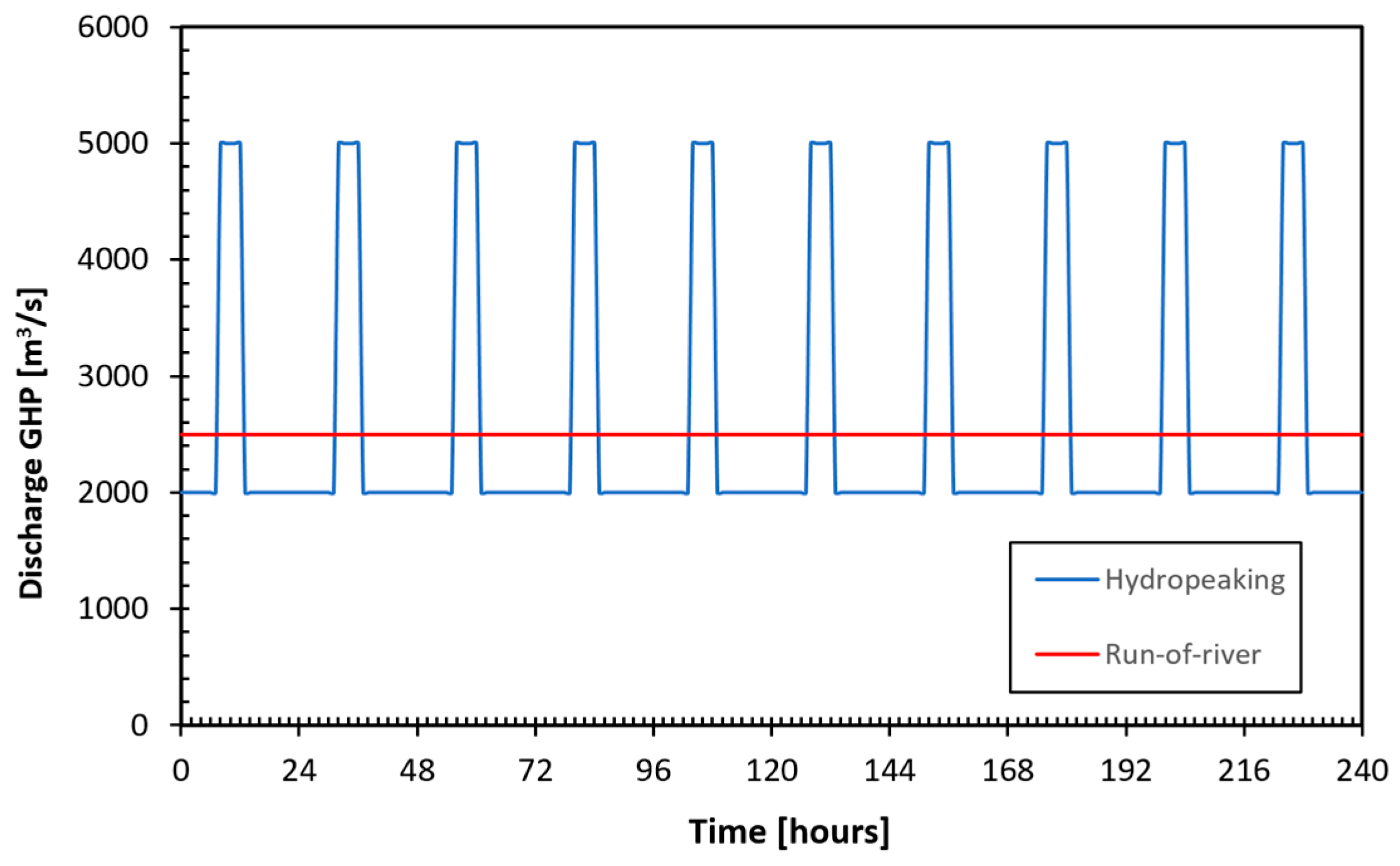
2.3. The GHP Operational Scenarios
3. Results
3.1. Surface Water Flow Model Calibration
3.2. Sediment Transport Model Calibration
3.3. The GHP Operational Scenarios’ Effect on Sediment Transport
3.3.1. Volume of Deposited Sediments in the Fairway at the Critical Ford
3.3.2. Riverbed Elevation in the Fairway at the Critical Ford
4. Discussion
4.1. Key Findings
4.2. Limitations and Future Work
5. Conclusions
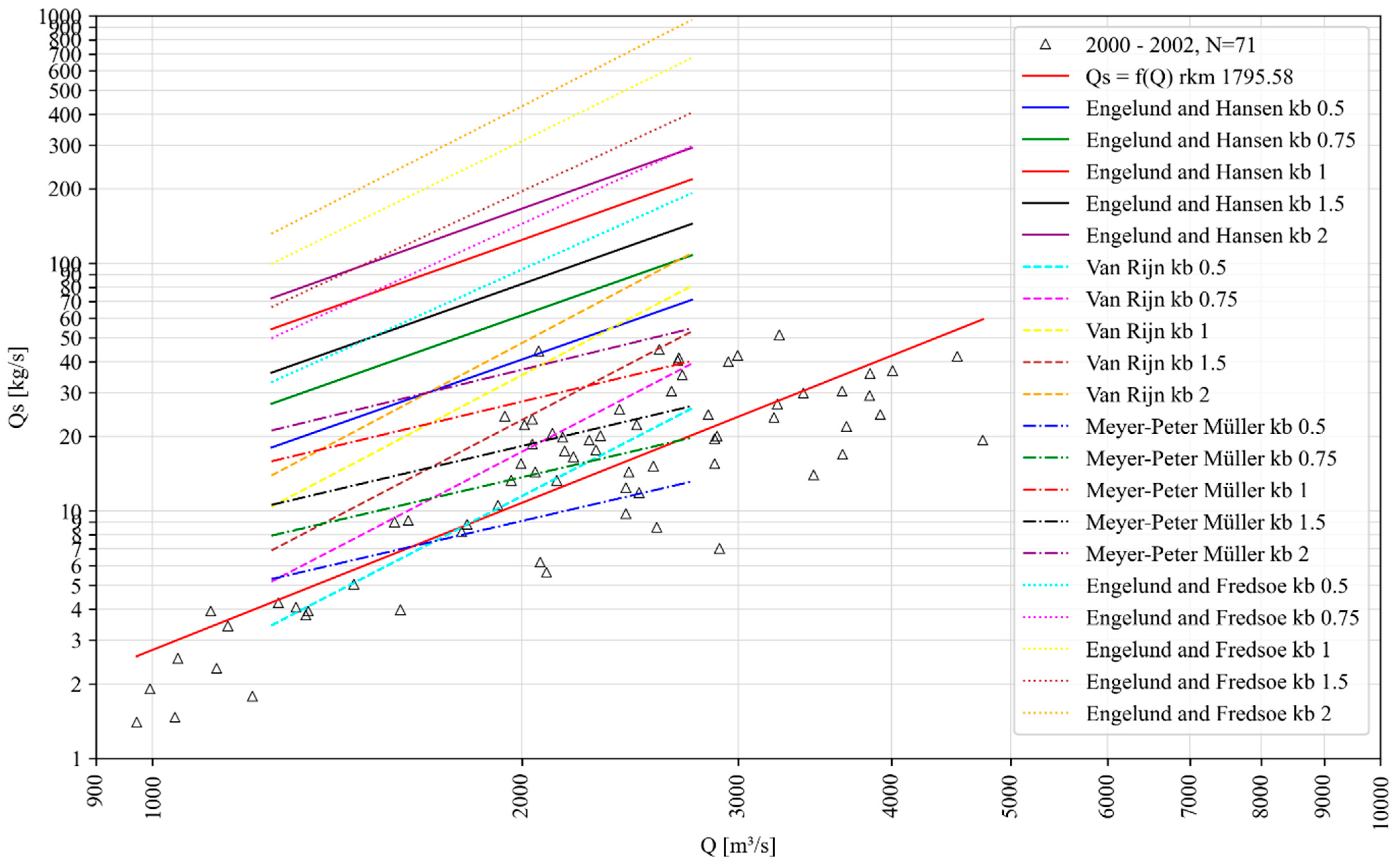
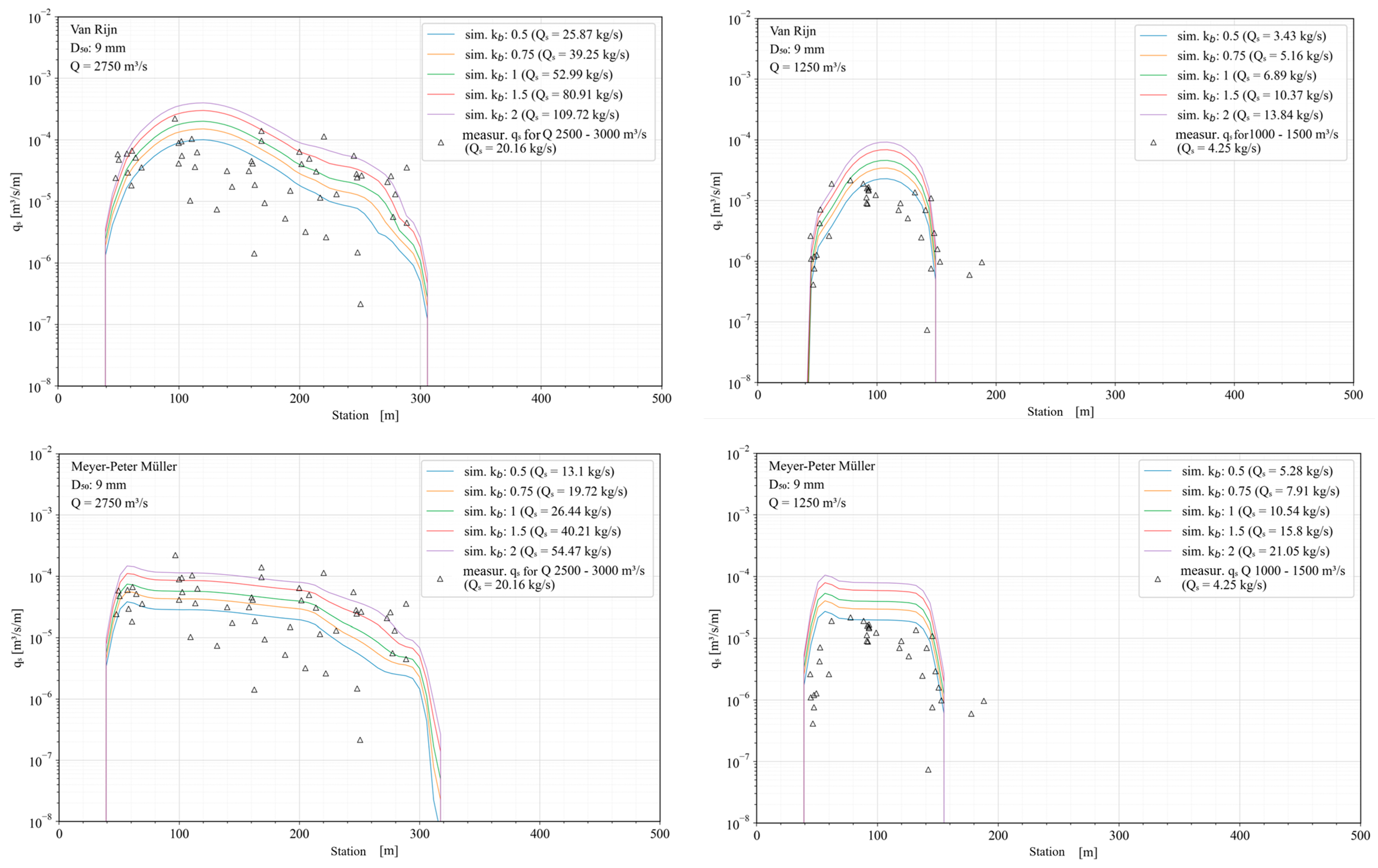
- The developed 2D morphodynamic MIKE 21 ST (Release 2021) model for the 50 km reach of the Danube downstream of the Gabčíkovo Hydropower Plant (GHP) was successfully calibrated against measured water levels (RMSE: 0.074 m, MAE: 0.064 m, R2: 0.998) and measured sediment transport rate values in the cross-section at rkm 1795.58. The Van Rijn formulation with a calibration factor kb = 0.5 was selected as the most suitable sediment transport formula. With this configuration, the model provides a realistic description of the short-term morphological response of the ford to changes in the GHP operational scenario.
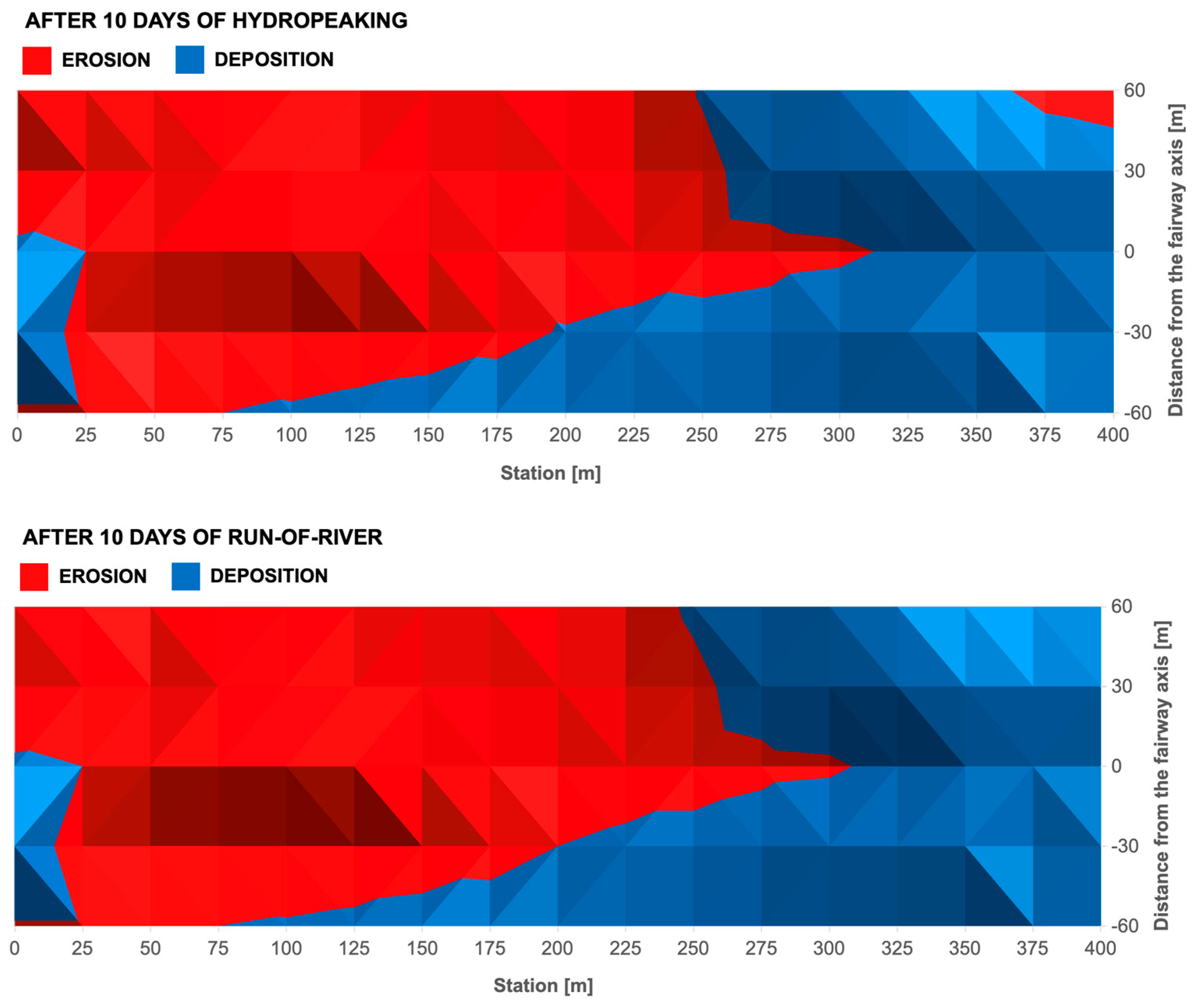
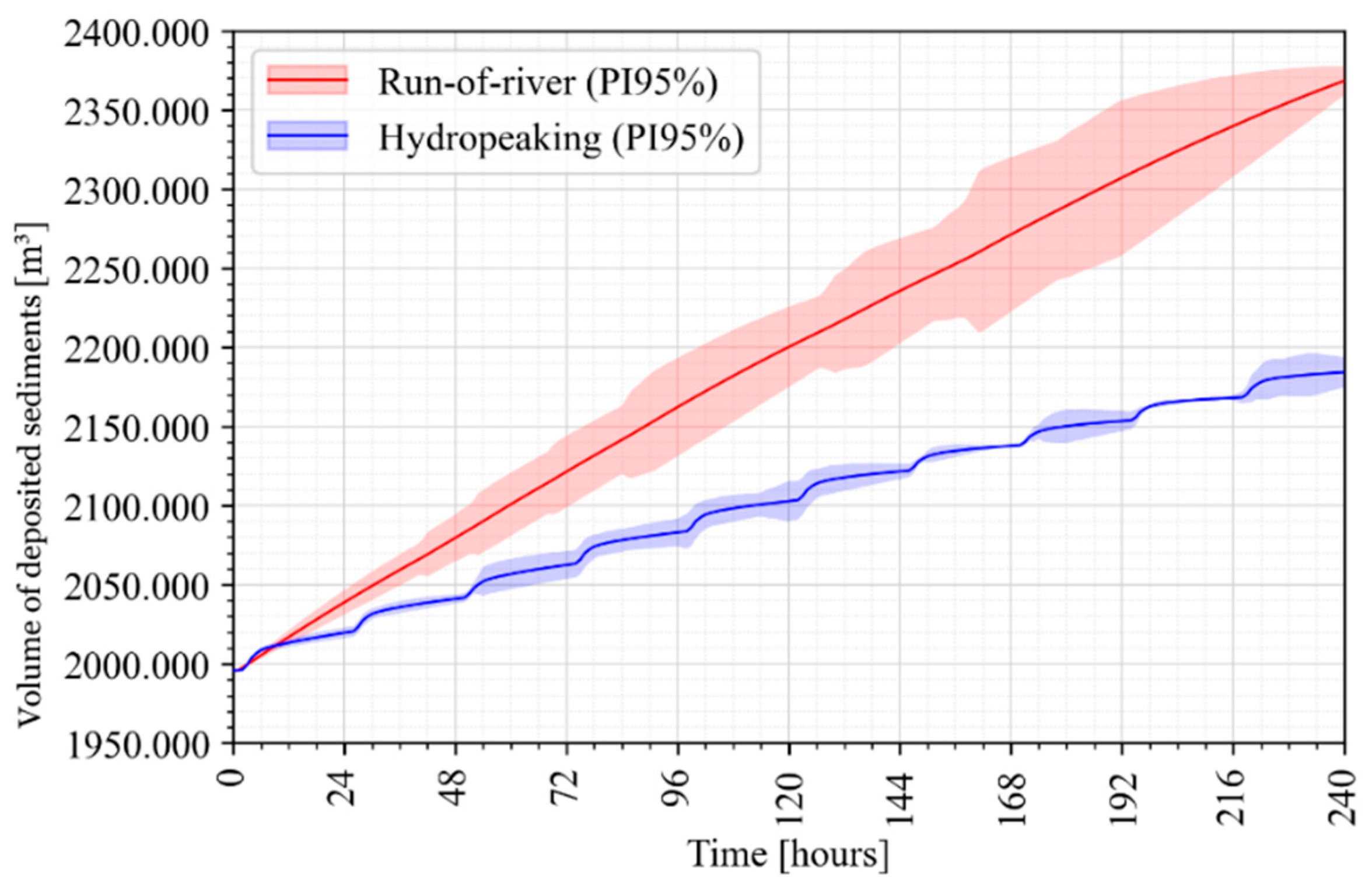
- 10-day simulations showed that, for the same daily volume of water passing through the turbines, the volume of newly deposited sediments in the fairway at the critical ford under hydropeaking is approximately 50% smaller than under run-of-river operation (about 189 m3 vs. 373 m3, a difference of ~184 m3). Hydropeaking is therefore capable of reducing the 10-day cumulative volume of deposited sediments in the fairway compared with run-of-river operation, even when model uncertainty expressed by the 95% prediction intervals is taken into account.
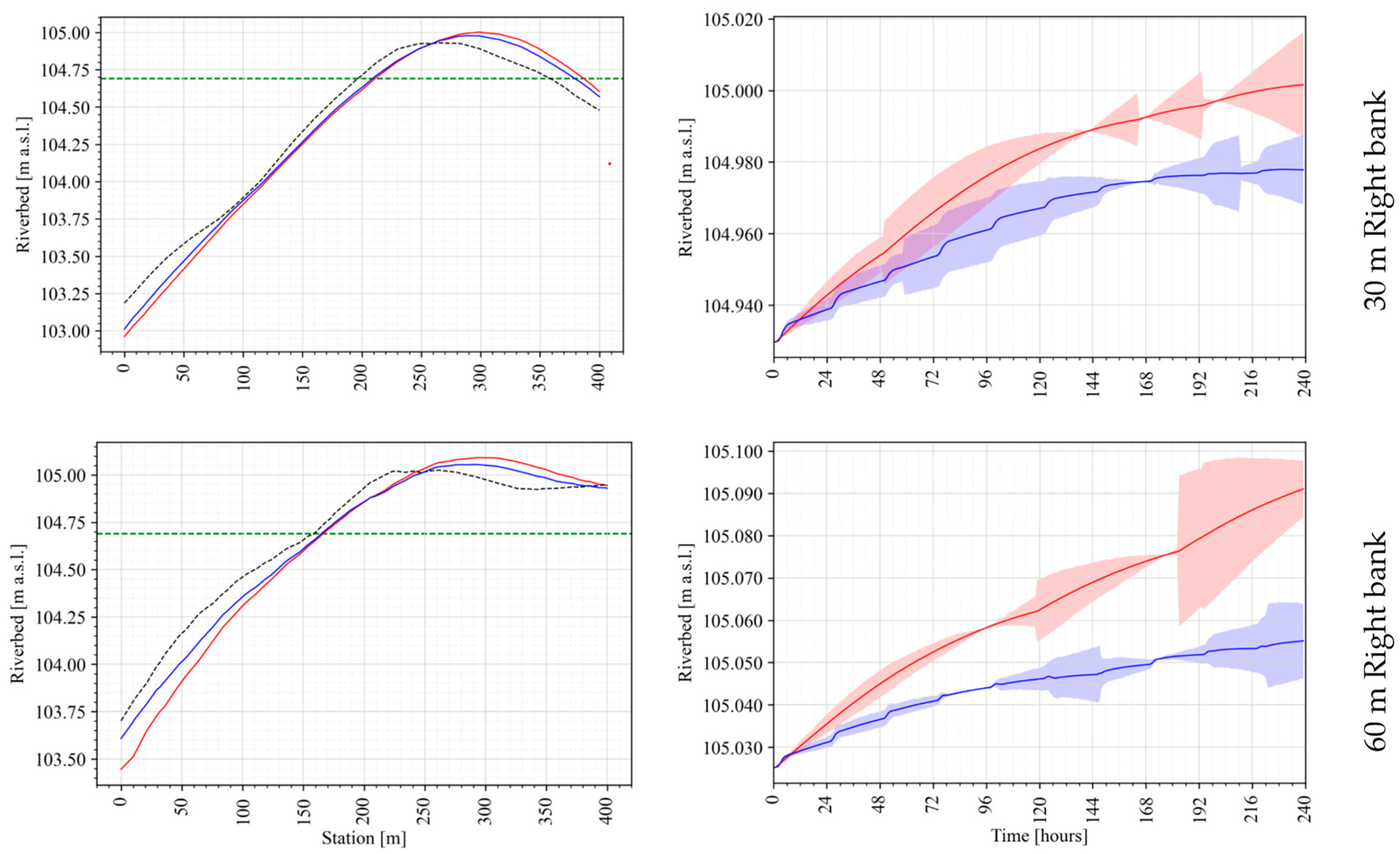
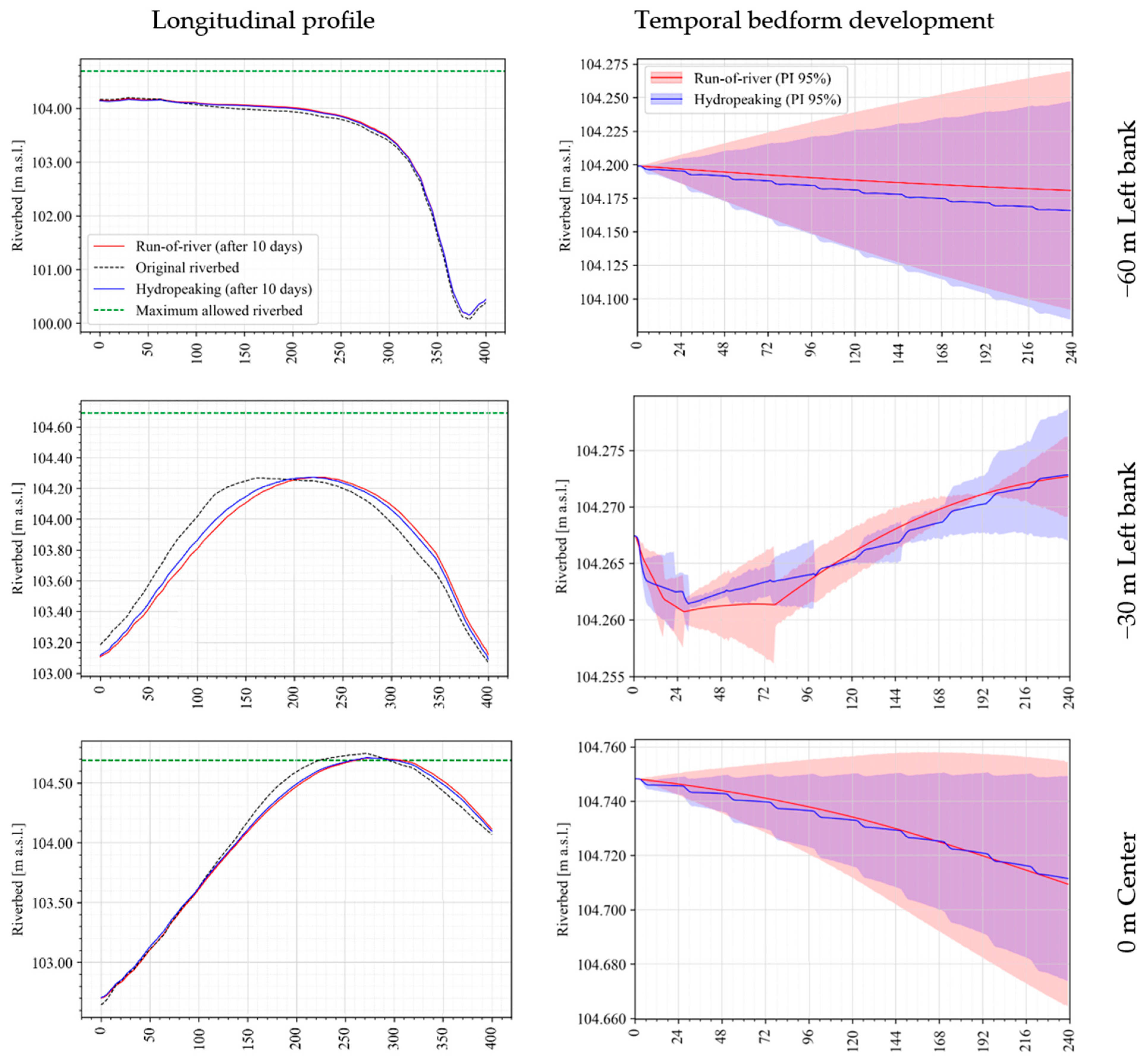
- From the viewpoint of the temporal development of the maximum riverbed elevation, operation with hydropeaking is more advantageous, particularly in the right-bank part of the fairway, where the increase in riverbed elevation is about 33–64% smaller than under run-of-river operation. Nevertheless, the required minimum depth of 2.7 m is not ensured across the entire cross-section of the ford under either scenario, so morphological flow management cannot fully replace technical interventions (dredging), but it can extend the interval between them.
- Under the conditions of the studied reach, from the point of view of maintaining navigable depth, an operational scenario of the GHP that includes regulated short-term discharge peaks (daily hydropeaking) can be considered more advantageous than purely run-of-river operation with a steady discharge, while keeping the total daily volume of used water the same. Hydropeaking can reduce the volume of deposited sediments in the fairway and potentially extend the interval between dredging interventions, which translates into lower fairway maintenance costs and reduced ecological impacts associated with frequent dredging.
- Although, from the navigation perspective, hydropeaking appears favourable in the analysed scenario, the known consequences of discharge fluctuations (bank erosion, habitat degradation, reduction in navigation safety) do not allow its broader implementation to be recommended automatically without a comprehensive assessment. Future modifications of the operation of the GHP should therefore be based on an integrated assessment that combines morphological, navigational, energy and ecological criteria within a common optimisation framework.
Author Contributions
Funding
Data Availability Statement
Acknowledgments
Conflicts of Interest
References
- Julien, P.Y. River Mechanics; Cambridge University Press: Cambridge, UK, 2018. [Google Scholar] [CrossRef]
- Kondolf, G.M.; Wilcock, P.R. The Flushing Flow Problem: Defining and Evaluating Objectives. Water Resour. Res. 1996, 32, 2329–2615. [Google Scholar] [CrossRef]
- Loire, R.; Piégay, H.; Malavoi, J.R.; Kondolf, G.M.; Bêche, L.A. From flushing flows to (eco)morphogenic releases: Evolving terminology, practice, and integration into river management. Earth Sci. Rev. 2021, 213, 103475. [Google Scholar] [CrossRef]
- Smokorowski, K.E. The ups and downs of hydropeaking: A Canadian perspective on the need for, and ecological costs of, peaking hydropower production. Hydrobiologia 2022, 849, 421–441. [Google Scholar] [CrossRef]
- Dynesius, M.; Nilsson, C. Fragmentation and flow regulation of river systems in the northern third of the world. Science 1994, 266, 753–762. [Google Scholar] [CrossRef]
- Kondolf, G. PROFILE: Hungry Water: Effects of Dams and Gravel Mining on River Channels. Environ. Manag. 1997, 21, 533–551. [Google Scholar] [CrossRef]
- Arthington, Á.H.; Naiman, R.J.; Mcclain, M.E.; Nilsson, C. Preserving the biodiversity and ecological services of rivers: New challenges and research opportunities. Freshw. Biol. 2010, 55, 1–16. [Google Scholar] [CrossRef]
- Carolli, M.; Vanzo, D.; Siviglia, A.; Zolezzi, G.; Bruno, M.C.; Alfredsen, K. A simple procedure for the assessment of hydropeaking flow alterations applied to several European streams. Aquat. Sci. 2015, 77, 639–653. [Google Scholar] [CrossRef]
- Vanzo, D.; Siviglia, A.; Carolli, M.; Zolezzi, G. Characterization of sub-daily thermal regime in alpine rivers: Quantification of alterations induced by hydropeaking. Hydrol. Process. 2016, 30, 1052–1070. [Google Scholar] [CrossRef]
- Bejarano, M.D.; Sordo-Ward, Á.; Alonso, C.; Nilsson, C. Characterizing effects of hydropower plants on sub-daily flow regimes. J. Hydrol. 2017, 550, 186–200. [Google Scholar] [CrossRef]
- Ashraf, F.B.; Haghighi, A.T.; Riml, J.; Alfredsen, K.; Koskela, J.J.; Kløve, B.; Marttila, H. Changes in short term river flow regulation and hydropeaking in Nordic rivers. Sci. Rep. 2018, 8, 17232. [Google Scholar] [CrossRef] [PubMed]
- Tonkin, J.D.; Merritt, D.M.; Olden, J.D.; Reynolds, L.V.; Lytle, D.A. Flow regime alteration degrades ecological networks in riparian ecosystems. Nat. Ecol. Evol. 2018, 2, 86–93. [Google Scholar] [CrossRef]
- Zhang, Y.; Zhai, X.; Zhao, T. Annual shifts of flow regime alteration: New insights from the Chaishitan Reservoir in China. Sci. Rep. 2018, 8, 1414. [Google Scholar] [CrossRef]
- Bejarano, M.D.; Jansson, R.; Nilsson, C. The effects of hydropeaking on riverine plants: A review. Biol. Rev. 2018, 93, 658–673. [Google Scholar] [CrossRef]
- Ziliotto, F.; Basilio Hazas, M.; Rolle, M.; Chiogna, G. Mixing enhancement mechanisms in aquifers affected by hydropeaking: Insights from flow-through laboratory experiments. Geophys. Res. Lett. 2021, 48, e2021GL095336. [Google Scholar] [CrossRef]
- Hauer, C.; Holzapfel, P.; Tonolla, D.; Habersack, H.; Zolezzi, G. In situ measurements of fine sediment infiltration (FSI) in gravel-bed rivers with a hydropeaking flow regime. Earth Surf. Process. Landf. 2019, 44, 433–448. [Google Scholar] [CrossRef]
- López, R.; Garcia, C.; Vericat, D.; Batalla, R.J. Downstream changes of particle entrainment in a hydropeaked river. Sci. Total Environ. 2020, 745, 140952. [Google Scholar] [CrossRef]
- Vericat, D.; Ville, F.; Palau-Ibars, A.; Batalla, R.J. Effects of Hydropeaking on Bed Mobility: Evidence from a Pyrenean River. Water 2020, 12, 178. [Google Scholar] [CrossRef]
- Trung, L.D.; Duc, N.A.; Nguyen, L.T.; Thai, T.H.; Khan, A.; Rautenstrauch, K.; Schmidt, C. Assessing cumulative impacts of the proposed lower Mekong Basin hydropower cascade on the Mekong River floodplains and Delta—Overview of integrated modeling methods and results. J. Hydrol. 2020, 581, 122511. [Google Scholar] [CrossRef]
- López, R.; Ville, F.; Garcia, C.; Batalla, R.J.; Vericat, D. Bed-material entrainment in a mountain river affected by hydropeaking. Sci. Total Environ. 2023, 856, 159065. [Google Scholar] [CrossRef]
- Gierszewski, P.J.; Habel, M.; Szmańda, J.; Luc, M. Evaluating effects of dam operation on flow regimes and riverbed adaptation to those changes. Sci. Total Environ. 2020, 710, 136202. [Google Scholar] [CrossRef]
- Szmańda, J.B.; Gierszewski, P.J.; Habel, M.; Luc, M.; Witkowski, K.; Bortnyk, S.; Obodovskyi, O. Response of the Dnieper River fluvial system to the river erosion caused by the operation of the Kaniv hydro-electric power plant (Ukraine). Catena 2021, 202, 105265. [Google Scholar] [CrossRef]
- Fošumpaur, P.; Králik, M.; Zukal, M. Physical and numerical modelling in the research of hydraulic structures. In Proceedings of the International Conference on Modelling and Simulation 2010, Prague, Czech Republic, 22–25 June 2010; Available online: https://www.researchgate.net/publication/332415598_Physical_and_numerical_modelling_in_the_research_of_hydraulic_structures#fullTextFileContent (accessed on 20 January 2026).
- Habersack, H.; Hengl, M.; Huber, B.; Lalk, P.; Tritthart, M. Fließgewässermodellierung–Arbeitsbehelf Feststofftransport und Gewässermorphologie; Austrian Federal Ministry of Agriculture, Forestry, Environment and Water Management: Vienna, Austria; Österreichischer Wasser-und Abfallwirtschaftsverband ÖWAV: Vienna, Austria, 2011; Available online: https://info.bml.gv.at/dam/jcr:bddb0f2b-a454-4b9f-915a-57553d88461f/Flie%C3%9Fgew%C3%A4ssermodellierung-AB%20Feststofftransport%20und%20Gew%C3%A4ssermorphologie.pdf (accessed on 20 January 2026).
- Engelund, F.; Hansen, E. A Monograph on Sediment Transport in Alluvial Streams; Technical University of Denmark: Copenhagen, Denmark, 1967; Available online: https://scispace.com/pdf/a-monograph-on-sediment-transport-in-alluvial-streams-5782l9wpz2.pdf (accessed on 20 January 2026).
- Van Rijn, L.C. Sediment transport, part I: Bed load transport. J. Hydraul. Eng. 1984, 110, 1431–1456. [Google Scholar] [CrossRef]
- Meyer-Peter, E.; Müller, R. Formulas for bed-load transport. In Proceedings of the 2nd Meeting of the International Association for Hydraulic Structures Research, Stockholm, Sweden, 7–9 May 1948; pp. 39–64. Available online: https://scispace.com/pdf/formulas-for-bed-load-transport-32ronh3p7c.pdf (accessed on 20 January 2026).
- Engelund, F.; Fredsøe, J. A sediment transport model for straight alluvial channels. Hydrol. Res. 1976, 7, 293–306. [Google Scholar] [CrossRef]
- Summer, W.; Stritzinger, W.; Zhang, W. The impact of run-of-river hydropower plants on Temporal Suspended Sediment Transport Behaviour. In IAHS Publications-Series of Proceedings and Reports-Intern Assoc Hydrological Sciences; IAHS: Oxfordshire, UK, 1994; pp. 411–420. Available online: https://iahs.info/uploads/dms/9867.411-419-224-Summer.pdf (accessed on 20 January 2026).
- Csiki, S.; Rhoads, B.L. Hydraulic and geomorphological effects of run-of-river dams. Prog. Phys. Geogr. 2010, 34, 755–780. [Google Scholar] [CrossRef]
- Holubová, K.; Čomaj, M.; Lukáč, M.; Mravcová, K.; Capeková, Z.; Antalová, M. Final Report in DuRe Flood Project—‘Danube Floodplain Rehabilitation to Improve Flood Protection and Enhance the Ecological Values of the River in the Stretch Between Sap and Szob; Danube Transnational Programme: Bratislava, Slovakia, 2015. [Google Scholar]
- Török, G.T.; Baranya, S. Morphological investigation of a critical reach of the upper Hungarian Danube. Period. Polytech. Civ. Eng. 2017, 61, 752–761. [Google Scholar] [CrossRef]
- DHI. MIKE 21 & MIKE 3 FLOW MODEL FM, Hydrodynamic and Transport Module; Scientific Documentation; DHI Water & Environment: Richmond, BC, Canada, 2017. [Google Scholar]
- DHI. MIKE 21 & MIKE 3 FLOW MODEL FM, Sand Transport Module; Scientific Documentation; DHI Water & Environment: Richmond, BC, Canada, 2017. [Google Scholar]
- Gómez-Zambrano, H.J.; López-Ríos, V.I.; Toro-Botero, F.M. New methodology for calibration of hydrodynamic models in curved open-channel flow. Rev. Fac. Ing. Univ. Antioq. 2017, 82–91. [Google Scholar] [CrossRef][Green Version]
- Camenen, B.; Holubová, K.; Lukač, M.; Le Coz, J.; Paquier, A. Assessment of methods used in 1D models for computing bed-load transport in a large river: The Danube River in Slovakia. J. Hydraul. Eng. 2011, 137, 1190–1199. [Google Scholar] [CrossRef][Green Version]
- Allen, J. Principles of Physical Sedimentology; Springer Science & Business Media: Berlin, Germany, 2012. [Google Scholar]
- Frings, R.M.; Schüttrumpf, H.; Vollmer, S. Verification of porosity predictors for fluvial sand-gravel deposits. Water Resour. Res. 2011, 47. [Google Scholar] [CrossRef]
- Lukač, M.; Holubová, K.; Szolgay, J. Research on the Suspended and Bed Load Regime of the Danube Downstream of Sap; Final Report; VÚVH: Bratislava, Slovakia, 2002. [Google Scholar]
- Mahadevan, S.; Sarkar, S. Uncertainty Analysis Methods; US Department of Energy: Washington, DC, USA, 2009; Available online: https://www-pub.iaea.org/MTCD/Publications/PDF/TE-1701_add-CD/PDF/USA%20Attachment%2012.pdf (accessed on 20 January 2026).
- Walters, R.W.; Huyse, L. Uncertainty Analysis for Fluid Mechanics with Applications; NASA Center for AeroSpace Information: Hanover, MD, USA, 2002; Available online: https://www.cs.odu.edu/~mln/ltrs-pdfs/icase-2002-1.pdf (accessed on 20 January 2026).
- Dalledonne, G.; Kopmann, R.; Riehme, J.; Naumann, U. Uncertainty analysis approximation for non-linear processes using Telemac-AD. In Proceedings of the XXIVth TELEMAC-MASCARET User Conference 2017, Graz, Austria, 17–20 October 2017; pp. 65–71. Available online: https://henry.baw.de/server/api/core/bitstreams/8aac7019-f2d5-4724-8a7b-fc223376afd7/content (accessed on 20 January 2026).
- Melching, C.S. An improved first-order reliability approach for assessing uncertainties in hydrologic modeling. J. Hydrol. 1992, 132, 157–177. [Google Scholar] [CrossRef]
- Saltelli, A.; Ratto, M.; Andres, T.; Campolongo, F.; Cariboni, J.; Gatelli, D.; Saisana, M.; Tarantola, S. Global Sensitivity Analysis. The Primer; John Wiley & Sons: Chichester, UK, 2008. [Google Scholar] [CrossRef]







| Scenario | GHP Flow [m3/s] | Flow—Old Danube Riverbed [m3/s] | Flow—Moson Danube [m3/s] | Water Level—Komárno [m a.s.l.] |
|---|---|---|---|---|
| 1 | 990 | 205 | 40 | 104.88 |
| 2 | 2780 | 254 | 40 | 107.15 |
| 3 | 4700 | 420 | 40 | 108.92 |
| Scenario | Water Level—Medveďov [m a.s.l.] | Water Level—Kližská Nemá [m a.s.l.] |
|---|---|---|
| 1 | 108.85 | 106.18 |
| 2 | 111.65 | 108.63 |
| 3 | 113.82 | 110.74 |
| Scenario | Water Level—Medveďov [m a.s.l.] | Water Level—Kližská Nemá [m a.s.l.] | RMSE | MAE | R2 | ||
|---|---|---|---|---|---|---|---|
| Measured | Simulated | Measured | Simulated | ||||
| 1 | 108.85 | 108.80 | 106.18 | 106.23 | 0.074 | 0.064 | 0.998 |
| 2 | 111.65 | 111.68 | 108.63 | 108.64 | |||
| 3 | 113.82 | 113.69 | 110.74 | 110.64 | |||
| Transport Formula | kb | Q = 2750 m3/s QS = 20.16 kg/s | Q = 1250 m3/s QS = 4.25 kg/s | RMSE | MAE | R2 |
|---|---|---|---|---|---|---|
| QS [kg/s] | QS [kg/s] | |||||
| Engelund and Hansen | 0.5 | 71.08 | 17.97 | 37.29 | 32.32 | −20.95 |
| 0.75 | 107.58 | 27 | 63.87 | 55.09 | −63.42 | |
| 1 | 218.11 | 54.07 | 144.33 | 123.88 | −327.95 | |
| 1.5 | 144.17 | 36.05 | 90.53 | 77.91 | −128.4 | |
| 2 | 292.45 | 72.08 | 198.42 | 170.06 | −620.66 | |
| Engelund and Fredsoe | 0.5 | 191.95 | 33.03 | 123.17 | 100.29 | −238.54 |
| 0.75 | 297.02 | 49.67 | 198.38 | 161.14 | −620.45 | |
| 1 | 675.49 | 99.28 | 468.23 | 375.18 | −3460.86 | |
| 1.5 | 405.51 | 66.35 | 276 | 223.73 | −1201.81 | |
| 2 | 962.12 | 131.5 | 672.12 | 534.61 | −7132.07 | |
| Van Rijn | 0.75 | 39.25 | 5.16 | 13.52 | 10 | −1.88 |
| 0.5 | 25.87 | 3.43 | 4.08 | 3.26 | 0.74 | |
| 1 | 80.91 | 10.37 | 43.17 | 33.44 | −28.43 | |
| 1.5 | 52.99 | 6.89 | 23.29 | 17.74 | −7.56 | |
| 2 | 109.72 | 13.84 | 63.69 | 49.58 | −63.05 | |
| Meyer-Peter Müller | 1 | 40.21 | 15.8 | 16.36 | 15.8 | −3.23 |
| 0.5 | 13.1 | 5.28 | 5.05 | 4.05 | 0.6 | |
| 0.75 | 19.72 | 7.91 | 2.61 | 2.05 | 0.89 | |
| 1.5 | 26.44 | 10.54 | 6.28 | 6.28 | −3.38 | |
| 2 | 54.47 | 21.05 | 27.01 | 25.55 | −10.52 |
| GHP Scenario | Day 0 [m3] | After 10 Days [m3] | Δ [m3] | After 10 Days (PI95%) [m3] |
|---|---|---|---|---|
| Run-of-river (24 h—2500 m3/s) | 1995 | 2368 | 373 | 2359–2377 |
| Hydropeaking (4 h—5000 m3/s, 20 h—2000 m3/s) | 1995 | 2184 | 189 | 2174–2193 |
| Distance from the Fairway’s Axis [m] | Original Depth - Day 0 - [m] | GHP Scenario - After 10 Days - | |||
|---|---|---|---|---|---|
| Run-of-River (24 h—2500 m3/s) | Hydropeaking (4 h—5000 m3/s, 20 h—2000 m3/s) | ||||
| [m] | PI 95% [m] | [m] | PI 95% [m] | ||
| −60 | 3.20 | 3.21 | 3.12–3.30 | 3.22 | 3.14–3.31 |
| −30 | 3.13 | 3.12 | 3.11–3.12 | 3.12 | 3.11–3.12 |
| 0 | 2.65 | 2.68 | 2.64–2.73 | 2.68 | 2.64–2.72 |
| +30 | 2.46 | 2.39 | 2.37–2.40 | 2.41 | 2.40–2.42 |
| +60 | 2.37 | 2.30 | 2.29–2.31 | 2.34 | 2.33–2.34 |
| Distance from the Fairway’s Axis [m] | GHP Scenario | Δ | |
|---|---|---|---|
| Run-of-River (24 h—2500 m3/s) | Hydropeaking (4 h—5000 m3/s, 20 h—2000 m3/s) | ||
| PI 95% [m] | PI 95% [m] | PI 95% [m] | |
| −60 | −0.11~0.07 | −0.11~0.05 | 0.00~−0.02 |
| −30 | 0.00~0.01 | 0.00~0.01 | 0.00~0.00 |
| 0 | −0.08~0.01 | −0.07~0.00 | 0.01~−0.01 |
| +30 | 0.06~0.09 | 0.04~0.06 | −0.02~−0.03 |
| +60 | 0.06~0.07 | 0.02~0.04 | −0.04~−0.03 |
Disclaimer/Publisher’s Note: The statements, opinions and data contained in all publications are solely those of the individual author(s) and contributor(s) and not of MDPI and/or the editor(s). MDPI and/or the editor(s) disclaim responsibility for any injury to people or property resulting from any ideas, methods, instructions or products referred to in the content. |
© 2026 by the authors. Licensee MDPI, Basel, Switzerland. This article is an open access article distributed under the terms and conditions of the Creative Commons Attribution (CC BY) license.
Share and Cite
Šulek, P.; Buček, D. The Influence of Hydropower Plant Operational Scenarios on Maintaining the Navigable Depths in an Anthropized River Reach: A Case Study on the Danube River in Slovakia Downstream of the Gabčíkovo Hydropower Plant. Water 2026, 18, 800. https://doi.org/10.3390/w18070800
Šulek P, Buček D. The Influence of Hydropower Plant Operational Scenarios on Maintaining the Navigable Depths in an Anthropized River Reach: A Case Study on the Danube River in Slovakia Downstream of the Gabčíkovo Hydropower Plant. Water. 2026; 18(7):800. https://doi.org/10.3390/w18070800
Chicago/Turabian StyleŠulek, Peter, and Daniel Buček. 2026. "The Influence of Hydropower Plant Operational Scenarios on Maintaining the Navigable Depths in an Anthropized River Reach: A Case Study on the Danube River in Slovakia Downstream of the Gabčíkovo Hydropower Plant" Water 18, no. 7: 800. https://doi.org/10.3390/w18070800
APA StyleŠulek, P., & Buček, D. (2026). The Influence of Hydropower Plant Operational Scenarios on Maintaining the Navigable Depths in an Anthropized River Reach: A Case Study on the Danube River in Slovakia Downstream of the Gabčíkovo Hydropower Plant. Water, 18(7), 800. https://doi.org/10.3390/w18070800