Next Article in Journal
Water Quality and Land Use Impacts in a Brazilian Conservation Unit with Speleological Heritage
Previous Article in Journal
Mapping Water: A Brief History of GIS in Hydrology and a Path Toward AI-Native Modeling
Previous Article in Special Issue
Synergistic Ozone-Ultrasonication Pretreatment for Enhanced Algal Bioresource Recovery: Optimization and Detoxification
 
 
Due to scheduled maintenance work on our servers, there may be short service disruptions on this website between 11:00 and 12:00 CEST on March 28th.
Article

Environmental Drivers of Algal Blooms in a Tropical Coastal Riverine System: A Multivariate Statistical Approach


by
Miguel Gurumendi-Noriega
1,2,*,
Mariela González-Narváez
3,4,
John Ramos-Veliz
2,
Andrea Mishell Rosado-Moncayo
2,
Boris Apolo-Masache
2,
Luis Dominguez-Granda
1,2,
Julio Bonilla
5 and
Christine Van der Heyden
6
1
Facultad de Ciencias Naturales y Matemáticas, Escuela Superior Politécnica del Litoral (ESPOL), Campus Gustavo Galindo, Km. 30.5 Vía Perimetral, Guayaquil 090902, Ecuador
2
Centro del Agua y Desarrollo Sustentable, Escuela Superior Politécnica del Litoral (ESPOL), Campus Gustavo Galindo, Km. 30.5 Vía Perimetral, Guayaquil 090902, Ecuador
3
Facultad de Ciencias de la Vida, Escuela Superior Politécnica del Litoral (ESPOL), Campus Gustavo Galindo, Km. 30.5 Vía Perimetral, Guayaquil 090902, Ecuador
4
Centro de Estudios e Investigaciones Estadísticas, Escuela Superior Politécnica del Litoral (ESPOL), Campus Gustavo Galindo, Km. 30.5 Vía Perimetral, Guayaquil 090902, Ecuador
5
Faculty of Health Sciences, Universidad de Especialidades Espíritu Santo, Samborondón 092301, Ecuador
6
Department of Biosciences and Industrial Technology, Health and Water Technology Research Centre, HOGENT—University of Applied Sciences and Arts, Valentin Vaerwyckweg 1, 9000 Gent, Belgium
*
Author to whom correspondence should be addressed.
Water 2026, 18(7), 797; https://doi.org/10.3390/w18070797
Submission received: 10 February 2026 / Revised: 17 March 2026 / Accepted: 25 March 2026 / Published: 27 March 2026
(This article belongs to the Special Issue Microalgae Control and Utilization: Challenges and Perspectives)

Highlights

What are the main findings?
  • Combined statistical approaches allowed the identification of algal bloom drivers.
  • High concentrations of ammonium-N, pH and dissolved oxygen favour algal abun-dance in the Daule River.
  • Site-specific conditions shape algal abundance and composition.
What are the implications of the main findings?
  • Integrated statistical analysis enhances the understanding of algal dynamics.
  • Nitrogen management is essential to reduce algal blooms in tropical rivers.
  • Local interventions can support mitigation actions.

Abstract

Nutrient inputs from human activities, such as agriculture and sewage discharge, influence algal blooms in water bodies. In Ecuador, the Daule River receives wastewater discharges. In addition, poor agricultural practices, including the unsuitable use of fertilisers in combination with soil erosion and surface runoff processes, increase the nutrient load to the river. Considering this, the objective of this study was to evaluate environmental and biological variables using statistical analysis to identify the parameters that influence algal blooms in the main stem of the Daule River. The methodology consisted of two phases: (i) data collection, including water sampling and laboratory work for the analysis of nutrients and phytoplankton, and (ii) statistical analysis, which includes univariate, bivariate, inferential and multivariate analysis (STATICO technique). The results showed that pH and dissolved oxygen were the main drivers of diatoms (Polymyxus coronalis and Aulacoseira granulate) and the charophyte Mougeotia sp. Similarly, ammonium-N was the main driver of the diatom Ulnaria ulna and the cyanobacteria Planktothrix cf. agardhii. The outcomes of this study identified the main environmental variables driving blooms of the five most abundant species, providing a basis for the development of ecological models in the context of land use and climate change.

1. Introduction

Algae are a group of photosynthetic organisms that include both eukaryotic (such as green, red, and brown algae) and prokaryotic forms (cyanobacteria) [1]. They play an essential role in ecosystems, including primary production and carbon cycling in marine and freshwater environments [2]. However, excessive algal abundance or algal blooms represent an environmental problem [3], leading to significant changes to aquatic ecosystems, water quality and filter clogging in drinking water treatment plants [4,5].
Some primary types of algal blooms include cyanobacteria, dinoflagellates, diatoms, haptophytes, raphidophytes and green algae [6]. For example, cyanobacteria can produce cyanotoxins (e.g., microcystin) [7], decrease oxygen levels, alter the food chain [8] and cause odours in water bodies and drinking water [9]. In addition, cyanotoxins encompass neurotoxins, hepatotoxins, cytotoxins, and endotoxins, resulting in health risks [10]. This type of algal dominance is known as a harmful algal bloom (HAB).
Worldwide increases in HABs are of concern in water resources management [11]. The occurrence of HABs is attributed to anthropogenic activity, eutrophication and climate change [12], resulting in biodiversity loss, economic impacts (tourism and fisheries sectors), and threats to human and animal health [13].
According to Yan et al. [14], HABs are influenced by chemical factors such as phosphorus, nitrogen, the ratio of nutrients, trace metals (iron, manganese, zinc, and selenium), vitamins (B12) and silicon; physical factors such as salinity, stratification or vertical density gradients; biological factors such as competition, grazing pressure, and adaptability among organisms; and climatological factors such as temperature, pH, partial pressure of carbon dioxide, irradiance and light. In addition, algal blooms are driven by interactions among multiple factors [15,16,17].
River–estuary–coastal systems play a vital role in the transfer of matter between terrestrial and marine environments [18]. In particular, tropical rivers transport large quantities of nutrients, originating from both natural processes and human activities, including agriculture, aquaculture and urban runoff [19]. In estuarine ecosystems, primary production is regulated by salinity, light, turbidity, temperature, nutrients, grazers, and water dynamics [20]. Nutrient loads, particularly nitrogen and phosphorus, influence phytoplankton growth [21] and promote HABs [22].
A key tool for identifying essential factors that promote algal blooms is statistical analysis, which allows the understanding of species–environment relationships [23,24,25]. For instance, multivariate methods such as redundancy analysis, canonical correspondence analysis, the Mantel test, and Generalised Dissimilarity Modelling are used to analyse phytoplankton communities and determine their spatial and temporal distributions [26,27]. Furthermore, dimensionality reduction techniques such as principal component analysis (PCA) enable the identification of physicochemical and meteorological parameters that correlate with phytoplankton abundance [28].
In Ecuador, some studies on HABs have been conducted. For example, some of them include identification of the oceanographic conditions that lead to HABs and spatio-temporal patterns of dinoflagellates along the Ecuadorian coast [29,30]. Other studies focused on the risk perception of coastal communities and authorities regarding HABs [31] and on the abundance of cyanobacteria in shrimp ponds at the Chone and Jama rivers [32].
The Daule River is the primary source of freshwater for the population of the Guayas province. However, there have been environmental impacts resulting from domestic wastewater discharges [33], poor agricultural practices due to the usage of pesticides and large quantities of fertilisers such as urea, ammonium sulphate, superphosphate and ammonium phosphate [34,35], which are transported into surface waters through soil erosion and runoff leading to water quality problems and effects on public health (e.g., gastrointestinal diseases).
Raphidiopsis raciborskii (Wołoszyńska) Aguilera et al. [36] is an example of cyanobacteria reported in the Daule River [32]. This species produces hepatotoxins (microcystin and cylindrospermopsin) and neurotoxins (saxitoxin and neosaxitoxin), resulting in gastrointestinal disorders, respiratory issues, fever, headache, vomiting, and bloody diarrhoea [32]. Therefore, it is necessary to understand the spatio-temporal factors that promote algal blooms through continuous monitoring and management.
Identifying the parameters that influence algal blooms in the Daule River is related to some sustainable development goals [37], such as: (i) good health and well-being (Goal 3), as some algae produce toxins that can affect human communities that consume water or fishery products; (ii) clean water and sanitation (Goal 6), as this study seeks to understand the environmental conditions that promote algal blooms; (iii) responsible consumption and production (Goal 12), since certain algal blooms are caused by excess nutrients from agriculture, wastewater and poor production practices; and (iv) life on land (Goal 15), as algal blooms affect the biodiversity of rivers and lakes.
In this context, the following research question is addressed: Is it possible to identify environmental factors influencing algal blooms through statistical analysis? Therefore, this study aims to evaluate the species–environment relationship using statistical methods to identify the factors that trigger algal blooms in the Daule River, thereby providing an essential basis for ecological modelling.

2. Materials and Methods

2.1. Study Area

The study area is located in the Daule River watershed in Ecuador. The Daule River is essential to Ecuador, as it crosses the coastal region, supporting various uses such as livestock, industrial activities, and human consumption, with agriculture as the primary land use [38]. On the other hand, in the northern part of the watershed is the Daule-Peripa reservoir, a multipurpose hydropower dam that protects the lower part of the watershed from flooding and regulates water flow, providing year-round water [38].
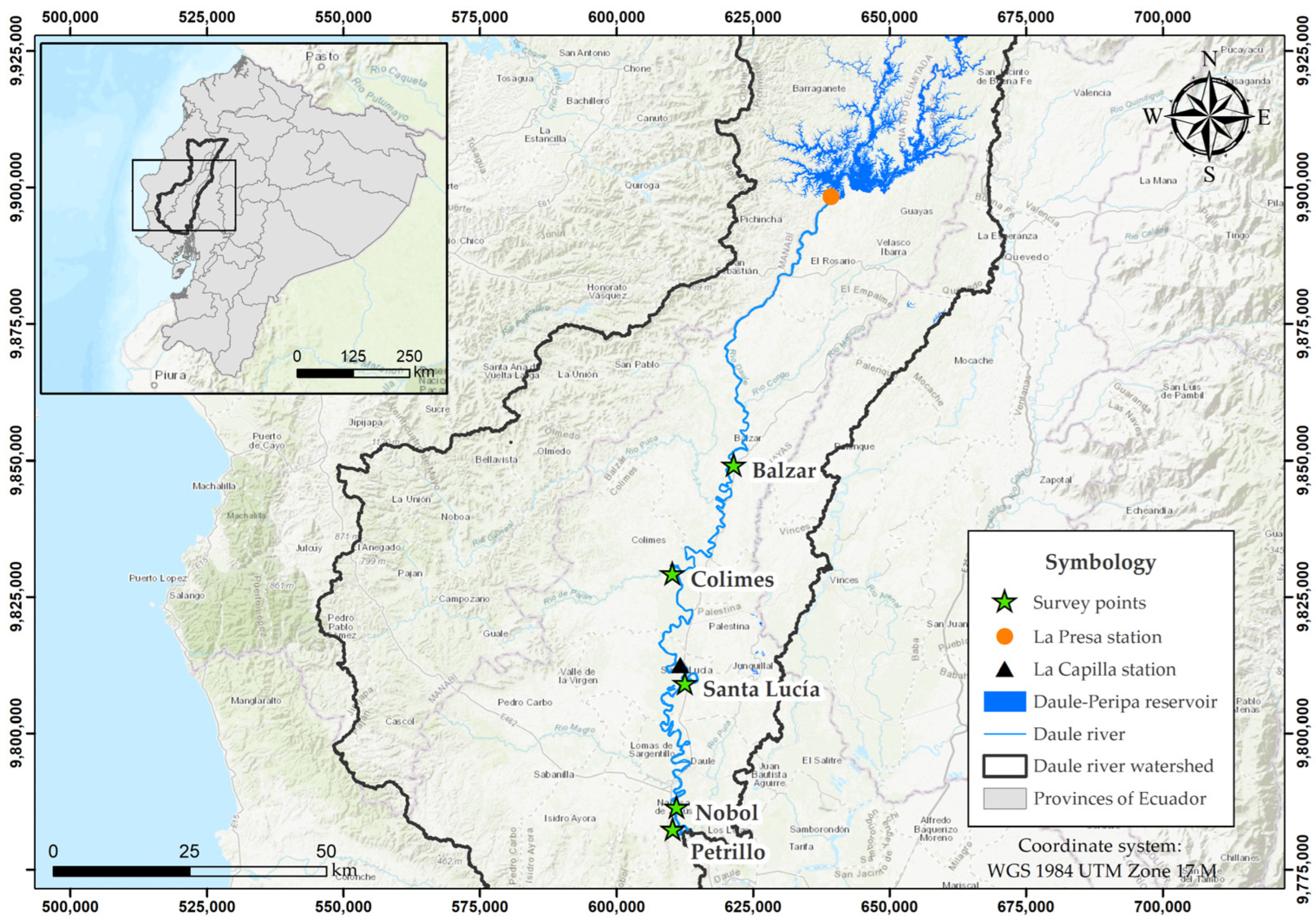
Sampling sites consisted of lotic environments (riverine systems) distributed in the towns of Balzar, Colimes, Santa Lucía, Nobol and Petrillo (Figure 1). Additionally, water sampling was conducted monthly during a period with no tidal influence from May 2024 to April 2025.

2.2. Data and Methods

This study employed a mixed qualitative–quantitative approach and encompassed two steps: data collection, including the physicochemical parameters and chemical analysis, biological analysis, and the meteorological and hydrological variables. Additionally, statistical analysis approaches were used for identifying factors that promote algal blooms (Supplementary Material Figure S1).

2.2.1. Water Sampling and Laboratory Analysis

  • Sensor calibration
The HANNA model HI9828 (Hanna Instruments, Villafranca, Italy) and HACH HQ40 (Hach Company, Loveland, CO, USA) multiparameter probes were used to record water quality data. Before collecting measurements at each sampling site, the pH sensor was calibrated using a multi-point (two-point) procedure, employing standard buffer solutions of pH 4.01 and 7.01 (Hach Company, Loveland, CO, USA) due to the expected measurement range. After each solution, the electrode was rinsed with deionised water, gently dried with absorbent paper, and then placed in the corresponding standard solution until a stable reading was recorded. The calibration was automatically verified by the equipment before the measurements began.
The conductivity sensor was calibrated using a certified conductivity standard solution of 1413 µS/cm. Prior to calibration, the sensor was rinsed with deionised water, followed by the standard solution. Calibration was performed once the reading stabilised, considering the equipment’s automated temperature correction.
The turbidity sensor was calibrated using formazine-based turbidity standards and a multi-point calibration procedure with solutions at 0, 20, and 200 FNU. Before calibration, the sensor’s cleanliness was verified, and air bubbles were avoided. The equipment accepted each calibration point only after reaching consistent records, ensuring the reliability of the values obtained.
In contrast, the HACH HQ40 instrument was calibrated following the manufacturer’s recommendations for the dissolved oxygen sensor. Calibration was performed using the air saturation method (single-point calibration) [39]. The sensor was previously conditioned to avoid direct contact with water and exposed to saturated air until a stable reading of 100% saturation was achieved.
  • Physicochemical parameters and sampling
The physicochemical parameters were measured in situ using the HANNA multiparameter instrument. The sensor was placed in the water body, waiting 5 to 10 s for stabilisation, after which the water temperature (°C), conductivity (µS/cm), total dissolved solids (mg/L), salinity (parts per thousand, ppt), pH, oxidation–reduction potential (mV), turbidity (FNU) and resistivity (MΩ·cm) were recorded [40,41,42,43]. In contrast, the HACH HQ40 multiparameter probe was used to measure the percentage of saturation and concentration of dissolved oxygen (mg/L).
Water sampling was performed using 1 L bottles (white or amber plastic bottles) that had been previously prepared in the laboratory with phosphate-free soap (Liquinox®, Valconox, White Plains, NY, USA) and a hydrochloric acid (Merck KGaA, Darmstadt, Germany) solution to remove traces of organic matter. Once at the sampling site, the bottle was labelled with the date, location, and sampling-point code. It was rinsed with river water at least three times, then the sample was collected by submerging the bottle in the water body and filling it completely. It was verified to ensure proper closure and storage in a cooler to maintain the cold chain until its arrival at the laboratory.
On the other hand, algae samples were collected with a phytoplankton net with a size of 63 µm by horizontal dragging for four minutes at each sampling site. These samples were placed in sterile 100 mL bottles and preserved with 4% formalin (Merck KGaA, Darmstadt, Germany) before being transferred to the laboratory.
  • Laboratory work
Quantification of the nutrient levels, chlorophyll a (mg/m3) and alkalinity (CaCO3 mg/L) was carried out in the laboratory using standardised techniques according to the American Public Health Association (APHA). The laboratory work involved measuring nitrite (NO2 mg/L), nitrate (NO3 mg/L), orthophosphate (PO43− mg/L), chloride (Cl mg/L), bromide (Br mg/L), sulphate (SO42− mg/L) and fluoride (F mg/L) by ion chromatography (883 Basic IC plus, Metrohm, Herisau, Switzerland) [44]. All samples were filtered through a 0.45 µm membrane (Minisart® NY25, Sartorius, Göttingen, Germany) to remove particles that may cause interference with the method and then fed into the chromatograph. Ion chromatography analysis specifically quantifies orthophosphate (PO43−); however, results were expressed as phosphorus (PO4–P). For chemical oxygen demand (COD mg/L) (2125915, HACH, Düsseldorf, Germany), ammonium-N (NH4+-N mg/L) (MQuant®, Merck KGaA, Darmstadt, Germany) and total phosphorus (PO4–P mg/L) (MQuant®, Merck KGaA, Darmstadt, Germany), specific kits were used (Supplementary Material Figure S2) and the readings were taken spectrophotometrically. If the samples were not analysed immediately, they were stored and preserved by freezing or acidification, depending on the analysis.
Semi-quantitative analysis of the phytoplankton was carried out using the Semina drip method [45]. The Semina method focuses on identifying and quantifying individuals within a 1 mL sample observed under an OLYMPUS CX31RTSF microscope (Olympus Corporation, Tokyo, Japan). The samples were homogenised and 0.03 mL aliquots were taken using a graduated pipette; these subsamples were then placed on microscope slides and coverslips. During the counting process, a scan equivalent to the entire surface area of the coverslip was performed. To standardise the counting effort and ensure sample representativeness, a cumulative rarefaction curve was used. Successive 0.03 mL aliquots were counted until the accumulation curve reached an asymptote, which served as the counting limit for each sample. Finally, the number of drops per mL was extrapolated to obtain the total number of cells per mL in the sample. Identification was conducted with the assistance of specialised guides and the literature on phytoplankton [46,47,48,49].
  • Meteorological and hydrological data
Data from both hydrological and meteorological stations, as well as the operation of the Daule-Peripa reservoir were also included. The information encompassed river flow (m3/s), precipitation (mm), solar radiation (W/m2) and water discharge (m3/s) from the reservoir to the Daule River. These data were provided by ‘Corporación Eléctrica del Ecuador’ (CELEC EP, acronym in Spanish). However, because only one site (Santa Lucía) had one hydrometeorological station (La Capilla Station, Figure 1) were used, it was assumed that river flow and precipitation were homogeneous across all sampling sites. This data was considered representative of the river’s hydrological variability, in line with the recommendations of the World Meteorological Organisation, which indicate that the minimum recommended density for gauging stations is 1 station per 2750 km2 in coastal areas [50].
Similarly, solar radiation (total solar energy during the 5 days prior to sampling) data were obtained from a single station (La Presa Station, Figure 1) and considered uniform across all sampling sites. Additionally, discharge from the Daule-Peripa reservoir was assumed constant across all sampling sites.
A database comprising 26 environmental variables, 101 biological variables (99 algae species, total algal abundance and chlorophyll a) and 54 records was created.

2.2.2. Statistical Data Analysis

  • Data quality control
As a fundamental step prior to data analysis, database quality control was performed to ensure the reliability of the results. For this purpose, boxplots were created for each variable to assess the distribution and asymmetry of the dataset, as well as to identify outliers. Outliers were checked in the field sheets and laboratory test records. This procedure allowed the identification of erroneous data, which were corrected. The RStudio program (version 4.3.2) with psych, GGally, stats, car, and ade4 packages was used for all statistical analyses.
  • Imputation techniques
Data imputation techniques were applied to estimate missing salinity and dissolved oxygen values for the Santa Lucía site in November 2024. The technique consisted of calculating the average from the previous and following months’ values. On the other hand, values below the detection limit (BDL) were replaced with the limit of detection (LOD). For chlorophyll a, values below the quantification limit (BQL) were replaced with half the minimum value in the dataset.
  • Adequacy of the sample size
The Kaiser–Meyer–Olkin (KMO) test was applied to the environmental variables [51,52,53]. The KMO index was used to assess the suitability of a sample for factor analysis. This index ranges from 0 to 1; values greater than 0.7 indicate that the sample is adequate [54,55,56]. In addition, Bartlett’s test of sphericity was applied [57]. This test evaluates the correlation between variables and their statistical significance. A significant p-value (p < 0.05) in this test indicates that the data are suitable for factor analysis [56,58].
Alongside the sample, seven biological variables were considered, including the five most abundant algal species, total algal abundance, and chlorophyll a. This set of variables, denoted as the reduced database, was used for further analysis. Additionally, normalisation of the biological variables was performed using logarithmic transformations (log10 (x + 1), where x corresponds to the value of each biological variable). This technique is used to decrease the asymmetry of species distribution [59].
  • Univariate statistics
A descriptive statistical analysis was performed for each sampling site, characterised by measures of central tendency and dispersion, including minimum and maximum values, mean, median, standard deviation (SD) and coefficient of variation (CV). Boxplots were also used to understand the data’s behavioural patterns.
  • Bivariate statistics
To explore the relationships between variables, generalised pairs plots were created [60]. Additionally, Spearman correlation analysis was used because most variables did not follow a normal distribution [61]. For each pair of variables, Spearman’s correlation coefficient (ρ) and the statistical significance level (significant, very significant and highly significant) were calculated.
  • Inferential statistics
To evaluate statistically significant differences between sampling sites for each variable, an inferential analysis approach was applied. First, for each variable, normality was verified using the Shapiro–Wilk normality test [62,63]. Subsequently, the homogeneity of variances was assessed using Bartlett’s test (if normality was met) or Levene’s test (if at least one site did not reveal normal distribution) [64,65]. If the homogeneity of variances was met, a one-way analysis of variance (ANOVA) was applied [66]. For significant values (p < 0.05), a post hoc test was performed using the Tukey HSD test [67].
  • Multivariate k-way statistics
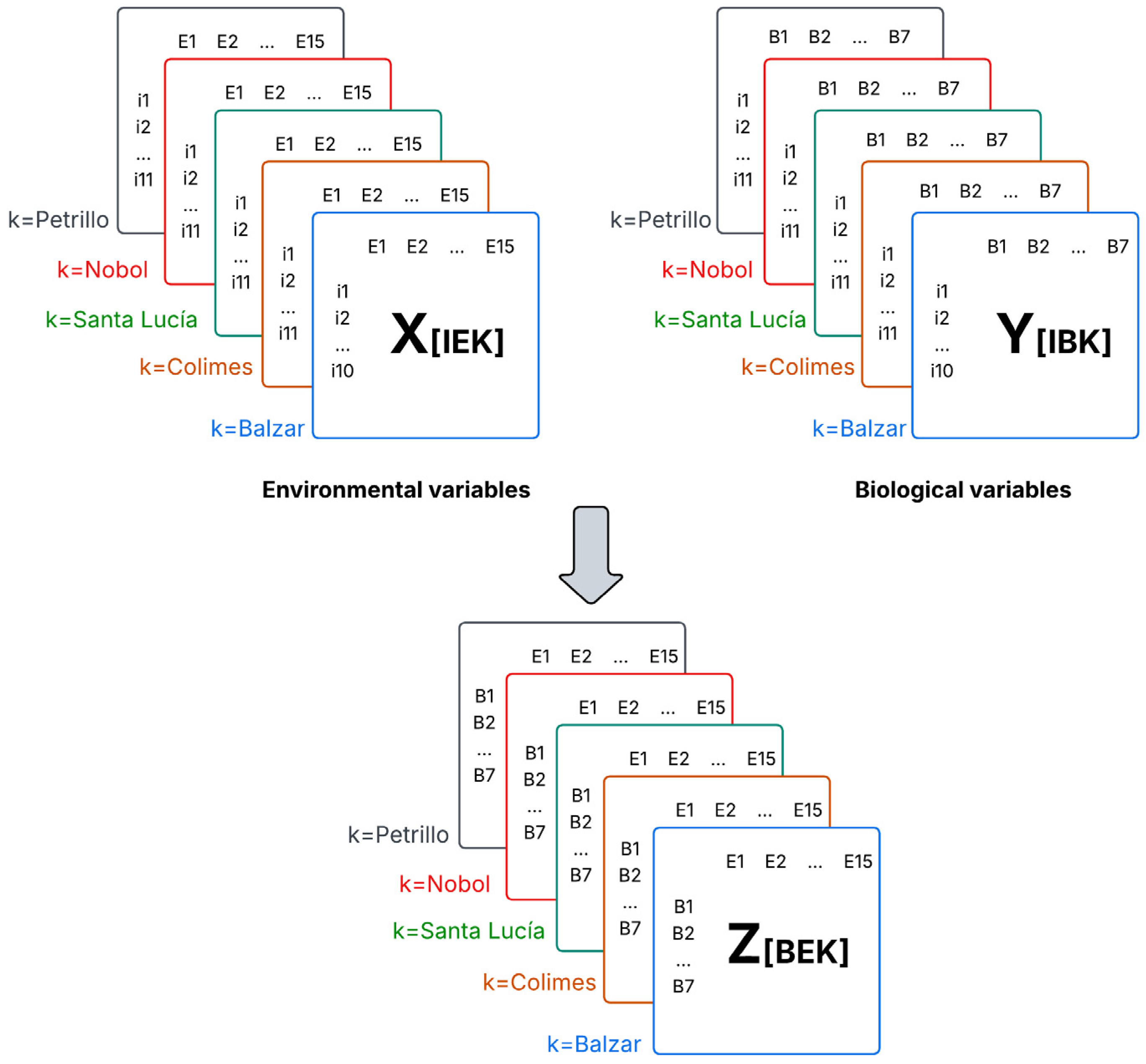
To analyse the relationship between two three-way matrices (environmental and biological) at different sites, the STATICO method was used [68,69]. This method involves analysing the relationships between each pair of tables using Coinertia analysis, which produces a cross-covariance table (Figure 2), followed by a Partial Triadic Analysis (PTA). To use this technique, the environmental and biological variables must be consistent across all sampling sites. Furthermore, the rows in the tables must be the same for both tables in a pair, but they may be different between k-matrices. For environmental variables, a total scaling was used [70], whereas biological variables were centred on their means.
Among the outputs of the STATICO method are the interstructure, compromise and intrastructure. The interstructure provides weights to build the compromise, which represents a weighted mean of the cross-covariance tables and graphically reveals the similarity of the species–environment relationship of the k-matrices. On the other hand, the intrastructure projects rows and columns from each table on the compiled information, showing the relationship between environmental and biological variables at each sampling site in a graph [71].

3. Results

This section shows the statistical analyses performed in the reduced database. The section encompasses the adequacy assessment of environmental variables, univariate and bivariate descriptive statistics, inferential statistical analysis, and k-way multivariate analysis of environmental and biological variables across different sampling sites.

3.1. Adequacy of the Sample Size

All environmental variables (26 in total) were assessed for adequacy using the KMO test. The sample of environmental variables comprised 15 variables, and the overall KMO index was 0.72, indicating adequate data adequacy. Additionally, Bartlett’s test of sphericity was statistically significant (X2(105) = 607.37, p-value = 9.74 × 10−72), indicating an acceptable correlation between the variables.

3.2. Univariate Statistics

Univariate descriptive analyses were performed for the 15 environmental variables and seven biological variables. The biological variables were represented by the five most abundant species during the water sampling campaign. The species are diatoms: Polymyxus coronalis L.W.Bailey [72] (68.51% of the total), Aulacoseira granulata (Ehrenberg) Simonsen [73] (8.48% of the total), Ulnaria ulna (Nitzsch) Compère [74] (5.93% of the total); charophytes: Mougeotia sp. (2.79% of the total); and cyanobacteria: Planktothrix cf. agardhii (Gomont) Anagnostidis & Komárek [75] (2.77% of the total). In addition, the total algal abundance values for the 99 species and chlorophyll a were included.
Tables S1 and S2 (Supplementary Materials) show the descriptive statistics of the environmental and biological variables. The results revealed wide variability in several variables, reflected in CV values exceeding 50%, including discharge, river flow, salinity (Balzar and Petrillo), dissolved oxygen (Balzar), turbidity, COD, nitrite (Balzar), nitrate, orthophosphate (Balzar and Colimes), sulphate, ammonium-N, alkalinity (Petrillo), and all biological variables. On the other hand, some variables, such as total solar radiation, water temperature, and pH, showed greater homogeneity across sampling sites, as evidenced by their low CV values.
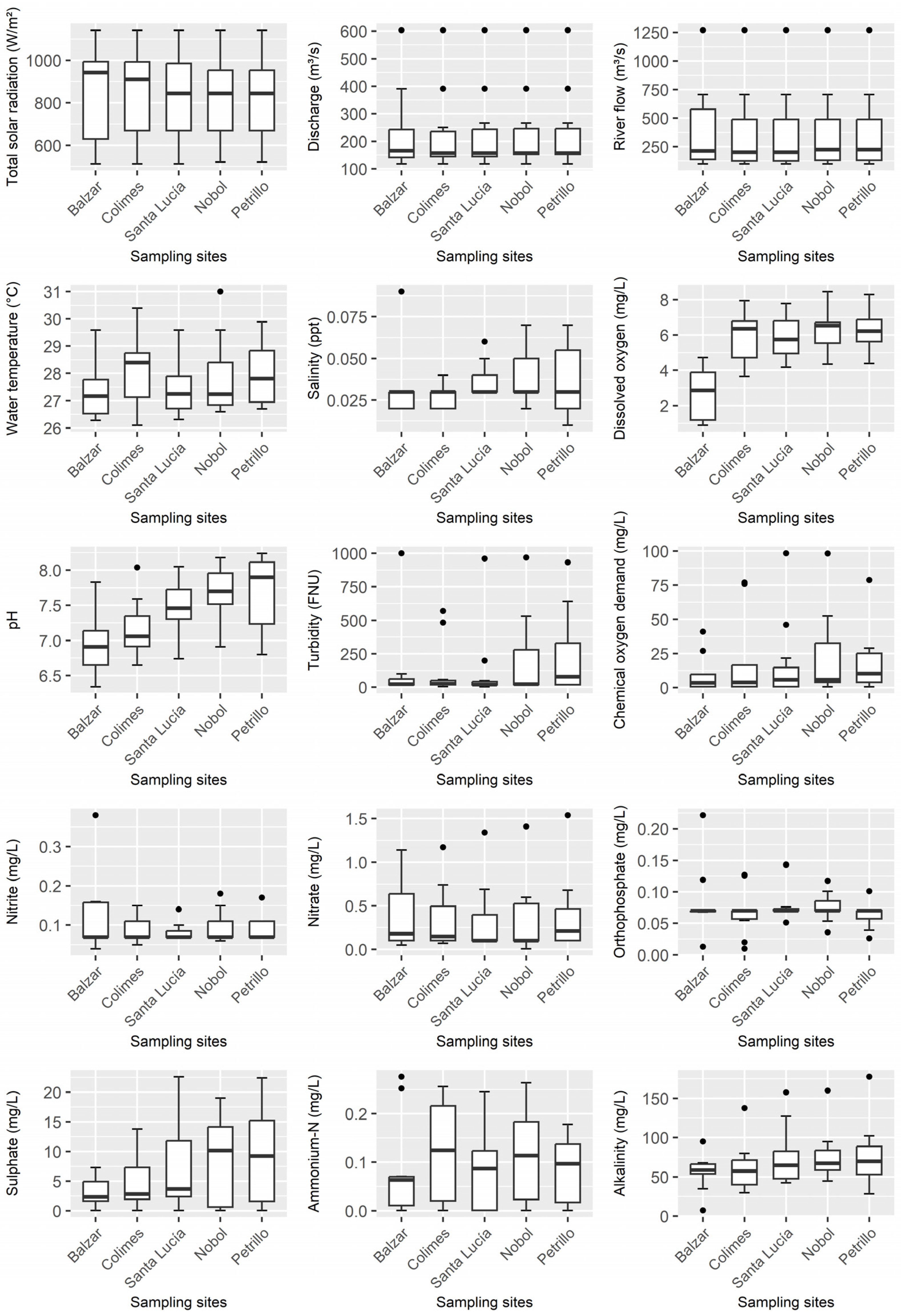
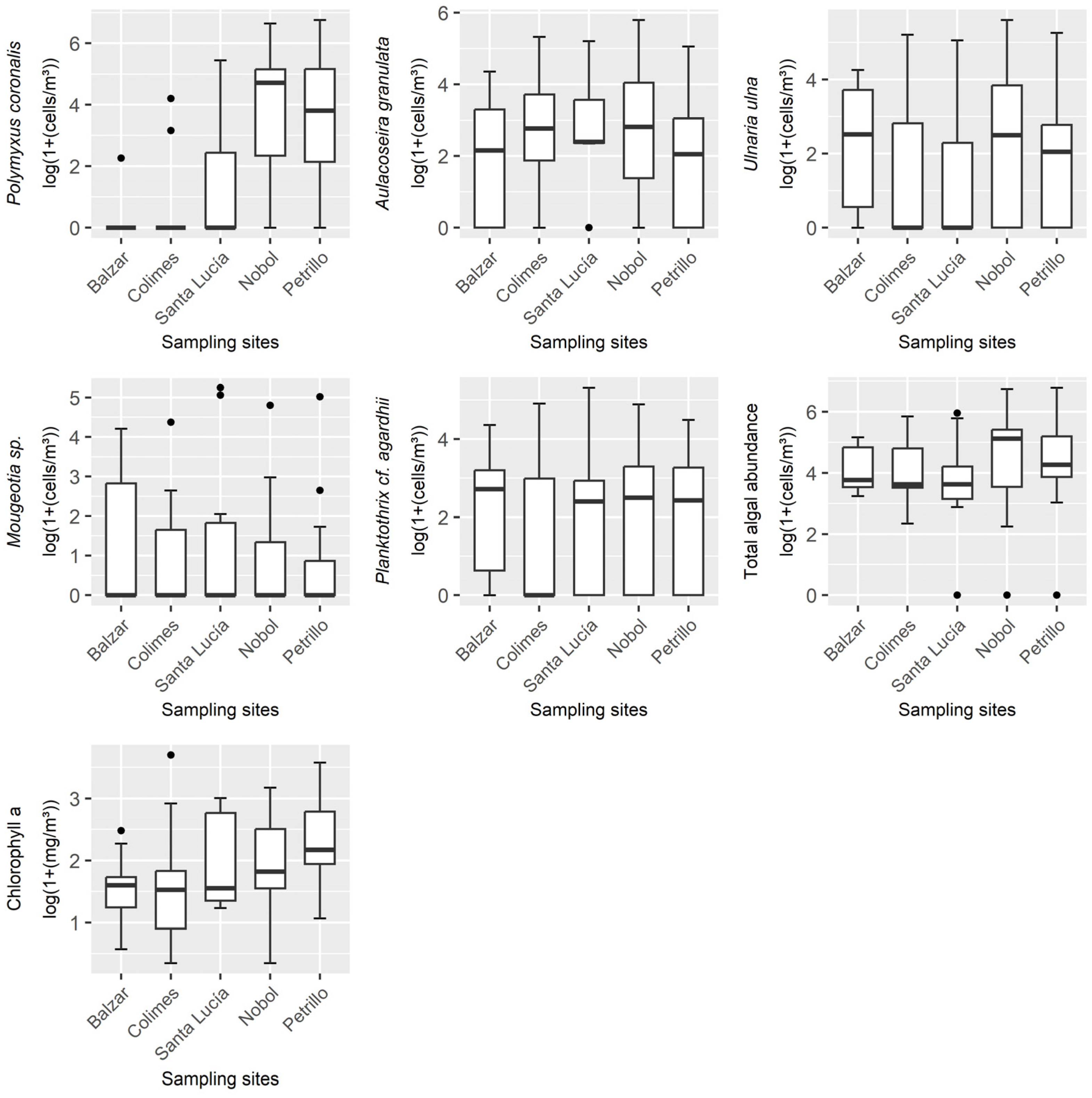
Figure 3 and Figure 4 illustrate boxplots for each variable at each sampling site. The order of presentation in the boxplots (left to right) corresponds to the sampling sites’ geographic locations (north to south). The boxplots of several environmental variables (Figure 3) showed greater data dispersion (higher boxes). These corresponded to total solar radiation, salinity (Petrillo), dissolved oxygen (Balzar), pH (Petrillo), turbidity (Nobol and Petrillo), COD (Nobol), nitrite (Balzar), nitrate (Balzar and Nobol), sulphate (Nobol and Petrillo) and ammonium-N (Colimes and Nobol). In addition, the data distribution was not symmetrical. On the other hand, the orthophosphate variable had the highest number of outliers (12).
Similarly, the boxplots of all biological variables (Figure 4) showed greater data variability (higher boxes). These corresponded to the species Polymyxus coronalis (Santa Lucía, Nobol and Petrillo), Aulacoseira granulata (Balzar, Nobol and Petrillo), Ulnaria ulna, Mougeotia sp. (Balzar) and Planktothrix cf. agardhii and also with the total algal abundance (Nobol) and chlorophyll a (Santa Lucía). Furthermore, the data distribution was not symmetrical in most boxplots. On the other hand, the species Mougeotia sp. presented the highest number of outliers (6).

3.3. Bivariate Statistics

Bivariate descriptive analyses were performed using a generalised pairs plot (Supplementary Material Figure S3). The upper part of the main diagonal of the plot shows the correlation coefficients and their statistical significance levels (significant, very significant and highly significant). The lower part includes local smoothing adjustment curves and 95% confidence bands. In addition, the main diagonal presents the distribution densities for each variable.
Strong and highly significant positive correlations were observed between turbidity and river flow (ρ = 0.701), nitrate and river flow (ρ = 0.748), nitrate and COD (ρ = 0.701), nitrate and nitrite (ρ = 0.724), and total algal abundance and the species Aulacoseria granulata (ρ = 0.699).
With respect to nutrients, nitrite showed a moderate and very significant negative correlation with Mougeotia sp. (ρ = −0.427). Likewise, nitrate showed a moderate but highly significant negative correlation with Mougeotia sp. (ρ = −0.451). Sulphate showed a moderate and highly significant negative correlation with Mougeotia sp. (ρ = −0.452) but a very significant correlation with total algal abundance (ρ = −0.388) and Aulacoseira granulata (ρ = −0.388) and Aulacoseira granulata (ρ = −0.368). Furthermore, ammonium-N showed a low-to-moderate, significant positive correlation with Polymyxus coronalis (ρ = 0.339).
Among algal species, Polymyxus coronalis showed a moderate, highly significant positive correlation with dissolved oxygen (ρ = 0.452) and pH (ρ = 0.438). The species Aulacoseira granulata showed a moderate, very significant positive correlation with dissolved oxygen (ρ = 0.403) and a moderate, very significant negative correlation with alkalinity (ρ = −0.411). The species Ulnaria ulna showed a moderate, very significant positive correlation with Aulacoseira granulata (ρ = 0.412).
The species Mougeotia sp. showed a moderate, highly significant negative correlation with sulphate (ρ = −0.452) and nitrate (ρ = −0.451). The species Planktothrix cf. agardhii showed a moderate, highly significant positive correlation with Ulnaria ulna (ρ = 0.477) and Aulacoseira granulata (ρ = 0.436). Furthermore, total algal abundance presented a moderate and highly significant positive correlation with Polymyxus coronalis (ρ = 0.573), Planktothrix cf. agardhii (ρ = 0.548), and Ulnaria ulna (ρ = 0.536), but a moderate and highly significant negative correlation with total solar radiation (ρ = −0.53) and alkalinity (ρ = −0.477). On the other hand, chlorophyll a showed a moderate, highly significant positive correlation with Polymyxus coronalis (ρ = 0.44).

3.4. Inferential Statistics

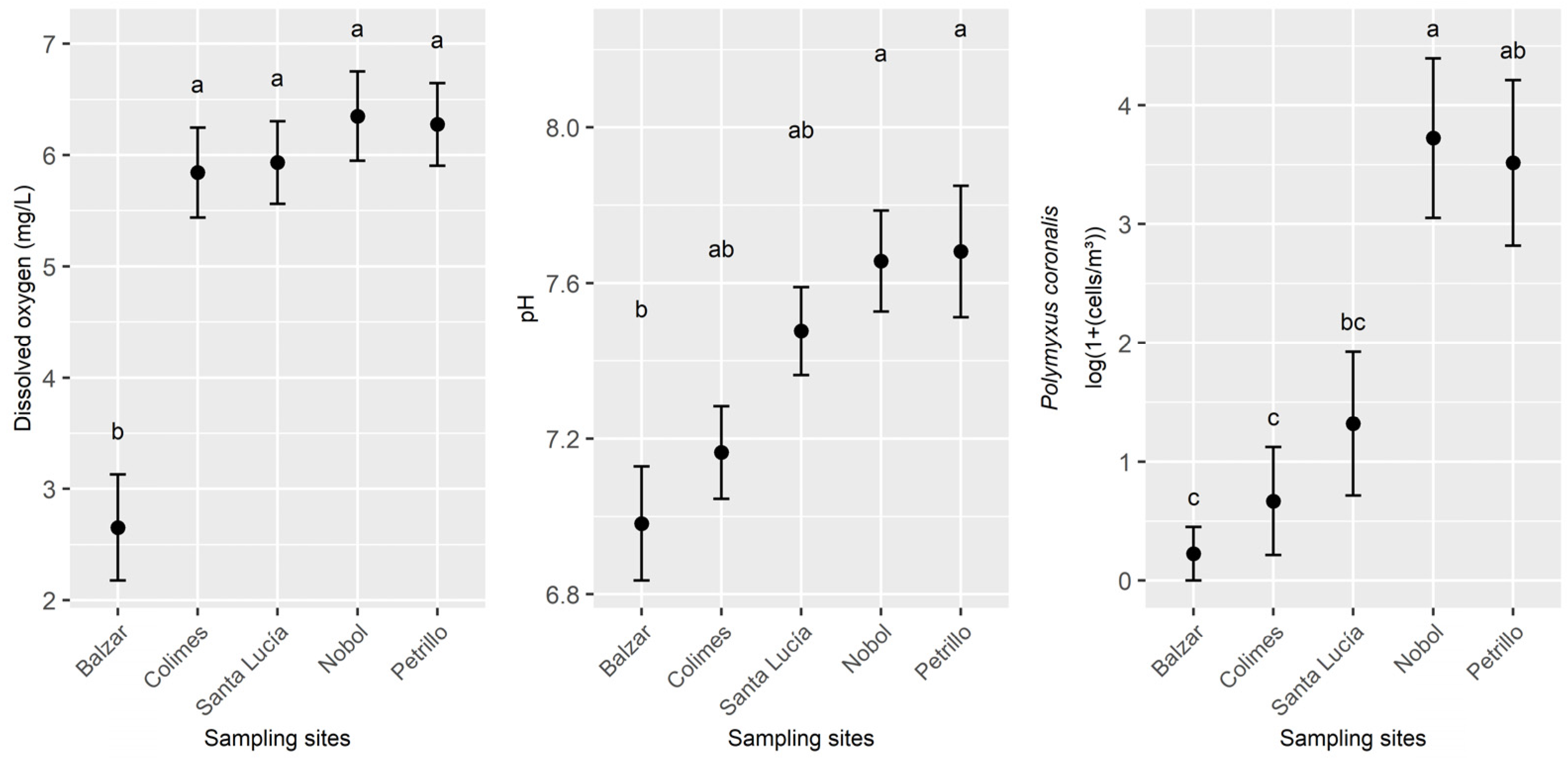
Inferential statistical analyses were performed using normality and homogeneity of variances tests, as well as parametric tests (Supplementary Material Table S3). The variables that showed statistically significant differences were dissolved oxygen, pH and Polymyxus coronalis species. The plot (Figure 5) shows the means of these variables for each site, along with their standard errors. Multiple-comparison tests revealed that dissolved oxygen levels at Balzar differed significantly from those at other sites. For pH, the values from the Colimes, Santa Lucía, Nobol and Petrillo sites were similar but different from that of Balzar. With respect to Polymyxus coronalis, the Nobol and Petrillo values were similar to each other but differed from those of Balzar, Colimes, and Santa Lucía.

3.5. Multivariate K-Way Statistics

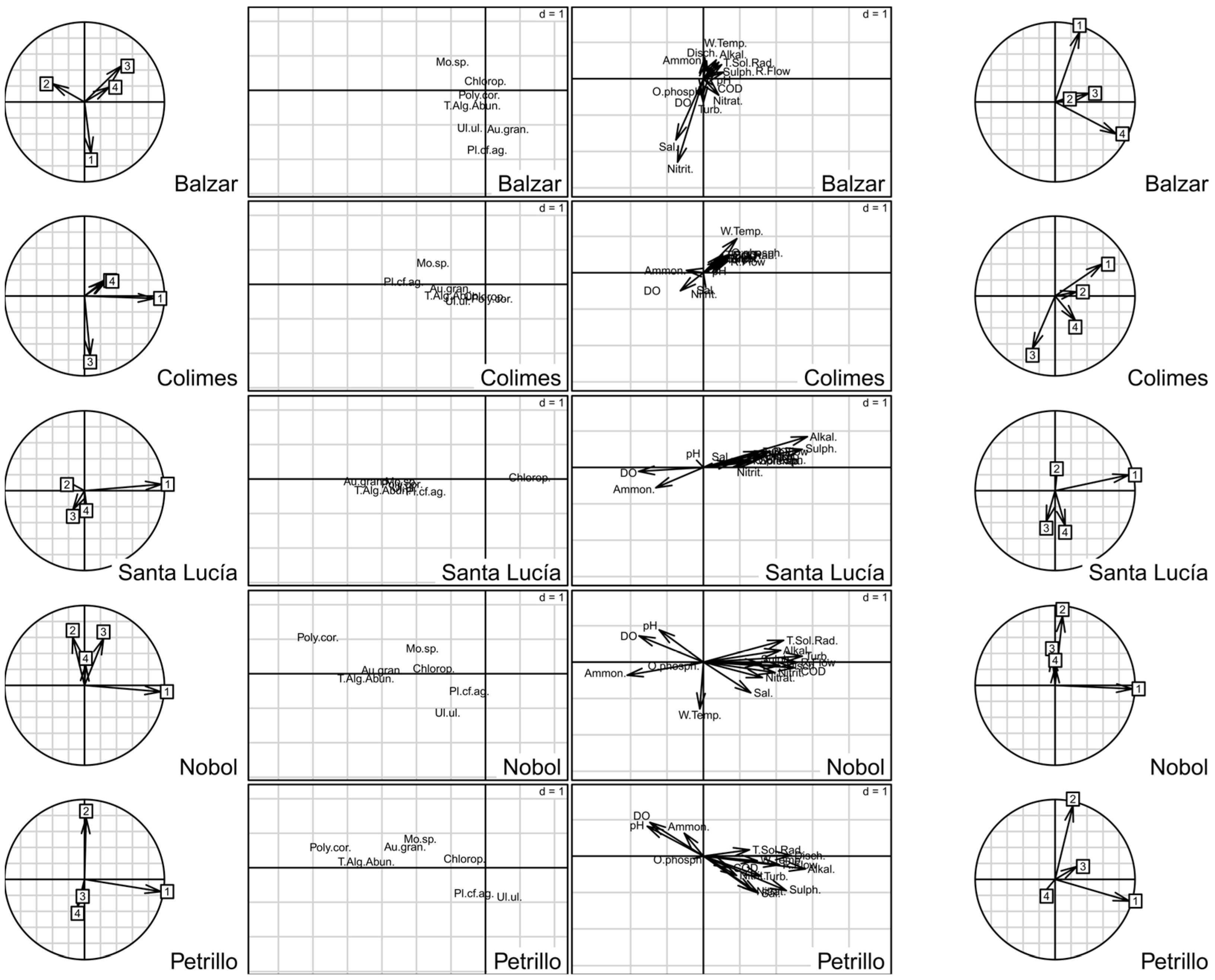
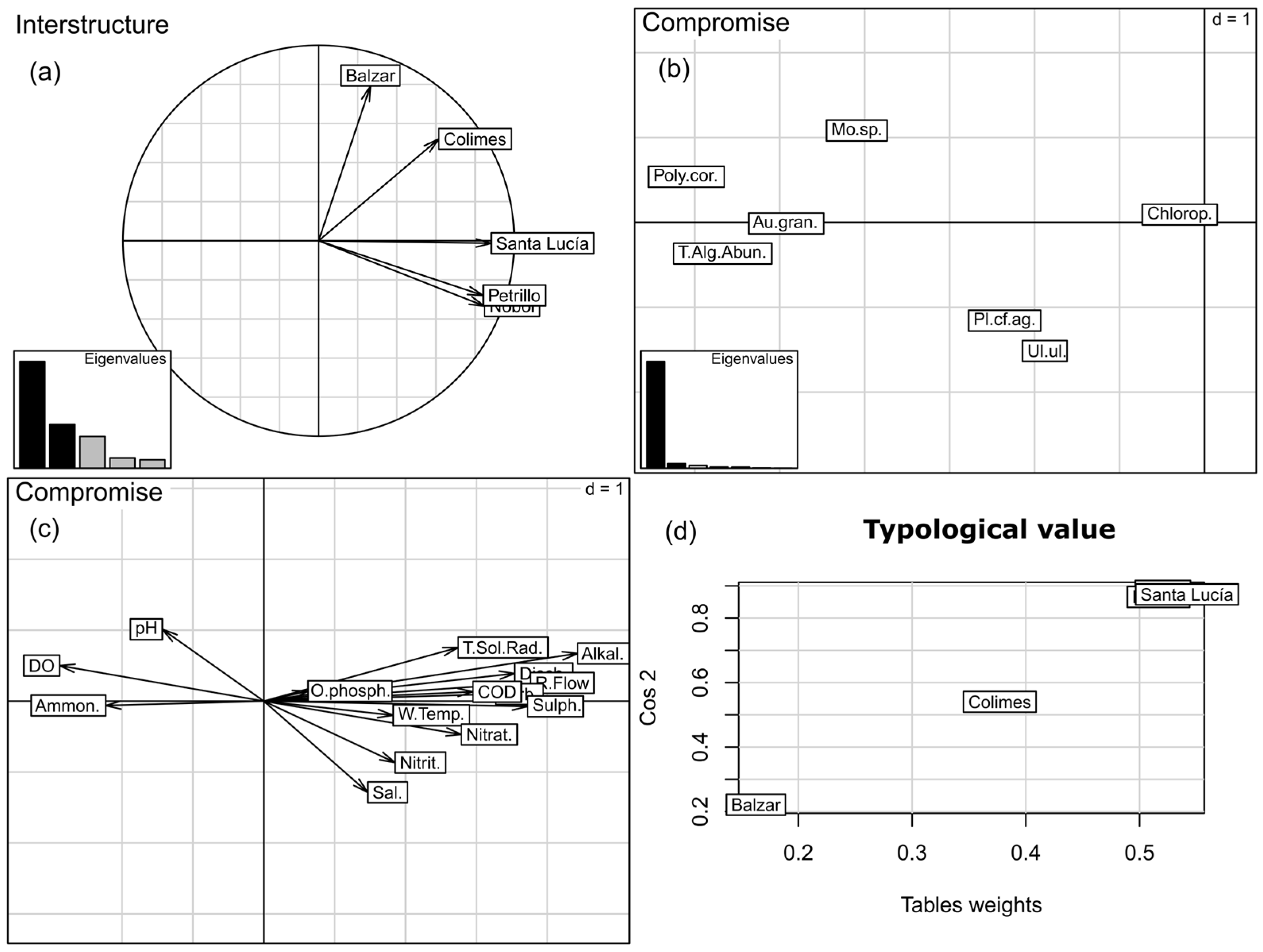
Multivariate k-way analyses were performed using the STATICO method, showing the interstructure, compromise, and intrastructure (Figure 6 and Figure 7). The interstructure (Figure 6a) showed four behavioural patterns. Balzar stood out from the other sites. Colimes was similar to Balzar, but different from Santa Lucía, Nobol and Petrillo. Santa Lucía was similar to Nobol and Petrillo, but different from Balzar and Colimes. Nobol and Petrillo were very similar, but different from the other sites.
In the compromise of biological variables (Figure 6b), Polymyxus coronalis, Aulacoseira granulata, Mougeotia sp., and total algal abundance showed similar environmental preferences. That is, they had a high abundance when pH and dissolved oxygen were high or above average. In addition, their high abundance was influenced by low or below-average values of the other environmental variables. Likewise, the species Planktothrix cf. agardhii and Ulnaria ulna had similar environmental preferences. Their high abundance occurred with high or above-average ammonium-N levels and low or below-average levels of the other environmental variables.
In the compromise of environmental variables (Figure 6c), there were positive correlations between pH, dissolved oxygen, and ammonium-N, as well as between total solar radiation, alkalinity, discharge, river flow, COD, turbidity, and sulphate. In addition, there was a positive relationship between water temperature, nitrate, nitrite and salinity. However, there was an inverse correlation between pH, dissolved oxygen, and the ammonium-N group, and the other environmental variables.
On the other hand, the species–environment relationship observed in Santa Lucía, Nobol, and Petrillo provided more information for the construction of the compromise. In contrast, those observed in Balzar provided little (Figure 6d). In terms of cos2 (quality of representation of sampling sites in the compromise), Santa Lucía, Nobol, and Petrillo were better represented by the compromise. In addition, Nobol showed a strong vector correlation with Petrillo and Santa Lucía. They showed similarity in species behaviour in response to environmental variation.
The interstructure accounted for 74.82% of the variability in the co-structure between the environment and species across the five sampling sites. In comparison, compromise accounted for 95.20% of the variability in the species–environment relationship.
The intrastructure (Figure 7) revealed that, at Balzar, Aulacoseira granulata, Ulnaria ulna and Planktothrix cf. agardhii species were most abundant at high or above average salinity (>0.03 ppt) and nitrite (>0.1 mg/L) values. In Colimes, Aulacoseira granulata, Mougeotia sp. and Planktothrix cf. agardhii showed higher abundance when there were high or above average values of ammonium-N (>0.09 mg/L). Aulacoseira granulata also highlighted its abundance by high or above-average dissolved oxygen levels (>5.46 mg/L).
In Santa Lucía, all five species were most abundant when dissolved oxygen and ammonium-N were high or above average. At Nobol, Polymyxus coronalis and Mougeotia sp. were most abundant at high or above-average pH (>7.4) and dissolved oxygen. Aulacoseira granulata was also more abundant in samples with high ammonium-N levels. In comparison, Planktothrix cf. agardhii was notable for high orthophosphate levels (>0.07 mg/L), and Ulnaria ulna for high water temperature (>27.74 °C).
In Petrillo, Polymyxus coronalis, Aulacoseira granulata and Mougeotia sp. were most abundant at high pH, dissolved oxygen and ammonium-N, while Planktothrix cf. agardhii was most abundant at high orthophosphate. In addition, Ulnaria ulna presented a higher abundance due to high values of COD (>17.24 mg/L), nitrite (>0.1 mg/L), turbidity (>161.09 FNU), sulphate (>6.94 mg/L), nitrate (>0.41 mg/L) and salinity (>0.03 ppt).

4. Discussion

This study focused on evaluating species–environment relationships using statistical analysis approaches (adequacy test, univariate, bivariate, inferential, and multivariate) to identify the main parameters that promote algal blooms in the Daule River, Ecuador. The results of the KMO and Bartlett tests support the application of multivariate analysis for dimension reduction, indicating that the variables evaluated showed sufficient correlations to simplify the dataset.
Concentrations of nutrients such as nitrite and nitrate were more dispersed in Balzar, while ammonium-N and sulphate were more dispersed in Colimes and Petrillo, respectively. These variations suggest the influence of anthropogenic activity, including wastewater discharge and agriculture [33,38]. Agricultural activity in Balzar has been mainly based on maize crops, whereas in Colimes, Santa Lucía, Nobol and Petrillo, rice crops have dominated [76]. This links to the study by Ribeiro et al. [35], indicating that areas highly vulnerable to nitrate contamination were located at the perimeters of rice fields due to agricultural practices in the Guayas River basin.
The positive, highly significant correlations of Polymyxus coronalis with dissolved oxygen (ρ = 0.452) and pH (ρ = 0.438) suggest that this diatom tends to increase in abundance when water oxygenation is higher, and the environment is slightly alkaline. The positive, very significant correlation between Aulacoseira granulata and dissolved oxygen (ρ = 0.403) suggests that higher dissolved oxygen levels tend to increase the abundance of this species. The study by Mohanty et al. [77], conducted on the River Ganga in India, used Karl Pearson’s correlation and found a positive correlation (r = 0.507) at the 0.01 significance level. Furthermore, in the research by Hegab et al. [78], conducted on the Nile River in Egypt, dissolved oxygen was an influential factor in the abundance of this species. However, the negative, very significant correlation with alkalinity (ρ = −0.411) indicates that lower alkalinity is associated with greater abundance of the species.
The positive, very significant correlation between Ulnaria ulna and Aulacoseira granulata (ρ = 0.412) suggests that both species share similar environmental preferences. The negative and highly significant correlation of Mougeotia sp. with nitrate (ρ = −0.451) and sulphate (ρ = −0.452) indicates that both high nitrate and sulphate concentrations limit the abundance of this species. The positive and highly significant correlations of Planktothrix cf. agardhii with Aulacoseira granulata (ρ = 0.436) and Ulnaria ulna (ρ = 0.477) indicate that these species coexist. The positive, highly significant correlation between total algal abundance and the diatom Aulacoseria granulata (ρ = 0.699) suggests that this species contributes substantially to total algal abundance. Moreover, both this species and the entire phytoplankton community respond to the same environmental conditions. The positive and highly significant correlation between chlorophyll a and Polymyxus coronalis (ρ = 0.44) indicates that higher concentrations of chlorophyll a are associated with greater abundance of this species. Studies show that chlorophyll a is an indicator of phytoplankton biomass and the trophic status of water bodies [79,80].
Regarding hydrological conditions, a negative, highly significant correlation between Mougetia sp. with river flow (ρ = −0.436) and discharge from the Daule-Peripa reservoir (ρ = −0.37) suggests that this species tends to increase in abundance when river flow and discharge are low. Algal blooms generally occur in relatively stagnant bodies of water, such as lakes, reservoirs, ponds, or bays, where water circulation is limited. Hydrodynamic conditions, including fluctuations in flow and water levels, can directly influence the growth or decline of algal species. In particular, changes in flow can generate shear forces that interfere with algae growth and biomass accumulation [81]. Additionally, the sampling site closest to the Daule-Peripa reservoir discharges is Balzar, which had the lowest total algal abundance (1734–145,692 cells/m3), similar to the study by Xin et al. [19], which observed negative relationships between water discharge and algal density in the Han River, China.
The variables that showed statistically significant differences were dissolved oxygen, pH and Polymyxus coronalis species. In Balzar, dissolved oxygen levels were the lowest (0.89–4.73 mg/L), as well as pH levels (6.34–7.83). Similar results were obtained in the Huayamave study [82], indicating that the cause is the discharge of urban wastewater and the contribution of anoxic water from the Daule-Peripa reservoir. In particular, the observed relationship with dissolved oxygen could reflect a higher biochemical oxygen demand (BOD5) associated with the degradation of organic matter [83]. However, this study does not include BOD5 values that could clarify this information, and the COD values found are within the permissible limit (<100 mg/L) for freshwater body discharges according to Ecuadorian regulations established in the Unified Text of Secondary Environmental Legislation (TULSMA, acronym in Spanish) [84], which does not raise suspicions that there are sewage discharges at the Balzar sampling site.
Additionally, the dissolved oxygen concentration must not be less than 5 mg/L and the pH must not be less than 6.5 to preserve flora and fauna in warm freshwaters. Regarding the species Polymyxus coronalis, it was most abundant in Nobol and Petrillo (sites further south), which corresponds with the sites with the highest dissolved oxygen and pH levels. Studies indicate that adequate dissolved oxygen concentrations are important for the aerobic metabolism of phytoplankton, while adequate pH levels favour enzymatic activity and nutrient uptake [79].
Furthermore, phosphate fertilisers contribute to phosphorus enrichment, which could promote eutrophication and alter the dynamics of the aquatic ecosystem [85]. Currently, Ecuadorian legislation does not include a parameter that would allow for comparing the permitted discharge levels or those required for the preservation of aquatic life with the values obtained in the study.
The interstructure obtained using the STATICO method showed that the highest abundances of the species Polymyxus coronalis, Aulacoseira granulata, and Mougeotia sp. were associated with high pH and dissolved oxygen values. In contrast, the species Planktothrix cf. agardhii and Ulnaria ulna showed higher abundance due to high ammonium-N concentrations. Ammonium and urea are used in agriculture in the Guayas River basin, which benefits the development of cyanobacteria [86,87].
In contrast, the intrastructure revealed the species–environment relationship at each sampling site. In Balzar, Aulacoseira granulata, Ulnaria ulna and Planktothrix cf. agardhii were more abundant due to high salinity and nitrite values. In addition, because of the influence of the tide on the Daule River, studies indicate that salinity favours the spread of marine diatom species in continental freshwater [88], as is the case with Polymyxus coronalis. In addition, another study notes that conductivity, pH, temperature, nitrate, and nitrite are variables that promote diatom growth [89]. On the other hand, the cyanobacteria Planktothrix cf. agardhii can produce toxins (e.g., microcystin) that affect the liver, kidney and reproductive systems [90]. The study by Vergalli et al. [91] revealed that this species acclimatised to salinity concentrations between 0 and 7.5 g/L as it continued its development and toxin production. In addition, cyanobacteria use reduced nitrogen forms for growth, such as nitrite, nitrate, ammonium, and urea [92,93]. Likewise, in the experimental study by Aguilera et al. [94], high levels of phosphate favoured the growth of this cyanobacteria.
In Colimes, Aulacoseira granulata, Mougeotia sp. and Planktothrix cf. agardhii were abundant due to high ammonium-N concentrations. In Santa Lucía, the five species were most abundant due to high dissolved oxygen and ammonium-N levels. The maximum values found at both sampling sites were 0.26 and 0.25 (ammonium-N mg/L), respectively, which, compared with the Aquatic Life Ambient Water Quality Criteria For Ammonia—Freshwater [95], were within the permissible limits. It is not possible to make a direct comparison with Ecuadorian regulations, as they only include ammonia criteria. Additionally, it is important to note that the chemical form of ammonia in water consists of two species: the most abundant is the ammonium ion (NH4+) and the least abundant is the undissociated or ionised ammonia molecule (NH3). The proportion of these species in a given aqueous solution depends on both pH and temperature.
In Nobol, Polymyxus coronalis and Mougeotia sp. were abundant, likely due to high pH and dissolved oxygen values. In contrast, Aulacoseira granulata stood out for high ammonium-N levels, and Planktothrix cf. agardhii for high orthophosphate concentrations. In Petrillo, Polymyxus coronalis, Aulacoseira granulata and Mougeotia sp. were abundant due to high pH, dissolved oxygen, and ammonium-N levels. At the same time, Planktothrix cf. agardhii was more abundant with high orthophosphate values.
This research has limitations. First, phytoplankton was sampled using a 63 µm net and then analysed using the Semina method, which would exclude smaller phytoplankton. The 63 µm mesh size was suitable for sampling larger phytoplankton, allowing filtration of large volumes of water and providing robust estimates of the dominant larger taxa while avoiding clogging. We acknowledge that this mesh excludes picophytoplankton and much of the nanophytoplankton, so the abundance of cyanobacteria and small chlorophytes may be underestimated. Detailed characterisation of these groups would require specific high-resolution methods (e.g., thin membrane filtration and flow cytometry) [96,97,98], which are beyond the scope of this study.
However, other studies report the Utermöhl method, which allows the counting of nanoplankton (2–20 µm) and microplankton (20–200 µm) [99,100]. The Semina method is based on the analysis of small-volume aliquots, which reduces the probability of encountering rare species; however, this limitation is mitigated by analysing multiple successive subsamples until the rarefaction curve reaches an asymptote. This approach ensured that the majority of observable diversity was recorded. The homogenisation of samples prior to analysis and the standardisation of subsamples ensured consistent effort across all samples, thereby reducing variability associated with counting differences and improving precision. While this method provides reliable information on phytoplankton taxonomic composition and relative abundance patterns, it offers lower precision for estimating absolute densities than sedimentation techniques such as the Utermöhl method. Consequently, the Semina method is particularly useful for ecological assessments aimed at characterising phytoplankton community structure, as it allows for the detection of dominance patterns that informed the subsequent analyses in this study.
Second, in some instances, only the identification of the phytoplankton community to the genus level was considered, so that molecular analysis would allow specific species identification. Third, the STATICO method visualises highly related matrices along the first principal component and therefore cannot represent similar structures that do not align with it. However, the results are robust, as they include statistical analysis approaches that identified the main environmental variables driving blooms of the five most abundant species during the water sampling campaign in the Daule River, which serve as a basis for the development of ecological models.

5. Conclusions

This study demonstrated that statistical analysis is an effective method for identifying environmental factors that influence algal blooms in the Daule River. This was achieved through univariate, bivariate, inferential, and multivariate statistics. The environmental variables of pH and dissolved oxygen were identified as the main drivers of the diatoms Polymyxus coronalis and Aulacoseira granulata and the charophyte Mougeotia sp. At the same time, ammonium-N was the main driver of the diatom Ulnaria ulna and the cyanobacteria Planktothrix cf. agardhii.
The most abundant species during the water sampling campaign, Polymyxus coronalis in Colimes, was favoured by salinity, nitrite and dissolved oxygen. In Santa Lucía, it was due to dissolved oxygen and ammonium-N levels. In Nobol and Petrillo, it was because of dissolved oxygen and pH levels. Regarding cyanobacteria, the abundance of Planktothrix cf. agardhii in Balzar was favoured by salinity and nitrite levels, while in Colimes, ammonium-N was the influencing factor. In Santa Lucía, it was due to dissolved oxygen and ammonium-N levels. In contrast, in Nobol, it was due to orthophosphate and water temperature levels. In Petrillo, it was because of orthophosphate concentrations.
This study reveals that the ammonium-N, orthophosphate and total phosphorus parameters should be incorporated into Ecuadorian regulations to prevent algal blooms and preserve freshwater ecosystems. Furthermore, by collecting microbiological data, it is possible to compile a taxonomic catalogue of the algae found in the Daule River, thereby enabling an understanding of the ecosystem’s productivity and an assessment of potential environmental changes.
To further our understanding of algal bloom dynamics in the Daule River, the following future lines of research were identified: (i) development of ecological models that serve as an early warning system, enabling decision makers to adopt quick solutions before blooms cause substantial ecological damage, and (ii) simulation of future scenarios in a tropical lotic ecosystem in the context of land use and climate change, providing a scientific basis for future public policy in Ecuador to mitigate the impact of algal blooms and HABs.

Supplementary Materials

The following supporting information can be downloaded at https://www.mdpi.com/article/10.3390/w18070797/s1, Figure S1: Methodological scheme; Figure S2: Water sampling analysis process; Figure S3: Generalised pairs plot; Table S1: Descriptive statistics of environmental variables; Table S2: Descriptive statistics of biological variables; Table S3: Inferential statistical analyses.

Author Contributions

Conceptualization, M.G.-N. (Mariela González-Narváez), L.D.-G., J.B. and C.V.d.H.; methodology, M.G.-N. (Miguel Gurumendi-Noriega), M.G.-N. (Mariela González-Narváez), J.R.-V., A.M.R.-M. and L.D.-G.; software, M.G.-N. (Miguel Gurumendi-Noriega) and M.G.-N. (Mariela González-Narváez); validation, M.G.-N. (Miguel Gurumendi-Noriega), M.G.-N. (Mariela González-Narváez), L.D.-G. and C.V.d.H.; formal analysis, M.G.-N. (Miguel Gurumendi-Noriega) and M.G.-N. (Mariela González-Narváez); investigation, J.R.-V. and A.M.R.-M.; resources, J.R.-V. and A.M.R.-M.; data curation, M.G.-N. (Miguel Gurumendi-Noriega), J.R.-V. and A.M.R.-M.; writing—original draft preparation, M.G.-N. (Miguel Gurumendi-Noriega); writing—review and editing, M.G.-N. (Miguel Gurumendi-Noriega), M.G.-N. (Mariela González-Narváez), B.A.-M., L.D.-G. and C.V.d.H.; visualisation, M.G.-N. (Miguel Gurumendi-Noriega); supervision, M.G.-N. (Mariela González-Narváez), B.A.-M. and L.D.-G.; project administration, M.G.-N. (Miguel Gurumendi-Noriega), L.D.-G. and J.B.; funding acquisition, L.D.-G. All authors have read and agreed to the published version of the manuscript.

Funding

This research was implemented by Escuela Superior Politécnica del Litoral (ESPOL) and HoGent in the framework of the project ‘On the prediction and prevention of toxic algae blooms in a tropical setting–AlgaePredict’ (Project number: EC2023SIN379B125), kindly funded by VLIR-UOS Short Initiatives. The APC was funded by the Master’s Program in Engineering Sciences for Water Resources Management at ESPOL.

Data Availability Statement

Data are available from the authors upon request.

Acknowledgments

The authors acknowledge INTERAGUA for conducting complementary water quality analyses. Additionally, the authors thank the Ministry of the Environment and Energy of Ecuador for the support provided during water sampling campaigns.

Conflicts of Interest

The authors declare no conflicts of interest.

References

  1. Renuka, N.; Guldhe, A.; Prasanna, R.; Singh, P.; Bux, F. Microalgae as multi-functional options in modern agriculture: Current trends, prospects and challenges. Biotechnol. Adv. 2018, 36, 1255–1273. [Google Scholar] [CrossRef]
  2. Gomez-Casati, D.F.; Pernice, M.; Tonon, T. Algae. Sci. Rep. 2025, 15, 2034. [Google Scholar] [CrossRef]
  3. Luo, C.; Wang, X.; Chen, Y.; Luo, H.; Dong, H.; He, S. Predictive Modeling of Cyanobacterial Blooms and Diurnal Variation Analysis Based on GOCI. Water 2025, 17, 749. [Google Scholar] [CrossRef]
  4. Ao, Y.; Fan, J.; Guo, F.; Li, M.; Li, A.; Shi, Y.; Wei, J. Machine Learning-Based Early Warning of Algal Blooms: A Case Study of Key Environmental Factors in the Anzhaoxin River Basin. Water 2025, 17, 725. [Google Scholar] [CrossRef]
  5. Li, Y.; Shi, K.; Zhu, M.; Li, H.; Guo, Y.; Miao, S.; Ou, W.; Zheng, Z. Data-driven models for forecasting algal biomass in a large and deep reservoir. Water Res. 2025, 270, 122832. [Google Scholar] [CrossRef] [PubMed]
  6. Lan, J.; Liu, P.; Hu, X.; Zhu, S. Harmful Algal Blooms in Eutrophic Marine Environments: Causes, Monitoring, and Treatment. Water 2024, 16, 2525. [Google Scholar] [CrossRef]
  7. Wilkinson, G.M.; Walter, J.A.; Albright, E.A.; King, R.F.; Moody, E.K.; Ortiz, D.A. An evaluation of statistical models of microcystin detection in lakes applied forward under varying climate conditions. Harmful Algae 2024, 137, 102679. [Google Scholar] [CrossRef] [PubMed]
  8. Butcher, J.B.; Fernandez, M.; Johnson, T.E.; Shabani, A.; Lee, S.S. Geographic Analysis of the Vulnerability of U.S. Lakes to Cyanobacterial Blooms under Future Climate. Earth Interact. 2023, 27, 1–17. [Google Scholar] [CrossRef]
  9. Ahn, J.M.; Kim, J.; Park, L.J.; Jeon, J.; Jong, J.; Min, J.-H.; Kang, T. Predicting Cyanobacterial Harmful Algal Blooms (CyanoHABs) in a Regulated River Using a Revised EFDC Model. Water 2021, 13, 439. [Google Scholar] [CrossRef]
  10. Hong, J.-F.; Ouddane, B.; Hwang, J.-S.; Dahms, H.-U. In silico assessment of human health risks caused by cyanotoxins from cyanobacteria. Biocell 2021, 45, 65–77. [Google Scholar] [CrossRef]
  11. Shin, J.; Cha, Y. Development of a deep learning–based feature stream network for forecasting riverine harmful algal blooms from a network perspective. Water Res. 2025, 268, 122751. [Google Scholar] [CrossRef]
  12. Demiray, B.Z.; Mermer, O.; Baydaroğlu, Ö.; Demir, I. Predicting Harmful Algal Blooms Using Explainable Deep Learning Models: A Comparative Study. Water 2025, 17, 676. [Google Scholar] [CrossRef]
  13. Lee, V.; Meza-Padilla, I.; Nissimov, J.I. Virus Infection of a Freshwater Cyanobacterium Contributes Significantly to the Release of Toxins Through Cell Lysis. Microorganisms 2025, 13, 486. [Google Scholar] [CrossRef]
  14. Yan, Z.; Kamanmalek, S.; Alamdari, N.; Nikoo, M.R. Comprehensive Insights into Harmful Algal Blooms: A Review of Chemical, Physical, Biological, and Climatological Influencers with Predictive Modeling Approaches. J. Environ. Eng. 2024, 150, 03124002. [Google Scholar] [CrossRef]
  15. Wang, Y.; Zhao, D.; Woolway, R.I.; Yan, H.; Paerl, H.W.; Zheng, Y.; Zheng, C.; Feng, L. Global elevation of algal bloom frequency in large lakes over the past two decades. Natl. Sci. Rev. 2025, 12, nwaf011. [Google Scholar] [CrossRef]
  16. Song, Y. Hydrodynamic impacts on algal blooms in reservoirs and bloom mitigation using reservoir operation strategies: A review. J. Hydrol. 2023, 620, 129375. [Google Scholar] [CrossRef]
  17. Xia, R.; Zhang, Y.; Wang, G.; Zhang, Y.; Dou, M.; Hou, X.; Qiao, Y.; Wang, Q.; Yang, Z. Multi-factor identification and modelling analyses for managing large river algal blooms. Environ. Pollut. 2019, 254, 113056. [Google Scholar] [CrossRef] [PubMed]
  18. Kamjunke, N.; Brix, H.; Flöser, G.; Bussmann, I.; Schütze, C.; Achterberg, E.P.; Ködel, U.; Fischer, P.; Rewrie, L.; Sanders, T.; et al. Large-scale nutrient and carbon dynamics along the river-estuary-ocean continuum. Sci. Total Environ. 2023, 890, 164421. [Google Scholar] [CrossRef] [PubMed]
  19. Xin, X.; Zhang, H.; Lei, P.; Tang, W.; Yin, W.; Li, J.; Zhong, H.; Li, K. Algal blooms in the middle and lower Han River: Characteristics, early warning and prevention. Sci. Total Environ. 2020, 706, 135293. [Google Scholar] [CrossRef]
  20. Bharathi, M.; Venkataramana, V.; Sarma, V. Phytoplankton community structure is governed by salinity gradient and nutrient composition in the tropical estuarine system. Cont. Shelf Res. 2022, 234, 104643. [Google Scholar] [CrossRef]
  21. Karthik, R.; Robin, R.; Anandavelu, I.; Purvaja, R.; Singh, G.; Mugilarasan, M.; Jayalakshmi, T.; Samuel, V.D.; Ramesh, R. Diatom bloom in the Amba River, west coast of India: A nutrient-enriched tropical river-fed estuary. Reg. Stud. Mar. Sci. 2020, 35, 101244. [Google Scholar] [CrossRef]
  22. Kumar, P.S.; Kumaraswami, M.; Rao, G.D.; Ezhilarasan, P.; Sivasankar, R.; Rao, V.R.; Ramu, K. Influence of nutrient fluxes on phytoplankton community and harmful algal blooms along the coastal waters of southeastern Arabian Sea. Cont. Shelf Res. 2018, 161, 20–28. [Google Scholar] [CrossRef]
  23. González-Narváez, M.; Fernández-Gómez, M.J.; Mendes, S.; Molina, J.-L.; Ruiz-Barzola, O.; Galindo-Villardón, P. Study of Temporal Variations in Species–Environment Association through an Innovative Multivariate Method: MixSTATICO. Sustainability 2021, 13, 5924. [Google Scholar] [CrossRef]
  24. Ren, X.; Zhang, H.; Zou, J.; Tian, X.; Pu, J.; Man, X.; Zhou, A.; Wei, Y.; Gao, D.; Chen, S. Tracking the seasonal dynamic response of water quality and phytoplankton communities: A case study of the Yaoshi River in the Sichuan Basin, China. Environ. Monit. Assess. 2025, 197, 888. [Google Scholar] [CrossRef]
  25. Kumar, P.S.; Thomas, J. Seasonal distribution and population dynamics of limnic microalgae and their association with physico-chemical parameters of river Noyyal through multivariate statistical analysis. Sci. Rep. 2019, 9, 15021. [Google Scholar] [CrossRef]
  26. Xu, Y.; Xiang, Z.; Rizo, E.Z.; Naselli-Flores, L.; Han, B.-P. Combination of linear and nonlinear multivariate approaches effectively uncover responses of phytoplankton communities to environmental changes at regional scale. J. Environ. Manag. 2022, 305, 114399. [Google Scholar] [CrossRef]
  27. Fai, P.B.A.; Kenko, D.B.N.; Tchamadeu, N.N.; Mbida, M.; Korejs, K.; Riegert, J. Use of multivariate analysis to identify phytoplankton bioindicators of stream water quality in the monomodal equatorial agroecological zone of Cameroon. Environ. Monit. Assess. 2023, 195, 788. [Google Scholar] [CrossRef]
  28. Lopes, J.; Pinto, A.; Eleutério, T.; Meirelles, M.; Vasconcelos, H. Multivariate Statistical Analysis of the Phytoplankton Interactions with Physicochemical and Meteorological Parameters in Volcanic Crater Lakes from Azores. Water 2022, 14, 2548. [Google Scholar] [CrossRef]
  29. Torres, G.; Carnicer, O.; Canepa, A.; De La Fuente, P.; Recalde, S.; Narea, R.; Pinto, E.; Borbor-Córdova, M.J. Spatio-temporal pattern of dinoflagellates along the tropical Eastern Pacific Coast (Ecuador). Front. Mar. Sci. 2019, 6, 145. [Google Scholar] [CrossRef]
  30. Borbor-Cordova, M.J.; Torres, G.; Mantilla-Saltos, G.; Casierra-Tomala, A.; Rafael Bermúdez, J.; Renteria, W.; Bayot, B. Oceanography of harmful algal blooms on the Ecuadorian coast (1997–2017): Integrating remote sensing and biological data. Front. Mar. Sci. 2019, 6, 13. [Google Scholar] [CrossRef]
  31. Borbor-Córdova, M.J.; Pozo-Cajas, M.; Cedeno-Montesdeoca, A.; Saltos, G.M.; Kislik, C.; Espinoza-Celi, M.E.; Lira, R.; Ruiz-Barzola, O.; Torres, G. Risk Perception of Coastal Communities and Authorities on Harmful Algal Blooms in Ecuador. Front. Mar. Sci. 2018, 5, 365. [Google Scholar] [CrossRef]
  32. Vera, J.; Alcívar, P.; Panta, R.; Rodríguez, J.; Díez, J.; López, A.; Raju, N. Identification and Composition of Cyanobacteria in Ecuadorian Shrimp Farming Ponds—Possible Risk to Human Health. Curr. Microbiol. 2024, 81, 237. [Google Scholar] [CrossRef]
  33. Merchan, B.; Ullauri, P.; Amaya, F.; Dender, L.; Carrión, P.; Berrezueta, E. Design of a sewage and wastewater treatment system for pollution mitigation in El Rosario, El Empalme, Ecuador. WIT Trans. Ecol. Environ. 2021, 251, 77–85. [Google Scholar] [CrossRef]
  34. Deknock, A.; De Troyer, N.; Houbraken, M.; Dominguez-Granda, L.; Nolivos, I.; Van Echelpoel, W.; Forio, M.A.E.; Spanoghe, P.; Goethals, P. Distribution of agricultural pesticides in the freshwater environment of the Guayas river basin (Ecuador). Sci. Total Environ. 2019, 646, 996–1008. [Google Scholar] [CrossRef] [PubMed]
  35. Ribeiro, L.; Pindo, J.C.; Dominguez-Granda, L. Assessment of groundwater vulnerability in the Daule aquifer, Ecuador, using the susceptibility index method. Sci. Total Environ. 2017, 574, 1674–1683. [Google Scholar] [CrossRef] [PubMed]
  36. Aguilera, A.; Gómez, E.B.; Kaštovský, J.; Echenique, R.O.; Salerno, G.L. The polyphasic analysis of two native Raphidiopsis isolates supports the unification of the genera Raphidiopsis and Cylindrospermopsis (Nostocales, Cyanobacteria). Phycologia 2018, 57, 130–146. [Google Scholar] [CrossRef]
  37. United Nations. Transforming Our World: The 2030 Agenda for Sustainable Development; United Nations: New York, NY, USA, 2015. [Google Scholar]
  38. FONDAGUA. La Cuenca del Río Daule. Available online: http://fondagua.org/cuenca-del-rio-daule/ (accessed on 19 December 2025).
  39. Hach Company. Sonda de Oxígeno Disuelto Luminiscente: Modelos LDO10101, LDO10103, LDO10105, LDO10110, LDO10115 o LDO10130; Hach Company: Loveland, CO, USA, 2009. [Google Scholar]
  40. Li, S.; Shi, X.; Lepère, C.; Liu, M.; Wang, X.; Kong, F. Unexpected predominance of photosynthetic picoeukaryotes in shallow eutrophic lakes. J. Plankton Res. 2016, 38, 830–842. [Google Scholar] [CrossRef]
  41. Mermer, O.; Demir, I. Multivariate Regression Analysis for Identifying Key Drivers of Harmful Algal Bloom in Lake Erie. Appl. Sci. 2025, 15, 4824. [Google Scholar] [CrossRef]
  42. Nong, X.; Guan, X.; Chen, L.; Wei, J.; Li, R. Identifying environmental impacts on planktonic algal proliferation and associated risks: A five-year observation study in Danjiangkou Reservoir, China. Sci. Rep. 2024, 14, 21568. [Google Scholar] [CrossRef]
  43. Srichandan, S.; Baliarsingh, S.K.; Prakash, S.; Lotliker, A.A.; Parida, C.; Sahu, K.C. Seasonal dynamics of phytoplankton in response to environmental variables in contrasting coastal ecosystems. Environ. Sci. Pollut. Res. 2019, 26, 12025–12041. [Google Scholar] [CrossRef]
  44. Rice, E.; Baird, R.; Eaton, A.; Clesceri, L. (Eds.) Standard Methods for the Examination of Water and Wastewater, 22nd ed.; American Public Health Association: Washington, DC, USA, 2012. [Google Scholar]
  45. Sournia, A. Phytoplankton Manual; UNESCO: Paris, France, 1978. [Google Scholar]
  46. Wehr, J.; Sheath, R.; Kociolek, J. Freshwater Algae of North America, 2nd ed.; Elsevier: Amsterdam, The Netherlands, 2015. [Google Scholar]
  47. Bellinger, E.G.; Sigee, D.C. Freshwater Algae: Identification and Use as Bioindicators; Wiley-Blackwell: Chichester, UK, 2010. [Google Scholar]
  48. Rosen, B. Color Atlas of Freshwater Algae: Comprehensive Identification Guide, Including Harmful Algal Blooms; Springer Nature: Cham, Switzerland, 2025. [Google Scholar] [CrossRef]
  49. Canter, H.; Lund, J. Freshwater Algae: Their Microscopic World Explored; Biopress: Bristol, UK, 1995. [Google Scholar]
  50. Chalov, S.; Terskii, P.; Pluntke, T.; Efimova, L.; Efimov, V.; Belyaev, V.; Terskaia, A.; Habel, M.; Karthe, D.; Bernhofer, C. Integrated approach to study river fluxes, water and sediment sources apportionment in sparsely monitored catchment. Proc. Int. Assoc. Hydrol. Sci. 2019, 381, 7–11. [Google Scholar] [CrossRef]
  51. Kaiser, H.F. A Second Generation Little Jiffy. Psychometrika 1970, 35, 401–415. [Google Scholar] [CrossRef]
  52. Kaiser, H.F.; Rice, J. Little Jiffy, Mark IV. Educ. Psychol. Meas. 1974, 34, 111–117. [Google Scholar] [CrossRef]
  53. Kaiser, H.F. An index of factorial simplicity. Psychometrika 1974, 39, 31–36. [Google Scholar] [CrossRef]
  54. Dziuban, C.D.; Shirkey, E.C. When is a correlation matrix appropriate for factor analysis? Some decision rules. Psychol. Bull. 1974, 81, 358–361. [Google Scholar] [CrossRef]
  55. Mirzaei, K.; Khalaji, M. Cross-cultural adaptation and validation of the Persian version of the oral health values scale. BMC Oral Health 2025, 25, 222. [Google Scholar] [CrossRef]
  56. Şahin, İ.; Atar, A.; Yaman, Ö.; Demir, H.P. Turkish validity and reliability study of the psychological food involvement scale: PFIS-TR. BMC Psychol. 2025, 13, 84. [Google Scholar] [CrossRef]
  57. Bartlett, M.S. The Effect of Standardization on a χ2 Approximation in Factor Analysis. Biometrika 1951, 38, 337–344. [Google Scholar] [CrossRef]
  58. Sen, H.T.; Polat, Ş.; Karaman, M.; Özdemir, D. A validity and reliability study of the citizenship fatigue scale in a Turkish sample. BMC Nurs. 2025, 24, 630. [Google Scholar] [CrossRef] [PubMed]
  59. Legendre, P.; Legendre, L. Ecological resemblance. In Developments in Environmental Modelling; Elsevier: Amsterdam, The Netherlands, 2012; Volume 24, pp. 265–335. [Google Scholar]
  60. Emerson, J.W.; Green, W.A.; Schloerke, B.; Crowley, J.; Cook, D.; Hofmann, H.; Wickham, H. The Generalized Pairs Plot. J. Comput. Graph. Stat. 2013, 22, 79–91. [Google Scholar] [CrossRef]
  61. Huang, J.; Zhang, J.; Wang, N.; Hu, S.; Duan, Y. Identification of the Driving Factors to Algal Biomass in Lake Dianchi: Implications for Eutrophication Control. Water 2024, 16, 3485. [Google Scholar] [CrossRef]
  62. Royston, J.P. Algorithm AS 181: The W Test for Normality. Appl. Stat. 1982, 31, 176–180. [Google Scholar] [CrossRef]
  63. Royston, P. Remark AS R94: A Remark on Algorithm AS 181: The W-test for Normality. Appl. Stat. 1995, 44, 547–551. [Google Scholar] [CrossRef]
  64. Bartlett, M.S. Properties of sufficiency and statistical tests. Proc. R. Soc. Lond. A Math. Phys. Sci. 1937, 160, 268–282. [Google Scholar] [CrossRef]
  65. Fox, J. Applied Regression Analysis and Generalized Linear Models, 3rd ed.; SAGE Publications: Thousand Oaks, CA, USA, 2016. [Google Scholar]
  66. Chambers, J.; Freeny, A.; Heiberger, R. Analysis of Variance; Designed Experiments. In Statistical Models in S; Chambers, J.M., Hastie, T.J., Eds.; Wadsworth & Brooks/Cole: Pacific Grove, CA, USA, 1992; pp. 145–193. [Google Scholar]
  67. Yandell, B.S. Practical Data Analysis for Designed Experiments, 1st ed.; Routledge: NewYork, NY, USA, 1997. [Google Scholar]
  68. Simier, M.; Blanc, L.; Pellegrin, F.; Nandris, D. Approche simultanée de K couples de tableaux: Application à l’étude des relations pathologie végétale—Environnement. Rev. Stat. Appl. 1999, 47, 31–46. [Google Scholar]
  69. Thioulouse, J.; Simier, M.; Chessel, D. Simultaneous analysis of a sequence of paired ecological tables. Ecology 2004, 85, 272–283. [Google Scholar] [CrossRef]
  70. Bouroche, J. Analyse des Données Ternaires: La Double Analyse en Composantes Principales. Ph.D. Thesis, Université de Paris VI, Paris, France, 1975. [Google Scholar]
  71. Thioulouse, J.; Dray, S.; Dufour, A.-B.; Siberchicot, A.; Jombart, T.; Pavoine, S. Multivariate Analysis of Ecological Data with ade4; Springer: New York, NY, USA, 2018. [Google Scholar]
  72. Bailey, L.W. Notes on new species of microscopical organisms, chiefly from the Para River, South America. Bost. J. Nat. Hist. 1862, 7, 329–352. [Google Scholar]
  73. Simonsen, R. The diatom system: Ideas on phylogeny. Bacillaria 1979, 2, 9–71. [Google Scholar]
  74. Compère, P. Ulnaria (Kützing) Compère, a new genus name for Fragilaria subgen. Alterasynedra Lange-Bertalot with comments on the typification of Synedra Ehrenberg. In Lange-Bertalot Festschrift. Studies on Diatoms Dedicated to Prof. Dr. Dr. h.c. Horst Lange-Bertalot on the Occasion of His 65th Birthday; Jahn, R., Kociolek, J.P., Witkowski, A., Compère, P., Eds.; A.R.G. Gantner Verlag, K.G.: Ruggell, Liechtenstein, 2001; pp. 97–102. [Google Scholar]
  75. Anagnostidis, K.; Komárek, J. Modern approach to the classification system of cyanophytes. 3. Oscillatoriales. Arch. Hydrobiol. Suppl. 1988, 80, 327–472. [Google Scholar]
  76. Ministerio de Agricultura, Ganadería y Pesca. Geoportal del Agro Ecuatoriano. Available online: http://geoportal.agricultura.gob.ec/index.php/copisa (accessed on 29 October 2025).
  77. Mohanty, T.R.; Tiwari, N.K.; Kumari, S.; Ray, A.; Manna, R.K.; Bayen, S.; Roy, S.; Das Gupta, S.; Ramteke, M.H.; Swain, H.S.; et al. Variation of Aulacoseira granulata as an eco-pollution indicator in subtropical large river Ganga in India: A multivariate analytical approach. Environ. Sci. Pollut. Res. 2022, 29, 37498–37512. [Google Scholar] [CrossRef] [PubMed]
  78. Hegab, M.H.; El Sayed, S.M.; Ahmed, N.M.; Abdel-Aal, E.I.; Kassem, D.A.; Gaber, K.M.; Haroon, A.M.; Gawad, S.S.A.; Goher, M.E.; Hussian, A.-E.M. Evaluating the spatial pattern of water quality of the Nile River, Egypt, through multivariate analysis of chemical and biological indicators. Sci. Rep. 2025, 15, 7626. [Google Scholar] [CrossRef] [PubMed]
  79. García–Nieto, P.J.; García–Gonzalo, E.; Fernández, J.R.A.; Muñiz, C.D. Forecast of chlorophyll-a concentration as an indicator of phytoplankton biomass in El Val reservoir by utilizing various machine learning techniques: A case study in Ebro river basin, Spain. J. Hydrol. 2024, 639, 131639. [Google Scholar] [CrossRef]
  80. Zhang, C.; McIntosh, K.D.; Sienkiewicz, N.; Stelzer, E.A.; Graham, J.L.; Lu, J. qPCR-based phytoplankton abundance and chlorophyll a: A multi-year study in twelve large freshwater rivers across the United States. Sci. Total Environ. 2024, 954, 175067. [Google Scholar] [CrossRef] [PubMed]
  81. Chen, Y.; Xia, R.; Jia, R.; Hu, Q.; Yang, Z.; Wang, L.; Zhang, K.; Wang, Y.; Zhang, X. Flow backward alleviated the river algal blooms. Water Res. 2023, 245, 120593. [Google Scholar] [CrossRef]
  82. Huayamave, J. Estudio de las Aguas y Sedimientos del río Daule, en la Provincia de Guayas, Desde el Punto de Vista Físico Químico, Orgánico, Bacteriológico y Toxicológico. Ph.D. Thesis, Universidad de Las Palmas de Gran Canaria, Las Palmas de Gran Canaria, Spain, 2013. [Google Scholar]
  83. Vigiak, O.; Grizzetti, B.; Udias-Moinelo, A.; Zanni, M.; Dorati, C.; Bouraoui, F.; Pistocchi, A. Predicting biochemical oxygen demand in European freshwater bodies. Sci. Total Environ. 2019, 666, 1089–1105. [Google Scholar] [CrossRef]
  84. Ministerio del Ambiente del Ecuador. Revisión y Actualización de la Norma de Calidad Ambiental y de Descarga de Efluentes: Recurso Agua; Anexo 1; Ministerio del Ambiente: Quito, Ecuador, 2015; pp. 1–40. [Google Scholar]
  85. Haque, S. How Effective Are Existing Phosphorus Management Strategies in Mitigating Surface Water Quality Problems in the U.S.? Sustainability 2021, 13, 6565. [Google Scholar] [CrossRef]
  86. Wurtsbaugh, W.A.; Paerl, H.W.; Dodds, W.K. Nutrients, eutrophication and harmful algal blooms along the freshwater to marine continuum. WIREs Water 2019, 6, e1373. [Google Scholar] [CrossRef]
  87. Borbor-Cordova, M.J.; Boyer, E.W.; McDowell, W.H.; Hall, C.A. Nitrogen and phosphorus budgets for a tropical watershed impacted by agricultural land use: Guayas, Ecuador. Biogeochemistry 2006, 79, 135–161. [Google Scholar] [CrossRef]
  88. Stenger-Kovács, C.; Béres, V.B.; Buczkó, K.; Tapolczai, K.; Padisák, J.; Selmeczy, G.B.; Lengyel, E. Diatom community response to inland water salinization: A review. Hydrobiologia 2023, 850, 4627–4663. [Google Scholar] [CrossRef]
  89. Taurozzi, D.; Cesarini, G.; Scalici, M. Diatoms as bioindicators for health assessments of ephemeral freshwater ecosystems: A comprehensive review. Ecol. Indic. 2024, 166, 112309. [Google Scholar] [CrossRef]
  90. U.S. Environmental Protection Agency. Common Toxins Produced by Cyanobacteria, Dinoflagellates, and Diatoms. Available online: https://www.epa.gov/habs/common-toxins-produced-cyanobacteria-dinoflagellates-and-diatoms (accessed on 22 December 2025).
  91. Vergalli, J.; Fayolle, S.; Combes, A.; Franquet, E.; Comte, K. Persistence of microcystin production by Planktothrix agardhii (Cyanobacteria) exposed to different salinities. Phycologia 2020, 59, 24–34. [Google Scholar] [CrossRef]
  92. Hampel, J.J.; McCarthy, M.J.; Neudeck, M.; Bullerjahn, G.S.; McKay, R.M.L.; Newell, S.E. Ammonium recycling supports toxic Planktothrix blooms in Sandusky Bay, Lake Erie: Evidence from stable isotope and metatranscriptome data. Harmful Algae 2019, 81, 42–52. [Google Scholar] [CrossRef] [PubMed]
  93. Shimura, Y.; Fujisawa, T.; Hirose, Y.; Misawa, N.; Kanesaki, Y.; Nakamura, Y.; Kawachi, M. Complete sequence and structure of the genome of the harmful algal bloom-forming cyanobacterium Planktothrix agardhii NIES-204T and detailed analysis of secondary metabolite gene clusters. Harmful Algae 2021, 101, 101942. [Google Scholar] [CrossRef]
  94. Aguilera, A.; Aubriot, L.; Echenique, R.O.; Donadelli, J.L.; Salerno, G.L. Raphidiopsis mediterranea (Nostocales) exhibits a flexible growth strategy under light and nutrient fluctuations in contrast to Planktothrix agardhii (Oscillatoriales). Hydrobiologia 2019, 839, 145–157. [Google Scholar] [CrossRef]
  95. U.S. Environmental Protection Agency. Aquatic Life Ambient Water Quality Criteria for Ammonia—Freshwater; U.S. EPA: Washington, DC, USA, 2013; pp. 1–255. [Google Scholar]
  96. Schmidt, K.; Birchill, A.J.; Atkinson, A.; Brewin, R.J.W.; Clark, J.R.; Hickman, A.E.; Johns, D.G.; Lohan, M.C.; Milne, A.; Pardo, S.; et al. Increasing picocyanobacteria success in shelf waters contributes to long-term food web degradation. Glob. Change Biol. 2020, 26, 5574–5587. [Google Scholar] [CrossRef] [PubMed]
  97. Ning, M.; Li, H.; Xu, Z.; Chen, L.; He, Y. Picophytoplankton identification by flow cytometry and high-throughput sequencing in a clean reservoir. Ecotoxicol. Environ. Saf. 2021, 216, 112216. [Google Scholar] [CrossRef]
  98. Chick, J.H.; Levchuk, A.P.; Medley, K.A.; Havel, J.H. Underestimation of rotifer abundance a much greater problem than previously appreciated. Limnol. Oceanogr. Methods 2010, 8, 79–87. [Google Scholar] [CrossRef]
  99. Weisse, T.; Montagnes, D.J. Ecology of planktonic ciliates in a changing world: Concepts, methods, and challenges. J. Eukaryot. Microbiol. 2022, 69, e12879. [Google Scholar] [CrossRef]
  100. Utermöhl, H. Zur Vervollkommnung der quantitativen Phytoplankton-Methodik. Int. Ver. Theor. Angew. Limnol. Mitt. 1958, 9, 1–38. [Google Scholar] [CrossRef]
Figure 1. Location of the study area.
Water 18 00797 g001
Figure 2. Cross-covariance table. i: Records for each sampling (i = 54), E: Environmental variables (E = 15), B: Biological variables (B = 7), k: Matrices of sampling sites (k = 5), X[IEK]: Environmental variable matrix, Y[IBK]: Biological variable matrix, Z[BEK]: Coinertia matrix between environmental and biological matrices.
Water 18 00797 g002
Figure 3. Boxplots of environmental variables. The thick line within the box represents the median. The lower edge of the box corresponds to the first quartile, while the upper edge represents the third quartile. The box represents the interquartile range (distance between the first and third quartiles). The whiskers extend 1.5 times the interquartile range from the first quartile (to the lower boundary) and from the third quartile (to the upper boundary). The outliers are points that lie outside the whisker limits.
Water 18 00797 g003
Figure 4. Boxplots of biological variables.
Water 18 00797 g004
Figure 5. Plot means of the variables with statistically significant differences. Letters (a, b, c) are from the Tukey HSD post hoc test. Sites with the same letter indicate that their means do not differ significantly (p > 0.05), while sites with different letters indicate that the means differ significantly (p < 0.05). The central point is the group mean. The whiskers indicate the variability of the mean (standard error). That is, short whiskers indicate greater precision (less variability) while long whiskers indicate greater uncertainty or variability in the data.
Water 18 00797 g005
Figure 6. Interstructure and compromise. (a) Interstructure; (b) compromise of biological variables; Eigenvalue plots in (a,b): axes with higher variability in black and lower variability in grey; (c) compromise of environmental variables; (d) cos2 (quality of representation of sampling sites in the compromise). T.Sol.Rad.: Total solar radiation, Disch.: Discharge, R.flow: River flow, W.Temp.: Water temperature, Sal.: Salinity, DO: Dissolved oxygen, Turb.: Turbidity, Nitrit.: Nitrite, Nitrat.: Nitrate, O.phosph.: Orthophosphate, Sulph.: Sulphate, Ammon.: Ammonium-N, Alkal.: Alkalinity, Poly.cor.: Polymyxus coronalis, Au.gran.: Aulacoseira granulata, Ul.ul.: Ulnaria ulna, Mo.sp.: Mougeotia sp., Pl.cf.ag.: Planktothrix cf. agardhii, T.Alg.Abun.: Total algal abundance, Chlorop.: Chlorophyll a.
Water 18 00797 g006
Figure 7. Intrastructure. T.Sol.Rad.: Total solar radiation, Disch.: Discharge, R.flow: River flow, W.Temp.: Water temperature, Sal.: Salinity, DO: Dissolved oxygen, Turb.: Turbidity, Nitrit.: Nitrite, Nitrat.: Nitrate, O.phosph.: Orthophosphate, Sulph.: Sulphate, Ammon.: Ammonium-N, Alkal.: Alkalinity, Poly.cor.: Polymyxus coronalis, Au.gran.: Aulacoseira granulata, Ul.ul.: Ulnaria ulna, Mo.sp.: Mougeotia sp., Pl.cf.ag.: Planktothrix cf. agardhii, T.Alg.Abun.: Total algal abundance, Chlorop.: Chlorophyll a. The intrastructure displays the information from each k-matrix regarding the compromise. The correlation circles (left and right) show the relationships between the STATICO compromise axes and the axes of a simple PCA (in each k-matrix). For example, the number 1 (axis 1 of the simple PCA) shows a strong correlation with the axes of the STATICO analysis, indicating that it provides a good representation of the information contained in axis 1 of each k-matrix.
Water 18 00797 g007
Disclaimer/Publisher’s Note: The statements, opinions and data contained in all publications are solely those of the individual author(s) and contributor(s) and not of MDPI and/or the editor(s). MDPI and/or the editor(s) disclaim responsibility for any injury to people or property resulting from any ideas, methods, instructions or products referred to in the content.