Next Article in Journal
Projections of Temperature-Driven Changes in Seasonal Ice Coverage Around Prince Edward Island, Canada
Previous Article in Journal
Self-Organization of Ocean Circulation: A Synergetic Perspective on Ocean and Climate Dynamics
Previous Article in Special Issue
Navigating Water (In)Security in Pakistan-Occupied Jammu and Kashmir (POJK)
 
 
Due to scheduled maintenance work on our servers, there may be short service disruptions on this website between 11:00 and 12:00 CEST on March 28th.
Article

Minute 330 of the US–Mexico Water Treaty: A Testament to Transboundary Cooperation Amidst Drought in the Colorado River Basin


by
Angel R. J. Loera Alonso
1,2,*,
Andrea K. Gerlak
1,2 and
Gemma Smith
1,3
1
Udall Center for Studies in Public Policy, The University of Arizona, Tucson, AZ 85721, USA
2
School of Geography, Development and Environment, The University of Arizona, Tucson, AZ 85721, USA
3
School of Government and Public Policy, The University of Arizona, Tucson, AZ 85721, USA
*
Author to whom correspondence should be addressed.
Water 2026, 18(7), 775; https://doi.org/10.3390/w18070775 (registering DOI)
Submission received: 31 January 2026 / Revised: 17 March 2026 / Accepted: 20 March 2026 / Published: 25 March 2026
(This article belongs to the Special Issue Working Across Borders to Address Water Scarcity)

Abstract

In 2024, the United States (US) and Mexico signed Minute 330, to address water scarcity in the Colorado River. Under Minute 330, Mexico committed to creating additional water savings through 2026, complementing conservation efforts by the US Lower Basin states during this period. In this paper, we examine the motivations behind Minute 330, its negotiations, and the state of its implementation to understand how it reflects the US–Mexico cooperative relationship amidst scarcity challenges in the basin. Our research takes a multi-method, qualitative approach that draws on semi-structured interviews with members of the Minute Negotiating Group from both countries and other interviewees with expertise on the post-2000 Colorado River Minute process from federal water agencies, NGOs, and universities, as well as members of US-state water agencies and Mexican water user leaders. We conclude that Minute 330 responded to water scarcity challenges in the basin that could not be addressed through prior minutes while setting an important precedent of cooperation and cross-border collaboration between the two countries amid unprecedented circumstances. These features take relevance in light of the post-2026 process and the need to develop additional regulations to manage the Colorado River both at the binational and the US national scale.

1. Introduction

In 2024, the United States and Mexico signed Minute 330 to develop a water conservation program under which Mexico would generate a minimum of 400,000 acre-feet of water savings in the Colorado River Basin through 2026 [1]. Titled “Expansion of Colorado River Temporary Measures,” Minute 330 followed a series of agreements between the two countries governing the Colorado River. Under the Minute, Mexico agreed to take additional conservation measures to complement efforts already undertaken by US states in the Basin, with the US providing USD 65 million in funding to support these efforts.
Minute 330 is part of the legal binational framework established by the Treaty for the Utilization of Waters of the Colorado and Tijuana Rivers and of the Rio Grande (the Water Treaty), signed in 1944 [2]. Under the treaty, Mexico is entitled to an annual allocation of 1.5 million acre-feet (MAF) from the Colorado [2] (art. 10). This allocation, however, may be reduced proportionally to reductions in US consumptive use in the event of an extraordinary drought, although the treaty did not define this term [2]. Similarly, if there is a water surplus, Mexico might receive up additional volumes not exceeding 1.7 MAF of overall allocation. Surplus is defined as “[an] excess of the amount necessary to supply uses in the United States and the guaranteed quantity of 1,500,000 acre-feet annually to Mexico” [2] (art. 10 (b). The treaty established the International Boundary and Water Commission as the binational venue for resolving disputes related to the interpretation and implementation of the treaty, based on the pre-existing International Boundary Commission. The commission works through a US section (IBWC) and a Mexican section (known in Spanish as Comisión Internacional de Límites y Aguas, CILA). IBWC–CILA commissioners meet to discuss ongoing issues and record their decisions through “minutes.” Minutes are numbered consecutively, starting with those signed by the Boundary Commission, with Minute 1 signed in 1922 [3].
Minutes do not modify the original treaty, but allow it to address new issues, including changes to water allocations. Broadly, the minute process has been applauded for its ability to adapt the treaty to respond to “emerging and unforeseen challenges” and “satisfy ongoing operational commitments,” contributing to its effectiveness and resilience [4] (p. 307), [5,6] (p. 7). In the context of climate change, resilience is important for international transboundary river basin agreements because it allows them to cope with increasing water variability. Minute 330 came at a time when the basin was experiencing extreme drought and scarcity. In 2022, Lake Mead, a major reservoir in the basin, recorded its lowest elevation since 1937, prompting additional water conservation measures beyond the earlier cuts [7]. Under the earlier Minute 323, signed in 2017, Mexico and the US developed a Binational Water Scarcity Contingency Plan (BWSCP) to contribute additional volume to the Colorado River system and avoid reaching critical elevations at Lake Mead. Mexican contributions followed the 2019 US Lower Basin States Drought Contingency Plans (DCP) and would be triggered when projected reservoir elevations dropped to or below 1090 feet above sea level on the first day of every calendar year [8].
Understanding the motivations and negotiations of Minute 330 is critical to evaluating how the binational cooperative framework has responded to scarcity conditions in the basin over the last two decades. In this paper, we examine the motivations and negotiation process regarding Minute 330, as well as its early implementation phase and initial reactions to its endorsement. We ask: Why did the US and Mexico decide to endorse a new minute on the Colorado River, and what are the minute’s contributions to the binational cooperative framework in the basin? Through our mixed-method approach combining document analysis, news media analysis, and semi-structured expert interviews, we reveal how Minute 330 became the logical next step between the two countries in a long line of cooperative activities. Consistent with our expectations at the outset of our research, we find that the Minute was a direct and necessary response to the immediate scarcity challenges in the basin, which earlier minutes could not address.
As the latest signed agreement on the Colorado River between Mexico and the US, Minute 330 expanded measures previously agreed on. It also proved that both countries could develop cooperative measures, demonstrated by additional water conservation measures and the creation work groups to address their effects in the wake of unprecedented circumstances. We begin with a review of the relevant academic literature on transboundary water cooperation as a tool for addressing water and environmental challenges. We then conduct a brief review of the modern minute process to set the stage and background before presenting our methods and findings. Lastly, we discuss our results and conclusions.

2. Binational Water Cooperation Amidst Environmental Challenges

Conflict and cooperation over water resources have gained prominence in international transboundary water research and policy over the last few decades. Research has observed that cooperative relations among transboundary riparian nations are more frequent worldwide than conflictual ones [9,10,11]. Among global institutions, there is agreement that cooperation improves water governance [12]. While promoting the observance of water law principles, international institutions have encouraged nations to endorse transboundary water agreements. In addition, the number of identified international river basins has increased substantially over the last 50 years, due to improvements in spatial resolution and changes in political boundaries across the globe [13].
Climate change is a major challenge faced by nation-states sharing transboundary rivers [14,15]. Increasing temperatures might alter precipitation patterns, evapotranspiration rates, and glacier melt, affecting runoff and flows in river basins [14,15]. This is particularly relevant for agriculture, as higher evaporation rates may increase crop water requirements. Reservoir capacity and hydropower production of dams might be reduced as a consequence of reduced water availability and increased sedimentation in regions where precipitation becomes more intense [15]. These physical changes in water availability could pose challenges for users, and the risk of intra- and international conflict increases as demand for decreasing water supplies rises [9,15].
Despite the potential effects of climate change on transboundary river basins, mechanisms to address impacts are not widely observed in international water treaties [16]. Variability in water flows increases the likelihood of water conflicts following reduced access in certain areas [17]. The existence of treaties allocating transboundary watercourses is associated with increased cooperation and lower vulnerability to conflict [18,19]. However, parties in transboundary agreements might fail to meet their commitments as a consequence of flow variability [18]. Beyond a certain level of climatic variation and during ongoing low-level conflicts, it has been observed that cooperation diminishes as risks associated with climate change increase [19]. Recommendations to enhance water treaties amidst climatic variation include flexible allocation mechanisms, adaptation assessments [16], and early warning systems [14]. Solid institutional frameworks may also play a role [14], as well as broader stakeholder participation, including government ministries, corporations, and other organizations [15].
The Water Treaty and the minutes include mechanisms to adapt the US–Mexico transboundary water regime to changing circumstances. On the one hand, the treaty states that “in the event of extraordinary drought or serious accident” to the US irrigation system, water allocated to Mexico in the Colorado River Basin “will be reduced in the same proportion as consumptive uses in the United States” [2] (art. 10 (b)). Researchers point out that the two countries did not define “extraordinary drought” [20,21]. However, they acknowledge that for the Colorado River, diplomacy has reached agreements amid an increasingly severe drought, especially with the endorsement of recent minutes, creating a basis for binational shortage sharing [21].
Binational water governance of the Colorado River strengthened its environmental scope through minutes that incorporated multistakeholder perspectives. In 2000, Minute 306 was signed to task a coalition of multistakeholder and non-governmental members to determine the minimum flow required to sustain vegetation along the river delta. In 2008, a binational advisory group was formed to continue studying the alternative to recover the delta [22]. This group became the Binational Environmental Work Group, which, alongside three other binational technical work groups, was crucial to the cooperative framework set through Minute 317 in 2010. Later, Minute 319 allocated water for the environment. In the case of the Colorado River, diverse stakeholder participation is thought to foster linkages among stakeholders, contributing to collaborative solutions in the transboundary water context [23]. Participation strengthens cooperation and prevents conflicts over shared water resources [24]. For example, multi-stakeholder dialogues have proved especially useful in basins where different interests over water converge, whether across countries, cultures, histories, or viewpoints, connecting actors and issues and promoting collaboration [25].
The Water Treaty has been considered successful because it provides an equitable apportionment of watercourses overseen by the IBWC–CILA [26]. Minutes have been essential in enhancing treaty flexibility to address situations that were not present at the time of endorsement [5]. Under the current and unprecedented drought, making water deliveries flexible has been essential, providing some resilience to transboundary water governance [27,28,29,30,31]. This is especially relevant from 2000 to date, with endorsement of Minute 306 onwards, a process that we sketch in the section below.

3. Background: An Evolution in Treaty Minutes

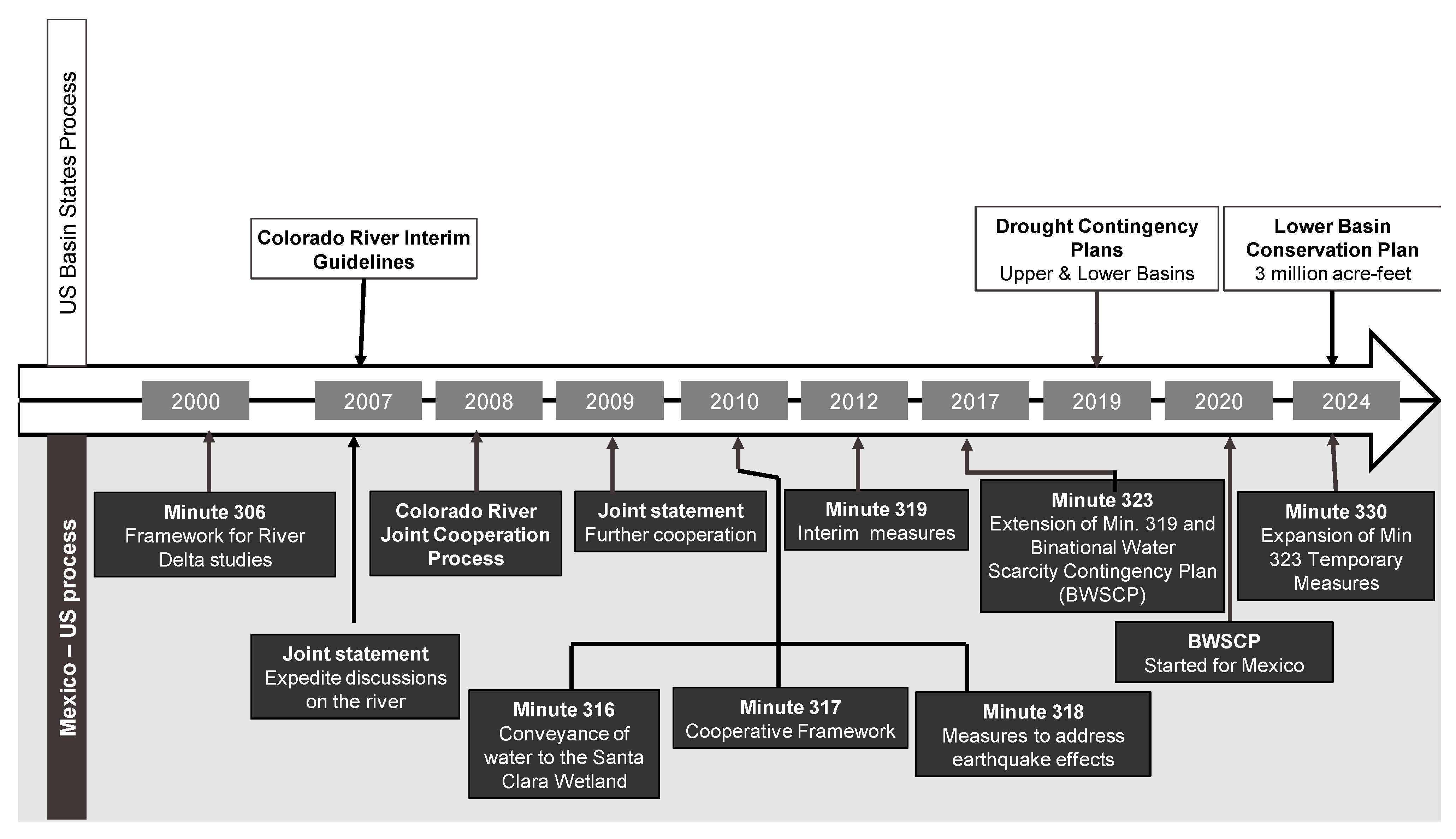
Minute 330 builds on the cooperative framework for Colorado River governance established and developed in earlier minutes dating back to 2000. In this section, we explore the minute process, the ongoing mechanism of negotiation and resolution of issues related to the treaty through minutes [32] (p. 547). We focus on “modern minutes,” namely Minutes 306, 317, 318, 319, and 323, which shared three common goals that have shaped the recent Minute 330. The first goal was to establish common frameworks to address environmental damage and preserve riparian and estuarine ecosystems in the Colorado River Basin. The second goal in addition to the prior minutes was to develop strategies to address water shortages in the system and to explore ways to create new water sources. The third goal was establishing provisions to address infrastructure damage in Mexico. We present the main features of these minutes contributing to Minute 330 in the chronological order of their approval (see Figure 1).

3.1. Early Efforts: Minutes 306, 316, 317, and 318

Early binational environmental efforts in the Colorado River were driven by a multistakeholder initiative to address ecosystem damage in the river delta. Dating back to 2000, Minute 306 resulted from common interests and evidence gathered by US and Mexican academic and scientific organizations aimed at preserving the river delta ecosystems [33]. It stressed the importance of collaboration through the exchange of information and advice from governments and non-governmental organizations (NGOs) with an interest in the river [33]. Both countries agreed on the key role of cooperation and scientific research to achieve this goal [30,41]. A binational technical taskforce would examine the riparian and estuarine ecology of the Colorado River to determine the minimum required flow to sustain ecosystems on the lower reach of the river [42].
In subsequent years, Mexico and the US intensified efforts to mitigate the environmental impact on the Colorado River. In 2007, both countries committed to expedite discussions to further cooperation to address climate change impacts and the effects of the “ongoing historic drought” [34]. The Colorado River Joint Cooperation Process (CRJCP), initiated that year, explored common projects of ecosystem restoration, water conservation, supply, and augmentation [35]. In early 2009, the US Secretary of State and the Mexican ambassador to the US acknowledged ongoing cooperation efforts and pledged that both governments would identify innovative opportunities towards those goals [36]. Minute 316, endorsed in 2010, mandated that both governments and NGOs contribute 10,000 acre-feet each to the Santa Clara Wetland, a site of ecological relevance in the Delta Region. In addition, Mexico would receive part of its allocation through desalinated water from the Yuma Desalting Plant, which would operate at one-third of its capacity [37,41].
During the 2010s, both countries continued exploring complementary measures to share shortages in the Colorado River Basin. Minute 317, endorsed that year, set a framework for measures on ecological restoration and water reduction sharing, which would set the stage for later minutes [4]. The Binational Core Group and the technical work groups were tasked to investigate additional projects to mitigate drought impacts in the basin [22,38]. They would consider projects to conserve existing volumes, with specific measures including investments in uses, especially in agriculture, as well as the possibility of storing part of Mexico’s allocation in US infrastructure. Alternatives to generate additional water sources, mainly through investments in desalination facilities, would also be explored [38]. In addition, the Binational Consultative Council composed of IBWC–CILA representatives, the US and Mexican federal governments, and basin states was established to coordinate legal, administrative, and policy matters, as well as benefit and cost sharing in mutual projects [38].
The possibility of storing Mexican volumes in US infrastructure envisioned by Minute 317 was finally implemented by Minute 318 and Minute 319 [35]. Minute 318 responded to damage in the Mexican irrigation system in the aftermath of a 7.2 Richter scale earthquake in 2010. As a result, deliveries to Mexico would be adjusted downward by up to 260,000 annual acre-feet so that the country received only volumes it was able to use [39]. While this agreement stemmed from emergency conditions, it did build on previous environmental efforts, as it was the first time a minute recorded both countries’ compromise to move forward to minimize climate change impacts [22,38]. Then, in 2012, with the endorsement of Minute 319, both countries moved to implement lessons from emergency adjustments to deliveries to Mexico into the broader environmental goals of the Minute 317 cooperative framework. Minutes 319 and 323 are the immediate predecessors of Minute 330 and could represent a new era of water cooperation.

3.2. A New Era of Water Cooperation: Minutes 319 and 323

Following their mutual interest in maintaining Colorado River water demands, Mexico and the US signed Minute 319 to continue and reinforce provisions of Minute 318 within the cooperative framework of Minute 317. Described as a landmark, significant, and remarkable agreement [30,31,43] and the highlight of the CRJCP [35], Minute 319 remained in force from 2012 to 2017. Allocation arrangements linked reservoir levels to water allocation in interim guidelines adopted by US basin states in 2007 to develop shortage-sharing agreements and to coordinate reservoir operations in the basin through 2026 [35,44]. However, as a bilateral effort, it was also remarkable that the minute led to the allocation of volumes to the environment while incorporating NGOs as treaty parties [31].
Both countries referred to historical and potential future climate impacts and designed measures to manage the Colorado River proactively amidst reservoir variability [40]. Under these circumstances, Minute 319 aimed to maximize water utilization by making water allocations to Mexico flexible [37]. Lake Mead elevation levels would set thresholds for sharing the shortage and supply [32]. Different thresholds were established; however, the lowest elevation level considered for implementing water reductions to Mexico was 1025 feet above mean sea level (msl). In the event of such elevation on the first day of any year, a volume of 125,000 acre-feet would be deferred [40]. The concept of Intentionally Created Mexican Allocation (ICMA) was introduced. ICMA volumes are those Mexico can voluntarily store in US reservoirs through conservation and new water sources projects [35,40]. As ICMA volumes could be recovered later, this mechanism implied mutual benefits: Mexico would be able to store some of its water in US infrastructure for future use, while reservoirs in the US, mainly Hoover Dam and Lake Mead, would remain at sustainable levels [30,41].
Minute 319 was also remarkable for bringing together a coalition of NGOs, many of whom had forged cooperation efforts in support of Minute 306. The negotiators took their environmental concerns into account. A joint cooperative program to investigate aspects involved in the creation of water volumes to allocate to the environment was set up [40], shifting governance to a participatory and science-based approach [28,41]. As part of the program, the US would provide USD 21 million of funding to Mexico for infrastructure projects. A notable part of the minute was a pulse flow of 105,392 acre-feet that would be released between 2014 and 2016 using part of the ICMA or deferred water volumes [40]. An environmental flow team, including the Sonoran Institute, Pronatura, and Environmental Defense Fund, contributed to setting up a delivery plan and report for these flows [41,45] within the Environmental Work Group and the Binational Consultative Council [40]. The pulse flow enabled the waters of the Colorado River to reach its delta for the first time in decades [46,47,48].
Endorsed in 2017, Minute 323 extended Minute 319 provisions through 2026. Thresholds for shortage and surplus sharing based on Lake Mead elevations and volumes were set in Minute 319 [8]. In addition, it established the BWSCP to implement immediate measures to avoid reaching critical elevation levels at Lake Mead [8]. BWSCP followed the US lower basin states’ implementation of DCPs since 2019 [8,35]. Contributions to BWSCP would start below 1090 feet msl. Mexico’s maximum contribution, i.e., the volume to be saved at the lowest elevation threshold, was 150,000 acre-feet in the event of elevations at or below 1025 feet msl. These volumes were recoverable, including in the case of improving Lake Mead elevations [8].
Minute 323 also established Mexico’s Water Reserve. The reserve consists of three separate volumes: emergency storage from deferrals of the Mexican allocation made under emergency situations [32], additional ICMA volumes, and a revolving account for Mexican waters in storage in the US, which included previously deferred volumes from Minute 318 and Minute 319 [8]. Volumes in Mexico’s Water Reserve allow for additional voluntary storage [35], yet the delivery and use of its volumes is subject to the rules established by Part V of the minute. Additionally, Minute 323 highlights environmental cooperation and projects. To support this, the US allocates a total of USD 31 million to Mexico for conservation efforts within the country through projects related to canal lining, on-farm conservation, reservoir regulation, and land fallowing, among others [8].
Taken together, the latest minutes on the Colorado River have each contributed to the binational regime toolkit to address a changing climate. Further cooperation and the storage of Mexican water in US infrastructure were envisioned through Minute 317. Deferral arrangements for Mexican allocation were first implemented under emergency conditions with Minute 318 and were institutionalized by Minute 319 [29]. Minute 319 also contributed to including the environment as an additional stakeholder. Finally, Minute 323 established the possibility of adding more water volumes through BWSCP and Mexico’s Water Reserve while envisioning a number of projects and investments. Despite these measures, in 2022 IBWC–CILA needed to reconvene to implement additional cooperative steps through a new agreement, Minute 330, due to persistently lower reservoir levels. After presenting our methods and approach, we now focus on the most recent of these arrangements.

4. Methods and Approach

We adopt a case study approach to examine the cooperative relationship between the US and Mexico over the management of the Colorado River. We ask: Why did the US and Mexico decide to endorse a new minute on the Colorado River, and what are the minute’s contributions to the binational cooperative framework in the Basin? To answer this research question, we adopt a multi-method, qualitative approach that combines document analysis, news media analysis, and semi-structured expert interviews. Our document analysis includes minutes, reports, and press releases from IBWC–CILA, the US Department of the Interior, the US Bureau of Reclamation, and other government agencies published from 2022 to 2025 (see Appendix A for a list of minutes and Appendix B for a list of government reports). Reports and press releases explain why a minute was needed and tell the story of the negotiating process from the government’s point of view. We also examined news media coverage of Minute 330 reported by Mexican and US sources in 2023 and 2024 (see Appendix C for a list of media documents). Our media exploration from Mexico extends through mid-2025 to cover responses to the minute in the country and the early stages of implementation.
To gain a more in-depth perspective on Minute 330’s background and negotiations, we conducted semi-structured interviews with stakeholders involved in the design and implementation of Minute 330. To be selected, participants in the first round of interviews needed to have either a prominent role in the Minute 330 process, as revealed by its text and document sources, or to have expertise in Mexico–US Colorado River water relations more generally. To avoid bias, our sampling frame was binationally integrated, targeting half of the participants from each country. Half of our final roster of interviewees was recruited directly and the other half was introduced to us by the first set of interviewees through snowball sampling. Snowballing is a useful approach in highly focused research [49], such as this research on a single minute. It introduced us to participants involved in the negotiation process and others who experienced the implementation process. No other kind of participants would have offered similar perspectives [50].
Our 20 interviewees include 8 experts from Mexico and 12 with a US affiliation. Interviewees included members of the Minute 330 negotiating group from IBWC–CILA and Mexican and US federal and state representatives, as well as other interviewees with expertise on the post-2000 Colorado River from federal US and Mexican federal agencies (US Department of the Interior, US Bureau of Reclamation, and Mexico’s National Water Commission), NGOs, and university researchers from both countries. We also included members of US-state water agencies and leaders of Mexican water user associations. Interviews were conducted primarily online via Microsoft Teams. Interviews with water user leaders were conducted by phone. Interviews took place between March and August 2025 (see Appendix D for a list of interview dates, interviewee affiliations, and countries). Transcripts of recordings were converted to text files using the same application. Audio recordings from the phone calls were transcribed using Microsoft Word’s online transcription function. All transcriptions were reviewed and checked for accuracy by the researchers. In this document, interviews are referenced as personal communications (personal communication), followed by the affiliation type of interviewees and interview date.
Our interviews inquired about participants’ roles in Colorado River issues and the minute process more broadly. Specifically, interviewees were asked to describe the motivations and negotiation process regarding Minute 330, as well as advances in its implementation and outcomes to date (see Appendix E for a list of interview questions). To guide our analysis, the interview transcripts were initially coded according to three key themes: motivation, negotiating process, and implementation of Minute 330. Our coding process led us to also inductively develop additional codes. “Minute 330 compensation” helped us understand implementation, and “Proportionality” helped us understand negotiations. We also coded cooperation between the US and Mexico, which interviewees emphasized (see Appendix F for coding sample). Coding was done using open-source qualitative analysis software and exported to a spreadsheet to facilitate analysis across interviews. The research study and informed consent protocols were approved by the Institutional Review Board (IRB) at the University of Arizona (5814).

5. Results

5.1. Minute 330: Motivations and Negotiations

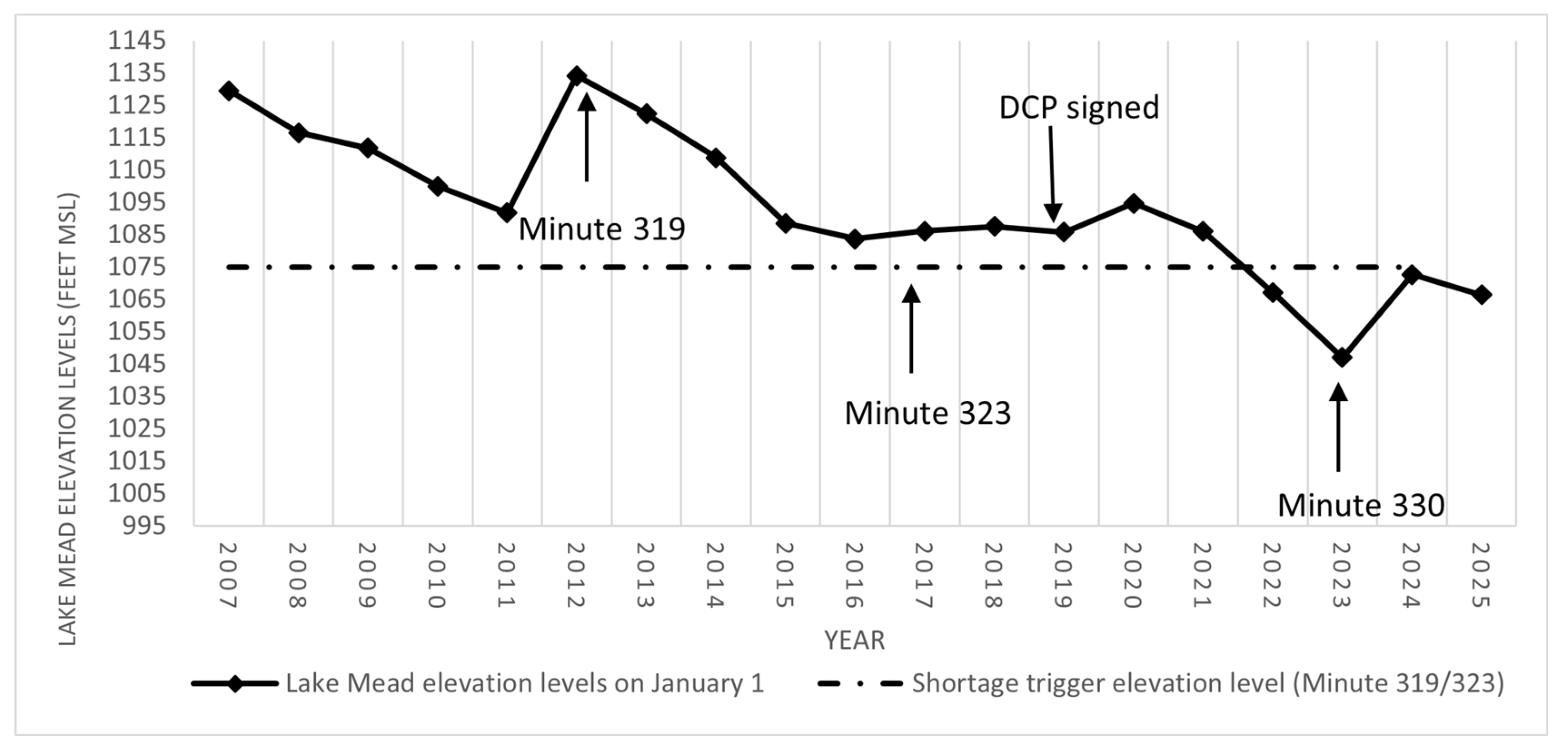
The genesis of Minute 330 dates to 2021, when the Colorado River’s main reservoirs reached critical levels (personal communication, academic member, 1 April 2025; personal communication, NGOmember, 11 April 2025). At this time, Lake Mead reached its lowest recorded levels (Figure 2), and cuts were announced by the US Bureau of Reclamation [7,51]. Low elevations at Lake Powell were especially worrisome, as they could make it difficult to operate Glen Canyon Dam, including generating electricity (personal communication NGO member, 25 April 2025; personal communication retired federal agency member, 30 May 2025). The US Department of the Interior [52] declared that a “prolonged drought and low runoff conditions accelerated by climate change have led to historically low water levels in Lakes Powell and Mead,” and released an intent to analyze potential alternatives to identify relevant information. A Supplemental Environmental Impact Assessment Process under the National Environmental Policy Act was initiated to develop plans to further reduce their water consumption by the end of 2026. Amidst that context, the US lower basin states (Arizona, California, and Nevada) submitted a proposal to the US Bureau of Reclamation in order to conserve 3 million acre-feet (MAF) of water from the Colorado River over the years 2024–2026 [53,54,55]. With these efforts underway within the US, there was a growing expectation to negotiate with Mexico to implement similar measures bilaterally (personal communication retired federal agency member, 30 May 2025; personal communication federal agency member, 12 May 2025; personal communication academic, 18 March 2025; personal communication basin state representative, 24 July 2025).
Throughout 2022–2024, IBWC and CILA met frequently to update on the basin’s hydrologic conditions and discuss the implementation of potential reduction measures (personal communication basin state representative, 24 July 2025; personal communication basin state representative, 31 July 2025). CILA notified the Mexican states of Sonora and Baja California, as well as Mexican agricultural water users, about the low levels in the basin and actions beyond Minute 323 in April 2022 [57]. Then, in May 2022, IBWC informed CILA about actions taken by US states in response to low reservoir levels. In response, CILA urged the government of Baja California to “develop projects to generate water savings, which contribute to maintaining the levels of reservoirs in the basin” [58]. Commissioners requested that water conservation projects be implemented to maintain Lake Mead levels [59].
In August 2022, Lake Mead’s elevation was forecast to be 1047.61 feet by 1 January 2023. According to Minute 323, “when on January 1, the elevation of Lake Mead is projected to be at or below elevation 1045 feet msl, the Commission will meet to discuss measures that could be undertaken, recognizing that reductions in both countries may need to increase” [8] (sec. III D). The projected lake levels would require the US to save 200,000 acre-feet under the Lower Basin DCP and 34,000 acre-feet in Mexico in accordance with Minute 323 section IV [8]. Following that minute’s provision, on 30 November 2022, IBWC–CILA met with the Mexican National Water Commission (Comision Nacional del Agua, CONAGUA), the Secretariat of Foreign Relations of Mexico (Secretaria de Relaciones Exteriores, SRE), the US Department of the Interior, the US Bureau of Reclamation, and the basin states to discuss how delivery reductions scheduled for 2023 would not be enough and that new measures must be adopted [60]. In December, IBWC–CILA established the Binational Emergency Response Group (BERG) to identify additional cooperative actions to prevent critical elevations in reservoirs [1]. Expert interviewees considered that the November meeting was the formal start of discussions for a new minute (personal communication federal agency member, 23 May 2025; personal communication federal agency member, 9 July 2025; personal communication federal agency member, 7 August 2025). A follow-up meeting of the same stakeholders was reported from Ciudad Juárez, Mexico, in February 2023 [61].
According to our interviewees, the negotiations for Minute 330 took place in a short time frame compared to previous minutes, due to the urgency of reaching an agreement to allow additional cuts in response to hydrologic conditions in the basin (personal communication federal agency member, 12 May 2025, personal communication retired federal agency member, 30 May 2025, personal communication basin state representative, 24 July 2025, personal communication basin state representative, 31 July 2025). As a result, fewer people represented stakeholders at the negotiation table than in previous minute negotiations. There was only one representative for the three US lower basin states and one representative for the four upper basin states. Baja California was represented by the head of CONAGUA in Baja California (personal communication basin state representative, 24 July 2025, personal communication retired federal agency member, 30 May 2025, personal communication basin state representative, 31 July 2025). Binational meetings were held monthly (personal communication basin state representative, 31 July 2025, personal communication basin state representative, 24 July 2025, personal communication federal agency member, 7 August 2025), finishing in February 2024, right before the minute was signed personal communication basin state representative, 31 July 2025). During those meetings, work groups reported to the negotiating group on the specific aspects they were working on for consideration of inclusion in the new minute (personal communication federal agency member, 7 August 2025).
In parallel to the binational meetings between the US and Mexico organized by the IBWC–CILA, each country held meetings with its own stakeholders (personal communication basin state representative, 31 July 2025). In Mexico, CILA, CONAGUA, the Secretariat for Protection, Sanitation, and Water Management of Baja California, Pronatura-Noroeste, and the Autonomous University of Baja California met several times, including in April, June, and December 2023 and February 2024 [62,63]. Some of these meetings were hybrid (both in person and remote) and included user representatives, such as users from Irrigation District 014, which is the largest user of water in northwestern Mexico. These participants were informed about forecasts and discussed potential measures [64]. Meetings with stakeholders, including the Binational Environmental Work Group, universities, and NGOs, about an upcoming minute were more informative than consultative (personal communication, NGO-member, 4 June 2025). In parallel, the US held meetings among state representatives, IBWC, and the US Bureau of Reclamation to prepare for negotiations (personal communication basin state representative, 24 July 2025). In early March 2024, a few weeks before Minute 330 was officially endorsed, the US federal government announced its support for the 3 MAF Lower Basin conservation effort. It also confirmed work in progress between Mexico, the IBWC, and the US Bureau of Reclamation to implement additional conservation measures through 2026 [65].

5.2. Minute 330: Provisions and Features

Under the title “Expansion of Colorado River Temporary Measures,” Minute 330 was signed on March 21, 2024, in El Paso, Texas. Its main mandate was that Mexico would “generate, through conservation projects, a total of at least 400,000 acre-feet (493,396,000 cubic meters) in system water and Mexico’s Water Reserve in addition to the volumes already identified in Minute No. 323” [1] (res. 1). Conservation of volumes would be accomplished by reducing the Mexican annual allocation over three years, starting in 2024 [1] (res. 5). That same year, the Mexican allocation would be reduced by 133,000 acre-feet (164 million cubic meters, MCM). During the second year, the reduced volumes total 200,000 acre-feet (246.7 MCM). Lastly, 67,000 acre-feet (82.7 MCM) would be reduced in 2026 [1] (res. 2) (personal communication federal agency member, 23 May 2025). At least 250,000 acre-feet of volume shall be system water, which benefits all users [1] (res. 2). The BERG considered adopting this conservation program, taking into account the reduction efforts made by the 3 MAF committed to by the US lower basin states. [1] (p. 1) (personal communication NGO-Environment Work Group member, 25 April 2025, personal communication federal agency member, 12 May 2025, personal communication basin state representative, 24 July 2025).
Volumes to be reduced for Mexican allocation followed the principles of proportionality and parity, which are common in the Mexico–US water allocation arrangements, especially since Minute 319 (personal communication federal agency member, 23 May 2025, personal communication federal agency member, 30 May 2025). These principles state that when a reduction is applied to the seven basin states, a proportional reduction is also applied to Mexico (personal communication federal agency member, 12 May 2025, personal communication federal agency member, 15 May 2025, personal communication federal agency member, 23 May 2025, personal communication federal agency member, 9 July 2025, personal communication federal agency member, 7 August 2025). Proportional reductions were regarded as opposite to the extraordinary drought clause (personal communication federal agency member, 9 July 2025), enacted in Article 10 of the Water Treaty, which states that “in the event of extraordinary drought,” water deliveries to Mexico will be reduced in the same proportion as consumptive uses in the United States [2] (art. 10 b). It was considered that if both countries “rely on the river [both] should be willing to put something on the table to help stabilize and balance it during this megadrought” (personal communication basin state representative, 31 July 2025). While adhering to those principles, some interviewees from both US states and the federal government stated that the later endorsement of Minute 330, compared to the lower basin agreement, led commissioners to consider a final volume of 400,000 acre-feet to be conserved (personal communication federal agency member, 12 May 2025; personal communication basin state representative, 24 July 2025; personal communication basin state representative, 31 July 2025). Interviewees also emphasized Mexico’s willingness to take voluntary measures to address the shortage (local water agency member, 3 June 2025; personal communication academic, 18 March 2025; personal communication federal agency member, 15 May 2025) and the mutual benefits involved (personal communication federal agency member, 9 July 2025), especially because Article 10 provides no definition of “extraordinary drought.” Because of this, invoking that legal provision would force IBWC–CILA to “go through a whole process” to define that term (personal communication federal agency member, 15 May 2025).
Thus, the amount of water to be conserved in Mexico, as per Minute 330, was set in proportion to the volume of 3 MAF conserved by the US lower basin states. As the allocation to Mexico of 1.5 MAF under the Water Treaty represents 16.67% of the 9 MAF total apportionment for lower basin US states (7.5 MAF) and Mexico (1.5 MAF), a similar percentage was applied to the 3 MAF commitment, resulting in 500,000 acre-feet required for Mexico (personal communication NGO member, 25 April 2025, personal communication federal agency member, 12 May 2025, personal communication federal agency member, 15 May 2025, personal communication basin state representative, 24 July 2025, personal communication basin state representative, 31 July 2025). A member of the negotiating group on the US side acknowledged that the agreement was largely set up by these proportional allocations at the time of the negotiation, and “Mexico did not have a role in shaping the initial set of actions, [which] is not optimal, but it was simply the result of the kind of crisis that we were trying to move quickly on doing something” (personal communication basin state representative, 24 July 2025). This interpretation suggests that negotiations were more focused on the amount of funding Mexico would receive to implement the specific projects to conserve the volumes determined.
To fund water conservation projects, Minute 330 also stated that the US would “provide the Government of Mexico with USD 65 million to support system water conservation projects” [1] (res. 2). Several interviewees stated that a sum of money as part of the minute provisions reflected the cooperative approach and the spirit of bilateral cooperation (personal communication retired federal agency member, 30 May 2025), which was also evident in Minutes 319 and 323, amounting to some USD 100 million to Mexico across the three agreements (personal communication federal agency member, 15 May 2025). Funding arrangements are also a feature of conservation agreements in both the US upper and lower basin states (personal communication basin state representative, 24 July 2025). However, earlier in Minute 330, Mexico had suggested including a sum of money to fund the conservation actions (personal communication basin state representative, 24 July 2025; personal communication federal agency member, 23 May 2025). The amount followed its own negotiating process (personal communication federal agency member, 23 May 2025; personal communication basin state representative, 24 July 2025) and not the parameters used in the US to compensate its users for similar transactions (personal communication basin state representative, 24 July 2025; personal communication NGO member, 25 April 2025). Interviewees reported that the amount was initially set at USD 20 million and USD 35 million (personal communication federal agency member, 23 May 2025; personal communication, academic member, 1 April 2025). Although Mexico was on schedule with the conserved volumes up to 2024 and on track to deliver the volumes for 2025 (personal communication federal agency member, 23 May 2025), funds had not been received by the summer of that year, as they are provided once construction on the projects begins (personal communication federal agency member, 15 May 2025).
Additionally, Minute 330 established mechanisms to address potential impacts of conservation projects on water users in Mexico. It was the initiative of Mexico to address imbalances to some Mexican users resulting from Minute 323 allocation reductions [1] (p. 3). There are two locations where the US delivers water to Mexico: the so-called Northerly International Boundary, on the Morelos Dam at the Mexico–US border, and the Southerly International Boundary, on Sanchez Mejorada Canal, in San Luis Rio Colorado, Mexico (personal communication federal agency member, 7 August 2025; personal communication, academic member, 1 April 2025). Minute 330 negotiators considered that users at the Northerly International Boundary are the most affected under Minute 323 [1] (p. 3); therefore, they resolved to “convene a Work Group to review concepts that could address disparate impacts to Mexican users depending on whether they receive water delivered by the United States at the Northerly or Southerly International Boundary” [1] (res. 8). Infrastructure solutions are among the avenues this group would explore [1] (p. 3).
Minute 330 also recognized that additional conservation efforts mandated would affect water salinity. IBWC–CILA and other national water authorities manage salinity levels to ensure optimal crop development (personal communication federal agency member, 23 May 2025). Conserving additional volumes, such as those specified in Minute 330, would make it more difficult to meet the target salinity level, because salinity increases as more water remains in the reservoirs (personal communication federal agency member, 30 May 2025; personal communication federal agency member, 12 May 2025; personal communication federal agency member, 15 May 2025, Local water agency member, 3 June 2025). IBWC–CILA also established a Minute 330 Salinity Policy Work Group, which would report to governments on existing and potential impacts of salinity in both countries [1]. Salinity has been closely monitored since the endorsement of Minute 242 in 1973, when the US committed to deliver water at a specified salinity level. Addressing the salinity issue would also help countries move toward a post-2026 scenario to avoid unnecessary reductions in water to dilute salt and adapt to current salinity levels, which are not as high as those when Minute 242 was signed (personal communication basin state representative, 24 July 2025; personal communication basin state representative, 31 July 2025). Interviewees also emphasized the importance of including salinity in Minute 330 (personal communication retired federal agency member, 30 May 2025, personal communication federal agency member, 15 May 2025). The Minute 330 Salinity Policy Working Group added to the salinity work groups established by Minutes 242 and 323. It was agreed that the Minute 330 Salinity Policy Work Group would submit a report one year after its scope of work is approved [64,65]. Of the USD 65 million in compensation, approximately USD 5 million is expected to be invested in projects to improve water quality and regulate salinity levels (personal communication, academic member, 1 April 2025) [66,67].

5.3. Minute 330: Early Implementation Actions and Responses

Initial reactions to Minute 330 on both sides of the border were mixed. Right before its endorsement, the US federal government called it a “complementary effort” to increase water savings and a key part of short- and long-term basin planning [65,68]. In Mexico, however, potential conservation measures raised concerns among users in the Mexicali Valley, an agricultural area in northwestern Mexico that relies heavily on the Colorado River allocations. Prospective mitigation measures at the national level include land fallowing due to the projected reduced volumes (personal communication NGO member—water user, 5 August 2025). Information about the detailed negotiations was not evenly distributed among all user groups at Irrigation District 014, the main water district in the valley. Some users argued that despite users not being informed, the press cited the volumes that would be reduced (personal communication NGO member—water user, 5 August 2025). The former head of the district declared to the media that the annual adjustments to Mexico’s water allocation began with Minute 319, but that deferred deliveries never arrived [69].
Official reports and one representative from the Mexican government claimed that Mexico had completed the volumes to be conserved for the year 2024 by mid-2025 [68] (p. 3) (personal communication federal agency member, 23 May 2025). They also argued that the country was on track to conserve the 2025 volumes, up to 333,000 acre-feet, by December of that year. In March 2025, a year after the minute’s endorsement, US sources reported that volumes conserved by Mexico had helped save 1.6 MAF in conjunction with the US basin states [70]. It was expected that the overall implementation of Minute 330 will raise the elevation of Lake Mead by 5 feet [71,72].
The implementation of the binational work groups established by Minute 330 was slower than expected, according to our expert interviewees. As of spring 2025, work groups created by Minute 330 were still in preparation and had not commenced activities (personal communication federal agency member, 15 May 2025; personal communication federal agency member, 12 May 2025; personal communication basin state representative, 31 July 2025). IBWC reported progress in the creation of the Minute 330 Salinity Policy Work Group’s terms of reference in October 2024 [65]. Our interviewees suggested that the group would be based on the Binational Salinity Work Group, which is already active on Minutes 319 and 323 [8,40] (personal communication federal agency member, 12 May 2025). On the one hand, this new group would likely have greater decision-making authority (personal communication federal agency member, 23 May 2025). It would be formed by representatives from the US and Mexican basin states, the US Bureau of Reclamation, CONAGUA, and IBWC–CILA (personal communication federal agency member, 12 May 2025). On the other hand, the existing work group continued monitoring salinity (personal communication federal agency member, 9 July 2025; personal communication federal agency member, 23 May 2025; personal communication federal agency member, 30 May 2025).
Authorities in Mexico, primarily CONAGUA, have worked with agricultural users to develop a plan to fallow lands in certain tracks and distribute funding among affected users (personal communication retired federal agency member, 30 May 2025). Shortly after the process, agricultural users in Mexico demanded around MXN 22,000–23,000 per fallowed hectare. In contrast, the government was offering MXN 7000 [73,74]. At users’ meetings in 2024, it was formally decided to ask for 90% of the USD 60 million to support costs for land fallowing so that each producer received around MXN 22,000 per fallowed hectare [75]. The remaining 10% of the budget would be used for infrastructure projects [76,77,78]. A proposal had been formally presented to CILA [69].
The regulations to implement Minute 330, published in early 2025, established that half of the USD 60 million would fund water conservation projects in major infrastructure works, while the other half would contribute to land fallowing, improvement, and modernization [79,80]. The final sum approved in those regulations is MXN 13,500 per hectare out of production plus MXN 2500 per hectare for land fallowing [79,80]. As of the summer of 2025, agricultural water users whose volumes were not delivered in exchange for land fallowing began receiving economic benefits; however, infrastructure projects in the Irrigation District 014 were still pending (personal communication NGO member—water user, 5 August 2025; personal communication federal agency member, 7 August 2025). Expected conservation projects include modernizing the irrigation district, land fallowing, wastewater reuse, and wetland creation (personal communication federal agency member, 23 May 2025).

6. Discussion

6.1. Resilience and Adaptation of the Treaty Amidst Changing Conditions

According to the IBWC–CILA, Minute 330 expanded on the temporary measures taken in the Colorado River [1]. Some interviewees described it as an add-on to Minute 323, or an interim minute between this and a post-2026 minute (personal communication academic member, 18 March 2025; personal communication retired federal agency member, 30 May 2025). Minute 330 created an opportunity for cooperation between the two countries and helped reinforce the Water Treaty’s institutional resilience amidst climate variability. Prior researchers have suggested that the Treaty’s minute features enable adaptation and contribute to its resilience [5,81,82,83]. Indeed, the treaty includes mechanisms that align with resilience features, such as establishing volume allocations and adjusting those allocations [17,84]. Minutes take these adjustments forward by helping implement over- or under-allocation of volumes, as well as complementary measures to adapt to those implementations. Overall, the minute process is seen as so strong that neither country has ever opted out of any endorsed minute [4]. As one interviewee noted, because minutes are rooted in the treaty, countries can bypass national legislative review processes, thereby improving efficiency and response times (personal communication federal agency member, 7 August 2025).
Minute 330 showed that no matter how strong the US–Mexico water regime is, worsening drought conditions can challenge plans established by minutes. A historic drought intensified, introducing a time constraint: negotiations had to proceed quickly (personal communication retired federal agency member, 30 May 2025; personal communication NGO member—water user, 5 August 2025). Prior research recognizes that treaties help reduce water conflict, but also that parties might fail to meet their commitments, and climate variability can weaken cooperation. Mexico and the US have demonstrated, through Minute 330, that they are prepared to manage unprecedented water-supply fluctuations, as evidenced by the lowest level ever recorded at Lake Mead. These unprecedented circumstances are likely to continue under the persisting aridification of the basin due to human and non-human activities, putting reservoirs at risk of further decline [85,86].
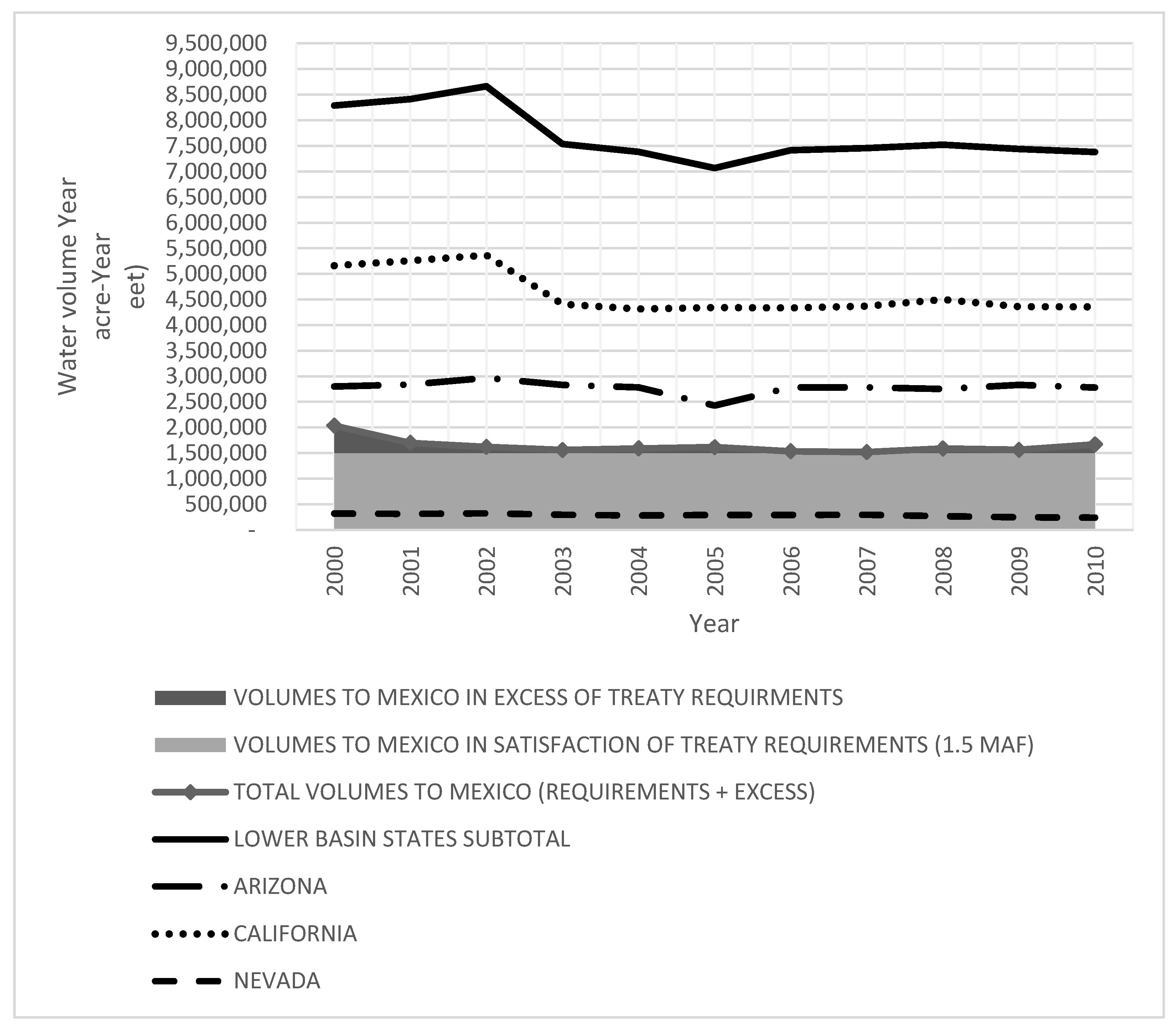
The cooperative framework envisioned in Minute 306, endorsed in Minute 317, and operationalized in Minutes 318, 319, and 323, prepared both countries to take further action amid reservoir-level reductions. Our interviewees acknowledged that additional conservation measures were preferred over triggering the extraordinary drought clause (Article 10) of the Water Treaty. Since the additional 400,000 acre-feet are calculated proportionally from the 3 MAF conserved by the US states, the shortage is shared as mandated under Article 10. The treaty did not define “extraordinary drought” in the context of the Colorado River [20,21,87]. However, it did mandate proportionality, at least in consumptive reductions in the US with respect to allocation reductions to Mexico. In the context of the ongoing historic drought, consumptive uses by the US lower basin states were reduced, especially after 2002 (see Figure 3). Before 2010, Mexico received its annual allocation of 1.5 MAF, and reductions only affected volumes in excess of treaty requirements. After 2010, shortage sharing has been implemented primarily under Minute 319 and Minute 323 [4,42,88], particularly Minute 323, and its subsequent report stating that “…the Commission may develop a successor agreement to Minute 323 that would extend or replace the substantive provisions of that agreement …” [89] (pp. 9–10). This is why it is significant that our interviewees emphasized that Mexico voluntarily accepted a specific process to address unprecedented conditions in the river. In the context of a new post-2026-min, our interviewees’ overall view is that the treaty’s framework is unlikely to be amended, yet both countries will need to rely on additional, perhaps longer-term, minutes (personal communication, NGO member, 25 April 2025; personal communication, NGO member, 11 April 2025). New agreements will likely be needed as further allocation cuts are anticipated. While the cooperative framework will continue to play a significant role in the binational relationship, a question remains about the suitability of temporary agreements to respond to longer-term challenges.
In terms of specific measures adopted in the realm of water allocation, Minute 330 largely represented continuity with its predecessors, Minute 319 and 323. The main tool is to reduce deliveries in exchange for US funding. Researchers have noted that volumes to Mexico have steadily decreased since 2021 [101]. Although the implementation of Minute 319 dates to 2012, its structure has remained largely similar to that of Minute 323. On the one hand, Mexico commits to leaving in Lake Mead a share of its corresponding volumes with the possibility of recovering part of them when the reservoir’s elevation levels improve. On the other hand, the US provides funding to develop projects in the basin [101,102]. While this exchange for conservation is featured in Minute 330, alternative future measures might not rely on reservoir levels as a reference for reductions, according to some of our interviewees (personal communication federal agency member, 15 May 2025; personal communication NGO member, 25 April 2025).
Beyond water allocation, the creation of the Minute 330 Salinity Policy Work Group, which is primarily concerned with conservation effects on salinity, opened the floor to wider discussion. On the one hand, the Salinity Work Group is exploring options for continuous salinity monitoring to replace the current sample-based approach. On the other hand, the river’s salinity conditions seem to be changing, as today the salinity in the river is at a much lower level than it was when Minute 242 salinity levels were set (personal communication federal agency member, 30 May 2025, personal communication basin state representative, 31 July 2025). Researchers have not widely discussed key changes to salinity provisions established at that point; however, desalting water has been considered both as a water augmentation strategy [103,104] and as an alternative in the event of increasing river salinity levels [105]. The former is part of the broader goal of creating “new water sources” under Minutes 319 and 323, while the latter minute tasked the Salinity Policy Work Group with exploring additional alternatives to modernize salinity monitoring [8]. It is crucial to avoid any “waste of water” (personal communication basin state representative, 31 July 2025), as one interviewee suggested might occur when bypassing volumes based on current salinity thresholds. This might help avoid the likely costly and time-consuming technical negotiations required to implement desalination methods widely. Thus, our exploration of Minute 330 opened a broader pathway for post-2026 negotiations, in which not only climatic and technical aspects will be crucial, but also negotiation and consensus, both at the bilateral level and especially within each country.

6.2. The Need for More Inclusive Decision-Making and Consultation

A second theme to highlight from our findings is the discussion Minute 330 sparked in Mexico concerning the flow of information about the negotiation of a new minute and the allocation of compensation funding While those interviewees who belong to the negotiating group and the government institutions that deal with the Colorado River cooperation process in both countries showed consensus about the suitability and need of Minute 330, other kinds of interviewees, especially water users in Mexico, did not fully agree on the suitability of the process (personal communication NGO member—water user, 5 August 2025, personal communication NGO member—water user, 7 August 2025). The main gaps identified were access to information about the negotiating process and the need to secure additional reductions from Mexico.
The US–Mexico transboundary water regime has become exemplary in terms of the inclusion of other parties, as evidenced by minutes endorsed before Minute 330. The inclusion of non-state actors was praised by most interviewees and in earlier scholarship, highlighting their contribution to facilitating cooperation, fostering environmental awareness, and addressing complex situations in transboundary basins [103,104]. Minute 306 was the first to acknowledge the importance of work performed by organizations interested in preserving the delta [33] (pp. 1–2). Then, Minute 319 was hailed for the work carried out by environmental NGOs to determine the Colorado river delta’s pulse flow volumes [42]. The Environmental Work Group and other specialized binational technical groups have been crucial in developing specific actions in projects, salinity, new water sources, and other issues. Minute 323 has expanded this activity by broadening the activities tasked to these multistakeholder work groups [81,106].
Thus, Minute 330 contrasted with its predecessors in terms of timing and the breadth of participants. Unlike Minutes 319 and 323, Minute 330 happened quickly and with fewer stakeholders at the negotiating table. Remarkably, the individual basin states and environmental NGOs were excluded (personal communication retired federal agency member, 30 May 2025, personal communication NGO member—water user, 5 August 2025). Although the basin states and environmental NGOs participated indirectly in Minute 319, their contributions were integral to the decision on how much water to allocate to the environment through the pulse flow. In Minute 330, by contrast, we learned that the environmental work group played a less active role, being included in informative talks (personal communication, NGO member, 4 June 2025) rather than consultative meetings. The fact that work groups usually concentrate on their own work rather than on others’ (personal communication, NGO member, 11 April 2025) could explain why the involvement of other work groups, like the Environmental Work Group, was much less on Minute 330, which had as its main goal to create an additional conservation volume.
Water infrastructure projects will be essential for conserving water volumes, but funding is necessary for Mexico to develop and implement them. Our interviewees viewed this primarily as a positive feature, though there were nuances. For the Mexican government, the compensation for Minute 330 was favorable, as it was not anticipated at the outset of the negotiations (personal communication, federal agency member, 23 May 2025). Although Mexican farmers welcomed the availability of money not provided otherwise by their national institutions, funding for conservation was regarded as a “purchase of water to maintain the reservoir levels … although it can also be a lease” (personal communication NGO member—water user, 5 August 2025). US officials have been aware of this situation. As a local water agency representative put it, Minutes 319 and 323 implied “water for a project” because it “looks bad if it is just water for money … that’s a political problem for [Mexico]” (local water agency member, 3 June 2025). Still, project execution can affect stakeholder perceptions. While Minute 323 permitted a simultaneous exchange of water for funding regardless of whether the project was executed (local water agency member, 3 June 2025), Minute 330 required the completion of the project for the US funding to be delivered (personal communication federal agency member, 15 May 2025). This created an information gap: reductions for 2024 were implemented that year, but the funds were not received until after summer 2025 (personal communication federal agency member, 23 May 2025; personal communication NGO member—water user, 5 August 2025). Money is essential when transboundary water arrangements feature joint infrastructure; however, the US–Mexico case study has not developed a full inter-basin transfer from Mexico to the US in the Colorado River, as we can see in other parts of the world, like the one existing in Lesotho in exchange for money from South Africa [107]. In the Colorado River Basin, how funding for projects is managed remains a national task.
The continued influence of funding on projects in the upcoming minutes is a concern. Our interviewees acknowledged that the availability of funds from the US contributed to making the Minute 330 conservation project. Still, there is no guarantee that such funds will be available for future needs (personal communication local water agency member, 9 July 2025), although it is likely that further projects will be needed. Furthermore, the distribution of money among relevant stakeholders is vital. We learned from our interviews that Mexico consciously negotiated the amount of compensation to allow the country to conserve the requested volume. The final sum was primarily aligned with practical and political constraints (personal communication basin state representative, 24 July 2025), whereas the conserved volumes were more closely aligned with conservation principles in the US lower basin.
As much as Minute 330 represented a consolidation of trust and partnership between Mexico and the US, that trust has not been fully reflected at the intranational level. The diversity of stakeholders in our sample, and the limited representation of some of them, make it hard to make claims about this. However, it is notable that the water users we interviewed were skeptical about the benefits to Mexico (personal communication NGO member—water user, 5 August 2025; personal communication NGO member—water user, 7 August 2025). In addition, most coverage of Minute 330 in the Mexican press focused on the ongoing conflict over the USD 65 million compensation within Mexico, whereas overall US media coverage was much smaller. At least from the user perspective, it was not only an issue of further reductions, but the way in which the Mexican government liaised with users at the irrigation district level, who, according to they themselves, first learned about a new minute after it was endorsed and it was “a surprise as [they] had not contemplated such cuts” (personal communication NGO member—water user, 5 August 2025). Thus, the intranational outcomes of transboundary water management should be considered, since researchers have posited that future conflict is more likely to take place nationally rather than internationally [9,108].
While the conflict in Mexico that followed Minute 330 focused on the government and users with respect to how to allocate compensation, this case highlights the importance of participation in achieving sustainable solutions and reducing conflict in transboundary waters [23,24,25,26,27,28,29,30,31,32,33,34,35]. Previous scholarship suggests that diverse stakeholders can benefit from water projects, especially when policies and agreements with affected parties are developed [107]. Our results indicate that part of the local water authorities’ role in Mexico is to consider users’ perspectives, suggesting that procedures exist, but are not necessarily assessed for effectiveness. While trust at the binational federal level between the US and Mexico has strengthened for more than two decades, trust between local users and their government representatives in Mexico has not advanced to the same extent. Research suggests that trust can be built by fostering face-to-face interactions among stakeholders [109] (p. 537), facilitating dialogue, promoting a more comprehensive knowledge of the basin, and enhancing consensus and agreement [110,111].

7. Conclusions

In this paper, we examined the motivations behind Minute 330, its negotiations, and the state of its implementation to understand how it reflects the US–Mexico cooperative relationship amid ongoing scarcity challenges in the basin. Through our mixed-method approach combining document analysis, news media analysis, and semi-structured expert interviews, we revealed how Minute 330 became the logical next step for the two countries in a long line of cooperative activities.
The main conclusion from our research is that Minute 330 was a direct and necessary response to the immediate scarcity challenges in the basin, which could not be addressed by measures agreed to and implemented in earlier minutes. Minute 330 expanded measures agreed to in Minute 323, primarily to task Mexico to conserve additional water volume. This new conserved volume proportionally reflects the amount of water conserved by the US lower basin states. Minute 330 also demonstrated that both countries can quickly implement cooperative measures in response to unprecedented circumstances.
However, ongoing aridification in the basin is likely to require greater cooperation to manage declining Colorado River flows. Mexico and the US will need to consider whether the current framework for allocating water, limitations on salinity, and the unregulated approach to funding water projects are best suited to address the post-2026 challenges in the Colorado River. The failure of the seven US basin states to reach a consensus in February 2026 has led to heightened uncertainty about the management of the reservoirs and the process to manage shortage between the states [112,113]. Growing conflict between the US and Mexico concerning allocations in the Rio Grande/Bravo [114] has been recently paused by an emerging deal [115]. However, the context of heightened tensions in the broader US–Mexico relationship [116] might suggest some difficult times ahead.
Lastly, we would be remiss if we did not acknowledge that findings from our research are limited by the diversity of stakeholders included and by the novelty of Minute 330. Our interviewee list included participants from the negotiating group, as well as individuals who have taken part in binational technical work groups, state water agencies, and federal water agencies that did not fully participate in Minute 330, but can comment on the broader binational relationship of which the minute is part. This leads to an understanding of implications and the process towards the minutes; however, it limits the depth of analysis of the interactions that took place at the negotiating table. Similarly, users in Mexico with broader concerns about the application of Minute 330 are not widely represented in our sample. These limitations open the future research agenda to deeper investigation of the experience in Mexican Irrigation District 014 during the years of implementation of Minute 330. There is also a need to understand the consultation process between national governments and the diversity of stakeholders. This is especially important in Mexico, where the federal government is more directly involved through CONAGUA’s local representation in the irrigation district. The Minute 330 experience also raises questions about the consequences of having fewer participants in time-sensitive transboundary water negotiations in the Colorado River Basin or elsewhere. Analyzing temporary funding in exchange for water rights is also a promising area for future research.

Author Contributions

Conceptualization, A.R.J.L.A. and A.K.G.; methodology, A.R.J.L.A. and A.K.G.; software, A.R.J.L.A.; validation, A.R.J.L.A., A.K.G. and G.S.; formal analysis, A.R.J.L.A.; investigation, A.R.J.L.A., A.K.G. and G.S.; resources, A.K.G.; data curation, A.R.J.L.A.; writing—original draft preparation, A.R.J.L.A.; writing—review and editing, A.R.J.L.A., A.K.G. and G.S.; visualization, A.R.J.L.A., A.K.G. and G.S.; supervision, A.K.G.; project administration, A.K.G.; funding acquisition, A.K.G. All authors have read and agreed to the published version of the manuscript.

Funding

This research was funded by the Udall Center for Studies in Public Policy at the University of Arizona.

Data Availability Statement

The original contributions presented in this study are included in the article and appendices.

Acknowledgments

We are grateful to our expert interviewees from governmental, non-governmental, and academic sectors who kindly shared their time and opinions.

Conflicts of Interest

The authors declare no conflicts of interest.

Abbreviations

The following abbreviations are used in this manuscript.
BERGBinational Emergency Response Group
BWSCPBinational Water Scarcity Contingency Plan
DCPdrought contingency plan
CILAMexican section of the International Boundary Water Commission
(Comisión Internacional de Límites y Aguas)
CONAGUAMexican National Water Commission (Comision Nacional del Agua)
CRJCPColorado River Joint Cooperation Process
ICMAIntentionally Created Mexican Allocation
IBWCUS section of the International Boundary and Water Commission
IRBinstitutional review board
Mslmean sea level
NGOsnon-governmental organization(s)
SRESecretariat of Foreign Relations of Mexico (Secretaria de Relaciones Exteriores)
USUnited States of America

Appendix A. Minutes

DateMinuteTitle
2000306Conceptual Framework for United States-Mexico Studies for Future Recommendations Concerning the Riparian and Estuarine Ecology of the Limitrophe Section of the Colorado River and its Associated Delta
2010316Utilization of the Wellton-Mohawk Bypass Drain and Necessary Infrastructure in the United States for the Conveyance of Water by Mexico and Non-Governmental Organization of Both Countries to the Santa Clara Wetland During the Yuma Desalting Plant Pilot Run
2010317Conceptual Framework for U.S.-Mexico Discussions on Colorado River Cooperative Actions
2010318Adjustment of Delivery Schedules for Water Allotted to Mexico for the Years 2010 Through 2013 as a Result of Infrastructure Damage in Irrigation District 014, Rio Colorado, Caused by the April 2010 Earthquake in the Mexicali Valley, Baja California
2012319Interim International Cooperative Measures in the Colorado River Basin Through 2017 and Extension of Minute 318 Cooperative Measures to Address the Continued Effects of the April 2010 Earthquake in the Mexicali Valley, Baja California
2017323Extension of cooperative measures and adoption of a Binational Water Scarcity Contingency Plan in the Colorado River Basin
2024330Expansion of the Colorado River Temporary Measures

Appendix B. Government Reports

AuthorDateTitle
IBWC–CILA11 July 2019Joint Report of the Principal Engineers with the Implementing Details of the Binational Water Scarcity Contingency Plan in the Colorado River Basin
CILA22 April 2022Boletín de prensa 137. Se informa de la evolución de las condiciones adversas en la cuenca del Río Colorado
CILA6 May 2022Comunicado de prensa 138. La sección mexicana de la CILA continúa informando sobre la evolución en las condiciones que prevalecen en la cuenca del río Colorado.
CILA4 July 2022Comunicado de prensa 139. La sección mexicana de la CILA continúa informando sobre la evolución en las condiciones que prevalecen en la cuenca del río Colorado
US Department of the Interior16 August 2022Interior Department Announces Actions to Protect Colorado River System, Sets 2023 Operating Conditions for Lake Powell and Lake Mead
CILA6 December 2022Comunicado de prensa 144. Las condiciones de escasez en la cuenca del río Colorado continúan agravándose lo que podría implicar acciones adicionales para todos los usuarios en 2023 y 2024.
CILA17 February 2023Comunicado de prensa 146. Se informa sobre el inicio de las reuniones para discutir las potenciales acciones a implementar entre 2024 y 2026 para proteger el sistema de cuenca del río Colorado.
US Department of the Interior5 March 2024Biden-Harris Administration Announces Major Milestone to Protect Short-Term Stability of Colorado River Basin
IBWC18 October 2024Bridging Borders and Tackling Challenges: IBWC Commissioners Lead the Way at Mexicali Regional Meeting
US Department of Interior20 November 2024Biden-Harris Administration Puts Colorado River on Path to Success
CILA6 February 2025Reglas de operación del programa de gestión de los apoyos del Acta 330 para el mejoramiento de la infraestructura hidroagrícola en el Distrito de Riego 014 “Río Colorado” para generar resiliencia ante las condiciones de escasez

Appendix C. News Media

AuthorDateTitleSource
Tuser, C.18 August 2021Bureau of Reclamation Announces First-Ever Water Shortage in Lake Mead, Colorado RiverWastewater Digest
Carlowicz20 July 2022Lake Mead Keeps DroppingNASA Earth Observatory
Bush, E.22 May 2023Three states agree to reduce water usage, so the Colorado River doesn’t go dryNBC News
Silversmith, S.22 May 2023Arizona, California and Nevada announce a plan to cut Colorado River usage for 3 years. ArizonaArizona Mirror
Udasin, S.5 March 2024Biden administration backs short-term Colorado River water savings planThe Hill
Domínguez, A.18 April 2024El gobierno mexicano no defendió el agua: Marco AurelioLa Voz de la Frontera
Cuéllar, M.24 April 2024BC dejará de recibir 493 millones de m3 de agua de EULa Jornada
Domínguez, A.1 May 2024Plantean descanso de 13 mil hectáreasLa Voz de la Frontera
Domínguez, A.6 May 2024Vence plazo para dar proyectos a la CILALa Voz de la Frontera
Cortéz Lara, A.7 May 2024El río Colorado, el Acta 330 y los usuarios del riegoUniradio Baja California
Domínguez, A. 9 May 2024CONAGUA sin proyectos de inversión ante acta 330La Voz de la Frontera
Domínguez, A.30 May 2024Deberán destinarse 5 mdd para garantizar la calidad del agua del ColoradoLa Voz de la Frontera
Goodland, M.6 June 2024Reclamation Commissioner Touton outlines efforts to safeguard Colorado River basin. Colorado Politics
Heras, A.4 August 2024Agricultores de Mexicali proponen descansar las tierras ante la falta de aguaLa Jornada
Arellano, C.4 September 2024Por pago de 65 MDD del Acta 330, Conagua propone entregar 30% a agricultores por descanso de tierrasPregonero de Baja California
Nava, V. M.9 December 2024Agricultores de Mexicali piden destitución del director de CONAGUA en Baja CaliforniaArriba El Campo
Domínguez del Hoyo, A.6 March 2025Sale Bernal de Conagua; agricultores a la expectativa por el pago de los 16 mil pesosLa Voz de la Frontera

Appendix D. Interviewees

CodeDateType of AffiliationCountry
0118 March 2025AcademicUS
021 April 2025AcademicMexico
0311 April 2025NGOUS
0425 April 2025NGOUS
0512 May 2025Federal agencyUS
0615 May 2025Federal agencyUS
0723 May 2025Federal agencyMexico
0830 May 2025Federal agencyUS
0930 May 2025Federal agency (retired)US
103 June 2025Local water agencyUS
114 June 2025NGOMexico
1210 June 2025Federal agency (retired)US
131 July 2025NGOMexico
149 July 2025Federal agencyMexico
159 July 2025Local water agencyUS
1624 July 2025Basin state representativeUS
1731 July 2025Basin state representativeUS
185 August 2025NGO—water userMexico
197 August 2025Federal agencyMexico
207 August 2025Federal agencyMexico

Appendix E. Interview Questions

  • What do you know about Minute 330 negotiations?
  • How was the negotiation and decision-making process between Mexico and the US and was there any interaction between/with states?
  • Who triggered its negotiation, the US or Mexico, and how did they define the volume of water to be conserved?
  • What can you share about the implementation of Minute 330 to date?
  • Do you know anything about the Salinity Work Group and Binational Emergency Response Group? Who are its members and activities?
  • Is your organization involved in these work groups? How so?
  • Overall, how is and how can Minute 330 contribute to post-2026 negotiations outcomes?

Appendix F. Sample Code

CodeDefinitionSample CodeOccurrences
Minute 330 CompensationIncludes comments on negotiations of the funding committed by the US“There was a discussion about the practical and political implications of the US providing money to Mexico’s farmers as opposed to Mexico providing money to the Mexican stakeholders. But you know, I think ultimately the amount was agreed to in terms of what was practically and politically possible.” (Int. 16—US)23
Minute 330 ImplementationIncludes comments related to the progress of Minute 330 implementation or plans on how it is going to happen.“Land fallowing projects are being implemented already. We are working with CONAGUA to identify other projects to improve hydro agricultural infrastructure of the (Mexicali) valley.” (Int. 20—MEX)53
Minute 330 MotivationStatements related to the reasons why Mexico and the US decided to negotiate a new minute“Minute 330 of course, is an effort to deal with what in 2022 and 2023 was thought to be a precipitous decline in lake levels at Lake Mead, and so there was a felt need to do a little bit more than Minutes 319 and 323. And to have some further conservation and to sustain lake levels of sustained commitments to the lower basin…” (Int. 1—US)26
Minute 330NegotiationsHow was the negotiating process that led to Minute 330?“…in minute 330, the stakeholders that were involved was the state of Baja, California, and the seven, you know, we had the seven basin states were involved in the negotiations directly as well as Bureau of Reclamation CONAGUA, Relaciones Exteriores and Department of State. OK, and the two sections [IBWC–CILA].” (Int 6-US)39
Cooperation MexicoActions taken by Mexico to ease the negotiation of water agreements, especially Minute 330. Aims to explain what Minute 330 means for cooperation.“Mexico would commit to save 400,000-acre feet of water in the period between 2023 and 2026, it is heroic and is incredibly important and essential.” (int 9-US)10
Cooperation USActions taken by the US to ease the negotiation of water agreements, especially Minute 330. Aims to explain what Minute 330 means for cooperation.“It is that balance that was achieved and I think that we are working in a form of cooperation with the United States and it was quite, well, it is quite interesting because we have been working in a framework of cooperation for many years with the Colorado River.” (int. 14MEX)9
post-2026How interviewees view the post-2026 Colorado River process, given the recent measures taken under Minute 330.“We didn’t do enough, so we keep putting new agreements in place. So, one thought is that. It could be really helpful to have the new agreements instead of being tied to the reservoirs to be tied to –especially now that the reservoirs are not full. They’re very empty—to some kind of measure of hydrology, like looking at the past three years or five years or 10 years” (int 4, US)38
Proportionality Mexico–USDiscussions on the proportionality principle followed by allocations between the US-states and Mexico“The 1.5 million acre feet (MAF) per year, you know, represents 16.67% of the lower basin apportionment of water. Both domestically and in Mexico, it’s a total of 9-million-acre feet of 7.5 [MAF] in the US because 4.4 [MAF] go to California, 2.8 [MAF] to Arizona, 300,000 [acre-feet] to Nevada and then 1.5 million to Mexico 1.5/9. Is 16.67% or 1.667%” (Int 5 US)9
SalinityComments on salinity and why a salinity workgroup was needed“Since there’s less water (with Minute 330 cuts), the salinity levels are going higher. But what they do is that they model like if that water was there. This is what your salinity levels would be, ok?. So they model it, and they say, “ok, based on this. This is what it would be if you were taking all of this water.”” (Int 6, MEX)10
Salinity Work GroupComments of the state of implementation of the Minute 330 Salinity Policy Work Group[The Minute 330 Salinity Policy Work Group] is the same group [The Binational Salinity Work Group]; it is just that now people with greater decision-making power are being incorporated, precisely because of the importance of the issue. “(Int 7 MEX)“All the parties I know above the border are supportive of Minute 330. I think we’re somewhat frustrated because it called for a Salinity Working Group and that hasn’t really happened yet” (int 17 US)6
Minute 330 CompensationIncludes comments on negotiations of the funding committed by the US“There was a discussion about the practical and political implications of the US providing money to Mexico’s farmers as opposed to Mexico providing money to the Mexican stakeholders. But you know, I think ultimately the amount was agreed to in terms of what was practically and politically possible.” (Int. 16—US)23
Minute 330 ImplementationIncludes comments related to the progress of Minute 330 implementation or plans on how it is going to happen.“Land fallowing projects are being implemented already. We are working with CONAGUA to identify other projects to improve hydro agricultural infrastructure of the (Mexicali) valley.” (Int. 20—MEX)53
Minute 330 MotivationStatements related to the reasons why Mexico and the US decided to negotiate a new minute“Minute 330 of course, is an effort to deal with what in 2022 and 2023 was thought to be a precipitous decline in lake levels at Lake Mead, and so there was a felt need to do a little bit more than Minutes 319 and 323. And to have some further conservation and to sustain lake levels of sustained commitments to the lower basin…” (Int. 1—US)26
Minute 330NegotiationsHow was the negotiating process that led to Minute 330?“…in minute 330, the stakeholders that were involved was the state of Baja, California, and the seven, you know, we had the seven basin states were involved in the negotiations directly as well as Bureau of Reclamation CONAGUA, Relaciones Exteriores and Department of State. OK, and the two sections [IBWC–CILA].” (Int 6-US)39
Cooperation MexicoActions taken by Mexico to ease the negotiation of water agreements, especially Minute 330. Aims to explain what Minute 330 means for cooperation.“Mexico would commit to save 400,000-acre feet of water in the period between 2023 and 2026, it is heroic and is incredibly important and essential.” (Int 9-US)10

References

  1. International Boundary and Water Commission United States and Mexico. Minute No. 330 Expansion of the Colorado River Temporary Measures; International Boundary and Water Commission United States and Mexico: El Paso, TX, USA, 2024. [Google Scholar]
  2. United States Government Printing Office. Utilization of Waters of the Colorado and Tijuana Rivers and of the Rio Grande; Treaty between the United States of America and Mexico; Treaty Series; United States Government Printing Office: Washington, DC, USA, 1944. [Google Scholar]
  3. International Boundary Commission. Minute 1; International Boundary and Water Commission United States and Mexico: El Paso, TX, USA, 1922. [Google Scholar]
  4. Mumme, S. Border Water: The Politics of U.S.-Mexico Transboundary Water Management, 1945–2015; University of Arizona Press: Tucson, AZ, USA, 2023; ISBN 978-0-8165-4831-6. [Google Scholar]
  5. Umoff, A.A. An Analysis of the 1944 U.S.-Mexico Water Treaty: Its Past, Present and Future. Env. Environ. Law Policy J. 2008, 32, 69–98. [Google Scholar]
  6. Mumme, S. The 1944 U.S.-Mexico Water Treaty as a Constitutional Document; Mexico Center; Rice University’s Baker Institute for Public Policy: Houston, TX, USA, 2019; p. 14. [Google Scholar]
  7. Carlowicz, M. Lake Mead Keeps Dropping. Available online: https://earthobservatory.nasa.gov/images/150111/lake-mead-keeps-dropping (accessed on 16 July 2025).
  8. International Boundary and Water Commission United States and Mexico. Minute No. 323. Extension of Cooperative Measures and Adoption of a Binational Water Scarcity Contingency Plan in the Colorado River Basin; International Boundary and Water Commission United States and Mexico: Ciudad Juarez, Mexico, 2017. [Google Scholar]
  9. Bernauer, T.; Böhmelt, T. International Conflict and Cooperation over Freshwater Resources. Nat. Sustain. 2020, 3, 350–356. [Google Scholar] [CrossRef]
  10. Swain, A. Water Insecurity in the Indus Basin: The Costs of Noncooperation. In Imagining Industan; Adeel, Z., Wirsing, R.G., Eds.; Water Security in a New World; Springer International Publishing: Cham, Switzerland, 2017; pp. 37–48. ISBN 978-3-319-32843-0. [Google Scholar]
  11. Yasuda, Y.; Hill, D.; Aich, D.; Huntjens, P.; Swain, A. Multi-Track Water Diplomacy: Current and Potential Future Cooperation over the Brahmaputra River Basin. Water Int. 2018, 43, 642–664. [Google Scholar] [CrossRef]
  12. UN Water. The United Nations World Water Development Report 2023: Partnerships and Cooperation for Water; United Nations Educational, Scientific and Cultural Organization: Paris, France, 2023. [Google Scholar]
  13. McCracken, M.; Wolf, A.T. Updating the Register of International River Basins of the World. Int. J. Water Resour. Dev. 2019, 35, 732–782. [Google Scholar] [CrossRef]
  14. Michel, D.; Eriksson, M.; Klimes, M. Chapter 5: Climate Change and (in)Security in Transboundary River Basins. In Handbook of Security and the Environment; Swain, A., Öjendal, J., Jägerskog, A., Eds.; Political Science and Public Policy; Edward Elgar Publishing: Gloucestershire, UK, 2021; pp. 62–75. [Google Scholar]
  15. Zeitoun, M.; Goulden, M.; Tickner, D. Current and Future Challenges Facing Transboundary River Basin Management. WIREs Clim. Change 2013, 4, 331–349. [Google Scholar] [CrossRef]
  16. Cooley, H.; Gleick, P.H. Climate-Proofing Transboundary Water Agreements. Hydrol. Sci. J. 2011, 56, 711–718. [Google Scholar] [CrossRef]
  17. De Stefano, L.; Petersen-Perlman, J.D.; Sproles, E.A.; Eynard, J.; Wolf, A.T. Assessment of Transboundary River Basins for Potential Hydro-Political Tensions. Glob. Environ. Change 2017, 45, 35–46. [Google Scholar] [CrossRef]
  18. De Stefano, L.; Duncan, J.; Dinar, S.; Stahl, K.; Strzepek, K.M.; Wolf, A.T. Climate Change and the Institutional Resilience of International River Basins. J. Peace Res. 2012, 49, 193–209. [Google Scholar] [CrossRef]
  19. Dinar, S.; Katz, D.; De Stefano, L.; Blankespoor, B. Do Treaties Matter? Climate Change, Water Variability, and Cooperation along Transboundary River Basins. Polit. Geogr. 2019, 69, 162–172. [Google Scholar] [CrossRef]
  20. Garrick, D.E. Water Security and Adaptation to Climate Extremes in Transboundary Rivers of North America. In Water Policy and Governance in Canada; Renzetti, S., Dupont, D.P., Eds.; Springer International Publishing: Cham, Switzerland, 2017; pp. 121–137. ISBN 978-3-319-42806-2. [Google Scholar]
  21. Mumme, S.; Ibanez, O.; Verdini, B. Extraordinary Drought in US-Mexico Water Governance. Water Law 2018, 26, 16. [Google Scholar]
  22. Mumme, S. Enhancing the U. S.-Mexico Treaty Regime on Transboundary Rivers: Minutes 317–319 and the Elusive Environmental Minute. J. Water Law 2015, 25, 27–37. [Google Scholar]
  23. Varady, R.G.; Albrecht, T.R.; Modak, S.; Wilder, M.O.; Gerlak, A.K. Transboundary Water Governance Scholarship: A Critical Review. Environments 2023, 10, 27. [Google Scholar] [CrossRef]
  24. Rivera-Torres, M.; Gerlak, A.K.; Jacobs, K.L. Lesson Learning in the Colorado River Basin. Water Int. 2021, 46, 567–577. [Google Scholar] [CrossRef]
  25. Yasuda, Y.; Demydenko, Y.; Faloutsos, D.; Tremblay-Lévesque, L.-C. Multistakeholder Regional Dialogues as Catalysers for Transboundary Water Cooperation. Water Int. 2024, 49, 540–552. [Google Scholar] [CrossRef]
  26. Talozi, S.; Altz-Stamm, A.; Hussein, H.; Reich, P. What Constitutes an Equitable Water Share? A Reassessment of Equitable Apportionment in the Jordan–Israel Water Agreement 25 Years Later. Water Policy 2019, 21, 911–933. [Google Scholar] [CrossRef]
  27. Buono, R.M.; Eckstein, G. Minute 319: A Cooperative Approach to Mexico–US Hydro-Relations on the Colorado River. Water Int. 2014, 39, 263–276. [Google Scholar] [CrossRef]
  28. Gerlak, A.K. Regional Water Institutions and Participation in Water Governance: The Colorado River Delta as an Exception to the Rule? J. Southwest 2017, 59, 184–203. [Google Scholar] [CrossRef]
  29. Samaniego López, M.A. The Historical Variability of the Colorado River Current. The Link with Draft 319. Estud. Front. 2017, 18, 81–102. [Google Scholar] [CrossRef]
  30. Sanchez, V.; Cortez-Lara, A.A. Minute 319 of the International Boundary and Water Commission between the US and Mexico: Colorado River Binational Water Management Implications. Int. J. Water Resour. Dev. 2015, 31, 17–27. [Google Scholar] [CrossRef]
  31. Stanger, W.F. The Colorado River Delta and Minute 319: A Transboundary Water Law Analysis. Env. Environ. Law Policy J. 2013, 37, 73–104. [Google Scholar]
  32. Buono, R.M.; Baggerman, J.; Sansom, L.C. Got a Minute for the Future of the Rio Grande? Considering the Prospects for a Sustainability Minute in the Wake of the Colorado’s Minute 323. Water Int. 2021, 46, 543–566. [Google Scholar] [CrossRef]
  33. International Boundary and Water Commission United States and Mexico. Minute No. 306. Conceptual Framework for United States-Mexico Studies for Future Recommendations Concerning the Riparian and Estuarine Ecology of the Limitrophe Section of the Colorado River and Its Associated Delta; International Boundary and Water Commission United States and Mexico: El Paso, TX, USA, 2000. [Google Scholar]
  34. U.S. Department of the Interior. U.S. and Mexico Agree to Discuss Joint Cooperative Actions Related to the Colorado River; U.S. Department of the Interior: Washington, DC, USA, 2007; Available online: http://www.riversimulator.org/Resources/LawOfTheRiver/HooverDamDocs/Appendices/2007JointUSMexicoStatementAugust13.pdf (accessed on 8 January 2026).
  35. Rivera-Torres, M.; Gerlak, A.K. Evolving Together: Transboundary Water Governance in the Colorado River Basin. Int. Environ. Agreem. Polit. Law Econ. 2021, 21, 553–574. [Google Scholar] [CrossRef] [PubMed]
  36. U.S. Department of the Interior. Joint Declaration. Colorado River Issues; U.S. Department of the Interior: Washington, DC, USA, 2009. Available online: https://www.doi.gov/sites/doi.gov/files/uploads/2009_col_riv_decl_jan_14_09_eng.pdf (accessed on 19 January 2026).
  37. International Boundary and Water Commission United States and Mexico. Minute No. 316. Utilization of the Wellton-Mohawk Bypass Drain and Necessary Infrastructure in the United States for the Conveyance of Water by Mexico and Non-Governmental Organization of Both Countries to the Santa Clara Wetland During the Yuma Desalting Plant Pilot Run; International Boundary and Water Commission United States and Mexico: Yuma, AZ, USA, 2010. [Google Scholar]
  38. International Boundary and Water Commission United States and Mexico. Minute No. 317 Conceptual Framework for U.S.-Mexico Discussions on Colorado River Cooperative Actions; International Boundary and Water Commission United States and Mexico: Ciudad Juarez, Mexico, 2010. [Google Scholar]
  39. International Boundary and Water Commission United States and Mexico. Minute No. 318. Adjustment of Delivery Schedules for Water Allotted to Mexico for the Years 2010 Through 2013 as a Result of Infrastructure Damage in Irrigation District 014, Rio Colorado, Caused by the April 2010 Earthquake in the Mexicali Valley, Baja California; International Boundary and Water Commission United States and Mexico: El Paso, TX, USA, 2010. [Google Scholar]
  40. International Boundary and Water Commission United States and Mexico. Minute No. 319 Interim International Cooperative Measures in the Colorado River Basin Through 2017 and Extension of Minute 318 Cooperative Measures to Address the Continued Effects of the April 2010 Earthquake in the Mexicali Valley, Baja California; International Boundary and Water Commission United States and Mexico: El Paso, TX, USA, 2012. [Google Scholar]
  41. Gerlak, A.K. Resistance and Reform: Transboundary Water Governance in the Colorado River Delta. Rev. Policy Res. 2015, 32, 100–123. [Google Scholar] [CrossRef]
  42. Pineda Pablos, N.; Mumme, S.; Rivera Torres, M.; Vega, M.E.; Ibañez Hernández, O. Professional Expertise in the Management of International Freshwater Commissions: The Case of the International Boundary and Water Commission, United States and Mexico. Environ. Sci. Policy 2020, 114, 43–51. [Google Scholar] [CrossRef]
  43. Mumme, S. Managing the Santa Cruz River: Prospects for a Future Binational Minute. Water 2024, 16, 1909. [Google Scholar] [CrossRef]
  44. Kuhn, E.; Fleck, J. Science Be Dammed: How Ignoring Inconvenient Science Drained the Colorado River; University of Arizona Press: Tucson, AZ, USA, 2019; ISBN 978-0-8165-4043-3. [Google Scholar]
  45. Gerlak, A.K. Nine Transnational Networks and Transboundary Water Governance in the Colorado River Delta. In Towards Continental Environmental Policy? North American Transnational Networks and Governance; Temby, O., Stoett, P., Eds.; SUNY Press: Albany, NY, USA, 2017; pp. 203–227. ISBN 978-1-4384-6759-7. [Google Scholar]
  46. Koebele, E.A.; Méndez-Barrientos, L.E.; Nadeau, N.; Gerlak, A.K. Beyond Engagement: Enhancing Equity in Collaborative Water Governance. WIREs Water 2024, 11, e1687. [Google Scholar] [CrossRef]
  47. Nelson, S.M.; Ramírez-Hernández, J.; Rodríguez-Burgueño, J.E.; Milliken, J.; Kennedy, J.R.; Zamora-Arroyo, F.; Schlatter, K.; Santiago-Serrano, E.; Carrera-Villa, E. A History of the 2014 Minute 319 Environmental Pulse Flow as Documented by Field Measurements and Satellite Imagery. Ecol. Eng. 2017, 106, 733–748. [Google Scholar] [CrossRef]
  48. Wilder, M.O.; Varady, R.G.; Gerlak, A.K.; Mumme, S.; Flessa, K.W.; Zuniga-Teran, A.A.; Scott, C.A.; Pablos, N.P.; Megdal, S.B. Hydrodiplomacy and Adaptive Governance at the U.S.-Mexico Border: 75 Years of Tradition and Innovation in Transboundary Water Management. Environ. Sci. Policy 2020, 112, 189–202. [Google Scholar] [CrossRef]
  49. Besen-Cassino, Y. Social Research Methods by Example: Applications in the Modern World, 2nd ed.; Routledge: New York, NY, USA, 2023; ISBN 978-1-003-26632-7. [Google Scholar]
  50. Creswell, J.W. Research Design: Qualitative, Quantitative, and Mixed Methods Approaches, 5th ed.; SAGE: Los Angeles, CA, USA; London, UK; New Delhi, India; Singapore; Washington, DC, USA; Melbourne, Australia, 2018; ISBN 978-1-5063-8670-6. [Google Scholar]
  51. Tuser, C. Bureau of Reclamation Announces First-Ever Water Shortage in Lake Mead, Colorado River. Available online: https://www.wwdmag.com/utility-management/news/10940031/bureau-of-reclamation-announces-first-ever-water-shortage-in-lake-mead-colorado-river (accessed on 16 July 2025).
  52. U.S. Department of the Interior Interior Department. Announces Actions to Protect Colorado River System, Sets 2023 Operating Conditions for Lake Powell and Lake Mead|U.S. Department of the Interior. Available online: https://www.doi.gov/pressreleases/interior-department-announces-actions-protect-colorado-river-system-sets-2023 (accessed on 16 July 2025).
  53. Bush, E. Three States Agree to Reduce Water Usage So the Colorado River Doesn’t Go Dry. Available online: https://www.nbcnews.com/science/science-news/arizona-california-nevada-cut-water-usage-drought-hit-colorado-river-rcna85567 (accessed on 28 June 2025).
  54. Nilsen, E. States Reach Landmark Deal on Water Cuts to Stave off a Crisis on the Colorado River. Available online: https://www.cnn.com/2023/05/22/us/colorado-river-lake-mead-water-deal-climate (accessed on 28 June 2025).
  55. Silversmith, S. Arizona, California and Nevada Announce a Plan to Cut Colorado River Usage for 3 Years. Arizona Mirror. 2023. Available online: https://azmirror.com/2023/05/22/arizona-california-and-nevada-announce-a-plan-to-cut-colorado-river-usage-for-3-years/ (accessed on 28 June 2025).
  56. Bureau of Reclamation. Lake Mead at Hoover Dam, End of Month Elevation (Feet). Available online: https://www.usbr.gov/lc/region/g4000/hourly/mead-elv.html (accessed on 19 February 2025).
  57. Comisión Internacional de Límites y Aguas entre México y los Estados Unidos. Boletín de Prensa 137. Se Informa de la Evolución de las Condiciones Adversas en la Cuenca del Río Colorado; Comisión Internacional de Límites y Aguas entre México y los Estados Unidos. Sección Mexicana: Mexicali, Mexico, 2022. [Google Scholar]
  58. Comisión Internacional de Límites y Aguas entre México y los Estados Unidos. Comunicado de Prensa 138. La Sección Mexicana de La CILA Continúa Informando sobre la Evolución en las Condiciones que Prevalecen en la Cuenca del Río Colorado; Comisión Internacional de Límites y Aguas entre México y los Estados Unidos. Sección Mexicana: Ciudad Juárez, Mexico, 2022. [Google Scholar]
  59. Comisión Internacional de Límites y Aguas entre México y los Estados Unidos. Comunicado de Prensa 139. La Sección Mexicana de La CILA Continúa Informando Sobre La Evolución En Las Condiciones Que Prevalecen en la Cuenca Del Río Colorado; Comisión Internacional de Límites y Aguas entre México y los Estados Unidos. Sección Mexicana: Ciudad Juárez, Mexico, 2022. [Google Scholar]
  60. Comisión Internacional de Límites y Aguas entre México y los Estados Unidos. Comunicado de Prensa 144. Las Condiciones de Escasez en la Cuenca Del Río Colorado Continúan Agravándose Lo que Podría Implicar Acciones Adicionales Para Todos Los Usuarios en 2023 y 2024; Comisión Internacional de Límites y Aguas entre México y los Estados Unidos. Sección Mexicana: Ciudad Juárez, Mexico, 2022. [Google Scholar]
  61. Comisión Internacional de Límites y Aguas entre México y los Estados Unidos. Boletín de Prensa 146. Se informa sobre el inicio de las reuniones para discutir las potenciales acciones a implementar entre 2024 y 2026 para proteger el sistema de cuenca del río Colorado; Comisión Internacional de Límites y Aguas entre México y los Estados Unidos. Sección Mexicana: Mexicali, Mexico, 2023. [Google Scholar]
  62. Comisión Internacional de Límites y Aguas entre México y los Estados Unidos. Reunión del Grupo Relativo a la Emergencia Por Sequía En El Río Colorado. NOTICILA, Comisión Internacional de Límites y Aguas entre México y los Estados Unidos, Mexicali, 28 June 2023; p. 4. Available online: http://www.cila.gob.mx/publicaciones/junio2023.pdf (accessed on 8 August 2025).
  63. Cuéllar, M. BC dejará de recibir 493 millones de m3 de agua de EU. La Jornada, 24 April 2024; p. 33. [Google Scholar]
  64. Cortéz Lara, A. El Río Colorado, el Acta 330 y Los Usuarios del Riego. Available online: https://www.uniradiobaja.com/columnas/el-rio-colorado-acta-330-usuarios-riego-n745389 (accessed on 4 August 2025).
  65. Udasin, S. Biden Administration Backs Short-Term Colorado River Water Savings Plan. The Hill, 5 March 2024. [Google Scholar]
  66. Domínguez, A. Deberán Destinarse 5 mdd Para Garantizar la Calidad del agua del Colorado. La Voz de la Frontera. 30 May 2024. Available online: https://oem.com.mx/lavozdelafrontera/local/deberan-destinarse-5-mdd-para-garantizar-la-calidad-del-agua-del-colorado-23735984 (accessed on 27 July 2025).
  67. International Boundary and Water Commission, United States Section. Bridging Borders and Tackling Challenges: IBWC Commissioners Lead the Way at Mexicali Regional Meeting. News Flash. Latest News and Bulletin Updates. International Boundary and Water Commission, United States Section. 18 October 2024. Available online: https://www.ibwc.gov/wp-content/uploads/2024/10/BRIDGING-BORDERS-AND-TACKLING-CHALLENGES-IBWC-COMMISSIONERS-LEAD-THE-WAY-AT-MEXICALI-REGIONAL-MEETING.pdf (accessed on 21 November 2024).
  68. Colorado River Board of California Executive Director’s Report to the Colorado River Board of California; Colorado River Board of California: Glendale, CA, USA, 2024.
  69. Domínguez, A. El Gobierno Mexicano No Defendió El Agua: Marco Aurelio. La Voz de la Frontera. 18 April 2024. Available online: https://oem.com.mx/lavozdelafrontera/local/el-gobierno-mexicano-no-defendio-el-agua-marco-aurelio-23737685 (accessed on 4 March 2025).
  70. U.S. Department of Interior Biden-Harris Administration Puts Colorado River on Path to Success|U.S. Department of the Interior. Available online: https://www.doi.gov/pressreleases/biden-harris-administration-puts-colorado-river-path-success (accessed on 1 March 2025).
  71. 44th Annual Colorado Law Conference on Natural Resources-Session 1, Parts 1 and 2; Getches-Wilkinson Center, University of Colorado Boulder. Available online: https://www.youtube.com/watch?v=RKUA5TEyLcY (accessed on 27 July 2025).
  72. Goodland, M. Reclamation Commissioner Touton Outlines Efforts to Safeguard Colorado River Basin. Available online: https://www.coloradopolitics.com/2024/06/06/reclamation-commissioner-touton-outlines-efforts-to-safeguard-colorado-river-basin/ (accessed on 26 July 2025).
  73. Domínguez, A. Plantean Descanso de 13 Mil Hectáreas. La Voz de la Frontera. 1 May 2024. Available online: https://oem.com.mx/lavozdelafrontera/local/contemplan-entre-13-mil-y-14-mil-hectareas-para-descanso-de-tierras-para-2024-23733598 (accessed on 28 July 2025).
  74. Nava, V.M. Agricultores de Mexicali piden destitución del director de CONAGUA en Baja California. Arriba El Campo; 9 December 2024. [Google Scholar]
  75. Domínguez, A. Vence plazo para dar proyectos a la CILA. La Voz de la Frontera, 6 May 2024. Available online: https://oem.com.mx/lavozdelafrontera/local/vence-plazo-para-dar-proyectos-a-la-cila-13137560 (accessed on 27 July 2025).
  76. Arellano Sarmiento, L. Por pago de 65 MDD del Acta 330, Conagua propone entregar 30% a agricultores por descanso de tierras. Pregonero de Baja California, 4 September 2024. Available online: https://pregonerobaja.com.mx/2024/09/04/por-pago-de-65-mmd-del-acta-330-conagua-propone-entregar-30-a-agricultores-por-descanso-de-tierras/ (accessed on 21 October 2024).
  77. Domínguez, A. CONAGUA sin proyectos de inversión ante acta 330. La Voz de la Frontera. 9 May 2024. Available online: https://oem.com.mx/lavozdelafrontera/local/conagua-sin-proyectos-de-inversion-ante-acta-330-23738264 (accessed on 27 July 2025).
  78. Heras, A. La Jornada: Agricultores de Mexicali proponen descansar las tierras ante la falta de agua. La Jornada, 4 August 2024; p. 21. [Google Scholar]
  79. Comisión Internacional de Límites y Aguas entre México y los Estados Unidos. Reglas de Operación del Programa de Gestión de los Apoyos del Acta 330 Para el Mejoramiento de la Infraestructura Hidroagrícola en el Distrito de Riego 014 “Río Colorado” para Generar Resiliencia Ante las Condiciones de Escasez; Comisión Internacional de Límites y Aguas entre México y los Estados Unidos: Mexico, 6 February 2025; Available online: http://www.cila.gob.mx/rc/roia330.pdf (accessed on 30 May 2025).
  80. Domínguez del Hoyo, A. Sale Bernal de Conagua; agricultores a la expectativa por el pago de los 16 mil pesos. La Voz de la Frontera. 6 March 2025. Available online: https://oem.com.mx/lavozdelafrontera/local/sale-bernal-de-conagua-agricultores-a-la-expectativa-por-el-pago-de-los-16-mil-pesos-22026313 (accessed on 25 July 2025).
  81. Bussey, O.W. In Good Times and in Bad: An International Water Law Analysis of Minute 323 Notes. Georget. Environ. Law Rev. 2018, 31, 157–182. [Google Scholar]
  82. Hernández Cruz, A.; Sandoval-Solis, S.; Mendoza-Espinosa, L.; Ramírez-Hernández, J.; Medellín-Azuara, J.; Daessle, L. Assessing Water Management Strategies under Water Scarcity in the Mexican Portion of the Colorado River Basin. J. Water Resour. Plan. Manag. 2023, 149, 04023042. [Google Scholar] [CrossRef]
  83. Mumme, S.P.; Tapia-Villaseñor, E.M. U.S.-Mexico Groundwater Diplomacy: Lessons from the Historical Record. J. Southwest 2023, 65, 362–396. [Google Scholar] [CrossRef]
  84. De Bruin, S.P.; Schmeier, S.; van Beek, R.; Gulpen, M. Projecting Conflict Risk in Transboundary River Basins by 2050 Following Different Ambition Scenarios. Int. J. Water Resour. Dev. 2024, 40, 7–32. [Google Scholar] [CrossRef]
  85. Abdelmohsen, K.; Famiglietti, J.S.; Ao, Y.Z.; Mohajer, B.; Chandanpurkar, H.A. Declining Freshwater Availability in the Colorado River Basin Threatens Sustainability of Its Critical Groundwater Supplies. Geophys. Res. Lett. 2025, 52, e2025GL115593. [Google Scholar] [CrossRef]
  86. Wang, B.; Bass, B.; Hall, A.; Rahimi, S.; Huang, L. Disentangling Climate and Policy Uncertainties for the Colorado River Post-2026 Operations. Nat. Commun. 2025, 16, 8625. [Google Scholar] [CrossRef]
  87. Sanchez, R.; Mumme, S.; Eckstein, G. The Extraordinary Drought Provision and the Future of the Rio Grande Water Deliveries under the 1944 US–Mexico Water Treaty: An Exploratory Policy Analysis. Water Int. 2025, 50, 171–188. [Google Scholar] [CrossRef]
  88. Lara-Valencia, F.; Coronado, I.; Mumme, S.; Brown, C.; Ganster, P.; García-Pérez, H.; Lybecker, D.; Megdal, S.B.; Sanchez, R.; Sweedler, A.; et al. Water Management on the U.S.-Mexico Border: Achieving Water Sustainability and Resilience through Cross-Border Cooperation. J. Borderl. Stud. 2023, 38, 323–334. [Google Scholar] [CrossRef]
  89. International Boundary and Water Commission United States Mexico. Joint Report of the Principal Engineers with the Implementing Details of the Binational Water Scarcity Contingency Plan in the Colorado River Basin; International Boundary and Water Commission: San Diego, CA, USA, 2019. [Google Scholar]
  90. Bureau of Reclamation. Compilation of Records in Accordance with Article V of the Decree of the Supreme Court of the United States in Arizona v. California Dated March 9, 1964. Calendar Year 2000; Bureau of Reclamation: Boulder City, NV, USA, 2000. [Google Scholar]
  91. Bureau of Reclamation. Compilation of Records in Accordance with Article V of the Decree of the Supreme Court of the United States in Arizona v. California Dated March 9, 1964. Calendar Year 2001; Bureau of Reclamation: Boulder City, NV, USA, 2002. [Google Scholar]
  92. Bureau of Reclamation. Compilation of Records in Accordance with Article V of the Decree of the Supreme Court of the United States in Arizona v. California Dated March 9, 1964. Calendar Year 2002; Bureau of Reclamation: Boulder City, NV, USA, 2003. [Google Scholar]
  93. Bureau of Reclamation. Colorado River Accounting and Water Use Report Arizona, California, and Nevada. Calendar Year 2003; Bureau of Reclamation: Boulder City, NV, USA, 2005. [Google Scholar]
  94. Bureau of Reclamation. Colorado River Accounting and Water Use Report Arizona, California, and Nevada. Calendar Year 2004; Bureau of Reclamation: Boulder City, NV, USA, 2006. [Google Scholar]
  95. Bureau of Reclamation. Colorado River Accounting and Water Use Report Arizona, California, and Nevada. Calendar Year 2005; Bureau of Reclamation: Boulder City, NV, USA, 2006. [Google Scholar]
  96. Bureau of Reclamation. Colorado River Accounting and Water Use Report Arizona, California, and Nevada. Calendar Year 2006; Bureau of Reclamation: Boulder City, NV, USA, 2008. [Google Scholar]
  97. Bureau of Reclamation. Colorado River Accounting and Water Use Report Arizona, California, and Nevada. Calendar Year 2007; Bureau of Reclamation: Boulder City, NV, USA, 2008. [Google Scholar]
  98. Bureau of Reclamation. Colorado River Accounting and Water Use Report Arizona, California, and Nevada. Calendar Year 2008; Bureau of Reclamation: Boulder City, NV, USA, 2009. [Google Scholar]
  99. Bureau of Reclamation. Colorado River Accounting and Water Use Report Arizona, California, and Nevada. Calendar Year 2009; Bureau of Reclamation: Boulder City, NV, USA, 2010. [Google Scholar]
  100. Bureau of Reclamation. Colorado River Accounting and Water Use Report Arizona, California, and Nevada. Calendar Year 2010; Bureau of Reclamation: Boulder City, NV, USA, 2011. [Google Scholar]
  101. Sandoval Solís, S.; Mendoza, L.; Hernández Cruz, A. Explicación Sobre La Reducción de La Asignación de Agua a México Del Río Colorado En El Marco Del Tratado de 1944: Actas 330 y 323. Permanent Forum of Binational Waters. 2024. Available online: https://www.binationalwaters.org/explicacion-sobre-la-reduccion-de-la-asignacion-de-agua-a-mexico-del-rio-colorado-en-el-marco-del-tratado-de-1944-actas-330-y-323/ (accessed on 2 November 2024).
  102. Cortez-Lara, A.A.; Vega Cruz, N.B. Capítulo 3. Actas 319 y 323 del Tratado Internacional de Límites y Aguas entre México y Estados Unidos: ¿Una nueva era de cooperación para el manejo de aguas transfronterizas del río Colorado? In Cooperación Internacional. Revisión de Sectores y Herramientas; Universidad Autónoma de Baja California: Mexicali, Mexico, 2018; pp. 59–108. [Google Scholar]
  103. Zikhali-Nyoni, T. Assessing the Value of Third Parties in Transboundary Water Governance: A Constructivist Institutionalism Perspective on the Incomati River Basin. Water Int. 2025, 50, 48–69. [Google Scholar] [CrossRef]
  104. Schmeier, S.; Von Lossow, T. Actors in Water Diplomacy. In Routledge Handbook of Water Diplomacy; Routledge: London, UK, 2025; pp. 150–162. ISBN 978-1-003-17843-9. [Google Scholar]
  105. Katz, D. Desalination and Hydrodiplomacy: Refreshening Transboundary Water Negotiations or Adding Salt to the Wounds? Environ. Sci. Policy 2021, 116, 171–180. [Google Scholar] [CrossRef]
  106. Mumme, S.P. Beyond the Rio Grande Water Debt; Issue Brief; Rice University’s Baker Institute for Public Policy: Houston, TX, USA, 2020; p. 8. [Google Scholar]
  107. Mokorosi, P.S.; van der Zaag, P. Can Local People Also Gain from Benefit Sharing in Water Resources Development? Experiences from Dam Development in the Orange-Senqu River Basin. Phys. Chem. Earth Parts ABC 2007, 32, 1322–1329. [Google Scholar] [CrossRef]
  108. Bernauer, T.; Siegfried, T. Climate Change and International Water Conflict in Central Asia. J. Peace Res. 2012, 49, 227–239. [Google Scholar] [CrossRef]
  109. Rugel, K. Up Close and Personal: An Essential Ingredient in Transboundary Water Basin Agreements. Water Int. 2024, 49, 532–539. [Google Scholar] [CrossRef]
  110. Gerlak, A.K.; Heikkila, T. Learning for Environmental Governance: Insights for a More Adaptive Future; Elements in Earth Systems Governance; Cambridge University Press: Cambridge, UK, 2024; ISBN 978-1-009-46111-5. [Google Scholar]
  111. Barua, A.; Deka, A.; Gulati, V.; Vij, S.; Liao, X.; Qaddumi, H.M.; Barua, A.; Deka, A.; Gulati, V.; Vij, S.; et al. Re-Interpreting Cooperation in Transboundary Waters: Bringing Experiences from the Brahmaputra Basin. Water 2019, 11, 2589. [Google Scholar] [CrossRef]
  112. Dance, S. States Miss a Big Deadline, Ending Chance for a Colorado River Water Deal. The New York Times, 13 February 2026. [Google Scholar]
  113. Canon, G. Western US States Fail to Negotiate Crucial Colorado River Deal: ‘Mother Nature Isn’t Going to Bail Us out’. The Guardian, 13 February 2026. [Google Scholar]
  114. Desrochers, D. Trump Threatens to Raise Tariffs on Mexico over Rio Grande Water Deliveries. Available online: https://www.politico.com/news/2025/12/08/trump-tariffs-mexico-rio-grande-water-00682220 (accessed on 4 March 2026).
  115. Corpi, S. Both Sides Are Running Out of Water: US and Mexico’s Deal Amid Historic Drought. Available online: https://www.tpr.org/news/2026-02-22/both-sides-are-running-out-of-water-us-and-mexicos-deal-amid-historic-drought (accessed on 4 March 2026).
  116. Linthicum, K.; McDonnell, P.J. Trump Wants a War on Cartels. Mexico’s President Says He Should Start by Combatting Guns and Addiction. Los Angeles Times. 9 March 2026. Available online: https://www.latimes.com/world-nation/story/2026-03-09/mexico-drugs-cartels-trump (accessed on 15 March 2026).
Figure 1. Evolution of the US–Mexico 2000–2024 Colorado River minute process and parallel US-basin states process. Source: the authors, based on Minutes and other documents [1,8,33,34,35,36,37,38,39,40].
Water 18 00775 g001
Figure 2. Lake Mead elevation levels on January 1, 2007–2025. Minutes 319, 323, and 330 were generally endorsed after years of lower elevation levels [56].
Water 18 00775 g002
Figure 3. Colorado River volumes delivered to Mexico and US lower basin state consumptive uses (2000–2010). Consumptive use by the US lower basin states (lower basin states subtotal) was reduced, especially after 2002. Before 2010, volumes to Mexico were reduced primarily by delivering less water in excess of treaty requirements. Source: Bureau of Reclamation [90,91,92,93,94,95,96,97,98,99,100].
Water 18 00775 g003
Disclaimer/Publisher’s Note: The statements, opinions and data contained in all publications are solely those of the individual author(s) and contributor(s) and not of MDPI and/or the editor(s). MDPI and/or the editor(s) disclaim responsibility for any injury to people or property resulting from any ideas, methods, instructions or products referred to in the content.