An Integrated Resilience Assessment Framework for Riverine Bridges Based on Hydraulic Modeling and Multicriteria Analysis
 , , and
Abstract
1. Introduction
2. Materials and Methods
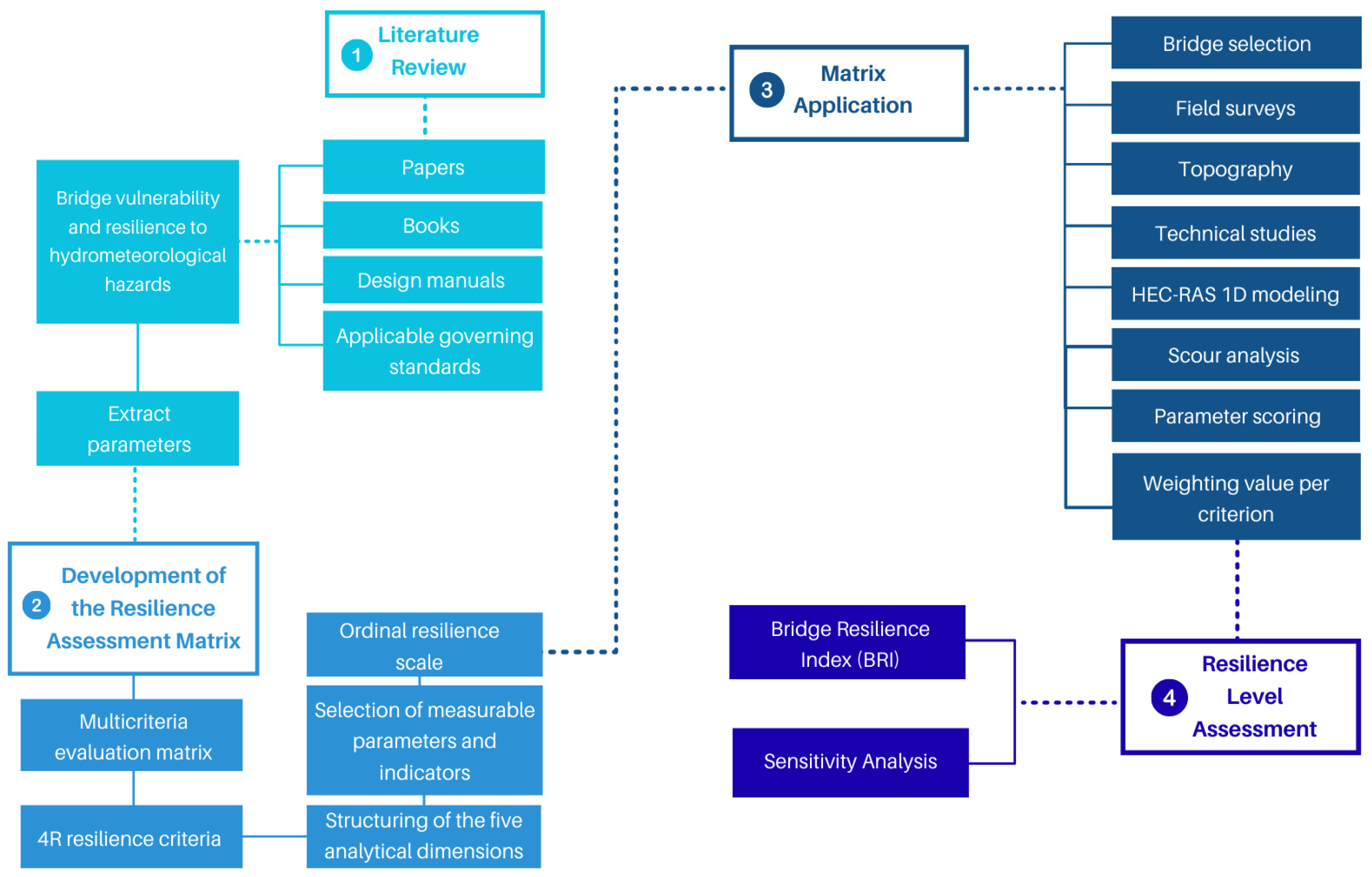
2.1. Literature Review
2.2. Development of the Resilience Assessment Matrix
- Technical (10 parameters): This dimension evaluates structural and hydraulic performance through variables associated with construction materials, the conservation state of the superstructure and substructure, the effectiveness of protection systems for piers and buttons, deck clearance, scour affecting shallow foundations, inspection methods employed, and the availability of materials and equipment for emergency response.
- Economic (4 parameters): This dimension represents the financial agility and availability to execute corrective interventions, integrating variables such as the resources allocated for maintenance, the duration of procurement procedures, and the existence of funds designated for emergencies and the annual budget.
- Organizational (6 parameters): This dimension reflects the institutional capacity to anticipate, manage, and reduce risk, considering the operational level of upstream dams, the recurrence of closures due to hydrological hazards, records of previous flooding events, expected hydrological severity, implemented disaster-management actions, maturity in planning (e.g., BIM, asset management), and the availability of alternative contractors to ensure operational continuity.
- Social (8 parameters): This dimension characterizes exposure levels and the response capacity of the surrounding area, considering the predominant construction materials of nearby housing, traffic volume, proximity to populated centers and critical facilities, and the territorial extent potentially affected. It also incorporates the population’s socioeconomic level, training in risk management, the proportion of vulnerable inhabitants, the operational capacity of the emergency system, and the availability and length of alternative detour routes.
- Environmental (2 parameters): This dimension includes indicators related to climatic exposure and variability, as well as basic water-quality aspects that influence ecological conditions and the stability of the fluvial environment.
2.3. Matrix Application
- Bridge selection. A critical bridge within the local road network was identified, prioritizing its functional importance, its exposure to extreme events, and the existence of previous hydrological and structural impacts.
- Field surveys. Systematic inspections were conducted to document the morphology of the riverbed, identify active erosive processes, and record the elements influencing flow resistance and flow–structure interactions within the study reach.
- Topography: A detailed topographic survey of the fluvial reach was conducted, providing essential input for constructing the geometric model required for hydraulic simulation.
- Technical studies. Specialized studies were conducted, including the hydrological analysis with the estimation of extreme flows, the morphological characterization of the channel, and the geotechnical (soil mechanics) analysis, in order to generate the necessary input parameters for hydrological, hydraulic, and scour modeling.
- HEC-RAS 1D modeling. The one-dimensional model was implemented incorporating calibration and validation procedures based on available historical records, allowing simulation of flow behavior under different hydrological design scenarios. A one-dimensional (1D) hydraulic model in HEC-RAS was adopted due to its proven reliability in hydraulic simulations [53,54,55].
- Scour analysis. General and local scour were evaluated considering critical scenarios, the geotechnical properties of the riverbed, and the structural characteristics of the bridge, with the purpose of determining its vulnerability to erosive processes.
- Parameter scoring. The compilation of primary and secondary information from official local sources included social, economic, and environmental data, as well as structural, hydraulic, and operational information on the bridge. This information was complemented by field visits aimed at verifying in situ the geomorphological configuration of the channel, the condition of the approaches, and the state of the structure and its immediate surroundings, along with the results of the hydraulic modeling and scour analysis. Using all these inputs, the resilience assessment matrix was applied to assign each parameter a score between 1 and 5 (from very low to very high) according to its resilience level.
- Weighting value per criterion. The assignment of weight percentages to each parameter within each criterion was carried out considering their local relevance and the availability of information. Using these weights, the consolidated score for each criterion was determined, which subsequently allowed the calculation of its corresponding BRI (Bridge Resilience Index).
2.4. Resilience Level Assessment
2.4.1. Bridge Resilience Index (BRI)
2.4.2. Sensitivity Analysis
3. Results
3.1. Matrix Application
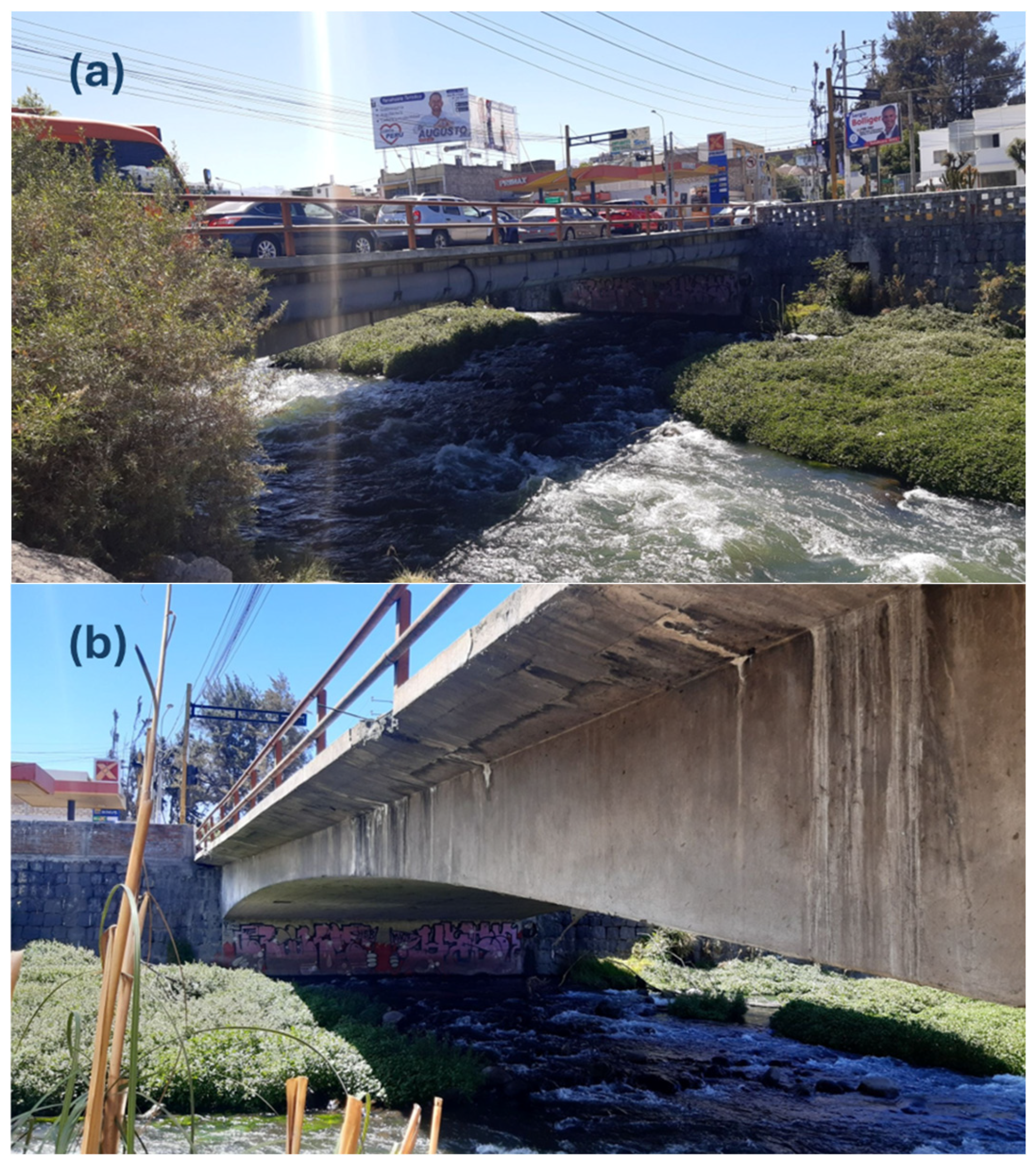
3.1.1. Bridge Selection
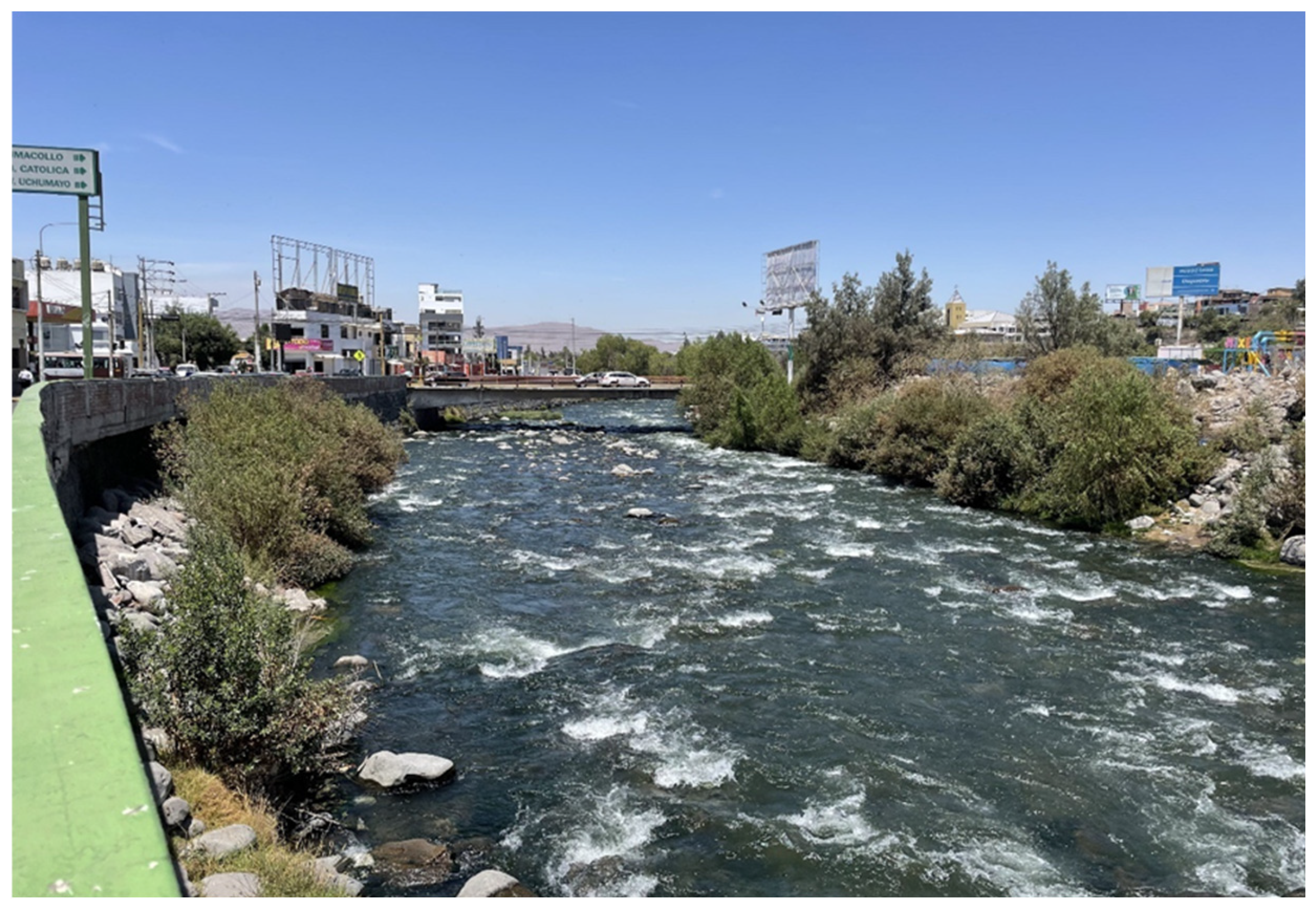
3.1.2. Field Surveys
3.1.3. Topography
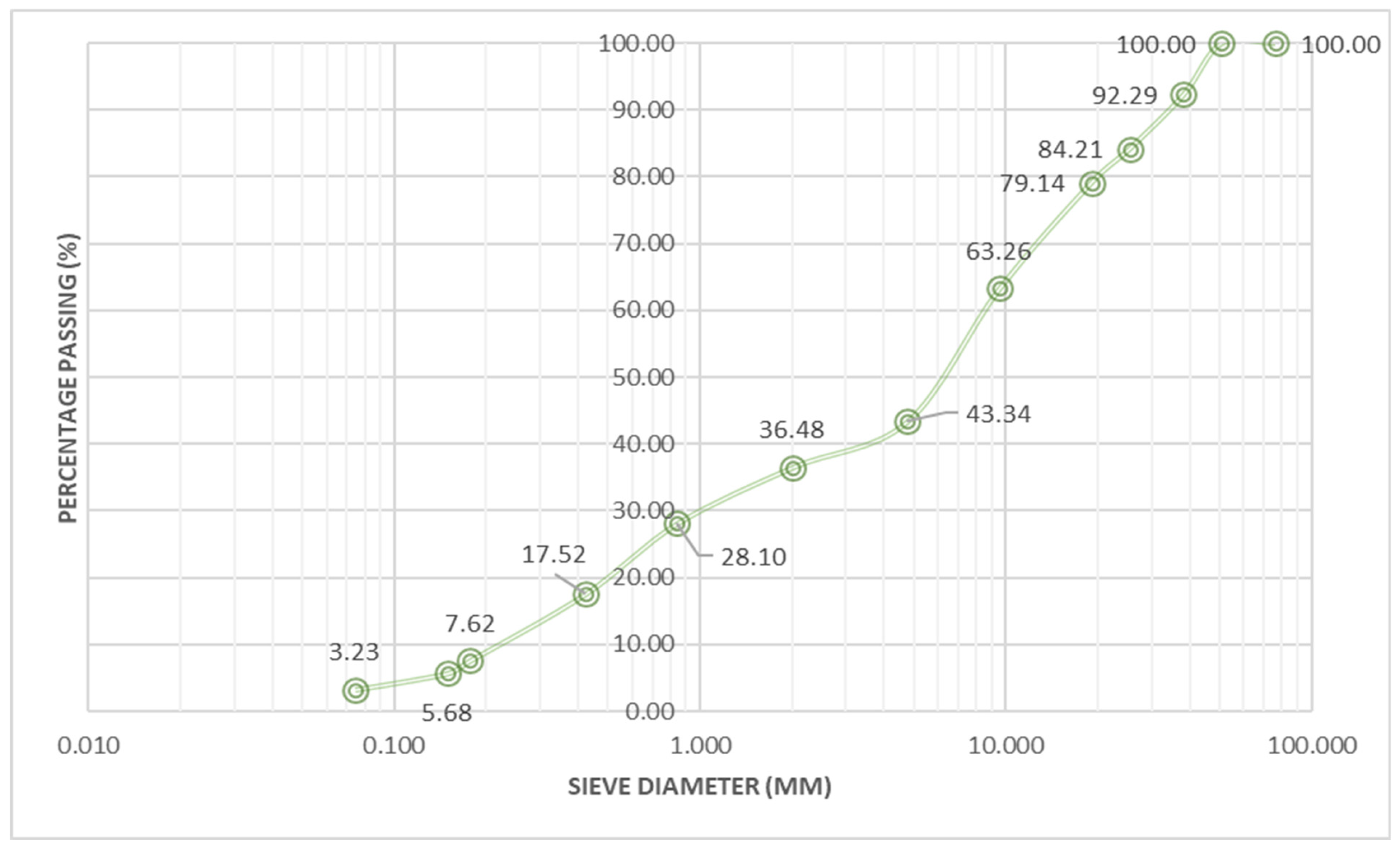
3.1.4. Technical Studies
3.1.5. HEC-RAS 1D Modeling
3.1.6. Scour Analysis
3.1.7. Parameter Scoring
3.1.8. Weighting Value per Criterion
3.2. Resilience Level Assessment
3.2.1. Global Bridge Resilience Index (BRI)
3.2.2. Sensitivity Analysis
4. Discussion
5. Conclusions
Author Contributions
Funding
Data Availability Statement
Acknowledgments
Conflicts of Interest
References
- Espinoza Vigil, A.J.; Booker, J. Hydrological Vulnerability Assessment of Riverine Bridges: The Bajo Grau Bridge Case Study. Water 2023, 15, 846. [Google Scholar] [CrossRef]
- Proske, D. Comparison of the Collapse Frequency and the Probability of Failure of Bridges. Proc. Inst. Civ. Eng.-Bridge Eng. 2019, 172, 27–40. [Google Scholar] [CrossRef]
- Mondoro, A.; Frangopol, D.M.; Liu, L. Bridge Adaptation and Management under Climate Change Uncertainties: A Review. Nat. Hazards Rev. 2017, 19, 04017023. [Google Scholar] [CrossRef]
- Naciones Unidas. La Economía Del Cambio Climático En América Latina y El Caribe Paradojas y Desafíos Del Desarrollo Sostenible; Naciones Unidas: New York, NY, USA, 2014. [Google Scholar]
- Smith, D. Bridge Failures. Proc. Inst. Civ. Eng. 1976, 60, 367–382. [Google Scholar] [CrossRef]
- Wardhana, K.; Hadipriono, F.C. Analysis of Recent Bridge Failures in the United States. J. Perform. Constr. Facil. 2003, 17, 144–150. [Google Scholar] [CrossRef]
- Kazemian, A.; Yee, T.; Oguzmert, M.; Amirgholy, M.; Yang, J.; Goff, D. A Review of Bridge Scour Monitoring Techniques and Developments in Vibration Based Scour Monitoring for Bridge Foundations. Adv. Bridge Eng. 2023, 4, 2. [Google Scholar] [CrossRef]
- López, S.P. Gestión, Intervenciones y Sujetos Patrimoniales En La Recuperación Del Centro Histórico Del Rímac (1991–2018). Devenir-Rev. Estud. Sobre Patrim. Edif. 2023, 10, 61–84. [Google Scholar] [CrossRef]
- INDECI. Resumen Ejecutivo N°323-2023; Temporada de Lluvias 2022–2023. Lima, Peru, 2023. Available online: https://drive.google.com/file/d/1TXLtyd6ne7oRen3-m3hrBYGD9rhL6Vzh/view (accessed on 16 September 2023).
- INDECI. Compendio Estadístico Del INDECI 2017—GESTIÓN REACTIVA; INDECI: Lima, Peru, 2017. [Google Scholar]
- INDECI. Resumen Ejecutivo Historico—Temporada de Lluvias, 2016–2017. Available online: https://portal.indeci.gob.pe/emergencias/resumen-ejecutivo-historico-temporada-de-lluvias-2016-2017-actualizado-al-24-de-enero-2018-2/ (accessed on 18 July 2023).
- Espinoza Vigil, A.J.; Booker, J.D. Building National Disaster Resilience: Assessment of ENSO-Driven Disasters in Peru. Int. J. Disaster Resil. Built Environ. 2023, 14, 423–433. [Google Scholar] [CrossRef]
- Tubaldi, E.; White, C.J.; Patelli, E.; Mitoulis, S.A.; De Almeida, G.; Brown, J.; Cranston, M.; Hardman, M.; Koursari, E.; Lamb, R.; et al. Invited Perspectives: Challenges and Future Directions in Improving Bridge Flood Resilience. Nat. Hazards Earth Syst. Sci. 2022, 22, 795–812. [Google Scholar] [CrossRef]
- Pregnolato, M.; Winter, A.O.; Mascarenas, D.; Sen, A.D.; Bates, P.; Motley, M.R. Assessing Flooding Impact to Riverine Bridges: An Integrated Analysis. Nat. Hazards Earth Syst. Sci. 2022, 22, 1559–1576. [Google Scholar] [CrossRef]
- Kosič, M.; Andrej, A.; Valentina, B. Flood Vulnerability Study of a Roadway Bridge Subjected to Hydrodynamic Actions, Local Scour and Wood Debris Accumulation. Water 2022, 15, 129. [Google Scholar] [CrossRef]
- Adger, W.N. Vulnerability. Glob. Environ. Change 2006, 16, 268–281. [Google Scholar] [CrossRef]
- Blum, R.W.; McNeely, C.; Nonnemaker, J. Vulnerability, Risk, and Protection. J. Adolesc. Health 2002, 31, 28–39. [Google Scholar] [CrossRef]
- Lavell, A. Sobre La Gestión Del Riesgo: Apuntes Hacía Una Definición. Ph.D. Thesis, National Autonomous University of Nicaragua, Managua, Nicaragua, 2001. [Google Scholar]
- Pita Fernández, S.; Vila Alonso, M.; Carpente Montero, J. Determinación de Factores de Riesgo; Elsevier: Amsterdam, The Netherlands, 1997; Volume 4. [Google Scholar]
- Patel, D.A.; Lad, V.H.; Chauhan, K.A.; Patel, K.A. Development of Bridge Resilience Index Using Multicriteria Decision-Making Techniques. J. Bridge Eng. 2020, 25, 04020090. [Google Scholar] [CrossRef]
- Argyroudis, S.A.; Mitoulis, S.A.; Hofer, L.; Zanini, M.A.; Tubaldi, E.; Frangopol, D.M. Resilience Assessment Framework for Critical Infrastructure in a Multi-Hazard Environment: Case Study on Transport Assets. Sci. Total Environ. 2020, 714, 136854. [Google Scholar] [CrossRef]
- Ccanccapa Puma, J.; Hidalgo Valdivia, A.V.; Espinoza Vigil, A.J.; Booker, J. Preserving Heritage Riverine Bridges: A Hydrological Approach to the Case Study of the Grau Bridge in Peru. Heritage 2024, 7, 3350–3371. [Google Scholar] [CrossRef]
- Khan, S.A.; Kabir, G.; Billah, M.; Dutta, S. An Integrated Framework for Bridge Infrastructure Resilience Analysis against Seismic Hazard. Sustain. Resilient Infrastruct. 2023, 8, 5–25. [Google Scholar] [CrossRef]
- Khodadad, M.; Sanei, M.; Aguilar-Barajas, I.; Cárdenas-Barrón, L.E.; Ramírez-Orozco, A.I.; Rizzo, A.; Khan, A.Z. Green Infrastructure Site Prioritization to Improve Urban Flood Resilience in Monterrey and Brussels Using a Decision Support Model. Sci. Rep. 2025, 15, 10744. [Google Scholar] [CrossRef] [PubMed]
- Peng, L.; Wang, Y.; Yang, L.; Garchagen, M.; Deng, X. A Comparative Analysis on Flood Risk Assessment and Management Performances between Beijing and Munich. Environ. Impact Assess. Rev. 2024, 104, 107319. [Google Scholar] [CrossRef]
- Rezvani, S.M.H.S.; Falcão Silva, M.J.; Marques de Almeida, N. Urban Resilience Index for Critical Infrastructure: A Scenario-Based Approach to Disaster Risk Reduction in Road Networks. Sustainability 2024, 16, 4143. [Google Scholar] [CrossRef]
- Kenarkoohi, M.; Hassan, M. Review of Accelerated Construction of Bridge Piers—Methods and Performance. Adv. Bridge Eng. 2024, 5, 15. [Google Scholar] [CrossRef]
- Zhang, G.; Yuan, Z.; Ding, Y.; Xu, F.; Tang, C.; Wang, S. Fire Behavior of Composite Steel Truss Bridge Girders: Numerical Investigation and Design Strategies. Adv. Bridge Eng. 2024, 5, 36. [Google Scholar] [CrossRef]
- Asghari, F.; Piadeh, F.; Egyir, D.; Yousefi, H.; Rizzuto, J.P.; Campos, L.C.; Behzadian, K. Resilience Assessment in Urban Water Infrastructure: A Critical Review of Approaches, Strategies and Applications. Sustainability 2023, 15, 11151. [Google Scholar] [CrossRef]
- Cao, F.; Xu, X.; Zhang, C.; Kong, W. Evaluation of Urban Flood Resilience and Its Space-Time Evolution: A Case Study of Zhejiang Province, China. Ecol. Indic. 2023, 154, 110643. [Google Scholar] [CrossRef]
- Zhang, Z.; Zhang, J.; Zhang, Y.; Chen, Y.; Yan, J. Urban Flood Resilience Evaluation Based on GIS and Multi-Source Data: A Case Study of Changchun City. Remote Sens. 2023, 15, 1872. [Google Scholar] [CrossRef]
- Zhao, R.; Zheng, K.; Wei, X.; Jia, H.; Liao, H.; Li, X.; Wei, K.; Zhan, Y.; Zhang, Q.; Xiao, L.; et al. State-of-the-Art and Annual Progress of Bridge Engineering in 2020. Adv. Bridge Eng. 2021, 2, 29. [Google Scholar] [CrossRef]
- Avcı, C.B.; Vanolya, M. Proposed Framework for Sustainable Flood Risk-Based Design, Construction and Rehabilitation of Culverts and Bridges Under Climate Change. Water 2025, 17, 1663. [Google Scholar] [CrossRef]
- Duran, E.; Mount, J.; Demir, I. Comprehensive Flood Impact Assessment for Iowa Bridge Infrastructure Using Integrated AHP and Fuzzy AHP Analysis. EarthArXiv 2025. [Google Scholar] [CrossRef]
- Apollonio, C.; Iemmolo, G.; Di Modugno, M.; Apollonio, M.; Petroselli, A.; Recanatesi, F.; Giannetta, D. A Multi-Parameter Approach to Support Sustainable Hydraulic Risk Analysis for the Protection of Transportation Infrastructure: The Case Study of the Gargano Railways (Southern Italy). Sustainability 2025, 17, 4151. [Google Scholar] [CrossRef]
- Wang, H.; Liu, Z.; Feng, J.; Zhang, P.; Liu, R.; Wang, S. Hydrodynamic Effects of Flash Floods Considering the Bridges and Their Blockage in South China. J. Flood Risk Manag. 2025, 18, e70086. [Google Scholar] [CrossRef]
- Buonora, L.; Moccia, B.; Ridolfi, E.; Russo, F.; Napolitano, F. Safety Assessment of Bridges: Analysis and Criticalities of the Guidelines for Hydraulic Risk Management. Procedia Struct. Integr. 2024, 62, 647–652. [Google Scholar] [CrossRef]
- Huarca Pulcha, A.; Espinoza Vigil, A.J.; Booker, J. Prioritizing Riverine Bridge Interventions: A Hydrological and Multidimensional Approach. Designs 2023, 7, 117. [Google Scholar] [CrossRef]
- Martínez, G.; García-Chevesich, P.A.; Guillen, M.; Tejada-Purizcana, T.; Martinez, K.; Ticona, S.; Novoa, H.M.; Crespo, J.; Holley, E.A.; McCray, J.E. Urban Stormwater Quality in Arequipa, Southern Peru: An Initial Assessment. Water 2023, 16, 108. [Google Scholar] [CrossRef]
- Lamb, R.; Garside, P.; Pant, R.; Hall, J.W. A Probabilistic Model of the Economic Risk to Britain’s Railway Network from Bridge Scour During Floods. Risk Anal. 2019, 39, 2457–2478. [Google Scholar] [CrossRef]
- Kitchenham, B. Guidelines for Performing Systematic Literature Reviews in Software Engineering; EBSE Technical Report EBSE-2007-01; Elsevier: Amsterdam, The Netherlands, 2007. [Google Scholar]
- Page, M.J.; McKenzie, J.E.; Bossuyt, P.M.; Boutron, I.; Hoffmann, T.C.; Mulrow, C.D.; Shamseer, L.; Tetzlaff, J.M.; Akl, E.A.; Brennan, S.E.; et al. The PRISMA 2020 Statement: An Updated Guideline for Reporting Systematic Reviews. BMJ 2021, 372, n71. [Google Scholar] [CrossRef]
- Ministerio de Transportes y Comunicaciones. Manual de Carreteras: Diseño Geométrico; Ministerio de Transportes y Comunicaciones: Lima, Peru, 2018. [Google Scholar]
- Ministerio de Transportes y Comunicaciones. Manual de Puentes; Ministerio de Transportes y Comunicaciones: Lima, Peru, 2018. [Google Scholar]
- Centro Nacional de Estimación Prevención y Reducción del Riesgo de Desastres. Manual Para La Evaluación de Riesgos Originados Por Fenómenos Naturales—2da Versión; Centro Nacional de Estimación Prevención y Reducción del Riesgo de Desastres: Lima, Peru, 2014; Available online: https://sigrid.cenepred.gob.pe/sigridv3/documento/257 (accessed on 23 November 2025).
- Ministerio de Transportes y Comunicaciones. Manual de Hidrología, Hidráulica y Drenaje; Ministerio de Transportes y Comunicaciones: Lima, Peru, 2008. [Google Scholar]
- Instituto Nacional de Defensa Civil. Manual Básico Para La Estimación Del Riesgo; Instituto Nacional de Defensa Civil: Lima, Peru, 2006; Available online: https://sinia.minam.gob.pe/documentos/manual-basico-estimacion-riesgo (accessed on 11 November 2025).
- Minaie, E.; Moon, F. Practical and Simplified Approach for Quantifying Bridge Resilience. J. Infrastruct. Syst. 2017, 23, 04017016. [Google Scholar] [CrossRef]
- Andrić, J.M.; Lu, D.G. Fuzzy Methods for Prediction of Seismic Resilience of Bridges. Int. J. Disaster Risk Reduct. 2017, 22, 458–468. [Google Scholar] [CrossRef]
- McGuire, B.; Atadero, R.; Clevenger, C.; Ozbek, M. Bridge Information Modeling for Inspection and Evaluation. J. Bridge Eng. 2016, 21, 04015076. [Google Scholar] [CrossRef]
- Barlish, K.; Sullivan, K. How to Measure the Benefits of BIM—A Case Study Approach. Autom. Constr. 2012, 24, 149–159. [Google Scholar] [CrossRef]
- Freckleton, D.; Heaslip, K.; Louisell, W.; Collura, J. Evaluation of Resiliency of Transportation Networks after Disasters. Transp. Res. Rec. 2012, 2284, 109–116. [Google Scholar] [CrossRef]
- Timbadiya, P.V.; Patel, P.L.; Porey, P.D. Hec-Ras Based Hydrodynamic Model in Prediction of Stages of Lower Tapi River. ISH J. Hydraul. Eng. 2011, 17, 110–117. [Google Scholar] [CrossRef]
- Popescu, C.; Bărbulescu, A. Floods Simulation on the Vedea River (Romania) Using Hydraulic Modeling and GIS Software: A Case Study. Water 2023, 15, 48. [Google Scholar] [CrossRef]
- Merkuryeva, G.; Merkuryev, Y.; Sokolov, B.V.; Potryasaev, S.; Zelentsov, V.A.; Lektauers, A. Advanced River Flood Monitoring, Modelling and Forecasting. J. Comput. Sci. 2015, 10, 77–85. [Google Scholar] [CrossRef]
- Tzeng, G.-H.; Huang, J.-J. Multiple Attribute Decision Making Methods and Applications; CRC Press: Boca Raton, FL, USA; Taylor and Francis Group: Oxfordshire, UK; A Chapman & Hall Book: Boca Raton, FL, USA; References—Scientific Research Publishing: Glendale, CA, USA, 2011. [Google Scholar]
- Chen, Y.; Yu, J.; Khan, S. Spatial Sensitivity Analysis of Multi-Criteria Weights in GIS-Based Land Suitability Evaluation. Environ. Model. Softw. 2010, 25, 1582–1591. [Google Scholar] [CrossRef]
- Riva, R. Cierran Tres Puentes Ante Posible Desborde Del Río Chili En Arequipa. Available online: https://rpp.pe/peru/actualidad/cierran-tres-puentes-ante-posible-desborde-del-rio-chili-en-arequipa-noticia-339102 (accessed on 23 October 2025).
- Méndez, R. Cierran Puentes En Arequipa Por Incremento Del Caudal Del Río Chili | Noticias | Agencia Peruana de Noticias Andina. Available online: https://andina.pe/agencia/noticia-cierran-puentes-arequipa-incremento-del-caudal-del-rio-chili-399604.aspx (accessed on 11 November 2025).
- SIMHEI—Sistema Integrado de Movimiento Hidrico e Instrumentacion MOVIMIENTO HÍDRICO—CHILI. Available online: https://simhei.pems.pe//SIMHEI2/#/public/chili-1 (accessed on 23 November 2025).
- Chow, V.T.; Maidment, D.R.; Mays, L.W. Hidrología Aplicada; McGraw-Hill: Bogotá, Colombia, 1994. [Google Scholar]
- Rodríguez Díaz, H.A. Hidráulica Fluvial. Fundamentos y Aplicaciones. Socavación; Escuela Colombiana de Ingeniería: Bogotá, Colombia, 2010; ISBN 9789588060297. [Google Scholar]
- HEC-RAS River Analysis System. HEC-RAS Hydraulic Reference Manual; HEC-RAS River Analysis System: Davis, CA, USA, 2024. [Google Scholar]
- Cowan, W.L. Estimating Hydraulic Roughness Coefficients. Agric. Eng. 1956, 37, 473–475. [Google Scholar]
- Concha Zeballos, C.J.; Miranda Vega, A.G. Análisis Del Riesgo de Inundación de la Cuencia Del Río Chili En El Tramo de Chilina a Uchumayo—Arequipa; Universidad Católica de Santa María: Arequipa, Peru, 2016; Available online: https://repositorio.ucsm.edu.pe/items/75e1e487-ca89-4abd-a02f-b35f4f7480e9 (accessed on 20 November 2025).
- Dasallas, L.; Kim, Y.; An, H. Case Study of HEC-RAS 1D–2D Coupling Simulation: 2002 Baeksan Flood Event in Korea. Water 2019, 11, 2048. [Google Scholar] [CrossRef]
- Huarca Pulcha, A.S.H. Metodología de Evaluación Hidrológica de Puentes Sobre Cauces de Río—Caso de Estudio: Río Chili En La Ciudad de Arequipa, Peru. Bachelor’s Thesis, Universidad Católica de Santa María, Arequipa, Peru, 2023. [Google Scholar]
- Ccanccapa-Puma, J.; Hidalgo-Valdivia, A.V.; Noriega-Aquise, G.Y.; Aguilar-Chávez, A.E.; Marques, M. Análisis y Prevención Del Peligro Por Inundaciones En Quebradas de Alto Riesgo En La Ciudad de Arequipa, Peru. Tecnol. Y Cienc. Agua 2024, 15, 142–203. [Google Scholar] [CrossRef]
- Espinoza Vigil, A.J.; Ccanccapa Puma, J.; Huarca Pulcha, A.; Ticona-Quispe, A.; Huarcaya-Perez, D.; Gonzales-Turpo, A.; Cusihuaman-Casquina, R.; Lucana-Hancco, F.; Booker, J. Multidimensional Datasets Supporting Vulnerability Assessments of Riverine Bridges in Peru. Sci. Data 2025, 13, 53. [Google Scholar] [CrossRef]
- Chacon Lima, D.; Huarca Pulcha, A.; Torrejon Llamoca, M.; Noriega Aquise, G.Y.; Espinoza Vigil, A.J. Hydraulic Modeling of Newtonian and Non-Newtonian Debris Flows in Alluvial Fans: A Case Study in the Peruvian Andes. Water 2025, 17, 2150. [Google Scholar] [CrossRef]
- Villón Béjar, M.V. Hidrología Estadística; Editorial Tecnológica de Costa Rica: Cartago, Costa Rica, 2006. [Google Scholar]
- Frase Corta Inauguración del Puente San Martín. Available online: https://www.facebook.com/photo.php?fbid=5836343223066751&id=1554003124634137&set=a.1554014347966348 (accessed on 25 November 2025).
- Semanario El Búho Arequipa: Peligrosa Creo Chili Tras Intensas Lluvias. Available online: https://elbuho.pe/2020/02/arequipa-crecida-del-rio-chili-tras-intensas-lluvias-video/?utm_source=chatgpt.com (accessed on 25 November 2025).
- Gobierno Regional de Arequipa Harán Mantenimiento de Represa de Aguada Blanca—Noticias—Gobierno Regional Arequipa—Plataforma Del Estado Peruano. Available online: https://www.gob.pe/institucion/regionarequipa/noticias/985195-haran-mantenimiento-de-represa-de-aguada-blanca (accessed on 24 November 2025).
- Libélula, Comunicación Ambiente y Desarrollo S.A.C. Vulnerabilidad y Adaptación al Cambio Climático En Arequipa Metropolitana; CAF Development Bank of Latinamerica: Caracas, Venezuela, 2018; Available online: https://scioteca.caf.com/handle/123456789/1181?show=full (accessed on 20 November 2025).
- Vargas Maquera, M.C. Determinación de Índice Simplificado de Calidad de Agua En El Río Chili, Arequipa 2019; Universidad Nacional de San Agustín: Arequipa, Peru, 2021; Available online: https://alicia.concytec.gob.pe/vufind/Record/UNSA_e60907ef10e989651cd8074a248c1e27/Details (accessed on 25 November 2025).
- Gallegos, C. Arequipa: Entregan El Puente Gunther Tras Más de Nueve Meses de Espera. Available online: https://elbuho.pe/2025/11/arequipa-entregan-el-puente-gunther-tras-mas-de-nueve-meses-de-espera/ (accessed on 25 November 2025).
- Municipalidad Provincial de Arequipa. Plan de Prevención y Reducción de Riesgo de Desastre; Municipalidad Provincial de Arequipa: Arequipa, Peru, 2025. [Google Scholar]
- Instituto Nacional de Estadística e Informática. Resultados Definitivos de Los Censos Nacionales 2017—Censos Nacionales 2017. Available online: https://censo2017.inei.gob.pe/resultados-definitivos-de-los-censos-nacionales-2017/ (accessed on 29 November 2025).
- Medina Yauri, F.D. Riesgo Hidrológico e Hidráulico Del Puente San Martín En La Ciudad de Arequipa-2022; Universidad Católica de Santa María: Arequipa, Peru, 2022; Available online: https://repositorio.ucsm.edu.pe/items/4d2cc86f-7cdb-4d8f-b0f4-0a21808fe909 (accessed on 20 November 2025).
- Ministerio de Economía y Finanzas (MEF). Distribución Del Gasto Del Presupuesto Del Sector Público Por Programas Presupuestales y Pliegos (PPE); Ministerio de Economía y Finanzas (MEF): Lima, Peru, 2024. [Google Scholar]
- Municipalidad Provincial de Arequipa. Plan de Contingencias Ante Lluvias Intensas 2023–2024; Municipalidad Provincial de Arequipa: Arequipa, Peru, 2023; Available online: https://www.gob.pe/institucion/muniarequipa/informes-publicaciones/5689749-plan-de-contingencia-ante-lluvias-intensas-2023-2024 (accessed on 2 November 2025).
- Astoquilca Thais Arequipa Solo Ha Ejecutado El 9.6% Del Presupuesto Para Riesgos y Desastres Ante El Fenómeno El Niño. Available online: https://elbuho.pe/2023/09/arequipa-solo-ha-ejecutado-el-9-6-del-presupuesto-para-riesgos-y-desastres-ante-el-fenomeno-el-nino/?utm_source=chatgpt.com (accessed on 25 November 2025).
- TodoLicitaciones Municipalidad Provincial De Arequipa—Entidad Compradora Del Estado de Peru. Available online: https://www.todolicitaciones.pe/organismo/PE-CONSUCODE-397/municipalidad-provincial-de-arequipa (accessed on 25 November 2025).
- Pasquino, V.; Lama, G.F.C.; Peruzzi, C.; Chirico, G.B.; Aberle, J. Assessing Bed Shear Stress Effects on Flow Resistance of Vegetated Channel Beds through Leaf Area Index (LAI). J. Hydrol. 2025, 653, 132518. [Google Scholar] [CrossRef]
- Errico, A.; Pasquino, V.; Maxwald, M.; Chirico, G.B.; Solari, L.; Preti, F. The Effect of Flexible Vegetation on Flow in Drainage Channels: Estimation of Roughness Coefficients at the Real Scale. Ecol. Eng. 2018, 120, 411–421. [Google Scholar] [CrossRef]
- Manes, C.; Brocchini, M. Local Scour around Structures and the Phenomenology of Turbulence. J. Fluid Mech. 2015, 779, 309–324. [Google Scholar] [CrossRef]
- Coscarella, F.; Gaudio, R.; Manes, C. Near-Bed Eddy Scales and Clear-Water Local Scouring around Vertical Cylinders. J. Hydraul. Res. 2020, 58, 968–981. [Google Scholar] [CrossRef]





| Literature on Resilience Assessment | |||
| Author and Year | Study Location | Infrastructure | Evaluation Parameters Used |
| Khodadad et al. (2025) [24] | Monterrey, Mexico–Brussels, Bélgica | Cities | They used environmental variables (elevation, slope, precipitation), infrastructure-related variables (road density, public facilities), social variables (population density and vulnerability), and economic variables (poverty and economic activity). |
| Peng et al. (2024) [25] | Beijing, China–Munich, Germany | Cities | They analyze environmental and territorial factors linked to flood risk, such as precipitation, topography, vegetation, socioeconomic conditions, population density, and road density. |
| Rezvani et al. (2024) [26] | Lisboa, Portugal | Roads | They assess urban resilience using an index that integrates temporal performance, socioeconomic factors, risk exposure, and management costs. |
| Kenarkoohi & Hassan (2024) [27] | Washington, EE. UU.–Montreal, Canadá - | Bridges | They analyze seismic performance by considering durability, maintenance, construction complexity, embedment depth, and the use of advanced materials. |
| G. Zhang et al. (2024) [28] | Arizona, USA. | Bridges | They evaluate fire-exposure dimensions and structural performance, including cable deflection, deformation, strength, and rates of change in deflection. |
| Asghari et al. (2023) [29] | Literature review | Literature review | They incorporate holistic approaches that account for flood levels, exposed population, residential functions, exposure time, risk indicators, and performance under extreme loads, complemented by PESTEL dimensions (political, economic, social, technological, environmental, and legal) and RAF components (engagement, economic sustainability, spatial planning, service management, safety, and robustness). They also analyze technical approaches based on metrics such as flood-volume reduction, recovery times, and overall system performance. |
| Khan et al. (2023) [23] | British Columbia, Canadá | Bridges | They evaluate structural reliability through the analysis of foundations, abutments, bearings, piers, beams, connections, bridge age, and structural geometry; and they assess recovery capacity by considering structural health monitoring, maintenance practices, damage level, functional importance, resource availability, and accessibility. |
| Cao et al. (2023) [30] | Zheijiang, China | Cities | They incorporate nature-related dimensions (green coverage, topography, precipitation), economic dimensions (GDP, per capita income, public expenditure), social dimensions (population density and structure, educational level), and infrastructure dimensions (drainage network, road area, and green spaces). |
| Z. Zhang et al. (2023) [31] | Changchun, China | Cities | They assess environmental and infrastructure vulnerability using variables such as altitude, land use, precipitation, NDVI, slope, and road density; and they evaluate social and economic recovery capacity based on per capita GDP, investment in flood-protection measures, population density, and educational level. |
| Zhao et al. (2021) [32] | China | Bridges | They consider mechanical properties, durability parameters, connection systems, aerodynamic models, and the use of advanced materials. |
| Patel et al. (2020) [20] | Surat, India | Bridges | They evaluate resilience using the 4R framework (robustness, rapidity, resourcefulness, and redundancy) and integrate 16 TOSE factors (technical, organizational, social, and economic). |
| Argyroudis et al. (2020) [21] | Lisboa, Portugal | Bridges | They determine resilience through an index based on the temporal functionality curve Q(t), incorporating robustness metrics (numerical models and fragility functions) and rapidity metrics (restoration times, damage state, standard deviation, and downtime periods). |
| Literature on Hydrological Vulnerability Assessment | |||
| Author and Year | Study Location | Infrastructure | Evaluation Parameters Used |
| Avcı & Vanolya (2025) [33] | Turkey | Bridges/Culverts | They incorporate dimensions related to population and urban expansion, socioeconomic conditions, environmentally sensitive areas, and catchment-basin parameters. |
| Duran et al. (2025) [34] | Iowa, USA | Bridges | They evaluate structural and functional parameters related to bridge conditions, traffic volume, detour length, and flood levels. |
| Apollonio et al. (2025) [35] | Puglia, Italy | Rail Network | They analyze the typology of hydraulic structures, the elements exposed to traffic, critical events, and accessibility and service-disruption coefficients. |
| Wang et al. (2025) [36] | Kaohsiung, Taiwan | Urban Areas | They incorporate flood hazard under different return periods and the social vulnerability of sensitive groups and emergency services. |
| Buonora et al. (2024) [37] | Italy | Bridges | They consider foundation type, riverbed geometry, and the number of floating debris as vulnerability parameters. |
| Ccanccapa Puma et al. (2024) [22] | Arequipa, Peru | Bridges | They reutilize the environmental, technical, social, and economic dimensions proposed by [38]. |
| Espinoza Vigil & Booker (2023) [1] | Arequipa, Peru | Bridges | They evaluate environmental vulnerability (flow-rate variability, water quality and composition) and physical vulnerability (bridge material and location, soil quality, geometric parameters, deck erosion, scour-protection measures, overflow and flooding risk, and regulatory compliance). |
| Huarca Pulcha et al. (2023) [38] | Arequipa, Peru | Bridges | They consider environmental dimensions (climate change, water quality, ecological conditions, and obstructions), technical dimensions (materials, conservation state, hydraulic protection, deck elevation, scour, and dam capacity), social dimensions (population exposure and proximity, disaster prevention, and socioeconomic conditions), and economic dimensions (road importance, traffic volume, risk-related closures, and flood history). |
| Martínez et al. (2023) [39] | Arequipa, Peru | Drainage water inflows to the Chili River. | They evaluate concentrations of materials and contaminants, physicochemical variables (pH, conductivity, salinity, resistivity, density, dissolved solids, turbidity, temperature), and hydrological parameters (discharge, precipitation, storm duration, and antecedent drought conditions). |
| Lamb et al. (2019) [40] | Great Britain | Rail Bridges | They analyze dimensions based on structural fragility, load associated with the return period, consequence/risk metrics, and the expected rate of service interruption. |
| Author/Year | Assessment Parameters |
|---|---|
| Ministerio de Transportes y Comunicaciones (2018) [43] | Clearance under the bridge, characteristics of the construction material, and estimated service life. |
| Ministerio de Transportes y Comunicaciones. (2018) [44] | Clearance under the bridge superstructure. |
| Centro Nacional de Estimación Prevención y Reducción del Riesgo de Desastres (2014) [45] | Service life, type of construction material, deterioration level, housing material composition, and training provided to residents. |
| Ministerio de Transportes y Comunicaciones (2008) [46] | Protection of structural elements such as piers, scour-control measures, and lower-bridge clearance. |
| Instituto Nacional de Defensa Civil (2006) [47] | Climatic conditions, water-resource quality, proximity to populated areas, and compliance with current regulatory provisions. |
| Parameter ID | Parameter Name | Dimension | 4R Assigned | Type (State/Capacity Process) | Rationale |
|---|---|---|---|---|---|
| T1 | Main construction material | Technical | Robustness | Capacity-process | Structural material governs intrinsic strength and resistance to hydraulic and seismic loads. |
| T2 | Structural conservation condition | Technical | Robustness | State (Vulnerability) | Deterioration directly affects structural reliability under extreme flows. |
| T3 | Protection of piers and abutments | Technical | Robustness | Capacity-process | Hydraulic protections mitigate scour and reduce collapse probability during floods. |
| T4 | Clearance under deck | Technical | Robustness | State (Vulnerability) | Insufficient freeboard increases impact risk and flow obstruction during floods. |
| T5 | Foundation exposure to potential scour | Technical | Robustness | State (Vulnerability) | Indicates foundation exposure that reduces structural safety margins under extreme floods |
| T6 | Age in service | Technical | Robustness | State (Vulnerability) | Older bridges often reflect outdated design standards and cumulative degradation. |
| E1 | Preliminary restoration cost | Economic | Robustness | Capacity-process | High restoration costs limit feasible corrective actions after damage. |
| O1 | Closures due to hydrological hazard | Organizational | Robustness | State (Vulnerability) | Recurrent closures indicate functional fragility under flood events. |
| O2 | Historical flood events | Organizational | Robustness | State (Vulnerability) | Past flooding reflects exposure frequency and hazard recurrence. |
| O3 | Operational capacity of upstream reservoirs | Organizational | Robustness | Capacity-process | Reservoir regulation influences downstream peak flows and flood severity. |
| S2 | Nearby critical facilities | Social | Robustness | State (Vulnerability) | Proximity to essential services amplifies consequences of service disruption. |
| A1 | Climate change (temperature trend) | Environmental | Robustness | State (Vulnerability) | Thermal trends affect hydrological regimes and material performance. |
| A2 | Water quality | Environmental | Robustness | State (Vulnerability) | Poor water quality accelerates material degradation and corrosion. |
| T7 | Estimated restoration time | Technical | Rapidity | Capacity-process | Shorter repair times enhance rapid recovery of functionality. |
| T8 | Operational access during flooding | Technical | Rapidity | Capacity-process | Accessibility conditions determine speed of emergency and repair operations. |
| E2 | Procurement process duration | Economic | Rapidity | Capacity-process | Faster procurement accelerates response and restoration actions. |
| O4 | Disaster management practices | Organizational | Rapidity | Capacity-process | Preparedness programs improve coordinated and timely emergency response. |
| S3 | Affected area or region | Social | Rapidity | State (Vulnerability) | Larger affected areas have slow recovery due to competing emergency demands. |
| S4 | Predominant nearby housing material | Social | Rapidity | State (Vulnerability) | Fragile housing increases complexity and social disruption. |
| S5 | Vulnerable population proportion | Social | Rapidity | State (Vulnerability) | Highly vulnerable population delays recovery and increases emergency needs. |
| S6 | Socioeconomic level | Social | Rapidity | State (Vulnerability) | Lower socioeconomic capacity limits adaptive and recovery resources. |
| T9 | Number of inspection techniques applied | Technical | Resourcefulness | Capacity-process | Multiple inspection methods increase diagnostic accuracy and decision quality. |
| O5 | BIM maturity in planning | Organizational | Resourcefulness | Capacity-process | BIM enables efficient planning, scheduling, and asset management. |
| S7 | Emergency response system capacity (ERM) | Social | Resourcefulness | Capacity-process | Strong ERM improves coordinated response and service continuity. |
| E3 | Emergency funds allocated | Economic | Resourcefulness | Capacity-process | Financial readiness enables immediate event actions. |
| T10 | Availability of emergency materials and equipment | Technical | Redundancy | Capacity-process | Local availability ensures backup options during infrastructure failure. |
| O6 | Availability of backup contractors | Organizational | Redundancy | Capacity-process | Contractor redundancy increases response flexibility and speed. |
| S1 | Traffic-based service criticality | Social | Redundancy | State (Vulnerability) | High traffic demand increases service loss and reduces operational redundancy |
| S8 | Length of alternative detour | Social | Redundancy | State (Vulnerability) | Longer detours increase disruption and reduce network redundancy. |
| E4 | Funds available for prevention | Economic | Redundancy | Capacity-process | Preventive funding increases adaptive capacity and reduces future losses. |
| Robustness | ||||||
| Code | Parameter | Very Low (1) | Low (2) | Medium (3) | High (4) | Very High (5) |
| T1 | Main construction material of the bridge | Low-strength materials (adobe, cane, wood). | Local materials of moderate strength. | Mixed or metallic structure with limited maintenance | Structural steel or reinforced concrete in good condition. | Reinforced concrete with surface protection and seismic-resistant design |
| T2 | Structural conservation condition | Severe deterioration with high risk of collapse. | Damage compromising the structure (no immediate collapse). | Correctable deterioration; structure remains stable. | Minor structural wear. | No structural damage or deterioration. |
| T3 | Protection of piers and abutments against flow | No protection against extraordinary flood events. | Deficient protection. | Moderate protection. | High protection. | Integral protection (riprap, wingwalls, collars; negligible vulnerability) |
| T4 | Clearance under the deck (m) | Flow overtops the deck. | Water reaches the bridge deck. | Flow with <0.3 m clearance. | Normal flow, clearance < 2 m. | Clearance > 2 m between water surface and deck. |
| T5 * | Foundation exposure to potential scour * | Critical exposure: scour exceeds foundation depth. | High exposure; scour depth close to foundation level. | Moderate exposure; limited margin against estimated scour. | Minor scour exposure: adequate safety margin remains. | Foundations well embedded; negligible scour exposure. |
| T6 | Age in service (years) | >75 years. | 50–75 years. | 25–50 years. | 10–25 years. | <10 years. |
| E1 | Preliminary restoration cost (from available funds) | ≥25% | 20–25% | 15–20% | 10–15% | ≤10% |
| O1 | Closures due to hydrological hazard | >2 recorded closures. | 2 closures. | 1 risk-related closure. | 1 preventive scheduled closure. | No closures due to hazard. |
| O2 | Historical flood events | ≥4 registered events. | 3 events. | 2 events. | 1 event. | No flood events recorded. |
| O3 | Current operational capacity of upstream reservoirs (%) | 0–20%. | 21–40%. | 41–60%. | 61–80%. | 81–100%. |
| S2 | Nearby critical facilities (schools, shelters, hospitals) | Large facilities within <0.5 km. | Several nearby facilities. | Medium facility > 0.5–1 km. | One small facility > 0.5–1 km. | None within 1 km2. |
| A1 | Climate change (temperature tendency) | Temperatures far above the historical average. | Temperatures clearly above the average. | Temperatures moderately above the average. | Temperatures slightly above the average. | Temperatures are stable relative to the historical average. |
| A2 | Water quality | Very high contamination. | High contamination. | Moderate contamination. | Slight contamination. | No evidence of contamination. |
| Rapidity | ||||||
| Code | Parameter | Very Low (1) | Low (2) | Medium (3) | High (4) | Very High (5) |
| T7 | Estimated restoration time (months) | ≥12. | 8–12. | 4–8. | 1–4. | ≤1. |
| T8 | Operational access during flooding | Critical access: isolated from both banks; prolonged total closure. | Conditional access (partial or intermittent service). | Restricted access for heavy equipment. | Partial access through one abutment. | Full access through both abutments without restrictions. |
| E2 | Duration of the procurement process (days) | ≥40. | 35–40. | 30–35. | 25–30. | ≤25. |
| O4 * | Disaster management practices (number of actions) | 0. | ≥2. | ≥4. | ≥5. | >6. |
| S3 | Affected area or region (km2 or districts) | ≥5 districts. | 4 districts. | 3 districts. | 2 districts. | 1 district. |
| S4 | Predominant construction material in nearby housing | Straw mats, cardboard, or highly precarious materials. | Adobe or mud-brick. | Quincha (cane and mud). | Reinforced wood or quincha. | Masonry or reinforced concrete. |
| S5 | Vulnerable population (≥65 years, <14 years) | >30%. | 20–30%. | 10–20%. | 5–10%. | ≤5%. |
| S6 | Socioeconomic level (poverty) | Extreme poverty (>50%). | High poverty (30–50%) | Moderate (15–30%). | Low (5–15%). | Very Low (<5%). |
| Resourcefulness | ||||||
| Code | Parameter | Very Low (1) | Low (2) | Medium (3) | High (4) | Very High (5) |
| T9 * | Number of inspection techniques applied | 1. | 2. | 3. | 4. | ≥5. |
| E3 | Emergency funds allocated by the administrator (%) | 0–10% | 10–25%. | 25–40%. | 40–50%. | ≥50%. |
| O5 * | BIM maturity level in planning | Not applicable or nonexistent | Level 0 (basic). | Level 1 (partial). | Level 2 (collaborative). | Level 3 (integrated). |
| S7 * | Operational capacity of the emergency response system (ERM) | None. | Limited. | Partial. | Efficient. | Comprehensive and proactive. |
| Redundancy | ||||||
| Code | Parameter | Very Low (1) | Low (2) | Medium (3) | High (4) | Very High (5) |
| T10 * | Availability of emergency materials and equipment (%) | ≤25%. | 25–50%. | 50–75%. | 75–100%. | >100% of the estimated requirement. |
| E4 * | Funds available for prevention from the annual budget (%) | 0–10%. | 10–30%. | 30–40%. | 40–50%. | ≥50%. |
| O6 | Availability of backup contractors | 0. | 1–10. | 10–20. | 20–30. | >30. |
| S1 | Traffic-based service criticality. | Critical traffic demand: no viable alternatives, severe service disruption expected. | High traffic demand; limited alternative routes available. | Significant traffic demand; partial dependence on the bridge. | Moderate traffic with available alternative routes. | Low traffic demand: service interruption has limited impact. |
| S8 | Length of the alternative detour (km) | >5. | 3–5. | 2–3. | 1–2. | ≤1. |
| BRI Range | Classification Resilient | General Interpretation (Resilience) |
|---|---|---|
| 4.0–5.0 | Very high | Optimal condition; fully operational and resilient. |
| 3.0–3.9 | High | Good condition; adequate resistance and partial recovery capability. |
| 2.0–2.9 | Moderate | Acceptable condition; moderate absorption and recovery capacity. |
| 1.0–1.9 | Low | Limited or partially functional condition. |
| <1.0 | Very low | Deficient or nonexistent condition; no response capacity. |
| Theoretical Delta | |||||||
|---|---|---|---|---|---|---|---|
| Distribution | California | Hazen | Weibull | Chegodayev | Blom | Tukey | Gringorten |
| Normal | 0.1093 | 0.1012 | 0.0965 | 0.0980 | 0.0992 | 0.0986 | 0.1002 |
| Log Normal II | 0.1340 | 0.1259 | 0.1261 | 0.1260 | 0.1260 | 0.1260 | 0.1260 |
| Log Normal III | 0.0970 | 0.1050 | 0.1090 | 0.1066 | 0.1060 | 0.1064 | 0.1055 |
| Gamma II | 0.5198 | 0.5278 | 0.5254 | 0.5268 | 0.5272 | 0.5270 | 0.5275 |
| Gamma III | 0.1262 | 0.1181 | 0.1103 | 0.1150 | 0.1162 | 0.1155 | 0.1172 |
| Log Pearson III | 0.1652 | 0.1572 | 0.1573 | 0.1572 | 0.1572 | 0.1572 | 0.1572 |
| Gumbel | 0.0889 | 0.0820 | 0.0860 | 0.0836 | 0.0830 | 0.0833 | 0.0825 |
| Log Gumbel | 0.1775 | 0.1694 | 0.1695 | 0.1695 | 0.1694 | 0.1694 | 0.1694 |
| Scenario | T (Years) | Non-Exceedance Probability | Q Max. (m3/s) |
|---|---|---|---|
| 1 | 100 | 99.000% | 310.062 |
| 2 | 200 | 99.500% | 349.303 |
| 3 | 300 | 99.667% | 372.257 |
| 4 | 400 | 99.750% | 388.543 |
| 5 | 500 | 99.800% | 401.176 |
| 6 | 750 | 99.867% | 424.130 |
| 7 | - | - | 500.000 |
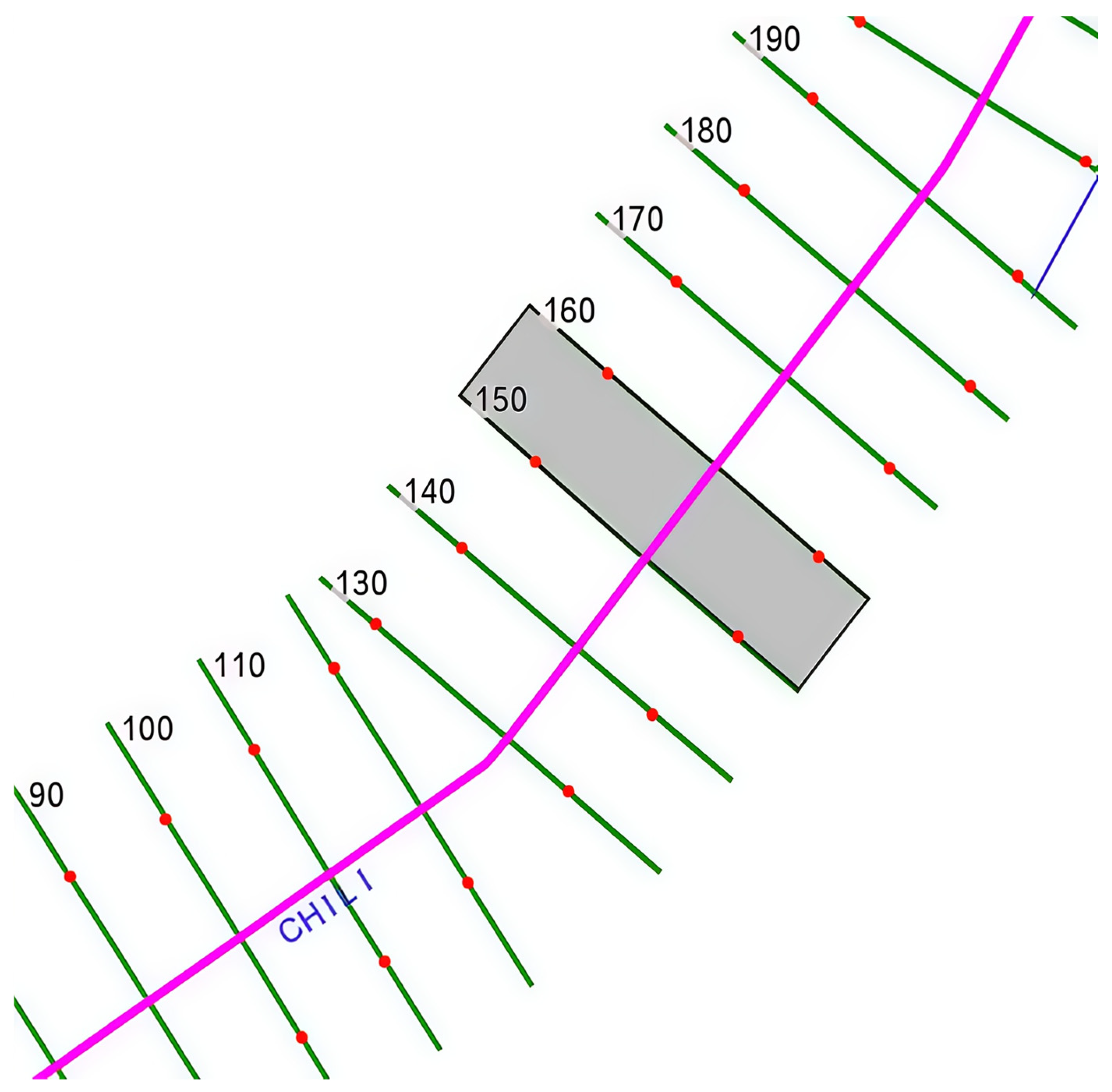
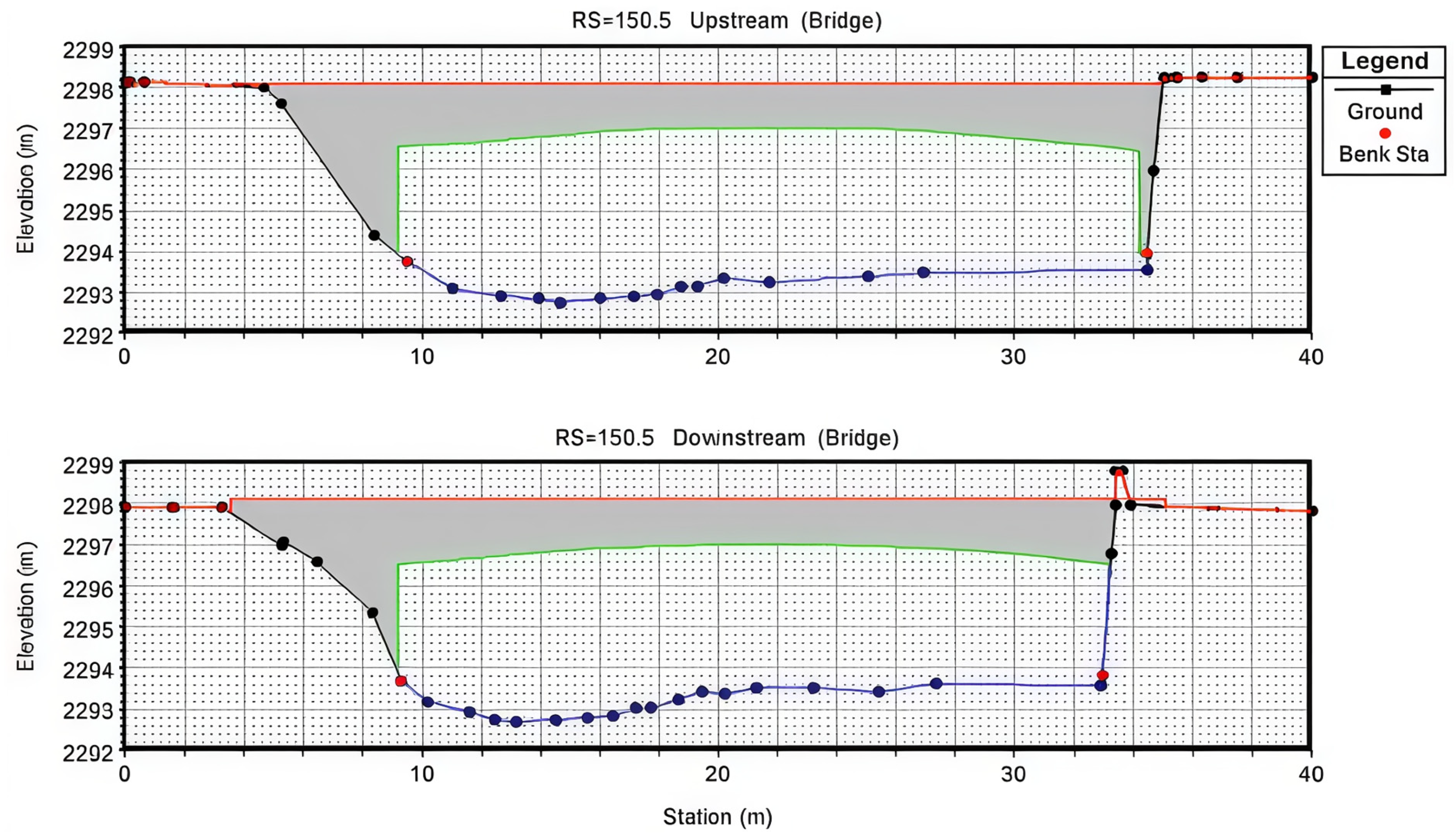
| Bridge Downstream Cross-Section | 0 + 150.00 | |||
|---|---|---|---|---|
| UTM Coordinates (m) | East (X) | 228,238 |  | |
| North (Y) | 8,184,353 | |||
| Left Overbank | Main channel | Right Overbank | ||
| n0 | 0.028 | 0.028 | 0.028 | |
| n1 | 0.005 | 0.007 | 0.013 | |
| n2 | 0.000 | 0.000 | 0.000 | |
| n3 | 0.000 | 0.000 | 0.000 | |
| n4 | 0.008 | 0.005 | 0.005 | |
| m5 | 1.000 | 1.000 | 1.000 | |
| n | 0.041 | 0.04 | 0.046 | |
| Bridge Upstream Cross-Section | 0 + 170.00 | |||
|---|---|---|---|---|
| UTM Coordinates (m) | East (X) | 228,245 |  | |
| North (Y) | 8,184,368 | |||
| Left Overbank | Main channel | Right Overbank | ||
| n0 | 0.028 | 0.028 | 0.028 | |
| n1 | 0.010 | 0.010 | 0.010 | |
| n2 | 0.000 | 0.000 | 0.000 | |
| n3 | 0.005 | 0.005 | 0.012 | |
| n4 | 0.005 | 0.005 | 0.020 | |
| m5 | 1.000 | 1.000 | 1.000 | |
| n | 0.048 | 0.048 | 0.07 | |
| Scenario | Return Period (Years) | Discharge (m3/s) | Average Flow Depth (m) | Flow Velocity (m/s) | Erosive Velocity (m/s) | Scour Type |
|---|---|---|---|---|---|---|
| 1 | 100 | 310.06 | 3.39 | 3.29 | 0.816 | Live-bed |
| 2 | 200 | 349.30 | 3.75 | 3.31 | 0.828 | Live-bed |
| 3 | 300 | 372.26 | 3.91 | 3.37 | 0.833 | Live-bed |
| 4 | 400 | 388.54 | 4.01 | 3.42 | 0.836 | Live-bed |
| 5 | 500 | 401.18 | 4.10 | 3.44 | 0.838 | Live-bed |
| 6 | 750 | 424.13 | 4.23 | 3.50 | 0.842 | Live-bed |
| 7 | - | 500.00 | 4.38 | 3.52 | 0.868 | Live-bed |
| Scenario | Discharge (m3/s) | Erosive Velocity (m/s) According to Melville–Coleman | Scour Type | Erosive Velocity (m/s) According to HEC-18 | Scour Type |
|---|---|---|---|---|---|
| 1 | 310.06 | 1.278 | Live-bed | 1.395 | Live-bed |
| 2 | 349.30 | 1.299 | Live-bed | 1.418 | Live-bed |
| 3 | 372.26 | 1.308 | Live-bed | 1.428 | Live-bed |
| 4 | 388.54 | 1.314 | Live-bed | 1.434 | Live-bed |
| 6 | 401.18 | 1.318 | Live-bed | 1.439 | Live-bed |
| 6 | 424.13 | 1.325 | Live-bed | 1.447 | Live-bed |
| 7 | 500.00 | 1.333 | Live-bed | 1.455 | Live-bed |
| Method | Right Abutment (m) | Left Abutment (m) |
|---|---|---|
| Field | 6.717 | 6.717 |
| Liu y Alia | 6.050 | 6.050 |
| Artamonov | 1.462 | 1.738 |
| Froehlich | 5.244 | 5.347 |
| Robustness | |||
| Code | Parameter | Score | Justification |
| T1 | Main construction material | 5 | The field inspection confirms that the superstructure and substructure are predominantly built in reinforced concrete, consistent with the in situ observations. |
| T2 | Structural conservation condition | 3 | The visual inspection identified areas with surface deterioration and exposed reinforcement corrosion, which, although not posing an immediate risk of collapse, compromises the structural integrity of the bridge. |
| T3 | Protection of piers and abutments against flow | 1 | During the field visit, it was verified that the downstream abutment is in direct contact with the flow and lacks protection elements, remaining fully exposed to erosive processes. |
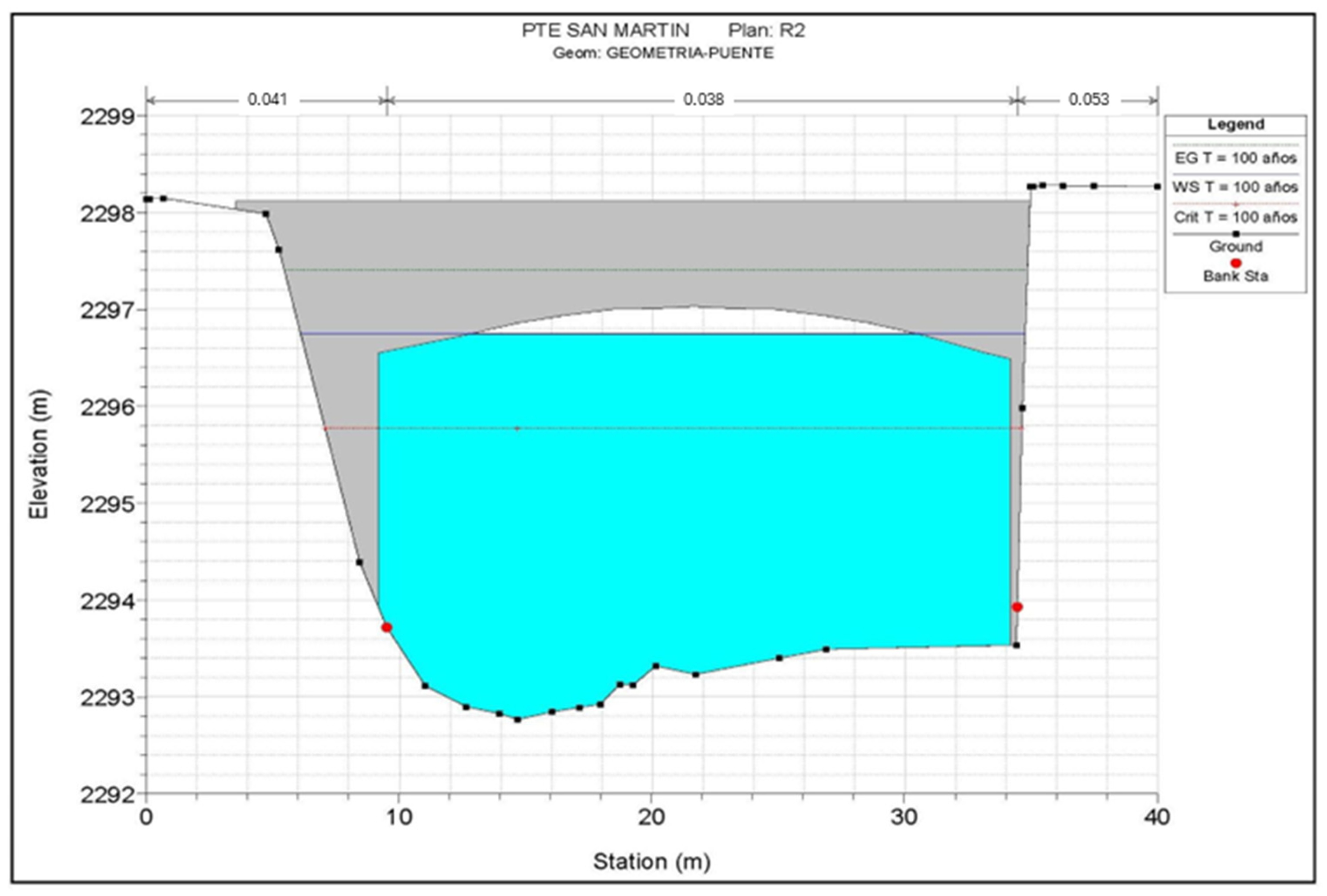
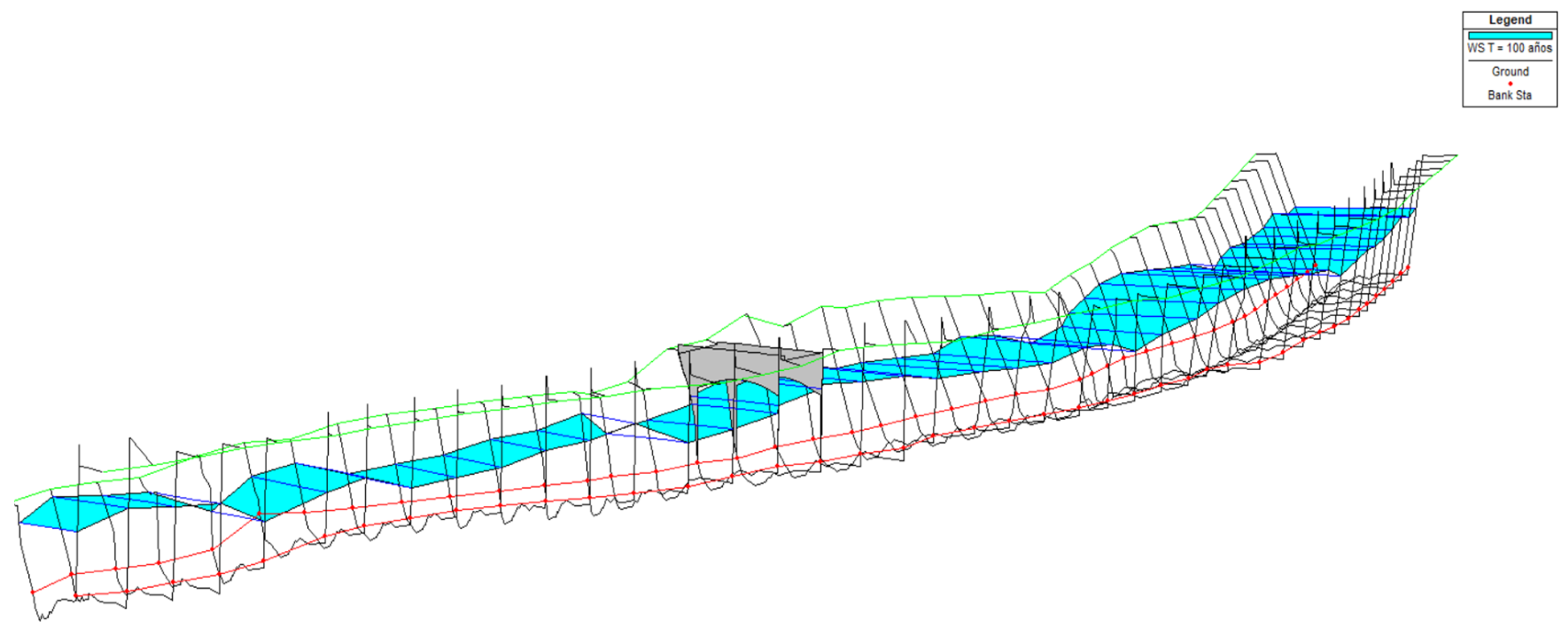
| T4 | Vertical clearance under the deck (m) | 1 | The hydraulic modelling shows that the water surface reaches the lower part of the deck in most simulated scenarios, reducing the available hydraulic clearance (Figure 8). |
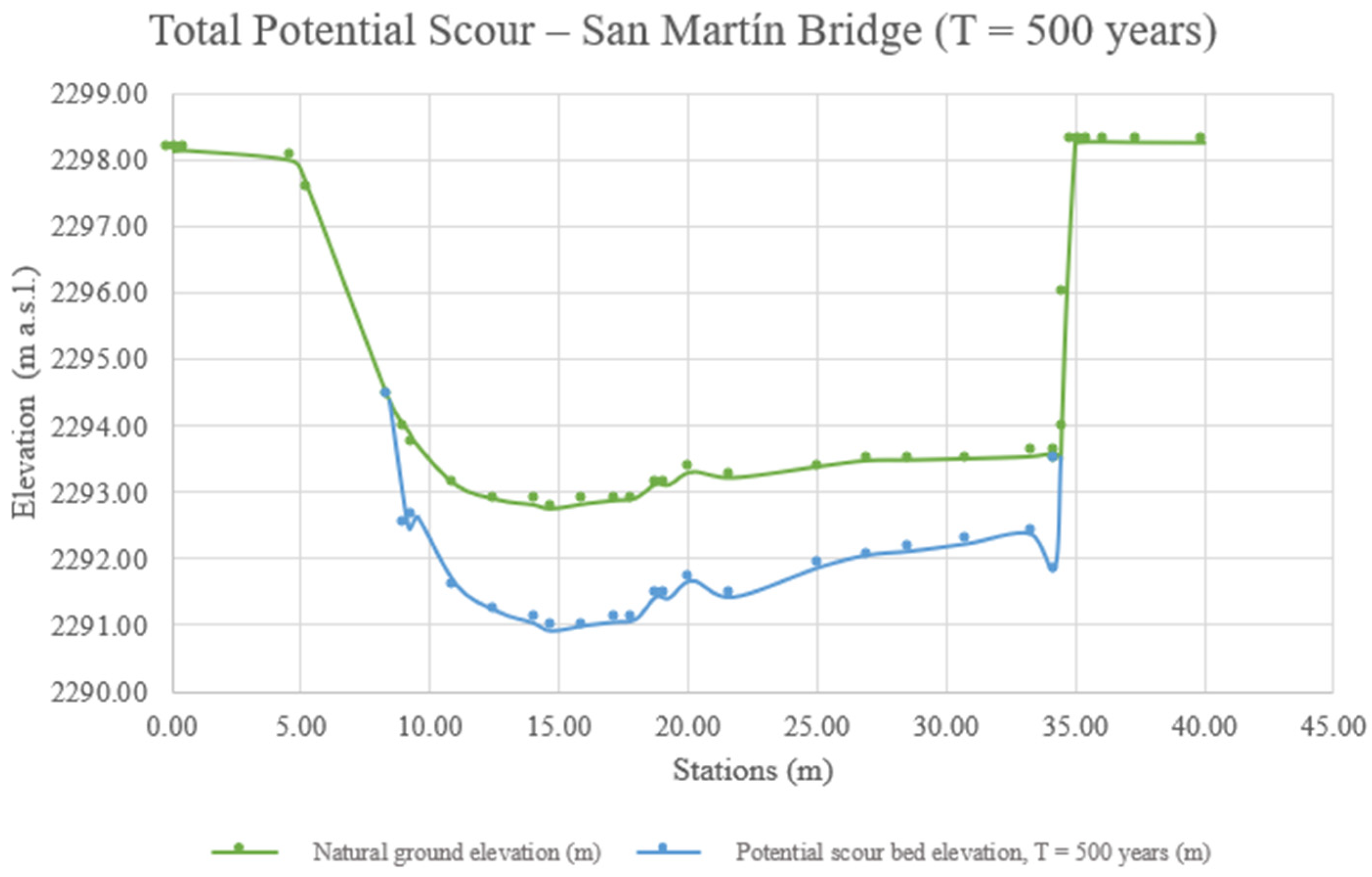
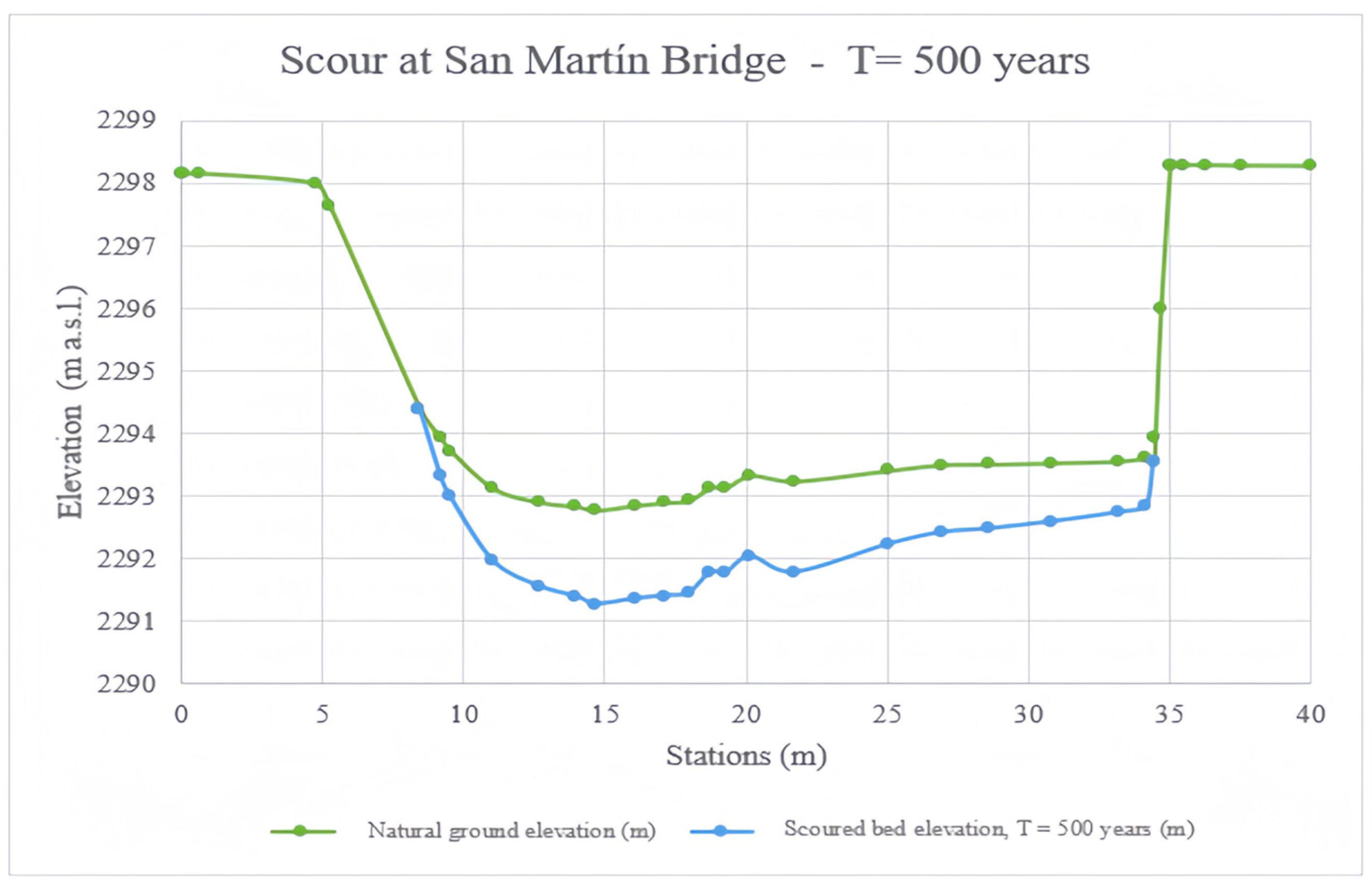
| T5 | Foundation exposure to potential scour | 1 | Since the actual abutment foundation depths in the field are unknown, a conservative score of 1 is assigned. Despite extensive efforts to obtain the original structural drawings from multiple institutions, including municipal authorities and public technical archives, no records were found. Owing to the age of the bridge, the foundation embedment depth could not be verified, and this lack of information was therefore treated conservatively within the assessment. |
| T6 | Service age (years) | 2 | The San Martín Bridge was inaugurated in 1959; therefore, it currently has 66 years of continuous service [72]. |
| E1 | Preliminary restoration cost (from available funds) | - | No official estimate or published study quantifying the total cost is available. |
| O1 | Traffic closures due to hydrological risk | 1 | Official news reports document preventive closures of the San Martín Bridge in 2011, 2012, and 2020 due to critical rises in the Chili River flow and the associated flood risk [59,73]. |
| O2 | Flooding history | 4 | A significant overflow event of the Chili River was recorded, which caused impacts in areas near the San Martín Bridge, reported by national media during a channel reoccupation episode [59]. |
| O3 | Current capacity of upstream reservoirs (%) | 3 | Official information indicates that the Aguada Blanca reservoir shows sedimentation that has reduced its usable capacity to approximately 53%, which may increase hydrological variability downstream [74]. |
| S2 | Nearby critical facilities (schools, shelters, hospitals) | 1 | Based on Google Earth, two school-level educational institutions and one university were identified within a 0.5 km radius, as well as four additional schools within a 1 km radius. |
| A1 | Climate change (temperature trend) | 2 | Recent studies report a sustained increase in regional temperature, associated with the progressive loss of agricultural areas and regional warming. This trend could intensify hydrological processes relevant to the bridge [75]. |
| A2 | Water quality | 1 | Microbiological monitoring conducted in the surroundings of the San Martín Bridge shows elevated contamination levels in the Chili River water, consistent with Vargas Maquera [76]. |
| Rapidity | |||
| Code | Parameter | Score | Justification |
| T7 | Estimated restoration time (months) | 2 | The reconstruction of the Gunther Bridge, which collapsed on February 14, 2025, was completed within approximately nine months; this project was executed by the same entity responsible for the San Martín Bridge [77]. |
| T8 | Operational access during flooding events. | 4 | Due to the asymmetric topographic configuration of the site, operational access would remain available only through one of the abutments, since the steep slope limits the propagation of flow toward that sector. |
| E2 | Duration of the procurement process (days) | 1 | The procurement process began 151 days after the collapse of the Gunther Bridge, which occurred on February 14, 2025, according to the Municipalidad Provincial de Arequipa [78]. |
| O4 | Disaster management practices (number of actions) | 4 | The Prevention Plan identifies six types of actions aimed at reducing flood risk, including capacity-building activities, interventions, and implementation measures intended to strengthen disaster risk management [78] |
| S3 | Affected area or region (km2 or districts) | 2 | The bridge generates direct impact on two districts (Yanahuara and Cercado) and indirect impact on two others (Sachaca and José Luis Bustamante y Rivero). |
| S4 | Predominant construction material in nearby dwellings | 5 | In the immediate surroundings, dwellings are predominantly built with masonry, coexisting with a commercial area composed of buildings constructed with reinforced materials. |
| S5 | Vulnerable population (≥65 years, <14 years) | 1 | According to the 2017 National Census [79], the population classified as vulnerable in the district where the bridge is located represents 31.64% of the total census count (17,541 out of 55,437 inhabitants). |
| S6 | Socioeconomic level (poverty) | 5 | According to the most recent national census conducted in Peru [79], the district where the bridge is located has a poverty rate of 0.21% (118 people out of a total of 55,437 inhabitants). |
| Resourcefulness | |||
| Code | Parameter | Score | Justification |
| T9 | Number of inspection techniques applied | 2 | Two previous studies were identified that developed hydrological and hydraulic models applied to the San Martín Bridge [38,80]. |
| E3 | Emergency funds allocated by the administrator (%) | 1 | According to the Public Sector Budget Expenditure Distribution [81], the Budget Program for Vulnerability Reduction and Emergency Disaster Response was allocated S/2,172,030,523. This amount represents 1.97% of the total national budget, which corresponds to S/110,524,035,517. This amount represents 1.97% of the total national budget, which corresponds to S/110,524,035,517. |
| O5 | BIM maturity level in planning | 1 | According to the Municipalidad Provincial de Arequipa [79], the San Martín Bridge does not have a monitoring system based on BIM methodology. |
| S7 | Operational capacity of the response system (ERM) | 1 | It was observed that traffic detours in Arequipa depend on manual traffic control performed by police officers, evidencing a complete reliance on human intervention. |
| Redundancy | |||
| Code | Parameter | Score | Justification |
| T10 | Availability of emergency materials and equipment (%) | 1 | Although the Contingency Plan for Extreme Rainfall Events lists an inventory of operational equipment and tools distributed across four warehouses for response to critical events, the absence of structural materials or essential prefabricated elements required to ensure accelerated bridge rehabilitation is evident [82]. |
| E4 | Funds available for prevention from the annual budget (%) | 5 | The budget execution of the Municipalidad Provincial de Arequipa (MPA) allocated to the prevention and management of critical events reached only 9.6% of the assigned annual budget [83]. |
| O6 | Availability of backup contractors | 1 | The Municipalidad Provincial de Arequipa (MPA) lacks a registry of prequalified contractors for immediate emergency response. Contracting is carried out through the public bidding system [84], which introduces a dependency on procurement procedures that may compromise the promptness of the response. |
| S1 | Traffic-based service criticality | 1 | Field observations indicate high vehicular flow, associated with the presence of multiple educational institutions (schools and universities) that converge in the area and use the bridge as a main connection route. |
| S8 | Length of the alternative detour (km) | 3 | Geospatial simulation (Google Earth) identified that the shortest available alternative detour route has an approximate length of 2.3 km. |
| Robustness (R1) | ||||
| Code | Parameter | Score | Weight (%) | Criterion Score |
| T1 | Main construction material | 5 | 0.05 | 0.25 |
| T2 | Structural conservation condition | 3 | 0.10 | 0.30 |
| T3 | Protection of piers and abutments against flow | 1 | 0.10 | 0.10 |
| T4 | Vertical clearance under the deck (m) | 1 | 0.10 | 0.10 |
| T5 | Foundation exposure to potential scour | 1 | 0.15 | 0.15 |
| T6 | Service age (years) | 2 | 0.10 | 0.20 |
| E1 | Preliminary restoration cost (from available funds) | - | - | - |
| O1 | Closures due to hydrological risk | 1 | 0.15 | 0.15 |
| O2 | Flooding history | 4 | 0.05 | 0.20 |
| O3 | Current upstream reservoir capacity (%) | 3 | 0.05 | 0.15 |
| S2 | Nearby critical facilities (schools, shelters, hospitals) | 1 | 0.10 | 0.10 |
| A1 | Climate change (temperature trend) | 2 | 0.025 | 0.05 |
| A2 | Water quality | 1 | 0.025 | 0.025 |
| R1= | 1.775 | |||
| Rapidity (R2) | ||||
| Code | Parameter | Score | Weight (%) | Criterion Score |
| T7 | Estimated restoration time (months) | 2 | 0.25 | 0.50 |
| T8 | Operational access during flooding events | 4 | 0.10 | 0.40 |
| E2 | Duration of the procurement process (days) | 1 | 0.15 | 0.15 |
| O4 | Disaster management practices (number of actions) | 4 | 0.10 | 0.40 |
| S3 | Affected area or region (km2 or districts) | 2 | 0.10 | 0.20 |
| S4 | Predominant construction material in nearby dwellings | 5 | 0.05 | 0.25 |
| S5 | Vulnerable population (≥65, <14) | 1 | 0.15 | 0.15 |
| S6 | Socioeconomic level (poverty) | 5 | 0.10 | 0.50 |
| R2= | 2.55 | |||
| Resourcefulness (R3) | ||||
| Code | Parameter | Score | Weight (%) | Criterion Score |
| T9 | Number of inspection techniques applied | 2 | 0.25 | 0.50 |
| E3 | Emergency funds allocated by the administrator (%) | 1 | 0.35 | 0.35 |
| O5 | BIM maturity level in planning | 1 | 0.20 | 0.20 |
| S7 | Operational capacity of the response system (ERM) | 1 | 0.20 | 0.20 |
| R3= | 1.25 | |||
| Redundancy (R4) | ||||
| Code | Parameter | Score | Weight (%) | Criterion Score |
| T10 | Availability of emergency materials and equipment (%) | 1 | 0.15 | 0.15 |
| E4 | Funds available for prevention from the annual budget (%) | 5 | 0.25 | 1.25 |
| O6 | Availability of backup contractors | 1 | 0.20 | 0.20 |
| S1 | Traffic-based service criticality | 1 | 0.20 | 0.20 |
| S8 | Length of the alternative detour (km) | 3 | 0.20 | 0.60 |
| R4= | 2.40 | |||
| Original Weights | |||||||||||
| 4Rs | −50% | −40% | −30% | −20% | −10% | 0% | 10% | 20% | 30% | 40% | 50% |
| Robustness | 0.30 | 0.36 | 0.42 | 0.48 | 0.54 | 0.60 | 0.66 | 0.72 | 0.78 | 0.84 | 0.90 |
| Rapidity | 0.33 | 0.30 | 0.28 | 0.25 | 0.22 | 0.19 | 0.16 | 0.13 | 0.10 | 0.08 | 0.05 |
| Resourcefulness | 0.23 | 0.21 | 0.19 | 0.17 | 0.15 | 0.13 | 0.11 | 0.09 | 0.07 | 0.05 | 0.03 |
| Redundancy | 0.14 | 0.13 | 0.12 | 0.10 | 0.09 | 0.08 | 0.07 | 0.06 | 0.04 | 0.03 | 0.02 |
| Robustness | |||||||||||
| Parameters | −50% | −40% | −30% | −20% | −10% | 0% | 10% | 20% | 30% | 40% | 50% |
| T1 | 0.05 | 0.05 | 0.05 | 0.05 | 0.05 | 0.05 | 0.05 | 0.05 | 0.05 | 0.05 | 0.05 |
| T2 | 0.11 | 0.11 | 0.11 | 0.10 | 0.10 | 0.10 | 0.10 | 0.10 | 0.09 | 0.09 | 0.09 |
| T3 | 0.11 | 0.11 | 0.11 | 0.10 | 0.10 | 0.10 | 0.10 | 0.10 | 0.09 | 0.09 | 0.09 |
| T4 | 0.11 | 0.11 | 0.11 | 0.10 | 0.10 | 0.10 | 0.10 | 0.10 | 0.09 | 0.09 | 0.09 |
| T5 | 0.08 | 0.09 | 0.11 | 0.12 | 0.14 | 0.15 | 0.17 | 0.18 | 0.20 | 0.21 | 0.23 |
| T6 | 0.11 | 0.11 | 0.11 | 0.10 | 0.10 | 0.10 | 0.10 | 0.10 | 0.09 | 0.09 | 0.09 |
| O1 | 0.16 | 0.16 | 0.16 | 0.16 | 0.15 | 0.15 | 0.15 | 0.14 | 0.14 | 0.14 | 0.14 |
| O2 | 0.05 | 0.05 | 0.05 | 0.05 | 0.05 | 0.05 | 0.05 | 0.05 | 0.05 | 0.05 | 0.05 |
| O3 | 0.05 | 0.05 | 0.05 | 0.05 | 0.05 | 0.05 | 0.05 | 0.05 | 0.05 | 0.05 | 0.05 |
| S2 | 0.11 | 0.11 | 0.11 | 0.10 | 0.10 | 0.10 | 0.10 | 0.10 | 0.09 | 0.09 | 0.09 |
| A1 | 0.03 | 0.03 | 0.03 | 0.03 | 0.03 | 0.03 | 0.02 | 0.02 | 0.02 | 0.02 | 0.02 |
| A2 | 0.03 | 0.03 | 0.03 | 0.03 | 0.03 | 0.03 | 0.02 | 0.02 | 0.02 | 0.02 | 0.02 |
| Rapidity | |||||||||||
| Parameters | −50% | −40% | −30% | −20% | −10% | 0% | 10% | 20% | 30% | 40% | 50% |
| T7 | 0.13 | 0.15 | 0.18 | 0.20 | 0.23 | 0.25 | 0.28 | 0.30 | 0.33 | 0.35 | 0.38 |
| T8 | 0.12 | 0.11 | 0.11 | 0.11 | 0.10 | 0.10 | 0.10 | 0.09 | 0.09 | 0.09 | 0.08 |
| E2 | 0.18 | 0.17 | 0.17 | 0.16 | 0.16 | 0.15 | 0.15 | 0.14 | 0.14 | 0.13 | 0.13 |
| O4 | 0.12 | 0.11 | 0.11 | 0.11 | 0.10 | 0.10 | 0.10 | 0.09 | 0.09 | 0.09 | 0.08 |
| S3 | 0.12 | 0.11 | 0.11 | 0.11 | 0.10 | 0.10 | 0.10 | 0.09 | 0.09 | 0.09 | 0.08 |
| S4 | 0.06 | 0.06 | 0.06 | 0.05 | 0.05 | 0.05 | 0.05 | 0.05 | 0.05 | 0.04 | 0.04 |
| S5 | 0.18 | 0.17 | 0.17 | 0.16 | 0.16 | 0.15 | 0.15 | 0.14 | 0.14 | 0.13 | 0.13 |
| S6 | 0.12 | 0.11 | 0.11 | 0.11 | 0.10 | 0.10 | 0.10 | 0.09 | 0.09 | 0.09 | 0.08 |
| Resourcefulness | |||||||||||
| Parameters | −50% | −40% | −30% | −20% | −10% | 0% | 10% | 20% | 30% | 40% | 50% |
| T9 | 0.32 | 0.30 | 0.29 | 0.28 | 0.26 | 0.25 | 0.24 | 0.22 | 0.21 | 0.20 | 0.18 |
| E3 | 0.18 | 0.21 | 0.25 | 0.28 | 0.32 | 0.35 | 0.39 | 0.42 | 0.46 | 0.49 | 0.53 |
| O5 | 0.25 | 0.24 | 0.23 | 0.22 | 0.21 | 0.20 | 0.19 | 0.18 | 0.17 | 0.16 | 0.15 |
| S7 | 0.25 | 0.24 | 0.23 | 0.22 | 0.21 | 0.20 | 0.19 | 0.18 | 0.17 | 0.16 | 0.15 |
| Redundancy | |||||||||||
| Parameters | −50% | −40% | −30% | −20% | −10% | 0% | 10% | 20% | 30% | 40% | 50% |
| T10 | 0.18 | 0.17 | 0.17 | 0.16 | 0.16 | 0.15 | 0.15 | 0.14 | 0.14 | 0.13 | 0.13 |
| E4 | 0.13 | 0.15 | 0.18 | 0.20 | 0.23 | 0.25 | 0.28 | 0.30 | 0.33 | 0.35 | 0.38 |
| O6 | 0.23 | 0.23 | 0.22 | 0.21 | 0.21 | 0.20 | 0.19 | 0.19 | 0.18 | 0.17 | 0.17 |
| S1 | 0.22 | 0.21 | 0.21 | 0.21 | 0.20 | 0.20 | 0.20 | 0.19 | 0.19 | 0.19 | 0.18 |
| S8 | 0.23 | 0.23 | 0.22 | 0.21 | 0.21 | 0.20 | 0.19 | 0.19 | 0.18 | 0.17 | 0.17 |
| Sensitivity Analysis (SA) | |||||||||||
|---|---|---|---|---|---|---|---|---|---|---|---|
| −50% | −40% | −30% | −20% | −10% | 0% | 10% | 20% | 30% | 40% | 50% | |
| BRI Robustness | 2.004 | 1.989 | 1.971 | 1.951 | 1.928 | 1.904 | 1.877 | 1.848 | 1.817 | 1.784 | 1.748 |
| BRI Rapidity | 1.797 | 1.821 | 1.844 | 1.865 | 1.886 | 1.904 | 1.921 | 1.939 | 1.956 | 1.972 | 1.985 |
| BRI Resourcefulness | 2.014 | 1.990 | 1.967 | 1.945 | 1.924 | 1.904 | 1.885 | 1.867 | 1.850 | 1.834 | 1.820 |
| BRI Redundancy | 1.926 | 1.922 | 1.918 | 1.914 | 1.909 | 1.904 | 1.898 | 1.892 | 1.886 | 1.879 | 1.872 |
Disclaimer/Publisher’s Note: The statements, opinions and data contained in all publications are solely those of the individual author(s) and contributor(s) and not of MDPI and/or the editor(s). MDPI and/or the editor(s) disclaim responsibility for any injury to people or property resulting from any ideas, methods, instructions or products referred to in the content. |
© 2026 by the authors. Licensee MDPI, Basel, Switzerland. This article is an open access article distributed under the terms and conditions of the Creative Commons Attribution (CC BY) license.
Share and Cite
Medina Yauri, D.F.; Muñoz-Manrique, A.; Huarca Pulcha, A.; Espinoza Vigil, A.J. An Integrated Resilience Assessment Framework for Riverine Bridges Based on Hydraulic Modeling and Multicriteria Analysis. Water 2026, 18, 746. https://doi.org/10.3390/w18060746
Medina Yauri DF, Muñoz-Manrique A, Huarca Pulcha A, Espinoza Vigil AJ. An Integrated Resilience Assessment Framework for Riverine Bridges Based on Hydraulic Modeling and Multicriteria Analysis. Water. 2026; 18(6):746. https://doi.org/10.3390/w18060746
Chicago/Turabian StyleMedina Yauri, Diego Fabian, Alejandra Muñoz-Manrique, Alan Huarca Pulcha, and Alain Jorge Espinoza Vigil. 2026. "An Integrated Resilience Assessment Framework for Riverine Bridges Based on Hydraulic Modeling and Multicriteria Analysis" Water 18, no. 6: 746. https://doi.org/10.3390/w18060746
APA StyleMedina Yauri, D. F., Muñoz-Manrique, A., Huarca Pulcha, A., & Espinoza Vigil, A. J. (2026). An Integrated Resilience Assessment Framework for Riverine Bridges Based on Hydraulic Modeling and Multicriteria Analysis. Water, 18(6), 746. https://doi.org/10.3390/w18060746