


Abstract
In the western part of the United States, surface water rights follow the prior appropriation doctrine, while tribal water rights are governed by the reserved water rights doctrine. States and Tribal Nations share borders, but water knows no boundaries, and water-related conflicts emerged by the late 19th Century. The United States Supreme Court recognized the reserved water rights doctrine through Winters v. United States in 1908. Over a century later, many tribal water rights claims remain unresolved. Since 1978, congressionally approved tribal water rights settlement acts have emerged as a way to resolve pending tribal water rights claims in the United States. As of March 2026, Tribal Nations, Arizona, the United States, and other interested parties have negotiated 11 congressionally approved tribal water rights settlement acts. This article qualitatively analyzes these 11 congressionally approved tribal water rights settlement acts. The historical and legal analysis highlights the importance of water sharing through water rights settlement acts to ensure water security for Arizona, Tribal Nations, and other interested parties.
1. Introduction
1.1. Introduction to Tribal Water Rights
Water governance is challenged in the context of shared borders because of fluidity and the very nature of water. As water moves and shifts, its legal characteristics change as well, creating challenges among stakeholders, including sovereign governments, tribal and non-tribal alike. In the United States, the three sovereign governments involved in tribal water rights disputes are states (i.e., Arizona), Tribal Nations (i.e., the Navajo Nation), and the United States federal government (i.e., Congress or the United States for simplicity) [1,2,3,4]. Other interested parties and stakeholders include cities, towns, irrigation districts, mining companies, and ranchers [1,2,3,4]. Water diplomacy is an essential element of tribal water settlements because they are based on negotiations among historical adversarial parties [1,2,3,4]. As the United States expanded westward in the 19th Century, it encouraged Euro-American settlers to divert surface waters to foment economic development in the region and the country [5,6,7]. Within the same period, the United States entered into over 300 binding treaties with Tribal Nations to create Native American reservations, which would serve as their permanent homelands [1,8,9,10].
Most Native American reservations were created in the arid western part of the United States, which created conflict with Euro-American settlers as both groups depended on the same water sources [5,8,9,10]. As Euro-American settlers arrived at the territories near Native American reservations, they quickly depleted local water resources through surface water diversions, dams, and groundwater pumping [5,6,7]. Such actions negatively impacted the livelihoods and economies of neighboring Native American reservations [5,6,7]. The landmark United States Supreme Court ruling of Winters v. United States in 1908 established the reserved water rights doctrine, recognizing tribal water rights [1,11,12]. Between 1908 and 1978, litigation was the primary way through which Tribal Nations resolved their legal claims to water rights, with the United States acting as trustee [11,12,13,14]. In 1978, Tribal Nations began entering into congressionally approved water settlements with states and other stakeholders to resolve Tribal Nations’ legal claims to water rights [11,12,13,14]. Currently, Tribal Nations have two main ways to legally secure their unresolved water claims: litigation and water settlements [1,11,15].
By qualitatively analyzing a total of 11 congressionally approved tribal water rights settlement acts involving Arizona, this article argues that water settlements are more conducive to water security for Tribal Nations, Arizona, the United States, and other interested parties than water litigation. For the purposes of this article, water security is generally defined as access to potable water for the people of Arizona and Tribal Nations, enough water for the economic development of interested parties, as well as clean water for the environment, ceremonial uses, and recreation. Congressionally approved tribal water rights settlement acts depend on negotiations among sovereign governments and other water users rather than litigation where one party loses and the other one wins [2,3,4,16,17]. While congressionally approved tribal water rights settlement acts are not the solution for every tribal water rights dispute, they offer a diplomatic solution that can enhance water sharing in Arizona, where water resources have been over-tapped and remain the source of ongoing conflicts since the 19th Century [3,4,5,7,11,14,18].
1.2. Literature Review
There is robust literature pertaining to tribal water rights and their relation to water security within Tribal Nations and the states they share borders with. The literature on tribal water rights is complemented by existing case law, highlighting the development of tribal reserved water rights between 1908 and early 2026. Generally, the literature can be organized into three main categories: (1) literature focused on tribal water litigation, (2) literature focused on tribal water settlements, and (3) literature focused on both tribal water litigation and settlements. The existing literature varies in focus and scope, confirming that tribal water rights are complex. Some sources focus mainly on the reserved water rights doctrine, whereas others focus on a more comprehensive overview of how tribal water rights evolved over time. This article’s contribution to existing literature is a qualitative analysis of how tribal water rights settlement acts evolved in Arizona and how they offer more water security for Tribal Nations, Arizona, the United States, and other stakeholders than tribal water litigation.
The literature that focuses mainly on tribal water litigation comprises works by Crass [19], Royster [20], and Hedden-Nicely [21]. A reason why few sources focus only on tribal water litigation is that tribal water litigation is generally reviewed alongside water settlements. Since 1990, the United States federal government endorsed tribal water rights settlement acts as the preferred method for resolving legal claims to water rights [22,23]. Additionally, the literary sources under this category have a narrow scope in their analyses due to their specific topics, with Crass [19] focusing on water marketing, Hedden-Nicely [21] focusing on the litigation of tribal reserved water rights in state courts, and Royster [20] focusing on the evolution of the reserved water rights doctrine between 1908 and 2008.
Tribal water settlements have been studied extensively by scholars of tribal water rights. Literary sources focusing on tribal water settlements are Agee [24], Bark and Jacobs [25], Bark [26,27], Clayton [28], Colby and Young [17], Colby et al., [4], Cosens [2], Curley [29], DeJong [5,14], Folk-Williams [30], Getches [31], Hawkins [32], Hays [33], Klee and Mecham [34], and McCool [3,16]. Of these sources, only Agee [24], Colby et al., [4], DeJong [5,14], Folk-Williams [30], and McCool [3] provide a broad context for readers to understand the historical nuances and complexities that led Tribal Nations to choose water settlements over litigation. The rest of the literature in this category has a narrower focus based on the individual scopes and topics of each source.
The third and final category of literature reviewed focuses on both tribal water litigation and tribal water rights settlement acts and includes Anderson [1,13,35,36], Brienza [12], Candrian [37], Chambers and Echohawk [38], Joyce [39], Lewis and Hestand [40], McGovern [41], and Royster [42,43]. Similarly to the literature in the category focusing only on tribal water settlements, the articles in this category vary in topic and scope, with some articles offering a more thorough analysis of tribal water rights. Anderson [1,13,35,36], Brienza [12], McGovern [41], and Royster [42,43] generally provide a very thorough review of the historical context behind tribal water litigation and settlements. The rest of the literature in this category generally discusses ways through which Tribal Nations, the United States, states, and other entities can benefit from water settlements and why settlements are preferable to litigation.
1.3. Historical Context of Tribal Water Rights
Tribal water rights are intrinsically tied to the political status of Tribal Nations vis-à-vis the United States and states [9,44]. Before the United States became a country, Tribal Nations entered into treaties with the British Crown [45,46]. Tribal Nations entered into treaties with the United States between the years leading to its independence from Britain and 1871, when Congress ended treaty making with Tribal Nations [8,9,44]. Initially, treaties between Tribal Nations and the United States were peace treaties [8,9,44]. As the United States grew in power and ambition, treaties between Tribal Nations and the country evolved into treaties of peace with large land cessions from Tribal Nations to the United States [8,9,44]. Such land cessions often accompanied the creation of Native American reservations that would become the permanent homelands of the Tribal Nations inhabiting them [9,44].
In 1831 and 1832, the United States Supreme Court established the concept of the federal trust responsibility and recognized tribal sovereignty through its rulings of Cherokee Nation v. Georgia (1831) and Worcester v. Georgia (1832), respectively [9,44]. Through Cherokee Nation v. Georgia (1831), the Court opined that Tribal Nations were domestic dependent nations in relation to the United States [9,44]. Where Cherokee Nation v. Georgia (1831) caused the Court to evaluate the status of Tribal Nations in relation to the United States, Worcester v. Georgia (1832) concerned the State of Georgia imposing its laws on the territory of the Cherokee Nation [9,44]. In Worcester v. Georgia (1832), the Court confirmed that although Tribal Nations were domestic dependent nations in relation to the United States, they were sovereign nations independent of states and that only the federal government had the plenary power to impose its laws upon Tribal Nations [9,44].
While the United States expanded westward it also encouraged Euro-American settlement and economic development in the territories made available through the Treaty of Guadalupe Hidalgo of 1848 and other international developments with Tribal Nations and European empires [14,45,46]. The Homestead Act of 1862 and the Desert Land Act of 1877 incentivized Euro-American settlers to economically develop the arid lands of the western part of the United States [5,14]. The prior appropriation doctrine, which is the legal doctrine of water rights in the western part of the United States emerged between 1850 and 1900, coinciding with the westward expansion of the country from present-day East Coast to the West Coast [6,15].
Unlike the riparian doctrine, which governs water law in the eastern part of the United States, the prior appropriation doctrine is very hierarchical, with a system of senior and junior rights-holders, with older appropriators holding priority over more recent appropriators [6,15]. According to the prior appropriation doctrine, appropriators must divert water from the source (i.e., a river or creek) to the site where the water will be put to beneficial use (economic development) and the priority date is the date when the water diversion or claim took place [6,15]. The water appropriated must be appropriable, meaning that no one else has appropriated it before [6,15]. Water rights can be lost and forfeited under the prior appropriation doctrine [6,15].
In 1887, the United States Congress passed the General Allotment Act of 1887 (General Allotment Act), which was actively implemented between 1887 and 1934 [9,10,44]. At its core, the General Allotment Act had the purpose of assimilating Native Americans into the Euro-American way of life [9,44]. As such, Native American reservations were divided into plots of land, which were distributed to the members of the Tribal Nation and what remained was declared surplus land and opened for Euro-American settlement [9,44]. Heads of household received 160 acres of land, tribal members over 18 years of age received 80 acres of land, and tribal members under 18 years of age received 40 acres of land [9,44]. Tribal Nations lost over 90 million acres of land through the execution of the General Allotment Act [9,13,44].
The General Allotment Act is relevant to tribal water rights because it divided communally owned Native American reservations into checkerboard patterns of individually owned land plots whose ownership could later pass from tribal to non-tribal persons [9,44,47]. According to the original policy, individual allotments would be converted into fee simple land title after 25 years, the owner would become a United States citizen, and would have to pay taxes to state and local governments [9,44,47]. Tribal Nations whose lands were divided and allotted by the General Allotment Act are subject to additional rules and restrictions regarding the water rights of individual allottees [9,44,47].
1.4. Fundamentals of Tribal Water Rights
By the late 19th Century, the combination of Tribal Nations’ confinement to reservations in the arid western part of the United States and the westward expansion of the United States caused water-related conflicts between Tribal Nations and Euro-American settlers [5,11,14]. The foundation of the reserved water rights doctrine lies with a conflict involving the Fort Belknap Indian Reservation in Montana [1,11,15]. Euro-American settlers were diverting too much water from the Milk River, imperiling the survival and economic development of the Tribal Nations of the Fort Belknap Indian Reservation [1,11,15]. The United States, acting as trustee, filed a lawsuit against the up-stream Euro-American settlers, which culminated in Winters v. United States (1908) [1,11,15].
In 1908, the Supreme Court of the United States issued its ruling in Winters v. United States (1908) and established the reserved water rights doctrine for Tribal Nations [6,11]. In its ruling, the Court confirmed that tribal water rights were impliedly reserved when Native American reservations were created [1,9,11]. The reasoning behind Winters has its basis in the fact that many treaties between Tribal Nations and the United States did not explicitly reserve water rights for the reservation created through the treaty [1,11]. In the ruling, the Supreme Court inferred that Tribal Nations would not have agreed to settle on reservations in the arid western part of the United States for the purpose of such reservations becoming their permanent homelands without water rights [1,11]. Because the Supreme Court based its ruling on the purpose of Native American reservations, however, its ruling left an indelible mark on tribal reserved water rights through which Tribal Nations were compelled to use their water rights for irrigation purposes only [1,11,15].
Another legal case fundamental to tribal water law is United States v. Winans (1905). In United States v. Winans (1905), the Supreme Court of the United States ruled that the Indians of the Yakima Indian Reservation had the right to fish at their “usual and accustomed” places, even when those places had passed into individual Euro-American ownership, because the Yakima Tribes’ treaty with the United States explicitly said so [1,11]. The Court’s ruling supports the claim that tribal reserved water rights were reserved by the Tribal Nation and not the United States by affirming that when treaties were made between Tribal Nations and the United States, rights were given by the Tribal Nation to the United States and not vice versa [11]. Winters v. United States (1908) decided a mere three years after Winans, through an opinion authored by the same Justice that in cases where the exchange of rights through treaty or agreement is ambiguous, courts should err on the side of the Tribal Nation, understanding the terms of the treaty or agreement as the Tribal Nation would have [11].
1.5. Tribal Water Rights Between 1908 and 1963
Tribal water rights were not enforced to their fullest extent between 1908 and 1963 because courts were reluctant to enforce the reserved water rights doctrine on the face of the prior appropriation doctrine [11,48]. In Arizona, Native Americans in the Gila River Indian Community and the San Carlos Apache Tribe gained a victory through the Globe Equity Decree of 1935 [11,14,25]. Each reservation was awarded water rights through this decree, which were ultimately not enforced by local authorities, leading to protracted water rights litigation driven by each tribal reservation [11,14].
The Colorado River watershed is a major source of water for the arid southwestern part of the United States, spanning seven states and 30 Tribal Nations [11,12,49]. The Colorado River Compact of 1922 established the foundation of what is known as the Law of the River, which led to complex and protracted litigation among interested parties, including Arizona v. California (1963) [11,12]. In 1963, the United States Supreme Court issued its ruling in Arizona v. California (1963) through which it decreed water rights to the Colorado River to five Tribal Nations along the main stem of the lower basin of the Colorado River and established the Practicable Irrigable Acreage (PIA) as the quantification standard for tribal water rights [1,11]. The five Tribal Nations awarded water rights to the Colorado River through Arizona v. California (1963) are the Colorado River Indian Tribes, Fort Mojave Indian Tribe, Chemehuevi Indian Tribe, Cocopah Indian Tribe, and Fort Yuma Quechan Indian Tribe [1,11]. In its Arizona v. California (1963) decision, the United States Supreme Court also added to the reserved water rights doctrine expanding the reach of the doctrine to include other federal reservations like those for national forests and military bases [1,11].
1.6. The McCarran Amendment
The McCarran Amendment was enacted by Congress in 1952 and it was not initially construed to apply to tribal water rights [11,21,50]. Initially, the McCarran Amendment only applied to waters owned by the United States and compelled the federal government to litigate water cases in state courts [11,21,50]. In 1971, the United States Supreme Court ruled on United States v. District Court in and for Eagle County (1971), through which the Court stated that the McCarran Amendment applied to federal reserved water rights, which are distinct from tribal reserved water rights [11,21]. In 1976, the United States Supreme Court ruled on Colorado River Water Conservation District v. United States (1976) holding, inter alia, that the McCarran Amendment applied to tribal reserved water rights because the Court interpreted federal trust responsibility over tribal water rights to mean ownership of such rights [11,21]. Under the federal trust responsibility, the United States holds the lands and resources of federally recognized Tribal Nations in trust on their behalf [9,11,44]. The question of whether the trust responsibility actually means federal ownership of tribal lands and resources deserves further scrutiny that exceeds the scope of this article.
In 1983, the United States Supreme Court reviewed a third case that further affirmed the applicability of the McCarran Amendment to tribal reserved water rights [11,21]. Through its ruling on Arizona v. San Carlos Apache Tribe of Arizona (1983), the Court ruled that the McCarran Amendment applies to Tribal Nations that file their water litigation claims on their own rather than through the United States as trustee, and that the McCarran Amendment applies to cases filed in states that disclaimed jurisdiction over Tribal Nations in their enabling acts [11,21]. Through this final case, the Supreme Court of the United States made it difficult for Tribal Nations to successfully remove their water rights claims for review in federal courts instead of state courts [11,21]. A drawback to litigating tribal water rights claims in state courts rather than federal courts is that state judges are generally not as well versed on American Indian law and policy as federal judges tend to be [11].
1.7. Quantification Standards for Tribal Water Rights
Until the United States Supreme Court’s adjudication of Arizona v. California (1963), there was no federal guidance about how tribal reserved water rights must be quantified [11,15]. Through the adjudication of Arizona v. California (1963), the United States Supreme Court ruled that an accepted quantification method for tribal water rights would be the Practicable Irrigable Acreage (PIA) [11,15]. At its core, the PIA standard was established in deference to Winters v. United States (1908) and its establishment of the reserved water rights doctrine [11]. As such, the PIA standard relies heavily on the belief that Native American reservations were established to not only serve as the permanent homelands of Tribal Nations, but to also assimilate them into the Euro-American system of agriculture and small family farms [11].
While the PIA standard may have been welcomed by some as an accepted quantification method for tribal water rights in 1963, it can be problematic for Tribal Nations, states, and other water users [2,11]. For Tribal Nations, determining the PIA is a very expensive process as they must hire experts in geology, hydrology, law, history, and soil science to prove to the courts and negotiators that they have the right to claim a certain quantity of water rights [2,11]. Additionally, Tribal Nations with reservations in alluvial plains have a better chance of receiving a more generous water rights decree than those with reservations encompassing rocky canyons or mountainous areas [2,11]. The PIA standard, however, can be just as beneficial and detrimental for states and other water users as it is for Tribal Nations, which makes it potentially controversial for any of the main parties seeking a water rights decree or settlement.
There are few replacements for the PIA standard, but the McCarran Amendment has made it easier for state courts to devise their own quantification methods for tribal water rights [11,21]. The moderate living standard, which emerged from the Adair cases in Oregon is an example [11]. Under the moderate living standard, enough water must be allocated for the Tribal Nation to exercise its treaty rights to hunt, fish, and gather, which entails enough water to maintain a habitat for the flora and fauna that Tribal Nations depend on [11].
In 2001, the Supreme Court of Arizona established another quantification standard for tribal water rights [2,11,51]. Through the general stream adjudication of the Gila River, the Supreme Court of Arizona established the homeland standard to quantify the water rights of Tribal Nations in Arizona [2,11,51]. Through the homeland standard, the Supreme Court of Arizona rejected the concept of primary and secondary water uses established by United States v. New Mexico (1978) [2,11,51]. United States v. New Mexico (1978) involved non-tribal federal water reservations and established primary water uses to serve the purpose of the federal water reservation while secondary water uses do not serve the primary purpose of the water reservation [11]. The Supreme Court of Arizona also based its logic on the fact that Native American reservations were established to be the permanent homelands of Tribal Nations [2,11,51]. As such, the Court declared that tribal water rights should be quantified on the basis of the water needed to satisfy the purpose of the reservation and for any use necessary to achieve that purpose [2,11,51]. While the homeland standard is more flexible than the PIA standard and the moderate living standard, its application can be problematic for Tribal Nations that would have received a higher amount of water rights under the PIA standard.
Of the three quantification methods for tribal water rights listed here, Arizona’s homeland standard is the most flexible and, arguably, the least restrictive [2,51]. Nonetheless, all three water quantification standards can be problematic for Tribal Nations because they were not created by Tribal Nations themselves. Tribal Nations are very diverse with their own histories and relationships to water. Applying a single quantification method to all Tribal Nations without regard to their individual histories and relationships to water can defeat the purpose of the reserved water rights doctrine. This fact is especially problematic for Tribal Nations that quantify their water rights through the litigation process. The tribal water rights settlement process may offer more flexibility for Tribal Nations to choose the water uses and priorities for their water rights, but it is important that Tribal Nations choose the water quantification method that best fits their needs.
2. Materials and Methods
Since 1978, a total of 11 congressionally approved tribal water rights settlement acts have been negotiated by Tribal Nations in Arizona, the United States, Arizona, and other interested parties [52]. In order to determine how tribal water rights settlement acts involving Tribal Nations and Arizona have evolved over time and how they contribute to the water security of all interested parties, a qualitative analysis of the 11 settlement acts was conducted. Criteria for determining the evolution of tribal water rights settlement acts focus on changes regarding water uses, restrictions, and rights waivers over time. The impact of tribal water rights settlement acts on the water security of Tribal Nations, Arizona, and other interested parties is more nuanced and relies on the fact that the southwestern part of the United States has been experiencing a historic drought in recent years [49]. Arizona and the Tribal Nations it shares borders with are located in the Southwestern part of the United States [49]. Tribal water rights settlement acts quantify unclaimed tribal water rights claims in Arizona, which allows the state to determine if there is enough water to meet its needs, as well as those of other parties [49,53].
Moreover, this research was part of the lead author’s dissertation project [54]. Due to time and monetary constraints, the research was limited to the archival review of the 11 tribal water rights settlement acts in Arizona and a review of existing literature regarding the topic [54]. Federal government sources were used to review each tribal water rights settlement act and its amendment as the Department of the Interior and the Bureau of Reclamation manage tribal water resources [22,53]. The congressionally approved settlement acts and their amendments are located in online federal government archives. Importantly, the nature of amendments to tribal water rights settlement acts varies; however, they generally serve as a way for the negotiating parties to address oversights that were not flagged during the initial negotiation process and to adapt to emergent circumstances like a drought, new state water policies, and inability to meet previously agreed upon deadlines [53].
Tribal water rights settlement acts are products of the complex legal and political history of tribal water rights. As such, the qualitative research undertaken for this article focuses on conducting a historical and legal analysis of the 11 tribal water rights settlement acts in Arizona. Each tribal water rights settlement act among Tribal Nations, Arizona, the United States, and other entities, as well as its corresponding amendment act, was reviewed and annotated. For this article, two tables were created based on the notes taken from the settlement acts and their amendments. The tables were created to present the information in a concise and organized manner. The use of tables is important because tribal water rights settlement acts are complex legislation documents that are the culmination of years of negotiation among the interested parties [3,4,16,22,52]. The information contained within each settlement act and its amendments is much more than can be presented in a table and an article of this size. Hence, information was selected to highlight results like changes in water uses, types of water used, and restrictions to where the water can be used.
Congressionally approved tribal water rights settlement acts are nuanced and require careful reading and analysis. Each tribal water rights settlement act depends on the unique circumstances of the negotiating Tribal Nation, its relationship with the state party, its history with the United States, and its interactions with other entities [3,4,16,22,53]. A legal and historical analysis is appropriate because American Indian law and policy is intrinsically connected to the history of the United States, states, Tribal Nations, and Euro-American settlers. Tribal water law emerged as a result of this history, which is necessary to understand the state of tribal water law in 2026 and its implications for water security in Arizona. A comprehensive historical and legal analysis was conducted in order to emphasize why tribal water rights settlement acts are complex. The qualitative analysis reviewed and analyzed the history of Tribal Nations vis-à-vis the United States and states, the development of the prior appropriation doctrine, the emergence of the reserved water rights doctrine, and Tribal Nations’ efforts to legally claim their water rights between 1905 and early 2026.
3. Results
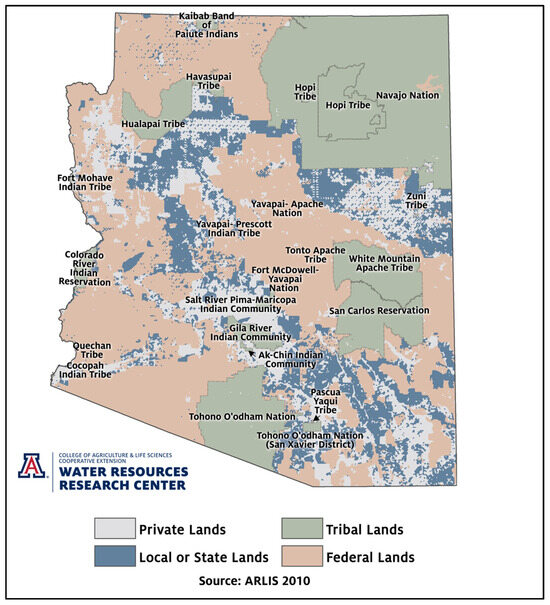
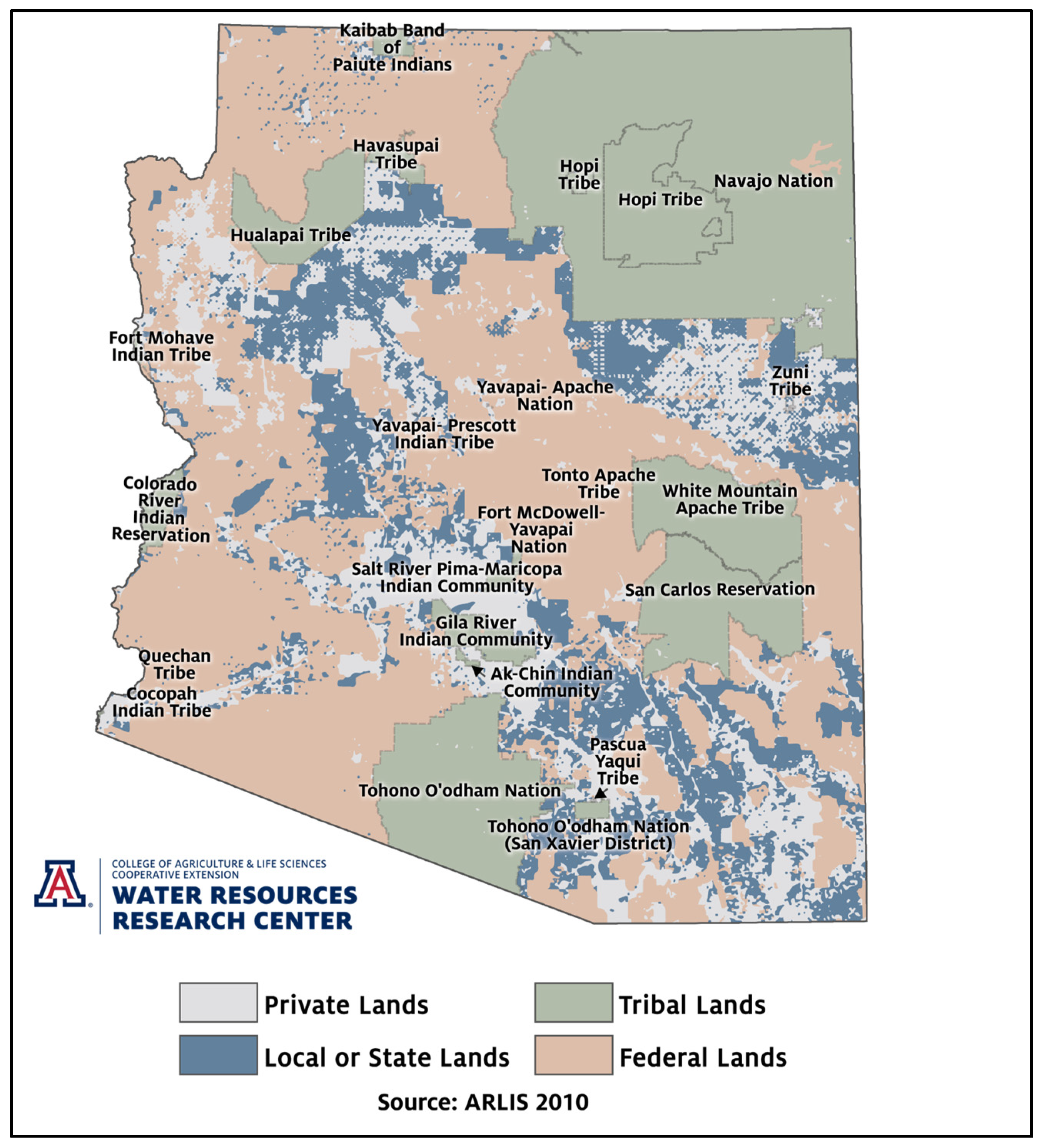
Congressionally approved tribal water rights settlement acts have been taking place since 1978 [3,4,11]. The first congressionally approved tribal water rights settlement act took place in Arizona with the Ak-Chin Indian Community Act of 1978 [11,52]. Since then, there have been a total of 11 congressionally approved tribal water rights settlement acts in Arizona [52]. Arizona shares borders with 22 federally recognized Tribal Nations [25,52,55] (see Figure 1). The question of whether such Tribal Nations are part of Arizona or separate nations sharing borders with the state depends on the context of the question as limitations on Arizona’s authority over Tribal Nations’ reservations are well established and complex [9,11,44]. A visual representation of the different types of water jurisdiction that exist within the borders of Arizona and especially between the state and Tribal Nations is presented in Figure 1 below (see Figure 1).
Figure 1.
Arizona Land Ownership Map [56].
In Arizona, water law is driven by the prior appropriation doctrine (surface water) and the Groundwater Management Act of 1980 (groundwater) [6,15,57]. The reserved water rights doctrine drives tribal water rights, which generally fall under federal jurisdiction and can include surface water and groundwater, depending on how a Tribal Nation’s water rights were quantified [6,11,15]. The McCarran Amendment blurs the line between federal reserved water law and state law because under the Amendment, tribal water litigation is susceptible to being compelled to be reviewed by state courts rather than federal courts [11,21,50]. Despite these differences between the prior appropriation doctrine and the reserved water rights doctrine, the unappropriated water that is available to Arizona through the Colorado River and other sources within the state is for everyone in the state, including Tribal Nations [5,25,57].
Table 1 below provides a summary of the 11 congressionally approved tribal water rights settlement acts in Arizona, the Tribal Nations involved, the year of enactment, and any amendments to the original settlement act (see Table 1). Each tribal water rights settlement act and its amendments were analyzed comprehensively as the amendments are extensions of the original settlement act. The information in Table 1 provides an overview of tribal water settlement acts involving Arizona, documenting the Tribal Nations involved and the historical span between the original settlement act and its latest amendment. Most tribal water rights settlement acts contain subsequent amendments, with the exception of the Zuni Indian Tribe Water Rights Settlement Act, the Gila River Indian Community Water Rights Settlement Act, the Bill Williams River Water Rights Settlement Act, and the Hualapai Tribe Water Rights Settlement Act (see Table 1). Determining why these settlement acts have not had amendments to date is outside the scope of this article; however, the Bill Williams River Water Rights Settlement Act and the Hualapai Tribe Water Settlement Act are for the same Tribal Nation and it is too early to determine if they will have amendments in the future (see Table 1). The fact that most tribal water rights settlement acts have amendments is a testament to their complexity as amendments generally occur after the implementation period of the settlement acts, when the parties realize that the negotiations did not provide for emergent complications like escalating cost of materials and the need for extra time to build water infrastructure [53].
Table 1.
Congressionally Approved Tribal Water Rights Settlement Acts Involving Arizona [52,58,59,60,61,62,63,64,65,66,67,68,69,70,71,72,73,74,75,76,77,78,79,80,81,82].
Tribal water rights settlement acts are important for the water security of Arizona, Tribal Nations, the United States, and interested parties because they quantify tribal water rights, which remained largely unquantified between 1908 and early 2026 [53,57]. In 1963, the United States Supreme Court allocated 2.8 million acre-feet of Colorado River water to Arizona through its ruling in Arizona v. California (1963) [11,12,37,56,83,84]. While Arizona has other sources of water for its population and economic development, there is a limited amount of water for such activities, especially given ongoing Colorado River water shortages [5,11,26,27,49,57,83]. This article offers a qualitative analysis of how tribal water rights settlement acts have evolved and contribute to water security in Arizona; a quantitative analysis is outside the scope of this article. The quantification of tribal water rights aids Arizona in determining how much water can be used by its cities, industry, and recreation activities [49,56,83,84]. Tribal Nations benefit from the quantification of their water rights through settlement acts by receiving the means to legally capture and use water that would otherwise go to other water users in the state [3,4,53]. Notedly, based on the prior appropriation doctrine and the reserved water rights doctrine, Tribal Nations often have very senior water rights in Arizona [6,7,11].
The evolution of tribal water rights settlement acts in Arizona demonstrates a blending of the reserved water rights doctrine and the prior appropriation doctrine, as well as a blending of tribal and non-tribal interests [2,3,4,5,16] (see Table 2). Table 2 includes extracts of tribal water rights settlement acts’ water uses, restrictions, and waivers of rights involving Arizona. Tribal water rights settlement acts involving Arizona evolved in alignment to Arizona water law between 1978 and the present, which is especially evident in the Ak-Chin Indian Community Act of 1978 and the Southern Arizona Water Rights Settlement Act of 1982 (see Table 2). Subsequent amendments to these acts expanded water uses while also adding provisions aligning with the Arizona Groundwater Management Act of 1980 (see Table 2, Column II) [85]. Importantly, the tribal water rights settlement acts involving Arizona were analyzed comprehensively with their corresponding amendments. Not all amendments apply to Table 2. For example, the 2000 amendment of the Ak-Chin Indian Community Act expanded the types of water leases allowed and added restrictions on how such leases could develop [68]. The amendments to the San Carlos Apache Tribe Water Rights Settlement Act amended technical language [74] and increasingly extended a deadline from 31 December 1994 to 31 December 1999 [69,70,71,73].
Table 2.
Tribal Water Rights Settlement Acts’ Water Uses, Restrictions, and Waivers of Rights Involving Arizona [52,58,59,60,61,62,63,64,65,66,67,68,69,70,71,72,73,74,75,76,77,78,79,80,81,82].
A portion of the 2.8 million acre-feet of Colorado River water decreed to Arizona was designated to settle tribal water rights in the state [25,26,57,86]. When a tribal water rights settlement act takes place, sources of water to implement the water settlement must be identified [53,57]. Initially, the main source of water to satisfy such settlement acts in Arizona was Central Arizona Project (CAP) water, but later tribal water settlement acts included a combination of CAP water and other sources like prior water decrees, water exchanges, and water reallocations [5,25,27]. The change from using primarily CAP water to settle tribal water rights in the state to using other sources of water may be due to a prolonged drought affecting the region since the late 1990s and the miscalculation of how much water would be needed to satisfy outstanding tribal water claims [53,57]. The drought has exposed weaknesses within the management of the Colorado River, especially regarding the overestimation of Colorado River flows, impacting the 2.8 million acre-feet of Colorado River water decreed to Arizona in 1963 [11,57].
As tribal water rights settlement acts continued to be negotiated and approved by Congress, their provisions shifted to take into consideration Arizona water management goals for non-tribal communities (see Table 2, Column III). For example, provisions within tribal water settlement acts between Tribal Nations and Arizona after 1980 allowed for water leases and sales outside the Tribal Nation’s exterior boundaries, but only within designated Active Management Areas (AMAs) [57,85] (see Table 2, Column III). AMAs were created by the Arizona Groundwater Management Act of 1980 to manage groundwater withdrawals and water sustainability within the most populous areas of Arizona [57,85].
A positive development of tribal water settlement acts is that the tribal water uses approved through them became more flexible between 1978 and the present (see Table 2, Column II). Earlier tribal water rights settlement acts included water for irrigation purposes only, conforming to the Practicable Irrigable Acreage (PIA) standard for tribal water quantification [1,11] (see Table 2, Column II). Such water uses evolved to include any water use depending on the type of water granted to the Tribal Nation (see Table 2, Columns II and III). Importantly, the flexible water uses provided under tribal water rights settlement acts in Arizona before 2001 were innovative for their time because the changes began prior to the establishment of the homeland standard by the Arizona Supreme Court [51] (see Table 1; see Table 2, Column II). Also, this level of flexibility set tribal water rights settlement acts apart from tribal water litigation because Arizona court decrees before the establishment of the homeland standard adhered to the PIA standard, which restricts tribal water uses to agriculture [11,51]. Restricting tribal water rights uses to agricultural purposes harms the socio-economic development of Tribal Nations because societies and economies are dynamic, and it is unrealistic to expect them to remain unchanged since the 19th Century [3,4,51].
Tribal water rights settlement act negotiations involve compromise, leading to an agreement to terms that may not be ideal for Tribal Nations (see Table 2, Column IV). Each tribal water rights settlement act has a section where the parties waive certain rights that they have, which causes them to vary according to the priorities of the parties [3,4] (see Table 2, Column IV). For Tribal Nations, however, the waiver section of tribal water rights settlement acts includes provisions that are generally uniform regardless of the Tribal Nation party to the settlement act (see Table 2, Column IV). Such provisions generally state that with the execution of the water settlement act, the Tribal Nation waives any additional water claims from time immemorial to the present and into the future (see Table 2, Column IV). Versions of this waiver of rights vary, but the end result is that once a Tribal Nation settles its water rights with Arizona, the United States, and other water users, the Tribal Nation cannot claim additional reserved water rights. Once a tribal water settlement act becomes law, the Tribal Nation can only sue based on disputes over the interpretation of the settlement act (see Table 2, Column IV).
While this article does not aim to judge whether tribal water rights settlements are beneficial for Tribal Nations, criticisms against tribal water rights settlement acts must be acknowledged [3,16,29]. Curley [29] refers to tribal water rights settlement acts as colonial enclosures that justify the settler colonial system’s desire to control Indigenous bodies and resources. In his 2002 book on tribal water settlements, McCool [3] writes about how tribal water settlements can divide Native American communities. Such divisions emerge because while some tribal members see the need for the water settlements, others remember the long history of broken treaties and agreements between Tribal Nations and the United States [3,8,9]. McCool [16], Curley [29], and Hays [33] also note that tribal water rights settlement acts are coercive. The criticism that tribal water rights settlement acts are coercive stems from the belief that such settlements are the last way through which states and other non-tribal parties can get what they want, after Tribal Nations have tried unsuccessfully to litigate their water rights in state courts [16,29,33].
4. Discussion
Until 1978, Tribal Nations legally secured their water rights mostly through litigation [3,4,11]. In 1978, the first congressionally approved tribal water rights settlement act was reached by Arizona, the Ak-Chin Indian Community, the United States, and other water users [3,4,11]. Since then, there have been a total of 35 congressionally approved tribal water rights settlement acts in the United States [52]. There were twelve tribal water rights settlement acts pending in Congress for approval in June of 2025, showing the desire by the parties involved to quantify tribal water rights claims for the water security of the region [87].
Initially, tribal water settlements were seen as preferable to tribal water litigation because they appeared to be more expeditious and affordable than litigation [2,3,22,30,41]. Close to fifty years later, however, tribal water settlements can take just as long as tribal water litigation and can be very expensive [14,22,24,33,34]. In fact, a major obstacle for the Congressional approval of tribal water rights settlement acts today is their cost [22,87]. The 2023 amendment to the White Mountain Apache Tribe Water Rights Quantification Act had a cost overrun budget of $541 million [58]. The Northeastern Arizona Indian Water Rights Settlement Act (NAIWRSA), which would settle the water rights of the Navajo Nation, the Hopi Tribe, and the San Juan Southern Paiute Tribe in Arizona, requested federal appropriations of $5.1 billion [88,89]. NAIWRSA was introduced to Congress in 2024 and remained pending in Congress as of mid-2025 [87,88,89].
Tribal water settlements are complex because they involve many parties with often conflicting interests and deal with water rights, without which neither life nor socio-economic development could take place in the arid western region of the United States [3,4,11,15]. The majority of congressionally approved tribal water rights settlement acts to date emerged from contentious tribal water litigation that did not ultimately resolve underlying conflicts [3,4]. Tribal water settlements are heavily dependent on state water law, which makes them unique to each state where the tribal water rights settlement is negotiated and implemented [3,4]. Another factor that makes tribal water settlements unique to the state where they develop is climate, as settlements emerging from the Pacific Northwest will include provisions addressing, for example, instream water flows, whereas settlements emerging from the Southwest will include provisions memorializing and protecting time immemorial farming practices [3,4]. Ultimately, however, tribal water rights settlement acts depend on the priorities of the Tribal Nation, the State, and other stakeholders involved in the negotiation process [3,4,16]. As such, tribal water rights settlement acts are difficult to generalize beyond the reality that all parties want water security to achieve their goals, be it economic, ceremonial, or for the restoration of river flows [58,59,60,61,62,63,64,65,66,67,68,69,70,71,72,73,74,75,76,77,78,79,80,81,82].
In the present, when a Tribal Nation and a state agree to enter into negotiations leading to a tribal water rights settlement act, they include the Department of the Interior as the third sovereign party representative to such government-to-government relations [22,53]. Within the Department of the Interior, the Secretary’s Indian Water Rights Office and the Bureau of Reclamation represent the United States, facilitating the negotiation stage in the multilateral process that culminates in congressionally approved tribal water rights settlement acts [22,53]. Before a tribal water rights settlement becomes an act of Congress, it must be a settlement agreement first, harkening back to the agreements between the United States and Tribal Nations before Congress ended treaty-making with Tribal Nations in 1871 [3,4,16,22,53]. With tribal water rights settlement agreements, however, the parties involve the Tribal Nation, the state with whom the Tribal Nation shares borders, the United States (as a trustee to Tribal Nations), and other parties with a stake in the process [3,4,16,22,53].
Once a tribal water rights settlement agreement is reached, State Senators and Representatives must introduce it and champion it in both chambers of Congress [3,4,87,89]. For example, NAIWRSA was re-introduced to Congress and supported by bipartisan Senators and Representatives from Arizona in 2025 [89]. The negotiation process at the congressional level includes Committee hearings and deliberations about federal appropriations to fund the implementation of the tribal water rights settlement acts [3,22,87,89]. Generally, there are two main types of tribal water rights settlement acts, which are fund-based and project-based tribal water rights settlement acts [22,53]. Fund-based tribal water settlement acts are those that create a fund for the implementation of the settlement act [22,53,87]. Project-based tribal water rights settlement acts emphasize the construction of water infrastructure projects as part of their implementation [87]. Hybrid tribal water rights settlement acts, which include aspects of fund-based settlements and project-based settlements, exist [22,53,87].
Funding for tribal water rights settlement acts has a contentious history, as in the past, such funding offset appropriations for other necessary tribal programs like health and education [3,16,24,29]. Nonetheless, federal funding for tribal water rights settlement acts is an integral part of the negotiation process because funds are necessary to develop water infrastructure [87,89]. Such funds contribute to the water security of Tribal Nations. The tribal water rights settlement process is an imperfect solution involving victories and compromises [3,4,17,29]. Where the United States, States, and other stakeholders give up money and some of their water rights through the negotiation process, Tribal Nations give up the ability to claim additional reserved water rights in the future (see Table 2, Column IV). The fact that non-tribal parties to tribal water rights settlement acts are willing to give up millions of dollars for the sake of the success of settlement negotiations confirms that the quantification of unclaimed tribal water rights contributes to their water security [53].
Because many tribal reserved water rights were not enforced as written until the latter part of the 20th Century, the economies of states like Arizona grew at the expense of unclaimed and unused tribal water rights [3,5,14,29]. In the age of tribal water rights settlement acts, the unclaimed water rights of Tribal Nations present logistical and economic development challenges because state water agencies cannot properly plan for water shortages if there are unclaimed tribal water rights [5,40,49]. Additionally, the present and future economic development of states becomes more uncertain with unclaimed tribal water rights lingering in the courts [5,40]. As such, tribal water rights settlement acts are pivotal to the water security of Arizona.
Congressional approval of tribal water rights settlement acts does not indicate finality regarding unclaimed tribal water rights [12,32]. If a tribal settlement act emerged from tribal water litigation, the courts within the state party to the settlement act must adjudicate the pending case based on the settlement act [87]. Also, if the tribal water rights settlement act requires state legislation to implement its provisions, state legislators must pass state laws in order to comply with the tribal water rights settlement act [87]. If the terms of the original tribal water rights settlement act were not sufficient to fulfill its purpose or unforeseen challenges emerged at the time of implementation, then amendments must be agreed upon, and then Congress must approve the amendments [12,52,87]. Nonetheless, tribal water rights settlement acts appear to be a viable solution to the water security issues of Tribal Nations, Arizona, and other stakeholder parties in the arid southwestern part of the United States.
5. Conclusions
Since 1776, the United States has become one of the most potent economies in the world. Water is an essential part of this economic development; however, water is also essential for life and for other uses that are not necessarily economic in nature. When Tribal Nations entered into treaties or agreements with the United States that created their reservations, many did not include water [1,11]. Nonetheless, the reservations of Tribal Nations were created to be their permanent homelands, sharing borders and water with their non-tribal neighbors [1,11]. Thus, the water security of states, Tribal Nations, the United States, and other parties became historically interconnected.
The 1908 United States Supreme Court decision of Winters v. United States (1908) created the reserved water rights doctrine, which complemented and also challenged the prior appropriation doctrine [6,11,15]. In the late 19th Century and early 20th Century, obtaining water security in the arid western part of the United States, and especially in the area that eventually became the State of Arizona, was imperative for both Tribal Nations and Euro-American settlers [5,11,15]. Despite the existence of the reserved water rights doctrine, Tribal Nations struggled to legally secure their water rights through the present, where even after close to 50 years of the existence of congressionally approved tribal water rights settlement acts, only 35 exist to date [11,52,87]. Arizona is home to 11 congressionally approved tribal water rights settlement acts, representing ten out of 22 Tribal Nations, as shown in Table 1 (see Table 1). Some of these tribal water rights settlement acts are partial and will need additional negotiations to achieve full settlement [86] (see Table 1). Other Tribal Nations in the state have been working with Arizona, the United States, and other stakeholders to achieve tribal water rights settlement agreements like the Northeastern Arizona Indian Water Rights Settlement Act, which is currently pending in Congress [87,88,89].
In summary, tribal water rights settlement acts are attractive because they are based on negotiations where the parties can prioritize what is important to them [14,17,38]. In early 2026, the existence of unclaimed tribal water rights in Arizona hinders the water security of all interested parties, especially on the face of a prolonged drought [49,57]. The fluid nature of water requires that parties that would otherwise be adversaries negotiate with each other, as what one party does to water affects everyone else. Tribal water rights settlement acts are a double-edged tool that can achieve water security for the parties involved, but requires compromise.
Author Contributions
Conceptualization, A.M.M., S.B.M. and H.W.R.H.; methodology, A.M.M.; validation, A.M.M., S.B.M. and H.W.R.H.; formal analysis, A.M.M.; investigation, A.M.M.; resources, A.M.M.; data curation, A.M.M.; writing—original draft preparation, A.M.M.; writing—review and editing, S.B.M. and H.W.R.H.; visualization, A.M.M., S.B.M. and H.W.R.H.; supervision, S.B.M. and H.W.R.H.; project administration, S.B.M.; funding acquisition, S.B.M. All authors have read and agreed to the published version of the manuscript.
Funding
This research was supported in part by the Water Resources Research Act Section 104b Grant Number G21AP10594 from the U.S. Geological Survey through The University of Arizona Water Resources Research Center.
Data Availability Statement
Conflicts of Interest
The authors declare no conflicts of interest. The funders had no role in the design of the study; in the collection, analyses, or interpretation of data; in the writing of the manuscript, or in the decision to publish the results.
References
- Anderson, R.T. Indian water rights, practical reasoning, and negotiated settlements. Calif. Law Rev. 2010, 98, 1133. [Google Scholar]
- Cosens, B. A Framework for Evaluation of Tribal Water Settlements. Nat. Resour. Environ. 2003, 18, 41. [Google Scholar]
- McCool, D. Native Waters: Contemporary Indian Water Settlements and the Second Treaty Era; The University of Arizona Press: Tucson, AZ, USA, 2002. [Google Scholar]
- Colby, B.G.; Thorson, E.T.; Britton, S. Negotiating Tribal Water Rights: Fulfilling Promises in the Arid West; The University of Arizona Press: Tucson, AZ, USA, 2005. [Google Scholar]
- DeJong, D.H. “The Sword of Damocles?” The Gila River Indian Community Water Settlement Act of 2004 in Historical Perspective. Wicazo Sa Rev. 2007, 22, 57–92. [Google Scholar] [CrossRef] [Scilit]
- Craig, R.K.; Adler, R.W.; Hall, N.D. Water Law; Foundation Press: Goleta, CA, USA, 2017. [Google Scholar]
- Glennon, R.J. Unquenchable: America’s Water Crisis and What to Do About It; Beacon Press: Boston, MA, USA, 2009. [Google Scholar]
- Deloria, V., Jr. Behind the Trail of Broken Treaties: An Indian Declaration of Independence; University of Texas Press: Austin, TX, USA, 1985. [Google Scholar]
- Fletcher, M.L.M. Federal Indian Law: Hornbook Series; West Academic Publishing: Eagan, MN, USA, 2016. [Google Scholar]
- Wilkins, D.E.; Lomawaima, K.T. Uneven Ground: American Indian Sovereignty and Federal Law; University of Oklahoma Press: Norman, OK, USA, 2001; pp. 117–142. [Google Scholar]
- Royster, J.V.; Blumm, M.C.; Kronk Warner, E.A.; Mills, M. Native American Natural Resources Law: Cases and Materials, 5th ed.; Carolina Academic Press: Durham, NC, USA, 2023. [Google Scholar]
- Brienza, S.D. Wet Water vs. Paper Rights: Indian and Non-Indian Negotiated Settlements and Their Effects. Stanf. Environ. Law J. 1992, 11, 151. [Google Scholar]
- Anderson, R.T. Water rights, water quality, and regulatory jurisdiction in Indian Country. Stanf. Environ. Law J. 2015, 34, 195. [Google Scholar]
- DeJong, D.H. Navigating the Maze: The Gila River Indian Community Water Settlement Act of 2004 and Administrative Challenges. Am. Indian Q. 2014, 38, 60–81. [Google Scholar] [CrossRef] [Scilit]
- Thompson, B.H.; Leshy, J.D.; Abrams, R.H.; Zellmer, S.B. Legal Control of Water Resources: Cases and Materials, 6th ed.; West Academic Publishing: Eagan, MN, USA, 2018. [Google Scholar]
- McCool, D. Indian water settlements: The prerequisites of successful negotiation. Policy Stud. J. 1993, 21, 227–242. [Google Scholar] [CrossRef] [Scilit]
- Colby, B.; Young, R. Tribal water settlements: Economic innovations for addressing water conflicts. West. Econ. Forum 2018, 16, 38–46. [Google Scholar]
- Glennon, R.J. Water Follies: Groundwater Pumping and the Fate of America’s Freshwaters; Island Press: Washington, DC, USA, 2002. [Google Scholar]
- Crass, K. Eroding the Winters Right: Non-Indian Water Users’ Attempt to Limit the Scope of the Indian Superior Entitlement to Western Water to Prevent Tribes from Water Brokering. Univ. Denver Water Law Rev. 1997, 1, 109. [Google Scholar]
- Royster, J.V. Water, Legal Rights, and Actual Consequences: The Story of Winters v. United States. In Indian Law Stories; Golberg, C., Washburn, K.K., Frickey, P.P., Eds.; Foundation Press: Goleta, CA, USA, 2011. [Google Scholar]
- Hedden-Nicely, D.R. The Legislative History of the McCarran Amendment: An Effort to Determine Whether Congress Intended for State Court Jurisdiction to Extend to Indian Reserved Water Rights. Environ. Law 2016, 46, 845. [Google Scholar]
- Stern, C.V. Indian Water Rights Settlements; US Congressional Research Service: Washington, DC, USA, 2017.
- US Department of the Interior. Working Group in Indian Water Settlements; Criteria and Procedures for the Participation of the Federal Government in Negotiations for the Settlement of Indian Water Rights Claims. Fed. Regist. 1990, 55, 9223–9225. Available online: https://www.doi.gov/sites/doi.gov/files/criteria-and-procedures-for-the-participation-of-the-federal-government-in-negotiations-for-the-settlement-of-indian-water-rights-claims.pdf (accessed on 18 January 2026).
- Agee, E.B. In the Federal Government We Trust-Federal Funding for Tribal Water Rights Settlements and the Taos Pueblo Indian Water Rights Settlement Act. Cornell J. Law Public Policy 2011, 21, 201. [Google Scholar]
- Bark, R.H.; Jacobs, K.L. Indian water rights settlements and water management innovations: The role of the Arizona Water Settlements Act. Water Resour. Res. 2009, 45, W05417. [Google Scholar] [CrossRef] [Scilit]
- Bark, R.H. The Arizona water settlement act and urban water supplies. Irrig. Drain. Syst. 2009, 23, 79–96. [Google Scholar] [CrossRef] [Scilit]
- Bark, R.H. Water Reallocation by Settlement: Who Wins, Who Loses, Who Pays? In Bepress Legal Series; Working Paper 1454; Bepress: Berkeley, CA, USA, 2006. [Google Scholar]
- Clayton, M. A new moment for indian water rights settlements. Nat. Resour. J. 2024, 64, 33–62. [Google Scholar]
- Curley, A. Unsettling Indian water settlements: The little Colorado river, the San Juan River, and colonial enclosures. Antipode 2021, 53, 705–723. [Google Scholar] [CrossRef] [Scilit]
- Folk-Williams, J.A. The use of negotiated agreements to resolve water disputes involving Indian rights. Nat. Resour. J. 1988, 28, 63. [Google Scholar]
- Getches, D.H. Management and marketing of Indian water: From conflict to pragmatism. Univ. Colo. Law Rev. 1986, 58, 515. [Google Scholar]
- Hawkins, C. Beyond quantification: Implementing and sustaining tribal water settlements. Univ. Denver Water Law Rev. 2012, 16, 229. [Google Scholar]
- Hays, A.V. The Nez Perce Water Rights Settlement and the Revolution in Indian Country. Environ. Law 2006, 36, 869. [Google Scholar]
- Klee, A.R.; Mecham, D. The Nez Perce Indian Water Right Settlement-Federal Perspective. Ida. Law Rev. 2005, 42, 595. [Google Scholar]
- Anderson, R.T. Indian water rights: Litigation and settlements. Tulsa Law Rev. 2006, 42, 23. [Google Scholar]
- Anderson, R.T. Indian water rights and the federal trust responsibility. Nat. Resour. J. 2006, 46, 399. [Google Scholar]
- Candrian, J. Building with Blinders On: How Policymakers Ignored Indian Water Rights to the Colorado, Setting the Stage for the Navajo Claim. Colo. J. Int. Environ. Law Policy 2011, 22, 159. [Google Scholar]
- Chambers, R.P.; Echohawk, J.E. Implementing the Winters Doctrine of Indian Reserved Water Rights: Producing Indian Water and Economic Development without Injuring Non-Indian Water Users. Gonz. Law Rev. 1991, 27, 447. [Google Scholar]
- Joyce, S. Tribal water sovereignty: Authorizing indian water marketing in the colorado basin. Stanf. Law Policy Rev. 2024, 35, 161–178. [Google Scholar]
- Lewis, R.B.; Hestand, J.T. Federal reserved water rights: Gila River Indian community settlement. J. Contemp. Water Res. Educ. 2006, 133, 34–42. [Google Scholar] [CrossRef] [Scilit]
- McGovern, G. Settlement or Adjudication: Resolving Indian Reserved Rights. Ariz. Law Rev. 1994, 36, 195. [Google Scholar]
- Royster, J.V. Indian Water and the Federal Trust: Some Proposals for Federal Action. Nat. Resour. J. 2006, 46, 375–398. [Google Scholar]
- Royster, J.V. A Primer on Indian Water Rights: More Questions Than Answers. Tulsa Law Rev. 1994, 30, 61. [Google Scholar]
- Canby, W.C. American Indian Law: In a Nutshell, 6th ed.; West Academic Publishing: Eagan, MN, USA, 2015. [Google Scholar]
- Immerwahr, D. How to Hide an Empire: A History of the Greater United States; Picador: Toronto, ON, Canada, 2019. [Google Scholar]
- Dunbar-Ortiz, R. An Indigenous Peoples’ History of the United States; Beacon Press: Boston, MA, USA, 2014. [Google Scholar]
- Greenwald, E. Reconfiguring the Reservation: The Nez Perces, Jicarilla Apaches, and the Dawes Act; UNM Press: Albuquerque, NM, USA, 2002. [Google Scholar]
- Massie, M. The Cultural Roots of Indian Water Rights. Ann. Wyo. 1987, 59, 15–27. [Google Scholar]
- Megdal, S.B. Water Policy Options as Arizona Adapts to a Drier Colorado River: A Perspective. Renew. Resour. J. 2022, 37, 3. [Google Scholar]
- 43 U.S.C. 666, Suits for Adjudication of Water Rights, 1952. Available online: https://www.govinfo.gov/content/pkg/USCODE-2011-title43/pdf/USCODE-2011-title43-chap15.pdf (accessed on 18 January 2026).
- Cosens, B.A. The Measure of Indian Water Rights: The Arizona Homeland Standard, Gila River Adjudication. Nat. Resour. J. 2002, 42, 835. [Google Scholar]
- US Department of the Interior. Enacted Indian Water Rights Settlements. Available online: https://www.doi.gov/siwro/enacted-indian-water-rights-settlements (accessed on 18 January 2026).
- Murray, M.J.; Stern, C.V. Indian Water Rights Settlements. CRS Products (Library of Congress). 2025. Available online: https://www.congress.gov/crs-product/R44148 (accessed on 18 January 2026).
- Menjivar Maldonado, A. Native American Water Sovereignty and Self-Determination: An Analysis of How Native American Tribes Sustain Water Security in the American Southwest. Doctoral Dissertation, University of Arizona, Tucson, AZ, USA, 2025. Available online: https://repository.arizona.edu/handle/10150/677706 (accessed on 18 January 2026).
- Arizona State Museum: Federally Recognized Native Nations in Arizona. Available online: https://statemuseum.arizona.edu/native-nations-arizona (accessed on 18 January 2026).
- University of Arizona Water Resources Research Center. Arizona Land Ownership Map. 2010. Available online: https://wrrc.arizona.edu/sites/wrrc.arizona.edu/files/2023-09/land-ownership.png (accessed on 28 January 2026).
- Ferris, K.; Porter, S.; Springer, A.; Megdal, S.B.; Eden, S. Keeping Arizona’s Water Glass Full: Arizona Town Hall. 2015. Available online: https://wrrc.arizona.edu/publication/keeping-arizonas-water-glass-full (accessed on 18 January 2026).
- Public Law 117-342, S. 3168, 117th Congress, 2023. Available online: https://www.congress.gov/117/plaws/publ342/PLAW-117publ342.pdf (accessed on 18 January 2026).
- Ak-Chin Indian Water Rights Settlement Act, S. 1582, 95th Cong., 1978. Available online: https://www.congress.gov/95/statute/STATUTE-92/STATUTE-92-Pg409.pdf (accessed on 18 January 2026).
- Gila River Indian Community Water Rights Settlement Act, S. 437, 108th Cong., 2004. pp. 23–59. Available online: https://www.congress.gov/108/plaws/publ451/PLAW-108publ451.pdf (accessed on 18 January 2026).
- Hualapai Tribe Water Rights Settlement Act, S. 4104, 117th Cong., 2022. Available online: https://www.congress.gov/117/plaws/publ349/PLAW-117publ349.pdf (accessed on 18 January 2026).
- Public Law 116-94, H.R. 1865, 116th Congress, 2020. Available online: https://www.congress.gov/116/plaws/publ94/PLAW-116publ94.pdf (accessed on 18 January 2026).
- Public Law 115-227, S. 2850, 115th Congress, 2018. Available online: https://www.congress.gov/115/statute/STATUTE-132/STATUTE-132-Pg1626.pdf (accessed on 18 January 2026).
- Public Law 113-223, H.R. 4924, 113th Congress, 2014. Available online: https://www.congress.gov/113/statute/STATUTE-128/STATUTE-128-Pg2096.pdf (accessed on 18 January 2026).
- Public Law 111-291, H.R. 4783, 111th Congress, 2010. Available online: https://www.congress.gov/111/statute/STATUTE-124/STATUTE-124-Pg3064.pdf (accessed on 18 January 2026).
- Public Law 109-373, S. 2464, 109th Congress, 2006. Available online: https://www.congress.gov/109/statute/STATUTE-120/STATUTE-120-Pg2650.pdf (accessed on 18 January 2026).
- Public Law 108-451, S. 437, 108th Congress, 2004. pp. 59–97. Available online: https://www.congress.gov/108/plaws/publ451/PLAW-108publ451.pdf (accessed on 18 January 2026).
- Public Law 106-285, H.R. 2647, 106th Congress, 2000. Available online: https://www.congress.gov/106/statute/STATUTE-114/STATUTE-114-Pg878.pdf (accessed on 18 January 2026).
- Public Law 105-18, H.R. 1871, 105th Congress, 1997. Available online: https://www.govinfo.gov/content/pkg/PLAW-105publ18/pdf/PLAW-105publ18.pdf (accessed on 18 January 2026).
- Public Law 104-261, H.R. 3068, 104th Congress, 1996. Available online: https://www.congress.gov/104/statute/STATUTE-110/STATUTE-110-Pg3176.pdf (accessed on 18 January 2026).
- Public Law 104-91, H.R. 1358, 104th Congress, 1996. Available online: https://www.govinfo.gov/content/pkg/PLAW-104publ91/pdf/PLAW-104publ91.pdf (accessed on 18 January 2026).
- Public Law 103-434, S. 1146, 103d Congress, 1994. Available online: https://www.congress.gov/103/statute/STATUTE-108/STATUTE-108-Pg4526.pdf (accessed on 18 January 2026).
- Public Law 103-435, H.R. 4709, 103d Congress, 1994. Available online: https://www.congress.gov/103/statute/STATUTE-108/STATUTE-108-Pg4566.pdf (accessed on 18 January 2026).
- Public Law 103-263, S. 1654, 103d Congress, 1994. Available online: https://www.congress.gov/103/statute/STATUTE-108/STATUTE-108-Pg707.pdf (accessed on 18 January 2026).
- Public Law 102-497, H.R. 5686, 102d Congress, 1992. Available online: https://www.congress.gov/102/statute/STATUTE-106/STATUTE-106-Pg3255.pdf (accessed on 18 January 2026).
- Public Law 102-238, S. 1193, 102d Congress, 1991. Available online: https://www.congress.gov/102/statute/STATUTE-105/STATUTE-105-Pg1908.pdf (accessed on 18 January 2026).
- Public Law 101-628, H.R. 2570, 101st Congress, 1990. Available online: https://www.congress.gov/101/statute/STATUTE-104/STATUTE-104-Pg4469.pdf (accessed on 18 January 2026).
- Public Law 100-512, H.R. 4102, 100th Congress, 1988. Available online: https://www.congress.gov/100/statute/STATUTE-102/STATUTE-102-Pg2549.pdf (accessed on 18 January 2026).
- Public Law 98-530, H.R. 6206, 98th Cong., 1984. Available online: https://www.congress.gov/98/statute/STATUTE-98/STATUTE-98-Pg2698.pdf (accessed on 18 January 2026).
- Public Law 97-293, S. 1409, 97th Congress, 1982. Available online: https://www.congress.gov/97/statute/STATUTE-96/STATUTE-96-Pg1261.pdf (accessed on 18 January 2026).
- San Carlos Apache Tribe Water Rights Settlement, H.R. 429, 102d Cong., 1992. pp. 141–153. Available online: https://www.govinfo.gov/content/pkg/STATUTE-106/pdf/STATUTE-106-Pg4600.pdf (accessed on 18 January 2026).
- Zuni Indian Tribe Water Rights Settlement Act, S. 222, 108th Cong., 2003. Available online: https://www.congress.gov/108/statute/STATUTE-117/STATUTE-117-Pg782.pdf (accessed on 18 January 2026).
- O’Neill, B.; Poupeau, F.; Coeurdray, M.; Cortinas, J.; Gupta, H. Laws of the river: Conflict and cooperation on the Colorado River. In Water Bankruptcy in the Land of Plenty; CRC Press: Boca Raton, FL, USA, 2016; pp. 45–64. [Google Scholar]
- Wheeler, K.G.; Udall, B.; Wang, J.; Kuhn, E.; Salehabadi, H.; Schmidt, J.C. What will it take to stabilize the Colorado River? Science 2022, 377, 373–375. [Google Scholar] [CrossRef] [Scilit] [PubMed]
- McGreal, B.; Eden, S. Arizona Groundwater Management–Past, Present, and Future. In Arroyo; Water Resources Research Center: Tucson, AZ, USA, 2021. [Google Scholar]
- Central Arizona Project. Tribal Water Rights. 2026. Available online: https://www.cap-az.com/about/tribal-water-rights/ (accessed on 18 January 2026).
- Walker, A. Water Rights Settlements Update. The Headwaters Report (NARF). 2025. Available online: https://narf.org/2025-water-settlements-update/ (accessed on 18 January 2026).
- Tso, C. The Northeastern Arizona Indian Water Rights Settlement Agreement; Arizona State University Kyl Center for Water Policy at Morrison Institute: Phoenix, AZ, USA, 2024. [Google Scholar]
- Arizona Senator Mark Kelly. Kelly Leads Reintroduction of Bipartisan, Bicameral Legislation to Ratify and Fund Historic Navajo Tribes Water Rights Settlement. 2025. Available online: https://www.kelly.senate.gov/newsroom/press-releases/kelly-leads-reintroduction-of-bipartisan-bicameral-legislation-to-ratify-and-fund-historic-navajo-tribes-water-rights-settlement/ (accessed on 18 January 2026).

Disclaimer/Publisher’s Note: The statements, opinions and data contained in all publications are solely those of the individual author(s) and contributor(s) and not of MDPI and/or the editor(s). MDPI and/or the editor(s) disclaim responsibility for any injury to people or property resulting from any ideas, methods, instructions or products referred to in the content. |
© 2026 by the authors. Licensee MDPI, Basel, Switzerland. This article is an open access article distributed under the terms and conditions of the Creative Commons Attribution (CC BY) license.