
Article

Contrasting Climatic and Land-Use Controls Structure Nutrient and Turbidity Regimes Across Mediterranean River Basins


by
Alessio Polvani
1,2,3,
Bruna Gumiero
2,3,4,
Francesco Di Grazia
1,3,
Luisa Galgani
1,2,3,
Amedeo Boldrini
1,2,
Xinyu Liu
1,2,
Riccardo Gaetano Cirrone
3,5,
Costanza Ottaviani
1 and
Steven Arthur Loiselle
1,2,3,6,*
1
Department of Biotechnology, Chemistry and Pharmacy, University of Siena, Via Aldo Moro 2, 53100 Siena, Italy
2
Centers for Colloid and Surface Science, Via della Lastruccia 3, 50019 Sesto Fiorentino, Italy
3
National Biodiversity Future Center, Spoke 3, University of Siena, Via Banchi di Sotto 55, 53100 Siena, Italy
4
Department of Biological, Geological and Environmental Sciences (BiGeA), University of Bologna, Via Selmi 3, 40126 Bologna, Italy
5
Department of Earth and Marine Sciences, University of Palermo, Via Archirafi 22, 90123 Palermo, Italy
6
Earthwatch Europe, 102-104 St Aldate’s, Oxford OX1 1BT, UK
*
Author to whom correspondence should be addressed.
Water 2026, 18(6), 728; https://doi.org/10.3390/w18060728
Submission received: 18 February 2026 / Revised: 15 March 2026 / Accepted: 17 March 2026 / Published: 19 March 2026
(This article belongs to the Section Water Quality and Contamination)

Highlights

What are the main findings?
  • Land use emerged as the dominant structural driver shaping nutrient variability across the Mediterranean river basins.
  • Citizen science monitoring of nitrate, phosphate, and turbidity was supported for basin-scale water-quality assessment.
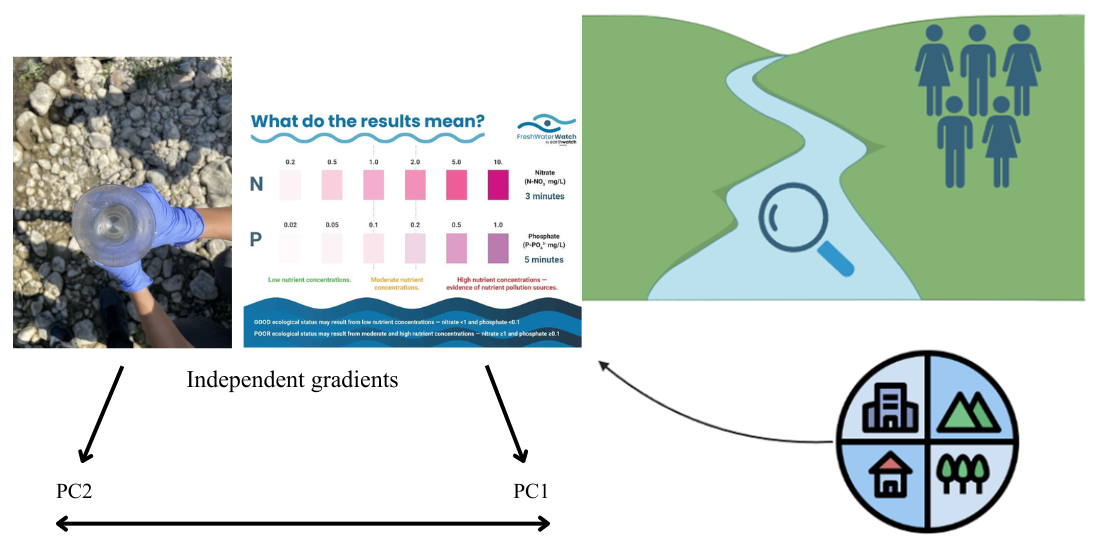
  • Multivariate analysis revealed two largely independent gradients in water quality: a nutrient axis (NO3 and PO4) and a turbidity axis.
What is the implication of the main finding?
  • Citizen science monitoring can complement regulatory monitoring through broader spatial coverage and higher temporal frequency.
  • Urban and industrial land use is associated with elevated nutrient concentrations, highlighting the importance of targeted nutrient management in urbanised basins.
  • Basin-specific responses to climatic variability highlight the need for context-dependent river management strategies.

Abstract
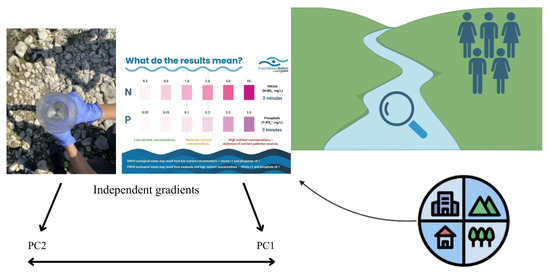
Understanding how climate and land use interact to shape freshwater quality remains challenging across heterogeneous river basins. This study analysed monthly citizen-science measurements of nitrate (NO3), phosphate (PO4), and turbidity, collected between 2016 and 2024, across seven Italian river basins representing contrasting climatic and land-use contexts. A non-parametric analytical framework combining Kruskal–Wallis tests, aligned rank transform analyses, principal component analysis (PCA), and basin-specific Somers’ D statistics was applied to ordinal concentration data. Significant differences among basins revealed persistent spatial structuring of water-quality regimes. PCA identified two largely independent gradients: a dominant nutrient axis defined by NO3 and PO4, and a secondary turbidity axis. Urban and industrial land use aligned with higher nutrient categories, while vegetated landscapes were associated with lower concentrations. Climatic effects were basin specific. Precipitation showed opposing relationships with NO3, suggesting both mobilisation and dilution processes, whereas temperature was positively associated with PO4 in several basins and negatively related to NO3. Turbidity displayed variable links with precipitation and temperature, reflecting hydrological and seasonal controls. Overall, results indicate that land use represents the primary structural driver of nutrient variability, while climatic factors modulate basin-specific responses. The integration of citizen science observations with robust non-parametric approaches provides a scalable framework for detecting environmental drivers and supporting the targeted management of Mediterranean river systems.

Graphical Abstract

1. Introduction

Freshwater ecosystems are increasingly affected by multiple, interacting pressures arising from land-use change, urbanisation, and climate variability. Nutrient enrichment and increased suspended particulates are recognised as globally important drivers to freshwater degradation, contributing to resource loss and habitat deterioration [1,2]. Nitrate (NO3), phosphate (PO4), and turbidity are widely used indicators of these pressures, as they integrate signals from diffuse agricultural sources, urban and industrial activities, and hydrological processes operating across catchments [3,4]. Understanding how these variables vary across space and time, and identifying their dominant drivers and their sensitivity to climate and land use conditions remains central to effective river basin management.
The importance of water quality monitoring is formally recognised within the United Nations 2030 Agenda for Sustainable Development, particularly under Sustainable Development Goal 6 (Clean Water and Sanitation) [5]. Target 6.3 aims to improve ambient water quality, while Indicator 6.3.2 evaluates the proportion of water bodies achieving acceptable physicochemical status. Achieving robust assessments under this framework requires spatially extensive and temporally resolved data on nutrients and related water-quality parameters. However, conventional regulatory monitoring programmes often face limitations related to sparse site coverage, low frequency sampling, and high operational costs, which can obscure basin-scale patterns and reduce understanding of seasonal dynamics [6].
Recent advances in citizen science monitoring have significantly expanded the spatial and temporal coverage of freshwater observations [7]. Citizen science has emerged as a powerful complement to traditional monitoring by expanding both spatial and temporal coverage while enabling consistent data collection across large geographic areas [8,9,10]. When supported by harmonised protocols, training, and quality control, citizen-generated water-quality data have proven suitable for scientific analysis and policy-relevant reporting [11,12]. Importantly, citizen science programmes frequently collect contextual information (e.g., surrounding land use, riparian vegetation, hydrological conditions) that could provide more information about potential drivers of water-quality loss [13,14]. This added contextual dimension is particularly valuable for disentangling the relative roles of climatic forcing and landscape structure in shaping water-quality regimes.
FreshWater Watch (FWW) is a global citizen science initiative specifically designed to support the large-scale assessment of freshwater quality using standardised methods [15]. Since 2012, trained volunteers have collected in situ measurements of NO3, PO4, and turbidity, alongside observations of land use, riparian vegetation, and hydrological conditions. The resulting dataset provides an opportunity to examine nutrient and turbidity patterns consistently across multiple river basins and seasons, while also linking water-quality outcomes to both static landscape characteristics and temporally varying climatic drivers.
Land use is widely recognised as a dominant long-term control on freshwater quality. Agricultural landscapes are commonly associated with elevated nitrate concentrations due to fertiliser application and leaching, while urban and industrial land uses contribute disproportionately to PO4 enrichment and suspended sediments through wastewater inputs, surface runoff, and altered channel morphology [16,17,18]. In contrast, climatic drivers such as precipitation and temperature operate primarily at shorter time scales, influencing mobilisation, transport, dilution, and retention [19,20]. The extent to which these climatic drivers interact with basin-specific land-use configurations to shape distinct water-quality gradients remains not completely resolved, particularly when assessed across multiple basins.
Within this context, the present study makes a comparative assessment across seven major river basins in Italy, integrating citizen science-based measurements and observations with Copernicus and agency data. The basins present a range of land use and hydrological and climate conditions, typical of Mediterranean rivers. Specifically, the study aims to: (i) quantify basin-scale and seasonal differences in NO3, PO4, and turbidity; (ii) identify whether these variables are structured along shared or independent gradients; (iii) evaluate the relative influence of climatic drivers (precipitation and temperature) on nutrient and sediment dynamics; (iv) compare mesoscale (1 km, earth observation based) land use impacts on water quality to local-scale (50 m, citizen scientist based) land use impacts.
Beyond identifying general land-use–water-quality relationships, the study aims to demonstrate how harmonised citizen science monitoring can reveal basin-specific water-quality responses and climatic sensitivities across heterogeneous Mediterranean catchments. By combining higher frequency observations with non-parametric and multivariate analyses, the study explores how nutrient and turbidity dynamics differ among river basins with respect to climatic variability and landscape structure.

2. Materials and Methods

2.1. Study Area and Climate Data

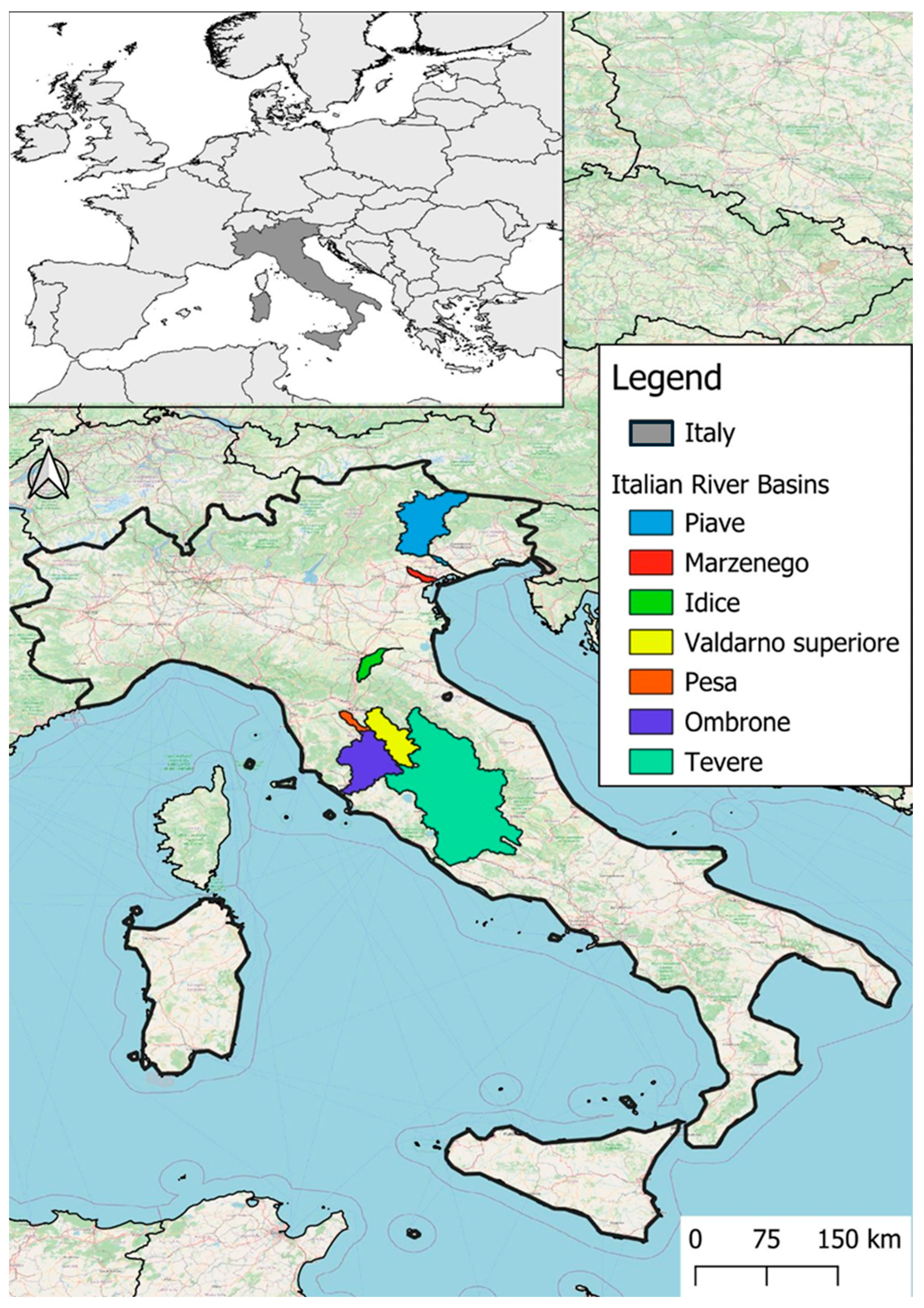
Raw data were downloaded from the FWW website using the Data Explorer tool. The dataset includes 1711 complete datasets collected between 2016 and 2024 by trained citizen scientists from seven Italian river basins spread across north and central Italy (Figure 1). All projects were initiated by local associations and communities, while training, quality control, and data analysis were performed following a standard train-the-trainer model by local scientists (from the universities of Siena and Bologna, Italy) and Earthwatch Europe.
Data were spatially organised by river basin based on the geographic location of each monitoring site (Table S1). Individual monitoring locations and associated metadata, including geographic coordinates and sampling records, are openly accessible through the FreshWater Watch Data Explorer platform, which allows users to visualise and download the complete dataset. It should be noted that the monitoring sites were chosen through a co-design process with local stakeholders, which resulted in a variable longitudinal distribution between basins. For the Pesa, Alto Val d’Arno, and Idice sites, the majority of the sites were in the upstream or secondary tributary reaches, whereas others (e.g., Tevere and Marzenego) had more sites located in downstream sections.
Seasonal grouping followed a temperate-climate framework appropriate for Italy, with warm summers, colder winters, and precipitation typically peaking in spring or autumn, depending on the basin. Seasons were defined as winter (January–March), spring (April–June), summer (July–September), and autumn (October–December). This basin-scale approach allows for comparative analysis across diverse hydro-climatic and land-use contexts, while maintaining methodological consistency through the standardised FWW monitoring protocol. Water-quality observations were collected at monthly intervals and subsequently aggregated into seasonal categories to allow for the comparison of temporal patterns across basins.
Monthly precipitation totals and mean air temperature data were obtained from regional hydrometeorological services for each river basin. Data for the Marzenego and Basso Piave basins were sourced from the Veneto regional agrometeorological bulletin [21]. Climatic data for the Idice basin were obtained from annual meteorological reports produced by the Emilia-Romagna regional environmental agency [22]. Data for Ombrone, Arno, and Pesa were sourced from the Tuscany regional hydrometeorological monitoring network [23], while climatic data for the Tevere basin, covering 3 regions, was obtained from hydrological services from all regions [24,25].
All climatic variables were aggregated at a monthly resolution for the period of 2016–2024. To ensure temporal consistency between climatic forcing and water-quality observations, only months during which FreshWater Watch (FWW) sampling was conducted were included in subsequent analyses.

2.2. FreshWater Watch Monitoring Protocol

The FWW monitoring protocol is a standardised, field-based approach designed to enable the collection of consistent and reproducible freshwater quality data across a wide range of environmental settings by trained citizen scientists [15]. The protocol prioritises participant safety, low operational costs, ease of use, and sample integrity, making it suitable for large-scale and long-term monitoring programmes. All measurements are conducted from the riverbank or shoreline.
For each sampling event, participants recorded site name, date, time, and geographic location. Data were primarily collected using the FWW mobile application ArcGIS Survey123 (Version 3) or using the FWW web platform (https://www.freshwaterwatch.org/). Sampling geolocations and time were entered automatically through the app. Each dataset is automatically assigned a unique identifier to support quality control, and all submitted data are accessible through the FWW database.
Contextual information is recorded to characterise local environmental conditions, including waterbody type, surrounding land use, bank vegetation, wildlife observations, river-discharge velocity and the presence of visible pollution sources. Observations are guided by photographic references to ensure consistency, and only conditions present at the time of sampling are documented.
Turbidity was assessed using a standard and calibrated cylindrical turbidity (Secchi) tube. Turbidity is then recorded in 15 intervals as nephelometric turbidity units (NTU), with values ranging from <14 NTU to >240 NTU. NO3 and PO4 were measured using transparent plastic reaction tubes designed to mix a fixed volume of water with pre-loaded reagents, producing a colour change with increasing analyte concentration (peak absorbance at 540 nm) (Kyoritsu Chemical-Check Lab., Corp., Tokyo, Japan). PO4 (as P-PO4) was quantified using a colourimetric enzymatic reaction based on 4-aminoantipyrine and phosphatase enzyme [26]. Results are recorded as categorical concentration classes: <0.02, 0.02–0.05, 0.05–0.1, 0.1–0.2, 0.2–0.5, 0.5–1.0, and >1.0 mg L−1. NO3 concentrations (as N-NO3) were determined using the Griess reaction in one of seven concentration categories: <0.2, 0.2–0.5, 0.5–1.0, 1.0–2.0, 2.0–5.0, 5.0–10.0, and >10 mg L−1 [27]. The detection ranges of the kits are designed to capture environmentally relevant concentration thresholds associated with eutrophication and water-quality assessment. For the nutrient methods, the quantification limits (LOQ) were 0.01 mg/L P-PO4 and 0.1 mg/L N-NO3, while the turbidity LOQ was 14 NTU. A number of previous studies show that these methodologies provide reliable measurement of nutrient concentration ranges with accuracies between 75 and 85%, when used by trained participants following standardised protocols [15,28,29].
Uploaded data are subject to automated internal consistency checks and plausibility screening within the FWW platform. Immediate feedback is provided to participants, enabling identification and correction of potential errors.

2.3. Statistical Analyses

Statistical analyses were conducted to evaluate spatial, seasonal, and contextual controls on NO3, PO4, and turbidity across the basins. Given the categorical nature of the nutrient concentration data and the non-normal distribution of turbidity values, non-parametric and rank-based methods were applied.
To assess basin-scale differences in water-quality variables (NO3, PO4, and turbidity), Kruskal–Wallis (KW) tests were performed using basin identity as the grouping factor. Where significant overall effects were detected, pairwise basin comparisons were conducted using Dunn’s post hoc tests with appropriate p-value adjustment to control for multiple comparisons. Seasonal patterns were examined using an aligned rank transform (ART) two-factor analysis, with basin and season as fixed factors, allowing main effects and interactions to be tested within a non-parametric framework. Water-quality data were analysed as ordinal concentration categories, consistent with the measurement resolution and distributional properties of the dataset. The use of ordinal categories avoids introducing artificial numerical precision into the analysis and ensures that statistical inference remains consistent with the resolution of the measurement method. Rank-based statistical approaches are therefore particularly appropriate for analysing citizen science datasets that rely on categorical colourimetric measurements.
To explore multivariate structure across water-quality variables, principal component analysis (PCA) was applied to z-scored ordinal ranks of NO3, PO4, and turbidity to ensure equal weighting in the ordination. Basin positions were summarised using centroids of PCA scores, while environmental-context variables (precipitation class, temperature class, land-use categories at local and mesoscale extents, and riparian vegetation) were projected as centroids into the same PCA space.
This approach was chosen to integrate multiple water-quality variables, while remaining consistent with a rank-based analytical framework. Applying PCA to standardised ordinal categories, rather than raw concentrations or ranks of individual observations, preserved relative differences among variables while avoiding assumptions of linearity and normality. Projecting environmental centroids onto PCA space enabled the qualitative assessment of how land use and climatic context align with dominant water-quality gradients, without conflating these drivers with the ordination itself.
To quantify directional associations between water-quality categories and short-term climatic drivers, basin-specific Somers’ D statistics were calculated between ordinal water-quality categories and binary precipitation and temperature classes. Climatic variables were classified into “high” and “low” categories based on basin-specific median values of monthly precipitation and temperature. Observations above the median were classified as “high”, whereas observations below the median were classified as “low”. Contingency tables were then constructed with increasing water-quality categories as the dependent variable and climatic classes as the independent variable. Somers’ D values and corresponding p-values were computed to assess both the strength and direction of monotonic associations within each basin.
Somers’ D was selected because it is specifically designed for asymmetric ordinal relationships and does not require assumptions of normality, linearity, or equal spacing between categories. This made it particularly suitable for citizen science data, where repeated observations capture changing climatic conditions at individual sites. By performing analyses separately for each basin, this approach allowed sensitivity to precipitation and temperature to be evaluated in a basin-specific context.

2.4. Upstream Buffer Delineation and Land Cover Extraction

To assess the influence of upstream land use on river water quality, a spatial procedure was implemented to extract land cover information specifically within the hydrologically connected upstream area of each sampling point. Rather than delineating the entire upstream catchment, the analysis focused on a fixed-distance buffer zone of 1 km, limited to the upstream direction, relative to the flow of the river. This approach was designed to capture local and near-local contributions of potential nutrient sources while excluding areas downstream of the sampling location.
The procedure was carried out in QGIS version 3.40, using a Digital Elevation Model (DEM) and a vector hydrographic network to determine topographic flow paths [30]. Flow direction and accumulation were computed using the GRASS GIS module r.watershed, and individual upstream catchments were delineated for each sampling point using r.water.outlet. These sub-catchments represent the hydrologically connected area contributing to surface or subsurface flow at the monitoring site.
From each upstream catchment, a circular buffer of 1 km radius was generated around the sampling point. This was then clipped by the corresponding upstream catchment polygon to retain only the hydrologically upstream portion of the buffer. The final area of analysis was both proximal to the sampling point and hydrologically relevant. The procedure was fully automated through scripting, allowing batch processing of multiple points and ensuring methodological consistency.
Land cover data were extracted from the Copernicus Riparian Zones 2018 dataset [31], which provides high-resolution thematic information on land use within riparian and adjacent areas across Europe. This dataset was selected due to its ecological relevance and spatial detail, enabling the precise quantification of land cover types potentially linked to water quality conditions.

3. Results

A descriptive summary of the monitoring dataset is provided in Supplementary Table S1. Across the seven basins, a total of approximately 1711 observations were collected from more than 90 monitoring locations. The number of observations and sampling frequencies varied among basins, reflecting differences in the duration and intensity of citizen science participation. Median water-quality categories also differed among basins, indicating contrasting nutrient and turbidity conditions prior to formal statistical analyses.
Median concentrations of all three water-quality variables differed significantly among river basins (Kruskal–Wallis tests, all p < 0.001), indicating strong spatial structuring at the basin scale.
For NO3, post hoc Dunn’s tests revealed a continuous gradient of basin conditions rather than discrete groups. The Marzenego and Basso Piave basins exhibited the highest mean ranks, indicating relatively elevated nitrate concentrations, whereas Alto Val d’Arno showed the lowest mean rank. Pesa, Tevere, Idice, and Ombrone occupied intermediate positions along this gradient. Overall, basin-scale nitrate variability was characterised by gradual transitions rather than sharp contrasts between basins.
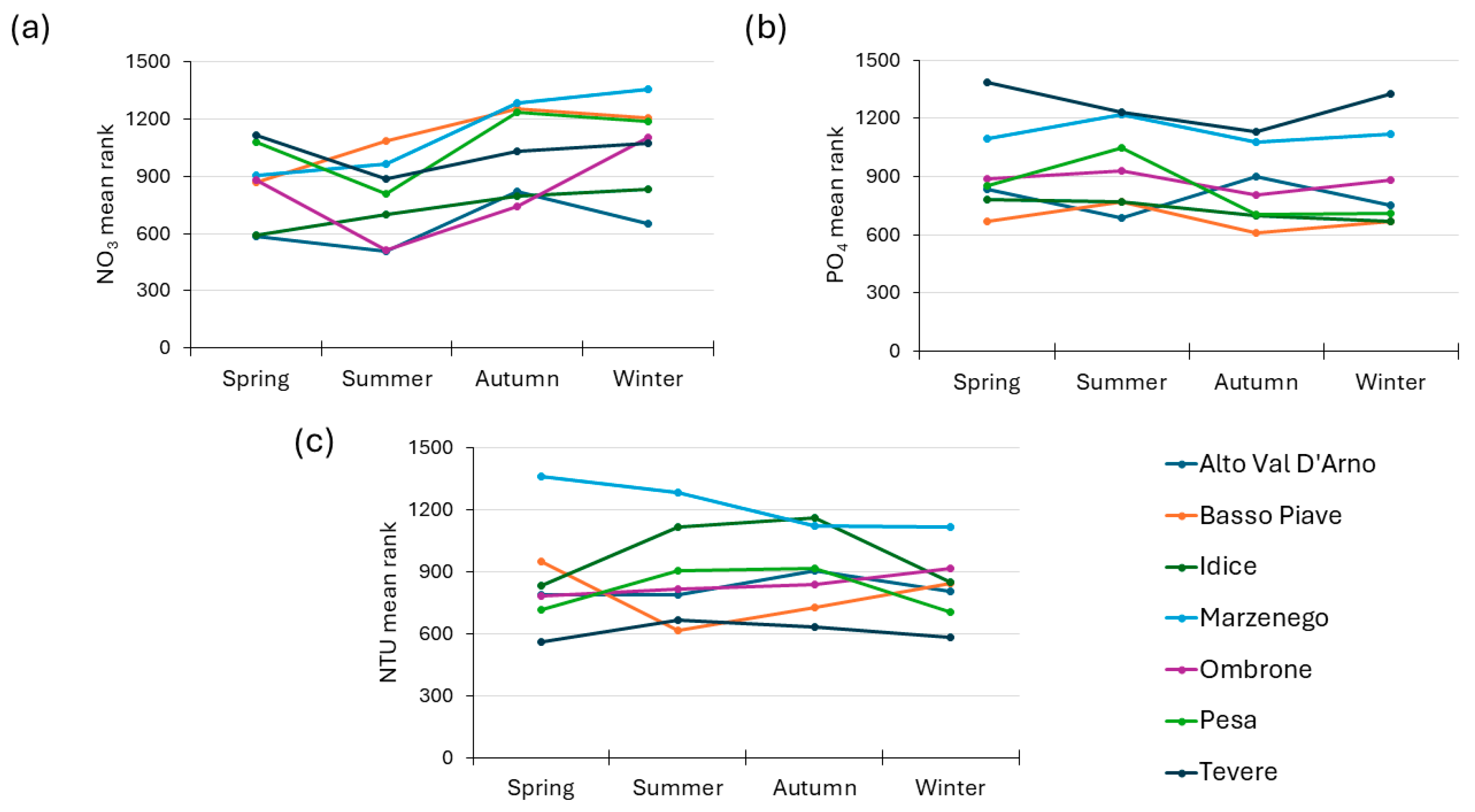
Seasonal patterns in NO3 differed among basins, consistent with significant basin and seasonal main effects detected by the ART analysis (Figure 2a). In spring, Pesa and Tevere exhibited the highest NO3 ranks, while Alto Val d’Arno and Idice showed markedly lower ranks. During summer, Basso Piave and Marzenego became the most NO3-rich systems, whereas Ombrone and Alto Val d’Arno declined to low ranks. Autumn showed an overall increase in NO3 ranks across all basins. Differences between basins also became more pronounced, with Marzenego, Basso Piave, and Pesa exhibiting higher NO3 categories than Alto Val d’Arno, Idice, and Ombrone. This pattern persisted into winter, with Marzenego, Basso Piave, Pesa, and Tevere maintaining high ranks, while Alto Val d’Arno and Idice remained comparatively low. Across seasons, basins tended to maintain their relative positions, indicating that seasonality modulated, but did not override, the underlying spatial nitrate gradient.
Median PO4 concentrations also differed significantly among basins (p < 0.001). Mean rank distributions indicated that Tevere and Marzenego exhibited the highest PO4 levels, followed by Ombrone, Pesa, and Alto Val d’Arno, while Idice and Basso Piave had the lowest ranks. Dunn’s post hoc tests showed that Tevere differed significantly from all other basins except Marzenego. Ombrone overlapped statistically with both Pesa and Alto Val d’Arno, but not with the lowest-ranked basins. These results indicate a basin-scale PO4 gradient, with Tevere and Marzenego forming a high PO4 tier, Idice and Basso Piave forming a low tier, and the remaining basins occupying intermediate positions.
Seasonal variation in PO4 exhibited basin-specific temporal structure (Figure 2b). Across basins, PO4 ranks tended to be higher in summer and winter than in spring and autumn. In summer, Marzenego and Tevere remained strongly elevated, with Pesa and Ombrone also showing relatively high ranks, while Alto Val d’Arno, Basso Piave, and Idice occupied an intermediate range. Autumn was characterised by stabilisation or decreases in PO4 ranks in several basins, with Basso Piave and Pesa showing clear minima. In winter, PO4 ranks increased again in Tevere and Marzenego.
Median turbidity differed significantly among basins. Marzenego had significantly higher turbidity ranks than all other basins (p < 0.001), followed by Idice. Tevere exhibited the lowest turbidity ranks and differed significantly from every other basin. Alto Val d’Arno, Ombrone, and Pesa formed an intermediate group, while Basso Piave occupied a slightly lower–intermediate position.
Seasonal turbidity patterns were consistent with these spatial contrasts (Figure 2c). Marzenego displayed the highest turbidity ranks across all seasons (except for Idice in autumn), while Tevere consistently exhibited the lowest values (except for Basso Piave in summer). Other basins showed more pronounced seasonal variability. Idice and Pesa experienced marked increases in turbidity during summer and autumn, whereas Basso Piave showed a pronounced summer decrease. During winter, turbidity remained elevated in Marzenego, Ombrone, and Basso Piave, while Tevere and Pesa showed lower ranks. These patterns indicate persistent basin-scale differences in turbidity, with superimposed seasonal modulation.

3.1. Basin Environmental Context: Land Use and Riparian Conditions

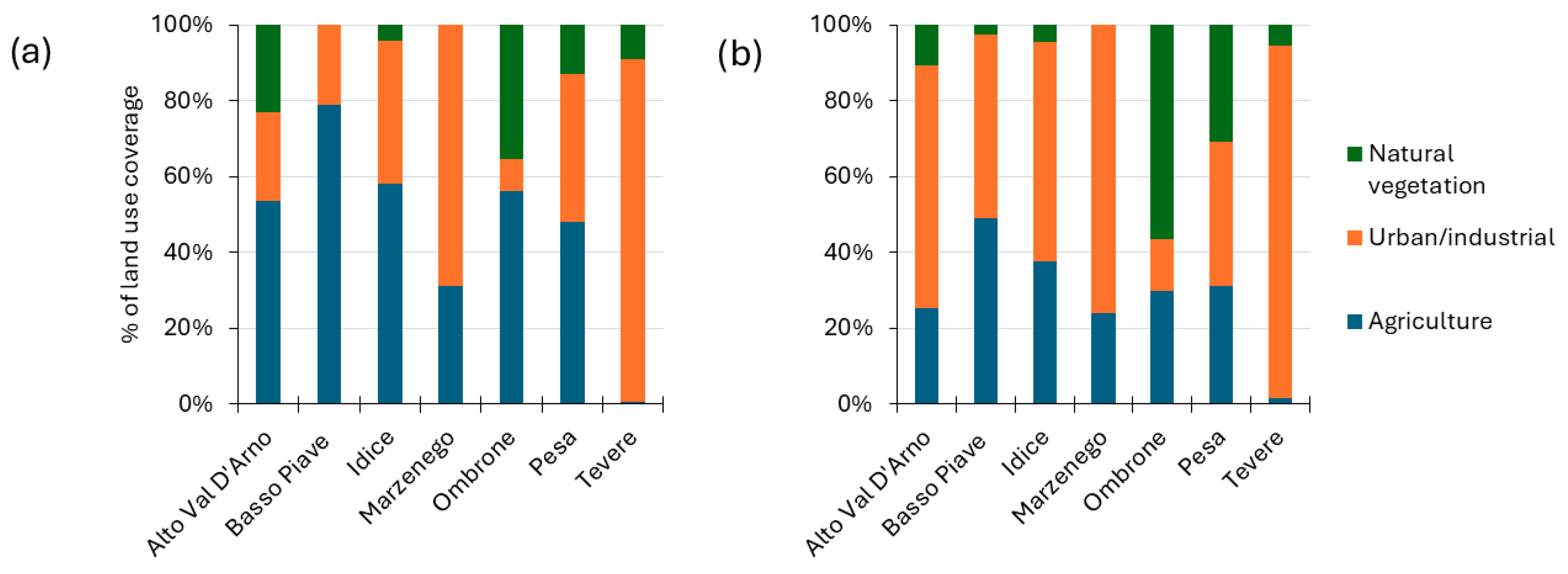
Mesoscale land-use composition differed markedly among river basins (likelihood-ratio χ2, p < 0.001), with a strong association between basin identity and land-use category (Cramér’s V = 0.42). Basins spanned a broad gradient of dominant land-use types (Figure 3a). Basso Piave and Idice were characterised by high proportions of agricultural land, whereas Marzenego and Tevere were strongly dominated by urban and industrial land use. Ombrone exhibited a comparatively high proportion of vegetated land cover, while vegetated land use was lower in several basins, including Basso Piave and Marzenego. These results indicate that basins are embedded within distinct mesoscale landscape contexts.
Local land use recorded by citizen scientists within 50 m upstream of sampling sites also differed significantly among basins (likelihood-ratio χ2, p < 0.001), with a similarly strong association (Cramér’s V = 0.43). Tevere and Marzenego were again characterised by predominantly urban and industrial conditions at the local scale, whereas Ombrone was dominated by vegetated land cover. Basso Piave, Idice, and Pesa exhibited mixed agricultural and urban land-use compositions, while Alto Val d’Arno showed a relatively urban-dominated local context despite a more heterogeneous mesoscale composition (Figure 3b). Overall, local and mesoscale land-use patterns were broadly consistent, indicating that basin-scale landscape structure was expressed across spatial scales.
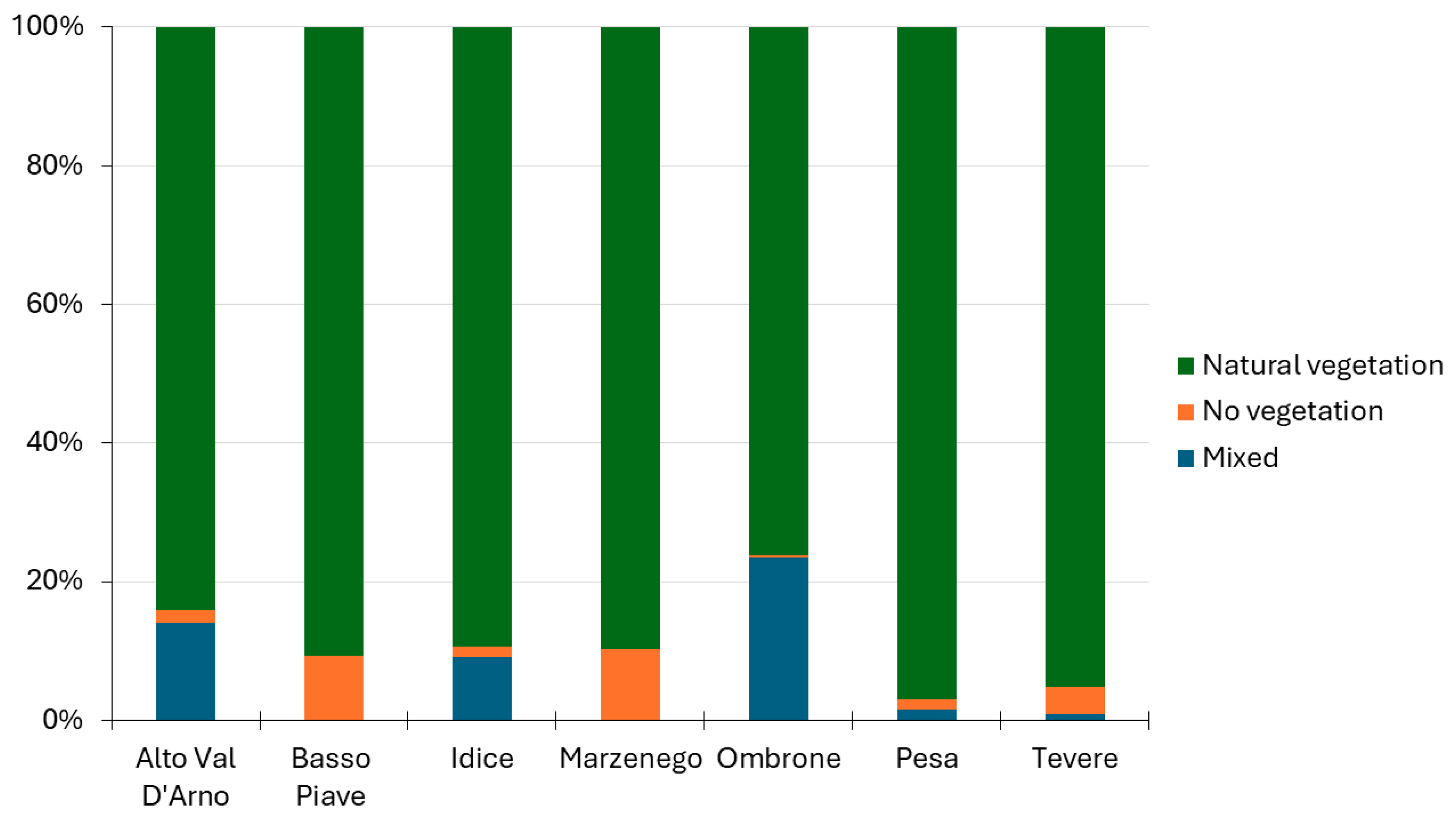
Riparian vegetation composition at the local scale showed weaker differentiation among basins (Cramér’s V = 0.23). Across all basins, most monitoring sites were characterised by vegetated riparian zones, exceeding 75% in every basin and surpassing 90% in several systems (Figure 4). Differences among basins were therefore driven primarily by the occurrence of mixed or unvegetated riparian reaches, which were unevenly distributed but limited overall.

3.2. Basin Climatic Context

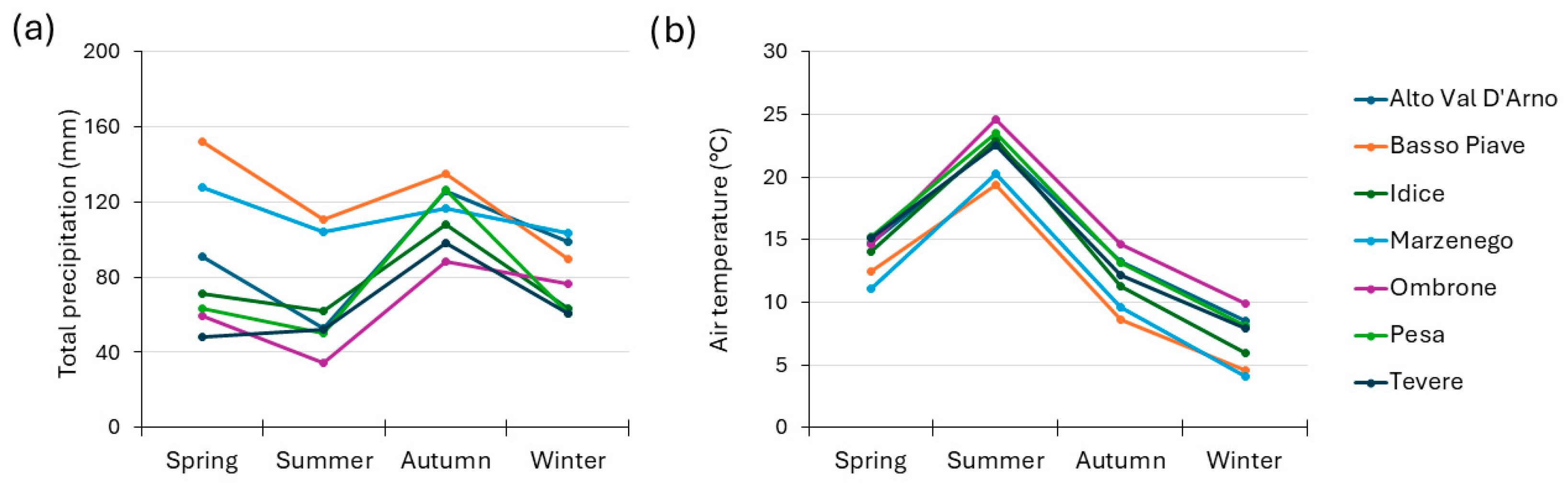
Precipitation and temperature exhibited typical Mediterranean seasonal patterns across all basins, but with marked differences in magnitude among systems. Precipitation was generally highest in autumn and winter and lowest in spring and summer (Figure 5a). Despite this shared seasonality, northern basins (Basso Piave and Marzenego) experienced consistently higher precipitation across all seasons, particularly in spring and summer, whereas central–south basins (Ombrone, Pesa, and Tevere) were drier year-round. Alto Val d’Arno and Idice exhibited intermediate precipitation regimes. Autumn precipitation was elevated across all basins but was especially pronounced in Alto Val d’Arno and Pesa, while winter precipitation showed less spatial contrast.
Mean seasonal air temperature followed a consistent seasonal cycle across basins, with th ehighest values in summer and lowest in winter (Figure 5b). Northern basins (Basso Piave and Marzenego) were consistently cooler across all seasons, particularly in autumn and winter, whereas central–south basins (Ombrone, Pesa, and Tevere) experienced warmer conditions throughout the year. Alto Val d’Arno and Idice again occupied intermediate positions. Together, these results indicate that, while basins share common seasonal climatic forcing, they differ in precipitation and temperature regimes along a latitudinal gradient.

3.3. Putting It All Together—PCA of Normalised Ranks

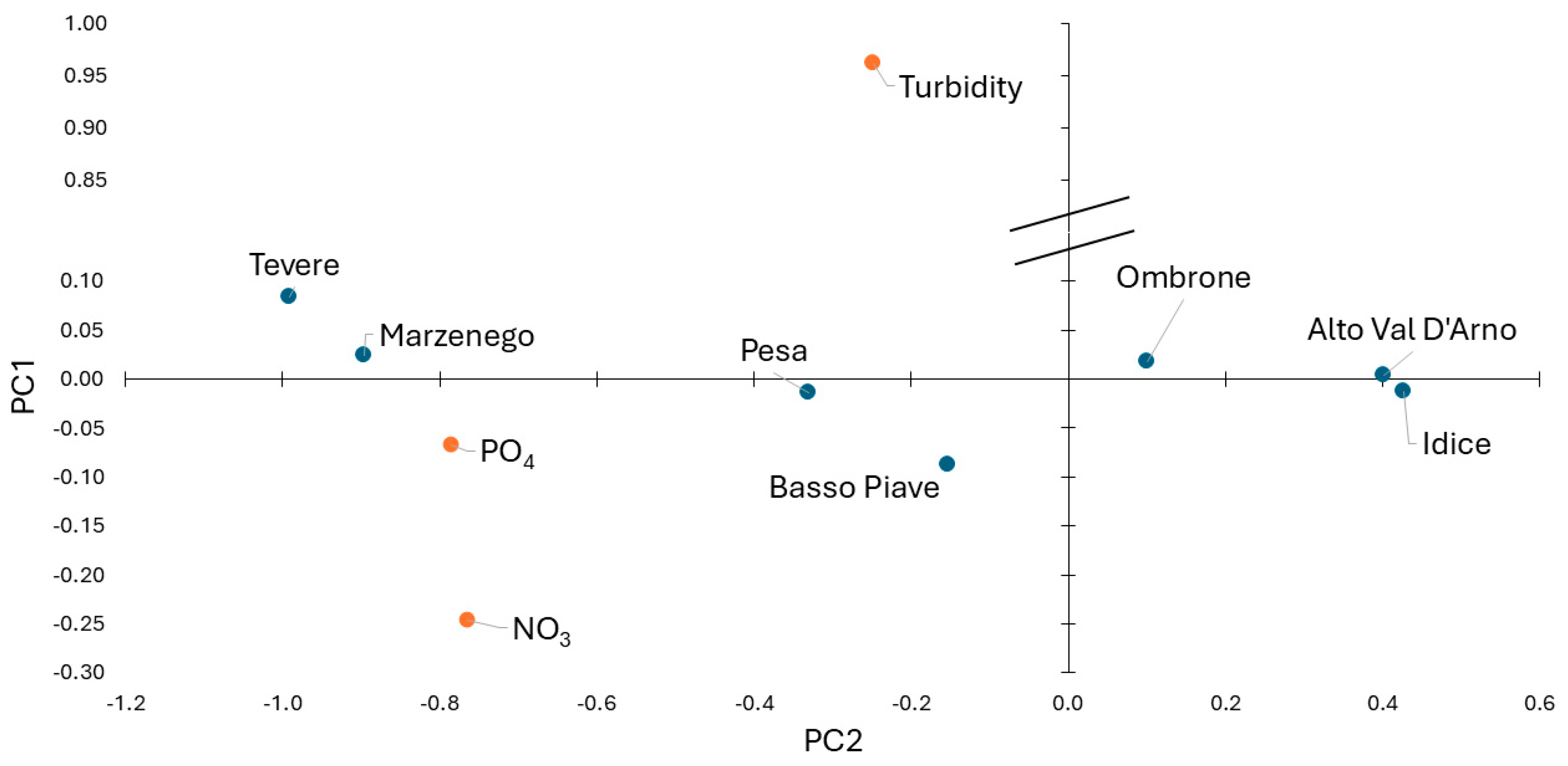
Principal component analysis of the normalised ordinal water-quality categories revealed a clear two-axis structure, with the first two components together explaining approximately 75% of the total variance. PC1 was characterised by strong and concordant negative loadings for NO3 and PO4, indicating a dominant gradient of increasing dissolved nutrient categories (Figure 6). In contrast, turbidity contributed only weakly to PC1. PC2 was dominated by turbidity, which showed a strong positive loading, while NO3 and PO4 contributed minimally. This separation indicates that nutrient variability and turbidity represent largely independent dimensions of water-quality structure across basins.
Basin scores projected into the PCA space revealed distinct multivariate water-quality regimes. Marzenego and Tevere exhibited strongly negative PC1 scores (Figure 6), indicating consistently high nutrient categories across seasons. In contrast, Alto Val d’Arno and Idice showed positive PC1 scores, reflecting comparatively lower nutrient conditions. Basso Piave, Pesa, and Ombrone occupied intermediate positions along PC1, indicating mixed or seasonally variable nutrient regimes. Along PC2, the separation was limited, suggesting that turbidity represents a less basin-specific gradient.
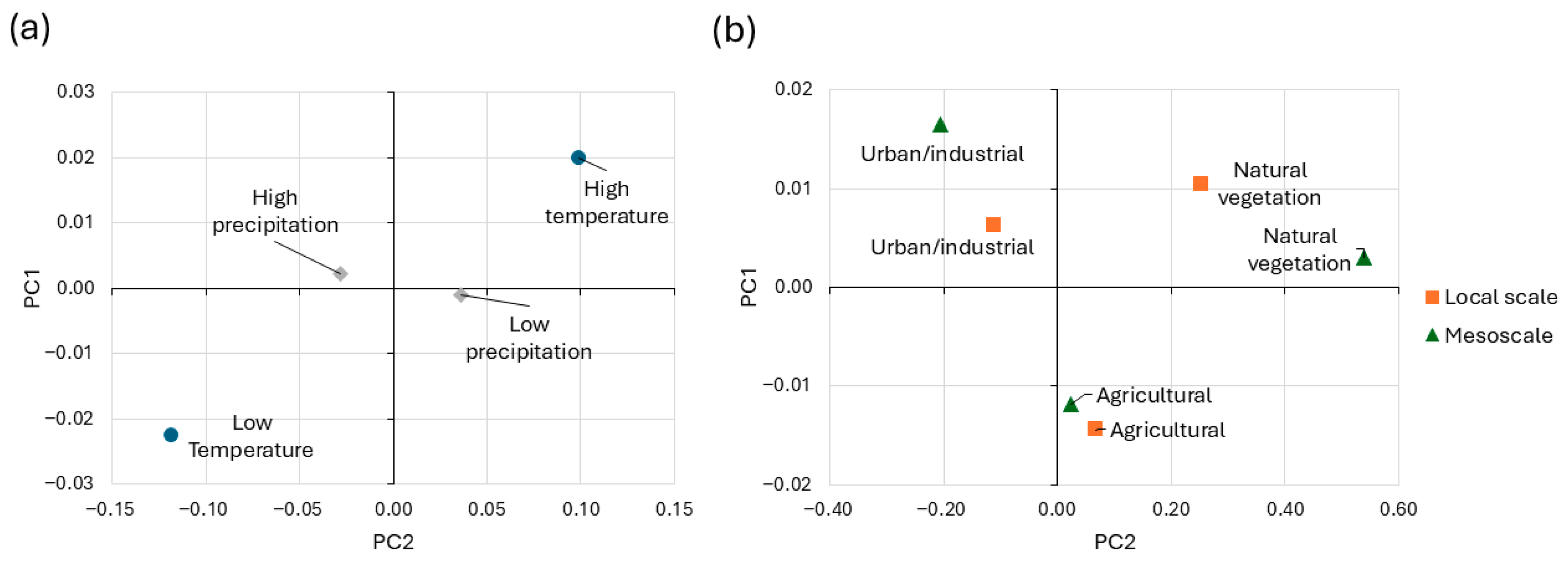
To further explore patterns within the PCA space, centroids of contextual variables were projected onto the component axes. Precipitation and temperature categories (high and low for each basin) showed weak separation along both PC1 and PC2, with centroid positions clustering close to the origin (Figure 7a). In contrast, land-use variables exhibited clearer structure along PC1 (Figure 7b). Vegetation-dominated land use at both the local and mesoscale were associated with positive PC1 scores, whereas urban and industrial land-use categories were associated with negative PC1 scores, aligning with higher nutrient categories. Riparian vegetation centroids showed weaker differentiation, though sites characterised by absent riparian vegetation tended to align with more negative PC1 values.
Contextual centroids showed limited separation along PC2 and clustering of most basins near the origin. Urban and industrial land-use categories tended to project toward positive PC2 scores, whereas vegetation-dominated land use projected weakly toward negative values. Agricultural land use also aligned on the negative side of PC2, indicating an association with comparatively lower turbidity categories in the multivariate space. Overall, separation among contextual variables was more pronounced along PC1 than PC2, indicating that the dominant structure of the ordination is driven by the shared nutrient gradient rather than turbidity variability.
Basin-specific Somers’ D analyses revealed opposing associations between NO3 concentration categories and precipitation between basins (Table 1). A significant positive association was observed in the Idice basin, indicating a tendency toward higher NO3 categories under wetter conditions. In contrast, the Ombrone and Pesa basins showed a significant negative association, suggesting lower NO3 categories during periods of higher precipitation. Associations in Alto Val d’Arno, Marzenego, Tevere, and Basso Piave were weak and not statistically significant, indicating no consistent monotonic relationship between precipitation and NO3 categories in these basins. For temperature, the relationships were uniformly negative across basins, with NO3 showing the strongest negative associations in Marzenego and Ombrone. Associations were less but still significant in Tevere, Basso Piave, Idice, and Pesa. This suggests a tendency toward lower NO3 categories under the warmer conditions of the growing season. In Alto Val d’Arno, temperature–NO3 associations were weakly negative and non-significant.
Associations between PO4 concentration categories and precipitation were generally weak across all basins. No statistically significant relationships were detected, although Marzenego exhibited a moderate positive effect size (not significant), suggesting a tendency toward higher PO4 categories during wetter conditions. In contrast, temperature showed significant positive associations with PO4 categories in several basins, supporting earlier studies in temperate rivers [16,32,33]. In Basso Piave and Marzenego, the negative association values indicated a shift toward higher PO4 categories under warmer conditions in these basins. Likewise, a similar, but weaker positive association was found in Alto Val d’Arno and Idice. Associations in Ombrone, Pesa, and Tevere were weak and not statistically significant.
Associations between turbidity categories and precipitation showed significant basin-specific responses. Four basins exhibited statistically significant positive associations, including Marzenego, Ombrone, Basso Piave, and Idice, indicating a tendency toward higher turbidity categories under wetter conditions. In contrast, Pesa showed a weak but non-significant positive association, while Alto Val d’Arno and Tevere exhibited negligible effects. Temperature showed significant associations in Marzenego, which had a large positive NTU effect. Ombrone also exhibited a significant positive association, indicating increased turbidity categories under warmer conditions.

4. Discussion

4.1. Basin-Scale Water-Quality Regimes and Dominant Gradients

The combined univariate, multivariate, and ordinal association analyses indicate that water quality across the seven river basins is structured along two dominant but differently organised gradients. The PCA of the nutrient and turbidity ranks indicated that NO3 and PO4 covary strongly (PC1), while turbidity is largely decoupled from nutrient concentrations and dominates the second component (PC2); separation between nutrient-driven and sediment-related gradients has been often reported in multivariate river water-quality studies [34]. The strong and concordant loadings of NO3 and PO4 indicate that, despite their different sources and biogeochemical behaviour, these nutrients tend to increase or decrease together at the basin scale. This co-variation is consistent with the univariate analyses, which showed that basins characterised by elevated NO3 concentrations often also exhibited elevated PO4. Although turbidity and dissolved nutrient categories emerged as largely independent gradients in the PCA, suspended sediments can transport particulate phosphorus and organic nitrogen [35]. The weak covariance observed here likely reflects the dominance of dissolved nutrient sources in several basins, particularly those influenced by urban wastewater inputs.
Basin positions in the PCA space broadly reflect these patterns. Marzenego and Tevere occupy positions corresponding to consistently high nutrient conditions across seasons, whereas Alto Val d’Arno and Idice show comparatively lower nutrient regimes. Intermediate basins such as Basso Piave, Ombrone, and Pesa showed mixed nutrient signatures and greater temporal variability.
Elevated nutrient concentrations and suspended sediments can have important ecological consequences for freshwater systems. Nutrient enrichment may promote eutrophication and shifts in primary productivity, potentially altering oxygen dynamics and biological community structure. Increased turbidity can reduce light penetration, limit benthic primary production, and degrade aquatic habitats through sediment deposition and changes in substrate conditions [36,37].

4.2. Climatic Controls

Precipitation centroids showed only weak separation in the PCA, indicating that short-term rainfall conditions do not structure basin positions within the multivariate nutrient–turbidity space. However, basin-specific Somers’ D analyses revealed that precipitation–water-quality relationships become evident when examined within individual basins. For NO3, significant precipitation associations were detected in several basins, but with contrasting directions. Positive associations in Idice indicate increased NO3 concentrations under wetter conditions, even while river discharge increases. This suggests enhanced NO3 mobilisation through increased runoff or subsurface flow, even though this basin has relatively low agricultural pressure [38]. In contrast, negative associations in Ombrone and Pesa suggest dilution effects or hydrological pathways that reduce NO3 concentrations during high-flow periods, which is to be expected in basins with constant nutrient sources. The absence of significant precipitation PO4 associations in all basins suggests that PO4 concentrations do not significantly associate with hydrological drivers, even in basins with evident autumn maxima (Marzenego) or minima (Tevere). Compared to NO3, the relative mobility of PO4 is limited [39].
Precipitation showed more consistent associations with turbidity. Significant positive precipitation–NTU associations were detected in multiple basins, indicating that higher turbidity conditions occur during wetter months, likely reflecting rainfall-driven sediment mobilisation and channel disturbance. This was particularly evident in Idice, Pesa and Alto Valdarno, where autumn precipitation maxima were reflected coincident with NTU maxima. Turbidity as a process-dominated variable sensitive to short-term hydrological forcing also aligns with the loading of NTU on PC2 [40].
Temperature exerted a strong positive association with PO4 concentration in four basins, suggesting the potential release of PO4 during warmer months. This pattern may reflect temperature-driven biogeochemical processes, including enhanced mineralisation of organic phosphorus, increased sediment–water exchange, and internal loading under low-flow conditions in these basins [41,42]. Warmer periods also coincide with reduced discharge, during which continuous, point, or legacy phosphorus sources exert proportionally greater influence on in-stream concentrations [33,43]. Together, these findings suggest that phosphate dynamics in these systems are more closely linked to seasonal thermal and biogeochemical controls than to episodic hydrological forcing.
For NO3, temperature associations were negative and significant in nearly all basins, suggesting a biologically related reduction through increased algal biomass. This has been observed in major northern rivers in relation to phytoplankton growth enhanced by long residence times and high light availability at low water levels [44,45]. Temperature showed a significant and positive association with turbidity only in the Marzenego basin, which may reflect enhanced biological activity or reduced baseflow dilution under a constant load of suspended sediment during warm periods. These results indicate that climatic drivers primarily modulate basin-specific water-quality responses rather than act as important controls on spatial gradients, highlighting the importance of hydrological pathways and catchment characteristics in shaping nutrient dynamics.
Additional parameters such as pH, conductivity, dissolved oxygen, and total dissolved solids can provide valuable information on river water quality. However, the standardised methodology used focuses on nitrate, phosphate, and turbidity because these variables represent key indicators of nutrient enrichment and suspended sediment dynamics and can be measured reliably by trained citizen scientists using simple, well-validated field methods. Nutrients are also core indicators within global monitoring frameworks such as the United Nations Sustainable Development Goal (SDG) indicator 6.3.2 for ambient water quality assessment. Previous testing of additional low-cost monitoring parameters, including pH, conductivity, ammonia, and total dissolved solids, showed a number of shortcomings related to the need for operator calibration or sensitivity to chemical interferences, which currently limits their reliability within large, distributed citizen science networks [5].

4.3. Land-Use Controls

Land-use structure showed a strong and consistent association with nutrient and turbidity variability across basins. Both local and mesoscale land-use classifications aligned strongly with PC1, with urban and industrial contexts consistently associated with elevated PO4 and NO3, and natural vegetation land cover associated with lower values. The limited influence of precipitation and temperature on PO4 and turbidity further supports the interpretation that land use reflects longer-term, structural controls rather than episodic climatic forcing. Elevated PO4 in urban-dominated basins such as Tevere and Marzenego is consistent with chronic point and diffuse sources, including wastewater inputs and impervious surface runoff. Anthropogenic wastewater discharges represent an important source of phosphate enrichment in Mediterranean rivers [46]. Urban and industrial land-use classes were used as proxies for these pressures [47]. The strong alignment between urban land use and elevated PO4 along PC2 in the PCA therefore likely reflects the influence of wastewater infrastructure and urban runoff pathways. This was particularly evident in the Tevere and Marzenego basins, where relative percent of urban/industrial land cover was the highest. Similarly, high turbidity in these systems likely reflects altered channel morphology, reduced infiltration capacity, and sustained sediment availability associated with urban land use [48].
Riparian vegetation also followed a clear pattern, with unvegetated or mixed riparian zones associated with higher PO4 and turbidity, consistent with the documented role of riparian buffers in reducing non-point nutrient and sediment inputs through filtration of surface runoff, bank stabilisation, and nutrient uptake processes [49,50,51]. However, the overall dominance of vegetated riparian conditions across all basins limited contrast in riparian buffering capacity, which may explain the comparatively lower explanatory power of this variable relative to broader land-use contexts.
An interesting result was the clear similarities between the impacts of land use when classified using satellite-based land-use indices at a 1 km scale and land-use classes as observed by trained citizen scientists at each monitoring site. These patterns were robust across the multivariate nutrient–turbidity space, indicating that impacts from basin-scale landscape structure are coherently expressed from the local scale to the surrounding catchment. This concordance may also point to the robustness of citizen science observations when they are properly structured within a clear workflow and guidelines designed to address specific, tailored questions.
It should be noted that differences in monitoring location and stream order may influence the comparisons of basin-scale patterns. Monitoring sites were not uniformly distributed along the longitudinal gradient in all basins. In the Pesa, Alto Val d’Arno, and Idice basins, a greater proportion of sites were located in upstream or secondary tributary reaches, whereas basins such as the Tevere and Marzenego included more sites in downstream sections. As a result, some basins may reflect more localised upstream conditions, while others integrate cumulative downstream influences. Lower-order rivers such as the Pesa and Idice drain relatively small upstream areas. Consequently, they integrate fewer hydrological, geochemical, and anthropogenic processes than larger river systems such as the Ombrone and Basso Piave. These differences in spatial integration may contribute to observed variability in water-quality sensitivity and should be considered when interpreting basin-specific patterns.
Citizen science monitoring also provides broader societal benefits by engaging local communities in environmental observation and supporting participatory approaches to river management [52]. Monthly observations collected by providing higher temporal frequency and broader spatial coverage help to identify spatial patterns of water-quality pressures and provide early indications of emerging environmental problems [53]. In addition to generating environmental data, participation in monitoring activities can enhance environmental awareness and scientific literacy among participants, strengthening community engagement in river stewardship and local decision-making [54]. At the same time, citizen science programmes must balance accessibility and data reliability as simplified field protocols and limited parameter sets may constrain the scope of environmental assessments [55].

5. Conclusions

This study demonstrates how harmonised citizen science monitoring combined with non-parametric statistical analysis can reveal basin-scale patterns in water quality across heterogeneous Mediterranean river systems. Monthly observations of nitrate, phosphate, and turbidity collected by trained volunteers allowed the identification of consistent spatial gradients in water-quality regimes, despite differences in basin size, land use, and climatic context. The results highlight the capacity of structured citizen science programmes to complement conventional monitoring networks by providing higher temporal frequency and broader spatial coverage than is often achievable through regulatory programmes alone.
Across the seven basins analysed, water-quality variability was structured primarily along a nutrient gradient defined by nitrate and phosphate concentrations, with turbidity forming a secondary and largely independent dimension of variation. Land-use patterns emerged as the dominant structural driver of nutrient enrichment, whereas climatic variables such as precipitation and temperature acted mainly as modulators of basin-specific responses. These findings indicate that, while landscape structure establishes baseline water-quality conditions, short-term climatic variability influences how nutrients and suspended sediments are mobilised within individual catchments.
The observed differences among basins also underline the importance of context-specific management strategies. Systems characterised by persistent nutrient enrichment are likely to benefit most from measures targeting point and diffuse nutrient sources, including improvements in wastewater treatment and urban runoff management. In contrast, basins showing stronger sensitivity to precipitation or hydrological variability may require strategies that reduce nutrient mobilisation during high-flow periods, such as improved soil management, protection of groundwater pathways, and restoration of landscape features that enhance water retention.
Beyond the scientific findings, this study illustrates the broader value of citizen science for freshwater management. Community-based monitoring programmes can expand the spatial and temporal coverage of water-quality observations, contribute to early identification of environmental pressures, and foster public engagement in river stewardship. At the same time, such programmes require careful protocol design, training, and quality control to ensure data reliability. When these conditions are met, citizen science observations can provide a valuable complement to regulatory monitoring and support evidence-informed decision-making in river basin management.

Supplementary Materials

The following supporting information can be downloaded at: https://www.mdpi.com/article/10.3390/w18060728/s1, Table S1: Descriptive summary of water-quality observations across the seven river basins, with the number of sites, frequency of sampling per month, median category values (with the interquartile range) for nitrate, phosphate, turbidity and the recorded through the FreshWater Watch monitoring programme between 2016 and 2024.

Author Contributions

Conceptualization, S.A.L., B.G. and L.G.; data curation, A.P., S.A.L. and C.O.; formal analysis, A.P., S.A.L. and F.D.G.; investigation, A.P. and S.A.L.; methodology, S.A.L., A.P., F.D.G. and A.B.; project administration, S.A.L. and B.G.; supervision, S.A.L., B.G. and L.G.; visualisation, A.B., R.G.C., X.L. and R.G.C.; writing—original draft, A.P., S.A.L., F.D.G.; writing—review and editing: B.G. and L.G. All authors have read and agreed to the published version of the manuscript.

Funding

This work is funded under the National Recovery and Resilience Plan (NRRP), Mission 4 Component 2 Investment 1.4—Call for tender No. 3138 of 16 December 2021, rectified by Decree n. 3175 of 18 December 2021 of Italian Ministry of University and Research funded by the European Union-NextGenerationEU. Project code [CN_00000033], Concession Decree No. 1034 of 17 June 2022 adopted by the Italian Ministry of University and Research, CUP [B63C22000650007], project title “National Biodiversity Future Center—NBFC”. The researchers who contributed to this study received funding from the MoRe4Nature project (EU Horizon grant agreement No. 101133983).

Data Availability Statement

Climate data were obtained from regional environmental and hydrometeorological agencies (see cited sources in the text). Nutrient concentrations, turbidity, and local land-use observations are openly accessible through the FreshWater Watch platform. Mesoscale land-use layers derived from Copernicus datasets will be made available by the corresponding author upon reasonable request.

Acknowledgments

The authors sincerely thank the hundreds of citizen scientists, students, volunteers, and local organisations across the study basins whose sustained commitment made this work possible. Their engagement in monitoring local rivers and streams provided the high-frequency observations that underpin this study and reflects a shared dedication to protecting freshwater ecosystems. In the Alto Val d’Arno basin, we are especially grateful to the students of ISIS Valdarno and ISIS Varchi, as well as the employees of Gruppo Prada Valvigna and Legambiente Valdarno Superiore, for their enthusiasm and long-term involvement. Citizen science monitoring in the Basso Piave basin was made possible through the active participation of volunteers and local associations, with support from the Italian Ministry of the Environment through the Piano di Gestione delle Acque project (ITN007_1DAO_001_M35). The authors gratefully acknowledge the volunteers of the Idice basin and the participation of GEV, Legambiente, WWF, Myfly (FPSAS), Europa Verde, San Lazzaro in Transizione, CambiamOra for their seven years of commitment. In the Marzenego basin, monitoring activities were sustained through the dedication of local associations, the he students of ICNoale “Betty” Pierazzo and ISIS Levi-Ponte, and the continued support of the Consorzio Acque Risorgive within the EU Horizon MoRe4Nature project (grant agreement No. 101133983). In the Ombrone basin, we thank the citizen scientists and CS4Rivers collaborators whose efforts contributed to data collection within the National Biodiversity Future Center. Citizen science observations in the Pesa basin were collected within the Horizon 2020 POSEIDOMM project (grant agreement No. 702747), and we extend our particular thanks to Rossella, Marco, Riccardo, and all volunteers for their invaluable contributions. The participatory monitoring of the Aniene and Tevere rivers would not have been possible without the coordination of ASUD and Insieme per l’Aniene, to whom the authors express their sincere thanks also for their successful efforts in engaging many other associations and groups of citizens. The researchers who contributed to this study received funding from the MoRe4Nature project. The opinions expressed herein are those of the authors and do not necessarily reflect those of the partners or the European Commission.

Conflicts of Interest

The authors declare no conflicts of interest.

References

  1. Smith, V.H.; Tilman, G.D.; Nekola, J.C. Eutrophication: Impacts of Excess Nutrient Inputs on Freshwater, Marine, and Terrestrial Ecosystems. Environ. Pollut. 1999, 100, 179–196. [Google Scholar] [CrossRef] [PubMed]
  2. George, T.S.; Giles, C.D.; Menezes-Blackburn, D.; Condron, L.M.; Gama-Rodrigues, A.C.; Jaisi, D.; Lang, F.; Neal, A.L.; Stutter, M.I.; Almeida, D.S.; et al. Organic Phosphorus in the Terrestrial Environment: A Perspective on the State of the Art and Future Priorities. Plant Soil 2018, 427, 191–208. [Google Scholar] [CrossRef]
  3. Soltaninia, S.; Eskandaripour, M.; Golmohammadi, M.H.; Taghavi, L.; Mehboodi, A. Nitrate Pollution in Urban Runoff: A Comprehensive Risk Assessment for Human and Ecological Health. Sci. Total Environ. 2025, 974, 179184. [Google Scholar] [CrossRef]
  4. Rügner, H.; Schwientek, M.; Beckingham, B.; Kuch, B.; Grathwohl, P. Turbidity as a Proxy for Total Suspended Solids (TSS) and Particle Facilitated Pollutant Transport in Catchments. Environ. Earth Sci. 2013, 69, 373–380. [Google Scholar] [CrossRef]
  5. United Nations Environment Programme. Introduction to Indicator 6.3.2: Proportion of Bodies of Water with Good Ambient Water Quality. Available online: https://www.unwater.org/our-work/integrated-monitoring-initiative-sdg-6/indicator-632-proportion-bodies-water-good-ambient (accessed on 15 January 2025).
  6. Kirschke, S.; Avellán, T.; Bärlund, I.; Bogardi, J.J.; Carvalho, L.; Chapman, D.; Dickens, C.W.S.; Irvine, K.; Lee, S.B.; Mehner, T.; et al. Capacity Challenges in Water Quality Monitoring: Understanding the Role of Human Development. Environ. Monit. Assess. 2020, 192, 298. [Google Scholar] [CrossRef]
  7. Amador-Castro, F.; González-López, M.E.; Lopez-Gonzalez, G.; Garcia-Gonzalez, A.; Díaz-Torres, O.; Carbajal-Espinosa, O.; Gradilla-Hernández, M.S. Internet of Things and Citizen Science as Alternative Water Quality Monitoring Approaches and the Importance of Effective Water Quality Communication. J. Environ. Manag. 2024, 352, 119959. [Google Scholar] [CrossRef]
  8. Sanna, V.S.; Di Grazia, F.; Capineri, C.; Polvani, A. Citizen Science for Transition to Sustainability and SDG Monitoring in an Italian River Basin. Int. J. E-Plan. Res. 2024, 13, 1–30. [Google Scholar] [CrossRef]
  9. Tulloch, A.I.T.; Possingham, H.P.; Joseph, L.N.; Szabo, J.; Martin, T.G. Realising the Full Potential of Citizen Science Monitoring Programs. Biol. Conserv. 2013, 165, 128–138. [Google Scholar] [CrossRef]
  10. Taylor, S.D.; Meiners, J.M.; Riemer, K.; Orr, M.C.; White, E.P. Comparison of Large-scale Citizen Science Data and Long-term Study Data for Phenology Modeling. Ecology 2019, 100, e02568. [Google Scholar] [CrossRef]
  11. Gumiero, B.; Veronesi, L.; Galgani, L.; Cirrone, R.G.; Corsi, A.; Tafi, A.; Loiselle, S.A. Freshwater Monitoring across the Globe: The Role of Citizen Science within the European Water Framework Directive (WFD) and the United Nations Sustainable Development Goals (SDGs), and Opportunities to Incentivize the Collaboration with Environmental Regulators. Open Res. Eur. 2025, 5, 45. [Google Scholar] [CrossRef]
  12. Warner, S.; Blanco Ramírez, S.; de Vries, S.; Marangu, N.; Ateba Bessa, H.; Toranzo, C.; Imaralieva, M.; Abrate, T.; Kiminta, E.; Castro, J.; et al. Empowering Citizen Scientists to Improve Water Quality: From Monitoring to Action. Front. Water 2024, 6, 1367198. [Google Scholar] [CrossRef]
  13. Moshi, H.A.; Kimirei, I.; Shilla, D.; O’Reilly, C.; Wehrli, B.; Ehrenfels, B.; Loiselle, S. Citizen Scientist Monitoring Accurately Reveals Nutrient Pollution Dynamics in Lake Tanganyika Coastal Waters. Environ. Monit. Assess. 2022, 194, 689. [Google Scholar] [CrossRef] [PubMed]
  14. San Llorente Capdevila, A.; Kokimova, A.; Sinha Ray, S.; Avellán, T.; Kim, J.; Kirschke, S. Success Factors for Citizen Science Projects in Water Quality Monitoring. Sci. Total Environ. 2020, 728, 137843. [Google Scholar] [CrossRef] [PubMed]
  15. Bishop, I.; Boldrini, A.; Clymans, W.; Hall, C.; Moorhouse, H.; Parkinson, S.; Scott-Somme, K.; Thornhill, I.; Loiselle, S. FreshWater Watch: Investigating the Health of Freshwater Ecosystems, from the Bottom Up. Citiz. Sci. 2025, 10, 2. [Google Scholar] [CrossRef]
  16. Loiselle, S.; Bishop, I.; Moorhouse, H.; Pilat, C.; Koelman, E.; Nelson, R.; Clymans, W.; Pratt, J.; Lewis, V. Citizen Scientists Filling Knowledge Gaps of Phosphate Pollution Dynamics in Rural Areas. Environ. Monit. Assess. 2024, 196, 220. [Google Scholar] [CrossRef]
  17. Usman, M.; Sanaullah, M.; Ullah, A.; Li, S.; Farooq, M. Nitrogen Pollution Originating from Wastewater and Agriculture: Advances in Treatment and Management. Rev. Environ. Contam. Toxicol. 2022, 260, 9. [Google Scholar] [CrossRef]
  18. Matej-Lukowicz, K.; Wojciechowska, E.; Nawrot, N.; Dzierzbicka-Głowacka, L.A. Seasonal Contributions of Nutrients from Small Urban and Agricultural Watersheds in Northern Poland. PeerJ 2020, 8, e8381. [Google Scholar] [CrossRef]
  19. Bieroza, M.Z.; Hallberg, L.; Livsey, J.; Wynants, M. Climate Change Accelerates Water and Biogeochemical Cycles in Temperate Agricultural Catchments. Sci. Total Environ. 2024, 951, 175365. [Google Scholar] [CrossRef]
  20. Ezzati, G.; Collins, A.L.; Pulley, S.; Galloway, J.; Hawtree, D.; Mellander, P. Impacts of Changing Weather Patterns on the Dynamics of Water Pollutants in Agricultural Catchments: Insights from 11-Year High Temporal Resolution Data Analysis. J. Hydrol. 2024, 644, 132122. [Google Scholar] [CrossRef]
  21. ARPAV. Bollettino Agrometeorologico Mensile. Available online: https://www.arpa.veneto.it/temi-ambientali/agrometeo/file-e-allegati (accessed on 23 October 2025).
  22. ARPAE. Rapporti Meteorologici Annuali. Available online: https://www.arpae.it/it/temi-ambientali/meteo/report-meteo/rapporti-annuali (accessed on 23 October 2025).
  23. SIR. Rete Di Monitoraggio Idrometeorologico Regionale. Available online: https://sir.toscana.it/consistenza-rete (accessed on 23 October 2025).
  24. ARSIAL. Servizio Integrato Agrometeorologico Della Regione Lazio. Available online: https://siarl.arsial.it/bi/superset/dashboard/11/ (accessed on 23 October 2025).
  25. Regione Umbria. Dati Idrometeorologici Regionali. Available online: https://www.regione.umbria.it/ambiente/servizio-idrografico (accessed on 23 October 2025).
  26. Berti, G.; Fossati, P.; Tarenghi, G.; Musitelli, C.; Melzi d’Eril, G.V. Enzymatic Colorimetric Method for the Determination of Inorganic Phosphorus in Serum and Urine. Clin. Chem. Lab. Med. 1988, 26, 399–404. [Google Scholar] [CrossRef]
  27. Nelson, J.L.; Kurtz, L.T.; Bray, R.H. Rapid Determination of Nitrates and Nitrites. Anal. Chem. 1954, 26, 1081–1082. [Google Scholar] [CrossRef]
  28. McGoff, E.; Dunn, F.; Cachazo, L.M.; Williams, P.; Biggs, J.; Nicolet, P.; Ewald, N.C. Finding Clean Water Habitats in Urban Landscapes: Professional Researcher vs Citizen Science Approaches. Sci. Total Environ. 2017, 581–582, 105–116. [Google Scholar] [CrossRef] [PubMed]
  29. Hegarty, S.; Hayes, A.; Regan, F.; Bishop, I.; Clinton, R. Using Citizen Science to Understand River Water Quality While Filling Data Gaps to Meet United Nations Sustainable Development Goal 6 Objectives. Sci. Total Environ. 2021, 783, 146953. [Google Scholar] [CrossRef] [PubMed]
  30. QGIS Development Team. QGIS Geographic Information System. Available online: http://qgis.org (accessed on 10 May 2025).
  31. European Environment Agency. Riparian Zones Land Cover/Land Use 2018 (Vector). Available online: https://land.copernicus.eu/en/products/riparian-zones/rz-land-cover-land-use-2018 (accessed on 10 May 2025).
  32. Abbott, B.W.; Baranov, V.; Mendoza-Lera, C.; Nikolakopoulou, M.; Harjung, A.; Kolbe, T.; Balasubramanian, M.N.; Vaessen, T.N.; Ciocca, F.; Campeau, A.; et al. Trends and Seasonality of River Nutrients in Agricultural Catchments: 18 Years of Weekly Citizen Science in France. Sci. Total Environ. 2018, 624, 845–858. [Google Scholar] [CrossRef]
  33. Dolph, C.L.; Finlay, J.C.; Dalzell, B.; Feyereisen, G.W. Phosphorus Transport in a Hotter and Drier Climate: In-Channel Release of Legacy Phosphorus during Summer Low-Flow Conditions. Hydrol. Earth Syst. Sci. 2024, 28, 5249–5294. [Google Scholar] [CrossRef]
  34. de Andrade Costa, D.; Soares de Azevedo, J.P.; dos Santos, M.A.; dos Santos Facchetti Vinhaes Assumpção, R. Water Quality Assessment Based on Multivariate Statistics and Water Quality Index of a Strategic River in the Brazilian Atlantic Forest. Sci. Rep. 2020, 10, 22038. [Google Scholar] [CrossRef]
  35. Mbabazi, J.; Inoue, T.; Yokota, K.; Saga, M. Variability of Particulate Bioavailable Phosphorus, Particulate Organic Carbon and Nitrogen in Agricultural and Urban Rivers. J. Environ. Chem. Eng. 2019, 7, 103086. [Google Scholar] [CrossRef]
  36. Hou, D.; He, J.; Lü, C.; Sun, Y.; Zhang, F.; Otgonbayar, K. Effects of Environmental Factors on Nutrients Release at Sediment-Water Interface and Assessment of Trophic Status for a Typical Shallow Lake, Northwest China. Sci. World J. 2013, 2013, 716342. [Google Scholar] [CrossRef] [PubMed]
  37. Akinnawo, S.O. Eutrophication: Causes, Consequences, Physical, Chemical and Biological Techniques for Mitigation Strategies. Environ. Chall. 2023, 12, 100733. [Google Scholar] [CrossRef]
  38. Zheng, W.; Wang, S.; Sun, H.; Shen, Y.; Cao, J. Rainfall Driven Nitrate Transport in Runoff of Hilly Area by Combining Time-Series Monitoring of Hydrochemistry and Stable Isotopes. J. Hydrol. 2025, 654, 132830. [Google Scholar] [CrossRef]
  39. Tesoriero, A.J.; Duff, J.H.; Wolock, D.M.; Spahr, N.E.; Almendinger, J.E. Identifying Pathways and Processes Affecting Nitrate and Orthophosphate Inputs to Streams in Agricultural Watersheds. J. Environ. Qual. 2009, 38, 1892–1900. [Google Scholar] [CrossRef]
  40. Jalón-Rojas, I.; Schmidt, S.; Sottolichio, A. Turbidity in the Fluvial Gironde Estuary (Southwest France) Based on 10-Year Continuous Monitoring: Sensitivity to Hydrological Conditions. Hydrol. Earth Syst. Sci. 2015, 19, 2805–2819. [Google Scholar] [CrossRef]
  41. Casson, N.J.; Wilson, H.F.; Higgins, S.M. Hydrological and Seasonal Controls of Phosphorus in Northern Great Plains Agricultural Streams. J. Environ. Qual. 2019, 48, 978–987. [Google Scholar] [CrossRef]
  42. Sharpley, A.; Jarvie, H.P.; Buda, A.; May, L.; Spears, B.; Kleinman, P. Phosphorus Legacy: Overcoming the Effects of Past Management Practices to Mitigate Future Water Quality Impairment. J. Environ. Qual. 2013, 42, 1308–1326. [Google Scholar] [CrossRef] [PubMed]
  43. Di Grazia, F.; Gumiero, B.; Galgani, L.; Troiani, E.; Ferri, M.; Loiselle, S.A. Ecosystem Services Evaluation of Nature-Based Solutions with the Help of Citizen Scientists. Sustainability 2021, 13, 10629. [Google Scholar] [CrossRef]
  44. Hallberg, L.; Bernal, S.; Bieroza, M. Seasonal Variation in Flow and Metabolic Activity Drive Nitrate and Carbon Supply and Demand in a Temperate Agricultural Stream. J. Geophys. Res. Biogeosci. 2024, 129, e2024JG008308. [Google Scholar] [CrossRef]
  45. Schulz, G.; van Beusekom, J.E.E.; Jacob, J.; Bold, S.; Schöl, A.; Ankele, M.; Sanders, T.; Dähnke, K. Low Discharge Intensifies Nitrogen Retention in Rivers—A Case Study in the Elbe River. Sci. Total Environ. 2023, 904, 166740. [Google Scholar] [CrossRef]
  46. Powley, H.R.; Dürr, H.H.; Lima, A.T.; Krom, M.D.; Van Cappellen, P. Direct Discharges of Domestic Wastewater Are a Major Source of Phosphorus and Nitrogen to the Mediterranean Sea. Environ. Sci. Technol. 2016, 50, 8722–8730. [Google Scholar] [CrossRef]
  47. Flo, E.; Garcés, E.; Camp, J. Land Uses Simplified Index (LUSI): Determining Land Pressures and Their Link With Coastal Eutrophication. Front. Mar. Sci. 2019, 6, 18. [Google Scholar] [CrossRef]
  48. Li, L.; Yu, Q.; Gao, L.; Yu, B.; Lu, Z. The Effect of Urban Land-Use Change on Runoff Water Quality: A Case Study in Hangzhou City. Int. J. Environ. Res. Public Health 2021, 18, 10748. [Google Scholar] [CrossRef]
  49. Brumberg, H.D.; Dee, L.E.; Murayama, H.; Alvarado Barrientos, J.J.; Bessesen, B.; Bouffard, M.G.; Burgess, M.G.; Cortés, J.; Furey, S.; Hernández, N.; et al. Riparian Vegetation Reduces Coastal Turbidity. Commun. Sustain. 2026, 1, 29. [Google Scholar] [CrossRef] [PubMed]
  50. Kumwimba, M.N.; Akter, S.; Li, X.; Dzakpasu, M.; Ifon, B.E.; Manirakiza, B.; Muyembe, D.K.; Zhang, Y.; Huang, J.; Guadie, A. Nutrient and Sediment Retention by Riparian Vegetated Buffer Strips: Impacts of Buffer Length, Vegetation Type, and Season. Agric. Ecosyst. Environ. 2024, 369, 109050. [Google Scholar] [CrossRef]
  51. Wu, S.; Bashir, M.A.; Raza, Q.-U.-A.; Rehim, A.; Geng, Y.; Cao, L. Application of Riparian Buffer Zone in Agricultural Non-Point Source Pollution Control—A Review. Front. Sustain. Food Syst. 2023, 7, 985870. [Google Scholar] [CrossRef]
  52. Soria, M.; Bonada, N.; Ballester, A.; Verkaik, I.; Jordà-Capdevila, D.; Solà, C.; Munné, A.; Jiménez-Argudo, S.-M.; Fortuño, P.; Gallart, F.; et al. Adapting Participatory Processes in Temporary Rivers Management. Environ. Sci. Policy 2021, 120, 145–156. [Google Scholar] [CrossRef]
  53. Rozemeijer, J.; Jordan, P.; Hooijboer, A.; Kronvang, B.; Glendell, M.; Hensley, R.; Rinke, K.; Stutter, M.; Bieroza, M.; Turner, R.; et al. Best Practice in High-Frequency Water Quality Monitoring for Improved Management and Assessment; a Novel Decision Workflow. Environ. Monit. Assess. 2025, 197, 353. [Google Scholar] [CrossRef]
  54. Shao, G.P.; Bishop, I.J. Citizen Science in River Monitoring: A Systematic Literature Review of the Whys and Hows. Front. Environ. Sci. 2025, 13, 1609084. [Google Scholar] [CrossRef]
  55. Fritz, S.; See, L.; Grey, F. The Grand Challenges Facing Environmental Citizen Science. Front. Environ. Sci. 2022, 10, 1019628. [Google Scholar] [CrossRef]
Figure 1. Location of the seven Italian river basins the in this study.
Water 18 00728 g001
Figure 2. Basin-scale seasonal variation in (a) NO3, (b) PO4, and (c) turbidity categories.
Water 18 00728 g002
Figure 3. (a) Mesoscale (1 km Copernicus-derived) and (b) local-scale (50 m citizen-observed) land-use composition across basins.
Water 18 00728 g003
Figure 4. Proportional composition of riparian vegetation conditions recorded at FreshWater Watch monitoring sites across basins.
Water 18 00728 g004
Figure 5. Seasonal variation in (a) total seasonal precipitation (mm) and (b) average air temperature (°C) across basins.
Water 18 00728 g005
Figure 6. PCA of standardised ordinal categories of NO3, PO4, and turbidity (in orange) and basins’ separation (in blue).
Water 18 00728 g006
Figure 7. Contextual environmental centroids projected onto the PCA space defined by standardised ordinal categories of NO3, PO4, and turbidity. Panel (a) shows the position of climatic classes (high vs. low precipitation and temperature); panel (b) shows centroids of land-use categories at both the local scale and the mesoscale.
Water 18 00728 g007
Table 1. Directional ordinal associations (Somers’ D) between nutrient and turbidity categories and climatic drivers across the seven river basins. Bold values indicate statistically significant associations (p < 0.01).
Somers’ DNO3NO3PO4PO4TurbidityTurbidity
Precip.Temp.Precip.Temp.Precip.Temp.
Alto Val D’Arno0.08−0.100.070.120.040.00
Basso Piave−0.15−0.200.080.210.14−0.03
Idice0.20−0.170.010.090.120.06
Marzenego0.08−0.340.190.320.340.41
Ombrone−0.28−0.410.000.020.140.15
Pesa−0.16−0.160.000.020.110.10
Tevere0.09−0.24−0.02−0.020.02−0.02
Disclaimer/Publisher’s Note: The statements, opinions and data contained in all publications are solely those of the individual author(s) and contributor(s) and not of MDPI and/or the editor(s). MDPI and/or the editor(s) disclaim responsibility for any injury to people or property resulting from any ideas, methods, instructions or products referred to in the content.