Extractable Water Index (EWI): Towards a Universal Metric for Sustainable River Extraction

 , , , and
Abstract
1. Introduction
2. Materials and Methods
2.1. No Storage Scenario
2.2. With Storage Scenario
2.3. Extractable Water Index (EWI)
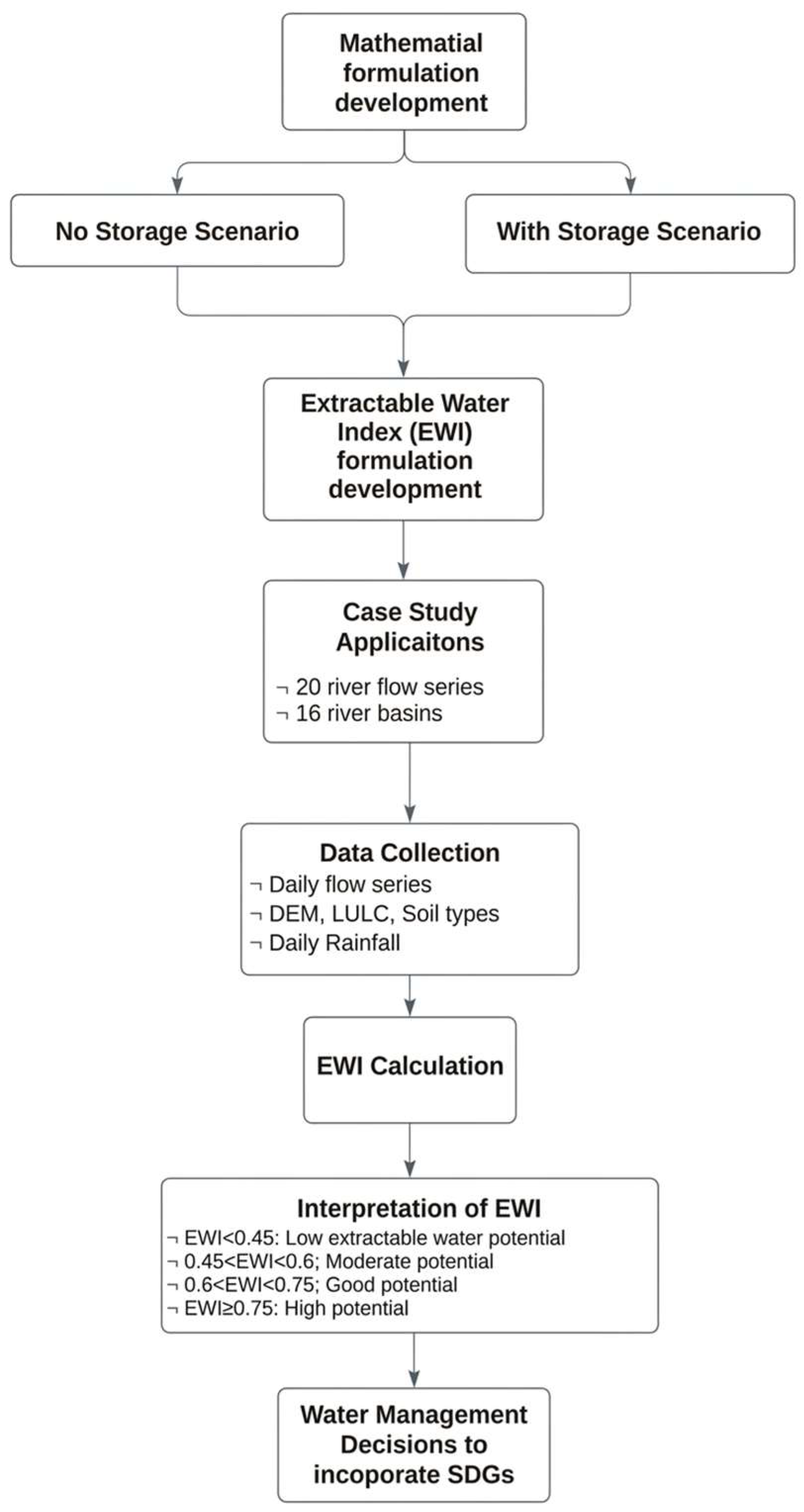
2.4. Application of the EWI for Threshold Classification
3. Results and Discussion
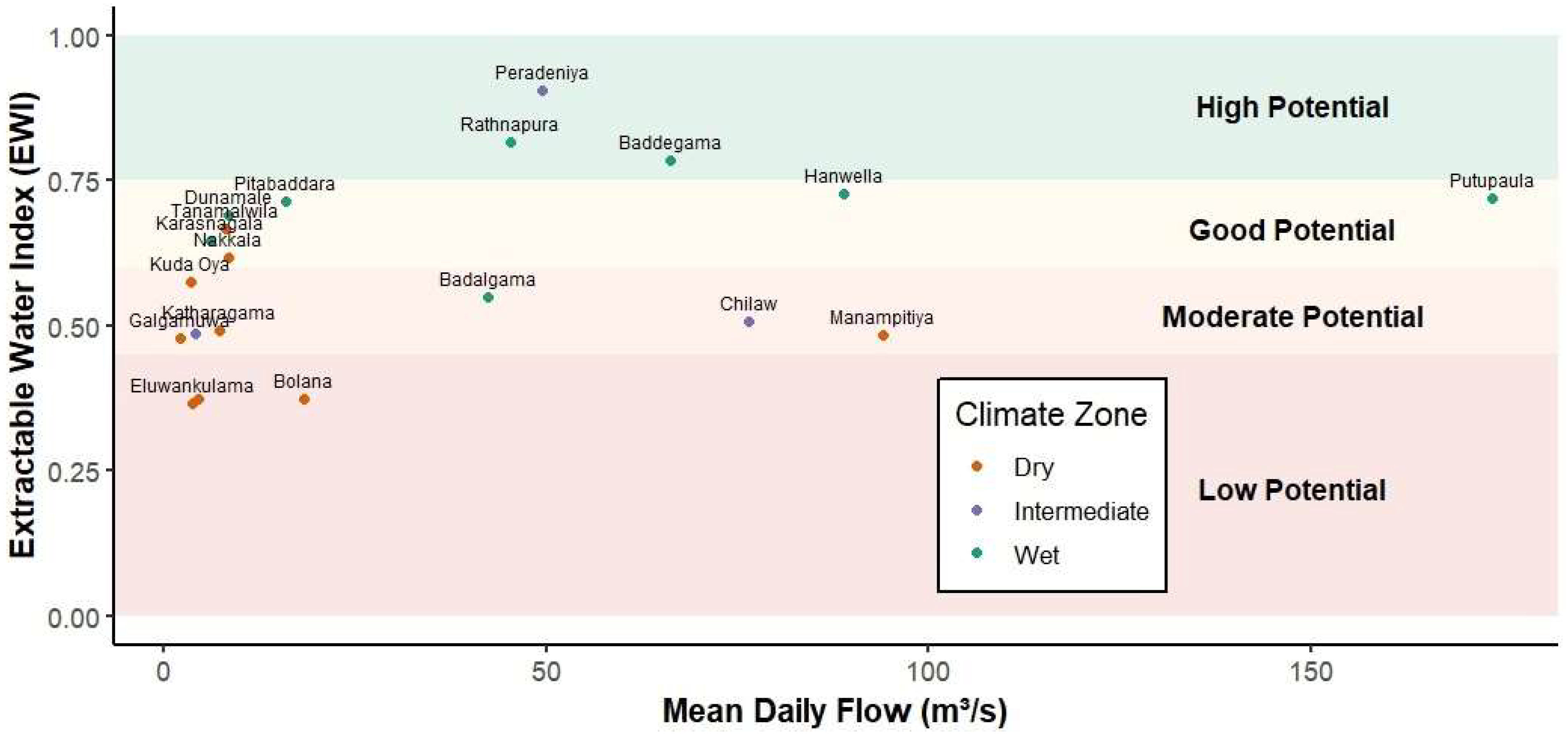
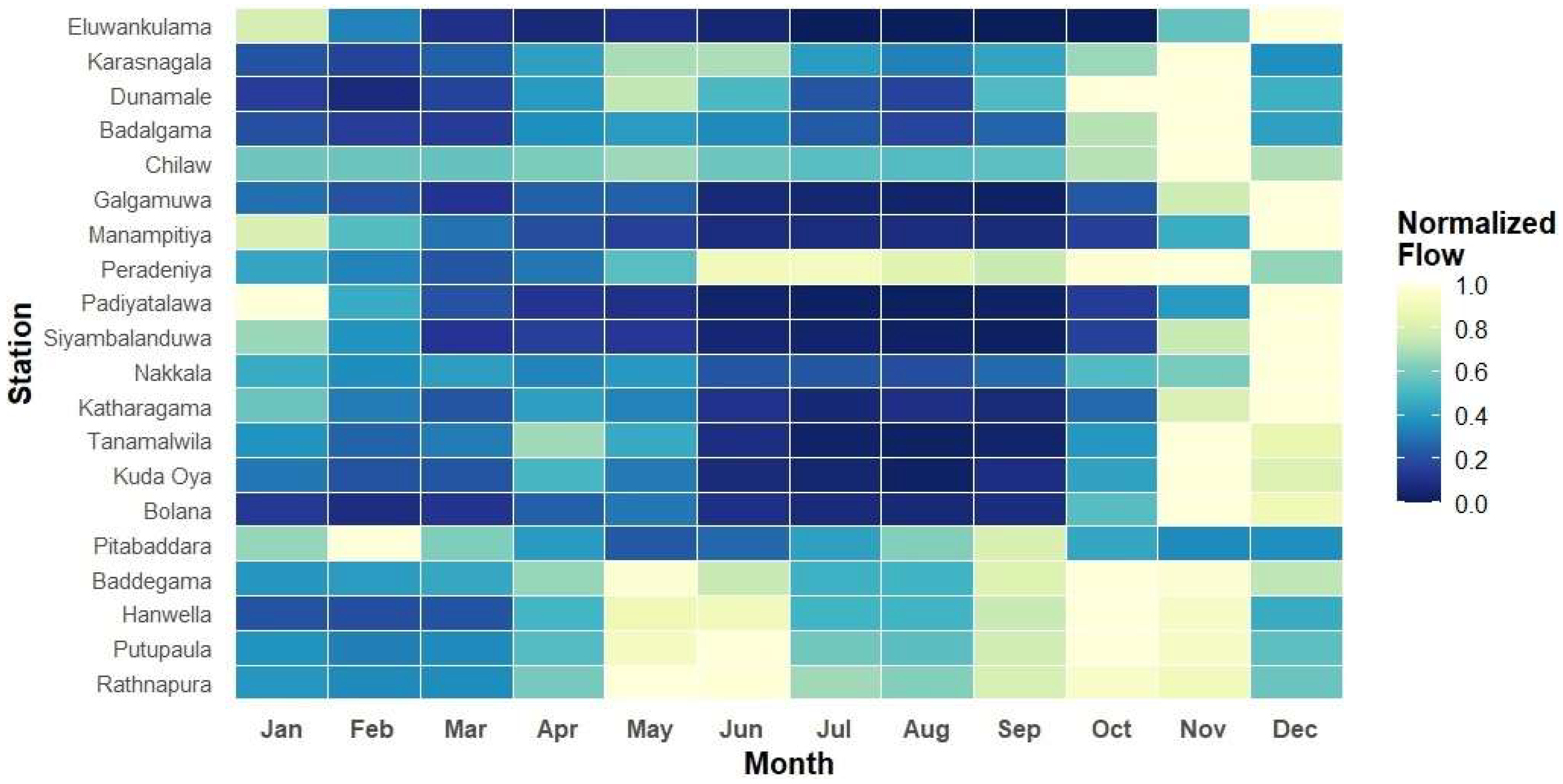
3.1. EWI Threshold Classification
3.2. Limitations of the Case Study Application
3.3. Mapping to Sustainable Development Goals
4. Conclusions
Author Contributions
Funding
Data Availability Statement
Acknowledgments
Conflicts of Interest
References
- Saha, A.K. Editorial for the special issue on Aquatic Ecosystems and Water Resources. Hydrology 2023, 10, 119. [Google Scholar] [CrossRef]
- Feisal, N.A.S.; Kamaludin, N.H.; Sani, M.F.A.; Ahmad, D.K.A.; Ahmad, M.A.; Razak, N.F.A.; Ibrahim, T.N.B.T. Anthropogenic disturbance of aquatic biodiversity and water quality of an urban river in Penang, Malaysia. Water Sci. Eng. 2023, 16, 234–242. [Google Scholar] [CrossRef]
- Antão-Geraldes, A.M.; Calheiros, C.S.C. Frontiers in freshwater ecology, conservation and water treatment technologies. Appl. Sci. 2023, 13, 2605. [Google Scholar] [CrossRef]
- Johnson, M.F.; Albertson, L.K.; Algar, A.C.; Dugdale, S.J.; Edwards, P.; England, J.; Gibbins, C.; Kazama, S.; Komori, D.; MacColl, A.D.C.; et al. Rising water temperature in rivers: Ecological impacts and future resilience. Wiley Interdiscip. Rev. Water 2024, 11, e1724. [Google Scholar] [CrossRef]
- Ding, B.; Zhang, J.; Zheng, P.; Li, Z.; Wang, Y.; Jia, G.; Yu, X. Water security assessment for effective water resource management based on multi-temporal blue and green water footprints. J. Hydrol. 2024, 632, 130761. [Google Scholar] [CrossRef]
- Darboei, A.; Azari, A.; Mirakzadeh, A.A. Sustainable exploitation of water resources in the framework of water-energy-food nexus in climate change conditions using new multi-objective optimization algorithm MOGWO-3D. Agric. Water Manag. 2025, 323, 110025. [Google Scholar] [CrossRef]
- Ogunjo, S.; Olusola, A.; Olusegun, C. Predicting river discharge in the Niger River Basin: A deep learning approach. Appl. Sci. 2023, 14, 12. [Google Scholar] [CrossRef]
- Jin, Z.; Zhang, X.; Li, J.; Yang, F.; Kong, D.; Wei, R.; Huang, K.; Zhou, B. Impact of wastewater treatment plant effluent on an urban river. J. Freshw. Ecol. 2017, 32, 697–710. [Google Scholar] [CrossRef]
- Li, J.; Burian, S.J. Effects of nonstationarity in urban land cover and rainfall on historical flooding intensity in a semiarid catchment. J. Sustain. Water Built Environ. 2022, 8, 04022002. [Google Scholar] [CrossRef]
- Pasquier, U.; Vahmani, P.; Jones, A.D. Quantifying the City-Scale Impacts of impervious surfaces on groundwater recharge potential: An urban application of WRF–Hydro. Water 2022, 14, 3143. [Google Scholar] [CrossRef]
- Öztürk, Ş.; Yılmaz, K.; Dinçer, A.E.; Kalpakcı, V. Effect of urbanization on surface runoff and performance of green roofs and permeable pavement for mitigating urban floods. Nat. Hazards 2024, 120, 12375–12399. [Google Scholar] [CrossRef]
- Zhang, T.; Zhang, X.; Xia, D.; Liu, Y. An analysis of land use change dynamics and its impacts on hydrological processes in the Jialing River Basin. Water 2014, 6, 3758–3782. [Google Scholar] [CrossRef]
- Ongaga, C.O.; Makokha, M.; Obiero, K.; Kipkemoi, I.; Diang’a, J. Urbanization and hydrological dynamics: A 22-year assessment of impervious surface changes and runoff in an urban watershed. Front. Water 2024, 6. [Google Scholar] [CrossRef]
- Acreman, M.C.; Dunbar, M.J. Defining environmental river flow requirements—A review. Hydrol. Earth Syst. Sci. 2004, 8, 861–876. [Google Scholar] [CrossRef]
- Yin, Z.; Liu, G.; Zheng, Z.; Li, X. Sustainable Stormwater Management: Runoff Impact of Urban Land Layout with Multi-Level Impervious Surface Coverage. Sustainability 2025, 17, 3511. [Google Scholar] [CrossRef]
- Chen, H.; Huang, S.; Qiu, H.; Xu, Y.; Teegavarapu, R.S.; Guo, Y.; Nie, H.; Xie, H.; Xie, J.; Shao, Y.; et al. Assessment of ecological flow in river basins at a global scale: Insights on baseflow dynamics and hydrological health. Ecol. Indic. 2025, 178, 113868. [Google Scholar] [CrossRef]
- Hussain, Z.; Wang, Z.; Wang, J.; Yang, H.; Arfan, M.; Hassan, D.; Wang, W.; Azam, M.I.; Faisal, M. A comparative Appraisal of Classical and Holistic Water Scarcity Indicators. Water Resour. Manag. 2022, 36, 931–950. [Google Scholar] [CrossRef]
- Brown, A.; Matlock, M.D. A Review of Water Scarcity Indices and Methodologies Food, Beverage & Agriculture. White Pap. 2011, 106, 1–19. Available online: https://sustainabilityconsortium.org/download/a-review-of-water-scarcity-indices-and-methodologies/ (accessed on 15 January 2026).
- Perveen, S.; James, L.A. Scale invariance of water stress and scarcity indicators: Facilitating cross-scale comparisons of water resources vulnerability. Appl. Geogr. 2010, 31, 321–328. [Google Scholar] [CrossRef]
- Vladimir, S.; Revenga, C.; Döll, P. Taking into Account Environmental Water Requirements in Global-Scale Water Resources Assessment; Research Report 2; International Water Management Institute: Colombo, Sri Lanka, 2004; Online; ISBN 92-9090-542-5. [Google Scholar]
- Sullivan, C.; Meigh, J.; Lawrence, P. Application of the Water Poverty Index at Different Scales: A cautionary tale. Water Int. 2006, 31, 412–426. [Google Scholar] [CrossRef]
- Berger, M.; Campos, J.; Carolli, M.; Dantas, I.; Forin, S.; Kosatica, E.; Kramer, A.; Mikosch, N.; Nouri, H.; Schlattmann, A.; et al. Advancing the Water Footprint into an Instrument to Support Achieving the SDGs—Recommendations from the “Water as a Global Resources” Research Initiative (GRoW). Water Resour. Manag. 2021, 35, 1291–1298. [Google Scholar] [CrossRef]
- Casadei, S.; Peppoloni, F.; Pierleoni, A. A new approach to calculate the Water Exploitation Index (WEI+). Water 2020, 12, 3227. [Google Scholar] [CrossRef]
- Hoekstra, A.Y.; Mekonnen, M.M.; Chapagain, A.K.; Mathews, R.E.; Richter, B.D. Global Monthly Water Scarcity: Blue Water Footprints versus Blue Water Availability. PLoS ONE 2012, 7, e32688. [Google Scholar] [CrossRef]
- Damkjaer, S.; Taylor, R. The measurement of water scarcity: Defining a meaningful indicator. AMBIO 2017, 46, 513–531. [Google Scholar] [CrossRef] [PubMed]
- Pastor, A.V.; Ludwig, F.; Biemans, H.; Hoff, H.; Kabat, P. Accounting for environmental flow requirements in global water assessments. Hydrol. Earth Syst. Sci. 2014, 18, 5041–5059. [Google Scholar] [CrossRef]
- Alharbi, R.S.; Nath, S.; Faizan, O.M.; Hasan, M.S.U.; Alam, S.; Khan, M.A.; Bakshi, S.; Sahana, M.; Saif, M.M. Assessment of Drought vulnerability through an integrated approach using AHP and Geoinformatics in the Kangsabati River Basin. J. King Saud Univ. Sci. 2022, 34, 102332. [Google Scholar] [CrossRef]
- Poff, N.L.; Richter, B.D.; Arthington, A.H.; Bunn, S.E.; Naiman, R.J.; Kendy, E.; Acreman, M.; Apse, C.; Bledsoe, B.P.; Freeman, M.C.; et al. The ecological limits of hydrologic alteration (ELOHA): A new framework for developing regional environmental flow standards. Freshw. Biol. 2009, 55, 147–170. [Google Scholar] [CrossRef]
- Alcamo, J.; Döll, P.; Henrichs, T.; Kaspar, F.; Lehner, B.; Rösch, T.; Siebert, S. Global estimates of water withdrawals and availability under current and future “business-as-usual” conditions. Hydrol. Sci. J. 2003, 48, 339–348. [Google Scholar] [CrossRef]
- Falkenmark, M. The Massive Water Scarcity Now Threatening Africa: Why Isn’t It Being Addressed? Ambio 1989, 18, 112–118. Available online: http://www.jstor.org/stable/4313541 (accessed on 15 January 2026).
- Richter, B.D.; Baumgartner, J.V.; Powell, J.; Braun, D.P. A Method for Assessing Hydrologic Alteration within Ecosystems. Conserv. Biol. 1996, 10, 1163–1174. [Google Scholar] [CrossRef]
- Tennant, D.L. Instream Flow Regimens for Fish, Wildlife, Recreation and Related Environmental Resources. Fisheries 1976, 1, 6–10. [Google Scholar] [CrossRef]
- Iresh, A.D.S.; Marasingha, A.G.N.S.; Wedanda, A.M.T.S.H.; Wickramasekara, G.P.; Wickramasooriya, M.D.J.P.; Premathilaka, M.T.C. Development of a hydrological model for Kala oya basin using SWAT model. Eng. J. Inst. Eng. Sri Lanka 2021, 54, 57. [Google Scholar] [CrossRef]
- Hashimoto, T.; Stedinger, J.R.; Loucks, D.P. Reliability, resiliency, and vulnerability criteria for water resource system performance evaluation. Water Resour. Res. 1982, 18, 14–20. [Google Scholar] [CrossRef]
- Vörösmarty, C.J.; McIntyre, P.B.; Gessner, M.O.; Dudgeon, D.; Prusevich, A.; Green, P.; Glidden, S.; Bunn, S.E.; Sullivan, C.A.; Liermann, C.R.; et al. Global threats to human water security and river biodiversity. Nature 2010, 467, 555–561. [Google Scholar] [CrossRef] [PubMed]
- Hoekstra, A.Y. The Water Footprint Assessment Manual: Setting the Global Standard; Routledge: London, UK, 2011; Volume 1, pp. 1259–1276. [Google Scholar]
- Döll, P.; Trautmann, T.; Gerten, D.; Schmied, H.M.; Ostberg, S.; Saaed, F.; Schleussner, C. Risks for the global freshwater system at 1.5 °C and 2 °C global warming. Environ. Res. Lett. 2018, 13, 044038. [Google Scholar] [CrossRef]
- Rockström, J.; Williams, J.; Daily, G.; Noble, A.; Matthews, N.; Gordon, L.; Wetterstrand, H.; DeClerck, F.; Shah, M.; Steduto, P.; et al. Sustainable intensification of agriculture for human prosperity and global sustainability. AMBIO 2016, 46, 4–17. [Google Scholar] [CrossRef]
- Prüss-Ustün, A.; Wolf, J.; Bartram, J.; Clasen, T.; Cumming, O.; Freeman, M.C.; Gordon, B.; Hunter, P.R.; Medlicott, K.; Johnston, R. Burden of disease from inadequate water, sanitation and hygiene for selected adverse health outcomes: An updated analysis with a focus on low- and middle-income countries. Int. J. Hyg. Environ. Health 2019, 222, 765–777. [Google Scholar] [CrossRef]



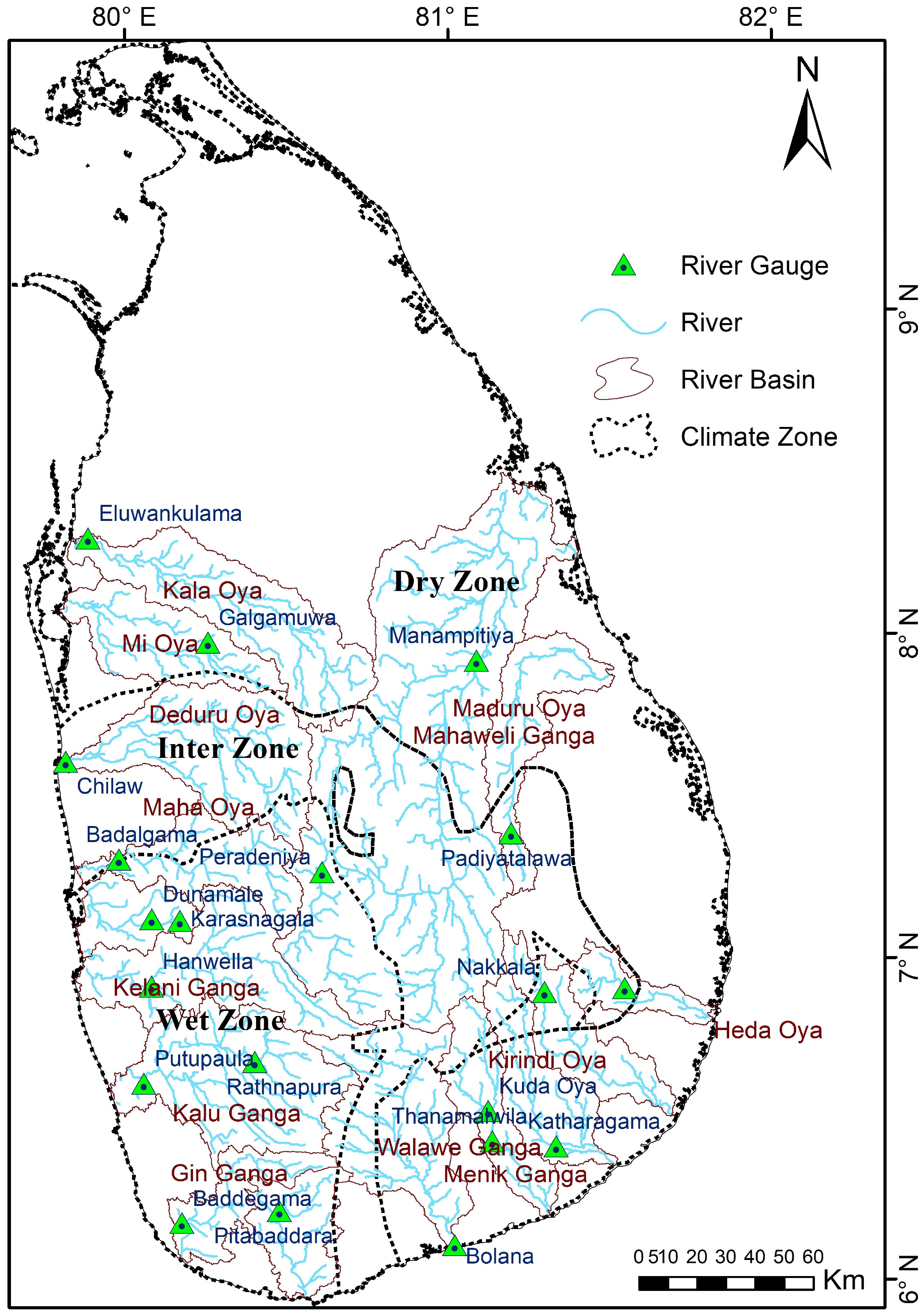
| River Basin | Station Name | Mean Daily Discharge (m3) | Catchment Area (km2) | Climate Zone |
|---|---|---|---|---|
| Kalu | Rathnapura | 45.46 | 603 | Wet |
| Putupaula | 173.73 | 2598 | Wet | |
| Kelani | Hanwella | 88.97 | 1782 | Wet |
| Gin | Baddegama | 66.3 | 749 | Wet |
| Nilwala | Pitabaddara | 16.03 | 310 | Wet |
| Walawe | Bolana | 18.37 | 2432 | Dry |
| Kirindi Oya | Kuda Oya | 3.59 | 291 | Dry |
| Thanamalwila | 8.07 | 749 | Dry | |
| Menik Ganga | Katharagama | 7.38 | 787 | Dry |
| Kumbukkan Oya | Nakkala | 8.6 | 216 | Intermediate |
| Heda Oya | Siyambalanduwa | 4.18 | 295 | Intermediate |
| Kala Oya | Eluwankulama | 3.75 | 2532 | Dry |
| Maduru Oya | Padiyatalawa | 4.62 | 159 | Intermediate |
| Mahaweli Ganga | Peradeniya | 49.48 | 1168 | Wet |
| Manampitiya | 94 | 7418 | Dry | |
| Mi Oya | Galgamuwa | 2.18 | 299 | Dry |
| Deduru Oya | Chilaw | 76.54 | 2608 | Intermediate |
| Maha Oya | Badalgama | 42.41 | 1360 | Wet |
| Attanagalu Oya | Dunamale | 8.49 | 153 | Wet |
| Karasnagala | 6.18 | 54 | Wet |
| River Basin | Station Name | EWI | River Basin | Station Name | EWI |
|---|---|---|---|---|---|
| Kalu | Rathnapura | 0.816 | Heda Oya | Siyambalanduwa | 0.485 |
| Putupaula | 0.720 | Kala Oya | Eluwankulama | 0.365 | |
| Kelani | Hanwella | 0.727 | Maduru Oya | Padiyatalawa | 0.373 |
| Gin | Baddegama | 0.785 | Mahaweli Ganga | Peradeniya | 0.906 |
| Nilwala | Pitabaddara | 0.715 | Manampitiya | 0.485 | |
| Walawe | Bolana | 0.374 | Mi Oya | Galgamuwa | 0.479 |
| Kirindi Oya | Kuda Oya | 0.575 | Deduru Oya | Chilaw | 0.508 |
| Thanamalwila | 0.668 | Maha Oya | Badalgama | 0.550 | |
| Menik Ganga | Katharagama | 0.492 | Attanagalu Oya | Dunamale | 0.690 |
| Kumbukkan Oya | Nakkala | 0.618 | Karasnagala | 0.647 |
| EWI Range | Category | Hydrological Interpretation |
|---|---|---|
| EWI < 0.45 | Low extractable water potential | Rivers with limited reliable extraction due to low flows or high variability |
| 0.45 < EWI < 0.60 | Moderate potential | Extraction possible but requires management and seasonal regulation |
| 0.60 < EWI < 0.75 | Good potential | relatively stable flows allowing moderate water extraction |
| EWI ≥ 0.75 | High potential | high flow reliability and favorable conditions for water withdrawal |
Disclaimer/Publisher’s Note: The statements, opinions and data contained in all publications are solely those of the individual author(s) and contributor(s) and not of MDPI and/or the editor(s). MDPI and/or the editor(s) disclaim responsibility for any injury to people or property resulting from any ideas, methods, instructions or products referred to in the content. |
© 2026 by the authors. Licensee MDPI, Basel, Switzerland. This article is an open access article distributed under the terms and conditions of the Creative Commons Attribution (CC BY) license.
Share and Cite
Iresh, A.D.S.; Athapattu, B.C.L.; Fernando, W.C.D.K.; Obeysekera, J.T.B.; Rathnayake, U. Extractable Water Index (EWI): Towards a Universal Metric for Sustainable River Extraction. Water 2026, 18, 707. https://doi.org/10.3390/w18060707
Iresh ADS, Athapattu BCL, Fernando WCDK, Obeysekera JTB, Rathnayake U. Extractable Water Index (EWI): Towards a Universal Metric for Sustainable River Extraction. Water. 2026; 18(6):707. https://doi.org/10.3390/w18060707
Chicago/Turabian StyleIresh, Attidiyage Don Shashika, Bandunee C. L. Athapattu, W. C. D. Kumari Fernando, Jayantha T. B. Obeysekera, and Upaka Rathnayake. 2026. "Extractable Water Index (EWI): Towards a Universal Metric for Sustainable River Extraction" Water 18, no. 6: 707. https://doi.org/10.3390/w18060707
APA StyleIresh, A. D. S., Athapattu, B. C. L., Fernando, W. C. D. K., Obeysekera, J. T. B., & Rathnayake, U. (2026). Extractable Water Index (EWI): Towards a Universal Metric for Sustainable River Extraction. Water, 18(6), 707. https://doi.org/10.3390/w18060707