Article

Re-Evaluation of Groundwater Flow Systems in Sedimentary Basin Based on Wide Range of Environmental Tracers, Hydrostratigraphy, and Field Measurements


1
Faculty of Science, Charles University, Albertov 6, 128 00 Prague, Czech Republic
2
Czech Geological Survey, Klárov 3, 118 00 Prague, Czech Republic
*
Author to whom correspondence should be addressed.
Water 2026, 18(6), 683; https://doi.org/10.3390/w18060683
Submission received: 20 February 2026 / Revised: 10 March 2026 / Accepted: 12 March 2026 / Published: 14 March 2026
(This article belongs to the Section Hydrogeology)

Highlights

What are the main findings?
  • It is essential to verify the flow and hydrostratigraphy even in seemingly well-known systems.
  • Aquifers redefined based on well logging and water table in screened intervals of wells.
  • Groundwater residence time derived from wide suite of tracers (3H, CFCs, SF6, 39Ar, 14C).
  • Groundwater mixing in individual flow systems quantified based on environ-mental traces.
  • Multi-proxy approach is essential to verify conceptual models of groundwater flow.
What are the implications of the main findings?
  • Refined hydrostratigraphy improves conceptual model of groundwater flow.
  • Knowledge gained enables protection of high-quality groundwater resources.
  • Improved hydrostratigraphy prevents hydraulic short-circuiting in well design.

Abstract

This study re-evaluates the hydrogeological framework of the Bohemian Cretaceous Basin (Czech Republic), where preliminary surveys unexpectedly identified old groundwater in several springs and abstraction wells. Traditional distinction into a Cenomanian (A) and a single Turonian (C) aquifer failed to explain the observed hydraulic head discrepancies and the occurrence of old groundwater. By integrating the spatial correlations of hundreds of well logs with hydraulic head data, environmental tracers (chemistry, 2H, 3H, 13C, 14C, 18O, 39Ar, 85Kr, CFCs, SF6, and noble gases), and field measurements, we objectively delineated the hydrostratigraphic architecture of the basin. The results demonstrate three distinct aquifers (A, Ca, and Cb), challenging long-standing interpretations. Several flow systems were identified, with mean residence times of the old water exceeding 300 years. The hydrogeochemical and isotopic evidence confirmed mixing of Holocene groundwater between Ca and Cb aquifers while excluding Last Glacial Period fossil groundwater that is typical of the A aquifer. These findings highlight the necessity of a multi-proxy approach to validate conceptual models in seemingly “well-understood” regions. The newly characterized subdivision of Turonian aquifers is critical for protecting old groundwater resources, optimizing the design of geothermal and water supply wells to prevent hydraulic short-circuiting, and identifying previously unrecognized groundwater resources currently discharging to the Jizera River.

1. Introduction

Groundwater supplies 20–23% of all water used in the EU and globally [1,2], and it represents a far more stable resource than surface water due to its resistance to climate variability and pollution [3]. Sedimentary basins are key groundwater reservoirs. Unlike hard-rock (crystalline) environments, they feature extensive aquifers, allowing groundwater to be extracted from wide area around wells, making it possible to supply water to large cities [4].
Groundwater flow systems are traditionally defined based on knowledge of the groundwater table in wells [5]. Understanding the boundaries and extent of individual flow systems is essential for estimating groundwater resources and, consequently, their exploitable volumes.
Environmental tracers are widely used in sedimentary basins to investigate groundwater flow systems, residence times, recharge conditions, and hydraulic connectivity across multiple spatial and temporal scales. Due to laterally extensive aquifer–aquitard successions within sedimentary basins, tracer methods provide critical information that cannot be derived from hydraulic data alone [6]. For instance, stable isotopes of water (δ2H, δ18O) are routinely applied to identify recharge sources, paleoclimatic signals, and mixing between groundwater bodies, while radioactive isotopes such as tritium and radiocarbon are used to constrain groundwater ages ranging from years to tens of thousands of years [7,8,9]. In addition, dissolved noble gases and other temperature-dependent tracers enable reconstruction of recharge temperatures and paleohydrological conditions, which is particularly relevant in confined basin aquifers [10]. Geochemical tracers, including major ions, trace elements, and isotopic systems, further support the identification of flow paths, water–rock interaction processes, and vertical leakage across aquitards.
Groundwater with long residence times typically contains low levels of modern anthropogenic contaminants. Prolonged subsurface residence leads to delayed or muted responses to recent pollution inputs [11,12]. Defining the flow systems of such groundwater resources is therefore crucial for their effective protection, e.g., against hydraulic short-circuiting with shallower groundwater bodies caused by drilling of geothermal wells.
The Bohemian Cretaceous Basin (hereafter BCB) is by far the most important sedimentary basin in the Czech Republic from a water supply perspective, providing groundwater to Prague and several other cities [13,14,15]. The hydrogeology of the basin has been studied for more than a century, and its substantial groundwater resources were intensively utilized, mainly between 1914 and the 1990s.
For many decades, aquifers and flow systems in the BCB appeared to be set permanently and were largely unquestioned. However, around 2015, it was recognized that old groundwater (several springs and abstraction wells with tritium levels indicating residence time over 60 years) occurs within recent groundwater flow systems in the western part of the BCB, contradicting the conceptual model of aquifers generally accepted at that time. To explain this surprising finding, an extensive environmental tracer study was initiated, supported by complementary techniques. Moreover, the hydrostratigraphy of the BCB has so far been based primarily on manual description of borehole cores. In the study area, more than one aquifer may be present in Turonian rocks, as groundwater tables in some wells were observed at considerably higher positions than neighboring ones.
The major objective of this study is to re-evaluate the hydrostratigraphy and groundwater flow systems within the Turonian strata in the BCB and to explain the coexistence of young and old groundwaters in the study area, which host large water supply systems.
In order to reach this objective, the following tasks were undertaken: (1) redefinition of aquifers and aquitards in the Turonian strata based on well logs and groundwater tables in wells with known screened intervals; (2) location and quantification of groundwater inflows into streams and delineation of gaining and losing stream segments; (3) characterization of facies in Turonian aquifers based on spring discharge, groundwater chemistry, and electrical conductivity; (4) determination of mean residence time of groundwater flow systems; (5) determination of recharge altitude and relationships between groundwaters based on stable isotopes and chemistry; and (6) delineation of flow systems based on synthesis of all available data, including groundwater table and discharge measurements.

2. Materials and Methods

2.1. Study Area

The Bohemian Cretaceous Basin (BCB) is the largest sedimentary basin in the Czech Republic, covering an area of approximately 14,600 km2. The basin originated as a shallow marine strait, formed by reactivation of northwest-trending basement faults [16], as part of the Late Mesozoic tectonic inversion in Central Europe [17]. Most of the sediments were deposited in a narrow epicontinental seaway connecting the Boreal Sea with the Tethys Ocean [18]. The Lausitz Block to the northwest represented the principal source of siliciclastic material supplied to the basin ([15], and references therein).
Sedimentary deposition extended from the Cenomanian, at least, to the Santonian [19]. The preserved sedimentary fill varies in thickness, mostly between 200 and 400 m, but reaches a maximum thickness of approximately 800–1000 m in the basin depocenters [16]. The basin fill is dominated by siliciclastic lithologies, with sandstones prevailing, accompanied by calcareous sandstones, sandy limestones, marls, claystones, and siltstones [14]. Quartz is the dominant mineral phase in the BCB, followed by calcite [20].
Aquifers in the BCB have traditionally been interpreted as being formed predominantly by quartz-rich sandstones [21,22], with groundwater flow controlled by primary intergranular porosity and fractures. However, recent studies have demonstrated that calcareous sandstones and thin sandy limestone interbeds can locally develop karst porosity and enhanced permeability due to carbonate dissolution, allowing significant groundwater flow through dissolution-enlarged fractures and conduits [14,15]. These findings indicate that aquifer architecture in the basin is more complex than previously assumed.
In hydrogeology, three facies are historically distinguished in the Turonian rocks of the BCB [23]: proximal, transitional, and distal, each exhibiting distinct hydrogeological properties. The proximal facies consist of coarse-grained quartz sandstone, forming delta bodies [16,24]. Springs here typically have medium yields, not exceeding several L/s. The transitional facies also contain, besides quartz sandstones, calcite-cemented sandstones and sandy limestones, where dissolution processes create karst conduits, giving rise to large springs with yields ranging from tens to over 100 L/s [14,15]. The distal facies consist of marlstones and claystones and are characterized by only small springs and a high surface stream density. Aquifers are traditionally designated in the BCB from bottom to top using alphabetical labels (A—Cenomanian, B—Lower Turonian, and C—Middle and Upper Turonian). The most important for water supply is aquifer C, which contains 52% of the groundwater resources of the BCB [25].
The study area, with a total extent of approximately 1600 km2, is located 50 km north-northeast of Prague, Czech Republic, between the towns of Mělník, Mladá Boleslav, and Liberec. It lies at an altitude ranging from 200 to 600 m above sea level (m a.s.l.), though the orographic catchment at crystalline rocks can reach an altitude of 1012 m a.s.l. The average annual precipitation and air temperature are 550–800 mm and 7–10 °C, respectively. The average annual groundwater recharge is 1–6 L/s/km2 [26,27].
Before the start of this study, the conceptual model of groundwater flow that had been accepted for several decades was as follows. Two aquifers, A and C, were historically distinguished in the study area. Aquifer C was delineated partly arbitrarily, based on manual description of borehole cores and the general assumption that coarse sandstones are more permeable than other rocks and form aquifers. This conceptual model was questioned by Hynie [23], who demonstrated that the largest springs are not located in coarse quartz sandstones but rather in finer lithologies containing calcite. However, his findings were largely overlooked. The Cenomanian aquifer A is recharged only in a few km wide strip in the north, along the Lusatian Fault, which is at least 10–15 km away from the boundaries of the study area. Groundwater in aquifer A flows slowly, predominantly southwards, towards the Elbe River, where it is discharged. The water exhibits long residence times (up to 30 ka) according to 14C and 4He, and has a specific isotopic and chemical composition. Particularly in the northern infiltration area, the total mineralization is markedly low (up to 0.2 g/L) [25,28,29].
The Turonian aquifer C was long assumed to contain predominantly young groundwater (with clearly measurable, non-zero tritium values). However, a large hydrogeology project (hereafter called Rebilance) that focused on BCB, conducted from 2010–2015, showed that, out of more than three hundred tritium measurements across the entire Bohemian Cretaceous Basin, tritium-dead waters were almost exclusively found in aquifer A. The only prominent exception was the present study area, where several objects (springs as well as several abstraction wells) exhibited zero or very low tritium concentrations, even for water that could not have originated from aquifer A. Therefore, in addition to young waters, old groundwater also occurs in the Turonian in the studied area, suggesting the existence of multiple independent flow systems that could not be explained by the conceptual model that had been accepted at that time.
The study area contains a number of groundwater abstraction wells for drinking water supply, sometimes of exceptionally high quality. The largest concentrated withdrawals occur in the Řepín and Bělá well fields (≈360 and 200+ L/s, respectively), which together are capable of supplying drinking water to more than 300,000 people. Since preliminary studies indicated that a substantial portion of this water contains old groundwater, it is essential to better constrain the recharge areas and determine the water residence time.
Several surface streams flow through the study area. The two most significant are the Jizera River, forming the eastern boundary of the area, and the Elbe River, which defines the western boundary; south of the study area, the Jizera flows into the Elbe. The northern portion is drained by the Ploučnice River and its tributaries. Other important streams are the Košátecký potok (“potok” is a Czech term for creek; hereafter abbreviated as “p.”), Liběchovka, and Pšovka within the Elbe catchment, and the Strenický p., Bělá, and Zábrtka within the Jizera catchment.

2.2. Determining the Hydrostratigraphy

The hydrostratigraphy (i.e., the division of flow systems into individual aquifers) was established based on groundwater table levels measured in wells, including their screened intervals, and on well log data obtained from the Geofond database [30]. Within the study area, the elevations of surfaces separating the individual Cenomanian and Turonian genetic sequences (CEN, TUR1-5) were determined based on resistivity and gamma-ray well logs at 130 wells, following Uličný et al. [16] and using an updated regional dataset of elevations of sequence bounding surfaces made available by D. Uličný and L. Špičáková.
A total of 862 wells with groundwater table data were classified into individual genetic sequences (hydrostratigraphic horizons) based on the altitude of their screened intervals. Genetic sequences exhibiting similar groundwater levels in a given location were interpreted as belonging to a common aquifer, whereas sequences showing significant groundwater-level differences were interpreted as being separated by aquitards. This approach enabled a redefinition of aquifers and aquitards based on objective data.
Based on abrupt changes in the elevation of genetic sequence bases, uplifted rock blocks were delineated. The courses of basic dykes were derived from geological maps [31] and complemented by additional lineaments identified from lidar-based digital elevation models (DMR 5 G; [32]).

2.3. Identification of Gaining and Losing Streams Using Thermometry and Conductometry

During winter, under freezing conditions, water temperature and electrical conductivity (EC) were measured along all streams in the study area to identify and locate major springs and groundwater inflows. Stream segments with large inflows and segments without inflows were delineated. EC values of springs and streams helped to determine the source lithology, with low EC indicating quartz sandstones, and higher EC indicating rocks with calcareous cement.
Gaining stream segments were delineated based on increases in water temperature associated with groundwater inflow and by downstream increases in discharge. Stream segments marked as losing showed no detectable inflows during thermometric surveys, exhibited stable or decreasing discharge downstream, and often had water levels above the groundwater table in the surrounding aquifer.

2.4. Discharge Measurements by Tracer Dilution Method

The tracer dilution method was used to measure the discharge in the study area [33,34]. A weighted amount of NaCl dissolved in water was injected from a bucket across the stream, proportionally to the distribution of flowing water within individual streamlines. Downstream of the injection line, typically within a distance of up to 120 m, four EC meters (Cond 3310; WTW, Weilheim, Germany) were deployed across the stream. EC was recorded at 5 s intervals to capture background values, and the subsequent increase above the background value caused by the NaCl injection. The relationship between EC and NaCl concentration was established by calibration.
At each measurement profile, two or three NaCl injections were performed. With four EC meters deployed at a single profile, this resulted in 8 or 12 independent discharge estimates per profile (for each EC meter and injection). For each profile, the mean discharge and standard deviation were calculated.

2.5. Hydrochemistry and Environmental Tracers

For the purpose of delineating groundwater flow systems, and for determining the origin and residence time of groundwater in the study area, samples were collected for subsequent hydrochemical and isotopic analyses.

2.5.1. Sampling and Field Measurements

Most of the sampled wells were water supply wells, equipped with submersible pumps and subjected to intensive pumping. For monitoring wells, three well volumes were pumped out prior to sampling, using a submersible pump. Groundwater was collected through a plastic tube tightly connected to the valve, taking care to prevent any contact with air during gas tracer sampling. For gas tracer sampling from streams and springs, samples were collected using a submersible pump.
In the field, the basic physicochemical properties of water were measured: EC using a Cond 3310 with the TetraCon probe (WTW, Weilheim, Germany), with values normalized to 25 °C; dissolved oxygen using a Multi 3630 IDS with the Optical IDS sensor FDO 925 (WTW, Weilheim, Germany); and pH and oxidation–reduction potential were measured using the GMH 3531 device with pH and ORP probes GE100-BNC and GR105-BNC (Greisinger, Regenstauf, Germany), respectively.
Samples for cation and anion analyses were filtered in the field through 0.45 μm cellulose Millipore membrane filters (Merck Millipore, Darmstadt, Germany) attached to a syringe, and the filtrate was stored in Nalgene bottles. Cation samples were stabilized with ultrapure nitric acid. Samples for alkalinity were not filtered.

2.5.2. Hydrochemistry Analyses

Cations were analyzed using flame atomic absorption spectrometry (FAAS), respectively, at ICP OES Prodigy7 (Teledyne Leeman Labs, Hudson, NH, USA), anions were analyzed using high-performance liquid chromatography (HPLC), respectively, at DIONEX AQUION (Thermo Fischer Scientific, Waltham, MA, USA), and alkalinity was determined by titration at the Czech Geological Survey and the T. G. Masaryk Water Research Institute. The tendency of the sampled waters to precipitate or dissolve minerals was modeled using the PHREEQC (Version 3) geochemical code [35], together with the PHREEQC thermodynamic database.
To identify the control variables, principal component analysis (hereafter PCA) was performed on chemistry data using the PAST program [36]. PCA is a multivariate statistical technique used to analyze a data table in which observations are described by several intercorrelated quantitative dependent variables. The goal is to extract important information from the table. Principal components are linear combinations of the original variables that best explain the total variance.

2.5.3. O and H Isotopes

The O and H isotopes in H2O were collected in HDPE Nalgene bottles. The stable isotope composition of oxygen (δ18O) and hydrogen (δ2H) in the water samples was determined using a Picarro L2130-i cavity ring-down spectroscopy (CRDS) analyzer (Picarro, Santa Clara, Ca, USA) at Charles University, Prague. The instrument was calibrated with internationally recognized reference standards (VSMOW, SLAP, and GISP). The results are reported in δ notation (‰), relative to the Vienna Standard Mean Ocean Water (VSMOW). The analytical error was ±0.03‰ for δ18O and ±0.09‰ for δ2H.

2.5.4. NGT Analysis

Air temperature during infiltration, used as proxy data for identifying infiltration location and/or period of recharge, was determined using the Noble Gas Temperature (NGT) method, based on measuring concentrations of dissolved noble gases (Ar, Ne, Kr, Xe, and He) in water. Because noble gas solubility is temperature dependent, air temperature at the time of infiltration can be reconstructed from the measured concentrations (for details, see, e.g., [37]).
Sampling was carried out using copper tubing, following the established USGS dissolved gas sampling protocols [38]. Copper tubes were connected to the sampling object using transparent hoses, ensuring the absence of air entrainment and visible air bubbles. Water was flushed through the system under reduced outlet flow to prevent degassing, after which the copper tubes were sealed with metal clamps and isolated from the atmosphere to avoid gas exchange. Noble gases were extracted using a high-vacuum method, and then purified and separated by cryogenic techniques at the Dissolved Gas Laboratory, University of Utah (USA). Helium was measured on a Thermo Scientific Helix SFT (Thermo Fischer Scientific, Bremen, Germany), and the heavy noble gases were measured using a quadrupole mass spectrometer (Hiden Analytical, Warrington, UK).

2.5.5. 13C Analysis

The sampling bottles used for stable C isotopes of dissolved inorganic carbon (DIC) were turned upside down, and an excess of BaCl2 and NaOH solution was injected through the bottle cap to prevent any CO2 loss. Dissolved and gaseous CO2 reacted to form BaCO3, which was then promptly vacuum-filtered (4 μm) and rinsed with cooled, previously boiled, distilled water to remove any unreacted BaCl2 and NaOH. The precipitate was dried at room temperature and ground to analytical fineness. BaCO3 was decomposed with 100% H3PO4 under vacuum, and the C isotopic composition of the released CO2 was measured using a Thermo Finnigan Delta V mass spectrometer at the laboratories of the Czech Geological Survey (Prague). δ13C values are reported relative to the Vienna Pee Dee Belemnite (VPDB), with an analytical error of ±0.1‰.

2.5.6. Radiocarbon Dating

Precipitates of BaCO3 were prepared in an identical way with the 13C procedure. Samples for 14C were analyzed by accelerator mass spectrometry. Graphitized samples were measured on the MICADAS AMS system (Ionplus, Dietikon, Switzerland) at the DeA site (Atomki, Debrecen, Hungary). Graphites prepared from NIST secondary oxalic acid (NBS) HOX II, SRM 4990-C [39], and from fossil phthalic anhydride were measured alongside the samples. AMS data were processed using BATS software [40], including background correction, fractionation correction using the AMS-measured δ13C value, and normalization to HOX II standards. External uncertainties associated with laboratory sample processing were included in the total combined uncertainty. Measured 14C activities and their combined uncertainties were expressed as percent modern carbon (PMC). The combined uncertainties reported for conventional radiocarbon ages correspond to a probability of approximately 68% [41]. The initial activity A0 was determined by default using the Pearson model and subsequently verified using the Mook and Fontes–Garnier models [42]. The input values used were δ13C −23‰ for soil CO2 and +3‰ for marine carbonates.

2.5.7. Tritium and CFC, SF6 Dating

To estimate the mean groundwater residence time, 70 samples were collected for tritium analysis. Tritium activity was measured using a TriCarb 3170 Tr/SL (PerkinElmer, Waltham, MA, USA) liquid scintillation spectrometer at Charles University, Prague. Samples were enriched by electrolysis at a 1:10 ratio. Each sample was measured in four consecutive runs of 700 min each. The standard deviation was 0.6 tritium units (TU), and the tritium activity was corrected to the sampling date.
CFC-11, CFC-12, and CFC-113, as well as SF6, were analyzed at Spurenstofflabor (Wachenheim, Germany) using purge-and-trap gas chromatography with an electron capture detector. Two replicate samples were taken in special glass bottles within a metal container. The concentrations of CFCs and SF6 were determined by gas chromatography following the standard method [43].

2.5.8. 39Ar and 85Kr Dating

Groundwater residence time was also determined using ATTA (Atom Trap Trace Analysis), an atom-counting method for measuring dissolved 39Ar and 85Kr in groundwater [44]. The amount of 39Ar, a cosmogenic radionuclide with a half-life of 269 years, begins to decrease via radioactive decay once the water is infiltrated and is no longer in contact with the atmosphere, which allows calculation of the groundwater residence time. 85Kr, an anthropogenic radionuclide absent before 1950 and with a half-life of 10.7 years, was used as a complementary tracer to estimate the contribution of modern water [45,46].
In the field, sampled water was degassed using a groundwater degassing instrument. The instrument was tightly connected to the sampling object, water flowed through it, and the extracted gas was collected in airtight bags, with a capacity of approximately 8 L. The collected gas was subsequently purified in the laboratory, and the number of 39Ar and 85Kr atoms was measured using laser-based atom counting in a magneto-optical trap system, which allows for extremely sensitive detection at the single-atom level. Measurements were carried out at the Laser Laboratory for Trace Analysis and Precision Measurements, University of Science and Technology of China, Hefei (China). Calculations of residence time were corrected for atmospheric 39Ar/Ar ratios following [47].

2.5.9. Mean Residence Time Modeling

Based on analyses of CFCs (CFC-11, CFC-12, and CFC-113), SF6, 3H, and 39Ar, and with consideration of the results of the 85Kr and 14C analyses, the mean residence time (MRT further) of the groundwater was modeled by the lumped parameters approach [48], using the TracerLPM software (Version 1.1.0) developed by the USGS [49]. Tritium activity in precipitation from Vienna and the content of CFCs and SF6 in Northern Hemisphere air were used as model inputs [49,50].
Due to the assumption of mixing two distinct groundwater components (here referred to as young and old; see Section 2.1 for reasoning), modeling was primarily conducted using a binary mixing model, simulating the mixing of two groundwater components of different ages in quantifiable proportions. The age of the old component water was inferred from 39Ar analyses at sites where this component predominated and was always approximated using a dispersion model.
The age of the young component water was modeled at most sites using a dispersion model and, to a lesser extent, with an exponential–piston flow model, which combines exponential and piston flow characteristics; however, both approaches yielded very similar results. To achieve the best fit between the modeled tracer curves and the measured concentrations, the relative proportions of young and old water were adjusted iteratively until the highest agreement was reached.
The relative contributions of the old and young groundwater components were thus estimated for each site. For sites exhibiting binary mixing, the MRT was calculated as a weighted average of the ages of both components and their respective contributions to the total groundwater composition. At some sites, particularly springs dominated by young groundwater, the tracer data could not be adequately reproduced using a binary mixing model; these sites were therefore described using a single-component exponential model.

3. Results

3.1. Aquifers and Major Structural Features Controlling Groundwater Flow

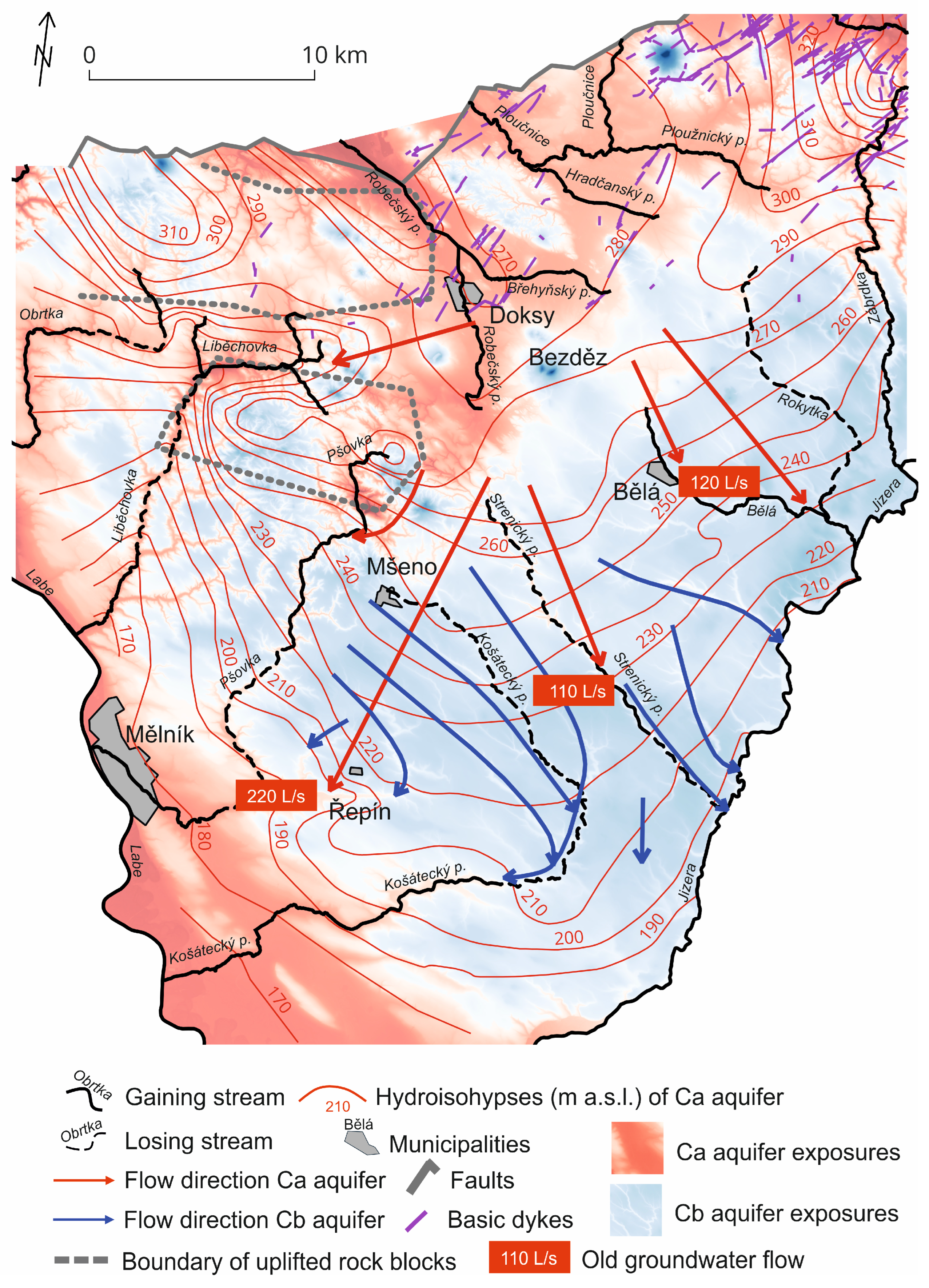
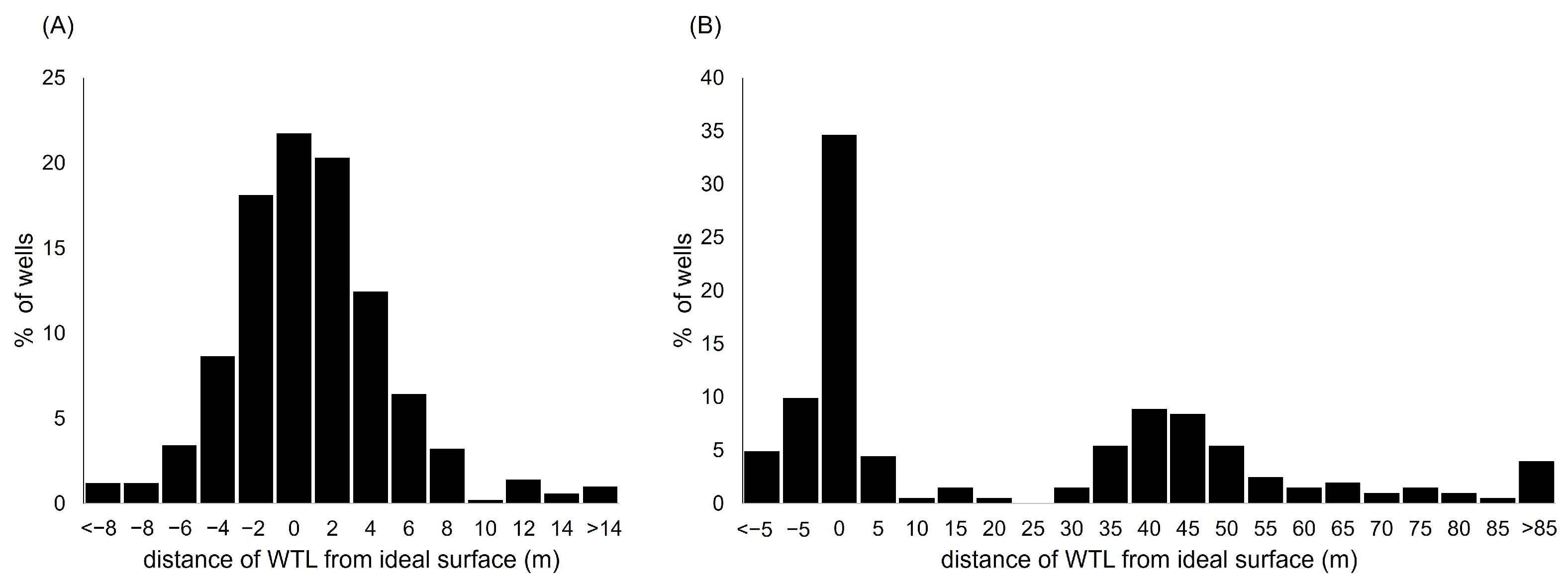
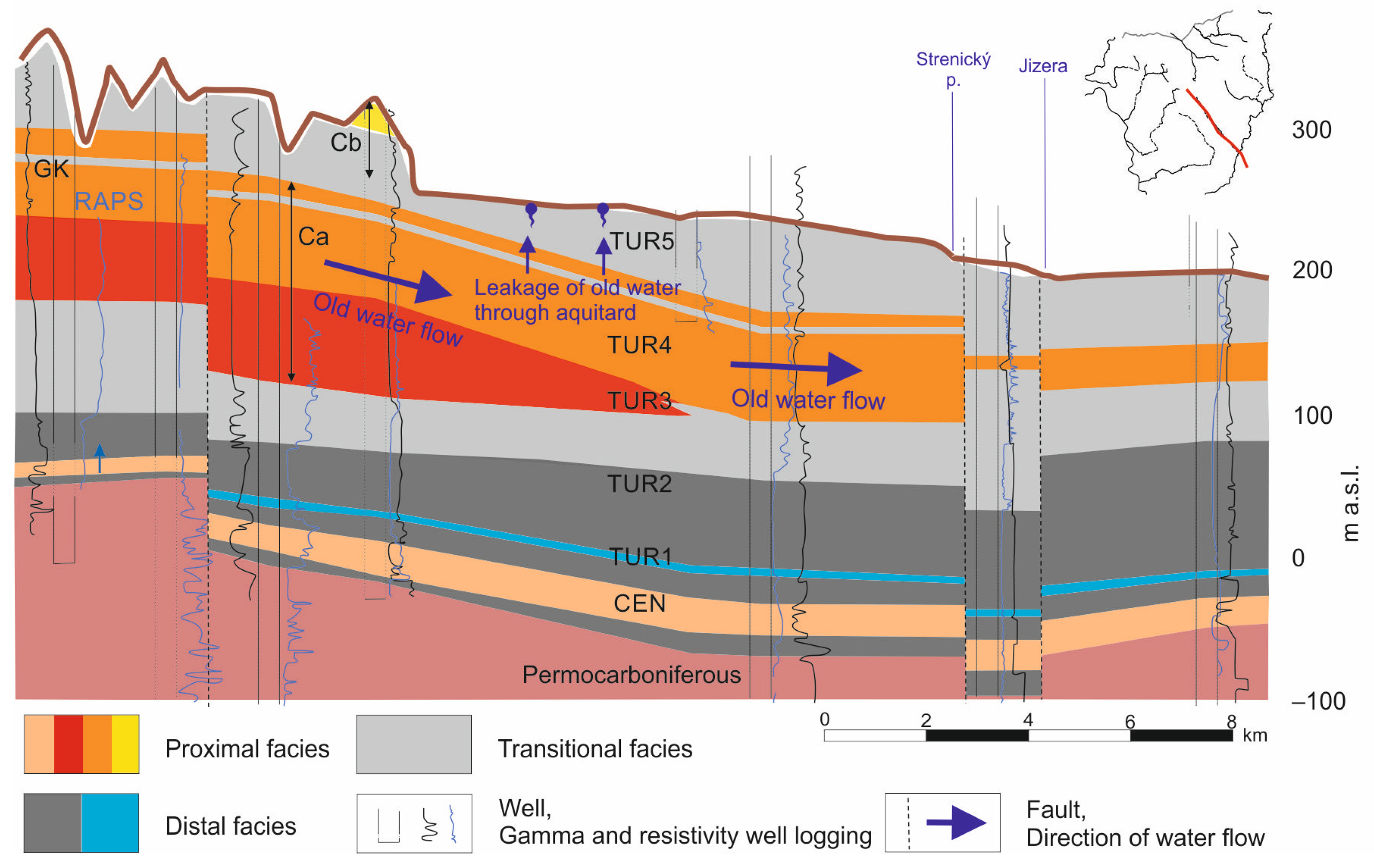
For individual Turonian genetic sequences, we tested whether groundwater table levels in wells screened within these sequences are identical in a given location, indicating that they form a common aquifer, or whether they differ, indicating hydraulically independent aquifers. Based on these criteria, three aquifers were defined in the study area. At the base lies aquifer A, developed in Cenomanian quartz sandstones with a thickness of 30–70 m. Aquifer A has been defined previously and is not the subject of this study. It is separated from the overburden by a 40–80 m thick aquitard composed of claystones and marls. Above the aquitard occurs the Ca aquifer, developed within the TUR3 and TUR4 genetic sequences, with a thickness of 140–180 m [16]. Groundwater table levels in the screened intervals of wells penetrating TUR3 and TUR4 are identical in nearby wells, indicating a common aquifer (Figure 1). It consists of coarse-grained quartz sandstones of the proximal facies, as well as fine-grained calcareous sandstones and sandy limestone interbeds of the transitional facies in the study area. Above is the Cb aquifer, developed within TUR5 and denudation relics of TUR 6 strata, which is composed of coarse-grained quartz sandstones, coarse- to fine-grained calcareous sandstones with common early diagenetic carbonate nodules, and thin layers of sandy limestones. This aquifer is present in the southern and central parts of the study area, whereas it is largely eroded in the northern part. At the base of TUR5, a leaky aquitard is present, which causes the existence of the Cb aquifer.
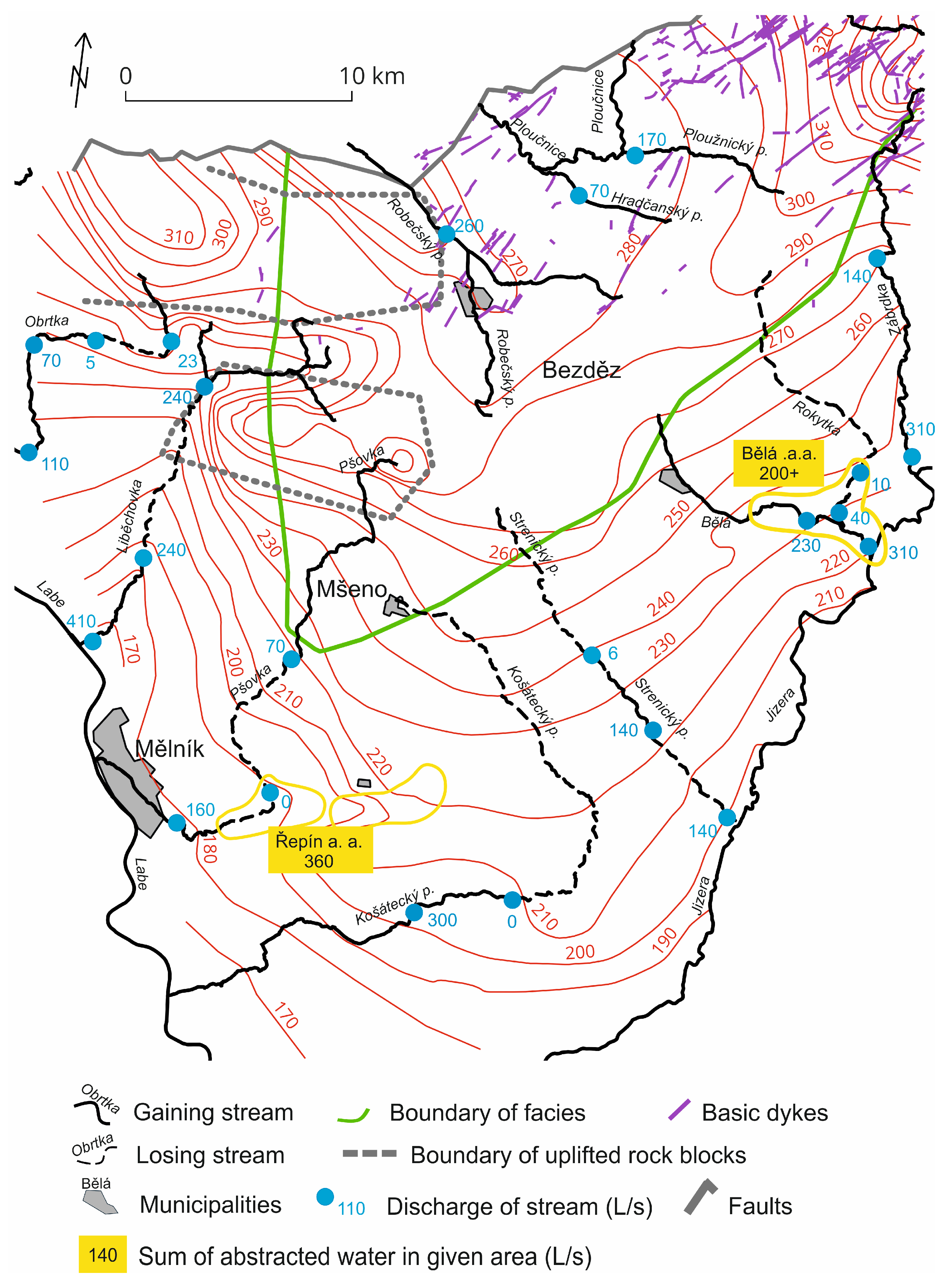
Previously, only a single Turonian aquifer was delineated in the study area [22,51]. However, this interpretation contrasted sharply with the markedly different groundwater levels observed in the Ca and Cb aquifers. The Ca aquifer is the most significant aquifer in terms of both groundwater flux and groundwater abstraction. The groundwater table in the Ca aquifer is shown in Figure 2. The groundwater table in aquifer A is on average 26 m lower than that in the Ca aquifer, except in drainage zones, where it locally exceeds the level in Ca. In contrast, the groundwater table in the Cb aquifer is generally 40–100 m above the Ca aquifer. However, where wells hydraulically connect the Ca and Cb aquifers, groundwater levels in the Cb aquifer are reduced to those of the Ca aquifer due to hydraulic short-circuiting.
Specific capacity values (L/s/m) from pumping tests obtained from the Geofond database were recalculated to coefficients of transmissivity (m2/day) following [52]. According to this classification, both the Ca aquifer (mean transmissivity 425 m2/day; n = 212) and the Cb aquifer (mean transmissivity 655 m2/day; n = 43) correspond to environments with high transmissivity magnitude on average. The transmissivity variability in the Ca aquifer is moderate (2–12,500 m2/day), whereas in the Cb aquifer it is extremely large (0.1–9300 m2/day), which is probably due to the alternation of less and more permeable (calcareous and karstified) layers within the Cb aquifer.
In the western part of the study area, two uplifted rock blocks (horsts) occur where the base of the Ca aquifer lies above the local drainage level, thereby blocking groundwater flow toward the SW (Figure 2). In the NE part of the area, several basic dykes trending NE–SW act as barriers to groundwater flow toward the southeast. Only in the central part of the study area does no geological barrier occur, and the gradually sloping base of the Ca aquifer to the SE allows groundwater to flow toward the main drainage base, represented by the low-gradient Jizera and Labe rivers (Figure 2).
The groundwater originates from an elevated area (around Bezděz) characterized by a very flat groundwater table. This is further indicated by the geometry of the water table in the Ca aquifer, which is fan-shaped, showing that a relatively large amount of groundwater flows out of this elevated area to multiple directions: toward the south, southwest, and southeast (Figure 2).

3.2. Gaining and Losing Streams

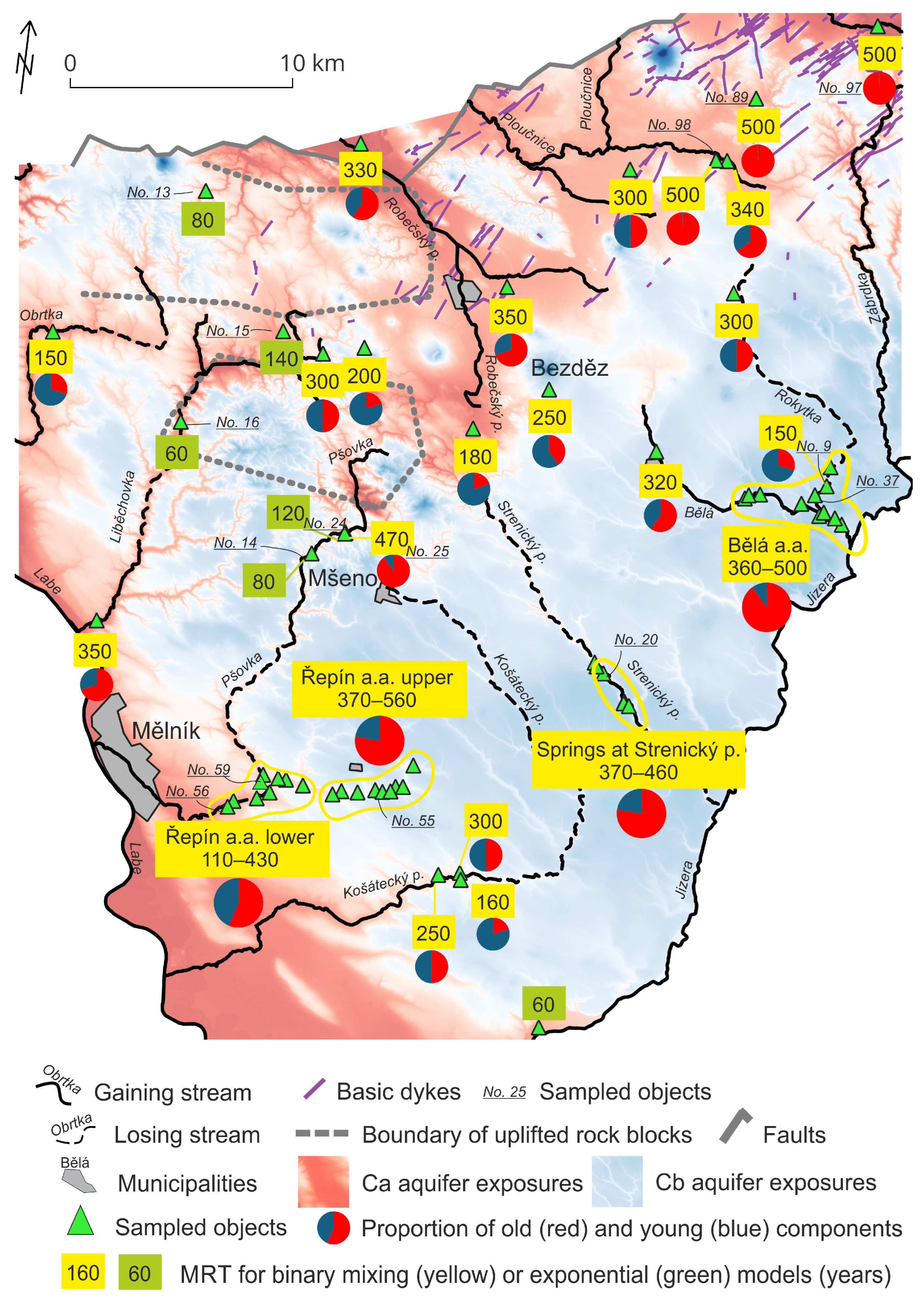
Gaining and losing segments of streams were delineated based on thermometry and conductometry. Groundwater inflows to streams are spatially irregular. There are long stream segments without any groundwater inflows and, conversely, short segments with intense groundwater inflows. An example is the Košátecký p. catchment, where the upper 22 km of the stream channel is permanently dry, while an average discharge of approximately 300 L/s occurs along the lower 5 km of the stream, supplied by large springs (Figure 2).
The alternation of gaining and losing stream segments differs among individual streams. Some streams, such as the Pšovka and Liběchovka, exhibit gaining segments in both their upper and lower sections, separated by a losing segment in the middle section. In contrast, the Strenický p. has a gaining segment only in its middle section, whereas the Košátecký p. shows a gaining segment exclusively in its lower section. Only streams in the northern part of the study area (the Ploučnice and its tributaries, the Robečský p., and the Zábrtka) show a gradual increase in discharge along their entire course.

3.3. Hydrochemistry and Isotopic Composition

For a summary of isotopic analysis results, please see Table A1 in Appendix A. For a summary including archival data from the Rebilance project, please refer to Table S1 in the Supplementary Materials.

3.3.1. Hydrochemistry Analyses

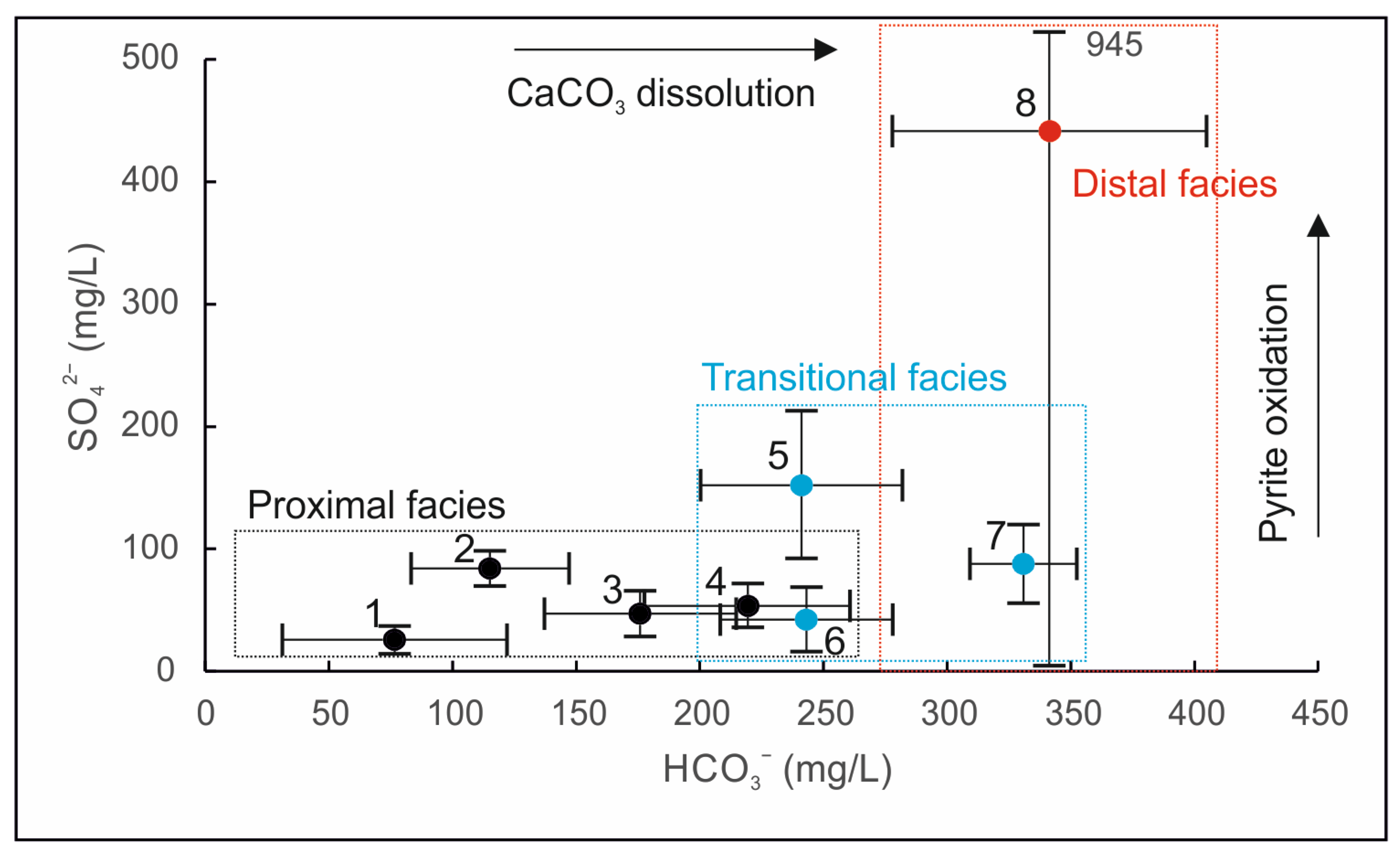
A total of 170 chemical analyses, mainly of springs from the Rebilance database, together with 59 new analyses (mainly wells), were available for the study area for Turonian aquifers. Testing correlations among individual chemical components and using the PCA analyses revealed a significant mutual correlation between two groups of ions: (1) SO4, Na, Mg, K, and Cl, and (2) HCO3, Ca. The multidimensional variability in chemical composition can therefore be largely reduced to a binary plot in which each axis represents one of these groups, i.e., SO42− and HCO3 (Figure 3), as confirmed by the PCA.
The SO42− content reflects pyrite oxidation, which releases highly soluble sulfates into groundwater. The aggressiveness generated during pyrite decomposition promotes the release of other ions, such as Na, Mg, and K from rocks into the water. The HCO3 and Ca2+ and their contents primarily reflect the carbonate content of the host rock, but they may also increase during pyrite decomposition [53]. This commonly applies to fine-grained rocks in the study area. The binary plot (Figure 3) is thus used to determine the lithological characteristics of rocks within the groundwater flow system sampled and whether these rocks fall into proximal or transitional facies.
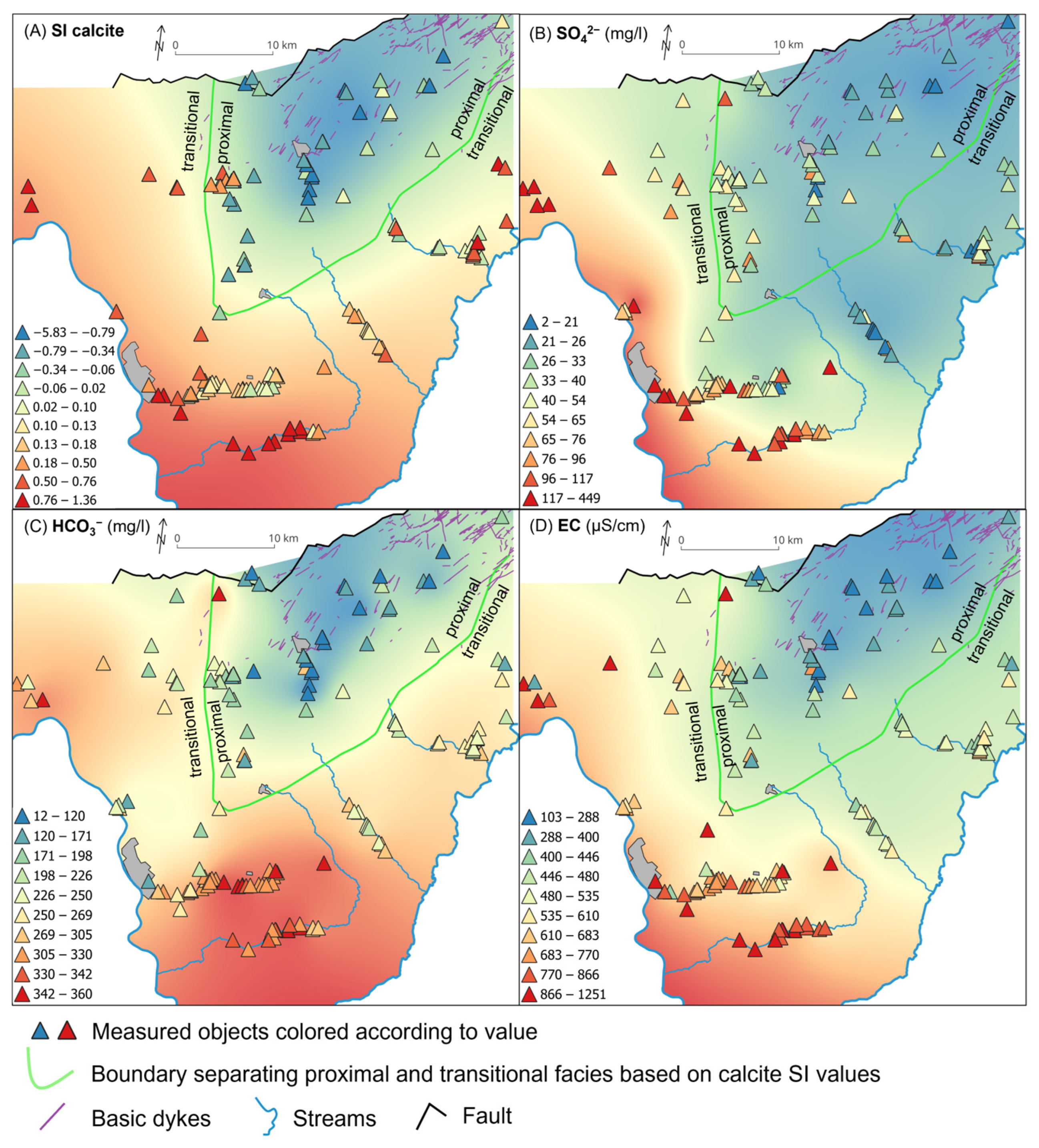
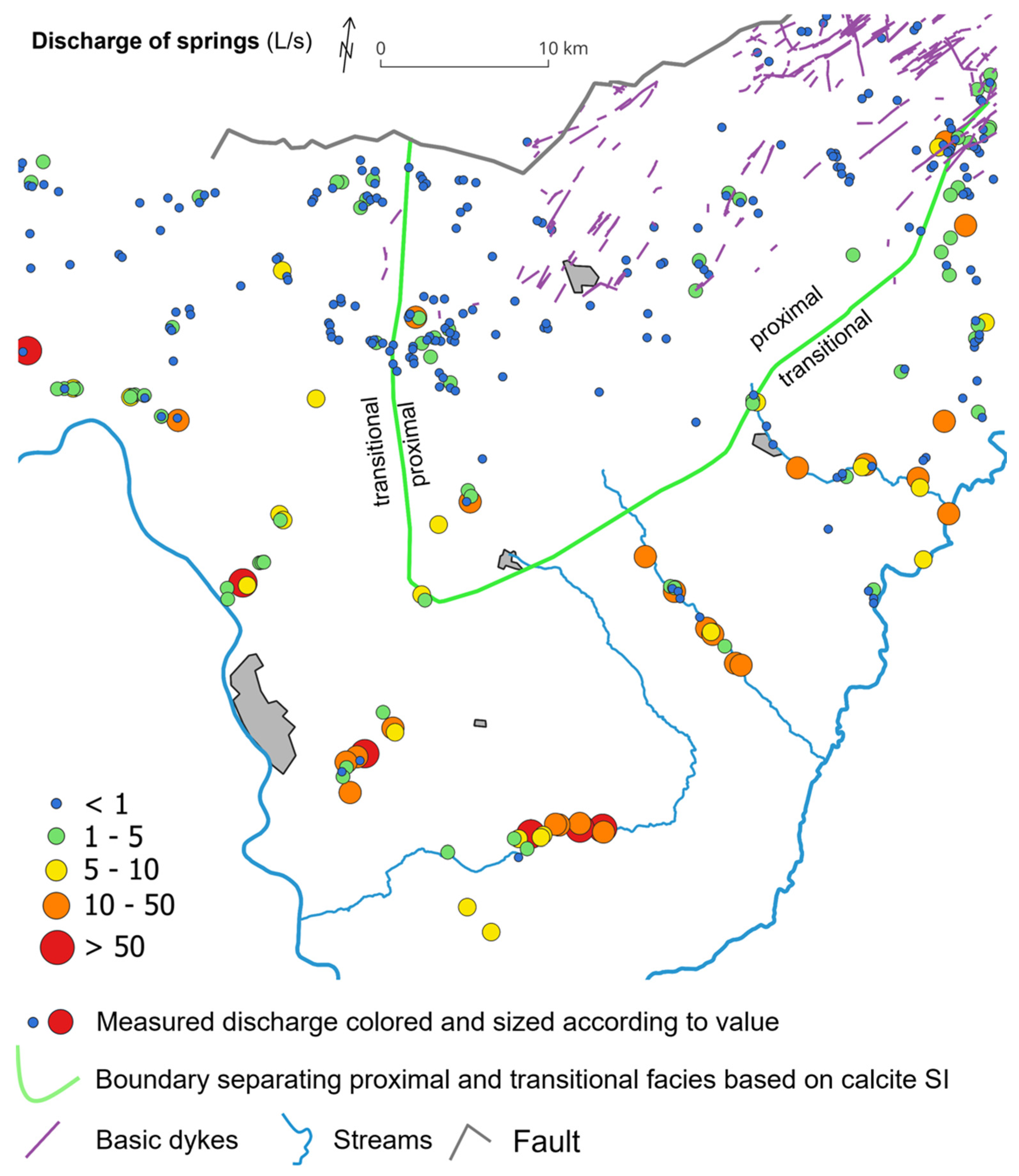
Saturation indices with respect to calcite were calculated from all chemical analyses and pH using PHREEQC software. As the calcite dissolves rapidly, undersaturation with respect to calcite strongly indicates that rocks within the flow system of a given sample are generally carbonate-free. In the study area, this corresponds to proximal facies of quartz sandstone (further, proximal facies) lacking carbonate cement, nodules, or interbeds. Based on these saturation index (SI) results, the study area can be roughly divided into two zones: in the N to NE, negative indices (≤−0.2) indicate clearly calcite undersaturation, corresponding to proximal facies with lack of carbonates; in the S to SW and SE parts, indices >−0.2 correspond to the transitional facies (Figure 4).
The catchment of the Ploučnice River and its tributaries, as well as the upper parts of the Liběchovka and Pšovka catchments, are built by quartz sandstones of proximal facies, whereas other catchments, including the middle and lower parts of the Pšovka, Strenický p., and Košátecký p. contain carbonate cement, nodules, or interbeds (based on the SI index with respect to calcite) and are therefore classified as transitional facies. The main water supply structures of Řepín and Bělá also fall within the transitional facies, with Bělá located close to the boundary with the proximal facies.
The division based on saturation indices corresponds closely with the SO42− and especially HCO3 contents (see Figure 4A–C). Sampled objects within the proximal facies exhibit significantly lower HCO3 concentrations, up to approximately 260 mg/L, and lower SO42− concentrations, up to 100 mg/L, indicating limited CaCO3 dissolution and limited pyrite oxidation. In contrast, sites within the transitional facies show HCO3 concentrations ranging from 200 to 350 mg/L and SO42− concentrations up to 220 mg/L, reflecting substantially higher contributions of CaCO3 dissolution and pyrite oxidation (Figure 3). Similarly, the two facies can be clearly distinguished by EC measurements, with proximal facies sites showing lower values (285 ± 85 μS/cm) and transitional facies sites showing higher values (614 ± 142 μS/cm) (Figure 4D).

3.3.2. Oxygen and Hydrogen Isotopes

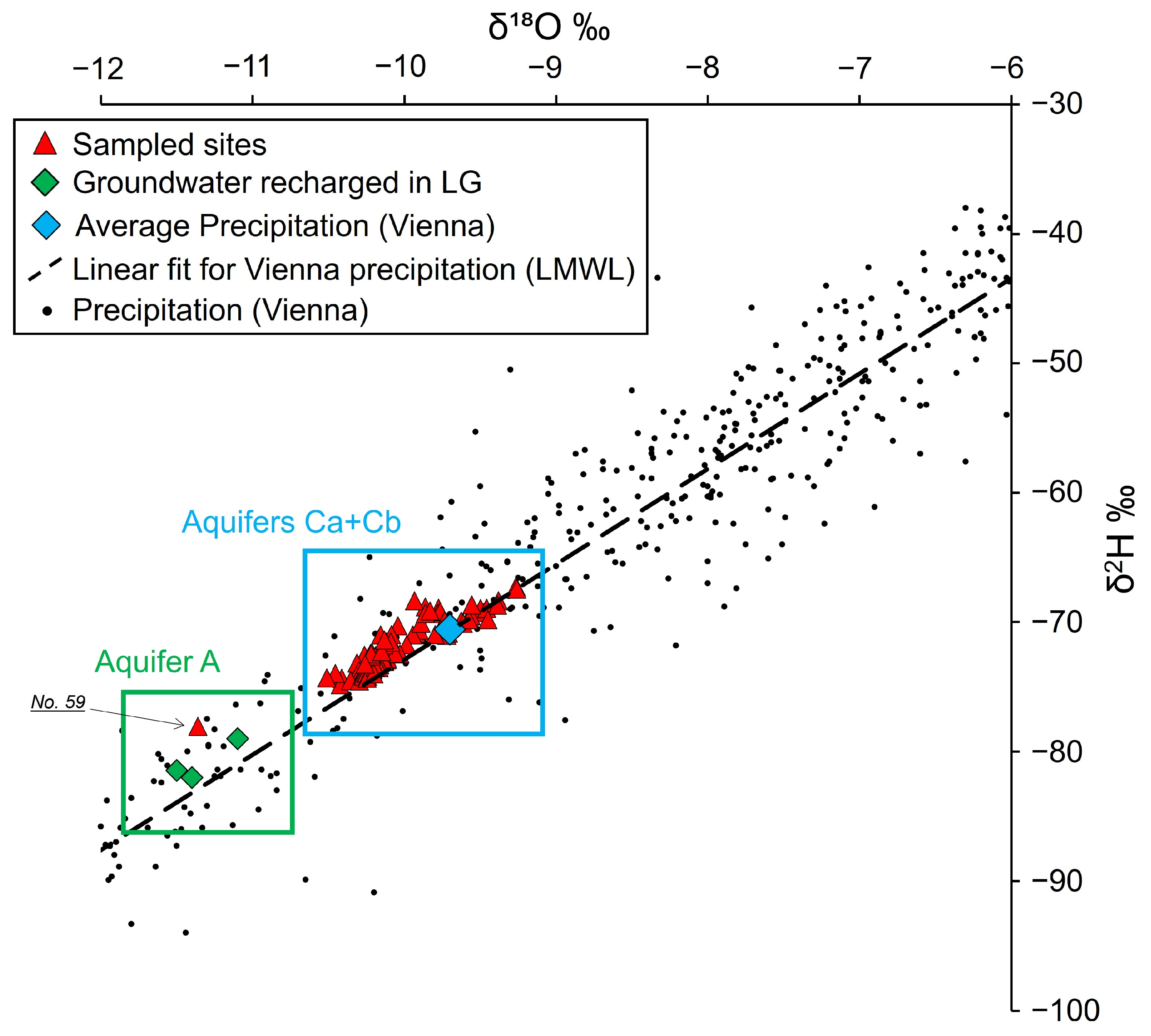
A total of 85 objects, mainly wells and springs, were sampled on stable O and H isotopes. The isotopic composition of most samples shows a very narrow range, with δ18O from −10.5 to −9.3‰ and δ2H from −74.8 to −67.3‰. An exception is deep well No. 59 in the Řepín well field, which reaches the Cenomanian aquifer A and exhibits δ18O of −11.4‰ and δ2H of −78.1‰, values that are consistent with Cenomanian waters from the glacial period reported by [22,54] (Figure 5). It therefore suggests that, with the exception of well No. 59 to Cenomanian aquifer, the other objects drain Turonian aquifers Ca and Cb, and not aquifer A, and were recharged during the Holocene. Comparison of the depletion level with the extensive Rebilance database indicates that the water originates from relatively low altitudes, clearly excluding the crystalline mountain catchments surrounding the Bohemian cretaceous basin.

3.3.3. NGT Analyses

A total of four objects from the Ca and Cb aquifers were sampled for noble gases. Three objects (well Nos. 37 and 55 from the Řepín and Bělá well fields, and spring No. 20 in the Strenický p. catchment) located in the transitional facies consistently showed calculated recharge temperatures of 8.0–8.2 °C, suggesting recharge during the Holocene and at relatively low recharge altitudes. In contrast, well No. 97 from the northeastern area in the proximal facies exhibited a temperature of 5.8 °C, suggesting either water recharged during the glacial period or rather originating from higher altitudes to the north [22].

3.3.4. 13C and 14C Analyses

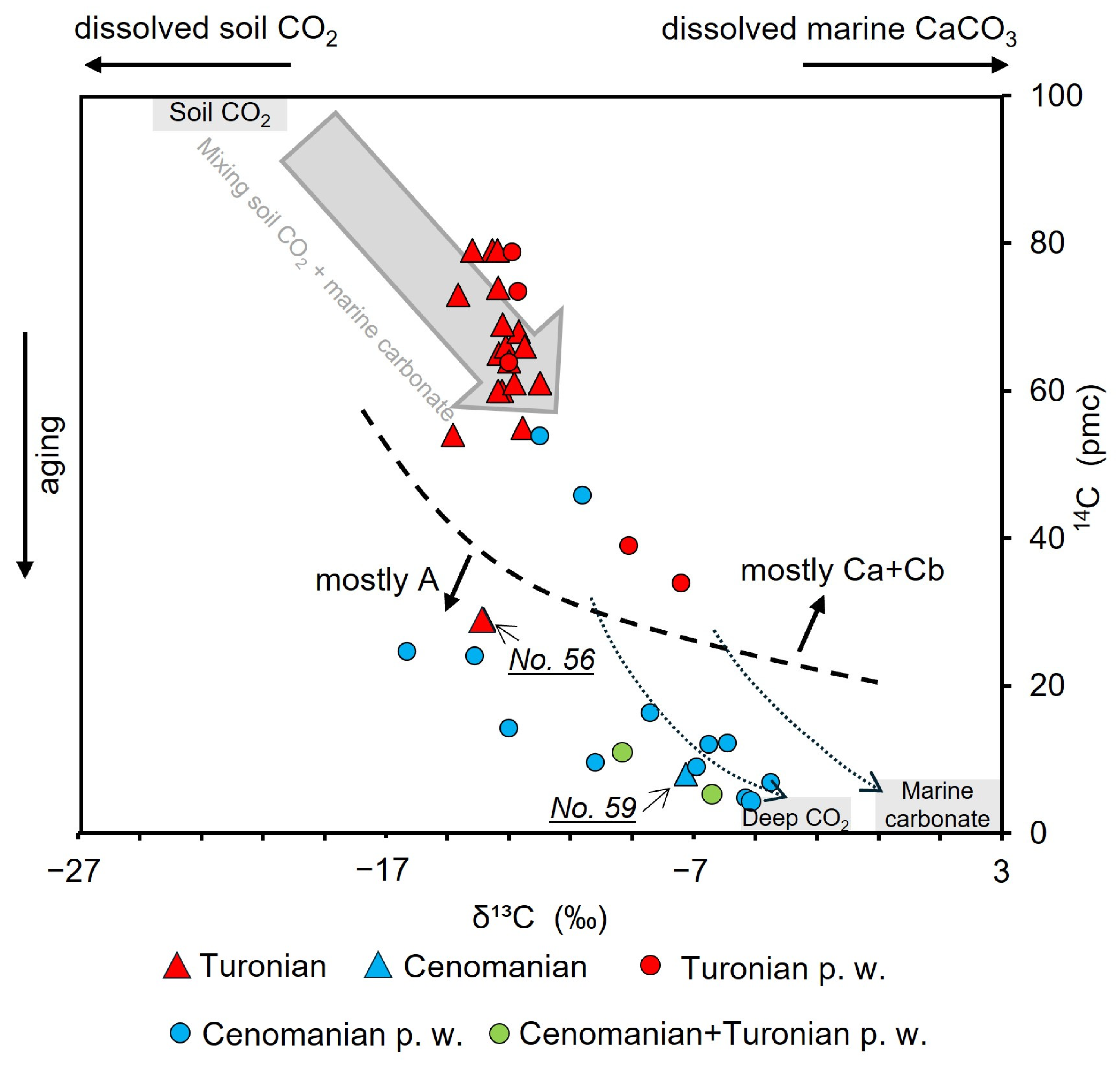
A total of 39 samples were collected for δ13C analyses in the Ca and Cb aquifers. The δ13C values range from −17.4 to −8.3‰. Samples (n = 32) from the transitional facies, characterized by a higher proportion of HCO3 (Figure 3), exhibit δ13C values ranging from −15.1 to −8.3‰ with a mean of −13.4‰. In contrast, samples (n = 7) from carbonate-poor proximal facies display δ13C values between −17.4 and −11.2‰, with a mean of −14.5‰ (Figure 6).
Less negative values (closer to zero) of δ13C indicate a higher contribution of HCO3 derived from the dissolution of marine carbonates, whereas more negative values reflect a larger proportion originating from soil CO2 dissolution. Values are significantly influenced by whether the HCO3 dissolution occurred in an open system (δ13C is then −17 to −18‰) or a closed system (−12 to −13‰ then), and whether there is an input of deep CO2, which leads to values > −12‰ [42].
Only one well, located in the proximal facies (No. 89, −17.4‰), exhibits a purely open system signature. Seven objects, five of which are in the transitional facies (Nos. 8, 36, 37, 42, and 43) and two (Nos. 25 and 99) in proximal facies, represent a purely closed system. The remaining objects exhibit values situated between the open and closed system end-members [42]. Only two wells in the Ca and Cb aquifers suggest a potential influence of deep (geogenic) CO2, both being located in the northern part of the study area, with one in the proximal facies (No. 98, −11.2‰) and the other in the transitional facies (No. 97, −8.3‰—for object location, see Figure 7).
The highest δ13C value was measured in well No. 59 (−7.3‰), in aquifer A, which clearly indicates a contribution of deep CO2 and a clear difference in 13C composition between aquifers Ca and Cb.
Radiocarbon measurements were conducted on 13 samples from the Ca and Cb aquifers. The measured activity (A) ranged from 29 to 79 pmc (percent of modern carbon). All samples were collected from the transitional facies, so comparison with proximal facies is not possible. In general, lower A values correspond to older water ages; however, this applies only if the initial 14C activity (A0) is the same for all samples. The A0 value is influenced by proportion of soil CO2 (A0 ≥ 100 pmc) and marine carbonate (A0 ≈ 0 pmc) during dissolution. This is strongly controlled by whether the system is open with respect to soil CO2 or closed [42].
When correcting for A0 using the Pearson model, most of the objects (eight out of 14) display ages on the order of several hundred to a few thousand years. Four objects show A0 values higher than the measured A, which can be explained by (i) the inadequacy of the Pearson model, which assumes a closed system with respect to soil CO2; or (ii) contamination from modern atmospheric 14C during the second half of the 20th century, when its concentrations were substantially elevated due to thermonuclear weapons testing (up to 200 pmc). As the application of alternative correction models (Mook, Fontes–Garnier) does not resolve this issue, explanation (ii) appears more plausible, particularly given that the affected objects exhibit the highest proportions of “young” water (exceeding 50%; see Section 3.3.5). Such water is commonly referred to as “modern water”. Given that the studied waters consist of multiple components with different ages, this observation is consistent with the new conceptual model, in which only a portion of the water is classified as modern water, while the older component has an age of several hundred years (see Section 3.3.5 and Section 4).
The remaining two objects display particularly higher ages. The oldest object appears to be well No. 59 (age ~13,800 years), which targets aquifer A with old groundwater [22]. The second oldest is well No. 56 (7300 years), indicating that this well may also, at least in part, drain water from aquifer A (Figure 6).
The calculations of A0 above used δ13C values of −23‰ for soil CO2 and +3‰ for marine carbonates. Because δ13C values of soil CO2 in the BCB can range down to −27‰ and those of marine carbonates from about +1 to +4.6‰ (see [21] and references therein), and neither of these end-members was measured directly in our study, the radiocarbon age calculations are highly sensitive to these parameters, particularly for young waters [9]. The following sensitivity analysis was performed. Variations in soil gas δ13C within the given range result in an average age variability of ~1200 years, whereas variations in carbonate mineral composition lead to an average age variability of ~850 years. Therefore, with the exception of well Nos. 59 and 56, the groundwater may either be all modern (one end-member scenario) or have ages ranging from several hundred to about a thousand years (the opposite end-member). Nevertheless, even when different plausible parameter values are applied, the overall interpretation remains unchanged: the Ca and Cb aquifers show characteristics of modern water or ages between a few hundred and a few thousand years, while the only distinctly older waters are in well Nos. 56 and 59, which is consistent with results from other tracers (see Section 3.3.5 and Figure 6).
Figure 6 shows that most of the studied objects fall within a very narrow range of the δ13C vs. δ14C relationship. The Ca and Cb aquifer waters plot in positions consistent with Turonian waters from previous studies. The one well from the Ca aquifer (No. 56) plots in the Cenomanian field. It is not possible to clearly determine whether the well contains a significant contribution of Cenomanian water or whether the observed values result solely from in situ aging processes in some stagnant portion of the aquifer, but second option is favored by O and H isotopic signature.

3.3.5. Mean Residence Time Modeling

Based on analyses of CFCs (CFC-11, CFC-12, and CFC-113), SF6, 3H, and 39Ar, the mean residence time (MRT) of the groundwater was modeled for 62 objects in the Ca and Cb aquifers. The results showed that, at most objects, the mean residence time is best approximated by a binary mixing model, indicating mixing of two groundwater components of different ages in a quantifiable proportion. The older component has an age of approximately 500 or 600 years. In contrast, the younger component reaches ages 5–300 (60 on average) years. For examples of model curve fitting, see the figures in Supplementary File S2.
The results indicate that the MRT at all objects with binary mixing ranges from ~100 years to more than 500 years, and the proportion of old water varies from 15% up to 99%. The average MRT of binary mixing objects in the transitional facies and the proximal facies is nearly identical (360 vs. 350 years). The transitional facies show a wider range of values than proximal facies (60–560 vs. 200–500 years, respectively), which may be caused by the different sizes of the datasets (50 objects vs. seven objects) or due to lower porosity and thus faster flow in transitional facies [14]. The highest proportions of the old component water occur in the NW part of the study area, which likely represent slowly flowing groundwater in deeper quartz sandstone zones; this pattern may also be influenced by the fact that the water was sampled from monitoring wells without long-term groundwater abstraction, unlike other objects.
In the Bělá abstraction area, MRTs in the pumped wells range from approximately 360 to 500 years, with the proportion of old component water exceeding 70%. These wells are dominantly fed from the Ca aquifer. In contrast, spring No. 9, located in close proximity (within the first few hundred meters) to the Bělá abstraction objects, exhibits an MRT of about 150 years and an old component water proportion of only ~30%. This indicates a lower contribution from the Ca aquifer and a higher contribution from the Cb aquifer compared to the abstraction wells.
In the Strenický p. catchment, pumped well No. 21 and spring No. 23 show MRTs and old component water proportions comparable to those of pumped wells in the Bělá abstraction area (Figure 7). Further, there are four springs in the Strenický p. catchment with MRTs over 370 years, draining the Ca aquifer (Figure 8).
The Řepín abstraction area in the Ca aquifer can be divided into two parts: an upper part (in the E and NE sectors), where the proportion of old component water ranges from 75 to 90%, with MRTs between 370 and 560 years; and a lower part (in the W and SW sectors), where the proportion of old component water decreases to approximately 25–70%, and MRTs range from about 110 to 430 years. This suggests a slightly lower contribution of old component water from the Ca aquifer in the lower part, with an additional influence of inflow of very young water from the losing Pšovka Stream, particularly in low-elevation wells. In such cases, mixing likely involves three water components, rather than two.
In the upper Pšovka area in the Ca aquifer, well No. 25 shows 90% old component and an MRT of ~470 years. In contrast, the nearby spring captured into a gallery (No. 24) drains younger component, with an age of approximately 120 years according to the exponential model (Figure 7).
The major springs along the Košátecký p., downstream of which the stream ceases to be losing and becomes gaining (Figure 2), likely drain both the Ca and Cb aquifers, as they contain a mixture of young and old groundwater (old component water, 20–50%) with an MRT of approximately 160–300 years.
Several abstraction wells (Nos. 88, 91, 92, 96, and 98) in the Ca aquifer, located near the center of the study area, also exhibit MRTs exceeding 300 years and old component water proportions above 50%. Most remaining objects show generally lower MRTs (<250 years) and lower proportions of old component water (<50%) compared to the Bělá and Řepín abstraction areas. Springs are notably rather young overall; the exponential model was usually most appropriate for them, indicating ages between 40 and 140 years. Several exceptions are present, however. One of them is spring No. 90 in the northern part of the study area, with an MRT of approximately 340 years and 55% of old component water, which likely reflects a deeper hydraulic connection or discharge of very old water from the Ca aquifer (Figure 7).

4. Discussion

4.1. Groundwater Flow Characteristics

Based on the saturation index of groundwater with respect to calcite and the magnitude of spring yield, individual facies were distinguished within the Ca aquifer (Figure 4 and Figure 9). The proximal facies comprise the catchments of the Ploučnice River and its tributaries, as well as the upper parts of the Liběchovka and Pšovka catchments. These areas are formed by coarse-grained quartz sandstone lacking carbonate, and the groundwater is therefore undersaturated with respect to calcite. Groundwater predominantly discharges diffusely into surface streams, with relatively few localized springs, most of which have yields not exceeding 5 L/s. In contrast, the southern catchments belong to the transitional facies, characterized by numerous large springs with discharges on the order of tens of L/s, groundwater saturated with respect to calcite, and stream water locally supersaturated with respect to calcite (Figure 4 and Figure 9). The distal facies in transition from the Ca aquifer to the aquitard line the Elbe River in the lowermost reaches of the Liběchovka, Pšovka, and Košátecký p. streams.
Concerning the Ca and Cb aquifers, old component groundwater (500–600 years old) occurs exclusively in Ca aquifer. With one possible exception in the Řepín abstraction area (well No. 56), the results clearly show that this is not due to leakage of fossil groundwater from the Cenomanian aquifer A, as evidenced by distinct groundwater table levels, as well as different δ13C, 14C, and δ18O values. Comparable multi-tracer studies have demonstrated that distinct isotopic compositions can differentiate hydraulically separated aquifers (see, e.g., [11,56]).
The old groundwater is recharged in the Bezděz area and subsequently spreads in a fan-like pattern, predominantly toward the SW and SE. To the NE, higher groundwater levels prevent flow in that direction, while to the W and NW, the base of the Ca aquifer is tectonically lifted by about 70–140 m in horsts and underlain by an aquitard. Groundwater flow in the Ca aquifer is blocked by these barriers and forced to flow around them, which effectively limits the flow of old groundwater toward the western catchments (the Liběchovka and Obrtka streams; Figure 2). Similar structural controls on regional groundwater flow have been documented in basins in China, where impermeable structural boundaries separated shallow and deep-flow systems with residence times differing by orders of magnitude [57].
Most of the old groundwater is thus discharged and subsequently abstracted for water supply systems in the Řepín (~220 L/s) and Bělá (~120 L/s) abstraction areas and drained by springs of the Strenický p. catchment area (~110 L/s) (Figure 2), as calculated from the MRT and the portion of the old component water in the particular objects. A part of the old groundwater likely continues to flow further toward its erosional base to the SE, represented by the Jizera River; however, the lack of additional wells or springs in this area prevents quantification of such flux.
The Ca aquifer also contains young groundwater in places. It is overlain by the Cb aquifer, with groundwater levels 30–100 m higher. At the base of the Cb aquifer, an aquitard is present, which enables the existence of the Cb aquifer. In incised valleys, the aquitard thickness is reduced by erosion and its integrity is impaired by weathering, allowing leakage from the Cb aquifer into the Ca aquifer with the influx of young groundwater. The occurrence of a high proportion of the old groundwater component is therefore restricted to areas where dilution by the younger groundwater component from the Cb aquifer does not occur due to sufficient aquitard thickness, or where groundwater stagnates in deep parts of the Ca aquifer (northern area). Examples of objects draining young water from the Ca aquifer include spring Nos. 13, 14, 15, and 16. Comparable vertical leakage and mixing between aquifers have been documented in alluvial and karst aquifers, where environmental tracers revealed mixtures of modern recharge water with deeper, older groundwater [12,57].
The Ca aquifer predominantly consists of rather thick quartz sandstones with high porosity (25% or more; [58]). In contrast, except for the northern part, the Cb aquifer is formed by a transitional facies of fine-grained calcareous sandstones and subordinate sandy limestones, with porosity typically between 5 and 10% [14]. This implies a lower water volume, resulting in faster flow and shorter residence times. Comparable lithological contrasts controlling groundwater residence time have been documented in sandstone aquifers in Luxembourg, where tritium-based transit times showed faster flow in more permeable units and slower circulation in less permeable strata [59] similarly as for karst aquifers in the Czech Republic [60].
The highest proportion of old groundwater component occurs in the NE part of the study area, which is most likely stored in the deeper sections of the Ca aquifer of quartz sandstone, with a recharge area located north of the study area. Based on hydroisohypses, this water then flows toward the Bezděz area (mostly in the proximal facies), where a relatively flat groundwater table is present. This area around Bezděz forms the recharge area for the old groundwater. From there, the groundwater in the Ca aquifer preferentially spreads toward the Bělá abstraction area (MRT up to 500 years), the lower reaches of the Strenický p. Stream (springs of MRT up to 460 years), and the Řepín abstraction area (MRT up to 430 and 560 years, respectively). The total discharge of this old groundwater amounts to at least 450 L/s and represents drainage occurring exclusively within the transitional facies. It is nevertheless evident that, since the proximal facies gradually transitions from the central-north area towards the S, SW, and SE parts to the transitional facies, flow systems overflow from the proximal facies into the transitional facies.
The proportion of young and old component water in abstracted or drained groundwater is controlled by two processes: (i) upward leakage from the Ca aquifer through the aquitard into the Cb aquifer, increasing the proportion of old component water in the Cb aquifer, and (ii) conversely, downward leakage through a locally compromised aquitard in incised valleys, allowing young component water from the Cb aquifer to enter the Ca aquifer. A clear example of mixing is provided by the large springs along the Košátecký p. Stream, where the proportion of old to young groundwater component is approximately 1:1. This is consistent with the hydrogeological setting, as young groundwater from the Cb aquifer flows beneath the incised valley of the Košátecký p., and is discharged together with old groundwater from the Ca aquifer, which is undoubtedly present there (Figure 2 and Figure 7).
Somewhat distinct from this flow is a series of springs in the western part of the area, with MRT values of 60–140 years. These springs drain young groundwater from the Cb aquifer, or occur in areas where the Cb aquifer is not developed, allowing infiltrating water to flow directly into the Ca aquifer. This area cannot be significantly supplied by old groundwater recharged near Bezděz, as uplifted rock blocks act as hydraulic barriers, preventing such flow.

4.2. Reasoning for Gaining and Losing Stream Segments

From a comparison of the positions of gaining and losing stream segments (Figure 2 and Figure 10) with structural geology, groundwater isohypses, spring discharge, groundwater age, and hydrochemical characteristics, it is evident that the causes of gaining/losing segments and large springs differ among the individual streams.
On the Strenický p. Stream, large springs discharging old groundwater occur where the thickness of the aquitard overlying the Ca aquifer increases downstream, forcing groundwater to exit the Ca aquifer (Figure 8). At the Košátecký p. Stream, young groundwater overflows from the Cb aquifer into the Ca aquifer, mixes with older groundwater, and emerges as large springs at the point where the Ca aquifer terminates due to a lithological transition into a distal, clay-rich facies. Along the Pšovka and Liběchovka streams, relatively small springs emerge in their upper reaches from quartz sandstones uplifted into horsts. Once the streams pass beyond the damming effect of these horsts, the groundwater table declines below the stream level, forming losing stream segments. Large springs appear in the lower reaches of both streams above the lateral termination of the Ca aquifer, which is associated with a lithological transition to the distal facies that line the Elbe River. Without integrating structural geology, hydrochemistry, environmental tracers, and groundwater table level data, it would not be possible to resolve the relationships between groundwater and surface water adequately.

5. Conclusions

The present study focuses on an area within the Bohemian Cretaceous Basin in the Czech Republic, where preliminary surveys unexpectedly identified old groundwater in several springs and abstraction wells. Historically, two aquifers were distinguished in the area: a Cenomanian aquifer A, containing groundwater over several thousand years old, and a single Turonian aquifer C. However, observed hydraulic head discrepancies and the presence of old groundwater in the abstraction wells and springs suggested the existence of an additional aquifer, which necessitated a comprehensive re-evaluation of the conceptual flow model in the area.
Based on the spatial correlation of hundreds of well log records and groundwater levels in screened intervals of wells, this study objectively delineated the hydrostratigraphic architecture in the studied part of the Bohemian Cretaceous Basin. The results demonstrate the existence of three distinct aquifers (A, Ca, and Cb), challenging the dual aquifer model that had been traditionally recognized for decades. Longitudinal profiling of stream temperature and electrical conductivity facilitated the localization and quantification of groundwater inflows into streams. Gaining and losing stream segments are controlled by the structural damming effect of horsts and an impermeable aquitard below the Ca aquifer. The association of large springs with calcite-rich transitional facies, together with groundwater saturation with respect to calcite, allowed us to delineate lateral transitions in the Ca aquifer between: (i) high-porosity, but moderately permeable quartz sandstones in the central-north area, (ii) low-porosity, but highly permeable calcareous sandstones, and (iii) low-permeability marls, which line the Elbe River.
Groundwater dating using a wide range of environmental tracers revealed individual flow systems of old groundwaters in Ca aquifer. The Cb aquifer exhibits a water table 30–100 m higher than the main Ca aquifer, and has a different hydrochemistry and younger groundwater. However, the young groundwater overflows into the Ca aquifer, especially where the aquitard between the two aquifers is compromised by erosion or subsurface weathering. Both young and old groundwater components originate from low-elevation recharge. The isotopic signatures confirm mixing between the Ca and Cb aquifers, while excluding the presence of Last Glacial Period groundwater typical of the Cenomanian aquifer A.
This work demonstrated that even in areas with intensive hydrogeological drilling and groundwater abstraction, where the hydrogeological situation has been considered “resolved” for many decades, the actual situation may differ considerably from established paradigms. These findings highlight the necessity of applying a multi-proxy approach that combines diverse environmental tracers with detailed data on: (i) hydrostratigraphy from well logs, (ii) groundwater levels, and (iii) groundwater inflows into streams, thereby ensuring sufficient data density and diversity to thoroughly verify the conceptual model from multiple perspectives.
The knowledge gained in this study is critical for the protection of old groundwater resources, as both the flow areas and hydrostratigraphic intervals in which they occur have been newly characterized. The subdivision of Turonian sediments into two distinct aquifers is essential for the proper design of geothermal and water supply wells, in order to prevent hydraulic short-circuiting between the aquifers. Furthermore, the delineation of the flow areas indicates promising new locations for the groundwater abstraction that currently drains as hidden flow into the Jizera River.

Supplementary Materials

The following supporting information can be downloaded at: https://www.mdpi.com/article/10.3390/w18060683/s1, Table S1: Table of sampled objects and results of physicochemical and isotopic analyses. Supplementary File S2: Selected examples of environmental tracer curve fitting to the measured data using the TracerLPM program.

Author Contributions

Conceptualization, J.B. and M.S.; methodology, J.B., M.S., J.M. and K.Š.; software, K.Š. and J.B.; validation, J.B., M.S. and J.M.; formal analysis, M.S., J.B. and J.M.; investigation, J.B., M.S., J.M., K.Š. and I.K.; resources, J.B. and O.N.; data curation, J.B., K.Š., I.K. and O.N.; writing—original draft preparation, J.B., M.S., J.M. and K.Š.; writing—review and editing, J.B., M.S., J.M., K.Š., I.K. and O.N.; visualization, K.Š., M.S. and J.M.; supervision, J.B.; project administration, J.B. All authors have read and agreed to the published version of the manuscript.

Funding

This research was funded by “Poznání, kvantifikace a ochrana strategických zdrojů podzemní vody české křídové pánve hlubokého oběhu v hydrogeologických rajonech 4410 a 4522” (“Identification, quantification and protection of strategic deep-flow groundwater resources in the Bohemian Cretaceous Basin, in hydrogeological regions 4410 and 4522”), project no. SS06010268 from the Technology Agency of the Czech Republic.

Data Availability Statement

The original contributions presented in this study are included in the article and in the Supplementary Materials. Further inquiries can be directed to the corresponding author.

Acknowledgments

The authors are grateful to David Uličný and Lenka Špičáková (Institute of Geophysics, Czech Academy of Sciences, Prague) for providing their updated dataset of genetic stratigraphy in the studied portion of the BCB. We thank Jan Bohadlo (The Czech Geological Survey) for processing and correlation of well logs, which resulted in an updated sequence stratigraphy scheme in the studied area. We extend our thanks to Wil Mace, Stephanie Musy, Emily Mace, Roland Purschert, Werner Aeschbach, and Wei Jiang for their valuable contributions regarding environmental tracers. The authors would also like to express their gratitude to Lenka Kozlová, Václav Jásek, František Klouček, Jakub Průša, and other workers from VKM and VAK MB waterworks, and Vladimír Ekert (DIAMO, s.p.) for their cooperation and for providing access to groundwater sampling objects. The authors also acknowledge the significant assistance with field measurements of physicochemical parameters, sample collection, and thermometric surveys provided by Lukáš Hronec, Tomáš Weiss, Jaroslav Řihošek, Jana Zmítková, Jan Soukup, Filip Podolský, Jiří Grundloch, Mekuanent Muluneh Finsa, Karel Pátek, Sotir Fataciune, Kateřina Malechová, and others. The authors are grateful to J.V. Datel for his role in funding acquisition.

Conflicts of Interest

The authors declare no conflicts of interest.

Abbreviations

The following abbreviations are used in this manuscript:
MRTMean Residence Time
BCBBohemian Cretaceous Basin
ECElectrical Conductivity
SISaturation Index

Appendix A

Table A1. List of sampled objects surveyed during the study. For archival data from the Rebilance project database, please see Supplementary Table S1.
Object No.Type of ObjectFaciesCatchment/Areaδ13C (‰) VPDBδ2H/δ18O (‰) VSMOWNGT Temp. (°C)3H (TU)14C (pmc)CFCs-11, -12, -133 (pmol/L), SF6 (fmol/L)39Ar (pMAr)/85Kr (dpm/cc)
1StreamTransitionalBělá 4.9, 2.6, 0.48, 11
2StreamTransitionalBělá 4.5, 2.5, 0.49, 4.5
3StreamTransitionalStrenický −74.84/−10.42 2.9
4StreamTransitionalStrenický −74.34/−10.41 1.9 4.2, 2.3, 0.27, 2.2
5SpringTransitionalKošátecký−12.89−69.19/−9.76 3.3 5.1, 4.9, 0.19, 1.2
6SpringTransitionalKošátecký−14.65−71.74/−10.14 0.73
7SpringTransitionalKošátecký−13.36−71.00/−10.16 0.74
8SpringTransitionalKošátecký−13.38−70.59/−9.76 2.7 1.50, 1.00, 0.15, 1.0
9SpringTransitionalBělá−13.37−68.83/−9.86 3.60.79
10SpringTransitionalBělá −68.93/−9.78 2.5 3.0, 3.0, 0.24, 1.5
11SpringTransitionalObrtka 7.4
12SpringTransitionalLiběchovka−13.00 1.90.64
13SpringTransitionalPloučnice 6.9
14SpringTransitionalBělá 0.0
15SpringTransitionalLiběchovka 3.1
16SpringTransitionalLiběchovka 3.9
17Pumped wellTransitionalPšovka
18SpringTransitionalPšovka 0.0
19Pumped wellTransitionalJizera
20SpringTransitionalStrenický−12.50−70.85/−9.928.20.90.66 48.0/3.52
21Pumped wellTransitionalStrenický −73.7/−10.31 1.9
22SpringTransitionalStrenický−13.39−70.98/−9.8 1.4 1.1, 0.90, 0.06, 0.4
23SpringTransitionalStrenický −70.62/−9.9 2.5
24SpringProximalPšovka−13.20 2.70.69
25Pumped wellProximalPšovka−12.98−73.24/−10.26 1.9 0.06, 0.18, <0.01, <0.1
26Pumped wellProximalPšovka 2.3
27SpringProximalLiběchovka−14.20−73.97/−10.46 2.40.79
28SpringProximalLiběchovka −74.3/−10.5 3.5
29SpringProximalLiběchovka −70.28/−10.04 3.4
30StreamProximalLiběchovka 2.8
31SpringProximalLiběchovka −70.97/−10.08 3.0
32SpringTransitionalBělá−12.00−72.49/−10.16 2.50.611.2, 0.09, 0.78, 1.0
33Pumped wellProximalBezděz −68.67/−9.56 2.8 2.6, 1.1, 0.15, 0.2
34Pumped wellTransitionalBělá−13.35−72.44/−10.22 1.20.600.01, 0.06, <0.01, <0.1
35SpringTransitionalBělá−12.9−71.00/−10.16 2.7
36Pumped wellTransitionalBělá−12.55−71.89/−10.14 1.80.55
37Pumped wellTransitionalBělá−12.84−72.43/−10.218.02.30.610.05, 0.05, <0.01, <0.143.5/<0.46
38Pumped wellTransitionalBělá−12.00−73.17/−10.31 1.10.610.01, 0.04, <0.01, <0.1
39Pumped wellTransitionalBělá−14.08−71.96/−10.12 2.3 1.2, 0.73, 0.1, 0.6
40Pumped wellTransitionalBělá −72.56/−10.26 1.5
41Pumped wellTransitionalBělá −72.69/−10.19 3.0
42Pumped wellTransitionalBělá−12.69−73.02/−10.25 2.00.680.6, 0.68, 0.01, 0.6
43Pumped wellTransitionalBělá−12.73−72.59/−10.19 2.2 0.47, 0.44, 0.01, 0.4
44Pumped wellTransitionalBělá −71/−9.94
45Pumped wellTransitionalŘepín−13.82−68.95/−9.5 3.2 1.9, 1.7, 0.17, 2.1
46Pumped wellTransitionalŘepín −68.35/−9.38
47Pumped wellTransitionalŘepín −74.04/−10.3
48Pumped wellTransitionalŘepín −73.76/−10.3 2.4
49Pumped wellTransitionalŘepín−14.86−74.19/−10.3 1.8 0.50, 0.36, 0.04, 0.5
50Pumped wellTransitionalŘepín−13.94−69.52/−9.57 2.9 1.50, 1.40, 0.09, 1.6
51Pumped wellTransitionalŘepín −68.93/−9.46
52Pumped wellTransitionalŘepín−13.22−74.53/−10.36 1.80.600.27, 0.20, 0.04, 0.2
53Pumped wellTransitionalŘepín−13.10−73.75/−10.28 1.60.660.02, 0.04, <0.01, <0.1
54Pumped wellTransitionalŘepín −73.66/−10.21 0.01, 0.04, <0.01, <0.1
55Pumped wellTransitionalŘepín−14.83−73.86/−10.278.11.20.54 40.2/1.36
56Pumped wellTransitionalŘepín−13.81−69.5/−9.56 1.80.29
57Pumped wellTransitionalŘepín −70.84/−9.71 3.5
58Pumped wellTransitionalŘepín −71.02/−9.72
59Pumped wellTransitionalŘepín−7.26−78.06/−11.36 1.10.08
60Pumped wellTransitionalŘepín−13.55−70.12/−9.61 3.50.792.1, 1.5, 0.19, 1.5
61Pumped wellTransitionalŘepín −69.81/−9.57
62Pumped wellTransitionalŘepín −68.69/−9.39 2.0
63Pumped wellTransitionalŘepín −69.83/−9.45 4.5
64Pumped wellTransitionalŘepín −73.39/−10.2 1.7
65Pumped wellTransitionalŘepín −73.02/−10.17 1.2, 0.83, 0.09, 0.7
66Pumped wellTransitionalŘepín−13.29−71.76/−9.98
67Pumped wellTransitionalŘepín−14.93−72.44/−10.05 2.0 1.4, 1.1, 0.09, 0.8
68Pumped wellTransitionalŘepín −74.54/−10.3 2.3
69Pumped wellTransitionalŘepín −74.08/−10.27 1.5
70Pumped wellTransitionalŘepín −69.25/−9.48 2.8
71Pumped wellTransitionalŘepín −69.93/−9.63 3.6
72Pumped wellTransitionalŘepín −72.93/−10.13 2.6
73Pumped wellTransitionalŘepín −72.9/−10.11
74Pumped wellTransitionalŘepín −72.81/−10.11 2.5
75Pumped wellTransitionalŘepín−13.07−72.45/−10.03 1.50, 0.84, 0.11, 1.4
76Pumped wellTransitionalŘepín −72.41/−10.06 2.6
77Pumped wellTransitionalŘepín−13.34−74.17/−10.27 1.80.650.22, 0.17, 0.02, 0.1
78Pumped wellTransitionalŘepín−13.21−73.61/−10.21 2.1 0.70, 0.49, 0.08, 0.5
79Pumped wellTransitionalŘepín −73.94/−10.25
80Pumped wellTransitionalŘepín−15.12−74.18/−10.24 1.8 0.60, 0.44, 0.07, 0.5
81Pumped wellTransitionalŘepín −74.34/−10.25
82Pumped wellTransitionalŘepín−13.10−73.02/−10.13 2.1
83Pumped wellTransitionalŘepín −73.03/−10.13
84Pumped wellTransitionalŘepín −73.3/−10.16 2.2
85Pumped wellTransitionalŘepín −73.51/−10.21 1.8
86Pumped wellTransitionalŘepín −73.5/−10.17 2.0
87Pumped wellTransitionalŘepín−14.76−73.48/−10.19 0.6, 0.82, 0.03, 0.4
88Pumped wellProximalNorth 3.0 190.00, 35.50, 11.0
89Monitoring wellProximalNorth−17.36−69.33/−9.86 2.9 2.3, 1.1, 0.16, 0.5
90SpringProximalNorth−16.42−71.38/−10.13 1.7 1.2, 0.72, 0.11, 0.9
91Pumped wellTransitionalNorth−13.25−71.53/−10.09 3.0 0.8, 0.33, 0.03, <0.1
92Pumped wellTransitionalNorth−13.16−70.07/−9.89 2.6 1.1, 0.49, 0.06, <0.1
93Pumped wellProximalNorth−15.99−72.62/−10.22 3.1 0.46, 0.17, 0.02, <0.1
94Pumped wellTransitionalNorth−14.39−72.26/−10.15 2.1 1.5, 0.56, 0.07, 0.1
95Pumped wellProximalNorth −67.26/−9.26 2.7
96Pumped wellProximalNorth−14.74−67.43/−9.26 3.2 0.6, 0.57, 0.03, 0.3
97Monitoring wellTransitionalNorth−8.27−68.35/−9.935.81.8 0.04, <0.01, <0.01, <0.1
98Monitoring wellProximalNorth−11.22−69.15/−9.83 1.7 0.03, 0.01, 0.01, <0.1
99Monitoring wellTransitionalNorth−12.90−72.47/−10.22 3.3 0.35, 0.12, 0.01, <0.1
100Pumped wellTransitionalŘepín −74/−10.2

References

  1. Zektser, I.S.; Everett, L.G. Groundwater Resources of the World and Their Use; Series on Groundwater No. 6; UNESCO: Paris, France, 2004. [Google Scholar]
  2. FAO. AQUASTAT. FAO AQUASTAT Dissemination System. 2024. Available online: https://data.apps.fao.org/aquastat/?lang=en (accessed on 15 February 2026).
  3. Sajil Kumar, P.J.; Schneider, M.; Elango, L. The state-of-the-art estimation of groundwater recharge and water balance with a special emphasis on India: A critical review. Sustainability 2022, 14, 340. [Google Scholar] [CrossRef]
  4. Bernardes Ayer, J.E.; Lämmle, L.; Mincato, R.L.; Donadio, C.; Yoshinaga Pereira, S. Three-dimensional model and environmental fragility in the Guarani Aquifer System, SE-Brazil. Groundw. Sustain. Dev. 2024, 26, 101285. [Google Scholar] [CrossRef]
  5. Czauner, B.; Erőss, A.; Szkolnikovics-Simon, S.; Markó, Á.; Baják, P.; Trásy-Havril, T.; Szijártó, M.; Szabó, Z.; Hegedűs-Csondor, K.; Mádl-Szőnyi, J. From basin-scale groundwater flow to integrated geofluid research in the hydrogeology research group of Eötvös Loránd University, Hungary. J. Hydrol. X 2022, 17, 100142. [Google Scholar] [CrossRef]
  6. Batlle-Aguilar, J.; Banks, E.W.; Batelaan, O.; Kipfer, R.; Brennwald, M.S.; Cook, P.G. Groundwater residence time and aquifer recharge in multilayered, semi-confined and faulted aquifer systems using environmental tracers. J. Hydrol. 2017, 546, 150–165. [Google Scholar] [CrossRef]
  7. Cook, P.G.; Böhlke, J.K. Determining timescales for groundwater flow and solute transport. In Environmental Tracers in Subsurface Hydrology; Cook, P.G., Herczeg, A.L., Eds.; Springer: Boston, MA, USA, 2000. [Google Scholar] [CrossRef]
  8. Okofo, L.B.; Adonadaga, M.-G.; Martienssen, M. Groundwater age dating using multi-environmental tracers (SF6, CFC-11, CFC-12, δ18O, and δD) to investigate groundwater residence times and recharge processes in Northeastern Ghana. J. Hydrol. 2022, 610, 127821. [Google Scholar] [CrossRef]
  9. Han, L.-F.; Wassenaar, L.I. Principles and uncertainties of 14C age estimations for groundwater transport and resource evalua-tion. Isot. Environ. Health Stud. 2021, 57, 111–141. [Google Scholar] [CrossRef]
  10. Aeschbach-Hertig, F.; Peeters, F.; Beyerle, U.; Kipfer, R. Interpretation of dissolved atmospheric noble gases in natural waters. Water Resour. Res. 1999, 35, 2779–2792. [Google Scholar] [CrossRef]
  11. Wilske, S.; Suckow, A.; Mallast, U.; Meier, C.; Merchel, S.; Merkel, B.; Sachse, A. A multi-environmental tracer study to determine groundwater residence times and recharge in a structurally complex multi-aquifer system. Hydrol. Earth Syst. Sci. 2020, 24, 249–267. [Google Scholar] [CrossRef]
  12. Musgrove, M.; Jurgens, B.C.; Opsahl, S.P. Karst groundwater vulnerability determined by modeled age and residence time tracers. Geophys. Res. Lett. 2023, 50, e2023GL102853. [Google Scholar] [CrossRef]
  13. Bruthans, J.; Kůrková, I.; Kadlecová, R. Factors controlling nitrate concentration in space and time in wells distributed along an aquifer/river interface (Káraný, Czechia). Hydrogeol. J. 2018, 27, 195–210. [Google Scholar] [CrossRef]
  14. Kůrková, I.; Bruthans, J.; Balák, F.; Slavík, M.; Schweigstillová, J.; Bruthansová, J.; Mikuš, P.; Grundloch, J. Factors controlling evolution of karst conduits in sandy limestone and calcareous sandstone (Turnov area, Czech Republic). J. Hydrol. 2019, 574, 1062–1073. [Google Scholar] [CrossRef]
  15. Starý, J.; Bruthans, J.; Schweigstillová, J.; Mareš, J.; Procházka, M. Origin of fracture-controlled conduits in calcite-rich highly productive aquifers impregnated with diagenetic silica. Water 2024, 16, 687. [Google Scholar] [CrossRef]
  16. Uličný, D.; Laurin, J.; Čech, S. Controls on clastic sequence geometries in a shallow-marine, transtensional basin: The Bohemian Cretaceous Basin, Czech Republic. Sedimentology 2009, 56, 1077–1114. [Google Scholar] [CrossRef]
  17. Voigt, T.; Kley, J.; Voigt, S. Dawn and dusk of Late Cretaceous basin inversion in central Europe. Soild Earth 2021, 12, 1443–1471. [Google Scholar] [CrossRef]
  18. Wiese, F.; Čech, S.; Ekrt, B.; Košt’ák, M.; Mazuch, M.; Voigt, S. The Upper Turonian of the Bohemian Cretaceous Basin (Czech Republic) exemplified by the Úpohlavy working quarry: Integrated stratigraphy and palaeoceanography of a gateway to the Tethys. Cretac. Res. 2004, 25, 329–352. [Google Scholar] [CrossRef]
  19. Čech, S.; Klein, V.; Kříž, J.; Valečka, J. Revision of the Upper Cretaceous stratigraphy of the Bohemian Cretaceous Basin. Věstník Ústředního Ust. Geol. 1980, 55, 277–296. [Google Scholar]
  20. Štaffen, Z. Chemostratigrafické stanovení ekvivalence vrstev a souvrství české křídové pánve. Acta Musei Richnoviensis 1999, 6, 41–194. [Google Scholar]
  21. Jiráková, H.; Huneau, F.; Hrkal, Z.; Celle-Jeanton, H.; Le Coustumer, P. Carbon isotopes to constrain the origin and circulation pattern of groundwater in the north-western part of the Bohemian Cretaceous Basin (Czech Republic). Appl. Geochem. 2010, 25, 1265–1279. [Google Scholar] [CrossRef]
  22. Corcho Alvarado, J.A.; Leuenberger, M.; Kipfer, R.; Paces, T.; Purtschert, R. Reconstruction of past climate conditions over central Europe from groundwater data. Quat. Sci. Rev. 2011, 30, 3423–3429. [Google Scholar] [CrossRef]
  23. Hynie, O. Hydrogeology of CSSR: Ground Waters; Czechoslovak Academy of Sciences: Prague, Czechoslovakia, 1961. (In Czech) [Google Scholar]
  24. Uličný, D. Depositional systems and sequence stratigraphy of coarse-grained deltas in a shallow-marine, strike-slip setting: The Bohemian Cretaceous Basin, Czech Republic. Sedimentology 2001, 48, 599–628. [Google Scholar] [CrossRef]
  25. Pačes, T.; Corcho Alvarado, J.A.; Herrmann, Z.; Kodeš, V.; Mužák, J.; Novák, R.; Purtschert, R.; Remenarová, D.; Valečka, J. The Cenomanian and Turonian aquifers of the Bohemian Cretaceous Basin, Czech Republic. In Natural Groundwater Quality; Edmunds, W.M., Shand, P., Eds.; Blackwell Publishing Ltd.: Oxford, UK, 2008; ISBN 978-1-4051-5675-2. [Google Scholar]
  26. Bruthans, J.; Grundloch, J.; Kadlecová, R.; Karatas, T.; Šabatová, K.; Vlnas, R. Methodology for creating a map of the vulnerability of the quantity of natural groundwater resources to drought for the Czech Republic. Water Manag. Tech. Econ. Inf. J. 2024, 66, 32–45. [Google Scholar] [CrossRef]
  27. Hydrogeological Regions Map. Czech Geological Survey. 2026. Available online: https://mapy.geology.cz/hydro_rajony (accessed on 15 February 2026).
  28. Krásný, J.; Císlerová, M.; Čurda, S.; Datel, J.; Dvořák, J.; Grmela, Z.; Hrkal, Z.; Kříž, H.; Marszalek, H.; Šantrůček, J.; et al. Groundwaters of Czech Republic: Regional Hydrogeology of Groundwaters and Mineral Waters; Czech Geological Survey: Prague, Czech Republic, 2012. (In Czech) [Google Scholar]
  29. Kůrková, I.; Burda, J.; Čech, S.; Nádaskay, R.; Bruthans, J.; Švábenická, L.; Herčík, F.; Kadlecová, R.; Bůzek, F.; Kondrová, L.; et al. Hydrogeology district 4410. In Evaluation of Groundwater Resources; Final Report; MS Geofond: Prague, Czech Republic, 2016; 210p. (In Czech) [Google Scholar]
  30. Database of the Archive of Reports and Expert Opinions (ASGI). Czech Geological Survey. 2026. Available online: https://app.geology.cz/asgi/ (accessed on 15 February 2026).
  31. Geological Map Portal. Czech Geological Survey. 2026. Available online: https://mapy.geology.cz/geo (accessed on 15 February 2026).
  32. AGS Geoportal. State Administration of Land Surveying and Cadastre. 2026. Available online: https://ags.cuzk.gov.cz/geoprohlizec/ (accessed on 15 February 2026).
  33. Kilpatrick, F.A.; Cobb, E.D. Measurement of discharge using tracers. In U.S. Geological Survey Techniques of Water–Resources Investigations; Book 3, Chapter A16; Geological Survey: Reston, VA, USA, 1985; 52p. [Google Scholar]
  34. ISO 9555-1:1994; Measurement of Liquid Flow in Open Channels—Tracer Dilution Methods for the Measurement of Steady Flow—Part 1: General. International Organization for Standardization: Geneva, Switzerland, 1994; 44p.
  35. Parkhurst, D.L.; Appelo, C.A.J. Description of input and examples for PHREEQC Version 3—A computer program for speciation, batch-reaction, one-dimensional transport, and inverse geochemical calculations. In US Geological Survey Techniques and Methods; Book 6, Chapter A43; Geological Survey: Reston, VA, USA, 2013; 497p. Available online: http://pubs.usgs.gov/tm/06/a43 (accessed on 15 February 2026).
  36. Hammer, Ø.; Harper, D.A. PAST: Paleontological statistics software package for education and data analysis. Palaeontol. Electron. 2001, 4, 1. [Google Scholar]
  37. Aeschbach-Hertig, W.; Solomon, D.K. Noble gas thermometry in groundwater hydrology. In The Noble Gases as Geochemical Tracers; Burnard, P., Ed.; Springer: Berlin/Heidelberg, Germany, 2013; pp. 81–122. [Google Scholar] [CrossRef]
  38. Hunt, A.G. U.S. Geological Survey Noble Gas Laboratory’s Standard Operating Procedures for the Measurement of Dissolved Gas in Water Samples (USGS Techniques and Methods 5-A11); U.S. Geological Survey: Reston, VA, USA, 2015. [Google Scholar]
  39. Schneider, R.; McNichol, A.P.; Nadeau, M.J.; Von Reden, K.F. Measurements of the oxalic acid II/oxalic acid I ratio as a quality control parameter at NOSAMS. Radiocarbon 1995, 37, 693–696. [Google Scholar] [CrossRef]
  40. Wacker, L.; Christl, M.; Synal, H.A. BATS: A new tool for AMS data reduction. Nucl. Instrum. Methods Phys. Res. Sect. B 2010, 268, 976–979. [Google Scholar] [CrossRef]
  41. Curie, L.A. Nomenclature in evaluation of analytical methods including detection and quantification capabilities (IUPAC Recommendation 1995). Anal. Chim. Acta 1999, 391, 105–126. [Google Scholar] [CrossRef]
  42. Clark, I. Groundwater Geochemistry and Isotopes; CRC Press: Boca Raton, FL, USA, 2015. [Google Scholar] [CrossRef]
  43. IAEA. Use of Chlorofluorocarbons in Hydrology: A Guidebook; International Atomic Energy Agency: Vienna, Austria, 2006; Volume 8, 277p, ISBN 92-0-100805-8. [Google Scholar]
  44. Musy, S.L.; Hinsby, K.; Wachs, D.; Sültenfuss, J.; Troldborg, L.; Aeschbach, W.; Schilling, O.S.; Purtschert, R. Bridging the 39Ar–14C groundwater dating gap: A dual-permeability transport perspective based on numerical modeling and field data. Water Resour. Res. 2025, 61, e2025WR040370. [Google Scholar] [CrossRef]
  45. Mace, E.; Aalseth, C.; Brandenberger, J.; Day, A.; Hoppe, E.; Humble, P.; Keillor, M.; Kulongoski, J.; Overman, C.; Panisko, M.; et al. Methods for using argon-39 to age-date groundwater using ultra-low-background proportional counting. Appl. Radiat. Isot. 2017, 126, 9–12. [Google Scholar] [CrossRef]
  46. Musy, S.; Purtschert, R. Reviewing 39Ar and 37Ar underground production at shallow depths with implications for groundwater dating. Sci. Total Environ. 2023, 884, 163868. [Google Scholar] [CrossRef]
  47. Gu, J.-Q.; Tong, A.L.; Yang, G.-M.; Hu, S.-M.; Jiang, W.; Lu, Z.-T.; Purtschert, R.; Ritterbusch, F. Reconstruction of the atmospheric 39Ar/Ar history. Chem. Geol. 2021, 583, 120480. [Google Scholar] [CrossRef]
  48. Maloszewski, P. LP models for the interpretation of environmental tracer data. In Manual on Mathematical Models in Isotope Hydrology; IAEA TECDOC 910; International Atomic Energy Agency (IAEA): Vienna, Austria, 1996; pp. 9–58. [Google Scholar]
  49. Jurgens, B.C.; Böhlke, J.K.; Eberts, S.M. TracerLPM (Version 1): An Excel® Workbook for Interpreting Groundwater Age Distributions from Environmental Tracer Data; Techniques and Methods 2012, 4-F3; U.S. Geological Survey: Reston, VA, USA, 2012; 60p. [Google Scholar]
  50. IAEA/WMO. Global Network of Isotopes in Precipitation (GNIP). 2018. Available online: https://www.iaea.org/services/networks/gnip (accessed on 15 February 2026).
  51. Herčík, F.; Herrmann, Z.; Valečka, J. Hydrogeology of the Bohemian Cretaceous Basin; Český Geologický Ústav: Praha, Czech Republic, 2003; ISBN 80-7075-604-7. [Google Scholar]
  52. Krásný, J. Classification of Transmissivity Magnitude and Variation. Ground Water 1993, 31, 2. [Google Scholar] [CrossRef]
  53. Appelo, C.A.J.; Postma, D. Geochemistry, Groundwater and Pollution, 2nd ed.; CRC Press: Boca Raton, FL, USA, 2004. [Google Scholar] [CrossRef]
  54. Dupalová, T.; Sracek, O.; Vencelides, Z.; Žák, K. The origin of thermal waters in the northeastern part of the Eger Rift, Czech Republic. Appl. Geochem. 2012, 27, 689–702. [Google Scholar] [CrossRef]
  55. Hrabánková, A. (Ed.) Podzemní vody a Prameny na územních Listech Speciální mapy 1:75,000: Možnost Využití Reedice pro Hodnocení Současné Globální Klimatické Změny; Výzkumný ústav vodohospodářský T.G. Masaryka: Prague, Czech Republic, 2009; ISBN 978-80-85900-93-4. [Google Scholar]
  56. Hssaisoune, M.; Bouchaou, L.; Qurtobi, M.; Marah, H.; Beraaouz, M.; Stitou El Messari, J. Isotopic and Chemical Tracing for Residence Time and Recharge Mechanisms of Groundwater under Semi-Arid Climate: Case from Rif Mountains (Northern Morocco). Geosciences 2022, 12, 74. [Google Scholar] [CrossRef]
  57. Ma, B.; Jin, M.; Liang, X.; Li, J. Application of environmental tracers for investigation of groundwater mean residence time and aquifer recharge in fault-influenced hydraulic drop alluvium aquifers. Hydrol. Earth Syst. Sci. 2019, 23, 427–445. [Google Scholar] [CrossRef]
  58. Pátek, K. The Potential of Karst Conduits Development in the Area Between the Úštěcký and Košátecký Stream Basins and the Delimitation of the Catchment Areas of the Main Spring Groups. Master’s Thesis, Faculty of Science, Charles University, Prague, Czech Republic, 2024; 102p. (In Czech) [Google Scholar]
  59. Gourdol, L.; Stewart, M.K.; Morgenstern, U.; Pfister, L. Short high-accuracy tritium time series for assessing groundwater transit times in the vadose and saturated zones of the Luxembourg Sandstone aquifer. Hydrol. Earth Syst. Sci. 2024, 28, 3519–3547. [Google Scholar] [CrossRef]
  60. Bruthans, J. Using Environmental Tracers and Other Methods to Estimate Mean Residence Time and Water Flow in Karst Areas, Czech Republic. Ph.D. Thesis, Charles University, Faculty of Science, Prague, Czech Republic, 2007. (In Czech) [Google Scholar]
Figure 1. Histograms comparing water table levels in wells screened within Turonian strata with the reconstructed water table level in the Ca aquifer. (A) Water table levels (WTLs) in wells with screened intervals to TUR3 and TUR4 (n = 497 wells) show that the majority of wells fall within ±5 m of the reconstructed Ca aquifer water table, indicating that these units form a common aquifer. (B) In contrast, about 50% of the water table levels in TUR 5 (n = 202 wells) occur 30–90 m above the Ca aquifer water table, demonstrating that TUR5 forms a separate aquifer. The remaining 50% of wells have the water table at the Ca aquifer level due to aquitard thinning in valleys and numerous wells that create a short-circuit between the Ca and Cb aquifers.
Water 18 00683 g001
Figure 2. Map of the study area showing exposure areas of both aquifers, horsts and basic dykes blocking groundwater flow, surface streams with their losing and gaining segments, groundwater table in the Ca aquifer, flow directions in the aquifers, quantification of old groundwater flow, and other details as indicated in the legend. The darker blue areas indicate the greater thickness of Cb exposures; the white areas indicate the transition between Cb and Ca exposures; and the darker red areas indicate the more deeply eroded Ca exposures.
Water 18 00683 g002
Figure 3. Binary plot of SO42− and HCO3 concentrations with indicated value ranges for individual environments. Values for the distal facies are taken from the Rebilance project outside of the study area. Several areas are indicated in the plot by numbering: 1—proximal f. (northern BCB); 2—proximal f. (Bohemian Paradise); 3—proximal f. (Liběchovka catchment); 4—proximal f. (Pšovka catchment); 5—transitional f. (Pšovka catchment); 6—transitional f. of the Bělá catchment, Bělá water supply, Zábrdka, Liběchovka, northern BCB, and the Strenický p.; 7—transitional f. of the Řepín water supply, Obrtka, and the Košátecký p.; and 8—distal f. (Roudnice). The higher content of SO42− in area 2 is due to a capping layer of clays with pyrite. Averages (points) and standard deviations (whiskers) are given.
Water 18 00683 g003
Figure 4. Spatial distribution of (A) the saturation index with respect to calcite, (B) SO42− concentrations (mg/L), (C) HCO3 concentrations (mg/L), and (D) electrical conductivity (μS/cm). Cold colors (blue) indicate areas with lower values; warm colors (red) indicate higher values.
Water 18 00683 g004
Figure 5. δ18O and δ2H values of the sampled objects and their position relative to the LMWL. Data for waters recharged during the Last Glacial (LG) Period were taken from [22,54].
Water 18 00683 g005
Figure 6. Relationship between δ13C and 14C activities. The figure incorporates data from previous studies (marked p.w.) by [21,25].
Water 18 00683 g006
Figure 7. Map displaying the mean residence time (MRT) of groundwater at sampled objects. A yellow-shaded MRT value indicates a binary mixing model, while a green-shaded value denotes a single exponential model. Red and blue pie charts represent the proportions of old (red) and young (blue) groundwater components in the binary mixing model.
Water 18 00683 g007
Figure 8. Cross-section of the BCB at the Strenický p. Stream based on well logs according to Uličný et al. [16]. GK represents gamma logs, and RAPS represents resistivity. Dark gray represents an aquitard; light gray indicates calcareous sandstone; and red, orange, and yellow indicate quartz sandstones.
Water 18 00683 g008
Figure 9. Map showing spring magnitudes (in L/s) in the study area (based on [55]).
Water 18 00683 g009
Figure 10. Map displaying surface stream discharge measurements conducted using the dilution method. The map illustrates the relationship between discharge magnitude and whether the stream is losing or gaining.
Water 18 00683 g010
Disclaimer/Publisher’s Note: The statements, opinions and data contained in all publications are solely those of the individual author(s) and contributor(s) and not of MDPI and/or the editor(s). MDPI and/or the editor(s) disclaim responsibility for any injury to people or property resulting from any ideas, methods, instructions or products referred to in the content.