Re-Evaluation of Groundwater Flow Systems in Sedimentary Basin Based on Wide Range of Environmental Tracers, Hydrostratigraphy, and Field Measurements

 , , ,
, , , Highlights
- It is essential to verify the flow and hydrostratigraphy even in seemingly well-known systems.
- Aquifers redefined based on well logging and water table in screened intervals of wells.
- Groundwater residence time derived from wide suite of tracers (3H, CFCs, SF6, 39Ar, 14C).
- Groundwater mixing in individual flow systems quantified based on environ-mental traces.
- Multi-proxy approach is essential to verify conceptual models of groundwater flow.
- Refined hydrostratigraphy improves conceptual model of groundwater flow.
- Knowledge gained enables protection of high-quality groundwater resources.
- Improved hydrostratigraphy prevents hydraulic short-circuiting in well design.
Abstract
1. Introduction
2. Materials and Methods
2.1. Study Area
2.2. Determining the Hydrostratigraphy
2.3. Identification of Gaining and Losing Streams Using Thermometry and Conductometry
2.4. Discharge Measurements by Tracer Dilution Method
2.5. Hydrochemistry and Environmental Tracers
2.5.1. Sampling and Field Measurements
2.5.2. Hydrochemistry Analyses
2.5.3. O and H Isotopes
2.5.4. NGT Analysis
2.5.5. 13C Analysis
2.5.6. Radiocarbon Dating
2.5.7. Tritium and CFC, SF6 Dating
2.5.8. 39Ar and 85Kr Dating
2.5.9. Mean Residence Time Modeling
3. Results
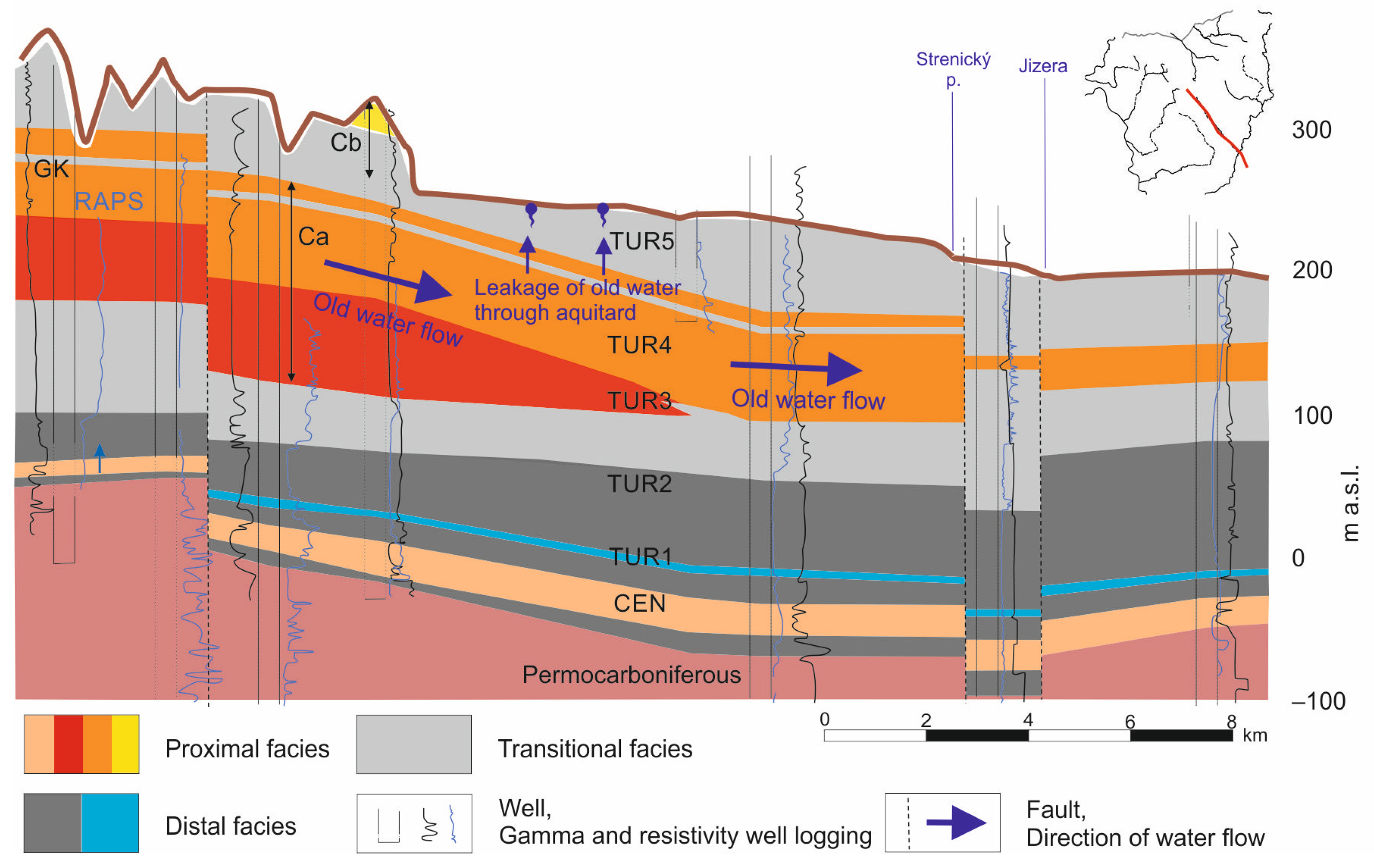
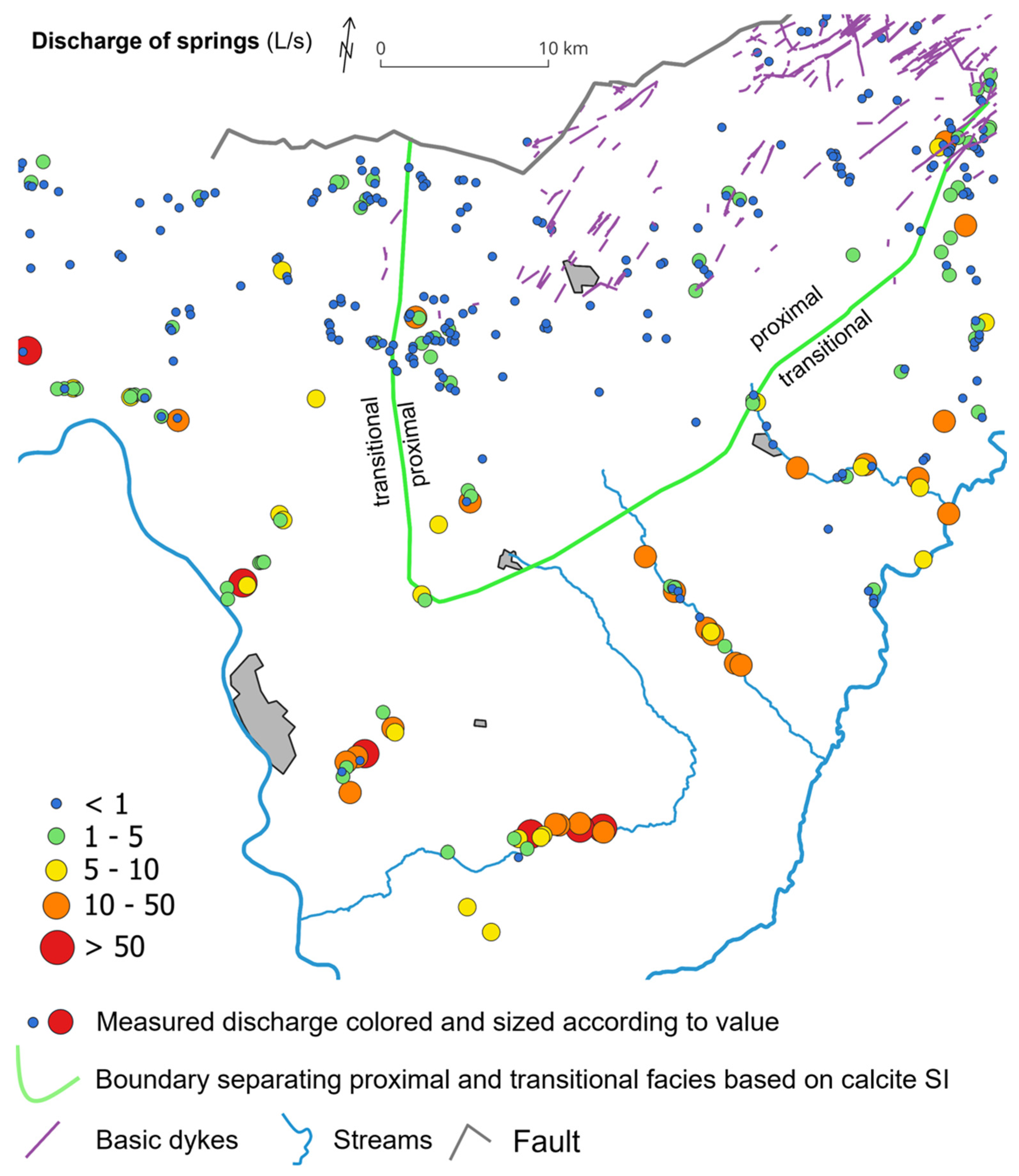
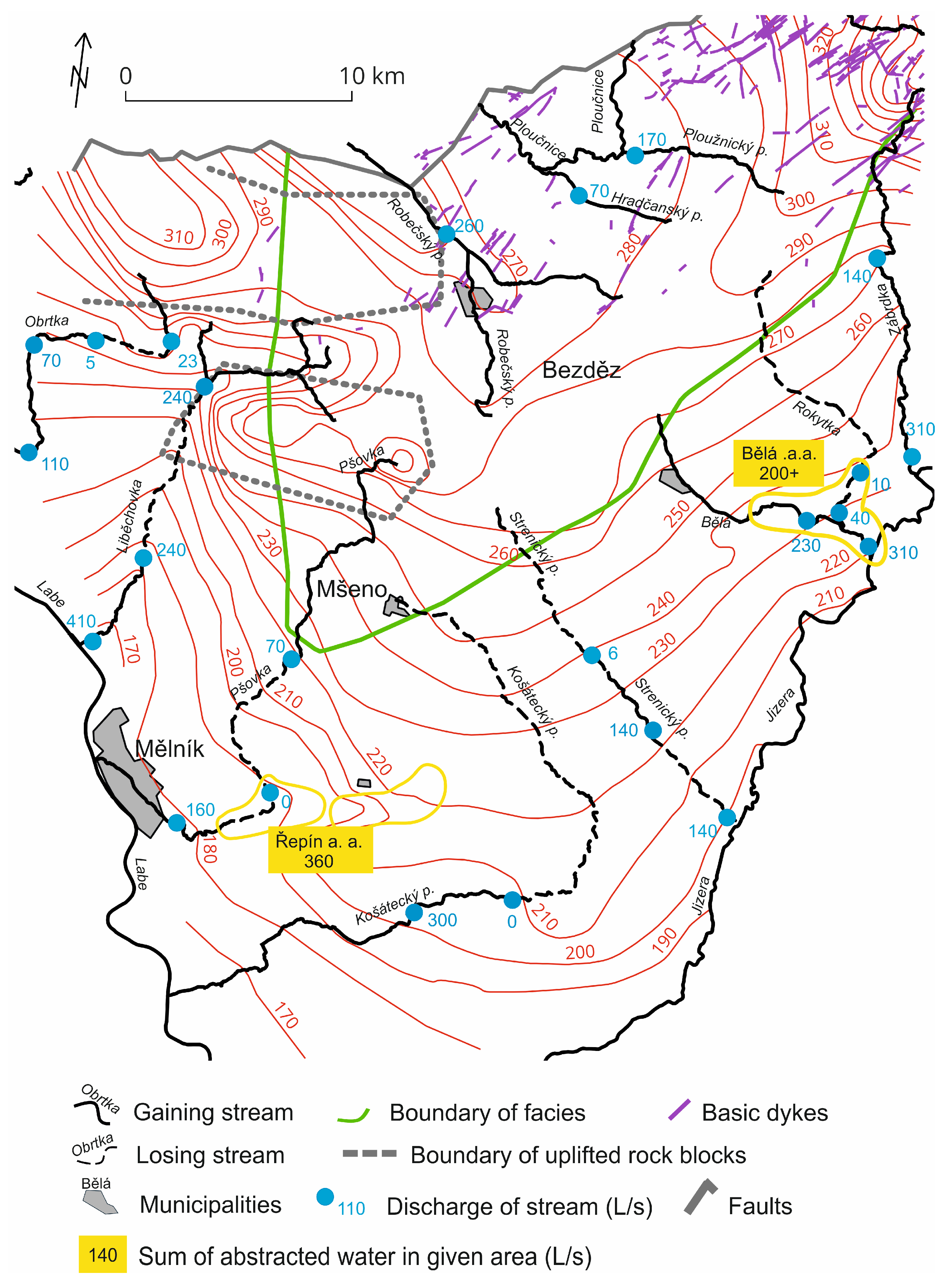
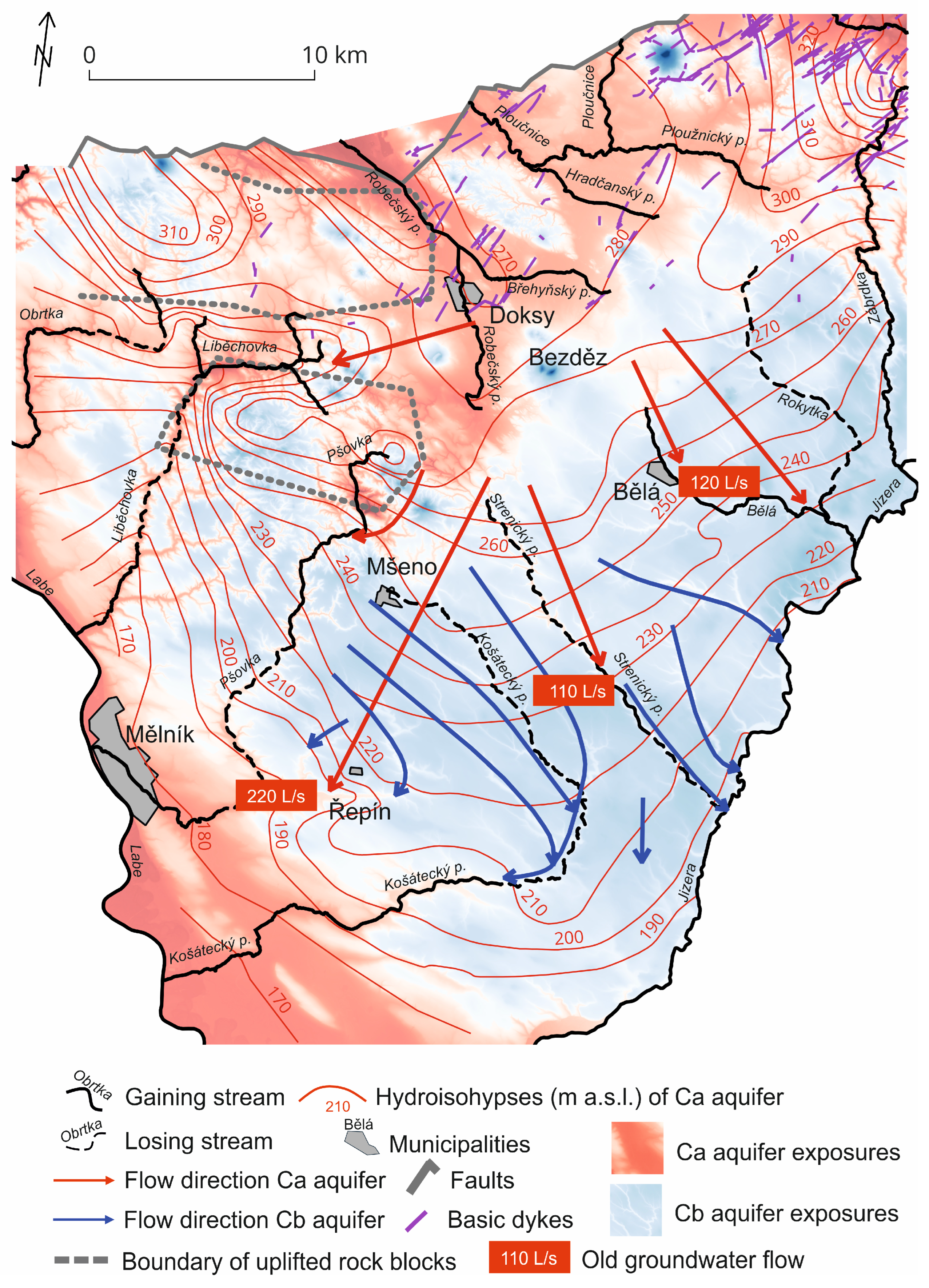
3.1. Aquifers and Major Structural Features Controlling Groundwater Flow
3.2. Gaining and Losing Streams
3.3. Hydrochemistry and Isotopic Composition
3.3.1. Hydrochemistry Analyses
3.3.2. Oxygen and Hydrogen Isotopes
3.3.3. NGT Analyses
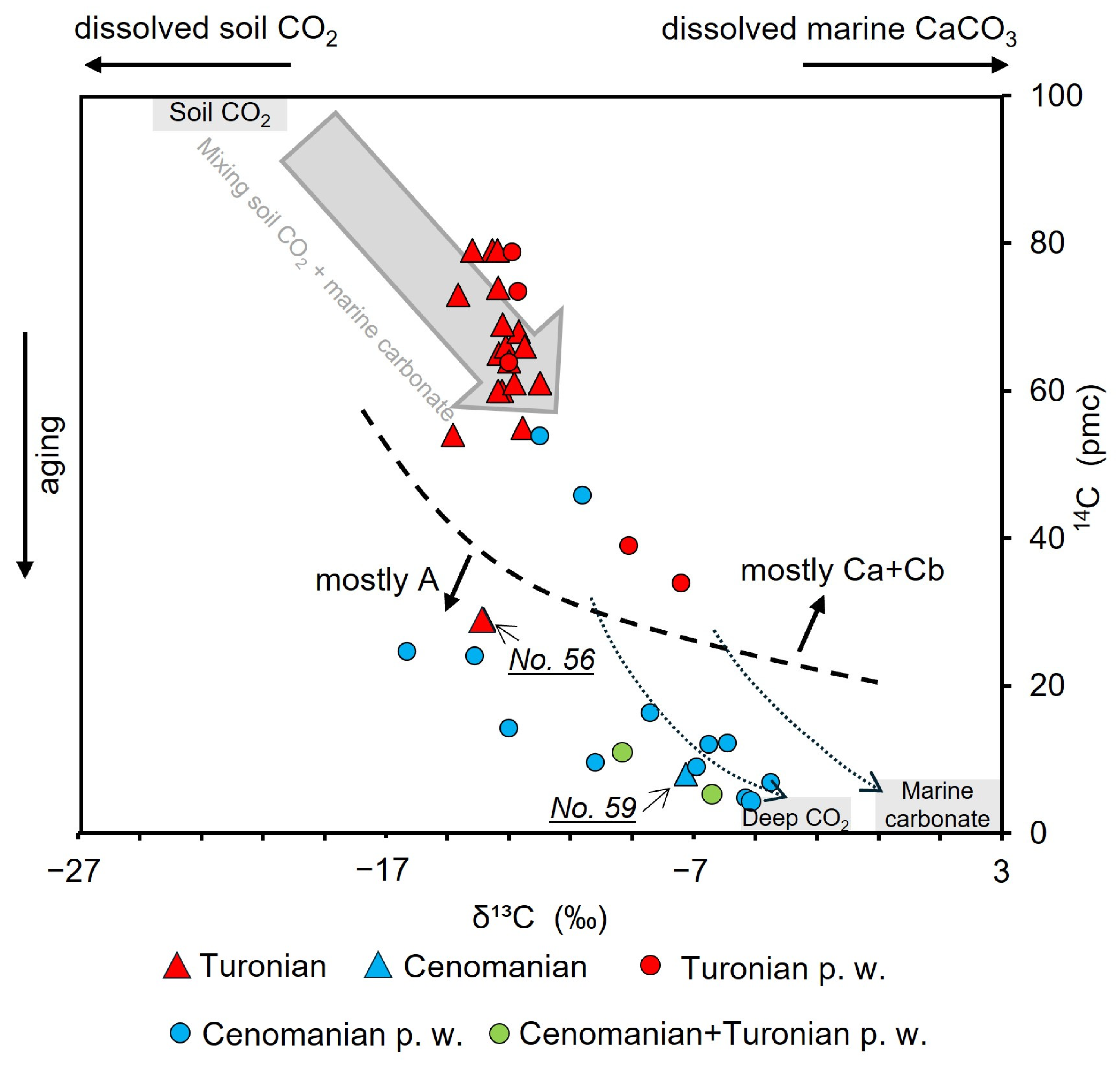
3.3.4. 13C and 14C Analyses
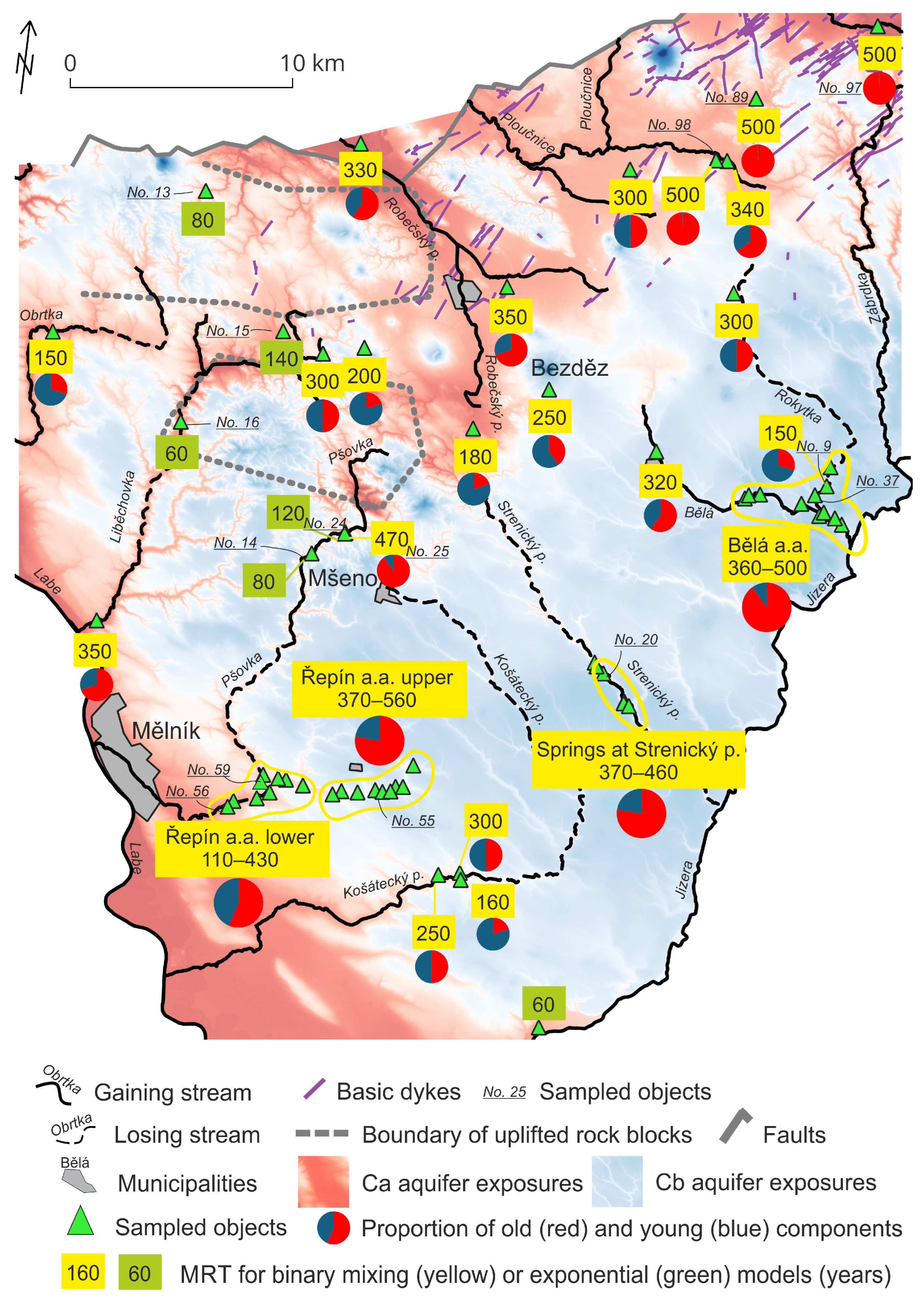
3.3.5. Mean Residence Time Modeling
4. Discussion
4.1. Groundwater Flow Characteristics
4.2. Reasoning for Gaining and Losing Stream Segments
5. Conclusions
Supplementary Materials
Author Contributions
Funding
Data Availability Statement
Acknowledgments
Conflicts of Interest
Abbreviations
| MRT | Mean Residence Time |
| BCB | Bohemian Cretaceous Basin |
| EC | Electrical Conductivity |
| SI | Saturation Index |
Appendix A

| Object No. | Type of Object | Facies | Catchment/Area | δ13C (‰) VPDB | δ2H/δ18O (‰) VSMOW | NGT Temp. (°C) | 3H (TU) | 14C (pmc) | CFCs-11, -12, -133 (pmol/L), SF6 (fmol/L) | 39Ar (pMAr)/85Kr (dpm/cc) |
|---|---|---|---|---|---|---|---|---|---|---|
| 1 | Stream | Transitional | Bělá | 4.9, 2.6, 0.48, 11 | ||||||
| 2 | Stream | Transitional | Bělá | 4.5, 2.5, 0.49, 4.5 | ||||||
| 3 | Stream | Transitional | Strenický | −74.84/−10.42 | 2.9 | |||||
| 4 | Stream | Transitional | Strenický | −74.34/−10.41 | 1.9 | 4.2, 2.3, 0.27, 2.2 | ||||
| 5 | Spring | Transitional | Košátecký | −12.89 | −69.19/−9.76 | 3.3 | 5.1, 4.9, 0.19, 1.2 | |||
| 6 | Spring | Transitional | Košátecký | −14.65 | −71.74/−10.14 | 0.73 | ||||
| 7 | Spring | Transitional | Košátecký | −13.36 | −71.00/−10.16 | 0.74 | ||||
| 8 | Spring | Transitional | Košátecký | −13.38 | −70.59/−9.76 | 2.7 | 1.50, 1.00, 0.15, 1.0 | |||
| 9 | Spring | Transitional | Bělá | −13.37 | −68.83/−9.86 | 3.6 | 0.79 | |||
| 10 | Spring | Transitional | Bělá | −68.93/−9.78 | 2.5 | 3.0, 3.0, 0.24, 1.5 | ||||
| 11 | Spring | Transitional | Obrtka | 7.4 | ||||||
| 12 | Spring | Transitional | Liběchovka | −13.00 | 1.9 | 0.64 | ||||
| 13 | Spring | Transitional | Ploučnice | 6.9 | ||||||
| 14 | Spring | Transitional | Bělá | 0.0 | ||||||
| 15 | Spring | Transitional | Liběchovka | 3.1 | ||||||
| 16 | Spring | Transitional | Liběchovka | 3.9 | ||||||
| 17 | Pumped well | Transitional | Pšovka | |||||||
| 18 | Spring | Transitional | Pšovka | 0.0 | ||||||
| 19 | Pumped well | Transitional | Jizera | |||||||
| 20 | Spring | Transitional | Strenický | −12.50 | −70.85/−9.92 | 8.2 | 0.9 | 0.66 | 48.0/3.52 | |
| 21 | Pumped well | Transitional | Strenický | −73.7/−10.31 | 1.9 | |||||
| 22 | Spring | Transitional | Strenický | −13.39 | −70.98/−9.8 | 1.4 | 1.1, 0.90, 0.06, 0.4 | |||
| 23 | Spring | Transitional | Strenický | −70.62/−9.9 | 2.5 | |||||
| 24 | Spring | Proximal | Pšovka | −13.20 | 2.7 | 0.69 | ||||
| 25 | Pumped well | Proximal | Pšovka | −12.98 | −73.24/−10.26 | 1.9 | 0.06, 0.18, <0.01, <0.1 | |||
| 26 | Pumped well | Proximal | Pšovka | 2.3 | ||||||
| 27 | Spring | Proximal | Liběchovka | −14.20 | −73.97/−10.46 | 2.4 | 0.79 | |||
| 28 | Spring | Proximal | Liběchovka | −74.3/−10.5 | 3.5 | |||||
| 29 | Spring | Proximal | Liběchovka | −70.28/−10.04 | 3.4 | |||||
| 30 | Stream | Proximal | Liběchovka | 2.8 | ||||||
| 31 | Spring | Proximal | Liběchovka | −70.97/−10.08 | 3.0 | |||||
| 32 | Spring | Transitional | Bělá | −12.00 | −72.49/−10.16 | 2.5 | 0.61 | 1.2, 0.09, 0.78, 1.0 | ||
| 33 | Pumped well | Proximal | Bezděz | −68.67/−9.56 | 2.8 | 2.6, 1.1, 0.15, 0.2 | ||||
| 34 | Pumped well | Transitional | Bělá | −13.35 | −72.44/−10.22 | 1.2 | 0.60 | 0.01, 0.06, <0.01, <0.1 | ||
| 35 | Spring | Transitional | Bělá | −12.9 | −71.00/−10.16 | 2.7 | ||||
| 36 | Pumped well | Transitional | Bělá | −12.55 | −71.89/−10.14 | 1.8 | 0.55 | |||
| 37 | Pumped well | Transitional | Bělá | −12.84 | −72.43/−10.21 | 8.0 | 2.3 | 0.61 | 0.05, 0.05, <0.01, <0.1 | 43.5/<0.46 |
| 38 | Pumped well | Transitional | Bělá | −12.00 | −73.17/−10.31 | 1.1 | 0.61 | 0.01, 0.04, <0.01, <0.1 | ||
| 39 | Pumped well | Transitional | Bělá | −14.08 | −71.96/−10.12 | 2.3 | 1.2, 0.73, 0.1, 0.6 | |||
| 40 | Pumped well | Transitional | Bělá | −72.56/−10.26 | 1.5 | |||||
| 41 | Pumped well | Transitional | Bělá | −72.69/−10.19 | 3.0 | |||||
| 42 | Pumped well | Transitional | Bělá | −12.69 | −73.02/−10.25 | 2.0 | 0.68 | 0.6, 0.68, 0.01, 0.6 | ||
| 43 | Pumped well | Transitional | Bělá | −12.73 | −72.59/−10.19 | 2.2 | 0.47, 0.44, 0.01, 0.4 | |||
| 44 | Pumped well | Transitional | Bělá | −71/−9.94 | ||||||
| 45 | Pumped well | Transitional | Řepín | −13.82 | −68.95/−9.5 | 3.2 | 1.9, 1.7, 0.17, 2.1 | |||
| 46 | Pumped well | Transitional | Řepín | −68.35/−9.38 | ||||||
| 47 | Pumped well | Transitional | Řepín | −74.04/−10.3 | ||||||
| 48 | Pumped well | Transitional | Řepín | −73.76/−10.3 | 2.4 | |||||
| 49 | Pumped well | Transitional | Řepín | −14.86 | −74.19/−10.3 | 1.8 | 0.50, 0.36, 0.04, 0.5 | |||
| 50 | Pumped well | Transitional | Řepín | −13.94 | −69.52/−9.57 | 2.9 | 1.50, 1.40, 0.09, 1.6 | |||
| 51 | Pumped well | Transitional | Řepín | −68.93/−9.46 | ||||||
| 52 | Pumped well | Transitional | Řepín | −13.22 | −74.53/−10.36 | 1.8 | 0.60 | 0.27, 0.20, 0.04, 0.2 | ||
| 53 | Pumped well | Transitional | Řepín | −13.10 | −73.75/−10.28 | 1.6 | 0.66 | 0.02, 0.04, <0.01, <0.1 | ||
| 54 | Pumped well | Transitional | Řepín | −73.66/−10.21 | 0.01, 0.04, <0.01, <0.1 | |||||
| 55 | Pumped well | Transitional | Řepín | −14.83 | −73.86/−10.27 | 8.1 | 1.2 | 0.54 | 40.2/1.36 | |
| 56 | Pumped well | Transitional | Řepín | −13.81 | −69.5/−9.56 | 1.8 | 0.29 | |||
| 57 | Pumped well | Transitional | Řepín | −70.84/−9.71 | 3.5 | |||||
| 58 | Pumped well | Transitional | Řepín | −71.02/−9.72 | ||||||
| 59 | Pumped well | Transitional | Řepín | −7.26 | −78.06/−11.36 | 1.1 | 0.08 | |||
| 60 | Pumped well | Transitional | Řepín | −13.55 | −70.12/−9.61 | 3.5 | 0.79 | 2.1, 1.5, 0.19, 1.5 | ||
| 61 | Pumped well | Transitional | Řepín | −69.81/−9.57 | ||||||
| 62 | Pumped well | Transitional | Řepín | −68.69/−9.39 | 2.0 | |||||
| 63 | Pumped well | Transitional | Řepín | −69.83/−9.45 | 4.5 | |||||
| 64 | Pumped well | Transitional | Řepín | −73.39/−10.2 | 1.7 | |||||
| 65 | Pumped well | Transitional | Řepín | −73.02/−10.17 | 1.2, 0.83, 0.09, 0.7 | |||||
| 66 | Pumped well | Transitional | Řepín | −13.29 | −71.76/−9.98 | |||||
| 67 | Pumped well | Transitional | Řepín | −14.93 | −72.44/−10.05 | 2.0 | 1.4, 1.1, 0.09, 0.8 | |||
| 68 | Pumped well | Transitional | Řepín | −74.54/−10.3 | 2.3 | |||||
| 69 | Pumped well | Transitional | Řepín | −74.08/−10.27 | 1.5 | |||||
| 70 | Pumped well | Transitional | Řepín | −69.25/−9.48 | 2.8 | |||||
| 71 | Pumped well | Transitional | Řepín | −69.93/−9.63 | 3.6 | |||||
| 72 | Pumped well | Transitional | Řepín | −72.93/−10.13 | 2.6 | |||||
| 73 | Pumped well | Transitional | Řepín | −72.9/−10.11 | ||||||
| 74 | Pumped well | Transitional | Řepín | −72.81/−10.11 | 2.5 | |||||
| 75 | Pumped well | Transitional | Řepín | −13.07 | −72.45/−10.03 | 1.50, 0.84, 0.11, 1.4 | ||||
| 76 | Pumped well | Transitional | Řepín | −72.41/−10.06 | 2.6 | |||||
| 77 | Pumped well | Transitional | Řepín | −13.34 | −74.17/−10.27 | 1.8 | 0.65 | 0.22, 0.17, 0.02, 0.1 | ||
| 78 | Pumped well | Transitional | Řepín | −13.21 | −73.61/−10.21 | 2.1 | 0.70, 0.49, 0.08, 0.5 | |||
| 79 | Pumped well | Transitional | Řepín | −73.94/−10.25 | ||||||
| 80 | Pumped well | Transitional | Řepín | −15.12 | −74.18/−10.24 | 1.8 | 0.60, 0.44, 0.07, 0.5 | |||
| 81 | Pumped well | Transitional | Řepín | −74.34/−10.25 | ||||||
| 82 | Pumped well | Transitional | Řepín | −13.10 | −73.02/−10.13 | 2.1 | ||||
| 83 | Pumped well | Transitional | Řepín | −73.03/−10.13 | ||||||
| 84 | Pumped well | Transitional | Řepín | −73.3/−10.16 | 2.2 | |||||
| 85 | Pumped well | Transitional | Řepín | −73.51/−10.21 | 1.8 | |||||
| 86 | Pumped well | Transitional | Řepín | −73.5/−10.17 | 2.0 | |||||
| 87 | Pumped well | Transitional | Řepín | −14.76 | −73.48/−10.19 | 0.6, 0.82, 0.03, 0.4 | ||||
| 88 | Pumped well | Proximal | North | 3.0 | 190.00, 35.50, 11.0 | |||||
| 89 | Monitoring well | Proximal | North | −17.36 | −69.33/−9.86 | 2.9 | 2.3, 1.1, 0.16, 0.5 | |||
| 90 | Spring | Proximal | North | −16.42 | −71.38/−10.13 | 1.7 | 1.2, 0.72, 0.11, 0.9 | |||
| 91 | Pumped well | Transitional | North | −13.25 | −71.53/−10.09 | 3.0 | 0.8, 0.33, 0.03, <0.1 | |||
| 92 | Pumped well | Transitional | North | −13.16 | −70.07/−9.89 | 2.6 | 1.1, 0.49, 0.06, <0.1 | |||
| 93 | Pumped well | Proximal | North | −15.99 | −72.62/−10.22 | 3.1 | 0.46, 0.17, 0.02, <0.1 | |||
| 94 | Pumped well | Transitional | North | −14.39 | −72.26/−10.15 | 2.1 | 1.5, 0.56, 0.07, 0.1 | |||
| 95 | Pumped well | Proximal | North | −67.26/−9.26 | 2.7 | |||||
| 96 | Pumped well | Proximal | North | −14.74 | −67.43/−9.26 | 3.2 | 0.6, 0.57, 0.03, 0.3 | |||
| 97 | Monitoring well | Transitional | North | −8.27 | −68.35/−9.93 | 5.8 | 1.8 | 0.04, <0.01, <0.01, <0.1 | ||
| 98 | Monitoring well | Proximal | North | −11.22 | −69.15/−9.83 | 1.7 | 0.03, 0.01, 0.01, <0.1 | |||
| 99 | Monitoring well | Transitional | North | −12.90 | −72.47/−10.22 | 3.3 | 0.35, 0.12, 0.01, <0.1 | |||
| 100 | Pumped well | Transitional | Řepín | −74/−10.2 |
References
- Zektser, I.S.; Everett, L.G. Groundwater Resources of the World and Their Use; Series on Groundwater No. 6; UNESCO: Paris, France, 2004. [Google Scholar]
- FAO. AQUASTAT. FAO AQUASTAT Dissemination System. 2024. Available online: https://data.apps.fao.org/aquastat/?lang=en (accessed on 15 February 2026).
- Sajil Kumar, P.J.; Schneider, M.; Elango, L. The state-of-the-art estimation of groundwater recharge and water balance with a special emphasis on India: A critical review. Sustainability 2022, 14, 340. [Google Scholar] [CrossRef]
- Bernardes Ayer, J.E.; Lämmle, L.; Mincato, R.L.; Donadio, C.; Yoshinaga Pereira, S. Three-dimensional model and environmental fragility in the Guarani Aquifer System, SE-Brazil. Groundw. Sustain. Dev. 2024, 26, 101285. [Google Scholar] [CrossRef]
- Czauner, B.; Erőss, A.; Szkolnikovics-Simon, S.; Markó, Á.; Baják, P.; Trásy-Havril, T.; Szijártó, M.; Szabó, Z.; Hegedűs-Csondor, K.; Mádl-Szőnyi, J. From basin-scale groundwater flow to integrated geofluid research in the hydrogeology research group of Eötvös Loránd University, Hungary. J. Hydrol. X 2022, 17, 100142. [Google Scholar] [CrossRef]
- Batlle-Aguilar, J.; Banks, E.W.; Batelaan, O.; Kipfer, R.; Brennwald, M.S.; Cook, P.G. Groundwater residence time and aquifer recharge in multilayered, semi-confined and faulted aquifer systems using environmental tracers. J. Hydrol. 2017, 546, 150–165. [Google Scholar] [CrossRef]
- Cook, P.G.; Böhlke, J.K. Determining timescales for groundwater flow and solute transport. In Environmental Tracers in Subsurface Hydrology; Cook, P.G., Herczeg, A.L., Eds.; Springer: Boston, MA, USA, 2000. [Google Scholar] [CrossRef]
- Okofo, L.B.; Adonadaga, M.-G.; Martienssen, M. Groundwater age dating using multi-environmental tracers (SF6, CFC-11, CFC-12, δ18O, and δD) to investigate groundwater residence times and recharge processes in Northeastern Ghana. J. Hydrol. 2022, 610, 127821. [Google Scholar] [CrossRef]
- Han, L.-F.; Wassenaar, L.I. Principles and uncertainties of 14C age estimations for groundwater transport and resource evalua-tion. Isot. Environ. Health Stud. 2021, 57, 111–141. [Google Scholar] [CrossRef]
- Aeschbach-Hertig, F.; Peeters, F.; Beyerle, U.; Kipfer, R. Interpretation of dissolved atmospheric noble gases in natural waters. Water Resour. Res. 1999, 35, 2779–2792. [Google Scholar] [CrossRef]
- Wilske, S.; Suckow, A.; Mallast, U.; Meier, C.; Merchel, S.; Merkel, B.; Sachse, A. A multi-environmental tracer study to determine groundwater residence times and recharge in a structurally complex multi-aquifer system. Hydrol. Earth Syst. Sci. 2020, 24, 249–267. [Google Scholar] [CrossRef]
- Musgrove, M.; Jurgens, B.C.; Opsahl, S.P. Karst groundwater vulnerability determined by modeled age and residence time tracers. Geophys. Res. Lett. 2023, 50, e2023GL102853. [Google Scholar] [CrossRef]
- Bruthans, J.; Kůrková, I.; Kadlecová, R. Factors controlling nitrate concentration in space and time in wells distributed along an aquifer/river interface (Káraný, Czechia). Hydrogeol. J. 2018, 27, 195–210. [Google Scholar] [CrossRef]
- Kůrková, I.; Bruthans, J.; Balák, F.; Slavík, M.; Schweigstillová, J.; Bruthansová, J.; Mikuš, P.; Grundloch, J. Factors controlling evolution of karst conduits in sandy limestone and calcareous sandstone (Turnov area, Czech Republic). J. Hydrol. 2019, 574, 1062–1073. [Google Scholar] [CrossRef]
- Starý, J.; Bruthans, J.; Schweigstillová, J.; Mareš, J.; Procházka, M. Origin of fracture-controlled conduits in calcite-rich highly productive aquifers impregnated with diagenetic silica. Water 2024, 16, 687. [Google Scholar] [CrossRef]
- Uličný, D.; Laurin, J.; Čech, S. Controls on clastic sequence geometries in a shallow-marine, transtensional basin: The Bohemian Cretaceous Basin, Czech Republic. Sedimentology 2009, 56, 1077–1114. [Google Scholar] [CrossRef]
- Voigt, T.; Kley, J.; Voigt, S. Dawn and dusk of Late Cretaceous basin inversion in central Europe. Soild Earth 2021, 12, 1443–1471. [Google Scholar] [CrossRef]
- Wiese, F.; Čech, S.; Ekrt, B.; Košt’ák, M.; Mazuch, M.; Voigt, S. The Upper Turonian of the Bohemian Cretaceous Basin (Czech Republic) exemplified by the Úpohlavy working quarry: Integrated stratigraphy and palaeoceanography of a gateway to the Tethys. Cretac. Res. 2004, 25, 329–352. [Google Scholar] [CrossRef]
- Čech, S.; Klein, V.; Kříž, J.; Valečka, J. Revision of the Upper Cretaceous stratigraphy of the Bohemian Cretaceous Basin. Věstník Ústředního Ust. Geol. 1980, 55, 277–296. [Google Scholar]
- Štaffen, Z. Chemostratigrafické stanovení ekvivalence vrstev a souvrství české křídové pánve. Acta Musei Richnoviensis 1999, 6, 41–194. [Google Scholar]
- Jiráková, H.; Huneau, F.; Hrkal, Z.; Celle-Jeanton, H.; Le Coustumer, P. Carbon isotopes to constrain the origin and circulation pattern of groundwater in the north-western part of the Bohemian Cretaceous Basin (Czech Republic). Appl. Geochem. 2010, 25, 1265–1279. [Google Scholar] [CrossRef]
- Corcho Alvarado, J.A.; Leuenberger, M.; Kipfer, R.; Paces, T.; Purtschert, R. Reconstruction of past climate conditions over central Europe from groundwater data. Quat. Sci. Rev. 2011, 30, 3423–3429. [Google Scholar] [CrossRef]
- Hynie, O. Hydrogeology of CSSR: Ground Waters; Czechoslovak Academy of Sciences: Prague, Czechoslovakia, 1961. (In Czech) [Google Scholar]
- Uličný, D. Depositional systems and sequence stratigraphy of coarse-grained deltas in a shallow-marine, strike-slip setting: The Bohemian Cretaceous Basin, Czech Republic. Sedimentology 2001, 48, 599–628. [Google Scholar] [CrossRef]
- Pačes, T.; Corcho Alvarado, J.A.; Herrmann, Z.; Kodeš, V.; Mužák, J.; Novák, R.; Purtschert, R.; Remenarová, D.; Valečka, J. The Cenomanian and Turonian aquifers of the Bohemian Cretaceous Basin, Czech Republic. In Natural Groundwater Quality; Edmunds, W.M., Shand, P., Eds.; Blackwell Publishing Ltd.: Oxford, UK, 2008; ISBN 978-1-4051-5675-2. [Google Scholar]
- Bruthans, J.; Grundloch, J.; Kadlecová, R.; Karatas, T.; Šabatová, K.; Vlnas, R. Methodology for creating a map of the vulnerability of the quantity of natural groundwater resources to drought for the Czech Republic. Water Manag. Tech. Econ. Inf. J. 2024, 66, 32–45. [Google Scholar] [CrossRef]
- Hydrogeological Regions Map. Czech Geological Survey. 2026. Available online: https://mapy.geology.cz/hydro_rajony (accessed on 15 February 2026).
- Krásný, J.; Císlerová, M.; Čurda, S.; Datel, J.; Dvořák, J.; Grmela, Z.; Hrkal, Z.; Kříž, H.; Marszalek, H.; Šantrůček, J.; et al. Groundwaters of Czech Republic: Regional Hydrogeology of Groundwaters and Mineral Waters; Czech Geological Survey: Prague, Czech Republic, 2012. (In Czech) [Google Scholar]
- Kůrková, I.; Burda, J.; Čech, S.; Nádaskay, R.; Bruthans, J.; Švábenická, L.; Herčík, F.; Kadlecová, R.; Bůzek, F.; Kondrová, L.; et al. Hydrogeology district 4410. In Evaluation of Groundwater Resources; Final Report; MS Geofond: Prague, Czech Republic, 2016; 210p. (In Czech) [Google Scholar]
- Database of the Archive of Reports and Expert Opinions (ASGI). Czech Geological Survey. 2026. Available online: https://app.geology.cz/asgi/ (accessed on 15 February 2026).
- Geological Map Portal. Czech Geological Survey. 2026. Available online: https://mapy.geology.cz/geo (accessed on 15 February 2026).
- AGS Geoportal. State Administration of Land Surveying and Cadastre. 2026. Available online: https://ags.cuzk.gov.cz/geoprohlizec/ (accessed on 15 February 2026).
- Kilpatrick, F.A.; Cobb, E.D. Measurement of discharge using tracers. In U.S. Geological Survey Techniques of Water–Resources Investigations; Book 3, Chapter A16; Geological Survey: Reston, VA, USA, 1985; 52p. [Google Scholar]
- ISO 9555-1:1994; Measurement of Liquid Flow in Open Channels—Tracer Dilution Methods for the Measurement of Steady Flow—Part 1: General. International Organization for Standardization: Geneva, Switzerland, 1994; 44p.
- Parkhurst, D.L.; Appelo, C.A.J. Description of input and examples for PHREEQC Version 3—A computer program for speciation, batch-reaction, one-dimensional transport, and inverse geochemical calculations. In US Geological Survey Techniques and Methods; Book 6, Chapter A43; Geological Survey: Reston, VA, USA, 2013; 497p. Available online: http://pubs.usgs.gov/tm/06/a43 (accessed on 15 February 2026).
- Hammer, Ø.; Harper, D.A. PAST: Paleontological statistics software package for education and data analysis. Palaeontol. Electron. 2001, 4, 1. [Google Scholar]
- Aeschbach-Hertig, W.; Solomon, D.K. Noble gas thermometry in groundwater hydrology. In The Noble Gases as Geochemical Tracers; Burnard, P., Ed.; Springer: Berlin/Heidelberg, Germany, 2013; pp. 81–122. [Google Scholar] [CrossRef]
- Hunt, A.G. U.S. Geological Survey Noble Gas Laboratory’s Standard Operating Procedures for the Measurement of Dissolved Gas in Water Samples (USGS Techniques and Methods 5-A11); U.S. Geological Survey: Reston, VA, USA, 2015. [Google Scholar]
- Schneider, R.; McNichol, A.P.; Nadeau, M.J.; Von Reden, K.F. Measurements of the oxalic acid II/oxalic acid I ratio as a quality control parameter at NOSAMS. Radiocarbon 1995, 37, 693–696. [Google Scholar] [CrossRef]
- Wacker, L.; Christl, M.; Synal, H.A. BATS: A new tool for AMS data reduction. Nucl. Instrum. Methods Phys. Res. Sect. B 2010, 268, 976–979. [Google Scholar] [CrossRef]
- Curie, L.A. Nomenclature in evaluation of analytical methods including detection and quantification capabilities (IUPAC Recommendation 1995). Anal. Chim. Acta 1999, 391, 105–126. [Google Scholar] [CrossRef]
- Clark, I. Groundwater Geochemistry and Isotopes; CRC Press: Boca Raton, FL, USA, 2015. [Google Scholar] [CrossRef]
- IAEA. Use of Chlorofluorocarbons in Hydrology: A Guidebook; International Atomic Energy Agency: Vienna, Austria, 2006; Volume 8, 277p, ISBN 92-0-100805-8. [Google Scholar]
- Musy, S.L.; Hinsby, K.; Wachs, D.; Sültenfuss, J.; Troldborg, L.; Aeschbach, W.; Schilling, O.S.; Purtschert, R. Bridging the 39Ar–14C groundwater dating gap: A dual-permeability transport perspective based on numerical modeling and field data. Water Resour. Res. 2025, 61, e2025WR040370. [Google Scholar] [CrossRef]
- Mace, E.; Aalseth, C.; Brandenberger, J.; Day, A.; Hoppe, E.; Humble, P.; Keillor, M.; Kulongoski, J.; Overman, C.; Panisko, M.; et al. Methods for using argon-39 to age-date groundwater using ultra-low-background proportional counting. Appl. Radiat. Isot. 2017, 126, 9–12. [Google Scholar] [CrossRef]
- Musy, S.; Purtschert, R. Reviewing 39Ar and 37Ar underground production at shallow depths with implications for groundwater dating. Sci. Total Environ. 2023, 884, 163868. [Google Scholar] [CrossRef]
- Gu, J.-Q.; Tong, A.L.; Yang, G.-M.; Hu, S.-M.; Jiang, W.; Lu, Z.-T.; Purtschert, R.; Ritterbusch, F. Reconstruction of the atmospheric 39Ar/Ar history. Chem. Geol. 2021, 583, 120480. [Google Scholar] [CrossRef]
- Maloszewski, P. LP models for the interpretation of environmental tracer data. In Manual on Mathematical Models in Isotope Hydrology; IAEA TECDOC 910; International Atomic Energy Agency (IAEA): Vienna, Austria, 1996; pp. 9–58. [Google Scholar]
- Jurgens, B.C.; Böhlke, J.K.; Eberts, S.M. TracerLPM (Version 1): An Excel® Workbook for Interpreting Groundwater Age Distributions from Environmental Tracer Data; Techniques and Methods 2012, 4-F3; U.S. Geological Survey: Reston, VA, USA, 2012; 60p. [Google Scholar]
- IAEA/WMO. Global Network of Isotopes in Precipitation (GNIP). 2018. Available online: https://www.iaea.org/services/networks/gnip (accessed on 15 February 2026).
- Herčík, F.; Herrmann, Z.; Valečka, J. Hydrogeology of the Bohemian Cretaceous Basin; Český Geologický Ústav: Praha, Czech Republic, 2003; ISBN 80-7075-604-7. [Google Scholar]
- Krásný, J. Classification of Transmissivity Magnitude and Variation. Ground Water 1993, 31, 2. [Google Scholar] [CrossRef]
- Appelo, C.A.J.; Postma, D. Geochemistry, Groundwater and Pollution, 2nd ed.; CRC Press: Boca Raton, FL, USA, 2004. [Google Scholar] [CrossRef]
- Dupalová, T.; Sracek, O.; Vencelides, Z.; Žák, K. The origin of thermal waters in the northeastern part of the Eger Rift, Czech Republic. Appl. Geochem. 2012, 27, 689–702. [Google Scholar] [CrossRef]
- Hrabánková, A. (Ed.) Podzemní vody a Prameny na územních Listech Speciální mapy 1:75,000: Možnost Využití Reedice pro Hodnocení Současné Globální Klimatické Změny; Výzkumný ústav vodohospodářský T.G. Masaryka: Prague, Czech Republic, 2009; ISBN 978-80-85900-93-4. [Google Scholar]
- Hssaisoune, M.; Bouchaou, L.; Qurtobi, M.; Marah, H.; Beraaouz, M.; Stitou El Messari, J. Isotopic and Chemical Tracing for Residence Time and Recharge Mechanisms of Groundwater under Semi-Arid Climate: Case from Rif Mountains (Northern Morocco). Geosciences 2022, 12, 74. [Google Scholar] [CrossRef]
- Ma, B.; Jin, M.; Liang, X.; Li, J. Application of environmental tracers for investigation of groundwater mean residence time and aquifer recharge in fault-influenced hydraulic drop alluvium aquifers. Hydrol. Earth Syst. Sci. 2019, 23, 427–445. [Google Scholar] [CrossRef]
- Pátek, K. The Potential of Karst Conduits Development in the Area Between the Úštěcký and Košátecký Stream Basins and the Delimitation of the Catchment Areas of the Main Spring Groups. Master’s Thesis, Faculty of Science, Charles University, Prague, Czech Republic, 2024; 102p. (In Czech) [Google Scholar]
- Gourdol, L.; Stewart, M.K.; Morgenstern, U.; Pfister, L. Short high-accuracy tritium time series for assessing groundwater transit times in the vadose and saturated zones of the Luxembourg Sandstone aquifer. Hydrol. Earth Syst. Sci. 2024, 28, 3519–3547. [Google Scholar] [CrossRef]
- Bruthans, J. Using Environmental Tracers and Other Methods to Estimate Mean Residence Time and Water Flow in Karst Areas, Czech Republic. Ph.D. Thesis, Charles University, Faculty of Science, Prague, Czech Republic, 2007. (In Czech) [Google Scholar]



Disclaimer/Publisher’s Note: The statements, opinions and data contained in all publications are solely those of the individual author(s) and contributor(s) and not of MDPI and/or the editor(s). MDPI and/or the editor(s) disclaim responsibility for any injury to people or property resulting from any ideas, methods, instructions or products referred to in the content. |
© 2026 by the authors. Licensee MDPI, Basel, Switzerland. This article is an open access article distributed under the terms and conditions of the Creative Commons Attribution (CC BY) license.
Share and Cite
Bruthans, J.; Slavík, M.; Mareš, J.; Šabatová, K.; Kůrková, I.; Nol, O. Re-Evaluation of Groundwater Flow Systems in Sedimentary Basin Based on Wide Range of Environmental Tracers, Hydrostratigraphy, and Field Measurements. Water 2026, 18, 683. https://doi.org/10.3390/w18060683
Bruthans J, Slavík M, Mareš J, Šabatová K, Kůrková I, Nol O. Re-Evaluation of Groundwater Flow Systems in Sedimentary Basin Based on Wide Range of Environmental Tracers, Hydrostratigraphy, and Field Measurements. Water. 2026; 18(6):683. https://doi.org/10.3390/w18060683
Chicago/Turabian StyleBruthans, Jiří, Martin Slavík, Jakub Mareš, Kateřina Šabatová, Iva Kůrková, and Ondřej Nol. 2026. "Re-Evaluation of Groundwater Flow Systems in Sedimentary Basin Based on Wide Range of Environmental Tracers, Hydrostratigraphy, and Field Measurements" Water 18, no. 6: 683. https://doi.org/10.3390/w18060683
APA StyleBruthans, J., Slavík, M., Mareš, J., Šabatová, K., Kůrková, I., & Nol, O. (2026). Re-Evaluation of Groundwater Flow Systems in Sedimentary Basin Based on Wide Range of Environmental Tracers, Hydrostratigraphy, and Field Measurements. Water, 18(6), 683. https://doi.org/10.3390/w18060683