Study on Flood Season Segmentation and Rationality Examination for Wuluwati Reservoir


Abstract
1. Introduction
2. Materials and Methods
2.1. Flood Season Segmentation
2.1.1. Circular Distribution Method
2.1.2. Fisher Optimal Partition
2.2. Rationality Examination
- (1)
- If dk,j > 0 (indicating a larger value is better):
- (2)
- If dk,j < 0 (indicating a smaller value is better):
- (3)
- If the signs of dk,j are mixed (both positive and negative values exist):where max(dk,j) and min(dk,j) represent the maximum and minimum values of the generalized distance across all schemes for the j-th segmentation stage, respectively.
3. Results
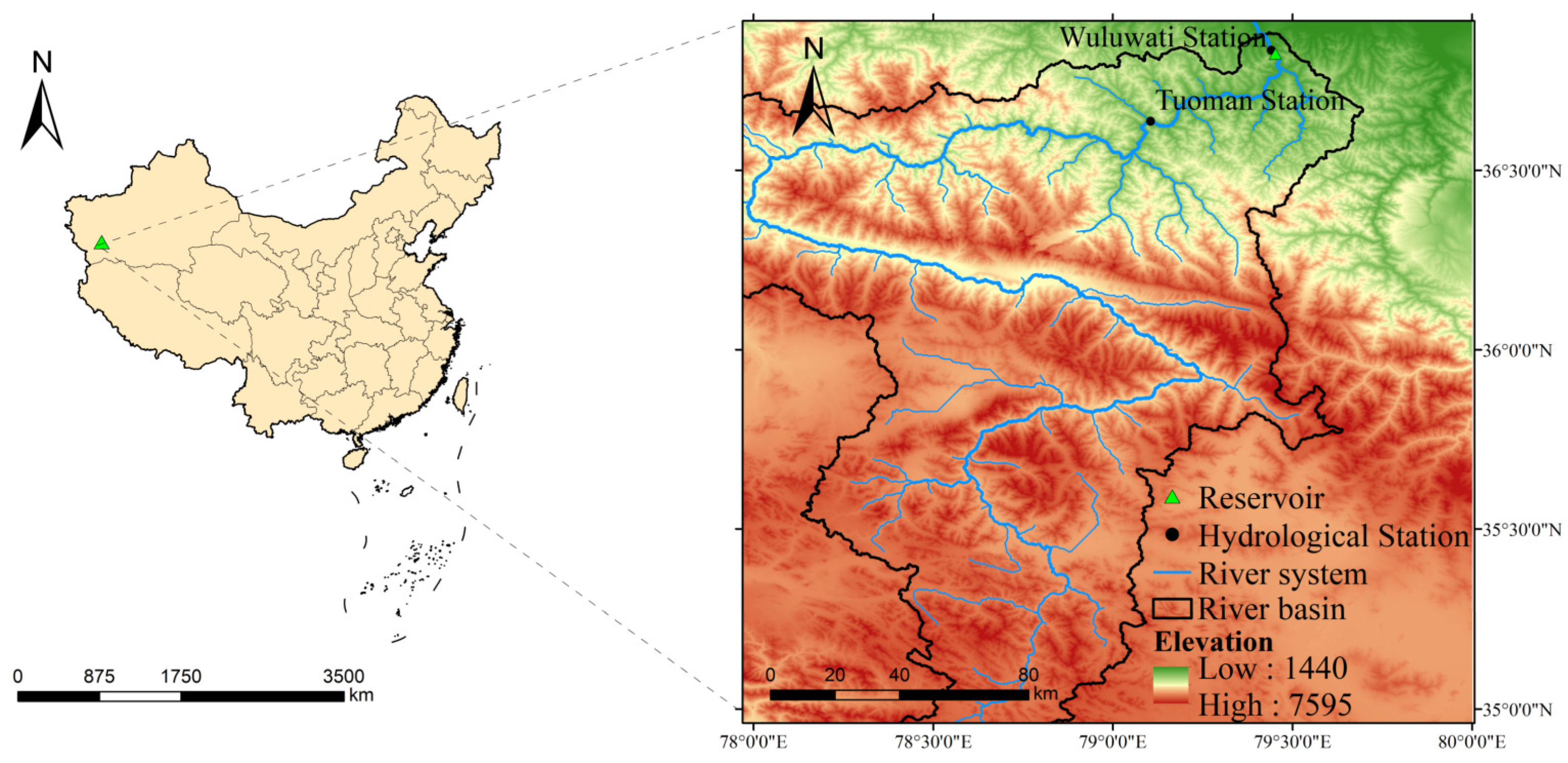
3.1. Overview of the Reservoir
3.2. Flood Season Segmentation Result
3.2.1. Flood Season Segmentation Based on the Circular Distribution Method
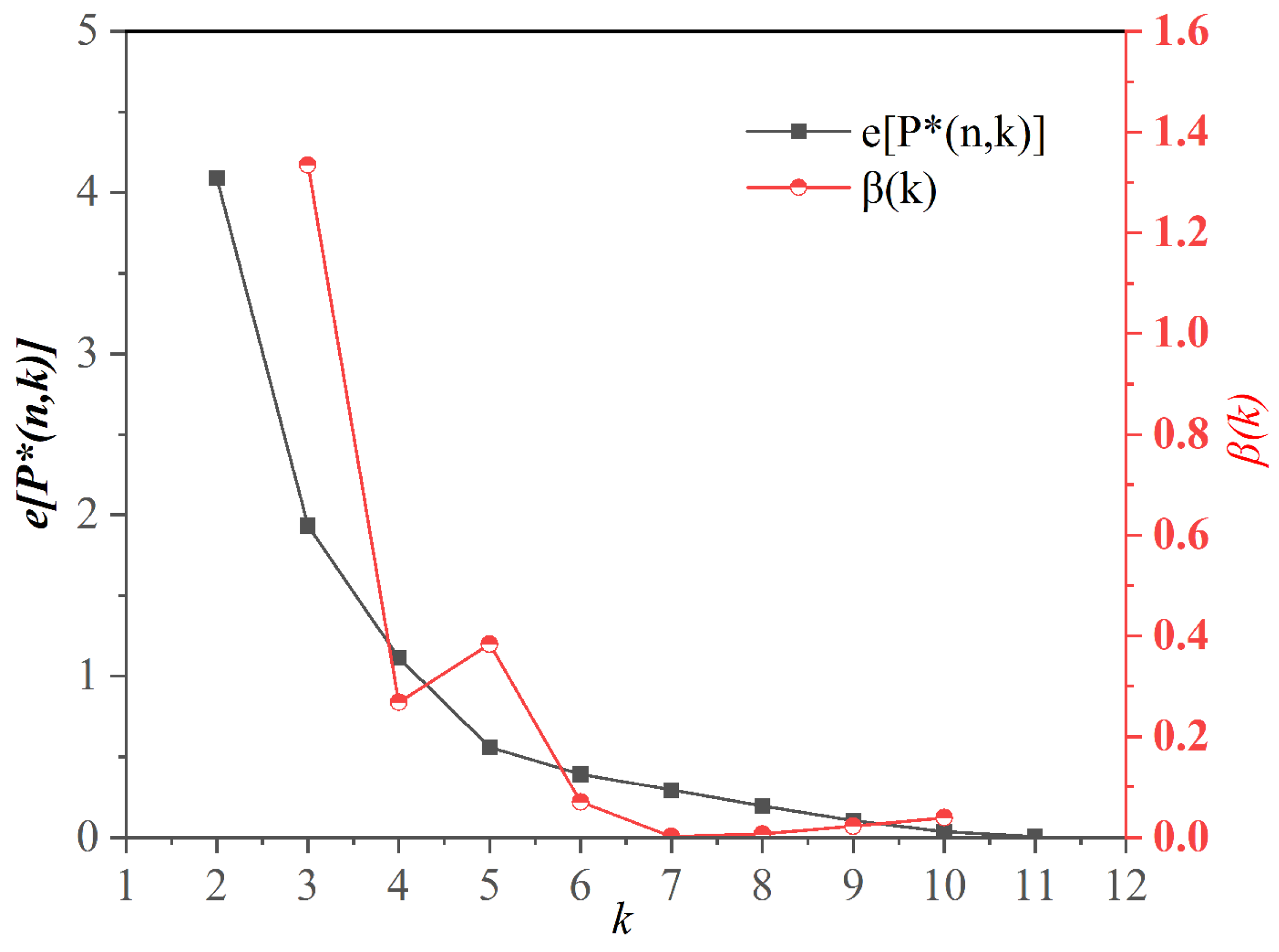
3.2.2. Flood Season Segmentation Based on the Fisher Optimal Partition Method
3.2.3. Comprehensive Analysis of Flood Season Segmentation
3.3. Rationality Examination Result
4. Discussion
5. Conclusions
- (1)
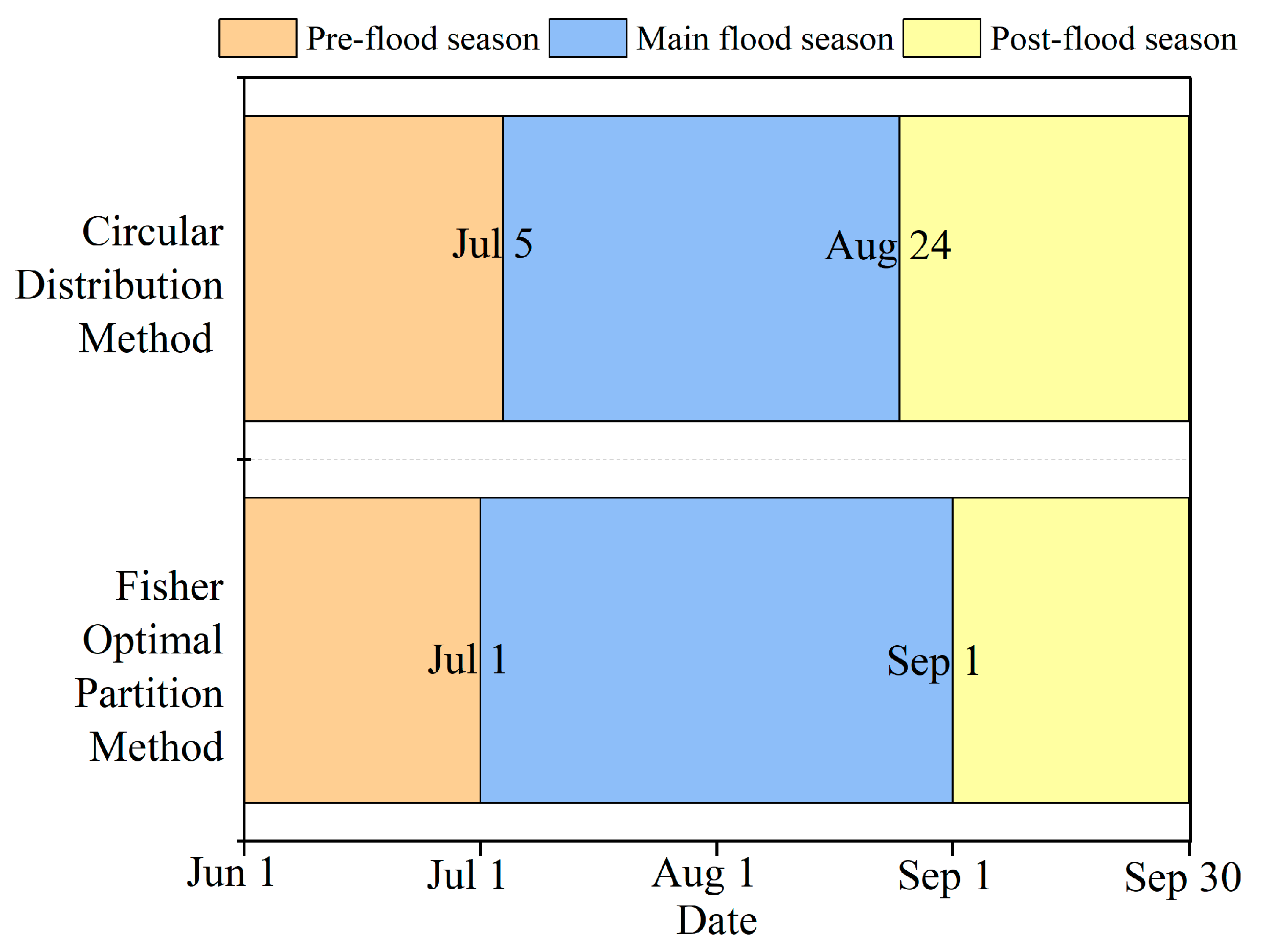
- The circular distribution method and the Fisher optimal partition method are applied to calculate the flood season segmentation for the Wuluwati Reservoir. The two methods yield highly consistent segmentation results with substantial overlap in the main flood season, and the average of the start and end dates derived from both methods is therefore adopted as the final segmentation result. Accordingly, the flood season of the Wuluwati Reservoir is determined as follows: the pre-flood season from June 1 to July 2, the main flood season from July 3 to August 27, and the post-flood season from August 28 to September 30.
- (2)
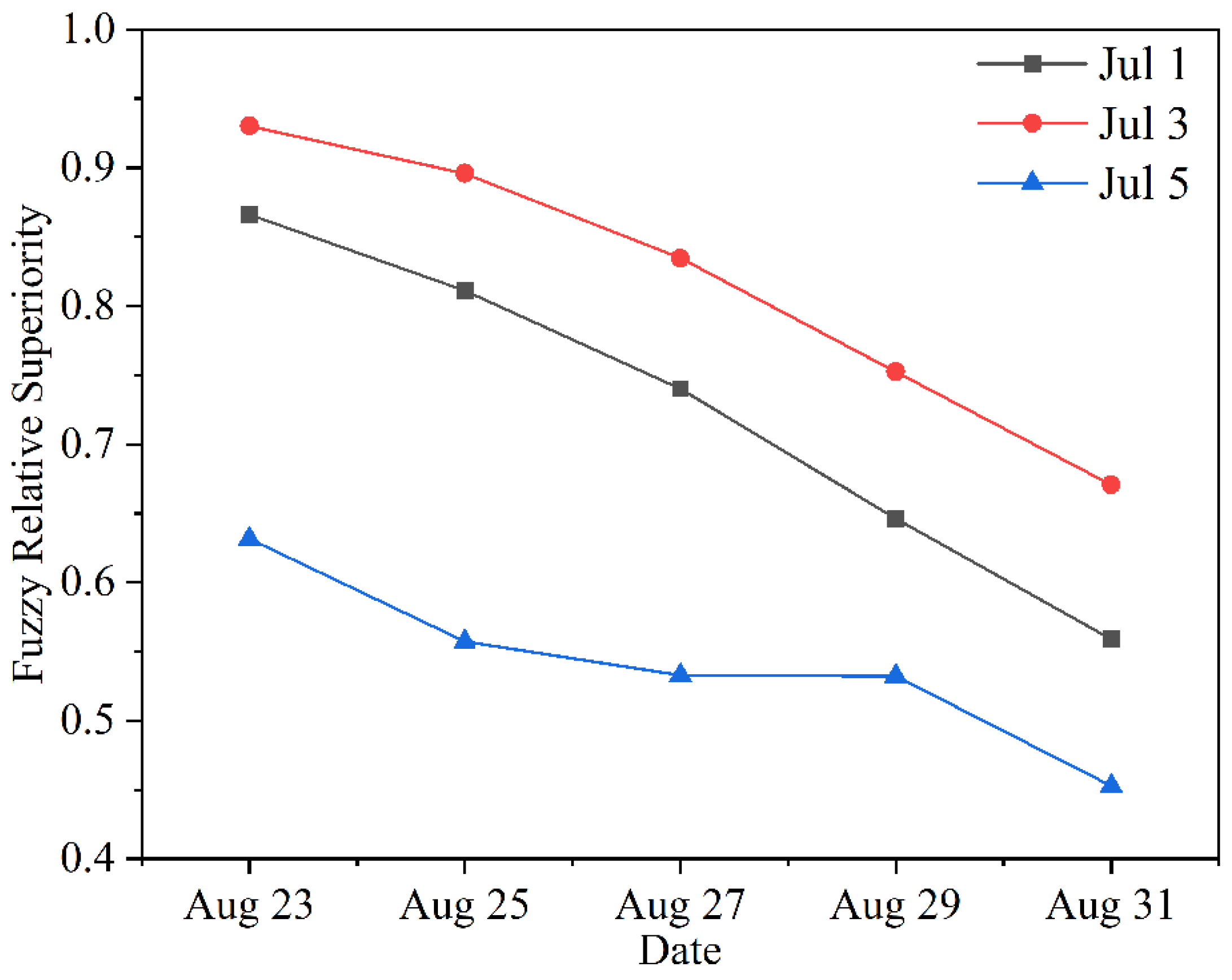
- To examine the rationality of the flood season segmentation, the improved Cunderlik method is employed to evaluate segmentation performance based on relative superiority degree. The results indicate that the segmentation points with the highest superiority degree occur on July 3 and August 23. These optimal points fall within the range identified by the comprehensive segmentation results, thereby confirming the rationality of the final flood season partition.
- (3)
- Based on the segmentation results, specific flood-limiting operation measures can be proposed: dynamically raising the flood-limited water level during the pre-flood and post-flood seasons to increase beneficial storage, while strictly controlling the water level during the main flood season to ensure flood control capacity; establishing pre-release rules near segmentation boundaries in combination with short-term inflow forecasts to achieve smooth transitions between different periods. These measures provide operable technical solutions for the dynamic operation of the Wuluwati Reservoir and offer methodological references for flood season segmentation and flood control operation of reservoirs with similar hydrological characteristics.
Author Contributions
Funding
Data Availability Statement
Conflicts of Interest
References
- Huang, E.; Zhu, G.; Meng, G.; Wang, Y.; Chen, L.; Miao, Y.; Wang, Q.; Shi, X.; Zhao, L.; Wang, Q.; et al. Historical Dataset of Reservoir Construction in Arid Regions. Sci. Data 2025, 12, 1428. [Google Scholar] [CrossRef] [PubMed]
- Yun, X.; Wang, J.; Bao, H. Assessing Climate Change Impacts on Extreme Hydrological Characteristics of Reservoir Inflow in Tianshan Mountain Range, China. Sci. Rep. 2025, 15, 14925. [Google Scholar] [CrossRef] [PubMed]
- Gong, X.; Zhang, Q.; Tang, S.; Bai, Y.; Singh, V.P.; Lu, Z. Proactive Dynamic Flooding Regulations for River Basins in China’s Arid and Semi-Arid Region of Xinjiang. J. Hydrol. Reg. Stud. 2025, 59, 102457. [Google Scholar] [CrossRef]
- Ai, X.; Dong, Q.; Wang, X.; Zhang, Y. Application of Wavelet Fractal Dimension Estimation in Dividing Flood Stages for Three Gorges Reservoir. Syst. Eng.-Theory Pract. 2009, 29, 145–151. [Google Scholar] [CrossRef]
- Jiang, H.; Yu, Z.; Mo, C. Ensemble Method for Reservoir Flood Season Segmentation. J. Water Resour. Plann. Manage. 2017, 143, 04016079. [Google Scholar] [CrossRef]
- Liu, P.; Guo, S.; Xiong, L.; Chen, L. Flood Season Segmentation Based on the Probability Change-Point Analysis Technique. Hydrol. Sci. J. 2010, 55, 540–554. [Google Scholar] [CrossRef]
- Jiang, H.; Wang, Z.; Ye, A.; Liu, K.; Wang, X.; Wang, L. Hydrological Characteristic-Based Methodology for Dividing Flood Seasons: An Empirical Analysis from China. Environ. Earth Sci. 2019, 78, 399. [Google Scholar] [CrossRef]
- Jiang, H.; Yu, Z.; Mo, C. Reservoir Flood Season Segmentation and Optimal Operation of Flood-Limiting Water Levels. J. Hydrol. Eng. 2015, 20, 05014035. [Google Scholar] [CrossRef]
- Mo, C.; Deng, J.; Lei, X.; Ruan, Y.; Lai, S.; Sun, G.; Xing, Z. Flood Season Staging and Adjustment of Limited Water Level for a Multi-Purpose Reservoir. Water 2022, 14, 775. [Google Scholar] [CrossRef]
- Li, X.; Zhang, Y.; Tong, Z.; Niu, G.-Y. Reservoir Flood Season Segmentation and Risk–Benefit Cooperative Decision of Staged Flood Limited Water Level. Water Resour. Manag. 2022, 36, 3463–3479. [Google Scholar] [CrossRef]
- Tang, L.; Zhang, Y. Considering Abrupt Change in Rainfall for Flood Season Division: A Case Study of the Zhangjia Zhuang Reservoir, Based on a New Model. Water 2018, 10, 1152. [Google Scholar] [CrossRef]
- Mo, C.; Mo, G.; Liu, P.; Zhong, H.; Wang, D.; Huang, Y.; Jin, J. Reservoir Operation by Staging Due to Climate Variability. Hydrol. Sci. J. 2018, 63, 926–937. [Google Scholar] [CrossRef]
- Li, Y.; Li, Y.; Feng, K.; Sun, K.; Cheng, Z. The Influence of Time Domain on Flood Season Segmentation by the Fisher Optimal Partition Method. Water 2024, 16, 580. [Google Scholar] [CrossRef]
- Zhou, K. Flood Season Segmentation and Scheme Optimization in the Yellow River. J. Water Clim. Change 2022, 13, 274–286. [Google Scholar] [CrossRef]
- Wu, P.; Chen, G.; Wang, Y.; Li, J. Applying the Improved Set Pair Analysis Method to Flood Season Staging in Tropical Island Rivers: A Case Study of the Hainan Island Rivers in China. Water 2024, 16, 3418. [Google Scholar] [CrossRef]
- Cunderlik, J.M.; Ouarda, T.B.M.J.; Bobée, B. On the Objective Identification of Flood Seasons. Water Resour. Res. 2004, 40, W01520. [Google Scholar] [CrossRef]
- Chen, L.; Singh, V.P.; Guo, S.; Zhou, J.; Zhang, J.; Liu, P. An Objective Method for Partitioning the Entire Flood Season into Multiple Sub-Seasons. J. Hydrol. 2015, 528, 621–630. [Google Scholar] [CrossRef]
- Villarini, G. On the Seasonality of Flooding across the Continental United States. Adv. Water Resour. 2016, 87, 80–91. [Google Scholar] [CrossRef]




| Sampling Period t/d | Whether to Consider the Flood Magnitude | Concentration Degree γ | Main Flood Season | ||
|---|---|---|---|---|---|
| 1 | No | 0.822 | 2.996 | 7/28 | 7/16–8/9 |
| Yes | 0.493 | 3.004 | 7/28 | 7/5–8/20 | |
| 3 | No | 0.805 | 3.082 | 7/29 | 7/17–8/11 |
| Yes | 0.495 | 3.065 | 7/29 | 7/6–8/21 | |
| 5 | No | 0.797 | 3.118 | 7/30 | 7/17–8/12 |
| Yes | 0.477 | 3.096 | 7/30 | 7/6–8/22 | |
| 7 | No | 0.806 | 3.189 | 7/30 | 7/19–8/13 |
| Yes | 0.480 | 3.153 | 7/30 | 7/7–8/23 |
| Serial Number | Ten-Day Period | P (mm) | P1 (mm) | Q (m3/s) | Q1 (m3/s) | Q3 (m3/s) | T (°C) | T1 (°C) |
|---|---|---|---|---|---|---|---|---|
| 1 | Early June | 1.000 | 1.000 | 0.218 | 0.275 | 0.26 | 0.512 | 0.512 |
| 2 | Mid-June | 0.716 | 0.844 | 0.292 | 0.377 | 0.348 | 0.545 | 0.545 |
| 3 | Late June | 0.568 | 0.773 | 0.5 | 0.586 | 0.567 | 0.779 | 0.779 |
| 4 | Early July | 0.58 | 0.767 | 0.634 | 0.695 | 0.694 | 0.791 | 0.791 |
| 5 | Mid-July | 0.457 | 0.667 | 0.796 | 0.862 | 0.86 | 0.922 | 0.922 |
| 6 | Late July | 0.346 | 0.501 | 0.915 | 0.976 | 1.000 | 0.961 | 0.961 |
| 7 | Early August | 0.358 | 0.516 | 1.000 | 1.000 | 1.000 | 1.000 | 1.000 |
| 8 | Mid-August | 0.457 | 0.643 | 0.761 | 0.815 | 0.807 | 0.823 | 0.823 |
| 9 | Late August | 0.198 | 0.236 | 0.476 | 0.514 | 0.517 | 0.65 | 0.65 |
| 10 | Early September | 0.296 | 0.33 | 0.262 | 0.274 | 0.28 | 0.419 | 0.419 |
| 11 | Mid-September | 0.012 | 0.000 | 0.105 | 0.111 | 0.11 | 0.272 | 0.272 |
| 12 | Late September | 0.000 | 0.012 | 0.000 | 0.000 | 0.000 | 0.000 | 0.000 |
| i | j = 2 | j = 3 | j = 4 | j = 5 | j = 6 | j = 7 | j = 8 | j = 9 | j = 10 | j = 11 | j = 12 |
|---|---|---|---|---|---|---|---|---|---|---|---|
| 1 | 0.068 | 0.401 | 0.740 | 1.405 | 2.319 | 3.090 | 3.173 | 3.631 | 4.527 | 6.431 | 8.983 |
| 2 | 0.161 | 0.327 | 0.732 | 1.334 | 1.830 | 1.848 | 2.338 | 3.370 | 5.363 | 7.994 | |
| 3 | 0.030 | 0.206 | 0.539 | 0.803 | 0.812 | 1.408 | 2.624 | 4.748 | 7.481 | ||
| 4 | 0.084 | 0.272 | 0.410 | 0.445 | 1.123 | 2.435 | 4.575 | 7.262 | |||
| 5 | 0.057 | 0.096 | 0.195 | 0.944 | 2.308 | 4.386 | 6.941 | ||||
| 6 | 0.006 | 0.159 | 0.895 | 2.162 | 4.014 | 6.258 | |||||
| 7 | 0.135 | 0.745 | 1.733 | 3.193 | 4.961 | ||||||
| 8 | 0.311 | 0.826 | 1.721 | 2.861 | |||||||
| 9 | 0.169 | 0.558 | 1.162 | ||||||||
| 10 | 0.170 | 0.457 | |||||||||
| 11 | 0.097 |
| n | k = 2 | k = 3 | k = 4 | k = 5 | k = 6 | k = 7 | k = 8 | … | k = 12 |
|---|---|---|---|---|---|---|---|---|---|
| 3 | 0.068 (3) | 0.0 (3) | … | ||||||
| 4 | 0.098 (3) | 0.03 (3) | 0.0 (4) | ||||||
| 5 | 0.274 (3) | 0.098 (5) | 0.03 (5) | 0.0 (5) | |||||
| 6 | 0.607 (3) | 0.155 (5) | 0.087 (5) | 0.03 (6) | 0.0 (6) | ||||
| 7 | 0.811 (4) | 0.195 (5) | 0.105 (6) | 0.036 (6) | 0.006 (6) | 0.0 (7) | |||
| 8 | 0.846 (4) | 0.293 (5) | 0.195 (8) | 0.105 (8) | 0.036 (8) | 0.006 (8) | 0.0 (8) | ||
| 9 | 1.476 (4) | 0.846 (9) | 0.293 (9) | 0.195 (9) | 0.105 (9) | 0.036 (9) | 0.006 (9) | ||
| 10 | 2.692 (4) | 1.015 (9) | 0.463 (9) | 0.293 (10) | 0.195 (10) | 0.105 (10) | 0.036 (10) | ||
| 11 | 3.731 (9) | 1.404 (9) | 0.852 (9) | 0.463 (11) | 0.293 (11) | 0.195 (11) | 0.105 (11) | … | |
| 12 | 4.088 (10) | 1.933 (10) | 1.112 (11) | 0.56 (11) | 0.391 (11) | 0.292 (11) | 0.195 (12) | … | 0.0 (12) |
| k | e[P*(n,k)] | β(k) | Segmentation Status |
|---|---|---|---|
| 2 | 4.088 | {1~9} {10~12} | |
| 3 | 1.933 | 1.335 | {1~3} {4~9} {10~12} |
| 4 | 1.112 | 0.268 | {1~3} {4~8} {9~10} {11~12} |
| 5 | 0.56 | 0.383 | {1~2} {3~4} {5~8} {9~10} {11~12} |
| 6 | 0.391 | 0.07 | {1~2} {3~4} {5~8} {9} {10} {11~12} |
| 7 | 0.292 | 0.002 | {1~2} {3~4} {5~7} {8} {9} {10} {11~12} |
| 8 | 0.195 | 0.007 | {1~2} {3~4} {5~7} {8} {9} {10} {11} {12} |
| 9 | 0.105 | 0.022 | {1~2} {3~4} {5} {6~7} {8} {9} {10} {11} {12} |
| 10 | 0.036 | 0.039 | {1} {2} {3~4} {5} {6~7} {8} {9} {10} {11} {12} |
| 11 | 0.006 | {1} {2} {3} {4} {5} {6~7} {8} {9} {10} {11} {12} |
Disclaimer/Publisher’s Note: The statements, opinions and data contained in all publications are solely those of the individual author(s) and contributor(s) and not of MDPI and/or the editor(s). MDPI and/or the editor(s) disclaim responsibility for any injury to people or property resulting from any ideas, methods, instructions or products referred to in the content. |
© 2026 by the authors. Licensee MDPI, Basel, Switzerland. This article is an open access article distributed under the terms and conditions of the Creative Commons Attribution (CC BY) license.
Share and Cite
Wang, J.; Liu, R.; Luo, X.; Yang, G.; Xu, G. Study on Flood Season Segmentation and Rationality Examination for Wuluwati Reservoir. Water 2026, 18, 681. https://doi.org/10.3390/w18060681
Wang J, Liu R, Luo X, Yang G, Xu G. Study on Flood Season Segmentation and Rationality Examination for Wuluwati Reservoir. Water. 2026; 18(6):681. https://doi.org/10.3390/w18060681
Chicago/Turabian StyleWang, Jun, Runhui Liu, Xiaoliang Luo, Guoqin Yang, and Guangdong Xu. 2026. "Study on Flood Season Segmentation and Rationality Examination for Wuluwati Reservoir" Water 18, no. 6: 681. https://doi.org/10.3390/w18060681
APA StyleWang, J., Liu, R., Luo, X., Yang, G., & Xu, G. (2026). Study on Flood Season Segmentation and Rationality Examination for Wuluwati Reservoir. Water, 18(6), 681. https://doi.org/10.3390/w18060681