Review

The Problem of Water Losses in the Visegrad Group (V4) Countries: Challenges and Opportunities

by
Mateusz Rożnowski
1,2,*,
Jakub Żywiec
2,
Dawid Szpak
2 and
Barbara Tchórzewska-Cieślak
2
1
Doctoral School, Rzeszow University of Technology, Al. Powstańców Warszawy 6, 35-959 Rzeszów, Poland
2
Department of Water Supply and Sewerage Systems, Faculty of Civil, Environmental Engineering and Architecture, Rzeszow University of Technology, Al. Powstańców Warszawy 6, 35-959 Rzeszów, Poland
*
Author to whom correspondence should be addressed.
Water 2026, 18(5), 640; https://doi.org/10.3390/w18050640
Submission received: 26 January 2026 / Revised: 27 February 2026 / Accepted: 6 March 2026 / Published: 8 March 2026

Abstract

One of the objectives of Directive (EU) 2020/2184 is to assess the amount of water leakage in water supply systems (WSS) and to reduce it if it exceeds a certain threshold. The Directive is binding on water supply companies supplying at least 10,000 m3/d or serving at least 50,000 consumers. The problem of water losses due to, among other things, aging infrastructure currently requires appropriate action to be taken by WSS management companies. This paper discusses the problem of water losses in the Visegrad Group countries and the challenges and opportunities associated with it. In order to analyze the problem, a bibliometric analysis of the state of knowledge was performed. The results of the literature review present the current directions of research on this topic in the V4 countries as former communist bloc countries. The strengths and weaknesses identified in the paper can be used to plan water loss reduction by water supply companies, researchers, and legislators.

1. Introduction

Reducing water loss should be a priority for modern water supply companies, as it requires effective management of collective water supply systems. In the literature, water losses are commonly described as non-revenue water (NRW), defined as the difference between the volume of water supplied to the distribution network and the volume billed to consumers [1]. According to the International Water Association (IWA), NRW consists of real losses (e.g., leaks), apparent losses (e.g., metering inaccuracies or unauthorized consumption), and authorized unbilled consumption (e.g., network flushing) [1]. The percentage values of NRW in water supply companies range from a few percent in well-managed companies to over 50% in aging or poorly managed water supply networks [2]. Every percentage point of water not sold by the water utility generates unnecessary costs associated with treatment and feeding treated water into the water supply network [3]. Reducing water losses can have a positive impact in terms of reducing interruptions in water supply to consumers, improving water quality by detecting leaks in pipes, and reducing the costs of treating and feeding water into the distribution network [4].
Directive (EU) 2020/2184 [5] on the quality of water intended for human consumption aims to systematically assess the level of water losses in water supply systems (WSS) and reduce them if certain efficiency thresholds are exceeded. The Directive introduces an obligation to carry out regular assessments of leakage levels based on a harmonized methodology, to report the results to the competent authorities, and, where necessary, to develop and implement corrective action plans. The Directive is binding on water supply companies supplying at least 10,000 m3/day or serving at least 50,000 customers. Member States are required to ensure adequate mechanisms for monitoring, assessing the efficiency of infrastructure, and supporting modernization investments, particularly in the context of aging water networks and rising operating costs. Guidelines and good practices for reducing water losses are developed, among others, by the International Water Association, which promotes water balance standards and comprehensive network pressure management.
Real water losses most often manifest themselves as leaks associated with water pipe failures, which can be observed on the ground surface, e.g., sinkholes and cracks, and as hidden leaks, e.g., at connections or fittings. Factors affecting water supply network failures and water losses include pressure, aging infrastructure, technical condition, materials, and human activity [6,7,8]. Currently, critical infrastructure is becoming increasingly important worldwide. The World Health Organization (WHO) recommends Water Safety Plans (WSPs) as a tool for identifying and mitigating risks to human health arising from the operation of water supply systems. WSPs focus on identifying potential hazards in the water supply network, such as leaks, which can adversely affect the quality of water supplied to consumers. WHO guidelines on water safety in water supply networks emphasize that networks that are poorly managed through improper operation or maintenance or failure to detect leaks can result in deterioration of the quality of water supplied to consumers and an increased risk of health problems. The implementation of the WSPs approach and WHO recommendations by water supply companies can significantly help both to ensure adequate quality of water intended for consumption and to reduce the failure rate of water supply networks and resulting water losses [9,10].
The aim of this article was to review the current state of knowledge on water loss issues in Visegrad Group countries and to present challenges and opportunities. Based on scientific work related to the issues under study, a bibliometric analysis was performed on the basis of which, among other things, trends in research conducted by scientists in V4 countries were presented. The paper discusses topics of research in publications and lists the most cited works from the entire research period and selected recent publications. The knowledge gained from this study is intended to identify key areas of research on the issue of water loss in the V4 countries and to indicate the direction in which further research or practical solutions to the problem are needed.

2. Materials and Methods

One of the key tools used to study scientific trends in a given discipline is bibliometric analysis, which is also one of the tools used to identify trending topics, as well as journals, researchers, and scientific institutions [11,12]. Unlike traditional literature reviews, bibliometric analysis is less subjective because it is based on statistical data [13]. Recently, there has been an intensification in the use of advanced analytical tools in bibliometric research, such as Bibliometrix (R package), CiteSpace, and the VOSviewer (version 1.6.20) program used in this study. These tools enable multidimensional exploration of bibliographic data. An important element of this type of research is science mapping, which involves visualizing the connections between publications, keywords, authors, institutions, or sources based on co-occurrence, co-authorship, or citation structures [12,13,14,15,16]. The VOSviewer software used for bibliometric analysis in this study was developed by the Centre for Science and Technology Studies at Leiden University (The Netherlands) [16]. The tool enables the processing of bibliographic data from renowned scientific databases, such as Web of Science or Scopus, and then generates various forms of visualization, including network visualizations, overlay visualizations, and density visualizations. This type of presentation of results promotes transparency and facilitates the interpretation of analyses [14,17]. The calculations performed in the VOSviewer program use the association strength indicator [14], which is used to construct a similarity matrix based on a co-occurrence matrix. Then, using the VOS mapping technique, the generated map is rotated, moved, and reflected. The value of the indicator in question is determined according to Formula (1) [14]:
s x y = c x y n x · n y   ,
where
cxy—the number of co-occurrences of items x and y;
nx—the total number of occurrences of items x;
ny—the total number of occurrences of items y.
Another parameter used in the bibliometric analysis is the average number of citations per year for publications on the analyzed topic, which is determined according to Formula (2). This indicator allows us to observe the level of interest in a given topic over the years.
A C P Y = c n · m   ,
where
∑c—sum of citation numbers for publications in one year;
n—number of publications in one year;
m—number of years of publications’ availability.
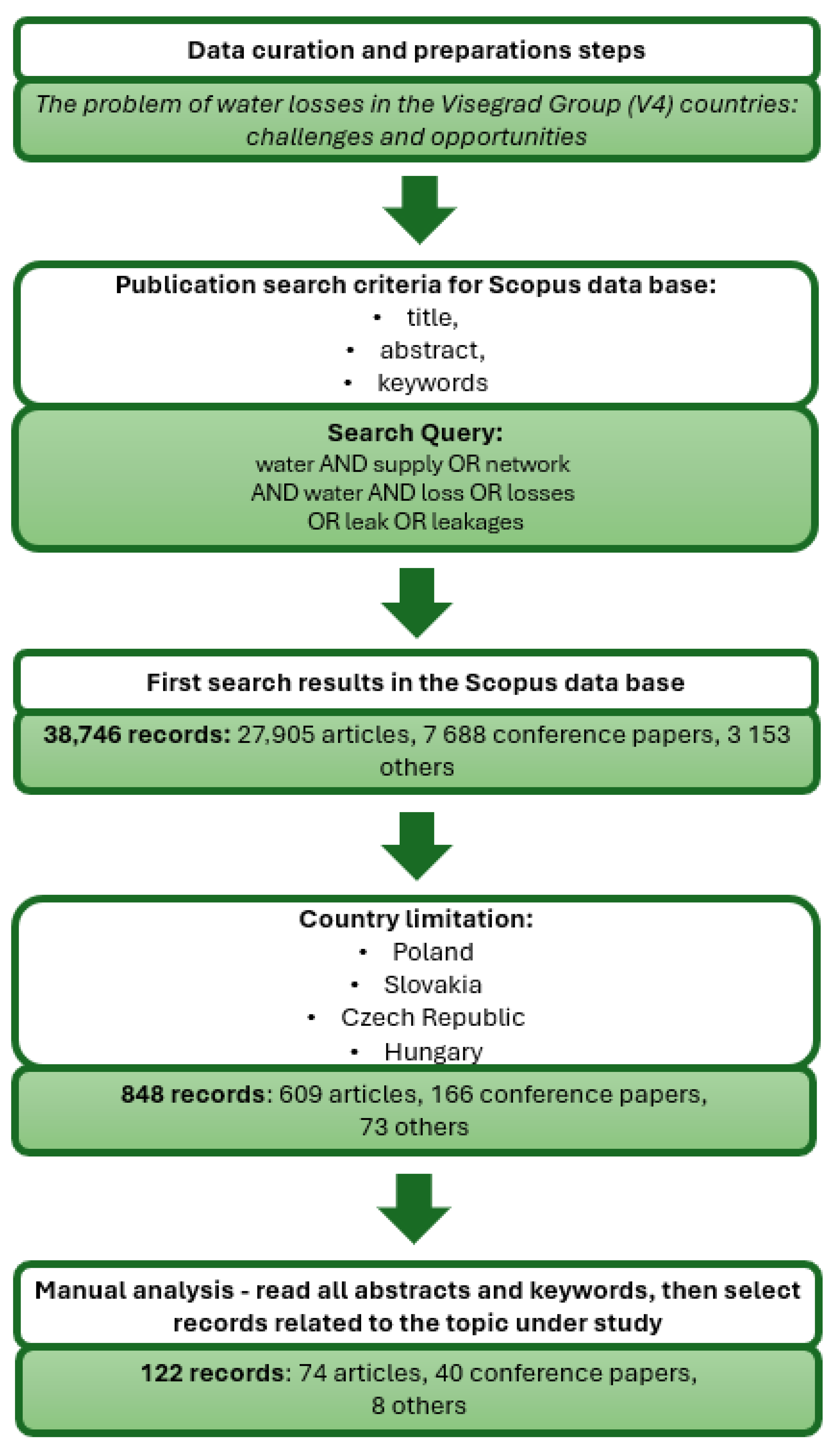
The source of bibliographic data used in this study was the Scopus scientific database, which, together with Web of Science, is one of the most recognizable and widely used bibliographic databases in the scientific community. The search for scientific papers was based on an analysis of the title, abstract, and keywords fields. The basic search queries were defined as “water AND supply OR network AND water AND loss OR losses OR leak OR leakages”. The data obtained from the Scopus scientific database are from 29 July 2025. The initial search of bibliographic data identified 38,746 records. The search was then limited to items from countries belonging to the Visegrad Group (V4), i.e., Poland, Hungary, the Czech Republic, and Slovakia. This reduced the number of items to 848 publications. In the final stage, the titles, abstracts, and keywords were analyzed manually. Publications related to the issue of water losses in water supply systems were selected for analysis. Finally, a bibliographic database consisting of 122 items was used for the analysis. Figure 1 presents a diagram of the preparation of the bibliographic database.

3. Results and Discussion

3.1. Current Research Directions

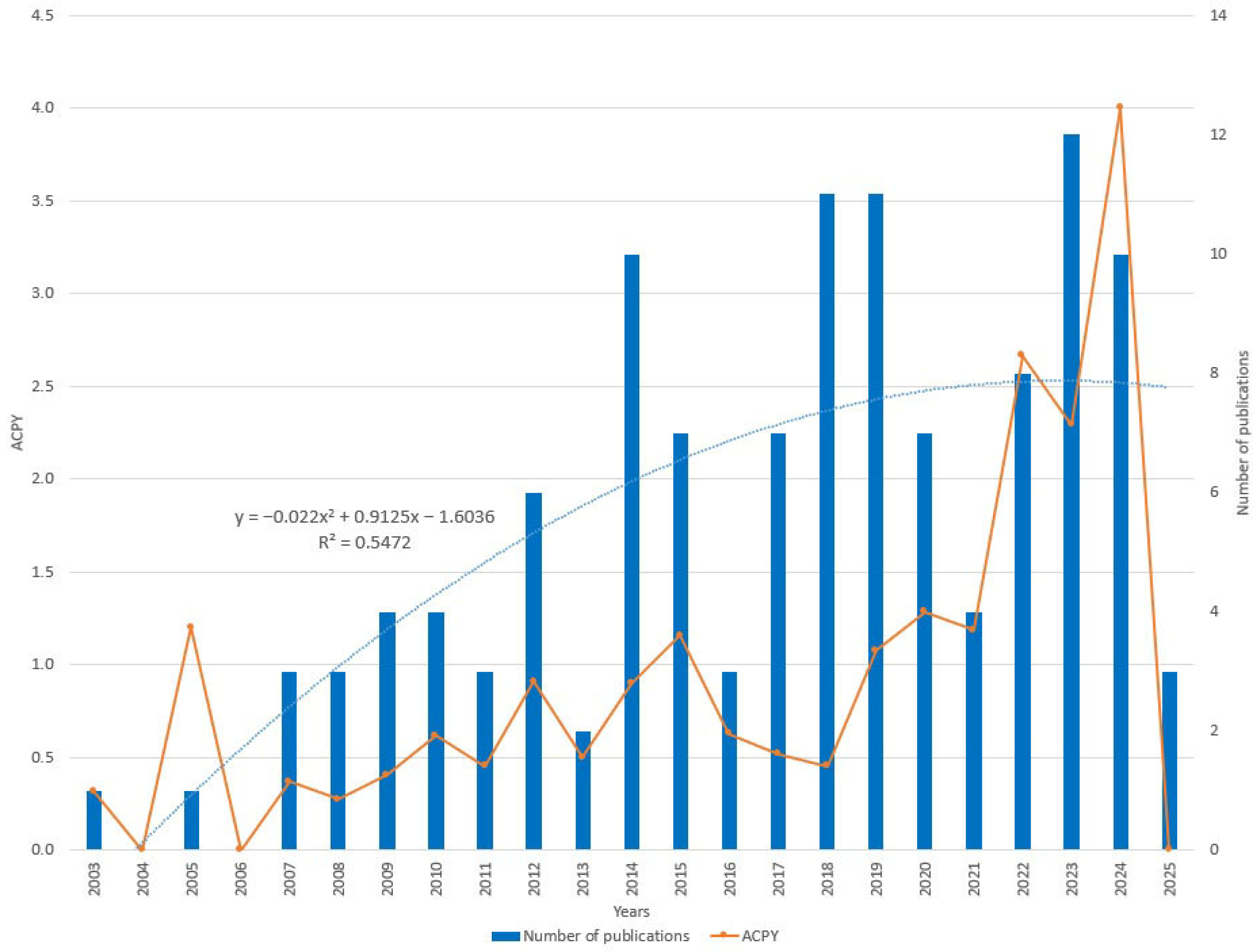
Figure 2 shows the number of publications in the period of 2003–2025 related to water loss in the V4 countries and the average number of citations per year. Based on the analysis of the graph, a clear and systematic increase in the number of publications on the subject under analysis can be observed. The second-degree polynomial model used (R2 = 0.5472) indicates the non-linear nature of the changes and moderate quality of the fit. The negative value of the coefficient for the quadratic component may suggest a gradual stabilization of the growth rate in recent years. At the same time, the ACPY index shows an increasing intensity of citations after 2020. The increasing number of publications and citations indicates a growing awareness among researchers of water losses, which, among other things, generate unnecessary costs associated with the treatment of water that ultimately does not bring any benefits. Another factor contributing to the increase in the topic of water losses is the introduction by the European Parliament and the Council of the EU of Directive 2020/2184 on the quality of water intended for human consumption [5], which obliges companies supplying water to more than 50,000 consumers or supplying at least 10,000 m3/d of water to assess the amount of water leakage and the possibilities for reducing it. Due to the provisions of Directive 2020/2184 [5], the topic of water loss reduction and management will continue to be relevant, and, according to the authors, the number of publications on this topic may continue to grow.
The first publications on water losses in the V4 group appeared in 1996. They concerned efforts to reduce losses through infrastructure modernization, the use of data and management support systems, and the transformation of water management [18,19]. In 2003, publication [20] presented the CARE-W project, which aimed to develop tools for optimal planning of repair strategies and modernization of water supply networks. In the following years, topics related to tools used for monitoring the condition of water supply networks, applied to leak detection [21], and effective real-time management of water supply network infrastructure [22] appeared. In 2007–2014, H. Hotloś, in five independent publications and two co-authored publications, focused mainly on the quantitative operational analysis of collective water supply systems, with particular emphasis on water losses, water pipe failure rates, and technical conditions affecting their operation [6,7,8,23,24,25,26]. Articles [27,28,29] presented the topic of intelligent water supply system monitoring systems designed to detect water leaks. Other publications from 2008 to 2020 have been divided into categories and presented in the Table 1. Due to the nature of the research, selected publications have been assigned to more than one category.
In 2021, research focused on water loss management in water supply systems [5], monitoring and advanced processes supporting leak detection [100,101,102], and analysis of water losses in two water supply systems and their variability during the analyzed period [103].
In 2022, the research focused on the following:
  • The phenomenon of soil suffusion resulting from leaks from damaged water pipes [104];
  • The design of DMA areas and their importance for water supply network management, including water losses [105,106];
  • Analysis of the vulnerability of water supply networks to failures, taking into account the frequency of damage and the scale of interruptions in water supply to consumers [107];
  • Loss monitoring systems that enable the detection of leaks and the estimation of water wastage [108];
  • A review of the methods used to diagnose the operating condition of water supply networks [109];
  • A hydraulic model used to reduce pressure in the network, thereby limiting water losses [110];
  • Automatic comparison of measurement data with simulation results. Exceeding the specified deviations between measurement data and simulation triggers an alert, allowing for more effective leak detection and reducing the operator’s workload [111].
The year 2023 focuses on topics such as the following:
  • Pressure and its management in the water supply network [112,113,114];
  • Optimization of shut-off valves using a “standard genetic algorithm” [115];
  • Safety and reliability of water supply systems [116,117];
  • New indicators for assessing the development potential of urban agglomerations in the context of water resource availability; water losses are presented as one of the key barriers [118];
  • Energy audit of the water supply network showing the level of energy losses, which are largely related to water losses [119];
  • Assessment of the possibility of implementing CE in the water sector in Kazakhstan [120];
  • A real-time ultrasonic water leak detection system [121];
  • Detecting leaks in measurement zones (DMA) [122] and the impact of selected factors on the failure rate of the municipal water supply network [123].
The year 2024 saw another 10 publications on the subject, which concerned the following:
  • Analysis of battery power consumption in sensors used for network monitoring and leak detection [124];
  • An energy saving model for Internet of Things (IoT) sensors monitoring pipelines [125];
  • A method for locating leaks in complex water supply systems using data from physical simulations and a limited number of sensors [126];
  • An approach to detecting water leaks in water supply networks using anomaly detection methods for heterogeneous time series data from various components of the water supply network [127];
  • Determining the area of water leakage from a damaged water pipe using analysis of the fractal characteristics of the leak [128];
  • Analysis of the impact of climate change on water supply infrastructure, pointing to increasing water losses [129];
  • Research on water meter selection aimed at reducing apparent water losses in the water supply network [130];
  • A method for detecting water leaks in rural and suburban water supply networks using hydraulic modeling and statistical analysis [131];
  • Comparative analysis of water loss efficiency indicators for 12 Polish water supply systems [132];
  • Method for assessing the risk of water loss in water supply networks based on a three-parameter risk method and risk maps [133].
As of 29 July 2025, three publications matching the analyzed topic were found in the Scopus database. One article [134] presents a new DSMS algorithm that enables effective detection of leaks in the water supply network by analyzing acoustic signals despite environmental interference, while another [135] presents an assessment of the accuracy and efficiency of spatial data processing systems in terms of improving network management, facilitating leak detection, and improving the accuracy of hydraulic modeling. The last publication analyzed [136] concerns the analysis of the variability of metrological parameters of water meters during their operation, with an emphasis on measurement errors at minimum flows, which have a significant impact on apparent water losses.
Table 2 presents the most frequently cited publications in the period 2003–2025, including all publications cited more than 20 times (number of citations as of 29 July 2025).
Based on Table 2, it can be seen that the two papers with the highest number of citations [41,52] concern the detection and localization of leaks in networks. The most frequently cited paper is [105], presenting an automated algorithm used to design DMA zones (the annual average number of citations is 11). Of the seven most cited publications, five concern various methods or techniques for detecting or locating leaks in water distribution systems. The remaining papers concern the diagnosis of the operation and faults of water supply systems [8] and the design of DMA zones [105].

3.2. Scientometric Analysis

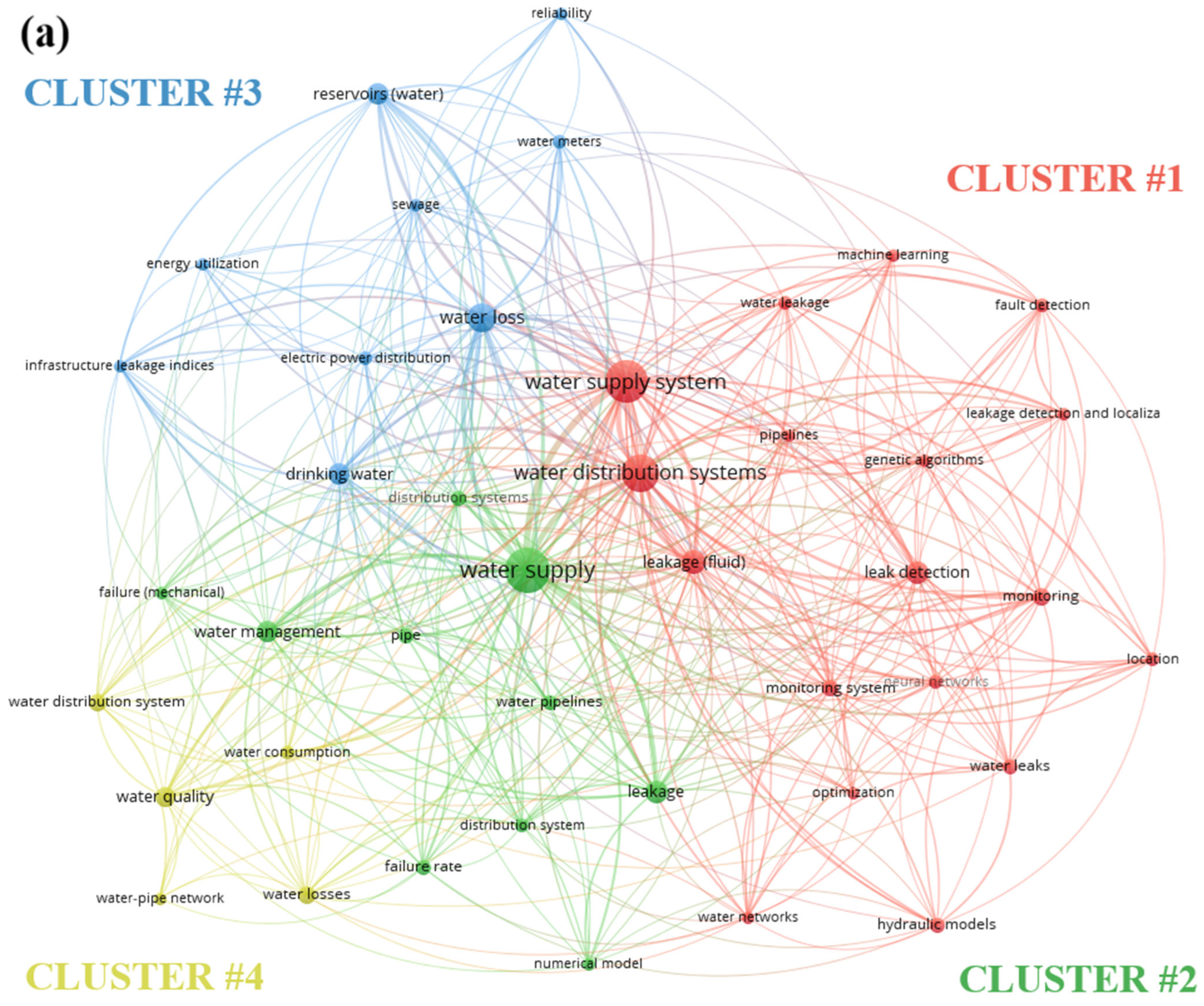
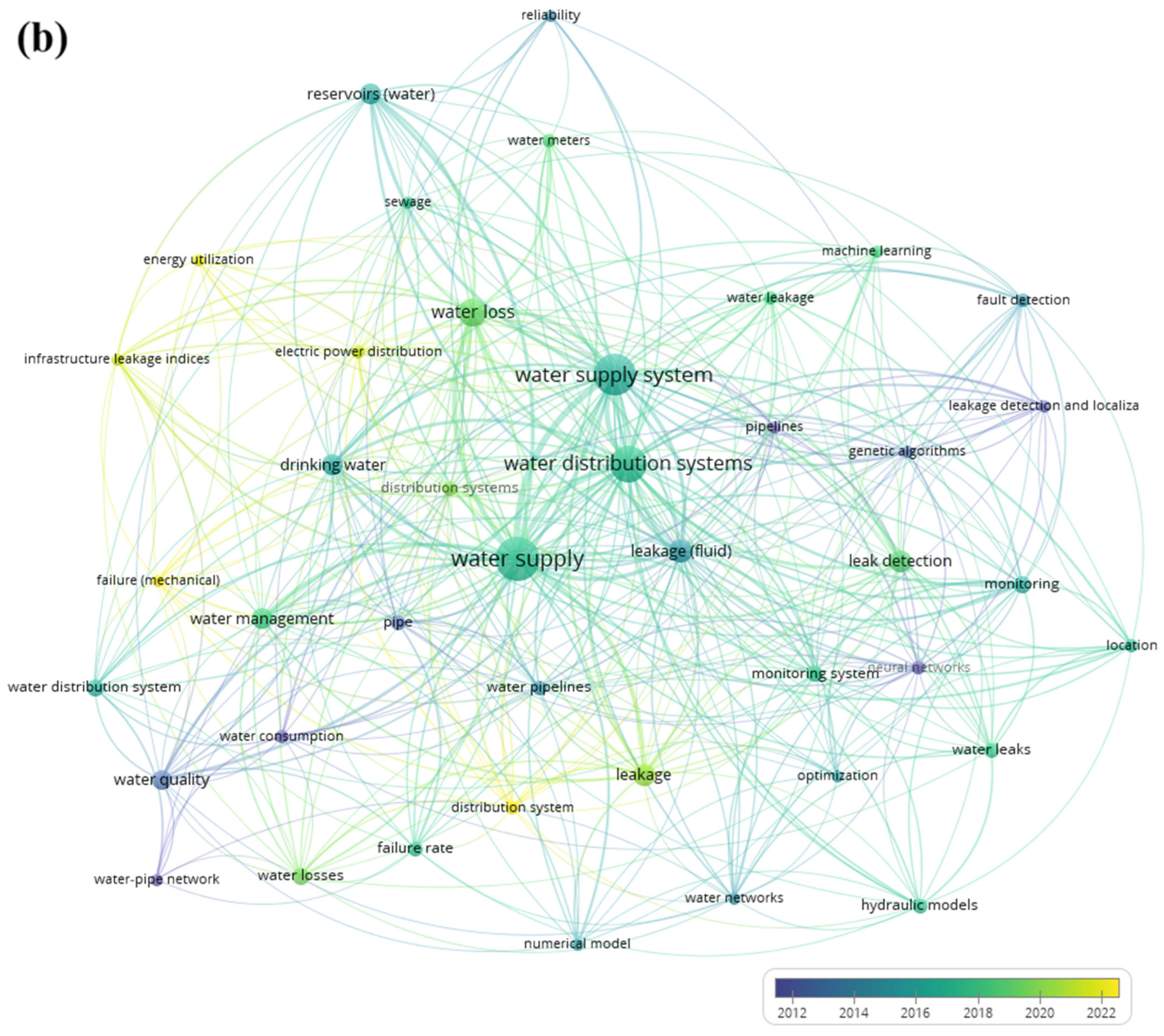
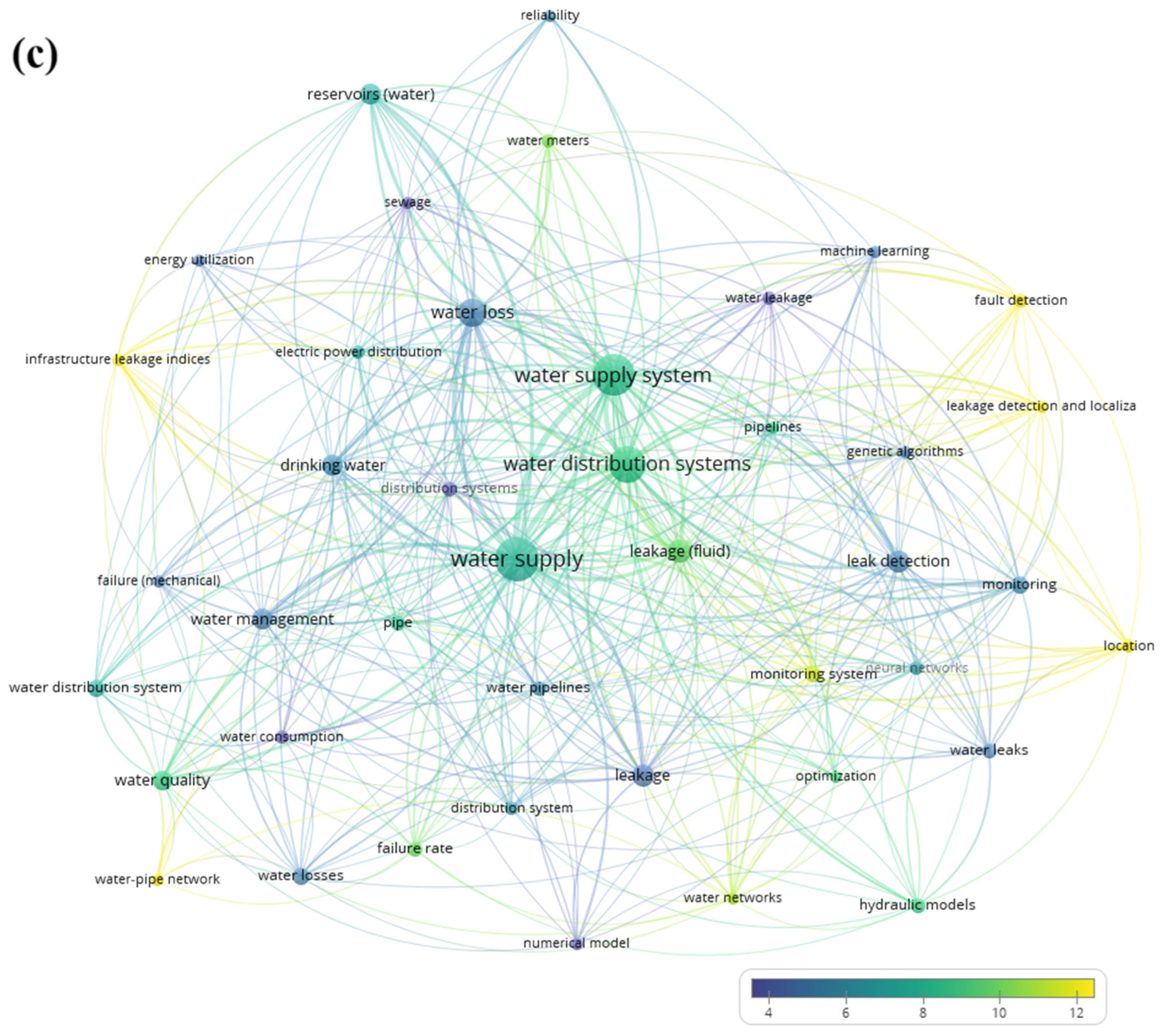
Figure 3 presents the results of a bibliometric analysis conducted using the VOSviewer program. It shows a map of the co-occurrence of keywords related to the issue of the problem of water losses in Visegrad Group (V4) countries, including challenges and opportunities. Each keyword is represented by a circle, the size of which reflects the weight (importance) of the keyword—the larger the circle, the greater its significance in the analyzed set. The keywords are grouped into four clusters, marked with colors: red (#1), green (#2), blue (#3), and yellow (#4). The distances between the nodes indicate the degree of connection between individual keywords, with a smaller distance meaning a stronger connection [16]. In addition, the figure shows lines reflecting the connections between keywords, with their thickness corresponding to the frequency of co-occurrence of the keywords in the publication [16]. Figure 3 presents the following aspects of the analysis: (a) clusters; (b) year of occurrence; and (c) average number of citations.
Table 3 summarizes key statistics for keywords presented in the network shown in Figure 3. Due to the very large number of keywords identified in the analyzed publications (982 keywords), only keywords that appeared in at least five publications were included in further research. As a result, the analyzed set was reduced to 42 keywords assigned to four clusters. In VOSviewer, clusters are created based on the strength of keyword co-occurrence. Grouping is performed using the VOS (Visualization of Similarities) algorithm, which maximizes the density of connections within a cluster and minimizes connections between clusters. The result is colorful groups of keywords representing coherent thematic areas (Figure 3a).
The three keywords with the highest total link strength (TLS), number of occurrences (O), and number of links (L) presented in Table 2 are “water supply” (TLS-243; O-55; L-41), “water supply system” (TLS-199; O-49; L-40), and “water distribution systems” (TLS-184; O-39; L-40).
An analysis of the average age of publications indicates that keywords such as “water-pipe network,” “pipelines,” “water consumption,” and “neural networks” were the starting point for research conducted between 1996 and 2025. Contemporary research trends developed recently include keywords such as “distribution system,” “(mechanical) failure,” “energy utilization,” “electric power distribution,” and “infrastructure leakage indicators.”
Within the analyzed topic, the keywords that attract the most interest (measured by the average number of citations) are “leakage detection and localizations” (16.60), “infrastructure leakage indices” (16.40), and “fault detection” (15.83).

3.3. Research Directions in the Context of the V4 Countries

Table 4 presents the V4 countries along with the number of publications, citations, and total link strength. Poland has 97 publications on the subject analyzed, which have been cited a total of 695 times. The Czech Republic ranks second with 13 publications cited 72 times, followed by Hungary with 8 publications and 20 citations, and Slovakia with 4 publications.
Table 5 presents selected studies after 2020 on the analyzed subject area. Since 2021, 37 of 122 publications in the studied field have been produced. The most interesting areas of research developed in recent years include studies on water loss monitoring systems and methods for detecting them [108,122,131,132]; the impact of factors on the failure rate of water supply networks and failure prediction [123]; and the analysis of the risk of water loss in water supply systems [133].
As can be seen from Table 5, issues in selected scientific papers since 2022 related to water losses have largely focused on monitoring, modeling, machine learning, neural networks, and risk analysis for the purpose of detecting and/or predicting failures.

3.4. Discussion of Results

Based on a bibliometric analysis of the current state of knowledge on water loss in the V4 countries, there is a growing interest in research on advanced leak detection methods (including machine learning, hydraulic modeling, etc.). In the discussed work, particular attention should be paid to the integration of monitoring systems and real-time data analysis, optimization (e.g., pressure management or DMA zone design), and the adaptation of research trends to Directive (EU) 2020/2184. The analysis made it possible to identify the strengths and weaknesses of studies on water losses in the V4 countries.
Strengths:
  • Aligning research trends with the requirements of Directive (EU) 2020/2184;
  • Network optimization through pressure management or DMA zone design;
  • Integration of monitoring systems and real-time data analysis;
  • Growing interest in advanced leak detection methods.
Weaknesses:
  • Limited consideration of environmental and climatic factors in studies related to water losses;
  • Low availability of high-resolution data;
  • Use of GIS systems mainly for infrastructure management—recording and collecting data;
  • Limited integration of methods.
When it comes to global research trends, the issue of water loss covers a wide range of approaches, from factors influencing water loss, water supply network management strategies, and the relationship between water loss and water demand (the role of loss in resource and water supply system management) to the integration of performance indicators (e.g., ILI, NRW) and methods and advanced solutions based on data and machine learning, detection methods, and modeling [2,137,138,139,140,141,142,143], while publications from V4 countries have a more limited scope. Research in V4 countries mainly focuses on technical and diagnostic aspects of leaks and less often on integrated and interdisciplinary strategies and the integration of methods, but this trend has been shifting towards global trends in recent years. Global literature reviews indicate the high importance of long-term, high-resolution operational data for accurate modeling and optimization of activities [2].
According to the authors, compared to global research trends, the V4 countries have limited research related to the development of methods for assessing water loss risk, the integration of methods, an interdisciplinary approach to the subject, and the use of GIS systems to create advanced spatial analyses.

4. Conclusions, Perspective, and Limitations

Reducing water loss in water supply systems is an important part of water supply companies’ efforts to provide consumers with a continuous supply of water of the right quality and at the required pressure. Another reason for reducing water loss is economic: water lost not only through failures or leaks, but also through theft, is non-revenue water, the costs of treating and introducing into the distribution network of which are borne directly by water supply companies and indirectly by consumers. An additional aspect is Directive 2184 of the European Parliament and of the Council of the European Union of 2020 on the quality of water intended for human consumption, which will set a permissible threshold by 12 January 2028, based on the infrastructure leakage index (ILI) or another appropriate method. For water supply companies supplying at least 10,000 m3/d of water or serving at least 50,000 customers, these provisions will be binding, and companies exceeding the permissible thresholds will have to present an action plan to reduce leakage.
Based on the literature review, it can be concluded that the problem of water losses in water supply systems in the Visegrad Group countries is analyzed in many scientific papers. Water losses in the analyzed scientific papers are most often associated with the failure rate of water pipes, pipe leaks, or hydraulic conditions (excessive or variable pressure). Examples include papers [6,7,8,25,30,31,33]. The main research approach is an operational and statistical one, involving, among other things, the analysis of operational data from many years, water loss and failure rates, and the correlation between damage and hydraulic parameters. In some of the studies, e.g., [20,22], computer simulations and hydraulic models were used to evaluate the operation of water supply systems, but, in these cases, water losses are not the main problem but rather the optimization of network operation and reduction of operating costs. Another important area of research is the introduction of leak detection and localization using, among other things, artificial neural networks [49,52].
GIS systems are widely used by water supply companies as a tool for effective water supply network management, primarily enabling precise infrastructure location. Despite the many possibilities for analyzing spatial and numerical data in a GIS environment, this system has not yet been used as a tool to support the management of failures and water losses. Its role has been limited mainly to a recording tool and a tool supporting data and infrastructure management.
Based on the analyzed literature, it was found that the topic of water loss risk has so far been addressed mainly indirectly, through risk components, i.e., risk management in the water supply network [84], probability of failure [72], probability and frequency of failure, effects, including amount of water loss, and factors, such as pressure, operating conditions [6,8,23,25]. One paper [133] directly refers to the risk of water loss, introduces the conceptual notion of water loss risk, and structures the factors influencing the risk of water loss. Based on the current state of knowledge, the main directions for further scientific research in the analyzed area can be presented, i.e., extending the capabilities of GIS systems to include analytical tasks, visualization of research results, and transitioning from the concept of water loss risk to a risk model and its implementation in a GIS environment. The combination of water loss risk management and spatial analysis will be an important tool that can be used to reduce and maintain water leakage at an acceptable level, which will be required of water supply companies under Directive 2020/2184.

Author Contributions

Conceptualization, M.R., J.Ż., D.S., and B.T.-C.; methodology, M.R., J.Ż., and D.S.; software, M.R.; validation, M.R., J.Ż., and D.S.; formal analysis, M.R.; investigation, M.R.; resources, M.R.; data curation, M.R.; writing—original draft preparation, M.R.; writing—review and editing, M.R., J.Ż., D.S., and B.T.-C.; visualization, M.R.; supervision, D.S. and B.T.-C.; project administration, M.R. and J.Ż. All authors have read and agreed to the published version of the manuscript.

Funding

This research received no external funding.

Data Availability Statement

No new data were created or analyzed in this study.

Conflicts of Interest

The authors declare no conflicts of interest.

References

  1. Lambert, A.O.; Brown, T.G.; Takizawa, M.; Weimer, D. A Review of Performance Indicators for Real Losses from Water Supply Systems. J. Water Supply: Res. Technol. 1999, 48, 227–237. [Google Scholar] [CrossRef]
  2. Serafeim, A.V.; Fourniotis, N.T.; Deidda, R.; Kokosalakis, G.; Langousis, A. Leakages in Water Distribution Networks: Estimation Methods, Influential Factors, and Mitigation Strategies—A Comprehensive Review. Water 2024, 16, 1534. [Google Scholar] [CrossRef]
  3. Liemberger, R.; Wyatt, A. Quantifying the Global Non-Revenue Water Problem. Water Supply 2019, 19, 831–837. [Google Scholar] [CrossRef]
  4. Molinos-Senante, M.; Maziotis, A.; Sala-Garrido, R.; Mocholi-Arce, M. Estimating Performance and Savings of Water Leakages and Unplanned Water Supply Interruptions in Drinking Water Providers. Resour. Conserv. Recycl. 2022, 186, 106538. [Google Scholar] [CrossRef]
  5. Official Journal of the European Union. Directive (EU) 2020/2184 of the European Parliament and of the Council of 16 December 2020 on the Quality of Water Intended for Human Consumption; Official Journal of the European Union: Luxembourg, 2020. [Google Scholar]
  6. Hotloś, H. Quantitative Assessment of the Influence of Water Pressure on the Reliability of Water-Pipe Networks in Service. Environ. Prot. Eng. 2010, 36, 103–112. [Google Scholar]
  7. Hotloś, H.; Mielcarzewicz, E. Reliability conditions and assessment of a proper functioning of water-pipe networks and sewer systems in areas affected by mining operations. In Scientific Works of the Institute of Environmental Protection of the Technical University of Wrocław; Wrocław University of Technology Press: Wrocław, Poland, 2011; pp. 1–84. Available online: https://www.scopus.com/pages/publications/84862747336# (accessed on 5 March 2026).
  8. Kutyłowska, M.; Hotloś, H. Failure Analysis of Water Supply System in the Polish City of Głogów. Eng. Fail. Anal. 2014, 41, 23–29. [Google Scholar] [CrossRef]
  9. World Health Organization. Water Safety in Distribution Systems; World Health Organization: Geneva, Switzerland, 2015. [Google Scholar]
  10. World Health Organization. Water Safety Plan Manual: Step-by-Step Risk Management for Drinking-Water Suppliers, 2nd ed.; World Health Organization: Geneva, Switzerland, 2023. [Google Scholar]
  11. Perianes-Rodriguez, A.; Waltman, L.; Van Eck, N.J. Constructing Bibliometric Networks: A Comparison between Full and Fractional Counting. J. Informetr. 2016, 10, 1178–1195. [Google Scholar] [CrossRef]
  12. Kut, P.; Pietrucha-Urbanik, K. Bibliometric Analysis of Renewable Energy Research on the Example of the Two European Countries: Insights, Challenges, and Future Prospects. Energies 2023, 17, 176. [Google Scholar] [CrossRef]
  13. Ogarek, P.; Wojtoń, M.; Słyś, D. Hydrogen as a Renewable Energy Carrier in a Hybrid Configuration of Distributed Energy Systems: Bibliometric Mapping of Current Knowledge and Strategies. Energies 2023, 16, 5495. [Google Scholar] [CrossRef]
  14. Van Eck, N.J.; Waltman, L. Software Survey: VOSviewer, a Computer Program for Bibliometric Mapping. Scientometrics 2010, 84, 523–538. [Google Scholar] [CrossRef]
  15. Żywiec, J.; Szpak, D.; Wartalska, K.; Grzegorzek, M. The Impact of Climate Change on the Failure of Water Supply Infrastructure: A Bibliometric Analysis of the Current State of Knowledge. Water 2024, 16, 1043. [Google Scholar] [CrossRef]
  16. Kordana-Obuch, S.; Starzec, M.; Wojtoń, M.; Słyś, D. Greywater as a Future Sustainable Energy and Water Source: Bibliometric Mapping of Current Knowledge and Strategies. Energies 2023, 16, 934. [Google Scholar] [CrossRef]
  17. VOSviewer, version 1.6.20; Leiden University: Leiden, The Netherlands, 2025.
  18. Kris, J. National Report-Slovakia. Water Supply 1996, 14, 104–105. [Google Scholar]
  19. Cihakova, I.; Valdhansova, H.; Svec, L. National Report-Czech Republic. Water Supply 1996, 14, 188–190. [Google Scholar]
  20. Sægrov, S.; Schilling, W.; Røstum, J.; Tuhovcak, L.; Eisenbeis, P.; Herz, R.; LeGauffre, P.; Baptista, J.M.; Conroy, P.; DeFederico, V.; et al. Computer-Aided Rehabilitation of Water Networks (CARE-W). Water Supply 2003, 3, 19–27. [Google Scholar] [CrossRef]
  21. Holnicki-Szulc, J.; Kołakowski, P.; Nasher, N. Leakage Detection in Water Networks. J. Intell. Mater. Syst. Struct. 2005, 16, 207–220. [Google Scholar] [CrossRef]
  22. Farmani, R.; Ingeduld, P.; Savic, D.; Walters, G.; Svitak, Z.; Berka, J. Real-Time Modelling of a Major Water Supply System. Proc. Inst. Civ. Eng.-Water Manag. 2007, 160, 103–108. [Google Scholar] [CrossRef]
  23. Hotloś, H. Quantitative Assessment of the Effect of Some Factors on the Parameters and Operating Costs of Water-Pipe Networks; Wrocław University of Technology Publishing House: Wrocław, Poland, 2007; pp. 1–199. [Google Scholar]
  24. Hotloś, H. Analysis of failure events and damage repair costs for water-pipe networks in the winter season. Ochr. Srodowiska 2009, 31, 41–48. [Google Scholar]
  25. Hotloś, H. Variations in water loss observed in some water distribution systems over the period of 1990-2008. Ochr. Srodowiska 2010, 32, 21–25. [Google Scholar]
  26. Hotloś, H. Variations in water consumption observed in some municipalities in the time span of 1990 to 2008. Ochr. Srodowiska 2010, 32, 39–42. [Google Scholar]
  27. Wyczółkowski, R.; Wysogla̧d, B. An Optimization of Heuristic Model of Water Supply Network. Comput. Assis Mech. Eng. Sci. 2007, 14, 767–776. [Google Scholar]
  28. Wyczółkowski, R. Intelligent Monitoring of Local Water Supply System Inteligentny System Monitorowania Sieci Wodociagowych. Eksploat. I Niezawodn.-Maint. Reliab. 2008, 37, 33–36. [Google Scholar]
  29. WyczóŁkowski, R.; Matysiak, G. The Development of an Intelligent Monitoring System of a Local Water Supply Network. Eksploat. I Niezawodn.-Maint. Reliab. 2009, 42, 71–75. [Google Scholar]
  30. Bergel, T.; Bugajski, P. Analysis of water losses in municipal water supply systems. Przem. Chem. 2008, 87, 408–410. [Google Scholar]
  31. Bergel, T.; Pawełek, J. Quantitative and Economical Aspects of Water Loss in Water-Pipe Networks in Rural Areas. Environ. Prot. Eng. 2008, 34, 59–64. [Google Scholar]
  32. Kowalski, D. Water quality management in a water distribution system. Ochr. Srodowiska 2009, 31, 37–40. [Google Scholar]
  33. Usidus, D.; Drozdowicz, A. Analysis of Water Use on the Selected Area of Central Pomerania-in Sianów Municipality. Rocz. Ochr. Srodowiska 2010, 12, 543–558. [Google Scholar]
  34. Kwietniewski, M. Application of water loss indicators as a measure of its distribution effectiveness in water supply systems. Ochr. Srodowiska 2013, 35, 9–16. [Google Scholar]
  35. Wojciech, K. Sectorisation of Looped Water Networks with Electromagnetic Water Meters. Water Pract. Technol. 2014, 9, 150–157. [Google Scholar] [CrossRef]
  36. Musz-Pomorska, A.; Iwanek, M.; Parafian, K.; Wójcik, K. Analysis of Water Losses in Two Selected Water Distribution Systems. In E3S Web Conferences; Piekarska, K., Kutylowska, M., Trusz-Zdybek, A., Kazmierczak, B., Eds.; EDP Sciences: Les Ulis, France, 2017; Volume 17. [Google Scholar]
  37. Ociepa, E.; Molik, R.; Lach, J. Assessment of Water Loss Level on the Example of Selected Distribution Systems. In E3S Web Conferences; Kazmierczak, B., Jadwiszczak, P., Piekarska, K., Kutylowska, M., Eds.; EDP Sciences: Les Ulis, France, 2018; Volume 44. [Google Scholar]
  38. Gwozdziej-Mazur, J.; Świętochowski, K. Analysis of the Water Meter Management of the Urban-Rural Water Supply System. In E3S Web Conferences; Kazmierczak, B., Jadwiszczak, P., Piekarska, K., Kutylowska, M., Eds.; EDP Sciences: Les Ulis, France, 2018; Volume 44. [Google Scholar]
  39. Ociepa, E. Analysis and Evaluation of Water Losses in the Collective Water Supply System. Rocz. Ochr. Srodowiska 2019, 21, 1021–1039. [Google Scholar]
  40. Zywiec, J.; Tchórzewska-Cieślak, B. Seasonality Analysis of Water Losses in a Selected Collective Water Supply System. In E3S Web Conferences; Jadwiszczak, P., Kutylowska, M., Kazmierczak, B., Miller, U., Eds.; EDP Sciences: Les Ulis, France, 2019; Volume 100. [Google Scholar]
  41. Ociepa, E.; Mrowiec, M.; Deska, I. Analysis of Water Losses and Assessment of Initiatives Aimed at Their Reduction in Selected Water Supply Systems. Water 2019, 11, 1037. [Google Scholar] [CrossRef]
  42. Zywiec, J.; Tchórzewska-Cieślak, B. Water Loss Analysis as an Element of Operation Management of Water Supply System. J. KONBiN 2019, 49, 55–77. [Google Scholar] [CrossRef]
  43. Gwoździej-Mazur, J.; Świętochowski, K. Evaluation of Real Water Losses and the Failure of Urban-Rural Water Supply System. J. Ecol. Eng. 2020, 22, 132–138. [Google Scholar] [CrossRef]
  44. Nowicki, A.; Grochowski, M. Kernel PCA in Application to Leakage Detection in Drinking Water Distribution System. In Lecture Notes in Computer Science; Springer: Berlin/Heidelberg, Germany, 2011; Volume 6922, pp. 497–506. [Google Scholar]
  45. Sala, D.; Kolakowski, P. Identification of Leaks in Closed-Loop Water Distribution Networks Using the Virtual Distortion Method. In Proceedings of the 11th International Conference on Computing and Control for the Water Industry (CCWI 2011); Urban Water Management: Challenges and Opportunities; Centre for Water Systems: Exeter, UK, 2011; Volume 2. [Google Scholar]
  46. Przystałka, P.; Moczulski, W. Optimal Placement of Sensors and Actuators for Leakage Detection and Localization. IFAC Proc. Vol. 2012, 8, 666–671. [Google Scholar] [CrossRef]
  47. Shucksmith, J.D.; Boxall, J.B.; Staszewski, W.J.; Seth, A.; Beck, S.B.M. Onsite Leak Location in a Pipe Network by Cepstrum Analysis of Pressure Transients. J.-Am. Water Work. Assoc. 2012, 104, E457–E465. [Google Scholar] [CrossRef]
  48. Sala, D.; Kołakowski, P. A Global Approach for Detection of Leaks in Closed-Loop Water Distribution Networks. In Proceedings of the 6th European Workshop on Structural Health Monitoring (EWSHM 2012), Dresden, Germany, 3–6 July 2012. [Google Scholar]
  49. Studzinski, J.; Rojek, I. Detection and Localization of Water Leaks in Water Nets by Means of a Monitoring System, Hydraulic Model and Neuronal Networks. In Proceedings of the of 27th European Simulation and Modeling Conference, ESM’2013, Lancaster, UK, 23–25 October 2013; pp. 172–175. [Google Scholar]
  50. Miszta-Kruk, K.; Kwietniewski, M.; Malesińska, A.; Chudzicki, J. Modern Devices for Detecting Leakages in Water Supply Networks. In Underground Infrastructure of Urban Areas 3; CRC Press: Boca Raton, FL, USA, 2014; pp. 149–160. [Google Scholar]
  51. Sala, D.; Kołakowski, P. Detection of Leaks in a Small-Scale Water Distribution Network Based on Pressure Data—Experimental Verification. Procedia Eng. 2014, 70, 1460–1469. [Google Scholar] [CrossRef]
  52. Wachla, D.; Przystalka, P.; Moczulski, W. A Method of Leakage Location in Water Distribution Networks Using Artificial Neuro-Fuzzy System. IFAC-PapersOnLine 2015, 28, 1216–1223. [Google Scholar] [CrossRef]
  53. Moczulski, W.; Wyczolkowski, R.; Ciupke, K.; Przystalka, P.; Tomasik, P.; Wachla, D. A Methodology of Leakage Detection and Location in Water Distribution Networks—The Case Study. In 2016 3rd Conference on Control and Fault-Tolerant Systems (SysTol); Sarrate, R., Ed.; IEEE Computer Society: Los Alamitos, CA, USA, 2016; Volume 2016, pp. 331–336. [Google Scholar]
  54. Iwanek, M.; Kowalski, D.; Kowalska, B.; Hawryluk, E.; Kondraciuk, K. Experimental Investigations of Zones of Leakage from Damaged Water Network Pipes. In WIT Transactions on the Built Environment; WITPress: Southampton, UK, 2014; Volume 139, pp. 257–265. [Google Scholar]
  55. Miszta-Kruk, K. Employment of the inverse transient analysis to leakage detection in water distribution networks. Ochr. Srodowiska 2016, 38, 39–43. [Google Scholar]
  56. Ciupke, K. Leak Detection Using Regression Trees. In Applied Condition Monitoring; Springer: Berlin/Heidelberg, Germany, 2018; Volume 10, pp. 311–321. [Google Scholar]
  57. Przystałka, P. Performance Optimization of a Leak Detection Scheme for Water Distribution Networks. IFAC-PapersOnLine 2018, 51, 914–921. [Google Scholar] [CrossRef]
  58. Moczulski, W.; Karwot, J.; Wyczółkowski, R.; Wachla, D.; Ciupke, K.; Przystałka, P.; Pająk, D. SysDetLok-a Leakage Detection and Localization System for Water Distribution Networks. IFAC-PapersOnLine 2018, 51, 521–528. [Google Scholar] [CrossRef]
  59. Kosior, M. The Concept of an Improved Acoustic Wireless Sensor Node for Leak Detection and Location in a Water Distribution Networks. Diagnostyka 2019, 20, 49–55. [Google Scholar] [CrossRef]
  60. Merta, J.; Fikejz, J. Utilization of Machine Learning to Detect Sudden Water Leakage for Smart Water Meter. In 2019 29th International Conference Radioelektronika (RADIOELEKTRONIKA); Institute of Electrical and Electronics Engineers Inc.: New York, NY, USA, 2019. [Google Scholar]
  61. Bieniek, A.; Studzinski, J. Methods for Detecting and Locating Water Leaks in Water Supply Systems. In 34th Annual European Simulation and Modelling Conference, ESM 2020; Nketsa, A., Baron, C., Foucher, C., Eds.; EUROSIS: Toulouse, France, 2020; pp. 282–290. Available online: https://www.scopus.com/pages/publications/85096790824 (accessed on 5 March 2026).
  62. Zimoch, I. Pressure control as part of risk management for a water-pipe network in service. Ochr. Srodowiska 2012, 34, 57–62. [Google Scholar]
  63. Rojek, I.; Studziński, J. Comparison of Different Types of Neuronal Nets for Failures Location within Water-Supply Networks. Eksploat. I Niezawodn.-Maint. Reliab. 2014, 16, 42–47. [Google Scholar]
  64. Iwanek, M.; Kowalski, D.; Kwietniewski, M. Model studies of a water outflow from an underground pipeline upon its failure. Ochr. Srodowiska 2015, 37, 13–17. [Google Scholar]
  65. Pietrucha-Urbanik, K.; Tchorzewska-Cieslak, B. Research Methodology of Water Network Failure in Terms of Reneval. J. KONBIN 2015, 33, 233–242. [Google Scholar] [CrossRef]
  66. Kutyłowska, M. Prediction of Failure Frequency of Water-Pipe Network in the Selected City. Period. Polytech. Civ. Eng. 2017, 61, 548–553. [Google Scholar] [CrossRef]
  67. Łój-Pilch, M.; Zakrzewska, A. Impact of Monitoring on the Mean Time to Repair of the Water Supply Network. E3S Web Conf. 2018, 44, 00101. [Google Scholar] [CrossRef]
  68. Teichmann, M.; Kuda, F.; Szeligová, N. Modelling and optimization of drinking water supply system using facility management part 2: Analysis of the construction and technical state of the water main in the village of Žabeň. Vytap. Vetr. Instal. 2018, 27, 224–228. [Google Scholar]
  69. Kepa, U.; Stepniak, L.; Stanczyk-Mazanek, E.; Przybylski, J. The Sustainable Management of Water Supply Systems. In AIP Conference Proceedings; Lepadatescu, B., Ed.; American Institute of Physics Inc.: Melville, NY, USA, 2018; Volume 2022. [Google Scholar]
  70. Tchórzewska-Cieślak, B.; Rak, J.R.; Szpak, D. Bayesian Inference in the Analysis of the Failure Risk of the Water Supply Network. J. KONBIN 2019, 49, 433–450. [Google Scholar] [CrossRef][Green Version]
  71. Pietrucha-Urbanik, K.; Tchórzewska-Cieślak, B.; Eid, M. Water Network-Failure Data Assessment. Energies 2020, 13, 2990. [Google Scholar] [CrossRef]
  72. Bogárdi, I.; Fülöp, R. A Space-Time Probabilistic Model for Pipe Network Reconstruction Planning. Urban Water J. 2012, 9, 333–346. [Google Scholar] [CrossRef]
  73. Studzinski, J.; Kurowski, M. Some Algorithms Supporting the Water Network Management by Use of Simulation of Network Hydraulic Model. In Industrial Simulation Conference (ISC’2014); Pehrsson, L., Syberfeldt, A., Ng, A., Eds.; EUROSIS-ETI: Ghent, Belgium, 2014; pp. 33–37. [Google Scholar]
  74. Bakker, M.; Rajewicz, T.; Kien, H.; Vreeburg, J.H.G.; Rietveld, L.C. Advanced Control of a Water Supply System: A Case Study. Water Pract. Technol. 2014, 9, 264–276. [Google Scholar] [CrossRef]
  75. Marton, D.; Kapelan, Z. Risk and Reliability Analysis of Open Reservoir Water Shortages Using Optimization. In Procedia Engineering; Giustolisi, O., Laucelli, D., Berardi, L., Campisano, A., Brunone, B., Eds.; Elsevier Ltd.: Amsterdam, The Netherlands, 2014; Volume 89, pp. 1478–1485. [Google Scholar]
  76. Studziński, J. ICS System Supporting the Water Networks Management by Means of Mathematical Modelling and Optimization Algorithms. J. Autom. Mob. Robot. Intell. Syst. 2015, 9, 48–54. [Google Scholar] [CrossRef]
  77. Grochowski, M.; Matczak, M.; Sokolowski, M. Optimising Approach to Designing Kernel PCA Model for Diagnosis Purposes with and without a Priori Known Data Reflecting Faulty States. In 2015 20th International Conference on Methods and Models in Automation and Robotics, MMAR 2015; Institute of Electrical and Electronics Engineers Inc.: New York, NY, USA, 2015; pp. 541–546. [Google Scholar]
  78. Lozynskyi, A.O.; Kutsyk, A.S.; Kinchur, O.F. The Research of Efficiency of the Use of Neuropredictor in the Control System of Water-Supply Pump Electric Drive. Nauk. Visnyk Natsionalnoho Hirnychoho Universytetu 2017, 1, 93–99. [Google Scholar]
  79. Lousada, S.; Silva, P.S.-D.; Castanho, R.A.; Naranjo-Gómez, J.M. Modelling water system supplies. The case of Madeira island. Bitacora Urban. Territ. 2019, 29, 89–98. [Google Scholar] [CrossRef]
  80. Suchorab, P.; Iwanek, M. Water Losses Analysis Based on FEFLOW FEM Simulation and EPANET Hydraulic Modelling. In IOP Conference Series: Materials Science and Engineering; IOP Publishing Ltd.: Bristol, UK, 2019; Volume 710. [Google Scholar]
  81. Kofinas, D.; Ulanczyk, R.; Laspidou, C.S. Simulation of a Water Distribution Network with Key Performance Indicators for Spatio-Temporal Analysis and Operation of Highly Stressedwater Infrastructure. Water 2020, 12, 1149. [Google Scholar] [CrossRef]
  82. Studziński, J.; Ziółkowski, A. Control of Pumps of Water Supply Network under Hydraulic and Energy Optimisation Using Artificial Intelligence. Entropy 2020, 22, 1014. [Google Scholar] [CrossRef]
  83. Bibok, A.; Fülöp, R. Hydraulic Model Calibration and Performance Assessment of Pressure Managed Areas with Multiple Inlets. Period. Polytech. Civ. Eng. 2020, 64, 605–613. [Google Scholar] [CrossRef]
  84. Tchórzewska-Cieslak, B. Risk Management System in Water-Pipe Network Functioning. In Joint ESREL (European Safety and Reliability) and SRA-Europe (Society for Risk Analysis Europe) Conference; CRC Press/Balkema (Taylor & Francis Group): London, UK, 2009; Volume 3, pp. 2463–2471. [Google Scholar]
  85. Zimoch, I.; Łobos, E.W.A. Comprehensive Interpretation of Safety of Wide Water Supply Systems. Environ. Prot. Eng. 2012, 38, 107–117. [Google Scholar] [CrossRef]
  86. Kowalski, D.; Kowalska, B.; Hołota, E.; Choma, A. Water Quality Correction Within Water Distribution System; De Gruyter Open Ltd.: Warsaw, Poland, 2015; Volume 22, pp. 401–410. [Google Scholar]
  87. Harutyunyan, N. Metering Drinking Water in Armenia: The Process and Impacts. Sustain. Cities Soc. 2015, 14, 351–358. [Google Scholar] [CrossRef]
  88. Brodziak, R.; Urbaniak, A.; Bylka, J.; Zakrzewski, P. Decision Support in Sustainable Management of Water Supply Systems. In The European Simulation and Modelling Conference (ESM’2016); Evora-Gomez, J., Hernandez-Cabrera, J.J., Eds.; EUROSIS-ETI: Ghent, Belgium, 2016; pp. 331–335. [Google Scholar]
  89. Suchacek, T.; Tuhovcak, L.; Rucka, J. Influence of Pressure, Temperature and Humidity on Water Consumption. In Proceedings of the CCWI 2017—Computing and Control for the Water Industry, Sheffield, UK, 5–7 September 2017. [Google Scholar]
  90. Bacotiu, C.; Iacob, C.; Kapalo, P. Drinking Water Supply Systems—Evolution Towards Efficiency. In Water Resources Management in Romania; Springer Nature: Cham, Switzerland, 2020; pp. 197–225. [Google Scholar]
  91. Piechurski, F.G. Impact of Pressure Control on Water Loses in Distribution Net. In Underground Infrastructure of Urban Areas 3; CRC Press: Boca Raton, FL, USA, 2014; pp. 191–199. [Google Scholar]
  92. Cichoń, T.; Królikowska, J. Reduction of Water Losses through Metering of Water Supply Network Districts. In Fifth National Congress of Environmental Engineering; Pawlowska, M., Pawlowski, L., Eds.; CRC Press/Balkema: London, UK, 2017; pp. 59–64. [Google Scholar]
  93. Gwoździej-Mazur, J. Apparent Water Loss Prevention Using Modern Measurement Tools. In E3S Web of Conferences; Piekarska, K., Kutylowska, M., Trusz-Zdybek, A., Kazmierczak, B., Eds.; EDP Sciences: Les Ulis, France, 2017; Volume 17. [Google Scholar]
  94. Ociepa-Kubicka, A.; Wilczak, K. Water Loss Reduction as the Basis of Good Water Supply Companies’ Management. In E3S Web of Conferences; Wzorek, M., Krolczyk, G., Krol, A., Eds.; EDP Sciences: Les Ulis, France, 2017; Volume 19. [Google Scholar]
  95. Cichoń, T.; Królikowska, J. Reduction of Water Losses through Metering of Water Supply Network Districts. In Environmental Engineering V; CRC Press: Boca Raton, FL, USA, 2018; pp. 59–63. [Google Scholar]
  96. Rucka, J.; Holesovsky, J.; Suchacek, T.; Tuhovcak, L. An Experimental Water Consumption Regression Model for Typical Administrative Buildings in the Czech Republic. Water 2018, 10, 424. [Google Scholar] [CrossRef]
  97. Cichoń, T.; Królikowska, J. Protection of Water Resources for Sustainable Development. Desalin. Water Treat. 2018, 128, 442–449. [Google Scholar] [CrossRef]
  98. Teichmann, M.; Kuta, D.; Kuda, F. Effective Ways to Reduce Drinking Water Loss-Case Study from the Czech Republic. In 19th International Multidisciplinary Scientific GeoConference (SGEM 2019); International Multidisciplinary Scientific Geoconference: Sofia, Bulgaria, 2019; Volume 19, pp. 237–243. [Google Scholar]
  99. Teichmann, M.; Kuta, D.; Kuda, F. Fluctuation of Water Pressure and Its Impact on Water Losses in Water Distribution Network. In 19th International Multidisciplinary Scientific GeoConference (SGEM 2019); International Multidisciplinary Scientific Geoconference: Sofia, Bulgaria, 2019; Volume 19, pp. 209–216. [Google Scholar]
  100. Suchorab, P.; Kowalski, D. Water Resources Protection By Controlling Water Supply Network Leakages. Int. J. Conserv. Sci. 2021, 12, 745–754. [Google Scholar]
  101. Klosok-Bazan, I.; Boguniewicz-Zablocka, J.; Suda, A.; Łukasiewicz, E.; Anders, D. Assessment of Leakage Management in Small Water Supplies Using Performance Indicators. Environ. Sci. Pollut. Res. 2021, 28, 41181–41190. [Google Scholar] [CrossRef] [PubMed]
  102. Studziński, J.; Ziółkowski, A. Locating Water Leaks in Communal Water Networks Using Neural Network Models. In 35th Annual European Simulation and Modelling Conference (ESM 2021); Armenia, S., Geril, P., Eds.; EUROSIS-ETI: Ghent, Belgium, 2021; pp. 198–203. [Google Scholar]
  103. Ociepa, E. Analysis and Assessment of Water Losses Reduction Effectiveness Using Examples of Selected Water Distribution Systems. Desalination Water Treat. 2021, 211, 196–209. [Google Scholar] [CrossRef]
  104. Iwanek, M. Parameters Characterizing Leakages from Damaged Water Pipes in the Aspect of Environmental Security. Appl. Water Sci. 2022, 12, 126. [Google Scholar] [CrossRef]
  105. Brentan, B.M.; Carpitella, S.; Izquierdo, J.; Luvizotto, E.; Meirelles, G. District Metered Area Design through Multicriteria and Multiobjective Optimization. Math. Methods Appl. Sci. 2022, 45, 3254–3271. [Google Scholar] [CrossRef]
  106. Kowalska, B.; Suchorab, P.; Kowalski, D. Division of District Metered Areas (DMAs) in a Part of Water Supply Network Using WaterGEMS (Bentley) Software: A Case Study. Appl. Water Sci. 2022, 12, 166. [Google Scholar] [CrossRef]
  107. Wéber, R.; Huzsvár, T.; Hos, C. Vulnerability of Water Distribution Networks with Real-Life Pipe Failure Statistics. Water Supply 2022, 22, 2673–2682. [Google Scholar] [CrossRef]
  108. Kwietniewski, M.; Swiercz, P.; Chudzicki, J. Modern Methods for Monitoring Water Leakages in Water Networks. Stud. Geotech. Mech. 2022, 44, 53–65. [Google Scholar] [CrossRef]
  109. Stańczyk, J.; Burszta-Adamiak, E. Development of Methods for Diagnosing the Operating Conditions of Water Supply Networks over the Last Two Decades. Water 2022, 14, 786. [Google Scholar] [CrossRef]
  110. Zajkowski, A.; Wysocki, Ł.; Tuz, P.; Bartkowska, I.; Kruszyński, W. Use of Hydraulic Model in Real Water Loss Reduction and Water Distribution Network Operational Cost Lowering. Econ. Environ. 2022, 81, 186–202. [Google Scholar] [CrossRef]
  111. Kowalski, D.; Kowalska, B.; Suchorab, P. Smart Water Supply System: A Quasi Intelligent Diagnostic Method for a Distribution Network. Appl. Water Sci. 2022, 12, 135. [Google Scholar] [CrossRef]
  112. Huzsvár, T.; Wéber, R.; Szabó, M.; Hős, C. Optimal Placement and Settings of Valves for Leakage Reduction in Real Life Water Distribution Networks. Water Resour. Manag. 2023, 37, 4949–4967. [Google Scholar] [CrossRef]
  113. Urbanowicz, K.; Haluch, I.; Bergant, A.; Deptuła, A.; Śliwiński, P. Initial Investigation of Wave Interactions During Simultaneous Valve Closures in Hydraulic Piping Systems. Water Resour. Manag. 2023, 37, 5105–5125. [Google Scholar] [CrossRef]
  114. Kowalski, D.; Suchorab, P. The Impact Assessment of Water Supply DMA Formation on the Monitoring System Sensitivity. Appl. Sci. 2023, 13, 1554. [Google Scholar] [CrossRef]
  115. Wéber, R.; Huzsvár, T.; Hős, C. Isolation Valve Placement Optimization of Water Distribution Networks to Reduce Vulnerability. Period. Polytech. Mech. Eng. 2023, 67, 51–58. [Google Scholar] [CrossRef]
  116. Tchórzewska-Cieślak, B.; Rak, J.; Pietrucha-Urbanik, K.; Piegdoń, I.; Boryczko, K.; Szpak, D.; Żywiec, J. Water Supply Safety Assessment Considering the Water Supply System Resilience. Desalination Water Treat. 2023, 288, 26–36. [Google Scholar] [CrossRef]
  117. Tchórzewska-Cieślak, B.; Pietrucha-Urbanik, K. Water System Safety Analysis Model. Energies 2023, 16, 2809. [Google Scholar] [CrossRef]
  118. Żywiec, J.; Szpak, D.; Piegdoń, I.; Boryczko, K.; Pietrucha-Urbanik, K.; Tchórzewska-Cieślak, B.; Rak, J. An Approach to Assess the Water Resources Reliability and Its Management. Resources 2023, 12, 4. [Google Scholar] [CrossRef]
  119. Andraka, D.; Kruszyński, W.; Tyniec, J.; Gwoździej-Mazur, J.; Kaźmierczak, B. Practical Aspects of the Energy Efficiency Evaluation of a Water Distribution Network Using Hydrodynamic Modeling—A Case Study. Energies 2023, 16, 3340. [Google Scholar] [CrossRef]
  120. Radelyuk, I.; Klemeš, J.J.; Jia, X.; Yelubay, M. Implementation of Circular Economy in the Water Sector in the Industrial Region of Kazakhstan. Chem. Eng. Trans. 2023, 103, 13–18. [Google Scholar] [CrossRef]
  121. Zadžora, D.; Katonová, E.A.; Murín, M.; Fecilak, P.; Michalko, M.; Jakab, F. Ultrasonic Water Leak Detection System with Real-Time Transmission of Measured Values. In 21st International Conference on Emerging eLearning Technologies and Applications (ICETA 2023); Fejedelem, S., Ed.; Institute of Electrical and Electronics Engineers Inc.: New York, NY, USA, 2023; pp. 565–569. [Google Scholar]
  122. Głomb, P.; Cholewa, M.; Koral, W.; Madej, A.; Romaszewski, M. Detection of Emergent Leaks Using Machine Learning Approaches. Water Supply 2023, 23, 2371–2386. [Google Scholar] [CrossRef]
  123. Gheibi, M.; Moezzi, R.; Taghavian, H.; Wacławek, S.; Emrani, N.; Mohtasham, M.; Khaleghiabbasabadi, M.; Koci, J.; Yeap, C.S.Y.; Cyrus, J. A Risk-Based Soft Sensor for Failure Rate Monitoring in Water Distribution Network via Adaptive Neuro-Fuzzy Interference Systems. Sci. Rep. 2023, 13, 12200. [Google Scholar] [CrossRef] [PubMed]
  124. Gorawski, M.; Marjasz, R.; Grochla, K.; Frankiewicz, A. Comparative Analysis of Energy Consumption in Simulated LoRa Water Meter Reconfiguration vs. Real-World Readings. In 2024 IFIP Networking Conference (IFIP Networking 2024); Institute of Electrical and Electronics Engineers Inc.: New York, NY, USA, 2024; pp. 696–701. [Google Scholar]
  125. Kuaban, G.S.; Czachórski, T.; Gelenbe, E.; Pecka, P.; Nkemeni, V.; Czekalski, P. Energy Performance of Internet of Things (IoT) Networks for Pipeline Monitoring. In 20th International Wireless Communications and Mobile Computing Conference (IWCMC 2024); Institute of Electrical and Electronics Engineers Inc.: New York, NY, USA, 2024; pp. 1490–1497. [Google Scholar]
  126. Cholewa, M.; Romaszewski, M.; Głomb, P.; Kołodziej, K.; Gorawski, M.; Koral, J.; Koral, W.; Madej, A.; Musioł, K. Just One More Sensor Is Enough-Iterative Water Leak Localization with Physical Simulation and a Small Number of Pressure Sensors. IEEE Sens. J. 2024, 24, 24299–24307. [Google Scholar] [CrossRef]
  127. Babela, J.; Munk, M.; Munkova, D. From Drips to Data: Preventing Unnecessary Leakages in Water Distribution Networks in Slovakia. Procedia Comput. Sci. 2024, 239, 1696–1704. [Google Scholar] [CrossRef]
  128. Iwanek, M.; Suchorab, P. Fractal Characteristics of Water Outflows on the Soil Surface after a Pipe Failure. Water 2024, 16, 1222. [Google Scholar] [CrossRef]
  129. Rosińska, W.; Jurasz, J.; Przestrzelska, K.; Wartalska, K.; Kaźmierczak, B. Climate Change’s Ripple Effect on Water Supply Systems and the Water-Energy Nexus—A Review. Water Resour. Ind. 2024, 32, 100266. [Google Scholar] [CrossRef]
  130. Świętochowski, K.; Andraka, D.; Kalenik, M.; Gwoździej-Mazur, J. The Hourly Peak Coefficient of Single-Family and Multi-Family Buildings in Poland: Support for the Selection of Water Meters and the Construction of a Water Distribution System Model. Water 2024, 16, 1077. [Google Scholar] [CrossRef]
  131. Bartkowska, I.; Wysocki, Ł.; Zajkowski, A.; Tuz, P. Comparative Analysis of Leak Detection Methods Using Hydraulic Modelling and Sensitivity Analysis in Rural and Urban–Rural Areas. Sustainability 2024, 16, 7405. [Google Scholar] [CrossRef]
  132. Ociepa-Kubicka, A.; Deska, I.; Ociepa, E. Issues in Implementation of EU Regulations in Terms of Evaluation of Water Losses: Towards Energy Efficiency Optimization in Water Supply Systems. Energies 2024, 17, 633. [Google Scholar] [CrossRef]
  133. Tchórzewska-Cieślak, B.; Szpak, D.; Żywiec, J.; Rożnowski, M. The Concept of Estimating the Risk of Water Losses in the Water Supply Network. J. Environ. Manag. 2024, 359, 120965. [Google Scholar] [CrossRef]
  134. Zhao, S.; Lu, Q.; Zhang, T.; He, S.; Shi, P.; Li, J. Leak Detection of Underground Water Pipelines Using Acoustic Feature Extraction. IEEE Internet Things J. 2025, 12, 33411–33420. [Google Scholar] [CrossRef]
  135. Orgoványi, P.; Hammer, T.; Karches, T. Geocoding Applications for Enhancing Urban Water Supply Network Analysis. Urban Sci. 2025, 9, 51. [Google Scholar] [CrossRef]
  136. Cichoń, T.; Królikowska, J. Operation of Industrial Water Meters at Minimum Flow Rates. Desalination Water Treat. 2025, 322, 101206. [Google Scholar] [CrossRef]
  137. Delnaz, A.; Nasiri, F.; Li, S.S. Asset Management Analytics for Urban Water Mains: A Literature Review. Environ. Syst. Res. 2023, 12, 12. [Google Scholar] [CrossRef]
  138. Mohamad Na’in, N.; Din, R.; Wan Abdullah, N.; Mohd Farid, N.F. Review on Leakage Detection Model of Water Distribution System for Non-Revenue Water. Int. J. Innov. Ind. Revolut. 2024, 6, 85–94. [Google Scholar] [CrossRef]
  139. Obunga, P.O.; Rwanga, S.S.; Dinka, M.O.; Otieno, B.O. Review of the Emerging Technologies in the Water Sector with a Focus on the Deployment of Internet of Things Solutions. npj Clean Water 2025, 8, 53. [Google Scholar] [CrossRef]
  140. Javed, A.; Wu, W.; Sun, Q.; Dai, Z. Leak Management in Water Distribution Networks Through Deep Reinforcement Learning: A Review. Water 2025, 17, 1928. [Google Scholar] [CrossRef]
  141. Farah, E.; Shahrour, I. Water Leak Detection: A Comprehensive Review of Methods, Challenges, and Future Directions. Water 2024, 16, 2975. [Google Scholar] [CrossRef]
  142. Sibale, D.; Kranjac-Berisavljevic, G.; Abdul-Ganiyu, S.; Mlewa, R.; Malinda, E.; Kamwendo, P.; Issaka, Z.; Chikavumbwa, S.R. Assessment of Water Losses and Projection of Their Impact on Water Demand. Appl. Water Sci. 2026, 16, 24. [Google Scholar] [CrossRef]
  143. Almeida, E.P.D.; Silva, F.D.G.B.D.; Valerio, V.E.D.M. Losses in Water Distribution Networks—A Bibliometric Review: General Aspects and Optimization. Res. Soc. Dev. 2021, 10, e407101220659. [Google Scholar] [CrossRef]
Figure 1. Schematic diagram of database preparation for bibliometric analysis.
Water 18 00640 g001
Figure 2. Number of publications and average citation per year on the analyzed topic.
Water 18 00640 g002
Figure 3. Keywords co-occurrence network map on the analyzed topic: (a) cluster division, (b) years of occurrence, (c) average number of citations.
Water 18 00640 g003aWater 18 00640 g003bWater 18 00640 g003c
Table 1. Categories of other publications from 2008 to 2020.
No.CategoryPublications
1analysis of water losses and the efficiency of water supply systems[30,31,32,33,34,35,36,37,38,39,40,41,42,43]
2detection and location of water leaks[44,45,46,47,48,49,50,51,52,53,54,55,56,57,58,59,60,61]
3failure rate, reliability, and costs[30,31,42,43,62,63,64,65,66,67,68,69,70,71]
4modeling, planning, and optimization of water supply networks[49,56,57,63,64,66,72,73,74,75,76,77,78,79,80,81,82,83]
5system management and security[32,35,62,84,85,86,87,88,89,90]
6factors affecting water loss and methods of reducing it[79,82,91,92,93,94,95,96,97,98,99]
Table 2. Most cited research on the analyzed topic.
YearsTitleJournalAuthorsResearch SummaryCitations
2015A method of leakage location in water distribution networks using artificial neuro-fuzzy systemIFAC-PapersOnLineWachla et al. [52]The publication presents a method for locating leaks in water distribution networks. The idea behind the method is based on dividing the water supply system into defined areas and then determining the approximate location where a leak may occur. 57
2019Analysis of water losses and assessment of initiatives aimed at their reduction in selected water supply systemsWaterOciepa et al. [41]The publication analyzes the effectiveness of measures taken by three water supply companies located in mining areas to reduce water losses. Thanks to the implementation of modern monitoring and leak detection methods and the modernization of the water supply network, water losses have been significantly reduced.49
2022District metered area design through multicriteria and multiobjective optimizationMathematical Methods in the Applied SciencesBrentan et al. [105]The paper presents a fully automated algorithm for designing DMA zones using cluster analysis, optimization, and multi-criteria analysis, which was compared with a weighted single-criterion approach.33
2014Failure analysis of water supply system in the Polish city of GłogówEngineering Failure AnalysisKutyłowska and Hotloś [8]The article presents a diagnosis of the operation and faults of the water supply system in Głogów based on operational data. The modernization of old cast iron and steel pipes translates into increased network reliability, reduced water losses, and improved water quality.28
2014Comparison of different types of neuronal nets for failures location within water-supply networksEksploatacja i NiezawodnoscRojek and Studziński [63]The publication concerns various types of neural networks for locating faults in water supply networks. Monitoring systems with current operating data should be used as part of IT systems for network management, mainly for detecting and locating hidden water leaks. 25
2005Leakage detection in water networksJournal of Intelligent Material Systems and StructuresHolnicki-Szulc et al. [21]The article presents a tool for monitoring the condition of water supply networks used to identify leaks. The method uses water lift heights at network nodes in various locations within the studied area, an analytical network model of the actual installation, and the Virtual Distortion Method. 24
2012Onsite leak location in a pipe network by cepstrum analysis of pressure transientsJournal—American Water Works AssociationShucksmith et al. [47]The publication concerns the use of a leak detection technique based on pressure transients in water supply networks. The proposed method has the potential to improve the speed and accuracy of leak detection and reduce the incidence of misdiagnosis.22
Table 3. The most important keywords in the analyzed topic.
ClusterNo.KeywordOccurrencesLinksTotal Link StrengthAverage Citations
11fault detection6153115.83
2genetic algorithms517265.20
3hydraulic models716278.86
4leak detection1523465.33
5leakage (fluid)16371059.56
6leakage detection and localizations5152916.60
7location6153214.17
8machine learning514255.20
9monitoring923545.67
10monitoring system8245011.25
11neural networks619306.50
12optimization513199.00
13pipelines515238.60
14water distribution systems39401848.67
15water leakage620403.33
16water leaks717325.14
17water networks5203010.80
18water supply system49401998.41
219distribution system620326.17
20distribution systems720322.29
21failure (mechanical)517265.20
22failure rate716259.71
23leakage1427674.93
24numerical model512204.20
25pipe718278.29
26water management1322485.31
27water pipelines720335.71
28water supply55412437.71
329drinking water1327705.85
30electric power distribution620317.00
31energy utilization511165.00
32infrastructure leakage indices5183516.40
33reliability59175.80
34reservoirs (water)1319617.31
35sewage517253.20
36water loss23311135.30
37water meters6163010.00
438water consumption615223.67
39water distribution system917267.44
40water losses919295.33
41water quality1219428.67
42water-pipe network581212.80
Table 4. V4 countries with the number of publications, citations, and total link strength.
No.CountryDocumentsCitationsTotal Link Strength
1Poland976959
2Czech Republic137212
3Hungary8203
4Slovakia401
Table 5. Selected recent publications related to the analyzed topic.
YearsTitleJournalAuthorsResearch SummaryCitations
2022Modern methods for monitoring water leakages in water networksStudia Geotechnica et MechanicaKwietniewski et al. [108]In their publication, the authors presented modern and, in their opinion, the most interesting water loss monitoring systems used to detect leaks and estimate water loss. In the following section, they analyzed these methods and identified the strengths and weaknesses of leak detection effectiveness.3
2023Detection of emergent leaks using machine learning approachesWater SupplyGłomb et al. [122]The publication focuses on leak detection in measurement zones (DMAs) by analyzing deviations from zone patterns over time. Various anomaly detectors based on machine learning algorithms were tested. The effectiveness of the approach in quickly identifying leaks (within a few hours) while limiting false alarms was demonstrated.8
2023A risk-based soft sensor for failure rate monitoring in water distribution network via adaptive neuro-fuzzy interference systemsScientific ReportsGheibi et al. [123]The research paper concerned the impact of selected factors on the failure rate of the municipal water supply network. A sensor based on the Adaptive Neuro-Fuzzy Inference System (ANFIS) was used to predict failures. The results indicate that diameter, pipe material, and water pressure have the greatest impact on the failure rate. Pressure management was considered a key strategy for reducing the risk of failures and leaks. 7
2024Comparative Analysis of Leak Detection Methods Using Hydraulic Modelling and Sensitivity Analysis in Rural and Urban–Rural AreasSustainabilityBartkowska et al. [131]The paper presents a method for detecting water leaks in rural and suburban water supply networks using hydraulic modeling and statistical analysis. The results of the study contribute to the optimization of leak detection strategies, especially in conditions of limited data and resources.0
2024Issues in Implementation of EU Regulations in Terms of Evaluation of Water Losses: Towards Energy Efficiency Optimization in Water Supply SystemsEnergiesOciepa-Kubicka et al. [132]The publication presents a comparative analysis of water loss efficiency indicators for 12 Polish water supply systems in the context of EU Directive 2020/2184, which requires large companies to report water losses. It has been shown that incorrect estimation of parameters can lead to an underestimation of the ILI, which may result in a failure to take action to reduce water losses.7
2024The concept of estimating the risk of water losses in the water supply networkJournal of Environmental ManagementTchórzewska-Cieślak et at. [133]In their study, the authors proposed a method for assessing the risk of water losses in the water supply network based on a three-parameter risk method and risk maps. The analysis made it possible to identify the sections most vulnerable to leaks and to indicate priority actions to reduce water losses.8
Disclaimer/Publisher’s Note: The statements, opinions and data contained in all publications are solely those of the individual author(s) and contributor(s) and not of MDPI and/or the editor(s). MDPI and/or the editor(s) disclaim responsibility for any injury to people or property resulting from any ideas, methods, instructions or products referred to in the content.