Article

Hazard Assessment for Potential GLOF of JiongpuCo Glacial Lake, Southeastern Tibet
1
School of Civil Engineering, Henan Polytechnic University, Jiaozuo 454003, China
2
State Key Laboratory of Earthquake Dynamics, Institute of Geology, China Earthquake Administration, Beijing 100029, China
3
Institute of Mountain Hazards and Environment, Chinese Academy of Sciences, Chengdu 610041, China
4
Institute of Geographic Sciences and Natural Resources Research, Chinese Academy of Sciences, Beijing 100101, China
*
Author to whom correspondence should be addressed.
Water 2026, 18(5), 628; https://doi.org/10.3390/w18050628
Submission received: 29 January 2026 / Revised: 28 February 2026 / Accepted: 5 March 2026 / Published: 6 March 2026
(This article belongs to the Special Issue Intelligent Analysis, Monitoring and Assessment of Debris Flow)

Abstract

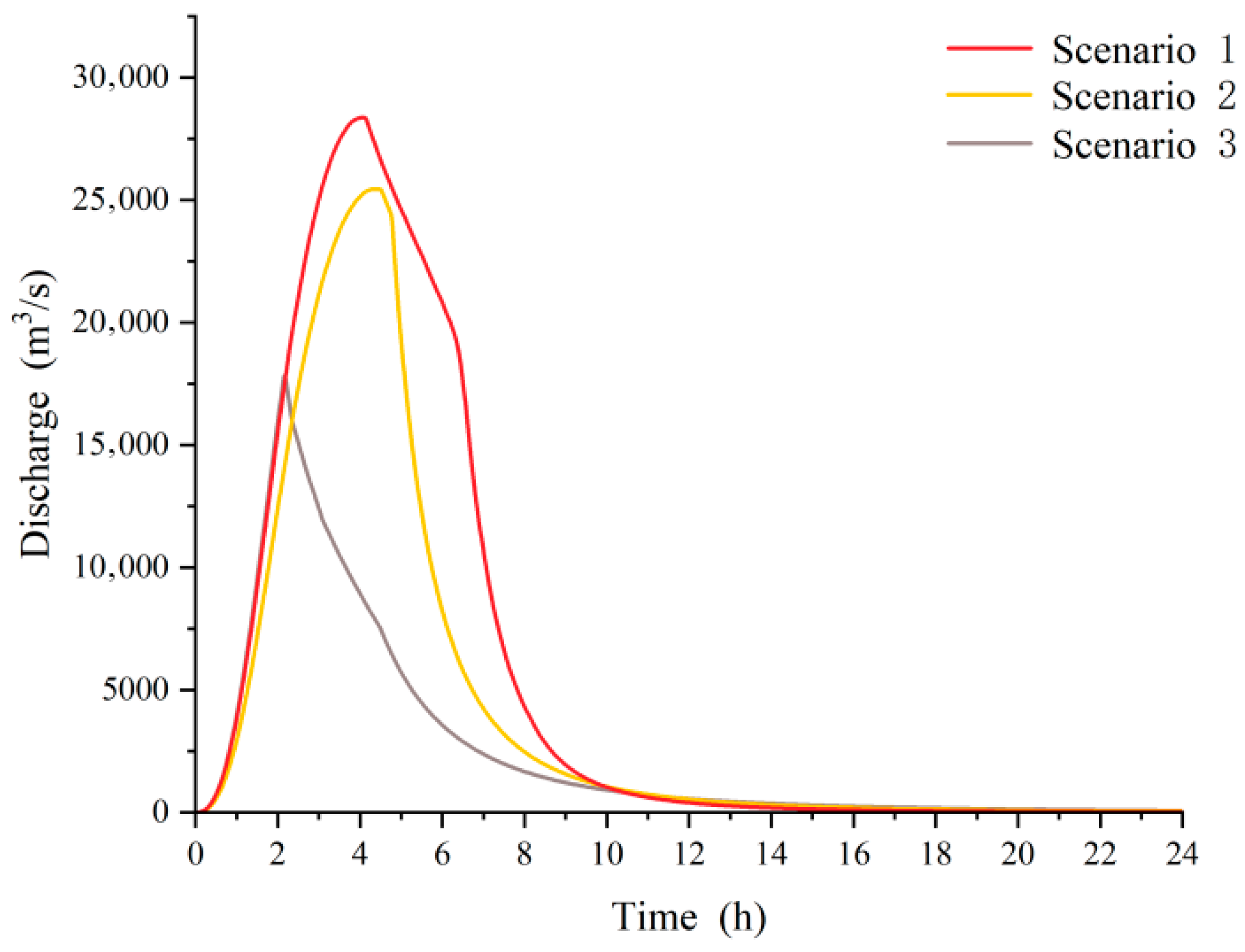
This study examined the glacial lake of JiongpuCo in the southeastern Tibet region. According to satellite images obtained by Landsat Thematic Mapper (TM) and Operational Land Imager (OLI) from 1995 to 2025, JiongpuCo’s area expanded from 1.92 ± 0.06 km2 to 5.26 ± 0.02 km2, which is a 174% increase over 30 years. The lake was in a state of dynamic equilibrium. The bathymetric data showed that JiongpuCo has a basin-like morphology. Its reservoir capacity curve was concave-up, with a maximum water depth of 237 m and total reservoir capacity of 6.35 × 10⁸ m3. A sequential HEC-RAS-MIKE 21 numerical modeling framework was constructed to simulate flood propagation. For three simulated scenarios (with breach volumes of 80%, 60%, and 30%), the peak discharge at the breach outlet was 28,368.45 m3/s, 25,451.67 m3/s, and 17,855.54 m3/s. Analysis of the simulation results shows that the glacier lake outburst flood (GLOF) has continuous attenuation of peak discharge and a gradual lag in arrival time along the flow path. Except for Bagai in Scenarios 2 and 3, all other target research towns and villages were flooded by floodwaters. These findings offer a solid scientific foundation for the reduction in GLOF disasters and the development of an early warning system for JiongpuCo.

1. Introduction

Moraine lakes are natural water bodies formed by closed depressions from moraine deposition, which mainly rely on glacial meltwater for recharge [1]. Glacier lake outburst floods (GLOFs) are sudden flood disasters that happen when ice dam structures fail or overflow in glacial areas [2]. In the Third Pole, including the western and southern parts of the Tibetan Plateau, surge waves caused by rock avalanches or landslides are the main initiating mechanism for GLOFs, which account for up to 70% of documented cases according to empirical records [3]. These events pose significant threats to human lives and infrastructure in downstream areas, and also cause severe damage to the natural and socio-ecological environment [4].
The Qinghai–Tibet Plateau, called the “Asian Water Tower”, has unique and complex geographical conditions. It has the largest glacial resources in mid-to-low latitudes globally [5]. These glaciers are essential reserves of solid water, so they hold important strategic significance for China, as well as for Central and South Asia [6]. Glaciers in southeastern Tibet are losing mass significantly [7], which could cause lake reservoir capacity to expand sharply, thereby increasing the risk of GLOFs [8,9]. The southeastern Tibet has had multiple GLOF events. One of the most notable examples is the Tulagou Lake outburst [10], on 3 July 2015, which was caused by an ice avalanche of about 1.5 × 10⁴ m3 entering the water. The flood caused the destruction of 12 homes and damaged 21 others in Jiangka Village. Recently, JiwenCo [11] failed on 26 June 2020, which caused a flood that reached Zhongyu town in 3.86 h. At 1408.11 m3/s, the torrent peaked, which destroyed a lot of infrastructure, like bridges, roads, and farmland. In studies of GLOFs, peak discharge is typically estimated using empirical formulas derived from statistical analysis of historical dam failure events. Numerous such formulas currently exist (e.g., Evans formula, Popov’s formula, and Froehlich’s formula). However, the applicability of these formulas is highly dependent on characteristics of the sample data and the geographical region. Consequently, the peak discharge results obtained for the same GLOF can vary considerably across different formulas [12].
At the moment, numerical models like HEC-RAS and MIKE are being widely used in flood routing studies. For example, Tang et al. employed HEC-RAS to numerically simulate dammed lake outburst floods, analyzing flood propagation characteristics under various scenarios and their effects on the downstream Yebatan hydropower station [13]. Rawat et al. applied HEC-RAS integrated with ArcGIS for unsteady flow analysis to evaluate downstream effects of GLOF in the Satluj basin of the western Indian Himalayas [14]. Liu et al. combined GIS with a one-dimensional hydrodynamic model, MIKE 11, to simulate flood routing in the Xiao’anxi River basin under different return periods, obtaining dynamic water-surface profiles along the channel [15]. Yang et al. developed a two-dimensional hydrodynamic model using MIKE 21 to simulate flood propagation and inundation extent following a dam breach [16]. Zhang et al. used a MIKE 21-based two-dimensional model to simulate flood propagation and inundation extent after a dam breach [17].
Considering the scale of the downstream channel at JongpuCo and the numerous floodplains in the riverbed, the MIKE 21 model is more appropriate for simulating the downstream outburst flood routing than HEC-RAS, which is generally better for smoother river terrains with less variation in cross-sectional shape and width [18]. This study focuses on JiongpuCo Glacial Lake as the research subject. By combining the HEC-RAS and MIKE 21 models, a numerical model is developed to simulate outburst floods from JiongpuCo. According to the established model, the propagation characteristics of potential outburst floods are analyzed, which gives important support for preventing and mitigating GLOF.
Compared with existing research, the novelty and originality of this paper are reflected in these aspects:
(1)
Unlike many GLOF studies that rely on empirical volume-area relationships, this study uses an unmanned surface vehicle (USV) measurement system to obtain measured bathymetric data, which is used to significantly reduce the uncertainty of the numerical model.
(2)
The application of a sequential HEC-RAS (dam breach simulation)—MIKE 21 (flood routing) numerical modeling framework to the complex terrain of JiongpuCo’s downstream channel, which has no historical GLOF records.
(3)
The study clarifies the key parameters, such as flood arrival time, peak flow, and submerged depth of five towns and villages in the lower reaches of JiongpuCo under different dam break scenarios, which provides a scientific basis for local governments to formulate emergency plans, set early warning thresholds, and plan refuge routes.

2. Materials and Methods

2.1. Study Area

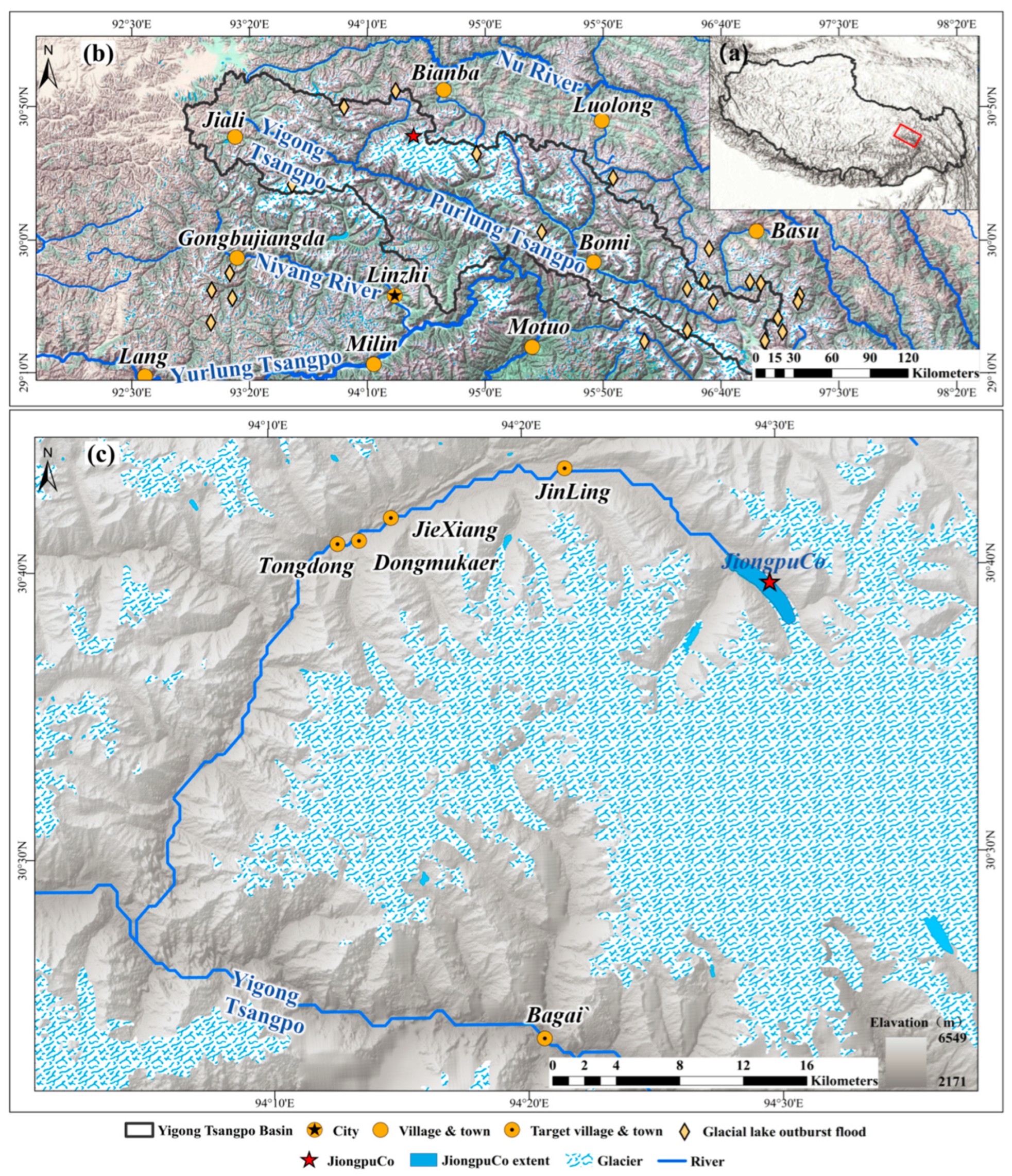
The Yigong Tsangpo river basin (Figure 1b), a western tributary of the Parlung Tsangpo river, extends 286 km in length and encompasses a drainage area of 13,533 km2. The terrain generally descends from west to east, with an average elevation exceeding 4000 m. The basin has a mean annual runoff of approximately 1.431 × 10⁹ m3 [19]. JiongpuCo Glacial Lake (94°29′35″ E, 30°39′10″ N) is situated within the Yigong Tsangpo river basin in the Tibet Autonomous Region (Figure 1a). It is a moraine-dammed lake, impounded by a southwest–northeast trending moraine ridge, and formed primarily from meltwater and ice collapses of the Ruoguo Glacier.
This study selected five target research towns and villages downstream of JiongpuCo based on the principle of “dense population and proximity to river channel” (Figure 1c). These include Jinling, Jiexiang, Dongmukaer, Tongdong, and Bagai. The study conducts further analysis of the flood inundation range for these locations.

2.2. Remote Sensing Data

This study used Landsat Thematic Mapper (TM) (NASA, Washington, DC, USA) and Operational Land Imager (OLI) (NASA, Washington, DC, USA) satellite images provided by the USGS Earth Explorer at https://search.earthdata.nasa.gov/search (accessed on 21 October 2025) to extract the boundary information of JiongpuCo from 1995 to 2025. In order to reduce the influence of seasonal factors and cloud coverage on the accuracy of lake extraction, clear-sky data from September to November were mainly selected. Furthermore, to ensure the accuracy and consistency of boundary delineation, the boundary lines of the glacial lake were outlined through manual digitization.

2.3. DEM Data

In this study, a freely available 12.5 m resolution ALOS-PALSAR digital elevation model (DEM) was used provided by Japan Aerospace Exploration Agency at https://search.asf.alaska.edu (accessed on 7 November 2025). The 12.5 m ALOS-PALSAR DEM data have been successfully applied in many numerical simulation studies in the Tibet Plateau. It shows that it has good applicability in this study area and can provide relatively reliable data support for terrain analysis and hydrological modeling [11,20,21]. To analyze the channel geometry, the 10.38 km reach downstream of JiongpuCo was extracted first, and then spatially processed using the ArcGIS v10.8 software. These data were integrated into the MIKE ZERO 2014 suite for final preprocessing, which produces the computational terrain input needed for MIKE 21 hydrodynamic simulation.

2.4. Underwater Topographic Data

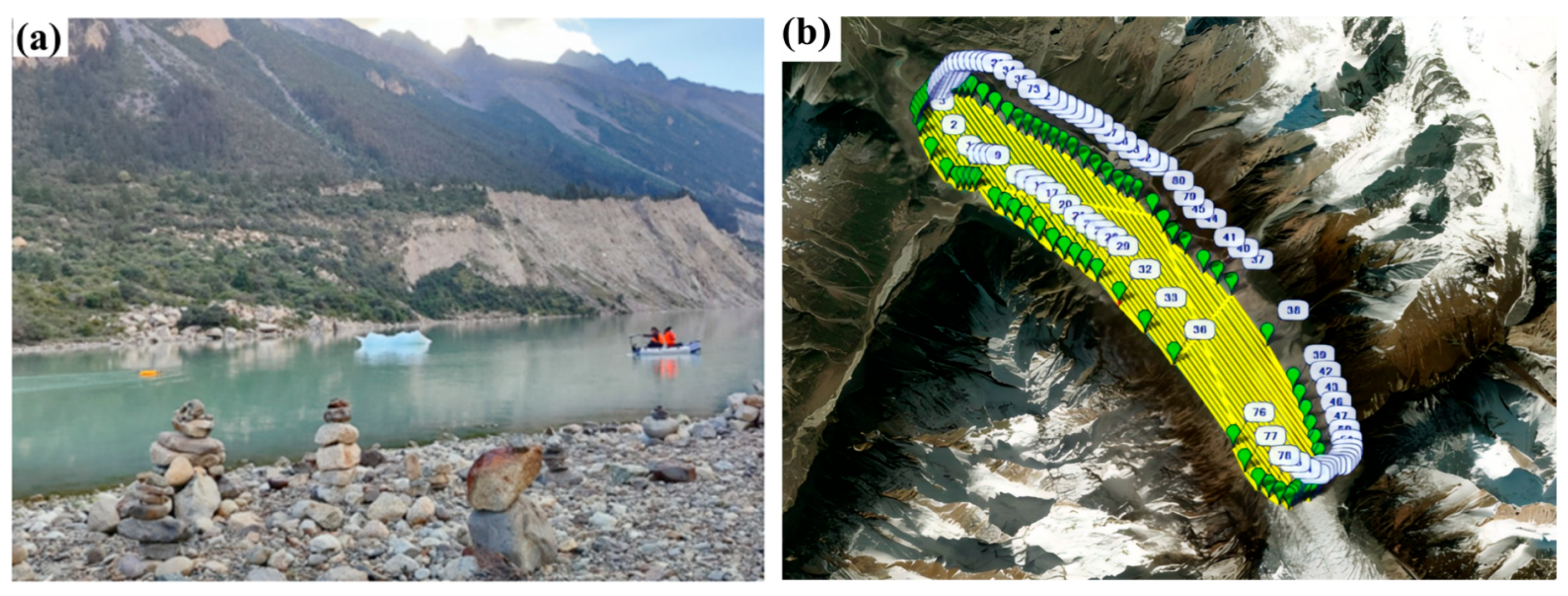
To obtain the underwater topographic data of JiongpuCo, a CHCNAV APACHE 3 PRO USV (Shanghai Huace Navigation Technology Ltd., Shanghai, China) was used for on-site bathymetric survey (Figure 2a). The surveyed area was approximately 5.0 km2 (Figure 2b), with a total survey track length of about 114 km, and a line spacing of 50 m. The raw data acquired by the unmanned vessel were processed using the accompanying HydroSurvey v7.0.16 software. This post-processing made corrections for water depth and water level, resulting in the actual water depth data for the glacial lake. Subsequently, by employing the Surface Volume tool in ArcGIS v10.8 software in conjunction with a custom-written script, the measured reservoir capacity curve of the glacial lake was derived. This empirical capacity curve serves as a critical input condition for simulating the glacial lake outburst process in the HEC-RAS model.

2.5. Hydrodynamic Modeling of GLOF

In this study, the HEC-RAS model was used to simulate the glacial lake outburst process. The discharge at the breach outlet from HEC-RAS served as the upstream boundary condition for the MIKE 21 model. The MIKE 21 model was then applied to simulate the subsequent flood routing in the downstream channel, thereby establishing a sequential HEC-RAS-MIKE 21 numerical modeling framework for the GLOF of JiongpuCo.

2.5.1. HEC-RAS Dam Breach Model

HEC-RAS, developed by the Hydrologic Engineering Center of the U.S. Army Corps of Engineers [22], has demonstrated excellent capability in flood simulation [23]. In particular, its dam-break module (Dam/Levee Breach) provides powerful extensions for simulating the breaching process. The user can prescribe key breach parameters, such as initial breach width, to simulate the complete dynamic process from initial overtopping to progressive failure, thereby obtaining the discharge hydrograph at the breach. This hydrograph defines both the magnitude and temporal distribution of the outflow from the breach, and is then used as the upstream boundary condition to drive unsteady flow routing of the flood wave in the downstream channel.

2.5.2. MIKE 21 Flood Routing Model

MIKE 21 is a two-dimensional hydrodynamic modeling software developed by the Danish Hydraulic Institute (DHI) [24]. It has hydrodynamics, wave dynamics, sediment transport, water quality, and ecological modeling functionalities [25]. MIKE 21 employs three numerical methods to solve the two-dimensional shallow-water equations under hydrostatic pressure and Boussinesq assumptions. In a Cartesian coordinate system, the governing equations can be expressed as follows [26,27]:
U t + ( F x I F x V ) x + ( F y I F y V ) y = S
where U is the vector of conserved variables, F is the flux vectors, and S denotes the source term. The superscripts I and V correspond to the noncohesive and viscous flux vectors, respectively.
In this study, the MIKE 21 modeling procedure is used, which is as follows:
(1)
The study area’s downstream river channel outline was extracted by ArcGIS software. Combined with DEM data, a point data file (.xyz) for the DEM within the channel extent was created.
(2)
The channel outline file was imported into the SMS v10.1 software to generate the mesh file. This mesh file was opened in the MIKE 21 Mesh Generator tool. Importing the DEM scattered point file (.xyz) and applying linear interpolation, the topographic data was mapped onto the mesh nodes. This process resulted in a two-dimensional mesh file (.mesh) that includes the DEM data, which defines the computational domain of the model.
(3)
The breach hydrograph data, obtained from the HEC-RAS dam breach simulation, was processed using the MIKE 21 Time Series Editor tool. This caused a discharge time-series file (.dfs0), which was set as the upstream boundary condition for the model.
(4)
Finally, the hydrodynamic FM module of MIKE 21 was employed. After specifying the time step, roughness, and boundary conditions, the model was run to generate the simulation output file (.dfsu).

2.5.3. Dam Break Scenarios

Extreme high-temperature events may accelerate the melting of source glaciers, which can indirectly raise lake levels by increasing the inflow of meltwater. Once overtopping happens, the flow quickly scours fine particulate matter from the moraine dam, creating an initial breach. Due to the low cohesion of dam materials, this breach rapidly deepens and widens through a positive feedback mechanism [28]: the initial breach causes increased downcutting erosion, which further amplifies flow discharge and intensifies dam erosion. If overtopping occurs, the failure scale would be from partial breaches to near-complete dam collapses, which are affected by complex site-specific factors. Therefore, by taking JiongpuCo as a case study, this study creates three different overtopping dam break scenarios according to varying failure volumes: roughly 80%, 60%, and 30% of the lake’s total water volume.

2.6. Model Parameters

2.6.1. Breach Parameters

Following the dam break scenarios (Section 2.5.3) and using the measured capacity data of JiongpuCo (Section 3.2), the breach model, assuming a homogeneous moraine dam, adopted the following parameters (Table 1):

2.6.2. Model Validation

Given the absence of historical breach records for JiongpuCo, direct validation against observed flood hydrographs was not feasible. Therefore, the peak discharge at the breach outlet simulated by HEC-RAS was cross-verified against results derived from empirical regression equations. This comparative approach is widely adopted regarding glacial hazard assessments in data-scarce regions [28]. Accordingly, the Evans empirical formula, which is applicable to moraine dams, was adopted in this study [29]:
Q m a x = 0.72 V G L O F m a x 0.53
where Q m a x is the peak discharge (m3/s), and V G L O F m a x is the volume of GLOF (m3).

2.6.3. Manning’s n

The frictional resistance of the river channel is governed by Manning’s roughness coefficient ( n ), which is spatially determined based on the Land Use and Land Cover (LULC) types and the roughness of riverbed sediments in the study area. To calculate the value of Manning’s n for the river cross-sections, this study used 10 m spatial resolution LULC data for the year 2024, which was obtained by ArcGIS Sentinel-2 Land Cover Explorer. Based on the potential flood area, LULC analysis identified six types, dominated by grassland at 46% coverage, followed by river beach at 13%. The corresponding Manning’s n for these types are 0.035 and 0.02 [30], respectively. We computed a weighted average of Manning’s n based on the areal proportion of each LULC type. Finally, we determined 0.045 as the global Manning’s n .

3. Results

3.1. Changes in JiongpuCo

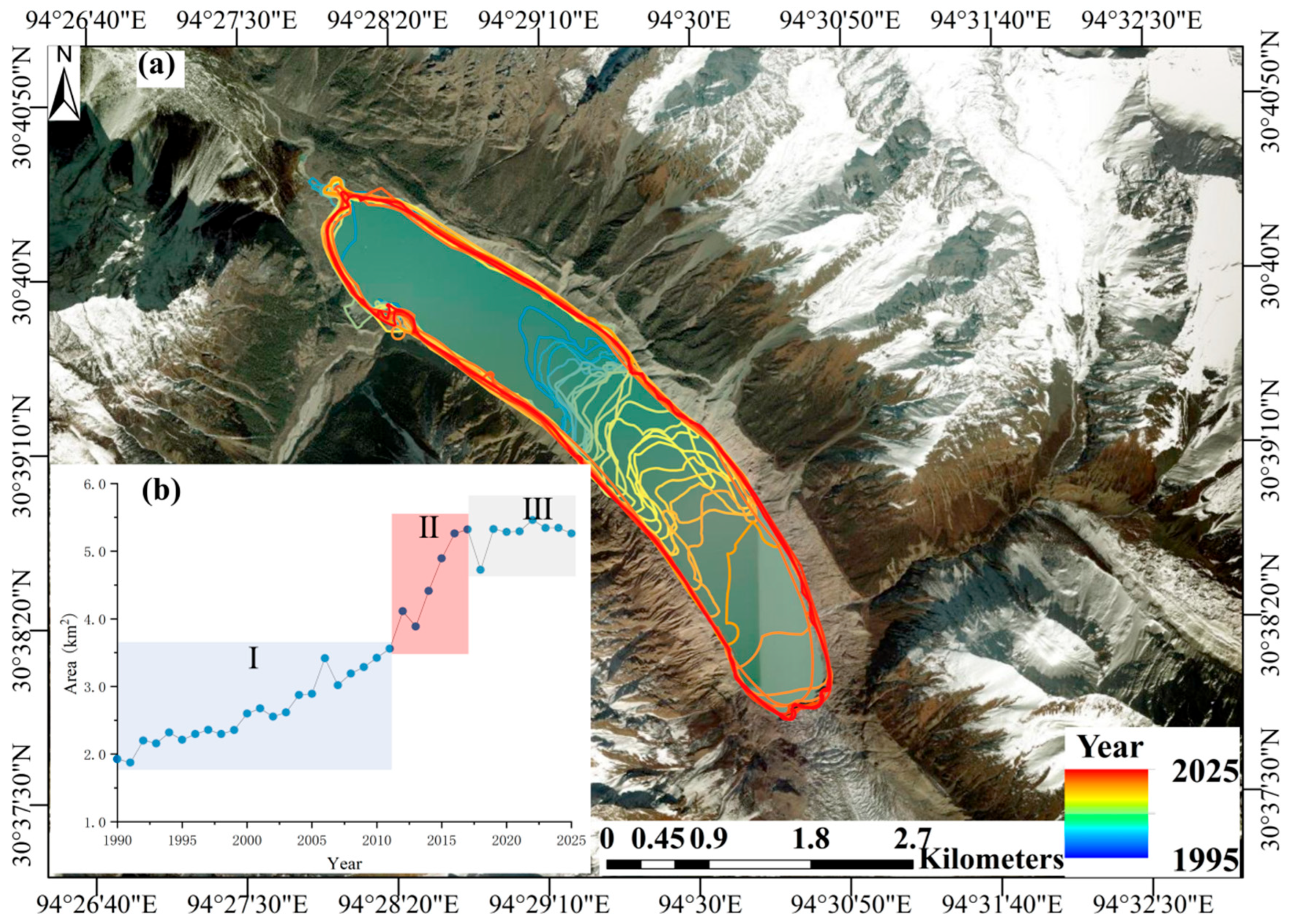
JiongpuCo expanded primarily towards the glacier terminus, while its boundary at the terminal moraine dam remained largely stable (Figure 3a). Its area shows a non-linear growth trend, growing from 1.92 ± 0.06 km2 in 1995 to 5.26 ± 0.02 km2 in 2025. This represents a cumulative growth of 174% over the 30-year period, with an average annual expansion of 0.11 km2. The change in the JiongpuCo area has the characteristics of a stage, which is roughly divided into three stages. (Figure 3b) Phase I (1995–2011) represents a period of steady growth, characterized by an average annual increase of 0.074 km2. Phase II (2012–2017) represents a phase of accelerated expansion, during which the lake area grew by 36% of the total increment. This accelerated expansion is likely attributable to higher temperatures and increased glacier meltwater feeding the lake. Phase III (2018–2025) represents a period of relative stability. The lake area changes little, indicating that JiongpuCo may have entered a new dynamic equilibrium stage.

3.2. Reservoir Capacity of JiongpuCo

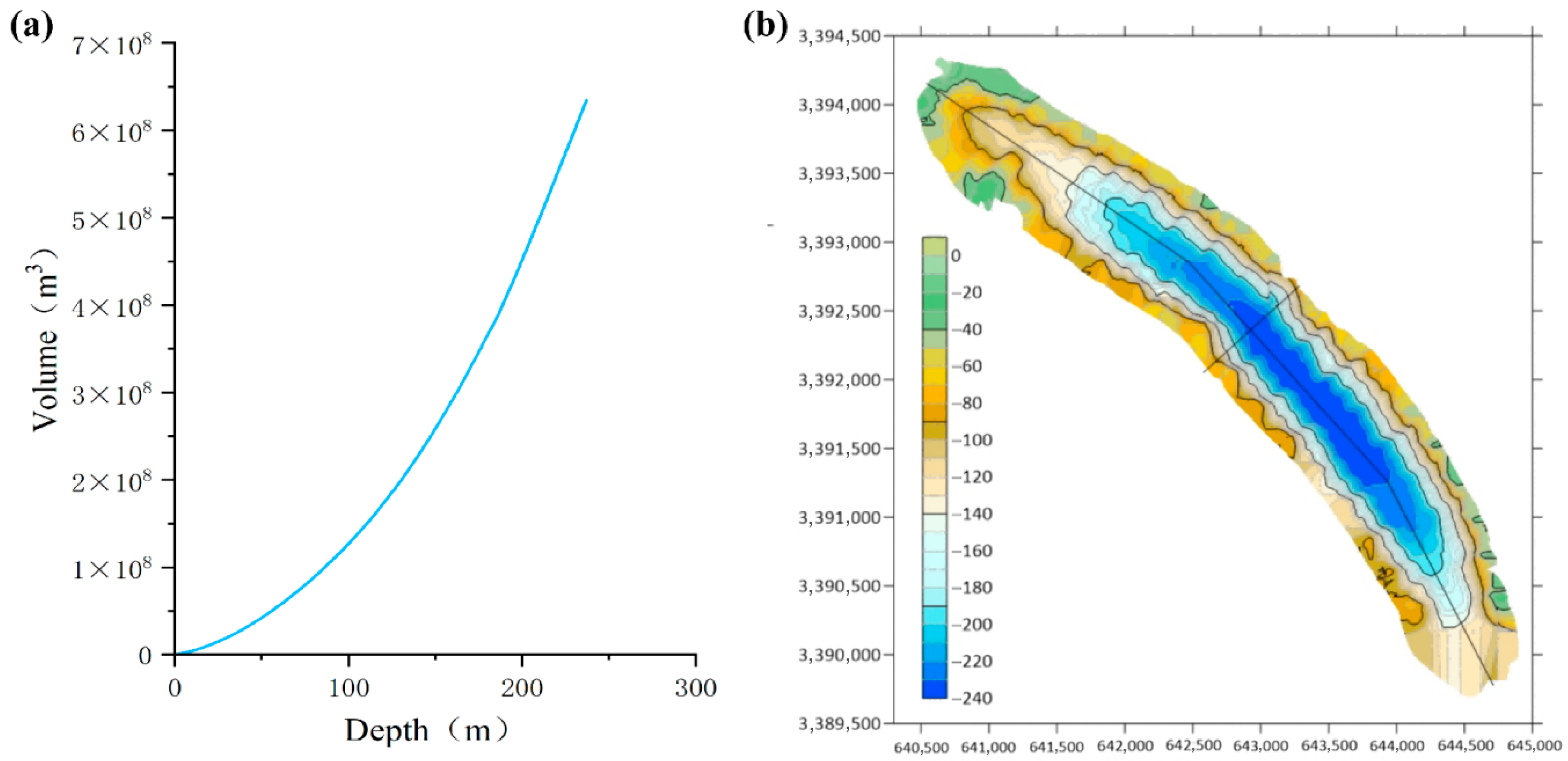
The reservoir capacity curve of JiongpuCo (Figure 4a) exhibits a distinct concave upward profile. This shows that when water depth increases, the slope of the curve increases sharply. This characteristic directly corresponds to the topographic features of the JiongpuCo lakebed, characterized by a gentle slope and a relatively small area. The result is a slow initial increase in the storage volume. As the depth increases, the lake basin opens quickly, and the water reservoir capacity increases a lot. The bathymetric contour map (Figure 4b) corroborates this morphology. The maximum recorded depth is 237 m, with the deepest point situated approximately 2.8 km from the lake outlet. The total reservoir capacity at the present water level is 6.35 × 10⁸ m3. This basin-like morphology makes JiongpuCo have an unusually large amount of water storage after reaching a certain water depth. On the one hand, it means that it has an important water resource reserve function. On the other hand, it also means that once a break occurs, it may release huge amounts of water and energy in a short period of time, with a high risk of flood disaster.

3.3. Peak Discharge at the Breach

The numerical simulation results reveal significant differentiation in peak discharge across the three scenarios (Figure 5). According to the results, Scenario 1 yields the highest peak discharge of 28,368.45 m3/s. This is followed by Scenario 2, with a peak of 25,451.67 m3/s, while Scenario 3 produces the smallest peak discharge of only 17,855.54 m3/s. In the rising stage of flow rate, the slope of the curve of Scenario 1 and Scenario 2 shows a three-stage characteristic of ‘rapid increase-stabilization-gradually decrease’. This pattern aligns with the basin-like morphology of JiongpuCo. In contrast, the depth of the breach in Scenario 3 is only 34 m, so the flow rising slope only shows a rapid increase to a stable stage.

3.4. Flood Routing Process

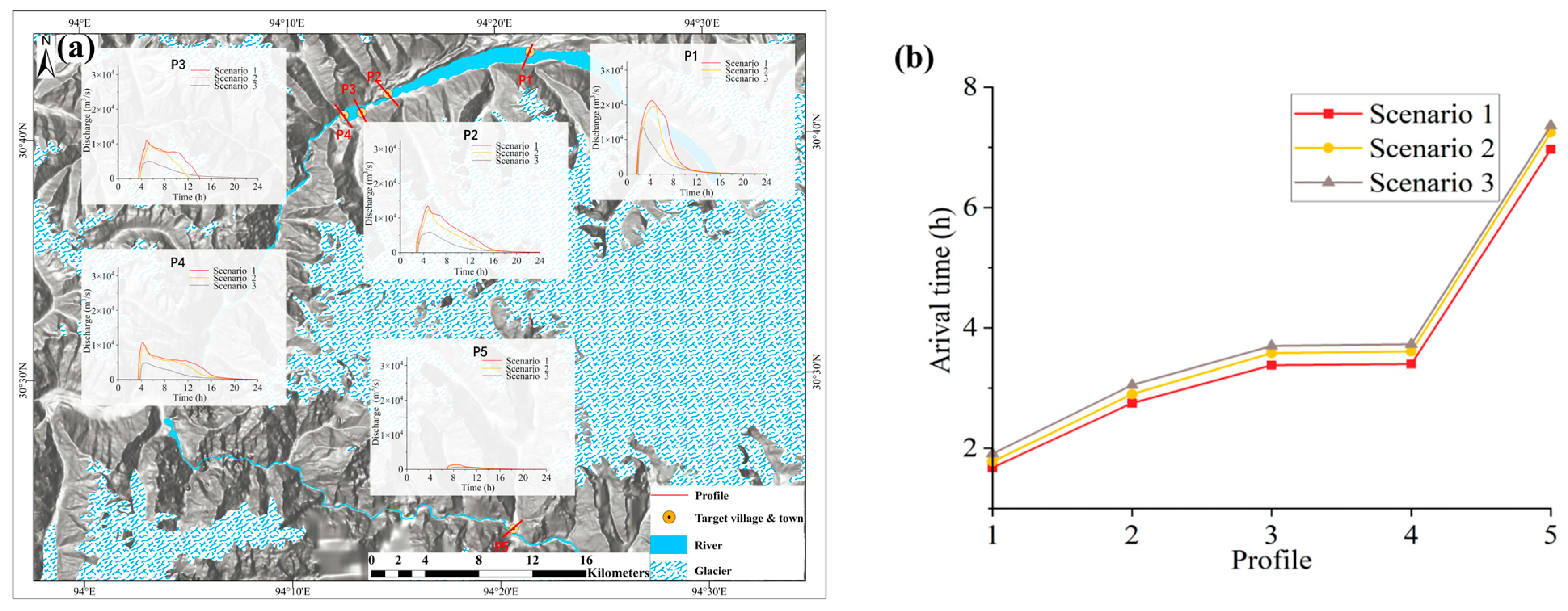
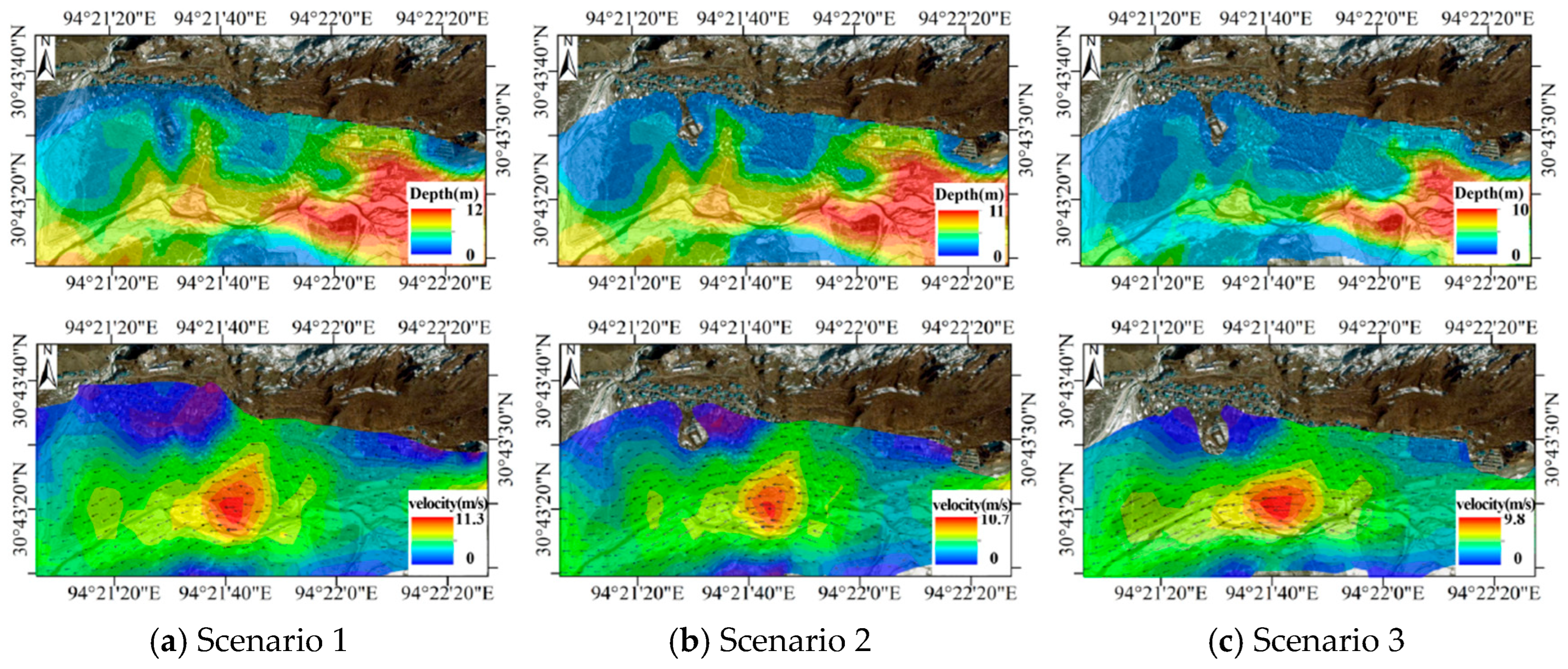
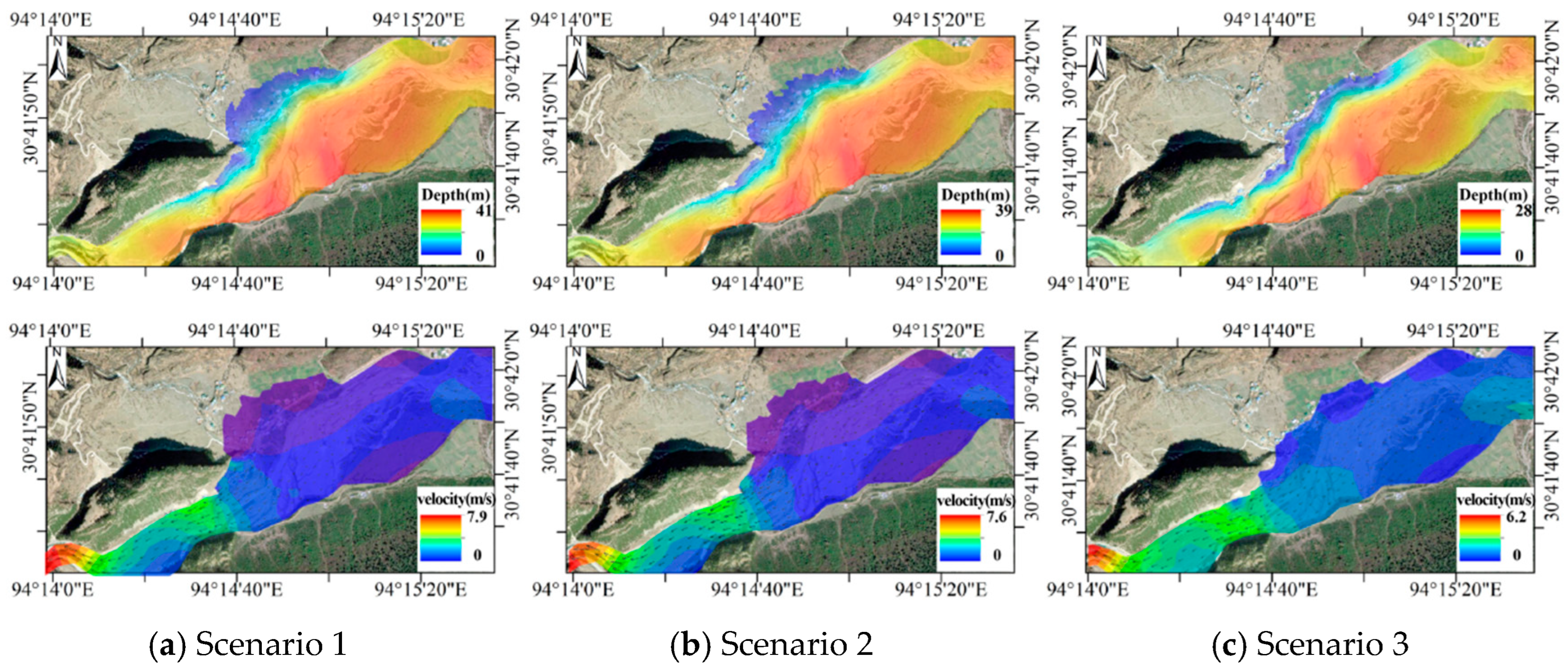
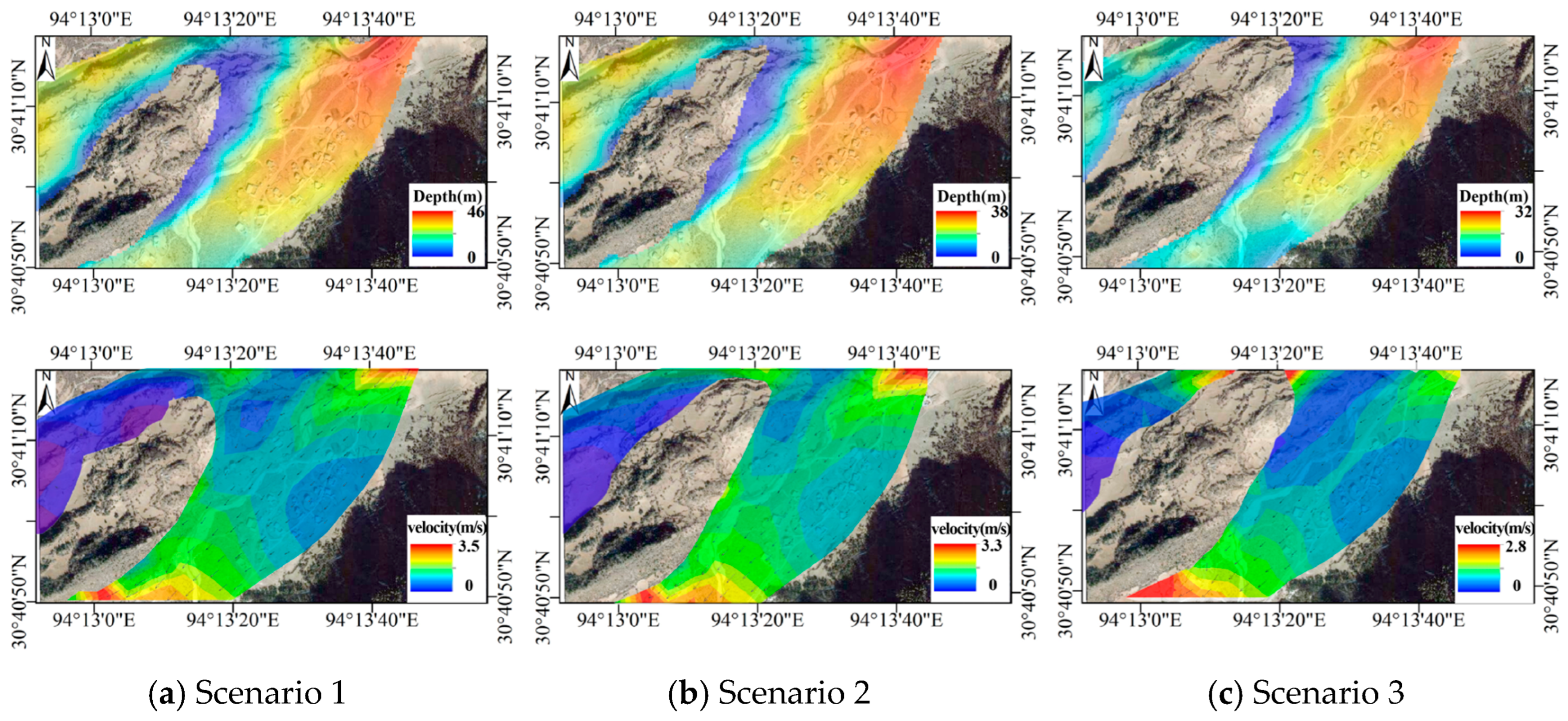
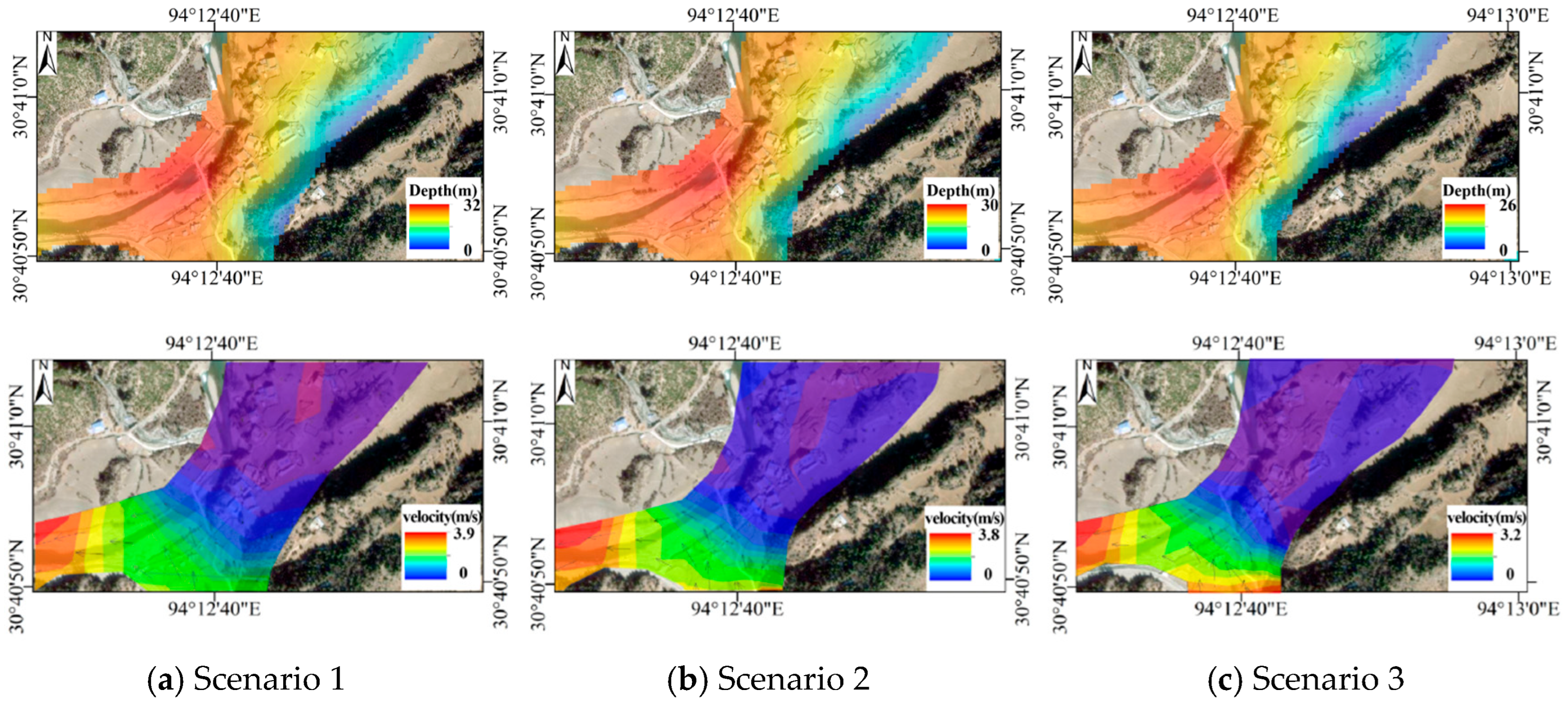
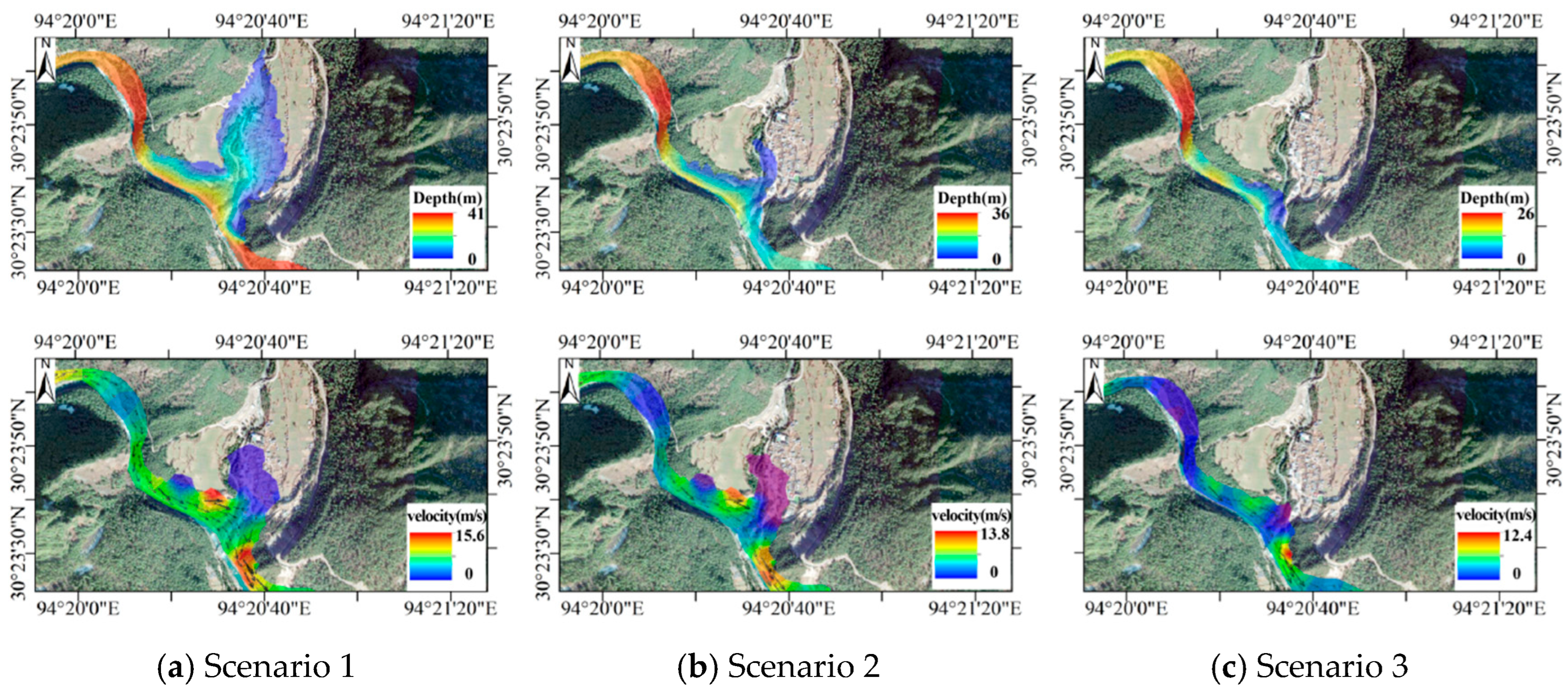
For the three scenarios, GLOF parameters were generated at the target research towns and villages locations, including peak discharge, flood travel time, water depth, and flow hydrographs. The results show total released water volumes of 5.1 × 10⁸ m3, 3.8 × 10⁸ m3, and 9 × 10⁸ m3 for the respective scenarios. The flood propagation process (Figure 6) indicates that under the three scenarios, the outburst floods reach monitoring profile P1 at Jinling, located 12.3 km downstream of JiongpuCo, at 1.68 h, 1.78 h, and 1.91 h. And the corresponding flood peak flow is 21,255 m3/s, 19,630 m3/s, and 13,620 m3/s. As the flood continues downstream, it arrives at profile P2 near Jiexiang, 23.4 km from JiongpuCo, at 2.75 h, 2.90 h, and 3.05 h, with peak discharges of 13,466 m3/s, 12,492 m3/s, and 5911 m3/s. Further downstream at profile P3 near Dongmukaer, approximately 26 km from JiongpuCo, the arrival times are delayed to 3.38 h, 3.58 h, and 3.70 h, with peak discharges of 11,202 m3/s, 8882 m3/s, and 5010 m3/s. Subsequently, the flood reaches profile P4 at Tongdong, 27.2 km from JiongpuCo, at 3.40 h, 3.61 h, and 3.73 h, where the peak discharges are 10,751 m3/s, 8679 m3/s, and 4929 m3/s. Finally, at profile P5, arrival times are 6.97 h, 7.25 h, and 7.63 h, with peak discharges significantly reduced to 1511 m3/s, 1305 m3/s, and 693 m3/s. Compared to the breach site values, these represent attenuation rates of 92.9%, 93.3%, and 94.9%, respectively. It is important to note that the reach between P1 and P2 shows the most significant peak reduction, with attenuation values of 36.6%, 36.3%, and 56.5%. It reflects the huge flood-regulation capacity of this river section. The distribution of water depth and flow velocity under peak-discharge conditions (Figure 7, Figure 8, Figure 9, Figure 10 and Figure 11) indicates that only Scenario 2 and Scenario 3 resulted in no inundation in Bagai. In all other cases, the villages had varying levels of inundation impact.

4. Discussion

4.1. Reliability Analysis of the Simulation Results

According to the Evans empirical formula presented in Section 2.6.2, the peak discharge for each breach scenario was estimated by replacing the outburst water volume accordingly. These estimated values are compared with the model-simulated peak discharges (Table 2). All absolute differences are below 5%, so this result suggests that the model is reasonably reliable and can be employed for subsequent analysis.

4.2. Analysis of Roughness Sensitivity

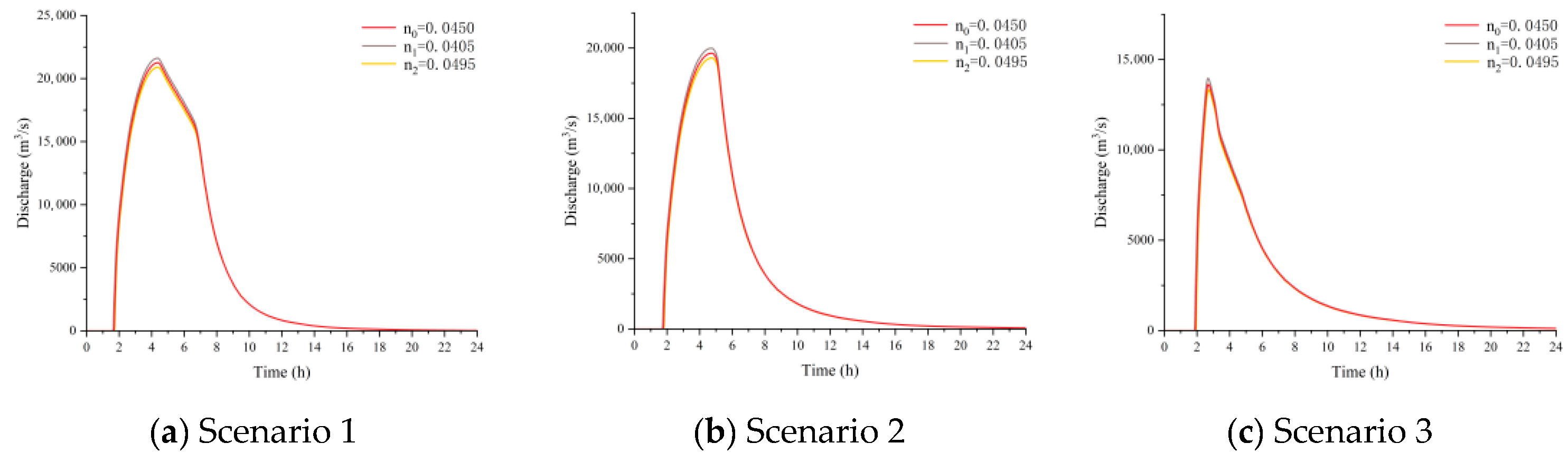
In order to evaluate the influence of model parameter uncertainty on simulation results and ensure the reliability and prediction accuracy of the hydrodynamic model, roughness sensitivity analysis was carried out in this study. On the basis of the global roughness value ( n 0 = 0.045) selected in this paper, it decreased by 10% ( n 1 = 0.0405) and increased by 10% ( n 2 = 0.0495), respectively. By comparing the response of the discharge at Jinling to the roughness change under different working conditions, the rationality of the parameter setting and the sensitivity of the model output to the roughness disturbance are tested.
The simulation results (Figure 12) show that the corresponding hydrographs of the three roughness settings under different scenarios have small changes and no significant fluctuations. Among them, under scenario 3, compared with n 0 , n 1 has the largest change in peak discharge, which is only 2.5%. The above results further show that the sensitivity of the model output to the roughness parameters is within a reasonable range, and the selected global roughness value can well reflect the actual situation of the study area. The setting of global Manning’s n is reasonable and reliable.

4.3. Impact of Topography on Flood Transmission

As the flood spreads downstream from the breach, the peak discharge decreases gradually along the channel, and the timing of the peak is progressively delayed. This attenuation is mainly due to channel storage effects and bed friction resistance. This indicates that the impact of smaller outbursts is more concentrated in the upstream reaches. Furthermore, the model result shows that the flow velocity at Dongmukaer is significantly higher than that at Tongdong. Combined with the analysis of flow-velocity distribution and flow-direction characteristics, this difference may be related to the topography and flow dynamics of the river section. After the flood discharges from upstream, it bifurcates in the upstream section of Tongdong, flows through both sides of Dongmukaer and Tongdong, and then converges again downstream. In this process, the river channel on the side of Dongmukaer may be more straight or have a larger slope, resulting in a higher flow velocity and stronger flow energy. When the two flows intersect in the downstream, the high-speed flow on the side of Dongmukaer plays a leading role in the confluence point. A certain degree of extrusion is formed on the water flow on the side of Tongdong, which leads to local backflow or a slowing of flow velocity in Tongdong, so the observed flow velocity is obviously reduced.
Despite the differing breach magnitudes across the three scenarios, the flood propagation demonstrates strong consistency in its spatiotemporal evolution. This reflects a predictable flood routing process under the given river network and topographic conditions, providing a credible basis for employing numerical models in risk assessment and early warning.

4.4. Strengths and Limitations of the Model

In this study, HEC-RAS is used to simulate the dam break process, and MIKE21 is used to simulate the downstream two-dimensional flood evolution, which gives full play to the advantages of the one-dimensional model in breach-flow simulation and the two-dimensional model in complex terrain inundation simulation. This sequential HEC-RAS-MIKE 21 numerical modeling framework achieves a balance between computational efficiency and simulation accuracy, making it suitable for study areas characterized by large river scales and significant topographic variation. However, there are still some uncertainties and simplifications in the coupling process. Despite the use of 12.5 m resolution ALOS-PALSAR DEM, there may still be smoothing effects in steep valley slopes, beach micro-topography, etc., which affect the accuracy of local velocity and submerged boundary. Future work could incorporate higher-resolution topographic data obtained via the unmanned aerial vehicle (UAV) photogrammetry or LiDAR to better represent the channel. In addition, while the dam breach module in HEC-RAS can simulate breach development, it assumes that the dam material is homogeneous and the breach mode is standard progressive, without considering the composite breach mechanisms, such as uneven internal structure, piping, or sliding of moraine dams. These simplifications may lead to a difference between the GLOF hydrographs and the actual situation.

5. Conclusions

Employing field surveys and remote sensing interpretation, this study investigates the expansion history and actual reservoir capacity of JiongpuCo in southeastern Tibet. The sequential HEC-RAS-MIKE 21 numerical modeling framework is used to simulate three breach scenarios: 80%, 60%, and 30% of the total storage volume.
Over the three decades, the area of JiongpuCo has expanded by 174%. The lake might be nearing a new dynamic equilibrium state. The measured reservoir capacity curve for JiongpuCo shows a concave-up trend. Under the current water levels, the total reservoir capacity is 6.35 × 10⁸ m3, and the maximum water depth is 237 m. These results show that JiongpuCo is very important in regional water resources storage. And it has a huge value for downstream ecosystems and socio-economic development.
Peak discharge at the breach varies considerably across different outburst scenarios. The simulated peak discharges for the three scenarios are 28,368.45 m3/s, 25,451.67 m3/s, and 17,855.54 m3/s, respectively. Comparisons with estimates from the Evans formula show absolute differences all below 5%, supporting the reliability of the modeling results. The modeled peak discharges can provide quantitative design parameters for assessing the safety of downstream hydraulic infrastructure. During downstream flood propagation, peak discharges attenuate progressively along the channel in all three scenarios. With the exception of Bagai under the 60% and 30% breach scenarios, all studied villages in the downstream area would be inundated. The results of the flood-inundated area and flood arrival time can inform evacuation planning and emergency response protocols. These results suggest that a potential outburst of JiongpuCo could pose extensive and severe disaster risks.

Author Contributions

Conceptualization, N.H. and H.W.; methodology, X.L. and H.W.; formal analysis, X.L.; investigation, X.L., H.W., M.Z., J.C., and Y.Y.; resources, N.H., H.W., and W.L.; data curation, H.W.; writing—original draft, N.H., X.L., and H.W.; writing-review and editing, N.H., X.L., and H.W.; Funding acquisition, H.W. All authors have read and agreed to the published version of the manuscript.

Funding

This work was supported by the Science and Technology Project of Power China (DJ-HXGG-2022-02), and State Key Laboratory of Earthquake Dynamics (Project No.LED2023B02).

Data Availability Statement

The datasets used and analyzed during the current study are available from the corresponding author upon reasonable request.

Conflicts of Interest

The authors declare no conflicts of interest.

References

  1. Wang, Z.; Liu, W.; Zheng, B.; Ma, X.; Zhu, L. A regional-scale distribution changes and influencing factors of glacial lakes in Xizang autonomous region. Earth Sci. Inform. 2025, 18, 103. [Google Scholar] [CrossRef]
  2. Tielidze, L.G.; Nadaraia, A.; Kumladze, R.M.; Cook, S.J.; Lobjanidze, M.; Liu, Q.; Megrelidze, I.; Mackintosh, A.N.; Imnadze, G. Post-Little Ice Age Shrinkage of the Tsaneri–Nageba Glacier System and Recent Proglacial Lake Evolution in the Georgian Caucasus. Water 2025, 17, 3209. [Google Scholar] [CrossRef]
  3. Zhang, T.; Wang, W.; An, B.; Wei, L. Enhanced glacial lake activity threatens numerous communities and infrastructure in the Third Pole. Nat. Commun. 2023, 14, 8250. [Google Scholar] [CrossRef]
  4. Gao, J.; Du, J.; Yixi, Z. Forewarning model for glacial lake outburst in Southeast Tibet. Appl. Sci. 2023, 13, 1797. [Google Scholar] [CrossRef]
  5. Yao, T.; Zhang, T.; Wang, W.; Zhang, G.; Liu, S.; Baosheng, A. Glacial Lake Change and Outburst Risk Assessment on the Asian Water Tower. Adv. Earth Sci. 2025, 40, 221–227. [Google Scholar] [CrossRef]
  6. Chen, J.; Kang, S.; Du, W.; Jiang, Y. Progress in the research of glacier meteorology and energy balance in theQingzang plateau. Acta Meteorol. Sin. 2025, 83, 959–968. [Google Scholar] [CrossRef]
  7. Zhou, B.; Yuan, J.; Qiao, B.; Ma, H.; Shi, F.; Cao, X.; Yan, Y.; Sun, W. Research Progress on Climate and Cryosphere Changes in the Qinghai-Tibetan Plateau. Res. Environ. Sci. 2024, 37, 1885–1896. [Google Scholar] [CrossRef]
  8. Zhang, T.; Wang, W.; An, B. Heterogeneous changes in global glacial lakes under coupled climate warming and glacier thinning. Commun. Earth Environ. 2024, 5, 374. [Google Scholar] [CrossRef]
  9. Zhang, T.; Wang, W.; Kougkoulos, I.; Cook, S.J.; Li, S.; Iribarren-Anacona, P.; Watson, C.S.; An, B.; Yao, T. High frequency of moraine-dammed lake outburst floods driven by global warming. Nat. Commun. 2025, 16, 11173. [Google Scholar] [CrossRef]
  10. Liu, J.; Zhang, J.; Gao, B.; Li, Y.; Li, M.; Wujin, D.; Zhou, L. An overview of glacial lake outburst flood in Tibet, China. J. Glaciol. Geocryol. 2019, 41, 1335–1347. [Google Scholar] [CrossRef]
  11. Zhang, Y.; Yao, X.; Duan, H.; Wang, Q. Simulation of Glacial Lake Outburst Flood in Southeastern Qinghai-Tibet Plateau—A Case Study of JiwenCo Glacial Lake. Front. Earth Sci. 2022, 10, 819526. [Google Scholar] [CrossRef]
  12. Zheng, G.; Mergili, M.; Emmer, A.; Allen, S.; Bao, A.; Guo, H.; Stoffel, M. The 2020 glacial lake outburst flood at Jinwuco, Tibet: Causes, impacts, and implications for hazard and risk assessment. Cryosphere 2021, 15, 3159–3180. [Google Scholar] [CrossRef]
  13. Tang, J.; Hu, X.; Xie, W.; Huo, Z.; Cao, S.; Wang, W. Prediction of flood disaster chain caused by watershed type landslides blocking rivers and collapses:A case study of Baige landslide. Hydrogeol. Eng. Geol. 2025, 52, 168–180. [Google Scholar] [CrossRef]
  14. Rawat, M.; Jain, S.K.; Ahmed, R.; Lohani, A.K. Glacial lake outburst flood risk assessment using remote sensing and hydrodynamic modeling: A case study of Satluj basin, Western Himalayas, India. Environ. Sci. Pollut. Res. 2023, 30, 41591–41608. [Google Scholar] [CrossRef] [PubMed]
  15. Liu, J.; Liu, G.; Han, J.; He, L.; Han, W. Simulation studyon flood routing in Xiao’anxi River Basin based on MIKE11. J. Zhejiang Univ. Technol. 2025, 53, 421–427. [Google Scholar]
  16. Yang, D.; Zhang, W.; Sheng, J.; Peng, X. Optimization method of dynamic path for dam-break flood evacuation. Hydro-Sci. Eng. 2023, 10, 43–52. [Google Scholar] [CrossRef]
  17. Zhang, Z.; Li, Y.; Jiang, S.; Chang, Z.; Zhang, J. Simulation of dike breach evolution and flood progression based on the DLBreach model: A case study of Tuanzhou Dike. J. Water Resour. Water Eng. 2025, 36, 106–113. Available online: http://szyysgcxb.alljournals.ac.cn/szyysgcxb/ch/reader/view_abstract.aspx?flag=1&file_no=20250413&journal_id=szyysgcxb (accessed on 4 March 2026).
  18. Liang, L.; Jiang, Y. Analysis of Water Surface Line of Jinjiang Based on HEC-RAS and MIKE11 Models. J. Water Resour. Res. 2023, 12, 58–64. [Google Scholar] [CrossRef]
  19. Yang, Y.; Lei, S. Gigantic Engineering Geological Problems and Countermeasures of Hydropower Development in Yigongzangbu Basin of Tibetan Plateau. J. Eng. Geol. 2024, 32, 1759–1770. [Google Scholar] [CrossRef]
  20. Li, S.; Li, C.; Li, P.; Shu, Y.; Li, Z.; Wang, Z. Numerical Investigation of the Erosive Dynamics of Glacial Lake Outburst Floods: A Case Study of the 2020 Jinwuco Event in Southeastern Tibetan Plateau. Water 2025, 17, 2837. [Google Scholar] [CrossRef]
  21. Jiang, L.; Fan, X.; Deng, Y.; Zou, C.; Feng, Z.; Djukem, D.L.; Wei, T.; Dou, X.; Xu, Q. Combining geophysics, remote sensing and numerical simulation to assess GLOFs: Case study of the Namulacuo Lake in the Southeastern Tibetan Plateau. Sci. Total Environ. 2023, 880, 163262. [Google Scholar] [CrossRef]
  22. Peker, İ.B.; Gülbaz, S.; Demir, V.; Orhan, O.; Beden, N. Integration of HEC-RAS and HEC-HMS with GIS in flood modeling and flood hazard mapping. Sustainability 2024, 16, 1226. [Google Scholar] [CrossRef]
  23. Gupta, J.P.; Sahu, M.K.; Dwarakish, G.; Shwetha, H. State-of-the-art hydraulic modelling: A comprehensive review of HEC-RAS for 1D and 2D applications. Hydrol. Sci. J. 2025, 71, 166–190. [Google Scholar] [CrossRef]
  24. Ma, J.; Zhou, F.; Yue, C.; Sun, Q.; Wang, X. The Coupled Application of the DB-IWHR Model and the MIKE 21 Model for the Assessment of Dam Failure Risk. Water 2024, 16, 2919. [Google Scholar] [CrossRef]
  25. Ansarifard, S.; Eyvazi, M.; Kalantari, M.; Mohseni, B.; Ghorbanifard, M.; Moghaddam, H.J.; Nouri, M. Simulation of floods under the influence of effective factors in hydraulic and hydrological models using HEC-RAS and MIKE 21. Discov. Water 2024, 4, 92. [Google Scholar] [CrossRef]
  26. Lu, J.; Chen, L.; Xu, D. Study on the Oil Spill Transport Behavior and Multifactorial Effects of the Lancang River Crossing Pipeline. Appl. Sci. 2024, 14, 3455. [Google Scholar] [CrossRef]
  27. Liu, M.; Lv, S.; Qiao, Q.; Song, L. Design and Numerical Simulation of the Headworks in the Shizuishan Section of the Yellow River. Sustainability 2023, 15, 4564. [Google Scholar] [CrossRef]
  28. Westoby, M.J.; Glasser, N.F.; Brasington, J.; Hambrey, M.J.; Quincey, D.J.; Reynolds, J.M. Modelling outburst floods from moraine-dammed glacial lakes. Earth-Sci. Rev. 2014, 134, 137–159. [Google Scholar] [CrossRef]
  29. Evans, S.G. The maximum discharge of outburst floods caused by the breaching of man-made and natural dams. Can. Geotech. J. 1986, 23, 385–387. [Google Scholar] [CrossRef]
  30. Brunner, G.W. HEC-RAS (River Analysis System). In Proceedings of the North American Water & Environment Congress & Destructive Water, Providence, RI, USA, 16–20 May 2010. [Google Scholar]
Figure 1. Overview of the study area: (a) location of the Purlung Tsangpo river basin in the southeastern Tibet Autonomous Region; (b) detailed view of the Yigong Tsangpo river basin (partial), illustrating the locations of JiongpuCo glacial lake and historical GLOF sites; (c) geographic extent of the simulated downstream channel and the locations of key research towns and villages for risk assessment.
Water 18 00628 g001
Figure 2. (a) Field survey and (b) sampling route of the USV in JiongpuCo.
Water 18 00628 g002
Figure 3. (a) Changes in boundary lines and (b) changes in area (1995–2025).
Water 18 00628 g003
Figure 4. (a) Reservoir capacity curve and (b) bathymetric contour map of JiongpuCo.
Water 18 00628 g004
Figure 5. GLOF hydrographs of different scenarios at the breach.
Water 18 00628 g005
Figure 6. (a) Flow hydrographs and (b) flood arrival time at different downstream locations.
Water 18 00628 g006
Figure 7. The distribution of water depth and flow velocity for Jinling at peak discharge under three scenarios.
Water 18 00628 g007
Figure 8. The distribution of water depth and flow velocity for Jiexiang at peak discharge under three scenarios.
Water 18 00628 g008
Figure 9. The distribution of water depth and flow velocity for Dongmukaer at peak discharge under three scenarios.
Water 18 00628 g009
Figure 10. The distribution of water depth and flow velocity for Tongdong at peak discharge under three scenarios.
Water 18 00628 g010
Figure 11. The distribution of water depth and flow velocity for Bagai at peak discharge under three scenarios.
Water 18 00628 g011
Figure 12. Hydrographs of three roughness settings under different scenarios.
Water 18 00628 g012
Table 1. Breach parameters for different scenarios.
Parameter123
Breach depth (m)1258034
Breach slope0.50.50.5
Breach width (m)808080
Time of breach (h)753
Table 2. Comparison of peak discharges.
ScenarioEstimated Peak Discharge (m3/s)Model-Simulated Peak Discharge (m3/s)Absolute Difference (%)
129,674.2728,368.454.4
225,421.5525,451.670.12
317,582.1517,855.541.6
Disclaimer/Publisher’s Note: The statements, opinions and data contained in all publications are solely those of the individual author(s) and contributor(s) and not of MDPI and/or the editor(s). MDPI and/or the editor(s) disclaim responsibility for any injury to people or property resulting from any ideas, methods, instructions or products referred to in the content.