Article

Dynamic Threshold Determination Method for Triggering Critical Rainfall in Mountainous Debris Flow

1
Henan Technical College of Construction, Zhengzhou 450064, China
2
School of Civil Engineering, Henan Polytechnic University, Jiaozuo 454003, China
*
Author to whom correspondence should be addressed.
Water 2026, 18(4), 484; https://doi.org/10.3390/w18040484
Submission received: 8 January 2026 / Revised: 28 January 2026 / Accepted: 11 February 2026 / Published: 13 February 2026
(This article belongs to the Special Issue Intelligent Analysis, Monitoring and Assessment of Debris Flow)

Abstract

The initiation of debris flows in mountainous areas is dynamically influenced by multiple factors, including rainfall intensity, duration, and antecedent rainfall conditions. Traditional static threshold methods struggle to adapt to these dynamic environmental conditions. To address this issue, this paper proposes a dynamic threshold determination method for the critical rainfall triggering debris flows in mountainous regions. Firstly, high-risk areas are identified based on the frequency ratio model, and the effective rainfall is quantified using the Crozier model. Subsequently, a combination of dynamic variables, such as soil saturation and safety factor, is constructed, and the Jensen–Shannon (JS) divergence is introduced for sensitivity screening to select the most relevant variables. These optimized variables are then fed into an LSTM-TCN (Long Short-Term Memory-Temporal Convolutional Network) framework to extract temporal features and predict the probability of debris flow occurrence time. Finally, real-time threshold determination is achieved by integrating the absolute rainfall energy with a dynamic threshold model. Test results demonstrate that this method can effectively quantify the dynamic nature of rainfall across different regions, screen key variables, and achieve threshold determination with high coverage (average of 0.978) and precise interval width (average of 0.023). This approach provides a more accurate and adaptive means of predicting and managing debris flow risks in mountainous areas, enhancing our ability to respond to these natural hazards in a timely and effective manner.

1. Introduction

As a highly destructive geological hazard, mountainous debris flows are characterized by sudden occurrence and rapid disaster formation, often posing severe threats to the safety of residents’ lives and property, infrastructure, and ecological environments in mountainous areas [1]. Rainfall, as the primary triggering factor for debris flow formation, is closely related to the initiation of debris flows in terms of its intensity, duration, and antecedent rainfall conditions. Accurately determining the dynamic threshold of the critical rainfall for the initiation of mountainous debris flows holds crucial practical significance for early warning and effective prevention of debris flow disasters [2,3,4], as well as for reducing disaster losses.
In the realm of dynamic early warning for debris flows, scholars have conducted research from various perspectives. For instance, Vianello et al. [5] focused on screening static geological environmental factors and employed the RES method to construct a susceptibility evaluation model for risk zoning. However, their approach lacks dynamic coupling with the rainfall process, making it difficult to determine the threshold of critical rainfall. Veloso et al. [6] developed a hazard index evaluation system by obtaining indicators related to pipeline safety and utilized a fixed-weight weighted sum analysis. Nevertheless, they failed to consider the impact of antecedent rainfall on soil moisture content, which hinders the precise capture of the coupled triggering mechanism. Nguyen et al. [7] constructed a correlation model linking antecedent rainfall, soil moisture content, and shear strength, and combined it with seismic parameters to establish a landslide susceptibility evaluation index system. However, their research primarily focused on the coupling of rainfall and earthquakes, providing an inadequate depiction of the core processes of debris flows, thus limiting its general applicability. Nguyen et al. [8] built a physical model for landslide initiation, predicted extreme rainfall using extreme value analysis, and conducted a fused assessment. However, extreme value analysis relies on long-sequence data, making it challenging to accurately predict the return period in mountainous areas with scarce observational data. Consequently, it fails to provide a “critical rainfall” determination criterion.
Scholars have conducted research on dynamic early warning for debris flows from various perspectives. For instance, Chen et al. (2023) employed machine learning and multi-source data fusion methods to construct a dynamic early warning model for debris flows based on antecedent rainfall and soil moisture, enhancing the accuracy of short-term early warnings [6]. Zhang et al. (2024) combined physical models with statistical methods to propose a framework for determining critical rainfall that considers the dynamic changes in soil saturation [7]. Meanwhile, Liu et al. (2025) utilized deep learning models to extract features from rainfall sequences, enabling probabilistic prediction of the occurrence time of debris flows [8]. Although these studies have made progress in dynamic early warning, there remains a lack of a systematic dynamic threshold determination method that integrates spatial susceptibility, rainfall time-series characteristics, and soil mechanical responses.
Therefore, this paper proposes a method for determining the dynamic threshold of the critical rainfall for the initiation of mountainous debris flows. By integrating the frequency ratio model, effective rainfall estimation, soil mechanical response analysis, and deep learning time-series prediction, a spatially–temporally–mechanically coupled dynamic determination system is constructed to real-time reflect the actual conditions for the initiation of mountainous debris flows, providing a reliable basis for disaster prevention and control. Compared with existing research, the innovations of this study are mainly reflected in three aspects:
(1) Systematic Coupling Innovation: For the first time, the frequency ratio model, Crozier’s effective rainfall model, slope stability analysis, and LSTM-TCN deep learning prediction are integrated into a unified framework, achieving full-process dynamic modeling from spatial identification, temporal evolution to mechanical response.
(2) Method Combination Innovation: The Jensen–Shannon (JS) divergence is introduced for the sensitivity screening of dynamic variable combinations, overcoming the subjectivity of traditional empirical selection and enhancing the discriminatory power of variable combinations.
(3) Threshold Indicator Innovation: The “absolute rainfall energy” is proposed as a physical indicator for the dynamic threshold, comprehensively representing the coupling effect of rainfall intensity and duration, and enabling the transition of the threshold from a static value to a dynamic process.

2. Mountainous Debris Flow Initiation Threshold Rainfall Dynamic Threshold Determination

2.1. Quantitative Analysis of Mountainous Debris Flow and Precipitation Dynamic Characteristics

2.1.1. Spatial Probability of Mountainous Debris Flow Occurrence Calculation

This study establishes a dynamic threshold for the critical rainfall intensity that triggers debris flows in mountainous areas. To accomplish this, it is essential to identify high-risk areas susceptible to debris flows, facilitating accurate examination of these particular zones. The spatial probability of landslide occurrence in mountainous areas can also be interpreted as the susceptibility to landslides [9], serving as a key indicator for assessing the varying levels of landslide risk across different segments within a region. This study employs susceptibility analysis by integrating two environmental geological factors, topographic slope and rock-soil type, within the study area. The analysis begins by dividing the entire region based on these two geological factors, forming sub-classification units. The spatial probability of landslide occurrence in mountainous areas is then calculated for each of these sub-classification units.
Given the differing numerical ranges and physical units of environmental geological factors [10], these factors must first undergo standardized transformation using the frequency ratio (FR) model, ensuring consistent units and comparable value ranges. The formula for calculating frequency ratio χ is:
χ = N i / N Σ A i / A Σ
where N i and N Σ represent the number of debris flows occurring within the subclass and the total number of debris flows occurring within the entire region, respectively; A i and A Σ represent the debris flow area within the subclass and the total area of the entire region, respectively.
The spatial probability of debris flows fundamentally reflects variations in occurrences likelihood across different locations within a region [11]. Therefore, the spatial probability of debris flow occurrence is directly described by the frequency ratio calculation results:
(1) When χ > 1 , the spatial probability of debris flow occurrence within this factor unit exceeds the regional average, indicating a debris flow-prone area;
(2) When χ < 1 , the probability of debris flow occurrence within this unit is below the regional average, indicating a low likelihood of debris flow events. Based on this result, high-risk areas prone to debris flow in mountainous regions can be identified, providing a fundamental basis for subsequent assessments.

2.1.2. Calculation of Effective Precipitation

After identifying high-risk areas prone to mountainous debris flows based on the preceding subsection, it is important to note that rainfall’s impact on triggering such events exhibits a certain degree of lag. As rainfall occurs earlier in the timeframe, the influence of earlier precipitation gradually diminishes [12]. Therefore, within the high-risk zones identified in the preceding subsection, the CROZIER5 effective rainfall model is employed to analyze the relationship between mountainous debris flows and preceding rainfall. This relationship is described through effective rainfall, calculated using the formula:
Q = Q t + ξ Q t 1 + ξ 2 Q t + 1 + , , + ξ n Q t + n
In the formula, Q represents effective rainfall; ξ denotes the effective rainfall decay coefficient; Q t signifies the rainfall amount on the day of the debris flow occurrence; Q t 1 indicates the rainfall amount one day prior to the debris flow occurrence, and so on; and n represents the number of days preceding the debris flow occurrence.
Two key factors in Equation (2) are the number of effective antecedent rainfall days n and the effective rainfall attenuation coefficient ξ . Therefore, this paper introduces the concept of cumulative rainfall, which refers to the total rainfall on the day of the debris flow and in the preceding period. The total rainfall on the day of the debris flow and in the previous n days is denoted as Q t o . The Pearson correlation coefficient μ is used to calculate the correlation between cumulative rainfall and debris flow deformation so as to determine the number of effective antecedent rainfall days n . Among them, the number of antecedent rainfall days corresponding to the cumulative rainfall with the largest correlation coefficient is set as the number of effective antecedent rainfall days n . The calculation formula of μ is:
μ = i = 1 m n i n ¯ Q i Q ¯ i = 1 m n i n ¯ 2 i = 1 m Q i Q ¯ 2
where n i and n ¯ represent the number and average number of debris flows occurring within the i th sub-unit, respectively; Q i and Q ¯ denote the cumulative rainfall prior to debris flow occurrence and its average value, respectively; m is the number of debris flow occurrences.
Correlation assessment based on Formula (3) results follows these criteria:
(1) When μ > 0.8 , the debris flow is highly correlated with the cumulative rainfall preceding the event;
(2) When 0.5 μ < 0.8 , debris flows show moderate correlation with prior cumulative rainfall;
(3) When 0.3 μ < 0.5 , debris flows show low correlation with prior cumulative rainfall;
(4) When μ < 0.3 , debris flows are uncorrelated with prior cumulative rainfall.
This paper adopts cumulative rainfall results with correlation coefficients above 0.5 as the selected outcomes for subsequent sections. This ensures that effective rainfall Q i accurately reflects the actual impact of precipitation (including prior rainfall) on debris flow initiation, providing a reliable quantitative basis for determining critical rainfall thresholds.

2.1.3. Dynamic Response Characteristics of Mountain Soil Mechanics

After determining the effective rainfall Q i that satisfies the condition (correlation coefficient > 0.5) in the preceding subsection, this study analyzes the impact of this rainfall on the mechanical dynamics of mountainous soils [13], conducting an in-depth examination of how effective rainfall influences the dynamics of debris flows in mountainous regions.
Based on the Mohr failure criterion for unsaturated soils and the unstable slope model, this paper establishes a formula for assessing the slope stability of debris flow channels:
ψ o = tan φ tan α + c + Γ tan φ ˜ γ e H e cos α sin α
where ψ o is the safety factor; c is the cohesion; φ is the internal friction angle; α is the slope angle; γ e is the soil density; H e is the depth of the unstable soil layer; φ ˜ represents the value close to the internal friction angle under low matrix suction conditions; Γ is the matrix suction.
Combining the Q i value from the preceding subsection with the Γ value from Formula (4), calculate the saturation degree B i of the mountainous soil using the following formula:
B i = Q t Δ Q Q i Δ Q = 1 1 + ϖ + Γ κ λ
where ϖ represents empirical constants related to soil pore distribution; κ and λ denote parameters of the soil moisture characteristic curve; Δ Q indicates the residual moisture content of the soil.
The effective rainfall model precisely quantifies the actual impact of effective rainfall (including prior precipitation) on soil bodies. By integrating this quantification with analyses of mountainous soil layer physical parameters, it establishes a complete linkage from rainfall (temporal dimension) → soil body state → stability, providing a reliable basis for subsequent dynamic assessments [14].

2.2. Selection of Dynamic Variable Combinations

After calculating the frequency ratio χ , effective rainfall Q , safety factor ψ o , and soil saturation B i in the previous subsection, to better grasp the dynamic change factors affecting mountain debris flows, we combine the frequency ratio χ , effective rainfall Q , safety factor ψ o , and soil saturation B i to form the dynamic variable combination X = χ , Q , ψ o , B i .
After obtaining the dynamic variable combination X = χ , Q , ψ o , B i , to evaluate its effectiveness in distinguishing debris flow occurrence from non-occurrence, this paper employs sensitivity analysis using the sensitivity coefficient X = χ , Q , ψ o , B i . Debris flow occurrence events are denoted by E 1 , while non-occurrence events are represented by E 2 . The dynamic variable combinations corresponding to these two scenarios are respectively denoted by X 1 and X 2 . The sensitivity coefficient formula for the dynamic variable combination is calculated as follows:
η j = ϕ P 1 X 1 , X 2 E 1 ; P 2 X 1 , X 2 E 2
where P 1 and P 2 represent the probability distributions of the dynamic variable combination X 1 X 2 in the debris flow occurrence and non-occurrence events, respectively; ϕ denotes the difference measure between the two probabilities.
To ensure the effectiveness of measuring the difference between the two probabilities [15], the JS divergence is selected as the metric in this paper. Its calculation formula is:
ϕ P 1 X , P 2 X = 1 2 j = 1 k P 1 X lg 2 P 1 X j P 1 X j , P 2 X j + 1 2 j = 1 k P 2 X lg 2 P 2 X j P 1 X j , P 2 X j
where k denotes the number of bins used when discretizing the continuous probability distribution during computation.
Using the result of ϕ P 1 X , P 2 X calculated by Formula (7), we quantify the probability distribution difference in the j -th dynamic influencing factor set X j between the occurrence and non-occurrence of debris flows. A larger difference indicates that this factor combination has a stronger ability to distinguish debris flow initiation. With this, we screen out the rainfall variable combination X ˜ (i.e., the optimal variable combination) that has a strong ability to distinguish between the occurrence and non-occurrence of debris flows. Then, we calculate the conditional probability of debris flow occurrence under this optimal rainfall dynamic variable combination X ˜ ; its calculation formula is given in Formula (8):
P ^ j E 1 X ˜ 1 , X ˜ 2 = P 1 X ˜ 1 , X ˜ 2 E 1 P ˜ 1 E 1 P 1 X ˜ 1 , X ˜ 2
where X ˜ 1 , X ˜ 2 X ˜ ; P ˜ 1 E 1 represents the prior probability of debris flow occurrence; P 1 X ˜ 1 , X ˜ 2 denotes the probability distribution of the dynamic variable combination across all rainfall events; P ^ j E 1 X ˜ 1 , X ˜ 2 indicates the probability of rainfall triggering debris flows in mountainous areas under the optimal rainfall variable combination j .

2.3. Probability Prediction of Debris Flow Occurrence Time Based on LSTM-TCN

2.3.1. Overall Structure of the LSTM-TCN-Based Prediction Method

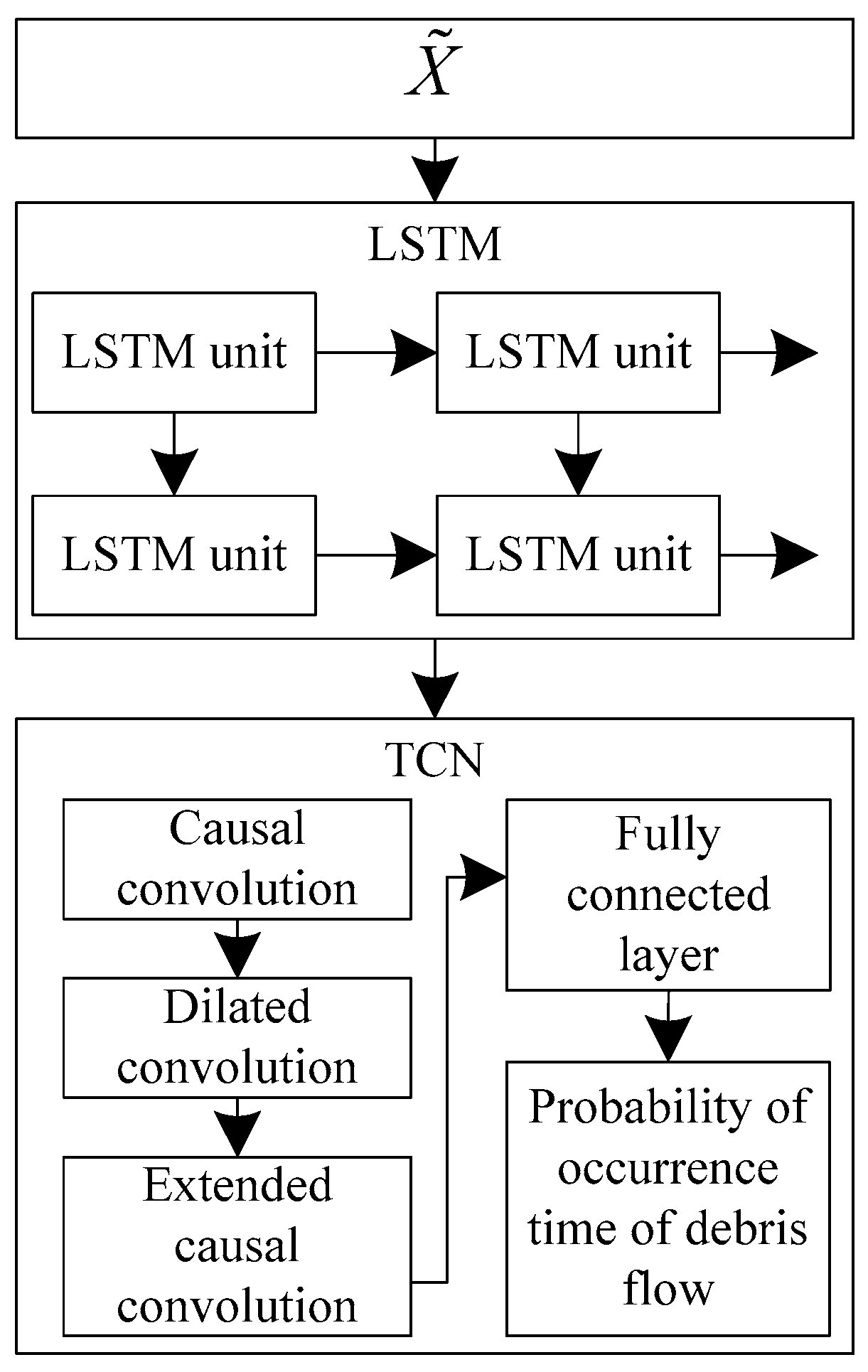
The conditional probability of debris flow occurrence under the optimal dynamic rainfall variable combination X ˜ (calculated using Formula (8) in the preceding subsection) is computed. The optimal combination X ˜ corresponding to the maximum probability is selected as the basis. LSTM-TCN is then employed to extract and learn temporal features from this variable combination, thereby predicting the probability of debris flow occurrence triggered by rainfall. LSTM-TCN is a deep learning framework integrating Long Short-Term Memory (LSTM) and Time Convolutional Network (TCN). The overall structure of the debris flow occurrence time probability prediction method based on LSTM-TCN is shown in Figure 1.
This framework utilizes LSTM to capture long-range dependencies in time series X ˜ , such as the impact of rainfall from previous days on subsequent debris flows during a precipitation event [16]. TCN uses dilated convolutions to efficiently capture local details and short-term patterns in time series, such as sudden changes in hourly rainfall intensity, while preserving temporal causality [17]. Combining these two approaches enables the extraction of local features from temporal data via TCNs while modeling long-range dependencies through LSTMs. This makes the framework well-suited for handling time-series tasks like rainfall–debris flow, which exhibit both short-term fluctuations and long-term cumulative effects.

2.3.2. LSTM-Based Dynamic Variable Combination for Time Series Feature Extraction

The LSTM module is an enhanced network based on traditional recurrent neural networks (RNNs). It introduces a gating mechanism to regulate weight updates in hidden layer neurons, addressing gradient explosion or vanishing gradient issues in multi-layer models [18], thereby improving applicability for rainfall–debris flow time series prediction tasks. The LSTM unit primarily consists of a forget gate, an input gate, a cell state, and an output gate, with the following computational flow:
(1) Forget Gate Calculation:
The forget gate determines how much information from the previous rainfall–debris flow time step is retained or discarded. Thus, after the dynamic variable combination X ˜ is input, it is first processed through the forget gate, calculated as:
g t = f w g × h t 1 + w g X ˜ t + b g
where g t represents the output of the forget gate; X ˜ t denotes the input dynamic variable combination of rainfall–debris flow at time t ; f . is the activation function; w g and b g represent the weight and bias terms of the forget gate, respectively.
(2) Input Gate Calculation:
The input gate determines how much X ˜ t information is retained at the current moment, serving as a flow control mechanism. The formula for calculating the additional information required by the input gate is:
s t = f w s × h t 1 + w s X ˜ t + b s
where s t represents the output of the forget gate; w s and b s denote the input gate’s weight and bias term, respectively.
The output result z t of the memory cell unit at time t is calculated as follows:
z t = g t × z t 1 + s t × tan w z × h t 1 + w z X ˜ t + b z
where w z and b z denote the weight and bias terms of the memory cell unit, respectively; z t 1 represents the output result of the memory cell unit at time t 1 .
(3) Output Gate Calculation:
The output gate determines which information will be treated as the current state’s output [19], controlling how much information is extracted into the hidden state. The output gate’s result o t is calculated as:
o t = f w o × h t 1 + w o X ˜ t + b o
where w o and b o represent the weights and bias terms of the input gate, respectively.
The output gate’s result o t indicates which information from the current cell state z t can be output. Combined with this result, the final rainfall–debris flow dynamic variable combination time series feature o ˜ t is obtained, calculated as:
o ˜ t = o t × tanh z t
Formula (13) combines o t and z t to obtain the key feature information of the rainfall–debris flow dynamic variable combination at the current time step.

2.3.3. Probability Prediction of Debris Flow Occurrence Time Based on TCN

TCN is a network model constructed by introducing three special structures—causal convolutions, dilated convolutions, and residual connections—to the convolutional neural network framework. It possesses three key functions: ① Causal convolutions: During convolution computations, only the current and previous time step o ˜ t is utilized, preventing the model from exploiting future information to cheat [20] and ensuring debris flow prediction results align with real-world temporal patterns; ② Dilated convolutions expand the receptive field through dilation rates, simultaneously capturing o ˜ t of both short-term rapid dynamic features and long-term cumulative dynamic features. This better adapts to debris flow events triggered by both short-period fluctuations and long-period accumulation; ③ Residual connections enable TCN to train deeper layers, thereby accurately learning complex interactions among dynamic variable combinations and enhancing the precision of temporal probability predictions.
The core concept of TCN is to extract both short-term and long-term features from debris flow time series through causal convolution and dilated convolution. The grid input length of the TCN must match the output length. Inputting o ˜ t into the TCN and applying causal convolution yields the following formula for the one-dimensional convolution output:
y t = i = 0 κ 1 w ˜ × o ˜ t
where κ denotes the convolution kernel size; w ˜ represents the convolution kernel weights.
Dilated convolution is the key component of TCN, used to expand the receptive field of the network. Dilated convolution introduces a dilation factor l to process o ˜ t , and its output formula is:
y t = i = 0 κ 1 w ˜ × o ˜ t v × l
where l denotes the skip distance between adjacent elements in the convolution kernel; t v × l ensures the causality of the causal convolution.
The obtained y t and y ˜ t are simultaneously input into the expanded causal convolution for reconstruction and integration. The output result y ^ t is:
y ^ t = i = 0 κ c × y t v × l + y ˜ t v × l
where c denotes the filter size; y t v × l and y ˜ t v × l represent the expanded feature results.
The core of residual connection is the residual block. Both the reconstructed and integrated y ^ t and the input debris flow dynamic variables are fed into the residual block, yielding the final debris flow occurrence probability prediction T . The formula is:
T = δ X ˜ t + ς y ^ t
where ς denotes the residual function; δ denotes the linear rectification function.

2.3.4. Definition of Rainfall Energy Terms

To comprehensively characterize the coupling effect of rainfall intensity and duration on debris flow initiation, this paper introduces Absolute Rainfall Energy (Ea) as the core indicator of dynamic threshold. It is defined as the cumulative value of the square of rainfall intensity per unit time, which physically reflects the comprehensive work capacity of rainfall on slope erosion and infiltration. The calculation formula is as follows:
E a t = τ = 1 t I τ 2 Δ t
In the formula: I τ is the rainfall intensity at time τ (mm/h), and Δ t is the time step (h). This indicator overcomes the shortcomings of single rainfall intensity or cumulative rainfall that cannot simultaneously characterize the triggering effects of short-term heavy rainfall and long-term rainfall, and is suitable for dynamic threshold determination of debris flows in mountainous areas.

2.3.5. Training and Validation of the LSTM-TCN Model: Data Division, Hyperparameter Settings, and Training Process

In this study, a total of 38 debris flow events and their corresponding time-series dynamic variable data were collected. The length of each sequence was set to 120 h prior to the event occurrence, with a time step of 1 h. To enhance the model’s generalization capability, the data was divided into training, validation, and test sets in a ratio of 7:2:1.
Regarding model hyperparameter settings, optimization was conducted through grid search. The specific parameters are as follows: The number of units in the LSTM layer was set to 64; the size of the TCN convolution kernel was set to 3; the dilation coefficient sequence was [1,2,4,8]; the dropout rate was set to 0.3; the batch size was set to 32; and the number of training epochs was set to 200. Meanwhile, five-fold cross-validation was employed to prevent overfitting, and an early stopping strategy (with a patience value of 20) was utilized to control the training process. Training was halted when the loss on the validation set did not decrease over 20 consecutive training epochs.
During the training process, the Adam optimizer was used with an initial learning rate of 0.001, and the binary cross-entropy loss function was adopted. The input data consisted of time-series sequences of the optimal combination of dynamic variables, while the output was the probability of debris flow occurrence time. Ultimately, the AUC for probability prediction on the validation set reached 0.92, indicating that the model possesses excellent time-series feature extraction and event discrimination capabilities.

2.4. Dynamic Threshold Determination for Critical Rainfall

After completing the probability prediction of debris flow occurrence time T as described in the preceding subsection, a dynamic threshold model for critical rainfall is established. This model determines the critical rainfall threshold for triggering debris flows in mountainous areas. The threshold model formula is:
Q ¯ = t = 1 T I t 2
where I t 2 denotes rainfall intensity at time t ; Q ¯ represents the absolute energy of rainfall.
Calculating Q ¯ using Formula (19) determines the dynamic rainfall energy during the rainfall event. Comparing this result with the preset risk value (R) determines whether the critical rainfall threshold is reached, thereby achieving dynamic threshold determination for mountainous debris flow initiation. The judgment criteria are shown in Table 1.

3. Test Analysis

To verify the effectiveness of the method proposed in this article, a debris flow prone area in a certain province of China was selected as the research area. This area is located in the Xiaojiang Fault Zone, belonging to the high mountain canyon landform, with an average annual precipitation of about 1000 mm. The lithology is mainly granite and diorite, with strong weathering and thick loose deposits covering the surface. The hidden danger points of debris flow are dense.
The data were obtained from the field monitoring and historical disaster records of the Geological Disaster Monitoring Center of the province in 2020 and 2024, including:
Rainfall data: sourced from 12 automatic rainfall stations within the region, with a time resolution of 1 h (see Table 2).
Geological data: Geotechnical parameters obtained from field surveys and indoor experiments (see Table 3).
Disaster data: Record the occurrence time, location, and scale of a total of 38 debris flow events.
All data underwent quality control and spatiotemporal alignment processing to ensure their availability for model training and validation.
The data used in the testing were derived from regional statistical records of natural disasters and geological environment surveys. For the purposes of this study, data from 2020 to 2024 were selected as the test dataset for the proposed method, ensuring the representativeness and reliability of the test results. The natural disaster data and geological survey results for the region over these five years are presented in Table 2 and Table 3, respectively.
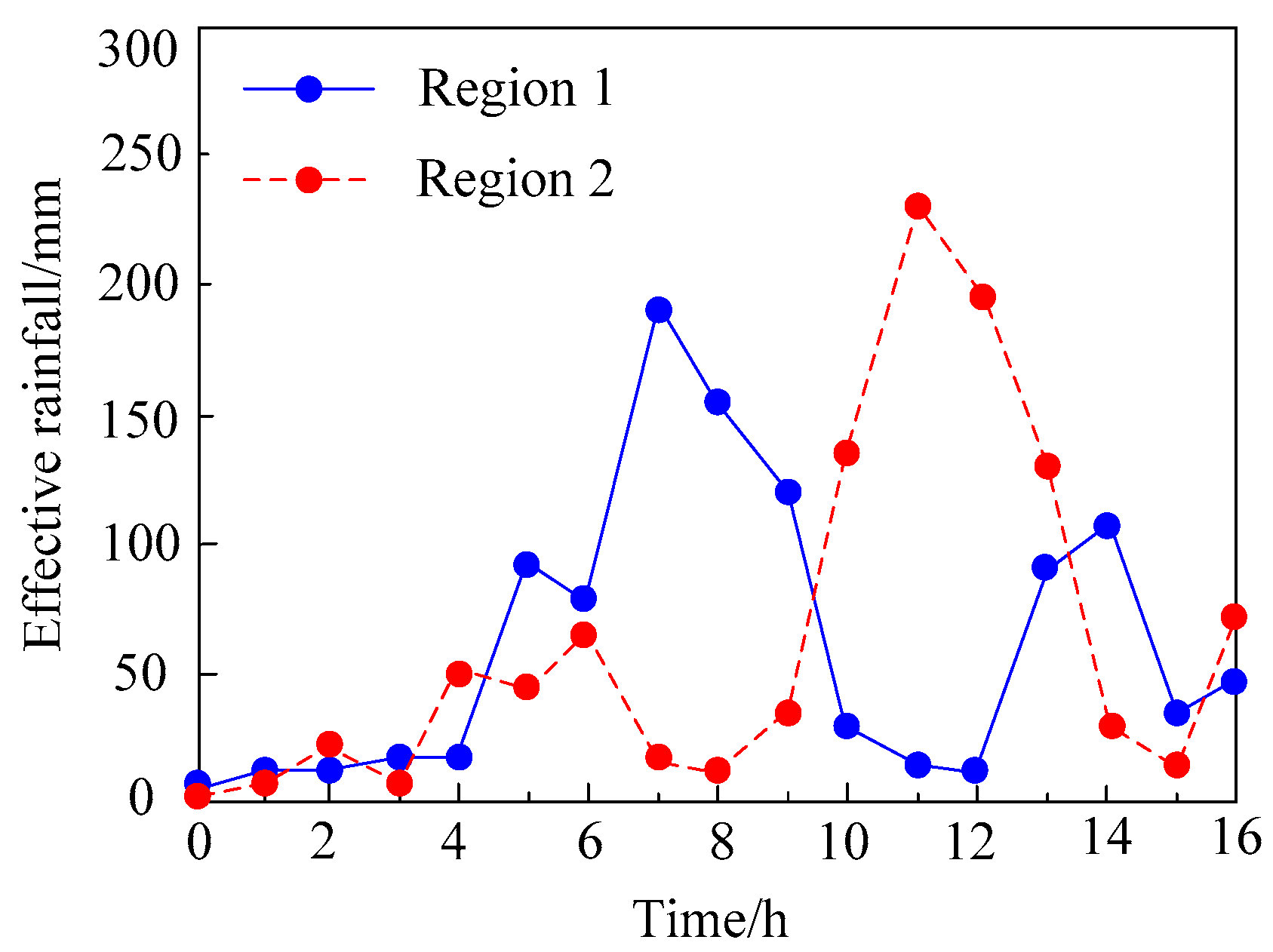
Prior to determining the dynamic threshold rainfall for initiating debris flows in mountainous areas, this method requires calculating the effective rainfall for the study region. To evaluate the method’s effectiveness in estimating effective rainfall, precipitation data for different time periods in the region were obtained, as shown in Figure 2. The results randomly display effective rainfall data for two debris flow occurrence areas.
Analysis of Figure 2 test results indicates that this method demonstrates robust dynamic effective rainfall calculation capabilities, enabling the acquisition of effective rainfall data at different time points. Furthermore, it can identify rainfall peaks across different regions based on the calculated rainfall results. For Region 1, the effective rainfall peak occurs around 8 h, approaching 200 mm, with a minor peak at 14 h exceeding 100 mm. In Region 2, the peak effective rainfall occurs at 12 h, exceeding 200 mm. Therefore, by calculating regional effective rainfall based on the spatial probability assessment of debris flow occurrence in mountainous areas, this study clearly reveals the dynamic rainfall variations across regions, providing a reliable basis for subsequent dynamic threshold determination.
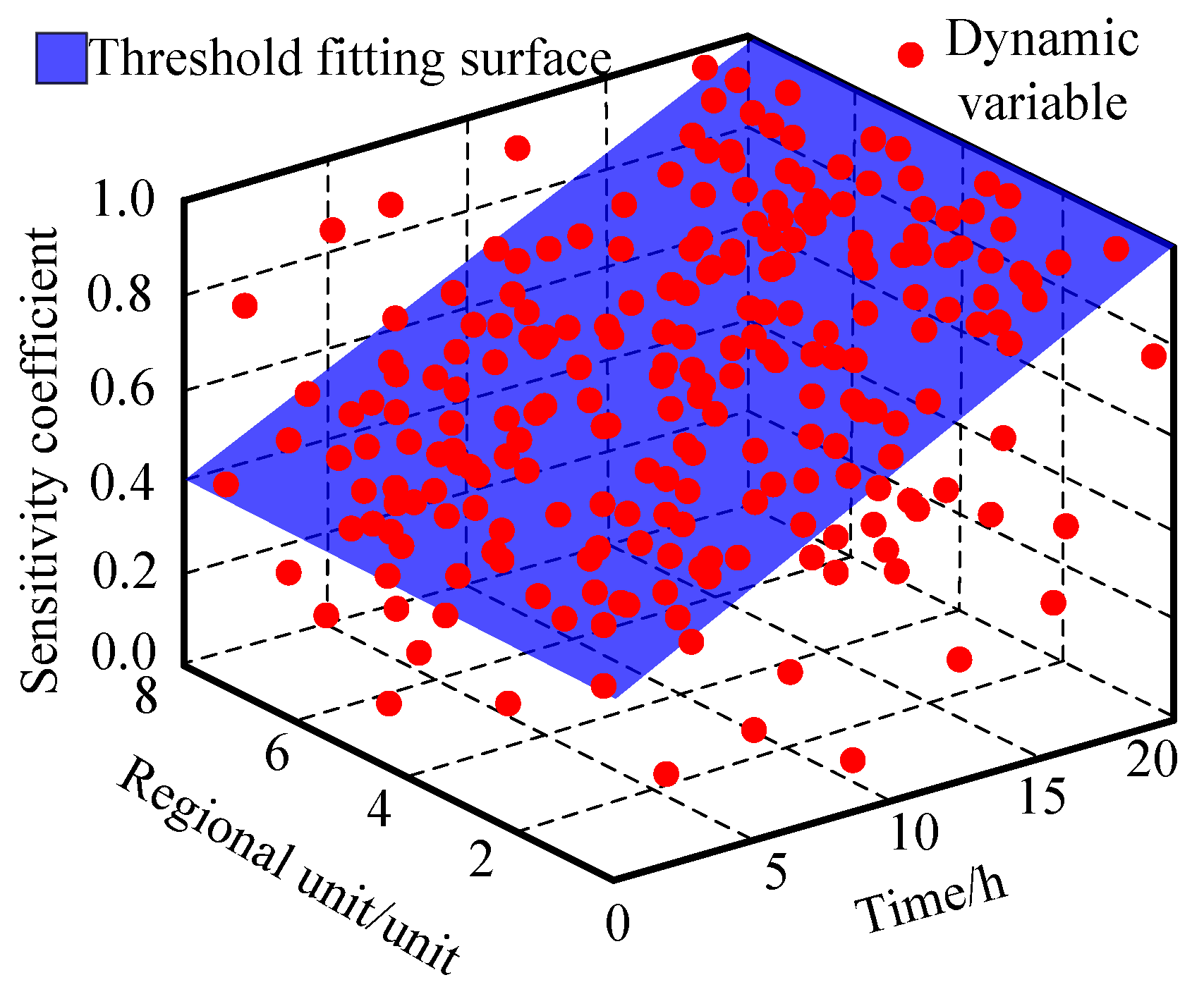
To test the screening effect of the proposed method on dynamic variable combinations, we combine the frequency ratio χ , effective rainfall Q , safety factor ψ o , and soil saturation B i to form the dynamic variable combination X = χ , Q , ψ o , B i . We set a sensitivity coefficient screening threshold (>0.4), and define the region that meets this threshold as a fitting surface, which is used to screen dynamic variables. The screening results are shown in Figure 3.
Analysis of the test results in Figure 3 reveals that this method can determine whether a dynamic variable combination lies on the fitted surface based on the calculated sensitivity coefficient. All combinations on the fitted surface are retained, while those deviating from it are discarded, indicating that the latter variable plays a minor role in predicting debris flow occurrence. Thus, this method obtains dynamic variable combination results by calculating sensitivity coefficients, thereby better describing the dynamic characteristics of critical rainfall thresholds for triggering debris flows in mountainous regions.
To evaluate the effectiveness of the proposed method in determining the dynamic threshold for the critical rainfall triggering debris flows in mountainous areas, this study employed the method to predict the probability of debris flow occurrence time under different rainfall conditions. The risk value R (i.e., the rainfall energy threshold) was determined through statistical analysis of historical disaster data and rainfall energy distribution, with the specific steps outlined as follows:
First, the absolute rainfall energy sequences for various stages before and after the occurrence of historical debris flow events were calculated.
Next, Receiver Operating Characteristic (ROC) curves, which illustrate the relationship between early warning accuracy and false alarm rate for different R values, were plotted.
Finally, the R value corresponding to the point on the ROC curve closest to the top-left corner (indicating the highest accuracy and lowest false alarm rate) was selected as the final threshold.
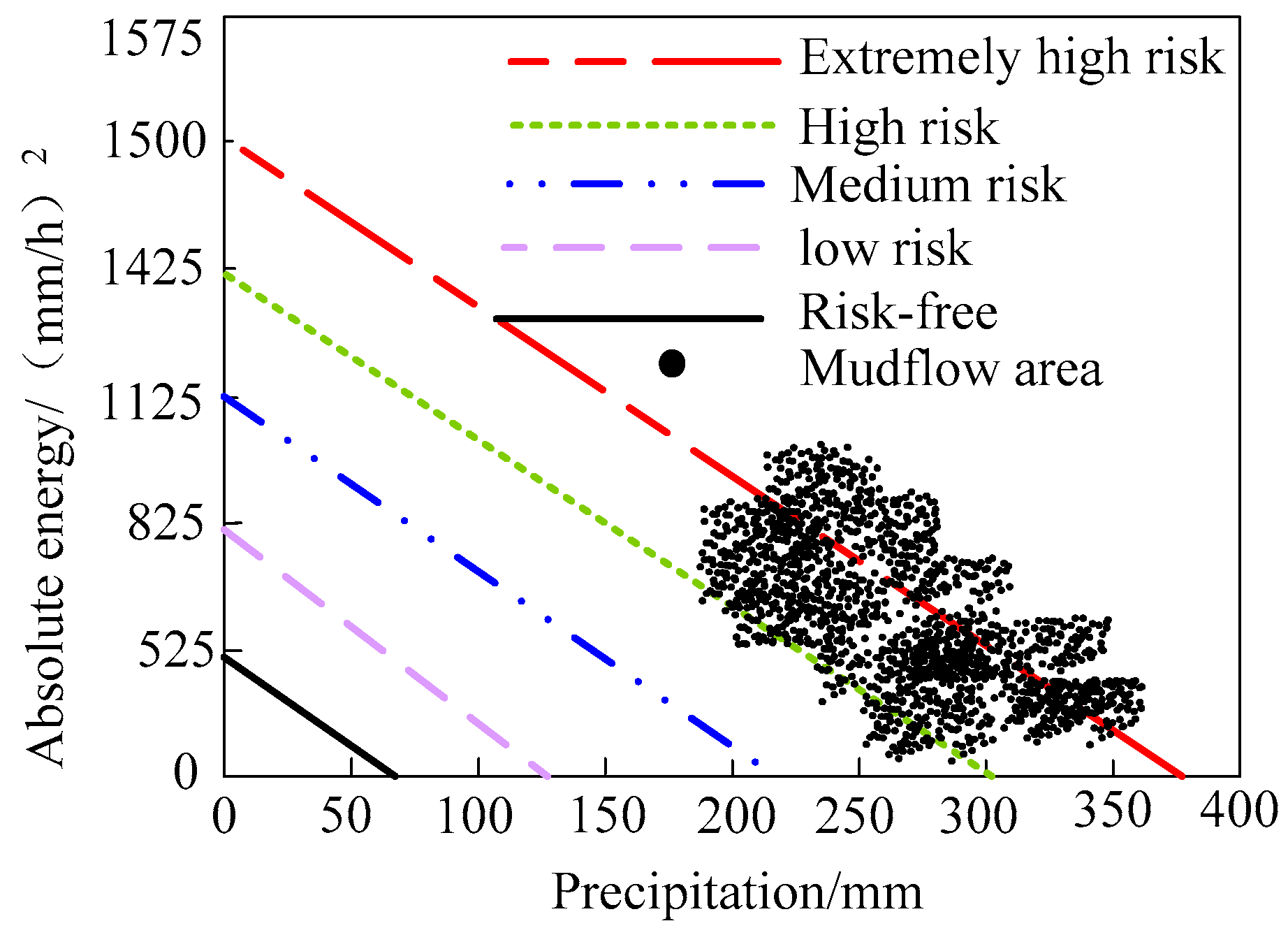
Based on data from 38 debris flow events in the study area from 2020 to 2024, the aforementioned analysis determined that R = 1500 (mm/h)2 is the optimal threshold. The absolute energy of rainfall was calculated according to the prediction results, and the calculated values were compared with this risk value. Subsequently, the dynamic threshold for the critical rainfall triggering debris flows in mountainous areas was determined based on the evaluation criteria presented in Table 1, with the determination results shown in Figure 4.
Analysis of Figure 4 test results indicates that when determining the dynamic threshold for critical rainfall initiating debris flows in mountainous areas using this method, absolute energy results can be obtained for different rainfall levels, and the initiation of debris flows under varying rainfall conditions can be analyzed. Specifically, when rainfall is less than 220 mm, no debris flows occur across the mountainous region. As rainfall continues to increase, exceeding 250 mm causes the absolute energy value to surpass 95% R, i.e., exceeding 1425 (mm/h)2, at which point debris flows occur. Therefore, this method can determine the corresponding risk level of debris flows by integrating the absolute energy judgment criteria for rainfall.
To further analyze the effectiveness of the proposed method in determining the dynamic threshold of critical rainfall for mountain debris flow initiation, two indicators, interval coverage ϑ and interval average percentage width β , are selected as evaluation criteria to measure the reliability and accuracy of the critical rainfall dynamic threshold determination for debris flows. Both indicators range between 0 and 1: a higher ϑ indicates that the threshold method’s results are more consistent with actual conditions, thus having stronger reliability; a smaller β means the threshold determination interval is tighter, so the method is more accurate in determining the critical rainfall. The calculation formulas for these two indicators are:
ϑ = 1 K k = 1 K X ˜ i
β = 1 K × ε max k = 1 K Q ¯ max Q ¯ min × 100 %
where X ˜ i denotes the i th dynamic variable. If the variable’s data falls within the rainfall energy range predicted by the dynamic threshold method, it is set to 1; otherwise, it is set to 0. K represents the number of samples. ε max denotes the range between the upper and lower limits of the judgment interval, Q ¯ max and Q ¯ min .
Both methods from References [5,6] were employed as comparative approaches to the present method. Using three distinct methodologies, dynamic threshold determinations for the critical rainfall initiating debris flows in mountainous regions were conducted under varying rainfall intensities. The results yielded two metrics: interval coverage ϑ and average interval percentage width β , as shown in Table 4.
Analysis of the test results in Table 4 reveals the following. Under different rainfall intensities, after rainfall calculation using the method from Reference [5] (RES method), the interval coverage ranged from 0.844 to 0.873 with an average of 0.857, while the average percentage width ranged from 0.137 to 0.145, with an average of 0.141. At medium-to-low rainfall levels (50 mm, 100 mm), the coverage rate decreased to below 0.87. After rainfall calculations using the method in Reference [6] (debris flow hazard index method), the interval coverage ranged from 0.821 to 0.833, with an average of 0.826. The average percentage width of the interval ranged from 0.149 to 0.155, with an average of 0.152. In contrast, after applying the critical rainfall dynamic threshold determination in this study, the interval coverage remained stable between 0.969 and 0.984, with an average of 0.978 and an overall fluctuation of only 1.5%. Particularly for extreme rainfall events (250 mm and 300 mm, corresponding to exceptionally heavy downpours), the index values reached 0.983 and 0.978, nearly completely covering the rainfall energy samples that actually triggered debris flows. The average percentage width of the interval remained stable between 0.021 and 0.025, with an average of 0.023. This results demonstrate that the proposed method can precisely delineate critical rainfall energy intervals (e.g., boundaries between supercritical, critical, and medium-risk levels), thereby providing clear quantitative standards for early warning [21].
To verify the rationality of each key link in the dynamic threshold determination, two supplementary experiments were conducted. The first is the sensitivity coefficient threshold selection experiment, which involves varying the sensitivity coefficient threshold within the range of 0.3 to 0.6 to thoroughly analyze its impact on the variable combination screening results and subsequent prediction accuracy. The second is the rainfall energy threshold rationality verification experiment, which compares the early warning accuracy and false alarm rate under different rainfall energy thresholds (R = 1300, 1500, 1700 (mm/h)2) to determine the optimal rainfall energy threshold. The results are presented in Table 5 and Table 6.
As shown in Table 5, when the sensitivity coefficient threshold is set to 0.4, the model achieves the optimal balance in terms of AUC and early warning lead time, indicating that this threshold can effectively screen out variable combinations with strong discriminatory power. Table 6 reveals that when the rainfall energy threshold R = 1500 (mm/h)2, the early warning accuracy is the highest (93.5%), with the lowest false alarm and missed alarm rates, demonstrating the good applicability and reliability of this threshold within the study area.

4. Discussion and Prospects

The dynamic threshold determination method proposed in this study has achieved favorable results in Dongchuan District, Yunnan Province. However, as it is solely based on data from a single region, its general applicability still requires further validation in mountainous areas with different geological and climatic conditions. Future research can be expanded in the following aspects:
(1) Multi-region Validation
Apply this framework in typical debris-flow-prone areas both domestically and internationally, such as Wenchuan, Taiwan, and the Alpine regions, to test its cross-regional adaptability. By conducting research in diverse geographical settings, we can better understand the limitations and strengths of the proposed method and make necessary adjustments to enhance its universal applicability. For example, different regions may have varying soil types, slope gradients, and precipitation patterns, which can all influence the occurrence and characteristics of debris flows. Validating the framework in these areas will help determine if it can accurately predict debris flow events under different environmental conditions.
(2) Multi-disaster Coupling Early Warning
Mountainous areas are often accompanied by landslides, flash floods, and other disasters. In the future, it is possible to explore the coupling triggering mechanisms of multiple disasters and develop collaborative early warning models. Debris flows, landslides, and flash floods are often interrelated, with one disaster potentially triggering or exacerbating another. For instance, heavy rainfall can simultaneously increase the likelihood of landslides and debris flows. By understanding the complex interactions between these disasters, we can develop more comprehensive early warning systems that consider multiple hazard factors. This will enable us to provide more timely and accurate warnings, reducing the risks to human life and property in mountainous regions.
(3) Space–Air–Ground Data Fusion
Integrate data from InSAR deformation monitoring, high-resolution topography, Internet of Things (IoT) sensors, and other sources to improve the real-time performance and spatial resolution of the model. InSAR technology can provide precise measurements of ground deformation over large areas, helping to identify potential areas at risk of debris flows. High-resolution topographic data can offer detailed information about the terrain, which is crucial for understanding the flow paths and accumulation areas of debris flows. IoT sensors can continuously monitor various environmental parameters, such as rainfall, soil moisture, and ground vibration, providing real-time data for early warning purposes. By fusing these different types of data, we can create a more comprehensive and accurate model that can better predict the occurrence and behavior of debris flows, enhancing our ability to mitigate their impacts.


5. Conclusions

To address the issue that traditional static threshold methods fail to reflect the dynamic interaction between rainfall and geological bodies, this study proposes a dynamic determination framework for the critical rainfall threshold for the initiation of mountainous debris flows. This framework integrates spatial susceptibility analysis, effective rainfall quantification, soil mechanical response, variable sensitivity screening, and deep learning time-series prediction. The core innovations of this study are as follows:
(1) A three-dimensional dynamic threshold system of “spatial identification–time-series prediction–energy determination” has been constructed, achieving the organic integration of multi-source data and multiple methods.
(2) For the first time, the Jensen–Shannon (JS) divergence has been introduced into the dynamic variable screening for debris flows. By quantifying sensitivity to optimize variable combinations, the discriminatory power and interpretability of the model have been enhanced.
(3) The absolute rainfall energy is proposed as the physical basis for the dynamic threshold, overcoming the shortcomings of single rainfall indicators in representing compound triggering effects and providing a clear quantitative standard for real-time early warning.

Author Contributions

Conceptualization, Y.W. and N.H.; methodology, Y.W. and N.H.; software, Y.W. and N.H.; validation, Y.W. and N.H.; original draft preparation, Y.W.; writing—review and editing, Y.W. and N.H.; visualization, Y.W.; supervision, N.H.; project administration, Y.W. and N.H. All authors have read and agreed to the published version of the manuscript.

Funding

This work are financially supported by Key Research and Promotion Project (Scientific and Technological Project) of Henan Province (Project No. 262102320183), Key Scientific Research Project of Colleges and Universities in Henan Province (Project No. 25B413013) and State Key Laboratory of Earthquake Dynamics (Project No. LED2023B02).

Data Availability Statement

The original contributions presented in this study are included in the article.

Conflicts of Interest

The authors declare no conflict of interest.

References

  1. Sajwan, A.; Sengupta, A. Debris Flow Modeling of the Chandmari and Sichey Landslides in Sikkim, India, Using the Distinct Element Method. Nat. Hazards Rev. 2024, 25, 05024011. [Google Scholar] [CrossRef]
  2. Nagl, G.; Huebl, J.; Scheidl, C. Real-scale measurements of debris-flow run-ups. Landslides 2024, 21, 963–973. [Google Scholar] [CrossRef]
  3. Veloso, V.Q.; Reis, F.A.G.V.; Cabral, V.C.; Sá, A.A.; Gramani, M.F.; Ogura, A.T.; Boesing, I.J.; Balbinot, G.; Tatizana, C. Brazil Proposal for real-time rainfall monitoring of gravitational mass movements in Serra do Mar, SP. Landslides 2025, 22, 2273–2292. [Google Scholar] [CrossRef]
  4. Khan, M.U.; Tian, S.; Chen, N.; Khan, T.A.; Khan, U.S.; Ahmad, A.; Alam, M.; Latif, K.; Nyirandayisabye, R. Understanding the formation mechanism of rainfall and snowmelt jointly induced Bicharh Nallah debris flow, North Pakistan. Environ. Earth Sci. 2025, 84, 86. [Google Scholar] [CrossRef]
  5. Vianello, D.; Vagnon, F.; Bonetto, S.; Mosca, P. Debris flow susceptibility mapping using the Rock Engineering System (RES) method: A case study. Landslides 2023, 20, 735–756. [Google Scholar] [CrossRef]
  6. Veloso, V.Q.; Reis, F.A.V.G.; Cabral, V.; Sá, A.A.; Gramani, M.F.; Ribeiro, T.C.; Ogura, A.T.; Corrêa, C.V.D.S.; Mascarenhas, P.V.S.; Russo, W. Application of the debris-flow hazard index for pipelines in the context of the hydrogeological disaster of February 2023 in São Sebastião, Serra do Mar, Brazil. Landslides 2025, 22, 709–726. [Google Scholar] [CrossRef]
  7. Nguyen, B.Q.V.; Doan, V.L.; Kim, Y.T.; Song, C.H.; Lee, J.S. Considering antecedent rainfall to improve susceptibility assessment of rainfall-earthquake-triggered landslides on unsaturated slopes. Environ. Earth Sci. 2024, 83, 142. [Google Scholar] [CrossRef]
  8. Nguyen, H.H.D.; Pradhan, A.M.S.; Song, C.H.; Lee, J.S.; Kim, Y.T. A hybrid approach combining physics-based model with extreme value analysis for temporal probability of rainfall-triggered landslide. Landslides 2025, 22, 149–168. [Google Scholar] [CrossRef]
  9. Imhoff, R.O.; Cruz, L.D.; Dewettinck, W. Scale-dependent blending of ensemble rainfall nowcasts and numerical weather prediction in the open-source pysteps library. Q. J. R. Meteorol. Soc. 2023, 149, 1335–1364. [Google Scholar] [CrossRef]
  10. Mohril, R.S.; Vasudeo, A.D.; Tsakiris, G. Exploring Runoff Response to Simulated Rainfall: A Study of the Rising Limb of a Hydrograph on Sandy Slopes. Water Resour. Manag. 2025, 39, 3199–3212. [Google Scholar] [CrossRef]
  11. Liao, M.; Barros, A.P. Toward Optimal Rainfall for Flood Prediction in Headwater Basins—Orographic QPE Error Modeling Using Machine Learning. Water Resour. Res. 2023, 59, e2023WR034456. [Google Scholar] [CrossRef]
  12. Imon, Z.; Solár, J. Recovery of trace elements in sediments from the alpine mountain stream affected by a severe flash flood in the Tatra Mountains. Environ. Earth Sci. 2025, 84, 223. [Google Scholar] [CrossRef]
  13. Hashimoto, H.; Horinouchi, K.; Kuwano, K.R. Soil Structure in Volcanic Pumice Soil of Dozou-sawa River Evaluated from In Situ and Laboratory Tests. Geotech. Test. J. 2023, 46, 1008–1026. [Google Scholar] [CrossRef]
  14. Kim, D.; Han, H.; Lee, H.; Kim, H.S.; Kim, J. Development of Heavy Rain Damage Prediction Technique Based on Optimization and Ensemble Method. KSCE J. Civ. Eng. 2023, 27, 2313–2326. [Google Scholar] [CrossRef]
  15. Kodihal, S.; Akhtar, M.P. Sustainable Groundwater Recharge Potential Zone Identification: An AHP-OWA Approach Integrating Future Rainfall and Land-Use Projections. Water Resour. Manag. 2024, 38, 1079–1098. [Google Scholar] [CrossRef]
  16. Rahimi, A.; Yashooa, N.K.; Ahmed, A.N.; Sherif, M.; El-Shafie, A. Different Time-Increment Rainfall Prediction Models: A Machine Learning Approach Using Various Input Scenarios. Water Resour. Manag. 2025, 39, 1677–1696. [Google Scholar] [CrossRef]
  17. Oorthuis, R.; Hürlimann, M.; Vaunat, J.; Moya, J.; Lloret, A. Monitoring the role of soil hydrologic conditions and rainfall for the triggering of torrential flows in the Rebaixader catchment (Central Pyrenees, Spain). Landslides 2023, 20, 249–269. [Google Scholar] [CrossRef]
  18. Mhedhbi, R.; Erechtchoukova, M.G. Assessing the Impact of Rainfall Nowcasts on an Encoder-Decoder LSTM Model for Short-Term Flash Flood Prediction. Water Resour. Manag. 2025, 39, 1623–1638. [Google Scholar] [CrossRef]
  19. Yas, Q.; Hamead, Y.K. Rainfall rate prediction using recurrent neural network with long short-term memory algorithm: Iraq case study. Int. J. Comput. Appl. Technol. 2024, 74, 125–135. [Google Scholar] [CrossRef]
  20. Zhu, J.X.; Ren, M.Y.; Gu, W.; Zhang, W.B. Modeling of Air Quality Prediction Based on CEEMDAN-IGWO-CNN-LSTM. Comput. Simul. 2025, 42, 529–537. [Google Scholar]
  21. Amlashi, A.T.; Ghanizadeh, A.R.; Dessouky, S. Enhanced Predictive Ensemble Learning Models for Compressive Strength of Concrete Modified with Bentonite Clay. Innov. Discov. 2024, 1, 33. [Google Scholar] [CrossRef]
Figure 1. Overall structure of probability prediction method for debris flow occurrence time based on LSTM-TCN.
Water 18 00484 g001
Figure 2. Dynamic Changes in Effective Rainfall.
Water 18 00484 g002
Figure 3. Sensitivity calculation results of dynamic variable combination.
Water 18 00484 g003
Figure 4. Dynamic threshold determination results of critical rainfall for initiating debris flow in mountainous areas.
Water 18 00484 g004
Table 1. Criteria for Determining Critical Rainfall.
Comparison ResultsRainfall ResultsRisk Level of Debris Flow
≥95 RSupercriticalExtremely high risk, occurrence of debris flows
75% R~95% RCriticalHigh risk, with a high probability of debris flows occurring
55% R~75% RCritical developmentMedium risk, potential formation of debris flow
35% R~55% RPotential riskLow risk, low probability of debris flow occurrence
<35% RRisk-freeNo risk, no debris flows occur
Table 2. Natural Disaster Data.
Maximum Daily Rainfall/mmRainfall LevelNumber of Occurrences of Debris FlowNumber of Debris Flow Occurrence Areas/Piece
[0, 10)Light rain00
[10, 25)Moderate rain00
[25, 50)Heavy rain11
[50, 100)Rainstorm83
[100, 250)Heavy rainstorm116
[250, +∞)Extremely heavy rainstorm188
Table 3. Geological Survey Data Results.
Parameter NameNumerical Value
Cohesion/kPa5~15
Angle of internal friction/°16~20
Permeability coefficient/m·h−12.3~10
Natural density/kg·m−31650~17,500
Void ratio0.85~0.95
Table 4. Different methods for determining the effectiveness.
Test MetricsPrecipitation/mmReference [5] MethodReference [6] MethodProposed Method
Interval coverage500.8440.8290.984
1000.8610.8220.976
1500.8520.8260.981
2000.8460.8330.969
2500.8730.8210.983
3000.8460.8240.978
Average percentage width of the interval500.1370.1530.022
1000.1410.1520.021
1500.1390.1490.025
2000.1440.1530.024
2500.1380.1550.022
3000.1450.1510.023
Table 5. Results of the Sensitivity Coefficient Threshold Comparison Experiment.
Sensitivity ThresholdNumber of Screened VariablesAUC (Validation Set)Early Warning Lead Time (h)
0.3280.892.1
0.4190.922.4
0.5120.881.9
0.670.851.5
Table 6. Results of the Rainfall Energy Threshold Comparison Experiment.
Threshold R ((mm/h)2)Accuracy (%)False Alarm Rate (%)Missed Alarm Rate (%)
130088.215.611.8
150093.58.36.5
170090.17.99.9
Disclaimer/Publisher’s Note: The statements, opinions and data contained in all publications are solely those of the individual author(s) and contributor(s) and not of MDPI and/or the editor(s). MDPI and/or the editor(s) disclaim responsibility for any injury to people or property resulting from any ideas, methods, instructions or products referred to in the content.