1. Introduction
Agriculture is widely recognized as a cornerstone of rural development, supporting local economies, employment, and livelihoods while also shaping social cohesion and regional identity [
1]. Beyond its productive role, agricultural land use interacts with critical biophysical processes that underpin long-term productivity and environmental stability, including soil fertility and hydrological regulation [
2]. Because these functions rely on limited resources and sensitive processes, they are increasingly challenged as agricultural systems shift toward greater intensification under mounting climatic, hydrological, and socioeconomic pressures.
Rising global food demand, driven by population growth and urbanization, together with shifting dietary patterns, has accelerated the transition toward increasingly intensive, input-dependent agricultural systems [
3,
4,
5]. In practice, intensification has increased reliance on irrigation water alongside fertilizers and plant-protection products, boosting short-term productivity while increasing demands on land and water resources [
4,
5,
6]. As a result, farms become more exposed to water-related constraints and more sensitive to disruptions in supply reliability, particularly in systems where irrigation is a key determinant of yield stability and farm income [
6,
7].
Climate variability further intensifies these pressures by altering the availability, timing, and spatial distribution of water resources and increasing the frequency and severity of extremes such as droughts, heatwaves, and floods [
8]. Consequently, irrigation performance depends not only on aggregate water availability but also on reliable, timely delivery at the point of use, shaped by conveyance losses and operational constraints that determine whether water can be supplied in accordance with on-farm demand [
9]. When surface-water deliveries are delayed or unreliable, farmers face uncertainty and respond by adjusting irrigation timing, shifting practices, and securing alternative sources to manage production risk [
10,
11].
These constraints are particularly pronounced in Mediterranean-type climates, where summer water shortfalls make irrigation a prerequisite for stable yields [
8,
12,
13]. Irrigation performance at the farm level is shaped by the operational condition of distribution networks and by the institutional–administrative arrangements through which allocation rules, operational responsibilities, and monitoring practices are defined and implemented [
9,
14,
15]. Where surface-water delivery is insufficient or unreliable, farms often compensate through private abstractions, with groundwater functioning as a reserve and supplementary source [
10,
11]. However, increased groundwater reliance can intensify longer-term sustainability and governance challenges, particularly where abstraction is not systematically monitored and documented [
10,
16].
Although irrigation performance and water governance have been widely examined in the international literature, quantitative modelling of crop-water requirements and institutional analyses of water management are often treated as analytically separate domains. In settings where systematic monitoring of groundwater abstraction and field-level deliveries is limited, this separation can obscure the interaction between theoretical demand, operational delivery constraints, and user-level adaptive responses. As a result, groundwater reliance may be interpreted primarily as a volumetric outcome, rather than as a function of delivery reliability within a specific infrastructural and institutional context.
By explicitly combining model-based estimation of irrigation requirements with intake-level delivery records and qualitative evidence from farmers and institutional stakeholders, this study seeks to bridge this gap. The aim is not only to quantify irrigation demand but also to interpret groundwater dependence within its operational and governance setting, particularly in a context characterized by incomplete monitoring.
Within this framing, the Arta Plain, a major irrigated plain in northwestern Greece, illustrates these intertwined dynamics. Despite the relative hydrological abundance of the wider region, the plain exhibits persistent spatial and seasonal mismatches between irrigation demand and the effective capacity of the public irrigation network to meet it. The public irrigation network, developed in the 1960s, comprises approximately 55 km of unlined earth canals and 18 km of lined canals, with substantial conveyance losses [
17]. At the farm level, surface and sprinkler irrigation account for approximately 80% of irrigation applications, whereas drip irrigation represents about 20% [
18]. This creates a central paradox: while surface water could theoretically satisfy a substantial share of irrigation requirements, operational constraints and delivery inefficiencies can shift a meaningful part of the supply toward private abstractions, with groundwater becoming crucial for maintaining reliability at the farm level. Yet, systematic datasets documenting groundwater abstraction, on-farm water use, and the spatial distribution of boreholes remain limited or fragmented, constraining robust assessment and evidence-based decision-making [
16].
Taken together, this study examines how modelled irrigation water requirements relate to effective delivery constraints and observed source reliance in the Arta Plain, using an integrated design that combines quantitative estimation of irrigation water requirements (IWR) with FAO CROPWAT 8.0 and primary qualitative evidence from semi-structured interviews with farmers and institutional stakeholders. By triangulating modelled demand with operational delivery conditions and user-level practices, the study provides a transparent basis for interpreting irrigation performance and groundwater reliance in settings where monitoring of abstractions and on-farm water use is incomplete or fragmented.
2. Materials and Methods
This study employed an integrated mixed-method design to examine how modelled irrigation water requirements relate to operational delivery constraints in the Arta Plain and how these constraints shape the balance between surface-water deliveries and groundwater use. Irrigation water requirements were estimated with FAO CROPWAT 8.0 (Food and Agriculture Organization of the United Nations, Rome, Italy) for the cultivated crops of the Arta Plain using standard FAO procedures. A very small fraction of crop types was excluded due to missing input parameters, with negligible implications for the aggregate estimates.
Qualitative evidence from semi-structured interviews with farmers and institutional stakeholders was used to document irrigation practices under real operating conditions and to contextualize the modelling outputs. Given the limited and fragmented monitoring of groundwater abstraction, interview evidence informed the interpretation of the relative contribution of surface water and groundwater to irrigation supply under local operating conditions.
2.1. Study Area
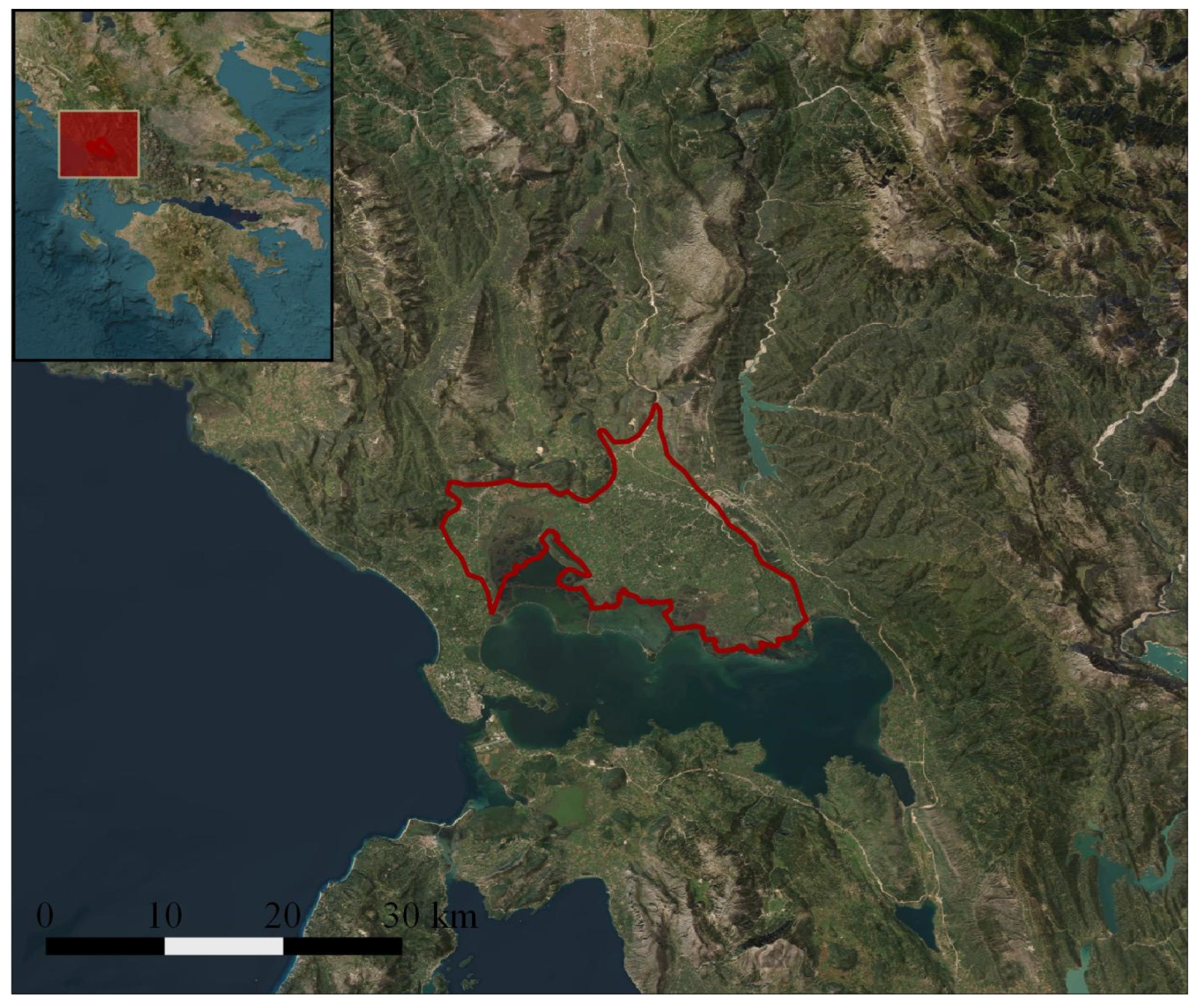
The study area lies between the regional units of Arta and Preveza, with most agricultural land located in the regional unit of Arta (approximate coordinates: 39°08′11.51″ N, 20°57′34.20″ E). Administratively, it belongs to the Region of Epirus, which ranks among the EU regions with the lowest GDP per capita (13th lowest in 2017) [
19]. In 2020, Epirus also recorded one of the highest shares of residents aged over 65 years (27.3%), ranking third among EU regions [
20]. These socioeconomic and demographic characteristics provide context for interpreting constraints and decision-making in the agricultural sector.
The plain is shaped by the Arachthos and Louros rivers, whose alluvial deposits have historically enhanced soil fertility and supported agricultural productivity. To the south, it borders the Amvrakikos Gulf, a wetland complex of international ecological significance protected under the Ramsar Convention [
21] and included within the Natura 2000 network [
22]. This proximity highlights the relevance of irrigation management in relation to a sensitive downstream coastal ecosystem (
Figure 1).
The regional climate is typically Mediterranean, with warm, dry summers and mild, wet winters. These conditions, together with the plain’s morphology and crop water requirements, influence the seasonal water balance and shape irrigation demand across the agricultural sector.
2.2. Crop Water Modelling Framework
2.2.1. Climatic Data Processing and Interpolation
Crop water requirements were estimated using CROPWAT 8.0 [
23], following the methodology described in FAO Irrigation and Drainage Paper No. 56 [
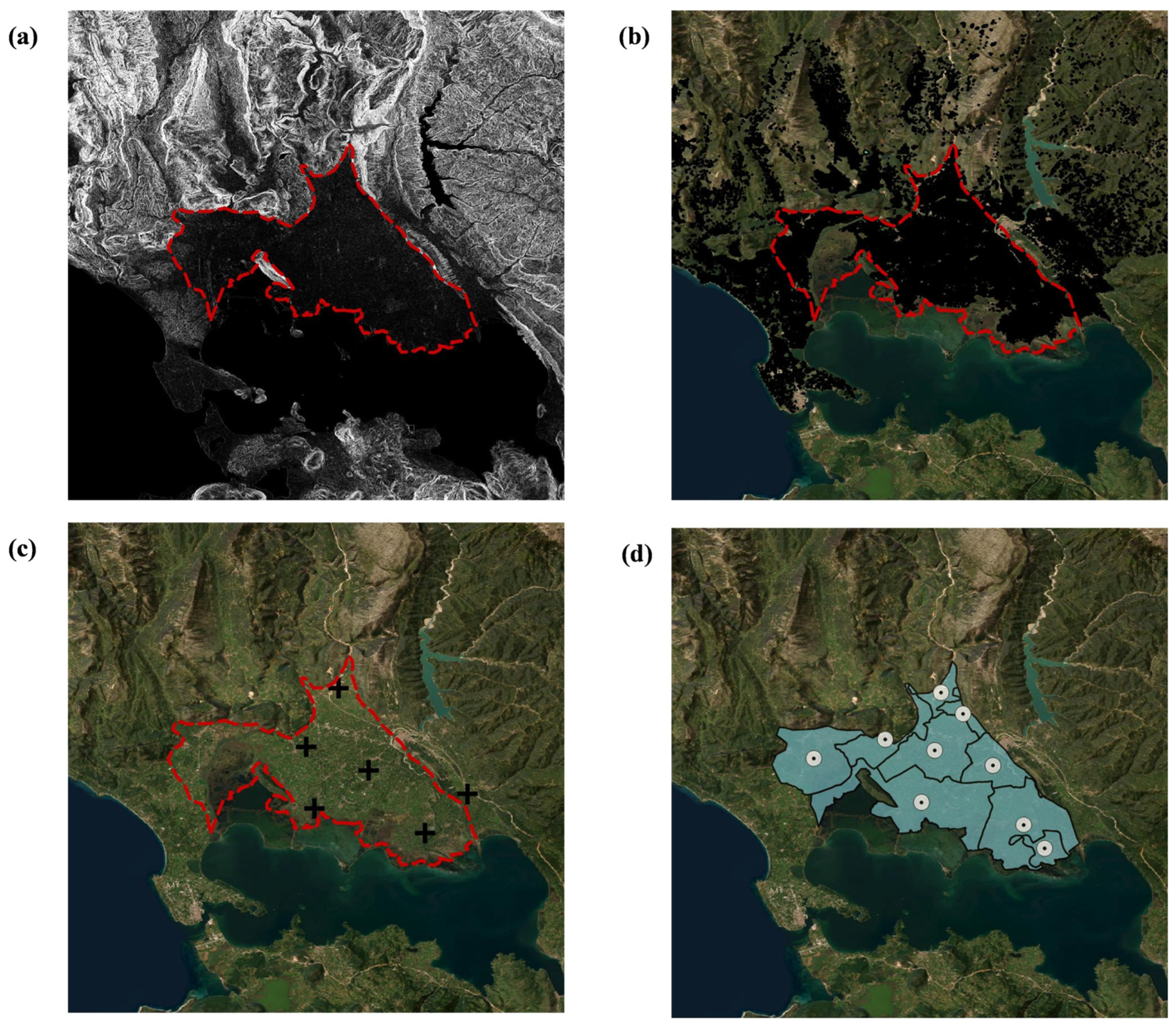
24]. The study domain (Arta Plain) was extracted in QGIS v2.18 (QGIS Development Team, Open Source Geospatial Foundation, Chicago, IL, USA) from a DEM mosaic generated from ASTER GDEM (NASA and METI, Washington, DC, USA/Tokyo, Japan) tiles, using DEM-derived terrain products (slope, shaded relief, and contours) to delineate and mask the contiguous lowland plain area and to support cartographic representation (
Figure 2a,b). The DEM was handled in WGS 84 (EPSG:4326) with 1 arc-second grid spacing (pixel size: 0.000277778°; nominal ~30 m).
CLIMWAT was not used because the nearest available station corresponds to Corfu, which is located more than 100 km away (straight-line distance) from the Arta Plain and reflects a coastal island climate with strong maritime influence that is not representative of inland plain conditions. Climatic inputs were therefore obtained from six local meteorological stations operated by the University of Ioannina and accessed through the OpenHi.net platform [
25] (Kampi, Agios Spyridonas, Kostakioi, Kompoti, Kommeno, and the Vigla Pumping Station;
Figure 2c). Monthly station records were regularized into daily series in Hydrognomon using standard aggregation rules prior to modelling [
26].
For spatial refinement, the study area was divided into nine units aligned with municipal boundaries (
Figure 2d). Climatic variables for each unit were estimated at the centroid of the unit using inverse-distance weighting (IDW) of observations from the six stations, with the power parameter set to
p = 2 and weights normalized to sum to one:
where KLIM is the interpolated climatic value (e.g., temperature, precipitation),
KLIMi is the observation at station
i, and
di is the distance between station
i and the centroid. The weighting factor
wi assigns greater influence to stations in closer proximity, ensuring spatially representative climatic inputs for the modelling framework.
2.2.2. Reference Evapotranspiration
Crop water modelling was based on the 2021 crop census dataset provided by the Greek Payment and Control Agency (OPEKEPE), representing the most recent validated crop-area record available at the onset of the study. To maintain temporal consistency between crop areas and climatic inputs, climate data for the same year were used. Operational records from the public irrigation network were available only for the 2016–2018 irrigation seasons and refer to intake volumes measured at the network entry points. Accordingly, the comparison presented later (2021 modelled demand versus 2016–2018 records) is not treated as a year-matched validation but as a seasonal-scale coherence check of whether the recorded intake volumes are broadly consistent with the order of magnitude implied by current crop water needs.
A total of 68 crop types were identified in the OPEKEPE dataset, covering approximately 9200 ha of cultivated land. Crops cultivated under cover, such as in greenhouses, were excluded due to their negligible share, less than 0.5 percent, and their distinct irrigation characteristics. Crop-specific agronomic parameters, including growth stages, rooting depths, crop coefficients, critical depletion levels, yield response factors, and crop heights, were compiled from established sources [
24,
27,
28,
29,
30,
31,
32,
33,
34]. Complete parameterization was feasible for 61 of the 68 crop types, which together account for the vast majority of the cultivated area. For crops with partially missing information, proxy values from morphologically and phenologically similar species were adopted following FAO guidance [
24,
27]. Crops for which complete agronomic parameters were unavailable, such as chestnut, persimmon, oregano, rosemary, eucalyptus, aloe, and sea buckthorn, were excluded from the modelling due to insufficient data and their negligible contribution, less than 1 percent, to the cultivated area. The complete list of crop categories and the final set of the modelled crops is provided in
Appendix A.
Reference evapotranspiration (
ET0) was then calculated using the FAO Penman–Monteith method [
24,
28], which simulates evapotranspiration from a well-watered hypothetical reference surface under standard climatic conditions [
23]:
where
ET0 denotes reference evapotranspiration (mm day
−1);
Rn is the net radiation at the crop surface (MJ m
−2 day
−1);
G is the soil heat flux (MJ m
−2 day
−1);
T is the mean air temperature at 2 m (°C);
U2 is the wind speed at 2 m (m s
−1);
and
ed are the saturation and actual vapour pressures (kPa), respectively; Δ is the slope of the saturation vapour pressure curve (kPa °C
−1); and
γ is the psychrometric constant (kPa °C
−1).
2.2.3. Crop Evapotranspiration (ETc)
Crop evapotranspiration (
ETc) was computed by combining reference evapotranspiration (
ET0) with crop coefficients (
Kc) following FAO-56 [
24]:
where
ETc represents daily crop evapotranspiration (mm day
−1),
Kc is the crop coefficient (dimensionless), and
ET0 is the reference evapotranspiration. Stage-specific
Kc values account for temporal changes in crop canopy development and ground cover across the growing season.
2.2.4. Irrigation Water Requirements (IWR)
Crop water requirements (
) represent the total amount of water required to meet
over each crop’s growth cycle under non-limiting conditions. While a portion of this demand is met through rainfall, only effective rainfall (
, the estimated fraction of precipitation that can be effectively utilized by crops, is considered, as a portion of precipitation is typically lost through runoff and deep percolation and therefore does not contribute to
[
24,
35]. The net irrigation water requirement (
) was therefore calculated as follows:
CROPWAT computations were driven by the regularized climate series and produced crop-specific irrigation requirements, which were subsequently extracted and aggregated to monthly values by crop type and spatial unit to support comparison with reported public-network deliveries and the subsequent allocation of irrigation supply between surface water and groundwater.
2.3. Estimating Groundwater Reliance: A Qualitative Approach
Semi-structured interviews were used to assess groundwater reliance for irrigation in the Arta Plain and to document irrigation practices, perceived operational constraints, and governance conditions under real operating settings. In the absence of systematic monitoring of groundwater abstraction and on-farm water use, the analysis draws on stakeholders’ experiential knowledge to generate evidence in a data-scarce context, an approach widely applied in natural resource management research [
36,
37].
Data collection was conducted in two phases to capture perspectives from both institutional stakeholders and farmers. Interviews were conducted using a semi-structured format informed by established methodological guidance, with a thematic interview guide to ensure consistent coverage of core topics and open-ended probing to capture context-specific experiences and practices [
37,
38]. Interview data were used to document operational practices and constraints in areas where direct measurements were incomplete [
36].
To ensure broad coverage of stakeholders involved in irrigation governance and water management, we invited a wide set of relevant regional and local organizations. Institutional interviews were conducted with representatives from municipal services, water management and irrigation authorities, public utilities, agricultural bodies, regional environmental services, and environmental organizations. These interviews took place in March 2023 during a regional workshop organized within the e-Pyrros research initiative. Interviews with irrigating farmers were subsequently conducted, with participants selected through purposive sampling, either directly in the field or via Local Land Reclamation Organizations, to ensure geographical dispersion across the plain and substantial farming experience across the main cropping patterns. Eligibility required active involvement in irrigated farming and experience with at least three of the four main crops examined (kiwifruit, citrus, alfalfa, and olive trees). Sampling continued until thematic saturation was reached [
39,
40,
41]. In total, interviews were conducted with 15 farmers and 16 institutional stakeholders.
Core topics covered in both stakeholder groups included (i) perceived key constraints affecting agricultural production and irrigation; (ii) perceptions of water-quality status and main drivers of degradation; (iii) perceptions of water availability (quantity) and its main determinants, including conveyance losses and allocation practices; (iv) perceived implications for the Amvrakikos Gulf; and (v) views on irrigation-system performance and improvement options. In addition, for each of the four main crops (kiwifruit, citrus, alfalfa, and olive trees), respondents were asked to report an indicative percentage of irrigation supplied via private boreholes (groundwater). These crop-level percentages are reported and assessed in
Section 3.2. Elicitation was restricted to these crops to reduce respondent fatigue and limit unreliable reporting for minor crops. Together, these crops account for the largest share of cultivated area in the plain [
42].
For farmers, the guide also included questions on farm and irrigation characteristics (cultivated area and crop mix, field location, irrigation network used, borehole operating costs where applicable, irrigation method by crop, and irrigation decision-making and record-keeping practices, including use of agronomic advice, meteorological information, and any basic monitoring/recording of irrigation events and volumes).
Interviews were documented, transcribed, and analysed using thematic coding, combining guide-based categories with inductively emerging themes. Coded material was synthesized by stakeholder group and theme and, where applicable, by water source and crop. Farmer-reported crop-level groundwater percentages were used to partition modelled irrigation requirements between groundwater and surface water. Institutional interviews were used to contextualize governance conditions, operational constraints, and system performance [
43].
Participation was voluntary. Written informed consent was obtained from institutional stakeholders, while verbal informed consent was obtained from farmers prior to field-based interviews, as written consent would have required the collection of identifying information during on-site interviews. All participants were assured anonymity and confidentiality. Audio recordings and transcripts were handled in accordance with research data-protection practices.
3. Results
3.1. Irrigation Water Requirements
This section estimates irrigation water requirements across the Arta Plain by modelling crop-specific irrigation requirements under FAO reference conditions. The purpose is to describe how irrigation requirements are distributed across crops and within the irrigation season at the plain scale. The modelling provides a standardized estimate of crop water needs and is not intended to represent observed farmer behaviour or actual applied irrigation volumes.
Crop-area data were obtained from the Greek Payment and Control Agency [
42]. The initial aim was to model irrigation requirements for all crops recorded in the dataset. Crops for which complete agronomic parameterization was not feasible were excluded due to insufficient data, representing less than 1% of the cultivated area (e.g., chestnut, persimmon, oregano, rosemary, eucalyptus, aloe, sea buckthorn). All remaining crops were included in the modelling. For reporting clarity,
Table 1 presents only crops exceeding 1% of the cultivated area, while the full list of modelled crops and crop-specific IWR estimates is provided in
Appendix A.
To reflect spatial climatic variability, the plain was divided into nine spatial units (municipalities), and IWR was estimated separately for each unit using localized climate data. For each crop, this produced a range of annual IWR values (minimum to maximum) across municipalities. Across the nine spatial units, annual IWR variability remained within a relatively narrow range (see
Table 1), reflecting the relatively homogeneous lowland morphology of the plain. The resulting monthly irrigation requirements are presented in
Table 2 (1 hm
3 = 10
6 m
3), aggregated over the modelled cultivated area (9184.63 ha). The concentration of modelled irrigation requirements in summer months reflects both crop growth patterns and the seasonal climate of the region.
3.2. Groundwater Reliance Estimates Based on Stakeholder and Farmer Responses
Semi-structured interviews indicated crop-specific differences in the reported share of irrigation supplied by groundwater. High levels of groundwater use were reported for kiwifruit (86%) and citrus (58%), whereas alfalfa (15%) and olive trees (7%) showed substantially lower dependence (
Table 3). Variability was greater among institutional stakeholders, reflecting differences in information sources and the fact that estimates were not based on direct irrigation decisions. Farmer responses, in contrast, exhibited low dispersion and strong alignment with field-level irrigation practices, as reflected in the narrower standard deviations reported in
Table 3, and were used to inform the allocation of modelled irrigation requirements by water source.
Groundwater shares were elicited only for the four dominant crops, which together account for approximately 84% of the total cultivated area of the Arta Plain. This coverage captures the dominant irrigation structure of the plain. Minor and highly fragmented crops represent small and heterogeneous shares of land use and were not parameterized in the survey. Given their limited proportional contribution to total irrigation demand, extending the elicitation to all minor crops would not materially affect the weighted allocation of total irrigation requirements. Accordingly, the resulting estimate should be interpreted as a conservative (lower-bound) approximation of overall groundwater reliance.
Based on these estimates, total IWR was disaggregated between surface-water supply and groundwater abstraction. The resulting groundwater share corresponds to 41.1% of the total annual IWR. This percentage was derived by weighting crop-specific groundwater shares reported by farmers with crop-level irrigation water requirements and aggregating across spatial units and months.
The annual shares reported in the last row of
Table 4 represent weighted totals based on aggregated monthly irrigation volumes rather than simple averages of monthly percentages.
3.3. Stakeholder and Farmer Perspectives on Irrigation Practices and Water Governance Challenges
To complement the quantitative analysis, semi-structured interviews were conducted with two stakeholder groups, local farmers (n = 15) and institutional stakeholders (n = 16), including personnel from public agencies, technical departments, Local Land Reclamation Organizations, and academic or environmental institutions. The thematic synthesis below summarizes convergences and divergences in how the two groups perceive irrigation constraints, water-related risks, and environmental implications for the Amvrakikos Gulf.
3.3.1. Infrastructure and Operational Constraints
Both groups identified inadequate irrigation infrastructure as a major challenge. Eight farmers and seven institutional stakeholders referred to degraded canal segments, ageing conveyance structures, and insufficient deliveries during peak irrigation months. Institutional stakeholders additionally emphasized systemic issues such as fragmented management structures and limited coordination among responsible bodies, whereas farmers highlighted increased production costs linked to reliance on groundwater. This convergence points to a shared diagnosis of infrastructure-related constraints, while differences in emphasis reflect the distinct roles of the two groups in irrigation operation and management [
44,
45].
3.3.2. Water Quality and Resource Perceptions
Clear asymmetries emerged regarding perceived water-related risks. All institutional stakeholders expressed concern about water-quality degradation, citing agrochemical runoff, groundwater extraction that is not systematically metered, and the use of drainage canals for irrigation. In contrast, only five farmers considered water-quality degradation a problem. A similar divergence was observed regarding perceived water availability: five institutional respondents referred to seasonal shortfalls, whereas only one farmer framed availability as a primary concern, with most farmer accounts attributing supply problems to delivery and infrastructure constraints. Overall, these patterns indicate different interpretative frames between the two groups [
36,
46].
3.3.3. Environmental Impacts on the Amvrakikos Gulf
Perceptions of environmental impacts also diverged. Fourteen of sixteen institutional stakeholders rated agricultural pressures on the Amvrakikos Gulf as moderate to high, whereas only three farmers acknowledged substantial effects. Most farmers perceived little or no impact, indicating a gap between field-level experiential views and broader environmental assessments at the gulf scale [
14,
47].
3.3.4. Irrigation Decision-Making at the Farm Level
Differences in perception were reflected in reported irrigation practices. Most farmers relied on empirical knowledge and short-term weather forecasts. Only five consulted agronomists, one used agrometeorological data, and none reported using localized digital decision-support tools. Furthermore, while seven farmers tracked irrigation timing, only two recorded applied water volumes. These responses indicate a continued reliance on experiential knowledge and limited engagement with monitoring or advisory systems, consistent with the absence of systematic on-farm water measurements across the plain [
17,
18].
3.3.5. Institutional Monitoring and Governance Constraints
Despite acknowledging water-quality concerns, only three institutional stakeholders reported systematic water monitoring within their organizations. Many pointed to governance barriers, including limited interagency coordination and fragmented responsibilities, as well as regulatory and administrative constraints. These responses are consistent with broader structural limitations reported for Mediterranean agricultural water governance, where integration efforts often face operational constraints [
14,
48].
3.3.6. Willingness to Adopt Sustainable Practices
Although irrigation practices were often described as informal, twelve farmers expressed willingness to adopt water-saving technologies, particularly drip irrigation, provided that adequate financial and technical support is available.
Overall, the interviews highlight recurring perception gaps between institutional stakeholders and farmers, alongside shared concerns regarding infrastructure and operational constraints. These qualitative findings provide context for interpreting irrigation delivery and allocation outcomes presented in the following section.
3.4. Empirical–Model Comparison of Irrigation Deliveries and Irrigation Requirements
This section examines irrigation water allocation in the Arta Plain by comparing model-derived irrigation water requirements (IWR) with empirical records of surface-water deliveries at the intake points of the public irrigation network. The analysis focuses on seasonal alignment between demand and network withdrawals and on the inferred contribution of alternative water sources during the irrigation period.
Empirical data were obtained from systematic hourly discharge measurements jointly conducted by the Department of Agriculture at the University of Ioannina and local water management authorities (Local and General Organizations of Land Reclamation) at five major intake points during the irrigation periods (April–September) of 2016–2018. Annual intake volumes were estimated at 192.0 hm
3 (2016), 145.3 hm
3 (2017), and 132.5 hm
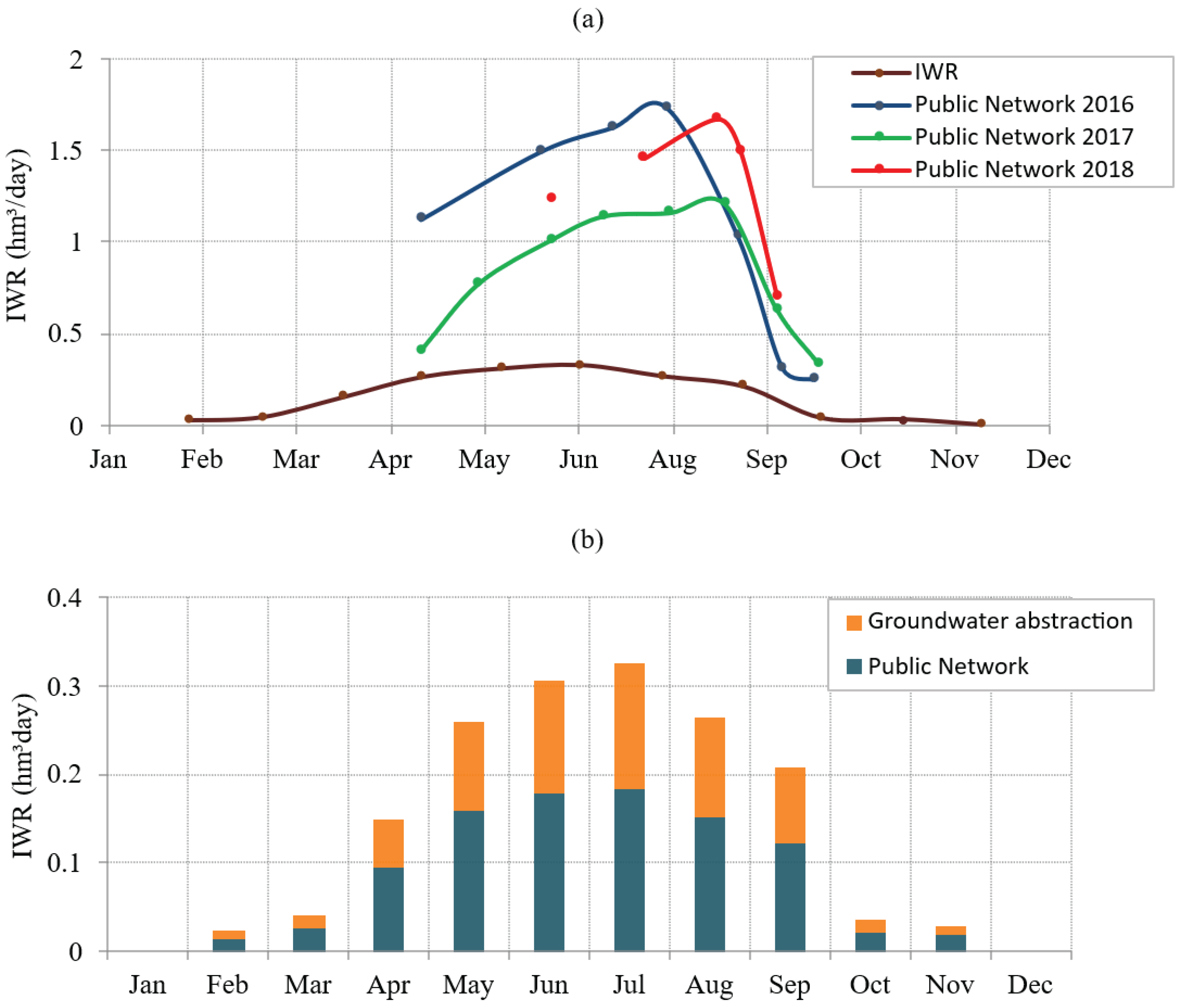
3 (2018). Measurements were aggregated to daily values and compared with the modelled irrigation requirements derived from FAO CROPWAT 8.0 (
Figure 3a). Because delivery data are available only for 2016–2018, the comparison is interpreted as a seasonal-scale coherence assessment of timing and magnitude, rather than a same-year validation or calibration of model outputs. Given the absence of systematic same-year intake data and the relative stability of crop structure and climatic seasonality in the region, the comparison is intended to assess seasonal alignment rather than interannual calibration accuracy.
The temporal correspondence analysis (
Figure 3a) indicates that intake withdrawals broadly follow the seasonal profile of modelled irrigation requirements, increasing and decreasing in parallel during the growing season. During peak months (June–August), however, recorded intake volumes consistently exceed the net field-level irrigation requirements implied by the model. Despite these high upstream withdrawals, farmers in peripheral areas repeatedly reported insufficient water availability and extensive reliance on private boreholes. Taken together, these findings indicate a gap between nominal withdrawals at the system’s intake points and effective delivery at the farm level, consistent with conveyance losses, uneven distribution within the network, and unregulated or unrecorded withdrawals.
Model outputs and operational measurements refer to different system boundaries. The 49.1 hm3 estimate represents net field-level irrigation requirements under FAO reference conditions, whereas the 132.5–192.0 hm3 figures reflect intake-level withdrawals into the public irrigation network. When juxtaposed, the implied intake-to-net-demand ratio is on the order of 26–37%. This ratio is not presented as a measured system ‘efficiency’. Rather, it provides an order-of-magnitude indication of the extent to which operational releases, conveyance losses, and delivery uncertainty can inflate intake-level withdrawals relative to net crop requirements. Accordingly, it should be interpreted as a system-level intake-to-demand ratio, not as a field-derived performance metric.
To clarify the role of alternative sources, crop-specific groundwater shares derived from farmer interviews (
Section 3.2) were integrated into the modelled IWR to partition irrigation requirements between surface-water deliveries through the public network and groundwater abstraction. The reconstructed allocation (
Figure 3b) highlights pronounced seasonal dependence on groundwater, particularly during peak-demand months, consistent with the compensatory role of private wells when field-level deliveries are unreliable. This mixed regime operates with limited coordinated monitoring, suggesting potential long-term pressure on aquifer resources and weak institutional oversight of withdrawals and allocation.
Overall, the results indicate that the observed mismatch between intake withdrawals and effective on-farm supply is consistent with infrastructure degradation and fragmented management, rather than hydrological scarcity.
4. Discussion
This study examined irrigation performance, groundwater dependence, and local governance dynamics in the Arta Plain through a mixed-method approach that combined quantitative modelling with qualitative investigation. The results converge on a clear conclusion: the challenges observed in the area do not arise from a lack of water resources but from the way water is managed, distributed, and ultimately accessed at the field level. Surface water is available at the level of the public irrigation network, but not uniformly at the field level. However, the conversion of nominal availability into reliable field-level delivery remains uneven and often uncertain. Ageing and degraded infrastructure, fragmented responsibilities, and limited monitoring create a situation in which nominal sufficiency coexists with operational instability, especially during the months of highest demand.
The quantitative analysis captured the strong seasonality of irrigation requirements, as expected for a Mediterranean agricultural system dominated by perennial, water-demanding crops. The public irrigation network typically operates from April to September, broadly coinciding with the main irrigation season. This concentrates the risk of delivery failures within a six-month period, when crop-water demands are highest, and production is most sensitive to supply disruptions. Comparison of modelled irrigation requirements with intake-level withdrawals showed a broadly similar seasonal pattern, but without full alignment. During the summer peak, withdrawals at the intake level exceeded theoretical crop water needs, while farmers in peripheral parts of the plain still reported shortages. Local factors such as conveyance losses, pressure drops, and irregular delivery schedules can create uneven reliability of field-level deliveries across the plain, a pattern that is not captured by aggregated supply records yet directly shapes farm-level decisions.
Within this context, groundwater functions as a stabilizing mechanism and, in practice, as a safety net against uncertainty in surface-water deliveries through the public irrigation network. The estimated contribution of groundwater, around 41% of total irrigation requirements, reflects this compensatory role. This percentage does not in itself indicate systematic over-abstraction or widespread hydrogeological degradation. Available assessments describe the regional aquifer systems of Epirus as largely renewable and not characterized by systematic seawater intrusion [
49]. Although localized surface and soil salinity have been documented in the coastal margins of the Arta Plain due to marine influence on shallow layers [
50], current evidence does not suggest intrusion into the deeper alluvial aquifers used for irrigation.
At the same time, the absence of systematic monitoring of abstraction volumes and groundwater-quality indicators limits the capacity to detect localized pressures at an early stage. Even without a plain-wide signal, cumulative effects cannot be excluded in the absence of coordinated oversight and clearly assigned institutional responsibility.
Overall, the pattern reflects a functional dependence: farmers turn to wells whenever the public irrigation network cannot provide adequate timing, flow, or pressure [
51,
52]. Similar dynamics have been documented in other Mediterranean and semi-arid regions, where private boreholes operate as a form of “hidden infrastructure” that absorbs uncertainty and sustains production in the presence of weak collective services [
45]. While this mechanism enhances short-term resilience, it may generate longer-term risks if pressures intensify or monitoring frameworks remain underdeveloped.
The combined use of model-derived irrigation requirements, intake-level delivery records, and qualitative evidence from water users is consistent with approaches increasingly adopted in Mediterranean and semi-arid regions to address incomplete monitoring environments. In contexts where systematic metering of groundwater abstraction is limited, several studies have relied on triangulation between crop-water modelling, delivery statistics, and stakeholder reporting to approximate source allocation and reliability patterns. Rather than treating model outputs as stand-alone indicators, this integrated design allows irrigation performance to be interpreted within its operational and institutional setting. In this sense, the present analysis aligns with international methodological practices in recent methodologies that combine spatial analysis, agro-hydrological modelling, and indirect estimation approaches under limited monitoring conditions [
53,
54,
55].
The differentiated reliance on groundwater across crops reflects both agronomic and economic drivers. Kiwifruit cultivation is highly sensitive to water stress and requires a stable water supply throughout the growing season. International studies confirm that kiwifruit (Actinidia deliciosa) exhibits marked reductions in fruit size and quality under inadequate soil moisture, which explains the strong preference for controllable sources such as wells in the Arta Plain [
56]. In citrus groves, beyond summer irrigation needs, part of the water use is linked to frost protection during cold episodes in winter. This practice, documented in Mediterranean irrigation systems, often favours groundwater use due to its immediate availability and the high degree of control it offers to farmers [
57]. These crop-specific factors help explain why perennial, water-intensive, or frost-sensitive orchards show higher dependence on groundwater than crops such as alfalfa or olive trees.
Irrigation decisions are taken mainly on an empirical basis. Most farmers rely on accumulated experience, short-term weather forecasts, and simple field indicators, rather than on structured advisory services, agro-meteorological data, or local decision-support tools. Only a small number systematically consult agronomists, and very few record the volumes they apply. In this context, a flat-rate charging scheme per cultivated area, as applied by local irrigation organizations, provides limited incentives for measuring and documenting actual water use. These findings are consistent with recent local evidence, which indicates that limited access to reliable, locally adapted decision-support instruments constrains efficiency gains [
17,
18]. At the same time, the relatively narrow dispersion in farmers’ estimates of groundwater use suggests that local knowledge can capture real irrigation practices with reasonable accuracy, especially in a context where organized measurement mechanisms are largely absent.
The qualitative investigation also revealed marked differences between the perceptions of farmers and those of institutional stakeholders. Institutional representatives placed greater emphasis on long-term water-resource sustainability, water quality, and environmental pressures, whereas farmers focused more on the day-to-day reliability of deliveries and the direct cost of pumping. This divergence is also consistent with the spatial structure of impacts: irrigation water is abstracted upstream and is generally perceived as suitable for use at the field level, while most documented water-quality pressures manifest downstream, particularly in relation to nutrient and agrochemical loads reaching the Amvrakikos Gulf. In the absence of systematic dissemination of monitoring outputs and structured information exchange, quality-related concerns tend to remain institutionally framed rather than embedded in everyday farm-level decision contexts. These perspectives do not negate each other but reflect different positions within the same system: institutions approach the issue from the standpoint of overall management, while farmers respond to immediate production risks and uncertainties. Comparable asymmetries in perception have been described in other irrigation settings, where the lack of a shared language and a common frame of reference make it difficult to arrive at solutions that are both technically sound and socially acceptable [
48].
Taken together, the findings indicate that technical upgrades, although important, are unlikely to address structural dysfunctions in irrigation systems on their own. Incremental yet coordinated interventions, including targeted rehabilitation of critical canal segments, gradual introduction of volumetric measurement at key nodes, clarification of institutional mandates, and transparent information-sharing between competent bodies, could enhance reliability within the existing allocation framework.
Although the quantitative analysis was conducted for a single hydrological year, available climatic records suggest that 2021 falls within recent interannual variability in the region. Network delivery records were only available for the 2016–2018 irrigation seasons. For this reason, the empirical–model comparison is interpreted as a seasonal, order-of-magnitude check rather than a strict same-year validation. Triangulation between quantitative results and qualitative evidence further supported the interpretation, both regarding intake-level withdrawals and user responses. Overall, the Arta Plain can be understood as a socio-ecological system in which infrastructure, institutional arrangements, and farming practices jointly shape irrigation outcomes. In this sense, system reliability emerges from the interaction between infrastructure condition, institutional arrangements, and user practices, rather than from any single dimension in isolation.
5. Conclusions
This study indicates that irrigation constraints in the Arta Plain are driven less by basin-scale water availability than by the reliability of distribution through the public irrigation network at the field level. Intake-level withdrawals may follow the seasonal profile of irrigation requirements, yet this does not necessarily translate into reliable and timely water deliveries at the field level, particularly in peripheral parts of the plain. Under these conditions, farmers rely on groundwater as a practical buffer to reduce production risk.
Groundwater reliance should therefore be understood primarily as an adaptive response to operational uncertainty. At the scale and resolution of available evidence, a generalized signal of significant aquifer degradation or seawater intrusion is not documented. However, localized pressures cannot be excluded in the absence of systematic and coordinated monitoring of abstraction volumes and basic groundwater-quality indicators.
More broadly, the findings underscore that irrigation performance is inseparable from governance quality. Approaches that integrate surface-water distribution and groundwater abstraction and that acknowledge the hydrological linkage between the Arta Plain and downstream ecosystems, including the Amvrakikos Gulf, provide a more coherent basis for sustaining agricultural viability while reducing environmental risk.
Rather than suggesting a single corrective measure, the evidence points to the need for progressively coordinated interventions. In the short term, targeted rehabilitation of critical canal segments and improved transparency of delivery schedules could reduce field-level uncertainty. In the medium term, the gradual introduction of volumetric measurement at key nodes and clearer allocation of institutional responsibilities would strengthen accountability. In the longer term, structured information exchange on water quantity and quality between competent bodies and water users may enhance adaptive capacity under conditions of climatic variability or potential expansion of cultivated areas.
Overall, irrigation reliability in the Arta Plain emerges from the interaction between infrastructure condition, monitoring practices, institutional coherence, and user behaviour. Strengthening coordination and transparency across these dimensions may prove as consequential as physical network upgrades for ensuring long-term system stability.