Article

Managing Trans-Jurisdictional Water Scarcity Conflicts Using a Decision-Making Method Combining Fairness and Stability Concerns


1
Hubei Water Resources Research Institute, Wuhan 430070, China
2
Hubei Water Saving Research Center, Wuhan 430070, China
*
Authors to whom correspondence should be addressed.
Water 2026, 18(5), 622; https://doi.org/10.3390/w18050622
Submission received: 9 January 2026 / Revised: 28 February 2026 / Accepted: 3 March 2026 / Published: 5 March 2026
(This article belongs to the Section Water Resources Management, Policy and Governance)

Abstract

Managing trans-jurisdictional water scarcity conflicts is a thorny task, as it is usually challenged by multiple institutionally independent decision-making agents, which requires developing cooperative and self-enforcing solutions. This study proposed a decision-making method that combines fairness and stability concerns to solve trans-jurisdictional water allocation conflicts under scarcity. Based on the water allocation alternatives yielded by seven bankruptcy rules, the Gini coefficient and Shapley–Shubik power index were used to separately quantify their fairness and stability criteria from distributive justice and individual-level acceptability, and then game theory was employed to integrate the quantitative results of the two criteria to make final water allocation decisions. The decision-making method was applied to the Hanjiang River Basin of Hubei Province in China under two water scarcity scenarios, which is shared by ten city-level jurisdictions. Numerical results indicate that bankruptcy rules are considered practical for performing trans-jurisdictional water allocations under scarcity, but their realistic eligibility should be investigated before implementation. An apparent trade-off between fairness and stability exists among the water allocation alternatives, and there exists room for identifying compromise alternatives; the constrained equal losses and adjusted proportional rules are identified as the preferred rule by the proposed decision-making method for allocating water resources in the Hanjiang River Basin of Hubei Province, respectively, in dry and extremely dry years. The findings highlight the necessity and significance of balancing fairness and stability criteria in managing trans-jurisdictional water scarcity conflicts, and the proposed method has proved to be an effective decision-making tool to facilitate negotiation over trans-jurisdictional water allocations under scarcity.

1. Introduction

Freshwater resources are the material foundation and energy driving force that support the orderly development of the social economy and maintain a virtuous cycle of the ecological environment. With rapid population growth and accelerated urbanization [1], the global freshwater demand has increased dramatically [2]. Coupled with changes in available water supply due to intensified climate disturbance [3], global water scarcity is a pressing development challenge affecting around 2.4 billion people [4]. Trans-jurisdictional rivers, as the primary source of freshwater resources, play an irreplaceable role in fostering riparian socioeconomic prosperity, whereas they may also become the root cause of geopolitical conflicts when encountering severe drought and water availability fails to cover the total water demand of all jurisdictions.
Water scarcity conflicts induced by supply–demand imbalance could impede the development of the social economy and damage the ecological environment to varying extents [5]. Rational water resource allocation is commonly recognized as the main instrument to deal with water insecurity and conflict [6]. Nevertheless, it is difficult and intractable to perform successful trans-jurisdictional water allocation as it often involves multiple institutionally independent decision-making agents [7], and they often take unilateral actions to meet their needs [8], irrespective of others’ and collective interests.
Cooperative game theory-based methods, including the core, Shapely value, Nash–Harsanyi solution, nucleolus, etc., are used to address trans-jurisdictional or transboundary water scarcity conflicts by formulating benefit compensations between agents through simultaneous consideration of individual rationality, group rationality and Pareto-efficiency [7]. Example trans-jurisdictional or transboundary water scarcity conflicts analyzed by cooperative game theory concepts include the Nile water conflict between Egypt, Sudan, Ethiopia and equatorial states [9]; the Blue Nile river conflict between Ethiopia, Sudan and Egypt [10]; the Zayandehrood river conflict in Iran between its six water stakeholders [11]; the Dongjiang river conflict in China between three players of the upstream, middle stream and downstream [12]; the Lancang–Mekong river conflict between China, Thailand, Laos, Cambodia and Vietnam [13]; the Tambo–Santiago–Ica river conflict in Peru between Huaytara province and Ica province [14]; and the Tarim river conflict in China between its nine jurisdictional agents [15]. All the aforementioned studies demonstrate that cooperative game theory is an effective tool in managing conflicts over trans-jurisdictional water resources. However, conceptualizing the trans-jurisdictional or transboundary water allocation problem as a cooperative transferable utility game is usually complicated and challenging because it highly depends on the available utility information of all stakeholders [16] and their cognitive ability [17]. In addition, stakeholders’ perception of a zero-sum game regarding water scarcity in trans-jurisdictional river systems may drive them to compete for limited water resources instead of computing coalition gains and pursuing some kind of benefit compensation [7].
Recently, the bankruptcy theory rules originally designed to address the conflicting claims problem [18], such as proportional, constrained equal awards, constrained equal losses, adjusted proportional, Talmud, etc., have gained widespread attention in the field of trans-jurisdictional water management [16,19,20,21,22,23,24,25,26,27,28]. These methods allocate water resources among jurisdictional agents directly with respect to their water claims based on common sense [20,24], irrespective of their utility information functions and incremental benefits of cooperation [16]; therefore, they are relatively easy to operate [7], and their allocation results are also more easily understood and accepted by individuals and policymakers [20,24]. These bankruptcy rules, however, are developed based on distinct internal distribution principles for a certain purpose, and rational trans-jurisdictional agents may often hold disparate fairness perceptions on them, showing diverse willingness to cooperate. Accordingly, the realistic eligibility of the water allocation alternatives produced by these rules should be further investigated.
In some of the research mentioned above [16,22,23], the performance of bankruptcy rules is basically discussed from the perspective of stability. The stability criterion often emphasizes the realistic feasibility of resource agreements [29] from individual-level acceptability. Rational individuals tend to choose stable solutions rather than those with the highest system benefits in practice, and consequently, identifying the cooperative willingness of agents and capturing their strategic interactions are the key instruments to settle water geopolitical conflicts [7]. In fact, fairness, coinciding with the concept of distributive justice [29], is another necessary factor that contributes to the emergence of self-enforcing water allocation solutions. D’Exelle et al. [30] considered that fair distribution of water resources can reduce socioeconomic disparities and maintain social stability. Imani et al. [31] revealed that the prevailing understandings of Iranian water policymakers about fair water allocation concern distributive justice and suggested improving the current water allocation system to ensure justice, particularly to adapt to emerging challenges like climate change. Tian et al. [32] deemed that water resource fairness refers to the equity of water allocation among different regions and users, focusing on rational distribution at the societal level. Although no agreement regarding the general definition of the fairness criterion has been reached yet in the field of public resource management [7,24], a fair multilateral environmental agreement should satisfy agents’ expectations of justifiable allocations of duties and rights [29], which concerns the moral underpinning of egalitarianism [33].
Fairness and stability cannot be simultaneously optimized in the same alternative [29]; nevertheless, there exists room for identifying compromise solutions that are fairer than the most stable one and more stable than the fairest one. Obviously, trans-jurisdictional water management under scarcity benefits from a decision-making procedure that encompasses fairness and stability as the evaluation metrics. Nevertheless, few studies in the water bankruptcy literature have simultaneously focused on the fairness and stability criteria, nor has an effective method been established for balancing these two criteria.
To this end, based on the water allocation alternatives yielded by several bankruptcy rules, this study proposed a decision-making method that combines fairness and stability concerns using game theory to solve trans-jurisdictional water scarcity conflicts. Subsequently, the Hanjiang River Basin of Hubei Province in China, which is shared by ten city-level jurisdictions and frequently faces water shortages, is used to demonstrate its effectiveness.

2. Methods

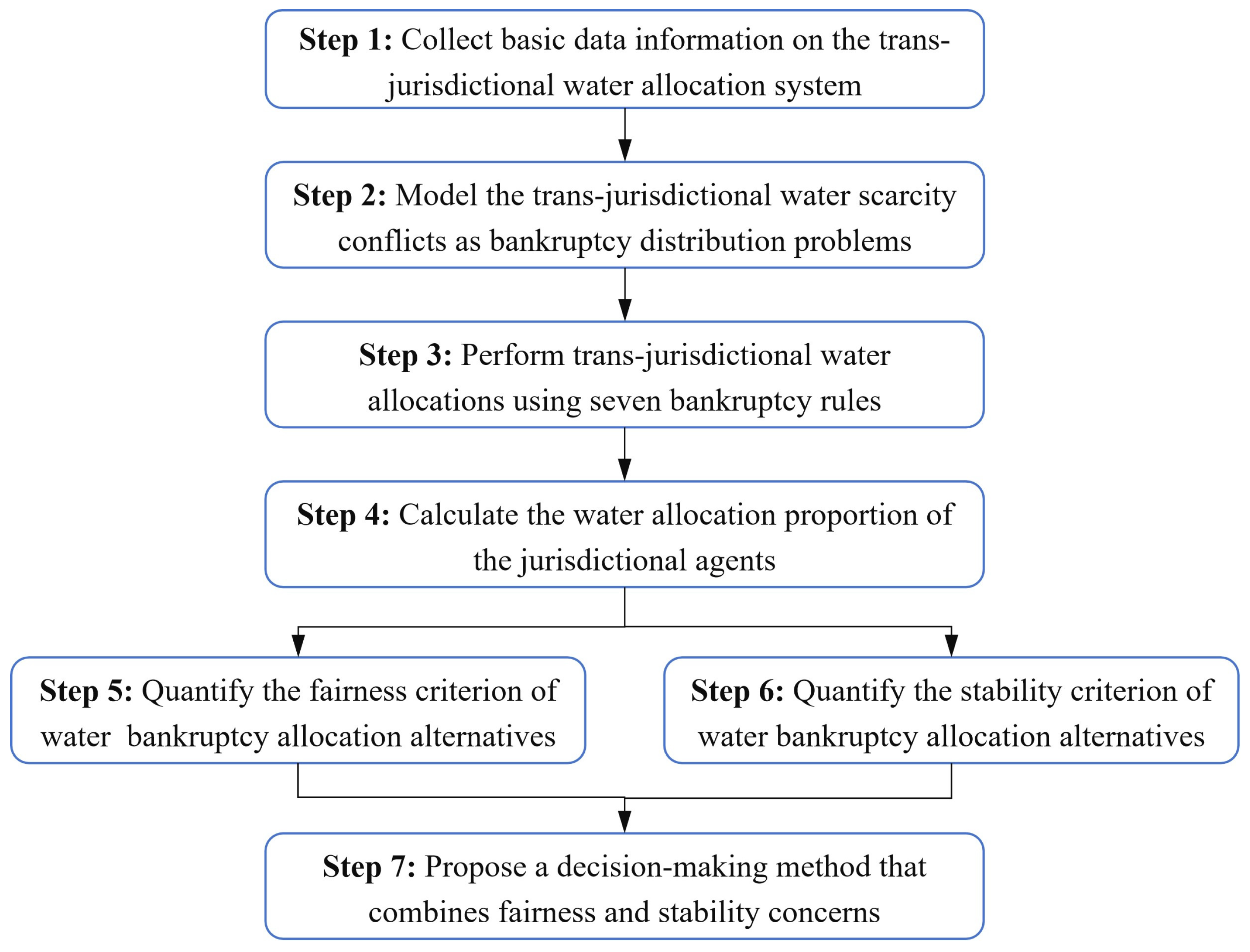
The developed decision-making method that combines fairness and stability concerns for managing trans-jurisdictional water scarcity conflicts is presented in Figure 1. It includes the following detailed steps:
Step 1. Collect basic data information on the trans-jurisdictional water allocation system.
Basic data information on trans-jurisdictional water allocation includes the available water quantity, the jurisdictional agents involved and their water demands.
Step 2. Perform trans-jurisdictional water allocations using bankruptcy rules.
In economics, a bankruptcy distribution problem can be recognized as the conflicting claims problem [18], in which the estate to be distributed is not enough to fulfill all the creditors’ claims on it [34]. Such a situation resembles the management of a river system in the sense that water resources are not sufficient to meet all claims [16,20,24,25]. Accordingly, managing water scarcity conflicts in trans-jurisdictional river systems can naturally be formulated as bankruptcy distribution problems [20]. Suppose that a trans-jurisdictional river water allocation system is shared by N = n jurisdictional agents with water claim (water demand [16,22,24]) vector ( c 1 , c 2 , , c n ), and they compete for the water asset (available water quantity E R + ), which fails to cover the aggregate water claims ( C = i = 1 n c i ). Let x i φ R + be the water quantity for jurisdictional agent i allocated by the bankruptcy rule φ , and three preconditions must be met: (1) the E R + must be precisely allocated between all jurisdictional agents (Pareto-efficiency, i = 1 n x i φ = E ); (2) no jurisdictional agent can receive a water allocation higher than its water claim (claim-boundedness, x i φ c i ); and (3) no jurisdictional agent will receive a negative amount (non-negativity, x i φ 0 ). Constrained by these conditions, this study reviewed some of the preeminent bankruptcy theory literature [35,36,37] and introduced seven bankruptcy rules, including the proportional (PRO), constrained equal awards (CEA), constrained equal losses (CEL), adjusted proportional (APRO), Talmud (TAL), Piniles’ (PIN) and αmin-Egalitarian (αmin-EA), to perform trans-jurisdictional water allocations under scarcity (Table 1).
Step 3. Calculate the water allocation proportion of the jurisdictional agents.
Based on the water allocation results produced by the examined bankruptcy rules, the water allocation proportion of the jurisdictional agents can be calculated as:
p i φ = x i φ E
where p i φ is the water allocation proportion of jurisdictional agent i under water allocation alternative φ .
Step 4. Quantify the fairness criterion of water bankruptcy allocation alternatives.
Based on the water allocation proportions of the jurisdictional agents, the Gini coefficient [38] is used to quantify the fairness criterion of water bankruptcy allocation alternatives from distributive justice. It is commonly used to measure the inequality in the distribution of income or wealth [39] and has gained a good reputation in the field of water resource management [40,41,42,43,44,45]. For the developed water bankruptcy allocation alternatives, their fairness values, quantified using the Gini coefficient, can be calculated as [40]:
G i n i φ = 1 2 × n 2 × μ φ i = 1 n i i n p i φ p i φ
μ φ = i = 1 n p i φ n
where G i n i φ is the Gini coefficient value of water bankruptcy allocation alternative φ ; p i φ is the water allocation proportion of jurisdictional agent i under water bankruptcy allocation alternative φ ; and μ φ is the mean value of all jurisdictional agents’ water allocation proportions denoting the completely equitable distribution. As the Lorenz curve always appears below the perfect fairness line in actual distribution problems, the Gini coefficient value falls between zero and one [40,45]. Generally, a lower Gini coefficient value signals a more equitable distribution, and vice versa [29].
Step 5. Quantify the stability criterion of water bankruptcy allocation alternatives.
Based on the water allocation proportion of the jurisdictional agents, the Shapley–Shubik power index [46] is used to quantify the stability criterion of water bankruptcy allocation alternatives from individual-level acceptability. It is defined as the ratio of an agent’s loss due to its departure from the grand coalition to the sum of all other agents’ losses after they leave the coalition [47], which has been proven to be an appropriate method for simulating an agent’s cooperation willingness and identifying the most stable solution in the water management literature [7,11,16,45,48]. For the developed water bankruptcy allocation alternatives, the cooperation willingness of the jurisdictional agents can be quantified using the Shapley–Shubik power index as [47]:
θ i φ = p i max p i φ i = 1 n p i max p i φ
p i max = max φ p i φ
where p i max is the best choice for jurisdictional agent i across all water bankruptcy allocation alternatives and θ i φ is the Shapley–Shubik power index value of jurisdictional agent i under water bankruptcy allocation alternative φ , signifying the cooperative tendency regarding this allocation alternative.
Dinar and Howitt [48] deemed that the most stable alternative enables the most equitable power distribution among agents and thus suggested using the coefficient of variation of θ i φ to measure allocation alternatives’ stability, that is:
C V θ φ = σ φ θ φ ¯
θ φ ¯ = i = 1 n θ i φ n
σ φ = i = 1 n θ i φ θ φ ¯ 2 n 1
where C V θ φ is the coefficient of variation of θ i φ , reflecting the stability of water bankruptcy allocation alternative φ , where lower values of C V θ φ indicate greater stability of the alternative, and vice versa [29], and σ φ and θ φ ¯ , respectively, are the standard deviation and the average value of θ i φ .
Step 6. Propose a decision-making method combining fairness and stability concerns.
Due to their discrepant inherent decision-making principles, separate fairness and stability may produce inconsistent or even conflicting decision results for water bankruptcy allocation alternatives. Game theory provides a good mathematical framework for analyzing strategic interactions and conflicts among various criteria [49]. Identifying a decision compromise between the above two criteria, therefore, can be regarded as a two-person game problem, and thus game theory can be employed to effectively aggregate them. The coupling idea based on game theory aims to achieve equilibrium and coordination between fairness and stability decision results by minimizing the respective deviations between the possible decision vector and the two basic decision vectors [49,50,51]. The decision-making method that combines fairness and stability concerns using game theory includes the following procedural steps.
First, it performs normalization on the quantified results of fairness and stability from Steps 4 and 5, ensuring that their values are mapped within the range of [0, 1]:
F a i φ = G i n i φ φ G i n i φ
S t a φ = C V θ φ φ C V θ φ
where F a i φ is the fairness index of water bankruptcy allocation alternative φ and S t a φ is the stability index of water bankruptcy allocation alternative φ .
Second, it introduces a coefficient vector = F a i , S t a to linearly combine the two basic decision vectors of F a i and S t a [50]:
W = F a i × F a i T + S t a × S t a T
where W is a linear combination vector of fairness and stability for all water bankruptcy allocation alternatives; F a i and S t a , respectively, are the linear weight coefficients for the fairness and stability of the water bankruptcy allocation alternatives; and F a i and S t a are the basic decision vectors formed by the fairness and stability of all water bankruptcy allocation alternatives.
Third, it seeks the optimal linear combination coefficient that can effectively compromise fairness and stability by minimizing the deviation between the weighted vector W and the basis vector F a i T , S t a T , that is [51]:
min W F a i T 2 min W S t a T 2
Fourth, based on the differential characteristics of the matrix, it utilizes the first-order derivative of the aforementioned objective function to obtain the corresponding optimal conditions [49]:
F a i T × F a i T F a i T × S t a T F a i T × S t a T S t a T × S t a T F a i S t a = F a i T × F a i T S t a T × S t a T
Fifth, it obtains the optimal linear combination coefficients for the fairness and stability of the water bankruptcy allocation alternatives by solving formula (13) and normalizes them [50]:
F a i = F a i F a i + S t a
S t a = S t a F a i + S t a
where F a i and S t a , respectively, are the optimal linear combination coefficients for the fairness and stability of the water bankruptcy allocation alternatives and F a i and S t a , respectively, are the normalized optimal linear combination coefficients for the fairness and stability of the water bankruptcy allocation alternatives.
Sixth, it obtains the fairness–stability trade-off index vector of the water bankruptcy allocation alternatives by substituting the calculation results of Formulas (14) and (15) into Formula (11):
F S = F a i × F a i T + S t a × S t a T
where F S is the fairness–stability trade-off index vector of the water bankruptcy allocation alternatives.
Finally, it arranges the water bankruptcy allocation alternatives in ascending order according to the calculated F S value and chooses the first-ranked alternative as the best one:
F S b e s t = min φ F S φ F S φ F S
where F S b e s t is the best choice among all water bankruptcy allocation alternatives and F S φ is the fairness–stability trade-off index of water allocation alternative φ .

3. Overview of the Study Area

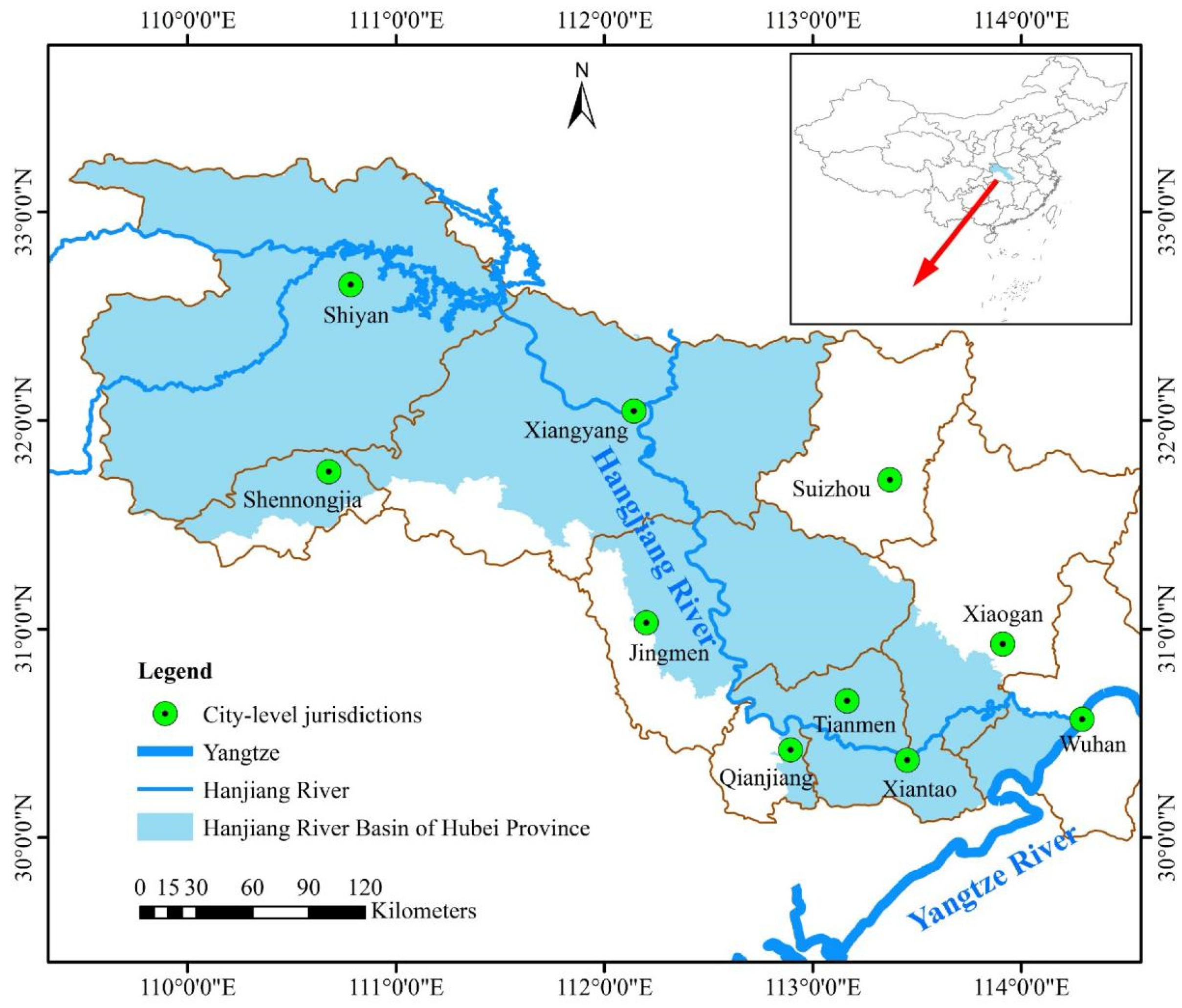
The Hanjiang River, the largest tributary of the middle reaches of the Yangtze River in China, originates from the southern foothills of the Qinling Mountains, flows through six provinces, including Shaanxi, Hubei, Henan, Sichuan, Chongqing and Gansu, and merges into the Yangtze River in Wuhan City. Within Hubei Province, it has a length of about 868 km and drains an area of 62,300 km2, accounting for approximately 55.04% of the total length and 39.18% of the total drainage area, respectively. The Hanjiang River Basin (HRB) in Hubei Province is shared by ten city-level jurisdictions, including Shiyan, Shennongjia, Xiangyang, Suizhou, Jingmen, Xiaogan, Xiantao, Qianjiang, Tianmen and Wuhan (Figure 2). The basin is characterized by a subtropical monsoon climate with an annual average temperature of 12~16 °C. According to the “Third National Water Resources Survey and Evaluation Report of Hubei Province”, the average annual precipitation in the HRB of Hubei Province is 942.9 mm, which is the main source of runoff recharge, and its distribution is basically consistent with surface water resources. The average annual total water resources amount is 220.12 × 10⁸ m3, of which surface water accounts for 96.99%. The average annual water supply is 120.59 × 10⁸ m3, of which the surface water supply accounts for 97.32%.
The favorable water resource endowment conditions and well-developed water conservancy infrastructure play an irreplaceable role in the socioeconomic prosperity of riparian areas. Nevertheless, with the increasing water demand in the riverine areas of Hubei Province and the receiving areas of the South-to-North Water Diversion Project, coupled with frequent extreme droughts, the mismatch between water supply and demand in the HRB of Hubei Province has become increasingly prominent. According to the “Water allocation plan for the Hanjiang River Basin in Hubei Province”, the total available surface water quantity of the basin in dry years is estimated to be 127.870 × 10⁸ m3, and the corresponding predicted water demand is 131.007 × 10⁸ m3 (Table 2) after deducting the available water supply from groundwater and other sources of 7.061 × 10⁸ m3, resulting in a water deficit of 3.137 × 10⁸ m3. In extremely dry years, the water demand is expected to rise by 19.22%, while the available surface water is estimated to reduce by 17.06%, resulting in a further exacerbation of the water deficit to 50.120 × 10⁸ m3. The water demands of ten city-level jurisdictions in the HRB of Hubei Province under two water scarcity scenarios are presented in Table 2.
The HRB of Hubei Province is a typical trans-jurisdictional river shared by ten city-level jurisdictions. Due to the quasi-public goods nature of trans-jurisdictional water resources, coupled with the increasing water demand in the riverine areas of Hubei Province and the receiving areas of the South-to-North Water Diversion Project, as well as frequent extreme droughts, water scarcity-induced competition conflicts between these jurisdictions have become increasingly prominent. Although the “Water allocation plan for the Hanjiang River Basin in Hubei Province” specified the initial water usage rights for ten city-level jurisdictions, the completely administrative directive management approach, which neither considers collective-level distributive justice nor individual-level acceptability, may not be capable of managing the increasingly difficult water scarcity conflicts in this basin. Therefore, an effective water allocation decision-making method for managing water scarcity conflicts in the HRB of Hubei Province is urgently needed. The water resource allocation features in the HRB of Hubei Province perfectly correspond to the water allocation decision-making method proposed in this study and can serve as a good case study to demonstrate its effectiveness. Conversely, the newly proposed method can offer decision-making insights for water allocation conflict management in this basin under scarcity.

4. Results and Discussion

4.1. Water Allocation Results Based on Bankruptcy Rules

Trans-jurisdictional water allocation under conditions where availability fails to cover the total claim resembles the economic bankruptcy problem structurally [20,24]. The water allocation problem in the HRB of Hubei Province under scarcity, naturally, can be described as a conflicting claims problem among multi-jurisdictional agents based on the available water quantity and water demand data. Here, ten city-level jurisdictions compete for the limited available surface water quantity (127.870 × 10⁸ m3 and 106.060 × 10⁸ m3, respectively, in dry and extremely dry years) with respect to their water claims, and the water availability fails to satisfy their total water claims (131.007 × 10⁸ m3 and 156.180 × 10⁸ m3, respectively, in dry and extremely dry years). Based on the constraints of Pareto-efficiency, claim-boundedness and non-negativity, seven bankruptcy rules, including the PRO, CEA, CEL, APRO, TAL, PIN and αmin-EA rules [35,36,37], are introduced to determine the available surface water quantity of the HRB in Hubei Province among the ten city-level jurisdictions under two scarcity scenarios, and the allocation results are shown in Table 3.
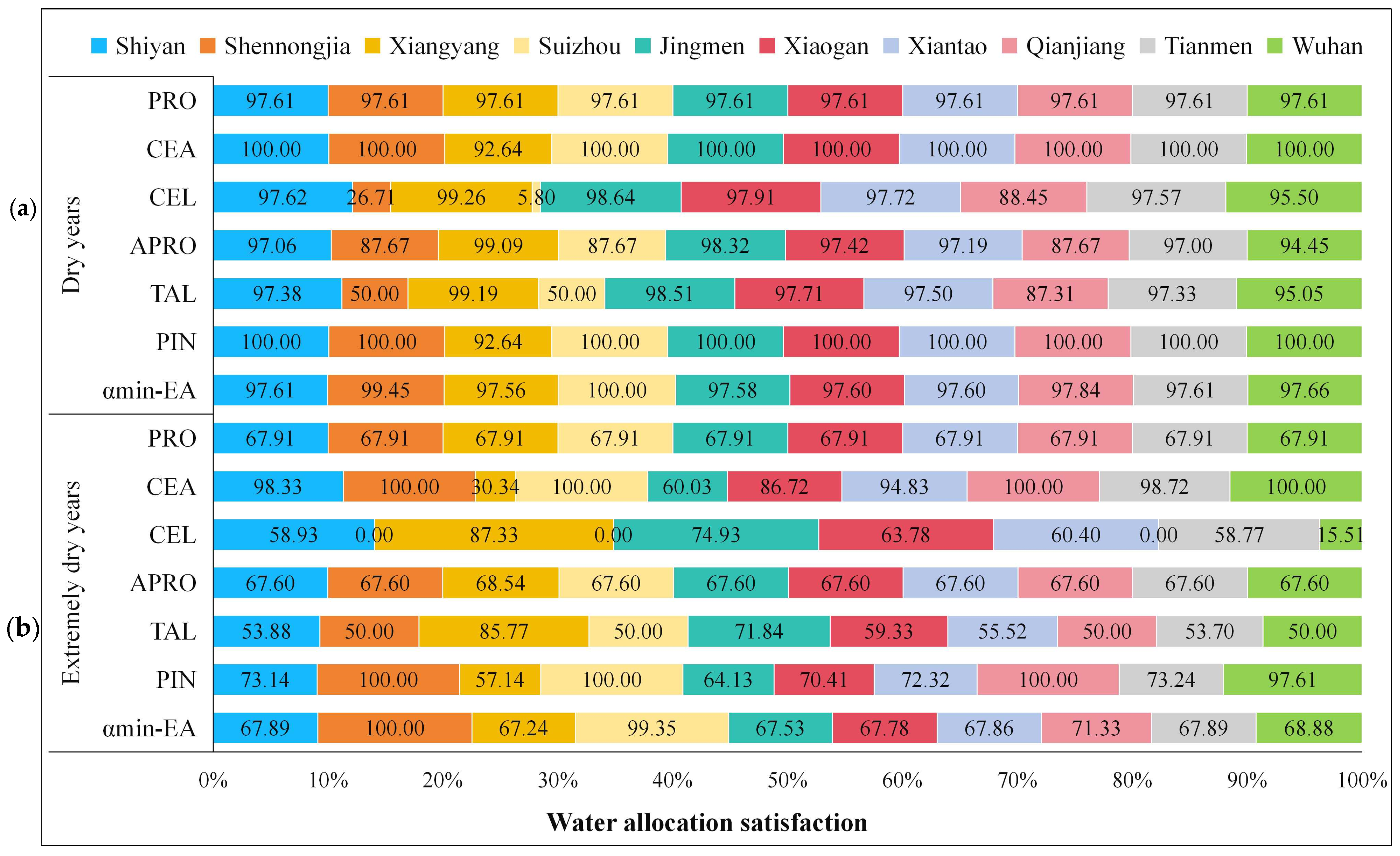
The results in Table 3 can be directly used for surface water quantity allocation decisions regarding the HRB in Hubei Province, while comparative analysis may be obscured simply through water quantity allocations and proportions. For instance, Suizhou receives the lowest water allocation proportion (only 0.26%) under the CEA rule, but it has the highest water satisfaction (100%). For easy comparison, the surface water quantity allocations obtained by the jurisdictional agents under various bankruptcy rules are converted into the satisfaction rates of their claims (Figure 3).
As shown in Figure 3, the ten city-level jurisdictions in the HRB of Hubei Province obtain the same water allocation satisfaction under the PRO rule, as this rule allocates water resources according to the fixed proportion of the jurisdictional agents’ claims [34]. Although this rule treats all claims equally, it gives a relatively higher water allocation proportion to the jurisdictional agents with higher claims [16,36]. For instance, Xiangyang receives the highest water allocation proportion (32.55% and 33.06%, respectively, in dry and extremely dry years) among the ten jurisdictional agents by this rule due to its largest water claim.
The CEA rule tries to allocate an equal amount and no more than the claimed water proportion to each agent with the aim of reducing the number of unsatisfied agents as much as possible [16]. Consequently, all jurisdictional agents, except for Xiangyang, are fully satisfied with this rule in dry years. In extremely dry years, Shennongjia, Suizhu, Qianjiang and Wuhan, which claim lower water proportions, are fully satisfied by this rule, while those with larger water claims are partially satisfied. Xiangyang receives the lowest water allocation satisfaction due to its largest water claim. Contrary to the CEA rule, the CEL rule tries to make all jurisdictional agents bear an equal water deficit and simultaneously ensure that their obtained water shares are not less than zero [34]. Therefore, this bankruptcy rule gives priority to the agents with the highest water claims [16]. Xiangyang, which claims the most, obtains the largest water allocation proportion (33.10% and 42.51%, respectively, in dry and extremely dry years) and the highest water allocation satisfaction (99.26% and 87.33%, respectively, in dry and extremely dry years) among the ten jurisdictional agents under the CEL rule. In contrast, the jurisdictional agents with relatively low water claims, including Shennongjia, Suizhou and Qianjiang, are severely penalized by this rule, especially in extremely dry years, when their water shares are all zero.
The APRO rule assigns an initial water quantity (may be zero when encountering a serious resource deficit) to each jurisdictional agent and then uses the PRO rule to distribute the remaining water quantity according to their adjusted water claims [37]. As this rule prioritizes providing a higher initial water allocation to agents with a larger claim, they may potentially receive a higher water proportion compared to the PRO rule. For instance, the water allocation proportions of Xiangyang and Jinmen are, respectively, 33.05% and 17.75% under the APRO rule in dry years, which are increased by 0.50% and 0.13%, respectively, compared to those under the PRO rule.
In both dry and extremely dry years, the available surface water quantity in the HRB of Hubei Province (127.870 × 10⁸ m3 and 106.060 × 10⁸ m3, respectively, in dry and extremely dry years) exceeds half of the aggregate water claim (65.504 × 10⁸ m3 and 78.090 × 10⁸ m3, respectively, in dry and extremely dry years). Consequently, the ten jurisdictional agents receive half of their water claims first, and then the remaining surface water quantity is allocated using the CEL rule [35]. Compared to the CEL rule, under the two water scarcity scenarios, all jurisdictional agents are satisfied at least half of their water claims, which presents a higher potential to become a decision-making outcome under the extreme water scarcity scenario since the former does not allocate water to Shennongjia, Suizhou and Qianjiang. Different from the TAL rule, the PIN rule employs the CEA rule to perform secondary water allocation in the HRB of Hubei Province. In comparison with the CEA rule, which is too partial to those with lower water claims, the PIN rule is concerned with the legitimate interests of those with higher water claims while ensuring those with lower water claims are not damaged as much as possible. For instance, the water allocation satisfaction of Xiangyang under the CEA rule is only 30.34% in extremely dry years, while under the PIN rule, it increases to 57.14%.
The αmin-EA rule is the convex combination of the PRO and EA divisions, while simultaneously, it guarantees that the jurisdictional agent with the smallest water claim is fully satisfied [36]. Unsurprisingly, Suizhou and Shennongjia are fully satisfied by this rule, owing to their smallest water claims, respectively, in dry and extremely dry years. In addition, the αmin-EA rule produces a more similar solution to the PRO rule than the EA rule since it assigns a higher weight value to the former.
There are some interesting points in Table 3 and Figure 3 that deserve attention. First, the water allocation results under the same bankruptcy rule exhibit significant differences depending on the degree of water bankruptcy, indicating that the bankruptcy rules are highly sensitive to changes in water scarcity situations. As the water bankruptcy situation intensifies, the water allocation satisfactions of all jurisdictional agents correspondingly decrease under the same bankruptcy rule. Second, the water allocation satisfaction of those with higher water claims may be lower than that of those with lower water claims under certain bankruptcy rules, while both the water allocation proportions they obtained and the water deficit they endured are not less than the latter under all bankruptcy rules. This reveals the “order preservation of awards and losses” of the bankruptcy rules [37]. Third, jurisdictional agents with similar water claims, such as Shennongjia and Suizhou, receive similar water allocation proportions and satisfactions under the same bankruptcy rule, which, to a certain extent, verifies the “equal treatment of the equals” of the bankruptcy rules [37]. Fourth, the allocation results derived from the CEL and CEA rules can be considered as two extremes of the examined bankruptcy rules since they are dual to each other [34]; that is, the other five rules yield water allocation results that are between the high and low allocations produced by the two rules. Finally, based on the differential perception of distributive fairness, the ten jurisdictional agents in the HRB of Hubei Province may hold disparate preferences on these water bankruptcy allocation alternatives, and, consequently, the realistic functionality of these allocation alternatives should be further investigated before implementation.

4.2. Fairness Analysis of Water Allocation Alternatives

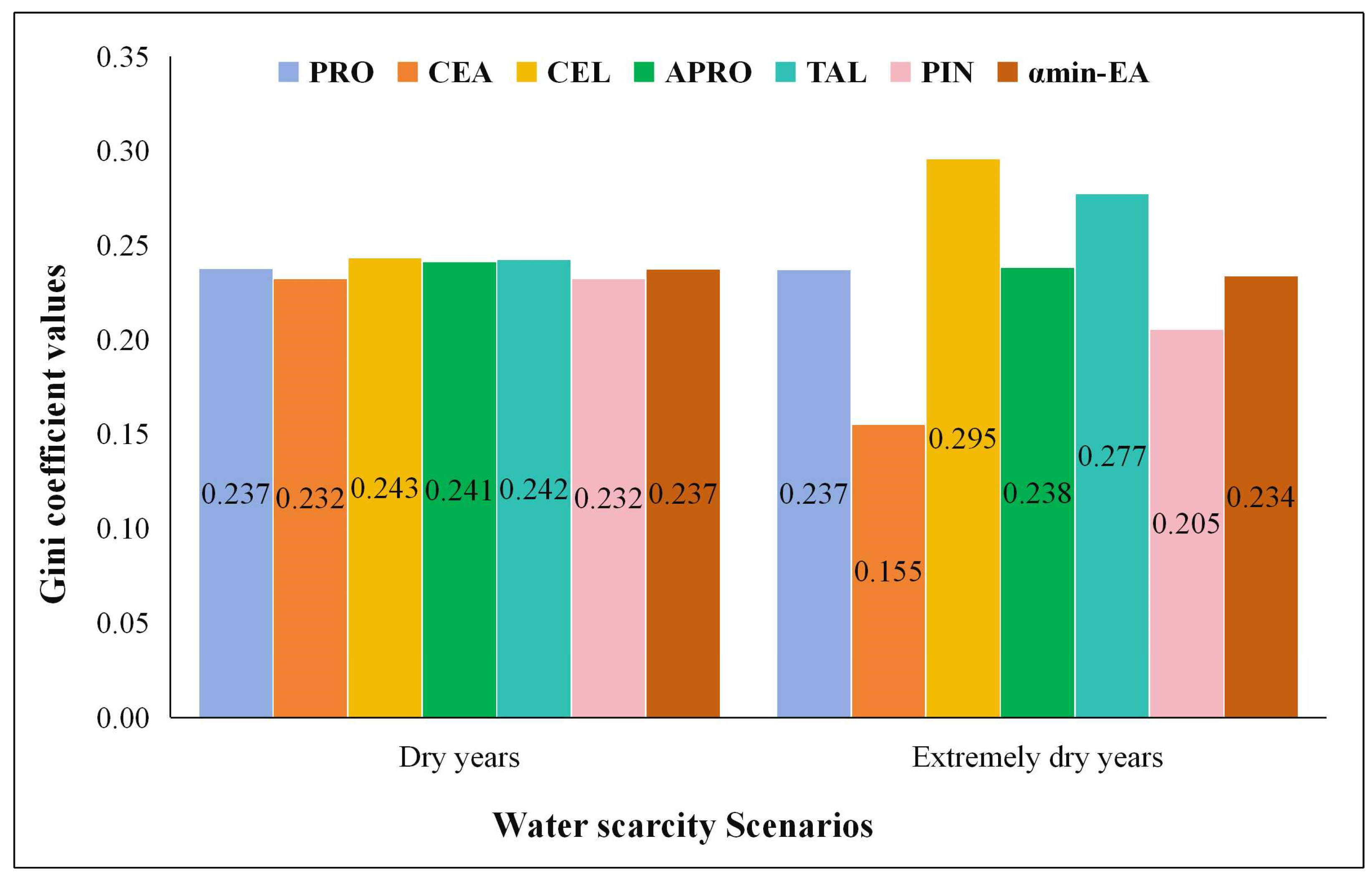
Based on the water allocation proportions of the ten jurisdictional agents in the HRB of Hubei Province under various water bankruptcy allocation alternatives (see Table 3), the Gini coefficient [38] is introduced to quantify their fairness criterion from distributive justice. The results are shown in Figure 4.
Under the two water scarcity scenarios, the Gini coefficient value of the CEA alternative is not higher than the others, indicating that its fairness is not inferior to theirs. This is consistent with the conclusion that the CEA rule Lorenz dominates the other bankruptcy rules drawn by Bosmans and Lauwers [35] and Giménez-Gómez and Peris [36], indicating that the CEA rule represents the upper bound of fairness among the examined bankruptcy rules. Because the CEL rule is the dual of the CEA rule [34] and the CEA rule is the Lorenz maximal, theoretically, the CEL rule is the Lorenz minimal [35]. As shown in Figure 4, the Gini coefficient values of the CEL alternative under the two water scarcity scenarios are greater than the others, indicating that the CEL rule represents the lower bound of fairness among the examined bankruptcy rules. The PIN alternative outperforms the TAL alternative in fairness. The logical explanation is that the TAL and PIN rules, respectively, employ the CEL and CEA rules to perform secondary water allocation in the HRB of Hubei Province, and the latter Lorenz dominates the former. As shown by Giménez-Gómez and Peris [36], the αmin-EA rule Lorentz dominates the PRO rule, and the αmin-EA-based water allocation alternative is fairer than the PRO-based one. The main reason lies in the fact that the αmin-EA rule incorporates the egalitarian division into the PRO rule.
As the water scarcity degree intensifies, the Gini coefficient value of the CEA alternative decreases, while that of the CEL alternative increases. A reasonable explanation is that the former tends to adopt egalitarianism in allocating water resources as the water deficit increases, while the latter increasingly favors jurisdictional agents with larger water claims. This is consistent with Rawls’ theory of justice and Pigou–Dalton’s transfer principle in economics [39].

4.3. Stability Analysis of Water Allocation Alternatives

Based on the water allocation proportions of the ten jurisdictional agents in the HRB of Hubei Province under various water bankruptcy allocation alternatives (see Table 3), the Shapley–Shubik power index method [46] is used to quantify their stability criteria from individual-level acceptability. The results are shown in Table 4.
As shown in Table 4, Xiangyang has the highest power index value of 1.000 under the CEA rule in dry years, whereas the others have a power index value of 0.000, which reveals that the internal power has not been equally distributed across the ten jurisdictional agents in the HRB of Hubei Province. Under the CEA alternative, the jurisdictional agents with a zero power index value are most likely to remain in the negotiation and seek agreement rather than leave prematurely, whereas Xiangyang is likely reluctant to continue the negotiation and hopes to seek other options beyond this alternative. This results in its highest coefficient of variation of the power index, and thus it is identified as the most unstable alternative. Conversely, the CEL alternative allows for materializing the most equal distribution of internal power among the ten jurisdictional agents in the HRB of Hubei Province, and thus, it is selected as the most stable water allocation alternative. The stability quantification results of the water bankruptcy allocation alternatives are sensitive to the water scarcity degree of the trans-jurisdictional river system. For example, in dry years, the TAL alternative is relatively more stable than the APRO alternative, while it performs worse than the latter in extremely dry years.

4.4. Fairness–Stability Trade-Off Analysis of Water Allocation Alternatives

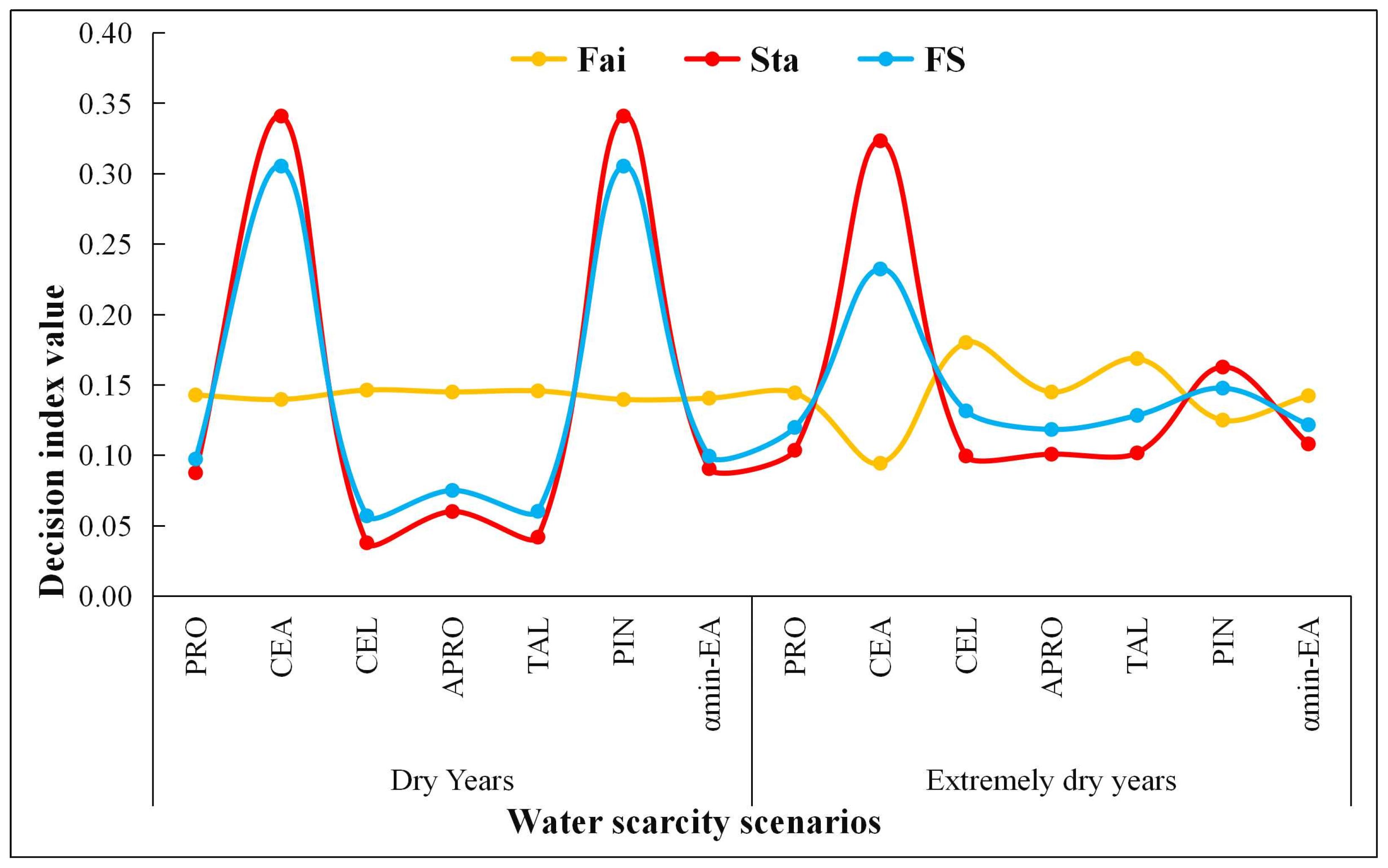
Figure 5 presents the fairness (Fai), stability (Sta) and fairness–stability trade-off (FS) index values of the water allocation alternatives in the HRB of Hubei Province. The Fai index values of the CEA alternative are the smallest under the two water scarcity scenarios, while its Sta index values are the highest. In contrast, the Fai index values of the CEL alternative are the highest under the two water scarcity scenarios, while its Sta index values are the smallest. The Fai index values of the other allocation alternatives fall between those of the CEA and CEL alternatives, and the same is true for the Sta index values. In addition, it can be clearly seen that if the Fai index value of a water allocation alternative is higher relative to another one, its Sta index value is relatively lower. This confirms that a trade-off between fairness and stability exists among the water allocation alternatives. In other words, these two criteria cannot be optimized simultaneously under the same alternative [29].
Nevertheless, there exists room for identifying compromise alternatives that are fairer than the most stable one and more stable than the fairest one. For instance, the Fai and Sta index values of the PRO alternative are 0.144 and 0.104 in extremely dry years, respectively, which is fairer than the CEL alternative (0.180) and more stable than the CEA alternative (0.323). To this end, considering the inherent conflict between fairness-based and stability-based decision outcomes, this study describes the process of seeking a compromise solution between the two criteria as a two-person game problem and employs game theory to attain it. As shown in Figure 5, it is evident that a trade-off between the fairness and stability of all the water allocation alternatives can be materialized by introducing game theory.
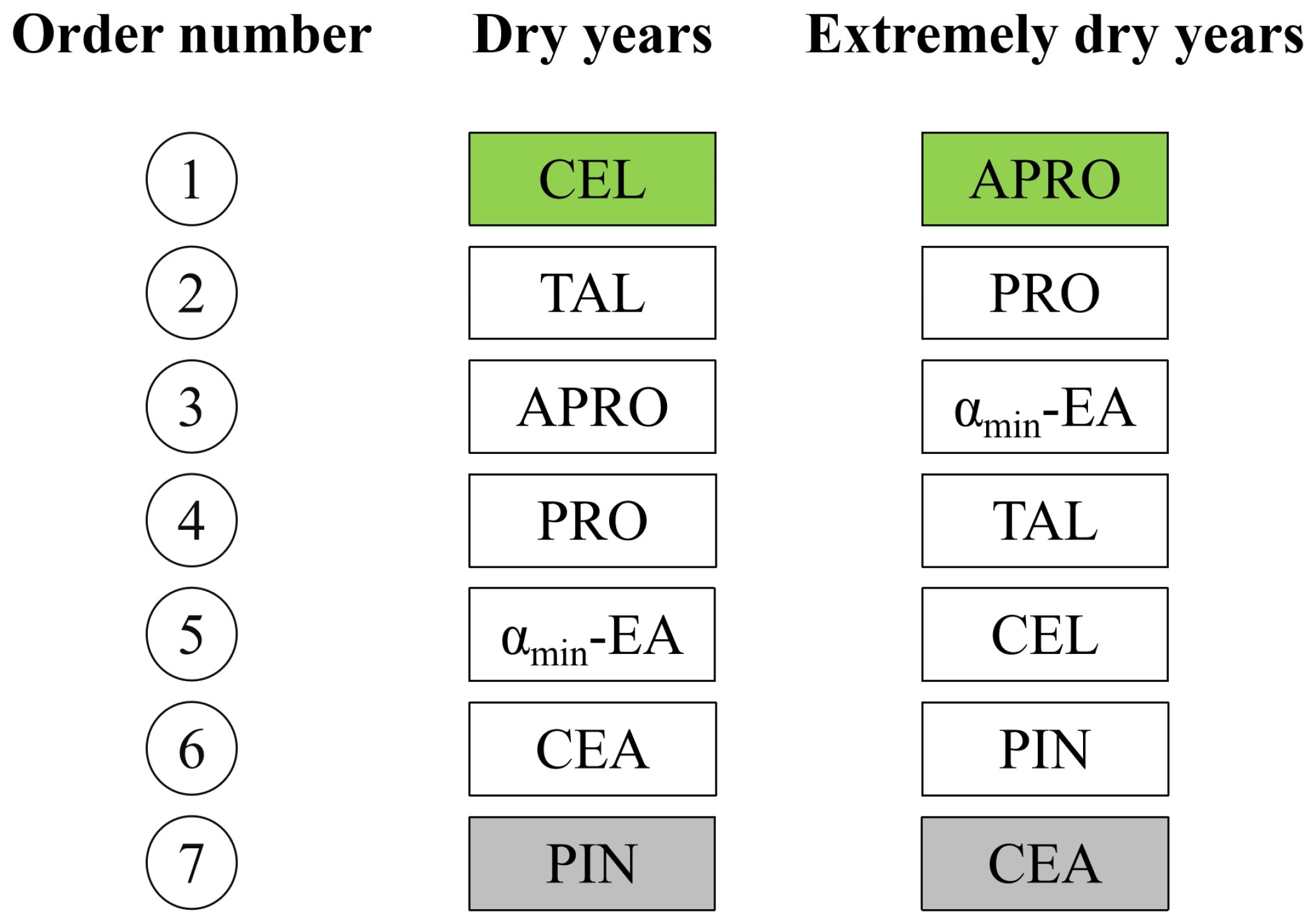
According to the calculated FS index values, the water bankruptcy allocation alternatives in the HRB of Hubei Province are arranged in ascending order, and the decision results are presented in Figure 6. In dry years, the CEL alternative is rated as the preferred alternative for water allocation in the HRB of Hubei Province by the FS index, while the PIN alternative is the least desirable option. In extremely dry years, the FS index identifies the APRO and CEA alternatives as the best and worst choices for water allocation in the HRB of Hubei Province, respectively. The differentiated decision results between dry and extremely dry years presented in Figure 6 suggest that the decisions derived from the FS index are sensitive to the water scarcity degree.

4.5. Significance Discussion of the Proposed Decision-Making Method

Managing trans-jurisdictional water allocation conflicts under scarcity is intractable because it often involves multiple institutionally independent decision-making agents [7]. Cooperative game theory-based methods are often used to address trans-jurisdictional or transboundary water scarcity conflicts. Based on the calculation of economic benefits of all possible cooperative water utilization options, Wu and Whittington [9] applied the core, nucleolus and Shapley value methods to develop incentive-compatible strategies for handling Nile water conflicts among Egypt, Sudan, Ethiopia and equatorial states. Dinar and Nigatu [10] employed the core, Shapley value and Nash–Harsanyi solution methods to allocate incremental benefits from full cooperation among three Blue Nile riparian states, including Ethiopia, Sudan and Egypt. Mehrparvar et al. [11] calculated the economic benefits from consuming water under all possible cooperative coalitions of the Zayandehrood River basin in Iran and then employed the Shapely value, nucleolus and Nash-Harsanyi solution methods to divide the water economic benefits of the grand coalition among six water stakeholders. Based on the stakeholders’ initial water shares generated by the TOPSIS model with entropy weight, He et al. [12] reallocated water and profit among three upstream, middle stream and downstream players in the Dongjiang River Basin using the Shapley value, least core, weak least core and Nash–Harsanyi solutions. Li et al. [13] employed the Shapley value, Gately point and Nash–Harsanyi solutions to formulate a water benefit-sharing scheme that can inspire the Lancang–Mekong River riparian countries to embrace cooperative water resource development. Gómez and Weikard [14] used the Nash bargaining solution to formulate cooperative agreements for sharing water resources of the Tambo–Santiago–Ica river basin in Peru between Huaytara province and Ica province. Zhang et al. [15] used the core, least core, weak least core and Shapley values to construct a benefit allocation mechanism that optimizes and redistributes water resources of the Tarim River among nine jurisdictional agents. These studies demonstrate the capability of cooperative game theory in resolving trans-jurisdictional water allocation conflicts. Nevertheless, the application of these methods in reality is highly dependent on the available utility information of all stakeholders [16] and their cognitive abilities [17], which hinders their widespread promotion. In addition, existing studies on water resource cooperation games mainly discuss the stability of cooperation among stakeholders based on a certain benefit compensation scheme, and few of them focus on the trade-off between stability and fairness.
Bankruptcy theory rules, often categorized as cooperative game theory solutions [52], have proven to be promising alternative methods for handling such issues [16,19,20,21,22,23,24,25,26,27,28] when trans-jurisdictional or transboundary water sharing problems fail to be conceptualized as a cooperative transferable utility game. Based on a distinct internal distribution principle for a certain purpose, these rules may produce different water allocation alternatives, and their realistic eligibility should be further investigated. Kampas [29] stated that the fairness and stability criteria are essential elements for achieving resource sharing agreements. They proposed a fairness–stability trade-off conceptual framework using the Borda count to examine the issue of allocating fishing rights for the management of East Atlantic and Mediterranean tuna. To the best of our knowledge, this framework has not received much attention in the administrative area of water resources, and using the Borda count to facilitate the final choice may fail to identify the unique solution under different resource-sharing scenarios. Madani et al. [16] applied the power index to evaluate the stability of four river bankruptcy solutions. Based on the preference vectors of stakeholders, Janjua and Hassan [22] compared and analyzed the fairness of seven bankruptcy theory-based and Shapley value-based water allocation alternatives. At present, no water resource studies related to bankruptcy theory simultaneously focus on the fairness and stability criteria, nor has an effective method been established for balancing these two criteria.
Inspired by previous research on fairness [29,30,31,32,33,38,39,40,41,42,43,44,45] and stability [7,11,16,45,48] in resource allocation, this study creatively proposes a decision-making method that combines fairness and stability concerns to solve trans-jurisdictional water allocation conflicts under scarcity using game theory. The fairness and stability criteria are separately quantified using the Gini coefficient from a collective-level distributive justice perspective and the Shapley–Shubik power index from the individual-level acceptability perspective. Then, it creatively models the balance between fairness and stability decisions as a two-person game problem and adopts game theory to integrate them into the decision-making process of trans-jurisdictional water allocation alternatives.
The HRB of Hubei Province is shared by ten city-level jurisdictions and frequently faces water shortages. It is used to demonstrate the effectiveness of the proposed decision-making method, and the findings can be used to provide decision-making suggestions for the Department of Water Resources of Hubei Province regarding surface water quantity allocations in the HRB under two water scarcity scenarios. According to the decision results presented in Figure 6, we suggest using the CEL rule to perform water allocation in the HRB of Hubei Province in dry years, while in extremely dry years, the APRO rule is the best option. According to the decision results of the FS index, the water allocation proportions for Shiyan, Shennongjia, Xiangyang, Suizhou, Jingmen, Xiaogan, Xiantao, Qianjiang, Tianmen and Wuhan, respectively, are 10.05%, 0.09%, 33.10%, 0.02%, 17.81%, 11.50%, 10.52%, 1.88%, 9.83% and 5.20% in dry years, and in extremely dry years, they are 10.15%, 0.29%, 33.37%, 0.29%, 16.63%, 11.51%, 10.53%, 2.17%, 10.11% and 4.94%, respectively.
Because all the methods used in the proposed decision-making method are relatively objective, deterministic, and easy to implement, it can be applied to other water scarcity scenarios in the HRB of Hubei Province, as well as trans-jurisdictional water management systems other than the HRB in Hubei Province. In other words, by replacing the basic research materials and data inputs, including the available water quantity, water demand, etc., under various climatic conditions and socioeconomic development scenarios, the proposed method can offer corresponding decision-making suggestions for surface water quantity allocations in the HRB of Hubei Province. It can also be recommended as a decision-making tool for watershed management authorities other than the Department of Water Resources of Hubei Province.

5. Conclusions

This study aimed to propose a novel decision-making method that combines fairness and stability concerns to manage trans-jurisdictional water scarcity conflicts. The HRB of Hubei Province in China is selected as the case study to verify its effectiveness. First, the trans-jurisdictional surface water quantity allocation of the HRB in Hubei Province is formulated as a bankruptcy distribution problem, and seven bankruptcy rules, including the PRO, CEA, CEL, APRO, TAL, PIN and αmin-EA rules, are introduced to generate water allocation alternatives among its ten city-level jurisdictions under two scarcity scenarios. Then, the fairness and stability criteria of these water bankruptcy allocation alternatives are quantified using the Gini coefficient and Shapley–Shubik power index. Afterward, game theory is employed to build the decision-making method that combines the fairness and stability concerns. Finally, the decision-making method is used to identify the preferred water allocation bankruptcy alternative for the HRB of Hubei Province. The major conclusions can be summarized as follows:
(1)
Based on common sense and without determining available utility information and incremental benefits, bankruptcy rules are considered practical for performing water allocations in the HRB of Hubei Province when the total water claims exceed the available water asset. Nevertheless, their realistic eligibility should be investigated before implementation, in the sense that they are formulated according to distinct distribution principles and ten jurisdictional agents in the HRB of Hubei Province hold disparate preferences for them.
(2)
If the Fai index value of a water allocation alternative is higher relative to another one, its Sta index value is relatively lower, which confirms that an apparent trade-off between fairness and stability exists among the water allocation alternatives.
(3)
Although the fairness and stability criteria cannot be optimized simultaneously in the same alternative, there exists room for identifying compromise alternatives that are fairer than the most stable one and more stable than the fairest one.
(4)
The FS index identifies the CEL and PIN alternatives, respectively, as the preferred and least desirable for water allocation in the HRB of Hubei Province in dry years. In extremely dry years, the APRO and CEA alternatives are rated as the best and worst choices, respectively.
(5)
The findings highlight the necessity and significance of balancing the fairness and stability criteria when managing trans-jurisdictional water scarcity conflicts, and game theory can offer insightful trade-off approaches.
The results demonstrate the advantages of the proposed decision-making method, and the findings can offer decision-making suggestions for the surface water quantity allocations of the HRB in Hubei Province under two water scarcity scenarios. All the methods it uses are relatively objective and easy to implement, which ensures its high flexibility and transferability. Simultaneously, its decision results are easily understood and accepted by stakeholders and policymakers.
It is noteworthy that uncertainty in hydrological conditions, socioeconomic development status, and water management policies can affect the available water quantity of trans-jurisdictional rivers and the water demand of jurisdictional agents. Consequently, further efforts should be made in the future to enhance the adaptive capability of the proposed decision-making method for trans-jurisdictional water management.

Author Contributions

Conceptualization, J.Q. and L.L.; methodology, J.Q. and J.W.; data curation, J.L., T.Y. and J.H.; formal analysis, J.Q. and X.W.; investigation, J.Q. and J.L.; writing—original draft, J.Q.; writing—review and editing, L.L., J.W. and X.W.; visualization, H.W. and G.X.; project administration, M.G.; supervision, L.L. All authors have read and agreed to the published version of the manuscript.

Funding

This study was supported by the Key Water Conservancy Research Project of Hubei Province (Nos. HBSLKY202505, HBSLKY202514), the China Postdoctoral Science Foundation (No. 2023M731040), and the National Natural Science Foundation of China (No. 52209016).

Data Availability Statement

The original contributions presented in this study are included in this article. Further inquiries can be directed to the corresponding authors.

Conflicts of Interest

The authors declare no conflicts of interest.

Abbreviations

The following abbreviations are used in this manuscript:
PROProportional
CEAConstrained equal awards
CELConstrained equal losses
APROAdjusted proportional
TALTalmud
PINPiniles’
αmin-EAαmin-Egalitarian
HRBHanjiang River Basin
FaiFairness
StaStability
FSFairness–stability trade-off

References

  1. Flörke, M.; Schneider, C.; McDonald, R.I. Water competition between cities and agriculture driven by climate change and urban growth. Nat. Sustain. 2018, 1, 51–58. [Google Scholar] [CrossRef]
  2. Huang, Y.; Wang, R.; Li, J.; Jiang, Y. Assessing the Impact of Land Use and Landscape Patterns on Water Quality in Yilong Lake Basin (1993–2023). Water 2026, 18, 30. [Google Scholar] [CrossRef]
  3. Pokhrel, Y.; Felfelani, F.; Satoh, Y.; Boulange, J.; Burek, P.; Gädeke, A.; Gerten, D.; Gosling, S.N.; Grillakis, M.; Gudmundsson, L.; et al. Global terrestrial water storage and drought severity under climate change. Nat. Clim. Change 2021, 11, 226–233. [Google Scholar] [CrossRef]
  4. Akao, P.K.; Singh, B.; Kaur, P.; Sor, A.; Avni, A.; Dhir, A.; Verma, S.; Kapoor, S.; Phutela, U.G.; Satpute, S.; et al. Coupled microalgal-bacterial biofilm for enhanced wastewater treatment without energy investment. J. Water Process. Eng. 2021, 41, 102029. [Google Scholar] [CrossRef]
  5. Unfried, K.; Kis-Katos, K.; Poser, T. Water scarcity and social conflict. J. Environ. Econ. Manag. 2022, 113, 102633. [Google Scholar] [CrossRef]
  6. Zhang, F.; Wu, Z.; Di, D.; Wang, H. Water resources allocation based on water resources supply-demand forecast and comprehensive values of water resources. J. Hydrol. 2023, 47, 101421. [Google Scholar] [CrossRef]
  7. Qin, J.; Fu, X.; Wu, X.; Wang, J.; Huang, J.; Chen, X.; Liu, J.; Zhang, J. Transboundary Water Allocation under Water Scarcity Based on an Asymmetric Power Index Approach with Bankruptcy Theory. Water 2024, 16, 2828. [Google Scholar] [CrossRef]
  8. Xu, Z.; Ma, K.; Leng, J.; Zhang, K.; Luo, R.; He, D. Transboundary cooperation potential under climate change and hydropower development in the Dulong-Irrawaddy river basin: A perspective on the water-energy-food-ecosystem nexus. J. Clean. Prod. 2025, 492, 144915. [Google Scholar] [CrossRef]
  9. Wu, X.; Whittington, D. Incentive compatibility and conflict resolution in international river basins: A case study of the Nile Basin. Water Resour. Res. 2006, 42, 336. [Google Scholar] [CrossRef]
  10. Dinar, A.; Nigatu, G.S. Distributional considerations of international water resources under externality: The case of Ethiopia, Sudan and Egypt on the Blue Nile. Water Resour. Econ. 2013, 2–3, 1–16. [Google Scholar] [CrossRef]
  11. Mehrparvar, M.; Ahmadi, A.; Safavi, H.R. Social resolution of conflicts over water resources allocation in a river basin using cooperative game theory approaches: A case study. Int. J. River Basin Manag. 2016, 14, 33–45. [Google Scholar]
  12. He, Y.; Yang, J.; Chen, X. Allocating river water in a cooperative way: A case study of the Dongjiang River Basin, South China. Stoch. Environ. Res. Risk Assess. 2018, 32, 3083–3097. [Google Scholar] [CrossRef]
  13. Li, D.; Zhao, J.; Govindaraju, R.S. Water benefits sharing under transboundary cooperation in the Lancang-Mekong River Basin. J. Hydrol. 2019, 577, 123989. [Google Scholar] [CrossRef]
  14. Gómez, R.; Weikard, H. Cooperative water-sharing agreements between highlands and drylands: The Tambo-Santiago-Ica river basin in Peru. Int. J. Water Resour. Dev. 2023, 39, 796–818. [Google Scholar]
  15. Zhang, K.; Lu, H.; Wang, B. Benefit Distribution Mechanism of a Cooperative Alliance for Basin Water Resources from the Perspective of Cooperative Game Theory. Sustainability 2024, 16, 6729. [Google Scholar] [CrossRef]
  16. Madani, K.; Zarezadeh, M.; Morid, S. A new framework for resolving conflicts over transboundary rivers using bankruptcy methods. Hydrol. Earth Syst. Sci. 2014, 18, 3055–3068. [Google Scholar] [CrossRef]
  17. Yuan, M.; Li, Z.; Li, X.; Li, L.; Zhang, S.; Luo, X. How to promote the sustainable development of prefabricated residential buildings in China: A tripartite evolutionary game analysis. J. Clean. Prod. 2022, 349, 131423. [Google Scholar] [CrossRef]
  18. O’Neill, B. A problem of rights arbitration from the Talmud. Math. Soc. Sci. 1982, 2, 345–371. [Google Scholar] [CrossRef]
  19. Asl-Rousta, B.; Mousavi, S.J. Bankruptcy rules and sustainable water management: A MODSIM-NSGAII simulation multi-objective optimization framework for equitable transboundary water allocation. Environ. Sustain. Indic. 2025, 26, 100648. [Google Scholar]
  20. Ansink, E.; Weikard, H.-P. Sequential sharing rules for river sharing problems. Soc. Choice Welf. 2012, 38, 187–210. [Google Scholar]
  21. Degefu, D.M.; He, W.; Yuan, L.; Min, A.; Zhang, Q. Bankruptcy to surplus: Sharing transboundary river basin’s water under scarcity. Water Resour. Manag. 2018, 32, 2735–2751. [Google Scholar] [CrossRef]
  22. Janjua, S.; Hassan, I. Use of bankruptcy methods for resolving interprovincial water conflicts over transboundary river: Case study of Indus River in Pakistan. River Res. Appl. 2020, 36, 1334–1344. [Google Scholar] [CrossRef]
  23. Jarkeh, M.R.; Mianabadi, A.; Mianabadi, H. Developing new scenarios for water allocation negotiations: A case study of the Euphrates watershed. Proc. Int. Assoc. Hydrol. Sci. 2016, 374, 9–15. [Google Scholar]
  24. Mianabadi, H.; Mostert, E.; Zarghami, M.; van de Giesen, N. A new bankruptcy method for conflict resolution in water resources allocation. J. Environ. Manag. 2014, 144, 152–159. [Google Scholar] [CrossRef] [PubMed]
  25. Shahraki, A.S.; Singh, V.P.; Bazrafshan, O. Developing a Bankruptcy Theory to Resolve Stakeholders’ Conffict over Optimal Water Allocation: The Case of Hirmand Catchment. Water 2024, 16, 1303. [Google Scholar] [CrossRef]
  26. Sechi, G.M.; Zucca, R. Water resource allocation in critical scarcity conditions: A bankruptcy game approach. Water Resour. Manag. 2015, 29, 541–555. [Google Scholar] [CrossRef]
  27. Wickramage, H.M.; Roberts, D.C.; Hearne, R.R. Water Allocation Using the Bankruptcy Model: A Case Study of the Missouri River. Water 2020, 12, 619. [Google Scholar] [CrossRef]
  28. Zheng, Y.; Sang, X.; Liu, Z.; Zhang, S.; Liu, P. Water allocation management under scarcity: A bankruptcy approach. Water Resour. Manag. 2022, 36, 2891–2912. [Google Scholar] [CrossRef]
  29. Kampas, A. Combining fairness and stability concerns for global commons: The case of East Atlantic and Mediterranean tuna. Ocean Coast. Manag. 2015, 116, 414–422. [Google Scholar] [CrossRef]
  30. D’Exelle, B.; Lecoutere, E.; Van Campenhout, B. Equity-Efficiency Trade-Offs in Irrigation Water Sharing: Evidence from a Field Lab in Rural Tanzania. World Dev. 2012, 40, 2537–2551. [Google Scholar] [CrossRef]
  31. Imani, S.; Niksokhan, M.H.; Shali, R.S. Fair Water Re-allocation: Lessons Learnt from Iranian policy-makers’ Perceptions about Distributive Justice. J. Hydrol. 2024, 652, 3859. [Google Scholar] [CrossRef]
  32. Tian, J.; Ma, J.; Wu, Q.; Zuo, Q. Quantifying water use balance between the economic society and ecology: A novel two-stage method considering dual factors of fairness and benefits. J. Environ. Manag. 2025, 395, 127930. [Google Scholar] [CrossRef] [PubMed]
  33. Roemer, J. Egalitarian Perspectives: Essays in Philosophical Economics; Cambridge University Press: Cambridge, UK, 1996. [Google Scholar]
  34. Herrero, C.; Villar, A. The three musketeers: Four classical solutions to bankruptcy problems. Math. Soc. Sci. 2001, 42, 307–328. [Google Scholar] [CrossRef]
  35. Bosmans, K.; Lauwers, L. Lorenz comparisons of nine rules for the adjudication of conflicting claims. Int. J. Game Theory 2011, 40, 791–807. [Google Scholar] [CrossRef][Green Version]
  36. Giménez-Gómez, J.M.; Peris, J.E. A proportional approach to claims problems with a guaranteed minimum. Eur. J. Oper. Res. 2014, 232, 109–116. [Google Scholar] [CrossRef][Green Version]
  37. Thomson, W. Axiomatic and game-theoretic analysis of bankruptcy and taxation problems: An update. Math. Soc. Sci. 2015, 74, 41–59. [Google Scholar] [CrossRef]
  38. Gini, C. Measurement of inequality of incomes. Econ. J. 1921, 31, 124–126. [Google Scholar] [CrossRef]
  39. Chakravarty, S.R. Inequality, Polarization and Poverty: Advances in Distributional Analysis; Springer: New York, NY, USA, 2009. [Google Scholar]
  40. Cullis, J.; van Koppen, B. Applying the Gini Coefficient to Measure Inequality of Water Use in the Olifants River Water Management Area, South Africa (IWMI Research Report 113); International Water Management Institute: Colombo, Sri Lanka, 2007; Volume 113, pp. 1–25. [Google Scholar]
  41. Jahanshahi, S.; Kerachian, R.; Emamjomehzadeh, O. A Leader-Follower Framework for Sustainable Water Pricing and Allocation. Water Resour. Manag. 2023, 37, 1257–1274. [Google Scholar] [CrossRef]
  42. Iftekhar, M.S.; Fogarty, J. Impact of water allocation strategies to manage groundwater resources in Western Australia: Equity and efficiency considerations. J. Hydrol. 2017, 548, 145–156. [Google Scholar] [CrossRef]
  43. Lou, Y.Q.; Qiu, Q.T.; Zhang, M.T.; Feng, Z.L.; Dong, J. Spatial equilibrium evaluation of the water resources in Tai’an City based on the lorenz curve and correlation number. Water 2023, 15, 2617. [Google Scholar] [CrossRef]
  44. Niu, C.; Wang, X.; Chang, J.; Wang, Y.; Guo, A.; Ye, X.; Wang, Q.; Li, Z. Integrated model for optimal scheduling and allocation of water resources considering fairness and efficiency: A case study of the Yellow River Basin. J. Hydrol. 2023, 626, 130236. [Google Scholar] [CrossRef]
  45. Wu, W.; Zhao, X.; Zhang, X.; Wu, X.; Zhao, Y.; Guo, Q.; Yao, L.; Liu, X. An ordered multi-objective fuzzy stochastic approach to sustainable water resources management: A case study from Taiyuan City, China. Water Sci. Technol. Water Supply 2024, 24, 10–11. [Google Scholar] [CrossRef]
  46. Shapley, L.S.; Shubik, S.M. A method for evaluating the distribution of power in a committee. Am. Political Sci. Rev. 1954, 48, 787–792. [Google Scholar] [CrossRef]
  47. Loehman, E.; Orlando, J.; Tschirhart, J.; Whinston, A. Cost allocation for a regional wastewater treatment system. Water Resour. Res. 1979, 15, 193–202. [Google Scholar] [CrossRef]
  48. Dinar, A.; Howitt, R.E. Mechanisms for Allocation of Environmental Control Cost: Empirical Tests of Acceptability and Stability. J. Manag. Eng. 1997, 49, 183–203. [Google Scholar] [CrossRef]
  49. Yu, Z.; Sun, G.; Lin, S.; Hu, H.; Xu, J. Operationalizing game-theoretic weighting in public hospital cost control: An implementation framework from Chinese tertiary hospitals. Cost Eff. Resour. Alloc. 2025, 23, 11. [Google Scholar] [CrossRef]
  50. Zhao, B.; Shao, Y.; Yang, C.; Zhao, C. The application of the game theory combination weighting-normal cloud model to the quality evaluation of surrounding rocks. Front. Earth Sci. 2024, 12, 1346536. [Google Scholar] [CrossRef]
  51. Wang, X.; Wang, G.; Wu, Y.; Xu, Y.; Gao, H. Comprehensive Assessment of Regional Water Usage Efficiency Control Based on Game Theory Weight and a Matter-Element Model. Water 2017, 9, 113. [Google Scholar] [CrossRef]
  52. Sheikhmohammady, M.; Madani, K. Sharing a multi-national resource through bankruptcy procedures. In Proceeding of the 2008 World Environmental and Water Resources Congress, Honolulu, Hawaii; Babcock, R.W., Walton, R., Eds.; American Society of Civil Engineers: Washington, DC, USA, 2008; pp. 1–9. [Google Scholar]
Figure 1. Methodological flowchart of the developed water allocation decision-making method.
Water 18 00622 g001
Figure 2. Geographical location of the HRB in Hubei Province.
Water 18 00622 g002
Figure 3. Water allocation satisfactions of ten city-level jurisdictions in the HRB of Hubei Province based on seven bankruptcy rules under two scarcity scenarios: (a) dry years and (b) extremely dry years.
Water 18 00622 g003
Figure 4. Fairness quantification results of the water bankruptcy allocation alternatives in the HRB of Hubei Province.
Water 18 00622 g004
Figure 5. Fairness (Fai), stability (Sta) and fairness–stability trade-off (FS) index values of the water allocation alternatives in the HRB of Hubei Province.
Water 18 00622 g005
Figure 6. Decision results of water bankruptcy allocation alternatives in the HRB of Hubei Province based on the FS index: the alternatives marked in green represents the best alternatives, while the alternatives marked in gray represents the worst ones.
Water 18 00622 g006
Table 1. The bankruptcy rules used to perform trans-jurisdictional water allocations under scarcity.
Bankruptcy RulesDescription
PROThis rule divides water asset proportionally with respect to each jurisdictional agent’s water claim [37]; that is, x i P R O = λ P R O × c i , λ P R O = E / C , where x i P R O is the water quantity for jurisdictional agent i allocated by the PRO rule; λ P R O is the proportional allocation coefficient, such that i = 1 n λ P R O c i = E ; and c i is the water claim of jurisdictional agent i .
CEAThis rule assigns each jurisdictional agent a water asset share as equal as possible, and no one receives more than its water claim [37]; that is, x i C E A = min λ C E A , c i , λ C E A = E / n , where x i C E A is the water quantity for jurisdictional agent i allocated by the CEA rule and λ C E A is the unique real number chosen so that i = 1 n min λ C E A , c i = E .
CELContrary to the CEA rule, this rule focuses on distributing water deficit among the jurisdictional agents as equal as possible, and none of them receives a negative amount [37]; that is, x i C E L = max 0 , c i λ C E L , λ C E L = C E / n , where x i C E L is the water quantity for jurisdictional agent i allocated by the CEL rule and λ C E A is the unique real number chosen so that i = 1 n max 0 , c i λ C E L = E .
APROThis rule ensures that each jurisdictional agent receives an initial water quantity allocation first, and then the remaining water quantity is divided by the PRO rule according to the revised water claims [37]; that is, x i A P R O = m i + c i E m i × E i = 1 n m i / i = 1 n c i E m i , m i = max 0 , E i N i c i , c i E = min c i , E , where x i A P R O is the water quantity for jurisdictional agent i allocated by the APRO rule and i = 1 n x i A P R O = E ; m i is the minimal water quantity allocation to jurisdictional agent i in the first stage; i N i c i is the sum of water claims except jurisdictional agent i ; c i is the water claim of jurisdictional agent i , where i N i ; and c i E is the revised water claim of jurisdictional agent i in the second stage, which is the smaller value between its water claim and the water asset E .
TALAccording to this rule, each jurisdictional agent receives half of its water claim first, and then the remaining water quantity is distributed by the CEL rule with respect to the vector of the half water claims when the water availability is greater than one half of the sum water claim; otherwise, the CEA rule is applied according to the vector of the half water claims [35]; that is, x i T A L = c i / 2 + C E L c / 2 , E C / 2 if E C / 2 ; otherwise, x i T A L = C E A c / 2 , E if E < C / 2 , where x i T A L is the water quantity for jurisdictional agent i allocated by the TAL rule and i = 1 n x i T A L = E .
PINThis rule is similar to the TAL rule. The difference is that it uses the CEA rule to perform secondary water allocation according to the vector of the half water claims when the water availability is greater than one half of the sum water claim [35]; that is, x i P I N = c i / 2 + C E A c / 2 , E C / 2 if E C / 2 ; otherwise, x i P I N = C E A c / 2 , E if E < C / 2 , where x i P I N is the water quantity for jurisdictional agent i allocated by the PIN rule and i = 1 n x i P I N = E .
αmin-EAThis rule is formulated by giving a specific weighted average of the PRO and the egalitarian (EA) divisions to ensure a minimum water amount to each agent, and simultaneously none of them receives a water share more than its water claim [36]; that is, x i α min E A = η × P R O x i + 1 η × E A x i , η = 0 , C × E n × c 1 / E × C n × c 1 , where x i α min E A is the water quantity for jurisdictional agent i allocated by the αmin-EA rule and i = 1 n x i α min E A = E ; η is the weight value given to the PRO division; 1 η is the weight value given to the EA division; and c 1 is the lowest water claim across all jurisdictional agents.
Table 2. Water demands of ten city-level jurisdictions in the HRB of Hubei Province under two water scarcity scenarios. Unit: 108 m3.
City-Level JurisdictionsWater Scarcity Scenarios
Dry YearsExtremely Dry Years
Shiyan13.17115.932
Shennongjia0.4280.451
Xiangyang42.64351.632
Suizhou0.3330.460
Jingmen23.08626.097
Xiaogan15.01418.066
Xiantao13.76416.521
Qianjiang2.7153.408
Tianmen12.88715.869
Wuhan6.9667.744
Total131.007156.180
Note: Data source: the water allocation plan for the Hanjiang River Basin in Hubei Province.
Table 3. Surface water quantity allocation results of the HRB in Hubei Province based on seven bankruptcy rules under two scarcity scenarios.
Water Scarcity
Scenarios
Jurisdictional AgentsBankruptcy Rules
PROCEACELAPROTALPINαmin-EA
xi
(108 m3)
Pi
(%)
xi
(108 m3)
Pi
(%)
xi
(108 m3)
Pi
(%)
xi
(108 m3)
Pi
(%)
xi
(108 m3)
Pi
(%)
xi
(108 m3)
Pi
(%)
xi
(108 m3)
Pi
(%)
Dry yearsShiyan12.85610.0513.17110.3012.85710.0512.78410.0012.82610.0313.17110.3012.85610.05
Shennongjia0.4180.330.4280.330.1140.090.3750.290.2140.170.4280.330.4260.33
Xiangyang41.62232.5539.50630.9042.32933.1042.25633.0542.29833.0839.50630.9041.60332.54
Suizhou0.3250.250.3330.260.0190.020.2920.230.1670.130.3330.260.3330.26
Jingmen22.53317.6223.08618.0522.77217.8122.69917.7522.74117.7823.08618.0522.52717.62
Xiaogan14.65411.4615.01411.7414.70011.5014.62711.4414.66911.4715.01411.7414.65311.46
Xiantao13.43410.5113.76410.7613.45010.5213.37710.4613.41910.4913.76410.7613.43410.51
Qianjiang2.6502.072.7152.122.4011.882.3801.862.3701.852.7152.122.6562.08
Tianmen12.5789.8412.88710.0812.5739.8312.5009.7812.5429.8112.88710.0812.5799.84
Wuhan6.7995.326.9665.456.6525.206.5795.156.6215.186.9665.456.8035.32
Total127.870100.00127.870100.00127.870100.00127.870100.00127.870100.00127.870100.00127.870100.00
Extremely dry yearsShiyan10.81910.2015.66614.779.3898.8510.76910.158.5848.0911.65310.9910.81610.20
Shennongjia0.306 0.290.451 0.430.000 0.000.305 0.290.226 0.210.451 0.430.451 0.43
Xiangyang35.063 33.06%15.666 14.7745.089 42.5135.391 33.3744.284 41.7529.503 27.8234.719 32.74
Suizhou0.312 0.290.460 0.430.000 0.000.311 0.290.230 0.220.460 0.430.457 0.43
Jingmen17.722 16.7115.666 14.7719.554 18.4417.640 16.6318.749 17.6816.736 15.7817.622 16.62
Xiaogan12.268 11.5715.666 14.7711.523 10.8612.212 11.5110.718 10.1112.720 11.9912.245 11.55
Xiantao11.219 10.5815.666 14.779.978 9.4111.167 10.539.173 8.6511.948 11.2711.211 10.57
Qianjiang2.314 2.183.408 3.210.000 0.002.304 2.171.704 1.613.408 3.212.431 2.29
Tianmen10.776 10.1615.666 14.779.326 8.7910.727 10.118.521 8.0311.622 10.9610.774 10.16
Wuhan5.259 4.967.744 7.301.201 1.135.235 4.943.872 3.657.559 7.135.334 5.03
Total106.060 100.00106.060 100.00106.060 100.00106.060 100.00106.060 100.00106.060 100.00106.060 100.00
Notes: xi is the surface water quantity allocations of jurisdictional agent i; Pi is the surface water quantity allocation share of jurisdictional agent i.
Table 4. Stability quantification results of the water bankruptcy allocation alternatives in the HRB of Hubei Province.
Water Scarcity
Scenarios
Jurisdictional
Agents
Water Bankruptcy Allocation Alternatives
PROCEACELAPROTALPINαmin-EA
Dry yearsShiyan0.1120.0000.1110.1370.1220.0000.112
Shennongjia0.0040.0000.1110.0190.0760.0000.001
Xiangyang0.2511.0000.0000.0260.0111.0000.257
Suizhou0.0030.0000.1110.0150.0590.0000.000
Jingmen0.1960.0000.1110.1370.1220.0000.198
Xiaogan0.1270.0000.1110.1370.1220.0000.128
Xiantao0.1170.0000.1110.1370.1220.0000.117
Qianjiang0.0230.0000.1110.1190.1220.0000.021
Tianmen0.1090.0000.1110.1370.1220.0000.109
Wuhan0.0590.0000.1110.1370.1220.0000.058
Coefficient of variation0.8133.1620.3510.5580.3893.1620.840
Extremely dry yearsShiyan0.1460.0000.1880.1470.2130.1200.146
Shennongjia0.0040.0000.0140.0040.0070.0000.000
Xiangyang0.3010.8830.0000.2910.0240.4680.311
Suizhou0.0040.0000.0140.0040.0070.0000.000
Jingmen0.0550.1170.0000.0570.0240.0850.058
Xiaogan0.1020.0000.1240.1040.1490.0880.103
Xiantao0.1330.0000.1710.1350.1950.1120.134
Qianjiang0.0330.0000.1020.0330.0510.0000.029
Tianmen0.1470.0000.1900.1480.2150.1210.147
Wuhan0.0750.0000.1960.0750.1160.0060.072
Coefficient of variation0.8902.7770.8550.8660.8731.3970.928
Disclaimer/Publisher’s Note: The statements, opinions and data contained in all publications are solely those of the individual author(s) and contributor(s) and not of MDPI and/or the editor(s). MDPI and/or the editor(s) disclaim responsibility for any injury to people or property resulting from any ideas, methods, instructions or products referred to in the content.