Evaluation of Long-Term Increased Groundwater Abstraction Impact on Watershed Hydrology in Han River Basin, South Korea



Abstract
1. Introduction
2. Materials and Methods
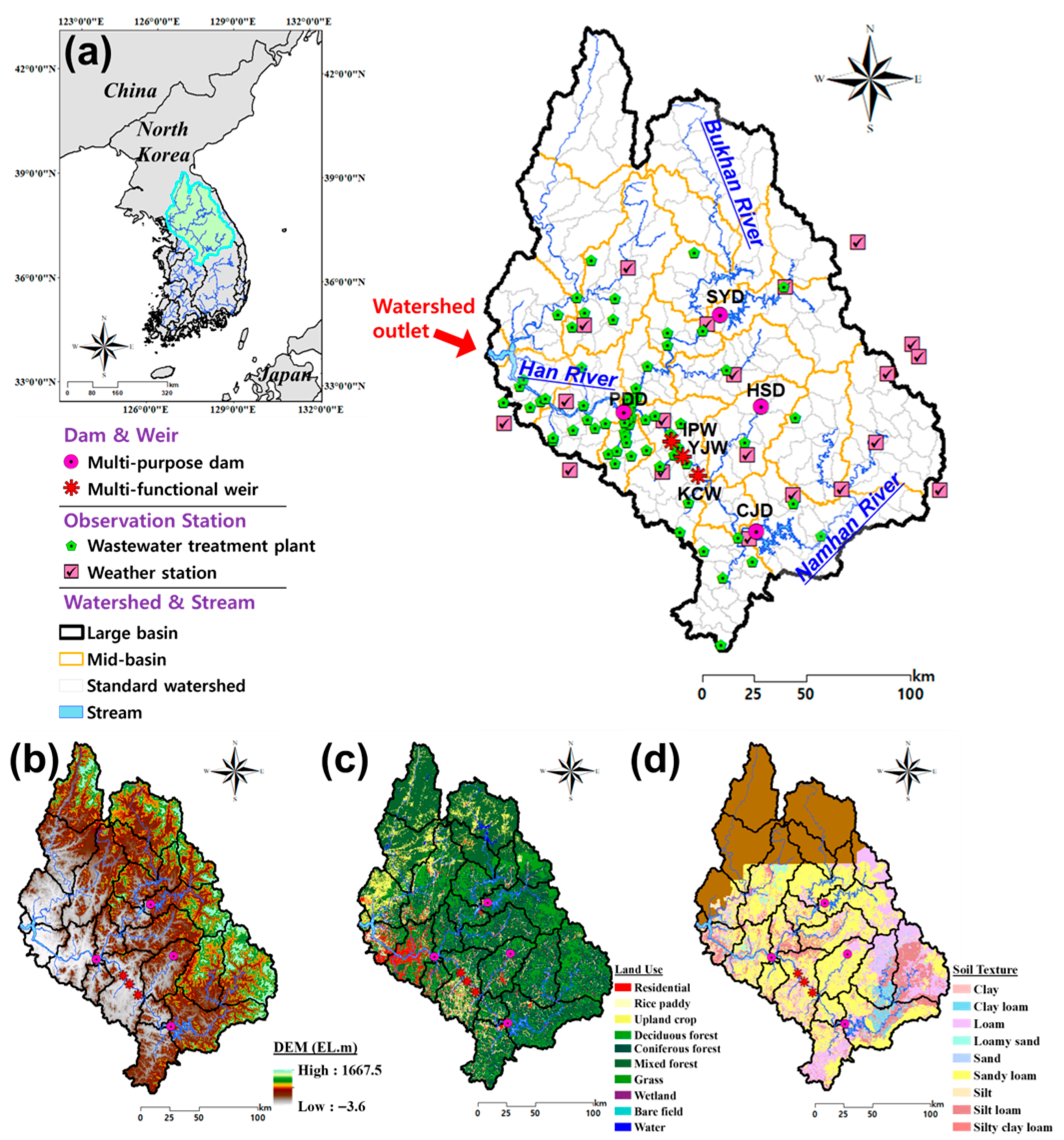
2.1. Study Area
2.2. SWAT Description
2.3. Consumptive Water Use
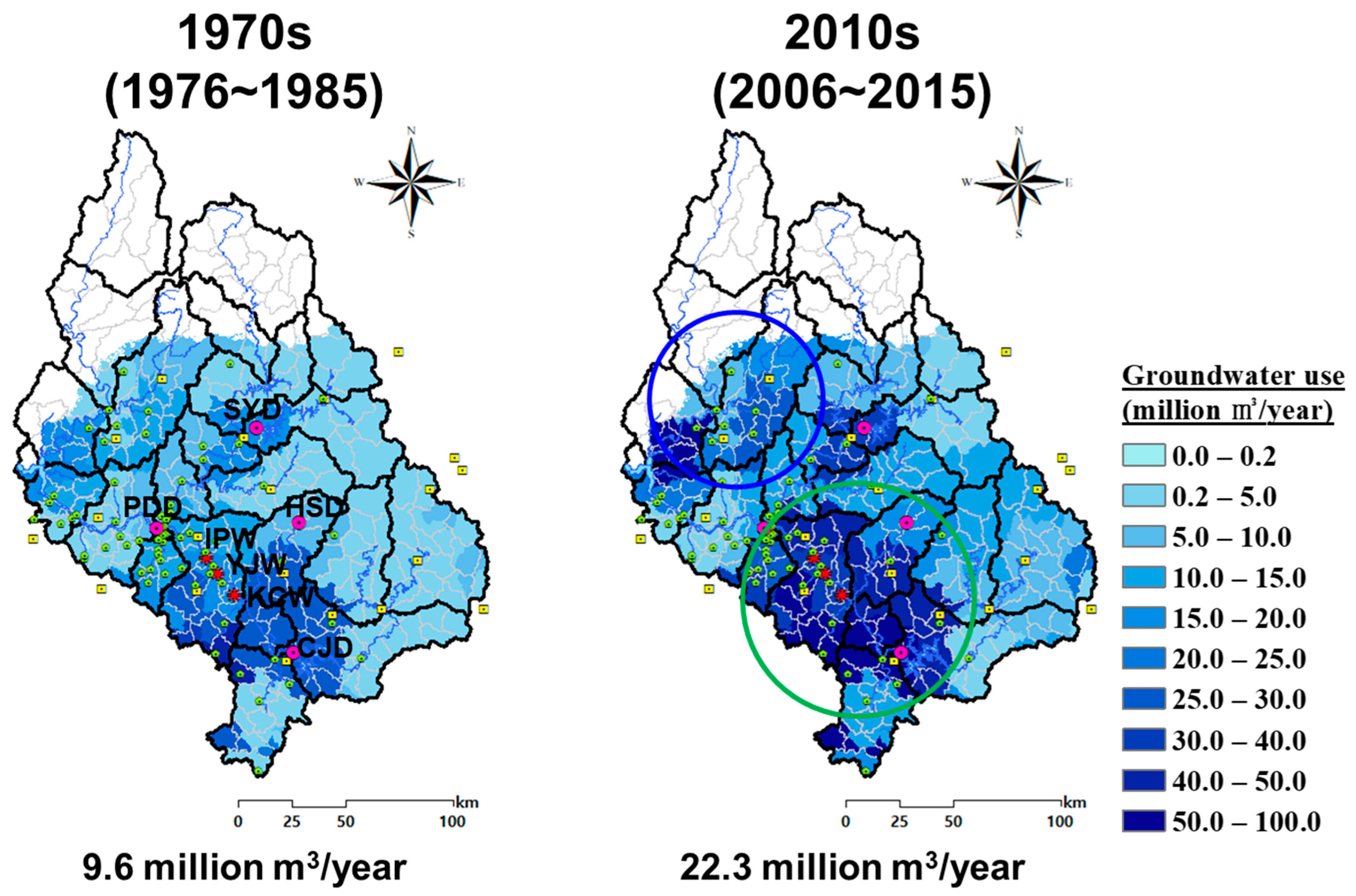
2.4. Groundwater Use Data
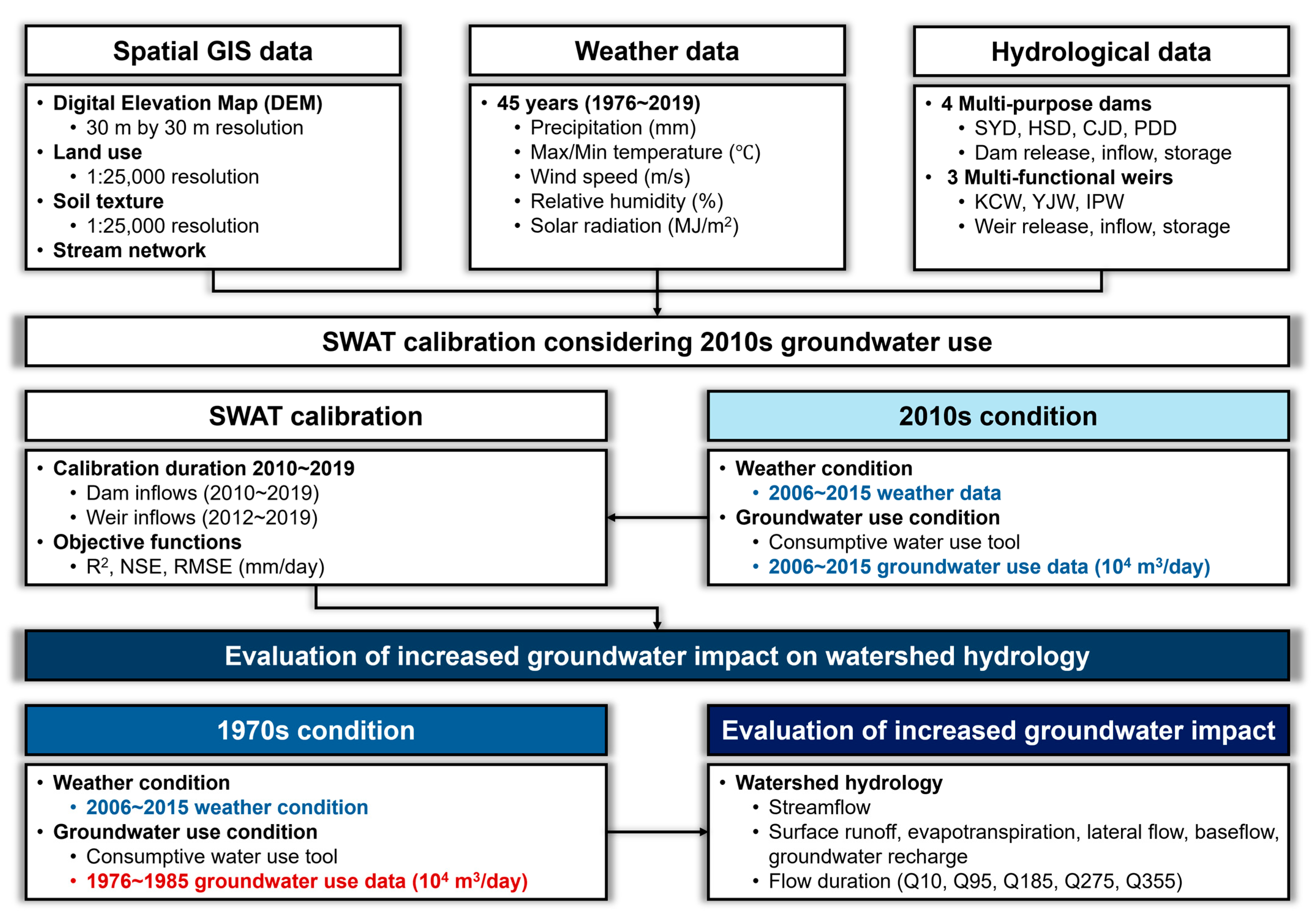
2.5. Methodology
3. Results
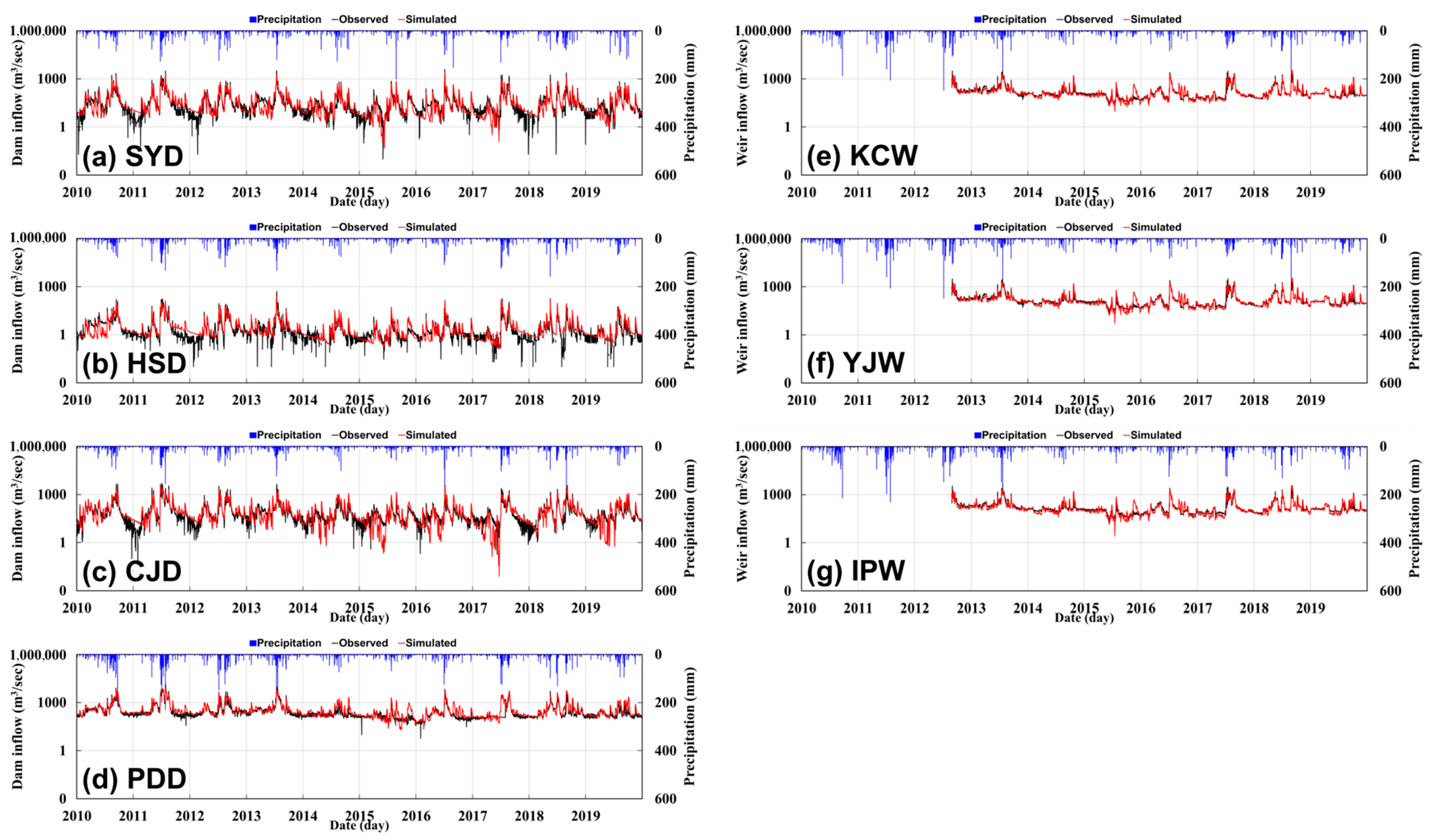
3.1. SWAT Calibration
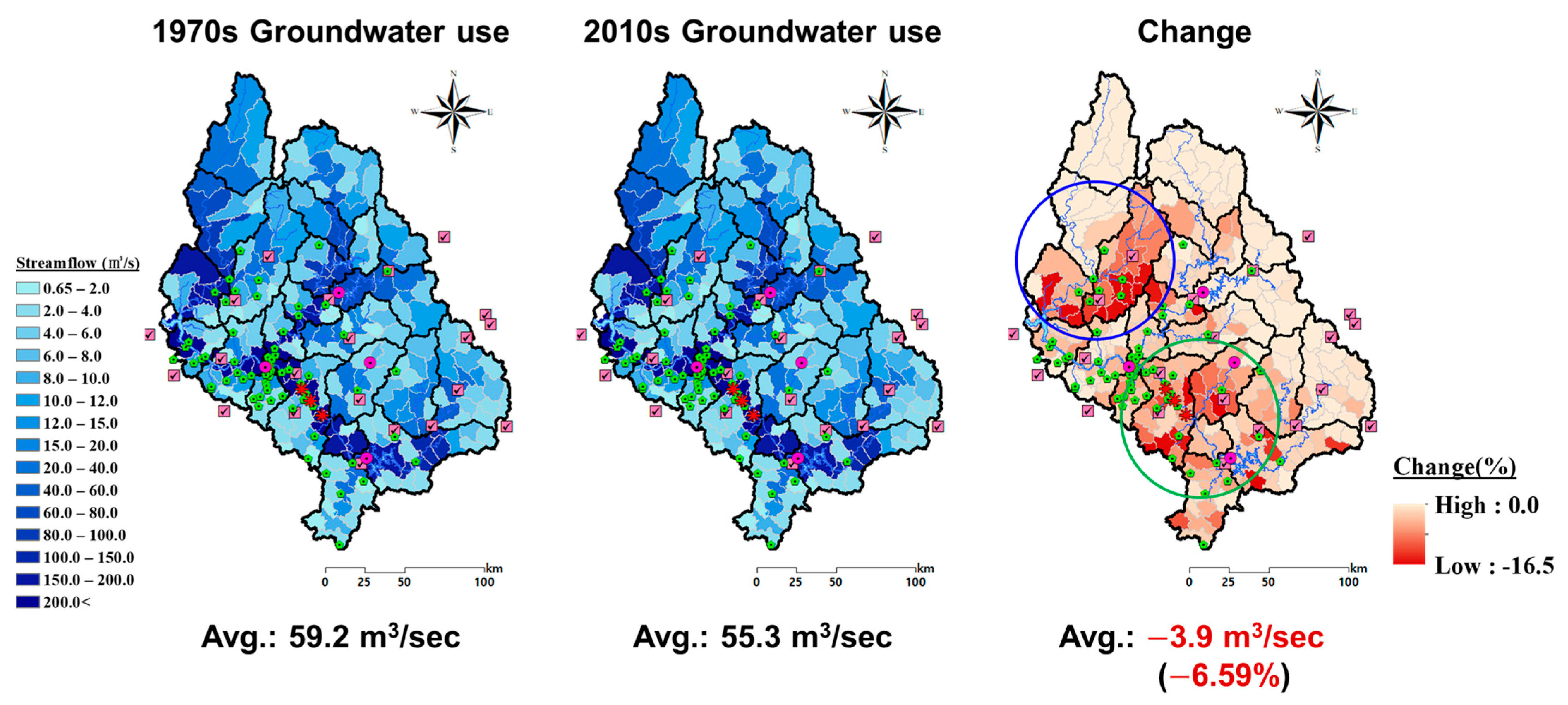
3.2. Increased Groundwater Abstraction Impact on Streamflow
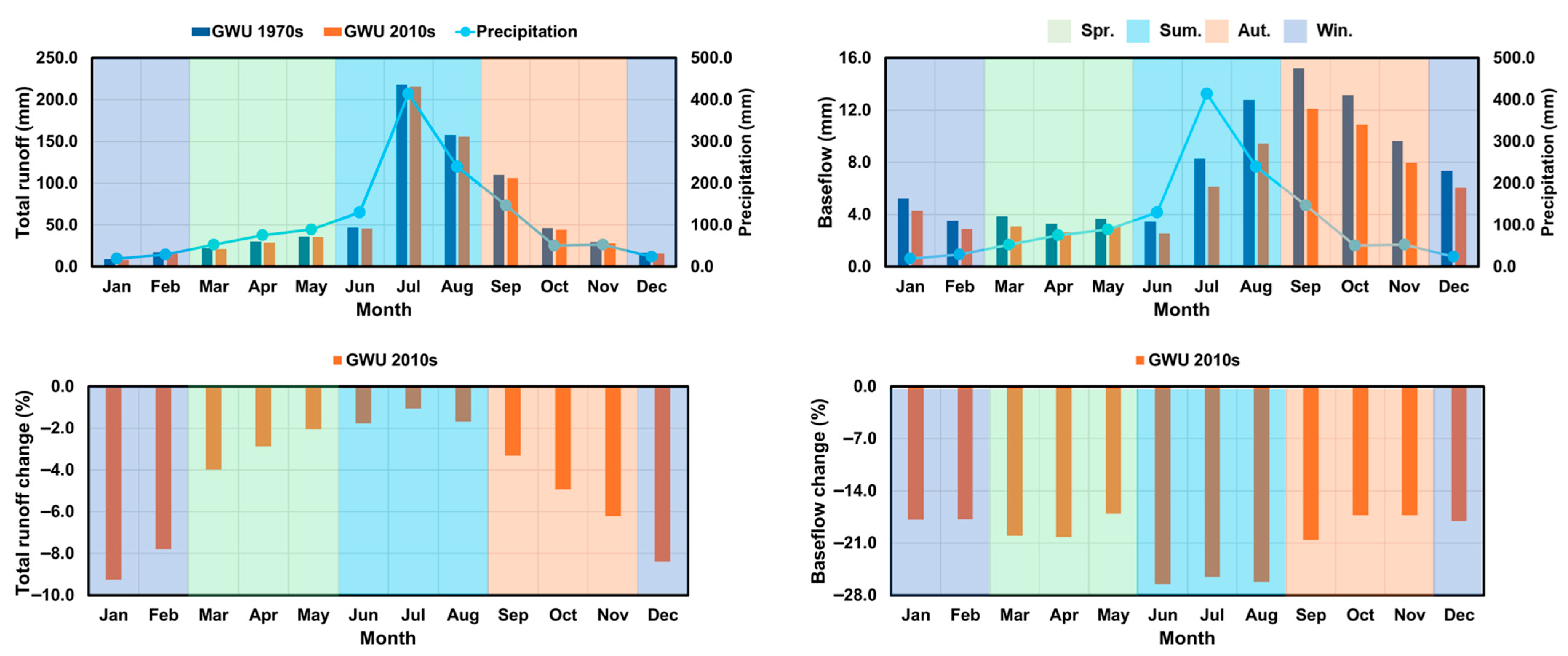
3.3. Increased Groundwater Abstraction Impact on Watershed Hydrology
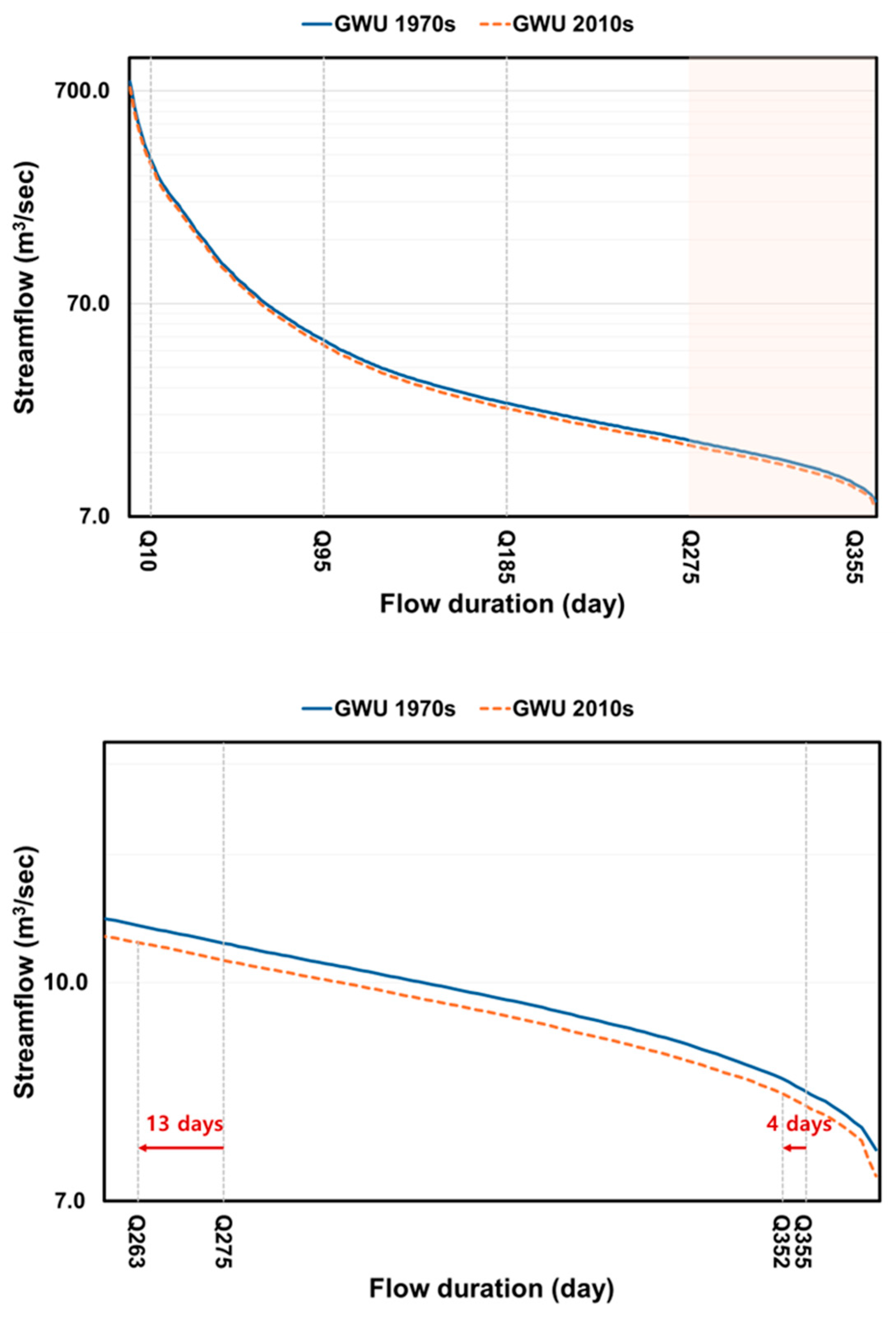
3.4. Flow Duration Analysis
4. Discussion
4.1. Mechanisms of Hydrological Response
4.2. Socio-Hydrological Implications for Water Management
4.3. Limitations and Future Research
5. Conclusions
Author Contributions
Funding
Data Availability Statement
Conflicts of Interest
References
- Winter, J.G.; Duthie, H.C. Effects of urbanization on water quality, periphyton and invertebrate communities in Southern Ontario stream. Can. Water Resour. J. 1998, 23, 245–257. [Google Scholar] [CrossRef]
- Geris, J.; Comte, J.C.; Franchi, F.; Petros, A.K.; Tirivarombo, S.; Selepeng, A.T.; Villholth, K.G. Surface water-groundwater interactions and local and use control water quality impacts of extreme rainfall and flooding in a vulnerable semi-arid region of Sub-Saharan Africa. J. Hydrol. 2022, 609, 127834. [Google Scholar] [CrossRef]
- Sophocleous, M. Interactions between groundwater and surface water: The state of the science. Hydrogeol. J. 2022, 10, 52–67. [Google Scholar] [CrossRef]
- Swain, S.; Taloor, A.K.; Dhal, L.; Sahoo, S.; Al-Ansari, N. Impact of climate change on groundwater hydrology: A comprehensive review and current status of the Indian hydrogeology. Appl. Water Sci. 2022, 12, 120. [Google Scholar] [CrossRef]
- Siebert, S.; Burke, J.; Faures, J.M.; Frenken, K.; Hoogeveen, J.; Döll, P.; Portmann, F.T. Groundwater use for irrigation—A global inventory. Hydrol. Earth Syst. Sci. 2010, 14, 1863–1880. [Google Scholar] [CrossRef]
- Kirk, S.; Herbert, A.W. Assessing the impact of groundwater abstractions on river flows. Geol. Soc. Lond. Spec. Publ. 2002, 193, 211–233. [Google Scholar] [CrossRef]
- Gleeson, T.; VanderSteen, J.; Sophocleous, M.A.; Taniguchi, M.; Alley, W.M.; Allen, D.M.; Zhou, Y. Groundwater sustainability strategies. Nat. Geosci. 2010, 3, 378–379. [Google Scholar] [CrossRef]
- Park, G.M.; Lee, H.J.; Koo, M.H.; Kim, Y.C. Strategies for an effective artificial recharge in alluvial stream-aquifer systems undergoing heavy seasonal pumping. J. Geol. Soc. Korea 2016, 52, 211–219. [Google Scholar] [CrossRef]
- Wendt, D.E.; Van Loon, A.F.; Bloomfield, J.P.; Hannah, D.M. Asymmetric impact of groundwater use on groundwater droughts. Hydrol. Earth Syst. Sci. 2020, 24, 4853–4868. [Google Scholar] [CrossRef]
- Wada, Y.; Van Beek, L.P.H.; Van Kempen, C.M.; Reckman, J.W.T.M.; Vasak, S.; Bierkens, M.F.P. Global depletion of groundwater resources. Geophys. Res. Lett. 2010, 37, L20402. [Google Scholar] [CrossRef]
- de Graaf, I.E.M.; Gleeson, T.; Van Beek, L.P.H.; Sutanudjaj, E.H.; Bierkens, M.F.P. Environmental flow limits to global groundwater pumping. Nature 2019, 574, 90–94. [Google Scholar] [CrossRef]
- Yoo, J.H.; Kim, K.H.; Park, Y.G.; Lee, G.H.; Kim, S.J.; Jung, C.G. A study on the use of GIS-based time series spatial data for streamflow depletion assessment. J. Korean Assoc. Geogr. Inf. Stud. 2018, 21, 50–63. [Google Scholar] [CrossRef]
- Liu, Q.; Gui, D.; Zhang, L.; Niu, J.; Dai, H.; Wei, G.; Hu, B.X. Simulation of regional groundwater levels in arid regions using interpretable machine learning models. Sci. Total Environ. 2022, 831, 154902. [Google Scholar] [CrossRef]
- Lee, S.Y.; Baek, W.J.; Kim, J.Y.; Jeong, C.S.; Kang, J.M. Groundwater flow analysis during excavation for underground tunnel construction. J. Korean GEO-Environ. Soc. 2024, 25, 19–24. [Google Scholar] [CrossRef]
- Kim, W.J.; Kim, S.J.; Kim, J.U.; Lee, J.W.; Woo, S.Y.; Kim, S.H. Assessment of long-term groundwater use increase and forest growth impact on watershed hydrology. Water Resour. Manag. 2022, 36, 5801–5821. [Google Scholar] [CrossRef]
- Kim, G.; Lee, J.B.; Agoussou, A.; Yang, J.S. Proposal for the groundwater based countermeasures to secure water resources considering regional characteristics of water resources vulnerable areas. J. Korea Water Resour. Assoc. 2022, 55, 191–203. [Google Scholar] [CrossRef]
- Prayag, A.G.; Zhou, Y.; Srinivasan, V.; Stigter, T.; Verzijl, A. Assessing the impact of groundwater abstractions on aquifer depletion in the Cauvery Delta, India. Agric. Water Manag. 2023, 279, 108191. [Google Scholar] [CrossRef]
- Fantaye, S.M.; Wolde, B.B.; Haile, A.T.; Taye, M.T. Estimation of shallow groundwater abstraction for irrigation and its impact on groundwater availability in the Lake Tana sub-basin, Ethiopia. J. Hydrol. Reg. Stud. 2023, 46, 101365. [Google Scholar] [CrossRef]
- Abbas, S.A.; Bailey, R.T.; White, J.T.; Arnold, J.G.; White, M.J. Estimation of groundwater storage loss using surface-subsurface hydrologic modeling in an irrigated agricultural region. Sci. Rep. 2025, 15, 8350. [Google Scholar] [CrossRef]
- Lu, C.; Richards, L.A.; Wilson, G.J.L.; Krause, S.; Lapworth, D.J.; Gooddy, D.C.; Chakravorty, B.; Palya, D.A.; Niasar, V.J. Quantifying the impacts of groundwater abstraction on Ganges river water infiltration into shallow aquifers under the rapidly developing city of Patna, India. J. Hydrol. Reg. Stud. 2022, 42, 101133. [Google Scholar] [CrossRef]
- Yan, H.; Xie, Z.; Jia, B.; Li, R.; Wang, L.; Tian, Y.; You, Y. Impact of groundwater overextraction and agricultural irrigation on hydrological processes in an inland arid basin. J. Hydrol. 2025, 653, 132770. [Google Scholar] [CrossRef]
- Cheema, M.J.M.; Immerzeel, W.W.; Bastiaanssen, W.G.M. Spatial quantification of groundwater abstraction in the irrigated Indus basin. Groundwater 2013, 52, 25–36. [Google Scholar] [CrossRef] [PubMed]
- Zhang, X.; Ren, L.; Kong, X. Estimating spatiotemporal variability and sustainability of shallow groundwater in a well-irrigated plain of the Haihe River basin using SWAT model. J. Hydrol. 2016, 541, 1221–1240. [Google Scholar] [CrossRef]
- Shafeeque, M.S.M.; Cheema, M.J.M.; Sarwar, A.S.A.; Hussain, M.W. Quantification of groundwater abstraction using SWAT model in Hakra branch canal system of Pakistan. Pak. J. Agric. Sci. 2016, 53, 249–255. [Google Scholar] [CrossRef]
- Lee, J.W.; Jung, C.G.; Kim, S.H.; Kim, S.J. Assessment of climate change impact on future groundwater-level behavior using SWAT groundwater-consumption function in Geum River basin of South Korea. Water 2019, 11, 949. [Google Scholar] [CrossRef]
- K-Water. Groundwater Statistical Yearbook; K-Water: Daejeon, Republic of Korea, 2024. [Google Scholar]
- National Geographic Institute (NGII). Digital Elevation Model (DEM). Available online: https://www.ngii.go.kr (accessed on 20 February 2026).
- Ministry of Climate, Energy and Environment (MCEE). Land Use Map. Available online: https://aid.mcee.go.kr (accessed on 20 February 2026).
- Rural Development Administration (RDA). Korean Soil Map. Available online: https://soil.rda.go.kr (accessed on 20 February 2026).
- Arnold, J.G.; Williams, J.R.; Srinivasan, R.; King, K.W. Swat Manual; USDA, Agricultural Research Service and Blackland Research Center: Temple, TX, USA, 1996. [Google Scholar]
- Neitsch, S.L.; Arnold, J.G.; Kiniry, J.R.; Williams, J.R. Soil and Water Assessment Tool: The Theoretical Documentation; U.S. Agricultural Research Service: Temple, TX, USA, 2001; pp. 340–367. [Google Scholar]
- Arnold, J.G.; Kiniry, J.R.; Srinivasan, R.; Williams, J.R.; Haney, E.B.; Neitsch, S.L. Swat 2012 Input/Output Documentation; Texas Water Resources Institute: College Station, TX, USA, 2013. [Google Scholar]
- National Groundwater Information Center (GIMS). Groundwater Statistical Yearbooks, Ministry of Climate, Energy and Environment, Sejong, Republic of Korea. Available online: https://www.gims.go.kr (accessed on 20 February 2026).
- Moriasi, D.H.; Wilson, B.N.; Douglas-Mankin, K.R.; Arnold, J.G.; Gowda, P.H. Hydrologic and water quality models: Use, calibration, and validation. Trans. ASABE 2012, 55, 1241–1247. [Google Scholar] [CrossRef]
- Mkhwanazi, M.; Chavez, J.R.; Rambikur, E.H. Comparison of large aperture scintillometer and satellite based energy balance models in sensible heat flux and crop evapotranspiration determine. Int. J. Remote Sens. Appl. 2012, 2, 24–30. [Google Scholar]
- Sun, S.; Tang, Q.; Konar, M.; Huang, Z.; Gleeson, T.; Ma, T.; Fang, C.; Cai, X. Domestic groundwater depletion supports China’s full supply chains. Water Resour. Res. 2022, 58, e2021WR030695. [Google Scholar] [CrossRef]
- Hellwig, J.; Stahl, K. An assessment of trends and potential future changes in groundwater-baseflow drought based on catchment response times. Hydrol. Earth Syst. Sci. 2018, 22, 6209–6224. [Google Scholar] [CrossRef]
- Cruz, M.G.; Hernandez, E.A.; Uddameri, V. Vulnerability assessment of agricultural production systems to drought stresses using robustness measures. Sci. Rep. 2021, 11, 21648. [Google Scholar] [CrossRef]
- Steward, D.R.; Allen, A.J. Peak groundwater depletion in the High Plains Aquifer, projections from 1930 to 2110. Agric. Water Manag. 2016, 170, 36–48. [Google Scholar] [CrossRef]
- Nie, W.; Zaitchick, B.F.; Rodell, M.; Kumar, S.V.; Anderson, M.C.A.; Hain, C. Groundwater withdrawals under drought: Reconciling GRACE and Land Surface Models in the United States High Plains Aquifer. Water Resour. Res. 2018, 54, 5282–5299. [Google Scholar] [CrossRef]
- Rolls, R.J.; Bond, N.R. Environmental and ecological effects of flow alteration in surface water ecosystems. In Water for the Environment: From Policy and Science to Implementation and Management; Academic Press: Cambridge, MA, USA, 2017; pp. 65–82. [Google Scholar] [CrossRef]
- Van Gerven, L.P.A.; Kuiper, J.J.; Janse, J.H.; Janssen, A.B.G.; Jeuken, M.; Mooij, W.M.; de Klein, J.J.M. How regime shifts in connected aquatic ecosystems are affected by the typical downstream increase of water flow. Ecosystems 2017, 20, 733–744. [Google Scholar] [CrossRef]
- Kim, Y.W.; Kim, W.J.; Woo, S.Y.; Lee, Y.G.; Kim, S.J. A study on investigation of stream drying phenomena in tributaries of the Han River basin and estimation of ecological flow. J. Korea Water Resour. Assoc. 2024, 57, 519–532. [Google Scholar] [CrossRef]
- Ahl, R.S.; Woods, S.W.; Zuuring, H.R. Hydrologic calibration and validation of SWAT in a snow-dominated Rocky Mountain Watershed, Montana, U.S.A. J. Am. Water Resour. Assoc. 2008, 44, 1411–1430. [Google Scholar] [CrossRef]
- Lee, J.W.; Jung, C.G.; Kim, D.Y.; Maeng, S.J.; Jeong, H.S.; Jo, Y.S.; Kim, S.J. A study on estimating the quick return flow from irrigation canal of agricultural water using watershed model. J. Korea Water Resour. Assoc. 2022, 55, 321–331. [Google Scholar] [CrossRef]
- Han, J.H.; Lee, S.R.; Kim, J.G. Quantifying stream return flow of agricultural water using SWAT-MODFLOW-PADDY model in Korean Paddy Fields. Agronomy 2024, 14, 2440. [Google Scholar] [CrossRef]
- Rowe, W.D. Understanding uncertainty. Risk Anal. 1994, 14, 743–750. [Google Scholar] [CrossRef]
- Schiavo, M.; Pedretti, D. Genetic and iterative metaheuristics—Informed algorithms for precision shallow groundwater modeling and drought inference. J. Geophys. Res. Mach. Learn. Comput. 2025, 2, e2025JH000854. [Google Scholar] [CrossRef]
- Zowam, F.J.; Milewski, A.M. Groundwater level prediction using machine learning and geostatistical interpolation models. Water 2024, 16, 2771. [Google Scholar] [CrossRef]
- Toure, A.; Diekkrüger, B.; Mariko, A.; Cissé, A.S. Assessment of groundwater resources in the context of climate change and population growth: Case of the Klela Basin in Southern Mali. Climate 2017, 5, 45. [Google Scholar] [CrossRef]
- Secci, D.; Tanda, M.G.; D’Oria, M.; Todaro, V. Artificial intelligence models to evaluate the impact of climate change on groundwater resources. J. Hydrol. 2023, 627, 130359. [Google Scholar] [CrossRef]
- Lu, X.; Wang, Z.; Zhao, M.; Peng, S.; Geng, S.; Ghorbani, H. Data-driven insights into climate change effects on groundwater levels using machine learning. Water Resour. Manag. 2025, 39, 3521–3536. [Google Scholar] [CrossRef]





| Period | Month | |||||||||||
|---|---|---|---|---|---|---|---|---|---|---|---|---|
| Jan. | Feb. | Mar. | Apr. | May | Jun. | Jul. | Aug. | Sep. | Oct. | Nov. | Dec. | |
| 1970s groundwater abstraction (106 ton) | 0.27 | 0.27 | 0.27 | 0.30 | 0.29 | 0.84 | 0.94 | 0.95 | 0.45 | 0.27 | 0.27 | 0.27 |
| 2010s groundwater abstraction (106 ton) | 0.57 | 0.57 | 0.57 | 0.63 | 0.62 | 1.94 | 2.20 | 2.21 | 1.01 | 0.57 | 0.57 | 0.57 |
| Parameter | Definition | Range | Initial * (Default) | Adjusted Value | ||||||
|---|---|---|---|---|---|---|---|---|---|---|
| SYD | HSD | CJD | PDD | KCW | YJW | IPW | ||||
| CN2 | SCS curve number for moisture condition | 35 to 98 | Given by HRUs ** | −5 | −10 | −5 | −5 | −5 | - | - |
| CH_N (2) | Manning’s “n” value for main channel | −1 to 0.3 | 0.014 | 0.08 | 0.08 | 0.06 | 0.06 | 0.06 | 0.06 | 0.08 |
| ESCO | Soil evaporation compensation coefficient | 0 to 1 | 0.95 | 0.90 | 0.90 | 0.60 | 0.60 | 0.65 | 0.65 | 0.65 |
| SOL_AWC | Available water capacity of the soil layer (mmH2O/mm soil) | 0 to 1 | Given by HRUs | * 1.10 | * 1.05 | * 0.95 | - | * 1.10 | * 1.05 | - |
| SOL_K | Saturated hydraulic conductivity (mm/hr) | 0 to 2000 | Given by HRUs | * 1.10 | * 1.10 | * 0.95 | - | - | * 1.05 | - |
| GW_DELAY | Delay time for aquifer recharge (days) | 0 to 500 | 31 | 100 | 120 | 80 | 70 | 100 | 80 | 120 |
| GWQMN | Threshold water level in shallow aquifer for base flow (mm) | 0 to 5000 | 1000 | 500 | 500 | 500 | 500 | 500 | 500 | 500 |
| ALPHA_BF | Base flow recession constant | 0 to 1 | 0.048 | 0.30 | 0.30 | 0.70 | 0.70 | 0.80 | 0.75 | 0.75 |
| RES_ESA | Reservoir surface area when the reservoir is filled to emergency spillway (ha) | - | - | 7000 | 580 | 9700 | 2000 | 350 | 350 | 350 |
| RES_EVOL | Volume of water needed to fill the reservoir to the emergency spillway (104 m3) | - | - | 290,000 | 10,690 | 275,000 | 34,400 | 1870 | 2130 | 24,300 |
| RES_PSA | Reservoir surface area when the reservoir is filled to the principal spillway (ha) | - | - | 6180 | 500 | 8775 | 1700 | 300 | 300 | 3000 |
| RES_PVOL | Volume of water needed to fill the reservoir to the principal spillway (104 m3) | - | - | 250,380 | 7890 | 225,152 | 19,400 | 870 | 1130 | 1430 |
| RES_VOL | Initial reservoir volume (104 m3) | - | - | 154,860 | 760 | 1,074,100 | 6830 | 880 | 7900 | 960 |
| Point | Calibration Component | Objective Function | ||||
|---|---|---|---|---|---|---|
| R2 | Criteria | NSE | Criteria | RMSE (mm/Day) | ||
| SYD | Dam inflow | 0.72 | Satisfactory | 0.70 | Satisfactory | 2.97 |
| HSD | Dam inflow | 0.75 | Good | 0.69 | Satisfactory | 3.02 |
| CJD | Dam inflow | 0.75 | Good | 0.71 | Good | 2.18 |
| PDD | Dam inflow | 0.74 | Satisfactory | 0.66 | Satisfactory | 1.56 |
| KCW | Weir inflow | 0.87 | Very Good | 0.76 | Good | 1.77 |
| YJW | Weir inflow | 0.85 | Good | 0.75 | Good | 1.06 |
| IPW | Weir inflow | 0.86 | Very Good | 0.79 | Good | 1.02 |
| Groundwater Abstraction | Hydrological Component | ||||||
|---|---|---|---|---|---|---|---|
| TR | ET | SR | LF | BF | PE | GWR | |
| 1970s groundwater abstraction (mm) | 740.0 | 487.1 | 166.7 | 458.1 | 89.5 | 116.7 | 114.8 |
| 2010s groundwater abstraction (mm) | 720.4 | 487.1 | 166.7 | 458.1 | 71.0 | 116.7 | 90.9 |
| Change (mm) | −19.6 | 0.0 | 0.0 | 0.0 | −18.5 | 0.0 | −23.9 |
| Change (%) | −2.6 | 0.0 | 0.0 | 0.0 | −20.7 | 0.0 | −20.8 |
| Season | Precipitation (mm) | TR_1970s (mm) | TR_2010s (mm) | Change (%) | BF_1970s (mm) | BF_2010s (mm) | Change (%) |
|---|---|---|---|---|---|---|---|
| Spring (Mar.~May) | 217.8 | 88.4 | 85.9 | 2.8 | 10.9 | 8.8 | 19.3 |
| Summer (Jun.~Aug.) | 783.9 | 422.8 | 417.1 | 1.3 | 24.5 | 18.1 | 26.1 |
| Autumn (Sep.~Nov.) | 251.9 | 185.7 | 177.9 | 4.2 | 38.0 | 30.9 | 18.7 |
| Winter (Dec.~Feb.) | 73.1 | 43.1 | 39.5 | 8.4 | 16.1 | 13.2 | 18.0 |
| Total | 1326.6 | 740.0 | 720.4 | 2.6 | 89.5 | 71.0 | 20.7 |
| Flow Duration | 1970s Groundwater Abstraction (m3/s) | 2010s Groundwater Abstraction (m3/s) | Change (m3/s) | Change (%) |
|---|---|---|---|---|
| Q10 (High flows) | 351.52 | 333.51 | 18.01 | 5.40 |
| Q95 (Moist conditions) | 47.46 | 44.97 | 2.49 | 5.53 |
| Q185 (Mid-range flows) | 23.79 | 22.52 | 1.27 | 5.63 |
| Q275 (Dry conditions) | 15.87 | 15.02 | 0.74 | 5.61 |
| Q355 (Low flows) | 9.95 | 9.51 | 0.44 | 4.60 |
Disclaimer/Publisher’s Note: The statements, opinions and data contained in all publications are solely those of the individual author(s) and contributor(s) and not of MDPI and/or the editor(s). MDPI and/or the editor(s) disclaim responsibility for any injury to people or property resulting from any ideas, methods, instructions or products referred to in the content. |
© 2026 by the authors. Licensee MDPI, Basel, Switzerland. This article is an open access article distributed under the terms and conditions of the Creative Commons Attribution (CC BY) license.
Share and Cite
Kim, Y.; Kim, W.; Woo, S.; Lee, Y.; Kim, S. Evaluation of Long-Term Increased Groundwater Abstraction Impact on Watershed Hydrology in Han River Basin, South Korea. Water 2026, 18, 607. https://doi.org/10.3390/w18050607
Kim Y, Kim W, Woo S, Lee Y, Kim S. Evaluation of Long-Term Increased Groundwater Abstraction Impact on Watershed Hydrology in Han River Basin, South Korea. Water. 2026; 18(5):607. https://doi.org/10.3390/w18050607
Chicago/Turabian StyleKim, Yongwon, Wonjin Kim, Soyoung Woo, Yonggwan Lee, and Seongjoon Kim. 2026. "Evaluation of Long-Term Increased Groundwater Abstraction Impact on Watershed Hydrology in Han River Basin, South Korea" Water 18, no. 5: 607. https://doi.org/10.3390/w18050607
APA StyleKim, Y., Kim, W., Woo, S., Lee, Y., & Kim, S. (2026). Evaluation of Long-Term Increased Groundwater Abstraction Impact on Watershed Hydrology in Han River Basin, South Korea. Water, 18(5), 607. https://doi.org/10.3390/w18050607