Impacts of Land-Use Types and Landscape Patterns on River Water Quality in the Dry-Hot Valley Basin with Frequent Geological Hazards in the Southwest China

Abstract
1. Introduction
2. Materials and Methods
2.1. Study Area and Sampling
2.2. Research Methods
2.2.1. Land-Use Analysis and Debris Flow Trace Areas
2.2.2. Calculation of Pollutant Flux and Sediment Transport Rate
2.2.3. Landscape Pattern Analysis of the Basin
2.2.4. Data Analysis
3. Results
3.1. Spatio-Temporal Distribution of Water Quality in the Xiaojiang River Basin
3.1.1. Temporal Distribution of Water Quality Indicators
3.1.2. Spatial Distribution of Water Quality Indicators
3.2. Influencing Factors of Water Quality Changes
3.2.1. Changes in Key Water Quality Indicators Before and After Heavy Rainfall Events
3.2.2. Impact of Landscape Pattern on Water Quality
4. Discussion
4.1. Attribution of Temporal and Spatial Distribution Differences in Water Quality in River Basins
4.2. Impact of the Debris Flow Trace Area on River Water Quality in the Xiaojiang Basin
4.3. Impact of Landscape Pattern Characteristics in the Xiaojiang River Basin on River Water Quality
4.4. Implications and Limitations
5. Conclusions
- (1)
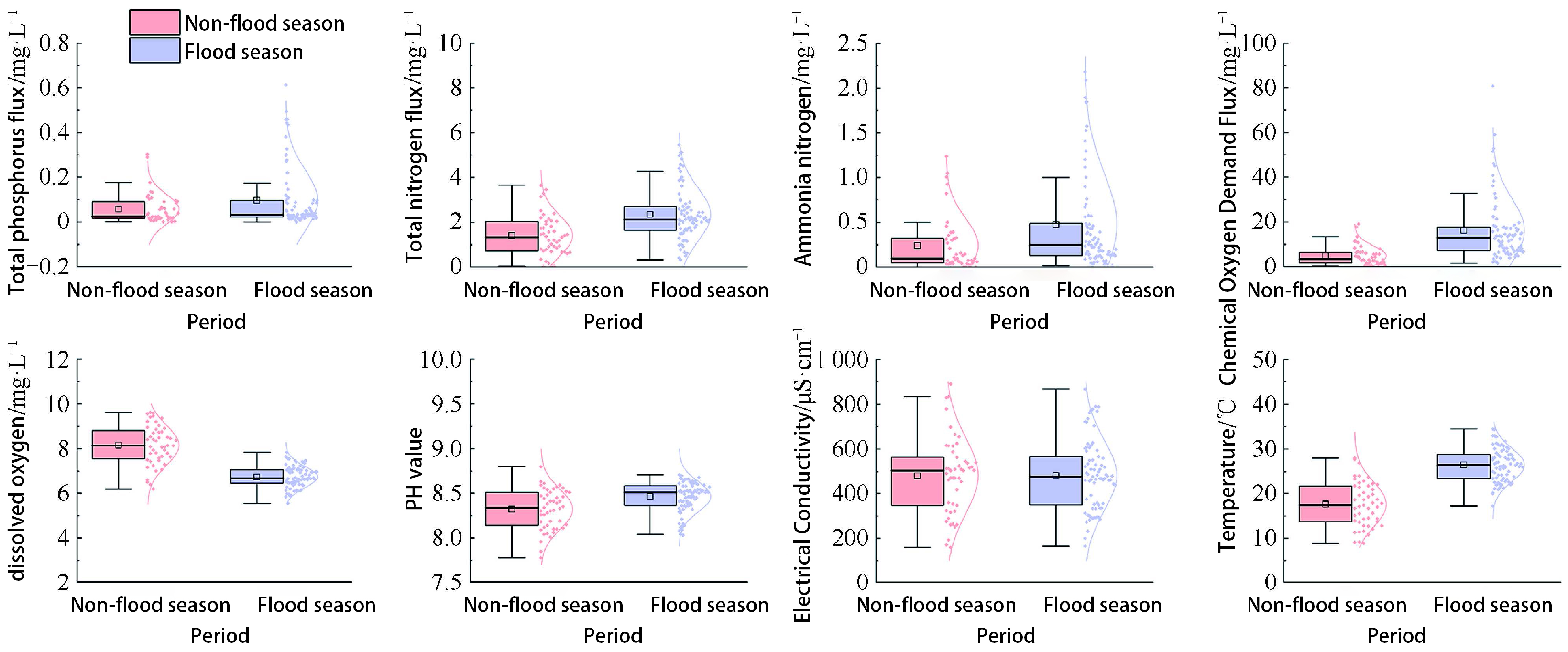
- The key water quality indices, such as total phosphorus, total nitrogen, ammonia nitrogen, chemical oxygen demand, and temperature in the Xiaojiang River Basin were shown as flood season > non-flood season. During the non-flood season, the dissolved oxygen and conductivity indicators showed a trend of being greater than those during the flood season, whereas the pH value remained unchanged. The data for total phosphorus, total nitrogen, ammonia nitrogen, and COD indicators had a relatively large degree of dispersion during the flood and non-flood seasons, whereas dissolved oxygen and pH values showed the opposite trend.
- (2)
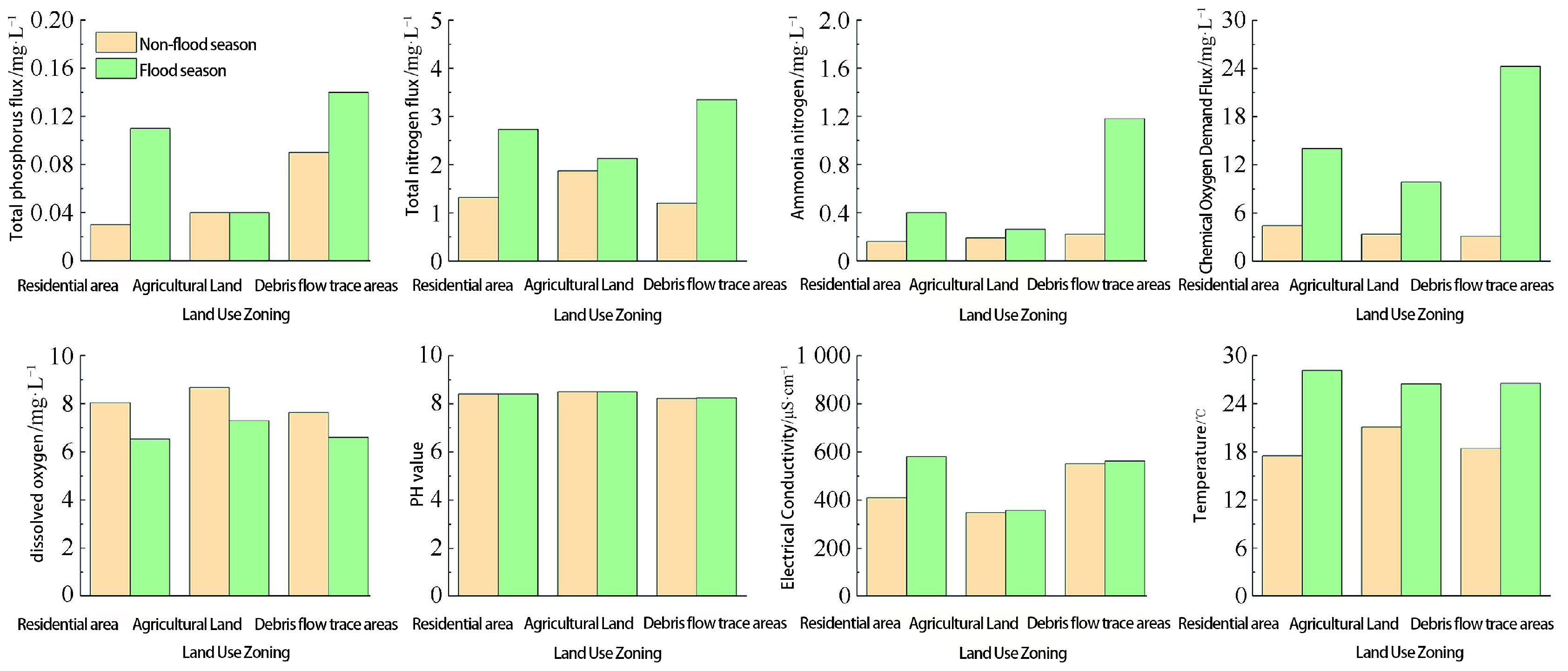
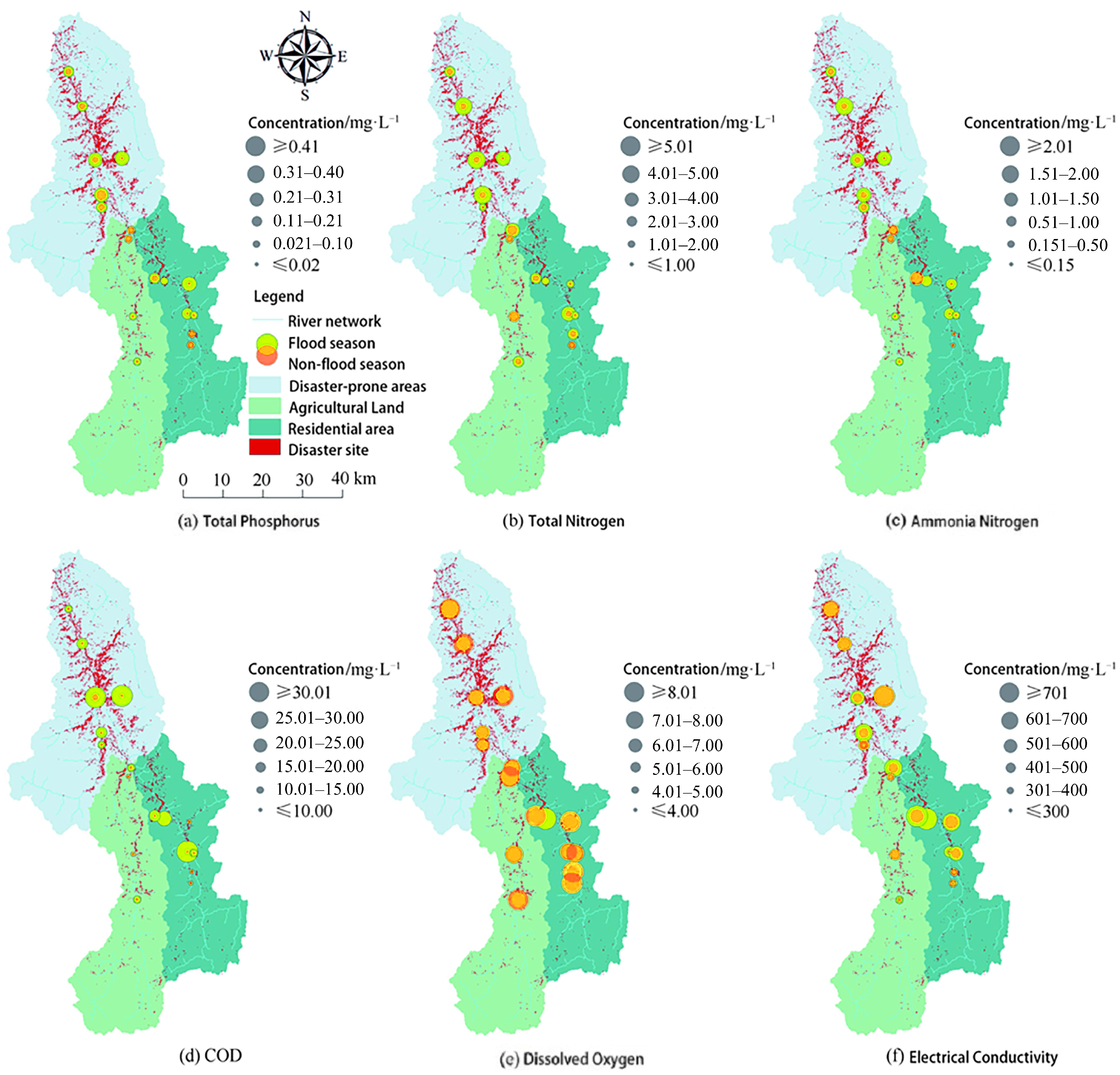
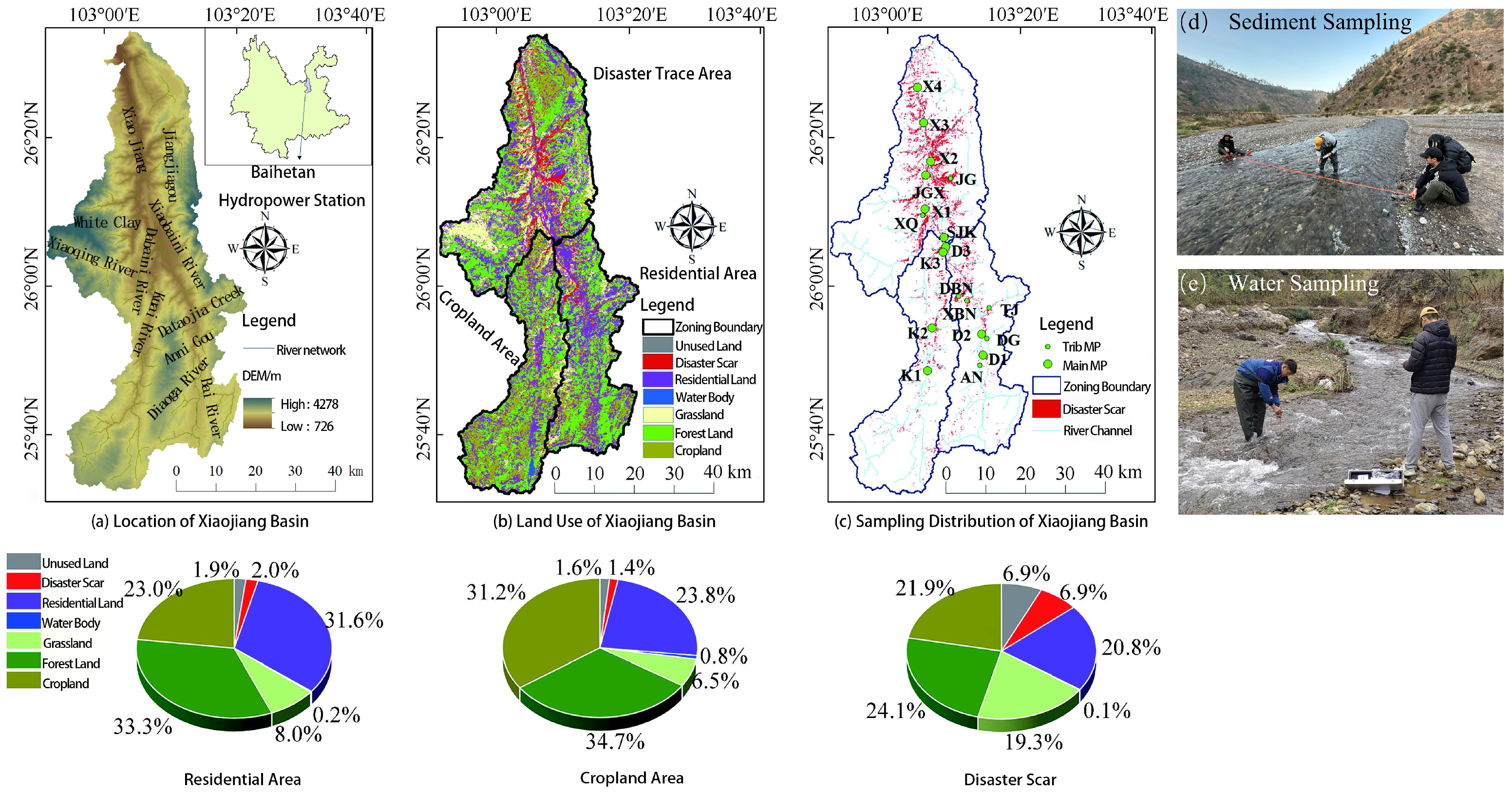
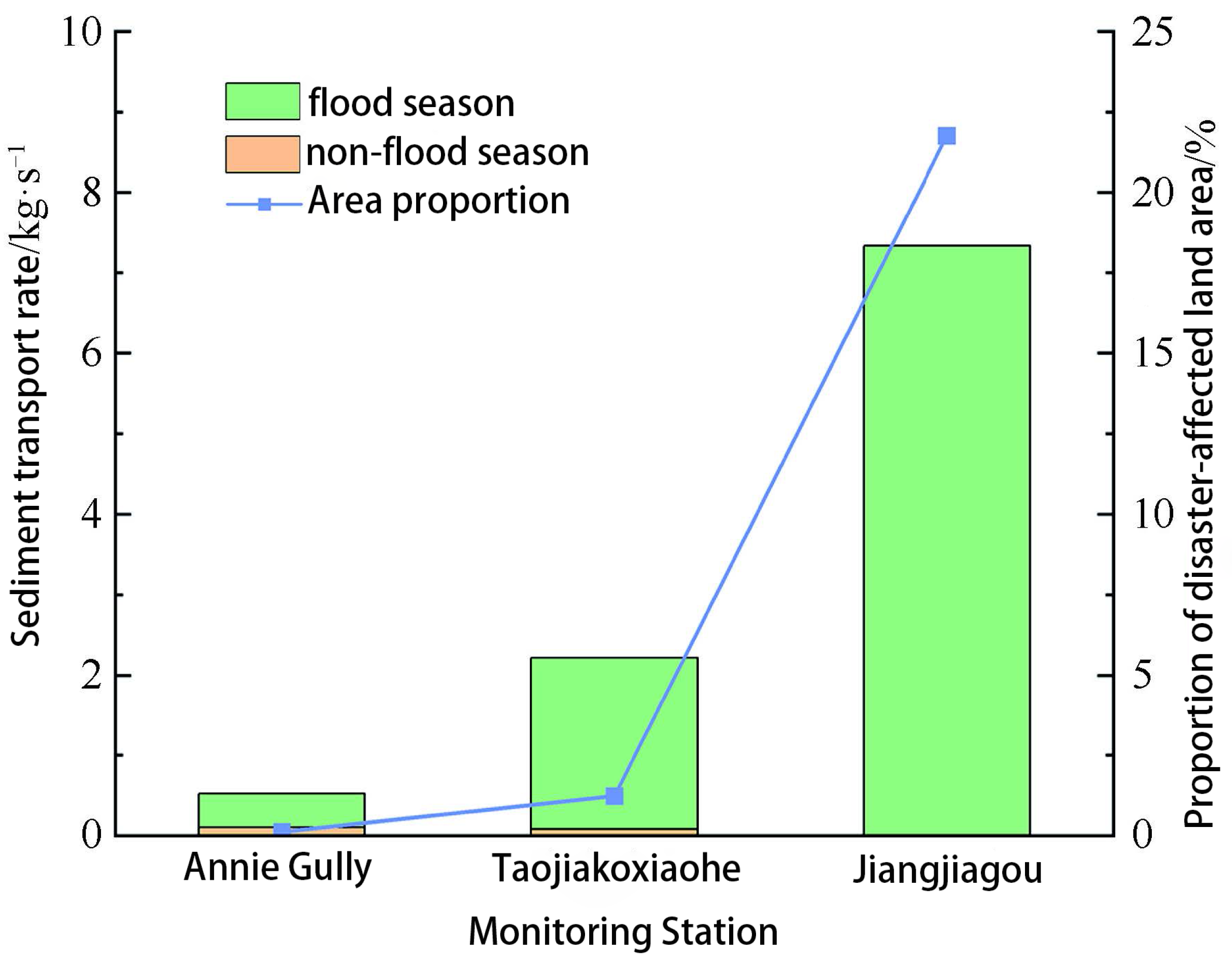
- From a spatial perspective, the water quality in each land-use zone during the non-flood season was better than that during the flood season. The average concentrations, concentration ranges, and water quality conditions of total phosphorus, total nitrogen, ammonia nitrogen, COD, and electrical conductivity were in the following order: hazard-prone area > residential area > cultivated land area. In addition, the water quality in the upstream was generally better than that in the downstream. The larger the proportion of disaster-affected sites in the branch gullies, the more severe the deterioration of water quality during the flooding season.
- (3)
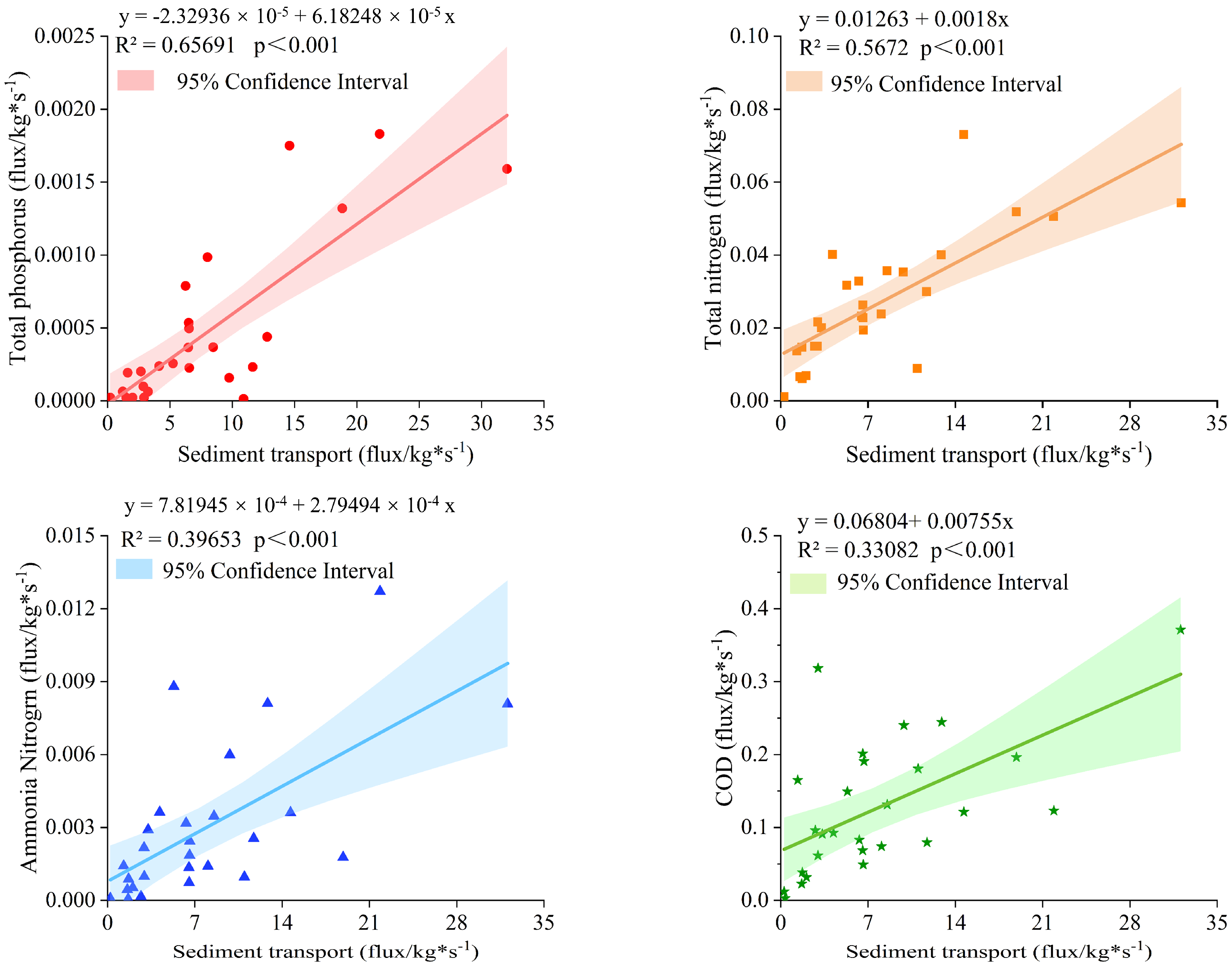
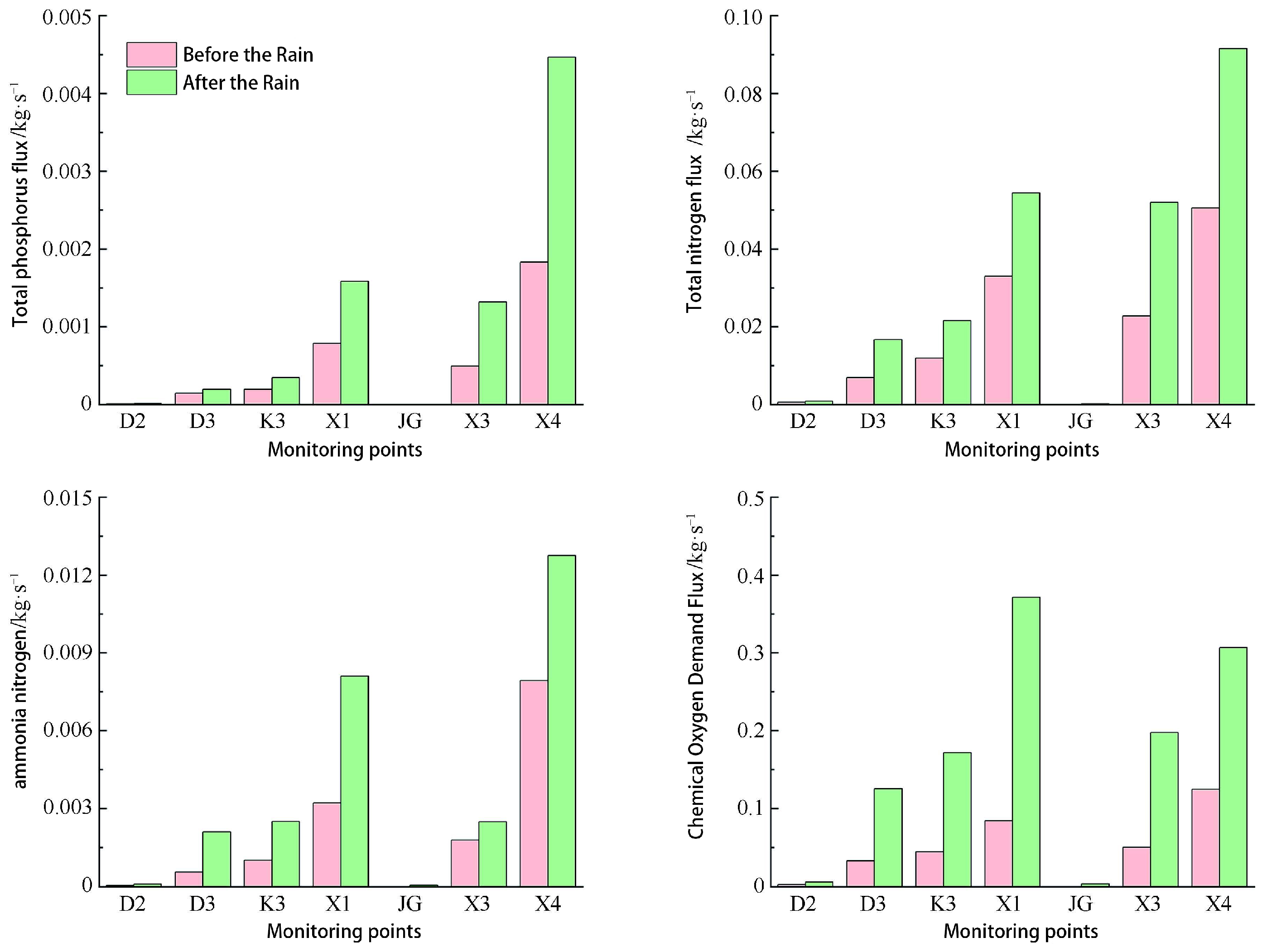
- Under heavy rain conditions in each session, the transport volume of nitrogen and phosphorus pollutants in water bodies increased significantly. In the branch gully areas with a large proportion of disaster-stricken areas and debris flow trace areas, the pollutant fluxes increased geometrically.
- (4)
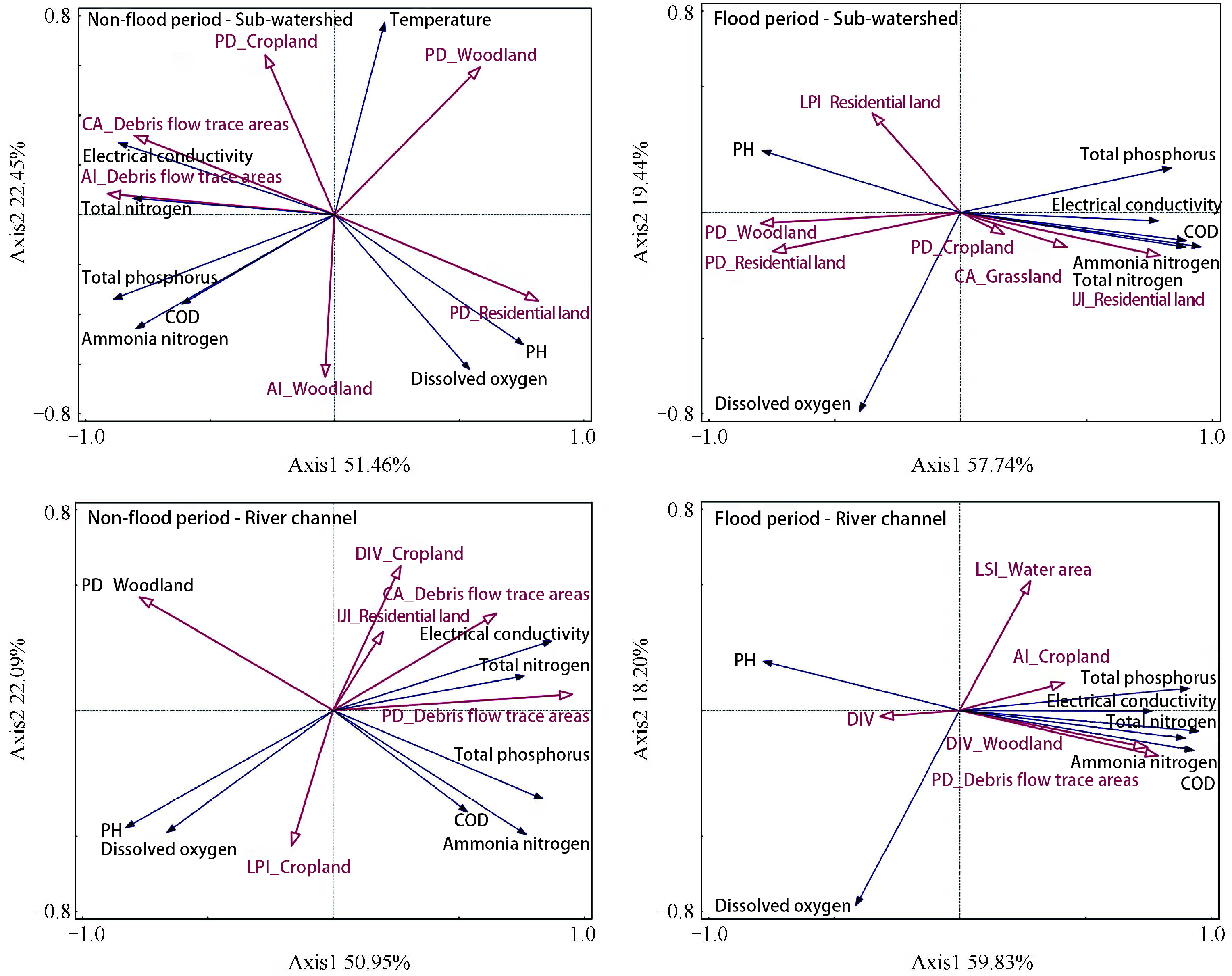
- The results of redundancy analysis (RDA) showed that the ability of landscape patterns in the flood season to explain the change in water quality was better than that in the non-flood season. At the sub-basin scale, the higher the aggregation degree of non-flood season disaster sites (AI_ hazard-influenced areas), the higher the concentrations of nitrogen, phosphorus, and organic pollutants in key water quality indicators, and the greater the risk of water quality deterioration. The distribution of residential land during the flood season and the increase in the adjacency index (IJI_ residential area) were positively correlated with the variation range of water quality, indicating that the diversity of contact between residential land and other patch types aggravated water pollution. At the river channel scale, the degree of fragmentation of the disaster site (PD_hazard-influenced areas) significantly exacerbated the pollution level. The degree of landscape dispersion of cultivated land (DIV_cultivated land) effectively reduces water pollution, especially having a significant inhibitory effect on the increase in key water quality indicators such as total phosphorus and total nitrogen in main and tributary streams.
Author Contributions
Funding
Data Availability Statement
Acknowledgments
Conflicts of Interest
References
- Zhang, J.; Liu, C.; Xu, J. Earth Critical Zone: A comprehensive exploration of the Earth’s surface processes. Earth Crit. Zone 2024, 1, 100001. [Google Scholar] [CrossRef]
- Allan, J.D. Landscapes and riverscapes: The influence of land use on stream ecosystems. Annu. Rev. Ecol. Evol. Syst. 2004, 35, 257–284. [Google Scholar] [CrossRef]
- Tiwari, A.K.; Suozzi, E.; Silva, C.; De Maio, M.; Zanetti, M. Role of Integrated Approaches in Water Resources Management: Antofagasta Region, Chile. Sustainability 2021, 13, 1297. [Google Scholar] [CrossRef]
- Naylor, L.A.; Dungait, J.A.J.; Zheng, Y.; Buckerfield, S.; Green, S.M.; Oliver, D.M.; Liu, H.; Peng, J.; Tu, C.; Zhang, G.-l.; et al. Achieving Sustainable Earth Futures in the Anthropocene by Including Local Communities in Critical Zone Science. Earths Future 2023, 11, e2022EF003448. [Google Scholar] [CrossRef]
- Zhai, X.; Xia, J.; Zhang, Y. Water quality variation in the highly disturbed Huai River Basin, China from 1994 to 2005 by multi-statistical analyses. Sci. Total Environ. 2014, 496, 594–606. [Google Scholar] [CrossRef]
- Yue, F.-J.; Waldron, S.; Li, S.-L.; Wang, Z.-J.; Zeng, J.; Xu, S.; Zhang, Z.-C.; Oliver, D.M. Land use interacts with changes in catchment hydrology to generate chronic nitrate pollution in karst waters and strong seasonality in excess nitrate export. Sci. Total Environ. 2019, 696, 134062. [Google Scholar] [CrossRef]
- Wang, W.; Liu, C.; Zhang, F.; Tan, M.L.; Shi, J.; Zhang, Z.; Duan, P.; Kung, H.-T.; Xin, H. Evaluation of impacts of environmental factors and land use on seasonal surface water quality in arid and humid regions using structural equation models. Ecol. Indic. 2022, 144, 109546. [Google Scholar] [CrossRef]
- Van Vliet, M.T.H.; Thorslund, J.; Strokal, M.; Hofstra, N.; Floerke, M.; Macedo, H.E.; Nkwasa, A.; Tang, T.; Kaushal, S.S.; Kumar, R.; et al. Global river water quality under climate change and hydroclimatic extremes. Nat. Rev. Earth Environ. 2023, 4, 687–702. [Google Scholar] [CrossRef]
- Dethier, E.N.; Renshaw, C.E.; Magilligan, F.J. Rapid changes to global river suspended sediment flux by humans. Science 2022, 376, 1447–1452. [Google Scholar] [CrossRef]
- Xiang, X.; Wang, W.; Wu, X.; Liu, Z.; Rajib, A.; Wu, L.; Cao, H.; Lin, X.; Liu, Y. Effects of Deep Learning Bias Correction and Carbon Neutrality on Projections of Future Population Exposure to Extreme Precipitation. Int. J. Climatol. 2026, 46, e70174. [Google Scholar] [CrossRef]
- Wang, M.; Bodirsky, B.L.; Rijneveld, R.; Beier, F.; Bak, M.P.; Batool, M.; Droppers, B.; Popp, A.; van Vliet, M.T.H.; Strokal, M. A triple increase in global river basins with water scarcity due to future pollution. Nat. Commun. 2024, 15, 880. [Google Scholar] [CrossRef] [PubMed]
- Deng, X. Influence of water body area on water quality in the southern Jiangsu Plain, eastern China. J. Clean. Prod. 2020, 254, 120136. [Google Scholar] [CrossRef]
- Bridgewater, P.; Upadhaya, S.; Poudyal, B. Understanding and managing inland water biodiversity in the earth critical zone. Earth Crit. Zone 2025, 2, 100023. [Google Scholar] [CrossRef]
- Battin, T.J.; Lauerwald, R.; Bernhardt, E.S.; Bertuzzo, E.; Gener, L.G.; Hall, R., Jr.; Hotchkiss, E.R.; Maavara, T.; Pavelsky, T.M.; Ran, L.S.; et al. River ecosystem metabolism and carbon biogeochemistry in a changing world. Nature 2023, 613, 449–459. [Google Scholar] [CrossRef]
- Agyekum, M.K.; Pathak, D.; Kindinger, A.; Kumar, R.; Borchardt, D.; Weitere, M.; Frank, K.; Schmitt-Jansen, M.; Büttner, O.; Brauns, M.; et al. A hydrologically informed agricultural land use intensity index for assessing ecological impacts on streams and rivers. Commun. Earth Environ. 2025, 6, 991. [Google Scholar] [CrossRef]
- Baccour, S.; Goelema, G.; Kahil, T.; Albiac, J.; van Vliet, M.T.H.; Zhu, X.; Strokal, M. Water quality management could halve future water scarcity cost-effectively in the Pearl River Basin. Nat. Commun. 2024, 15, 5669. [Google Scholar] [CrossRef]
- Puczko, K.; Jekatierynczuk-Rudczyk, E. Extreme Hydro-Meteorological Events Influence to Water Quality of Small Rivers in Urban Area: A Case Study in Northeast Poland. Sci. Rep. 2020, 10, 10255. [Google Scholar] [CrossRef]
- Zhong, X.C.; Xu, Q.L.; Yi, J.H.; Jin, L.J. Study on the threshold relationship between landscape pattern and water quality considering spatial scale effect—A case study of Dianchi Lake Basin in China. Environ. Sci. Pollut. Res. 2022, 29, 44103–44118. [Google Scholar] [CrossRef]
- Zheng, Y.X.; Li, C.; Yu, J.S.; Wang, Q.Y.; Yue, Q.M. Tracking the optimal watershed landscape pattern for driving pollutant transport: Insights from the integration of mechanistic models and data-driven approaches. J. Environ. Manag. 2025, 37, 123939. [Google Scholar] [CrossRef]
- Li, S.K.; Tu, B.; Zhang, Z.; Wang, L.; Zhang, Z.; Che, X.Q.; Wang, Z.Z. Exploring new methods for assessing landscape ecological risk in key basin. J. Clean. Prod. 2024, 461, 142633. [Google Scholar] [CrossRef]
- Lee, S.W.; Hwang, S.J.; Lee, S.B.; Hwang, H.S.; Sung, H.C. Landscape ecological approach to the relationships of land use patterns in watersheds to water quality characteristics. Landsc. Urban Plan. 2009, 92, 80–89. [Google Scholar] [CrossRef]
- Alberti, M.; Booth, D.; Hill, K.; Coburn, B.; Avolio, C.; Coe, S.; Spirandelli, D. The impact of urban patterns on aquatic ecosystems: An empirical analysis in Puget lowland sub-basins. Landsc. Urban Plan. 2007, 80, 345–361. [Google Scholar] [CrossRef]
- Zhang, M.S.; Li, W.; Zhang, W.G.; Li, Y.T.; Li, J.Y.; Gao, Y. Agricultural land-use change exacerbates the dissemination of antibiotic resistance genes via surface runoffs in Lake Tai Basin, China. Ecotoxicol. Environ. Saf. 2021, 220, 112328. [Google Scholar] [CrossRef] [PubMed]
- Huang, L.; Chen, Q.J.; Feng, J.Z. Spatial-temporal characteristics and driving mechanisms analysis of habitat quality in Shenfu mining area based on geodetector. Solid. Earth 2023, 39, 451–463. [Google Scholar] [CrossRef]
- Wang, Z.; Johnson, D.A.; Rong, Y.; Wang, K. Grazing effects on soil characteristics and vegetation of grassland in northern China. Solid Earth 2016, 7, 55–65. [Google Scholar] [CrossRef]
- He, L.J.; Huang, L.B.; Ke, X.L. The analysis of the impact of slope climbing of cultivated cand on ecosystem services in the Yangtze River Basin. Acta Ecol. Sin. 2025, 45, 367–384. [Google Scholar] [CrossRef]
- Yang, L.Y.; Chen, W.X.; Zeng, J. Gradient differences of the impact of urbanization on habitat quality in the Yangtze River Basin. Acta Ecol. Sin. 2024, 44, 4038–4050. [Google Scholar] [CrossRef]
- Shehab, Z.N.; Jamil, N.R.; Aris, A.Z.; Shafie, N.S. Spatial variation impact of landscape patterns and land use on water quality across an urbanized watershed in Bentong, Malaysia. Ecol. Indic. 2021, 122, 107254. [Google Scholar] [CrossRef]
- Le, C.T.U.; Paul, W.L.; Gawne, B.; Suter, P.J. Quantitative Flow-Ecology Relationships Using Distributed Lag Nonlinear Models: Large Floods in the Murray River Could Have Delayed Effects on Aquatic Macroinvertebrates Lasting More Than Three Decades. Water Resour. Res. 2020, 56, e2019WR025896. [Google Scholar] [CrossRef]
- Danehy, R.J.; Bilby, R.E.; Langshaw, R.B.; Evans, D.M.; Turner, T.R.; Floyd, W.C.; Schoenholtz, S.H.; Duke, S.D. Biological and water quality responses to hydrologic disturbances in third-order forested streams. Ecohydrology 2012, 5, 90–98. [Google Scholar] [CrossRef]
- Que, Z.; Wang, X.; Liu, T.; Wu, S.; He, Y.; Zhou, T.; Yu, L.; Qing, Z.; Chen, H.; Yuan, X. Watershed land use change indirectly dominated the spatial variations of CH4 and N2O emissions from two small suburban rivers. J. Hydrol. 2023, 619, 129357. [Google Scholar] [CrossRef]
- Tang, H.; Lai, Y.; Zhan, C.; Lu, Z.; Ran, Q. Spatiotemporal changes of the water conservation function in the six major river basins in Yunnan Province, Southwest China. J. Hydrol. Reg. Stud. 2026, 63, 103073. [Google Scholar] [CrossRef]
- He, Y.P.; Xie, H.; Cui, P.; Wei, F.Q.; Zhong, D.L.; Gardner, J.S. GIS-based hazard mapping and zonation of debris flows in Xiaojiang Basin, southwestern China. Environ. Geol. 2003, 45, 286–293. [Google Scholar] [CrossRef]
- Chai, Z.X.; Fan, J.R. Strong erosion and formations in lower reaches of Jinsha River. J. Soil. Water Conserv. 2001, 15, 14–17. [Google Scholar] [CrossRef]
- Yu, G.A.; Huang, H.Q.; Wang, Z.Y.; Brierley, G.; Zhang, K. Rehabilitation of a debris-flow prone mountain stream in southwestern China—Strategies, effects and implications. J. Hydrol. 2012, 414, 231–243. [Google Scholar] [CrossRef]
- Liu, C.L.; Lin, L.J.; Song, C. The impact of land use on CO2 intake of chemical weathering in a typical karst region: A case study of Xiaojiang watershed, Yunnan Province. Geol. China 2011, 38, 479–488. [Google Scholar]
- Zhang, X.H.; Gan, S.; Yuan, X.P. Analysis of land use patterns of debris flow fans in Xiaojiang River Basin of Yunnan Province. J. Yunnan Univ. Nat. Sci. Ed. 2020, 42, 499–506. [Google Scholar]
- Qin, R.J.; Wu, H.; Guo, Q. Investigation of damage situation of the natural landform along Lijiang River based on GIS and RS. Remote Sens. Land. Resour. 2013, 25, 160–164. [Google Scholar]
- Wang, C.Q.; Yan, J.Y.; Li, G.H. Evolution and optimization research on landscape pattern of Yongding River section of Beijing based on ENVI technology. J. Beijing For. Univ. 2021, 43, 118–129. [Google Scholar]
- Lai, Y.H.; Tang, H.L.; Zhan, C.; Hong, S.B.; Ran, Q.H. Evaluating the cumulative and time-lag effects of vegetation response to drought in the Lancang-Mekong River basin. Ecol. Indic. 2025, 178, 114113. [Google Scholar] [CrossRef]
- Chen, A.; Yang, X.; Guo, J.; Zhang, M.; Xing, X.; Yang, D.; Xu, B.; Jiang, L. Dynamic of land use, landscape, and their impact on ecological quality in the northern sand-prevention belt of China. J. Environ. Manag. 2022, 317, 115351. [Google Scholar] [CrossRef] [PubMed]
- Jiang, P.; Wen, C.; Ma, Z.; Dai, F. Spatiotemporal dynamics and planning responses to address carbon balance and land-use mixtures in megacities: A case study of Wuhan, China. Environ. Impact Assess. Rev. 2026, 116, 108139. [Google Scholar] [CrossRef]
- McGarigal, K. FRAGSTATS Help; University of Massachusetts: Amherst, MA, USA, 2015; Volume 182. [Google Scholar]
- Yu, H.; Hu, X.; Yao, L. Vegetation restoration reduces landscape ecological risk in the Loess Plateau. Geogr. Sustain. 2025, 6, 100320. [Google Scholar] [CrossRef]
- Zhu, A.P.; Yuan, S.Y.; Wen, S.S. Effects of landscape pattern on water quality at multi-spatial scales in the Liuxi River. Acta Ecol. Sin. 2023, 43, 1485–1495. [Google Scholar] [CrossRef]
- Lu, J.G.; Fu, Y.M.; Zhou, Y.; Zhang, L.W.; Shi, X.L. Response of Water Quality to Land Use and Landscape Pattern in the Ganjiang River Watershed. Environ. Manag. 2025, 75, 155–166. [Google Scholar] [CrossRef]
- Fang, Z.J.; Fang, R.J.; Xu, B.L.; Xue, P.W.; Zou, C.L.; Huang, J.H.; Xu, Q.X.; Dai, J.F. Scale Effects of Landscape Patterns on Nitrogen and Phosphorus Pollution in Yanshan River Basin, Guilin, China. Water 2024, 16, 2472. [Google Scholar] [CrossRef]
- Mei, K.; Shi, H.N.; Wu, Y.P.; Dahlgren, R.A.; Ji, X.L.; Yang, M.M.; Guan, Y.R. Impact of landscape patterns on river water quality: Spatial-scale effects across an agricultural-urban interface. Ecol. Indic. 2025, 170, 113019. [Google Scholar] [CrossRef]
- Pei, W.; Xu, Q.Y.; Lei, Q.L.; Du, X.Z.; Luo, J.F.; Qiu, W.W.; An, M.Y.; Zhang, T.P.; Liu, H.B. Interactive impact of landscape composition and configuration on river water quality under different spatial and seasonal scales. Sci. Total Environ. 2024, 950, 175027. [Google Scholar] [CrossRef]
- Dow, C.L.; Arscott, D.B.; Newbold, J.D. Relating major ions and nutrients to watershed conditions across a mixed-use, water-supply watershed. J. North Am. Benthol. Soc. 2006, 25, 887–911. [Google Scholar] [CrossRef]
- Wu, J.H.; Lu, J. Spatial scale effects of landscape metrics on stream water quality and their seasonal changes. Water Res. 2021, 191, 116811. [Google Scholar] [CrossRef]
- Dou, J.; Xia, R.; Chen, Y.; Chen, X.; Cheng, B.; Zhang, K.; Yang, C. Mixed spatial scale effects of landscape structure on water quality in the Yellow River. J. Clean. Prod. 2022, 368, 133008. [Google Scholar] [CrossRef]
- Wang, Y.J.; Fu, G.S.; Jiang, C.J. Analysis on temporal and spatial variation characteristics of water quality in Lixiahe abdominal area, Jiangsu Province. Yangtze River 2020, 51, 68–73. [Google Scholar] [CrossRef]
- Zhu, P.H.; Pan, B.Z.; Li, Z.W.; Zhao, G.N.; Liu, X.Y. Debris flow weakens the ecological role of river microhabitat heterogeneity in mountainous regions. Ecol. Indic. 2023, 153, 110469. [Google Scholar] [CrossRef]
- Li, J.; Wang, G.; Song, C.; Sun, S.; Ma, J.; Wang, Y.; Guo, L.; Li, D. Recent intensified erosion and massive sediment deposition in Tibetan Plateau rivers. Nat. Commun. 2024, 15, 722. [Google Scholar] [CrossRef]
- Zhou, Y.; Wang, J.; Zhou, L.; Zhi, W.; Zhang, Y.; Qin, B.; Wu, F.; Woolway, R.I.; Jane, S.F.; Jeppesen, E.; et al. Episodic flooding causes sudden deoxygenation shocks in human-dominated rivers. Nat. Commun. 2025, 16, 6865. [Google Scholar] [CrossRef]
- Bao, J.; Wang, J.; Xu, W.; Zhang, Z.; Datry, T.; Gomez-Gener, L.; Chen, X.; Zhang, J.; Li, J.; McDowell, W.H.; et al. Intermittent rivers in peri-urban areas act as significant but overlooked sources of N2O emissions. Water Res. 2026, 288, 124775. [Google Scholar] [CrossRef]
- Pang, Q.; Zhao, G.; Wang, D.; Zhu, X.; Xie, L.; Zuo, D.; Wang, L.; Tian, L.; Peng, F.; Xu, B.; et al. Water periods impact the structure and metabolic potential of the nitrogen-cycling microbial communities in rivers of arid and semi-arid regions. Water Res. 2024, 267, 122472. [Google Scholar] [CrossRef]
- Xin, Y.; Gao, Q.; Zhang, S.; Zhang, Z.; Wang, J.; Xia, X. Microbial regulatory mechanisms underlying methane emission in rivers with different land covers. Water Res. 2025, 281, 123680. [Google Scholar] [CrossRef]
- Zhou, X.Q.; Shen, Y.M.; Tang, J. Numerical modeling of water diversion impacts on water quality improvement in Lake Dianchi. Environ. Model. Softw. 2025, 187, 106375. [Google Scholar] [CrossRef]
- Sun, W.C.; Wang, X.Y.; Ning, Z.; Sun, L.; Wang, S.W. Analysis of Pathogen-Microbiota Indicator Responses in Surface Karst Springs under Various Conditions in a Rocky Desertification Area: A Case Study of the Xiaojiang Watershed in Yunnan. Appl. Sci. 2024, 14, 1933. [Google Scholar] [CrossRef]
- Li, S.K.; He, W.X.; Wang, L.; Zhang, Z.; Chen, X.Q.; Lei, T.C.; Wang, S.J.; Wang, Z.Z. Optimization of landscape pattern in China Luojiang Xiaoxi basin based on landscape ecological risk assessment. Ecol. Indic. 2023, 146, 109887. [Google Scholar] [CrossRef]
- Cai, K. Reflections on the Sources of Total Phosphorus Pollution and Pollution Prevention and Control in the Xiaojiang River Basin of Dongchuan District. Intell. City 2020, 6, 114–115. [Google Scholar] [CrossRef]
- Jiang, X.; She, D.; Huang, X.; Pan, Y.; Xia, Y. Improving water quality prediction through landscape patterns in Euclidean distance-based drainage areas for plain river networks. J. Hydrol. 2026, 669, 135089. [Google Scholar] [CrossRef]
- Wang, Y.; Liu, X.; Wang, T.; Zhang, X.; Feng, Y.; Yang, G.; Zhen, W. Relating land-use/land-cover patterns to water quality in watersheds based on the structural equation modeling. Catena 2021, 206, 105566. [Google Scholar] [CrossRef]
- Yi, M.; Jin, X.; Zhang, H.; Xia, X.; Li, Y. Decoupling of Biodiversity and Network Stability in Sediment-Laden Rivers: A Cross-Regional Analysis of Multitrophic Communities in the Yellow River. Environ. Sci. Technol. 2026, 60, 1660–1673. [Google Scholar] [CrossRef]
- Wang, A.; Yang, D.; Tang, L. Spatiotemporal variation in nitrogen loads and their impacts on river water quality in the upper Yangtze River basin. J. Hydrol. 2020, 590, 125487. [Google Scholar] [CrossRef]
- Wu, Y.; Wang, J.; Liu, Z.; Li, C.; Niu, Y.; Jiang, X. Seasonal nitrate input drives the spatiotemporal variability of regional surface water-groundwater interactions, nitrate sources and transformations. J. Hydrol. 2025, 655, 132973. [Google Scholar] [CrossRef]
- Zhao, H.; Liu, X.; Du, X.; Lei, Q.; Liu, H. Impacts of storm events on watershed phosphorus critical source area identification based on SWAT model. J. Hydrol. 2026, 668, 135032. [Google Scholar] [CrossRef]
- Lou, S.; Zhang, Z.; Zhou, F.; Wang, H.; Zou, Y.; Fedorova, I.V.; Liu, S. Distributions and influencing factors of heavy metals in the coastal areas of the Yangtze River Estuary, China. Reg. Stud. Mar. Sci. 2025, 86, 104216. [Google Scholar] [CrossRef]
- Zhao, Y.; Han, J.; Zhang, B.; Gong, J. Impact of transferred water on the hydrochemistry and water quality of surface water and groundwater in Baiyangdian Lake, North China. Geosci. Front. 2021, 12, 101086. [Google Scholar] [CrossRef]




| Category | Definition | Field Footage | ENVI Imagery | Google Earth Imagery |
|---|---|---|---|---|
| Arable land | Land used for agricultural production, cultivated and suitable for growing crops. |  |  |  |
| Woodland | Forested land is defined as areas covered by vegetation such as trees, bamboo, and shrubs. | 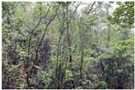 |  |  |
| Grassland | Grassland is defined as an area covered by herbaceous plants with a growth coverage of 5% or more. |  |  |  |
| water area | Refers to areas covered by water bodies, including natural or artificial bodies of water such as lakes, rivers, and ponds. |  |  |  |
| Residential land | Land designated for human habitation and related activities, including residential areas, public facilities, and commercial zones. |  |  |  |
| Debris flow trace areas | Disaster-affected sites refer to land that has experienced natural disasters and has not been significantly disturbed by human activity. | 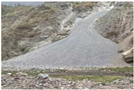 |  |  |
| Unutilized land | Land in its natural state that has not yet been developed, cultivated, or built upon. |  |  |  |
| Landscape Index | Scale | Computation Formula | Description |
|---|---|---|---|
| Patch Density | Type | Number of patches per unit area | |
| Largest patch index | Type | The percentage of the largest patch in the total landscape | |
| Total (Class) Area | Type | Total area by type | |
| Splitting Index | Type | Ratio of the sum of squares of the total landscape area to the sum of squares of the patch area, and the degree of separation of different patch individuals within the landscape type (%) | |
| Aggregation Index | Type | The number of similar adjacents involving the corresponding class (%) | |
| Contagion Index | Landscape | Reflect the aggregation degree or extension trend of different plaque types | |
| Shannon’s diversity Index | Landscape | Reflects landscape heterogeneity |
| Residential Area | Cultivated Land Area | Hazard-Prone Area | ||||
|---|---|---|---|---|---|---|
| Non-Flood Season | Flood Season | Non-Flood Season | Flood Season | Non-Flood Season | Flood Season | |
| Total phosphorus (mg/L) | 0.03 | 0.11 | 0.04 | 0.04 | 0.09 | 0.14 |
| Total nitrogen (mg/L) | 1.32 | 2.73 | 1.87 | 2.13 | 1.20 | 3.35 |
| Ammonia nitrogen (mg/L) | 0.16 | 0.40 | 0.19 | 0.26 | 0.22 | 1.18 |
| COD (mg/L) | 4.42 | 14.04 | 3.35 | 9.84 | 3.09 | 24.27 |
| Dissolved oxygen (mg/L) | 8.04 | 6.53 | 8.67 | 7.29 | 7.63 | 6.60 |
| Conductivity (µs/cm) | 409.85 | 581.21 | 348.11 | 357.17 | 551.19 | 562.83 |
| pH | 8.41 | 8.41 | 8.50 | 8.50 | 8.22 | 8.24 |
| Temperature (°C) | 17.52 | 28.14 | 21.10 | 26.48 | 18.41 | 26.52 |
| Scale | Period | Explanatory Variables (%) | Complete Explanatory Variable (%) | Contribution of Key Landscape Pattern Index (%) | |||
|---|---|---|---|---|---|---|---|
| Axis 1 | Axis 2 | Axis 3 | Axis 4 | ||||
| Sub-basin | non-flood season | 51.46 | 22.45 | 10.77 | 6.17 | 90.84 | AI_hazard-influenced area (43.1), AI-forest land (15.5) |
| flood season | 57.74 | 19.44 | 8.56 | 5.92 | 96.50 | IJI-residential area (40.7), PD-forest land (17.7) | |
| River course | non-flood season | 50.95 | 22.09 | 9.17 | 5.97 | 88.15 | PD_hazard-influenced area (46.8), PD-forest land (15.3) |
| flood season | 59.83 | 18.20 | 9.97 | 6.00 | 94.00 | PD_hazard-influenced area (40.1), DIV-cultivated land area (16.8) | |
| Location | Sand Transport Rate of Non-Flood Season (kg/s) | Sand Transport Rate of Flood Season (kg/s) | Proportion of Hazard Area (%) |
|---|---|---|---|
| Anni Gully | 0.105 | 0.417 | 0.118 |
| Taojia Small River | 0.080 | 2.141 | 1.229 |
| Jiangjia Gully | 0.001 | 7.332 | 21.765 |
Disclaimer/Publisher’s Note: The statements, opinions and data contained in all publications are solely those of the individual author(s) and contributor(s) and not of MDPI and/or the editor(s). MDPI and/or the editor(s) disclaim responsibility for any injury to people or property resulting from any ideas, methods, instructions or products referred to in the content. |
© 2026 by the authors. Licensee MDPI, Basel, Switzerland. This article is an open access article distributed under the terms and conditions of the Creative Commons Attribution (CC BY) license.
Share and Cite
Tang, H.; Yang, J.; Yang, C.; Li, S.; Qi, L.; Zhou, L.; Tong, C.; Ren, H.; Yang, Y. Impacts of Land-Use Types and Landscape Patterns on River Water Quality in the Dry-Hot Valley Basin with Frequent Geological Hazards in the Southwest China. Water 2026, 18, 567. https://doi.org/10.3390/w18050567
Tang H, Yang J, Yang C, Li S, Qi L, Zhou L, Tong C, Ren H, Yang Y. Impacts of Land-Use Types and Landscape Patterns on River Water Quality in the Dry-Hot Valley Basin with Frequent Geological Hazards in the Southwest China. Water. 2026; 18(5):567. https://doi.org/10.3390/w18050567
Chicago/Turabian StyleTang, Honglei, Jiangwen Yang, Chunyu Yang, Songpei Li, Liang Qi, Linxuan Zhou, Chenjue Tong, Haonan Ren, and Yifei Yang. 2026. "Impacts of Land-Use Types and Landscape Patterns on River Water Quality in the Dry-Hot Valley Basin with Frequent Geological Hazards in the Southwest China" Water 18, no. 5: 567. https://doi.org/10.3390/w18050567
APA StyleTang, H., Yang, J., Yang, C., Li, S., Qi, L., Zhou, L., Tong, C., Ren, H., & Yang, Y. (2026). Impacts of Land-Use Types and Landscape Patterns on River Water Quality in the Dry-Hot Valley Basin with Frequent Geological Hazards in the Southwest China. Water, 18(5), 567. https://doi.org/10.3390/w18050567