Linking Self-Organized Heterogeneities to Solute Transport in Mixing-Induced Precipitated Porous Media

 , and
, and
Abstract
1. Introduction
2. Experimental Overview
3. Materials and Methods
3.1. Construction of Composite Permeability Fields
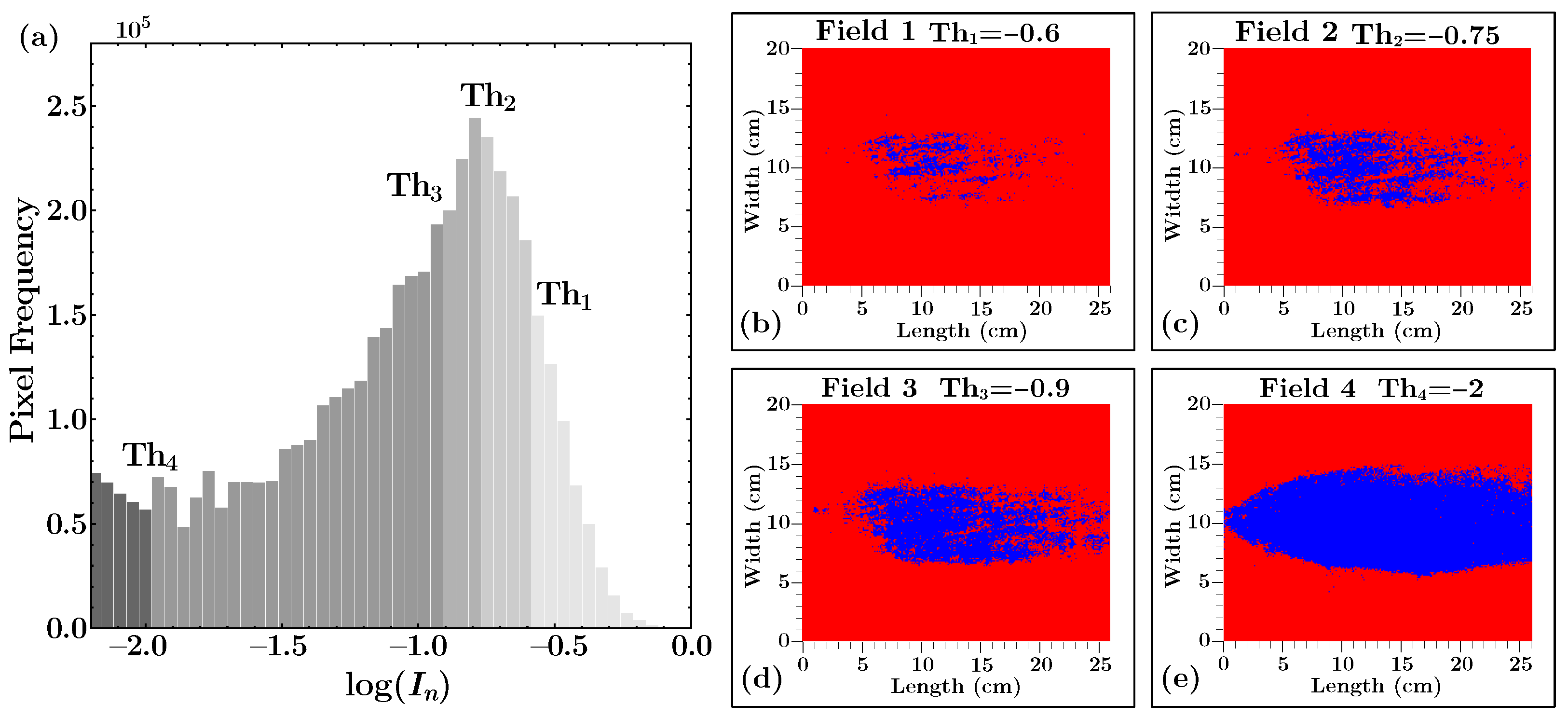
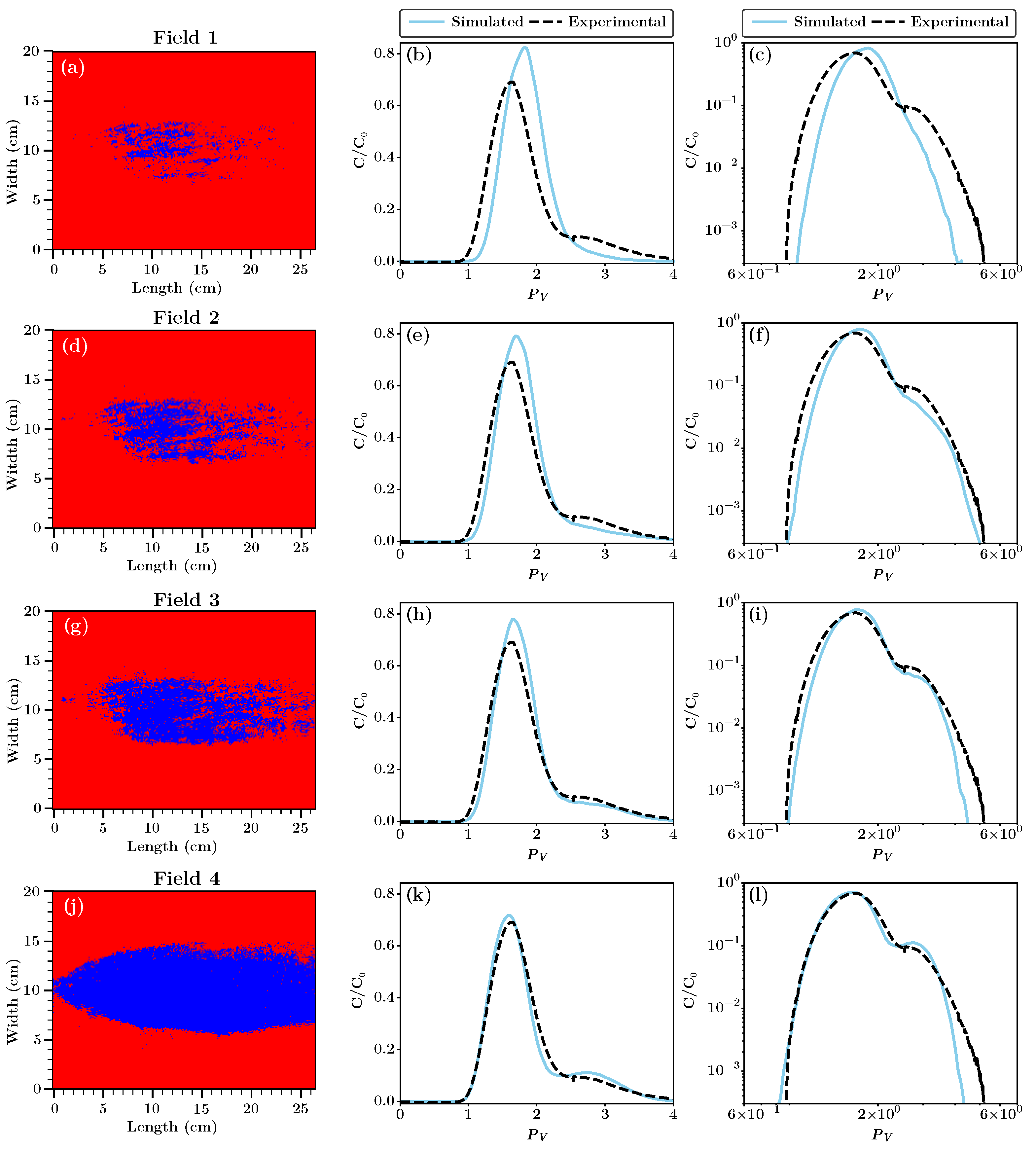
- , corresponding to the 0th percentile (), was determined through visual inspection to define the boundary of the total precipitate area.
- , corresponding to the 85th percentile (), covers 15% of the total precipitated area.
- , corresponding to the 70th percentile (), covers 30% of the total precipitated area.
- , corresponding to the 55th percentile (), covers 45% of the total precipitated area.
3.2. Flow and Transport Model
3.3. Model Calibration
4. Results
4.1. Dual Composite Permeability Models
4.2. Triple Composite Permeability Models
5. Discussion
6. Conclusions
- 1.
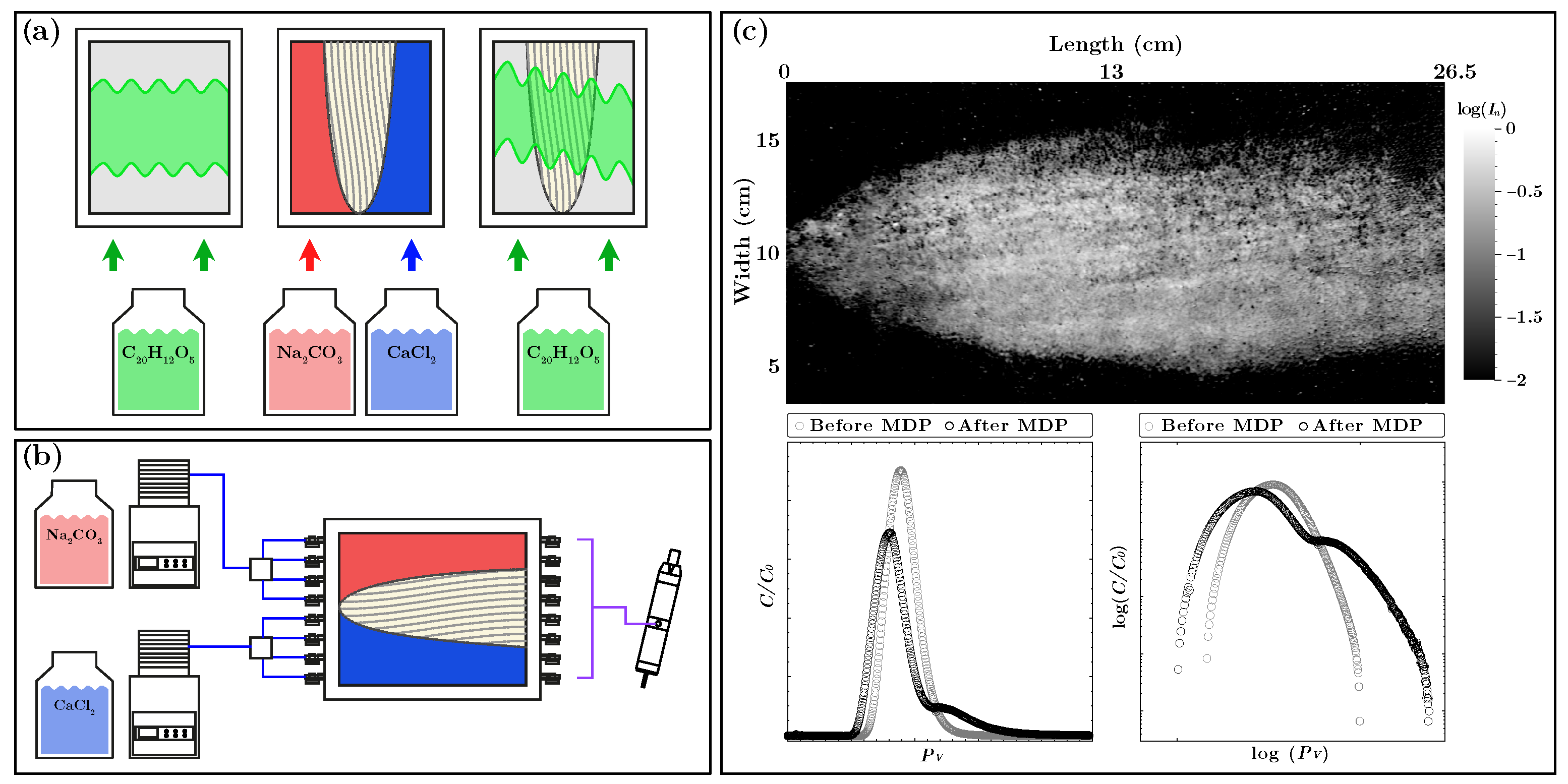
- Two important features must be captured to accurately reproduce non-Fickian solute transport observed after mineral precipitation: (a) identify the area of total extension of the precipitation; and (b) represent the internal heterogeneous structure conducive to preferential channels.
- 2.
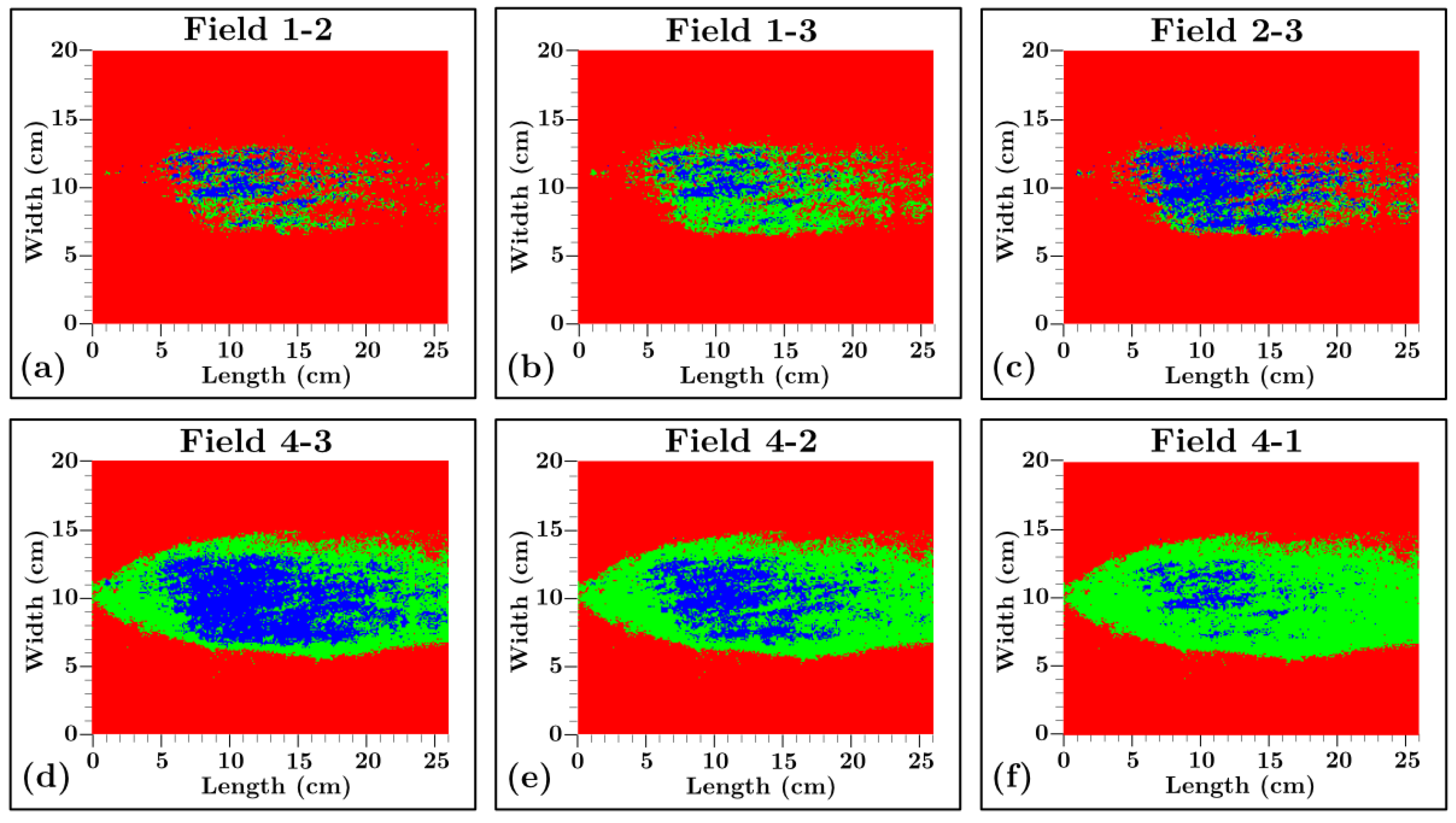
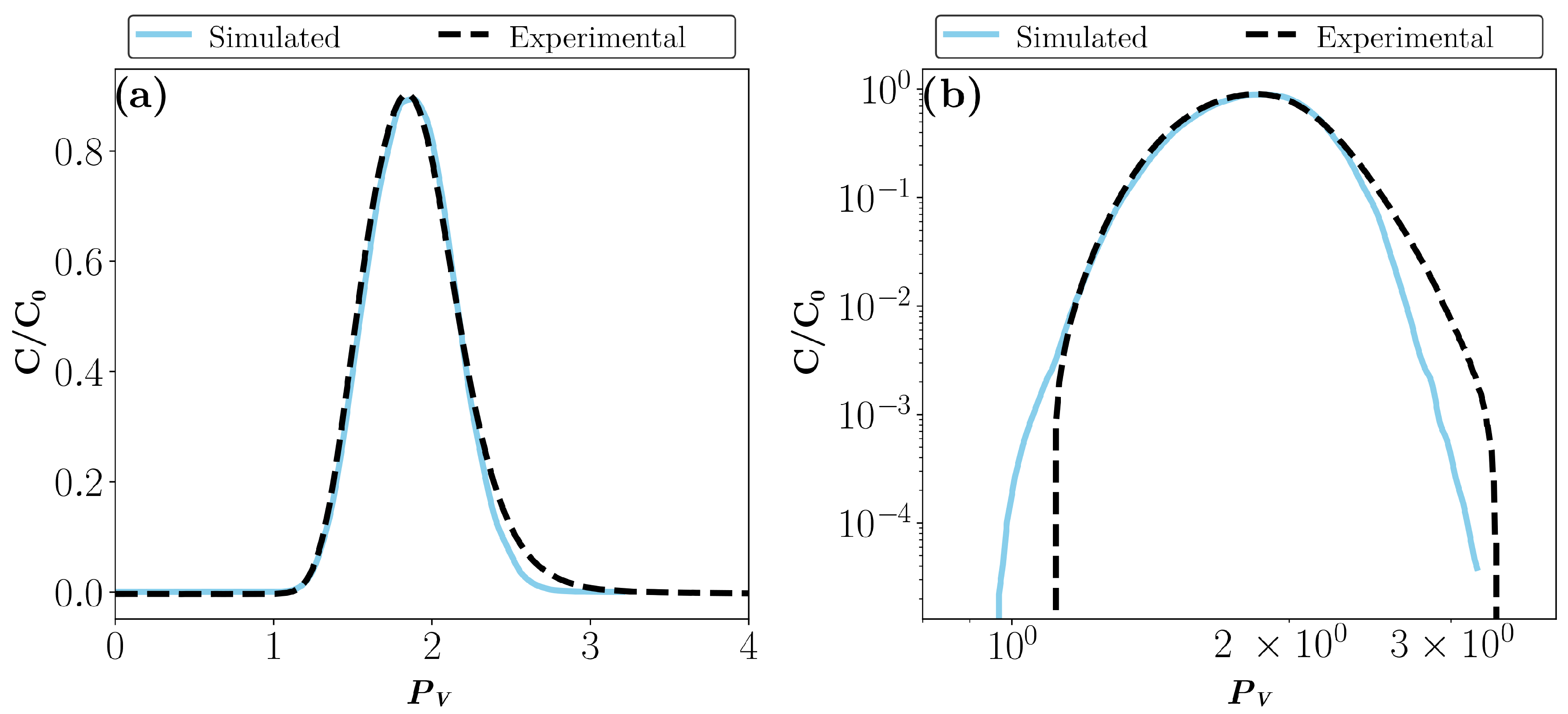
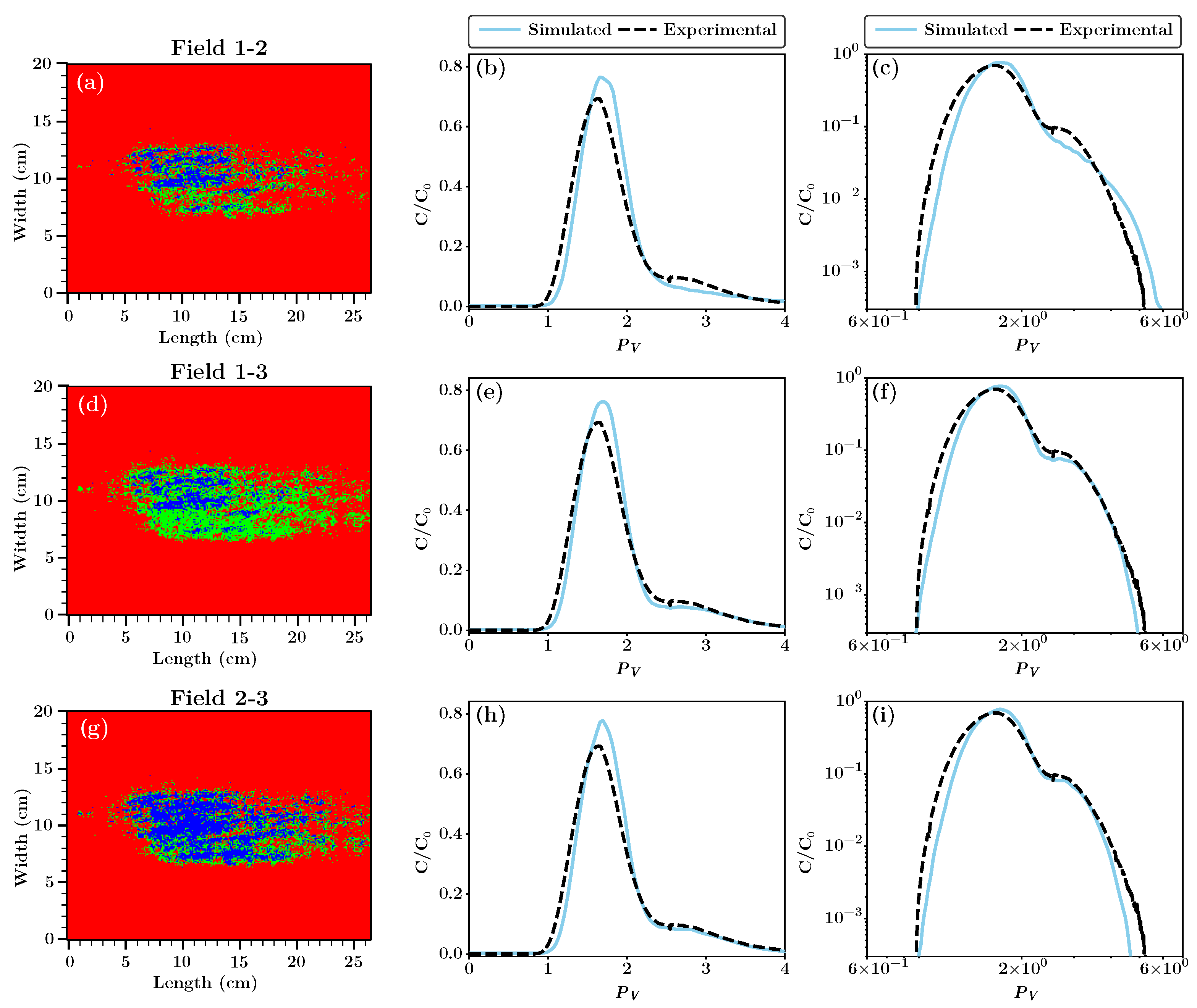
- Dual composite permeability fields, which incorporate the entire area affected by precipitation, effectively capture non-Fickian behavior in the model. This approach provides an excellent fit for both the arrival time and the two peaks characteristic of dual-permeability media. However, the model still faces challenges in fully capturing the transition between the peaks and the maximum value of the first peak. The model suggests that the first peak is due to bypass flow through non-precipitated zones, leading to earlier arrival times. The second peak, on the other hand, reflects the concentration of flow within the low-permeability calcite layer.
- 3.
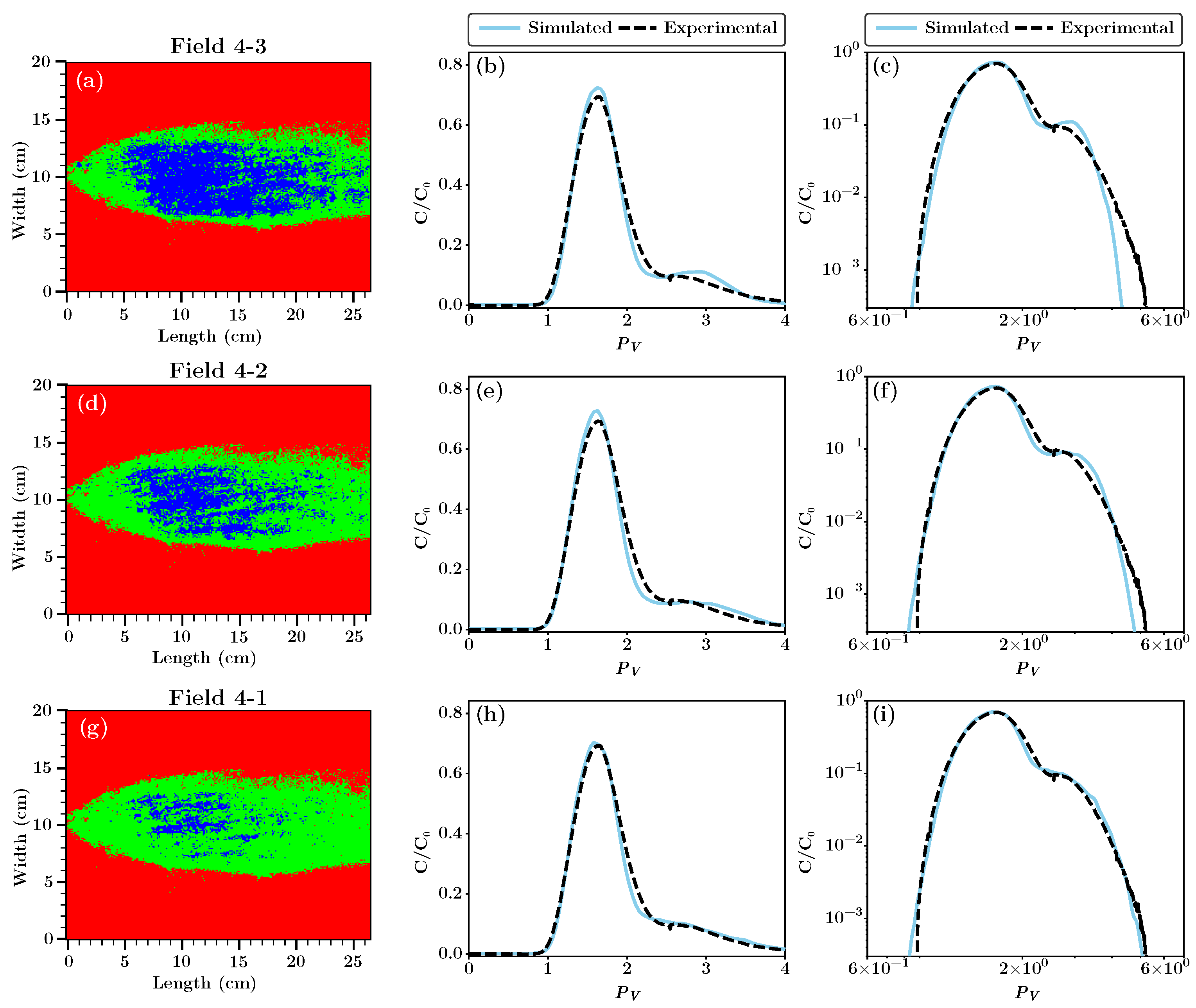
- The best way to represent the non-Fickian behavior observed after mineral precipitation was achieved by considering triple composite permeability fields, taking into account the total actual area of the precipitate along with defining the high-precipitation area as a small region. In this way, the model reduces the overestimation of the first peak, enhances the transition between peaks, improves the representation of the second peak, and extends the tailing over a longer period.
Author Contributions
Funding
Data Availability Statement
Acknowledgments
Conflicts of Interest
References
- Bachu, S.; Gunter, W.; Perkins, E. Aquifer disposal of CO2: Hydrodynamic and mineral trapping. Energy Convers. Manag. 1994, 35, 269–279. [Google Scholar] [CrossRef]
- Saripalli, K.P.; Meyer, P.D.; Bacon, D.H.; Freedman, V.L. Changes in hydrologic properties of aquifer media due to chemical reactions: A review. Crit. Rev. Environ. Sci. Technol. 2001, 31, 311–349. [Google Scholar] [CrossRef]
- Li, L.; Benson, C.H.; Lawson, E.M. Impact of mineral fouling on hydraulic behavior of permeable reactive barriers. Groundwater 2005, 43, 582–596. [Google Scholar] [CrossRef]
- Emmanuel, S.; Berkowitz, B. Mixing-induced precipitation and porosity evolution in porous media. Adv. Water Resour. 2005, 28, 337–344. [Google Scholar] [CrossRef]
- Cil, M.B.; Xie, M.; Packman, A.I.; Buscarnera, G. Solute mixing regulates heterogeneity of mineral precipitation in porous media. Geophys. Res. Lett. 2017, 44, 6658–6666. [Google Scholar] [CrossRef]
- Mackenzie, P.D.; Horney, D.P.; Sivavec, T.M. Mineral precipitation and porosity losses in granular iron columns. J. Hazard. Mater. 1999, 68, 1–17. [Google Scholar] [CrossRef]
- Zhang, C.; Dehoff, K.; Hess, N.; Oostrom, M.; Wietsma, T.W.; Valocchi, A.J.; Fouke, B.W.; Werth, C.J. Pore-scale study of transverse mixing induced CaCO3 precipitation and permeability reduction in a model subsurface sedimentary system. Environ. Sci. Technol. 2010, 44, 7833–7838. [Google Scholar] [CrossRef]
- Jeong, H.Y.; Jun, S.C.; Cheon, J.Y.; Park, M. A review on clogging mechanisms and managements in aquifer storage and recovery (ASR) applications. Geosci. J. 2018, 22, 667–679. [Google Scholar] [CrossRef]
- Fujita, Y.; Ferris, F.G.; Lawson, R.D.; Colwell, F.S.; Smith, R.W. Subscribed content calcium carbonate precipitation by ureolytic subsurface bacteria. Geomicrobiol. J. 2000, 17, 305–318. [Google Scholar] [CrossRef]
- Zhu, T.; Dittrich, M. Carbonate precipitation through microbial activities in natural environment, and their potential in biotechnology: A review. Front. Bioeng. Biotechnol. 2016, 4, 4. [Google Scholar] [CrossRef]
- Qin, C.Z.; Hassanizadeh, S.M.; Ebigbo, A. Pore-scale network modeling of microbially induced calcium carbonate precipitation: Insight into scale dependence of biogeochemical reaction rates. Water Resour. Res. 2016, 52, 8794–8810. [Google Scholar] [CrossRef]
- Warren, L.A.; Maurice, P.A.; Parmar, N.; Ferris, F.G. Microbially mediated calcium carbonate precipitation: Implications for interpreting calcite precipitation and for solid-phase capture of inorganic contaminants. Geomicrobiol. J. 2001, 18, 93–115. [Google Scholar] [CrossRef]
- Wang, Y.; Soga, K.; Dejong, J.T.; Kabla, A.J. A microfluidic chip and its use in characterising the particle-scale behaviour of microbial-induced calcium carbonate precipitation (MICP). Géotechnique 2019, 69, 1086–1094. [Google Scholar] [CrossRef]
- Castro-Alonso, M.J.; Montañez-Hernandez, L.E.; Sanchez-Muñoz, M.A.; Macias Franco, M.R.; Narayanasamy, R.; Balagurusamy, N. Microbially induced calcium carbonate precipitation (MICP) and its potential in bioconcrete: Microbiological and molecular concepts. Front. Mater. 2019, 6, 126. [Google Scholar] [CrossRef]
- Starnoni, M.; Sanchez-Vila, X. Pore-scale modelling of subsurface biomineralization for carbon mineral storage. Adv. Water Resour. 2024, 185, 104641. [Google Scholar] [CrossRef]
- Neupane, D.; Yasuhara, H.; Kinoshita, N.; Unno, T. Applicability of enzymatic calcium carbonate precipitation as a soil-strengthening technique. J. Geotech. Geoenvironmental Eng. 2013, 139, 2201–2211. [Google Scholar] [CrossRef]
- Ahenkorah, I.; Rahman, M.M.; Karim, M.R.; Beecham, S. Enzyme induced calcium carbonate precipitation and its engineering application: A systematic review and meta-analysis. Constr. Build. Mater. 2021, 308, 125000. [Google Scholar] [CrossRef]
- Zhao, C.; Xiao, Y.; Liu, H.; Chu, J. Effects of urease and cementing solution concentrations on micro-scale enzymatic mineralisation characteristics. Géotechnique 2025, 75, 732–746. [Google Scholar] [CrossRef]
- Zhang, Y.; Liu, Y.; Sun, X.; Zeng, W.; Xing, H.; Lin, J.; Kang, S.; Yu, L. Application of microbially induced calcium carbonate precipitation (MICP) technique in concrete crack repair: A review. Constr. Build. Mater. 2024, 411, 134313. [Google Scholar] [CrossRef]
- Konstantinou, C.; Wang, Y. Unlocking the potential of microbially induced calcium carbonate precipitation (MICP) for hydrological applications: A review of opportunities, challenges, and environmental considerations. Hydrology 2023, 10, 178. [Google Scholar] [CrossRef]
- Canal, J.; Delgado, J.; Falcón, I.; Yang, Q.; Juncosa, R.; Barrientos, V. Injection of CO2-saturated water through a siliceous sandstone plug from the Hontomin test site (Spain): Experiment and modeling. Environ. Sci. Technol. 2013, 47, 159–167. [Google Scholar] [CrossRef] [PubMed]
- DePaolo, D.J.; Cole, D.R. Geochemistry of geologic carbon sequestration: An overview. Rev. Mineral. Geochem. 2013, 77, 1–14. [Google Scholar] [CrossRef]
- Xu, R.; Li, R.; Ma, J.; He, D.; Jiang, P. Effect of mineral dissolution/precipitation and CO2 exsolution on CO2 transport in geological carbon storage. Accounts Chem. Res. 2017, 50, 2056–2066. [Google Scholar] [CrossRef] [PubMed]
- Wu, J.; Wang, X.B.; Wang, H.F.; Zeng, R.J. Microbially induced calcium carbonate precipitation driven by ureolysis to enhance oil recovery. RSC Adv. 2017, 7, 37382–37391. [Google Scholar] [CrossRef]
- Song, C.; Elsworth, D. Microbially induced calcium carbonate plugging for enhanced oil recovery. Geofluids 2020, 2020, 21789. [Google Scholar] [CrossRef]
- Tariq, Z.; Mahmoud, M.; Alahmari, M.; Bataweel, M.; Mohsen, A. Lost circulation mitigation using modified enzyme induced calcite precipitation technique. J. Pet. Sci. Eng. 2022, 210, 110043. [Google Scholar] [CrossRef]
- Jones, T.A.; Detwiler, R.L. Fracture sealing by mineral precipitation: The role of small-scale mineral heterogeneity. Geophys. Res. Lett. 2016, 43, 7564–7571. [Google Scholar] [CrossRef]
- Yang, F.; Guan, D.; Starchenko, V.; Yuan, K.; Stack, A.G.; Ling, B. Effect of nucleation heterogeneity on mineral precipitation in confined environments. Geophys. Res. Lett. 2024, 51, e2023GL107185. [Google Scholar] [CrossRef]
- Ortoleva, P.; Merino, E.; Moore, C.; Chadam, J. Geochemical self-organization I; reaction-transport feedbacks and modeling approach. Am. J. Sci. 1987, 287, 979–1007. [Google Scholar] [CrossRef]
- Renard, F.; Gratier, J.P.; Ortoleva, P.; Brosse, E.; Bazin, B. Self-organization during reactive fluid flow in a porous medium. Geophys. Res. Lett. 1998, 25, 385–388. [Google Scholar] [CrossRef]
- Gonzalez-Subiabre, G.; Bertran, O.; Fernandez-Garcia, D. Impact of Sharp Soil Interfaces on Solute Transport: Insights from a Reactive Tracer Test in a 2D Intermediate-Scale Experiment. Water 2025, 17, 2382. [Google Scholar] [CrossRef]
- Emmanuel, S.; Ague, J.J.; Walderhaug, O. Interfacial energy effects and the evolution of pore size distributions during quartz precipitation in sandstone. Geochim. Cosmochim. Acta 2010, 74, 3539–3552. [Google Scholar] [CrossRef]
- Borgia, A.; Pruess, K.; Kneafsey, T.J.; Oldenburg, C.M.; Pan, L. Numerical simulation of salt precipitation in the fractures of a CO2-enhanced geothermal system. Geothermics 2012, 44, 13–22. [Google Scholar] [CrossRef]
- Stack, A.G. Precipitation in pores: A geochemical frontier. Rev. Mineral. Geochem. 2015, 80, 165–190. [Google Scholar] [CrossRef]
- Noiriel, C.; Seigneur, N.; Le Guern, P.; Lagneau, V. Geometry and mineral heterogeneity controls on precipitation in fractures: An X-ray micro-tomography and reactive transport modeling study. Adv. Water Resour. 2021, 152, 103916. [Google Scholar] [CrossRef]
- Jones, T.A.; Detwiler, R.L. Mineral precipitation in fractures: Using the level-set method to quantify the role of mineral heterogeneity on transport properties. Water Resour. Res. 2019, 55, 4186–4206. [Google Scholar] [CrossRef]
- Detwiler, R.L.; Glass, R.J.; Bourcier, W.L. Experimental observations of fracture dissolution: The role of Peclet number on evolving aperture variability. Geophys. Res. Lett. 2003, 30, 1648. [Google Scholar] [CrossRef]
- De Simoni, M.; Sanchez-Vila, X.; Carrera, J.; Saaltink, M. A mixing ratios-based formulation for multicomponent reactive transport. Water Resour. Res. 2007, 43, W07419. [Google Scholar] [CrossRef]
- Dentz, M.; Le Borgne, T.; Englert, A.; Bijeljic, B. Mixing, spreading and reaction in heterogeneous media: A brief review. J. Contam. Hydrol. 2011, 120, 1–17. [Google Scholar] [CrossRef]
- Rege, S.D.; Fogler, H.S. Competition among flow, dissolution, and precipitation in porous media. AIChE J. 1989, 35, 1177–1185. [Google Scholar] [CrossRef]
- Steefel, C.I.; Maher, K. Fluid-rock interaction: A reactive transport approach. Rev. Mineral. Geochem. 2009, 70, 485–532. [Google Scholar] [CrossRef]
- Jiang, Q.R.; Hu, R.; Deng, H.; Ling, B.; Yang, Z.; Chen, Y.F. Controls of the Nucleation Rate and Advection Rate on Barite Precipitation in Fractured Porous Media. Langmuir 2025, 41, 1250–1259. [Google Scholar] [CrossRef]
- Battiato, I.; Tartakovsky, D. Applicability regimes for macroscopic models of reactive transport in porous media. J. Contam. Hydrol. 2011, 120, 18–26. [Google Scholar] [CrossRef] [PubMed]
- Osselin, F.; Kondratiuk, P.; Budek, A.; Cybulski, O.; Garstecki, P.; Szymczak, P. Microfluidic observation of the onset of reactive-infitration instability in an analog fracture. Geophys. Res. Lett. 2016, 43, 6907–6915. [Google Scholar] [CrossRef]
- Sabo, M.S.; Beckingham, L.E. Porosity-permeability evolution during simultaneous mineral dissolution and precipitation. Water Resour. Res. 2021, 57, e2020WR029072. [Google Scholar] [CrossRef]
- Masoudi, M.; Nooraiepour, M.; Deng, H.; Hellevang, H. Mineral Precipitation and Geometry Alteration in Porous Structures: How to Upscale Variations in Permeability–Porosity Relationship? Energy Fuels 2024, 38, 9988–10001. [Google Scholar] [CrossRef]
- Mountassir, G.E.; Lunn, R.J.; Moir, H.; MacLachlan, E. Hydrodynamic coupling in microbially mediated fracture mineralization: Formation of self-organized groundwater flow channels. Water Resour. Res. 2014, 50, 1–16. [Google Scholar] [CrossRef]
- Li, X.; Yang, X. Effects of physicochemical properties and structural heterogeneity on mineral precipitation and dissolution in saturated porous media. Appl. Geochem. 2022, 146, 105474. [Google Scholar] [CrossRef]
- González-Subiabre, G.; Pérez-Illanes, R.; Reales-Núñez, D.; Saaltink, M.W.; Trabucchi, M.; Fernàndez-Garcia, D. Impact of Mixing-Driven Calcite Precipitation on Solute Transport Dynamics: Insights from Laboratory Visualization and Tracer tests Analysis, 2026. Submitted to Water. Available online: https://www.preprints.org/manuscript/202601.2390 (accessed on 11 February 2026).
- Tartakovsky, A.M.; Redden, G.; Lichtner, P.C.; Scheibe, T.D.; Meakin, P. Mixing-induced precipitation: Experimental study and multiscale numerical analysis. Water Resour. Res. 2008, 44, W06S04. [Google Scholar] [CrossRef]
- Katz, G.E.; Berkowitz, B.; Guadagnini, A.; Saaltink, M.W. Experimental and modeling investigation of multicomponent reactive transport in porous media. J. Contam. Hydrol. 2011, 120, 27–44. [Google Scholar] [CrossRef]
- Schuszter, G.; Brau, F.; De Wit, A. Flow-driven control of calcium carbonate precipitation patterns in a confined geometry. Phys. Chem. Chem. Phys. 2016, 18, 25592–25600. [Google Scholar] [CrossRef] [PubMed]
- Schuszter, G.; Brau, F.; De Wit, A. Calcium carbonate mineralization in a confined geometry. Environ. Sci. Technol. Lett. 2016, 3, 156–159. [Google Scholar] [CrossRef]
- Schuszter, G.; De Wit, A. Comparison of flow-controlled calcium and barium carbonate precipitation patterns. J. Chem. Phys. 2016, 145, 224201. [Google Scholar] [CrossRef]
- Perkins, T.K.; Johnston, O. A review of diffusion and dispersion in porous media. Soc. Pet. Eng. J. 1963, 3, 70–84. [Google Scholar] [CrossRef]
- Bradski, G.; Kaehler, A. Learning OpenCV: Computer Vision with the OpenCV library; O’Reilly Media, Inc.: Sebastopol, CA, USA, 2008. [Google Scholar]
- Howse, J. OpenCV Computer Vision with Python; Packt Publishing: Birmingham, UK, 2013; Volume 27. [Google Scholar]
- Harbaugh, A.W. MODFLOW-2005, the US Geological Survey Modular Ground-Water Model: The Ground-Water Flow Process; US Department of the Interior, US Geological Survey: Reston, VA, USA, 2005; Volume 6. [Google Scholar]
- Pérez-Illanes, R.; Fernàndez-Garcia, D. MODPATH-RW: A Random Walk Particle Tracking Code for Solute Transport in Heterogeneous Aquifers. Groundwater 2024, 62, 617–634. [Google Scholar] [CrossRef]
- Pollock, D.W. User Guide for MODPATH Version 7—A Particle-Tracking Model for MODFLOW; Technical report; US Geological Survey: Reston, VA, USA, 2016. [Google Scholar]
- Levy, M.; Berkowitz, B. Measurement and analysis of non-Fickian dispersion in heterogeneous porous media. J. Contam. Hydrol. 2003, 64, 203–226. [Google Scholar] [CrossRef] [PubMed]



| Symbol | Properties | Values | Units |
|---|---|---|---|
| Pe | Péclet number | 523 | – |
| Q | Total flow rate | /s | |
| D | Molecular diffusion (*) | /s | |
| d | Glass beads diameter | m | |
| v | Velocity | m/s | |
| Porosity | 0.34 | – | |
| A | Cross section | ||
| Head difference | 0.014 | m | |
| L | Tank length | 0.265 | m |
| W | Tank width | 0.2 | m |
| H | Tank height | 0.01 | m |
| i | Hydraulic gradient | – | |
| Initial hydraulic cond. | 145.4 | m/d | |
| 5 × | mol/kgw | ||
| Na2CO3 | 2 × | mol/kgw | |
| 145.4 | mg/L |
| Field | Red Pixels | Blue Pixels | Green Pixels |
|---|---|---|---|
| 1 | 51,181 | 1819 | - |
| 2 | 48,309 | 4691 | - |
| 3 | 44,920 | 8080 | - |
| 4 | 34,525 | 18,475 | - |
| 2-1 | 48,309 | 1819 | 2872 |
| 3-1 | 44,920 | 1819 | 6261 |
| 3-2 | 44,920 | 4691 | 3389 |
| 4-1 | 34,525 | 1819 | 16,656 |
| 4-2 | 34,525 | 4691 | 13,784 |
| 4-3 | 34,525 | 8080 | 10,395 |
| Symbols | Parameters | Value | Units |
|---|---|---|---|
| W | Aquifer width | 0.2 | m |
| L | Aquifer length | 0.265 | m |
| H | Aquifer height | 0.01 | m |
| Q | Total flow rate | 0.0154 | /d |
| Initial porosity | 0.34 | - | |
| Initial hydraulic cond. | 145.4 | m/d |
| Symbol | Parameter | Value | Unit |
|---|---|---|---|
| Longitudinal dispersivity | 0.00265 | m | |
| Transverse dispersivity | 0.001 | m | |
| Coefficient of determination | 0.9939 | - | |
| RMSE | Root mean squared error | 0.01946 | - |
| Field | (m/d) | RMSE | AIC | ||
|---|---|---|---|---|---|
| 1 | 8 | 0.055 | 0.7053 | 0.1022 | 998.66 |
| 2 | 17 | 0.117 | 0.9180 | 0.0539 | 279.52 |
| 3 | 37 | 0.254 | 0.9595 | 0.0379 | −116.33 |
| 4 | 60 | 0.413 | 0.9838 | 0.0239 | −634.57 |
| Field | (m/d) | (m/d) | RMSE | AIC | |||
|---|---|---|---|---|---|---|---|
| 1-2 | 22 | 13 | 0.151 | 0.089 | 0.934 | 0.048 | 151.22 |
| 1-3 | 45 | 20 | 0.310 | 0.138 | 0.964 | 0.035 | −203.80 |
| 2-3 | 65 | 30 | 0.447 | 0.206 | 0.955 | 0.039 | −82.17 |
| Field | (m/d) | (m/d) | RMSE | AIC | |||
|---|---|---|---|---|---|---|---|
| 4-3 | 88 | 48 | 0.605 | 0.330 | 0.988 | 0.019 | −890.46 |
| 4-2 | 78 | 32 | 0.536 | 0.220 | 0.985 | 0.022 | −725.68 |
| 4-1 | 73 | 17 | 0.502 | 0.117 | 0.991 | 0.017 | −1015.48 |
Disclaimer/Publisher’s Note: The statements, opinions and data contained in all publications are solely those of the individual author(s) and contributor(s) and not of MDPI and/or the editor(s). MDPI and/or the editor(s) disclaim responsibility for any injury to people or property resulting from any ideas, methods, instructions or products referred to in the content. |
© 2026 by the authors. Licensee MDPI, Basel, Switzerland. This article is an open access article distributed under the terms and conditions of the Creative Commons Attribution (CC BY) license.
Share and Cite
González-Subiabre, G.; Reales-Núñez, D.; Pérez-Illanes, R.; Fernàndez-Garcia, D. Linking Self-Organized Heterogeneities to Solute Transport in Mixing-Induced Precipitated Porous Media. Water 2026, 18, 502. https://doi.org/10.3390/w18040502
González-Subiabre G, Reales-Núñez D, Pérez-Illanes R, Fernàndez-Garcia D. Linking Self-Organized Heterogeneities to Solute Transport in Mixing-Induced Precipitated Porous Media. Water. 2026; 18(4):502. https://doi.org/10.3390/w18040502
Chicago/Turabian StyleGonzález-Subiabre, Guido, Daniela Reales-Núñez, Rodrigo Pérez-Illanes, and Daniel Fernàndez-Garcia. 2026. "Linking Self-Organized Heterogeneities to Solute Transport in Mixing-Induced Precipitated Porous Media" Water 18, no. 4: 502. https://doi.org/10.3390/w18040502
APA StyleGonzález-Subiabre, G., Reales-Núñez, D., Pérez-Illanes, R., & Fernàndez-Garcia, D. (2026). Linking Self-Organized Heterogeneities to Solute Transport in Mixing-Induced Precipitated Porous Media. Water, 18(4), 502. https://doi.org/10.3390/w18040502