Environmental Patterns of Phytoplankton Community Composition Across Lentic and Lotic Systems in Ecuador


Abstract
1. Introduction
2. Materials and Methods
2.1. Study Area
2.2. Sample Collection and Analysis
2.3. Physicochemical Parameters
2.4. Water Quality Assessment
2.5. Statistical Analysis
3. Results
3.1. Physicochemical Parameters of the Water
3.2. Taxonomic Richness and Community Composition
3.3. Palmer’s Organic Pollution Index
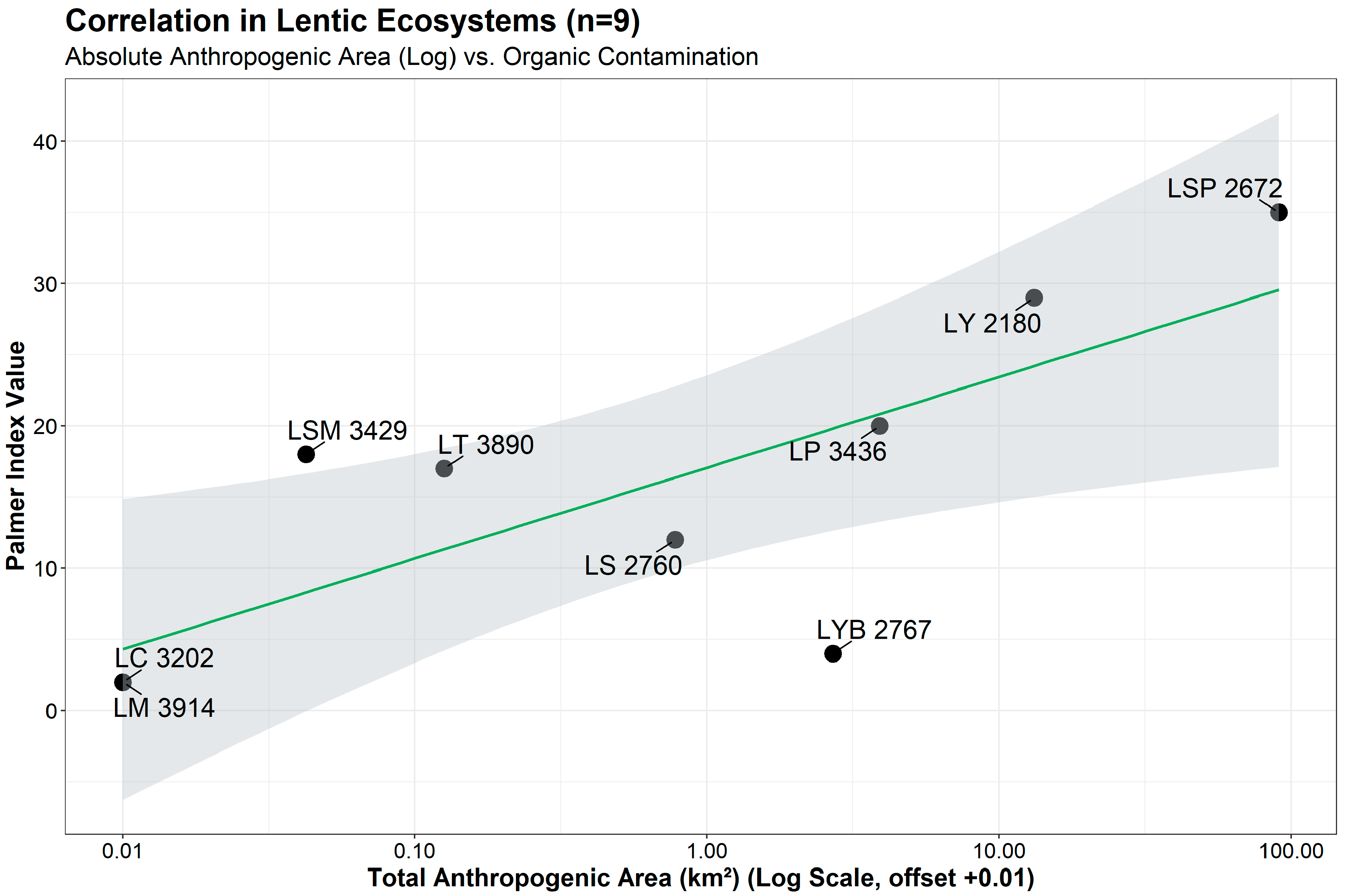
3.4. Correlation Between Land Use and Water Quality
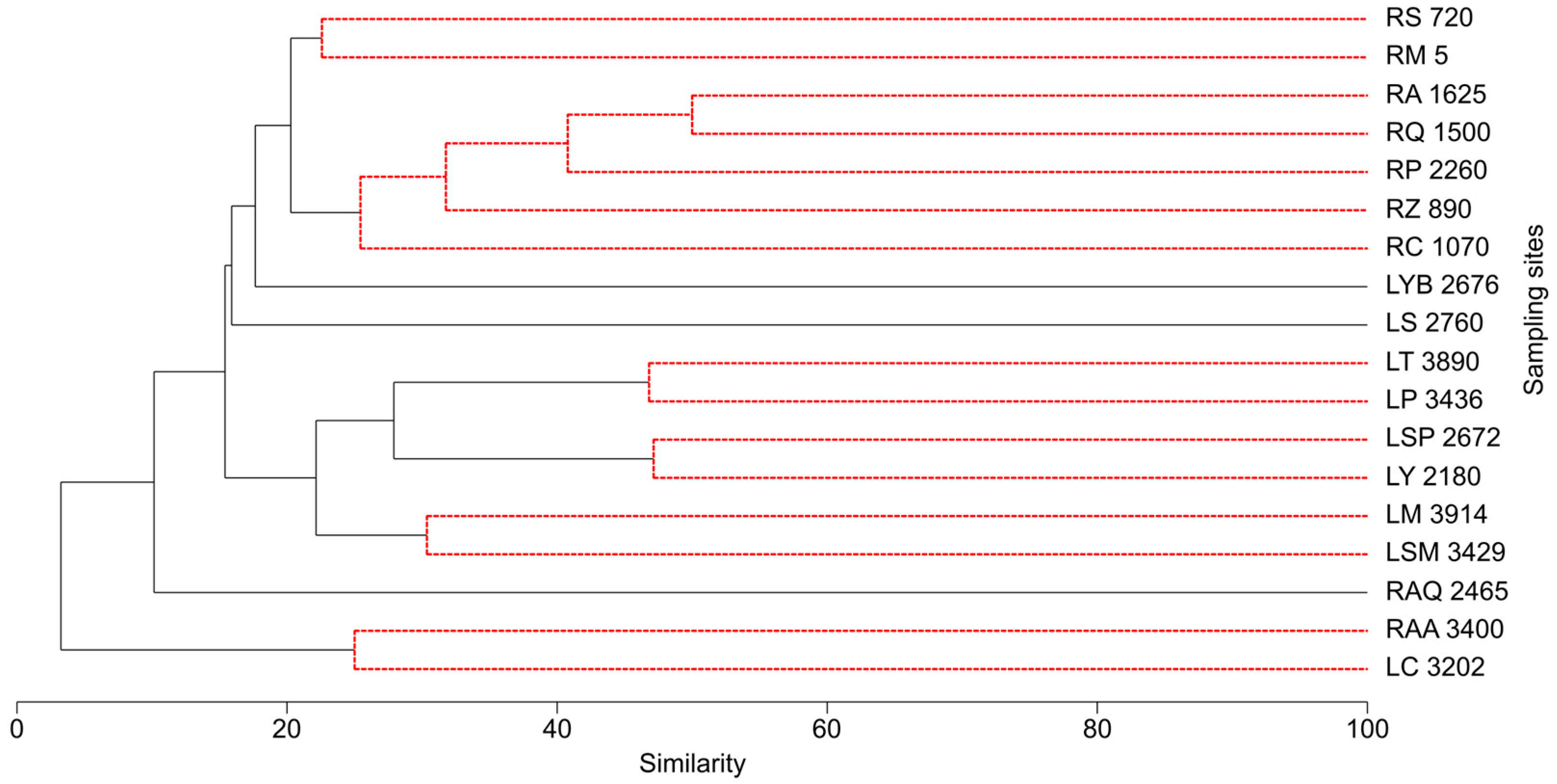
3.5. Community Composition
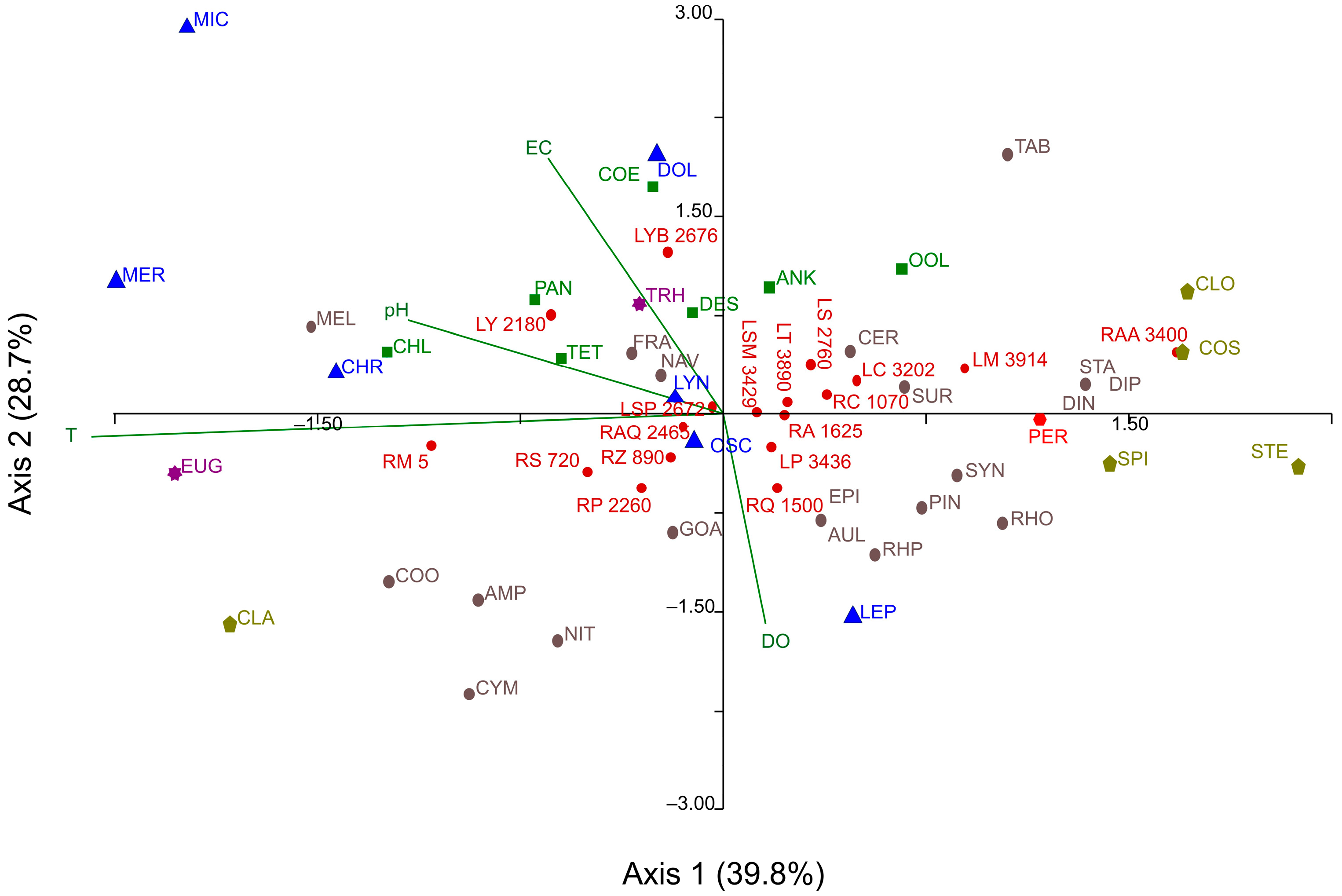
3.6. Canonical Correspondence Analysis (CCA)
4. Discussion
4.1. Phytoplankton Diversity
4.2. Ecological Differentiation Between Lentic and Lotic Environments
4.3. Human Pressure as a Secondary Structuring Gradient
4.4. Applicability and Limitations of Palmer’s Organic Pollution Index
4.5. Influence of Land Use: Strong in Lakes, Weak in Rivers
4.6. Environmental Patterns and Community-Level Associations
4.7. Implications for Monitoring and Water Management
- Lakes warrant priority monitoring, as their phytoplankton communities reflect cumulative basin-scale pressures and long-term changes in land use.
- Rivers require targeted control of point-source discharges, particularly industrial and urban effluents, as these exert a disproportionate influence on water quality.
- Palmer’s Index is useful for rapid assessment, but should be complemented with nutrient measurements, conductivity, and cyanobacterial functional indicators, especially in endorheic or geochemically atypical lakes.
- The recurrent detection of potentially toxic cyanobacteria (Microcystis, Dolichospermum, Raphidiopsis) highlights the need for regular toxin monitoring using molecular or biochemical methods.
- Phytoplankton proved to be robust bioindicators, supporting their integration into national water-quality assessment frameworks and future monitoring programs in the Andes.
Supplementary Materials
Author Contributions
Funding
Data Availability Statement
Acknowledgments
Conflicts of Interest
Appendix A

| Code | LY | LSP | LS | LYB | LC | LSM | LP | LT | LM | RM | RS | RZ | RC | RQ | RA | RP | RAQ | RAA | ||
|---|---|---|---|---|---|---|---|---|---|---|---|---|---|---|---|---|---|---|---|---|
| Cyanobacteria | Calothrix sp. | x | x | |||||||||||||||||
| Chroococcus sp. | CHR | x | x | x | x | |||||||||||||||
| ▪ Cyanosarcina sp. | x | x | x | |||||||||||||||||
| Cylindrospermum sp. | x | x | x | |||||||||||||||||
| Dichothrix sp. | x | |||||||||||||||||||
| * Dolichospermum sp. | DOL | x | x | x | x | |||||||||||||||
| ▪ Gomphosphaeria sp. | x | x | ||||||||||||||||||
| Leptolyngbya sp. | LEP | x | x | x | x | |||||||||||||||
| Lyngbya sp. | LYN | x | x | x | x | x | ||||||||||||||
| Merismopedia glauca | MER | x | x | x | x | |||||||||||||||
| * Microcystis aeruginosa | MIC | x | x | x | x | x | ||||||||||||||
| Nostoc commune | x | x | x | |||||||||||||||||
| Oscillatoria sp. | OSC | x | x | x | x | x | x | x | x | x | x | |||||||||
| Pseudanabaena sp. | x | x | ||||||||||||||||||
| * Raphidiopsis sp. | x | |||||||||||||||||||
| ▪ Stigonema sp. | x | |||||||||||||||||||
| Synechocystis sp. | x | |||||||||||||||||||
| Heterokontophyta | Amphora sp. | AMP | x | x | x | x | x | x | x | |||||||||||
| Aulacoseira sp. | AUL | x | x | x | x | x | ||||||||||||||
| Ceratoneis sp. | CER | x | x | x | x | x | x | x | x | x | x | |||||||||
| Cocconeis placentula | COO | x | x | x | x | x | x | |||||||||||||
| Cymbella sp. | CYM | x | x | x | x | x | x | x | ||||||||||||
| Dinobryon sp. | DIN | x | x | x | x | x | ||||||||||||||
| Diploneis sp. | DIP | x | x | x | x | |||||||||||||||
| Epithemia sp. | EPI | x | x | x | x | x | ||||||||||||||
| Fragilaria sp. | FRA | x | x | x | x | x | x | x | x | x | x | x | x | x | x | |||||
| Gomphonema acuminatum | GOA | x | x | x | x | x | x | x | x | x | x | |||||||||
| Gyrosigma sp. | x | x | x | |||||||||||||||||
| Melosira sp. | MEL | x | x | x | x | x | x | |||||||||||||
| Navicula sp. | NAV | x | x | x | x | x | x | x | x | x | x | x | x | x | x | x | ||||
| Nitzschia sigmoidea | x | x | ||||||||||||||||||
| Nitzschia sp. | NIT | x | x | x | x | x | x | |||||||||||||
| Pinnularia sp. | PIN | x | x | x | x | x | x | x | x | |||||||||||
| Pseudostaurastrum limneticum | x | |||||||||||||||||||
| Rhoicosphenia sp. | RHO | x | x | x | x | |||||||||||||||
| Rhopalodia sp. | RHP | x | x | x | x | x | x | x | ||||||||||||
| Stauroneis sp. | STA | x | x | x | x | |||||||||||||||
| Surirella sp. | SUR | x | x | x | x | x | x | x | x | x | x | |||||||||
| Synedra sp. | SYN | x | x | x | x | x | x | x | ||||||||||||
| Synura sp. | x | x | ||||||||||||||||||
| Tabellaria sp. | TAB | x | x | x | x | x | x | |||||||||||||
| Charophyta | ▪ Actinotaenium curtum | x | x | |||||||||||||||||
| Closterium acerosum | CLA | x | x | x | x | |||||||||||||||
| Closterium acutum | x | x | x | |||||||||||||||||
| Closterium dianae | x | x | ||||||||||||||||||
| Closterium glacile | CLO | x | x | x | x | |||||||||||||||
| Closterium kuetzingii | x | |||||||||||||||||||
| Closterium moniliferum | x | x | ||||||||||||||||||
| ▪ Closterium parvulum | x | x | ||||||||||||||||||
| Closterium striolatum | x | |||||||||||||||||||
| Closterium venus | x | x | ||||||||||||||||||
| ▪ Cosmarium bioculatum | x | |||||||||||||||||||
| Cosmarium botrytis | x | x | ||||||||||||||||||
| ▪ Cosmarium formosulum | x | |||||||||||||||||||
| ▪ Cosmarium goniodes | x | |||||||||||||||||||
| ▪ Cosmarium humile | x | |||||||||||||||||||
| Cosmarium impressulum | x | x | ||||||||||||||||||
| ▪ Cosmarium punctulatum | x | x | x | |||||||||||||||||
| ▪ Cosmarium pyramidatum | x | |||||||||||||||||||
| ▪ Cosmarium quadratum | x | x | x | |||||||||||||||||
| ▪ Cosmarium quadrifarium | x | |||||||||||||||||||
| ▪ Cosmarium regnelii | x | x | ||||||||||||||||||
| Cosmarium subspeciosum | x | x | x | x | ||||||||||||||||
| ▪ Cosmarium trilobulatum | COS | x | x | x | x | |||||||||||||||
| Elakatothrix gelatinosa | x | x | x | |||||||||||||||||
| ▪ Euastrum bidentatum | x | x | x | |||||||||||||||||
| ▪ Euastrum denticulatum | x | |||||||||||||||||||
| Hyalotheca sp. | x | |||||||||||||||||||
| ▪ Micrasterias americana | x | x | ||||||||||||||||||
| Micrasterias laticeps | x | x | ||||||||||||||||||
| Micrasterias truncata | x | |||||||||||||||||||
| ▪ Penium margaritaceum | x | x | ||||||||||||||||||
| ▪ Pleurotaenium trabecula | x | x | ||||||||||||||||||
| Spirogyra sp. | SPI | x | x | x | x | x | x | x | ||||||||||||
| ▪ Staurastrum furcigerum | x | |||||||||||||||||||
| ▪ Staurastrum manfeldtii | x | x | x | |||||||||||||||||
| ▪ Staurastrum spongiosum | x | |||||||||||||||||||
| ▪ Staurastrum subavicula | x | |||||||||||||||||||
| Staurodesmus dejectus | x | x | ||||||||||||||||||
| Staurodesmus extensus | STE | x | x | x | x | |||||||||||||||
| ▪ Staurodesmus gibberulus | x | |||||||||||||||||||
| Xanthidium octocorne | x | x | x | |||||||||||||||||
| Chlorophyta | Acutodesmus acuminatus | x | x | |||||||||||||||||
| Acutodesmus bernardii | x | x | ||||||||||||||||||
| Ankistrodesmus fusiformis | ANK | x | x | x | x | x | ||||||||||||||
| Ankistrodesmus spiralis | x | x | ||||||||||||||||||
| ▪ Ankyra judayi | x | x | ||||||||||||||||||
| ▪ Asterococcus sp. | x | |||||||||||||||||||
| Botryococcus braunii | x | x | ||||||||||||||||||
| Bulbochaete sp. | x | x | ||||||||||||||||||
| Chlamydomonas sp. | CHL | x | x | x | x | x | ||||||||||||||
| ▪ Chlorococcum sp. | x | x | ||||||||||||||||||
| Coelastrum indicum | COE | x | x | x | x | |||||||||||||||
| Coelastrum microporum | x | x | x | |||||||||||||||||
| Comasiella arcuata | x | x | x | |||||||||||||||||
| Desmodesmus communis | DES | x | x | x | x | x | ||||||||||||||
| Dictyosphaerium pulchellum | x | x | ||||||||||||||||||
| Eudorina elegans | x | x | x | |||||||||||||||||
| Gloeocystis sp. | x | |||||||||||||||||||
| ▪ Golenkinia sp. | x | x | ||||||||||||||||||
| ▪ Gonium pectorale | x | |||||||||||||||||||
| ▪ Haematococcus sp. | x | |||||||||||||||||||
| Kirchneriella lunaris | x | |||||||||||||||||||
| Lagerheimia ciliata | x | |||||||||||||||||||
| Monactinus simplex | x | x | x | |||||||||||||||||
| Monactinus simplex var. Echinulatum | x | |||||||||||||||||||
| Monoraphidium contortum | x | x | ||||||||||||||||||
| ▪ Monoraphidium griffitii | x | |||||||||||||||||||
| Oedogonium sp. | x | x | ||||||||||||||||||
| Oocystis lacustris | OOL | x | x | x | x | x | x | |||||||||||||
| Oocystis naegelii | x | x | ||||||||||||||||||
| Pandorina morum | PAN | x | x | x | x | x | ||||||||||||||
| Pseudopediastrum boryanum | x | x | x | |||||||||||||||||
| Pediastrum duplex | x | x | ||||||||||||||||||
| Planktosphaeria gelatinosa | x | |||||||||||||||||||
| ▪ Scenedesmus javanensis | x | |||||||||||||||||||
| ▪ Sphaerocystis sp. | x | x | ||||||||||||||||||
| Tetraëdron minimum | TET | x | x | x | x | x | x | |||||||||||||
| ▪ Tetraëdron tumidulum | x | |||||||||||||||||||
| ▪ Volvox aureus | x | x | ||||||||||||||||||
| Cryptista | Cryptomonas sp. | x | x | |||||||||||||||||
| Euglenophyta | Euglena sp. | EUG | x | x | x | x | x | x | ||||||||||||
| Lepocinclis sp. | x | x | x | |||||||||||||||||
| Phacus sp. | x | x | ||||||||||||||||||
| ▪ Trachelomonas armata | x | |||||||||||||||||||
| Trachelomonas hispida | TRH | x | x | x | x | |||||||||||||||
| Trachelomonas volvocina | x | x | ||||||||||||||||||
| Dinoflagellata | Ceratium sp. | x | ||||||||||||||||||
| Peridinium sp. | PER | x | x | x | x | x |
References
- Bravo, E. La Biodiversidad en el Ecuador; Editorial Universitaria Abya-Yala: Quito, Ecuador, 2014. [Google Scholar]
- Steinitz-Kannan, M. The lakes in Andean protected areas of Ecuador. In The George Wright Forum; The George Wright Society: Denver, Colorado, 1997; pp. 33–43. [Google Scholar]
- Consejo Nacional de Recursos Hídricos. Gestión de los Recursos Hídricos del Ecuador: Políticas y Estrategias; Informe Ejecutivo: Quito, Ecuador, 2002. [Google Scholar]
- Lazo, P.X.; Mosquera, G.M.; McDonnell, J.J.; Crespo, P. The role of vegetation, soils, and precipitation on water storage and hydrological services in Andean Páramo catchments. J. Hydrol. 2019, 572, 805–819. [Google Scholar] [CrossRef] [Scilit]
- Naranjo-Silva, S. A hydropower development perspective in Ecuador: Past, present, and future. La Granja 2024, 39, 63–77. [Google Scholar] [CrossRef] [Scilit]
- Limburg, K.E. Aquatic ecosystem services. In Encyclopedia of Inland Waters; Elsevier: Amsterdam, The Netherlands, 2009; pp. 25–30. [Google Scholar]
- Aguirre, W.E.; Alvarez-Mieles, G.; Anaguano-Yancha, F.; Burgos-Morán, R.; Cucalón, R.V.; Escobar-Camacho, D.; Jácome-Negrete, I.; Jiménez Prado, P.; Laaz, E.; Miranda-Troya, K.; et al. Conservation threats and future prospects for the freshwater fishes of Ecuador: A hotspot of Neotropical fish diversity. J. Fish Biol. 2021, 99, 1158–1189. [Google Scholar] [CrossRef] [Scilit]
- Hernández-Falconi, A.V.; Castillo, M.M.; Mendoza-Carranza, M.; Jarquín-Sánchez, A.; Ramos-Reyes, R. Cambios en el uso del suelo afectan la calidad del agua y la concentración de clorofila en arroyos tropicales. Hidrobiológica 2023, 33, 59–72. [Google Scholar] [CrossRef] [Scilit]
- Liu, Y.; Jiang, X.; Li, D.; Shen, J.; An, S.; Leng, X. Intensive human land uses cause the biotic homogenization of algae and change their assembly process in a major watershed of China. Sci. Total Environ. 2023, 871, 162115. [Google Scholar] [CrossRef] [Scilit] [PubMed]
- Talib, A.; Randhir, T.O. Long-term effects of land-use change on water resources in urbanizing watersheds. PLoS Water 2023, 2, e0000083. [Google Scholar] [CrossRef] [Scilit]
- Nobre, R.L.G.; Caliman, A.; Cabral, C.R.; de Carvalho-Araújo, F.; Guerin, J.; Dantas, F.D.C.C.; Quesado, L.B.; Venticinque, E.M.; Guariento, R.D.; Amado, A.M.; et al. Precipitation, landscape properties and land use interactively affect water quality of tropical freshwaters. Sci. Total Environ. 2020, 716, 137044. [Google Scholar] [CrossRef] [Scilit]
- Lampert, W.; Sommer, U. Limnoecology: The Ecology of Lakes and Streams, 2nd ed.; Oxford university press: New York, NY, USA, 2007. [Google Scholar]
- Withers, P.J.; Neal, C.; Jarvie, H.P.; Doody, D.G. Agriculture and eutrophication: Where do we go from here? Sustainability 2014, 6, 5853–5875. [Google Scholar] [CrossRef] [Scilit]
- Elias, E.; Dougherty, M.; Srivastava, P.; Laband, D. The impact of forest to urban land conversion on streamflow, total nitrogen, total phosphorus, and total organic carbon inputs to the converse reservoir, Southern Alabama, USA. Urban Ecosyst. 2013, 16, 79–107. [Google Scholar] [CrossRef] [Scilit]
- Ptacnik, R.; Solimini, A.G.; Brettum, P. Performance of a new phytoplankton composition metric along a eutrophication gradient in Nordic lakes. Hydrobiologia 2009, 633, 75–82. [Google Scholar] [CrossRef] [Scilit]
- Esteves, F.A.; Suzuki, M.S. Comunidade Fitoplanctônica. In Fundamentos de Limnología, 3rd ed.; Editora Interciência: Rio de Janeiro, Brasil, 2011; pp. 375–445. [Google Scholar]
- Reynolds, C.S. The Ecology of Phytoplankton; Cambridge University Press: Cambridge, UK, 2006. [Google Scholar]
- Green, A.J.; Lovas-Kiss, Á.; Reynolds, C.; Sebastián-González, E.; Silva, G.G.; van Leeuwen, C.H.; Wilkinson, D.M. Dispersal of aquatic and terrestrial organisms by waterbirds: A review of current knowledge and future priorities. Freshw. Biol. 2023, 68, 173–190. [Google Scholar] [CrossRef] [Scilit]
- Palmer, C.M.A. Composite rating of algae tolerating organic pollution. J. Phycol. 1969, 5, 78–82. [Google Scholar] [CrossRef] [Scilit] [PubMed]
- Escobar, M.J.; Terneus, E.; Yánez, P. El plancton como bioindicador de la calidad del agua en zonas agrícolas andinas, análisis de caso. Qualitas 2013, 5, 17–37. [Google Scholar]
- Maila, M.; Pérez, E. Estudio preliminar del Componente Biológico Planctónico de Pasivos Mineros en la Micro-Cuenca del río Pilaló, Pujilí–Cotopaxi. Cinchonia 2016, 14, 151–170. [Google Scholar]
- Jonah, U.E.; Archibong, I.J. Assessing the Water Quality of Akwa Ibom State North-West District, Nigeria, using Water Quality Indices and Palmer Pollution Index. Ekológia 2022, 41, 301–311. [Google Scholar] [CrossRef] [Scilit]
- Khan, N.S.; Uddin, A.; Bari, J.B.A.; Tisha, N.A. Evaluating the potentiality of ancient ponds by Palmer’s Algal pollution index, Noakhali, Bangladesh. Evaluation 2019, 4, 28–31. [Google Scholar]
- Noel, S.D.; Rajan, M.R. Evaluation of organic pollution by Palmer’s algal genus index and physico-chemical analysis of Vaigai river at Madurai, India. Nat. Resour. Conserv. 2015, 3, 7–10. [Google Scholar] [CrossRef] [Scilit]
- Salem, Z.; Ghobara, M.; El Nahrawy, A.A. Spatio-temporal evaluation of the surface water quality in the middle Nile Delta using Palmer’s algal pollution index. Egypt. J. Basic Appl. Sci. 2017, 4, 219–226. [Google Scholar] [CrossRef] [Scilit]
- Bicudo, C.E.; Menezes, M. Géneros de Algas de Águas Continentais do Brasil: Chave para Identificação e Descrições, 3rd ed.; RIMA: São Carlos, Brasil, 2017. [Google Scholar]
- Coesel, P.F.M.; Meesters, K.J. Desmids of the Lowlands: Mesotaeniaceae and Desmidiaceae of the European Lowlands; KNNV Publishing: Amsterdam, The Netherlands, 2007. [Google Scholar]
- Felisberto, S.A.; e Souza, D.B.D.S. Characteristics and diversity of cyanobacteria in periphyton from lentic tropical ecosystem, Brazil. Adv. Microb. 2014, 4, 1076–1087. [Google Scholar] [CrossRef]
- Komárek, J. Phenotype diversity of the heterocytous cyanoprokaryotic genus Anabaenopsis. Fottea 2005, 5, 1–35. [Google Scholar]
- Kim, H.S. New records of fresh-water green algae (Chlorophytes) from Korea. J. Ecol. Environ. 2013, 36, 303–314. [Google Scholar] [CrossRef] [Scilit]
- Kim, Y.J. Taxonomic and ecological study of the families Hydrodictyaceae and Coelastraceae, order Chlorococcales, and Class Chlorophyceae in Korea. J. Ecol. Environ. 2013, 36, 421–437. [Google Scholar] [CrossRef] [Scilit]
- Kim, Y.J. New records of genus Scenedesmus (Chlorophyceae) found in Korea. J. Ecol. Environ. 2015, 38, 213–227. [Google Scholar] [CrossRef] [Scilit]
- Komárek, J.; Zapomělová, E. Planktic morphospecies of the cyanobacterial genus Anabaena = subg. Dolichospermum – 1. part: Coiled types. Fottea 2007, 7, 1–31. [Google Scholar] [CrossRef] [Scilit]
- Rai, S.K.; Misra, P.K. Taxonomy and diversity of genus Pediastrum Meyen (Chlorophyceae, Algae) in east Nepal. Our Nature 2012, 10, 167–175. [Google Scholar] [CrossRef] [Scilit]
- Rosini, E.F.; Sant’Anna, C.L.; Tucci, A. Cyanobacteria de pesqueiros da região metropolitana de São Paulo, Brasil. Rodriguésia 2013, 64, 399–417. [Google Scholar] [CrossRef] [Scilit]
- Guiry, M.D.; Guiry, G.M. AlgaeBase. Available online: https://www.algaebase.org (accessed on 2 December 2025).
- Clarke, K.R.; Gorley, R.N. PRIMER v7: User Manual/Tutorial; PRIMER-e: Plymouth, UK, 2015. [Google Scholar]
- R Core Team. R: A Language and Environment for Statistical Computing; R Foundation for Statistical Computing: Vienna, Austria, 2024. [Google Scholar]
- Farr, T.G.; Rosen, P.A.; Caro, E.; Crippen, R.; Duren, R.; Hensley, S.; Kobrick, M.; Paller, M.; Rodriguez, E.; Roth, L.; et al. The Shuttle Radar Topography Mission. Rev. Geophys. 2007, 45, 361. [Google Scholar] [CrossRef] [Scilit]
- Ministerio del Ambiente y Energía. Mapa Interactivo. Available online: http://ide.ambiente.gob.ec/mapainteractivo/ (accessed on 6 June 2025).
- Hammer, Ø.; Harper, D.A.T. PAST: Paleontological Statistics Software Package for Education and Data Analysis; Version 4.03; University of Oslo: Oslo, Norway, 2023; Available online: https://www.nhm.uio.no/english/research/resources/past/ (accessed on 14 January 2026).
- Guamán-Burneo, M.C.; González-Romero, N.; Santillán-Sarmiento, A. Microalgal Diversity in the Ecuadorian Tropical Andes and Its Association with Abiotic Factors. Hydrobiology 2025, 4, 28. [Google Scholar] [CrossRef] [Scilit]
- Arévalo, A.; Cadena, M.; Ontaneda, D. Phytoplankton diversity and current trophic status of a high mountain lake in the province of Imbabura, Ecuador. ACI Adv. Cien. Ing. 2025, 17, 5235. [Google Scholar] [CrossRef] [Scilit]
- Delgado-Fernández, E.; Cruz, D.; Ayavaca, R.; Benítez, Á.; Hernández, B. Microalgal Diversity as Bioindicators for Assessing and Sustaining Water Quality in the High Mountain Lakes of Quimsacocha, Azuay, Ecuador. Sustainability 2025, 17, 1620. [Google Scholar] [CrossRef] [Scilit]
- Lewis, J.W.; Riehl, W. Phytoplankton composition and morphology in Lake Valencia, Venezuela. Int. Rev. Ges. Hydrobiol. 1982, 67, 297–322. [Google Scholar]
- Catalan, J.; Donato, J. Perspectives for an integrated understanding of tropical and temperate high-mountain lakes. J. Limnol. 2016, 75, 215–234. [Google Scholar] [CrossRef] [Scilit]
- Terneus-Jácome, E. Vegetación acuática y estado trófico de las lagunas andinas de San Pablo y Yahuarcocha, provincia de Imbabura, Ecuador. Rev. Ecuat. Med.Cienc. Biol. 2017, 35, 121–131. [Google Scholar] [CrossRef] [Scilit]
- Huisman, J.; Codd, G.A.; Paerl, H.W.; Ibelings, B.W.; Verspagen, J.M.; Visser, P.M. Cyanobacterial blooms. Nat. Rev. Microbiol. 2018, 16, 471–483. [Google Scholar] [CrossRef] [Scilit]
- Woolway, R.I.; Sharma, S.; Smol, J.P. Lakes in hot water: The impacts of a changing climate on aquatic ecosystems. Bioscience 2022, 72, 1050–1061. [Google Scholar] [CrossRef] [Scilit]
- Jones, I.D.; Smol, J.P. (Eds.) Wetzel’s Limnology: Lake and River Ecosystems, 4th ed.; Academic Press: London, UK, 2023. [Google Scholar]
- Rodrigues, L.; Bicudo, D.D.C. Similarity among periphyton algal communities in a lentic-lotic gradient of the upper Paraná river floodplain, Brazil. Braz. J. Bot. 2001, 24, 235–248. [Google Scholar] [CrossRef] [Scilit]
- Li, F.; Zhang, H.; Zhu, Y.; Xiao, Y.; Chen, L. Effect of flow velocity on phytoplankton biomass and composition in a freshwater lake. Sci. Total Environ. 2013, 447, 64–71. [Google Scholar] [CrossRef] [Scilit] [PubMed]
- Song, Y. Hydrodynamic impacts on algal blooms in reservoirs and bloom mitigation using reservoir operation strategies: A review. J. Hydrol. 2023, 620, 129375. [Google Scholar] [CrossRef] [Scilit]
- Tesson, S.V.; Skjøth, C.A.; Šantl-Temkiv, T.; Löndahl, J. Airborne microalgae: Insights, opportunities, and challenges. Appl. Environ. Microbiol. 2016, 82, 1978–1991. [Google Scholar] [CrossRef] [Scilit]
- Cochak, C.; Zanon, F.M.; Pineda, A.; Lansac-Tôha, F.M.; Jati, S.; Velho, L.F.M. Beta diversity of freshwater algal communities: Influence of different dispersal mechanisms. Aquat. Sci. 2024, 86, 26. [Google Scholar] [CrossRef] [Scilit]
- Chiu, M.C.; Ao, S.; He, F.; Resh, V.H.; Cai, Q. Elevation shapes biodiversity patterns through metacommunity-structuring processes. Sci. Total Environ. 2020, 743, 140548. [Google Scholar] [CrossRef] [Scilit]
- Portilla, K.; Velarde, E.; Decaestecker, E.; Teixeira de Mello, F.; Muylaert, K. Potential submerged macrophytes to mitigate eutrophication in a high-elevation tropical shallow lake a Mesocosm experiment in the Andes. Water 2022, 151, 75. [Google Scholar] [CrossRef] [Scilit]
- Beltrán-Dávalos, A.A.; Salazar, C.; Kurbatova, A.I.; Echeverría, M.; Merino, A.; Otero, X.L. Sediment Chemistry and Ecological Risk Assessment in Andean Lakes of Central Ecuador: Influence of Trophic Status on Accumulation Patterns. Sustainability 2025, 17, 3397. [Google Scholar] [CrossRef] [Scilit]
- Steinitz-Kannan, M.; Colinvaux, P.A.; Kannan, R. Limnological Studies in Ecuador 1. A Survey of chemical and physical properties of Ecuadorian lakes. Arch. Hydrobiol. 1983, 65, 61–105. [Google Scholar]
- Im, J.K.; Sim, Y.B.; Byun, J.H.; Park, C.H.; Hwang, S.J.; Kang, T.G. The Seasonal Environmental Factors and Phytoplankton Composition of Lake Paldang, the Largest Water Source in South Korea. Water 2024, 16, 3504. [Google Scholar] [CrossRef] [Scilit]
- Vyse, S.A.; Herzschuh, U.; Pfalz, G.; Pestryakova, L.A.; Diekmann, B.; Nowaczyk, N.; Biskaborn, B.K. Sediment and carbon accumulation in a glacial lake in Chukotka (Arctic Siberia) during the Late Pleistocene and Holocene: Combining hydroacoustic profiling and down-core analyses. Biogeosciences 2021, 18, 4791–4816. [Google Scholar] [CrossRef] [Scilit]
- Aguilar, P.; Vila, I.; Sommaruga, R. Bacterioplankton zonation does exist in high elevation, polymictic Lakes. Front. Microbiol. 2022, 13, 764566. [Google Scholar] [CrossRef] [Scilit] [PubMed]
- Khamis, K.; Blaen, P.J.; Comer-Warner, S.; Hannah, D.M.; MacKenzie, A.R.; Krause, S. High-frequency monitoring reveals multiple frequencies of nitrogen and carbon mass balance dynamics in a headwater stream. Front. Water 2021, 3, 668924. [Google Scholar] [CrossRef] [Scilit]
- Habit, E.; Zurita, A.; Díaz, G.; Manosalva, A.; Arriagada, P.; Link, O.; Górski, K. Latitudinal and altitudinal gradients of riverine landscapes in Andean rivers. Water 2022, 14, 2614. [Google Scholar] [CrossRef] [Scilit]
- Şahin, B.; Barinova, S. Assessment of Charophyta flora and ecological status in two high-mountain lakes (Rize, Turkey). Transylv. Rev. Syst. Ecol. Res. 2022, 24, 35–54. [Google Scholar] [CrossRef] [Scilit]
- Vélez, M.I.; Salgado, J.; Delgado, M.; Patiño, L.F.; Bird, B.; Escobar, J.H.; Fajardo, S. Humans and climate in ritualized landscapes, the case of Lake Tota in the eastern highlands of Colombia. Holocene 2024, 34, 1587–1597. [Google Scholar] [CrossRef] [Scilit]
- Burdis, R.M.; Ward, N.K.; Manier, J.T. Phytoplankton assemblage dynamics in relation to environmental conditions in a riverine lake. Aquat. Ecol. 2025, 59, 467–485. [Google Scholar] [CrossRef] [Scilit]
- Cao, H.; Zhang, K.; Deng, D.; Qi, H.; Li, J.; Cao, Y.; Jin, Q.; Zhao, Y.; Wang, Y.; Wu, Z.; et al. Environmental heterogeneity affecting spatial distribution of phytoplankton community structure and functional groups in a large eutrophic lake, Lake Chaohu, China. Environ. Sci. Pollut. Res. 2023, 30, 79001–79014. [Google Scholar] [CrossRef] [Scilit] [PubMed]


| Code | Altitude (m.a.s.l.) | Sampling Sites | Type of Ecosystem | Standard UTM | pH | T (°C) | EC (µS cm−1) | DO (mg/L) |
|---|---|---|---|---|---|---|---|---|
| LY | 2180 | Yahuarcocha Lake | Lentic | 17N 0822235 0040409 | 7.9 | 20.1 | 649 | 4.6 |
| LSP | 2672 | San Pablo Lake | Lentic | 17N 0807481 0023814 | 7.4 | 18.4 | 300 | 6.5 |
| LS | 2760 | El Salado Lake | Lentic | 18N 0189606 0064481 | 7 | 10.4 | 41 | 6.9 |
| LYB | 2767 | Yambo Lake | Lentic | 17M 0768255 9878620 | 8.7 | 17.9 | 2190 | 6.7 |
| LC | 3202 | Caricocha Lake | Lentic | 17N 0802961 0015187 | 7.2 | 14.4 | 39 | 7.4 |
| LSM | 3429 | San Marcos Lake | Lentic | 18N 0169786 0012537 | 8.1 | 12.2 | 38 | 7.1 |
| LP | 3436 | Papallacta Lake | Lentic | 17M 0816300 9958392 | 7.5 | 12.4 | 630 | 9.0 |
| LT | 3890 | Toreadora Lake | Lentic | 17M 0697554 9692753 | 7.5 | 10.4 | 46 | 6.8 |
| LM | 3914 | La Mica Lake | Lentic | 17M 0810222 9940119 | 7.7 | 10.8 | 321 | 6.9 |
| RM | 5 | Manta River | Lotic | 17M 0530971 9894346 | 8.5 | 26.0 | 231 | 7.0 |
| RS | 720 | Santiago River | Lotic | 17M 0809152 9667703 | 7 | 20.4 | 71 | 6.9 |
| RZ | 890 | Zamora River | Lotic | 17M 0775510 9604375 | 7.1 | 17.2 | 86 | 6.5 |
| RC | 1070 | Copueno River | Lotic | 17M 0821765 9745407 | 7.9 | 11.8 | 81 | 7.2 |
| RQ | 1500 | Quijos River | Lotic | 18M 0191349 9965303 | 6.9 | 14.8 | 89 | 8.2 |
| RA | 1625 | Abanico River | Lotic | 17M 0811459 9751014 | 7.8 | 10.5 | 61 | 6.3 |
| RP | 2260 | Pachanlica River | Lotic | 17M 0767512 9853766 | 8.7 | 12.6 | 124 | 7.4 |
| RAQ | 2465 | Apaquí River | Lotic | 18N 0183536 0055325 | 8 | 13.6 | 106 | 7.1 |
| RAA | 3400 | Agua Amarilla Stream | Lotic | 18N 0194614 0080494 | 7.3 | 10.1 | 35 | 5.9 |
| Phytoplankton Genera | Pollution Index | Phytoplankton Genera | Pollution Index |
|---|---|---|---|
| Anacystis | 1 | Micractinium | 1 |
| Ankisthrodesmus | 2 | Navicula | 3 |
| Chlamydomonas | 4 | Nitzschia | 3 |
| Chlorella | 3 | Oscillatoria | 5 |
| Closterium | 1 | Pandorina | 1 |
| Cyclotella | 1 | Phacus | 2 |
| Euglena | 5 | Phormidium | 1 |
| Gomphonema | 1 | Scenedesmus | 4 |
| Lepociclis | 1 | Stigeoclonium | 2 |
| Melosira | 1 | Synedra | 2 |
Disclaimer/Publisher’s Note: The statements, opinions and data contained in all publications are solely those of the individual author(s) and contributor(s) and not of MDPI and/or the editor(s). MDPI and/or the editor(s) disclaim responsibility for any injury to people or property resulting from any ideas, methods, instructions or products referred to in the content. |
© 2026 by the authors. Licensee MDPI, Basel, Switzerland. This article is an open access article distributed under the terms and conditions of the Creative Commons Attribution (CC BY) license.
Share and Cite
Arévalo-Moreno, A.; Cadena, M.; Valencia, K.; Tobes, I. Environmental Patterns of Phytoplankton Community Composition Across Lentic and Lotic Systems in Ecuador. Water 2026, 18, 496. https://doi.org/10.3390/w18040496
Arévalo-Moreno A, Cadena M, Valencia K, Tobes I. Environmental Patterns of Phytoplankton Community Composition Across Lentic and Lotic Systems in Ecuador. Water. 2026; 18(4):496. https://doi.org/10.3390/w18040496
Chicago/Turabian StyleArévalo-Moreno, Andrés, Mabel Cadena, Kevin Valencia, and Ibon Tobes. 2026. "Environmental Patterns of Phytoplankton Community Composition Across Lentic and Lotic Systems in Ecuador" Water 18, no. 4: 496. https://doi.org/10.3390/w18040496
APA StyleArévalo-Moreno, A., Cadena, M., Valencia, K., & Tobes, I. (2026). Environmental Patterns of Phytoplankton Community Composition Across Lentic and Lotic Systems in Ecuador. Water, 18(4), 496. https://doi.org/10.3390/w18040496