Article

Exergy Analysis Based on AI Correlations for Seawater Properties: Case Study of Industrial MED-TVC Plant in Kuwait

by
Abdulrahman S. Almutairi
1,*,
Hani Abulkhair
2,3,
Hamad M. Alhajeri
1 and
Abdulrahman H. Alenezi
1
1
Department of Mechanical Power and Refrigeration Technology, College of Technological Studies, Public Authority for Applied Education and Training, Kuwait City 70654, Kuwait
2
Department of Mechanical Engineering, Faculty of Engineering, King Abdulaziz University, P.O. Box 80204, Jeddah 21589, Saudi Arabia
3
Center of Excellence in Desalination Technology, King Abdulaziz University, P.O. Box 80200, Jeddah 21589, Saudi Arabia
*
Author to whom correspondence should be addressed.
Water 2026, 18(4), 482; https://doi.org/10.3390/w18040482
Submission received: 23 December 2025 / Revised: 19 January 2026 / Accepted: 29 January 2026 / Published: 13 February 2026
(This article belongs to the Section Wastewater Treatment and Reuse)

Abstract

Desalination is an increasingly important element in the sustainable supply of potable water. To accurately predict costs, the efficiency of such systems requires accurate knowledge of seawater’s thermodynamic properties. Four models have been proposed for determining the thermophysical properties of salt water, pure water, an ideal mixture, and an aqueous sodium chloride solution, and empirical correlations, as would be expected, provide the precision necessary for accurate exergy calculations. This research began with a study of the most recent and accurate empirical investigations of the thermodynamic properties of seawater. It then employed AI techniques to develop a simpler, more accurate model for density, Gibbs free energy, specific enthalpy, and specific entropy for pressures extending up to 12 MPa, salinities from 0 to 80 g/kg, and the temperature range of 10 °C to 120 °C. The AI-based correlations achieved absolute errors of 1.5 kg/m3 for density, 0.185 kJ/kg for specific enthalpy, 0.005 kJ/kg·K for specific entropy, and 0.214 kJ/kg for Gibbs free energy. These values demonstrated at least equivalent, and even superior, accuracy to the existing state-of-the-art formulations, with the advantage of significantly reduced computational complexity, enhanced computational efficiency, and a more user-friendly implementation. Validation against experimental data demonstrated the exceptional accuracy of the predicted values for all the stated thermodynamic properties. In addition, an exergy-based assessment was conducted of the performance of a recently commissioned desalination plant in Kuwait. This was a large-scale multi-effect distillation plant with thermal vapour compression (MED-TVC), showing a second-law efficiency of 8.9%, with the primary source of exergy destruction identified as the evaporator units. Comparative assessment with a more conventional approach showed differences of less than 0.4% in total exergy destruction and less than 5% in exergetic efficiency. This is taken as a validation of the accuracy, reliability, and practical usefulness of the proposed AI framework for the performance evaluation of desalination systems.

1. Introduction

Precise knowledge of the thermophysical properties of seawater is essential for the accurate evaluation of seawater-based desalination operations and the optimisation of the design of desalination plants. Minor errors in estimates of these properties can lead to significant errors in determining the size of the required equipment and calculated energy consumption. The seawater thermophysical properties of boiling point, density, enthalpy, entropy, Gibbs energy, isothermal compressibility, osmotic pressure, specific heat capacity, thermal conductivity, thermal expansion at constant pressure, vapour pressure, and viscosity are all required inputs for thermal desalination processes and membrane-based systems [1,2]. These properties vary significantly with local pressure, salinity, and temperature, influencing essential processes including heat and mass transfer, fluid flow characteristics, and thermodynamic behaviour, each of which affects the system’s efficiency, economic viability, and environmental footprint. With thermal desalination, such parameters as specific heat capacity and latent heat of vapourisation are critical for determining thermal energy requirements and rates of steam generation. However, the power consumption and efficiency of membrane-based processes depend on osmotic pressure and viscosity [3,4]. Research suggests that a 2–3% error in, for example, specific heat capacity can, over the operational lifespan of a large-scale facility processing hundreds of thousands of cubic meters of seawater daily, result in millions of dollars in misestimated fuel costs. Density and boiling-point elevation also play crucial roles in the performance of distillation systems, and their variations can significantly affect efficiency and operational outcomes. Differences of 5–10% in the thermophysical properties of pure water and seawater can significantly affect system design [5]. The thermophysical properties of seawater have been measured many times both experimentally and analytically. McManus et al. [6] pioneered the use of direct measurement, determining mathematical relations for the quantification of salinity in saline systems. Jellison et al. [7] adopted the same methodology for conductivity and density in hypersaline brine solutions, and by Vollmer et al. [8] for assessing the properties of lacustrine saline environments. Such empirical and semi-empirical correlation-based approaches have demonstrated considerable efficacy in predicting thermophysical properties for the operation of desalination plants. Seawater thermophysical behaviour is fundamentally dictated by two principal state variables—temperature and salinity concentration—which collectively define subsidiary transport and thermal properties under atmospheric pressure conditions. Consequently, systematic temperature–salinity parametric frameworks have been formulated by investigators for predictive property characterisation. Millero et al. [9] proposed a normalised salinity representation expressed as mass fraction (g/kg), whereas comprehensive investigations of the seawater equation of state have employed regression analysis methodologies applied to empirical datasets [10], generating predictive constitutive relationships valid within the salinity domain of 2 to 42 g/kg. Researchers have proposed numerous methods for characterising seawater properties similar to those used for pure water. Wagner and Prub [11] introduced an approach utilising the Gibbs equation as the fundamental equation of state, which was theoretically derived and calibrated using experimental measurements. This framework subsequently enabled the calculation of various thermophysical properties of seawater. Over recent decades, multiple thermodynamic equations for seawater have emerged based on equations of state and related formulations. The International Equation of State of Seawater (IES-80) [12] was established in 1980 as a standard reference. Two decades later, in 2010, the Thermodynamic Equation of Seawater (TEOS-10) was developed to improve the accuracy of calculations of seawater’s thermodynamic properties [13]. This formulation integrates the reference-composition salinity framework and adopts the ITS-90 temperature standard. The TEOS-10 was officially endorsed as an international standard by the Intergovernmental Oceanographic Commission (IOC) in 2009 and is applicable over extended operating ranges, including temperatures from −6 to 40 °C, salinities up to 42 g/kg, and pressures from 0 to 100 MPa, which makes it particularly well-suited for oceanographic applications. The latest international standard, IAPWS-2013 (Advisory Note No. 5), developed by Kretzschmar and colleagues [14] under the International Association for the Properties of Water and Steam, provides seawater thermodynamic properties across temperature ranges up to 80 °C and salinity up to 120 g/kg, relevant for thermal and membrane desalination applications. Sharqawy et al. [1] performed an extensive review, comparing existing correlations with the IAPWS 2008 formulation, and developed new best-fit correlations for properties including density, viscosity, surface tension, boiling point elevation, enthalpy, entropy, and osmotic coefficient. These correlations were standardised to the ITS-90 temperature scale and reference-composition salinity scales, covering temperatures from 0–120 °C and salinities from 0–120 g/kg. Nayar et al. extended these correlations to include pressure dependence up to 12 MPa for the desalination range (10–120 °C, 0–120 g/kg salinity), developing relationships for density, enthalpy, and entropy [2]. Accurate property correlations underpin exergy analysis and second-law efficiency computations, allowing for the pinpointing of irreversible thermodynamic processes and the formulation of strategies to minimise energy dissipation [15,16]. Standardised and dependable property correlations facilitate equitable techno-economic evaluations among alternative desalination technologies, support adherence to regulatory frameworks for energy documentation, and establish the basis for precise greenhouse gas emission quantification within the framework of international sustainability objectives [17,18].
Despite their indispensability, these properties pose an ongoing challenge for researchers and engineering practitioners. Whereas abundant experimental and empirical information on seawater thermophysical characteristics has been documented, only a select few references deliver integrated coverage of the entire spectrum of properties. Compounding this challenge, marked disparities are evident among reported correlations in the literature, most notably at the extreme temperature and salinity conditions encountered in advanced desalination processes [18,19].
Here, we focus on using AI techniques to establish correlations for those thermodynamic properties of seawater necessary for exergy calculations. The exergy variations determined are then compared with and validated using measured thermodynamic data for real seawater. In addition, we perform an exergy-based assessment inspired by a recently commissioned large MED-TVC desalination plant in Kuwait.

2. AI-Enhanced Methodology

This research uses AI techniques to produce new and more simple empirical correlations between those thermophysical properties of seawater density, enthalpy, and entropy that are the most useful for exergy calculations under conditions relevant to desalination and power generation systems. The primary AI tool was symbolic regression, implemented using the Eureqa software (version 1.24). This was enhanced by machine learning techniques, such as genetic programming and/or regression-based neural networks, that were trained on experimental data gathered from an extensive literature review and then compared with existing empirical models [20,21]. While these AI techniques enable the development of accurate and simplified correlations, they also have limitations, including longer training times, sensitivity to data quality, and the need for careful parameter tuning. These factors are considered when designing the workflow to ensure an optimal balance between predictive accuracy and computational efficiency. The AI models developed here analysed input data using functional relationships to determine optimal relationships between the properties of seawater and its temperature, salinity, and pressure. These models had the benefits of providing accurate results with reduced complexity and fewer variables. This approach enables rapid evaluation but may overfit and reduce interpretability. We mitigate these risks by restricting use to the validated domain and reporting residual-based error. The total dataset consisted of over 5000 samples spanning the full stated operational ranges of temperature, salinity, and pressure. The majority of the data were generated using validated thermodynamic models to ensure systematic coverage across the operational domain, and experimental measurements from peer-reviewed literature were used to validate model accuracy. Of the total samples, 10% were held for validation, 10% were used for testing, and the remaining 80% were used for training. The remaining samples were used for training and validation. The Eureqa shuffled the dataset before splitting to reduce ordering bias and mitigate overfitting. The primary goal is to achieve high predictive accuracy across the operational range while ensuring mathematical simplicity for practical engineering applications. Model performance was assessed using statistical measures like the coefficient of determination (R2) (1), root mean square error (RMSE) (2), and mean absolute error (MAE) (3). These indicators are expressed, respectively, as follows:
R 2 = 1 i y i y i ^ 2 i y i y i ¯ 2
R M S E = 1 n i = 1 n y i y i ^ 2
M A E = 1 n i = 1 n y i y i ^
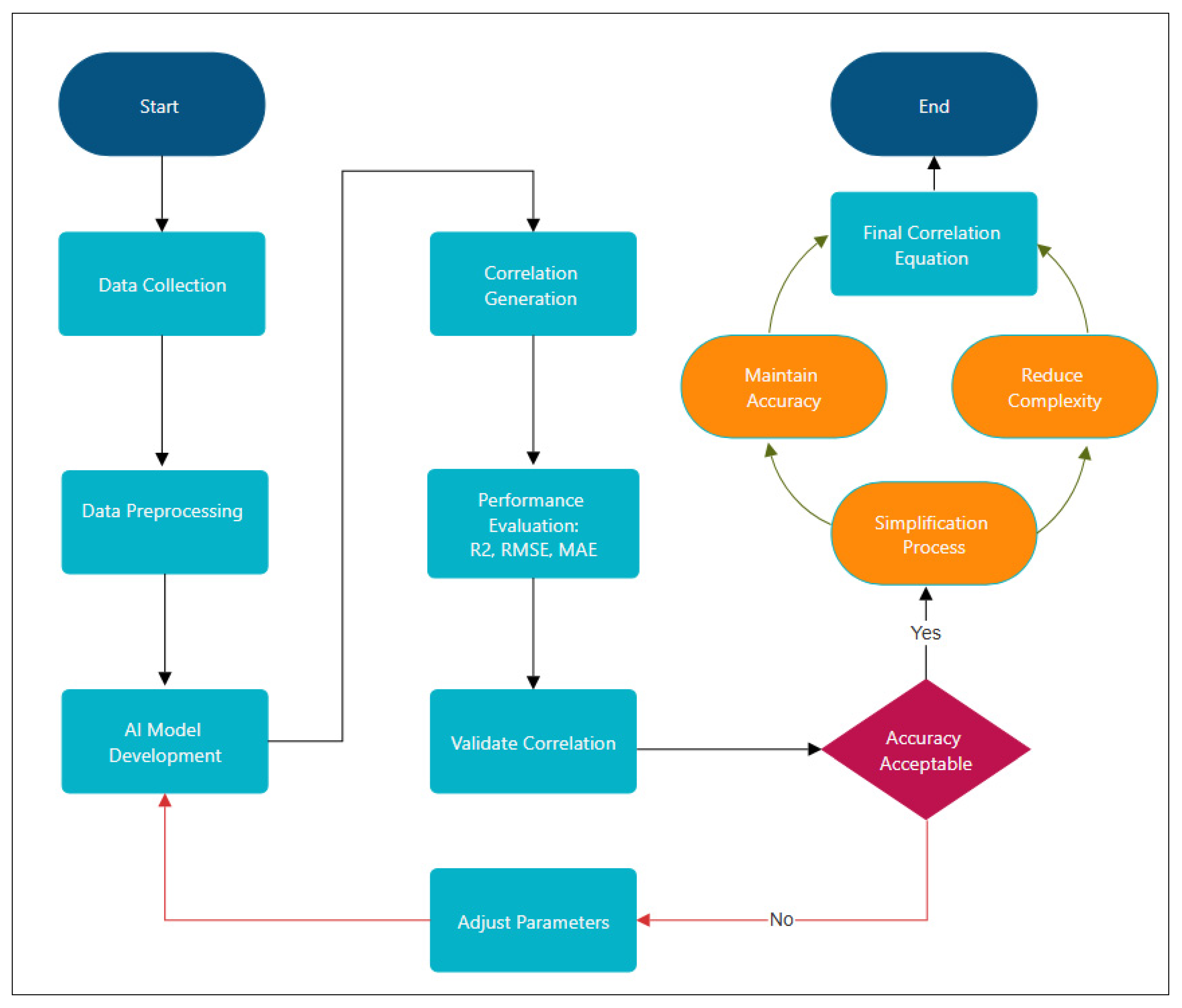
The developed AI-based correlations underwent thorough validation using independent data to verify their accuracy, dependability, and enhanced predictive capabilities relative to conventional, more intricate formulations reported in existing literature. Figure 1 delineates the computational framework and procedural workflow of the AI-based model development strategy implemented for establishing the simplified empirical correlations of seawater thermophysical properties. The workflow began with data collection from the literature, followed by preprocessing to ensure data quality. The AI model development employed symbolic regression algorithms to generate preliminary correlations, which underwent performance evaluation using statistical metrics (R2, RMSE, and MAE) and validation against independent datasets. A decision node assessed prediction accuracy: if unacceptable, parameters were adjusted and the model was retrained; if acceptable, an iterative optimisation cycle balanced accuracy maintenance with complexity reduction through systematic simplification. The process concluded when the optimised correlations achieved target performance, yielding final equations suitable for engineering applications in desalination and power systems.

3. Thermophysical Properties of Seawater

Pure water, seawater, and steam are the primary streams in a thermal desalination plant. Seawater is a complex electrolytic system comprising water and various dissolved ions and, typically, has a salinity of less than 5%. A review of the current literature has shown that there are substantial deviations in the published analyses due to the complex nature of seawater, in the sensitivity of chemical exergy to strong electrolytes, and also in the different approaches that have been proposed when modelling the thermodynamic properties of seawater.
The salt mass fraction, here denoted as ws, is a measure of the total dissolved salt per unit mass of seawater. This is typically expressed using the reference-composition salinity scale, as defined by Millero et al. [9,22], which offers the most precise estimate of absolute salinity. Today, the four models used to calculate the thermodynamic properties of saline water are as follows: (i) pure water as a reference [22,23], (ii) ideal mixture concept [24], (iii) aqueous sodium chloride solutions [25], and (iv) empirical correlations [1,26].

3.1. Pure Water

The properties of water in a specified state are extracted from standard works such as “Steam Tables: Thermodynamic Properties of Water Including Vapor, Liquid, and Solid Phases/With Charts” [27]. This is considered the most straightforward approach. However, there are deviations of 5–10% in the thermophysical properties between pure water and seawater, which can significantly affect the design and efficiency of the operation of thermal desalination plants [22,23].

3.2. Ideal Mixture

Kahraman and Cengel [24] initially applied the ideal-mixture concept to calculate the chemical exergy of seawater in a multi-stage flash (MSF) desalination plant. The seawater was treated as an ideal solution of pure water (H2O) and sodium chloride (NaCl), and the seawater mixture’s extensive properties were treated as the sum of its individual components. The properties of seawater depend on its temperature, pressure, and salinity, which is most often expressed in parts per million (ppm). For example, when the salinity is 45,000 ppm, this is equivalent to 4.5% or a salt mass fraction, w s = 0.045. For seawater considered as a saline solution, we have the following:
w s = m s m m = x s M s M m
w w = m w m m = x w M w M m
where m is mass and M is molar mass, and the subscripts s, w, and m refer to salt, water, and the mixture, respectively. The molar mass of an ideal mixture is then given by
M m = x w M w + x s M s
The molar masses of pure water and NaCl are 18.0 kg/kmol and 58.5 kg/kmol, respectively. The calculations of salinity and minimum work require knowledge of the mass and mole fractions; therefore, the number of salt moles can be written as a function of mass fraction as follows:
x s = w s M w ( 1 w s ) M s + w s M w
where w s + w w = 1 and x s + x w = 1 .
The seawater mixture’s extensive properties are the sum of its individual components.

3.3. Aqueous Sodium Chloride Solution

Sodium chloride is a major constituent of seawater, and some reports in the literature utilise this property to represent seawater as an aqueous sodium chloride solution at equivalent salinity. The term aqueous solution is used when water is the solvent. Pitzer et al. [25] developed empirical equations to estimate the thermophysical properties of aqueous sodium chloride solution. The extensive properties of these solutions were presented for specified temperature and pressure ranges.

3.4. Empirical Correlations

The thermodynamic properties of seawater, including specific volume, enthalpy, entropy, and chemical potential, are required for the application of exergy calculations. These properties are calculated using correlations derived from a fundamental Gibbs free energy relationship that models the properties of seawater as a function of temperature, pressure, and salinity. The complete mathematical framework, correlations, and associated coefficients are provided in the 2008 release by the International Association for the Properties of Water and Steam (IAPWS) [28]. The empirical correlations developed by Sharqawy et al. [26] enable the calculation of the thermophysical properties of saline water at atmospheric pressure, using temperature and salinity as variables. These correlations can be extended to account for varying pressure levels by incorporating additional equations provided by the same research group [1]. A significant benefit of Sharqawy’s correlations is their ability to include chemical effects, which ensures that exergy values remain consistently positive regardless of the selected dead state or reference conditions. These correlations are expressed as polynomial relationships that depend on temperature and salinity under atmospheric-pressure conditions (or at saturation pressure when temperatures exceed the standard boiling point). Within these correlations, the baseline reference for enthalpy and entropy calculations is set to pure water at its triple point (0.01 °C) with zero salinity. Temperature measurements follow the International Temperature Scale (ITS-1990) [29]. This research uses the correlations of Nayar et al. to determine the thermophysical properties of seawater, leveraging their extensive ranges of temperature and salinity. In contrast to the equations derived by Sharqawy et al., which are restricted to atmospheric pressure, the formulations of Nayar et al. include pressure dependence, which makes them well suited for SWRO applications operating at pressures above 6 MPa [1,2]. These correlations were validated using data extracted from [23,25,26,27,28] for seawater and showed good agreement.

3.4.1. Density

Seawater has a higher density than pure water due to the presence of salt, which results in a lower specific volume. The density of seawater can be determined using Equation (8), which is valid for temperatures from 0 to 180 °C, salt concentrations from zero to 0.15 kgs/kgsw, and pressures from 0 to 12 MPa, with an accuracy of ±0.14%.
ρ s w T , w s , P = ρ s w T , w s , P o × F p
where
ρ s w ( T , w s , P o ) = a 1 + a 2 T + a 3 T 2 + a 4 T 3 + a 5 T 4 + ( b 1 w s k g s k g s w + b 2 w s k g s k g s w T   + b 3 w s k g s / k g s w T 2 + b 4 w s k g s / k g s w T 3 + b 5 w s k g s / k g s w 2 T 2 )
  F p = exp P - P o ×   c 1 + c 2 T + c 3 T 2 + c 4 T 3 + c 5 T 4 + c 6 T 5 + w s g s / k g s w ×   d 1 + d 2 T + d 3 T 2   + P 2 - P o 2 2 × c 7 + c 8 T + c 9 T 3 + d 4 w s g s / k g s w
Equations (9) and (10) contain constants that are used to calculate the density of seawater, see Table 1, adapted from Nayar et al. [2].
Equation (11) introduces an AI-derived correlation for seawater density as a function of temperature that employs a new exponential functional form obtained by rigorous machine learning regression and validated against the benchmark of Nayar et al. [2]. Correlation shows maximum deviations of less than ±0.69% and a mean absolute error of only 0.15% over the full desalination range (0–120 °C, zero–120 gs/kgsw salinity, pressures up to 12 MPa). Further comparison with the highly accurate experimental data of Safarov et al. [30] for standard seawater (35 gs/kgsw) confirms mean deviations of just 0.18% across an extended domain reaching 195 °C and 140 MPa.
Particularly noteworthy is the model’s superior performance in hypersaline regimes (40–120 gs/kgsw), where it significantly outperforms Nayar et al. [2] (mean error 0.088% compared to. 0.231%) while remaining highly competitive at typical seawater salinities (mean error 0.026% vs. 0.067%). The extended range and enhanced accuracy in concentrated brines make Equation (11) especially valuable for high-recovery desalination, brine management, zero-liquid-discharge systems, and other processes involving extreme salinity conditions.
ρ s w T , w s , P = 999.99 + 802 w s g s / k g s w + 0.4146 P + 0.00343 w s g s / k g s w T 2   + 0.793 T ( 0.00126 ) 0.0011 T 0.776 T 0.000206 T 2   2.041 w s g s / k g s w T ( 0.001259 ) 0.001099 T
where T is the temperature of the solution in °C, ws gs/kgsw is the salt mass fraction in grammes of salt per kilogramme of seawater, and P is the local pressure in MPa.
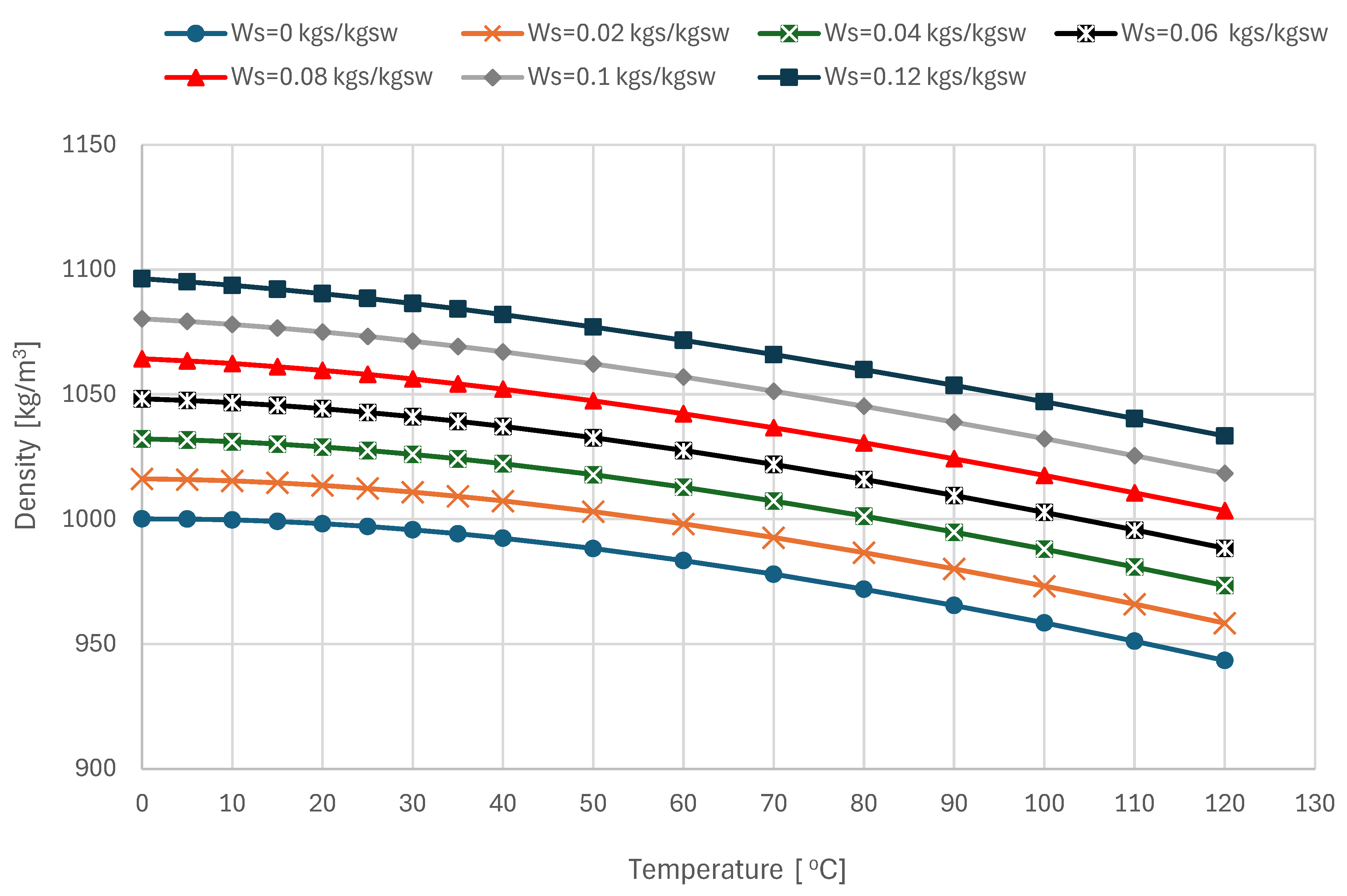
Figure 2 presents seawater density as a function of its temperature calculated using Equation (11) over the desalination operating range (0–120 °C) for seven salinity values from 0 to 0.12 kgs/kgsw at a reference pressure of 0.5 MPa. In all cases, density decreases with increasing temperature and increases monotonically with salinity across the entire temperature range. At the upper limit of the investigated conditions (120 °C, 0.12 kgs/kgsw salinity), seawater density reaches 1033.4 kg/m3, which is approximately 9.1% higher than that of pure water at the same temperature (943.4 kg/m3).
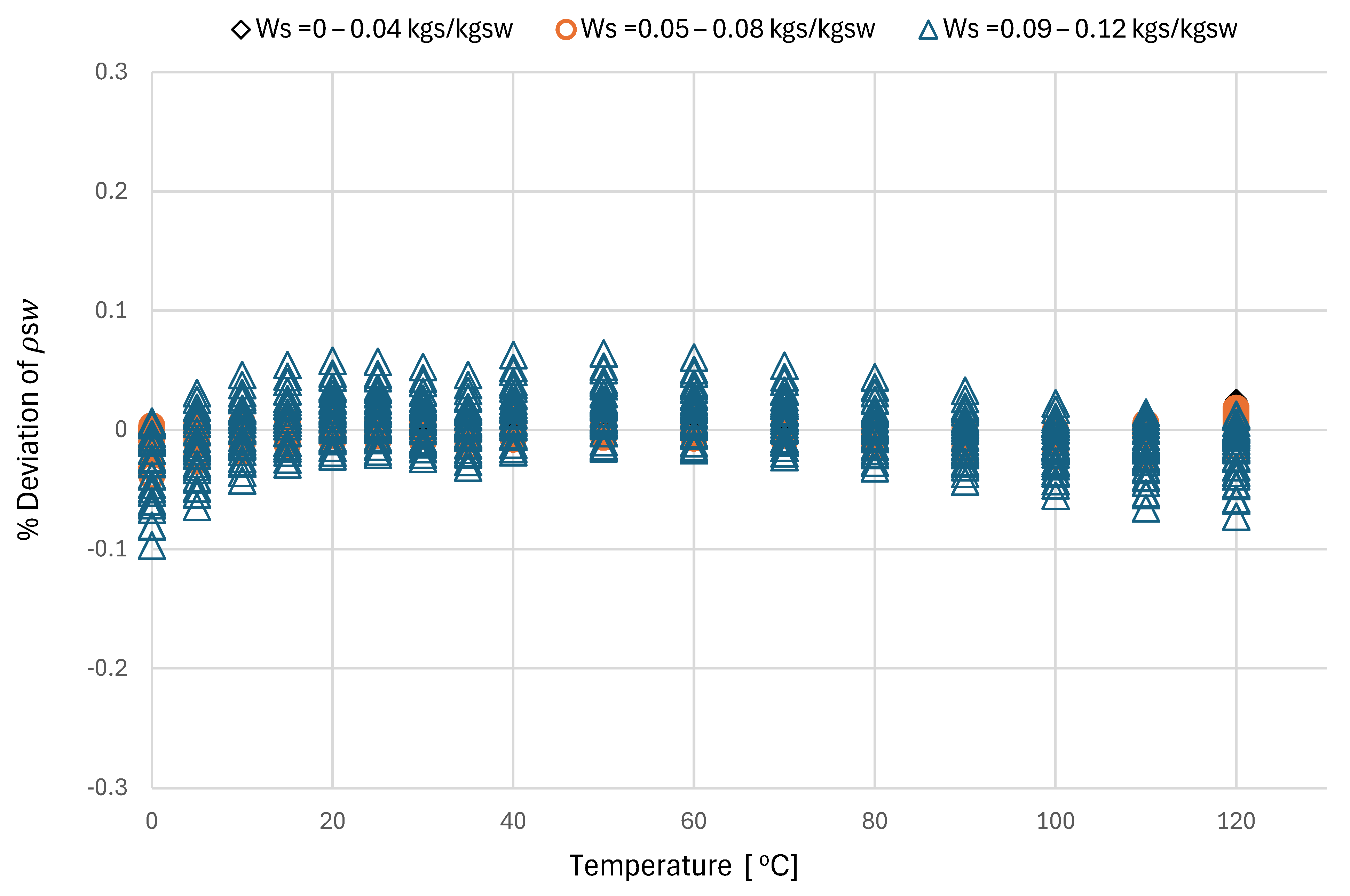
Figure 3 presents the percentage deviation in seawater density attributable to temperature variations across the examined range. All deviations fall within ±0.1%, with scatter evenly distributed around zero. The tight clustering demonstrates that Equation (11) reproduces the reference data with high fidelity across all temperature and salinity conditions.

3.4.2. Specific Enthalpy

The specific enthalpy of pure water exceeds that of seawater because pure water has a higher specific heat capacity. The presence of salt in seawater introduces thermal resistance, reducing its enthalpy. The specific enthalpy of seawater can be computed using Equation (12) from Nayar et al. [2], which was derived by fitting empirical data obtained from the International Association for the Properties of Water and Steam (IAPWS R13-08) using the Gibbs energy function [11]. This formulation is presented as valid for seawater temperatures between 10 °C and 120 °C, salinities from 0 to 0.12 kgs/kgsw, and pressures from 0 to 12 MPa, with a claimed accuracy of ±0.1.47%.
h s w T , w s , P = h s w T , w s , P o   + P P o × a 1 + a 2 T + a 3 T 2 + a 4 T 3 + w s g s / k g s w × ( a 5 + a 6 T + a 7 T 2 + a 8 T 3 )
where
h s w T , w s , P o = h w T , P o w s k g s / k g s w   ( b 1 + b 2 w s k g s / k g s w + b 3 w s 2 k g s / k g s w + b 4 w s 3 k g s / k g s w + b 5 T + b 6 T 2 + b 7 T 3 + b 8 w s k g s / k g s w T + b 9 w s 2 k g s / k g s w T + b 10 w s k g s / k g s w T 2 )
h w T , P o = 141.355 + 4202.070   T 0.535   T 2 + 0.004   T 3
where the symbols have the meanings given above. The constant parameters in Equations (12) and (13), used to determine seawater specific enthalpy, are detailed in Table 2 (Nayar et al. [2]).
A highly compact eight-parameter correlation for the specific enthalpy of liquid seawater (10–120 °C, 0.1–12 MPa, 0–80 gs/kgsw salinity) was developed by multivariate regression using the Nayar et al. [2] reference dataset, which itself extends the IAPWS-2008 standard [11] for desalination applications. The resulting correlation contains only eight optimised coefficients—far fewer than the dozens required by conventional thermodynamic formulations—yet delivers a mean absolute error of just 0.185 kJ/kg (0.103% MAPE) across the full operating envelope. Independent validation against the complete IAPWS-2008 and the TEOS-10 framework as adopted by the Intergovernmental Oceanographic Commission in 2009 confirms 0.123% MAPE at atmospheric pressure and 0.037% MAPE under high-pressure conditions (0.1–12 MPa). The correlation demonstrates an 11-fold improvement in accuracy relative to existing simplified models while remaining within the 0.1–0.5% uncertainty band of the reference standard, which makes it exceptionally well suited for desalination applications.
h s w T , w s , P = 1.158 + P + 4.1175 T + 1.095 × 10 3 T 2 27.98 w s k g s k g s w 2.79 × 10 3 P T 4.807 w s k g s k g s w T 4.911 × 10 6 w s k g s k g s w T 3
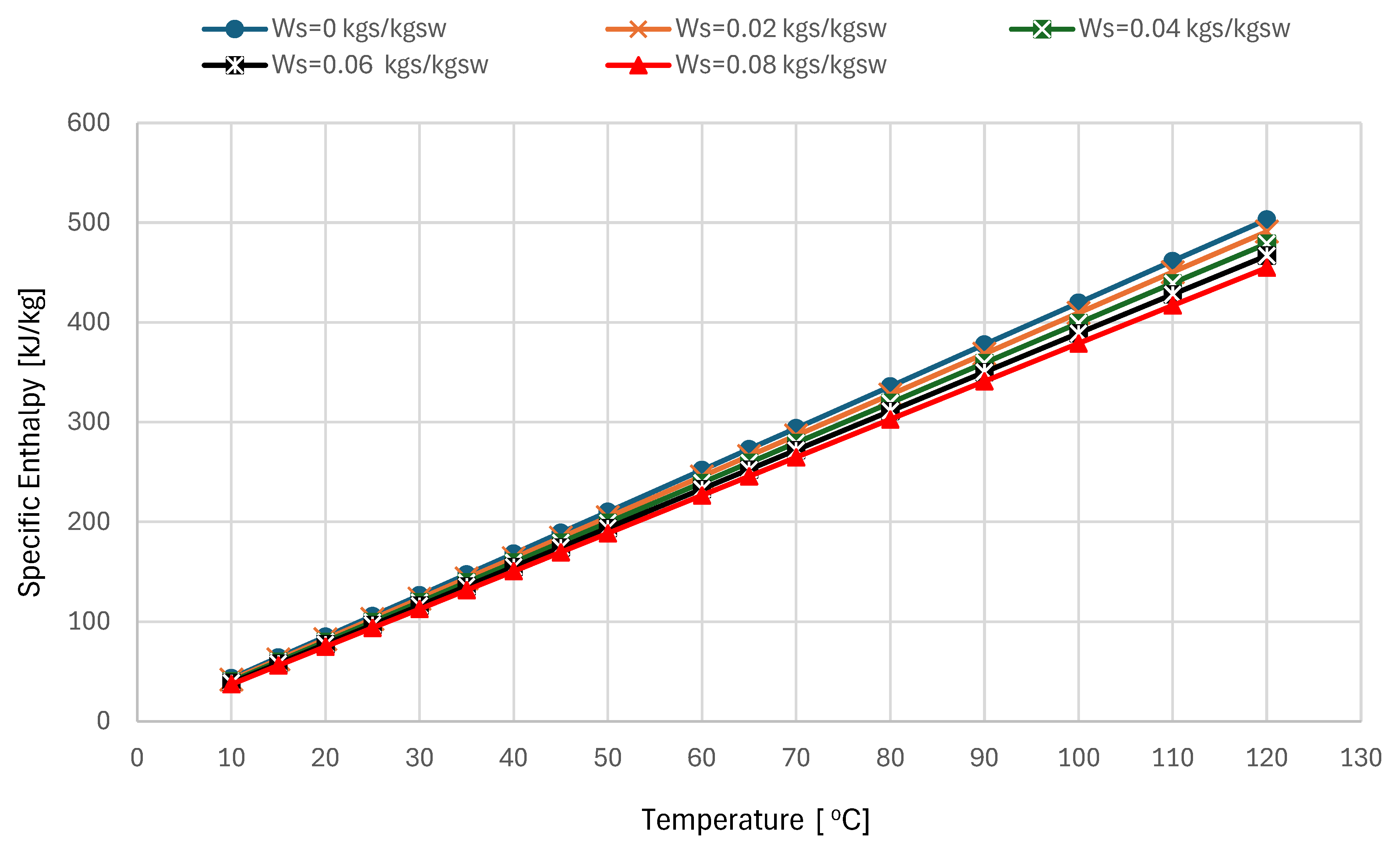
The specific enthalpy of seawater decreases with increasing salinity at all temperatures, see Figure 4, which primarily illustrates the relationship between temperature (10–120 °C) and specific enthalpy (40–500 kJ/kg) for various salt concentrations (ws = 0 to 0.08 kgs/kgsw) at constant pressure (1 MPa), computed using Equation (15). Pure water (ws = zero) exhibits the highest specific enthalpy values across the entire temperature range, reaching approximately 505 kJ/kg at 120 °C. As salt concentration increases from 0.02 to 0.08 kgs/kgsw, specific enthalpy decreases correspondingly, with the maximum saline solution (ws = 0.08 kgs/kgsw) reaching only 460 kJ/kg at 120 °C, representing a reduction of approximately 9% relative to pure water. This phenomenon occurs because dissolved salts reduce the heat capacity of water as ionic species interfere with the hydrogen-bonding network of water molecules, thereby diminishing the solution’s overall thermal energy storage capacity. All the curves exhibit a nearly linear relationship between temperature and specific enthalpy, with comparable gradients, indicating that the relative effect of salinity is consistent across the investigated temperature range. These findings have significant implications for thermal systems that use seawater, including desalination processes, ocean thermal energy conversion systems, and coastal cooling applications, where accurate predictions of thermodynamic properties are essential for accurate system design and performance optimisation.
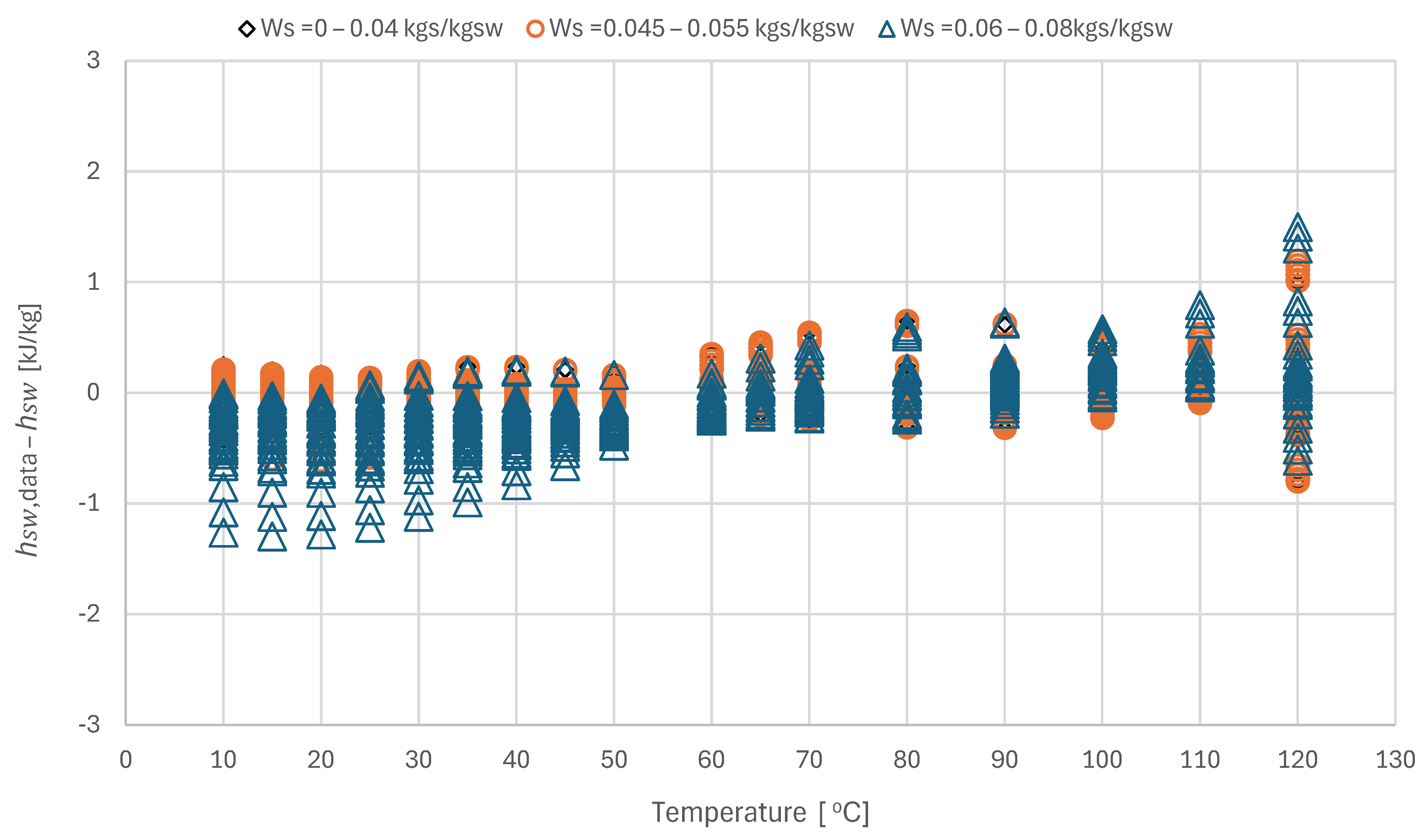
Figure 5 illustrates the discrepancy between seawater specific enthalpy data from Nayar et al. [2] and the values calculated using Equation (15) for the temperature range of 10–120 °C and salinity concentrations from zero to 0.08 kgs/kgsw. The results indicate strong agreement between the experimental and predicted values, with variations predominantly confined to ±1.5 kJ/kg throughout the examined range, maintaining relative errors below 0.5% of the actual enthalpy magnitudes. These findings confirm that Equation (15) reliably represents seawater specific enthalpy for the salinity and temperature regimes commonly observed in desalination applications.

3.4.3. Specific Entropy

Under identical conditions of temperature and pressure, the specific entropy of pure water exceeds that of seawater. Although dissolving salt raises the entropy of the salt (from solid to dissolved ions), the water’s entropy drops substantially due to the ordered structuring around those ions, resulting in a lower overall specific entropy (per unit mass of solution) for seawater compared to pure water. The specific entropy of seawater can be calculated using Equation (16) obtained from Nayar et al. [2] and developed by fitting empirical data to the IAPWS seawater Gibbs energy function [11]. This equation is valid for temperatures of 10–120 °C, salinities of zero–0.12 kgs/kgsw, and pressures of 0–12 MPa, with an accuracy of ±0.167%.
s s w T , w s , P = s s w t , w s , P o + P P o × a 1 + a 2 T + a 3 T 2 + a 4 T 3 + w s g s / k g s w × ( a 5 + a 6 T + a 7 T 2 + a 8 T 3 )
where
s s w T , w s , P o = s w T , P o w s k g s / k g s w   ( b 1 + b 2 w s k g s / k g s w + b 3 w s 2 k g s / k g s w + b 4 w s 3 k g s / k g s w + b 5 T + b 6 T 2 + b 7 T 3 + b 8 w s k g s / k g s w T + b 9 w s 2 k g s / k g s w T + b 10 w s k g s / k g s w T 2 )
s w T , P o = 0.1543 + 15.383 T 2.996 × 10 2 T 2 + 8.193 × 10 5 T 3 1.37 × 10 7 T 4
The symbols represent the quantities defined earlier. The constant coefficients appearing in Equations (16) and (17), which are applied in calculating the specific entropy of seawater, are listed in Table 3 (Nayar et al. [2]).
A simplified polynomial relation for seawater entropy was developed using AI-based regression analysis to provide computationally efficient predictions suitable for desalination process modelling. The correlation takes the form
s s w T , w s , P = 7.96 × 10 3 + 0.0149 T + 1.99 × 10 8 T 3 1.25 × 10 4 P 6 × 10 6 P T 0.0144 w s k g s k g s w T   2.11 × 10 5 T 2 4.91 w s 2 k g s k g s w
This compact eight-term correlation offers an exceptional combination of computational efficiency and accuracy, which makes it highly suitable for process simulation and real-time control systems. It provides reliable predictions across the complete desalination operating window: temperatures 10–120 °C, salinities zero–80 gw/kgsw, and pressures 0–12 MPa.
The derived correlation was validated against the seawater property equations of Nayar et al. [2], which were constructed from extensive high-quality experimental data which included the extensive measurements of Millero et al. [12,31]. This new AI-derived formulation matches the Nayar reference data with a mean absolute difference of just 0.103% (median 0.062%), well within Nayar’s stated uncertainty of ±0.50% relative to the original experimental datasets. In the restricted domain (T ≤ 40 °C and ws ≤ 42 gs/kgsw), where the IAPWS-08 seawater formulation is applicable, the new correlation achieves a mean error of 0.26%—close to the order of magnitude of IAPWS-08’s uncertainty of <0.1%—while uniquely providing accurate results in higher-temperature thermal desalination regimes (40–120 °C) where IAPWS-08 does not apply.
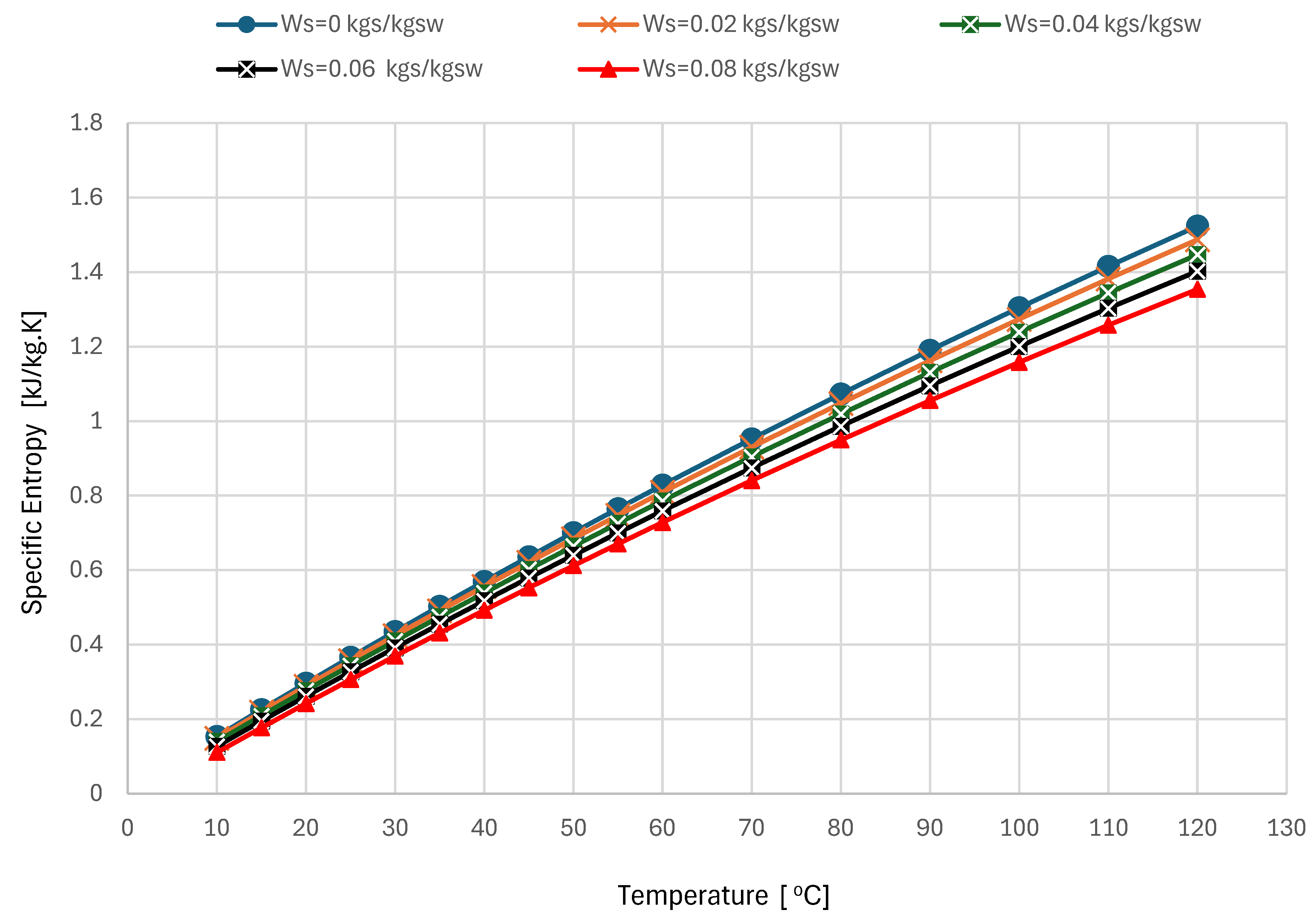
Figure 6 shows the specific entropy of seawater calculated from Equation (19) over the temperature range of 10–120 °C and salinities from zero to 0.08 kgs/kgsw at a constant pressure of 5 MPa. The results indicate that specific entropy increases monotonically with temperature for all salinity levels while decreasing systematically with increasing salt concentration at any given temperature. Pure water displays the highest specific entropy values throughout the examined range, reaching approximately 1.52 kJ/kgK at 120 °C, whereas the most saline solution (ws = 0.08 kgs/kgsw) reached only about 1.35 kJ/kgK at the same temperature, representing a 12.5% reduction. This behaviour demonstrates that the specific entropy of seawater is less than that of fresh water, with the reduction becoming more pronounced at higher salt concentrations and elevated temperatures. The presence of dissolved salts constrains the molecular disorder and configurational freedom of water molecules, thereby diminishing the entropy of the solution. All curves exhibit a slight but clearly consistent nonlinear relationship with comparable curvature patterns, which suggests that the fundamental temperature dependence of entropy remains qualitatively similar across the different salinities considered.
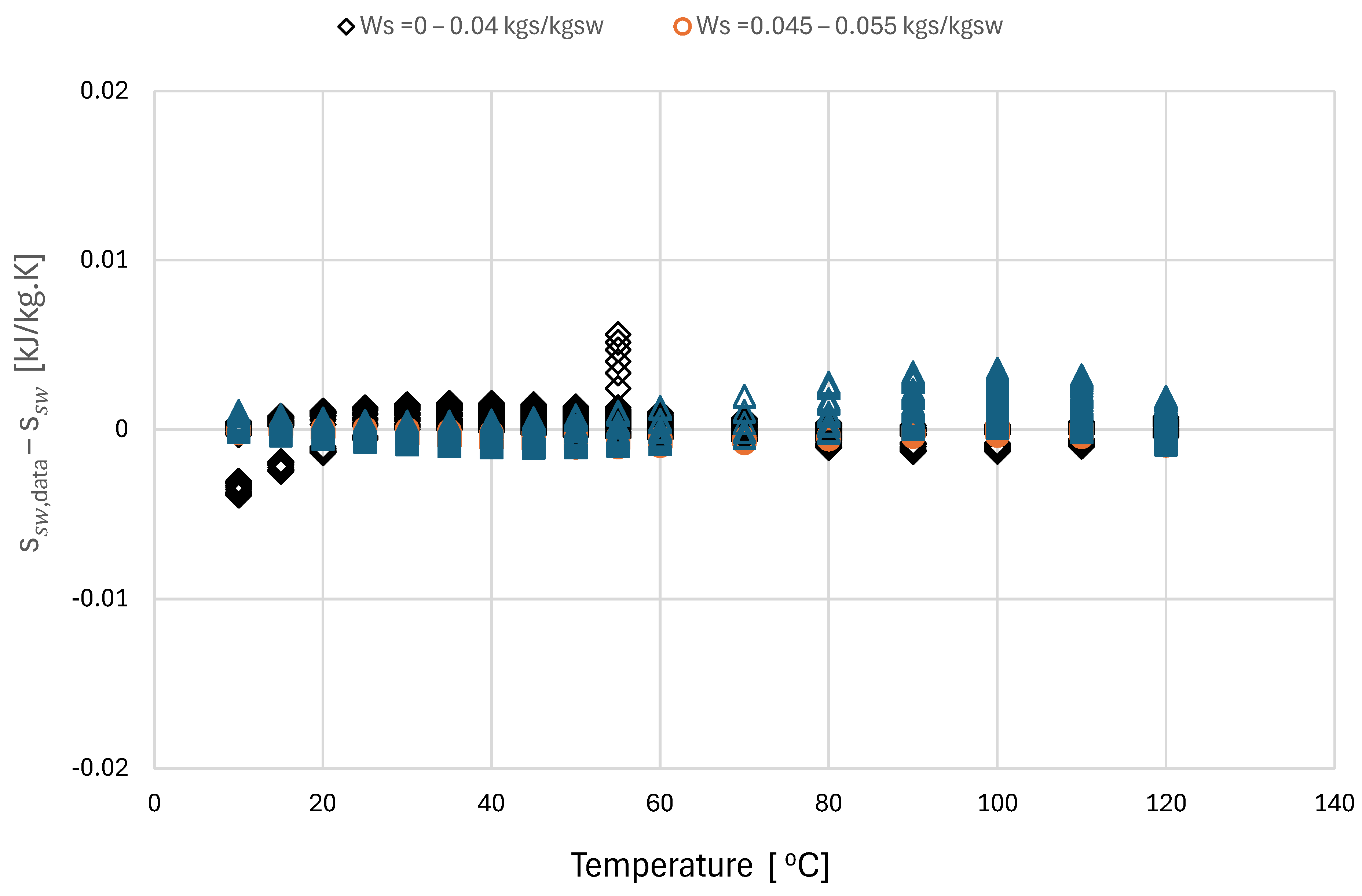
Figure 7 illustrates the deviation between the seawater specific entropy data reported by Nayar et al. [2] and the values calculated using Equation (16) for the temperature range of 10–120 °C, salinity from zero to 0.08 kgs/kgsw, and pressure from 0 to 12 MPa. Analysis of the deviation demonstrates exceptional agreement between the experimental data and the predictive equation, with nearly all deviations confined within a narrow band of ±0.005 kJ/kgK throughout the entire range investigated. The data points are tightly clustered around zero deviation across all temperatures, which indicates that Equation (16) accurately reproduces the reference entropy values with minimal systematic bias. This remarkable level of agreement, with relative errors typically below 0.5% of the corresponding entropy values, validates the robustness and reliability of Equation (16) for calculating seawater specific entropy across the broad range of operating conditions relevant to desalination systems, thermal power cycles, and oceanographic applications, which confirms its suitability for accurate thermodynamic analysis and engineering design calculations.

3.4.4. Gibbs Free Energy

The Gibbs free energy represents a crucial thermodynamic parameter that merges the enthalpic and entropic characteristics of a system, thereby defining the maximum energy accessible for performing useful work. When applied to seawater, this quantity can be expressed on a per-mass basis as the specific Gibbs energy, see Equation (20).
g s w = h s w T + 273.15 s s w
However, calculating Gibbs energy indirectly using Equation (20) from separate enthalpy and entropy correlations produced significant errors. The absolute deviation reached 0.36 kJ/kg, demonstrating poor agreement with direct calculations. Relative errors became extremely large (up to 66.6%) in temperature–salinity regions where Gibbs energy nears zero. These substantial inaccuracies make this particular method unreliable for precise thermodynamic calculations and practical engineering applications involving seawater. However, Nayar et al. [2] provide an alternative approach in Equation (21), developed by fitting the IAPWS-08 seawater specific Gibbs energy function [28]:
g s w T , w s , P = g s w T , w s , P o   + P P o × a 1 + a 2 T + a 3 T 2 + a 4 T 3 +   w s g s / k g s w × ( a 5 + a 6 T + a 7 T 2 + a 8 T 3 )
where
g s w T , w s , P o = g w T , P o + w s k g s / k g s w   ( b 1 + b 2 T + b 3 T 2 + b 4 w s 2 k g s / k g s w T + b 5 w s 2 k g s / k g s w T 2 + b 6 w s 3 k g s / k g s w + b 7 w s 3 k g s / k g s w T 2 + b 8 L n ( w s k g s / k g s w ) + b 9 L n ( w s k g s / k g s w )   T
g w T , P o = c 1 + c 2 T + c 3 T 2 + c 4 T 3 + c 5 T 4
The symbols correspond to the variables defined earlier. The fixed coefficients employed in Equations (21)–(23) to evaluate the specific Gibbs free energy of seawater are presented in Table 4 (Nayar et al. [2]).
Equation (24) represents a simplified correlation for the Gibbs energy of seawater, derived through AI pattern recognition applied to the IAPWS-08 reference data in Equation (21). The model demonstrates strong agreement with the international standard, yielding a mean absolute error of 0.214 kJ/kg, which is only 3.1 times the deviation observed in Nayar et al., despite employing only 8 rather than 22 adjustable parameters. Excellent predictive accuracy is maintained throughout the validated ranges of 10–120 °C for temperature, zero–0.08 kgs/kgsw for salinity, and 0–12 MPa for pressure, with the correlation explaining 99.993% of the variance in the reference data (R2 = 0.99993).
g s w T , w s , P = P + w s k g s / k g s w T + 6.801 × 10 4 ( w s k g s k g s w ) 3 + 295.724 c o s 0.00693 T + 960.34 T ( w s k g s k g s w ) 3 c o s 0.00693 T 296.15 s i n ( 68010.21 w s k g s k g s w ) 88.85 w s k g s k g s w
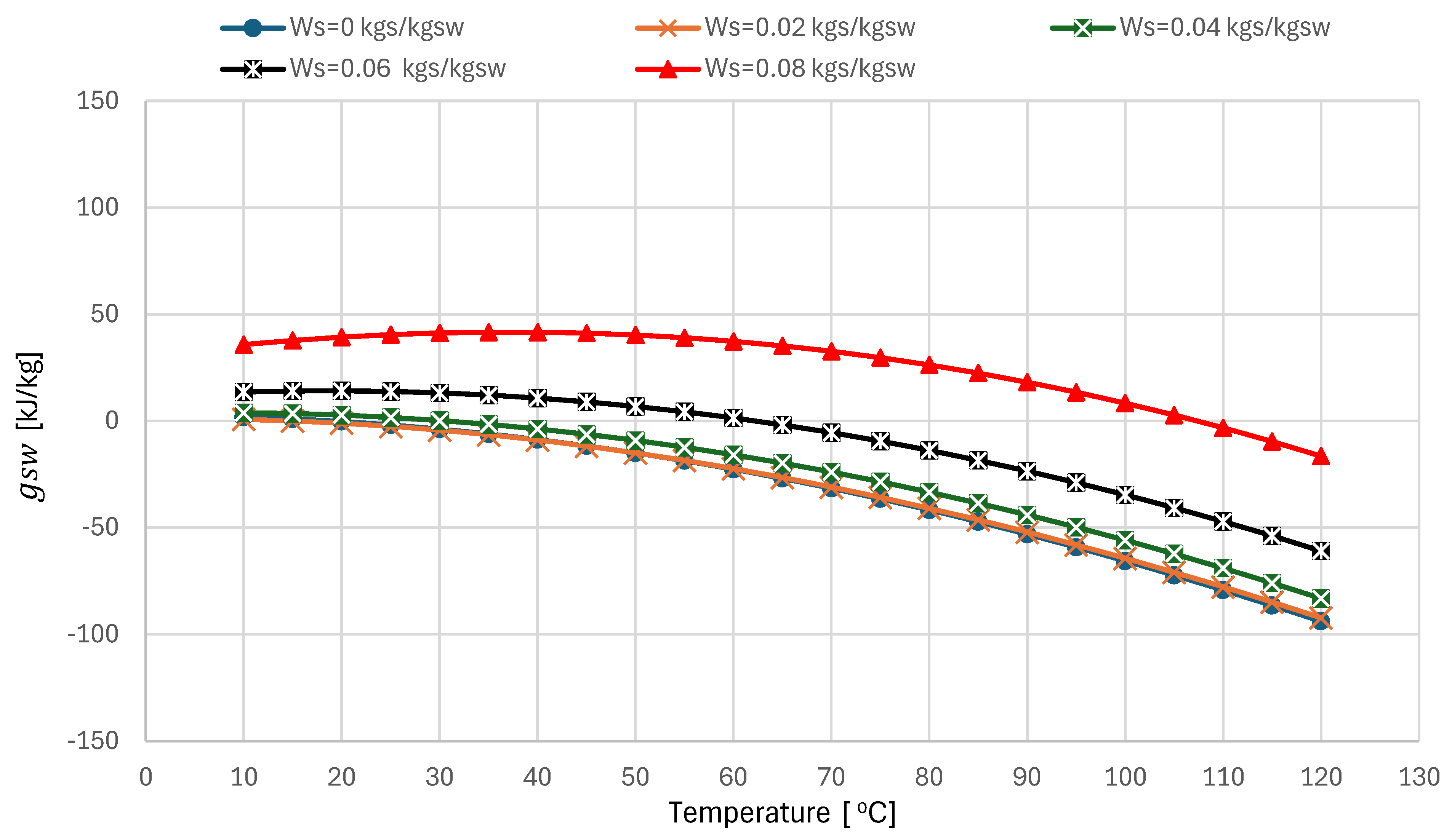
Figure 8 presents the specific Gibbs energy of seawater as a function of temperature at constant pressure (3 MPa) for salinity concentrations ranging from zero to 0.08 kgs/kgsw, calculated using Equation (24). The results demonstrate that specific Gibbs energy decreases monotonically with increasing temperature across the range of 10–120 °C for all salinity levels examined, reflecting the thermodynamic tendency toward greater spontaneity at elevated temperatures. Distinctive salinity-dependent behaviour is evident, with higher salt concentrations yielding significantly elevated Gibbs energy values at lower temperatures. At 10 °C, the most saline solution ( w s = 0.08 kgs/kgsw) exhibits a Gibbs energy of approximately +35 kJ/kg, while pure water and the lowest salinity solutions converge near +15 kJ/kg. As temperature increases, the specific Gibbs energy becomes increasingly negative at all salinity levels. Higher salinity consistently shifts the curve upward to less negative values. The difference in Gibbs energy caused by salinity increases with rising temperature; the lines diverge rather than converge. This means that, within the temperature range shown, the thermodynamic influence of salinity on specific Gibbs energy becomes more pronounced at higher temperatures, not less. The systematic upward shift of the Gibbs energy curves with increasing salinity reflects the enhanced chemical potential contribution of dissolved salts, which increases the energy required for phase transitions and chemical processes. These findings are crucial for understanding the thermodynamic feasibility of desalination processes, phase equilibria in saline systems, and the exergy analysis of thermal seawater applications, where Gibbs energy serves as a fundamental measure of available work and process spontaneity.
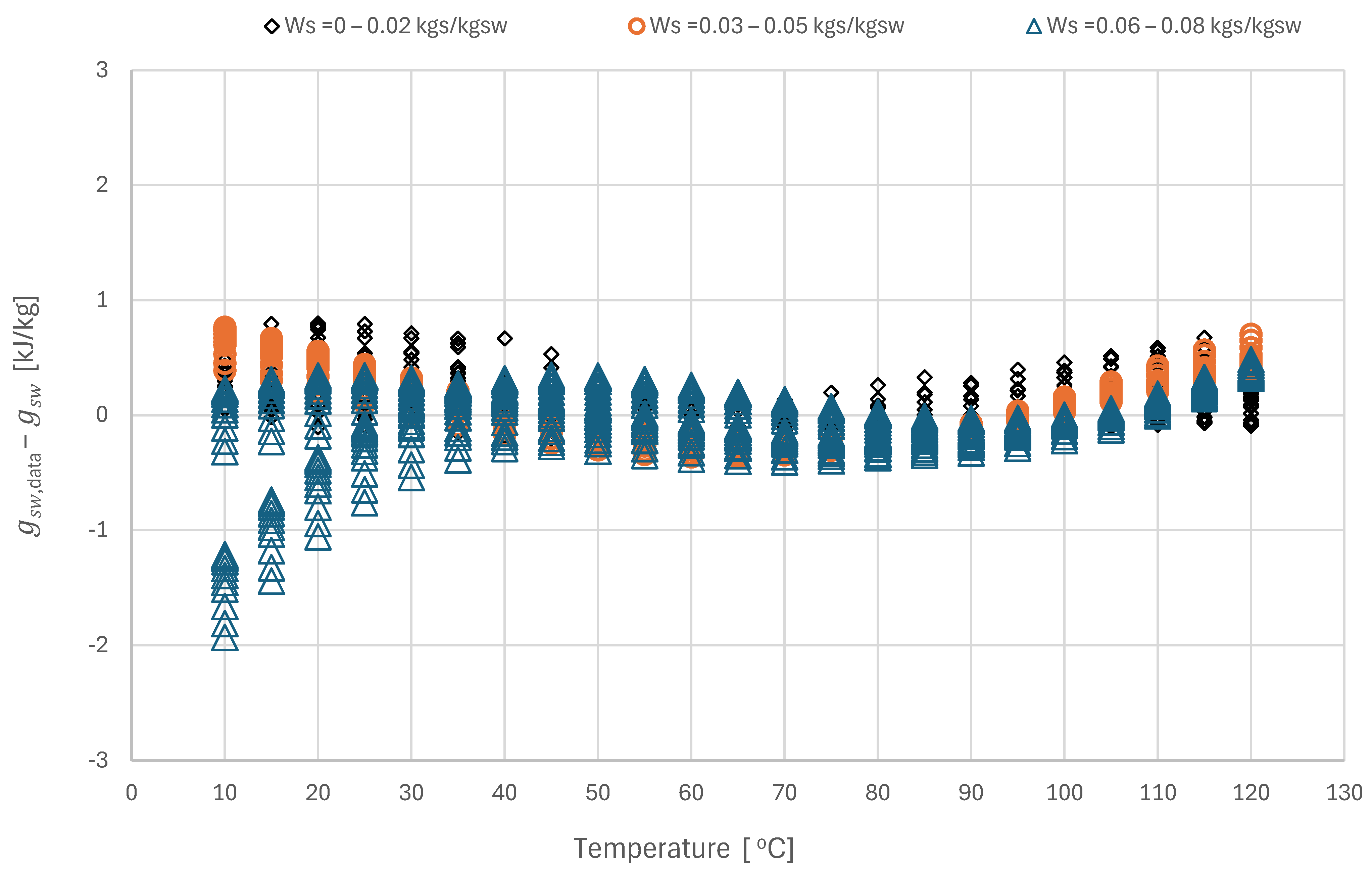
Figure 9 illustrates the difference between Gibbs energy data for seawater as reported by Nayar et al. [2] and the values calculated using Equation (24) across the temperature range of 10–120 °C, salinity levels from zero to 0.08 kgs/kgsw, and pressures spanning 0–12 MPa. Analysis of the differences reveals generally good agreement between the experimental data and the predictive equation, with the majority of differences confined within ±0.5 kJ/kg throughout most of the investigated range. Despite the larger deviations observed at lower temperatures, the overall performance of Equation (24) remains satisfactory for engineering applications, as the relative errors typically represent less than 2% of the absolute Gibbs energy values. This level of accuracy is adequate for the thermodynamic modelling of desalination processes, exergy analysis, and phase equilibrium calculations in seawater systems across practical operating conditions.
Chemical potential is a key property for assessing energy systems, particularly those involving concentration changes in working fluids through mixing or desalination. This intensive property quantifies how readily a stream transfers particles to another stream—known as the escape tendency. Particles naturally move from high to low chemical potential, with this driving force being primarily determined by composition. When a system reaches equilibrium, all components share the same value of the chemical potential. To determine the chemical potentials of water and salt in seawater, derivatives of the total Gibbs energy function are applied, yielding Equations (25) and (26), respectively:
µ w = G s w m w = g s w w s g s w w s
µ s = G s w m s = g s w + ( 1 w s ) g s w w s

4. Exergetic Analysis

Exergy represents the maximum useful work extractable when bringing a system from its current state to equilibrium with the environment, known as the dead state—where exergy equals zero. This equilibrium encompasses three aspects: thermal, mechanical, and chemical. Unlike energy, exergy is not conserved; it is continuously destroyed by irreversibilities within thermal processes. As an extensive property (similar to mass, energy, and entropy), exergy analysis applies both the first and second laws of thermodynamics to identify and quantify inefficiency sources in energy systems. The general exergy balance equation is given by
d E c v d t = k 1 T o T k Q ˙ k W ˙ c v P o d V c v d t + i m ˙ i e i e m ˙ e e e E ˙ d
Equation (27) expresses that exergy accumulation within a control volume equals net exergy inputs (via mass, heat, and work) minus exergy destruction. At steady state, this becomes Equation (28):
E ˙ q E ˙ w = e E ˙ e i E ˙ i + E ˙ d
where E ˙ i   and E ˙ e   denote the inlet and outlet exergy flows, respectively, and E ˙ q   and E ˙ w   represent the exergy transfers due to heat and work, respectively. However, in the absence of nuclear reaction, surface tension, magnetism, and electricity, the total exergy consists of four components: physical ( E ˙ p h ), chemical ( E ˙ c h ), kinetic ( E ˙ k e ), and potential ( E ˙ p e ). The exergy balance of a system is given by
E ˙ x = E ˙ p h + E ˙ c h + E ˙ k e + E ˙ p e
The physical exergy component corresponds to purely physical phenomena involving mechanical and thermal exergy contributions and can be mathematically expressed as
E ˙ p h = m ˙ h s h o T o s s s o
The chemical exergy quantifies the maximum useful energy available when mass flows equilibrate from an environmental state to the dead state, attributable to disparities in molecular composition and concentration. For saline water systems, chemical exergy is mathematically represented as follows:
E ˙ c h , w = m ˙ w k ( µ k s µ k o )
In this study, kinetic and potential exergies—which arise from the ordered motion and elevation of fluid particles, respectively—are considered negligible for all streams. Therefore, they have been excluded from the exergy analysis owing to their insignificant contribution.
Minimising the work required to separate salt from saline water is a primary objective in desalination research. Under steady-flow adiabatic conditions, the minimum separation work can be determined using the following relationship:
W ˙ m i n = E ˙ b r i n e + E ˙ p r o d u c t E ˙ f e e d
Exergetic efficiency evaluates thermal plant performance thermodynamically, requiring specification of product and fuel due to energy quality dependence in exergy analysis. In desalination, it is the ratio of the minimum separation work (product exergy) to the total energy input (fuel exergy) supplied and is given by the expression
η e x = W ˙ m i n E ˙ f
For all components of the system, the exergy outflow rate is lower than the inflow rate because of exergy destruction and exergy losses. Under steady-state conditions, these quantities are related as follows:
E ˙ i = E ˙ e + E ˙ d + E ˙ L
where E ˙ d and E ˙ L denote the rates of exergy destruction and exergy loss, respectively. Table 5 illustrates the exergy rates of fuel ( E ˙ F   ), product ( E ˙ P   ), and destruction ( E ˙ d ), together with the exergetic efficiency of the major components in the MED-TVC system during steady-state operation.
Exergy analysis offers superior diagnostic capabilities for evaluating energy systems, with accurate thermodynamic diagnosis serving as the necessary precondition for effective process improvement [32].
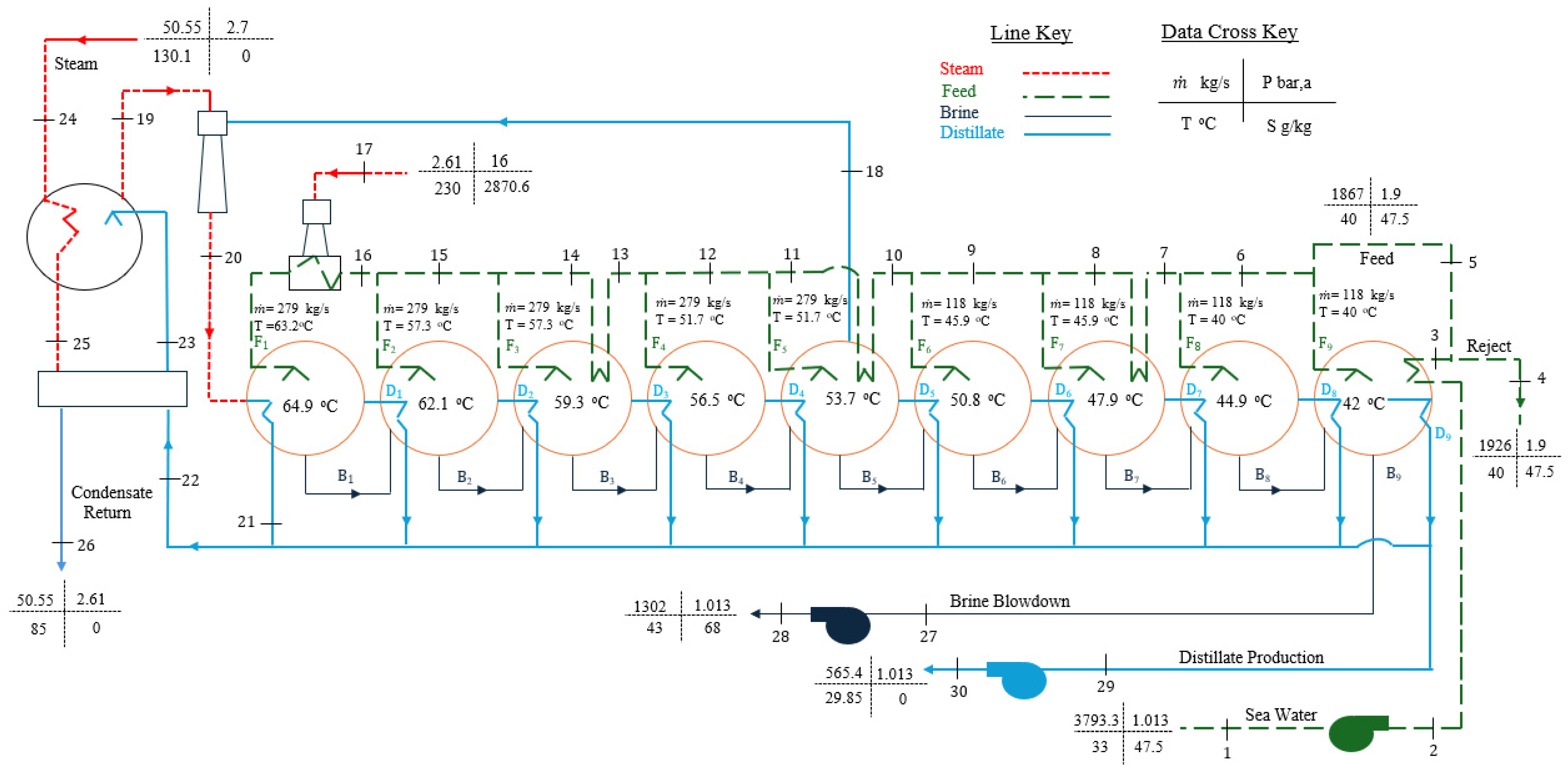
Figure 10 presents a schematic representation derived from the advanced thermal vapour compression multiple-effect distillation (TVC-MED) facility at Az Zour North Phase 1, located in Kuwait. This desalination installation, situated approximately 100 km south of Kuwait City in the vicinity of the existing Az-Zour South power infrastructure, comprises ten MED units with a combined production capacity of 486,500 m3/day (107 MIGD), where each individual unit generates 10.84 MIGD. The multi-effect distillation unit is augmented with thermal vapour compression (TVC) technology, as shown in Figure 10, to optimise system performance and production output. Thermo-compressors (steam ejectors) are integrated into the MED process to capture waste heat prior to its rejection through the condenser to the marine environment. High-pressure motive steam entrains a portion of the vapour stream from the fifth effect, and this compressed mixture is directed to the first MED effect as the heating medium. Consequently, the specific steam consumption is significantly reduced, thereby enhancing overall plant thermal efficiency. Table 6 presents the eight effects that constitute a single complete block.
The present study conducts a comprehensive exergetic performance analysis of this facility. Before the assessment of the plant performance, a preliminary evaluation was undertaken to validate novel correlations for determining the thermodynamic properties of seawater, with a particular emphasis on comparative analysis against established correlations reported in the literature, specifically, those developed by Nayar et al. [2] and Sharqawy et al. [26] as shown in Table 7. The seawater entering the desalination unit has a temperature of 306 K, a pressure of 1.01 bar, and a salinity (dissolved solids content, w s ) of 47,500 parts per million (PPM). These values represent the environmental and initial (“dead state”) reference conditions.
Table 7 presents the thermodynamic characteristics at various points within the TVC-MED system, comparing results from Sharqawy et al. [26] and Nayar et al. [2] and calculations based on the present work. The discrepancies between Sharqawy et al.’s results and those of both Nayar et al. and the present study are primarily due to the incorporation of pressure effects in the more recent correlations, as Sharqawy et al.’s formulations were developed without considering pressure dependency, which becomes important in desalination systems operating at elevated pressures.
The correlations developed in this work show strong agreement with Nayar et al.’s well-established formulations, with variations typically remaining below 5% across most system locations.
Particularly good consistency is observed in specific entropy values, with maximum variations of approximately 3.82% at point 2 and less than 1% at the majority of the measurement points. This close correspondence validates the reliability of the newly developed AI-based correlations while providing reduced computational complexity compared to the more elaborate formulations of Nayar et al. The simplified methodology maintains high accuracy without compromising precision, which makes it well suited for practical engineering calculations in desalination system analysis.
The small variations between Nayar et al. and the present work, especially at critical locations such as ejector inlets and evaporator stages, confirm that the new correlations successfully capture the essential thermodynamic behaviour without the mathematical complexity of previous models. This combination of simplicity and accuracy provides a substantial benefit for iterative design calculations and optimisation studies in thermal desalination systems.
Table 8 presents a comprehensive summary of the exergy analysis results for the TVC-MED desalination unit, comparing values obtained from Sharqawy et al. [26] and Nayar et al. [2] and the present work’s calculations. The table encompasses various exergy parameters including heating steam exergy input, pump input exergy, minimum separation work, and exergy destruction across different system components such as ejectors, evaporators, cooling process, and disposal streams.
The results from Sharqawy et al. [26] show close agreement with both Nayar et al. [2] and the present work, despite their correlations not accounting for pressure effects. This consistency can be attributed to the fact that thermal desalination systems operate predominantly at low pressures, where pressure dependency has a minimal impact on thermodynamic property calculations. Consequently, the inclusion or exclusion of pressure effects does not significantly alter the exergy analysis outcomes in low-pressure thermal desalination applications. This contrasts with membrane desalination processes, such as reverse osmosis, where the effect of pressure is essential due to operation at high pressures (typically 50–80 bar), which makes pressure-dependent correlations critical for accurate thermodynamic and exergy analysis.
The exergetic efficiency of the unit ranges from approximately 8.514% to 8.986% across the three calculation methods, which is consistent with the results reported for thermal desalination units in the literature. The nature of the thermal desalination process involves evaporation and condensation, and this is the primary reason for the relatively poor exergetic performance. Phase change operations are fundamentally irreversible, generating significant entropy through heat transfer across finite temperature differences. Operating at sub-atmospheric pressures further increases the latent heat requirements per unit mass of distillate. Thermal desalination uses large amounts of heat energy to perform a separation task that theoretically requires minimal work. The actual energy input (30+ MW) far exceeds the minimum separation work (2.7–2.8 MW), with most energy lost through phase transitions, resulting in efficiencies below 10%.
The results indicate that the highest sources of irreversibilities within the desalination unit are found in the evaporators (17.783 MW and 17.881 MW) and the ejectors, with the primary ejector destroying 1.831 MW and the secondary ejector destroying approximately 1.52 MW across all calculations. The evaporators dominate due to finite-temperature-difference heat transfer and phase change irreversibilities while processing the majority of system thermal energy. The ejectors’ exergy destruction arises from three factors: spontaneous irreversible mixing between entrained vapour and motive steam, complex aerodynamic losses across different geometric sections (nozzle, throat, and diffuser), and the degradation of high-grade motive steam energy during the compression process.
The comparison among all three calculation methods reveals excellent agreement across most parameters. The exergetic efficiency shows only minor variations, with a maximum difference of approximately 5.5% between Sharqawy et al. and the present work. The total exergy destruction demonstrates remarkable consistency, with differences less than 4% across all three approaches. Overall, the results are nearly identical, confirming the consistency and reliability of all calculation methods. These variations can be attributed to the differences in thermodynamic property correlations, modelling assumptions, and calculation methodologies employed in each study. Nevertheless, the close agreement validates the worthiness of the new correlations despite their simplicity, with no major changes observed in the overall exergy analysis outcomes.


5. Conclusions

This study develops novel AI-based correlations for those thermodynamic properties of seawater that are critical for exergy computations. The derived exergy values were validated using experimentally determined thermodynamic measurements obtained by previous researchers and subsequently applied to an exergy analysis of a full-scale MED-TVC desalination plant currently operating in Kuwait.
The newly formulated correlations for seawater are density; Gibbs free energy enthalpy; entropy; and, for pressures extending up to 12 MPa, salinities from 0 to 80 g/kg and a temperature range from 10 °C to 120 °C. Relative to current methods, the AI-driven data show an order-of-magnitude improvement in accuracy. For all the correlations, we have developed a comprehensive uncertainty quantification that is also provided. The AI-based correlations achieved low absolute errors of 1.5 kg/m3 for density, 0.185 kJ/kg for specific enthalpy, 0.005 kJ/kg·K for specific entropy, and 0.214 kJ/kg for Gibbs free energy. These results indicate an accuracy comparable to, and in some cases better than, current state-of-the-art empirical models while offering the added advantage of significantly lower computational effort.
Evaluation of the exergetic performance of the desalination plant gave a second-law efficiency of 8.9%, which agrees well with reported efficiencies for thermal desalination plants. Analysis of irreversibility revealed the evaporator units as the major exergy destruction source, with thermal vapour compression ejectors being the second major contributor. Comparison with the results of Nayar et al. [2] showed good agreement, with differences of less than 0.4% in aggregate exergy destruction and 4.8% in exergetic efficiency. Such small differences confirm the reliability and practical utility of the proposed correlation method. Despite the use of a relatively simple AI-based framework, the results produced show very good agreement with conventional approaches, thereby validating their applicability to engineering analyses of desalination systems.

Author Contributions

Conceptualization, A.S.A.; methodology, A.S.A.; software, A.S.A. and H.M.A.; validation, A.S.A., H.M.A. and A.H.A.; formal analysis, H.M.A. and A.H.A.; investigation, A.S.A., H.A., H.M.A. and A.H.A.; resources, A.S.A. and H.A.; data curation, H.A. and H.M.A.; writing—original draft preparation, A.S.A. and H.A.; writing—review and editing, A.S.A. and A.H.A.; visualization, A.H.A.; supervision, A.S.A. and H.A.; project administration, A.S.A. All authors have read and agreed to the published version of the manuscript.

Funding

This research received no external funding.

Data Availability Statement

The original contributions presented in this study are included in the article. Further inquiries can be directed to the corresponding author.

Acknowledgments

The authors express their sincere gratitude to the MEWRE, Kuwait, for its invaluable assistance and support throughout this research. The authors also extend their appreciation to the CEDT at King Abdulaziz University for providing essential technical support and collaboration. During the preparation of this manuscript, the authors used Eureqa software for symbolic regression and genetic programming to derive empirical correlations from the study dataset. The authors also used Grammarly (https://www.grammarly.com/) to assist with language proofreading. The authors have reviewed and edited all outputs and take full responsibility for the content of this publication.

Conflicts of Interest

The authors declare that there are no conflicts of interest.

Glossary

NomenclatureSubscripts
BBrine water flow rate1, 2Substances 1 and 2
DDistillate water flow rateacActual
E ˙ Rate of exergy flow in the streamcCold stream
e ¯ k c h Specific molar chemical exergychChemical
FFeed water flow ratecvControl volume
gSpecific Gibbs energydDestruction
hSpecific enthalpyfFuel
h f g Latent heat of vapourisation hHot Stream
L H V ¯ Low heating value on a molar basisiInlet
MMolar masskComponent
m ˙ Mass flow ratekeKinetic energy
n ˙ Number of molesLLoss
P Pressure of the streammMotive steam
Q ˙ Heat transfer rateoEnvironmental dead state
R Gas constantpProduct
R 2Coefficient of determinationphPhysical
R ¯ Universal gas constantpePotentials
sSpecific entropy eOutlet
S ˙ Entropy generationsSalt
tTimeSSteam
TTemperature of the streamswSeawater
yMole fractionwPure water
vSpecific volumexTotal
W m i n Minimum work of separation
w s Salinity
Greek lettersAbbreviations
  η e x Exergetic efficiencyAIArtificial intelligence
Δ DifferenceMAEMean absolute error
ρ DensityMEDMulti-effect desalination
σ Standard deviationRMSERoot mean square error
μ Chemical potentialTVCThermal vapour compression

References

  1. Sharqawy, M.H.; Lienhard, J.H.; Zubair, S.M. Thermophysical properties of seawater: A review of existing correlations and data. Desalination Water Treat. 2010, 16, 354–380. [Google Scholar] [CrossRef]
  2. Nayar, K.G.; Sharqawy, M.H.; Banchik, L.D.; Lienhard, J.H. Thermophysical properties of seawater: A review and new correlations that include pressure dependence. Desalination 2016, 390, 1–24. [Google Scholar] [CrossRef]
  3. El-Dessouky, H.; Ettouney, H. Fundamentals of Salt Water Desalination; Elsevier: Amsterdam, The Netherlands, 2002. [Google Scholar]
  4. Elimelech, M.; Phillip, W.A. The future of seawater desalination: Energy, technology, and the environment. Science 2011, 333, 712–717. [Google Scholar] [CrossRef] [PubMed]
  5. Alsadaie, S.M.; Mujtaba, I.M. Dynamic modelling of Heat Exchanger fouling in multistage flash (MSF) desalination. Desalination 2017, 409, 47–65. [Google Scholar] [CrossRef]
  6. McManus, J.; Collier, R.W.; Chen, C.T.A.; Dymond, J. Physical properties of Crater Lake, Oregon: A method for the determination of a conductivity- and temperature-dependent expression for salinity. Limnol. Oceanogr. 1992, 37, 41–53. [Google Scholar] [CrossRef]
  7. Jellison, R.; Macintyre, S.; Millero, F.J. Density and conductivity properties of Na−CO3−Cl−SO4 brine from Mono Lake, California, USA. Int. J. Salt Lake Res. 1999, 8, 41–53. [Google Scholar] [CrossRef]
  8. Vollmer, M.K.; Weiss, R.F.; Williams, R.T.; Falkner, K.K.; Qiu, X.; Ralph, E.A.; Romanovsky, V.V. Physical and chemical properties of the waters of saline lakes and their importance for deep-water renewal: Lake Issyk-Kul, Kyrgyzstan. Geochim. Cosmochim. Acta 2002, 66, 4235–4246. [Google Scholar] [CrossRef]
  9. Millero, F.J.; Feistel, R.; Wright, D.G.; McDougall, T.J. The composition of Standard Seawater and the definition of the Reference-Composition Salinity Scale. Deep. Res. Part I Oceanogr. Res. Pap. 2008, 55, 50–72. [Google Scholar] [CrossRef]
  10. Fofonoff, N.P. Physical properties of seawater: A new salinity scale and equation of state for seawater. J. Geophys. Res. Ocean. 1985, 90, 3332–3342. [Google Scholar] [CrossRef]
  11. Wagner, W.; Pruß, A. Release of the IAPWS Formulation 1995 for the Thermodynamic Properties of Ordinary Water Substance for General and Scientific Use; International Association for the Properties of Water and Steam: Berlin, Germany, 1996; Volume 31. [Google Scholar]
  12. Millero, F.J.; Chen, C.T.; Bradshaw, A.; Schleicher, K. A new high pressure equation of state for seawater. Deep Sea Res. Part A Oceanogr. Res. Pap. 1980, 27, 255–264. [Google Scholar] [CrossRef]
  13. Pawlowicz, R.; Feistel, R. Limnological applications of the thermodynamic equation of Seawater 2010 (TEOS-10). Limnol. Oceanogr. Methods 2012, 10, 853–867. [Google Scholar] [CrossRef]
  14. Kretzschmar, H.J.; Feistel, R.; Wagner, W.; Miyagawa, K.; Harvey, A.H.; Cooper, J.R.; Hiegemann, M.; Blangetti, F.L.; Orlov, K.A.; Weber, I.; et al. The IAPWS industrial formulation for the thermodynamic properties of seawater. Desalination Water Treat. 2015, 55, 1177–1199. [Google Scholar] [CrossRef]
  15. Almutairi, A.; Pilidis, P.; Al-Mutawa, N.; Al-Weshahi, M. Energetic and exergetic analysis of cogeneration power combined cycle and ME-TVC-MED water desalination plant: Part-1 operation and performance. Appl. Therm. Eng. 2016, 103, 77–91. [Google Scholar] [CrossRef]
  16. Gude, V.G. Desalination and sustainability—An appraisal and current perspective. Water Res. 2016, 89, 87–106. [Google Scholar] [CrossRef]
  17. Lattemann, S.; Höpner, T. Environmental impact and impact assessment of seawater desalination. Desalination 2008, 220, 1–15. [Google Scholar] [CrossRef]
  18. Mostafa, M.G.; Zhu, B.; Cran, M.; Dow, N.; Milne, N.; Desai, D.; Duke, M. Membrane distillation of meat industry effluent with hydrophilic polyurethane coated polytetrafluoroethylene membranes. Membranes 2017, 7, 55. [Google Scholar] [CrossRef] [PubMed]
  19. Patek, J.; Klomfar, J. A computationally effective formulation of the thermodynamic properties of LiBr—H2O solutions from 273 to 500 K over full composition range (Formulation permettant le calcul des propriétés thermodynamiques des solutions de LiBr-H2O pour une plage allant de 273 à 500 K et une gamme complète de compositions). Int. J. Refrig. 2006, 29, 566–578. [Google Scholar] [CrossRef]
  20. Zayed, M.E.; Ghazy, M.; Shboul, B.; Elkadeem, M.R.; Rehman, S.; Irshad, K.; Abido, M.A.; Menesy, A.S.; Askalany, A.A. Enhanced performance of a hybrid adsorption desalination system integrated with solar PV/T collectors: Experimental investigation and machine learning modeling coupled with manta ray foraging algorithm. Appl. Therm. Eng. 2024, 255, 124023. [Google Scholar] [CrossRef]
  21. Elsheikh, A.; Zayed, M.; Aboghazala, A.; Essa, F.A.; Rehman, S.; Muskens, O.L.; Kamal, A.; Abd Elaziz, M. Innovative solar distillation system with prismatic absorber basin: Experimental analysis and LSTM machine learning modeling coupled with great wall construction algorithm. Process Saf. Environ. Prot. 2024, 186, 1120–1133. [Google Scholar] [CrossRef]
  22. Al-Najem, N.; Darwish, M.; Youssef, F. Thermovapor compression desalters: Energy and availability analysis of single-and multi-effect systems. Desalination 1997, 110, 223–238. [Google Scholar] [CrossRef]
  23. Hou, S.; Zeng, D.; Ye, S.; Zhang, H. Exergy analysis of the solar multi-effect humidification–dehumidification desalination process. Desalination 2007, 203, 403–409. [Google Scholar] [CrossRef]
  24. Kahraman, N.; Cengel, Y.A. Exergy analysis of a MSF distillation plant. Energy Convers. Manag. 2005, 46, 2625–2636. [Google Scholar] [CrossRef]
  25. Pitzer, K.S.; Peiper, J.C.; Busey, R.H. Thermodynamic Properties of Aqueous Sodium Chloride Solutions. J. Phys. Chem. Ref. Data 1984, 13, 1–102. [Google Scholar] [CrossRef]
  26. Sharqawy, M.H.; Lienhard, J.H.; Zubair, S.M. On exergy calculations of seawater with applications in desalination systems. Int. J. Therm. Sci. 2011, 50, 187–196. [Google Scholar] [CrossRef]
  27. Çengel, Y.; Michael, B. Thermodynamics: An Engineering Approach, 3rd ed.; McGraw-Hill Education: Columbus, OH, USA, 1998. [Google Scholar]
  28. Cooper, J.R.; Dooley, R. Release on the IAPWS Formulation 2008 for the Thermodynamic Properties of Seawater; The International Association for the Properties of Water and Steam: Berlin, Germany, 2008; pp. 1–19. [Google Scholar]
  29. Preston-Thomas, H. The International Temperature Scale of 1990 (ITS-90). Metrologia 1990, 27, 3–10. [Google Scholar] [CrossRef]
  30. Safarov, J.; Millero, F.; Feistel, R.; Heintz, A.; Hassel, E. Thermodynamic properties of standard seawater: Extensions to high temperatures and pressures. Ocean Sci. 2009, 5, 235–246. [Google Scholar] [CrossRef]
  31. Millero, F.J.; Poisson, A. International one-atmosphere equation of state of seawater. Deep Sea Res. Part A Oceanogr. Res. Pap. 1981, 28, 625–629. [Google Scholar] [CrossRef]
  32. Kariman, H.; Khiadani, M.; Hoseinzadeh, S.; Shoeibi, S. Evaluation of mechanical vapor recompression and easy multi-effect desalination systems in different climate conditions-sensitivity and 7E analysis. Desalination 2024, 582, 117601. [Google Scholar] [CrossRef]
Figure 1. Flowchart of the AI-driven correlation development process.
Water 18 00482 g001
Figure 2. Density of seawater vs. temperature at constant pressure (0.5 MPa) for salinities w s = 0–0.12 kgs/kgsw, computed via Equation (11).
Water 18 00482 g002
Figure 3. Difference in seawater density data between results of Nayar et al. [2] and value calculated using Equation (11) for salinities in the range of w s = 0–0.12 kgs/kgsw.
Water 18 00482 g003
Figure 4. Specific enthalpy of seawater vs. temperature at constant pressure (1 MPa) for salinities w s = 0–0.08 kgs/kgsw, computed using Equation (15).
Water 18 00482 g004
Figure 5. Differences in seawater specific enthalpy between the data of Nayar et al. [2] and as calculated using Equation (15) for salinities from ws = 0 to ws = 0.08 kgs/kgsw.
Water 18 00482 g005
Figure 6. Specific entropy of seawater vs. temperature at constant pressure (5 MPa) for salinities w s = 0–0.08 kgs/kgsw, computed via Equation (19).
Water 18 00482 g006
Figure 7. Differences between seawater specific entropy data obtained by Nayar et al. [2] and calculated using Equation (16) (for 10–120 °C, salinity 0–0.08 kgs/kgsw, and 0–12 MPa pressure).
Water 18 00482 g007
Figure 8. Specific seawater Gibbs energy vs. temperature at constant pressure (3 MPa) for salinities w s = 0–0.08 kgs/kgsw, computed via Equation (24).
Water 18 00482 g008
Figure 9. Differences between Gibbs energy data for seawater determined by Nayar et al. [2] and values calculated using Equation (24) (for 10–120 °C, 0–0.08 kgs/kgsw salinity, and 0–12 MPa pressure).
Water 18 00482 g009
Figure 10. Diagram illustrating the proposed multiple-effect distillation system with thermal vapour compression.
Water 18 00482 g010
Table 1. Constants used in the density empirical correlation.
a1 = 9.999 × 10²b1 = 8.020 × 10²c1 = 5.0792 × 10⁻⁴c6 = −1.7058 × 10⁻¹⁵d2 = 5.5584 × 10⁻⁹
a2 = 2.034 × 10⁻²b2 = −2.001c2 = −3.4168 × 10⁻⁶c7 = −1.3389 × 10⁻⁶d3 = −4.2539 × 10⁻¹¹
a3 = −6.162 × 10⁻³b3 = 1.677 × 10⁻²c3 = 5.6931× 10⁻⁸c8 = 4.8603 × 10⁻⁹d4 = 8.3702 × 10⁻⁹
a4 = 2.261 × 10⁻⁵b4 = −3.060 × 10⁻⁵c4 = −3.7263 × 10⁻¹⁰c9 = −6.8039 × 10⁻¹³-
a5 = −4.657 × 10⁻⁸b5 = −1.613 × 10⁻⁵c5 = 1.4465 × 10⁻¹²d1 = −1.1077 × 10⁻⁶-
Table 2. Constants used in the enthalpy empirical correlation.
a1 = 996.7767a7 = −2.6185 × 10⁻⁵b5 = 7.82607 × 10³
a2 = −3.2406a8 = 7.0661 × 10⁻⁸b6 = −4.41733 × 101
a3 = 0.01270b1 = −2.34825 × 10⁴b7 = 2.13940 × 10⁻¹
a4 = −4.7723 × 10⁻⁵b2 = 3.15183 × 10⁵b8 = −1.99108 × 10⁴
a5 = −1.1745b3 = 2.80269 × 10⁶b9 = 2.77846 × 10⁴
a6 = 0.01169b4 = −1.44606 × 10⁷b10 = 9.72801 × 101
Table 3. Constants used in the entropy empirical correlation.
a1 = −4.4786 × 10⁻³a7 = −1.4193 × 10⁻⁷b5 = 2.562 × 101
a2 = −1.1654 × 10⁻²a8 = 3.3142 × 10⁻¹⁰b6 = −1.443 × 10⁻¹
a3 = 6.1154 × 10⁻⁵b1 = −4.231 × 10²b7 = 5.879 × 10⁻⁴
a4 = −2.0696 × 10⁻⁷b2 = 1.463 × 10⁴b8 = −6.111 × 101
a5 = −1.5531 × 10⁻³b3 = −9.880 × 10⁴b9 = 8.041 × 101
a6 = 4.0054 × 10⁻⁵b4 = 3.095 × 10⁵b10 = 3.035 × 10⁻¹
Table 4. Constants used in a specific Gibbs energy empirical correlation.
a1 = 996.1978a7 = −1.8919 × 10⁻⁵b5 = −6.7157 × 10⁻⁶c2 = −1.4303
a2 = 3.4910 × 10⁻²a8 = 2.5939 × 10⁻⁸b6 = 5.1993 × 10⁻⁴c3 = −7.6139
a3 = 4.7231 × 10⁻³b1 = −2.4176 × 10²b7 = 9.9176 × 10⁻⁹c4 = 8.3627 × 10⁻³
a4 = −6.9037 × 10⁻⁶b2 = −6.2462 × 10⁻¹b8 = 6.6448 × 101c5 = −7.8754 × 10⁻⁶
a5 = −7.2431 × 10⁻¹b3 = 7.4761 × 10⁻³b9 = 2.0681 × 10⁻¹-
a6 = 1.5712 × 10⁻³b4 = 1.3836 × 10⁻³c1 = 1.0677 × 10²-
Table 5. Exergy rates for fuel, product, destruction, and exergetic efficiency of the primary components in the multiple-effect distillation–thermal vapour compression (MED-TVC) system at steady-state operation.
No.ComponentSchematic Fuel   Exergy   Rate  
E ˙ F
Product Exergy Rate
E ˙ P
Exergy Destruction
E ˙ D
Exergetic Efficiency
η e x
1MED EffectWater 18 00482 i001 E ˙ d , j 1 E ˙ d c , j 1 E ˙ b , j E ˙ b , j 1 E ˙ f , j + E ˙ d , j E ˙ d , j 1 E ˙ d c , j 1
E ˙ b , j E ˙ b , j 1 E ˙ f , j + E ˙ d , j
E ˙ b , j E ˙ b , j 1 E ˙ f , j + E ˙ d , j E ˙ d , j 1 E ˙ d c , j 1
2CondenserWater 18 00482 i002 E ˙ i h E ˙ e h E ˙ e c   E ˙ i c E ˙ i h E ˙ e h E ˙ e c E ˙ i c   E ˙ e c E ˙ i c E ˙ i h E ˙ e h
3EjectorWater 18 00482 i003 E ˙ i 1 + E ˙ i 2 E ˙ e E ˙ i 1 + E ˙ i 2 E ˙ e E ˙ e E ˙ i 1 + E ˙ i 2
4PumpWater 18 00482 i004 E ˙ w   E ˙ e E ˙ i E ˙ w   E ˙ e E ˙ i   E ˙ e E ˙ i E ˙ w  
5Flash BoxWater 18 00482 i005 E ˙ i E ˙ e 1 E ˙ e 2 E ˙ i E ˙ e 1 E ˙ e 2 E ˙ e 2 E ˙ i E ˙ e 1
Table 6. Actual operating data of a TVC-MED block.
DescriptionValueUnit
Number of effects, n9-
Block capacity565.4kg/s
Motive pressure 2.7bar
Motive steam flow rate69.5kg/s
Top brine temperature66.7°C
Minimum brine temperature43°C
Feed seawater temperature42°C
Compression ratio2.1-
Expansion ratio2.3-
Gain output ratio8.13kg/s
Specific heat consumption228kJ/kg
Table 7. Thermodynamic characteristics at different points within the TVC-MED system.
No. m ˙ kg/sT °CP kPa w s kgs/kgswe a kJ/kge b kJ/kge c kJ/kgDeviation [%]
13793.333.09101.00.04750.000.000.000.00
23793.333.10200.00.04750.100.100.103.82
33793.342.00190.00.04750.570.580.56−3.45
41926.342.00190.00.04750.570.570.56−3.06
51867.042.00190.00.04750.570.570.56−3.06
61749.042.00190.00.04750.570.570.56−3.06
71631.042.00190.00.04750.570.570.56−3.06
81631.049.50190.00.04751.751.751.71−2.43
91513.049.50190.00.04751.751.751.71−2.43
101395.049.50190.00.04751.751.751.71−2.43
111395.051.70190.00.04752.222.222.17−2.22
121116.051.70190.00.04752.222.222.17−2.22
13837.051.70190.00.04752.222.222.17−2.22
14837.057.30190.00.04753.683.673.61−1.74
15558.057.30190.00.04753.683.673.61−1.74
16279.057.30190.00.04753.683.673.61−1.74
172.6230.001600.00.0000813.56815.55815.670.01
185.554.7315.00.0000155.95157.88158.010.08
1969.5123.001350.0000481.80483.73483.840.02
2075.070.0031.20.0000261.18263.09263.210.05
2175.069.9131.10.000012.4812.0512.171.01
2269.569.9215.00.000012.4812.0512.171.01
2369.573.5136.30.000014.1613.7313.860.88
2450.6130.00270.00.0000577.95579.77579.890.02
2550.6129.84269.00.0000563.25565.01565.130.02
2650.685.00261.00.068120.6620.2420.360.62
271302.043.008.30.06810.821.040.99−4.24
281302.043.02200.00.00001.011.221.19−2.95
29565.039.787.30.00004.173.7163.843.26
30565.033.00101.30.00003.963.503.623.46
Note(s): a Sharqawy et al. [26], b Nayar et al. [2], and c present work calculations and the deviation between sources b and c.
Table 8. Summary of exergy analysis results for the TVC-MED unit.
Descriptiona Resultb Resultc ResultUnits
Heating steam exergy 30.21930.33930.339MW
Pump input exergy in0.9320.9310.963MW
Minimum separation work2.6522.6742.813MW
Exergy destroyed in pumps0.2330.2330.241MW
Exergy destroyed in primary ejector 1.8121.8311.831MW
Exergy destroyed in secondary ejector 1.5171.5241.526MW
Exergy destroyed in evaporators 17.87117.78317.881MW
Exergy destroyed in cooling process0.9480.9480.912MW
Exergy destroyed in product0.2110.2130.213MW
Exergy destroyed in brine disposal0.8970.8980.781MW
Exergy destroyed in condensate disposal1.0441.0231.029MW
Exergy destroyed in other components3.9664.1444.076MW
Total exergy destruction28.50029.72629.617MW
Exergetic efficiency8.5148.5528.986%
Note(s): a Sharqawy et al. [26], b Nayar et al. [2], and c present work calculations.
Disclaimer/Publisher’s Note: The statements, opinions and data contained in all publications are solely those of the individual author(s) and contributor(s) and not of MDPI and/or the editor(s). MDPI and/or the editor(s) disclaim responsibility for any injury to people or property resulting from any ideas, methods, instructions or products referred to in the content.