Article

Limits in the Recovery of the Headwater Stream Litavka, Czech Republic: A 22-Year Experience

1
Biology Centre of the Czech Academy of Sciences, Institute of Hydrobiology, Na Sádkách 7, CZ-370 05 České Budějovice, Czech Republic
2
Department of Entomology, National Museum, Cirkusová 1740, CZ-193 00 Prague, Czech Republic
3
Department of Hydrology, Czech Technical University in Prague, Thákurova 7, CZ-166 29 Prague, Czech Republic
4
Povodí Labe, State Enterprise, Víta Nejedlého 951, CZ-500 03 Hradec Králové, Czech Republic
*
Author to whom correspondence should be addressed.
Deceased author.
Water 2026, 18(4), 479; https://doi.org/10.3390/w18040479
Submission received: 9 December 2025 / Revised: 29 January 2026 / Accepted: 5 February 2026 / Published: 13 February 2026
(This article belongs to the Section Ecohydrology)

Abstract

Despite reductions in sulphur and nitrogen emissions, lakes and streams in Europe and North America have shown only partial recovery from acidification. This study aims to assess the chemical and biological recovery of the upper stretch of the Litavka River, currently on of the most acidic stream in the Czech Republic. Water composition and macroinvertebrates were studied for 1999, 2010, and 2021, along with long-term data on hydrology and climate. Over these 22 years, concentrations of SO42−, base cations, conductivity, and toxic Al forms (Ali) significantly decreased, but pH only increased from 4.2 to 4.3. Biological recovery was most evident during 1999–2010, with an increase in the number of taxa and the appearance of less acid-tolerant taxa such as stonefly Diura bicaudata and caddisfly Rhyacophila sp., mainly associated with decreased Ali toxicity. Subsequently, however, despite continued chemical improvement, macroinvertebrate diversity decreased, and sensitive taxa were again absent in 2021. Average annual temperature increased by 2.4 °C over the past 50 years (1970–2020) while precipitation remained unchanged, resulting in significant aridification of the regional climate. We attribute the lack of biological recovery in 2021 to climate-related changes, including more frequent dry periods and floods. Although partial biological recovery of the river followed chemical recovery, the increasing frequency of hydrological extremes has likely become the main limiting factor.

1. Introduction

The acidification of surface waters has been recognised as one of the major anthropogenic stressors affecting aquatic ecosystems in the temperate and boreal regions of the Northern Hemisphere. This has resulted in a decrease in biodiversity and disrupted food webs [1,2]. More than 100,000 lakes in Scandinavia and North America were affected because of their low buffering capacity and poor resistance to acid deposition [3], mostly in the second half of the 20th century. In Central Europe, acidification of surface waters became particularly pronounced starting in the 1970s, with the most severe impacts in mountainous regions underlain by acid-sensitive bedrock (e.g., [4,5,6]). The combination of high atmospheric deposition of sulphur (S) and nitrogen (N) compounds at high altitudes, base-poor geological substrates, and coniferous forests created conditions highly conducive to acidification [7].
Following significant reductions in industrial emissions of S and N, largely driven by international environmental policies such as the Gothenburg Protocol [8], the chemical recovery of many surface waters has been documented [9,10,11]. In Central Europe, a marked chemical recovery was reported in mountain streams and lakes [12,13,14]. Research has also demonstrated a progressive biological recovery of zooplankton [15] and macroinvertebrates [16] in the same regions, although this process remains constrained by various environmental limitations and the legacy effects of acidification [17].
For instance, despite the pronounced declines in atmospheric depositions of S and N compounds across Central Europe [12], recovery has remained incomplete, and acidification effects have persisted to some extent due to the continued leaching of sulphate accumulated in soils during the peak pollution period [17,18]. The Litavka River (Czech Republic), a small, non-humic headwater stream characterised by low concentrations of dissolved organic carbon and ionic content, belongs to the most acidified surface water body in the Czech Republic [14,19]. In 1999, the headwaters of the Litavka River became an experimental catchment area where precipitation, flow rates, water chemistry, and macrozoobenthos were monitored. Later modelling using the MAGIC model predicted a slow and limited recovery due to the gradual release of sulphate from soils [19].
Based on data from 1999, 2010, and 2021, the aim of this work was to examine whether a successful biological recovery of this stream, primarily associated with declining concentrations of ionic, toxic aluminium forms (Ali) and protons (H+), may be negatively affected by ongoing climate change and related hydrological changes.

2. Materials and Methods

2.1. Study Site

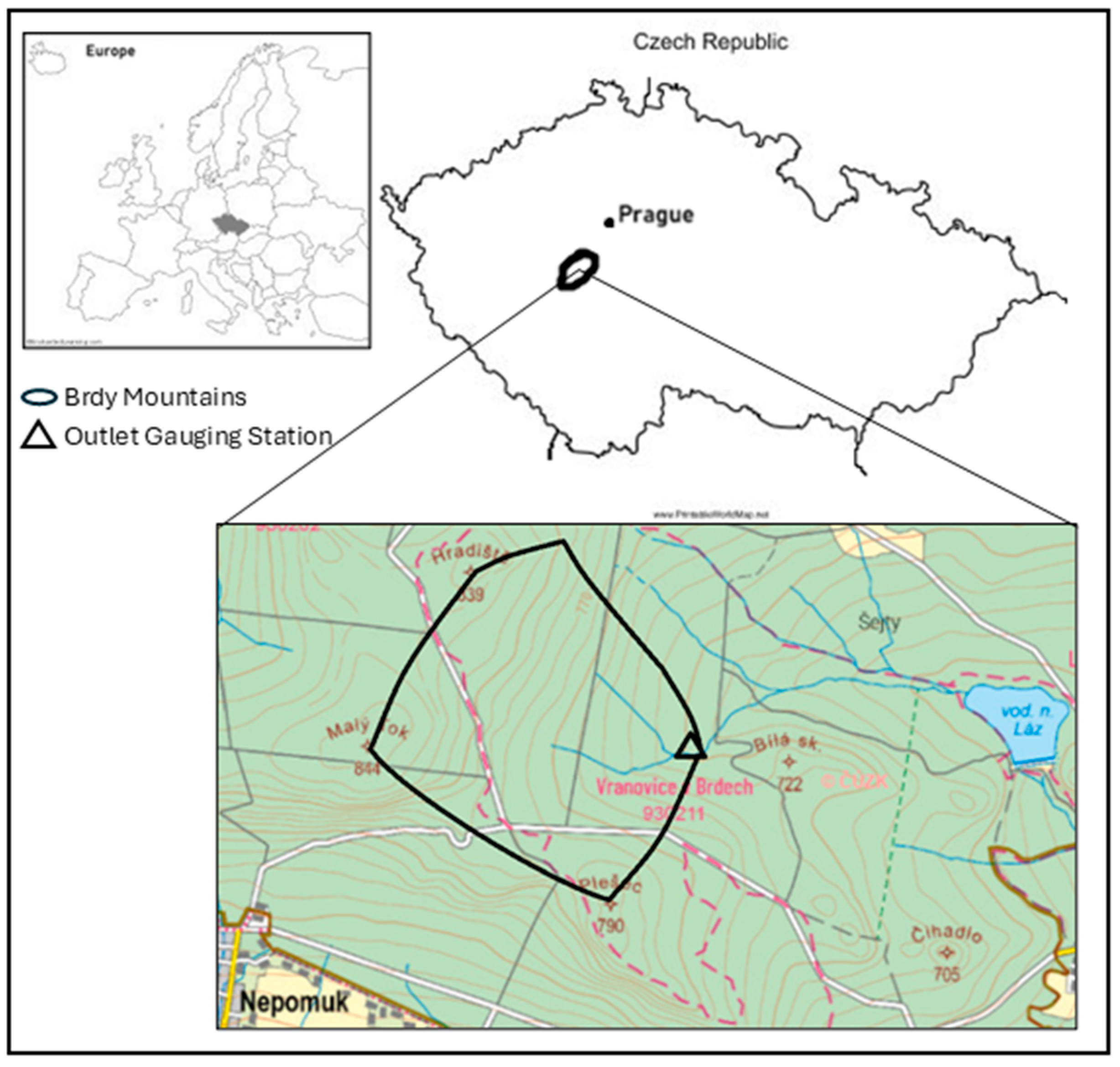
The headwaters of the Litavka River (49°39′ N, 13°52′ E) are located in the Brdy Mountains (Central Bohemia, Czech Republic; Figure 1). This region has a hilly landscape with elevations up to 900 m above sea level with geologically diverse bedrock (from ancient Neoproterozoic to younger Ordovician and Cambrian sedimentary and volcanic rocks, forming the interior of Central Bohemia) [20]. The whole catchment is covered by acidic, nutrient-poor brown cambisol soils and peat bogs. In terms of climate, this area belongs to the humid continental zone (Kőppen’s Dfb: warm-summer humid continental) [21] and has a mid-latitudinal precipitation regime (precipitation distributed across all seasons) and a rainfall-dependent river regime [22]. The natural vegetation has been represented by Luzulo-Fagetum beech forests (Fagus sylvatica), but nowadays Norway spruce stands are dominant (Picea abies (L.) H. Karst. [19,23].
Our study was conducted on the strongly acidified 1.5 km long rain-fed branch of this stream described as the Litavka right branch [24], a second-order stream with a catchment area of 1.74 km2 and an average slope of 8.6% (further referred only as the Litavka River). The other spring-fed branch of the Litavka River is much less acidified because its main source is an underground spring [19]. Between 1999 and 2011, ~7% of forest in the catchment was logged, with one of the largest clearings carried out directly along the sampling stretch in 2010 [19]. Between 2011 and 2021, a further 16% of the forest area was logged [25]. The average width of the studied branch at the sampling stretch is 0.5 m, ranging from 0.2 m to 1.5 m, and the average depth is 0.2 m, ranging from 0.03 m to 1.0 m [26]. The stream bed consists mainly of gravel, stones and boulders, and only 15% mud. Locally it is covered by moss and seasonally by filamentous algae. The median stream flow is 1.0 L s−1, though this fluctuates considerably during the year, ranging from 0 to over 1200 L s−1 during extreme flood events, depending on snow melt and the intensity of rainfall [19]. On average, snow cover lasts from 1 December to 10 April, with maximum depths of 15 cm occurring in March [21]. The theoretical maximum water equivalent of the snowpack is considered to be 60 mm. The stream is fishless at the sampling profile.

2.2. Instrumental Catchment

The studied catchment of the Litavka River is shown in Figure 1. This basin was instrumented in 1999 with a composite sharp-crested V-notch weir installed at the outlet. Initially, the water level was measured every two weeks. Since 2006, continuous recording has been carried out by an ALA 4020 automatic water pressure and temperature recorder (www.ala1.com; ALA, Bučovice, Czech Republic), logging every 2 min. Stream discharge was calculated from the water height using the general formula for a hydraulic weir [21]. Data from two neighbouring downstream gauging stations (1-11-04-0030: Příbram, catchment area of 43.6 km2, and 1-11-04-0130: Čenkov, 158 km2) were used for regional data interpolation.
Long-term trends in air temperature and precipitation were analysed from data from a nearby standard climate station “AKS1: Rožmitál pod Třemšínem”, 16 km from the study area (49°36′ N, 13°54′ E, elevation 538 m), operated continuously by the Czech Hydrometeorological Institute.

2.3. Hydrological Characteristics

Stream discharge data were processed in hourly, daily, monthly, and annual intervals. The local-minimum method [27] was used to identify the direct and baseflow components in observed hydrographs. The N-year flood peaks QN were estimated by the regional approach [22] using the recommended parameters (B = 58.14, n = 0.494) from [28].
Similarly, the low flow frequency analysis employed regional coefficients, and the M-day duration discharge QM was calculated using the long-term average annual discharge Qa. Based on the Czech national water law [29], the ecological minimum discharge was estimated by the value of Q330.
To indicate changes in aridity of the studied area, Lang’s rain factor LRF [30] was applied as an effective single indicator of aridification in relatively wet headwater regions of Central Europe [31,32], using the ratio of annual precipitation (P) to average annual air temperature (Ta). Subsequently, changes in streamflow extremes were analysed, particularly the number of days with an average daily discharge below the critical ecological minimum value.

2.4. Sampling and Water Biota

Water samples for chemical analyses and macroinvertebrate samples were taken at monthly intervals during 1999 and 2010 and at quarterly intervals in 2021. Additional water and macroinvertebrate samples were taken in the years 2000, 2009, and 2022. Water samples were filtered on site through a 40 μm mesh polyamide filter (Whatman, Maidstone, UK). Macroinvertebrate samples were taken using a kicking technique [33] with a 500 μm mesh hand sieve along a 50 m long section upstream of the weir from 6 different habitats for 30 s each, giving adequate attention to all microhabitats. The sieve was frequently emptied to minimise the loss of low-instar or small-sized macroinvertebrates. The material was carefully sieved to remove mud, and preserved in the field with 80% ethanol for further laboratory analysis.

2.5. Laboratory Analyses

In the laboratory, pH was measured using a combined glass electrode, and specific conductivity at 25 °C (SC25) was determined. The main ions (SO42−, NO3, Cl, F, Na+, K+, Ca2+, Mg2+, and NH4+) were analysed using ion chromatography (Dionex, Sunnyvale, CA, USA). Total organic carbon (TOC) was measured with Shimadzu TOC analyzer (Shimadzu TOC-L, Kyoto, Japan) and FormacsTN (Skalar, Breda, The Netherlands) automatic analysers. Total reactive aluminium (Al) and its ionic form (Ali) were fractionated and determined according to [34]. Organically bound aluminium (Alo) was the difference between Al and Ali. Other metals were not analysed, but annual average concentrations of some important metals, such as iron (Fei) and manganese (Mni) were obtained from the monitoring research conducted by the Czech Geological Survey at the same study site (Table 1).
Macroinvertebrate larvae and adults were sorted and identified at least to the genus, and to species level if possible. Oligochaeta, Chironomidae and other Diptera were identified to the subfamily or lower level. Based on morphotaxonomy, the number of taxa was determined by counting the highest possible number of taxa determined to the lowest possible level (e.g., Micropterna sp. and Limnephilidae are counted as only one taxon).

2.6. Data Analyses

Differences in water composition between the studied years was assessed by the nonparametric Kruskall–Wallis test, and a subsequent multiple comparison of p-values was run to assign the significantly different pairs of years, both using the Statistica 13 packages (TIBCO, San Ramon, CA, USA). Trends in the time series for temperature and precipitation were assessed using the Spearman correlation test with the CTPA programme (WMO/TD No. 1013, Genéva, Switzerland) [35]. Standard descriptive statistics and one-way ANOVA were applied to analyse the collected data sets of water flows.

3. Results

3.1. Water Composition

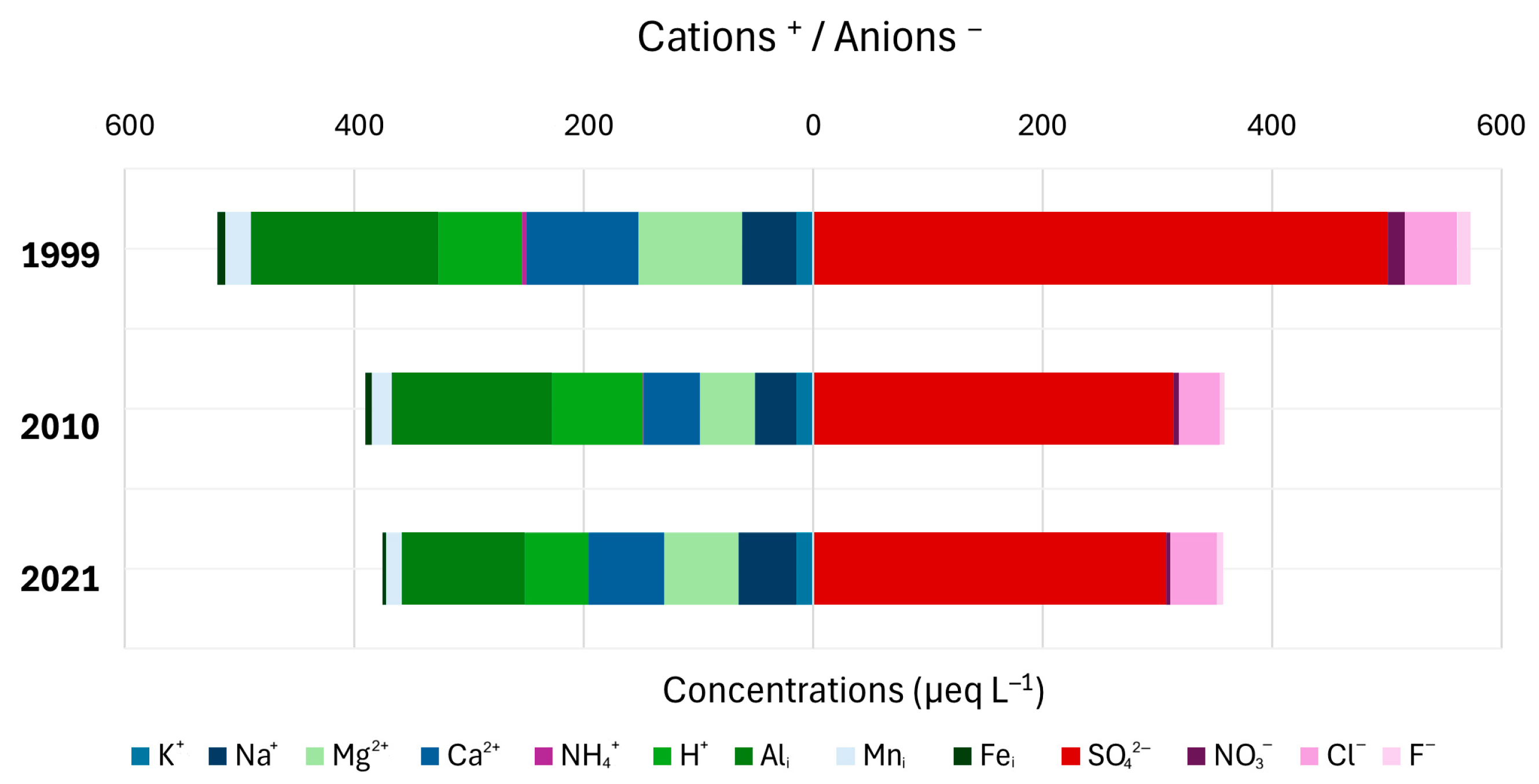
Average water pH values in the Litavka River increased from 4.2 to only 4.3 during the period from 1999 to 2021 and H+ concentrations decreased only by 24% despite a significant decrease in SO42− concentrations (p < 0.001) by 49% (from 601 to 308 μeq L−1) (Table 1). There was also a significant (p = 0.002) 43% decrease in Ali concentrations (from 192 to 107 μeq L−1) and a related overall increase in Alo (significant during 1999–2010, p = 0.014). There was also an overall decrease in conductivity and the concentrations of NO3 (78%) and Cl (11%) between 1999 and 2010. In contrast to SO42− and NO3, a different trend occurred for Na+, Ca2+, and Mg2+ concentrations, which first decreased between 1999 and 2010 by 22, 50, and 47%, respectively, but then increased again in the period 2010–2021 (Table 1). TOC concentrations were significantly higher in 2010 and 2021 compared to 1999. The sum of cations and anions substantially decreased in 2010 compared to 1999, but only a very slight decrease was observed between 2010 and 2021 (Figure 2).

3.2. Climate and Hydrology

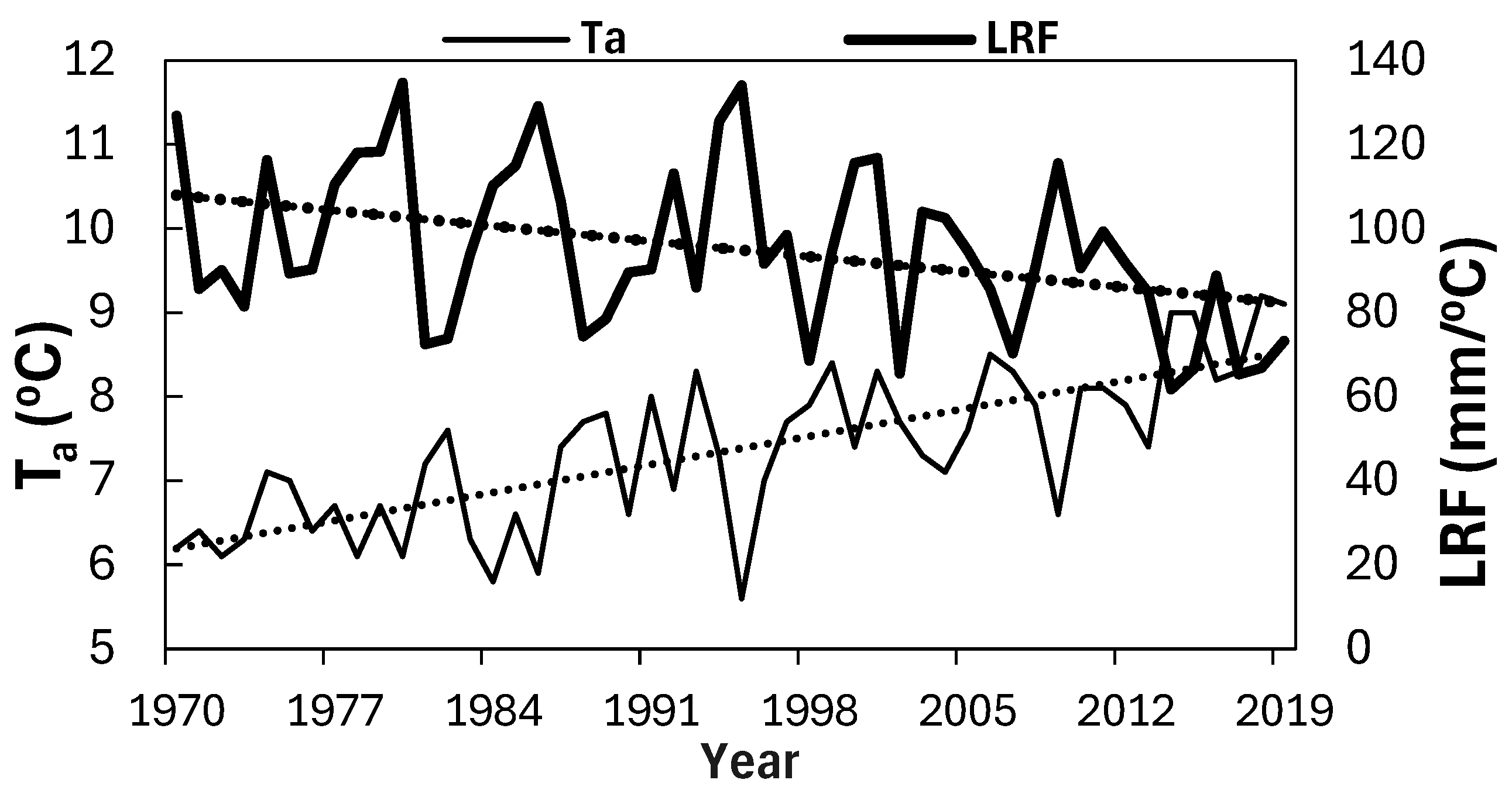
At the nearby climate station “Rožmitál pod Třemšínem”, there was a significant increase in average Ta over the last 50 years (1970–2020) by 2.4 °C, (Figure 3; Spearman correlation coefficient R = 0.75 > Rcrit = 0.273, n = 51, p = 0.05), and the two-tailed p-value < 0.0001 indicates an extremely significant linear trend. However, while the average Ta over the whole period increased by 0.48 °C decade−1, from 1970 to 1999 Ta rose by 0.3 °C decade−1, whereas from 2000 to 2020, it rose by 0.75 °C decade−1. These results correspond to the recent (2011–2020) increase in global warming, with larger increases over land (1.59 °C above the long-term average) reported by [36].
In contrast to Ta, the trend in annual precipitation was not significant (R = 0.19 < Rcrit = 0.273). However, there was a significant decline in Lang’s rain factor (LRF) (Figure 3; the Spearman correlation coefficient R = 0.36 > Rcrit = 0.273, n = 51, p = 0.05), with a shift over the last 50 years from “temperate wet” (LRF: 100–160) to “temperate warm” (LRF: 60–100). The trend of the LRF changed significantly in 1987, as the gradient increased from −4.2 mm °C−1 decade−1 from 1970 to 1986 to −9.4 mm °C−1 decade−1 from 1987 to 2020. This has caused a significant aridification of the regional climate.
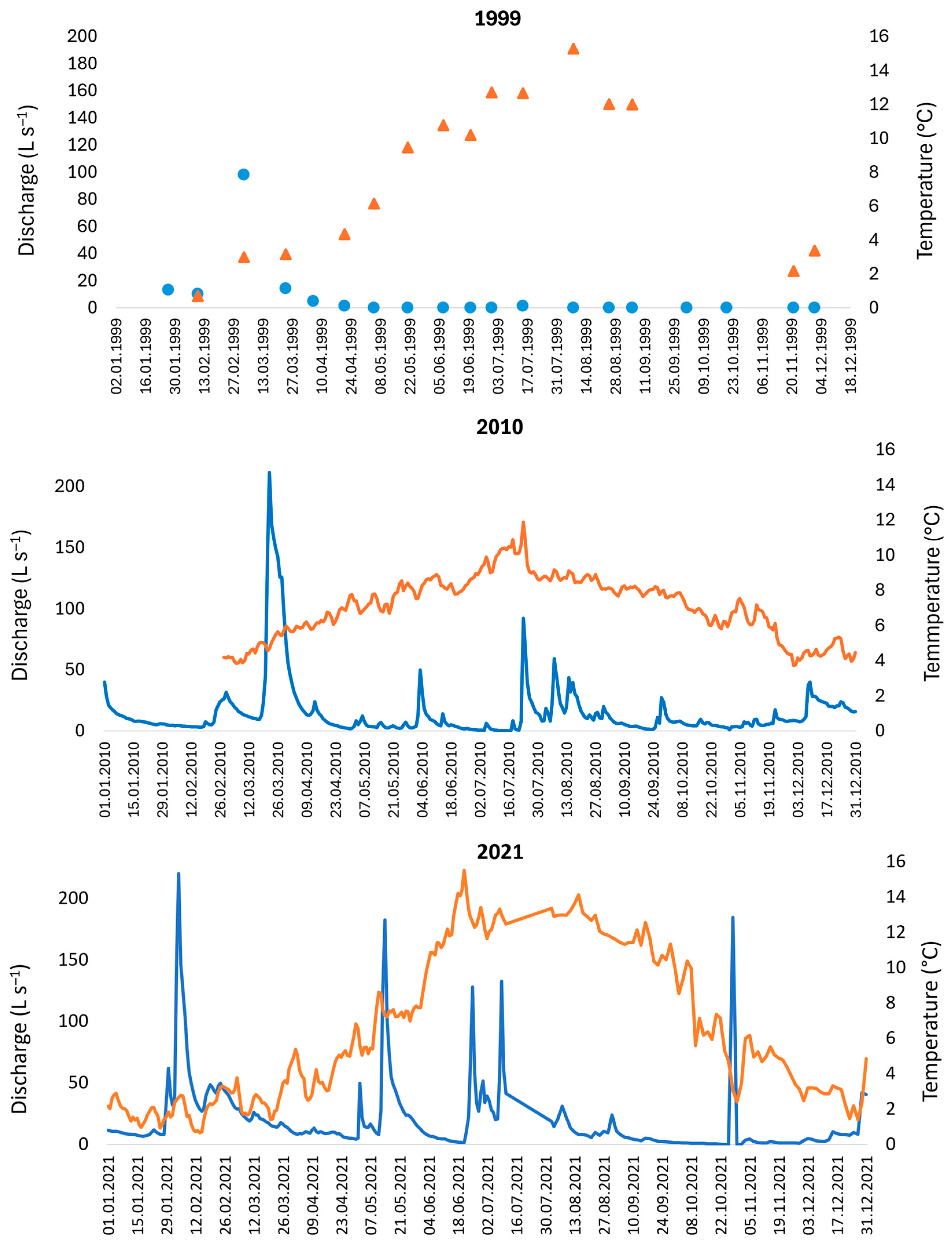
Annual temperature and precipitation in all three investigated years, 1999, 2010, and 2021 (Figure 4), were close to the long-term averages (7 °C and 824 mm, respectively) as the differences from the average were 0.2, 0.5, and 0.3 °C, and −40, −25, and −4 mm, respectively. In 1999, the average annual discharge was 12 L s−1, the maximum peak-flow was 241 L s−1, the minimum discharge was 0.18 L s−1, and streamflow did not reach the critical ecological value of 1.8 L s−1 for 29 days per year. In 2010, the average annual discharge was 15 L s−1, the maximum peak-flow was 270 L s−1, the minimum discharge was 0.2 L s−1, and there were 25 days with streamflow below the critical value. In 2021, the average annual discharge was 20 L s−1, the maximum peak-flow was 310 L s−1, and streamflow below the critical value extended to 44 days. Overall, the year 2021 was the least balanced year in terms of discharge. Moreover, a zero discharge was observed at the gauging station during 12 days in October.

3.3. Macroinvertebrates

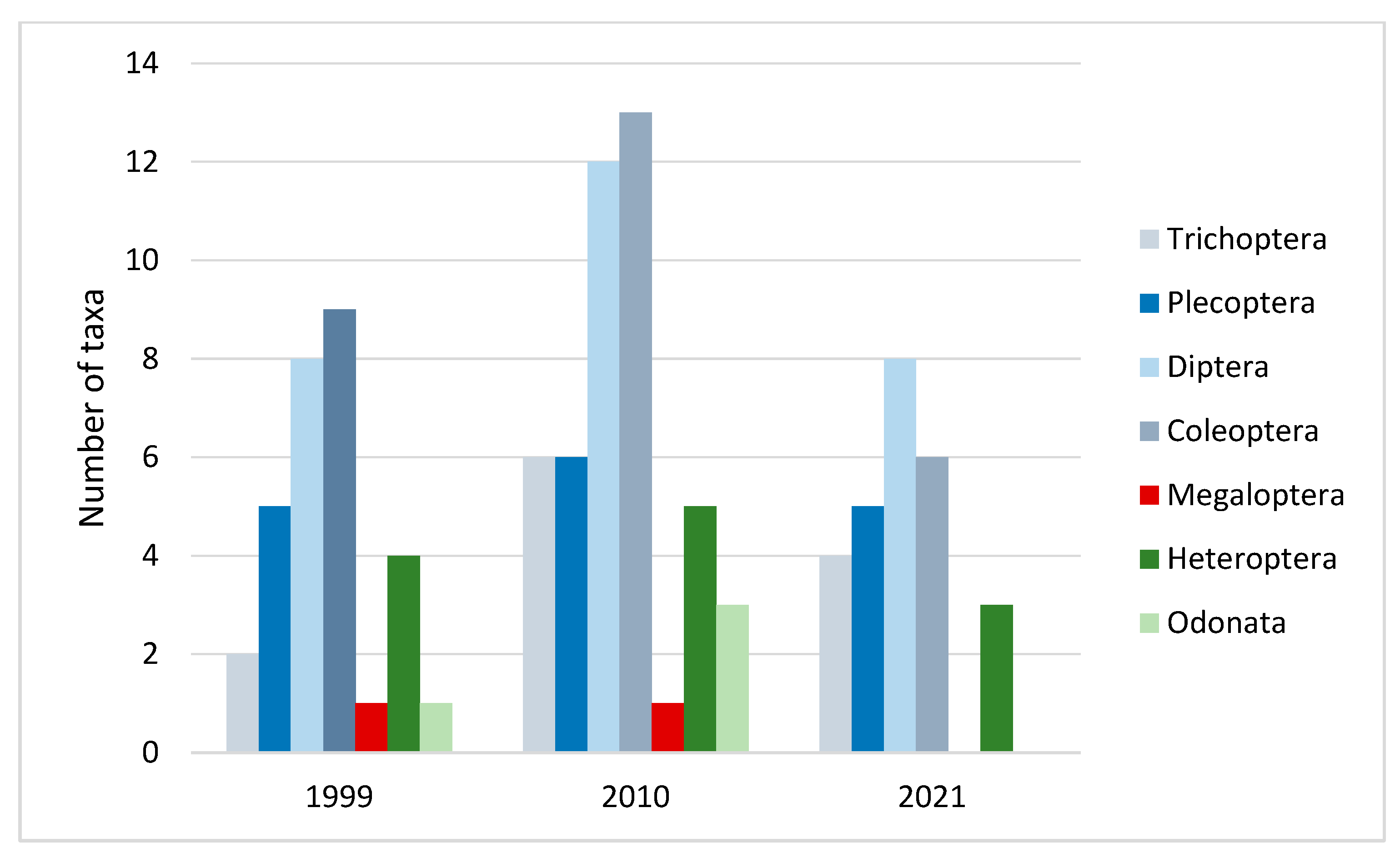
While a significant improvement in the number of taxa and the appearance of the first acid-sensitive species was observed in the Litavka River in 2010 compared to 1999, a considerable decline in their numbers was recorded in 2021 (Figure 5). The numbers of species decreased slightly (from 6 to 4 for Trichoptera,), returned to 1999 levels (from 6 to 5 for Plecoptera; from 12 to 8 for Diptera), or were even lower than in 1999 (from 1 to 0 for Megaloptera; from 3 to 0 for Odonata; from 13 to 5 for Coleoptera; from 5 to 3 for Heteroptera). Acid-sensitive stonefly Diura bicaudata and caddisfly Rhyacophila sp., both recorded in 2010, were not present in 2021. Many other species that were present in 2010 were not found in 2021 (Table S1). They mainly include beetles (Agabus paludosus, A. strumii, Deronectes platynotus, Hydroporus planus, Helephorus sp., Anacaena globulus, A. lutescens, Crenitis punctatostriata), but there were also two species of water bugs (Callicorixa prauesta, Gerris thoracicus), the dipteran Rhagio sp. and the family Tabanidae, and all Odonata taxa.
In contrast, other taxa showed opposite trends in relative abundance between 1999 and 2021 (Table 2). There were considerable increases in relative abundances in the caddisfly Plectrocnemia conspersa (predator) and the dipteran family Chironomidae (predominantly detritivores), as well as other Diptera. In 2021, these taxa accounted for the highest relative abundance of the entire macroinvertebrate assemblage (8.4%, 75%, and 4.9%, respectively).
An increase in relative abundance from 1999 to 2010, followed by a slight decrease from 2010 to 2021, was observed in stoneflies Nemoura cambrica and Amphinemura sp., the caddisfly family Limnephilidae, and beetles of the family Dytiscidae. On the other hand, there was a decrease in the relative abundance of oligochaetes, stoneflies Leuctra sp. (followed by another slight decrease in 2021), Protonemura sp., and Nemurella pictetii.
The annual variability in the number of individuals was analysed in 2021, showing considerable differences among the most abundant taxa (Figure S1). The highest total abundances were recorded in November (Trichoptera, Chironominae), followed by March (Chironominae, Orthocladiinae, Plecoptera) and May (Plecoptera); the lowest abundance was recorded in August. Similarly, an analysis of habitat variability revealed that each of the six microhabitats was favourable for one of the most abundant macroinvertebrate groups (Figure S1).

4. Discussion

To our knowledge, the Litavka River has long been among the most acidified streams in the Czech Republic, along with other catchments with acid-sensitive bedrock in the Bohemian Forest [6,17,36,37] and in the Slavkovský les (Slavkov Forest) Mountains [7]. According to MAGIC modelling, pH in the Litavka River of the Litavka River was estimated at 5.0 in the 1860s, then steadily decreased to a minimum of 4.05 in 1988 [19]. The same model showed that recovery from this extreme acidification would be gradual and slow due to SO4 leaching from the soil and the depleted base saturation of catchment soils. Therefore, pH was predicted to increase only to 4.3 by 2050. However, we observed an average pH of 4.3 already in 2021, indicating that chemical recovery has so far been somewhat faster than predicted. This may be due to an unexpected increase in the leaching of base cations, possibly associated with forest decline and the release of base cations from litter, as observed elsewhere (e.g., [38]).
Although the recovery from acidification has proceeded faster than predicted up to 2021, it could still be considered very slow and far from the initial conditions. While the water composition changed significantly towards chemical recovery (with decreases in SO42−, H+, Ali, conductivity, base cations, etc.), the pH increased only to ~4.3. The relatively small increase in pH enabled only a partial recovery of macroinvertebrate species, underscoring the sensitivity of aquatic biota to minor chemical improvements [18]. The significant reduction in Al toxicity could be the most important factor subsequently enabling biological recovery in the Litavka River, as there is usually a strong negative correlation between the number of macrozoobenthos species and the concentration of toxic Al forms [3].
The observed increase in the number of taxa and the appearance of the first less acid-tolerant taxa (Diura bicaudata and Rhyacophila sp.) were mainly evident between 1999 and 2010. The decrease in the relative abundance of Leuctra sp., Protonemura sp., and Nemurella pictetii from 1999 to 2021 also indicates ongoing biological recovery, since these acid-tolerant generalists typically occupy niches that are vacant due to acidification effects [18]. The increase in the relative abundance of the predatory caddisfly Plectrocnemia conspersa could be explained by its good adaptation to hydrological conditions such as floods or droughts [39]. Between 2010 and 2021, however, although the water composition continued to recover, a decrease in macroinvertebrate diversity and the absence of both less acid-tolerant taxa were again observed. This suggests that biological recovery processes were influenced by additional factors. Unfavourable hydrological conditions in 2021, including several periods of increased discharge followed by extremely low discharges or even drought, could explain this unexpected decline in the number of macroinvertebrate taxa.
The decrease in Ali concentrations was most probably associated with an increase in TOC (consisting mainly of dissolved DOC), as higher concentrations of DOC can bind Al in organic, non-toxic complexes [39]. Indeed, Alo concentrations increased in Litavka during the studied period. A similar increase in DOC has recently been observed in many European and North American freshwaters (e.g., [9,40,41,42,43,44]) alongside ongoing recovery from acidification, and may also follow forest disturbances [45]. These studies identified various causes of increasing DOC concentrations, including increasing temperature, recovery from acidification, increased summer precipitation, reduced photo-mineralization rates, elevated CO2-driven primary production, altered hydrological regimes, more frequent severe droughts, or land-use changes and disturbances. Furthermore, it is not clear whether the increase in DOC can accelerate or delay recovery from acidification [3]. Nevertheless, for the biological recovery of the Litavka River, the increase in TOC along with Alo and the decrease in toxic Ali may have been crucial.
All of the above-mentioned results highlight that the chemical and biological recovery of freshwaters from acidification have likely been affected by recent climate change, although the process may be somewhat ambiguous, and can even enhance recovery [46]. However, increases in hydrological extremes, as have been observed in the Litavka River, have likely delayed recovery, as has been noted by others (e.g., [47]). Over the last 50 years, the average annual temperature in our study area increased by 2.4 °C with intensification in the last 20 years. With climate aridification rises potential evapotranspiration affecting the number of days with discharge below the critical minimum level [32,36]. Though short drought spells have historically occurred in the Litavka catchment, however, hydrological modelling has predicted an increased frequency of short dry periods due to changes in the precipitation distribution and decline in annual runoff (2–30%) and much more markedly in summer–autumn runoff (60%) [48]. More frequent droughts and floods can therefore have a significant negative impact on the ongoing recovery of macroinvertebrate assemblages. For example, ref. [39] observed a reduction of ~50% in the number of macroinvertebrate taxa and a 90% decrease in their abundance after a nearly 1000-year flood. On the other hand, after the same flood, a significant drop in SO42− concentrations and rising alkalinity were recorded in the stream, potentially accelerating chemical recovery.
The recovery of the Litavka River could also be affected, to some extent, by land use change in its catchment. Continued planting of spruce monocultures likely contributes to slowing the recovery. At the same time, however, harvesting of spruce forests leads to net losses of K+, Ca2+, and Mg2+ [49] as well as increases in water temperature, daily discharge, and peak flood discharge [50]. During the period investigated, 1999–2011, approximately 21% of the forest in the Litavka catchment area was harvested by the clear-cutting of mature spruce stands. However, according to the authors of [51], the average annual forest harvest increment was likely too low to cause significant changes in catchment outflow. Despite this, changes in light conditions due to logging in the immediate vicinity of the studied stretch could have had an indirect effect on the macroinvertebrate assemblage, since primary production could have increased, thereby supporting herbivorous taxa.
The absence of mayflies, molluscs, and crustaceans in the Litavka River indicates continued acidic conditions [52,53]. The dispersal of acid-sensitive taxa should not be a limiting factor, as less-acidic neighbouring streams are a potential source of such species. In lotic environments, recolonization is aided by effective dispersal mechanisms, such as drift, which enables species to reappear shortly after the removal of environmental stress [3]. In the catchment of the Litavka headwaters, modelling showed a low buffering capacity of soils even before the onset of acidification [19], making the streams more susceptible to episodic re-acidification [40]. Such short acidification events, not detected by our occasional research, may hinder the successful recovery of macrozoobenthos.
A slow recovery process has also been observed in Swedish lakes [40], UK lakes [54] lakes in eastern Canada [55], as well as lakes of the Czech and Slovakian mountains [15,16,17]. Ref. [10] determined that the recovery of European and North American lakes is far from complete. Climate change, increasing terrestrial export of DOC, and intensive forest harvesting were most frequently cited as important factors possibly delaying chemical recovery. As a result, freshwater ecosystems may not return to reference conditions.
In summary, besides the ongoing recovery from acidification of the Litavka River, the macroinvertebrate composition was likely affected by conditions preceding and during sampling. These factors contributed to unexpected differences in taxon richness among sampling years, particularly the high number of taxa observed in 2010 and the low numbers observed in 1999 and 2021. The 2010 species composition suggests an input of semi-terrestrial species (e.g., the dipteran Rhagio sp.), probably flushed out during higher discharges. The high number of beetle species may reflect favourable conditions following the deforestation around the sampling profile prior to 2010, similar to the higher numbers of water bugs and Odonata that readily colonise new habitats. The occurrence of Odonata (dragonflies and damselflies), the alderfly Sialis fuliginosa, and the caddisfly Oligotricha striata in 2010 could also indicate a higher amount of sediment in the stream. Moreover, water bugs recorded in 2010 were surface-dwelling and thus were likely sampled only incidentally. These findings contrast with the impaired hydrological conditions in 1999 and 2021. Therefore, when assessing the recovery process, such ecological factors must also be considered.

5. Conclusions

Despite significant reductions in S and N emissions since the recent past, which were clearly reflected in decreases in water concentrations of SO42−, H+, Ali, conductivity, and base cations, the Litavka River remains one of the most acidified stream in the Czech Republic. Since the pH has decreased only slightly since 1999, we attribute the noticeable biological recovery observed between 1999 and 2010 mainly to a significant decrease in toxic Ali concentrations. However, despite further improvements in water quality between 2010 and 2021, there was no further progress in biological recovery; instead, there was a decline in the number of taxa compared to 2010. Representatives of mayflies, molluscs, and crustaceans were completely absent throughout the study period.
The results of this study are associated with a small, largely rain-fed headwater stream with a limited groundwater storage. Extremely low and high discharges could have had a significant impact on the decline in macrozoobenthos diversity. Larger stream systems with greater groundwater contributions are likely to be less sensitive to short-term drought conditions or floods during their recovery from historical acidification.
Indirectly, biological recovery could also be affected by the observed increase in DOC concentrations, logging in the catchment area, and changes in light conditions at the sampling site. Further research is needed to clarify the ongoing recovery in the current period; however, more frequent sampling would be beneficial.
Since the studied stream section is located in the Brdy Protected Landscape Area (established in 2016), nature conservation authorities can apply the results to management. Targeted changes in forest management in the mountain basins could help reduce the negative impacts of climate change (extreme hydrological events).

Supplementary Materials

The following supporting information can be downloaded at https://www.mdpi.com/article/10.3390/w18040479/s1, Figure S1: Year and habitat variability in the occurrence of macroinvertebrates based on four samples collected in 2021; Table S1: List of macroinvertebrate taxa found in the samples in 1999, 2010, and 2021.

Author Contributions

Conceptualization, E.S., K.D. and P.C.; Methodology and field work, E.S., J.K. (Jiří Kopáček), J.K. (Josef Křeček), M.U. and P.C.; Formal analysis, E.S., J.K. (Jiří Kopáček), J.Š. and P.C.; and Investigation, E.S., J.K. (Jiří Kopáček), J.K. (Josef Křeček) and P.C.; Data curation, K.D.; Writing—original draft preparation, K.D.; Writing—review and editing, E.S., J.K. (Jiří Kopáček), J.K. (Josef Křeček), K.D. and P.C.; Visualisation, K.D. and J.K. (Josef Křeček); Supervision, E.S. Author E.S. sadly passed away prior to the publication of this manuscript. All authors have read and agreed to the published version of the manuscript.

Funding

This study is based on recent work funded by the Ministry of Education Youth and Sports of the Czech Republic (project No. LUAUS25082) and the Czech Science Foundation (project No. 23-06075S). The study of P. Chvojka was supported by the Ministry of Culture of the Czech Republic (DKRVO 2024–2028/5.I.b, National Museum, 00023272).

Data Availability Statement

Data are available in zenodo at https://zenodo.org/records/17900903 (accessed on 8 December 2025).

Acknowledgments

A large number of colleagues have participated in field sampling or biological determination (J. Hájek, D. Hardekopf, J. Horecký, P. Kment, D. Vondrák) to whom we would like to express our special thanks. We are thankful to David Hardekopf and Joanne P. Ballard for their proofreading of the manuscript.

Conflicts of Interest

Jan Špaček was employed by the company Povodí Labe, State Enterprise. The remaining authors declare that the research was conducted in the absence of any commercial or financial relationships that could be construed as a potential conflict of interest.

References

  1. Reuss, J.O.; Johnson, D.W. Acid Deposition and the Acidification of Soils and Waters; Springer: New York, NY, USA, 1986. [Google Scholar]
  2. Psenner, R.; Catalan, J. Chemical composition of lakes in crystaline basins: A combination of atmospheric deposition, geologic background, biological activity and human action. In Limnology Now: A Paradigm of Planetary Problems; Margalef, R., Ed.; Elsevier: Amsterdam, The Netherlands, 1994. [Google Scholar]
  3. Hynynen, J.; Meriläinen, J.J. Recovery from acidification in boreal lakes inferred from macroinvertebrates and subfossil chironomids. Hydrobiologia 2005, 541, 155–173. [Google Scholar] [CrossRef]
  4. Fott, J.; Pražáková, M.; Stuchlík, E.; Stuchlíková, Z. Acidification of lakes in Šumava (Bohemia) and in the High Tatra Mountains (Slovakia). Hydrobiologia 1994, 274, 37–47. [Google Scholar] [CrossRef]
  5. Veselý, J. Investigation of the nature of the Šumava lakes: A review. Časopis Národního Muzea Praha Řada Přírodovědná 1994, 163, 103–120. [Google Scholar]
  6. Vrba, J.; Kopáček, J.; Fott, J.; Kohout, L.; Nedbalová, L.; Pražáková, M.; Soldán, T.; Schaumburg, J. Long-term studies (1871–2000) on acidification and recovery of lakes in the Bohemian Forest (Central Europe). Sci. Total Environ. 2003, 310, 73–85. [Google Scholar] [CrossRef] [PubMed]
  7. Hruška, J.; Moldan, F.; Krám, P. Recovery from acidification in central Europe–observed and predicted changes of soil and streamwater chemistry in the Lysina catchment, Czech Republic. Environ. Pollut. 2002, 120, 261–274. [Google Scholar] [CrossRef] [PubMed]
  8. UN-ECE. Strategies and policies for air pollution abatement. In Economic Commission for Europe (ECE.EB.AIR/65); Convention on Long-Range Transboundary AIR Pollution; UN-ECE: Geneva, Switzerland, 1999. [Google Scholar]
  9. Stoddard, J.L.; Jeffries, D.S.; Lükewille, A.; Clair, T.A.; Dillon, P.J.; Driscoll, C.T.; Forsius, M.; Johannessen, M.; Kahl, J.S.; Kellogg, J.H.; et al. Regional trends in aquatic recovery from acidification in North America and Europe. Nature 1999, 401, 575–578. [Google Scholar] [CrossRef]
  10. Posch, M.; Aherne, J.; Forsius, M.; Fronzek, S.; Veijalainen, N. Modelling the impacts of European emission and climate change scenarios on acid-sensitive catchments in Finland. Hydrol. Earth Syst. Sci. 2008, 12, 449–463. [Google Scholar] [CrossRef]
  11. Garmo, Ø.A.; Skjelkvåle, B.L.; De Wit, H.A.; Colombo, L.; Curtis, C.; Fölster, J.; Hoffman, A.; Hruška, J.; Høgåsen, T.; Jeffries, D.S.; et al. Trends in Surface Water Chemistry in Acidified Areas in Europe and North America from 1990 to 2008. Water Air Soil Pollut. 2014, 225, 1880. [Google Scholar] [CrossRef]
  12. Kopáček, J.; Hejzlar, J.; Stuchlík, E.; Fott, J.; Veselý, J. Reversibility of acidification of mountain lakes after reduction in nitrogen and sulphur emissions in Central Europe. Limnol. Oceanogr. 1998, 43, 357–361. [Google Scholar] [CrossRef]
  13. Křeček, J.; Palán, L.; Pažourková, E.; Stuchlík, E. Water-quality genesis in a mountain catchment affected by acidification and forestry practices. Freshw. Sci. 2019, 38, 257–269. [Google Scholar] [CrossRef]
  14. Oulehle, F.; Fischer, M.; Hruška, J.; Chuman, T.; Krám, P.; Navrátil, T.; Tesař, M.; Trnka, M. The GEOMON network of Czech catchments provides long-term insights into altered forest biogeochemistry: From acid atmospheric deposition to climate change. Hydrol. Process. 2021, 35, e14204. [Google Scholar] [CrossRef]
  15. Stuchlík, E.; Bitušík, P.; Hardekopf, D.W.; Hořická, Z.; Kahounová, M.; Tátosová, J.; Vondrák, D.; Dočkalová, K. Complexity in the biological recovery of Tatra Mountain lakes from acidification. Water Air Soil Pollut. 2017, 228, 184. [Google Scholar] [CrossRef]
  16. Petruželová, J.; Bojková, J.; Sychra, J.; de Donnová, S.; Vrba, J.; Polášková, V.; Seifert, L.; Šorfová, V.; Kopáček, J. Accelerated recovery of lake macroinvertebrates in the third decade since the reversal of acidification. Sci. Total Environ. 2023, 892, 164553. [Google Scholar] [CrossRef] [PubMed]
  17. Vrba, J.; Bojková, J.; Chvojka, P.; Fott, J.; Kopáček, J.; Macek, M.; Nedbalová, L.; Papáček, M.; Rádková, V.; Sacherová, V.; et al. Constraints on the biological recovery of the Bohemian Forest lakes from acid stress. Freshw. Biol. 2016, 61, 376–395. [Google Scholar] [CrossRef]
  18. Horecký, J.; Stuchlík, E.; Chvojka, P.; Hardekopf, D.W.; Mihaljevič, M.; Špaček, J. Macroinvertebrate community and chemistry of the most atmospherically acidified streams in the Czech Republic. Water Air Soil Pollut. 2006, 173, 261–272. [Google Scholar] [CrossRef]
  19. Hardekopf, D.W.; Horecký, J.; Kopáček, J.; Stuchlík, E. Predicting long-term recovery of a strongly acidified stream using MAGIC and climate models (Litavka, Czech Republic). Hydrol. Earth Syst. Sci. 2008, 12, 479–490. [Google Scholar] [CrossRef]
  20. Demek, J.; Mackovčin, P. Mountains and Lowlands. In Geographical lexicon of the Czech Republic; Mendel University: Brno, Czech Republic, 2006. (In Czech) [Google Scholar]
  21. Tolasz, R.; Míková, T.; Valeriánová, A.; Voženílek, V. Climate Atlas of Czechia; Czech Hydrometeorological Institute: Prague, Czech Republic, 2007. [Google Scholar]
  22. Shaw, E.M. Hydrology in Practice, 4th ed.; Span Press: London, UK, 2011. [Google Scholar]
  23. Neuhӓuslová, Z.; Blažková, D.; Grulich, V.; Husová, M.; Chytrý, M.; Jeník, J.; Sádlo, J.; Jirásek, J.; Kolbek, J.; Wild, J.; et al. Map of Potential Natural Vegetation of the Czech Republic; Academia: Prague, Czech Republic, 1998. [Google Scholar]
  24. Horecký, J.; Rucki, J.; Krám, P.; Křeček, J.; Bitušík, P.; Špaček, J.; Stuchlík, E. Differences in benthic macroinvertebrate structure of headwater streams with extreme hydrochemistry. Biologia 2013, 68, 303–313. [Google Scholar] [CrossRef]
  25. Varvařovský, L. (Military Forests and Estates of the Czech Republic, State Enterprise, Nepomuk, Czech Republic). Evidence of harvesting. Personal Communication, 2025. [Google Scholar]
  26. Beneš, F.; Horecký, J.; Senoo, T.; Kamasová, L.; Lamačová, A.; Tátosová, J.; Hardekopf, D.W.; Stuchlík, E. Evidence for responses in water chemistry and macroinvertebrates in a strongly acidified mountain stream. Biologia 2017, 72, 1049–1058. [Google Scholar] [CrossRef]
  27. Sloto, R.A.; Crouse, M.Y. HYSEP: A Computer Program for Streamflow Hydrograph Separation and Analysis; Water—Resources Investigations Report 96-4040; U.S. Geological Survey: Lemoyne, PA, USA, 1996. [Google Scholar]
  28. Kemel, M. Climatology, Meteorology, Hydrology; Czech Technical University: Prague, Czech Republic, 1996. (In Czech) [Google Scholar]
  29. Act No. 254/2001 Coll. Water Act on Amendments to Certain Acts (Water Act); Parliament of the Czech Republic: Praha, Czech Republic, 2001; Available online: https://www.zakonyprolidi.cz/cs/2001-254 (accessed on 8 December 2025). (In English)
  30. Oliver, J.E. Encyclopedia of World Climatology; Encyclopedia of Earth Sciences Series; Springer: Dordrecht, The Netherlands, 2005. [Google Scholar]
  31. Mihai, G.; Alexandru, A.M.; Nita, I.A.; Birsan, M.V. Climate change in the provenance regions of Romania over the last 70 years: Implications for forest management. Forests 2022, 13, 1203. [Google Scholar] [CrossRef]
  32. Kertesz, A.; Křeček, J. Impacts of aridification on water resources in Central Europe. Int. J. Water Res. Arid Env. (PSIEWDR) 2024, 13, 8–20. [Google Scholar]
  33. Frost, S.A.; Huni, A.; Kershaw, W.E. Evaluation of kicking technique for sampling stream bottom fauna. Can. J. Zool. 1971, 49, 167–173. [Google Scholar] [CrossRef]
  34. Driscoll, C.T. A procedure for the fractionation of aqueous aluminum in dilute acidic waters. Int. J. Environ. Anal. Chem. 1984, 16, 267–284. [Google Scholar] [CrossRef]
  35. WMO. Technology for Detecting Trends and Changes in Time Series of Hydrological and Meteorological Variables; Hydrological Operational Multipurpose System; World Meteorological Organization: Geneva, Switzerland, 2001. [Google Scholar]
  36. IPCC. Climate Change, 2023; AR6 Synthesis Report; Intergovernmental Panel on Climate Change: Geneva, Switzerland, 2023. [Google Scholar]
  37. Dočkalová, K.; Senoo, T.; Vondrák, D.; Chvojka, P.; Kopáček, L.; Kamasová, L.; Beneš, F.; Špaček, J.; Tátosová, J.; Bitušík, P.; et al. Macroinvertebrate assemblages in acidified mountain lake inflows differs from lake outflows: The influence of lakes. Biologia 2022, 77, 2593–2607. [Google Scholar] [CrossRef]
  38. Kopáček, J.; Fluksová, H.; Hejzlar, J.; Kaňa, J.; Porcal, P.; Turek, J. Changes in surface water chemistry caused by natural forest dieback in an unmanaged mountain catchment. Sci. Total Environ. 2017, 584–585, 971–981. [Google Scholar] [CrossRef] [PubMed]
  39. Pažourková, E.; Křeček, J.; Bitušík, P.; Chvojka, P.; Kamasová, L.; Senoo, T.; Špaček, J.; Stuchlík, E. Impacts of an extreme flood on the ecosystem of a headwater stream. J. Limnol. 2021, 80, 1998. [Google Scholar] [CrossRef]
  40. Futter, M.N.; Valinia, S.; Löfgren, S.; Köhler, S.J.; Fölster, J. Long-term trends in water chemistry of acid-sensitive Swedish lakes show slow recovery from historic acidification. AMBIO 2014, 43, 77–90. [Google Scholar] [CrossRef] [PubMed]
  41. Monteith, D.T.; Stoddard, J.L.; Evans, C.D.; de Wit, H.A.; Forsius, M.; Hogåsen, T.; Wilander, A.; Skjelkvåle, B.L.; Jeffries, D.S.; Vuorenmaa, J.; et al. Dissolved organic carbon trends resulting from changes in atmospheric deposition chemistry. Nature 2007, 450, 537–540. [Google Scholar] [CrossRef] [PubMed]
  42. Evans, C.D.; Reynolds, B.; Hinton, C.; Hughes, S.; Norris, D.; Grant, S.; Williams, B. Effects of decreasing acid deposition and climate change on acid extremes in an upland stream. Hydrol. Earth Syst. Sci. 2008, 12, 337–351. [Google Scholar] [CrossRef]
  43. De Wit, H.; Stoddard, J.L.; Monteith, D.T.; Sample, J.E.; Austnes, K.; Couture, S.; Fölster, J.; Higgins, S.N.; Houle, D.; Hruška, J.; et al. Cleaner air reveals growing influence of climate on dissolved organic carbon trends in northern headwaters. Environ. Res. Lett. 2021, 16, 104009. [Google Scholar] [CrossRef]
  44. Langheinrich, U.; Smith, K.E.C.; Arevalo, J.R.; Schwarz, F.; Lüderitz, V. Recovery of streams in the Harz National Park (Germany)—The attenuation of acidification. Ecologies 2025, 6, 13. [Google Scholar] [CrossRef]
  45. Kopáček, J.; Evans, C.D.; Hejzlar, J.; Kaňa, J.; Porcal, P.; Šantrůčková, H. Factors affecting the leaching of dissolved organic carbon after tree dieback in an unmanaged European mountain forest. Environ. Sci. Technol. 2018, 52, 6291–6299. [Google Scholar] [CrossRef] [PubMed]
  46. Kopáček, J.; Kaňa, J.; Bičárová, S.; Fernandez, I.J.; Hejzlar, J.; Kahounová, M.; Norton, S.A.; Stuchlík, E. Climate Change Increasing Calcium and Magnesium Leaching from granitic Alpine catchments. Environ. Sci. Technol. 2016, 51, 159–166. [Google Scholar] [CrossRef] [PubMed]
  47. Laudon, H. Recovery from episodic acidification delayed by drought and high sea salt deposition. Hydrol. Earth Syst. Sci. 2008, 12, 363–370. [Google Scholar] [CrossRef]
  48. Benčoková, A.; Hruška, J.; Krám, P. Modeling anticipated climate change impact on biogeochemical cycles of an acidified headwater catchment. Appl. Geochem. 2011, 26, S6–S8. [Google Scholar] [CrossRef]
  49. Akselsson, C.; Westling, O.; Sverdrup, H.; Holmqvist, J.; Thelin, G.; Uggla, E.; Malm, G. Impact of harvest intensity on long-term base cation budgets in Swedish forest soils. Water Air Soil Pollut. 2007, 7, 201–210. [Google Scholar] [CrossRef]
  50. Lee, R.B. Forest Hydrology; Columbia University Press: New York, NY, USA, 2020. [Google Scholar]
  51. Bosch, J.M.; Hewlett, J.D. A review of catchment experiments to determine the effect of vegetation changes on water yield and evapotranspiration. J. Hydrol. 1982, 55, 3–23. [Google Scholar] [CrossRef]
  52. Raddum, G.G.; Fjellheim, A. Acidification and early warning organisms in freshwater in western Norway. Verh. Int. Verein. Limnol. 1984, 22, 1973–1980. [Google Scholar] [CrossRef]
  53. Braukmann, U.; Biss, R. Conceptual study—An improved method to assess acidification in German streams by using benthic macroinvertebrates. Limnologica 2004, 34, 433–450.59. [Google Scholar] [CrossRef]
  54. Helliwell, R.C.; Aherne, J.; MacDougall, G.; Nisbet, T.R.; Lawson, D.; Cosby, J.B.; Evans, C.D. Past acidification and recovery of surface waters, soils and ecology in the United Kingdom: Prospects for the future under current deposition and land use protocols. Ecol. Indic. 2014, 37, 381–395. [Google Scholar] [CrossRef]
  55. Clair, T.A.; Dennis, I.F.; Vet, R. Water chemistry and dissolved organic carbon trends in lakes from Canada’s Atlantic Provinces: No recovery from acidification measured after 25 years of lake monitoring. Can. J. Fish. Aquat. Sci. 2011, 68, 663–674. [Google Scholar] [CrossRef]
Figure 1. The Litavka experimental catchment.
Water 18 00479 g001
Figure 2. Ion balance in 1999, 2010, and 2021 based on average year concentrations of selected ions in the Litavka River.
Water 18 00479 g002
Figure 3. Average annual air temperature Ta and aridification of the area expressed by Lang’s rain factor for the period 1970–2020. Data source: the nearby climatological station “AKS1: Rožmitál pod Třemšínem”.
Water 18 00479 g003
Figure 4. Stream water discharge (blue) and temperature (orange) at the outlet of the studied catchment in year 1999, 2010, and 2021.
Water 18 00479 g004
Figure 5. Comparison of total numbers of taxa of the most important macroinvertebrate groups among the investigated years 1999, 2010, and 2021.
Water 18 00479 g005
Table 1. Water composition of the Litavka rain-fed branch in the gauging station profile. Significant p-values are in bold. ↓—decreasing trend; ↑—increasing trend.
ParameterUnit199920102021Kruskal–Wallis
p-Value
Significantly Different PairsTrend
AverageMin–MaxAverageMin–MaxAverageMin–Max
pH 4.24.0–4.34.14.0–4.24.34.2–4.40.057--
SC25μS cm−19890–1087366–775650–600.0041999–2010, 1999–2021
H+μeq L−17354–927960–955642–620.057
Na+μeq L−14743–513732–465149–530.0011999–2010, 2010–2021-
K+μeq L−11511–191412–181412–160.842-
Ca2+μeq L−19885–1284943–596653–810.0051999–2010
Mg2+μeq L−19073–1094840–746560–710.0011999–2010
NH4+μeq L−13.40.0–4.70.610.0–4.30.0690.0–0.190.0191999–2010
SO42−μeq L−1601578–628376323–430308262–345<0.0011999–2010, 1999–2021
NO3μeq L−1150.0–355.371.9–153.40.0–130.092
Clμeq L−14641–5335.328–424137–430.0081999–2010-
Fμeq L−11110–124.63.9–5.55.64.2–6.8<0.0011999–2010-
Aliμeq L−1192177–208152126–18610793–1160.0021999–2021
Feiμeq L−17.26.9–7.45.85.6–6.02.71.3–4.5<0.0011999–2010, 1999–2021
Mniμeq L−122181411–19<0.0011999–2010, 1999–2021
R-Alμg L−119961793–221116961381–202812001087–12830.0021999–2021
Aloμg L−18412–145193185–33211257–1680.0141999–2010
TOCmg L−12.90.50–5.06.63.3–116.64.1–9.20.0071999–2010, 1999–2021
SC25—specific conductivity at 25 °C; R-Al—total reactive aluminium; Alo—organically bound aluminium; TOC—total organic carbon.
Table 2. Total (TA) and relative (RA) abundances of selected taxa or taxa groups in 1999 (8 samples), 2010 (7 samples), and 2021 (4 samples).
Taxa199920102021Difference in RA 1999–2021
(Only Selected Taxa)
TARA (%)TARA (%)TARA (%)
Limnephilidae40.032131.5130.3411× more
Plectrocnemia conspersa1921.41921.43198.46× more
Leuctra nigra + Leuctra sp.561640900.651153.013× less
Amphinemura sp.10.011839131072.8280× more
Nemoura cambrica110.081401.090.243× more
Nemurella pictetii2018147745.6741.97× less
Protonemura sp.3352.4160.1120.05245× less
Diura bicaudata0080.0600
Chironomidae5252379296672869752× more
Other Diptera1080.741861.31874.96× more
Dytiscidae1310.923022.2762.02× more
Other Coleoptera00230.1660.16
Sialis fuliginosa1390.9850.0400
Heteroptera140.1210.1500.1
Odonata30.02120.0900
Oligochaeta3502.58105.8360.942.6× less
Disclaimer/Publisher’s Note: The statements, opinions and data contained in all publications are solely those of the individual author(s) and contributor(s) and not of MDPI and/or the editor(s). MDPI and/or the editor(s) disclaim responsibility for any injury to people or property resulting from any ideas, methods, instructions or products referred to in the content.