Scalability and Computational Performance of an Ecohydrological Model Using Machine Learning-Based Prediction



Abstract
1. Introduction
2. Materials and Methods
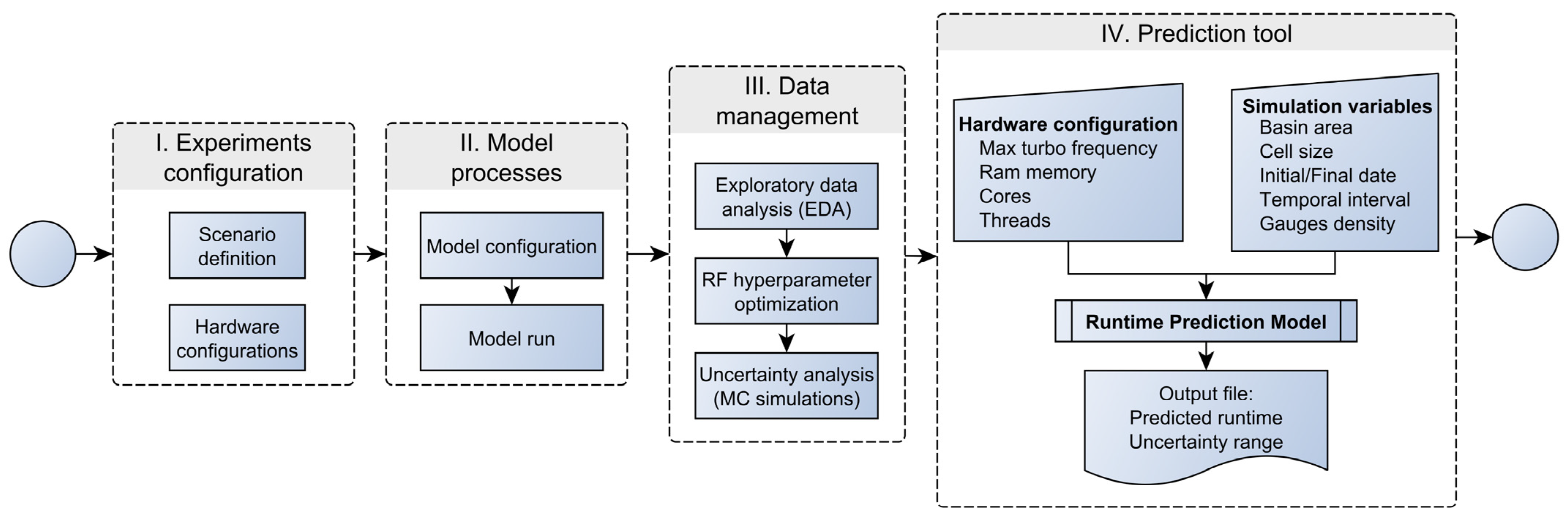
2.1. Experimental Design
2.2. Machine Learning Application
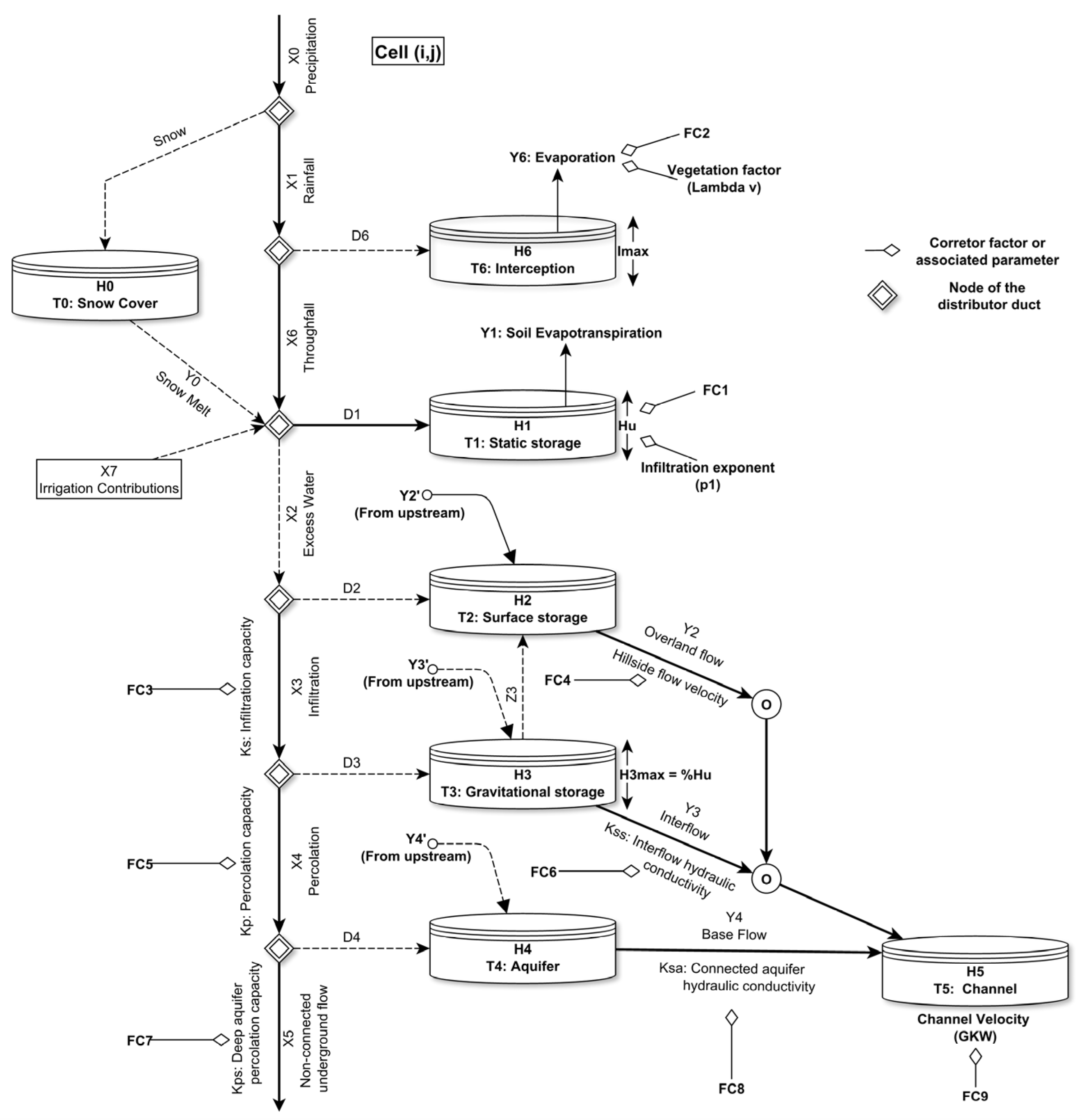
2.3. Ecohydrological Model: TETIS
3. Results
3.1. Analysis of Preliminary Processes
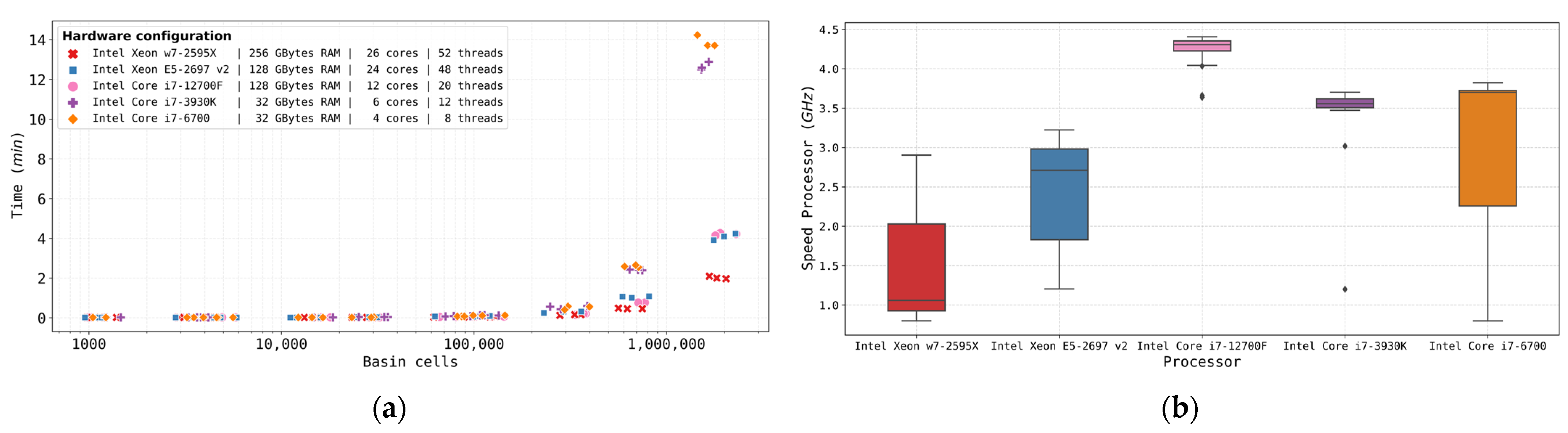
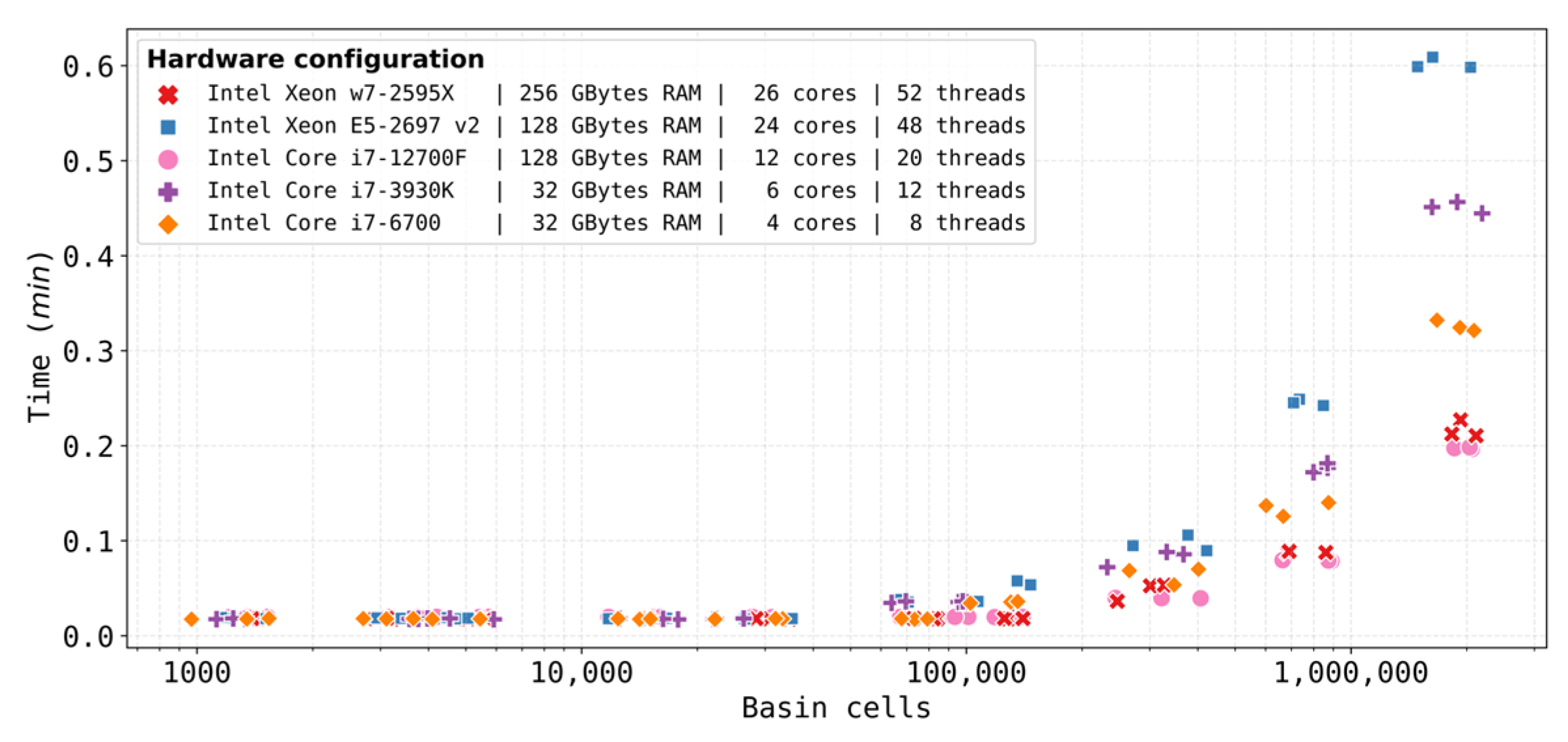
3.2. Hydrological Simulation Runs
3.3. Performance Prediction and Analysis
4. Discussion
5. Conclusions
Author Contributions
Funding
Data Availability Statement
Acknowledgments
Conflicts of Interest
Correction Statement
Appendix A

| Parameter Map | Unit | Description | Corrector Factor * |
|---|---|---|---|
| Digital elevation model (DEM) | m | The digital elevation model has been processed with fill sinks and hydrological reconditioning. | - |
| Slope | m/m | Slope for each cell | - |
| Flow direction | (-) | Indicate the direction in which the flow is driven | - |
| Accumulated cells | (-) | Number of cells accumulated | - |
| Land use | (-) | Vegetation covers index for the evapotranspiration | - |
| Static storage (Hu) | (mm) | Maximum capacity of the static storage tank | CF1 |
| Infiltration capacity (Ks) | (mm/h) | Saturated hydraulic conductivity of soil | CF3 |
| Hillside Flow Velocity | (m/s) | Surface velocity of flow on the hillside | CF4 |
| Percolation capacity (Kp) | (mm/h) | Hydraulic conductivity of subsoil | CF5 |
| Interflow hydraulic conductivity (Kss) | (mm/h) | Saturated horizontal hydraulic conductivity of soil | CF6 |
| Deep aquifer percolation capacity (Kps) | (mm/h) | Saturated hydraulic conductivity of the rock layer | CF7 |
| Connected aquifer hydraulic conductivity (Ksa) | (mm/h) | Saturated horizontal hydraulic conductivity of the rock layer | CF8 |
| Predictor Variables Combination * | R2 Val | ΔR2 | N Estimators | Max Depth | Min Samples Split | Min Sample Leaf |
|---|---|---|---|---|---|---|
| Max turbo frequency, Basin cells, RAM memory, Cores, Threads | 0.993 | −0.034 | 100 | 5 | 6 | 2 |
| Max turbo frequency, Basin cells, RAM memory, Cores | 0.992 | −0.052 | 200 | 5 | 7 | 1 |
| Basin cells, RAM memory, Cores, Threads | 0.993 | −0.043 | 150 | 5 | 7 | 1 |
| Max turbo frequency, Basin cells, Cores, Threads | 0.991 | −0.060 | 100 | 5 | 7 | 1 |
| Max turbo frequency, Basin cells, RAM memory, Threads | 0.992 | −0.055 | 100 | 5 | 7 | 1 |
| Max turbo frequency, Basin cells, RAM memory | 0.992 | −0.063 | 100 | 5 | 7 | 2 |
| Basin cells, RAM memory, Threads | 0.993 | −0.046 | 100 | 5 | 7 | 1 |
| Max turbo frequency, Basin cells, Threads | 0.992 | −0.052 | 400 | 5 | 7 | 1 |
| Basin cells, Cores, Threads | 0.992 | −0.013 | 100 | 5 | 6 | 1 |
| Basin cells, RAM memory, Cores | 0.991 | −0.061 | 300 | 5 | 7 | 1 |
| Max turbo frequency, Basin cells, Cores | 0.991 | −0.064 | 100 | 5 | 7 | 1 |
| Max turbo frequency, Basin cells | 0.993 | −0.178 | 200 | 5 | 6 | 2 |
| Basin cells, RAM memory | 0.992 | −0.067 | 100 | 5 | 7 | 1 |
| Basin cells, Cores | 0.991 | −0.066 | 100 | 5 | 7 | 1 |
| Basin cells, Threads | 0.991 | −0.057 | 100 | 5 | 7 | 1 |
| Basin cells | 0.898 | −0.299 | 100 | 5 | 10 | 1 |
| Predictor Variables Combination * | R2 Val | ΔR2 | N Estimators | Max Depth | Min Samples Split | Min Sample Leaf |
|---|---|---|---|---|---|---|
| Max turbo frequency, Basin cells, Time steps, Input gauges, Output gauges | 0.994 | −0.005 | 300 | 5 | 10 | 5 |
| Max turbo frequency, Basin cells, Time steps, Output gauges | 0.994 | −0.005 | 400 | 5 | 10 | 5 |
| Max turbo frequency, Time steps, Output gauges | 0.990 | −0.004 | 100 | 5 | 10 | 5 |
| Max turbo frequency, Time steps, Input gauges, Output gauges | 0.988 | −0.003 | 100 | 5 | 10 | 5 |
| Basin cells, Time steps | 0.289 | −0.009 | 150 | 5 | 10 | 3 |
| Basin cells, Output gauges | 0.212 | 0.010 | 100 | 5 | 10 | 5 |
| Output gauges | 0.212 | 0.009 | 100 | 5 | 10 | 5 |
| Predictor Variables * | Quino Basin | Muco Basin |
|---|---|---|
| Max turbo frequency | 4.9 | 4.9 |
| Basin area (km2) | 300 | 649 |
| Cell size (m) | 90 | 90 |
| Initial date (dd/mm/yyyy hh:mm) | 1/01/2061 0:00 | 1/01/2030 0:00 |
| Final date (dd/mm/yyyy hh:mm) | 31/12/2091 0:00 | 1/01/2060 0:00 |
| Delta t (min) | 1440 | 1440 |
| Number input gauges | 9 | 9 |
| Number output gauges | 12 | 1 |
| RAM memory (Gb) | 128 | 128 |
| Cores | 12 | 12 |
| Threads | 20 | 20 |
References
- Beven, K. Rainfall-Runoff Modelling; John Wiley & Sons, Ltd.: Hoboken, NJ, USA, 2012; ISBN 9780470714591. [Google Scholar] [CrossRef]
- Wood, E.F.; Sivapalan, M.; Beven, K.; Band, L. Effects of spatial variability and scale with implications to hydrologic modeling. J. Hydrol. 1988, 102, 29–47. [Google Scholar] [CrossRef]
- Mamillapalli, S.; Srinivasan, R.; Arnold, J.G.; Engel, B.A. Effect of spatial variability on basin scale modeling. In Proceedings of the Third International Conference on GIS and Enviromental Modeling, Santa Fe, NM, USA, 21–25 January 1996; National Center for Geographic Information and Analysis: Santa Barbara, CA, USA, 1996; pp. 802–8013. [Google Scholar]
- Viviroli, D.; Archer, D.R.; Buytaert, W.; Fowler, H.J.; Greenwood, G.B.; Hamlet, A.F.; Huang, Y.; Koboltschnig, G.; Litaor, M.I.; López-Moreno, J.I.; et al. Climate change and mountain water resources: Overview and recommendations for research, management and policy. Hydrol. Earth Syst. Sci. 2011, 15, 471–504. [Google Scholar] [CrossRef]
- Clark, M.P.; Nijssen, B.; Lundquist, J.D.; Kavetski, D.; Rupp, D.E.; Woods, R.A.; Freer, J.E.; Gutmann, E.D.; Wood, A.W.; Gochis, D.J.; et al. A unified approach for process-based hydrologic modeling: 2. Model implementation and case studies. Water Resour. Res. 2015, 51, 2515–2542. [Google Scholar] [CrossRef]
- García Bartual, R. Efecto de las variaciones temporales de la intensidad de la precipitación en el hidrograma de la crecida generada. Rev. De Obras Públicas 1991, 138, 13–21. [Google Scholar]
- Ehret, U.; van Pruijssen, R.; Bortoli, M.; Loritz, R.; Azmi, E.; Zehe, E. Adaptive clustering: Reducing the computational costs of distributed (hydrological) modelling by exploiting time-variable similarity among model elements. Hydrol. Earth Syst. Sci. 2020, 24, 4389–4411. [Google Scholar] [CrossRef]
- Blöschl, G. Scaling and Regionalization in Hydrology; Vienna University of Technology: Vienna, Austria, 2011. [Google Scholar]
- Blöschl, G.; Sivapalan, M. Scale issues in hydrological modelling: A review. Hydrol. Process. 1995, 9, 251–290. [Google Scholar] [CrossRef]
- Clark, M.P.; Bierkens, M.F.P.; Samaniego, L.; Woods, R.A.; Uijlenhoet, R.; Bennett, K.E.; Pauwels, V.R.N.; Cai, X.; Wood, A.W.; Peters-Lidard, C.D. The evolution of process-based hydrologic models: Historical challenges and the collective quest for physical realism. Hydrol. Earth Syst. Sci. 2017, 21, 3427–3440. [Google Scholar] [CrossRef] [PubMed]
- van Jaarsveld, B.; Wanders, N.; Sutanudjaja, E.H.; Hoch, J.; Droppers, B.; Janzing, J.; van Beek, R.L.P.H.; Bierkens, M.F.P. A first attempt to model global hydrology at hyper-resolution. Earth Syst. Dyn. 2025, 16, 29–54. [Google Scholar] [CrossRef]
- Nearing, G.S.; Kratzert, F.; Sampson, A.K.; Pelissier, C.S.; Klotz, D.; Frame, J.M.; Prieto, C.; Gupta, H.V. What Role Does Hydrological Science Play in the Age of Machine Learning? Water Resour. Res. 2021, 57, e2020WR028091. [Google Scholar] [CrossRef]
- Shen, C. A Transdisciplinary Review of Deep Learning Research and Its Relevance for Water Resources Scientists. Water Resour. Res. 2018, 54, 8558–8593. [Google Scholar] [CrossRef]
- Droppers, B.; Rakovec, O.; Avila, L.; Azimi, S.; Cortés-Torres, N.; De León Pérez, D.; Imhoff, R.; Francés, F.; Kollet, S.; Rigon, R.; et al. Multi-model hydrological reference dataset over continental Europe and an African basin. Sci. Data 2024, 11, 1009. [Google Scholar] [CrossRef]
- Dai, Y.; Zeng, X.; Dickinson, R.E.; Baker, I.; Bonan, G.B.; Bosilovich, M.G.; Denning, A.S.; Dirmeyer, P.A.; Houser, P.R.; Niu, G.; et al. The Common Land Model. Bull. Am. Meteorol. Soc. 2003, 84, 1013–1024. [Google Scholar] [CrossRef]
- Aerts, J.P.M.; Hut, R.W.; Van De Giesen, N.C.; Drost, N.; Van Verseveld, W.J.; Weerts, A.H.; Hazenberg, P. Large-sample assessment of varying spatial resolution on the streamflow estimates of the wflow_sbm hydrological model. Hydrol. Earth Syst. Sci. 2022, 26, 4407–4430. [Google Scholar] [CrossRef]
- Janzing, J.; Wanders, N.; Van Tiel, M.; Van Jaarsveld, B.; Karger, D.N.; Brunner, M.I. Hyper-resolution large-scale hydrological modelling benefits from improved process representation in mountain regions. Hydrol. Earth Syst. Sci. 2025, 29, 7041–7071. [Google Scholar] [CrossRef]
- Zink, M.; Kumar, R.; Cuntz, M.; Samaniego, L. A high-resolution dataset of water fluxes and states for Germany accounting for parametric uncertainty. Hydrol. Earth Syst. Sci. 2017, 21, 1769–1790. [Google Scholar] [CrossRef]
- Francés, F.; Vélez, J.I.; Vélez, J.J. Split-parameter structure for the automatic calibration of distributed hydrological models. J. Hydrol. 2007, 332, 226–240. [Google Scholar] [CrossRef]
- GIMHA—Grupo de Investigación en Modelación Hidrológica y Ambiental Distribuida. Descripción Del Modelo Conceptual Distribuido De Simulación Hidrológica TETIS v.9. 2021. Available online: https://zenodo.org/records/17780029 (accessed on 3 February 2026). [CrossRef]
- Beneyto, C.; Vignes, G.; Aranda, J.Á.; Francés, F. Sample Uncertainty Analysis of Daily Flood Quantiles Using a Weather Generator. Water 2023, 15, 3489. [Google Scholar] [CrossRef]
- Medici, C.; Butturini, A.; Bernal, S.; Vázquez, E.; Sabater, F.; Vélez, J.I.; Francés, F. Modelling the non-linear hydrological behaviour of a small Mediterranean forested catchment. Hydrol. Process. 2008, 22, 3814–3828. [Google Scholar] [CrossRef]
- Romero Hernández, C.P. Análisis del impacto del crecimiento de las megaciudades sobre el ciclo hidrológico bajo escenarios de cambio climático. Aplicación a la cuenca del río Bogotá (Colombia). Ph.D. Thesis, Universitat Politècnica de València, Valencia, Spain, 2022. Available online: https://riunet.upv.es/handle/10251/191025 (accessed on 3 February 2026). [CrossRef]
- Barrios, M.; Francés, F. Spatial scale effect on the upper soil effective parameters of a distributed hydrological model. Hydrol. Process. 2012, 26, 1022–1033. [Google Scholar] [CrossRef]
- Güiza-Villa, N.; Cortés-Torres, N.; Francés, F. Impacto del riego estimado por satélite en la modelación hidrológica: Análisis del balance hídrico y desempeño del modelo TETIS en la cuenca del río Po. Ing. Del Agua 2026, 30, 31–47. [Google Scholar] [CrossRef]
- Pedregosa, F.; Varoquaux, G.; Gramfort, A.; Michel, V.; Thirion, B.; Grisel, O.; Blondel, M.; Prettenhofer, P.; Weiss, R.; Dubourg, V. Scikit-learn: Machine learning in Python. J. Mach. Learn. Res. 2011, 12, 2825–2830. [Google Scholar]
- Breiman, L. Random Forests. Mach. Learn. 2001, 45, 5–32. [Google Scholar] [CrossRef]
- Rakovec, O.; Kumar, R.; Attinger, S.; Samaniego, L. Improving the realism of hydrologic model functioning through multivariate parameter estimation. Water Resour. Res. 2016, 52, 7779–7792. [Google Scholar] [CrossRef]
- Yalew, S.; van Griensven, A.; Ray, N.; Kokoszkiewicz, L.; Betrie, G.D. Distributed computation of large scale SWAT models on the Grid. Environ. Model. Softw. 2013, 41, 223–230. [Google Scholar] [CrossRef]
- Cortes Torres, N.; Salazar-Galán, S.; Francés, F. Fractal Dimension and Multiscale Analysis in Geomorphological Parameter Assessment and Hydrological Modeling. In Proceedings of the EGU General Assembly 2025, Vienna, Austria, 27 April–2 May 2025. [Google Scholar] [CrossRef]
- Cortés-Torres, N.; Vignes, G.; De Leon Pérez, D.; Salazar, S.; Fránces, F. Influencia Del Reacondicionamiento y Escalado Espacial De Parámetros Geomorfológicos En Modelación. In Proceedings of the Memorias Del XXXI Congreso Latinoamerciano De Hidráulica, Medellín, Colombia, 1–4 October 2024; pp. 429–438. [Google Scholar]
- Hernández-Sosa, M.; Aguayo, M.; Cortés-Torres, N.; Stehr, A.; Frances, F.; Llompart, O. Assessing hydrological responses to large-scale native forest restoration as a nature-based solution in South-Central Chile under climate change. Nat.-Based Solut. 2026, 9, 100298. [Google Scholar] [CrossRef]
- García-García, A.; Stradiotti, P.; Di Paolo, F.; Filippucci, P.; Fischer, M.; Orság, M.; Brocca, L.; Peng, J.; Dorigo, W.; Gruber, A.; et al. Intercomparison of Earth Observation products for hyper-resolution hydrological modelling over Europe. Remote Sens. Environ. 2026, 333, 115131. [Google Scholar] [CrossRef]
- Gomis-Cebolla, J.; Garcia-Arias, A.; Perpinyà-Vallès, M.; Francés, F. Evaluation of Sentinel-1, SMAP and SMOS surface soil moisture products for distributed eco-hydrological modelling in Mediterranean forest basins. J. Hydrol. 2022, 608, 127569. [Google Scholar] [CrossRef]
- Brocca, L.; Zhao, W.; Lu, H. High-resolution observations from space to address new applications in hydrology. Innovation 2023, 4, 100437. [Google Scholar] [CrossRef] [PubMed]
- Brombacher, J.; de Oliveira Silva, I.R.; Degen, J.; Pelgrum, H. A novel evapotranspiration based irrigation quantification method using the hydrological similar pixels algorithm. Agric. Water Manag. 2022, 267, 107602. [Google Scholar] [CrossRef]
- Leonard, L. Using machine learning models to predict and choose meshes reordered by graph algorithms to improve execution times for hydrological modeling. Environ. Model. Softw. 2019, 119, 84–98. [Google Scholar] [CrossRef]
- Cortés-Torres, N.; Segio, S.-G.; Francés, F. Análisis de la escalabilidad computacional del modelo TETIS ante variaciones en resolución espacial, temporal y parametrizaciones del sistema. In Proceedings of the Libro de Resúmenes, VIII Jornadas de Ingeniería del Agua 2025, Zaragoza, Spain, 22–23 October 2025; Volume 11, pp. 385–388. [Google Scholar]
- Probst, P.; Wright, M.N.; Boulesteix, A. Hyperparameters and tuning strategies for random forest. WIREs Data Min. Knowl. Discov. 2019, 9, e1301. [Google Scholar] [CrossRef]
- Speiser, J.L.; Miller, M.E.; Tooze, J.; Ip, E. A comparison of random forest variable selection methods for classification prediction modeling. Expert Syst. Appl. 2019, 134, 93–101. [Google Scholar] [CrossRef] [PubMed]
- Jamshidi, P.; Siegmund, N.; Velez, M.; Kästner, C.; Patel, A.; Agarwal, Y. Transfer Learning for Performance Modeling of Configurable Systems: An Exploratory Analysis. arXiv 2017, arXiv:1709.02280. [Google Scholar] [CrossRef]
- Geurts, P.; Ernst, D.; Wehenkel, L. Extremely randomized trees. Mach. Learn. 2006, 63, 3–42. [Google Scholar] [CrossRef]
- Bergstra, J.; Bengio, Y. Random Search for Hyper-Parameter Optimization. J. Mach. Learn. Res. 2012, 13, 281–305. c. [Google Scholar]
- Cortés-Torres, N. Full Reproduction Package: Inputs, Configurations, and Monitoring Data for TETIS Computational Scalability Study [Data Set]. Zenodo. 2025. Available online: https://zenodo.org/records/17569945 (accessed on 3 February 2026). [CrossRef]
- Cortés-Torres, N. TETIS Runtime Predictor. Zenodo. 2025. Available online: https://zenodo.org/records/18458768 (accessed on 3 February 2026). [CrossRef]
- Mower, R.; Gutmann, E.D.; Liston, G.E.; Lundquist, J.; Rasmussen, S. Parallel SnowModel (v1.0): A parallel implementation of a distributed snow-evolution modeling system (SnowModel). Geosci. Model Dev. 2024, 17, 4135–4154. [Google Scholar] [CrossRef]
- Perraud, J.-M.; Collins, D.; Bowden, J.C.; Raupach, T.; Manser, P.A.; Stenson, M.P.; Renzullo, L.J. A balancing act in heterogeneous computing—Developing the AWRA-Landscape data assimilation system. In Proceedings of the MODSIM2013, 20th International Congress on Modelling and Simulation; Piantadosi, J., Anderssen, R.S., Boland, J., Eds.; Modelling and Simulation Society of Australia and New Zealand (MSSANZ), Inc.: Sydney, Australia, 2013. [Google Scholar] [CrossRef]
- Schubert, J.E.; Sanders, B.F. Building treatments for urban flood inundation models and implications for predictive skill and modeling efficiency. Adv. Water Resour. 2012, 41, 49–64. [Google Scholar] [CrossRef]
- Krause, P.; Kralisch, S. The hydrological modelling system J2000-knowledge core for JAMS. In Proceedings of the MODSIM 2005 International Congress on Modelling and Simulation, Melbourne, Australia, 12–15 December 2005. [Google Scholar]
- Tian, Y.; Peters-Lidard, C.D.; Kumar, S.V.; Geiger, J.; Houser, P.R.; Eastman, J.L.; Dirmeyer, P.; Doty, B.; Adams, J. High-performance land surface modeling with a Linux cluster. Comput. Geosci. 2008, 34, 1492–1504. [Google Scholar] [CrossRef]
- Lin, Q.; Zhang, D. A scalable distributed parallel simulation tool for the SWAT model. Environ. Model. Softw. 2021, 144, 105133. [Google Scholar] [CrossRef]
- Kan, G.; He, X.; Ding, L.; Li, J.; Hong, Y.; Liang, K. Heterogeneous parallel computing accelerated generalized likelihood uncertainty estimation (GLUE) method for fast hydrological model uncertainty analysis purpose. Eng. Comput. 2020, 36, 75–96. [Google Scholar] [CrossRef]
- Richardson, A.; Hill, C.N.; Taylor Perron, J. IDA: An implicit, parallelizable method for calculating drainage area. Water Resour. Res. 2014, 50, 4110–4130. [Google Scholar] [CrossRef]
- Survila, K.; Yildirim, A.A.; Li, T.; Liu, Y.Y.; Tarboton, D.G.; Wang, S. A scalable high-performance topographic flow direction algorithm for hydrological information analysis. In Proceedings of the the XSEDE16 Conference on Diversity, Big Data, and Science at Scale (XSEDE16), New York, NY, USA, 17–21 July 2016. [Google Scholar] [CrossRef]
- Creaco, E.; Franchini, M. Comparison of Newton-Raphson Global and Loop Algorithms for Water Distribution Network Resolution. J. Hydraul. Eng. 2014, 140, 313–321. [Google Scholar] [CrossRef]
- Kotyra, B.; Chabudziński, Ł. Fast parallel algorithms for finding the longest flow paths in flow direction grids. Environ. Model. Softw. 2023, 167, 105728. [Google Scholar] [CrossRef]
- Cho, H. Loop then task: Hybridizing OpenMP parallelism to improve load balancing and memory efficiency in continental-scale longest flow path computation. Environ. Model. Softw. 2025, 193, 106630. [Google Scholar] [CrossRef]
- Kehagias, A. A hidden Markov model segmentation procedure for hydrological and environmental time series. Stoch. Environ. Res. Risk Assess. 2004, 18, 117–130. [Google Scholar] [CrossRef]
- Senevirathne, N.; Willgoose, G. A comparison of the performance of digital elevation model pit filling algorithms for hydrology. In Proceedings of the MODSIM2013, 20th International Congress on Modelling and Simulation; Piantadosi, J., Anderssen, R.S., Boland, J., Eds.; Modelling and Simulation Society of Australia and New Zealand (MSSANZ), Inc.: Sydney, Australia, 2013. [Google Scholar] [CrossRef]
- Abouali, M.; Timmermans, J.; Castillo, J.E.; Su, B.Z. A high performance GPU implementation of Surface Energy Balance System (SEBS) based on CUDA-C. Environ. Model. Softw. 2013, 41, 134–138. [Google Scholar] [CrossRef]
- Freitas, H.R.A.; Mendes, C.L.; Ilic, A. Performance Optimization and Scalability Analysis of the MGB Hydrological Model. In Proceedings of the Proceedings—2020 IEEE 27th International Conference on High Performance Computing, Data, and Analytics, HiPC 2020; Institute of Electrical and Electronics Engineers Inc.: Piscataway, NJ, USA, 2020; pp. 31–40. [Google Scholar] [CrossRef]
- Freitas, H.R.A.; Mendes, C.L.; Ilic, A. Performance optimization of the MGB hydrological model for multi-core and GPU architectures. Environ. Model. Softw. 2022, 148, 105271. [Google Scholar] [CrossRef]
- Wei, X.; Li, W.; Tian, H.; Li, H.; Xu, H.; Xu, T. THC-MP: High performance numerical simulation of reactive transport and multiphase flow in porous media. Comput. Geosci. 2015, 80, 26–37. [Google Scholar] [CrossRef]
- Richieri, B.; Sivelle, V.; Hartmann, A.; Labat, D.; Muniruzzaman, M.; Chiogna, G. LuKARS 3.0: A high-performance computing software to model flow and transport processes in karst aquifers. Environ. Model. Softw. 2025, 193, 106642. [Google Scholar] [CrossRef]
- Furnari, L.; Senatore, A. The Effects of Different Mesh Sizes on a Cellular Automata-Based Hydrological Model. In Proceedings of the Lecture Notes in Computer Science (Including Subseries Lecture Notes in Artificial Intelligence and Lecture Notes in Bioinformatics); Springer Science and Business Media Deutschland GmbH: Berlin, Germany, 2025; Volume 14477 LNCS, pp. 268–274. [Google Scholar] [CrossRef]
- Momo, M.R.; Tachini, M.; Refosco, J.C.; Severo, D.L.; Dos Santos Silva, H.; Cordero, A. Architecture for integrating computational tools based on Grid services for system monitoring and alerting. In Proceedings of the Proceedings—2012 6th International Conference on Complex, Intelligent, and Software Intensive Systems, CISIS 2012, Palermo, Italy, 4–6 July 2012; pp. 1013–1017. [Google Scholar] [CrossRef]
- Mosavi, A.; Ozturk, P.; Chau, K. Flood Prediction Using Machine Learning Models: Literature Review. Water 2018, 10, 1536. [Google Scholar] [CrossRef]
- Schulthess, T.C. Programming revisited. Nat. Phys. 2015, 11, 369–373. [Google Scholar] [CrossRef]
- Feitelson, D.G. Workload Modeling for Computer Systems Performance Evaluation; Cambridge University Press: Cambridge, UK, 2015; ISBN 9781107078239. [Google Scholar] [CrossRef]
- Yokelson, D.; Charest, M.R.J.; Li, Y.W. HPC Application Performance Prediction with Machine Learning on New Architectures. In Proceedings of the Proceedings of the 2023 on Performance EngineeRing, Modelling, Analysis, and Visualization Strategy; ACM: New York, NY, USA, 2023; pp. 1–8. [Google Scholar] [CrossRef]
- Hou, Z.; Zhao, S.; Yin, C.; Wang, Y.; Gu, J.; Zhou, X. Machine Learning Based Performance Analysis and Prediction of Jobs on a HPC Cluster. In Proceedings of the 2019 20th International Conference on Parallel and Distributed Computing, Applications and Technologies (PDCAT); IEEE: Piscataway, NJ, USA, 2019; pp. 247–252. [Google Scholar] [CrossRef]
- Samaniego, L.; Kumar, R.; Attinger, S. Multiscale parameter regionalization of a grid-based hydrologic model at the mesoscale. Water Resour. Res. 2010, 46, 1–25. [Google Scholar] [CrossRef]
- Kumar, R.; Samaniego, L.; Attinger, S. Implications of distributed hydrologic model parameterization on water fluxes at multiple scales and locations. Water Resour. Res. 2013, 49, 360–379. [Google Scholar] [CrossRef]
- Brædstrup, C.F.; Damsgaard, A.; Egholm, D.L. Ice-sheet modelling accelerated by graphics cards. Comput. Geosci. 2014, 72, 210–220. [Google Scholar] [CrossRef]
- Gourbesville, P.; Tallé, H.A.; Ghulami, M. AquaVar: High Performance Computing for Real Time Water Management. In Proceedings of the IAHR World Congress; International Association for Hydro-Environment Engineering and Research: Madrid, Spain, 2022; pp. 4952–4960. [Google Scholar] [CrossRef]
- Wei, J.; Luo, X.; Huang, H.; Liao, W.; Lei, X.; Zhao, J.; Wang, H. Enable high-resolution, real-time ensemble simulation and data assimilation of flood inundation using distributed GPU parallelization. J. Hydrol. 2023, 619, 129277. [Google Scholar] [CrossRef]
- Ozik, J.; Collier, N.; Murphy, J.T.; Altaweel, M.; Lammers, R.B.; Prusevich, A.A.; Kliskey, A.; Alessa, L. Simulating Water, Individuals, and Management using a coupled and distributed approach. In Proceedings of the Winter Simulation Conference 2014; IEEE: Savannah, GA, USA, 2014; pp. 1120–1131. [Google Scholar] [CrossRef]
- Perraud, J.-M.; Bridgart, R.; Bennett, J.C.; Robertson, D. SWIFT2: High performance software for short-medium term ensemble streamflow forecasting research and operations. In Proceedings of the MODSIM2015, 21st International Congress on Modelling and Simulation; Weber, T., McPhee, M.J., Anderssen, R.S., Eds.; Modelling and Simulation Society of Australia and New Zealand: Sydney, Australia, 2015. [Google Scholar] [CrossRef]
- Sloboda, M.; Swayne, D. Autocalibration of Environmental Process Models Using a PAC Learning Hypothesis. In International Symposium on Environmental Software Systems; Springer: Berlin/Heidelberg, Germany, 2011; pp. 528–534. [Google Scholar] [CrossRef]
- Bacu, V.; Gorgan, D. Grid application oriented computational resource allocation strategy. In Proceedings of the 2012 International Conference on High Performance Computing & Simulation (HPCS); IEEE: Piscataway, NJ, USA, 2012; pp. 581–587. [Google Scholar] [CrossRef]
- Gorgan, D.; Bacu, V.; Mihon, D.; Rodila, D.; Abbaspour, K.; Rouholahnejad, E. Grid based calibration of SWAT hydrological models. Nat. Hazards Earth Syst. Sci. 2012, 12, 2411–2423. [Google Scholar] [CrossRef]
- Wu, Y.; Li, T.; Sun, L.; Chen, J. Parallelization of a hydrological model using the message passing interface. Environ. Model. Softw. 2013, 43, 124–132. [Google Scholar] [CrossRef]
- Li, Q.; Nie, N.; Lu, Z.; Wang, Y. The study of parallelization of SWAT hydrology cycle. In Proceedings of the Communications in Computer and Information Science; Springer: Berlin/Heidelberg, Germany, 2019; Volume 913, pp. 174–185. [Google Scholar] [CrossRef]
- Yin, Z.; Liao, W.; Lei, X.; Wang, H. Parallel hydrological model parameter uncertainty analysis based on message-passing interface. Water 2020, 12, 2667. [Google Scholar] [CrossRef]
- Kan, G.; Li, C.; Zuo, D.; Fu, X.; Liang, K. Massively Parallel Monte Carlo Sampling for Xinanjiang Hydrological Model Parameter Optimization Using CPU-GPU Computer Cluster. Water 2023, 15, 2810. [Google Scholar] [CrossRef]
- Zhang, A.; Li, T.; Si, Y.; Liu, R.; Shi, H.; Li, X.; Li, J.; Wu, X. Double-layer parallelization for hydrological model calibration on HPC systems. J. Hydrol. 2016, 535, 737–747. [Google Scholar] [CrossRef]
- Kotyra, B. High-performance watershed delineation algorithm for GPU using CUDA and OpenMP. Environ. Model. Softw. 2023, 160, 105613. [Google Scholar] [CrossRef]
- Le, P.V.V.; Kumar, P.; Valocchi, A.J.; Dang, H.V. GPU-based high-performance computing for integrated surface-sub-surface flow modeling. Environ. Model. Softw. 2015, 73, 1–13. [Google Scholar] [CrossRef]
- Immanuel, A.; Berry, M.W.; Gross, L.J.; Palmer, M.; Wang, D. A parallel implementation of ALFISH: Simulating hydrological compartmentalization effects on fish dynamics in the Florida Everglades. Simul. Model. Pract. Theory 2005, 13, 55–76. [Google Scholar] [CrossRef]
- Klenk, K.; Spiteri, R.J. Improving resource utilization and fault tolerance in large simulations via actors. Cluster Comput. 2024, 27, 6323–6340. [Google Scholar] [CrossRef]
- Klenk, K.; Moayeri, M.M.; Guo, J.; Clark, M.P.; Spiteri, R.J. Mitigating synchronization bottlenecks in high-performance actor-model-based software. In Proceedings of the Proceedings of SC 2024-W: Workshops of the International Conference for High Performance Computing, Networking, Storage and Analysis; Institute of Electrical and Electronics Engineers Inc.: Piscataway, NJ, USA, 2024; pp. 1274–1287. [Google Scholar] [CrossRef]
- Sharma, V.; Swayne, D.; Lam, D.; Schertzer, W. Auto-Calibration of Hydrological Models Using High Performance Computing. In Proceedings of the International Congress on Environmental Modelling and Software, Burlington, VT, USA, 9–13 July, 2006. [Google Scholar]
- Maghami, I.; Van Beusekom, A.; Hay, L.; Li, Z.; Bennett, A.; Choi, Y.D.; Nijssen, B.; Wang, S.; Tarboton, D.; Goodall, J.L. Building cyberinfrastructure for the reuse and reproducibility of complex hydrologic modeling studies. Environ. Model. Softw. 2023, 164, 105689. [Google Scholar] [CrossRef]


| Processor | RAM Memory (GB) | Cores | Threads | Base Speed (GHz) | Max Turbo Frequency (GHz) |
|---|---|---|---|---|---|
| Intel Xeon w7-2595X | 256 | 26 | 52 | 2.80 | 4.80 |
| Intel Xeon E5-2697 v2 | 128 | 24 | 48 | 2.70 | 3.50 |
| Intel Core i7-12700F | 128 | 12 | 20 | 2.10 | 4.90 |
| Intel Core i7-3930K | 32 | 6 | 23 | 3.20 | 3.80 |
| Intel Core i7-6700 | 32 | 4 | 8 | 3.40 | 4.00 |
| Hyperparameter | Name | Minimum | Maximum | Delta |
|---|---|---|---|---|
| n_estimators | The number of trees in the forest. | 100 | 500 | 50 |
| max_depth | The maximum depth of the tree | 5 | 20 | 5 |
| min_samples_split | The minimum number of samples required to split an internal node | 2 | 10 | 1 |
| min_samples_leaf | The minimum number of samples required to be at a leaf node | 1 | 5 | 1 |
| Process | Algorithm Structure | Core Usage | Parallelization | Role in Workflow |
|---|---|---|---|---|
| Topolco | Parallel (Open MP) | All available cores | Yes | Topology preprocessing |
| Hantec | Serial | Single core | No | Initial state generation |
| Hydrological simulation | Serial | Single core | No | Dynamic hydrological simulation |
| Observed Time Range (min) | Mean Error (%) | Observed Time Range (min) | Mean Error (%) |
|---|---|---|---|
| <0.1 | 907.6 | 10 to 100 | 37.3 |
| 0.1 to 1 | 253.1 | 100 to 1000 | 19.5 |
| 1 to 10 | 75.6 | 1000 to 10,000 | 7.4 |
Disclaimer/Publisher’s Note: The statements, opinions and data contained in all publications are solely those of the individual author(s) and contributor(s) and not of MDPI and/or the editor(s). MDPI and/or the editor(s) disclaim responsibility for any injury to people or property resulting from any ideas, methods, instructions or products referred to in the content. |
© 2026 by the authors. Licensee MDPI, Basel, Switzerland. This article is an open access article distributed under the terms and conditions of the Creative Commons Attribution (CC BY) license.
Share and Cite
Cortés-Torres, N.; Salazar-Galán, S.; Francés, F. Scalability and Computational Performance of an Ecohydrological Model Using Machine Learning-Based Prediction. Water 2026, 18, 466. https://doi.org/10.3390/w18040466
Cortés-Torres N, Salazar-Galán S, Francés F. Scalability and Computational Performance of an Ecohydrological Model Using Machine Learning-Based Prediction. Water. 2026; 18(4):466. https://doi.org/10.3390/w18040466
Chicago/Turabian StyleCortés-Torres, Nicolás, Sergio Salazar-Galán, and Félix Francés. 2026. "Scalability and Computational Performance of an Ecohydrological Model Using Machine Learning-Based Prediction" Water 18, no. 4: 466. https://doi.org/10.3390/w18040466
APA StyleCortés-Torres, N., Salazar-Galán, S., & Francés, F. (2026). Scalability and Computational Performance of an Ecohydrological Model Using Machine Learning-Based Prediction. Water, 18(4), 466. https://doi.org/10.3390/w18040466