Abstract
Phosphorus enrichment remains a major driver of eutrophication in lake-feeding rivers, yet effective regulation is hindered by insufficient understanding of the spatiotemporal variability and dominant sources of total phosphorus (TP) at the basin scale. The Xiangjiang River, a major inflow to Dongting Lake, provides a representative system for examining TP dynamics in a human-impacted watershed. An interpretable association rule mining framework was applied to multi-source water quality, hydrological, agricultural, and socio-economic data (2020–2024) to characterize TP variation and quantify source contributions. TP concentrations exhibit pronounced seasonal and hydrological variability, with higher levels during spring and the flood season and lower levels during autumn and low-flow periods, together with a longitudinal increasing pattern from upstream to downstream. Quantitative source apportionment indicates that agricultural non-point sources dominate TP contributions at the basin scale, domestic sources provide a stable secondary contribution, and industrial sources exert localized influences. The spatial organization of source contributions closely corresponds to land-use patterns, with relatively consistent source structures among sites despite local heterogeneity. These results demonstrate the utility of an interpretable association rule mining framework for resolving TP source structures in heterogeneous river basins. The proposed framework offers a transferable approach for phosphorus source identification and supports basin-scale nutrient management and targeted control of agricultural non-point source pollution.
1. Introduction
With the rapid development of the social economy, water pollution incidents occur frequently, which has become one of the most severe global environmental challenges in the 21st century [1,2,3]. In recent decades, rapid industrial and agricultural development has led to excessive enrichment of nutrients in surface water bodies, triggering eutrophication. Phosphorus (P) enrichment is widely recognized as a central driver of eutrophication in freshwater lakes, often resulting in harmful algal blooms, oxygen depletion, and the degradation of aquatic ecosystems [4,5,6,7,8]. Despite long-term efforts to control external nutrient inputs, eutrophication remains persistent in many large lake systems, suggesting that phosphorus transport and accumulation processes at the watershed scale are not yet fully understood. Rivers serve as the primary pathways linking terrestrial phosphorus sources to downstream lakes [9,10,11], integrating inputs from agricultural production, urban development, and industrial activities [12]. As a result, effective eutrophication mitigation increasingly depends on the accurate identification and quantification of phosphorus sources within lake-feeding river basins.
In recent years, with the rapid development of machine learning (ML) they have become one of the most popular hydrological research techniques due to their strong nonlinear mapping and learning capabilities, high fault tolerance, and generalization ability. They can accurately simulate complex, dynamic, and nonlinear systems without the need for an in-depth understanding of internal complex interactions [13,14,15].
A range of methods has been employed to trace and apportion phosphorus sources in river–lake systems, including export coefficient models, mass balance approaches, isotope techniques, and multivariate statistical analyses [16,17,18]. These methods have substantially advanced the understanding of phosphorus transport and source characteristics; however, their applicability is often constrained by data availability, linear assumptions, or the need for extensive field measurements. In large and heterogeneous watersheds, where phosphorus inputs arise from multiple interacting natural and anthropogenic processes, such limitations may lead to considerable uncertainty in source attribution. With the increasing availability of long-term monitoring records and multi-source datasets, ML approaches have been progressively introduced into water quality research [19,20,21]. Existing studies demonstrate that ML methods are effective in capturing nonlinear relationships between nutrient concentrations and hydrological, meteorological, land-use, and socio-economic variables, and they have been widely applied to nutrient prediction, pattern recognition, and source identification in rivers and lakes [22,23,24,25,26,27,28,29]. Nevertheless, most ML-based applications remain primarily prediction-oriented, and their outputs are often difficult to interpret in terms of physically meaningful source contributions. In particular, few studies have examined how data-driven association patterns derived from ML can be systematically translated into quantitative estimates of phosphorus source contributions, highlighting the need for approaches that explicitly balance predictive capability with interpretability.
Dongting Lake, the second-largest freshwater lake in China, has experienced persistent eutrophication pressure in recent decades, with phosphorus identified as a key limiting nutrient. The Xiangjiang River, one of its major inflowing rivers, drains a watershed characterized by intensive agriculture, rapid urbanization, and industrial development, and therefore serves as an important pathway for anthropogenic phosphorus inputs to the lake. Although previous studies have examined water quality and nutrient dynamics in the Xiangjiang River, a comprehensive understanding of the spatiotemporal variability of total phosphorus (TP) and the relative contributions of different phosphorus sources remains limited, constraining the development of effective, basin-specific phosphorus control strategies for Dongting Lake.
To address these challenges, this study develops an interpretable association rule mining framework to investigate the spatiotemporal variation and source apportionment of total phosphorus in the Xiangjiang River. Frequent itemset mining based on the Apriori algorithm is applied to identify stable co-occurrence patterns among hydrological, environmental, agricultural, and socio-economic indicators, which are further integrated with clustering analysis to convert qualitative association rules into quantitative estimates of source contributions. By enhancing the interpretability of data-driven results, this framework provides a robust approach for phosphorus source apportionment in complex lake-feeding river basins. Specifically, this study aims to: (i) characterize the spatiotemporal variability of TP concentrations in the Xiangjiang River; (ii) identify dominant phosphorus source patterns using frequent itemset mining; and (iii) quantify the relative contributions of different anthropogenic sources through a rule-based clustering approach. The findings are expected to support targeted phosphorus management strategies and contribute to eutrophication control in the Dongting Lake basin.
2. Materials and Methods
2.1. Study Area
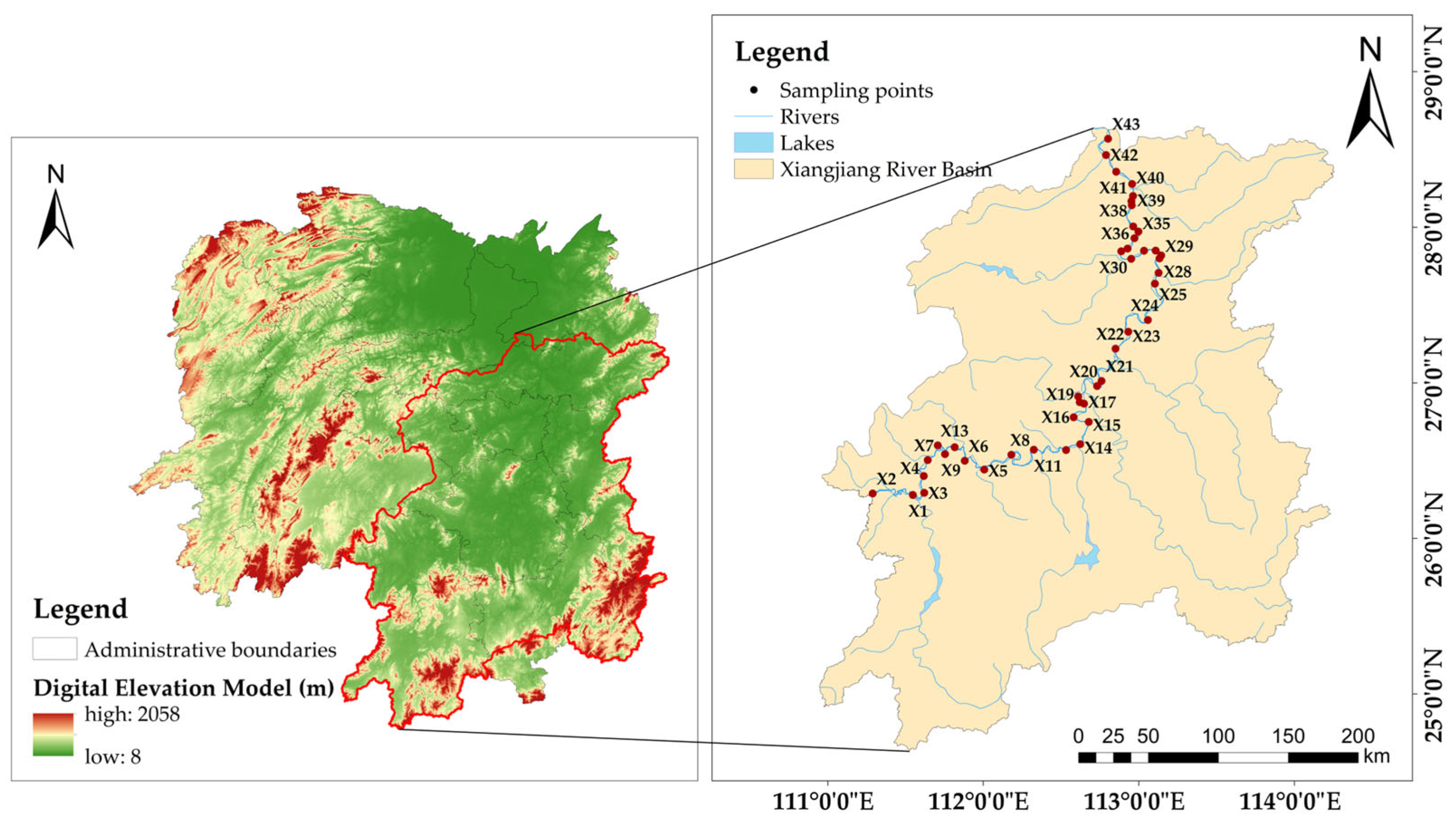
The Xiangjiang River Basin is located in Hunan Province, China, and represents the largest inflowing river system of Dongting Lake (25°00′~29°00′ N; Figure 1). The main stem of the Xiangjiang River extends approximately 856 km, draining a catchment area of 94,721 km2 [30,31]. The river contributes about 39.2% of the total inflow to Dongting Lake, highlighting its importance in regulating lake water quantity and nutrient inputs.
Figure 1.
Study area and distribution of sampling points.
The basin is characterized by a subtropical monsoon humid climate, with a mean annual air temperature of approximately 16–18 °C and average annual precipitation ranging from 1200 to 1400 mm. Under the combined influence of climatic conditions and intensive human activities, the Xiangjiang River plays a key role as a hydrological and biogeochemical link between the watershed and Dongting Lake, making it a representative system for investigating phosphorus transport and source apportionment in lake-feeding river basins.
2.2. Sampling Point Setup
A total of 43 sampling sites were established along the main stem of the Xiangjiang River and are denoted as X1–X43 in Figure 1. Based on their longitudinal positions, the sampling sites were classified into three river reaches: upstream (X1–X14), midstream (X15–X29), and downstream (X30–X43). This spatial arrangement covers the entire river continuum from headwaters to the river mouth, allowing for a comprehensive assessment of longitudinal variation in water quality. Data collected from these sampling sites were used to analyze the spatiotemporal variability of TP concentrations in the Xiangjiang River. Combined with land-use and socio-economic information, the sampling design provides a basis for subsequent phosphorus source apportionment and interpretation of spatial heterogeneity along the river.
2.3. Data Sources
Multiple datasets were integrated in this study to support the analysis of spatiotemporal variation and source apportionment of TP in the Xiangjiang River. These datasets include water quality observations, hydrological and meteorological records, agricultural production statistics, socio-economic indicators, and topographic information. Table S1 provides an example of an integrated dataset corresponding to a single sampling point, illustrating the structure and composition of the variables used in this study. All data processing, statistical analyses, and rule-based data mining-driven source apportionment procedures were conducted using R software (version 4.3.2).
2.3.1. Water Quality Data
Basic water quality parameters, including TP, pH, dissolved oxygen (DO), chemical oxygen demand (COD), five-day biochemical oxygen demand (BOD5), and ammonia nitrogen (NH3-N), were obtained from routine monitoring records of water quality monitoring stations along the Xiangjiang River. In the analysis, we used the monthly mean values from each station to capture seasonal and interannual variations while reducing short-term fluctuations. TP concentrations were determined using the Flow injection Analysis (FIA) and Ammonium molybdate spectrophotometry [32] (HJ 671-2013), pH was measured using the Electrode method [33] (HJ 1147-2020), DO was measured using the Electrochemical Probe Method [34] (HJ 506-2009), COD was determined using the Dichromate method [35] (HJ 828-2017), BOD5 was measured using the Dilution and Seeding Method [36] (HJ 505-2009), and NH3–N was determined using the Nessler’s Reagent Spectrophotometry [37] (HJ 535-2009). All surface water environmental quality monitoring and analysis activities were conducted in accordance with the Technical Specifications for Surface Water Environmental Quality Monitoring of China [38] (HJ 91.2-2022). These variables were used to characterize nutrient status and organic pollution conditions and to support the subsequent association rule analysis.
2.3.2. Hydrological and Meteorological Data
Monthly runoff data covering the period from 2020 to 2024 were obtained from the Hunan Provincial Water Resources Bulletin. Meteorological variables included monthly mean air temperature, monthly mean wind speed, monthly total precipitation, and monthly potential evapotranspiration. Monthly mean air temperature data were available for 2020–2024, whereas the remaining meteorological variables covered 2020–2023.
Meteorological data were retrieved from the National Centers for Environmental Information of the National Oceanic and Atmospheric Administration (NOAA). Monthly potential evapotranspiration data were obtained from the Loess Plateau Subcenter of the National Earth System Science Data Center, China [39]. These variables were used to represent climatic drivers affecting hydrological processes and phosphorus transport.
To account for the partial temporal coverage of some meteorological variables, water quality, and meteorological datasets were aligned over the overlapping period (2020–2023) for all association analyses, ensuring temporal consistency.
2.3.3. Agricultural and Livestock Production Data
Agricultural activity indicators, including crop sown area, main crop yield, total agricultural output value, and animal husbandry output value, were collected from local Statistical Yearbooks. These variables were used to characterize agricultural and livestock production intensity, which represents a major source of non-point phosphorus inputs within the basin.
2.3.4. Socio-Economic Data
Socio-economic indicators, including population, primary industry gross output value, secondary industry output value, per capita GDP, and average annual GDP, were also obtained from local Statistical Yearbooks. These indicators were used to reflect population pressure, economic development level, and industrial structure, all of which are closely associated with anthropogenic phosphorus emissions [40].
2.3.5. Topographic Data
A digital elevation model (DEM) of the Xiangjiang River Basin was obtained from the Geospatial Data Cloud, Computer Network Information Center, Chinese Academy of Sciences. The DEM was used to support watershed delineation and to provide topographic context for hydrological and spatial analyses.
2.4. Main Research Methods
2.4.1. Overview of the Analytical Framework
To quantitatively apportion phosphorus sources in a complex lake-feeding river basin, this study develops a rule-based analytical framework that integrates frequent itemset mining and clustering analysis. The core objective of this framework is to extract stable association patterns among hydrological, environmental, agricultural, and socio-economic indicators, and to translate these patterns into quantitative estimates of phosphorus source contributions. Rather than relying on predefined source categories or linear assumptions, the proposed approach adopts a data-driven strategy that emphasizes interpretability and robustness. The analytical workflow consists of three sequential steps: (i) identification of frequent co-occurrence patterns using the Apriori algorithm; (ii) evaluation of rule importance based on occurrence strength; and (iii) clustering of rule-derived indicators to quantify the relative contributions of different phosphorus sources.
2.4.2. Frequent Itemset Mining Using the Apriori Algorithm
The Apriori algorithm is a classical association rule mining method based on the principle that all subsets of a frequent itemset must also be frequent. In practice, it first identifies simple indicator states that occur frequently under similar conditions and then iteratively combines them into larger patterns, pruning infrequent combinations using a minimum support threshold. Stable combinations are finally retained to construct association rules that satisfy predefined confidence criteria [41].
Frequent itemset mining was applied to identify stable co-occurrence patterns among hydrological, environmental, agricultural, and socio-economic indicators associated with TP variability. Prior to analysis, all continuous variables were processed to ensure comparability across indicators. Specifically, each continuous variable was discretized into three ordinal states (Low, Medium, and High) based on its empirical distribution. The discretization thresholds were defined using variable-specific tertiles (33% and 66% quantiles), with values assigned to the corresponding categories using quantile-based cut points. This transformation enabled the integration of heterogeneous variables into a unified transactional dataset suitable for association rule mining.
For TP, the “High” state was not necessarily included as the RHS of every rule. Rather, rules were evaluated in the context of elevated TP conditions: those that frequently co-occurred with high TP observations were considered more relevant for TP-related patterns.
The Apriori algorithm was then implemented to extract frequent itemsets from the discretized dataset. In this study, each observation (sampling event) was treated as a transaction, and each indicator state (e.g., high population, high crop sown area, or high runoff) was treated as an item. Itemsets were generated iteratively by increasing itemset length, and only those satisfying the minimum support threshold were retained. To ensure the reliability of extracted patterns, a confidence threshold was further applied to association rules derived from the frequent itemsets. As a result, the retained rules include indicator combinations that are statistically robust under elevated TP conditions, even though TP may not appear in the consequent (Right-hand side, RHS) of all rules. In the study, the minimum support, confidence, and rule length were set to 0.10, 0.85, and 4–6, respectively [24,28,42].
It should be noted that the Apriori algorithm was employed here as a pattern mining tool. The objective of this step was to systematically identify robust association patterns that reflect potential phosphorus source signals embedded in the multi-source dataset.
2.4.3. Association Rule Strength Indicators and Source Characterization
To characterize the statistical strength of association rules derived from frequent itemset mining, this study adopts rule strength indicators based on occurrence frequency.
Each association rule generated by the Apriori algorithm can be expressed as:
where and represent the antecedent (Left-hand side, LHS) and the RHS of the rule, respectively, and .
To characterize the statistical significance and association strength of the rules, three indicators—support, confidence, and lift—were introduced, and their definitions are as follows:
Among them, support reflects the frequency of occurrence of the rule in the entire dataset, confidence represents the probability that the consequent occurs given that the antecedent holds, and lift is used to measure the strength of the correlation between the antecedent and the consequent [43].
Rules with higher support values indicate indicator combinations that recur more consistently across sampling events and are therefore considered to capture more stable phosphorus-related patterns. It should be emphasized that these rule strength indicators serve as statistical descriptors of patterns associated with elevated TP, but do not directly represent absolute TP contributions.
In source apportionment studies, a single rule does not directly correspond to a specific pollution source; however, the combinations of indicators contained in the rules exhibit clear environmental semantic orientations. For example, rules associated with indicators such as crop sown area, agricultural output value, and ammonia nitrogen often indicate agricultural source characteristics, whereas rules related to indicators such as population density, COD, and BOD5 more frequently reflect influences from domestic sources. Therefore, association rules can be regarded as statistical representations of source characteristic patterns.
2.4.4. A Quantitative Method for TP Source Apportionment Based on Rule Statistical Strength
Based on the statistical strength of association rules, a quantitative method was developed to estimate the relative contributions of phosphorus sources. Only rules identified under “High TP” conditions were considered, ensuring that the analysis focuses on elevated phosphorus scenarios.
For each sampling site , the statistical strength of rule was quantified using confidence () and lift () indicators derived from the Apriori algorithm. The rule–site weight was defined as:
Here, represents the relative importance of rule at site ; TP concentrations are not directly included to avoid mathematical redundancy, as the relative contribution rates are based on the structure and statistical strength of rules rather than absolute TP values.
By weighting rules according to , frequently occurring and statistically robust patterns exert a stronger influence on source apportionment, while maintaining consistency with the mined association rules.
2.4.5. Construction of Rule Clusters and Calculation of Source Contribution Rates
To improve interpretability, each rule’s antecedent was converted into a fixed-length vector corresponding to the full set of indicators, with each position representing a specific indicator. Indicators included in the rule were encoded according to their discretized state (Low = 1, Medium = 2, High = 3), while indicators not present in the rule were assigned 0. This produces a high-dimensional vector that simultaneously reflects the combination of indicators and their states under elevated TP conditions. Each vector was further weighted by the statistical strength of the corresponding rule.
The weighted rule vectors were clustered using hierarchical clustering with Ward’s linkage and Euclidean distance. The optimal number of clusters (k = 9) was determined by maximizing the average silhouette width and confirming cluster stability across bootstrap resampling.
To calculate site-level contributions, rules were first assigned to one of four source types (planting, livestock and poultry, domestic, industrial) based on the indicator composition of their antecedents. For each sampling site s, the weights of all rules belonging to the same cluster were summed to obtain the composite cluster weight:
Furthermore, at site s, for rules belonging to source type t within cluster k, their weights are summed to obtain the overall weight of this source type in cluster k:
The relative contribution rate of cluster at site was then calculated by normalizing across all clusters:
Similarly, the contribution rate of each source type within cluster at site was obtained by normalizing the source-specific weights:
Finally, for each site, the dominant source type of each cluster was determined as the source type with the highest .
3. Results
3.1. Analysis of TP Variation and Trends
From 2020 to 2024, TP concentrations across all sampling sites in the Xiangjiang River averaged 0.049 ± 0.022 mg L−1. The maximum TP concentration (0.187 mg L−1) was observed at site X15 in August 2024, whereas the minimum value (0.005 mg L−1) occurred at site X8 in May 2020. Descriptive statistics of TP concentrations for different seasons and hydrological periods are summarized in Table 1.
Table 1.
Descriptive statistics of TP concentration by season and hydrological period.
To characterize temporal variability, the monitoring period was classified into four seasons—spring (March–May), summer (June–August), autumn (September–November), and winter (December–February)—and three hydrological periods, including the flood season (April–September), normal water period (October–November), and low water period (December–March) [44]. Statistical comparisons of TP concentrations among seasons and hydrological periods are presented in Table 2. Although the absolute seasonal differences in TP concentration were numerically small (ranging from 0.005 to 0.012 mg L−1), they represent significant shifts in the river’s nutrient regime. The calculated Cohen’s d reached up to 0.569, indicating a medium effect size and confirming that these seasonal variations are robust rather than minor fluctuations.
Table 2.
Pairwise comparison of TP concentration differences by season and hydrological period.
Given the Xiangjiang River’s vast annual discharge, a concentration increment of 0.01 mg L−1 translates to an additional phosphorus load of hundreds of tons per year delivered to the downstream Dongting Lake, which is sufficient to influence its trophic state and increase eutrophication risks.
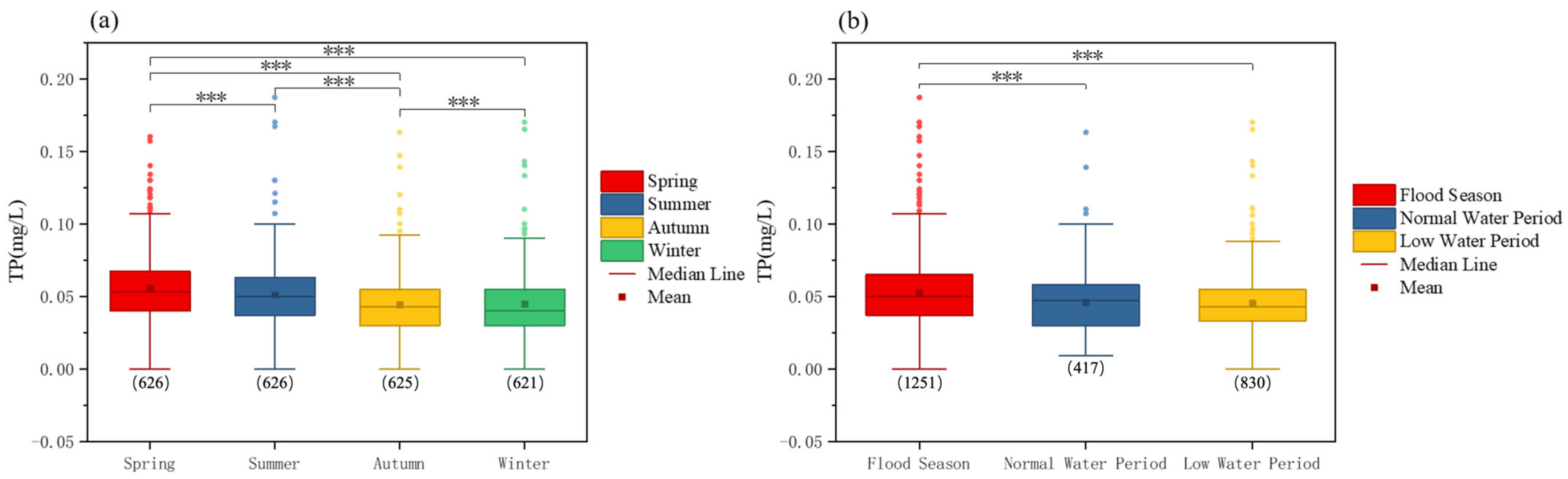
Seasonal variation analysis indicates that TP concentrations exhibited a distinct seasonal pattern (Figure 2a). Mean TP concentrations were highest in spring (0.0559 mg L−1) and lowest in autumn (0.0444 mg L−1), with intermediate levels observed in summer (0.0513 mg L−1) and winter (0.0451 mg L−1). On average, winter TP concentrations were approximately 0.0062 mg L−1 lower than those recorded in summer. One-way ANOVA results confirmed that seasonal differences in TP concentrations were statistically significant (p < 0.05).
Figure 2.
(a) Seasonal variation of average TP concentration at each sampling point. (b) Variation of Average TP Concentration at Each Sampling Point by Hydrological Period. *** indicates p < 0.001.).
Consistent with the seasonal pattern, TP concentrations also varied significantly among hydrological periods (Figure 2b). The flood season exhibited the highest mean TP concentration (0.0526 mg L−1), whereas the lowest concentrations occurred during the low water period (0.0457 mg L−1). TP concentrations during the normal water period (0.0460 mg L−1) were comparable to those observed during low flow conditions. On average, TP concentrations during the low water period were approximately 0.0069 mg L−1 lower than those during the flood season. Both parametric (ANOVA) and nonparametric (Kruskal–Wallis) tests indicated significant differences among hydrological periods (p < 0.05).
At the interannual scale, TP concentrations exhibited noticeable temporal fluctuations across sampling sites. Although year-to-year variability was evident, the overall trend during the study period showed a slight increasing tendency. This gradual increase likely reflects the combined influence of changing hydrological conditions, climate variability, and sustained anthropogenic nutrient inputs within the basin.
3.2. Analysis of Spatial Variation of TP
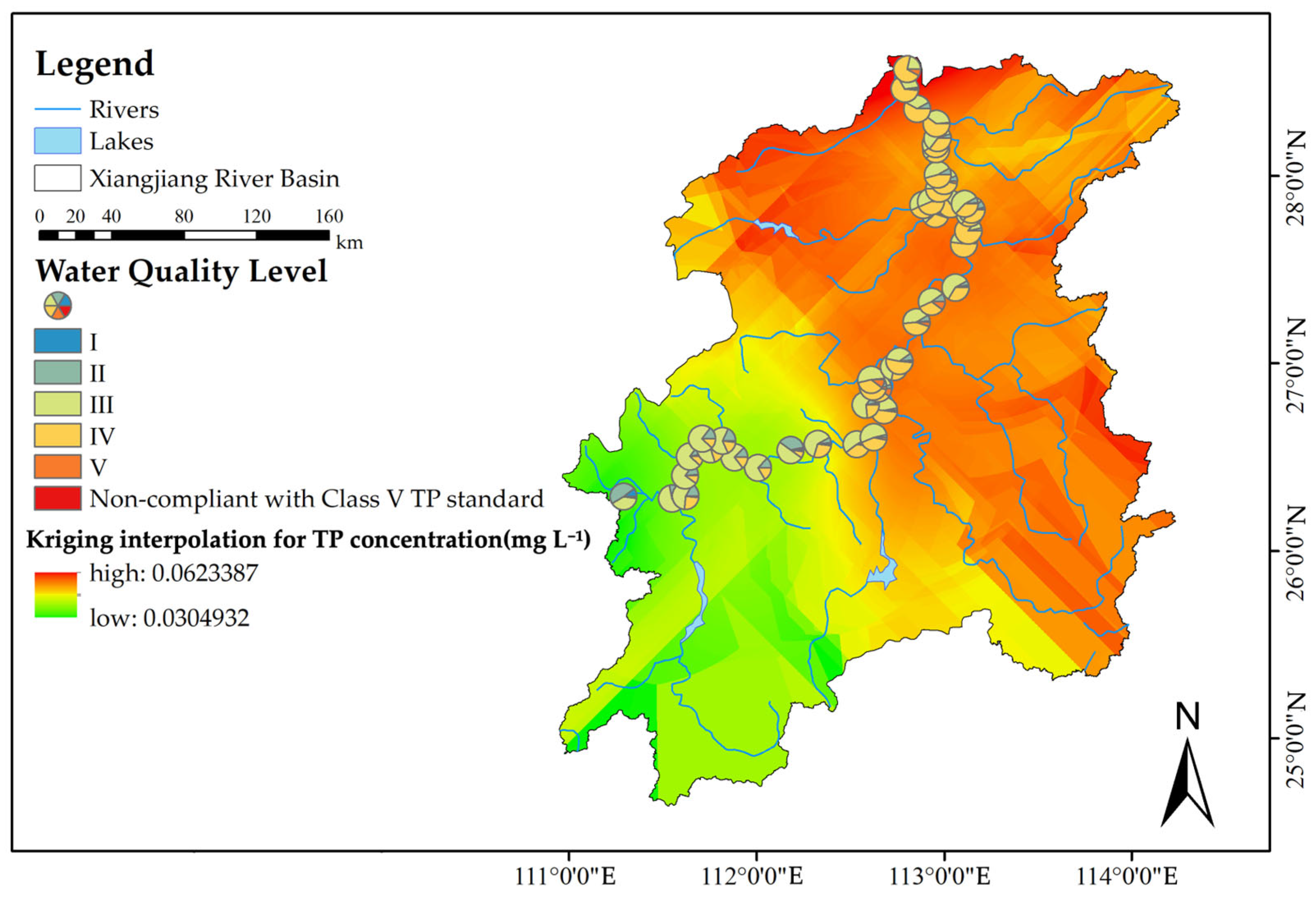
From January 2020 to December 2024, pronounced spatial heterogeneity in TP concentrations was observed along the main stem of the Xiangjiang River. Among the 43 monitoring sites, the highest site-specific mean TP concentration occurred at site X26 (0.0668 mg L−1), whereas the lowest value was recorded at site X2 (0.0262 mg L−1). Throughout the study period, TP concentrations at all sites remained below the Class II threshold (0.10 mg L−1) defined by the Chinese Environmental Quality Standards for Surface Water [45] (GB 3838-2002), indicating the absence of persistent exceedance at the reach scale.
A longitudinal analysis of site-averaged TP concentrations revealed a gradual increasing tendency from upstream to downstream sections of the river. Linear regression fitted to the spatial sequence of sampling sites yielded a positive slope (K = 4.624, R2 = 0.422), suggesting a systematic downstream accumulation of phosphorus along the river continuum (Figure 3). This longitudinal pattern reflects the integrated effects of cumulative pollutant inputs and in-river transport processes.
Figure 3.
Graded spatial distribution and changes in average TP concentration at each sampling point.
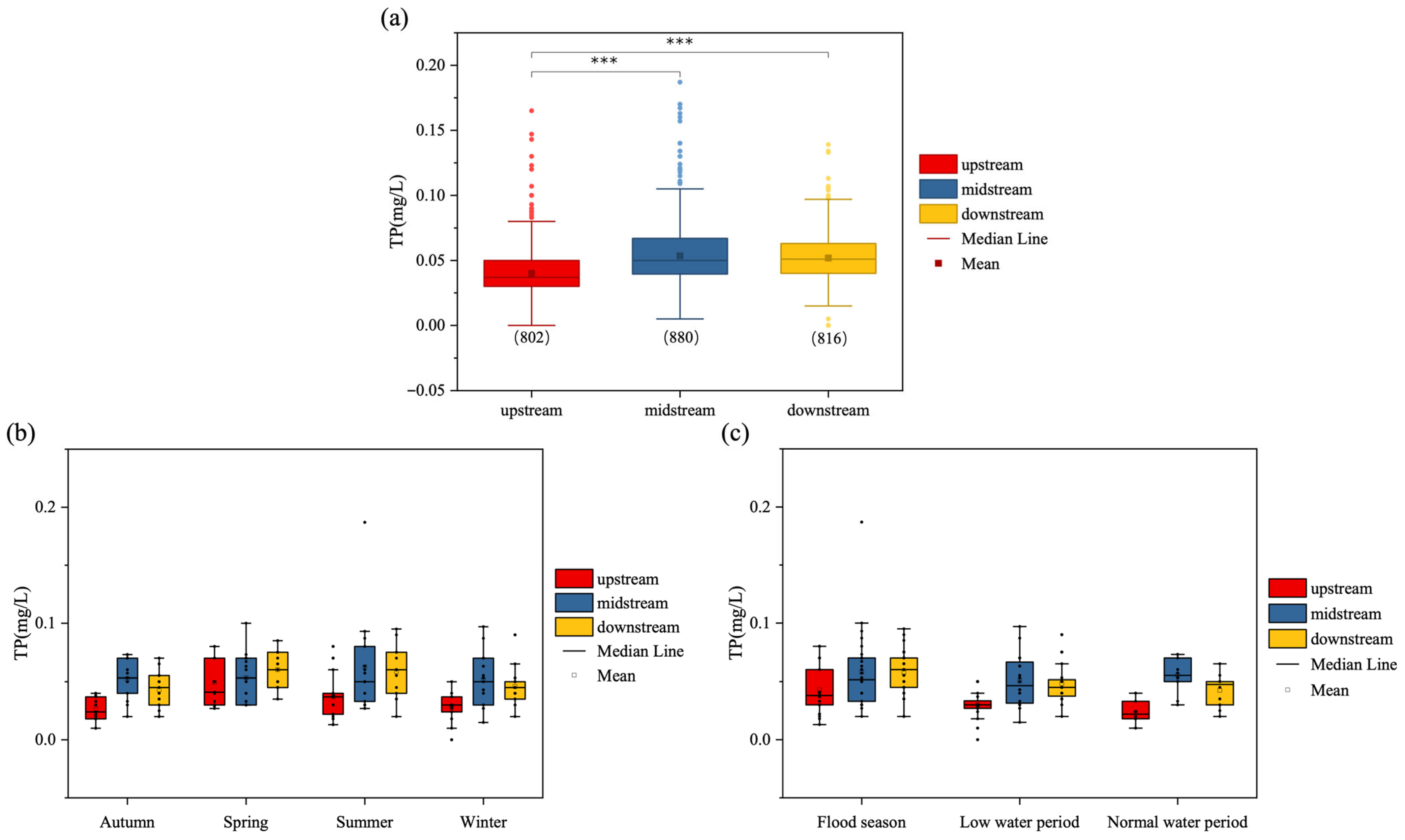
To further resolve reach-scale differences, TP concentrations were compared among the upstream, midstream, and downstream reaches under different seasonal and hydrological conditions (Table 3). At the annual scale, statistically significant differences in TP concentrations were detected among the three river reaches (Table 4; p < 0.001). The upstream reach exhibited the lowest mean TP concentration (0.0401 mg L−1), whereas the midstream (0.0536 mg L−1) and downstream reaches (0.0534 mg L−1) showed substantially higher levels. Pairwise comparisons indicated that both the midstream and downstream reaches had significantly higher TP concentrations than the upstream reach, while no significant difference was observed between the midstream and downstream reaches.
Table 3.
Descriptive statistics of TP concentration by river reach.
Table 4.
Pairwise comparison of TP concentration differences by river reach.
Regarding the spatial gradient, although the absolute increase in TP concentration from upstream to mid/downstream is 0.013 mg/L, the calculated Cohen’s d reaches 0.643–0.703, indicating a medium-to-large effect size. This demonstrates that the spatial accumulation of phosphorus along the Xiangjiang River is a robust and substantial phenomenon, rather than a minor fluctuation. Such a shift is highly relevant for basin management, as it reflects the persistent pressure of anthropogenic inputs on the river’s water quality as it flows toward Dongting Lake.
Seasonal and hydrological stratification further revealed distinct spatial contrasts (Figure 4). During summer, autumn, winter, as well as during the normal water and low water periods, TP concentrations in the upstream reach were consistently lower than those in the midstream and downstream reaches. In contrast, during spring and the flood season, differences in TP concentrations among the three reaches were markedly reduced, indicating a convergence of spatial patterns under high-flow conditions. This attenuation of spatial gradients during the flood season likely reflects enhanced hydrological connectivity and increased mixing driven by elevated runoff.
Figure 4.
(a) Changes in TP concentration in upstream, midstream, and downstream. (b) Changes in TP concentration in upstream, midstream, and downstream across different seasons. (c) Changes in TP concentration in upstream, midstream, and downstream across different hydrological periods. *** indicates p < 0.001.).
Overall, the spatial distribution of TP along the Xiangjiang River is characterized by a downstream-increasing longitudinal pattern and pronounced reach-scale heterogeneity. The midstream reach consistently exhibits elevated TP concentrations and greater variability compared to the upstream reach, while the downstream reach shows comparable mean concentrations but reduced dispersion. These spatial features highlight the combined influence of cumulative anthropogenic inputs, hydrological regulation, and in-river processes on phosphorus dynamics at the basin scale.
3.3. Source Apportionment of TP
3.3.1. Identification of Potential TP Sources Based on Association Rules
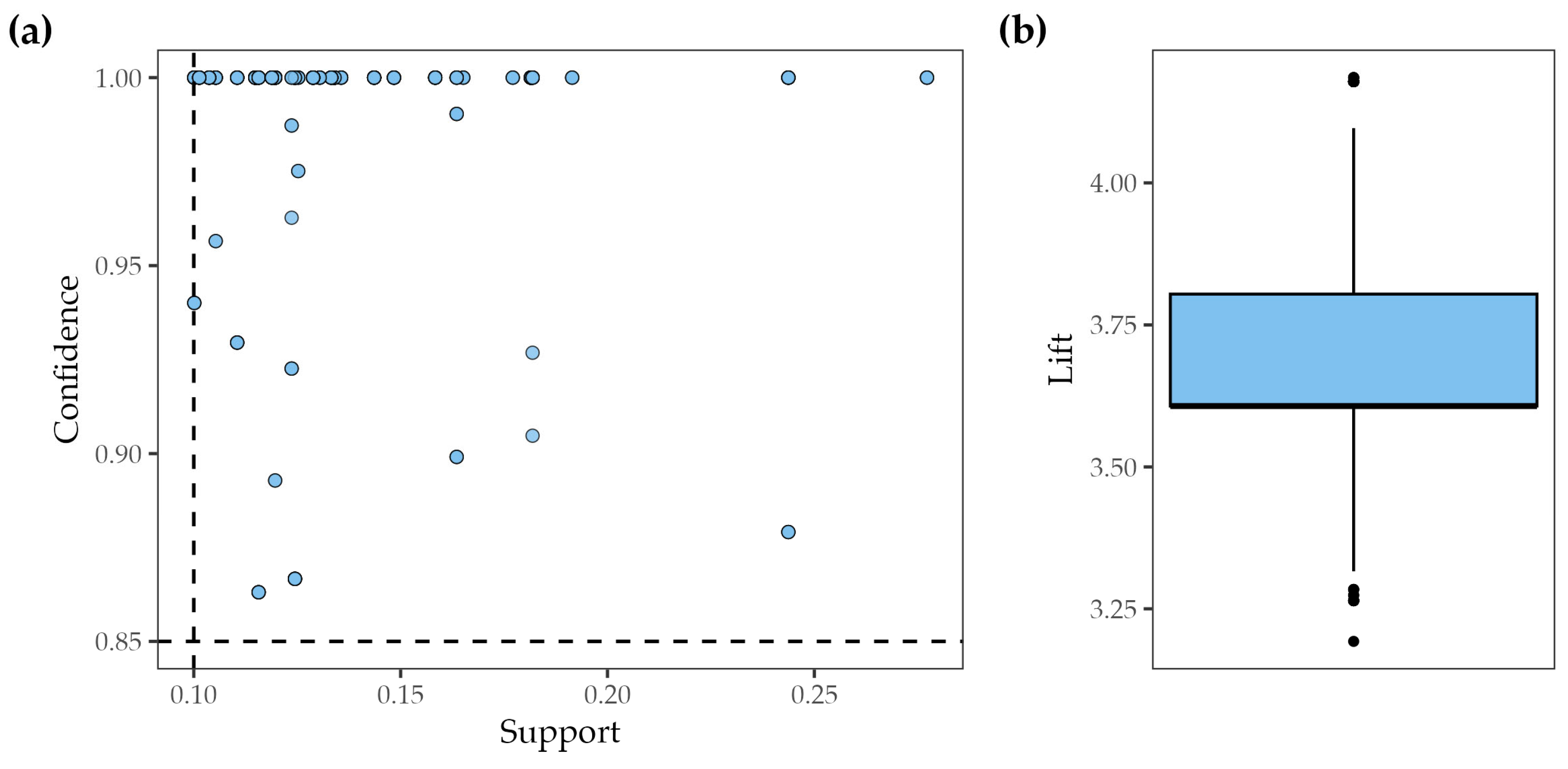
Association rule mining identified recurrent indicator combinations associated with TP variability across the Xiangjiang River basin. Under the specified thresholds (support ≥ 0.10, confidence ≥ 0.85, rule length 4–6), a total of 445 non-redundant association rules were extracted (Figure 5a).
Figure 5.
Quality characteristics of the mined association rules. (a) Joint distribution of support and confidence, with dashed lines indicating the minimum thresholds applied in this study (support = 0.10, confidence = 0.85). (b) Boxplot of lift values, illustrating the overall strength of non-random associations among the extracted rules.
All rules exhibited high confidence values (>0.86), with lift values ranging from 3.19 to 4.19 (Figure 5b), indicating strong and non-random associations between indicator combinations and TP conditions. The antecedents of the rules were dominated by indicators related to agricultural production intensity, population and economic activity, and hydrological–meteorological conditions, typically appearing in high-value states and multi-variable combinations. This pattern suggests that TP variability is controlled by the joint influence of multiple natural and anthropogenic drivers.
Based on the environmental semantic characteristics of their antecedent indicator combinations, the association rules were qualitatively linked to different TP source types. Rules emphasizing agricultural production and nutrient-related variables were interpreted as agricultural non-point sources, whereas rules dominated by population, economic indicators, and organic pollution parameters (e.g., COD and BOD5) were associated with domestic sources. Rules primarily composed of hydrological and meteorological variables were considered to reflect background environmental controls. Representative rule examples are provided in Table S2. Overall, the association rule mining results delineate stable and interpretable TP source patterns, providing a qualitative foundation for the subsequent quantitative source apportionment analysis.
3.3.2. Quantitative Analysis of TP Source Contributions Based on Rule-Strength Weighting
Quantitative source apportionment based on rule-strength weighting indicates a stable and spatially organized structure of TP contributions across the Xiangjiang River basin. At the basin scale, agricultural sources, including planting-related and livestock-related activities, constitute the dominant contributors to TP at most sampling sites, whereas domestic sources represent a consistent secondary contribution. Industrial sources generally account for smaller proportions of TP, with relatively higher contributions confined to specific river sections.
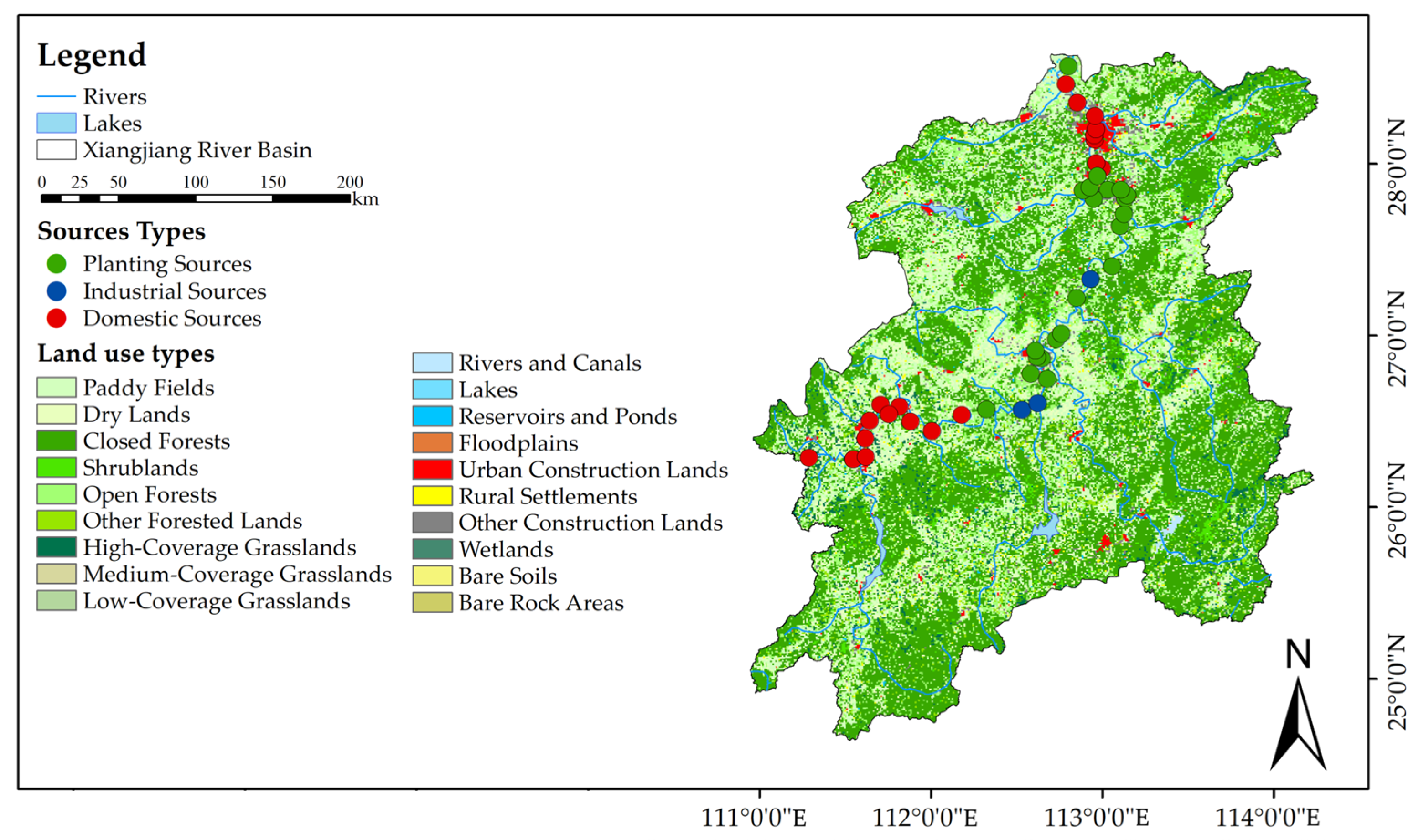
The spatial distribution of dominant TP source types exhibits clear correspondence with land-use patterns along the river (Figure 6). Sites characterized by elevated industrial source contributions are primarily located within reaches associated with concentrated industrial and manufacturing activities (e.g., X10, X14, X20–X21, and X24–X34). In contrast, planting-related agricultural sources dominate at sites situated in intensively cultivated regions (e.g., X11, X15–X19, X22–X23, X26–X32, and X43). Domestic sources show increased relative contributions at sites corresponding to urbanized sections of the basin (e.g., X1–X9, X12–X13, and X35–X42).
Figure 6.
Spatial distribution of dominant TP source types.
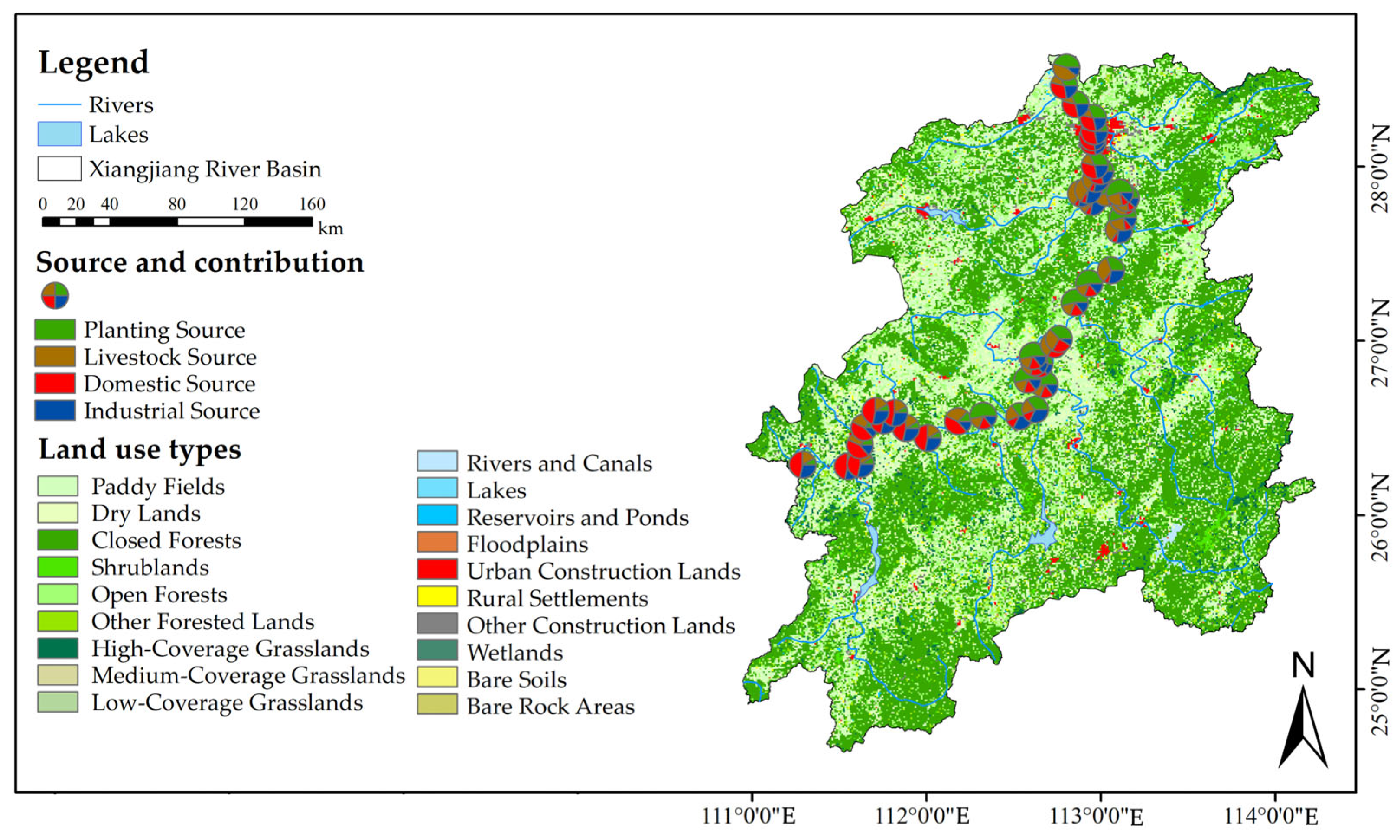
Across individual sampling sites, TP contributions generally reflect the combined influence of multiple source types rather than single-source dominance (Figure 7). Agricultural sources consistently account for the largest share of TP, followed by domestic sources, while industrial sources become prominent only at a limited number of sites (Table S3). To further facilitate interpretation, an additional figure illustrating the longitudinal variation of TP concentrations (boxplots) across sampling sites along the river course, with sites grouped according to their dominant phosphorus sources, is provided in the Supplementary Material (Figure S1). The overall similarity in source contribution proportions among sites suggests that TP dynamics in the Xiangjiang River are largely governed by basin-scale agricultural non-point source processes, with localized modulation by urban and industrial activities.
Figure 7.
Site-specific contribution structure of TP sources.
Localized deviations in source composition are nevertheless observed at certain sites, where increased contributions from domestic- or livestock-related sources alter the relative source structure. These deviations indicate spatial heterogeneity in human activity intensity and land-use configuration superimposed on a relatively uniform basin-scale background pattern.
Based on the spatial distribution of total phosphorus sources, specific river reaches can be delineated as priority areas for targeted interventions. Reaches with elevated industrial discharges (e.g., X24–X34) should be managed through upgrades to industrial wastewater treatment facilities and enhanced effluent monitoring [46]. Urbanized sections with substantial domestic wastewater inputs (e.g., X1–X9, X35–X42) should be prioritized for increased sewage treatment capacity and the implementation of ecological interception measures [47]. In river reaches dominated by agricultural non-point sources (e.g., X15–X19, X26–X32), optimized fertilizer management, improved livestock waste handling, and the establishment of riparian buffer zones are recommended [48]. These priority reaches represent critical nodes for reducing phosphorus export to downstream water bodies such as Dongting Lake.
4. Discussion
4.1. Spatiotemporal Dynamics and Source Structure of TP
The results reveal pronounced spatiotemporal heterogeneity of TP concentrations along the Xiangjiang River, characterized by clear seasonal variability and a longitudinal increasing pattern from upstream to downstream. Similar downstream accumulation patterns of phosphorus have been reported in other large river systems and are commonly attributed to cumulative anthropogenic inputs and in-river transport processes [49,50,51,52,53]. In this context, the Xiangjiang River appears to function as an important nutrient transport corridor, potentially enhancing phosphorus delivery to Dongting Lake, especially during high-flow and flood periods [54,55].
The quantitative source apportionment further indicates that agricultural non-point sources dominate TP contributions at the basin scale, while domestic sources provide a relatively stable secondary contribution and industrial sources exert more localized influences. This source structure is broadly consistent with previous findings in intensively cultivated river basins [56,57].
4.2. Implications for Basin Management
The identified source structure has clear implications for phosphorus management in the Xiangjiang River basin. The dominance of agricultural non-point sources indicates that basin-scale nutrient control should prioritize agricultural management measures, including optimized fertilizer application and improved regulation of livestock waste [48,49]. Given the diffuse nature of agricultural inputs, complete elimination is unlikely; therefore, coordinated basin-wide source reduction and process-control strategies are likely to be more effective than isolated interventions.
In contrast, domestic and industrial sources exhibit distinct spatial clustering, particularly in river sections downstream of urbanized or industrialized areas. These locations represent priority targets for site-specific management actions, such as upgrading wastewater treatment facilities, constructing ecological interception systems, or implementing other localized mitigation measures. Such targeted interventions have been shown to significantly improve water quality in similar river systems [58,59].
4.3. Methodological Innovation and Limitations
The study proposes an interpretable, rule-based framework for basin-scale source apportionment of total phosphorus, integrating multi-source environmental and socio-economic data. Unlike traditional mass-balance or regression-based approaches, the framework emphasizes relative source influence inferred from stable association patterns rather than absolute phosphorus loads.
The focus on relative influence may limit direct comparison with load-based source apportionment results. In addition, variable discretization ensures robust rule extraction across heterogeneous datasets, but the framework may be less sensitive to extreme events due to data resolution.
5. Conclusions
An interpretable association rule mining framework enables quantitative characterization of the spatiotemporal variation and source structure of TP in the Xiangjiang River using multi-source environmental and socio-economic data.
TP concentrations exhibit clear seasonal and hydrological variability, together with a longitudinal increasing pattern along the river. Quantitative source apportionment reveals that agricultural non-point sources dominate TP contributions at the basin scale, whereas domestic sources provide a stable secondary contribution and industrial sources exert localized influences. The spatial organization of source contributions corresponds closely to land-use patterns, with relatively consistent source structures across sites despite local heterogeneity.
The framework supports the identification of dominant phosphorus sources in lake-feeding rivers and provides a scientific basis for basin-scale nutrient management and targeted control of agricultural non-point source pollution.
Supplementary Materials
The following supporting information can be downloaded at: https://www.mdpi.com/article/10.3390/w18040438/s1, Table S1: Example of an Integrated Dataset for a Single Sampling Point; Table S2: Typical Association Rules Related to Total Phosphorus Sources; Table S3: Relative Contributions of Different TP Sources at Each Sampling Site; Figure S1: (a) Total Phosphorus Concentrations at Each Sampling Site. (b) Monthly Boxplots of Total Phosphorus Concentrations Across All Sampling Sites.
Author Contributions
Conceptualization, F.L. and X.D.; methodology, X.D. and F.L.; software, X.D.; validation, X.D., F.L., P.T., S.X. and T.Z.; formal analysis, X.D., A.D. and P.Z.; investigation, X.D., P.T., S.X. and T.Z.; resources, F.L.; data curation, X.D., A.D., P.Z. and F.L.; writing—original draft preparation, X.D.; writing—review and editing, X.D., F.L., C.M. and C.X.; visualization, X.D.; supervision, F.L.; project administration, F.L.; funding acquisition, F.L. All authors have read and agreed to the published version of the manuscript.
Funding
This research was funded by the National Key Research and Development (R&D) Program of China, grant numbers 2024YFD1700100, 2024YFD1700105, and the Key Science and Technology Project of Hunan Province: ‘Top Talent Recruitment’, grant number 2024QK3001.
Data Availability Statement
The raw data supporting the conclusions of this article will be made available by the authors on request.
Conflicts of Interest
The authors declare that they do not have any commercial or associative interest that represents a conflict of interest in connection with the work submitted.
References
- Beeton, A.M. Large Freshwater Lakes: Present State, Trends, and Future. Environ. Conserv. 2002, 29, 21–38. [Google Scholar] [CrossRef]
- Huang, J.; Zhang, Y.; Bing, H.; Peng, J.; Dong, F.; Gao, J.; Arhonditsis, G.B. Characterizing the River Water Quality in China: Recent Progress and on-Going Challenges. Water Res. 2021, 201, 117309. [Google Scholar] [CrossRef]
- Suresh, K.; Tang, T.; van Vliet, M.T.H.; Bierkens, M.F.P.; Strokal, M.; Sorger-Domenigg, F.; Wada, Y. Recent Advancement in Water Quality Indicators for Eutrophication in Global Freshwater Lakes. Environ. Res. Lett. 2023, 18, 063004. [Google Scholar] [CrossRef]
- Liu, C.; Kroeze, C.; Hoekstra, A.Y.; Gerbens-Leenes, W. Past and Future Trends in Grey Water Footprints of Anthropogenic Nitrogen and Phosphorus Inputs to Major World Rivers. Ecol. Indic. 2012, 18, 42–49. [Google Scholar] [CrossRef]
- Mardamootoo, T.; Preez, C.C.D.; Barnard, J.H. Agricultural Phosphorus Management for Environmental Protection: A Review. J. Geosci. Environ. Prot. 2021, 9, 48–81. [Google Scholar] [CrossRef]
- Wildemeersch, M.; Tang, S.; Ermolieva, T.; Ermoliev, Y.; Rovenskaya, E.; Obersteiner, M. Containing the Risk of Phosphorus Pollution in Agricultural Watersheds. Sustainability 2022, 14, 1717. [Google Scholar] [CrossRef]
- Guan, X.; Liu, W.; Chen, M. Study on the Ecological Compensation Standard for River Basin Water Environment Based on Total Pollutants Control. Ecol. Indic. 2016, 69, 446–452. [Google Scholar] [CrossRef]
- Han, J.; Xin, Z.; Han, F.; Xu, B.; Wang, L.; Zhang, C.; Zheng, Y. Source contribution analysis of nutrient pollution in a P-rich watershed: Implications for integrated water quality management. Environ. Pollut. 2021, 279, 116885. [Google Scholar] [CrossRef] [PubMed]
- Pokhrel, Y.; Felfelani, F.; Satoh, Y.; Boulange, J.; Burek, P.; Gädeke, A.; Gerten, D.; Gosling, S.N.; Grillakis, M.; Gudmundsson, L.; et al. Global Terrestrial Water Storage and Drought Severity under Climate Change. Nat. Clim. Change 2021, 11, 226–233. [Google Scholar] [CrossRef]
- Maansi, U.; Jindal, R.; Wats, M. Evaluation of Surface Water Quality Using Water Quality Indices (WQIs) in Lake Sukhna, Chandigarh, India. Appl. Water Sci. 2022, 12, 2. [Google Scholar] [CrossRef]
- Li, L.; Knapp, J.L.A.; Lintern, A.; Ng, G.-H.C.; Perdrial, J.; Sullivan, P.L.; Zhi, W. River Water Quality Shaped by Land–River Connectivity in a Changing Climate. Nat. Clim. Change 2024, 14, 225–237. [Google Scholar] [CrossRef]
- Li, Y.; Ni, L.; Guo, Y.; Zhao, X.; Dong, Y.; Cheng, Y. Challenges and Opportunities to Treat Water Pollution. In Paths to Clean Water Under Rapid Changing Environment in China; Li, Y., Ni, L., Guo, Y., Zhao, X., Dong, Y., Cheng, Y., Eds.; Springer Nature: Singapore, 2022; pp. 13–42. ISBN 978-981-19-0091-4. [Google Scholar]
- Zhu, M.; Wang, J.; Yang, X.; Zhang, Y.; Zhang, L.; Ren, H.; Wu, B.; Ye, L. A Review of the Application of Machine Learning in Water Quality Evaluation. Eco-Environ. Health 2022, 1, 107–116. [Google Scholar] [CrossRef]
- Yan, X.; Zhang, T.; Du, W.; Meng, Q.; Xu, X.; Zhao, X. A Comprehensive Review of Machine Learning for Water Quality Prediction over the Past Five Years. J. Mar. Sci. Eng. 2024, 12, 159. [Google Scholar] [CrossRef]
- Zhi, W.; Appling, A.P.; Golden, H.E.; Podgorski, J.; Li, L. Deep Learning for Water Quality. Nat. Water 2024, 2, 228–241. [Google Scholar] [CrossRef]
- Bowes, M.J.; Smith, J.T.; Jarvie, H.P.; Neal, C. Modelling of Phosphorus Inputs to Rivers from Diffuse and Point Sources. Sci. Total Environ. 2008, 395, 125–138. [Google Scholar] [CrossRef]
- Liu, D.; Li, X.; Zhang, Y.; Qiao, Q.; Bai, L. Using a Multi-Isotope Approach and Isotope Mixing Models to Trace and Quantify Phosphorus Sources in the Tuojiang River, Southwest China. Environ. Sci. Technol. 2023, 57, 7328–7335. [Google Scholar] [CrossRef] [PubMed]
- Le, F.; Ruan, X.; Wei, Z.; Wu, K.; Wei, H.; Liu, C. Tracing Phosphorus Sources in the River-Lake System Using the Oxygen Isotope of Phosphate. Sci. Total Environ. 2024, 949, 175022. [Google Scholar] [CrossRef]
- Wang, P.; Zou, S.; Li, J.; Ju, H.; Zhang, J. Advancing Water Quality Management: Harnessing the Synergy of Remote Sensing, Process-Based Models, and Machine Learning to Enhance Monitoring and Prediction. Remote Sens. 2025, 17, 3157. [Google Scholar] [CrossRef]
- Deng, Y.; Zhang, Y.; Pan, D.; Yang, S.X.; Gharabaghi, B. Review of Recent Advances in Remote Sensing and Machine Learning Methods for Lake Water Quality Management. Remote Sens. 2024, 16, 4196. [Google Scholar] [CrossRef]
- Xie, Z.; Liu, W.; Chen, S.; Yao, R.; Yang, C.; Zhang, X.; Li, J.; Wang, Y.; Zhang, Y. Machine Learning Approaches to Identify Hydrochemical Processes and Predict Drinking Water Quality for Groundwater Environment in a Metropolis. J. Hydrol. Reg. Stud. 2025, 58, 102227. [Google Scholar] [CrossRef]
- Srivastava, D.; Singh, R.M. Breakthrough Curves Characterization and Identification of an Unknown Pollution Source in Groundwater System Using an Artificial Neural Network (ANN). Environ. Forensics 2014, 15, 175–189. [Google Scholar] [CrossRef]
- Khorsandi, M.; Haddad, O.B.; Mariño, M.A. Application of Data-Driven and Optimization Methods in Identification of Location and Quantity of Pollutants. J. Hazard. Toxic Radioact. Waste 2015, 19, 04014031. [Google Scholar] [CrossRef]
- Wang, P.; Yao, J.; Hao, F.; Shrestha, S.; Xue, B.; Xie, G.; Peng, Y.; Wang, G. Exploring the Application of Artificial Intelligence Technology for Identification of Water Pollution Characteristics and Tracing the Source of Water Quality Pollutants. Sci. Total Environ. 2019, 693, 133440. [Google Scholar] [CrossRef]
- Yan, X.; Gong, J.; Wu, Q. Pollution Source Intelligent Location Algorithm in Water Quality Sensor Networks. Neural Comput. Appl. 2020, 33, 209–222. [Google Scholar] [CrossRef]
- Hu, Y.; Du, W.; Yang, C.; Wang, Y.; Huang, T.; Xu, X.; Li, W. Source Identification and Prediction of Nitrogen and Phosphorus Pollution of Lake Taihu by an Ensemble Machine Learning Technique. Front. Environ. Sci. Eng. 2022, 17, 55. [Google Scholar] [CrossRef]
- Liu, L.; You, X. Water Quality Assessment and Contribution Rates of Main Pollution Sources in Baiyangdian Lake, Northern China. Environ. Impact Assess. Rev. 2023, 98, 106965. [Google Scholar] [CrossRef]
- Wang, J.; Wang, Y.; A, Y.; Wang, G.; Han, D.; Xue, B. Identification of Pollution Source and Prediction of Water Quality Based on Deep Learning Techniques. J. Contam. Hydrol. 2024, 261, 104287. [Google Scholar] [CrossRef]
- Wu, X.; Zhu, M.; Sun, P.; Wang, Q.; Chang, M.; Chen, L.; Wu, B. Research Progress on Source Tracing of Aquatic Environmental Pollutants Driven by Artificial Intelligence Technology. J. Ecol. Rural Environ. 2025, 41, 1143–1157. [Google Scholar] [CrossRef]
- Li, H.; Chai, L.; Yang, Z.; Yang, W.; Liao, Q.; Cao, Z.; Peng, Y. Systematic Assessment of Health Risk from Metals in Surface Sediment of the Xiangjiang River, China. Int. J. Environ. Res. Public. Health 2020, 17, 1677. [Google Scholar] [CrossRef] [PubMed]
- Huang, Z.; Zheng, S.; Liu, Y.; Zhao, X.; Qiao, X.; Liu, C.; Zheng, B.; Yin, D. Distribution, Toxicity Load, and Risk Assessment of Dissolved Metal in Surface and Overlying Water at the Xiangjiang River in Southern China. Sci. Rep. 2021, 11, 109. [Google Scholar] [CrossRef]
- HJ 671-2013; Water Quality—Determination of Total Phosphorus—Flow Injection Analysis (FIA) and Ammonium Molybdate Spectrophotometry. Ministry of Ecology and Environment of the People’s Republic of China: Beijing, China, 2013.
- HJ 1147-2020; Water Quality—Determination of pH—Electrode Method. Ministry of Ecology and Environment of the People’s Republic of China: Beijing, China, 2020.
- HJ 506-2009; Water Quality—Determination of Dissolved Oxygen—Electrochemical Probe Method. Ministry of Ecology and Environment of the People’s Republic of China: Beijing, China, 2009.
- HJ 828-2017; Water Quality—Determination of Chemical Oxygen Demand—Dichromate Method. Ministry of Ecology and Environment of the People’s Republic of China: Beijing, China, 2017.
- HJ 505-2009; Water Quality—Determination of Five-Day Biochemical Oxygen Demand (BOD5)—Dilution and Seeding Method. Ministry of Ecology and Environment of the People’s Republic of China: Beijing, China, 2009.
- HJ 535-2009; Water Quality—Determination of Ammonia Nitrogen—Nessler’s Reagent Spectrophotometry. Ministry of Ecology and Environment of the People’s Republic of China: Beijing, China, 2009.
- HJ 91.2-2022; Technical Specifications for Surface Water Environmental Quality Monitoring. Ministry of Ecology and Environment of the People’s Republic of China: Beijing, China, 2022.
- Peng, S.; Ding, Y.; Liu, W.; Li, Z. 1 Km Monthly Temperature and Precipitation Dataset for China from 1901 to 2017. Earth Syst. Sci. Data 2019, 11, 1931–1946. [Google Scholar] [CrossRef]
- Yuan, F.; Wei, Y.D.; Gao, J.; Chen, W. Water Crisis, Environmental Regulations and Location Dynamics of Pollution-Intensive Industries in China: A Study of the Taihu Lake Watershed. J. Clean. Prod. 2019, 216, 311–322. [Google Scholar] [CrossRef]
- Agrawal, R.; Imieliński, T.; Swami, A. Mining Association Rules between Sets of Items in Large Databases. ACM SIGMOD Rec. 1993, 22, 207–216. [Google Scholar] [CrossRef]
- Zhang, R.; Chen, W.; Hsu, T.-C.; Yang, H.; Chung, Y.-C. ANG: A Combination of Apriori and Graph Computing Techniques for Frequent Itemsets Mining. J. Supercomput. 2019, 75, 646–661. [Google Scholar] [CrossRef]
- Wu, J.; Lin, K.; Liu, M.; Huang, L. Discussion on Flood Hazard and Causes Analysis in Coastal Areas by Using the Apriori Algorithm. China Rural Water Hydropower 2023, 111–118. [Google Scholar] [CrossRef]
- Wang, S.; Zhou, Y.; Zhu, D.; Chen, H. Study on Flood Season Segmentation of Dongting Lake Basin. J. Water Resour. Res. 2022, 11, 366. [Google Scholar] [CrossRef]
- GB 3838-2002; Environmental Quality Standards for Surface Water. Ministry of Ecology and Environment of the People’s Republic of China. General Administration of Quality Supervision, Inspection and Quarantine of the People’s Republic of China: Beijing, China, 2002.
- Abdoli, S.; Asgari Lajayer, B.; Dehghanian, Z.; Bagheri, N.; Vafaei, A.H.; Chamani, M.; Rani, S.; Lin, Z.; Shu, W.; Price, G.W. A Review of the Efficiency of Phosphorus Removal and Recovery from Wastewater by Physicochemical and Biological Processes: Challenges and Opportunities. Water 2024, 16, 2507. [Google Scholar] [CrossRef]
- Lyu, T.; Headley, T.; Kadlec, R.H.; Jefferson, B.; Dotro, G. Phosphorus Removal in Surface Flow Treatment Wetlands for Domestic Wastewater Treatment: Global Experiences, Opportunities, and Challenges. J. Environ. Manag. 2024, 369, 122392. [Google Scholar] [CrossRef]
- Liu, Y.; Yang, W.; Bass, B.; Rao, Y.R. Effectiveness of Agricultural BMPs on Phosphorus Load Reduction for the Canadian Lake Erie Basin: A Literature Review. Environ. Rev. 2025, 33, 1–24. [Google Scholar] [CrossRef]
- Li, J.; He, Y.; Xie, T.; Song, Z.; Bai, S.; Zhang, X.; Wang, C. Seasonal Variations and Drivers of Total Nitrogen and Phosphorus in China’s Surface Waters. Water 2025, 17, 512. [Google Scholar] [CrossRef]
- Wang, Y.; Xu, H.; Zhao, X.; Kang, L.; Qiu, Y.; Paerl, H.; Zhu, G.; Li, H.; Zhu, M.; Qin, B.; et al. Rainfall Impacts on Nonpoint Nitrogen and Phosphorus Dynamics in an Agricultural River in Subtropical Montane Reservoir Region of Southeast China. J. Environ. Sci. 2025, 149, 551–563. [Google Scholar] [CrossRef]
- Zhang, X.; Yu, B.; Xin, Z.; Cong, M.; Zhang, C. Spatial–Temporal Variations of River Water Quality under Human-Induced Land Use Changes in Large River Basins. Sci. Rep. 2025, 15, 36955. [Google Scholar] [CrossRef]
- Chen, X.; Ma, T.; Xie, F.; Tang, Z. Phosphate Source Apportionment across the Agriculture-Urban Gradient in Asia’s Longest River: Combining Machine Learning and Multi-Isotope Techniques. Agric. Water Manag. 2025, 320, 109874. [Google Scholar] [CrossRef]
- Zhang, W.; Fan, M.; Yang, Y.; Li, J.; Su, M.; Shen, S. Analysis of Pollution Characteristics in Urban Rivers of Fuxi Town, a Tributary of the Tuojiang River, Based on Multivariate Statistics. J. Ecol. 2023, 42, 1517–1526. [Google Scholar] [CrossRef]
- Zhao, Z.; Yuan, J.; Tian, Z.; Chu, Z.; Wang, X. Characteristics analysis and retention effect of phosphorus and nitrogen fluxes in Dongting Lake. J. Water Resour. Water Eng. 2023, 34, 74–82. [Google Scholar] [CrossRef]
- Lu, S.; Zhou, N.; Cai, Y.; Guo, M.; Zhao, W.; Wang, Z. Analysis of nitrogen and phosphorus migration and transformation and driving mechanism in hyporheic zone groundwater of Dongting Lake wetland. Water Resour. Prot. 2024, 40, 122–130. [Google Scholar] [CrossRef]
- Hussain, F.; Ahmed, S.; Muhammad Zaigham Abbas Naqvi, S.; Awais, M.; Zhang, Y.; Zhang, H.; Raghavan, V.; Zang, Y.; Zhao, G.; Hu, J. Agricultural Non-Point Source Pollution: Comprehensive Analysis of Sources and Assessment Methods. Agriculture 2025, 15, 531. [Google Scholar] [CrossRef]
- Muhammetoglu, A.; Akdegirmen, O.; Dugan, S.T.; Orhan, P. A Modeling Framework for Control of Nonpoint Source Pollution and Evaluation of Best Management Practices for Identification of Critical Source Areas. Environ. Earth Sci. 2025, 84, 257. [Google Scholar] [CrossRef]
- Zheng, Y.; Wan, Y.; Zhang, Y.; Huang, J.; Yang, Y.; Tsang, D.C.W.; Wang, H.; Chen, H.; Gao, B. Recovery of Phosphorus from Wastewater: A Review Based on Current Phosphorous Removal Technologies. Crit. Rev. Environ. Sci. Technol. 2023, 53, 1148–1172. [Google Scholar] [CrossRef]
- Wang, X.; Wang, J.; Lin, C.; Huang, L.; Qiu, G.; Cheng, N. Did Green Infrastructure Improve Water Purification Ecosystem Services in Shandong Peninsula Urban Agglomeration? Evidence from Total Phosphorus. J. Environ. Manag. 2025, 373, 123441. [Google Scholar] [CrossRef]
Disclaimer/Publisher’s Note: The statements, opinions and data contained in all publications are solely those of the individual author(s) and contributor(s) and not of MDPI and/or the editor(s). MDPI and/or the editor(s) disclaim responsibility for any injury to people or property resulting from any ideas, methods, instructions or products referred to in the content. |
© 2026 by the authors. Licensee MDPI, Basel, Switzerland. This article is an open access article distributed under the terms and conditions of the Creative Commons Attribution (CC BY) license.