
Review

Ecohydrological Pathways of Water Quality Under Climate Change: Nature-Based Solutions for Pollutant Flux Regulation

Lukasiewicz Research Network—Lodz Institute of Technology, 19/27 Marii Sklodowskiej-Curie Street, 90-570 Lodz, Poland
*
Author to whom correspondence should be addressed.
Water 2026, 18(3), 347; https://doi.org/10.3390/w18030347
Submission received: 15 December 2025 / Revised: 22 January 2026 / Accepted: 23 January 2026 / Published: 30 January 2026
(This article belongs to the Section Ecohydrology)

Abstract

Climate change is steadily reshaping hydrological regimes, and one of its clearest consequences is the growing disruption of the biogeochemical pathways that govern water quality across river basins. More frequent high-intensity rainfall events, prolonged dry spells, and shifts in seasonal runoff patterns are altering the timing and magnitude of nutrient, organic matter, sediment, and contaminant fluxes. These pulses of material often originate from short-lived episodes of enhanced connectivity between soils, groundwater, and surface waters, making water-quality responses more variable and harder to anticipate than in previous decades. This review describes the ecohydrological mechanisms underlying these changes, focusing on threshold behaviors, the functioning of transitional zones such as riparian corridors and floodplains, and the cumulative effects of legacy pollution. We also discuss the capacity of nature-based solutions (NbS) to buffer climatic pressures. Although NbS can improve retention and moderate peak flows, their performance proves highly sensitive to hydrological variability and landscape context. In the final part, we describe tools that can strengthen adaptive water-quality management, including high-frequency monitoring, event-focused early-warning systems, and modeling approaches that integrate hydrology with biogeochemical processing. This article addresses ecohydrological pathways for water quality under climate change and presents nature-based solutions for regulating pollutant flows within a general framework. Data from North America and Europe, among other areas, are used as primary examples. However, it is important to remember that the issues and proposed solutions vary depending on landscape conditions and climatic zones, which vary across the globe. This article provides an overview of the most common solutions.

1. Introduction

Climate change is altering hydroclimatic regimes in ways that extend well beyond gradual warming. In many regions, rainfall patterns have become more erratic, and extreme events—both wet and dry—are occurring with greater frequency and intensity. These changes have a direct impact on the water quality, mainly in rivers, lakes, wetlands, and groundwater systems, as well as oceans [1]. Short, intense storms now generate rapid runoff that mobilizes nutrients, sediments, pathogens, and a growing range of emerging contaminants from both agricultural and urban surfaces. Conversely, prolonged dry periods tend to concentrate solutes, modify redox conditions, and interrupt the biogeochemical processes that ordinarily stabilize ecosystem function, collectively degrading ecological status and increasing risks to human health [1,2]. The interactions among these processes occur from plot to catchment scale, which makes it increasingly difficult to rely on simple or linear explanations for water-quality change [1,2,3,4,5].
In addition to changes in long-term averages, rapidly alternating extremes—sometimes termed hydroclimatic “whiplash”—are becoming more common. Sequences in which drought is followed by flooding and then returns to drought can release large, short-lived pulses of pollutants that overwhelm existing control measures and erode the effectiveness of long-standing management practices. These practices are primarily found in the Americas but are also observed in European countries [1,2,3,4,5]. Such episodes temporarily increase connectivity between hillslopes, riparian areas, and river channels, resulting in abrupt increases in nitrogen, phosphorus, suspended sediment, and a suite of associated contaminants. These dynamics increasingly expose the limitations of water-quality management frameworks that were developed under assumptions of quasi-stationary hydrology [3,4,5].
Ecohydrology offers a process-oriented framework that is particularly useful for interpreting this growing complexity. By focusing on how hydrological fluxes interact with biological processes across catchments, the discipline offers tools for enhancing resilience and improving water-quality outcomes [6,7]. Central to this approach is the understanding that vegetation structure, soil–plant–microbial interactions, and the partitioning of water into infiltration, evapotranspiration, and retention pathways can be deliberately shaped to influence how pollutants move, accumulate, and transform within landscapes [6,7]. This conceptual foundation has become particularly important for the development of nature-based solutions (NbS), including riparian buffers, floodplain reconnection, and constructed or restored wetlands—interventions designed to use ecohydrological processes themselves as regulators of water quality under changing climatic conditions [1,6,8]. Although the evidence base for NbS is strong, it is far from uniform. Meta-analyses generally indicate substantial reductions in nutrient and sediment loads within buffer zones, and wetlands have repeatedly been shown to function as effective biogeochemical reactors with comparatively low operational costs [8,9,10,11,12].
Still, several unresolved issues limit the extent to which NbS can be considered fully climate-robust. Among the most pressing are the scarcity of long-term datasets that document their performance during extreme events, the limited representation of compound events in both monitoring efforts and modeling studies, the ongoing challenge of scaling findings from plot-level experiments to whole catchments, and the absence of standardized metrics that capture pollutant-flux regulation under future climate scenarios [2,8]. Addressing these shortcomings requires a synthesis that links ecohydrological processes to NbS performance across different hydroclimatic settings, while also considering scalability, cost-effectiveness, and alignment with broader adaptation policy. Over the last decade, similar response patterns have been observed in several Central European lowland catchments, where short drought–flood sequences generated nutrient pulses that routine monitoring programs failed to resolve. This article addresses ecohydrological pathways for water quality under climate change and presents nature-based solutions for regulating pollutant flows within a general framework. Data from North America and Europe, among other areas, are used as primary examples. However, it is important to remember that the issues and proposed solutions vary depending on landscape conditions and climatic zones, which vary across the globe. This article provides an overview of the most common solutions.

2. Mechanisms and Drivers of Climate-Induced Water Quality Degradation

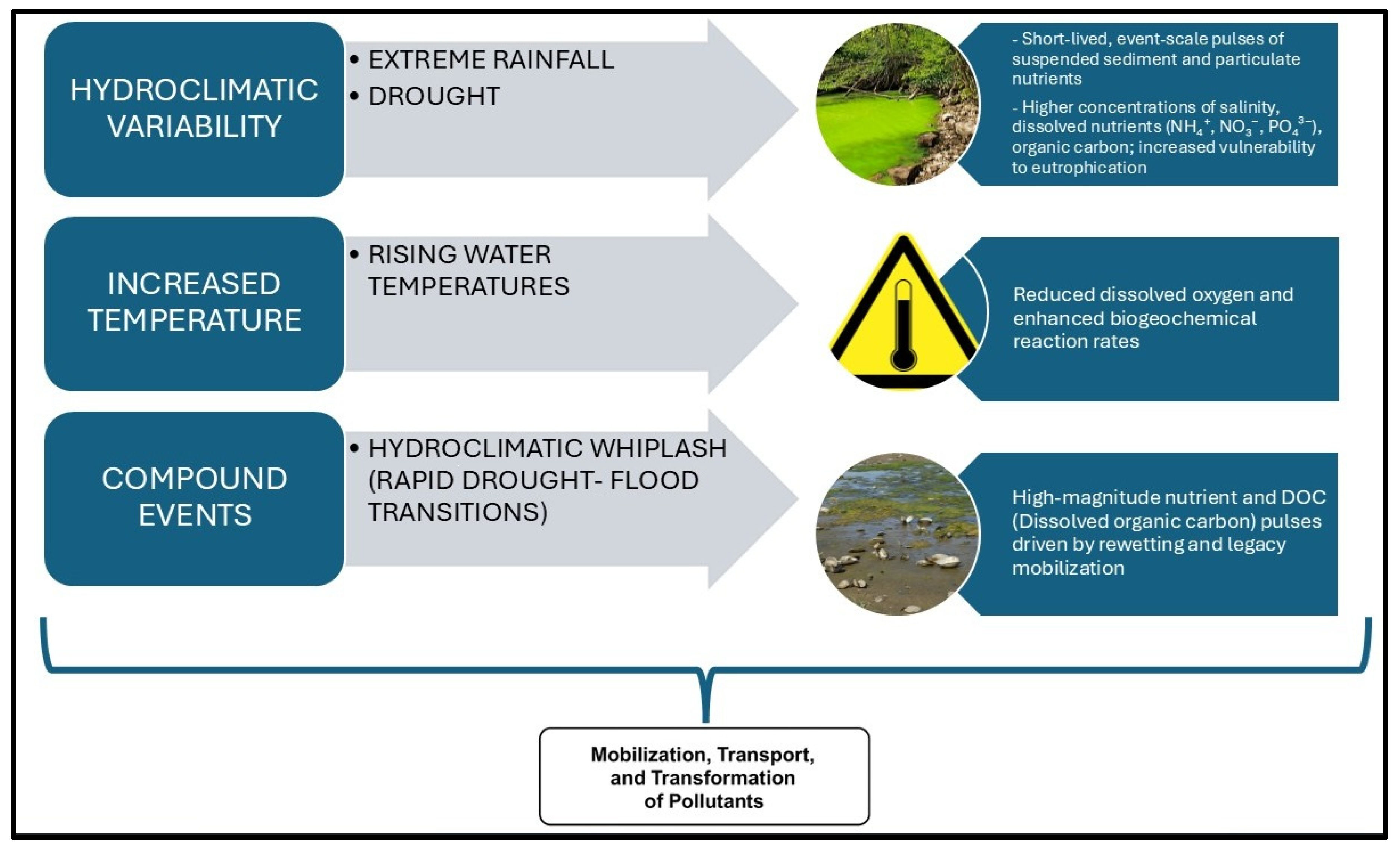
Climate change reshapes hydroclimatic regimes in three coupled ways that matter for water quality: (1) it alters the magnitude and seasonality of flows (e.g., runoff, baseflow, and groundwater exchange); (2) it amplifies extremes (e.g., droughts, heatwaves, and intense rainfall); and (3) it warms waters, shifting thermal and redox conditions that govern biogeochemical reactions. Acting in combination, these drivers reshape how pollutants are mobilized, transported, transformed, and temporarily retained along the hillslope–riparian–channel continuum. Observational syntheses in the IPCC AR6 WGII Chapter “Water” emphasize that these processes now operate outside historical variability in many basins, complicating monitoring and design assumptions that relied on quasi-stationary regimes [1]. Figure 1 synthesizes the principal climate drivers highlighted in this section and their combined influence on pollutant mobilization and biogeochemical transformation.
For clarity, the main climate-related drivers discussed above, together with their underlying mechanisms and expected effects on water quality, are summarized in Table 1.
Table 1. Climate-change drivers and their impacts on water quality.
Climate DriverWater-Quality ImpactsReferences
Intensified extreme
rainfall
Short-lived, event-scale pulses of suspended sediment and particulate nutrients[1,13,14,15]
Prolonged droughtHigher concentrations of salinity, dissolved nutrients (NH4+, NO3, PO43−), organic carbon; increased vulnerability to eutrophication[1,13,16,17,18]
Rising water
temperatures
Reduced dissolved oxygen and enhanced biogeochemical reaction rates[19,20,21]
Hydroclimatic whiplash (rapid drought–flood transitions)High-magnitude nutrient and DOC * pulses driven by rewetting and legacy mobilization[3,22,23,24,25,26]
Note: * DOC—dissolved organic carbon.

2.1. Hydrological Variability and Pollutant Mobilization

More erratic precipitation and intensified storms increase overland flow, bank erosion, and hydrological connectivity between source areas and streams, enhancing pulses of suspended sediment and particulate nutrients [1]. Conversely, prolonged low flows reduce dilution and increase residence times, raising concentrations of dissolved nutrients, salinity, and pathogens. A global synthesis across 314,046 monitoring sites shows that during droughts and heatwaves, median river temperature rises by ~27%, dissolved oxygen declines by ~17%, and salinity increases by ~24%, with responses modulated by climate zone, irrigation, and wastewater treatment level [13].
Beyond these first-order patterns, catchment wetness history and selective activation of flow paths generate marked event-scale hysteresis in concentration–discharge (C-Q) relations: particulate constituents frequently exhibit clockwise hysteresis linked to rapid hillslope flushing, whereas dissolved fractions often display counter-clockwise loops reflecting delayed subsurface delivery [14,15]. The prevalence of “chemostatic” versus “transport-limited” behavior thus depends on antecedent moisture, soil structure, and land use, with tilled row–crop systems and sealed urban surfaces predisposing sharp, transport-limited peaks during short, high-intensity storms [14,15].
Compound drought–flood sequences (“hydroclimatic whiplash”) commonly trigger step changes in constituent export and first-flush effects after rewetting, but dissolved and particulate fractions respond differently depending on land use and network connectivity [16]. In drained croplands, rapid activation of macropores and tile drains after dry spells can short-circuit nitrate-rich waters to channels; in forested headwaters, initial pulses are often sediment-dominated from bank toe failure and road–ditch linkages [15,16]. Wildfire-affected basins represent an extreme: hydrophobic soils and ash layers suppress infiltration and mobilize fine particulates and phosphorus during the first post-fire storms, while subsequent low-flow periods sustain elevated DOC that complexes metals and elevates downstream oxygen demand [17,18]. Short, energetic floods can also scour biofilms and disrupt hyporheic exchange, temporarily reducing in-stream uptake and increasing export efficiency until benthic communities and redox zonation recover [17,18].
From a monitoring and design perspective, hydrological variability effectively acts as a gatekeeper, controlling when and where pollutant transfer becomes efficient. Event-aware networks (high-frequency sensors and autosamplers keyed to rising limbs) are needed to resolve peak loads, hysteresis direction, and recovery time-metrics that better represent flux regulation than period-averaged concentrations. Because water-quality responses are shaped by both variance and sequencing (not only mean shifts), assessments should explicitly include dry-to-wet transitions and heat-drought co-occurrence [1,13,16]. This framing links directly to ecohydrological buffers discussed later: where infiltration and residence are sustained (riparian soils, floodplain backwaters, and hyporheic corridors) systems function as filters; once thresholds are exceeded (saturation-excess runoff or preferential flow bypass), they flip into fast conduits of export [1,13,16]. Such interactions may contribute to the long-term persistence of microplastics in aquatic systems, acting as secondary reservoirs of contamination with delayed ecological effects. It is worth noting that many of these event-scale dynamics remain poorly represented in national water-quality datasets, particularly in regions where sampling frequency is still based on monthly routines [24,25,26].

2.2. Compound and Rapidly Alternating Extremes—Hydroclimatic Whiplash

Temporally compounding events—heatwaves with drought, or drought followed by extreme rainfall—are increasingly recognized as distinct risk pathways because their combined impact exceeds the sum of their parts. The commonly used typology distinguishes preconditioned, multivariate, temporally compounding, and spatially compounding events, offering a rigorous lens to diagnose pollutant pulses, infrastructure upsets, and management failures under non-stationarity [27]. Global hotspot analyses further map where multiple hazards co-occur or propagate (e.g., hot–dry with wind, storm surge with heavy rain), elevating the likelihood of water-quality failures such as algal bloom-prone low-flow periods immediately followed by high-shear storms that resuspend nutrients and contaminants [28].
“Hydroclimatic whiplash” describes rapid switches between drought and flood (and vice versa). Emerging detection and attribution work indicates that greenhouse-gas forcing increases the frequency and spatial extent of precipitation whiplash, with projections of substantial mid-century amplification across many populated regions [29]. In parallel, regional studies show rising precipitation volatility and more frequent sequences that stress both storage and conveyance systems, implying a higher probability of operational excursions for water-quality infrastructure (e.g., bypasses and combined sewer overflows) and for nature-based solutions (NbS) operating near capacity limits [30].
From a mechanistic perspective, whiplash events modify both hydraulic and biogeochemical antecedent states. This effectively prepares catchments for high export during rewetting: drought, evaporation, sediment concentration, and consolidation. Particularly in nutrient-rich agricultural basins, nutrient and metal concentrations in porewater also increase, biofilms and cyanobacterial mats accumulate labile biomass, and banks become mechanically fragile. Subsequent heavy rainfall events activate short, efficient flow paths that mobilize fine sediments, dissolved nutrients, and urban pollutants in “first flush” pulses that can overwhelm treatment and cause short-term downstream hypoxia [27,28,29]. Where events are multivariate (e.g., hot–dry–windy), wildfire risk and ash inputs further raise particulate P and organic load, compounding oxygen demand during the flood phase [28]. Conversely, flood-to-drought transitions can leave legacy turbidity and internal nutrient loading that sustain blooms as flows recede, particularly in stratifying reservoirs and backwaters [27,28].
Whiplash also exposes a scale mismatch between design standards and compound risk. Reservoir rule curves and wetlands, as peatlands detention-sized for single hazards, may underperform when required to buffer both protracted deficits and sudden surfeits. NbS performance is particularly sensitive to event sequencing (dry-to-wet vs. wet-to-dry), recovery times, and clogging or scouring thresholds; thus, evaluation should incorporate stress tests with realistic compound forcing rather than steady-state means [28,29,30]. From a methods standpoint, recent reviews highlight that robust assessment of drought-to-flood transitions requires explicit definitions of transition point, transition time, and speed, not only counts of co-occurrence; otherwise, risk to water quality and operations can be under- or over-estimated [31].
In practice, monitoring and modeling frameworks should (1) deploy event-triggered sampling keyed to rising limbs and early rewetting; (2) include compound-aware hazard matrices (e.g., hot–dry + wind; storm-tide + pluvial) with joint return periods; and (3) evaluate operational fragilities (e.g., bypass set-points, CSO thresholds, and intake shut-down criteria) under representative whiplash sequences. These elements connect directly to Section 2.1 and Section 2.2 (hydrologic connectivity; temperature–redox feedbacks), where antecedent drought reduces assimilative capacity and warming narrows the oxic window, thereby magnifying the water-quality impact once the flood arrives [27,28,29,30].
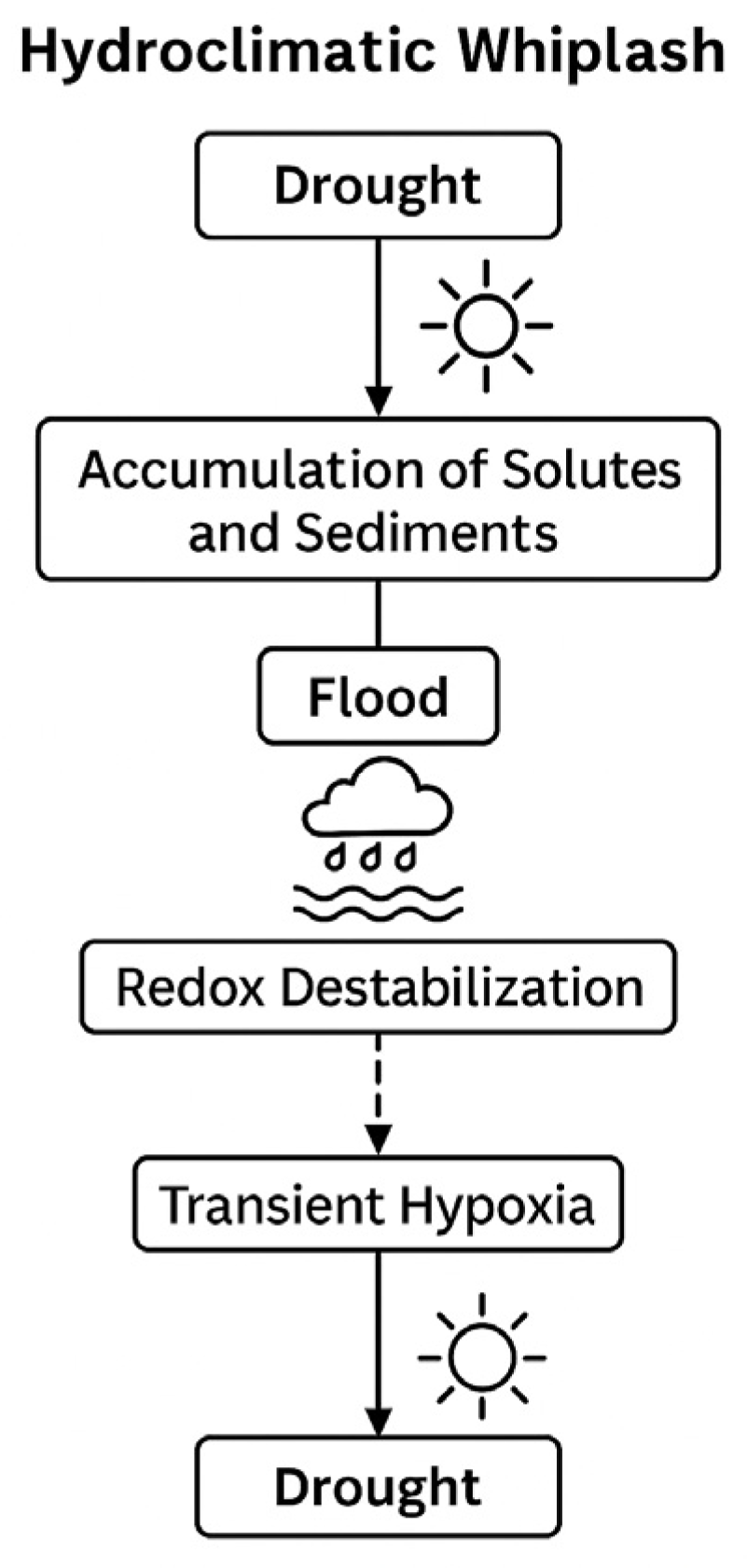
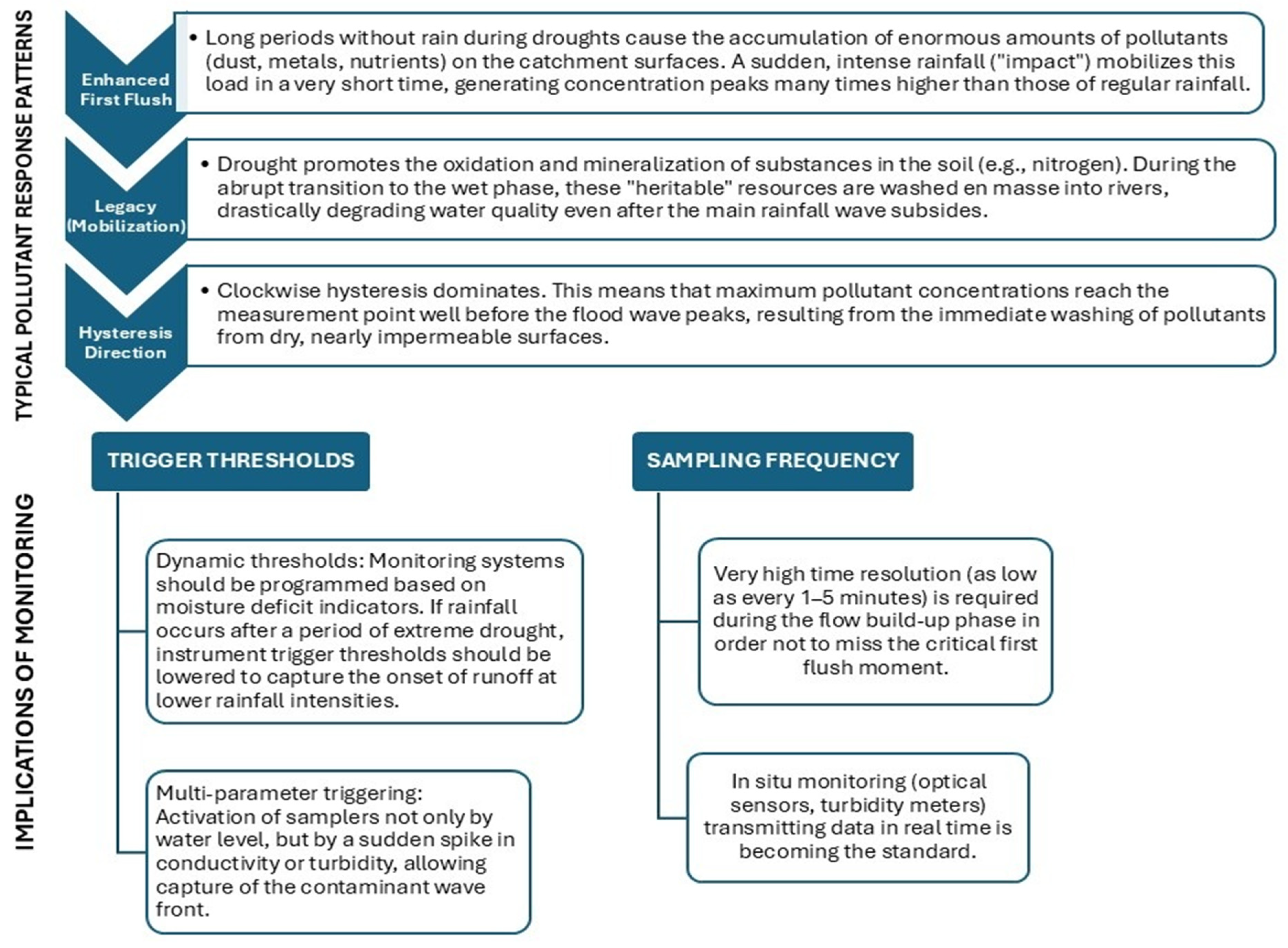
To illustrate how rapid transitions between hydrological extremes shape pollutant dynamics, Figure 2 summarizes the typical sequence of “hydroclimatic whiplash” events and their biogeochemical consequences. Figure 3 is a brief quantitative synthesis of the “hydroclimatic whip” concept describing typical pollutant response patterns and monitoring implications.
Combining hydroclimatic whiplash dynamics with practical tools relies, among other things, on integrating knowledge about extreme phenomena with specific operational and planning measures [31]. It is crucial to focus on single, extreme events (rainfall following drought), which generate the majority of the annual pollutant load in just a few hours. The volume-concentration method is used for this purpose, involving real-time flow and concentration measurements (in situ monitoring), followed by integration of the data to estimate the total pollutant mass (load) for a given event [30,31,32]. Hydrodynamic model calibration is a method of using data from extreme whiplash events to calibrate catchment models, allowing for reliable simulation of future loads. Early warning systems must account for the unique drought–flood sequence; therefore, it is crucial to establish dynamic warning thresholds that depend on preconditions (drought duration and intensity) and not just on current rainfall intensity. From a practical perspective, these include soil dryness indicators and intelligent turbidity sensors [33,34]. Additionally, it is worth mentioning the requirement to update infrastructure design standards to account for climate variability. A shift from static, historical rainfall data to climate-risk-based scenarios is needed. Design storms must reflect increased intensity and preceding drought periods. Nature-based solutions (NbS), such as rain gardens, polders, and wetlands, require flexible management under whiplash conditions. Active management of NbS retention capacity based on the predicted sequence of events is crucial, using, among other things, dynamic water level control and intelligent control systems [28,29,30,31].

2.3. Cross-Scale Implications for Monitoring and Management

Mechanistic insights translate into three practical imperatives. First, monitoring networks should be “event-aware–capturing” rewetting, first-flush, and recovery phases, and “compound-aware”, capable of detecting co-occurring heat–drought–storm sequences. In practice, this requires dense sensor deployment at hydrologically connected nodes (e.g., tributary junctions, storm drains, and tile-drain outlets), autosamplers triggered by hydrograph rise, and integration of high-frequency in situ data (NO3, temperature, dissolved oxygen, turbidity, chlorophyll-a, and DOM) with discrete laboratory analyses for speciation and validation [32,33]. Such high-resolution monitoring reveals concentration–discharge hysteresis and first-flush dynamics invisible to daily or weekly averages but critical for quantifying loads, identifying treatment upsets, and evaluating the resilience of nature-based solutions (NbS) [32,33,34]. Modern monitoring relies on proxy parameters that allow for immediate response without waiting for laboratory results. The stage (water level/flow) is the basis for determining the peak wave and calculating the load (mass = concentration × flow). Turbidity is a key indicator of total suspended solids (TSS) and heavy metals and phosphorus, which are transported on particulate matter during the “first flush” [32,33]. Electrolytic conductivity (EC) allows for identifying the transition point between groundwater (high salinity) and precipitation (low salinity) and detecting road pollution. Nitrate (NO3) levels are crucial in agricultural areas; optical sensors (UV–Vis) allow for capturing the sudden increase in nutrient leaching after drought (legacy mobilization). Temperature analysis is essential for compensating for other sensors and assessing the risk of eutrophication [32,34].
Second, risk assessment and design should integrate hydro-biogeochemical coupling, especially temperature–oxygen–redox feedbacks and soil-moisture controls on N, P, and S cycling. Standardized evaluation should include the following: (1) sequence-dependent metrics (e.g., transition time and transition speed for drought-to-flood events); (2) joint return periods for compound hazards (hot–dry–windy; storm-tide–pluvial); and (3) assessment of “oxic windows” in the hyporheic zone as buffers of reaction kinetics [32,33,34]. This aligns with the IPCC AR6 Water Chapter, which emphasizes managing variance and sequencing, not only mean shifts, as precipitation extremes and droughts intensify [35].
Third, models and interventions must be tested under non-stationarity with changing variance and sequencing rather than merely shifted means. This entails moving beyond traditional stationary design curves toward explicit non-stationary risk frameworks that characterize return periods and exceedance probabilities as time-dependent [35,36]. Both gray and green infrastructure should be evaluated for resilience thresholds (e.g., scouring and clogging limits) and for “recovery times” between events, rather than solely steady-state performance [33,36]. Nowadays, sampling at fixed intervals is being replaced by a prioritization logic based on a growing branch. Automatic sampling is activated when a derivative threshold (e.g., water level increase of >5 cm/15 min) or a turbidity threshold is exceeded. Because the first-flush effect and the highest concentrations occur before the flow peak, the system is programmed to sample densely (e.g., every 5–10 min) during the growing phase. As flow stabilizes or decreases, the algorithm automatically extends the sampling intervals (e.g., every 30–60 min) to conserve sample bottles for the entire event [34,35,36]. Sampling should continue until parameters (especially conductivity and nitrates) return to pre-event baseline levels (so-called pre-event conditions). In practice, monitoring should last at least twice as long as the time from the beginning of the rainfall to the peak of the wave (concentration time). It is also recommended to continue sampling infrequently (e.g., every 4–6 h) until water chemistry stabilizes [36,37,38].
Finally, scaling from river reach to catchment requires calibration and validation against large, harmonized datasets. Global repositories such as GLORICH (river chemistry), GEMStat (UNEP global water-quality database), and the newer SWatCh (Surface Water Chemistry) dataset provide standardized archives linking event-scale observations with long-term records [37,38,39]. When combined with high-frequency sensor networks, these resources enable cross-scale calibration of flux-based models, improve the prediction of first-flush loads, and support the design of adaptive operating rules for reservoirs, combined sewer overflows (CSOs), and NbS under increasingly volatile hydroclimatic conditions [1,32,33,35,36,37,38,39].

3. Ecohydrological and Biogeochemical System Responses

Ecohydrology links hydrological variability with biological regulation to explain why landscapes alternately function as pollutant sinks or as efficient transport corridors. Rather than focusing solely on pollutant loads, this perspective examines how timing, residence, and connectivity control self-purification efficiency. The main regulatory pathways include (1) hydrological partitioning (infiltration, overland flow, and groundwater recharge); (2) biogeochemical transformations mediated by vegetation and microorganisms; and (3) physical and biological retention in ecohydrological buffers such as riparian zones, floodplains, and wetlands. These feedbacks determine how pollutants move, transform, and are stored within catchments subjected to climatic stress [1,6,40]. A key strength of ecohydrology is that it explicitly treats these processes as adaptive and non-linear rather than static.
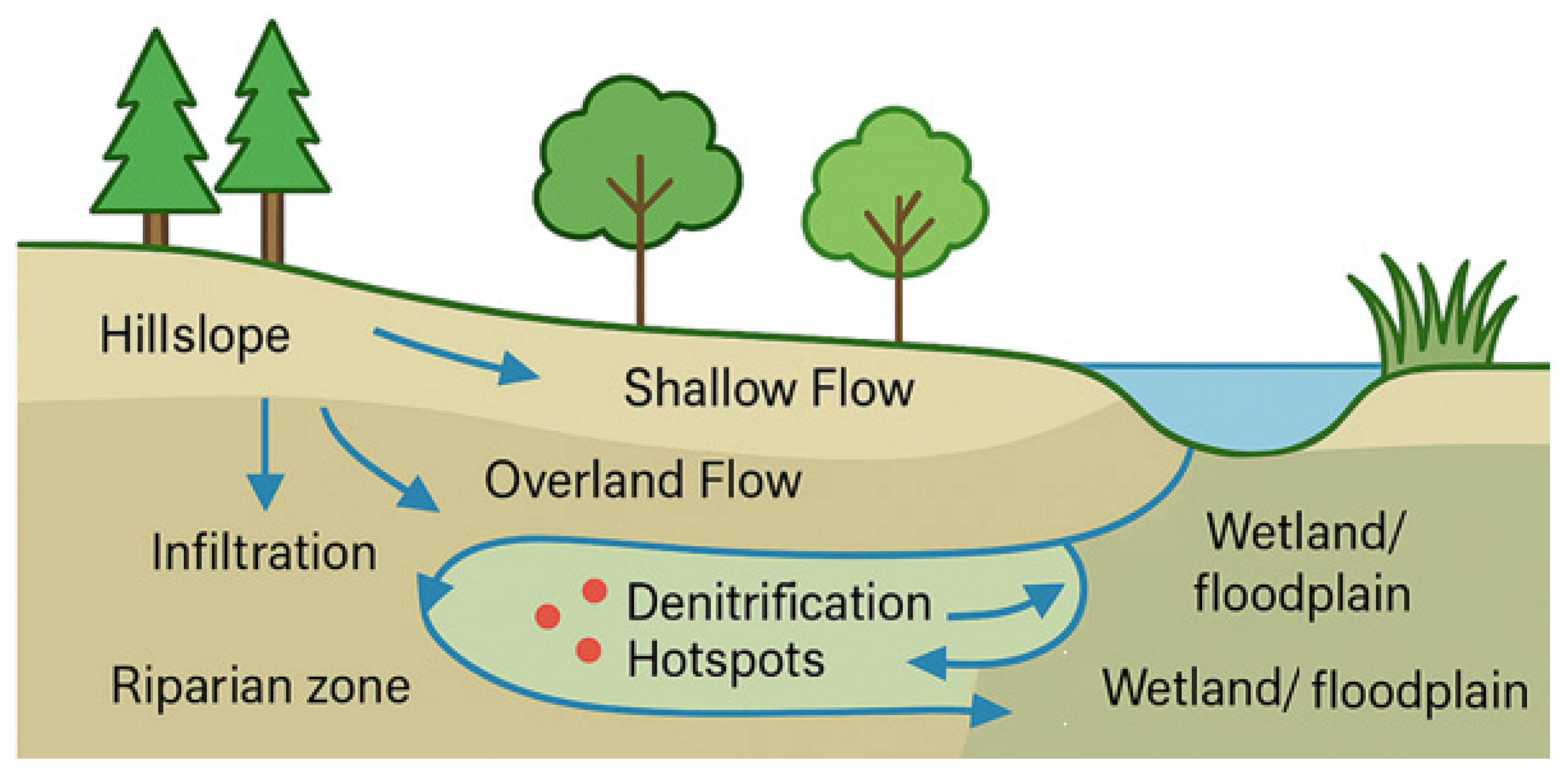
To provide a spatial overview of the ecohydrological pathways discussed in this section, Figure 4 illustrates the main landscape compartments—hillslope, riparian zone, hyporheic zone, and wetland/floodplain—and the associated flow routes that regulate pollutant retention and transformation. Under extreme conditions such as hydroclimatic whiplash, riverine systems cease to function continuously and begin to transport pollutant loads in a pulsating manner. Hydrological connectivity between individual zones (chambers) in the valley’s cross-section is crucial here.
The slope is a mobilization zone—this is where the process begins in the “wet” phase after a prolonged drought. Due to soil drying and a decrease in its permeability (hydrophobicity), rapid surface runoff occurs. In extreme conditions, the slope becomes a “feeder” for the load, which does not have time to infiltrate deeper into the profile. The riparian zone normally serves as a buffer zone, but during whiplash events, its role changes. During moderate rainfall, riverside vegetation retains nutrients [6,10,41]; however, during extreme impacts (whiplash), high water energy causes erosion of the banks themselves (so-called bank erosion). Instead of filtering, this zone can become a secondary source of pollutants (washed-out bottom and shore sediments). Wetlands are the most critical link in the purification chain, acting as a retention sponge. During the rising limb phase, these areas can release previously stored pollutants (legacy mobilization). During the recession phase, they become the primary site for sedimentation of fine suspended solids and heavy metals [11]. The floodplain provides the largest surface area of contact between water and soil during extreme events. Massive sediment deposition (sedimentation) occurs. The floodplain acts as a natural “settler.” If the floodplain is used for agriculture, the deposited pollutants (e.g., microplastics and heavy metals from the cities above) permanently contaminate the alluvial soils. Fertilizers washed from the floodplain (after a long drought) drastically increase the nitrate load in the river below [13,41].

3.1. Hydrological Controls on Pollutant Pathways

A key phenomenon in whiplash dynamics is the so-called hydrological connectivity switch. It transforms the landscape from a system of isolated “chambers” into a connected highway system of pollutant transport [40]. An example of this cascade of events is the extreme drying of clay and peat soils on slopes and in wetlands. This physically fractures the soil structure, leading to intense mineralization of organic nitrogen into nitrates. An intense storm strikes the parched watershed. Instead of slowly infiltrating through the soil matrix, water rapidly penetrates the cracks formed during the drought. Water bypasses biologically active layers and “falls” directly into drains or groundwater (activation of preferential flow) [41,42]. Sensors on the slope record a sudden drop in conductivity (rainwater), but sensors in the stream (in-stream) register a nitrate peak. The flood reaches a level where water leaves the channel and spills onto the floodplain and oxbow lakes. Floodplains that were isolated for months of drought suddenly become part of an active channel (lateral reconnection). The water carries away sediments accumulated on the floodplain. If the water stagnates on the wet floodplain (low flow velocity), microbiological processes (denitrification) are activated [43,44].
Hydrological partitioning fundamentally determines pollutant fate. During high-intensity rainfall, infiltration capacity is exceeded, generating Hortonian overland flow and mobilizing fine sediments, particulate phosphorus, and organic-bound contaminants. Conversely, under moderate rainfall and unsaturated conditions, infiltration-dominated flow prevails, lengthening water residence time and enhancing subsurface denitrification and sorption processes. The relative balance between these pathways fluctuates seasonally, influenced by soil structure, vegetation cover, and antecedent moisture conditions [41].
Riparian soils, characterized by higher porosity and organic-matter content, function as hydraulic and biogeochemical buffers, dissipating energy and promoting contact between water and reactive substrates. When groundwater levels rise rapidly, however, preferential flow pathways bypass these reactive zones, sharply reducing filtration efficiency and exporting previously stored solutes—a phenomenon known as “flushing”. Similar alternations have been documented in European and North American lowland rivers, where flood pulses temporarily reverse nitrate gradients between riparian zones and channels [42].
At the hyporheic interface, periodic exchanges between surface and subsurface water sustain microbial processing of dissolved oxygen, nitrate, and carbon compounds. The geometry of streambeds—controlled by sediment size and channel morphology—determines exchange depth and frequency. Systems with intermediate permeability and moderate gradients display optimal retention potential [43]. In managed rivers, channel simplification and bank reinforcement drastically reduce hyporheic exchange, undermining natural purification capacity. Hydrological restoration that reintroduces small-scale morphological variability (gravel bars and woody debris) can therefore recover up to 30–50% of self-purification functions lost due to channelization [44].
In summary, hydrological controls act as the gating mechanism for pollutant transfer: when infiltration and connectivity are balanced, ecohydrological systems operate as efficient filters; when hydrological thresholds are exceeded, they transform into rapid conduits of export. This dynamic highlights the need for adaptive management responsive to rainfall variability and antecedent conditions rather than static design criteria [45,46,47,48,49].

3.2. Physical and Biogeochemical Retention in Ecohydrological Buffers

Ecohydrological buffers—riparian corridors, floodplains, wetlands, and vegetated filter strips—constitute the biogeochemical backbone of catchment self-purification. They intercept overland flow, attenuate peak discharges, and enhance sedimentation and sorption processes. Vegetation slows hydraulic velocity, promoting particle settling and contact between solutes and organic-rich substrates. In parallel, microbial communities within these sediments transform nutrients and degrade organic pollutants through oxidation–reduction reactions [50].
Riparian buffers are particularly effective in intercepting non-point-source pollution. Meta-analyses show average reductions in total nitrogen by ~50% and total phosphorus by ~40%, though performance depends strongly on buffer width, vegetation type, and slope [51]. Floodplains act as intermittent storage zones. During inundation, they trap suspended sediments and induce anoxic conditions favorable to denitrification; during low-flow periods, they facilitate re-oxygenation and carbon sequestration [52]. However, disconnection from rivers—due to levees and channelization—reduces their effectiveness by limiting hydrological exchange.
Constructed wetlands replicate these natural mechanisms in engineered settings. Multi-year syntheses report pollutant removal efficiencies typically ranging from 40 to 70% for nitrogen and 30 to 60% for phosphorus [53]. Yet, performance is highly sensitive to seasonality: cold or dry periods suppress microbial activity and plant uptake. Hybrid configurations—combining surface and subsurface flow regimes—maintain higher resilience by diversifying hydraulic and microbial niches [54].
Retention efficiency ultimately depends on achieving a balance between hydraulic residence time and biogeochemical reactivity. Excessive retention may lead to internal nutrient release, while insufficient residence results in bypassing of treatment zones. A distinction is made between nominal residence time and actual residence time under extreme conditions—the average time a water molecule spends in the system (Hydraulic Retention Time—HRT). During rapid floods, HRT drops dramatically (from several days to several hours), preventing biological processes. Adaptive systems strive to maintain HRT at a minimum of 24–48 h for sedimentation of fine suspended solids [50]. Removal efficiency (RE) is a percentage indicator of the reduction in pollutant concentration at the outlet relative to the inlet. Typical values for total suspended solids (TSS) are in the range of 60–90% (highest efficiency); for heavy metals (bound to particles), in the range of 40–70%; and for nutrients (N and P), in the range of 20–50% (strongly dependent on HRT and temperature) [53,54]. Furthermore, load reduction is crucial—the most important indicator for protecting the receiving body (e.g., river and lake) throughout the event. This is the total mass of pollutant retained in the system during the entire flood cycle (from the onset of rainfall until the return to base flow). Saturation thresholds determine the point at which the retention system loses its ability to absorb further pollutants or water. Modern NbS designs, therefore, incorporate adjustable flow control structures and zoned vegetation mosaics to maintain function across climatic variability [50,51,52,53,54].

3.3. Vegetation, Root Systems, and Microbial Interactions

Vegetation structure and productivity shape pollutant dynamics by modulating both water and nutrient pathways. Canopy interception reduces rainfall kinetic energy, minimizing erosion and delaying runoff. Root networks improve infiltration, stabilize aggregates, and host complex rhizosphere microbiomes that mediate carbon and nutrient cycling [45]. Root exudates supply labile carbon to denitrifiers and phosphatase-producing microbes, sustaining biogeochemical activity, even during fluctuating moisture conditions.
The rhizosphere acts as a dynamic interface coupling hydrology and biology. Under waterlogged conditions, oxygen diffuses from plant roots into surrounding sediments, maintaining micro-oxic niches that support coupled nitrification–denitrification. In drought phases, roots concentrate microbial hotspots near moisture pockets, sustaining partial transformations despite reduced saturation [46]. Experimental data show that mixed-vegetation buffers with both deep-rooted trees and shallow-rooted grasses outperform monocultures by maintaining continuous vertical gradients of oxygen and carbon, improving nitrogen removal efficiency by up to 45% [47].
Microbial communities within riparian and wetland soils display remarkable metabolic flexibility, switching between aerobic respiration, denitrification, and dissimilatory nitrate reduction to ammonium depending on redox status [48]. Climate warming accelerates enzymatic processes but can also favor opportunistic microbes that are less efficient in nutrient retention. Thus, functional redundancy—the coexistence of microbial groups capable of the same process—is critical to maintain resilience. Modern metagenomic studies demonstrate that hydrological variability tends to enrich communities with flexible metabolic pathways, enabling sustained pollutant removal despite oscillating oxygen regimes [49].
Vegetation–microbe interactions are, therefore, not static; they evolve in response to hydrological forcing. Long-term restoration projects in Central Europe reveal that newly reforested riparian buffers require 5–10 years to reach stable microbial–hydrological coupling comparable to natural forests, emphasizing the importance of temporal scale in evaluating ecohydrological success [45,46,47,48,49].

3.4. Temperature, Redox Conditions, and Biogeochemical Cycling

Warming waters and altered oxygen dynamics shift nitrification/denitrification balances, phosphorus sorption/desorption, and organic-matter processing. As temperature rises, nitrifier and denitrifier communities generally show Q10 in the ~1.8–2.3 range, increasing potential nitrification at warm, oxic interfaces and accelerating denitrification (and N2O yields) where electron acceptors remain available [19,20]. Lower oxygen solubility at higher temperatures further narrows the redox window that sustains aerobic processing and biological uptake, raising eutrophication risk and amplifying the toxicity of several contaminants [3,4]. Collectively, these changes depress the self-purification capacity during warm, low-flow periods when dilution is also weakest [21,22].
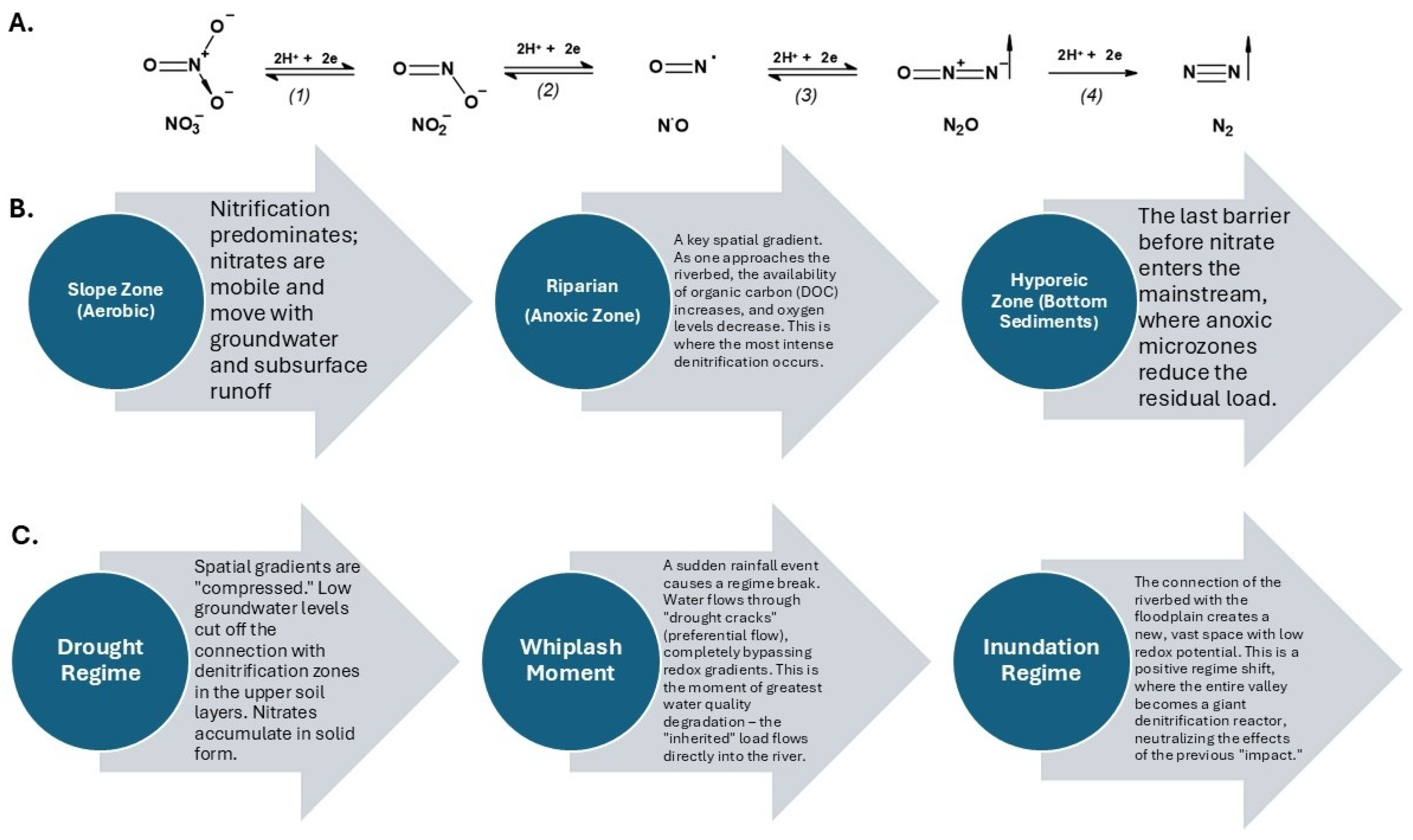
Figure 5 summarizes the sequential nitrogen transformation pathways that become activated under progressively reducing conditions in ecohydrological compartments, linking microbial nitrate reduction to hydrological residence time, temperature-driven redox shifts, and the potential accumulation of intermediate nitrogen species such as N2O.
On land–water interfaces, soil–water status controls both transport and microbially mediated reactions (including redox-sensitive N, P, and S cycling). Drying–rewetting sequences reorganize electron/acceptor availability and enzyme activity, often stimulating mineralization and nitrification during rewetting while producing short-lived pulses of dissolved inorganic nitrogen and labile DOC; denitrification tends to lag until anoxia is re-established in microsites [19]. This is the most dynamic failure mode in the whiplash scenario. During drought, microbial biomass dies, and soil organic matter mineralizes and accumulates. The first rainfall (rewetting) causes a rapid increase in microbial activity and the physical leaching of these resources. This results in a sudden pulse of dissolved organic carbon (DOC), nitrates, and phosphorus. DOC causes a rapid decrease in oxygen (used for its oxidation) and complicates water treatment processes (creating disinfection byproducts). The monitoring implications require UV–Vis (spectrophotometric) sensors to measure DOC/COD in real time [19,20,21,22,23]. In rewetted coastal peatlands, the direction and magnitude of nutrient export depend on time since restoration and salinity: recently rewetted fens can export disproportionately high area-normalized N and PO4-P loads to adjacent waters, whereas longer-rewetted systems show partial attenuation as redox stratification and plant uptake redevelop [23]. Salinity co-controls these responses by inhibiting nitrification in some cases and promoting NH4+/P release via ion exchange and floc disruption [23].
Redox oscillations play a decisive role in regulating phosphorus mobility through Fe-P coupling. Prolonged hypoxia causes the release of phosphorus. When oxygen is depleted in bottom sediments (reservoirs, polders, and oxbow lakes), the redox potential drops below critical values for the stability of iron–phosphorus complexes [6]. Under oxic conditions, P is retained on Fe(III) oxyhydroxides; during warming–enhanced hypoxia/anoxia, reductive dissolution liberates phosphate to the water column (“internal loading”), reinforcing eutrophication feedbacks [21]. Yet under anoxic, non-sulfidogenic conditions and sufficient Fe(II), phosphate can be sequestered as vivianite (Fe3(PO4)2·8H2O), providing a relatively redox-stable P sink. For this reason, several management strategies focus on increasing reactive Fe availability in order to shift sediments toward a more stable P sink and suppress internal loading [6]. The balance among these pathways depends on temperature-controlled oxygen demand, organic-matter lability, and sulfate availability (which can redirect Fe toward sulfides rather than vivianite). Monitoring requires redox potential and oxygen sensors in the near-bottom zone. The warning threshold is O2 < 2 mg/L). In routine monitoring campaigns, these rapid redox transitions are rarely captured, which explains why assessments of internal loading often underestimate its true magnitude during transitional periods [21,24].
Within river corridors, the hyporheic zone acts as a thermal and redox buffer where steep vertical gradients partition aerobic respiration, nitrification, and denitrification across millimeters to centimeters. Warmer conditions accelerate metabolism but can also collapse oxic layers, shifting processing to anoxic pathways and altering greenhouse-gas stoichiometry (e.g., favoring N2O production and stimulating methane turnover) [19,25]. Heatwaves cause oxygen breakdown. An increase in water temperature (above 25–28 °C) drastically reduces oxygen solubility, simultaneously accelerating the metabolism of microorganisms and the rate of organic matter decomposition (increased oxygen demand). A sudden collapse of the oxygen curve leads to fish kill and anoxia, which in turn triggers the release of phosphorus. The implication of monitoring requires continuous measurement of temperature and O2 [21,22,23,24]. The system logic should trigger aeration thresholds or force the flow of cooler water from deeper layers. High-resolution profiling shows intense, depth-structured CH4 cycling and coupled N transformations in hyporheic sediments, with reaction hotspots adjusting rapidly to temperature and discharge-driven oxygen supply [25].
At the land–sea margin, projected shifts in river discharge and cryosphere melt intersect with submarine groundwater discharge (SGD) to modify nutrient and redox conditions along deltas, estuaries, and nearshore shelves. SGD delivers reactive N and P (and reduced species such as Fe(II), Mn(II)) directly to coastal waters, often bypassing surface-water controls; its magnitude and composition are temperature- and redox-sensitive within coastal aquifers [8]. Accounting for SGD in water-quality models improves the prediction of eutrophication responses and helps explain hypoxia susceptibility in systems with modest river inputs but strong subsurface connectivity [26]. To provide a clearer overview of how redox conditions shape nutrient and carbon dynamics across changing hydrological regimes, the main pathways and their expected effects are summarized in Table 2.
Table 2. Redox conditions and dominant responses of nitrogen and phosphorus cycling under climate-induced variability.
Redox
Conditions
Process SensitivityEffect on Nitrogen
Cycling
Effect on Phosphorus
Mobility
Refs.
Oxic
conditions
Sensitive to temperature, organic-matter supply, and oxygen penetration depthIncreased NO3 production;
enhanced nitrification rates
Phosphate retained on Fe(III) oxyhydroxides[19,20,21,24]
Anoxic
conditions
Highly dependent on redox duration, Fe availability, and sulfate competitionNO3 removal with potential N2O emission depending on electron availabilityP release following Fe(III) reduction; possible vivianite formation under Fe-rich, low-sulfate conditions[19,21,23,24,25]
Alternating
oxic–anoxic
cycles
Strongly site- and history-dependent; controlled by rewetting intensity and OM labilityEvent-scale pulses of inorganic N during drying–rewetting transitionsOscillating P retention–release linked to Fe redox cycling[19,23,55,56]

3.5. Coupling of Carbon, Nitrogen, and Phosphorus Cycles

The interplay among carbon, nitrogen, and phosphorus cycles underpins ecohydrological resilience. Organic carbon serves as an energy source for denitrifying bacteria, while nitrogen and phosphorus availability regulate primary productivity and organic matter input. Disturbances to this stoichiometric balance propagate through food webs and alter overall pollutant dynamics [55].
Hydrological variability modulates biogeochemical functioning by altering C–N–P coupling and the stability of redox gradients. These shifts influence long-term nutrient retention and transformation efficiency across riparian and floodplain systems [56].
Field studies across European floodplain systems confirm that maintaining hydrological connectivity moderates these fluctuations by sustaining intermediate moisture and redox states. Systems with regular inundation cycles retain more stable C:N:P ratios and demonstrate 30–40% higher denitrification efficiency compared to disconnected sites [56]. Furthermore, inputs of dissolved organic carbon (DOC) from riparian litter sustain microbial metabolism during low-flow phases, preventing abrupt nutrient accumulation.
Integrated modeling of C-N-P coupling shows that ecohydrological feedbacks can buffer the effects of climate extremes up to a threshold—typically corresponding to a threefold increase in flow variability—beyond which retention collapses [57]. Maintaining organic matter inputs and dynamic hydrology is, therefore, essential for resilience. The practical implication is clear: NbS should be designed to maintain not only hydraulic retention but also continuous carbon supply and controlled redox heterogeneity to support nutrient coupling [55,56,57].

3.6. Conceptual Synthesis

Ecohydrological regulation of pollutant fluxes operates as a multi-scale network of feedback loops connecting hydrology, biology, and geomorphology. At the hydrological scale, flow variability governs the time and extent of pollutant contact with reactive zones. At the biological scale, vegetation and microorganisms mediate transformations through uptake, mineralization, and gas emissions. At the geomorphological scale, landform configuration—channel complexity, floodplain width, and slope—defines where and how these processes overlap [58].
These feedbacks form the foundation of what Zalewski [6] termed the self-purification potential of a catchment: the emergent ability of ecosystems to stabilize water quality through intrinsic regulation. This potential is sustained when hydrological and biological processes operate within compatible timeframes—so-called ecohydrological resonance. Extreme or asynchronous events (e.g., flash floods and prolonged droughts) disrupt this synchrony, leading to loss of function and increased pollutant export [59].
Conceptual advances increasingly emphasize the importance of dynamic equilibrium, where systems fluctuate within a resilient operating space rather than maintain fixed steady states. Empirical studies show that restored riparian and floodplain systems can recover up to 60% of lost purification capacity within a decade if hydrological and biological rhythms are resynchronized [60]. The integration of process-based metrics—nutrient retention efficiency, biogeochemical turnover rates, and residence-time distributions—into management frameworks provides a quantitative basis for assessing resilience [61].
In practice, the “Integrated Conceptual Model” provides the foundation for water-quality management in times of climate extremes. It is a conceptual and mathematical framework that moves beyond simple rainfall–runoff correlations toward understanding the interactions of three pillars: transport physics, chemical kinetics, and ecosystem legacy. This model explains the dynamics of water quality. Connectivity determines the physical ability of water and pollutants to move between different “compartments” of a watershed (e.g., from a slope to a riverbed) and determines the timing of pollution peaks. During droughts, connectivity is low (isolation). Sudden rainfall “switches on” connectivity (e.g., through preferential flow in soil cracks or flooding of a floodplain) [6,58,60].
Redox and temperature determine the biological and chemical “efficiency” of an ecosystem to remove or generate pollutants and determine how the chemical composition of a stream changes as it flows. Heatwaves dramatically increase oxygen demand, which can lead to oxygen depletion. The transition from aerobic to anoxic conditions (during flooding) is a “switch” that determines whether nitrates are removed (denitrification) or phosphorus is released from sediments (internal loading) [58,59,60,61].
Legacy storage—controlling “post-event memory”—refers to contaminant stores (nitrogen, phosphorus, and DOC) accumulated in soil, sediments, and groundwater as a result of long-term human activity or previous drought cycles. This determines the amount (load) of pollutants available for transport. Long droughts increase the pool of “mobilizable” nitrogen. After an extreme event, the river “remembers” the drought for weeks (recovery pathway), exhibiting elevated nutrient concentrations even after the flood wave has subsided [6,58,59,60,61].

4. Nature-Based Solutions (NbS) as Ecohydrological Tools for Water-Quality Improvement

Nature-based solutions (NbS) constitute a class of interventions that harness ecological processes to regulate hydrological and biogeochemical fluxes. Within an ecohydrological framework, NbS are designed not as static infrastructure, but as adaptive, self-organizing systems that co-evolve with hydrological variability and land-use pressures. Their efficiency in improving water quality derives from their ability to extend residence time, enhance contact between water and bioreactive media, and stabilize nutrient and sediment cycles [1,2,3]. Nature-based solutions (NbS) are based on the understanding that their effectiveness is not constant. It is crucial to distinguish between the optimal operating window and critical points caused by whiplash phenomena. Under typical conditions (low- to moderate-intensity rainfall and regular hydrological cycles), NbS perform best, acting as multifunctional purification systems [8,62,63,64,65,66,67,68]. This state is characterized by high residence time (HRT) (water moves slowly, allowing for full sedimentation of suspended solids up to 90% and phosphorus sorption); biological stability (biofilms on plant roots are active, effectively reducing nitrate and DOC loads); and source retention (NbS, e.g., rain gardens and soakaways can retain 100% of runoff from small rainfall events, completely eliminating the pollutant load reaching the receiving water) [12,52,53,54,63,66]. Extreme conditions (downpours after drought and heatwaves) and non-stationarity (changes in weather patterns that prevent the system from returning to its baseline state) lead to functional failure of the NbS. During extreme rainfall, water flows through the NbS too quickly (so-called short-circuiting). Biological processes do not have time to occur, and the system operates only as a simple transit channel. Exceeding the retention capacity causes the most contaminated water (first flush) to bypass the system through emergency overflows. Functional failure of the NbS includes internal erosion and leaching, anoxia and phosphorus release, and water stress (drought) [44,50,65,69,70]. Under extreme weather conditions (urban heat islands and flash floods), physical retention and evapotranspiration mechanisms dominate. Landscape retention is the absolute leader: In extreme rainfall situations, natural polders and wetlands are the only mechanism capable of absorbing the mass of water that gray infrastructure cannot accommodate. During extreme heatwaves, the transpiration mechanism of urban trees proves dominant—it can lower the perceived temperature by several degrees, an effect impossible to achieve with technological solutions on this scale [50,65,69].
The following subsections examine major NbS typologies—riparian buffers, floodplains, wetlands, and hybrid landscape systems—highlighting mechanisms, empirical evidence, and research challenges. For reference, the main types of nature-based solutions discussed in this section, together with their dominant mechanisms and reported pollutant-removal efficiencies, are summarized in Table 3.
Table 3. Dominant removal patterns and context-dependent performance of major nature-based solutions (NbS).
NbS TypeNitrogen
Removal
Potential
Phosphorus
Removal
Potential
Key Limitations/Context
Dependence
Refs.
Riparian buffer zones/
vegetative filter strips
High for nitrate under shallow groundwater flow pathsModerate; primarily particulate P retentionStrongly dependent on buffer width, soil saturation, and vegetation type[6,8,9,10,50,51]
Reconnected or restored floodplainsModerate-to-high during frequent inundation and exchangeModerate; declines under prolonged saturationRequires regular hydrological connectivity; risk of internal P release
under anoxia
[55,56,66,67,68]
Constructed wetlands (surface-flow or hybrid systems)High but seasonally variableModerate; enhanced by Fe-rich substratesPerformance sensitive to hydraulic loading, temperature, and long-term P saturation[11,12,52,53,54,70]
Agricultural/landscape NbS (vegetated ditches, ponds, contour strips)Low-to-moderate at catchment scaleLow-to-moderate; sediment-drivenHighly distributed effects; cumulative rather than point-scale efficiency[44,50,63,64]
Urban green infrastructure (bioswales, permeable pavements, retention cells)Moderate for dissolved N under frequent small eventsLow-to-moderate; media-dependentPerformance declines during extreme rainfall and bypass flow[69,71,72,73]

4.1. Riparian Buffer Zones and Vegetative Filter Strips

Riparian buffers are among the most effective and widely implemented NbS for mitigating non-point-source pollution. Acting as transition zones between uplands and aquatic ecosystems, they intercept overland flow, reduce erosion, and foster denitrification and phosphorus immobilization. Their ecohydrological function arises from hydraulic dispersion, infiltration enhancement, and vegetation-mediated nutrient uptake [4,62].
Recent meta-analyses demonstrate mean removal efficiencies of 50–70% for nitrate and 30–60% for total phosphorus, though performance depends strongly on buffer width, vegetation composition, and soil permeability [6]. Grass buffers are efficient in trapping sediments, while forested strips are superior for nitrate attenuation due to deeper rooting and enhanced carbon supply for denitrification [7].
The design of riparian buffer zones is based on a dynamic approach, where the width and structure of the zone are adapted to the specific characteristics of the catchment and predicted extreme events. The design is based on three main pillars that determine the zone’s effectiveness as a biogeochemical barrier: zone width, soil type and vegetation, and hydraulic loading [50,63]. The minimum (mechanical barrier) is 5–10 m for retaining sediments and suspended solids, while the optimum (chemical barrier—nitrogen) is 15–30 m. The highest effectiveness is demonstrated by soils with high organic-matter content and moderate permeability (alluvial soils). The presence of a saturated (hydromorphic) zone, which favors denitrification, is crucial, and the vegetation should be mixed [63,64]. The designed load should not exceed the soil’s infiltration capacity. Designing for a 10-year rainfall is standard. If the specific flow exceeds 0.5 L/s per linear meter of the zone, its purification efficiency drastically decreases [62,64,70].
Under climate change, extreme rainfall events can temporarily overwhelm filtration capacity, converting buffers from sinks into sources. Studies from Scandinavian agricultural basins show that repeated flooding causes the remobilization of phosphorus bound to iron oxides, a process mitigated by maintaining mixed vegetation zones and subsurface flow paths [8]. Even the best-designed buffer zones fail under whiplash conditions or thermal extremes. Bypass flows are the most common cause of failure. Water does not flow uniformly across the entire width of the buffer, but instead carves narrow channels or exploits natural depressions (microstreams) [6,12,44]. As a result, over 90% of pollutants bypass the plant filter, flowing directly to the river. In early spring, when the soil is frozen or saturated, its infiltration capacity is zero. Meltwater runoff flows across the surface, carrying high concentrations of nutrients from the fields, while biological processes (denitrification) are dormant due to low temperatures [52,69,73]. In the “whiplash” phase after a drought, the water’s high kinetic energy erodes the buffer zones themselves. Instead of filtering, the zone erodes, and the accumulated “older stores” (legacy phosphorus) are rapidly released into the riverbed. Buffer zones are completely ineffective if pollutants (mainly nitrates) are transported through drainage systems that run under the buffer and discharge directly into the river [8,50,51,55].
Hydrological connectivity is key: saturated buffers connected to shallow groundwater remove nitrate effectively even during low flows, while disconnected systems lose their filtering role [9]. Innovations, such as denitrifying bioreactors, woodchip trenches, and microtopographic reshaping, have improved year-round nitrate removal and resilience to seasonal variability [63]. In the broader landscape, the cumulative benefit of distributed buffers has been shown to reduce nitrogen export from agricultural catchments by up to 30% when spatially optimized along hydrological flow paths [64].

4.2. Floodplain Reconnection and River Restoration

Floodplains represent dynamic ecohydrological buffers whose functionality depends on the frequency, duration, and depth of inundation. They operate through temporary storage, sedimentation, and biogeochemical processing in alternating oxic–anoxic cycles. Reconnecting rivers with their floodplains—by breaching levees or restoring side channels—reinstates this natural regulation and improves water quality while providing co-benefits such as biodiversity recovery and flood attenuation [65].
Renovation activities directly modify hydraulic parameters, which translates into specific ecohydrological effects. Reducing peak velocities through meander restoration and the introduction of deadwood increases channel roughness, which slows flood flow and promotes sedimentation of total suspended solids (TSS) and associated pollutants (phosphorus, heavy metals, and microplastics) [50,65,68]. Extending retention time through reconnection with side channels and oxbow lakes increases the volume of water remaining in the valley. Prolonged contact of water with biologically active sediments and biofilm under conditions of low redox potential (anoxia) optimizes the denitrification process. Nitrates (NO3) are effectively reduced to gaseous nitrogen (N2) before the water returns to the main channel [50,69,73].
Empirical research from the Danube, Loire, and Vistula systems shows that restored floodplains reduce annual nitrate loads by 25–50% and total phosphorus by 20–40%, primarily through enhanced denitrification and sediment trapping [66]. The effectiveness increases with hydrological exchange rate: areas re-inundated several times per year show more stable nutrient retention than those flooded episodically [67]. Conversely, long dry periods promote soil oxidation, leading to internal phosphorus release when rewetting occurs. Maintaining a “dynamic equilibrium” of wetting and drying cycles is, therefore, essential for sustained performance [68].
Floodplain vegetation mediates these processes by stabilizing sediments and supplying organic carbon. Mixed herbaceous-woody stands promote stratified redox zones and improve denitrification efficiency compared with monodominant grasslands. Remote-sensing studies reveal that functional vegetation heterogeneity correlates with reduced nitrate fluxes across European floodplains [55]. While restoration costs can be high, economic assessments demonstrate that nutrient removal via reconnection can be 30–50% cheaper per unit of N removed than advanced wastewater treatment when long-term ecosystem services are considered [50].
It is important to note that climate change may impact effectiveness. Climate change introduces non-stationarity, which can impair or completely block the operation of restored systems. Extreme floods exceeding design assumptions (e.g., flows with a probability of 0.5% occurring more frequently) cause secondary erosion [8,12,50,68]. Water with enormous kinetic energy can flush sediments previously deposited on the floodplain (older storage), transforming the floodplain from a “sink” of pollutants into their source. Prolonged droughts cause wetlands to dry out, leading to the mineralization of organic matter [55,70,73]. When rainfall (whiplash) follows the drought, these systems are unable to “stop” the wave of pollutants because their sorption capacity is impaired by soil cracks (preferential flow), and the microorganisms responsible for denitrification need time to recolonize. Significant temperature increases will accelerate decay processes in stagnant zones, which at low flows may lead to the release of phosphorus from sediments (internal loading) even in renaturalized sections [44,50,65,70].

4.3. Constructed and Restored Wetlands as Biogeochemical Reactors

Constructed wetlands (CWs) are engineered NbS that mimic the hydrological and biogeochemical functions of natural wetlands. They achieve pollutant reduction through sedimentation, filtration, sorption, plant uptake, and microbially mediated transformations within shallow, vegetated basins. Their modularity allows deployment at multiple scales—from field-edge treatment cells to urban stormwater retention ponds [69].
In the face of hydroclimatic whiplash phenomena, it is crucial to precisely separate the two roles played by wetlands in a watershed. Although these processes occur simultaneously, they are subject to different failure modes and require different monitoring strategies. As hydraulic buffers, wetlands act as a mechanical system for managing energy and water volume. Their main functions are attenuation (increasing surface roughness—vegetation and microtopography, which extend the flood wave over time and lower its peak), and storage (utilizing the free retention capacity in soil pores and surface basins) [11,52,69,71].
As biogeochemical reactors, wetlands act as active chemical processors, changing the form and toxicity of pollutants. Their main function is redox transformation—water-saturated zones create anaerobic (anoxic) conditions, necessary for denitrification. Vegetation and sediments provide organic carbon (DOC), which fuels these reactions.
Extensive syntheses of over 500 CW systems report median removal efficiencies of 45–75% for total nitrogen, 35–60% for total phosphorus, and 70–90% for suspended solids [52]. Hybrid systems combining surface and subsurface flow maintain high performance under variable loading, while the inclusion of carbon-rich substrates (e.g., woodchips and biochar) enhances denitrification and metal binding. In recent experimental and pilot-scale systems, biopolymer-based reactive media (e.g., alginate, chitosan, cellulose derivatives, or polydopamine coatings) have been explored primarily as supplementary functional components rather than as core NbS elements [11]. Beyond conventional substrates such as woodchips or mineral sorbents, increasing attention has been given to biopolymer-based materials and functional coatings as supplementary reactive media in nature-based water-treatment systems, where their role is to enhance sorption capacity, support biofilm development, and locally stabilize redox-sensitive processes rather than to replace ecosystem-scale functions. Alginic acid with carboxylate groups enables cation binding, cellulose as a structural polysaccharide supports biofilm development, and chitosan with protonable amino groups facilitates metal and phosphate sorption. Another NbS biopolymer for applications, carrageenan with sulfate groups, increases cation exchange capacity, and polydopamine can be used as a multifunctional coating providing catechol and amine functional sites for adsorption. These materials are typically used as dispersed or surface-modified components within wetlands or buffer systems (e.g., alginate or chitosan-based matrices, cellulose scaffolds, carrageenan gels, or polydopamine coatings). Their effectiveness depends largely on hydrological retention time, microbial colonization, and long-term material stability under varying redox and humidity conditions. These approaches are currently being developed and modified both in laboratory-scale studies and in preliminary model field studies. In the context of ecological approaches to environmental solutions, the use of naturally derived polymeric materials is currently of considerable interest to researchers [11].
Assessing the effectiveness of retention systems and NbS under non-stationary conditions (variable, extreme hydroclimatic cycles) requires considering critical trade-offs. These systems, designed to protect water quality, can generate negative side effects under extreme conditions [70]. To minimize these risks, modern Integrated Water Resources Management systems implement dynamic retention by actively controlling water levels to prevent excessively deep drops in redox potential (preventing P release). Implementing habitat mosaicism involves designing differentiated zones (aerobic and anaerobic), which limit CH4 emissions and ensure process stability under various weather regimes. Furthermore, process monitoring allows for the tracking of not only pollutant concentrations but also auxiliary parameters, such as the Fe:P ratio in sediments, which allows for the prediction of system performance failure [52,69,70,72].
Under real-world operating conditions, however, seasonal variability remains a key limitation: microbial activity declines during cold periods, while droughts and drying–rewetting cycles can disrupt redox stability. Long-term monitoring in Chinese and Scandinavian constructed wetlands indicates that design elements such as multi-cell sequencing, variable water levels, and high plant diversity significantly improve system resilience to climatic stress [70].
CWs also provide co-benefits—carbon sequestration, flood mitigation, and habitat creation—but require regular maintenance to prevent clogging and vegetation senescence. The emerging concept of “adaptive wetlands” integrates dynamic flow management and predictive monitoring (via IoT sensors) to sustain optimal hydraulic retention and biogeochemical activity [71]. In developing regions, decentralized CWs have become cost-effective alternatives to conventional wastewater treatment, offering nutrient removal at <5% of the capital and energy cost of mechanical systems [72].

4.4. Integrated NbS Systems in Agricultural and Urban Landscapes

Ecohydrological NbS are increasingly deployed in mosaics that integrate multiple functions—hydrological buffering, nutrient retention, and biodiversity support. In agricultural landscapes, constructed wetlands, vegetated ditches, and contour buffer strips collectively reduce diffuse pollution by intercepting runoff at various spatial scales. Modeling studies in the Po and Odra basins indicate that integrated NbS networks can achieve a basin-scale nitrogen reduction of 20–35% with less than 5% land conversion [44].
Urban applications are also gaining prominence. Green roofs, permeable pavements, bioswales, and retention ponds combine hydrological control with pollutant removal. Their performance depends on substrate depth, vegetation type, and hydraulic design. For instance, permeable pavements with biochar-amended sublayers show 60–80% removal of hydrocarbons and heavy metals, while vegetated bioswales enhance microbial degradation of organic contaminants [73]. Beyond treatment, urban NbS reduce stormwater peaks and mitigate combined sewer overflows, providing climate-adaptation co-benefits.
The key to success lies in connectivity across scales—linking field-level buffers, floodplains, and urban green infrastructure into coherent ecohydrological networks. This requires spatial planning tools (e.g., GIS-based prioritization and multi-criteria optimization) that align pollutant pathways with suitable NbS typologies [74]. The shift from isolated installations to landscape-integrated NbS corridors marks a significant advance toward systemic water-quality management.

4.5. Performance Metrics, Monitoring, and Research Gaps

Although NbS have proven capacity to improve water quality, quantifying their long-term effectiveness remains challenging. Traditional performance metrics—percentage reduction in total nitrogen (TN), total phosphorus (TP), or total suspended solids (TSS)—capture average removal but neglect variability during hydrological extremes. Recent frameworks emphasize flux-based metrics that account for pollutant retention across flow regimes (low, transitional, and high) [50].
Advances in remote sensing, in situ sensors, and isotopic tracing allow direct observation of ecohydrological processes. High-frequency monitoring reveals that NbS performance is highly dynamic; for instance, denitrification in wetlands peaks during moderate flows and declines sharply during floods or prolonged droughts [52]. Therefore, resilience should be measured not only by mean efficiency but also by stability across stress conditions.
Modeling tools such as SWAT+, HYPE, and INCA-N now incorporate NbS modules linking hydrological and biogeochemical processes, yet parameter uncertainty remains high. Empirical calibration using compound event datasets (drought–flood sequences) is essential to predict real-world responses. Moreover, socio-ecological factors—maintenance, governance, and co-benefit valuation—determine long-term viability as much as biophysical performance [75]. Despite investment enthusiasm, some mechanisms are still based on optimistic assumptions rather than hard evidence. An example is the automatic self-purification of heavily contaminated flowing waters—phytoremediation mechanisms—which are poorly supported by data in the context of removing modern pollutants such as microplastics or specific pharmaceuticals. In these cases, nature alone proves insufficient without technological support. The scale of carbon sequestration by young urban forests is attractive in the media, but data indicate that the real impact of small urban plantings on the global CO2 balance is marginal. Their role is overestimated compared to their actual absorption capacity [50,52,75,76].
Research gaps include the need for standardized evaluation protocols, better quantification of carbon-nutrient trade-offs, and integration of NbS into circular-economy frameworks. Addressing these challenges will require cross-disciplinary collaboration between hydrologists, ecologists, and policy-makers to transform NbS from demonstration projects into mainstream infrastructure for climate-resilient water management [76]. To highlight the ecohydrological processes most relevant to the functioning and resilience of different NbS types, the key mechanisms and their sensitivities are summarized in Table 4. Reported removal potentials reflect dominant tendencies observed across studies rather than transferable efficiencies, and should be interpreted in a strongly context-dependent manner.
Table 4. Key ecohydrological processes shaping the performance and resilience of nature-based solutions (NbS).
Ecohydrological ProcessFunctional
Role in NbS
Sensitivity to
Hydrological
Extremes
Refs.
Hydraulic
residence time
Determines contact between water and reactive substrates; controls N and P transformation efficiencyMarkedly reduced during high-flow events; bypassing of treatment zones during floods[50,52,53,54,70]
Redox regime
stability
Regulates nitrification–denitrification balance and Fe–P cycling; maintains biogeochemical processingSusceptible to drought-induced oxidation and rapid shifts following rewetting[21,23,24,55,56]
Hydrological
connectivity
Controls activation of flow paths and exchange between buffers and channelsWeakened during droughts; abruptly intensified during whiplash events[14,15,28,29,30,44]
Carbon supply and organic matter availabilitySupports denitrification and microbial metabolism; maintains redox heterogeneityReduced during prolonged dry periods; episodic pulses after rewetting[19,23,49,55]
Vegetation-mediated uptake and structural controlProvides root-zone oxygenation, stabilizes soils, enhances infiltration and microbial hot spotsDeclines under heat stress or prolonged inundation; sensitive to seasonal variability[45,46,47,69,73]

5. Integrating Ecohydrology and Nature-Based Solutions into Water-Quality Management Frameworks

5.1. Policy Context and the Need for Systemic Integration

The increasing frequency of hydrological extremes and compound drought–flood events has exposed the limitations of conventional water management systems based solely on gray infrastructure. Across Europe and globally, policy frameworks such as the EU Water Framework Directive (WFD), the EU Biodiversity Strategy 2030, and the UN Decade on Ecosystem Restoration (2021–2030) emphasize the need for ecosystem-based approaches to sustain water quality under climate stress. Yet, despite strong conceptual support, practical integration of ecohydrology and nature-based solutions (NbS) into regulatory and financial mechanisms remains fragmented [1,77,78].
The integration of ecohydrology with nature-based solutions (NbS) is based on a project lifecycle approach that considers climate non-stationarity and whiplash phenomena. Planning is based on the identification of risks and potential [79]. Catchment analysis utilizes indicators such as the SPEI to determine drought susceptibility and flash flood risk maps. Identifying “older storage sites” (e.g., phosphorus-rich sediments) and the main communication points through which pollutants enter the river during the “first flush” is an important qualitative objective [78,79,80]. The development of an integrative conceptual model for a specific valley (determining redox zones and transport pathways) is also fundamental during the planning phase. NbS design emphasizes flexibility and avoiding failure modes. This translates into seeking dual-functionality of the systems—designing the polder as a hydraulic buffer (a volume for the whiplash event) and a biogeochemical reactor (a mosaic of oxic and anoxic zones) [1,75,77,80]. Safeguards are crucial—designating bypass fractions for extreme flows protects denitrification zones from erosion and leaching. Appropriate vegetation selection, using species with broad ecological tolerance (resistant to flooding and desiccation), will maintain soil structure and prevent preferential flows. Monitoring of the designed systems should be remote, continuous, and event-based. The minimum set of sensors consists of in situ probes measuring gradient, turbidity, conductivity, and nitrate. SCADA systems automatically increase sampling frequency (as often as every 2 min) when a rising limb is detected after a period of drought [77,79,80,81]. Monitoring oxygen and redox potential is important to detect the risk of phosphorus release or methane emissions during prolonged flooding. The last stage is closing the feedback loop based on monitoring data, i.e., active retention (decisions on controlled discharge of water from the polder—flushing the bottom layer), maintaining the system’s “memory” (increasing plant biomass or modifying the coastal zone in the next season, if the data after the event show a long “regeneration path”), and optimization (based on the analysis of the hysteresis loop (whether the pollution comes from close or far away); if these are achieved, the priorities of actions in the upper catchment area are corrected [6,75,81,82].
A significant challenge is reconciling hydrological predictability with ecological variability. Traditional engineering designs assume stationarity, whereas ecohydrological systems operate through feedback loops that dynamically adapt to disturbances. Effective implementation, therefore, requires flexible planning tools capable of recognizing ecosystem services as measurable, manageable assets [79]. Table 5 summarizes the main policy frameworks relevant to ecohydrology and NbS, highlighting the elements most directly linked to water-quality management. The listed frameworks differ substantially in scope and legal force; their relevance to NbS implementation varies across governance levels and implementation stages.
Table 5. Key policy frameworks supporting the integration of ecohydrology and nature-based solutions (NbS) into water-quality management.
Policy FrameworkEcohydrological ComponentsNbS-Relevant ElementsReferences
EU Water Framework
Directive (WFD)
Hydromorphological status; ecological indicators; river-basin planningFloodplain reconnection, riparian buffers, wetland restoration[1,77,78]
EU Biodiversity Strategy 2030Landscape connectivity; habitat restorationLarge-scale wetland restoration, green infrastructure[77,80]
EU Green DealClimate adaptation; resilienceGreen infrastructure; multi-benefit NbS[79,80]
UN Decade on Ecosystem Restoration (2021–2030)Ecosystem-function recovery; hydrological–ecological couplingRiver and wetland restoration[77,78]
Mission “Restore Our Ocean and Waters”System-scale resilience; digital water-quality monitoringCatchment-scale NbS portfolios; floodplain and wetland regeneration[80]
Because these systems deliver benefits across sectors—agriculture, flood protection, and urban resilience—their financing must likewise be multi-source and multi-actor. Payment for Ecosystem Services (PES) is a market mechanism in which entities using clean water pay landowners for practices that improve water quality (e.g., retention and buffer zones). For example, water utilities pay farmers in upper watersheds for maintaining wetlands, which act as natural filters, reducing turbidity and nitrate loads, thus lowering the operating costs of treatment plants. Compliance markets allow entities unable to meet quality standards on their own to purchase “credits” for pollution reductions achieved by others, often through cheaper methods (e.g., implementing NbS in rural areas). An example is funding under the Water Framework Directive (2000/60/EC), which requires the achievement of good ecological status of water bodies and is the main basis for applying for EU and national funds for NbS-related activities [69,81,82,83,84,85].

5.2. Monitoring, Modeling, and Decision Support

Modeling hydrological processes under unsteady conditions (such as hydroclimatic whiplash) must move away from stationary models and toward dynamic systems capable of simulating abrupt regime changes [32,85]. The recommended modeling architecture should encompass three key pillars: event-based load estimation, hydro-biogeochemical coupling, and uncertainty management. Modeling cannot rely on monthly averaged loads. The architecture must operate at high temporal resolution (minutes/hours) to capture first-flush dynamics and concentration peaks triggered by sudden rainfall after drought. Modeling the mass of pollutants transported during specific weather events is crucial, allowing for the identification of critical moments for the ecosystem [43,86]. Models that combine physical water transport with chemical kinetics are recommended (e.g., simplified storage selection functions or redox threshold models). The model must understand that changing flow (hydro) activates or deactivates transformation processes (biogeochemistry), such as denitrification or phosphorus release, depending on the current saturation state and temperature [85,86,87]. Instead of a single forecast, an ensemble approach is standard. Modeling should cover a wide range of scenarios, from extreme drought to flash floods. Results should be presented as confidence intervals, allowing decision-makers to assess the risk of “worst-case” scenarios in infrastructure design [32,85,86,87].
Verifying the performance of nature-based solutions (NbS) relies on the convergence of monitoring and modeling. Traditional average annual assessment methods are replaced by dynamic analysis, which allows us to determine whether the system is still purifying water or, under extreme conditions, has become a source of contamination [88,89]. Under extreme conditions (downpours after drought and heatwaves), monitoring must focus on detecting moments of functional failure. The use of automatic samplers activated by turbidity and flow sensors allows us to capture the “first flush”, which, in extreme conditions, carries up to 80% of the pollutant load [89,90,91]. Continuous measurement of turbidity, conductivity, and nitrate (NO3) allows us to monitor mechanical performance (sedimentation) [90]. Monitoring redox processes by placing oxygen and redox potential sensors in NbS sediments allows us to determine whether the redox level drops too low during prolonged flooding and begins to release phosphorus (biogeochemical failure). Effective convergence allows NbS to be issued a “climate resilience certificate”, which is crucial for obtaining financing from compliance markets and EU funds. The performance verification process runs through an adaptive loop: calibration at extremes, hysteresis analysis, bypass fraction determination, and optimization (adaptive management) [69,85,91,92,93,94,95].

6. Challenges and Future Directions

6.1. Scientific and Technical Challenges

Despite significant progress in ecohydrology and nature-based solutions (NbS), scaling these concepts from pilot experiments to full catchment applications remains technically complex. One of the key scientific barriers is the quantification of non-linear feedbacks among hydrological, ecological, and biogeochemical processes. Most existing models still assume quasi-stationary conditions, underestimating threshold effects, hysteresis, and time lags that dominate nutrient and sediment dynamics during extreme events [1,82].
Another challenge lies in translating process understanding into operational design parameters. For example, optimal hydraulic residence times or vegetation configurations for nitrogen removal vary with antecedent moisture, redox oscillations, and microbial community structure. While mechanistic studies have clarified many component processes, their integration across spatial scales remains incomplete [6]. Furthermore, the limited availability of long-term, high-frequency datasets hampers model calibration under changing climate regimes.
Technologically, advances in remote sensing, environmental DNA profiling, and real-time sensor networks are creating unprecedented opportunities to monitor ecohydrological processes in situ [7]. The challenge now is interoperability—harmonizing sensor data, hydrological models, and policy databases into unified digital frameworks. Achieving this integration will enable near-real-time management decisions, but requires standardized protocols and open data infrastructure.

Research Priorities and Methodological Advances

Future research must move from description to prediction and design optimization. Key priorities include the following: quantifying feedback thresholds between hydrological extremes and biogeochemical responses, particularly under compound drought–flood sequences [95]; integrating microbial ecology and functional genomics into ecohydrological models to represent process plasticity; developing multi-scale indicators of resilience that link field observations to catchment-scale management; expanding machine learning and digital-twin frameworks for real-time control of NbS performance [64].
Interdisciplinary collaboration will be essential. Hydrologists, ecologists, data scientists, and economists must co-develop metrics that translate process understanding into actionable management criteria. This approach aligns with the emerging concept of “eco-digital hydrology”, where data streams, predictive models, and adaptive governance interact continuously [96].
International networks such as UNESCO-IHP Ecohydrology, the EU Mission “Restore Our Ocean and Waters”, and the Global Water Partnership provide platforms for coordinated research and knowledge transfer. Strengthening these alliances can accelerate standardization of monitoring, enhance model validation, and reduce duplication of effort across regions [69,97,98].

6.2. Implications for Design and Management

In the face of climate extremes, engineers and planners must revise their methods to ensure that nature-based solutions (NbS) truly deliver. Instead of rigid parameters, systems should be designed with a margin for “safe failure.” NbS must be monitored in real time (e.g., using sensors), allowing for rapid intervention when vegetation is unable to cope with drought or excess water [64]. This is known as adaptive management. In extreme conditions, nature alone may not be enough. Hybrid infrastructure systems are effective, where, for example, concrete retention reservoirs support rain gardens during heavy rainfall. Plant species with high thermal resistance and diverse root systems that support each other (so-called plant guilds) should also be selected [82,95,97,98].
However, there are elements at the design stage that should not be assumed to function under extreme climatic conditions. It is unacceptable to assume that a wetland or retention basin will retain its water absorption capacity after 30 days of heatwaves (the soil becomes hydrophobic—it does not absorb water) or after a series of floods (silting) [96,97]. In an era of climate extremes, assuming that “nature will defend itself” without support systems (e.g., emergency graywater irrigation) leads to project degradation. It is also unacceptable to assume that native species from a decade ago will survive today’s heatwaves. Planners must analyze climate scenarios and increasingly utilize species from warmer climates (assisted migration). Under extreme conditions (e.g., hurricane-force winds or the Millennium Flood), NbS can reach a critical point where they cease to serve a protective function, so their durability must always be determined [64,95,96]. The biggest disappointment, and a mechanism that fails without proper management, is simplistic biodiversity compensation. Monocultural plantings (so-called “forest greenwashing”) consistently fail as a climate change mitigation mechanism. They are susceptible to pests and fires, and have negligible ecological value compared to natural forests. Unmanaged rain gardens often fail in cities, becoming mere ecological “dummies.” Without systematic cleaning and the selection of appropriate vegetation, they quickly lose their permeability, ceasing to serve as flood control after just a few seasons [50,65,69,97].

Author Contributions

Conceptualization: M.H.K.; writing—original draft preparation: M.H.K., M.S., Z.M., and R.Ż.; writing—review and editing: M.H.K., M.S., Z.M. and R.Ż.; supervision: M.H.K.; funding acquisition: M.H.K. All authors have read and agreed to the published version of the manuscript.

Funding

This research received no external funding.

Data Availability Statement

The original contributions presented in this study are included in the article. Further inquiries can be directed to the corresponding author.

Conflicts of Interest

The authors declare no conflicts of interest.

Abbreviations

The following abbreviations are used in this manuscript:
CSOCombined sewer overflow
CW/CWsConstructed wetland/Constructed wetlands
DOCDissolved organic carbon
DOMDissolved organic matter
Fe–PIron-bound phosphorus
GLORICHGlobal River Chemistry Database
GEMStatUNEP Global Water Quality Database
IPCCIntergovernmental Panel on Climate Change
NbSNature-based solutions
NH4+Ammonium
NO3Nitrate
SWatChSurface Water Chemistry dataset
TNTotal nitrogen
TPTotal phosphorus
TSSTotal suspended solids
WFDWater Framework Directive

References

  1. IPCC. Climate Change 2022—Impacts, Adaptation and Vulnerability; Working Group II Contribution to the Sixth Assessment Report of the Intergovernmental Panel on Climate Change; Cambridge University Press: Cambridge, UK, 2023. [Google Scholar]
  2. Ayele, G.T. Review of Climate Change Impacts on Water Quantity and Quality in the Murray-Darling Basin, Australia. Water 2024, 16, 3506. [Google Scholar] [CrossRef]
  3. Na, W.; Najafi, M.R. Rising Risks of Hydroclimatic Swings: A Large Ensemble Study of Dry and Wet Spell Transitions in North America. Glob. Planet. Change 2024, 238, 104476. [Google Scholar] [CrossRef]
  4. Richardson, C.M.; Peucker-Ehrenbrink, B.; Wyatt, S.; Bourbonnais, A.; Hatje, V.; Frey, C.; Sanders, T.; Varela, D.E.; Paytan, A. Effects of Climate Change on River and Groundwater Nutrient Inputs to the Coastal Ocean. Commun. Earth Environ. 2025, 6, 761. [Google Scholar] [CrossRef]
  5. Maharjan, S.; Li, W.; Bolten, J.D.; El-Askary, H. The Future Intensification of Hydrological Extremes and Whiplashes in the Contiguous United States Increase Community Vulnerability. Commun. Earth Environ. 2025, 61, 668. [Google Scholar] [CrossRef]
  6. Zalewski, M. Ecohydrology—The Scientific Background to Use Ecosystem Properties as Management Tools toward Sustainability of Water Resources. Ecol. Eng. 2000, 16, 1–8. [Google Scholar] [CrossRef]
  7. Zalewski, M. Hydroecology and Ecohydrology: Past, Present and Future. Vadose Zone J. 2011, 10, 773–777. [Google Scholar] [CrossRef]
  8. Santos, E. Nature-Based Solutions for Water Management in Europe: What Works, What Does Not, and What’s Next? Water 2025, 17, 2193. [Google Scholar] [CrossRef]
  9. Tsai, Y.; Zabronsky, H.M.; Zia, A.; Beckage, B. Efficacy of Riparian Buffers in Phosphorus Removal: A Meta-Analysis. Front. Water 2022, 4, 882560. [Google Scholar] [CrossRef]
  10. Wang, D.; Gao, X.; Wu, S.; Zhao, M.; Zheng, X.; Wang, Z.; Zhang, Y.; Fan, C. A Comprehensive Review on Ecological Buffer Zone for Pollutants Removal. Water 2024, 16, 2172. [Google Scholar] [CrossRef]
  11. Chen, G.; Mo, Y.; Gu, X.; Jeppesen, E.; Xie, T.; Ning, Z.; Li, Y.; Li, D.; Chen, C.; Cui, B.; et al. Sustainability of Global Small-Scale Constructed Wetlands for Multiple Pollutant Control. npj Clean Water 2024, 71, 45. [Google Scholar] [CrossRef]
  12. Lin, Z.; Li, M.; Yan, P.; Zhang, J.; Xie, H.; Wu, H. Constructed Wetlands for Wastewater Treatment and Reuse: Two Decades of Experience from China. Environ. Res. 2025, 279, 121781. [Google Scholar] [CrossRef]
  13. Graham, D.J.; Bierkens, M.F.P.; van Vliet, M.T.H. Impacts of Droughts and Heatwaves on River Water Quality Worldwide. J. Hydrol. 2024, 629, 130590. [Google Scholar] [CrossRef]
  14. Godsey, S.E.; Kirchner, J.W.; Clow, D.W. Concentration-Discharge Relationships Reflect Chemostatic Characteristics of US Catchments. Hydrol. Process. 2009, 23, 1844–1864. [Google Scholar] [CrossRef]
  15. Knapp, J.L.A.; Von Freyberg, J.; Studer, B.; Kiewiet, L.; Kirchner, J.W. Concentration-Discharge Relationships Vary among Hydrological Events, Reflecting Differences in Event Characteristics. Hydrol. Earth Syst. Sci. 2020, 24, 2561–2576. [Google Scholar] [CrossRef]
  16. Zscheischler, J.; Westra, S.; Van Den Hurk, B.J.J.M.; Seneviratne, S.I.; Ward, P.J.; Pitman, A.; Aghakouchak, A.; Bresch, D.N.; Leonard, M.; Wahl, T.; et al. Future Climate Risk from Compound Events. Nat. Clim. Change 2018, 8, 469–477. [Google Scholar] [CrossRef]
  17. Rust, A.J.; Hogue, T.S.; Saxe, S.; McCray, J. Post-Fire Water-Quality Response in the Western United States. Int. J. Wildl. Fire 2018, 27, 203–216. [Google Scholar] [CrossRef]
  18. Bladon, K.D.; Emelko, M.B.; Silins, U.; Stone, M. Wildfire and the Future of Water Supply. Environ. Sci. Technol. 2014, 48, 8936–8943. [Google Scholar] [CrossRef]
  19. Velthuis, M.; Veraart, A.J. Temperature Sensitivity of Freshwater Denitrification and N2O Emission-A Meta-Analysis. Global Biogeochem. Cycles 2022, 36, e2022GB007339. [Google Scholar] [CrossRef]
  20. Zheng, Z.Z.; Wan, X.; Xu, M.N.; Hsiao, S.S.Y.; Zhang, Y.; Zheng, L.W.; Wu, Y.; Zou, W.; Kao, S.J. Effects of Temperature and Particles on Nitrification in a Eutrophic Coastal Bay in Southern China. J. Geophys. Res. Biogeosci. 2017, 122, 2325–2337. [Google Scholar] [CrossRef]
  21. Chapra, S.C.; Boehlert, B.; Fant, C.; Victor, J.; Bierman, J.; Henderson, J.; Mills, D.; Mas, D.M.L.; Rennels, L.; Jantarasami, L.; et al. Climate Change Impacts on Harmful Algal Blooms in U.S. Freshwaters: A Screening-Level Assessment. Environ. Sci. Technol. 2017, 51, 8933–8943. [Google Scholar] [CrossRef]
  22. U.S. Geological Survey. Chapter 6.2 of Section A, National Field Manual for the Collection of Water-Quality Data Book 9. In Handbooks for Water-Resources Investigations; U.S. Geological Survey: Reston, VA, USA, 2006. [Google Scholar]
  23. Breznikar, A.; Pönisch, D.L.; Lorenz, M.; Jurasinski, G.; Rehder, G.; Voss, M. Rewetting Effects on Nitrogen Cycling and Nutrient Export from Coastal Peatlands to the Baltic Sea. Biogeochemistry 2024, 167, 967–987. [Google Scholar] [CrossRef]
  24. Heinrich, L.; Rothe, M.; Braun, B.; Hupfer, M. Transformation of Redox-Sensitive to Redox-Stable Iron-Bound Phosphorus in Anoxic Lake Sediments under Laboratory Conditions. Water Res. 2021, 189, 116609. [Google Scholar] [CrossRef]
  25. Michaelis, T.; Wunderlich, A.; Coskun, Ö.K.; Orsi, W.; Baumann, T.; Einsiedl, F. High-Resolution Vertical Biogeochemical Profiles in the Hyporheic Zone Reveal Insights into Microbial Methane Cycling. Biogeosciences 2022, 19, 4551–4569. [Google Scholar] [CrossRef]
  26. Wilson, S.J.; Tamborski, J.J.; Song, B.; Bernhardt, P.; Mulholland, M.R. Submarine Groundwater Discharge as a Major Nutrient Source in River-Fed vs. Tidally Dominated Estuaries. Limnol. Oceanogr. 2025, 70, 426–442. [Google Scholar] [CrossRef]
  27. Zscheischler, J.; Martius, O.; Westra, S.; Bevacqua, E.; Raymond, C.; Horton, R.M.; van den Hurk, B.; AghaKouchak, A.; Jézéquel, A.; Mahecha, M.D.; et al. A Typology of Compound Weather and Climate Events. Nat. Rev. Earth Environ. 2020, 17, 333–347. [Google Scholar] [CrossRef]
  28. Ridder, N.N.; Pitman, A.J.; Westra, S.; Ukkola, A.; Hong, X.D.; Bador, M.; Hirsch, A.L.; Evans, J.P.; Di Luca, A.; Zscheischler, J. Global Hotspots for the Occurrence of Compound Events. Nat. Commun. 2020, 111, 5956. [Google Scholar] [CrossRef]
  29. Tan, X.X.; Wu, X.; Huang, Z.; Fu, J.; Tan, X.X.; Deng, S.; Liu, Y.; Gan, T.Y.; Liu, B. Increasing Global Precipitation Whiplash Due to Anthropogenic Greenhouse Gas Emissions. Nat. Commun. 2023, 141, 2796. [Google Scholar] [CrossRef] [PubMed]
  30. Swain, D.L.; Langenbrunner, B.; Neelin, J.D.; Hall, A. Increasing Precipitation Volatility in Twenty-First-Century California. Nat. Clim. Change 2018, 85, 427–433. [Google Scholar] [CrossRef]
  31. Barendrecht, M.H.; Matanó, A.; Mendoza, H.; Weesie, R.; Rohse, M.; Koehler, J.; de Ruiter, M.; Garcia, M.; Mazzoleni, M.; Aerts, J.C.J.H.; et al. Exploring Drought-to-Flood Interactions and Dynamics: A Global Case Review. Wiley Interdiscip. Rev. Water 2024, 11, e1726. [Google Scholar] [CrossRef]
  32. Rode, M.; Wade, A.J.; Cohen, M.J.; Hensley, R.T.; Bowes, M.J.; Kirchner, J.W.; Arhonditsis, G.B.; Jordan, P.; Kronvang, B.; Halliday, S.J.; et al. Sensors in the Stream: The High-Frequency Wave of the Present. Environ. Sci. Technol. 2016, 50, 10297–10307. [Google Scholar] [CrossRef] [PubMed]
  33. Burns, D.A.; Pellerin, B.A.; Miller, M.P.; Capel, P.D.; Tesoriero, A.J.; Duncan, J.M. Monitoring the Riverine Pulse: Applying High-Frequency Nitrate Data to Advance Integrative Understanding of Biogeochemical and Hydrological Processes. Wiley Interdiscip. Rev. Water 2019, 6, e1348. [Google Scholar] [CrossRef]
  34. Rozemeijer, J.; Jordan, P.; Hooijboer, A.; Kronvang, B.; Glendell, M.; Hensley, R.; Rinke, K.; Stutter, M.; Bieroza, M.; Turner, R.; et al. Best Practice in High-Frequency Water Quality Monitoring for Improved Management and Assessment; a Novel Decision Workflow. Environ. Monit. Assess. 2025, 1974, 353. [Google Scholar] [CrossRef]
  35. Milly, P.C.D.; Betancourt, J.; Falkenmark, M.; Hirsch, R.M.; Kundzewicz, Z.W.; Lettenmaier, D.P.; Stouffer, R.J. Climate Change: Stationarity Is Dead: Whither Water Management? Science 2008, 319, 573–574. [Google Scholar] [CrossRef]
  36. Salas, J.D.; Obeysekera, J. Revisiting the Concepts of Return Period and Risk for Nonstationary Hydrologic Extreme Events. J. Hydrol. Eng. 2013, 19, 554–568. [Google Scholar] [CrossRef]
  37. Hartmann, J.; Lauerwald, R.; Moosdorf, N. A Brief Overview of the GLObal RIver Chemistry Database, GLORICH. Procedia Earth Planet. Sci. 2014, 10, 23–27. [Google Scholar] [CrossRef]
  38. UNEP GEMS/Water Global Freshwater Quality Archive—Dataset—IHP Water Information Network System (IHP-WINS). Available online: https://ihp-wins.unesco.org/dataset/unep-gems-water-global-freshwater-quality-archive (accessed on 12 November 2025).
  39. Rotteveel, L.; Heubach, F.; Sterling, S.M. The Surface Water Chemistry (SWatCh) Database: A Standardized Global Database of Water Chemistry to Facilitate Large-Sample Hydrological Research. Earth Syst. Sci. Data 2022, 14, 4667–4680. [Google Scholar] [CrossRef]
  40. Malagó, A.; Bouraoui, F.; Grizzetti, B.; De Roo, A. Modelling Nutrient Fluxes into the Mediterranean Sea. J. Hydrol. Reg. Stud. 2019, 22, 100592. [Google Scholar] [CrossRef] [PubMed]
  41. McGlynn, B.L.; McDonnell, J.J. Quantifying the Relative Contributions of Riparian and Hillslope Zones to Catchment Runoff. Water Resour. Res. 2003, 39, 1310. [Google Scholar] [CrossRef]
  42. Vidon, P.G.F.; Hill, A.R. Landscape Controls on the Hydrology of Stream Riparian Zones. J. Hydrol. 2004, 292, 210–228. [Google Scholar] [CrossRef]
  43. Boano, F.; Harvey, J.W.; Marion, A.; Packman, A.I.; Revelli, R.; Ridolfi, L.; Wörman, A. Hyporheic Flow and Transport Processes: Mechanisms, Models, and Biogeochemical Implications. Rev. Geophys. 2014, 52, 603–679. [Google Scholar] [CrossRef]
  44. Gordon, B.A.; Dorothy, O.; Lenhart, C.F. Nutrient Retention in Ecologically Functional Floodplains: A Review. Water 2020, 12, 2762. [Google Scholar] [CrossRef]
  45. Gyssels, G.; Poesen, J.; Bochet, E.; Li, Y. Impact of Plant Roots on the Resistance of Soils to Erosion by Water: A Review. Prog. Phys. Geogr. 2005, 29, 189–217. [Google Scholar] [CrossRef]
  46. Kuzyakov, Y.; Blagodatskaya, E. Microbial Hotspots and Hot Moments in Soil: Concept & Review. Soil Biol. Biochem. 2015, 83, 184–199. [Google Scholar] [CrossRef]
  47. Jacoby, R.P.; Kopriva, S. Metabolic Niches in the Rhizosphere Microbiome: New Tools and Approaches to Analyse Metabolic Mechanisms of Plant-Microbe Nutrient Exchange. J. Exp. Bot. 2019, 70, 1087–1094. [Google Scholar] [CrossRef]
  48. Burgin, A.J.; Hamilton, S.K. Have We Overemphasized the Role of Denitrification in Aquatic Ecosystems? A Review of Nitrate Removal Pathways. Front. Ecol. Environ. 2007, 5, 89–96. [Google Scholar] [CrossRef]
  49. Bowles, M.W.; Nigro, L.M.; Teske, A.P.; Joye, S.B. Denitrification and Environmental Factors Influencing Nitrate Removal in Guaymas Basin Hydrothermally Altered Sediments. Front. Microbiol. 2012, 3, 32554. [Google Scholar] [CrossRef] [PubMed]
  50. Mayer, P.M.; Reynolds, S.K.; McCutchen, M.D.; Canfield, T.J. Meta-Analysis of Nitrogen Removal in Riparian Buffers. J. Environ. Qual. 2007, 36, 1172–1180. [Google Scholar] [CrossRef]
  51. Valera, C.A.; Pissarra, T.C.T.; Filho, M.V.M.; do Valle Júnior, R.F.; Oliveira, C.F.; Moura, J.P.; Fernandes, L.F.S.; Pacheco, F.A.L. The Buffer Capacity of Riparian Vegetation to Control Water Quality in Anthropogenic Catchments from a Legally Protected Area: A Critical View over the Brazilian New Forest Code. Water 2019, 11, 549. [Google Scholar] [CrossRef]
  52. Vymazal, J. Constructed Wetlands for Wastewater Treatment. Water 2010, 2, 530–549. [Google Scholar] [CrossRef]
  53. Vymazal, J. Constructed Wetlands for Wastewater Treatment: Five Decades of Experience. Environ. Sci. Technol. 2011, 45, 61–69. [Google Scholar] [CrossRef]
  54. Mitsch, W.J.; Bernal, B.; Hernandez, M.E. Ecosystem Services of Wetlands. Int. J. Biodivers. Sci. Ecosyst. Serv. Manag. 2015, 11, 1–4. [Google Scholar] [CrossRef]
  55. Schönbrunner, I.M.; Preiner, S.; Hein, T. Impact of Drying and Re-Flooding of Sediment on Phosphorus Dynamics of River-Floodplain Systems. Sci. Total Environ. 2012, 432, 329–337. [Google Scholar] [CrossRef]
  56. Venterink, H.O.; Wiegman, F.; Van der Lee, G.E.M.; Vermaat, J.E. Role of Active Floodplains for Nutrient Retention in the River Rhine. J. Environ. Qual. 2003, 32, 1430–1435. [Google Scholar] [CrossRef]
  57. Achat, D.L.; Augusto, L.; Gallet-Budynek, A.; Loustau, D. Future Challenges in Coupled C-N-P Cycle Models for Terrestrial Ecosystems under Global Change: A Review. Biogeochemistry 2016, 131, 173–202. [Google Scholar] [CrossRef]
  58. Zalewski, M.; Kiedrzyńska, E.; Wagner, I.; Izydorczyk, K.; Boczek, J.M.; Jurczak, T.; Krauze, K.; Frankiewicz, P.; Godlewska, M.; Wojtal-Frankiewicz, A.; et al. Ecohydrology and Adaptation to Global Change. Ecohydrol. Hydrobiol. 2021, 21, 393–410. [Google Scholar] [CrossRef]
  59. van Vliet, M.T.H.; Zwolsman, J.J.G. Impact of Summer Droughts on the Water Quality of the Meuse River. J. Hydrol. 2008, 353, 1–17. [Google Scholar] [CrossRef]
  60. Welti, N.; Bondar-Kunze, E.; Tritthart, M.; Pinay, G.; Hein, T. Nitrogen Dynamics in Complex Danube River Floodplain Systems: Effects of Restoration. River Syst. 2012, 20, 71–85. [Google Scholar] [CrossRef]
  61. González del Tánago, M.; Gurnell, A.M.; Belletti, B.; García de Jalón, D. Indicators of River System Hydromorphological Character and Dynamics: Understanding Current Conditions and Guiding Sustainable River Management. Aquat. Sci. 2015, 781, 35–55. [Google Scholar] [CrossRef]
  62. Mahajan, P.; Jaspal, D.; Malviya, A. Adsorption of Dyes Using Custard Apple and Wood Apple Waste: A Review. J. Indian Chem. Soc. 2023, 100, 100948. [Google Scholar] [CrossRef]
  63. Christianson, L.E.; Cooke, R.A.; Hay, C.H.; Helmers, M.J.; Feyereisen, G.W.; Ranaivoson, A.Z.; McMaine, J.T.; McDaniel, R.; Rosen, T.R.; Pluer, W.T.; et al. Effectiveness of Denitrifying Bioreactors on Water Pollutant Reduction from Agricultural Areas. Trans. ASABE 2021, 64, 641–658. [Google Scholar] [CrossRef]
  64. Kyllmar, K.; Bechmann, M.; Deelstra, J.; Iital, A.; Blicher-Mathiesen, G.; Jansons, V.; Koskiaho, J.; Povilaitis, A. Long-Term Monitoring of Nutrient Losses from Agricultural Catchments in the Nordic-Baltic Region—A Discussion of Methods, Uncertainties and Future Needs. Agric. Ecosyst. Environ. 2014, 198, 4–12. [Google Scholar] [CrossRef]
  65. Verhoeven, J.T.A.; Arheimer, B.; Yin, C.; Hefting, M.M. Regional and Global Concerns over Wetlands and Water Quality. Trends Ecol. Evol. 2006, 21, 96–103. [Google Scholar] [CrossRef] [PubMed]
  66. Schipper, L.A.; Robertson, W.D.; Gold, A.J.; Jaynes, D.B.; Cameron, S.C. Denitrifying Bioreactors-An Approach for Reducing Nitrate Loads to Receiving Waters. Ecol. Eng. 2010, 36, 1532–1543. [Google Scholar] [CrossRef]
  67. Noe, G.B.; Hupp, C.R. Retention of Riverine Sediment and Nutrient Loads by Coastal Plain Floodplains. Ecosystems 2009, 12, 728–746. [Google Scholar] [CrossRef]
  68. Erwin, K.L. Wetlands and global climate change: The role of wetland restoration in a changing world. Wetlands Ecol Manag. 2009, 17, 71–84. [Google Scholar] [CrossRef]
  69. Schoumans, O.F.; Chardon, W.J.; Bechmann, M.E.; Gascuel-Odoux, C.; Hofman, G.; Kronvang, B.; Rubæk, G.H.; Ulén, B.; Dorioz, J.M. Mitigation Options to Reduce Phosphorus Losses from the Agricultural Sector and Improve Surface Water Quality: A Review. Sci. Total Environ. 2014, 468, 1255–1266. [Google Scholar] [CrossRef]
  70. Perdana, M.C.; Sochacki, A.; COmez, F.O.; Silva, A.M.T.; Tiritan, M.E.; Berchova, K.; Chval, Z.; Lexa, M.; Ren, T.; Beesley, L.; et al. The Resilience of Constructed Wetlands Treating Greywater: The Effect of Operating Conditions and Seasonal Temperature Decline. Environ. Sci. Water Res. Technol. 2024, 10, 3206–3216. [Google Scholar] [CrossRef]
  71. Dzakpasu, M.; Scholz, M.; McCarthy, V.; Jordan, S.; Sani, A. Adaptive Neuro-Fuzzy Inference System for Real-Time Monitoring of Integrated-Constructed Wetlands. Water Sci. Technol. 2015, 71, 22–30. [Google Scholar] [CrossRef]
  72. Retta, B.; Coppola, E.; Ciniglia, C.; Grilli, E. Constructed Wetlands for the Wastewater Treatment: A Review of Italian Case Studies. Appl. Sci. 2023, 13, 6211. [Google Scholar] [CrossRef]
  73. Ledesma, J.L.J.; Musolff, A.; Sponseller, R.A.; Lupon, A.; Peñarroya, X.; Jativa, C.; Bernal, S. The Riparian Zone Controls Headwater Hydrology and Biogeochemistry, Doesn’t It? Reassessing Linkages Across European Ecoregions. Glob. Biogeochem. Cycles 2025, 39, e2024GB008250. [Google Scholar] [CrossRef]
  74. Washington, B.N.; Groffman, P.M.; Duncan, J.M.; Band, L.E.; Miller, A.J. Long-Term Changes in Riparian Connectivity and Groundwater Chemistry in an Urban Watershed. J. Environ. Qual. 2025, 54, 257–274. [Google Scholar] [CrossRef]
  75. Malá, J.; Bílková, Z.; Hrich, K.; Schrimpelová, K.; Kriška, M.; Šereš, M. Sustainability of Denitrifying Bioreactors with Various Fill Media. Plant Soil Environ. 2017, 63, 442–448. [Google Scholar] [CrossRef]
  76. Swain, D.L.; Abatzoglou, J.T.; Albano, C.M.; Brunner, M.I.; Diffenbaugh, N.S.; Kolden, C.; Prein, A.F.; Singh, D.; Skinner, C.B.; Swetnam, T.W.; et al. Increasing Hydroclimatic Whiplash Can Amplify Wildfire Risk in a Warming Climate. Glob. Change Biol. 2025, 31, e70075. [Google Scholar] [CrossRef] [PubMed]
  77. Grizzetti, B.; Pistocchi, A.; Liquete, C.; Udias, A.; Bouraoui, F.; Van De Bund, W. Human Pressures and Ecological Status of European Rivers. Sci. Rep. 2017, 71, 205. [Google Scholar] [CrossRef]
  78. European Commission. EU Biodiversity Strategy for 2030-Bringing Nature Back into Our Lives. COM(2020) 380 Final. 2020. Available online: https://eur-lex.europa.eu/legal-content/EN/TXT/?uri=celex:52020DC0380 (accessed on 14 December 2025).
  79. Valizadeh, N.; Shamseldin, A.Y.; Wotherspoon, L. Indicator-Based Hydrological Resilience Framework for Urban Stormwater Management Systems. Preprint 2023. [Google Scholar] [CrossRef]
  80. European Commission. EU Mission “Restore Our Ocean and Waters by 2030”. Available online: https://research-and-innovation.ec.europa.eu/funding/funding-opportunities/funding-programmes-and-open-calls/horizon-europe/eu-missions-horizon-europe/restore-our-ocean-and-waters_en (accessed on 14 December 2025).
  81. Yan, H.; Yang, H.; Guo, X.; Zhao, S.; Jiang, Q. Payments for Ecosystem Services as an Essential Approach to Improving Ecosystem Services: A Review. Ecol. Econ. 2022, 201, 107591. [Google Scholar] [CrossRef]
  82. Kabisch, N.; Frantzeskaki, N.; Hansen, R. Principles for Urban Nature-Based Solutions. Ambio 2022, 51, 1388–1401. [Google Scholar] [CrossRef]
  83. Audet, J.; Zak, D.; Bidstrup, J.; Hoffmann, C.C. Nitrogen and Phosphorus Retention in Danish Restored Wetlands. Ambio 2019, 49, 324–336. [Google Scholar] [CrossRef]
  84. Djodjic, F.; Geranmayeh, P.; Collentine, D.; Markensten, H.; Futter, M. Cost Effectiveness of Nutrient Retention in Constructed Wetlands at a Landscape Level. J. Environ. Manag. 2022, 324, 116325. [Google Scholar] [CrossRef] [PubMed]
  85. Mendes, L.R.D. Edge-of-Field Technologies for Phosphorus Retention from Agricultural Drainage Discharge. Appl. Sci. 2020, 10, 634. [Google Scholar] [CrossRef]
  86. Blaen, P.J.; Khamis, K.; Lloyd, C.; Comer-Warner, S.; Ciocca, F.; Thomas, R.M.; MacKenzie, A.R.; Krause, S. High-Frequency Monitoring of Catchment Nutrient Exports Reveals Highly Variable Storm Event Responses and Dynamic Source Zone Activation. J. Geophys. Res. Biogeosci. 2017, 122, 2265–2281. [Google Scholar] [CrossRef]
  87. Jarvie, H.P.; Pallett, D.W.; Schäfer, S.M.; Macrae, M.L.; Bowes, M.J.; Farrand, P.; Warwick, A.C.; King, S.M.; Williams, R.J.; Armstrong, L.; et al. Biogeochemical and Climate Drivers of Wetland Phosphorus and Nitrogen Release: Implications for Nutrient Legacies and Eutrophication Risk. J. Environ. Qual. 2020, 49, 1703–1716. [Google Scholar] [CrossRef] [PubMed]
  88. Vigiak, O.; Udias, A.; Pistocchi, A.; Zanni, M.; Aloe, A.; Grizzetti, B. Probability Maps of Anthropogenic Impacts Affecting Ecological Status in European Rivers. Ecol. Indic. 2021, 126, 107684. [Google Scholar] [CrossRef]
  89. Kauark-Fontes, B.; Marchetti, L.; Salbitano, F. Integration of Nature-Based Solutions (NBS) in Local Policy and Planning toward Transformative Change. Evidence from Barcelona, Lisbon, and Turin. Ecol. Soc. Publ. 2023, 28, 1388–1401. [Google Scholar] [CrossRef]
  90. Choi, C.; Berry, P.; Smith, A. The Climate Benefits, Co-Benefits, and Trade-Offs of Green Infrastructure: A Systematic Literature Review. J. Environ. Manag. 2021, 291, 112583. [Google Scholar] [CrossRef]
  91. Xu, H.; Zhao, G.; Muldoon-Smith, K.; Kumar, B.; Singh, P.; Gupta, A. Assessing the Value of Urban Green Infrastructure Ecosystem Services for High-Density Urban Management and Development: Case from the Capital Core Area of Beijing, China. Sustainability 2021, 13, 12115. [Google Scholar] [CrossRef]
  92. Pace, S.; Hood, J.M.; Raymond, H.; Moneymaker, B.; Lyon, S.W. High-Frequency Monitoring to Estimate Loads and Identify Nutrient Transport Dynamics in the Little Auglaize River, Ohio. Sustainability 2022, 14, 16848. [Google Scholar] [CrossRef]
  93. Hoffmann, C.C.; Kronvang, B.; Audet, J. Evaluation of Nutrient Retention in Four Restored Danish Riparian Wetlands. Hydrobiologia 2011, 674, 5–24. [Google Scholar] [CrossRef]
  94. Grizzetti, B.; Lanzanova, D.; Liquete, C.; Reynaud, A.; Cardoso, A.C. Assessing Water Ecosystem Services for Water Resource Management. Environ. Sci. Policy 2016, 61, 194–203. [Google Scholar] [CrossRef]
  95. Hermoso, V.; Carvalho, S.B.; Giakoumi, S.; Goldsborough, D.; Katsanevakis, S.; Leontiou, S.; Markantonatou, V.; Rumes, B.; Vogiatzakis, I.N.; Yates, K.L. The EU Biodiversity Strategy for 2030: Opportunities and Challenges on the Path towards Biodiversity Recovery. Environ. Sci. Policy 2022, 127, 263–271. [Google Scholar] [CrossRef]
  96. Otto, F.E.L. Attribution of Extreme Events to Climate Change. Annu. Rev. Environ. Resour. 2023, 48, 813–828. [Google Scholar] [CrossRef]
  97. Kabisch, N.; Frantzeskaki, N.; Pauleit, S.; Naumann, S.; Davis, M.; Artmann, M.; Haase, D.; Knapp, S.; Korn, H.; Stadler, J.; et al. Nature-Based Solutions to Climate Change Mitigation and Adaptation in Urban Areas: Perspectives on Indicators, Knowledge Gaps, Barriers, and Opportunities for Action. Ecol. Soc. 2016, 21, 39. [Google Scholar] [CrossRef]
  98. Thorslund, J.; Jarsjo, J.; Jaramillo, F.; Jawitz, J.W.; Manzoni, S.; Basu, N.B.; Chalov, S.R.; Cohen, M.J.; Creed, I.F.; Goldenberg, R.; et al. Wetlands as Large-Scale Nature-Based Solutions: Status and Challenges for Research, Engineering and Management. Ecol. Eng. 2017, 108, 489–497. [Google Scholar] [CrossRef]
Figure 1. Climate drivers influencing water-quality mechanisms. Schematic representation of three major climate-related drivers—hydroclimatic variability (extreme rainfall, drought), increased temperature, and compound events (“hydroclimatic whiplash”)—and their combined effects on the mobilization, transport, and transformation of pollutants.
Water 18 00347 g001
Figure 2. Conceptual sequence of a “hydroclimatic whiplash” event, showing the transition from drought to flood and back to drought. During drought, solutes and fine sediments accumulate; the subsequent flood produces a strong first-flush pulse and redox destabilization, followed by a short period of hypoxia before flows return to drought-like low-water conditions.
Water 18 00347 g002
Figure 3. A brief quantitative synthesis of the “hydroclimatic whip” concept describing typical pollutant response patterns and monitoring implications.
Water 18 00347 g003
Figure 4. Conceptual model of ecohydrological buffering. The diagram shows a cross-section of the hillslope–riparian–hyporheic–floodplain continuum, highlighting key flow pathways (infiltration, overland flow, shallow subsurface flow) and biogeochemical hotspots, including zones of denitrification supported by DOC (dissolved organic carbon) supply. These interacting compartments collectively regulate pollutant retention, transformation, and downstream export.
Water 18 00347 g004
Figure 5. Conceptual representation of stepwise nitrate reduction along ecohydrological redox gradients. The diagram illustrates the sequential transformation of nitrate: (A) (NO3) to dinitrogen (N2) via nitrite (NO2), nitric oxide (NO), and nitrous oxide (N2O) under progressively reducing conditions typically developing in riparian soils, wetlands, and hyporheic zones. (B) Nitrate reduction occurs along the water flow path from oxygenated areas to reducing zones (spatial gradient). (C) A regime change (e.g., a sudden transition from drought to flood) drastically reconfigures nitrate reduction. Individual steps are mediated by microbial enzyme systems (nitrate, nitrite, nitric oxide, and nitrous oxide reductases), whose expression and activity are regulated primarily by oxygen availability, temperature, organic carbon supply, and hydrological residence time rather than by fixed biochemical pathways. In ecohydrological contexts, the relative dominance of intermediate products—particularly N2O—reflects transient redox instability associated with drying–rewetting cycles, flow-path activation, and thermal stress, linking microbial nitrogen transformations to catchment-scale water-quality responses.
Water 18 00347 g005
Disclaimer/Publisher’s Note: The statements, opinions and data contained in all publications are solely those of the individual author(s) and contributor(s) and not of MDPI and/or the editor(s). MDPI and/or the editor(s) disclaim responsibility for any injury to people or property resulting from any ideas, methods, instructions or products referred to in the content.