Insights into the Landslide Processes by Hydrogeochemical and Isotopic Characterization: The Case Study of the Slano Blato Landslide (SW Slovenia)


Abstract
1. Introduction
Aim of the Study
2. Materials and Methods
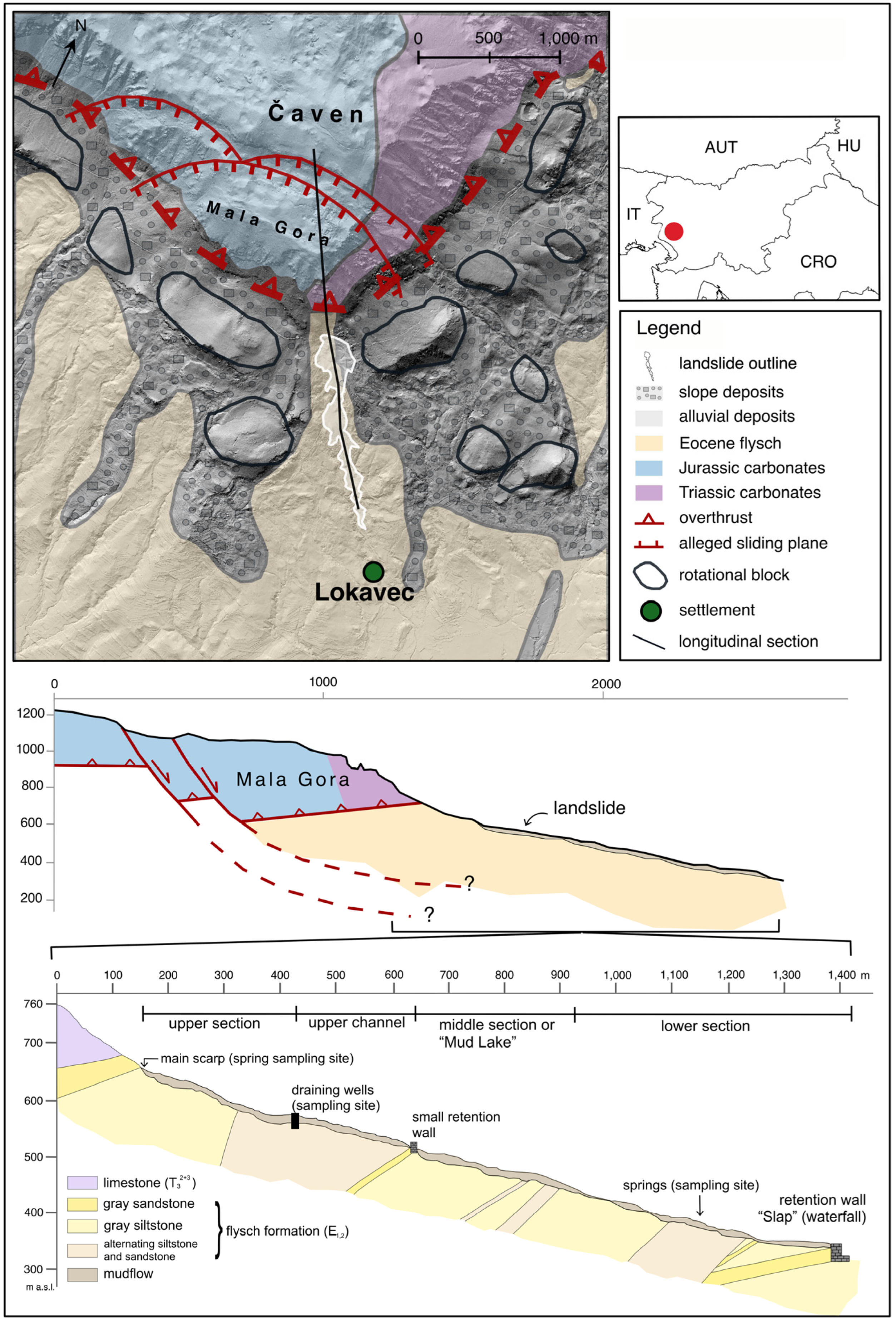
2.1. Description of the Slano Blato Landslide and Its Geological Setting
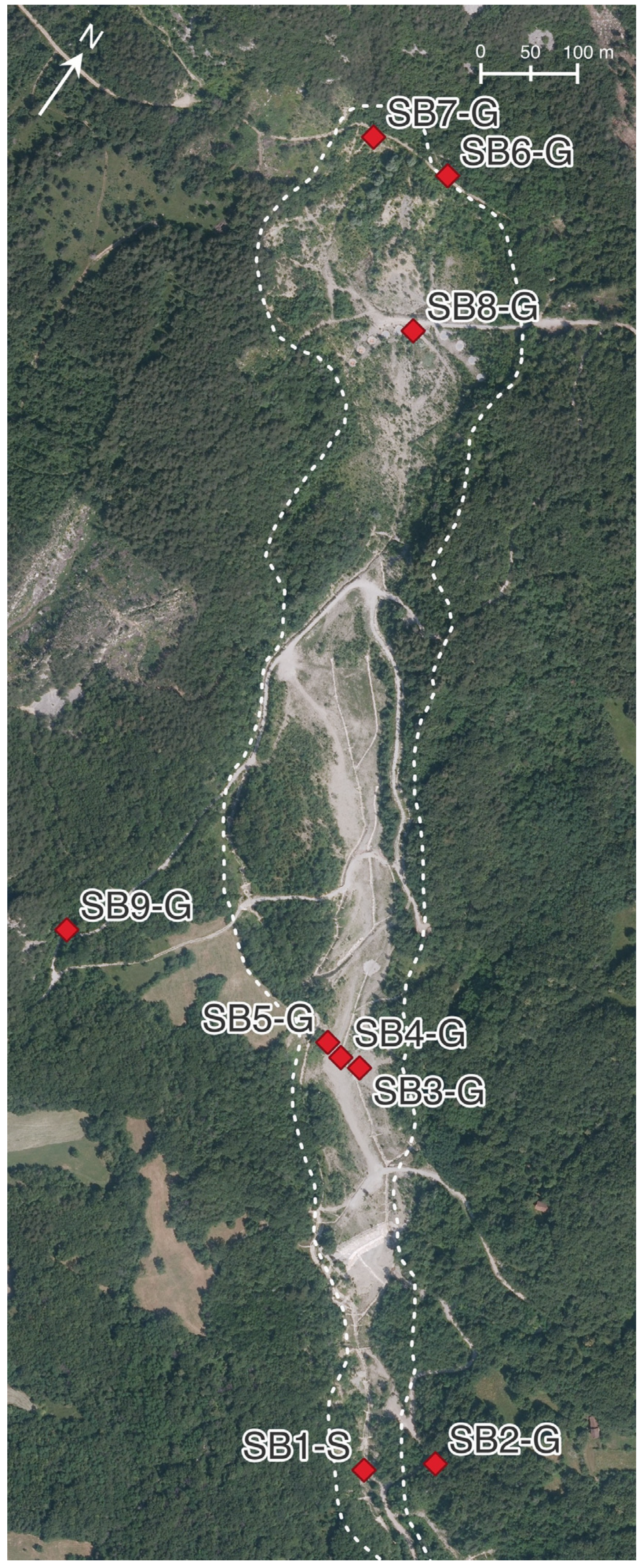
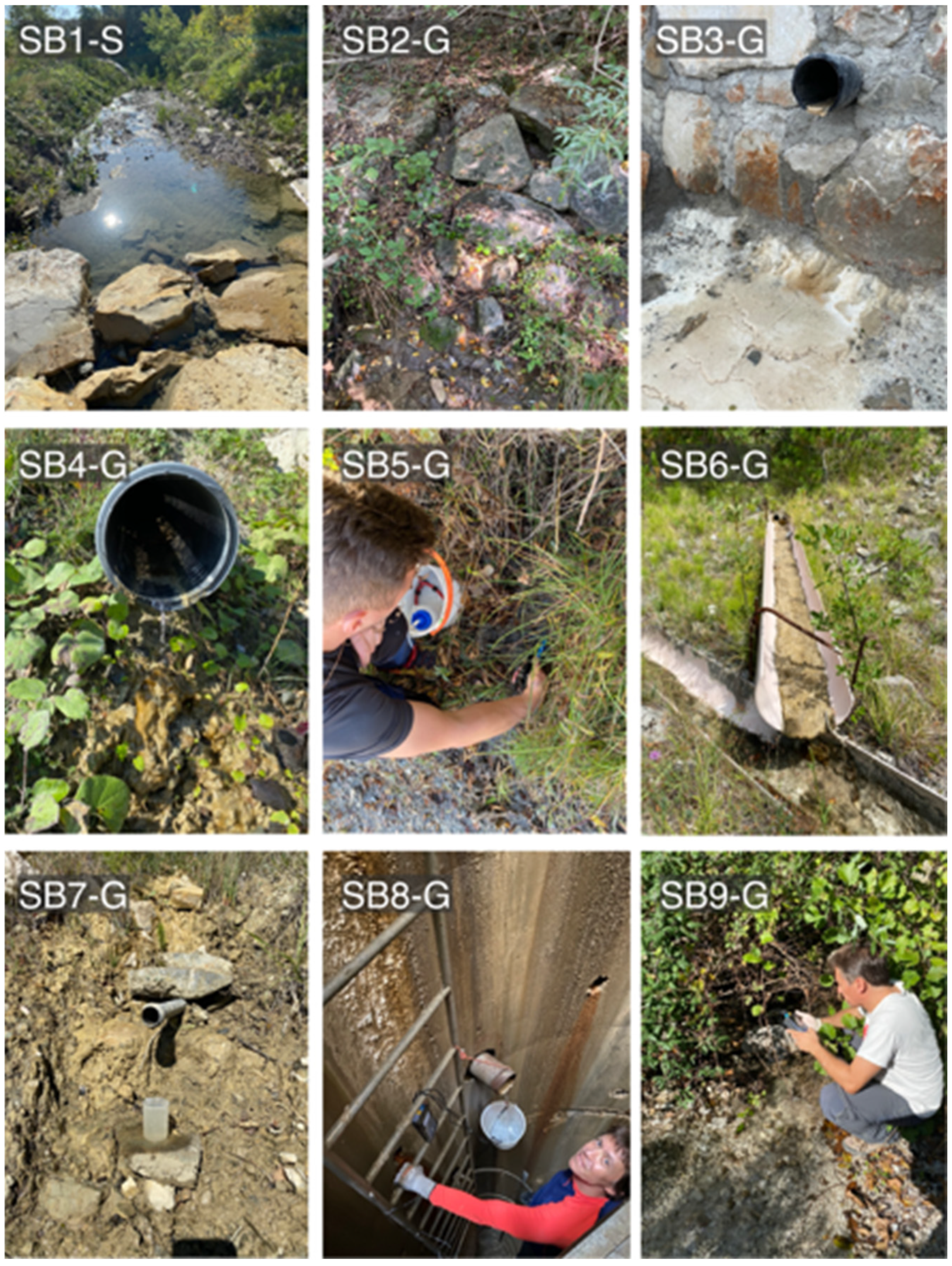
2.2. Sampling Locations
2.3. Hydrogeochemical Measurements
2.4. Total Alkalinity Measurements
2.5. Isotopic Measurements
3. Results and Discussion
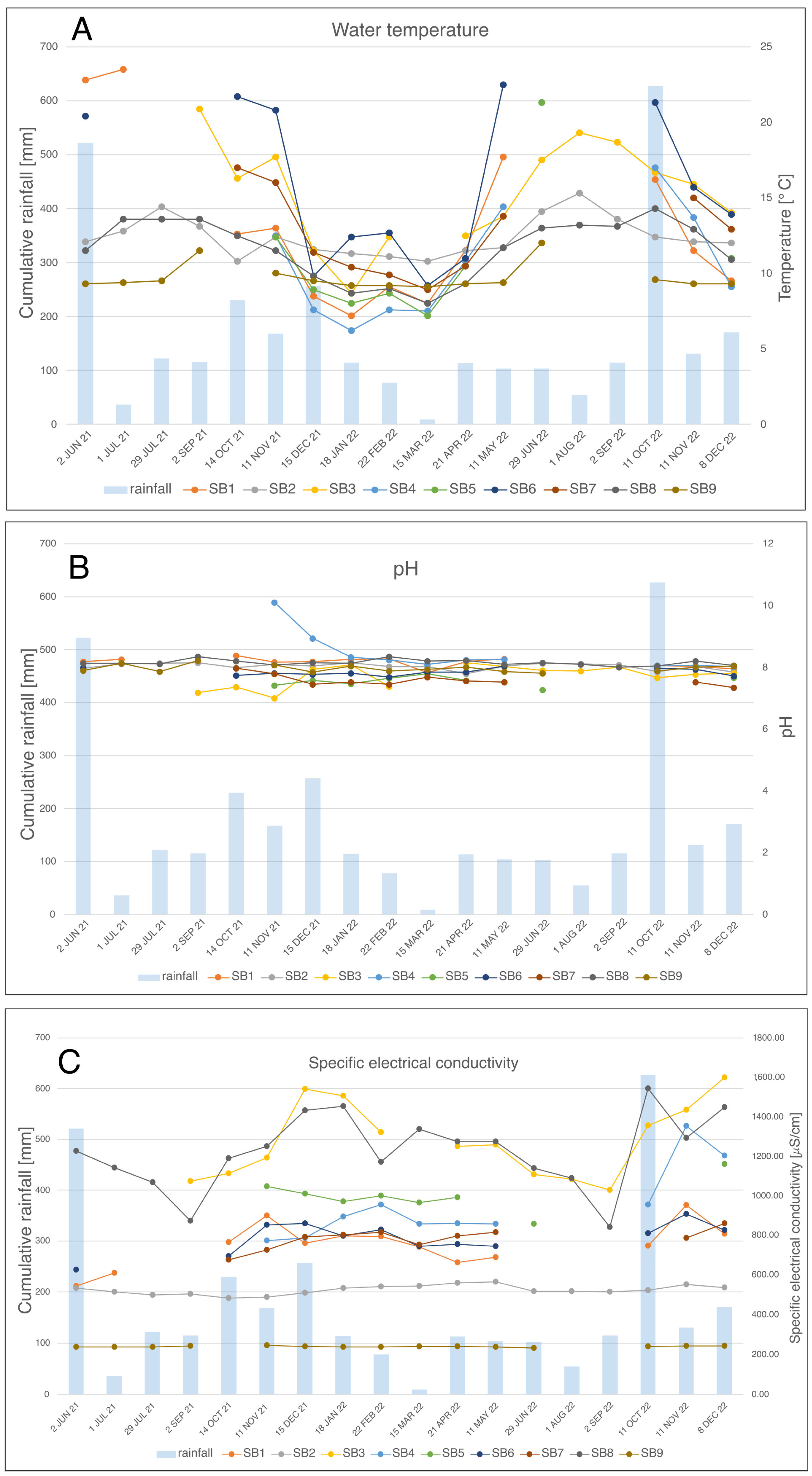
3.1. Physico-Chemical Parameters
3.1.1. Temperature
3.1.2. pH
3.1.3. Specific Electrical Conductivity (EC)
3.1.4. Oxidation–Reduction Potential (ORP)
3.1.5. Dissolved Oxygen (DO)
3.1.6. Spring Discharges
3.2. Hydrogeochemical Analyses
3.3. Saturation Indices
3.4. Isotopic Analyses
3.4.1. Isotopic Composition of Carbon in Dissolved Inorganic Carbon (δ13CDIC)
3.4.2. Isotopic Composition of Hydrogen (δ2H) and Oxygen (δ18O)
4. Conclusions
- The chemical composition of springs within the Slano blato landslide differs markedly from springs in similar geological settings in the broader Vipava Valley.
- Waters primarily originate from the higher karstic recharge area and flow through deep flysch layers (fractured sandstone beds), where they acquire higher concentrations of dissolved ions—especially K+ and SO42−—and increased mineralization in the lowland section of the landslide.
- Groundwater persists within the landslide body even during dry periods.
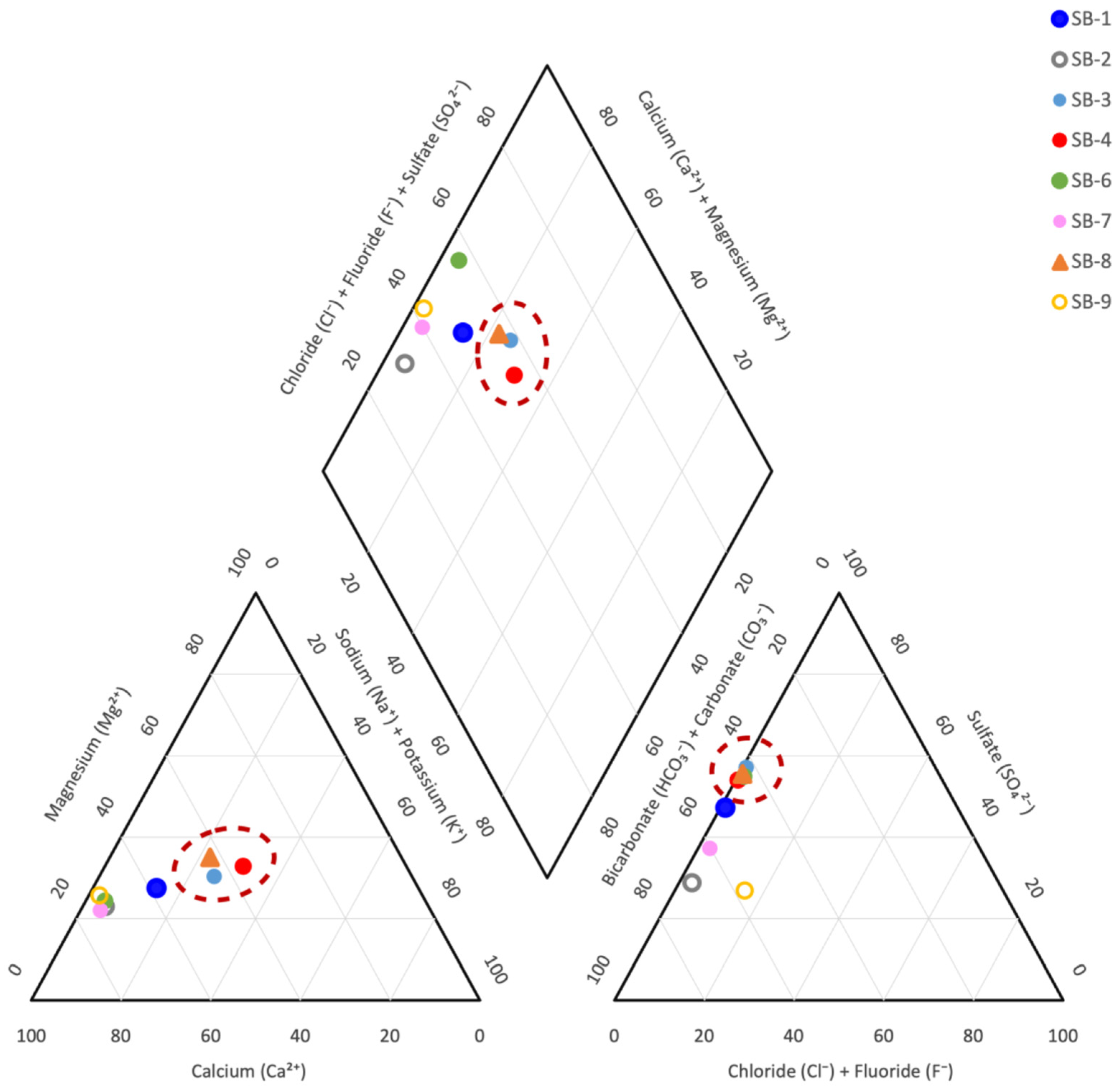
- Saturation indices for all samples, except SB9, indicate slight oversaturation with calcite and dolomite and equilibrium with quartz, reflecting interactions with both carbonates and flysch sandstones.
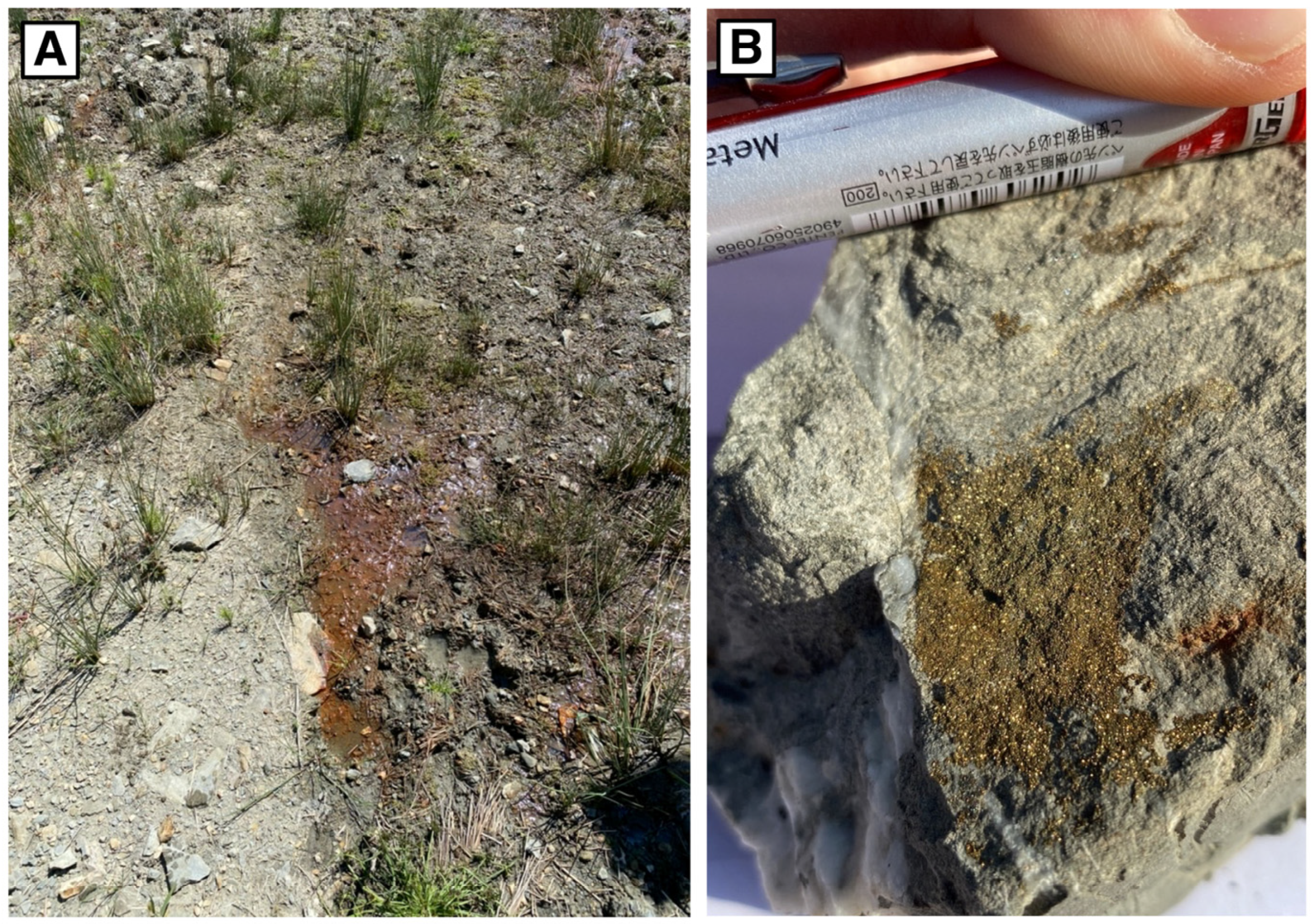
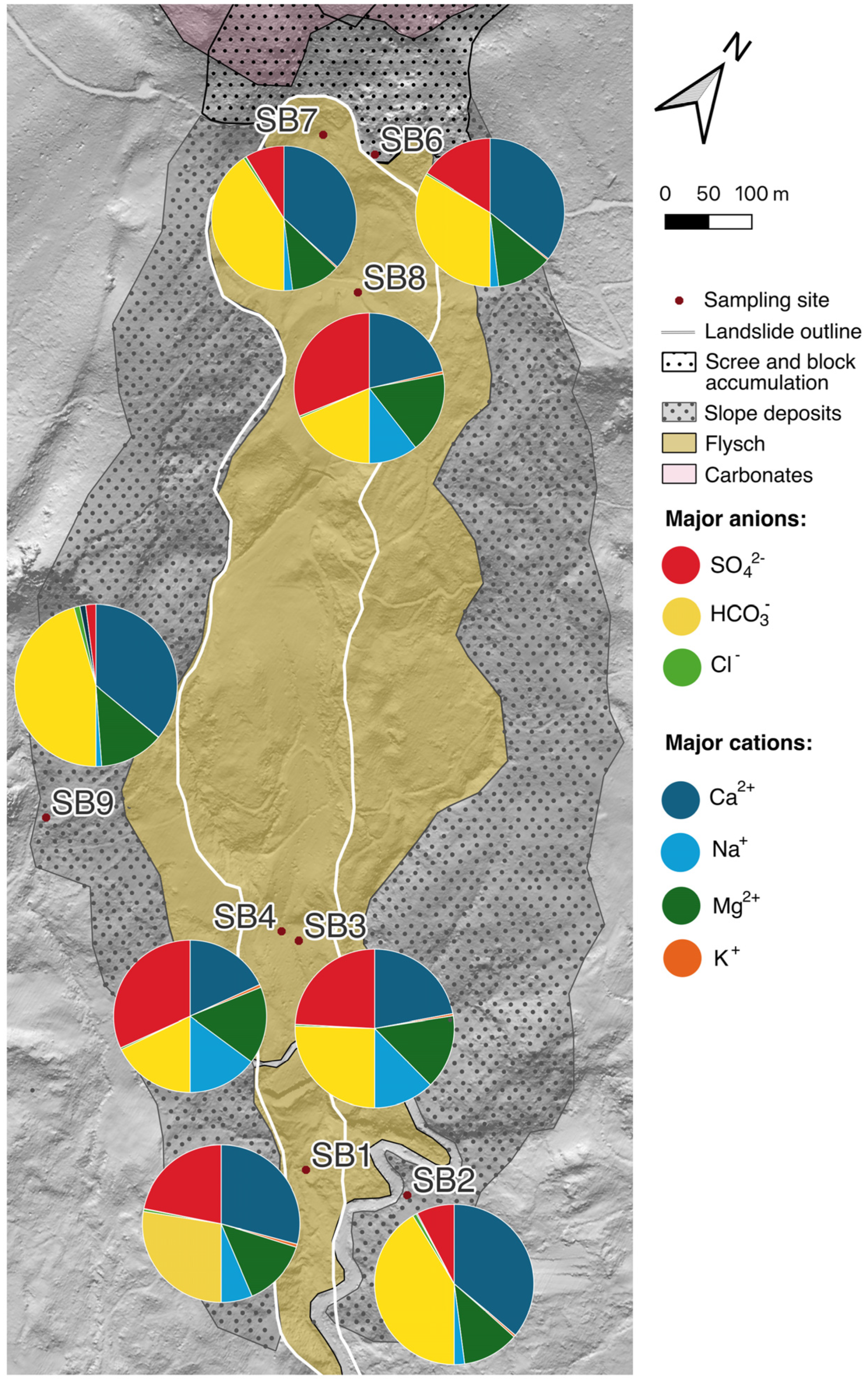
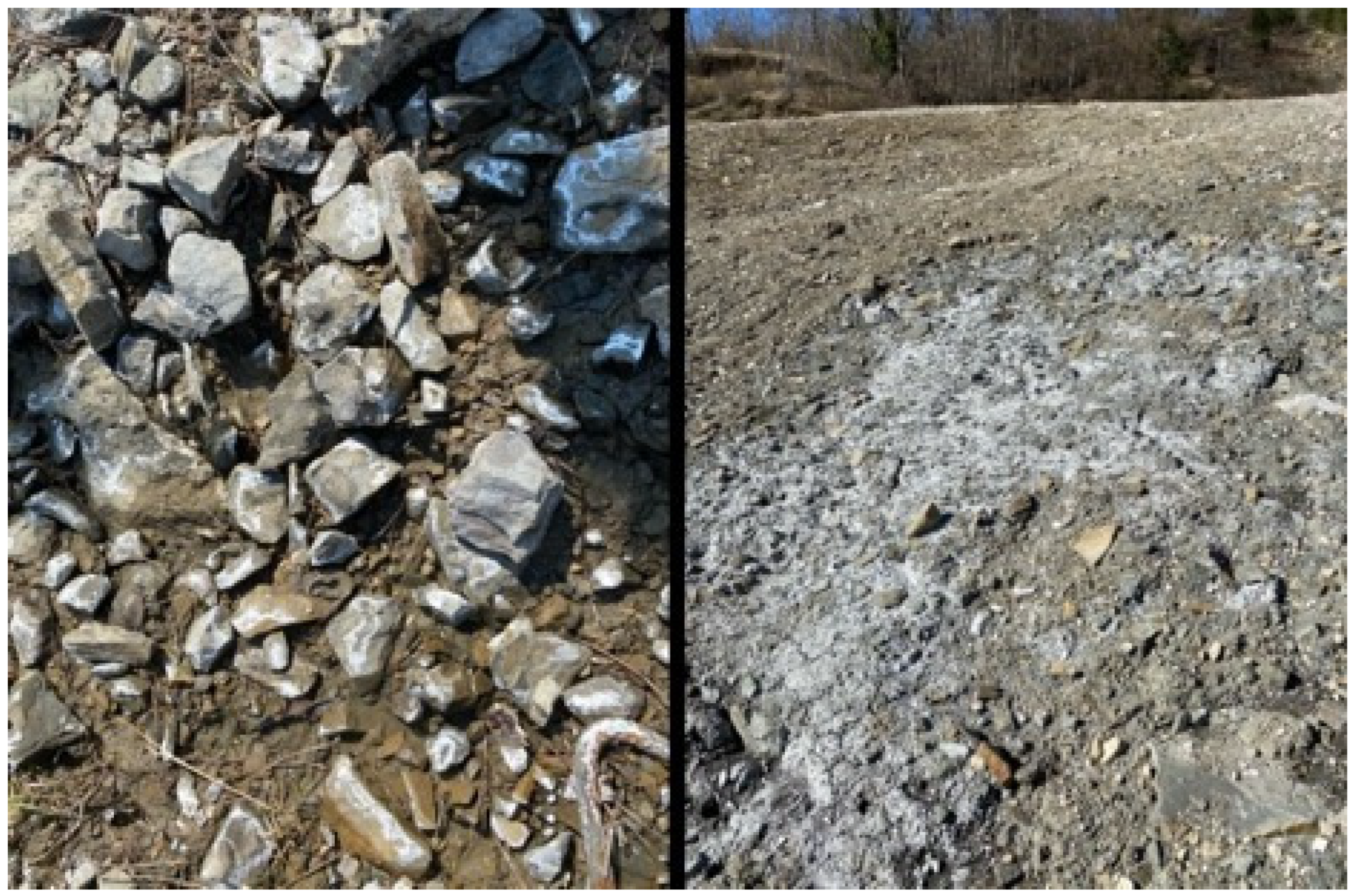
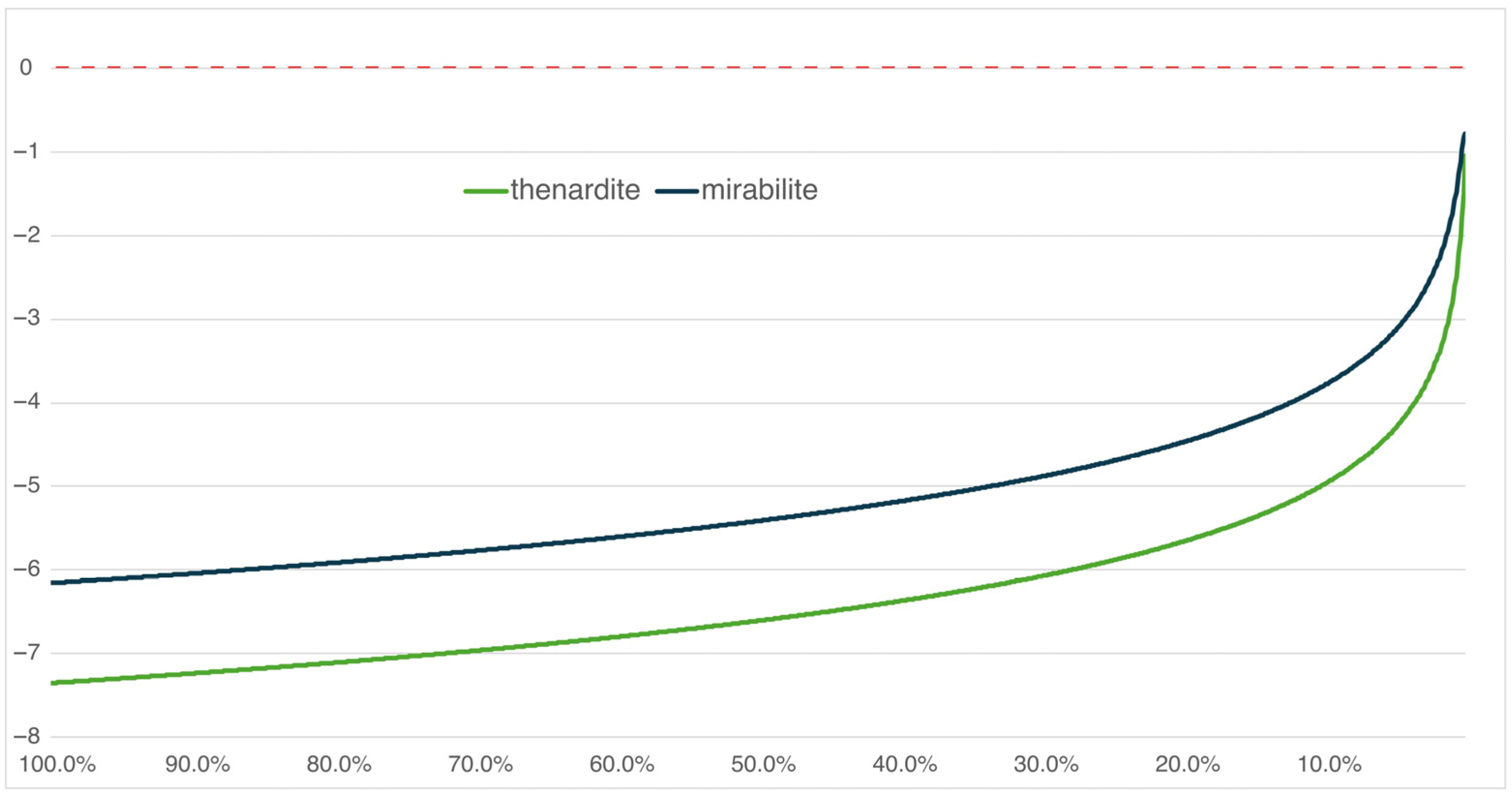
- Salts such as mirabilite and thenardite can contribute to the degradation of landslide material. Although simple geochemical modeling could not directly confirm their crystallization, it suggests that near-equilibrium—and potential precipitation—could occur under increased evaporation. Landslide processes expose, mix, hydrate, and oxidize materials, promoting secondary mineralization (e.g., gypsum, mirabilite) and bringing primary minerals (e.g., pyrite, andradite) to the surface. Higher sulfate concentrations are observed in the central part of the landslide, with the exception of one spring located outside the landslide.
- Waters from carbonate scree locations respond more rapidly hydrologically than deeper groundwater sources.
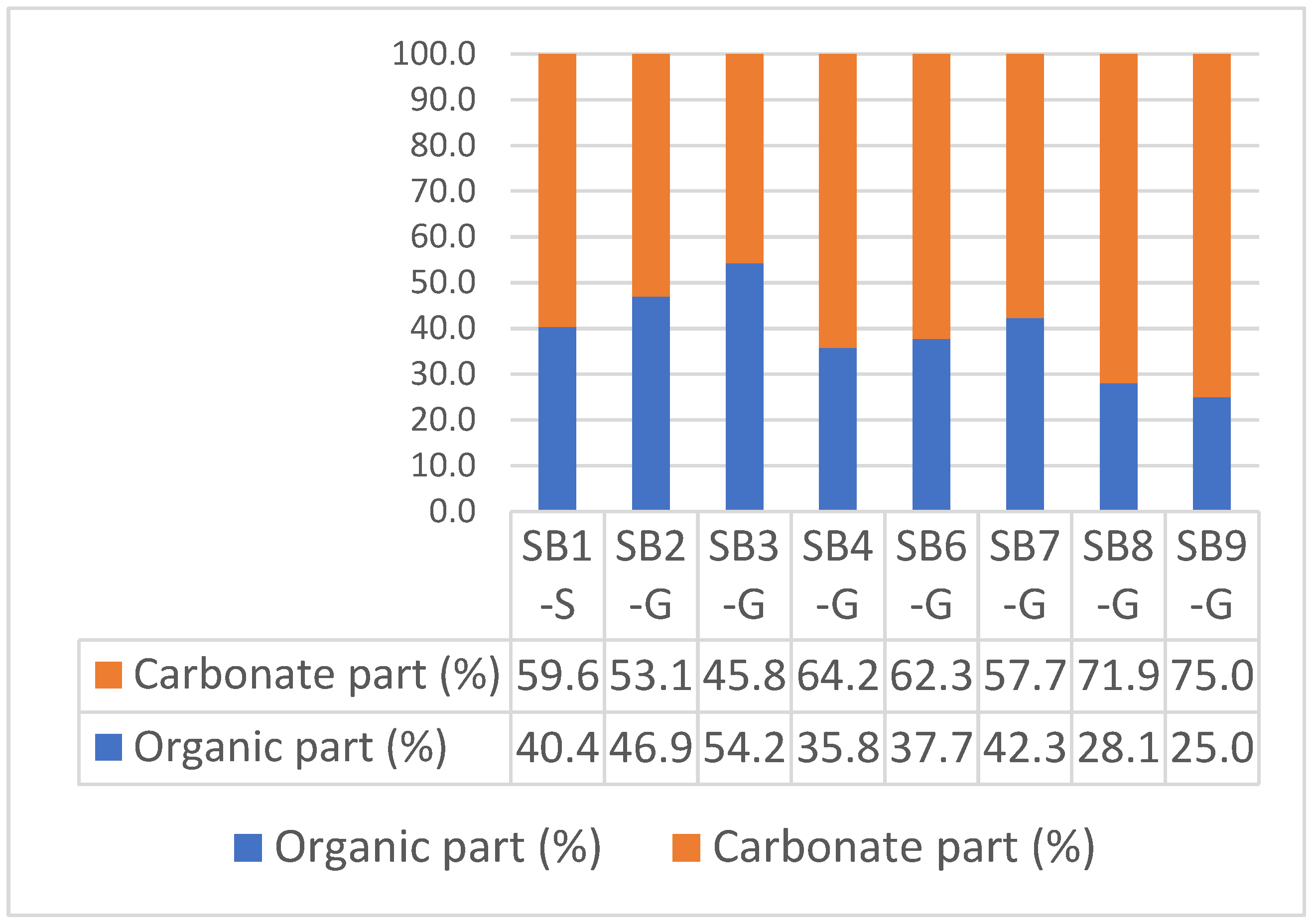
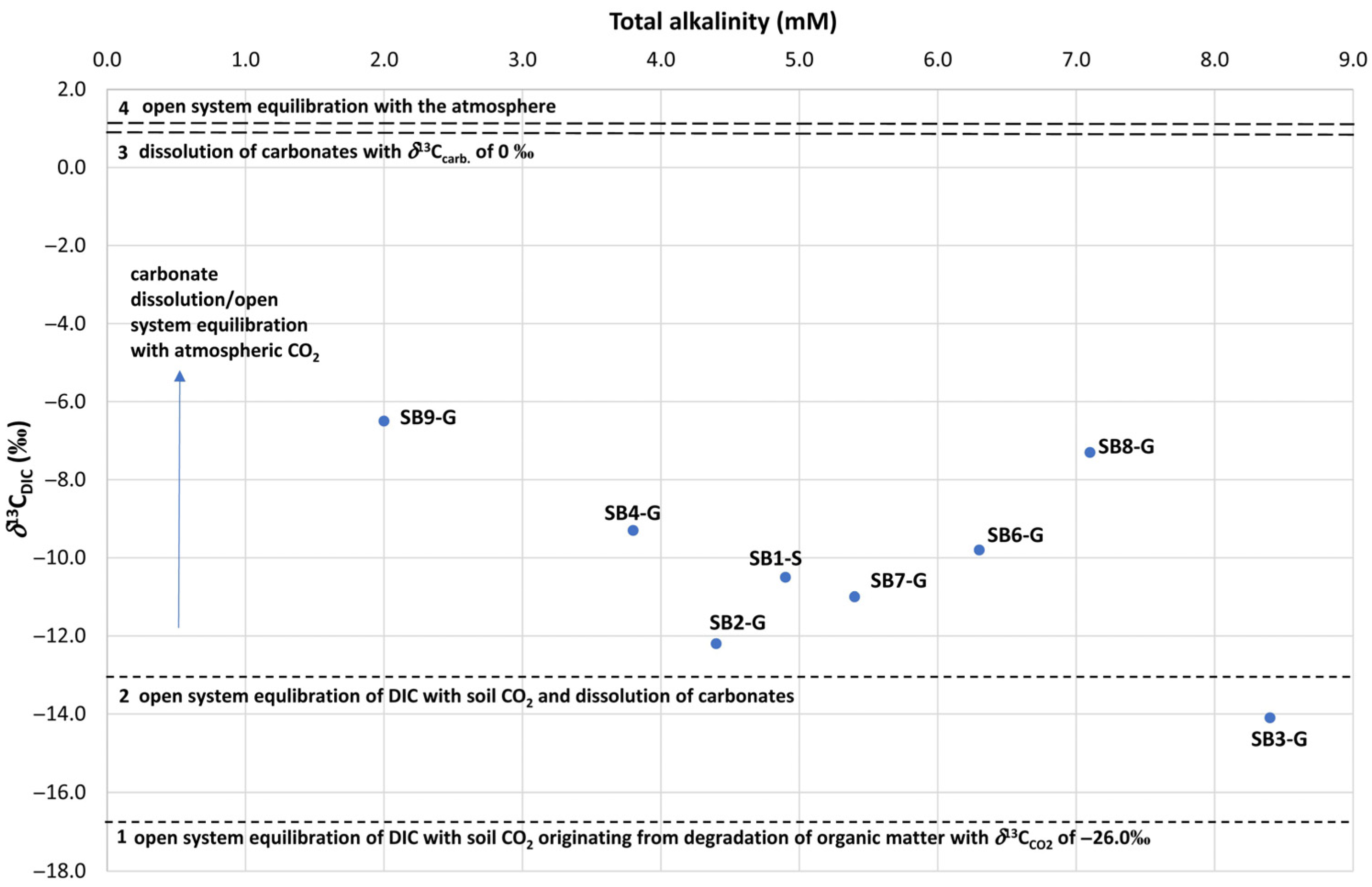
- δ13CDIC values indicate a dominant influence of carbonate dissolution with minimal contribution from organic matter in most springs.
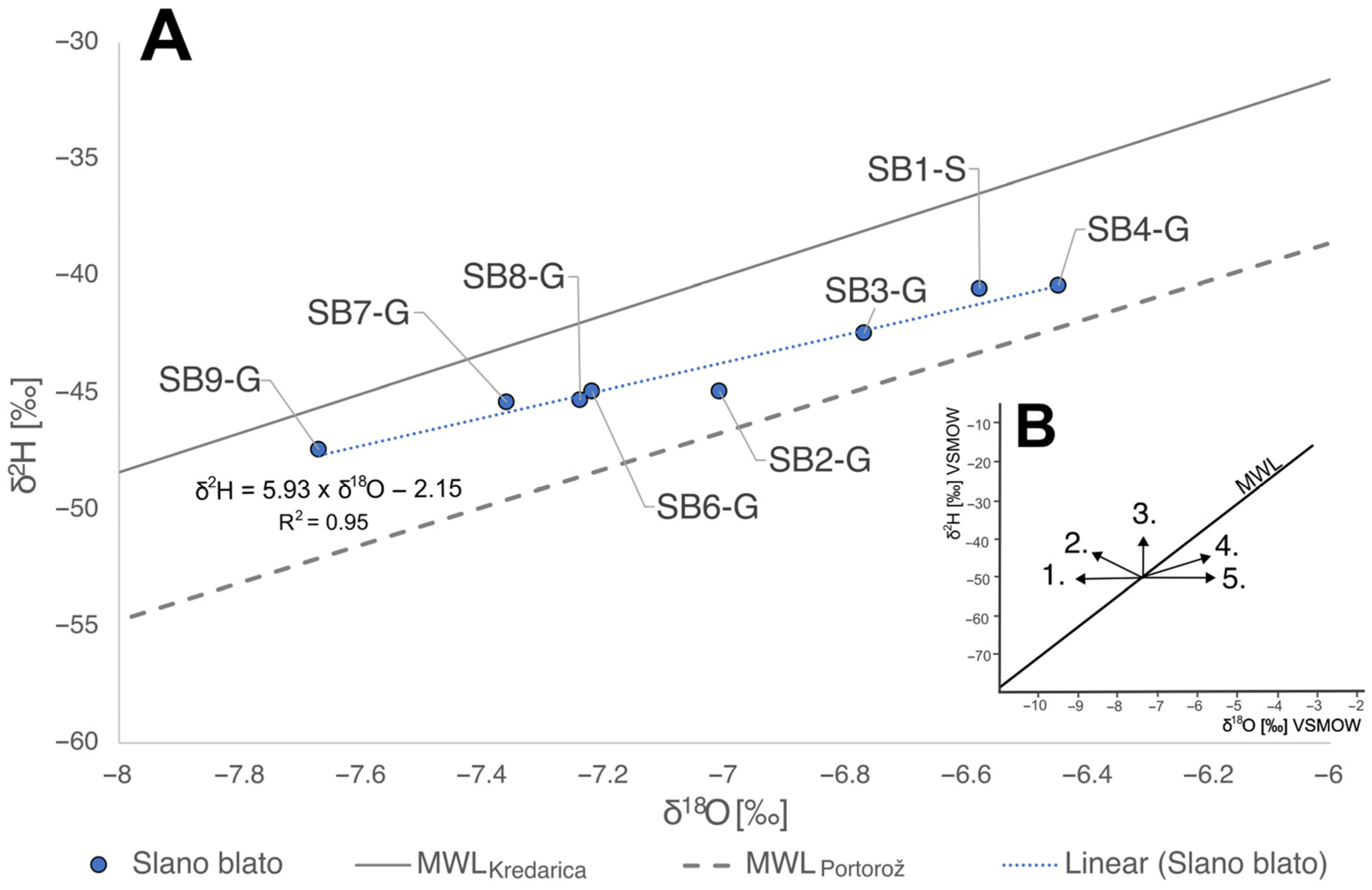
- δ18O and δ2H values indicate a meteoric origin of the groundwater, modified by evaporation and prolonged water–rock interaction.
- Our hydrogeochemical and isotope investigations confirm the idea of the structural model of the Slano blato landslide proposed by Placer et al. [10], in which the limestone massif above the landslide scarp forms a detached tectonic block and a structural depression. This configuration allows groundwater to accumulate in the carbonates above the less permeable flysch and enables delayed, deeper water flow through the flysch.
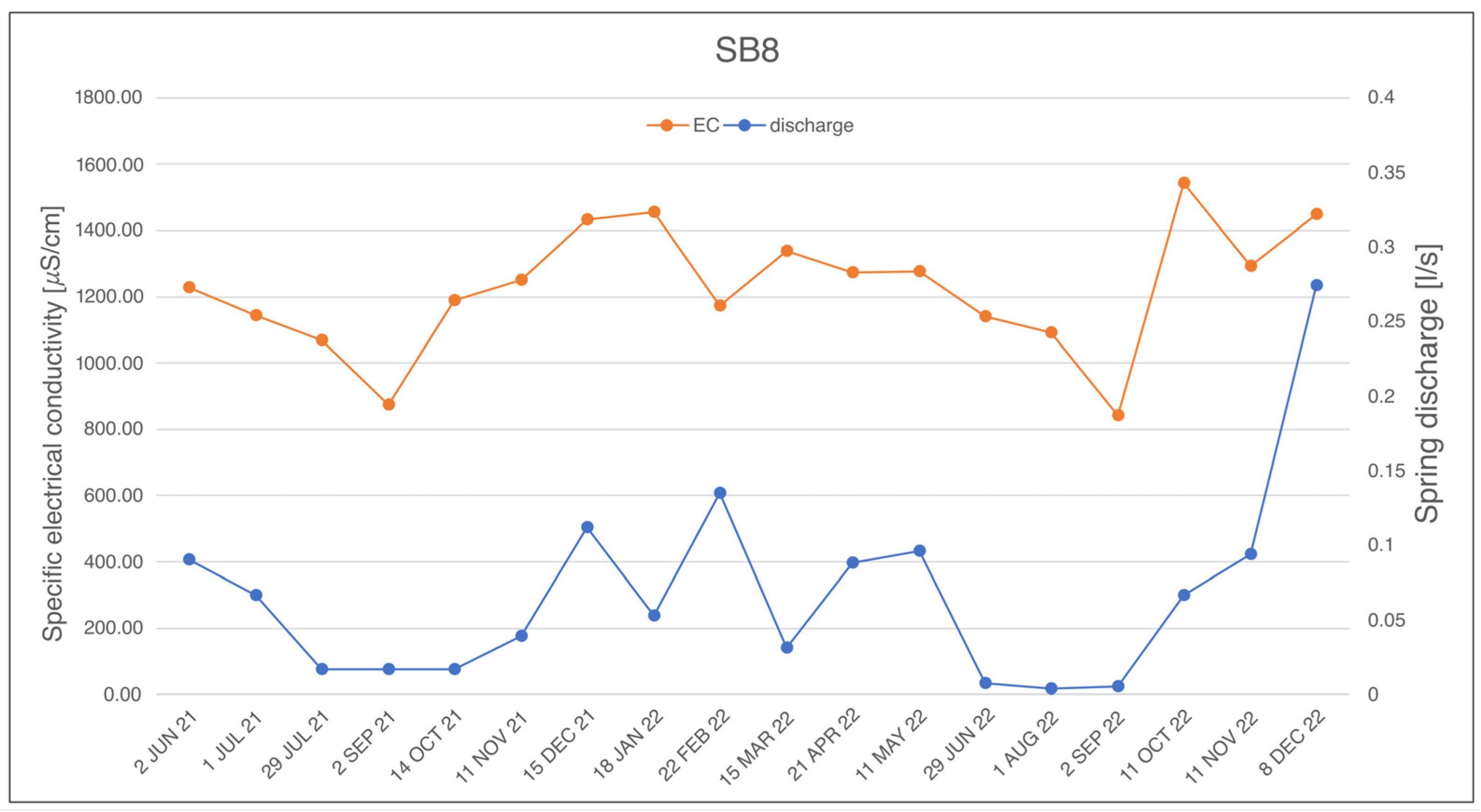
- We have shown that the water chemistry changes significantly during this underground flow, and both hydrogeochemical composition and isotope data support the idea of deeper underground water flow through flysch. For further confirmation, a hydrogeological model with quantitative flow modelling should be conducted; this was beyond the scope of our study and is suggested for future investigations. The same conclusion applies to the observation of the relationship between discharge and specific electrical conductivity values at the SB8 site, which suggests a delayed groundwater response to precipitation within the flysch. In summary, this study represents an investigation based on a single sampling campaign using stable isotope tracers (C, H, O) to assess landslide behavior. Future research should include additional stable isotope tracers (e.g., S: δ34SSO4, δ18OSO4), water-age tracers (3H, CFCs), seasonal hydrogeochemical analyses for more robust interpretations and hydrogeological modeling. Installing a meteorological station directly on the landslide would allow precise monitoring of local precipitation events and improve correlations between rainfall and hydrogeochemical responses.
Supplementary Materials
Author Contributions
Funding
Data Availability Statement
Conflicts of Interest
References
- Mikoš, M.; Petkovšek, A.; Majes, B. Mechanisms of landslides in over-consolidated clays and flysch. Landslides 2009, 6, 367–371. [Google Scholar] [CrossRef]
- Montety, V.d.; Marc, V.; Emblanch, C.; Malet, J.P.; Bertrand, C.; Maquaire, O.; Bogaard, T.A. Identifying the origin of groundwater and flow processes in complex landslides affecting black marls: Insights from a hydrochemical survey. Earth Surf. Process Landf. 2006, 32, 32–48. [Google Scholar] [CrossRef]
- Mudry, J.; Bertrand, C.; Emblanch, C.; Marc, V.; Guglielmi, Y.; Bogaard, T. Hydrogeochemistry in landslide research: A review. Bull. Soc. Geol. Fr. 2007, 178, 113–126. [Google Scholar] [CrossRef]
- Petrella, E.; Raimondo, M.; Chelli, A.; Valentino, R.; Severini, E.; Diena, M.; Celico, F. Processes and factors controlling the groundwater flow in a complex landslide: A case study in the northern Italy. Hydrol. Process 2023, 37, 14891. [Google Scholar] [CrossRef]
- Hemid, E.M.; Kántor, T.; Tamma, A.A.; Masoud, M.A. Effect of groundwater fluctuation, construction, and retaining system on slope stability of Avas Hill in Hungary. Open Geosci. 2021, 13, 1139–1157. [Google Scholar] [CrossRef]
- Pecoraro, G.; Calvello, M.; Piciullo, L. Monitoring strategies for local landslide early warning systems. Landslides 2018, 16, 213–231. [Google Scholar] [CrossRef]
- Jemec Auflič, M.; Jež, J.; Popit, T.; Košir, A.; Maček, M.; Logar, J.; Petkovšek, A.; Mikoš, M.; Calligaris, C.; Boccali, C.; et al. The variety of landslide forms in Slovenia and its immediate NW surroundings. Landslides 2017, 14, 1537–1546. [Google Scholar] [CrossRef]
- Martín-Pérez, A.; González-Acebrón, L.; Košir, A.; Popit, T. Sandstone diagenesis, salt-induced weathering and landslide formation: The case of Slano Blato Landslide, Slovenia. In Proceedings of the 32nd IAS International Meeting of Sedimentology, Marrakesh, Morocco, 23–25 May 2016. [Google Scholar]
- Logar, J.; Fifer Bizjak, K.; Kočevar, M.; Mikoš, M.; Ribičič, M.; Majes, B. History and present state of the Slano Blato landslide. Nat. Hazards Earth Syst. Sci. 2005, 5, 447–457. [Google Scholar] [CrossRef]
- Placer, L.; Jež, J.; Atanackov, J. Structural aspect on the Slano blato landslide (Slovenia). Geologija 2008, 51, 229–234. [Google Scholar] [CrossRef]
- Kočevar, M.; Ribičič, M. Geological, hydrogeological and geomechanical investigation of Slano blato landslide. Geologija 2002, 45, 427–432. [Google Scholar] [CrossRef]
- Verbovšek, T. Hydraulic conductivities of fractures and matrix in Slovenian carbonate aquifers. Geologija 2008, 51, 245–255. [Google Scholar] [CrossRef]
- Majes, B.; Petkovšek, A.; Logar, J. The comparisson of material properties of debris flows from Stože, Slano blato and Strug landslide. Geologija 2002, 45, 457–463. [Google Scholar] [CrossRef]
- Fifer Bizjak, K.; Zupančič, A. Site and laboratory investigation of the Slano blato landslide. Eng. Geol. 2009, 105, 171–185. [Google Scholar] [CrossRef]
- Maček, M.; Majes, B.; Petkovšek, A. Lessons learned from 6 years of suction monitoring of the Slano blato landslide. Riv. Ital. Di Geotech. 2016, 50, 21–33. [Google Scholar]
- Ribičič, M.; Kočevar, M. The final remediation of the landslide Slano blato above settlement Lokavec at Ajdovščina. Geologija 2002, 45, 525–530. [Google Scholar] [CrossRef]
- Pulko, B.; Majes, B.; Mikoš, M. Reinforced concrete shafts for the structural mitigation of large deep-seated landslides: An experience from the Macesnik and the Slano blato landslides (Slovenia). Landslides 2012, 11, 81–91. [Google Scholar] [CrossRef]
- Appelo, C.A.J.; Postma, D. Geochemistry, Groundwater and Pollution; A.A. Balkema Publishers: Leiden, The Netherlands, 2004. [Google Scholar]
- Parkhurst, D.L. User’s Guide to PHREEQC—A Computer Program for Speciation, Reaction-Path, Advective-Transport, and Inverse Geo-Chemical Calculations Water-Resources Investigations Report 95-4227; U.S. Geological Survey: Reston, VA, USA, 1995. [Google Scholar]
- Croghan, C.W.; Egeghy, P.P. Methods of Dealing with Values Below the Limit of Detection Using SAS; Environmental Protection Agency: Washington, DC, USA, 2003.
- Glass, D.C.; Gray, C.N. Estimating mean exposures from censored data: Exposure to benzene in the Australian petroleum industry. Ann. Occup. Hyg. 2001, 45, 275–282. [Google Scholar] [CrossRef]
- Succop, P.A.; Clark, S.; Chen, M.; Galke, W. Imputation of Data Values That are Less Than a Detection Limit. J. Occup. Environ. Hyg. 2004, 1, 436–441. [Google Scholar] [CrossRef]
- Verbovšek, T. A comparison of parameters below the limit of detection in geochemical analyses by substitution methods = Primerjava ocenitev parametrov pod mejo določljivosti pri geokemičnih analizah z metodo nadomeščanja. RMZ Mater. Geoenviron. 2011, 58, 393–404. [Google Scholar]
- Gieskes, J.M. The alkalinity-total carbon dioxide system in seawater. In The Sea; Goldberg, E.D., Ed.; Marine Chemistry; Wiley-Interscience: Hoboken, NY, USA, 1974; Volume 5, pp. 123–151. [Google Scholar]
- Zuliani, T.; Kanduč, T.; Novak, R.; Vreča, P. Characterization of Bottled Waters by Multielemental Analysis, Stable and Radiogenic Isotopes. Water 2020, 12, 2454. [Google Scholar] [CrossRef]
- Spötl, C. A robust and fast method of sampling and analysis of δ13C of dissolved inorganic carbon in ground waters. Isot. Environ. Health Stud. 2005, 41, 217–221. [Google Scholar] [CrossRef]
- Coplen, T.B.; Wildman, J.D.; Chen, J. Improvements in the gaseous hydrogen-water equilibration technique for hydrogen isotope-ratio analysis. Anal. Chem. 1991, 63, 910–912. [Google Scholar] [CrossRef]
- Avak, H.; Brand, W. The Finning MAT HDO-Equilibration-A fully automated H2O/gas phase equilibration system for hydrogen and oxygen isotope analyses. Thermo Electron. Corp. Appl. News 1995, 11, 1–13. [Google Scholar]
- Epstein, S.; Mayeda, T. Variation of O18 content of waters from natural sources. Geochim. Cosmochim. Acta 1953, 4, 213–224. [Google Scholar] [CrossRef]
- Lancaster, S.T.; Irrgeher, J.; Dallmayr, R.; Conrad, E.; Hörhold, M.; Bohleber, P.; Behrens, M.; Camin, F.; Žagar, K.; Vreča, P.; et al. δ(18O/16O) Determinations in Water Using Inductively Coupled Plasma–Tandem Mass Spectrometry. Anal. Chem. 2025, 97, 20788–20797. [Google Scholar] [CrossRef]
- Vreča, P.; Kanduč, T.; Štrok, M.; Žagar, K.; Nigro, M.; Barsanti, M. An Assessment of Six Years of Precipitation Stable Isotope and Tritium Activity Concentration Records at Station Sv. Urban, Eastern Slovenia. Water 2024, 16, 469. [Google Scholar] [CrossRef]
- Coplen, T.B. Guidelines and recommended terms for expression of stable-isotope-ratio and gas-ratio measurement results. Rapid Commun. Mass Spectrom. 2011, 25, 2538–2560. [Google Scholar] [CrossRef] [PubMed]
- Ashjari, J.; Fryar, A.E.; Tobin, B.; Ashjari, Z. Understanding Piston Flow in Karstic Springs: Global Patterns and Influencing Factors. SSRN 2024. [Google Scholar] [CrossRef]
- Caetano Bicalho, C.; Batiot-Guilhe, C.; Seidel, J.L.; Van Exter, S.; Jourde, H. Geochemical evidence of water source characterization and hydrodynamic responses in a karst aquifer. J. Hydrol. 2012, 450–451, 206–218. [Google Scholar] [CrossRef]
- Nannoni, A.; Piccini, L. Mixed Recharge and Epikarst Role in a Complex Metamorphic Karst Aquifer: The Pollaccia System, Apuan Alps (Tuscany, Italy). Hydrology 2022, 9, 83. [Google Scholar] [CrossRef]
- Košir, A.; Martín Pérez, A.; Popit, T. Zakaj je Slano blato slano? In Proceedings of the 21 Posvetovanje Slovenskih Geologov, Ljubljana, Slovenia; Geološki Zbornik: Ljubljana, Slovenia, 2003; pp. 75–77. [Google Scholar]
- Urbanc, J.; Jamnik, B. Distribution and origin of nitrates in the groundwater of Ljubljansko polje. Geologija 2007, 50, 467–475. [Google Scholar] [CrossRef]
- Warren, J. Dolomite: Occurrence, evolution and economically important associations. Earth Sci. Rev. 2000, 52, 1–81. [Google Scholar] [CrossRef]
- Herman, J.S.; Lorah, M.M. CO2 outgassing and calcite precipitation in Falling Spring Creek, Virginia, USA. Chem. Geol. 1987, 62, 251–262. [Google Scholar] [CrossRef]
- Genkinger, S.; Putnis, A. Crystallisation of sodium sulfate: Supersaturation and metastable phases. Environ. Geol. 2006, 52, 329–337. [Google Scholar] [CrossRef]
- Goudie, A.; Viles, H.A. Salt Weathering Hazards; Wiley: Chichester, UK; New York, NY, USA, 1997; pp. vii–241. [Google Scholar]
- Rodriguez-Navarro, C.; Doehne, E.; Sebastian, E. How does sodium sulfate crystallize? Implications for the decay and testing of building materials. Cem. Concr. Res. 2000, 30, 1527–1534. [Google Scholar] [CrossRef]
- Jurak, V.; Slovenec, D.; Mileusnić, M. Pretjerana erozija fliša—Slani potok = Stop 1: Excessive Flysch Erosion—Slani potok. In Proceedings of the 3 Hrvatski Geološki Kongres, Opatija, Croatia, 29 September–1 October 2005. [Google Scholar]
- Michel, M. Les Fleuves et le Cycle Géochimique des Éléments; University Pierre et Marie Curie: Paris, France, 1984. [Google Scholar]
- Vreča, P.; Pavšek, A.; Kocman, D. SLONIP—A Slovenian Web-Based Interactive Research Platform on Water Isotopes in Precipitation. Water 2022, 14, 2127. [Google Scholar] [CrossRef]
- Vreča, P.; Bronić, I.K.; Horvatinčić, N.; Barešić, J. Isotopic characteristics of precipitation in Slovenia and Croatia: Comparison of continental and maritime stations. J. Hydrol. 2006, 330, 457–469. [Google Scholar] [CrossRef]
- Mezga, K.; Urbanc, J.; Cerar, S. The isotope altitude effect reflected in groundwater: A case study from Slovenia. Isot. Environ. Health Stud. 2014, 50, 33–51. [Google Scholar] [CrossRef]



| ID | Site | Latitude | Longitude | Altitude |
|---|---|---|---|---|
| SB1-S | Channel below retention wall | 45.907247° | 13.871403° | 259 m |
| SB2-G | Spring below retention wall | 45.907666° | 13.872121° | 274 m |
| SB3-G | Red spring | 45.910166° | 13.868302° | 356 m |
| SB4-G | New drainage pipe | 45.910152° | 13.868022° | 360 m |
| SB5-G | New spring | 45.910206° | 13.867748° | 367 m |
| SB6-G | Drainage pipe upper part | 45.917118° | 13.862400° | 620 m |
| SB7-G | Spring in the scarp | 45.917118° | 13.861349° | 624 m |
| SB8-G | Draining well | 45.915901° | 13.863229° | 567 m |
| SB9-G | Jovšček spring | 45.909662° | 13.864278° | 421 m |
| Parameter | Unit | SB1-S | SB2-G | SB3-G | SB4-G | SB6-G | SB7-G | SB8-G | SB9-G |
|---|---|---|---|---|---|---|---|---|---|
| EC (20 °C) | µS/cm | 746 | 523 | 1358 | 955 | 810 | 583 | 1543 | 241 |
| DO | mg/L | 9.10 | 10.36 | 9.22 | 9.34 | 8.63 | 9.11 | 9.52 | 10.69 |
| DO | % | 94.1 | 99.6 | 98.1 | 100 | 104.3 | 100.7 | 98.0 | 98.3 |
| ORP | mV | −67.1 | −54.4 | −43.9 | −66.6 | −63 | −55.3 | −65.7 | −55.1 |
| pe (from Eh) | / | −1.19 | −0.96 | −0.78 | −1.18 | −1.11 | −0.98 | −1.16 | −0.97 |
| pH | / | 8.065 | 7.854 | 7.655 | 8.059 | 7.971 | 7.866 | 8.038 | 7.871 |
| T | °C | 16.2 | 12.4 | 16.7 | 17 | 21.3 | 17.2 | 14.3 | 9.6 |
| Alkalinity | mmol/L | 4.90 | 4.40 | 8.4 | 3.8 | 6.30 | 5.4 | 7.1 | 2.0 |
| HCO3 | mgHCO3−/L | 299 | 268 | 513 | 232 | 384 | 330 | 433 | 122 |
| Ca | mg/L | 96.8 | 83.8 | 143 | 83.7 | 145 | 109 | 164 | 38.9 |
| K | mg/L | 4.26 | 1.94 | 5.88 | 5.73 | 2.41 | 1.88 | 9.4 | 0.19 |
| Cl | mg/L | 3.3 | 2.9 | 4.4 | 2.8 | 2.8 | 2.9 | 5.4 | 1.8 |
| Mg | mg/L | 27.6 | 16.1 | 59.6 | 45.7 | 29.9 | 19.7 | 81.5 | 8.38 |
| Mn | mg/L | 0.0013 | 0.0003 | 0.0446 | 0.0005 | 0.0026 | 0.0019 | 0.0438 | 0.0002 |
| TDS | mg/L | 749 | 521 | 1366 | 953 | 812 | 583 | 1532 | 241 |
| Na | mg/L | 24.4 | 5.6 | 92.1 | 78.2 | 8.7 | 6.46 | 92.9 | 1.41 |
| NO3 | mgNO32−/L | 0.94 | 1.58 | 0.43 | 0.25 | 0.14 | 0.85 | 1.12 | 3.18 |
| SO4 | mgSO42−/L | 187.0 | 39.1 | 383.0 | 326.0 | 145.0 | 55.8 | 572 | 4.25 |
| Total Fe | mg/L | <0.01 | <0.01 | 0.01 | 0.01 | 0.01 | 0.02 | 0.01 | <0.01 |
| As | mg/L | 0.00026 | 0.00022 | 0.00038 | 0.00026 | 0.00018 | 0.00013 | 0.00023 | 0.00017 |
| Ba | mg/L | 0.0446 | 0.0472 | 0.0382 | 0.0301 | 0.0409 | 0.0958 | 0.0272 | 0.004 |
| Br | mg/L | <0.1 | <0.09 | <0.3 | <0.1 | <0.1 | <0.09 | <0.3 | <0.06 |
| F | mg/L | <0.04 | <0.03 | <0.1 | <0.05 | <0.04 | <0.03 | <0.1 | <0.02 |
| Total Cr | mg/L | 0.0021 | 0.0007 | 0.0015 | 0.0061 | <0.0005 | <0.0005 | <0.0005 | <0.0005 |
| Li | mg/L | 0.02 | 0.005 | 0.049 | 0.039 | 0.022 | 0.017 | 0.057 | <0.001 |
| Se | mg/L | 0.0006 | 0.0007 | 0.0002 | 0.0007 | 0.0004 | 0.0011 | 0.0021 | <0.0002 |
| Sr | mg/L | 0.816 | 0.28 | 2.07 | 1.61 | 0.943 | 0.731 | 3.1 | 0.0354 |
| Pb | mg/L | 0.00024 | 0.00011 | 0.00009 | 0.00009 | 0.0001 | 0.0005 | 0.00007 | 0.00022 |
| Al | mg/L | 0.011 | 0.004 | 0.009 | 0.009 | 0.006 | 0.1 | 0.007 | 0.006 |
| Sb | mg/L | 0.00024 | 0.00005 | 0.00009 | 0.00022 | 0.0001 | 0.00008 | 0.00011 | 0.00003 |
| Cu | mg/L | 0.0012 | 0.0005 | 0.0006 | 0.0009 | 0.0004 | 0.0007 | 0.0007 | 0.0002 |
| Be | mg/L | <0.0001 | <0.0001 | <0.0001 | <0.0001 | <0.0001 | <0.0001 | <0.0001 | <0.0001 |
| Cs | mg/L | 0.000015 | 0.000001 | 0.00002 | 0.000011 | 0.000004 | 0.000006 | 0.000064 | <0.000001 |
| Zn | mg/L | 0.0039 | 0.0071 | 0.0026 | 0.0041 | 0.0039 | 0.0068 | 0.0336 | 0.0072 |
| Cd | mg/L | <0.0001 | <0.0001 | <0.0001 | <0.0001 | <0.0001 | <0.0001 | <0.0001 | <0.0001 |
| Co | mg/L | 0.000057 | 0.000022 | 0.000086 | 0.000054 | 0.000022 | 0.000033 | 0.000169 | 0.000012 |
| Sn | mg/L | <0.0001 | <0.0001 | <0.0001 | <0.0001 | <0.0001 | <0.0001 | <0.0001 | <0.0001 |
| Mo | mg/L | 0.0009 | 0.0002 | 0.0007 | 0.0011 | 0.0003 | 0.0002 | 0.0004 | <0.0001 |
| Ni | mg/L | 0.0011 | 0.0004 | 0.0023 | 0.0013 | 0.0031 | 0.001 | 0.0032 | <0.0003 |
| Rb | mg/L | 0.00389 | 0.000796 | 0.00377 | 0.00317 | 0.00172 | 0.00178 | 0.00872 | 0.000141 |
| Ag | mg/L | <0.002 | <0.002 | <0.002 | <0.002 | <0.002 | <0.002 | <0.002 | <0.002 |
| U | mg/L | 0.000584 | 0.000359 | 0.000581 | 0.000692 | 0.00048 | 0.000338 | 0.000777 | 0.000217 |
| V | mg/L | 0.0009 | 0.0004 | 0.0006 | 0.0005 | <0.0001 | 0.0002 | 0.0002 | 0.0005 |
| Hg | mg/L | <0.0002 | <0.0002 | <0.0002 | <0.0002 | <0.0002 | <0.0002 | <0.0002 | <0.0002 |
| Total P | mg/L | <0.08 | <0.06 | <0.2 | <0.1 | <0.08 | <0.06 | <0.2 | <0.04 |
| Tl | mg/L | 0.000008 | 0.000004 | 0.000011 | 0.000007 | 0.000011 | 0.000005 | 0.000008 | 0.000004 |
| Ti | mg/L | <0.0001 | <0.0001 | <0.0001 | <0.0001 | <0.0001 | <0.0001 | <0.0001 | <0.0001 |
| Te | mg/L | <0.0001 | <0.0001 | <0.0001 | <0.0001 | <0.0001 | <0.0001 | <0.0001 | <0.0001 |
| Si | mg/L | 4.2 | 3.2 | 6 | 4.6 | 5.5 | 4.4 | 5.1 | 0.9 |
| δ13CDIC | (‰) | −10.5 | −12.2 | −14.1 | −9.3 | −9.8 | −11.0 | −7.3 | −6.5 |
| δ18O | (‰) | −6.58 | −7.01 | −6.77 | −6.45 | −7.22 | −7.36 | −7.24 | −7.67 |
| δ2H | (‰) | −40.5 | −44.9 | −42.4 | −40.4 | −44.9 | −45.4 | −45.3 | −47.4 |
| Name | ERR (%) | CAL | DOL | GYP | QTZ | THE | MIR |
|---|---|---|---|---|---|---|---|
| SB1-S | −3.94 | 0.86 | 2.51 | −1.33 | 0.05 | −8.70 | −7.48 |
| SB2-G | 4.54 | 0.55 | 1.72 | −1.97 | 0.02 | −10.60 | −9.20 |
| SB3-G | −0.89 | 0.78 | 2.51 | −1.00 | 0.20 | −7.35 | −6.16 |
| SB4-G | 4.43 | 0.65 | 2.37 | −1.21 | 0.07 | −7.49 | −6.31 |
| SB6-G | 4.35 | 1.11 | 2.91 | −1.31 | 0.06 | −9.74 | −8.77 |
| SB7-G | 5.76 | 0.81 | 2.24 | −1.76 | 0.05 | −10.36 | −9.19 |
| SB8-G | 0.22 | 1.06 | 3.14 | −0.83 | 0.18 | −7.21 | −5.90 |
| SB9-G | 10.59 | −0.07 | 0.50 | −3.13 | −0.46 | −12.66 | −11.13 |
| Location | SB-1 | SB-2 | SB-3 | SB-4 | SB-6 | SB-7 | SB-8 | SB-9 |
|---|---|---|---|---|---|---|---|---|
| Sr2+/Ca2+ | 3.86 | 1.53 | 6.62 | 8.80 | 2.97 | 3.07 | 8.65 | 0.42 |
Disclaimer/Publisher’s Note: The statements, opinions and data contained in all publications are solely those of the individual author(s) and contributor(s) and not of MDPI and/or the editor(s). MDPI and/or the editor(s) disclaim responsibility for any injury to people or property resulting from any ideas, methods, instructions or products referred to in the content. |
© 2026 by the authors. Licensee MDPI, Basel, Switzerland. This article is an open access article distributed under the terms and conditions of the Creative Commons Attribution (CC BY) license.
Share and Cite
Debevec Jordanova, G.; Kanduč, T.; Vreča, P.; Verbovšek, T. Insights into the Landslide Processes by Hydrogeochemical and Isotopic Characterization: The Case Study of the Slano Blato Landslide (SW Slovenia). Water 2026, 18, 318. https://doi.org/10.3390/w18030318
Debevec Jordanova G, Kanduč T, Vreča P, Verbovšek T. Insights into the Landslide Processes by Hydrogeochemical and Isotopic Characterization: The Case Study of the Slano Blato Landslide (SW Slovenia). Water. 2026; 18(3):318. https://doi.org/10.3390/w18030318
Chicago/Turabian StyleDebevec Jordanova, Galena, Tjaša Kanduč, Polona Vreča, and Timotej Verbovšek. 2026. "Insights into the Landslide Processes by Hydrogeochemical and Isotopic Characterization: The Case Study of the Slano Blato Landslide (SW Slovenia)" Water 18, no. 3: 318. https://doi.org/10.3390/w18030318
APA StyleDebevec Jordanova, G., Kanduč, T., Vreča, P., & Verbovšek, T. (2026). Insights into the Landslide Processes by Hydrogeochemical and Isotopic Characterization: The Case Study of the Slano Blato Landslide (SW Slovenia). Water, 18(3), 318. https://doi.org/10.3390/w18030318