
Article

Mechanisms of Flow-Induced Pressure Pulsations in Semi-Open Impeller Sewage Pumps Under Solid–Liquid Two-Phase Flow Conditions


1
School of Mechanical Engineering, Changzhou Institute of Technology, Changzhou 213032, China
2
International Shipping Research Institute, Jiujiang Polytechnic University of Science and Technology, Jiujiang 332020, China
3
Department of Mechanical and Mold Engineering, Taizhou Vocational College of Science and Technology, Taizhou 318020, China
4
College of Hydraulic Science and Engineering, Yangzhou University, Yangzhou 225009, China
5
State Key Laboratory of Hydraulics and Mountain River Engineering, Sichuan University, Chengdu 610065, China
6
State Key Laboratory of Eco-Hydraulics in Northwest Arid Region, Xi’an University of Technology, Xi’an 710048, China
7
Yangzhou Urban Riverway Management Office, Yangzhou 225100, China
*
Authors to whom correspondence should be addressed.
Water 2026, 18(3), 317; https://doi.org/10.3390/w18030317
Submission received: 30 December 2025 / Revised: 21 January 2026 / Accepted: 24 January 2026 / Published: 27 January 2026
(This article belongs to the Section Hydraulics and Hydrodynamics)

Abstract

Semi-open impeller sewage pumps are widely used for transporting solid-laden fluids due to their anti-clogging properties. However, unlike extensive research on clear water conditions, the specific mechanisms governing pressure instabilities under solid–liquid two-phase flows remain underexplored. This study investigates the unsteady flow field and pulsation characteristics of a Model 80WQ4QG pump using unsteady CFD simulations based on the Standard k−ϵ turbulence model and the Eulerian–Eulerian multiphase model. The effects of flow rate, particle size, and volume fraction were systematically analyzed. Results indicate that the blade-passing frequency (95 Hz) dominates the pressure spectra, with the volute tongue and impeller outlet identified as the most sensitive regions. While increased flow rates weaken fluctuations at the volute tongue, the presence of solid particles significantly amplifies them. Specifically, compared to single-phase flow, the pulsation amplitudes at the volute tongue increased by 68.15% with a 3.0 mm particle size and by 97.73% at a 20% volume fraction. Physically, this amplification is attributed to the intensified momentum exchange between phases and the enhanced turbulent flow disturbances induced by particle inertia at the rotor–stator interface. These findings clarify the particle-induced flow instability mechanisms, offering theoretical guidelines for optimizing pump durability in multiphase environments.

1. Introduction

In municipal sewage treatment systems, the semi-open impeller sewage pump has become a core piece of equipment for transporting sewage containing fibrous impurities and solid particles. It owes this status to its wide flow passage, strong anti-clogging performance and convenient maintenance, while its operational stability directly determines the sewage treatment efficiency and operation and maintenance costs. However, when this type of pump transports solid–liquid two-phase media, solid particles tend to alter the dynamic characteristics of the flow field, resulting in unsteady pressure pulsations. These fluctuations not only directly intensify pump vibration and operating noise, but also accelerate the wear of flow passage components, such as impellers and volutes, through periodic impacts. This ultimately leads to frequent equipment failures and a shortened service life.
Fundamentally, this is a solid–fluid interaction problem. It mirrors phenomena seen in other fields, such as ice-breaking dynamics [1], where solid impacts similarly generate severe pressure instabilities. Since these interactions manifest primarily as pressure fluctuations, investigating them is the key to preventing such structural failure. In fact, managing unsteady flow dynamics to ensure system stability is a shared objective across diverse engineering fields, ranging from unsteady cooling control [2] to scalable bioprocess operations [3]. Pressure pulsation is a primary indicator of internal flow instability and is closely linked to noise generation. A thorough understanding of pulsation characteristics is essential for improving pump performance and operational stability [4]. Spence et al. [5] categorized these pulsations into three types, random, blade-frequency harmonic, and shaft-frequency harmonic, establishing a framework for subsequent research. With advances in numerical methods, Computational Fluid Dynamics (CFD) has become a standard tool for investigating these transient phenomena. For instance, Tang et al. [6] employed unsteady numerical simulations combined with sliding mesh technology to conduct numerical simulations and frequency-domain analyses of the internal flow field and pressure pulsations in the tongue region of pumps under various operating conditions. Their findings offered valuable guidance for flow passage optimization, vibration control, and maintenance strategy development for double-suction centrifugal pumps. Zhang et al. [7], Ding et al. [8], Bai et al. [9], Zhang et al. [10], and Cui et al. [11] analyzed unsteady pressure pulsations and hydrodynamic forces induced by flow instabilities in centrifugal pumps, providing important references for pump design improvement. Furthermore, comparing different types of multiphase flow helps to better understand unsteady flow characteristics. For instance, a recent study by Wu et al. [12] on gas–liquid pumps revealed that the gas phase significantly alters the flow field and amplifies pressure fluctuations. This is consistent with the particle-induced effects observed in our study, suggesting that the presence of a second phase—whether gas or solid—leads to similar flow instability patterns.
In addition to flow instability analysis, the influence of impeller structural parameters on pressure pulsation and hydraulic performance has also attracted considerable attention. Xiang et al. [13] designed forward-curved and backward-curved impellers and compared their performance under different operating conditions using CFD methods. The results showed that the forward-curved impeller significantly improved performance when the pump operated as a turbine, offering important guidance for pump-as-turbine design and optimization. Al-Obaidi et al. [14], Zhang et al. [15], Gao et al. [16], and Wu et al. [17] investigated the effects of blade number, blade angle, and pressure surface profiles on the performance of low-specific-speed centrifugal pumps through numerical simulations and experiments, and proposed methods for predicting internal pressure pulsations. Furthermore, Zhang et al. [18] and Parrondo-Gayo et al. [19] experimentally analyzed the unsteady pressure distribution within the volute of centrifugal pumps, which contributed to the evaluation of pressure pulsation levels. Pressure pulsation is also a major excitation source of vibration and noise in pumps. Duan et al. [20], Yang et al. [21], Duan et al. [22], Jiang et al. [23], Wu et al. [24], and Qiu et al. [25] investigated the relationship between pressure pulsation, vibration, and noise in axial flow pumps, providing important references for pump design and optimization. Spence et al. [26] conducted numerical analyses of pressure variation in a double-suction double-volute centrifugal pump and proposed design optimization strategies, demonstrating that reducing pressure pulsation can effectively extend component service life and mitigate vibration and noise.
As a rotating fluid machine, centrifugal pumps inevitably experience vibration during operation due to various excitation sources, including both mechanical factors common to rotating machinery and flow-induced excitations unique to pumps [27]. The rotor system, as the core component of a centrifugal pump, plays a critical role in ensuring stable operation [28]. Zhang et al. [29] proposed a hydraulic optimization method based on blade thickness and angle distribution to suppress pressure pulsations and reduce flow-induced vibration. Cui et al. [30] numerically and experimentally studied the effects of radial excitation forces and pressure pulsations on vibration characteristics under different flow rates, providing a basis for vibration reduction and operational stability enhancement.
Moreover, fluid–structure interaction (FSI) models have been increasingly adopted to investigate flow-induced vibration in pumps. Zhou et al. [31] and Sun et al. [32] established FSI models to calculate pump vibration acceleration and revealed the flow-induced vibration characteristics of centrifugal pumps. Ye et al. [33] developed a dynamic theoretical model of an axial piston pump, constructed an experimental test bench, and used a three-dimensional CFD model to simulate piston chamber pressure and calculate dynamic excitation forces, demonstrating that optimizing bolt installation positions could significantly reduce vibration. Bai et al. [34] evaluated the vibration characteristics of a cantilever multistage centrifugal pump under different flow rates and found that mass imbalance was the dominant vibration source, while the blade-passing frequency and its harmonics were the main excitation frequencies.
Finally, the effects of pump structural parameters and operating conditions on unsteady flow and vibration behavior have been widely studied. Shi et al. [35], Yin et al. [36], and Cui et al. [37] investigated the influence of blade number, blade angle, and impeller wear on unsteady flow and vibration, highlighting the importance of parameter optimization for improving pump performance and stability. Chen et al. [38] and Yang et al. [39] further examined vibration characteristics under different operating conditions and reported that variations in flow rate had a pronounced impact on both low-frequency and high-frequency vibrations, providing valuable guidance for pump design optimization and stable operation.
Despite the large number of studies on pressure pulsations in centrifugal pumps, the mechanisms of flow instabilities in semi-open impeller sewage pumps under solid–liquid two-phase conditions remain insufficiently understood. In particular, the combined effects of particle size, particle volume fraction, and flow rate on pressure pulsation intensity and frequency characteristics in key regions such as the impeller outlet and the volute tongue have not yet been systematically clarified. To address this gap, the present study employs unsteady CFD simulations in combination with time–frequency domain analysis to investigate the evolution of pressure pulsations within a semi-open impeller sewage pump. The results identify pulsation-sensitive regions and reveal the governing laws of pressure pulsation under different particle and flow rate conditions, thereby providing new physical insights and theoretical support for vibration suppression, hydraulic stability enhancement, and operational reliability assessment of sewage pump systems. In the context of stability control, advanced intelligent algorithms offer new possibilities. For instance, the reinforcement learning strategy recently applied to wind turbine blades by Wang et al. [40] demonstrates how cross-disciplinary methodologies can effectively suppress unsteady loads, providing a promising direction for minimizing the blade-passing frequency dominance observed in this study.

2. Numerical Calculation Method and Verification

2.1. Physical Model

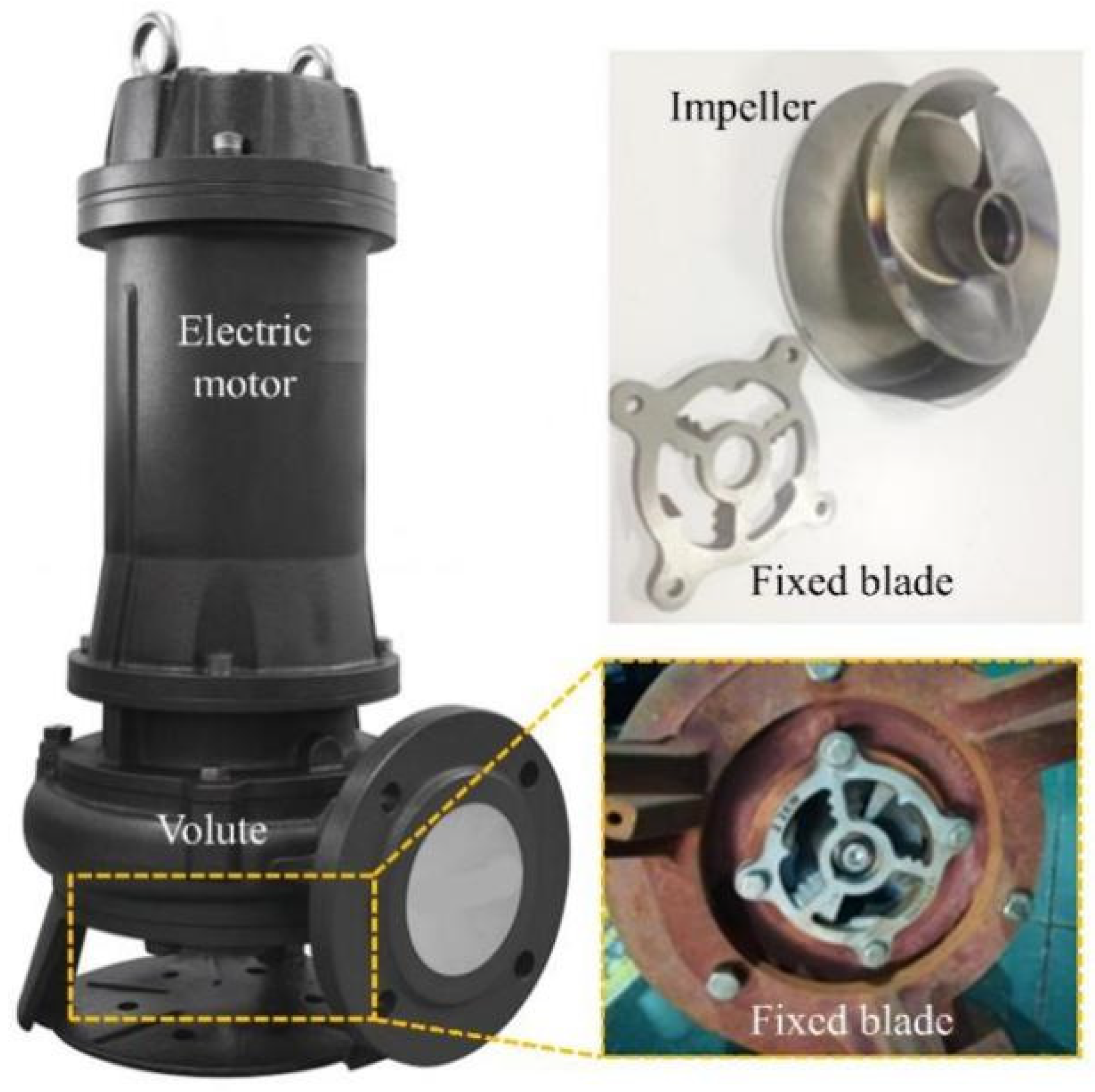
This study selects the 80WQ4QG semi-open impeller sewage pump (Shimge Pump Industry (Group) Co., Ltd., Wenling, China) as the research object. The structure of the sewage pump is shown in Figure 1, with the main components including the motor, stator, rotor, impeller, volute, and outlet fixed cutter. The key parameters of the sewage pump are as shown in Table 1: flow rate Q = 45 m3/h, head H = 15 m, rotational speed n = 2850 r/min, and motor power = 4 kW.

2.2. Grid Generation and Independence Analysis

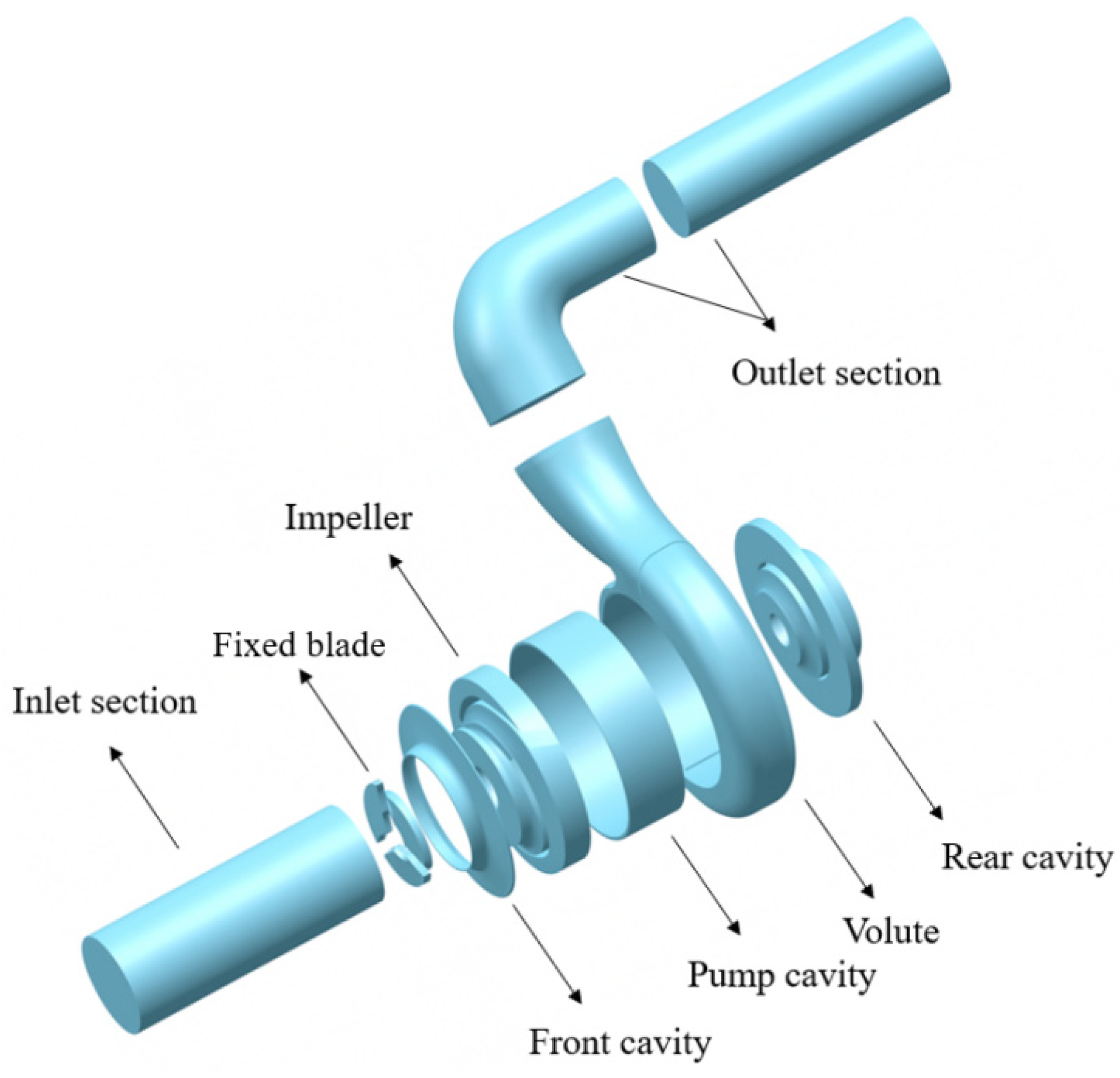
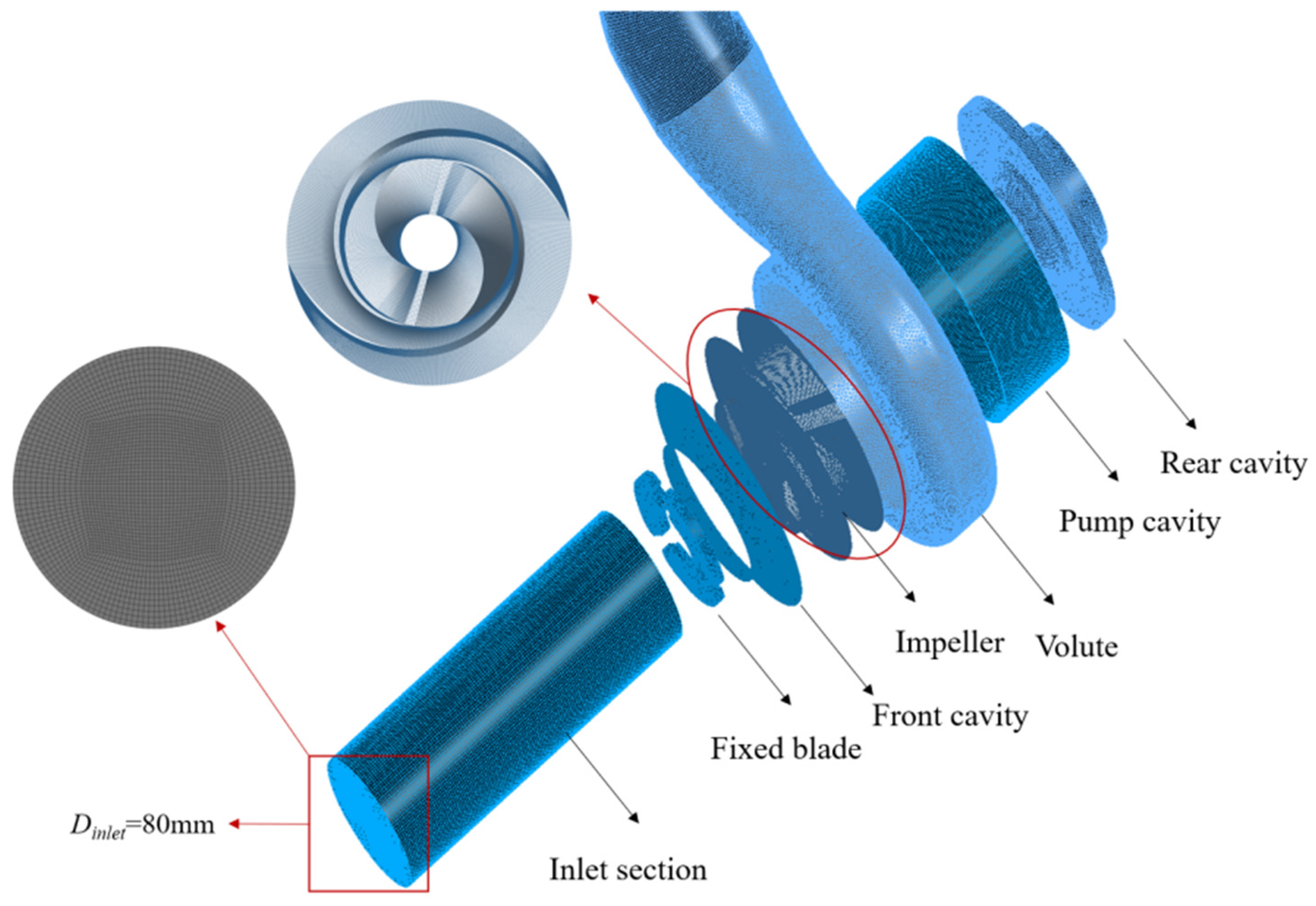
Based on the structural characteristics of the semi-open impeller sewage pump, the core computational fluid domain of the pump was extracted (Figure 2), comprising the inlet and outlet sections, fixed blade, front and rear cavities, impeller, pump cavity, and volute. A hybrid meshing strategy was adopted: high-quality structured grids were generated for the impeller region using ICEM to ensure computational accuracy, while unstructured grids were used for complex regions such as the volute and the front and rear cavities to meet computational requirements and achieve good coupling with the structured grids [41]. The overall grid distribution is shown in Figure 3.
For the rated flow rate condition, the calculation results of five different grid numbers were compared in this study. The dimensionless parameter head coefficient (ψ) was introduced as the key parameter for evaluating the performance of the sewage pump, and this coefficient is widely used in grid independence verification [42]. Table 2 and Table 3 show the relationships between the five grid generation schemes and their corresponding head (H) and head coefficient (ψ).
The calculation formula for the head coefficient is as follows:
ψ   =   2 gH u 2 2
where u2 is the impeller outlet velocity, m/s.
It was found from the comparison of the calculation results of five grid numbers in Table 3 that as the grid number gradually increased from a relatively small value to 4.26 million, the calculation results of the head coefficient decreased gradually, but the decreasing amplitude became smaller and smaller. When the grid number exceeded 4.26 million (e.g., Schemes 3 and 4), the difference in the head coefficient value was less than 0.05%. This indicates that the calculation result of the head coefficient (ψ) is basically not affected by the grid number at this point. Therefore, Scheme 3 with 4.26 million grids was finally selected for subsequent simulations. This scheme not only ensures the accuracy of results but also saves computational resources. To ensure the accuracy of near-wall turbulence modeling, the average y+ value on the wall surfaces was maintained within the logarithmic law region (30 < y+ < 300), as listed in Table 2. Consequently, scalable wall functions were applied to resolve the boundary layer. The reliability of this meshing strategy is supported by recent studies on complex flow structures. For instance, Wang et al. [43] and Jia et al. [44] demonstrated that optimized grid distributions effectively capture flow gradients in shock trains and film hole arrangements, respectively. Adopting a similar methodology, this study ensures that the grid resolution is sufficient to capture the intricate pressure pulsation characteristics.

2.3. Boundary Conditions

The computational fluid domain was divided into a rotating domain (the impeller at 2850 r/min) and a stationary domain (the remaining components). The interface between them was treated using the Frozen Rotor method for initialization, followed by the Transient Rotor–Stator method for the unsteady phase to accurately simulate the rotor–stator interaction effects and prevent distortion of the pressure pulsation signal at the interface, laying the foundation for pulsation analysis in key regions.
The boundary conditions were set as follows: a mass flow inlet was used to ensure a stable flow rate for each operating condition; a static pressure outlet (reference pressure: 1 atm) was applied to accurately model the pressure recovery process. All solid walls were set as no-slip, and the wall roughness was defined according to the actual machining accuracy (Ra = 1.6 μm) to ensure the computational accuracy of the near-wall flow and pressure pulsation signals.
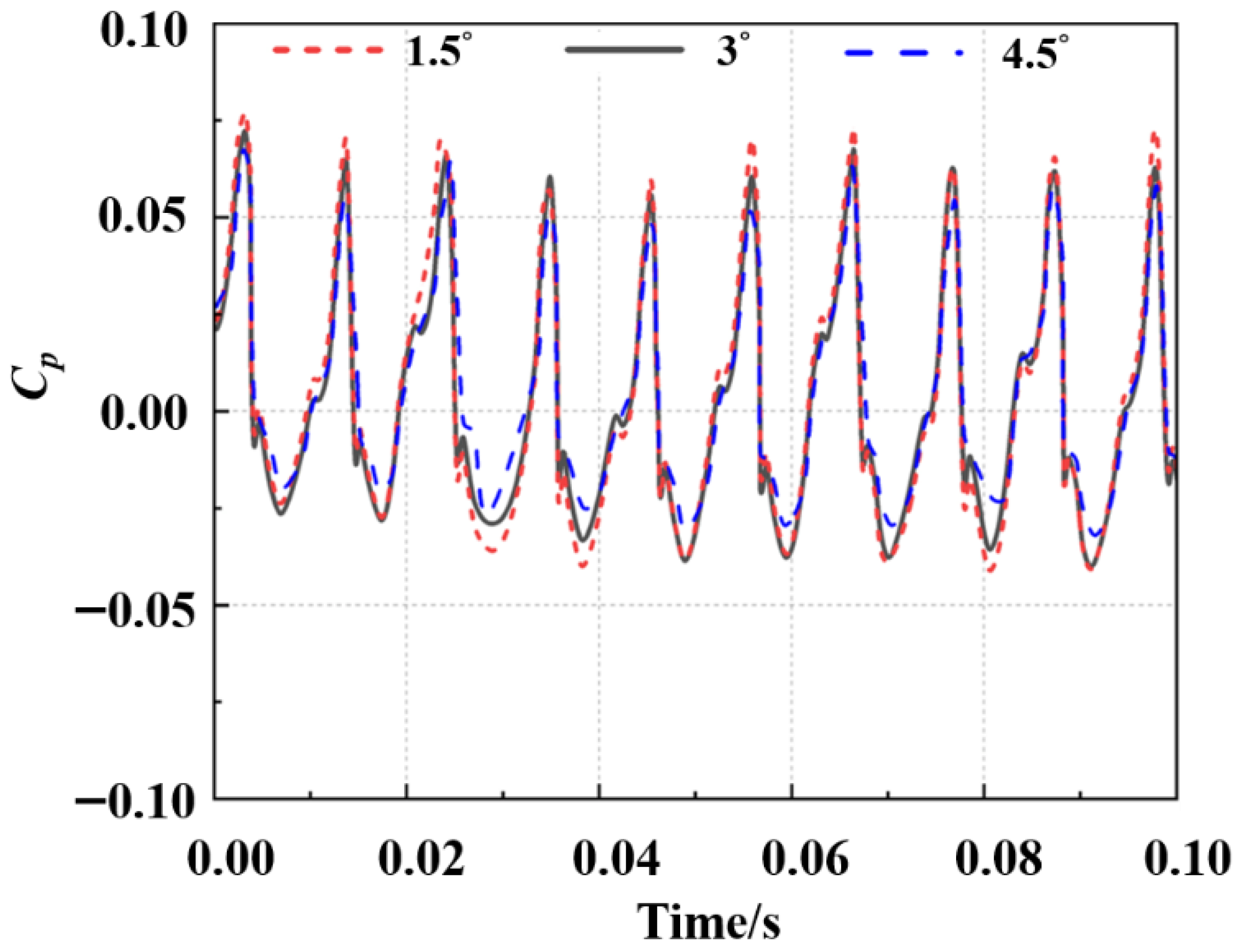
Given the particularity of unsteady simulation for pressure pulsation, additional key computational parameters were set: the time step was 0.000175439 s (corresponding to a 3° rotation of the impeller, to ensure the capture of the periodic characteristics of the 95 Hz blade frequency fluctuation), and the total time step was 0.210526 s (covering 10 impeller rotation cycles). The computational convergence criterion was defined as the root mean square (RMS) of the governing equation residuals ≤ 10−5, which avoids fluctuation signal oscillation caused by insufficient iteration. To assess the influence of temporal resolution, simulations were conducted using time steps corresponding to 1.5°, 3° (baseline), and 4.5° rotation angles. As shown in Figure 4, the coarse time step (4.5°) results in noticeable signal smoothing and phase lag. In contrast, the baseline case (3°) aligns closely with the fine step (1.5°), capturing the transient details effectively. This confirms that the current time step is sufficient to resolve the unsteady flow characteristics. After the calculation was completed, the stable data from the last 5 cycles (i.e., 600 data points) were selected as the results of the unsteady calculation. Under solid–liquid two-phase conditions, dispersed phase boundary conditions were supplemented: the wall boundary for the dispersed phase (solid particles) was set as a free-slip boundary. It is acknowledged that this setting represents an idealization, neglecting the energy dissipation from particle–wall friction and inelastic rebound. However, recent CFD-DEM research on semi-open pumps by Wang et al. [45] reveals that high-frequency pressure pulsations are predominantly generated by particle–fluid interactions and vortex disruptions, rather than direct particle–wall impacts. Consequently, while this simplification might lead to a slight overestimation of the pulsation amplitude due to the omission of wall-impact energy loss, it effectively captures the primary frequency characteristics and variation trends driven by interphase momentum exchange, providing a conservative estimate for engineering analysis.
The Standard k−ϵ turbulence model was chosen for its established stability in industrial multiphase simulations. To validate our numerical treatment of fluid–solid interactions—specifically the free-slip boundary condition—we draw on recent high-fidelity research. Yuan et al. [46,47] applied similar numerical frameworks to analyze high-pressure jet impacts. Their findings confirm that this approach accurately captures the transient pressure pulsations caused by solid–fluid collisions, lending credibility to the boundary constraints used in this study. The coordinated setting of the above boundary conditions not only ensures the consistency of pressure pulsation simulations under different working conditions, but also truly reproduces the unsteady characteristics of the internal flow of the pump, providing high-quality flow field data support for subsequent time–frequency domain analysis.

2.4. Verification of Numerical Calculation Results

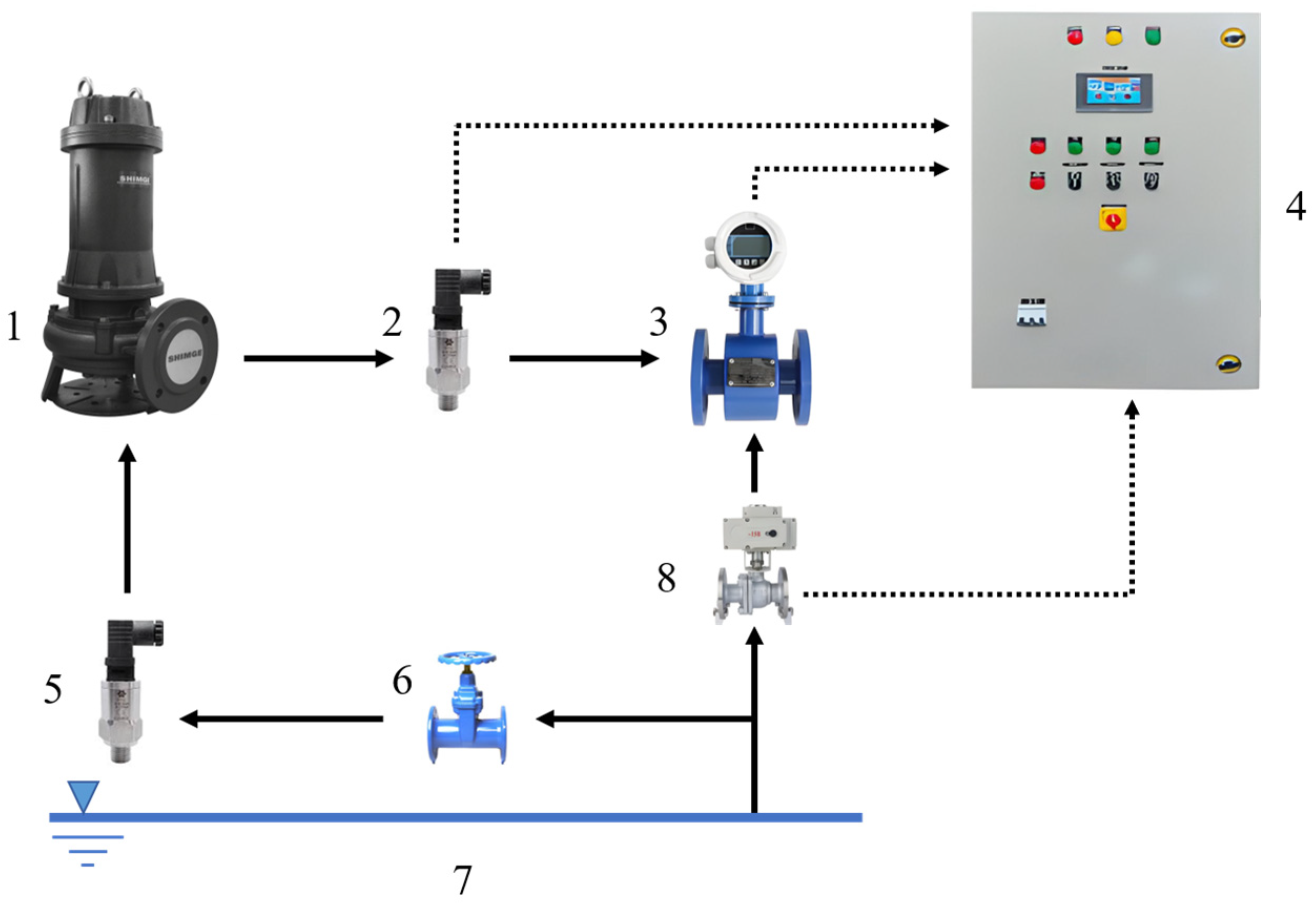
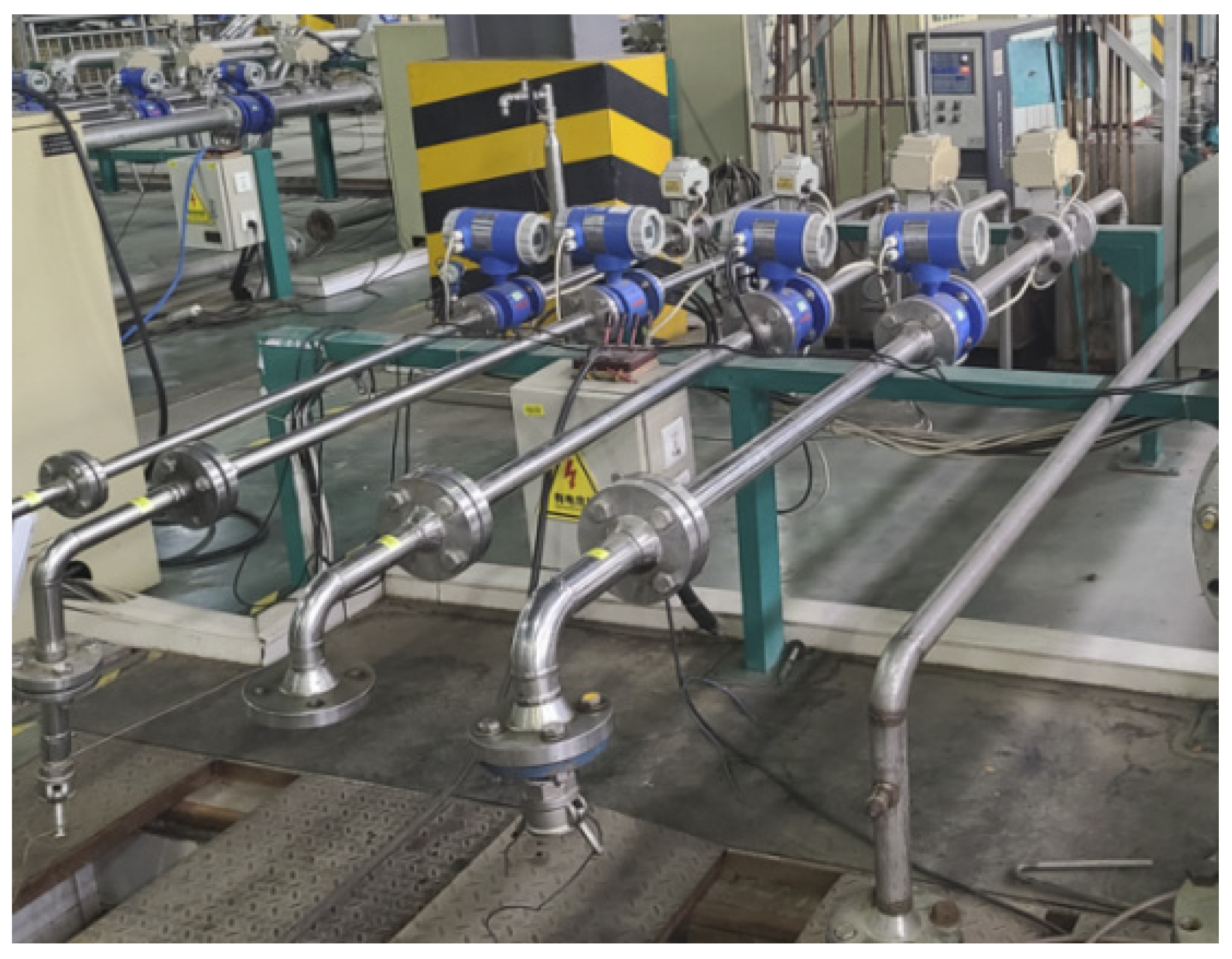
The performance characteristics of the semi-open impeller sewage pump were evaluated using a professional closed-loop test rig. Figure 5 presents the local details of the pipeline arrangement, while the schematic of the hydraulic system is illustrated in Figure 6. The experimental loop consists of a water tank (7) serving as the fluid reservoir, the test pump (1), and regulating valves (6, 8) located on the suction and discharge pipelines, respectively. To acquire precise hydraulic data, a high-precision electromagnetic flowmeter (3) is installed downstream of the pump to monitor the volumetric flow rate. Pressure sensors are mounted at the pump inlet (5) and outlet (2) to determine the pressure differential. All instrumentation signals are transmitted to an integrated data acquisition and control cabinet (4), which is responsible for real-time monitoring and data processing. As illustrated in the schematic (Figure 6), the solid arrows denote the direction of the closed-loop hydraulic flow circulating through the tank, pump, and valves. The dotted lines represent the signal transmission paths, linking the pressure sensors and flowmeter to the central control unit for synchronized data acquisition.
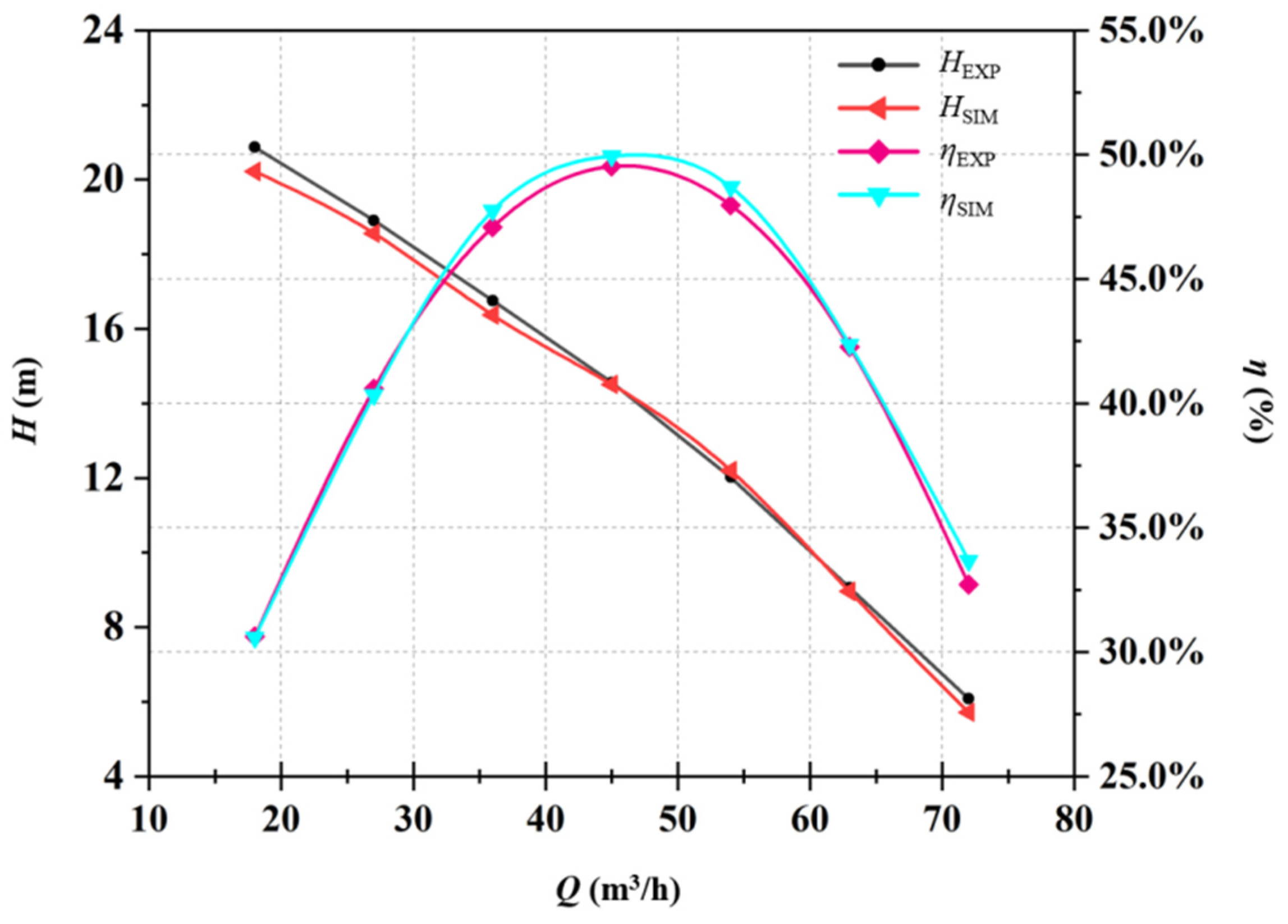
The reliability of the computational method was validated by comparing the numerical simulation results with experimental data (Figure 7). Under the rated operating condition, the errors between the simulated and measured values for head and efficiency were only 0.02 m and 0.41%, respectively, both within the allowable range for engineering applications. This indicates that the established numerical model, along with the Standard k−ϵ turbulence model and Eulerian–Eulerian multiphase model, possesses excellent predictive accuracy and engineering applicability.
The slight deviation between the simulation and the experiment may originate from the fixed blade device at the sewage pump’s impeller inlet. This structure alters the inlet flow pattern and increases the flow field complexity, with its disturbance propagating downstream. Despite this deviation, the simulated trend of the external characteristics curve shows high consistency with the experimental data across the full range of flow rates, further confirming the applicability and accuracy of the numerical method. Although direct pressure fluctuation measurements were not feasible within the current experimental scope, the precise prediction of external performance metrics strongly substantiates the fidelity of the internal flow solution. Additionally, the adopted URANS framework is inherently robust in resolving deterministic periodic signals—specifically the blade-passing frequencies driven by rotor–stator interactions—thereby ensuring the credibility of the reported spectral characteristics. With the validity of the numerical method established, the subsequent sections systematically analyze the spatiotemporal evolution of flow field instabilities and quantify the impact of particle parameters on pressure pulsations.

3. Monitoring Point Setup and Analytical Methods

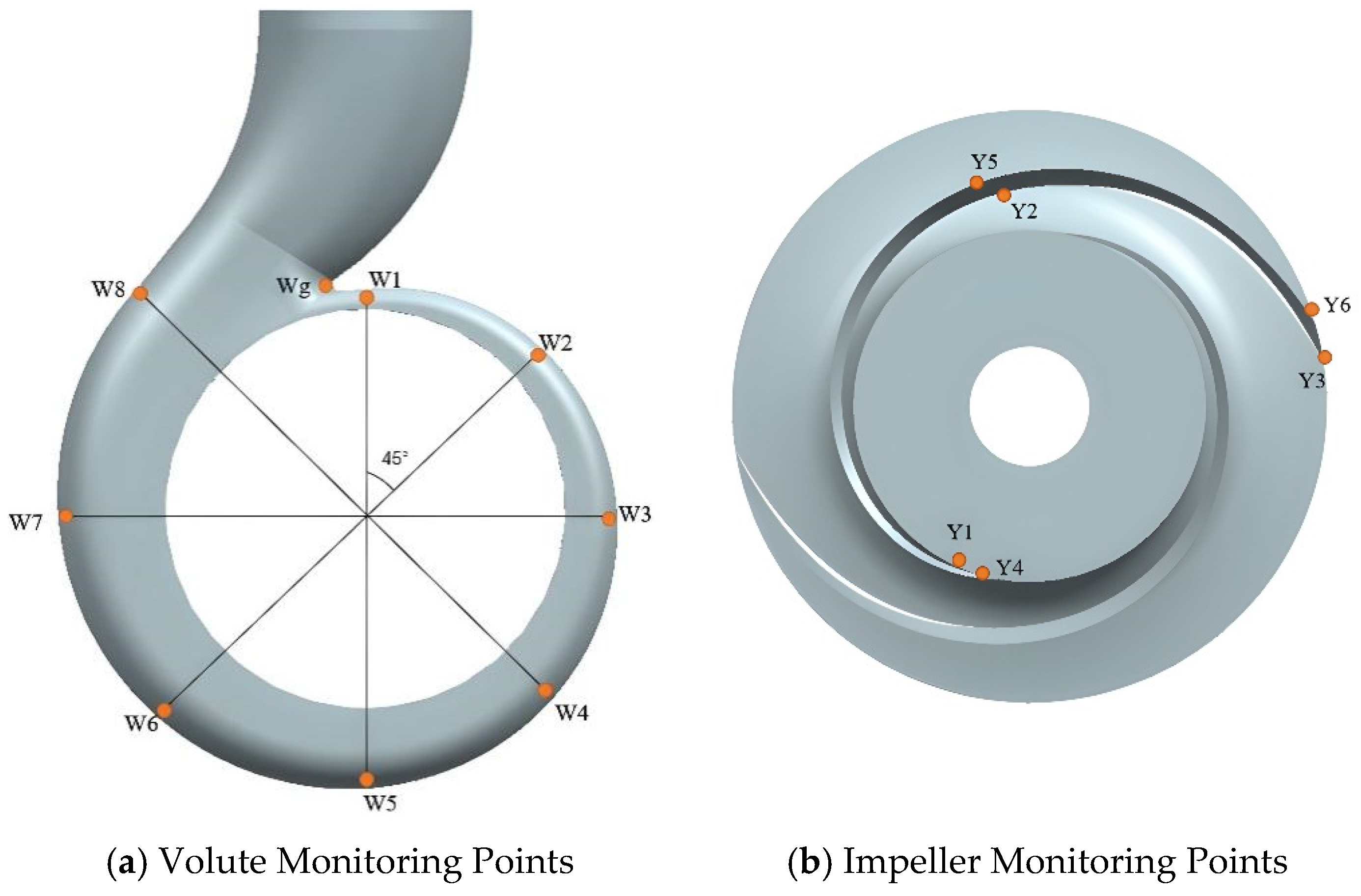
During the unsteady simulation, 15 monitoring points were strategically placed within the impeller and volute flow passages to capture pressure variations under different operating conditions. These monitoring points covered critical locations such as the impeller inlet, impeller outlet, and volute tongue. In Figure 8a, monitoring points are positioned at the volute tongue and along the volute pump cavity flow passages (at 45° intervals) on the volute mid-section, labeled as Wg and W1 to W8, respectively. In Figure 8b, to address the specific research focus on pressure pulsation characteristics, six additional monitoring points (denoted as Y1 to Y6) are evenly distributed along the blade pressure surface, blade suction surface, and within the impeller flow passages, following the direction of the impeller curvature. By combining these monitoring points with those on the volute flow passage mid-section, a comprehensive pressure pulsation monitoring system was established, consisting of 15 monitoring points distributed across the impeller domain and volute flow passages.
The 45° interval for the monitoring points was selected to ensure sufficient resolution of the circumferential pressure field. This layout allows for a detailed recording of the unsteady loads, which is essential for analyzing hydraulic excitation forces and identifying vibration sources, consistent with the radial force analysis method by Zhang et al. [48]. Furthermore, the data obtained from these key points provides a necessary foundation for future design optimization using advanced surrogate model strategies, similar to the methodologies discussed by Chang et al. [49].
Two methods are commonly used in analyzing pressure pulsation data: time-domain analysis and frequency-domain analysis. Time-domain analysis focuses on directly analyzing data in the time dimension, while frequency-domain analysis converts complex time-domain signals into more manageable frequency-domain signals, and these signals can be further analyzed and processed with specific tools. Furthermore, to eliminate the influence of static pressure at the monitoring points on pressure pulsation readings, the dimensionless pressure pulsation coefficient Cp is introduced:
C p = p p ¯ 1 2 ρ u 2 2
where p is the instantaneous static pressure, Pa; p ¯ is the average static pressure, Pa; ρ is the fluid density, kg/m3; and u2 is the impeller outlet circumferential velocity, m/s.
Blade frequency:
f z = nz 60
where n is the rotational speed, r/min, and z is the number of blades. When substituting n = 2850 r/min, z = 2 into the formula for calculation, the blade frequency fz = 95 Hz is obtained.

4. Pressure Pulsation Characteristics Under Clear Water Conditions

4.1. Impeller Pressure Pulsation at Different Flow Rates

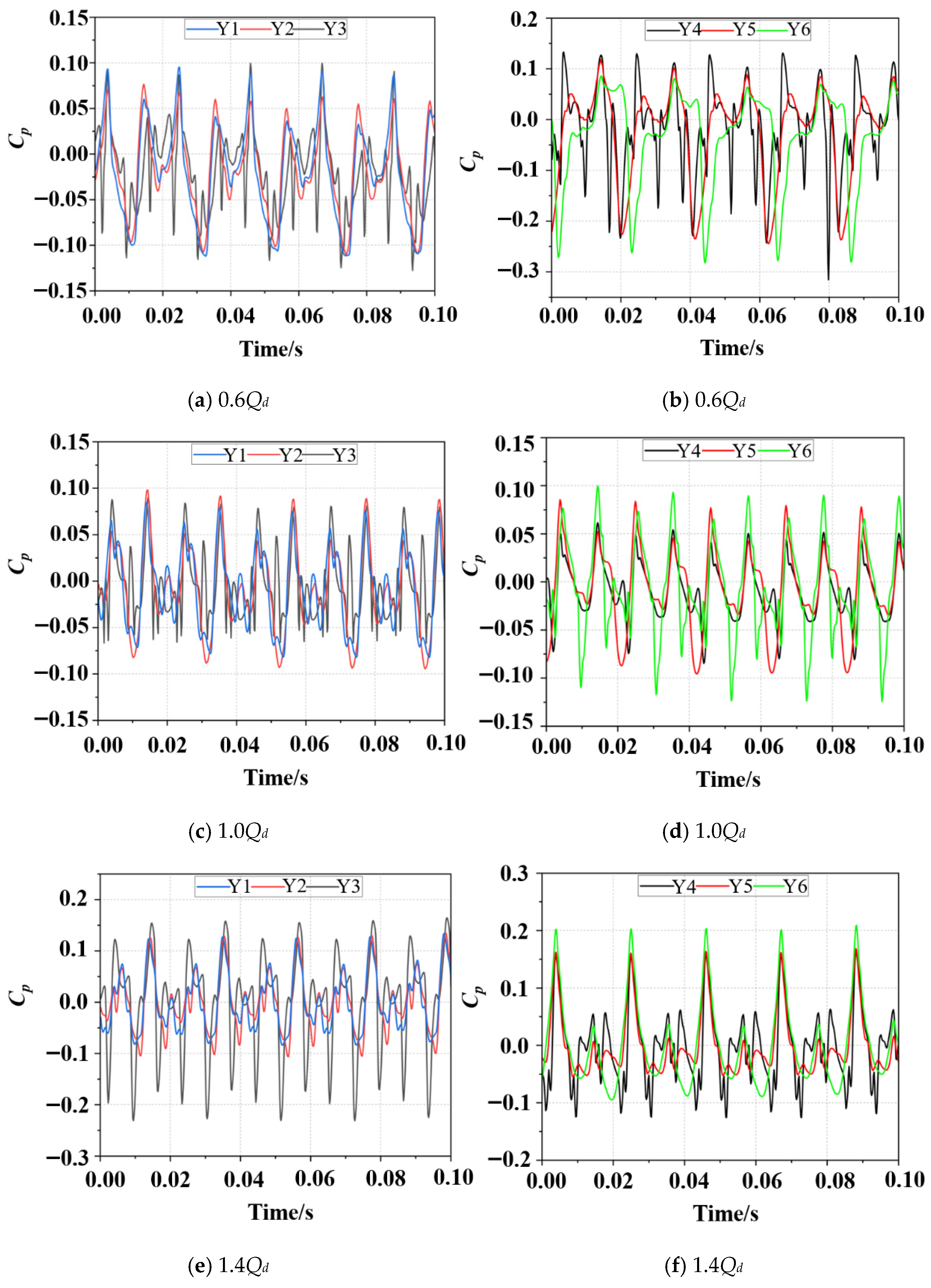
Figure 9 shows the time-domain diagrams of the pressure pulsation coefficient Cp for monitoring points Y1~Y6 in the impeller flow passages under different flow rate conditions. As can be seen from the figure, all monitoring points Y1~Y6 in the impeller flow passages exhibit obvious “peak–valley” periodic fluctuation patterns within the monitoring period of 0~0.1 s. Among them, the monitoring points Y3 (located at the outlet of the blade pressure surface) and Y6 (located at the outlet of the blade suction surface) have relatively large fluctuation amplitudes; moreover, as the flow rate increases, the variation degree of the pressure pulsation coefficient Cp becomes relatively significant.
Under off-design conditions, the time–frequency characteristics of the pressure pulsation coefficient Cp show significant asymmetry, which is manifested in the asymmetric distribution of the peak and valley values of fluctuations. Specifically, the amplitude of negative pressure pulsations is generally higher than that of positive pressure pulsations.
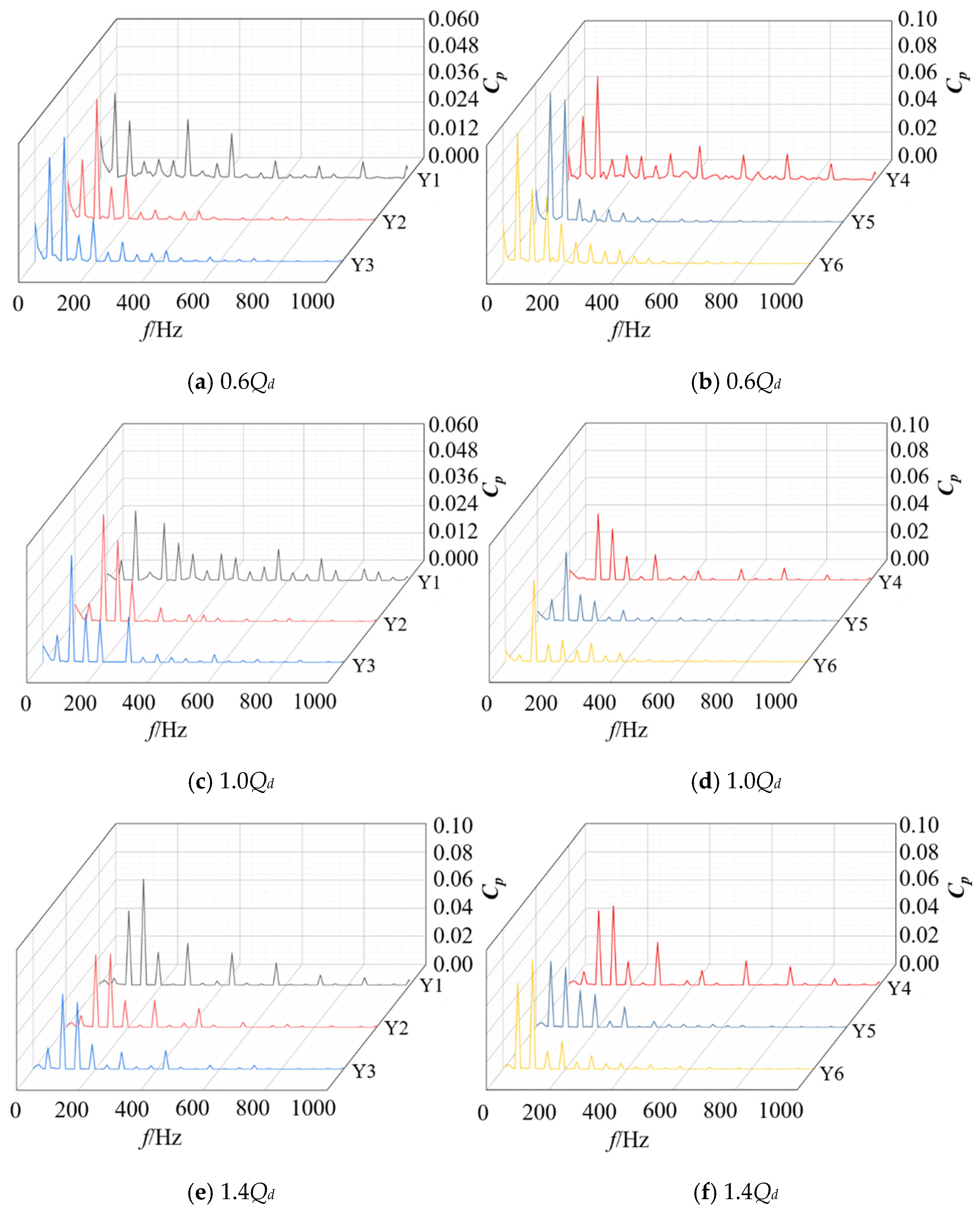
Figure 10 shows the frequency-domain diagrams of the pressure pulsation coefficient Cp for monitoring points Y1~Y6 under different flow rates. The results indicate that under all flow rate conditions, the dominant frequency of monitoring points in the impeller is concentrated at the first-order blade frequency (95 Hz), and the subdominant frequencies are mostly integer multiples of the dominant frequency—this reflects the periodic pressure changes caused by impeller rotation.
At the same location, the fluctuation amplitude of monitoring points on the blade pressure surface is higher than that on the blade suction surface. Additionally, as the flow rate increases, the amplitude of the dominant frequency Cp at each monitoring point increases, among which the increase at Y3 and Y6 (located at the impeller outlet) is the most significant. This is because the flow velocity at the impeller outlet is the highest, leading to stronger rotor–stator interaction with the volute.
In conclusion, under different flow rates, the internal pressure pulsation of the impeller mainly originates from the inlet and outlet of the blade pressure surface, and the law governing the influence of flow rate on this fluctuation is clarified.

4.2. Volute Pressure Pulsation at Different Flow Rates

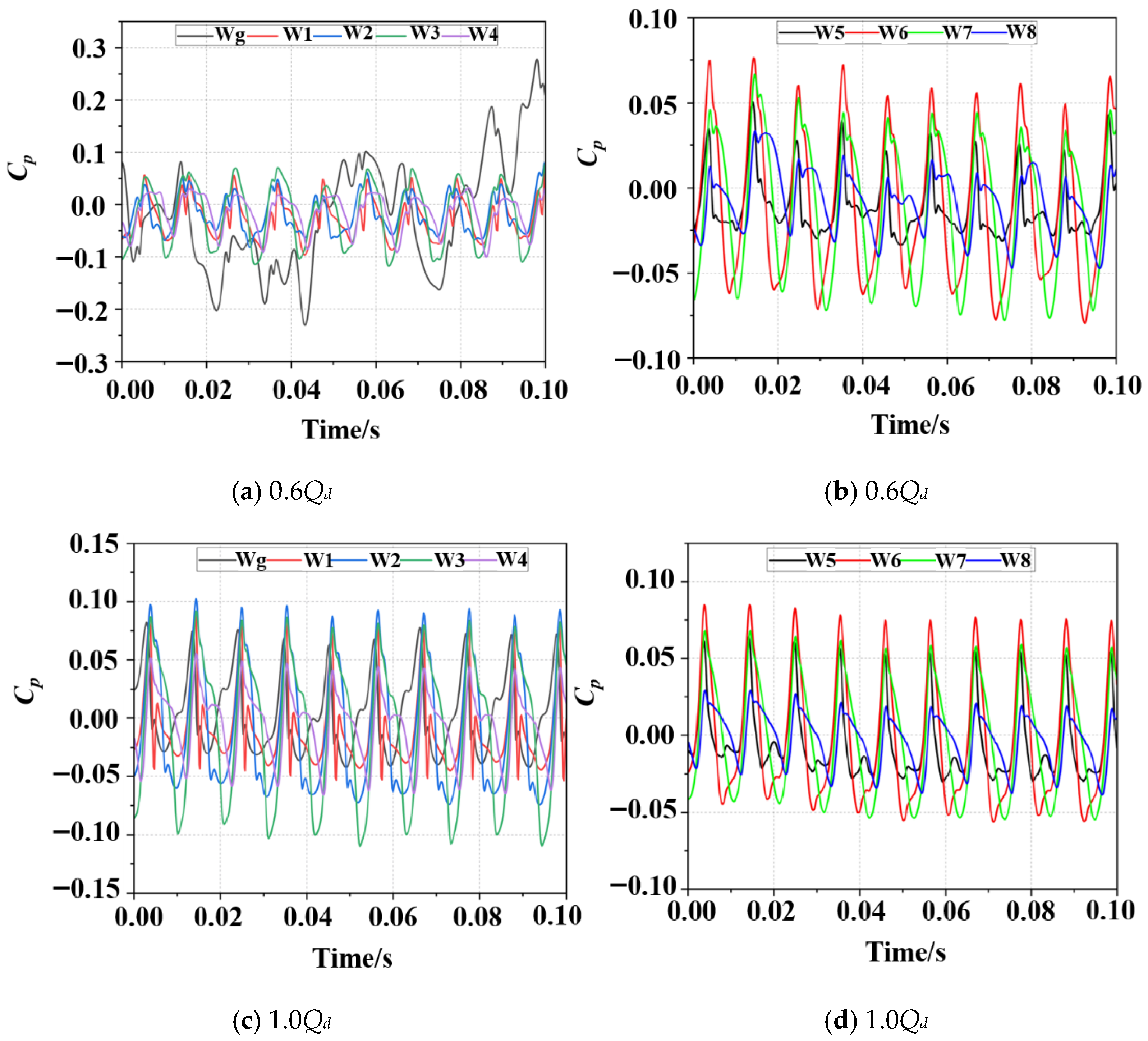
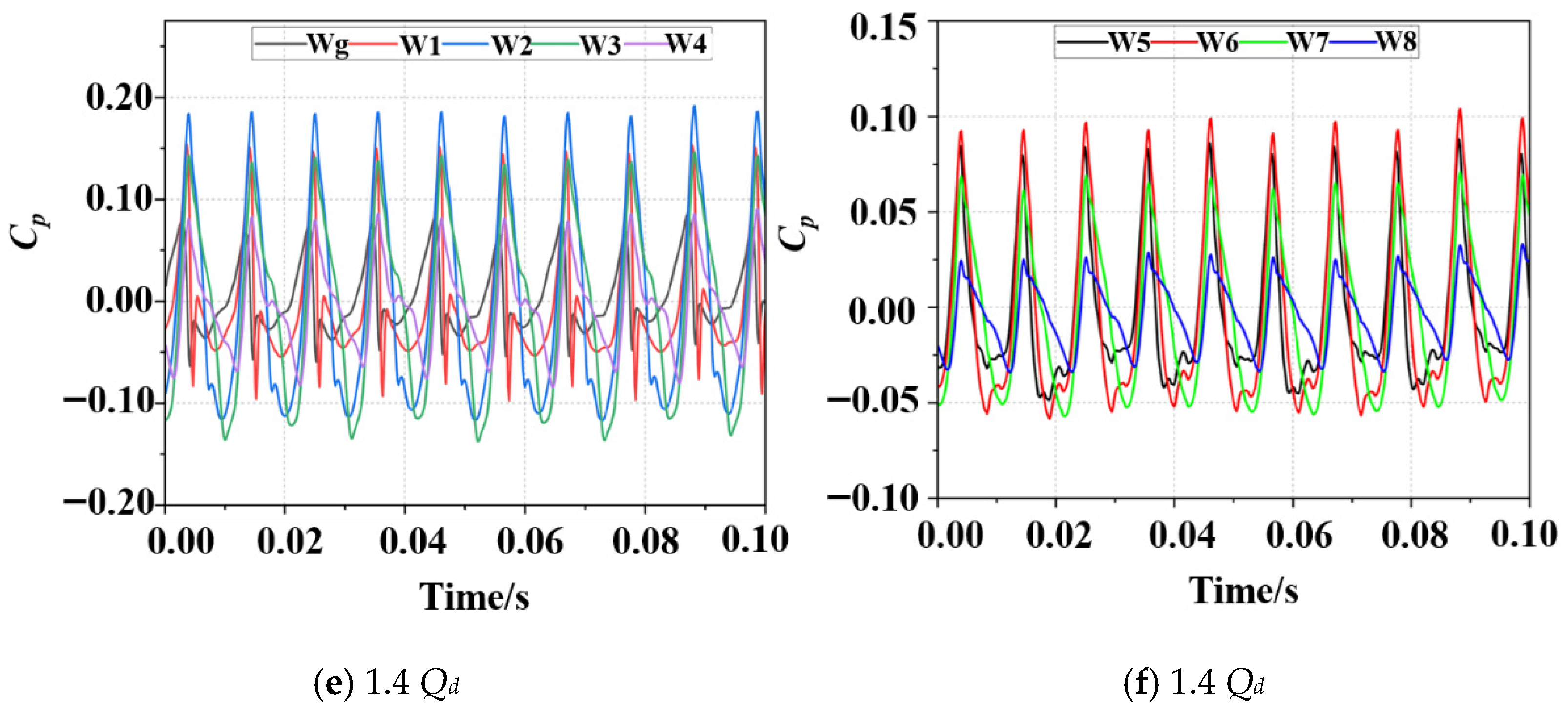
Figure 11 shows the time-domain diagrams of pressure pulsation for volute monitoring points Wg~W8 under different flow rates. Under low flow rate conditions, the fluctuations at the volute tongue monitoring point Wg and the adjacent monitoring point W1 are significant, which is due to the geometric asymmetry of the volute and the enhanced fluctuation energy caused by the rotor–stator interaction at the volute tongue. As the flow rate increases, the fluctuation amplitudes at W1 and Wg decrease, and the energy distribution tends to be balanced.
Frequency-domain analysis indicates that there are secondary harmonics before the dominant frequency of these two monitoring points, which is related to the nonlinear fluctuations caused by periodic vortices in the flow passages and flow separation. This pattern increases the uncertainty in flow prediction and poses a potential risk to the stability of the pump unit. In addition, the increase in the volute cross-sectional diameter (i.e., monitoring points are far from the impeller outlet) has a significant impact on fluctuations; W3 is close to the impeller outlet and is strongly affected by rotor–stator interaction, resulting in the highest negative peak value of fluctuations and excellent periodicity. When W5 is far from the outlet, the rotor–stator interaction weakens and the flow passage area increases. Superimposed with asymmetric vortices formed by flow splitting, this leads to the attenuation of fluctuation amplitude and deterioration of periodicity. W8 is close to the volute outlet. Due to its distance from the impeller and simple geometric structure, it has the smallest amplitude of the fluctuation coefficient, indicating that the fluid is in a stable state when flowing out.
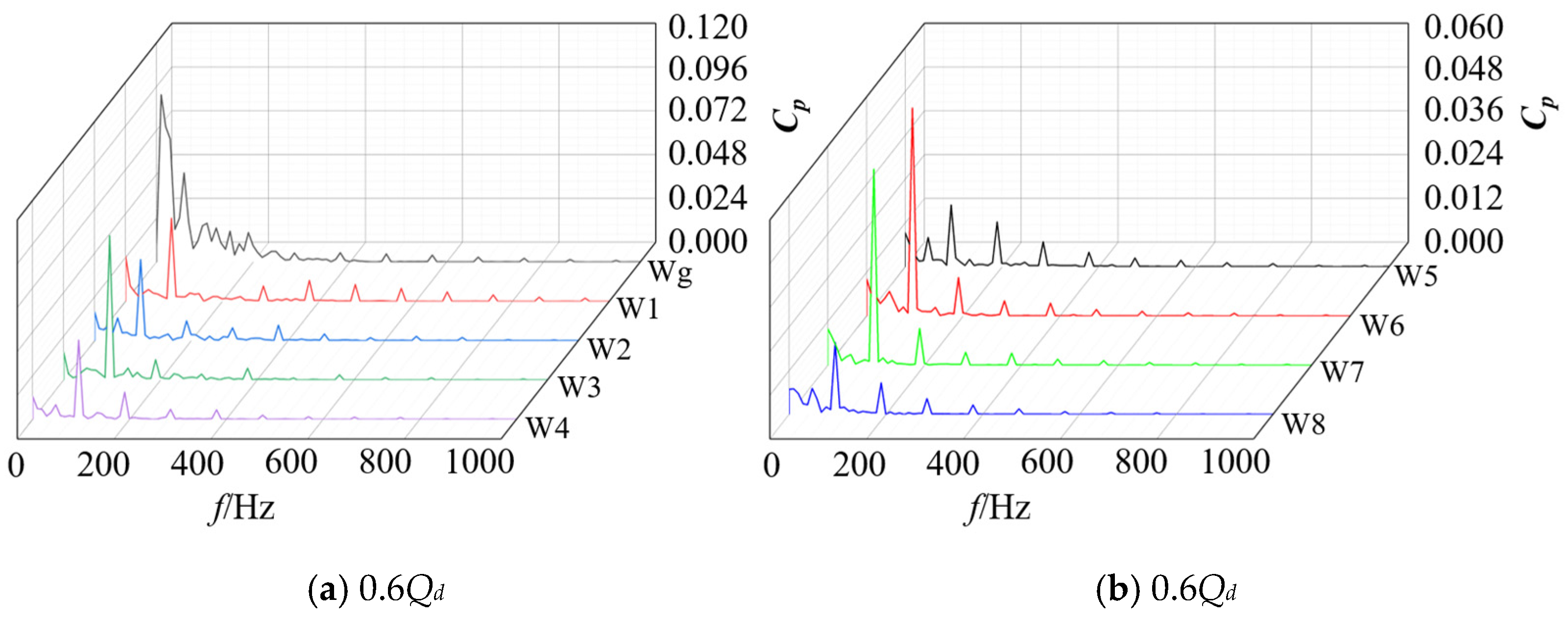
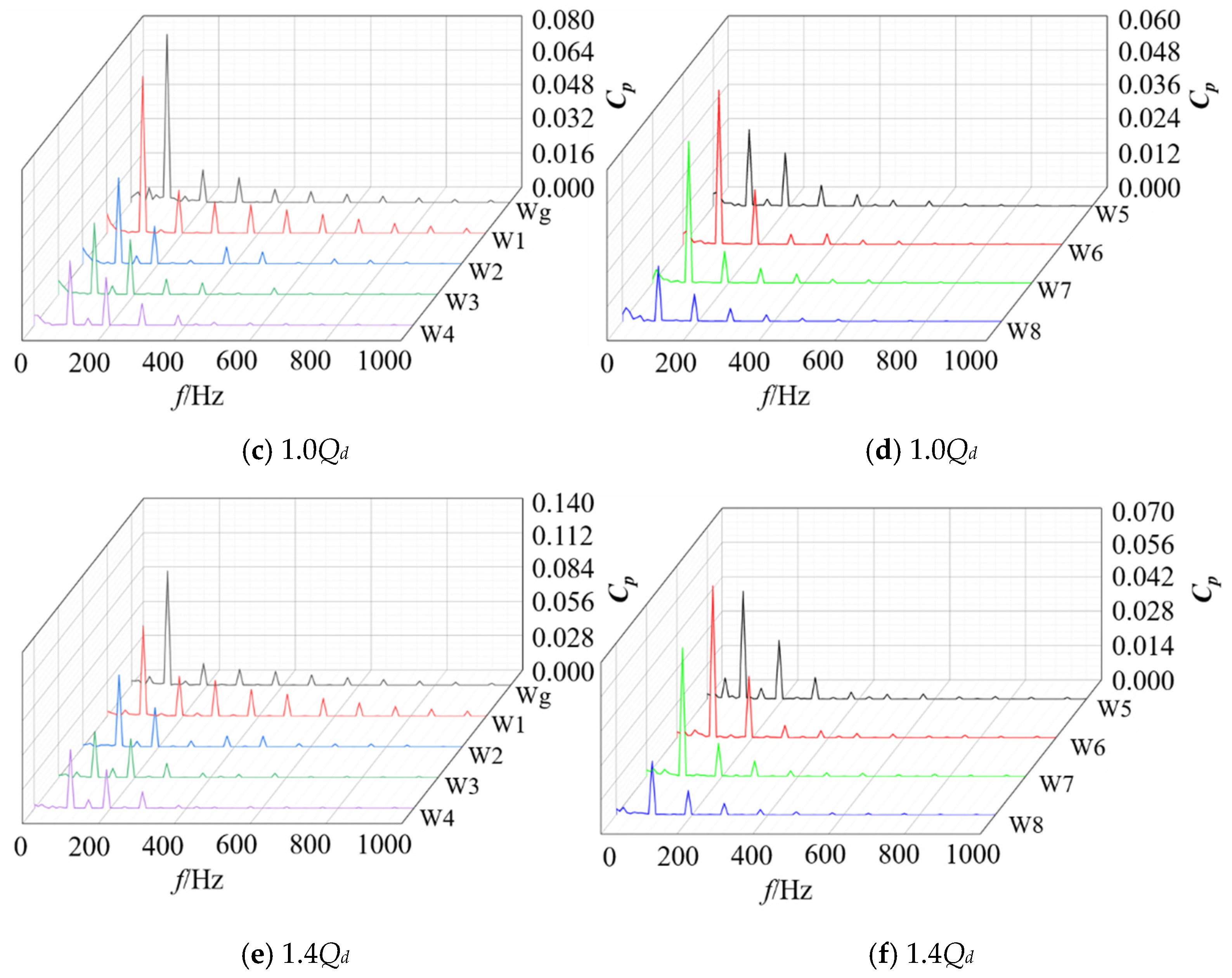
Figure 12 shows a frequency-domain diagram of pressure pulsation for volute monitoring points Wg~W8 under different flow rates. The results show that the Cp value of the volute tongue monitoring point Wg is the largest under the low-flow condition of 0.6Qd (Qd denotes the design flow rate), as the volute tongue structure causes complex local flow. With the increase in flow rate, the Cp value of Wg decreases, while that of W1 increases—this is because as the flow rate rises, the flow velocity in the narrow area of the volute near W1 accelerates, and the abrupt change in the flow passage cross-section enhances flow instability, thereby intensifying pressure pulsation.
The dominant frequency Cp value of monitoring point W3 increases with the rise in flow rate. This is due to the fact that W3 is located at the narrow cross-section of the volute (where flow separation occurs) and is close to the impeller outlet, thus being subject to strong rotor–stator interaction. In contrast, the dominant frequency Cp value of W8 is relatively low, as it is far from the impeller outlet and affected by weak rotor–stator interaction. For the remaining monitoring points, their dominant frequency Cp values first decrease and then increase with the increase in flow rate, but the changes are not significant. This indicates that the fluid flow in these areas tends to stabilize as the flow rate adjusts.

5. Pressure Pulsation Characteristics in Solid–Liquid Two-Phase Flow Conditions

From the preceding analysis, it is clear that under solid–liquid two-phase flow conditions, the internal pressure field, velocity field, and solid volume fraction distribution in the sewage pump become significantly more complex, and the flow structure deviates from that observed under clear water conditions. Specifically, the impeller outlet and volute tongue regions experience flow interference due to the topology of the flow passages, and the rotor–stator interaction in these areas is substantially stronger compared to clear water conditions. The non-uniform distribution of pressure pulsation energy in the frequency domain within these regions is prone to inducing structural resonance, which directly threatens the operational stability of the pump system.
Therefore, investigating the influence mechanism of particle parameters on pressure pulsations is of critical engineering importance. This study systematically analyzes the effects of particle size and volume fraction on the pressure pulsation characteristics near the volute tongue and impeller working surface under rated flow rate conditions. The theory of solid–liquid two-phase flow and the numerical simulation setup are not elaborated upon in this paper, as they have been comprehensively addressed in our previous related study [50].

5.1. Pressure Pulsation Under Different Particle Size Conditions

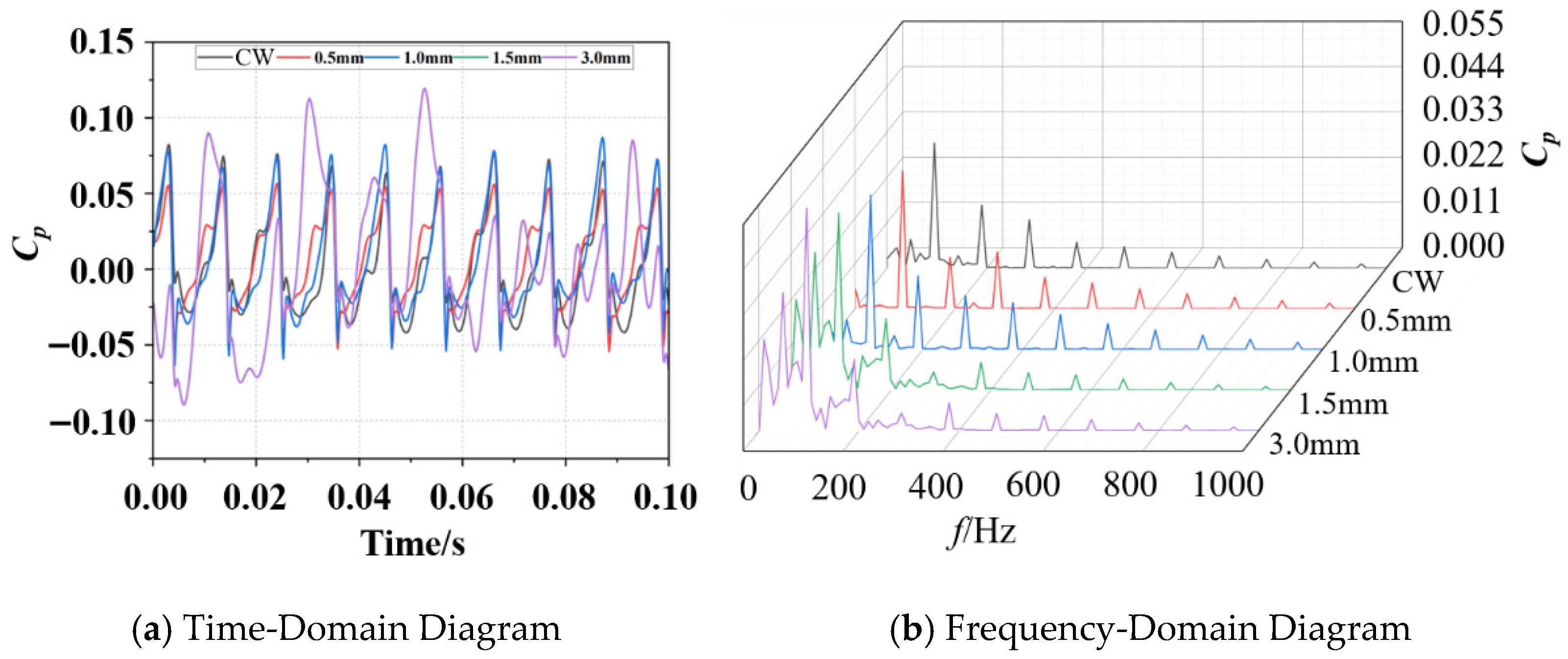
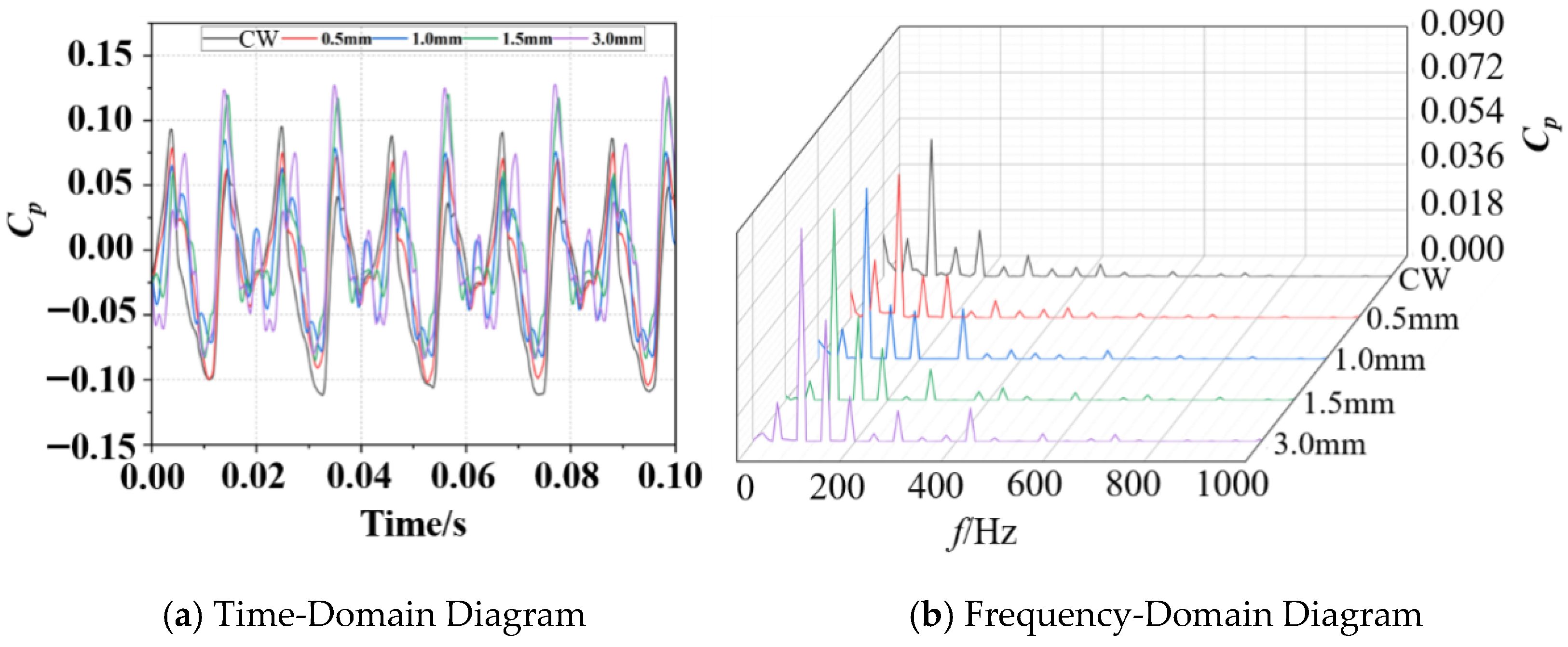
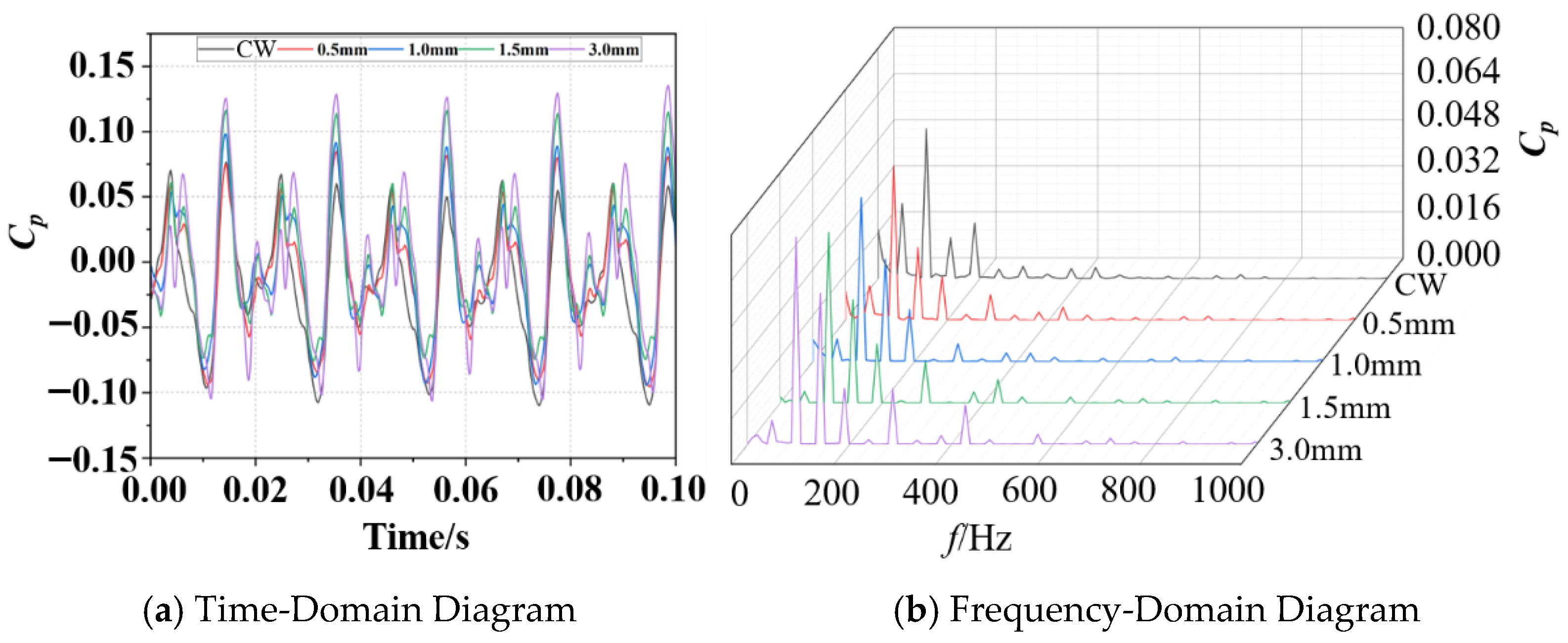
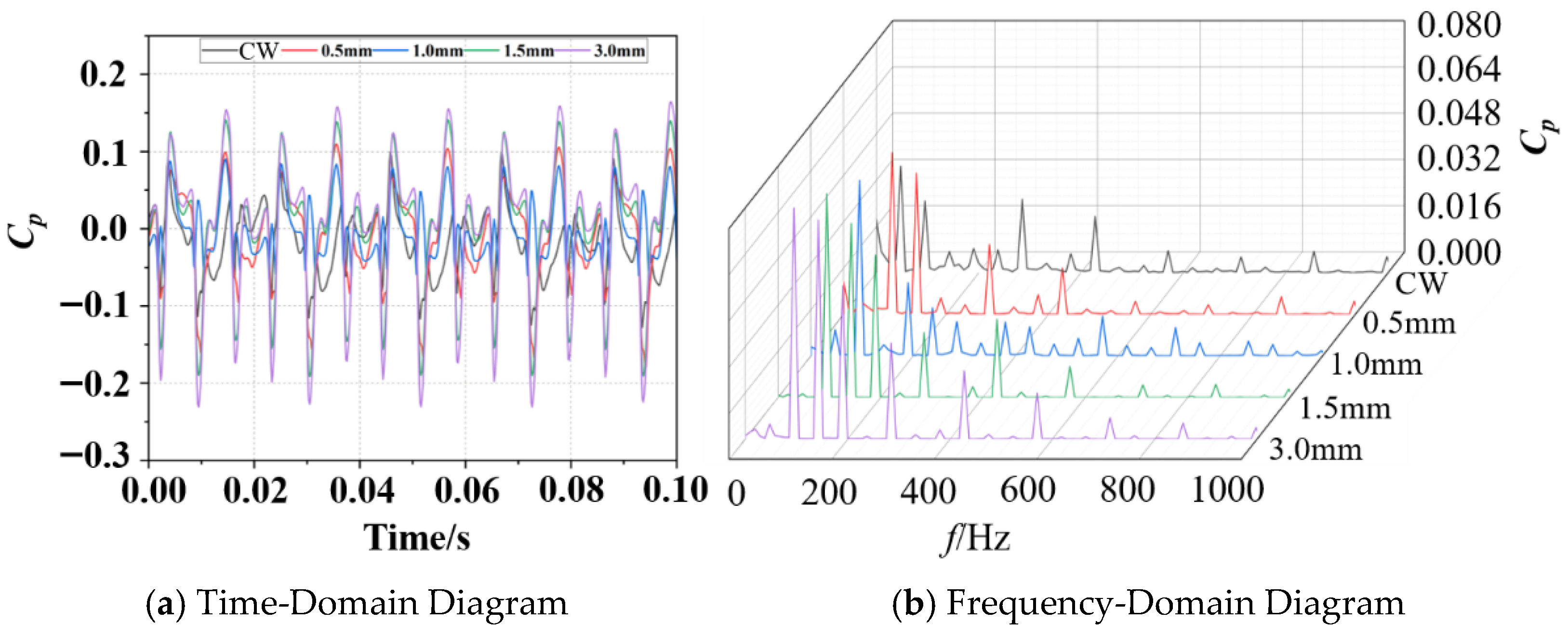
Figure 13, Figure 14, Figure 15 and Figure 16 show the time-domain and frequency-domain diagrams of the pressure pulsation coefficient Cp at monitoring points near the volute tongue and impeller working surface under the rated flow rate condition (with a solid volume fraction of 10%) and different particle size conditions (0.5 mm, 1.0 mm, 1.5 mm, and 3.0 mm).
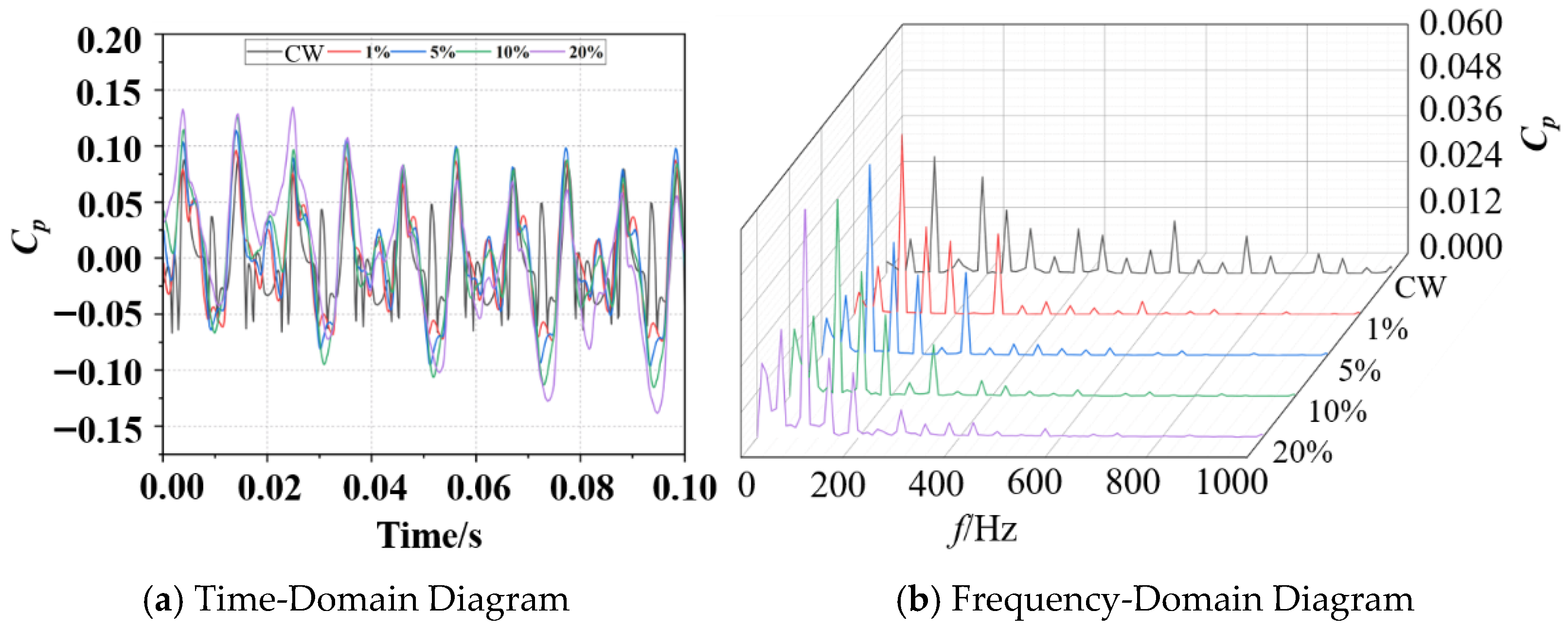
Figure 13 presents the time-domain and frequency-domain diagrams of the pressure pulsation coefficient Cp at the volute tongue monitoring point Wg under the clear water condition and different particle size conditions.
Time-Domain Characteristics (Figure 13a): All conditions exhibit similar peak–valley periodic fluctuations; however, the Cp fluctuation range expands synchronously with the increase in particle size, with the most significant fluctuation observed at a particle size of 3.0 mm. Specifically, the fluctuation range is (−0.0418 to 0.0822) under the clear water condition, and expands to (−0.0896 to 0.1189) when the particle size is 3.0 mm, representing a 68.15% increase in fluctuation amplitude compared to the clear water condition. This phenomenon is attributed to the complex flow caused by the geometric structure of the volute tongue itself. The addition of solid particles further alters the flow field structure, intensifies local flow separation, and ultimately significantly enhances pressure pulsation.
Frequency-Domain Characteristics (Figure 13b): Under all conditions, the dominant frequency of Cp remains stable at the first-order blade frequency (95 Hz). The dominant frequency amplitudes for different particle sizes (in ascending order: clear water, 0.5 mm, 1.0 mm, 1.5 mm, 3.0 mm) are 0.0304, 0.0334, 0.0375, 0.0430, and 0.0540, respectively. When the particle size is 3.0 mm, the dominant frequency amplitude reaches 1.78 times that of the clear water condition. In addition, low-frequency signals exist around the first-order dominant frequency under all conditions, and their amplitude variation trend with increasing particle size is consistent with that of the dominant frequency.
Figure 14 shows the time-domain and frequency-domain diagrams of the pressure pulsation coefficient Cp at monitoring point Y1 on the impeller working surface under the clear water condition and different particle size conditions.
Time-Domain Characteristics (Figure 14a): All working conditions exhibit peak–valley periodic fluctuations; however, the Cp fluctuation range shows a trend of “first decreasing and then increasing” as the particle size increases, with the largest fluctuation observed at a particle size of 3.0 mm. Specifically, the fluctuation range is (−0.1119 to 0.0952) under the clear water condition, narrows to (−0.1044 to 0.0788) when the particle size is 0.5 mm, and expands to (−0.0835 to 0.1337) at a particle size of 3.0 mm, representing only a 4.88% increase in fluctuation amplitude compared to the clear water condition. It can be seen that the presence of particles and changes in particle size have a weak impact on the pressure pulsation at Y1 (near the impeller inlet). Moreover, small particles (0.5 mm) can further reduce the fluctuation amplitude by weakening the impeller inlet backflow and optimizing the inlet flow pattern.
Frequency-Domain Characteristics (Figure 14b): Under all working conditions, the dominant frequency of Cp remains stable at the first-order blade frequency (95 Hz). The dominant frequency amplitudes, in ascending order of particle size (clear water, 0.5 mm, 1.0 mm, 1.5 mm, 3.0 mm), are 0.0537, 0.0563, 0.0670, 0.0750, and 0.0835, respectively. When the particle size is 3.0 mm, the dominant frequency amplitude reaches 1.55 times that of the clear water condition. In addition, under all working conditions, the subdominant frequency fluctuation is significant at the 1.5th-order blade frequency, and the subdominant frequency amplitude gradually decreases to zero as the frequency increases.
Figure 15 shows the time-domain and frequency-domain diagrams of the pressure pulsation coefficient Cp at monitoring point Y2 on the impeller working surface under the clear water condition and different particle size conditions. Time-Domain Characteristics (Figure 15a): All conditions exhibit consistent pulsation patterns and significant periodicity, while the Cp fluctuation range shows a monotonically expanding trend as the particle size increases—with the largest fluctuation observed at a particle size of 3.0 mm. Specifically, the fluctuation range is (−0.1098 to 0.0766) under the clear water condition, and expands to (−0.1062 to 0.1354) when the particle size is 3.0 mm, representing a 29.61% increase in fluctuation amplitude compared to the clear water condition.
Compared with monitoring point Y1 (near the impeller inlet), the increase in particle size has a more significant impact on pressure pulsation at Y2 (middle of the impeller flow passage). This is because the followability of large particles to the liquid decreases, leading to a velocity difference between the solid and liquid phases. This difference induces additional flow disturbances inside the liquid, ultimately intensifying pressure pulsation in the middle of the flow passage. Moreover, the larger the particle size, the more prominent this effect becomes, which may affect the operational stability of the pump unit. Frequency-Domain Characteristics (Figure 15b): Under all conditions, the dominant frequency of Cp remains stable at the first-order blade frequency (95 Hz). The dominant frequency amplitudes, in ascending order of particle size (clear water, 0.5 mm, 1.0 mm, 1.5 mm, 3.0 mm), are 0.0520, 0.0536, 0.0569, 0.0592, and 0.0719, respectively. When the particle size is 3.0 mm, the dominant frequency amplitude reaches 1.38 times that of the clear water condition. Notably, the dominant frequency Cp amplitude increases significantly (reaching 21.45%) in the particle size range from 1.5 mm to 3.0 mm. It is inferred that large particles cause stronger disturbances in the middle of the impeller flow passage, resulting in a more obvious increase in the dominant frequency pulsation energy.
Figure 16 shows the time-domain and frequency-domain diagrams of the pressure pulsation coefficient Cp at monitoring point Y3 at the outlet of the impeller working surface under the clear water condition and different particle size conditions. Time-Domain Characteristics (Figure 16a): All conditions exhibit similar pulsation periodicity, but the Cp fluctuation range expands significantly as the particle size increases, with the most intense fluctuation observed at a particle size of 3.0 mm. Specifically, the fluctuation range is (−0.1276 to 0.0973) under the clear water condition, and expands to (−0.2308 to 0.1646) when the particle size is 3.0 mm, representing a 75.81% increase in fluctuation amplitude compared to the clear water condition. In addition, the pressure pulsation curve of Y3 has a poor fitting degree and its fluctuation amplitude increases significantly, which indicates that the flow stability in the impeller outlet area is the worst and is the most affected by changes in particle size. The core reason lies in the strong rotor–stator interaction effect and complex flow state in this area: it is prone to vortex formation and significant flow velocity changes, ultimately leading to more complex pressure pulsation characteristics.
Frequency-Domain Characteristics (Figure 16b): Under all conditions, the dominant frequency of Cp remains stable at the first-order blade frequency (95 Hz). The dominant frequency amplitudes, in ascending order of particle size (clear water, 0.5 mm, 1.0 mm, 1.5 mm, 3.0 mm), are 0.0248, 0.0558, 0.0607, 0.0704, and 0.0800, respectively, showing a steady growth trend. When the particle size is 3.0 mm, the dominant frequency amplitude reaches 3.23 times that of the clear water condition, with a significant increase. Notably, subdominant frequency fluctuations with amplitudes close to that of the dominant frequency appear at both the 1.5th-order and 2.0th-order blade frequencies. Moreover, as the particle size increases, the amplitude of high-frequency signals increases, while the number of low-frequency signals decreases but their amplitudes increase simultaneously.

5.2. Pressure Pulsation Under Different Particle Volume Fraction Conditions

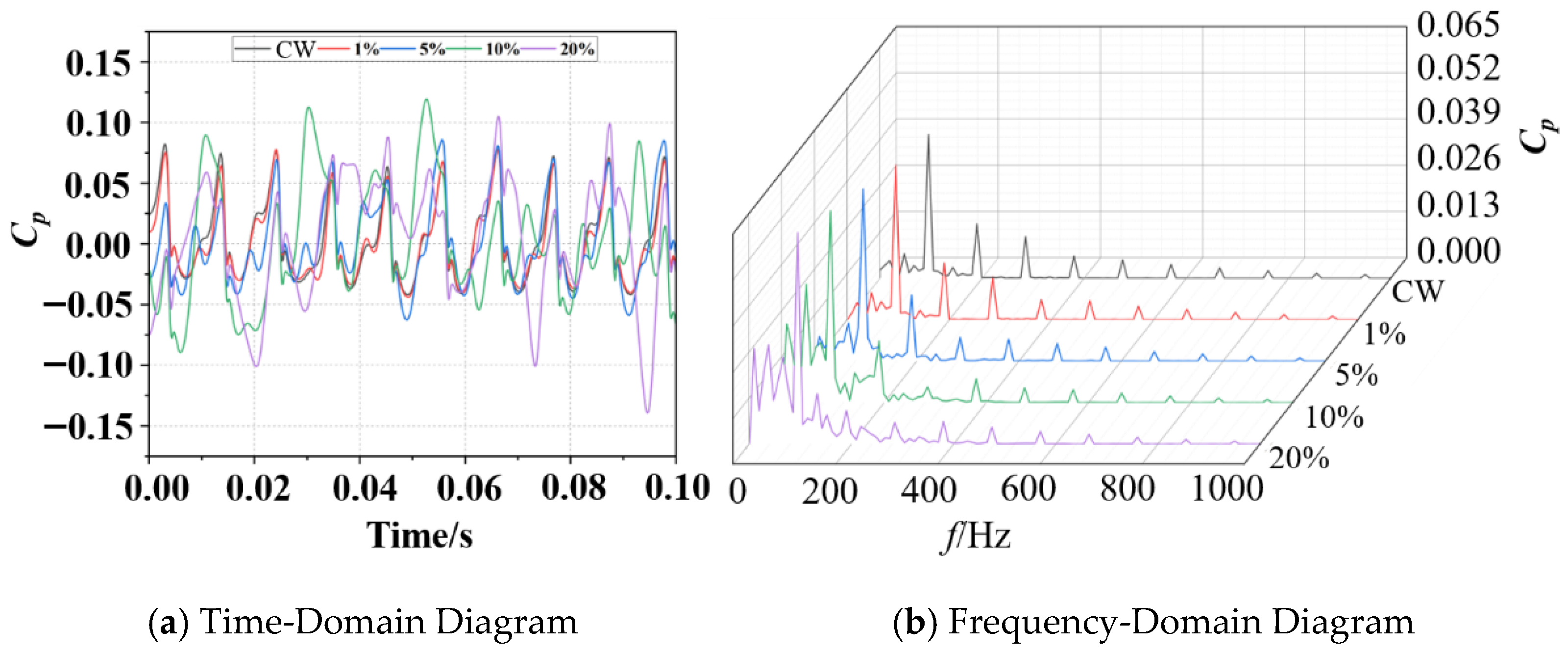
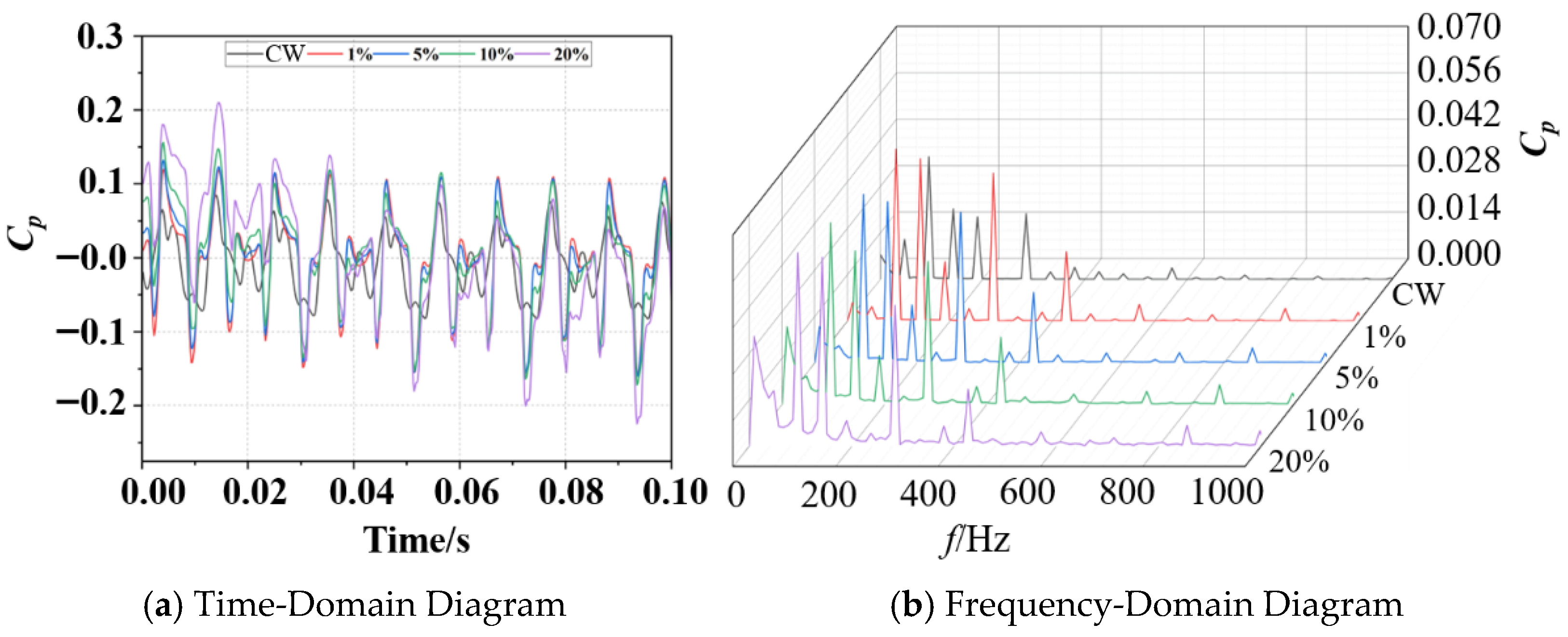
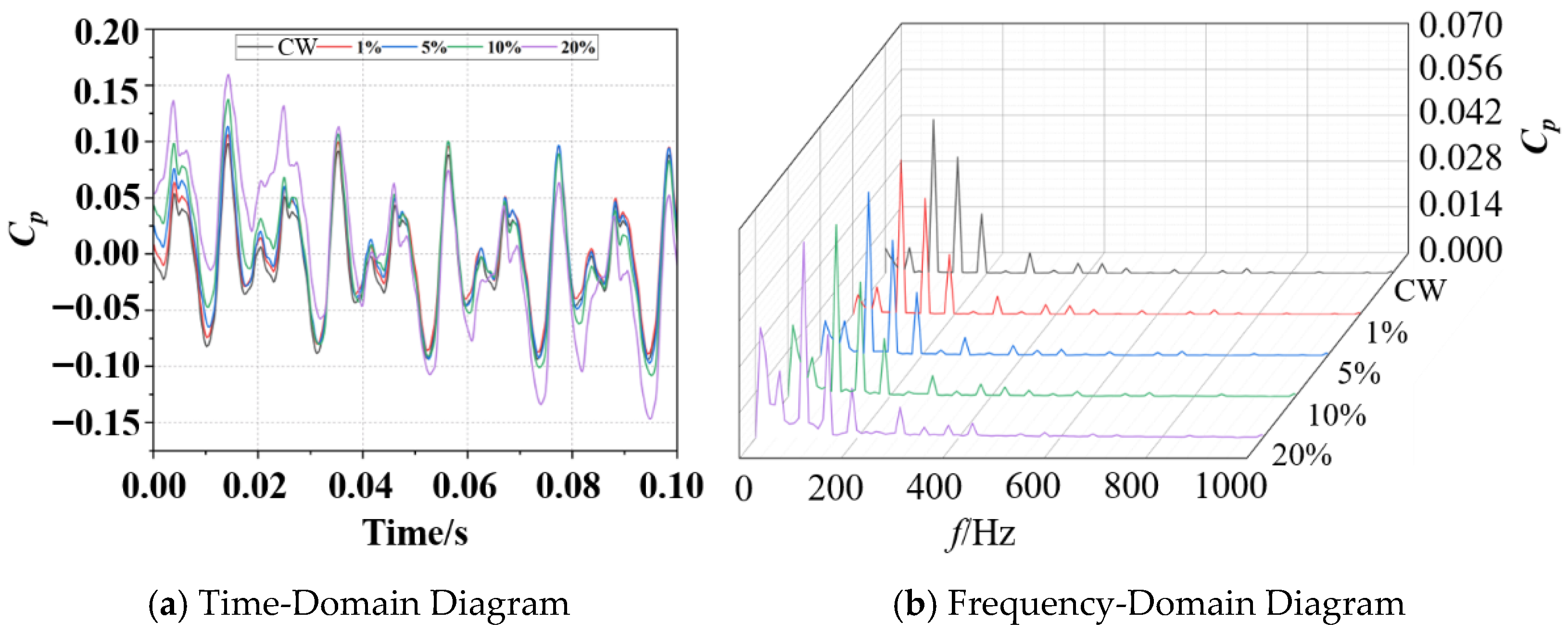
Figure 17, Figure 18, Figure 19 and Figure 20 show the time-domain and frequency-domain diagrams of the pressure pulsation coefficient Cp at monitoring points near the volute tongue and impeller working surface under the rated flow rate condition (with a fixed particle size of 1.0 mm) and different particle volume fraction conditions (1%, 5%, 10%, and 20%).
Time-Domain Characteristics (Figure 17a): The pulsation periods under the clear water condition and low particle volume fraction conditions are similar, while the Cp fluctuation range expands significantly under high particle volume fraction conditions. Specifically, the fluctuation range is (−0.0418 to 0.0818) for the clear water condition, expands to (−0.0895 to 0.1191) at a 10% volume fraction, and further expands to (−0.1393 to 0.1051) at a 20% volume fraction, representing an approximate 97.73% increase in fluctuation amplitude compared to the clear water condition. It can be seen that the impact of particle volume fraction on the pressure pulsation at Wg is significantly greater than that of particle size. The core reason is that an increase in the number of particles intensifies flow turbulence at the volute tongue, enhances the particle impact effect, and thus leads to a significant increase in pressure pulsation. Although the particle contact model is simplified, it effectively captures the dominant momentum transfer driving the pulsation surge. This mechanism aligns with recent findings in multiphase dynamics: Liu et al. [51] demonstrated the significance of impact loads during high-speed water-entry, while Huang et al. [52] highlighted the critical influence of discrete phase size on system performance. These studies collectively support our conclusion that the physical impact and size of the discrete phase are the primary drivers of flow instabilities.
Frequency-Domain Characteristics (Figure 17b): Under all conditions, the dominant frequency of Cp remains stable at the first-order blade frequency (95 Hz). The dominant frequency amplitudes show a slight increasing trend with the increase in particle volume fraction, and are 0.0404, 0.0436, 0.0485, 0.0534, and 0.0595 in ascending order of volume fraction (clear water, 1%, 5%, 10%, 20%). At a 20% volume fraction, the dominant frequency amplitude reaches 1.47 times that of the clear water condition. In addition, multiple low-frequency signals appear before the first-order dominant frequency under all conditions, and the amplitude of these low-frequency signals gradually decreases to zero as the frequency increases.
Figure 18 shows the time-domain and frequency-domain diagrams of the pressure pulsation coefficient Cp at monitoring point Y1 (near the inlet) on the impeller working surface under the clear water condition and different particle volume fraction conditions.
Time-Domain Characteristics (Figure 18a): All conditions exhibit consistent pulsation periodicity, but the Cp fluctuation range expands significantly as the particle volume fraction increases. Specifically, the fluctuation range is (−0.0821 to 0.0847) under the clear water condition and expands to (−0.2243 to 0.2099) at a 20% particle volume fraction, indicating that the internal flow of the pump exhibits complex nonlinear characteristics under high particle volume fraction conditions. This significant enhancement is driven by the intensified momentum exchange between phases. Due to the density difference, solid particles exhibit a phase lag (velocity slip) relative to the carrier fluid. This slip induces unstable wake structures behind the particles, which interact with the main flow field. As the particle volume fraction increases, the collective effect of these wake disturbances and the enhanced inter-particle collisions significantly amplifies the local pressure pulsation energy at the monitoring point.
Frequency-Domain Characteristics (Figure 18b): Under all conditions, the dominant frequency of Cp is concentrated around the first-order blade frequency (95 Hz). The maximum dominant frequency amplitudes, in ascending order of particle volume fraction (clear water, 1%, 5%, 10%, 20%), are 0.0370, 0.0518, 0.0507, 0.0547, and 0.0583, respectively, showing an overall slight increasing trend. In addition, high-frequency fluctuations with amplitudes close to that of the dominant frequency appear at both the 1.5th-order and 3.0th-order blade frequencies. This characteristic further reflects the periodic law of pressure pulsation induced by impeller rotation.
Figure 19 shows the time-domain and frequency-domain diagrams of the pressure pulsation coefficient Cp at monitoring point Y2 in the middle of the impeller working surface under the clear water condition and different particle volume fraction conditions.
Time-Domain Characteristics (Figure 19a): Under all conditions, Cp exhibits consistent periodicity. The fluctuation range is (−0.0937 to 0.0980) under the clear water condition and expands to (−0.1466 to 0.1597) at a 20% particle volume fraction, representing an approximate 59.78% increase in fluctuation amplitude compared to the clear water condition. Notably, the fluctuation range of pressure pulsation at Y2 is smaller than that at the impeller inlet monitoring point. The core reason is that as the particles flow from the impeller inlet to the middle of the flow passage, their motion state gradually becomes stable, which weakens the disturbance to the local flow field.
Frequency-Domain Characteristics (Figure 19b): Under all conditions, the dominant frequency of Cp is concentrated around the first-order blade frequency (95 Hz) and shows an increasing trend with the increase in particle volume fraction. The dominant frequency amplitudes, in ascending order of particle volume fraction (clear water, 1%, 5%, 10%, 20%), are 0.0469, 0.0472, 0.0499, 0.0525, and 0.0598, respectively. At a 20% particle volume fraction, the dominant frequency amplitude reaches 1.27 times that of the clear water condition. In addition, low-frequency fluctuations with weak intensity are mainly distributed around integer multiples of the blade frequency, and their amplitudes gradually approach zero as the frequency increases.
Figure 20 shows the time-domain and frequency-domain diagrams of the pressure pulsation coefficient Cp at monitoring point Y3 at the outlet of the impeller working surface under the clear water condition and different particle volume fraction conditions. Time-Domain Characteristics (Figure 20a): Under high particle volume fraction conditions, the positive Cp amplitude of pressure pulsation is significantly larger than the negative Cp amplitude. The fluctuation range is (−0.0667 to 0.0836) under the clear water condition and expands to (−0.1383 to 0.1348) at a 20% particle volume fraction, representing an approximate 81.70% increase in fluctuation amplitude compared to the clear water condition.
This phenomenon is attributed to the following: the impeller outlet area has a high flow velocity and strong rotor–stator interaction effect; moreover, the presence of particles changes the local flow pattern and increases the pressure gradient difference. These factors collectively lead to a significant intensification of pressure pulsation in the outlet area. Physically, this intense pulsation at the impeller outlet is driven by the high-speed impact of solid particles against the blade trailing edge. This mechanism directly mirrors the brittle impact dynamics observed in high-pressure water jet ice-breaking. As modeled by Yuan et al. [53], the kinetic energy transfer during such high-velocity solid-fluid collisions results in sharp pressure spikes, which explains why the pulsation amplitude in this region is so prone to amplification. Frequency-Domain Characteristics (Figure 20b): Under all conditions, the dominant frequency of Cp is concentrated around the first-order blade frequency (95 Hz) and shows an increasing trend with the increase in particle volume fraction. The dominant frequency amplitudes, in ascending order of particle volume fraction (clear water, 1%, 5%, 10%, 20%), are 0.0307, 0.0473, 0.0501, 0.0517, and 0.0627, respectively. At a 20% particle volume fraction, the dominant frequency amplitude reaches 2.04 times that of the clear water condition. In addition, there are many low-frequency signals under the clear water condition; as the particle volume fraction increases, these low-frequency signals gradually weaken and eventually disappear. This indicates that the increase in particle volume fraction makes the flow field more complex and exerts a significant regulatory effect on the pressure pulsation at the impeller outlet.

6. Conclusions

This study investigates the pressure pulsation characteristics of solid–liquid two-phase flow in a semi-open impeller sewage pump by combining experimentally validated unsteady numerical simulations with multi-scale time–frequency analysis. The effects of flow rate, particle size, and particle volume fraction on flow field instability are systematically analyzed. The main conclusions are as follows:
(1) Pressure pulsations exhibit significant spatial heterogeneity, being predominantly concentrated at the volute tongue and impeller outlet due to strong rotor–stator interaction. The blade-passing frequency (95 Hz) consistently dominates the spectra in these sensitive regions, driven by periodic vortex shedding at the interface.
(2) Solid particles significantly amplify pressure pulsations through interphase momentum exchange. Specifically, increasing the particle size or volume fraction intensifies the pulsation amplitude at the volute tongue, with a maximum observed increase of 97.73% compared to clear water conditions. Furthermore, the presence of particles suppresses low-frequency components, shifting the spectral dominance toward the primary frequency.
(3) The rotor–stator interaction is the fundamental source of pulsations, while solid particles act as an intensifying agent by exacerbating flow instability. Crucially, the dominant frequency remains fixed at 95 Hz across all particle parameters, confirming that impeller rotation governs periodicity, whereas particles modulate the pulsation amplitude and frequency distribution.
Overall, this study provides valuable insights into the mechanisms of flow-induced pressure pulsations. Beyond theoretical analysis, the findings offer direct engineering value: the quantified 97.73% pulsation increase at the volute tongue serves as a critical input for fatigue life prediction. Targeting these sensitive regions for structural reinforcement or geometric optimization can effectively mitigate vibration risks associated with the dominant blade-passing frequency, thereby extending the operational lifespan of sewage treatment systems.
Finally, regarding the generalizability of these findings, the scope of this study is currently limited to a specific semi-open impeller pump geometry operating at the rated speed. While the quantitative pulsation amplitudes may vary with different blade numbers or rotational speeds, the identified qualitative mechanisms—specifically the influence of particle concentration on spectral energy distribution—are expected to be applicable to similar solid–liquid transport systems. Future investigations will address these geometric and operational variations to provide more comprehensive design guidelines.

Author Contributions

Conceptualization, H.W. (Hongliang Wang) and C.W.; Methodology, H.W. (Hongliang Wang); Software, H.W. (Hongliang Wang) and A.L.; Validation, S.L., Z.S. and F.M.; Formal Analysis, H.W. (Hongliang Wang), Z.S. and X.C.; Investigation, S.L., G.L. and X.C.; Resources, C.W. and G.L.; Data Curation, S.L. and A.L.; Writing—Original Draft Preparation, H.W. (Hongliang Wang); Writing—Review and Editing, C.W. and H.W. (Hui Wang); Visualization, H.W. (Hongliang Wang) and F.M.; Supervision, C.W. and H.W. (Hui Wang); Project Administration, H.W. (Hui Wang); Funding Acquisition, C.W. and H.W. (Hui Wang). All authors have read and agreed to the published version of the manuscript.

Funding

This research was funded by the Postgraduate Practical Innovation Project of Changzhou Institute of Technology, grant number YSJCX2025001.

Data Availability Statement

The original contributions presented in this study are included in the article. Further inquiries can be directed to the corresponding authors.

Conflicts of Interest

The authors declare no conflict of interest.

References

  1. Xue, Y.; Wang, X.; Yuan, G.; Ni, B.Y.; Xu, X.; Song, J. Numerical simulation study on ice breaking by a submerged water jet. Phys. Fluids 2024, 36, 113302. [Google Scholar] [CrossRef]
  2. Kong, D.; Zhu, Y.; Liu, C.; Niu, X.; Guo, T. Numerical analysis of flow and heat transfer characteristics of unsteady film cooling of HPT shroud under high-speed rotation sweeping of the rotor blade. Int. Commun. Heat Mass Transf. 2023, 149, 107142. [Google Scholar] [CrossRef]
  3. Li, Y.; Li, Y.; Ni, B.J.; Li, Y.Z.; Ni, S.Q. Towards scalable anammox: Mechanistic insights and emerging strategies. Trends Biotechnol. 2025, in press. [Google Scholar] [CrossRef]
  4. Zhang, N.; Li, D.; Gao, B.; Ni, D.; Li, Z. Unsteady pressure pulsations in pumps—A review. Energies 2022, 16, 150. [Google Scholar] [CrossRef]
  5. Spence, R.; Amaral-Teixeira, J. Investigation into pressure pulsations in a centrifugal pump using numerical methods supported by industrial tests. Comput. Fluids 2008, 37, 690–704. [Google Scholar] [CrossRef]
  6. Tang, X.; Zou, M.; Wang, F.; Li, X.; Shi, X. Comprehensive numerical investigations of unsteady internal flows and cavitation characteristics in double-suction centrifugal pump. Math. Probl. Eng. 2017, 2017, 5013826. [Google Scholar] [CrossRef]
  7. Zhang, N.; Yang, M.; Gao, B.; Li, Z.; Ni, D. Experimental investigation on unsteady pressure pulsation in a centrifugal pump with special slope volute. J. Fluids Eng. 2015, 137, 061103. [Google Scholar] [CrossRef]
  8. Ding, H.; Lin, F.; Chang, T.; Ge, F. Numerical study on the effect of blade trailing edge filing on performance and unsteady pressure pulsation in low specific speed centrifugal pump. J. Vib. Eng. Technol. 2024, 12, 233–245. [Google Scholar] [CrossRef]
  9. Bai, L.; Zhou, L.; Han, C.; Zhu, Y.; Shi, W. Numerical study of pressure fluctuation and unsteady flow in a centrifugal pump. Processes 2019, 7, 354. [Google Scholar] [CrossRef]
  10. Zhang, S.; Chen, H.; Ma, Z.; Wang, D.; Ding, K. Unsteady flow and pressure pulsation characteristics in centrifugal pump based on dynamic mode decomposition method. Phys. Fluids 2022, 34, 112014. [Google Scholar] [CrossRef]
  11. Cui, B.; Zhang, Y.; Huang, Y. Analysis of the pressure pulsation and vibration in a low-specific-speed centrifugal pump. J. Fluids Eng. 2021, 143, 021201. [Google Scholar] [CrossRef]
  12. Wu, X.; Li, C.; Luo, X.; Feng, J.; Zhu, G. Revealing the evolution of flow structure and pressure fluctuations in a multiphase pump under varying gas phase conditions. Phys. Fluids 2025, 37, 043301. [Google Scholar] [CrossRef]
  13. Xiang, R.; Wang, T.; Fang, Y.; Yu, H.; Zhou, M.; Zhang, X. Effect of blade curve shape on the hydraulic performance and pressure pulsation of a pump as turbine. Phys. Fluids 2022, 34, 085130. [Google Scholar] [CrossRef]
  14. Al-Obaidi, A.R. Investigation of the influence of various numbers of impeller blades on internal flow field analysis and the pressure pulsation of an axial pump based on transient flow behavior. Heat Transf. 2020, 49, 2000–2024. [Google Scholar] [CrossRef]
  15. Zhang, J.; Li, G.; Mao, J.; Yuan, S.; Qu, Y.; Jia, J. Numerical investigation of the effects of splitter blade deflection on the pressure pulsation in a low specific speed centrifugal pump. Proc. Inst. Mech. Eng. Part A J. Power Energy 2020, 234, 420–432. [Google Scholar] [CrossRef]
  16. Gao, Z.; Zhu, W.; Lu, L.; Deng, J.; Zhang, J.; Wuang, F. Numerical and experimental study of unsteady flow in a large centrifugal pump with stay vanes. J. Fluids Eng. 2014, 136, 071101. [Google Scholar] [CrossRef]
  17. Wu, C.; Li, Q.; Zheng, F.; Wu, P.; Yang, S.; Ye, H.; Huang, B.; Wu, D. Improve of unsteady pressure pulsation based on jet–wake suppression for a low specific centrifugal pump. J. Fluids Eng. 2021, 143, 111202. [Google Scholar] [CrossRef]
  18. Zhang, N.; Yang, M.; Gao, B.; Li, Z.; Ni, D. Experimental and numerical analysis of unsteady pressure pulsation in a centrifugal pump with slope volute. J. Mech. Sci. Technol. 2015, 29, 4231–4238. [Google Scholar] [CrossRef]
  19. Parrondo-Gayo, J.L.; González-Pérez, J.; Fernández-Francos, J.N. The effect of the operating point on the pressure pulsations at the blade passage frequency in the volute of a centrifugal pump. J. Fluids Eng. 2002, 124, 784–790. [Google Scholar] [CrossRef]
  20. Duan, X.; Tang, F.; Duan, W.; Zhou, W.; Shi, L. Experimental investigation on the correlation of pressure pulsation and vibration of axial flow pump. Adv. Mech. Eng. 2019, 11, 1687814019889473. [Google Scholar] [CrossRef]
  21. Yang, F.; Li, Z.; Fu, J.; Lv, Y.; Ji, Q.; Jian, H. Numerical and experimental analysis of transient flow field and pressure pulsations of an axial-flow pump considering the pump–pipeline interaction. J. Mar. Sci. Eng. 2022, 10, 258. [Google Scholar] [CrossRef]
  22. Duan, X.; Tang, F.; Duan, W. Improved robust stability criteria for uncertain linear neutral-type systems via novel Lyapunov-Krasovskii functional. Asian J. Control 2020, 22, 976–987. [Google Scholar] [CrossRef]
  23. Jiang, D.; Yang, F.; Cai, Y.; Xu, G.; Tang, F.; Jin, Y. Cross influence of rotational speed and flow rate on pressure pulsation and hydraulic noise of an axial-flow pump. Phys. Fluids 2023, 35, 095144. [Google Scholar] [CrossRef]
  24. Wu, D.; Bai, Y. Numerical simulation of flow-induced noise in horizontal axial flow pumps in forward and reverse conditions. Water 2023, 15, 322. [Google Scholar] [CrossRef]
  25. Qiu, J.T.; Liu, T.Y.; Liu, X.Y.; Dai, Y.X.; Wang, Z.L.; Cai, Y.L. Experimental and numerical study on cavitation pulsating pressure of water-jet propulsion axial-flow pump. PLoS ONE 2024, 19, e0310167. [Google Scholar] [CrossRef]
  26. Spence, R.; Amaral-Teixeira, J. A CFD parametric study of geometrical variations on the pressure pulsations and performance characteristics of a centrifugal pump. Comput. Fluids 2009, 38, 1243–1257. [Google Scholar] [CrossRef]
  27. Gangipamula, R.; Ranjan, P.; Patil, R.S. Flow-induced noise sources and reduction methods in centrifugal pumps: A literature review. Phys. Fluids 2022, 34, 081302. [Google Scholar] [CrossRef]
  28. Wang, H.; Yang, Y.; Che, Q.; Hou, J.; Liu, D.; Ji, L.; Zhou, L.; Li, H.; He, Z. Parameterised analysis of blade profiles within electric submersible pump for enhancing energy conversion efficiency. Eng. Appl. Comput. Fluid Mech. 2025, 19, 2532520. [Google Scholar] [CrossRef]
  29. Zhang, L.; Wang, X.; Wu, P.; Huang, B.; Wu, D. Optimization of a centrifugal pump to improve hydraulic efficiency and reduce hydro-induced vibration. Energy 2023, 268, 126677. [Google Scholar] [CrossRef]
  30. Cui, B.; Li, J.; Zhang, C.; Zhang, Y. Analysis of radial force and vibration energy in a centrifugal pump. Math. Probl. Eng. 2020, 2020, 6080942. [Google Scholar] [CrossRef]
  31. Zhou, W.; Ma, J.; Ma, Z.; Yu, W.; Gao, B. Multi-scale fluid-induced vibration characteristics of centrifugal pump based on fluid–structure interaction method. Phys. Fluids 2025, 37, 027163. [Google Scholar] [CrossRef]
  32. Sun, T.; Yao, Y.; Zhang, J.; Yang, L. Analysis of vibration characteristics of the centrifugal pump base on CFD. In Proceedings of the 2021 7th International Symposium on Mechatronics and Industrial Informatics (ISMII), Zhuhai, China, 22–24 January 2021; pp. 168–171. [Google Scholar] [CrossRef]
  33. Ye, S.; Zhang, J.; Xu, B.; Zhu, S.; Xiang, J.; Tang, H. Theoretical investigation of the contributions of the excitation forces to the vibration of an axial piston pump. Mech. Syst. Signal Process. 2019, 129, 201–217. [Google Scholar] [CrossRef]
  34. Bai, L.; Zhou, L.; Jiang, X.; Pang, Q.; Ye, D. Vibration in a multistage centrifugal pump under varied conditions. Shock Vib. 2019, 2019, 2057031. [Google Scholar] [CrossRef]
  35. Shi, L.; Zhu, J.; Yuan, Y.; Tang, F.; Huang, P.; Zhang, W.; Liu, H.; Zhang, X. Numerical Simulation and Experiment of the Effects of Blade Angle Deviation on the Hydraulic Characteristics and Pressure Pulsation of an Axial-Flow Pump. Shock Vib. 2021, 2021, 6673002. [Google Scholar] [CrossRef]
  36. Ding, H.; Chang, T.; Lin, F. The influence of the blade outlet angle on the flow field and pressure pulsation in a centrifugal fan. Processes 2020, 8, 1422. [Google Scholar] [CrossRef]
  37. Cui, B.; Li, W.; Zhang, C. Effect of blade trailing edge cutting angle on unstable flow and vibration in a centrifugal pump. J. Fluids Eng. 2020, 142, 101203. [Google Scholar] [CrossRef]
  38. Chen, C.; Ma, J.; Liu, R.; Zhou, P. Experimental Study on Centrifugal Pump Vibration in Different Operation Conditions. Noise Vib. Control 2012, 32, 199–202. [Google Scholar] [CrossRef]
  39. Yang, J.; Yuan, S.; Yuan, J.; Si, Q.; Pei, J. Numerical and experimental study on flow-induced noise at blade-passing frequency in centrifugal pumps. Chin. J. Mech. Eng. 2014, 27, 606–614. [Google Scholar] [CrossRef]
  40. Wang, X.; Li, H.; Baoyin, H.; Han, S.; Bao, C. Aerodynamic optimization of wind turbine blades via surrogate-assisted deep reinforcement learning. Phys. Fluids 2025, 37, 047141. [Google Scholar] [CrossRef]
  41. Gu, J.; Gao, B.; Zhang, N.; Liu, S.; Ni, D.; Zhou, W. Numerical analysis on the contributions of flow-induced noise sources in a centrifugal pump. Phys. Fluids 2025, 37, 055136. [Google Scholar] [CrossRef]
  42. Pei, J.; Yuan, S.; Yuan, J. Numerical analysis of periodic flow unsteadiness in a single-blade centrifugal pump. Sci. China Technol. Sci. 2013, 56, 212–221. [Google Scholar] [CrossRef]
  43. Wang, Z.; Yao, K.; Xin, X.; Huang, R.; Chang, J. Experimental and numerical simulation of shock train characteristics in the concave channel. J. Propuls. Power 2025, 41, 602–623. [Google Scholar] [CrossRef]
  44. Jia, Y.; Liu, Y.; He, X.; Meng, Z.; Zhao, S. Arrangement guideline of film holes along conjugate temperature difference in turbine guide vanes. Chin. J. Aeronaut. 2025, 38, 103400. [Google Scholar] [CrossRef]
  45. Wang, H.; Yang, Y.; Ge, H.; Chen, P.; Che, Q.; Yao, Y.; Ji, L.; Zhou, L.; Li, H.; He, Z. CFD-DEM Simulation of particle transport in solid–liquid flow within a semi-open centrifugal pump. Eng. Appl. Comput. Fluid Mech. 2025, 19, 2585367. [Google Scholar] [CrossRef]
  46. Yuan, G.Y.; Ni, B.Y.; Wu, Q.G.; Xue, Y.Z.; Han, D.F. Ice breaking by a high-speed water jet impact. J. Fluid Mech. 2022, 934, A1. [Google Scholar] [CrossRef]
  47. Yuan, G.; Wang, X.; Ni, B.; Xu, W.; Yang, D.; Xue, Y. Experimental study on load characteristic and icebreaking process of submerged Venturi cavitating water jets. J. Fluids Struct. 2025, 137, 104374. [Google Scholar] [CrossRef]
  48. Zhang, H.; Li, K.; Liu, T.; Liu, Y.; Hu, J.; Zuo, Q.; Jiang, L. Analysis of radial hydraulic forces in centrifugal pump operation via hierarchical clustering (HC) algorithms. Appl. Sci. 2025, 15, 10251. [Google Scholar] [CrossRef]
  49. HaiChao, C.; Wenlong, H.; Zuyuan, L.; Baiwei, F.; Qiang, Z. Enhancing surrogate model accuracy in ship design optimization through intelligent constraint-aware sample selection. Eng. Appl. Artif. Intell. 2026, 163, 112716. [Google Scholar] [CrossRef]
  50. Wang, H.; Li, A.; Wang, C.; Liu, S.; Shi, Y.; Yu, H.; Wang, X.; Jia, X. Influence mechanism of particle diameter and volume fraction on the solid-liquid two-phase flow performance of semi-open impeller sewage pumps. Water 2025, 18, 74. [Google Scholar] [CrossRef]
  51. Liu, X.; Cai, X.; Huang, Z.; Hou, Y.; Qin, J.; Chen, Z. Comparative study on the oblique water-entry of high-speed projectile based on rigid-body and elastic-plastic body model. Def. Technol. 2025, 46, 133–155. [Google Scholar] [CrossRef]
  52. Huang, J.; Li, Y.; Zhou, Z.; Xiang, M. Study on the impact of the atomized water droplet size on the performance of magnesium-based water ramjet engine. Appl. Therm. Eng. 2025, 279, 127849. [Google Scholar] [CrossRef]
  53. Yuan, G.Y.; Ni, B.Y.; Liu, P.; Kim, D.K. Ice damage characteristics under high-pressure water jet based on Johnson–Holmquist II brittle constitutive model. Phys. Fluids 2025, 37, 086153. [Google Scholar] [CrossRef]
Figure 1. A physical diagram of the sewage pump.
Water 18 00317 g001
Figure 2. Computational fluid domain.
Water 18 00317 g002
Figure 3. A schematic of the fluid-domain mesh for a centrifugal pump.
Water 18 00317 g003
Figure 4. A verification of time step independence for pressure pulsation at the volute tongue.
Water 18 00317 g004
Figure 5. Local details of the pipeline arrangement.
Water 18 00317 g005
Figure 6. A schematic diagram of the closed-loop performance testing system. 1 Test pump. 2 Outlet pressure sensor. 3 Electromagnetic flowmeter. 4 Data acquisition and control center. 5 Inlet pressure sensor. 6 Inlet valve. 7 Water tank. 8 Outlet regulation valve.
Water 18 00317 g006
Figure 7. A comparison diagram of external characteristic simulation and experimental data.
Water 18 00317 g007
Figure 8. Distribution diagram of volute and impeller monitoring points.
Water 18 00317 g008
Figure 9. Pressure pulsation for monitoring points Y1~Y6 under different flow conditions.
Water 18 00317 g009
Figure 10. Frequency-domain diagram of pressure pulsation for monitoring points Y1~Y6.
Water 18 00317 g010
Figure 11. Pressure pulsation for monitoring points Wg~W8 inside the volute under different flow conditions.
Water 18 00317 g011aWater 18 00317 g011b
Figure 12. Frequency-domain diagram of pressure pulsation for monitoring points Wg~W8.
Water 18 00317 g012aWater 18 00317 g012b
Figure 13. Time-domain and frequency-domain diagrams of pressure pulsation at monitoring point Wg under different particle size conditions.
Water 18 00317 g013
Figure 14. Time-domain and frequency-domain diagrams of pressure pulsation at monitoring point Y1 under different particle size conditions.
Water 18 00317 g014
Figure 15. Time-domain and frequency-domain diagrams of pressure pulsation at monitoring point Y2 under different particle size conditions.
Water 18 00317 g015
Figure 16. Time-domain and frequency-domain diagrams of pressure pulsation at monitoring point Y3 under different particle size conditions.
Water 18 00317 g016
Figure 17. Time-domain and frequency-domain diagrams of pressure pulsation at monitoring point Wg under different particle volume fraction conditions.
Water 18 00317 g017
Figure 18. Time-domain and frequency-domain diagrams of pressure pulsation at monitoring point Y1 under different particle volume fraction conditions.
Water 18 00317 g018
Figure 19. Time-domain and frequency-domain diagrams of pressure pulsation at monitoring point Y2 under different particle volume fraction conditions.
Water 18 00317 g019
Figure 20. Time-domain and frequency-domain diagrams of pressure pulsation at monitoring point Y3 under different particle volume fraction conditions.
Water 18 00317 g020
Table 1. The parameters of the sewage pump.
Flow Rate Q (m3/h)Head H (m)Rotational Speed n (r/min)Motor Power P (kW)
451528504
Table 2. Grid independence analysis.
SchemeImpeller Grid NumberVolute Grid NumberTotal Grid NumberHead (m)EfficiencyAverage
y+
1320,515268,4121,422,23414.7656.70%85.2
2826,5411,026,5413,614,79414.7353.06%68.5
31,053,0001,185,5454,264,69714.5149.94%55.4
42,003,2002,041,5365,601,87014.5250.11%42.8
53,740,1602,587,4418,363,27114.5150.02%35.1
Table 3. Grid–head coefficient analysis.
Scheme12345
Grid Number1,422,2343,614,7944,264,6975,601,8708,363,271
Head Coefficient0.61070.60950.60040.60080.6004
Disclaimer/Publisher’s Note: The statements, opinions and data contained in all publications are solely those of the individual author(s) and contributor(s) and not of MDPI and/or the editor(s). MDPI and/or the editor(s) disclaim responsibility for any injury to people or property resulting from any ideas, methods, instructions or products referred to in the content.