Hydrogeochemical Characteristics and Formation Mechanism of Metasilicic Acid Mineral Water at Taoping Water Source Area


Abstract
1. Introduction
2. Research Area Overview
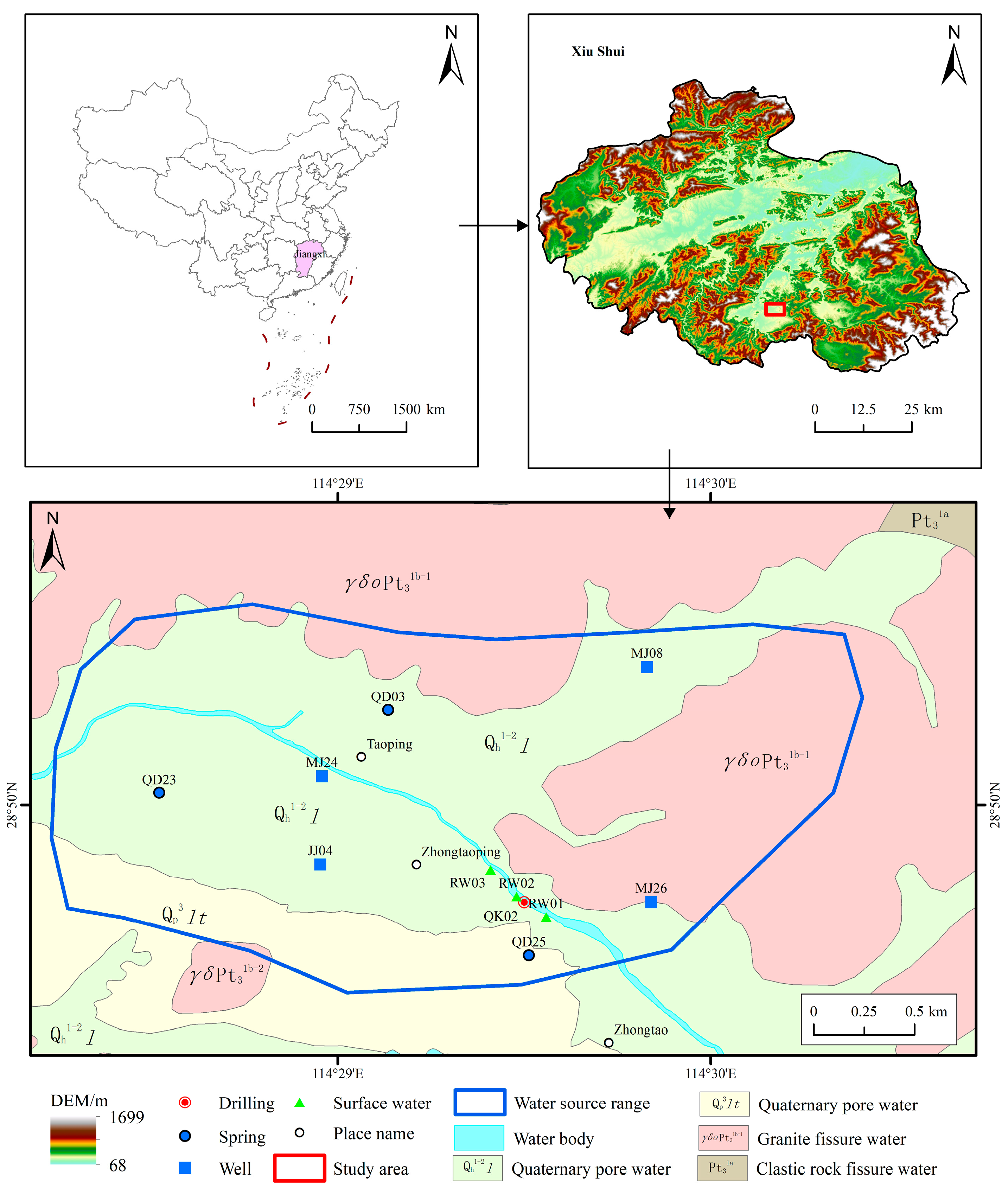
2.1. Geographical Location
2.2. Geological Conditions
2.3. Hydrogeological Conditions
2.4. Groundwater Recharge and Drainage Conditions
3. Materials and Methods
4. Analysis and Discussion
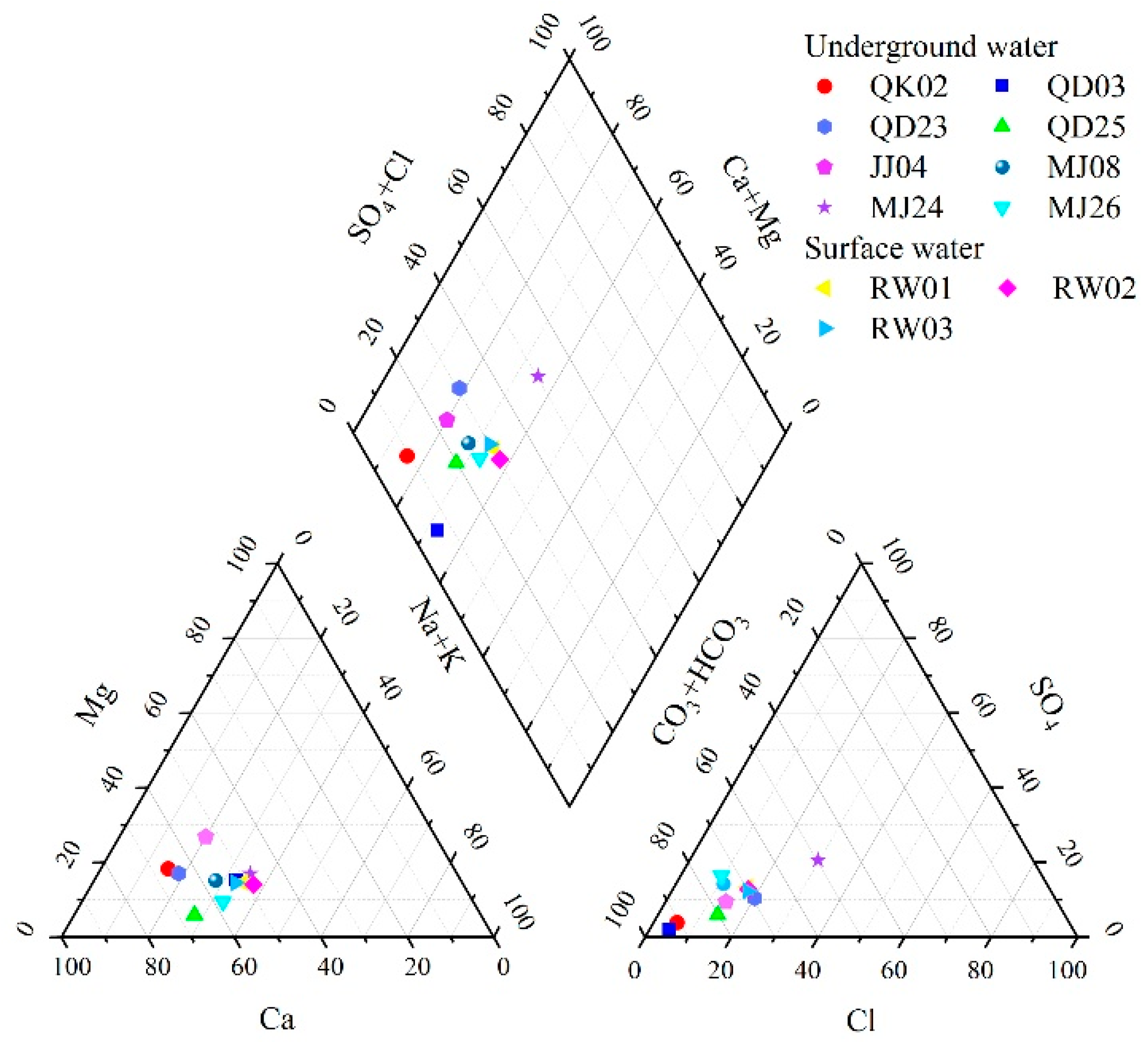
4.1. Distribution and Hydrochemical Characteristics of Metasilicic Acid-Type Mineral Waters
4.1.1. Ionic Characteristics of Metasilicic Acid and Key Water Chemistry
4.1.2. Pearson Correlation Analysis
4.2. Analysis of Hydrochemical Component Sources
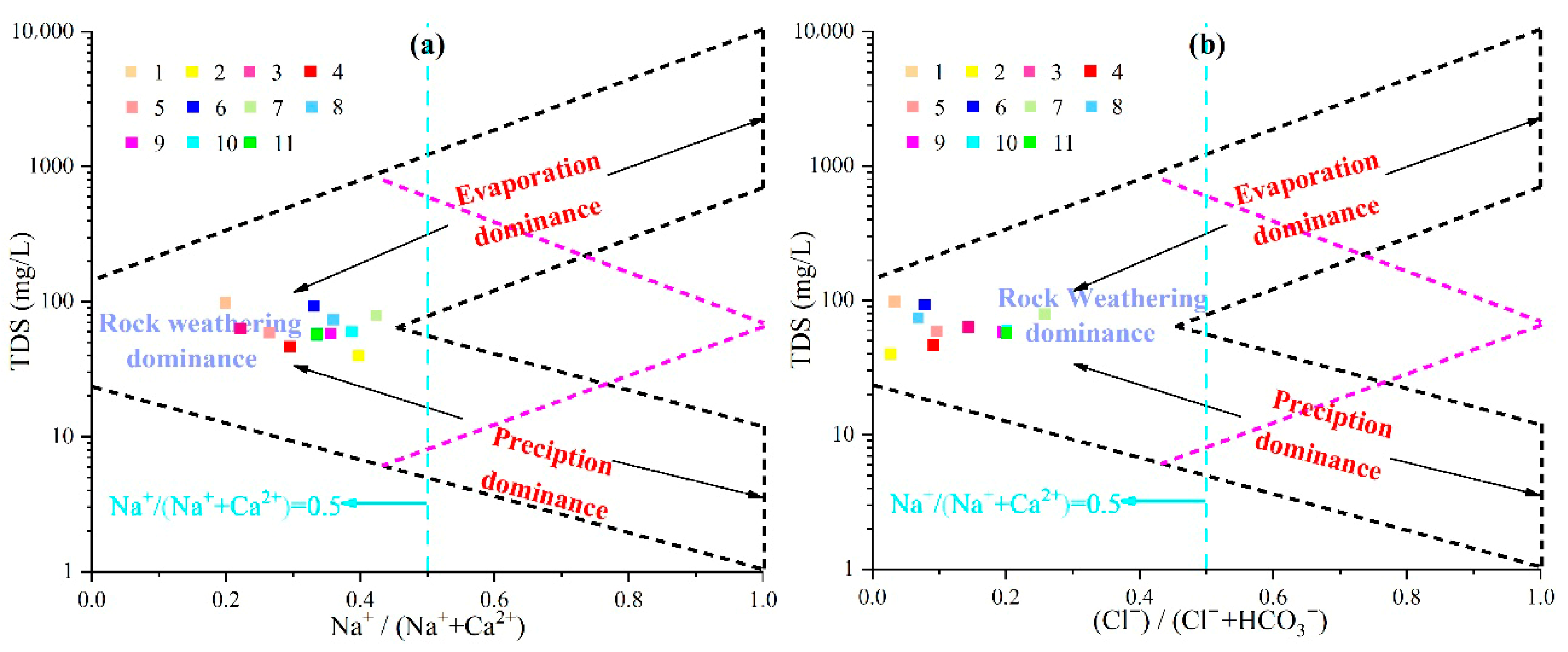
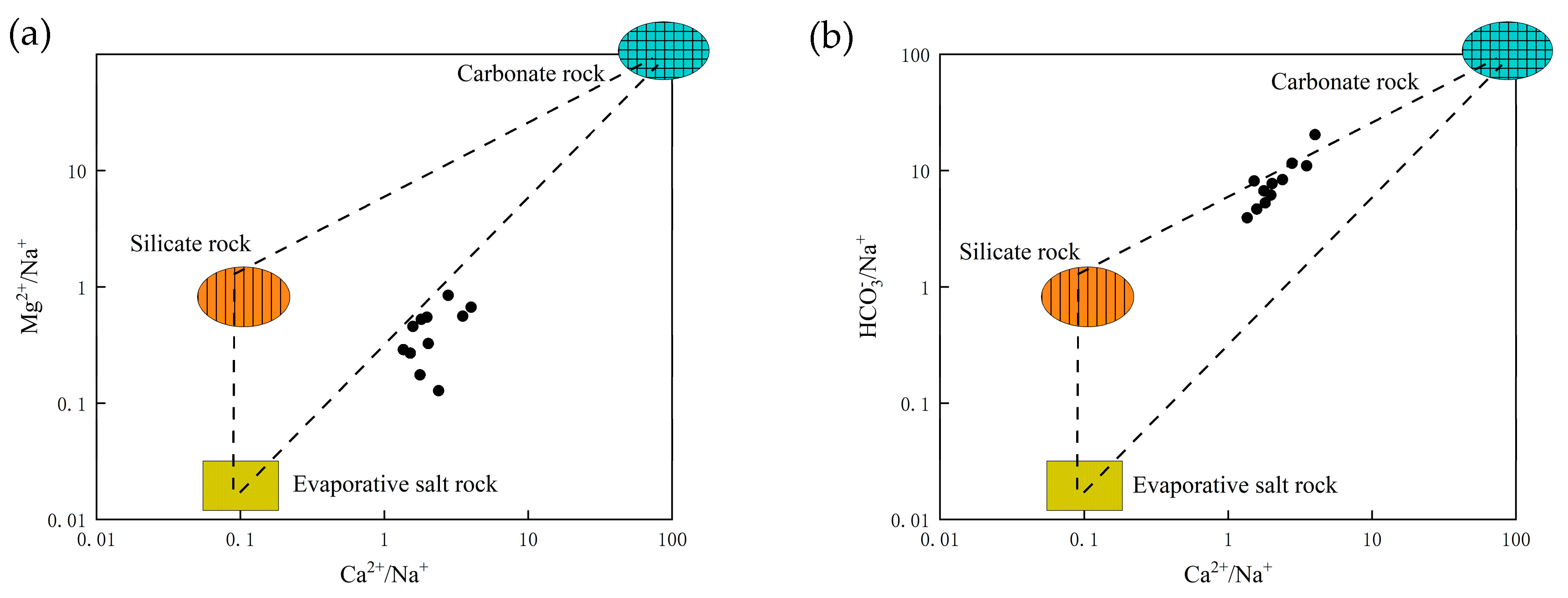
4.2.1. Gibbs and Three-Component Diagrams
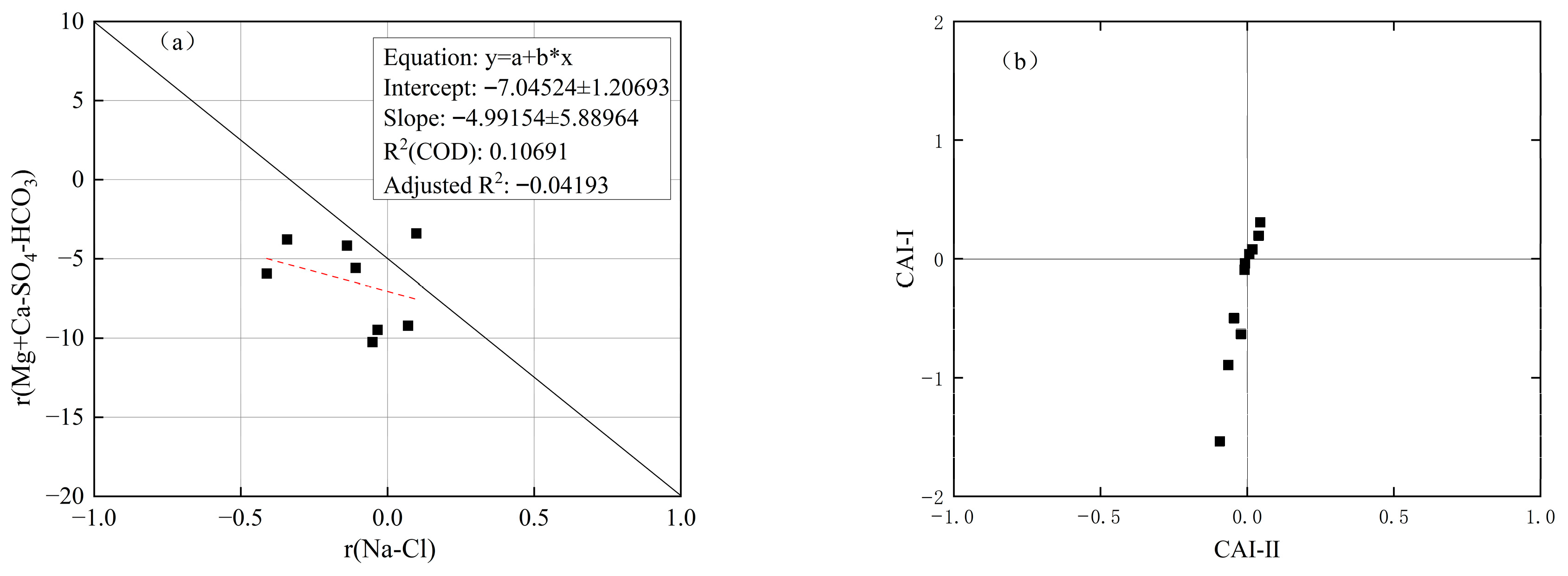
4.2.2. Chlor-Alkali Index (CAI)
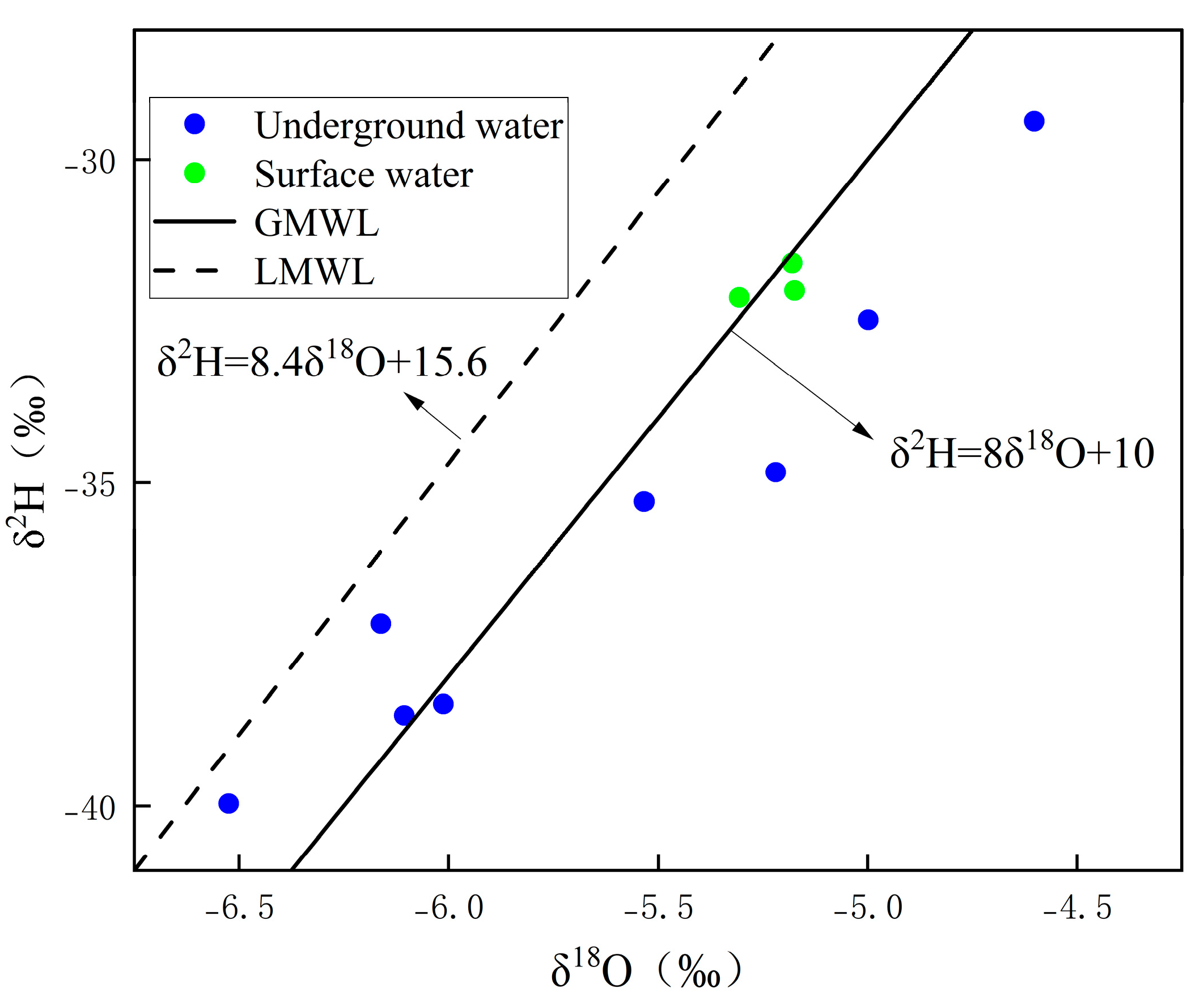
4.3. Analysis of Supply Sources and Ages
5. Conclusions
- (1)
- The groundwater in this magmatic rock terrain is characterized by low salinity (TDS < 100 mg/L) and metasilicic acid-enriched characteristics, qualifying as high-quality metasilicic acid mineral water. The strata contain abundant carbonates and dolomites, resulting in high contents of Ca2+ and Mg2+ ions. The dominant hydrochemical facies are HCO3−–Ca·Na, HCO3−–Ca·Mg, and HCO3−–Ca types.
- (2)
- Ionic ratio analysis indicates that the enrichment of silicic acid in groundwater is mainly controlled by the weathering and leaching of silicate minerals, with cation exchange adsorption serving as a secondary contributing process.
- (3)
- Stable isotopic (18O and δ2H) analyses show that both surface water and groundwater share a common recharge source—atmospheric precipitation. However, surface water showed greater isotopic enrichment owing to enhanced evaporation during its exposure to the atmosphere. Tritium (3H) dating results suggest that the groundwater in the study area has a residence time of approximately 60 years, reflecting long-term water–rock interactions and significant hydrogeochemical evolution.
Author Contributions
Funding
Data Availability Statement
Conflicts of Interest
References
- Chen, J.; Malhi, K.K.; Li, X.; Xu, X.; Kang, J.; Zhao, B.; Xu, Y.; Li, X.; Li, J. Metasilicate-based alkaline mineral water improves the growth performance of weaned piglets by maintaining gut-liver axis homeostasis through microbiota-mediated secondary bile acid pathway. Anim. Nutr. 2025, 20, 95–109. [Google Scholar] [CrossRef]
- Chen, J.; Xu, X.; Kang, J.; Zhao, B.; Xu, Y.; Li, J. Metasilicate-based alkaline mineral water confers diarrhea resistance in maternally separated piglets via the microbiota-gut interaction. Pharmacol. Res. 2023, 187, 106580. [Google Scholar] [CrossRef]
- Yang, X.; Jia, C.; Zhu, H.; Liu, Z.; Liu, Z. Characteristics and genesis of high-quality metasilicate mineral water in Liaocheng City, Shandong Province. Environ. Monit. Assess. 2024, 196, 1155. [Google Scholar] [CrossRef]
- Xu, M.; Hu, C.; Zhu, L.; Song, G.; Peng, W.; Yang, S.; Song, J. Spatial Distribution Characteristics and Genetic Mechanism of the Metasilicate-Rich Groundwater in Ji’nan Rock Mass Area, Shandong Province, China. Water 2023, 15, 713. [Google Scholar] [CrossRef]
- Kong, F.; Xue, Y.; Qiu, D.; Su, M.; Gong, H.; Wang, X. Assessment of the Mineralization Processes of Potable Natural Mineral Water Using the Chemical Thermodynamics Analysis. Pol. J. Environ. Stud. 2021, 31, 121–134. [Google Scholar] [CrossRef] [PubMed]
- Bian, J.; Li, Y.; Ma, Y.; Li, J.; Yu, Y.; Sun, W. Study on hydrochemical characteristics and formation process of Antu mineral water in Changbai Mountain, China. Water 2022, 14, 2770. [Google Scholar] [CrossRef]
- Li, Y.; Bian, J.; Li, J.; Ma, Y.; Auguiano, J.H.H. Hydrochemistry and stable isotope indication of natural mineral water in Changbai Mountain, China. J. Hydrol. Reg. Stud. 2022, 40, 101047. [Google Scholar] [CrossRef]
- He, J.; Ma, X.; Deng, Q.; Li, W.; Ma, X.; Zheng, Y.; Liu, Z. Hydrochemical characteristics and formation mechanism of metasilicate mineral water in a Cenozoic basaltic aquifer in Zhangbei County, Hebei Province. Geol. China 2021, 50, 1887–1902. [Google Scholar]
- Liu, Y.; Li, M.; Zhang, Y.; Wu, X.; Zhang, C. Analysis of the hydrogeochemical characteristics and origins of groundwater in the changbai mountain region via inverse hydrogeochemical modeling and unsupervised machine learning. Water 2024, 16, 1853. [Google Scholar] [CrossRef]
- Shan, T.; Xu, S.; Fan, Z.; Ruan, W. Characteristics and formation mechanism of metasilicate mineral water in Xishan mountain of Kunming. J. Kunming Univ. Sci. Technol. (Nat. Sci.) 2019, 44, 39–47. [Google Scholar]
- Fang, Z.; Bian, J.; Sun, X.; Tian, X. Mineral water formation mechanism and process modeling in Fusong County. Sci. Technol. Eng. 2017, 17, 39–44. [Google Scholar]
- Zhu, Z.; Xiao, C.; Liang, X.; Yang, W.; Jia, L. Hydrochemical characteristics and formation mechanism of metasilicic acid type natural mineral water in basalt area of Antu County. Water Resour. Hydropower Eng. 2021, 52, 146–156. [Google Scholar]
- Sun, H.; Sun, X.; Wei, X.; Chen, Z.; Liu, W.; Huang, X.; Li, X.; Yin, Z.; Liu, W. Formation mechanism of metasilicate mineral water in Chengde, Hebei Province: Evidence from rock weathering and water-rock interaction. Geol. China 2022, 49, 1088–1113. [Google Scholar]
- Wang, X.; Wang, Y.; Gao, G.; Li, M.; An, H.; Mao, K.; Wang, Y.; You, Y.; Gong, L. Hydrochemical Characteristics and Genesis of Groundwater in Taoshan Granite Body, Yushan Uplift Area, South Jiangxi, China. Water 2025, 17, 974. [Google Scholar] [CrossRef]
- Deng, J.; Xu, F.; Bai, X.; Ye, H. Study on the Distribution Patterns and Formation Mechanism of Natural Drinking Mineral Water in Jiangxi Province. Jiangxi Sci. 2024, 42, 1190–1197. [Google Scholar]
- Gong, L.; Wang, X.; Song, M.; Hu, Q.; Liao, S.; Chen, H. Hydrochemical characteristics and water quality health function evaluation of potential metasilicate mineral water in Xingguo County, Jiangxi Province. Rock Miner. Anal. 2021, 40, 894–906. [Google Scholar]
- Wang, P.; Cao, Y.; Feng, N.; Zhao, Y.; Wang, Z.; Zhong, B. Discovery and development suggestion of strontium-rich and metasilicate mineral water in the northern Pingxiang City, Jiangxi Province. Geol. China 2022, 49, 677–678. [Google Scholar]
- Sun, Z.; Gao, Z.; Wang, X.; Lin, H.; Song, M. Exploration of mineral water outcropping pattern in the mountainous area of South Jiangxi. Acta Geosci. Sin. 2018, 39, 565–572. [Google Scholar]
- GB 8537-2018; National Food Safety Standard Drinking Natural Mineral Water. Standards Press of China: Beijing, China, 2018.
- Gibbs, R.J. Mechanisms controlling world water chemistry. Science 1970, 170, 1088–1090. [Google Scholar] [CrossRef]
- Han, Y.; Zhao, H.; Ji, Y.; Wang, Y.; Zhang, L. The Hydrogeochemical Characteristics and Formation Mechanisms of the High-Salinity Groundwater in Yuheng Mining Area of the Jurassic Coalfield, Northern Shaanxi, China. Water 2025, 17, 1459. [Google Scholar] [CrossRef]
- Gao, S.; Li, C.; Liu, Y.; Sun, B.; Zhao, Z.; Lv, M.; Gang, S. Hydrogeochemical Characteristics and Evolution Processes of Karst Groundwater Affected by Multiple Influencing Factors in a Karst Spring Basin, Eastern China. Water 2023, 15, 3899. [Google Scholar] [CrossRef]
- Yan, M.; Wang, L.; Wang, Q.; Liu, Z. Hydrochemical Characteristics and Origin Analysis of Groundwater in Nanling County, Anhui Province. Water 2024, 16, 1579. [Google Scholar] [CrossRef]
- Zhou, Z.; Huang, Q.; Wang, Y.; Luo, F.; Liang, J.; Xiong, J. Recharge sources and hydrochemical evolution mechanism of surface water and groundwater in typical karst mining area. Huan Jing Ke Xue 2024, 45, 5264–5276. [Google Scholar]
- Yadav, P.; Sreekesh, S.; Nandimandalam, J.R. Groundwater Quality and Its Suitability in the Semi-Arid River Basin in India: An Analysis of Hydrogeochemical Processes Using Multivariate Statistics. Environ. Model. Assess. 2025, 30, 625–646. [Google Scholar] [CrossRef]
- Li, H.; Zhang, W.; Wang, Y.; Zhang, L.; Li, X.; Geng, H.; Lu, Y. Chemical characteristics and evolution of groundwater in northeastern margin of the Tibetan Plateau, China. Environ. Geochem. Health 2025, 47, 11. [Google Scholar] [CrossRef] [PubMed]
- Lin, Y.; Ren, H.; Wu, Y.; Cao, F.; Jia, F.; Qu, P. The evolution of hydrogeochemical characteristics of a typical piedmont karst groundwater system in a coal-mining area, Northern China. Environ. Earth Sci. 2019, 78, 557. [Google Scholar] [CrossRef]
- Oerter, E.J.H. Hydrogen and Oxygen Stable Isotope Compositions of Kaolinite Hydroxyl Water and their Paleoenvironmental Significance. Geochim. Cosmochim. Acta 2025, 398, 1–10. [Google Scholar] [CrossRef]
- Zuecco, G.; Marchina, C.; Censini, M.; Todini-Zicavo, D.; Cassiani, G.; Borga, M. A simple experiment to trace stemflow infiltration: Advantages and challenges of using stable isotopes of hydrogen and oxygen and electrical resistivity tomography. Vadose Zone J. 2025, 24, e20397. [Google Scholar] [CrossRef]
- Bao, Z.; Zha, X.; Gao, X.; Zhao, Y.; Zhao, A.; Xu, Z.; Chen, J.; Jiang, J. Hydrogeochemincal characteristics and genesis for jiujiang NO. 2 well in Jiangxi Province. China Earthq. Eng. J. 2022, 44, 920–928. [Google Scholar]
- Ge, Q.; Shao, Z.; Liang, X.; Li, X.; Wang, J.; Wu, P.; Chen, Y.; Li, J.; Zhang, Q. Study on the Hydrochemical Characteristics and Formation Mechanism of Shallow Groundwater in Karst Area, Meijiao Town, Ganzhou. Environ. Chem. 2024, 43, 1608–1620. [Google Scholar]
- Zhao, Z.; Sun, Y.; Chen, Q.; Li, T.; Liu, F.; Yan, T.; Zheng, W. Research Progress in Tritium Processing Technologies: A Review. Separations 2025, 12, 33. [Google Scholar] [CrossRef]
- Krajcar Bronić, I.; Barešić, J. Application of Stable Isotopes and Tritium in Hydrology. Water 2021, 13, 430. [Google Scholar] [CrossRef]



| Number | Water Droplet Type | pH | Content (mg/L) | |||||||||
|---|---|---|---|---|---|---|---|---|---|---|---|---|
| H2SiO3 | TDS | Na+ | K+ | Ca2+ | Mg2+ | HCO3− | Cl− | SO42− | NO3− | |||
| QK02 | Groundwater | 6.45 | 43.40 | 97.80 | 8.36 | 1.26 | 33.60 | 5.59 | 169.79 | 5.90 | 5.77 | 0.28 |
| QD03 | 6.85 | 51.90 | 39.80 | 7.65 | 1.25 | 11.60 | 2.06 | 62.30 | 1.76 | 1.01 | 2.62 | |
| QD23 | 6.67 | 24.00 | 63.20 | 9.20 | 2.60 | 32.27 | 5.15 | 101.13 | 17.04 | 12.00 | 6.65 | |
| QD25 | 6.70 | 67.00 | 46.30 | 12.10 | 3.20 | 28.87 | 1.55 | 101.13 | 10.22 | 6.00 | 6.35 | |
| JJ04 | 6.50 | 31.00 | 58.80 | 6.10 | 2.10 | 16.98 | 5.15 | 70.48 | 7.50 | 6.86 | 3.45 | |
| MJ08 | 6.55 | 48.00 | 92.60 | 20.60 | 5.20 | 41.61 | 6.70 | 159.35 | 13.63 | 24.00 | 5.92 | |
| MJ24 | 6.48 | 22.00 | 78.90 | 12.50 | 3.20 | 16.98 | 3.61 | 49.03 | 17.04 | 16.00 | 8.83 | |
| MJ26 | 6.80 | 45.00 | 73.90 | 20.60 | 5.30 | 36.51 | 3.61 | 137.90 | 10.22 | 24.00 | 5.84 | |
| RW01 | Surface water | 6.96 | - | 58.00 | 6.85 | 1.65 | 12.40 | 3.60 | 36.11 | 8.83 | 6.97 | 2.79 |
| RW02 | 6.95 | - | 60.00 | 7.72 | 1.70 | 12.20 | 3.53 | 36.11 | 9.07 | 6.62 | 2.84 | |
| RW03 | 6.99 | - | 57.00 | 5.86 | 1.45 | 11.60 | 3.21 | 36.11 | 9.07 | 6.38 | 2.60 | |
| H2SiO3 | PH | TDS | K+ | Na+ | Ca2+ | Mg2+ | HCO3− | Cl− | SO42− | NO3− | |
|---|---|---|---|---|---|---|---|---|---|---|---|
| H2SiO3 | 1 | ||||||||||
| PH | 0.485 | 1 | |||||||||
| TDS | −0.368 | −0.648 | 1 | ||||||||
| K+ | 0.124 | 0.177 | 0.312 | 1 | |||||||
| Na+ | 0.201 | 0.223 | 0.419 | 0.959 ** | 1 | ||||||
| Ca2+ | 0.129 | −0.288 | 0.784 | 0.729 | 0.803 | 1 | |||||
| Mg2+ | −0.659 | −0.781 | 0.849 * | 0.217 | 0.226 | 0.496 | 1 | ||||
| HCO3− | −0.011 | −0.434 | 0.922 ** | 0.436 | 0.579 | 0.919 ** | 0.602 | 1 | |||
| Cl− | 0.122 | −0.253 | 0.447 | 0.865 * | 0.779 | 0.805 | 0.402 | 0.535 | 1 | ||
| SO42− | −0.132 | 0.010 | 0.554 | 0.944 ** | 0.941 ** | 0.789 | 0.469 | 0.594 | 0.800 | 1 | |
| NO3− | 0.428 | 0.382 | −0.208 | 0.828 * | 0.706 | 0.370 | −0.213 | −0.023 | 0.745 | 0.602 | 1 |
| Sample Number | Elevation (m) | δ2H (‰) | δ18O (‰) | 3H (TU) |
|---|---|---|---|---|
| MJ08 | 157.6 | −5.0 | −32.5 | - |
| MJ24 | 153.8 | −4.6 | −29.4 | - |
| MJ26 | 171.5 | −6.2 | −37.2 | - |
| JJ04 | 168.6 | −5.5 | −35.3 | - |
| QD03 | 160.1 | −6.5 | −40.0 | - |
| QD23 | 143.5 | −5.2 | −34.8 | - |
| QD25 | 160.2 | −6.1 | −38.6 | - |
| QK02 | 154.8 | −6.0 | −38.4 | 1.44 |
| RW01 | 154.1 | −5.3 | −32.1 | - |
| RW02 | 159.1 | −5.2 | −32.0 | - |
| RW03 | 155.7 | −5.2 | −31.6 | - |
Disclaimer/Publisher’s Note: The statements, opinions and data contained in all publications are solely those of the individual author(s) and contributor(s) and not of MDPI and/or the editor(s). MDPI and/or the editor(s) disclaim responsibility for any injury to people or property resulting from any ideas, methods, instructions or products referred to in the content. |
© 2026 by the authors. Licensee MDPI, Basel, Switzerland. This article is an open access article distributed under the terms and conditions of the Creative Commons Attribution (CC BY) license.
Share and Cite
Liu, D.; Bai, X.; Wang, X.; Yu, S.; Li, T.; Deng, F. Hydrogeochemical Characteristics and Formation Mechanism of Metasilicic Acid Mineral Water at Taoping Water Source Area. Water 2026, 18, 249. https://doi.org/10.3390/w18020249
Liu D, Bai X, Wang X, Yu S, Li T, Deng F. Hydrogeochemical Characteristics and Formation Mechanism of Metasilicic Acid Mineral Water at Taoping Water Source Area. Water. 2026; 18(2):249. https://doi.org/10.3390/w18020249
Chicago/Turabian StyleLiu, Dian, Ximin Bai, Xuegang Wang, Shengpin Yu, Tian Li, and Fei Deng. 2026. "Hydrogeochemical Characteristics and Formation Mechanism of Metasilicic Acid Mineral Water at Taoping Water Source Area" Water 18, no. 2: 249. https://doi.org/10.3390/w18020249
APA StyleLiu, D., Bai, X., Wang, X., Yu, S., Li, T., & Deng, F. (2026). Hydrogeochemical Characteristics and Formation Mechanism of Metasilicic Acid Mineral Water at Taoping Water Source Area. Water, 18(2), 249. https://doi.org/10.3390/w18020249