Daily Streamflow Prediction Using Multi-State Transition SB-ARIMA-MS-GARCH Model

 ,
,
Abstract
1. Introduction
2. Methods
2.1. Single-State Models
2.1.1. ARIMA-GARCH Model
2.1.2. ARIMA–gjrGARCH Model
2.2. Multi-State Models
2.3. Evaluation Metrics
3. Case Studies
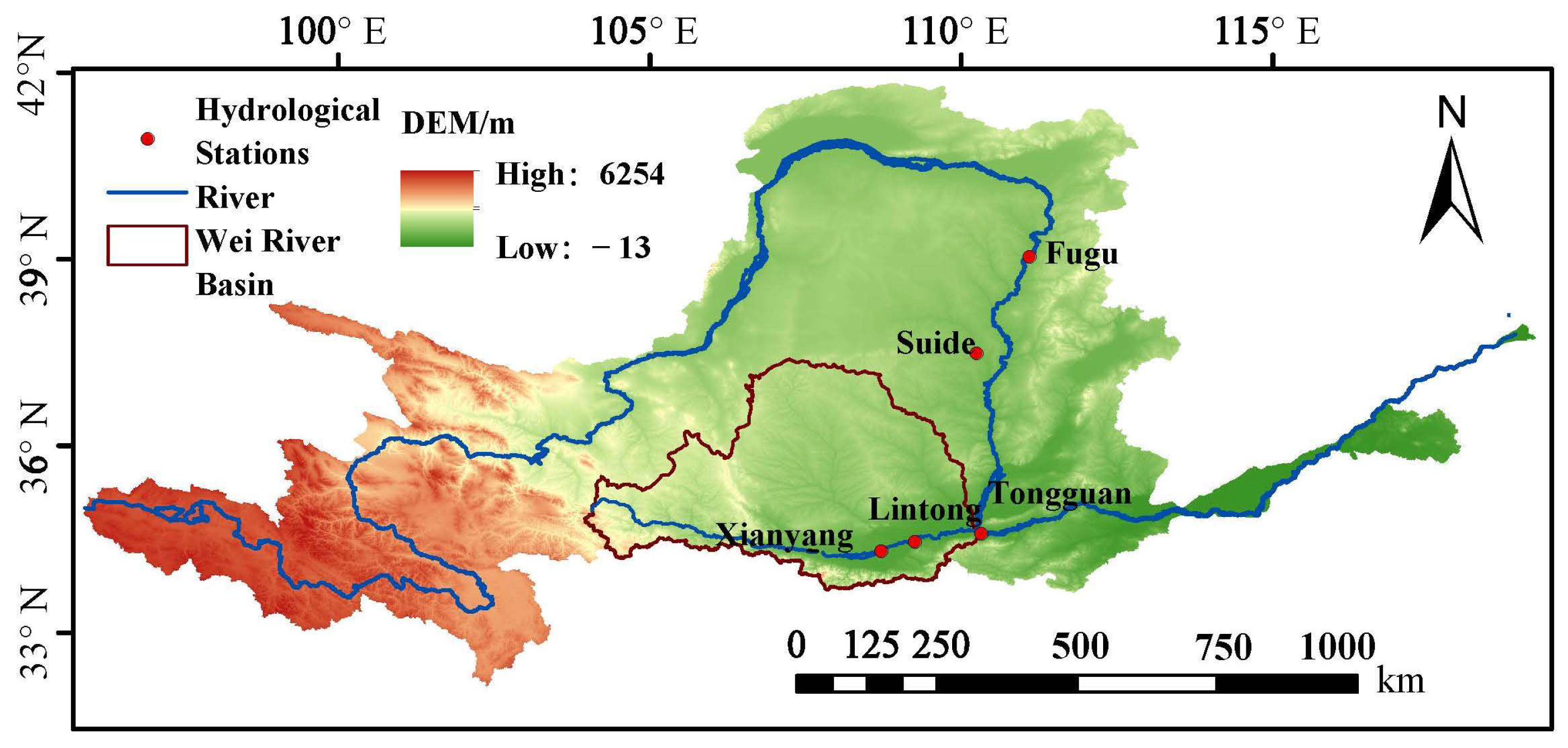
3.1. Study Area and Data Analysis
3.2. Data Stationarity Test and SB Identification
3.3. Daily Streamflow Prediction Model Construction
3.3.1. ARIMA Model Validity Testing
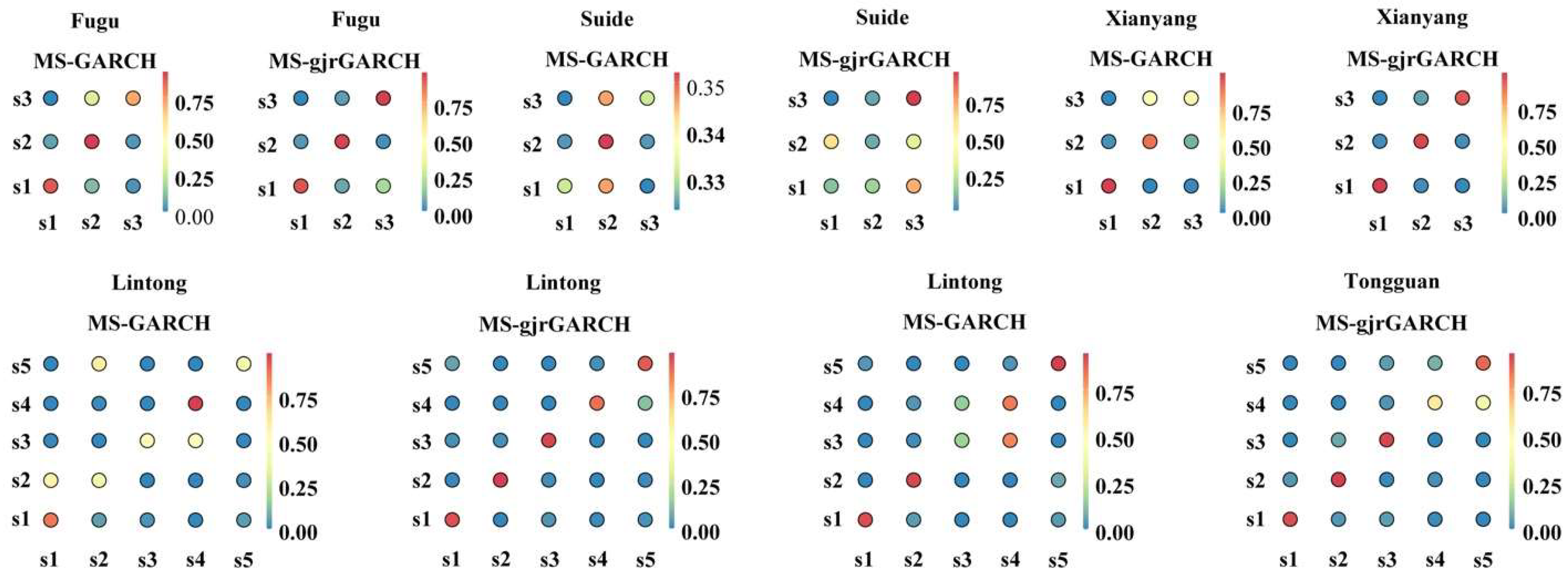
3.3.2. Volatility Regime Analysis
3.3.3. Volatility State Transition Analysis
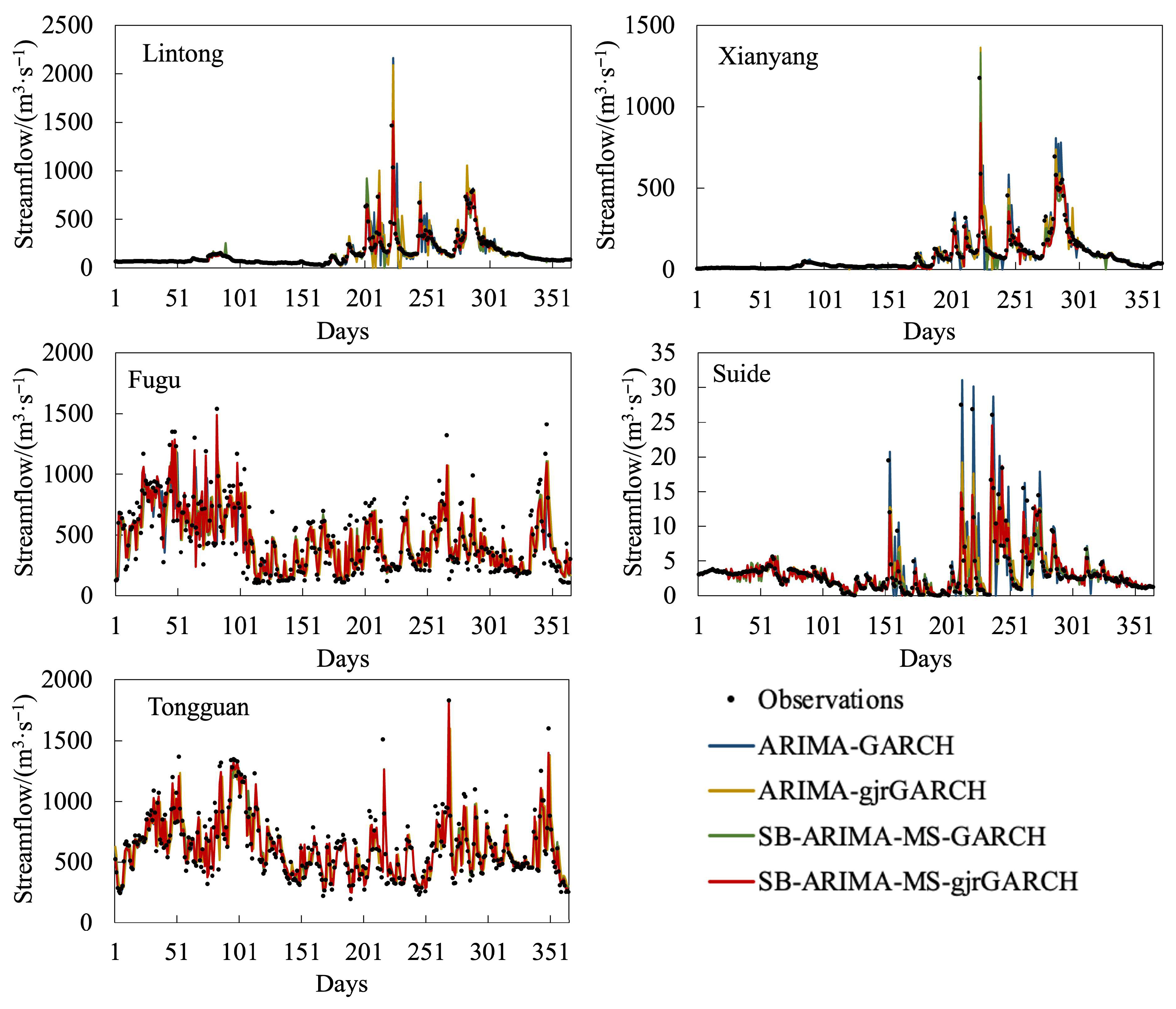
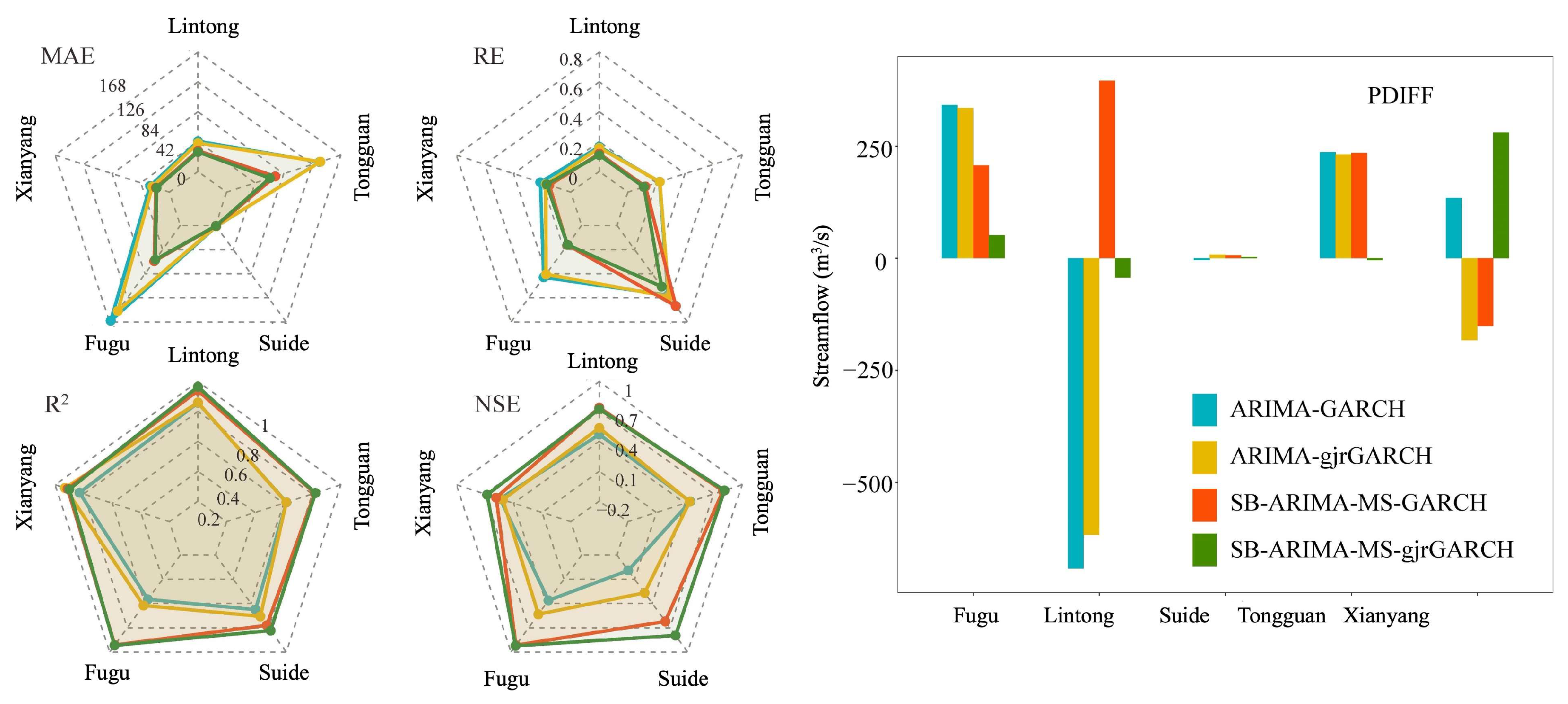
3.4. Model Prediction Results
4. Discussion
5. Conclusions
- (1)
- The identification of multiple structural breaks across all five stations confirms that streamflow in the middle reaches of the Yellow River is highly non-stationary. This highlights that traditional stationary models are insufficient for capturing the long-term evolutionary shifts driven by environmental and anthropogenic changes in this region.
- (2)
- Compared to single-state models, the multi-state MS-GARCH and MS-gjrGARCH models provide a more nuanced characterization of volatility. By allowing the model parameters to switch between different regimes, these frameworks effectively capture “volatility clustering” and the alternating periods of high and low flow variability that are characteristic of the Loess Plateau.
- (3)
- The integration of structural breaks and asymmetric volatility (SB-ARIMA-MS-gjrGARCH) significantly improves predictive accuracy and model reliability. Specifically, the asymmetric model’s ability to distinguish between different directions of flow shocks proves essential for the middle reaches of the Yellow River, where flow extremes are frequent.
Author Contributions
Funding
Data Availability Statement
Conflicts of Interest
References
- Lei, X.; Wang, H.; Yang, M.; Gui, Z. Advances in hydro-meteorological forecast under changing environment. J. Hydraul. Eng. 2018, 49, 9–18. (In Chinese) [Google Scholar] [CrossRef]
- Seo, S.B.; Kim, Y.-O.; Kim, Y.; Eum, H.I. Selecting climate change scenarios for regional hydrologic impact studies based on climate extremes indices. Clim. Dyn. 2019, 52, 1595–1611. [Google Scholar] [CrossRef]
- Wang, H.; Song, S.; Zhang, G. Daily runoff simulation based on seasonal long-term memory DAR model. J. Hydraul. Eng. 2023, 54, 686–695. (In Chinese) [Google Scholar] [CrossRef]
- Wang, H.; Song, S.; Zhang, G.; Ayantobo, O.O.; Guo, T. Stochastic volatility modeling of daily streamflow time series. Water Resour. Res. 2023, 59, e2021WR031662. [Google Scholar] [CrossRef]
- Wang, W.; Ma, J. Review on some methods for hydrological forecasting. Adv. Sci. Technol. Water Resour. 2005, 25, 56–60. (In Chinese) [Google Scholar]
- Liu, Y.; Wang, W.; Liu, Y.; Ling, Z.; Liu, Q. Advances in multi-source data assimilation approach and application in simulation and forecast of hydrological model. J. Hohai Univ. (Nat. Sci.) 2021, 49, 483–491. (In Chinese) [Google Scholar] [CrossRef]
- Wang, Z.; Si, Y.; Chu, H. Daily streamflow prediction and uncertainty using a long short-term memory (LSTM) network coupled with bootstrap. Water Resour. Manag. 2022, 36, 4575–4590. [Google Scholar] [CrossRef]
- Li, F.; Wang, Z.; Qiu, J. Long-term streamflow forecasting using artificial neural network based on preprocessing technique. J. Forecast. 2019, 38, 192–206. [Google Scholar] [CrossRef]
- Liang, H.; Huang, S.; Meng, E.; Huang, Q. Runoff prediction based on multiple hybrid models. J. Hydraul. Eng. 2022, 51, 112–125. (In Chinese) [Google Scholar] [CrossRef]
- Zhou, T.; Jin, J.; Li, R.; Ji, C.; Li, J. Performance optimization analysis for inflow prediction using wavelet Support Vector Machine. J. Hydroelectr. Eng. 2017, 36, 45–55. (In Chinese) [Google Scholar] [CrossRef]
- Sun, Y.; Niu, J.; Sivakumar, B. A comparative study of models for short-term streamflow forecasting with emphasis on wavelet-based approach. Stoch. Environ. Res. Risk Assess. 2019, 33, 1875–1891. [Google Scholar] [CrossRef]
- Wang, H.; Gao, X.; Qian, L.; Yu, S. Uncertainty analysis of hydrological processes based on ARMA-GARCH model. Sci. China Technol. Sci. 2012, 55, 2321–2331. (In Chinese) [Google Scholar] [CrossRef]
- Fathian, F.; Fard, A.F.; Ouarda, T.B.M.J.; Dinpashoh, Y.; Mousavi Nadoushani, S.S. Modeling streamflow time series using nonlinear SETAR-GARCH models. J. Hydrol. 2019, 573, 82–97. [Google Scholar] [CrossRef]
- Mehdizadeh, S.; Fathian, F.; Safari, M.J.S.; Adamowski, J.F. Comparative assessment of time series and artificial intelligence models to estimate monthly streamflow: A local and external data analysis approach. J. Hydrol. 2019, 579, 124225. [Google Scholar] [CrossRef]
- Fathian, F.; Fakheri-Fard, A.; Modarres, R.; van Gelder, P.H.A.J.M. Regional scale rainfall–runoff modeling using VARX–MGARCH approach. Stoch. Environ. Res. Risk Assess. 2018, 32, 999–1016. [Google Scholar] [CrossRef]
- Wang, H.; Song, S.; Zhang, G.; Ayantobo, O.O. Time-varying effects of precipitation and temperature on daily streamflow determined using the DCC model. J. Water Resour. Plan. Manag. 2023, 149, 05023012. [Google Scholar] [CrossRef]
- Zha, X.; Xiong, L.; Guo, S.; Kim, J.S.; Liu, D. AR-GARCH with exogenous variables as a postprocessing model for improving streamflow forecasts. J. Hydrol. Eng. 2020, 25, 04020036. [Google Scholar] [CrossRef]
- Guo, T.; Song, S.; Ma, W. Point and interval forecasting of groundwater depth using nonlinear models. Water Resour. Res. 2021, 57, E2021WR030209. [Google Scholar] [CrossRef]
- Pandey, P.K.; Tripura, H.; Pandey, V. Improving prediction accuracy of rainfall time series by hybrid SARIMA–GARCH modeling. Nat. Resour. Res. 2019, 28, 1125–1138. [Google Scholar] [CrossRef]
- Hillebrand, E. Neglecting parameter changes in GARCH models. J. Econom. 2005, 129, 121–138. [Google Scholar] [CrossRef]
- Mikosch, T.; Stărică, C. Nonstationarities in financial time series, the long-range dependence, and the IGARCH effects. Rev. Econ. Stat. 2004, 86, 378–390. [Google Scholar] [CrossRef]
- Teterin, P.; Brooks, R.; Enders, W. Smooth volatility shifts and spillovers in U.S. crude oil and corn futures markets. J. Empir. Finance 2016, 38, 22–36. [Google Scholar] [CrossRef]
- Wang, W.; Zhang, J.; Zheng, Y.; Xu, S. Runoff prediction based on BP-SVM model of Markov Chain. Water Resour. Hydropower Eng. 2020, 11, 78–84. (In Chinese) [Google Scholar] [CrossRef]
- Li, W.; Wang, X.; Pang, S.; Guo, H. A runoff prediction model based on nonhomogeneous markov chain. Water Resour. Manag. 2022, 36, 1431–1442. [Google Scholar] [CrossRef]
- Zhou, X.P.; Zhu, C.; Li, T.X. Annual runoff prediction based on least square support vector machines-Markov chain combined model. Adv. Mater. Res. 2012, 418, 2114–2117. (In Chinese) [Google Scholar] [CrossRef]
- Chan, J.Y.-L.; Phoong, S.W.; Phoong, S.Y.; Cheng, W.K.; Chen, Y.L. The Bitcoin halving cycle volatility dynamics and safe haven-hedge properties: A MSGARCH approach. Mathematics 2023, 11, 698. [Google Scholar] [CrossRef]
- Segnon, M.; Gupta, R.; Wilfling, B. Forecasting stock market volatility with regime-switching GARCH-MIDAS: The role of geopolitical risks. Int. J. Forecast. 2024, 40, 29–43. [Google Scholar] [CrossRef]
- Bai, J.; Perron, P. Computation and analysis of multiple structural change models. J. Appl. Econom. 2003, 18, 1–22. [Google Scholar] [CrossRef]
- Ljung, G.M.; Box, G.E.P. On a measure of lack of fit in time series models. Biometrika 1978, 65, 297–303. [Google Scholar] [CrossRef]
- Engle, R.F. Autoregressive conditional heteroscedasticity with estimates of the variance of United Kingdom inflation. Econometrica 1982, 50, 987–1007. [Google Scholar] [CrossRef]
- Dawson, C.W.; Abrahart, R.J.; See, L.M. HydroTest: A web-based toolbox of evaluation metrics for the standardised assessment of hydrological forecasts. Environ. Model. Softw. 2007, 22, 1034–1052. [Google Scholar] [CrossRef]
- Liu, C.; Cui, N.; Gong, D.; Hu, X.; Feng, Y. Evaluation of seasonal evapotranspiration of winter wheat in humid region of East China using large-weighted lysimeter and three models. J. Hydrol. 2020, 590, 125388. [Google Scholar] [CrossRef]
- Moriasi, D.N.; Arnold, J.G.; Van Liew, M.W.; Bingner, R.L.; Harmel, R.D.; Veith, T.L. Model evaluation guidelines for systematic quantification of accuracy in watershed simulations. Trans. ASABE 2007, 50, 885–900. [Google Scholar] [CrossRef]
- Zhang, J.; Wang, G.; He, R.; Liu, C. Variation trends of runoffs in the Middle Yellow River basin and its response to climate change. Adv. Water Sci. 2009, 20, 153–158. (In Chinese) [Google Scholar] [CrossRef]
- Cui, Z.; Zhou, Y.L.; Guo, S.L.; Wang, J.; Ba, H.; He, S. A novel hybrid XAJ-LSTM model for multi-step-ahead flood forecasting. Hydrol. Res. 2021, 52, 1436–1454. [Google Scholar] [CrossRef]
- Qin, D.; Stocker, T. Highlights of the IPCC Working Group I Fifth Assessment Report. Prog. Inquisitiones Mutat. Clim. 2014, 10, 1–6. (In Chinese) [Google Scholar] [CrossRef]
- Ren, L.; Shen, H.; Yuan, F.; Zhao, C.; Yang, X.; Zheng, P. Hydrological drought characteristics in the Weihe catchment in a changing environment. Adv. Water Sci. 2016, 27, 492–500. (In Chinese) [Google Scholar] [CrossRef]
- Xue, J. Impacts of a new round of returning farmland to forests and grasslands project on land use efficiency—Empirical study in Yellow River Basin. Bull. Soil Water Conserv. 2023, 43, 155–164. (In Chinese) [Google Scholar] [CrossRef]
- Song, S. Stochastic modeling research progress of hydrological non-stationary heteroscedasticity series in the changing environment of watershed. J. Water Resour. Water Eng. 2023, 34, 1–6. (In Chinese) [Google Scholar] [CrossRef]



| Stations | Period | Mean (m3/s) | Median (m3/s) | Standard Deviation | Skewness | Watershed Area (km2) |
|---|---|---|---|---|---|---|
| Fugu | 1 January 2005–31 December 2015 | 592.624 | 485.0 | 443.515 | 1.962 | 404,000 |
| Suide | 1 January 1990–31 December 2003 | 4.260 | 2.2 | 16.922 | 19.394 | 3906 |
| Lintong | 1 January 1985–31 December 2007 | 159.717 | 89.6 | 239.144 | 6.285 | 97,299 |
| Xianyang | 1 January 1985–31 December 2013 | 86.546 | 44.9 | 151.37 | 7.344 | 46,827 |
| Tongguan | 1 January 2005–31 December 2015 | 793.917 | 650.0 | 560.504 | 2.705 | 682,141 |
| Station | Augmented Dickey–Fuller Test | Structural Break Test | ||
|---|---|---|---|---|
| Statistical Value | p Value | Number of Breaks | Break Timings | |
| Fugu | −18.901 | 0.01 | 2 | 31 May 2010; 25 September 2011 |
| Suide | −27.842 | 0.01 | 2 | 22 July 1994; 11 August 1996 |
| Lintong | −27.6687 | 0.01 | 4 | 20 April 1988; 8 August 1991; 25 November 1994; 15 July 2003 |
| Xianyang | −27.5544 | 0.01 | 2 | 27 November 1993; 14 July 2003 |
| Tongguan | −17.34 | 0.01 | 4 | 8 May 2006; 27 March 2008; 4 July 2010; 29 September 2011 |
| Stations | Orders | Residual LB Test | Square Residual LB Test | LM Test |
|---|---|---|---|---|
| Fugu | 5, 1, 5 | 0.992 | 0 | 0 |
| Suide | 8, 1, 9 | 0.068 | 0 | 0 |
| Lintong | 5, 1, 6 | 0.068 | 0 | 0 |
| Xianyang | 8, 1, 8 | 0.280 | 0 | 0 |
| Tongguan | 5, 1, 5 | 0.662 | 0 | 0 |
| Stations | Models | ||||
|---|---|---|---|---|---|
| Fugu | GARCH | 1971.130 | 0.153 | 0.826 | |
| gjrGARCH | 1679.633 | 0.187 | 0.812 | −0.141 | |
| MS-GARCH | 174.895 | 0.024 | 0.882 | - | |
| MS-gjrGARCH | 3654.320 | 0.102 | 0.002 | 0.0001 | |
| Lintong | GARCH | 31.498 | 0.234 | 0.765 | - |
| gjrGARCH | 42.534 | 0.268 | 0.732 | −0.608 | |
| MS-GARCH | 33,636.221 | 0.670 | 0.000 | - | |
| MS-gjrGARCH | 1004.384 | 0.792 | 0.001 | 0.000 | |
| Suide | GARCH | 0.366 | 0.134 | 0.865 | - |
| gjrGARCH | 0.280 | 0.113 | 0.879 | −0.989 | |
| MS-GARCH | 323.029 | 0.999 | 0.000 | - | |
| MS-gjrGARCH | 0.044 | 0.001 | 0.874 | 0.251 | |
| Xianyang | GARCH | 12.063 | 0.124 | 0.783 | - |
| gjrGARCH | 13.669 | 0.11 | 0.848 | 0.043 | |
| MS-GARCH | 0.187 | 0.000 | 1.000 | - | |
| MS-gjrGARCH | 0.315 | 0.001 | 0.999 | 0.000 | |
| Tongguan | GARCH | 2026.588 | 0.107 | 0.866 | - |
| gjrGARCH | 1877.925 | 0.144 | 0.890 | −0.177 | |
| MS-GARCH | 1957.358 | 0.00 | 0.569 | - | |
| MS-gjrGARCH | 1870.612 | 0.000 | 0.580 | 0.001 |
Disclaimer/Publisher’s Note: The statements, opinions and data contained in all publications are solely those of the individual author(s) and contributor(s) and not of MDPI and/or the editor(s). MDPI and/or the editor(s) disclaim responsibility for any injury to people or property resulting from any ideas, methods, instructions or products referred to in the content. |
© 2026 by the authors. Licensee MDPI, Basel, Switzerland. This article is an open access article distributed under the terms and conditions of the Creative Commons Attribution (CC BY) license.
Share and Cite
Zhao, J.; Shang, J.; Ye, Q.; Wang, H.; Zhang, G.; Yao, F.; Shou, W. Daily Streamflow Prediction Using Multi-State Transition SB-ARIMA-MS-GARCH Model. Water 2026, 18, 241. https://doi.org/10.3390/w18020241
Zhao J, Shang J, Ye Q, Wang H, Zhang G, Yao F, Shou W. Daily Streamflow Prediction Using Multi-State Transition SB-ARIMA-MS-GARCH Model. Water. 2026; 18(2):241. https://doi.org/10.3390/w18020241
Chicago/Turabian StyleZhao, Jin, Jianhui Shang, Qun Ye, Huimin Wang, Gengxi Zhang, Feng Yao, and Weiwei Shou. 2026. "Daily Streamflow Prediction Using Multi-State Transition SB-ARIMA-MS-GARCH Model" Water 18, no. 2: 241. https://doi.org/10.3390/w18020241
APA StyleZhao, J., Shang, J., Ye, Q., Wang, H., Zhang, G., Yao, F., & Shou, W. (2026). Daily Streamflow Prediction Using Multi-State Transition SB-ARIMA-MS-GARCH Model. Water, 18(2), 241. https://doi.org/10.3390/w18020241