Article

A Study on the Measurement and Spatial Non-Equilibrium of Marine New-Quality Productivity in China: Differences, Polarization, and Causes

1
School of Economics, Guangdong Ocean University, Zhanjiang 524088, China
2
Graduate School of Technology and Innovation Management, Hanyang University, Seoul 04763, Republic of Korea
*
Authors to whom correspondence should be addressed.
Water 2026, 18(2), 240; https://doi.org/10.3390/w18020240
Submission received: 16 November 2025 / Revised: 5 January 2026 / Accepted: 14 January 2026 / Published: 16 January 2026
(This article belongs to the Section Oceans and Coastal Zones)

Abstract

Compared to traditional marine productivity, marine new-quality productivity (MNQP) is composed of advanced productive forces driven by the deepening application of new technologies, is characterized by the rapid emergence of new industries, new business models, and new modes of operation, and is marked by a substantial increase in total factor productivity in the marine economy. It has, therefore, become a new engine and pathway for China’s development into a maritime power. The main research approaches and conclusions of this paper are as follows: ① Using a combined order relation analysis method–Entropy Weight Method (G1-EWM) weighting method that integrates subjective and objective factors, we measured the development level of China’s MNQP from 2006 to 2021 across two dimensions: “factor structure” and “quality and efficiency”. The findings indicate that China’s MNQP is developing robustly and still holds considerable potential for improvement. ② Utilizing Gaussian Kernel Density Estimation and Spatial Markov Chain analysis to examine the dynamic evolution of China’s MNQP, the study identifies breaking the low-end lock-in of MNQP as crucial for accelerating balanced development. Spatial imbalances in China’s MNQP may exist both at the national level and within the three major marine economic zones. ③ To further examine potential spatial imbalances, Dagum Gini decomposition was employed to assess regional disparities in China’s MNQP. The DER polarization index and EGR polarization index were used to analyze spatial polarization levels, revealing an intensifying spatial imbalance in China’s MNQP. ④ Finally, geographic detectors were employed to identify the factors influencing spatial imbalances in China’s MNQP. Results indicate that these imbalances result from the combined effects of multiple factors, with marine economic development emerging as the core determinant exerting a dominant influence. The core conclusions of this study provide theoretical support and practical evidence for advancing the enhancement of China’s MNQP, thereby contributing to the realization of the goal of building a maritime power.

1. Introduction

China’s marine economic development has been remarkable in the last forty years. Since 2012, the government has placed great importance on ocean strategy, repeatedly proposing to accelerate the integration of land and sea, strengthen the sea, and achieve milestones to build a strong marine country [1,2]. While achieving success in the marine economy, the authorities know there is still work to do to become a powerful ocean nation [3,4]. The marine industry is biassed towards tradition and there is an urgent need to establish a modern marine industrial system [5,6], exploit and utilize marine resources more [7,8], and replace the current development mode with one that is more intensive [9,10]. China must also improve its capacity in global ocean governance, establish marine cities, develop coastal economic zones, and form maritime economic circles. The coastal economic belt, maritime economic circle, and other regions need better coordination and balanced development. Conversely, while pursuing the ocean economy to enhance the national economy, it is imperative to prioritize the establishment of a marine ecological civilisation from a sustainable development perspective [11,12]. It is imperative to continuously endeavour to engender positive externality benefits for the marine environment and ecology. This is the only method by which to alleviate the increasingly acute problem of resource scarcity and environmental pollution [13,14]. In order to achieve parity with Western developed countries and realize the potential of ocean power, China wants to develop the marine economy by focusing on quality and productivity.
The new-quality productivity paradigm has three components, and the terms “new”, “quality”, and “productivity” must be considered in combination if one is to gain a comprehensive understanding of their intrinsic meaning. In order to achieve a comprehensive comprehension of its inherent significance, it is imperative to integrate the concepts of “new” and “quality” within the research framework of “productivity” [15,16]. The prevailing consensus is that productivity comprises three constituent elements: the labour force, the labour materials, and the labour objects [17,18]. In contrast to the conventional productivity levels observed during China’s period of rapid economic growth, the nation’s economic development paradigm demands advanced productivity, characterized by high technology, efficiency, and quality. This is known as “new-quality productivity”. It is vital that the labour force, materials, and objects reflect these “new” and “quality” aspects, evident in new technologies, factors, business, and models [19,20]. It is imperative to acknowledge the significance of the three factors of production and their optimal combinations of labourers, labour materials, and labour objects. The three factors of production and their optimized combinations have been upgraded, with the objective of achieving high-tech and high-efficiency in production and operation, resource development, and utilization activities, as well as high-quality economic benefits. Contrary to the active discourse observed within political circles and the media, research in academic circles concerning new-quality productivity remains in its nascent stage. The focus of this research is transitioning from qualitative perspectives to encompass theoretical connotations, concept definitions, and path countermeasures [15,16]. The following perspectives are to be considered from a quantitative standpoint: spatial and temporal differentiation, evolutionary trends, and the identification of causality [19,21]. The literature on new-quality productivity in the marine economy is limited. As China modernizes its marine industries, there is a need to quantitatively assess the development of new-quality productivity. This is particularly pertinent in the context of regional economic imbalance in China. An exploratory analysis of the data is therefore required to accurately capture the spatial and temporal evolution characteristics and trends of new-quality productivity. This analysis must also examine spatial non-equilibrium and its causes, which are of great theoretical and practical significance for marine economic development policies and regional synergistic development strategies.
In summary, the extant literature has conducted in-depth research on the connotation, measurement, pathways, and countermeasures of new-quality productive forces. The findings of these studies hold significant theoretical and practical implications for the present research. In comparison with previous studies, this research proposes enhancements in three domains: ① Existing studies on new-quality productive forces primarily focus on the national economy as a whole, with insufficient research on individual national production sectors. The subjects of the research study are listed below. ② The second domain pertains to the nature of the research content. The majority of the extant literature on new-quality productive forces constructs comprehensive evaluation indicators primarily from the perspective of factor structure, neglecting output indicators that reflect quality and efficiency. This approach is inadequate in fully capturing the intrinsic requirements and core essence of new-quality productive forces. Moreover, extant studies frequently neglect spatial polarization phenomena when examining spatial imbalances in new-quality productive forces, focusing exclusively on regional disparities. ③ The majority of the extant literature employs a singular weighting method to measure the development level of new-quality productive forces. The methodology of the research is outlined below.
In consideration of the aforementioned points, the present study concentrates on the investigation of novel quality productive forces within the marine sector. Firstly, an indicator system is constructed for China’s MNQP. This system will be constructed across two dimensions: the factors under consideration are “factor structure” and “quality and efficiency”. A composite-weighting method is employed to measure development levels, thereby avoiding the bias toward either objectivity or subjectivity inherent in single-weighting approaches. Secondly, the spatiotemporal evolution characteristics and trends of China’s MNQP are analyzed using the Gaussian Kernel Density Estimation and Spatial Markov Chain methods. Thirdly, the Dagum Gini decomposition, DER polarization index and EGR polarization index are utilized to analyze the spatial imbalance of China’s MNQP from the perspectives of regional disparities and spatial polarization. Subsequently, geographical detectors are employed to investigate the causes of this spatial imbalance. Finally, targeted recommendations are proposed to advance the development of China’s MNQP, providing a basis for decision-making in this field.
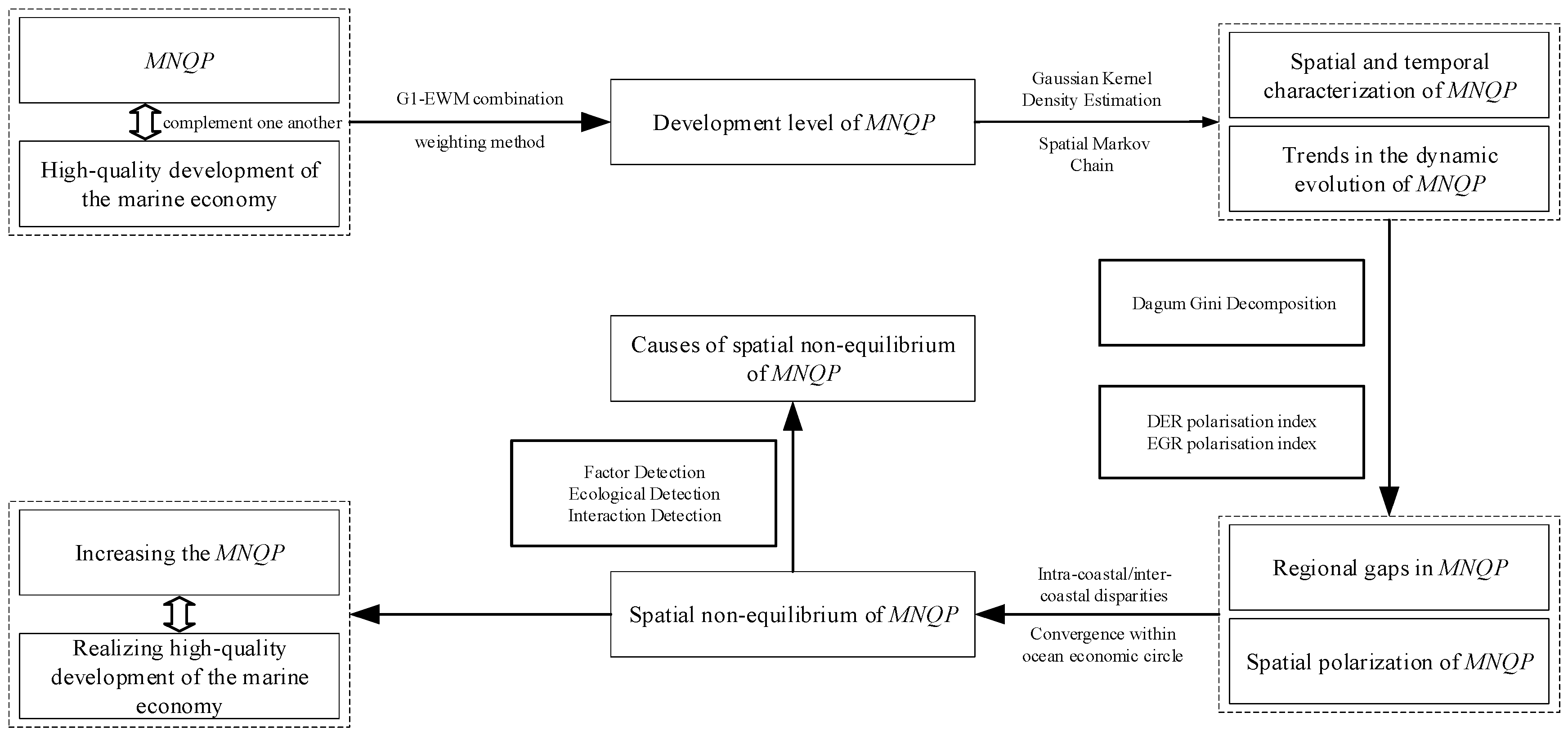
The remainder of this paper is structured as follows: Section 2 covers the research design, the index system, and the full methodology. Section 3 analyzes spatial/temporal characteristics of China’s MNQP. Section 4 analyzes spatial non-equilibrium of China’s MNQP. Section 5 analyzes causes of spatial non-equilibrium. Section 6 contains conclusions and policy recommendations. Please refer to the Technical route (see Figure 1).

2. Research Design

2.1. Indicator System Construction

As China advances its economic transformation toward a more sustainable and robust foundation, high-quality growth has become a central objective in building a modern socialist nation. Within this context, the marine economy represents a dynamic and promising sector, particularly for coastal regions, and is integral to achieving sustained and healthy economic development. The marine sector is an emerging pillar of China’s economy, so it must also comply with the need for high-quality development. Unlike earlier trends, China’s economy is now stable [22,23]. To encourage high-quality economic advancement, we need new productivity theories. New-quality productivity has a lot of potential in this regard [15]. The “new” of MNQP essentially distinguishes it from traditional marine productivity. The core characteristics of the phenomenon will manifest in three aspects: Firstly, a qualitative transformation of production factors is expected. This will involve the reconfiguration of labourers, means of production, and objects of labour. It will be driven by knowledge and technology, with new elements such as big data and artificial intelligence deeply integrated into the marine economic cycle. Secondly, the introduction of disruptive innovations in technological paradigms is emphasized, with particular reference to original and convergent innovations in the fields of marine sensing, engineering equipment, and bio-utilization. A more profound level of analysis reveals that it catalyzes structural evolution in industrial forms, thereby propelling the marine economy from a model reliant upon resource intensity to one driven by knowledge and data. Furthermore, it fosters the emergence of emerging sectors, such as the manufacture of high-end equipment and blue carbon sinks. Thirdly, it signifies a fundamental reshaping of development philosophy and value orientation, inherently integrating green, coordinated, and sustainable principles to achieve the organic unity of economic benefits, ecological security, and national strategic objectives. The term “quality” emphasizes the quality of the entire process of the marine economy, in line with the concept of sustainable development and the pursuit of win-win economic and ecological benefits. “Productivity” has three constituent elements: workers, resources, and objects. These must be integrated with “new” and “quality”. The new-quality productivity of the marine industry is focused on human capital, materials, and objects. This study says that MNQP aims to empower the contemporary industry through innovation, management, and a new production and operating way, aligned with innovation, openness, coordination, greenness, and sharing. The advanced productivity will be a catalyst for the marine economy, propelling it towards a trajectory of high quality, high technology, and high efficiency. It will give rise to a new dynamic, a new industry, and a new mode for the marine economy.
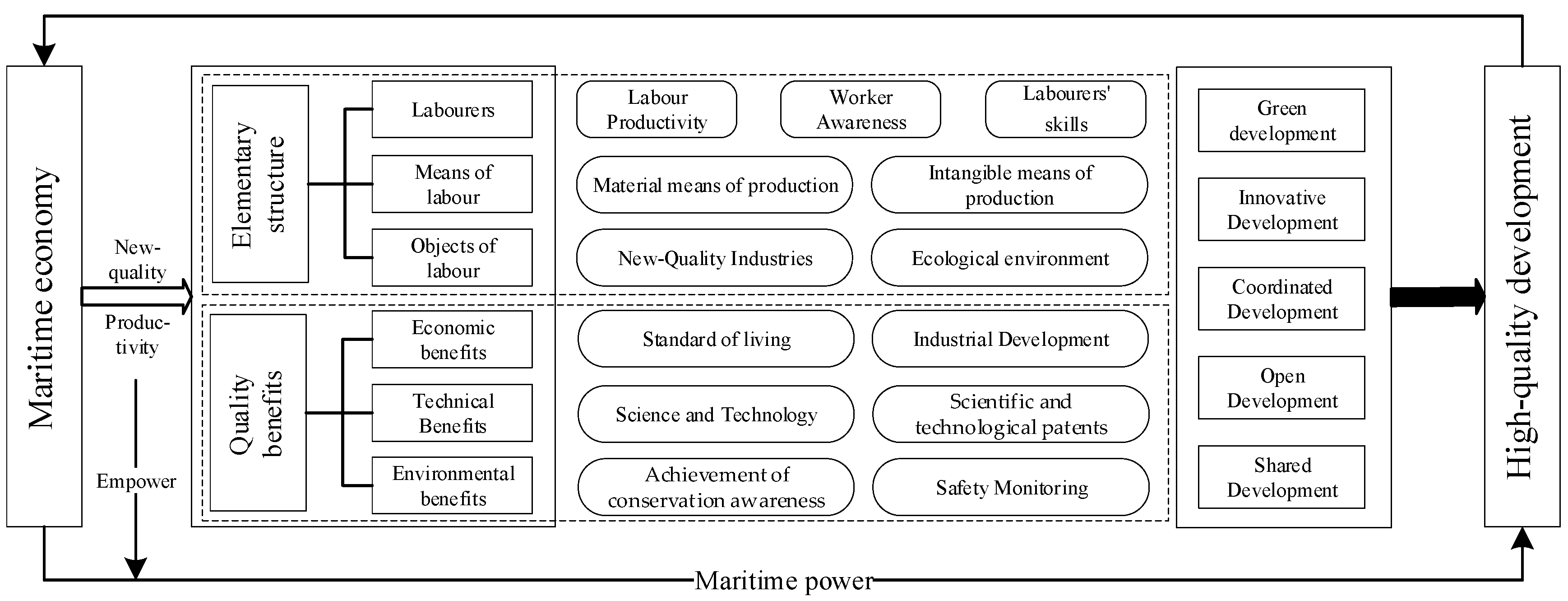
Cultivating new marine productive forces serves as the core driver propelling the high-quality development of the marine economy. This driving process essentially constitutes a systemic empowerment mechanism: through technological innovation and the innovative allocation of production factors, it directly enhances labour productivity and optimizes production efficiency, thereby translating into significant economic benefits. Simultaneously, this mechanism incorporates a green orientation, promoting resource-intensive utilization and ecological conservation through technological innovation, concurrently generating environmental benefits and balancing the relationship between development and protection. Ultimately, this empowerment pathway creates a chain from micro-level enterprise efficiency to macro-level industrial development, propelling the marine economy toward innovation, coordination, green practices, openness, and shared benefits. It lays a solid foundation of productive forces for building a maritime powerhouse. The relationship between MNQP and high-quality development is the basis of this study’s analytical framework, which is based on the dimensions of “factor structure” and “quality and efficiency”. See Figure 2 for a schematic representation of this theoretical model.
It is necessary to think strategically from two aspects, productivity and production relations, with the factor structure serving as their essential carrier. It is vital to coordinate the transition between traditional and new forms of productivity, facilitating the shift from old to new growth drivers without replacing the former. Concurrently, production relations must be updated to align with the developmental demands of new productivity. As indicated earlier, MNQP revolves around human capital accumulation, labour instrument modernization, and labour object optimization. This study addresses two key dimensions: ① Labour Force: The focus should be on nurturing marine science and technology talent and developing practitioners’ skills. Also vital is advancing aquaculture production technologies and improving fishermen’s competencies [24,25,26,27]. ② Means of Labour: Increased investment in R&D is imperative, alongside improvement of the efficiency of technology transformation. Emphasis should also be placed on digitalization and intelligent production systems. Furthermore, the promotion of artificial intelligence and big data is essential to empower traditional marine production activities. The accelerated application of high-end intelligent equipment and facilities is also crucial [28,29,30]. The following aspects of labour objects are hereby presented for consideration: It is vital to provide robust support for emerging strategic industries in the marine sector, with a particular emphasis on the synergies and complementarities between these emerging industries and the established sectors. It is vital that the current structure is transformed and upgraded, in order to embrace novel industries, innovative forms, and avant-garde modes of operation, including but not limited to marine renewable energy, biotechnology and medicine, the marine digital information industry, the marine green chemical industry, and deep-sea mining and oil and gas excavation [31,32,33]. It is important to note that the deep integration and optimization of marine labour, materials, and objects is a significant symbol of the development of marine productivity. This deep integration has liberated itself from the limitations of the old mode of production, achieved optimal resource allocation, and broken the shackles of traditional marine economic development.
When assessing the development of MNQP, economic efficiency, technical efficiency, and environmental efficiency are essential. These metrics form the foundational framework for evaluating the value enhancement derived from marine labour, means of labour, and objects of labour. ① Human-Centred Development: China’s economic strategy is fundamentally guided by a people-oriented approach [34,35]. The aim is to boost marine productivity and economic growth, ensuring developmental outcomes are shared and enhance public well-being [36]. The economic benefits of improved marine productivity are reflected in the restructuring and modernization of marine industries. The contemporary marine industrial system—incorporating “new” and “quality” attributes—serves as the principal channel through which new technologies, industries, formats, and development paradigms are integrated. Key themes include industrial upgrading, rationalization, green technology innovation, and the enhancement of total factor productivity. ② Science- and Technology-Driven Efficiency: Advancements in marine quality and productivity rely heavily on scientific and technological innovation.
Outputs such as research findings, patented technologies, and academic publications from institutions and universities provide critical inputs that, when effectively transformed, bolster technological progress and societal development [37,38], thereby raising total factor productivity in the marine sector. ③ Ecological Sustainability: There is an urgent need to shift away from the overexploitation of marine resources by leveraging scientific methods and capital investment [39]. Efforts should promote the sustainable and circular utilization of marine resources, as well as support ecological restoration of marine ecosystems, with a particular focus on enhancing marine biodiversity [40,41]. Through green productivity, marine economic development can evolve to be resource-efficient, environmentally sound, and ecologically sustainable—embodying the principle of harmonious coexistence between humanity and nature. The ecological dimension highlights the importance of MNQP.
The indicator system is following the principles of scientificity, operability, and representativeness. It includes 2 second-level indicators, “factor structure” and “quality and efficiency”, and covers 6 third-level indicators, 13 fourth-level indicators, 25 fifth-level indicators, and 30 variables in total (Table 1). A comprehensive evaluation index system has been constructed, incorporating two second-level indicators, namely, “factor structure” and “quality and efficiency”. The system also has 6 third-level indicators, 13 fourth-level indicators, and 25 fifth-level indicators, totalling 30 variables.
This study uses an integrated G1-EWM approach, combining subjective and objective weighting techniques, to avoid the limitations of single-assignment methods. This method is applied to quantify the development of China’s MNQP from 2006 to 2021.
The Entropy Weight Method (EWM) is an objective weighting technique. In information theory, information entropy—also known as average information content—serves to measure information uncertainty. An increase in information signifies a decrease in entropy, enabling entropy to gauge the dispersion of metric information. The Entropy Weight Method fundamentally calculates the information entropy of each indicator. It then determines the weighting coefficients for each indicator based on the relative impact of their changes on the overall system. As an objective weighting method, the determination of weights in the Entropy Weight Method relies entirely on the inherent dispersion of the data itself, free from subjective judgement. It offers high precision and strong objectivity. The main calculation steps are as follows: ① Construct a decision matrix. ② Standardize data processing. ③ Calculate the proportion of the i-th evaluation object in the j-th indicator. ④ Calculate the information entropy of the j-th indicator. ⑤ Calculate the weight of the j-th indicator.
The order relation analysis method (G1) belongs to subjective weighting methods. It is a weighting method improved from the Analytic Hierarchy Process (AHP). It fully leverages the rich knowledge and practical experience of decision-making experts while reducing the number of subjective judgements. Moreover, it eliminates the need to construct a judgement matrix and perform consistency tests, overcoming the shortcomings of AHP and facilitating practical application. The main calculation steps are as follows: ① Determine the order relationship of indicator weights. ② Quantitatively judge the relative importance of indicators. ③ Calculate the weight coefficient for the j-th indicator.
The detailed computational procedures for the EWM and G1 method are omitted here due to space constraints. See Zhao et al. [42] and Ding et al. [43] for derivation formulas. The calculation process begins with data preprocessing to obtain normalized and standardized values. Then, the G1 method and EWM are applied to determine their respective weights, followed by the execution of the following equations:
① Calculate the portfolio weight of the i-th indicator:
w i = α w 1 + 1 α w 2
The subjective and objective assignment methods are equally reliable and valid; α = 0.5 is assigned to each. The MNQP development level is computed using the equation below.
② Multi-objective programming
Multi-objective programming is a method for addressing planning problems with multiple objectives. It transforms such problems into a single-objective formulation through the linear weighting of objective functions:
h j i = i n w i Q j i
In Equation (2), hji is the level of development of MNQP. Qji is the value of the variable obtained after standardization.

2.2. Research Methods

2.2.1. Gaussian KDE

KDE is a key technique for analyzing spatial and temporal variability. It is widely used in economic geography to assess the dynamic evolution of indicators. It is effective in avoiding errors caused by irrational modelling, providing a more accurate reflection of the spatial and temporal distribution characteristics of China’s ocean and sea productivity. It is also effective in avoiding errors caused by unreasonable model settings, characterizing the spatiotemporal distribution patterns of China’s MNQP. This study employs KDE, a method recognized for mitigating bias induced by inappropriate model specification. The Gaussian KDE is adopted for this purpose:
f x = 1 N L i = 1 N k x ¯ X i L
In Equation (3), f(x), Xi, k, x ¯ , and L denote the MNQP of a coastal area, the observed sample values, the kernel function, the mean of the observations, and the bandwidth, respectively. Smaller values of L yield higher estimation accuracy.

2.2.2. Spatial Markov Chain

KDE effectively captures spatiotemporal distribution trends of China’s MNQP, but this study further examines its dynamic evolution under spatial dependency. The key methodology for analyzing regional economic dynamics is the spatial Markov chain, integrating spatial autocorrelation into the conventional Markov framework to account for influences from neighbouring coastal areas. The analysis begins by classifying sample regions into four types using the quartile method, based on the initial-year spatial lag value of MNQP. The spatial lag value of coastal region i reflects the productivity type of its neighbouring region j. The traditional Markov model is then incorporated with the spatial lag, and four 4 × 4 transitional probability matrices are constructed.
L a g = x i W i j
In Equation (4), Lag denotes the spatial lag value, xi represents the MNQP of coastal area i, and Wij is the spatial weight matrix. This study employs a 0–1 adjacency criterion to define the weights: Wij = 1 if coastal area i is adjacent to area j, and Wij = 0 otherwise.

2.2.3. Dagum Gini Decomposition

This study uses two methods—Gaussian KDE and Spatial Markov Chain analysis—to identify the spatiotemporal dynamics and evolutionary trends of China’s MNQP. However, these methods alone cannot fully reveal the underlying drivers of such spatial-temporal variations nor visually represent the associated spatial non-equilibrium and its changing patterns. To address this, the Dagum Gini decomposition is used. This is a widely utilized analytical tool designed to measure spatial differentiation in economic and social phenomena. It decomposes the overall regional variance into three constituent components: intra-regional variance, inter-regional variance, and hypervariance density [44]. In this study, the 11 provincial administrative divisions along China’s coast are categorized into three maritime economic circles: northern, eastern, and southern. The Dagum Gini decomposition and its decomposition index are then employed to measure the degree of regional variation in China’s MNQP. Due to the length of this article, the detailed calculation process of the Dagum Gini decomposition and its decomposition index cannot be included. Instead, the specific derivation formula is presented in the research results of Dagum [45].

2.2.4. DER and EGR Polarization Index

Existing studies on spatial disequilibrium tend to emphasize regional differences while overlooking spatial polarization. The Dagum Gini decomposition effectively visualizes regional disparities in China’s MNQP and their sources but fails to account for the degree of antagonism between regions. Furthermore, conventional disparity measures typically focus on variations within and between regions, neglecting the identity or homogeneity of regions. Spatial disequilibrium can arise from both intra- and inter-regional variance, as well as heightened homogeneity within regions. Such homogeneity can lead to class solidification and self-reinforcement, hindering the enhancement of MNQP and triggering spatial polarization [46]. Spatial polarization intensifies with inter-coastal variability and the intensification of intra-oceanic economic identity. A decline in intra-regional disparity does not necessarily imply a weakening of spatial polarization. Instead, it may be attributable to an increase in internal identity, resulting in enhanced spatial polarization and the onset of spatial disequilibrium. When using regional indicators to analyze spatial inequality, the actual situation of spatial polarization must be considered. This study uses the DER polarization index (based on the “identity–alienation” framework) and the EGR polarization index (based on the ER index). The DER index is improved to analyze China’s MNQP. The indices are based on the “identity–alienation” framework and the ER index. Due to the medium’s spatial limitations, the DER and EGR calculations are not displayed. Instead, the derivation formulae are shown in Duclos, Esteban, and Ray [47] and Esteban, Gradin, and Ray [48].

2.2.5. Geographical Detectors

This paper utilizes the Dagum Gini decomposition, the DER polarization index, and the EGR polarization index to comprehend the alterations in spatial non-equilibrium of marine neoplastic productivity in China. To further investigate the drivers of spatial non-equilibrium in China’s MNQP, this study applies geographical detectors [49,50]. This method effectively analyzes spatial heterogeneity and identifies underlying influencing factors without relying on linear assumptions, thereby overcoming limitations common in conventional statistical causal analysis. Geographical detectors include four types: factor, interaction, ecological, and risk detection. The study uses the first three to examine the factors affecting the spatial non-equilibrium of MNQP. Specifically, it uses factor detection to quantify the explanatory power of different drivers in accounting for regional disparities:
q = 1 V a r w l V a r T = 1 h = 1 L N h σ h 2 N σ 2
V a r w l = h = 1 L N h σ h 2 , V a r T = N σ 2
In Equations (5) and (6), q is the explanatory power of an influencing factor on the spatial non-equilibrium of MNQP, ranging from 0 to 1. A higher q indicates a stronger explanatory capacity. Here, L represents the number of variable categories; N and Nh are the total sample sizes for the coastal region and the hth marine economic circle, respectively; σ 2 and σ h 2 are the variances of the influencing factor for the entire sample and for the hth marine economic circle, respectively; and V a r T and V a r w l refer to the total regional variance and the intra-regional variance, respectively.
The primary function of ecological probes is to facilitate a comparison of the significance of any two influencing factors in relation to the spatial non-equilibrium of MNQP. The F-statistic, as outlined in the following formula, is a common measurement of this phenomenon:
F = N f 1 N f 2 1 V a r w l , f 1 N f 2 N f 1 1 V a r w l , f 2
V a r w l , f 1 = h = 1 L 1 N h σ h 2 , V a r w l , f 2 = h = 1 L 2 N h σ h 2
In Equations (7) and (8), Nf1 and Nf2 represent the sample sizes of the two influencing factors f1 and f2, respectively; V a r w l , f 1 and V a r w l , f 2 represent the sum of the within-stratum variances of the strata formed by f1 and f2, respectively; and L1 and L2 represent the number of strata of the variables f1 and f2, respectively. The H0 of the F-statistic is V a r w l , f 1 = V a r w l , f 2 . If the original hypothesis is rejected, it means that there is a significant difference between the effects of the two influences f1 and f2 on the spatial non-equilibrium of MNQP.
Interaction probes are mainly used to analyze whether various drivers increase or weaken the ability to explain the spatial non-equilibrium of MNQP when they act together. Specifically, the factor detector first calculates the q-value of any two influences on the spatial disequilibrium of MNQP, e.g., q(f1) and q(f2), and uses this to calculate the q-value when two influencing factors interact, i.e., q(f1 ∩ f2), and then compares q(f1), q(f2), and q(f1 ∩ f2), so as to judge their respective interactions, which can be classified into the following five categories: non-linearly attenuated, one-factor non-linearly attenuated, two-factor enhanced, independent, and non-linearly enhanced.

2.3. Research Objects and Data Sources

This study looks at the 11 coastal provinces of mainland China, grouped into three maritime economic circles as outlined in the 14th Five-Year Plan for National Economic and Social Development of the People’s Republic of China. The northern marine economic circle includes Liaodong Peninsula, Bohai Bay, and Shandong Peninsula, covering Liaoning, Hebei, Tianjin, and Shandong. The eastern marine economic circle is the Yangtze River Delta coastal zone, comprising Jiangsu, Shanghai, and Zhejiang. The southern marine economic circle is Fujian, the Pearl River Estuary, the Gulf of Tonkin, and Hainan Island, including Fujian, Guangdong, Guangxi, and Hainan.
Data come from the China Marine Economic Statistics Yearbook, China Environmental Statistics Yearbook, China Statistics Yearbook, CSMAR, RESSET, and EPS databases. Missing data are supplemented via interpolation. Four representative years—2006, 2011, 2016, and 2021—are selected, corresponding to the onset of the 11th to 14th Five-Year Plans, serving as benchmark intervals for longitudinal analysis.

3. Typical Spatial and Temporal Characteristics of MNQP in China

3.1. Level Measurement

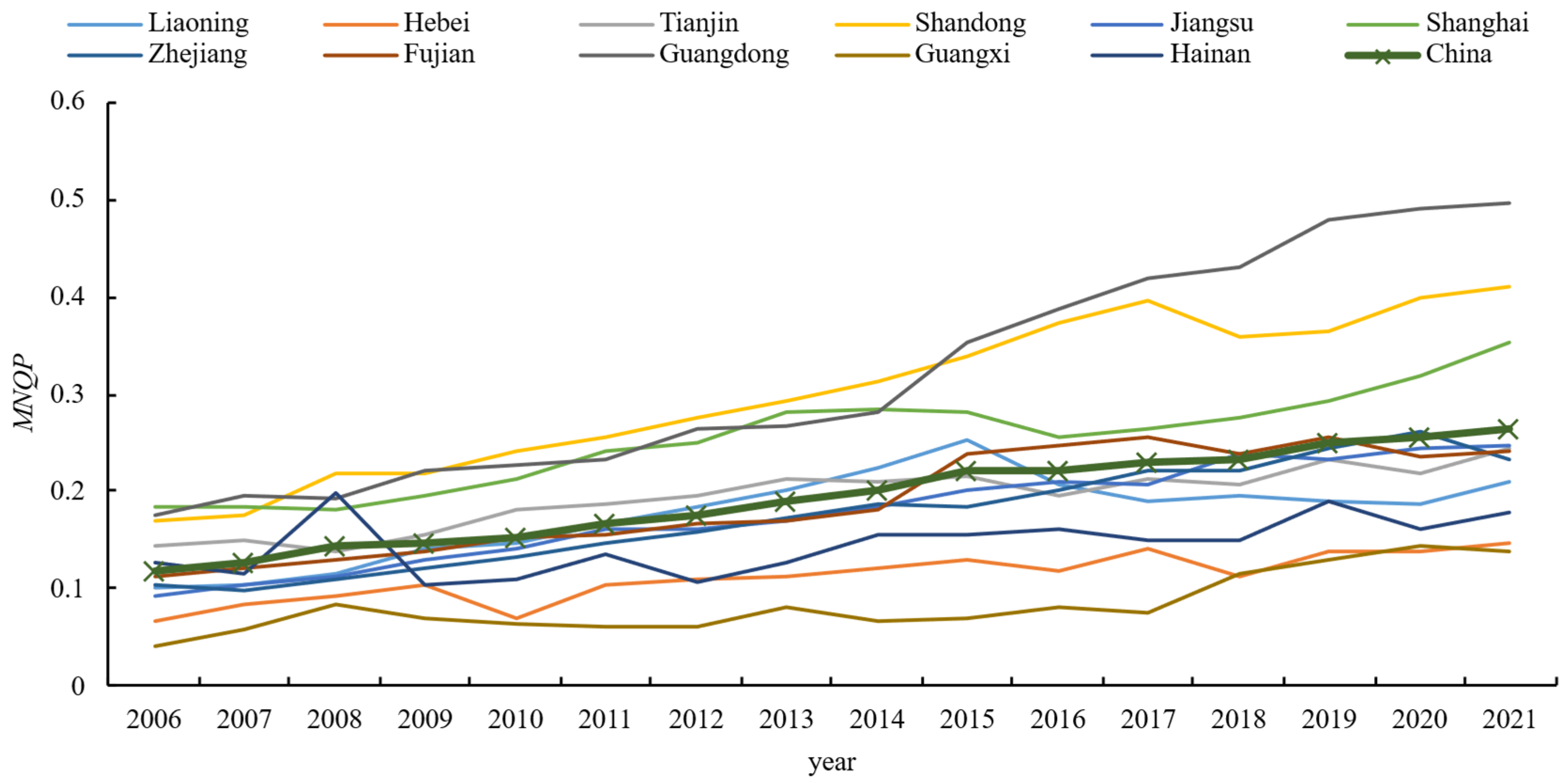
To empirically examine China’s MNQP, the integrated G1-EWM weighting approach is applied. Using Equations (1) and (2), the development levels of MNQP across coastal provincial regions from 2006 to 2021 are computed (see Figure 3).
Figure 3 illustrates a consistent upward trajectory in MNQP at both the national and regional levels. Nationally, the average level rose from 0.120 in 2012 to 0.264 in 2021, representing a growth of 120.70%. In recent years, China’s MNQP has gained substantial momentum, though considerable potential for further advancement remains. This progress reflects China’s increasing emphasis on marine economic development. Initiatives such as the marine power strategy and related policy frameworks have accelerated the sector’s growth. The government has consistently facilitated the inter-regional flow of marine-related capital, talent, technology, and information, while continuously improving the maritime business environment and promoting market-based allocation of marine factors. These efforts, supported by technological innovation and green technical upgrades, have promoted the transformation of marine industrial structures and the growth of emerging strategic sectors, collectively enhancing MNQP.
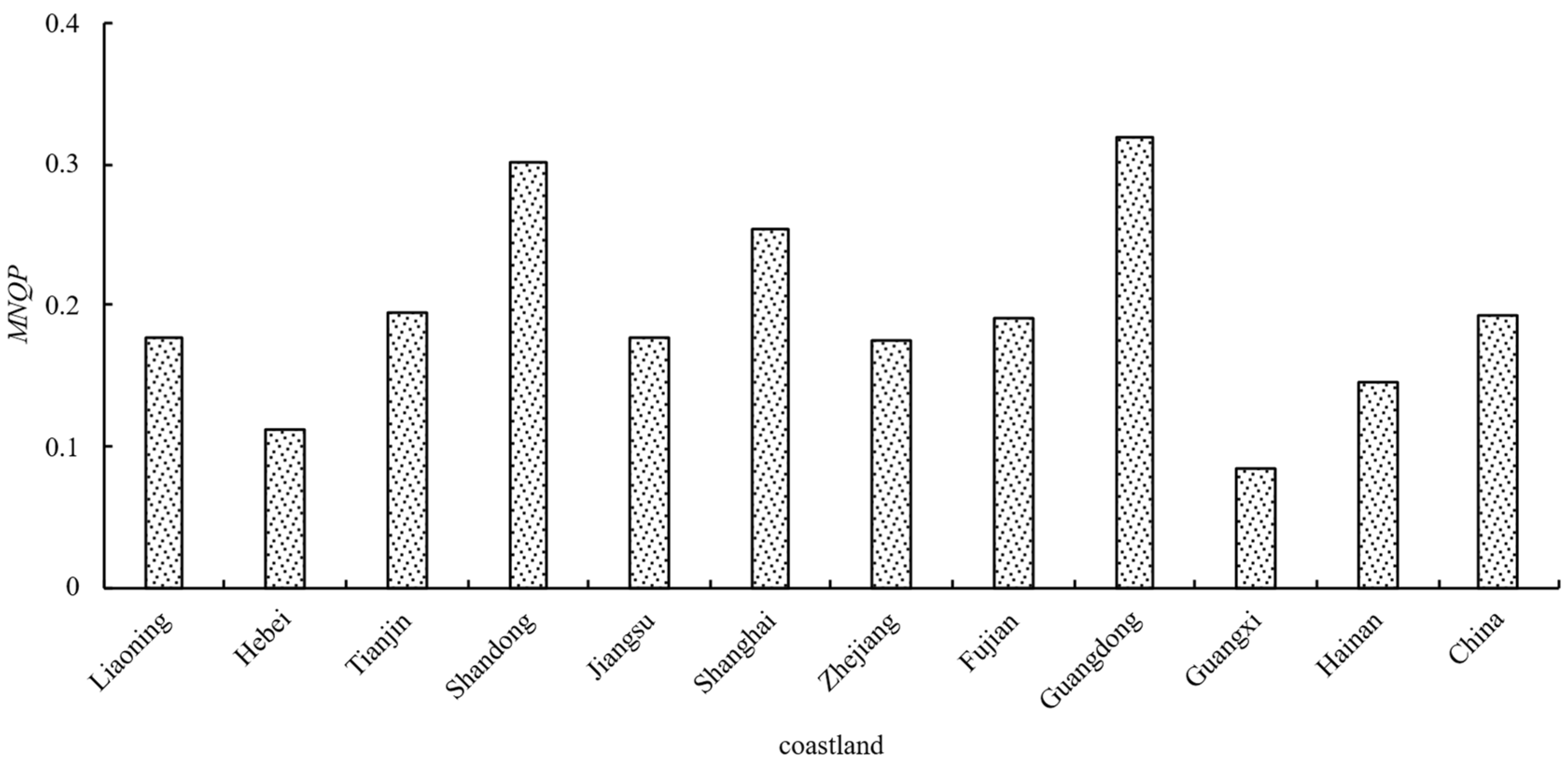
For a detailed analysis of regional variations in MNQP, see Figure 4.
Figure 4 shows that the average MNQP of Guangdong, Shandong, Shanghai, and Tianjin during the observation period exceeded the national mean. Guangdong recorded the highest value (0.319), followed by Shandong (0.300), Tianjin (0.254), and Shanghai (0.194). These regions are all central hubs within their respective maritime economic circles, reflecting stronger marine resource endowment, more advanced development and utilization, and greater attractiveness to marine professionals. Although other coastal regions also improved their MNQP over the study period, a significant gap remains between them and the four leading regions. This underscores the need to further examine the spatiotemporal heterogeneity—particularly spatial imbalance—in China’s MNQP.

3.2. Dynamic Evolution Trends

3.2.1. KDE

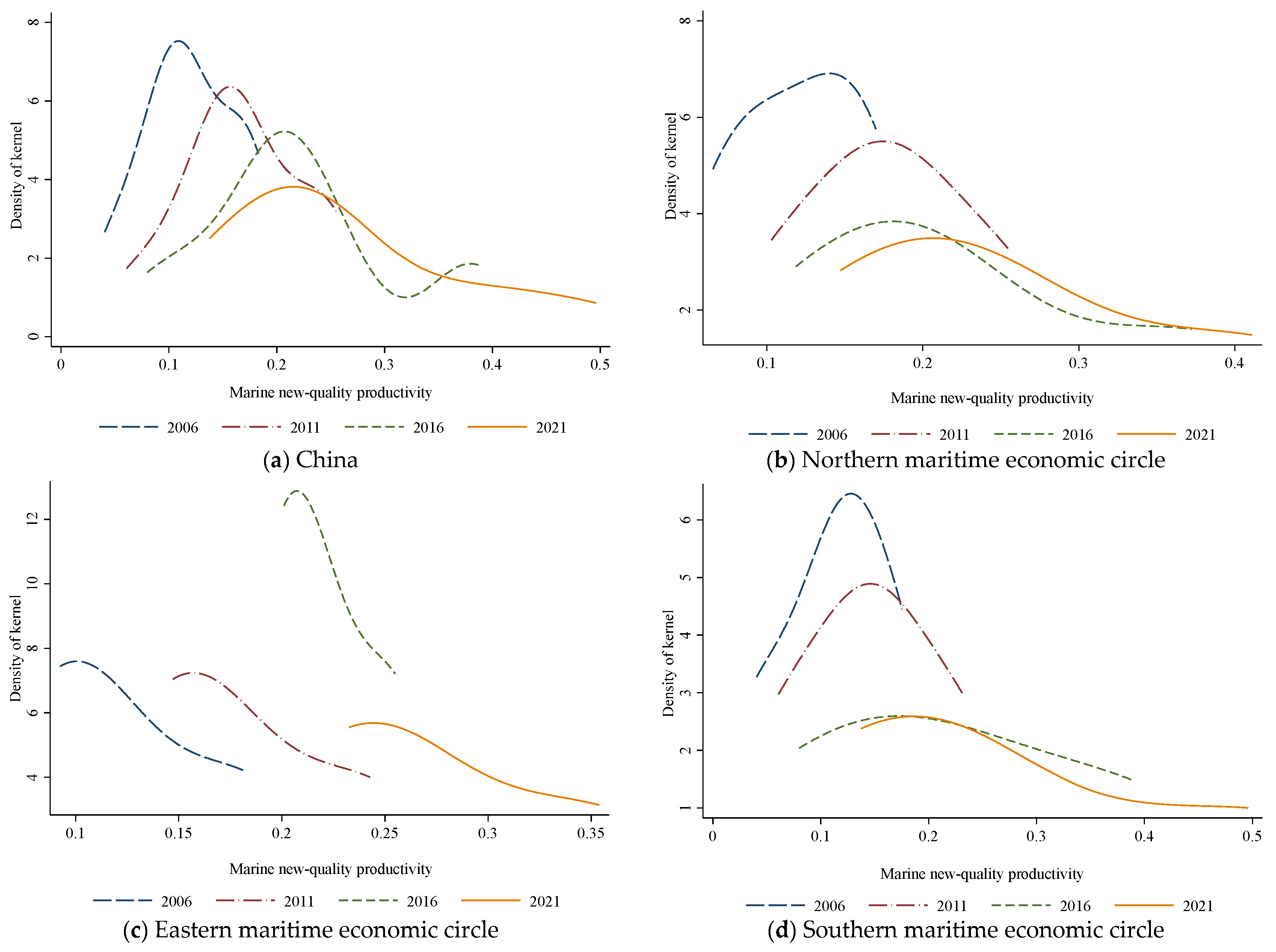
In order to characterize the spatiotemporal evolution of MNQP, the Gaussian KDE is applied. Using Equation (3), kernel density values are computed for each coastal provincial region from 2006 to 2021. The results are visualized in Figure 5. It should be noted that the horizontal axis in Figure 5 represents MNQP, while the vertical axis displays kernel density values. Kernel density values serve as estimates of a probability density function, and the kernel density values used in this paper denote the probability per unit of MNQP.
Figure 5a–d depict the kernel density estimates of MNQP at the national level and within the northern, eastern, and southern maritime economic circles from 2006 to 2021. At the national level, the rightward shift in the kernel density curve reflects a general rise in MNQP across coastal regions. With the exception of a “double-peak” pattern observed in 2016, the “single-peak” distributions in 2006, 2011, and 2021 suggest an initial phase of regional polarization in development levels which later moderated. Additionally, the gradual decrease in peak height coupled with the widening of the density curve indicates growing disparities in MNQP among coastal areas. The kernel density curves exhibit a right-skewed distribution, implying that a larger number of coastal regions perform below the national average. This right-tailed characteristic was most pronounced in 2021.
With regard to the performance of each maritime economic circle, the overall trend of the kernel density curves of MNQP in the northern maritime economic circle shows a rightward shift, indicating that MNQP in the northern maritime economic circle is improving on an annual basis. From the standpoint of the main peak movement, the four selected years exhibit a single-peak distribution. With regard to the wave pattern, the peak of the curve decreases and extends to the left and right. This indicates that the regional gap in the MNQP of the northern maritime economic circle has further widened.
The kernel density curve for MNQP in the eastern maritime economic circle shifts rightward, reflecting sustained developmental progress. Across the four selected years, the distribution consistently exhibits a single-peak pattern. The peak height follows a pattern of initial decline, subsequent rise, and further decline, suggesting that regional disparities in MNQP underwent phases of narrowing followed by renewed expansion. Concurrently, the curve width initially broadened, later contracted toward the centre, and then extended again, indicating alternating cycles of convergence and divergence in regional productivity levels.
A pronounced rightward shift in the kernel density curve signifies continuous improvement in MNQP within the southern maritime economic circle. The distribution maintains a single-peak form, with a growing rightward skew and an extended right tail. The peak height decreases while the base widens, signalling increasing intraregional disparity. This pattern highlights a widening gap between coastal areas with high and low levels of MNQP, illustrating a clear polarization effect.

3.2.2. Spatial Markov Chain

To analyze the dynamic evolution of China’s MNQP, this study applies a spatial Markov chain approach. The analysis assumes that MNQP follows a first-order Markov process with stable transition probabilities. Using the quartile method, coastal regions are classified into four distinct development states: low (LL), lower (LRL), higher (HRL), and high (HL). The corresponding spatial Markov transition probability matrix is computed via Equation (4).
The diagonal values in Table 2 represent the probability of coastal zones maintaining their current state in the next period, i.e., the self-maintenance probability. In the traditional Markov transition probability matrix (without spatial lag terms), coastal areas in the high-level state exhibit the highest self-maintenance probability (89.5%), while those in the low-level state show the lowest (70.7%). State transitions primarily occur in the “low-level → high-level” pattern. High-level coastal areas demonstrate the strongest state persistence, whereas low-level regions exhibit relatively limited transition probabilities. This indicates coexisting advantages and constraints during the transition from imbalanced to balanced development in MNQP. Thus, addressing the low-end lock-in problem in coastal areas is crucial for accelerating balanced development of China’s MNQP.
Following a thorough consideration of the spatial lag type of the domain, the self-locking probabilities of the four local states are determined to be 75%, 57.1%, 78.9%, and 75%, respectively, when the state of the neighbouring coastal area is at a low level. When the state of the neighbouring coastal area is at a lower level, the self-locking probabilities are found to be 78.6%, 100%, 75%, and 100%, respectively. When the state of the neighbouring coastal area is at a higher level, the self-locking probabilities are determined to be 78.6%, 100%, 75%, and 100%, respectively. The self-locking probabilities of the four local states are as follows: 71.4%, 72.7%, 58.3%, and 62.5%, respectively. Based on these observations, the following conclusions can be drawn: ① Four distinct convergence clubs are identified in China’s coastal regions, characterized as low, lower, higher, and high levels of MNQP. In all cases, the diagonal probabilities exceed the off-diagonal values, indicating strong state persistence and limited mobility across development levels. When spatial dependence is considered, state transitions occur most frequently at the lower levels, with relatively fewer transitions observed at higher levels. ② The probabilities on the non-diagonal of China’s MNQP are distributed on both sides of the diagonal, which implies that the MNQP is regressive while exhibiting the transfer to higher level. Furthermore, the state transfer of China’s MNQP is typically observed to occur between neighbouring grades, with the phenomenon of “jumping” transfers being infrequent. This results in the formation of a certain “path dependence”, characterized by continuity. Consequently, it becomes more challenging to achieve breakthrough development. ③ Spatial proximity significantly influences state transitions in China’s MNQP. The developmental status of neighbouring coastal areas affects local transition probabilities: higher productivity levels in adjacent regions generally increase the likelihood of upward or downward shifts locally, while lower neighbouring levels reduce downward transition probabilities. This pattern suggests that high-level coastal areas exert stronger syphon effects than trickle-down effects on their surroundings, failing to establish a positive regional demonstration effect. These findings highlight the need to accelerate cross-regional synergistic development and promote shared prosperity in the marine economy.
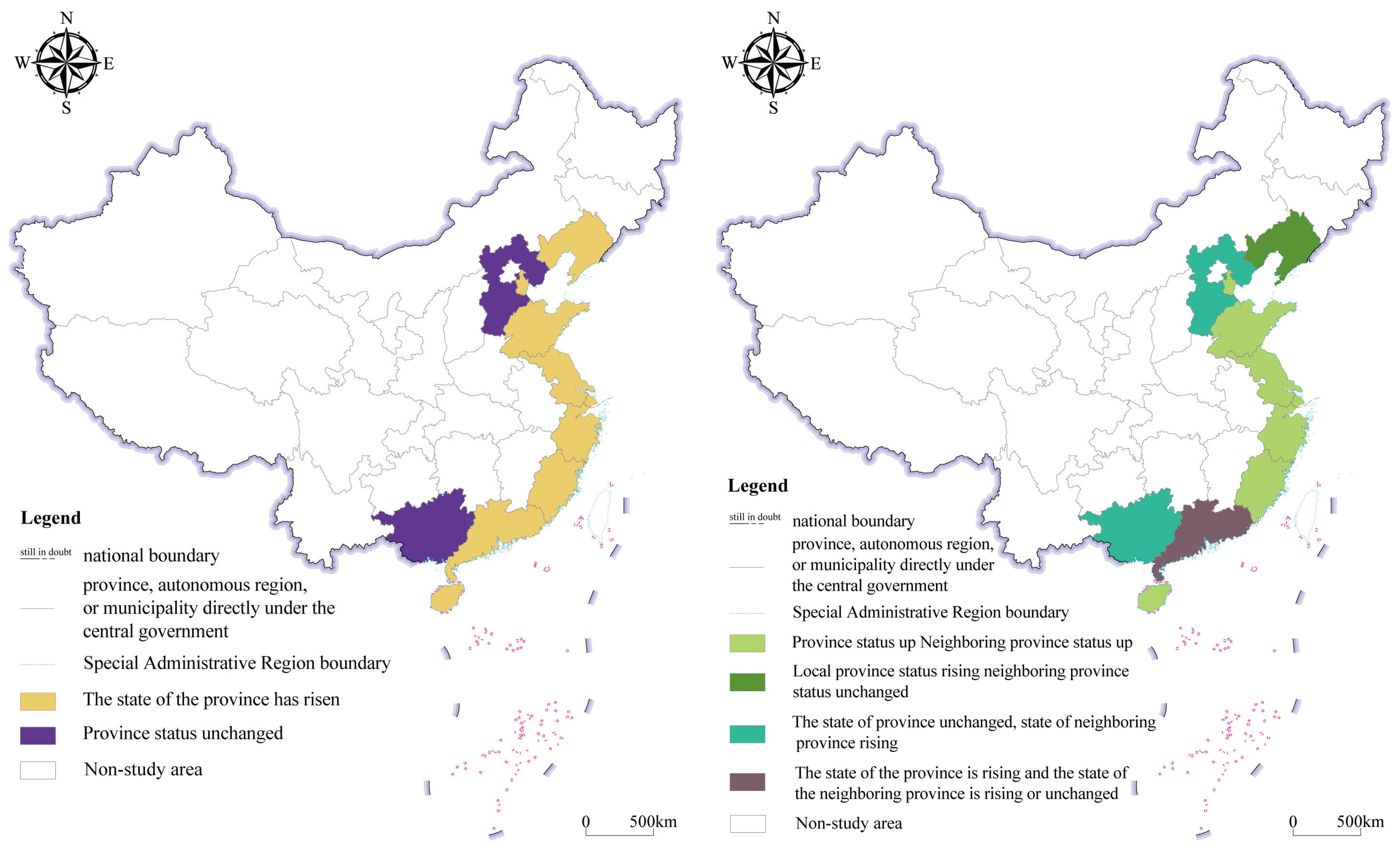
The spatial transition patterns of MNQP are illustrated in Figure 6, revealing its dynamic evolutionary characteristics.
As demonstrated in Figure 6, the transfer of neighbouring coastal areas exhibits a convergence characteristic during the designated sample observation period. Among the eleven coastal provincial administrative regions, eight coastal areas demonstrate an upward shift in both themselves and neighbouring regions; two coastal areas exhibit an upward shift in the region, while the neighbouring regions remain unchanged (Liaoning and Guangdong); and two coastal areas demonstrate an upward shift in the region, while the neighbouring regions remain unchanged (Hebei and Guangxi). It is evident that no coastal areas have been observed to demonstrate a MNQP orientation that is oriented in a downward direction. The overall correlation of MNQP in China during the study period is positive, with all indicators demonstrating an upward trend or remaining constant.

4. Spatial Non-Equilibrium of China’s MNQP

4.1. Regional Disparity Characteristics

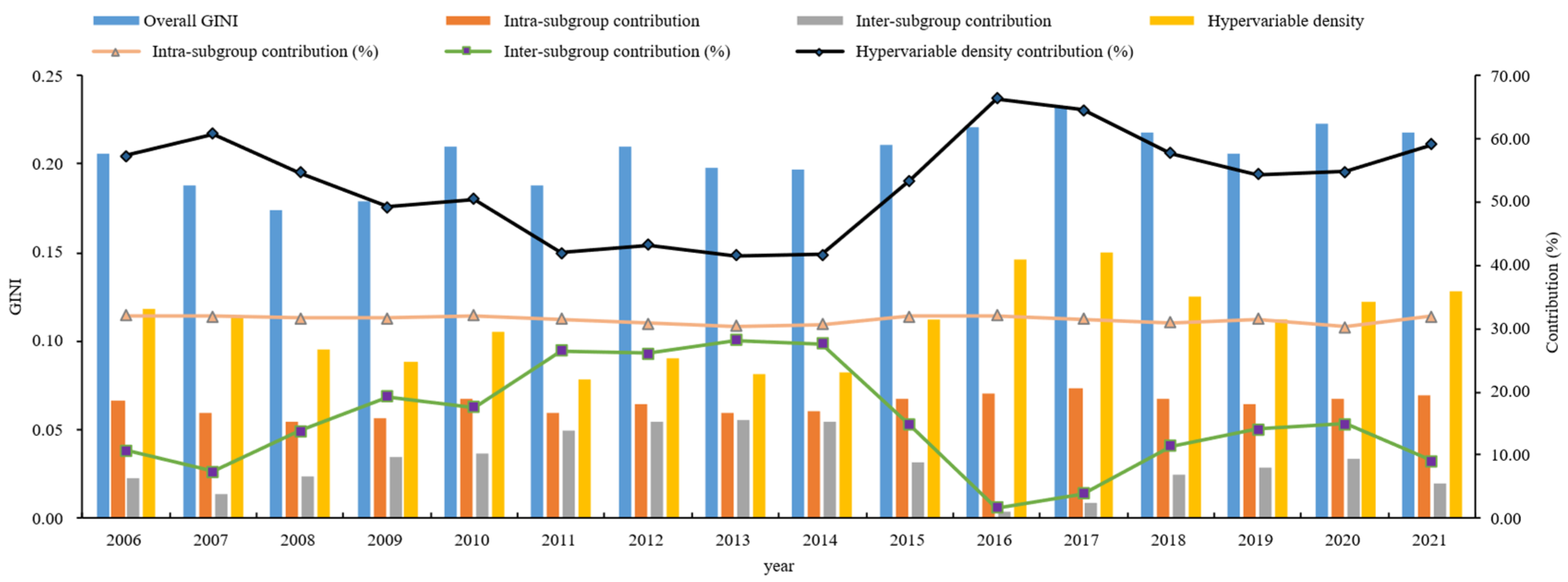
This study assessed MNQP across coastal regions and examined its regional disparities from 2006 to 2021. Using the Dagum Gini coefficient decomposition method, we obtained the overall Gini coefficient, inter-group and intra-group coefficients, transvariation density, and their respective contribution rates (Table 3). The temporal trends of these decomposition indices are further visualized in Figure 7.
At the macro level (see Table 3 and Figure 7), the mean value of the overall Gini coefficient of China’s MNQP is 0.205, with the Gini coefficient distributed in the range of 0.174 to 0.233. This indicates significant regional disparities. The overall Gini coefficient of China’s MNQP demonstrates a fluctuating upward trend, suggesting that, although China’s level of development of MNQP is continuously improving, the gap between the development levels of MNQP in various coastal areas is widening. In terms of contribution rates, hypervariation density consistently accounts for the largest share throughout the study period, surpassing both intra- and inter-group disparities. This suggests that overlapping differentiations among coastal regions constitute the primary driver of spatial non-equilibrium in China’s MNQP. Intra-group disparity represents the second most significant source of spatial imbalance, though its contribution shows an overall decline. Inter-group disparity ranks third, with its contribution rate also decreasing over time.
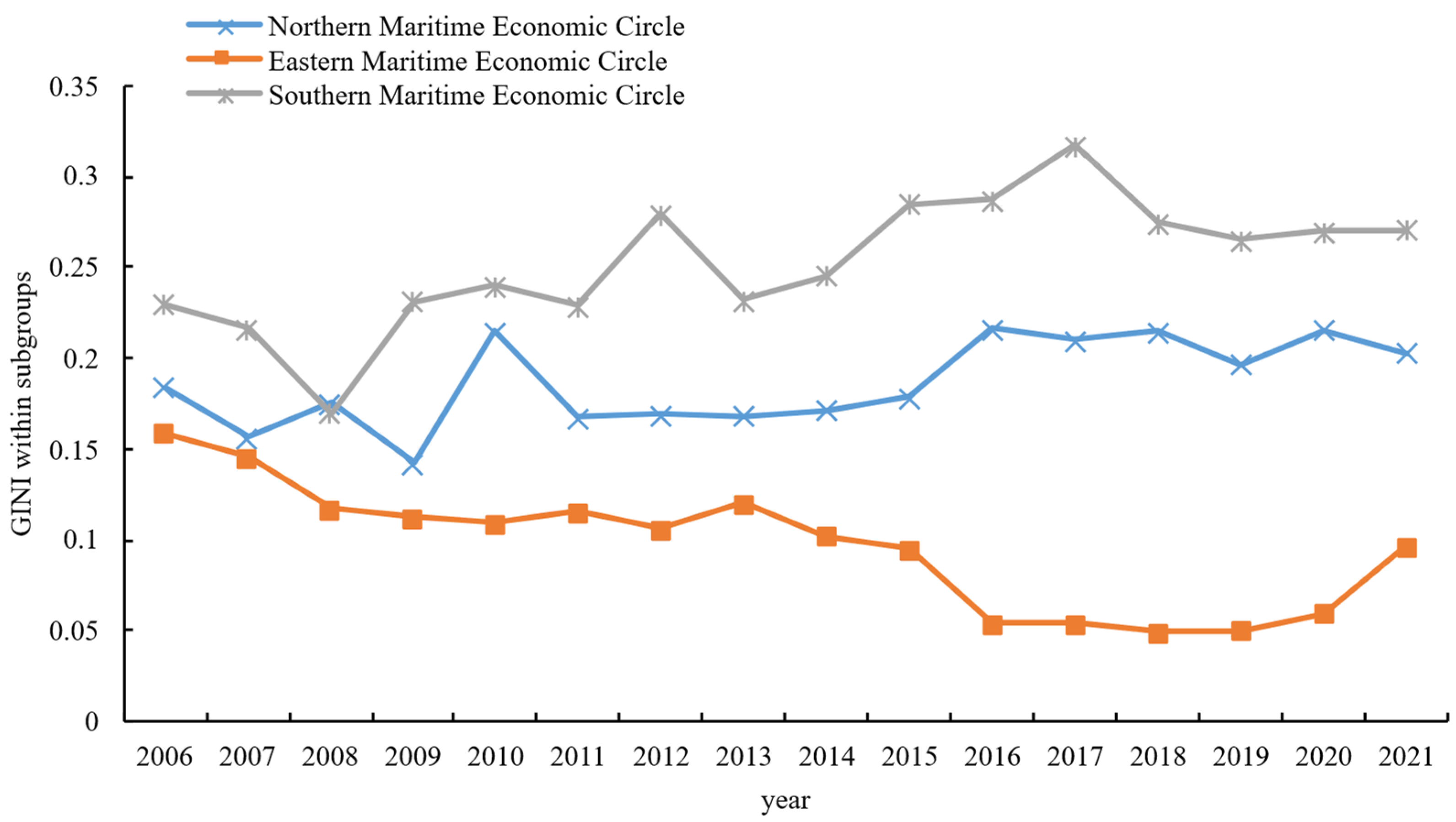
To further investigate the dynamics of intra-group disparities in MNQP, Figure 8 is presented.
Analysis of intra-regional disparities (Figure 8) reveals distinct patterns across maritime economic circles. The southern maritime economic circle shows the most substantial variation in MNQP, with Gini coefficients ranging from 0.170 to 0.317 (mean: 0.253). The northern maritime economic circle demonstrates the second-highest level of disparity (0.142–0.216; mean: 0.187), while the eastern maritime economic circle exhibits relatively minimal internal variation (0.050–0.159; mean: 0.097). Regarding evolutionary trends, intra-regional disparities increased in both the northern and southern circles during the observation period, whereas the eastern circle showed a decrease in internal variation. In terms of fluctuation magnitude, the southern and eastern circles experienced relatively notable volatility in their Gini coefficients, while the northern circle maintained more moderate fluctuations.
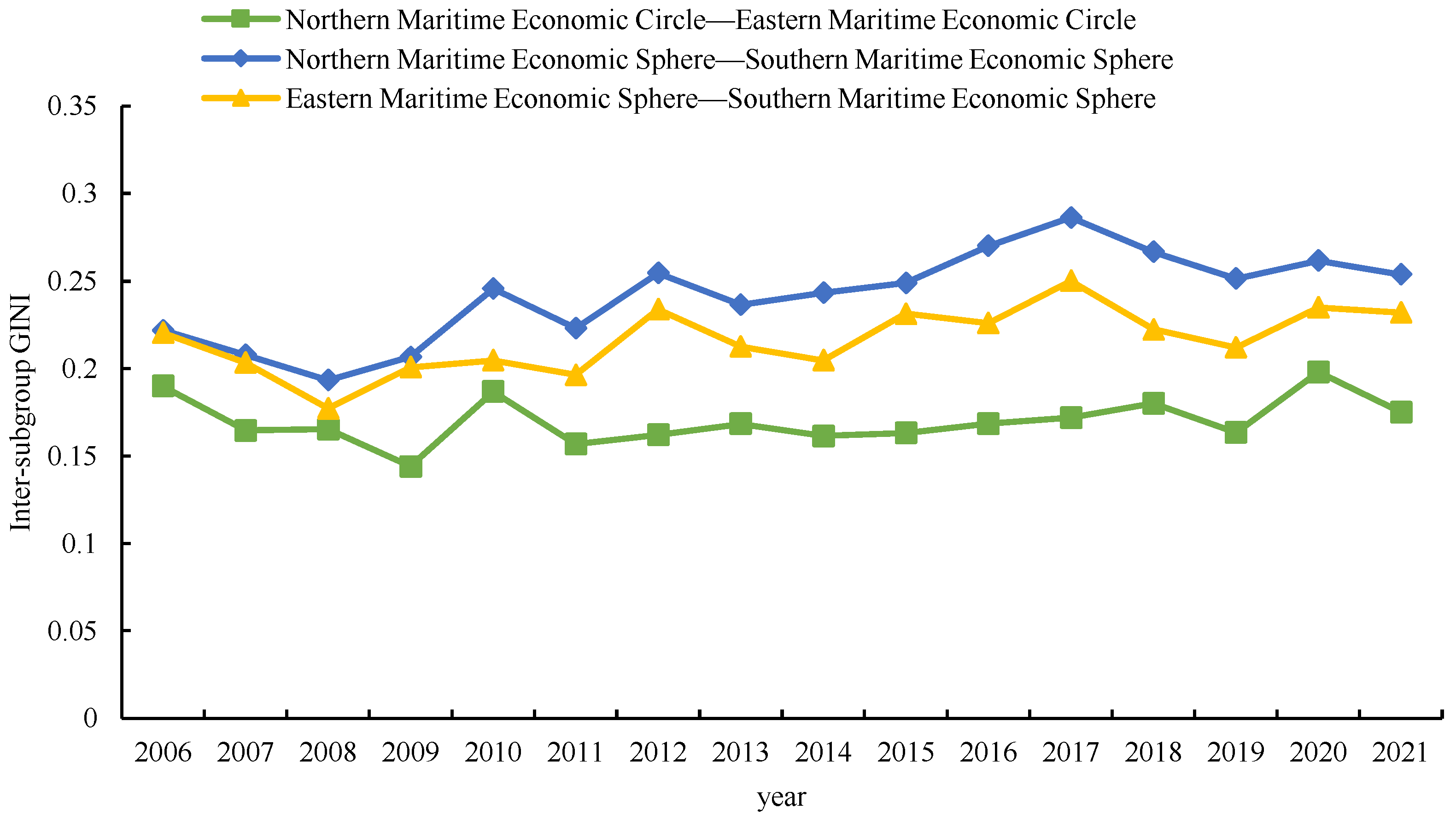
In order to examine the dynamics of the inter-group gap in MNQP in China, Figure 9 is plotted.
Analysis of inter-regional disparities (Figure 9) reveals pronounced differences between the northern and southern maritime economic circles, which consistently exhibit the highest Gini coefficients (0.144–0.198; mean: 0.171). Disparities between the eastern and southern circles rank second (0.177–0.250; mean: 0.216), while those between the northern and eastern circles are relatively minimal (0.193–0.286; mean: 0.242). All three inter-regional disparity curves demonstrate closely aligned fluctuating upward trends throughout the study period.
Two principal findings emerge from the analysis. First, the substantial contribution of hypervariation density, coupled with the limited share of inter-regional disparity, indicates that overlapping differentiations across regions constitute the primary driver of the widening overall disparities in China’s MNQP. Second, within the more developed maritime economic circles, certain coastal areas exhibit particularly high productivity levels. These patterns reflect how divergent growth trajectories—with relative declines in some advanced regions and ascendance in others—have intensified the developmental stratification between higher- and lower-level maritime economic circles. With regard to the evolution trend, both the intra-group Gini coefficient and hypervariance density demonstrate an upward trend, with the exception of the inter-group Gini coefficient, which exhibits a downward trend on the whole.

4.2. Spatial Polarization Characteristics

Building on the analysis of regional disparities, this study further examines the spatial polarization characteristics of China’s MNQP from 2006 to 2021 by applying the DER and EGR polarization indices.
As demonstrated in Table 4, both the DER and EGR polarization indices exhibit an upward trend during the period 2006–2021. After adjusting for various parameters, the trends of the DER and EGR polarization indices remain consistent, indicating an enhancement in the degree of polarization of China’s MNQP during the examined timeframe. The findings are statistically robust, providing a reliable basis for the conclusions drawn. Moreover, it has been established that an increase in the value of the sensitivity parameter α results in a decrease in the corresponding DER and EGR indices. This phenomenon can be attributed to the fact that the parameter α serves as a metric for the identification of group members. As the value of α increases, the degree of group identity also increases. This observation intuitively captures the fundamental distinction between the polarization index and the Gini coefficient. Specifically, the polarization index considers the identity of group members, whereas the Gini coefficient does not take this into account. This paper’s utilization of the polarization index for the analysis of spatial imbalance in China’s MNQP is a justifiable endeavour.
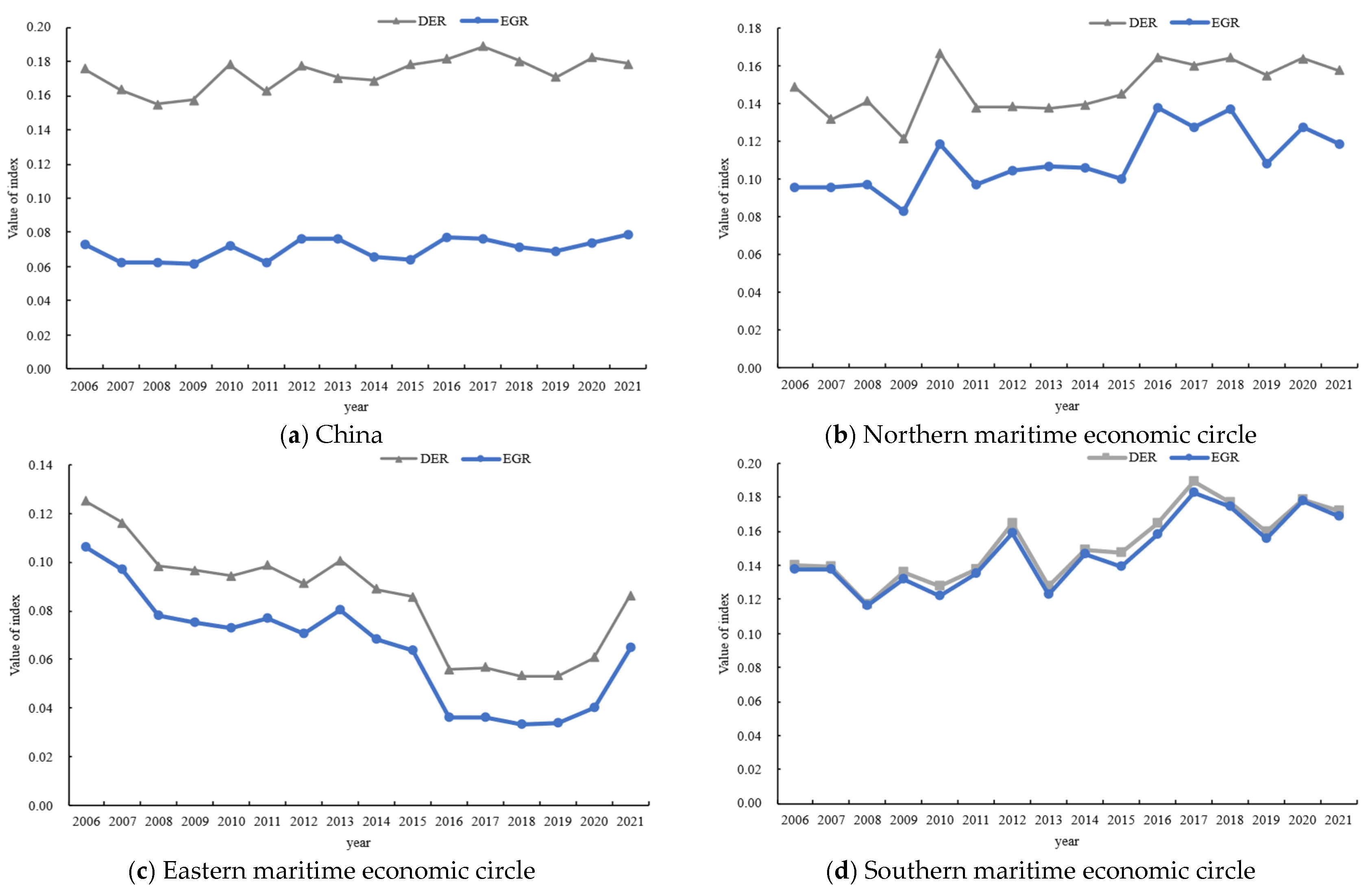
As illustrated in Figure 10, the trend of the polarization index in different maritime economic circles is worthy of further observation.
As shown in Figure 10, the DER and EGR polarization indices for MNQP demonstrate distinct regional trends during the observation period. Both indices show a notable increase in the northern and southern maritime economic circles, while declining in the eastern maritime economic circle. Comparative analysis reveals the southern maritime economic circle maintains the highest average polarization levels, followed by the northern circle, with the eastern circle exhibiting the lowest values. This indicates that spatial polarization of MNQP is most pronounced in the southern region, moderate in the northern region, and relatively minimal in the eastern region among China’s three major maritime economic zones.
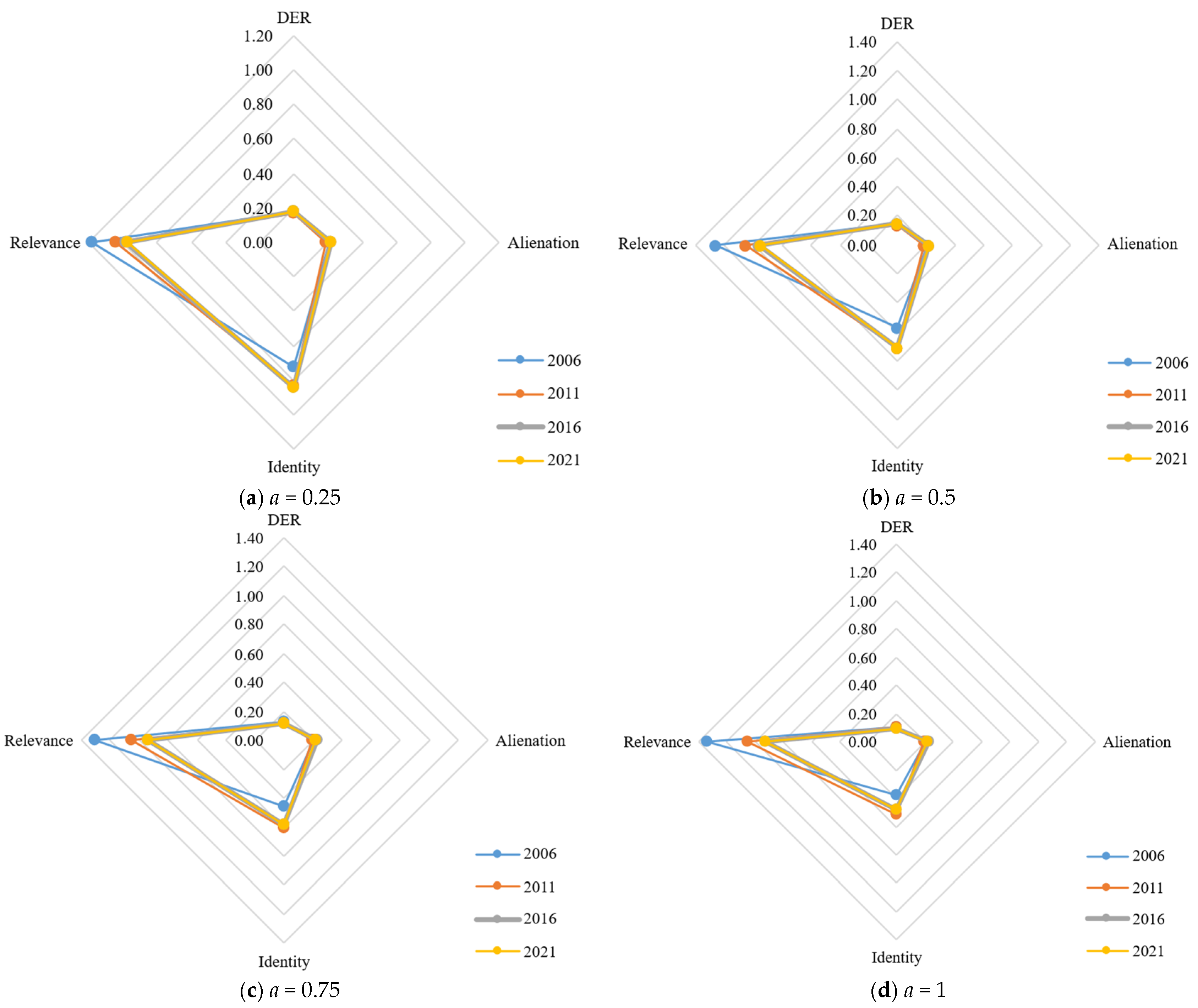
This study utilizes the decomposition properties of the DER index to ascertain the three primary indicators of identity. Figure 11 presents the identity, detachment, and correlation indicators from the DER index analysis, revealing factors behind the increased polarization of China’s MNQP during 2006–2021.
Figure 11 shows that the identifiability and alienation indices of the DER for China’s MNQP consistently increased across multiple parameters during the observation period. This indicates a growing divergence in productivity distribution among maritime economic circles, alongside evident clustering within selective subgroups.

5. Cause Analysis of Spatial Disequilibrium of MNQP in China

Drawing on the relevant literature [51,52] and considering the actual conditions of marine economic development across coastal regions, this study selects seven variables to examine their influence on the spatial non-equilibrium of China’s MNQP: ① Marine economic development (factor 1): measured by per capita GDP. ② Marine industrial structure (factor 2): proportion of marine secondary and tertiary industries in marine GDP. ③ Marine green technological progress (factor 3): marine green total factor productivity calculated using Data Envelopment Analysis, Directional Distance Function, and Global Malmquist–Luenberger methods. ④ Degree of openness (factor 4): ratio of total import-export value to GDP. ⑤ Level of financial support (factor 5): proportion of local fiscal expenditure to GDP. ⑥ Environmental regulation intensity (factor 6): share of completed industrial pollution control investment in GDP. ⑦ Financial development level (factor 7): deposit and loan balances of banking institutions relative to GDP.
Prior to Geodetector analysis, all influencing factors were discretized using the K-means clustering method into five levels. These discretized factors served as detection variables in the Geodetector model to assess their respective impacts on spatial non-equilibrium.
Table 5 ranks the influencing factors by their explanatory power regarding the spatial non-equilibrium of China’s MNQP. Marine economic development (factor 1) emerges as the predominant factor, followed sequentially by marine industrial structure (factor 2), marine green technology advancement (factor 3), openness (factor 4), financial support (factor 5), environmental regulation (factor 6), and financial development (factor 7).
Further ecological detection is conducted to identify influencing factors.
Table 6 reveals that multiple factor pairs significantly influence the spatial distribution of China’s MNQP. Statistically significant interactive effects are observed between marine economic development (factor 1) and financial development level (factor 3), marine green technology progress (factor 4), openness (factor 5), financial support (factor 7), and environmental regulation (factor 6); as well as between marine industrial structure (factor 2) and financial development level (factor 3), and environmental regulation (factor 6). However, several factor pairs demonstrate non-significant interactive effects, including marine economic development (factor 1) with financial support (factor 7), and marine industrial structure (factor 2) with both environmental regulation (factor 6) and financial development level (factor 3).
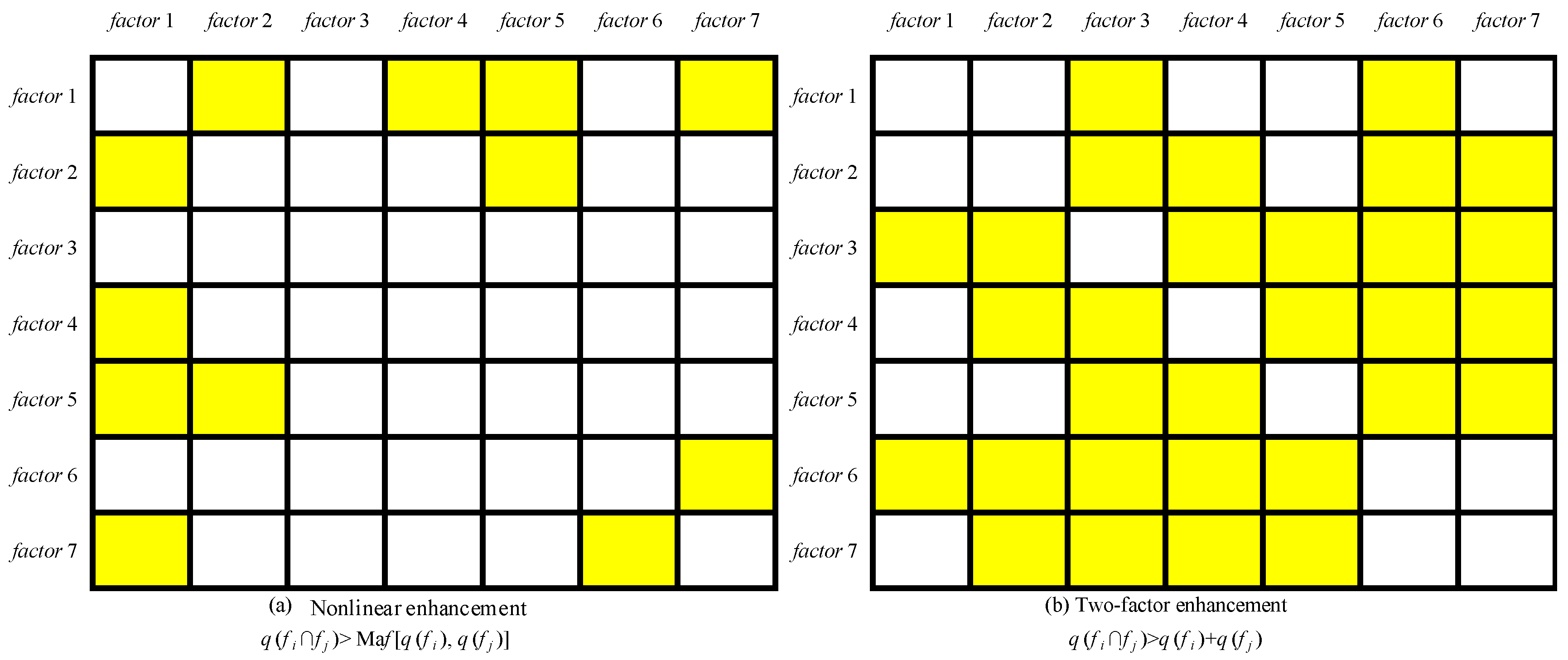
Finally, a cross-detection analysis is conducted on the factors influencing China’s marine new-quality productivity, with results presented in Table 7. The cross-detection findings are visualized in Figure 12. It should be noted that Table 7 reports the results of factor interactions—specifically, the interaction effects (q statistic) between pairs of influencing factors—which indicate the explanatory power of two factors in accounting for spatial non-equilibrium in China’s marine new-quality productivity. Figure 12 classifies these pairwise interaction effects. If the q statistic satisfies q(fifj) > Max[q(fi), q(fj)], it is defined as nonlinear enhancement; if q(fifj) > q(fi) + q(fj), it is defined as two-factor enhancement. If the box in Figure 12a or Figure 12b is yellow, it indicates that the interaction effect between the influencing factors is either nonlinear enhancement or Two-factor enhancement.
Table 7 and Figure 12 indicate that interactions among influencing factors are predominantly characterized by two-factor enhancement and nonlinear enhancement, with the latter being more prevalent. This demonstrates that the spatial non-equilibrium of China’s MNQP results from the synergistic effects of multiple factors. Notably, the financial development level (factor 3), marine green technology progress (factor 4), and environmental regulation level (factor 6) exhibit nonlinear enhancement when interacting with other factors—their combined explanatory power is notably greater than the sum of individual effects. This highlights that these three factors, through interaction with other variables, exert a particularly strong synergistic influence on the spatial differentiation of MNQP in China.

6. Conclusions and Policy Recommendations

This study assesses MNQP across China’s 11 coastal provincial regions from 2006 to 2021 using the G1-EWM integrated weighting approach. Spatial patterns are analyzed at the national and regional levels, using Gaussian KDE, spatial Markov chains, Dagum Gini decomposition, DER/EGR polarization indices, and geographical detectors. The research found out the following: ① From a spatiotemporal perspective, the national average of China’s marine new-type productive forces rose from 0.120 in 2006 to 0.264 in 2021. This finding suggests that China is making consistent progress in the development of its marine new-type productive forces, although the overall level remains comparatively low. ② From a regional perspective, China’s overall Gini coefficient for marine new-quality productivity has exhibited an upward trend, rising from 0.206 in 2006 to 0.217 in 2021. The disparity in the levels of development of marine new-quality productivity among coastal regions is increasing. The results of the decomposition process indicate that both the intra-group Gini coefficient and the hyper-variability density demonstrate an upward trend, whilst the inter-group Gini coefficient exhibits an overall downward trend. Furthermore, the presence of overlapping issues among different coastal regions is the primary cause of regional disparities in China’s marine new-quality productivity. ③ Spatial Polarization: National indices show rising trends, with the eastern circle showing convergence. DER index decomposition identifies enhanced identity and alienation as key drivers. The spatial non-equilibrium characteristics result from multiple factors, with marine economic development being the main influence. Financial development level, marine green technology progress, and environmental regulation show particularly strong nonlinear enhancement effects when interacting with other factors. ④ The results of the geographic detector indicate that marine economic development (q statistic: 0.478) is the core factor influencing the spatial non-equilibrium of China’s marine new-quality productive forces. The explanatory power of interactions among various influencing factors primarily manifests as dual-factor enhancement and nonlinear enhancement, with the latter being more prevalent. The spatial non-equilibrium of China’s marine new-quality productive forces is the result of the combined effects of multiple influencing factors. A comparison of the present paper with existing research reveals three aspects in which its contributions are novel. Firstly, it introduces a novel research subject. Whilst the previous literature has examined new-quality productive forces from the perspective of the national economy as a whole, this paper focuses on trends and conducts systematic exploration within the MNQP framework. Secondly, the research content is novel. Whilst earlier studies have established new-quality productivity indicator systems based exclusively on the three factors of labour (labourers, objects of labour, and means of labour), this paper extends the factor structure by incorporating economic, technological, and environmental benefits. The aim is to establish a comprehensive evaluation indicator system for marine new-quality productivity. Furthermore, while extant studies frequently characterize the spatial imbalance of marine new-quality productive forces solely through the lens of regional disparities, this paper integrates regional disparities with spatial polarization in order to systematically examine the spatial imbalance of marine new-quality productive forces. Thirdly, the methodology employed is innovative. Existing studies predominantly utilize a single-objective weighting method to measure new-quality productivity, frequently lacking expert input and practical orientation. The present paper employs the G1-EWM combined weighting method, integrating subjective and objective approaches, to measure marine new-quality productivity.
The findings suggest that China’s progress toward becoming a strong maritime nation could be hindered by imbalanced and inadequate marine new-quality production. Accelerating the marine economic development model and fostering coordinated regional development are crucial to achieving the goals of the 14th Five-Year Plan and long-term maritime power strategies. The recommendations are as follows: ① Cultivate MNQP: Focus efforts at the regional level to boost productivity. Leverage talent, technology, and new growth opportunities in the marine economy to create new avenues of MNQP. Support high-end marine equipment, network information, the green chemical industry, biopharmaceuticals, and other cutting-edge sectors. Shape the marine industrial landscape and foster new formats. ② Empowerment through Sci-Tech Innovation: It is essential to optimize the marine science and technology innovation system, tackle key technologies in the marine sector, and develop frontier technologies for marine productivity. Governments and enterprises should work together to improve the working environment for marine professionals, offer better conditions and incentives for marine R&D talent, refine research incentive mechanisms, and strengthen the technology R&D and transformation chain to align innovation with real-world demands. Policy support, financial subsidies, and enhanced financial services should be used to stimulate innovation in small- and medium-sized marine enterprises, improve the maritime business climate, and cultivate competitive marine firms. This study is interested in a multi-party collaborative innovation mechanism among research institutes, universities, enterprises, and the government. This mechanism combines production, teaching, and R&D to explore and incubate technologies and project entities in practice. ③ Coastal and inland regions should leverage their respective resources and capital advantages. Sea-related capital, talent, information, technology, and other relevant factors should be more open. This will accelerate the “attraction of enterprises involved in the sea”. Pilot policies and demonstration samples will be a key priority. Efforts will be made to promote green development, increasing the construction of sea-related nature reserves. This will be coupled with an improvement in marine biodiversity and the formation of a development model that is environmentally friendly and in harmony with nature. The primary focus should be on enhancing the global competitiveness of enterprises operating in the maritime sector. To achieve this, it is essential to participate actively in global governance and accumulate global marine influence. ④ It is imperative to expedite the exploration of a synergistic development mechanism for marine economic advancement among coastal regions. Moreover, there is a need to promote the integration of digital information with the real economy of the oceans. Furthermore, it is imperative that a platform for the dissemination of marine information resources be established through collaborative endeavours. It is imperative to promote the natural flow of sea-related elements among coastal areas. In addition, there is a need to enhance exchanges and cooperation among coastal areas in sea-related academic and scientific research, business activities, talent cultivation, and so forth. Moreover, it is imperative to establish collaborative networks to foster regional and international marine city clusters and economic circles. Finally, there is a requirement to promote the joint implementation of various sea-related projects, with a view to promoting synergistic and balanced development of new marine productivity.
It is evident that the conclusions of this study are constrained by the limitations of the current era and the available perspectives. Consequently, the conclusions of this study are of reference value and practical significance only for China’s present and near-term practices. They cannot support its long-term development. It is recommended that future efforts concentrate on monitoring the dynamic evolution of China’s marine new-quality productive forces. This necessitates the continuous updating of indicators with higher technological sophistication, efficiency, and quality, whilst incorporating more infrastructure and technical metrics related to next-generation information technologies to reflect the digital ocean trend.

Author Contributions

Conceptualization, Y.W. and L.Y.; Methodology, Y.W. and Z.L.; Data curation, W.W. and Y.W.; Writing—original draft, R.W. and Y.W.; Writing—review and editing, L.Y. and Y.W.; Visualization, W.W. and Z.L. All authors have read and agreed to the published version of the manuscript.

Funding

Guangdong Province Philosophy and Social Sciences “13th Five-Year Plan” project (GD20YDXZYJ15); Modern Marine Industry and RCEP Trade Research Institute project (No. 2025TSZK015).

Data Availability Statement

The raw data supporting the conclusions of this article will be made available by the authors on request.

Conflicts of Interest

The authors declare no conflicts of interest.

References

  1. Chen, Y.; Ma, Y.; Wang, Y.; Sun, Z.; Han, Y. Impact of China’s Marine Governance Policies on the Marine Ecological Environment—A Case Study of the Bohai Rim. Ocean Coast. Manag. 2023, 246, 106913. [Google Scholar] [CrossRef]
  2. Sun, C.; Wang, L.; Zou, W.; Zhai, X. The High-Quality Development Level Assessment of Marine Economy in China Based on a “2+6+4” Framework. Ocean Coast. Manag. 2023, 244, 106822. [Google Scholar] [CrossRef]
  3. Cheng, J.; Zhang, X.; Gao, Q. Analysis of the Spatio-Temporal Changes and Driving Factors of the Marine Economic–Ecological–Social Coupling Coordination: A Case Study of 11 Coastal Regions in China. Ecol. Indic. 2023, 153, 110392. [Google Scholar] [CrossRef]
  4. Feng, F.; Zhai, C.; Yang, Z.; Feng, K. China’s Marine Manufacturing Export Growth: Policy, Status, and Driving Components. Mar. Policy 2023, 149, 105495. [Google Scholar] [CrossRef]
  5. Shi, X.; Wang, T.; Luo, K.; Wang, J.; Gu, X. The Mechanism of Constructing Marine Ranching Industrial Ecosystem Based on Grounded Theory: A Case Study of Yantai, China. Reg. Stud. Mar. Sci. 2023, 68, 103214. [Google Scholar] [CrossRef]
  6. Xu, S.; Liu, Y. Research on the Impact of Carbon Finance on the Green Transformation of China’s Marine Industry. J. Clean. Prod. 2023, 418, 138143. [Google Scholar] [CrossRef]
  7. Meng, Z.; Yu, X.; Wang, L.; Chen, W. Composite Indicators for Multi-Dimensional Assessments of Marine Economic Security in China. Ocean Coast. Manag. 2024, 251, 107063. [Google Scholar] [CrossRef]
  8. Yang, Y.; Liu, D.; Xu, R.; Li, Z.; Shi, C.; Zhu, X.; Sun, X. Full Title: The Performance Evaluation of Marine Ecological Civilization Construction (MECC): A Case Study of Coastal Cities in Jiangsu Province, China. Ocean Coast. Manag. 2024, 254, 107174. [Google Scholar] [CrossRef]
  9. Ji, J.; Liu, H.; Yin, X. Evaluation and Regional Differences Analysis of the Marine Industry Development Level: The Case of China. Mar. Policy 2023, 148, 105445. [Google Scholar] [CrossRef]
  10. Zhai, X.; Sun, C.; Zou, W.; Hao, S. Spatiotemporal Characteristic and Evolution of China’s Marine Economic Resilience. Ocean Coast. Manag. 2023, 238, 106562. [Google Scholar] [CrossRef]
  11. Zhong, J.; Wu, X.; Wu, S.; Wang, Y.; Peng, S. Regional Patterns and Factors Analysis of the Sustainable Development of Benefits in China’s National-Level Marine Ranching: Based on Shellfish and Algae. J. Clean. Prod. 2024, 467, 142994. [Google Scholar] [CrossRef]
  12. Fang, X.; Zhang, Y.; Yang, J.; Zhan, G. An Evaluation of Marine Economy Sustainable Development and the Ramifications of Digital Technologies in China Coastal Regions. Econ. Anal. Policy 2024, 82, 554–570. [Google Scholar] [CrossRef]
  13. Sun, R.; Hu, D. China’s Marine Eco-Environment Law Enforcement from the Perspective of the Responsibility System: Dilemmas and Solutions. Mar. Policy 2025, 171, 106437. [Google Scholar] [CrossRef]
  14. Yang, W.; Chen, X.; Liu, Y. Recent Developments in Building Sustainable Marine Fisheries in China: Reflections on the 2023 Revision of the Marine Environmental Protection Law. Mar. Policy 2025, 171, 106439. [Google Scholar] [CrossRef]
  15. Li, L.; Liu, L. New Quality Productivity and Chinese Modernization: Analysis Based on the Perspective of Scientific and Technological Innovation. Int. J. Soc. Sci. Public Adm. 2024, 2, 192–196. [Google Scholar] [CrossRef]
  16. Shao, C.; Dong, H.; Gao, Y. New Quality Productivity and Industrial Structure in China: The Moderating Effect of Environmental Regulation. Sustainability 2024, 16, 6796. [Google Scholar] [CrossRef]
  17. Baeza, A.V.; González, B.G.M. Labor Productivity and Marxist Theory of Labor Value. World Rev. Political Econ. 2020, 11, 377–387. [Google Scholar] [CrossRef]
  18. Chiarella, C.; Meyfroidt, P.; Abeygunawardane, D.; Conforti, P. Balancing the Trade-Offs between Land Productivity, Labor Productivity and Labor Intensity. Ambio 2023, 52, 1618–1634. [Google Scholar] [CrossRef]
  19. Liu, Y.; He, Z. Synergistic Industrial Agglomeration, New Quality Productive Forces and High-Quality Development of the Manufacturing Industry. Int. Rev. Econ. Financ. 2024, 94, 103373. [Google Scholar] [CrossRef]
  20. Li, J.; Noorliza, K.; Zhang, X. Enhancing Environmental, Social, and Governance Performance through New Quality Productivity and Green Innovation. Sustainability 2024, 16, 4843. [Google Scholar] [CrossRef]
  21. Yu, L.; Zhang, Q. Measurement of New Qualitative Productivity Kinetic Energy from the Perspective of Digital and Green Collaboration--Comparative Study Based on European Countries. J. Clean. Prod. 2024, 476, 143787. [Google Scholar] [CrossRef]
  22. Zhao, J. How Do Innovation Factor Allocation and Institutional Environment Affect High-Quality Economic Development? Evidence from China. J. Innov. Knowl. 2024, 9, 100475. [Google Scholar] [CrossRef]
  23. Zhou, C.; Li, X.; Lin, X.; Cheng, M. Influencing Factors of the High-Quality Economic Development in China Based on LASSO Model. Energy Rep. 2022, 8, 1055–1065. [Google Scholar] [CrossRef]
  24. Li, R.; Wang, Q.; Ge, Y. Does Trade Protection Undercut the Green Efficiency of the Marine Economy? A Case Study. Mar. Policy 2023, 157, 105864. [Google Scholar] [CrossRef]
  25. Yusheng, C.; Sun, Z.; Zhou, Y.; Yang, W.; Ma, Y. Can the Regulation of the Coastal Environment Facilitate the Green and Sustainable Development of the Marine Economy? Ocean Coast. Manag. 2024, 254, 107203. [Google Scholar] [CrossRef]
  26. Wang, W.; Mao, W.; Wu, R. The Effect of Marine Pastures on Green Aquaculture in China. Water 2024, 16, 1730. [Google Scholar] [CrossRef]
  27. Sun, Y.; Zhou, Z.; Fang, Y.; Bie, M.; Sun, X. Analysis of Regional Disparities, Spatiotemporal Evolution and Key Influencing Factors of Marine New Productive Forces in China. Sustainability 2025, 17, 1432. [Google Scholar] [CrossRef]
  28. Ji, J.; Li, Y. The Development of China’s Fishery Informatization and Its Impact on Fishery Economic Efficiency. Mar. Policy 2021, 133, 104711. [Google Scholar] [CrossRef]
  29. Li, Y.; Ji, J. The Digitalization of Chinese Fisheries and Its Configuration Path to Empower Fishery Sustainable Development. J. Clean. Prod. 2024, 466, 142807. [Google Scholar] [CrossRef]
  30. Meng, Q.; Di, Q.; Liu, Y.; Chen, X. How New Quality Productivity Becomes a New Driving Force for Marine Economy High-Quality Development: An Empirical Analysis Based on New Technology, New Forms, and New Economy. Water 2025, 17, 987. [Google Scholar] [CrossRef]
  31. Wright, G. Marine Governance in an Industrialised Ocean: A Case Study of the Emerging Marine Renewable Energy Industry. Mar. Policy 2015, 52, 77–84. [Google Scholar] [CrossRef]
  32. Yin, K.; Zhang, K.; Huang, C. Institutional Supply, Market Cultivation, and the Development of Marine Strategic Emerging Industries. Mar. Policy 2022, 139, 105045. [Google Scholar] [CrossRef]
  33. Liu, S.; Zhang, Y.; Wang, J.; Wang, C.; Chen, S.; Liu, Y. The Impact of the Spatial Mobility of Marine New Qualitative Productivity Force Factors on the Coordinated Development of China’s Marine Economy. Sustainability 2025, 17, 5883. [Google Scholar] [CrossRef]
  34. Qingyue, M.; Shenglan, T. Universal Health Care Coverage in China: Challenges and Opportunities. Procedia-Soc. Behav. Sci. 2013, 77, 330–340. [Google Scholar] [CrossRef][Green Version]
  35. Hu, A.; Yan, Y.; Tang, X.; Liu, S. People-Centered Comprehensive Modernization. In 2050 China: Becoming a Great Modern Socialist Country; Hu, A., Yan, Y., Tang, X., Liu, S., Eds.; Springer: Singapore, 2021; pp. 21–29. ISBN 978-981-15-9833-3. [Google Scholar]
  36. Huang, C.; Liu, J. People-Centered Philosophy of Development. In Research on the Concept and Practice of Poverty Reduction in China; Huang, C., Liu, J., Eds.; Springer Nature: Singapore, 2022; pp. 13–28. ISBN 978-981-16-9519-3. [Google Scholar]
  37. Li, G.; Zhou, Y.; Liu, F.; Tian, A. Regional Difference and Convergence Analysis of Marine Science and Technology Innovation Efficiency in China. Ocean Coast. Manag. 2021, 205, 105581. [Google Scholar] [CrossRef]
  38. Wang, J.; Shi, X.; Du, Y. Exploring the Relationship among Marine Science and Technology Innovation, Marine Finance, and Marine Higher Education Using a Coupling Analysis: A Case Study of China’s Coastal Areas. Mar. Policy 2021, 132, 104706. [Google Scholar] [CrossRef]
  39. Chen, P.; Chen, H.; Chen, K.; Ke, H.; Cai, M. Quantitative Assessment of the Response of Seawater Environmental Quality to Marine Protection Policies under Regional Economic Development—A Case Study of Xiamen Bay, China. Mar. Environ. Res. 2023, 186, 105934. [Google Scholar] [CrossRef]
  40. Qian, X. Research on the Coordinated Development Model of Marine Ecological Environment Protection and Economic Sustainable Development. J. Sea Res. 2023, 193, 102377. [Google Scholar] [CrossRef]
  41. Burdon, D.; Barnard, S.; Strong, J.A.; Atkins, J.P. Linking Marine Habitats and Economic Values: A Spatial Scaling Methodology for Valuing Societal Benefits. Ecol. Econ. 2024, 224, 108316. [Google Scholar] [CrossRef]
  42. Zhao, H.; Wang, Y.; Liu, X. The Evaluation of Smart City Construction Readiness in China Using CRITIC-G1 Method and the Bonferroni Operator. IEEE Access 2021, 9, 70024–70038. [Google Scholar] [CrossRef]
  43. Ding, X.; Tian, X.; Wang, J. A Comprehensive Risk Assessment Method for Hot Work in Underground Mines Based on G1-EWM and Unascertained Measure Theory. Sci. Rep. 2024, 14, 6063. [Google Scholar] [CrossRef] [PubMed]
  44. Wang, W.; Mao, W.; Zhu, J.; Wu, R.; Yang, Z. Research on Efficiency of Marine Green Aquaculture in China: Regional Disparity, Driving Factors, and Dynamic Evolution. Fishes 2024, 9, 11. [Google Scholar] [CrossRef]
  45. Dagum, C. A New Approach to the Decomposition of the Gini Income Inequality Ratio. Empir. Econ. 1997, 22, 515–531. [Google Scholar] [CrossRef]
  46. Wang, W.; Mao, W.; Wu, R.; Zhu, J.; Yang, Z. Study on the Spatial Imbalance and Polarization of Marine Green Aquaculture Efficiency in China. Water 2024, 16, 273. [Google Scholar] [CrossRef]
  47. Duclos, J.-Y.; Esteban, J.; Ray, D. Polarization: Concepts, Measurement, Estimation. Econometrica 2004, 72, 1737–1772. [Google Scholar] [CrossRef]
  48. Esteban, J.; Gradín, C.; Ray, D. An Extension of a Measure of Polarization, with an Application to the Income Distribution of Five OECD Countries. J. Econ. Inequal. 2007, 5, 1–19. [Google Scholar] [CrossRef]
  49. Wang, J.; Haining, R.; Zhang, T.; Xu, C.; Hu, M.; Yin, Q.; Li, L.; Zhou, C.; Li, G.; Chen, H. Statistical Modeling of Spatially Stratified Heterogeneous Data. Ann. Am. Assoc. Geogr. 2024, 114, 499–519. [Google Scholar] [CrossRef]
  50. Wang, J.; Li, X.; Christakos, G.; Liao, Y.; Zhang, T.; Gu, X.; Zheng, X. Geographical Detectors-Based Health Risk Assessment and Its Application in the Neural Tube Defects Study of the Heshun Region, China. Int. J. Geogr. Inf. Sci. 2010, 24, 107–127. [Google Scholar] [CrossRef]
  51. Ji, J.; Chi, Y.; Yin, X. Research on the Driving Effect of Marine Economy on the High-Quality Development of Regional Economy—Evidence from China’s Coastal Areas. Reg. Stud. Mar. Sci. 2024, 74, 103550. [Google Scholar] [CrossRef]
  52. Wang, S.; Lu, B.; Yin, K. Financial Development, Productivity, and High-Quality Development of the Marine Economy. Mar. Policy 2021, 130, 104553. [Google Scholar] [CrossRef]
Figure 1. Technical route.
Water 18 00240 g001
Figure 2. Theoretical framework for the construction of China’s MNQP indicator system.
Water 18 00240 g002
Figure 3. Results of level measurement.
Water 18 00240 g003
Figure 4. Comparison of development levels of 11 coastal provincial administrative regions with the overall national situation.
Water 18 00240 g004
Figure 5. Results of KDE at the national level and for the three Marine economic circles.
Water 18 00240 g005
Figure 6. Transfer types for dynamic spatial Markov chains.
Water 18 00240 g006
Figure 7. Dagum Gini coefficient and change trend of decomposition index.
Water 18 00240 g007
Figure 8. Trend of Gini coefficient change within groups.
Water 18 00240 g008
Figure 9. Trend of change in Gini coefficient between groups.
Water 18 00240 g009
Figure 10. Spatial polarization trends at the national level and in the three marine economic circles. Note: Parameter α = 0.25 for DER index; α = 0.25 and β = 1 for EGR index.
Water 18 00240 g010
Figure 11. The DER index decomposes the radar map.
Water 18 00240 g011
Figure 12. Factor interaction. Note: The yellow highlighted part in (a) corresponds to whether it is nonlinear enhancement; (b) The yellow highlighted part corresponds to whether it is a two-factor enhancement.
Water 18 00240 g012
Table 1. Index system construction.
ObjectiveDimensionGuidelinesFirst-Level IndicatorSecond-Level IndicatorsMeasures
MNQPBasic structureLabourLabour productivityMarine labour productivityGross marine product (yuan)/persons employed in the coastal zone (number)
Worker awarenessEmployment philosophyPersons employed in marine research and development organizations (number)/persons employed in the coastal zone (number)
Worker skillsEducational supportHigher education institutions specializing in the sea (number)
Human capitalStudents enrolled in general higher education and above specializing in marine subjects (number)
Labour particularsMaterial means of productionTraditional facilitiesMarine cargo turnover (tons per kilometre)
Mariculture area (hectare)
Total area of salt flats (hectare)
Number of travel agencies in coastal areas (number)
Digital equipmentLong-distance fibre-optic cable lines (km)/coastal population (number)
Internet broadband access ports (number)/population of coastal areas (number)
Depletion of energyCoastal energy consumption (ten thousand tons of standard coal)/GDP (100 million yuan)
Electricity consumption (100 million kilowatts/hour)/population in coastal areas (10,000 people)
Intangible means of productionSupport for innovationResearch and development funds for marine research institutions (100 million yuan)/gross domestic product of coastal areas (100 million yuan)
Scientific and technical subject matterScientific and technological projects in marine research institutions (number)/employees of marine research and development institutions (number)
Objects of labourNew industryRelated industriesValue added of marine-related industries (100 million yuan)/value added of marine and related industries (100 million yuan)
Strategic industriesValue added of marine scientific research, education, and management services (100 million yuan)/value added of MNQP (100 million yuan)
Ecological environmentPollutant emissionsIndustrial waste water discharge (ten thousand tons)/gross domestic product of coastal areas (100 million yuan)
Environmental intensityExpenditure on environmental protection (100 million yuan)/government expenditure on public finance (100 million yuan)
Benefits realizationEconomic benefitsLiving standardDisposable incomeCoastal disposable income per capita (yuan)
Industrial developmentIndustrial structureGross Maritime Product (100 million yuan)/gross domestic product of coastal areas (100 million yuan)
Related industry scaleValue added of marine-related industries (100 million yuan)
Strategic industry scaleValue added of marine research, education, and management services (100 million yuan)
Technical benefitsTechnology patentsPatent applicationPatent applications received by marine research organizations (number)
Patent licencingPatents granted by marine research institutions (number)
AchievementsPapersScientific and technical papers published by marine research institutions (number)
WritingScientific and technical publications by marine scientific research institutions (number)
Environmental benefitsAchievement of conservation effectivenessNational nature reservesState-level marine-type nature reserves (number)
Local nature reservesLocal-level marine-type nature reserves (number)
Safety monitoringMarine stationsMarine stations (number)
Weather stationsWeather stations (number)
Table 2. Results of spatial Markov transition probability matrix estimation.
Spatial Lagt/t + 1FrequencyLLLRLHRLHL
VicinityNo spatial lagLL440.7730.2050.0230.000
LRL410.0490.7070.2200.024
HRL420.0240.0480.7140.214
HL380.0000.0000.1050.895
LLLL40.7500.2500.0000.000
LRL140.0000.5710.4290.000
HRL190.0000.0530.7890.158
HL40.0000.0000.2500.750
LRLLL140.7860.2140.0000.000
LRL50.0001.0000.0000.000
HRL80.0000.0000.7500.250
HL170.0000.0000.0001.000
HRLLL120.8330.0830.0830.000
LRL110.0910.7270.0910.091
HRL30.3330.0000.6670.000
HL90.0000.0000.0001.000
HLLL140.7140.2860.0000.000
LRL110.0910.7270.1820.000
HRL120.0000.0830.5830.333
HL80.0000.0000.3750.625
Table 3. Dagum Gini coefficient and its decomposition results.
YearOverall GINIIntra-Subgroup ContributionInter-Subgroup ContributionHypervariable DensityIntra-Subgroup Contribution (%)Inter-Subgroup Contribution (%)Hypervariable Density
Contribution (%)
20060.2060.0660.0220.11832.01210.80357.185
20110.1880.0590.0500.07931.52226.49941.979
20160.2200.0710.0040.14632.0471.65766.297
20210.2170.0690.0200.12831.8729.07459.054
Table 4. DER and EGR polarization index measurement results.
YearDEREGR
α = 0α = 0.25α = 1α = 1.3α = 1.6
β = 1β = 1β = 1
20060.2060.1760.1060.0730.049
20070.1880.1630.0920.0620.040
20080.1740.1550.0920.0620.041
20090.1790.1580.0910.0620.041
20100.2100.1780.1080.0720.047
20110.1880.1630.0930.0630.041
20120.2090.1770.1110.0770.052
20130.1970.1700.1030.0770.047
20140.1970.1690.0980.0650.043
20150.2110.1780.0980.0640.040
20160.2200.1820.1100.0770.053
20170.2330.1890.1130.0760.050
20180.2180.1800.1130.0720.046
20190.2060.1710.1020.0690.046
20200.2230.1820.1110.0740.047
20210.2170.1790.1150.0790.053
Table 5. Factor detection results.
Detection Factorfactor 1factor 2factor 3factor 4factor 5factor 6factor 7
q statistic0.4780.2170.0060.1270.1250.0420.112
p value0.0000.0000.9990.0160.0050.5230.009
Table 6. Ecological detection results.
factor 1factor 2factor 3factor 4factor 5factor 6factor 7
factor 1
factor 2Yes
factor 3YesYes
factor 4YesNoNo
factor 5YesNoNoNo
factor 6YesYesNoNoNo
factor 7YesNoNoNoNoNoYes
Table 7. Cross-detection results.
factor 1factor 2factor 3factor 4factor 5factor 6factor 7
factor 10.478
factor 20.6160.217
factor 30.5340.2590.006
factor 40.6110.4700.1750.127
factor 50.5990.3250.1570.3580.125
factor 60.5660.3390.0780.2160.2630.042
factor 70.5210.3810.1590.3460.3690.1430.112
Disclaimer/Publisher’s Note: The statements, opinions and data contained in all publications are solely those of the individual author(s) and contributor(s) and not of MDPI and/or the editor(s). MDPI and/or the editor(s) disclaim responsibility for any injury to people or property resulting from any ideas, methods, instructions or products referred to in the content.