From Technical Feasibility to Governance Integration: Developing an Evaluation Matrix for Greywater Reuse in Urban Residential Areas



Abstract
1. Introduction
2. Background and Literature Review
2.1. MCDA Tools for Water Reuse
2.2. Greywater Reuse in Urban Context
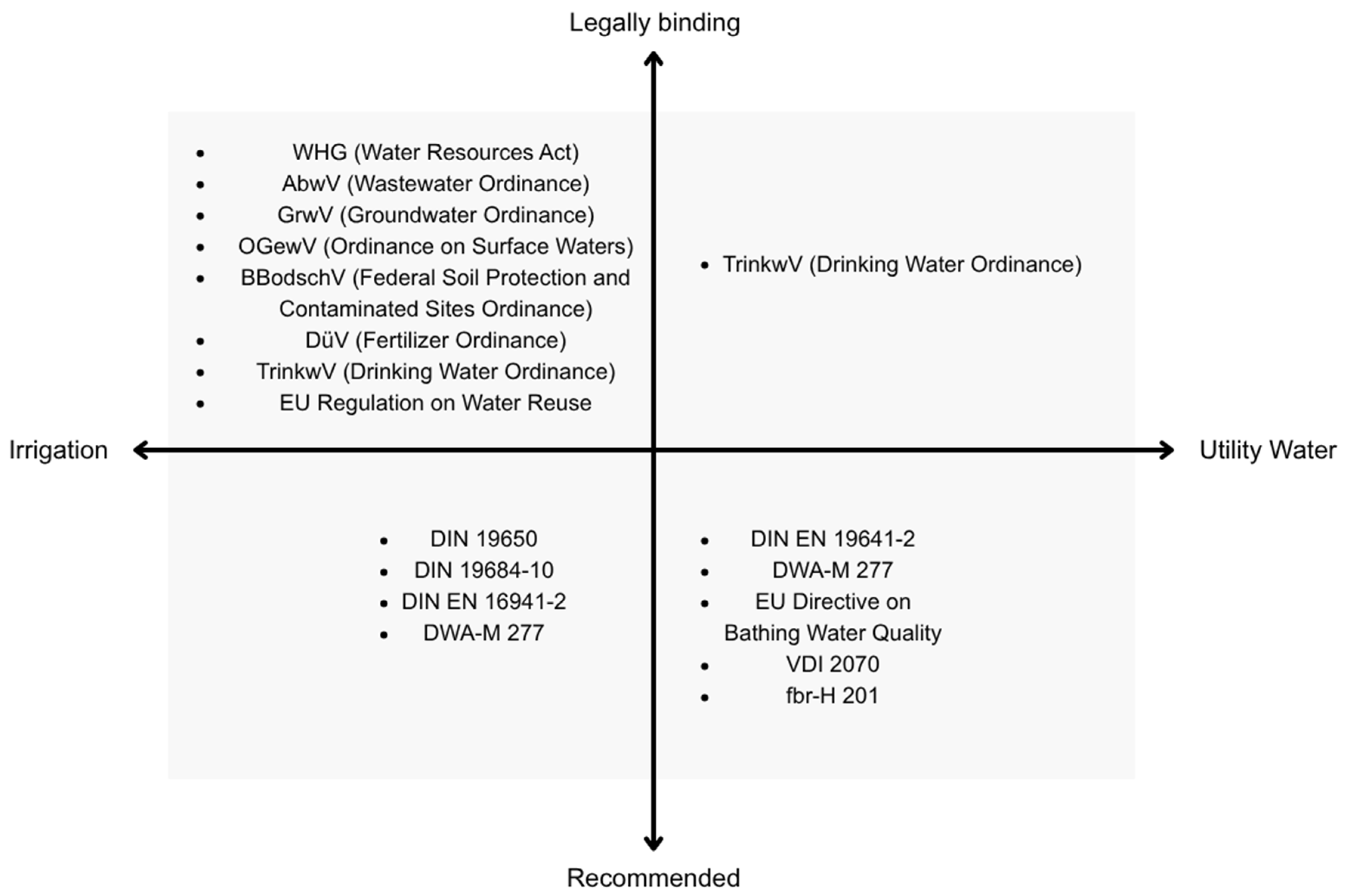
2.3. Legal Situation in Germany
2.4. Treatment Requirements for Greywater as Irrigation Water in Germany
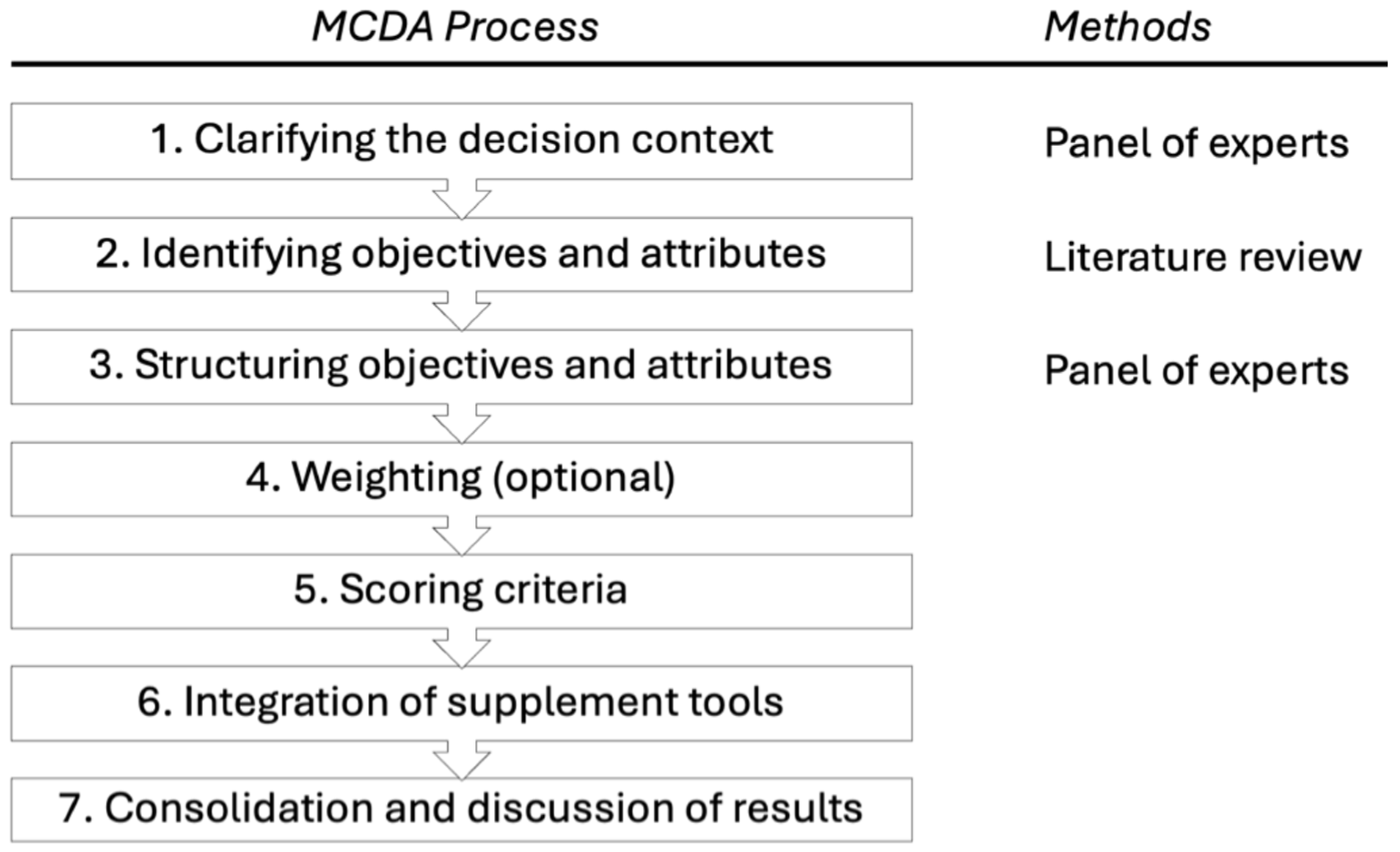
3. Methodology for Developing Evaluation Framework
4. Results
4.1. Clarifying the Decision Context
4.2. Identifying Objectives and Attributes
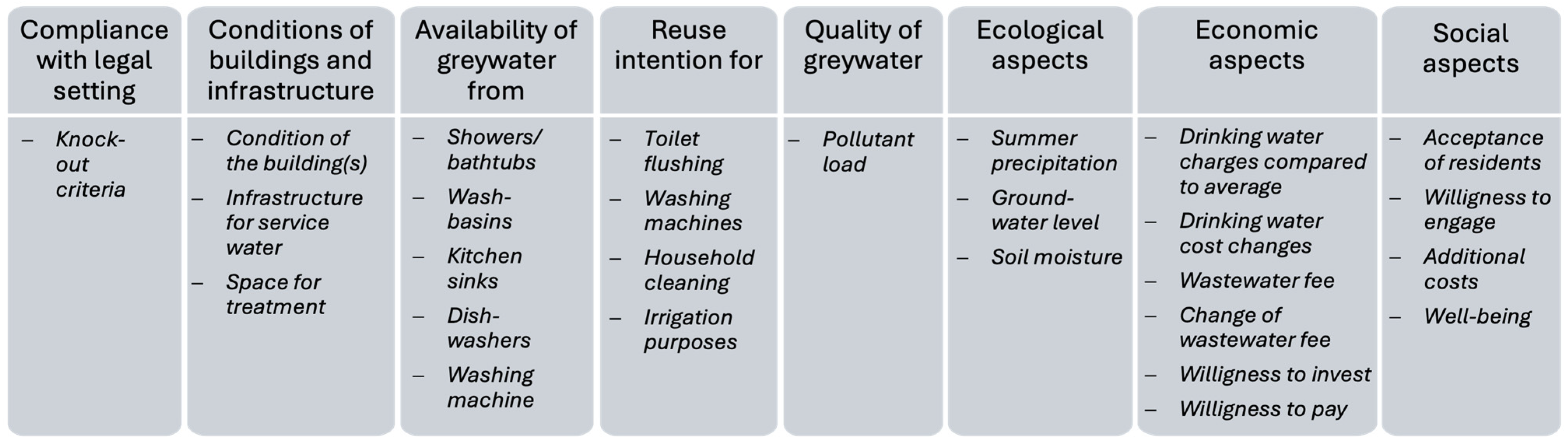
4.3. Structuring of Objectives and Attributes
4.4. Weighting
4.5. Scoring
4.6. Detailed Description of Influencing Factors in the Evaluation Matrix
4.6.1. Category 1: Legal Aspects
- Water Resources Act [83];
- Wastewater Ordinance [84];
- Groundwater Ordinance [85];
- Surface Water Ordinance [86];
- Regulation on Water Reuse [56]’
- Federal Soil Protection Ordinance [87];
- Fertilizer Ordinance [88];
- Exemption from the Obligation to Connect to and Use Public Wastewater Systems;
- Exemption from the Obligation to Connect to and Use Public Drinking Water Systems
4.6.2. Category 2: Building and Infrastructure
4.6.3. Category 3: Greywater Availability
4.6.4. Category 4: Intended Use
4.6.5. Category 5: Greywater Quality
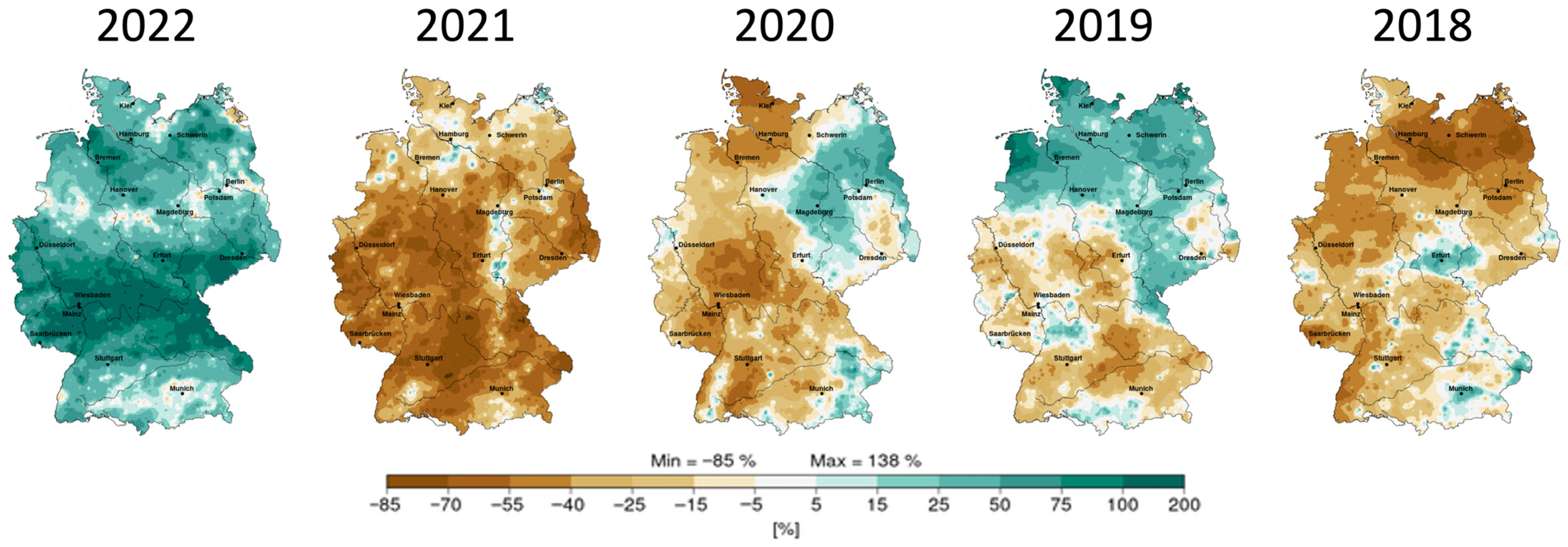
4.6.6. Category 6: Ecology
4.6.7. Category 7: Economy
4.6.8. Category 8: Social Aspects
4.7. Supporting Worksheets to the Criteria Catalog
4.7.1. Supporting Worksheet 1: Water Balance
4.7.2. Supporting Worksheet 2: Ecology
4.7.3. Supporting Worksheet 3: Economy
4.8. Overview of Results
4.9. Case Studies
- (1)
- Collect basic site information: A planner gathers readily available data such as IH, building condition, existing piping, available space for treatment, local water tariffs, size of green areas, and intended reuse options.
- (2)
- Determine greywater availability and demand: Using Supporting worksheet 1, the planner enters population equivalents for each substream. The tool automatically calculates daily greywater availability and compares it with the required demand (e.g., toilet flushing and irrigation).
- (3)
- Assess each criterion category
- (4)
- Apply weighting (optional): If a developer or municipality provides stakeholder preferences, the planner incorporates weighting through the AHP-based scoring option. If not, the matrix can be used in unweighted form as a neutral baseline.
- (5)
- Calculate the final evaluation: Scores are aggregated, and the planner obtains an overall potential rating (e.g., “moderate,” “high”). The matrix also highlights which category most strongly influences feasibility (e.g., limited space, low greywater volumes, high irrigation demand, economic constraints).
4.9.1. Case Study 1: Micro-Apartments in Bergmannsgrün (Dortmund, Huckarde)
4.9.2. Case Study 2: Reference Building in Weimar
5. Discussion
6. Conclusions
- (1)
- Comprehensive and practical decision support structure: The matrix consolidates eight domains—legal, infrastructural, availability, intended use, quality, ecology, economy, and social factors—into a transparent and replicable early-stage screening tool that can be used by planners and real estate developers.
- (2)
- Legal compliance as a non-negotiable prerequisite: Treating the legal framework as a knock-out criterion proved essential, as regulatory permissibility determines whether greywater reuse can be pursued at all.
- (3)
- Automated supporting worksheets enhance accuracy and transparency: The water-balance, ecological, and economic supporting worksheets reduced calculation errors, helped interpret climatic and hydrological constraints over a five-year window, and highlighted the importance of obtaining local—not regional—economic data.
- (4)
- Case studies demonstrate feasibility and discriminative power: Application to a new-build neighbourhood (Dortmund) and an existing multi-storey building (Weimar) showed that the matrix differentiates clearly between site conditions, identifies bottlenecks, and supports early planning decisions.
- (5)
- Weighting and local data strongly influence outcomes: Scenario analyses confirmed that category weights (e.g., investor vs. sustainability perspectives) and the specificity of tariff data can meaningfully shift results, underscoring the need for transparent weighting processes and up-to-date local input values.
- (6)
- Greywater availability and intended use require careful balancing: The case studies highlight that lightly polluted sub streams often cannot fully cover irrigation peaks, and combining seasonal irrigation with year-round uses (e.g., toilet flushing) improves system stability and sizing decisions.
- (7)
- Governance and acceptance are critical for implementation: Beyond regulatory compliance, successful integration depends on institutional coordination, data-sharing, monitoring responsibilities, and resident acceptance—components that complement the technical and economic assessment encoded in the matrix.
7. Outlook
Supplementary Materials
Author Contributions
Funding
Data Availability Statement
Acknowledgments
Conflicts of Interest
References
- Biswas, A.; Sarkar, S.; Das, S.; Dutta, S.; Roy Choudhury, M.; Giri, A.; Bera, B.; Bag, K.; Mukherjee, B.; Banerjee, K.; et al. Water Scarcity: A Global Hindrance to Sustainable Development and Agricultural Production—A Critical Review of the Impacts and Adaptation Strategies. Camb. Prism. Water 2025, 3, e4. [Google Scholar] [CrossRef]
- Kuhlemann, L.-M.; Tetzlaff, D.; Smith, A.; Kleinschmit, B.; Soulsby, C. Using Soil Water Isotopes to Infer the Influence of Contrasting Urban Green Space on Ecohydrological Partitioning. Hydrol. Earth Syst. Sci. 2021, 25, 927–943. [Google Scholar] [CrossRef]
- McDonald, R.I.; Green, P.; Balk, D.; Fekete, B.M.; Revenga, C.; Todd, M.; Montgomery, M. Urban Growth, Climate Change, and Freshwater Availability. Proc. Natl. Acad. Sci. USA 2011, 108, 6312–6317. [Google Scholar] [CrossRef]
- Kuzma, S.; Saccoccia, L. Marlena Chertock 25 Countries, Housing One-Quarter of the Population, Face Extremely High Water Stress. Mod. Econ. 2023. Available online: https://www.wri.org/insights/highest-water-stressed-countries (accessed on 11 March 2025).
- Liu, H.; Xing, R.; Davies, E.G.R. Forecasting Municipal Water Demands: Evaluating the Impacts of Population Growth, Climate Change, and Conservation Policies on Water End-Use. Sustain. Cities Soc. 2025, 130, 106581. [Google Scholar] [CrossRef]
- Qadir, M.; Sharma, B.R.; Bruggeman, A.; Choukr-Allah, R.; Karajeh, F. Non-Conventional Water Resources and Opportunities for Water Augmentation to Achieve Food Security in Water Scarce Countries. Agric. Water Manag. 2007, 87, 2–22. [Google Scholar] [CrossRef]
- Tzanakakis, V.A.; Paranychianakis, N.V.; Angelakis, A.N. Water Supply and Water Scarcity. Water 2020, 12, 2347. [Google Scholar] [CrossRef]
- Friedler, E. The Water Saving Potential and the Socio-economic Feasibility of Greywater Reuse within the Urban Sector—Israel as a Case Study. Int. J. Environ. Stud. 2008, 65, 57–69. [Google Scholar] [CrossRef]
- Ravinandrasana, V.P.; Franzke, C.L.E. The First Emergence of Unprecedented Global Water Scarcity in the Anthropocene. Nat. Commun. 2025, 16, 8281. [Google Scholar] [CrossRef]
- Liu, L.; Jensen, M.B. Green Infrastructure for Sustainable Urban Water Management: Practices of Five Forerunner Cities. Cities 2018, 74, 126–133. [Google Scholar] [CrossRef]
- Cheshmehzangi, A.; Butters, C.; Xie, L.; Dawodu, A. Green Infrastructures for Urban Sustainability: Issues, Implications, and Solutions for Underdeveloped Areas. Urban For. Urban Green. 2021, 59, 127028. [Google Scholar] [CrossRef]
- Hamidi, M.N. Greywater Reuse for Irrigation: A Critical Review of Suitability, Treatment, and Risks. Sci. Total Environ. 2025, 975, 179272. [Google Scholar] [CrossRef]
- Ameer, S.; Muhammad, N.; Jadoon, K.Z.; Sheikh, N.; Rahman, K.U. A Systematic Literature Review on Potential of Ablution Greywater Reuse: Current Insights, Challenges, and Future Prospects. Appl. Water Sci. 2025, 15, 173. [Google Scholar] [CrossRef]
- Nhenderere, O.C.; Mashamaite, C.V.; Mzini, L.L. A Narrative Review on the Potential Reuse of Greywater for Irrigation in Crop Production: Pros and Cons. Sustain. Water Resour. Manag. 2025, 11, 118. [Google Scholar] [CrossRef]
- Budeli, P.; Sibali, L.L. Greywater Reuse: Contaminant Profile, Health Implications, and Sustainable Solutions. Int. J. Environ. Res. Public Health 2025, 22, 740. [Google Scholar] [CrossRef] [PubMed]
- Prashanna Rangan, R.; Heenalisha, K. Grey-Water Treatment and Reuse: A Review. Asian J. Sci. Appl. Technol. 2019, 8, 5–9. [Google Scholar] [CrossRef]
- Oteng-Peprah, M.; Acheampong, M.A.; deVries, N.K. Greywater Characteristics, Treatment Systems, Reuse Strategies and User Perception—A Review. Water. Air. Soil Pollut. 2018, 229, 255. [Google Scholar] [CrossRef]
- Leung, R.W.K.; Li, D.C.H.; Yu, W.K.; Chui, H.K.; Lee, T.O.; Van Loosdrecht, M.C.M.; Chen, G.H. Integration of Seawater and Grey Water Reuse to Maximize Alternative Water Resource for Coastal Areas: The Case of the Hong Kong International Airport. Water Sci. Technol. 2012, 65, 410–417. [Google Scholar] [CrossRef] [PubMed]
- UN-Water. UN-Water Analytical Brief on Unconventional Water Resources; United Nations: Geneva, Switzerland, 2020. [Google Scholar]
- Capodaglio, A.G. Taking the Water out of “Wastewater”: An Ineluctable Oxymoron for Urban Water Cycle Sustainability. Water Environ. Res. 2020, 92, 2030–2040. [Google Scholar] [CrossRef] [PubMed]
- Eriksson, E.; Auffarth, K.; Henze, M.; Ledin, A. Characteristics of Grey Wastewater. Urban Water 2002, 4, 85–104. [Google Scholar] [CrossRef]
- Van De Walle, A.; Kim, M.; Alam, M.K.; Wang, X.; Wu, D.; Dash, S.R.; Rabaey, K.; Kim, J. Greywater Reuse as a Key Enabler for Improving Urban Wastewater Management. Environ. Sci. Ecotechnol. 2023, 16, 100277. [Google Scholar] [CrossRef]
- Tripathy, P.; Prakash, O.; Sharma, A.; Juneja, C.; Hiwrale, I.; Shukla, V.; Pal, S. Facets of Cost-Benefit Analysis of Greywater Recycling System in the Framework of Sustainable Water Security. J. Clean. Prod. 2024, 451, 142048. [Google Scholar] [CrossRef]
- Rajski, K.; Englart, S.; Sohani, A. Analysis of Greywater Recovery Systems in European Single-Family Buildings: Economic and Environmental Impacts. Sustainability 2024, 16, 4912. [Google Scholar] [CrossRef]
- Godfrey, S.; Labhasetwar, P.; Wate, S. Greywater Reuse in Residential Schools in Madhya Pradesh, India—A Case Study of Cost–Benefit Analysis. Resour. Conserv. Recycl. 2009, 53, 287–293. [Google Scholar] [CrossRef]
- Juan, Y.-K.; Chen, Y.; Lin, J.-M. Greywater Reuse System Design and Economic Analysis for Residential Buildings in Taiwan. Water 2016, 8, 546. [Google Scholar] [CrossRef]
- Rodríguez, C.; Serrano, J.; Sánchez, R.; Celume, T.; Leiva, E. Optimization of Greywater Reuse Systems: Integration of Economic and Environmental Objectives in Real Case Scenarios. J. Water Process Eng. 2025, 77, 108582. [Google Scholar] [CrossRef]
- Jakhar, R.; Styszko, K. Recent Trends in Emerging Greywater Management in India: An Overview. Desalination Water Treat. 2025, 322, 101226. [Google Scholar] [CrossRef]
- Yoonus, H.; Al-Ghamdi, S.G. Environmental Performance of Building Integrated Grey Water Reuse Systems Based on Life-Cycle Assessment: A Systematic and Bibliographic Analysis. Sci. Total Environ. 2020, 712, 136535. [Google Scholar] [CrossRef]
- Souza, H.H.D.S.; Morandi, C.G.; Boncz, M.Á.; Paulo, P.L.; Steinmetz, H. Life Cycle Sustainability Assessment of Greywater Treatment and Rainwater Harvesting for Decentralized Water Reuse in Brazil and Germany. Resources 2025, 14, 96. [Google Scholar] [CrossRef]
- Ni, H.S.; Omar, R.; Chen, G.K.; Wee, S.T. The Challenges of Implementing Greywater Recycling System in Residential Buildings. Res. Manag. Technol. Bus. 2021, 2, 1113–1129. Available online: https://publisher-uthm-edu-my.translate.goog/periodicals/index.php/rmtb/article/view/2047?_x_tr_sl=en&_x_tr_tl=de&_x_tr_hl=de&_x_tr_pto=sc (accessed on 2 February 2025).
- Morris, J.C.; Georgiou, I.; Guenther, E.; Caucci, S. Barriers in Implementation of Wastewater Reuse: Identifying the Way Forward in Closing the Loop. Circ. Econ. Sustain. 2021, 1, 413–433. [Google Scholar] [CrossRef]
- Weingärtner, D.E. Greywater Characteristics, Biodegradability and Reuse of Some Greywaters; Schriftenreihe, S.W.W., Ed.; Siedlungswasserwirtschaft: Karlsruhe, Germany, 2013; ISBN 978-3-9813069-7-2. [Google Scholar]
- Abdelkarim, S.B.; Ahmad, A.M.; Ferwati, S.; Naji, K. Urban Facility Management Improving Livability through Smart Public Spaces in Smart Sustainable Cities. Sustainability 2023, 15, 16257. [Google Scholar] [CrossRef]
- Van Oijstaeijen, W.; Van Passel, S.; Cools, J. Urban Green Infrastructure: A Review on Valuation Toolkits from an Urban Planning Perspective. J. Environ. Manag. 2020, 267, 110603. [Google Scholar] [CrossRef] [PubMed]
- Paul, M.; Negahban-Azar, M.; Shirmohammadi, A.; Montas, H. Developing a Multicriteria Decision Analysis Framework to Evaluate Reclaimed Wastewater Use for Agricultural Irrigation: The Case Study of Maryland. Hydrology 2021, 8, 4. [Google Scholar] [CrossRef]
- Torre, A.; Vázquez-Rowe, I.; Parodi, E.; Kahhat, R. A Multi-Criteria Decision Framework for Circular Wastewater Systems in Emerging Megacities of the Global South. Sci. Total Environ. 2024, 912, 169085. [Google Scholar] [CrossRef]
- Filho, E.H.C.; Stefanutti, R.; Oliveira, U.C.D.; Matos, J.S. Water Reuse: Contribution of a Decision Support Model. Sustainability 2025, 17, 692. [Google Scholar] [CrossRef]
- Sampaio, V.; Santos, A.S.P.; Lima, M.M. Decision Support Tools for Water Reuse: A Systematic Review. Water Sci. Technol. 2024, 90, 2713–2733. [Google Scholar] [CrossRef] [PubMed]
- Mikucioniene, D.; Mínguez-García, D.; Repon, M.R.; Milašius, R.; Priniotakis, G.; Chronis, I.; Kiskira, K.; Hogeboom, R.; Belda-Anaya, R.; Díaz-García, P. Understanding and Addressing the Water Footprint in the Textile Sector: A Review. Autex Res. J. 2024, 24, 20240004. [Google Scholar] [CrossRef]
- Hadad, E.; Fershtman, E.; Gal, Z.; Silberman, I.; Oron, G. Simulation of Dual Systems of Greywater Reuse in High-Rise Buildings for Energy Recovery and Potential Use in Irrigation. Resour. Conserv. Recycl. 2022, 180, 106134. [Google Scholar] [CrossRef]
- Morseletto, P.; Mooren, C.E.; Munaretto, S. Circular Economy of Water: Definition, Strategies and Challenges. Circ. Econ. Sustain. 2022, 2, 1463–1477. [Google Scholar] [CrossRef]
- Vuppaladadiyam, A.K.; Merayo, N.; Prinsen, P.; Luque, R.; Blanco, A.; Zhao, M. A Review on Greywater Reuse: Quality, Risks, Barriers and Global Scenarios. Rev. Environ. Sci. Biotechnol. 2019, 18, 77–99. [Google Scholar] [CrossRef]
- Gebäudeausrüstung, T. Verein deutscher Ingenieure (VDI) Betriebswassermanagement Für Gebäude Und Liegenschaften. VDI 2013. Available online: https://www.vdi.de/mitgliedschaft/vdi-richtlinien/details/vdi-2070-betriebswassermanagement-fuer-gebaeude-und-liegenschaften (accessed on 15 April 2025).
- Ringelstein, O. MoVe Green—Mobile Vertikale Fassenbegrünung. Fbr-Wasserspiegel 2023, 2023, 18–20. [Google Scholar]
- Fachvereinigung Betriebs- und Regenwassernutzung e. V. (fbr). Grauwasser-Recycling Und Regenwassernutzung. Wasser Zweimal Nutzen; FBR: Darmstadt, Germany, 2009; Volume 12, ISBN 978-3-9811727-1-3. [Google Scholar]
- Sayegh, M.A.; Ludwińska, A.; Rajski, K.; Dudkiewicz, E. Environmental and Energy Saving Potential from Greywater in Hotels. Sci. Total Environ. 2021, 761, 143220. [Google Scholar] [CrossRef]
- König, K.W. Grauwassernutzung: Ökologisch Notwendig—Ökonomisch Sinnvoll, 1st ed.; iWater Wassertechnik: Troisdorf, Germany, 2013; ISBN 978-3-00-039866-7. [Google Scholar]
- INTEWA. Nachhaltiges Grauwasser-Recycling Auf Dem Campingplatz Gerhardshof. Fbr-Wasserspiegel 2021, 2. Available online: https://indd.adobe.com/view/dcaf9359-f21a-400c-8607-dc8c0484b9d7 (accessed on 14 May 2023).
- ANCHOR Interreg North Sea. Why Greywater Reuse Is the Future. 2025. Available online: https://www.interregnorthsea.eu/anchor/news/why-greywater-reuse-is-the-future (accessed on 6 October 2025).
- Stec, A.; Piotrowska, B.; Słyś, D. Greywater as an Undervalued Tool for Energy Efficiency Enhancement and Decarbonizing the Construction Sector: A Case Study of a Dormitory in Poland. Energy Build. 2025, 330, 115337. [Google Scholar] [CrossRef]
- Stec, A. Rainwater and Greywater as Alternative Water Resources: Public Perception and Acceptability. Case Study in Twelve Countries in the World. Water Resour. Manag. 2023, 37, 5037–5059. [Google Scholar] [CrossRef]
- Shoushtarian, F.; Negahban-Azar, M. Worldwide Regulations and Guidelines for Agricultural Water Reuse: A Critical Review. Water 2020, 12, 971. [Google Scholar] [CrossRef]
- Umweltbundesamt (UBA) Rahmenbedingungen Für Die Umweltgerechte Nutzung von Behandeltem Abwasser Zur Landwirtschaftlichen Bewässerung (TEXTE, 34/2016). Available online: https://www.umweltbundesamt.de/sites/default/files/medien/378/publikationen/texte_34_2016_rahmenbedingungen_fuer_die_umweltgerechte_nutzung_von_behandeltem_abwasser_0.pdf (accessed on 29 August 2023).
- Kohlhepp, G. Potentialabschätzung Zur Nutzung von Grauwasser Im Kontext Einer Nachhaltigen Siedlungsökologie. Master’s Thesis, Bauhaus-Universität Weimar, Weimar, Germany, 2023. [Google Scholar]
- Europäische Union. VERORDNUNG (EU) 2020/741 DES EUROPÄISCHEN PARLAMENTS UND DES RATES Vom 25. Mai 2020 Über Mindestanforderungen an Die Wasserwiederverwendung; EU: Brussels, Belgium, 2020. [Google Scholar]
- DIN 19650:1999-02; Bewässerung_-Hygienische Belange von Bewässerungswasser. DIN Media GmbH: Berlin, Germany, 2009. [CrossRef]
- DIN 19684-10:2009-01; Bodenbeschaffenheit_-Chemische Laboruntersuchungen_- Teil_10: Untersuchung Und Beurteilung Des Wassers Bei Bewässerungsmaßnahmen. DIN Media GmbH: Berlin, Germany, 2009. [CrossRef]
- DIN EN 16941-2:2021-11; Vor-Ort-Anlagen Für Nicht-Trinkwasser_-Teil_2: Anlagen Für Die Verwendung von Behandeltem Grauwasser. DIN Media GmbH: Berlin, Germany, 2021. [CrossRef]
- DWA-M 277 Hinweise Zur Auslegung von Anlagen Zur Behandlung Und Nutzung von Grauwasser Und Grauwasserteilströmen; DWA-Regelwerk; Deutsche Vereinigung für Wasserwirtschaft, Abwasser und Abfall e.V. (DWA): Hennef, Germany, 2017; Volume Merkblatt DWA-M 277.
- Qualität Der Badegewässer Und Deren Bewirtschaftung Und Aufhebung Der Richtlinie. 2006. Available online: https://eur-lex.europa.eu/legal-content/DE/TXT/PDF/?uri=CELEX:32006L0007&from=DE (accessed on 6 May 2023).
- Belton, V. Multiple Criteria Decision Analysis: An Integrated Approach, 1st ed.; Springer: Boston, MA, USA, 2002; ISBN 978-1-4613-5582-3. [Google Scholar]
- Daniel, M.; Ahammed, M.M.; Shaikh, I.N. Selection of Greywater Reuse Options Using Multi-Criteria Decision-Making Techniques. Water Conserv. Sci. Eng. 2023, 8, 2. [Google Scholar] [CrossRef]
- Lienert, J.; Scholten, L.; Egger, C.; Maurer, M. Structured Decision-Making for Sustainable Water Infrastructure Planning and Four Future Scenarios. EURO J. Decis. Process. 2015, 3, 107–140. [Google Scholar] [CrossRef]
- Huang, I.B.; Keisler, J.; Linkov, I. Multi-Criteria Decision Analysis in Environmental Sciences: Ten Years of Applications and Trends. Sci. Total Environ. 2011, 409, 3578–3594. [Google Scholar] [CrossRef]
- Bichai, F.; Smeets, P.W.M.H. Integrating Water Quality into Urban Water Management and Planning While Addressing the Challenge of Water Security. In Understanding and Managing Urban Water in Transition; Grafton, Q., Daniell, K.A., Nauges, C., Rinaudo, J.-D., Chan, N.W.W., Eds.; Springer: Dordrecht, The Netherlands, 2015; Volume 15, pp. 135–154. ISBN 978-94-017-9800-6. [Google Scholar]
- Gregory, R.; Failing, L.; Harstone, M.; Long, G.; McDaniels, T.L.; Ohlson, D. Structured Decision Making: A Practical Guide to Environmental Management Choices; Wiley-Blackwell: Chichester, UK; Hoboken, NJ, USA, 2012; ISBN 978-1-4443-3341-1. [Google Scholar]
- Lück, A.; Nyga, I. Experiences of Stakeholder Participation in Multi-Criteria Decision Analysis (MCDA) Processes for Water Infrastructure. Urban Water J. 2018, 15, 508–517. [Google Scholar] [CrossRef]
- Abdallat, R.; Bdour, A.N.; Abu Haifa, A.; Al-Rawash, F.F.; Almakhadmeh, L.; Hazaimeh, S. Development of a Sustainable, Green, and Solar-Powered Filtration System for E. Coli Removal and Greywater Treatment. Glob. J. Environ. Sci. Manag. 2024, 10, 435–450. [Google Scholar] [CrossRef]
- Gerek, E.E. Optimized Sizing of Hybrid Renewable Energy Systems for Sustainable Buildings with Seasonal Grey Water Treatment. Sustain. Energy Technol. Assess. 2025, 76, 104287. [Google Scholar] [CrossRef]
- González, Y.; Carrillo, V.; Gómez, G.; Carballa, M.; Vidal, G. A Comprehensive Review of Treatment Technologies for Greywater Contaminants: An Emphasis on Surfactants. J. Environ. Manag. 2025, 392, 126861. [Google Scholar] [CrossRef] [PubMed]
- Hamidi, M.N. Membrane Bioreactor Technology for Greywater Treatment: A Review. Sep. Purif. Technol. 2025, 361, 131451. [Google Scholar] [CrossRef]
- Wu, B. Membrane-Based Technology in Greywater Reclamation: A Review. Sci. Total Environ. 2019, 656, 184–200. [Google Scholar] [CrossRef]
- Kohlhepp, G.; Middendorf, V.; Hartmann, M.; Ostheimer, S.; Siemer, D.; Schütze, M.; Rotsch, J.; Podlowski, L.; Speck, M.; Friedrich, K.; et al. VertiKKA—Die vertikale KlimaKlärAnlage zur Steigerung der Ressourceneffizienz und Lebensqualität in urbanen Räumen; Umsetzung, Monitoring und Weiterentwicklung der vertikalen Klima-Klär-Anlage; Technische Informationsbibliothek: Hannover, Germany, 2025. [Google Scholar] [CrossRef]
- Pucher, B.; Zluwa, I.; Spörl, P.; Pitha, U.; Langergraber, G. Evaluation of the Multifunctionality of a Vertical Greening System Using Different Irrigation Strategies on Cooling, Plant Development and Greywater Use. Sci. Total Environ. 2022, 849, 157842. [Google Scholar] [CrossRef] [PubMed]
- Lück, A.; Londong, J.; Kraft, E. Business Models for Sustainability Transitions in Resource-Oriented Wastewater Management. Clean. Water 2025, 3, 100083. [Google Scholar] [CrossRef]
- Hillenbrand, T.; Bieker, S.; Dockhorn, T.; Felmeden, J.; Kaufmann-Alves, I. Langergraber, Günter Nachhaltigkeitsbewertung von Wasserinfrastruktursystemen. Leitfaden Zur Anwendung Des Arbeitsblatts DWA-A 272. KA Korresp. Abwasser 2018, 65, 443–449. [Google Scholar] [CrossRef]
- Sartorius, C.; Hillenbrand, T.; Lévai, P.; Nyga, I.; Schulwitz, M.; Tettenborn, F. Indikatoren Zur Bewertung Alternativer Wasserinfrastrukturen Im Projekt TWIST++; Fraunhofer-Institut für System- und Innovationsforschung ISI: Karlsruhe, Germany, 2016; Available online: https://www.isi.fraunhofer.de/content/dam/isi/dokumente/ccn/twist/ergebnispapiere/nichttechnische-arbeiten/Indikatoren_Bewertung.pdf (accessed on 2 February 2025).
- Saaty, T.L. Decision Making with the Analytic Network Process: Economic, Political, Social and Technological Applications with Benefits, Opportunities, Costs and Risks. In International Series in Operations Research & Management Science, 2nd ed.; Springer: New York, NY, USA, 2013; ISBN 978-1-4899-8676-4. [Google Scholar]
- Joshi, A.; Kale, S.; Chandel, S.; Pal, D. Likert Scale: Explored and Explained. Br. J. Appl. Sci. Technol. 2015, 7, 396–403. [Google Scholar] [CrossRef]
- Koo, M.; Yang, S.-W. Likert-Type Scale. Encyclopedia 2025, 5, 18. [Google Scholar] [CrossRef]
- Kohlhepp, G.; Schneider-Werres, S.; Müller, G.; Spurling, K.; Kaller, F.; Al-Hakim, Y. Wasserwende im Wohnungsbau: Praktischer Leitfaden zur Grauwassernutzung; Bauhaus-Universität Weimar: Weimar, Germany, 2024. [Google Scholar] [CrossRef]
- Wasserhaushaltsgesetz—WHG. 2009. Available online: https://www.gesetze-im-internet.de/whg_2009/index.html (accessed on 12 February 2025).
- Bundesamt Fur Justiz. Abwasserverordnung (AbwV)—Anhang 1. Verordnung Über Anforderungen an Das Einleiten von Abwasser in Öffentliche Abwasseranlagen; Bundesamt Fur Justiz: Bonn, Germany. Available online: https://www.gesetze-im-internet.de/abwv/AbwV.pdf (accessed on 2 February 2025).
- Länderarbeitsgemeinschaft Wasser (LAWA). Bericht Zur Ableitung Der Geringfügigkeitsschwellenwerte Für Das Grundwasser; LAWA (Länderarbeitsgemeinschaft Wasser): Berlin, Germany, 2017; Available online: https://www.lawa.de/documents/geringfuegigkeits_bericht_seite_001-028_1552302313.pdf (accessed on 12 February 2025).
- German Federal Ministry of Justice. Oberflächengewässerverordnung (OGewV); German Federal Ministry of Justice: Berlin, Germany, 2016. [Google Scholar]
- German Federal Ministry of Justice. Bundes-Bodenschutz- Und Altlastenverordnung (BBodSchV); German Federal Ministry of Justice: Berlin, Germany, 2023. [Google Scholar]
- German Federal Ministry of Justice. Düngemittelverordnung (DüV); German Federal Ministry of Justice: Berlin, Germany, 2017. [Google Scholar]
- Hörnlein, S.; Londong, J.; Veser, S.; Berndt, M. Technische Lösungen Für Source Separation Im Bestand. Fbr Wasserspiegel 2022, 2, 27–33. [Google Scholar]
- ARIS Regen. Wasser. Systeme. ARIS BiOCYCLE. Available online: https://aris-systeme.de/product/aris-grauwasser/ (accessed on 11 August 2023).
- Deutscher Wetterdienst (DWD). Niederschlag Aktuell Sommer Und Winter 2022—Abweichung Vom Normalwert 1971–2000. Available online: https://www.dwd.de/DE/klimaumwelt/klimaatlas/klimaatlas_node.html (accessed on 29 August 2023).
- CORRECTIV Wo in Deutschland Das Grundwasser Sinkt. Der Grundwasserspiegel in Ihrem Kreis. Available online: https://correctiv.org/aktuelles/kampf-um-wasser/2022/10/25/klimawandel-grundwasser-in-deutschland-sinkt/#:~:text=Besonders%20in%20Norddeutschland%20sowie%20in,sogar%20an%20jeder%20dritten%20Messstelle (accessed on 29 August 2023).
- Helmholtz Zentrum für Umweltforschung (UFZ). Dürremonitor Deutschland—Dürren Seit 2014 (Monatlich). Available online: https://www.ufz.de/index.php?de=47252 (accessed on 29 August 2023).
- Helmholtz Zentrum für Umweltforschung (UFZ). Dürremonitor Deutschland—Karte Pflanzenverfügbares Wasser Deutschland. Available online: https://www.ufz.de/index.php?de=37937 (accessed on 9 June 2023).
- Statistisches Bundesamt (DESTATIS). Wasserwirtschaft—Entgelt Für Die Trink Wasser Versorgung in Tarifgebieten Nach Tariftypen. Available online: https://www.destatis.de/DE/Themen/Gesellschaft-Umwelt/Umwelt/Wasserwirtschaft/Tabellen/tw-08-entgelt-trinkwasserversorgung-tarifgeb-nach-tariftypen-2020-2022-land-bund.html?view=main[Print] (accessed on 29 August 2023).
- IW Consult GmbH. Abwassergebührenranking 2023. Abwassergebühren Der 100 Größten Deutschen Städte Im Vergleich. Available online: https://www.hausundgrund.de/sites/default/files/2023-06/Abwassergebührenranking%202023%20Haus%20%26%20Grund%20Deutschland.pdf (accessed on 29 August 2023).
- Beyer, A.-K.; Kohlhepp, G.; Metz, S.; Ziegler, T.G. Grauwassernutzung Für Eine Nachhaltige Bewässerung von Urbanen Grünanlagen; Bauhaus Universität Weimar (BUW): Weimar, Germany, 2023. [Google Scholar]
- Wen, J.; Li, H.; Meseretchanie, A. Assessment and Prediction of the Collaborative Governance of the Water Resources, Water Conservancy Facilities, and Socio-Economic System in the Xiangjiang River Basin, China. Water 2023, 15, 3630. [Google Scholar] [CrossRef]
- Shen, R.; Yao, L. Exploring the Regional Coordination Relationship between Water Utilization and Urbanization Based on Decoupling Analysis: A Case Study of the Beijing–Tianjin–Hebei Region. Int. J. Environ. Res. Public Health 2022, 19, 6793. [Google Scholar] [CrossRef]



| Application for Use as | Regulation | Microbiological Parameters | Physico-Chemical Parameters |
|---|---|---|---|
| Irrigation water | EU Regulation 2020/741Minimum requirements for water reuse [56]: | x | x |
| DIN 19650 Hygienic aspects of irrigation water [57] | x | ||
| DIN 19684-10 Soil properties—Chemical laboratory tests—Part 10: Investigation and assessment of water in irrigation measures [58] | x | ||
| Irrigation water and utility water | DIN EN 16941-2 On-site non-potable water supply systems—Part 2: Systems for the use of treated greywater [59] | x | x |
| DWA-M 277 Guidelines for the design of plants for the treatment and use of greywater and greywater streams [60] | x | x | |
| Bathing water | EU-Richtlinie 2006/7/EG 2006 Quality of bathing water and its management and repeal of Directive 76/160/EEC [61] | x |
| Criterion | Assessment Options |
|---|---|
| 2.1 The considered building or neighbourhood is… | 1 = an already renovated existing building or a newly completed building |
| 2 = a building requiring minor renovation | |
| 3 = a building requiring major renovation | |
| 4 = a building where renewal of the piping system is necessary anyway | |
| 5 = a new building in planning | |
| 2.2 Existing infrastructure for service water (non-potable water) use… | 1 = not available and cannot be added |
| 2 = not available and can only be added under difficult conditions | |
| 3 = not available, but can be added without problems | |
| 4 = available and in moderate condition | |
| 5 = available and in good condition, or a new building is being planned, so the service water network can be easily integrated | |
| 2.3 Are there areas available where a greywater treatment system could be installed? Guideline value: 2 m2 per m3 of treatment capacity (ARIS) | 1 = There is no possibility of installing a system, neither in the basement nor in outdoor areas |
| 2 = Space in the basement or outdoor area is limited but installation is possible | |
| 3 = Space in the basement or outdoor area is of moderate size | |
| 4 = Sufficient space is available outdoors | |
| 5 = Sufficient space is available in the basement |
| Criterion | Assessment Options |
|---|---|
| 3.1 Showers/Bathtubs | 1 = 1–5 inhabitants (IH) |
| 3.2 Washbasins | 2 = 6–15 inhabitants (IH) |
| 3.3 Kitchen sinks | 3 = 16–30 inhabitants (IH) |
| 3.4 Dishwashers | 4 = 31–50 inhabitants (IH) |
| 3.5 Washing machines | 5 = more than 50 inhabitants (IH) |
| Criterion | Assessment Options |
|---|---|
| 4.1 Use as service water for toilet flushing | 1 = 1–5 inhabitants/trees/m2 |
| 4.2 Use as service water for washing machines | 2 = 6–15 inhabitants/trees/m2 |
| 4.3 Use as service water for household cleaning | 3 = 16–30 inhabitants/trees/m2 |
| 4.4 Use as irrigation water for surrounding green areas and trees | 4 = 31–50 inhabitants/trees/m2 |
| 5 = more than 50 inhabitants/trees/m2 |
| Criterion | Assessment Options |
|---|---|
| 5.1 Pollutant Load | 1 = very high contamination (e.g., greywater solely from washing machines and kitchens) |
| 2 = high contamination (e.g., predominantly greywater from washing machines and kitchens) | |
| 3 = medium contamination (e.g., mixed greywater from all sub streams) | |
| 4 = low contamination (e.g., from sanitary areas and washing machines or kitchens) | |
| 5 = very low contamination (e.g., from sanitary areas) |
| Criterion | Assessment Options |
|---|---|
| 6.1 The amount of summer precipitation has decreased on average over the past 5 years compared to the reference period by… | 1 = > −5% |
| 2 = −5% to −15% | |
| 3 = −15% to −25% | |
| 4 = −25% to −40% | |
| 5 = < −40% | |
| 6.2 The percentage of lowered groundwater levels in the area is… | 1 = < 5% |
| 2 = 5–10% | |
| 3 = 10–20% | |
| 4 = 20–30% | |
| 5 = > 30% | |
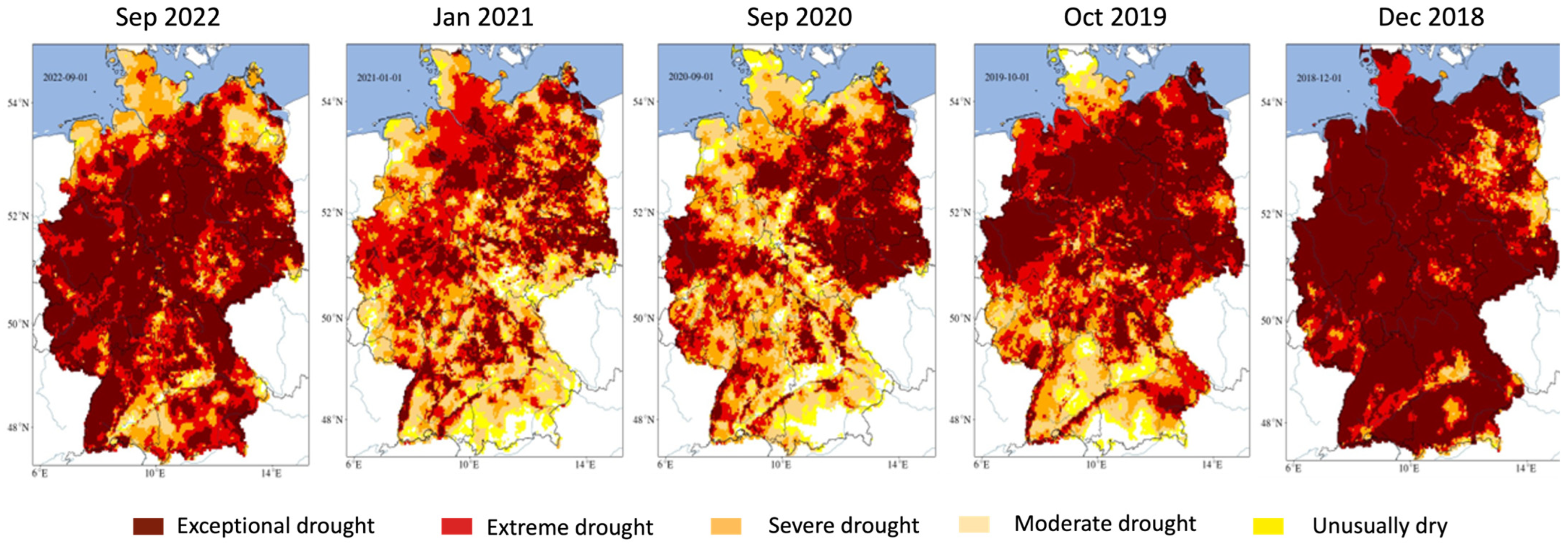
| 6.3 In the potential application area, soil moisture has been so low in the past 5 years that the Drought Monitor has recorded a … during the month with the most severe drought | 1 = unusual dryness |
| 2 = moderate drought | |
| 3 = severe drought | |
| 4 = extreme drought | |
| 5 = exceptional drought |
| Criterion | Assessment Options |
|---|---|
| 7.1 The difference in drinking water charges compared to the national average currently amounts to … | 1 = ≤ 0.00 |
| 2 = 0.01–0.10 | |
| 3 = 0.11–0.20 | |
| 4 = 0.21–0.30 | |
| 5 = > 0.30 | |
| 7.2 Drinking water costs have increased between 2014 and 2022 (i.e., over the last 9 years) by … | 1 = < 0% |
| 2 = 0–5% | |
| 3 = 5–10% | |
| 4 = 10–15% | |
| 5 = > 15% | |
| 7.3 The wastewater charge amounts to … €/m3 | 1 = < 1.30 |
| 2 = 1.30–2.30 | |
| 3 = 2.30–3.30 | |
| 4 = 3.30–4.30 | |
| 5 = > 4.30 | |
| 7.4 Wastewater costs have increased in the last 9 years by … | 1 = < 0% |
| 2 = 0–5% | |
| 3 = 5–10% | |
| 4 = 10–15% | |
| 5 = > 15% | |
| 7.5 I am … to invest in new technologies with a longer payback period | 1 = not willing |
| 2 = rather not willing | |
| 3 = undecided | |
| 4 = rather willing | |
| 5 = willing | |
| 7.6 I am … to invest in a technology with ongoing monthly operating costs | 1 = not willing |
| 2 = rather not willing | |
| 3 = undecided | |
| 4 = rather willing | |
| 5 = willing |
| Criterion | Assessment Options |
|---|---|
| 8.1 The residents’ acceptance of greywater reuse is … | 1 = not given |
| 2 = rather not given | |
| 3 = neutral | |
| 4 = present | |
| 5 = fully present | |
| 8.2 The residents’ willingness to engage with the technology is … | 1 = not given |
| 2 = rather not given | |
| 3 = neutral | |
| 4 = present | |
| 5 = fully present | |
| 8.3 The additional costs borne by residents in recent years, based on drinking and wastewater charges, were … | 1 = minimal |
| 2 = rather low | |
| 3 = average | |
| 4 = slightly increased | |
| 5 = high | |
| 8.4 Assessment of plants and green areas in relation to water shortage without additional irrigation, leading to a decline in tenant well-being | 1 = Green areas remain vital due to natural water balance |
| 2 = Individual dry patches occur | |
| 3 = Increasingly dry patches occur | |
| 4 = The majority of the area is dried out | |
| 5 = Almost all green areas and hedges are dried out |
| 3. Greywater Availability | |||
| Greywater sub-stream | Reference value (DWA-M 277) | Inhabitants (IH) | ltr/day |
| 3.1 Showers/bathtubs | 45.0 ltr/(IH x d) | 53 | 2385 |
| 3.2 Handwash basins | 12.5 ltr/(IH x d) | 53 | 663 |
| Subtotal lightly polluted Greywater | 3048 | ||
| 3.3 Kitchen sinks | 7.5 ltr/(IH x d) | 53 | 398 |
| 3.4 Dishwashers | 7.5 ltr/(IH x d) | 0 | 0 |
| 3.5 Washing machines | 12.5 ltr/(IH x d) | 53 | 663 |
| Subtotal heavily polluted Greywater | 1060 | ||
| Total Greywater availability | 4108 | ||
| 4. Developer’s Reuse Intention | |||
| Type of use | Reference value (DWA-M 277) | Inhabitants (IH) | ltr/day |
| 4.1 As service water for toilet flushing | 33.0 ltr/(IH x d) | 53 | 1749 |
| 4.2 As service water for washing machine | 15.0 ltr/(IH x d) | 0 | 0 |
| 4.3 As service water for household cleaning | 7.0 ltr/(IH x d) | 0 | 0 |
| Subtotal service water | 3048 | ||
| 4.4 As irrigation water for trees | 20.0 ltr/(tree x d) | 17 | 340 |
| 4.4 As irrigation water for green areas | 7.5 ltr/(m2 green area x d) | 1560 | 1092 |
| Subtotal irrigation water | 1432 | ||
| Total usage demand | 3181 | ||
| Year | 1 | 2 | 3 | 4 | 5 | Transfer | |
|---|---|---|---|---|---|---|---|
| >−5% | −5 to −15% | −15 to −25% | −5 to −40% | <−40% | |||
| 6.1 The precipitation amount in summer has, on average over the last 5 years, decreased compared to the reference period by … Maps from DWD (see [91]) | 1 | x | 5 | ||||
| 2 | x | 1 | |||||
| 3 | x | 3 | |||||
| 4 | x | 5 | |||||
| 5 | x | 5 | |||||
| Average | 3.8 | ||||||
| Criterion | Assessment Options | Number |
|---|---|---|
| 6.2 The groundwater levels have … decreased. In the right-hand column, the number of groundwater measurement stations can be entered as needed. The percentage share is calculated automatically. Online tool from Correctiv (see [92]) | Strongly declining | 0 |
| Slightly declining | 1 | |
| No strong trend | 3 | |
| Slightly rising | 0 | |
| Strongly rising | 0 | |
| Total | 4 | |
| Share of declining groundwater levels | 25% |
| Year | 1 | 2 | 3 | 4 | 5 | Transfer | |
|---|---|---|---|---|---|---|---|
| Unusually dry | Moderate | Severe | Extreme | Exceptional | |||
| 6.3 The soil moisture in the potential application area was so low in the last 5 years that the Drought Monitor for the total soil column indicated a drought in the month with the highest drought level … Drought categories are indicated according to UFZ (see [93]) | 1 | x | 5 | ||||
| 2 | x | 4 | |||||
| 3 | x | 5 | |||||
| 4 | x | 5 | |||||
| 5 | x | 5 | |||||
| Average | 4.8 | ||||||
| Year | Criterion 7.1 | Criterion 7.2 | ||||
|---|---|---|---|---|---|---|
| Federal State | 2022 | 2014 | Deviation of the drinking water charge from the national average by federal states in 2022 | Rating number | Percentage increase/decrease in the drinking water charge from 2014 to 2022 | Rating number |
| Germany | 1.83 | 1.69 | 0.00 | 8.3 | … | |
| Baden-Württemberg | 2.33 | 2.0 | 0.50 | 5 | 14.2 | 4 |
| Bavaria | 1.78 | 1.48 | −0.05 | 1 | 20.3 | 5 |
| Berlin | 1.81 | 1.81 | −0.02 | 1 | 0.0 | 1 |
| Brandenburg | 1.57 | 1.53 | −0.26 | 1 | 2.6 | 2 |
| Bremen | 2.44 | 1.98 | 0.61 | 5 | 23.2 | 5 |
| Hamburg | 1.93 | 1.77 | 0.10 | 2 | 9.0 | 3 |
| Hesse | 2.16 | 1.97 | 0.33 | 5 | 9.6 | 3 |
| Mecklenburg-Vorpommern | 1.60 | 1.61 | −0.23 | 1 | −0.6 | 1 |
| Lower Saxony | 1.43 | 1.22 | −0.40 | 1 | 17.2 | 5 |
| North Rhine-Westphalia | 1.64 | 1.65 | −0.19 | 1 | −0.6 | 1 |
| Rhineland-Palatinate | 1.82 | 1.70 | −0.01 | 1 | 7.1 | 3 |
| Saarland | 2.00 | 1.88 | 0.17 | 3 | 6.4 | 3 |
| Saxony | 2.01 | 1.94 | 0.18 | 3 | 3.6 | 2 |
| Saxony-Anhalt | 1.75 | 1.73 | −0.08 | 1 | 1.2 | 2 |
| Schleswig-Holstein | 1.57 | 1.44 | −0.26 | 1 | 9.0 | 3 |
| Thuringia | 2.08 | 2.00 | 0.25 | 4 | 4.0 | 2 |
| Category | Sustainability | Investor | User Benefit | Mixed Interests | Without Weighting |
|---|---|---|---|---|---|
| 2. Buildings and infrastructure | 15.0% | 20.0% | 12.5% | 20.0% | 14.3% |
| 3. Greywater availability | 15.0% | 5.0% | 5.0% | 20.0% | 14.3% |
| 4. Developer’s Reuse Intention | 15.0% | 10.0% | 20.0% | 10.0% | 14.3% |
| 5. Greywater quality | 5.0% | 5.0% | 10.0% | 12.5% | 14.3% |
| 6. Ecological Factors | 35.0% | 5.0% | 10.0% | 12.5% | 14.3% |
| 7. Economic Factors | 5.0% | 40.0% | 10.0% | 15.0% | 14.3% |
| 8. Social Aspects | 10.0% | 15.0% | 32.5% | 10.0% | 14.3% |
| Overall result | 4.0 | 3.4 | 3.6 | 3.9 | 3.8 |
| Deviation compared to without weighting | 0.2 | −0.4 | −0.2 | 0.1 | 0.0 |
| From | To | Potential Assessment |
|---|---|---|
| 2.5 | <3.5 | Potential is moderate |
| 3.5 | <4.5 | Potential is high |
| Scenario | Sustainability | Investor | User Benefit | Mixed Interests | Without Weighting |
|---|---|---|---|---|---|
| Overall result | 3.2 | 2.8 | 2.9 | 3.1 | 3.1 |
| Deviation from unweighted result | 0.1 | −0.3 | −0.2 | 0.0 | 0.0 |
Disclaimer/Publisher’s Note: The statements, opinions and data contained in all publications are solely those of the individual author(s) and contributor(s) and not of MDPI and/or the editor(s). MDPI and/or the editor(s) disclaim responsibility for any injury to people or property resulting from any ideas, methods, instructions or products referred to in the content. |
© 2026 by the authors. Licensee MDPI, Basel, Switzerland. This article is an open access article distributed under the terms and conditions of the Creative Commons Attribution (CC BY) license.
Share and Cite
Maria, K.G.; Andrea, L.; Gerald, M.; Silvio, B. From Technical Feasibility to Governance Integration: Developing an Evaluation Matrix for Greywater Reuse in Urban Residential Areas. Water 2026, 18, 190. https://doi.org/10.3390/w18020190
Maria KG, Andrea L, Gerald M, Silvio B. From Technical Feasibility to Governance Integration: Developing an Evaluation Matrix for Greywater Reuse in Urban Residential Areas. Water. 2026; 18(2):190. https://doi.org/10.3390/w18020190
Chicago/Turabian StyleMaria, Kohlhepp Gloria, Lück Andrea, Müller Gerald, and Beier Silvio. 2026. "From Technical Feasibility to Governance Integration: Developing an Evaluation Matrix for Greywater Reuse in Urban Residential Areas" Water 18, no. 2: 190. https://doi.org/10.3390/w18020190
APA StyleMaria, K. G., Andrea, L., Gerald, M., & Silvio, B. (2026). From Technical Feasibility to Governance Integration: Developing an Evaluation Matrix for Greywater Reuse in Urban Residential Areas. Water, 18(2), 190. https://doi.org/10.3390/w18020190