Article

Temporal and Spatial Variation Pattern of Groundwater Storage and Response to Environmental Changes in Shandong Province

1
College of Water Conservancy and Civil Engineering, Shandong Agricultural University, Tai’an 271018, China
2
Shandong Key Laboratory of Agricultural Water-Saving Technology and Equipment, Shandong Agricultural University, Tai’an 271018, China
*
Author to whom correspondence should be addressed.
Water 2026, 18(2), 189; https://doi.org/10.3390/w18020189 (registering DOI)
Submission received: 28 November 2025 / Revised: 24 December 2025 / Accepted: 8 January 2026 / Published: 10 January 2026
(This article belongs to the Section Hydrology)

Abstract

Based on GRACE RL06 data, this study reconstructs a monthly Terrestrial Water Storage Anomaly (TWSA) series in Shandong Province (2003–2024) using Singular Spectrum Analysis (SSA) and derives Groundwater Storage Anomaly (GWSA) via the water balance equation. The spatiotemporal evolution characteristics of GWSA were systematically examined, and the relative contributions of climatic factors and human activities to groundwater storage changes were quantitatively assessed, with the aim of contributing to the development, utilization, and protection of groundwater in Shandong Province. The results indicate that temporally, GWSA in Shandong Province exhibited a statistically significant decreasing trend at a rate of −8.45 mm/a (p < 0.01). The maximum GWSA value of 17.15 mm was recorded in 2006, while the Mann–Kendall abrupt change-point analysis identified 2013 as a significant transition point. Following this abrupt change, GWSA demonstrated a persistent decline, reaching the minimum annual average of −225.78 mm in 2020. Although moderate recovery was observed after 2020, GWSA values remained substantially lower than those in the pre-abrupt change period. Seasonal analysis revealed a distinct “higher in autumn and lower in spring” pattern, with the most pronounced fluctuations occurring in summer and the most stable conditions in winter. Spatially, approximately 99.1% of the study area showed significant decreasing trends, displaying a clear east–west gradient with more severe depletion in inland regions compared to relatively stable coastal areas. Crucially, human activities emerged as the dominant driving factor, with an average contribution rate of 86.11% during 2003–2024. The areal proportion where human activities served as the decisive factor (contribution rate > 80%) increased dramatically to 99.58%. Furthermore, the impact of human activities demonstrated bidirectional characteristics, transitioning from negative influences during the depletion phase to positive contributions promoting groundwater recovery in recent years. At present, the GWSA in Shandong Province is expected to continue declining in the future, with an overall downward trend. Countermeasures must be implemented promptly.

1. Introduction

Groundwater, as a vast water body stored within subsurface aquifer systems, profoundly influences regional hydrological cycles, ecosystem stability, and the sustainable socio-economic development of human society through both the magnitude and dynamic variations in its storage [1]. Groundwater storage (GWS) serves not only as a critical freshwater reserve during non-abundant water seasons in arid and semi-arid regions and other areas, providing drinking water for local populations and ensuring stable water sources for agricultural irrigation and industrial production, but also, by sustaining river baseflow, ecological water demand of wetlands, and moisture supply in the vegetation root zone, plays an irreplaceable supporting role in the stability and biodiversity of terrestrial ecosystems [2]. The dynamic changes in groundwater (including increases and decreases caused by both natural recharge and anthropogenic extraction) are directly linked to the availability and security of water resources; long-term over-exploitation leading to persistent storage depletion not only intensifies water scarcity risks but can also induce a series of severe geo-environmental hazards, such as land subsidence, seawater intrusion, and water quality deterioration, thereby threatening infrastructure safety and ecological balance [3]. Simultaneously, as an important regulatory water resource, the response and feedback of GWS to climate change constitute a key link in understanding the evolution of the global water system [4]. Therefore, the precise assessment and continuous monitoring of GWS and its spatiotemporal variation trends form the cornerstone for scientifically managing water resources, safeguarding ecological security, ensuring resilient economic and social development, and responding to global environmental changes, thereby providing an indispensable scientific basis for formulating sustainable water resource strategies and ecological environmental protection policies [5].
Regarding the monitoring of groundwater storage, traditional methods primarily rely on groundwater monitoring wells; however, this approach is constrained by numerous limitations, such as uneven distribution of monitoring sites, discontinuous data records, and restricted data accessibility [6]. Following the rapid development of satellite remote sensing technology, in 2002, the National Aeronautics and Space Administration (NASA) and the Deutsches Zentrum für Luft- und Raumfahrt (DLR) jointly launched the Gravity Recovery and Climate Experiment (GRACE) satellite mission [7]; by precisely measuring changes in the Earth’s gravity field, it enables the inversion of Terrestrial Water Storage (TWS) changes [8,9], thereby overcoming the spatiotemporal limitations inherent in traditional ground-based observations and making large-scale regional groundwater monitoring feasible [10,11]. Wahr et al. were the first to propose that time-variable gravity field data from GRACE could be used to monitor changes in sea level and TWS [12]. Due to specific software and hardware issues associated with the GRACE and GRACE-Follow On (GRACE-FO) missions, the datasets contain missing values for some months; specifically, there are 20 months of missing data during the GRACE observation period, 2 months of missing data during the GRACE-FO observation period, and an 11-month data gap between the GRACE and GRACE-FO missions [13]. Based on previous research, Yi et al. adopted an improved Singular Spectrum Analysis (SSA) method to interpolate the missing GRACE data and achieved favorable results; subsequent studies have further demonstrated the accuracy of SSA for interpolating GRACE satellite data [14]. Rodell et al. were the first to systematically conceptualize the calculation of GWSA based on the water balance equation, the principle of which involves inferring GWSA from satellite-derived TWSA, making the calculation of large-scale GWSA feasible and enabling GWSA to accurately reflect changes in groundwater storage [15]. Through continuous optimization and refinement of the satellite-based GWSA calculation method by subsequent researchers, this approach has now been thoroughly validated and widely applied [16,17].
Building upon the valuable experience from previous research, this study integrates its strengths to conduct an in-depth investigation into Groundwater Storage Anomaly (GWSA) changes in Shandong Province. Integrating GRACE satellite gravity data, a raster dataset of Terrestrial Water Storage Anomaly (TWSA) is generated. For the missing periods in the GRACE observation time series, the SSA method is employed for interpolation; based on the water balance equation, the raster time series of GWSA for Shandong Province is inverted and calculated by utilizing the TWSA from GRACE satellite observations and the changes in other water storage components provided by GLDAS. Subsequently, using tools such as ArcGIS 10.7 for regional clipping and refinement processing of global-scale data, the spatiotemporal evolution patterns of GWSA in Shandong Province from January 2003 to December 2024 across different temporal scales are systematically analyzed. Combined with precipitation and air temperature data for Shandong Province provided by the National Tibetan Plateau Data Center (NTPDC) of China, the residual analysis method is applied to quantitatively analyze the main factors influencing GWSA changes in Shandong Province from 2003 to 2024, with the aim of providing support for the future development of Shandong Province and for GWS research in other regions.

2. Materials and Methods

2.1. Study Area

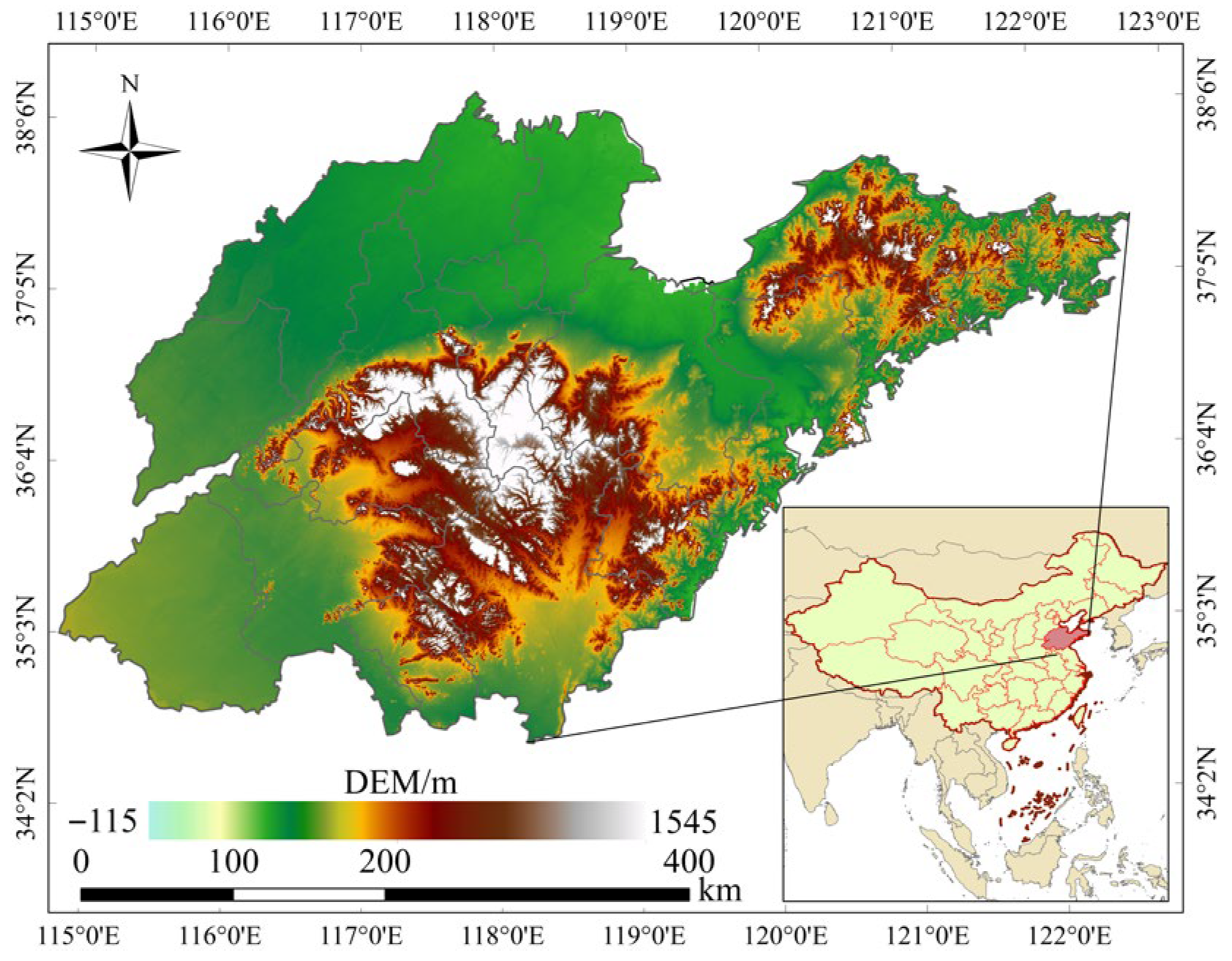
The topography of Shandong Province is characterized by a central uplift, known as the hilly region of central and southern Shandong. The eastern peninsula predominantly consists of gently undulating wave-like hills, while the western and northern areas form the alluvial plain of the Yellow River. Plains constitute 55% of the province’s total area, mountainous and hilly terrain account for 29%, depressions and lakes occupy 8%, and other land types make up the remaining 8% [18]. The coastline extends approximately 3345 km, with a maritime area of 159,500 km2; significant climatic differences exist between coastal and inland regions (see Figure 1). Located in the northern temperate semi-humid monsoon climate zone, Shandong Province exhibits distinct seasons, substantial temperature variations, synchronized occurrence of rainfall and heat, and strongly seasonal precipitation patterns. Winters are cold and dry with minimal precipitation; summers are hot with concentrated rainfall; both spring and autumn are characterized by drought conditions with scarce rainfall. The province’s average annual temperature ranges from 11 to 14 °C, with a frost-free period of 200–220 days; the multi-year average surface water resources amount to 20.51 km3, groundwater resources total 16.89 km3, and after deducting repetitive calculations, the total water resources volume reaches 30.81 km3; the per capita water resources availability is 315 m3 (data from Shandong Provincial Department of Water Resources). Consequently, groundwater faces severe risks of over-exploitation and drought [19,20].

2.2. Data Sources

The Terrestrial Water Storage Anomaly (TWSA) data employed in this study were sourced from the next-generation gravity field inversion product GRACE RL06.3 mascon (https://www2.csr.utexas.edu/grace/RL06_mascons.html) [21], accessed on 7 April 2025, jointly released by the NASA Jet Propulsion Laboratory (JPL) and the University of Texas Center for Space Research (CSR). Numerous scholars have validated its applicability and objective reliability for the Chinese region [22,23].
Soil Moisture Storage (SMS), Snow Water Equivalent (SWE), and Canopy Water Storage (CWS) data were obtained from the Global Land Data Assimilation System (GLDAS), a major scientific project jointly led by the NASA Goddard Space Flight Center (GSFC) and the NOAA National Centers for Environmental Prediction (NCEP). The core dataset GLDAS Noah Land Surface Model L4 monthly 0.25 × 0.25 degree V2.1 served as the primary data source (https://disc.gsfc.nasa.gov/datasets/GLDAS_NOAH025_M_2.1/summary) [24], accessed on 3 June 2025.
The 1 km resolution monthly precipitation [25] and temperature [26] raster datasets were acquired from the National Tibetan Plateau Data Center (NTPDC) of China (http://data.tpdc.ac.cn), accessed on 21 July 2025. The data period spans from January 2003 to December 2024, uniformly provided at monthly temporal resolution, with a spatial resolution of 0.25°, and the data extent was clipped to Shandong Province, China.
Gross Domestic Product (GDP), population, and built-up area data were obtained from the Shandong Provincial Statistical Bureau’s Statistical Yearbooks (http://tjj.shandong.gov.cn/col/col6279/) of Shandong Province (2003–2024), accessed on 7 October 2025. Groundwater recharge data were sourced from the Hydrological Yearbooks of Shandong Province (2003–2024) (http://wr.shandong.gov.cn/), accessed on 7 October 2025. Impervious surface area data were derived from the dataset published by Professor Yang [27].

2.3. Research Methods

2.3.1. Singular Spectrum Analysis Method

Singular Spectrum Analysis (SSA) is a tool proposed by Vautard et al. in 1992 for decomposing and ordering time series according to variance components [28], which can be used to extract nonlinear trends from temporal signals or eliminate noise. This method originates from Karhunen–Loeve decomposition theory; as a principal component analysis method for analyzing one-dimensional time series, it can be utilized to extract nonlinear trends from temporal signals or eliminate noise [29]. The core principle of Singular Spectrum Analysis lies in constructing a trajectory matrix from time-lagged windows of the original series, extracting its inherent covariance structure, and subsequently reconstructing the signal by leveraging the identified temporal dependencies. Singular Spectrum Analysis has further developed into a tool capable of filling gaps in time series data based on features derived from data samples [30]. In time series analysis, SSA is a nonparametric spectral estimation method. SSA can help decompose a time series into a sum of components, each possessing a meaningful interpretation. SSA considers only the intrinsic characteristics of the data itself without accounting for other factors, making it particularly suitable for imputation and forecasting of stationary time series [31].
A uniformly sampled time series X = [ x 1 , ···, x n ], an L × M trajectory matrix Y can be formed:
Y L × M = x 1   x 2     x M x 2   x 3     x M + 1     x L   x L + 1     x N = [ X 1 , X 2 , , X M ]
Let M = N − L + 1, where L ≤ M < N. Each ascending anti-diagonal of matrix Y contains identical values. In previous research, based on the method proposed by Broomhead and King, the lag-covariance matrix YYT is formed using matrix Y and processed using the Principal Component Analysis (PCA) procedure [32]. An equivalent but more concise alternative approach is to directly decompose Y through Singular Value Decomposition (SVD):
Y L × M = U L × L Λ L × M V M × M T
where the subscripts denote matrix dimensions, Λ is a diagonal matrix, U and V are orthogonal, and V also represents the eigenvectors of the lag-covariance matrix. The outputs of Empirical Orthogonal Functions (EOFs) and Principal Components (PCs) in Principal Component Analysis can be expressed as follows:
E O F i = U , i σ i P C i = V , i
where Uᵢ and Vᵢ represent the i-th columns of U and V, respectively, and λᵢ is the i-th diagonal element of Λ. Note that if the lag-covariance matrix is defined as YTY, the definitions of EOF and PC should be swapped. The Y matrix can be reconstructed through the summation of modal Z, where each modal Z equals the multiplication of EOF and PC:
Y = i = 1 K Z i = i = 1 K E O F i × P C i
where K = min (M,L), and each modal Zᵢ has the same structure as Y. Therefore, we can represent a new time series using the average of the anti-diagonal elements, called Reconstructed Components (RCs, denoted as ϑ ):
ϑ i p = m e a n Z i j . k , p = 1,2 , 3 , . . . N
where all elements in Zᵢ satisfy j + k = p + 1, noting that the superscript here represents position index. The sum of all RCs equals the original input time series. The RCs are arranged in descending order according to their singular values (i.e., signal strength), and can represent long-term and oscillatory components or noise. Therefore, the original K value containing all information of the signal (and noise) is typically not used; instead, K is reduced to K’ to retain the desired RCs:
X = i = 1 K ϑ i
Yi et al. added two loops to the original SSA method and gradually iteratively updated missing values. The inner loop terminates once the imputed values converge to a steady state, while the outer loop iteratively elevates the reconstruction complexity, governed by the order of the reconstruction model. (Equation (6)). By initializing missing entries as zero and iteratively updating them across the dual-loop framework, the method achieves direct signal-noise separation from the original observations. This design inherently avoids dependencies on external filtering operations. In the specific code (SSA-filling-b), this essentially constitutes a complete sensitivity analysis and parameter optimization module. For each parameter combination (M, K) in Mlist and Klist, the algorithm simulates data gaps and evaluates the ability of the sequence reconstructed using that parameter set to predict known data. The final selection is the parameter combination that yields the minimum prediction error during cross-validation. They have provided open-source processing tools and datasets [14].

2.3.2. Water Balance Equation

This study isolated the GWSA by subtracting other water storage component anomalies derived from GLDAS from the TWSA derived from GRACE. Terrestrial water storage comprises numerous components; this study utilized its primary components extracted and calculated from the GLDAS Noah model, and inverted the Groundwater Storage Anomaly through the water balance equation [33].
G W S A = T W S A   -   S M S A   -   S W E A   -   C W S A
where GWSA is the Groundwater Storage Anomaly, TWSA is the Terrestrial Water Storage Anomaly inverted from GRACE, SMSA is the Soil Moisture Storage Anomaly, SWEA is the Snow Water Equivalent Anomaly, and CWSA is the Canopy Water Storage Anomaly.
S M S A i , j = SMS i , j μ j σ j
S W E A i , j = SWE i , j μ j σ j
C W S A i , j = CWS i , j μ j σ j
where SMS is Soil Moisture Storage, SWE is Snow Water Equivalent, CWS is Canopy Water Storage, μ is the monthly average value from the baseline year data for each dataset, and σ is the standard deviation of the baseline year data for each dataset. Following the processing format of RL06.3, the period 2004–2009 was similarly selected as the baseline year data for calculating the respective anomalies.

2.3.3. Linear Regression Trend Analysis

Trend analysis method is a technique that predicts the change trend of a variable by performing linear regression analysis on its time-dependent sequence.
y = a + k x + ε
where a and k are unknown constants, and ε is the random error. Using the observed values ( x i , yi) (i = 1, 2, …, n), the unknown parameter k can be estimated as follows:
k = i = 1 n ( x i x ¯ ) ( y i y ¯ ) i = 1 n ( x i x ¯ ) 2
For long-term time series data, the corresponding linear equation is obtained after linear fitting using the Least Squares Method (LSM). The slope k of the equation indicates the multi-annual change trend of the pixel value. k > 0 indicates an increasing trend, while k < 0 indicates a decreasing trend.

2.3.4. Mann–Kendall Test

The Mann–Kendall (MK) change-point test is a method frequently employed for abrupt change detection. The specific procedure is as follows:
Let the original time series be y1, y2, …, yn. Let mi denote the cumulative count where the i-th sample yi is greater than yj (1 ≤ j ≤ i). A statistic dk is defined as follows:
d   =   i = 1 k m     ( 2     k     n )
Under the null hypothesis that the original series is random, independent, and identically distributed, the mean E(dk) and variance Var(dk) of dk are, respectively:
E ( d )   =   k ( k     1 ) / 4
V a r ( d ) = k ( k 1 ) ( 2 k + 5 ) / 72
The statistic dk is standardized using the formula above, yielding UFk:
U F   =   [ d     E ( d ) ] Var ( d )
The series of UFk values forms a UF curve. Whether a significant change trend exists can be determined by checking this curve against the significance level.
Applying the same method to the reversed time series, another curve UB is calculated. The intersection point of these two curves (UF and UB) within the confidence interval is identified as the change point.
Given a significance level of α = 0.05, the critical values for the statistics UF and UB are ±1.96. A UF value greater than 0 indicates an upward trend in the series; conversely, it indicates a downward trend. A UF value that exceeds or falls below ±1.96 indicates a statistically significant upward or downward trend, respectively.

2.3.5. Quantifying the Relative Contributions of Climate and Human Activities on GWSA

This study established a multiple regression model between GWSA and climate variable anomalies, considering precipitation and temperature as the primary climatic factors, since most climate-driven storage anomalies can be reconstructed using precipitation and temperature [34,35]. To assess the impacts of climate and human activities on GWSA, the respective contributions of these two drivers were distinguished and quantified via residual analysis. Residual analysis is commonly applied for attributing vegetation changes and can separate the influences of human activities and climate on a variable [36]. The principle of residual analysis involves using climate data to establish a climate-driven time series of the variable, then the residual between the observed variable and the established variable is assumed to be the human activity-driven time series [37].
First, the GWSA raster data were resampled to the same spatial resolution as the climate raster data using ArcGIS to successfully perform the residual analysis. Subsequently, fitting equations between GWSA and monthly precipitation anomalies as well as monthly temperature anomalies were constructed at the raster scale. The fitted values (reconstructed monthly GWSA) were identified as the climate-driven GWSA time series, while the residuals of the fitting equation (original monthly GWSA minus the reconstructed monthly GWSA) were considered as the human activity-driven GWSA changes (i.e., non-climatic influences), because GWSA can generally be attributed to consequences induced by both human and climatic factors. Detailed quantitative definitions are provided in Table 1, with the formulas as follows [38]:
G W S A cc   =   a   ×   P   +   b   ×   T
G W S A a c = G W S A or G W S A c c

2.3.6. Spearman’s Rank Correlation Analysis

Spearman’s rank correlation coefficient is a nonparametric (distribution-free) statistical measure used to assess the strength and direction of a monotonic relationship between two variables. This method does not assume that the data follow a specific distribution (such as a normal distribution) and is less sensitive to outliers, making it particularly suitable for analyzing data that do not meet the prerequisites for parametric tests [39]. The core principle of Spearman’s correlation lies in the fact that it does not directly analyze the original observed values of the two variables, but rather analyzes their respective rank orders. The specific steps are as follows: Independently convert the observed values of the two variables X and Y into rank values R ( x i ) and R ( y i ) . Rank 1 represents the minimum value in the variable, the next smallest value is rank 2, and so on. Calculate the rank difference d i = R ( x i ) R ( y i ) for each pair of observations. For a sample of size n, the simplified calculation formula for Spearman’s rank correlation coefficient ρ s is as follows:
ρ s = 1 6 i = 1 n d i 2 n ( n 2 1 )
The value of Spearman’s coefficient ranges between −1 and +1. +1 indicates a perfect positive monotonic relationship. When the rank of one variable increases, the rank of the other variable increases in perfect concordance. −1 indicates a perfect negative monotonic relationship. When the rank of one variable increases, the rank of the other variable decreases in perfect concordance. 0 indicates no monotonic relationship.
Considering the characteristics of the dataset itself and the inherent advantages of Spearman’s correlation analysis: It measures the monotonic relationship between variables (whether linear or not), without assuming linearity. It is less sensitive to outliers because it is calculated based on data ranks rather than raw values. It does not require the data to follow a normal distribution. This study selected Spearman’s correlation analysis method for conducting correlation analysis between the datasets.

3. Results

3.1. Reconstruction of TWSA Series Using Singular Spectrum Analysis

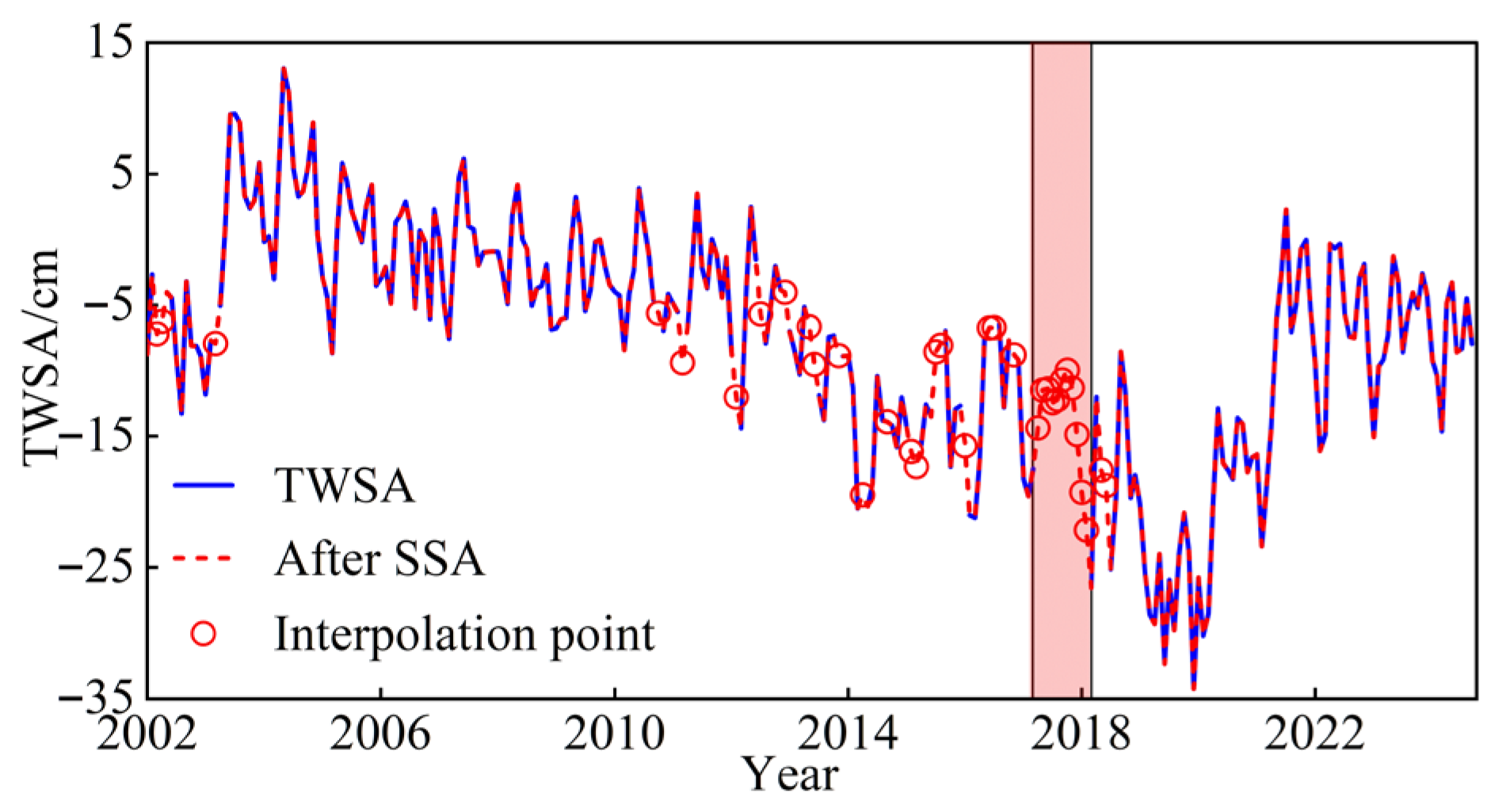
The original Terrestrial Water Storage Anomaly (TWSA) satellite data for Shandong Province from April 2002 to December 2024 were selected for gap-filling using Singular Spectrum Analysis (SSA). This procedure primarily addressed the prolonged data gap during the transition period between the GRACE and GRACE-FO missions from June 2017 to May 2018, as well as missing monthly observations in prior years, thereby generating a complete monthly time series from January 2003 to December 2024; details are presented in Figure 2. The interpolation ensured data continuity, reflected the fluctuating variations in the TWSA sequence, more accurately reconstructed the overall TWSA variation pattern, and facilitated subsequent research [40].

3.2. Spatiotemporal Variation Patterns of GWSA in Shandong Province

3.2.1. Temporal Variation Patterns

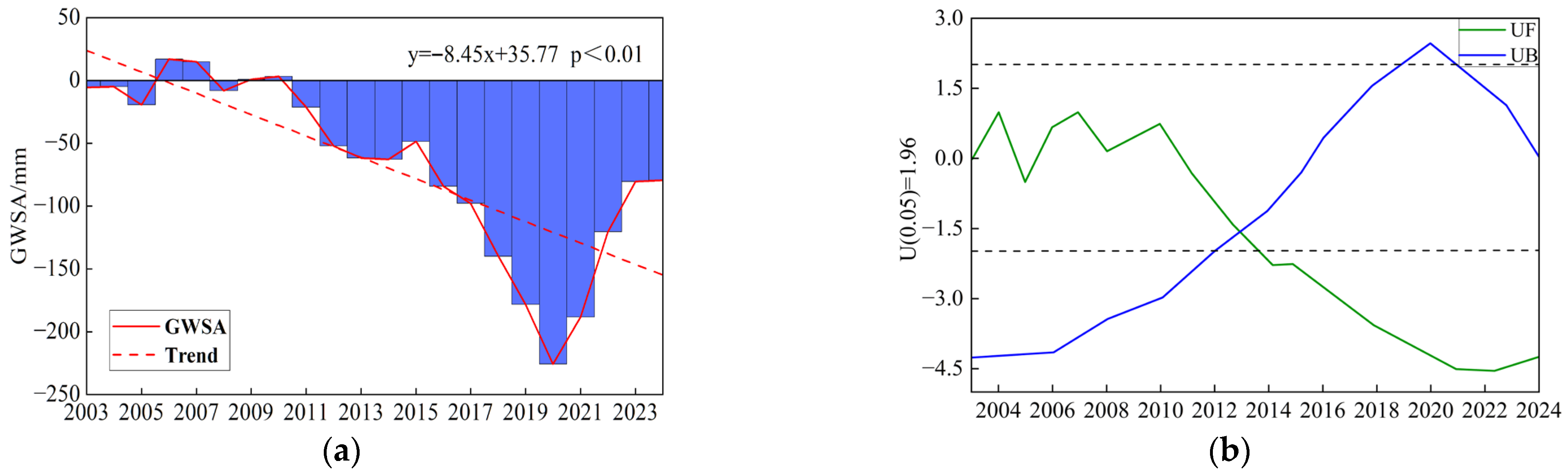
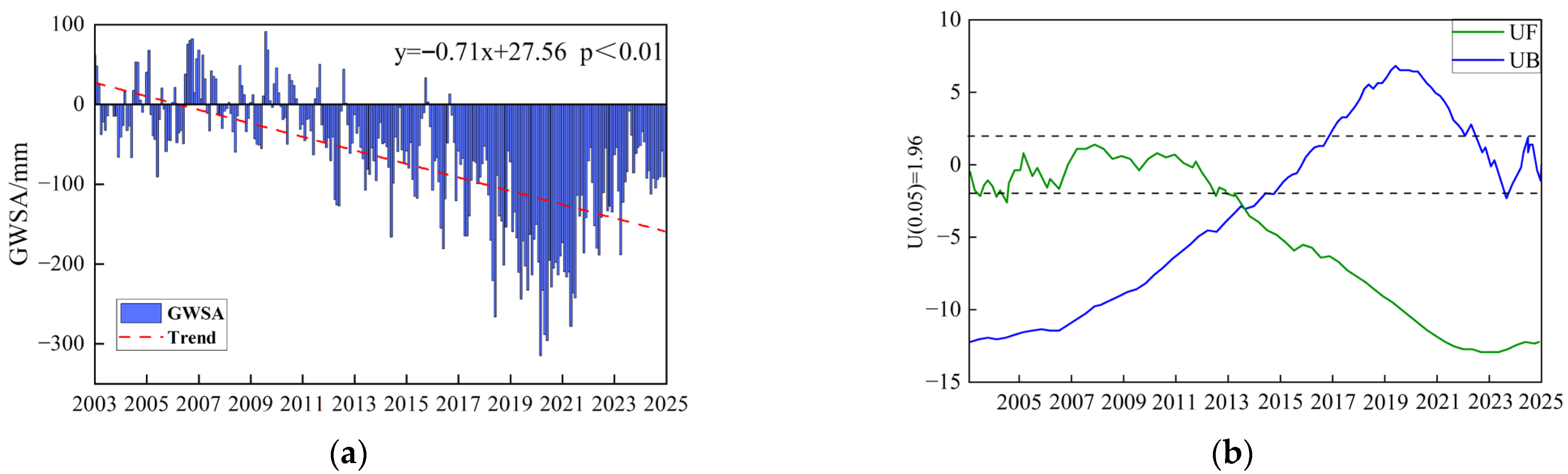
The results indicate that the annual average GWSA in Shandong Province exhibited a significant decreasing trend (p < 0.01) with a rate of −8.45 mm/a. The overall trend from 2003 to 2024 generally followed a pattern of initial stability, followed by a sharp decline, and then a slight recovery. A continuous decline in GWSA commenced in 2011, reaching its lowest value in 2020. Although the rate of groundwater storage depletion slowed after 2020, the overall system remained in a state of systematic deficit, indicating long-term challenges to the sustainability of groundwater resources. The MK change-point detection identified the year 2013 as a significant change point (p < 0.05) for the annual-scale GWSA data, while the change point for the monthly scale GWSA data was identified around July 2013; details are shown in Figure 3 and Figure 4.
During the pre-change point phase (2003–2012), although GWSA exhibited significant interannual fluctuations and seasonal cycles, the overall system maintained a certain dynamic equilibrium, reaching its highest GWSA value of 17.15 mm in 2006. Intra-annual variations showed a relatively regular recharge-depletion cycle: positive peaks occurred in summer (53.48 mm in August 2004; 75.49 mm in August 2006; 91.22 mm in August 2009), while negative anomalies frequently occurred in winter, spring, and early summer of some years (−90.87 mm in June 2005; −60.03 mm in June 2008; −127.06 mm in June 2012). Notably, although the intensity of negative anomaly events during this phase was already considerable (−126.24 mm in May 2012), their duration was relatively limited. In most years, effective replenishment still occurred during summer and autumn following low values, preventing a systematic shift in the annual average.
During the post-change point phase (2013–2024), GWSA entered a state of persistent and sharp decline into negative anomalies, reaching its lowest value of −225.78 mm in 2020. The core characteristics of this phase are as follows:
Drastic Increase in Negative Anomaly Intensity and Prolonged Duration: The year 2013 became a turning point, with negative GWSA anomalies becoming the norm. Notable lows were observed in June 2014 (−166.38 mm), June 2016 (−180.38 mm), and June 2018 (−266.45 mm), reaching the lowest values during 2019–2020 (June 2019: −243.98 mm; September 2019: −232.65 mm; March 2020: −314.92 mm; June 2020: −295.95 mm). Between April 2018 and December 2020, GWSA remained almost continuously low for 32 months (mostly < −150 mm, often below −200 mm). Although GWSA showed some recovery from 2021 to 2024, values in most months remained below −50 mm.
Weakened Seasonal Recovery Capacity: The significant summer–autumn replenishment effect evident in the pre-change point phase was severely weakened post-change point. The traditional recharge season (July–September) not only frequently failed to generate effective positive recharge but often exhibited deep negative values (August 2017: −71.05 mm; August 2018: −139.30 mm; August 2019: −202.50 mm; August 2020: −228.78 mm; August 2024: −104.82 mm). The diminished recharge capacity of the groundwater system led to the continuous accumulation of depletion.
Systematic Downward Shift in System State: After the 2013 change point, the annual average GWSA underwent a systematic downward shift, stabilizing within a negative anomaly range. Even during high-value months (October 2015: 33.38 mm; September 2016: 12.96 mm; August 2023: −8.04 mm), the values were considerably lower than those during corresponding periods before the change point. Furthermore, the recovery amplitudes were limited and short-lived, insufficient to counteract the overall depletion trend.

3.2.2. Spatial Variation Patterns

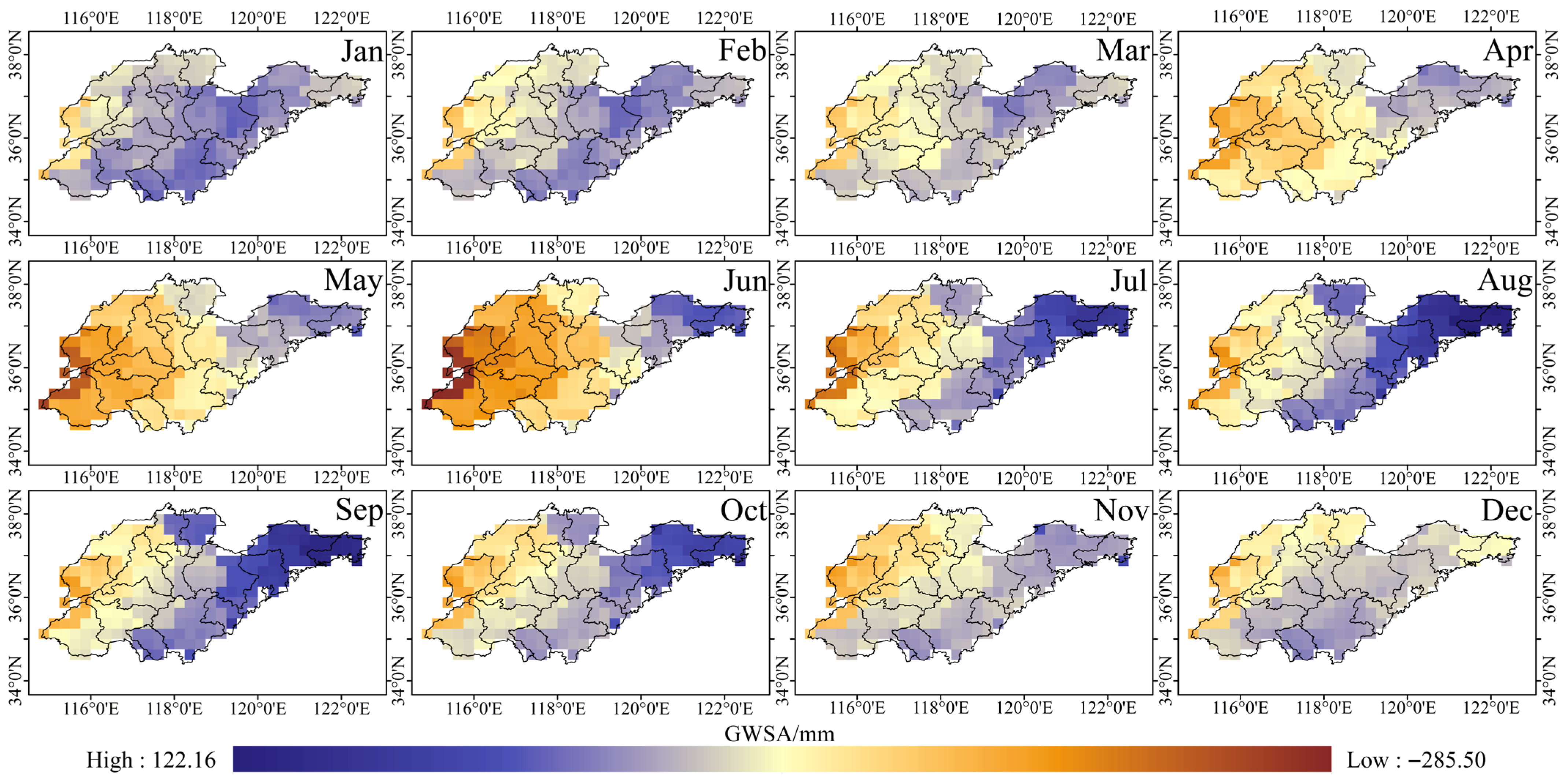
The spatial distribution of the monthly average GWSA in Shandong Province from 2003 to 2024 is shown in Figure 5. Overall, a clear east–west disparity in GWSA is observed across Shandong Province, with groundwater storage generally exhibiting a gradual decreasing trend from east to west; the magnitude of variation is significantly influenced by seasonal factors.
From the perspective of intra-annual distribution, GWSA in Shandong Province continuously decreased from January to June, reaching the annual average minimum value of −285.50 mm across the entire western region in June. GWSA gradually improved from July to October, peaking at an annual average maximum of 122.16 mm in the eastern region in August, demonstrating a pronounced difference between the eastern coastal and western inland areas. From October to January of the following year, most areas exhibited a positive growth trend, groundwater storage became relatively stable across regions, and the disparities in GWSA between regions gradually diminished, generally showing a pattern of initial decrease followed by an increase, constituting a significant seasonal variation pattern.
Analyzing from a seasonal perspective, according to the climate classification in China, spring in Shandong Province spans March to May, summer June to August, autumn September to November, and winter December to February of the following year. The results indicate that the average GWSA in Shandong Province was lowest in spring, reaching −86.76 mm. Summer exhibited large GWSA fluctuations, with both the most groundwater-depleted and most abundant areas within the province occurring during the same summer season; the seasonal average was −74.22 mm, reaching the monthly average minimum of −126.41 mm in June and the monthly average maximum of −34.30 mm in August, indicating a period of regular seasonal recharge. The average GWSA in autumn and winter was −52.39 mm and −49.20 mm, respectively, with groundwater storage across the province being relatively stable during these seasons. The overall seasonal variation in groundwater in Shandong Province is substantial and deeply influenced by seasonal factors.
From a regional perspective, GWSA is generally higher in eastern Shandong and lower in the west, indicating a marked regional disparity between the east and west, deeply influenced by coastal-inland factors. The GWSA trends are distinctly different between the eastern coastal areas and the western inland areas. The driest period for groundwater in the eastern region occurs annually in June, whereas in the western region, it occurs in December. The period of greatest groundwater abundance in the western region is in January each year, while in the eastern region, it is in August. The lowest GWSA in the eastern region is around −80 mm, compared to −285 mm in the western region; similarly, the highest GWSA in the eastern region is around 122 mm, compared to approximately 50 mm in the western region. Throughout the year, compared to eastern Shandong, groundwater storage in western Shandong is relatively scarce and exhibits greater intra-annual variability, while the GWSA situation in eastern Shandong is relatively stable.
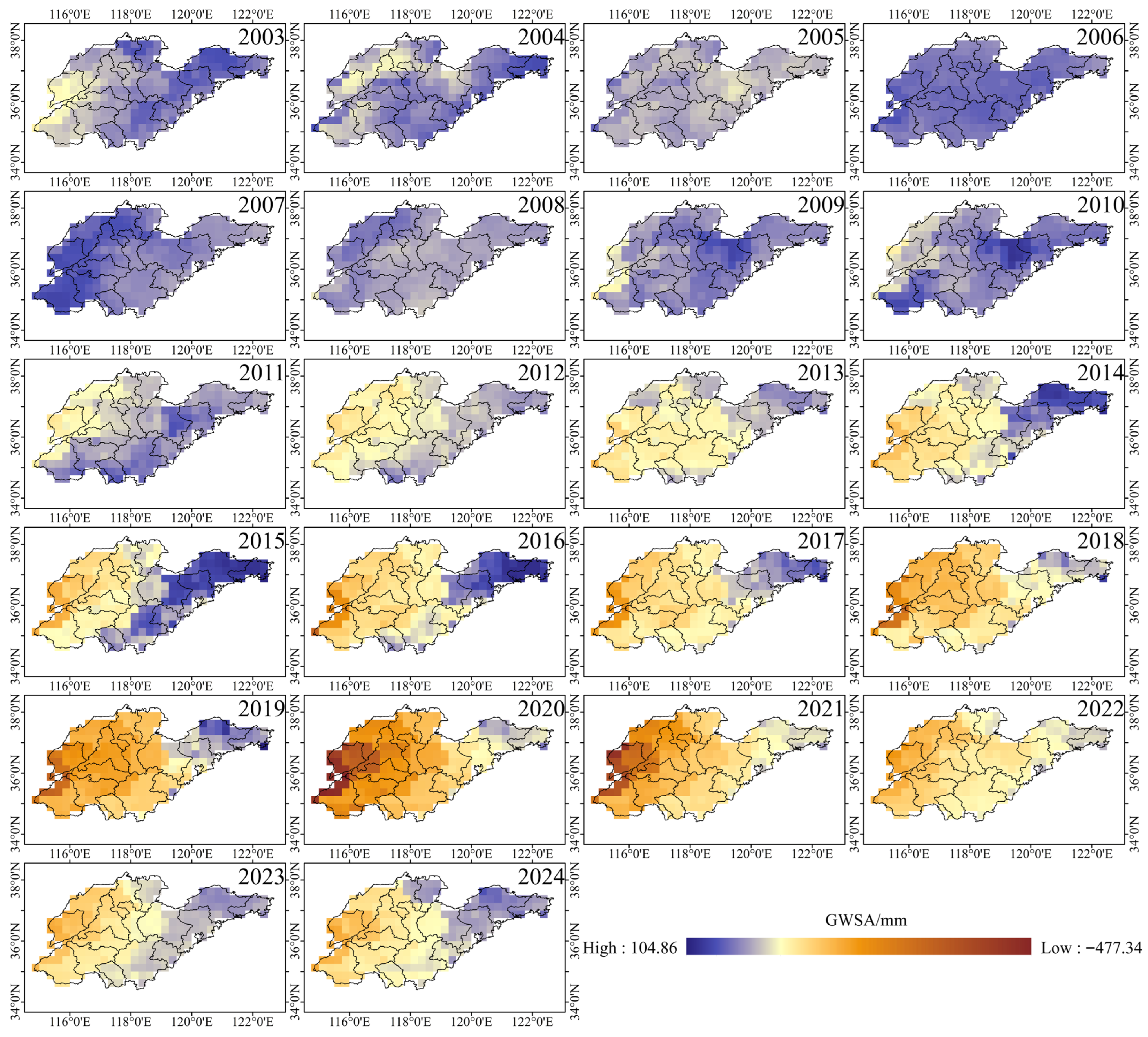
The spatial distribution of GWSA in Shandong Province from 2003 to 2024 is shown in Figure 6. Combined with the analysis of the temporal variation trend in Figure 3, it can be observed that the GWSA in Shandong Province from 2003 to 2024 followed a pattern of initial decline followed by a subsequent rise, demarcated by the year 2020, which recorded the lowest groundwater storage. From 2003 to 2012, groundwater storage maintained overall stability and dynamic reorganization. After 2013, extensive water scarcity and depletion emerged, and GWSA shifted to a significantly decreasing overall trend. From 2020 to 2024, groundwater storage in Shandong Province gradually improved.
From 2003 to 2012, groundwater storage in Shandong Province was stable, with annual average GWSA in most areas remaining above −50 mm. The highest provincial GWSA occurred in 2006, reaching an annual average maximum of 17.15 mm. The annual average GWSA across most of Shandong Province was around 30 mm, representing the highest groundwater storage level relative to the entire study period. The year 2013, identified as a significant, abrupt change year by MK analysis, serves as a boundary. After that year, pronounced large-scale declines in GWSA began in Shandong Province, subsequently remaining consistently below the anomaly year data average level. This significant declining trend reached its lowest point in 2020, with an annual average GWSA of −225.78 mm. However, after 2020, GWSA exhibited a rising trend, and groundwater storage in Shandong Province received replenishment, although it still failed to recover to the previously relatively stable and abundant average level.
Influenced by coastal-inland factors, the GWSA difference between eastern and western Shandong from 2003 to 2024 was pronounced. The inland western regions experienced a larger and more significant decline in groundwater storage, whereas the coastal eastern areas, particularly the northeastern part of the Jiaodong Peninsula, maintained relatively stable groundwater storage and even a growing state. Signs of groundwater storage depletion in Shandong Province first emerged in the western inland areas in 2009, while the eastern coastal areas remained relatively abundant. Even in 2015, a year of overall groundwater scarcity, some parts of the eastern coastal region still maintained an annual average GWSA around 50 mm, while the western inland areas had already fallen into negative values and continued their declining trend; it was not until 2017 that similarly significant groundwater depletion appeared in the eastern coastal areas. The year with the lowest GWSA in Shandong Province during 2003–2024 was 2020, when large areas experienced severe groundwater depletion and a declining trend. The most severely affected area in the western inland region reached a GWSA of −477.34 mm, with only small, localized parts of the northeastern Jiaodong Peninsula maintaining stable groundwater storage. After 2020, as groundwater storage slowly recovered, the eastern coastal areas were again the first where GWSA returned to positive values, showing a significant increase in groundwater storage. This demonstrates that the GWSA variation trend in Shandong Province is significantly influenced by coastal-inland factors; geographical location is a key factor affecting groundwater storage in the province. Inland areas are more vulnerable to groundwater storage crises compared to coastal areas, and monitoring efforts for groundwater storage changes should prioritize these inland regions.

3.3. Contribution Rate of Human Activities

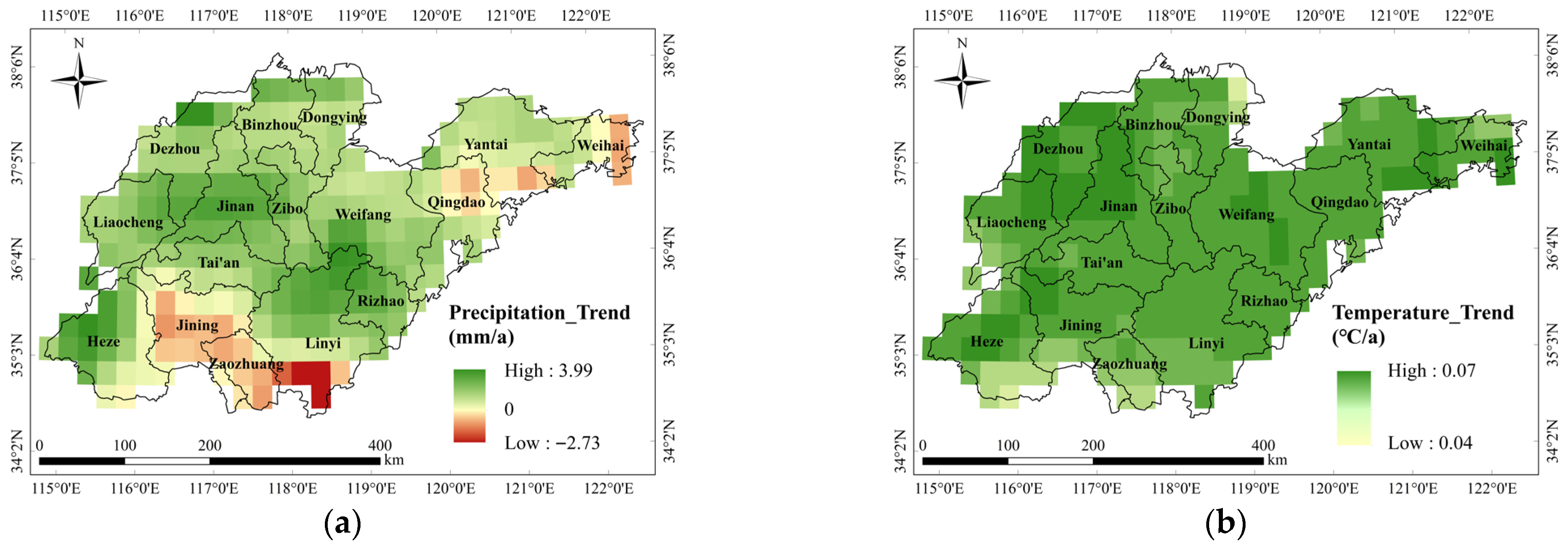
Based on previous research findings [35,38] indicating that precipitation and temperature are the primary climatic factors, a multiple regression model was constructed between GWSA and climate variable anomalies (precipitation and temperature) in Shandong Province to analyze and study the contribution rate of climatic factors to GWSA (Figure 7 and Figure 8 for details).
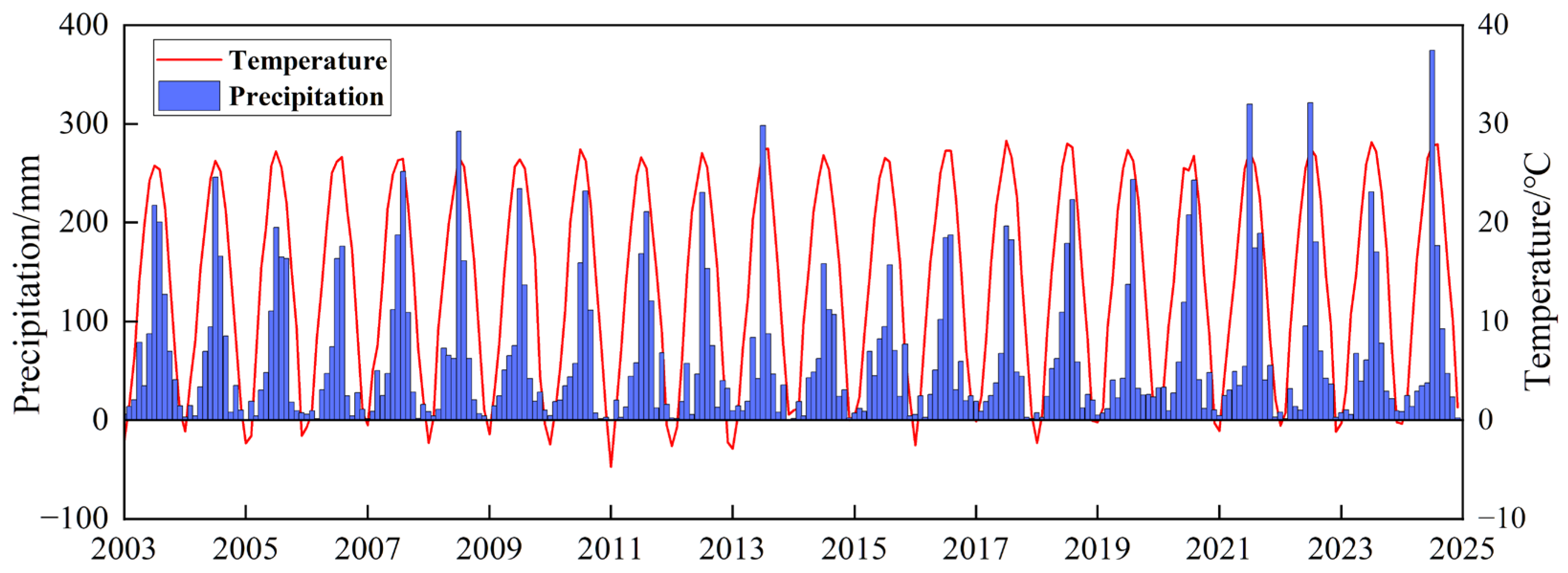
From 2003 to 2024, the average annual precipitation in Shandong Province was approximately 743.38 mm, with an average temperature of about 14.0 °C. The annual precipitation trend value was approximately 1.32 mm/a, showing a significant increasing trend (p < 0.05) across the province; areas exhibiting an increasing trend accounted for 85% of the total provincial area, while only 15% of regions showed a decreasing precipitation trend, as shown in Figure 7 and Figure 8. The annual average temperature demonstrated a significant upward trend (p < 0.05), with a trend value of approximately 0.06 °C/a, closely related to global warming factors [41].
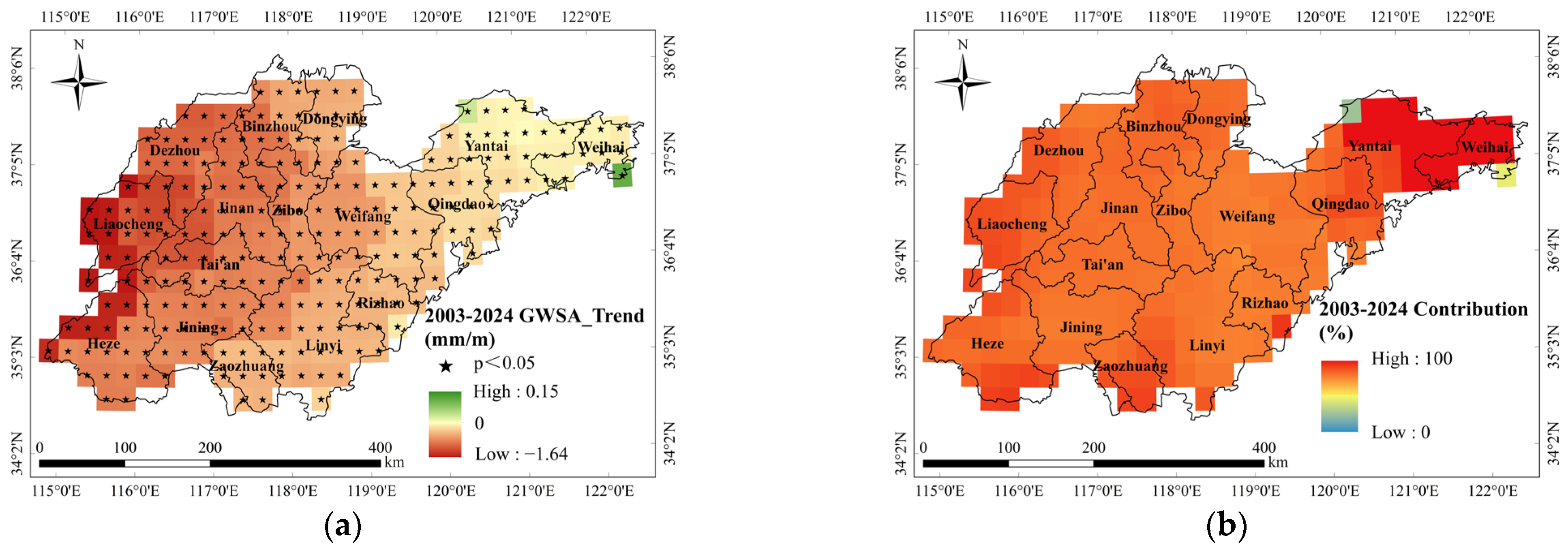
The spatial distribution of GWSA change trends and human activity contribution rates in Shandong Province from 2003 to 2024 is detailed in Figure 9. Approximately 99.1% of the areas in Shandong Province showed a significant decreasing trend in GWSA (p < 0.05), while only 0.9% of the areas exhibited a significant increasing trend in GWSA (p < 0.05); the average GWSA trend change in Shandong Province was approximately −0.71 mm/m. The overall GWSA trend displayed a gradual decreasing process from east to west; between 2003 and 2023, the closer to the inland areas in western Shandong, the more pronounced the groundwater decline trend, with the minimum GWSA trend slope in the west reaching −1.64 mm/m, indicating an extremely significant decreasing trend; conversely, in the coastal eastern areas, particularly the northeastern part of the Jiaodong Peninsula, the trend values mostly ranged between −0.1 and −0.01 mm/m, and the GWSA trend remained relatively stable over the entire study period.
Overall, the average human activity impact contribution rate in Shandong Province reached 86.11%; for 96.25% of the areas in Shandong Province from 2003 to 2024, the decisive influencing factor for GWSA changes was human activities, with a human activity contribution rate > 80%. Only 0.9% of the areas were dominated by climatic factors, with a human activity contribution rate < 50%; 2.85% of the areas were jointly influenced by human activities and climatic factors. This indicates that the decline in groundwater storage in Shandong Province from 2003 to 2024 is closely related to human activities, and human activities are the direct cause of the groundwater storage decline in Shandong Province, exerting the primary negative impact on the province’s groundwater storage.
In the western and central regions of Shandong Province, where the trend values are less than 0 mm/m and groundwater storage shows a significant decreasing trend, the human activity contribution rate mostly exceeds 80%; this demonstrates that the declining trend of groundwater storage in western and central Shandong is primarily negatively influenced by anthropogenic factors. In most northeastern parts of the Jiaodong Peninsula in eastern Shandong and some coastal areas in the southeast, where the trend values are around 0, and the GWSA trend is relatively stable, the human activity contribution rate is nearly 100%; human activities dominantly influence the local GWSA trend, maintaining its relatively stable trajectory. In small parts of southeastern Weihai and northwestern Yantai, where the human activity contribution rate is around 40% and 25%, respectively, climatic factors are dominant, and the GWSA trend shows growth; this indicates that these two areas are primarily influenced by climatic factors, and although affected by human activities, the dominant positive influence of climatic factors promotes a positive growth trend in groundwater storage.
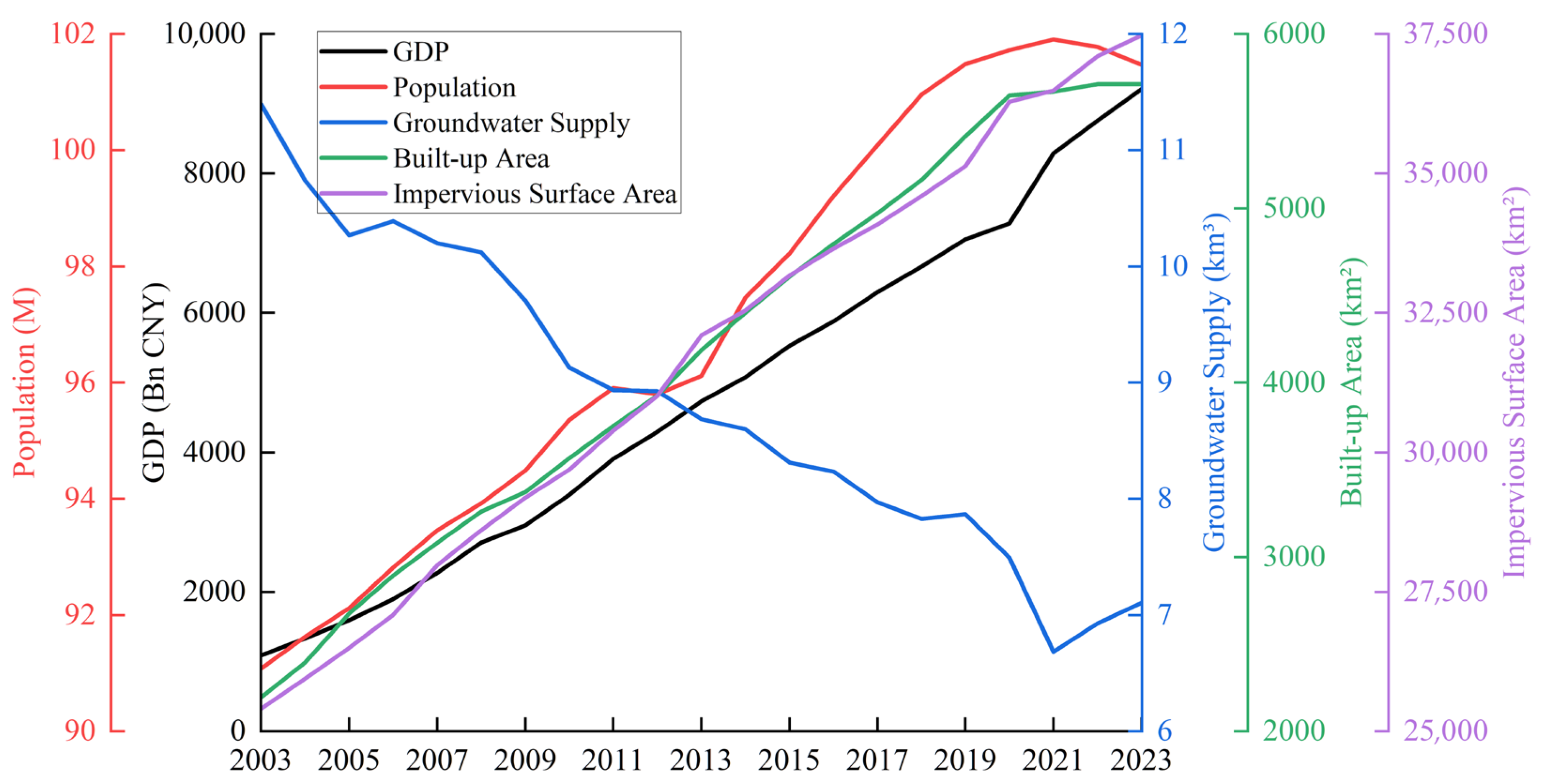
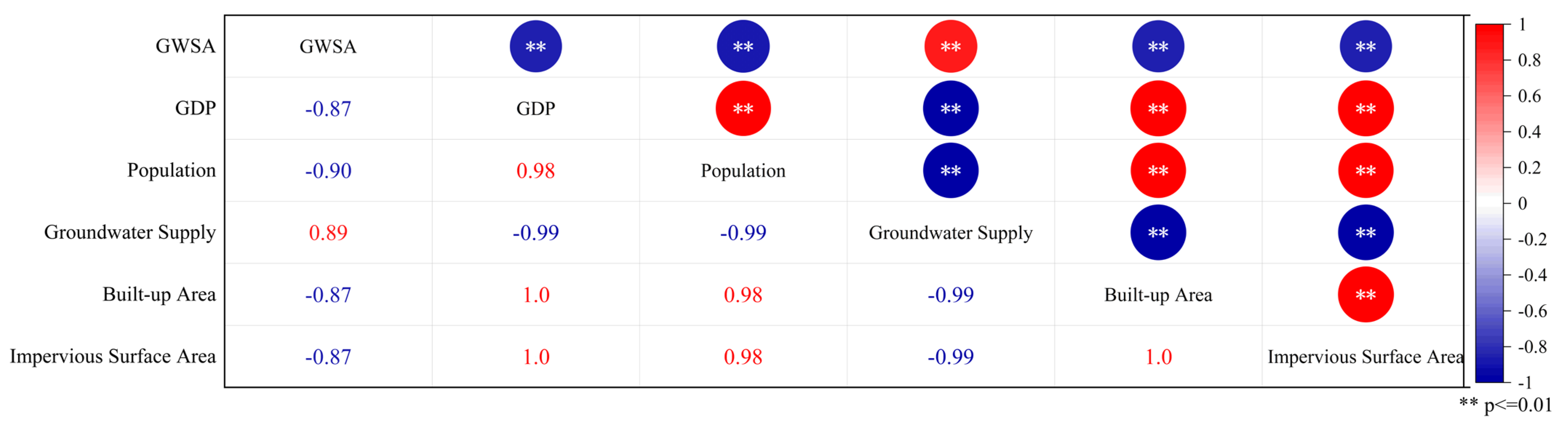
To further validate the research finding that human activities are the primary influencing factor for GWSA variations, annual data of human activity-related indicators-including Gross Domestic Product (GDP), population, groundwater supply volume (here referring to extraction volume from well engineering), built-up area, and impervious surface area (see Figure 10) for the period 2003–2023 were selected for Spearman’s rank correlation analysis with the obtained GWSA data of Shandong Province from 2003 to 2023.
The results (see Figure 11) demonstrate that GDP, population, built-up area, and impervious surface area in Shandong Province all exhibited highly significant (p < 0.01) strong negative correlations ( ρ s < −0.8) with GWSA, while showing highly significant (p < 0.01) strong positive correlations ( ρ s > 0.8) with groundwater supply volume. These findings sufficiently confirm that GWSA changes in Shandong Province are indeed closely associated with human activities, and the intensification of human activities directly influences the variations in groundwater storage across the province.
To conduct an in-depth analysis of the contribution rate of human activities to GWSA in Shandong Province, four distinct periods were delineated using the years 2006 (maximum value year), 2013 (abrupt change year), and 2020 (minimum value year) as demarcation points.
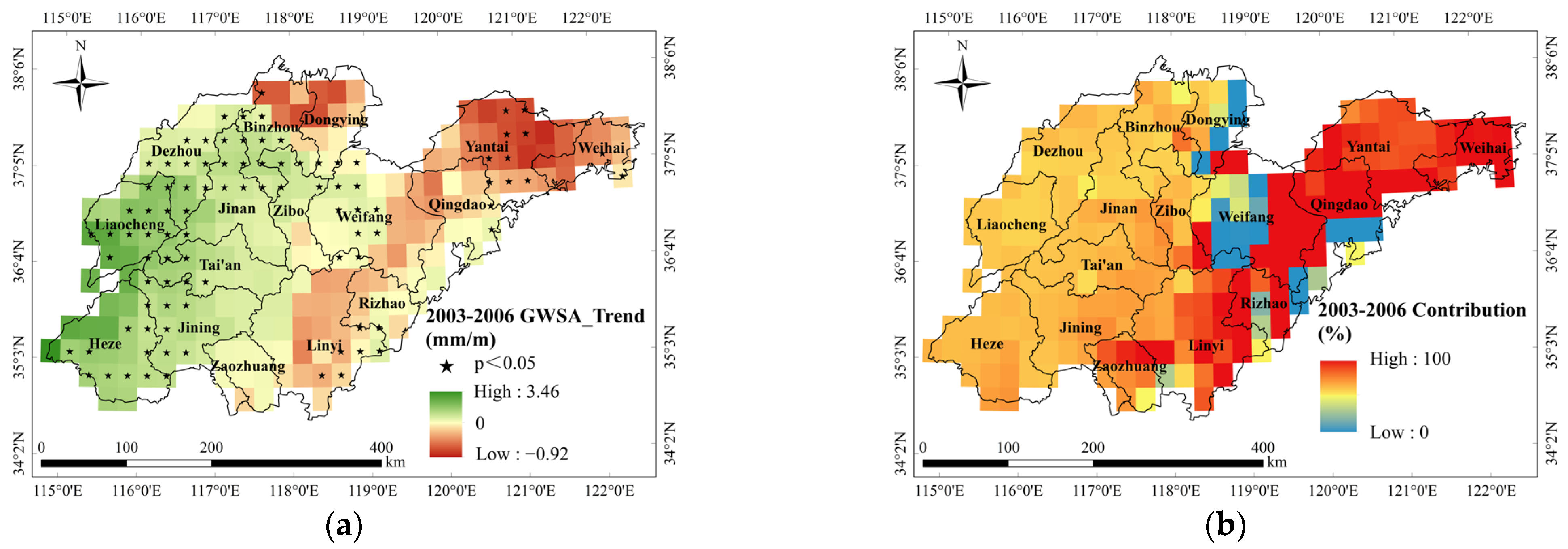
For the period 2003–2006, the spatial distribution of GWSA change trends and human activity contribution rates in Shandong Province is shown in Figure 12. The average GWSA trend change in Shandong Province was approximately 0.42 mm/m, with groundwater storage predominantly showing an increasing trend, covering 60.8% of the area, while 39.2% of the regions exhibited a decreasing trend. Human activities served as the deterministic factor for GWSA changes in 54.16% of the area; climatic factors were the primary driver in 10.42% of the regions; and 35.42% of the areas were jointly influenced by both human and climatic activities.
Significant spatial heterogeneity in groundwater storage trends was observed across Shandong Province during this period. Most western regions exhibited significantly increasing GWSA trends, with human activity contribution rates mostly exceeding 50%. In contrast, areas with declining GWSA trends were predominantly concentrated in most eastern coastal cities, where human activity contribution rates generally exceeded 90%. The negative impact of human activities led to the declining GWSA trend and continuous reduction in groundwater storage during this period, which was closely associated with the development policies of coastal cities and increasing urban population [42,43].
In the coastal areas of Qingdao, eastern Dongying, and central-western Weifang, the human activity contribution rate approached 0%, indicating almost complete dominance by climatic factors. Specifically, eastern Dongying showed a climatic contribution rate of nearly 100%, yet GWSA exhibited a non-significant decreasing trend. Conversely, in western Dongying and northern Binzhou, where the human activity contribution rate was approximately 60%, GWSA showed a significantly decreasing trend.
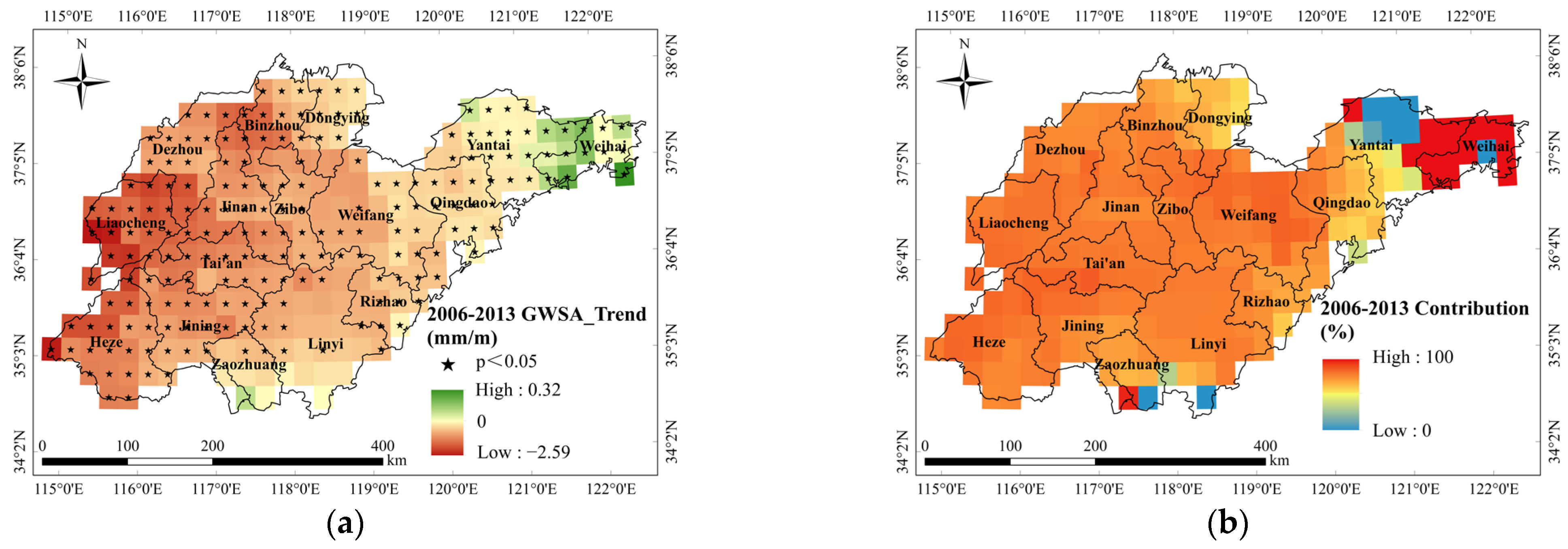
During the period 2006–2013, the spatial distribution of GWSA change trends and human activity contribution rates in Shandong Province is shown in Figure 13. The overall trend showed a significant decrease, with an average GWSA trend change of approximately −0.88 mm/m; 93.3% of the regions exhibited a decreasing trend in groundwater storage, while only 6.7% of the areas maintained an increasing trend in groundwater storage. Human activities served as the deterministic factor for GWSA changes in 75.83% of the area; climatic factors were the primary driver in 5.83% of the regions; and 18.34% of the areas were jointly influenced by both human and climatic activities.
Most areas of Weihai, eastern Yantai, northwestern Yantai, and small parts of southern Zaozhuang exhibited a significantly increasing GWSA trend, with human activity contribution rates in these regions approaching 100%, indicating that human activities played a positive role in groundwater storage recovery. In contrast, central-northern Yantai, central-southern Weihai, and small parts of southern Zaozhuang and southern Linyi were dominated by climatic factors, where the human activity contribution rate dropped to nearly 0%, resulting in trend change values around 0 mm/m in most areas of Yantai and maintaining a stable GWSA state.
In other regions of Shandong Province, the human activity contribution rate ranged between 60% and 80%, with GWSA showing a significantly decreasing trend. The primary negative influence of human activities led to a year-by-year decline in groundwater storage in these areas.
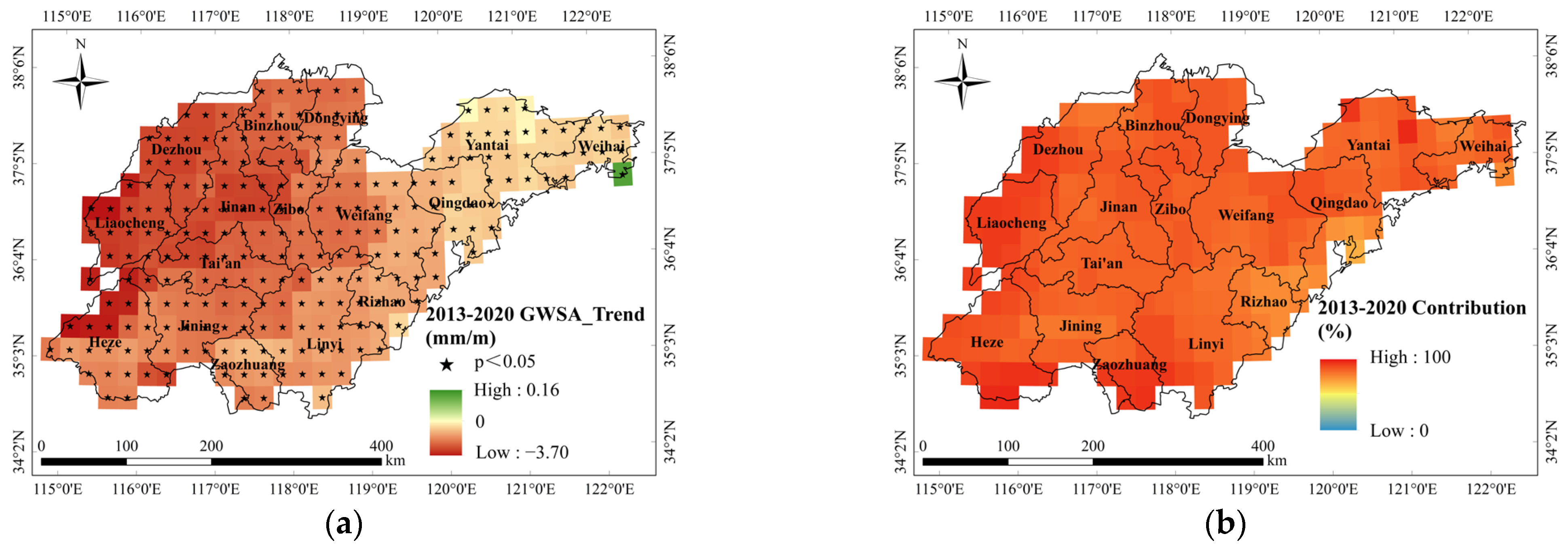
During the period 2013–2020, the spatial distribution of GWSA change trends and human activity contribution rates in Shandong Province is shown in Figure 14. The overall trend exhibited a highly significant decreasing pattern, with an average GWSA trend value of approximately −1.96 mm/m; nearly 99.6% of the areas in Shandong Province showed declining groundwater storage conditions, and the average human activity contribution rate reached 89.11%. Human activities served as the deterministic factor for GWSA changes in 94.58% of the area, while only 5.42% of the regions were jointly influenced by both human and climatic activities.
Some eastern coastal areas maintained relatively stable GWSA conditions with comparatively smaller magnitudes of decline, spatially preserving a weakening trend from west to east. The western inland regions consistently represented the most groundwater-deficient areas in Shandong Province, while even minimal portions of the eastern coastal areas still maintained an increasing trend. The human activity contribution rate across Shandong Province predominantly ranged between 80% and 90%, reaching 100% in some regions. During this period, human activities completely superseded climatic factors as the key determinant influencing GWSA in Shandong Province. The significantly negative impact of human activities resulted in the systematic decline of groundwater storage across the province.
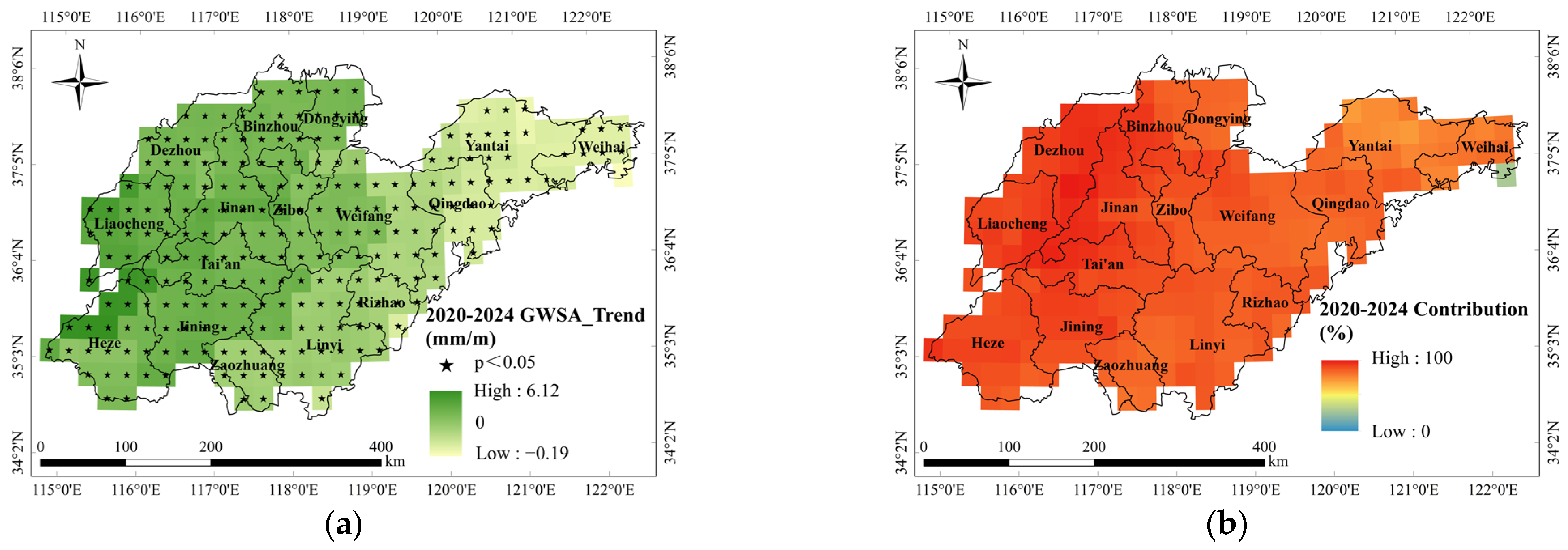
During the period 2020–2024, the spatial distribution of GWSA change trends and human activity contribution rates in Shandong Province is shown in Figure 15. The average GWSA trend value was approximately 3.27 mm/m, exhibiting a significant increasing trend and marking an entry into a groundwater storage recovery phase. During this period, human activities served as the deterministic factor for GWSA changes in 99.58% of the area; the positive influence of human activities promoted the recovery and increase in groundwater storage. Climatic factors were the primary driver in 0.42% of the regions, where GWSA still exhibited a decreasing trend, mainly distributed in small coastal areas of southeastern Weihai; influenced by climatic factors, groundwater storage showed a slight decreasing trend of approximately −0.19 mm/m. However, the province overall experienced positive impacts from human activities, leading to continuous recovery and an increase in groundwater storage, with the most pronounced effects in the western inland regions, while coastal areas remained relatively stable.

4. Discussion

This study systematically analyzed the spatiotemporal distribution patterns of GWSA in Shandong Province and its response mechanisms to human activities. The results indicate that groundwater storage in Shandong Province generally exhibited a decreasing trend, but with significant spatial heterogeneity. However, constrained by the spatial resolution (0.25° × 0.25°) of the GRACE/GRACE-FO satellite data, certain uncertainties remain when characterizing groundwater dynamics at local scales, particularly in depicting detailed variations in areas with intensive groundwater extraction and complex hydrogeological conditions, where the accuracy is still insufficient [44,45]. Future research could consider incorporating downscaling techniques, such as integrating high-resolution optical/radar remote sensing data, land use information, and hydrogeological parameters, combined with machine learning methods like Random Forest and Geographically Weighted Regression, to construct spatial statistical downscaling models [46,47]. This would enhance the spatial resolution and regional applicability of GWSA data, thereby more precisely revealing the local driving mechanisms of groundwater changes.
Although the satellite data CSRM (RL06.3) has undergone comprehensive correction [48,49] and requires no additional post-processing after release, along with [50], an SSA interpolation method specifically optimized for this dataset, corresponding uncertainties remain. These uncertainties do not critically affect the introduction of research findings, and results can be confidently drawn.
The GWSA inversion results for Shandong Province in this study are largely consistent with previous research findings [51,52], with significant changes and spatiotemporal variation patterns generally aligning [53]. However, different studies extend from varying perspectives; for instance, this study focuses on the response relationship with human activities and changes in groundwater storage. Future research could integrate related studies of the same region to conduct a comprehensive literature review and identify new research directions during this synthesis.
Currently, large-scale groundwater storage analysis still primarily relies on Terrestrial Water Storage Anomaly observations from the GRACE satellite series, coupled with hydrological models or reanalysis data to separate surface components such as soil moisture and snow water, thereby inferring groundwater changes [10,54]. Previous studies have validated the reliability of GWSA within Shandong Province relative to measured data [55]. Although this approach holds significant advantages for large-region monitoring, its reliance on measured data is relatively low, and it struggles to capture the heterogeneity of the vertical structure of aquifer systems. While traditional groundwater monitoring well data offer high accuracy, they suffer from issues such as uneven spatial distribution, insufficient monitoring density, and inadequate data sharing mechanisms, limiting their systematic application in regional GWSA validation [56,57]. Consequently, there is an urgent need to develop an integrated space-ground groundwater monitoring system, fusing multi-source data including satellite gravity, interferometric radar measurements, and downhole pressure sensing, to construct a groundwater storage assimilation system with high spatiotemporal resolution, thereby enhancing model simulation and prediction capabilities [58].
Our study primarily focuses on the direct impacts of quantifiable climatic variables (precipitation and temperature) on groundwater storage and their relative contributions compared to human activities at the regional scale. It does not delve into the mechanisms of global warming and its long-term hydrological effects over larger spatiotemporal scales, which indeed represents a boundary of this work. Global warming profoundly influences the stability of regional water cycles by altering atmospheric circulation, evaporative demand, precipitation patterns, and the frequency of extreme events. Future research could incorporate indicators such as potential evapotranspiration, circulation indices and utilize climate model scenarios to more comprehensively assess the long-term pressures of climate change on groundwater sustainability in Shandong Province. This points point to a significant direction for deeper investigation in subsequent work.
Considering the nonlinear and lagged response of groundwater systems, future research can think about delineating and quantifying both climate-influenced (e.g., rainfall-dependent irrigation) and relatively climate-independent human activities (e.g., industrial pollution, land-use change, lithological controls, and over-exploitation). A clear assessment of each factor’s contribution is essential for targeted water resource management. In studies employing residual analysis to attribute impacts to anthropogenic and climatic factors, precipitation and temperature datasets are predominantly selected as the primary climatic forcing data. This convention is grounded in the fact that variations in precipitation and temperature directly govern fundamental components of the terrestrial water budget, such as runoff generation and evapotranspiration, and these data are globally available with relatively high accuracy and consistency [34,35]. It is important to acknowledge, however, that this approach entails inherent uncertainties. Strictly speaking, the contribution rate attributed to human activities derived in this study should be interpreted as its theoretical upper bound, as the residual may also encapsulate effects from unmodeled non-anthropogenic drivers and complex human-environment interactions. Nevertheless, extensive validation in the literature suggests that this simplification does not materially undermine the robustness of the core conclusions, which remain valid. Future research should aim to progressively reduce these uncertainties by incorporating additional climatic variables and refining attribution frameworks.
Compared to previous research findings, which often highlighted the negative impact of human activities on groundwater storage, this study reveals that the impact of human activities on GWSA in Shandong Province is not solely manifested as a negative consumption effect. In some regions, human intervention has even become a key driving factor for groundwater storage recovery. For instance, through the implementation of comprehensive management measures such as groundwater recharge projects, optimization of agricultural irrigation regimes, and promotion of water-saving societies, the groundwater system in some areas has been gradually restored, showing a rebounding GWSA trend [59,60]. This finding suggests that the impact of human activities on groundwater storage possesses dual-directionality and regulatability. Future water resource governance should place greater emphasis on its potential for positive regulation, enhancing the resilience and sustainability of groundwater systems through scientific planning and targeted policies [61,62].

5. Conclusions

  • The interannual variation trend of GWSA in Shandong Province from 2003 to 2024 exhibited a significant overall decreasing trend, with a monthly change rate of −0.71 mm/m (p < 0.01) and an annual change rate of −8.45 mm/a (p < 0.01). The GWSA changes underwent a process of initial stability, followed by a sharp decline, and then a slight recovery. The MK test identified 2013 as the abrupt change year.
  • Groundwater storage in Shandong Province exhibits significant seasonal differentiation, characterized by “spring drought, summer intensity, autumn stability, and winter moderation,” generally showing a pattern of initial decrease followed by an increase, with key replenishment occurring in summer and autumn. The groundwater system is most arid in spring, with an average value of −86.76 mm. Summer is both the primary period for extreme negative anomalies (reaching the monthly average minimum of −126.41 mm in June) and a critical period for potential positive recharge (reaching the monthly average maximum of −34.30 mm in August). Autumn and winter are relatively abundant, with averages of −52.39 mm and −49.20 mm, respectively. This highlights the importance of seasonal water resource allocation and management.
  • Spatially, the decreasing trend shows a distinct pattern of diminishing from west to east. This indicates that the spatial differentiation pattern of GWSA in Shandong Province results from the interaction of geographical setting (coastal/inland location), hydrogeological conditions, and human activity intensity. Inland areas exhibit higher groundwater vulnerability and require targeted management.
  • Human activities have progressively become the decisive factor driving GWSA changes in Shandong Province. From 2003 to 2024, the average contribution rate of human activities to GWSA changes reached 86.11%, and the areal proportion where human activities served as the decisive factor (contribution rate > 80%) increased from 54.16% during 2003–2006 to 99.58% during 2020–2024. The influence of climate change has gradually diminished in its ability to dominate the GWSA trend in Shandong Province. Future efforts should place greater emphasis on the macro-regulation of human subjective initiative in addressing groundwater storage issues.
  • The impact of human activities exhibits dual-directionality and phase-specific characteristics. Contribution rate analysis indicates that the impact of human activities is not solely negative consumption but possesses significant potential for bidirectional regulation. Evidence of this was apparent even in the initial phase (2003–2006); in both rapidly developing coastal areas and inland regions where human activities dominated GWSA changes, the positive and negative GWSA trend values differed significantly. During the rapid consumption phase (2013–2020), human activities were the dominant negative driver leading to systematic groundwater depletion. In contrast, during the recovery period (2020–2024), human activities became the key positive driver promoting the recovery of groundwater storage. This finding challenges the simplistic perception that “human activities equate to resource depletion” and emphasizes the effectiveness of scientific management and policy interventions.
Future efforts should pay more attention to the specific impacts of human activities on groundwater storage and gradually formulate policies and strategies. The decisive role of human activities in influencing groundwater storage changes should be fully utilized to develop favorable policies and implement specific action plans.

Author Contributions

Conceptualization, Y.B. and X.T.; methodology, Y.B. and X.T.; software, Y.B. and X.T.; validation, Y.B. and X.T.; formal analysis, Y.B. and X.T.; investigation, Y.B. and X.T.; resources, Y.B. and X.T.; data curation, Y.B.; writing—original draft preparation, Y.B.; writing—review and editing, Y.B. and X.T. All authors have read and agreed to the published version of the manuscript.

Funding

This research received no external funding.

Data Availability Statement

All data sources have been disclosed in the article. The original contributions presented in this study are included in the article material. Further inquiries can be directed to the corresponding author.

Acknowledgments

The authors extend their gratitude to the data source institution, as well as the editors and reviewers for their valuable suggestions and constructive comments. They also acknowledge the substantial support from the Shandong Key Laboratory of Agricultural Water-saving Technology and Equipment, Shandong Agricultural University.

Conflicts of Interest

The authors declare no conflicts of interest.

References

  1. Kuang, X.; Liu, J.; Scanlon, B.R.; Jiao, J.J.; Jasechko, S.; Lancia, M.; Biskaborn, B.K.; Wada, Y.; Li, H.; Zeng, Z.; et al. The Changing Nature of Groundwater in the Global Water Cycle. Science 2024, 383, eadf0630. [Google Scholar] [CrossRef]
  2. Rodell, M.; Famiglietti, J.S.; Wiese, D.N.; Reager, J.T.; Beaudoing, H.K.; Landerer, F.W.; Lo, M.-H. Emerging Trends in Global Freshwater Availability. Nature 2018, 557, 651–659. [Google Scholar] [CrossRef] [PubMed]
  3. De Graaf, I.E.M.; Gleeson, T.; (Rens) Van Beek, L.P.H.; Sutanudjaja, E.H.; Bierkens, M.F.P. Environmental Flow Limits to Global Groundwater Pumping. Nature 2019, 574, 90–94. [Google Scholar] [CrossRef] [PubMed]
  4. Long, D.; Pan, Y.; Zhou, J.; Chen, Y.; Hou, X.; Hong, Y.; Scanlon, B.R.; Longuevergne, L. Global Analysis of Spatiotemporal Variability in Merged Total Water Storage Changes Using Multiple GRACE Products and Global Hydrological Models. Remote Sens. Environ. 2017, 192, 198–216. [Google Scholar] [CrossRef]
  5. Monir, M.M.; Sarker, S.C.; Islam, A.R.M.T. A Critical Review on Groundwater Level Depletion Monitoring Based on GIS and Data-Driven Models: Global Perspectives and Future Challenges. HydroResearch 2024, 7, 285–300. [Google Scholar] [CrossRef]
  6. Reading, L.; Gurieff, L.B.; Catania, S. Sustainable Groundwater Management through Collaborative Local Scale Monitoring. Water Resour. Manag. 2025, 39, 725–740. [Google Scholar] [CrossRef]
  7. Tapley, B.D.; Bettadpur, S.; Ries, J.C.; Thompson, P.F.; Watkins, M.M. GRACE Measurements of Mass Variability in the Earth System. Science 2004, 305, 503–505. [Google Scholar] [CrossRef]
  8. Tangdamrongsub, N.; Hwang, C.; Borak, J.S.; Prabnakorn, S.; Han, J. Optimizing GRACE/GRACE-FO Data and a Priori Hydrological Knowledge for Improved Global Terrestial Water Storage Component Estimates. J. Hydrol. 2021, 598, 126463. [Google Scholar] [CrossRef]
  9. Cao, Y.; Nan, Z.; Cheng, G. GRACE Gravity Satellite Observations of Terrestrial Water Storage Changes for Drought Characterization in the Arid Land of Northwestern China. Remote Sens. 2015, 7, 1021–1047. [Google Scholar] [CrossRef]
  10. Chen, J.; Famigliett, J.S.; Scanlon, B.R.; Rodell, M. Groundwater Storage Changes: Present Status from GRACE Observations. Surv. Geophys. 2016, 37, 397–417. [Google Scholar] [CrossRef]
  11. Xiong, Y.; Feng, W.; Bai, H.; Chen, W.; Jiang, Z.; Zhong, M. High-Resolution Terrestrial Water Storage Anomalies and Components in China From GRACE/GFO via Joint Inversion Downscaling. Water Resour. Res. 2025, 61, e2024WR038996. [Google Scholar] [CrossRef]
  12. Wahr, J.; Molenaar, M.; Bryan, F. Time Variability of the Earth’s Gravity Field: Hydrological and Oceanic Effects and Their Possible Detection Using GRACE. J. Geophys. Res. 1998, 103, 30205–30229. [Google Scholar] [CrossRef]
  13. Yuan, Z.; Chen, X. Decomposition-Based Reconstruction Scheme for GRACE Data with Irregular Temporal Intervals. J. Hydrol. 2025, 662, 134011. [Google Scholar] [CrossRef]
  14. Yi, S.; Sneeuw, N. Filling the Data Gaps Within GRACE Missions Using Singular Spectrum Analysis. JGR Solid Earth 2021, 126, e2020JB021227. [Google Scholar] [CrossRef]
  15. Rodell, M.; Famiglietti, J.S. The Potential for Satellite-Based Monitoring of Groundwater Storage Changes Using GRACE: The High Plains Aquifer, Central US. J. Hydrol. 2002, 263, 245–256. [Google Scholar] [CrossRef]
  16. Kitambo, B.M.; Wongchuig, S.; Tshimanga, R.M.; Paris, A.; Blazquez, A.; Moreira, D.; Frappart, F.; Fleischmann, A.S.; Kileshye, J.-M.O.; Tourian, M.J.; et al. Hydrogeological Control of Groundwater Variations in the Congo River Basin Revealed by GRACE Water Storage Change Decomposition. J. Hydrol. Reg. Stud. 2025, 62, 102810. [Google Scholar] [CrossRef]
  17. Kashani, A.; Safavi, H.R. Assessing Groundwater Drought in Iran Using GRACE Data and Machine Learning. Sci. Rep. 2025, 15, 14671. [Google Scholar] [CrossRef]
  18. Ma, D.; Lin, Z.; Wang, Q.; Yu, Y.; Yu, G. The Spatio-Temporal Evolution of Ecosystem Service Value and Its Driving Factors Analysis in Shandong Province of China. Adv. Space Res. 2025, 77, 1776–1794. [Google Scholar] [CrossRef]
  19. Liu, Q.; Zhang, X.; Xu, Y.; Li, C.; Zhang, X.; Wang, X. Characteristics of Groundwater Drought and Its Correlation with Meteorological and Agricultural Drought over the North China Plain Based on GRACE. Ecol. Indic. 2024, 161, 111925. [Google Scholar] [CrossRef]
  20. Gan, Z.; Xie, X.; Su, C.; Ge, W.; Pan, H.; Yang, L. Understanding the Evolutionary Processes and Causes of Groundwater Drought Using an Interpretable Machine Learning Model. Sci. Rep. 2025, 15, 20981. [Google Scholar] [CrossRef]
  21. Save, H.; Bettadpur, S.; Tapley, B.D. High-resolution CSR GRACE RL05 Mascons. JGR Solid Earth 2016, 121, 7547–7569. [Google Scholar] [CrossRef]
  22. Yang, S.; Zhong, Y.; Wu, Y.; Yang, K.; An, Q.; Bai, H.; Liu, S. Quantifying Long-Term Drought in China’s Exorheic Basins Using a Novel Daily GRACE Reconstructed TWSA Index. J. Hydrol. 2025, 655, 132919. [Google Scholar] [CrossRef]
  23. Jing, W.; Zhang, P.; Zhao, X. A Comparison of Different GRACE Solutions in Terrestrial Water Storage Trend Estimation over Tibetan Plateau. Sci. Rep. 2019, 9, 1765. [Google Scholar] [CrossRef] [PubMed]
  24. Rodell, M.; Houser, P.R.; Jambor, U.; Gottschalck, J.; Mitchell, K.; Meng, C.-J.; Arsenault, K.; Cosgrove, B.; Radakovich, J.; Bosilovich, M.; et al. The Global Land Data Assimilation System. Bull. Am. Meteorol. Soc. 2004, 85, 381–394. [Google Scholar] [CrossRef]
  25. Peng, S. High-Spatial-Resolution Monthly Precipitation Dataset over China during 1901–2017. Earth Syst. Sci. Data 2019, 11, 1931–1946. [Google Scholar] [CrossRef]
  26. Peng, S.; Ding, Y.; Liu, W.; Li, Z. 1 Km Monthly Temperature and Precipitation Dataset for China from 1901 to 2017. Earth Syst. Sci. Data 2019, 11, 1931–1946. [Google Scholar] [CrossRef]
  27. Huiqun, R.; Xin, H.; Jie, Y.; Guoqing, Z. Improving 30-Meter Global Impervious Surface Area (GISA) Mapping: New Method and Dataset. ISPRS J. Photogramm. Remote Sens. 2024, 220, 354–376. [Google Scholar] [CrossRef]
  28. Vautard, R.; Yiou, P.; Ghil, M. Singular-Spectrum Analysis: A Toolkit for Short, Noisy Chaotic Signals. Phys. D Nonlinear Phenom. 1992, 58, 95–126. [Google Scholar] [CrossRef]
  29. Hassani, H. Singular Spectrum Analysis: Methodology and Comparison. J. Data Sci. 2021, 5, 239–257. [Google Scholar] [CrossRef]
  30. Schoellhamer, D.H. Singular Spectrum Analysis for Time Series with Missing Data. Geophys. Res. Lett. 2001, 28, 3187–3190. [Google Scholar] [CrossRef]
  31. Kondrashov, D.; Ghil, M. Spatio-Temporal Filling of Missing Points in Geophysical Data Sets. Nonlin. Process. Geophys. 2006, 13, 151–159. [Google Scholar] [CrossRef]
  32. Broomhead, D.S.; King, G.P. Extracting Qualitative Dynamics from Experimental Data. Phys. D Nonlinear Phenom. 1986, 20, 217–236. [Google Scholar] [CrossRef]
  33. Gong, H.; Pan, Y.; Zheng, L.; Li, X.; Zhu, L.; Zhang, C.; Huang, Z.; Li, Z.; Wang, H.; Zhou, C. Long-Term Groundwater Storage Changes and Land Subsidence Development in the North China Plain (1971–2015). Hydrogeol. J. 2018, 26, 1417–1427. [Google Scholar] [CrossRef]
  34. Humphrey, V.; Gudmundsson, L.; Seneviratne, S.I. A Global Reconstruction of Climate-driven Subdecadal Water Storage Variability. Geophys. Res. Lett. 2017, 44, 2300–2309. [Google Scholar] [CrossRef]
  35. Liu, B.; Zou, X.; Yi, S.; Sneeuw, N.; Cai, J.; Li, J. Identifying and Separating Climate- and Human-Driven Water Storage Anomalies Using GRACE Satellite Data. Remote Sens. Environ. 2021, 263, 112559. [Google Scholar] [CrossRef]
  36. Sun, Y.; Yang, Y.; Zhang, L.; Wang, Z. The Relative Roles of Climate Variations and Human Activities in Vegetation Change in North China. Phys. Chem. Earth Parts A/B/C 2015, 87–88, 67–78. [Google Scholar] [CrossRef]
  37. Pei, H.; Liu, M.; Jia, Y.; Zhang, H.; Li, Y.; Xiao, Y. The Trend of Vegetation Greening and Its Drivers in the Agro-Pastoral Ecotone of Northern China, 2000–2020. Ecol. Indic. 2021, 129, 108004. [Google Scholar] [CrossRef]
  38. Liu, M.; Pei, H.; Shen, Y. Evaluating Dynamics of GRACE Groundwater and Its Drought Potential in Taihang Mountain Region, China. J. Hydrol. 2022, 612, 128156. [Google Scholar] [CrossRef]
  39. Spearman, C. The Proof and Measurement of Association between Two Things. Am. J. Psychol. 1987, 100, 441. [Google Scholar] [CrossRef]
  40. He, M.; Chen, T.; Pan, Y.; Jiao, J.; Wu, Q.; Lv, Y.; Jiang, W. Spatiotemporal Variability of Terrestrial Water Storage over the Tibetan Plateau from the Joint Inversion of GNSS and GRACE Observations. Sci. Rep. 2025, 15, 27168. [Google Scholar] [CrossRef]
  41. Liu, Q.; Fu, C.; Xu, Z.; Ding, A. Global Warming Intensifies Extreme Day-to-Day Temperature Changes in Mid–Low Latitudes. Nat. Clim. Chang. 2026, 16, 69–76. [Google Scholar] [CrossRef]
  42. Pan, Z.; Luo, Y.; Wang, Y.; Ji, J.; Lai, B. Coupling Coordination and Driving Mechanism between Tourism Development, Ecological Conservation and Digital Economy: Insights from Chinese 278 Cities. Sci. Rep. 2025, 15, 37445. [Google Scholar] [CrossRef] [PubMed]
  43. Zhou, Q.; Zhang, J.; Zhang, S.; Chen, Q.; Fan, H.; Cao, C.; Zhang, Y.; Yang, Y.; Luo, J.; Yao, Y. Groundwater Quality Evolution across China. Nat. Commun. 2025, 16, 2522. [Google Scholar] [CrossRef] [PubMed]
  44. Mo, S.; Schumacher, M.; Van Dijk, A.I.J.M.; Shi, X.; Wu, J.; Forootan, E. Near-Real-Time Monitoring of Global Terrestrial Water Storage Anomalies and Hydrological Droughts. Geophys. Res. Lett. 2025, 52, e2024GL112677. [Google Scholar] [CrossRef]
  45. Guo, X.; Lian, Y.; Sun, Y.; Zhou, H.; Luo, Z. Assessment of the Added Value of the GOCE GPS Data on the GRACE Monthly Gravity Field Solutions. Remote Sens. 2024, 16, 1586. [Google Scholar] [CrossRef]
  46. Gao, S.; Lin, L.; Zhang, Z.; Wang, J. Temporal Downscaling Meteorological Variables to Unseen Moments: Continuous Temporal Downscaling via Multi-Source Spatial–Temporal-Wavelet Feature Fusion and Time-Continuous Manifold. ISPRS J. Photogramm. Remote Sens. 2025, 230, 32–54. [Google Scholar] [CrossRef]
  47. Viviers, C.; Der Laan, M.V.; Gaffoor, Z.; Dippenaar, M. Downscaling and Validating GLDAS Groundwater Storage Anomalies by Integrating Precipitation for Recharge and Actual Evapotranspiration for Discharge. J. Hydrol. Reg. Stud. 2024, 54, 101879. [Google Scholar] [CrossRef]
  48. Swenson, S.; Chambers, D.; Wahr, J. Estimating Geocenter Variations from a Combination of GRACE and Ocean Model Output. J. Geophys. Res. 2008, 113, B08410. [Google Scholar] [CrossRef]
  49. Richard Peltier, W.; Argus, D.F.; Drummond, R. Comment on “An Assessment of the ICE-6G_C (VM5a) Glacial Isostatic Adjustment Model” by Purcell et al. JGR Solid Earth 2018, 123, 2019–2028. [Google Scholar] [CrossRef]
  50. Ditmar, P. Conversion of Time-Varying Stokes Coefficients into Mass Anomalies at the Earth’s Surface Considering the Earth’s Oblateness. J. Geod. 2018, 92, 1401–1412. [Google Scholar] [CrossRef]
  51. Ali, S.; Ran, J.; Luan, Y.; Khorrami, B.; Xiao, Y.; Tangdamrongsub, N. The GWR Model-Based Regional Downscaling of GRACE/GRACE-FO Derived Groundwater Storage to Investigate Local-Scale Variations in the North China Plain. Sci. Total Environ. 2024, 908, 168239. [Google Scholar] [CrossRef] [PubMed]
  52. Li, W.; Bao, L.; Yao, G.; Wang, F.; Guo, Q.; Zhu, J.; Zhu, J.; Wang, Z.; Bi, J.; Zhu, C.; et al. The Analysis on Groundwater Storage Variations from GRACE/GRACE-FO in Recent 20 Years Driven by Influencing Factors and Prediction in Shandong Province, China. Sci. Rep. 2024, 14, 5819. [Google Scholar] [CrossRef] [PubMed]
  53. Tian, J.; Chen, Y.; Wang, S.; Chen, X.; Cheng, H.; Tian, X.; Wang, X.; Tan, K. Spatiotemporal Monitoring of Water Storage in the North China Plain from 2002 to 2022 Based on an Improved Grace Downscaling Method. J. Hydrol. Reg. Stud. 2025, 59, 102370. [Google Scholar] [CrossRef]
  54. Scanlon, B.R.; Zhang, Z.; Save, H.; Wiese, D.N.; Landerer, F.W.; Long, D.; Longuevergne, L.; Chen, J. Global Evaluation of New GRACE Mascon Products for Hydrologic Applications. Water Resour. Res. 2016, 52, 9412–9429. [Google Scholar] [CrossRef]
  55. Feng, W.; Zhong, M.; Lemoine, J.; Biancale, R.; Hsu, H.; Xia, J. Evaluation of Groundwater Depletion in North China Using the Gravity Recovery and Climate Experiment (GRACE) Data and Ground-based Measurements. Water Resour. Res. 2013, 49, 2110–2118. [Google Scholar] [CrossRef]
  56. Castellazzi, P.; Martel, R.; Galloway, D.L.; Longuevergne, L.; Rivera, A. Assessing Groundwater Depletion and Dynamics Using GRACE and InSAR: Potential and Limitations. Groundwater 2016, 54, 768–780. [Google Scholar] [CrossRef]
  57. Zhong, Y.; Zhong, M.; Feng, W.; Zhang, Z.; Shen, Y.; Wu, D. Groundwater Depletion in the West Liaohe River Basin, China and Its Implications Revealed by GRACE and In Situ Measurements. Remote Sens. 2018, 10, 493. [Google Scholar] [CrossRef]
  58. Werth, S.; Manoochehr, S.; Grace, C.; Manuela, G.; Nitheshnirmal, S. Unlocking Insight: Past, Present, and Future of Groundwater Storage Change Digital Twins via GRACE and InSAR Integration. GRACE/GRACE-FO Sci. Team Meet. 2024, 10, GSTM2024-42. [Google Scholar] [CrossRef]
  59. Ghorbaniaghdam, M.; Khozeymehnezhad, H.; Bilondi, M.P.; Ghasemie, H. Application of Modified Two-Point Hedging Policy in Groundwater Resources Planning in the Kashan Plain Aquifer. J. Groundw. Sci. Eng. 2025, 13, 62–73. [Google Scholar] [CrossRef]
  60. Subirats, J.; Pastor-López, E.J.; Pascó, J.; Mendoza, M.; Guivernau, M.; Fernández, B.; Trobajo, R.; Viñas, M.; Biel, C.; Sánchez, D.; et al. Green Solutions for Treating Groundwater Polluted with Nitrates, Pesticides, Antibiotics, and Antibiotic Resistance Genes for Drinking Water Production. J. Environ. Manag. 2025, 375, 124263. [Google Scholar] [CrossRef]
  61. Long, D.; Xu, Y.; Cui, Y.; Cui, Y.; Butler, J.J.; Dong, L.; Wang, L.; Liu, D.; Wada, Y.; Hu, L.; et al. Unprecedented Large-Scale Aquifer Recovery through Human Intervention. Nat. Commun. 2025, 16, 7296. [Google Scholar] [CrossRef]
  62. Karandish, F.; Liu, S.; De Graaf, I. Global Groundwater Sustainability: A Critical Review of Strategies and Future Pathways. J. Hydrol. 2025, 657, 133060. [Google Scholar] [CrossRef]
Figure 1. DEM of Shandong Province, China.
Water 18 00189 g001
Figure 2. SSA interpolation results of TWSA in Shandong Province (2002.4–2024.12).
Water 18 00189 g002
Figure 3. Annual scale GWSA analysis of Shandong Province from 2003 to 2024: (a) trend analysis; (b) MK abrupt change analysis.
Water 18 00189 g003
Figure 4. Monthly scale GWSA analysis of Shandong Province from 2003 to 2024: (a) trend analysis; (b) MK abrupt change analysis.
Water 18 00189 g004
Figure 5. Monthly average GWSA of Shandong Province from 2003 to 2024.
Water 18 00189 g005
Figure 6. Annual average GWSA of Shandong Province from 2003 to 2024.
Water 18 00189 g006
Figure 7. Monthly temperature and precipitation in Shandong Province (2003.1–2024.12).
Water 18 00189 g007
Figure 8. Trend distribution of Shandong Province from 2003 to 2024: (a) Precipitation trend (mm/a); (b) Temperature trend (°C/a).
Water 18 00189 g008
Figure 9. Trend analysis of GWSA and contribution rate of human activities in Shandong Province from 2003 to 2024: (a) Trend analysis of GWSA (mm/m); (b) Contribution rate of human activities (%).
Water 18 00189 g009
Figure 10. Trend analysis of human activity factors from 2003 to 2023.
Water 18 00189 g010
Figure 11. Spearman correlation analysis between GWSA and human activity factors from 2003 to 2023.
Water 18 00189 g011
Figure 12. Trend analysis of GWSA and contribution rate of human activities in Shandong Province from 2003 to 2006: (a) Trend analysis of GWSA (mm/m); (b) Contribution rate of human activities (%).
Water 18 00189 g012
Figure 13. Trend analysis of GWSA and contribution rate of human activities in Shandong Province from 2006 to 2013: (a) Trend analysis of GWSA (mm/m); (b) Contribution rate of human activities (%).
Water 18 00189 g013
Figure 14. Trend analysis of GWSA and contribution rate of human activities in Shandong Province from 2013 to 2020: (a) Trend analysis of GWSA (mm/m); (b) Contribution rate of human activities (%).
Water 18 00189 g014
Figure 15. Trend analysis of GWSA and contribution rate of human activities in Shandong Province from 2020 to 2024: (a) Trend analysis of GWSA (mm/m); (b) Contribution rate of human activities (%).
Water 18 00189 g015
Table 1. Quantification of climate and anthropogenic impacts on GWSA.
GWSA or SlopeFactorsPartitioningContribution Rate (%)
GWSA cc  Slope GWSA ac  Slopeaccc
>0ac & cc>0>0 Slope ac /
Slope or
Slope cc /
Slope or
ac<0>01000
cc>0<00100
<0ac & cc<0<0 Slope ac /
Slope or
Slope cc /
Slope or
ac>0<01000
cc<0>00100
Notes: cc (climatic contribution), ac (anthropogenic contribution). The terms Slope cc , Slope ac and Slope or correspond to the linear trends of the GWSA series driven by climate, human activities and the original GRACE data, respectively.
Disclaimer/Publisher’s Note: The statements, opinions and data contained in all publications are solely those of the individual author(s) and contributor(s) and not of MDPI and/or the editor(s). MDPI and/or the editor(s) disclaim responsibility for any injury to people or property resulting from any ideas, methods, instructions or products referred to in the content.