Article

A Study on the Response of Precipitation to Climatic and Ecological Factors in the Middle and Lower Reaches of the Yellow River Based on Wavelet Analysis

1
College of Water Resources and Architectural Engineering, Northwest A&F University, Xianyang 712100, China
2
Key Laboratory of Agricultural Soil and Water Engineering in Arid and Semiarid Areas, Ministry of Education, Northwest A&F University, Xianyang 712100, China
*
Author to whom correspondence should be addressed.
These authors contributed equally to this work.
Water 2026, 18(2), 154; https://doi.org/10.3390/w18020154
Submission received: 4 December 2025 / Revised: 1 January 2026 / Accepted: 5 January 2026 / Published: 7 January 2026

Abstract

Regional precipitation patterns are influenced by a combination of global climatic drivers and local environmental conditions. This study takes Henan Province, located in the middle and lower reaches of the Yellow River, as a case study. Using wavelet analysis, cross-wavelet transform (XWT), and wavelet coherence (WTC), we investigated the periodic relationships between summer (July) precipitation in Henan Province during 1983–2022 and four key factors: El Niño–Southern Oscillation (ENSO), East Asian Summer Monsoon (EASM), Western Pacific Subtropical High (WPSH), and Normalized Difference Vegetation Index (NDVI). The results indicate that (1) Precipitation shares a common periodic signal at approximately 3–6 years with all influencing factors, and additionally exhibits low-frequency co-variability at the 18–20-year timescale with ENSO, EASM, and WPSH; (2) ENSO, EASM, and WPSH are identified as the primary drivers of precipitation variability in the middle and lower reaches of the Yellow River; (3) In recent years, anomalous summer precipitation in this region has been closely linked to the periodic activities of ENSO, EASM, and WPSH.

1. Introduction

Precipitation is a core component of the hydrological cycle and plays a key regulatory role in regional water resource distribution, soil environment evolution, and socio-economic development [1,2,3]. In recent years, under the background of global warming, the atmospheric energy balance has been disrupted, potentially accelerating the hydrological cycle. Observational and modeling studies indicate that precipitation has become increasingly irregular in terms of frequency, intensity, and timing [4]. Such changes may exacerbate the occurrence of extreme droughts and heavy precipitation events, increase the complexity of flood–drought disasters, and thereby pose new challenges for watershed-scale water resource planning and management [5,6].
At the regional scale, precipitation changes are widely considered to be synergistically regulated by multiple factors, such as monsoon systems and large-scale climate teleconnection modes, which often play a dominant role in interannual to decadal precipitation variability [7,8]. Specifically, climate factors such as the ENSO, EASM, and WPSH can significantly influence moisture transport pathways and the spatial distribution of precipitation across Asia by modulating large-scale atmospheric circulation patterns [9,10]. For example, Fan et al. employed the Moving Correlation Empirical Orthogonal Function (MC-EOF) method to analyze decadal changes in the relationship between East Asian summer monsoon precipitation and concurrent ENSO, identifying a dominant spatial mode characterized by a meridional “tripolar” pattern and further quantifying the role of tropical North Atlantic sea surface temperatures in modulating this relationship [11]. It is noteworthy that the response of regional precipitation to climatic forcing typically exhibits multi-timescale characteristics, and the relative contributions of different climate systems at each scale may vary dynamically [12]. Xavier et al. demonstrated that the association between ENSO and monsoon precipitation is most pronounced at the interannual scale, suggesting that this relationship may be enhanced during the warm phase of the Pacific Decadal Oscillation (PDO) [13]. Therefore, systematically analyzing the relationships between climatic factors and precipitation from a timescale decomposition perspective helps to more clearly identify dominant cycles and their dynamic evolutionary patterns.
In addition to large-scale climatic forcing, land surface ecological processes are also considered to potentially modulate regional precipitation through land–atmosphere interactions [14]. Studies have shown that vegetation changes can affect atmospheric moisture conditions from local to regional scales by altering surface energy partitioning, evapotranspiration fluxes, and boundary layer structure, thereby potentially providing indirect feedbacks to precipitation processes [15]. For example, Wang et al., based on analyses of water vapor and isotopic mass balance, reported that in specific regions vegetation transpiration can contribute approximately 67% of recycled water vapor in precipitation [16]. Moreover, when vegetation shifts from shallow-rooted to deep-rooted systems, the contribution of transpiration to vapor recycling may increase by about 50%, primarily due to the enhanced utilization of deep soil water by deep-rooted plants. However, the vegetation–precipitation relationship is generally constrained by climatic background, land use type, and study timescale, with its strength and response characteristics often exhibiting considerable variability across different regions [17,18]. In recent years, although studies on vegetation–climate interactions based on remote sensing data have increased, the modulating effects of ecological factors on precipitation changes and their multi-timescale response mechanisms still lack systematic assessment in regions dominated by agricultural land with relatively homogeneous crop types.
The middle and lower reaches of the Yellow River constitute an important grain production base and a densely populated economic zone in China, and are also among the regions facing pronounced water supply–demand contradictions [19,20]. In recent years, observations indicate an increasing trend in the frequency and intensity of summer extreme precipitation events in this region, posing potential threats to local socio-economic stability and sustainable development [21,22,23]. Precipitation changes in this region are considered to be jointly influenced by multiple factors, including the westerly system, the East Asian monsoon, air–sea interactions, and intense human activities, resulting in a complex driving mechanism [24,25]. The relative roles and synergistic relationships among different driving factors across multiple timescales still require further systematic analysis and quantitative identification.
Based on the aforementioned research background, this study takes the middle and lower reaches of the Yellow River (Henan Province) as the research area, systematically analyzes the characteristics of summer precipitation changes from a multi-timescale perspective, and further explores the coupling relationships between typical climatic factors and ecological factors with precipitation changes at different timescales. To address the non-stationary characteristics inherent in the precipitation series and its potential driving factors, this study employs methods such as wavelet analysis, XWT, and WTC analysis to identify the dominant timescales of summer precipitation variation and their possible driving mechanisms. The research findings will help deepen the understanding of the formation and evolution mechanisms of summer precipitation in the middle and lower Yellow River region and can provide a scientific basis for regional precipitation prediction, rational allocation of water resources, and disaster prevention and mitigation decision-making.

2. Materials and Methods

2.1. Study Area

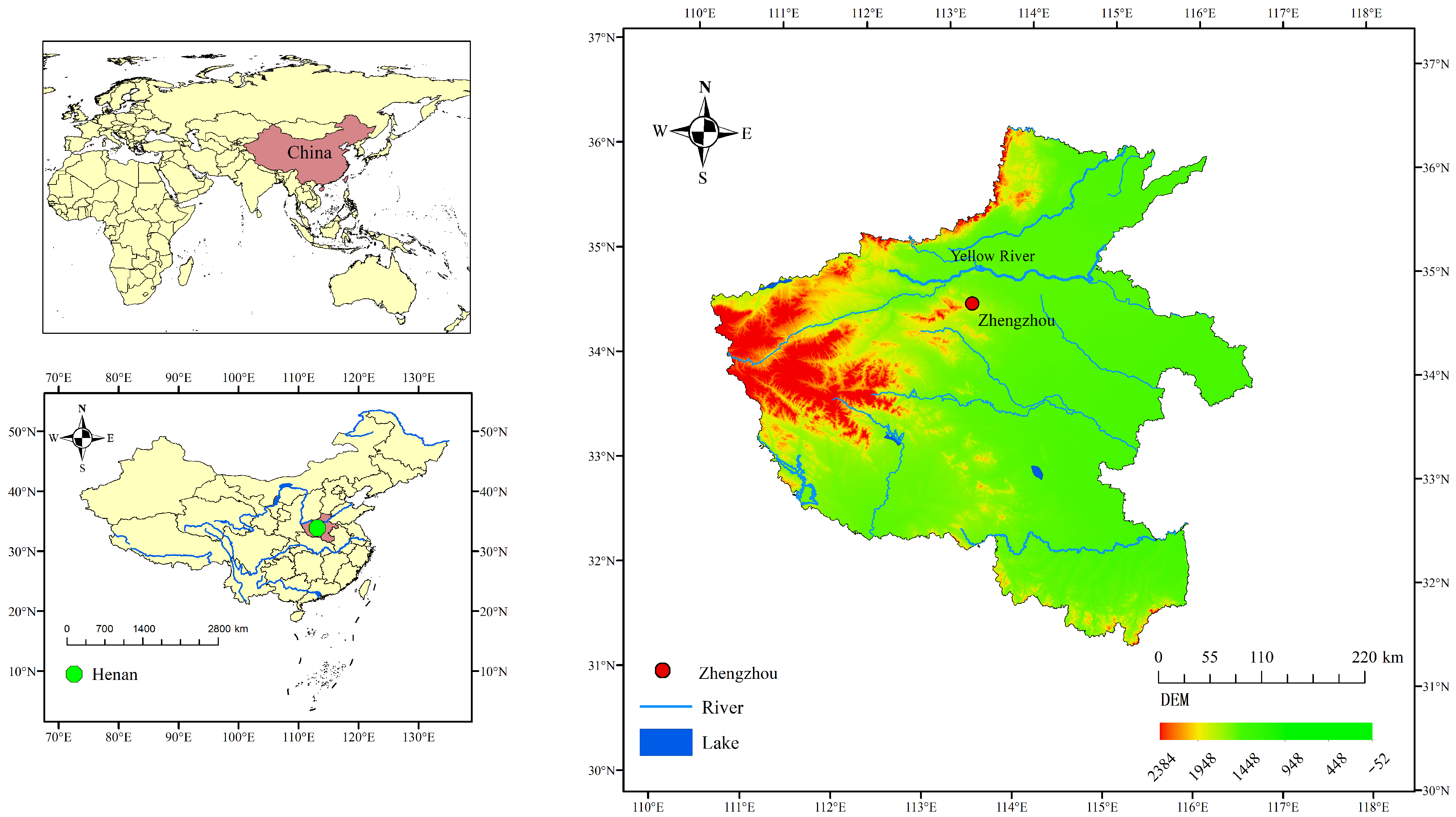
Henan Province is situated between 31°23′ N and 36°22′ N latitude, and 110°21′ E and 116°39′ E longitude. The topography of the province is characterized by higher elevations in the west and lower elevations in the east, as shown in Figure 1. The Taihang, Funiu, Tongbai, and Dabie Mountains form a semicircular distribution along the northern, western, and southern boundaries. The central and eastern parts consist of the North China Plain, while the southwestern area comprises the Nanyang Basin. The climate of Henan Province transitions gradually from a subtropical zone in the south to a warm temperate zone in the north. The region features mild temperatures, four distinct seasons, and coincident rainfall and heat [26]. The mean annual temperature ranges from 12 to 16 °C, and the annual precipitation ranges from 500 to 1400 mm, with the majority of rainfall concentrated between June and August [27].

2.2. Datasets

This study extracted July precipitation data for the period 1983–2022 in Henan Province to represent summer precipitation, as July corresponds to the peak rainfall month in the middle and lower reaches of the Yellow River, when precipitation typically reaches its annual maximum and exhibits pronounced seasonality. July also coincides with the most active phase of the EASM, one of the primary climate systems governing summer precipitation in this region. During this phase, its influence on rainfall is strongest. Focusing on July therefore allows for a clearer identification of the interactions and spatiotemporal variability between precipitation and the EASM. These precipitation data were obtained from the ERA5 reanalysis dataset provided by the European Centre for Medium-Range Weather Forecasts (ECMWF). Additionally, the 200 hPa and 850 hPa zonal and meridional wind data used to calculate the EASM indices were also sourced from the ERA5 dataset [28].
The EASM index is one of the most widely used indicators for characterizing the intensity of the EASM. It is constructed as a composite index by synthesizing wind field data from multiple key regions. For each region, wind field data are spatially averaged over the specified latitude and longitude ranges to represent the strength of the monsoon circulation. The nomenclature and computational formulae of the ESAM indices are given as follows [7]:
E A S M = 1 n × m i = 2.5 10 j = 105 140 U i j 1 n × m i = 17.5 22.5 105 140 U I J + 1 n × m i = 30 37.5 105 140 U i j
where i is latitude, j is longitude, and n and m are the upper and lower grid points of i and j. U′ denotes the 200 hPa latitudinal wind field.
The Western Wind Quantitative Index (WWQI) is defined as a composite measure of the meridional wind component at 850 hPa averaged over specific latitude and longitude ranges, and is used as a supplementary indicator of the East Asian summer monsoon. The calculation of the WWQI is expressed as follows:
W W Q I = 1 n × m i = 20 30 j = 110 140 V i j 1 n × m i = 30 40 110 140 V I J
where i is latitude, j is longitude, and n and m are the upper and lower grid points of i and j. V′ is the summer 850 hPa meridional wind distance level.
These two indices collectively characterize the intensity of the ESAM, with EASM-1 serving as the primary indicator and WWQI providing complementary information.
Vegetation cover data were obtained from the ORNL DAAC Land Data repository (https://doi.org/10.3334/ORNLDAAC/2187) [29]. The average NDVI values for July from 1983 to 2022 in Henan Province were calculated to obtain the NDVI time series. In order to more accurately reveal the periodic characteristics of the NDVI data, anomaly processing was applied, where the annual data were subtracted from the long-term mean. This method effectively eliminates seasonal fluctuations and interannual variations, highlighting the long-term trend and periodic features.
To investigate the individual impacts of ENSO and the WPSH on precipitation, El Niño years were defined as those with an average monthly Niño 3.4 index exceeding 0.5 during July–October, while La Niña years were defined as those with an average monthly Niño 3.4 index less than or equal to −0.5 during the same period. The specific years identified as El Niño and La Niña events are listed in Table 1 and Table 2, respectively. The Niño 3.4 index data were obtained from the NOAA Climate Prediction Center. The Western Ridge Point (WRP) index of the WPSH was defined as the longitude of the westernmost grid point with a geopotential height of 588 dagpm within the 90°–180° E domain. If the identified ridge point was located west of 90° E, it was uniformly recorded as 90° E. If all geopotential height values in a given year were below 588 dagpm, the 587 dagpm contour was used as a substitute. In addition, the area index was defined as the total number of grid points north of 10° N within 110°–180° E where the 500 hPa geopotential height was greater than or equal to 588 dagpm. The 500 hPa geopotential height data were also obtained from the NOAA Climate Prediction Center.

2.3. Multiple Wavelet Transform Methods

2.3.1. Wavelet Analysis

Wavelet analysis exploits the localization properties of wavelet functions in both the time and frequency domains, making it particularly well suited for identifying multiscale variability and hierarchical change patterns in hydrological processes [30,31,32]. In this study, the Morlet wavelet was employed to perform wavelet transforms on precipitation and temperature time series using the Wavelet Analysis Toolbox implemented in MATLAB R2023a. The mathematical expression of the Morlet wavelet function is given as follows [33]:
+ Ψ ( t ) d t = 0 ,   Ψ ( t ) L 2 ( R )
where Ψ ( t ) is the basis function of the wavelet, which is expressed as a function of [34]
Ψ a , b t = a 1 2 Ψ t b a a , b R , a 0
where Ψ a , b ( t ) is the sub-wavelet; a is the scale factor, which reflects the characteristic period of the wavelet function; and b is the displacement factor, which reflects the temporal translation of the wavelet function.
If Ψ a , b ( t ) is a sub-wavelet given by Equation (4), for a wavelet function Ψ a , b ( t ) satisfying certain conditions, L 2 ( R ) indicates that it is defined as a measurable square-integrable function on the real axis. For f ( t ) L 2 ( R ) , the wavelet transform is defined as follows [34]:
w f a , b = a 1 / 2 + f t Ψ t b a d t , a , b R   a n d   a 0
where w f a , b are wavelet transform coefficients; f(t) is a square-integrable function; a is an extended scale; b is a transformation parameter; and Ψ ¯ t b a is the complex conjugate function of Ψ t b a .
Integrating the squared wavelet coefficients over the b-domain gives the wavelet variance, i.e., [35]:
V a r a = W f ( a , b ) 2 a b
In this study, to minimize boundary effects, the signal was extended prior to performing the wavelet transform. Specifically, the signal length was extended to twice the next power of two, and a symmetric (whole-point) extension mode was employed to preserve the smoothness of the signal boundaries [36]. This approach helps suppress the influence of boundary effects on the wavelet coefficients, thereby enhancing the stability of the analytical results.
Furthermore, the “Cone of Influence” (COI) region was delineated on the wavelet spectrum. Only regions outside the COI that passed the significance test were considered in the discussion of periodicity or coherence, ensuring that the analytical results were not influenced by boundary effects.

2.3.2. Crossed Wavelets (XWT)

The crossed wavelet transform is a signal analysis technique that combines wavelet transform and cross-spectral analysis, enabling the investigation of the interrelationship between two time series in the time–frequency domain across multiple time scales [37,38]. The cross wavelet transform is effective in analyzing phase variations in each time series within the same time interval [39,40].
Let WX(s) and WY(s) denote the wavelet transforms of the two given time series X and Y, respectively; their cross-wavelet spectrum is then defined as [36]:
W n X Y s = W n X s W n Y s
The corresponding cross-wavelet power spectral density is W n X Y s ; a larger value indicates that the two time series share a common high-energy region and are significantly correlated. The continuous cross-wavelet power spectrum is tested by comparison with the red-noise standard spectrum. Assuming that the expected spectra of the two time series X and Y follow red-noise spectra P k X and P k Y , respectively, the cross-wavelet power spectral distribution satisfies the following relationship [41]:
W n X ( s ) W n Y ( s ) σ X σ Y = Z V P V P k X P k Y
where σ X and σ Y are the standard deviations of time series X and Y, respectively [42]. For the Morlet wavelet transform, the degree of freedom v is taken as 2, Z V P represents the confidence level associated with probability P; Z 2 ( 95 % ) = 3.999 at the significance level α = 0.25. The 95% confidence limit of the red-noise power spectrum is first determined. When the left-hand side of Equation (8) exceeds this confidence limit, the red-noise criterion is considered to be satisfied at the significance level α = 0.25, indicating a significant correlation between the two time series.
The phase relationship was quantified using the circular mean of phases in regions outside the cone of influence (COI) with statistical significance exceeding the 5% level. This approach represents a general and effective method for estimating the average phase. With n angles a i (i = 1,2,3,…,n) the circular mean is defined as [43]:
α = arg x , y ; x = i = 1 n cos α i ; y = i = 1 n s i n ( α i )
The circular standard deviation, or angular deviation, which indicates the dispersion of angular data, is defined as [36]:
q = 2 l n ( r / n )
r = x 2 + y 2 , which indicates the degree of concentration of the angular data and ranges from 0 to 1.

2.3.3. Wavelet Coherence (WTC)

Cross-wavelet power reveals regions of high common power. Another useful metric is the degree of coherence of the XWT in the time–frequency space [44,45,46,47]. The WTC between two time series is defined as follows [48]:
R n 2 s = S ( s 1 W n X Y ( s ) ) 2 S ( s 1 W n X s 2 ) · S ( s 1 W n Y s )
where S denotes the smoothing operator. This definition is analogous to that of the traditional correlation coefficient, and WTC can be interpreted as a local correlation coefficient in the time–frequency space. The smoothing operator S is expressed as follows [49]:
S W = S s c a l e ( S t i m e ( W n ( s ) ) )
where S scale denotes smoothing along the wavelet scale axis, and S time denotes temporal smoothing. It is appropriate to design the smoothing operator so that it has a similar footprint to the wavelet used. For Morlet wavelets, Torrence and Compo proposed a suitable smoothing operator [36]:
S t i m e W | s = ( W n ( s ) · c 1 t 2 2 s 2 ) | s
S s c a l e W | n = W n s · c 2 0.6 s | n
where c 1 and c 2 are normalisation constants and is the rectangular function. The factor 0.6 represents the empirically determined scale decorrelation length of the Morlet wavelet. In practice, both convolutions are performed discretely; therefore, the normalization factors are determined numerically.

3. Results

3.1. Characteristics of Precipitation Changes

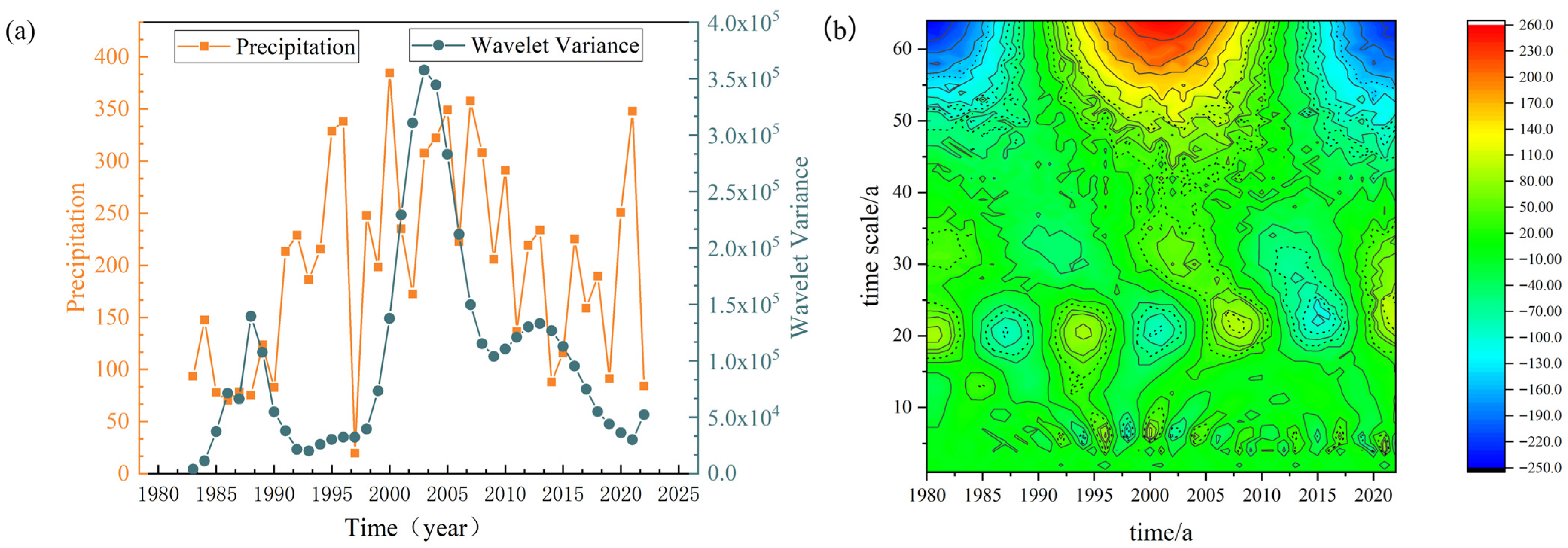
Figure 2a shows the time series of July precipitation from 1983 to 2022 along with its corresponding wavelet variance. The precipitation exhibits substantial fluctuations, reaching a peak in 2000 and a minimum in 1997. The wavelet variance displays three distinct peaks, indicating three dominant periodicities at approximately 31, 21, and 6 years. Among these, the 21-year cycle is the most pronounced, representing the primary dominant cycle for midsummer precipitation in the study region, with its periodic signal persisting throughout the entire study period. Figure 2b presents the contour map of the real part of the wavelet transform, revealing dominant time scales of 18–22 years and 3–6 years, with the 18–22 year periodicity being particularly evident. A significant oscillation at the 5-year scale was observed between 1990 and 2005; it disappeared after 2005 but reemerged after 2015 with a reduced time scale. The 21-year cycle remained stable over the 40-year period, while the 31-year cycle was less distinct. Regarding decadal variability, precipitation maintained a stable 21-year oscillation from 1983 to 2022. At interannual scales, the characteristic time scales of precipitation showed a decreasing trend over the same period. These results suggest that the observed periodic variations in precipitation are associated with El Niño events.

3.2. Wavelet Analysis of the Four Drivers

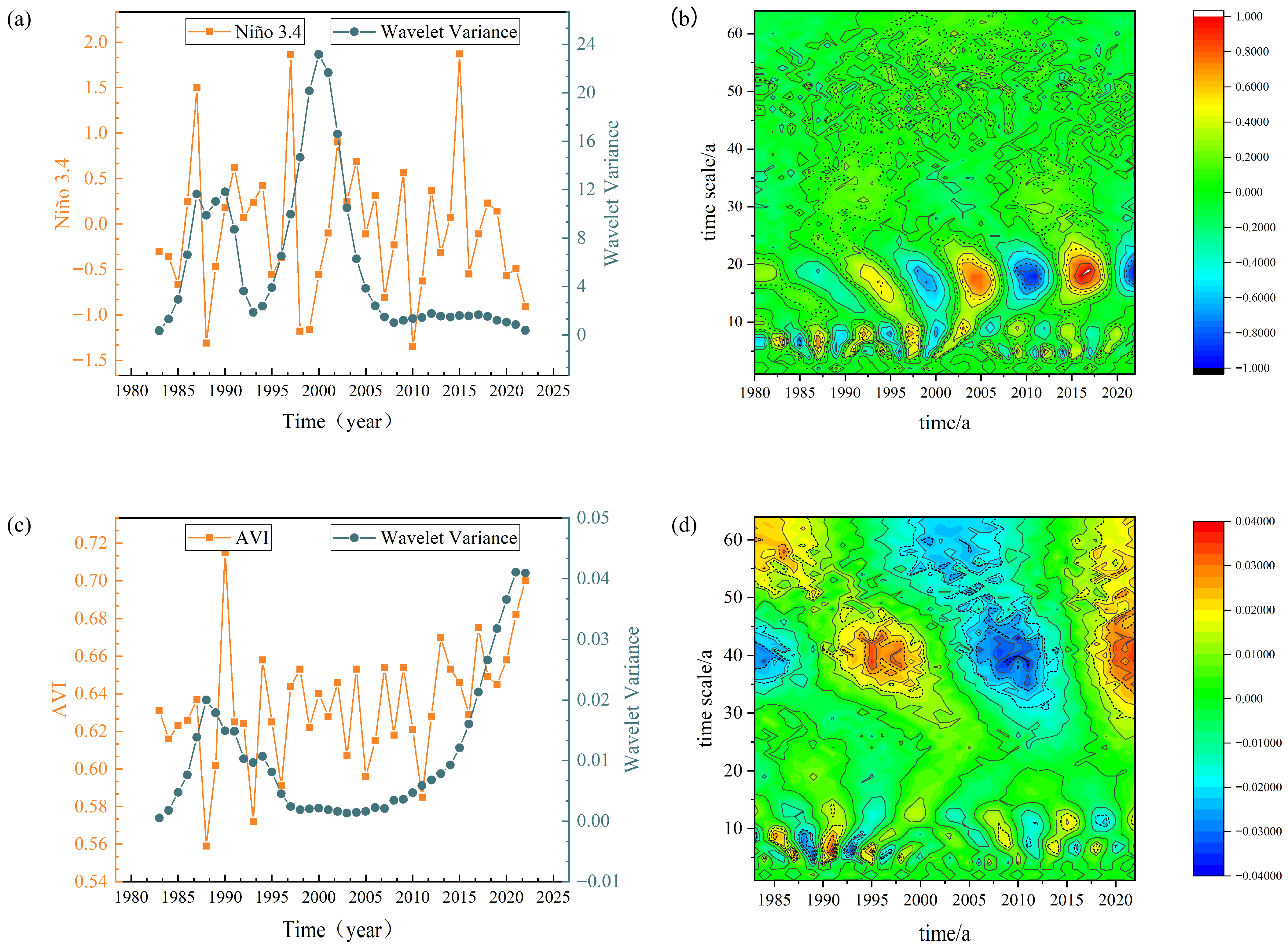
Figure 3a shows the time series of the Niño 3.4 index from 1983 to 2022 along with its wavelet variance. The wavelet variance exhibits three prominent peaks, corresponding to dominant cycles of approximately 18, 8, and 5 years. Among these, the 18-year cycle demonstrates the largest variance and most pronounced periodicity, representing the primary dominant cycle in the Niño 3.4 index series. Figure 3b presents the contour map of the real part of the wavelet transform, revealing multiple time-scale structures in the Niño 3.4 index, including 2–5 years, 5–8 years, and 12–20 years. The 12–20-year periodicity is particularly distinct, with the 18-year cycle becoming most prominent after approximately 1992. The 8-year cycle gradually weakened after 2005, whereas the 5-year cycle remained relatively evident. The Anomaly Vegetation Index (AVI) is defined as the difference between the NDVI value for a specific period (e.g., decade or month) in a given year and the long-term mean NDVI for the same period. This index is more suitable for capturing periodic characteristics in wavelet analysis. Figure 3c shows the time series of the AVI and its wavelet variance. The AVI exhibits a steady increasing trend, while the wavelet variance remains relatively small, indicating inconspicuous periodic fluctuations. Figure 3d presents the contour map of the real part of the wavelet transform for AVI. From 1985 to 2000, significant oscillations occurred at the 5–10-year time scale, but from 2005 to 2022, the characteristic time scale decreased and the periodic fluctuations weakened.
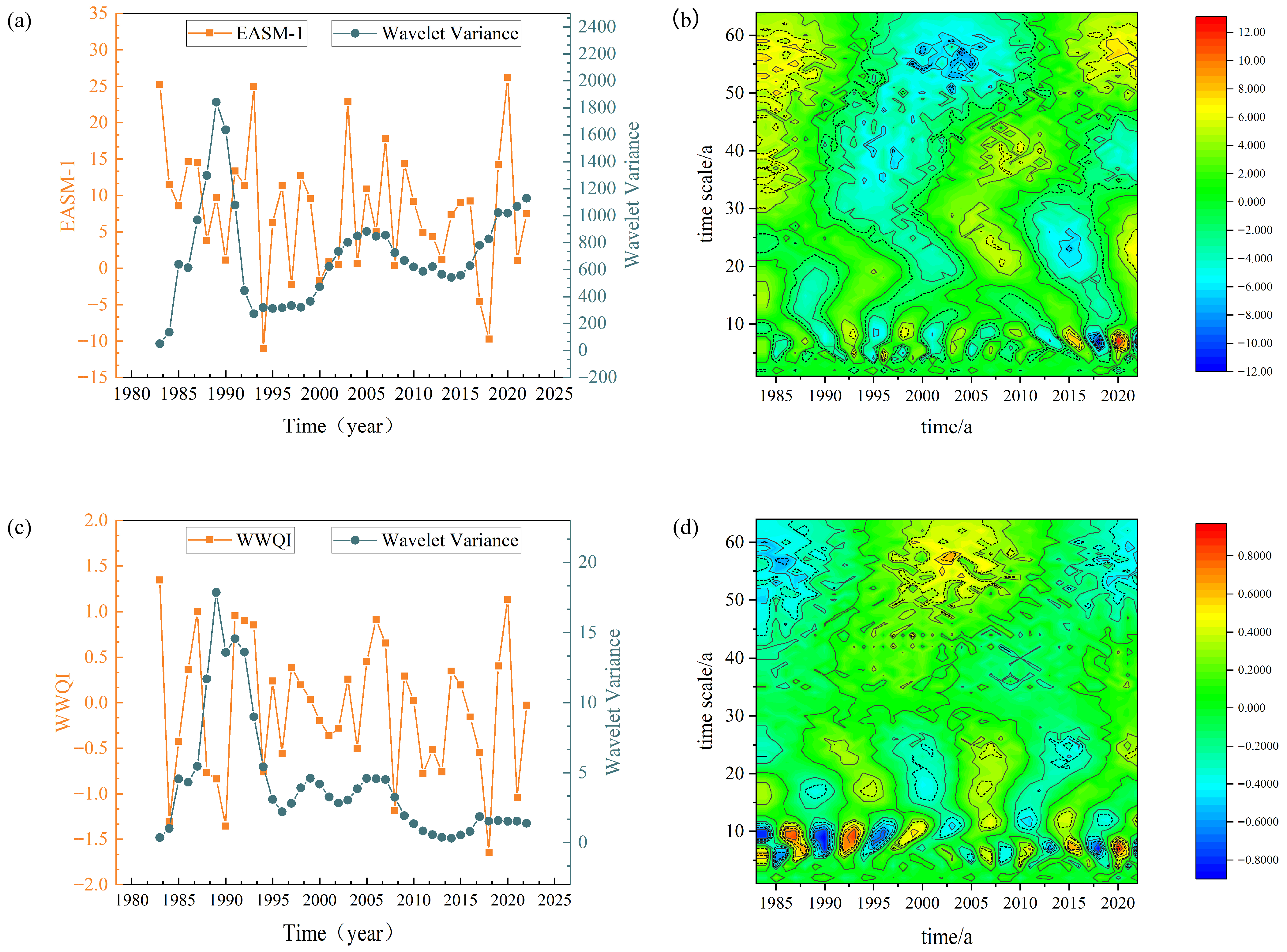
The intensity of the ESAM is characterized by the EASM-1 and WWQI indices. These two indices are calculated using distinct methodologies, with EASM-1 serving as the primary metric and WWQI providing supplementary analysis. Figure 4a,c show the temporal variations in the EASM-1 and WWQI indices along with their respective wavelet variances, while Figure 4b,d present the corresponding contour maps of the real part of the wavelet transform. Figure 4a indicates that the EASM-1 index reached its maximum in 2020 and its minimum in 1993. Its wavelet variance exhibits two peaks at time scales of approximately 23 and 7 years, with the 7-year cycle showing greater variance and more pronounced periodicity. A combined analysis of Figure 4b,d reveals significant periodic oscillations at the 5-year time scale after 2015, consistent with the patterns observed in the WWQI. Figure 4d shows intense periodic oscillations at around the 8-year time scale during 1983–2000, which disappeared after 2000. Around 2015, periodic fluctuations reemerged but at a shorter time scale. The contour maps of the real part of the wavelet transform for both indices also reveal significant periodic oscillations at approximately the 20-year time scale.
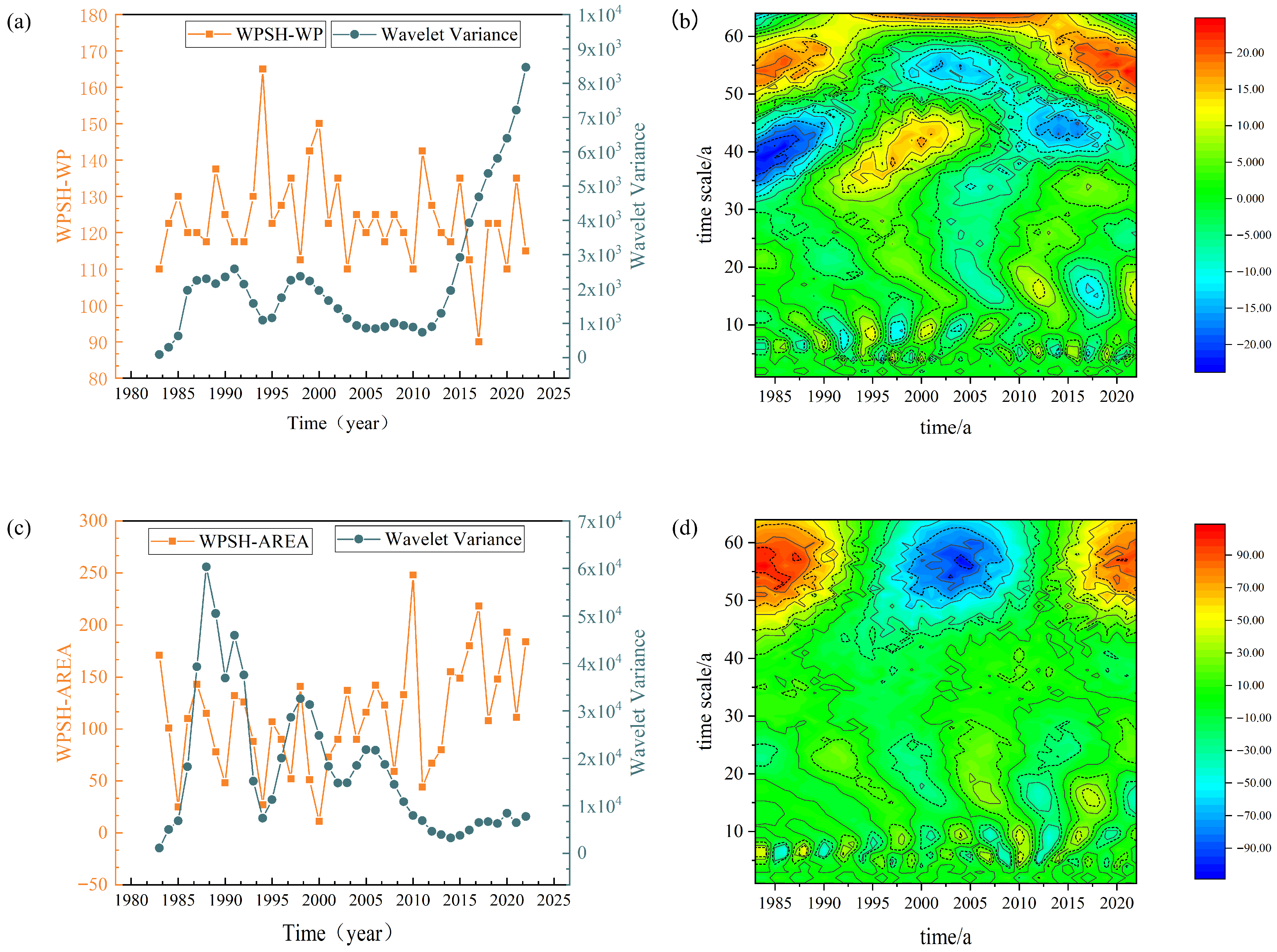
The WPSH is a key component of the East Asian monsoon system. In this study, the WRP and areal extent are used as metrics, with the WRP serving as the primary indicator and the area index providing supplementary analysis. Figure 5a,c present the temporal series of the WRP and the area index along with their respective wavelet variances, while Figure 5b,d display the contour maps of the real part of the wavelet transform for these indices. The wavelet variance sequence for the WRP exhibits three peaks, corresponding to time scales of approximately 13, 9, and 6 years. These three time scales show similar variance magnitudes and comparable significance in their periodic characteristics. The contour map of the real part (Figure 5b) shows clear periodic oscillations at around the 10-year scale between 1985 and 2000, which gradually diminished after 2000. A stable cycle emerged at the 15-year scale after 2010, concurrent with periodic variations at a 2-year scale. These features are consistent with the periodic variations observed in the area index.

3.3. Characteristics of Cyclical Changes in Precipitation and Drivers

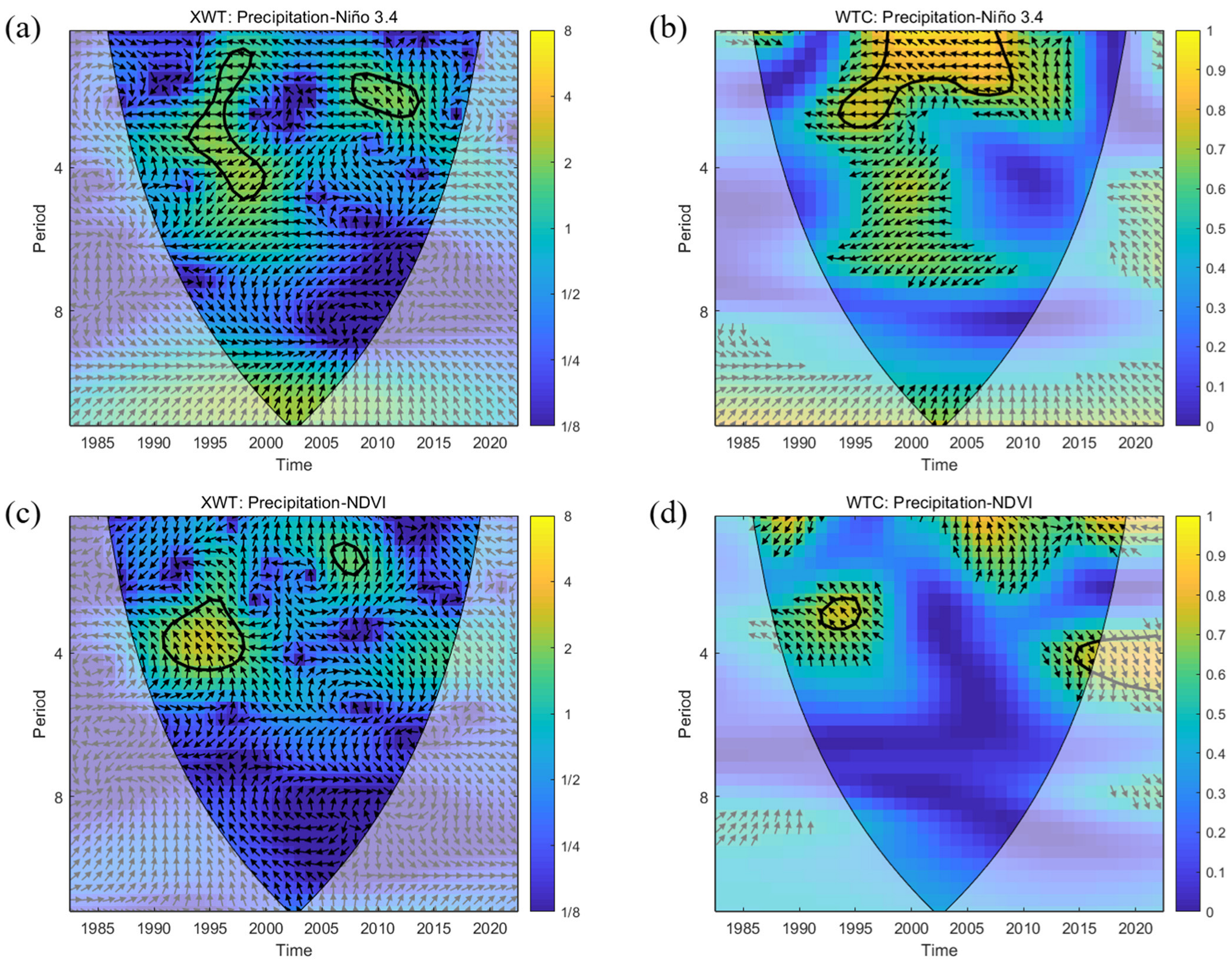
This study examines the periodic variations in precipitation and its driving factors from 1983 to 2020, and generates the corresponding cross-wavelet power spectra and WTC spectra. As shown in Figure 6, the thick black contours indicate regions that are statistically significant at the 5% level against red noise, while the lighter shaded area represents the cone of influence (COI), where edge effects may distort the results. Significant regions in the cross-wavelet spectrum reflect areas of high common power, whereas those in the WTC spectrum reveal regions of significant localized correlation between the two time series. Arrows indicate the phase relationship: rightward-pointing arrows signify that the driving factor and precipitation are in phase, implying a positive correlation, while leftward-pointing arrows indicate an anti-phase relationship, corresponding to a negative correlation.
Figure 6a,c present the cross-wavelet transforms between precipitation and the Niño 3.4 index and NDVI, respectively, while Figure 6b,d show the corresponding WTC spectra. As illustrated in Figure 6a, ENSO influences precipitation with statistically significant high-power regions, indicating a strong impact. The primary high common-power regions between ENSO and precipitation occur at the 2–6-year time scale during 1995–2000, with a secondary period at the 3-year scale during 2007–2012. In both high common-power regions, ENSO and precipitation are negatively correlated. The WTC spectrum shows significant co-movement between ENSO and precipitation at the 1–2-year time scale in lower energy bands, also indicating a negative correlation. At decadal scales, the relationship between the two variables shifts from positive to negative correlation, which is associated with a notable modulation of El Niño characteristics during the 1990s. To further clarify the relationship between El Niño and regional precipitation, seven El Niño years and seven La Niña years were selected along with their corresponding precipitation anomaly percentages. As shown in Table 3 and Table 4, composite analysis indicates that precipitation decreased during midsummer in four of the seven El Niño years (1987, 1997, 2002, and 2015). However, the precipitation anomaly in 2004 was positive (60.74%), primarily due to Typhoon Rananim, which transported substantial moisture to eastern China, creating abundant atmospheric moisture conditions over the study area and resulting in anomalous rainfall. The years 1991 and 2009, characterized by weak El Niño events, likely experienced limited modulation of precipitation by ENSO. Precipitation increased during midsummer in six of the seven La Niña years, whereas the decrease in 1999 was potentially influenced by other factors such as the WPSH, the Indian Summer Monsoon, and the North Atlantic Oscillation. Overall, El Niño events correspond to reduced precipitation in the middle and lower reaches of the Yellow River, while La Niña events lead to increased precipitation, consistent with the established ENSO teleconnection. Vegetation coverage is another factor influencing regional precipitation. Previous studies generally indicate a positive correlation between vegetation cover and precipitation. However, comparison of Figure 6c,d reveals that, although the cross-wavelet and WTC between precipitation and NDVI show significant regions at interannual scales, no stable common-frequency band exists at decadal scales. The correlation between the two variables is weak, which may be attributed to the land use characteristics of the study area. The region is predominantly cultivated land with stable crop types and increasingly efficient irrigation systems. These factors reduce interannual fluctuations in vegetation cover, thereby limiting its influence on precipitation variability in the region.
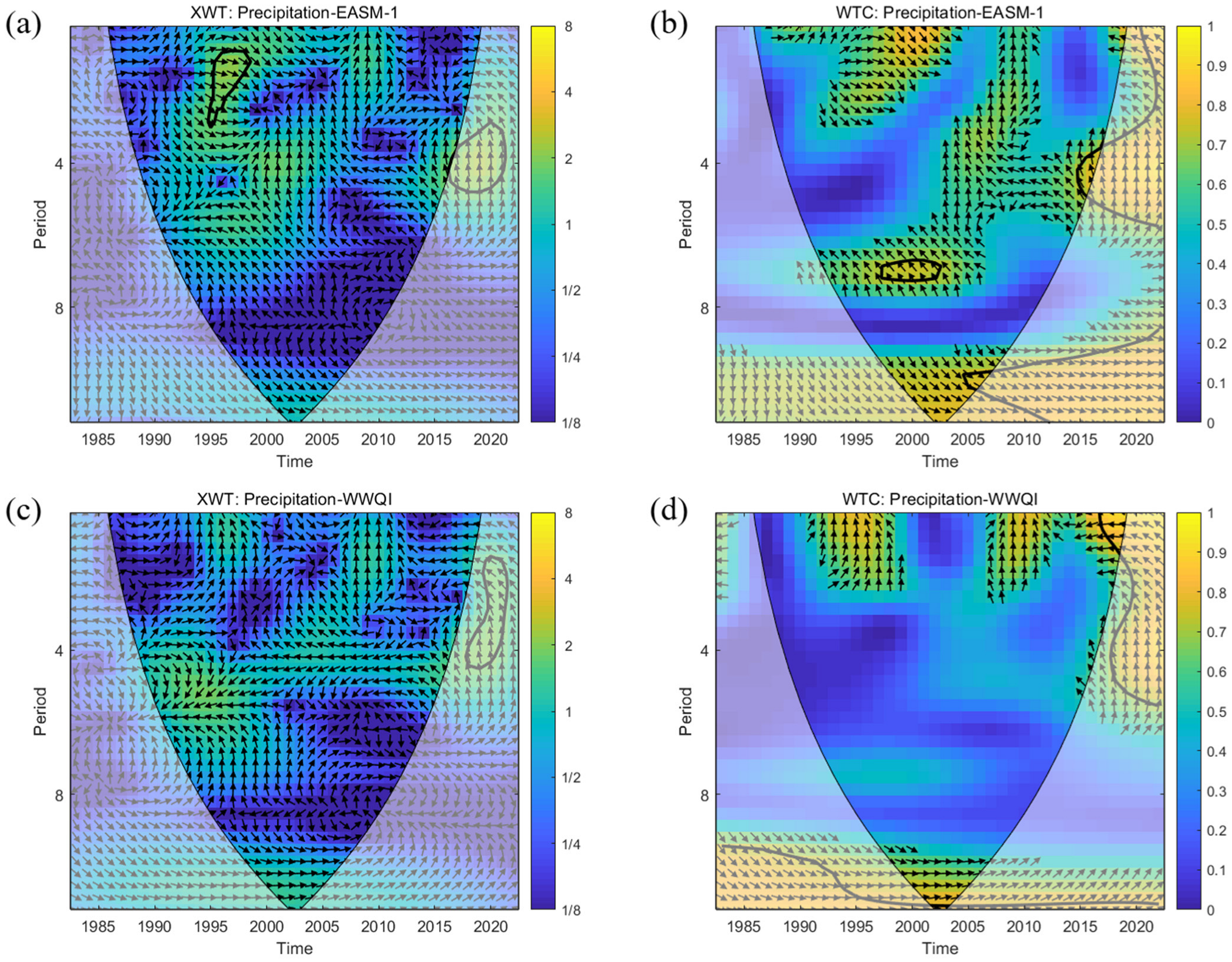
Figure 7a,c present the cross-wavelet transforms between precipitation and the EASM-1 and WWQI indices, respectively, while Figure 7b,d show the corresponding WTC spectra. The Asian summer monsoon dominates hydro-meteorological processes across most parts of Asia, and summer precipitation in the middle and lower reaches of the Yellow River is strongly modulated by the ESAM. As shown in Figure 7a,c, statistically significant high common-power regions emerge for both indices after 2015, displaying unstable correlations. Figure 7b,d reveal broad significant bands in the lower energy range after 2010, with a negative correlation between the EASM and precipitation at approximately 1–4-year scales, and a positive correlation at around 4–6-year scales, indicating scale-dependent phase relationships. At decadal scales, however, the correlation between the EASM (represented by both indices) and precipitation remained stable and positive throughout the 1983–2022 period.
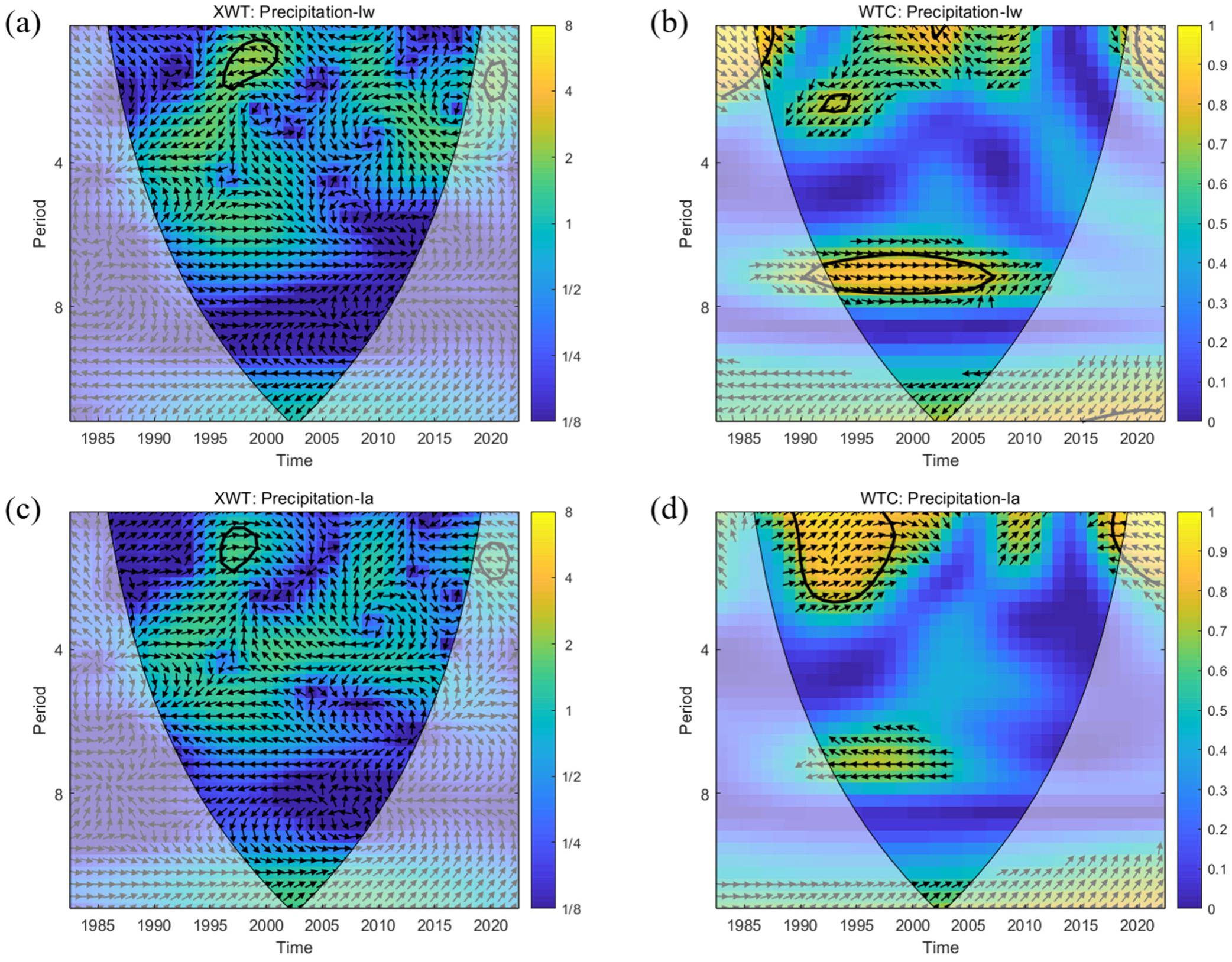
Figure 8a,c present the cross-wavelet transforms between precipitation and the WRP and area indices of the WPSH, respectively, while Figure 8b,d display the corresponding WTC spectra. The cross-wavelet power spectra in Figure 8a,c reveal relatively small but statistically significant high common-power regions for both the WRP and the area index, alongside extensive regions of correlated power with complex, alternating negative and positive phase relationships. This complexity aligns with the patterns observed in the WTC spectra (Figure 8b,d) at interannual scales. At decadal scales, however, precipitation exhibits stable periodic co-variability with both the WRP and the area index. Precipitation is negatively correlated with the WRP, but positively correlated with the WPSH area. The ESAM system comprises the Australian High, the 105° E cross-equatorial flow, the WPSH, the Mascarene High, the South China Sea Southwest Summer Monsoon, the Intertropical Convergence Zone (ITCZ), and the 30° N Meiyu front. As a key component of this system, the WPSH and the EASM exhibit synergistic effects during summer, jointly modulating precipitation patterns. Figure 7 and Figure 8 show the emergence of significant high common-power regions and the broadening of significant bands in the lower energy range between precipitation and both the EASM and WPSH since approximately 2017, indicating an intensification of their regulatory influence on precipitation in recent years. The Siberian High typically strengthens the equatorial westerlies over the ITCZ, promoting a westward extension of the WPSH. This circulation pattern enhances moisture transport to eastern China, leading to increased precipitation. Furthermore, the northward shift in the WPSH in late July, together with the intensified penetration of the EASM, creates favorable conditions for precipitation formation in the middle and lower reaches of the Yellow River.

4. Discussions

This study adopts an integrated methodological framework combining Wavelet Transform (WT), XWT, and WTC to systematically uncover the dynamic linkages between summer precipitation in the middle and lower Yellow River region and key climatic and ecological drivers across multiple temporal scales. This suite of methods provides complementary, hierarchical insights: WT identifies the dominant periodicities within precipitation and each driver; XWT highlights common high-energy regions and their phase relationships in the time-frequency domain; and WTC quantifies localized coherence strength, effectively detecting transient correlations in non-stationary signals. Integrating these three techniques enables not only the delineation of the periodic structure of precipitation variability but also the characterization of scale-dependent synergistic, lagged, or antagonistic relationships with drivers such as ENSO, EASM, and WPSH, thereby offering a systematic and robust approach to dissecting multi-scale precipitation drivers.
Using wavelet analysis, XWT, and WTC analysis, this study systematically characterizes the multi-scale periodic features and underlying driving mechanisms of summer precipitation in the middle and lower Yellow River region (Henan Province) during 1983–2022. The results indicate that summer precipitation exhibits prominent oscillations at interannual (3–6 years) and interdecadal (18–22 years) timescales. The interdecadal variability is closely associated with the coupled variations in the WPSH and the ESAM, and is likely modulated by low-frequency climate modes such as the PDO. Notably, the stability of this long-period signal is constrained by the observational record length, suggesting that validation with longer-term data is required.
The dominant 3–6-year periodicity corresponds closely to the characteristic timescale of the ENSO, operating through a WPSH- and EASM-mediated teleconnection chain. Cross-wavelet analysis reveals a significant negative correlation between the Niño3.4 index and regional precipitation within the 2–7-year frequency band. Specifically, El Niño events generate an anomalous anticyclone over the western North Pacific (WNPAC), which intensifies, extends westward, and shifts southward the WPSH [50]. This anomalous circulation suppresses the northward advance of the EASM and anchors the primary monsoon rain belt over the Yangtze River basin, reducing moisture convergence and consequently precipitation in the middle and lower Yellow River region. The negative precipitation anomalies observed during strong El Niño years (e.g., 1987, 1997, 2015) directly reflect the impact of this teleconnection. In contrast, La Niña events typically produce an anomalous cyclone over the western North Pacific, leading to a weakened, eastward-retreated WPSH and an intensified EASM, favoring northward transport of warm, moist air and enhanced precipitation. The reduced summer precipitation in 1999 may instead be influenced by the Indian Summer Monsoon (ISM) and the North Atlantic Oscillation (NAO) [51,52]. Notably, although 2004 was classified as an El Niño year, extreme precipitation occurred, likely influenced by Typhoon Rananim, which made landfall in Zhejiang on 12 August 2004, and propagated inland with heavy rainfall. Its outer rain bands, active as early as late July, likely contributed to the positive precipitation anomaly observed in July 2004 [53].
As key components of the ESAM system, the WPSH and the EASM synergistically modulate summer precipitation. At timescales exceeding 10 years, the EASM index maintains a stable positive correlation with precipitation, whereby years with a strong EASM generally correspond to enhanced rainfall. This relationship arises because the WPSH intensifies wind fields over the equatorial westerlies and the ITCZ, promoting its westward extension [54]. This circulation facilitates sustained northward transport of warm, moist air from the South China Sea and western Pacific along the western edge of the WPSH. The moisture-laden flow converges with mid-latitude westerly disturbances over the study region, enhancing moisture convergence and ascent, thereby promoting precipitation [55].
Nevertheless, cross-wavelet analysis indicates periods of negative correlation between EASM/WPSH and precipitation at specific timescales, demonstrating that the EASM-precipitation relationship is not uniformly positive. At certain interannual or interdecadal scales, variations in EASM intensity do not necessarily translate into increased precipitation and may exhibit weakly negative correlations. Since the 1990s, an intensified WPSH has suppressed effective moisture transport, causing precipitation in eastern China to decouple from and not increase with a strengthening EASM [56]. The EASM-precipitation relationship is influenced by multiple factors, with large-scale circulation systems playing a particularly significant role. At specific decadal or interannual scales, variations in these climatic systems can disrupt the canonical positive correlation, resulting in a more complex and occasionally negative relationship between precipitation and monsoon intensity [57].
Vegetation cover did not exhibit a significant influence in this study. Although global-scale studies often support a positive vegetation-precipitation feedback mechanism [58]. Henan Province is a typical agricultural region with over 60% cropland, predominantly under a winter wheat–summer maize rotation. This land use pattern results in minimal interannual variability in vegetation indices such as the NDVI [59,60]. Consequently, the homogenized land surface weakens land-atmosphere interactions, rendering any vegetation-mediated feedback on precipitation undetectable in our multi-scale analysis.
This study systematically characterizes the multi-scale periodicities and driving mechanisms of summer precipitation in the middle and lower Yellow River region (Henan Province) during 1983–2022. By identifying stable coherence between precipitation and large-scale climate modes such as ENSO at 3–6-year and 18–22-year scales, our findings provide critical physical constraints for developing multi-timescale precipitation prediction models, with direct implications for regional climate forecasting and extreme event early warning. Additionally, the identified periodic and phase relationships can be integrated into climate risk assessment platforms to support decision-making. This work also lays a foundation for future research, offering scientific support for climate services, water resource management, and disaster risk reduction in the region. Nevertheless, several limitations should be noted: 1. Simplification of Driver Indices: Complex climate systems are represented by simplified indices (e.g., Niño3.4, EASM index, WPSH area index), which may not fully capture internal structural diversity or multi-dimensional characteristics. Future studies could employ composite indices to better represent the multifaceted nature of these circulation systems. 2. Limited Set of Drivers: While focusing on key modes like ENSO, WPSH, and EASM, other potential remote influences from mid-to-high latitudes are not systematically included. Future work should incorporate a broader set of drivers to examine their combined effects on precipitation mechanisms. 3. Record Length Constraint: The 40-year observational record (1983–2022), while adequate for resolving 3–6-year and 18–20-year periodicities, limits detection and reliability of longer-period (e.g., multidecadal) signals. Incorporating multi-source climate data, such as paleo-proxies or extended reanalysis datasets, in future research could enhance the understanding of interdecadal to multidecadal variability.

5. Conclusions

Based on wavelet analysis, this study systematically investigates the multi-scale linkages between summer precipitation and key climatic and ecological drivers in the middle and lower Yellow River region, Henan Province, over the period from 1983 to 2022.
  • Precipitation shares a common periodic signal with all influencing factors at the 3–6-year timescale and additionally exhibits pronounced low-frequency co-variability with the ENSO, the ESAM, and the WPSH at the 18–20-year timescale.
  • ENSO, EASM, and WPSH are identified as the primary drivers regulating precipitation variability in the middle and lower reaches of the Yellow River. The underlying physical mechanisms are complex, and the phase relationships among these drivers and precipitation are not unique and vary across different temporal scales.
  • Non-significant influence of vegetation cover: The study region is predominantly cropland, resulting in minimal interannual variability in vegetation indices such as the NDVI, which consequently exerts no discernible multi-scale feedback on precipitation.
This study highlights the critical regulatory roles of ENSO, the ESAM, and the WPSH in controlling summer precipitation variability in this region, providing a scientific foundation for regional precipitation forecasting and water resource management. Future research should employ longer observational time series and more comprehensive circulation indices to further elucidate the synergistic mechanisms of multiple drivers.

Author Contributions

G.L. Z.J. and Z.L. participated in conceiving and performing the experiments. Q.C. and P.G. participated in analyzing the data. Conceptualization, Z.L.; Methodology, G.L. and Z.J.; Formal analysis, G.L.; Investigation, Z.J., Q.C. and P.G.; Data curation, Q.C. and P.G.; Writing—original draft, G.L.; Funding acquisition, Z.L. All authors have read and agreed to the published version of the manuscript.

Funding

This research was funded by the Joint Funds of the National Natural Science Foundation of China (U2243235).

Data Availability Statement

The original contributions presented in this study are included in the article. Further inquiries can be directed to the corresponding author.

Conflicts of Interest

The authors declare no conflicts of interest.

References

  1. Cook, B.I.; Smerdon, J.E.; Seager, R.; Coats, S. Global warming and 21st century drying. Clim. Dyn. 2014, 43, 2607–2627. [Google Scholar] [CrossRef]
  2. Sohoulande, C.; Djebou, S.; Singh, V. Impact of climate change on the hydrologic cycle and implications for society. Environ. Soc. Psychol. 2016, 1, 36–49. [Google Scholar] [CrossRef]
  3. Chongfeng, R.; Zhehao, L.; Hongbo, Z. Integrated multi-objective stochastic fuzzy programming and AHP method for agricultural water and land optimization allocation under multiple uncertainties. J. Clean. Prod. 2019, 210, 12–24. [Google Scholar] [CrossRef]
  4. Deng, S.; Zhao, D.; Chen, Z.; Liu, L.; Zhu, Y.; Wang, K.; Gao, X.; Wu, H.; Zheng, D. Global Distribution and Projected Variations of Compound Drought-Extreme Precipitation Events. Earth’s Future 2024, 12, e2024EF004809. [Google Scholar] [CrossRef]
  5. Rind, D.; Rosenzweig, C.; Goldberg, R. Modelling the hydrological cycle in assessments of climate change. Nature 1992, 358, 119–122. [Google Scholar] [CrossRef]
  6. Allen, M.R.; Ingram, W.J. Constraints on future changes in climate and the hydrologic cycle. Nature 2002, 419, 224–232. [Google Scholar] [CrossRef]
  7. Chang, X.; Wang, B.; Yan, Y.; Hao, Y.; Zhang, M. Characterizing effects of monsoons and climate teleconnections on precipitation in China using wavelet coherence and global coherence. Clim. Dyn. 2019, 52, 5213–5228. [Google Scholar] [CrossRef]
  8. Tao, W.; Chao, S.; Xiaohong, C. Clarifying the relationship between annual maximum daily precipitation and climate variables by wavelet analysis. Atmos. Res. 2023, 295, 106981. [Google Scholar]
  9. Wen, N.; Liu, Z.; Li, L. Direct ENSO impact on East Asian summer precipitation in the developing summer. Clim. Dyn. 2019, 52, 6799–6815. [Google Scholar] [CrossRef]
  10. Cao, D.; Tam, C.-Y.; Xu, K. Impacts of El Niño diversity on East Asian summertime precipitation extremes. Clim. Dyn. 2024, 62, 4171–4187. [Google Scholar] [CrossRef]
  11. Fan, L.; Yang, Q.; Fu, H.H. Understanding the interdecadal changes in the teleconnection pattern of the East Asian summer monsoon precipitation with concurrent ENSO. Geophys. Res. Lett. 2024, 51, e2024GL111723. [Google Scholar] [CrossRef]
  12. Rathinasamy, M.; Agarwal, A.; Parmar, V.; Khosa, R.; Bairwa, A.K.; Physics, O. Partial wavelet coherence analysis for understanding the standalone relationship between Indian Precipitation and Teleconnection patterns. arXiv 2017. [Google Scholar] [CrossRef]
  13. Xavier, A.K.; Varikoden, H.; Babu, C.A.; Reshma, T. Influence of PDO and ENSO with Indian summer monsoon rainfall and its changing relationship before and after 1976 climate shift. Clim. Dyn. 2023, 61, 5465–5482. [Google Scholar] [CrossRef]
  14. Santanello, J.A.; Dirmeyer, P.A.; Ferguson, C.R.; Findell, K.L.; Tawfik, A.B.; Berg, A.; Ek, M.; Gentine, P.; Guillod, B.P.; van Heerwaarden, C.; et al. Land–Atmosphere Interactions: The LoCo Perspective. Bull. Am. Meteorol. Soc. 2018, 99, 1253–1272. [Google Scholar] [CrossRef]
  15. Emmerichs, T.; Lu, Y.S.; Taraborrelli, D. The influence of plant water stress on vegetation–atmosphere exchanges: Implications for ozone modelling. Biogeosciences 2024, 21, 3251–3269. [Google Scholar] [CrossRef]
  16. Wang, J.; Ya, H.; Ha, J.; Ji, W.; Sun, J.; Wei, X.; Li, Z. Vegetation change impacts on moisture recycling are closely linked to plant water uptake strategies in the Loess-covered region in China. Geoderma 2026, 465, 117654. [Google Scholar] [CrossRef]
  17. Miralles, D.G.; Vilà-Guerau de Arellano, J.; McVicar, T.R.; Mahecha, M.D. Vegetation-climate feedbacks across scales. Ann. N. Y. Acad. Sci. 2025, 1544, 27–41. [Google Scholar] [CrossRef] [PubMed]
  18. Cui, J.; Lian, X.; Huntingford, C.; Gimeno, L.; Wang, T.; Ding, J.; He, M.; Xu, H.; Chen, A.; Gentine, P.J.N.G. Global water availability boosted by vegetation-driven changes in atmospheric moisture transport. Nature 2022, 15, 982–988. [Google Scholar] [CrossRef]
  19. Li, J.; Zhao, Y.; Tang, Z. Projection of Future Summer Precipitation over the Yellow River Basin: A Moisture Budget Perspective. Atmosphere 2020, 11, 1307. [Google Scholar] [CrossRef]
  20. Sun, Z.; Liu, Y.; Zhang, J.; Chen, H.; Shu, Z.; Chen, X.; Jin, J.; Guan, T.; Liu, C.; He, R.; et al. Projecting Future Precipitation in the Yellow River Basin Based on CMIP6 Models. J. Appl. Meteorol. Climatol. 2022, 61, 1399–1417. [Google Scholar] [CrossRef]
  21. Lan, G.; Liang, Y.; Ma, Y. Assessment of precipitation reanalysis product ERA5 on summer extreme precipitation in the Yellow River Basin. Dyn. Atmos. Ocean. 2025, 112, 101603. [Google Scholar] [CrossRef]
  22. Guo, C.; Ning, N.; Guo, H.; Tian, Y.; Bao, A.; De Maeyer, P. Does ERA5-Land Effectively Capture Extreme Precipitation in the Yellow River Basin? Atmosphere 2024, 15, 1254. [Google Scholar] [CrossRef]
  23. Zhao, Y.; Wang, M.; Li, J.; Yang, X.; Zhang, N.; Chen, H. Diurnal Variations in Summer Precipitation over the Yellow River Basin. Adv. Meteorol. 2019, 2019, 2482656. [Google Scholar] [CrossRef]
  24. Zhang, H.; Wang, S.; Li, C.; Li, Z.; Wang, Y.; Ye, Q. The effects of increased evapotranspiration on precipitation in the Yellow River Basin. J. Hydrol. 2026, 664, 134453. [Google Scholar] [CrossRef]
  25. Haoriwa; Zhalagahu; Zhou, R. Spatiotemporal variation of drought and its influential factors in the Yellow River Basin, China based on vegetation health index. J. Arid Land 2025, 17, 1361–1377. [Google Scholar] [CrossRef]
  26. Sheng, K.; Li, R.; Zhang, F.; Chen, T.; Liu, P.; Hu, Y.; Li, B.; Song, Z. Response of Grain Yield to Extreme Precipitation in Major Grain-Producing Areas of China Against the Background of Climate Change—A Case Study of Henan Province. Water 2025, 17, 2342. [Google Scholar] [CrossRef]
  27. Lang, Y.; Jiang, Z.; Wu, X. Investigating the Linkage between Extreme Rainstorms and Concurrent Synoptic Features: A Case Study in Henan, Central China. Water 2022, 14, 1065. [Google Scholar] [CrossRef]
  28. Lavers, D.A.; Simmons, A.; Vamborg, F.; Rodwell, M. An evaluation of ERA5 precipitation for climate monitoring. Q. J. R. Meteorol. Soc. 2022, 148, 3152–3165. [Google Scholar] [CrossRef]
  29. Pinzon, J.E.; Pak, E.W.; Tucker, C.J.; Bhatt, U.S.; Frost, G.V.; Macander, M.J. Global Vegetation Greenness (NDVI) from AVHRR GIMMS-3G+, 1981–2022 (Version 1); ORNL Distributed Active Archive Center: Oak Ridge, TN, USA, 2023. [Google Scholar] [CrossRef]
  30. Lin, Y.; Wang, X.L.; Qu, P.C.; Wu, Y.Z.; Wang, S.P. Temporal Variations in Karst Spring Flow and Its Response to Climate Change in the Taihang Mountains, China. J. Hydrol. Eng. 2021, 26, 05021026. [Google Scholar] [CrossRef]
  31. Hao, Y.H.; Liu, G.L.; Li, H.M.; Li, Z.T.; Zhao, J.J.; Yeh, T.C.J. Investigation of karstic hydrological processes of Niangziguan Springs (North China) using wavelet analysis. Hydrol. Process. 2012, 26, 3062–3069. [Google Scholar] [CrossRef]
  32. Khan, A.; Hassan, D.; Raza, S.M.M.; Amjad, M.; Mian, K. Applications of wavelet transform in climatic time series: A case study of Gilgit-Baltistan, Pakistan. Int. J. Environ. Sci. Technol. 2025, 22, 13749–13768. [Google Scholar] [CrossRef]
  33. Labat, D.; Ababou, R.; Mangin, A. Rainfall-runoff relations for karstic springs. Part II: Continuous wavelet and discrete orthogonal multiresolution. J. Hydrol. 2000, 238, 149–178. [Google Scholar] [CrossRef]
  34. David, L. Recent advances in wavelet analyses: Part 1. A review of concepts. J. Hydrol. 2005, 314, 275–288. [Google Scholar] [CrossRef]
  35. Huang, S.Z.; Li, P.; Huang, Q.; Leng, G.Y.; Hou, B.B.; Ma, L. The propagation from meteorological to hydrological drought and its potential influence factors. J. Hydrol. 2017, 547, 184–195. [Google Scholar] [CrossRef]
  36. Torrence, C.; Compo, G.P. A practical guide to wavelet analysis. Bull. Am. Meteorol. Soc. 1998, 79, 61–78. [Google Scholar] [CrossRef]
  37. Wang, J.J.; Shi, B.; Pan, X.Y.; Liu, L.F. Multi-scale Characteristics of Precipitation and Its Relationship with ENSO and AO. J. Coast. Res. 2020, 104, 23–28. [Google Scholar] [CrossRef]
  38. Ren, L.; Dong, X.H. Spatio-Temporal Characteristics of Drought and Its Relationship with El Nino-Southern Oscillation in the Songhua River Basin from 1960 to 2019. Water 2022, 14, 866. [Google Scholar] [CrossRef]
  39. Zhang, J.H.; Ju, X.P.; Wang, S.; Li, F.P.; Zhao, Z.Y. Variations in Precipitation at the Shimantan Reservoir, China. Water 2023, 15, 4313. [Google Scholar] [CrossRef]
  40. Zhang, H.Y.; Rui, X.P.; Zhou, Y.; Sun, W.; Xie, W.Y.; Gao, C.J.; Ren, Y.C. Analysis of the Response of Shallow Groundwater Levels to Precipitation Based on Different Wavelet Scales-A Case Study of the Datong Basin, Shanxi. Water 2024, 16, 2920. [Google Scholar] [CrossRef]
  41. Jevrejeva, S.; Moore, J.C.; Grinsted, A. Influence of the Arctic Oscillation and El Niño-Southern Oscillation (ENSO) on ice conditions in the Baltic Sea: The wavelet approach. J. Geophys. Res. Atmos. 2003, 108, 4677. [Google Scholar] [CrossRef]
  42. Dremin, I.M.; Ivanov, O.V.; Nechitailo, V.A. Wavelets and their applications. Uspekhi Fiz. Nauk 2001, 171, 465–501. [Google Scholar] [CrossRef]
  43. Cazelles, B.; Chavez, M.; Berteaux, D.; Ménard, F.; Vik, J.O.; Jenouvrier, S.; Stenseth, N.C. Wavelet analysis of ecological time series. Oecologia 2008, 156, 287–304. [Google Scholar] [CrossRef]
  44. Dong, Y.Y.; Zhai, J.Q.; Zhao, Y.; Li, H.H.; Wang, Q.M.; Jiang, S.; Chang, H.Y.; Ding, Z.Y. Teleconnection patterns of precipitation in the Three-River Headwaters region, China. Environ. Res. Lett. 2020, 15, 104050. [Google Scholar] [CrossRef]
  45. Ren, Y.T.; Cheng, Q.P.; Jin, H.Y. Evolution of Wet and Dry Spells Based on Original and Corrected Precipitation Data in Southwest China, 1961–2019. Water 2022, 14, 3090. [Google Scholar] [CrossRef]
  46. Molavi-Arabshahi, M.; Eskandari, S. Analyzing the cyclical impact of sunspot activity and ENSO on precipitation patterns in Gilan province: A wavelet-based approach. Sci. Rep. 2025, 15, 22184. [Google Scholar] [CrossRef]
  47. Wang, Y.; Liu, S.N.; Chen, J.; Zhou, Z.Q.; Shi, H.Y. Investigating the spatiotemporal variations of extreme rainfall and its potential driving factors with improved partial wavelet coherence. Front. Environ. Sci. 2022, 10, 951468. [Google Scholar] [CrossRef]
  48. Lee, E.J.; Ha, K.J.; Jhun, J.G. Interdecadal changes in interannual variability of the global monsoon precipitation and interrelationships among its subcomponents. Clim. Dyn. 2014, 42, 2585–2601. [Google Scholar] [CrossRef]
  49. Grinsted, A.; Moore, J.C.; Jevrejeva, S. Application of the cross wavelet transform and wavelet coherence to geophysical time series. Nonlinear Process. Geophys. 2004, 11, 561–566. [Google Scholar] [CrossRef]
  50. Wang, B.; Wu, R.; Lau, K.M. Interannual Variability of the Asian Summer Monsoon: Contrasts between the Indian and the Western North Pacific–East Asian Monsoons. J. Clim. 2001, 14, 4073–4090. [Google Scholar] [CrossRef]
  51. Jin, D.; Guan, Z.; Cai, J.; Weiya, T. Interannual variations of regional summer precipitation in Mainland China and their possible relationships with different teleconnections in the past five decades. J. Meteorol. Soc. Japan 2015, 93, 265–283. [Google Scholar] [CrossRef]
  52. Wei, W.; Zhang, R.; Wen, M.; Rong, X.; Li, T. Impact of Indian summer monsoon on the South Asian High and its influence on summer rainfall over China. Clim. Dyn. 2014, 43, 1257–1269. [Google Scholar] [CrossRef]
  53. Yu, Z.; Jianfeng, Z.; Fang, Z.; Ji, C. Improvement of Numerical Simulation of Typhoon Rananim (0414) by Using Doppler Radar Data. J. Trop. Meteorol. 2008, 14, 89–92. [Google Scholar]
  54. Zhou, T.; Yu, R.; Zhang, J.; Drange, H.; Cassou, C.; Deser, C.; Hodson, D.L.R.; Sanchez-Gomez, E.; Li, J.; Keenlyside, N.; et al. Why the Western Pacific Subtropical High Has Extended Westward since the Late 1970s. J. Clim. 2009, 22, 2199–2215. [Google Scholar] [CrossRef]
  55. Lee, Y.C.; Wenig, M.O.; Chan, K.L. Oceanic and atmospheric anomalies associated with extreme precipitation events in China 1983–2020. Air Qual. Atmos. Health 2023, 16, 881–895. [Google Scholar] [CrossRef]
  56. Gao, H.; Jiang, W.; Li, W. Changed Relationships Between the East Asian Summer Monsoon Circulations and the Summer Rainfall in Eastern China. Meteor. Res. 2014, 28, 1075–1084. [Google Scholar] [CrossRef]
  57. Shi, J.; Yan, Q.; Wang, H. Timescale dependence of the relationship between the East Asian summer monsoon strength and precipitation over eastern China in the last millennium. Clim. Past 2018, 14, 577–591. [Google Scholar] [CrossRef]
  58. Li, Z.; Ciais, P.; Wright, J.S.; Wang, Y.; Liu, S.; Wang, J.; Li, L.Z.X.; Lu, H.; Huang, X.; Zhu, L.; et al. Increased precipitation over land due to climate feedback of large-scale bioenergy cultivation. Nat. Commun. 2023, 14, 4096. [Google Scholar] [CrossRef] [PubMed]
  59. Li, J.; Lei, H. Tracking the spatio-temporal change of planting area of winter wheat-summer maize cropping system in the North China Plain during 2001–2018. Comput. Electron. Agric. 2021, 187, 106222. [Google Scholar] [CrossRef]
  60. Yang, B.; Wang, J.; Li, S.; Huang, X. Identifying the Spatio-Temporal Change in Winter Wheat–Summer Maize Planting Structure in the North China Plain between 2001 and 2020. Agronomy 2023, 13, 2712. [Google Scholar] [CrossRef]
Figure 1. Geographical location and terrain of Henan Province.
Water 18 00154 g001
Figure 2. Wavelet analysis of precipitation: (a) Curves of precipitation and its wavelet variance; (b) Contour map of the real part of the wavelet transform for precipitation.
Water 18 00154 g002
Figure 3. Wavelet analysis of the Niño 3.4 index and AVI: (a) Line plot of the Niño 3.4 index and its wavelet variance; (b) Contour map of the real part of the wavelet transform for the Niño 3.4 index; (c) Line plot of the AVI and its wavelet variance; (d) Contour map of the real part of the wavelet transform for the AVI.
Water 18 00154 g003
Figure 4. Wavelet analysis of the EASM-1 and WWQI: (a) Line plot of the EASM-1 and its wavelet variance; (b) Contour map of the real part of the wavelet transform for the EASM-1; (c) Line plot of the WWQI and its wavelet variance; (d) Contour map of the real part of the wavelet transform for the WWQI.
Water 18 00154 g004
Figure 5. Wavelet analysis of the Western Pacific Subtropical High indices: (a,c) Line plots of the western ridge point, area index, and their corresponding wavelet variances; (b,d) Contour maps of the real part of the wavelet transform for the western ridge point and area index, respectively.
Water 18 00154 g005
Figure 6. XWT and WTC analyses between precipitation and Niño 3.4/NDVI: (a,c) XWT plots of precipitation with Niño 3.4 and NDVI, respectively; (b,d) WTC plots of precipitation with Niño 3.4 and NDVI, respectively.
Water 18 00154 g006
Figure 7. XWT and WTC analyses between precipitation and East Asian Summer Monsoon indices: (a,c) XWT between precipitation and the EASM-1 and WWQI indices, respectively; (b,d) WTC between precipitation and the EASM-1 and WWQI indices, respectively.
Water 18 00154 g007
Figure 8. XWT and WTC analyses between precipitation and WPSH indices: (a,c) XWT between precipitation and the WRP and area index, respectively; (b,d) WTC between precipitation and the WRP and area index, respectively.
Water 18 00154 g008
Table 1. El Niño years.
El Niño year1987199119972002200420092015
Niño 3.4 index1.50.621.860.90.690.571.87
Table 2. La Niña years.
La Niña year1995199819992000200720102020
Niño 3.4 index−0.56−1.18−1.16−0.560.81−1.35−0.57
Table 3. El Niño Years: Niño 3.4 Index and Precipitation Anomaly Percentage.
El Niño Year1987199119972002200420092015
Niño 3.4 index1.50.621.860.90.690.571.87
Precipitation anomaly percentage−60.80%6.25%−90.11%−13.99%60.74%2.71%−42.30%
Table 4. La Niña Years: Niño 3.4 Index and Precipitation Anomaly Percentage.
La Niña Year1995199819992000200720102020
Niño 3.4 index−-0.56−1.18−1.16−0.56−0.81−1.35−0.57
Precipitation anomaly percentage64.03%23.60%−1.08%91.90%78.29%45.09%25.05%
Disclaimer/Publisher’s Note: The statements, opinions and data contained in all publications are solely those of the individual author(s) and contributor(s) and not of MDPI and/or the editor(s). MDPI and/or the editor(s) disclaim responsibility for any injury to people or property resulting from any ideas, methods, instructions or products referred to in the content.