1. Introduction
Gas bubbles in liquids can be classified according to their size, location, and physical behavior. Conventional bubbles, which are micrometer- or millimeter-scale entities, are visible or easily detectable and rise rapidly by buoyancy, coalesce readily, and disappear relatively quickly through surface rupture or dissolution. In contrast, nanobubbles are gas cavities on the nanometer scale, and their small size alters their mobility, interfacial dynamics, and persistence in the liquid medium [
1,
2].
Within this category, two main types can be distinguished: surface and bulk nanobubbles. The former are attached to solid–liquid interfaces, whereas bulk nanobubbles are gas cavities that are freely dispersed within the liquid phase [
3]. In aqueous systems, the latter typically have diameters smaller than 200 nm and do not behave like conventional bubbles that are reduced in size [
2]. In aqueous systems, the latter typically have diameters smaller than 200 nm and do not simply behave like conventional bubbles reduced in size; for example, their buoyant rise velocity becomes negligible compared with Brownian motion, so they may remain dispersed in the bulk liquid instead of rapidly rising and escaping as micrometric or millimetric bubbles do. Owing to their nanoscale size, their motion is strongly influenced by Brownian diffusion, their rise rate due to buoyancy is very low, and their surface-to-volume ratio is high. These characteristics make them attractive for processes where gas–liquid mass transfer is relevant; however, they also raise a central question: under classical models of capillary pressure and diffusive dissolution, such small bubbles should not persist for long periods [
4,
5].
Bulk nanobubbles belong to the broader family of nanoscale gaseous domains, which include surface and interfacial nanobubbles. In aqueous systems containing solid boundaries, dispersed nanobubbles may interact with hydrophobic or chemically heterogeneous surfaces and become transiently trapped as surface-associated gas domains. This transition alters the conditions for persistence, as interfacial nanobubbles are influenced not only by gas diffusion and colloidal interactions but also by substrate wettability, contact line pinning, surface heterogeneity, and local gas enrichment. In systems with abundant solid interfaces, the observed nanobubble population may therefore reflect both freely dispersed and surface-associated gaseous domains [
6,
7].
The apparent kinetic persistence of freely dispersed bulk nanobubbles remains an unresolved issue in interfacial chemistry. According to the Young–Laplace equation, the high curvature of a nanoscale bubble generates a high internal pressure, thereby increasing the chemical potential of the gas contained within it [
4]. Under these conditions, the Epstein–Plesset model predicts rapid diffusive dissolution into the surrounding liquid, with extremely short lifetimes for nanoscale bubbles [
5,
8]. However, experimental studies have reported that nanobubbles persist for much longer periods than those predicted by these models [
9]. This discrepancy between the thermodynamic and diffusive predictions for isolated bubbles and the experimentally observed kinetic or population-level persistence constitutes the stability paradox of bulk nanobubbles.
Part of this paradox stems from the broad use of the term “stability.” In the literature, this term may refer to thermodynamic stability, kinetic persistence, colloidal stability, maintenance of average diameter, persistence of number concentration, or operational performance [
2,
10]. Although these phenomena are related, they do not necessarily describe the same process. This ambiguity makes it difficult to compare studies and requires the specification of the level of stability evaluated in each case.
Furthermore, the ionic composition of the aqueous medium is one of the most relevant variables for interpreting the bulk nanobubble formation and persistence. The presence of electrolytes can alter the solubility of the gas and, consequently, the conditions for nanobubble formation [
11,
12]. It can also alter the interfacial charge, structure of the electric double layer, and colloidal interactions between nanobubbles [
13,
14]. However, these effects do not depend solely on the total ionic strength but also on the identity, valence, and interfacial interactions of the ions present [
15]. The stability of nanobubbles in aqueous media should be analyzed by considering not only the electrolyte concentration but also the electrolyte chemistry and the conditions under which the population is generated.
This review examines the physicochemical mechanisms that govern the formation, colloidal stability, kinetic persistence, and population-level persistence of bulk nanobubbles in aqueous media, with particular emphasis on their ionic composition. Classical descriptions of dissolution and electrostatic stabilization are discussed, along with ion-specific effects, preparation pathways, population-level interactions, and experimental metrics used to infer stability.
During the preparation of this manuscript, the authors used ChatGPT 5.5 for the purposes of generating figures. All figures in the manuscript were generated with the assistance of Scholar GPT (OpenAI, ChatGPT custom GPT). The tool was used to generate the figures based on the authors’ instructions.
2. Formation, Persistence, and Colloidal Stability
Bulk nanobubbles are commonly described as nanoscale gaseous entities dispersed in the liquid phase; however, this distinction is partly operational. In systems containing solid boundaries, dispersed nanobubbles can interact with hydrophobic or chemically heterogeneous surfaces and become transiently trapped as surface-associated gaseous domains. Their persistence may then be influenced by contact-line pinning, substrate wettability, surface heterogeneity, and local gas enrichment, rather than solely by gas diffusion and colloidal interactions [
16]. In practical aqueous systems, freely dispersed and surface-associated gaseous domains may coexist, and their relative contribution may vary with surface availability, wettability, gas saturation, ionic composition, and other physicochemical conditions [
17]. Therefore, the apparent kinetic persistence of freely dispersed bulk nanobubbles remains an open problem in interfacial physical chemistry.
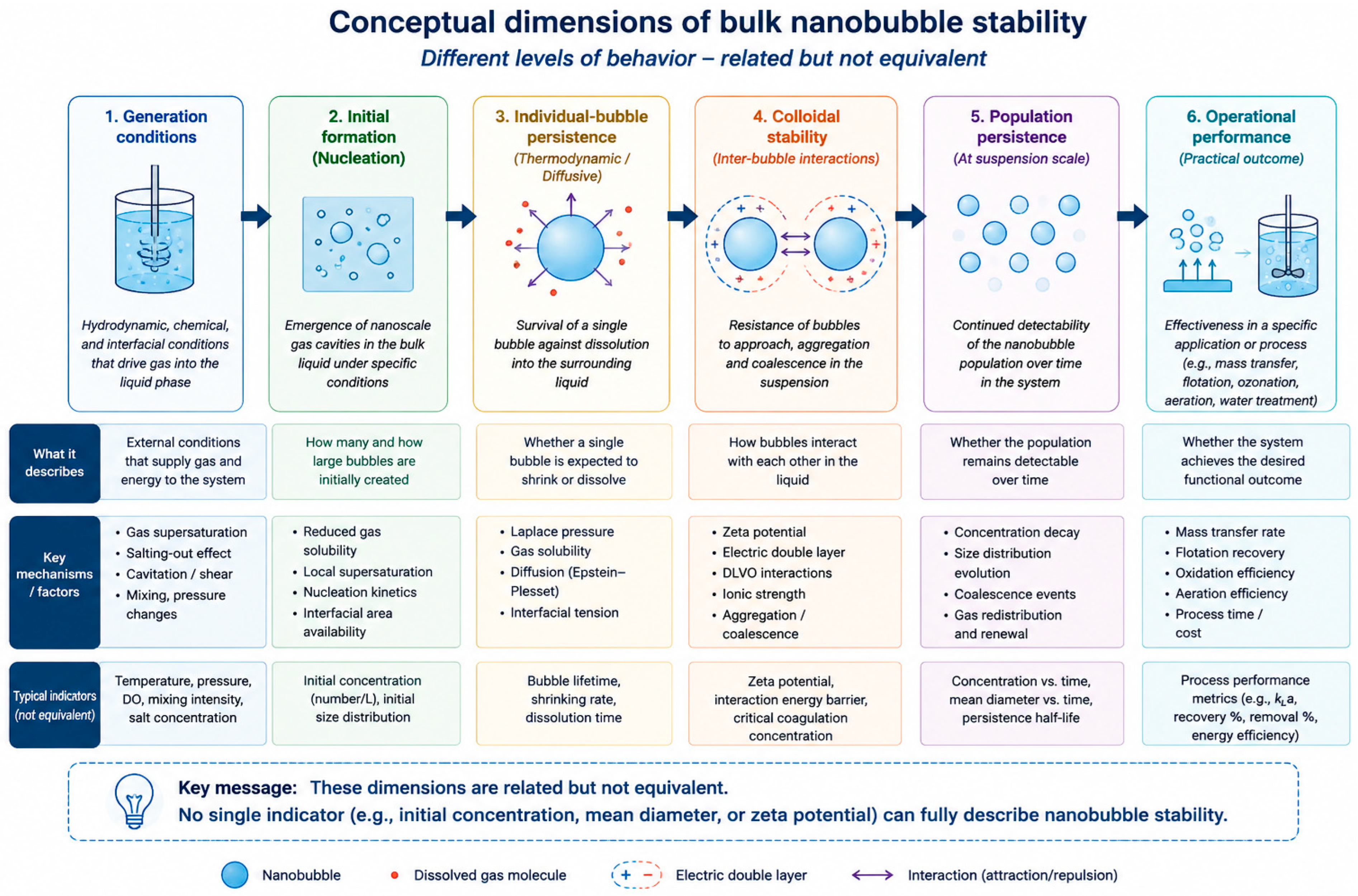
The term stability is used in different ways in the nanobubble literature and should therefore be specified. Thermodynamic stability refers to whether a nanobubble represents an equilibrium state under the imposed pressure, temperature, interfacial tension, and gas chemical potential. Classical thermodynamic arguments based on the Young–Laplace pressure indicate that an isolated nanoscale gas bubble in an undersaturated or weakly saturated liquid is not thermodynamically stable [
18]. Kinetic stability, or kinetic persistence, instead refers to the lifetime of a non-equilibrium gaseous entity over experimentally relevant time scales. In this sense, a bulk nanobubble may be thermodynamically unstable but kinetically persistent if dissolution, coalescence, or gas exchange is sufficiently slow [
1]. This distinction differs from colloidal stability, which describes resistance to aggregation or coalescence, and from population persistence, which refers to the continued detectability of a nanobubble population rather than the survival of each individual bubble [
4].
Nanobubbles may also be associated with suspended solid particles or nanoparticles, particularly in flotation and particle separation systems. Once attached to mineral particles, colloids, or engineered nanoparticles, they are no longer equivalent to isolated, freely dispersed nanobubbles, even though the resulting bubble–particle assemblies remain suspended in bulk liquid. Their apparent persistence may reflect particle attachment, heteroaggregation, or modified interfacial conditions, rather than the stability of the gaseous domain alone [
19].
A key distinction lies in the difference between the initial formation and temporal persistence. Initial formation describes the emergence of nanobubbles under specific generation conditions, such as local gas supersaturation, injection, cavitation, and changes in solubility [
20]. In contrast, temporal persistence refers to the ability of a detected population to remain observable over a given period. Although both processes may be related, they are not equivalent to each other.
Colloidal stability describes the ability of a nanobubble population to resist aggregation and coalescence. In bulk nanobubbles, this stability is typically analyzed using the interfacial charge, zeta potential, and structure of the electric double layer [
13,
14]. Colloidal stability primarily describes the interactions between bubbles within a suspension.
Diffusive or kinetic persistence refers to a different aspect of this problem. It relates to the ability of an individual nanobubble to maintain its gaseous phase against dissolution into the surrounding liquid [
5]. This phenomenon is not equivalent to colloidal stability, because a population may resist coalescence without demonstrating the kinetic persistence of each individual bubble.
Finally, population persistence refers to the observable preservation of dispersed gaseous phases at the scale of suspension. This persistence may depend not only on the behavior of individual bubbles but also on collective processes, local gas redistribution, and population reorganization [
21]. Recognizing this separation prevents the initial concentration, mean diameter, zeta potential, and temporal persistence from being treated as equivalent indicators of stability.
The distinctions discussed above are summarized in
Figure 1, which separates the main dimensions commonly grouped under the term “stability” in bulk nanobubble studies.
This distinction is important because most experimental techniques report population-level properties rather than individual nanobubble trajectories. Therefore, apparent persistence should be interpreted as the temporal evolution of a detected population, not as direct evidence that each initially formed nanobubble remains unchanged with time.
3. Classical Thermodynamic and Diffusive Models of Nanobubble Dissolution
3.1. Laplace Pressure and Thermodynamic Instability
Classical descriptions of bubble dynamics, including the roles of surface tension, Laplace pressure, gas diffusion, and cavitation phenomena, provide a baseline against which the anomalous persistence of nanoscale gaseous domains is evaluated [
18].
The first framework for understanding the thermodynamic instability of an isolated nanobubble is the Young–Laplace equation, which relates the pressure difference between the interior of a bubble and the surrounding liquid to the curvature of the gas–liquid interface [
4]:
where Δ
P corresponds to the internal overpressure of the bubble,
γ is the gas–liquid surface tension, and
R is the radius of the bubble. This relationship shows that as the radius decreases, the internal pressure increases inversely. Because the Laplace pressure increases as the bubble radius decreases, a nanometer-sized bubble is expected to have a much higher internal pressure than a micrometer- or millimeter-sized bubble.
Based on this reasoning, an isolated nanobubble in a liquid that is not supersaturated with respect to the gas contained within the bubble should not be a persistent entity because the high curvature of its interface promotes the transfer of gas into the liquid and, ultimately, its disappearance [
8].
This description establishes the starting point of the problem: under the classical model of a single bubble, the nanoscale amplifies the Laplace pressure and makes the persistence of an isolated gas cavity thermodynamically unfavorable [
4,
8].
3.2. Diffusive Dissolution According to Epstein–Plesset
The kinetic consequences of the internal overpressure described by Young–Laplace were formalized by Epstein and Plesset, who used a diffusive dissolution model for gas bubbles in liquids [
22]. In this framework, the high internal pressure of a small bubble increases the gas concentration at the gas–liquid interface, generating a concentration gradient between the bubble surface and surrounding liquid. This gradient drives the diffusion of gas from inside the bubble into the liquid, causing a progressive decrease in the radius of the bubble.
In simple terms, the characteristic dissolution time can be represented as a diffusion scale that depends on the initial bubble size [
22]:
where
τ corresponds to the characteristic dissolution time,
d0 is the initial bubble diameter, and
D is the gas diffusion coefficient in the liquid. Although this expression does not replace the full Epstein–Plesset solution, it allows us to demonstrate the key dependence of the model: as the initial bubble size decreases, the expected lifetime decreases rapidly. For nanoscale bubbles, this leads to extremely short dissolution times on the order of microseconds or milliseconds, depending on the gas and liquid conditions [
23].
The significance of the Epstein–Plesset model establishes the classical diffusive dissolution limit against which the experimentally observed kinetic persistence is compared. Under these assumptions, a single nanobubble should disappear rapidly because of the gas diffusion into the liquid. The observation of populations that persist for much longer periods indicates that the evolution of these systems requires consideration of mechanisms beyond the dissolution of isolated bubbles [
23,
24].
3.3. Electrostatic Stabilization and DLVO Theory
In addition to thermodynamic and diffusive models for isolated bubbles, bulk nanobubble suspensions are often analyzed from the perspective of their colloidal stability. In aqueous systems, these entities frequently exhibit negative zeta potentials, which are commonly attributed to the preferential accumulation of hydroxyl species at the gas–liquid interface [
25,
26]. This interfacial charge promotes the formation of an electric double layer around the bubble and generates electrostatic repulsion between neighboring entities.
Under this approach, DLVO theory provides a first-order framework for interpreting colloidal interactions in bulk nanobubble suspensions as a balance between van der Waals attraction and electric double-layer repulsion [
27]. When electrostatic repulsion is sufficiently high, nanobubbles can remain separated, thereby reducing the likelihood of aggregation or coalescence. In this regard, the zeta potential is frequently used as an indirect indicator of colloidal stability; higher absolute values are typically associated with greater repulsion between bubbles and, therefore, with a lower tendency toward coalescence.
The spatial extent of this repulsion is related to the thickness of the electric double layer, which is commonly described in terms of the Debye length [
28]. In general, this length represents the characteristic distance over which electrostatic interactions are shielded by ions present in the medium:
where
κ−1 corresponds to the Debye length,
εr is the relative permittivity of the medium,
ε0 is the permittivity of free space,
kB is the Boltzmann constant,
T is the absolute temperature,
NA is Avogadro’s number,
e is the elementary charge, and
I is the ionic strength of the solution, defined as
, where
and
are the molar concentration and valence of ion
, respectively. When SI units are used,
should be expressed in mol m
−3; equivalently, 1 mM = 1 mol m
−3. Equation (3) is valid primarily as a dilute-solution approximation. It is based on Debye–Hückel-type electrostatic screening and assumes point ions, ideal activities, a continuum solvent, and negligible ion–ion correlations. Thus, it is most reliable for dilute monovalent electrolytes and should be treated as semi-quantitative at high ionic strength or in solutions containing multivalent ions, where finite ion size, hydration, ion pairing, and specific adsorption can substantially modify the structure of the electric double layer. This relationship shows that an increase in the ionic strength reduces the thickness of the electric double layer and decreases the range of electrostatic repulsion between nanobubbles.
From this perspective, the DLVO model is useful for interpreting changes in aggregation, coalescence, zeta potential, and average size of bulk nanobubble populations. Its primary scope is colloidal; it allows us to analyze how interfacial charge and ionic screening modify the interaction between bubbles within a suspension [
27,
28]. However, DLVO theory should not be treated as a validated mechanistic model of bulk nanobubble persistence. Its classical formulation was developed for interactions between solid colloids and is not directly transferable to nanoscale gas–liquid interfaces, where interfacial deformability, gas compressibility, surface mobility, adsorbed impurities, and charge regulation may modify the interaction potential. Additional uncertainty arises in multivalent electrolytes or at high ionic strength, where ion–ion correlations, finite ion size, hydration-driven forces, ion pairing, and specific adsorption can introduce non-DLVO interactions. Thus, DLVO calculations are better suited to describe trends in electrostatic screening and colloidal interactions than to establish the persistence of individual nanobubbles.
3.4. Valid Inferences Based on Classical Models
Classical models allow for the interpretation of different aspects of a problem but do not provide the same type of information. The Young–Laplace and Epstein–Plesset models describe the expected instability and dissolution of a single bubble, whereas the DLVO model primarily addresses the colloidal interactions between charged bubbles within a suspension. Because these models describe different aspects of nanobubble behavior, their predictions should not be considered equivalent to one another.
Table 1 summarizes the interpretive scope of these studies.
This distinction is necessary before analyzing the effect of electrolytes, as the ionic composition can simultaneously affect the initial generation, interfacial charge, colloidal stability, and temporal evolution of the population.
4. Effects of Ionic Strength on Bulk Nanobubble Behavior
The ionic composition affects bulk nanobubble systems at several levels. Ionic strength provides a global descriptor of electrostatic screening, but it does not specify which ions are present or how they interact with the gas–liquid interface. Ionic valence introduces a first level of specificity because multivalent ions contribute disproportionately to ionic strength and can more strongly affect double-layer compression and charge neutralization. Beyond valence, ion-specific properties such as hydration, mobility, polarizability, and interfacial adsorption may further modify surface charge, gas solubility, aggregation, and population persistence. Separating these levels helps clarify why electrolytes with similar ionic strengths may produce different nanobubble responses.
4.1. Ionic Strength as a Global Descriptor
The ionic strength is a useful first descriptor because it summarizes the concentration and charge of ions in solution and determines the extent of electrostatic screening under dilute electrolyte conditions. However, it does not distinguish between ions with different valences, hydration, mobilities, or interfacial affinities. The presence of electrolytes can also influence the early stages of bulk nanobubble formation by altering the solubility of dissolved gases in the aqueous phase [
34]. In saline solutions, ion–water interactions reduce the capacity of the medium to maintain gas molecules in a solvated state, thereby decreasing gas solubility and promoting local supersaturation [
35].
This behavior is commonly associated with the salting-out effect, which describes the decrease in gas solubility in the presence of salt [
36,
37]. This effect can be expressed using Setchenov’s equation.
where
C0 corresponds to the solubility of the gas in pure water,
Cs is the solubility of the gas in the saline solution,
Csalt is the concentration of the electrolyte, and
ks is the Setchenov coefficient. This relationship indicates that as salt concentration increases, gas solubility generally decreases. If the system is near saturation, this decrease can promote local supersaturation and facilitate the formation of gas nuclei. However, the magnitude of this effect is gas- and electrolyte-dependent because it is governed by the corresponding Setchenov coefficient (
Figure 2).
4.2. Ionic Strength and the Decoupling Between Formation and Persistence
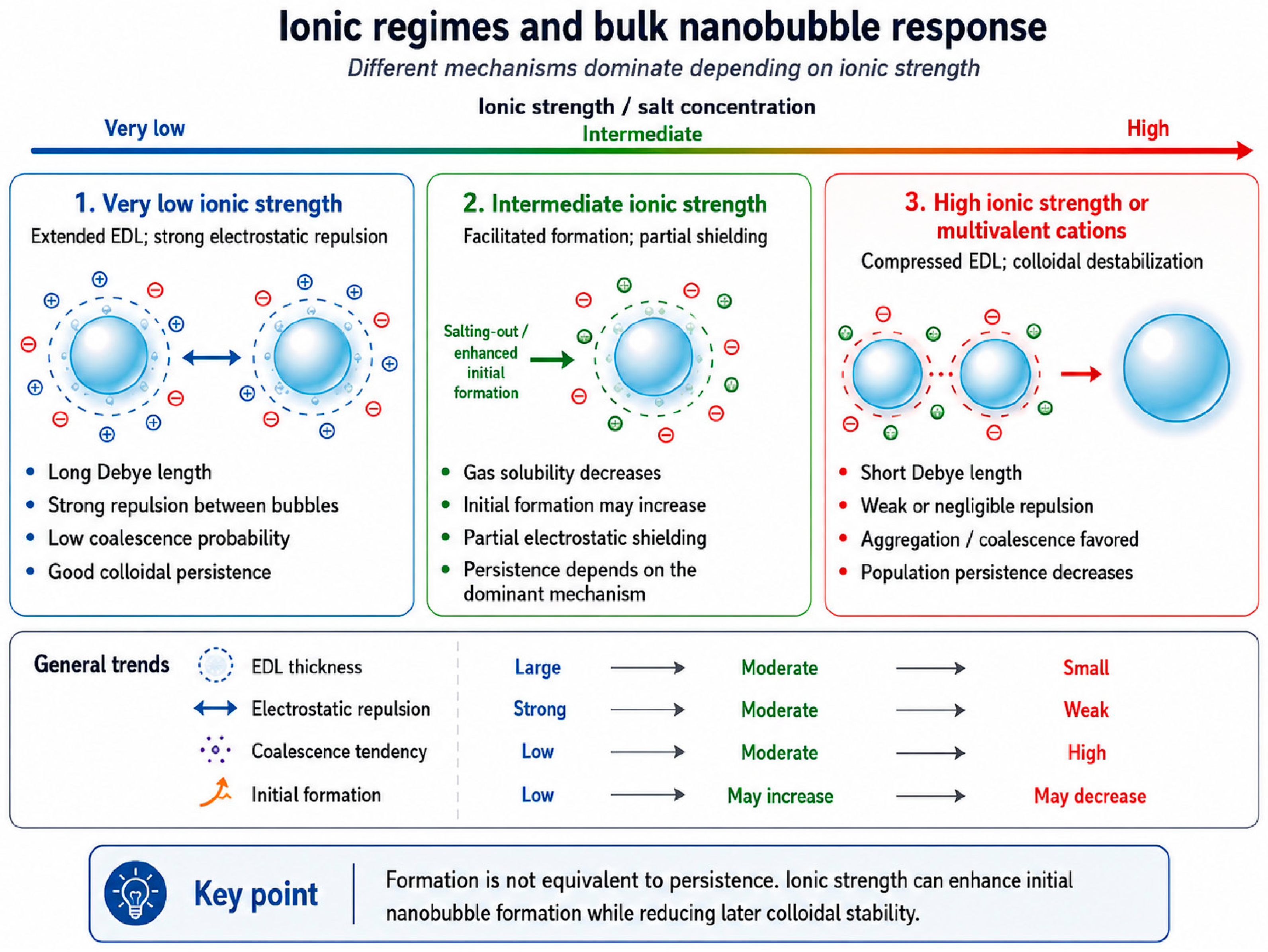
From the perspective of formation, electrolytes may increase the initial concentration of generated nanobubbles, particularly when the generation method induces supersaturation, cavitation, or intense mixing [
14]. At this stage, the dominant electrolyte effect may be associated with the modification of the gas–liquid equilibrium and promotion of nucleation. This effect must be distinguished from the subsequent evolution of the population, which depends strongly on the colloidal interactions between nanobubbles.
Once nanobubbles are formed, an increase in the ionic strength can reduce the colloidal stability by screening the interfacial charge [
35]. In aqueous systems, where nanobubbles often exhibit negative zeta potentials, higher electrolyte concentrations compress the electric double layer and reduce the effective range of electrostatic repulsion [
38,
39]. In colloidal terms, this lowers the energy barrier against close approaches and may increase the probability of contact, aggregation, and coalescence [
27,
28]. Experimentally, this loss of colloidal stability may appear as a decrease in the number concentration, an increase in the average diameter, disappearance of smaller entities, or growth into larger structures [
40,
41].
The coexistence of these effects explains why the ionic strength can generate apparently contradictory responses in the literature. The same chemical conditions may favor initial formation by reducing gas solubility while compromising subsequent colloidal stability or population persistence by weakening electrostatic repulsion [
38,
40]. Therefore, the initial concentration should be interpreted together with the time-resolved size evolution, number concentration, and measurement conditions rather than as an isolated indicator of stability. Greater initial formation does not necessarily imply greater kinetic or population-level persistence; the effect of salinity depends on the variable being measured and the time at which the system is evaluated [
42,
43].
4.3. Ionic Valence as a First-Order Specificity Factor
Ionic valence represents the first level at which ionic identity becomes relevant. Because the ionic strength depends on the squared charge of each ion, multivalent ions contribute more strongly to electrostatic screening than monovalent ions at the same molar concentration [
28,
44]. As a result, divalent cations such as Ca
2+ and Mg
2+ can compress the electric double layer more effectively than monovalent salts and may promote charge neutralization, aggregation, coalescence, or shifts toward larger apparent diameters [
45,
46]. In bulk nanobubble suspensions, this means that solutions with similar salt concentrations but different ion valence may exhibit distinct colloidal behavior. However, valence alone does not fully explain ion-specific responses because ions with the same charge can differ in hydration, mobility, and interfacial affinity [
47,
48].
4.4. Ion-Specific Effects Beyond Valence: Hydration, Mobility, and Adsorption
Ion-specific effects may arise even when the ionic strength and valences are comparable. Differences in hydration energy, hydrated radius, mobility, polarizability, and interfacial affinity can modify the organization of water and ions near the gas–liquid interface [
47,
48]. These effects may influence the magnitude and sign of the zeta potential, adsorption or exclusion of specific ions, local availability of hydroxyl species, and resistance of the interface to coalescence [
17,
46]. Therefore, two electrolytes with similar ionic strengths may produce different nanobubble size distributions, concentration decay profiles, and apparent colloidal stabilities. This behavior is consistent with the view that ionic strength is a global descriptor, whereas ion identity determines additional interfacial and kinetic responses.
4.5. Conceptual Response Regimes to Increasing Ionic Strength
The response to increasing ionic strength can be organized into conceptual regimes depending on whether electrostatic repulsion, nucleation promotion, or loss of population stability predominates in the system.
Table 2 summarizes these processes.
Indicative ranges are given for aqueous monovalent electrolytes at 25 °C and should be interpreted as approximate orders of magnitude, not universal thresholds. The response of the bulk nanobubbles depends on gas identity, electrolyte composition, pH, temperature, and preparation pathway.
5. Ionic Identity Beyond Ionic Strength
5.1. Cationic Valence and Charge Neutralization
Because bulk nanobubbles in water typically exhibit a negative interfacial charge, the cations present in the solution act as counterions in the electric double layer. Their effect depends not only on the total concentration of electrolytes but also on their valence, as a higher cationic charge can shield, neutralize, or even reverse the interfacial charge more efficiently [
46,
50].
This behavior is generally consistent with the Schulze–Hardy rule, according to which a counterion’s ability to induce coagulation increases sharply with its valence [
51]. In negatively charged nanobubbles, monovalent cations such as Na
+ or K
+ tend to progressively compress the electric double layer, thereby reducing the range of electrostatic repulsion between bubbles [
52]. This effect can promote the approach of dispersed entities when the repulsive barrier is no longer sufficient to prevent the aggregation or coalescence of the entities.
This effect is typically more pronounced in the presence of divalent cations, such as Ca
2+ and Mg
2+. Owing to their higher charge, these ions can neutralize the negative interface more efficiently than monovalent ions and reduce the absolute value of the zeta potential more rapidly [
42]. Experimentally, this can be expressed as an increase in the average diameter, decrease in the number concentration, or greater tendency toward aggregation, depending on the aqueous matrix and observation time [
53].
In the case of trivalent cations, such as Al
3+ and Fe
3+, electrostatic modification can be even more pronounced. These ions can shift the system toward zeta potential values close to zero and even induce charge reversal under certain conditions [
51]. In nanobubble systems, this effect can be expressed as a marked alteration of the interfacial charge and colloidal stability in the presence of multivalent electrolytes [
54]. However, this behavior should be interpreted with caution, as Al(III) and Fe(III) may undergo hydrolysis, complex formation, or precipitate generation depending on the pH and composition of the medium [
55]. The behavior of these ions depends not only on their nominal valence but also on their chemical speciation in the solution.
Cationic valence introduces the first form of ionic specificity, as not all electrolytes with the same nominal concentration or comparable ionic strength produce the same colloidal response. In negatively charged nanobubbles, the type of counterion can modify the intensity of shielding, degree of interfacial neutralization, and proximity to the isoelectric point. This difference extends the analysis to other ionic attributes, such as hydration, mobility, and interfacial affinity, which could also affect stability [
45].
5.2. Beyond Valence: Hydration, Mobility, and Interfacial Affinity
Although the cationic valence strongly influences the compression of the electric double layer, it does not explain the response of bulk nanobubbles to different electrolytes. Ions with the same formal charge can have different effects on the zeta potential, average size, number concentration, or temporal evolution of the population. This difference is related to physicochemical properties such as the hydrated radius, hydration energy, ionic mobility, and affinity for the gas–liquid interface [
46,
56].
Hydration is particularly important because it influences the approach of ions to the interfacial region. A strongly hydrated ion retains a more stable shell of water molecules, which could hinder its approach to the compact layer or limit specific adsorption processes. In contrast, species with lower dehydration penalties can interact more easily with the interface or regions near it [
56,
57]. For this reason, cations of equal valence, such as Ca
2+ and Mg
2+, do not necessarily elicit equivalent responses.
Ionic mobility can also influence the dynamic reorganization of the electric double layer. During bubble generation, storage, or collision, the local ion distribution can be altered by disturbances in the concentration, charge, or interfacial geometry. Ions with different mobilities can affect the rate at which electrostatic shielding is established and the way in which the interface responds to local changes in the environment [
58,
59].
Finally, interfacial affinity introduces another source of specificity in the separation process. Some ions remain preferentially hydrated within the solution, whereas others can more easily approach the interfacial regions owing to differences in hydration, polarizability, or compatibility with the local water structure [
60,
61]. This interaction can modify the electrokinetic potential and organization of the double layer, and eventually, the properties associated with gas transport or resistance to coalescence.
Valence accounts for only a portion of the ion-interface interaction. The response of nanobubbles to an electrolyte also depends on how each ion hydrates, moves, and distributes itself near the gas–liquid interface. Recognizing this separation avoids the reduction in ionic specificity from being reduced to a simple charge hierarchy and paves the way for an analysis of the distinct roles of cations and anions.
5.3. The Distinct Roles of Anions and Cations
The response of bulk nanobubbles to electrolytes also depends on the role of each ionic species at the gas–liquid interface. In systems where nanobubbles have a negative interfacial charge, cations and anions do not act equivalently. Cations primarily act as counterions, thereby directly influencing the neutralization of the surface charge, compression of the electric double layer, and proximity to the isoelectric point [
57].
This mechanism explains why cations typically control the threshold for the loss of colloidal stability of nanoparticles. By counteracting the negative charge at the interface, they reduce the magnitude of the zeta potential and shorten the range of electrostatic repulsion between the nanobubbles [
15,
32]. Therefore, the aggregation and coalescence behavior is governed not only by the ionic strength but also by the identity of the dominant cation in solution.
Although anions do not typically control electrostatic collapse in negatively charged nanobubbles, they can modify the interfacial organization. Their influence can manifest through differences in mobility, hydration, polarizability, or affinity for the gas–liquid interface [
60,
61]. Furthermore, species such as hydroxyls or other anions present in the medium can contribute to interfacial electrification, the local structure of water, and the way in which the surface charge is expressed electrokinetically [
25,
46].
Ionic specificity operates asymmetrically: cations primarily control the neutralization and compression of the electric double layer, whereas anions can modulate the interfacial structure and the nature of the surface charge. This distinction prevents the effect of electrolytes from being reduced to a simple hierarchy of cationic valence and demonstrates why ionic strength is insufficient as a sole descriptor of stability.
5.4. Limitations of Ionic Strength as a Descriptor of Nanobubble Stability
Ionic strength is a useful descriptor for estimating the general degree of electrostatic shielding and compression of the electric double layer. However, it cannot predict thermodynamic stability, colloidal stability, or population persistence on its own in aqueous media, as it condenses the composition of the solution into a single parameter and loses information about the chemical nature of the present ions.
Two solutions with similar ionic strengths could elicit different responses if they differ in the valence of the dominant counterion, hydrated radius, mobility, interfacial affinity, or specific adsorption capacity of their ions. The same ionic strength may be associated with different degrees of charge neutralization, reorganization of the electric double layer, and changes in population dynamics.
pH is a key variable in the interpretation of the ionic effects on bulk nanobubbles because it can simultaneously modify the interfacial charge, gas speciation, and gas solubility [
46,
62]. In aqueous systems, the negative electrokinetic response of nanobubbles is frequently associated with the preferential accumulation or orientation of hydroxyl species at the gas–liquid interface; therefore, changes in pH may alter the zeta potential and thickness or organization of the electric double layer [
25,
63]. At higher pH values, a more negative zeta potential is often expected, whereas under acidic conditions, partial charge neutralization may reduce electrostatic repulsion and favor aggregation or coalescence [
62,
64]. In addition, the pH can modify the gas–liquid equilibrium of chemically reactive gases. For example, dissolved CO
2 is coupled to carbonic acid, bicarbonate, and carbonate equilibria, whereas NH
3/NH
4+ speciation is strongly pH dependent [
34,
35,
36]. Consequently, changes attributed to ionic strength may reflect combined variations in ionic composition, pH, interfacial charge, and gas solubility [
15,
45]. Unless the pH is kept constant or explicitly reported, it should be treated as a confounding variable in the interpretation of nanobubble formation and persistence.
6. Preparation Pathway and Electrolyte Exposure
In addition to the ionic strength and identity of the ions present, the evolution of nanobubbles may depend on the conditions under which they were generated [
3]. Forming nanobubbles directly in an electrolytic solution is not necessarily equivalent to first producing them in pure water and then modifying the composition of the medium. In both cases, a similar final composition may be achieved; however, the gas–liquid interface will not follow the same formation trajectory.
6.1. In Situ Generation in Electrolyte-Containing Media
When nanobubbles are generated directly in an electrolytic medium, nucleation occurs in the presence of ions that subsequently surround the interface [
38]. In this case, the electrolytes do not act on a pre-formed bubble but rather participate in the earliest stages of gas–liquid interface organization. The initial charge distribution, structure of the electric double layer, and presence of counterions are determined by the chemical composition of the medium at the moment of formation [
46].
In situ generation can produce populations with initial characteristics that differ from those obtained in pure water [
65]. The decrease in gas solubility may favor the appearance of gas nuclei in saline media [
11]; however, the most relevant aspect is that these nuclei are formed in direct contact with an ionic environment. The interface is formed under predefined conditions of salinity, pH, and chemical composition rather than being subsequently modified by external disturbances. Therefore, the initial organization of the interfacial charge may depend on the ionic composition during its formation [
38].
In situ generation cannot be considered as direct evidence of greater long-term stability. The same ionic environment involved in the initial formation may subsequently promote electrostatic shielding and coalescence [
45]. Its significance lies in the fact that it defines a specific trajectory: ions influence not only the number of nanobubbles formed but also the initial organization of the interface during the generation process [
66].
6.2. Post-Generation Addition of Electrolytes
A different scenario occurs when nanobubbles are first generated in pure water or in a medium with a low ionic strength, and an electrolyte is then added. In this case, the gas–liquid interface and its initial electric double layer were formed under conditions different from those of the final system. Subsequent addition of salts does not accompany nucleation but modifies the existing population through changes in electrostatic screening and interfacial organization [
39,
40].
This disturbance can rapidly alter colloidal stability. Nanobubbles formed in low-ionic-strength media may exhibit a more extensive electric double layer and electrostatic repulsion over a greater range [
67]. When electrolytes are added after generation, the double layer could collapse abruptly, reducing the repulsion between bubbles and promoting aggregation or coalescence [
52].
The difference from in situ generation lies in the timing of the interaction between ions and the interface. In one case, the interface forms within the ionic environment, whereas in the other, an already established interface must reorganize in response to a subsequent chemical change. Two suspensions with the same final electrolyte concentration may exhibit different responses in terms of mean size, number concentration, or zeta potential if they follow different preparation pathways [
65].
6.3. Pathway-Dependent Colloidal Stability and Population Persistence
A comparison between in situ generation and post-generation incorporation shows that the colloidal stability and population persistence of bulk nanobubbles cannot be interpreted solely based on the final composition of the aqueous medium. Two systems may reach the same final ionic strength and contain the same electrolytes; however, they may exhibit different responses if the gas–liquid interface is exposed to these ions at different times. The conditions under which nanobubbles are generated should therefore be treated as part of the physicochemical description of the system, instead of as a secondary experimental detail [
49,
68].
This distinction has direct implications for comparing studies. Reporting only the final electrolyte concentration may be insufficient if it is not specified whether the nanobubbles were generated directly in the saline medium, whether the salt was added later, whether there were subsequent pH adjustments, or whether the suspension was stored before measurement [
69]. The composition of the medium defines the possible interactions, but the preparation process determines when and how these interactions affect the interface and population dynamics.
7. Collective Dynamics and Population Persistence
Once a population is formed, the evolution of bulk nanobubbles does not depend solely on the properties of each individual entity. In sufficiently concentrated suspensions, the proximity between bubbles can alter the local dissolved gas environment, colloidal interactions, and population reorganization [
70]. This collective scale allows for the interpretation of forms of persistence that cannot be explained solely by the behavior of isolated bubbles.
7.1. Limitations of the Isolated Bubble Approach
Models based on a single bubble are useful for establishing the thermodynamic and diffusive limits of a problem; however, they do not fully describe the evolution of a real suspension [
71]. In a population of nanobubbles, each entity does not evolve in an infinite, unaltered liquid, but rather in a medium modified by the presence of nearby bubbles.
This change in scale introduces variables that do not appear in the isolated-bubble approach, such as the inter-bubble distance, spatial distribution, local gas concentration, and probability of interaction between entities. Persistence at the suspension level may reflect population-level processes rather than the intrinsic stability of individual nanobubbles [
70,
72].
7.2. Diffusive Shielding in Dense Populations
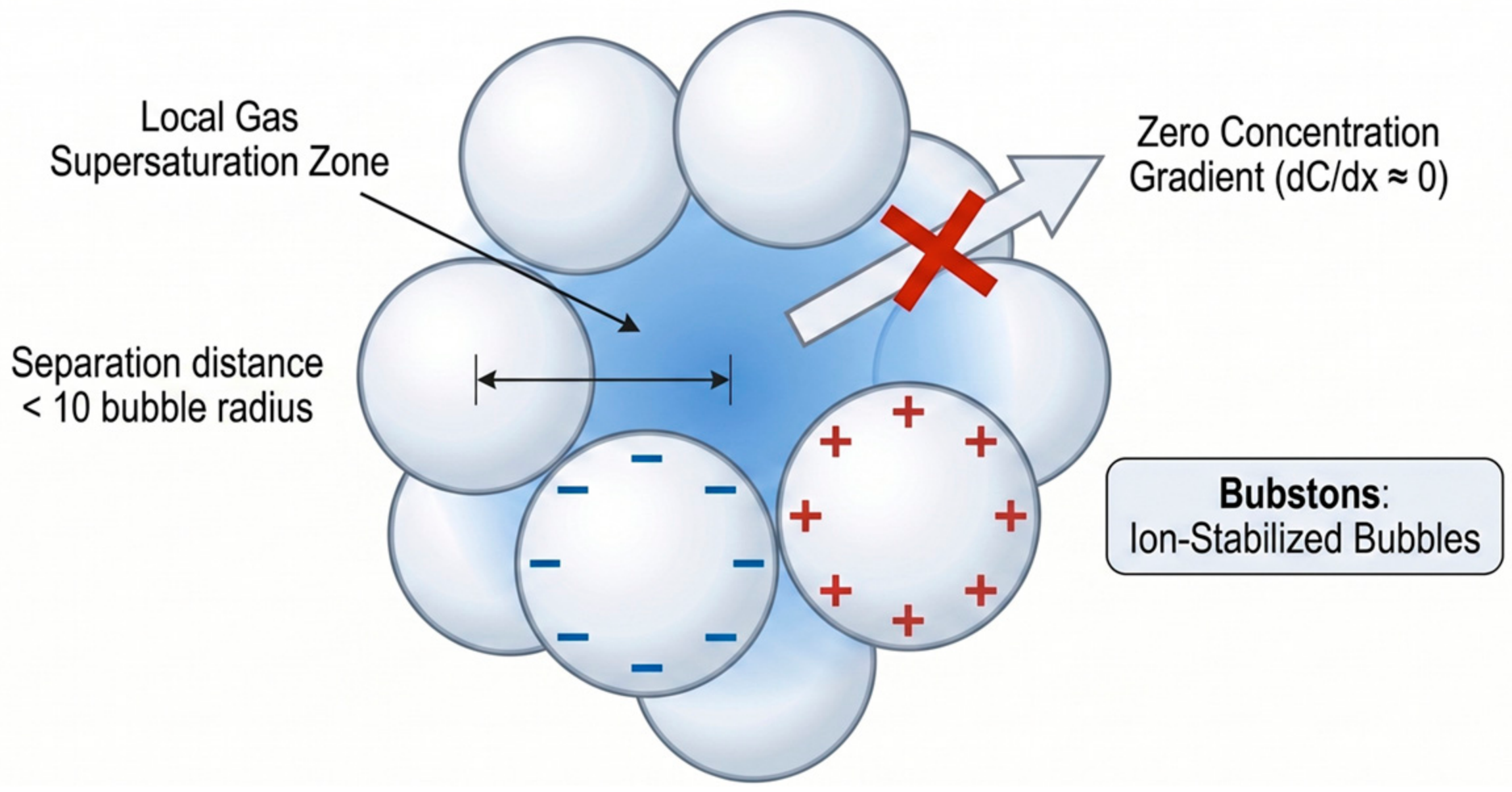
In dilute suspensions, nanobubbles could be approximated as isolated entities that exchange gas with a much larger liquid volume. In dense populations, this approximation loses its validity because bubbles may be close enough to overlap their concentration fields. Under this condition, the dissolution of a bubble does not occur in an unaltered liquid but rather in a region locally enriched by the gas released from neighboring bubbles [
73].
Diffusive shielding is based on the reduction in the concentration gradient around each bubble. If gas transport is expressed in simplified terms as:
where
J is the diffusive flux,
D is the diffusion coefficient,
is the gas concentration at the interface,
is the concentration in the surrounding liquid, and
is a characteristic diffusion distance, the diffusive shielding acts by locally increasing
. By decreasing the effective difference
, the driving force for gas escape from the bubble is reduced, and dissolution may be delayed [
74].
The relevance of the diffusion shield is not in demonstrating that an isolated nanobubble is thermodynamically stable but in showing that the observed persistence may depend on the conditions created by the population itself [
73,
75]. In sufficiently concentrated suspensions, variables such as the number concentration, inter-bubble distance, spatial distribution, and degree of local saturation of the liquid can modify the gas gradients that govern the dissolution. When the bubbles are sufficiently close together, the suspension ceases to behave as a sum of independent entities and becomes a collective system, where the evolution of each bubble is influenced by its population environment [
76]. From this perspective, diffusive shielding offers a population-scale explanation for the persistence observed in bulk nanobubbles without assuming that each bubble is stable in isolation.
Figure 3 illustrates the change in scale from an isolated nanobubble to a dense population of nanobubbles. In the isolated case, the loss of gas depends on the gradient between the interface and the surrounding liquid, whereas in a concentrated suspension, the proximity between bubbles can locally alter the concentration of dissolved gas. This superposition of diffusive fields reduces the driving force for dissolution and allows part of the observed persistence to be interpreted as a population property [
73,
76].
7.3. Dynamic Aggregates and Population Organization
In addition to diffusive shielding, the persistence of bulk nanobubbles can be influenced by the formation of dynamic aggregates or collective structures [
76]. Under this interpretation, the population does not consist exclusively of individual bubbles dispersed independently but also of nearby entities that interact via electrostatic forces, overlapping diffusive fields, and local reorganization of ionic environments.
This possibility alters the interpretation of variables, such as average diameter, number concentration, and temporal persistence. An increase in the average size does not necessarily imply uniform growth of individual bubbles; it may also reflect the emergence of transient clusters or partially stabilized groupings. Similarly, a decrease in the detected concentration may be due to irreversible coalescence, loss of detectability, or reorganization of small entities into larger collective structures [
77].
Cluster-based models suggest that nanobubbles can form dynamic configurations that reorganize during the evolution of the suspension [
78]. Their stability depends on the balance between electrostatic repulsion, short-range attractions, gas exchange, and the chemical composition of the medium [
21]. The ionic identity can alter this balance by modifying the electric double layer, effective interaction distance, and probability of contact between bubbles [
42].
A more specific hypothesis relates to the concept of bubstons, a term introduced mainly in the work of Bunkin et al. to describe long-lived, ion-stabilized gaseous nanostructures or nanobubble clusters in dilute electrolyte solutions [
79]. In this model, dissolved gas molecules form nanoscale gaseous domains that are stabilized by ions adsorbed or organized near the gas–liquid interface, generating electrostatic repulsion that can inhibit coalescence and slow dissolution [
80]. Experimental support has been reported using optical scattering and related techniques in dilute NaCl and other electrolyte solutions [
81]. However, the Bubston model should be considered a complementary and system-specific interpretation rather than a universal mechanism for bulk nanobubble persistence. First, the direct structural identification of bubstons remains experimentally challenging because scattering-based signals may arise from impurities, droplets, aggregates, and other colloidal entities. Second, the model was primarily developed for dilute electrolyte conditions and may not be applicable to concentrated salts, multivalent ions, complex aqueous matrices, or systems containing surfactants and particles. Third, it does not resolve the thermodynamic instability predicted for isolated gas cavities but rather proposes a kinetic or population-level stabilization pathway [
67,
79].
Dynamic aggregates expand the scale of analysis from individual bubbles to an organized and changing population. They do not replace diffusive shielding or electrostatic stabilization, but they help explain why the average size, number concentration, and temporal persistence can evolve in a coupled manner in bulk nanobubble suspensions [
63].
7.4. Population Persistence Versus Individual-Bubble Persistence
The preceding discussion allows us to distinguish between two levels that are often confused: the detectable persistence of a population and the kinetic persistence of each nanobubble as an isolated entity [
2]. A suspension can retain detectable nanoscale entities for days or weeks without implying the survival of all the bubbles formed at the outset. This persistence may reflect internal reorganization of the population, gas exchange between entities, partial aggregation, or changes in the size distribution [
10].
As emphasized above, most experimental measurements describe population properties rather than individual trajectories. The mean diameter, number concentration, apparent zeta potential, and scattering intensity provide information about the dominant state of the suspension at a given moment but do not allow for the reconstruction of the preparation pathway for each bubble [
30]. An apparently stable population may conceal the disappearance of small bubbles, growth of others, gas redistribution, or internal reorganization.
The persistence of a population of bulk nanobubbles does not, in and of itself, prove that each nanobubble is stable as an individual entity [
3]. This indicates that the system maintains a dispersed gaseous phase, the evolution of which depends on the interfacial, colloidal, diffusive, and population processes [
67]. This distinction allows the observed stability to be interpreted as a property of the suspension and not necessarily as direct evidence of the individual thermodynamic stability.
8. Experimental Metrics and Apparent Population Stability
8.1. Mean Size and Number Concentration
The mean size and number concentration are two of the most commonly used metrics to characterize bulk nanobubble suspensions [
82,
83]. The mean diameter corresponds to an aggregate measure of the size distribution. Its temporal stability cannot be considered direct evidence that the same bubbles remain unchanged throughout the observation period. A distribution could maintain a similar average value while simultaneous processes of small bubble disappearance, growth of others, partial coalescence, or aggregate formation occur. Similarly, an increase in the average diameter may reflect different mechanisms, such as bubble fusion, Ostwald ripening, population reorganization, or preferential loss of the smallest entities.
The particle concentration is also open to various interpretations. A decrease in the number of detected particles may be associated with diffusive dissolution but also with coalescence, aggregation, growth beyond the detection limit, or loss of detectability [
84]. Conversely, a high initial concentration primarily reflects the generation efficiency and does not necessarily indicate the subsequent persistence of the suspension.
The mean size and number concentration must be analyzed jointly as a function of time [
37,
83]. A decrease in concentration, accompanied by an increase in mean size, may suggest growth, aggregation or coalescence. In contrast, a relatively constant concentration with changes in size distribution may indicate internal reorganization of the population, such as the loss of small particles, a shift toward larger sizes, broadening of the distribution, or formation of subpopulations. In these cases, the suspension may remain detectable, but its population architecture and functional behavior are no longer equivalent to their initial states. Size, concentration, and population persistence are better understood as dynamic descriptors of suspensions than as absolute indicators of nanobubble stability.
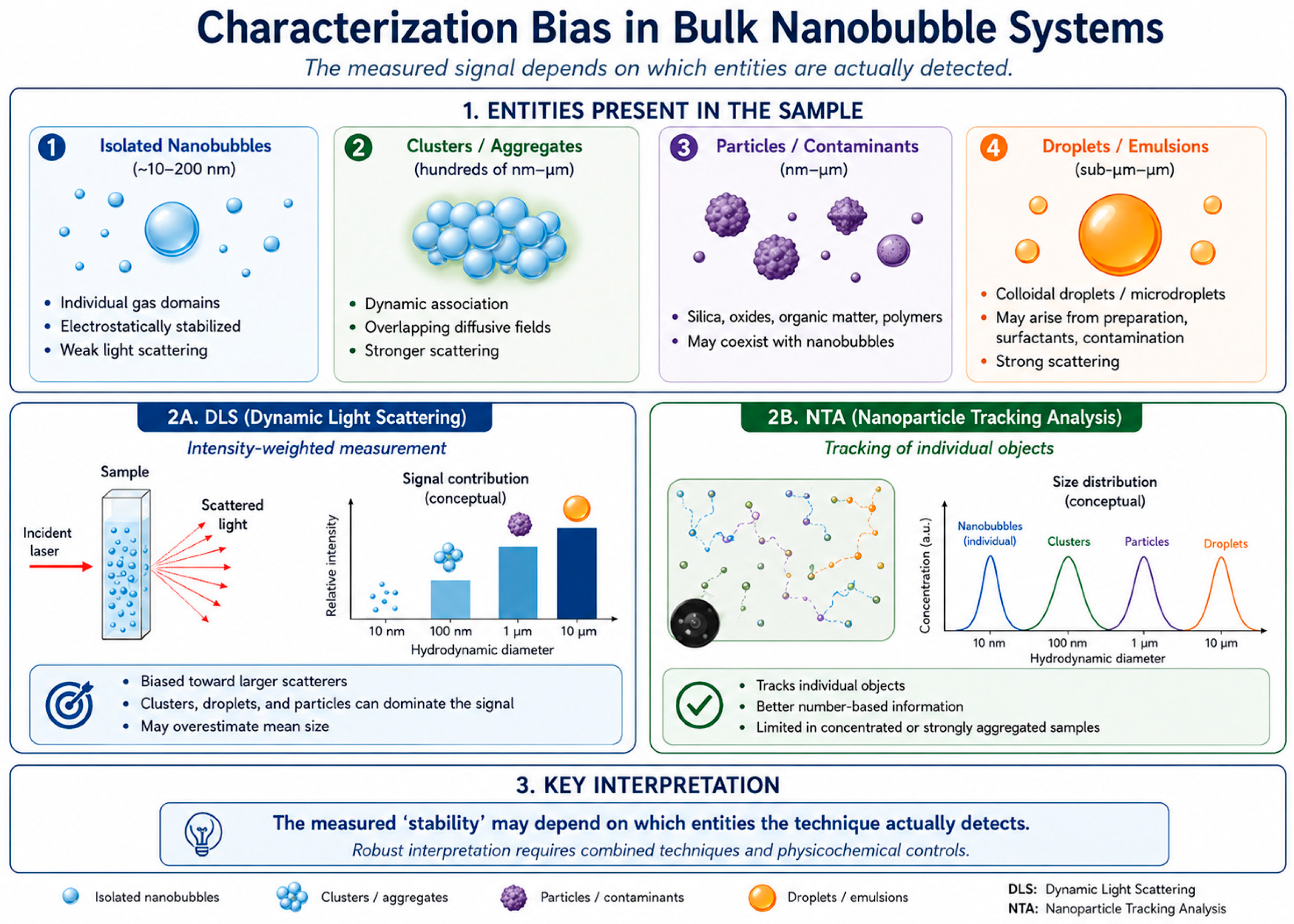
Figure 4 summarizes the interpretative ambiguity in the detection of nanoscale entities in suspensions.
8.2. DLS and NTA: Population Signals, Not Unambiguous Identification
Optical scattering and particle-tracking methods, particularly DLS and NTA, are frequently used to evaluate bulk nanobubble suspensions because they provide rapid estimates of the apparent size and number concentration [
85,
86]. However, these techniques should be interpreted as population-level measurements rather than the unambiguous identification of individual nanobubbles. DLS tracks fluctuations in the scattered light intensity and reports an apparent hydrodynamic diameter inferred from Brownian motion, whereas NTA estimates the size and concentration by tracking the optical trajectories of individual scattering entities [
85,
86]. In both cases, the detected signal may arise not only from freely dispersed nanobubbles but also from aggregates, nanodroplets, solid nanoparticles, colloidal impurities, and interfacially active contaminants [
30,
31].
A specific limitation of DLS is that the conversion from the diffusion coefficient to the apparent hydrodynamic diameter relies on the Stokes–Einstein relation. This relationship was developed for the Brownian motion of rigid spherical particles in a continuum liquid, whereas a nanobubble is a nanoscale gas–liquid interface. Interfacial deformability, slip, gas compressibility, and contamination of the interface may therefore affect the link between Brownian motion and the apparent size. Recent theoretical studies have questioned the direct applicability of the Stokes–Einstein relation to small bubbles at the nanoscale, indicating that DLS-derived diameters should be regarded as apparent hydrodynamic values rather than direct measurements of bubble size [
44].
In DLS, the signal is strongly influenced by the scattering intensity; therefore, a small fraction of larger particles can dominate the measurement and shift the apparent mean diameter toward higher values [
85]. In polydisperse suspensions, this limitation makes it difficult to distinguish between individual nanobubbles, aggregates, dynamic clusters, and colloidal contaminants. Therefore, the reported size is better understood as a population-level signal than as a direct identification of the nature of each detected entity [
31].
NTA allows the tracking of the Brownian motion of individual scattering entities and the estimation of their size and number concentration from optical trajectories [
86]. This approach provides more detailed particle-by-particle information than that obtained using DLS. Nevertheless, it also has limitations in concentrated, polydisperse, or transiently structured suspensions, where trajectory overlap, dynamic aggregation, optical thresholding, or the presence of non-gaseous particles may affect the size and concentration estimates [
87].
The key point is that neither DLS nor NTA can definitively determine whether the detected entity corresponds to an individual nanobubble, an aggregate of nanobubbles, a nanodroplet, a solid particle, colloidal organic matter, or an interfacially active impurity [
30]. Assigning persistent nanoscale populations to nanobubbles requires additional controls, including temporal evolution, response to degassing, pressure sensitivity, changes in pH or ionic strength, and validation using complementary techniques [
88].
Low-amplitude acoustic measurements may also contribute to the identification of bulk nanobubble cloud. Under non-cavitation conditions, dispersed gaseous domains can modify ultrasound propagation through attenuation, scattering, dispersion, or changes in the effective speed of sound owing to the high compressibility contrast between gas and water. These acoustic responses provide information that is independent of optical scattering but remains population-level signatures and can be affected by bubble size distribution, gas content, interfacial contamination, suspended particles, and frequency selection. For this reason, acoustic methods should be considered complementary to DLS, NTA, pressure response, degassing, and other physicochemical controls [
89]. The main capabilities, limitations, and recommended controls of these characterization techniques are summarized in
Table 3.
8.3. Zeta Potential as a Relative Indicator
The zeta potential is one of the most widely used parameters for interpreting the colloidal stability of bulk nanobubbles, as it provides an indirect electrokinetic estimate of the repulsion between dispersed entities [
63]. In general, high absolute values indicate greater electrostatic repulsion, whereas values close to zero suggest proximity to the isoelectric point and a greater tendency toward aggregation or coalescence [
62].
However, the zeta potential does not correspond to a direct measurement of the actual charge at the gas–liquid interface of bubbles. This parameter represents the electrokinetic potential associated with the slip plane, not the surface potential or the total interfacial charge density [
91]. This distinction is particularly relevant for bubbles, whose interface is curved, deformable, and potentially mobile, meaning that their electrokinetic response cannot be interpreted in the same manner as that of a rigid solid particle [
92]. The measured value should be interpreted as an operational descriptor of the electrokinetic response of the system, and not as a direct measure of the interfacial charge.
Its primary utility lies in the comparison of trends across experimental conditions. A decrease in the absolute value of the zeta potential as the ionic strength increases may indicate the compression of the electric double layer and weakening of the repulsion between nanobubbles [
64]. Changes in response to variations in pH or electrolyte type may suggest charge neutralization, specific ion adsorption, or approaching the isoelectric point [
62,
64].
However, the zeta potential primarily provides information on the colloidal stability of suspensions. A negative or high zeta potential value may be consistent with greater electrostatic repulsion and a lower tendency toward aggregation or coalescence [
62]; however, it does not, on its own, demonstrate thermodynamic stability or individual kinetic persistence. A population may maintain sufficient electrostatic repulsion between bubbles and yet be subject to gas transfer into the liquid, as predicted by classical dissolution analyses of colloidal bubbles [
93].
In ionic media, its interpretation requires special care. Different ions can modify the zeta potential through electrostatic shielding, specific neutralization, charge reversal, or changes in the interfacial structure [
15,
60,
61]. Similar variations in the measured value may result from different mechanisms. Hence, the zeta potential should be used as a relative indicator of colloidal stability and analyzed in conjunction with the temporal evolution of the size, number concentration, and chemical conditions of the medium [
94].
8.4. Apparent Stability and Minimum Interpretation Criteria
Because each metric captures only one dimension of the system, experimental stability must be inferred from converging evidence, rather than from a single, isolated signal. The average size, number concentration, zeta potential, scattering intensity, and response to perturbations provide useful information; however, each describes only a part of the system [
88]. Apparent stability is better understood as an inference constructed from complementary metrics, especially when the signal may be influenced by aggregation, collective structures, or changes in the nature of the detected entities [
78].
Table 4 summarizes the minimum criteria for interpreting the stability of bulk nanobubbles in aqueous media. These indicators do not constitute a closed experimental protocol but rather a guide for distinguishing between population evolution, detectable persistence, colloidal response, and the possible gaseous nature of the measured entities.
A more rigorous interpretation requires an examination of whether these signals are consistent. For example, a decrease in concentration accompanied by an increase in the average size and a decrease in the absolute value of the zeta potential suggests a loss of colloidal stability [
90]. In contrast, isolated changes in a single metric may result from different mechanisms, such as coalescence, aggregation, growth beyond the detection range, population reorganization, or the presence of non-gaseous entities [
95].
The experimental stability of bulk nanobubbles should be understood as an inference based on the converging evidence. No single measurement provides a definitive distinction between individual nanobubbles, dynamic aggregates, nanodroplets, colloidal particles, or contaminants [
96]. This caution is especially important when comparing studies conducted with different aqueous matrices, generation methods, and observation time windows [
72].
9. Implications for Aqueous Applications and Operational Design
The practical implications of the mechanisms discussed are not limited to the selection of conditions that maximize the nanobubble stability. In aqueous applications, performance depends on the relationship between the chemical matrix, generation method, temporal persistence, and operational function of the ROS [
97,
98]. A population suitable for storage or transport may not necessarily be the most efficient for rapid gas transfer, ozonation, flotation, or treatment of complex water [
99].
9.1. The Aqueous Matrix as a Design Variable
The aqueous matrix defines the chemical environment in which nanobubbles form, evolve, and interact with dissolved and colloidal species. Variables such as pH, alkalinity, hardness, salinity, multivalent cations, natural organic matter, surfactants, and colloidal particles can modify the interfacial charge, coalescence, mass transfer, and population persistence [
90,
100,
101]. Conditions optimized for ultrapure water should not be directly extrapolated to environmental or industrial waters, where the chemical composition may simultaneously alter nanobubble size, number concentration, and zeta potential [
102,
103,
104,
105].
Matrix-specific effects are particularly relevant in hard, saline, and organic-rich water. In hard water, divalent cations can reduce electrostatic repulsion and increase the average particle size [
46]. In saline water, reduced gas solubility may favor initial formation, whereas a higher ionic strength can weaken the subsequent colloidal stability [
49,
104]. In wastewater or organic-rich matrices, surfactants, natural organic matter, and colloidal particles may adsorb at the gas–liquid interface and modify the interfacial charge, coalescence, or mass transfer, thereby altering the response expected from simple aqueous systems [
68,
105].
The aqueous matrix should be treated as a design variable, rather than as a passive medium. For applications in water treatment, ozonation, aeration, remediation, and flotation, nanobubbles should be evaluated under chemical conditions representative of the intended end use [
106,
107]. The operational question is not simply how many nanobubbles can be generated, but whether the resulting population remains functional in the target matrix.
9.2. Initial Concentration as an Incomplete Optimization Criterion
In applications based on bulk nanobubbles, a high initial concentration is often assumed to be favorable [
68]. However, this metric primarily describes the generation efficiency and not the performance over the process lifetime. Optimizing only the number of nanobubbles produced at the start can lead to unsuitable conditions if the population rapidly loses concentration, increases in size, or changes its behavior during storage or operation [
37].
The importance of the initial concentration depends on the application objectives. In rapid-contact processes, such as ozonation, oxidation, intensive aeration, and flotation, a high initial population can be advantageous if the residence time is short and the goal is to maximize the available interfacial area [
102,
103]. However, in applications requiring storage, transport, or prolonged gas release, temporal persistence may be more important than achieving the highest initial concentration [
100,
101].
The design criterion should not be formulated as “producing more nanobubbles” but rather as generating a population suitable for a specific function [
72]. To this end, the initial concentration must be evaluated along with the temporal evolution of the size, numerical loss, colloidal stability, and residence time of the process. A suspension that is less concentrated at the start but more persistent or functional in a given matrix may be more useful than an initially abundant but rapidly unstable population.
9.3. Operational Performance Does Not Necessarily Follow Population Persistence
In applications where the primary objective is to transfer gas into a liquid, the condition with the highest population persistence or colloidal stability does not necessarily correspond to that with the best performance. A persistent population of nanobubbles can increase the gas residence time and maintain a large available interfacial area; however, an overly stabilized interface can limit gas exchange if it reduces interfacial renewal or increases resistance to mass transport [
103]. Nanobubble stability must be evaluated in relation to the intended operational function rather than as an absolute performance criterion.
In general, gas transfer can be described by the volumetric mass transfer coefficient, k
La.
where
is the mass transfer rate,
is the volumetric mass transfer coefficient,
is the equilibrium gas concentration, and
is the dissolved gas concentration in the liquid. Nanobubbles can contribute to this term due to their small size and high surface-to-volume ratio. However, overall performance depends not only on the available surface area but also on how easily the gas crosses the interface and is incorporated into the liquid [
108].
This relationship implies a trade-off between nanobubble persistence and gas transfer performance, indicating that the optimal condition depends on the intended application rather than persistence alone. Conditions that favor persistence, such as strong electrostatic repulsion or the presence of stiffer interfacial layers, could help prevent coalescence and population loss. Simultaneously, these conditions can reduce interfacial mobility or increase resistance to gas exchange [
108]. However, a more stable population does not necessarily transfer gases more efficiently.
Conversely, a less persistent population may be advantageous if it promotes faster gas exchange. In ozonation, aeration, or advanced oxidation, the goal may not be to maintain nanobubbles for days but rather to maximize the availability of the reactive gas for minutes or hours [
102,
109]. Under these conditions, a suspension with a high initial interfacial area and active gas exchange may be more efficient than a highly persistent population with limited transferability.
The aqueous matrix could shift this balance by simultaneously modifying the colloidal stability, interfacial mobility, and gas availability. Salts, organic matter, surfactants, and interfacially active species can stabilize or destabilize the population depending on how they alter the interfacial charge, coalescence, and resistance to mass transport [
69]. Observed stability alone is insufficient to predict performance, which depends on the relationship between persistence, gas exchange, and chemical conditions of the medium [
110].
For mass transfer applications, the optimal condition is not necessarily the one that maximizes persistence but rather the one that balances the concentration, size, effective interfacial area, and gas exchange during the process residence time [
111]. This distinction avoids the assumption that greater stability always implies better performance and allows the system to be tailored to the type of gas, aqueous matrix, and the operational objective.
9.4. Design Based on Application Objective
The design of bulk nanobubble-based systems must begin with the application objective. Maximizing the initial concentration, minimizing the diameter, or maximizing persistence may not always be appropriate. Each application requires prioritizing a different combination of formation, colloidal stability, mass transfer and resistance to aqueous matrices [
72].
In applications where nanobubbles must be stored, transported, or maintained for extended periods, population persistence becomes more important [
101]. However, in ozonation, rapid aeration, or advanced oxidation processes, it may be more important to maximize gas transfer during the process residence time [
102,
111]. In complex matrices, such as wastewater, hard water, and solutions with high organic loading, the priority shifts toward the ability to maintain a functional response under variations in pH, salinity, hardness, and organic matter [
90].
Table 5 summarizes the operational-goal-oriented design logic.
This approach avoids treating stability as an objective measure. In some cases, the priority is to maintain a persistent population; in others, to facilitate rapid gas transfer; and in others, to ensure functionality within a complex chemical matrix. The design of nanobubble systems must be based on the operational objectives and specific aqueous matrix, not on a single stability metric [
101,
112].
10. Conclusions
The stability of bulk nanobubbles in aqueous media cannot be considered a single property. Thermodynamic stability, kinetic persistence, colloidal stability, population persistence, and operational performance correspond to different problem levels. The initial formation, colloidal stability, diffusive persistence, population persistence, and operational performance correspond to different levels of problems. A high initial concentration, an apparently constant mean diameter, or a high absolute zeta potential does not constitute sufficient evidence of a stable system.
The ionic composition of the medium plays a central role in this discussion; however, the ionic strength alone is insufficient to predict the system behavior. Electrolytes could favor initial formation by reducing the solubility of the gas and promoting its local supersaturation. However, they could also compromise colloidal stability by compressing the electric double layer and reducing the repulsion between bubbles. Furthermore, the identity of the ions, including their valence, hydration, mobility, and interfacial affinity, could generate distinct responses even under similar ionic strengths.
The interpretation of kinetic and population-level persistence also depends on the preparation pathway and the observed scale. Two suspensions with the same final composition may evolve differently if the nanobubbles are formed directly in an electrolytic medium or if the electrolytes are added afterward. Likewise, the detectable persistence of a population does not equate to demonstrating the individual stability of each nanobubble because the experimental signal may arise from collective processes and population reorganization. Hence, experimental stability must be inferred from complementary metrics and not from an isolated measurement.
For environmental and industrial applications, the optimal conditions do not necessarily correspond to maximum population persistence or colloidal stability. The design must be based on the aqueous matrix, residence time, and desired operational function. Storage, ozonation, aeration, flotation, and treatment of complex waters require different trade-offs between concentration, size, persistence, mass transfer, and resistance to the chemistry of the medium. The relevant question is not simply how to produce more nanobubbles but rather what population is needed, in what matrix, for how long, and for what function.
The reviewed evidence suggests that the “stability” of bulk nanobubbles should not be treated as a single property, but rather as a set of behaviors dependent on the system stage, ionic composition, generation pathway, and operational objectives.
Author Contributions
Conceptualization, J.C.G. and J.S.; investigation, J.C.G., C.F. and J.S.; writing—original draft preparation, J.C.G. and J.S.; writing—review and editing, J.C.G., C.F., C.C. and J.S.; supervision, C.C. and J.S. All authors have read and agreed to the published version of the manuscript.
Funding
This research received no external funding.
Data Availability Statement
No new data were created or analyzed in this study. Data sharing is not applicable to this article.
Acknowledgments
During the preparation of this manuscript, the authors used ChatGPT (OpenAI, GPT-5.5) for the purposes of English language editing and generation of figures. The authors have reviewed and edited the output and take full responsibility for the content of this publication.
Conflicts of Interest
The authors declare no conflicts of interest.
Abbreviations
The following abbreviations are used in this manuscript:
| C | Dissolved gas concentration in the liquid |
| C* | Equilibrium gas concentration in the liquid |
| C∞ | Gas concentration in the bulk liquid far from the bubble interface |
| CL | Dissolved gas concentration in the liquid |
| Cs | Gas concentration at the bubble–liquid interface |
| ci | Molar concentration of ion (i) |
| D | Gas diffusion coefficient in water |
| e | Elementary charge |
| H | Henry’s law constant |
| I | Ionic strength |
| J | Diffusive gas flux |
| κ | Debye screening parameter (inverse Debye length) |
| kB | Boltzmann constant |
| kL | Liquid-side mass transfer coefficient |
| kLa | Volumetric mass transfer coefficient |
| l | Characteristic diffusion length |
| NA | Avogadro constant |
| P0 | External or ambient pressure |
| Pin | Internal pressure of the gas bubble |
| Pout | Pressure in the surrounding liquid |
| R | Bubble radius |
| r | Mass transfer rate |
| T | Absolute temperature |
| t | Time |
| zi | Valence of ion (i) |
| ΔP | Laplace pressure difference across the gas–liquid interface |
| γ | Gas–liquid interfacial tension |
| εr | Relative permittivity of the liquid |
| ε0 | Vacuum permittivity |
| κ | Inverse Debye length |
| κ−1 | Debye length |
| BNB | Bulk nanobubble |
| DLS | Dynamic light scattering |
| DLVO | Derjaguin–Landau–Verwey–Overbeek theory |
| DO | Dissolved oxygen |
| EDL | Electric double layer |
| NTA | Nanoparticle tracking analysis |
References
- Alheshibri, M.; Qian, J.; Jehannin, M.; Craig, V.S.J. A History of Nanobubbles. Langmuir 2016, 32, 11086–11100. [Google Scholar] [CrossRef] [Scilit] [PubMed]
- Montazeri, S.M.; Kalogerakis, N.; Kolliopoulos, G. Effect of Chemical Species and Temperature on the Stability of Air Nanobubbles. Sci. Rep. 2023, 13, 16716. [Google Scholar] [CrossRef] [Scilit] [PubMed]
- Ma, X.; Li, M.; Xu, X.; Sun, C. On the Role of Surface Charge and Surface Tension Tuned by Surfactant in Stabilizing Bulk Nanobubbles. Appl. Surf. Sci. 2023, 608, 155232. [Google Scholar] [CrossRef] [Scilit]
- Nirmalkar, N.; Pacek, A.W.; Barigou, M. On the Existence and Stability of Bulk Nanobubbles. Langmuir 2018, 34, 10964–10973. [Google Scholar] [CrossRef] [Scilit] [PubMed]
- Weijs, J.H.; Seddon, J.R.T.; Lohse, D. Diffusive Shielding Stabilizes Bulk Nanobubble Clusters. ChemPhysChem 2012, 13, 2197–2204. [Google Scholar] [CrossRef] [Scilit] [PubMed]
- Lohse, D.; Zhang, X. Surface nanobubbles and nanodroplets. Rev. Mod. Phys. 2015, 87, 981–1035. [Google Scholar] [CrossRef] [Scilit]
- Tortora, M.; Meloni, S.; Tan, B.H.; Giacomello, A.; Ohl, C.D.; Dietrich, E. The interplay among gas, liquid and solid interactions determines the stability of surface nanobubbles. Nanoscale 2020, 12, 22698–22709. [Google Scholar] [CrossRef] [Scilit] [PubMed]
- Ohgaki, K.; Khanh, N.Q.; Joden, Y.; Tsuji, A.; Nakagawa, T. Physicochemical Approach to Nanobubble Solutions. Chem. Eng. Sci. 2010, 65, 1296–1300. [Google Scholar] [CrossRef] [Scilit]
- Ghaani, M.R.; Kusalik, P.G.; English, N.J. Massive Generation of Metastable Bulk Nanobubbles in Water by External Electric Fields. Sci. Adv. 2020, 6, eaaz0094. [Google Scholar] [CrossRef] [Scilit] [PubMed]
- Ebina, K.; Shi, K.; Hirao, M.; Hashimoto, J.; Kawato, Y.; Kaneshiro, S.; Morimoto, T.; Koizumi, K.; Yoshikawa, H. Oxygen and Air Nanobubble Water Solution Promote the Growth of Plants, Fishes, and Mice. PLoS ONE 2013, 8, e65339. [Google Scholar] [CrossRef] [Scilit] [PubMed]
- Uchida, T.; Liu, S.; Enari, M.; Oshita, S.; Yamazaki, K.; Gohara, K. Effect of NaCl on the Lifetime of Micro- and Nanobubbles. Nanomaterials 2016, 6, 31. [Google Scholar] [CrossRef] [Scilit] [PubMed]
- Seddon, J.R.T.; Lohse, D.; Ducker, W.A.; Craig, V.S.J. A Deliberation on Nanobubbles at Surfaces and in Bulk. ChemPhysChem 2012, 13, 2179–2187. [Google Scholar] [CrossRef] [Scilit] [PubMed]
- Nirmalkar, N.; Pacek, A.W.; Barigou, M. Interpreting the Interfacial and Colloidal Stability of Bulk Nanobubbles. Soft Matter 2018, 14, 9643–9656. [Google Scholar] [CrossRef] [Scilit] [PubMed]
- Agarwal, K.; Trivedi, M.; Nirmalkar, N. Does Salting-out Effect Nucleate Nanobubbles in Water: Spontaneous Nucleation? Ultrason. Sonochem. 2022, 82, 105860. [Google Scholar] [CrossRef] [Scilit] [PubMed]
- Creux, P.; Lachaise, J.; Graciaa, A.; Beattie, J.K. Specific Cation Effects at the Hydroxide-Charged Air/Water Interface. J. Phys. Chem. C 2007, 111, 3753–3755. [Google Scholar] [CrossRef] [Scilit]
- Maheshwari, S.; van der Hoef, M.; Zhang, X.; Lohse, D. Stability of surface nanobubbles: A molecular dynamics study. Langmuir 2016, 32, 11116–11122. [Google Scholar] [CrossRef] [Scilit] [PubMed]
- Maeda, N. Interfacial nanobubbles and the memory effect of natural gas hydrates. J. Phys. Chem. C 2018, 122, 11399–11406. [Google Scholar] [CrossRef] [Scilit]
- Brennen, C.E. Cavitation and Bubble Dynamics; Oxford University Press: New York, NY, USA, 1995. [Google Scholar]
- Nazari, S.; Hassanzadeh, A.; He, Y.; Khoshdast, H.; Kowalczuk, P.B. Recent developments in generation, detection and application of nanobubbles in flotation. Minerals 2022, 12, 462. [Google Scholar] [CrossRef] [Scilit]
- Agarwal, A.; Ng, W.J.; Liu, Y. Principle and Applications of Microbubble and Nanobubble Technology for Water Treatment. Chemosphere 2011, 84, 1175–1180. [Google Scholar] [CrossRef] [Scilit] [PubMed]
- Ljunggren, S.; Eriksson, J.C. The Lifetime of a Colloid-Sized Gas Bubble in Water and the Cause of the Hydrophobic Attraction. Colloids Surf. A Physicochem. Eng. Asp. 1997, 129–130, 151–155. [Google Scholar] [CrossRef] [Scilit]
- Epstein, P.S.; Plesset, M.S. On the Stability of Gas Bubbles in Liquid-Gas Solutions. J. Chem. Phys. 1950, 18, 1505–1509. [Google Scholar] [CrossRef] [Scilit]
- Tan, B.H.; An, H.; Ohl, C.-D. How Bulk Nanobubbles Might Survive. Phys. Rev. Lett. 2020, 124, 134503. [Google Scholar] [CrossRef] [Scilit] [PubMed]
- Tan, B.H.; An, H.; Ohl, C.-D. Stability of Surface and Bulk Nanobubbles. Curr. Opin. Colloid Interface Sci. 2021, 53, 101428. [Google Scholar] [CrossRef] [Scilit]
- Ushikubo, F.Y.; Enari, M.; Furukawa, T.; Nakagawa, R.; Makino, Y.; Kawagoe, Y.; Oshita, S. Zeta-Potential of Micro- and/or Nano-Bubbles in Water Produced by Some Kinds of Gases. IFAC Proc. Vol. 2010, 43, 283–288. [Google Scholar] [CrossRef] [Scilit]
- Cho, S.H.; Kim, J.Y.; Chun, J.H.; Kim, J.D. Ultrasonic Formation of Nanobubbles and Their Zeta-Potentials in Aqueous Electrolyte and Surfactant Solutions. Colloids Surf. A Physicochem. Eng. Asp. 2005, 269, 28–34. [Google Scholar] [CrossRef] [Scilit]
- Trefalt, G.; Behrens, S.H.; Borkovec, M. Charge regulation in the electrical double layer: Ion adsorption and surface interactions. Langmuir 2016, 32, 380–400. [Google Scholar] [CrossRef] [Scilit] [PubMed]
- Leroy, P.; Jougnot, D.; Revil, A.; Lassin, A.; Azaroual, M. A Double Layer Model of the Gas Bubble/Water Interface. J. Colloid Interface Sci. 2012, 388, 243–256. [Google Scholar] [CrossRef] [Scilit] [PubMed]
- Alheshibri, M.; Craig, V.S.J. Generation of Nanoparticles upon Mixing Ethanol and Water; Nanobubbles or Not? J. Colloid Interface Sci. 2019, 542, 136–143. [Google Scholar] [CrossRef] [Scilit] [PubMed]
- Jadhav, A.J.; Barigou, M. Bulk Nanobubbles or Not Nanobubbles: That Is the Question. Langmuir 2020, 36, 1699–1708. [Google Scholar] [CrossRef] [Scilit] [PubMed]
- Eklund, F.; Alheshibri, M.; Swenson, J. Differentiating Bulk Nanobubbles from Nanodroplets and Nanoparticles. Curr. Opin. Colloid Interface Sci. 2021, 53, 101427. [Google Scholar] [CrossRef] [Scilit]
- Takahashi, M. ζ Potential of Microbubbles in Aqueous Solutions: Electrical Properties of the Gas-Water Interface. J. Phys. Chem. B 2005, 109, 21858–21864. [Google Scholar] [CrossRef] [Scilit] [PubMed]
- Siqveland, L.M.; Skjæveland, S.M. Derivations of the Young-Laplace Equation. Capillarity 2021, 4, 23–30. [Google Scholar] [CrossRef] [Scilit]
- Hermann, C.; Dewes, I.; Schumpe, A. The Estimation of Gas Solubilities in Salt Solutions. Chem. Eng. Sci. 1995, 50, 1673–1675. [Google Scholar] [CrossRef] [Scilit]
- Hewage, S.A.; Kewalramani, J.; Meegoda, J.N. Stability of Nanobubbles in Different Salts Solutions. Colloids Surf. A Physicochem. Eng. Asp. 2021, 609, 125669. [Google Scholar] [CrossRef] [Scilit]
- Craig, V.S. Gas Solubility of Electrolytes. In Encyclopedia of Applied Electrochemistry; Kreysa, G., Ota, K., Savinell, R.F., Eds.; Springer: New York, NY, USA, 2014; pp. 927–931. [Google Scholar]
- Lang, W.; Zander, R. Salting-Out of Oxygen from Aqueous Electrolyte Solutions: Prediction and Measurement. Ind. Eng. Chem. Fundam. 1986, 25, 775–782. [Google Scholar] [CrossRef] [Scilit]
- Agarwal, K.; Trivedi, M.; Nirmalkar, N. Bulk Nanobubbles in Aqueous Salt Solution. Mater. Today Proc. 2022, 57, 1789–1792. [Google Scholar] [CrossRef] [Scilit]
- Ma, X.; Li, M.; Pfeiffer, P.; Eisener, J.; Ohl, C.D.; Sun, C. Ion Adsorption Stabilizes Bulk Nanobubbles. J. Colloid Interface Sci. 2022, 606, 1380–1394. [Google Scholar] [CrossRef] [Scilit] [PubMed]
- Ma, X.; Li, M.; Sun, C. Effect of Ionic Environment in Aqueous Solution on Nucleation and Stabilization of Bulk Nanobubbles. Appl. Surf. Sci. 2024, 656, 159726. [Google Scholar] [CrossRef] [Scilit]
- Zhou, Y.; Han, Z.; He, C.; Feng, Q.; Wang, K.; Wang, Y.; Luo, N.; Dodbiba, G.; Wei, Y.; Otsuki, A.; et al. Long-Term Stability of Different Kinds of Gas Nanobubbles in Deionized and Salt Water. Materials 2021, 14, 1808. [Google Scholar] [CrossRef] [Scilit] [PubMed]
- Bueno-Tokunaga, A.; Pérez-Garibay, R.; Martínez-Carrillo, D. Zeta Potential of Air Bubbles Conditioned with Typical Froth Flotation Reagents. Int. J. Miner. Process. 2015, 140, 50–57. [Google Scholar] [CrossRef] [Scilit]
- Tanaka, S.; Terasaka, K.; Fujioka, S. Generation and Long-Term Stability of Ultrafine Bubbles in Water. Chem. Ing. Tech. 2021, 93, 168–179. [Google Scholar] [CrossRef] [Scilit]
- Zhou, Y.; Huang, M.; Tian, F.; Shi, X.; Zhang, X. Einstein–Stokes relation for small bubbles at the nanoscale. J. Chem. Phys. 2024, 160, 054109. [Google Scholar] [CrossRef] [Scilit] [PubMed]
- Ma, X.; Li, M.; Xu, X.; Sun, C. Coupling Effects of Ionic Surfactants and Electrolytes on the Stability of Bulk Nanobubbles. Nanomaterials 2022, 12, 3450. [Google Scholar] [CrossRef] [Scilit] [PubMed]
- Creux, P.; Lachaise, J.; Graciaa, A.; Beattie, J.K.; Djerdjev, A.M. Strong Specific Hydroxide Ion Binding at the Pristine Oil/Water and Air/Water Interfaces. J. Phys. Chem. B 2009, 113, 14146–14150. [Google Scholar] [CrossRef] [Scilit] [PubMed]
- Jungwirth, P.; Tobias, D.J. Specific ion effects at the air/water interface. Chem. Rev. 2006, 106, 1259–1281. [Google Scholar] [CrossRef] [Scilit] [PubMed]
- Pegram, L.M.; Record, M.T. Hofmeister salt effects on surface tension arise from partitioning of anions and cations between bulk water and the air–water interface. J. Phys. Chem. B 2007, 111, 5411–5417. [Google Scholar] [CrossRef] [Scilit] [PubMed]
- Phan, K.; Truong, T.; Wang, Y.; Bhandari, B. Effect of Electrolytes and Surfactants on Generation and Longevity of Carbon Dioxide Nanobubbles. Food Chem. 2021, 363, 130299. [Google Scholar] [CrossRef] [Scilit] [PubMed]
- Khairy, M.; Kubelka, J.; Piri, M. The Effects of Ionic Strength and pH on Nanobubble Electrostatic Stability in Saline Solutions. Langmuir 2025, 41, 22116–22128. [Google Scholar] [CrossRef] [Scilit] [PubMed]
- Trefalt, G.; Szilagyi, I.; Téllez, G.; Borkovec, M. Colloidal Stability in Asymmetric Electrolytes: Modifications of the Schulze-Hardy Rule. Langmuir 2017, 33, 1695–1704. [Google Scholar] [CrossRef] [Scilit] [PubMed]
- Jin, F.; Li, J.; Ye, X.; Wu, C. Effects of pH and Ionic Strength on the Stability of Nanobubbles in Aqueous Solutions of α-Cyclodextrin. J. Phys. Chem. B 2007, 111, 11745–11749. [Google Scholar] [CrossRef] [Scilit] [PubMed]
- Lasek, L.; Krzywanski, J.; Skrobek, D.; Zylka, A.; Nowak, W. Review of Micro- and Nanobubble Technologies: Advancements in Theory and Applications and Perspectives on Adsorption Cooling and Desalination Systems. Energies 2023, 16, 8078. [Google Scholar] [CrossRef] [Scilit]
- Dutta, N.; Mitra, S.; Nirmalkar, N. Understanding the Role of Surface Charge on Nanobubble Capillary Bridging during Particle-Particle Interaction. Langmuir 2024, 40, 4475–4488. [Google Scholar] [CrossRef] [Scilit] [PubMed]
- Baes, C.F., Jr.; Mesmer, R.E. The Hydrolysis of Cations; Wiley: New York, NY, USA, 1976. [Google Scholar]
- Vrbka, L.; Mucha, M.; Minofar, B.; Jungwirth, P.; Brown, E.; Tobias, D. Propensity of Soft Ions for the Air-Water Interface. Curr. Opin. Colloid Interface Sci. 2004, 9, 67–73. [Google Scholar] [CrossRef] [Scilit]
- Peng, M.; Duignan, T.T.; Nguyen, A.V. Quantifying the Counterion-Specific Effect on Surfactant Adsorption Using Modeling, Simulation, and Experiments. Langmuir 2020, 36, 13012–13022. [Google Scholar] [CrossRef] [Scilit] [PubMed]
- Hunter, R.J. Applications of the Zeta Potential. In Zeta Potential in Colloid Science; Academic Press: London, UK, 1981; pp. 219–257. [Google Scholar]
- Jungwirth, P.; Tobias, D.J. Molecular Structure of Salt Solutions: A New View of the Interface with Implications for Heterogeneous Atmospheric Chemistry. J. Phys. Chem. B 2001, 105, 10468–10472. [Google Scholar] [CrossRef] [Scilit]
- Han, Z.; Kurokawa, H.; Matsui, H.; He, C.; Wang, K.; Wei, Y.; Dodbiba, G.; Otsuki, A.; Fujita, T. Stability and Free Radical Production for CO2 and H2 in Air Nanobubbles in Ethanol Aqueous Solution. Nanomaterials 2022, 12, 237. [Google Scholar] [CrossRef] [Scilit] [PubMed]
- Bui, T.T.; Nguyen, D.C.; Han, M. Average Size and Zeta Potential of Nanobubbles in Different Reagent Solutions. J. Nanopart. Res. 2019, 21, 173. [Google Scholar] [CrossRef] [Scilit]
- Weissenborn, P.K.; Pugh, R.J. Surface Tension of Aqueous Solutions of Electrolytes: Relationship with Ion Hydration, Oxygen Solubility, and Bubble Coalescence. J. Colloid Interface Sci. 1996, 184, 550–563. [Google Scholar] [CrossRef] [Scilit] [PubMed]
- Oxtoby, D.W. Nucleation of First-Order Phase Transitions. Acc. Chem. Res. 1998, 31, 91–97. [Google Scholar] [CrossRef] [Scilit]
- Alam, H.S.; Sutikno, P.; Soelaiman, T.A.F.; Sugiarto, A.T. A Diffused Double-Layer Model of Bulk Nanobubbles in Aqueous NaCl Solutions. Therm. Sci. Eng. Prog. 2024, 50, 102590. [Google Scholar] [CrossRef] [Scilit]
- Ushikubo, F.Y.; Furukawa, T.; Nakagawa, R.; Enari, M.; Makino, Y.; Kawagoe, Y.; Shiina, T.; Oshita, S. Evidence of the Existence and the Stability of Nanobubbles in Water. Colloids Surf. A Physicochem. Eng. Asp. 2010, 361, 31–37. [Google Scholar] [CrossRef] [Scilit]
- Xiao, W.; Zhang, H.; Wang, X.; Wang, B.; Long, T.; Deng, S.; Huang, J.; Wang, Y. Interaction mechanisms and application of ozone micro/nanobubbles and nanoparticles: A review and perspective. Nanomaterials 2022, 12, 1958. [Google Scholar] [CrossRef] [Scilit] [PubMed]
- Meegoda, J.N.; Hewage, S.A.; Batagoda, J.H. Application of the Diffused Double Layer Theory to Nanobubbles. Langmuir 2019, 35, 12100–12112. [Google Scholar] [CrossRef] [Scilit] [PubMed]
- Oh, S.H.; Kim, J.-M. Generation and Stability of Bulk Nanobubbles. Langmuir 2017, 33, 3818–3823. [Google Scholar] [CrossRef] [Scilit] [PubMed]
- Ahmed, A.K.A.; Sun, C.; Hua, L.; Zhang, Z.; Zhang, Y.; Marhaba, T.; Zhang, W. Colloidal Properties of Air, Oxygen, and Nitrogen Nanobubbles in Water: Effects of Ionic Strength, Natural Organic Matters, and Surfactants. Environ. Eng. Sci. 2018, 35, 720–727. [Google Scholar] [CrossRef] [Scilit]
- Postnikov, A.V.; Uvarov, I.V.; Penkov, N.V.; Svetovoy, V.B. Collective Behavior of Bulk Nanobubbles Produced by Alternating Polarity Electrolysis. Nanoscale 2018, 10, 428–435. [Google Scholar] [CrossRef] [Scilit] [PubMed]
- Yasui, K.; Tuziuti, T.; Kanematsu, W. Mysteries of Bulk Nanobubbles (Ultrafine Bubbles): Stability and Radical Formation. Ultrason. Sonochem. 2018, 48, 259–266. [Google Scholar] [CrossRef] [Scilit] [PubMed]
- Babu, K.S.; Amamcharla, J.K. Generation Methods, Stability, Detection Techniques, and Applications of Bulk Nanobubbles in Agro-Food Industries: A Review and Future Perspective. Crit. Rev. Food Sci. Nutr. 2023, 63, 9262–9281. [Google Scholar] [CrossRef] [Scilit] [PubMed]
- Yasui, K.; Tuziuti, T.; Kanematsu, W.; Kato, K. Dynamic Equilibrium Model for a Bulk Nanobubble and a Microbubble Partly Covered with Hydrophobic Material. Langmuir 2016, 32, 11101–11110. [Google Scholar] [CrossRef] [Scilit] [PubMed]
- Lee, J.I.; Huh, H.S.; Park, J.Y.; Han, J.G.; Kim, J.M. Coarsening Behavior of Bulk Nanobubbles in Water. Sci. Rep. 2021, 11, 19173. [Google Scholar] [CrossRef] [Scilit] [PubMed]
- Manning, G.S. On the Thermodynamic Stability of Bubbles, Immiscible Droplets, and Cavities. Phys. Chem. Chem. Phys. 2020, 22, 17523–17531. [Google Scholar] [CrossRef] [Scilit] [PubMed]
- Jadhav, A.J.; Barigou, M. On the Clustering of Bulk Nanobubbles and Their Colloidal Stability. J. Colloid Interface Sci. 2021, 601, 816–824. [Google Scholar] [CrossRef] [Scilit] [PubMed]
- Satpute, P.A.; Earthman, J.C. Hydroxyl Ion Stabilization of Bulk Nanobubbles Resulting from Microbubble Shrinkage. J. Colloid Interface Sci. 2021, 584, 449–455. [Google Scholar] [CrossRef] [Scilit] [PubMed]
- Sharma, H.; Yadav, G.; Dutta, N.; Nirmalkar, N. Interfacial Engineering of Nanobubbles: From Nucleation to Mass Transfer. Surf. Interfaces 2025, 72, 107386. [Google Scholar] [CrossRef] [Scilit]
- Bunkin, N.F.; Ninham, B.W.; Ignatiev, P.S.; Kozlov, V.A.; Shkirin, A.V.; Starosvetskij, A.V. Long-living nanobubbles of dissolved gas in aqueous solutions of salts and erythrocyte suspensions. J. Biophotonics 2011, 4, 150–164. [Google Scholar] [CrossRef] [Scilit] [PubMed]
- Bunkin, N.F.; Shkirin, A.V.; Ignatiev, P.S.; Chaikov, L.L.; Burkhanov, I.S.; Starosvetskij, A.V. Nanobubble clusters of dissolved gas in aqueous solutions of electrolyte. I. Experimental proof. J. Chem. Phys. 2012, 137, 054706. [Google Scholar] [CrossRef] [Scilit] [PubMed]
- Bunkin, N.F.; Shkirin, A.V.; Suyazov, N.V.; Babenko, V.A.; Sychev, A.A.; Penkov, N.V.; Belosludtsev, K.N.; Gudkov, S.V. Formation and dynamics of ion-stabilized gas nanobubble phase in the bulk of aqueous NaCl solutions. J. Phys. Chem. B 2016, 120, 1291–1303. [Google Scholar] [CrossRef] [Scilit] [PubMed]
- Wu, C.; Nesset, K.; Masliyah, J.; Xu, Z. Generation and characterization of submicron size bubbles. Adv. Colloid Interface Sci. 2012, 179–182, 123–132. [Google Scholar] [CrossRef] [Scilit] [PubMed]
- Agarwal, K.; Trivedi, M.; Ohl, C.D.; Nirmalkar, N. On Nanobubble Dynamics under an Oscillating Pressure Field during Salting-out Effects and Its DLVO Potential. Langmuir 2023, 39, 5250–5262. [Google Scholar] [CrossRef] [Scilit] [PubMed]
- Zheng, X.; Jang, J. Hydraulic Properties of Porous Media Saturated with Nanoparticle-Stabilized Air-Water Foam. Sustainability 2016, 8, 1317. [Google Scholar] [CrossRef] [Scilit]
- Chen, M.; Peng, L.; Qiu, J.; Luo, K.; Liu, D.; Han, P. Monitoring of an Ethanol-Water Exchange Process to Produce Bulk Nanobubbles Based on Dynamic Light Scattering. Langmuir 2020, 36, 10069–10073. [Google Scholar] [CrossRef] [Scilit] [PubMed]
- Tian, Y.; Tian, D.; Peng, X.; Qiu, H. Critical Parameters to Standardize the Size and Concentration Determination of Nanomaterials by Nanoparticle Tracking Analysis. Int. J. Pharm. 2024, 656, 124097. [Google Scholar] [CrossRef] [Scilit] [PubMed]
- Häbich, A.; Ducker, W.; Dunstan, D.E.; Zhang, X. Do Stable Nanobubbles Exist in Mixtures of Organic Solvents and Water? J. Phys. Chem. B 2010, 114, 6962–6967. [Google Scholar] [CrossRef] [Scilit] [PubMed]
- Ma, X.; Li, M.; Xu, X.; Sun, C. Measurement and Characterization of Bulk Nanobubbles by Nanoparticle Tracking Analysis Method. J. Hydrodyn. 2022, 34, 1121–1133. [Google Scholar] [CrossRef] [Scilit]
- Leroy, V.; Norisuye, T. Investigating the existence of bulk nanobubbles with ultrasound. ChemPhysChem 2016, 17, 2787–2790. [Google Scholar] [CrossRef] [Scilit] [PubMed]
- Soyluoglu, M.; Kim, D.; Zaker, Y.; Karanfil, T. Stability of Oxygen Nanobubbles under Freshwater Conditions. Water Res. 2021, 206, 117749. [Google Scholar] [CrossRef] [Scilit] [PubMed]
- Kang, S.L.; Kim, K.Y.; Kwak, H.-Y. Bubble Nucleation in Polymer Solutions. Polym. Korea 2004, 28, 51–58. [Google Scholar]
- Blander, M.; Katz, J.L. Bubble nucleation in liquids. AIChE J. 1975, 21, 833–848. [Google Scholar] [CrossRef] [Scilit]
- Chen, C.; Gao, Y.; Zhang, X. The Existence and Stability Mechanism of Bulk Nanobubbles: A Review. Nanomaterials 2025, 15, 314. [Google Scholar] [CrossRef] [Scilit] [PubMed]
- Zhao, S.; Wu, J.; Li, Y. Advances in the Research on the Properties and Applications of Micro-Nano Bubbles. Processes 2025, 13, 2106. [Google Scholar] [CrossRef] [Scilit]
- Alheshibri, M.; Jehannin, M.; Coleman, V.A.; Craig, V.S.J. Does Gas Supersaturation by a Chemical Reaction Produce Bulk Nanobubbles? J. Colloid Interface Sci. 2019, 554, 388–395. [Google Scholar] [CrossRef] [Scilit] [PubMed]
- Alheshibri, M.; Craig, V.S.J. Differentiating between Nanoparticles and Nanobubbles by Evaluation of the Compressibility and Density of Nanoparticles. J. Phys. Chem. C 2018, 122, 21998–22007. [Google Scholar] [CrossRef] [Scilit]
- Temesgen, T.; Bui, T.T.; Han, M.; Kim, T.I.; Park, H. Micro and Nanobubble Technologies as a New Horizon for Water-Treatment Techniques: A Review. Adv. Colloid Interface Sci. 2017, 246, 40–51. [Google Scholar] [CrossRef] [Scilit] [PubMed]
- Azevedo, A.; Oliveira, H.; Rubio, J. Bulk Nanobubbles in the Mineral and Environmental Areas: Updating Research and Applications. Adv. Colloid Interface Sci. 2019, 271, 101992. [Google Scholar] [CrossRef] [Scilit] [PubMed]
- Qin, Y.; Chen, Y.; Bao, D.; Zhou, H.; Tang, X.; Zhu, Z. Review of Micronano Bubbles: Stability, Mass Transfer Performance, and Application. Ind. Eng. Chem. Res. 2025, 64, 17981–18001. [Google Scholar] [CrossRef] [Scilit]
- Favvas, E.P.; Kyzas, G.Z.; Efthimiadou, E.K.; Mitropoulos, A.C. Bulk Nanobubbles, Generation Methods and Potential Applications. Curr. Opin. Colloid Interface Sci. 2021, 54, 101455. [Google Scholar] [CrossRef] [Scilit]
- Foudas, A.W.; Kosheleva, R.I.; Favvas, E.P.; Kostoglou, M.; Mitropoulos, A.C.; Kyzas, G.Z. Fundamentals and Applications of Nanobubbles: A Review. Chem. Eng. Res. Des. 2023, 189, 64–86. [Google Scholar] [CrossRef] [Scilit]
- Koundle, P.; Nirmalkar, N.; Momotko, M.; Boczkaj, G. Ozone Nanobubble Technology as a Novel AOPs for Pollutants Degradation under High Salinity Conditions. Water Res. 2024, 263, 122148. [Google Scholar] [CrossRef] [Scilit] [PubMed]
- Silva, J.; Arias-Torres, L.; Carlesi, C.; Aroca, G. Use of Nanobubbles to Improve Mass Transfer in Bioprocesses. Processes 2024, 12, 1227. [Google Scholar] [CrossRef] [Scilit]
- Meegoda, J.N.; Aluthgun Hewage, S.; Batagoda, J.H. Stability of Nanobubbles. Environ. Eng. Sci. 2018, 35, 1216–1227. [Google Scholar] [CrossRef] [Scilit]
- Hamamoto, S.; Takemura, T.; Suzuki, K.; Nishimura, T. Effects of pH on Nano-Bubble Stability and Transport in Saturated Porous Media. J. Contam. Hydrol. 2018, 208, 61–67. [Google Scholar] [CrossRef] [Scilit] [PubMed]
- Calgaroto, S.; Wilberg, K.Q.; Rubio, J. On the Nanobubbles Interfacial Properties and Future Applications in Flotation. Miner. Eng. 2014, 60, 33–40. [Google Scholar] [CrossRef] [Scilit]
- Hu, L.; Xia, Z. Application of Ozone Micro-Nano-Bubbles to Groundwater Remediation. J. Hazard. Mater. 2018, 342, 446–453. [Google Scholar] [CrossRef] [Scilit] [PubMed]
- Sharma, H.; Nirmalkar, N. Enhanced Gas-Liquid Mass Transfer Coefficient by Bulk Nanobubbles in Water. Mater. Today Proc. 2022, 57, 1838–1841. [Google Scholar] [CrossRef] [Scilit]
- Arias-Torres, L.; Silva, J.; Ortiz, R.; Carlesi, C.; Aroca, G. Comparative Analysis of Volumetric Mass Transfer Coefficients for Oxygen Uptake and Desorption with Nanobubbles. Water 2025, 17, 130. [Google Scholar] [CrossRef] [Scilit]
- Eklund, F.; Swenson, J. Stable Air Nanobubbles in Water: The Importance of Organic Contaminants. Langmuir 2018, 34, 11003–11009. [Google Scholar] [CrossRef] [Scilit] [PubMed]
- Atkinson, A.J.; Apul, O.G.; Schneider, O.; Garcia-Segura, S.; Westerhoff, P.; Mathon, B. Nanobubble Technologies Offer Opportunities to Improve Water Treatment. Acc. Chem. Res. 2019, 52, 1196–1205. [Google Scholar] [CrossRef] [Scilit] [PubMed]
- Vlachy, V. Ionic effects beyond Poisson-Boltzmann theory. Annu. Rev. Phys. Chem. 1999, 50, 145–165. [Google Scholar] [CrossRef] [Scilit] [PubMed]
| Disclaimer/Publisher’s Note: The statements, opinions and data contained in all publications are solely those of the individual author(s) and contributor(s) and not of MDPI and/or the editor(s). MDPI and/or the editor(s) disclaim responsibility for any injury to people or property resulting from any ideas, methods, instructions or products referred to in the content. |