Thermal-Process-Informed Input-Variable Selection for Multi-Site Short-Term River Water-Temperature Forecasting in the Upper and Middle Reaches of the Yangtze River

Abstract
1. Introduction
2. Materials and Methods
2.1. Study Area and Station Grouping
2.2. Data Sources, Standardization and Experimental Setting
2.3. Thermal-Process-Informed Input-Variable Selection
2.4. Model Structure and Parameter Combinations
2.5. Evaluation Metrics
3. Results
3.1. Hyperparameter Sensitivity Analysis
3.2. One-Day-Ahead Prediction Under Different Seasons and Station Groups
3.3. Conditional Effect of Discharge Input
3.4. Comparison Between LSTM and xLSTM
4. Discussion
4.1. Role and Scope of Process-Informed Input Variables
4.2. Influence of Reach Background on Model Accuracy
4.3. Role of Discharge Across Stations and Seasons
4.4. Hyperparameter Response and Model-Structure Applicability
4.5. Data Period and Transferability
5. Conclusions
- (1)
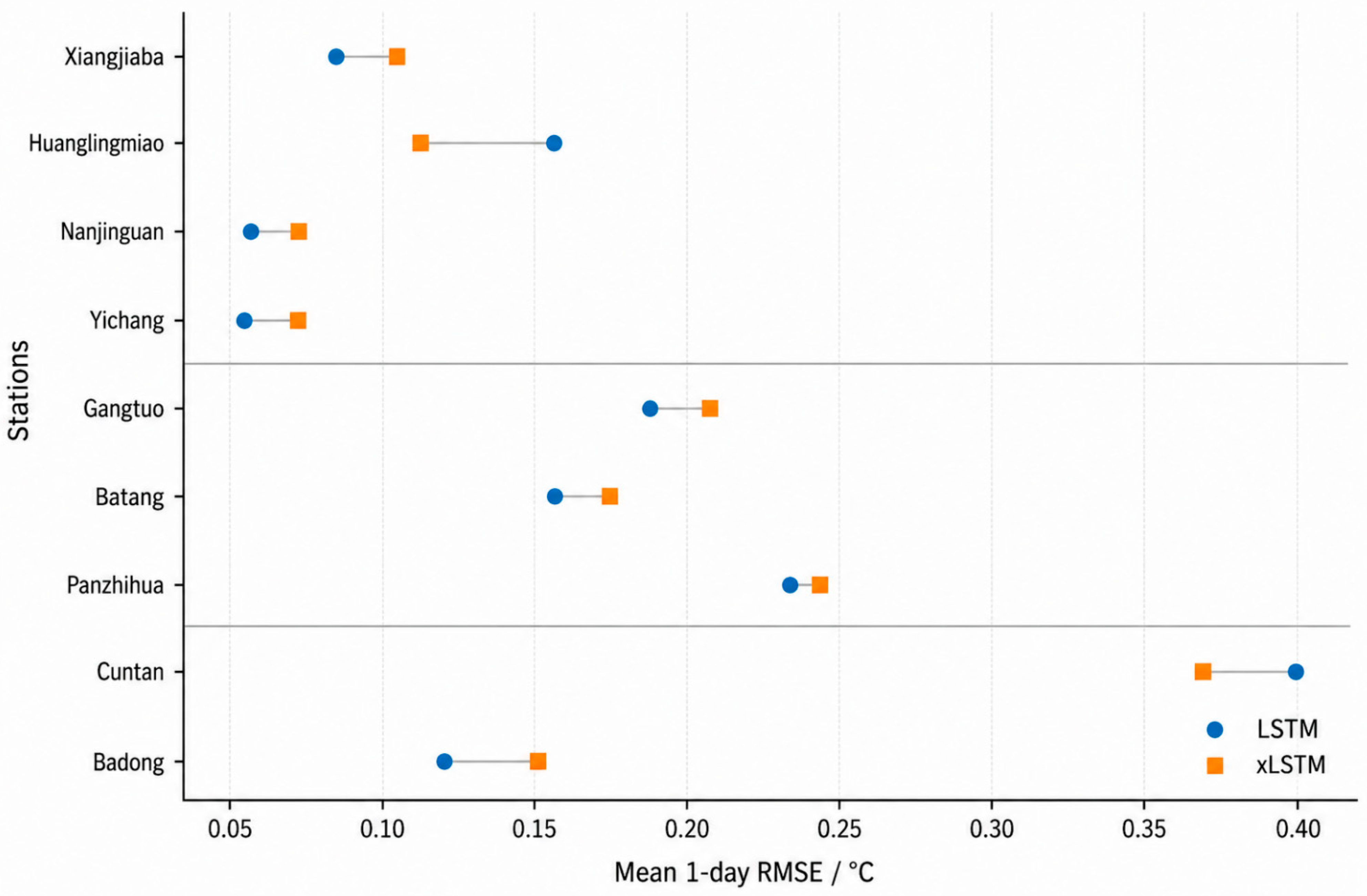
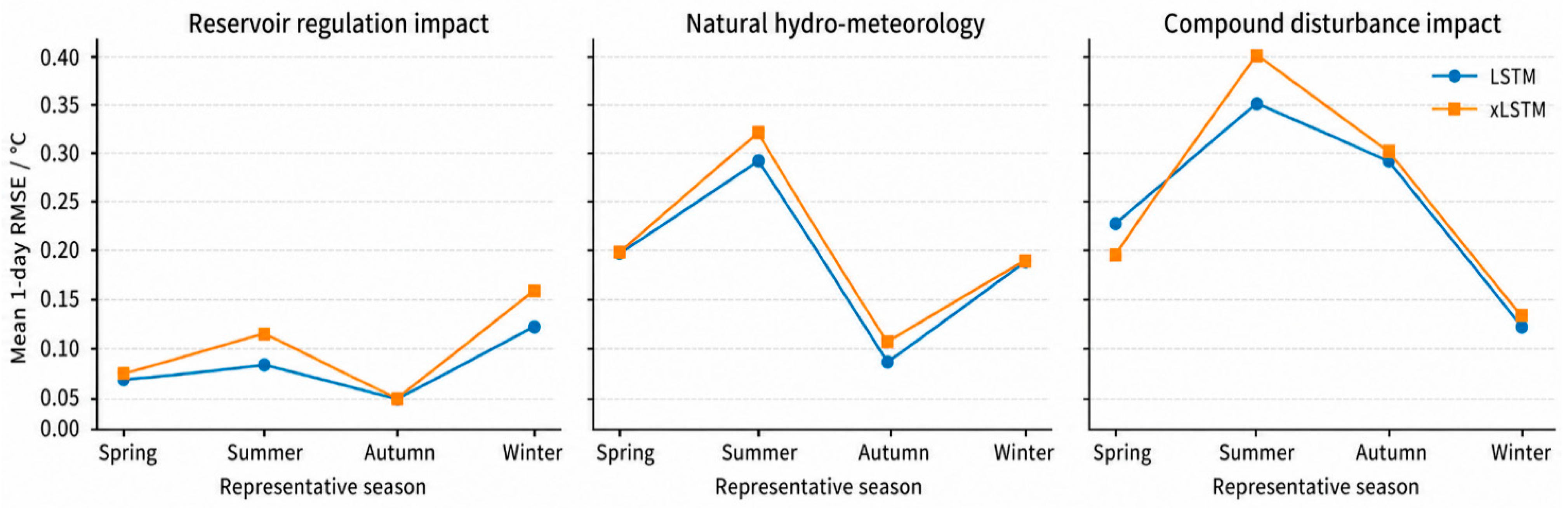
- Under the no-discharge scheme, the validation-set RMSE, MAE, and R2 were 0.238 °C, 0.177 °C, and 0.938 for LSTM, and 0.248 °C, 0.186 °C, and 0.935 for xLSTM. The mean representative-date one-day-ahead RMSE was 0.160 °C for LSTM and 0.165 °C for xLSTM, compared with 0.183 °C for the persistence baseline. The corresponding reductions relative to the baseline were 12.9% and 10.2%. Across 972 matched no-discharge combinations, the xLSTM-minus-LSTM RMSE difference averaged 0.0049 °C (p = 0.200), showing that the overall difference between the two models was small. LSTM was slightly more stable on average, while xLSTM showed local advantages only at Huanglingmiao and Cuntan.
- (2)
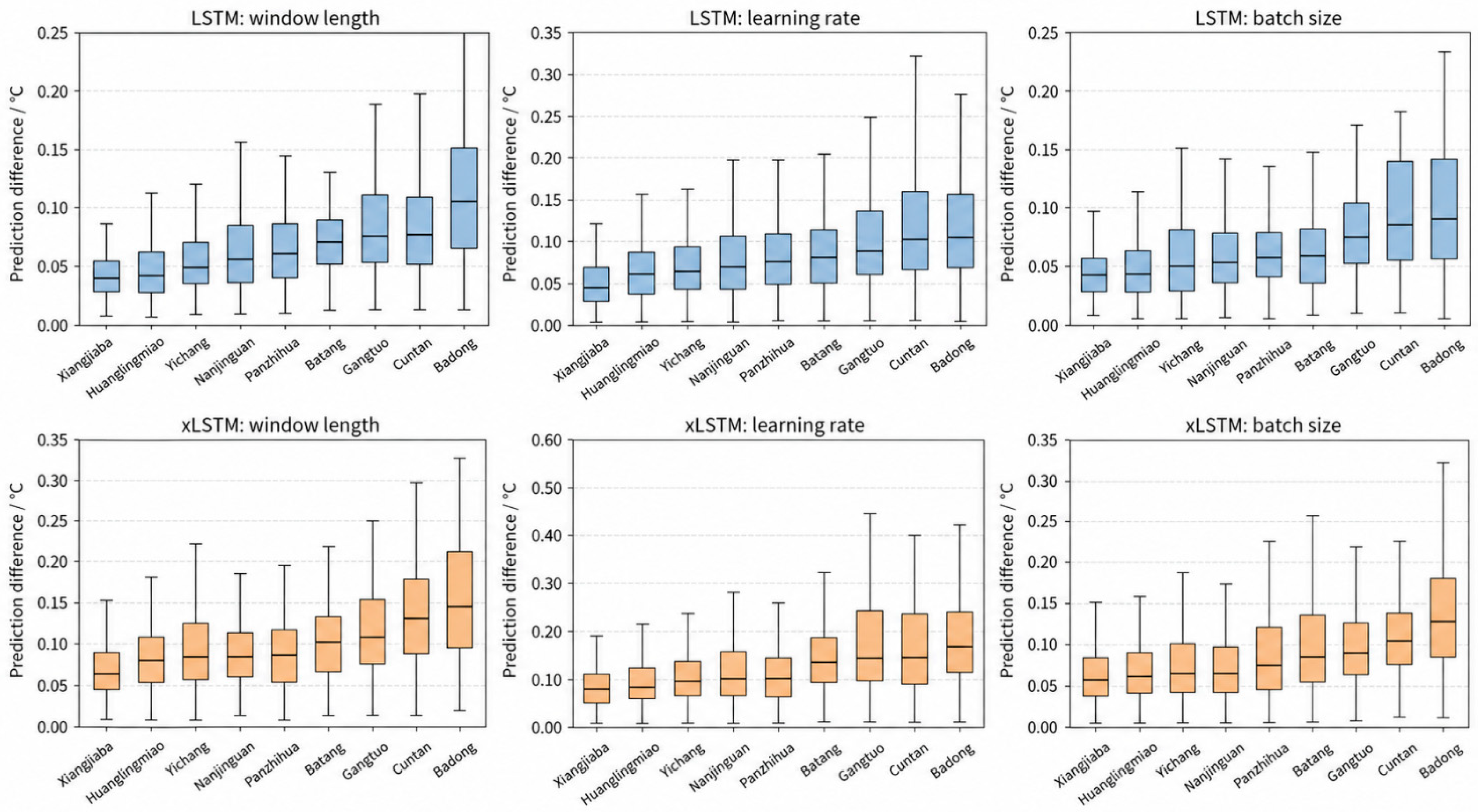
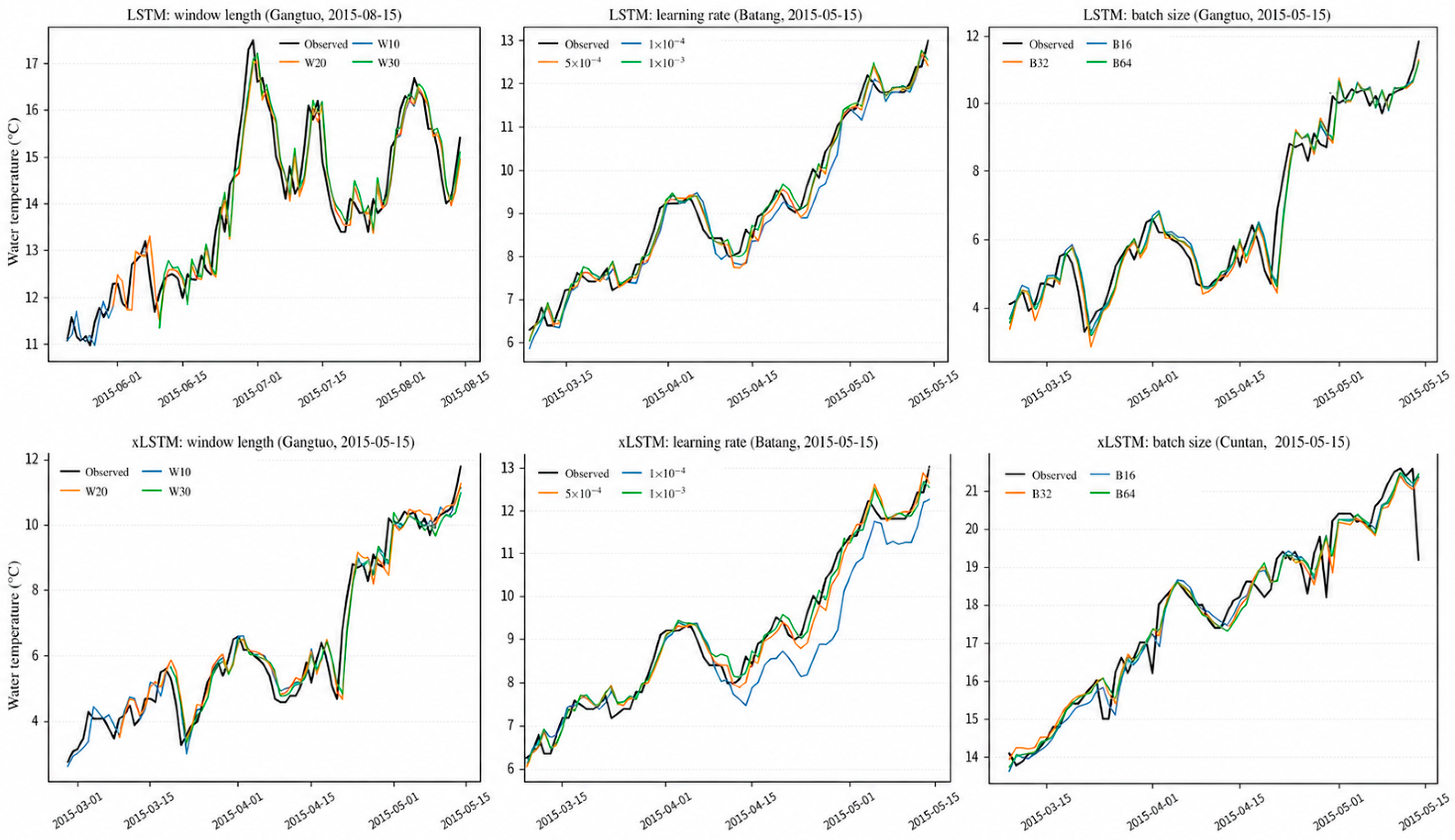
- Learning rate was the main training parameter affecting the predicted water-temperature series in both models. In the no-discharge validation set, the median predicted-temperature differences caused by changes in window length, learning rate, and batch size were 0.055, 0.077, and 0.056 °C for LSTM and 0.089, 0.102, and 0.073 °C for xLSTM. xLSTM showed larger parameter responses, especially to learning rate, indicating that training-parameter selection was more influential for this extended recurrent structure.
- (3)
- The grouping results showed that the reservoir regulation impact group had the lowest one-day-ahead errors, the natural hydro-meteorology group was intermediate, and the compound disturbance impact group was higher overall but showed clear within-group differences. The high error at Cuntan was consistent with the influence of reservoir-tail effects, tributary inflow, and urban-reach disturbance, whereas the relatively low error at Badong was consistent with reservoir impoundment, water-body thermal inertia, and slow-flow conditions that maintain daily water-temperature continuity. These process interpretations indicate plausible sources of error differences and can be refined with additional observations of tributary inflow, reservoir operation, local mixing, and urban heat inputs.
- (4)
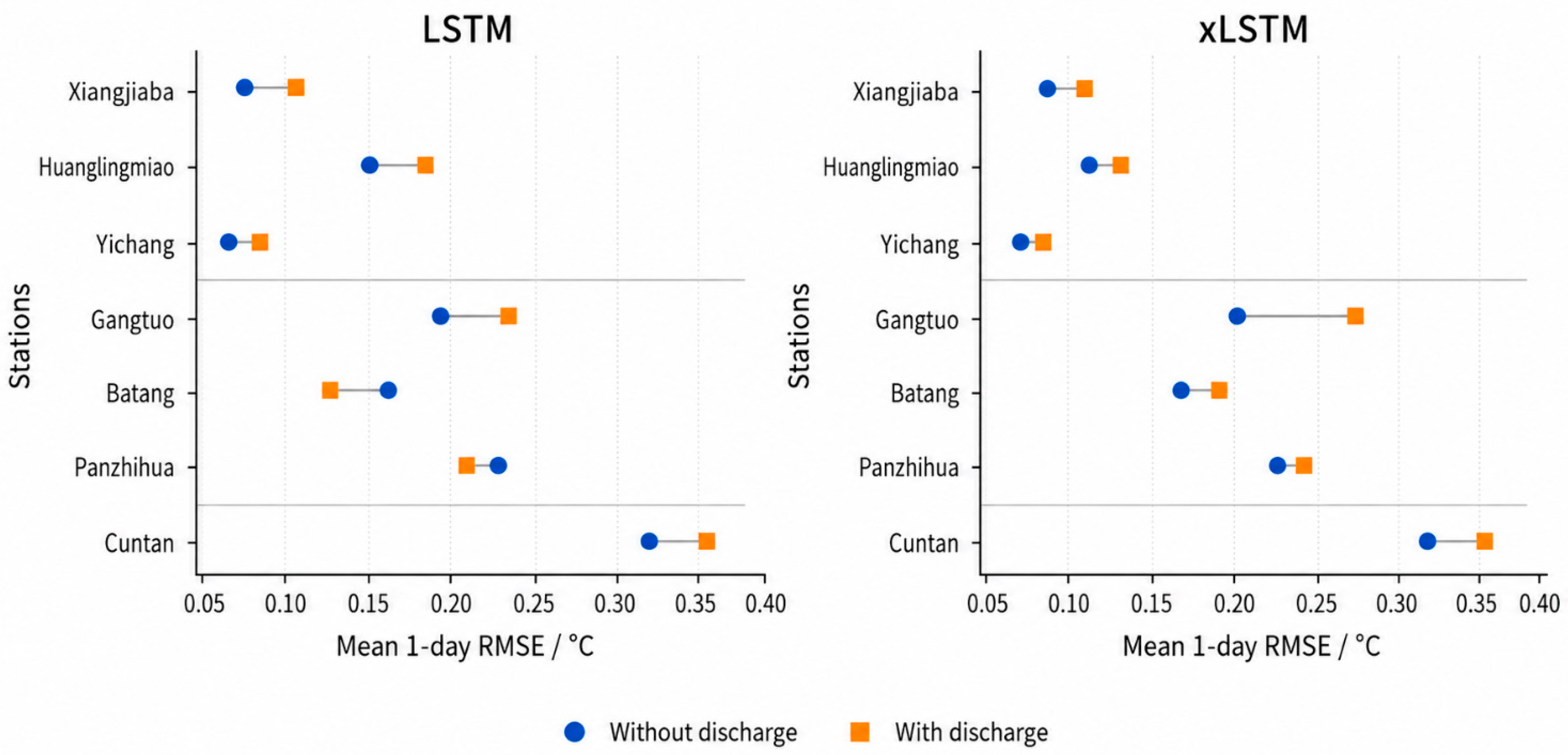
- The effect of discharge input was station- and model-dependent. For LSTM, adding discharge reduced mean RMSE at Batang, Panzhihua, and Huanglingmiao, while Gangtuo, Yichang, and Cuntan showed higher or similar errors. Across matched combinations, the average LSTM change was only 0.0004 °C (p = 0.534). For xLSTM, the seven stations with discharge data all showed higher mean RMSE after discharge was added, and the paired comparison gave an average increase of 0.0216 °C (p = 0.002). The discharge-lag analysis showed that the strength and lag of the discharge–water-temperature relationship varied by station and season, with seasonal Spearman correlations ranging from −0.409 to 0.948. Discharge is therefore most useful when its variation reflects the inflow transport or mixing processes that control local water-temperature changes.
- (5)
- Process-informed input-variable selection provides a consistent basis for comparing multi-site water-temperature forecasts and interpreting error differences among stations and input schemes. Antecedent water temperature, air temperature, and discharge correspond to thermal inertia, atmospheric thermal forcing, and hydrodynamic transport, respectively. The results show that variable effectiveness should be considered together with station background, seasonal stage, and inflow thermal state. Future improvements in complex reaches may benefit from variables that describe radiation, wind speed, humidity, inflow temperature, tributary inflow, reservoir operation, and local heat sources more directly.
Author Contributions
Funding
Data Availability Statement
Conflicts of Interest
References
- Caissie, D. The thermal regime of rivers: A review. Freshw. Biol. 2006, 51, 1389–1406. [Google Scholar] [CrossRef] [Scilit]
- Poole, G.C.; Berman, C.H. An ecological perspective on in-stream temperature: Natural heat dynamics and mechanisms of human-caused thermal degradation. Environ. Manag. 2001, 27, 787–802. [Google Scholar] [CrossRef] [Scilit] [PubMed]
- Webb, B.W.; Hannah, D.M.; Moore, R.D.; Brown, L.E.; Nobilis, F. Recent advances in stream and river temperature research. Hydrol. Process. 2008, 22, 902–918. [Google Scholar] [CrossRef] [Scilit]
- Xie, Q.; Liu, Z.; Fang, X.; Chen, Y.; Li, C.; MacIntyre, S. Understanding the temperature variations and thermal structure of a subtropical deep river-run reservoir before and after impoundment. Water 2017, 9, 603. [Google Scholar] [CrossRef] [Scilit]
- He, T.; Deng, Y.; Tuo, Y.; Yang, Y.; Liang, N. Impact of the dam construction on the downstream thermal conditions of the Yangtze River. Int. J. Environ. Res. Public Health 2020, 17, 2973. [Google Scholar] [CrossRef] [Scilit] [PubMed]
- Zhang, J.Q.; Ma, J.; Xu, Y.Q.; Liu, D.F.; Wang, Z.P.; Tao, Z.Y.; Wei, H.; Xiao, R. Methods for predicting water temperature in data-scarce areas under different climate regions of China. Water Cycle 2025, 6, 259–271. [Google Scholar] [CrossRef] [Scilit]
- Ouellet, V.; St-Hilaire, A.; Dugdale, S.J.; Hannah, D.M.; Krause, S.; Proulx-Ouellet, S. River temperature research and practice: Recent challenges and emerging opportunities for managing thermal habitat conditions in stream ecosystems. Sci. Total Environ. 2020, 736, 139679. [Google Scholar] [CrossRef] [Scilit] [PubMed]
- Benyahya, L.; Caissie, D.; St-Hilaire, A.; Ouarda, T.B.M.J.; Bobée, B. A review of statistical water temperature models. Can. Water Resour. J. 2007, 32, 179–192. [Google Scholar] [CrossRef] [Scilit]
- Mohseni, O.; Stefan, H.G. Stream temperature/air temperature relationship: A physical interpretation. J. Hydrol. 1999, 218, 128–141. [Google Scholar] [CrossRef] [Scilit]
- Piccolroaz, S.; Calamita, E.; Majone, B.; Gallice, A.; Siviglia, A.; Toffolon, M. Prediction of river water temperature: A comparison between a new family of hybrid models and statistical approaches. Hydrol. Process. 2016, 30, 3901–3917. [Google Scholar] [CrossRef] [Scilit]
- Piotrowski, A.P.; Napiorkowski, J.J. Performance of the air2stream model that relates air and stream water temperatures depends on the calibration method. J. Hydrol. 2018, 561, 395–412. [Google Scholar] [CrossRef] [Scilit]
- DeWeber, J.T.; Wagner, T. A regional neural network ensemble for predicting mean daily river water temperature. J. Hydrol. 2014, 517, 187–200. [Google Scholar] [CrossRef] [Scilit]
- Zhu, S.; Nyarko, E.K.; Hadzima-Nyarko, M.; Heddam, S.; Wu, S. Assessing the performance of a suite of machine learning models for daily river water temperature prediction. PeerJ 2019, 7, e7065. [Google Scholar] [CrossRef] [Scilit] [PubMed]
- Feigl, M.; Lebiedzinski, K.; Herrnegger, M.; Schulz, K. Machine-learning methods for stream water temperature prediction. Hydrol. Earth Syst. Sci. 2021, 25, 2951–2977. [Google Scholar] [CrossRef] [Scilit]
- Qiu, R.; Wang, Y.; Rhoads, B.L.; Wang, D.; Qiu, W.; Tao, Y.; Wu, J. River water temperature forecasting using a deep learning method. J. Hydrol. 2021, 595, 126016. [Google Scholar] [CrossRef] [Scilit]
- Piotrowski, A.P.; Napiorkowski, M.J.; Napiorkowski, J.J.; Osuch, M. Comparing various artificial neural network types for water temperature prediction in rivers. J. Hydrol. 2015, 529, 302–315. [Google Scholar] [CrossRef] [Scilit]
- Qiu, R.; Wang, Y.; Wang, D.; Qiu, W.; Wu, J.; Tao, Y. Water temperature forecasting based on modified artificial neural network methods: Two cases of the Yangtze River. Sci. Total Environ. 2020, 737, 139729. [Google Scholar] [CrossRef] [Scilit] [PubMed]
- Tao, Y.; Wang, Y.; Wang, D.; Ni, L.; Wu, J. A C-vine copula framework to predict daily water temperature in the Yangtze River. J. Hydrol. 2021, 598, 126430. [Google Scholar] [CrossRef] [Scilit]
- Graf, R.; Aghelpour, P. Daily river water temperature prediction: A comparison between neural network and stochastic techniques. Atmosphere 2021, 12, 1154. [Google Scholar] [CrossRef] [Scilit]
- Weierbach, H.; Lima, A.R.; Willard, J.D.; Hendrix, V.C.; Christianson, D.S.; Lubich, M.; Varadharajan, C. Stream temperature predictions for river basin management in the Pacific Northwest and Mid-Atlantic regions using machine learning. Water 2022, 14, 1032. [Google Scholar] [CrossRef] [Scilit]
- Jiang, D.; Xu, Y.; Lu, Y.; Gao, J.; Wang, K. Forecasting water temperature in cascade reservoir operation-influenced river with machine learning models. Water 2022, 14, 2146. [Google Scholar] [CrossRef] [Scilit]
- Abdi, R.; Rust, A.; Hogue, T.S. Development of a multilayer deep neural network model for predicting hourly river water temperature from meteorological data. Front. Environ. Sci. 2021, 9, 738322. [Google Scholar] [CrossRef] [Scilit]
- Drainas, K.; Kaule, L.; Mohr, S.; Uniyal, B.; Wild, R.; Geist, J. Predicting stream water temperature with artificial neural networks based on open-access data. Hydrol. Process. 2023, 37, e14991. [Google Scholar] [CrossRef] [Scilit]
- Ikram, R.M.A.; Mostafa, R.R.; Chen, Z.; Parmar, K.S.; Kisi, O.; Zounemat-Kermani, M. Water temperature prediction using improved deep learning methods through reptile search algorithm and weighted mean of vectors optimizer. J. Mar. Sci. Eng. 2023, 11, 259. [Google Scholar] [CrossRef] [Scilit]
- Zhu, S.; Piotrowski, A.P. River/stream water temperature forecasting using artificial intelligence models: A systematic review. Acta Geophys. 2020, 68, 1433–1442. [Google Scholar] [CrossRef] [Scilit]
- Grbić, R.; Kurtagić, D.; Slišković, D. Stream water temperature prediction based on Gaussian process regression. Expert Syst. Appl. 2013, 40, 7407–7414. [Google Scholar] [CrossRef] [Scilit]
- Sun, J.; Di Nunno, F.; Sojka, M.; Ptak, M.; Luo, Y.; Xu, R.; Xu, J.; Luo, Y.; Zhu, S.; Granata, F. Prediction of daily river water temperatures using an optimized model based on NARX networks. Ecol. Indic. 2024, 161, 111978. [Google Scholar] [CrossRef] [Scilit]
- Ahmadi-Nedushan, B.; St-Hilaire, A.; Ouarda, T.B.M.J.; Bilodeau, L.; Robichaud, É.; Thiémonge, N.; Bobée, B. Predicting river water temperatures using stochastic models: Case study of the Moisie River (Québec, Canada). Hydrol. Process. 2007, 21, 21–34. [Google Scholar] [CrossRef] [Scilit]
- Graf, R.; Zhu, S.; Sivakumar, B. Forecasting river water temperature time series using a wavelet-neural network hybrid modelling approach. J. Hydrol. 2019, 578, 124115. [Google Scholar] [CrossRef] [Scilit]
- Heddam, S.; Ptak, M.; Sojka, M.; Kim, S.; Malik, A.; Kisi, O.; Zounemat-Kermani, M. Least square support vector machine-based variational mode decomposition: A new hybrid model for daily river water temperature modeling. Environ. Sci. Pollut. Res. 2022, 29, 71555–71582. [Google Scholar] [CrossRef] [Scilit] [PubMed]
- Segura, C.; Caldwell, P.; Sun, G.; McNulty, S.; Zhang, Y. A model to predict stream water temperature across the conterminous USA. Hydrol. Process. 2015, 29, 2178–2195. [Google Scholar] [CrossRef] [Scilit]
- Rahmani, F.; Appling, A.P.; Feng, D.; Lawson, K.; Shen, C. Identifying structural priors in a hybrid differentiable model for stream water temperature modeling. Water Resour. Res. 2023, 59, e2023WR034420. [Google Scholar] [CrossRef] [Scilit]
- Orozco López, E.; Kaplan, D.; Linhoss, A. Interpretable transformer neural network prediction of diverse environmental time series using weather forecasts. Water Resour. Res. 2024, 60, e2023WR036337. [Google Scholar] [CrossRef] [Scilit]
- He, Y.; Yang, X. A physics-informed deep learning framework for estimating thermal stratification in a large deep reservoir. Water Resour. Res. 2025, 61, e2025WR040592. [Google Scholar] [CrossRef] [Scilit]
- Hochreiter, S.; Schmidhuber, J. Long short-term memory. Neural Comput. 1997, 9, 1735–1780. [Google Scholar] [CrossRef] [Scilit] [PubMed]
- Zheng, T.G.; Wu, M.X.; Zhang, D.; Jin, J.; Lin, J.Q.; Sun, S.K. Simulating water temperature in reservoir using improved LSTM model. Trans. Chin. Soc. Agric. Eng. 2025, 41, 144–153. [Google Scholar] [CrossRef]
- Beck, M.; Pöppel, K.; Spanring, M.; Auer, A.; Prudnikova, O.; Kopp, M.; Klambauer, G.; Brandstetter, J.; Hochreiter, S. xLSTM: Extended long short-term memory. arXiv 2024, arXiv:2405.04517. [Google Scholar] [CrossRef] [Scilit]
- Pedregosa, F.; Varoquaux, G.; Gramfort, A.; Michel, V.; Thirion, B.; Grisel, O.; Blondel, M.; Prettenhofer, P.; Weiss, R.; Dubourg, V.; et al. Scikit-learn: Machine learning in Python. J. Mach. Learn. Res. 2011, 12, 2825–2830. [Google Scholar]
- Kingma, D.P.; Ba, J. Adam: A method for stochastic optimization. In Proceedings of the International Conference on Learning Representations (ICLR), San Diego, CA, USA, 7–9 May 2015. [Google Scholar]
- Paszke, A.; Gross, S.; Massa, F.; Lerer, A.; Bradbury, J.; Chanan, G.; Killeen, T.; Lin, Z.; Gimelshein, N.; Antiga, L.; et al. PyTorch: An imperative style, high-performance deep learning library. Adv. Neural Inf. Process. Syst. 2019, 32, 8024–8035. [Google Scholar] [CrossRef] [Scilit]
- Corona, C.R.; Hogue, T.S. Machine learning in stream and river water temperature modeling: A review and metrics for evaluation. Hydrol. Earth Syst. Sci. 2025, 29, 2521–2549. [Google Scholar] [CrossRef] [Scilit]
- Moriasi, D.N.; Arnold, J.G.; Van Liew, M.W.; Bingner, R.L.; Harmel, R.D.; Veith, T.L. Model evaluation guidelines for systematic quantification of accuracy in watershed simulations. Trans. ASABE 2007, 50, 885–900. [Google Scholar] [CrossRef] [Scilit]
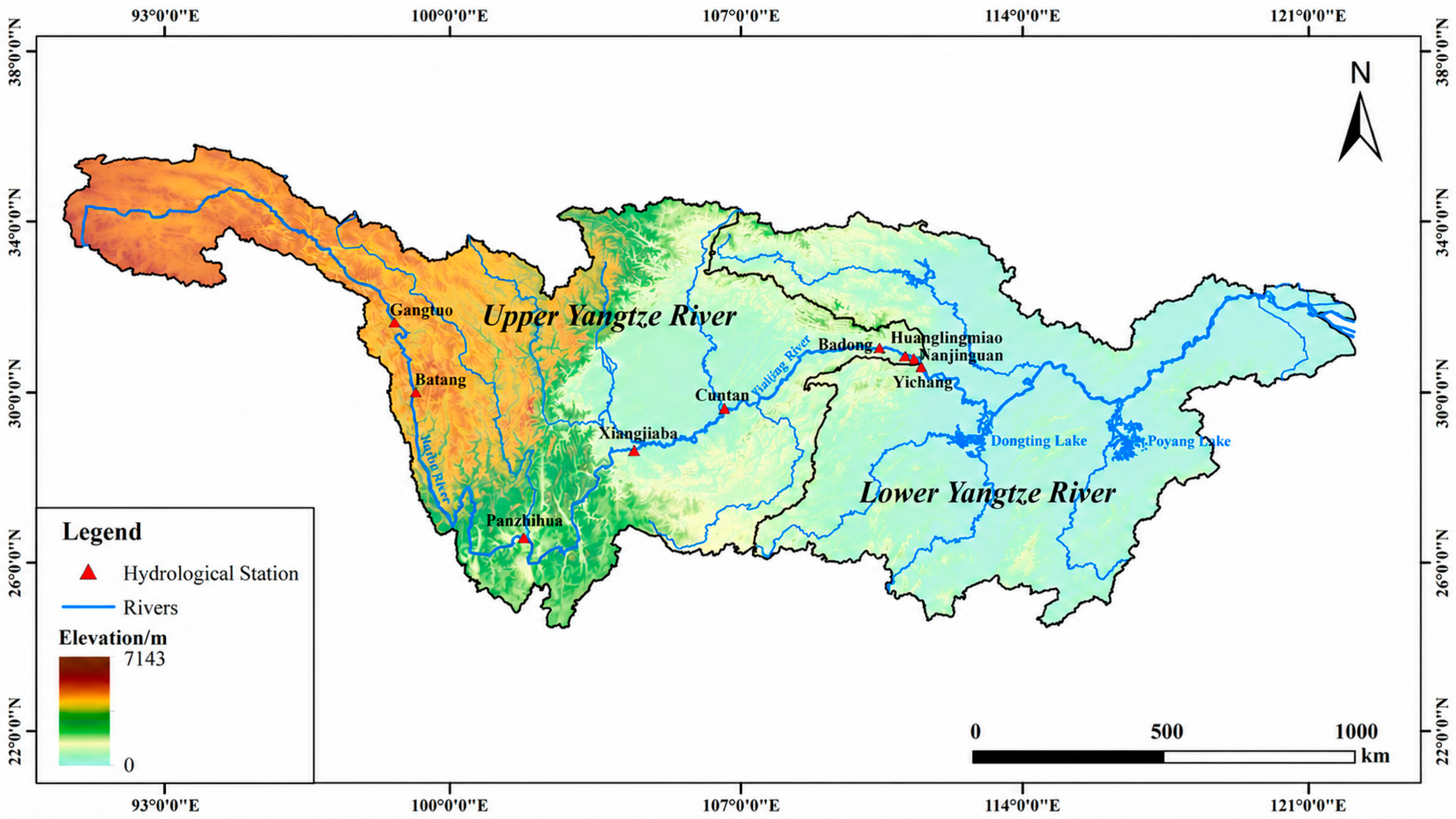




| Type of Influence | Stations | Main Background | Modeling Focus |
|---|---|---|---|
| Natural hydro-meteorology | Gangtuo, Batang, Panzhihua | Dominated by climate, elevation, inflow processes and natural water–air heat exchange; direct engineering regulation is relatively weak. | Examine the effects of water-temperature thermal inertia, seasonal transition and climatic differences on forecasting errors. |
| Reservoir regulation impact | Xiangjiaba, Huanglingmiao, Nanjinguan, Yichang | Affected by reservoir storage and release, released-water temperature, downstream mixing or reservoir-outlet processes, which may reshape the short-term continuity of the water-temperature series. | Analyze whether reservoir regulation enhances short-term thermal continuity and how regulation-induced smoothing affects model accuracy. |
| Compound disturbance impact | Cuntan, Badong | Cuntan is jointly affected by backwater near the reservoir tail, Jialing River inflow, urban shoreline activity and local hydrodynamics; Badong is influenced by the Three Gorges Reservoir, shoreline activity, reservoir thermal inertia and slow-flow conditions. | Compare forecasting errors and input-variable applicability under compound disturbance backgrounds and different local processes. |
| Item | Setting | Description |
|---|---|---|
| Model | LSTM, xLSTM | Both models used identical input variables, parameter-search space and training–validation split. |
| Input scheme | No discharge: air temperature, water temperature; with discharge: air temperature, water temperature, discharge | The no-discharge scheme covered nine stations, while the discharge-input scheme covered seven stations with available discharge data. |
| Input window | 10, 20, 30 d | Historical sequence length used to predict next-day water temperature. |
| Learning rate | 0.0001, 0.0005, 0.001 | Controls the step size of parameter updates in the Adam optimizer. |
| Batch size | 16, 32, 64 | Controls the number of samples used for each gradient update. |
| Training setting | epoch = 100, seed = 42, training:validation = 9:1 | Training and validation samples were split chronologically to avoid temporal leakage. |
| Seasonal representative dates | 15 February 2015, 15 May 2015, 15 August 2015, and 15 November 2015 | Represent winter low-temperature, spring warming, summer high-temperature and autumn cooling periods, respectively. |
| Model | Parameter | Median Difference/°C | Mean Difference/°C | 90th Percentile/°C | Maximum/°C | Low-Difference Station | High-Difference Station |
|---|---|---|---|---|---|---|---|
| LSTM | Batch size | 0.056 | 0.068 | 0.128 | 0.533 | Xiangjiaba (0.039) | Cuntan (0.090) |
| LSTM | Learning rate | 0.077 | 0.097 | 0.185 | 0.877 | Xiangjiaba (0.043) | Gangtuo (0.112) |
| LSTM | Window length | 0.055 | 0.066 | 0.126 | 0.377 | Xiangjiaba (0.033) | Gangtuo (0.105) |
| xLSTM | Batch size | 0.073 | 0.091 | 0.172 | 0.682 | Xiangjiaba (0.052) | Cuntan (0.123) |
| xLSTM | Learning rate | 0.102 | 0.136 | 0.254 | 1.475 | Xiangjiaba (0.068) | Panzhihua (0.163) |
| xLSTM | Window length | 0.089 | 0.104 | 0.187 | 0.611 | Xiangjiaba (0.057) | Gangtuo (0.144) |
| Seasonal Period | RMSE Statistic | XJB | HLM | NJG | YC | GT | BT | PZH | CT | BD |
|---|---|---|---|---|---|---|---|---|---|---|
| Spring warming | Mean | 0.034 | 0.150 | 0.068 | 0.064 | 0.219 | 0.143 | 0.211 | 0.441 | 0.080 |
| Maximum | 0.098 | 0.215 | 0.169 | 0.167 | 0.458 | 0.369 | 0.277 | 0.897 | 0.183 | |
| Minimum | 0.000 | 0.088 | 0.002 | 0.000 | 0.022 | 0.003 | 0.066 | 0.072 | 0.017 | |
| Summer high-temp. | Mean | 0.213 | 0.049 | 0.032 | 0.049 | 0.184 | 0.208 | 0.506 | 0.456 | 0.263 |
| Maximum | 0.270 | 0.146 | 0.081 | 0.154 | 0.310 | 0.328 | 0.576 | 0.541 | 0.480 | |
| Minimum | 0.164 | 0.001 | 0.000 | 0.001 | 0.061 | 0.106 | 0.448 | 0.376 | 0.097 | |
| Autumn cooling | Mean | 0.036 | 0.082 | 0.053 | 0.028 | 0.090 | 0.127 | 0.055 | 0.530 | 0.068 |
| Maximum | 0.086 | 0.136 | 0.141 | 0.064 | 0.191 | 0.210 | 0.146 | 0.725 | 0.127 | |
| Minimum | 0.000 | 0.025 | 0.005 | 0.006 | 0.000 | 0.005 | 0.006 | 0.417 | 0.005 | |
| Winter low-temp. | Mean | 0.062 | 0.280 | 0.084 | 0.079 | 0.260 | 0.151 | 0.159 | 0.156 | 0.081 |
| Maximum | 0.125 | 0.371 | 0.188 | 0.233 | 0.380 | 0.283 | 0.308 | 0.276 | 0.242 | |
| Minimum | 0.004 | 0.201 | 0.004 | 0.005 | 0.134 | 0.078 | 0.013 | 0.064 | 0.002 |
| Seasonal Period | RMSE Statistic | XJB | HLM | NJG | YC | GT | BT | PZH | CT | BD |
|---|---|---|---|---|---|---|---|---|---|---|
| Spring warming | Mean | 0.058 | 0.114 | 0.074 | 0.081 | 0.208 | 0.243 | 0.131 | 0.324 | 0.053 |
| Maximum | 0.124 | 0.201 | 0.227 | 0.468 | 0.480 | 1.017 | 0.329 | 0.722 | 0.209 | |
| Minimum | 0.003 | 0.041 | 0.002 | 0.000 | 0.001 | 0.001 | 0.003 | 0.009 | 0.003 | |
| Summer high-temp. | Mean | 0.229 | 0.081 | 0.052 | 0.064 | 0.220 | 0.187 | 0.581 | 0.419 | 0.406 |
| Maximum | 0.266 | 0.248 | 0.122 | 0.142 | 0.628 | 0.350 | 0.820 | 0.615 | 0.621 | |
| Minimum | 0.183 | 0.005 | 0.002 | 0.003 | 0.013 | 0.018 | 0.474 | 0.327 | 0.098 | |
| Autumn cooling | Mean | 0.033 | 0.049 | 0.082 | 0.048 | 0.061 | 0.156 | 0.119 | 0.556 | 0.058 |
| Maximum | 0.107 | 0.120 | 0.245 | 0.138 | 0.286 | 0.354 | 0.312 | 0.775 | 0.177 | |
| Minimum | 0.001 | 0.003 | 0.000 | 0.004 | 0.004 | 0.040 | 0.009 | 0.226 | 0.001 | |
| Winter low-temp. | Mean | 0.054 | 0.205 | 0.072 | 0.091 | 0.328 | 0.109 | 0.124 | 0.179 | 0.076 |
| Maximum | 0.198 | 0.321 | 0.191 | 0.248 | 0.529 | 0.334 | 0.310 | 0.334 | 0.219 | |
| Minimum | 0.004 | 0.035 | 0.017 | 0.015 | 0.103 | 0.014 | 0.006 | 0.045 | 0.006 |
| Group | Model | Mean RMSE | Standard Deviation | Minimum | Maximum |
|---|---|---|---|---|---|
| Reservoir regulation impact | LSTM | 0.085 | 0.077 | 0.000 | 0.371 |
| Reservoir regulation impact | xLSTM | 0.087 | 0.073 | 0.000 | 0.468 |
| Natural hydro-meteorology | LSTM | 0.193 | 0.132 | 0.000 | 0.576 |
| Natural hydro-meteorology | xLSTM | 0.206 | 0.178 | 0.001 | 1.017 |
| Compound disturbance impact | LSTM | 0.259 | 0.209 | 0.002 | 0.897 |
| Compound disturbance impact | xLSTM | 0.259 | 0.208 | 0.001 | 0.775 |
| Group | Station | LSTMΔRMSE | xLSTMΔRMSE | Interpretation |
|---|---|---|---|---|
| Reservoir regulation impact | Xiangjiaba | −0.000 | 0.019 | No improvement for either model |
| Reservoir regulation impact | Huanglingmiao | −0.003 | 0.013 | LSTM decreased; xLSTM did not improve |
| Reservoir regulation impact | Yichang | 0.006 | 0.002 | No improvement for either model |
| Natural hydro-meteorology | Gangtuo | 0.041 | 0.080 | No improvement for either model |
| Natural hydro-meteorology | Batang | −0.026 | 0.019 | LSTM decreased; xLSTM did not improve |
| Natural hydro-meteorology | Panzhihua | −0.017 | 0.009 | LSTM decreased; xLSTM did not improve |
| Compound disturbance impact | Cuntan | 0.002 | 0.009 | No improvement for either model |
| Group | Station | LSTM | xLSTM | Difference (xLSTM—LSTM) | Lower-Error Model |
|---|---|---|---|---|---|
| Reservoir regulation impact | Xiangjiaba | 0.086 | 0.093 | 0.007 | LSTM |
| Reservoir regulation impact | Huanglingmiao | 0.140 | 0.112 | −0.028 | xLSTM |
| Reservoir regulation impact | Nanjinguan | 0.059 | 0.070 | 0.011 | LSTM |
| Reservoir regulation impact | Yichang | 0.055 | 0.071 | 0.016 | LSTM |
| Natural hydro-meteorology | Gangtuo | 0.188 | 0.205 | 0.016 | LSTM |
| Natural hydro-meteorology | Batang | 0.157 | 0.174 | 0.016 | LSTM |
| Natural hydro-meteorology | Panzhihua | 0.233 | 0.239 | 0.006 | LSTM |
| Compound disturbance impact | Cuntan | 0.396 | 0.369 | −0.026 | xLSTM |
| Compound disturbance impact | Badong | 0.123 | 0.148 | 0.025 | LSTM |
| Model | Validation RMSE/°C | Validation MAE/°C | Validation R2 | Representative-Date One-Day-Ahead RMSE/°C |
|---|---|---|---|---|
| LSTM | 0.238 | 0.177 | 0.938 | 0.160 |
| xLSTM | 0.248 | 0.186 | 0.935 | 0.165 |
Disclaimer/Publisher’s Note: The statements, opinions and data contained in all publications are solely those of the individual author(s) and contributor(s) and not of MDPI and/or the editor(s). MDPI and/or the editor(s) disclaim responsibility for any injury to people or property resulting from any ideas, methods, instructions or products referred to in the content. |
© 2026 by the authors. Licensee MDPI, Basel, Switzerland. This article is an open access article distributed under the terms and conditions of the Creative Commons Attribution (CC BY) license.
Share and Cite
Ma, J.; Huang, H.; Liu, D.; Liu, Y.; Xu, Y. Thermal-Process-Informed Input-Variable Selection for Multi-Site Short-Term River Water-Temperature Forecasting in the Upper and Middle Reaches of the Yangtze River. Water 2026, 18, 1574. https://doi.org/10.3390/w18131574
Ma J, Huang H, Liu D, Liu Y, Xu Y. Thermal-Process-Informed Input-Variable Selection for Multi-Site Short-Term River Water-Temperature Forecasting in the Upper and Middle Reaches of the Yangtze River. Water. 2026; 18(13):1574. https://doi.org/10.3390/w18131574
Chicago/Turabian StyleMa, Jun, Hui Huang, Defu Liu, Ying Liu, and Yaqian Xu. 2026. "Thermal-Process-Informed Input-Variable Selection for Multi-Site Short-Term River Water-Temperature Forecasting in the Upper and Middle Reaches of the Yangtze River" Water 18, no. 13: 1574. https://doi.org/10.3390/w18131574
APA StyleMa, J., Huang, H., Liu, D., Liu, Y., & Xu, Y. (2026). Thermal-Process-Informed Input-Variable Selection for Multi-Site Short-Term River Water-Temperature Forecasting in the Upper and Middle Reaches of the Yangtze River. Water, 18(13), 1574. https://doi.org/10.3390/w18131574