Article

Hydrodynamic Mechanisms and Collaborative Optimization of Perforated Plate Grid Revetments: Integrating Flume Tests with LES

1
State Key Laboratory of Hydrology-Water Resources and Hydraulic Engineering, Nanjing Hydraulic Research Institute, Nanjing 210024, China
2
River and Harbour Engineering Department, Nanjing Hydraulic Research Institute, Nanjing 210024, China
3
Changjiang Institute of Survey, Design and Research, Wuhan 430010, China
4
Hubei Engineering Research Center for Ecological Waterway Technology, Wuhan 430010, China
*
Author to whom correspondence should be addressed.
Water 2026, 18(13), 1572; https://doi.org/10.3390/w18131572 (registering DOI)
Submission received: 17 January 2026 / Revised: 11 June 2026 / Accepted: 20 June 2026 / Published: 26 June 2026

Abstract

To mitigate the negative impacts of traditional rigid revetments on river ecosystems, this study focuses on perforated plate grid revetments, aiming to reveal the hydrodynamic mechanisms and parameter collaborative optimization pathways that simultaneously achieve anti-scour stability and ecological water exchange. A series of flume scour tests were conducted, combined with high-resolution large eddy simulation (LES) validated by experimental data, to systematically analyze the regulatory effects of key design parameters—such as opening ratio and longitudinal offset angle—on near-bottom flow velocity attenuation, vortex structures, and water exchange efficiency. The results indicate that a prototype parameter combination of 0.25 m grid height and 0.50 m plate grid spacing can reduce local scour depth by about 30% and enhance vertical exchange through the synergy of jetting from the openings and internal vortices. The longitudinal offset of adjacent holes may enhance the transverse water exchange but may also significantly reduce the longitudinal exchange intensity; hence, further research is needed. A hole-to-baffle height ratio greater than 0.40 is identified as a critical threshold for improving exchange efficiency. This study proposes a collaborative design framework in which grid spacing controls scour safety and aperture parameters regulate exchange functions, providing an experimental basis for the precise design and performance enhancement of ecological revetments.

1. Introduction

Global river ecosystems are increasingly threatened by climate change and intensive human activities, leading to the continuous degradation of ecological service functions and posing significant constraints on regional sustainable development [1]. The riparian zone, which forms the interface between aquatic and terrestrial ecosystems, plays a critical role in pollution buffering, hydrological regulation, and biodiversity maintenance [2,3]. However, traditional riverbank protection projects often rely on rigid engineering materials. Although such structures can ensure shoreline stability, they also disrupt water–soil exchange and reduce habitat diversity, thereby accelerating ecological degradation [4,5]. Consequently, developing riverbank protection technologies that simultaneously ensure engineering stability and ecological functionality has become a central challenge in river restoration.
The shallow-water riparian zone is particularly sensitive because of its unique hydrodynamic and habitat conditions. It serves as a key region for aquatic vegetation establishment and fish reproduction, and its ecological functions strongly depend on the stability of surface nutrient soil [6,7]. However, intense hydrodynamic activity in shallow areas frequently induces soil erosion, which may ultimately lead to the failure of ecological restoration projects [8]. An ideal ecological riverbank protection system must therefore mitigate erosion while maintaining sufficient water exchange. Achieving this balance requires a clear understanding of how structural configurations regulate nearshore hydrodynamics, including velocity distribution, turbulence structures, and mass exchange processes [9].
Perforated ecological riverbank structures allow partial flow penetration and can mimic the permeability and habitat complexity of natural riverbanks. Among these systems, the perforated plate grid revetment is a prefabricated modular structure that dissipates flow energy through internal partitions while allowing controlled water exchange through panel apertures. This configuration has the potential to enhance both bank stability and water exchange capacity [10,11]. However, existing studies have primarily evaluated such structures based on their macroscopic anti-erosion performance. Limited attention has been paid to how geometric parameters—such as opening ratio, aperture size, and spatial arrangement—quantitatively regulate near-bed flow structures, turbulence characteristics, and exchange efficiency. This knowledge gap restricts the refined design and engineering application of such systems [12].
From a fluid mechanics perspective, perforated plate grid revetments can be interpreted as engineered roughness elements embedded in the boundary surface, combining characteristics of porous structures and cavity-type roughness. Flow over such configurations typically exhibits shear-layer separation at aperture edges, cavity recirculation within the grid cells, and enhanced turbulence production. These processes are closely related to the classical turbulent boundary layers over rough surfaces. Previous studies have distinguished between k-type roughness, dominated by element height effects, and d-type roughness, where cavity recirculation shelters the wall and governs momentum exchange. Experimental and numerical studies on rough-wall and cavity flows have demonstrated that cavity geometry, spacing, and porosity strongly influence vortex formation, mixing efficiency, and sediment transport processes. Despite these advances—including the systematic classifications of d-type and k-type roughness [13], the analysis of roughness sublayer eddy structures [14], effective slope parameterization [15], the effective distribution concept [16], and the DNS of rod-roughened channels [17]—perforated ecological revetment systems have rarely been systematically analyzed within this roughness-flow framework, and the linkage between geometric parameters, turbulence structures, and ecological hydraulic functions remains insufficiently understood.
Physical model experiments remain the primary method for evaluating riverbank protection performance because they allow direct observation of scour patterns and measurement of time-averaged flow velocities [18,19]. However, experiments alone cannot non-destructively resolve high-resolution three-dimensional transient flow structures within cavities and near apertures, such as turbulent kinetic energy, vorticity distribution, and exchange flux. These quantities are key drivers of hydrodynamic and ecological processes [20,21]. Computational fluid dynamics (CFD), particularly large eddy simulation (LES), has demonstrated strong capability in resolving unsteady vortex structures and turbulence dynamics in complex hydraulic environments [22,23,24]. Nevertheless, systematic integration of LES diagnostics with physical experiments for perforated plate grid revetments remains limited.
The novelty of this study lies not only in evaluating structural parameters, but also in identifying a cavity–jet coupled hydrodynamic mechanism and proposing a hierarchical dual-objective design framework. In this framework, plate spacing is treated as the primary design variable ensuring scour safety, whereas aperture parameters (primarily the opening ratio φ) are optimized subsequently to regulate turbulence structure and water exchange intensity. To investigate this mechanism, this study integrates physical model experiments with high-resolution LES to analyze how geometric parameters influence near-bed velocity attenuation, turbulence generation, and exchange efficiency. The results aim to clarify the intrinsic relationships among structural geometry, flow structures, and functional performance, thereby providing theoretical support and practical guidance for the precise design and optimization of ecological riverbank protection systems.
It should be noted that the geometry used in the optimization stage differs from that of the physical experiments. This modification is intentional. After identifying the cavity–jet coupling mechanism in the validated experimental configuration, the optimization study adopts a simplified model that isolates the hydrodynamic interaction between two longitudinally adjacent cavities. This conceptual model reduces geometric complexity and enables controlled parametric analysis. In this framework, the opening ratio and longitudinal offset are selected as the primary variables because they directly govern jet penetration and inter-cavity exchange intensity. The simplified configuration preserves the essential flow physics while allowing systematic exploration of design sensitivity.

2. Materials and Methods

2.1. Scaled Physical Model Tests

To assess the scour resistance of perforated plate grid revetments and provide validation data for subsequent numerical simulations, standard physical model tests were conducted. Unlike traditional rigid revetments, the nutrient soil and cushion layer within this structure are directly exposed to water flow. Its primary design objective is therefore to suppress sediment scouring and maintain soil stability. Considering the pronounced three-dimensional flow characteristics near the structure, experiments were carried out in a long rectangular glass flume to investigate the influence of different grid clearances on bed scour patterns.
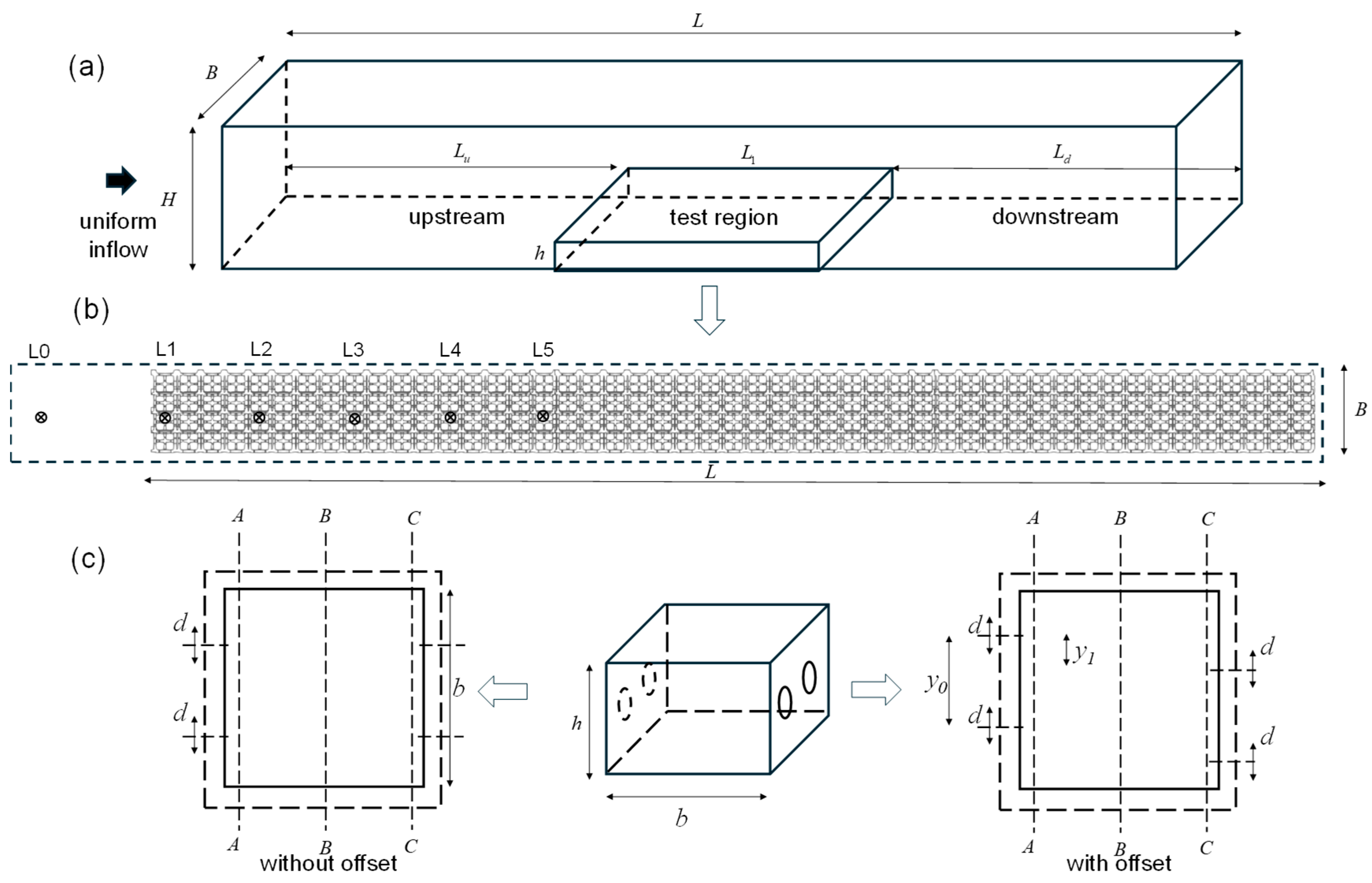
The experimental flume study was conducted to investigate a revetment optimization problem for a representative reach of the Yangtze River. The flume has a total length of 50 m, with the test section located in the middle (Figure 1). An 18 m upstream straight reach was reserved and equipped with flow-rectifying devices to ensure fully developed and stable inflow conditions. The physical model was constructed according to geometric similarity with the engineering prototype. Given the pronounced three-dimensional flow characteristics near the structure, an undistorted scale model was adopted ( λ L = λ H =   3) with a prototype grid height of h = 0.25 m. Similitude was established based on Froude similarity to preserve free-surface flow characteristics, yielding a velocity scale of λ v = λ L 1 / 2 = 1.732 . Key dimensionless parameters are summarized in Table 1. The model Reynolds number ( R e = U h / ν ) exceeds 1 × 10 4 , confirming fully turbulent flow conditions. The Froude number ( F r = U / g H ) is below 0.3 in both the model and prototype, validating the rigid-lid assumption adopted in the following numerical study. The model Shields parameter ( θ = τ b / [ ( ρ s ρ ) g d 50 ] ) falls within the mobile-bed range, confirming that scour processes are dynamically representative of prototype conditions.
Sediment incipient-motion similarity was satisfied using the Tang Cunben formula. The prototype sediment with a median diameter of d 50 = 0.18 mm and an incipient velocity of V c = 0.39 m/s corresponds to a model incipient velocity of V c , m = 0.23 m/s. Plastic sand with ρ s = 1.5 t/m3 and d 50 = 0.2 mm was selected to satisfy this criterion.
Bed deformation time scales were estimated using the Goncharov bed-load transport formula. The bed-load transport rate scale is λ g b = λ γ s λ d λ v = 1.53 , giving a morphological time scale of λ t , m = 13.6 . Accordingly, the 1.5 h scour test corresponds to approximately three days under prototype conditions. As the scour resistance tests focused primarily on comparative evaluation among configurations, absolute morphological reproduction was not required.

2.2. Measurement Methods and Data Analysis

Measurement points were deployed at key sections upstream, within, and downstream of the structure. Acoustic Doppler velocimetry (ADV) was used to monitor three-dimensional velocity distributions, while intermittent laser-based 3D topographic scanning captured the spatiotemporal evolution of scour pits. This enabled a systematic evaluation of the influence of grid clearance on scour resistance.

2.2.1. Hydrodynamic Parameter Measurement

Three-dimensional instantaneous velocities ( U x , U y , U z ) at critical grid locations were measured using a three-dimensional acoustic Doppler velocimeter (ADV). The sampling frequency was 50 Hz, and each point was recorded for at least 120 s to ensure statistical convergence of turbulence quantities. Water surface elevation and local water depth were measured simultaneously using calibrated rulers mounted along the side walls and a point-type wave gauge.

2.2.2. Quantitative Measurement of Bed Morphology

Bed erosion and deposition were quantified using two complementary approaches: (1) Profile sampling method: At ten pre-selected representative cross-sections, sediment samples were collected after each experiment. Following drying and weighing, the mass variation was converted into equivalent bed elevation change ( h s ). (2) Full-field topographic scanning: High-resolution 3D laser scanning was conducted before and after each test to generate digital elevation models (DEMs) of the bed surface. Differential analysis of the DEMs yielded spatial distributions of bed elevation change, from which local scour depth and scour volume were derived.

2.2.3. Data Processing and Uncertainty Analysis

Velocity time series were post-processed through signal-to-noise filtering, spike removal, and phase-space thresholding to eliminate measurement noise and outliers. Time-averaged velocity and root-mean-square (RMS) velocity components were computed from the processed data.
Measurement uncertainty arises from instrument accuracy, scanning resolution, and flow control stability. ADV measurement uncertainty after calibration was within ±1.5%. Elevation errors associated with point-cloud stitching and interpolation were limited to ±0.2 mm through repeated scanning and averaging. Flow rate fluctuations in the flume were maintained within ±1%.

2.3. Development and Validation of the CFD Framework

To investigate the flow structures and exchange processes around the perforated plate grid that are difficult to resolve experimentally, a three-dimensional LES framework was established based on the plate grid geometry used in the flume tests. To reduce computational cost while retaining the essential hydraulic characteristics of the experimental configuration, cyclic boundary conditions were applied at the inlet and outlet in the streamwise direction. Symmetry boundary conditions were imposed at the top, front, and back boundaries, while all structural surfaces were treated as solid walls. Under this framework, the LES model was used to resolve the unsteady flow field within and around the perforated plate grid and to provide the basis for subsequent hydrodynamic analysis.
For the parametric analysis, only the key structural parameters controlling exchange intensity were varied, including the opening ratio, aperture size, and longitudinal offset angle between adjacent grid rows. The opening ratio is defined as
φ = d h
where d is the opening height and h is the total height of the panel. The longitudinal offset angle between adjacent grid rows is defined as
θ = a r c t a n y 1 b
where y 1 represents the lateral offset distance between adjacent apertures and b is the aperture spacing. Through this simplified configuration, the influence of key geometric parameters on water exchange efficiency can be systematically evaluated.

2.3.1. Computational Domain and Mesh Strategy

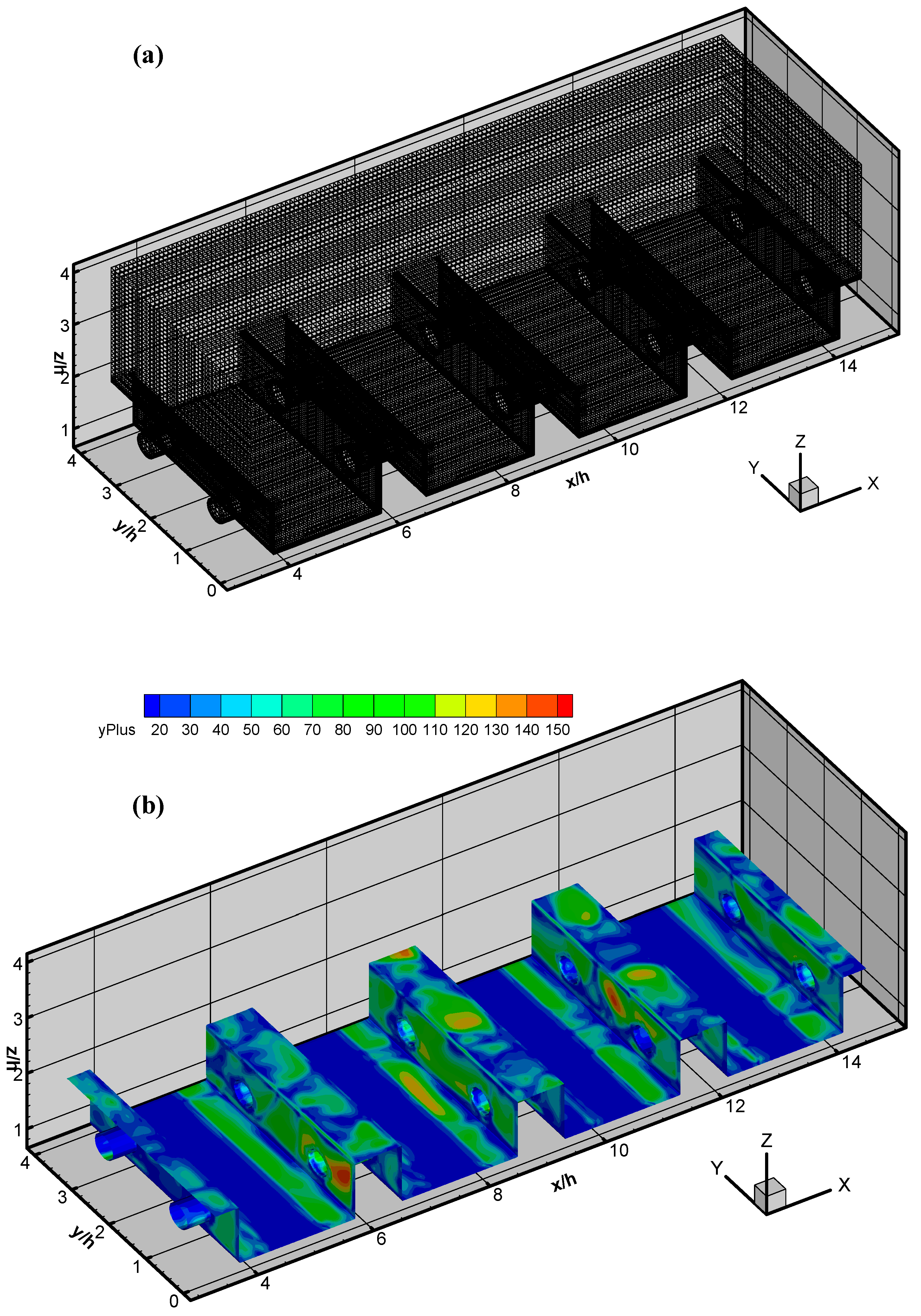
The computational domain was constructed from the principal geometric dimensions of the plate grid configuration used in the flume tests. To reduce computational cost while retaining the essential hydraulic characteristics of the experimental setup, cyclic boundary conditions were imposed in the streamwise direction, and symmetry boundary conditions were specified at the top, front, and back boundaries. All plate grid surfaces were treated as no-slip walls. A hybrid mesh strategy was adopted. The bulk-flow region was discretized using structured hexahedral cells with a base size of 5mm, whereas local refinement was applied around the perforations, cavity regions, and structural surfaces, where strong velocity gradients and recirculating flow structures were expected. The final mesh contained approximately 1 million cells. Mesh adequacy was assessed in viscous wall units. Owing to the local surface refinement, the mean wall y + remained close to 80, while Δ x + and Δ z + stayed within the generally accepted range for wall-modeled LES (WMLES). The adopted mesh therefore satisfied the resolution requirement for capturing the dominant near-wall and shear-layer dynamics of the present flow. A mesh visualization and the y+ distribution are shown in Figure 2.

2.3.2. Turbulence Model and Numerical Schemes

Large eddy simulation (LES) was employed to resolve the dominant unsteady vortical structures in and around the perforated plate grid. Prior to the final simulations, a comparative assessment between the WALE and standard Smagorinsky subgrid-scale models was conducted. The WALE model was ultimately selected because of its favorable near-wall behavior and its superior ability to represent separated shear flows and cavity recirculation, which are critical to the present configuration. Pressure–velocity coupling was handled using the PIMPLE algorithm implemented in OpenFOAM. The convective terms were discretized using a bounded central differencing scheme, while temporal integration employed a second-order implicit backward scheme. The time step Δ t was adjusted to maintain a maximum Courant number of 1, which resulted in values on the order of 1 × 10⁻³ s~5 × 10⁻³ s during the LES.

2.3.3. Initialization and Statistical Sampling

To initialize the LES, a steady-state SST k ω RANS simulation was first carried out, and the converged RANS flow field was then used as the initial conditions for the transient LES. This approach accelerated the development of the turbulent structures and shortened the initial adjustment period. The transient simulation was conducted for a total physical time of 80 s. Velocity time series at representative probe locations were monitored continuously to evaluate statistical stationarity. After the initial transient stage, the final 40 s of the simulation were used for time averaging and for the calculation of turbulence statistics. Variations in time-averaged velocity and turbulence intensity within the sampling window remained below 2%, indicating that the reported numerical results were statistically converged.

2.3.4. Model Validation

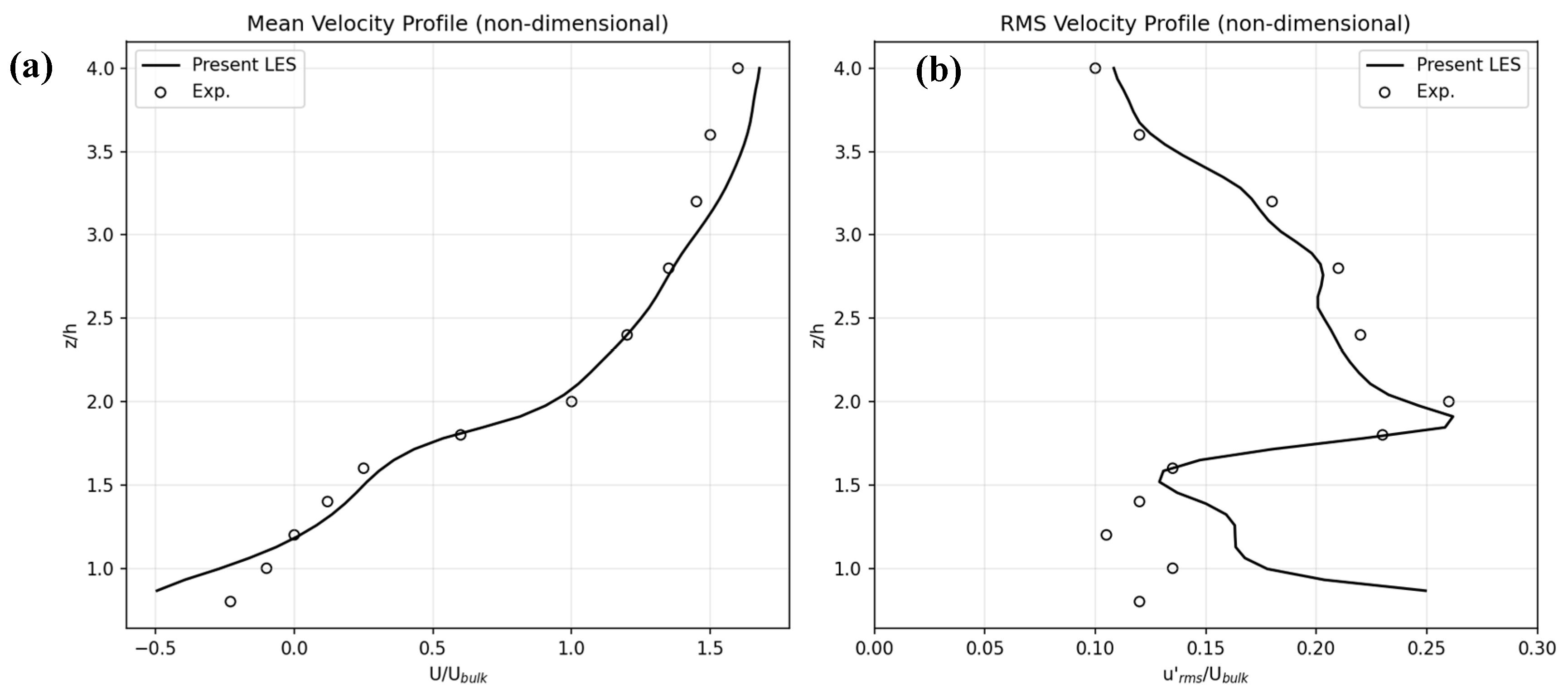
The CFD model was validated against the measured streamwise velocity profiles U x ( z ) and the root-mean-square streamwise velocity profiles u r m s , obtained from measurements in the flume experiment, as shown in Figure 3. Since periodic boundary conditions were employed in the CFD simulation to allow fully developed turbulence, the velocity data measured along line L5, which is located farthest downstream from the inlet of the test region, were selected for comparison. The comparison indicates that the LES framework successfully reproduces the main features of both the mean flow and the streamwise velocity fluctuation field, including the near-bed velocity attenuation within the plate grid zone and the localized enhancement of velocity fluctuations near the openings and cavity interfaces. The overall deviation between the numerical results and the experimental measurements is generally within 10%. A slight discrepancy is observed in the near-wall region (z/h < 0.5), which is due to the near-wall steep velocity gradient that challenges accurate resolution in LES. It should be noted that the ADV measurements obtained inside the plate grid cavities exhibited relatively lower mean velocities and turbulence intensities compared with the numerical results, which may be attributed to flow interference caused by the presence of the ADV probe under confined turbulent conditions. These results demonstrate that the numerical model provides an adequate representation of the hydraulic characteristics observed in the flume tests and can therefore be used for subsequent analysis of the internal flow structure and water exchange processes.

2.4. Integrated Study of Flume Tests and LES Numerical Simulation

An integrated study combining flume tests and LES numerical simulation was conducted to clarify the respective roles of plate spacing, baffle-hole height, and offset angle. The overall strategy was designed in three stages. First, a fixed plate height was selected, and scour tests were performed under different plate spacings without openings so that a scour resistance curve could be established and an appropriate spacing determined. Because anti-scour performance is the primary objective, spacing was treated as the main control parameter for bed stability. Second, under the selected spacing, LES was used to study how baffle-hole height affects water exchange capacity. The two key indices were the exchange capacity between adjacent cavities and the exchange capacity between the mainstream and the cavity, since baffle-hole height is the main factor governing exchange intensity and water exchange is a secondary objective. Third, the offset angle was examined qualitatively to assess its relative influence on lateral exchange and longitudinal exchange.

2.4.1. Flume Tests for Scour Resistance Curves

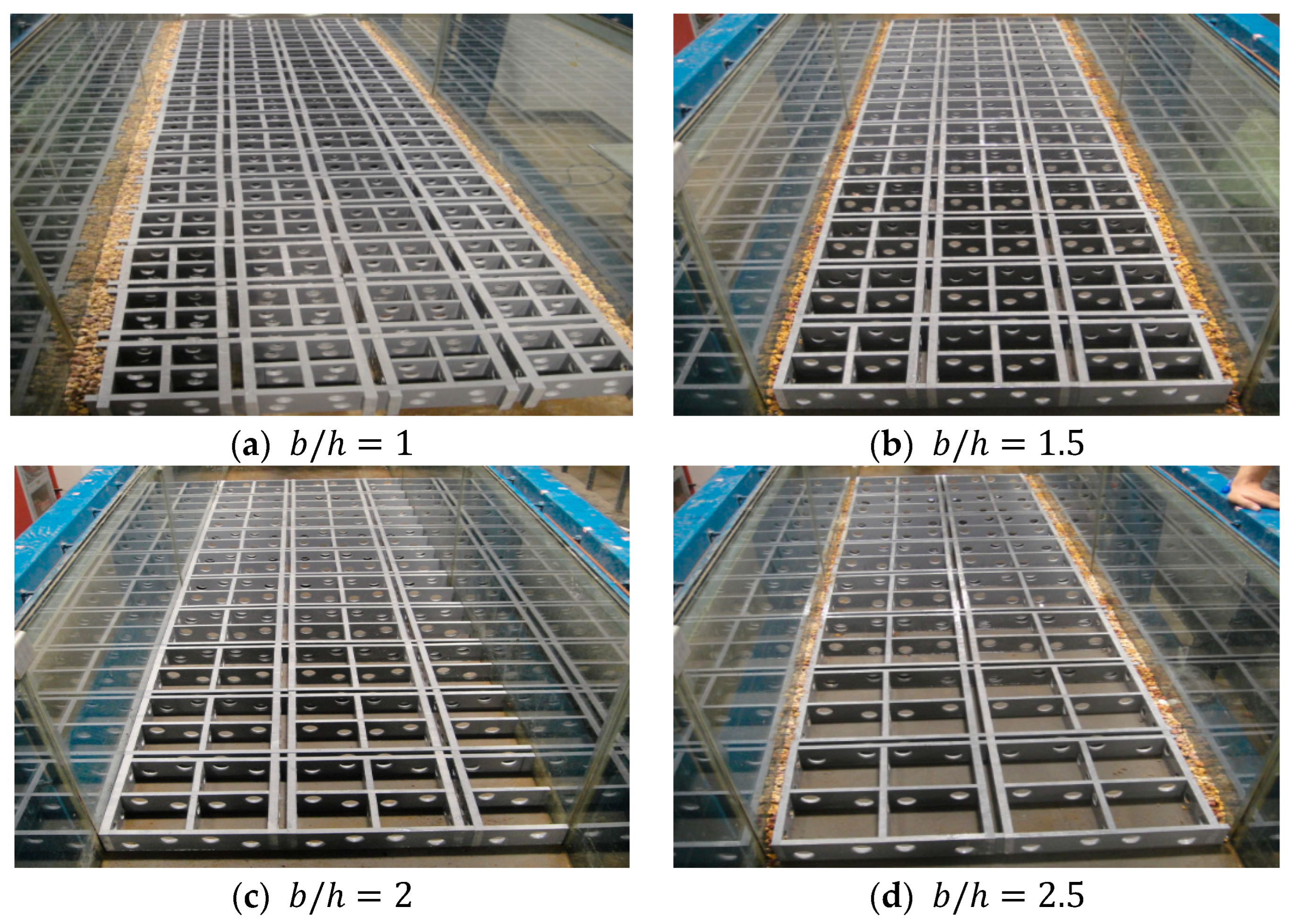
A series of non-perforated plate grid models with a fixed plate height and different inter-plate spacings were employed in the flume scour tests, as shown in Figure 4. The test region has a bedding thickness exceeding 20 cm (>30 times d50) to fully simulate semi-infinite bed conditions and eliminate bottom effects. All tests were conducted at a constant water depth of h = 0.4 m. A honeycomb flow straightener at the inlet and a tailgate at the outlet ensured fully developed turbulent flow conditions within the test zone. Inflow velocity, turbulence intensity, and water depth were rigorously calibrated prior to each test.

2.4.2. LES-Based Water Exchange Capacity Analysis

After an appropriate spacing had been identified from the scour tests, LESs were performed under that spacing to evaluate the water exchange performance associated with different baffle-hole heights. The geometric configuration was kept unchanged except for the baffle-hole height, which was varied systematically. This numerical stage focused on two exchange metrics: the exchange capacity between adjacent cavities, evaluated from the discharge flux through the baffle passage, and the exchange capacity between the mainstream and the cavity, evaluated from the exchange flow across the cavity opening. These metrics were used to clarify how baffle-hole height regulates exchange intensity while the scour-resistant spacing determined in the preceding stage was retained.
In the final stage, the offset angle was examined qualitatively. Rather than establishing a separate quantitative optimization criterion, this stage compared the flow patterns associated with different offset angles to assess their relative effects on lateral and longitudinal exchange. Accordingly, offset was treated as a secondary design adjustment that may be introduced when enhanced lateral mixing is required, but only after the plate spacing and baffle-hole height have been fixed on the basis of scour resistance and exchange performance.

3. Results

3.1. Results of Scour Resistance Optimization Tests

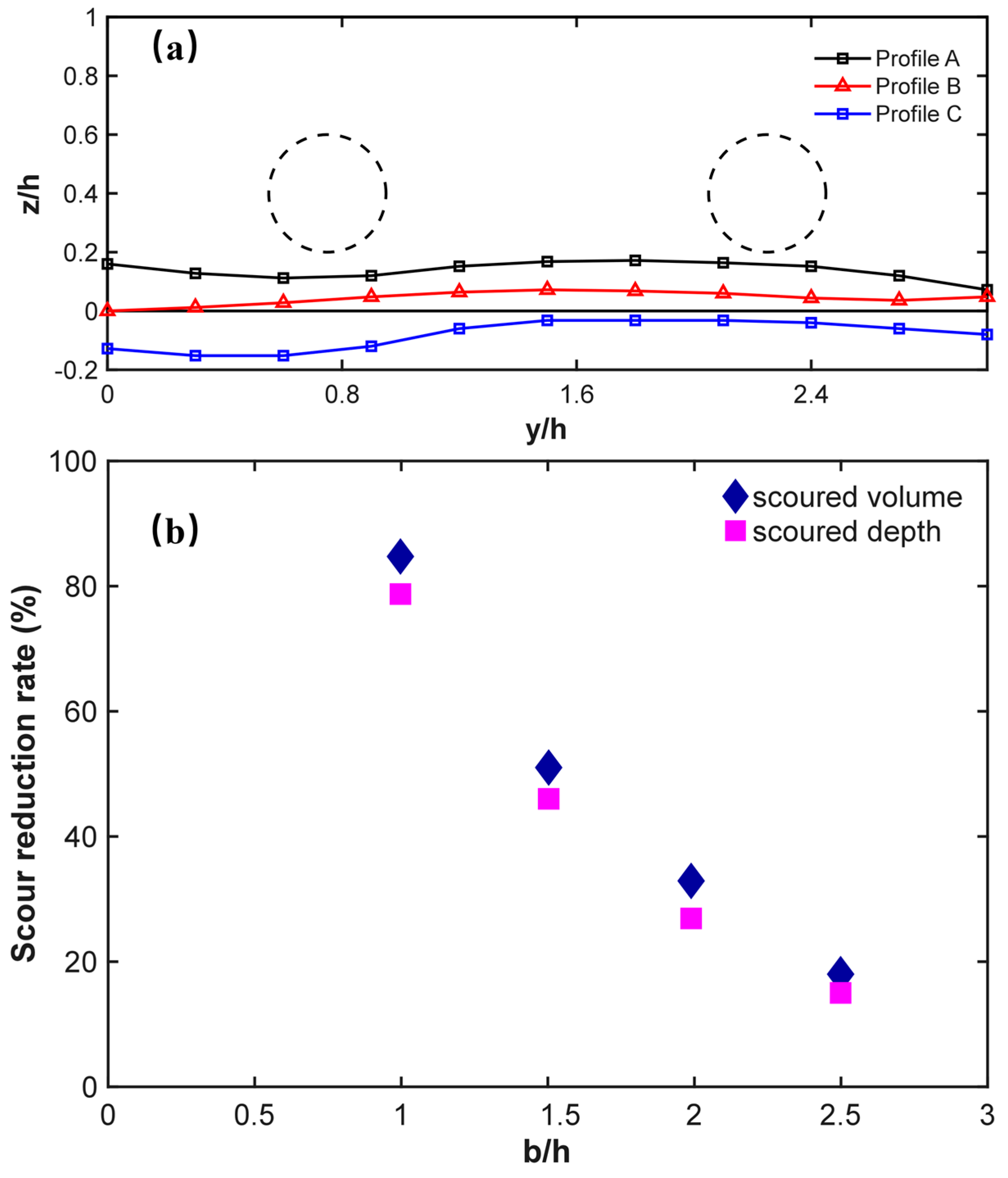
The results show that the perforated plate grid significantly altered the flow field structure and bed response in the shallow shore zone. Compared with the unprotected condition, the presence of the grid reduced near-bed flow velocity, weakened the intensity of local bed erosion, and improved the overall stability of sediment distribution. Differences among tested configurations were also evident. Variations in grid height, plate spacing, and opening ratio produced distinct effects on both scour control and water exchange performance. In general, excessively small openings limited flow exchange, whereas overly large openings tended to weaken the protective effect on the bed. The experimental observations, supported by LES analysis, further indicate that the flow within the structure was characterized by cavity recirculation and shear-layer separation near the plate edges, which together promoted momentum dissipation and water–sediment exchange. According to the flume test results shown in Figure 5, the perforated plate grid could reduce the scouring depth or volume by 20% to 80% for a scaled plate grid spacing varying between 1.0 and 2.5. As the plate grid spacing increased, the scour reduction rate gradually decreased. Hence, the medium plate grid spacing scenario, i.e., b / h = 2.0, was selected for the following study.

3.2. Results of Water Exchange Capacity Optimization Tests

The key parameters of the LES runs in the water exchange capacity optimization test are summarized in Table 2.

3.2.1. Flow Field Characteristics

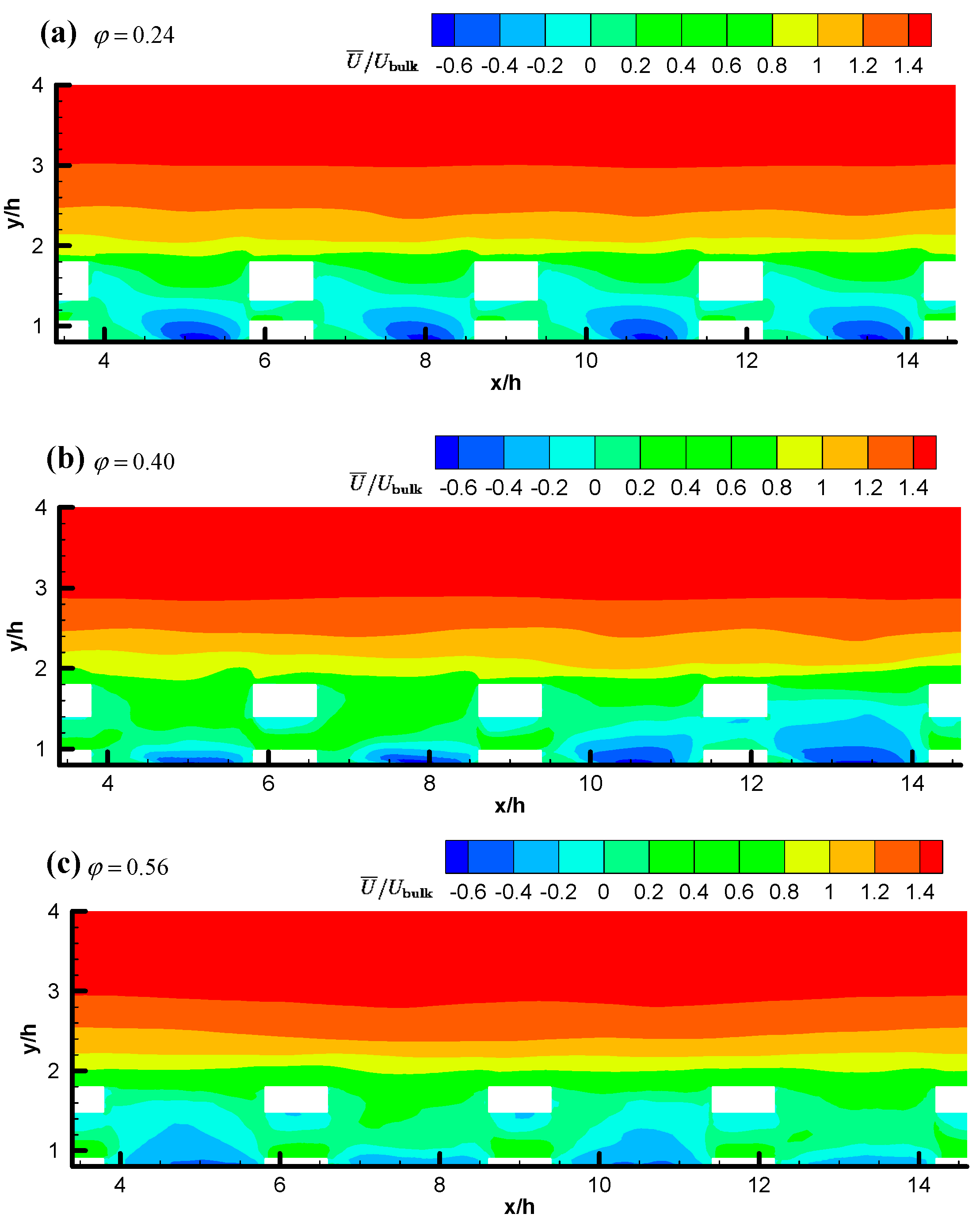
The time-averaged streamwise velocity field depicted in Figure 6, U x , ¯ shows that the external mainstream tends to intrude into the cavity; however, this intrusion does not directly control the flow through the baffle passage between adjacent cavities. Instead, the flow structure within the baffle passage is primarily governed by the splitting pattern of the vertical motion on the downstream side of the cavity at the passage entrance. As the baffle height increases, the thickness of the mainstream intrusion layer decreases, whereas the flow splitting at the opening becomes more organized. Consequently, enlarging the opening diameter is favorable for promoting water exchange between adjacent cavities. Overall, however, the section-averaged velocity within the baffle passage remains about one order of magnitude smaller than the mainstream velocity. Therefore, the exchange efficiency between adjacent cavities cannot be reliably inferred from the magnitude of U x alone.
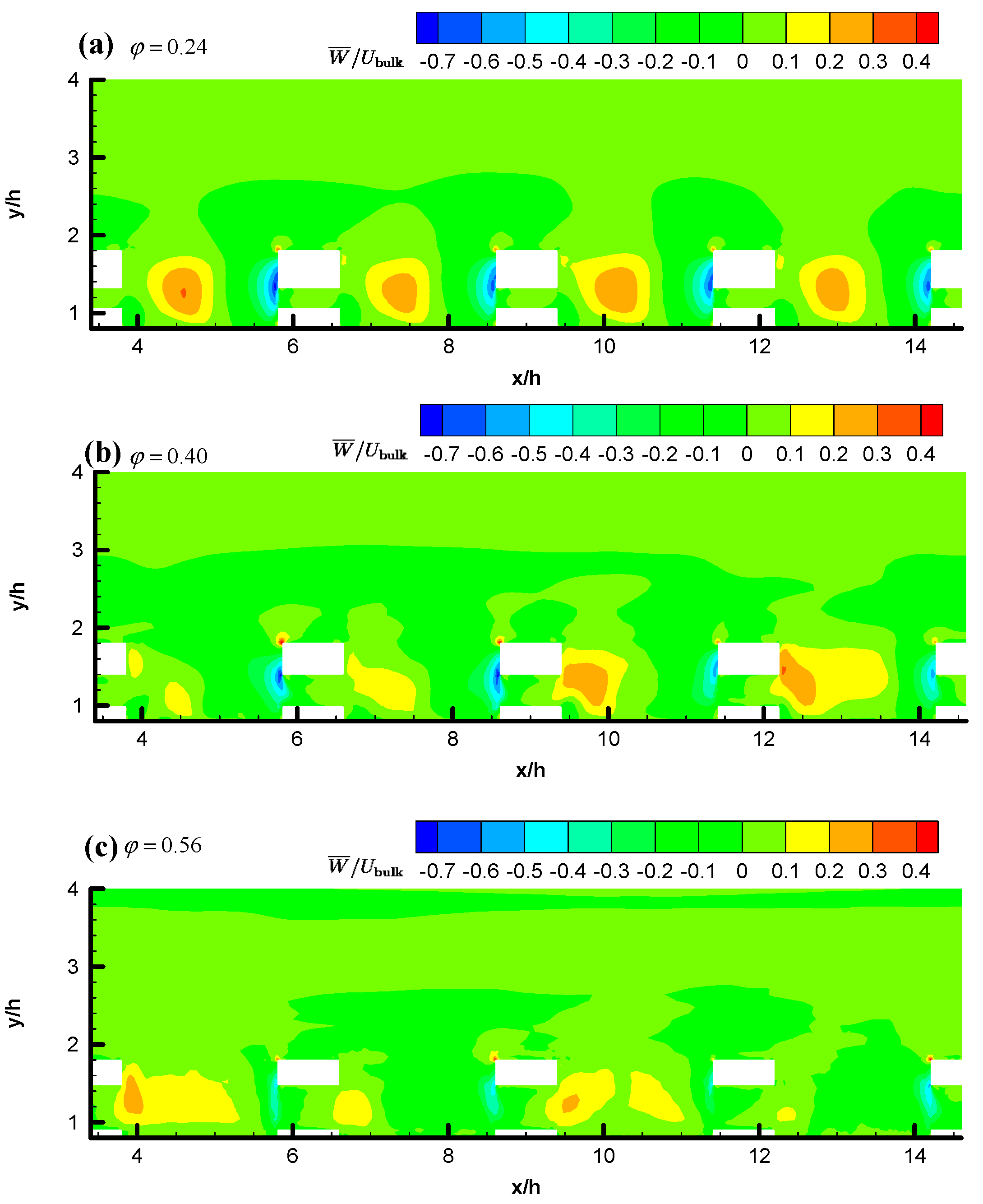
The time-averaged vertical velocity field ( U z ¯ ) indicates pronounced recirculating vortices inside the cavities for all tested cases, as shown in Figure 7. With increasing baffle height, the vortex core shifts toward the upstream side of the cavity interior, and the upward velocity in the vortex core region first increases and then decreases. The maximum upward velocity occurs at a nondimensional baffle height of 0.40. Only when the baffle height exceeds a critical threshold does the downward velocity on the downstream side of the vortex increase markedly, thereby enhancing flow splitting into the baffle passage.
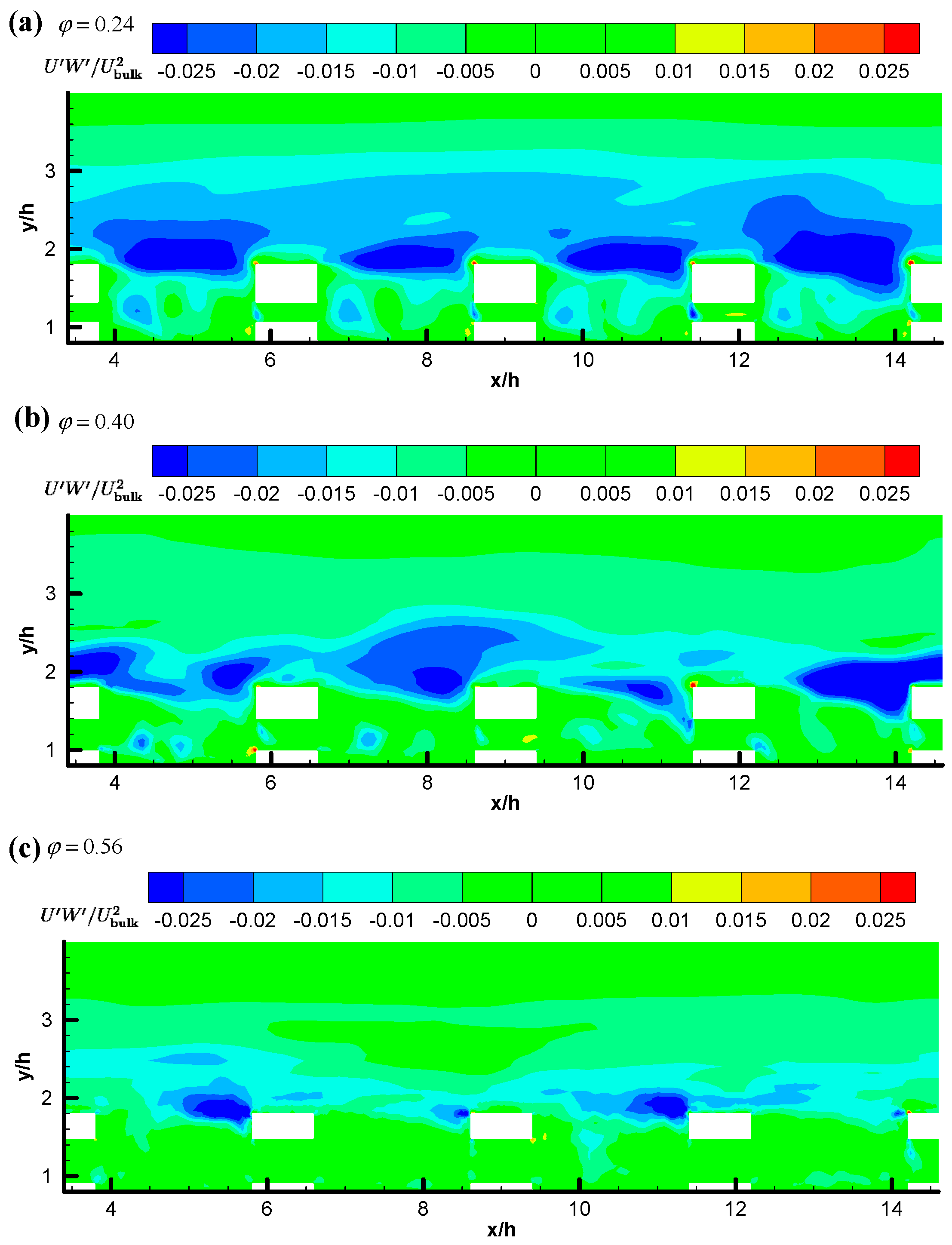
The Reynolds shear stress depicted in Figure 8, ρ U W ¯ , further shows that, with increasing baffle height, the peak value of ρ U W ¯ in the external shear layer decreases and the shear-layer thickness becomes smaller. This trend indicates a weakened exchange capacity between the mainstream and the cavity. It is noted that only at an intermediate opening ratio (φ ≈ 0.40) do localized secondary wake motions and shear-layer instabilities become slightly more pronounced, as reflected by a modest intensification of velocity gradients and localized shear-layer deformation near the baffle entrance. However, these effects remain secondary compared with the dominant cavity-scale recirculation, which continues to govern the overall transport dynamics. Accordingly, the flow system is best characterized as a recirculation-dominated cavity flow with weak, configuration-dependent shear-layer modulation.

3.2.2. Water Exchange Capacity Statistics

Both the instantaneous and mean flow fields indicate that the velocity distribution within the baffle passage is highly non-uniform. The water exchange capacity between adjacent cavities can therefore be quantitatively evaluated by recording the time series of x-direction discharge across the baffle-hole section and performing a statistical analysis of the resulting discharge fluctuations.
By contrast, the shear-layer flow between the cavity and the mainstream is relatively regular, consisting mainly of an upstream ascending-flow subzone and a downstream descending-flow subzone. The mean exchange capacity between the cavity and the mainstream can therefore be obtained by integrating the time-averaged vertical velocity over the cavity opening in the xz plane.
To quantitatively evaluate the exchange capacity between the adjacent cavities, a scaled instantaneous volumetric exchange flow parameter, Q ^ x ( t ) , is defined as:
Q ^ x ( t ) = A x U x ( y , z )   d A b h
where A x denotes the total opening surface area of a single grid unit (i.e., the circular perforation plane), and U x ( y , z ) is the velocity component normal to the opening surface. The exchange capacity between the cavity interior and the surrounding mainstream flow, represented by another scaled instantaneous volumetric exchange flow parameter, Q ^ z ( t ) , is defined as:
Q ^ z ( t ) = A z U z ( x , y )   d A b 2
where A z denotes the opening surface area of a single cavity between the lower layer ( z / h 1 ) and the upper layer ( z / h 1 ). The mean exchange flow over the statistical sampling period T is calculated as:
Q x ¯ = 1 T 0 T Q ^ x ( t )   d t
Q z ¯ = 1 T 0 T Q ^ z ( t )   d t
The formulation was developed with reference to previous cavity exchange studies by Valentine and Wood [25] and Weitbrecht et al. [26], while being adapted to the present permeable revetment configuration. Unlike the conventional first-order exchange coefficient framework, the present study directly evaluates the volumetric exchange intensity by integrating the time-averaged transverse velocity across the defined interface between the protected region and the main flow domain.
Table 3 presents the water exchange index values of the zero-offset LES runs. The results indicate that with increasing opening ratio, the mean inter-cavity exchange rate first increases and then decreases. In contrast, the mean cavity–mainstream exchange rate exhibits an overall decreasing trend, while tending to level off when the opening ratio exceeds a certain threshold. For the offset cases, a highly unsteady exchange flow field is observed, which will be discussed in the following section.

4. Discussion

4.1. Roughness Hydrodynamics and Flow Regime Classification

To frame the present findings within roughness hydrodynamics, the perforated plate grid revetment is interpreted as an engineered roughness element array with a fixed element height h. Following the framework of [13], the vertical distribution of Reynolds shear stress serves as a diagnostic for roughness regime classification: d-type roughness confines turbulence production within the cavity (z < h), while k-type roughness sustains elevated Reynolds stress well into the outer layer due to wake shedding.
The present LES results reveal a systematic dependence on the opening ratio φ. For the highest opening ratio (φ = 0.56), the core region of Reynolds shear stress ρ U W ¯   extends only to z ≈ 1.2h, indicating that turbulence production is largely confined near the cavity—a hallmark of d-type-like behavior. As φ decreases to 0.40, the extent increases to z ≈ 1.5–2.0h, suggesting a transitional regime. For the lowest opening ratio (φ = 0.24), the Reynolds stress core reaches z ≈ 2.0h, approaching k-type-like characteristics, where wake shedding from the plate tops enhances turbulence in the outer layer.
This opening-ratio-dependent transition can be interpreted within the framework of [15,16]. Lower opening ratios increase the effective solidity of the roughness array, promoting wake interference (k-type-like), whereas higher opening ratios enhance aperture jets that reinforce cavity recirculation but also dissipate turbulent energy within the cavity, limiting its outward propagation (d-type-like). The cavity–jet coupled pattern observed in all configurations—where aperture jets split the recirculation into two counter-rotating structures—represents a hybrid regime not present in classical d-type or k-type definitions. Nevertheless, the systematic variation in Reynolds stress extent with φ demonstrates that the roughness regime is not fixed but rather tunable via geometric design. This tunability is incorporated into the hierarchical optimization strategy presented in Section 4.2, where φ is optimized after spacing.
The stable rotating vortex observed inside the grids is consistent with flow structures reported in chlorine contact tanks equipped with perforated baffles [27]. LES studies have demonstrated that jets emerging from apertures penetrate recirculation zones behind solid baffles, transforming stagnant dead zones into active mixing regions. This jet penetration mechanism is directly analogous to the aperture-induced jet penetration into cavity recirculation observed here, which governs inter-cavity and cavity–mainstream water exchange. The consistency of these findings across chlorine contact tanks and the present perforated plate grid revetment confirms that cavity–jet coupling is a broader hydrodynamic principle relevant to perforated structures where controlled exchange between a confined cavity and a mainstream flow is desired.

4.2. Hierarchical Optimization Strategy

The results support a hierarchical optimization strategy for perforated plate grid revetments, in which scour resistance is treated as the primary design requirement and water exchange as a secondary ecological function. The opening ratio φ, which governs the transition between d-type-like and k-type-like regimes (Section 4.1), is treated as the secondary design variable optimized after spacing; its effect on roughness regime is characterized in Section 4.1, and its value is determined by the balance between flow resistance and ecological permeability, as discussed below.
Step 1: Plate spacing (scour resistance). In the first stage, the plate spacing was determined from flume scour tests conducted for non-perforated configurations with a fixed plate height. This step is physically justified because spacing primarily controls mainstream deceleration, cavity sheltering, and the resulting near-bed shear stress and therefore exerts the dominant influence on bed stability. Once a scour-resistant spacing was identified, the subsequent analysis could focus on exchange regulation without reintroducing unacceptable hydraulic risk. This design approach is also consistent with recent studies on permeable revetments and porous hydraulic structures [28,29,30,31,32].
Step 2: Opening ratio φ (exchange intensity and roughness regime). Under the selected spacing, the LES results show that the opening ratio φ is the principal parameter governing exchange intensity. The exchange process cannot be inferred from the streamwise mean velocity alone because the section-averaged velocity within the baffle passage remains much smaller than that of the mainstream. Instead, exchange is governed by the coupling between cavity recirculation and opening-induced flow splitting. The time-averaged vertical velocity field indicates that the internal vortex structure controls both the upward motion in the cavity interior and the downward motion on the downstream side of the vortex, which together determine the discharge partition into the baffle passage. Accordingly, the two exchange metrics adopted in this study serve complementary purposes: the cavity–adjacent cavity exchange capacity characterizes inter-cavity transfer through the baffle passage, whereas the cavity–mainstream exchange capacity characterizes vertical exchange across the cavity opening. Similar to permeability analyses in porous-media hydraulics [29,30], the present exchange metrics describe the dominant transport pathways within the cavity system.
A geometric threshold is observed in the exchange process. As the baffle-hole height increases, the vortex core shifts upstream and the upward velocity in the cavity first increases and then decreases, while the downward motion on the downstream side becomes substantially stronger only after the hole height exceeds a critical value. This behavior shows that exchange depends more strongly on the hole height ratio than on the mean streamwise velocity and therefore provides a more meaningful indicator of exchange efficiency. In the present study, a ratio greater than approximately 0.40 marks the onset of more effective exchange because it promotes both cavity–mainstream through-flow and the discharge splitting required for inter-cavity transfer. This threshold-type behavior is consistent with previous findings that pore morphology and aperture geometry strongly control permeability and local jet structures in porous flows [29,30]. The strong turbulent mixing near the opening is also consistent with aperture-induced jet and shear-layer structures reported in artificial reefs and other permeable hydraulic systems [30,31]. The results distinguish the hydraulic roles of the main geometric parameters. Plate spacing primarily controls scour resistance, whereas baffle-hole height primarily controls water exchange capacity. This separation simplifies the design procedure by reducing parameter coupling. In practice, spacing can first be selected from scour resistance requirements, after which the hole height can be adjusted to regulate exchange. This framework is consistent with the practical requirement that ecological enhancement should not compromise the primary anti-scour function of the revetment [28,31].
The aperture ratio itself also influences the balance between flow resistance and ecological permeability. Previous studies have shown that excessively small openings can suppress ecological exchange despite improving velocity attenuation, whereas excessively large openings weaken near-bed protection and increase local scour risk [28,31]. An intermediate opening ratio may therefore provide sufficient energy dissipation while maintaining exchange and limiting bed instability [29,31].
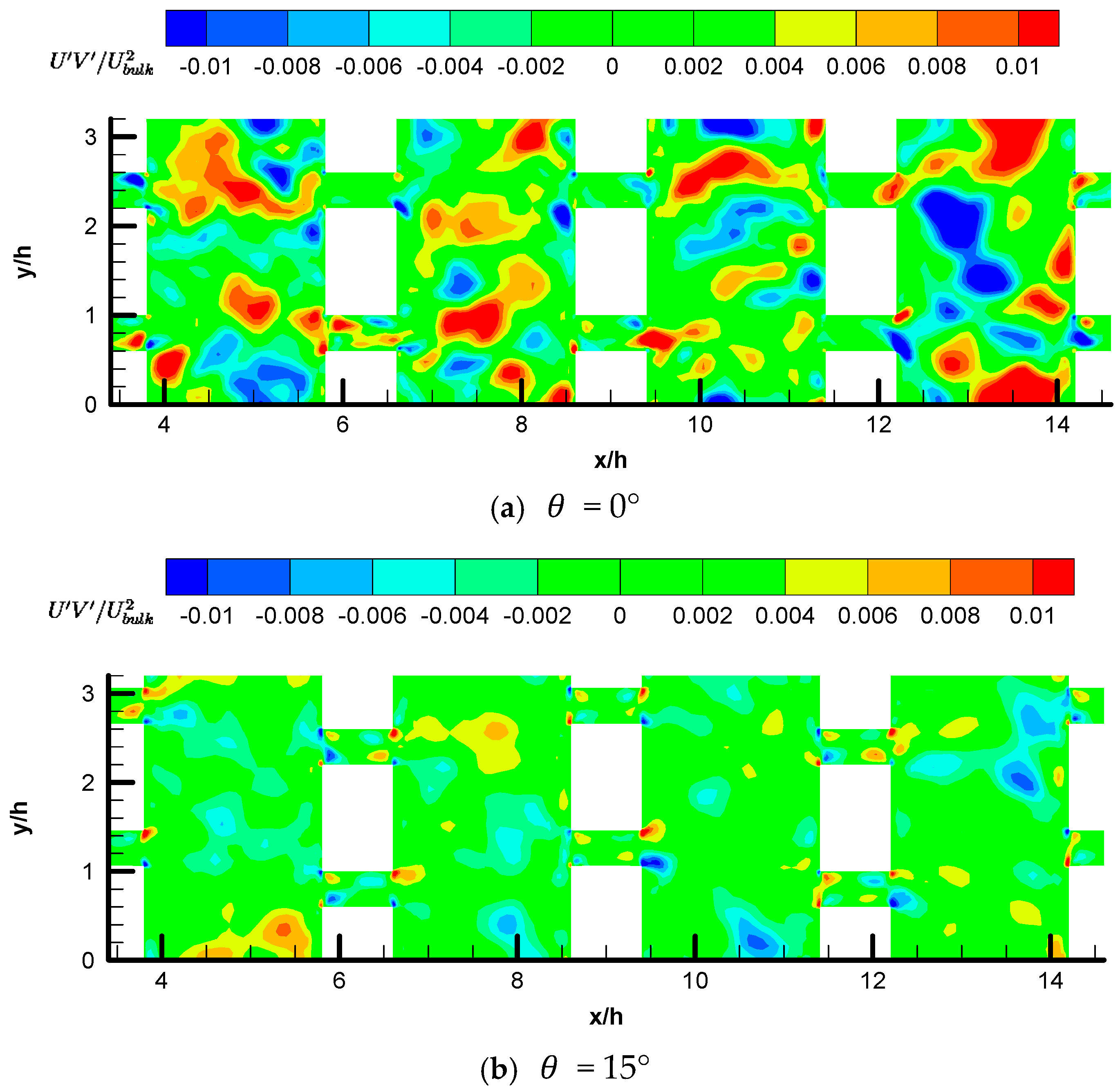
Step 3: Lateral offset (secondary adjustment). The effect of lateral baffle offset on turbulence structure is examined in Figure 9. The numerical results indicate that introducing a lateral baffle offset does not necessarily enhance lateral exchange. As shown in Figure 9, compared with the configuration without offset, the introduction of offset led to a reduction in the magnitude of the scaled ρ U V ¯ term, which represents the intensity of lateral shear fluctuations. In addition, the case without offset exhibited more pronounced transverse turbulent coherent structures. This suggests that the more regular spanwise arrangement of the non-offset configuration may favor the formation of stable lateral shear structures. In contrast, the introduction of offset may disrupt this organized flow pattern, thereby weakening the magnitude of   ρ U V ¯ . Nevertheless, the underlying mechanism remains unclear. This finding is consistent with the observation that, under shallow-water conditions dominated by longitudinal mainstream flow, maintaining aligned exchange pathways may be more beneficial than increasing structural complexity through staggered arrangements [32,33,34]. The present results suggest that the hydraulic effect of staggered layouts depends strongly on the surrounding flow regime and therefore requires case-specific evaluation [32,34]. Nevertheless, the detailed mechanism linking offset-induced asymmetry to coherent-structure suppression remains unclear and requires further investigation.
The present results are consistent with previous observations that vortex-induced mixing and shear-layer instability are the key mechanisms governing exchange in porous or cavity-type hydraulic structures [29,30,34]. The present study extends this understanding by distinguishing the hydraulic roles of spacing, hole height, and offset within a unified design framework. By combining flume scour tests with LES-based flow diagnostics, the study provides a mechanistic explanation of how structural geometry controls both bed protection and water exchange. The results further show that local turbulence structure and cavity circulation play an important role in regulating exchange processes. Compared with conventional impermeable revetments, the present configuration maintains hydraulic connectivity through controlled permeability [35].
Several limitations should nevertheless be acknowledged. First, the scour tests and LESs were conducted under steady, uniform flow conditions. Natural rivers, however, are subject to hydrograph variability, water-level fluctuation, and sediment heterogeneity. These factors may modify both the threshold behavior of exchange and the long-term evolution of bed morphology. Similar fluctuating-flow effects have been shown to influence dynamic responses and cavity oscillations in other ecohydraulic systems [36]. Second, the offset analysis was qualitative and based on a quasi-two-dimensional numerical framework, which means that the full three-dimensional structure of lateral mixing requires further verification. Third, the present study addressed hydrodynamic exchange only and did not directly couple solute transport, water quality, or benthic ecological response. Future work should therefore couple the present hydrodynamic framework with scalar transport or ecological models to evaluate exchange-driven transport processes more directly. In addition, long-term field-scale verification remains necessary to evaluate the long-term hydraulic and structural performance of the proposed structure under realistic environmental conditions, including wet–dry cycles, structural aging, and biological colonization processes.
Overall, the combined flume test and LES approach provides a consistent hydrodynamic basis for the design of perforated plate grid revetments. The results suggest that spacing should first be selected to satisfy scour resistance requirements, baffle-hole height should then be used to regulate cavity–cavity and cavity–mainstream exchange, and offset should be treated as a cautious secondary adjustment for redistributing lateral and longitudinal exchange. This hierarchical strategy offers a practical framework for balancing engineering safety and ecological connectivity in shallow-water revetment design.

5. Conclusions

This study integrates physical model experiments with LES to reveal the hydrodynamic mechanisms by which a perforated plate grid structure simultaneously achieves slope stabilization and water activation in shallow shore zones. From a fluid mechanics perspective, the perforated plate grid behaves as a d-type roughness system, characterized by stable recirculation within cavities and shear-layer separation at panel edges. This roughness-controlled flow mechanism explains the observed combination of near-bed velocity attenuation and enhanced exchange capacity. The results indicate that a prototype parameter combination of 0.25 m grid height and 0.50 m plate grid spacing can reduce local scour depth by about 30% and enhance vertical exchange through the synergy of jetting from the openings and internal vortices. The longitudinal offset of adjacent holes may enhance the transverse water exchange but may also significantly reduce longitudinal shear exchange intensity; hence, further research is needed. A hole-to-baffle height ratio greater than 0.40 is identified as a critical threshold for improving exchange efficiency. This study proposes a collaborative design framework in which grid spacing controls scour safety and aperture parameters regulate exchange functions, providing an experimental basis for the precise design and performance enhancement of ecological revetments.

Author Contributions

Conceptualization, Y.L. and Q.X.; methodology, Y.L. and Q.X.; software, Y.L.; validation, Y.L.; formal analysis and investigation, Y.L. and T.J.; writing—original draft preparation, Y.L.; writing—review and editing, Y.L., Q.X. and F.C.; visualization, Y.L. and T.J. project administration, Q.X. and Z.F.; funding acquisition, Z.F. All authors have read and agreed to the published version of the manuscript.

Funding

The Independent Innovation Funding Project of Changjiang Survey and Planning Design Research Co., Ltd. (CX2022Z05-1), and the Key Area Basic Research Funding of Central-level Public Welfare Scientific Research Institute (Y220011, Y224006).

Data Availability Statement

The data presented in this study are available on request from the corresponding author due to privacy.

Conflicts of Interest

The authors declare that the research was conducted in the absence of any commercial or financial relationships that could be construed as potential conflicts of interest.

References

  1. Grill, G.; Lehner, B.; Thieme, M.; Geenen, B.; Tickner, D.; Antonelli, F.; Babu, S.; Borrelli, P.; Cheng, L.; Crochetiere, H.; et al. Mapping the world’s free-flowing rivers. Nature 2019, 569, 215–221. [Google Scholar] [CrossRef] [PubMed]
  2. Arora, S.; Kumar, B. Effect of emergent vegetation on riverbank erosion with sediment mining. Sci. Rep. 2024, 14, 11193. [Google Scholar] [CrossRef] [PubMed]
  3. Labelle, L.; Baudron, P.; Barbecot, F.; Bichai, F.; Masse-Dufresne, J. Identification of riverbank filtration sites at watershed scale: A geochemical and isotopic framework. Sci. Total Environ. 2023, 864, 160964. [Google Scholar] [CrossRef] [PubMed]
  4. Li, S.; Yang, L.; Fang, J. Comprehensive evaluation of urban river ecological bank protection based on AHP-TOPSIS method. Environ. Technol. 2025, 46, 1201–1214. [Google Scholar] [PubMed]
  5. Gonçalves, C.; Verdelhos, T.; Caçador, I.; Oliveira, P.J.V.; Marques, D.; Veríssimo, H. Effectiveness of eco-engineering structures to promote sediment particles retention in estuarine salt marshes. Water 2023, 17, 678. [Google Scholar]
  6. Cheng, J.Z.; Berkowitz, J.F.; White, J.R. Trajectory of coastal wetland soil physical and microbial properties 6+ years after thin layer placement sediment amendment. Front. Ecol. Evol. 2023, 13, 1605785. [Google Scholar]
  7. Ławniczak-malińska, A. Effect of water level reduction on the littoral zone in terms of its efficiency in lake protection. Water 2023, 15, 5563. [Google Scholar] [CrossRef]
  8. Jiang, C.; Yang, Z.; Liu, C.; Dong, X.; Wang, X.; Zhuang, C.; Zhao, L. Win-win-win pathway for ecological restoration by balancing hydrological, ecological, and agricultural dimensions: Contrasting lessons from highly eroded agroforestry. Sci. Total Environ. 2021, 774, 145140. [Google Scholar] [PubMed]
  9. Xiao, Q.; Lu, Y.; Fu, Z.; Chen, F. Study on hydrodynamic characteristics of ecological slope protection structure with hole plate grid. In Proceedings of the 24th IAHR-APD Congress, Wuhan, China, 14–17 October 2024. [Google Scholar]
  10. Xu, Y.; Su, C.; Zhu, Q.; Yang, C.; Yang, Y. Field study of a new ecological slope protection method applied to expansive soil slope. Arab. J. Geosci. 2021, 14, 2871. [Google Scholar] [CrossRef]
  11. Cho, M.T.T.; Chueasamat, A.; Saito, H.; Kohgo, Y. Performance of filter gabion with pipe as a simple countermeasure against slope failures due to torrential rainfalls. In Proceedings of the 7th Asia-Pacific Conference on Unsaturated Soils (AP-UNSAT2019); Japanese Geotechnical Society Special Publication: Tokyo, Japan, 2019. [Google Scholar]
  12. Khan, S.; Melville, B.W.; Khan, M.M.; Shoaib, M.; Shamseldin, A. Effect of baffles on the hydraulic performance of sediment retention ponds. Water Sci. Technol. 2017, 75, 1991–1996. [Google Scholar] [PubMed][Green Version]
  13. Leonardi, S.; Orlandi, P.; Antonia, R.A. Properties of d- and k-type roughness in a turbulent channel flow. Phys. Fluids 2007, 19, 125101. [Google Scholar] [CrossRef]
  14. Castro, I.P.; Cheng, H.; Reynolds, R. Turbulence over urban-type roughness: Deductions from wind-tunnel measurements. Bound.-Layer Meteorol. 2006, 118, 109–131. [Google Scholar]
  15. De Marchis, M.; Saccone, D.; Milici, B.; Napoli, E. Large Eddy Simulations of Rough Turbulent Channel Flows Bounded by Irregular Roughness: Advances Toward a Universal Roughness Correlation. Flow Turbul. Combust. 2019, 105, 627–648. [Google Scholar]
  16. Bruno, F.; Leonardi, S.; De Marchis, M. Towards a new roughness parametrization through the effective distribution function. J. Fluid Mech. 2024, 999, A26. [Google Scholar] [CrossRef]
  17. Ashrafian, A.; Andersson, H.I.; Manhart, M. DNS of turbulent flow in a rod-roughened channel. Int. J. Heat Fluid Flow 2004, 25, 373–383. [Google Scholar] [CrossRef]
  18. Mazzarotto, G.; Camporese, M.; Salandin, P. Insights on Permeable Pavement Hydraulic Performance from Large-Scale Laboratory Experiments and Physically Based Modelling; European Geosciences Union General Assembly: Vienna, Austria, 2024; p. EGU24-19732. [Google Scholar]
  19. Oumeraci, H.; Staal, T.; Pfoertner, S.; Kudella, M.; Schimmels, S.; Verhagen, H.J. Hydraulic performance of elastomeric bonded permeable revetments and subsoil response to wave loads. In Proceedings of the 32nd International Conference on Coastal Engineering, Shanghai, China, 30 June–5 July 2010; p. 509. [Google Scholar]
  20. Das, V.K.; Hansda, S.; Debnath, K.; Chaudhuri, S. Riverbank stabilization based on the modulation of the near bank turbulence scales. Environ. Dev. Sustain. 2021, 23, 15290–15313. [Google Scholar] [CrossRef]
  21. Mulahasan, S.; Saleh, M.S.; Muhsun, S.S. Simulation of flow around a permeable dike using physical and 3D-CFD models. Int. J. River Basin Manag. 2023, 21, 53–65. [Google Scholar] [CrossRef]
  22. Liu, M.Y.; Huai, W.X.; Ji, B. Characteristics of the flow structures through and around a submerged canopy patch. Phys. Fluids 2021, 33, 035144. [Google Scholar] [CrossRef]
  23. Zhang, X.H.; Liu, B.Q.; Zhu, R.Y. Investigation on unsteady flow characteristics of an artificial-submerged cavitating jet based on the LES approach. Ocean Eng. 2025, 316, 119989. [Google Scholar]
  24. Wang Zy Li, S. Numerical simulation of cubic artificial reef under large eddy in passive scalar model. Oceanol. Limnol. Sin. 2021, 52, 1376–1387. [Google Scholar]
  25. Valentine, E.M.; Wood, I.R. Longitudinal dispersion with dead zones. J. Hydraul. Div. ASCE 1977, 103, 975–990. [Google Scholar] [CrossRef]
  26. Weitbrecht, V.; Socolofsky, S.A.; Jirka, G.H. Experiments on mass exchange between groin fields and main stream in rivers. J. Hydraul. Eng. 2008, 134, 1734–1741. [Google Scholar] [CrossRef]
  27. Tafarojnoruz, A.; Loprieno, P.; Fiorini Morosini, A.; Leone, E.; Francone, A.; Fella, N.; Lupo, F.; Dell’Anna, F.; Lauria, A.; Tomasicchio, G.R. CFD-Based Hydraulic Performance Improvement of a Chlorine Contact Tank: The Case Study of a Southern Italy Plant. Fluids 2025, 10, 328. [Google Scholar] [CrossRef]
  28. Wang, W.; Yan, J.; Chen, S.; Liu, J.; Jin, F.; Wang, B. Gridded cemented riprap for scour protection around monopile in the marine environment. Ocean Eng. 2023, 272, 113876. [Google Scholar] [CrossRef]
  29. Chabokpour, J. Experimental and analytical investigation of hydraulic conductivity, energy dissipation, and drag forces in gradually varied flow conditions through rockfill media. Adv. Res. Water Wastewater 2024, 11, 116–123. [Google Scholar]
  30. Maslov, D.; Pereira, E.; Duarte, D. Numerical analysis of the flow field and cross section design implications in a multifunctional artificial reef. Ocean Eng. 2023, 272, 113817. [Google Scholar] [CrossRef]
  31. Hayes, E.; Higgins, S.; Mullan, D.; Geris, J. High-resolution assessment of riverbank erosion and stabilization techniques with associated water quality implications. Int. J. River Basin. Manag. 2024, 22, 611–625. [Google Scholar]
  32. Fall, M.; Sarr, D.; Abdoulaye, S.O. Modelling and dimensioning of a natural riprap protection dike against coastal erosion on the Djiffère and Joal Spit. Int. J. Res. Rev. 2025, 12, 467–475. [Google Scholar] [CrossRef]
  33. Han, Z.; Xie, Y.; Zou, W. Hydromechanical responses of geogrid-reinforced expansive soil cutting slopes: Field monitoring and numerical simulation. Chin. J. Geotech. Eng. 2025, 47, 1757–1766. [Google Scholar]
  34. Xu, P.; Wang, L.; Xu, J.; Wang, Z.; Ahmerkamp, S.; Bartzke, G.; Wu, M.; Han, J.; Zhu, H. Effects of porous structures on point source dispersion across the sediment–water interface. AQUA 2024, in press. [Google Scholar] [CrossRef]
  35. Rathjens, H.; Miguez, M.B.; Winchell, M.; Sur, R. Evaluation of SEAWAVE–QEX in a high agricultural intensity catchment in Belgium. Integr. Environ. Assess. Manag. 2022, 19, 513–526. [Google Scholar] [CrossRef] [PubMed]
  36. Slavin, E.I.; Wain, D.J.; Bryant, L.D.; Amani, M.; Perkins, R.G.; Blenkinsopp, C.; Simoncelli, S.; Hurley, S. The effects of surface mixers on stratification, dissolved oxygen, and cyanobacteria in a shallow eutrophic reservoir. Water Resour. Res. 2022, 58, e2021WR030068. [Google Scholar] [CrossRef]
Figure 1. (a) Sketch of the experimental flume setup; (b) location of the velocity measurement profiles L0~L5 (top view); and (c) location of the scouring measurement profiles A, B, and C and three rows of one unit.
Water 18 01572 g001
Figure 2. (a) Overview of the computational mesh and (b) spatial distribution of y + on the perforated plate grid surface. Mean y+ ≈ 80.
Water 18 01572 g002
Figure 3. Comparison between LES simulated and experimentally measured: (a) mean velocity profile and (b) root-mean-square velocity profile.
Water 18 01572 g003
Figure 4. Photos of the physical model test flume for different plate spacing.
Water 18 01572 g004
Figure 5. (a) Measured scaled bed elevation in profiles A, B, and C (denoted in Figure 1) along the transverse y direction; and (b) measured scour reduction rate for different scenarios versus scaled plate spacing.
Water 18 01572 g005
Figure 6. Scaled time-averaged mean velocity U x ¯ at vertical sections (y/z = 0.8) for different opening ratios (φ = 0.28 , 0.40 , 0.56 ).
Water 18 01572 g006
Figure 7. Scaled time-averaged mean velocity U z ¯ at vertical sections (y/h = 0.8) for different opening ratios (φ = 0.28 , 0.40 , 0.56 ).
Water 18 01572 g007
Figure 8. Scaled Reynolds shear stress ρ U W ¯ at vertical sections (y/h = 0.8) for different opening ratios (φ = 0.28 , 0.40 , 0.56 ).
Water 18 01572 g008
Figure 9. Scaled Reynolds shear stress ρ U V ¯ at horizontal sections (z/h = 0.5) for different offset angles: (a) θ = 0° and (b) θ = 15°.
Water 18 01572 g009
Table 1. Prototype—model hydraulic similitude parameters.
ParameterPrototype/CriterionModel/ValueRemark
Geometric scale, λ L -3Undistorted model
λ L = λ H
Velocity scale, λ v λ L 1 / 2 1.732Froude similitude
Reynolds number, R e = U h / ν Turbulent regime > 1 × 1 0 4 Fully turbulent
Froude number, F r = U / g H Subcritical<0.3Supports rigid-lid LES
Shields parameter,
θ = τ b / [ ( ρ s ρ ) g d 50 ]
Mobile-bed rangeMobile-bed rangeScour is dynamically representative
Aperture ratio, φ = d / h PreservedPreservedGeometric similarity maintained
Incipient velocity V c = 0.39 m/s V c , m 0.23 m/sTang Cunben’s criterion satisfied
Morphological time scale, λ t , m -13.61.5 h model ≈ 3 days prototype
Table 2. Parameter values of the LES runs in the water exchange capacity optimization test.
LES Test No.Opening Ratio
= d / h )
Offset Angle (°)
θ = a r c t a n y 1 b
10.240
20.400
30.560
40.2415
50.4015
60.5615
Table 3. Exchange index values of the zero-offset LES runs.
Opening Ratio
= d / h )
Mean Inter-Cavity
Exchange Rate Q x ¯
Mean Cavity Mainstream Exchange Rate Q z ¯
0.241.0 × 10−30.16
0.403.9 × 10−30.13
0.561.6 × 10−30.12
Disclaimer/Publisher’s Note: The statements, opinions and data contained in all publications are solely those of the individual author(s) and contributor(s) and not of MDPI and/or the editor(s). MDPI and/or the editor(s) disclaim responsibility for any injury to people or property resulting from any ideas, methods, instructions or products referred to in the content.