Article

Remote Sensing Retrieval and Spatiotemporal Variation in Suspended Sediment Concentration in the Middle and Lower Reaches of the Liaohe River

1
School of Water Conservancy Engineering, Liaoning Vocational College of Ecological Engineering, Shenyang 110101, China
2
College of Water Conservancy, Shenyang Agricultural University, Shenyang 110866, China
3
Fushun Hydrology Bureau of Liaoning Province, Fushun 113000, China
*
Authors to whom correspondence should be addressed.
These authors contributed equally to this work.
Water 2026, 18(13), 1562; https://doi.org/10.3390/w18131562
Submission received: 18 May 2026 / Revised: 20 June 2026 / Accepted: 23 June 2026 / Published: 26 June 2026

Abstract

Suspended sediment concentration (SSC) is a key indicator of river sediment transport processes and water environmental change. For medium-width rivers, continuous-reach SSC monitoring remains constrained by the spatial discontinuity of station observations and the temporal or consistency limitations of single-source satellite imagery. To improve multi-year SSC characterization in the middle and lower reaches of the Liaohe River, this study integrated Harmonized Landsat and Sentinel-2 (HLS) surface reflectance imagery from 2016 to 2022 with SSC observations from five hydrological stations and developed a random forest retrieval model using multi-band reflectance and sediment-related spectral features. The trained model was applied to valid HLS images to examine SSC spatial distribution, interannual variation, and inter-station reach differences. The model achieved a test-set R2 of 0.641, an RMSE of 0.083 kg·m−3, and an MAE of 0.067 kg·m−3. The median composite of 52 retrieval images showed a lower SSC in the Tieling–Mahushan and Mahushan–Pinganbao reaches and a higher SSC in the Pinganbao–Liaozhong and Liaozhong–Liujianfang reaches. SSC was generally higher in 2016 and 2022 and lower in 2018. These findings indicate that HLS-based retrieval can support continuous-reach SSC monitoring and regional water–sediment dynamic assessment in medium-width rivers, although the accurate quantification of extreme high-SSC events still requires additional in situ samples and higher-frequency observations.

1. Introduction

The Liaohe River Basin is located in northeastern China and serves as an important support area for regional agriculture, industry, and ecological security. In recent years, it has faced significant pressure on water resources and river processes under the combined influences of climate change and human activities [1]. In the middle and lower reaches of the Liaohe River, channel erosion–deposition dynamics and sediment transport processes are relatively active, and some reaches have long been subject to strong sediment transport and depositional effects [2]. Suspended sediment concentration (SSC) is an important indicator linking watershed erosion, channel transport, and downstream deposition processes. Variations in SSC are related not only to channel morphology and sediment management, but also to the optical properties of water bodies and river environmental quality [3,4]. The formation and evolution of riverine SSC are usually jointly influenced by multiple factors, including sediment supply conditions, hydrological processes, channel boundaries, and local disturbances. However, traditional cross-sectional sampling or data from only a few monitoring stations are often insufficient to track spatial differences and their shifting locations along continuous river reaches [5,6]. Compared with traditional manual sampling and fixed-point monitoring, remote sensing observations have the advantages of broad spatial coverage, high revisit frequency, and strong spatial continuity. With the development of multi-source satellite observations and data-driven methods, remote sensing has gradually become an important technical approach for river SSC monitoring and spatial tracking [7,8].
For the remote sensing retrieval of suspended sediment concentration (SSC), existing studies have widely used multi-source optical satellite data such as Landsat and Sentinel for monitoring and estimation. The methods employed include empirical or semi-empirical models, statistical regression models, and machine learning algorithms, and the study targets have expanded from rivers to estuaries, nearshore waters, and highly turbid water bodies [9,10]. Because SSC and remote sensing reflectance often exhibit complex nonlinear relationships, machine learning methods have attracted increasing attention in recent years. Among these methods, random forest has been widely applied in the retrieval of SSC and related water quality parameters because it can handle multi-band, multi-feature inputs and nonlinear mapping relationships [11,12]. Existing applications show that SSC monitoring based on relatively long time series or long continuous river reaches has already been carried out in large rivers such as the lower Yellow River and the Yangtze River. However, continuous-reach retrieval and multi-year dynamic analysis for medium-width rivers remain relatively insufficient [3,13,14]. Therefore, for a river system such as the middle and lower reaches of the Liaohe River, which exhibits pronounced differences in erosion and deposition, it remains highly necessary to conduct multi-temporal SSC retrieval using multi-source harmonized data and to further analyze its multi-year spatiotemporal variation characteristics.
Compared with a single satellite data source, the Harmonized Landsat and Sentinel-2 (HLS) dataset offers more distinct data advantages for multi-temporal SSC retrieval and spatiotemporal analysis in medium-width rivers. As a dataset generated through the harmonization of Landsat and Sentinel-2 surface reflectance, HLS maintains a spatial resolution of 30 m while providing stackable, relatively high-frequency temporal observations. It also improves the consistency of multi-source imagery through unified atmospheric correction, band harmonization, and spatial co-registration, and is therefore more suitable for river monitoring that requires both spatial detail and temporal continuity [15]. Existing studies show that SSC remote sensing applications within the Liaohe River system have expanded to highly turbid estuarine waters, whereas continuous long-reach SSC retrieval has been reported more often for other large rivers. This indicates that research on continuous river reaches in the middle and lower reaches of the Liaohe River, especially multi-year dynamic analysis based on high-temporal-frequency, multi-source harmonized data, still needs to be further strengthened [2,14].
Against this background, this study focused on the middle and lower reaches of the Liaohe River and combined HLS imagery with measured suspended sediment concentration (SSC) data from hydrological stations to construct a random forest retrieval model for multi-temporal SSC retrieval. The model was then used to analyze SSC spatial distribution, interannual variation, and differences among inter-station river reaches from 2016 to 2022. This study aims to reveal continuous-reach SSC variation patterns in the middle and lower reaches of the Liaohe River and to provide a reference for regional sediment transport studies and suspended sediment dynamic monitoring.

2. Materials and Methods

2.1. Study Area

The study area covers the middle and lower reaches of the Liaohe mainstream. Influenced by a temperate monsoon climate, this region has uneven intra-annual precipitation distribution and pronounced alternation between drought and flood conditions. Precipitation is mainly concentrated in July and August, with heavy rainfall and flood events occurring mostly in summer [16]. Runoff processes in the basin are sensitive to seasonal precipitation changes and external disturbances. The seasonal pattern of concentrated precipitation, rapid runoff increase, and enhanced sediment transport provides an important hydrological background for rapid SSC variations [16,17]. In this study, water–sediment processes refer to the coupled dynamics of streamflow and sediment transport. The middle and lower reaches of the Liaohe River are characterized by active channel erosion and deposition. In particular, the reach from Juliuhe to Liujianfang is a significant depositional zone, indicating that this region is sensitive to changes in water and sediment input conditions and that channel deposition processes exhibit strong spatiotemporal variability [2]. These characteristics make the study area suitable for investigating SSC retrieval and spatiotemporal variation in a medium-width river.
Against this background, five hydrological stations, namely Tieling, Mahushan, Pinganbao, Liaozhong, and Liujianfang, were selected in this study as key control cross-sections (Figure 1). These five stations are distributed sequentially from upstream to downstream along the Liaohe mainstream, with coordinates ranging approximately from 122°29′ E to 123°54′ E and from 41°15′ N to 42°23′ N, and can effectively capture the spatial differences in channel form, sediment supply conditions, and along-river transport processes within the study reach. Among them, Tieling and Mahushan are located in relatively upstream reaches, whereas Pinganbao, Liaozhong, and Liujianfang are situated farther downstream in the middle and lower main-channel region. Together, they form a continuous observation framework suitable for along-river SSC retrieval and spatiotemporal pattern analysis.

2.2. Data Sources

The data used in this study mainly include Harmonized Landsat and Sentinel-2 (HLS) surface reflectance products and measured suspended sediment concentration data from five hydrological stations in the middle and lower reaches of the Liaohe mainstream. The remote sensing data were derived from the HLS v002 product and obtained through the Google Earth Engine (GEE; https://earthengine.google.com/) platform. The HLS dataset consists of two product types, HLSL30 and HLSS30, which correspond to observations from Landsat 8/9 OLI/OLI-2 and Sentinel-2A/B MSI, respectively. By applying geometric harmonization, band harmonization, and radiometric harmonization to Landsat and Sentinel-2 imagery, this dataset provides a directly stackable 30 m surface reflectance time series, which improves temporal continuity while maintaining spatial resolution and thus provides a suitable data basis for multi-temporal monitoring and spatiotemporal analysis of medium-width rivers. The HLS product includes built-in quality control information, among which the Quality Assessment (QA) layer can be used to identify clouds, cloud shadows, snow and ice, and other invalid pixels [18].
In accordance with the objectives of this study, when acquiring HLS imagery covering the study area from 2016 to 2022 on the GEE platform, quality screening was first performed based on QA information to remove pixels affected by clouds, cloud shadows, snow and ice, and other invalid information. Imagery acquired during the winter months (December to February of the following year) was also excluded. The imagery was then clipped using a 3 km buffer on both sides of the river centerline, so as to retain the valid areas relevant to the study reach. After the above processing, a total of 311 HLS images were obtained for station-based sample construction, including 132 L30 images and 179 S30 images. These images were mainly used for subsequent station-based sample extraction and model training. From these images, a further 52 images were selected for river-reach-scale SSC retrieval and analysis, and their distribution by year and season is shown in Table 1. Among these images, 25 were from HLSL30 and 27 were from HLSS30, indicating a relatively balanced use of the two HLS product types in this study. The selected images were mainly distributed in spring and autumn, with relatively fewer valid images available in summer. This distribution reflects the effects of cloud contamination and cloud shadows, as well as the requirement for continuous visibility of the main channel during image screening.
The measured sediment data were obtained from routine sediment-monitoring records of the Liaoning Provincial Hydrology Bureau. Daily mean sediment concentration records from 2016 to 2022 at five hydrological stations, namely Tieling, Mahushan, Pinganbao, Liaozhong, and Liujianfang, were selected as ground observation data. The sediment data were organized as daily mean sediment concentration tables for each station and year. The values represent daily mean cross-sectional sediment concentrations derived from observed cross-sectional sediment process curves according to routine hydrological sediment-monitoring procedures, with a daily temporal resolution and a unit of kg·m−3. In this study, the daily mean sediment concentration on the satellite acquisition date was treated as the suspended sediment concentration (SSC) observation for the corresponding station, and was used as the supervised variable for the remote sensing retrieval model.

2.3. Data Processing and Analysis

2.3.1. Water Extraction

To reduce the interference of non-water pixels in subsequent sampling-point reflectance extraction and river-reach-scale retrieval, effective water bodies within the study area were extracted in this study. Considering that HLS imagery has a uniform spatial resolution of 30 m and that the target of this study is a medium-width river, the Normalized Difference Water Index (NDWI) was used to identify water pixels in the imagery. The NDWI characterizes surface water information through the reflectance difference between the green and near-infrared bands and can effectively distinguish water bodies from surrounding non-water features; it has therefore been widely used for water extraction from remote sensing imagery [19]. The calculation formula is as follows:
NDWI   =   ρ Green     ρ NIR ρ Green   +   ρ NIR
where ρGreen and ρNIR denote the reflectance of the green and near-infrared bands in the HLS imagery, respectively.
Because water bodies generally exhibit relatively high reflectance in the green band and strong absorption in the near-infrared band, water pixels usually have relatively high NDWI values [19]. However, the study area is a medium-width river, and some actual water pixels may have relatively low NDWI values under the influence of turbid water during the flood season, shoreline mixed pixels, and local geometric deviations. During the threshold selection process, the commonly used threshold of NDWI > 0 was found to omit a considerable number of water pixels in some turbid-water and boundary-water areas, resulting in discontinuous channel extraction. Across the 52 selected HLS images, NDWI > 0 retained 77.61% of the candidate channel water pixels identified by NDWI > −0.1 and excluded 22.39% of them. Based on this comparison, NDWI > −0.1 was considered more suitable for retaining most channel water pixels and maintaining channel continuity in the study area. Although this threshold may include some boundary mixed pixels, it provides a more continuous water extent for subsequent river-reach-scale SSC retrieval. Therefore, to reduce water omission and maintain the continuity of channel water areas as much as possible, a relatively lenient threshold of NDWI > −0.1 was adopted to identify water pixels in this study. A water mask for the study area was then constructed, and the imagery was clipped under water-area constraints using this mask.

2.3.2. Sampling-Point Reflectance Extraction and Sample Construction

In this study, sampling-point reflectance extraction and sample construction were conducted using “station-date-sensor” as the basic unit. For HLS images that met the above screening criteria and covered the target stations, a 3 × 3 neighborhood window was constructed around each hydrological station to improve the stability of station feature extraction, considering that a single pixel is easily affected by water-boundary displacement, mixed pixels, and local noise. Only water pixels within the window that were not flagged as clouds, cloud shadows, snow and ice, or other invalid information after QA screening and that satisfied NDWI > −0.1 were retained. The median reflectance values of the Blue, Green, Red, NIR, SWIR1, and SWIR2 bands were calculated for the valid water pixels within the neighborhood. Spectral indices and band-ratio features, including NDVI, NDTI, RG, and RNIR, were then constructed as supplementary inputs to better characterize water spectral differences and sediment-related information for subsequent SSC retrieval modeling [20].
The above remote sensing features were then paired one by one with the daily mean SSC observations from the hydrological stations on the same date to form the samples used for retrieval modeling. After data organization, a total of 788 valid samples were obtained, and the distribution of modeling samples at each hydrological station under the two sensor types, L30 and S30, is shown in Table 2.

2.4. SSC Retrieval Model and Statistical Evaluation

2.4.1. Random Forest Model

Random Forest (RF) is an ensemble learning method based on decision trees. It generates multiple training subsets through bootstrap sampling and randomly selects a subset of features during node splitting for tree construction, and the final model output is obtained by integrating the predictions of multiple decision trees. This method can effectively handle high-dimensional features, has strong adaptability to multicollinearity among variables, and possesses a certain ability to resist overfitting, making it suitable for SSC retrieval tasks such as this study, which involve a moderate sample size and a relatively large number of input features [11].
Pearson correlation analysis was first conducted between the candidate features and SSC to support the preliminary screening of input variables for the random forest model, and the results are shown in Table 3. As shown in Table 3, Blue, Green, Red, NIR, SWIR1, SWIR2, NDTI, and RG were all significantly correlated with SSC and exhibited relatively high correlation coefficients. Considering both the correlation analysis results and the modeling requirements, these features were selected as the input variables for the random forest model, whereas NDVI and RNIR were not included in the final model because their correlations with SSC were relatively weak. Although SWIR1 and SWIR2 showed relatively weak correlations with SSC, they were retained because they were statistically significant and could provide supplementary spectral information for the nonlinear random forest model. The daily mean suspended sediment concentration (SSC) observed at the hydrological stations was used as the response variable of the model. Considering that the SSC data showed a certain degree of skewness, the model was developed after applying a log1p transformation to SSC to reduce skewness and improve the distributional properties of the response variable [21]. Model training was performed in the log1p(SSC) space; after prediction, the results were transformed back to the original SSC space, and R2, RMSE, and MAE were calculated in the original SSC space. Therefore, the units of RMSE and MAE are kg·m−3.
To reduce the potential influence of temporal dependence and to prevent samples from the same observation date from being simultaneously assigned to the training and test sets, the samples were grouped by observation date and then divided into training and test sets at an approximate ratio of 7:3. During model training, the number of decision trees in the random forest model was set to 500, the maximum tree depth was set to 10, the minimum number of samples required for internal node splitting was set to 6, and the minimum number of samples in each leaf node was set to 3. The maximum number of features randomly selected at each split was set to the square root of the total number of features, and the SSC retrieval model was trained under these parameter settings.
After model training, the feature importance values generated by the random forest model were extracted to evaluate the relative contribution of each input variable to SSC retrieval. These importance values were normalized and indicate the relative contribution of each feature rather than the direction of its effect.

2.4.2. Accuracy Metrics and Statistical Tests

To quantitatively evaluate the fitting and prediction performance of the random forest model for suspended sediment concentration (SSC), the coefficient of determination (R2), root mean square error (RMSE), mean absolute error (MAE), and mean bias error (MBE) were selected as the evaluation metrics. Among them, R2 was used to measure the degree to which the model explained the variation in the observed values, and its calculation formula is as follows:
R 2   =   1   i = 1 n ( y i     y ^ i ) 2 i = 1 n ( y i     y ¯ ) 2
where yi stands for the observed value of the i-th sample, y ^ i for the predicted value of the i-th sample, y ¯ for the mean of the observed values, and n for the number of samples.
The closer the value of R2 is to 1, the stronger the model’s ability to explain the variation in the observed data, and the better the fitting performance. RMSE was used to measure the overall deviation between predicted and observed values and is more sensitive to large errors; a smaller RMSE indicates a lower prediction error. MAE was used to characterize the average magnitude of absolute prediction errors and can more directly reflect the mean error level of the model; a smaller MAE indicates higher model accuracy. MBE was used to evaluate the systematic bias of the model predictions and was calculated as the mean difference between predicted and observed SSC values. A positive MBE indicates overall overestimation, whereas a negative MBE indicates overall underestimation.
To further examine whether the SSC differences among the four inter-station river reaches were statistically distinguishable, a non-parametric paired comparison was performed using the single-image reach-scale median SSC values. Since reach-scale SSC estimates were obtained for all four river reaches from each selected HLS image, the reach-level SSC values were treated as paired observations. The Friedman test was first used to evaluate the overall differences among the four reaches. When the overall test was significant, pairwise comparisons were conducted using Wilcoxon signed-rank tests, and the p-values were adjusted using the Holm method to account for multiple comparisons.

3. Results

3.1. Random Forest Model Evaluation

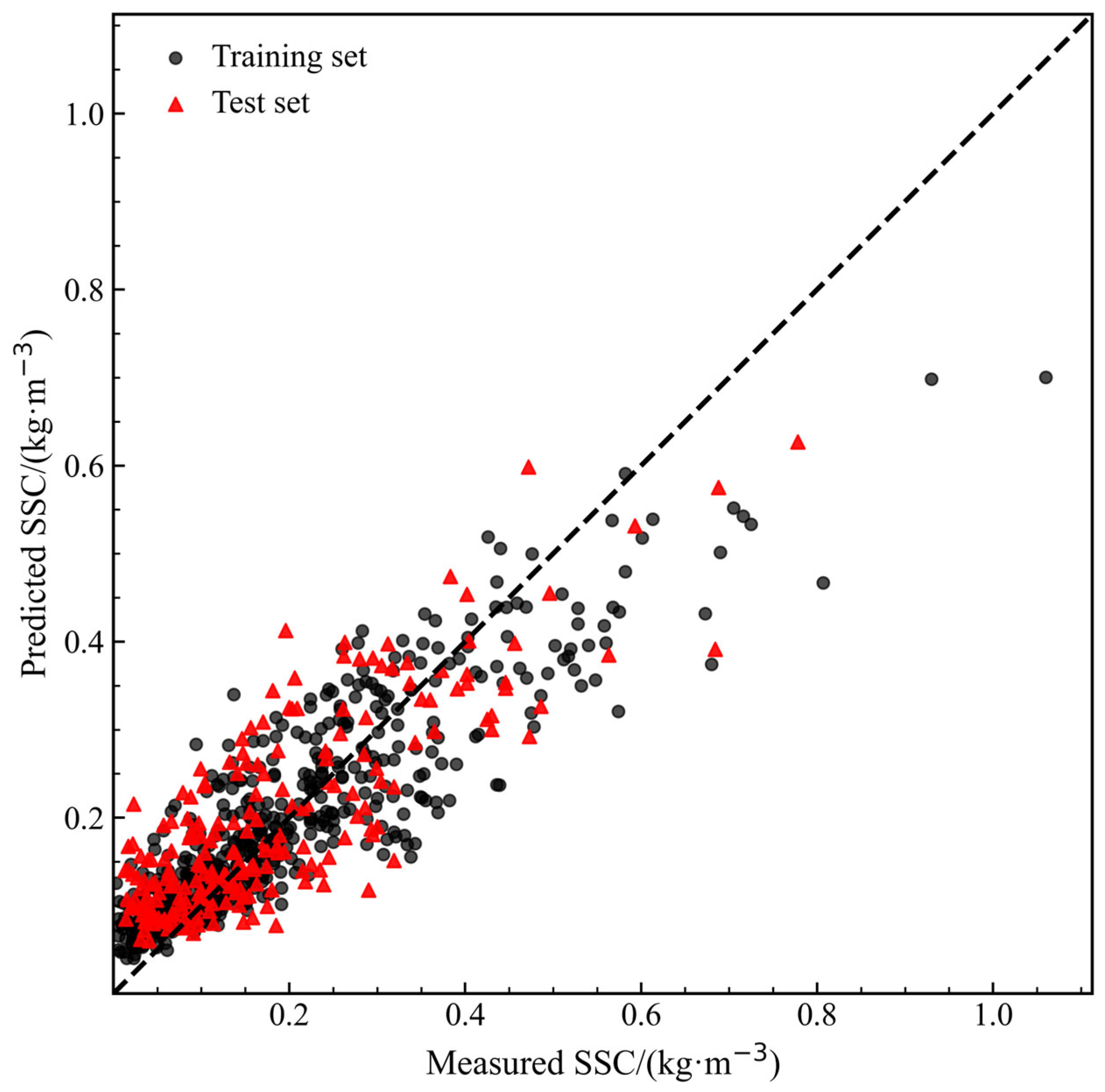
The random forest model showed acceptable predictive performance for SSC retrieval on both the training and test sets. As shown in Table 4, the training set achieved an R2 of 0.777, an RMSE of 0.072 kg·m−3, an MAE of 0.053 kg·m−3, and an MBE of 0.004 kg·m−3, whereas the test set achieved an R2 of 0.641, an RMSE of 0.083 kg·m−3, an MAE of 0.067 kg·m−3, and an MBE of 0.022 kg·m−3. The slightly positive MBE values indicate a weak overall overestimation tendency, which was more evident in the test set than in the training set.
The accuracy of the training set was higher than that of the test set, suggesting that some prediction uncertainty remained when the model was applied to independent samples. Nevertheless, the test-set results indicate that the model could capture the main variation trend of SSC. Consistent with the results shown in Table 4, the sample points of both the training and test sets in Figure 2 were generally distributed around the 1:1 line. The low- and medium-concentration samples were relatively concentrated, whereas some high-concentration samples deviated from the 1:1 line, indicating that bias still existed in the high-value range. This bias may be related to the relatively small number of high-concentration samples, the imbalance in sample distribution, and the greater complexity of water spectral responses under high-SSC conditions. Overall, the random forest model constructed based on HLS imagery provided a usable basis for subsequent analysis of SSC spatiotemporal variations in the study area, while the retrieved SSC values should be interpreted with appropriate caution.
To further evaluate the role of different input variables in the random forest model, feature importance values were extracted from the trained model, and the results are shown in Table 5. RG, NIR, NDTI, and Red showed relatively high importance, indicating that red-band-related features and near-infrared reflectance were the main contributors to SSC retrieval. SWIR1 and SWIR2 showed lower importance than these dominant variables, but their importance values were comparable to or slightly higher than those of Green and Blue, suggesting that they still provided supplementary spectral information in the nonlinear model.

3.2. SSC Retrieval Results in the Study Area

Based on the model evaluation in Section 3.1, the trained random forest model was applied to the selected valid HLS images to retrieve SSC within the extracted water areas of the study reach. The retrieval results were analyzed using the multi-year median composite, the along-river interannual heatmap, and the variation statistics of different inter-station river reaches. These analyses were used to characterize the spatial distribution, interannual variation, and river-reach differences in SSC in the middle and lower reaches of the Liaohe River during 2016–2022.
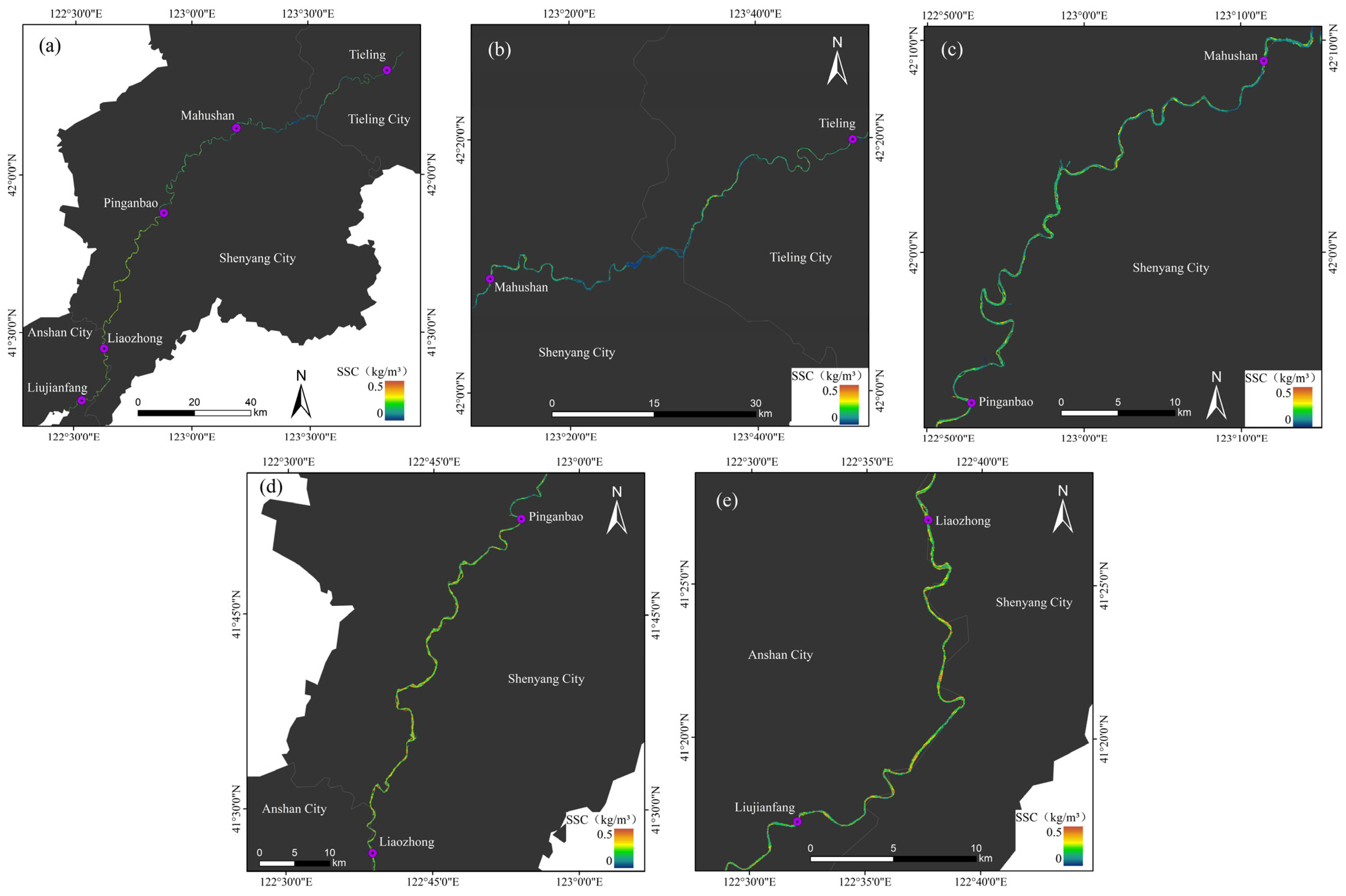
Based on the median composite of 52 valid retrieval images selected from 2016 to 2022, the spatial distribution characteristics of SSC in the study area are shown in Figure 3. To a certain extent, the median composite reduced the influence of random fluctuations and local outliers in individual images and therefore could more stably reflect the overall spatial distribution pattern during the seven-year study period. Overall, SSC in the study area ranged from 0.058 to 0.507 kg·m−3, with an overall median of 0.170 kg·m−3, indicating evident spatial heterogeneity. River-reach statistics showed that the median SSC values of the four reaches, namely Tieling–Mahushan, Mahushan–Pinganbao, Pinganbao–Liaozhong, and Liaozhong–Liujianfang, were 0.134, 0.154, 0.221, and 0.204 kg·m−3, respectively. Among them, the Pinganbao–Liaozhong reach had the highest median value and represented the main high-value area of the SSC in the study region; although the Liaozhong–Liujianfang reach showed a slight decrease compared with the preceding reach, it still maintained a relatively high overall level.
Based on the single-image reach-scale median SSC values, the Friedman test indicated significant overall differences among the four reaches (χ2 = 95.42, p < 0.001). Pairwise Wilcoxon signed-rank tests with Holm correction showed that the Pinganbao–Liaozhong and Liaozhong–Liujianfang reaches were both significantly different from the Tieling–Mahushan and Mahushan–Pinganbao reaches (adjusted p < 0.001), whereas no significant difference was found between the Tieling–Mahushan and Mahushan–Pinganbao reaches (adjusted p = 0.344). This result further supports the spatial differentiation pattern of relatively low SSC in the first two reaches and relatively high SSC in the latter two reaches.
Consistent with these statistical results, SSC in the study area exhibited a spatial pattern characterized by relatively low values in the first two reaches and generally higher values in the latter two reaches, with the Pinganbao–Liaozhong reach being the principal high-value area. Previous studies have indicated that the Juliuhe–Liujianfang reach belongs to a strongly depositional zone in the middle and lower reaches of the Liaohe River, and that variations in sediment input from the Liu River play an important controlling role in the evolution of sediment deposition in downstream reaches [2]. The two reaches defined in this study, Pinganbao–Liaozhong and Liaozhong–Liujianfang, fall within this river section; therefore, their relatively high median SSC values may be related to the sediment transport and deposition processes within this strongly depositional reach.
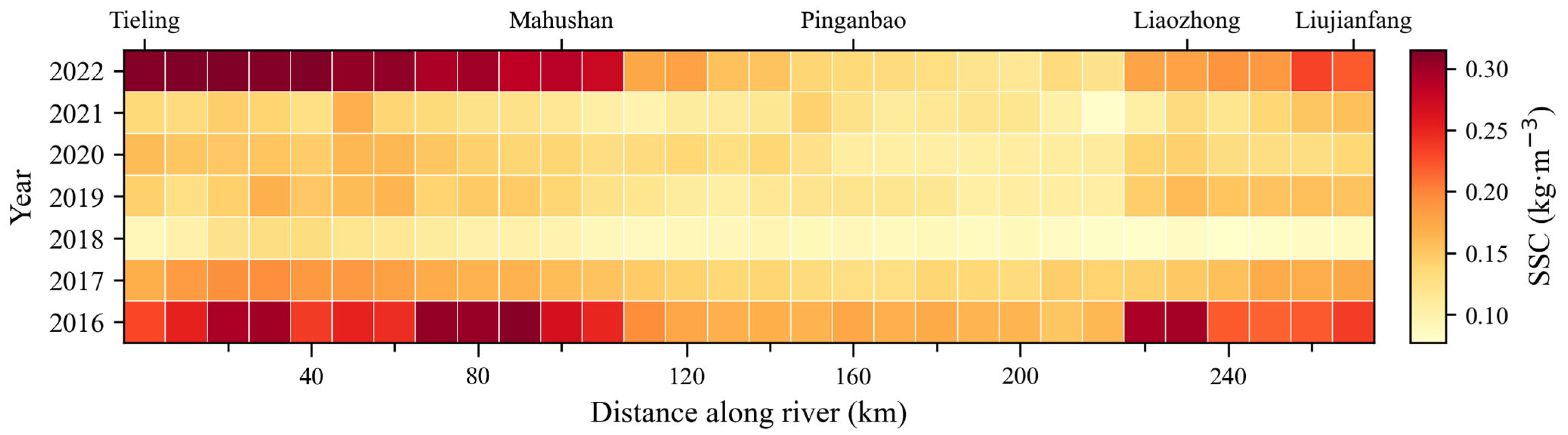
To further analyze the interannual variation characteristics of SSC during the study period, the annual retrieval results were statistically analyzed along the river distance, and the results are shown in Figure 4. In the figure, the along-river distance starts from the vicinity of Tieling Station and ends near Liujianfang Station. Overall, 2016 and 2022 were years with a relatively high SSC during the study period. In 2016, the overall mean and median values were 0.225 and 0.226 kg·m−3, respectively; in 2022, the corresponding values were 0.216 and 0.187 kg·m−3. By contrast, 2018 was the year with the lowest SSC during the study period, with an overall mean of 0.095 kg·m−3 and a median of 0.089 kg·m−3. During 2019–2021, SSC remained at a relatively low level with relatively small fluctuations, indicating that the SSC in the study area exhibited pronounced interannual variability. Along the river, the spatial positions of high-value and low-value zones were not entirely consistent among different years. However, the overall pattern showed relatively high values in the upstream part of the study area in 2016 and 2022, relatively low values in the middle part in most years, and renewed increases in the downstream part in some years. This indicates that the interannual variation in SSC was reflected not only in overall increases and decreases, but also in spatiotemporal heterogeneity characterized by inconsistent responses among different river sections. Previous studies have shown that precipitation in the Liaohe River Basin was anomalously high in the summer of 2022, with frequent major rainfall events and multiple flood events, and the Liaohe mainstream once exceeded the warning level. This may have intensified surface erosion within the basin and sediment resuspension in the channel and was likely one of the important background factors contributing to the overall high SSC in 2022 [22].
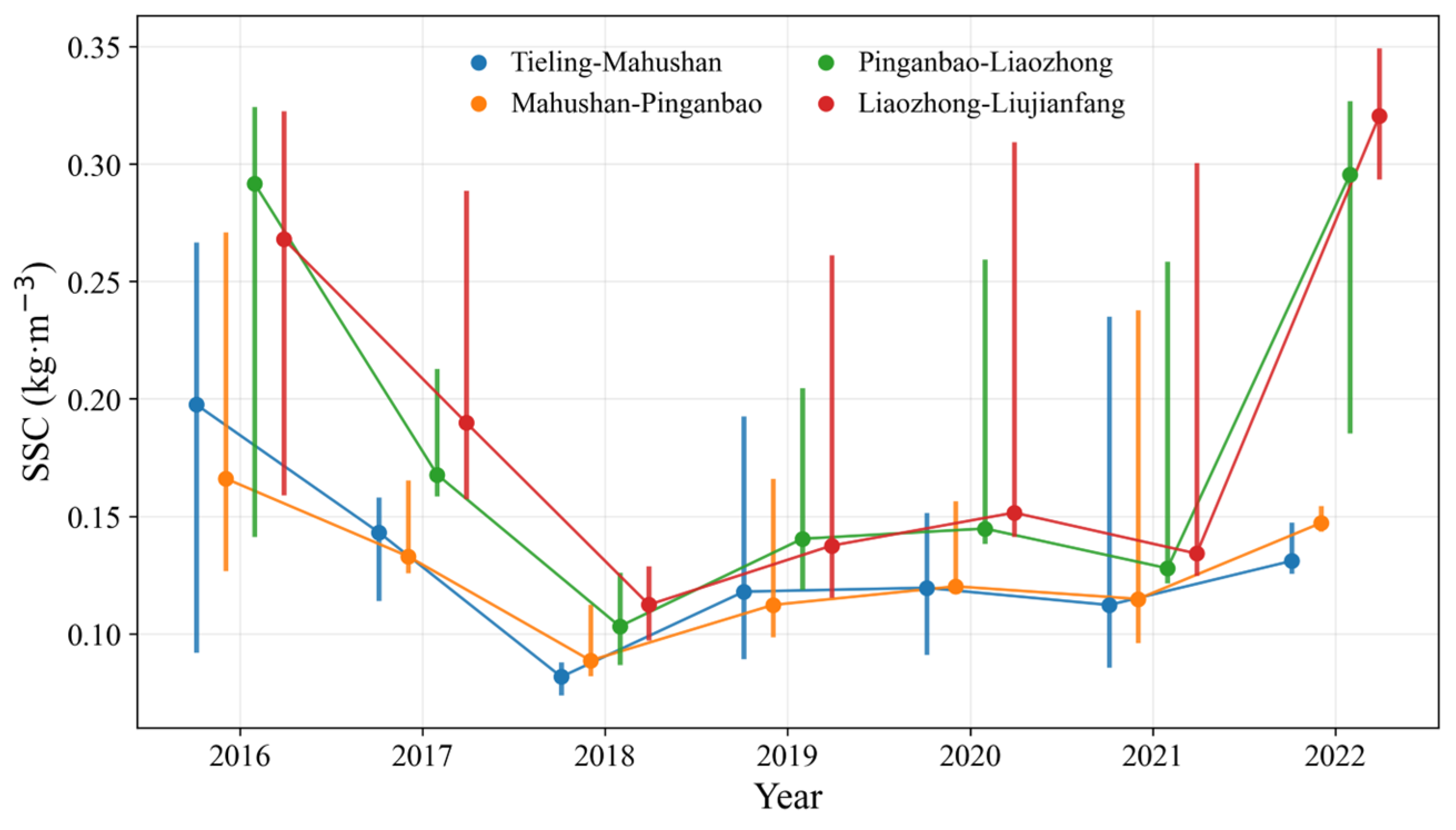
Against the background of the overall interannual variation trend, SSC changes among different inter-station river reaches still exhibited evident differentiation characteristics. As shown in Figure 5, although the four river reaches showed good consistency in interannual variation, all being relatively high in 2016 and 2022 and relatively low in 2018, clear differences existed in their background levels and fluctuation intensity. Based on the mean of the annual median values from 2016 to 2022, the Tieling–Mahushan and Mahushan–Pinganbao reaches had values of 0.129 and 0.126 kg·m−3, respectively, whereas the Pinganbao–Liaozhong and Liaozhong–Liujianfang reaches had values of 0.182 and 0.188 kg·m−3, respectively. This indicates that, on a multi-year scale, SSC in the study area can be divided into relatively stable low-value and high-value groups, with the latter two reaches being overall markedly higher than the former two. Further comparison of the year-by-year rankings shows that the Liaozhong–Liujianfang reach maintained the highest level in most years, the Pinganbao–Liaozhong reach ranked second in many years, whereas the Tieling–Mahushan and Mahushan–Pinganbao reaches remained at relatively low levels over the long term. This suggests that such river-reach differences were relatively stable and were not merely accidental phenomena in a single year. Meanwhile, the mean annual interquartile ranges of the Pinganbao–Liaozhong and Liaozhong–Liujianfang reaches were 0.109 and 0.125 kg·m−3, respectively, which were clearly higher than those of the Tieling–Mahushan and Mahushan–Pinganbao reaches, at 0.081 and 0.068 kg·m−3. Their multi-year ranges were also larger, indicating that the latter two downstream reaches not only had higher overall SSC levels, but also stronger intra-annual fluctuations and interannual amplitudes, and were more sensitive to changes in external water–sediment conditions. Particularly in 2022, the annual median values of the Pinganbao–Liaozhong and Liaozhong–Liujianfang reaches increased to 0.295 and 0.320 kg·m−3, respectively, whereas those of the Tieling–Mahushan and Mahushan–Pinganbao reaches were only 0.131 and 0.147 kg·m−3. This indicates that the river-reach differences in that year were mainly characterized by the latter two reaches being markedly higher than the former two.
In summary, SSC in the study area exhibited a relatively stable spatial differentiation pattern and pronounced interannual fluctuation characteristics during 2016–2022. At the spatial scale, SSC concentrations were generally lower in the Tieling–Mahushan and Mahushan–Pinganbao reaches but generally higher in the Pinganbao–Liaozhong and Liaozhong–Liujianfang reaches. This indicates that the SSC in the study area was not uniformly distributed along the river, but instead showed relatively stable zones of low and high values. At the temporal scale, SSC showed evident fluctuations among different years, with overall higher values in 2016 and 2022 and lower values in 2018, indicating that the SSC in the study area was significantly influenced by interannual changes in water–sediment conditions. In particular, the increase in SSC was most pronounced in 2022, and the increase was more evident in the latter two river reaches, resulting in further enlargement of the differences among reaches. This may be related to the enhancement of surface erosion within the basin and sediment resuspension in the channel caused by heavy rainfall and flood events in the summer of that year. By contrast, in years with an overall lower SSC, the differences among river reaches were relatively weakened. This suggests that the spatiotemporal variation in SSC in the middle and lower reaches of the Liaohe River was not the result of a single process, but rather a combined manifestation of long-term relatively stable background differences among river reaches and water–sediment processes operating at the interannual scale.

4. Discussion

The combination of HLS imagery and the random forest model provided a usable basis for multi-temporal SSC retrieval and reach-scale spatiotemporal analysis in the middle and lower reaches of the Liaohe River. Random forest is suitable for handling nonlinear relationships between SSC and multi-band reflectance as well as derived spectral features [11]. In this study, the model achieved a test-set R2 of 0.641, indicating that it could capture the main variation trend of SSC. However, the RMSE, MAE, and MBE results also indicate that a certain degree of retrieval uncertainty and weak systematic bias remained in independent samples. Therefore, the model performance should be interpreted as acceptable for multi-year and river-reach-scale pattern analysis rather than as highly accurate for all pixel-level or event-scale SSC estimates. In addition, the use of median reflectance values of valid water pixels within a 3 × 3 station neighborhood helped improve the stability of station–image matching by reducing the influence of water-boundary displacement, mixed pixels, and local noise. This processing strategy is consistent with previous river SSC remote sensing studies emphasizing the influence of narrow channels, adjacency effects, and mixed pixels on water reflectance extraction [23]. Comparisons with previous main-stem river studies further suggest that differences in SSC retrieval accuracy are related not only to model structure, but also to channel width, SSC range, sample size, sensor conditions, and sample-matching strategy [24,25,26,27].
The spatial differentiation pattern of SSC in the study area may be jointly influenced by tributary sediment input, the depositional background of the channel, and local hydrodynamic conditions. The Pinganbao–Liaozhong and Liaozhong–Liujianfang reaches showed consistently higher SSC levels than the two upstream reaches, indicating that the downstream part of the study area is not characterized by a simple monotonic downstream change. Previous studies have shown that the Juliuhe–Liujianfang reach is a strongly depositional zone in the middle and lower reaches of the Liaohe River, and that sediment input from the Liu River has an important influence on downstream sediment deposition [2]. However, a depositional reach does not necessarily correspond to low suspended sediment concentration under all hydrological conditions. Instead, the higher SSC values in the downstream reaches may reflect an active water–sediment adjustment zone where sediment supply, transport, deposition, and resuspension coexist. During periods of increased runoff or local flow disturbance, deposited fine sediment may be resuspended into the water column, and additional sediment supplied by tributaries may further increase SSC. Moreover, changes in channel geometry, bends, and local flow velocity may influence sediment carrying capacity and promote spatial heterogeneity in SSC. Therefore, the relatively high SSC levels in the downstream reaches should be interpreted as the combined result of sediment supply, channel depositional background, and local hydrodynamic processes, rather than as a direct consequence of deposition alone.
The 52 HLS images used for river-reach-scale retrieval were selected to ensure continuous visibility of the main channel and to reduce the influence of clouds, cloud shadows, and discontinuous water extraction. This screening strategy improved the reliability of the spatial retrieval results, but it also introduced limitations in temporal representativeness. The selected images were mainly distributed in spring and autumn, whereas relatively fewer valid images were available in summer because flood-season imagery is more easily affected by cloud contamination and channel-visibility constraints. Therefore, the interannual comparison in this study should be understood as a remote sensing statistical comparison under valid-image conditions rather than as a complete annual mean of all hydrological processes. This limitation is particularly relevant for years or seasons with fewer valid images. Nevertheless, the use of median composites and reach-scale statistics can reduce the influence of random fluctuations and local outliers in individual images, thereby providing a relatively stable description of the multi-year spatial pattern of SSC in the study area.
High-SSC conditions and extreme sediment events remain important sources of uncertainty in the current retrieval framework. The scatter plot of observed and predicted SSC showed that some high-concentration samples deviated from the 1:1 line, indicating that bias still existed in the high-value range. This may be related to the limited number of high-SSC samples, the imbalance of sample distribution, and the more complex optical response of highly turbid water. In the Liaohe River Basin, precipitation is mainly concentrated in summer, and heavy rainfall and flood events can enhance runoff and sediment transport processes [16,17]. For example, the anomalously high precipitation and flood events in 2022 may have intensified surface erosion and channel sediment resuspension, contributing to the relatively high SSC in that year [22]. However, such high-sediment periods are also more likely to be affected by cloud contamination, which reduces the availability of valid HLS observations. As a result, the retrieval framework developed in this study is more suitable for characterizing general multi-year and river-reach-scale SSC patterns than for accurately quantifying short-term extreme SSC peaks. Future work should incorporate more measured samples during flood and high-sediment events, introduce remote sensing data with higher spatial and temporal resolution or multi-source hydrological information, and further evaluate the effects of runoff, tributary input, and channel morphology on SSC retrieval and interpretation.

5. Conclusions

Based on HLS imagery and hydrological station SSC observations, this study established a random forest retrieval framework for suspended sediment concentration in the middle and lower reaches of the Liaohe River and analyzed SSC spatial distribution, interannual variation, and inter-station reach differences from 2016 to 2022. The main conclusions are as follows:
(1)
The HLS-based random forest model captured the main variation trend of SSC in the study area, with a test-set R2 of 0.641, an RMSE of 0.083 kg·m−3, an MAE of 0.067 kg·m−3, and an MBE of 0.022 kg·m−3. The model provides a usable basis for multi-year and river-reach-scale SSC retrieval in medium-width rivers, but the remaining prediction uncertainty and high-value bias should be considered when interpreting the retrieved SSC values.
(2)
The median composite and reach-scale statistical comparison from 2016 to 2022 showed that SSC was generally lower in the Tieling–Mahushan and Mahushan–Pinganbao reaches but higher in the Pinganbao–Liaozhong and Liaozhong–Liujianfang reaches. This downstream high-value pattern suggests that SSC differences among reaches were relatively stable rather than being caused by individual images or occasional local variations.
(3)
The interannual variation in SSC was characterized by relatively high values in 2016 and 2022, relatively low values in 2018, and smaller fluctuations during 2019–2021. The downstream reaches, especially Pinganbao–Liaozhong and Liaozhong–Liujianfang, generally showed higher SSC levels and larger fluctuation amplitudes, indicating stronger sensitivity to interannual water–sediment changes. However, because the selected 52 HLS images were unevenly distributed among seasons and years, the interannual comparison should be understood as a valid-image-based remote sensing statistical result rather than a complete annual average of all hydrological conditions.
(4)
The relatively high SSC levels in the downstream reaches may be associated with tributary sediment input, channel depositional background, and local hydrodynamic processes, including possible sediment resuspension under increased runoff or local flow disturbance. The results provide remote sensing evidence for understanding continuous-reach SSC variation in the Liaohe River, while future work should include more in situ samples during flood and high-sediment events, higher-spatiotemporal-resolution remote sensing data, and hydrological information to improve the interpretation of extreme SSC processes and water–sediment mechanisms.

Author Contributions

Conceptualization, X.L. and Q.W.; methodology, X.L. and Q.W.; software, C.L. and M.Y.; validation, C.L., M.Y., F.G. and Y.Y.; formal analysis, C.L. and M.Y.; investigation, C.L., M.Y., F.G., Y.Y. and S.L.; resources, X.L., Q.W. and S.L.; data curation, C.L., M.Y. and S.L.; writing—original draft preparation, C.L. and M.Y.; writing—review and editing, X.L. and Q.W.; visualization, C.L. and M.Y.; supervision, X.L. and Q.W.; project administration, X.L. and Q.W.; funding acquisition, C.L. and Q.W. All authors have read and agreed to the published version of the manuscript.

Funding

This research was funded by the Liaoning Provincial Science and Technology Program (Provincial Doctoral Research Start-up Fund Program), grant number 2024-BS-291, and the National Natural Science Foundation of China, grant number 52479042. The APC was funded by Liaoning Vocational College of Ecological Engineering.

Data Availability Statement

The HLS data used in this study are publicly available through the Google Earth Engine platform. The in situ suspended sediment concentration data were provided by the Liaoning Provincial Hydrology Bureau and are not publicly available due to data-use restrictions. Processed data supporting the findings of this study are available from the corresponding authors upon reasonable request.

Acknowledgments

The authors would like to thank the Liaoning Provincial Hydrology Bureau for providing the in situ suspended sediment concentration data and related support for this study.

Conflicts of Interest

The authors declare no conflicts of interest. The funders had no role in the design of the study; in the collection, analyses, or interpretation of data; in the writing of the manuscript; or in the decision to publish the results.

Abbreviations

The following abbreviations are used in this manuscript:
SSCSuspended sediment concentration
HLSHarmonized Landsat and Sentinel-2
RFRandom forest
GEEGoogle Earth Engine
NDWINormalized Difference Water Index
NDVINormalized Difference Vegetation Index
NDTINormalized Difference Turbidity Index
L30Landsat-based HLS product
S30Sentinel-2-based HLS product
RMSERoot mean square error
MAEMean absolute error
MBEMean bias error

References

  1. Lyu, L.; Jiang, R.; Zheng, D.; Liang, L. Impact of Climate Change and Land Use/Cover Change on Water Yield in the Liaohe River Basin, Northeast China. J. Arid Land 2025, 17, 182–199. [Google Scholar] [CrossRef]
  2. Yang, C.; Wang, L.-L.; Fan, H.-M. Sedimentation Analysis in Middle and Lower Reaches of Liaohe River. Water Resour. 2020, 47, 87–94. [Google Scholar] [CrossRef]
  3. Hu, J.; Miao, C.; Zhang, X.; Kong, D. Retrieval of Suspended Sediment Concentrations Using Remote Sensing and Machine Learning Methods: A Case Study of the Lower Yellow River. J. Hydrol. 2023, 627, 130369. [Google Scholar] [CrossRef]
  4. Vercruysse, K.; Grabowski, R.C.; Rickson, R.J. Suspended Sediment Transport Dynamics in Rivers: Multi-Scale Drivers of Temporal Variation. Earth-Sci. Rev. 2017, 166, 38–52. [Google Scholar] [CrossRef]
  5. Rahat, S.H.; Steissberg, T.; Chang, W.; Chen, X.; Mandavya, G.; Tracy, J.; Wasti, A.; Atreya, G.; Saki, S.; Bhuiyan, M.A.E.; et al. Remote Sensing-Enabled Machine Learning for River Water Quality Modeling under Multidimensional Uncertainty. Sci. Total Environ. 2023, 898, 165504. [Google Scholar] [CrossRef] [PubMed]
  6. Zhang, Y.; He, X.; Lian, G.; Bai, Y.; Yang, Y.; Gong, F.; Wang, D.; Zhang, Z.; Li, T.; Jin, X. Monitoring and Spatial Traceability of River Water Quality Using Sentinel-2 Satellite Images. Sci. Total Environ. 2023, 894, 164862. [Google Scholar] [CrossRef] [PubMed]
  7. Sun, Y.; Wang, D.; Li, L.; Ning, R.; Yu, S.; Gao, N. Application of Remote Sensing Technology in Water Quality Monitoring: From Traditional Approaches to Artificial Intelligence. Water Res. 2024, 267, 122546. [Google Scholar] [CrossRef] [PubMed]
  8. Zeng, F.; Song, C.; Cao, Z.; Xue, K.; Lu, S.; Chen, T.; Liu, K. Monitoring Inland Water via Sentinel Satellite Constellation: A Review and Perspective. ISPRS J. Photogramm. Remote Sens. 2023, 204, 340–361. [Google Scholar] [CrossRef]
  9. Yang, H.; Kong, J.; Hu, H.; Du, Y.; Gao, M.; Chen, F. A Review of Remote Sensing for Water Quality Retrieval: Progress and Challenges. Remote Sens. 2022, 14, 1770. [Google Scholar] [CrossRef]
  10. Yang, X.; Sokoletsky, L.; Wei, X.; Shen, F. Suspended Sediment Concentration Mapping Based on the MODIS Satellite Imagery in the East China Inland, Estuarine, and Coastal Waters. Chin. J. Ocean. Limnol. 2017, 35, 39–60, Erratum in Chin. J. Ocean. Limnol. 2017, 35, 466–467. [Google Scholar] [CrossRef]
  11. Belgiu, M.; Drăguţ, L. Random Forest in Remote Sensing: A Review of Applications and Future Directions. ISPRS J. Photogramm. Remote Sens. 2016, 114, 24–31. [Google Scholar] [CrossRef]
  12. Song, G.; Jiang, Y.; Lei, X.; Zhai, S. Measurement of Suspended Sediment Concentration at the Outlet of the Yellow River Canyon: Using Sentinel-2 Images and Machine Learning. Remote Sens. 2025, 17, 2424. [Google Scholar] [CrossRef]
  13. Li, J.; Wang, G.; Sun, S.; Ma, J.; Guo, L.; Song, C.; Lin, S. Mapping and Reconstruct Suspended Sediment Dynamics (1986–2021) in the Source Region of the Yangtze River, Qinghai-Tibet Plateau Using Google Earth Engine. Remote Sens. Environ. 2025, 317, 114533. [Google Scholar] [CrossRef]
  14. Nones, M.; Guo, C. Remote Sensing as a Support Tool to Map Suspended Sediment Concentration over Extended River Reaches. Acta Geophys. 2025, 73, 4655–4668. [Google Scholar] [CrossRef]
  15. Claverie, M.; Ju, J.; Masek, J.G.; Dungan, J.L.; Vermote, E.F.; Roger, J.-C.; Skakun, S.V.; Justice, C. The Harmonized Landsat and Sentinel-2 Surface Reflectance Data Set. Remote Sens. Environ. 2018, 219, 145–161. [Google Scholar] [CrossRef]
  16. Chen, X.; Jiang, J.; Li, H. Drought and Flood Monitoring of the Liao River Basin in Northeast China Using Extended GRACE Data. Remote Sens. 2018, 10, 1168. [Google Scholar] [CrossRef]
  17. Jiang, C.; Wang, F. Temporal Changes of Streamflow and Its Causes in the Liao River Basin over the Period of 1953–2011, Northeastern China. CATENA 2016, 145, 227–238. [Google Scholar] [CrossRef]
  18. Ju, J.; Zhou, Q.; Freitag, B.; Roy, D.P.; Zhang, H.K.; Sridhar, M.; Mandel, J.; Arab, S.; Schmidt, G.; Crawford, C.J.; et al. The Harmonized Landsat and Sentinel-2 Version 2.0 Surface Reflectance Dataset. Remote Sens. Environ. 2025, 324, 114723. [Google Scholar] [CrossRef]
  19. McFeeters, S.K. The Use of the Normalized Difference Water Index (NDWI) in the Delineation of Open Water Features. Int. J. Remote Sens. 1996, 17, 1425–1432. [Google Scholar] [CrossRef]
  20. Paulista, R.S.D.; de Almeida, F.T.; de Souza, A.P.; Hoshide, A.K.; de Abreu, D.C.; da Silva Araujo, J.W.; Martim, C.C. Estimating Suspended Sediment Concentration Using Remote Sensing for the Teles Pires River, Brazil. Sustainability 2023, 15, 7049. [Google Scholar] [CrossRef]
  21. West, R.M. Best Practice in Statistics: The Use of Log Transformation. Ann. Clin. Biochem. 2022, 59, 162–165. [Google Scholar] [CrossRef] [PubMed]
  22. Zuo, H.; Bian, X. Flood and Drought Disaster Prevention in the Songhua-Liaohe River Basin in 2022. China Flood Drought Manag. 2022, 32, 29–31. (In Chinese) [Google Scholar] [CrossRef]
  23. Zhai, Y.; Zhong, P.; Duan, H.; Zhang, D.; Chen, X.; Guo, X. Modeling of Suspended Particulate Matter Concentration in an Extremely Turbid River Based on Multispectral Remote Sensing from an Unmanned Aerial Vehicle (UAV). Remote Sens. 2023, 15, 5398. [Google Scholar] [CrossRef]
  24. Duan, M.; Qiu, Z.; Li, R.; Li, K.; Yu, S.; Liu, D. Monitoring Suspended Sediment Transport in the Lower Yellow River Using Landsat Observations. Remote Sens. 2024, 16, 229. [Google Scholar] [CrossRef]
  25. Qiu, Z.; Liu, D.; Yan, N.; Yang, C.; Chen, P.; Zhang, C.; Duan, H. Improving the Observations of Suspended Sediment Concentrations in Rivers from Landsat to Sentinel-2 Imagery. Int. J. Appl. Earth Obs. Geoinf. 2024, 134, 104209. [Google Scholar] [CrossRef]
  26. Zhang, C.; Liu, Y.; Chen, X.; Gao, Y. Estimation of Suspended Sediment Concentration in the Yangtze Main Stream Based on Sentinel-2 MSI Data. Remote Sens. 2022, 14, 4446. [Google Scholar] [CrossRef]
  27. Dethier, E.N.; Renshaw, C.E.; Magilligan, F.J. Toward Improved Accuracy of Remote Sensing Approaches for Quantifying Suspended Sediment: Implications for Suspended-Sediment Monitoring. J. Geophys. Res. Earth Surf. 2020, 125, e2019JF005033. [Google Scholar] [CrossRef]
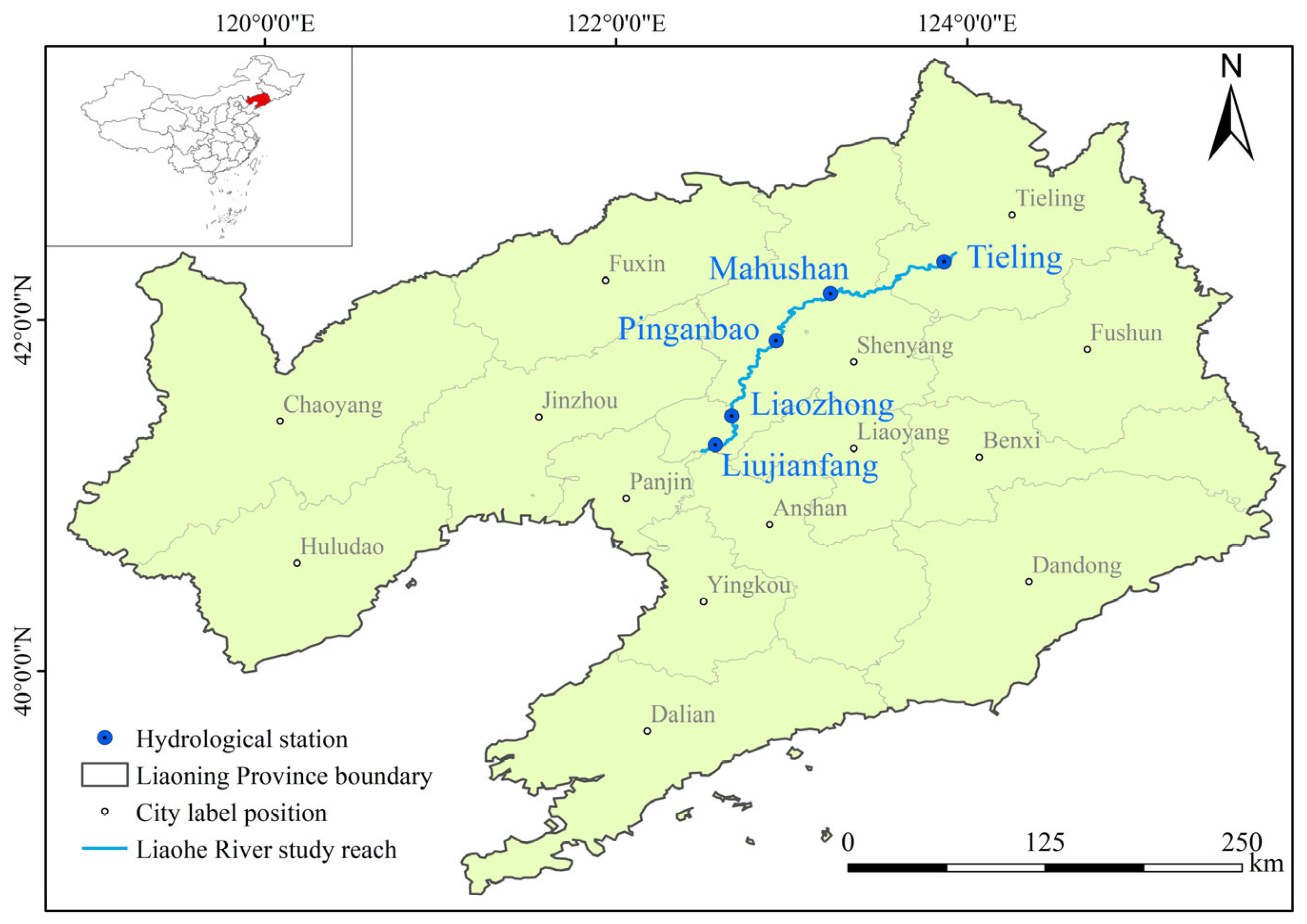
Figure 1. Overview of the study area and locations of the five hydrological stations along the Liaohe River study reach.
Water 18 01562 g001
Figure 2. Scatter plot of observed and predicted SSC values for the random forest model. The dashed line indicates the 1:1 line.
Water 18 01562 g002
Figure 3. Spatial distributions of the median SSC from 2016 to 2022 in the study area: (a) entire study area; (b) Tieling–Mahushan reach; (c) Mahushan–Pinganbao reach; (d) Pinganbao–Liaozhong reach; and (e) Liaozhong–Liujianfang reach. Tieling, Mahushan, Pinganbao, Liaozhong, and Liujianfang are the dividing stations between adjacent river reaches.
Water 18 01562 g003
Figure 4. Interannual heatmap of SSC along the Liaohe River study reach from 2016 to 2022. The along-river distance starts from the upstream end near Tieling Station and ends near Liujianfang Station. The study reach was divided into 30 equal river-distance bins, each approximately 9.11 km long, and each grid shows the annual median SSC calculated from the selected valid HLS retrieval images for the corresponding year.
Water 18 01562 g004
Figure 5. Interannual variations in SSC in four river reaches from 2016 to 2022. Dots indicate the annual median SSC for each reach, and vertical bars denote the 25th–75th percentile range.
Water 18 01562 g005
Table 1. Temporal distribution of the 52 Harmonized Landsat and Sentinel-2 (HLS) images used for river-reach-scale suspended sediment concentration (SSC) retrieval.
YearSpringSummerAutumnTotal
20162237
20173126
20183- 158
20193-912
20203-36
20214-26
20225-27
Total2332652
Notes: 1 “-” indicates that no image met the criteria of cloud-free continuous coverage of the main channel in that season. Winter images from December to February were excluded.
Table 2. Statistics of modeling sample numbers at each hydrological station.
StationL30 SamplesS30 SamplesTotal Samples
Tieling445296
Mahushan4177118
Pinganbao6675141
Liaozhong97115212
Liujianfang105116221
Total353435788
Table 3. Pearson correlation analysis results between modeling features and SSC.
FeatureCorrelation Coefficient rSelected for Model
Blue0.322 *** 1Yes
Green0.359 ***Yes
Red0.506 ***Yes
NIR0.450 ***Yes
SWIR1−0.129 ***Yes
SWIR2−0.142 ***Yes
NDTI 20.542 ***Yes
NDVI0.066No
RG0.559 ***Yes
RNIR−0.107 **No
Notes: 1 *** and ** indicate significance at the 0.001 and 0.01 levels, respectively. 2 NDTI = (Red − Green)/(Red + Green); NDVI = (NIR − Red)/(NIR + Red); RG = Red/Green; RNIR = Red/NIR.
Table 4. Accuracy evaluation results of the random forest model.
DatasetR2RMSE/(kg·m−3)MAE/(kg·m−3)MBE/(kg·m−3)
Training set0.7770.0720.0530.004
Test set0.6410.0830.0670.022
Table 5. Feature importance of input variables in the random forest model.
RankFeatureImportance
1RG0.186
2NIR0.179
3NDTI0.167
4Red0.145
5SWIR10.085
6SWIR20.084
7Green0.078
8Blue0.076
Disclaimer/Publisher’s Note: The statements, opinions and data contained in all publications are solely those of the individual author(s) and contributor(s) and not of MDPI and/or the editor(s). MDPI and/or the editor(s) disclaim responsibility for any injury to people or property resulting from any ideas, methods, instructions or products referred to in the content.