Article

Water Level Measurement Approach Using Monocular Vision with Piecewise Linear Fitting Algorithm

1
Henan Jiaoyuan Engineering Technology Group Co., Ltd., Zhengzhou 451460, China
2
School of Civil Engineering, Zhengzhou University of Technology, Zhengzhou 450044, China
3
School of Management and Economics, North China University of Water Resources and Electric Power, Zhengzhou 450046, China
*
Author to whom correspondence should be addressed.
Water 2026, 18(13), 1557; https://doi.org/10.3390/w18131557 (registering DOI)
Submission received: 4 May 2026 / Revised: 17 June 2026 / Accepted: 24 June 2026 / Published: 25 June 2026

Abstract

Water level monitoring is closely linked to the safety of production and daily activities along riverbanks, making real-time and high-precision water level measurement an urgent technical demand. The feature extraction backbone of the Unet model is modified, and the lightweight MobileNet V2 network is adopted in this paper. The constructed network achieves significantly higher computational efficiency than standard convolutions, effectively overcoming the limited real-time performance of conventional water level measurement methods. Furthermore, the coordinate attention (CA) mechanism is integrated into the skip connections of Unet to strengthen the network’s capability to extract key features for water level segmentation, thereby further improving the accuracy of water level detection. A novel piecewise linear fitting method for water level line measurement based on monocular vision is proposed, and field-measured water level data are adopted to verify the calculation results. The main achievements of the improved model include the following: (1) Compared with the baseline model, the improved model MCUnet (MobileNet V2 + CA + Unet) achieves a 5.77% increase in accuracy and a 25.71% improvement in inference speed on the experimental water surface recognition dataset. (2) Taking the field-observed water level as the reference, the mean absolute error of the proposed image-based water level monitoring method reaches approximately 1.69 cm. (3) In comparison with DeepLab, U2net and Unet, the MCUnet model gains accuracy improvements of 4.47%, 2.81% and 5.77% respectively, with the detection frame rate increased by 12 FPS, 15 FPS and 11 FPS correspondingly. Through this work, the paper can provide some theoretical support and technical references for overcoming the limitations of conventional water level measuring devices, including strict installation requirements, limited measurement precision, high deployment and maintenance costs, and cumbersome data processing.

1. Introduction

Water level data is the crucial foundation for early warning, prevention and control of flood disasters [1]. Accurate water level measurement can secure valuable time for disaster avoidance, minimizing casualties and property losses to the greatest extent. Furthermore, water level variation plays a vital role in ecological conservation. For instance, wetlands and lakes rely on appropriate ecological water levels to sustain biodiversity. Excessively low water levels may trigger wetland desiccation and aquatic organism mortality, while abnormally high levels can damage biological habitats. Long-term coastal water level monitoring enables quantification of sea-level rise driven by global warming and furnishes fundamental data for future coastal defense planning. By analyzing historical evolution patterns of water levels, researchers can deepen the understanding of changing global hydrological cycles and develop targeted countermeasures against the growing frequency of extreme weather events.
Water level measurement techniques are generally classified into contact-based and non-contact methods [2]. Typical contact-based measurement methods include capacitive [3,4,5,6,7], float [8,9,10] and hydrostatic [11,12,13,14,15] types. Areekath et al. [7] developed a novel water level sensing mechanism using planar coils integrated on printed circuit boards (PCBs). Furthermore, this sensor employs a single sensing element to simultaneously monitor water level and water quality (electrical conductivity), cutting equipment cost and routine maintenance workload for designers. Nevertheless, water with high conductivity necessitates extra calibration for reliable water level readings, which severely impairs the real-time performance of water level measurement.
Float-type water level sensors exhibit prominent advantages in water level monitoring. With a simple configuration consisting mainly of floats, transmission connectors and signal conversion units, they contain no complicated electronic components and feature low manufacturing cost as well as convenient installation and maintenance. Nevertheless, such sensors have inherent drawbacks. First, strict constraints are imposed on installation position and assembly precision to guarantee unobstructed vertical movement of floats following water level fluctuations. Second, turbulent flow and floating trash on the water surface can disturb the working state of floats and trigger measurement deviations. In addition, mechanical components including floats, suspension ropes and pulleys are prone to wear and require periodic inspection, resulting in high long-term maintenance expenses. Majdalani et al. [9] proposed an innovative approach for water level measurement under unsteady flow conditions in experimental flumes. This method integrates conventional contact-based float sensing with advanced non-contact remote infrared sensing to capture dynamic variations in water surface elevation. However, the technique is inapplicable to water level detection inside enclosed conduits, as cameras for image analysis can only be mounted externally.
Almeida et al. [16] developed a robust water level sensor based on fiber Bragg grating (FBG). Benefiting from superior mechanical stability and extensive dynamic range, the approach enables uninterrupted remote monitoring of water levels. However, this method is mainly developed for well-controlled environments including water treatment facilities, municipal water supply pipelines and fuel storage tanks, where operational parameters can be regulated to eliminate fluid turbulence and mechanical shocks. Such favorable ambient conditions are unavailable for in situ river water level monitoring.
The fundamental operating principle of hydrostatic pressure sensors for water level measurement is based on fluid statics, wherein the hydrostatic pressure of a liquid is directly proportional to its depth. Hydrostatic pressure sensors offer several advantages, including high accuracy, rapid response, simple construction, ease of installation, and suitability for various liquid environments, thereby ensuring broad applicability. However, hydrostatic pressure sensors also exhibit certain limitations. Their measurement range is typically constrained by the pressure tolerance of the sensor. In high-viscosity liquids or those containing impurities, adhesion of contaminants to the sensor surface may compromise measurement accuracy. Additionally, temperature variations can affect measurement precision, necessitating temperature compensation. Prolonged immersion in liquids may also lead to degradation of sensor sealing integrity, consequently impacting service life.
Schenato et al. [17] developed a high-stability pressure sensor for water level monitoring in embankments. Equipped with an aluminum alloy casing and a 3D-printed mechanical transducer, the sensor tolerates harsh environments and rugged installation conditions, and the transducer converts external pressure into axial strain of the optical fiber. An integrated temperature sensing module compensates for temperature-induced measurement errors of the fiber Bragg grating (FBG) pressure probe. Capable of remote power supply and monitoring, the sensor can be cascaded into multi-node networks to achieve highly flexible field arrangement. Nevertheless, owing to the nonlinear coupling between pressure and temperature, complicated numerical inversion is required to establish the pressure–temperature calibration surface. Adequate wavelength spacing must be reserved when multiple sensors are cascaded so as to avoid mutual restriction of measurement ranges.
Non-contact water level measurement mainly comprises ultrasonic and radar methodologies, whose working principles are analogous. These methods function by emitting energy waves toward the water surface and receiving the echoes reflected from the surface. The time difference between wave emission and echo reception is precisely measured. Subsequently, utilizing the propagation velocity of the wave in air, the distance from the sensor to the water surface is calculated using the relevant formula. Finally, the water level is obtained by subtracting this distance from the known installation height of the sensor. Pereira et al. [18] utilized ultrasonic sensors and an Arduino controller for water level monitoring in open channels. The combination of Arduino and ultrasonic sensors presents a technically and economically viable alternative for water level monitoring. However, in open channels, measurement accuracy is compromised due to water surface irregularities and turbulent flow effects. Furthermore, as flow conditions become increasingly turbulent, sensor readings exhibit greater deviation and noise, necessitating the application of Kalman filtering to address this issue. Guan et al. [19] proposed a low-cost, compact and easily configurable interferometric radar system for water level monitoring, which enables water level measurement with millimeter-scale precision. When deployed in networks, the system enables synchronized, high-resolution water level monitoring over extensive areas. However, radar signals are susceptible to interference from background noise and various boundary conditions, necessitating further optimization of hardware configurations to enhance measurement resolution and range.
With the continuous advancement of image processing technologies, their applications in water level measurement have become increasingly widespread [20,21]. Lee et al. [22] reviewed research advances of high-resolution, low-cost vision-based water level sensors developed using image processing algorithms, which have prominent strengths of high measuring precision and low hardware cost. At the same time, they can automatically identify water level images and further calculate the water level based on changes in image brightness. Compared to traditional float-type, ultrasonic, radar, and capacitive water level sensors, this method avoids direct contact with water, thereby enhancing reliability and stability. However, this approach also exhibits certain limitations, including sensitivity to environmental conditions (such as illumination and water quality), necessitating algorithm optimization to accommodate diverse application scenarios.
Deep learning has achieved breakthrough advancements in numerous fields [23,24,25,26,27,28]. Chen et al. [29] developed a deep learning-based scheme for dynamic water level visualization and monitoring in nuclear steam generators. Nevertheless, this method is constrained by computer read–write performance and neural network complexity, which may degrade its real-time responsiveness.
In recent years, machine vision has been increasingly widely adopted for water level measurement [30,31,32,33]. Liu et al. [34] put forward a vision-based water level measurement method based on the residual length ratio of characters in staff gauge images. Compared with conventional measuring techniques including float-type, pressure-type, ultrasonic and radar methods, the proposed vision approach eliminates high installation expenditure and complicated maintenance while improving environmental adaptability, and enables non-contact measurement merely with an ordinary camera. This algorithm works by identifying standard E-shaped markings and calculating their residual length ratios, which makes the method heavily dependent on E-pattern staff gauges. Accordingly, its applicability and generalization capacity are restricted when applied to non-E-type gauges or natural water boundaries without graduated scales.
Muhadi et al. [35] proposed a surveillance-camera-based water level estimation method integrating DeepLabv3+ semantic segmentation and LiDAR elevation data. Assisted by LiDAR elevation points, the approach can not only estimate water stage values but also classify water levels into four threshold grades (normal, alert, warning and dangerous), delivering direct decision support for flood control. However, absolute water stages cannot be determined from images exclusively; the method has to adopt a LiDAR-derived Digital Elevation Model (DEM) to extract elevations of water level reference points. In the absence of such prior elevation data, this technique cannot operate independently.
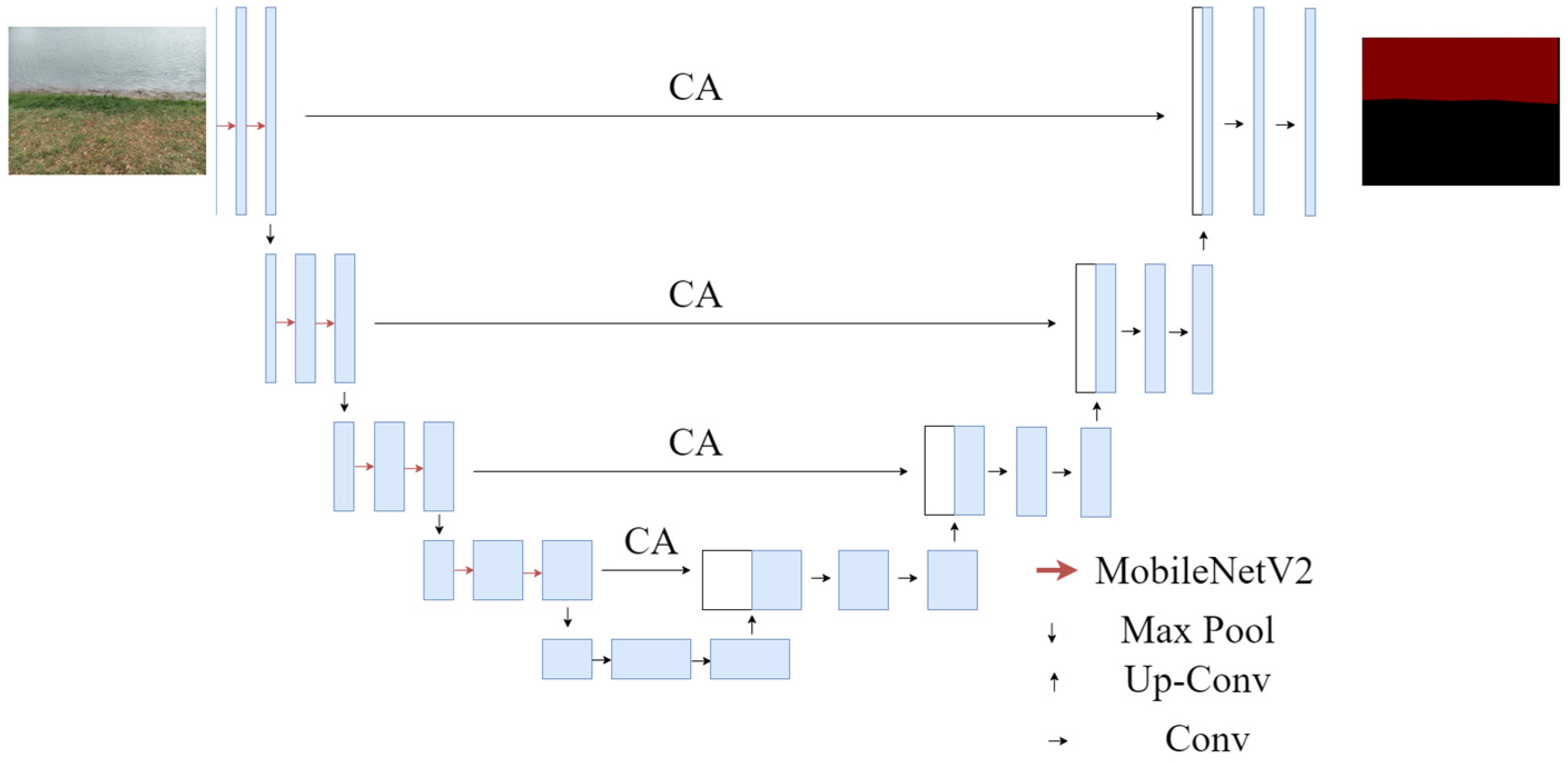
To realize real-time and high-precision water level monitoring, this paper presents a piecewise linear fitting method for water level measurement based on monocular vision. The proposed method consists of two modules. In the first module, the feature extraction backbone of Unet is replaced with MobileNet V2, which drastically reduces model parameters and achieves much higher computational efficiency than standard convolutions, thus addressing the poor real-time performance of conventional water level measurement approaches. Additionally, a coordinate attention (CA) mechanism is incorporated into the skip connections of Unet. The CA mechanism enhances the network’s capability to capture critical features for water level segmentation, thus improving the accuracy of conventional water level measurements. In the second module, a novel piecewise linear fitting interpolation method is proposed for water level calculation, addressing several limitations of traditional water level measurement equipment, including stringent position and accuracy requirements, high installation and maintenance costs, difficulties in data processing, and poor adaptability. The advantages of this research are summarized as follows:
(1)
The improved MCUnet model enables accurate segmentation of water level lines, overcomes the poor real-time performance inherent in conventional water level measurement techniques, and improves measurement precision. This method effectively minimizes casualties and property losses, furnishing dependable technical support for practical engineering applications.
(2)
The proposed piecewise linear fitting algorithm for water level computation overcomes the limitations of traditional water level measurement such as strict hardware demands, high deployment and maintenance expenditure, and cumbersome data processing.
(3)
In contrast to existing segmentation approaches, the proposed method retains satisfactory accuracy with no specialized hardware for data collection, marking a core contribution of this work.

2. Data Acquisition and Model Enhancement

2.1. Data Acquisition

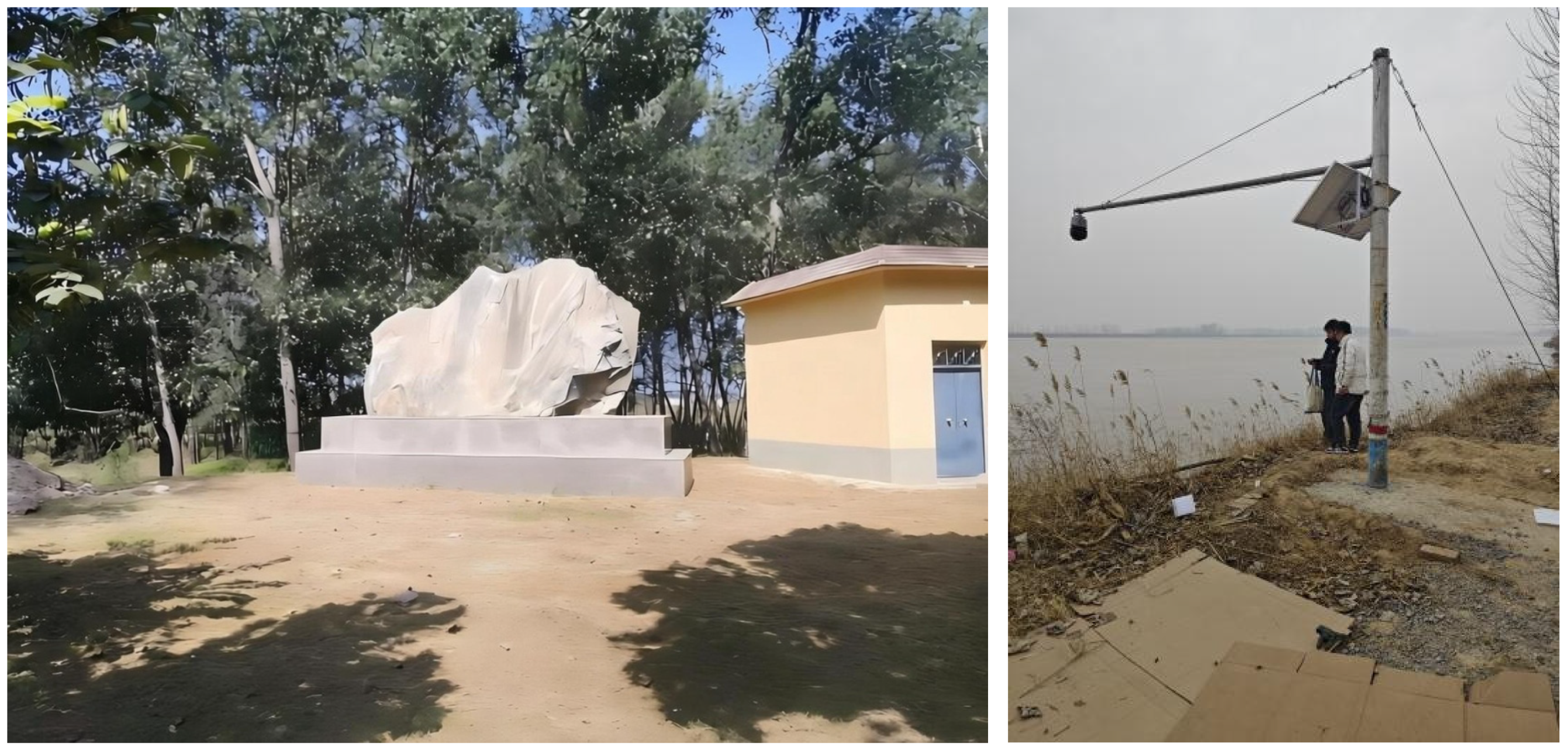
In this study, field surveillance cameras (Hangzhou Hikvision Digital Technology Co. Ltd., Hangzhou, China) were deployed in Fan County, China. The cameras were mounted 8 m vertically above the water surface and 5 m horizontally away from the riverbank, capturing video streams at an inclination angle of 30° relative to the horizontal plane to collect water level data across different time periods. It should be noted that the acquired dataset cannot validate the universal applicability of the proposed method for all working scenarios; however, the method is applicable for analogous field conditions. Water level data were extracted from video streams captured by the camera at a frame rate of 25 FPS and a resolution of 1280 × 960. A total of five rounds of data collection were conducted, each recording 60 s video clips, resulting in 7500 image samples. The entire image dataset was then divided into training, validation, and test sets in an 8:1:1 ratio. The dataset is owned by industrial collaborators and cannot be publicly released. Figure 1 presents the on-site camera deployment scenario alongside its schematic diagram. The Labelme annotation tool was adopted to label water level lines, with a critical requirement that annotation bounding boxes must form closed loops when outlining water areas.

2.2. Segmented Linear Fitting for Water Level Calibration

In the monocular vision-based water level measurement system, the images captured by the camera are essentially the perspective projection of the three-dimensional water surface spatial scene onto the two-dimensional imaging target plane. Restricted by the geometric characteristics of perspective projection, the vertical pixel dimension in the images has a nonlinear correspondence with the real physical height. Specifically, the pixel interval occupied by a unit elevation is relatively large in waters near the camera, and such pixel spacing for the same actual height keeps decreasing as the water area is farther away from the camera. If the traditional univariate linear regression model is directly adopted for calibration under the assumption of a proportional relationship between pixel coordinates and water level values, remarkable systematic errors will be induced during measurement, failing to meet the requirements of high-precision water level monitoring.
To address the aforementioned nonlinear mapping issue and guarantee the real-time computational performance simultaneously, this paper proposed a water level calibration method based on piecewise linear fitting. The core principle of the proposed method is converting nonlinear curves into piecewise straight lines, which approximates the complex nonlinear perspective relationship via piecewise linearization.
The proposed algorithm divides the full water level measurement range into multiple continuous equidistant subintervals. Within each local subinterval, high-order error terms caused by perspective effect are neglected, and a linear correlation between pixel coordinates and water level elevation is established approximately. After piecewise processing of the entire measurement range, the original global nonlinear mapping is decomposed into a series of local linear relations. This method avoids cumbersome nonlinear computation while ensuring measurement accuracy and effectively improves the operational efficiency of the algorithm.
When the installation tilt angle and mounting height of the camera change in practical deployment, recalibration is required to align the top edge of the captured image with the calibration line.

2.3. Principle of Piecewise Linear Fitting for Water Level Measurement

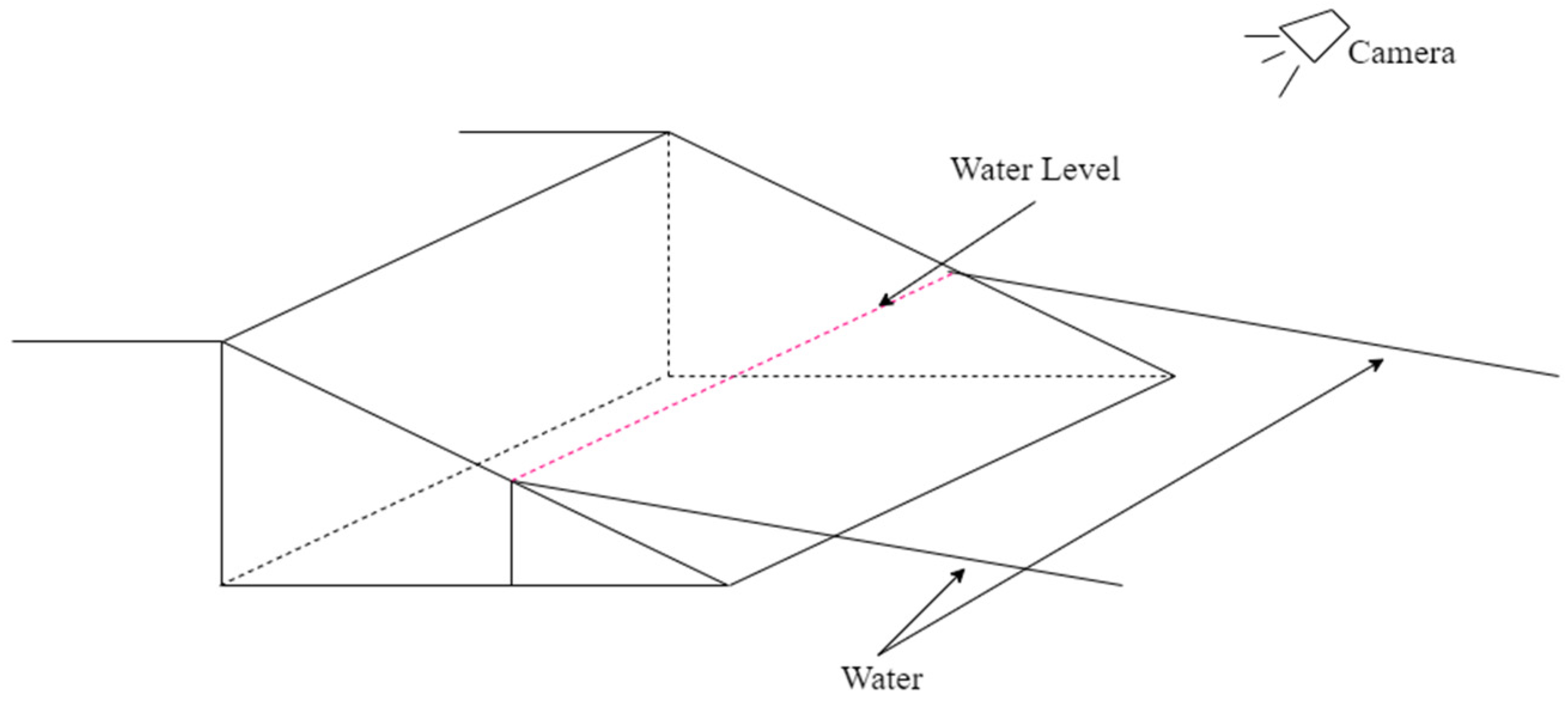
Figure 2 shows the schematic of water level measurement, where the red line denotes the actual water level elevation H. To achieve accurate monocular vision-based water level measurement, a piecewise linear fitting method is proposed to resolve the nonlinear mapping induced by perspective projection. Owing to the nonlinear variation in pixel spacing against physical height caused by perspective effect, the full measurement range [Hmin, Hmax] is divided into N equidistant local linear subintervals. Calibration points are adopted to fit the linear function for each subsection, which empirically offsets the adverse influence from perspective distortion.
I k = [ H k 1 , H k ] , k = 1 , 2 , , N
where H0 = Hmin, and HN = Hmax. Hmin and Hmax represent the maximum and minimum values of the water level measurement range obtained by the camera, and each divided interval is equally divided by the calibration ruler. For the k-th interval Ik, it is assumed that the pixel coordinates and actual water level H within this interval follow a local linear relationship, which gives
H = a k v + b k , ( v , H ) I k
where ak is the slope, bk is the intercept, v stands for pixel coordinate and H denotes the real water level. ak and bk are undetermined calibration parameters calculated by least-squares fitting using calibration points (vi, Hi) (i = k − 1, k) in the corresponding interval:
min a k , b k i = k 1 k ( H i ( a k v i + b k ) ) 2
The solution is given by
a k = H k H k 1 v k v k 1 , b k = H k 1 a k v k 1
Once the pixel coordinate v of the waterline in the captured image is obtained, the corresponding interval Ik is determined via interval discrimination, and the actual water level is subsequently calculated as
H = a 1 v + b 1 , v [ v 0 , v 1 ] a 2 v + b 2 , v [ v 1 , v 2 ] a N v + b N , v [ v N 1 , v N ]
The waterline is segmented using the improved MCUnet model to obtain its average vertical pixel coordinate v ¯ . Then, substituting v ¯ into the piecewise linear fitting formula yields the real-time water level H:
H = k = 1 N δ k a k v ¯ + b k
where δ k is the interval indicator function:
δ k = 1 , v ¯ [ v k 1 , v k ] 0 , otherwise

2.4. Introduction of MobileNet V2

Rapid real-time water level identification is critical under flood discharge and other emergency conditions. Embedding the MobileNet V2 module into the Unet network enables real-time water level detection.
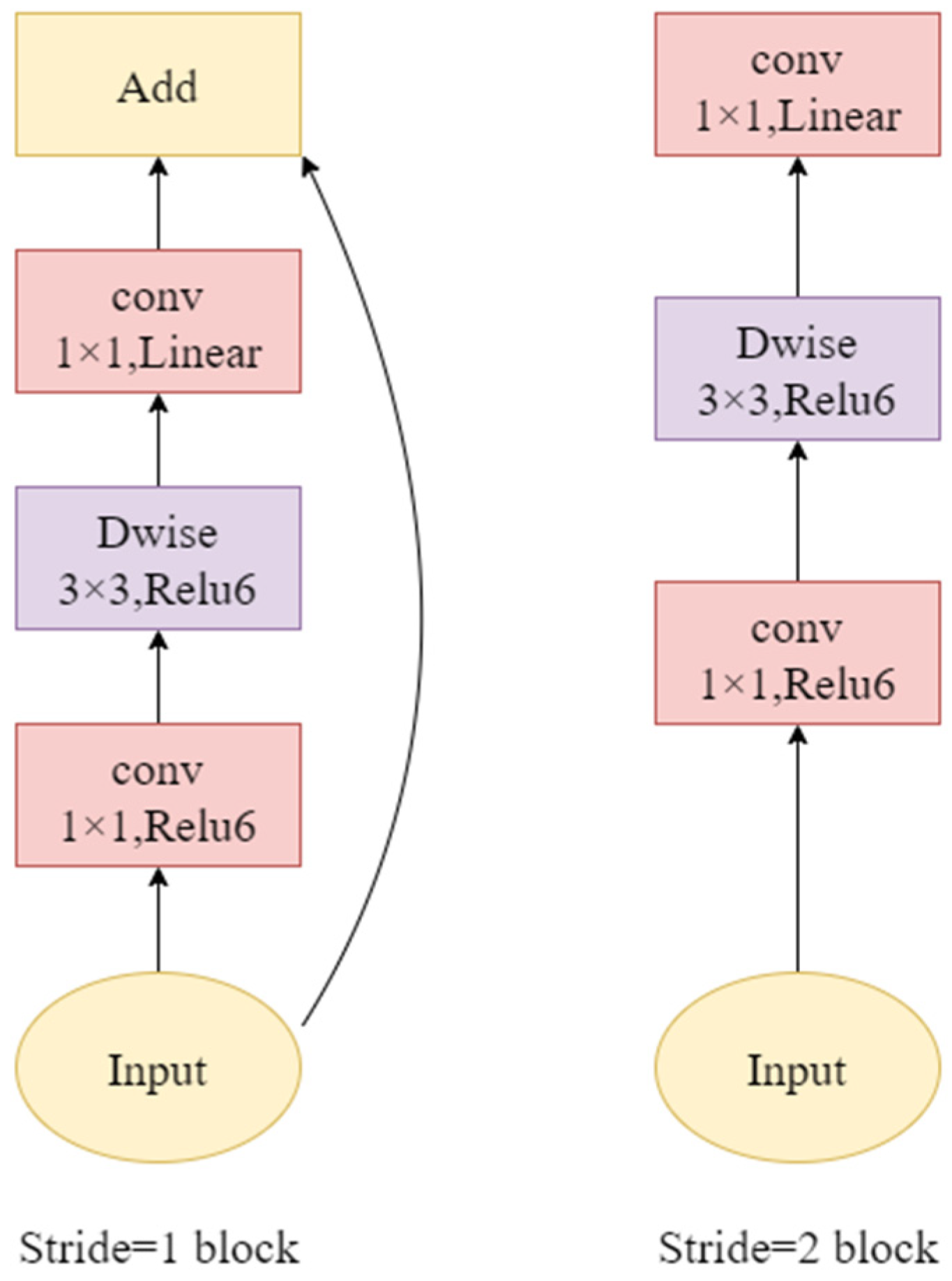
MobileNet V2 achieves fast and accurate image classification and object detection under limited computing resources. As illustrated in Figure 3, the network architecture is essential to its high efficiency, and its design follows two core principles: lightweight construction and effective feature extraction. The network starts with a standard 3 × 3 convolution for initial feature extraction, while its main body consists of repeatedly stacked inverted residual bottleneck modules. Each module follows a three-stage workflow of expansion, depthwise filtering and compression. First, a 1 × 1 pointwise convolution expands channel dimensions, and the ReLU6 activation function ensures computational stability under low-precision calculation for sufficient feature extraction. Afterwards, low-cost 3 × 3 depthwise separable convolution is adopted for spatial filtering to capture features with drastically reduced parameters. Finally, a linear 1 × 1 pointwise convolution without an activation function compresses channels to the target dimension. Such a linear bottleneck design prevents learned feature information from being corrupted by nonlinear transformation.

2.5. Introduction of Coordinate Attention Mechanism

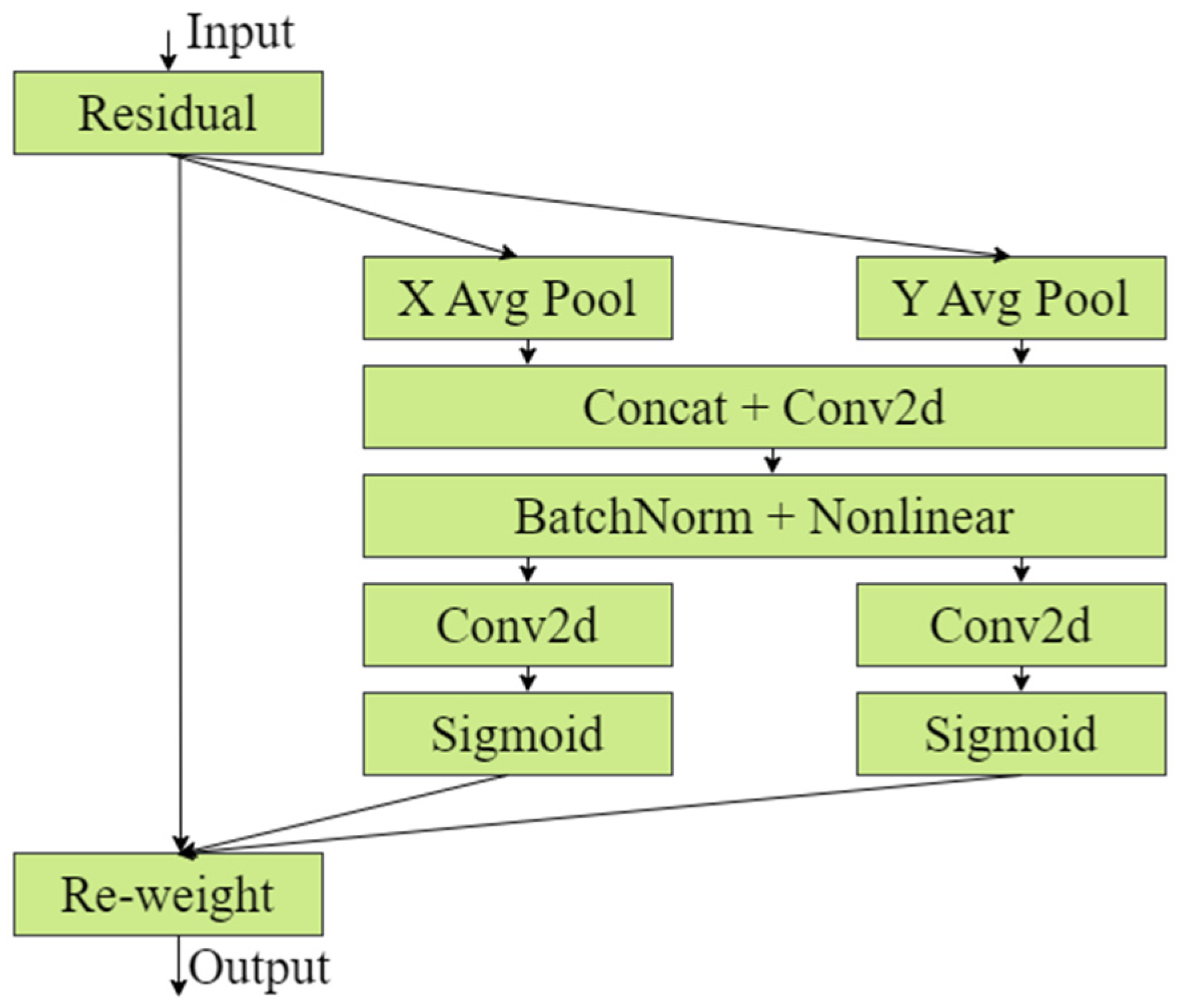
To improve the segmentation accuracy of water level lines, a coordinate attention (CA) mechanism [36] is embedded into the Unet network in this paper. As a widely adopted algorithm for enhancing feature representation in deep learning, the coordinate attention module applies adaptive weights to each channel of feature maps. It enables the model to focus on valid feature channels while suppressing invalid interfering features, thereby optimizing the segmentation performance of Unet for water level contours. Figure 4 illustrates the workflow of the coordinate attention algorithm.
To preserve spatial positional information, the coordinate attention (CA) module performs pooling operations on the input feature map along the horizontal and vertical directions via X Avg Pool and Y Avg Pool to generate directional feature maps with dimensions of (C × 1 × W) and (C × H × 1). Subsequently, the two obtained feature maps are concatenated, and convolutional operations are adopted to extract features for the generation of attention weights corresponding to the two directions. Ultimately, the two groups of weights are separately imposed on the horizontal and vertical dimensions of the original input feature map to achieve direction-aware and position-sensitive attention enhancement. Automatic focusing on water level features is therefore realized, and the overall model performance is improved accordingly.

2.6. Introduction of MCUnet

As shown in Figure 5, the network architecture of MCUnet is displayed. The feature extraction backbone of the Unet encoder is replaced by MobileNet V2. Combined with depthwise separable convolution and corresponding structural design, the proposed network remarkably cuts down model parameters and computational consumption and accelerates the feature extraction speed for water level segmentation. Meanwhile, the CA mechanism is embedded into skip connections. Attention weights are imposed separately along the horizontal and vertical directions of input water level images to construct a direction-aware and position-sensitive attention enhancement module, which optimizes the extraction of water level features effectively. The real-scene image on the left is the input of MCUnet, and the binary image on the right is its corresponding output.

2.7. Experimental Environment and Configuration

The experimental hardware includes a 12th Gen Intel Core i7-12650H CPU (2.30 GHz), an RTX 4060 graphics card and 16 GB RAM. All experiments are implemented on the Windows 11 operating system. The Python 3.10 environment is built via Anaconda, with CUDA 12.0 and PyTorch 2.0 adopted for network training. Detailed parameter settings are listed in Table 1.

2.8. Evaluation Metrics

Model performance is quantitatively evaluated via precision (P), recall (R), F1-score and AUC calculated on the test dataset. Severe class imbalance commonly exists between water and non-water regions in aquatic images. Indicator P quantifies the risk of an overestimated waterline (non-water pixels misclassified as water), while indicator R reflects the risk of an underestimated waterline (missing genuine water areas), both of which are critical to the reliability of water level measurement. Accurate waterline extraction requires avoiding both missing real water regions and incorrect identification of non-water backgrounds. As the harmonic mean of P and R, F1-score serves as the primary metric for evaluating the overall segmentation performance. Since segmentation results are highly sensitive to the selection of binarization threshold, AUC is adopted to assess the inherent discriminative capability of the model without the restriction of specific threshold values, which further verifies the effectiveness of feature extraction improvement in the modified Unet.
P = T P T P + F P × 100 %
Metric P is defined as the ratio of truly labeled water pixels to all pixels predicted as water, which measures the purity of segmentation outputs. A low precision value indicates that numerous non-water pixels are incorrectly classified as water by the model.
R = T P T P + F N × 100 %
Metric R is defined as the proportion of correctly predicted water pixels among all ground-truth water pixels, evaluating the detection capability of the model for actual water regions. A low value of R implies that a large number of real water pixels are omitted during segmentation.
F 1 - score = 2 × P × R P + R
F1-score is defined as the harmonic mean of P and R. Since P and R generally restrict each other, F1-score serves as a comprehensive metric to balance the overall segmentation performance against over-segmentation (false positives) and under-segmentation (missing detection) of water areas.
Metric AUC is defined as the area under the receiver operating characteristic (ROC) curve. Since the Unet outputs probability maps that require a specified threshold for binarization, AUC evaluates the overall capability of distinguishing water from non-water regions across all potential classification thresholds and reflects the robustness of the improved Unet model.

3. Experimental Results and Analysis

3.1. Comparative Visualization of Segmentation Results

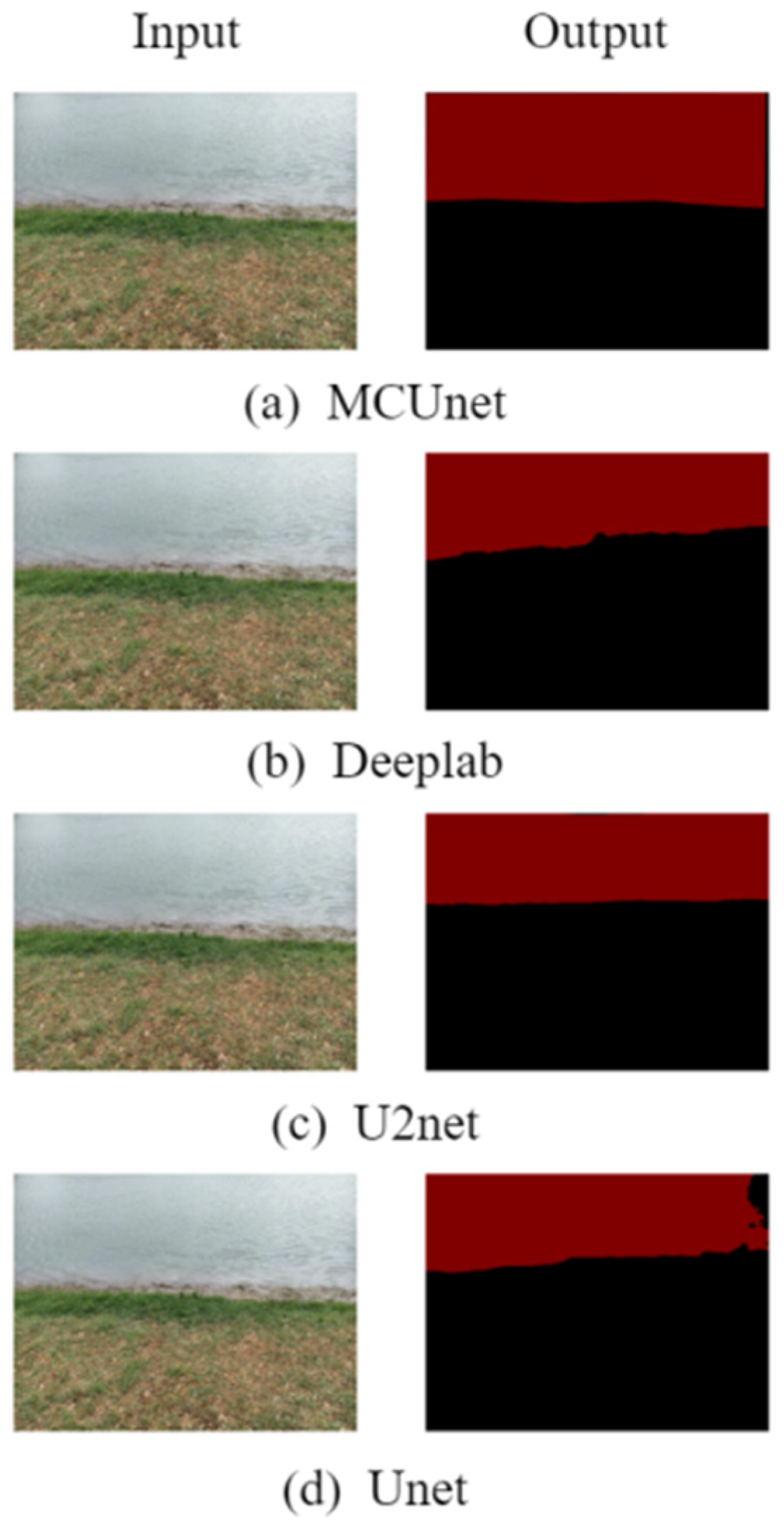
Figure 6 shows the results of four models on the same frame. The first column labeled Input is the original image, and the columns marked Output present the corresponding segmentation results of each model. It can be seen that MCUnet achieves thorough segmentation of water and non-water regions and accurately extracts the water level line. By contrast, the water level line predicted by DeepLab deviates significantly from the actual position; U2net produces an overestimated water level, while Unet suffers from incomplete segmentation. Overall, MCUnet achieves better performance than DeepLab, U2net and Unet. A comparison between MCUnet and Unet further demonstrates that the CA mechanism contributes remarkably to the segmentation of water and non-water areas.

3.2. Analysis of Ablation Experiment Results

To verify the effectiveness of each module, the following ablation experiments were conducted: (1) baseline model: the original Unet (without any improvements); (2) Unet + MobileNet V2; (3) Unet + CA module; (4) complete model: MCUnet (Unet + MobileNet V2 + CA). The experimental results are shown in Table 2.
As can be observed from the ablation test data in Table 2, different improved modules produce disparate gains in model inference speed and segmentation accuracy. The baseline vanilla UNet yields an FPS of 35, with P, R, F1-score and AUC equal to 82.35%, 70.51%, 75.97% and 84.07%, respectively. After integrating MobileNet V2 into UNet to form M-Unet, the FPS increases to 42 and the four metrics rise to 84.12%, 72.35%, 77.85% and 85.21%, which verifies that the lightweight backbone design accelerates inference and improves segmentation accuracy through effective feature representation. When the CA module is embedded into baseline Unet to construct C-Unet, the FPS slightly decreases to 34, whereas P, R, F1-score and AUC are improved to 83.58%, 71.89%, 77.35% and 85.03%. This indicates that the CA mechanism strengthens the model’s capability to capture critical features and boosts the accuracy and integrity of segmentation.
The proposed MCUnet combines MobileNet V2 and the CA module, achieving the maximum FPS of 45 across all test groups together with superior metric values of 88.12% (P), 78.09% (R), 82.80% (F1-score) and 91.42% (AUC). These results reveal a prominent synergy between MobileNet V2 for computational acceleration and CA for accuracy optimization; the combined modification simultaneously upgrades the model in both inference efficiency and segmentation performance.

3.3. Comparative Analysis of Different Models

All experimental models were trained on the same dataset with unified training settings, including training epochs, data augmentation schemes, input image size and batch size, in this study. Among them, the DeepLab baseline was constructed based on DeepLabv3+ with deeplabv3plus_resnet101 as the backbone network. As shown in Table 3, the original Unet [33] achieves the worst performance with the lowest precision (82.35), R (70.51), F1-score (75.97) and AUC (84.07). DeepLab [35] and U2net deliver moderate performance, and U2net is slightly better than DeepLab, with F1-score and AUC higher by 1.03 and 1.22 respectively. Notably, the introduction of attention mechanisms brings a remarkable performance improvement. Compared with the original Unet, M-ECA-Unet embedded with the ECA attention mechanism [37] obtains the most prominent gain in R, which increases from 70.51 to 75.47 (an increment of 4.96). This indicates that the ECA mechanism effectively improves the recall of positive samples, and accordingly raises the F1-score and AUC by 4.38 and 4.86.
MCUnet equipped with the CA mechanism achieves the best overall performance, reaching the highest values of P (88.12), R (78.09), F1-score (82.80) and AUC (91.42). Compared with M-ECA-Unet, MCUnet gains a more obvious improvement of 2.19 in P, demonstrating that the CA mechanism outperforms ECA in enhancing precision. Meanwhile, the F1-score and AUC are further increased by 2.45 and 2.49.

3.4. Comparative Analysis of Water Level Measurement Results

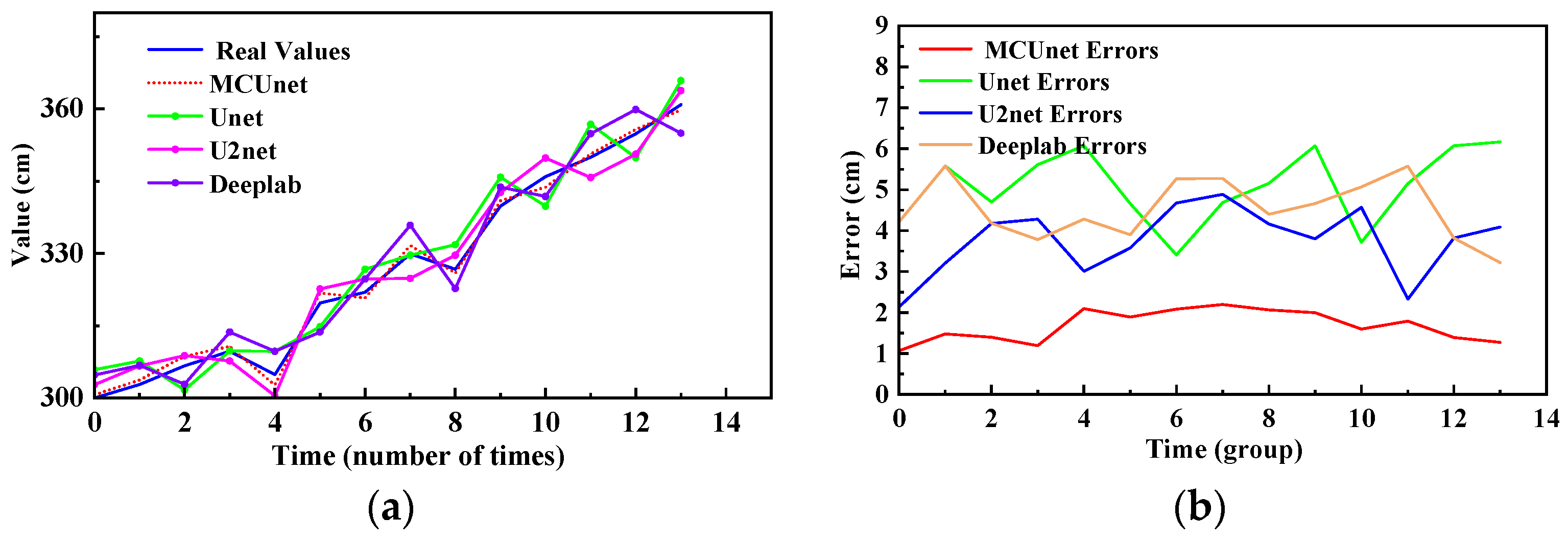
In this study, the artificially measured water levels were used as the benchmark, and it was assumed that the artificially measured data represented the true water levels. The error indicators in Table 4 are the differences between the predicted water levels of each model and the artificially measured benchmark water level. To verify the effectiveness of the MCUnet-based water level measurement model, comparative experiments were conducted among MCUnet, Unet, U2net and DeepLab. The baseline DeepLab model was built on DeepLabv3+ architecture with deeplabv3plus_resnet101 as the backbone network. Model-estimated water level values are compared against manually measured ground-truth values for validation, and partially measured data are illustrated in Figure 7.
Figure 7a shows the water level prediction curves of different models in multiple experiments. The horizontal axis represents the number of tests in a single group, and the vertical axis refers to the corresponding actual water level. It can be observed that the predictions of MCUnet are closest to the actual values with the smallest fluctuation. Figure 7b presents the average water level errors of 14 experiment groups. The horizontal axis denotes the group number, and the vertical axis indicates the deviation between predicted values and actual water levels. It further reveals that MCUnet has the minimum error and more stable fluctuation.
In summary, the MCUnet model outperforms the ruler-free water level measurement methods based on DeepLab, U2net and Unet in terms of both prediction performance and measurement error.
Detailed error statistics extracted from Figure 7 are summarized in Table 4. As listed in the table, MCUnet obtains remarkably lower values across all error metrics compared with other models. In terms of mean absolute error (MAE), MCUnet reaches 1.69 cm, which is approximately 66.9%, 55.3% and 62.7% lower than Unet (5.11), U2net (3.78 cm) and DeepLab (4.53 cm), respectively, verifying its superior average prediction accuracy. For maximum absolute error (Max AE), the value of MCUnet is 2.20 cm, about 64.5%, 55.1% and 60.7% less than Unet (6.20 cm), U2net (4.90 cm) and DeepLab (5.60 cm). This result demonstrates stronger error control and higher stability under extreme prediction conditions. The root mean square error (RMSE) of MCUnet is 1.73 cm, a decrease of 66.6%, 55.4% and 62.3% relative to Unet (5.18 cm), U2net (3.88 cm) and DeepLab (4.59 cm). Since RMSE is sensitive to large prediction errors, the small RMSE of MCUnet implies concentrated error distribution and the absence of severe abnormal prediction values.
In conclusion, as a lightweight convolutional neural network, MobileNet enables efficient feature extraction with reduced computational complexity while maintaining favorable feature representation. The CA mechanism dynamically assigns weights to features from different channels to highlight critical features and suppress irrelevant ones. Such improvement strengthens the model’s focus on key water level regions and further reduces prediction errors.

3.5. Model Performance Under Varying Water Levels

To investigate the stability of the four models under varying water level heights, corresponding experiments are carried out. The experiments are divided into three groups corresponding to low, normal and high water levels to test the robustness of each model, and the experimental results are listed in Table 5.
As shown in Table 5, MCUnet achieves the optimal overall performance across all test conditions and evaluation metrics with outstanding stability, which demonstrates its strong generalization ability and promising engineering practicability. The F1-score of MCUnet remains above 85% and varies slightly from 85.1% to 89.5%. Its MAE is limited below 2.1 cm, much lower than competing models, indicating accurate and credible water level measurement. Only negligible performance degradation occurs under challenging low-water level conditions (small water area and severe background interference) or high-water level conditions, proving the strong adaptability of MCUnet to complex environments.

3.6. Experimental Results of Comparison on Model Lightweight and Inference Efficiency

On the premise of ensuring measurement accuracy, comparative experiments on model lightweight performance and computational efficiency were conducted to screen the optimal model for practical engineering applications. The lightweight indicators and computational efficiency statistics of each model are presented in Table 6.
As illustrated in Table 6, MCUnet achieves the best comprehensive performance in terms of model lightweight characteristics and computational efficiency. It obtains the lowest values in all four lightweight indicators, with a parameter number of 4.2 M, computational complexity of 8.2 GFLOPs, model size of 16.8 MB and memory usage of 1024 MB. Meanwhile, it achieves an inference latency of 22 ms and a frame rate of 45 FPS, which balances lightweight design and high-efficiency inference capability well. Unet presents moderate comprehensive performance with parameters of 17.3 M, 55.6 GFLOPs, 69.2 MB model size, 1450 MB memory usage, 29 ms latency and 34 FPS, serving as a well-balanced baseline model [33]. In contrast, U2net and DeepLab suffer from structural redundancy and high resource consumption, with parameters close to or exceeding 40 M and memory usage higher than 1950 MB. Among all the models, U2net has the maximum parameters (44.5 M), model size (178 MB) and memory occupation (2100 MB), as well as the longest inference latency (33 ms) and the lowest FPS (30). DeepLab obtained from the literature [35] performs similarly to U2net in lightweight level and inference efficiency. Both models show obvious disadvantages in hardware resource consumption and computing speed, limiting their practical engineering applications.

4. Discussions

A monocular vision-based water level measurement approach combined with piecewise linear fitting is proposed in this study. Although the effectiveness of the proposed method has been verified by experimental results, the analysis of discrepancies and limitations is essential to promote the practical engineering application of vision-based water level detection technology. In this section, an in-depth discussion on the insights and achievements of this research is provided from three aspects.

4.1. Performance Differences from Comparative Methods

Experimental results have demonstrated that MCUnet outperforms mainstream segmentation models including DeepLab and U2net. In terms of network mechanisms, DeepLab realizes multi-scale feature capture based on atrous spatial pyramid pooling [38]. Equipped with nested residual U-shaped architecture, U2net owns powerful feature extraction capacity yet suffers from slow inference speed caused by excessive parameters [39]. In comparison, MCUnet combines a lightweight encoder and streamlined skip connections to achieve a preferable trade-off between suppressing irregular water surface noise and preserving critical edge details of water level.

4.2. Analysis of Limitations in Practical Engineering Applications

Despite the high precision and strong robustness of MCUnet under conventional daytime conditions, several limitations exist in practical engineering deployment. As a visible-light-based vision scheme, its performance is heavily restricted by image quality. Severe weather or nighttime environments without auxiliary lighting lead to severe degradation of low-level image features, and valid waterline edges can barely be extracted only via semantic segmentation and interpolation. In addition, drastic camera offset invalidates the measurement benchmark of the monocular vision system. In future studies, infrared imaging can be adopted to enhance nighttime feature visibility, and multimodal fusion schemes combining vision and radar can be explored. With the above technologies, the all-weather adaptability and reliability of water level monitoring systems under extreme working conditions can be further improved.

4.3. Discussion on Transferability and Generalization of the Proposed Framework

Efficient water level detection is achieved by the proposed visual measurement framework based on lightweight semantic segmentation and piecewise linear fitting calibration. Its core ideas and methodologies can also exhibit outstanding transferability and generalization capacity toward other computer vision measurement tasks.
Perspective projection results in the well-known size-variation distortion in all monocular vision systems, which generates a nonlinear mapping between pixel coordinates and real physical dimensions. Conventional global linear calibration inevitably introduces prominent systematic errors. The presented piecewise linear fitting method follows the idea of approximating nonlinear curves via segmented linear segments. Instead of being restricted to water level calibration, this calibration strategy can be transferred to diverse monocular ranging tasks suffering from perspective distortion. For instance, vehicle distance measurement in intelligent transportation [40] faces identical nonlinear perspective distortion on road images. Piecewise linear fitting is capable of converting pixel distances into actual road distances segmentally, improving ranging accuracy while guaranteeing real-time computation performance.

5. Conclusions

Real-time and high-precision water level measurement is targeted in this work. With field cameras deployed to collect water level data covering various periods, a novel monocular vision-based water level measurement method with piecewise linear fitting was proposed. Except under extremely harsh weather conditions or nighttime environments without auxiliary lighting, the proposed approach addresses the deficiencies of traditional water level measurement equipment, including strict installation limitation, high deployment and maintenance cost and cumbersome data processing. The main conclusions are summarized as follows:
(1) By optimizing the feature extraction network of the traditional Unet model, a lightweight MobileNet V2 network suitable for water level measurement was constructed in this study. Experimental results show that the established network achieves optimal performance in five key indicators, including precision, recall, F1-score, AUC and FPS. It can segment water level lines accurately and in real time. With significantly higher computational efficiency than standard convolution, the proposed network can effectively solve the poor real-time performance of traditional water level measurement methods.
(2) Based on measured water level data, a comparative analysis is conducted on the prediction performance of various water level measurement models. The experimental results demonstrate that the proposed MCUnet model outperforms the scale-free methods of DeepLab and U2net, as well as the scale-based method of Unet, in terms of prediction performance and error control, which verifies its excellent measurement accuracy and applicability.
(3) Under the test scenarios of low, normal and high water levels, the MCUnet model achieves the optimal overall performance. Its F1-score remains at a high level above 85% with a narrow fluctuation range from 85.1% to 89.5%. Meanwhile, the mean absolute error (MAE) is strictly controlled within 2.1 cm, which is significantly lower than that of other models.

Author Contributions

Conceptualization, D.Z. and K.S.; methodology, D.Z.; software, X.W. and M.L.; validation, Z.L. and M.G.; formal analysis, X.W.; investigation, J.S.; resources, Z.L.; data curation, M.G.; writing—original draft preparation, D.Z.; writing—review and editing, X.W.; visualization, Z.L. and M.G.; supervision, J.S.; project administration, J.S.; funding acquisition, D.Z. and K.S. All authors have read and agreed to the published version of the manuscript.

Funding

This research was funded by Henan Province Postdoctoral Scientific Research Funding Project (Grant No. HN2026119), Scientific and Technological Breakthrough Program in Henan Province (Grant No. 252102320022), A New Round of Construction Project of Key Academic Discipline in Henan Province (Grant No. 2023414), Zhengzhou Outstanding Young Scientific and Technological Talent Project (Grant No. 2025QNKJ017), Zhengzhou Outstanding Young Scientific and Technological Talent Project (Grant No. 2025QNKJ018), Zhengzhou Outstanding Young Scientific and Technological Talent Project (Grant No. 2025QNKJ019), and Key Research Projects of Henan Provincial Colleges and Universities (Grant No. 26A440013).

Data Availability Statement

The experimental dataset belongs to our industrial partner and cannot be publicly released under confidentiality constraints. All key results supporting the conclusions of this study are included in the paper. Requests for additional information should be addressed to the corresponding author.

Conflicts of Interest

Authors Dong Zhou and Jinggan Shao were employed by the company “Henan Jiaoyuan Engineering Technology Group Co., Ltd.” The remaining authors declare that the research was conducted in the absence of any commercial or financial relationships that could be construed as a potential conflict of interest.

References

  1. Zakharova, E.A.; Krylenko, I.N.; Sazonov, A.A.; Semenova, N.K.; Lisina, A.A. Water level regime of Arctic rivers according to modeling and satellite measurements. Russ. Meteorol. Hydrol. 2023, 48, 1076–1083. [Google Scholar] [CrossRef]
  2. Mohindru, P. Development of liquid level measurement technology: A review. Flow Meas. Instrum. 2023, 89, 102295. [Google Scholar]
  3. Chetpattananondh, K.; Tapoanoi, T.; Phukpattaranont, P.; Jindapetch, N. A self-calibration water level measurement using an interdigital capacitive sensor. Sens. Actuators A Phys. 2014, 209, 175–182. [Google Scholar] [CrossRef]
  4. Lee, Y.T.; Kwon, I.H. Development of capacitive water level sensor system for boiler. J. Semicond. Disp. Technol. 2021, 20, 103–107. [Google Scholar]
  5. Wei, Q.; Kim, M.J.; Lee, J.H. Development of capacitive sensor for automatically measuring tumbler water level with FEA simulation. Technol. Health Care 2018, 26, S491–S500. [Google Scholar] [CrossRef]
  6. Loizou, K.; Koutroulis, E. Water level sensing: State of the art review and performance evaluation of a low-cost measurement system. Measurement 2016, 89, 204–214. [Google Scholar] [CrossRef]
  7. Areekath, L.; Lodha, G.; Sahana, S.K.; George, B.; Philip, L.; Mukhopadhyay, S.C. Feasibility of a planar coil-based inductive-capacitive water level sensor with a quality-detection feature: An experimental study. Sensors 2022, 22, 5508. [Google Scholar] [CrossRef] [PubMed]
  8. Hong, S.T.; Shin, G.W. Mathematical Model Expression of Portable Calibration System for Float Type Water Level Meters. J. Korea Inst. Inf. Commun. Eng. 2017, 21, 1964–1972. [Google Scholar]
  9. Majdalani, S.; Chazarin, J.P.; Moussa, R. A new water level measurement method combining infrared sensors and floats for applications on laboratory scale channel under unsteady flow regime. Sensors 2019, 19, 1511. [Google Scholar] [CrossRef] [PubMed]
  10. Kim, D.S.; Han, J.M.; Park, G.S. Optimal design of dual magnetic float type level gauge to detect a specific level. J. Sens. Sci. Technol. 2008, 17, 308–316. [Google Scholar] [CrossRef]
  11. Wang, M.; Chen, W.Z.; Fan, G.M. Investigation on Transient Characteristics of High Pressure Vessel Water Level Measurement. Front. Energy Res. 2021, 9, 609320. [Google Scholar] [CrossRef]
  12. Gribovszki, Z.; Kalicz, P.; Szilágyi, J. Does the accuracy of fine-scale water level measurements by vented pressure transducers permit for diurnal evapotranspiration estimation? J. Hydrol. 2013, 488, 166–169. [Google Scholar] [CrossRef]
  13. Sengupta, D.; Shankar, M.S.; Reddy, P.S.; Prasad, R.S.; Srimannarayana, K. An FBG based hydrostatic pressure sensor for liquid level measurements. In Microstructured and Specialty Optical Fibres; Society of Photo-Optical Instrumentation Engineers: Bellingham, WA, USA, 2012; pp. 80–84. [Google Scholar]
  14. Maria de Fátima, F.D.; de Brito Paixão, T.; Mesquita, E.F.T.; Alberto, N.; Frias, A.R.; Ferreira, R.A.; Varum, H.; da Costa Antunes, P.F.; de Brito Andre, P.S. Liquid hydrostatic pressure optical sensor based on micro-cavity produced by the catastrophic fuse effect. IEEE Sens. J. 2015, 15, 5654–5658. [Google Scholar] [CrossRef]
  15. Terzic, E.; Nagarajah, R.; Alamgir, M. A neural network approach to fluid quantity measurement in dynamic environments. Mechatronics 2011, 21, 145–155. [Google Scholar] [CrossRef]
  16. de Almeida, G.G.; Barreto, R.C.; Seidel, K.F.; Kamikawachi, R.C. A fiber Bragg grating water level sensor based on the force of buoyancy. IEEE Sens. J. 2019, 20, 3608–3613. [Google Scholar]
  17. Schenato, L.; Aguilar-Lopez, J.P.; Galtarossa, A.; Pasuto, A.; Bogaard, T.; Palmieri, L. A rugged FBG-based pressure sensor for water level monitoring in dikes. IEEE Sens. J. 2021, 21, 13263–13271. [Google Scholar] [CrossRef]
  18. Pereira, T.S.R.; de Carvalho, T.P.; Mendes, T.A.; Formiga, K.T.M. Evaluation of water level in flowing channels using ultrasonic sensors. Sustainability 2022, 14, 5512. [Google Scholar] [CrossRef]
  19. Guan, S.; Bridge, J.A.; Davis, J.R.; Li, C.Z. Compact continuous wave radar for water level monitoring. J. Atmos. Ocean. Technol. 2022, 39, 1245–1257. [Google Scholar] [CrossRef]
  20. Ansari, I.; Jeong, Y.; Lee, Y.; Shim, J. Water level tracking system based on morphology and template matching. J. Korea Multimed. Soc. 2018, 21, 1431–1438. [Google Scholar]
  21. Dou, G.; Chen, R.S.; Han, C.T.; Liu, Z.W.; Liu, J.F. Research on water-level recognition method based on image processing and convolutional neural networks. Water 2022, 14, 1890. [Google Scholar] [CrossRef]
  22. Lee, J.H.; Jung, J.K. Development of image-based water level sensor with high-resolution and low-cost using image processing algorithm: Application to outgassing measurements from gas-enriched polymer. Sensors 2024, 24, 7699. [Google Scholar] [PubMed]
  23. Liu, M.T.; Yue, S.; Li, S.; Du, Y.Y.; Li, B. Research on intelligent detection of concrete aggregate level based on monocular imaging. Measurement 2022, 194, 111036. [Google Scholar] [CrossRef]
  24. Liu, Y.J.; Yue, S.; Wang, X.C.; Zhang, J.H.; Wang, G.H.; Liu, M.T.; Shangguan, L.J. Mapping of sand and gravel aggregate level height and volume measurement based on contour mapping generation. Signal Image Video Process. 2024, 18, 2865–2878. [Google Scholar] [CrossRef]
  25. Liu, Y.J.; Yue, S.; Li, B.; Wang, G.H.; Liu, M.T.; Zhang, J.H.; Shangguan, L.J. Fast and intelligent measurement of concrete aggregate volume based on monocular vision mapping. J. Real-Time Image Process. 2023, 20, 101. [Google Scholar] [CrossRef]
  26. Akkaya, I.; Arslan, O.; Rolland, J.P. Automated and highly precise surface wetting contact angle measurement with optical coherence tomography based on deep learning model. Measurement 2025, 253, 117788. [Google Scholar] [CrossRef]
  27. Zhang, M.Y.; Yu, S.; Hu, Z.L.; Xia, K.Y.; Wang, J.X.; Zhu, H.N. Sound source localization with sparse Bayesian-based feature matching via deep transfer learning in shallow sea. Measurement 2025, 253, 117873. [Google Scholar] [CrossRef]
  28. Meng, J.J.; Yuan, X.L.; Wang, G.; Li, X.K.; Zhao, E.P.; Li, J.R.; Fang, H.M.; Li, B.; Li, C.; Zhao, D.J.; et al. Automatic surface roughness recognition system under different manufacturing processes based on deep learning. Measurement 2025, 253, 117473. [Google Scholar] [CrossRef]
  29. Chen, J.H.; Huang, Z.W.; Hu, B.; Ke, H.B.; Lin, M.; Wang, Q.W. Visualization and monitoring dynamic water levels of steam generators based on deep learning. Prog. Nucl. Energy 2024, 169, 105052. [Google Scholar] [CrossRef]
  30. Li, J.L.; Tong, C.Y.; Yuan, H.X.; Huang, W.N. A Complex Environmental Water-Level Detection Method Based on Improved YOLOv5m. Sensors 2024, 24, 5235. [Google Scholar] [CrossRef] [PubMed]
  31. Chen, C.; Fu, R.F.; Ai, X.J.; Huang, C.B.; Cong, L.; Li, X.H.; Jiang, J.G.; Pei, Q.Q. An integrated method for river water level recognition from surveillance images using convolution neural networks. Remote Sens. 2022, 14, 6023. [Google Scholar] [CrossRef]
  32. Liang, L.; Huang, W.; Awan, M.L.; Parveen, A.; Li, R.P.; Bi, F.G.; Shao, J.H.; Liang, X.Y.; Wu, C.H.; Liu, Z.Q. Study and application of image water level recognition calculation method based on mask R-CNN and raster R-CNN. Appl. Ecol. Environ. Res. 2023, 21, 5039–5053. [Google Scholar] [CrossRef]
  33. Zhang, P.; Yan, Y.M.; Ai, Y.G.; Wang, B.H.; Shen, H.M.; Peng, Z.H. Unet-based image segmentation and binarization for water level detection. Vis. Comput. 2025, 41, 7367–7377. [Google Scholar]
  34. Liu, M.T.; Wang, C.C.; Huang, W.; Wang, X.C.; Li, S.H.; Lu, P.; Liu, X.M.; Jiang, E.H. Research on water level measurement technology based on the residual length ratio of image characters. Signal Image Video Process. 2024, 18, 57–70. [Google Scholar] [CrossRef]
  35. Muhadi, N.A.; Abdullah, A.F.; Bejo, S.K.; Mahadi, M.R.; Mijic, A. Deep learning semantic segmentation for water level estimation using surveillance camera. Appl. Sci. 2021, 11, 9691. [Google Scholar] [CrossRef]
  36. Hou, Q.B.; Zhou, D.Q.; Feng, J.S. Coordinate attention for efficient mobile network design. In Proceedings of the IEEE/CVF Conference on Computer Vision and Pattern Recognition; IEEE Computer Society: Los Alamitos, CA, USA, 2021; pp. 13713–13722. [Google Scholar]
  37. Wang, Q.L.; Wu, B.G.; Zhu, P.F.; Li, P.H.; Zuo, W.M.; Hu, Q.H. ECA-Net: Efficient channel attention for deep convolutional neural networks. In Proceedings of the IEEE/CVF Conference on Computer Vision and Pattern Recognition; IEEE Computer Society: Los Alamitos, CA, USA, 2020; pp. 11534–11542. [Google Scholar]
  38. Zhang, Y.H.; Wei, X.X.; Wang, Y.S. MDAB-UNet: A lightweight and efficient improved UNet architecture for remote sensing image segmentation. J. Real-Time Image Process. 2026, 23, 103. [Google Scholar] [CrossRef]
  39. Fang, W.; Fu, Y.X.; Sheng, V.S. FPS-U2Net: Combining U2Net and multi-level aggregation architecture for fire point segmentation in remote sensing images. Comput. Geosci. 2024, 189, 105628. [Google Scholar] [CrossRef]
  40. Zheng, L.; Liu, L.; Lu, J.; Tian, J.; Cheng, Y.; Yin, W. Research on distance measurement of vehicles in front of campus patrol vehicles based on monocular vision. Pattern Anal. Appl. 2024, 27, 146. [Google Scholar] [CrossRef]
Figure 1. Layout of water level monitoring site and equipment.
Water 18 01557 g001
Figure 2. Schematic diagram of water level measurement.
Water 18 01557 g002
Figure 3. Structure diagram of MobileNet V2 network.
Water 18 01557 g003
Figure 4. Coordinate attention algorithm flow chart.
Water 18 01557 g004
Figure 5. Network structure diagram of MCUnet.
Water 18 01557 g005
Figure 6. Comparison chart of model prediction results. (a) MCUnet; (b) Deepleb; (c) U2net; (d) Unet.
Water 18 01557 g006
Figure 7. Comparison of prediction performance and error among four models. (a) Water level prediction curves of different models in multiple experiments; (b) Average water level errors of different models.
Water 18 01557 g007
Table 1. Experimental parameters.
Laboratory EquipmentSpecification
Operating SystemWindows 11
Development EnvironmentCUDA 12.0
GPUNVIDIA GeForce RTX 4060
CPU12th Gen Intel(R) Core(TM) i7-12650H
Epoch500
Batch_size4
Table 2. Results of ablation experiments.
ModelFPSPRF1-ScoreAUC
MCUnet4588.1278.0982.8091.42
Unet3482.3570.5175.9784.07
C-Unet3483.5871.8977.3585.03
M-Unet4284.1272.3577.8585.21
Table 3. Performance comparison of different models.
ModelPRF1-ScoreAUC
DeepLab83.6571.1276.8785.12
U2net85.3171.6877.9086.34
Unet82.3570.5175.9784.07
M-ECA-Unet85.9375.4780.3588.93
MCUnet88.1278.0982.8091.42
Table 4. Model error metrics.
Error TypeMCUnet ErrorUnet ErrorU2net ErrorDeeplab Error
Mean absolute error (cm)1.695.113.784.53
Maximum absolute error (cm)2.206.204.905.60
Root mean square error (cm)1.735.183.884.59
Table 5. Performance of various models under different water level conditions.
ModelWater Level GroupF1-ScoreMAE (cm)RMSEMaxAE
MCUnetLow Water Level85.12.12.33.5
Normal Water Level89.51.51.72.8
High Water Level87.31.823.1
UnetLow Water Level70.36.56.89.2
Normal Water Level83.14.85.17.5
High Water Level76.25.96.28.8
U2netLow Water Level75.64.857.1
Normal Water Level85.73.53.85.9
High Water Level79.14.24.56.5
DeeplabLow Water Level72.85.768.4
Normal Water Level84.34.24.56.7
High Water Level77.55.15.47.9
Table 6. Model efficiency and lightweight metrics.
ModelParameter Quantity (M)GFLOPsModel File Size (MB)Memory Usage (MB)End-to-End Latency (ms)FPS
MCUnet4.28.216.810242245
Unet17.355.669.214502934
U2net44.5218.317821003330
Deeplab39.7145.4158.819503033
Disclaimer/Publisher’s Note: The statements, opinions and data contained in all publications are solely those of the individual author(s) and contributor(s) and not of MDPI and/or the editor(s). MDPI and/or the editor(s) disclaim responsibility for any injury to people or property resulting from any ideas, methods, instructions or products referred to in the content.