Article

Comparative Study of UV-Based AOPs for Degradation of Hydrophilic Ribavirin and Hydrophobic Chloroquine Phosphate: Performance, Radical Pathways, EEO, and Water Matrix Effects

1
State Key Laboratory of Pollution Control and Resource Reuse, College of Environmental Science and Engineering, Tongji University, Shanghai 200092, China
2
Shandong Province Water Supply and Drainage Monitoring Centre, Jinan 250101, China
3
CAUPD (Beijing) Planning & Design Consultants Co., Ltd., Beijing 100044, China
4
School of Water Conservancy and Environment, University of Jinan, Jinan 250022, China
*
Author to whom correspondence should be addressed.
Water 2026, 18(13), 1548; https://doi.org/10.3390/w18131548 (registering DOI)
Submission received: 19 May 2026 / Revised: 19 June 2026 / Accepted: 22 June 2026 / Published: 25 June 2026

Abstract

Ribavirin (RBV) and chloroquine phosphate (CQP) are two typical pharmaceutical contaminants with distinct hydrophilic (RBV) and hydrophobic (CQP) properties. This polarity contrast led to markedly different degradation behaviors. Interestingly, hydrophobic CQP consistently degraded faster and with lower EEO than hydrophilic RBV across all combined systems, highlighting pollutant polarity as a key determinant. This study systematically compared their degradation by three UV-based advanced oxidation processes (UV/AOPs): UV/H2O2, UV/PMS, and UV/KMnO4. Degradation kinetics, electrical energy per order (EEO), radical pathways, and water matrix effects were investigated. Sole UV or sole oxidant achieved negligible removal (<7.2%). All UV/AOPs greatly enhanced degradation in a dose-dependent manner. At equal molar oxidant concentration (0.2 mM), the efficiency order was UV/PMS > UV/H2O2 ≫ UV/KMnO4, with the gap widening at higher dosages. UV/H2O2 exhibited the best overall performance, with remarkably low EEO values (0.59 kWh/m3 for RBV and 0.46 kWh/m3 for CQP at 0.2 mM), whereas UV/PMS showed faster kinetics but much higher energy consumption (e.g., 28.67 kWh/m3 for RBV and 28.60 kWh/m3 for CQP at 0.4 mM) and secondary pollution risks. UV/KMnO4 had low energy but poor degradation. Radical quenching experiments revealed that in UV/H2O2, hydroxyl radicals (•OH) predominantly drove degradation regardless of pollutant polarity. In UV/PMS, •OH primarily drove RBV degradation, while CQP removal involved the combined action of •OH, sulfate radicals (SO4), and other reactive species. For the optimal UV/H2O2 process, acidic pH (5.0) favored degradation; Cl slightly promoted CQP removal but inhibited RBV, whereas SO42−, CO32−, and HCO3 suppressed both pollutants. Collectively, UV/H2O2 is recommended as the most energy-efficient and robust UV/AOP for treating both hydrophilic and hydrophobic pharmaceuticals, with the additional insight that pollutant polarity governs both degradation kinetics and radical mechanisms.

1. Introduction

Emerging contaminants include pharmaceuticals and personal care products (PPCPs), persistent organic pollutants (POPs), endocrine-disrupting chemicals (EDCs), per- and polyfluoroalkyl substances (PFAS), and others. These compounds generally exhibit high environmental stability and can pose hazards to soil, water bodies, atmosphere, and human health through natural and social cycles [1]. At present, emerging contaminants enter wastewater systems via human metabolism and other pathways, imposing a heavy burden on existing wastewater treatment facilities. Their proportion in organic pollutants from wastewater treatment plants (WWTPs) worldwide has been increasing, and in China, their share can reach up to 21% [2]. Ribavirin is a common antiviral drug with in vitro activity against a wide spectrum of viruses. It is used to treat various viral infections and has also been applied in the therapy of colorectal cancer and hepatocellular carcinoma [3,4,5]. Chloroquine phosphate (CQP) is an antiviral agent used against coronavirus disease and is also a long-established drug for malaria, rheumatoid arthritis, and asthma. Accordingly, ribavirin (RBV) and CQP are extensively consumed in daily life and represent two typical PPCPs [6,7]. Both RBV and CQP possess high persistence and biotoxicity. For instance, RBV has been found to exert significant teratogenic and embryocidal effects in nearly all animal studies and shows high delayed toxicity toward Spodoptera litura, a destructive agricultural pest. Its discharge into aquatic environments can lead to severe water pollution and viral drug resistance. CQP released into wastewater can affect biomass activity and process stability, including anaerobic ammonia oxidation, in biological treatment systems [8,9,10,11,12,13]. Excessive amounts of RBV, CQP, and other pharmaceuticals enter wastewater systems through human excretion. Owing to their high structural stability, the large-scale consumption of these compounds has placed a substantial burden on conventional wastewater treatment processes [14,15,16]. RBV and CQP have been detected in urban wastewater, surface water, groundwater, and sediments at concentrations ranging from ng/L to μg/L [17,18,19]. Uncontrolled accumulation of RBV, CQP, and their metabolites in aquatic environments would exert toxic effects on algae, fish, and humans, posing elevated risks to water safety [4,16,20,21]. Wastewater treatment plants serve as critical hubs for water treatment; however, traditional processes show limited removal efficiency toward RBV and CQP. Moreover, RBV is hydrophilic, while CQP displays hydrophobic characteristics, making the two compounds ideal candidates for comparative investigation into the degradation behavior of pharmaceuticals with distinct physicochemical properties [22,23]. Therefore, it is necessary to develop novel methods or optimize existing technologies to enhance their elimination [14,16,21].
Photochemical oxidation processes feature mild reaction conditions, simple operation, fast pollutant degradation, short reaction time, and high removal efficiency. They have been widely applied in water and wastewater treatment and show promising development prospects. The main mechanism of ultraviolet (UV)-based photochemical oxidation systems involves the addition of oxidants such as H2O2, peroxymonosulfate (PMS), peroxydisulfate (PDS), NaClO, and KMnO4 into solution. Under UV irradiation, these substances are activated to generate strong oxidizing radicals or species, including hydroxyl radicals (•OH), sulfate radicals (SO4), chlorine radicals (Cl•), and Mn(V). These reactive species undergo substitution, addition, electron transfer, and other reactions with organic pollutants, leading to their partial or complete mineralization and removal [16,24]. H2O2 is a commonly used oxidant in advanced oxidation processes (AOPs) [25]. It is chemically unstable and readily decomposes, and its UV-activated oxidation produces only water and oxygen, avoiding secondary pollution. H2O2 is fully miscible with aqueous solutions and exhibits high safety, making it suitable for degrading various organic pollutants [26,27]. PMS is an emerging oxidant in AOPs that decomposes into water and sulfate. Upon activation, it generates reactive species such as •OH and SO4, enabling efficient pollutant degradation. PMS is convenient, safe, and stable, with good water miscibility and high security [28,29]. The degradation of pollutants by PMS-activated radicals highly depends on the structural active sites of catalysts [30]. PMS can be effectively activated by UV, Fe2+, various catalysts, and their combinations, significantly improving the removal of organic pollutants [28,29,31]. KMnO4 is widely employed as an oxidant in water treatment due to its easy dosing, convenient storage and transportation, strong oxidation capacity, and absence of toxic disinfection byproducts during oxidation. It is used to remove iron, manganese, and other metals; eliminate algae; control odor; and degrade emerging organic compounds in water [32,33]. Compared with other oxidants, KMnO4 generates fewer byproducts during pollutant treatment, and its final reduction product in water treatment is usually MnO2, which exhibits adsorption and coagulation-aid effects, providing synergistic benefits for pollutant removal [32,33]. The UV/KMnO4 system is a typical UV-driven photochemical oxidation process and an emerging technology. Previous studies have investigated the degradation of nitrobenzene, benzoic acid, terephthalic acid, p-chlorobenzoic acid (as probe compounds), gemfibrozil, and nalidixic acid (as representative micropollutants). Results have verified a distinct synergistic effect in the UV/KMnO4 system, which exhibited significantly enhanced degradation kinetics compared with UV alone. Such improvement is mainly attributed to the UV-induced activation of KMnO4, generating Mn(V) and hydroxyl radicals (•OH) that contribute to the efficient oxidation and decomposition of target contaminants [34].
Although UV-based AOPs have been individually applied to various pharmaceuticals, most existing studies treat target pollutants in isolation without systematically comparing how intrinsic molecular properties—particularly hydrophilicity/hydrophobicity—affect degradation behavior across different AOPs. The role of pollutant polarity in determining not only degradation kinetics but also energy efficiency (EEO) and dominant radical pathways remains largely unexplored. Furthermore, the selection of suitable UV/AOPs for pharmaceutical wastewater still lacks a clear, property-based guiding principle. To fill this gap, RBV (logKow = −1.85) and CQP (logKow = 3.89) serve as two representative antiviral pharmaceuticals with sharply contrasting polarities, making them ideal candidates for elucidating the polarity-dependent mechanisms that govern UV/AOP performance [22,23].
In this work, hydrophilic ribavirin (RBV) and hydrophobic chloroquine phosphate (CQP) were selected as model pollutants. The degradation performance and electrical energy per order (EEO) of three UV-based AOPs (UV/H2O2, UV/PMS, and UV/KMnO4) were systematically compared at equivalent molar oxidant dosages. Particular attention was paid to how pollutant hydrophilicity/hydrophobicity affects degradation kinetics and energy consumption. Radical quenching experiments were designed to identify the dominant reactive species responsible for pollutant removal. Furthermore, the effects of key water quality parameters (pH, common anions) on the most energy-efficient process were investigated. The findings provide both practical guidance for selecting suitable UV/AOPs in treating antiviral pharmaceutical wastewater and mechanistic insights into polarity-dependent radical pathways.

2. Materials and Methods

2.1. Chemicals

RBV (C10H13N5O4), CQP (C18H32ClN3O8P2), disodium hydrogen phosphate dodecahydrate (Na2HPO4·12H2O), sodium dihydrogen phosphate (NaH2PO4), potassium permanganate (KMnO4), ammonium acetate (CH3COONH4, HPLC grade), tert-butanol (C4H10O, chromatographically pure), isopropanol (C3H8O, chromatographically pure), and ethanol (CH3CH2OH, chromatographically pure) were purchased from Aladdin Reagent (Shanghai, China). Methanol (CH3OH) and acetonitrile (CH3CN) were obtained from Merck KGaA (Darmstadt, Germany). Sodium chloride (NaCl), anhydrous sodium sulfate (Na2SO4), sodium bicarbonate (NaHCO3), sodium carbonate (Na2CO3), sodium hydroxide (NaOH), hydrochloric acid (HCl), and hydrogen peroxide (H2O2) were acquired from Sinopharm Chemical Reagent Co., Ltd. (Shanghai, China). Potassium peroxymonosulfate (PMS, KHSO5·0.5KHSO4·0.5K2SO4) was purchased from Ron Reagent (Shanghai, China). All solutions were prepared with ultrapure water (18.2 MΩ·cm) produced by a Milli-Q system (MilliporeSigma, Guyancourt, France).

2.2. Experimental Design and Methods

The experimental setup employed in this study was a Trojan parallel beam UV reactor, and the UV fluence rate was accurately determined using a UV radiometer. The typical UV fluence rate applied was 206 μW/cm2, as detailed in Figure S1 in the Supporting Information. Stock solutions including KMnO4, PMS, H2O2, RBV, CQP, 100 mM disodium hydrogen phosphate (Solution A), and 100 mM sodium dihydrogen phosphate (Solution B) were prepared separately. Each stock solution was stirred for 24 h to ensure complete dissolution before use. All stock solutions were stored at 4 °C and renewed weekly. All experiments were conducted at room temperature of 25 ± 2 °C. Before each experiment, the UV lamp was preheated for 30 min to ensure stable UV radiation.
A 5 mM PBS buffer solution was prepared by mixing appropriate volumes of Na2HPO4 and NaH2PO4 stock solutions. The solution pH was adjusted using NaOH or HCl if any fluctuation occurred. RBV, CQP, and corresponding oxidant stock solutions (PMS, H2O2, KMnO4) were added into the buffered solution in sequence. After mixing, the solution was transferred into the reactor and exposed to UV irradiation aligned with the cylindrical chamber of the parallel beam apparatus, initiating the UV/AOPs degradation process. Samples were collected at predetermined time intervals for analysis.
The degradation of RBV and CQP was monitored by high-performance liquid chromatography (HPLC). All degradation experiments were performed in duplicate (n = 2). For quantitative analysis of RBV via high-performance liquid chromatography (HPLC), the mobile phase was a mixture of methanol/water (10:90, v/v). The UV detection wavelength was set at 208 nm, using a C18 column (4.6 mm × 250 mm, 5 μm). The flow rate was 0.8 mL min−1, and the column temperature was maintained at 35 °C. For CQP quantification, the mobile phase consisted of methanol/acetonitrile/0.1 mM ammonium acetate (40:25:35, v/v/v). The detection wavelength was 325 nm, using the same C18 column (4.6 mm × 250 mm, 5 μm). The flow rate was 1.0 mL min−1 with a column temperature of 35 °C. Calibration curves for both RBV and CQP were established with excellent linearity (R2 = 0.9999 for both analytes). The LOD and LOQ were approximately 0.1 μM and 0.3 μM for both compounds, well below the experimental concentration of 2.5 μM, ensuring reliable quantification. Recovery rates from spiked samples ranged from 95% to 105%, with RSD < 5%. Prior to HPLC analysis, samples were quenched by adding excess methanol. Control experiments confirmed that none of the oxidants (H2O2, PMS, KMnO4) or radical scavengers (EtOH, IPA, TBA) at the concentrations used produced interfering peaks at the analytical wavelengths for RBV (208 nm) or CQP (325 nm).

2.3. Date Analysis

The UV-based photochemical oxidation process in this study is a homogeneous reaction, in which oxidation occurs in the aqueous phase. The UV light intensity was kept constant during the experiments, so the generated strong oxidizing radicals could be regarded as being produced continuously and uniformly. However, these oxidative radicals exhibit extremely short lifetimes in water and cannot be directly quantified. Therefore, the pseudo-first-order kinetic model was generally adopted to describe the degradation process, as shown in Equation (1):
−In(C/C0) = kct
where
  • C is the concentration of RBV or CQP, mmol·L−1;
  • t is the reaction time, min;
  • k_C is the apparent pseudo-first-order rate constant, min−1.
Moreover, the electrical energy per order (EEO), a standard measure commonly used for operating cost assessment, was introduced to evaluate the unit energy consumption of the various UV/AOPs for RBV and CQP removal [35]. In this study, EEO-UV was calculated based on the effective UV radiant power reaching the reaction solution (measured by a UV radiometer), rather than the total electrical input power of the UV lamp, as this approach normalizes the UV fluence input for a fair inter-process comparison in a laboratory-scale collimated beam apparatus. EEO-OX is defined as an auxiliary equivalent energy indicator for cost-weight estimation of oxidant consumption; electrical energy consumption and chemical cost should be evaluated separately in practical applications. The detailed calculations are presented in Supplementary Material Text S1.

3. Results

3.1. Comparative Analysis of RBV and CQP Degradation by UV/H2O2, UV/PMS and UV/KMnO4

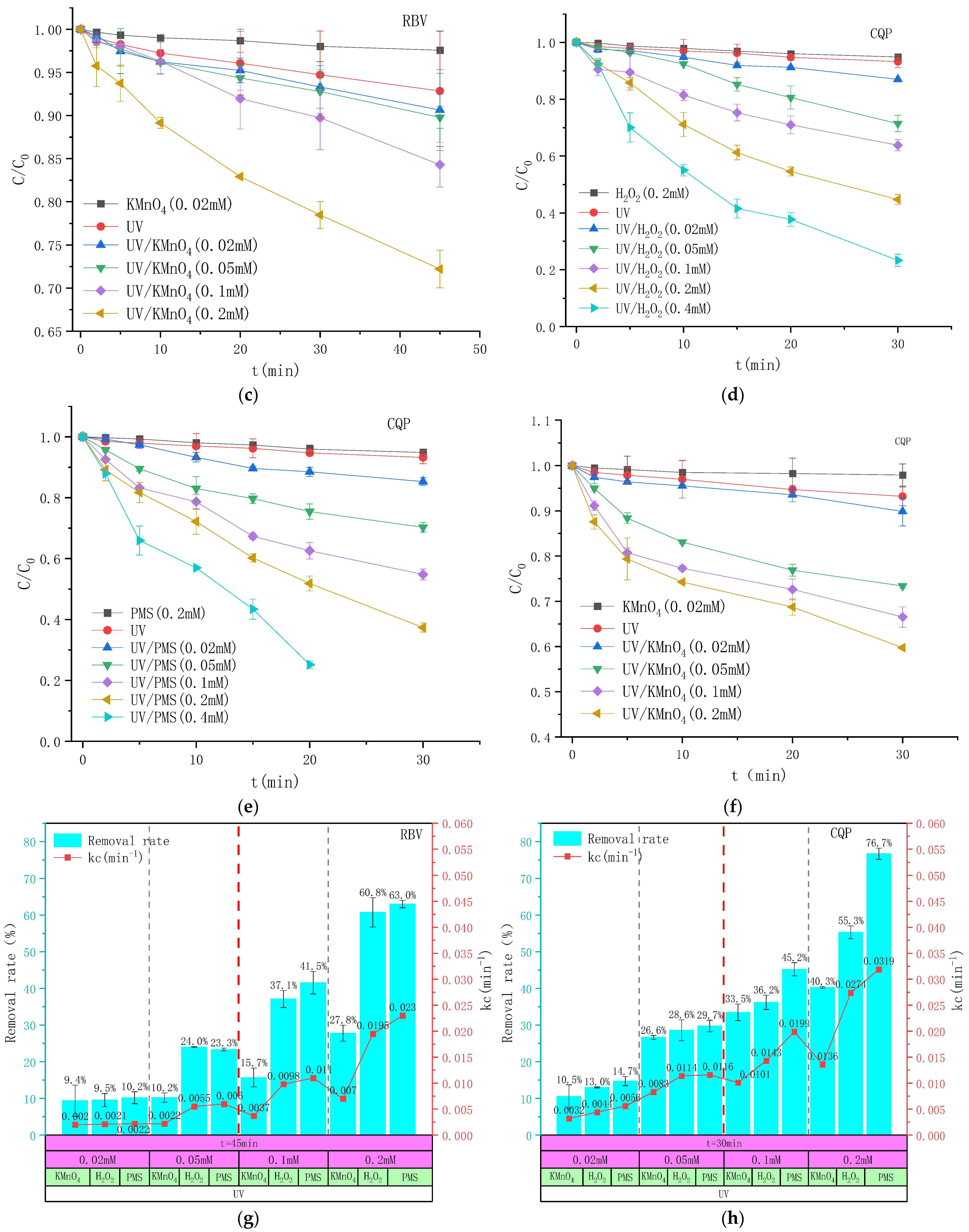
H2O2, PMS, and KMnO4 are common oxidants. This study compared the degradation of RBV and CQP in sole UV, sole oxidant, and UV/AOP systems at equivalent molar concentrations (Figure 1). Pseudo-first-order rate constants (kc) are given in Tables S2 and S3. Under sole UV, RBV removal was only 7.2% (45 min), and CQP removal was 6.8% (30 min). Sole oxidants (0.2 mM H2O2, 0.2 mM PMS, or 0.02 mM KMnO4) gave negligible removal (<5.5%), because unactivated oxidants cannot generate reactive oxygen species without light.
UV/AOPs dramatically enhanced degradation in a dose-dependent manner. For RBV in UV/H2O2 (0.02 → 0.4 mM H2O2), removal increased from 9.5% to 79.5% (kc 0.0021 → 0.0347 min−1). In UV/PMS (0.02 → 0.4 mM PMS), RBV removal rose from 10.2% to 86.8% (kc 0.0022 → 0.0444 min−1). In UV/KMnO4 (0.02 → 0.2 mM), RBV removal increased from 9.4% to 27.8% (kc 0.0020 → 0.0070 min−1). For CQP, UV/H2O2 gave removal from 13.0% to 76.7% (kc 0.0044 → 0.0482 min−1); UV/PMS from 14.7% to nearly 100% (kc 0.0056 → 0.0659 min−1); UV/KMnO4 from 10.5% to 40.3% (kc 0.0032 → 0.0136 min−1). No obvious quenching was observed, indicating oxidant dosages were below the radical-scavenging threshold [32,33].
Pollutant polarity significantly influenced degradation. Hydrophobic CQP consistently showed higher kc than hydrophilic RBV. At 0.4 mM H2O2, kc(CQP)/kc(RBV) = 1.39; at 0.4 mM PMS, the ratio was 1.48. The absolute kc difference between CQP and RBV widened with oxidant dosage: in UV/PMS at 0.02 mM, the difference was 0.0034 min−1; at 0.4 mM, it reached 0.0215 min−1 (six-fold increase). Thus, the hydrophobic pollutant benefits disproportionately from increased radical flux. The relative advantage also varied among systems: in UV/KMnO4 at 0.2 mM, the ratio reached 1.94, suggesting that Mn(V) intermediates [34] may favor hydrophobic targets more strongly than •OH or SO4.
A horizontal comparison (Figure 1g,h) confirmed the degradation order: UV/PMS > UV/H2O2 > UV/KMnO4 at all tested concentrations (0.02–0.2 mM). At 0.02 mM, removal differences were small (e.g., RBV: 9.4–10.2%; CQP: 10.5–14.7%). As oxidant concentration increased, the gap widened. At 0.2 mM, RBV removals were 27.8% (KMnO4), 60.8% (H2O2), and 63.0% (PMS); CQP removals were 40.3%, 55.3%, and 62.6%, respectively. UV/PMS produced the most reactive species (SO4 + •OH), while UV/KMnO4 suffered from poor activation efficiency. In summary, both oxidant choice and contaminant polarity are key determinants of degradation efficiency in UV/AOPs. To identify the dominant radical species in UV/H2O2 and UV/PMS and to interpret their different degradation behaviors, quenching experiments were performed.

3.2. Mechanistic Insights

In this section, the radical quenching method was employed to investigate the main radical species responsible for the degradation of RBV and CQP in UV/H2O2 and UV/PMS. UV/KMnO4 was not further studied because its intense purple color (even at 0.2 mM) makes the solution deeply colored, hindering light penetration and complicating radical identification; moreover, its poor degradation performance already limited practical value. Therefore, mechanistic studies focused only on UV/H2O2 and UV/PMS. In UV/H2O2 and UV/PMS, possible reactive species include •OH, SO4, 1O2, and O2. To distinguish them, tert-butanol (TBA, quenches •OH but not SO4), ethanol (EtOH, quenches both •OH and SO4), and isopropanol (IPA, also quenches both •OH and SO4) were selected based on their well-known rate constants. All three react very fast with •OH (k ≈ 108–109 M−1·s−1) [36,37]. TBA reacts slowly with SO4 (<106 M−1·s−1), while EtOH and IPA show moderate reactivity (k ≈ 7.8 × 10⁷ and 8.5 × 10⁷ M−1·s−1) [38,39]. Their reactions with 1O2 are extremely slow (<103–105 M−1·s−1) and negligible with O2 [36,40]. Strong inhibition by TBA, EtOH, or IPA indicates involvement of •OH and/or SO4; no inhibition suggests 1O2 or O2. IPA rapidly quenches both •OH and SO4 but not 1O2, so strong IPA inhibition excludes 1O2 [41,42].
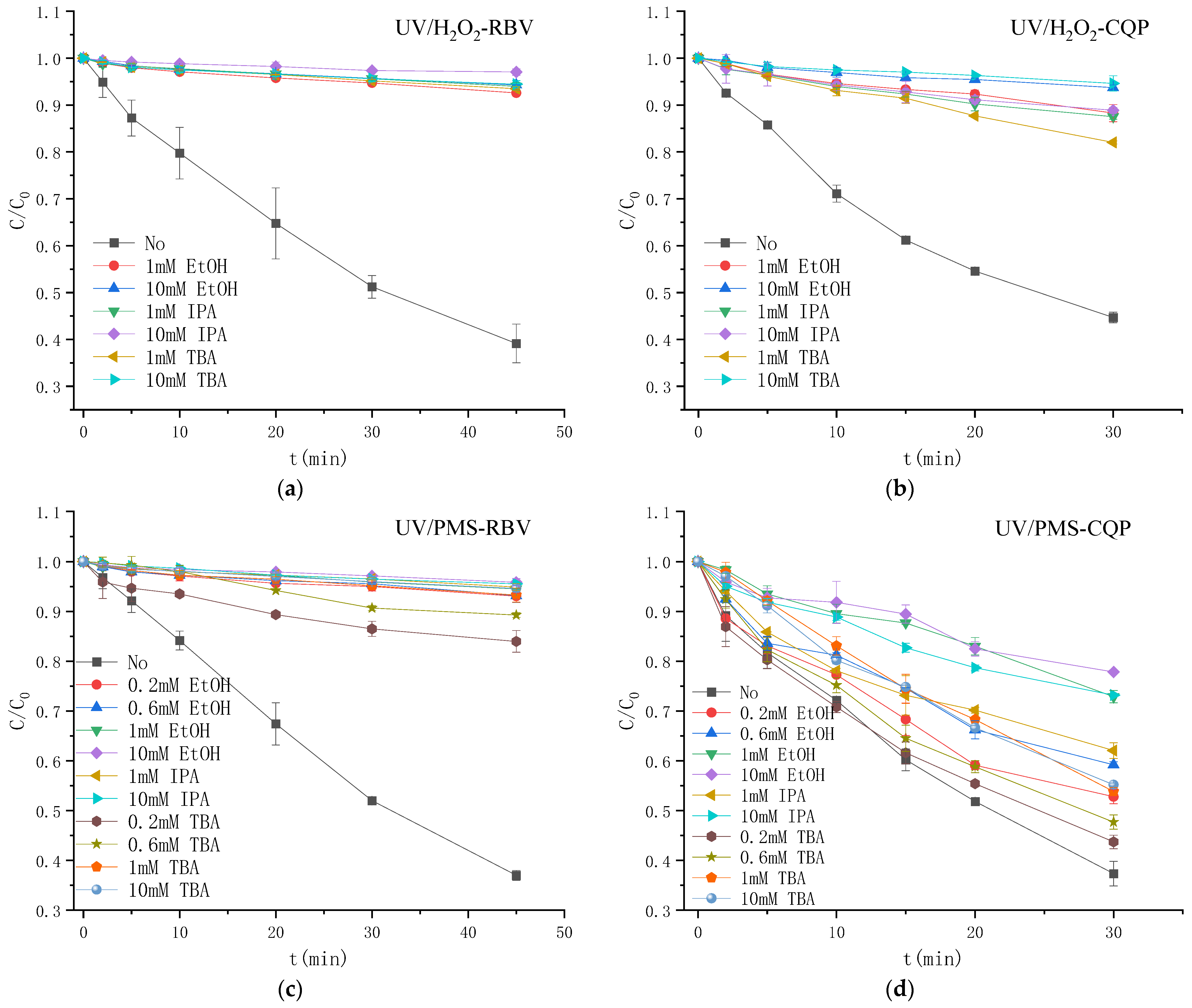
To elucidate the radical pathways, quenching experiments were performed using the UV/H2O2 (0.2 mM) and UV/PMS (0.2 mM) processes. The degradation efficiencies of RBV (45 min) and CQP (30 min) were measured upon addition of various quenchers, and the results are summarized in Figure 2 and Table S4 (Supporting Information).
UV/H2O2: Without quencher, RBV removal = 60.9% (kc 0.020 min−1), CQP = 55.3% (kc 0.0274 min−1). At 10 mM quencher ([quencher]:[H2O2] = 50:1), RBV removal dropped to 5.7% (EtOH), 2.9% (IPA), 5.6% (TBA); CQP to 6.3% (EtOH), 11.1% (IPA), 5.4% (TBA). TBA suppressed both pollutants as strongly as EtOH (e.g., CQP: 5.4% vs. 6.3%), proving that •OH is the predominant radical; other ROS contributions are negligible.
UV/PMS: Without quencher, RBV removal = 63.0% (kc 0.023 min−1), CQP = 62.6% (kc 0.0319 min−1). For RBV, 10 mM TBA reduced removal to 5.4%, and 10 mM EtOH to 4.2%, indicating •OH dominates with minor SO4 contribution. For CQP, TBA (10 mM) left 44.8% removal, whereas EtOH (10 mM) left only 22.2%. The much weaker TBA inhibition proves SO4 plays a major role. After 10 mM EtOH, residual CQP removal (22.2%) exceeded the sum of direct photolysis (6.8%) and direct PMS oxidation (5.2%) = 12.0%. Given the low reactivity of EtOH/IPA with 1O2, non-radical pathways likely contribute to CQP degradation (but the specific involvement of 1O2 remains a reasonable inference based on indirect evidence). Thus, in UV/PMS, radical pathways depend on pollutant polarity: hydrophilic RBV is primarily oxidized by •OH in the aqueous phase; hydrophobic CQP, due to its low aqueous solubility and tendency to associate with radical species in solution, undergoes degradation involving the combined action of •OH, SO4, other possible radicals, direct photolysis, and direct PMS oxidation.
Mechanistic explanation: •OH acts as “short-range, fast oxidation” (H-abstraction/addition [43]), with near diffusion-controlled rates (109–1010 M−1·s−1) and minimal steric hindrance, rapidly oxidizing hydrophilic RBV [44,45,46]. However, its half-life is ~20 ns, limiting it to attack only pollutants near its generation site in the aqueous phase [47,48]. SO4 acts as “long-range, migratory oxidation” via outer-sphere single electron transfer (SET) [43], favoring electron-rich aromatics (e.g., CQP quinoline ring) [46,49]. Its reaction with hydrophilic substrates is ~10× slower (108–109 M−1·s−1) than •OH, and it suffers more steric hindrance [44,45,46,49]. However, SO4 has a much longer half-life (30–40 μs, ~2000× that of •OH), enabling greater diffusion distance [47,48]. These differences in reactivity and diffusion explain why •OH dominates RBV degradation, whereas the degradation of CQP in UV/PMS involves the combined action of •OH, SO4, and other reactive species.

3.3. Analysis of Electrical Energy per Order (EEO)

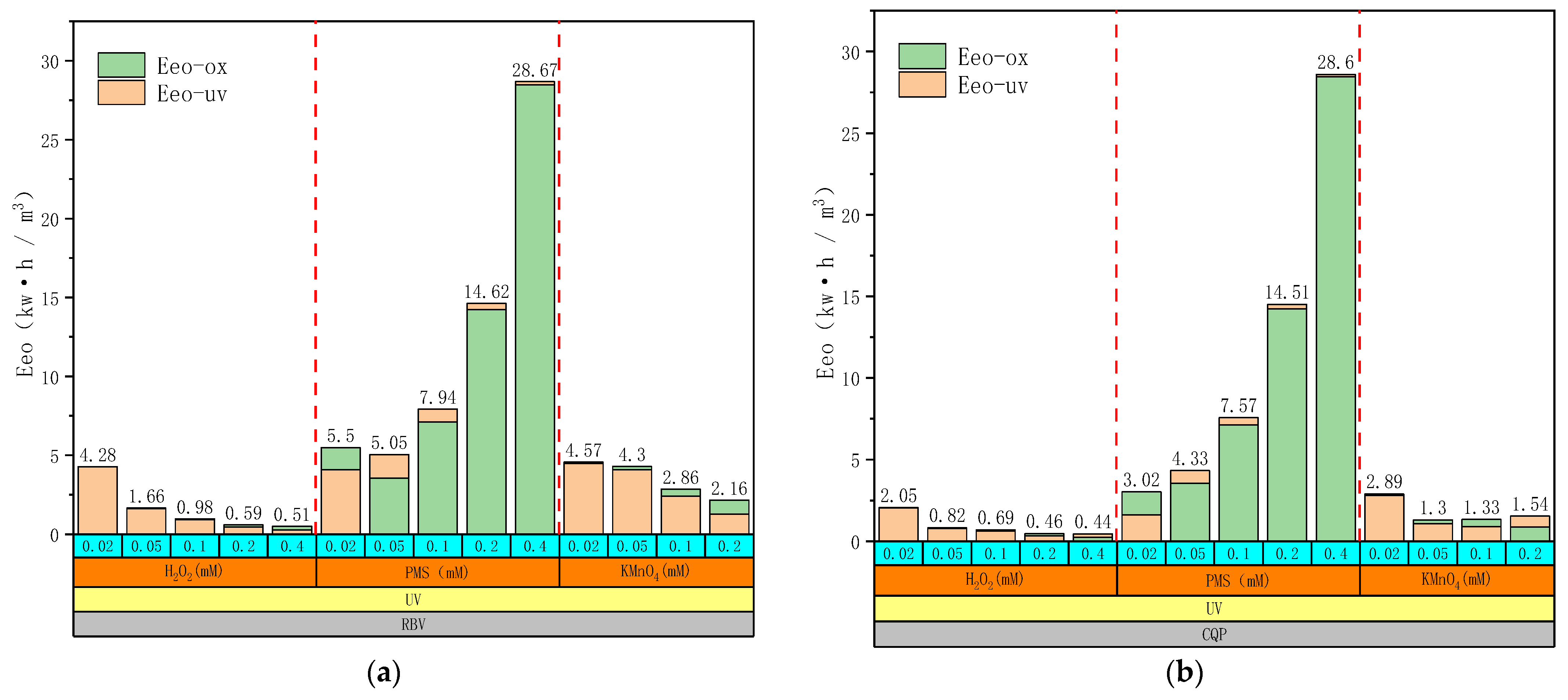
As shown in Figure 3a,b and Table S5, the electrical energy per order (EEO) for RBV and CQP degradation by UV/H2O2, UV/PMS, and UV/KMnO4 was analyzed. EEO consists of UV contribution (EEO-UV) and oxidant contribution (EEO-OX).
For UV/H2O2, energy was dominated by UV. Increasing H2O2 from 0.02 to 0.4 mM reduced EEO for RBV from 4.28 to 0.51 kWh/m3 and for CQP from 2.05 to 0.44 kWh/m3. CQP (hydrophobic) consistently required lower EEO than RBV. In contrast, UV/PMS showed an opposite trend: raising PMS from 0.02 to 0.4 mM sharply increased EEO to 28.67 kWh/m3 for RBV and 28.60 kWh/m3 for CQP, with similar values regardless of polarity. EEO-OX became dominant, worsening energy efficiency. For UV/KMnO4, energy was also UV-dominated. Increasing KMnO4 from 0.02 to 0.2 mM decreased EEO for RBV from 4.57 to 2.16 kWh/m3, and for CQP from 2.89 to 1.54 kWh/m3 (minimum 1.30 kWh/m3 at 0.05 mM). CQP again showed lower EEO than RBV.
Overall energy efficiency order: UV/H2O2 > UV/KMnO4 > UV/PMS. UV/PMS had high energy cost, especially at high oxidant concentrations, while UV/H2O2 and UV/KMnO4 were more practical. Hydrophobic CQP always needed less electrical energy than hydrophilic RBV in UV/H2O2 and UV/KMnO4, confirming that intrinsic hydrophobicity favors lower energy input when the oxidant does not dominate the budget.
In summary, hydrophobic CQP consistently exhibited faster degradation and lower EEO than hydrophilic RBV across all combined systems. This polarity-dependent advantage widened with oxidant dosage, though the extent varied. Based on treatment efficiency per mole, the ranking was UV/PMS > UV/H2O2 ≫ UV/KMnO4; based on EEO, the order was UV/PMS ≫ UV/KMnO4 > UV/H2O2. UV/PMS achieved fast degradation but suffered from high energy consumption and secondary pollution risks (excess PMS and sulfate can form sulfides under reducing conditions, causing blackening and malodor [50]). UV/KMnO4 had low operating cost but limited oxidation capacity; excessive KMnO4 causes water coloration and MnO2 precipitation, leading to filter clogging and turbidity [33,51,52]. In addition, the deep coloration of KMnO4 solutions substantially attenuates 254 nm UV radiation, reducing the effective photon fluence available for •OH generation and contributing to the lower degradation efficiency of the UV/KMnO4 process. In comparison, UV/H2O2 offered balanced performance: efficiency slightly lower than UV/PMS, energy efficiency improved with oxidant dosage, and H2O2 decomposes into H2O and O2 without toxic residues [53,54]. Considering degradation efficiency, energy consumption, environmental risks, and detoxification performance, UV/H2O2 shows superior application potential for pharmaceutical pollutant control. The following sections analyze water matrix effects on RBV and CQP degradation by UV/H2O2.

3.4. Effects of Different Water Matrix Components

3.4.1. Influences of pH

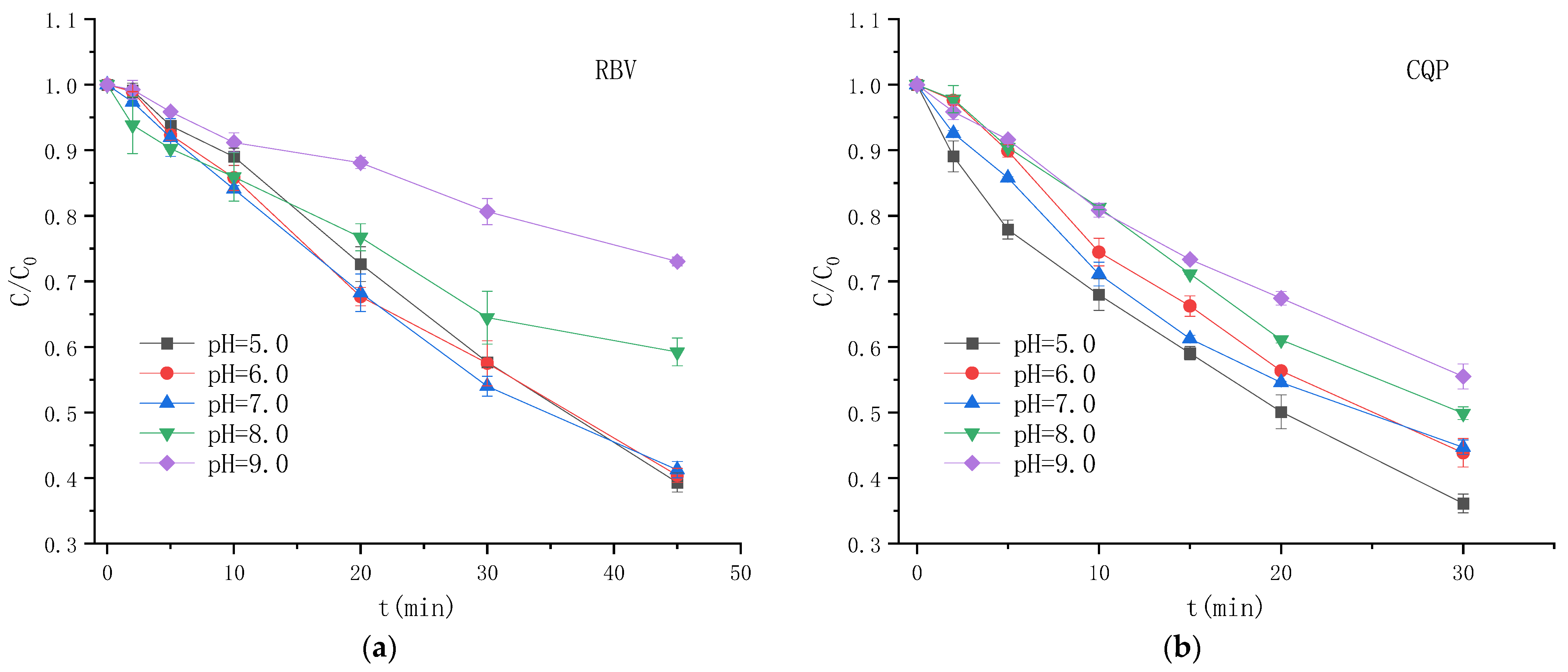
The influence of pH (5.0–9.0) on RBV and CQP degradation by UV/H2O2 was investigated (Figure 4a,b; Table S6). For both pollutants, degradation efficiency decreased with increasing pH. The highest removal was achieved at pH 5.0: RBV 60.7% (kc = 0.0211 min−1, 45 min) and CQP 63.9% (kc = 0.0326 min−1, 30 min). At pH 9.0, removal dropped sharply to 27.0% for RBV (kc = 0.0071 min−1) and 44.5% for CQP (kc = 0.0197 min−1). Thus, acidic conditions favor the UV/H2O2 process for both hydrophilic RBV and hydrophobic CQP, though the extent of pH-induced attenuation differs between the two pollutants.
Based on advanced oxidation principles and previous studies, the high degradation efficiency of the UV/H2O2 system under acidic conditions can be attributed to two main factors. First, an acidic environment effectively stabilizes the molecular structure of H2O2, reducing its unproductive decomposition under UV irradiation and thus ensuring the sustained generation of •OH [55]. Second, the quenching of •OH is notably inhibited under acidic conditions, and both RBV and CQP exist mainly in molecular form, making them more susceptible to oxidation by •OH [56]. As pH increases to neutral and alkaline ranges, H2O2 tends to undergo self-dismutation or react inefficiently with OH, leading to a substantial reduction in •OH production [57]. Meanwhile, the molecular forms of RBV and CQP change (e.g., dissociate into ionic species), resulting in lower reactivity toward •OH and ultimately a marked decrease in degradation efficiency [55,58].

3.4.2. Influences of Anions

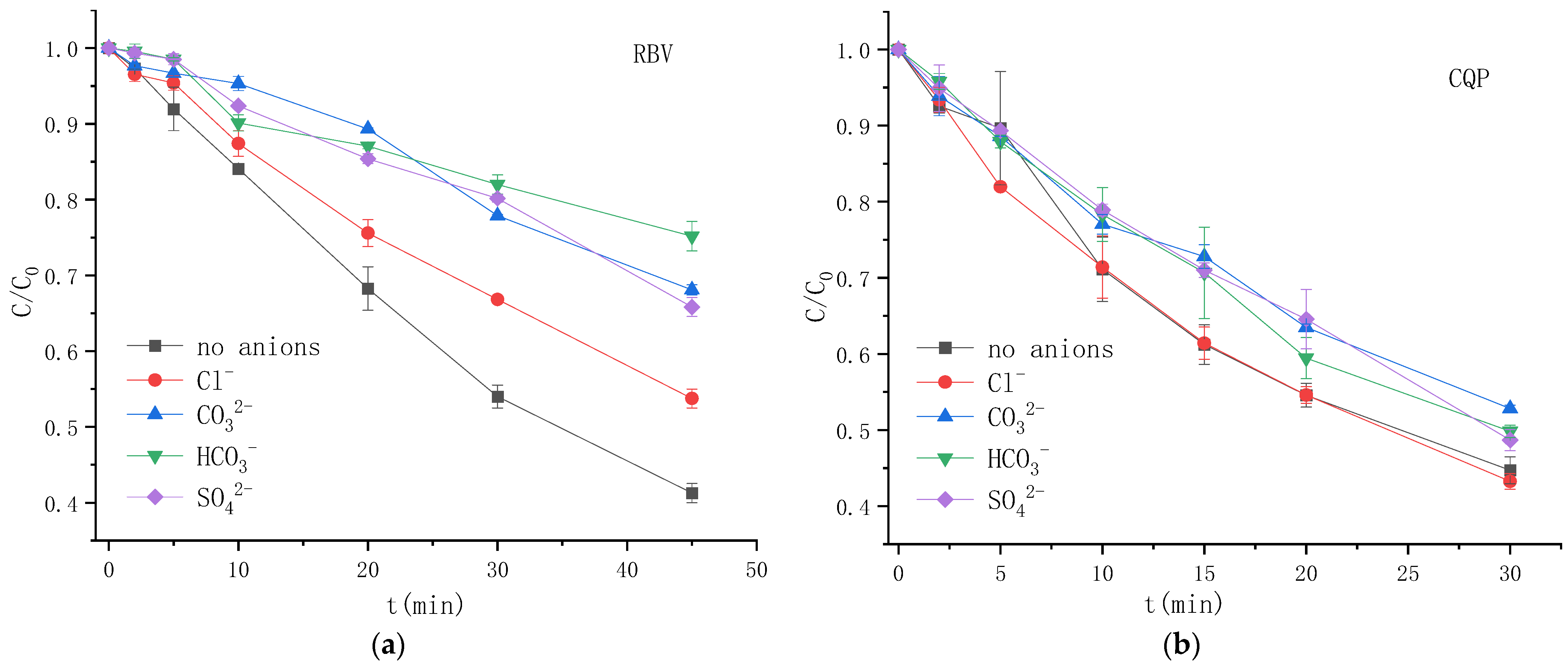
The effects of common anions (Cl, SO42−, CO32−, HCO3, each at 1 mM) on RBV and CQP degradation by UV/H2O2 were investigated (Figure 5, Table S7). For hydrophilic RBV, all anions inhibited degradation: the kc decreased from 0.0195 min−1 to 0.013 (Cl), 0.0095 (SO42−), 0.0082 (CO32−), and 0.0068 min−1 (HCO3). For hydrophobic CQP, Cl slightly promoted degradation (kc increased from 0.0274 to 0.0279 min−1), whereas the other anions suppressed it (kc: 0.0211 for SO42−, 0.0234 for CO32−, 0.0238 for HCO3). These distinct responses are attributed to the different hydrophilic/hydrophobic properties of the two pollutants.
The influence of Cl on the UV/H2O2 system is particularly complex, as illustrated in Equations (2)–(10) [59,60,61,62,63,64], and can result in either promotion or inhibition of the overall reaction. In this work, Cl mainly exhibited an inhibitory effect on RBV degradation but a promoting effect on CQP degradation by UV/H2O2.
O H + C l C l + O H , k = 3.0 × 1 0 9   M 1 s 1
O H + Cl ClOH , k = 4.3 × 1 0 9   M 1 s 1
C l + O H C l H O , k = 1.80 × 1 0 10   M 1 s 1
C l H O O H + C l , k = 6.1 × 1 0 9   M 1 s 1
ClOH O H + C l , k = ( 6.1 ± 0.8 ) × 1 0 9   M 1 s 1
ClOH + H + C l + H 2 O , k = ( 2.1 ± 0.7 ) × 1 0 10   M 1 s 1
C l O H + C l C l 2 + O H , k = 1.0 × 1 0 5   M 1 s 1
C l + C l C l 2 , k = ( 6.5 ~ 8.5 ) × 1 0 9   M 1 s 1
C l 2 + H 2 O H + + C l + HClO , k = 2.1 × 1 0 9   M 1 s 1
In this study, SO42− exerted a partial inhibitory effect on the reaction, which may be attributed to the reactions of SO42− as shown in Equations (11) and (12) [65,66]. Sulfate radicals (SO4 ) generated during the reaction possess a redox potential (2.5–3.1 V) comparable to that of hydroxyl radicals (•OH, 2.77 V). However, SO4 exhibits certain selectivity toward the degradation of organic pollutants, thereby leading to an overall inhibitory effect on the reaction rate [67].
O H + H + + S O 4 2 S O 4 + H 2 O , k = ( 3.5 ± 0.5 ) × 1 0 5   M 1 s 1
S O 4 + O H S O 4 2 + O H , k = 6.5 × 1 0 7   M 1 s 1
In this study, the inhibitory effects of CO32− and HCO3 were particularly pronounced. This phenomenon could be attributed to the formation of CO3 and HCO3• radicals via the reactions depicted in Equations (13) and (14) [61,68,69]. The corresponding redox potentials are E° (CO3/CO32−) = 1.78 V and E° (HCO3•/HCO3) = 1.50 V [70], both of which are significantly lower than that of the hydroxyl radical (•OH). Consequently, these radicals exerted inhibitory effects on the degradation of both RBV and CQP by the UV/H2O2 system.
O H + H C O 3 O H + H C O 3 , k = ( 0.85 ~ 1.00 ) × 1 0 7   M 1 s 1
O H + C O 3 2 O H + C O 3 , k = ( 3.90 ~ 4.20 ) × 1 0 8   M 1 s 1
The distinct response patterns of RBV and CQP to common anions are mainly attributed to their differences in hydrophilicity and hydrophobicity, which lead to variations in their interaction with anions, existing forms in aqueous solution, and reactivity with •OH generated by the UV/H2O2 system.

4. Discussion

Hydrophobic CQP consistently outperformed hydrophilic RBV in all systems regarding degradation kinetics and energy consumption. As shown in Table S8, RBV and CQP differ substantially in multiple physicochemical properties beyond polarity, including molecular weight, LogP, aqueous solubility, pKa, and molecular structure. Therefore, the observed kinetic differences should be interpreted as a compound-specific comparison reflecting the combined effect of these factors, with polarity identified as a key contributing factor rather than the sole determinant. Each process exhibited distinct characteristics: UV/PMS prioritized reaction rate but at the cost of high energy input; UV/KMnO4 featured low energy consumption yet poor degradation capacity, partly due to the strong absorption of KMnO4 at 254 nm, which reduces effective photon fluence for •OH generation; and UV/H2O2 stood out as the most balanced option with both high efficiency and low EEO.
The consistently faster degradation of hydrophobic CQP compared with hydrophilic RBV can be rationalized by considering the differential accessibility of the two pollutants to reactive radicals in aqueous solution. Hydrophobic organic compounds tend to exhibit stronger affinity toward radical species in aqueous solution. In contrast, highly water-soluble compounds such as RBV remain fully hydrated and dispersed in the bulk solution, reducing their probability of encountering short-lived radicals such as •OH and SO4. This polarity-dependent accessibility, which has been discussed in the literature for structurally diverse pharmaceuticals [71], provides a plausible mechanistic explanation for the observed kinetic differences.
Increasing oxidant dosage further amplified the performance gap among the three systems. Radical quenching experiments clarified the mechanistic differences between the two core processes: UV/H2O2 relied predominantly on •OH for degradation, unaffected by pollutant polarity, while UV/PMS adopted a pollutant-specific pathway—•OH dominated RBV removal, and CQP degradation depended on the synergy of •OH, SO4, and other active species. It should be noted that quenching experiments provide indirect and semi-quantitative evidence for radical contributions, and the results should be interpreted as indicative of dominant radical pathways rather than rigorous quantitative proof. Direct radical quantification methods (e.g., EPR spin trapping) would be valuable for future confirmation. For the optimal UV/H2O2 process, solution pH and coexisting anions exerted significant effects: pH 5.0 (acidic condition) was most favorable, and elevated pH inhibited degradation. Cl slightly promoted CQP but inhibited RBV, whereas SO42−, CO32−, and HCO3 showed universal inhibition. A limitation of this study is that all degradation experiments were conducted in phosphate-buffered solutions. Although the effects of major coexisting anions and pH were systematically examined, the overall performance in real water matrices (e.g., municipal secondary effluent or pharmaceutical wastewater) may deviate due to the complex interplay of natural organic matter and other constituents. Validation with authentic water samples is therefore necessary to confirm the practical applicability of the UV/H2O2 process.
As homogeneous processes, UV/H2O2 and UV/PMS do not suffer from catalyst deactivation, and their batch-to-batch reproducibility has been widely reported [72,73]. Nevertheless, the long-term operational stability under continuous-flow conditions warrants dedicated investigation before practical deployment.
It should be noted that the removal efficiency of target pollutants does not directly equate to the safety of the treated water. The potential formation of toxic intermediates during UV/AOP degradation has been reported for structurally similar pharmaceuticals [71]. Although the •OH-dominated UV/H2O2 process generally exhibits strong mineralization potential, the ecotoxicity evolution along the degradation pathway of RBV and CQP in UV/AOPs remains to be systematically evaluated in future studies. Furthermore, the findings obtained at μM concentrations should not be directly extrapolated to environmentally relevant ng/L levels, as the pollutant-to-scavenger ratio differs substantially between these concentration regimes.

5. Conclusions

This study establishes pollutant polarity as a key factor governing both degradation kinetics and radical mechanisms in UV/AOPs. Hydrophobic pharmaceuticals are inherently more amenable to treatment than their hydrophilic counterparts, and the choice of AOP determines whether the radical pathway is universal (•OH-dominated in UV/H2O2) or polarity-dependent (•OH/SO4 synergy in UV/PMS). Among the three processes compared, UV/H2O2 offers the most practical balance of efficiency, energy consumption, and operational simplicity, with its performance tunable through pH and anion control. These findings provide a polarity-informed framework for selecting UV/AOPs in pharmaceutical wastewater treatment.
Future work should validate the UV/H2O2 process in real water matrices, optimize reactor configuration and operational parameters, assess the ecological toxicity of transformation products, and explore catalyst- or coupling-enhanced UV/KMnO4 systems to broaden the application of UV-based AOPs in pharmaceutical wastewater treatment. Additionally, experiments with a broader set of probe compounds are needed to decouple the individual contributions of polarity, aromaticity, and electron-transfer reactivity.

Supplementary Materials

The following supporting information can be downloaded at https://www.mdpi.com/article/10.3390/w18131548/s1, Text S1. Electrical Energy per Order (EEO) Analysis; Figure S1. Schematic diagram of the parallel beam apparatus; Table S1. Equivalent energy consumption per unit reagent; Table S2. Pseudo-first-order rate constants kc (min−1) for the degradation of RBV by UV/H2O2, UV/PMS, and UV/KMnO4 processes at different oxidant concentrations; Table S3. Pseudo-first-order rate constants kc (min−1) for the degradation of CQP by UV/H2O2, UV/PMS, and UV/KMnO4 processes at different oxidant concentrations; Table S4. Degradation rate constants (kc), R2, and removal efficiencies of ribavirin (RBV) and chloroquine phosphate (CQP) under UV/H2O2 and UV/PMS processes with different quenchers; Table S5. Analysis of electrical energy per order (EEO) for the degradation of RBV and CQP by UV/H2O2, UV/PMS, and UV/KMnO4 processes at different oxidant concentrations; Table S6. Pseudo-first-order rate constants kc(min−1) for the degradation of RBV and CQP by the UV/H2O2 process at different pH values; Table S7. Pseudo-first-order rate constants, kc (min−1), for the degradation of RBV and CQP by the UV/H2O2 process in the presence of different anions. Table S8. Basic properties of RBV and CQP. References [22,23,35,73,74] are cited in Supplementary Materials.

Author Contributions

X.W.: Conceptualization, Methodology, Validation, Formal analysis, Investigation, Data curation, Writing—original draft, Writing—review and editing, Visualization. J.J.: Conceptualization, Methodology, Validation, Formal analysis, Investigation, Resources, Writing—original draft, Writing—review and editing, Visualization. Z.P.: Investigation, Data curation, Writing—original draft, Writing—review and editing, Visualization. C.L.: Investigation, Data curation, Writing—original draft, Writing—review and editing, Visualization. Z.D.: Investigation, Data curation, Writing—original draft, Writing—review and editing, Visualization. R.J.: Conceptualization, Methodology, Resources, Supervision, Project administration, Funding acquisition, Writing—review and editing. All authors have read and agreed to the published version of the manuscript.

Funding

The authors gratefully acknowledge the National Key R&D Program of China (No. 2021YFC3200904).

Data Availability Statement

All data generated or analyzed during this study are included in this published article (and its Supplementary Information Files).

Acknowledgments

The authors sincerely thank all members of the research group for their help and suggestions in the experiment and research. During the preparation of this manuscript, the authors adopted DeepSeek-V4 and Doubao (version 2.1) AI tools to polish academic sentences and adjust logical expression of the full text. All manuscript contents have been fully reviewed, revised and finalized by the authors, who take complete responsibility for all published content.

Conflicts of Interest

Author [Junqi Jia] was employed by CAUPD (Beijing) Planning & Design Consultants Co., Ltd. The remaining authors declare that the research was conducted in the absence of any commercial or financial relationships that could be construed as a potential conflict of interest. The funders had no role in the design of the study; in the collection, analyses, or interpretation of data; in the writing of the manuscript; or in the decision to publish the results.

Abbreviations

The following abbreviations are used in this manuscript:
RBVRibavirin
CQPChloroquine phosphate
UV-AOPsUltraviolet-based advanced oxidation processes
PMSPeroxymonosulfate
H2O2Hydrogen peroxide
KMnO4Potassium permanganate
•OHHydroxyl radical
SO4Sulfate radical
EEOElectrical energy per order

References

  1. Wang, F.; Xiang, L.L.; Leung, K.S.Y.; Elsner, M.; Zhang, Y.; Guo, Y.M.; Pan, B.; Sun, H.W.; An, T.C.; Ying, G.G.; et al. Emerging contaminants: A One Health perspective. Innovation 2024, 5, 100612. [Google Scholar] [CrossRef] [PubMed]
  2. Zhang, H.Y.; Mu, Y.M.; Li, S.L.; Wang, Y.; Ya, T.; Chen, C.; Duan, L. Challenges and Future Directions of Neglected Emerging Contaminants in Wastewater Treatment Plants. ACS ES&T Water 2025, 5, 2005–2008. [Google Scholar] [CrossRef]
  3. Liu, L.; Guo, S.; Che, C.; Su, Q.; Zhu, D.; Hai, X. Improved HPLC method for the determination of ribavirin concentration in red blood cells and its application in patients with COVID-19. Biomed. Chromatogr. 2022, 36, e5370. [Google Scholar] [CrossRef] [PubMed]
  4. Zhu, S.; Han, X.; Yang, R.; Tian, Y.; Zhang, Q.; Wu, Y.; Dong, S.; Zhang, B. Metabolomics study of ribavirin in the treatment of orthotopic lung cancer based on UPLC-Q-TOF/MS. Chem.-Biol. Interact. 2023, 370, 110305. [Google Scholar] [CrossRef] [PubMed]
  5. Abo-zeid, Y.; Garnett, M.C. Polymer nanoparticle as a delivery system for ribavirin: Do nanoparticle avoid uptake by Red Blood Cells? J. Drug Deliv. Sci. Technol. 2020, 56, 101552. [Google Scholar] [CrossRef]
  6. Zeeshan, Q.M.; Qiu, S.; Gu, J.; Abbew, A.-W.; Wu, Z.; Chen, Z.; Xu, S.; Ge, S. Unravelling multiple removal pathways of oseltamivir in wastewater by microalgae through experimentation and computation. J. Hazard Mater. 2022, 427, 128139. [Google Scholar] [CrossRef] [PubMed]
  7. Yao, L.; Dou, W.-Y.; Ma, Y.-F.; Liu, Y.-S. Development and validation of sensitive methods for simultaneous determination of 9 antiviral drugs in different various environmental matrices by UPLC-MS/MS. Chemosphere 2021, 282, 131047. [Google Scholar] [CrossRef] [PubMed]
  8. Xiang, W.; Xu, F.; Wan, D.; Wang, X.; Luo, F.; Chen, Y. Mechanistic investigation of direct photodegradation of chloroquine phosphate under simulated sunlight. Chemosphere 2023, 335, 139093. [Google Scholar] [CrossRef] [PubMed]
  9. Wang, X.-X.; Liu, L.; Li, Q.-F.; Xiao, H.; Wang, M.-L.; Tu, H.-C.; Lin, J.-M.; Zhao, R.-S. Nitrogen-rich based conjugated microporous polymers for highly efficient adsorption and removal of COVID-19 antiviral drug chloroquine phosphate from environmental waters. Sep. Purif. Technol. 2023, 305, 122517. [Google Scholar] [CrossRef] [PubMed]
  10. Li, D.; He, C.; Wang, M.; Liu, H.; Liu, R.; Xu, L. Toxicity of Ribavirin to Spodoptera litura by Inhibiting the Juvenile Hormone. J. Agric. Food Chem. 2022, 70, 3117–3126. [Google Scholar] [CrossRef] [PubMed]
  11. Li, H.; Zhao, H.; Lin, H.; Shen, P.; Liu, C.; Zhan, S. Utilization of Intravenous Ribavirin Among Reproductive Age Adults in 2010-2017: A Population-Based Study in the Yinzhou District, Ningbo City of China. Front. Public Health 2021, 9, 678785. [Google Scholar] [CrossRef] [PubMed]
  12. Hu, R.; Chen, X.; Xia, M.; Chen, B.; Lu, X.; Luo, G.; Zhang, S.; Zhen, G. Identification of extracellular polymeric substances layer barrier in chloroquine phosphate-disturbed anammox consortia and mechanism dissection on cytotoxic behavior by computational chemistry. J. Hazard. Mater. 2024, 471, 134335. [Google Scholar] [CrossRef] [PubMed]
  13. Nannou, C.; Ofrydopoulou, A.; Evgenidou, E.; Heath, D.; Heath, E.; Lambropoulou, D. Antiviral drugs in aquatic environment and wastewater treatment plants: A review on occurrence, fate, removal and ecotoxicity. Sci. Total Environ. 2020, 699, 134322. [Google Scholar] [CrossRef] [PubMed]
  14. Jain, S.; Kumar, P.; Vyas, R.K.; Pandit, P.; Dalai, A.K. Occurrence and Removal of Antiviral Drugs in Environment: A Review. Water Air Soil Pollut. 2013, 224, 1410. [Google Scholar] [CrossRef]
  15. Lyu, L.; Zhang, W.; Dou, X.; Luo, Z.; Chen, D. Pollution status and environment trend of antiviral drugs in water environment. Environ. Chem. 2022, 41, 1920–1933. [Google Scholar]
  16. Wang, X.; He, G.; Tian, L.; Li, J.; Wang, Y.; Jiang, Q. Pollution status and removal technology progress of antiviral drugs in water. Ind. Water Treat. 2022, 42, 47–54. [Google Scholar]
  17. He, J.; Feng, T.; Tao, L.; Peng, Y.E.; Tong, L.; Zhao, X.W.; Shao, X.; Xu, L.Y.; Yang, Y.L.; Zhao, Y.B. Distribution and impacts on the geological environment of antiviral drugs in major waters of Wuhan, China. China Geol. 2022, 5, 402–410. [Google Scholar] [CrossRef]
  18. Liu, Q.; Feng, X.; Chen, N.; Shen, F.; Zhang, H.; Wang, S.; Sheng, Z.; Li, J. Occurrence and risk assessment of typical PPCPs and biodegradation pathway of ribavirin in wastewater treatment plants. Environ. Sci. Ecotechnol. 2022, 11, 100184. [Google Scholar] [CrossRef] [PubMed]
  19. Chen, X.; Lei, L.; Liu, S.; Han, J.; Li, R.; Men, J.; Li, L.; Wei, L.; Sheng, Y.; Yang, L.; et al. Occurrence and risk assessment of pharmaceuticals and personal care products (PPCPs) against COVID-19 in lakes and WWTP-river-estuary system in Wuhan, China. Sci. Total Environ. 2021, 792, 148352. [Google Scholar] [CrossRef] [PubMed]
  20. Barra Caracciolo, A.; Grenni, P.; Sacca, M.L. Effect of the Antiviral Drug Oseltamivir (Tamiflu) on the Bacterial Community Structure of a Surface Water Ecosystem Analyzed Using Fluorescence In Situ Hybridization. Bull. Environ. Contam. Toxicol. 2010, 85, 443–446. [Google Scholar] [CrossRef] [PubMed]
  21. Kuroda, K.; Li, C.; Dhangar, K.; Kumar, M. Predicted occurrence, ecotoxicological risk and environmentally acquired resistance of antiviral drugs associated with COVID-19 in environmental waters. Sci. Total Environ. 2021, 776, 145740. [Google Scholar] [CrossRef] [PubMed]
  22. NCBI. Ribavirin. Available online: https://pubchem.ncbi.nlm.nih.gov/compound/37542 (accessed on 27 April 2025).
  23. NCBI. Chloroquine Phosphate. Available online: https://pubchem.ncbi.nlm.nih.gov/compound/64927 (accessed on 27 April 2025).
  24. Rinaldi, A.; Da Silva, M.R. Degradation of BTX in Contaminated Soil by Using Hydrogen Peroxide (H2O2) and Potassium Permanganate (KMnO4). Water Air Soil Pollut. 2011, 217, 245–254. [Google Scholar] [CrossRef]
  25. Ruan, X.-C.; Ai, R.; Jin, X.; Zeng, Q.-F.; Yang, Z.-Y. Photodegradation of Tri (2-chloroethyl) Phosphate in Aqueous Solution by UV/H2O2. Water Air Soil Pollut. 2013, 224, 1406. [Google Scholar] [CrossRef]
  26. Dai, H.F.; Luo, W.; Jin, L.; Deng, L.; Wang, Q.; Hu, J.; Singh, R.P. Degradation of chloroquine phosphate during UV/H2O2 process: Performance, kinetics, and degradation pathways. J. Environ. Chem. Eng. 2024, 12, 112493. [Google Scholar] [CrossRef]
  27. Kim, I.; Yamashita, N.; Tanaka, H. Performance of UV and UV/H2O2 processes for the removal of pharmaceuticals detected in secondary effluent of a sewage treatment plant in Japan. J. Hazard. Mater. 2009, 166, 1134–1140. [Google Scholar] [CrossRef] [PubMed]
  28. Sun, Q.; Yang, J.; Fan, Y.; Cai, K.; Lu, Z.; He, Z.; Xu, Z.; Lai, X.; Zheng, Y.; Liu, C.; et al. The role of trace N-Oxyl compounds as redox mediator in enhancing antiviral ribavirin elimination in UV/Chlorine process. Appl. Catal. B-Environ. 2022, 317, 121709. [Google Scholar] [CrossRef] [PubMed]
  29. Sun, X.; Li, W.; Dong, Z.; Hou, Y.; Ning, Y.; Wang, C.; Lv, G. Degradation of ribavirin by Fe2+/PS oxidation technology: Performance, mechanism and toxicity control. Arab. J. Chem. 2024, 17, 105754. [Google Scholar] [CrossRef]
  30. Lin, Z.F.; Chen, P.; Lv, W.Y.; Fang, Z.; Xiao, Z.J.; Luo, J.; Zhang, J.L.; Liu, Y.; Liu, G.G. Non-radical dominated degradation of chloroquine phosphate via Fe-based O-doped polymeric carbon nitride activated peroxymonosulfate: Performance and mechanism. Sep. Purif. Technol. 2023, 319, 124049. [Google Scholar] [CrossRef]
  31. Tian, Z.; Luo, J.; Sun, S.C.; Zhang, X.; Ma, R.; Lin, J.H.; Chen, Y. Microwave heating of iron-rich Enteromorpha for Fe single-atom catalysts for the activation of peroxymonosulfate: Mechanisms and structure-activity relationships. Sep. Purif. Technol. 2023, 318, 123938. [Google Scholar] [CrossRef]
  32. Jinzhao, H.U.; Dadong, Z.; Yujie, W.; Yaowu, J. Combination process of KMnO4 pre-oxidation-coagulative precipitation in slightly polluted water treatment. Ecol. Environ. Sci. 2011, 20, 511–514. [Google Scholar]
  33. Tanatti, N.P. Treatability of biodiesel wastewaters by using KMnO4 and KMnO4/O3 processes and kinetic analysis. Water Sci. Technol. 2022, 86, 17–28. [Google Scholar] [CrossRef] [PubMed]
  34. Guo, K.; Zhang, J.; Li, A.; Xie, R.; Liang, Z.; Wang, A.; Ling, L.; Li, X.; Li, C.; Fang, J. Ultraviolet Irradiation of Permanganate Enhanced the Oxidation of Micropollutants by Producing HO• and Reactive Manganese Species. Environ. Sci. Technol. Lett. 2018, 5, 750–756. [Google Scholar] [CrossRef]
  35. Miklos, D.B.; Remy, C.; Jekel, M.; Linden, K.G.; Drewes, J.E.; Hübner, U. Evaluation of advanced oxidation processes for water and wastewater treatment—A critical review. Water Res. 2018, 139, 118–131. [Google Scholar] [CrossRef] [PubMed]
  36. Buxton, G.V.; Greenstock, C.L.; Helman, W.P.; Ross, A.B. Critical-review of rate constants for reactions of hydrated electrons, hydrogen-atoms and hydroxyl radicals (•OH/•O)in aqueous-solution. J. Phys. Chem. Ref. Data 1988, 17, 513–886. [Google Scholar] [CrossRef]
  37. Alam, M.S.; Rao, B.S.M.; Janata, E. •OH reactions with aliphatic alcohols: Evaluation of kinetics by direct optical absorption measurement. A pulse radiolysis study. Radiat. Phys. Chem. 2003, 67, 723–728. [Google Scholar] [CrossRef]
  38. Clifton, C.L.; Huie, R.E. Rate Constants for Hydrogen Abstraction Reactions of The Sulfate Radical, SO4—Alcohols. Int. J. Chem. Kinet. 1989, 21, 677–687. [Google Scholar] [CrossRef]
  39. George, C.; El Rassy, H.; Chovelon, J.M. Reactivity of selected volatile organic compounds (VOCs) toward the sulfate radical (SO4). Int. J. Chem. Kinet. 2001, 33, 539–547. [Google Scholar] [CrossRef]
  40. Wilkinson, F.; Helman, W.P.; Ross, A.B. Rate constants for the decay and reactions of the lowest electronically excited singlet-state of molecular-oxygen in solution—An expanded and revised compilation. J. Phys. Chem. Ref. Data 1995, 24, 663–1021. [Google Scholar] [CrossRef]
  41. Gao, L.; Guo, Y.; Zhan, J.; Yu, G.; Wang, Y. Assessment of the validity of the quenching method for evaluating the role of reactive species in pollutant abatement during the persulfate-based process. Water Res. 2022, 221, 118730. [Google Scholar] [CrossRef] [PubMed]
  42. Li, B.; Chen, B.; Wei, Z. Challenging established norms: The unanticipated role of alcohols in UV/PDS radical quenching. J. Hazard. Mater. 2024, 478, 135502. [Google Scholar] [CrossRef] [PubMed]
  43. Zhang, H.; Xie, C.; Chen, L.; Duan, J.; Li, F.; Liu, W. Different reaction mechanisms of SO4 and •OH with organic compound interpreted at molecular orbital level in Co(II)/peroxymonosulfate catalytic activation system. Water Res. 2023, 229, 119392. [Google Scholar] [CrossRef] [PubMed]
  44. Mitroka, S.; Zimmeck, S.; Troya, D.; Tanko, J.M. How Solvent Modulates Hydroxyl Radical Reactivity in Hydrogen Atom Abstractions. J. Am. Chem. Soc. 2010, 132, 2907–2913. [Google Scholar] [CrossRef] [PubMed]
  45. Luo, S.; Wei, Z.; Spinney, R.; Villamena, F.A.; Dionysiou, D.D.; Chen, D.; Tang, C.-J.; Chai, L.; Xiao, R. Quantitative structure-activity relationships for reactivities of sulfate and hydroxyl radicals with aromatic contaminants through single-electron transfer pathway. J. Hazard. Mater. 2018, 344, 1165–1173. [Google Scholar] [CrossRef] [PubMed]
  46. Wojnarovits, L.; Takacs, E. Rate constants of sulfate radical anion reactions with organic molecules: A review. Chemosphere 2019, 220, 1014–1032. [Google Scholar] [CrossRef] [PubMed]
  47. Xie, R.; Guo, K.; Li, Y.; Zhang, Y.; Zhong, H.; Leung, D.Y.C.; Huang, H. Harnessing air-water interface to generate interfacial ROS for ultrafast environmental remediation. Nat. Commun. 2024, 15, 8860. [Google Scholar] [CrossRef] [PubMed]
  48. Guerra-Rodriguez, S.; Rodriguez, E.; Singh, D.N.; Rodriguez-Chueca, J. Assessment of Sulfate Radical-Based Advanced Oxidation Processes for Water and Wastewater Treatment: A Review. Water 2018, 10, 1828. [Google Scholar] [CrossRef]
  49. Suhnholz, S.; Kopinke, F.-D.; Mackenzie, K. Heterogeneous activation of persulfate by FeS—Surface influence on selectivity. Chem. Eng. J. 2022, 450, 138192. [Google Scholar] [CrossRef]
  50. Gao, Y.; Wang, Q.; Ji, G.; Li, A. Degradation of antibiotic pollutants by persulfate activated with various carbon materials. Chem. Eng. J. 2022, 429, 132387. [Google Scholar] [CrossRef]
  51. Nguyen, T.-B.; Ho, T.-B.-C.; Chen, C.-W.; Chen, W.-H.; Bui, X.-T.; Hsieh, S.; Dong, C.-D. Enhancing the degradation of microplastics through combined KMnO4 oxidation and UV radiation. J. Environ. Manag. 2024, 370, 122942. [Google Scholar] [CrossRef] [PubMed]
  52. Peng, J.; Zhou, P.; Zhou, H.; Liu, W.; Zhang, H.; Zhou, C.; Lai, L.; Ao, Z.; Su, S.; Lai, B. Insights into the Electron-Transfer Mechanism of Permanganate Activation by Graphite for Enhanced Oxidation of Sulfamethoxazole. Environ. Sci. Technol. 2021, 55, 9189–9198. [Google Scholar] [CrossRef] [PubMed]
  53. Li, W.; Xu, X.; Lyu, B.; Tang, Y.; Zhang, Y.; Chen, F.; Korshin, G. Degradation of typical macrolide antibiotic roxithromycin by hydroxyl radical: Kinetics, products, and toxicity assessment. Environ. Sci. Pollut. Res. 2019, 26, 14570–14582. [Google Scholar] [CrossRef] [PubMed]
  54. Shi, Y.; Shen, G.; Geng, J.; Fu, Y.; Li, S.; Wu, G.; Wang, L.; Xu, K.; Ren, H. Predictive models for the degradation of 4 pharmaceutically active compounds in municipal wastewater effluents by the UV/H2O2 process. Chemosphere 2021, 263, 127944. [Google Scholar] [CrossRef] [PubMed]
  55. Liu, Y.C.; Zhu, K.; Su, M.M.; Zhu, H.Y.; Lu, J.B.; Wang, Y.X.; Dong, J.K.; Qin, H.; Wang, Y.; Zhang, Y. Influence of solution pH on degradation of atrazine during UV and UV/H2O2 oxidation: Kinetics, mechanism, and degradation pathways. Rsc Adv. 2019, 9, 35847–35861. [Google Scholar] [CrossRef] [PubMed]
  56. Gomes, J.; Domingues, E.; Fernandes, E.; Castro, L.; Martins, R.C.; Quinta-Ferreira, R.M. Coagulation and biofiltration by Corbicula fluminea for COD and toxicity reduction of swine wastewater. J. Water Process Eng. 2021, 42, 102145. [Google Scholar] [CrossRef]
  57. Von Gunten, U. Ozonation of drinking water: Part II. Disinfection and by-product formation in presence of bromide, iodide or chlorine. Water Res. 2003, 37, 1469–1487. [Google Scholar] [CrossRef] [PubMed]
  58. Jiang, J.; An, Z.; Li, M.; Huo, Y.; Zhou, Y.; Xie, J.; He, M. Comparison of ribavirin degradation in the UV/H2O2 and UV/PDS systems: Reaction mechanism, operational parameter and toxicity evaluation. J. Environ. Chem. Eng. 2023, 11, 109193. [Google Scholar] [CrossRef] [PubMed]
  59. Li, H.; Yang, Y.; Li, X.; Zhou, Z.; Feng, J.; Dai, Y.; Li, X.; Ren, J. Degradation of sulfamethazine by vacuum ultraviolet-activated sulfate radical-advanced oxidation: Efficacy, mechanism and influences of water constituents. Sep. Purif. Technol. 2022, 282, 120058. [Google Scholar] [CrossRef]
  60. Lu, Y.; Ding, Z.; Zhang, J.; Fu, C.; Xia, X.; Fang, Y. Degradation of Atrazine by UV/PMS in Phosphate Buffer. Pol. J. Environ. Stud. 2019, 28, 2735–2744. [Google Scholar] [CrossRef] [PubMed]
  61. Wang, A.; Hua, Z.; Wu, Z.; Chen, C.; Hou, S.; Huang, B.; Wang, Y.; Wang, D.; Li, X.; Li, C.; et al. Insights into the effects of bromide at fresh water levels on the radical chemistry in the UV/peroxydisulfate process. Water Res. 2021, 197, 117042. [Google Scholar] [CrossRef] [PubMed]
  62. Hou, S.; Ling, L.; Dionysiou, D.D.; Wan, Y.; Huang, J.; Guo, K.; Li, X.; Fang, J. Chlorate Formation Mechanism in the Presence of Sulfate Radical, Chloride, Bromide and Natural Organic Matter. Environ. Sci. Technol. 2018, 52, 6317–6325. [Google Scholar] [CrossRef] [PubMed]
  63. Peng, Y.; Shi, H.; Wang, Z.; Fu, Y.; Liu, Y. Kinetics and reaction mechanism of photochemical degradation of diclofenac by UV-activated peroxymonosulfate. Rsc Adv. 2021, 11, 6804–6817. [Google Scholar] [CrossRef] [PubMed]
  64. Minakata, D.; Kamath, D.; Maetzold, S. Mechanistic Insight into the Reactivity of Chlorine-Derived Radicals in the Aqueous-Phase UV Chlorine Advanced Oxidation Process: Quantum Mechanical Calculations. Environ. Sci. Technol. 2017, 51, 6918–6926. [Google Scholar] [CrossRef] [PubMed]
  65. Tang, Y.; Thorn, R.P.; Mauldin, R.L.; Wine, P.H. kinetics and spectroscopy of the so4- radical in aqueous-solution. J. Photochem. Photobiol. A-Chem. 1988, 44, 243–258. [Google Scholar] [CrossRef]
  66. Liu, C.; Wu, B.; Guo, Y.; Yi, Z.; An, L. Polymer Protecting Layer, Lithium Metal Negative Electrode, Lithium Secondary Battery. US2018366735A1; US10658671B2, 19 May 2020. [Google Scholar] [CrossRef] [PubMed]
  67. Liu, X.; Hong, Y.; Ding, S.; Jin, W.; Dong, S.; Xiao, R.; Chu, W. Transformation of antiviral ribavirin during ozone/PMS intensified disinfection amid COVID-19 pandemic. Sci. Total Environ. 2021, 790, 148030. [Google Scholar] [CrossRef] [PubMed]
  68. Zhou, Y.; Chen, C.; Guo, K.; Wu, Z.; Wang, L.; Hua, Z.; Fang, J. Kinetics and pathways of the degradation of PPCPs by carbonate radicals in advanced oxidation processes. Water Res. 2020, 185, 116231. [Google Scholar] [CrossRef] [PubMed]
  69. Wang, Q.; Rao, P.; Li, G.; Dong, L.; Zhang, X.; Shao, Y.; Gao, N.; Chu, W.; Xu, B.; An, N.; et al. Degradation of imidacloprid by UV-activated persulfate and peroxymonosulfate processes: Kinetics, impact of key factors and degradation pathway. Ecotoxicol. Environ. Saf. 2020, 187, 109779. [Google Scholar] [CrossRef] [PubMed]
  70. Laura Dell’Arciprete, M.; Soler, J.M.; Santos-Juanes, L.; Arques, A.; Martire, D.O.; Furlong, J.P.; Gonzalez, M.C. Reactivity of neonicotinoid insecticides with carbonate radicals. Water Res. 2012, 46, 3479–3489. [Google Scholar] [CrossRef] [PubMed]
  71. Fatta-Kassinos, D.; Vasquez, M.I.; Kuemmerer, K. Transformation products of pharmaceuticals in surface waters and wastewater formed during photolysis and advanced oxidation processes—Degradation, elucidation of byproducts and assessment of their biological potency. Chemosphere 2011, 85, 693–709. [Google Scholar] [CrossRef] [PubMed]
  72. Wang, J.; Wang, S. Activation of persulfate (PS) and peroxymonosulfate (PMS) and application for the degradation of emerging contaminants. Chem. Eng. J. 2018, 334, 1502–1517. [Google Scholar] [CrossRef]
  73. Guo, K.; Wu, Z.; Yan, S.; Yao, B.; Song, W.; Hua, Z.; Zhang, X.; Kong, X.; Li, X.; Fang, J. Comparison of the UV/chlorine and UV/H2O2 processes in the degradation of PPCPs in simulated drinking water and wastewater: Kinetics, radical mechanism and energy requirements. Water Res. 2018, 147, 184–194. [Google Scholar] [CrossRef] [PubMed]
  74. Bolton, J.R.; Bircher, K.G.; Tumas, W.; Tolman, C.A. Figures-of-merit for the technical development and application of advanced oxidation technologies for both electric- and solar-driven systems (IUPAC Technical Report). Pure Appl. Chem. 2001, 73, 627–637. [Google Scholar] [CrossRef]
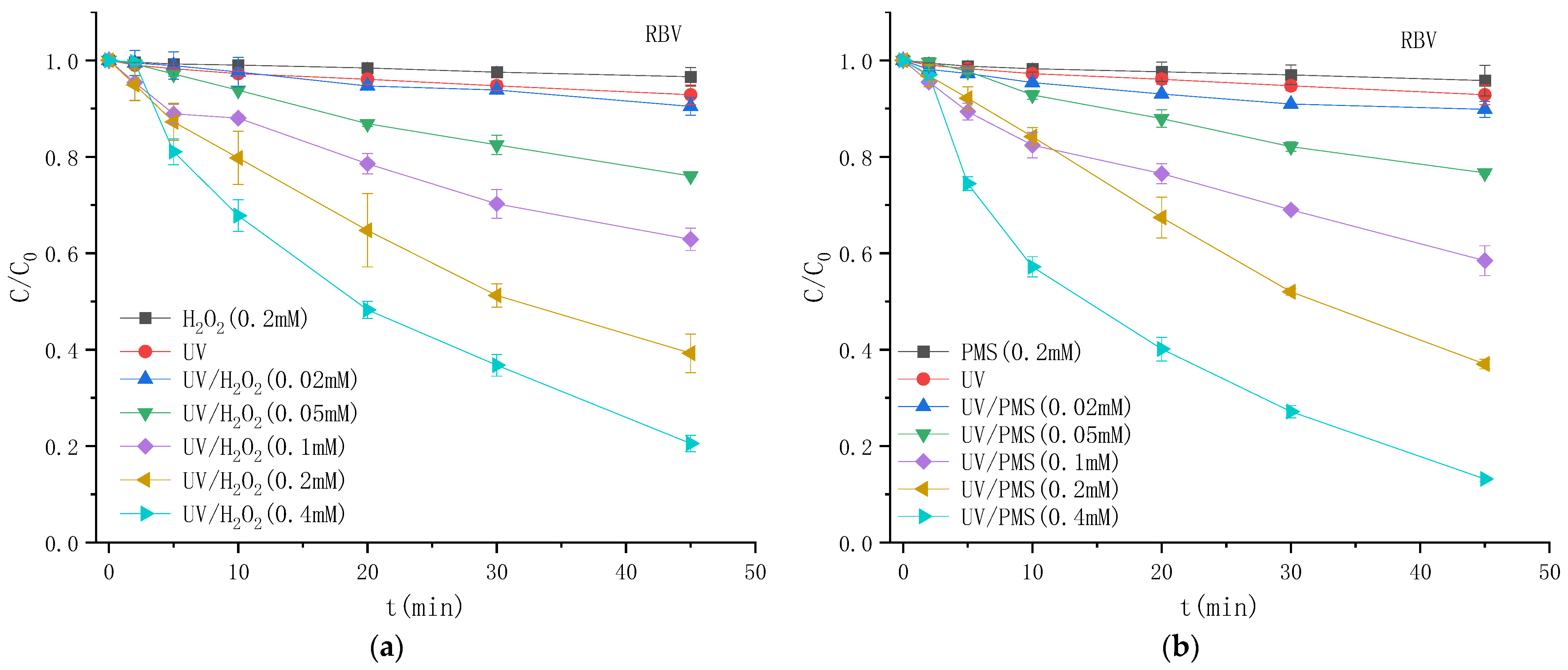
Figure 1. Effects of oxidant concentration on RBV and CQP degradation in different UV/oxidant systems (i.e., UV/H2O2, UV/PMS, UV/KMnO4), and comparison of treatment performance at equivalent molar oxidant dosage. Experimental conditions: UV intensity = 206 μW/cm2, [Pollutant] = 2.5 μM, pH = 7.0, 5 mM phosphate buffer, and [Oxidant] = 0–0.4 mM. (a) RBV in UV/H2O2; (b) RBV in UV/PMS; (c) RBV in UV/KMnO4; (d) CQP in UV/H2O2; (e) CQP in UV/PMS; (f) CQP in UV/KMnO4; (g) Comparison of RBV degradation; (h) Comparison of CQP degradation.
Water 18 01548 g001aWater 18 01548 g001b
Figure 2. Identification of radical species via quenching experiments in UV/H2O2 and UV/PMS processes for RBV and CQP, respectively. Conditions: [UV intensity] = 206 μW/cm2, [RBV or CQP] = 2.5 μM, [H2O2] = [PMS] = 0.2 mM, pH = 7.0 (5 mM phosphate buffer), [EtOH] = [IPA] = [TBA] = 0.2–10 mM. (a) UV/H2O2—RBV; (b) UV/H2O2—CQP; (c) UV/PMS—RBV; (d) UV/PMS—CQP.
Water 18 01548 g002
Figure 3. Comparison of electrical energy per order (EEO) for pollutant degradation by UV/H2O2, UV/PMS, and UV/KMnO4 at different oxidant concentrations. (a) RBV; (b) CQP.
Water 18 01548 g003
Figure 4. Effects of solution pH on the degradation of RBV and CQP by UV/H2O2. Experimental conditions: U.V intensity = 206 μW/cm2, [pollutant] = 2.50 μM, 5 mM phosphate buffer, [H2O2] = 0.2 mM. (a) RBV; (b) CQP.
Water 18 01548 g004
Figure 5. Effects of different anionic species on the degradation of RBV and CQP by UV/PMS. Experimental conditions: UV intensity = 206 μW/cm2, [pollutant] = 2.50 μM, pH = 7.0, 5 mM phosphate buffer, [H2O2] = 0.2 mM, and [HCO3] = [CO32−] = [SO42−] = [Cl] = 1 mM. (a) RBV; (b) CQP.
Water 18 01548 g005
Disclaimer/Publisher’s Note: The statements, opinions and data contained in all publications are solely those of the individual author(s) and contributor(s) and not of MDPI and/or the editor(s). MDPI and/or the editor(s) disclaim responsibility for any injury to people or property resulting from any ideas, methods, instructions or products referred to in the content.