Article

Analysis of the Spatiotemporal Patterns of Water Conservation and Its Soil Driving Forces

1
School of Geography, South China Normal University, Guangzhou 510631, China
2
Guangzhou Institute of Forestry and Landscape Architecture, Guangzhou 510405, China
3
Guangzhou Collaborative Innovation Center on Science-Tech of Ecology and Landscape, Guangzhou 510405, China
*
Authors to whom correspondence should be addressed.
Water 2026, 18(12), 1508; https://doi.org/10.3390/w18121508
Submission received: 8 May 2026 / Revised: 8 June 2026 / Accepted: 15 June 2026 / Published: 18 June 2026

Abstract

Soil is the principal physical space for water conservation (WC), so analyzing the driving forces of soil on WC is significant for studying WC services and integrated environmental management. Guangdong Province, a major economic province in China, was taken as a research case to deeply analyze the spatiotemporal pattern of WC function from 2000 to 2020 with InVEST, and to reveal its soil driving forces using a classical mathematical statistics method. We found that, from 2000 to 2020, the WC functions in Guangdong Province exhibited significant spatiotemporal differences. High-value regions were mainly concentrated in the northern and western mountainous regions, while low-value areas were primarily in the Pearl River Delta. The total WC in Guangdong showed a fluctuating upward trend, with 10.71% of its area experiencing extremely significant improvement in the Pearl River Delta, followed by Northern Guangdong. Moreover, WC is influenced by the types and distribution areas of different soils. Red soil has the highest WC depth and volume, followed by paddy soil, while lateritic red soil has the lowest WC depth. Furthermore, soil components exhibited complex stratified relationships with precipitation-normalized WC (PNWC). Components characterized by cation exchange capacity (CEC), pH, and total exchangeable bases (TEB) were positively associated with PNWC, whereas aluminum saturation (ALSA) showed a negative association within the corresponding soil components. The findings provide an important scientific basis for the ecological governance of ecosystem WC functions and water resource management.

1. Introduction

As a vital ecosystem service, WC reflects the process and ability of ecosystems to retain water within a specific spatial–temporal scale. It encompasses multiple functions including regulating surface runoff and augmenting available water resources [1], thus serving as a crucial core metric for assessing the sustainability of terrestrial ecosystems [2]. Water transport within the Soil–Plant–Atmosphere Continuum (SPAC) operates as an interactive network where atmospheric forcing and plant physiological regulation jointly govern global water exchanges. Solar radiation and vapor pressure deficit serve as primary drivers of evaporative demand, initiating phase transitions in the hydrological cycle [3]. Concurrently, vegetation modulates these fluxes through biophysical controls: roots actively extract soil moisture via osmotic gradients, while xylem networks passively transport water to leaves, where stomatal conductance regulates transpiration rates [4]. This bidirectional exchange creates feedback loops between soil moisture availability and atmospheric humidity, with plant hydraulic traits acting as critical mediators of ecosystem-scale water use efficiency. The soil layer plays a crucial role in the water cycle by facilitating the transformation of water between atmospheric precipitation, surface water, soil water, and groundwater. Moreover, its physical properties and moisture status shape the global pattern of water limitation in ecosystems [5,6], highlighting the decisive role of soil in the water cycle [7]. Given its unique position, the WC function of the soil layer is central to the ecosystem’s overall WC capacity [8,9]. This function is realized through key hydrological processes, including the regulation of surface runoff, enhancement of soil water retention, modulation of forest evapotranspiration, and influence on runoff characteristics in watersheds [10]. Thus, the soil layer serves as a vital element in maintaining regional water resource balance and ecosystem stability. Currently, the quantitative assessment of WC for different soil types and the understanding of their driving mechanisms remain relatively limited. Therefore, it is imperative to quantitatively assess the WC service functions for different soil types and investigate the driving mechanisms of multi-level soil factors on WC function. Such research will provide crucial insights for achieving sustainable development of regional water resources and ecosystems.
Current research on WC is gradually shifting from assessing its spatiotemporal variation characteristics to analyzing the underlying driving mechanisms. Many scholars have employed various methods to explore the driving effects of macro-level natural factors like climate and topography [11,12] and socio-economic factors such as population density and GDP [13] on regional WC functions. However, previous studies have predominantly focused on macro-level factors, while lacking a better understanding of multiple soil factors. Soil, as a critical medium for WC, directly affects the processes of water infiltration and storage through its physical and chemical properties, such as pH and exchangeable bases, as well as its layered structure. Nevertheless, the existing studies often simplify it into a single variable or background parameter, resulting in an insufficiently in-depth analysis of the driving effects of multiple soil factors. This simplification overlooks the complexity of soil moisture dynamics and restricts a comprehensive understanding of the soil’s WC function. Evident limitations are also shown in the limited studies focusing on the driving effects of multiple soil factors. The existing studies have mainly focused on the WC function of surface soils [14,15], with fewer analyses on the impacts of subsoils. The water-holding capacity and pore structure of both surface and subsoils jointly determine the processes of water infiltration, storage, and release in soils, which are crucial for groundwater recharge and long-term water regulation. However, the underlying mechanisms of subsoils remain unclear and urgently need further exploration and clarification.
Owing to its unique geographical location and development opportunities, Guangdong Province is at the forefront of China’s rapid economic development and has become one of the regions with one of the highest economic and population densities globally. According to the Statistical Communique of Guangdong Province on the 2023 National Economic and Social Development, Guangdong Province ranked first among all provinces in both population size and GDP. The immense population size and substantial economic activities exert considerable pressure on the equilibrium between water availability and consumption. Guangdong Province meets the water demands of 9% of the national population and contributes 10.7% to GDP, with only 6.7% of the nation’s water resources [16]. As a highly urbanized region with an extremely dense population, the study area relies crucially on high-quality water ecosystem service for the sustainable development of the regional economy, society, and ecological environment. However, under the continuous impact of global warming, terrestrial ecosystems are experiencing a more pronounced warming process than the oceans [17], which not only accelerates the evaporation of soil moisture [18] but also increases the frequency and intensity of drought events, thereby triggering water scarcity issues globally. At the regional level, especially in densely populated and highly urbanized areas like Guangdong Province, water resources, as the core support for the functioning and maintenance of regional ecosystems, are under increasing pressure. With the accelerating urbanization process and the increasing intensity of human activities’ interference with the ecological environment, the water resource situation in Guangdong Province has become more severe. With low per capita water resources [19], the province faces serious ecological issues such as soil erosion [20] and water resource shortages [21,22], which severely restrict the stability and sustainable development of regional ecosystems. Soil, as a key link in the water cycle, occupies a pivotal position in WC, and clarifying its mechanism of action is important. Therefore, analyzing WC driving forces from a soil-driven perspective is urgently needed, and will provide theoretical support for developing targeted ecological protection and restoration measures, thereby optimizing the WC capacity of regional ecosystems. Based on this, this study aimed to clarify the spatiotemporal changes in WC in Guangdong Province from 2000 to 2020, quantify the differences in WC among major soil types, and examine the statistical associations between multi-layer soil properties and WC across different soil depths. To achieve these objectives, we used the InVEST model with localized parameters to estimate WC. We then applied soil-type statistics, PCA, and OLS regression to identify soil-related differences and associated factors. The results provide a theoretical basis for enhancing ecosystem services and co-managing water and soil resources in the humid regions of South China, as well as scientific references for ecological restoration practices in areas with high human interference.

2. Materials and Methods

2.1. Study Area

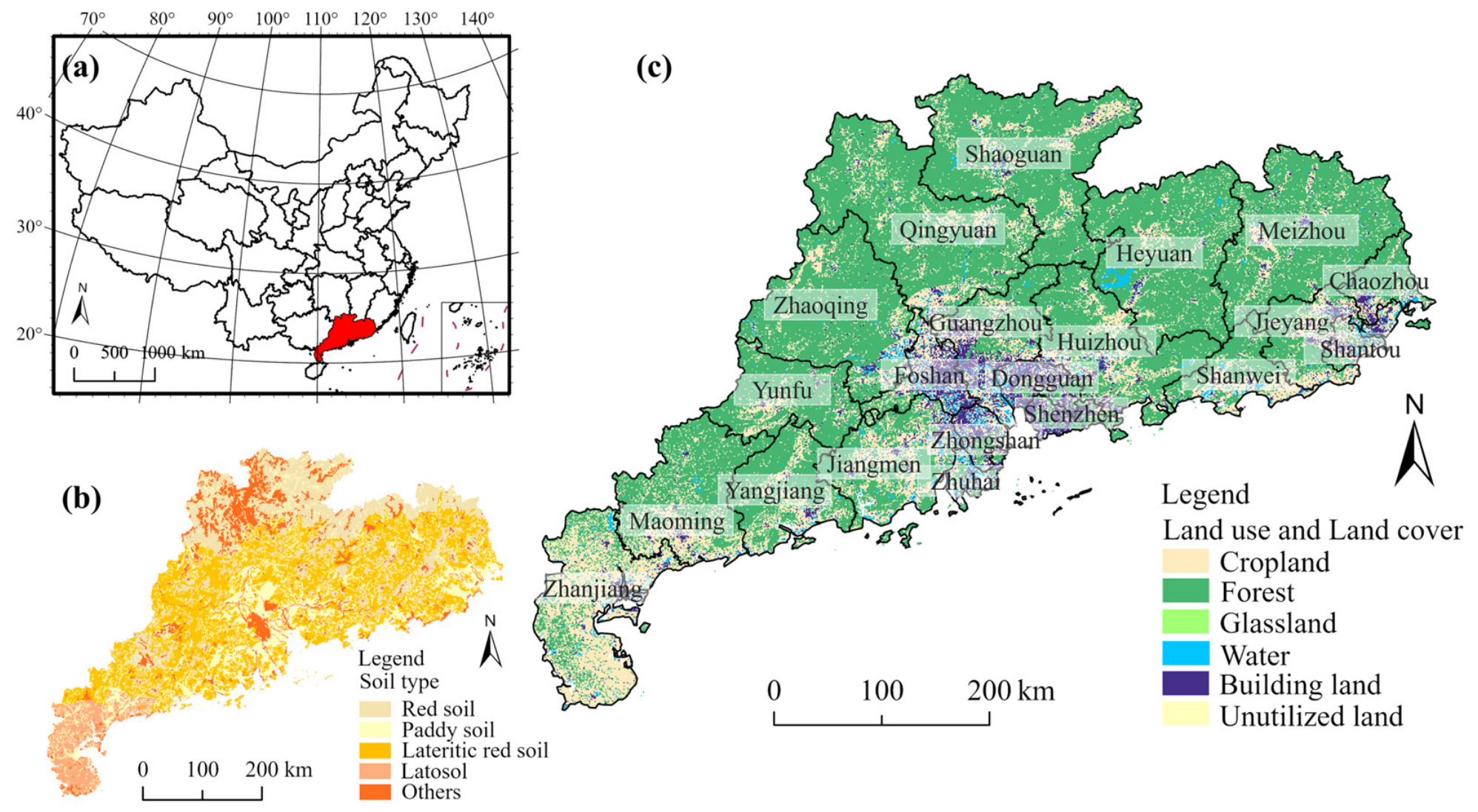
Located in the southern extremity of the Chinese mainland (20°09′~25°31′ N, 109°45′~117°20′ E), Guangdong Province adjoins Fujian Province on its eastern flank, shares boundaries with Jiangxi and Hunan Provinces to the north, neighbors Guangxi Zhuang Autonomous Region on the west, and borders the South China Sea to the south (Figure 1). Situated in the East Asian monsoon climatic zone, Guangdong spans from the mid-subtropical climate in the north to the south-subtropical and tropical climates in the south. The area has a warm and humid climate with favorable hydrothermal conditions, characterized by an average annual sunshine duration of 1746 h, an average annual temperature of 22.10 °C, and an average annual precipitation of 1828.29 mm. Precipitation is unevenly distributed in time and space, with 70–85% of the annual rainfall occurring during the flood season (from April to September). While the abundant rainfall provides ample moisture for WC, its concentration poses challenges to soil WC capacity. The topography is dominated by mountains and hills in the north and alluvial plains in the south. The soil types transition from red soil, to lateritic red soil, to latosol from north to south, with paddy soils scattered across the area.
From 2000 to 2020, the total water resources of Guangdong Province fluctuated between 1.50 and 2.50 × 10¹¹ m3 [23]. Despite the considerable total volume of water resources, swift economic progress and continuous population expansion have intensified the need for water resources, worsening the imbalance between water supply and economic advancement. As of 2023, Guangdong Province’s permanent resident population stood at 127.06 million, with a regional GDP of 135.67 trillion yuan and an urbanization rate of 75.42% [24].
To more clearly analyze the WC service in different regions, this study divides the 21 municipal administrative units in Guangdong Province into four regions, based on the Guangdong Province Principal Functional Zones Plan [25]. The specific divisions are shown in Table 1.

2.2. Data

The data used include meteorological, soil, and vegetation data (Table 2). During the processing of the soil data, the range of soil depths studied included 0–20 cm, 20–40 cm, 40–60 cm, 60–80 cm, 80–100 cm, 100–150 cm, and 150–200 cm, which are sequentially numbered as L1–L7. All data were processed using ArcGIS (version 10.8.2; Esri, Redlands, CA, USA) with a unified projection of WGS 1984 UTM Zone 49 N and resampled to a resolution of 1 km.

2.3. Methods

2.3.1. Water Conservation

The InVEST model is currently a widely applied assessment tool for quantifying multiple ecosystem services [29]. Based on the Budyko hydrothermal coupling equilibrium hypothesis, its water yield module can accurately simulate the regional water cycle process, combined with terrain, vegetation, and soil parameters. Water yield provides a practical basis for estimating WC because it represents the portion of precipitation remaining after evapotranspiration and is closely related to runoff regulation and downstream water supply. This provides a practical water balance basis for WC assessment, because water quantity, runoff regulation, and downstream water supply are key components of hydrologic ecosystem services [30]. Therefore, it has been applied to assess WC functions across multiple areas [31,32] and scales [33,34], demonstrating good adaptability in its evaluation results. The InVEST model uses raster cells as the computational basis, supports high-resolution spatial outputs, and can reveal spatial information about WC service [35]. In this study, annual water yield was first estimated using the InVEST water yield module, and then corrected using topographic conditions, flow velocity, and soil saturated hydraulic conductivity to characterize WC. The calculation formula for water yield is as follows:
Y ( x ) = ( 1 A E T ( x ) P ( x ) ) × P ( x )
where Y(x) is the annual water yield for pixel x (mm); AET(x) is the real annual evapotranspiration for pixel x; and P(x) is the annual precipitation for pixel x. Parameters such as the evapotranspiration coefficient were compiled from the relevant literature (Table 3).
Considering the influence of topographic factors on the WC function, this study followed the water retention correction method proposed by Yu et al. [36]. The flow velocity coefficient, topographic index, and soil saturated hydraulic conductivity were used to correct the water yield and obtain the WC pattern of the research area at the raster scale. The specific calculation method is as follows:
Retention   = min ( 1 , 249   Velocity   ) × min ( 1 , 0.9 × TI 3 ) × min ( 1 , Ksat 300 ) × Y ( x )
TI = lg ( D area   Soil   dep   × P slope   )
where Retention is the annual WC depth (mm); TI is the topographic index; Velocity is the flow rate coefficient; Ksat is the soil saturation hydraulic conductivity (cm/d), derived from the Soil–Plant–Air–Water (SPAW) Model; D area represents the grid number of the area;   Soil   dep is the soil depth (mm); and P slope   is the percentage slope.
The parameter Z in this study was determined to be two based on existing research and model operations [37,38]. The annual water yield of Guangdong Province from 2000 to 2020 was 182.92 × 10⁹ m3, and, compared with the annual water yield of 2000–2020 published by the Water Resources Bureau of Guangdong Province, which is 188.04 × 10⁹ m3, the error is only 2.72%. Moreover, the mean value of the relative errors in each year is the smallest, demonstrating the relative reliability of the model’s operational outcomes.
To reduce the direct influence of interannual precipitation variability on modeled WC, precipitation-normalized water conservation (PNWC) was further calculated. PNWC was defined as the ratio of unit WC to annual precipitation for each raster cell:
PNWC = WC P
where WC is the annual unit water conservation depth (mm), and P is the annual precipitation (mm).

2.3.2. Spatiotemporal Trend Analysis

The Theil–Sen Median is a non-parametric test for trend calculation, which exhibits high resistance to extreme values and outliers [39]. The method can effectively mitigate the distortion of the trend line caused by extreme precipitation years and accurately quantify the interannual variability of the WC function. The Mann–Kendall statistical test is particularly advantageous for analyzing non-normal time series, which imposes no assumptions on data distribution and remains robust to outliers. Notably, natural variability and deterministic trends in hydrometeorological datasets can be systematically discriminated by evaluating trend significance at the 95% confidence level (|Z| ≥ 1.96) in the test. Its flexibility in handling non-ideal data conditions and ability to quantify monotonic trends make it a cornerstone method for detecting long-term changes in meteorological time series [40]. The combination of Theil–Sen trend analysis and the Mann–Kendall significance test has proven to be an effective approach for quantifying trends in long-term time series data [41,42]. To enhance accuracy, this study employs the Theil–Sen Median method to test the significance of change trends in WC service and integrates the results with the Mann–Kendall significance test method for a comprehensive assessment. The detailed calculation formulas are as follows:
β = Median ( X j X i j i )
S = i = 1 n 1   j = i + 1 n   sgn ( x j x i )
sgn ( x j x i ) = { 1 , x j x i > 0 0 , x j x i = 0 1 , x j x i < 0
Z = { S 1 s ( S ) , S > 0   0 , S = 0 S + 1 s ( S ) , S < 0  
s ( S ) = n ( n 1 ) ( 2 n + 5 ) 22
where X j and X i are data values in time series j and i ( j > i ), respectively. β > 0 indicates an upward trend in the time series and β < 0 indicates a downward trend in the time series. n is the number of data; S is the test statistic; and Z is the standard normal test statistic. At a confidence level of a = 0.05 , the critical value | Z | = 1.96 is used to evaluate the significance of the trend. If | Z | is greater than 1.96, the change trend is considered significant; otherwise, it is non-significant. Following this, the trend of WC is divided into five categories (Table 4).

2.3.3. Principal Component Analysis and OLS Regression

The soil system contains multiple physicochemical variables with complex internal relationships [43]. In the study of the soil–WC relationship, a traditional single variable regression model is inadequate for analyzing multidimensional and non-linear coupling relationships. To characterize the main soil components associated with WC, this study employs PCA to reduce the dimensionality of 18 regional soil factors (Table 5) and extract representative soil components. KMO and Bartlett tests are used to evaluate the suitability of PCA, and components with eigenvalues > 1 are retained. This reduces multicollinearity and redundancy while preserving key information, which makes PCA useful for soil quality assessment [44]. The extracted PC scores are then used as independent variables in OLS regression, with PNWC as the dependent variable, to test whether soil components statistically explain the spatial variation in precipitation-normalized WC. This study conducts all PCA and OLS analyses in SPSS 27.0.

3. Results

3.1. Spatiotemporal Variation in WC in Guangdong Province

The simulation accuracy of the InVEST water yield module largely depends on the Z parameter, which was calibrated by comparing the simulated water yield with the observed runoff. Based on the annual runoff data of Guangdong Province from 2000 to 2020, the Z value was continuously adjusted to repeatedly validate the water yield results generated by the InVEST model. The validation results showed that when the Z value was set to 2, the mean simulated water yield was 182.92 × 10⁹ m3, with an R2 of 0.85, a PBIAS of −1.17%, and an NSE of 0.72 (Table 6). Under this condition, the simulated water yield was closest to the observed runoff, indicating the reliability of the model results.
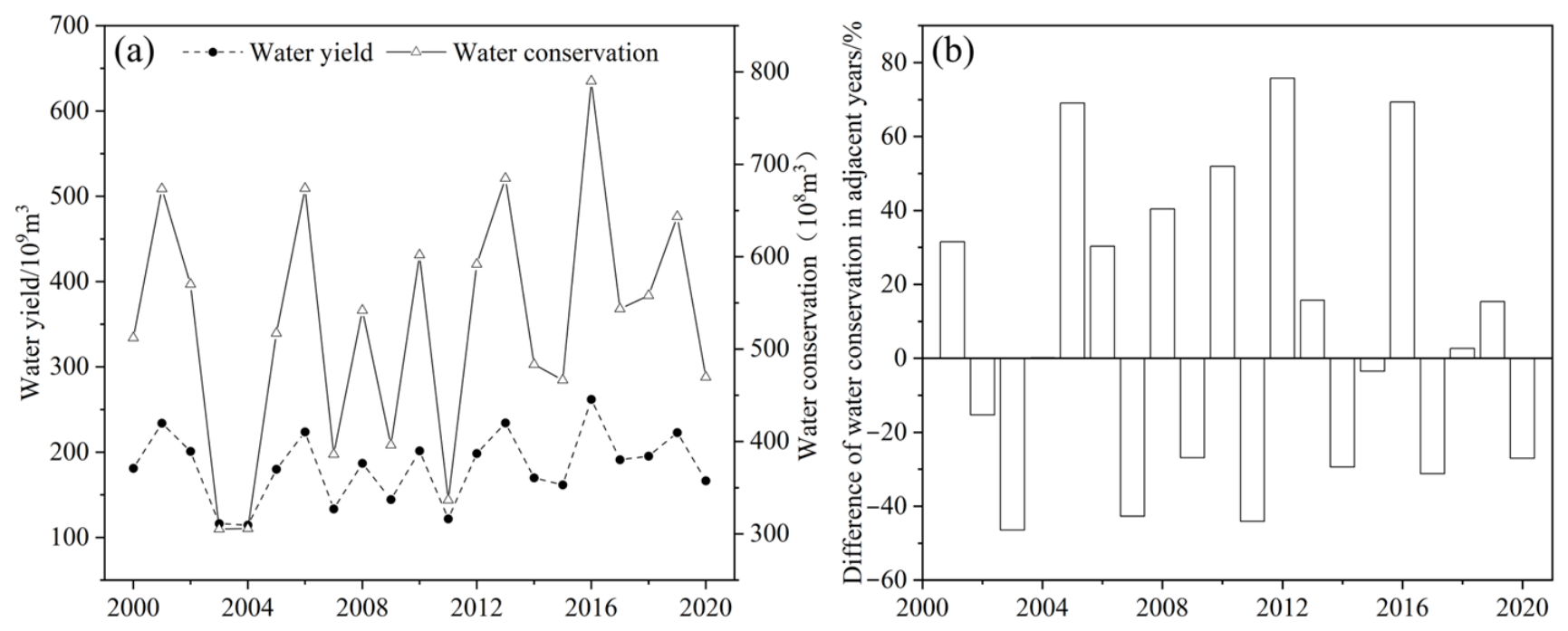
From 2000 to 2020, the trend in WC services mirrored that of water yield, with an average unit WC of 292.73 mm and an average WC volume of 526.34 × 10⁸ m3 (Figure 2a). The total WC significantly fluctuated (Figure 2b). A pronounced peak occurred in 2016, with a 45.35% increase from 2015. Conversely, the lowest volume was observed in 2003, declining by 46.46% from 2002. The correlation analysis further showed strong positive relationships between annual precipitation and regional WC (Table 7). Across the four regions, the correlation coefficients ranged from 0.980 to 0.997 for mean WC depth and from 0.980 to 0.997 for WC volume, with all correlations significant at p < 0.001.
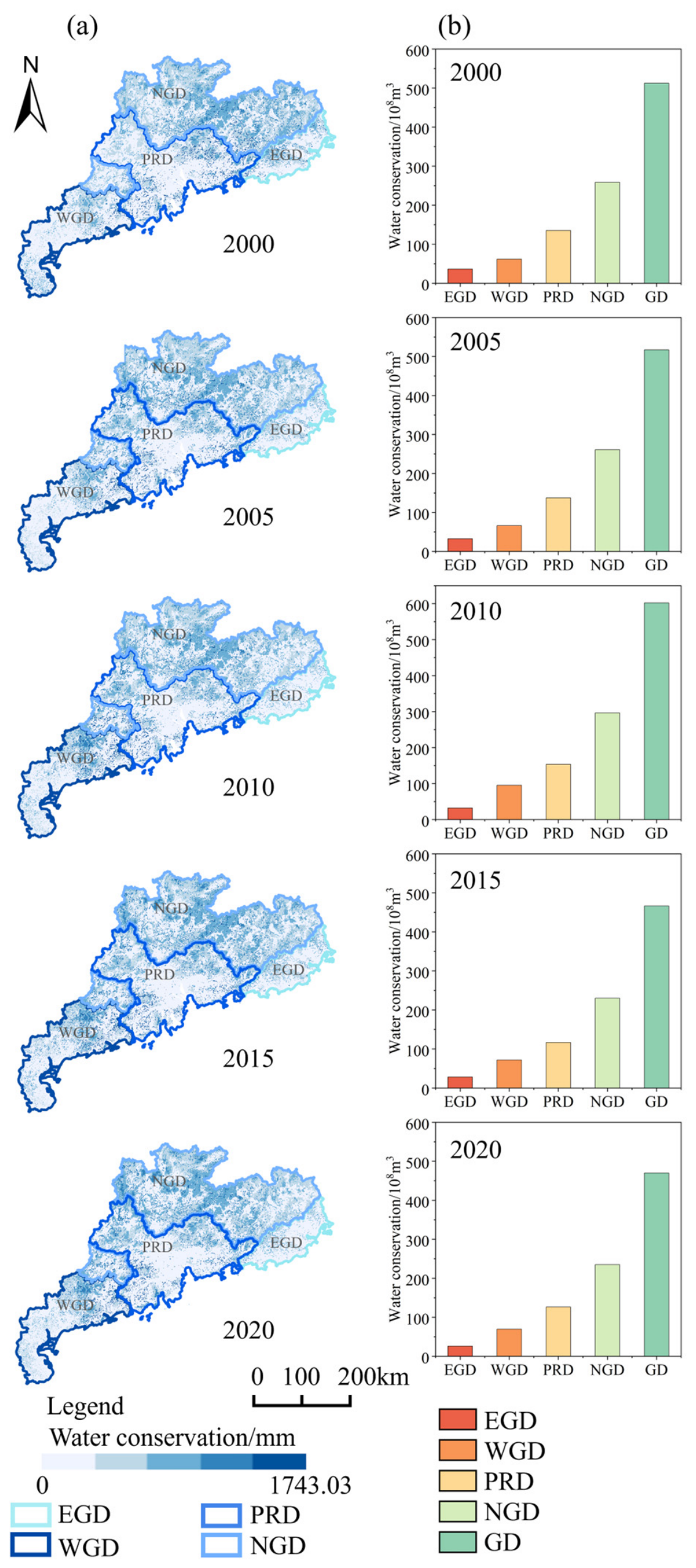
From 2000 to 2020, the spatial distribution of WC (Figure 3a) revealed a pronounced geographical pattern of higher values in NGD and WGD and lower values in PRD. High-value regions were primarily concentrated in cities such as Qingyuan, Shaoguan, Heyuan, and Maoming. Over time, these high-value regions shifted progressively from east to west. A gradual decline in WC was observed in the cities of the eastern part, such as Meizhou and Huizhou. In contrast, cities like Zhaoqing and Yunfu witnessed a continuous enhancement in their capacity to retain water sources. In economically advanced PRD cities like Guangzhou, Dongguan, and Shenzhen, crucial WC ecological lands have been extensively occupied by rapid urban land expansion from economic growth. Consequently, the WC function in these areas gradually deteriorated, resulting in an ecological deficit. In recent years, cities in EGD, such as Chaozhou and Shantou, have shown a pronounced trend towards lower values of WC services. This highlights the weak and deteriorating WC capacity in these regions.
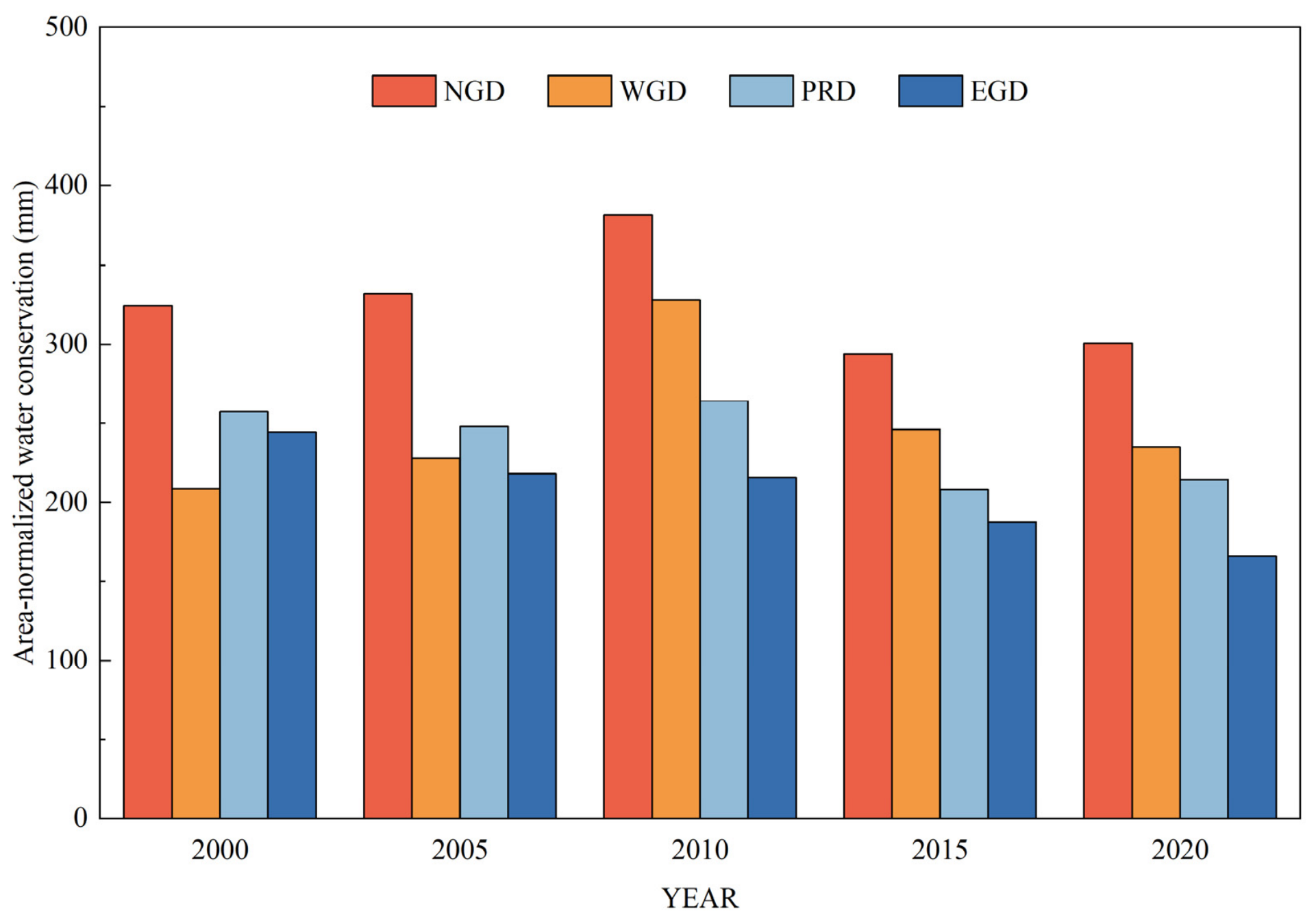
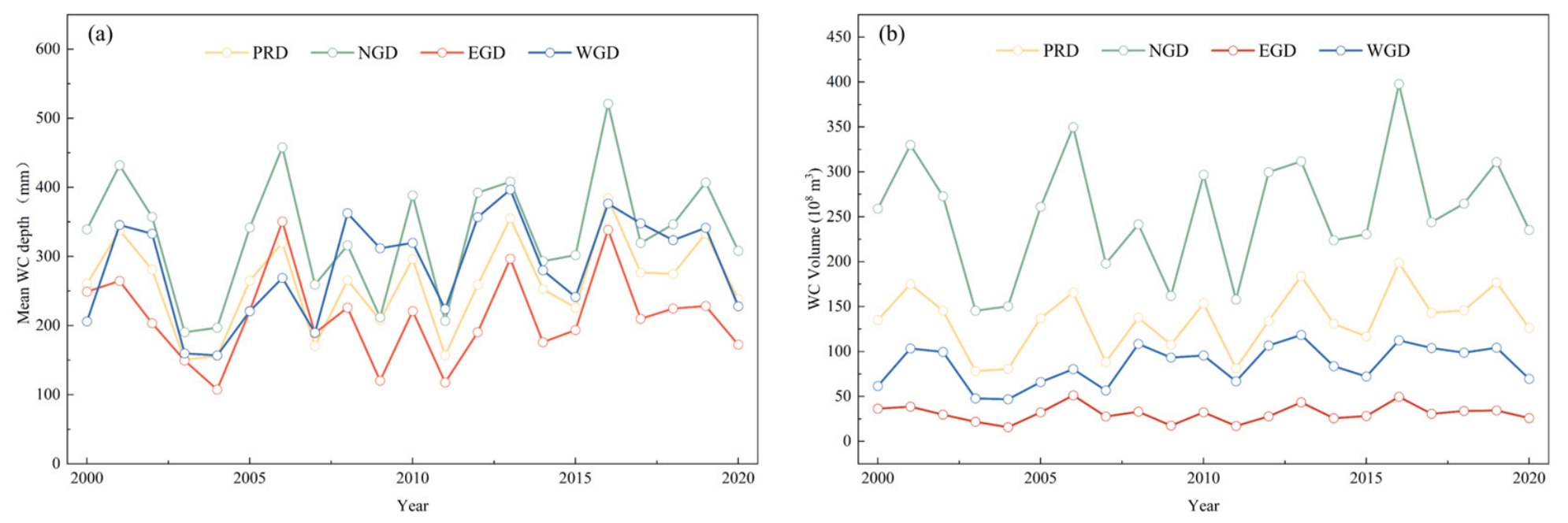
The average WC shows a significant difference between various regions (Figure 3b), and varied as follows: NGD (254.14 × 10⁸ m3) > PRD (135.33 × 10⁸ m3) > WGD (85.51 × 10⁸ m3) > EGD (31.10 × 10⁸ m3). The variations in WC across the four regions mirrored the overall trend observed in Guangdong Province, characterized by a fluctuating upward trend (Figure 3). The WC of NGD and PRD exhibited similar trends, whereas the eastern and western regions, with their small WC volume, displayed less pronounced trends. City-level statistics further quantified the spatial variability shown in Figure 3 (Table 8). Among the five selected years, the mean WC across Guangdong Province was 263.82 ± 29.76 mm in 2000, reached its highest value of 292.00 ± 38.65 mm in 2010, and declined to 228.67 ± 29.31 mm in 2020. NGD consistently exhibited the highest regional mean WC, whereas WGD showed the greatest inter-city variability. After normalization by regional area, NGD remained the region with the highest WC depth, whereas EGD generally showed the lowest values (Figure 4). Although the total WC volume of PRD was higher than that of WGD, its area-normalized WC depth was lower than that of WGD in 2010, 2015, and 2020, indicating that the regional area affected comparisons based on total WC volume. In 2020, both the provincial and regional WC in the Pearl River Basin were affected by reduced precipitation, leading to a decline. The regional time series results showed broadly synchronous interannual fluctuations among the four regions, but with clear differences in magnitude (Figure 5). NGD generally had the highest mean WC depth and WC volume, whereas EGD remained the lowest. The Theil–Sen and Mann–Kendall results further indicated positive Sen’s slopes for all regions, suggesting increasing tendencies in regional mean WC depth (Table 9). However, these trends were not statistically significant.
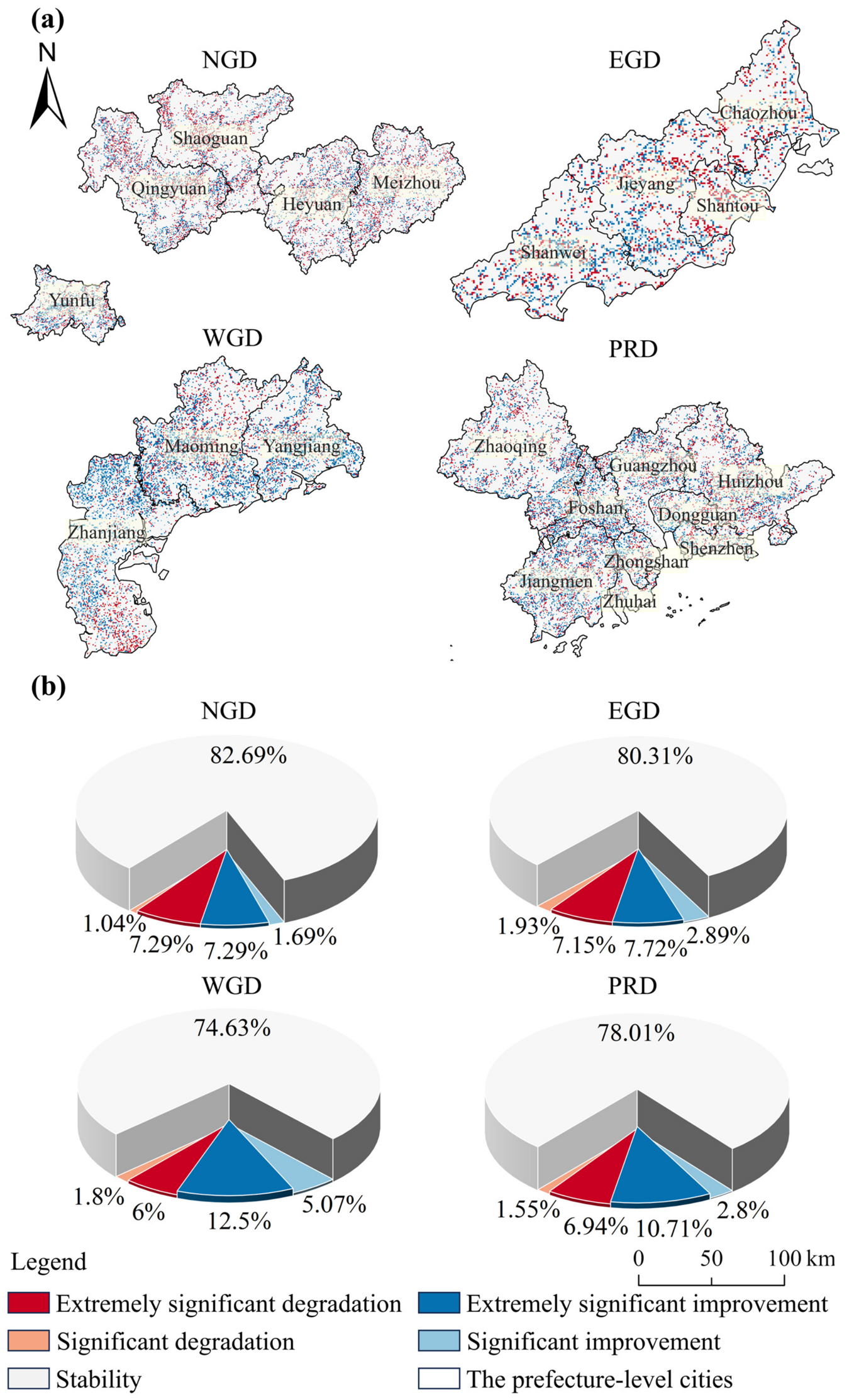
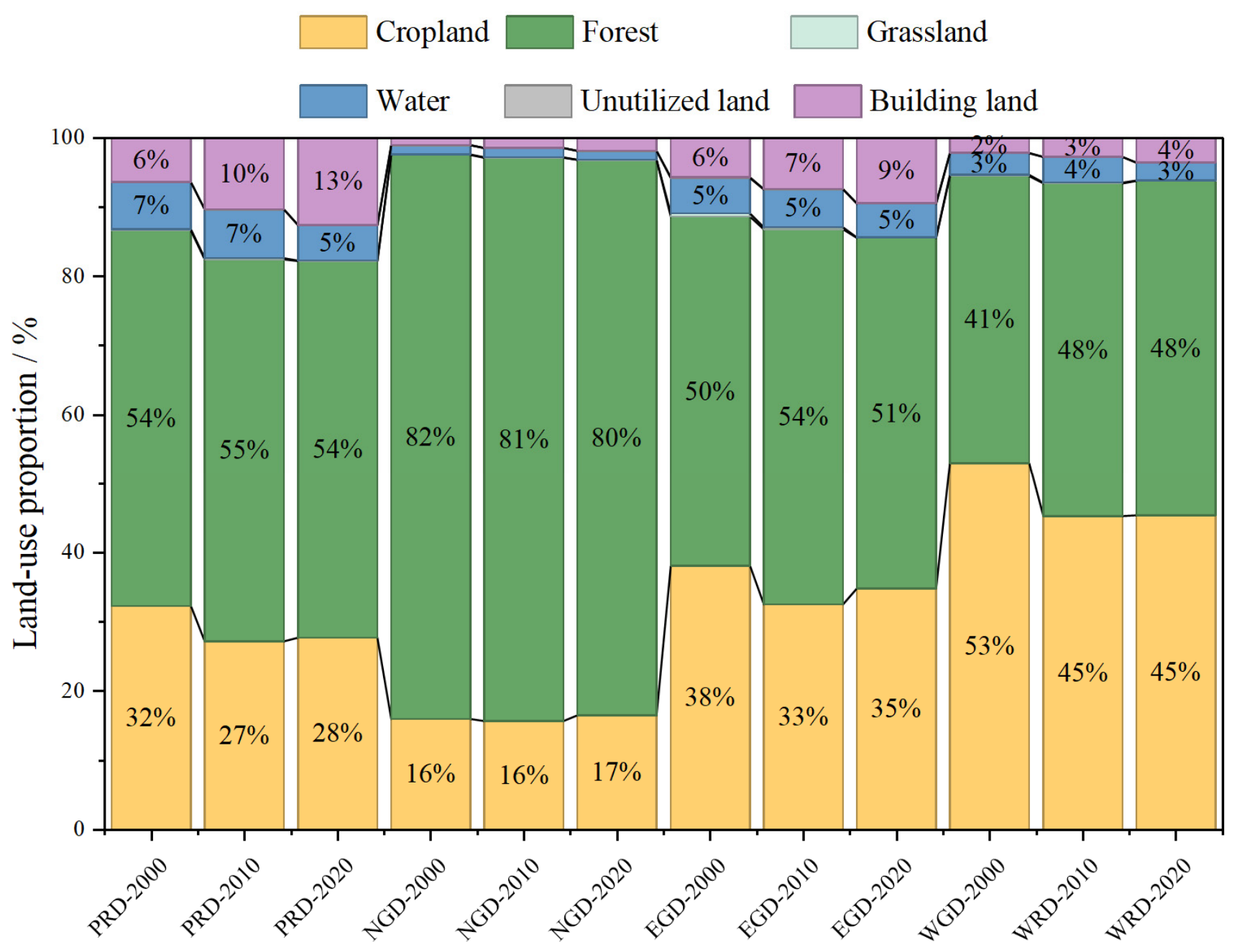
The spatiotemporal changes in WC in Guangdong Province from 2000 to 2020 were classified into five types: extremely significant improvement (9.29% of the area), significant improvement (2.73% of the area), stability (79.63% of the area), significant deterioration (1.41% of the area), and extremely significant deterioration (6.94% of the area) (Figure 6). Across the entire study area, the majority of regions exhibited stability, with the remaining four categories scattered sporadically. The combined area of regions with extremely significant and significant improvement (12.02%) exceeded that of regions with extremely significant and significant deterioration (8.35%), indicating an overall trend of optimization in WC. The land use structure of the four regions (Figure 7) further helps explain this spatial differentiation. NGD remained dominated by forest, with forest cover remaining stable at 80–82%. In WGD, forest cover increased from 41% to 48%, whereas cropland decreased from 53% to 45%. Building land increased from 6% to 9% in EGD and from 6% to 13% in PRD, although forest cover in PRD remained relatively stable, at 54–55%. These land use changes were broadly consistent with the regional differences in WC. Higher and more stable forest cover was associated with a stronger WC basis, whereas regions experiencing building land expansion also contained areas of localized WC degradation. The regions with extremely significant and significant improvement were most extensively distributed in the Pearl River Delta, accounting for 35.17% and 31.29% of its area, respectively. The improvement is closely associated with the implementation of the mountains–rivers–forests–farmlands–lakes–grasslands–seas ecological protection and restoration projects in the PRD, adherence to ecological protection red lines, and optimization of national land space. Conversely, regions with extremely significant and significant deterioration were primarily located in NGD and the economically developed central areas of PRD, mostly due to the resource and environmental pressures brought about by economic development (Figure 6a).
Across the four regions, stability areas accounted for an average of 78.91% (Figure 6b). Guided by the 14th Five-Year Plan Period target of constructing 333,000 hectares of high-quality water source forests, cities in the WGD, such as Maoming, have engaged in large-scale afforestation over multiple years, establishing a robust green foundation for high-quality development. These regions feature 12.50% of areas with extremely significant improvements and the smallest proportion of areas with extremely significant degradation (Figure 6b). Against the backdrop of ecological civilization construction and the mountains–rivers–forests–farmlands–lakes–grasslands–seas ecological protection and restoration projects, the PRD has shown a clear trend of optimizing its WC function, with 10.71% of areas experiencing extremely significant improvements. The land use transition matrix further showed that 2079.28 km2 of cropland was converted to forest in the PRD from 2000 to 2020, whereas 2835.70 km2 of cropland and 226.57 km2 of forests were converted to building land (Table 10). These results indicate the coexistence of ecological land restoration and urban expansion, consistent with the simultaneous occurrence of WC improvement and degradation within the PRD. However, due to rapid built-up land expansion from economic growth that has extensively occupied crucial ecological lands, 8.49% of the PRD area still showed extremely significant or significant degradation (Figure 6b).

3.2. Spatiotemporal Variation in WC in Different Soil Types

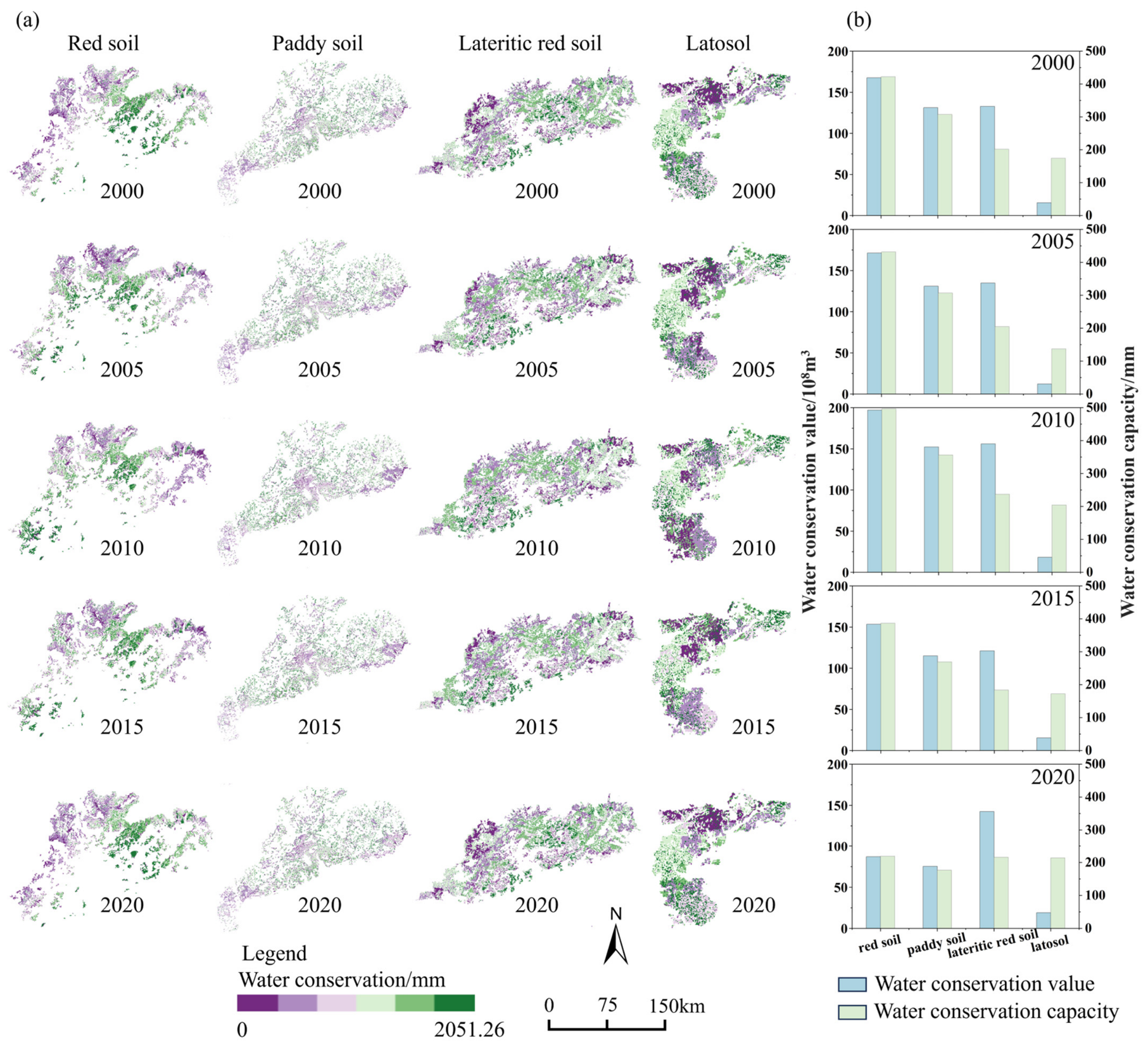
The soil water storage capacity in the region is affected by the distribution of soil types, thus influencing the spatial pattern of WC. The predominant soil types in Guangdong Province are red soil, lateritic red soil, latosol, and paddy soil [45]. In terms of distribution (Figure 8a), red soil is primarily found in the mountainous regions of NGD, with scattered occurrences in the eastern and western parts of the province. This soil type contributed the largest average annual total WC volume of 166.39 × 10⁸ m3, and its high-value areas were mainly concentrated in northeastern NGD. The WC volume of lateritic red soil is second to red soil, primarily because it is extensively distributed in the central part of Guangdong Province, covering 37.62% of the whole area. Paddy soil is present in a fragmented, patchy pattern across Guangdong Province, with an average annual WC volume of 130.15 × 10⁸ m3. Its WC capacity is higher in the southern coastal regions and decreases gradually towards the north. Latosol has the lowest average annual WC volume of 18.84 × 10⁸ m3, with a spatial distribution pattern characterized by high values in the northern part of the Leizhou Peninsula and a gradual decrease towards the north and south. This is partly due to its location in the hot and humid South Asian subtropical climate zone of the Leizhou Peninsula, where intense strong weathering processes lead to poor WC capacity in soil. Additionally, its distribution area is the smallest, accounting for only 5.16% of the total area.
The WC service functions of the four major soil types within the study area exhibit significant temporal differences (Figure 8b). From 2000 to 2020, the total WC of all soil types showed a fluctuating upward trend, consistent with the overall trend in Guangdong Province. Among them, lateritic red soil had the lowest mean WC depth, whereas latosol had the smallest distribution area and the lowest total WC volume. The unit WC of different soil types reflects the ability of different soil categories, with higher values indicating stronger WC capacity. Figure 8b illustrates that red soil demonstrates an optimal WC performance, with the highest average unit WC at 419.05 mm. Paddy soil ranks second in WC capacity, while lateritic red soil and latosol have similar capacities, which are only half that of red soil.
The Theil–Sen slope and Mann–Kendall test further confirmed the temporal tendencies of WC among soil types (Table 11). All four soil types showed positive Sen’s slopes, indicating a general increasing tendency in WC from 2000 to 2020. However, these trends were not statistically significant (p > 0.05). Red soil had the highest average annual WC (419.05 mm) and the largest Sen’s slope (3.548 mm·yr−1), followed by lateritic red soil (3.061 mm·yr−1), latosol (2.251 mm·yr−1), and paddy soil (1.599 mm·yr−1). This suggests that the long-term WC changes in different soil types were mainly characterized by weak upward fluctuations rather than significant monotonic increases.
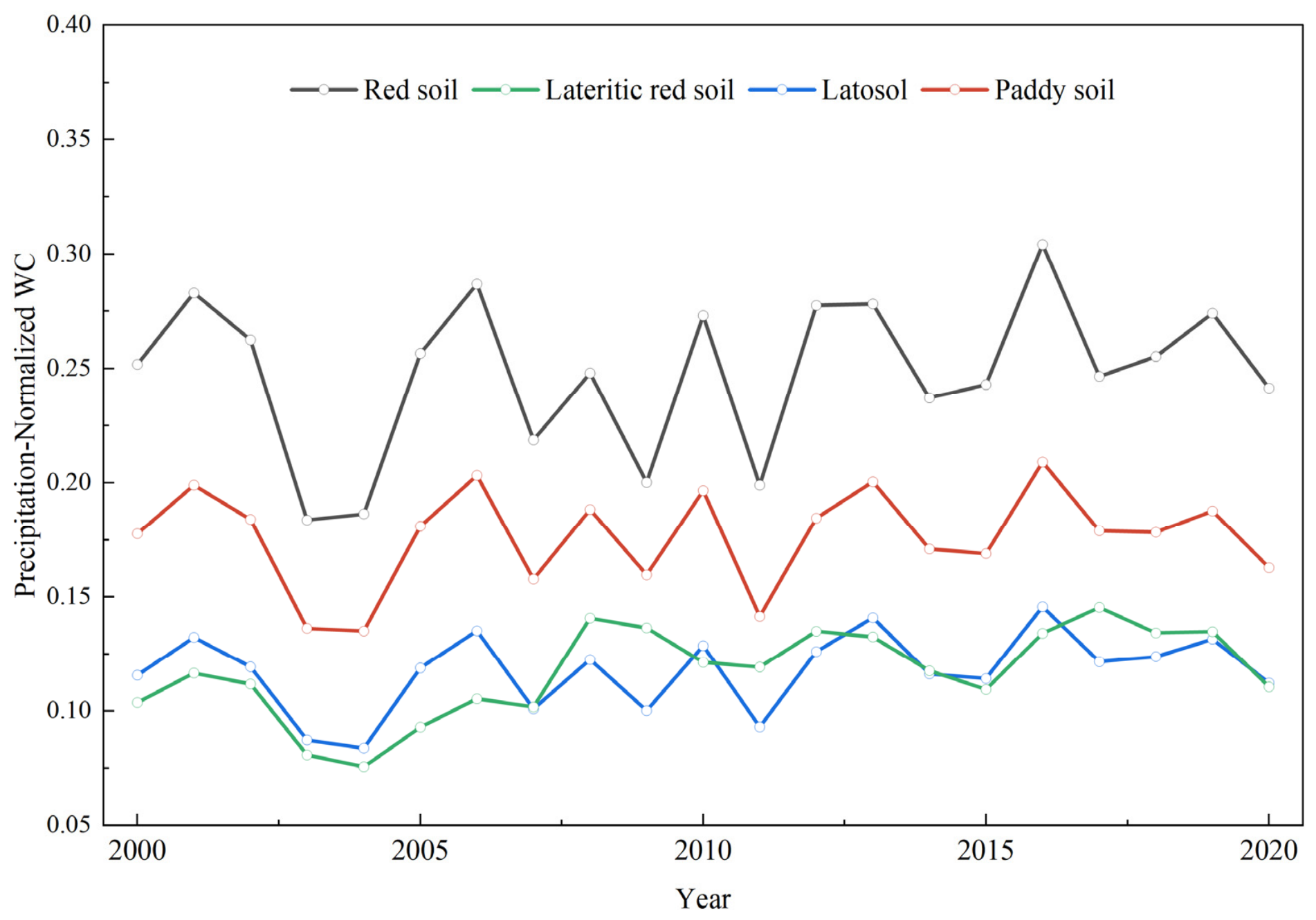
To minimize the influence of interannual precipitation variability, PNWC was calculated for the four dominant soil types (Figure 9). Distinct differences persisted after precipitation normalization. Red soil exhibited the highest mean PNWC (0.2480), followed by paddy soil (0.1763), whereas latosol and lateritic red soil showed lower values of 0.1176 and 0.1171, respectively. Trend analysis indicated a significant increase in PNWC only for lateritic red soil, while the positive trends observed in red soil, paddy soil, and latosol were not statistically significant (Table 12). These findings suggest that precipitation primarily determined the magnitude of annual WC variation, whereas soil type and associated surface characteristics influenced the efficiency of precipitation conversion into WC.

3.3. Soil Components Associated with WC in Guangdong Province

In the PCA conducted across seven soil layers, the KMO values ranged from 0.556 to 0.652, and Bartlett’s tests were significant for all layers. This indicates that the soil variables were acceptable for exploratory PCA and had sufficient internal correlations for dimensionality reduction. Five PCs were retained for L1, L2, L3, L6, and L7, whereas four PCs were retained for L4 and L5. The cumulative variance explained by the retained PCs ranged from 84.01% to 87.99%, indicating that the extracted components preserved most information from the original soil variables. In all soil layers, the cumulative contribution of PC1 and PC2 exceeded 50%, reaching 54.97%, 53.60%, 51.01%, 62.67%, 63.10%, 64.57%, and 56.25% from L1 to L7, respectively.
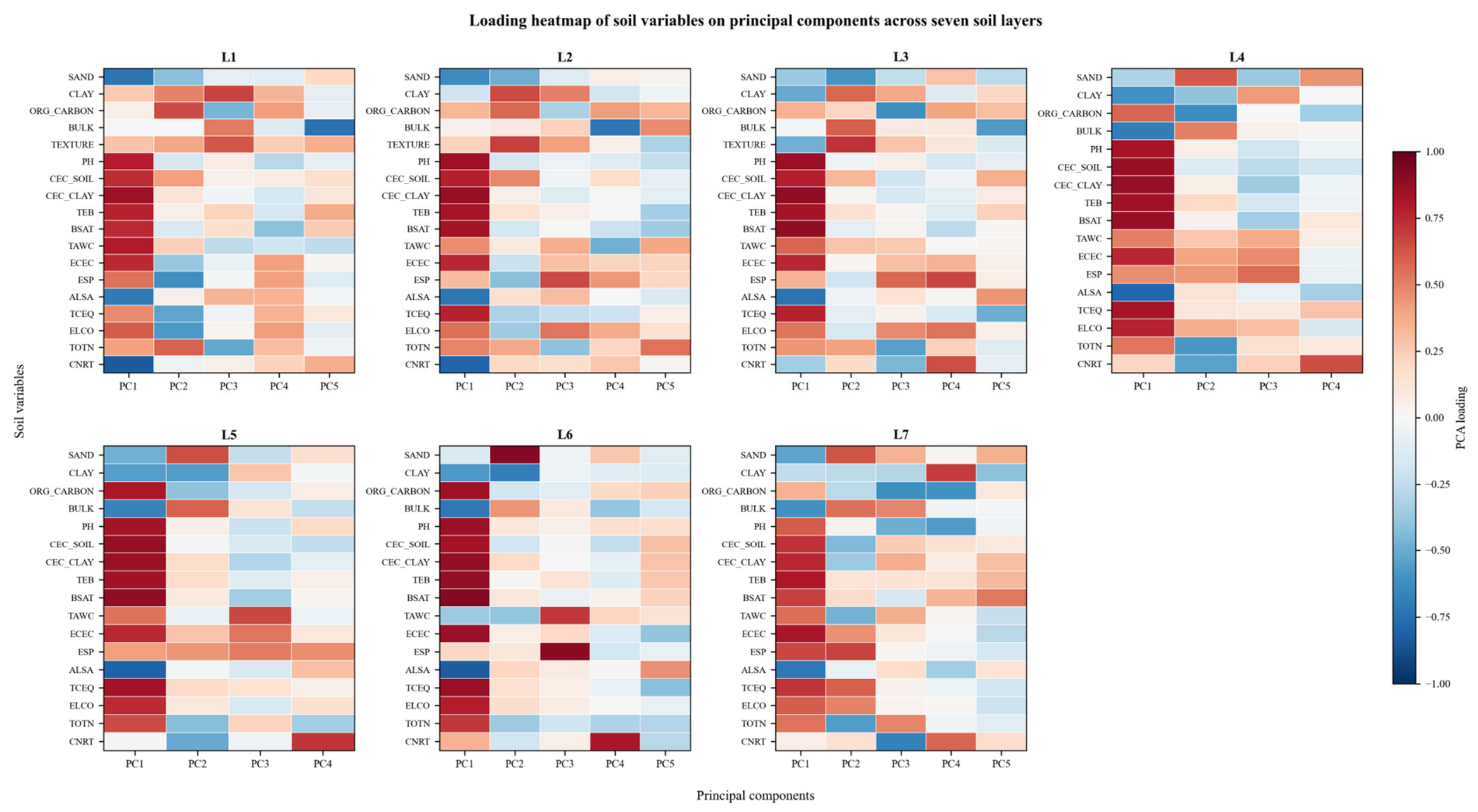
The loading heatmap further revealed clear vertical differences in the composition of soil PCs (Figure 10). Across most soil layers, PC1 was mainly characterized by high positive loadings of pH, CEC_SOIL, CEC_CLAY, TEB, BSAT, ECEC, and related exchangeable base variables. In contrast, ALSA generally showed negative loadings on PC1, indicating an opposite variation pattern relative to base saturation and cation exchange related variables. Texture-related variables, including SAND and CLAY, showed more variable loading patterns among layers, suggesting that their contribution to soil component structure changed with depth. In deeper layers, variables such as TCEQ, ELCO, TOTN, and CNRT showed more evident layer-dependent loading patterns. These results indicate that soil components associated with PNWC have clear stratified characteristics along the soil profile.
To further evaluate the statistical association between PCA-derived soil components and PNWC, OLS regression was conducted for each soil layer (Table 13). All models were significant at p < 0.001, indicating that the extracted soil components were significantly associated with PNWC. The adjusted R2 values ranged from 0.040 to 0.398, showing clear vertical differences in explanatory power among soil layers. L7 showed the highest explanatory power, followed by L3, L2, L1, L6, L5, and L4. The relatively low adjusted R2 of L4 suggests that mid-depth soil components had a weaker independent association with PNWC. The Durbin–Watson values were close to 2.0, and all VIF values were 1.000, indicating no serious residual autocorrelation or multicollinearity.

4. Discussion

4.1. Spatiotemporal Pattern of WC in Guangdong Province

From 2000 to 2020, the WC in Guangdong exhibited significant spatiotemporal heterogeneity and a fluctuating upward trend. The high-value regions gradually shifted westward, while the central PRD region, characterized by economic prosperity, showed a clear trend of deteriorating WC function. This distribution pattern mirrors the findings of Xu et al. [46]. The regional differences in WC were further related to precipitation variability and land use transitions. The strong correlations between annual precipitation and regional WC indicate that precipitation controlled the synchronous interannual fluctuations among regions. However, differences in land use structure and transitions modified the spatial response of WC. Forest- and cropland-dominated areas in NGD and WGD generally maintained higher WC, whereas the expansion of built-up land in parts of PRD weakened local WC. Therefore, regional WC differences were shaped by both climatic variability and land use changes. The high-value regions were located in cities of NGD and WGD such as Maoming and Zhanjiang, while the surrounding areas of PRD showed a clear trend of optimization. The land use types in NGD are dominated by forest and cropland. Multiple ecological functions, including canopy interception, forest soil infiltration, and rhizosphere water retention, synergistically improve WC capacity. Moreover, the northern mountainous region serves as the upstream catchment of the Beijiang and Dongjiang rivers, which are the main components of the Pearl River. It is characterized by numerous river systems and large- and medium-sized reservoirs, making it a pivotal area for water source protection. WGD is an important agricultural production area, with extensive distribution of agricultural land and basic farmland protection zones. Cities such as Zhaoqing, located in the northern part of the PRD, are geographically distant from the region’s core economic hubs. The land use patterns in these cities are predominantly characterized by forest ecosystems and cropland. These cities not only serve as critical buffers for regional ecosystems but also act as the main pillars of WC. Building on the spatial pattern of WC and its hydrological basis, the protection of forest-dominated areas in NGD and WGD remains important for maintaining regional WC. The ecological redline, permanent basic farmland, and water conservation forest projects can be viewed as land management contexts that help maintain the hydrological functions identified in this study.

4.2. Differences in WC of Different Soil Types

The theory that the soil is the primary contributor to WC functions within ecosystems has been demonstrated in numerous studies [47]. Different soil types exhibit varying textures, which directly influence their capacity to retain and transport water, thereby determining the likelihood and timing of water limitation in ecosystems [7]. Soil types with higher sand content, characterized by larger particles and more interstitial spaces, exhibit better water permeability and conductivity, implying a weaker water retention capacity. In contrast, clayey soils, with smaller particles and fewer pores, restrict water movement, reducing water conductivity and enhancing water retention capacity. The distribution of soil types in Guangdong Province shows significant spatial variability, leading to heterogeneity in WC functions. Red soil, predominantly found in the northern mountainous regions, has a moderate particle composition and porosity, which imparts superior water retention capacity [48,49], thereby resulting in the highest WC capacity and total volume among regional soil types. Li et al. [50] compared the WC capacities of five national soil and water conservation zones in China and found that the water storage capacity of the red soil region in Guangdong is approximately 1–2 times higher than that of paddy soil regions in Anhui and Zhejiang Province.
However, absolute WC was strongly affected by annual precipitation. Therefore, PNWC was further used to evaluate the efficiency of precipitation conversion into WC. After precipitation normalization, red soil still showed the highest mean PNWC. This indicates that soil type affected WC mainly by regulating the conversion efficiency of precipitation. The Theil–Sen and Mann–Kendall results further showed that red soil had the highest average annual WC and the largest positive Sen’s slope, although the trend was not significant. This may be attributed to its dominant distribution in northern mountainous areas, where forest cover is high and human disturbance is relatively weak. These conditions favor canopy interception, soil infiltration, and stable water retention. In contrast, the WC capacity of lateritic red soil is the lowest, mainly because it is predominantly dispersed in the Leizhou Peninsula at the southernmost tip of Guangdong Province. The hot and humid climate and intense weathering processes rapidly decompose organic matter, making it difficult for soil aggregates to form and leading to the accumulation of large amounts of iron and aluminum oxides with weak water adsorption capacity. Moreover, latosol covers only 5.16% of the study area, resulting in the lowest WC volume of 18.84 × 10⁸ m3. In WGD, WC was affected by agricultural land use, soil organic matter, and aggregate structure, indicating that soil structural stability plays an important role in regulating WC in agricultural regions.

4.3. Analysis of Soil Factors Affecting WC in Guangdong Province

The OLS validation supports the PCA-based interpretation and further indicates a clear depth-dependent relationship between soil components and PNWC. In multiple soil layers, factors such as CEC, pH, and TEB are positively associated with the WC function, while ALSA exhibits a negative correlation. Existing studies emphasize that the soil can better retain nutrients, reduce nutrient loss, and enhance soil water retention with high CEC [51,52]. The toxicity of ALSA disrupts root apex cell division, leading to reduced vegetation coverage and declines in soil infiltration rates, thereby decreasing soil water retention capacity [53]. Therefore, province-wide implementation of organic fertilizer combined with lime technology is recommended for Guangdong Province, aiming to regulate soil pH and enhance cation exchange capacity through synergistic amendments. This integrated approach should be prioritized in constructing WC demonstration zones, where soil acidification mitigation and fertility improvement are critical for a sustainable agricultural ecosystem. In addition, crop varieties that are tolerant to aluminum should be bred according to local conditions, and demonstration bases for aluminum-resistant varieties should be established. The NGD and EGD regions, which are dominated by lateritic red soil, are severely affected by aluminum toxicity. It is therefore recommended to select acid- and aluminum-tolerant tree species such as E. urophylla and the hybrid E. urophylla × E. grandis species [54]. WGD cropland should promote aluminum-tolerant rice varieties such as the Guihuahuang Rice series and aluminum-tolerant soybean varieties like M90-24 [55,56].
As a complex ecosystem, soil functions and properties are influenced by a combination of physical, chemical, and biological factors. Different soil factors interact with each other and collectively influence the regional WC function. Soil pH has a significant synergistic effect on CEC. Studies have shown that, when pH increases, CEC also increases, thereby enhancing the soil’s WC capacity through synergy [57]. In contrast, soil pH and ALSA exhibit a trade-off effect in their interaction with WC. High concentrations of ALSA are more soluble under acidic conditions and can leach into the groundwater system, thereby reducing soil water retention capacity and affecting WC functions [58]. The soil pH in Guangdong Province is predominantly acidic and slightly acidic, with a significant trend of acidification in recent years [59]. Under such acidic conditions, high concentrations of ALSA in the soil can inhibit the WC capacity in Guangdong. This indicates that merely adjusting a single factor is inadequate for comprehensively and sustainably enhancing WC. Instead, effective improvement in soil WC capacity can be achieved only by taking into account the interactions among multiple factors. Soil pH modification is crucial in NGD’s mountainous areas. Incorporating lime and other alkaline amendments can elevate soil pH, and boost cation exchange capacity, thereby improving soil WC. Additionally, these amendments decrease soil bulk density, improve aggregate stability, and strengthen soil water-holding ability. Efforts should be made to simultaneously improve soil aeration and permeability and adjust the soil carbon-to-nitrogen ratio in PRD. To address the widespread issue of high ALSA concentrations in Guangdong, it is necessary to combine the application of soil amendments with the planting of aluminum-tolerant crops to mitigate their negative impacts on soil water retention and plant growth, ensuring the synergistic action of multiple factors to comprehensively enhance the soil’s WC capacity across the province.
The soil factors associated with WC exhibit complex stratified characteristics. With increasing soil depth, the positive correlation between CNRT, inorganic carbon content, organic carbon content, and WC capacity gradually strengthens. At L6 and L7, the positive correlation between TCEQ, CNRT, and WC highlights the buffering function of deep soil layers. A high CNRT ratio indicates a reduced rate of organic matter decomposition, which is conducive to the formation of stable humus–mineral complexes. This positively affects the long-term stability of soil water retention capacity, enabling the soil to maintain good water-holding properties over extended periods [60,61]. In deeper layers, these carbon-related components may also reflect the combined effects of mineral protection, soil texture, and slow water redistribution, instead of the isolated effect of a single soil variable [62,63]. Deep roots, macropores, and biopores may further connect surface infiltration with subsoil water storage, allowing deep soil layers to participate in regional water regulation [64,65]. However, changes in soil bulk density exhibit an opposite trend in their impact on WC functions. The negative correlation between soil bulk density and WC capacity increases with soil depth and peaks at L5. This phenomenon reveals that the increase in soil bulk weight with increasing depth is usually accompanied by a decrease in porosity, which reduces the water-holding capacity of the soil and thus affects the WC function [66,67]. Moreover, the trend of increasing soil bulk density with depth has been verified in various soil types and forest types [68,69], which further illustrates the potential impact of soil bulk density on WC functions.

4.4. Limitations and Future Directions

This study evaluated the WC function in Guangdong Province from 2000 to 2020 using the InVEST model and explored the effect of soil-related factors on WC using classical statistical methods, filling the research gap in the intersection of WC and soil science. However, limitations remain. Firstly, methodological constraints introduce inherent inaccuracies in quantifying ecosystem service functions. The parameter settings of the InVEST model mainly rely on empirical data from regions with similar environmental conditions. Although these parameters have been validated in previous studies, the overall model simulation accuracy may still be affected. Secondly, this study only explores WC differences based on soil type classifications, neglecting variations in physicochemical properties within the same soil type. It also lacks systematic quantification of key indicator gradients, such as soil texture and organic matter content. Biological processes in soils, particularly microbial influences on soil structure and water-holding capacity, are not considered. Moreover, contemporary analytical frameworks predominantly employing singular methodologies exhibit limitations in characterizing the synergistic interplay and threshold-driven regulatory mechanisms inherent to multifactorial soil systems. Furthermore, such approaches may limit the ability to capture spatiotemporal heterogeneity among soil factors. Finally, although this study considered soil profiles down to 200 cm, it did not fully address the vertical interactions between shallow and deep soil layers or the roles of deep soil processes. Deep soil processes, such as root water uptake, preferential flow through macropores and biopores, capillary redistribution, mineral adsorption, and groundwater–soil water exchange, were not directly measured. This may limit the understanding of the vertical regulation of water conservation.
To minimize errors from low data precision and improve WC model accuracy, it is crucial to incorporate locally measured data and improve better data processing methods by integrating remote sensing and Geographic Information System technologies. Furthermore, in order to study the impact of physicochemical property differences in the same soil type on WC functions, high-resolution soil sampling and analysis techniques should be used to capture spatial data on soil physicochemical properties. Geographic Information System technology and geostatistical methods should be combined to create spatial distribution maps of soil physicochemical properties and analyze their quantitative relationship with WC functions. Future studies should also incorporate multi-depth observations and process-based approaches to better represent interactions between soil layers. Root sampling, soil moisture monitoring, infiltration experiments, and groundwater observations could provide direct evidence of vertical water movement. To fully account for considering the complex interactions among multiple soil factors, machine learning methods such as XGBoost can be used to detect interactions, and geographically weighted regression can be combined to clarify the spatial distribution patterns of the intensity of different factors. This approach will provide a more targeted scientific basis for regional differentiated ecological restoration and water resource management.

5. Conclusions

This study used the InVEST model to simulate spatiotemporal changes in WC from 2000 to 2020 and revealed the driving forces of multiple soil factors on WC through PCA. The results showed the following: (1) From 2000 to 2020, the WC function in Guangdong Province exhibited significant spatiotemporal heterogeneity, with high-value regions mainly concentrated in the northern and western mountainous areas and low-value regions primarily in the Pearl River Delta. The total WC in Guangdong Province showed a fluctuating upward trend, with the most significant optimization trend in the Pearl River Delta, followed by NGD. (2) WC function is influenced by the types and distribution areas of different soils. Red soil has the highest WC ability and total amount, followed by paddy soil, while lateritic red soil has the lowest capacity. (3) The soil driving forces on WC exhibit complex stratified characteristics, with significant differences in their effects as soil depth increases. Factors such as CEC, pH, and TEB have significant positive driving effects, while ALSA shows a strong negative correlation.
Amidst intensified global climate change and frequent human disturbances, global ecosystem services become more sensitive to water limitations, potentially exerting significant impacts on carbon sequestration, biodiversity, and food security [3,70]. Consequently, the dynamic monitoring and analysis of the driving mechanisms of WC functions have emerged as a frontier in ecohydrological research. This study revealed the multi-level interaction patterns between soil factors and WC services, further enriching the theoretical framework at the intersection of hydrology and soil science. Clarifying the driving mechanism of soil factors on WC not only provides important methodological references and data support for subsequent related studies but also helps different regions formulate targeted ecological protection strategies to mitigate global declines in water provisioning ecosystem functions.

Author Contributions

X.Y., Q.Z. and C.Z. conceived the ideas and designed the methodology; X.Y., Q.Z. and S.D. collected the data; X.Y. and Q.Z. analyzed the data; X.Y., Q.Z. and C.Z. led the writing of the manuscript. All authors have read and agreed to the published version of the manuscript.

Funding

This study was supported by the Guangzhou Collaborative Innovation Center on Science-tech of Ecology and Landscape [202206010058] and the National Natural Science Foundation of China [42471026].

Data Availability Statement

The original contributions presented in this study are included in the article. Further inquiries can be directed to the corresponding authors.

Conflicts of Interest

The authors declare no conflicts of interest.

Abbreviations

WCWater conservation
NGDNorthern Guangdong
EGDEastern Guangdong
WGDWestern Guangdong
PRDPearl River Delta
GDGuangdong
PCAPrincipal component analysis
PCPrincipal component
SANDSoil sand content ratio
CLAYSoil clay content ratio
ORG_CARBONSoil organic carbon content ratio
BULKBulk density
TEXTURESoil texture
PHPH in water
CEC_SOILThe cation exchange capacity of soil
CEC_CLAYThe cation exchange capacity of clay
TEBTotal exchangeable bases
BSATBase saturation
TAWCTotal available water capacity
ECECEffective cation exchange capacity
ESPExchangeable sodium percentage
ALSAAluminum saturation
TCEQTotal carbonate carbon
ELCOElectrical conductivity
TOTNTotal nitrogen content
CNRTCarbon-to-nitrogen ratio

References

  1. Wang, Y.; Zhao, J.; Fu, J.; Wei, W. Effects of the Grain for Green Program on the water ecosystem services in an arid area of China—Using the Shiyang River Basin as an example. Ecol. Indic. 2019, 104, 659–668. [Google Scholar] [CrossRef]
  2. Gong, S.; Xiao, Y.; Zheng, H.; Xiao, Y.; Ouyang, Z. Spatial patterns of ecosystem water conservation in China and its impact factors analysis. Acta Ecol. Sin. 2017, 37, 2455–2462. [Google Scholar] [CrossRef]
  3. Denissen, J.M.C.; Teuling, A.J.; Pitman, A.J.; Koirala, S.; Migliavacca, M.; Li, W.; Reichstein, M.; Winkler, A.J.; Zhan, C.; Orth, R. Widespread shift from ecosystem energy to water limitation with climate change. Nat. Clim. Change 2022, 12, 677–684. [Google Scholar] [CrossRef]
  4. van den Berg, T.E.; Dutta, S.; Kaiser, E.; Vialet-Chabrand, S.; van der Ploeg, M.; van Emmerik, T.; Coenders-Gerrits, M.; ten Veldhuis, M.-C. Plants, vital players in the terrestrial water cycle. In Instrumentation and Measurement Technologies for Water Cycle Management; Springer: Berlin/Heidelberg, Germany, 2022. [Google Scholar] [CrossRef]
  5. Liu, L.; Gudmundsson, L.; Hauser, M.; Qin, D.; Li, S.; Seneviratne, S.I. Soil moisture dominates dryness stress on ecosystem production globally. Nat. Commun. 2020, 11, 4892. [Google Scholar] [CrossRef] [PubMed]
  6. Yin, J.; D’Odorico, P.; Porporato, A. Soil moisture dynamics in water-limited ecosystems. In Dryland Ecohydrology; Springer: Berlin/Heidelberg, Germany, 2019; pp. 31–48. [Google Scholar] [CrossRef]
  7. Wankmüller, F.J.P.; Delval, L.; Lehmann, P.; Baur, M.J.; Cecere, A.; Wolf, S.; Or, D.; Javaux, M.; Carminati, A. Global influence of soil texture on ecosystem water limitation. Nature 2024, 635, 631–638. [Google Scholar] [CrossRef] [PubMed]
  8. Xu, Y.; Zhang, M.; Li, Q.; Yu, E.; Deng, L.; Deng, S.; Liu, Z.; Lian, H. Upscaling subalpine forest soil water-holding capacity based on vegetation and environmental factors: An example of the Zagunao River watershed in the upper reach of the Minjiang River in China. Acta Ecol. Sin. 2023, 43, 5614–5626. [Google Scholar] [CrossRef]
  9. Wang, X.; Du, S.; Deng, L.; Zhu, W.; Liu, G. Effects of different soil porosity on the water conservation of typical vegetation system in western Sichuan. Sci. Soil Water Conserv. 2023, 21, 19. [Google Scholar] [CrossRef]
  10. Monneveux, P.; Rekika, D.; Acevedo, E.; Merah, O. Effect of drought on leaf gas exchange, carbon isotope discrimination, transpiration efficiency and productivity in field grown durum wheat genotypes. Plant Sci. 2006, 170, 867–872. [Google Scholar] [CrossRef]
  11. Zhao, G.; Tian, S.; Liang, S.; Jing, Y.; Chen, R.; Wang, W.; Han, B. Dynamic evolution trend and driving mechanisms of water conservation in the Yellow River Basin, China. Sci. Rep. 2024, 14, 26304. [Google Scholar] [CrossRef] [PubMed]
  12. Li, M.; Di, Z.; Yao, Y.; Ma, Q. Variations in water conservation function and attributions in the Three-River Source Region of the Qinghai–Tibet Plateau based on the SWAT model. Agric. For. Meteorol. 2024, 349, 109956. [Google Scholar] [CrossRef]
  13. Wang, G.; Liu, J.; Wang, Z.; Xiang, Y.; Heng, C.K.; Li, X. Spatiotemporal evolution and interaction of water constraints and their socio-ecological drivers in the Taihu Lake Basin. Sci. Total Environ. 2024, 949, 175155. [Google Scholar] [CrossRef] [PubMed]
  14. Dai, L.; Xu, Z. The effect of soil porosity size distribution on integral energy content of water in different moisture slopes. Water Supply 2023, 23, 3950–3958. [Google Scholar] [CrossRef]
  15. Meng, F.; Wang, S.; Qin, F.; Luo, Y.; Wang, D.; Liu, J.; Sun, Y. Effect of Different Fruit-Crop Compounds on Soil Phys-io-chemical Properties and Soil-water Conservation in Gully Region of Plateau. J. Soil Water Conserv. 2020, 34, 192–199. [Google Scholar] [CrossRef]
  16. Deng, G.; Chen, H.H.; Li, J.; Wu, D.; Xu, X.L. Exploring the spatiotemporal evolution and risk factors for total factor energy productivity in Guangdong Province, China. J. Environ. Manag. 2025, 373, 123395. [Google Scholar] [CrossRef] [PubMed]
  17. Nkonya, E.M. Climate Change and Land: An IPCC Special Report on Climate Change, Desertification, Land Degradation, Sustainable Land Management, Food Security, and Greenhouse Gas Fluxes in Terrestrial Ecosystems; IPCC: Geneva, Switzerland, 2019. [Google Scholar]
  18. Yao, L.; Leng, G.; Yu, L.; Li, H.; Tang, Q.; Python, A.; Hall, J.W.; Liao, X.; Li, J.; Qiu, J.; et al. Emergent constraints on global soil moisture projections under climate change. Commun. Earth Environ. 2025, 6, 39. [Google Scholar] [CrossRef]
  19. Tian, G.; Han, X.; Zhang, C.; Li, J.; Liu, J. Virtual Water Flows Embodied in International and Interprovincial Trade of Yellow River Basin: A Multiregional Input-Output Analysis. Sustainability 2020, 12, 1251. [Google Scholar] [CrossRef]
  20. Liu, Z.; Shen, X.; Wei, Y.; Zhou, X.; Cai, C. Soil depth mapping and its linkage to gully erosion rate prediction in granite areas of southern China. Soil Tillage Res. 2023, 231, 105711. [Google Scholar] [CrossRef]
  21. Xian, C.; Fan, Y.; Zhang, J.; Zhang, L. Assessing sustainable water utilization from a holistic view: A case study of Guangdong, China. Sustain. Cities Soc. 2022, 76, 103428. [Google Scholar] [CrossRef]
  22. Wang, X.; Liu, L.; Zhang, S. Integrated model framework for the evaluation and prediction of the water environmental carrying capacity in the Guangdong-Hong Kong-Macao Greater Bay Area. Ecol. Indic. 2021, 130, 108083. [Google Scholar] [CrossRef]
  23. Song, S.; Fang, L.; Yang, J.; Zhou, R.; Bai, G.; Qiu, Y. The Spatial-Temporal Matching Characteristics of Water Resources and Socio-Economic Development Factors: A Case Study of Guangdong Province. Water 2024, 16, 362. [Google Scholar] [CrossRef]
  24. Zhu, L.; Wu, Z.; Huang, X. Exploring the relationship between ecosystem services and sustainable development goals in Guangdong province, China. Ecol. Indic. 2024, 169, 112907. [Google Scholar] [CrossRef]
  25. Government GPPs. Guangdong Provincial Main Function Zone Plan (Gov. Order No. 120). 2012. Available online: https://www.gd.gov.cn/gkmlpt/content/0/146/post_146572.html (accessed on 14 June 2026).
  26. Sharp, R.; Chaplin-Kramer, R.; Wood, S.; Guerry, A.; Douglass, J. InVEST User’s Guide; Stanford University: Stanford, CA, USA, 2018. [Google Scholar]
  27. Liang, J.; Li, S.; Li, X.; Li, X.; Liu, Q.; Meng, Q.; Lin, A.; Li, J. Trade-off analyses and optimization of water-related ecosystem services (WRESs) based on land use change in a typical agricultural watershed, southern China. J. Clean. Prod. 2021, 279, 123851. [Google Scholar] [CrossRef]
  28. Zhang, Q.; Sun, X.; Ma, J.; Xu, S. Scale effects on the relationships of water-related ecosystem services in Guangdong Province, China. J. Hydrol. Reg. Stud. 2022, 44, 101278. [Google Scholar] [CrossRef]
  29. Wu, C.; Qiu, D.; Gao, P.; Mu, X.; Zhao, G. Application of the InVEST model for assessing water yield and its response to precipitation and land use in the Weihe River Basin, China. J. Arid. Land 2022, 14, 426–440. [Google Scholar] [CrossRef]
  30. Brauman, K.A.; Daily, G.C.; Duarte, T.K.; Mooney, H.A. The nature and value of ecosystem services: An overview highlighting hydrologic services. Annu. Rev. Environ. Resour. 2007, 32, 67–98. [Google Scholar] [CrossRef]
  31. Xue, J.; Li, Z.; Feng, Q.; Gui, J.; Zhang, B. Spatiotemporal variations of water conservation and its influencing factors in ecological barrier region, Qinghai-Tibet Plateau. J. Hydrol. Reg. Stud. 2022, 42, 101164. [Google Scholar] [CrossRef]
  32. Liu, Q.; Qiao, J.; Li, M.; Huang, M. Spatiotemporal heterogeneity of ecosystem service interactions and their drivers at different spatial scales in the Yellow River Basin. Sci. Total Environ. 2024, 908, 168486. [Google Scholar] [CrossRef] [PubMed]
  33. Wang, Y.; Ye, A.; Peng, D.; Miao, C.; Di, Z.; Gong, W. Spatiotemporal variations in water conservation function of the Tibetan Plateau under climate change based on InVEST model. J. Hydrol. Reg. Stud. 2022, 41, 101064. [Google Scholar] [CrossRef]
  34. Gu, K.; Ma, L.; Xu, J.; Yu, H.; Zhang, X. Spatiotemporal Evolution Characteristics and Driving Factors of Water Conservation Service in Jiangxi Province from 2001 to 2020. Sustainability 2023, 15, 11941. [Google Scholar] [CrossRef]
  35. Sun, M.; Hu, J.; Chen, X.; Lü, Y.; Yang, L. Comparison of Five Models for Estimating the Water Retention Service of a Typical Alpine Wetland Region in the Qinghai–Tibetan Plateau. Remote Sens. 2022, 14, 6306. [Google Scholar] [CrossRef]
  36. Yu, X.; Zhou, B.; Lü, X.; Yang, Z. Evaluation of water conservation function in mountain forest areas of Beijing based on InVEST model. Sci. Silvae Sin. 2012, 48, 1–5. [Google Scholar] [CrossRef]
  37. Hu, W.; Li, G.; Li, Z. Spatial and temporal evolution characteristics of the water conservation function and its driving factors in regional lake wetlands—Two types of homogeneous lakes as examples. Ecol. Indic. 2021, 130, 108069. [Google Scholar] [CrossRef]
  38. Geng, X.; Wang, X.; Yan, H.; Zhang, Q.; Jin, G. Land Use/Land Cover Change Induced Impacts on Water Supply Service in the Upper Reach of Heihe River Basin. Sustainability 2015, 7, 366–383. [Google Scholar] [CrossRef]
  39. Wang, S.; Gao, M.; Li, Z.; Ma, J.; Peng, J. How Do Driving Factors Affect Vegetation Coverage Change in the Shaanxi Region of the Qinling Mountains? Remote Sens. 2024, 16, 160. [Google Scholar] [CrossRef]
  40. Musonda, B.; Jing, Y.; Iyakaremye, V.; Ojara, M. Analysis of Long-Term Variations of Drought Characteristics Using Standardized Precipitation Index over Zambia. Atmosphere 2020, 11, 1268. [Google Scholar] [CrossRef]
  41. Liu, Y.; Wu, G.; Ma, B.; Wu, T.; Wang, X.; Wu, Q. Revealing climatic and groundwater impacts on the spatiotemporal variations in vegetation coverage in marine sedimentary basins of the North China Plain, China. Sci. Rep. 2024, 14, 10085. [Google Scholar] [CrossRef] [PubMed]
  42. Xu, H.-J.; Zhao, C.-Y.; Wang, X.-P.; Chen, S.-Y.; Shan, S.-Y.; Chen, T.; Qi, X.-L. Spatial differentiation of determinants for water conservation dynamics in a dryland mountain. J. Clean. Prod. 2022, 362, 132574. [Google Scholar] [CrossRef]
  43. Bouslihim, Y.; John, K.; Miftah, A.; Azmi, R.; Aboutayeb, R.; Bouasria, A.; Razouk, R.; Hssaini, L. The effect of covariates on Soil Organic Matter and pH variability: A digital soil mapping approach using random forest model. Ann. GIS 2024, 30, 215–232. [Google Scholar] [CrossRef]
  44. Pouladi, N.; Jafarzadeh, A.A.; Shahbazi, F.; Ghorbani, M.A.; Greve, M.H. Assessing the soil quality index as affected by two land use scenarios in Miandoab region. SN Appl. Sci. 2020, 2, 1875. [Google Scholar] [CrossRef]
  45. Liu, S.; Xie, X.; Wang, X.; Feng, X.; Hou, X.; Wang, S.; Lin, K.; Huang, M.; Jia, S.; Hou, Y. Distribution Pattern of Soil Organic Carbon and Its Regional Humification Constant in the Coastal Monsoon Region of Eastern China. Environ. Sci. Pollut. Res. 2021. [Google Scholar] [CrossRef] [PubMed]
  46. Xu, Q.; Yang, Y.; Yang, R.; Zha, L.-S.; Lin, Z.-Q.; Shang, S.-H. Spatial Trade-Offs and Synergies between Ecosystem Services in Guangdong Province, China. Land 2024, 13, 32. [Google Scholar] [CrossRef]
  47. Sun, Q.; Li, Y.; Guo, J.; Wu, X. Assessment of Water Conservation Function of Forest Ecosystem in Yunhe County, Zhejiang Province. Acta Sci. Nat. Univ. Pekin. 2015, 51, 888–896. [Google Scholar] [CrossRef]
  48. Zhang, Y.; Yang, Z.; Kong, L.; Yang, H.; Yu, Y.; Zhao, Y. Water Content Variations and Pepper Water-Use Efficiency of Yunnan Laterite Under Root-Zone Micro-Irrigation. Front. Plant Sci. 2022, 13, 918288. [Google Scholar] [CrossRef] [PubMed]
  49. Qian, Z.; Tang, L.; Zhuang, S.; Zou, Y.; Fu, D.; Chen, X. Effects of biochar amendments on soil water retention characteristics of red soil at south China. Biochar 2020, 2, 479–488. [Google Scholar] [CrossRef]
  50. Li, Z.; Ning, K.; Chen, J.; Liu, C.; Wang, D.; Nie, X.; Hu, X.; Wang, L.; Wang, T. Soil and water conservation effects driven by the implementation of ecological restoration projects: Evidence from the red soil hilly region of China in the last three decades. J. Clean. Prod. 2020, 260, 121109. [Google Scholar] [CrossRef]
  51. Olorunfemi, I.; Fasinmirin, J.; Ojo, A. Modeling cation exchange capacity and soil water holding capacity from basic soil properties. Eurasian J. Soil Sci. 2016, 5, 266–274. [Google Scholar] [CrossRef]
  52. Dey, R.; Sharma, S.B.; Thakkar, M.G. Maximising ecological value and assessing land suitability for sustainable grassland management in Asia’s largest tropical grassland, Western India. Sci. Rep. 2024, 14, 13658. [Google Scholar] [CrossRef] [PubMed]
  53. Shetty, R.; Prakash, N.B. Effect of different biochars on acid soil and growth parameters of rice plants under aluminium toxicity. Sci. Rep. 2020, 10, 12249. [Google Scholar] [CrossRef] [PubMed]
  54. Liang, Y.; Bai, T.; Liu, B.; Yu, W.; Teng, W. Different antioxidant regulation mechanisms in response to aluminum-induced oxidative stress in Eucalyptus species. Ecotoxicol. Environ. Saf. 2022, 241, 113748. [Google Scholar] [CrossRef] [PubMed]
  55. Lu, H.-L.; Dong, G.; Hua, H.; Zhao, W.-R.; Li, J.-Y.; Xu, R.-K. Method for initially selecting Al-tolerant rice varieties based on the charge characteristics of their roots. Ecotoxicol. Environ. Saf. 2020, 187, 109813. [Google Scholar] [CrossRef] [PubMed]
  56. Zhao, L.; Cui, J.; Cai, Y.; Yang, S.; Liu, J.; Wang, W.; Gai, J.; Hu, Z.; Li, Y. Comparative Transcriptome Analysis of Two Contrasting Soybean Varieties in Response to Aluminum Toxicity. Int. J. Mol. Sci. 2020, 21, 4316. [Google Scholar] [CrossRef] [PubMed]
  57. Ganiyu, S.A.; Are, K.S.; Olurin, O.T. Assessment of geotechnical and physico-chemical properties of age-long greywater-contaminated soils in basement complex areas, southwest Nigeria. Appl. Water Sci. 2020, 10, 114. [Google Scholar] [CrossRef]
  58. Nsengumuremyi, C.; Fischer, E.; Nsabimana, D.; Zaninka, M.C.; Senyanzobe, J.; Uwimana, B. Sustainable Agroforestry for Soil Chemical Properties Improvement and Nutrients Availability in Agriculture Landscape around Cyamudongo Isolated Forest, Rwanda. Turk. J. Agric.-Food Sci. Technol. 2022, 10, 2516–2530. [Google Scholar] [CrossRef]
  59. Zheng, C.; Guo, Z.; Yuan, Y.; Guo, Y.; Chai, M.; Liang, X.; Bi, R. Spatial and temporal changes of farmland soil acidification and their influencing factors in different regions of Guangdong Province, China. Chin. J. Appl. Ecol. 2019, 30, 593–601. [Google Scholar] [CrossRef]
  60. Pikaar, I.; de Vrieze, J.; Rabaey, K.; Herrero, M.; Smith, P.; Verstraete, W. Carbon emission avoidance and capture by producing in-reactor microbial biomass based food, feed and slow release fertilizer: Potentials and limitations. Sci. Total Environ. 2018, 644, 1525–1530. [Google Scholar] [CrossRef] [PubMed]
  61. Pries, C.E.H.; Ryals, R.; Zhu, B.; Min, K.; Cooper, A.; Goldsmith, S.; Pett-Ridge, J.; Torn, M.; Berhe, A.A. The Deep Soil Organic Carbon Response to Global Change. Annu. Rev. Ecol. Evol. Syst. 2023, 54, 375–401. [Google Scholar] [CrossRef]
  62. Soinne, H.; Keskinen, R.; Tähtikarhu, M.; Kuva, J.; Hyväluoma, J. Effects of Organic Carbon and Clay Contents on Structure-Related Properties of Arable Soils with High Clay Content. Eur. J. Soil Sci. 2023, 74, e13424. [Google Scholar] [CrossRef]
  63. Bachofen, C.; Tumber-Dávila, S.J.; Mackay, D.S.; McDowell, N.G.; Carminati, A.; Klein, T.; Stocker, B.D.; Mencuccini, M.; Grossiord, C. Tree Water Uptake Patterns across the Globe. New Phytol. 2024, 242, 1891–1910. [Google Scholar] [CrossRef] [PubMed]
  64. Pushpanjali; Reddy, K.S.; Dhimate, A.S.; Karthikeyan, K.; Samuel, J.; Reddy, A.G.K.; Kumar, N.R.; Rao, K.V.; Pankaj, P.K.; Rohit, J.; et al. Soil Preferential Flow Dynamics in the Southern Drylands of India—A Watershed Based Approach. Front. Water 2025, 6, 1457680. [Google Scholar] [CrossRef]
  65. Truong, T.H.H.; Marschner, P. Plant residues differing in C/N ratio in mulch and soil—The effect of the mulch on nutrient availability and microbial biomass is more pronounced with higher leaching amount. Soil Ecol. Lett. 2020, 2, 317–326. [Google Scholar] [CrossRef]
  66. Xu, C.; Liu, W.; Li, J.; Wu, J.; Zhou, Y.; Kader, R. Dynamic change of soil aggregate stability and infiltration properties during crop growth under four tillage measures in Mollisols region of northeast China. Front. Earth Sci. 2024, 12, 1357467. [Google Scholar] [CrossRef]
  67. Rupngam, T.; Messiga, A.J. Unraveling the Interactions between Flooding Dynamics and Agricultural Productivity in a Changing Climate. Sustainability 2024, 16, 6141. [Google Scholar] [CrossRef]
  68. Du, H.; Zeng, F.; Peng, W.; Wang, K.; Zhang, H.; Liu, L.; Song, T. Carbon Storage in a Eucalyptus Plantation Chronosequence in Southern China. Forests 2015, 6, 1763–1778. [Google Scholar] [CrossRef]
  69. Göl, C.; ÇiçEk, M. The Investigation of Some Soil and Morphological Properties of Trees in Conversion of Marsh into Eucalyptus camaldulensis (Dehn) Different Ages Plantation, (Mediterranean Region—Turkey). Kastamonu Univ. J. For. Fac. 2019, 19, 197–213. [Google Scholar] [CrossRef]
  70. Xia, J.; Yuan, W.; Wang, Y.-P.; Zhang, Q. Adaptive Carbon Allocation by Plants Enhances the Terrestrial Carbon Sink. Sci. Rep. 2017, 7, 3341. [Google Scholar] [CrossRef] [PubMed]
Figure 1. (a) Location of the study area; (b) soil type; (c) land use and land cover in 2020.
Water 18 01508 g001
Figure 2. Temporal variation in water yield and WC from 2000 to 2020 in Guangdong Province (a); difference in WC in adjacent years (b).
Water 18 01508 g002
Figure 3. Spatial–temporal variation in WC from 2000 to 2020 in Guangdong Province. (a) spatial distribution of WC depth in selected years; (b) regional WC volume in selected years. EGD (Eastern Guangdong); WGD (Western Guangdong); PRD (Pearl River Delta); NGD (Northern Guangdong); GD (Guangdong).
Water 18 01508 g003
Figure 4. Area-normalized water conservation depth in Northern Guangdong (NGD), Western Guangdong (WGD), the Pearl River Delta (PRD), and Eastern Guangdong (EGD) in 2000, 2005, 2010, 2015, and 2020.
Water 18 01508 g004
Figure 5. Interannual variation in regional WC in Guangdong Province from 2000 to 2020. (a) Regional mean WC depth; (b) regional WC volume.
Water 18 01508 g005
Figure 6. Spatial patterns of significance test from 2000 to 2020 (a) and their respective proportion (b). Blue colors indicate improvement, red colors indicate degradation, and white indicates stability. The prefecture-level city boundary is shown for spatial reference. EGD (Eastern Guangdong); WGD (Western Guangdong); PRD (Pearl River Delta); NGD (Northern Guangdong).
Water 18 01508 g006
Figure 7. Land use composition in the four regions of Guangdong Province in 2000, 2010, and 2020. PRD (Pearl River Delta); NGD (Northern Guangdong); EGD (Eastern Guangdong); WGD (Western Guangdong).
Water 18 01508 g007
Figure 8. Spatial–temporal variation in WC in four soil types. (a) spatial distribution of WC in different soil types; (b) temporal variation in WC among different soil types.
Water 18 01508 g008
Figure 9. Interannual variation in PNWC among major soil types from 2000 to 2020.
Water 18 01508 g009
Figure 10. Loading heatmap of soil variables on principal components in each soil layer. L1–L7 represent soil layers 1–7, and PC1–PC5 represent principal components 1–5. Red indicates positive loading, while blue indicates negative loading.
Water 18 01508 g010
Table 1. Summary information of four regions in Guangdong Province.
The RegionArea/km2Area Percentage/%The Municipal Administrative Units Included
NGD76,75142.71Shaoguan, Heyuan, Meizhou, Qingyuan, and Yunfu.
EGD15,4968.62Shantou, Chaozhou, Jieyang and Shanwei.
WGD32,68218.17Zhanjiang, Maoming and Yangjiang.
PRD54,76730.50Guangzhou, Shenzhen, Zhuhai, Foshan, Jiangmen, Dongguan, Zhongshan, Huizhou and Zhaoqing.
Table 2. Summary of the primary data.
DataSourceData Description
Meteorological dataNational Tibetan Plateau Science Data Center (https://data.tpdc.ac.cn)
(accessed on 14 June 2026)
The dataset includes precipitation and annual average evapotranspiration, with a resolution of 1000 m
Land use and land coverChina Land Cover Dataset (CLCD) (https://zenodo.org/record/5210928#.YuXtgtBBw2y)
(accessed on 14 June 2026)
30 m resolution
Root depthInternational Soil Reference and Information Centre (https://data.isric.org/)
(accessed on 14 June 2026)
1000 m resolution
Plant available water content (PAWC)International Soil Reference and Information Centre (https://data.isric.org/)
(accessed on 14 June 2026)
1000 m resolution
Biophysical tableAccording to the InVEST model manual [26] and the relevant studies [27,28]The dataset includes parameter values such as plant evapotranspiration coefficient and velocity coefficient, with a resolution of 1000 m
Digital elevation model (DEM)Geospatial Data Cloud Platform of Chinese Academy of Sciences (http://www.gscloud.cn)
(accessed on 14 June 2026)
500 m resolution
KsatHarmonized World Soil Database (https://www.fao.org/)
(accessed on 14 June 2026)
Based on the soil texture data, calculated by the SPAW software (version 6.02.75; Washington State University, Pullman, WA, USA )
Soil typeResource and Environmental Science Data Center (RESDC), Chinese Academy of Sciences (http://www.resdc.cn)
(accessed on 14 June 2026)
1000 m resolution
HWSD2.0Harmonized World Soil Database (https://www.fao.org/)
(accessed on 14 June 2026)
The dataset includes material such as sand content (%) and clay content (%), with a resolution of 1000 m
The WISE30sec databaseInternational Soil Reference and Information Centre (https://data.isric.org/)
(accessed on 14 June 2026)
The dataset includes material such as total nitrogen content and exchangeable sodium percentage, with a resolution of 1000 m
Table 3. Biophysical table used for the InVEST water yield model.
LucodeLULC_descKcRoot_depth (mm)LULC_veg
1Cropland0.6510001
2Forest0.965001
3Grassland0.6520001
4Water110000
5Building land0.3100
6Unutilized land0.2100
Note: Lucode: Unique integer for each LULC class. LULC_desc: Descriptive name of land use and land cover class. Kc: Plant evapotranspiration coefficient for each LULC class. Root_depth: The maximum root depth for vegetated land use classes. LULC_veg: Values must be 1 for vegetated land use except wetlands, and 0 for other land uses.
Table 4. The categories of WC change trend.
β ZTrends
β > 0 2.58 < | Z | Extremely significant improvement
1.96 < | Z | < 2.58 Significant improvement
β = 0 | Z | < 1.96 Stability
β < 0 1.96 < | Z | < 2.58 Significant degradation
2.58 < Z Extremely significant degradation
Table 5. Soil factors used in PCA.
AbbreviationFull Name
SANDSand content
CLAYClay content
ORG_CARBONSoil organic carbon content
BULKBulk density
TEXTURESoil texture
PHSoil pH
CEC_SOILCation exchange capacity of soil
CEC_CLAYCation exchange capacity of clay
TEBTotal exchangeable bases
BSATBase saturation
TAWCTotal available water capacity
ECECEffective cation exchange capacity
ESPExchangeable sodium percentage
ALSAAluminum saturation
TCEQTotal carbonate carbon
ELCOElectrical conductivity
TOTNTotal nitrogen content
CNRTCarbon-to-nitrogen ratio
Table 6. InVEST model calibration and validation results.
The Z ValueR2PBIASNSE
10.848.44%0.48
1.50.704.04%0.42
20.85−1.17%0.72
2.50.85−3.90%0.67
Table 7. Correlation between annual precipitation and regional WC from 2000 to 2020.
RegionPrecipitation vs. Mean WC Depth, rpPrecipitation vs. WC Volume, rp
PRD0.986<0.0010.990<0.001
NGD0.997<0.0010.997<0.001
EGD0.986<0.0010.990<0.001
WGD0.980<0.0010.980<0.001
Table 8. City-level uncertainty analysis of water conservation across different regions.
Regionn20002005201020152020
GD21263.82 ± 29.76259.29 ± 29.38292.00 ± 38.65230.14 ± 26.55228.67 ± 29.31
NGD5324.29 ± 103.59331.67 ± 59.92381.59 ± 63.81294.09 ± 54.52300.83 ± 57.15
EGD4244.24 ± 31.41218.09 ± 31.78215.71 ± 36.01187.77 ± 41.89165.78 ± 37.01
WGD3208.81 ± 84.45227.92 ± 219.38327.95 ± 305.20246.00 ± 188.78234.82 ± 196.78
PRD9257.25 ± 42.83247.85 ± 38.51264.15 ± 45.18208.17 ± 32.13214.48 ± 34.92
Table 9. Theil–Sen and Mann–Kendall trend results for regional mean WC depth from 2000 to 2020.
RegionSen’s Slope mm/YearZpTrend
PRD2.1960.8150.415Non-significant increase
NGD3.0300.7550.450Non-significant increase
EGD0.2300.0300.976Non-significant increase
WGD4.4331.6000.110Non-significant increase
Table 10. Land use transition matrix for the PRD (Pearl River Delta) from 2000 to 2020 (km2).
LULC_desc2000
CroplandForestGrasslandWaterBuilding LandUnutilized LandSum (km2)
2020Cropland11,914.351824.9421.53977.1194.110.7614,932.86
Forest2079.2827,211.525.3548.6912.280.0529,357.17
Grassland15.2810.992.133.1200.550.2132.37
Water591.6046.436.632041.4442.231.912730.24
Building land2835.70226.5737.66475.663189.272.046766.89
Unutilized land7.821.070.697.300.470.4617.82
Sum (km2)17,444.0329,321.5173.993553.463438.915.4453,837.36
Table 11. Theil–Sen slope and Mann–Kendall trend test results for WC among different soil types from 2000 to 2020.
Soil TypeAverage Annual WC/mmSen’s Slope/mm·yr−1ZpTrend
Red soil419.053.5480.7550.4503Non-significant increase
Paddy soil308.971.5990.5740.5661Non-significant increase
Latosol209.372.2511.1780.2389Non-significant increase
Lateritic red soil208.343.0611.4190.1558Non-significant increase
Table 12. Trend analysis of PNWC among major soil types from 2000 to 2020.
Soil TypeMean PNWCMinMaxTheil–Sen SlopeZpTrend
Red soil0.24800.1830.30430.0012150.5130.608Stable
Paddy soil0.17630.13500.20920.0004190.3930.695Stable
Latosol0.11760.08380.14570.0007970.9960.319Stable
Lateritic red soil0.11710.07570.14550.0016852.2650.024Significant improvement
Table 13. OLS validation of PCA-derived soil components associated with PNWC across soil layers.
Soil LayerCumulative Variance (%)R2Adjusted R2FpDW
L187.8570.1840.183394.256<0.0012.007
L286.9240.1840.184395.769<0.0011.991
L387.9990.2190.219392.578<0.0011.990
L484.0710.0410.04075.244<0.0011.946
L586.6380.1040.104206.712<0.0011.996
L687.4410.1530.153322.492<0.0012.002
L785.3940.3980.398722.023<0.0012.023
Note: PNWC represents precipitation-normalized water conservation. PCs are PCA-derived principal component scores. All OLS models used the Enter method. VIF values were 1.000 for all predictors.
Disclaimer/Publisher’s Note: The statements, opinions and data contained in all publications are solely those of the individual author(s) and contributor(s) and not of MDPI and/or the editor(s). MDPI and/or the editor(s) disclaim responsibility for any injury to people or property resulting from any ideas, methods, instructions or products referred to in the content.