1. Introduction
Concrete-faced rockfill dams (CFRDs) have been widely applied in modern dam engineering due to their advantages of small cross-sections, high safety, and short construction periods [
1,
2,
3]. To accommodate deformations caused by temperature stresses and rockfill settlement, structures such as peripheral and vertical joints are typically installed on the face slab [
4,
5]. However, influenced by complex geological conditions, construction defects, and long-term water scouring, these waterstop structures are prone to local or overall failure [
6,
7,
8]. Once the integrity of the anti-seepage system is compromised, it may cause substantial reservoir leakage and, in severe cases, lead to seepage deformation in the cushion and transition zones, thereby affecting the overall safety of the dam [
9]. Therefore, investigating the evolution mechanisms of the internal seepage field of the dam under waterstop failure conditions is a core subject for ensuring the long-term safe operation of high CFRDs.
In recent years, extensive quantitative studies have been conducted on the seepage response and service safety of CFRDs under face-slab waterstop failure conditions [
10,
11,
12,
13]. Regarding macroscopic leakage patterns, Li et al. [
14] pointed out that local waterstop failures significantly weaken the anti-seepage effectiveness. Under a combination of numerous random cracks (equivalent crack widths of 0.05~0.9 mm), the total leakage of the dam can surge to 25 times that of normal conditions, and the free surface locally rises by approximately 11.2 m behind the cushion zone. Zhang et al. [
15] further revealed the seepage superposition effect under multi-crack conditions, noting that the total leakage is approximately the sum of single-crack results, and the risk of seepage failure shifts from the cushion zone to the deep rockfill zone. In terms of micro-parameter sensitivity and local hydraulic responses, Research by Feng et al. [
16] further quantified the impact boundaries, indicating that when the failure width of the peripheral joint expands to 20 mm, the seepage gradient in the special cushion zone rises to 0.97, exceeding its allowable limit (0.92) and triggering seepage failure. Furthermore, addressing extreme failure scenarios, Chen et al. [
17] evaluated that once a crushing failure occurs in the vertical joint (crack width of 0.5 cm), the maximum seepage gradient in the cushion zone soars to 13.79, presenting an extreme risk of seepage failure. Al-Janabi et al. [
18] compared seepage through embankment dams using physical tests, mathematical calculations, and numerical modeling, and showed that numerical seepage models should be carefully validated because their accuracy may depend on the seepage-line position and drainage conditions. Jia et al. [
19] developed a seepage-flow prediction method for face-slab cracks based on the equivalent permeability coefficient, providing a recent reference for quantifying crack-induced leakage in CFRDs. Chen and Liu [
20] analyzed multiple cracks in CFRDs under coupled factors, indicating that the spatial distribution and combined action of cracks may affect the seepage and structural response of the face slab system. In addition, Zheng and Wang [
21] evaluated the seepage-control effect of a CFRD by comparing numerical results with monitoring data, highlighting the importance of model validation in seepage safety assessment.
Although existing studies have yielded fruitful results regarding single-crack failures or localized quantitative responses, research on the combined failure of multiple types of waterstop structures under high water heads and the resulting complex 3D spatial seepage effects remains insufficient. In practical engineering, the deterioration of face slab waterstops rarely occurs in isolation. The combined failure of peripheral and vertical joints leads to the disorder and short-circuiting of seepage paths, and the resulting surge in leakage and local gradient distortion is not a simple linear superposition of single failures [
22,
23]. Additionally, the 3D topological characteristics of the mountain body at the dam site exert significant control over the bypass seepage field, while traditional 2D profiles or simplified 3D models struggle to accurately reflect the spatial evolution laws of dominant seepage channels under extreme conditions [
24].
Based on the high CFRD of the JD Hydropower Station, this study constructs a refined three-dimensional finite element seepage model incorporating the dam body, foundation, grout curtain, face slab, and key seepage-control zones. Six representative waterstop failure scenarios are simulated to compare the effects of peripheral joint failure, single vertical joint failure, overall vertical joint failure, and combined failures on the phreatic surface, seepage discharge, hydraulic gradients, and abutment bypass seepage. The main contributions of this study are threefold: (1) a refined three-dimensional dam–foundation seepage model is established for a high CFRD under waterstop failure scenarios; (2) the distinct seepage responses and safety implications of different failure modes are quantitatively compared; and (3) the different risk-control mechanisms of peripheral joint failure, overall vertical joint failure, and right-bank abutment bypass seepage are clarified.
2. Materials and Methods
This study was conducted following a systematic numerical workflow. The overall numerical-analysis procedure adopted in this study is illustrated in
Figure 1. First, engineering design documents, topographic maps, geological maps, dam cross-sectional drawings, grout curtain layouts, and hydrogeological profiles were collected and used to construct the three-dimensional dam–foundation model. Second, the dam body, foundation, anti-seepage curtain, concrete face slab, cushion, transition zone, rockfill zones, and drainage zones were geometrically represented and assigned material parameters according to the engineering zoning scheme. Third, a steady-state seepage model was established in COMSOL (version 6.1) Multiphysics, with the finite-element mesh generated using HyperMesh (version 2023). Finally, six waterstop failure scenarios were simulated to evaluate the phreatic surface, hydraulic head distribution, seepage discharge, bypass leakage, and hydraulic gradients in key dam zones.
2.1. Study Area
The case study is based on a high concrete-face rockfill dam at the JD Hydropower Station, hereafter referred to as JD Station. Because the project is currently subject to confidentiality requirements, the full project name, exact geographical coordinates, and detailed location map are not disclosed in this manuscript. The project name, river name, and nearby place names are therefore anonymized. Nevertheless, the main engineering, geomorphological, geological, and hydrogeological characteristics relevant to the seepage analysis are described in detail to ensure the reproducibility and scientific interpretation of the numerical model.
JD Station is a cascade hydropower project located on the main stream of the NQ River in a high mountainous valley region of China. It is the sixth cascade hydropower station planned along the NQ River reach. The primary development objective of the project is power generation, with no other comprehensive utilization requirements. The hydropower complex consists of a concrete-face rockfill dam, a spillway on the left bank, a flood discharge tunnel on the left bank, an emptying tunnel on the right bank, and a surface powerhouse on the right bank. The project is classified as a Class I large-scale project. The controlled catchment area at the dam site is 46,308 km2, and the multi-year average discharge is 448 m3/s. The recommended normal pool level is 3892 m, corresponding to a reservoir capacity of 2.075 billion m3 and a regulating storage capacity of 1.456 billion m3. The initially proposed installed capacity is 1200 MW, with annual utilization of 3751 h and a multi-year average annual power generation of 4.503 billion kW·h.
The concrete-face rockfill dam has an axis azimuth of 62°1′22″ NE, a crest elevation of 3900.50 m, a crest width of 10 m, a total crest length of 510 m, and a maximum dam height of 189.0 m. The top elevation of the L-shaped parapet wall is 3901.70 m, with a wall height of 5.2 m. The upstream dam slope is 1:1.4. Below the elevation of 3797.00 m, an upstream weighting zone and an upstream blanket zone are arranged, with top widths of 6 m and slopes of 1:2.5 and 1:1.6, respectively. The downstream dam slope is 1:1.5 above the elevation of 3848.5 m and 1:1.4 below this elevation. A 10 m wide zigzag access road is arranged between the elevations of 3900.50 m and 3736.00 m, resulting in an overall downstream slope ratio of approximately 1:2.0. A typical cross-section and material zoning of the dam are shown in
Figure 2.
The dam site is located in an asymmetric U-shaped valley. The river water level at the dam site is approximately 3724.5 m, and the river surface width ranges from 50 m to 100 m. At the normal pool level of 3892 m, the valley width along the dam axis is approximately 417 m, with a width-to-height ratio of about 2.38. The topography of the two abutments is relatively intact, but the bank slopes are clearly asymmetric. The natural slope of the left bank is about 65°, whereas that of the right bank is about 44°, indicating a gentler right-bank topography. Bedrock is exposed below the elevation of 3850 m along the dam axis, while the terrain above 3850 m becomes relatively gentle on both banks.
The exposed strata at the dam site mainly include the Middle–Lower Jurassic Lagongtang Formation and Quaternary deposits. The bedrock is dominated by sandy slate, locally interbedded with metamorphic lithic sandstone. The main discontinuities include bedding fractures, unloading fractures near the ground surface, and randomly distributed deep fractures. Faults are more developed on the left bank and are mainly characterized by interlayer compression zones, whereas fewer faults are exposed on the right bank because of the relatively dense vegetation cover. The dam-axis area is also affected by complex folding, with steeply dipping strata on both sides.
The groundwater at the dam site mainly occurs as pore phreatic water and fissure phreatic water. According to borehole water-pressure test results, moderately permeable rock masses account for approximately 25% of the tested sections, weakly permeable rock masses account for about 75%, and slightly permeable rock masses account for only about 0.5%. Overall, the foundation rock mass is dominated by moderately and weakly permeable zones. These topographic, geological, and hydrogeological characteristics provide the engineering basis for establishing the three-dimensional seepage model and for interpreting the asymmetric bypass seepage behavior around the left and right abutments.
2.2. Dam Geometry and Finite Element Model
A three-dimensional finite element model was established to represent the dam body, foundation, abutments, grout curtain, and the main seepage-affected area around the hydropower complex. The model geometry was constructed based on the dam cross-section, plan layout, grout curtain arrangement, geological profiles, and stratigraphic information. The purpose of the model was to reproduce the spatial relationship among the concrete face slab, plinth, cushion zone, transition zone, rockfill zones, horizontal drainage zone, foundation strata, and anti-seepage curtain, so that the three-dimensional seepage response under different waterstop failure scenarios could be evaluated.
The computational domain was defined to cover the dam site and its surrounding foundation area. According to the available CAD drawings and geological data, the model domain extends approximately 1650 m in the longitudinal direction, 1125 m in the transverse direction, and 660 m in the vertical direction, from elevation 3600 m to 4260 m. This range was selected to include the main dam body, both abutments, the foundation seepage region, and the downstream discharge area, thereby reducing the influence of artificial model boundaries on the calculated seepage field.
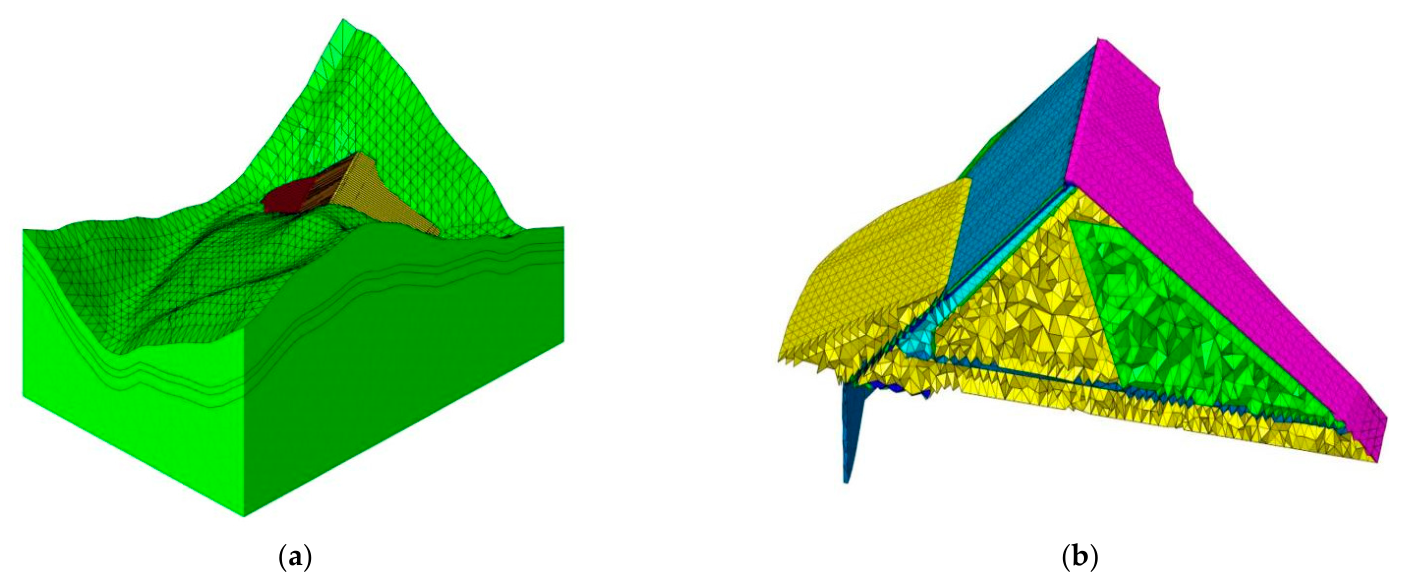
The concrete-face rockfill dam and its associated seepage-control system were represented according to the engineering zoning scheme. As shown in
Figure 1, the dam body was divided into the concrete face slab, plinth, cushion zone, special cushion zone, transition zone, upstream rockfill zone, horizontal drainage zone, downstream rockfill zone, downstream dry-laid stone pitching, grout curtain, and foundation strata with different permeability classes. Compared with a two-dimensional section model, the three-dimensional model can explicitly consider the spatial continuity of the dam body, abutments, foundation strata, and grout curtain, which is necessary for analyzing abutment bypass seepage and combined waterstop failure scenarios.
The finite element mesh was generated using tetrahedral elements. The total number of elements in the three-dimensional model is approximately 350,000. The total mesh volume of the dam body is 1.307 × 10
7 m
3, with an average element volume of 90.51 m
3. The total mesh volume of the surrounding mountain foundation is 1.042 × 10
9 m
3, with an average element volume of 3057.03 m
3. The total mesh volume of the grout curtain is 1.334 × 10
7 m
3, with an average element volume of 1918.87 m
3. The overall three-dimensional computational model and the refined dam-body mesh are shown in
Figure 3.
The mesh size was controlled according to the geometric complexity and expected variation in the seepage field in different zones. Smaller elements were mainly used in the dam body, anti-seepage structures, drainage zones, and joint-related regions, whereas larger elements were used in the outer mountain foundation, where the hydraulic head changes more gradually. This mesh strategy was adopted to balance the representation of local seepage responses near key structures and the computational efficiency of the full three-dimensional model.
2.3. Fracture Flow Model
In this study, the failed waterstop joints were represented using a fracture-flow model. The failure of the peripheral joint and vertical joints was idealized as seepage through continuous openings with prescribed apertures. Two assumptions were adopted for the fracture-flow representation. First, the failed joint was assumed to be relatively smooth, and the aperture was considered to be approximately uniform along the main flow direction. Second, because the hydraulic conductivity of the concrete face slab is much lower than that of the failed joint, water exchange between the concrete slab matrix and the fracture wall was neglected. Therefore, the concrete face slab was treated as an impermeable boundary outside the failed joint region.
When the water flow within the failed joint remains laminar, the discharge per unit width can be described by the cubic law for fracture flow:
where
q is the discharge per unit width of the fracture,
b is the fracture aperture,
J is the hydraulic gradient along the fracture,
g is the gravitational acceleration, and
ν is the kinematic viscosity of water. The corresponding average flow velocity within the fracture can be expressed as:
where
vb is the average flow velocity within the joint. By comparing Equation (2) with Darcy’s law, the equivalent hydraulic conductivity of the failed joint can be written as:
where
kf is the equivalent hydraulic conductivity of the fracture, and
μ is the dynamic viscosity of water.
In the numerical model, the failed peripheral and vertical waterstop regions were assigned fracture-flow properties according to the specified aperture of each scenario [
25]. This treatment allowed the localized seepage entrance caused by waterstop failure to be incorporated into the three-dimensional seepage model while maintaining consistency with the material zoning of the dam body and foundation.
It should be noted that the cubic-law formulation is based on the assumption of laminar flow in a smooth fracture. For extreme failure scenarios, especially S5, in which the calculated total seepage discharge reaches 3010.46 L/s, local deviations from the laminar-flow assumption may occur [
26]. Therefore, the results of such extreme scenarios are interpreted mainly as indicators of relative seepage risk and unfavorable hydraulic response. Further verification using Reynolds-number-based criteria or non-Darcy fracture-flow models is recommended in future studies.
2.4. Numerical Implementation in COMSOL Multiphysics
The three-dimensional seepage simulations were performed using COMSOL Multiphysics. The finite-element mesh was pre-processed using HyperMesh and then imported into COMSOL for seepage calculation. The model was established under steady-state seepage conditions, and the dam body, foundation strata, grout curtain, concrete face slab, plinth, cushion zone, transition zone, rockfill zones, drainage zone, and downstream protection zone were represented as separate material domains with different hydraulic parameters.
The seepage field in the porous media was described using Darcy’s law and the hydraulic-head formulation. For each material zone, the saturated hydraulic conductivity and porosity were assigned according to the engineering zoning scheme and calibrated hydrogeological parameters. The concrete face slab and grout curtain were assigned relatively low hydraulic conductivities to represent their anti-seepage function, whereas the drainage zone and rockfill zones were assigned higher hydraulic conductivities to reflect their drainage and water-conveying capacity. The failed waterstop regions were incorporated into the model through the fracture-flow formulation described in
Section 2.3.
The numerical implementation followed a consistent procedure for all calculation scenarios. First, the three-dimensional geometry and material zoning were imported into COMSOL. Second, the hydraulic parameters of the dam body, foundation, and anti-seepage structures were assigned to the corresponding domains. Third, upstream and downstream total-head boundaries were applied according to the specified reservoir and tailwater levels. Fourth, the failed peripheral or vertical waterstop regions were activated according to the corresponding scenario and assigned fracture-flow properties based on the specified aperture. Finally, the steady-state seepage field was solved, and the hydraulic head, phreatic surface, seepage discharge, bypass leakage, and maximum hydraulic gradients in key zones were extracted for comparison.
In this study, the phreatic surface was identified from the calculated hydraulic-head field and used to evaluate the internal seepage state of the dam body. Seepage discharge was calculated by integrating the seepage velocity over selected cross-sections, including the main dam section, foundation, and left- and right-bank abutment regions. The hydraulic gradient was derived from the spatial variation in hydraulic head and compared with the allowable gradients of the corresponding material zones. These outputs provided the basis for comparing the seepage response and safety implications of different waterstop failure scenarios. The hydraulic parameters assigned to the dam body, foundation strata, grout curtain, and seepage-control zones are listed in
Table 1. Based on these parameters, the hydraulic conductivity zoning at the typical section 0 + 255 is shown in
Figure 4.
2.5. Boundary Conditions and Waterstop Failure Scenarios
The waterstop failure analysis was conducted under the normal reservoir operating condition. The upstream reservoir level was set to the normal pool level of 3892.00 m, and the downstream water level was set to the minimum tailwater level of 3721.81 m under one-unit operation. In the three-dimensional seepage model, the upstream and downstream water levels were imposed as total-head boundaries on the corresponding reservoir-side and downstream boundary surfaces. The extents of the upstream and downstream total-head boundaries are shown in
Figure 5. The remaining external boundaries were defined according to the hydrogeological setting and the limits of the computational domain.
To provide a clear reference for comparison, a baseline scenario was defined in this study. The normal condition, denoted as S0, refers to the seepage condition without waterstop failure under the same upstream normal pool level of 3892.00 m and downstream water level of 3721.81 m. All waterstop failure scenarios were compared with this baseline condition to evaluate the influence of waterstop damage on the phreatic surface, hydraulic head, seepage discharge, abutment bypass leakage, and hydraulic gradients.
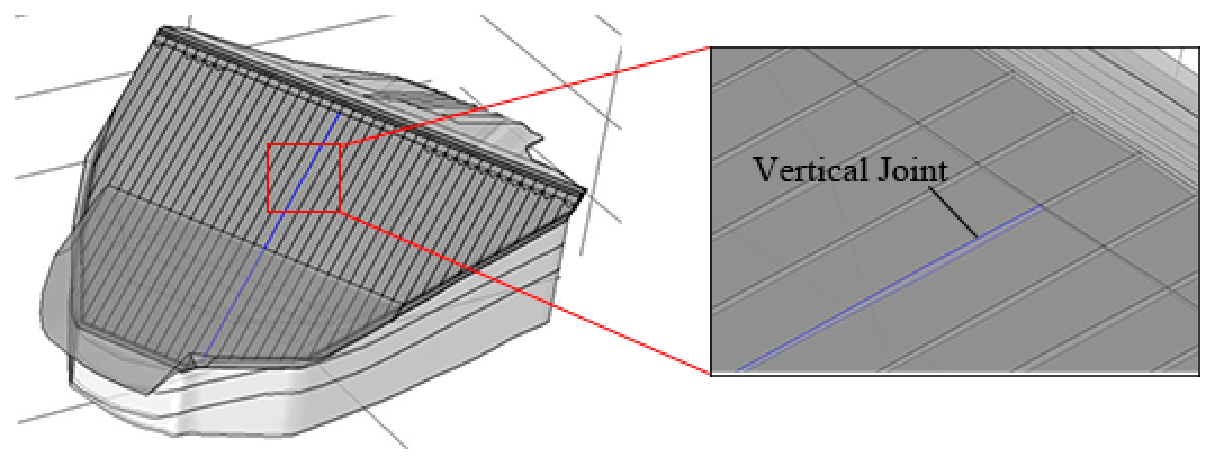
The waterstop system of the concrete-face rockfill dam consists mainly of the peripheral joint waterstop and vertical joint waterstops. The peripheral joint is located at the connection between the lower edge of the concrete face slab and the plinth, forming a U-shaped waterstop system along the dam foundation contact. The vertical joint waterstops are distributed between adjacent concrete face slabs, with a total of 41 vertical joints considered in the model. Based on these two types of waterstop structures, six representative failure scenarios were established to compare local, overall, and combined failure modes.
Scenario S1 represents peripheral joint waterstop failure with a fracture aperture of 30 mm. Scenario S2 represents the failure of a single vertical joint with a fracture aperture of 30 mm at section 0 + 255. Scenario S3 combines peripheral joint failure and single vertical joint failure. Scenario S4 represents overall vertical joint failure with an aperture of 0.1 mm for each of the 41 vertical joints. Scenario S5 represents overall vertical joint failure with an aperture of 0.5 mm for each of the 41 vertical joints. Scenario S6 combines peripheral joint failure with the overall vertical joint failure condition used in S4. The scenario design allows the seepage responses caused by peripheral, single vertical, overall vertical, and combined waterstop failures to be systematically compared.
The fracture apertures were selected to represent different levels of waterstop damage. A relatively large aperture of 30 mm was used for the peripheral joint failure and single vertical joint failure scenarios to represent severe local failure. For the overall vertical joint failure scenarios, smaller apertures of 0.1 mm and 0.5 mm were assigned to each of the 41 vertical joints to represent distributed failure along the face slab. This setting reflects the difference between localized concentrated seepage and distributed seepage along multiple vertical joints.
The seepage safety assessment in this study was based on four indicators: (1) the spatial position of the phreatic surface, which reflects the internal seepage state of the dam body; (2) total seepage discharge, which indicates the overall leakage risk; (3) maximum hydraulic gradients in key zones, which were compared with the corresponding allowable gradients; and (4) left- and right-bank abutment bypass seepage, which was used to identify potential preferential seepage paths around the dam foundation and abutments. These indicators were extracted consistently for S0 and S1–S6 to quantify the seepage response and safety implications of different waterstop failure modes.
Table 2 summarizes the baseline condition and the six waterstop failure scenarios.
The fracture-flow boundary extents corresponding to the six waterstop failure scenarios are illustrated in
Figure 6,
Figure 7,
Figure 8,
Figure 9 and
Figure 10.
Figure 6 shows the peripheral joint failure boundary for S1,
Figure 7 shows the single vertical joint failure boundary for S2,
Figure 8 shows the combined peripheral and single vertical joint failure boundary for S3,
Figure 9 shows the overall vertical joint failure boundary for S4 and S5, and
Figure 10 shows the combined peripheral and overall vertical joint failure boundary for S6.
2.6. Model Validation and Sensitivity Analysis
Before the model was applied to the waterstop failure scenarios, its reliability was evaluated using the natural groundwater level data obtained from the dam-site hydrogeological investigation [
27]. In the validation calculation, the natural groundwater field before reservoir impoundment was simulated. Groundwater level profiles at sections Heng 1–2, Heng 4–5, and the dam-axis section were used to define the boundary conditions, whereas the groundwater level profile at section Heng 3 was reserved for comparison with the calculated result. This validation strategy allowed the model to be examined against an independent groundwater profile rather than only against the boundary data used in the calculation.
The comparison between the simulated and measured groundwater levels at section Heng 3 showed that the calculated groundwater surface was generally consistent with the measured profile. In particular, the groundwater level near the upstream and downstream river channels was well reproduced, and the overall groundwater flow pattern from the abutment mountains toward the river channel was consistent with the hydrogeological interpretation of the dam site. This result indicates that the three-dimensional finite element model can reasonably represent the natural groundwater distribution, the hydrogeological zoning, and the permeability characteristics of the foundation rock mass. Therefore, the calibrated model was considered suitable for subsequent seepage analysis under reservoir operation and waterstop failure conditions.
The permeability parameters of the foundation strata were calibrated through inverse analysis based on the natural groundwater field. The initial permeability ranges were determined from borehole water-pressure tests and the hydrogeological classification of the rock mass. During the inverse analysis, rainfall infiltration was not considered, and the permeability coefficients of different strata were adjusted by comparing the simulated groundwater level with the measured profile. The medium-permeability zone was found to have a relatively strong influence on the calculated groundwater distribution. The calibrated hydraulic conductivities were 1.0 × 10⁻⁴ cm/s for the 10–100 Lu zone, 0.65 × 10⁻⁴ cm/s for the 3–10 Lu zone, 0.25 × 10⁻⁴ cm/s for the 1–3 Lu zone, and 0.1 × 10⁻⁴ cm/s for the <1 Lu zone. These calibrated values were then used in the subsequent dam seepage simulations.
A supplementary sensitivity analysis was also conducted to examine the influence of the grout curtain extension on seepage behavior. Based on the selected dam zoning scheme, two curtain extension schemes were compared: one with a left-bank curtain extension of 100 m and a right-bank extension of 200 m, and another with a left-bank extension of 100 m and a right-bank extension of 300 m. The analysis focused on the variation in foundation leakage, hydraulic head distribution, and hydraulic gradients under different curtain layouts. The results were used to support the selection of the seepage-control layout and to evaluate the influence of curtain extension on the overall seepage field.
It should be noted that the validation and sensitivity analysis mainly focus on the natural groundwater field, foundation permeability parameters, and grout curtain layout. They provide support for the reliability of the three-dimensional seepage model and the adopted hydrogeological parameters. However, the sensitivity of the model to fracture aperture under extreme waterstop failure scenarios requires further investigation. Therefore, the results of the six waterstop failure scenarios are interpreted as comparative evaluations under the selected aperture assumptions, and further refinement using additional monitoring data or non-Darcy fracture-flow models is recommended in future studies.
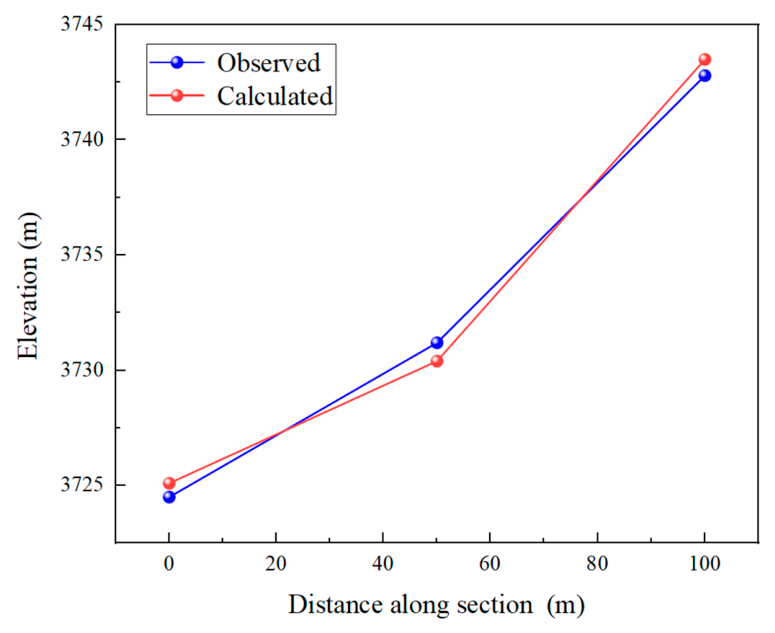
To further evaluate the reliability of the numerical model, the calculated groundwater levels were compared with the groundwater levels obtained from the dam-site hydrogeological investigation along a representative section. The comparison results are presented in
Figure 11 and
Table 3. The calculated phreatic surface generally agrees well with the observed groundwater profile, indicating that the adopted seepage parameters and boundary conditions are reasonable for the present engineering conditions. The relative differences between the calculated and observed groundwater levels remain within an acceptable range, demonstrating the applicability of the proposed three-dimensional seepage model for subsequent waterstop-failure analysis.
3. Results and Discussion
3.1. Three-Dimensional Seepage Field Morphology
The phreatic surface of the dam body drops rapidly behind the concrete face slab, but the depth of decline varies under different waterstop failure scenarios. Under S1, the phreatic surface drops into the horizontal drainage zone (3BII). Under S2, it drops to the surface of the horizontal drainage zone (3BII). Under S3, it drops to the lower part of the upstream rockfill zone (3BI) above the drainage zone. Under S4, it drops to the lower part of the upstream rockfill zone (3BI). Under S5, it remains in the middle-to-upper part of the upstream rockfill zone (3BI). Under S6, it drops to the lower part of the upstream rockfill zone (3BI).
The inhibitory effect of waterstop failure on the decline of the phreatic surface, from weakest to strongest, follows the order S1, S2, S3, S4, S6, and S5. This ranking indicates that overall vertical joint failure has a more pronounced influence on the internal seepage state of the dam body than peripheral joint failure or single vertical joint failure. In particular, when multiple vertical joints fail simultaneously, the seepage entrance changes from a local path to a more distributed inflow pattern along the face slab, resulting in a higher phreatic surface within the dam body.
Taking S1, S3, and S5 as representative scenarios, the three-dimensional seepage field, pressure head distribution, and phreatic surface are shown in
Figure 12. Different failure modes exert clear effects on the spatial evolution of the seepage field. Under S1, reservoir water enters the dam body mainly through the peripheral joint failure zone, and the pressure head decreases from the upstream face slab toward the downstream direction. The phreatic surface drops into the horizontal drainage zone (3BII), indicating that although peripheral joint failure increases seepage and induces local hydraulic-gradient concentration, the drainage system still maintains a certain discharge capacity.
Under S5, which represents overall vertical joint failure with an aperture of 0.5 mm for each of the 41 vertical joints, seepage develops from a localized inflow path into a more spatially distributed pattern along the face slab. The phreatic surface remains in the middle-to-upper part of the upstream rockfill zone (3BI), rather than dropping into the horizontal drainage zone. This suggests that the drainage effect is significantly weakened under this scenario, and the internal seepage state of the dam body becomes more unfavorable than that under the other failure scenarios. Therefore, S5 can be regarded as the most unfavorable scenario in terms of phreatic surface elevation and internal seepage response.
Under S3, which combines peripheral joint failure and single vertical joint failure, the two seepage mechanisms interact. The phreatic surface rises to the lower part of the upstream rockfill zone above the drainage zone, indicating that the combined failure produces a more adverse seepage response than S1 or S2 alone, but its influence remains weaker than that of the overall vertical joint failure represented by S5.
Under waterstop failure conditions, the permeability contrast between the dam materials and the surrounding mountain foundation also affects the spatial morphology of the seepage field. The hydraulic conductivities of the horizontal drainage zone and upstream rockfill zone are much higher than those of the surrounding mountain foundation. As a result, the phreatic surface near the contact zone between the dam body and the mountain foundation shows a relatively steep variation, and seepage tends to concentrate in the more permeable dam zones. This permeability contrast helps explain the complex seepage paths observed under S5. Meanwhile, the intersection between the phreatic surface and the grout curtain on both abutment sides indicates that the curtain continues to play an important role in seepage interception and flow diversion [
28]. Therefore, the seepage-control measures at the dam–foundation contact zone and the durability of the grout curtain remain important for maintaining the overall seepage safety of the dam.
3.2. Asymmetry of Bypass Seepage in Left and Right Abutments
The bypass leakage volumes at the left and right abutments under different waterstop failure scenarios are summarized in
Table 4. The calculated results show that the right-bank foundation leakage is generally greater than the left-bank foundation leakage under all failure scenarios. The ranking of abutment bypass seepage is S5 > S6 > S4 > S3 > S2 ≈ S1.
This ranking indicates that overall vertical joint failure has a more pronounced influence on abutment bypass seepage than peripheral joint failure or single vertical joint failure. Under overall vertical joint failure, seepage enters the dam body through multiple distributed vertical joints, which raises the internal seepage level and modifies the spatial distribution of hydraulic head near the abutment zones. As a result, the foundation and abutment seepage paths become more active, especially under S5, where the fracture aperture of each vertical joint is 0.5 mm. In contrast, S1 and S2 mainly represent localized failure modes, and their influence on abutment bypass seepage is relatively limited.
A general relationship can also be observed between the water level behind the dam and the abutment bypass leakage. When the water level behind the face slab becomes higher, a larger portion of seepage tends to concentrate within the main dam section, which may reduce the relative amount of bypass seepage around the abutments. This explains why the variation in abutment bypass seepage does not simply increase in proportion to the water level behind the dam, but depends on the failure mode and the resulting redistribution of seepage paths.
The results further show an obvious asymmetry between the left and right abutments. From S1 to S6, the right-bank foundation leakage is 90.4–137.7% higher than the left-bank foundation leakage. The maximum asymmetry occurs under S6, with the right-bank foundation leakage being 137.7% higher than that on the left. The highest absolute right-bank foundation leakage is obtained under S5, reaching 2.99 L/s. These results indicate that overall vertical joint failure, especially under a larger fracture aperture, has a stronger effect on the development of right-bank bypass seepage.
According to the geological setting described in
Section 2.1 and as inferred from the model geometry and permeability distribution, the larger right-bank bypass seepage may be related to the relatively gentler right-bank slope, the spatial distribution of permeable foundation zones, and the reservoir-side boundary configuration [
29]. However, this interpretation should be regarded as an inference based on the available geological information and numerical results rather than a direct field-confirmed conclusion. Therefore, the right-bank abutment should be regarded as a key monitoring area during reservoir operation, especially under scenarios involving overall vertical joint failure or combined waterstop failure.
3.3. Water Level Behind the Dam and Reservoir Water Loss
Waterstop failure weakens the continuity of the anti-seepage system formed by the concrete face slab, plinth, and grout curtain. Under the same upstream and downstream water levels as the baseline condition S0, reservoir water can enter the dam body through the failed waterstop regions, resulting in an increase in the hydraulic head behind the face slab and a corresponding increase in seepage discharge. The calculated hydraulic heads at key locations under different failure scenarios are listed in
Table 5, and the seepage leakage volumes of different zones are summarized in
Table 6.
As shown in
Table 5, the water level behind the face slab increases to different degrees under S1–S6. Among the six waterstop failure scenarios, S5, which represents overall vertical joint failure with an aperture of 0.5 mm for each of the 41 vertical joints, produces the highest water level behind the face slab, reaching 3888.23 m. This value is much higher than those under the other scenarios, indicating that distributed failure along multiple vertical joints has a pronounced influence on the internal water level of the dam body. In contrast, S1, representing peripheral joint failure with a 30 mm aperture, results in a relatively lower water level behind the face slab, reaching 3736.41 m.
The seepage discharge results in
Table 6 show a similar trend. S5 produces the largest total seepage discharge, reaching 3010.46 L/s, mainly because the overall vertical joint failure provides multiple seepage entrances along the face slab. S6 and S4 also show relatively large total leakage values, reaching 958.58 L/s and 842.40 L/s, respectively. In comparison, S1 has the smallest total leakage among the failure scenarios, with a total seepage discharge of 174.95 L/s. These results indicate that the total leakage response is more sensitive to overall vertical joint failure than to peripheral joint failure or single vertical joint failure.
Compared with the baseline condition S0, all waterstop failure scenarios increase the seepage discharge and raise the water level behind the face slab. However, the degree of influence varies significantly among different failure modes. Peripheral joint failure mainly creates a local seepage entrance near the plinth, while overall vertical joint failure allows seepage to enter through multiple vertical joints, leading to a larger increase in the internal hydraulic head and total leakage. Therefore, S5 can be regarded as the most unfavorable scenario in terms of reservoir water loss and water-level rise behind the face slab.
It should be noted that the high leakage discharge under S5 reflects an extreme failure assumption in the numerical model. The result indicates a substantial reduction in the effectiveness of the anti-seepage system, rather than a complete loss of its function. Therefore, the S5 result should be interpreted as an upper-risk scenario under the selected fracture aperture assumption. In practical dam operation, the actual seepage response would depend on the real failure extent, fracture aperture, hydraulic conditions, and the performance of the drainage and grout curtain systems.
3.4. Hydraulic Gradient Response of the Dam Body
The maximum hydraulic gradients in different dam zones under the waterstop failure scenarios are summarized in
Table 7. The results show that waterstop failure changes the hydraulic-gradient distribution in several key zones, especially near the plinth and the special cushion zone (2B). These zones are directly connected with the peripheral joint and, therefore, are sensitive to local seepage concentration when the peripheral waterstop fails.
Compared with the baseline condition S0, scenarios involving peripheral joint failure, including S1, S3, and S6, produce relatively high hydraulic gradients near the plinth. Under S1, the maximum hydraulic gradient at the plinth reaches 72.92, which remains lower than the allowable value of 225. However, the special cushion zone (2B) becomes more critical. The maximum hydraulic gradient in 2B reaches 2.72 under S1, 1.64 under S3, and 2.22 under S6, all exceeding the allowable value of 0.72. This indicates that peripheral joint failure mainly controls the risk of local hydraulic-gradient concentration in the special cushion zone.
The single vertical joint failure scenario S2 also leads to an exceedance of the allowable gradient in the special cushion zone, with a maximum value of 1.18. However, the increase is less pronounced than that under S1. This suggests that although vertical joint failure can affect the local hydraulic-gradient field, the direct connection between the peripheral joint failure zone and the special cushion zone makes S1 more unfavorable for local gradient concentration near the plinth.
For the overall vertical joint failure scenarios, S4 and S5, the hydraulic gradient in the special cushion zone remains below the allowable value. However, S5 shows relatively high gradients in the upstream rockfill zone, downstream rockfill zone, drainage zone, and downstream slope protection. This is consistent with the higher phreatic surface and larger total seepage discharge discussed in
Section 3.1 and
Section 3.3. Therefore, overall vertical joint failure mainly controls the total leakage and internal seepage-state response, whereas peripheral joint failure mainly controls the local hydraulic-gradient concentration near the plinth and special cushion zone.
The enlarged seepage flow net at the typical section 0 + 255 under S1 is shown in
Figure 13. The local concentration of hydraulic gradient near the plinth and special cushion zone can be attributed to the seepage entrance formed by the failed peripheral joint between the lower edge of the face slab and the plinth. Reservoir water can enter the special cushion zone directly through this failure path, leading to a localized increase in hydraulic gradient.
From an engineering perspective, these results indicate that different failure modes correspond to different seepage safety concerns. Because peripheral joint failure causes the hydraulic gradient in the special cushion zone to exceed the allowable value, monitoring and inspection near the plinth and special cushion zone should be emphasized during operation. In contrast, because overall vertical joint failure mainly increases total leakage and raises the phreatic surface, the integrity of vertical waterstops should be carefully checked during construction quality control and operation-stage inspection.