Article

Comparing Intermittent Aeration Strategies in a Pilot-Scale Moving-Bed Biofilm Reactor Treating Real Municipal Wastewater Under Variable Carbon and Nitrogen Loadings


1
Department of Civil, Architectural and Environmental Engineering, University of Naples Federico II, Via Claudio 21, 80125 Naples, Italy
2
Department of Engineering, University of Basilicata, Via dell’Ateneo Lucano 10, 85100 Potenza, Italy
3
Laboratory Technologies for the Efficient Use and Management of Water and Wastewater, Italian National Agency for New Technologies, Energy and Sustainable Economic Development (ENEA), Via M.M. Sole 4, 40129 Bologna, Italy
4
Laboratory Technologies for the Efficient Use and Management of Water and Wastewater, Italian National Agency for New Technologies, Energy and Sustainable Economic Development (ENEA), P.le Enrico Fermi, 1, 80055 Portici, Italy
5
WWTP Monitoring and Optimization Unit, GORI S.P.A., Via Trentola 211, 80056 Ercolano, Italy
*
Author to whom correspondence should be addressed.
Water 2026, 18(12), 1467; https://doi.org/10.3390/w18121467 (registering DOI)
Submission received: 9 May 2026 / Revised: 2 June 2026 / Accepted: 9 June 2026 / Published: 14 June 2026
(This article belongs to the Special Issue Advances in Water Cycle Management and Circular Economy)

Abstract

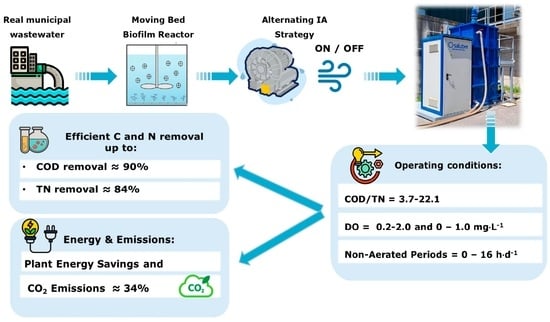
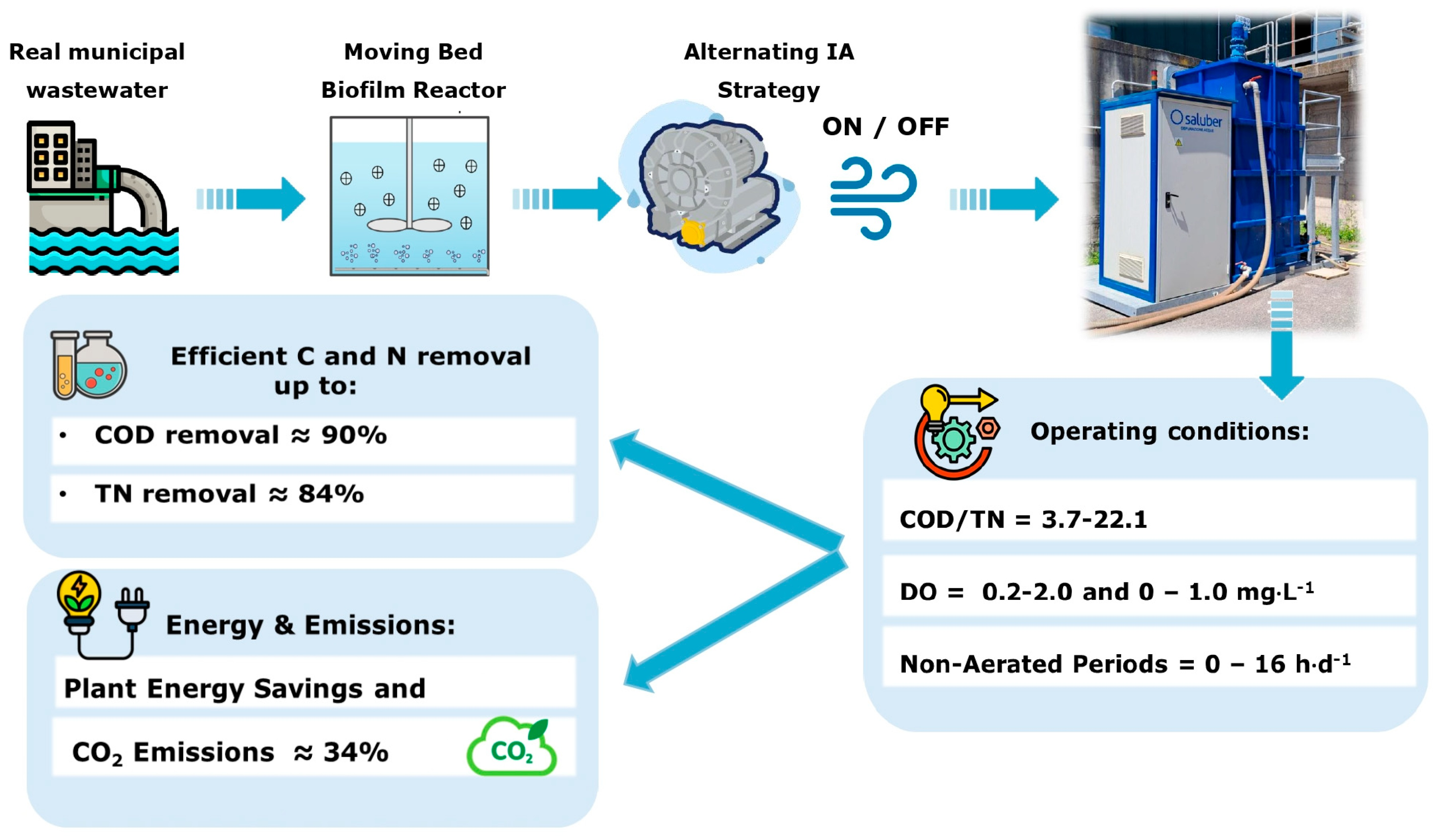
A pilot-scale moving-bed biofilm reactor (MBBR), operated under alternating intermittent aeration (IA) and non-aeration phases, was used for single-stage carbon (C) and nitrogen (N) removal from high-fluctuating municipal wastewater via simultaneous nitrification–denitrification. The reactor was operated under highly variable chemical oxygen demand to total nitrogen (COD/TN) ratios, low dissolved oxygen (DO) conditions, and progressively extended non-aerated periods to evaluate process robustness under real operational conditions. An active denitrifying biofilm developed on the carriers after 23 days of the anoxic start-up, as confirmed by batch activity tests. Under the most carbon-limited condition tested (COD/TN = 5.5), the application of 16 h·d−1 of non-aerated phases at DO levels of 0–1.0 mg·L−1 enabled simultaneous COD, N–NH4+ and TN removal efficiencies of 70, 95 and 84%, respectively. These results confirm that transient IA is an effective strategy for simultaneous C and N removal at very low COD/TN ratios and real fluctuating influent concentrations. Energy assessment showed that extended non-aeration phases reduced blower energy demand by 67% and total plant energy consumption by 34%, improving the environmental sustainability of the single-stage process. The main novelty of this study lies in the pilot-scale validation of an IA-MBBR for SND using real municipal wastewater under naturally fluctuating C and N loadings, thereby bridging previous laboratory-scale evidence with realistic operating conditions.

Graphical Abstract

1. Introduction

The increased production of nutrient-rich wastewater due to urbanization and industrial growth has contributed to the degradation of water resources through oxygen depletion and the eutrophication of surface waters [1]. Global projections indicate that nutrient discharge to surface water will increase by 10–70% by 2050 (from 10.4 Tg nitrogen (N) in 2010 to 13.5–17.9 Tg N and from 1.5 Tg phosphorus (P) to 1.6–2.4 Tg P), primarily from municipal wastewater discharges [2]. In response to these challenges, regulatory frameworks worldwide are becoming more stringent, particularly in the European Union, where the revised Urban Wastewater Treatment Directive (2024/3019) has extended its scope to smaller agglomerations and imposed stricter standards for nutrient removal while also encouraging more energy-efficient treatment solutions. Conventional biological N removal in wastewater treatment plants (WWTPs) consists of separate aerobic nitrification and anoxic denitrification processes. Nitrification involves the sequential oxidation of ammonium (NH4+) (nitritation) to nitrite (NO2) and then to nitrate (NO3) (nitratation) by ammonia- and nitrite-oxidizing bacteria [3]. This process is energy-intensive due to high aeration demand [4]. Denitrification is an anoxic process in which denitrifying bacteria (DNB) reduce NO3 to NO2 (denitratation) and subsequently to nitrogen gas (N2) via intermediates such as nitric oxide (NO) and nitrous oxide (N2O) [5,6,7].
To overcome the operational limitations of conventional N removal based on separated aerobic nitrification and anoxic denitrification stages, including high aeration demand, reactor compartmentalization and the need for sufficient organic carbon for denitrification, alternative biological pathways have been increasingly investigated. Among them, the simultaneous nitrification and denitrification (SND) process has been developed as an efficient and cost-effective process for combined C and N removal [8,9]. SND involves the execution of aerobic nitrification and anoxic denitrification within a single treatment unit under different aerobic/anoxic modes and varying oxygen conditions [10]. This alternative approach offers several advantages over conventional nitrogen removal systems, including lower capital and operating costs, reduced organic carbon requirements [11], lower sludge production, and decreased aeration energy demand [12,13]. Since aeration is the most energy-intensive process in biological wastewater treatment, optimizing aeration strategies can significantly contribute to reducing the carbon footprint of WWTPs.
The efficiency of SND is governed by the combined effect of influent carbon-to-nitrogen (C/N) ratio, dissolved oxygen (DO) concentration, hydraulic retention time (HRT), and aeration strategy. These factors are strongly interconnected: the C/N ratio controls electron donor availability for denitrification, DO concentration regulates the balance between nitrification and denitrification, HRT determines biomass–substrate contact time, and aeration strategy governs the alternation between aerobic and anoxic microenvironments within the biofilm [14,15,16,17,18]. The C/N ratio in wastewater treatment is a critical factor affecting the growth and activity of microorganisms, and thus N removal through the SND process. For coupled SND and denitrifying P removal systems, optimal performance is typically achieved at C/N ratios between 5 and 7, beyond which limited additional benefits are observed [19]. Iannacone et al. [16] assessed the SND and P removal process in a continuous-flow microaerobic moving-bed biofilm reactor (MBBR) operated at different feed C/N ratios (2.7, 4.2, and 5.6). A stable total N removal was attained at a feed C/N ratio of 4.2, while a feed C/N ratio of 5.6 resulted in excessive growth of the heterotrophic aerobic bacteria (HAB), suppressing nitrification [16]. On the contrary, insufficient organic carbon can decrease the denitrification efficiency, as reported by Chang et al. [20], promoting the development of other biological pathways [21,22]. Concerning oxygen concentrations, Jin et al. [23] observed that the highest SND efficiency (88.5%) in the integrated fixed-film activated sludge (IFAS) was achieved under microaerobic conditions, at a fixed DO concentration of 0.5 mg·L−1. Zhang et al. [24] investigated N removal in a full-scale multistage-activated sludge-membrane bioreactor system at different DO concentrations (0.6–4.0 mg·L−1), reporting that reducing the DO levels to 0.6–0.7 mg·L−1 improved the N removal efficiency from 82.4 to 94.3% [24], thus promoting SND. In addition, the HRT plays an important role in influencing microbial distribution and wastewater treatment performance. Chang et al. [20] evaluated N removal via SND in a biological folded non-aerated filter at different HRTs (4, 8, and 12 h). Increasing the HRT up to 10.83 h achieved higher NH4+, chemical oxygen demand (COD), and total nitrogen (TN) removal efficiencies of 88.6 ± 0.8, 76.1 ± 0.6%, and 50.5 ± 1.0%, respectively. On the contrary, a lower HRT of 4 h does not promote the contact between the degradation of pollutants and the biofilm, leading to a deterioration of the nitrification performance, in agreement with other studies [25,26]. With respect to aeration strategies, intermittent aeration (IA) establishes a sequence of aerobic and anoxic phases within the bioreactor, enabling the SND process, and has proved to be a cost- and energy-efficient operational mode for oxygen supply [27,28].
In recent years, SND has been successfully integrated into various treatment systems, including activated sludge [29], aerobic granular sludge (AGS) [15,30], MBBRs [31], and other bio-configurations such as the integrated fixed-film activated sludge (IFAS) [32]. Among these systems, MBBRs provide an attachment surface for the growth of a microbial biofilm, enabling higher concentrations of active biomass and the coexistence of diverse microbial communities, thereby favouring the SND process [33,34]. Although recent studies have demonstrated SND in activated sludge, IFAS, AGS and MBBR-based systems, most IA-MBBR investigations have been conducted at a laboratory scale using synthetic wastewater [16,17,31,35]. Therefore, pilot-scale validation of IA-MBBRs treating real municipal wastewater under naturally fluctuating influent composition remains limited [12]. Information on SND operation at larger scales would be essential for understanding the operational challenges and the effect of fluctuations in real wastewater flow and composition on the process performance in intermittently aerated biofilm systems.
This study aims to evaluate the feasibility of SND in a pilot-scale IA-MBBR treating municipal wastewater with highly variable composition, assessing the combined influence of COD/TN ratio, DO control and aeration strategy on simultaneous C and N removal. In addition, a detailed energy assessment was conducted to quantify the total specific energy demand and the indirect CO2 emissions under different IA regimes. The novelty of this work is not limited to the increase in reactor scale, but also lies in the validation of a continuously fed IA-MBBR under realistic WWTP conditions, including naturally fluctuating C and N loadings, variable wastewater composition, and practical operational constraints associated with pilot-scale operation. This provides a relevant step beyond previous laboratory-scale studies mostly conducted under controlled influent conditions.

2. Materials and Methods

2.1. Municipal Wastewater Characteristics

The real municipal wastewater used in this study is the influent wastewater of the WWTP located in Angri (Campania Region, Italy). The Angri WWTP is based on a conventional activated sludge system. Table 1 shows the composition of the WWTP influent for 2023 in terms of pH, total suspended solids (TSS), N-NH4+, total COD, and phosphorus (P-PO43−) concentrations. The wide variability observed in COD and TSS concentrations reflects the real operational conditions of the Angri WWTP, which receives both municipal wastewater and seasonal agro-industrial discharges from tomato processing activities occurring during the summer months. The input of industrial wastewater significantly increases the amount of organic matter and solids in the influent wastewater, generally from mid-July to mid-September [36]. Such fluctuations are typical of WWTPs located in agro-industrial districts and provide a realistic framework for evaluating the robustness of the pilot-scale treatment system. Before being fed to the pilot-scale MBBR, the influent underwent a preliminary treatment, which included bar screening and grit removal.

2.2. Description of the Pilot-Scale Bioreactor

The pilot-scale experimental unit consisted of an MBBR made of stainless steel (AISI 304) with a working volume of 3.3 m3 (Figure 1). The bioreactor was equipped with a stainless steel (AISI 304) grid with 10 mm spacing designed to ensure effective carrier containment, a peristaltic pump (ROTHO MOD. PSF 2, Ragazzini, Faenza, Italy) to feed the wastewater from the top of the reactor, a low-speed mixer (RLV 055-4-56/200, ECO Mix, Trezzano sul Naviglio, Italy) to ensure the carrier movement and mixed liquor homogenization, and an inverter-controlled side channel blower (CL 4/21, MAPRO, Nova Milanese, Italy) to provide the oxygen necessary for the process. Air was supplied through a bottom diffuser system to promote homogeneous oxygen distribution and carrier movement within the reactor. The airflow rate was controlled through the blower and air flowmeter, while DO was continuously monitored inside the bioreactor. The carrier type used was the BIOMASTER 012 KLS and was made of high-density polyethylene with an average diameter of approximately 12 mm, a density close to 0.95 g/cm3, and a net specific surface of 500 m2/m3. The carrier material was added to the bioreactor at a 50% filling ratio (percentage of empty reactor volume occupied by carriers). The system was provided with probes for DO (Oxymax COS61D 1.430,43, Endress + Hauser, Reinach, Switzerland), pH (ISEmax sensor, Endress + Hauser, Reinach, Switzerland) measurements, and a programmable logic controller (PLC) (Saluber, Cisterna di Latina, Italy) with the possibility of controlling DO concentrations through minimum and maximum set points as well as the duration of aeration and non-aeration phases, by setting the blower on/off cycles. During pilot operation, influent and effluent samples were collected periodically as grab samples.

2.3. Start-Up of the Pilot-Scale MBBR

For the start-up of the MBBR, a 2-stage cultivation strategy as proposed by Iannacone et al. [17] was adopted. Such a strategy implied a first anoxic phase (23 days) to develop a denitrifying biofilm on the mobile carriers, followed by an aerobic operation (32 days) under IA conditions and limited oxygen supply (DO ≤ 2.0 mg·L−1) to enrich nitrifiers. The duration of the anoxic phase was selected based on the time required to obtain repeated NO3 depletion after feed refreshment, indicating the establishment of denitrifying activity on the carriers. The subsequent 32-day aerobic/IA phase was maintained to favor nitrifier enrichment and to progressively adapt the biofilm to low-DO operation using real wastewater. The activated sludge (volatile suspended solids, VSS = 7.4 g·L−1) collected from the oxidation unit of the Angri WWTP was used as inoculum and filled half of the MBBR volume. The remaining volume was filled with the effluent from the grit removal stage.
During the 23-day anoxic phase, the MBBR was operated in batch mode. Due to the low concentration of influent organic matter to sustain denitrification, a sucrose solution was added to the real wastewater as supplementary feeding to the bioreactor to increase the COD concentration in the MBBR between 119 and 975 mg·L−1. Sucrose was selected as the carbon source due to its high bioavailability and ease of handling and its use was limited to the initial biofilm enrichment phase. KNO3 (Merck Chemicals, Darmstadt, Germany) was also added to the reactor at N-NO3 concentrations between 23.4 and 160 mg·L−1. NO3 dosage was stoichiometrically calculated based on the influent COD concentration and the denitrification reaction with acetate as the electron donor (Equations (S1) and (S2)) [37]. During the anoxic phase, as soon as the COD and/or N-NO3 were completely consumed, 200–500 L of reactor volume was replaced with fresh influent (i.e., refresh of the reactor) supplemented with the same feed sucrose and KNO3 concentrations. The addition of external carbon and NO3 was limited to the initial enrichment period and was intended only to accelerate the development of a denitrifying biofilm, due to the very low COD and NO3 concentrations in the influent during the start-up phase.
The second phase of the cultivation strategy (Period I, Table 2) lasted 32 days, during which the MBBR was operated in continuous mode under IA conditions using real wastewater without reagent addition. The influent concentrations of COD, N-NH4+, N-NO3, and N-NO2 were 40 ± 17, 7.3 ± 1.1, 3.2 ± 0.8 and 0.3 ± 0.1 mg·L−1, respectively, resulting in an influent COD/TN ratio of 3.7 ± 1.9. The MBBR was operated at an HRT of 26 h and a DO concentration ranging between 0.2 and 2.0 mg·L−1. These conditions resembled those investigated at laboratory scale by Iannacone et al. [17] in IA MBBRs performing SND in order to evaluate the effect of real wastewater and scale-up on the MBBR performance.

2.4. Denitrifying Batch Activity Tests

Batch activity tests were conducted at the end of the anoxic start-up period to assess the denitrification activity of the pilot-scale MBBR biofilm. Each test was performed in duplicate over a 48-h period using 1 L DURAN glass bottles under room temperature. To simulate the real experimental conditions, each flask was inoculated with 50% biofilm carriers collected from the pilot-scale MBBR and filled with a synthetic medium containing 347 mg COD·L−1 (as CH3COONa·3H2O) (Merck Chemicals, Darmstadt, Germany), 36.2 mg N-NO3·L−1 (as KNO3) (Merck Chemicals, Darmstadt, Germany) and nutrients [17]. The flasks were flushed with argon for 5 min before sealing to ensure anoxic conditions and then placed on a horizontal shaker set at 200 rpm. Samples were taken at five time points (0, 60, 480, 1440, and 2880 min) to analyse the concentrations of COD, N-NO3 and N-NO2.

2.5. MBBR Operation Under Varying Experimental Conditions

The continuous mode operation of the pilot-scale MBBR under IA conditions lasted 104 days, which were divided into six experimental periods, as shown in Table 2. The first day of these experimental periods was considered as day 0, and it coincides with the beginning of the second stage of the cultivation strategy (see Section 2.3).
The HRT was maintained at 26 h throughout the entire continuous operation. During periods I–VI, the influent COD/TN ratio varied in the range of 3.7–22.1 due to the variable composition of the real wastewater. Because real municipal wastewater was used as influent, the COD/TN ratio could not be independently controlled. Therefore, the aeration strategy was progressively adjusted to investigate the response of the system to naturally occurring variations in influent composition. During the first two periods, the blower was controlled through a DO-based feedback logic, with activation and shutdown determined by predefined minimum and maximum DO setpoints. During Period II, the DO control range was reduced from 0.2–2.0 mg/L (Period I) to 0–1.0 mg/L, leading to more frequent blower activation events. As a consequence, the aeration rate increased from 0.017 to 0.034 m3·Lreactor−1·d−1. Starting from period III, the MBBR was operated alternating IA and non-aeration phases, thereby further reducing the operating time of the blower. The blower operating time was shortened gradually from 24 h (period II) to 20 h (period III) and 8 h (period VI) by increasing the non-aerated period, which decreased the aeration rate from 0.034 (period II) to 0.028 (period III) and 0.011 m3·Lreactor−1·d−1 (period VI), with the objective of enhancing the simultaneous removal of C and N. Therefore, from Period III onward, the control strategy combined DO-based feedback during aerated intervals with timer-imposed non-aerated phases. This allowed the system to maintain microaerobic conditions during aeration while enforcing progressively longer anoxic periods. The temperature was monitored throughout the experimental periods and ranged from 20.3 to 28.3 °C.

2.6. Calculations and Energy Assessment

TN during continuous operation was determined by adding the concentrations of N-NH4+, N-NO2, and N-NO3, taking into account the negligible contribution of organic N.
The removal efficiencies (REs) of N-NH4+, N-NO3, COD, and TN, as well as the percentage of the influent TN used for biomass growth (TNINF,G) and denitrified (TNDEN) were calculated using the following Equations (1)–(6):
N - NH 4 + RE = N - NH 4 + INF N - NH 4 + EFF N - NH 4 + INF   ×   100
N - NO 3 RE = N - NO 3 INF N - NO 3 EFF N - NO 3 INF   ×   100
COD RE = COD IN COD EFF COD INF   ×   100
TN RE = N - NH 4 + INF + N - NO 3 INF + N - NO 2 INF N - NH 4 + EFF N - NO 3 EFF N - NO 2 EFF   N - NH 4 + INF + N - NO 3 INF + N - NO 2 INF   ×   100
T N I N F , G = 0.05   × COD INF COD EFF N - NH 4 + INF + N - NO 3 INF + N - NO 2 INF     ×   100
T N d e n = T N R E T N i n f , G
where:
  • N - NH 4 + INF and N - NH 4 + EFF are the influent and effluent N-NH4+ concentrations, respectively;
  • [CODINF] and [CODEFF] are the influent and effluent COD concentrations, respectively;
  • N - NO 3 INF and N - NO 3 EFF are the influent and effluent N-NO3 concentrations, respectively;
  • N - NO 2 INF and N - NO 2 EFF are the influent and effluent N-NO2 concentrations, respectively.
The contribution of organic nitrogen was assumed to be negligible due to the preliminary treatment of the influent wastewater and the typically low particulate organic nitrogen fraction reported for the Angri WWTP influent.
The aeration rate (m3·Lreactor−1·d−1) was evaluated by multiplying the operating hours per day (Tblower,ON) and the maximum flow rate (QAIR) of the blower and dividing by the effective reactor volume (VREACTOR) (from which the volume occupied by the carriers was subtracted), as shown in the following Equation (7):
A e r a t i o n   r a t e =   T b l o w e r ,   O N   ·   Q A I R V R E A C T O R
The energy assessment focused on the electrical consumption of the main components installed in the pilot-scale MBBR unit, namely the aeration blower, the mechanical mixer and the influent feed pump. Energy calculations did not account for oxygen transfer efficiency, blower efficiency under partial-load operation, or inverter-related efficiency variations. The blower was the only device operated with variable ON/OFF patterns during the different experimental periods, whereas both the mixer and the feed pump were operated continuously (24 h·d−1) throughout the study.
The energy assessment was based on nominal equipment power and operating time rather than direct electricity measurements. The nominal electrical powers of the three devices were provided by the manufacturers and are as follows: 0.75 kW for the side-channel blower, 0.55 kW for the submersible mixer, and 0.18 kW for the peristaltic feed pump. Daily energy consumption for each device (Ei, kWh·d−1) was calculated as:
E i = P i × t i
where Pi is the nominal power of device i (kW) and ti is the operating time per day (h·d−1). For the blower, Tblower corresponds to the aeration ON-time in each period (24, 20, 16, 12 and 8 h·d−1 for periods II–VI, respectively), while for the mixer and the feed pump Tblower = tpump = 24 h·d−1.
The total daily electrical energy consumption of the pilot plant (Etot,day, kWh·d−1) was then obtained as the sum of the three contributions:
E t o t , d a y = E b l o w e r + E m i x e r + E p u m p
The specific energy consumption per unit volume treated ( E t o t , m 3 , kWh·m−3) was calculated by normalising Etot,day to the measured average flow rate Q (m3·d−1), determined from the reactor working volume (3.3 m3) and HRT (26 h):
E t o t , m 3 = E t o t , d a y Q
In addition, indirect CO2 emissions associated with electricity use were estimated using a single national average grid emission factor ( E F C O 2 ) for Italy of 0.25 kg CO2·kWh−1, in line with recent estimates of the Italian electricity carbon intensity reported by international and national inventories such as IEA [38] and ISPRA [39], respectively. The specific indirect CO2 emissions per m3 treated ( C O 2 , e q , kg CO2·m−3) were thus calculated as:
C O 2 , e q = E t o t , m 3 × E F C O 2

2.7. Analytical Methods

Liquid samples were collected daily from both the influent and effluent of the bioreactor and filtered through 0.45 µm syringe filters with polypropylene membranes (VWR, Radnor, PA, USA) before analysis. The pH was measured from unfiltered samples with an MM374 pH-meter (Hach®, Düsseldorf, Germany). The concentration of COD (LCK 314,514), N-NH4+ (LCK 303,304) N-NO3 (LCK 339), and N-NO2 (LCK 341) was measured by cuvette tests (Hach®, Germany). The concentration of total solids (TS) and volatile solids (VS) of the attached-growth biomass was analysed according to the Standard Methods. To perform TS and VS analyses, 10 carriers were added to a bottle of 100 mL ultrapure water, and the biofilm was detached by mechanical agitation to obtain a biomass suspension [40].

2.8. Statistical Data Analysis

A one-way analysis of variance (ANOVA) was performed using the Data Analysis Tool of Excel 2016 (Microsoft Corporation, Redmond, WA, USA) to determine the statistical differences in the performance parameters for COD, N-NH4+, N-NO3, and N-NO2 removal. Each dataset consisted of >10 measurements collected within each period. The significant difference was set at 95% (p < 0.05). p-values are reported in the text where relevant.

3. Results and Discussion

3.1. Enrichment of the Denitrifying Biofilm

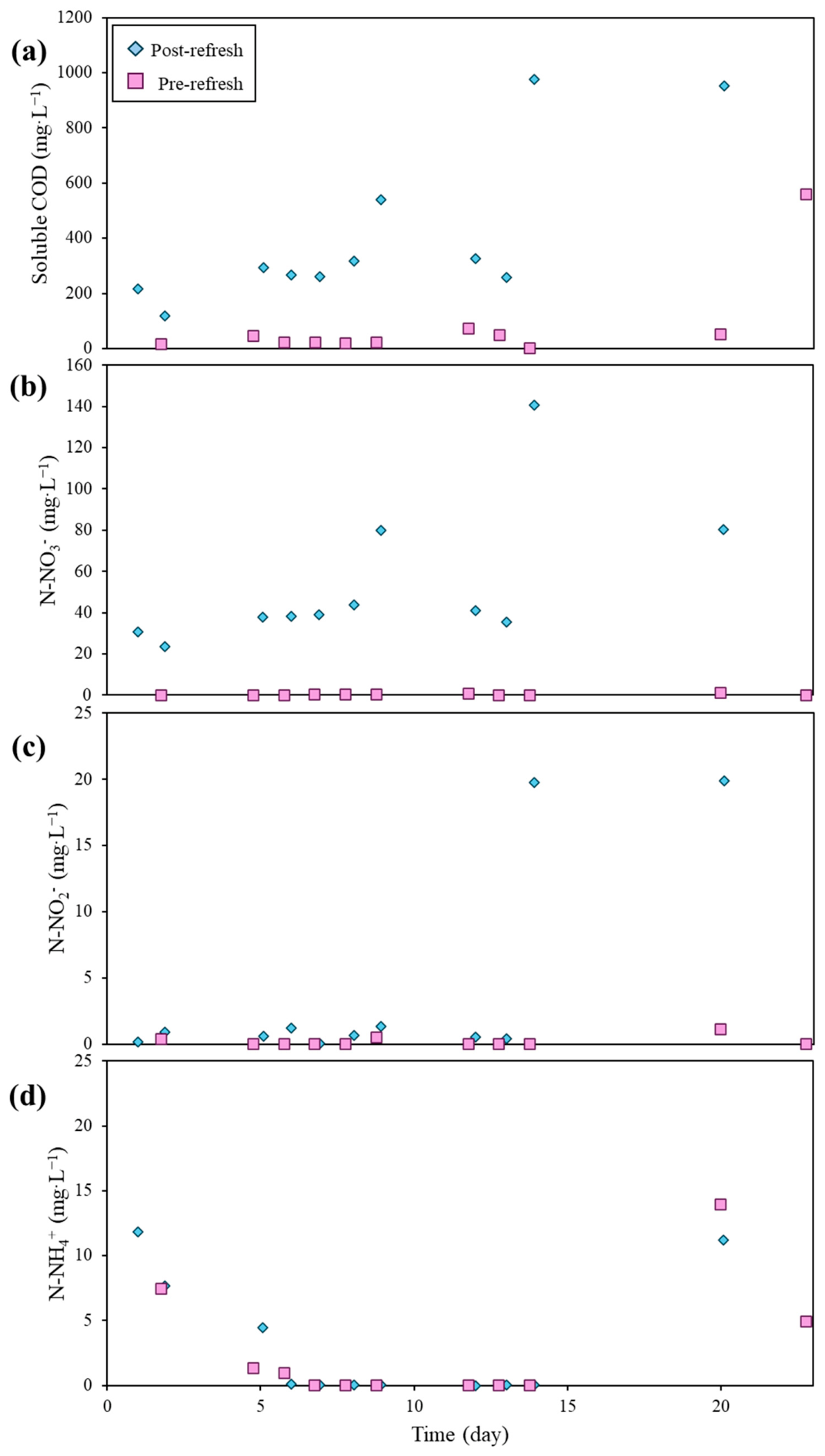
Figure 2 shows the concentrations of COD and N compounds in the MBBR during batch cultivation of the denitrifying biofilm under anoxic conditions, both pre- and post-refresh operations.
The average COD/N-NO3 ratio in this phase was 7.1, higher than the stoichiometric ratio calculated based on the denitrification reaction with sucrose as energy source (3.87) [37]. In the first 15 days, COD and NO3 were nearly all consumed within 24 h, resulting in no NO2 accumulation (Figure 2c). The N-NH4+ present in the influent wastewater was also rapidly consumed for biomass growth and remained below the detection limits. On day 14, the feed COD and N-NO3 were increased respectively to 975 and 160 mg·L−1 to stimulate the biofilm formation, resulting in a feed COD/N-NO3 ratio of 6.1. Despite the consistent increase in the feed concentrations, the COD and NO3 concentrations were consumed 5 days after the refresh (day 20). However, the lower COD/N-NO3 ratio compared to the average (7.1) may have caused a shortage of organic substrate, potentially favoring biomass decay and endogenous respiration, which can release NH4+ from organic nitrogen-containing cellular material [41], as indicated by the higher N-NH4+ concentration observed on day 20 (Figure 2d). NO2 accumulation remained limited throughout the experimental campaign, suggesting a tight coupling between nitritation and denitritation in the oxygen-limited microzones, although the available bulk liquid data do not allow confirmation of a stable shortcut SND pathway.
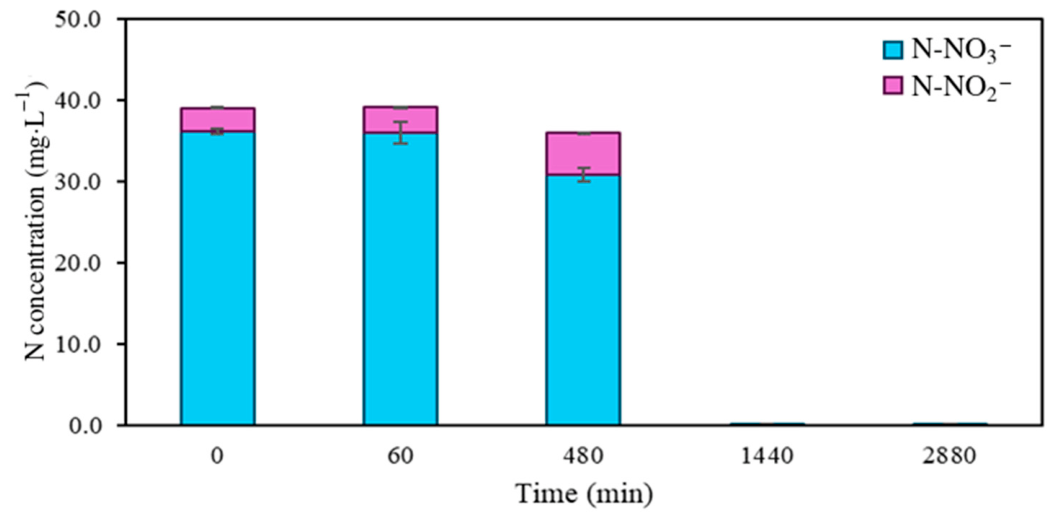
To verify the presence and the activity of denitrifying biomass in the MBBR biofilm, batch denitrification activity tests were carried out at the end of the 23-day cultivation period. The trends of N-NO3 and N-NO2 concentrations are shown in Figure 3. The tests revealed that the combined N-NO3 and N-NO2 concentration of 40 mg N·L−1 was completely depleted within 24 h, confirming the presence of an active denitrifying biomass in the pilot-scale MBBR biofilm and indicating the effectiveness of the anoxic start-up strategy adopted in promoting the biofilm formation. The biofilm establishment was also assessed by visual observation of the internal surface of the carriers (Figure S1). The rapid NO3 depletion observed during the anoxic enrichment suggests the selection of an active denitrifying heterotrophic community on the carrier surface. During the subsequent IA phase, the biofilm structure likely promoted the coexistence of aerobic outer layers and oxygen-limited inner zones, providing favorable microenvironments for nitrification and denitrification within the same reactor.

3.2. Effect of C/N Ratios, Oxygen Concentrations and Aeration Rate on SND Performance During Continuous MBBR Operation

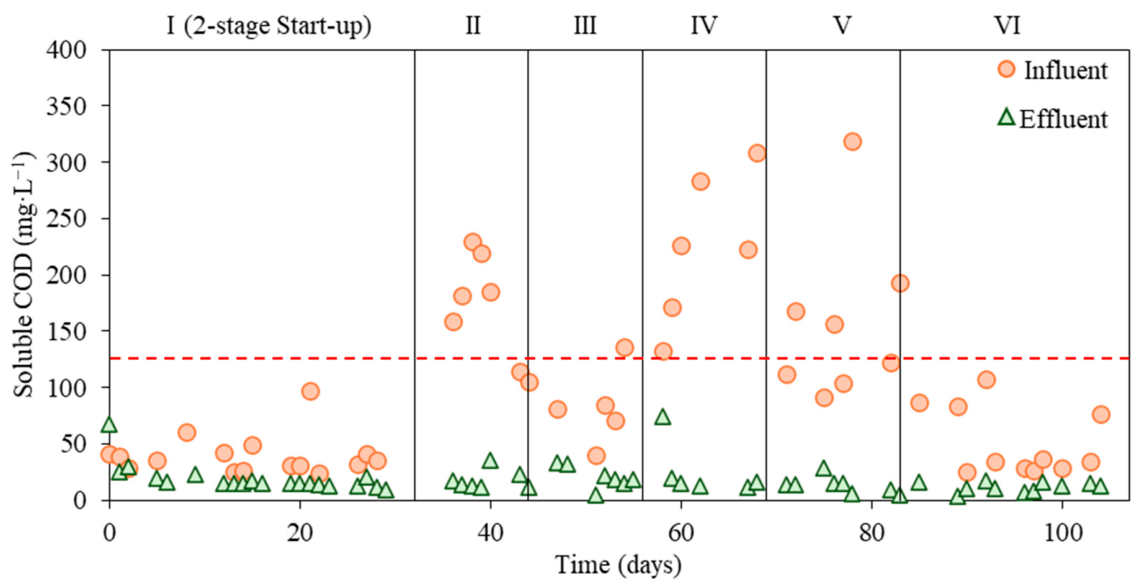
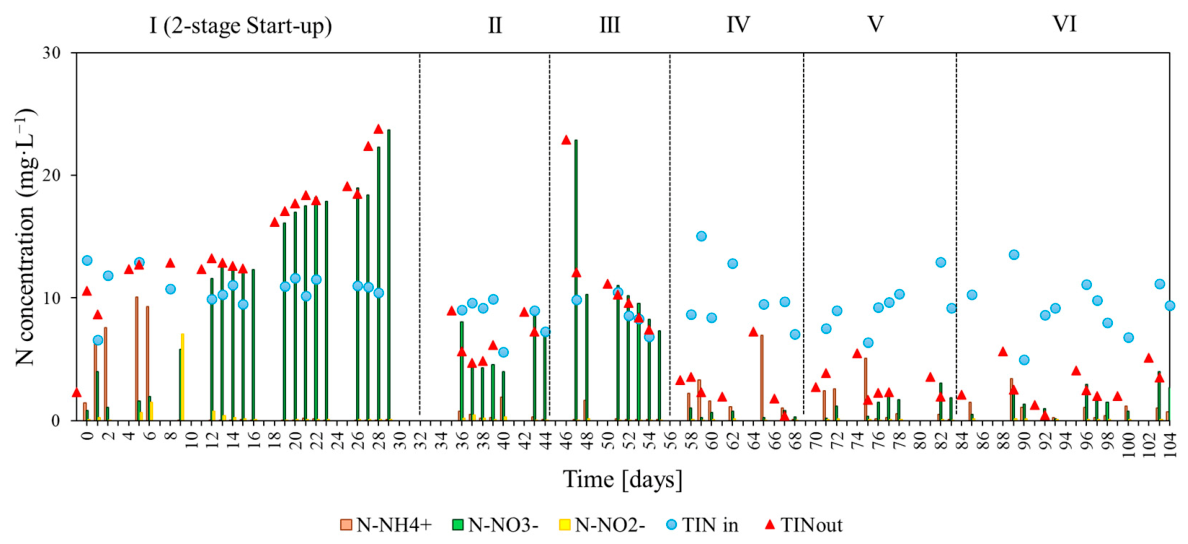
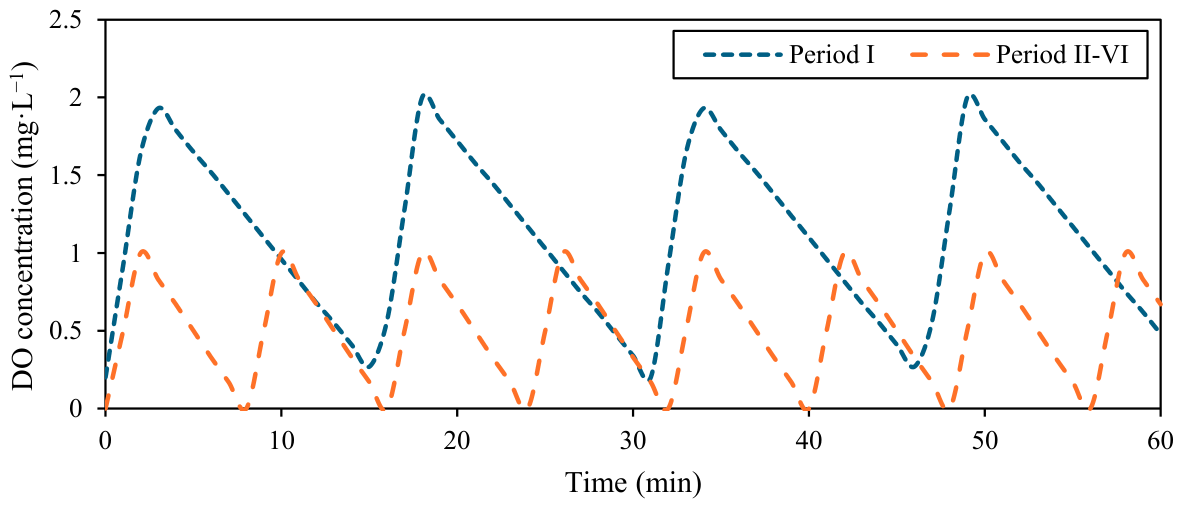
The profiles of effluent COD, TN, N-NH4+, N-NO3, and N-NO2 concentrations during the continuous start-up and operation of the MBBR are shown in Figure 4 and Figure 5. The temporal trend of the DO regimes applied in the experimental periods is reported in Figure 6. It should be noted that, because the influent was real municipal wastewater, variations in COD/TN ratio occurred simultaneously with operational adjustments. Therefore, causal relationships between single operating parameters and process performance cannot be fully isolated. On the other hand, the variability observed in influent concentrations reflects the real dynamic conditions of the WWTP influent and allowed the evaluation of the system performance under fluctuating influent composition, providing valuable insight into its robustness under realistic operating conditions. The following discussion focuses on the combined effect of influent variability and aeration strategy on system performance.
The first period (days 0–32) was characterized by the lowest tested concentration of COD (40 ± 17 mg·L−1) and a COD/TN ratio of 3.7 (± 1.9) (Table 2). The IA mode was maintained continuously (Tblower,ON = 24 h d−1) and the DO concentration varied between 0.2 and 2.0 mg·L−1. After an initial lag-phase characterized by residual effluent N-NH4+ concentrations up to 10.1 mg·L−1, nitrification occurred efficiently and N-NH4+ was completely consumed. Considering a COD:N requirement of 100:5 for aerobic cell synthesis [41], the estimated N uptake for microbial growth (TININF,G) was only 11% of the influent TN. The remaining N-NH4+ was removed through the nitrification process, leveraging the higher upper DO levels maintained during this period. As a result, N-NO3 started to accumulate up to 23.7 mg·L−1 as denitrification was strongly limited due to the low COD levels in the MBBR. The operating conditions of this period led to inefficient TN removal. In addition, the accumulation of NO3 observed in this period can be attributed to the aerobic oxidation of the organic N released by the biomass as a result of decay and endogenous respiration occurring in the system in the presence of strong COD limitations.
From period II (day 33), the feed COD concentration increased, reaching 171 (± 45) mg·L−1 and resulting in a feed COD/TN ratio of 20.0 (± 6.4). This increase was probably related to discharges from the tomato processing and preservation industry, which operates intensively in the Angri area from July to September [36]. Additionally, to better support denitrification, the DO range was changed from 0.2–2.0 to 0–1.0 mg·L−1 while maintaining continuous IA at microaerobic concentration in the system. However, due to the increased frequency of blower activation, the aeration rate increased from 0.017 to 0.034 m3·Lreactor−1·d−1 (Figure 6). With the increase in the COD/TN ratio, the CODRE reached 90 (± 4) %, while the N-NO3 concentration decreased to below 8.5 mg·L−1. The increased COD/TN ratio provided more energy and electrons to support the growth and activity of denitrifying bacteria within the biofilm, resulting in a more effective and simultaneous removal of COD and TN. In addition, VS concentration in the biofilm increased from 0.22 to 0.30 mg VS·carrier−1.
During period III (days 45–56), the COD/TN ratio of the influent wastewater decreased to 9.4 (± 5.3). To further support denitrification, non-aeration phases were alternated to microaerobic IA phases. The blower operating time for microaerobic IA was reduced from 24 to 20 h by turning off the blower for 1 h every 6 h, thus increasing the anoxic period from 0 to 4 h·d−1 and then reducing the aeration rate from 0.034 to 0.028 m3·Lreactor−1·d−1. However, the decrease in the feed COD/TN ratio resulted in an insufficient supply of influent organic carbon, which caused an immediate decrease in the denitrification activity [20]. This was reflected in an average effluent N-NO3 concentration of 11.4 (± 4.5) mg·L−1. Despite the reduction of oxygen supply, N-NH4+RE during period III was 94 (±9) %, indicating a high nitrification activity. Iannacone et al. [17] reported that the reduction in the feed COD/N ratio from 12.9 to 6.5 in an IA MBBR operated at a DO range of 0.2–2.0 mg·L−1 led to increased effluent N-NH4+ and N-NO2 levels, which were attributed to a lower assimilative N uptake by HAB. In this study, assimilative N removal (TNINF,G) was limited due to the low COD levels in the influent and accounted for only 16% in period III, the rest being removed by SND. Nevertheless, despite the lower input organic matter concentration, the VS of the biofilm slightly increased, reaching a concentration of 0.35 mg VS·carrier−1.
During period IV (days 57–69), the influent COD concentration increased to 225 (±60) mg·L−1, which resulted in an average COD/TN ratio of 22.1 (± 10.4). Given the high effluent NO3 levels observed under a similar COD/TN ratio (20.0 ± 6.4) in period II, the microaerobic IA time in period IV was further reduced from 20 to 16 h to stimulate denitrification. The combined effect of the higher organic load in the influent and reduced aeration rate led to a significant reduction (p < 0.05) of the effluent N-NO3 concentration, which remained below 1.0 mg·L−1 (Figure 5). On the other hand, N-NH4+ accumulation up to 6.9 mg·L−1 was observed, likely due to the combination of reduced aeration time and higher organic load, which may have created oxygen-limited conditions that temporarily inhibited nitrification while favouring the growth of HAB competing with nitrifiers for the limited oxygen. Such competition under high organic loading and limited oxygen availability has been widely reported in biofilm and activated sludge systems, where fast-growing heterotrophs can reduce oxygen penetration and temporarily inhibit nitrification [16,17]. Nevertheless, the effluent TN levels remained consistently within the regulatory limits (TN = 10 mg∙L−1) for safe discharge into water bodies in ecologically sensitive areas. A notable comparison can be made between periods II and IV due to their similar COD/TN ratios. Despite the comparable feed COD/TN ratios of periods II and IV (Table 1), the speciation of N compounds in the effluent varied significantly between the two periods, highlighting the significant effect of the reduced airflow rate and the subsequent increase in the anoxic period. The effectiveness of extended non-aerated phases can be explained by the biofilm microenvironment established under IA operation. During aerated phases, oxygen penetration likely supported nitrification in the outer biofilm layers, while oxygen-limited inner regions preserved anoxic niches for denitrification. During prolonged non-aerated intervals, residual NO3 could be further reduced using readily biodegradable influent COD as well as endogenous carbon sources, including EPS and intracellular storage compounds. This mechanism is consistent with the observed low NO3 accumulation and stable TN removal under carbon-limited conditions.
In period V (days 70–83), a decrease in the feed COD concentration led to a reduction in the COD/TN ratio to 17.1 (±6.3). To maintain a high denitrification efficiency, the operational period of microaerobic IA was further reduced to 12 h·d−1 by turning off and on the blower every 3 h. This led to a reduction in the aeration rate to 0.017 m3·Lreactor−1·d−1. Overall, higher COD and TN removal efficiencies of 91 and 72%, respectively, were achieved, with average effluent N-NO3- concentrations of up to 1.5 (± 0.9) mg·L−1 and a VS concentration in the biofilm of 0.6 mg VS·carrier−1.
In period VI (days 84–104), a further reduction (p < 0.05) in the influent COD concentration occurred (Figure 4), resulting in feed COD concentration of 51.8 (± 29.1) mg·L−1. Despite the low COD/TN ratio of 5.5 (± 2.9), which would typically limit denitrification due to carbon availability constraints, the strategic implementation of extended non-aerated periods (16 h per day) enabled effective denitrification, resulting in an average CODRE of 70% and maintaining N-NO3 concentrations below 2.9 mg·L−1. Remarkably, the drastic reduction in aeration rate to 0.011 m3·Lreactor−1·d−1 did not compromise the nitrification efficiency, with effluent N-NH4+ levels remaining below 3.4 mg·L−1, well below the regulatory limit. These results highlight how optimized IA strategies with an extended non-aerated period can effectively compensate for suboptimal influent characteristics, providing a robust approach for efficient SND in systems with variable wastewater composition.

3.3. Energy Performance and Carbon Footprint of the Pilot-Scale MBBR Under Different Aeration Regimes

Table 3 shows the estimated energy consumption and CO2 emissions by the MBBR system during the study. Under permanent IA conditions (period II), the system required approximately 11.66 kWh·m−3, corresponding to 2.92 kg CO2,eq·m−3. By implementing extended non-aerated phases (periods III-VI), the specific energy demand decreased to 7.72 kWh·m−3 (1.93 kg CO2,eq·m−3) in period VI (blower ON for 8 h d−1), representing a reduction in energy demand and CO2 emissions of approximately 34% compared to period II. This decrease demonstrates a substantial improvement in total plant energy efficiency, especially considering that the mixer (0.55 kW) and feed pump (0.18 kW) operated continuously and together contributed 50–75% of the daily energy consumption. Considering the blower-only operation, the reduction in energy demand and CO2 emissions between period II and period VI increased to 67%. Overall, the results indicate that the transient IA strategy applied to the pilot-scale MBBR markedly improves energy efficiency when compared to permanent IA operation.
It should be noted that the reported specific energy consumption refers to a pilot-scale installation operating at low hydraulic loading rates. Therefore, the estimated energy consumption cannot be directly compared with that of full-scale WWTPs, where optimized equipment and higher flow rates result in significantly lower specific energy demands. Indeed, pilot-scale systems inherently exhibit higher specific energy consumption than full-scale installations, due to unfavourable surface-to-volume ratio, limited hydraulic load, and use of non-optimised equipment operating at fixed power. In a recent study, Mineo et al. [42] operated a pilot-scale membrane bioreactor under alternating aerated and non-aerated phases and reported carbon footprint values of 2.5 and 2.8 kg CO2,eq·m−3 during two operating periods, respectively. These values are within the same order of magnitude as those estimated in the present study (1.93–2.92 kg CO2,eq·m−3), confirming that compact pilot-scale biological systems may exhibit elevated specific energy and carbon-footprint values. On the other hand, the relevant metric for scale-up is the relative reduction achieved through transient IA operation. The blower-only energy savings (~67%) and the reduction in total energy consumption (~34%) are expected to translate into even larger absolute reductions in full-scale systems, where mixers and pumps contribute proportionally less to the overall energy budget. Overall, the IA strategy applied in the pilot-scale MBBR demonstrates a robust potential for improving energy efficiency while maintaining high TN removal performance even at very low COD/TN ratios in wastewater, confirming the competitiveness of the system among compact biological treatment technologies.

3.4. Practical Remarks for System Operation Under Real Conditions

This study demonstrates the successful operation of a single-stage pilot-scale system based on the IA MBBR technology for the combined removal of organic C and N from high-fluctuating municipal wastewater. Real fluctuations in the influent characteristics in terms of COD/TN ratio significantly impacted the system performance, altering the C and N removal efficiencies. Despite such fluctuations, the application of IA coupled to extended non-aerated periods was shown to be effective in maintaining satisfactory denitrification and TN removal efficiencies and to comply with the standards for effluent discharge in water bodies. In addition, the ability to achieve high removal efficiencies under variable influent conditions while potentially reducing aeration requirements represents a promising approach to improving the energy efficiency of municipal wastewater treatment systems.
This work covers an important literature gap, as previous studies on IA-based biofilm systems have often been carried out at a laboratory scale and used synthetic wastewater as the influent, demonstrating the MBBR resilience to perform the SND process. Luan et al. [43] found TNRE and CODRE of 45 and 77% in a lab-scale anaerobic/intermittently aerated MBBR with a COD/TN of 3.5 under microaerobic conditions (0.1–1.0 mg·L−1) with an aerated/non-aerated period of 15/15 min. In contrast, this study used a significantly different IA strategy with longer non-aeration phases (4 h per cycle) while operating within a similar DO concentration range (0–1.0 mg·L−1). With a non-aerated period of 16 h and a COD/TN ratio of 5.5 in period VI, the process achieved COD and TN removal efficiencies of 70 and 84%, respectively. The almost two-fold improvement in TN removal compared to Luan et al. [43] can be attributed to the prolonged anoxic period, which enhances denitrification while maintaining effective N-NH4+ removal. This performance can be attributed to the availability of endogenous carbon sources—such as Extracellular Polymeric Substances (EPS) and intracellular storage products—which likely sustained the denitrification process during the non-aerated phases, demonstrating that the presence of extended non-aeration phases for real wastewater treatment and high HRT ensures system resilience [28].
Compared to synthetic wastewater, the use of real fluctuating wastewater made the process more complex. In this study, during the continuous operation phase, variations in the influent characteristics resulted in variable removal efficiencies, especially during the initial period, which was also influenced by the start-up phase. Discharges from tomato processing industries caused significant increases in influent TSS concentrations, resulting in frequent clogging of inlet pipes and connecting channels. This required the implementation of a maintenance protocol involving the physical cleaning of the affected components and caused occasional system downtime. Possible mitigation strategies include improved pre-screening, installation of an equalization tank to dampen peak solids and organic loads, enhanced primary solids removal, and scheduled maintenance of feeding and connecting lines during periods of seasonal agro-industrial discharge.
These operational challenges highlight important practical considerations for full-scale implementation of single-stage biological systems in areas with seasonal industrial discharges, such as the need for backup systems for auxiliary wastewater treatment, e.g., a twin IA MBBR system, to provide operational redundancy. In this way, one unit could remain in operation during maintenance or clogging events, thereby improving process reliability under highly variable influent conditions.

4. Conclusions

This study demonstrated the feasibility of SND in a pilot-scale IA-MBBR treating real municipal wastewater under highly variable carbon and nitrogen loadings. The implementation of extended non-aerated phases enhanced denitrification without compromising ammonium removal, enabling TN removal up to 84% under carbon-limited conditions (COD/TN = 5.5). These results indicate that time-controlled intermittent aeration can compensate for suboptimal influent carbon availability and support stable single-stage C and N removal without external carbon addition.
From an engineering perspective, the pilot system showed promising robustness under realistic operating conditions, including naturally fluctuating influent COD/TN ratios and seasonal variations associated with agro-industrial discharges. The energy assessment further demonstrated that the IA strategy reduced total estimated energy consumption by 34% and blower-related demand by 67% compared with continuous blower operation. Although the absolute specific energy demand was affected by pilot-scale limitations and continuously operating auxiliary equipment, the relative energy reduction confirms the potential of IA-MBBR systems to improve operational sustainability and indirect CO2,eq footprint of municipal wastewater treatment.
By moving IA-MBBR operation from previous laboratory-scale investigations to a 3.3 m3 pilot-scale reactor installed at a municipal WWTP and fed with real wastewater, this study provides evidence of increased technological maturity. In terms of technology readiness level (TRL), laboratory proof-of-concept studies are typically consistent with TRL 3-4, whereas prototype validation under relevant operational conditions is consistent with TRL 6-7 [44].
Therefore, the present work supports the advancement of IA-MBBR-based SND from laboratory-scale proof-of-concept to pilot-scale validation, moving toward system demonstration.
While the present study provides pilot-scale evidence of the feasibility and energy benefits of IA-MBBR operation under real wastewater conditions, further work would be valuable to consolidate the pathway toward full-scale implementation. In particular, future studies should include microbial community analysis to clarify the functional populations involved in SND, direct power monitoring and oxygen transfer evaluation to refine the energy balance, and longer-term operation across different seasons to further assess process stability under broader influent variability.

Supplementary Materials

The following supporting information can be downloaded at: https://www.mdpi.com/article/10.3390/w18121467/s1, Figure S1: Carrier collected from the MBBR pilot reactor at the end of the anoxic start-up phase.

Author Contributions

Conceptualization, A.L., S.P., F.D.C., D.M., M.L. and G.E.; methodology, A.L., S.P., F.D.C. and G.E.; formal analysis, A.L.; investigation, A.L., S.P., F.D.C., D.M., M.L. and G.E.; resources, L.P. and G.E.; data curation, A.L. and F.D.C.; writing—original draft preparation, A.L. and F.D.C.; writing—review and editing, S.P., F.D.C., D.M., M.L., L.P. and G.E.; visualization, A.L.; supervision, S.P., F.D.C., D.M., M.L., L.P. and G.E.; project administration, D.M. and G.E.; funding acquisition, D.M. and G.E. All authors have read and agreed to the published version of the manuscript.

Funding

This research was funded by the Italian Ministry of Environment and Energy Security (MASE) within the framework of the 2022–2024 Three-Year Implementation Plan of the National Electric System Research (Ricerca di Sistema, RdS). Anna Lanzetta’s research fellowship at the University of Naples Federico II was funded by the 2022 PRIN project, ‘BIOCORE: Biological COmpact REactors for combined C, N and P removal from wastewater’, which is funded by the European Union—Next Generation EU (grant number CUP E53D23003330006).

Data Availability Statement

The original contributions presented in this study are included in the article/Supplementary Materials. Further inquiries can be directed to the corresponding author.

Acknowledgments

The authors are also grateful to Giovanni di Dio Ammendola and the technical staff of the Angri WWTP for their invaluable assistance in maintaining and operating the bioreactor.

Conflicts of Interest

Author Luca Pucci was employed by the company GORI S.p.A. All authors declare that the research was conducted in the absence of any commercial or financial relationships that could be construed as a potential conflict of interest.

References

  1. Rout, P.R.; Shahid, M.K.; Dash, R.R.; Bhunia, P.; Liu, D.; Varjani, S.; Zhang, T.C.; Surampalli, R.Y. Nutrient removal from domestic wastewater: A comprehensive review on conventional and advanced technologies. J. Environ. Manag. 2021, 296, 113246. [Google Scholar] [CrossRef]
  2. van Puijenbroek, P.J.T.M.; Beusen, A.H.W.; Bouwman, A.F. Global nitrogen and phosphorus in urban waste water based on the Shared Socio-economic pathways. J. Environ. Manag. 2019, 231, 446–456. [Google Scholar] [CrossRef]
  3. Cicekalan, B.; Kosar, S.; Cingoz, S.; Eyit, N.; Ersahin, M.E.; Ozgun, H. Techno-economic and environmental assessment of different municipal wastewater treatment systems. J. Water Process Eng. 2023, 53, 103822. [Google Scholar] [CrossRef]
  4. Gikas, P. Towards energy positive wastewater treatment plants. J. Environ. Manag. 2017, 203, 621–629. [Google Scholar] [CrossRef]
  5. Arumugham, T.; Khudzari, J.; Abdullah, N.; Yuzir, A.; Iwamoto, K.; Homma, K. Research trends and future directions on nitrification and denitrification processes in biological nitrogen removal. J. Environ. Chem. Eng. 2024, 12, 111897. [Google Scholar] [CrossRef]
  6. Lanzetta, A.; Hajdu-Rahkama, R.; Di Capua, F.; Kokko, M.; Esposito, G.; Papirio, S. Exploring mixotrophic denitrification in a continuous double-chamber bioelectrochemical system treating nitrate-contaminated wastewater. J. Environ. Chem. Eng. 2024, 12, 114195. [Google Scholar] [CrossRef]
  7. Zou, G.; Papirio, S.; van Hullebusch, E.D.; Puhakka, J.A. Fluidized-bed denitrification of mining water tolerates high nickel concentrations. Bioresour. Technol. 2015, 179, 284–290. [Google Scholar] [CrossRef]
  8. Wu, T.; Yang, S.S.; Zhong, L.; Pang, J.W.; Zhang, L.; Xia, X.F.; Yang, F.; Xie, G.J.; Liu, B.F.; Ren, N.Q.; et al. Simultaneous nitrification, denitrification and phosphorus removal: What have we done so far and how do we need to do in the future? Sci. Total Environ. 2023, 856, 158977. [Google Scholar] [CrossRef] [PubMed]
  9. James, S.N.; Vijayanandan, A. Recent advances in simultaneous nitrification and denitrification for nitrogen and micropollutant removal: A review. Biodegradation 2023, 34, 103–123. [Google Scholar] [CrossRef] [PubMed]
  10. Loh, Z.Z.; Zaidi, N.S.; Syafiuddin, A.; Yong, E.L.; Bahrodin, M.B.; Aris, A.; Boopathy, R. Current status and future prospects of simultaneous nitrification and denitrification in wastewater treatment: A bibliometric review. Bioresour. Technol. Rep. 2023, 23, 101505. [Google Scholar] [CrossRef]
  11. Seifi, M.; Fazaelipoor, M.H. Modeling simultaneous nitrification and denitrification (SND) in a fluidized bed biofilm reactor. Appl. Math. Model. 2012, 36, 5603–5613. [Google Scholar] [CrossRef]
  12. Zhang, Y.; Yin, Z.; Liu, M.; Liu, C. Enhancing simultaneous nitrification and denitrification in a plant-scale integrated fixed-film activated sludge system: Focusing on the cooperation between activated sludge and biofilm. Chem. Eng. J. 2024, 496, 154322. [Google Scholar] [CrossRef]
  13. Di Capua, F.; Iannacone, F.; Sabba, F.; Esposito, G. Simultaneous nitrification–denitrification in biofilm systems for wastewater treatment: Key factors, potential routes, and engineered applications. Bioresour. Technol. 2022, 361, 127702. [Google Scholar] [CrossRef]
  14. Lanzetta, A.; Mattioli, D.; Di Capua, F.; Minieri, V.; Papirio, S.; Esposito, G. Modeling complete and shortcut simultaneous nitrification and denitrification coupled to phosphorus removal in moving bed biofilm reactors. J. Water Process Eng. 2024, 59, 105022. [Google Scholar] [CrossRef]
  15. Lanzetta, A.; Di Capua, F.; Panneerselvam, B.; Mattioli, D.; Esposito, G.; Papirio, S. Impact of Influent Composition and Operating Conditions on Carbon and Nitrogen Removal from Urban Wastewater in a Blanket Reactor. Energies 2023, 16, 6303. [Google Scholar] [CrossRef]
  16. Iannacone, F.; Di Capua, F.; Granata, F.; Gargano, R.; Pirozzi, F.; Esposito, G. Effect of carbon-to-nitrogen ratio on simultaneous nitrification denitrification and phosphorus removal in a microaerobic moving bed biofilm reactor. J. Environ. Manag. 2019, 250, 109518. [Google Scholar] [CrossRef]
  17. Iannacone, F.; Di Capua, F.; Granata, F.; Gargano, R.; Esposito, G. Simultaneous nitrification, denitrification and phosphorus removal in a continuous-flow moving bed biofilm reactor alternating microaerobic and aerobic conditions. Bioresour. Technol. 2020, 310, 123453. [Google Scholar] [CrossRef]
  18. Ma, W.; Han, Y.; Ma, W.; Han, H.; Zhu, H.; Xu, C.; Li, K.; Wang, D. Enhanced nitrogen removal from coal gasification wastewater by simultaneous nitrification and denitrification (SND) in an oxygen-limited aeration sequencing batch biofilm reactor. Bioresour. Technol. 2017, 244, 84–91. [Google Scholar] [CrossRef]
  19. Zhu, G.C.; Lu, Y.Z.; Xu, L.R. Effects of the carbon/nitrogen (C/N) ratio on a system coupling simultaneous nitrification and denitrification (SND) and denitrifying phosphorus removal (DPR). Environ. Technol. 2021, 42, 3048–3054. [Google Scholar] [CrossRef] [PubMed]
  20. Chang, M.; Wang, Y.; Pan, Y.; Zhang, K.; Lyu, L.; Wang, M.; Zhu, T. Nitrogen removal from wastewater via simultaneous nitrification and denitrification using a biological folded non-aerated filter. Bioresour. Technol. 2019, 289, 121696. [Google Scholar] [CrossRef]
  21. Langone, M.; Ferrentino, R.; Mertz, W.; Mattioli, D.; Petta, L.; Andreottola, G. Microbial community composition from full-scale reactors treating mature landfill leachate through innovative biological processes and its importance in mathematical modeling. Biochem. Eng. J. 2024, 204, 109226. [Google Scholar] [CrossRef]
  22. Lanzetta, A.; Mattioli, D.; Di Capua, F.; Sabia, G.; Petta, L.; Esposito, G.; Andreottola, G.; Gatti, G.; Merz, W.; Langone, M. Anammox-based processes for mature leachate treatment in sbr: A modelling study. Processes 2021, 9, 1443. [Google Scholar] [CrossRef]
  23. Jin, Y.; Ding, J.; Zhan, W.; Du, J.; Wang, G.; Pang, J.; Ren, N.; Yang, S. Effect of dissolved oxygen concentration on performance and mechanism of simultaneous nitrification and denitrification in integrated fixed-film activated sludge sequencing batch reactors. Bioresour. Technol. 2023, 387, 129616. [Google Scholar] [CrossRef]
  24. Zhang, Y.; Wang, X.; Liu, M.; Liu, C.; Yin, Z. Simultaneous nitrogen and phosphorus removal from black water: Effects of dissolved oxygen level and sludge concentration on full-scale performance and bacterial community dynamics. J. Water Process Eng. 2024, 57, 104735. [Google Scholar] [CrossRef]
  25. Khan, N.A.; Singh, S.; Ramamurthy, P.C.; Aljundi, I.H. Exploring nutrient removal mechanisms in column-type SBR with simultaneous nitrification and denitrification. J. Environ. Manag. 2024, 349, 119485. [Google Scholar] [CrossRef]
  26. Sun, H.; Wang, T.; Yang, Z.; Yu, C.; Wu, W. Simultaneous removal of nitrogen and pharmaceutical and personal care products from the effluent of wastewater treatment plants using aerated solid-phase denitrification system. Bioresour. Technol. 2019, 287, 121389. [Google Scholar] [CrossRef]
  27. Lim, J.W.; Lim, P.E.; Seng, C.E. Enhancement of nitrogen removal in moving bed sequencing batch reactor with intermittent aeration during REACT period. Chem. Eng. J. 2012, 197, 199–203. [Google Scholar] [CrossRef]
  28. Ferrentino, R.; Langone, M.; Vian, M.; Andreottola, G. Application of real-time nitrogen measurement for intermittent aeration implementation in a biological nitrogen removal system: Performances and efficiencies. Environ. Technol. 2019, 40, 2513–2526. [Google Scholar] [CrossRef] [PubMed]
  29. Zhang, P.; Qi, Z. Simultaneous nitrification and denitrification in activated sludge system under low oxygen concentration. Front. Environ. Sci. Eng. 2007, 1, 49–52. [Google Scholar] [CrossRef]
  30. Campo, R.; Sguanci, S.; Caffaz, S.; Mazzoli, L.; Ramazzotti, M.; Lubello, C.; Lotti, T. Efficient carbon, nitrogen and phosphorus removal from low C/N real domestic wastewater with aerobic granular sludge. Bioresour. Technol. 2020, 305, 122961. [Google Scholar] [CrossRef] [PubMed]
  31. Liu, T.; He, X.; Jia, G.; Xu, X.; Quan, X.; You, S. Simultaneous nitrification and denitrification process using novel surface-modified suspended carriers for the treatment of real domestic wastewater. Chemosphere 2020, 247, 125831. [Google Scholar] [CrossRef]
  32. Di Costanzo, N.; Masi, S.; Esposito, G.; Caniani, D.; Pirozzi, F.; Mancini, I.M.; Di Capua, F. Start-up of an intermittent-aeration integrated fixed-film activated sludge (IFAS)-Oxic settling anaerobic (OSA) biological system coupling shortcut simultaneous nitrification-denitrification to near-zero sludge generation. J. Environ. Chem. Eng. 2025, 13, 117016. [Google Scholar] [CrossRef]
  33. Luan, Y.N.; Yin, Y.; Guo, Z.; Yang, J.; Wang, G.; Zhang, F.; Xiao, Y.; Liu, C. Achieving simultaneous nitrification and endogenous denitrifying phosphorus removal in anaerobic/intermittently-aerated moving bed biofilm reactor for low carbon-to-nitrogen ratio wastewater treatment. Bioresour. Technol. 2024, 394, 130178. [Google Scholar] [CrossRef]
  34. Collivignarelli, M.C.; Abbà, A.; Bertanza, G. Oxygen transfer improvement in MBBR process. Environ. Sci. Pollut. Res. 2019, 26, 10727–10737. [Google Scholar] [CrossRef] [PubMed]
  35. Iannacone, F.; Di Capua, F.; Granata, F.; Gargano, R.; Esposito, G. Shortcut nitrification-denitrification and biological phosphorus removal in acetate- and ethanol-fed moving bed biofilm reactors under microaerobic/aerobic conditions. Bioresour. Technol. 2021, 330, 124958. [Google Scholar] [CrossRef]
  36. Lofrano, G.; Serafini, S.; Saviano, L.; Carotenuto, M.; Guida, M.; Romano Spica, V.; Cardito, A.; Libralato, G. A holistic picture of spatial distribution of river polluting loads in a highly anthropized area. Sci. Total Environ. 2023, 887, 163784. [Google Scholar] [CrossRef] [PubMed]
  37. Di Capua, F.; Pirozzi, F.; Lens, P.N.L.; Esposito, G. Electron donors for autotrophic denitrification. Chem. Eng. J. 2019, 362, 922–937. [Google Scholar] [CrossRef]
  38. International Energy Agency (IEA). CO2 Emissions in 2023; IEA: Paris, France, 2023. [Google Scholar]
  39. Istituto Superiore per la Protezione e la Ricerca Ambientale (ISPRA). Italian Greenhouse Gas Inventory 1990–2023; National Inventory Document 2025; ISPRA: Roma, Italy, 2025. [Google Scholar]
  40. Morello, R.; Di Capua, F.; Sahinkaya, E.; Esposito, G.; Pirozzi, F.; Fratino, U.; Spasiano, D. Operational strategies enhancing sewage sludge minimization in a combined integrated fixed-film activated sludge–oxic settling anaerobic system. J. Environ. Manag. 2023, 345, 118808. [Google Scholar] [CrossRef]
  41. Metcalf & Eddy, Inc.; Tchobanoglous, G.; Stensel, H.D.; Tsuchihashi, R.; Burton, F.L. Wastewater Engineering: Treatment and Resource Recovery, 5th ed.; McGraw-Hill Education: New York, NY, USA, 2014. [Google Scholar]
  42. Mineo, A.; Marcelo, P.; Mofatto, B.; Cosenza, A.; Di Trapani, D.; Mannina, G. Membrane bioreactor operated under intermittent aeration a comprehensive comparison with an IFAS-MBR: A pilot plant experience. J. Environ. Chem. Eng. 2025, 13, 118668. [Google Scholar] [CrossRef]
  43. Luan, Y.N.; Yin, Y.; An, Y.; Zhang, F.; Wang, X.; Zhao, F.; Xiao, Y.; Liu, C. Investigation of an intermittently-aerated moving bed biofilm reactor in rural wastewater treatment under low dissolved oxygen and C/N condition. Bioresour. Technol. 2022, 358, 127405. [Google Scholar] [CrossRef]
  44. Commissione Europea: Direzione Generale Della Ricerca e Dell’innovazione; Buna, M.; De Rose, A.; Olivieri, N.; Peeters, L.; Stevens, T.; Strazza, C. Technology Readiness Level—Guidance Principles for Renewable Energy Technologies—Final Report; Publications Office: Luxembourg, 2017; Available online: https://data.europa.eu/doi/10.2777/577767 (accessed on 2 June 2026).
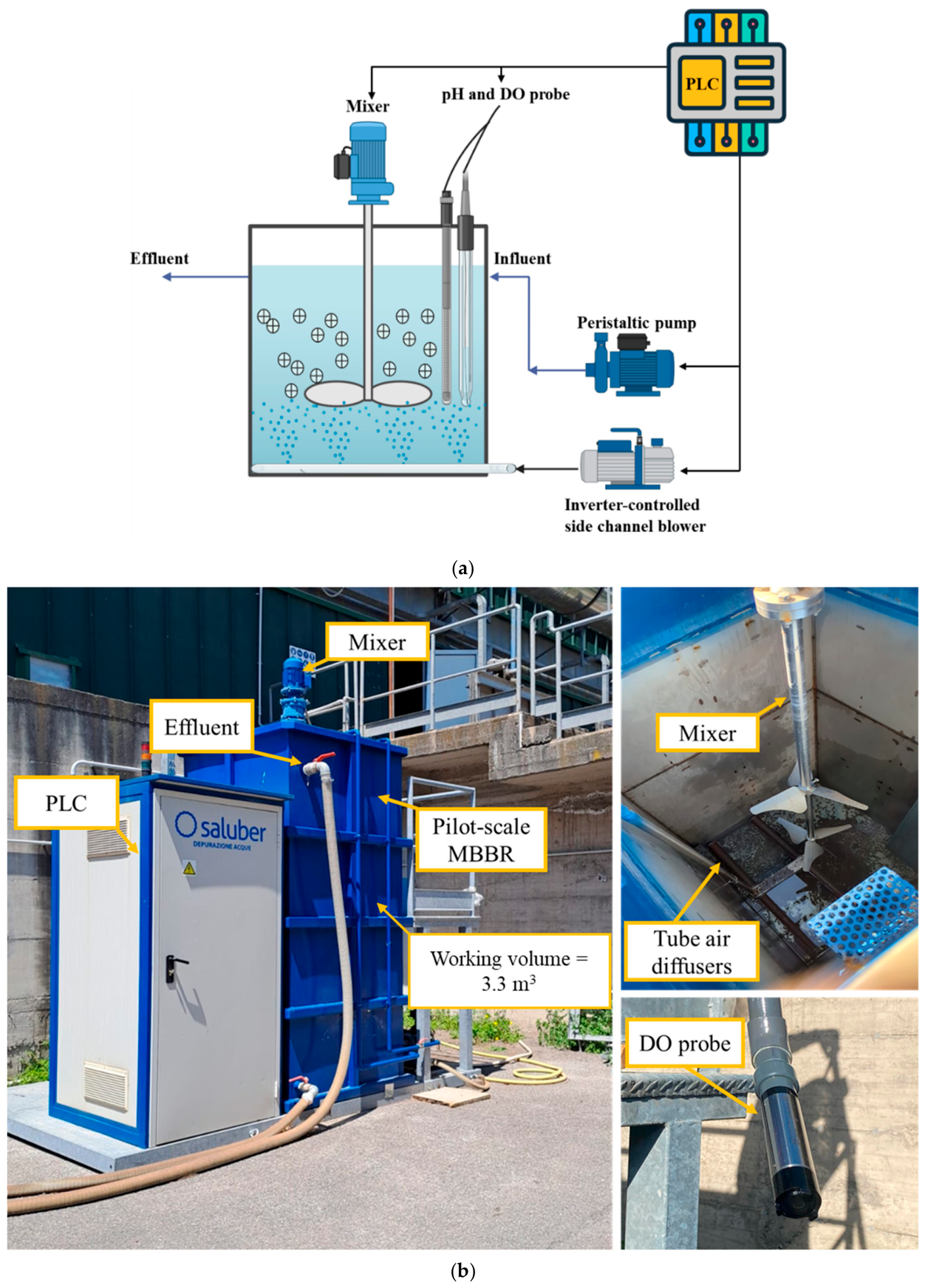
Figure 1. (a) Schematic of the pilot-scale MBBR, consisting of an experimental reactor with a working volume of 3.3 m3; carriers with a 50% filling ratio; an influent peristaltic pump; an inverter-controlled side channel blower; pH and DO probes; a mixer and programmable logic controller (PLC). (b) Pilot plant installation.
Water 18 01467 g001
Figure 2. Temporal trend of COD (a), N-NO3 (b), N-NO2 (c), and N-NH4+ (d) concentrations (mg∙L−1) measured daily in the MBBR after and before the refresh (i.e., the replacement of a new influent solution) during the experimental start-up period of the pilot-scale MBBR in batch mode.
Water 18 01467 g002
Figure 3. The concentration of N-NO3 and N-NO2 during the denitrifying batch activity tests carried out at the end of the anoxic start-up period. Data are reported as mean values of duplicate assays; error bars indicate the variability between replicates.
Water 18 01467 g003
Figure 4. Time trend of influent and effluent COD concentrations measured daily during the six experimental periods of the pilot-scale MBBR operation in continuous mode. The dotted red line indicates the Italian standard for COD (D. Lgs. 152/2006, Annex V, Part III) for urban effluent discharge (125 mg·L−1).
Water 18 01467 g004
Figure 5. Temporal trend of influent total nitrogen (TNINF) and effluent N-NH4+, N-NO3 and N-NO2 concentrations measured daily during the six experimental periods of the pilot-scale MBBR operation in continuous mode. The dotted red line indicates the Italian standard for TN (D. Lgs. 152/2006, Annex V, Part III) for urban effluent discharge in ecologically sensitive areas (10 mg·L−1).
Water 18 01467 g005
Figure 6. Temporal trend of the DO regimes applied during the six experimental period.
Water 18 01467 g006
Table 1. Chemical–physical characteristics in terms of pH, total suspended solids (TSS), ammonia nitrogen (N-NH4+), total chemical oxygen demand (COD), and phosphorus (P-PO43−) concentrations of the Angri wastewater treatment plant influent during 2023. Values were obtained from routine monitoring data provided by the plant operator and are reported as average ± standard deviation and min-max range to highlight the strong temporal variability of the real municipal wastewater.
ParametersUnitsValue (Min–Max)Value (Average ± Std)
pH-6.8–8.57.7 ± 0.9
TSSmg·L−120–820420 ± 400
N-NH4+mg·L−10.6–19.09.8 ± 9.2
Total CODmg·L−110–796403 ± 393
P-PO43−mg·L−10.1–6.23.2 ± 3.1
Table 2. Operating conditions and duration of each experimental period during the continuous operation of the pilot-scale MBBR.
Duration
[Day]
HRTDOTblower,ONTblower,OFFAeration RateFeed CODFeed N-NH4+Feed
N-NO3
Feed N-NO2Feed COD/TNOLRNLR
[h][mg·L−1][h d−1][h d−1][m3·L−1·d−1][mg·L−1][mg·L−1][mg·L−1][mg·L−1] [mgCOD·m−3·d−1][mgN·m−3·d−1]
I
(2-stage
Start-up)
0–32260.2–2.02400.01740 ± 177.3 ± 1.13.2 ± 0.80.3 ± 0.13.7 ± 1.937.010.0
II33–44260–1.02400.034171 ± 456.3 ± 1.41.7 ± 0.40.6 ± 0.120.0 ± 6.4158.07.9
III45–56260–1.02040.02883 ± 315.9 ± 0.92.3 ± 0.70.6 ± 0.09.4 ± 5.376.78.1
IV57–69260–1.01680.023225 ± 607.7 ± 2.51.9 ± 0.70.6 ± 0.122.1 ± 10.4208.09.4
V70–83260–1.012120.017159 ± 696.2 ± 1.02.5 ± 1.60.6 ± 0.217.1 ± 6.3147.08.6
VI84–104260–1.08160.01152 ± 296.0 ± 1.93.0 ± 0.70.3 ± 0.15.5 ± 2.948.18.6
Table 3. Specific energy consumption and indirect CO2 emissions across the experimental periods.
PeriodTblower,ON (h·d−1)Eblower (kWh·d−1)Emixer+pump (kWh·d−1)Etot,day
(kWh·d−1)
Etot,m3
(kWh·m−3)
CO2,eq (kg·m−3)Total Energy Reduction vs. Period II (%)
II2418.0017.5235.5211.662.920.0
III2015.0017.5232.5210.682.678.4
IV1612.0017.5229.529.692.4216.9
V129.0017.5226.528.712.1825.3
VI86.0017.5223.527.721.9333.8
Disclaimer/Publisher’s Note: The statements, opinions and data contained in all publications are solely those of the individual author(s) and contributor(s) and not of MDPI and/or the editor(s). MDPI and/or the editor(s) disclaim responsibility for any injury to people or property resulting from any ideas, methods, instructions or products referred to in the content.