1. Introduction
The spatialization of meteorological variables is a crucial process in environmental science, meteorology, and climate studies, as it allows estimating variables such as temperature, precipitation, wind speed, and relative humidity across different locations. This process is especially valuable in regions with complex orography, where observational data are limited or temporarily unavailable [
1,
2]. The benefits of accurate spatialization are far-reaching. In agriculture, for example, precise spatial representations of temperature and precipitation are essential for crop modelling and irrigation management [
3]. In flood forecasting, the spatial distribution of rainfall is critical for predicting runoff and managing water resources [
4]. Spatialization also plays a key role in urban planning and climate resilience, helping cities better prepare for extreme weather events, such as heatwaves or heavy rainfall [
5,
6].
Meteorological variables are inherently spatially variable, meaning they exhibit significant spatial heterogeneity due to local variations in orography, land use and microclimates. Accurately modelling and spatially representing these variations is essential for numerous applications in climate modelling, resource management, disaster forecasting and environmental studies. While significant progress has been made in improving spatialization techniques through the integration of geostatistical methods, remote sensing data, and machine learning, challenges related to uncertainty in the utilized measures and spatialization method remain, especially in areas with complex orography [
1,
7,
8]. However, with continued advancements in technology and computational techniques, the accuracy and utility of spatialized meteorological data are expected to increase, paving the way for more effective decision-making, from disaster management to agriculture and urban planning [
9]. Spatialization also facilitates a better understanding of localized phenomena such as microclimates, which cannot be fully captured by traditional weather stations [
10,
11]. Historically, meteorological data have been collected at specific weather stations, often leaving large areas with limited or no data coverage, particularly in remote or inaccessible regions, which has led to the development of various spatialization methods to interpolate and estimate the values of meteorological variables at unsampled locations. Geostatistical techniques, such as kriging, have been central to this task. Kriging is a spatial interpolation technique based on the statistical analysis of the spatial correlation between known data points, providing a best linear unbiased estimator (BLUE) for unknown values [
12]. This approach has been widely used in various applications, such as predicting precipitation patterns or estimating temperature distributions in regions with sparse observational data [
13,
14,
15]. Additionally, other interpolation methods, such as inverse distance weighting (IDW) and spline, are often employed in combination with kriging, depending on the specific requirements of the study [
1].
The increasing availability of remote sensing data from satellites and other aerial platforms has significantly enhanced the spatialization process. Satellite imagery, weather radar, and other earth observation tools provide a wealth of information about large-scale environmental conditions. These remote sensing technologies can be integrated with ground-based in situ meteorological data to create more comprehensive spatial models [
1,
7]. For example, data from geostationary satellites can provide near-real-time global coverage of temperature, precipitation, and other weather variables, which can be combined with localized observations to refine spatial models [
16]. This integration of ground-based measurements and remote sensing data allows for the generation of high-resolution spatial maps, improving the accuracy of meteorological predictions and decision-making.
Spatialization is not without its challenges. One of the primary concerns in meteorological data interpolation is the uncertainty associated with both the input data and the interpolation process. Uncertainty arises from multiple sources, including measurement errors, data gaps, and the inherent variability in meteorological processes [
17]. Uncertainty quantification (UQ) has become an important field of research to address this issue and provide more robust estimates of the inaccuracy associated with spatialized data. For instance, Thornton et al. [
11] highlighted the importance of UQ in the development of gridded daily weather data, particularly for regions with sparse observational networks and complex orography, providing uncertainty estimates alongside spatialized weather data to improve the reliability of climate models and local-scale predictions. Furthermore, the complexity of terrain and the heterogeneity of land cover can significantly affect the spatial distribution of meteorological variables. Mountainous regions, coastal zones, and urban areas, for instance, influence local temperature and precipitation patterns, requiring specialized models that account for these variations. One such approach is the Daymet1 spatialization method [
18], which generates daily meteorological surfaces over large and complex terrains. Daymet1 incorporates terrain-specific adjustments using a Digital Terrain Model (DTM) and, based on the distribution of measurement stations, other landscape features, such as land cover type, proximity to water bodies, and vegetation, to more accurately capture the influence of local topography and environment on climate variables. By including these factors, Daymet1 provides spatialized weather data along with estimates of associated uncertainties, which are particularly valuable in regions with sparse observational networks. This method has been further updated in Daymet4 [
11], employing improved modelling techniques to provide even more accurate and robust datasets.
The aim of this study is to develop a real-time adaptation of the Daymet4 algorithm published in Thornton et al. [
11], without using any information from subsequent days. It can operate with dynamically available observations and without requiring a fixed annual station network. To achieve this objective, several modifications were introduced to the original Daymet4 framework, resulting in the Daymet4-r1 algorithm. These modifications concern the management of missing observations, the treatment of precipitation gradients, and the extension of the method to additional meteorological variables. A further development, Daymet4-r2, was subsequently implemented to introduce automatic parameter optimization and an improved representation of thermal inversion conditions.
2. Materials and Methods
2.1. Daymet4-r1
Daymet4-r1 is derived from the original Daymet4 algorithm of Thornton et al. [
11], but introduces several modifications designed to support real-time operational applications. First, unlike Daymet4, which uses only stations with complete records for the entire year, Daymet4-r1 employs all observations available for the meteorological variable and day being spatialized. Consequently, the set of stations used by the algorithm can vary from day to day, allowing the method to exploit the maximum amount of available information. Second, for precipitation, the regression against elevation and horizontal coordinates is computed using observations from the same day rather than the centered 5-day moving average adopted in Daymet4, thereby avoiding the use of information from subsequent days. Finally, the methodology was extended to additional meteorological variables, including relative humidity, atmospheric pressure and wind speed. These modifications make the algorithm suitable for real-time applications and for operational meteorological networks characterized by variable data availability.
Daymet4-r1 performs spatial interpolation of meteorological variables (temperature, precipitation, relative humidity, pressure, wind speed) using a DTM of the area of interest and observations from a set of weather stations. This algorithm is based on the same principles originally defined by the authors of Daymet4 [
11], which include:
The influence area of an observation is inversely related to the local density of observations. This means that an isolated observation will influence a larger area compared to one located in a region with many nearby observations;
The interpolation surface produced by this algorithm is continuous but not strictly linear. It allows for discontinuities in first and higher-order derivatives, meaning that slope and curvature can change abruptly across different areas;
During the spatial interpolation, the influence of an observation decreases as the distance increases;
The spatialized surface does not necessarily coincide with the observed value at a specific location.
To achieve these properties, a truncated Gaussian filter is used [
18]. This filter limits the number of observations considered when predicting a point, making the computation more efficient. Observations are selected based on their distance from the prediction point, excluding those likely to have less influence. The general form of the truncated Gaussian filter for a point
p is as follows:
where
W(r) is the filter weight associated with a radial distance r from
p, R
p is the maximum distance from point
p within which observations are used (truncation distance), and α is a dimensionless parameter that controls how the weights change with distance.
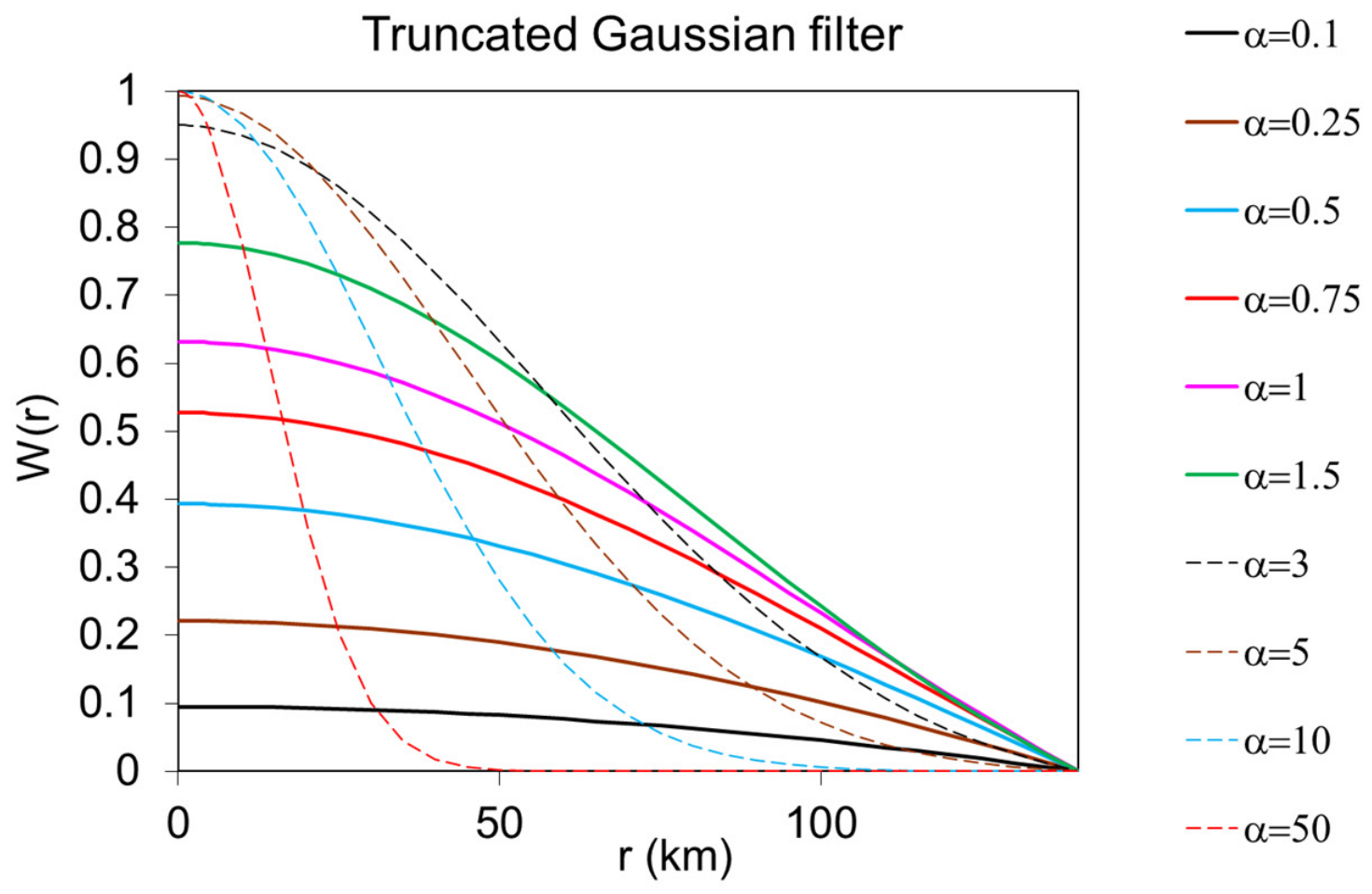
Figure 1 shows how the weights vary with distance as α changes, assuming R
p = 140 km.
Since weather stations are not evenly distributed, using a constant value for R
p would result in a significant imbalance in the number of observations used to make predictions (fewer in areas with sparse station coverage and more in areas with high station density). To ensure a more consistent number of observations across regions, R
p must be smaller in areas with many stations and larger in areas with fewer stations. Thornton et al. [
11] introduced a parameter, the average number of observations (N), which the algorithm uses during interpolation. For each interpolation point, R
p is adjusted based on the local station density so that the average number of observations tends to match N. All stations within 260 km (beyond which observations are assumed to have no meaningful influence on the prediction) are sorted in order of increasing distance from the grid point being interpolated. The truncation distance R
p is then set to the distance of the Nth closest station, or to the distance of the farthest available station if there are fewer than N stations.
The general interpolation method for a given set of observations and a prediction grid is defined by two parameters: N and α. The observations consist of an arbitrary meteorological variable
xi, measured at each of the
i ∈ {1, 2, …, n} observation points. The values of the interpolation parameters are kept constant across all time steps and all grid points. Considering a single prediction point at a specific time step, the interpolated value x
p is determined as follows:
2.1.1. Air Temperature Spatialization
The method used for spatialization both minimum and maximum temperatures is the same. Accordingly, a generic variable
T is employed in the formulas to represent either temperature. The calculation of the temperature at a single point
Tp for a specific time step is performed based on the observations
Ti and the interpolation weights
Wi, for
i ∈ {1, 2, …, n} observation points. To predict
Tp, Equation (2) was modified to include a correction that accounts for altitudinal and horizontal (latitudinal and longitudinal) gradients between the observation points and the prediction point. This correction is based on a weighted multivariate linear regression between the observed temperatures
T and the spatial coordinates of those observations. The regression is performed for each time step and each grid point in the forecast. More specifically, once the list of stations to be used for estimating the temperature at a given grid point has been identified using the previously described procedure, the coefficients of the regression were calculated from the following equation:
where
Ti are the n temperature observations used for the target grid point, W
i represents the weight of observation
i, as defined in Equation (1), and
Xi,
Yi and
Zi are the spatial coordinates of observation
i. The terms
β0,
β1,
β2, and
β3 are the four coefficients of the regression. Once these regression coefficients are known, Equation (4) is used to estimate the temperature T
p at the desired grid point:
where
Xp,
Yp,
Zp are the coordinates of the grid point to be interpolated. As stated by Thornton et al. [
11], the vertical temperature gradient coefficient (
β3) must lie within the range –0.012 °C/meter to 0.001 °C/m. This means that normal temperature lapse rates are limited to at most a 1.2 °C decrease and 0.1 °C increase in temperature per 100 m elevation difference.
The estimated temperature Tp from Equation (4) is constrained to lie within ±10 °C of the maximum and minimum observed temperatures among the stations used for that day. This limit helps prevent unrealistic temperature extremes that may occur in regions with few or unevenly distributed observation stations.
2.1.2. Precipitation Spatialization
The estimation of precipitation is carried out using two steps. First, it is determined whether the precipitation event occurs, and subsequently, if there is precipitation, its amount is defined. For the first step, a binomial variable is defined that represents the event of rain or no rain. This variable is calculated using the nearest stations, defined again with the same method mentioned previously. Considering the case for a single point on a given day and starting with a dataset of daily rainfall observations
Pi and a dataset of weights for interpolation
Wi (calculated using Equation (1)), we estimate what can be defined as the probability of occurrence of precipitation POP
p in the following way:
where PO
i indicates the binomial variable of the precipitation observations calculated based on the precipitation amount
Pi. It is considered that rain has fallen at the point being interpolated on the day under consideration if POP
p exceeds a specific critical value, POP
crit. If a rainfall event occurs (PO
p = 1), the precipitation amount
Pp is calculated; otherwise, it is set to zero as shown in the following equation.
POPcrit is kept constant across the entire spatial and temporal domain of the spatialization and represents the third parameter, alongside N and α, which, in the case of precipitation, defines the results of the spatialization.
As in the case of temperature, a multivariate weighted linear regression is used to investigate the relationship between precipitation and estimates of horizontal and altitudinal gradients. The independent variables and weights remain the same as those used for temperature, while the dependent variable consists only of precipitation observations greater than zero. The precipitation data used to compute the regression are the direct measurements, not a 5-day moving average centered on the day of estimation, as in Thornton et al. [
11]. This is because the algorithm is intended to be used in real time, without any information about subsequent days.
The regression thus takes the following form:
The estimation of the precipitation amount
Pp is carried out using Equation (8) and only the precipitation data
Pi greater than zero.
The estimation of precipitation (
Pp) is subject to certain constraints, as outlined by Thornton et al. [
11]. These are as follows: if
Pp < 0, then
Pp is set to 0; if P
p exceeds twice the maximum observed precipitation value, it is capped at twice that maximum; if the horizontal gradients (
β1,
β2) fall below −0.001 or above 0.001 mm/day/m, they are constrained within these limits; if the altitudinal gradient (
β3) is less than 0 or greater than 0.02 mm/day/m, it is similarly restricted within these bounds; finally, if the number of precipitation data points greater than zero is less than or equal to 5 in the list for a given grid cell, all gradients (
β1,
β2, and
β3) are forced to zero.
2.1.3. Relative Humidity Spatialization
In the algorithm, the daily mean relative humidity is spatialized by first converting it into absolute humidity. This transformation is performed using the expressions provided in Equation (9), based on measurements of relative humidity and minimum and maximum temperature.
where
ps = saturated vapor pressure [Pa], calculated following Murray [
19]
t = air temperature [°C]
ru = unit daily mean relative humidity (expressed as a fraction)
tmin = daily minimum air temperature [°C]
tmax = daily maximum air temperature [°C]
pv = daily mean vapor pressure [Pa]
Rv = specific gas constant for water vapour, 461.504884547 [J·K−1·kg−1]
au = daily mean absolute humidity [kg·m−3]
Absolute humidity is spatialized using the general form of Equation (2), without applying any regression based on horizontal or altitudinal gradients. It is then constrained to remain within the range of 0.00001 to 0.05 kg·m−3. Once the absolute humidity is computed for each grid point, it is converted back to relative humidity by inverting the expressions in Equation (9), using the spatialized minimum and maximum air temperatures for the same location.
2.1.4. Pressure Spatialization
To spatialize daily mean atmospheric pressure at the station level, the observed station pressure is first converted to sea-level pressure using the measured air temperature and relative humidity at the same point. The algorithm employed for computing atmospheric pressure at a specific elevation, based on data from a different elevation, is based on the hydrostatic equation of the atmosphere. This approach assumes that temperature decreases linearly with altitude at a lapse rate of –0.0063 K m
−1. The formula simulates the pressure variation within the lower layers of the atmosphere, i.e., up to elevations typically reached by terrain. The hydrostatic equation used is as follows:
where
pf = pressure at the desired elevation [Pa]
pi = pressure at the original elevation [Pa]
z = elevation difference between sea level and the station [m]
Rd = specific gas constant for dry air, 287.058319869 [J·kg−1·K−1]
g = gravitational acceleration, 9.80665 [m·s−2]
Tv = virtual temperature [K]
The virtual temperature at the station elevation (
Tvi) is calculated using the following equation:
where
T = daily mean air temperature [K]
pv = daily mean vapor pressure [Pa]
p = atmospheric pressure at the station elevation [Pa]
Rwd = ratio of the specific gas constant for dry air to that for water vapor = 0.622 [dimensionless].
The temperature at the target layer (
Tf) is first approximated by assuming a linear decrease in temperature with altitude, using the lapse rate γ:
The vapor pressure at the target elevation
Pvf is estimated by assuming the same relative humidity as at the station elevation, and using the previously determined temperature:
where
ur = relative humidity
ps = the saturation vapor pressure at temperature Tf
Subsequently, the virtual temperature at sea level, (
Tvf), is recalculated using Equation (11), and the mean virtual temperature across the two elevations is computed:
The sea-level pressure is first estimated using Equation (10). The computation of Tvf is then updated based on the new pressure estimate. This iterative procedure is repeated until the difference between two successive estimates of Pf is less than 1 Pa, ensuring numerical stability and convergence. Once sea-level pressures are estimated for all station locations, spatial interpolation is performed using the general form of the spatialization algorithm (Equation (2)), without applying regression based on horizontal or altitudinal gradients. To ensure physical plausibility, sea-level pressure values are constrained within the range 800 hPa to 1100 hPa.
Finally, the sea-level pressure at each grid point is reconverted into pressure at the point’s actual elevation, using the spatially interpolated minimum and maximum temperatures, relative humidity, and the full procedure outlined in Equations (10)–(14).
2.1.5. Wind Speed Spatialization
Daymet4-r1 spatializes daily mean wind speed using a standard measurement height of 2 m above ground level. If observations are taken from anemometers positioned at heights other than the standard 2 m, these measurements are adjusted to the standard height using a logarithmic profile:
where
v2 = wind speed at 2 m above ground level [m/s]
vh = wind speed measured at height h above ground level [m/s]
h = measurement height of the wind speed [m]
z0 = roughness length = 0.0126 m
The roughness length used in the calculations is derived for a crop of alfalfa at a height of 0.12 m (the same crop conditions used for calculating reference evapotranspiration) using the equation proposed by Szeicz et al. [
20]:
Once all wind speeds are adjusted to the standard height, the spatialization of this variable is performed using the same formulas applied for temperature. The estimated wind speed (Vp) is subjected to certain limits, similar to those applied for other meteorological variables. These limits are as follows:
if Vp < 0, then Vp = 0;
if Vp > 2 * the maximum observed wind speed, then Vp = 2 * the maximum observed wind speed;
if the vertical gradient β3 is < 0 or > 0.005 m/s/m, it is limited to these two values.
2.2. Daymet4-r2
In the Daymet4-r2 version, the parameters used for the spatialization of various meteorological variables, α, N, and POP
crit, are not fixed for all time intervals. Instead, they are optimized for each time interval. The search for optimal parameters was done using the method implemented in the find_min_global function of the dlib library (
http://dlib.net/optimization.html accessed on 12 June 2026), version 19.24.99. This global search method does not require the user to provide derivatives of the functions to be evaluated. Moreover, the functions may exhibit discontinuities, stochastic behavior, or multiple local maxima. Despite these challenges, the method strives to find the global optimum. It is also designed to minimize the number of function evaluations, making it well-suited for optimizing computationally expensive functions. The optimization process alternates between two modes: a global exploration mode and a local refinement mode. This is achieved by building and maintaining two models of the objective function:
a global model that provides an upper bound for the objective function. This is a non-parametric, piecewise linear model that incorporates all previous function evaluations. It is conceptually similar to the model proposed by Malherbe and Vayatis [
21], but with several refinements.
a local quadratic model fitted around the best solution found so far [
22].
The refinements present in the upper-bounds function implemented in the dlib library address a major limitation of earlier approaches: when the objective function is noisy or discontinuous, the Lipschitz constant k can become infinite. The updated implementation solves this issue by assigning a separate k value for each hyperparameter. To find the point x ∈ ℝ
d that maximizes a function f(x), dlib uses the following upper-bound function:
Here,
x1, …,
xt are the previously evaluated points,
σi represents the noise associated with each evaluation f(
xi) and K is a diagonal matrix containing the individual Lipschitz constants for each hyperparameter. The method proposed by Malherbe offers excellent global search capabilities but exhibits poor convergence near a local maximum. Conversely, Powell’s method [
22] excels in local convergence, as expected from a quadratic trust region approach, but it tends to get stuck in the closest local optimum. The dlib library combines both methods, resulting in strong performance both in global exploration and in rapid convergence near a local optimum.
As a further enhancement in Daymet4-r2, the spatial interpolation of minimum temperature was improved to account for potential thermal inversion conditions. Under such conditions, the vertical temperature gradient is not constant throughout the elevation profile. At lower elevations, the gradient becomes positive (temperature increases with altitude), while beyond a certain elevation threshold, it reverses and becomes negative (temperature decreases with altitude).
To detect and quantify thermal inversions, the multi-regression approach used to determine horizontal and vertical gradients of minimum temperature was adapted. All possible splits of the elevation-ordered stations into two groups were tested, with each group required to contain at least 15 stations. This minimum number was selected to ensure a statistically robust regression for each group; therefore, the multi-regression approach can only be applied when at least 30 stations are available. For every valid split, separate regressions were computed, and the configuration yielding the lowest mean absolute error (MAE) was selected, provided that the regression slope with altitude is positive for the lower-elevation group and negative for the higher-elevation group. Inversion conditions are considered present if the MAE from the thermal inversion regressions is lower than that of a single regression using all stations. Otherwise, the standard equations (Equations (3) and (4)) are used.
When inversion is detected, two multiple regressions are computed, one below the inversion altitude, and one above it:
where
Ti: observed minimum temperatures
Wi: weights as defined in Equation (1)
Xi, Yi, Zi: spatial coordinates of observation i
β0, …, β7: regression coefficients
Once the coefficients are known, the minimum temperature at a given grid point is computed using:
where
Zp,inv: height of the inversion at the target point p, that is to say the altitude of the transition between the lower-elevation lapse rate and the upper-elevation lapse rate
Xp, Yp, Zp: coordinates of the grid point being interpolated
Tp: estimated minimum temperature at the grid point
2.3. Meteorological Data, Calibration Process and Validation
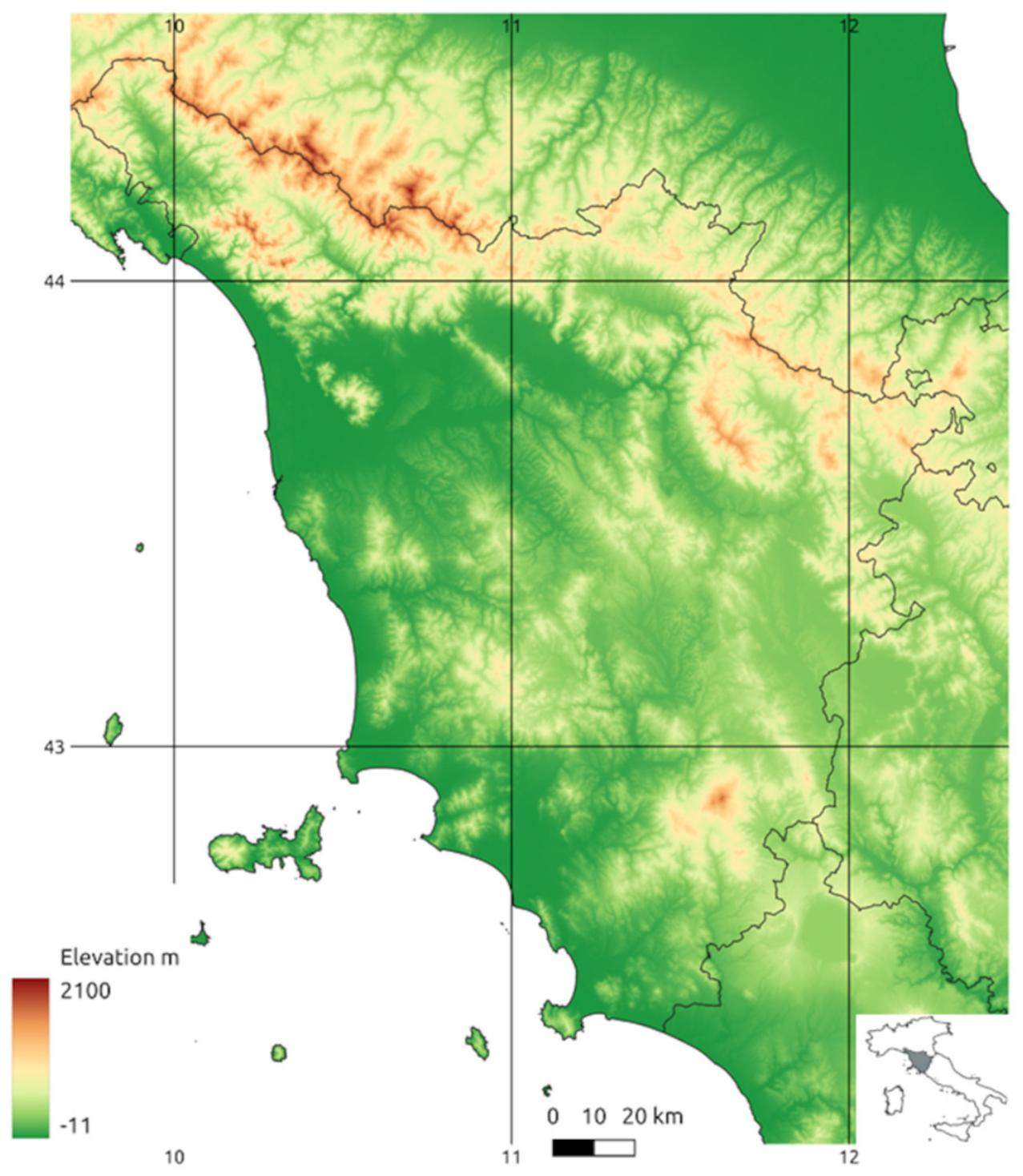
The spatialization was carried out using a DTM (
Supplementary Materials File S1) with a resolution of approximately 200 m for Tuscany and surrounding area (44.5719–42.1323 degrees North and 9.68646–12.474 degrees East, see
Figure 2).
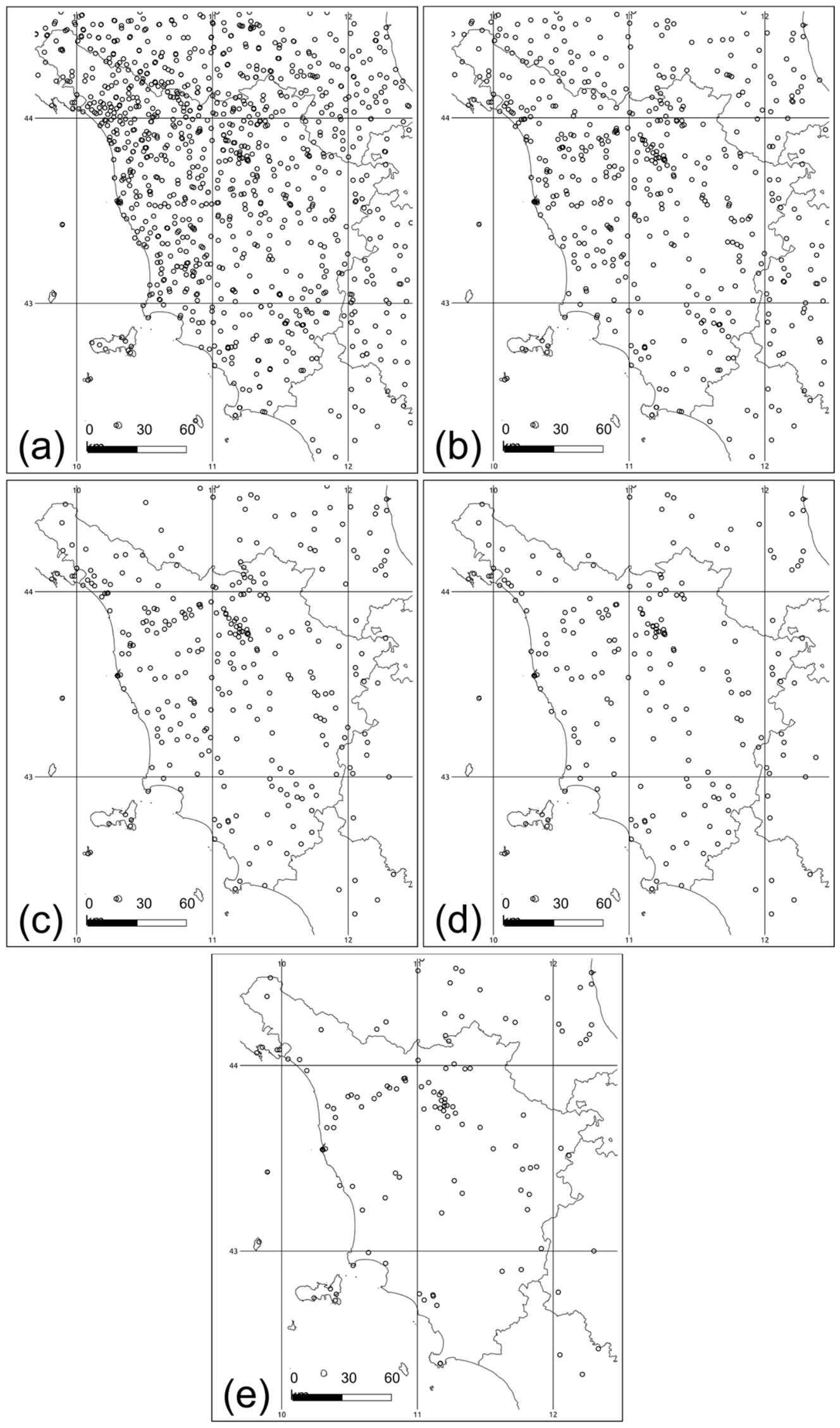
The meteorological data used for calibrating Daymet4-r1 and then comparing the performance of Daymet4-r1 and Daymet4-r2, by means of leave-one-out validation (for each iteration, one station is excluded from the interpolation procedure, the value at the excluded station is estimated using the remaining stations, and the estimated value is then compared with the corresponding observation), spans the 17-year period from 1 January 1995, to 31 December 2011. A total of 1074 stations for precipitation, 525 for temperature, 306 for relative humidity, 127 for atmospheric pressure, and 211 measuring wind speed were used. The number of data points available for each meteorological variable used in the spatialization varies from day to day, depending on the number of operational stations that recorded that variable.
Figure 3 shows the locations of the available stations within the study area, categorized according to the type of sensor they are equipped with.
For the Daymet4-r1 model, a calibration procedure was performed using the MAE (see
Section 2.4), computed through leave-one-out validation, as the objective function to be minimized. A comprehensive grid search was conducted by evaluating all possible combinations of the model parameters within the ranges defined in
Table 1.
Conversely, the Daymet4-r2 model does not require external calibration, as it incorporates an internal optimization routine that automatically adjusts the parameters for each individual time interval. The model was employed directly by providing the parameter configuration specified in
Table 2 to the find_min_global function from the dlib optimization library.
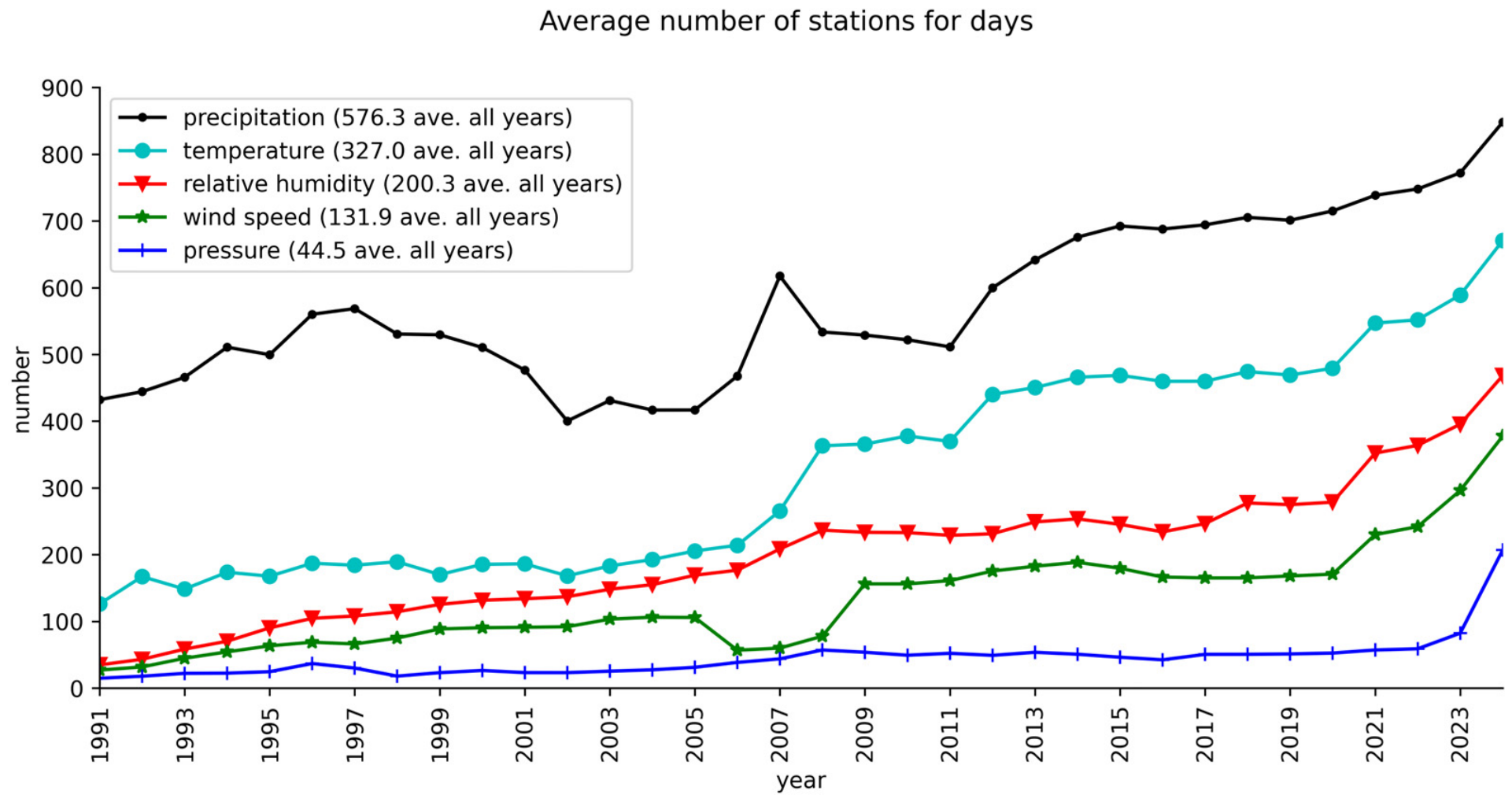
Only for the Daymet4-r2 algorithm, validation was also carried out over a longer and more recent period (1991–2024), both annually and seasonally. The aim was to evaluate its performance, detect seasonal differences, and assess any potential variations over an extended period.
Figure 4 shows the average number of stations for days for each year and meteorological variable used for the validation over the 1991–2024 period. An appreciable variability is observed, along with a trend towards an increase in the number of operational meteorological stations.
2.4. Model Evaluation Metrics
To assess model performance, standard statistical indicators were computed, including MAE, Mean Bias Error (MBE), Root Mean Square Error (RMSE), and Nash–Sutcliffe Efficiency (NSE) [
23,
24]. Let
Oi be the observed value and
Si the simulated (interpolated) value at location or time
i and
n the total number of samples.
MAE measures the average magnitude of the errors, without considering their direction.
MBE indicates the average bias of the model, showing whether it tends to overestimate (positive values) or underestimate (negative values).
RMSE gives greater weight to larger errors, making it sensitive to outliers, and represents the overall magnitude of errors.
where
Ō is the mean of observed values. NSE evaluates the predictive skill of the model relative to the mean of observations, with values ranging from −∞ to 1 (perfect agreement). An NSE value greater than 0 indicates that the model performs better than using the mean of the observations as a predictor.
3. Results
Table 3 reports the optimal parameter values identified through calibration of Daymet4-r1, corresponding to the lowest MAE achieved for each meteorological variable.
Table 4 present annual validation results for both Daymet4-r1 (using calibration-optimized parameters) and Daymet4-r2 across the different meteorological variables from 1995 to 2011.
The validation results for temperature and precipitation obtained over the Tuscany region using both Daymet4-r1 and Daymet4-r2 indicate performance that is generally comparable to, or improved, on respect of the values reported by Thornton et al. [
11] for North America. Specifically, Thornton et al. reported a 40-year average MAE of 1.78 °C for daily minimum temperature, while our corresponding value using Daymet4-r2 is lower at 1.27 °C. For daily maximum temperature, they reported 40-year average MAE ranges between 1.65 and 1.20 °C, compared to a 17-year average of 1.07 °C with Daymet4-r2. Regarding daily precipitation, Thornton et al. documented MAE values between 1.95 and 1.25 mm over 40 years, whereas our average using Daymet4-r2 is 1.27 mm.
The updated version of the spatialization algorithm (Daymet4-r2) shows a prevalence of slightly improved performance compared to the original implementation (Daymet4-r1). The most important improvement is found for minimum temperature. The improvement in minimum temperature prediction is due to the methodological refinement adopted to better capture thermal inversion phenomena.
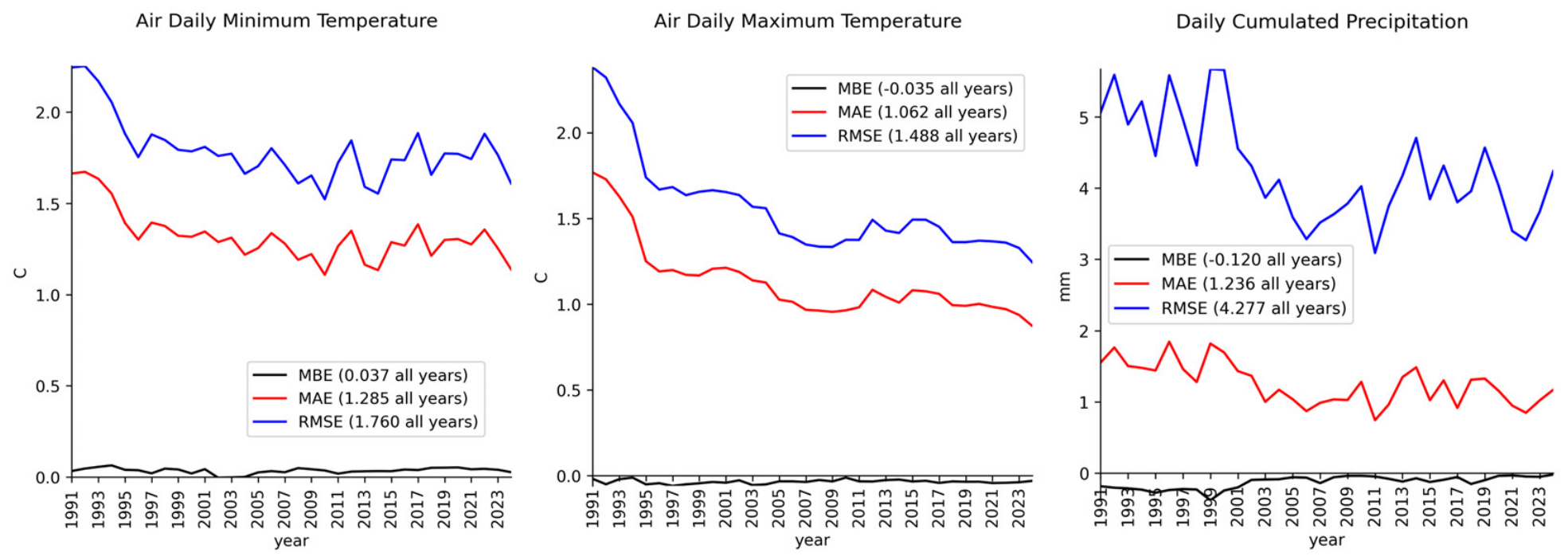
Figure 5 and
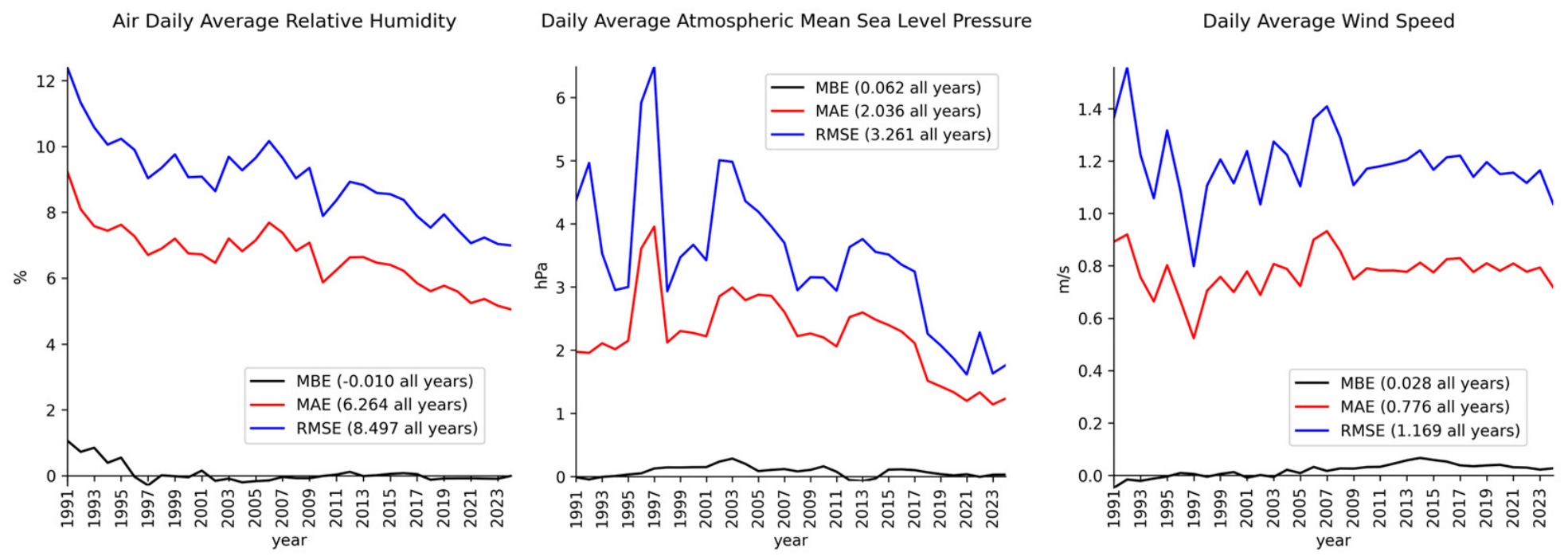
Figure 6 shows the validation results at an annual level over the 1991–2024 period for the six meteorological parameters. These figures reveal a general decreasing trend over time in both MAE and RMSE, likely due to the increased number of meteorological stations used in the spatialization process (
Figure 4).
Table 5 shows the leave-one-out validation results (Daymet4-r2) at seasonal and annual level over the 1991–2024 period.
The validation results at the seasonal level do not differ significantly from those at the annual level (
Table 5,
Figure 5 and
Figure 6). Despite improvements in the spatialization of minimum temperature, the largest errors still occur for minimum temperatures, likely due to the inherent difficulty in accurately representing thermal inversion phenomena.
4. Discussion and Conclusions
The results obtained with the updated Daymet4-r2 algorithm highlight its robustness and suitability for spatializing meteorological variables over regions characterized by complex terrain and heterogeneous observational networks. The introduction of a global optimization procedure, applied independently at each time step, represents a significant methodological advancement over traditional interpolation approaches, including the original Daymet4 structure. Unlike methods that rely on fixed parameters, long-term completeness of station records, or resource-intensive calibration phases, Daymet4-r2 adapts dynamically to the available observations and varying station density, making it highly suitable for real-time operational contexts.
The comparison between Daymet4-r1, Daymet4-r2, and the results reported by Thornton et al. [
11] shows that Daymet4-r2 systematically improves the accuracy of the spatialization across all meteorological variables. The most substantial enhancement is observed for minimum temperature, a variable that is generally affected by strong local-scale variability and nonlinear thermal stratification. The new thermal inversion detection and modelling procedure, introduced specifically for Daymet4-r2, allows the algorithm to capture temperature structures that diverge from the typical lapse-rate assumption. This is particularly important in mountainous and valley environments, where radiative cooling and stagnant air masses frequently produce inversion layers that traditional regression-based interpolation methods fail to represent.
The elimination of a preliminary calibration step brings both conceptual and practical advantages. From a computational perspective, the model avoids the need for extensive parameter tuning over long historical periods. From an operational standpoint, this self-calibrating capability ensures that the algorithm adapts to daily variations in the observational dataset, including temporary station outages or abrupt meteorological anomalies. This makes Daymet4-r2 especially suited for automated workflows in environmental monitoring systems and immediately usable (without calibration) to spatialize new meteorological variables or variables referring to time intervals other than the day used in this article.
In addition, the generality of the approach and its reliance on dynamically available observations indicate that the method may also be applicable to geographical contexts different from the study area considered here.
The extended validation performed over more than three decades (1991–2024) reveals not only consistent performance but also a general reduction in error over time. This trend correlates with the progressive increase in the number of available stations, indicating that Daymet4-r2 is able to effectively leverage denser observational networks without structural modifications to the algorithm. Error reductions are evident for temperature, precipitation, and wind speed, suggesting that the algorithm remains stable even when confronted with changes in network configuration or climatic variability.
Seasonal analyses further demonstrate that performance remains relatively homogeneous throughout the year. While minimum temperature continues to exhibit the largest errors, reflecting the intrinsic difficulty of modelling nocturnal cooling and inversion dynamics, the seasonal differences in error metrics are modest. This consistency is essential for operational applications requiring uninterrupted reliability, such as hydrological risk forecasting, agricultural decision support systems, and climate services.
The overall accuracy and flexibility of Daymet4-r2 make it a strong candidate for integration into a wide range of environmental applications. Its ability to update spatial fields in real time, without relying on fixed station subsets, supports climate and environmental monitoring systems that require continuous and adaptive data inputs. The model’s precise representation of precipitation and temperature fields also enhances hydrological and flood modelling, where accurate spatial patterns are essential for estimating runoff dynamics and assessing hazard scenarios. In agricultural and forestry contexts, the fine-scale characterization of temperature extremes, humidity, and wind speed provides valuable information for crop modelling, irrigation management, and frost-risk analysis. Moreover, the availability of high-resolution gridded datasets makes Daymet4-r2 suitable for numerical weather prediction verification and downscaling, facilitating model evaluation and bias correction. Its implementation in C++, optimized for computational efficiency, further enables seamless integration into operational workflows and high-frequency processing environments.
Although the improvements introduced in Daymet4-r2 are substantial, several avenues for future development remain. The integration of remote sensing products, such as radar-derived precipitation or satellite-based temperature and humidity, could reduce uncertainties in areas with limited observational coverage where the performance of the algorithm is more uncertain, especially in areas with complex terrain or strong local gradients. Hybrid or machine-learning approaches may also enhance the representation of nonlinear processes and spatial patterns beyond what can be achieved through linear regression schemes. Extending the method to additional meteorological variables, including solar radiation, evapotranspiration, and cloud cover, would further broaden its applicability across environmental and agricultural disciplines. Finally, exploring alternative objective functions within the optimization framework could help determine whether minimizing error metrics such as RMSE or maximizing spatial coherence may offer advantages for specific operational or research-oriented applications.
Future work should include a dedicated benchmark against other established methods for complex terrain, such as PRISM (Daly et al. [
25]) and MicroMet (Liston and Elder [
26]), since previous studies have shown that the relative performance of gridded meteorological products can depend strongly on the region, variable, elevation range, and validation design.
In summary, Daymet4-r2 emerges as a modern, accurate, and versatile solution for the spatial interpolation of meteorological variables. Its self-calibrating design, combined with improved modelling of complex terrain processes such as thermal inversions, delivers high reliability without sacrificing computational efficiency. The algorithm performs consistently across seasons, improves over time as observational networks evolve, and is immediately applicable to real-time monitoring systems and climate services. These characteristics make Daymet4-r2 not only an advancement over previous Daymet versions but also a robust framework on which to build future developments in high-resolution environmental data production.