Article

A Transformed Time Conformable-Type Slug Test Solution for Finite-Diameter Wells in Confined Aquifers: Verification, Identifiability, and Field Diagnostics


Department of Water Resources and Environmental Engineering, Tamkang University, New Taipei City 251301, Taiwan
Water 2026, 18(12), 1449; https://doi.org/10.3390/w18121449
Submission received: 7 May 2026 / Revised: 7 June 2026 / Accepted: 10 June 2026 / Published: 12 June 2026
(This article belongs to the Section Hydraulics and Hydrodynamics)

Abstract

Slug test interpretation can fail when measured recovery follows a time scale that differs from the classical Cooper–Bredehoeft–Papadopulos (CBP) finite-diameter well solution. This study derives a conformable slug test formulation by showing that a local weighted derivative converts the governing problem into the classical solution evaluated in transformed time. The formulation therefore does not introduce a nonlocal memory kernel; instead, it provides a reproducible diagnostic with one fitted exponent for testing power law time scaling while retaining the finite-diameter wellbore storage boundary condition. The solution is evaluated using double-precision Stehfest numerical inversion with 12 terms and is verified by the exact classical limit and by sensitivity tests on the number of inversion terms. Type curves, Morris sensitivity indices, objective function slices, synthetic benchmarks, and measured slug test data from the Minnelusa and Madison aquifer system near Spearfish, South Dakota, are used to evaluate the added exponent. A benchmark with an exponent above one recovered fitted exponents of 1.397 without noise and 1.417 under Gaussian noise with a standard deviation of 0.01. Field fitting over exponents from 0.5 to 2.0 reduces root mean square error and information criteria relative to the classical model for the analyzed datasets, especially the LA-88B pressure tests. However, exponents above one are interpreted only as accelerated transformed time behavior, not as conventional fractional orders or unique physical mechanisms. Comparison with a published semi-analytical slug test model that represents near-well formation damage and non-Darcy flow for the same field dataset supports using the conformable exponent as a diagnostic indicator of time-scale mismatch alongside mechanistic slug test models.

1. Introduction

Slug tests are among the most commonly used field methods for estimating hydraulic properties near a well. In a typical test, a known volume of water or a solid slug is introduced into or removed from a well, and the subsequent water-level recovery is recorded. The method is attractive because it is inexpensive, can be performed quickly, and usually avoids the disposal problems associated with pumping tests [1,2,3]. For monitoring wells and contaminated sites, these practical advantages are often decisive.
The interpretation of slug test data depends strongly on the selected conceptual model. The Hvorslev method provides a simple exponential recovery approximation [2], whereas the Cooper–Bredehoeft–Papadopulos (CBP) solution treats the finite diameter of a well and the transient storage response of a confined aquifer [4]. Other models have been developed to address unconfined conditions, partial penetration, skin effects, and inertial or oscillatory responses [5,6,7]. Mechanistic extensions can also represent pressure dependence, near-well formation damage, and nonlinear flow [8]. This literature shows that the observed recovery curve can reflect aquifer properties, wellbore storage, and near-well processes at the same time.
Fractional and related derivatives have been used in hydrology and porous media flow to describe nonclassical time scaling, anomalous recovery, and heterogeneous media behavior [9,10,11,12]. Conformable-type derivatives have also been applied to groundwater flow equations and Theis-type pumping test solutions [13]. Unlike nonlocal Caputo or Riemann–Liouville operators, a conformable derivative can be written as a weighted ordinary derivative [14,15]. This property makes the operator relevant to slug test interpretation as a way to represent transformed time while keeping the governing problem local.
For finite-diameter slug tests, a conformable-type formulation should retain the wellbore storage boundary condition, recover the classical CBP solution as a limiting case, and be evaluated with enough numerical and inverse analysis checks to clarify its practical use. It is also important to compare such a time-scaling formulation with mechanistic slug test interpretations when the same field data show pressure dependence, formation damage, or nonlinear flow effects.
The objective of this paper is to derive and evaluate a conformable-type solution for slug tests in finite-diameter wells in confined aquifers. The analysis derives the transformed time solution from the CBP problem, verifies the numerical inversion, constructs type curves and sensitivity measures, examines parameter identifiability with synthetic benchmarks and field data, and compares the field interpretation with a semi-analytical slug test model for near-well formation damage and non-Darcy flow [8]. These steps establish the intended scope of the conformable exponent as a time-scaling diagnostic within finite-diameter slug test analysis.

2. Materials and Methods

2.1. Physical Problem

The modeled system is a fully penetrating finite-diameter well completed in a homogeneous, isotropic, confined aquifer of infinite radial extent. The aquifer head perturbation is denoted by h ( r , t ) , where r is radial distance from the well axis and t is elapsed time; the well water-level displacement is denoted by H ( t ) . The water level in the well is instantaneously displaced by an initial head change H 0 , and the normalized recovery H ( t ) / H 0 is monitored through time. The well radius at the aquifer is denoted by r w , the casing radius controlling wellbore storage by r c , transmissivity by T, and storativity by S. This is the standard finite-diameter confined aquifer slug test setting used by the CBP solution, with the ordinary time derivative replaced by a conformable derivative.

2.2. Conformable Derivative and Transformed Time

For a differentiable function f ( t ) and positive exponent γ , the weighted time derivative used here is
D t γ f ( t ) = t 1 γ d f ( t ) d t .
Introducing the transformed time
θ = t γ γ
gives d θ / d t = t γ 1 , and therefore
D t γ f ( t ) = d f d θ .
Equations (2) and (3) show that the conformable model is an ordinary transient flow problem in the transformed time θ .
For 0 < γ 1 , Equation (1) follows the common conformable derivative convention. The inverse fits in this study also allow γ > 1 as an extended positive power law time-scaling exponent. This extension is used only diagnostically. Because θ = t γ / γ is monotone increasing for every γ > 0 , the transformed time CBP solution remains well defined for positive elapsed time. However, the coefficient t 1 γ is singular at t = 0 when γ > 1 , so the initial condition is interpreted in the limiting sense θ 0 + , and the model is fitted only to measured positive elapsed time values. Thus, γ > 1 denotes accelerated transformed time behavior and is not interpreted as a conventional fractional order.

2.3. Governing Equation and Boundary Conditions

The conformable radial groundwater flow equation is
2 h r 2 + 1 r h r = S T D t γ h , r > r w , t > 0 .
This equation is obtained by replacing the ordinary storage derivative in the confined aquifer diffusivity equation with the local weighted derivative D t γ . Using Equation (3), Equation (4) becomes
2 h r 2 + 1 r h r = S T h θ .
Equation (5) has the same conservative radial diffusion form as the classical CBP equation; storage and radial flux are therefore balanced in transformed time. The initial and far field conditions are
h ( r , 0 ) = 0 , h ( , θ ) = 0 .
The well and aquifer head continuity condition is
h ( r w , θ ) = H ( θ ) ,
and the finite-diameter wellbore storage condition is
2 π r w T h r r = r w = π r c 2 d H d θ .
Equation (8) preserves the classical finite-diameter well storage balance in transformed time; the model changes the time variable without changing the CBP well boundary physics. The initial well water-level displacement is
H ( 0 ) = H 0 .

2.4. Laplace Space Solution

Let the Laplace transform be taken with respect to the transformed time θ , and let p be the Laplace variable. The transformed radial flow equation is
d 2 h ¯ d r 2 + 1 r d h ¯ d r q 2 h ¯ = 0 , q = p S T 1 / 2 .
The square root is evaluated on the principal branch, with Re ( q ) > 0 for the positive real Laplace variables used in the Stehfest inversion. This radial equation has modified Bessel basis functions. The far field condition requires the transformed head to remain bounded and decay as r ; the growing basis function is therefore omitted, leaving a radial dependence proportional to K 0 ( q r ) . Applying the wellbore storage condition gives the transformed CBP solution
h ¯ ( r , p ) = r w S H 0 K 0 ( q r ) T q r w q K 0 ( q r w ) + 2 β K 1 ( q r w ) ,
Equation (11) is the transformed time CBP head solution in Laplace space and is the basis for computing the normalized well response. Here K 0 and K 1 are modified Bessel functions of the second kind of orders zero and one, respectively; K 1 enters through the radial derivative of K 0 in the wellbore storage flux condition. The storage ratio in Equation (11) is
β = r w 2 S r c 2 .
The well response is obtained by setting r = r w . The conformable slug test response in physical time is therefore
H γ ( t ) H 0 = L p θ 1 h ¯ ( r w , p ) H 0 θ = t γ / γ .
When γ = 1 , θ = t , and Equation (13) reduces exactly to the classical CBP finite-diameter well solution.

2.5. Numerical Evaluation

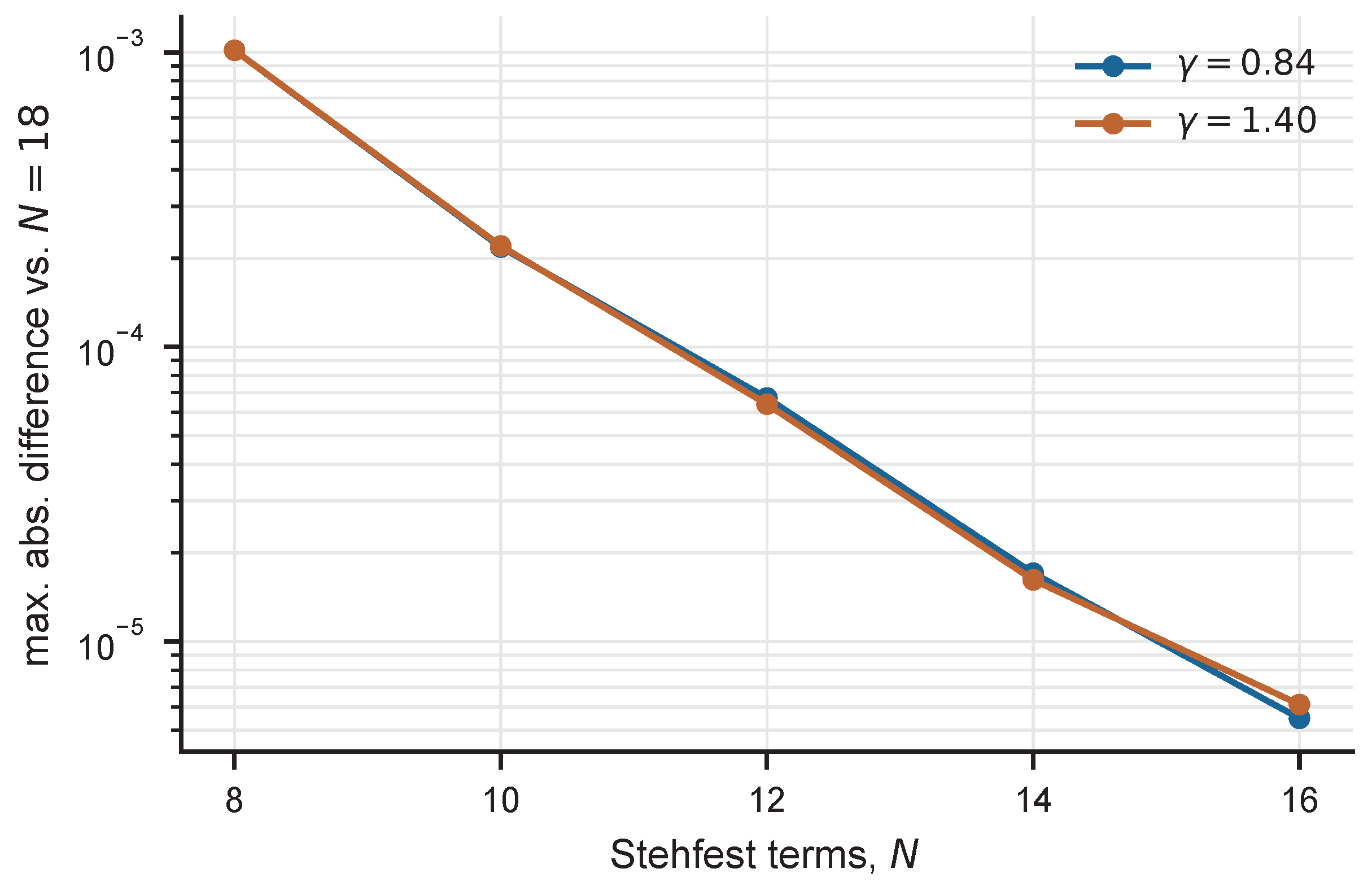
Equation (13) was evaluated using the Stehfest numerical inverse Laplace transform. The baseline implementation used N = 12 Stehfest terms in double-precision arithmetic for all classical and conformable curves. The implementation was checked by verifying that γ = 1 gives the same response as the classical CBP solution to numerical precision. Additional Stehfest checks were performed with N = 8 , 10 , 12 , 14 , 16 , and 18, using N = 18 as the reference. For N = 12 , the maximum absolute response difference relative to N = 18 is 6.71 × 10 5 for γ = 0.84 and 6.39 × 10 5 for γ = 1.40 ; increasing to N = 16 reduces these values to approximately 5– 6 × 10 6 . The baseline parameters used for the type curve and Morris sensitivity calculations are listed in Table 1.
Measured slug test data were also analyzed to evaluate whether the conformable exponent is supported by field observations. The data were taken from Greene et al. [16], who reported air-pressurized slug tests at wells LA-87B, LA-88B, and LA-88A in the Minnelusa and Madison aquifer system near Spearfish, South Dakota. The digitized dataset used here contains the normalized recovery values shown as measured points by Lin and Yeh [8]. The five fitted series are LA-87B, LA-88A at 100% of equilibrium water-level displacement, and LA-88B at 5, 12, and 30 psi. The conformable and classical models were fitted separately to each measured series using the measured H / H 0 values and elapsed time in seconds. The three LA-88B pressure levels were therefore treated as separate field tests, not as a single pooled recovery curve. For field data inversion, T was searched over 10 8 to 1 m2 s−1, S was constrained to 10 12 S 0.1 , and γ was searched over 0.5 γ 2.0 to allow both delayed and accelerated transformed time behavior. The upper storativity bound is intentionally permissive for slug test inversion, because Greene et al. [16] reported that the LA-87B type curve storativity estimate of 0.1 was already unrealistically high for a confined aquifer.
The objective function was the sum of squared residuals in normalized recovery. Model performance was summarized with RMSE, mean absolute error (MAE), Akaike information criterion (AIC), small-sample-corrected AIC (AICc), and Bayesian information criterion (BIC). The number of fitted parameters was k = 2 for the classical CBP model and k = 3 for the conformable model. As a simpler empirical comparator, the classical model was also fitted with a single linear time-scale factor, H ( t ) / H 0 = H CBP ( t / τ ) / H 0 . This baseline tests whether a single constant time rescaling explains the field residuals as well as the power law transformation θ = t γ / γ . The comparison separates a constant clock rate correction, t / τ , from the nonlinear power law time transformation, t γ / γ , which changes the relative spacing of early and late recovery times.
The pressure-dependent field tests were also compared with a semi-analytical slug test model for near-well formation damage and non-Darcy flow [8]. That model was applied to the same Greene et al. [16] field tests and represents formation damage as an additional head loss near the well screen and non-Darcy nonlinear flow through a Forchheimer relation. Because the published paper provides summary errors but not residual vectors for all curves, the comparison reports the standard error of estimate (SEE) and mean error (ME) from that model alongside the present reanalysis RMSE and MAE. AICc and BIC are not reported for the Lin and Yeh [8] model because the necessary residual vectors and identical likelihood basis are not available from the paper.
All calculations and figures were generated with Python 3 using NumPy, SciPy, pandas, matplotlib, and the official cmcrameri scientific colormaps.
The numerical SEE/ME pairs reported for that semi-analytical model [8] are restated in Table 2 so that the comparison is complete within the study.
Case 3 of the semi-analytical model in Lin and Yeh [8] includes both formation damage and non-Darcy flow and is used as the mechanistic comparator when the field results are discussed.

2.6. Sensitivity and Identifiability Analysis

Global sensitivity was evaluated with a Morris design based on elementary effects. The sampled inputs were log 10 T , log 10 S , and γ , with ranges 10 5 T 10 3 m2 s−1, 10 5 S 10 3 , and 0.5 γ 2.0 . For each parameter and each elapsed time, the elementary effects were summarized by the absolute mean μ and standard deviation σ :
μ i ( t ) = 1 N j = 1 N E E i , j ( t ) , σ i ( t ) = 1 N 1 j = 1 N E E i , j ( t ) E E ¯ i ( t ) 2 1 / 2 .
Here, E E i , j ( t ) is the Morris elementary effect for parameter i from trajectory j. The index μ represents the overall influence of a parameter on the recovery curve, while σ indicates nonlinearity or interaction with other parameters. Parameter identifiability was examined with a benchmark response generated by the conformable solution with γ = 0.84 and no added noise. This value was selected only to create a controlled, visibly nonclassical recovery curve that remains close enough to the classical case for a meaningful comparison; it was not estimated from the field data. The benchmark was then fitted with two models: the classical CBP model with γ = 1 , and the conformable CBP model with T, S, and γ estimated simultaneously. This is a numerical benchmark, not a field dataset.
Next, the benchmark set was further extended to include a γ = 1.40 case to match the accelerated transformed time regime found in several field fits. This second benchmark was evaluated both without added noise and with additive Gaussian noise of standard deviation 0.01 in normalized recovery. These cases test whether the inversion can recover both delayed and accelerated power law time scaling and whether measurement noise changes the model comparison.

3. Results

3.1. Effect of the Conformable Exponent

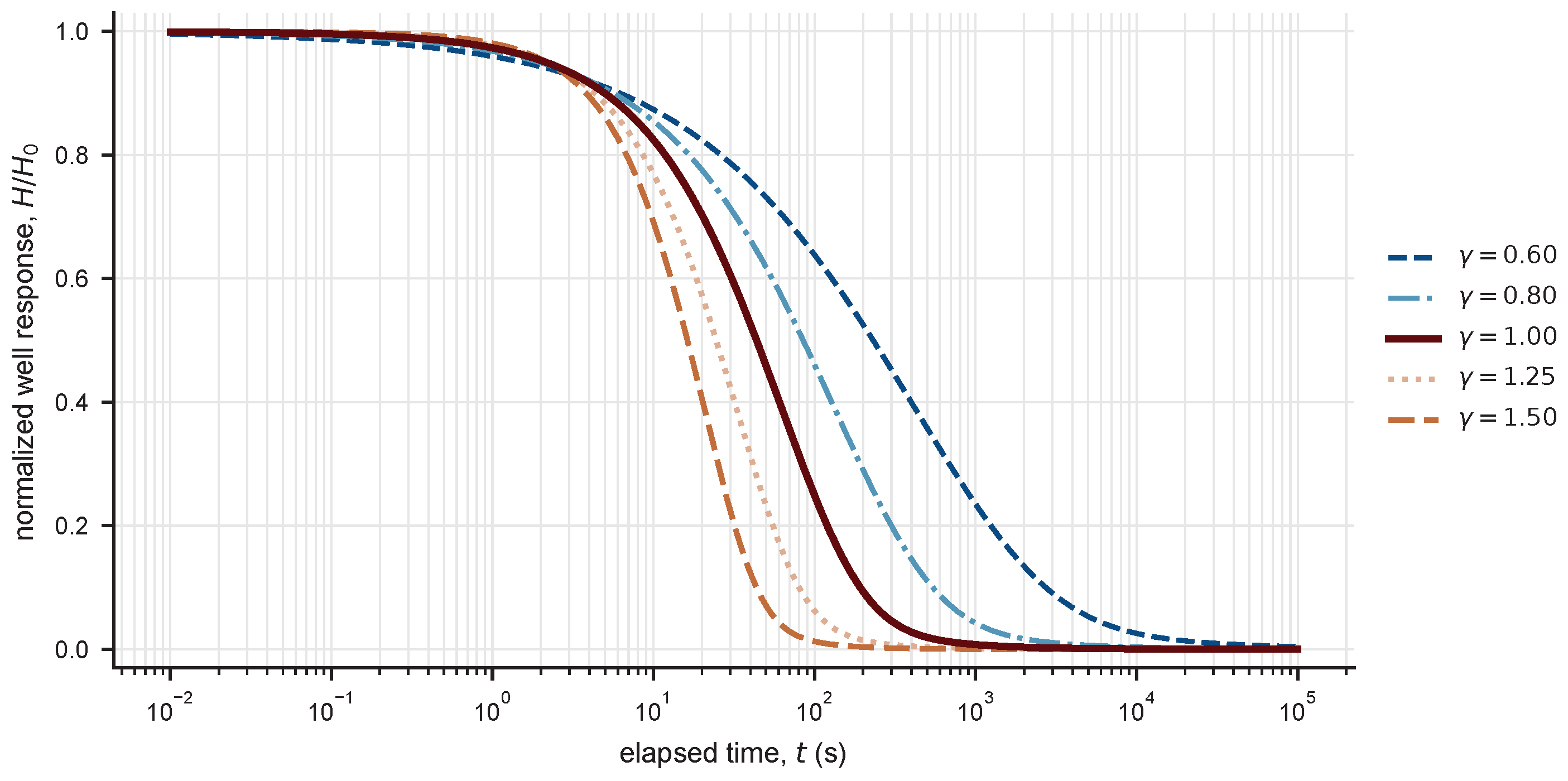
Figure 1 shows normalized recovery curves for different values of γ . The exponent changes the effective recovery time through θ = t γ / γ . For the baseline parameters, γ < 1 delays the main recovery transition in physical time, whereas γ > 1 accelerates it over the measured time range. The difference among curves is small at very early time, where the response remains close to H / H 0 = 1 , and at very late time, where the response approaches zero. The largest separation occurs during the main recovery interval.

3.2. Wellbore Storage Effect

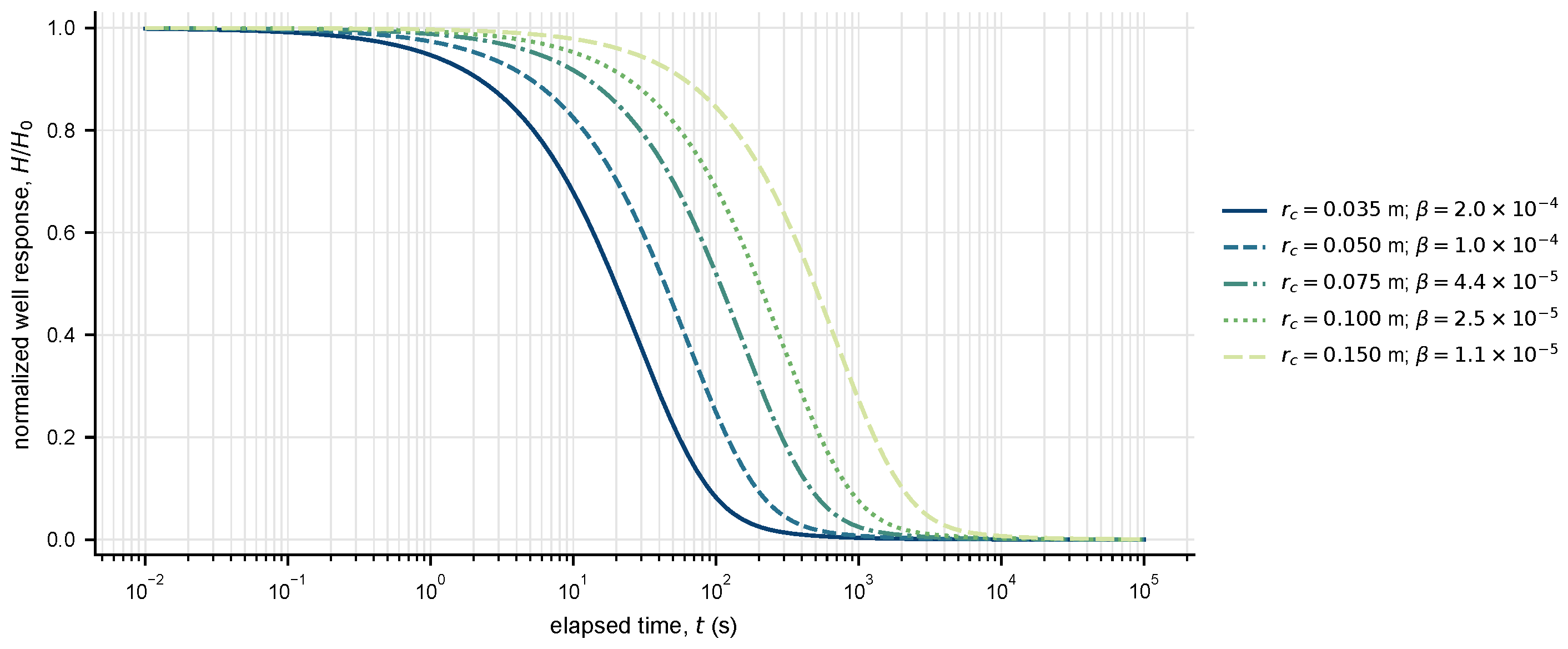
The CBP storage ratio β = r w 2 S / r c 2 controls the relative importance of aquifer storage and wellbore storage. Figure 2 fixes γ = 1 so that the storage effect can be viewed without adding a separate time-scaling effect. The figure shows that changing the casing radius modifies the recovery curve even when aquifer properties are fixed. Larger casing radius increases the wellbore water volume that must be equilibrated, producing a slower normalized recovery. This behavior is inherited directly by the conformable solution because the model retains the finite-diameter well boundary condition.

3.3. Morris Sensitivity Behavior

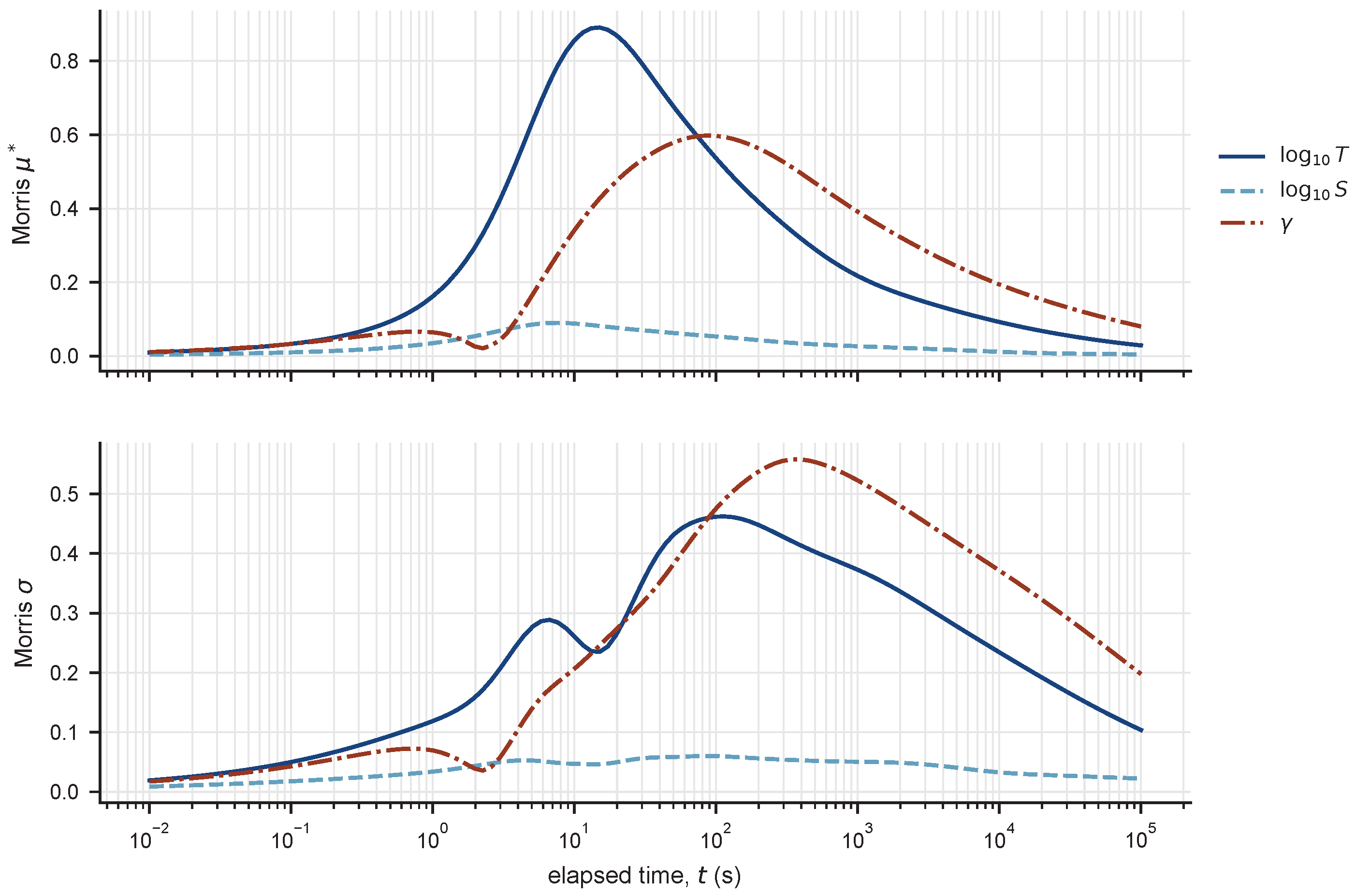
Figure 3 presents the Morris μ and σ indices for T, S, and γ as functions of elapsed time. The indices are small at very early and very late times because the recovery curve is nearly flat in those intervals. The strongest Morris effects occur during the main recovery transition. The exponent γ has a response pattern comparable to the hydraulic parameters over part of this interval, indicating that it is not merely a passive curve fitting parameter. The simultaneous increase in σ also shows that parameter effects are nonlinear and can interact during inverse analysis. This interaction explains why the identifiability analysis includes objective function slices involving γ rather than treating the exponent as an independent linear scaling factor.

3.4. Parameter Identifiability

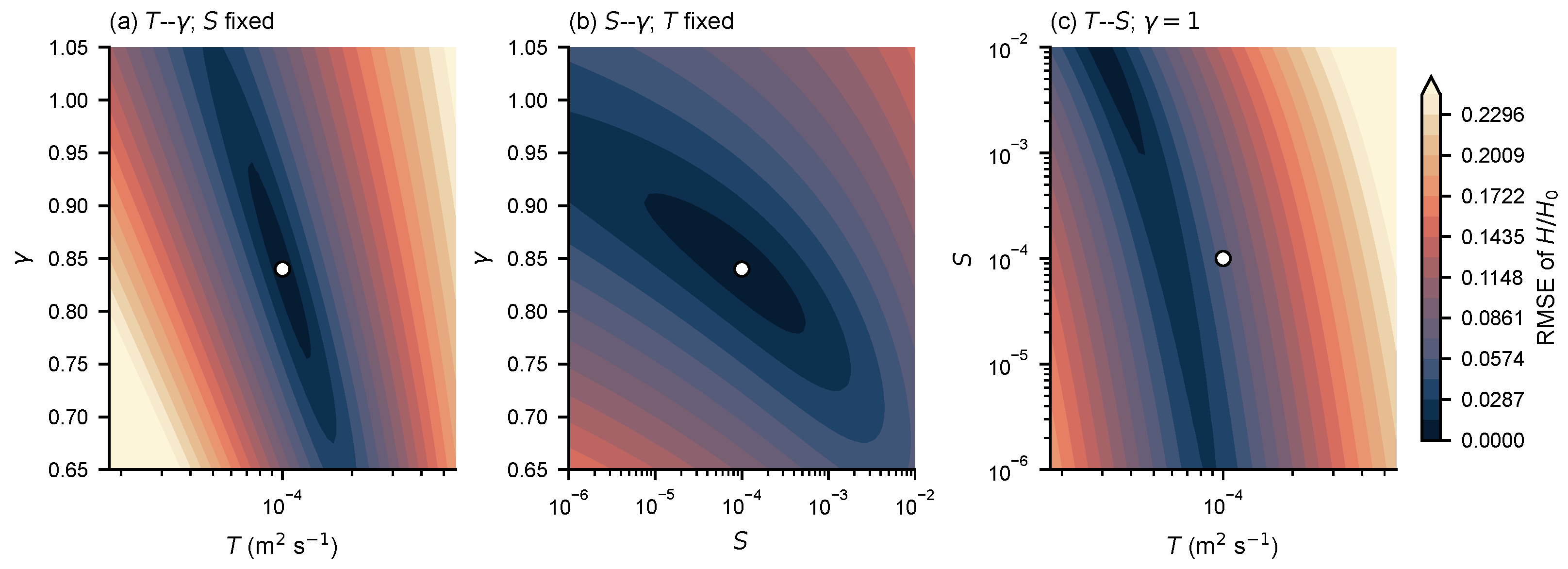
The objective function slices in Figure 4 show the RMSE between the benchmark response and model responses over three two-parameter planes. The ( T , γ ) and ( S , γ ) slices contain elongated low-error regions, indicating that both hydraulic parameters can partially compensate for the conformable exponent. The ( T , S ) slice further shows the familiar storage–transmissivity tradeoff in finite-diameter slug test interpretation. These surfaces do not provide formal confidence intervals, but they identify the main inverse problem risk: estimating T, S, and γ jointly from one recovery curve can be weakly constrained unless the data cover the main recovery transition and independent bounds are available.

3.5. Benchmark Fitting Comparison

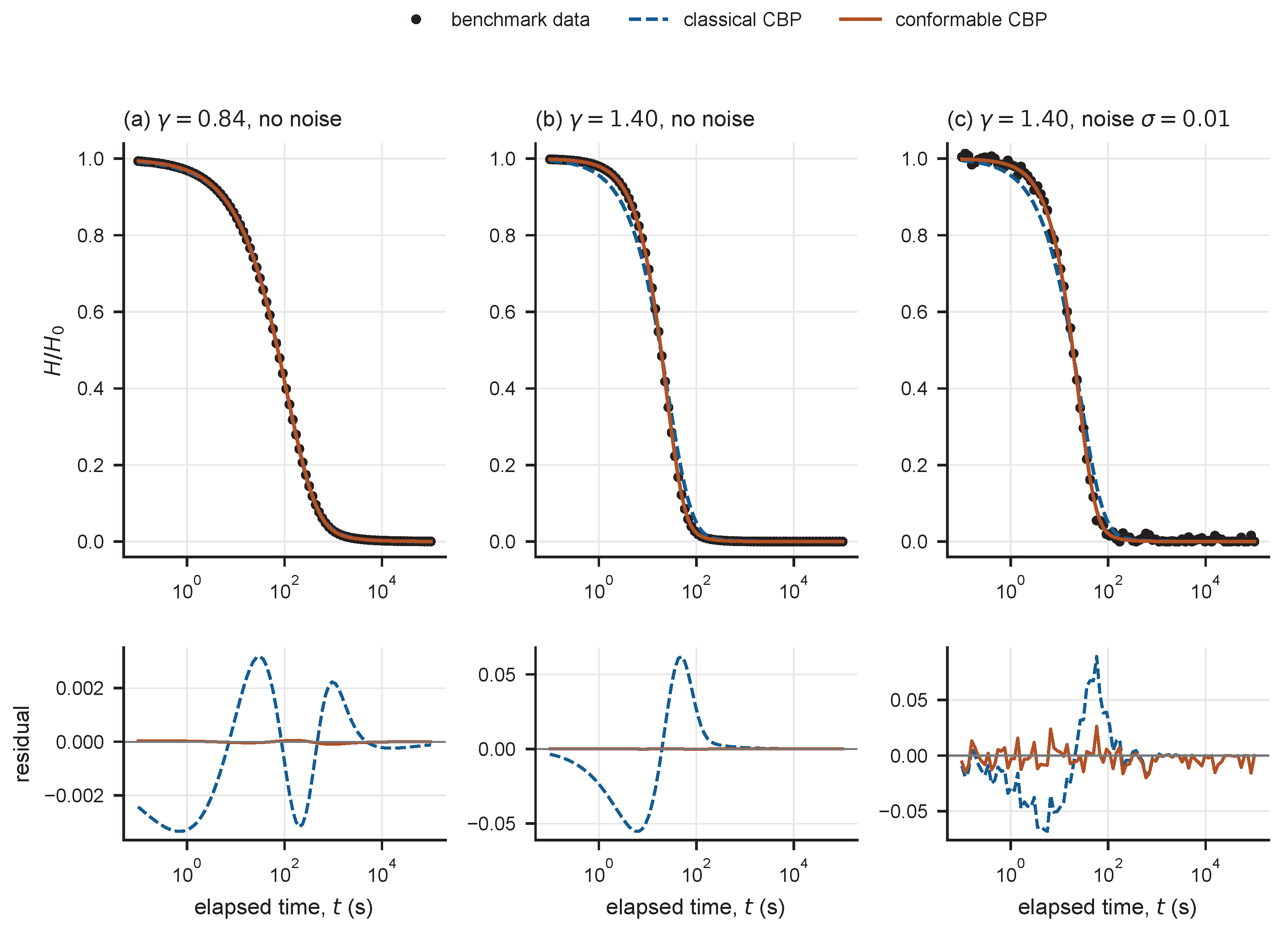
Figure 5 compares benchmark responses with fitted classical and conformable models for delayed and accelerated transformed time cases. The conformable model reproduces the benchmark responses with very small residuals in the cases without noise. The classical CBP model can approximate the overall recovery but leaves structured residuals, especially across the main transition interval. The noisy γ = 1.40 benchmark shows that noise increases residual scatter but does not remove the systematic advantage of the conformable fit.
Table 3 reports the fitted parameters and fit statistics for the same benchmark cases. The conformable fits recover the imposed delayed and accelerated exponents closely ( γ = 0.838 , 1.397, and 1.417), whereas the classical fits compensate through shifted T and S values and retain larger RMSE, especially for the γ = 1.40 benchmarks.
Figure 6 summarizes the Stehfest term sensitivity check. Relative to the N = 18 reference, the baseline N = 12 inversion differs by less than 7 × 10 5 in maximum absolute response for both the delayed and accelerated benchmark cases. These differences are smaller than the field data residuals and do not explain the structured residual reduction produced by the conformable fits.

3.6. Field Data Application

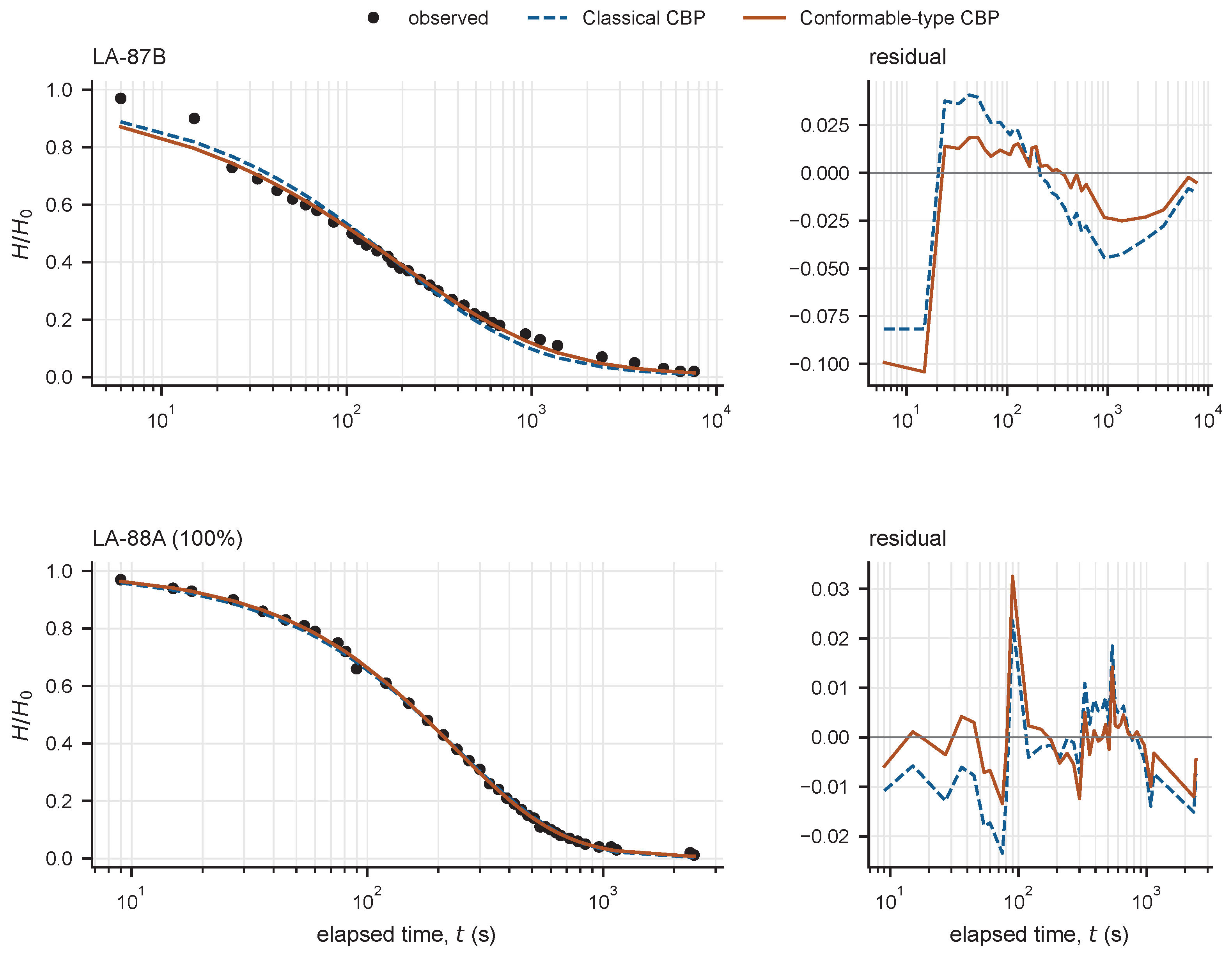
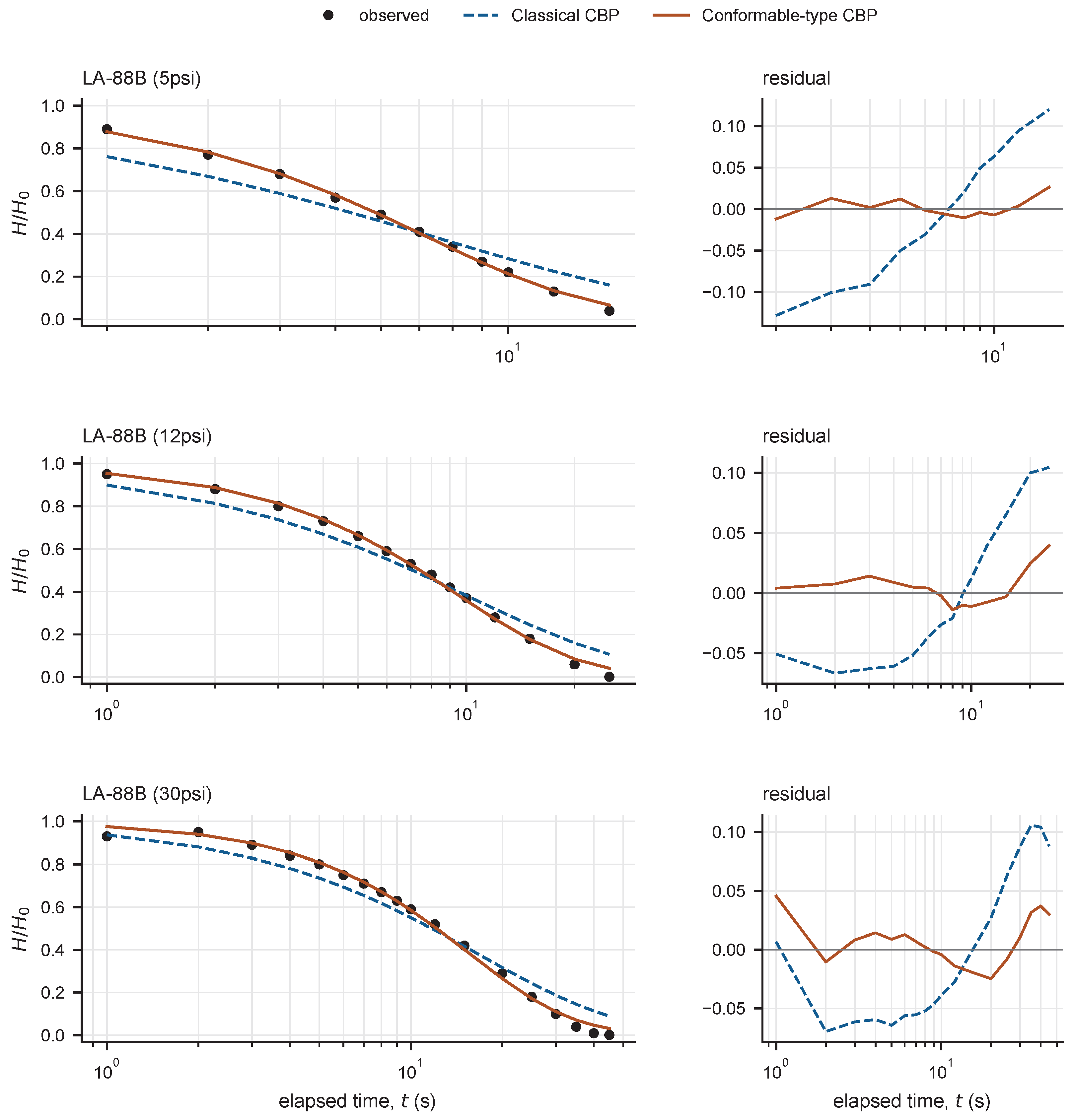
Figure 7 and Figure 8 compare measured normalized slug test recoveries from Greene et al. [16] with fitted classical and conformable CBP curves. The LA-87B and LA-88A data are reproduced reasonably well by the finite-diameter model. The three LA-88B pressure cases were fitted separately. They show larger residuals than LA-88A because the observed responses are pressure dependent and more scattered. The conformable exponent can shift the recovery time scale and reduce systematic residuals, but it cannot explicitly represent pressure-dependent mechanisms such as nonlinear head loss, formation damage, or air pressurization effects.
The fitted field data parameters and metrics are summarized in Table 4. The conformable model reduces RMSE, AICc, and BIC for all five measured series, with the largest improvement for the LA-88B pressure tests. For example, the LA-88B 5 psi series has n = 11 ; even after the small-sample correction, AICc decreases from −50.34 for the classical model to −89.25 for the conformable model, and BIC decreases from −51.05 to −91.48. The fitted T and S values should be interpreted as effective parameters for the normalized recovery curves under the assumed finite-diameter well geometry. Several classical fits reach the imposed storativity bounds, which indicates weak storage identifiability rather than physically meaningful storativity. Table 5 gives the constrained storativity check with 10 6 S 10 3 ; the conformable model retains lower RMSE and AICc for all five series, but several estimates still lie near the imposed storage bounds. A simpler empirical model with one constant time-scale factor, t / τ , gives RMSE values essentially identical to the classical CBP fits and therefore does not explain the LA-88B residual reduction. For LA-88B at 5, 12, and 30 psi, the constant scale model gives RMSE values of 0.0790, 0.0578, and 0.0631, respectively, which are the same as the classical CBP values at the reported precision; the conformable RMSE values are 0.0113, 0.0148, and 0.0203. This result indicates that the improvement is not produced by a constant time-scale correction alone.
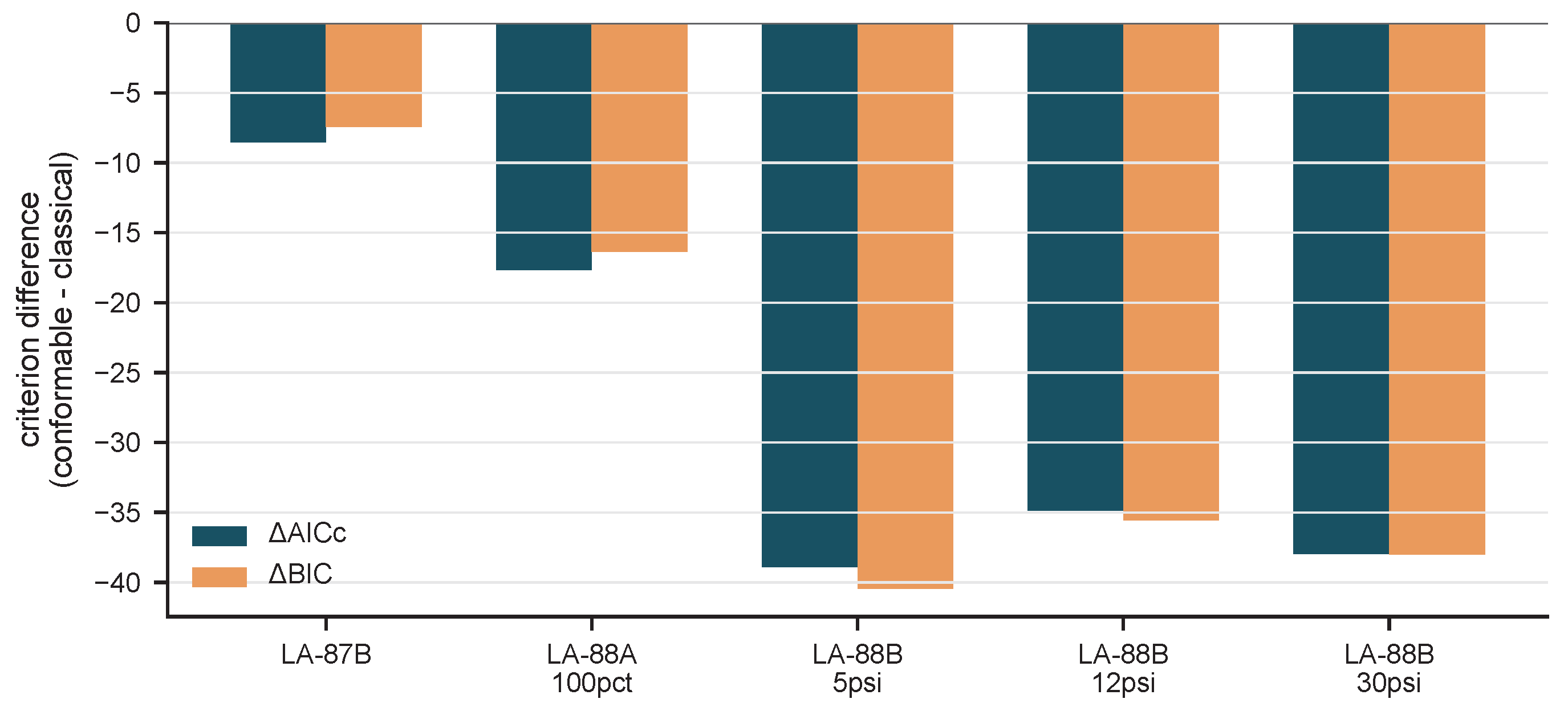
Figure 9 shows the AICc and BIC differences between the conformable and classical fits. Negative values indicate that the conformable model is preferred after the additional fitted parameter is penalized. The small-sample correction is strongest for LA-88B 5 psi, but it does not change the model selection conclusion for the analyzed cases.
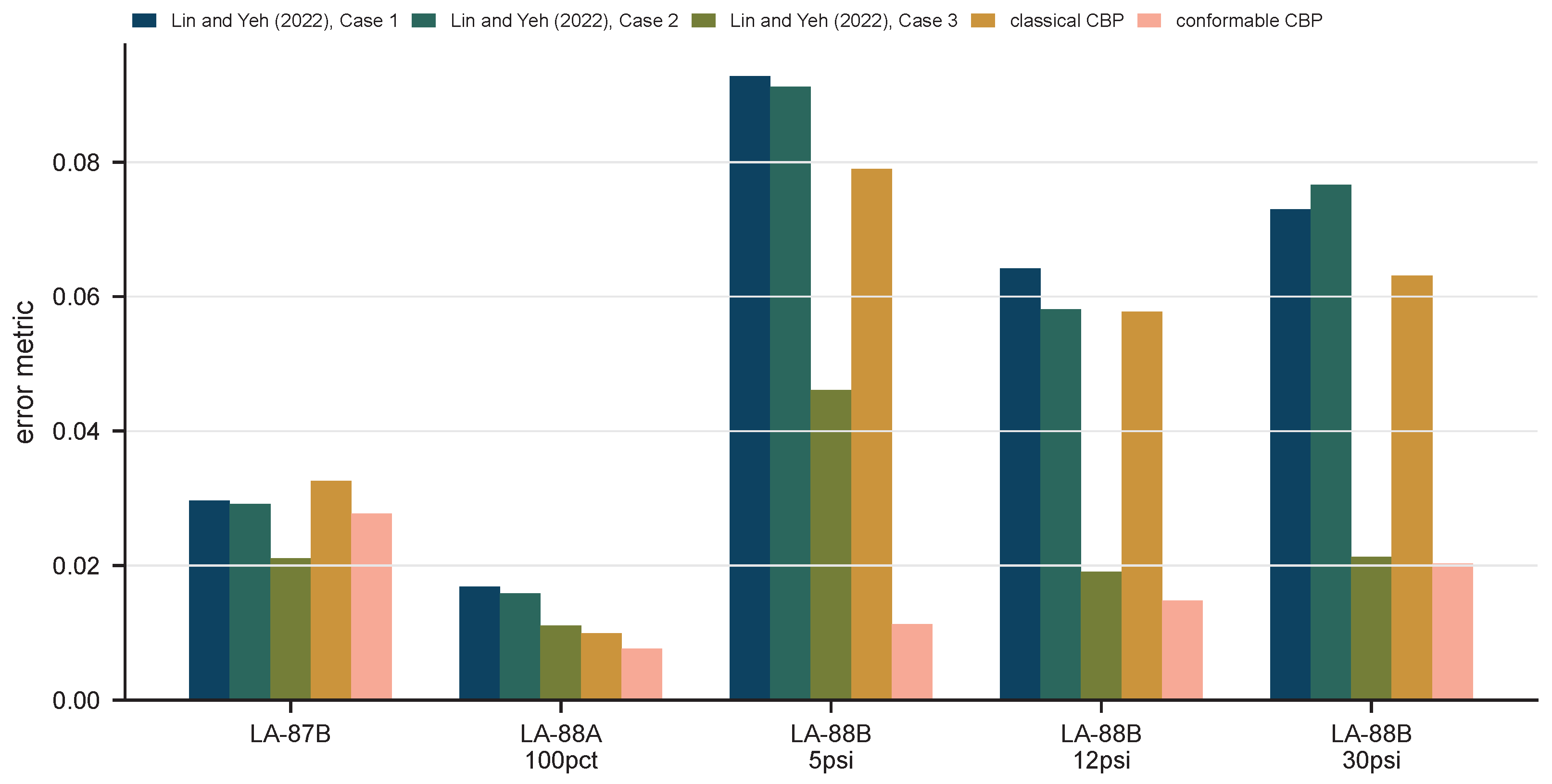
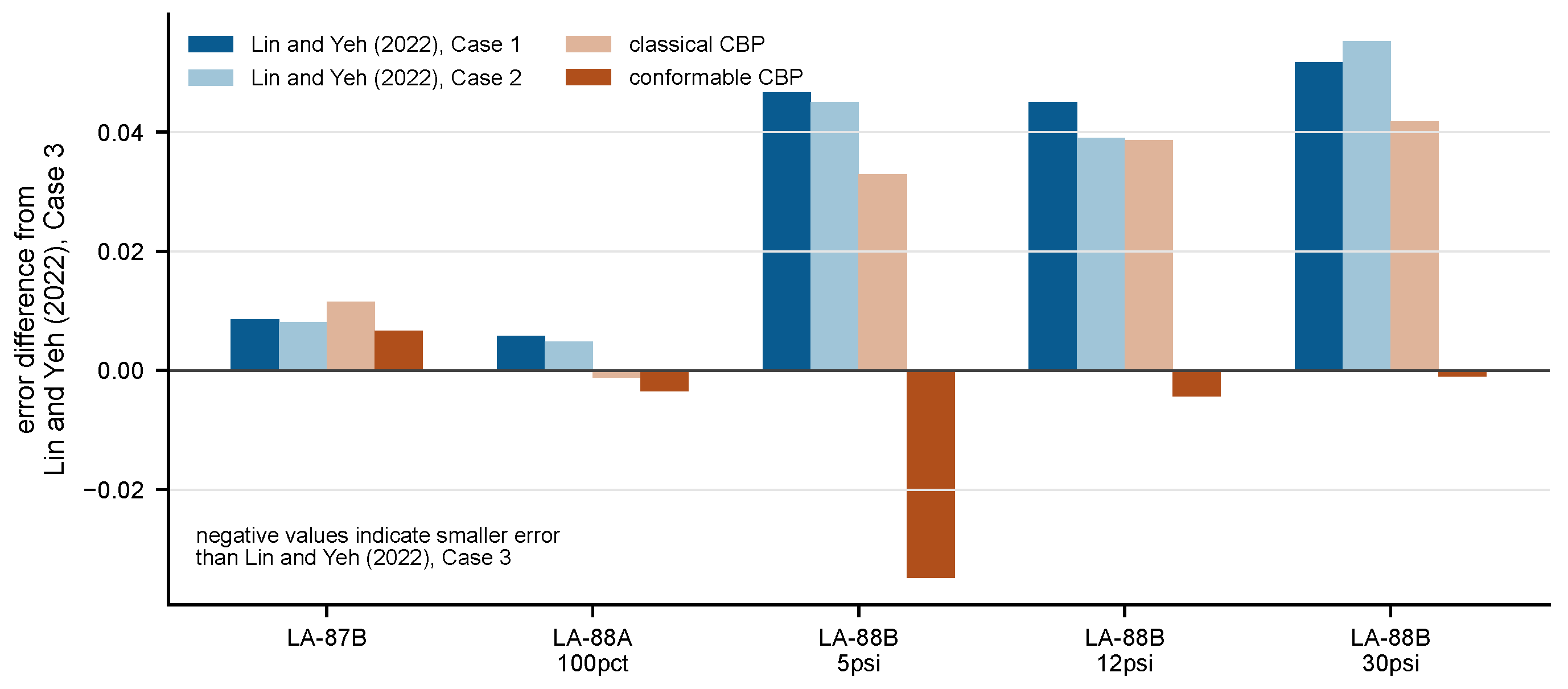
The LA-88B results are interpreted together with the semi-analytical slug test model for near-well formation damage and non-Darcy flow [8]. Case 3 of that model includes both formation damage head loss and non-Darcy nonlinear flow and markedly reduces SEE for the pressure-dependent tests relative to Cases 1 and 2. Figure 10 compares the SEE values reported for that mechanistic model with the RMSE values from the conformable and classical CBP fits in this study. The error metrics are not identical, so the comparison should be read as a scale comparison rather than a likelihood-based model selection. Figure 11 shows that the conformable RMSE is close to the Case 3 SEE for LA-88B 5 and 30 psi and is lower than the Case 3 SEE for LA-88B 12 psi, whereas the classical CBP RMSE is much larger for the pressure tests. Together, these comparisons indicate diagnostic value for the fitted exponent without assigning a unique mechanism. Large departures of γ from one should direct attention to mechanistic explanations such as formation damage, nonlinear flow, pressure dependence, or effects specific to each field test.

4. Discussion

The key step in the derivation is applying the local weighted derivative consistently to the aquifer diffusion equation and to the wellbore storage boundary condition. This keeps the finite-diameter well problem intact and does not replace it by a simple exponential recovery model. The result is a transformed time CBP solution rather than an empirical curve shift. The formulation is also equivalent to evaluating the classical CBP response at θ = t γ / γ , so its novelty should be understood as a governed time transformation diagnostic, not as a new nonlocal fractional flow theory. This distinction separates the analytical formulation, which is a CBP response in transformed time, from the data analysis question of whether a constant rescaling t / τ is already sufficient for the measured residual patterns.
These results clarify how the conformable exponent should be interpreted. Because the conformable derivative is equivalent to an ordinary derivative in transformed time, the exponent mainly changes the time scale of recovery. It does not by itself identify the physical cause of nonideal recovery. Field responses affected by inertial oscillation, well skin, turbulent head loss, partial penetration, unconfined drainage, formation damage, or nonlinear flow may all deviate from a classical curve, but those mechanisms require their own physical models [5,6,7,8]. Therefore, the conformable model is best presented as a diagnostic interpretation tool, while mechanistic explanations require models that represent the corresponding field processes.
The Morris sensitivity results indicate that γ can be estimable when measurements cover the main recovery transition. Data concentrated only at very early or very late time will provide limited information about γ , T, or S. This conclusion is consistent with broader slug test literature showing that parameter estimates depend on the information content of the observed response and that storage parameters are often difficult to estimate from single-well slug tests [17,18].
The field data application clarifies the practical role of the conformable exponent. When the inverse search is restricted to the conventional 0 < γ 1 range, most field cases return γ 1 and the classical model is preferred. When the range is extended to 0.5 γ 2.0 , the fitted field exponents shift above one and the residuals decrease substantially, especially for LA-88B. This pattern is consistent with a useful time-scaling diagnostic while limiting the physical interpretation of exponents greater than one. The three LA-88B pressure cases further show that pressure-dependent behavior is present. The fitted γ values for LA-88B are not monotonic with applied pressure (1.681, 1.411, and 1.419 at 5, 12, and 30 psi), so the exponent is not a direct pressure calibration parameter; the nonmonotonic pattern is itself a diagnostic sign of combined effects in the field tests. Case 3 of the semi-analytical model in Lin and Yeh [8] attributes much of this behavior to near-well formation damage and non-Darcy nonlinear flow. The conformable model can reproduce the recovery time scale with one extra exponent, but it does not identify the same physical mechanisms.
The benchmark fitting exercise also highlights a practical risk. If a recovery curve follows a conformable time scale but is interpreted with the classical CBP model, the fitted transmissivity and storativity can be biased. In the delayed benchmark, the classical fit achieved a visually reasonable curve but required a much smaller transmissivity and a much larger storativity than the generating values. In the accelerated benchmark, the classical fit shifted transmissivity upward and pushed storativity toward a lower bound. Such compensation is not unique to conformable models; it is a common inverse problem in aquifer test analysis. The conformable exponent therefore should be fitted only when the dataset has sufficient temporal coverage and when the added parameter is justified by residual structure, information criterion improvement, or independent field evidence.
The identifiability and constrained storativity checks limit the strength of the field interpretation. The objective function slices show that T, S, and γ are not fully orthogonal parameters. The constrained storativity sensitivity analysis shows that the conformable model still reduces RMSE when S is restricted to 10 6 S 10 3 , but some estimates remain near storage bounds. This means that the exponent can improve curve description while storage remains weakly identified. Future applications should therefore use independent hydraulic property information or constraints from multiple tests before assigning physical meaning to fitted T, S, or γ values.

5. Conclusions

This study derived a conformable-type finite-diameter slug test solution for confined aquifers by applying a local weighted derivative to both the radial aquifer flow equation and the wellbore storage boundary condition. The resulting solution is the classical CBP solution evaluated in transformed time, θ = t γ / γ , and it reduces exactly to the CBP solution when γ = 1 .
Type curves show that the conformable exponent mainly affects the timing and shape of the main recovery transition. Morris sensitivity analysis shows that the exponent can strongly influence recovery over the same time interval where transmissivity and storativity are informative. Benchmark inverse analyses show that ignoring conformable recovery can bias classical estimates of T and S, while fitting the conformable solution can recover both delayed ( γ < 1 ) and accelerated ( γ > 1 ) transformed time benchmarks. Stehfest term sensitivity tests indicate that the baseline N = 12 inversion is stable at the accuracy required for the plotted and fitted curves.
The field data application showed that the conformable exponent should be treated as a diagnostic rather than an automatically preferred physical parameter. With the extended inverse range 0.5 γ 2.0 , the Greene et al. measured data are fitted better by dataset-specific transformed time exponents, especially for the three LA-88B pressure tests. These values indicate accelerated transformed time behavior relative to the classical CBP model. However, comparison with a semi-analytical model for formation damage and non-Darcy flow [8] shows that improved conformable fits do not by themselves provide mechanistic interpretation. The proposed model is therefore a rigorous time-scaling extension of the finite-diameter confined aquifer slug test solution and should be paired with mechanistic models when inertial effects, skin effects, nonlinear flow, pressure dependence, formation damage, or unconfined drainage are known to dominate the observed response.

Funding

This research was funded by the National Science and Technology Council, Taiwan, under grant number NSTC 114-2625-M-032-006.

Data Availability Statement

The field data application uses normalized slug test recovery values reported by Greene et al. [16] and reproduced as measured points by Lin and Yeh [8]. Processed data and analysis scripts are available from the author upon reasonable request.

Acknowledgments

The author acknowledges Tamkang University for institutional support and the National Science and Technology Council, Taiwan, for support through grant NSTC 114-2625-M-032-006. The author also thanks Ying-Fan Lin for constructive comments and advice during manuscript preparation.

Conflicts of Interest

The author declares no conflicts of interest.

Abbreviations

The following abbreviations and symbols are used in this study:
AICAkaike information criterion
AICcsmall-sample-corrected Akaike information criterion
BICBayesian information criterion
CBPCooper–Bredehoeft–Papadopulos
MAEmean absolute error
MEmean error
RMSEroot mean square error
SEEstandard error of estimate
Hwater-level displacement in the well
H 0 initial water-level displacement in the well
K 0 modified Bessel function of the second kind of zero order
K 1 modified Bessel function of the second kind of first order
Sstorativity of the aquifer
Ttransmissivity of the aquifer
pLaplace variable
qLaplace domain radial wave number, ( p S / T ) 1 / 2
rradial distance from the well axis
r c casing radius
r w well radius at the aquifer
telapsed time
β wellbore storage ratio, r w 2 S / r c 2
γ conformable time-scaling exponent
θ transformed time, t γ / γ

References

  1. Butler, J.J. The Design, Performance, and Analysis of Slug Tests, 2nd ed.; CRC Press: Boca Raton, FL, USA, 2019. [Google Scholar] [CrossRef]
  2. Hvorslev, M.J. Time Lag and Soil Permeability in Ground-Water Observations; Bulletin 36; U.S. Army Corps of Engineers Waterways Experiment Station: Vicksburg, MS, USA, 1951. [Google Scholar]
  3. Bouwer, H.; Rice, R.C. A Slug Test for Determining Hydraulic Conductivity of Unconfined Aquifers with Completely or Partially Penetrating Wells. Water Resour. Res. 1976, 12, 423–428. [Google Scholar] [CrossRef]
  4. Cooper, H.H.; Bredehoeft, J.D.; Papadopulos, I.S. Response of a Finite-Diameter Well to an Instantaneous Charge of Water. Water Resour. Res. 1967, 3, 263–269. [Google Scholar] [CrossRef]
  5. Kipp, K.L. Type Curve Analysis of Inertial Effects in the Response of a Well to a Slug Test. Water Resour. Res. 1985, 21, 1397–1408. [Google Scholar] [CrossRef]
  6. Malama, B.; Kuhlman, K.L.; Barrash, W.; Cardiff, M.; Thoma, M. Modeling Slug Tests in Unconfined Aquifers Taking into Account Water Table Kinematics, Wellbore Skin and Inertial Effects. J. Hydrol. 2011, 408, 113–126. [Google Scholar] [CrossRef]
  7. Weeks, E.P.; Clark, A.C. Evaluation of Near-Critical Overdamping Effects in Slug-Test Response. Groundwater 2013, 51, 751–758. [Google Scholar] [CrossRef] [PubMed]
  8. Lin, Y.F.; Yeh, H.D. A Semi-Analytical Solution for Slug Test by Considering Near-Well Formation Damage and Nonlinear Flow. Water Resour. Res. 2022, 58, e2021WR031368. [Google Scholar] [CrossRef]
  9. Botha, J.F.; Cloot, A.H.J. A Generalised Groundwater Flow Equation Using the Concept of Non-Integer Order Derivatives. Water SA 2006, 32, 1–7. [Google Scholar] [CrossRef][Green Version]
  10. Atangana, A.; Botha, J.F. A Generalized Groundwater Flow Equation Using the Concept of Variable-Order Derivative. Bound. Value Probl. 2013, 2013, 53. [Google Scholar] [CrossRef]
  11. Khalil, R.; Al Horani, M.; Yousef, A.; Sababheh, M. A New Definition of Fractional Derivative. J. Comput. Appl. Math. 2014, 264, 65–70. [Google Scholar] [CrossRef]
  12. Abdeljawad, T. On Conformable Fractional Calculus. J. Comput. Appl. Math. 2015, 279, 57–66. [Google Scholar] [CrossRef]
  13. Kim, M.; Coskun, O.M.; Ordu, S.; Mutlu, R.; Choi, S. Conformal Fractional Derivative-Based Groundwater Flow Equation and Its Exact Solution. Earth Sci. Inform. 2026, 19, 81. [Google Scholar] [CrossRef]
  14. Abdelhakim, A.A. Precise Interpretation of the Conformable Fractional Derivative. arXiv 2018, arXiv:1805.02309. [Google Scholar] [CrossRef]
  15. Tarasov, V.E. “Conformable Fractional” Derivatives and Integrals Are Integer-Order Operators: Physical and Geometrical Interpretations, Applications to Fractal Physics. Chaos Solitons Fractals 2025, 192, 116066. [Google Scholar] [CrossRef]
  16. Greene, E.A.; Shapiro, A.M.; Carter, J.M. Hydrogeologic Characterization of the Minnelusa and Madison Aquifers near Spearfish, South Dakota; Water-Resources Investigations Report 98-4156; U.S. Geological Survey: Reston, VA, USA, 1999. [Google Scholar] [CrossRef]
  17. Halford, K.J.; Kuniansky, E.L. Documentation of Spreadsheets for the Analysis of Aquifer-Test and Slug-Test Data; Open-File Report 02-197; U.S. Geological Survey: Reston, VA, USA, 2002. [Google Scholar] [CrossRef]
  18. Cardiff, M.; Barrash, W.; Thoma, M.; Malama, B. Information Content of Slug Tests for Estimating Hydraulic Properties in Realistic, High-Conductivity Aquifer Scenarios. J. Hydrol. 2011, 403, 66–82. [Google Scholar] [CrossRef]
Figure 1. Conformable finite-diameter slug test type curves for the baseline parameters T = 1.0 × 10 4 m2 s−1, S = 1.0 × 10 4 , r w = 0.05 m, and r c = 0.05 m. The curve with γ = 1 is the classical Cooper–Bredehoeft–Papadopulos solution.
Water 18 01449 g001
Figure 2. Effect of casing radius and wellbore storage ratio on the finite-diameter recovery curve with γ = 1 .
Water 18 01449 g002
Figure 3. Morris global sensitivity indices of the normalized recovery to transmissivity, storativity, and the conformable exponent. The upper panel shows μ and the lower panel shows σ .
Water 18 01449 g003
Figure 4. Objective function slices for the conformable benchmark. The panels show RMSE in ( T , γ ) , ( S , γ ) , and ( T , S ) space. Parameters not shown in a panel are fixed at the benchmark value.
Water 18 01449 g004
Figure 5. Benchmark fitting comparison for γ = 0.84 , γ = 1.40 without noise, and noisy γ = 1.40 cases. The noisy case adds Gaussian noise with standard deviation 0.01 to normalized recovery.
Water 18 01449 g005
Figure 6. Sensitivity of the inverse Laplace transform to the number of Stehfest terms. Differences are measured against the N = 18 reference response.
Water 18 01449 g006
Figure 7. Field data application using measured slug test recovery values from Greene et al. [16] for LA-87B and LA-88A.
Water 18 01449 g007
Figure 8. Separate LA-88B air-pressurized slug test fits at 5, 12, and 30 psi. When γ is searched over 0.5 γ 2.0 , all three pressure cases prefer γ > 1 and show lower residuals than the classical CBP model, but the fitted exponent remains a time-scaling diagnostic rather than a direct representation of the pressure-dependent mechanisms.
Water 18 01449 g008
Figure 9. AICc and BIC differences for field data fits, computed as conformable minus classical. Negative values favor the conformable model.
Water 18 01449 g009
Figure 10. Comparison with a semi-analytical slug test model that accounts for formation damage and non-Darcy flow [8]. For LA-87B, LA-88A, and LA-88B at 5, 12, and 30 psi, the Case 3 SEE values reported for that model are 0.0211, 0.0111, 0.0461, 0.0191, and 0.0213, respectively; the corresponding RMSE values from this study are 0.0278, 0.00763, 0.0113, 0.0148, and 0.0203. The reported SEE uses an estimate error denominator, whereas the RMSE from this study is computed against the current digitized points using n in the denominator. Because both the denominator and residual basis differ, the comparison is intended only as a diagnostic scale check.
Water 18 01449 g010
Figure 11. Difference between RMSE from this study and the Case 3 SEE reported for the semi-analytical formation damage and non-Darcy flow model [8]. For LA-87B, LA-88A, and LA-88B at 5, 12, and 30 psi, the plotted differences are 0.0067, −0.00347, −0.0348, −0.0043, and −0.0010, respectively. Negative values indicate lower RMSE in this study. The RMSE is computed with n in the denominator, whereas the reported SEE uses an estimate error denominator; the residual basis also differs, so the comparison is only a diagnostic scale check.
Water 18 01449 g011
Table 1. Parameters used in the baseline numerical analysis and inverse fitting.
SymbolMeaningUnitBaseline or Range
H / H 0 Normalized well responsedependent variable
TAquifer transmissivitym2 s−1 1.0 × 10 4
SAquifer storativity 1.0 × 10 4
r w Well radius at the aquiferm0.05
r c Casing radius controlling wellbore storagem0.05
β Wellbore storage ratio r w 2 S / r c 2 1.0 × 10 4
γ Conformable time-scaling exponent 0.5 γ 2.0 in inverse fits
Table 2. SEE/ME values reported for a semi-analytical slug test model that accounts for near-well formation damage and non-Darcy flow [8]. The model was applied to the same Greene et al. field tests; each entry is SEE/ME for the corresponding model case.
DatasetCase 1 SEE/MECase 2 SEE/MECase 3 SEE/ME
LA-87B0.0297/0.005470.0292/0.005510.0211/0.000608
LA-88A 100%0.0169/0.002000.0159/ 0.000360 0.0111/ 1.34 × 10 5
LA-88B 5 psi0.0928/0.004060.0912/0.002880.0461/0.00260
LA-88B 12 psi0.0642/0.005410.0581/0.002070.0191/0.000179
LA-88B 30 psi0.0730/0.0005970.0766/0.01300.0213/0.00471
Table 3. Benchmark fitting results. The benchmarks are model-generated rather than field measured. Each benchmark uses n = 90 fitting points. The true baseline values are T = 1.0 × 10 4 m2 s−1 and S = 1.0 × 10 4 ; the inverse search ranges are 10 8 T 1 m2 s−1, 10 12 S 0.1 , and 0.5 γ 2.0 .
CaseModelT (m2 s−1)S γ RMSEBIC
γ = 0.84 , no added noiseClassical 2.92 × 10 5 1.01 × 10 2 1.000 2.04 × 10 3 −1106.31
γ = 0.84 , no added noiseConformable 1.02 × 10 4 8.84 × 10 5 0.838 3.53 × 10 5 −1831.78
γ = 1.40 , no added noiseClassical 4.63 × 10 4 1.00 × 10 8 1.000 2.57 × 10 2 −650.33
γ = 1.40 , no added noiseConformable 1.02 × 10 4 8.90 × 10 5 1.397 2.68 × 10 5 −1881.38
γ = 1.40 , σ = 0.01 Classical 4.63 × 10 4 1.00 × 10 8 1.000 2.91 × 10 2 −627.70
γ = 1.40 , σ = 0.01 Conformable 1.01 × 10 4 6.48 × 10 5 1.417 8.33 × 10 3 −848.38
Table 4. Field data parameter estimates and fitting results for measured slug test recoveries from Greene et al. [16]. The inverse ranges are 10 8 T 1 m2 s−1, 10 12 S 0.1 , and 0.5 γ 2.0 .
DatasetModelnTS γ RMSEAICcBICFlag
LA-87BClassical34 1.52 × 10 5 1.00 × 10 1 1.000 3.26 × 10 2 −228.41−225.74 S max
LA-87BConformable34 1.45 × 10 4 1.32 × 10 3 0.675 2.78 × 10 2 −236.94−233.16
LA-88A 100%Classical38 1.25 × 10 4 1.00 × 10 12 1.000 9.93 × 10 3 −346.16−343.23 S min
LA-88A 100%Conformable38 2.77 × 10 5 2.78 × 10 5 1.134 7.63 × 10 3 −363.81−359.60
LA-88B 5 psiClassical11 3.96 × 10 3 1.00 × 10 12 1.000 7.90 × 10 2 −50.34−51.05 S min
LA-88B 5 psiConformable11 1.02 × 10 3 2.16 × 10 7 1.681 1.13 × 10 2 −89.25−91.48
LA-88B 12 psiClassical14 2.97 × 10 3 1.00 × 10 12 1.000 5.78 × 10 2 −74.75−74.56 S min
LA-88B 12 psiConformable14 1.44 × 10 3 1.46 × 10 10 1.411 1.48 × 10 2 −109.62−110.10
LA-88B 30 psiClassical18 1.79 × 10 3 1.00 × 10 12 1.000 6.31 × 10 2 −94.66−93.68 S min
LA-88B 30 psiConformable18 6.00 × 10 4 5.46 × 10 9 1.419 2.03 × 10 2 −132.63−131.67
Note(s): Classical denotes the CBP model with γ = 1 ; conformable denotes the conformable CBP model with γ estimated. T is reported in m2 s−1. S min and S max mark estimates that reached the imposed storativity bounds.
Table 5. Constrained storativity sensitivity check for the field fits. All rows use 10 6 S 10 3 ; ΔAICc is conformable minus classical, so negative values favor the conformable model under the constrained storativity range.
DatasetClass. RMSEConf. RMSEConf. γ Class. AICcConf. AICc ( Δ )
LA-87B 6.72 × 10 2 2.78 × 10 2 0.669−179.17−236.92 (−57.75)
LA-88A 100% 1.71 × 10 2 7.64 × 10 3 1.139−304.67−363.79 (−59.11)
LA-88B 5 psi 8.69 × 10 2 1.16 × 10 2 1.710−48.25−88.66 (−40.41)
LA-88B 12 psi 6.66 × 10 2 1.61 × 10 2 1.472−70.78−107.17 (−36.38)
LA-88B 30 psi 7.30 × 10 2 2.11 × 10 2 1.462−89.44−131.15 (−41.71)
Disclaimer/Publisher’s Note: The statements, opinions and data contained in all publications are solely those of the individual author(s) and contributor(s) and not of MDPI and/or the editor(s). MDPI and/or the editor(s) disclaim responsibility for any injury to people or property resulting from any ideas, methods, instructions or products referred to in the content.