Exploring the Structure of Seaweed Assemblages Under the Pressure of Non-Indigenous Species (NIS) in the Transitional Water System Mar Piccolo of Taranto (Mediterranean Sea, Southern Italy)
 ,
,  , , , and
 Highlights
- The basin shows a heterogeneous response to NIS expansion, driven by local en-vironmental filtering.
- Diverse native canopies act as biological barriers limiting NIS dominance and preventing replacement.
- NIS integrate into spatial frameworks without erasing site-specific biological sig-natures.
- Monitoring must move beyond species lists to biomass-based evenness for better health assessment.
- Preserving diverse native canopies is critical to buffering against NIS spatial dominance.
- Local abiotic factors provide a predictable landscape for managing future biolog-ical invasions.
Abstract
1. Introduction
2. Materials and Methods
2.1. Study Area
2.2. Sampling Procedure
2.3. Temporal Analysis of Diversity and NIS Fluctuations
2.4. Evaluating Spatiotemporal Variation in Macrophytic Communities
2.5. Identifying Key Taxa in Spatiotemporal Seaweed Patterns
2.6. Assessing Temperature-Assemblage Correlations
3. Results
3.1. Dynamics of Community Diversity and NIS Occurrences
3.2. Spatiotemporal Configuration of Seaweed Assemblages
3.3. Spatiotemporal Variations in Dominant Seaweed Taxa
3.4. Thermal Influence on Seaweed Community Structure
4. Discussion
4.1. Drivers and Implications of NIS Fluctuations in Native Communities
4.2. Drivers of Spatiotemporal Heterogeneity in Seaweed Assemblages
4.3. Ecological Significance of Characteristic Species Shifts
4.4. Thermosensitivity and Resilience of Seaweed Assemblages
5. Conclusions
Supplementary Materials
Author Contributions
Funding
Data Availability Statement
Acknowledgments
Conflicts of Interest
Abbreviations
| NIS | Non-Indigenous Species |
| NatS | Native Species |
| PERMANOVA | Permutational Multivariate Analysis of Variance |
| FO | Frequency of Occurrence |
| PcoA | Principal Coordinate Analysis |
| PERMDISP | Permutational Test of Multivariate Dispersion |
| IndVal | Indicator Value |
References
- García-Poza, S.; Pacheco, D.; Cotas, J.; Marques, J.C.; Pereira, L.; Gonçalves, A.M.M. Marine macroalgae as a feasible and complete resource to address and promote Sustainable Deevelopment Goals (SDGs). Integr. Environ. Assess. Manag. 2021, 18, 1148–1161. [Google Scholar] [CrossRef]
- Cotas, J.; Gomes, L.; Pacheco, D.; Pereira, L. Ecosystem services provided by seaweeds. Hydrobiology 2023, 2, 75–96. [Google Scholar] [CrossRef]
- Tursi, A.; Lisco, A.; Chimienti, G.; Mastrototaro, F.; Ungaro, N.; Bottalico, A. Salinity as a key factor in structuring macrophyte assemblages in transitional water bodies: The case of the Apulian coastal lagoons (southern Italy). Diversity 2023, 15, 615. [Google Scholar] [CrossRef]
- Sfriso, A.; Buosi, A.; Juhmani, A.S.; Tomio, Y.; Wolf, M.A.; Sciuto, K.; Sfriso, A.A. Macrophyte changes in transitional water systems: Role of water and sediment parameters, the Venice Lagoon as study case. Ecol. Indic. 2024, 159, 111623. [Google Scholar] [CrossRef]
- Dijkstra, J.A.; Harris, L.G.; Mello, K.; Litterer, A.; Wells, C.; Ware, C. Invasive seaweeds transform habitat structure and increase biodiversity of associated species. J. Ecol. 2017, 105, 1668–1678. [Google Scholar] [CrossRef]
- Hassoun, A.E.R.; Mojtahid, M.; Merheb, M.; Lionello, P.; Gattuso, J.P.; Cramer, W. Climate change risks on key open marine and coastal Mediterranean ecosystems. Sci. Rep. 2025, 15, 24907. [Google Scholar] [CrossRef]
- Wallentinus, I.; Nyberg, C.D. Introduced marine organisms as habitat modifiers. Mar. Pollut. Bull. 2007, 55, 323–332. [Google Scholar] [CrossRef]
- Low, N.H.N.; Drouin, A.; Marks, C.J.; Bracken, M.E.S. Invader traits and community context contribute to the recent invasion success of the macroalga Heterosiphonia japonica on New England rocky reefs. Biol. Invasions 2015, 17, 257–271. [Google Scholar] [CrossRef]
- Mancuso, F.P.; D’Agostaro, R.; Milazzo, M.; Badalamenti, F.; Musco, L.; Mikac, B.; Lo Brutto, S.; Chemello, R. The invasive seaweed Asparagopsis taxiformis erodes the habitat structure and biodiversity of native algal forests in the Mediterranean Sea. Mar. Environ. Res. 2022, 173, 105515. [Google Scholar] [CrossRef]
- McKinnon, J.G.; Gribben, P.E.; Davis, A.R.; Jolley, D.F.; Wright, J.T. Differences in soft-sediment macrobenthic assemblages invaded by Caulerpa taxifolia compared to uninvaded habitats. Mar. Ecol. Prog. Ser. 2009, 380, 59–71. [Google Scholar] [CrossRef]
- Musco, L.; Andaloro, F.; Mikac, B.; Mirto, S.; Vega Fernandez, T.; Badalamenti, F. Concern about the spread of the invader seaweed Caulerpa taxifolia var. distichophylla (Chlorophyta: Caulerpales) towards the West Mediterranean. Mediterr. Mar. Sci. 2014, 15, 532–538. [Google Scholar] [CrossRef][Green Version]
- Arasamuthu, A.; Laju, R.L.; Diraviya Raj, K.; Ashok Kumar, T.K.; Leewis, R.J.; Patterson, E.J.K. Invasive red alga Kappaphycus alvarezii on the reefs of the Gulf of Mannar, India—A persistent threat to the corals. BioInvasions Rec. 2023, 12, 151–166. [Google Scholar] [CrossRef]
- European Commission. Directive 2000/60/EC of the European Parliament and of the Council of 23 October 2000 establishing a framework for Community action in the field of water policy. Off. J. Eur. Communities 2000, L327, 1–73. [Google Scholar]
- Basset, A.; Barbone, E.; Elliott, M.; Li, B.L.; Jorgensen, S.E.; Lucena-Moya, P.; Pardo, I.; Mouillot, D. A unifying approach to understanding transitional waters: Fundamental properties emerging from ecotone ecosystems. Estuar. Coast. Shelf Sci. 2013, 132, 5–16. [Google Scholar] [CrossRef]
- Newton, A.; Icely, J.; Cristina, S.; Brito, A.; Cardoso, A.C.; Colijn, F.; Dalla Riva, S.; Gertz, F.; Hansen, J.W.; Holmer, M.; et al. An overview of ecological status, vulnerability and future perspectives of European large shallow, semi-enclosed coastal systems, lagoons and transitional waters. Estuar. Coast. Shelf Sci. 2014, 140, 95–122. [Google Scholar] [CrossRef]
- Wolf, M.A.; Buosi, A.; Juhmani, A.S.F.; Sfriso, A. Shellfish import and hull fouling as vectors for new red algal introductions in the Venice Lagoon. Estuar. Coast. Shelf Sci. 2018, 215, 30–38. [Google Scholar] [CrossRef]
- Petrocelli, A.; Wolf, M.A.; Sciuto, K.; Sfriso, A.; Rubino, F.; Ricci, P.; Cecere, E. Long-term data prove useful to keep track of non-indigenous seaweed fate. Front. Environ. Sci. 2023, 11, 1075458. [Google Scholar] [CrossRef]
- Sfriso, A.; Wolf, M.A.; Buosi, A.; Sciuto, K.; Sfriso, A.A. Alien macroalgal rearrangement in the soft substrata of the Venice Lagoon (Italy): Impacts, threats, time and future trends. Sustainability 2023, 15, 8256. [Google Scholar] [CrossRef]
- Mendoza, J.N.; Prüse, B.; Mattalia, G.; Kochalski, S.; Prakofjewa, J.; Buosi, A.; Ciriaco, A.; Primavera, F.; Martini, A.; Bittner, M.V.; et al. Impacts of invasive algae from the perspective of fishers in the Lagoon of Venice, Northern Italy. Mar. Pol. 2026, 183, 106903. [Google Scholar] [CrossRef]
- Hartmann, T.F.; Ribeiro, I.; Duarte, D.; Gamito, S. Sea urchins’ patches in Ria Formosa coastal lagoon altered under invasion pressure of Caulerpa prolifera and Rugulopteryx okamurae. Est. Coast. Shelf Sci. 2025, 324, 109449. [Google Scholar] [CrossRef]
- Denti, G.; Ricci, P.; Cecere, E.; Petrocelli, A. Long term monitoring activities to investigate the colonization dynamics of non-indigenous seaweeds in transitional waters. In Proceedings of the IEEE International Workshop on Metrology for the Sea: Learning to Measure Sea Health Parameters, Portorož, Slovenia, 14–16 October 2024. [Google Scholar] [CrossRef]
- Cormaci, M.; Furnari, G.; Giaccone, G. Macrofitobenthos. Biol. Mar. Medit. 2003, 10, 233–262. [Google Scholar]
- Cormaci, M.; Furnari, G.; Catra, M.; Alongi, G.; Giaccone, G. Marine benthic flora of the Mediterranean: Phaeophyceae. Boll. Accad. Gioenia Nat. Sci. 2012, 45, 1–508. [Google Scholar]
- Cormaci, M.; Furnari, G.; Alongi, G. Marine benthic flora of the Mediterranean Sea: Chlorophyta. Boll. Accad. Gioenia Nat. Sci. 2014, 47, FP11–FP436. [Google Scholar]
- Cormaci, M.; Furnari, G.; Alongi, G. Marine benthic flora of the Mediterranean Sea: Rhodophyta (excluding Rhodymeniophycida). Boll. Accad. Gioenia Nat. Sci. 2017, 50, FP1–FP391. [Google Scholar]
- Cormaci, M.; Furnari, G.; Alongi, G. Benthic marine flora of the Mediterranean Sea: Rhodophyta–Rhodymeniophycidae. I. Acrosymphytales, Bonnemaisoniales, Gelidiales, Gigartinales, Gracilariales. Boll. Accad. Gioenia Nat. Sci. 2020, 53, FP11–FP346. [Google Scholar] [CrossRef]
- Cormaci, M.; Furnari, G.; Alongi, G. Benthic marine flora of the Mediterranean Sea: Rhodophyta–Rhodymeniophycidae. II. Halymeniales, Nemastomatales, Peyssonneliales, Plocamiales, Rhodymeniales, Sebdeniales. Boll. Accad. Gioenia Nat. Sci. 2021, 54, FP9–FP341. [Google Scholar] [CrossRef]
- Cormaci, M.; Furnari, G.; Alongi, G.; Serio, D. Benthic marine flora of the Mediterranean sea: Rhodophyta–Rhodymeniophycidae III, Ceramiales I: (excluding Rhodomelaceae). Boll. Accad. Gioenia Nat. Sci. 2023, 56, FP81–FP615. [Google Scholar] [CrossRef]
- Cormaci, M.; Furnari, G.; Alongi, G.; Serio, D. Benthic marine flora of the Mediterranean sea: Rhodophyta–Rhodymeniophycidae IV, Ceramiales II-Rhodomelaceae. Boll. Accad. Gioenia Nat. Sci. 2021, 58, FP162–FP641. [Google Scholar] [CrossRef]
- Margalef, R. Information, theory in ecology. Gen. Syst. 1958, 3, 36–71. [Google Scholar]
- Spellerberg, I.F.; Fedor, P.J. A tribute to Claude Shannon (1916–2001) and a plea for more rigorous use of species diversity and the ‘Shannon-Wiener’ index. Glob. Ecol. Biogeogr. 2003, 12, 177–179. [Google Scholar] [CrossRef]
- Pielou, E.C. The measurement of diversity in different types of biological collections. J. Theor. Biol. 1966, 13, 131–144. [Google Scholar] [CrossRef]
- Mann, H.B. Nonparametric tests against trend. Econometrica 1945, 13, 245–259. [Google Scholar] [CrossRef]
- Kendall, M.G. Rank Correlation Methods, 4th ed.; Charles Griffin: London, UK, 1975. [Google Scholar]
- Hammer, Ø.; Harper, D.A.T.; Ryan, P.D. PAST: Paleontological Statistics Software Package for education and data analysis. Palaeontol. Electron. 2001, 4, 1–9. [Google Scholar]
- Legendre, P.; Legendre, L. Numerical Ecology; Elsevier: Amsterdam, The Netherlands, 2012. [Google Scholar]
- Anderson, M. PERMANOVA+ for PRIMER: Guide to Software and Statistical Methods; PRIMER-E Limited: Plymouth, UK, 2008.
- Gower, J.C. Some distance properties of latent root and vector methods used in multivariate analysis. Biometrika 1966, 53, 325–338. [Google Scholar] [CrossRef]
- Anderson, M.J.; Ellingsen, K.E.; McArdle, B.H. Multivariate dispersion as a measure of beta diversity. Ecol. Lett. 2006, 9, 683–693. [Google Scholar] [CrossRef] [PubMed]
- Clarke, K.; Gorley, R.; Somerfield, P.; Warwick, R. Change in Marine Communities: An Approach to Statistical Analysis and Interpretation, 3rd ed.; PRIMER-E Limited: Plymouth, UK, 2014.
- Dufrêne, M.; Legendre, P. Species assemblages and indicator species: The need for a flexible asymmetrical approach. Ecol. Monogr. 1997, 67, 345–366. [Google Scholar] [CrossRef]
- De Cáceres, M.; Legendre, P. Associations between species and groups of sites: Indices and statistical inference. Ecology 2009, 90, 3566–3574. [Google Scholar] [CrossRef]
- Fridley, J.D.; Stachowicz, J.J.; Naeem, S.; Sax, D.F.; Seabloom, E.W.; Smith, M.D.; Stohlgren, T.J.; Tilman, D.; Von Holle, B. The invasion paradox: Reconciling pattern and process in species invasions. Ecology 2007, 88, 3–17. [Google Scholar] [CrossRef]
- Tamburello, L.; Maggi, E.; Benedetti-Cecchi, L.; Bellistri, G.; Rattray, A.J.; Ravaglioli, C.; Rindi, L.; Roberts, J.; Bulleri, F. Variation in the impact of non-native seaweeds along gradients of habitat degradation: A meta-analysis and an experimental test. Oikos 2015, 124, 1121–1131. [Google Scholar] [CrossRef]
- Ceccherelli, G.; Piazzi, L.; Balata, D. Spread of introduced Caulerpa species in macroalgal habitats. J. Exp. Mar. Biol. Ecol. 2002, 280, 1–11. [Google Scholar] [CrossRef]
- Katsanevakis, S.; Wallentinus, I.; Zenetos, A.; Leppäkoski, E.; Çinar, M.E.; Oztürk, B.; Grabowski, M.; Golani, D.; Cardoso, A.C. Impacts of invasive alien marine species on ecosystem services and biodiversity: A pan-European review. Aquat. Invasions 2014, 9, 391–423. [Google Scholar] [CrossRef]
- Mancuso, P.M.; Chemello, R.; Mannino, A.M. The effects of non-indigenous macrophytes on native biodiversity: Case studies from Sicily. J. Mar. Sci. Eng. 2023, 11, 1389. [Google Scholar] [CrossRef]
- Mouga, T.; Sousa, A.; Freitas, M.V.; Afonso, C. Optimizing growth conditions and biochemical properties of Chondracanthus acicularis (Rhodophyta) in laboratory settings. Appl. Sci. 2025, 15, 810. [Google Scholar] [CrossRef]
- Hillebrand, H.; Bennett, D.M.; Cadotte, M.W. Consequences of dominance: A review of evenness effects on local and regional ecosystem processes. Ecology 2008, 89, 1510–1520. [Google Scholar] [CrossRef]
- Pérez-Ruzafa, A.; Pérez-Ruzafa, I.M.; Newton, A.; Marcos, C. Coastal lagoons: Environmental variability, ecosystem complexity, and goods and services uniformity. In Coasts and Estuaries—The Future; Wolanski, E., Day, J.W., Elliott, M., Ramachandran, R., Eds.; Elsevier: Amsterdam, The Netherlands, 2019; pp. 253–276. [Google Scholar] [CrossRef]
- Cecere, E.; Alabiso, G.; Carlucci, R.; Petrocelli, A.; Verlaque, M. Fate of two invasive or potentially invasive alien seaweeds in a central Mediterranean transitional water system: Failure and success. Bot. Mar. 2016, 59, 451–462. [Google Scholar] [CrossRef]
- Christia, C.; Giordani, G.; Papastergiadou, E. Environmental variability and macrophyte assemblages in coastal lagoon types of western Greece (Mediterranean Sea). Water 2018, 10, 151. [Google Scholar] [CrossRef]
- Morri, C.; Montefalcone, M.; Gatti, G.; Vassallo, P.; Paoli, C.; Bianchi, C.N. An alien invader is the cause of homogenization in the recipient ecosystem: A simulation-like approach. Diversity 2019, 11, 146. [Google Scholar] [CrossRef]
- Cavalcante, L.L.; Daga, V.S.; Braga, R.R.; Padial, A.A. Functional homogenization in aquatic ecosystems: A review and framework proposal. Hydrobiologia 2023, 850, 1283–1302. [Google Scholar] [CrossRef]
- Piazzi, L.; Atzori, F.; Cadoni, N.; Cinti, M.F.; Frau, F.; Ceccherelli, G. Monitoring non-indigenous macroalgae in a Mediterranean MPA: Lessons from a short-temporal variability of pristine habitats invasion. Ocean Coast. Manag. 2021, 207, 105608. [Google Scholar] [CrossRef]
- Piazzi, L.; Balata, D. The spread of Caulerpa racemosa var. cylindracea in the Mediterranean Sea: An example of how biological invasions can influence beta diversity. Mar. Environ. Res. 2008, 65, 50–61. [Google Scholar] [CrossRef]
- Sfriso, A.; Tomio, Y.; Sfriso, A.A. Climatic changes shift macroalgal assemblages from cold- to warm-adapted species: The Venice Lagoon as a study case. Environments 2025, 12, 149. [Google Scholar] [CrossRef]
- Atkinson, J.; King, N.G.; Wilmes, S.B.; Moore, P.J. Summer and winter marine heatwaves favor an invasive over native seaweeds. J. Phycol. 2020, 56, 1591–1600. [Google Scholar] [CrossRef] [PubMed]



| Site | Lat | Long |
|---|---|---|
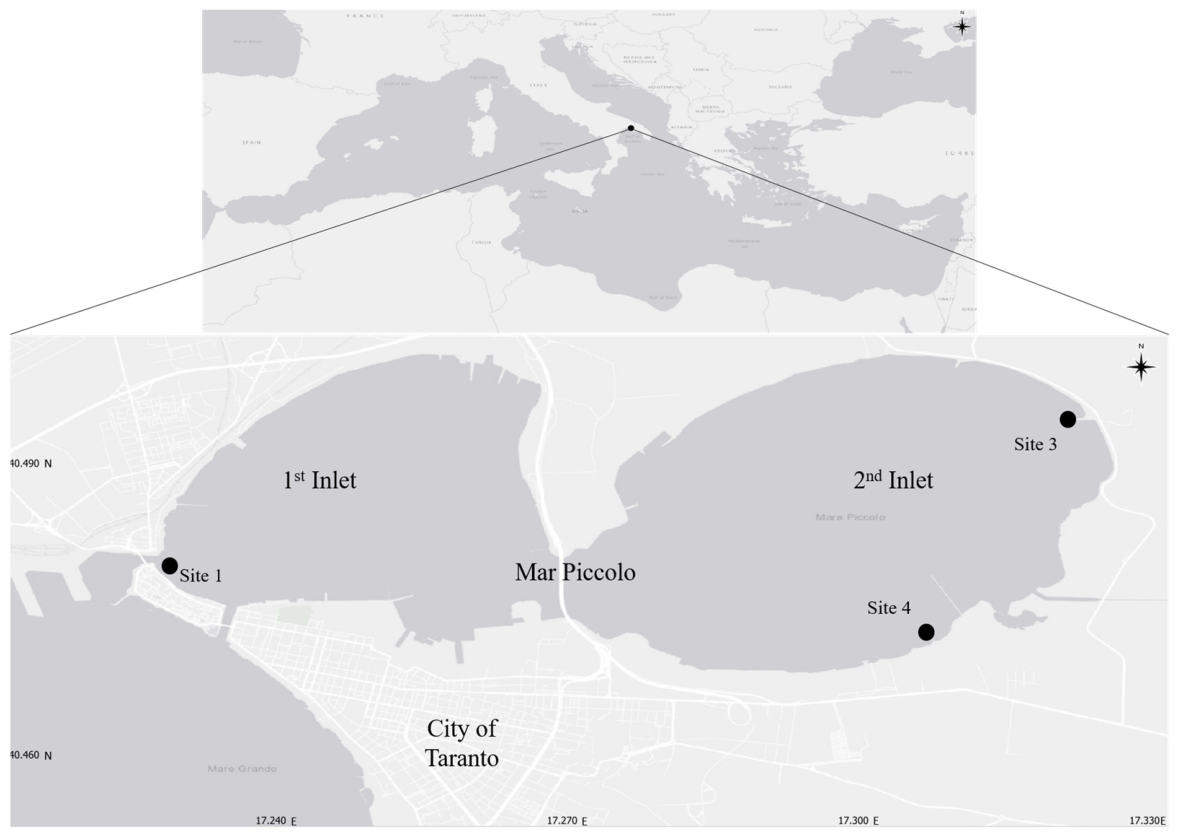
| Site 1—Scaletta | 40°28.773′ N | 17°13.687′ E |
| Site 3—Battendieri | 40°29.660′ N | 17°19.388′ E |
| Site 4—Cimino | 40°28.180′ N | 17°18.069′ E |
| Site | Time | d | H | J | NatS | NIS | |
|---|---|---|---|---|---|---|---|
| 1 | Time | >0.001 | 0.469 | 0.436 | >0.01 | 0.464 | |
| d | 0.342 | 0.069 | >0.001 | ||||
| H | 0.074 | 0.127 | >0.001 | ||||
| J | −0.078 | 0.188 | >0.05 | ||||
| NatS | −0.307 | −0.181 | −0.154 | −0.133 | 0.519 | ||
| NIS | −0.078 | 0.357 | 0.394 | 0.243 | 0.069 | ||
| 3 | Time | 0.255 | 0.309 | 0.362 | 0.651 | 0.548 | |
| d | 0.114 | 0.131 | 0.078 | ||||
| H | 0.103 | >0.001 | >0.05 | ||||
| J | 0.092 | >0.001 | >0.05 | ||||
| NatS | 0.046 | 0.152 | 0.365 | 0.362 | >0.01 | ||
| NIS | 0.061 | −0.182 | −0.247 | −0.220 | −0.316 | ||
| 4 | Time | >0.05 | 0.537 | 0.773 | 0.934 | >0.05 | |
| d | 0.222 | 0.456 | 0.675 | ||||
| H | 0.062 | 0.075 | 0.080 | ||||
| J | −0.030 | >0.05 | 0.066 | ||||
| NatS | −0.009 | −0.074 | 0.181 | 0.206 | 0.420 | ||
| NIS | 0.221 | −0.043 | 0.173 | 0.186 | 0.083 |
| Source of Variation | df | SS | MS | Pseudo-F | P Perm |
| Si | 2 | 435,670 | 217,830 | 128.68 | 0.0001 |
| Ye | 11 | 85,633 | 7785 | 4.5987 | 0.0001 |
| Se | 3 | 104,400 | 34,799 | 20.557 | 0.0001 |
| Rep | 2 | 2322 | 1161 | 0.68568 | 0.8743 |
| Si x Ye | 22 | 129,840 | 5902 | 3.4863 | 0.0001 |
| Si x Se | 6 | 96,819 | 16,136 | 9.5322 | 0.0001 |
| Ye x Se | 33 | 135,390 | 4103 | 2.4236 | 0.0001 |
| Si x Ye x Se | 66 | 216,390 | 3279 | 1.9368 | 0.0001 |
| Residuals | 284 | 480,760 | 1693 | ||
| Total | 429 | 1,696,500 | |||
| PAIRWISE test | |||||
| Factor | Levels Pairs | t | P(MC) | Av. S. (%) | |
| Site | 1, 3 | 12.93 | 0.0001 | 1.3508 | |
| 1, 4 | 13.928 | 0.0001 | 2.4495 | ||
| 3, 4 | 6.3848 | 0.0001 | 15.123 | ||
| Season | Sp, Su | 4.3635 | 0.0001 | 11.778 | |
| Sp, Au | 3.8002 | 0.0001 | 12.682 | ||
| Sp, Wi | 3.5858 | 0.0001 | 11.318 | ||
| Su, Au | 4.4907 | 0.0003 | 15.886 | ||
| Su, Wi | 6.1257 | 0.0001 | 7.6926 | ||
| Au, Wi | 4.1828 | 0.0001 | 11.532 | ||
| Site | Tmin | Tmean | Tmax | d | H | J | NatS | NIS | |
|---|---|---|---|---|---|---|---|---|---|
| 1 | Tmin | 0.428 | 0.623 | 0.783 | 0.854 | 0.078 | |||
| Tmean | 0.640 | 0.806 | 0.902 | 0.519 | 0.020 | ||||
| Tmax | 0.392 | 0.883 | 0.973 | 0.743 | 0.024 | ||||
| d | −0.144 | −0.085 | −0.154 | ||||||
| H | −0.089 | −0.046 | −0.027 | ||||||
| J | −0.050 | −0.023 | 0.007 | ||||||
| NatS | −0.034 | −0.115 | −0.060 | ||||||
| NIS | −0.318 | −0.410 | −0.401 | ||||||
| 3 | Tmin | 0.002 | 0.256 | 0.839 | 0.472 | 0.027 | |||
| Tmean | 0.001 | 0.155 | 0.544 | 0.599 | 0.041 | ||||
| Tmax | 0.072 | 0.701 | 0.961 | 0.166 | 0.233 | ||||
| d | −0.513 | −0.551 | −0.311 | ||||||
| H | −0.202 | −0.250 | −0.069 | ||||||
| J | −0.035 | −0.107 | −0.009 | ||||||
| NatS | 0.127 | 0.094 | 0.240 | ||||||
| NIS | 0.378 | 0.356 | 0.209 | ||||||
| 4 | Tmin | 0.043 | 0.586 | 0.854 | 0.004 | 0.047 | |||
| Tmean | 0.029 | 0.772 | 0.741 | 0.003 | 0.099 | ||||
| Tmax | 0.078 | 0.238 | 0.515 | 0.012 | 0.196 | ||||
| d | −0.393 | −0.421 | −0.343 | ||||||
| H | −0.107 | −0.057 | −0.234 | ||||||
| J | −0.037 | 0.067 | −0.133 | ||||||
| NatS | 0.551 | 0.568 | 0.474 | ||||||
| NIS | 0.389 | 0.321 | 0.257 |
Disclaimer/Publisher’s Note: The statements, opinions and data contained in all publications are solely those of the individual author(s) and contributor(s) and not of MDPI and/or the editor(s). MDPI and/or the editor(s) disclaim responsibility for any injury to people or property resulting from any ideas, methods, instructions or products referred to in the content. |
© 2026 by the authors. Licensee MDPI, Basel, Switzerland. This article is an open access article distributed under the terms and conditions of the Creative Commons Attribution (CC BY) license.
Share and Cite
Denti, G.; Petrocelli, A.; Cecere, E.; Rubino, F.; De Luca, F.P.; Ricci, P. Exploring the Structure of Seaweed Assemblages Under the Pressure of Non-Indigenous Species (NIS) in the Transitional Water System Mar Piccolo of Taranto (Mediterranean Sea, Southern Italy). Water 2026, 18, 1443. https://doi.org/10.3390/w18121443
Denti G, Petrocelli A, Cecere E, Rubino F, De Luca FP, Ricci P. Exploring the Structure of Seaweed Assemblages Under the Pressure of Non-Indigenous Species (NIS) in the Transitional Water System Mar Piccolo of Taranto (Mediterranean Sea, Southern Italy). Water. 2026; 18(12):1443. https://doi.org/10.3390/w18121443
Chicago/Turabian StyleDenti, Giuseppe, Antonella Petrocelli, Ester Cecere, Fernando Rubino, Francesca P. De Luca, and Pasquale Ricci. 2026. "Exploring the Structure of Seaweed Assemblages Under the Pressure of Non-Indigenous Species (NIS) in the Transitional Water System Mar Piccolo of Taranto (Mediterranean Sea, Southern Italy)" Water 18, no. 12: 1443. https://doi.org/10.3390/w18121443
APA StyleDenti, G., Petrocelli, A., Cecere, E., Rubino, F., De Luca, F. P., & Ricci, P. (2026). Exploring the Structure of Seaweed Assemblages Under the Pressure of Non-Indigenous Species (NIS) in the Transitional Water System Mar Piccolo of Taranto (Mediterranean Sea, Southern Italy). Water, 18(12), 1443. https://doi.org/10.3390/w18121443