Article

An ANN-Derived Model for Estimating Hourly Storm Patterns with Daily Precipitation Based on Climate Change-Induced Rainstorms
Department of Civil and Disaster Prevention Engineering, National United University, Miaoli 36063, Taiwan
*
Author to whom correspondence should be addressed.
Water 2026, 18(12), 1432; https://doi.org/10.3390/w18121432
Submission received: 8 May 2026 / Revised: 5 June 2026 / Accepted: 8 June 2026 / Published: 11 June 2026

Abstract

In this study, we aim to propose a framework for developing a smart model for estimating hourly based storm patterns subject to daily storm patterns, titled the SM_ESP_HRDY model; here, a storm pattern comprises a set of cumulative dimensionless rainfalls. A number of AR5 climate-induced rainstorms (1979–2099) are simulated at grid resolution within the study area (Miaoli City, Northern Taiwan) to develop and demonstrate the model. The results obtained via model development reveal that the AR5-simulated events could be separated into 1-day, 2-day, and 3-day rainy events, which could be classified into three types. Thus, within the proposed SM_ESP_HRDY model, the corresponding ANN-derived relationship between hourly and daily cumulative rainfall is established for the three storm patterns across three rainy events. Accordingly, the results for the demonstration of the model indicate that the estimated hourly storm patterns match the validations well, with low bias, especially for the 2-day and 3-day rainy events, with finer temporal rainfall resolution. As a result, the proposed SM_ESP_HRDY model can provide accurate and reliable hourly storm pattern estimates based on the daily rainfall series.

1. Introduction

In general, rainfall with different temporal resolutions can support the performance of various hydrological analyses. For example, long-term rainfall (e.g., daily and monthly precipitation) is commonly required in water resource-related investigations. However, flood-induced inundations frequently result from heavy short-term storm events; thus, the accuracy and reliability of rainfall-induced inundation simulations can be affected by rainfall temporal resolution [1,2,3,4]. Therefore, more accurate and reliable flood simulations play an important role in assessing the waterproofing performance of hydraulic structures and systems.
To achieve more accurate and reliable flood simulations, hydrometeorological numerical models are configured with high-resolution rainstorms in time and space, which are advantageous for waterproofing systems [5,6,7,8,9,10]. For example, Wu et al. [5] applied hourly gridded rainfall observations and estimates for 2D inundation simulations using an ANN-based model and physically based hydrodynamic models, respectively. Additionally, the impact of climate change on hydrology-related investigations is widely quantified and evaluated using hydrological and hydraulic models, with rainfall predictions accounting for various weather scenarios. Regarding simulated climate-induced rainstorms, hourly gridded rainfall events in 1977–2099, simulated under different radiation conditions for the AR5 project, were frequently used to assess the impact of climate change on hydrological responses. For instance, Hsiao et al. [11] conducted a flood simulation using the physically based hydrodynamic numerical (SOBEK) model with AR5 climate change-induced hourly rainstorms, indicating that flood discharge exhibited a considerable increasing trend. However, alongside variability in radiation, TICCP’s fifth annual report (AR6) indicates that significantly increased atmospheric carbon dioxide (CO2) concentrations lead to a high likelihood of more severe flood-induced disasters [12,13,14]. Thus, for AR6 climate change-induced rainstorms, the corresponding daily rainfall time series were generated under different weather scenarios to emulate more realistic climate change-induced rainfall-induced disasters, serving as a reference for flood mitigation and prevention [15]. However, the daily rainfall time series of AR6 climate change-induced rainstorms barely support conducting a 2D inundation simulation at a finer temporal resolution [16].
In general, the numerous methods for downscaling the temporal resolution of rainfall could be grouped into several types: dynamical-based methods [17] and statistical-based approaches [18,19,20,21]. For example, Wu et al. [18] proposed a statistical-based approach for distinguishing event-based rainfalls into five characteristics, including rainfall duration (hours), rainfall amount (mm), inter-event time (hours), and storm pattern (dimensionless cumulative rainfall curves); these patterns comprise dimensionless cumulative rainfalls at dimensionless times. Thus, simulated hourly hyetographs could be produced by integrating the simulated rainfall depths with the generated storm patterns. However, downscaling the temporal resolution of rainstorms using the above dynamical methods often requires substantial computational time; alternatively, a simple storm pattern, such as a uniform distribution of rainfall over time, is used in rainfall-induced flood simulations [22]. However, this does not adequately capture the realistic temporal behavior of rainfall. Although statistical-based methods could distinguish between low-resolution (monthly) rainfall and precipitation of fine resolution (daily) rainfall, the prior statistical properties of rainfall characteristics, including the statistical moments and correlation in time and space, should be determined using observations given in advance [16,20]; moreover, it is difficult to cope with the impact of the nonstationary nature of extreme rainfall sequences [19].
Recently, models produced using AI have comprehensively capitalized on downscaling rainfall in time [17,23,24,25,26,27,28,29,30]. For example, Coulibaly et al. [24] presented an ANN-based temporal downscaling model for determining daily precipitation, considering climatic features (i.e., humidity, wind velocity, and geopotential height). Pour et al. [17] introduced a hybrid model for identifying rainy days via the Support Vector Method (SVM) and predicting the corresponding rainfall. Among AI-based temporal downscaling approaches, ANN-derived methods can efficiently model nonlinear relationships among hydrological responses by leveraging the unique network structures of complex systems [31,32]. However, these AI-created downscaling models primarily focus on achieving finer temporal resolution for seasonal, monthly, or daily rainfall, without considering the variability in finer-resolution rainfall in time (e.g., storm patterns); thus, they may be inappropriate for modeling flood-induced inundations, which require precipitation at a high temporal resolution (e.g., hours) [33]. Nevertheless, several investigations could downscale the temporal resolution of rainfall from day to hour; however, the resulting daily rainfall levels determined based on hourly rainfall levels would be too inconsistent to enable the simulation of daily precipitation via the weather simulation models [34,35].
In general, an hourly hyetograph can be obtained by combining known daily rainfall depths with the dimensionless distribution of rainfall over time (the storm pattern). Therefore, in this study, we primarily focus on downscaling storm patterns without considering the effects of changes in rainfall duration and storm levels. In detail, an ANN-derived model is developed to distinguish daily rainfall distributions over time into finer-resolution (hourly) storm patterns. We expect that the resulting downscaled fine-resolution storm patterns will be applicable in hydrological analyses, particularly for rainfall-induced inundation.

2. Methodology

2.1. Model Concept

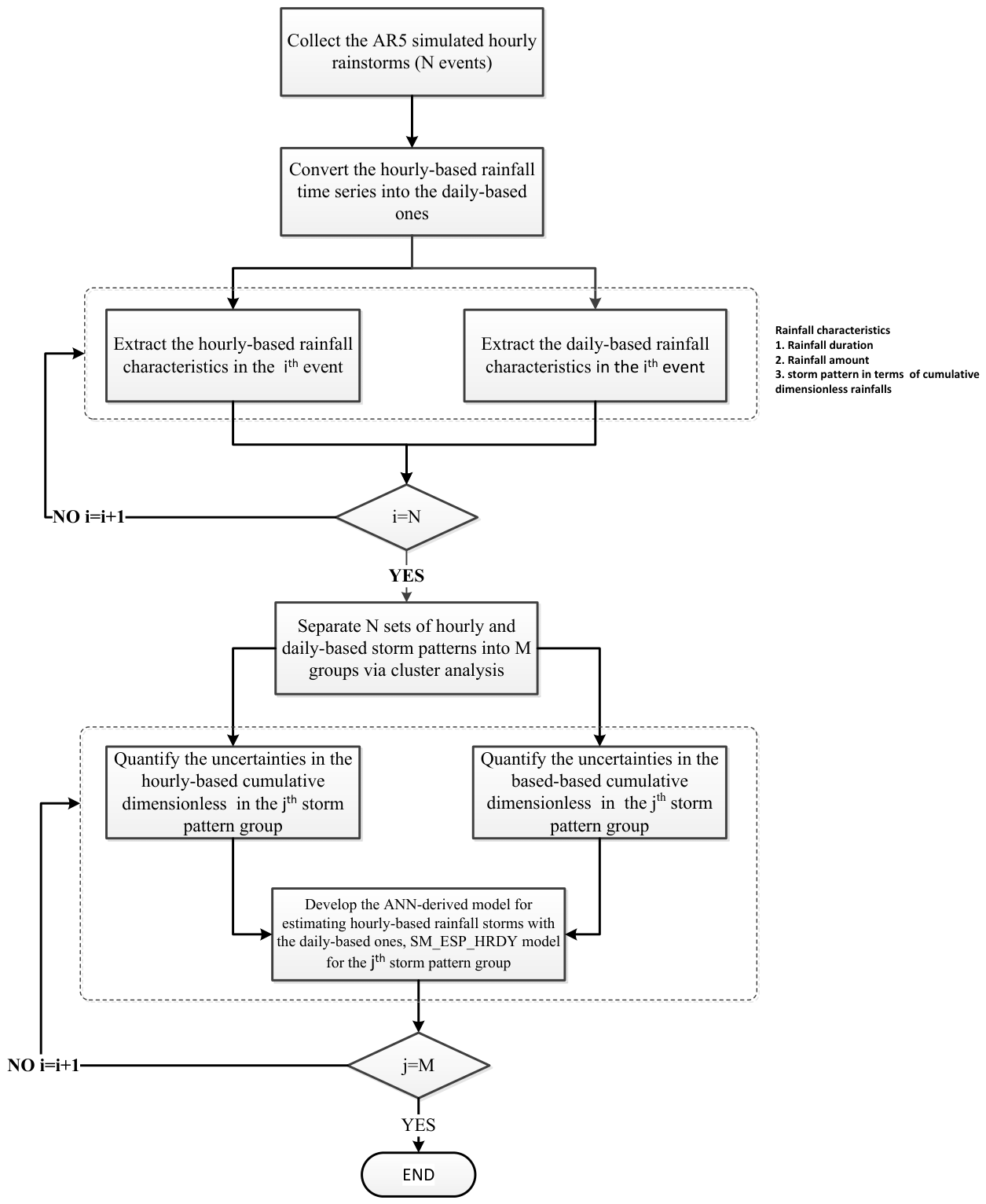
To achieve the finer temporal resolution of climate change-induced daily rainstorms, in this study, we propose an ANN-derived model for estimating hourly storm patterns, expressed as dimensionless rainfall levels, as a function of daily precipitation, known as the SM_ESP_HRDY model. In detail, before developing the proposed SM_ESP_HRDY model, the daily rainfall time series should be obtained via assessing hourly rainstorms. Afterward, rainfall characteristics, including rainfall durations, depths, and storm patterns, should be extracted separately from the daily and hourly time series of climate change-induced rainstorms. To reduce uncertainties in event-based rainfall durations and precipitation levels [18], cluster analysis should be conducted to classify hourly and daily storm patterns into various groups. Accordingly, the ANN-derived relationships between hourly and daily cumulative dimensionless rainfalls are established for various storm patterns. Over time, the model would be demonstrated by comparing the estimated hourly storm patterns generated via the proposed SM_ESP_HRDY model with the validation results. The detailed concepts are addressed in the subsections below.

2.2. Rainstorm Characterization

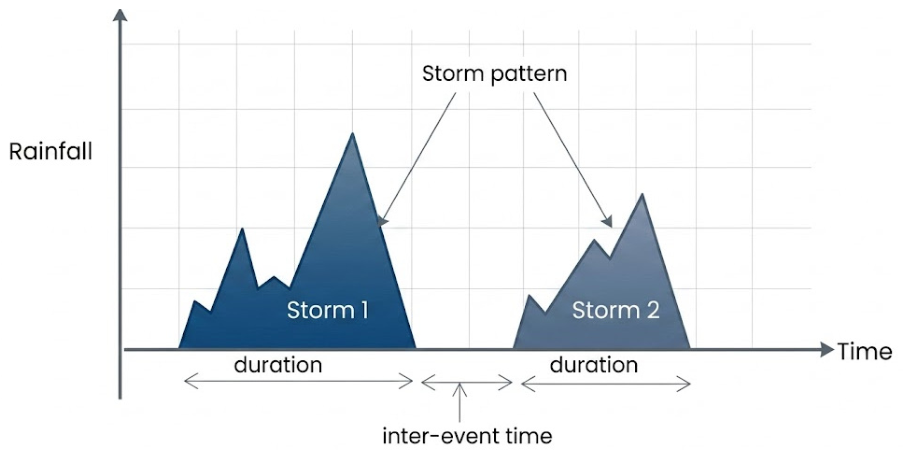
It is well known that a rainstorm event can be characterized by three components, namely rainfall depth, duration, and storm pattern, as shown in Figure 1 [18], with these components extracted from observations recorded at rain gauges in a watershed. In particular, the storm pattern is defined as the distribution of rainfall over a given period; it exhibits considerable variation with storm duration and rainfall levels from one event to another, as well as with the locations of rain gauges [20]. Wu et al. [18] introduced a dimensionless storm pattern that could be obtained by adjusting the rainfall depth and duration of a rainfall mass curve as follows:
τ = t d ;   F τ = D t D d ;   t = τ × d ;   P τ = F τ F τ 1
where τ and d represent the dimensionless time and rainfall duration, respectively; P τ and F τ serve as the incremental dimensionless rainfall and corresponding cumulative dimensionless rainfall, respectively; and Dd denotes the total rainfall depth. According to Equation (1), the cumulative dimensionless rainfall is between 0 and 1 over the dimensionless time. This allows the dimensionless storm pattern to remove the effects of rainfall duration and level in response to temporal variation in rainfall.
In Wu’s investigation [18], to reduce variation in the temporal distributions of rainstorm events, event-based storm patterns are grouped. In general, cluster analysis is mainly applied in classifying hydrological variates via the partitional and hierarchical clustering methods; the difference between these clustering methods is that, for the partitional method, the group number should be determined first, and the variates can be directly separated subject to their characteristics relative to the partitional approach used (e.g., K-means clustering algorithm); in contrast, the hierarchical clustering method could estimate the optimal group number, but the groups should be merged or split through a complicated adjusting process [36]. Therefore, to develop the proposed SM_ESP_HRDY model, we separated storm patterns within a prior group number using the K-means method, subject to event-based rainfall durations and depths.

2.3. Derivation of the ANN Model-Derived Relationship Between Hourly and Daily Storm Patterns

Within the proposed SM_ESP_HRDY model, the relationships among cumulative dimensionless rainfalls could be assessed using the ANN model-derived ANN_GA-SA_MTF model [37]. In this model, a neural network with three layers (i.e., input, hidden, and output layers) was configured with multiple activation functions (see Table 1) to reduce uncertainty in the model configuration. Moreover, to reduce uncertainty in parameter calibration, a modified genetic algorithm, known as GA-SA, which leverages parameter sensitivities to the model outputs was applied during model training [38]. The detailed GA-SA concept is referenced in Wu’s investigation [37].
The training of the ANN_GA-SA_MTF model is carried out by calibrating the appropriate parameters of the ANN_GA-SA_MTF parameters subject to the following objective function values:
E ( θ T F i ) = 1 N d a t a k = 1 N d a t a [ Y k Y ^ k ( θ T F i ] 2
where N d a t a is the number of observed hydrological estimates, while Y k   a n d   Y ^ k ( θ T F i serve as the validations and estimated model outputs, respectively, for the ANN_GA-SA_MTF model. After the parameter calibration, the corresponding model outputs could be achieved via the ANN_GA-SA model using the numerous sets of appropriate parameters, considering the specific activation function through the following equation:
Y ^ W A = i = 1 N T F W T F i × Y ^ θ T F i
W T F i = 1 E ( θ T F i ) i = 1 N T F 1 E ( θ T F i )
where N T F denotes the number of concerned activation functions, and W T F i denotes the weighted factor of the ith activation function, calculated from E θ T F i .
Consequently, within the proposed SM_ESP_HRDY model, the relationship between hourly and daily cumulative dimensionless rainfalls can be established via the ANN_GA-SA_MTF model using the cumulative dimensionless rainfalls as follows:
F i s p , j τ H = f A N N G A S A _ M T F F i s p , j τ D
where F i s p , j τ H and F i s p , j τ D are the hourly and daily cumulative dimensionless rainfalls at the dimensionless time step ( j τ ) for the storm pattern group (isp), respectively.

2.4. Calculation of the Weighted Average of Estimated Hourly Storm Patterns

Nevertheless, the appropriate storm pattern type should be determined via rainfall-related hydrological analyses; uncertainties in selecting storm patterns are likely to affect rainfall-induced hydrological analyses [39]. Therefore, to reduce the effect of the above uncertainty on the estimation of hourly storm patterns, in this study, we adopted the weighted average method for estimating the dimensionless cumulative rainfall with regard to the occurrence probabilities of the storm pattern types as follows:
F ^ j τ , H = i S P , = 1 N S P F ^ i S P , j τ H × P i S P ,
where N S P is the number of storm pattern groups; F ^ i S P , j τ H a n d F ^ j τ , H are the estimated hourly cumulative dimensionless rainfalls for the storm pattern group (isp) and the corresponding weighted average as the resulting model outputs at the dimensionless time step ( j τ ), respectively; and P i S P , is the corresponding occurrence probability of the concerned storm pattern group (isp), which could be quantified based on the event number of the specific storm pattern groups.

2.5. Quantification of Model Performance

To quantify and evaluate the accuracy and reliability of the above-estimated hourly storm patterns via the proposed SM_ESP_HRDY model, the performance indices (i.e., the root mean square error (RMSE) and the model reliability index (KG)) [40] are computed using the following equations:
R M S E = 1 N S P j = 1 N S P F j τ , v a l H F j τ , e s t H 2
K G = 1 + 1 N S P j = 1 N S P 1 F j τ , v a l H F j τ , e s t H 1 + F j τ , v a l H F j τ , e s t H 1 1 N S P j = 1 N S P 1 F j τ , v a l H F j τ , e s t H 1 + F j τ , v a l H F j τ , e s t H
where F j τ , v a l H   and   F j τ , e s t H   are the validated and estimated hourly cumulative dimensionless rainfalls at the dimensionless time step ( j τ ) over the period of dimensionless time ( N S P ). The RMSE index mainly measures the accuracy of the estimated hourly cumulative dimensionless rainfall; in contrast, the KG index quantifies the consistency of the estimated hourly cumulative dimensionless times to the validations. As the KG index approaches 1.0, the estimated hourly cumulative rainfalls exhibit a more consistent trend of variation than the validated ones. In detail, the KG index measures the reliability of the estimated hourly cumulative by comparing the estimates against the validations. Indeed, a KG index of 1 implies that the target models can provide estimates with high reliability [40]. In addition to the above indices (RMSE and KG), linear consistency between the estimated and validated dimensionless rainfalls can be quantified using the well-known Pearson correlation coefficient.

2.6. Model Framework

To sum up the above-mentioned concepts, the framework for developing and implementing the proposed SM_ESP_HRDY model is addressed below:

2.6.1. Model Development

Model development involved the following steps:
Step [1]: Collect the climate change-induced simulated hourly rainstorms.
Step [2]: Convert the hourly rainstorms into daily rainstorms.
Step [3]: Extract the rainfall characteristics from the hourly and daily rainstorms.
Step [4]: Categorize the hourly and daily storm patterns into various types via cluster analysis.
Step [5]: Quantify the stochastic properties of the dimensionless rainfalls of classified storm patterns and corresponding occurrence probabilities.
Step [6]: Derive the ANN-based relationships between the dimensionless rainfalls of hourly and daily storm patterns for various clusters. The relevant model development framework is shown in Figure 2.

2.6.2. Model Application

Based on the aforementioned model development framework, the process of estimating hourly storm patterns using the proposed SM_ESP_HRDY model is given below:
Step [1]: Extract the rainfall characteristics of daily rainstorms, including the duration (days), rainfall levels, and cumulative dimensionless rainfalls of the storm patterns, as well as the corresponding occurrence probabilities.
Step [2]: Determine the ANN-based relationships of the dimensionless rainfalls within the proposed SM_ESP_HRDY model, subject to the rainfall duration (days).
Step [3]. Estimate the dimensionless rainfalls of the hourly storm patterns with regard to the daily storm patterns for the three storm pattern clusters.
Step [4]: Calculate the weighted average of the estimated dimensionless rainfalls of the hourly storm patterns based on the occurrence probabilities of the storm pattern clusters.
Step [5]: The weighted average of the estimated dimensionless rainfalls represents the hourly storm patterns.

3. Study Area and Data

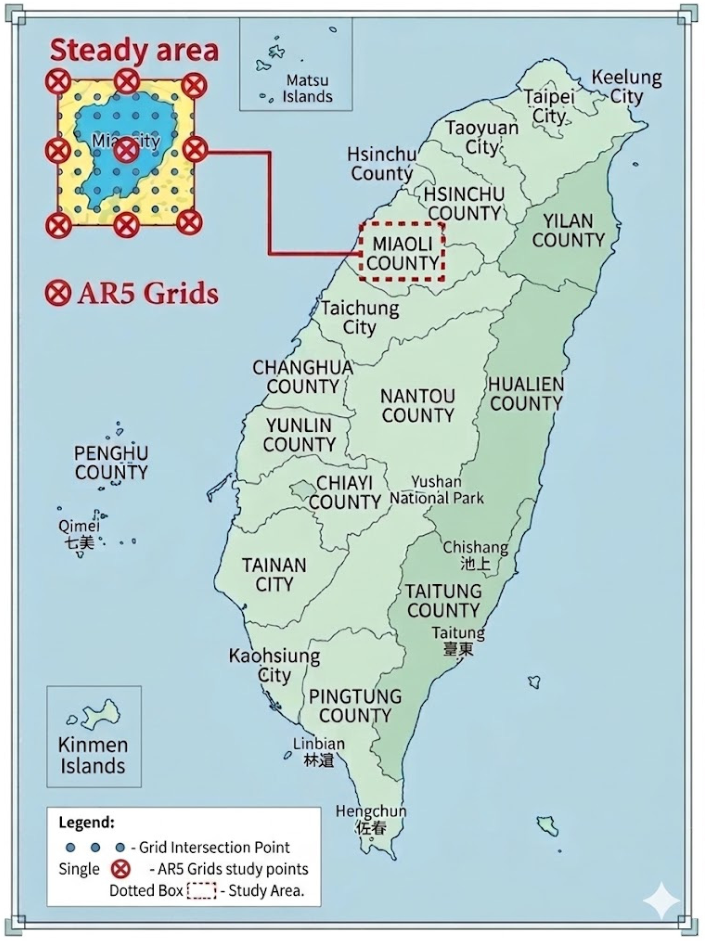
Miaoli County is located in western Taiwan, adjacent to Hsinchu County and Hsinchu City to the north and Taichung to the south, and it borders the Taiwan Strait to the west (see Figure 3). Miaoli County comprises eighteen townships, and Miaoli City, selected as the study area, is the county’s capital. Among the main neighboring rivers in Miaoli County, the Houlong River is the largest, with a watershed area of approximately 537 km2 and a length of 58.3 km.
To demonstrate the accuracy and reliability of the proposed SM_ESP_HRDY model in distinguishing between the hourly and daily storm patterns, in this study, we utilized climate change-induced rainstorms simulated under various weather scenarios (the representative concentration pathways are 8.5 and RCP8.5) for the middle and end of the 21st century (MID21 and END21); the above-mentioned rainstorms were simulated by the IPCC in the Fifth Assessment Report, 2013 (AR5) (AR5-simulated rainstorms). In particular, AR5-simulated rainstorms were downscaled to a spatial resolution of 2.5 km × 2.5 km and a 1 h temporal resolution in Taiwan via the TICCP (The Taiwan Climate Change Projection Information and Adaptation Knowledge Platform) [5,11,41]. In addition to the weather scenario RCE8.5, the TICCP released AR5-simulated rainstorms via CMIP, using historical climate observation data from 1979 to 2015 (the base period) [42]. The AR5-simulated rainstorms can efficiently capture the long-term trend in extreme precipitation characteristics compared with observations [43].
Therefore, the 774 AR5-simulated rainstorms for the base period and the weather scenario RCP8.5 (1979–2099) for the study area (see Figure 2), as listed in Table 2, were used in this study; moreover, regarding the variation in rainfall distribution in space, AR5-simulated rainstorms located at nine grids within the study area (see Figure 2) were adopted to develop and demonstrate the model.

4. Results and Discussion

4.1. Extraction and Uncertainty Quantification of Rainstorm

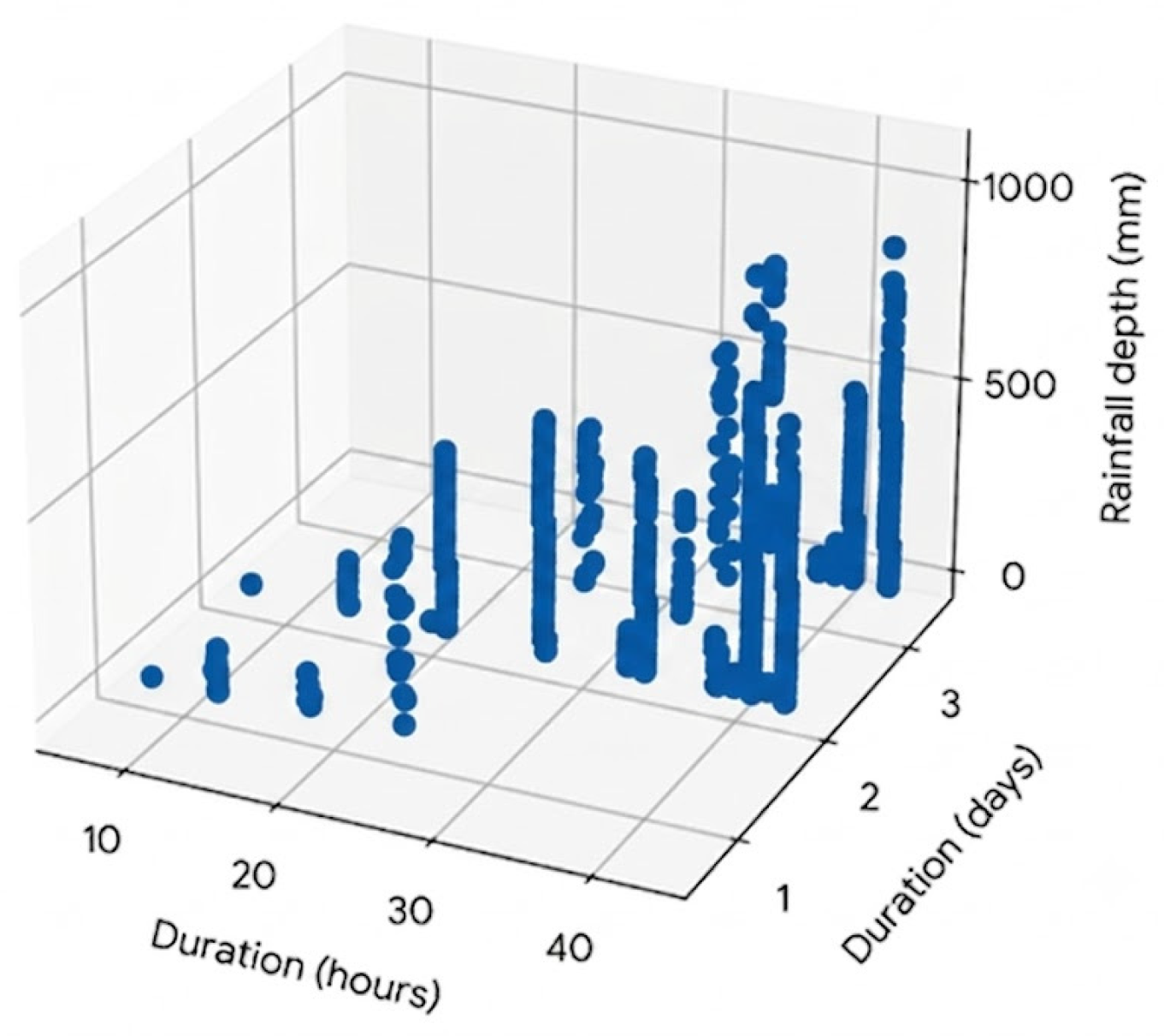
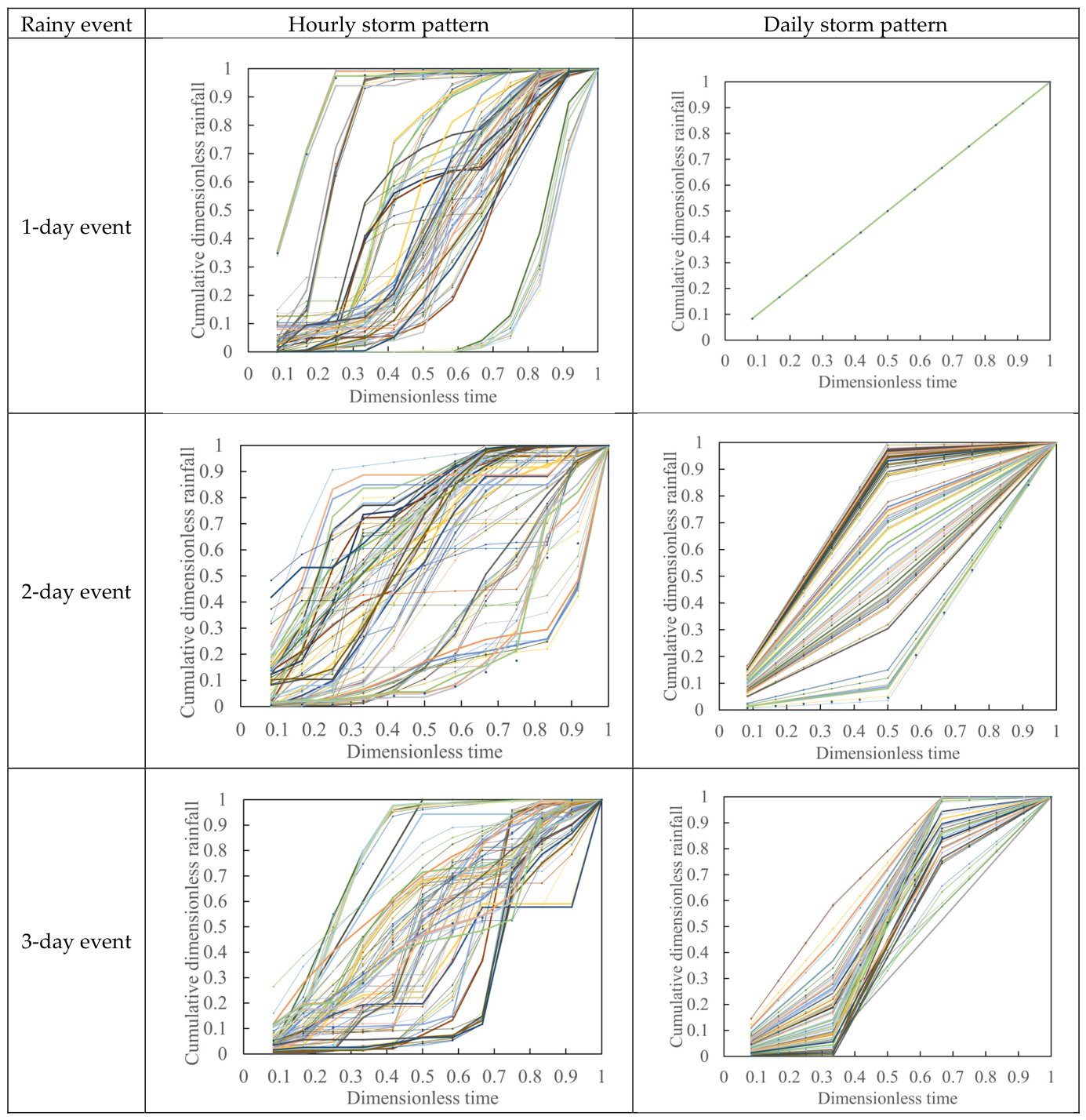
According to the development framework of the proposed SM_EFD_HRDY model, as shown in Figure 2, rainfall characteristics, including rainfall durations, levels, and storm patterns, should be extracted from the relevant AR5-simulated rainstorms (see Table 2) to serve as the model training datasets. Figure 4 shows the rainfall depths and durations (hours and days) corresponding to the AR5 rainfall characteristics; the data imply that the resulting rainfall durations range between 15 h and 39 h (i.e., 1 day–3 days). Moreover, the corresponding rainfall levels vary between 5 mm and 75 mm, indicating that the concerned AR5-simulated rainstorms can be divided into three types, namely 1-day, 2-day, and 3-day rainy events, of which there are 70, 518, and 194, respectively. Additionally, Figure 5 represents the corresponding cumulative dimensionless rainfalls (i.e., storm patterns) for AR5-simulated rainstorms for 1-day, 2-day, and 3-day rainy events, exhibiting noticeable changes in daily and hourly storm patterns due to the variety of AR5 weather scenarios considered, especially for 2-day and 3-day rainy events.
Altogether, ahead of developing the proposed SM_ESP_HRDY model, the daily and hourly storm patterns should be identified into the above types; after that, the corresponding parameters of the ANN_GA-SA_MTF model (see Equation (4)) can be individually calibrated to three storm pattern types for 1-day, 2-day, and 3-day rainy events.

4.2. Identification of Storm Patterns

As shown in Figure 5, the hourly and daily storm patterns can be roughly grouped into three types. Moreover, as noted in Wu’s investigation of storm pattern recognition [18,20], storm patterns can be roughly divided into three groups (advanced, central, and delayed) using cluster analysis. Therefore, in this study, we build on Wu’s investigation to separate daily and hourly storm pattern identification into three types via cluster analysis, based on rainfall factors, rainfall durations (hours and days), rainfall levels, and cumulative dimensionless rainfall over 12 dimensionless time steps.
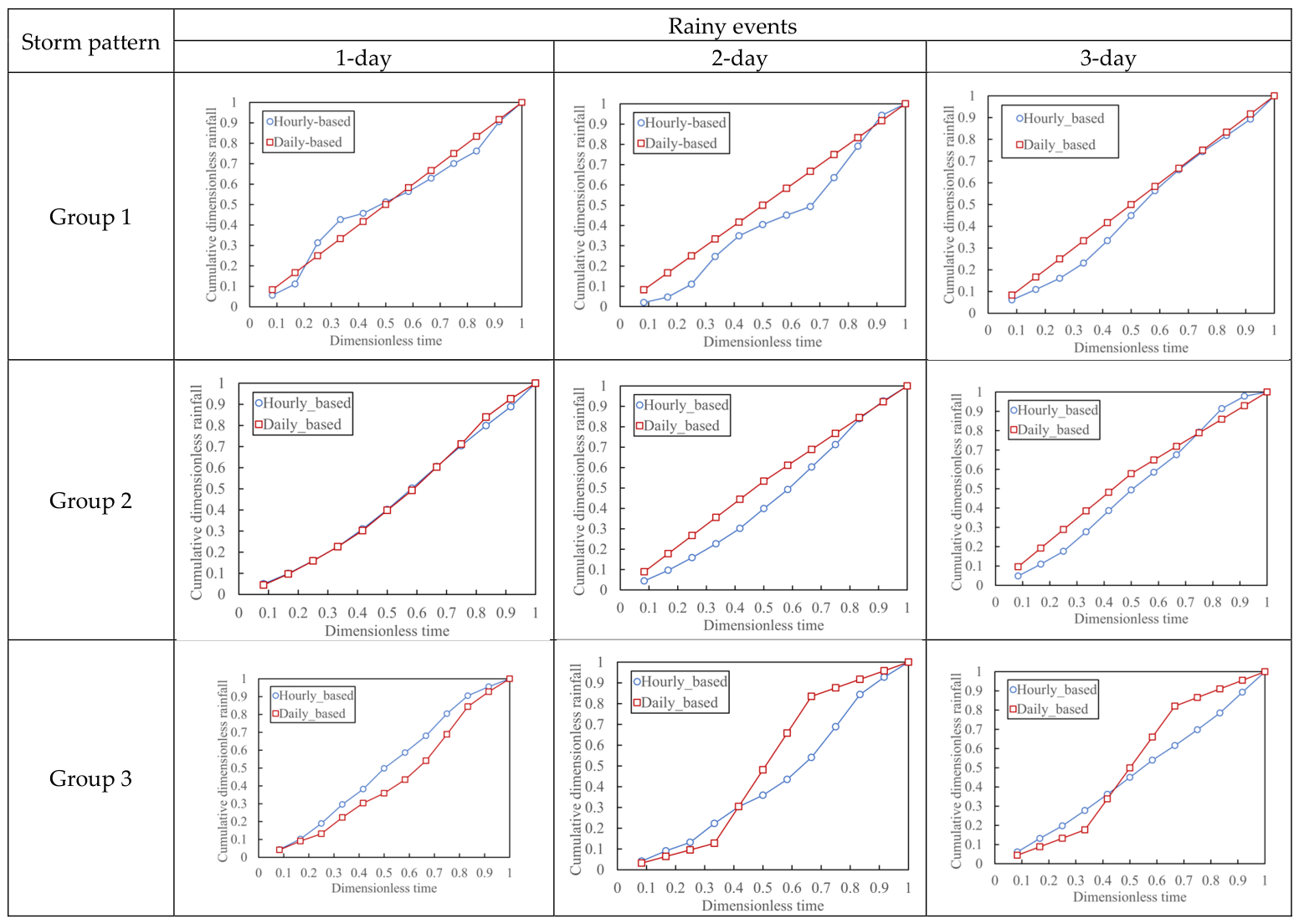
Figure 6 compares hourly and daily averages of cumulative dimensionless rainfall for three storm pattern groups for the 1-day, 2-day, and 3-day rainy events; it reveals significant variations in these averages across storm pattern groups and rainy events. For example, as for the 3-day events, the averages of hourly cumulative dimensionless rainfalls are higher than those for daily rainfalls at dimensionless times of less than 0.5 (storm pattern group 1), 0.35 (storm pattern group 2), and 0.45 (storm pattern group 3); after that, hourly cumulative rainfalls exceed daily rainfalls. In contrast, daily cumulative rainfalls are generally higher than hourly rainfalls for three storm pattern groups, with distinct differences. Moreover, Table 3 illustrates the stochastic properties of the remaining rainfall characteristics, indicating that the rainfall depths of the events (roughly between 15 mm and 35 mm) for the third cluster with the maximum event number (a range of about 500–3000) are markedly less than those for the storm pattern groups 1 and 2.
Overall, the above-mentioned results indicate that the distinct climate change-induced rainstorms could reasonably correspond to the weather scenarios. Therefore, within the parameters of the proposed SM_ESP_HRDY model, the ANN_GA-SA_MTF model could be configured across various storm pattern groups for 1-day, 2-day, and 3-day rainy events.

4.3. Configuration of the SM_ESP_HRDY Model

According to the model development framework (see Figure 2) and results from AR5 rainstorm identification, the relationship between hourly and daily cumulative rainfalls for various storm pattern groups could be derived using the three-layer ANN_GA-SA_MTF model as follows:
F ^ i S P , j τ H = f A N N G A S A M T F F i S P , j τ = 1 , j τ 1 D ,   j τ = 1,2 , , N S P
τ = j τ N τ , τ = J τ N τ
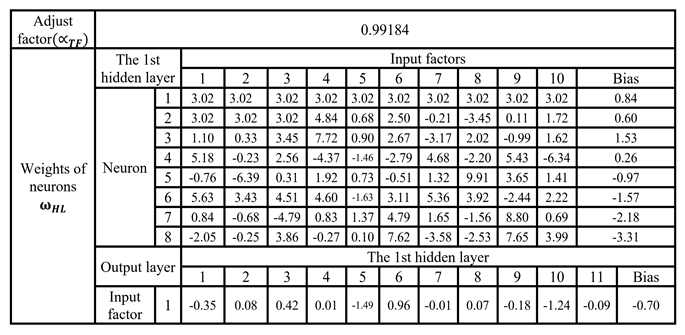
where F ^ i S P , j τ H is the hourly cumulative dimensionless rainfall at the dimensionless time ( τ ) for the storm pattern group (iSP), F i S P , j τ = 1 , j τ 1 D is the corresponding daily cumulative rainfall at the dimensionless times τ = 1 N τ , 2 N τ , , j τ 1 N τ , and N S P is the specific dimensionless time. Table 4 illustrates the parameters of the ANN_GA-SA_MTF model at the specific dimensionless time step for three storm clusters for 1-day, 2-day, and 3-day rainy events at specific dimensionless time steps ( j τ = 2 ,   and   10 ) ; it shows that there is a significant change in the ANN_GA-SA_MTF parameters across different dimensionless time steps for three storm pattern groups. Moreover, the consistency between the hourly and daily cumulative dimensionless rainfalls noticeably varies across the storm pattern groups.
Following the estimated hourly cumulative dimensionless rainfalls for three storm patterns, the weighted average of the estimated cumulative dimensionless cumulative rainfalls for three storm pattern groups, as the resulting model outputs, could be calculated using Equation (5) with corresponding occurrence probabilities ( P i S P , ); the above-mentioned occurrence probabilities ( P i S P , ) can be determined using the following equation:
P i S P , = N E V i S O N E V
where N E V i S O and N E V are the number of events per storm pattern group (iSP) and the total lengths of AR5-simulated rainstorms, as listed in Table 5, indicating that storm pattern group 3 has the highest significant occurrence probability (on average, 0.8) for all three types of rainy events.

4.4. Verification of Estimated Hourly Storms via the SM_ESP_HRDY Model

To demonstrate the accuracy of the resulting estimated hourly cumulative dimensionless rainfalls via the proposed SM_ESP_HRDY model, several AR5 rainstorms corresponding to the 1-day, 2-day, and 3-day rainy events for the three storm pattern groups are selected as the validation events (see Table 6); these validation datasets are excluded from model training.
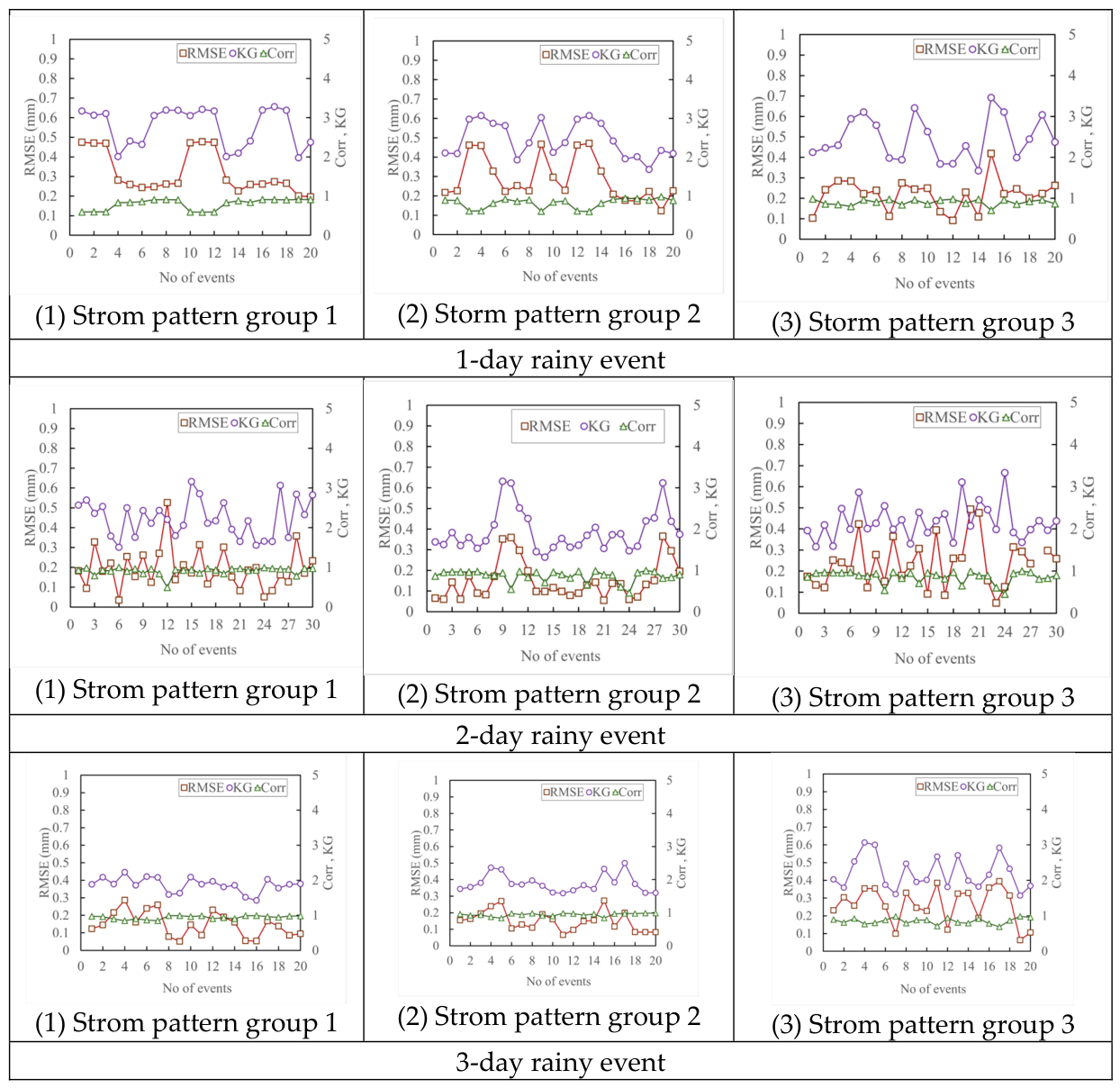
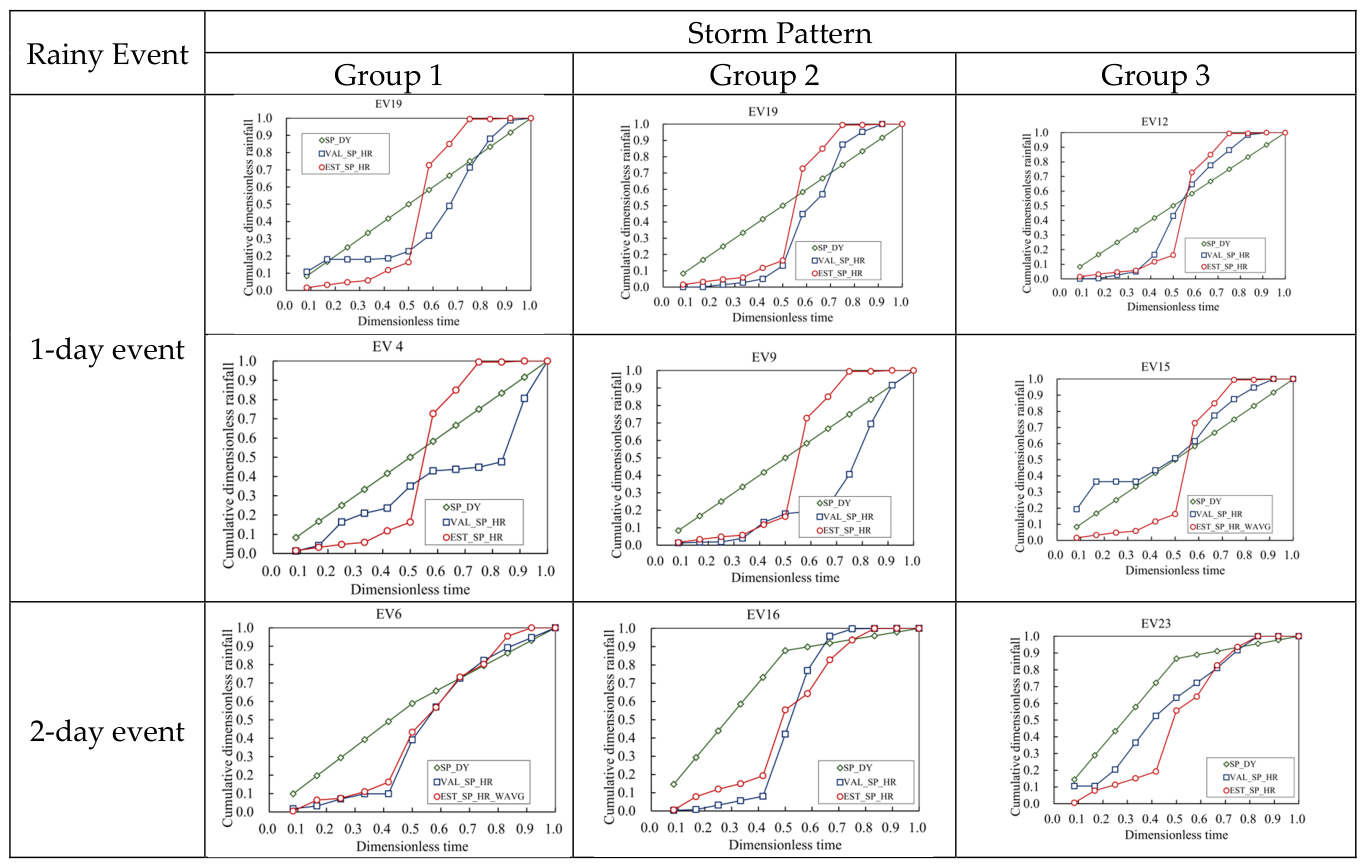
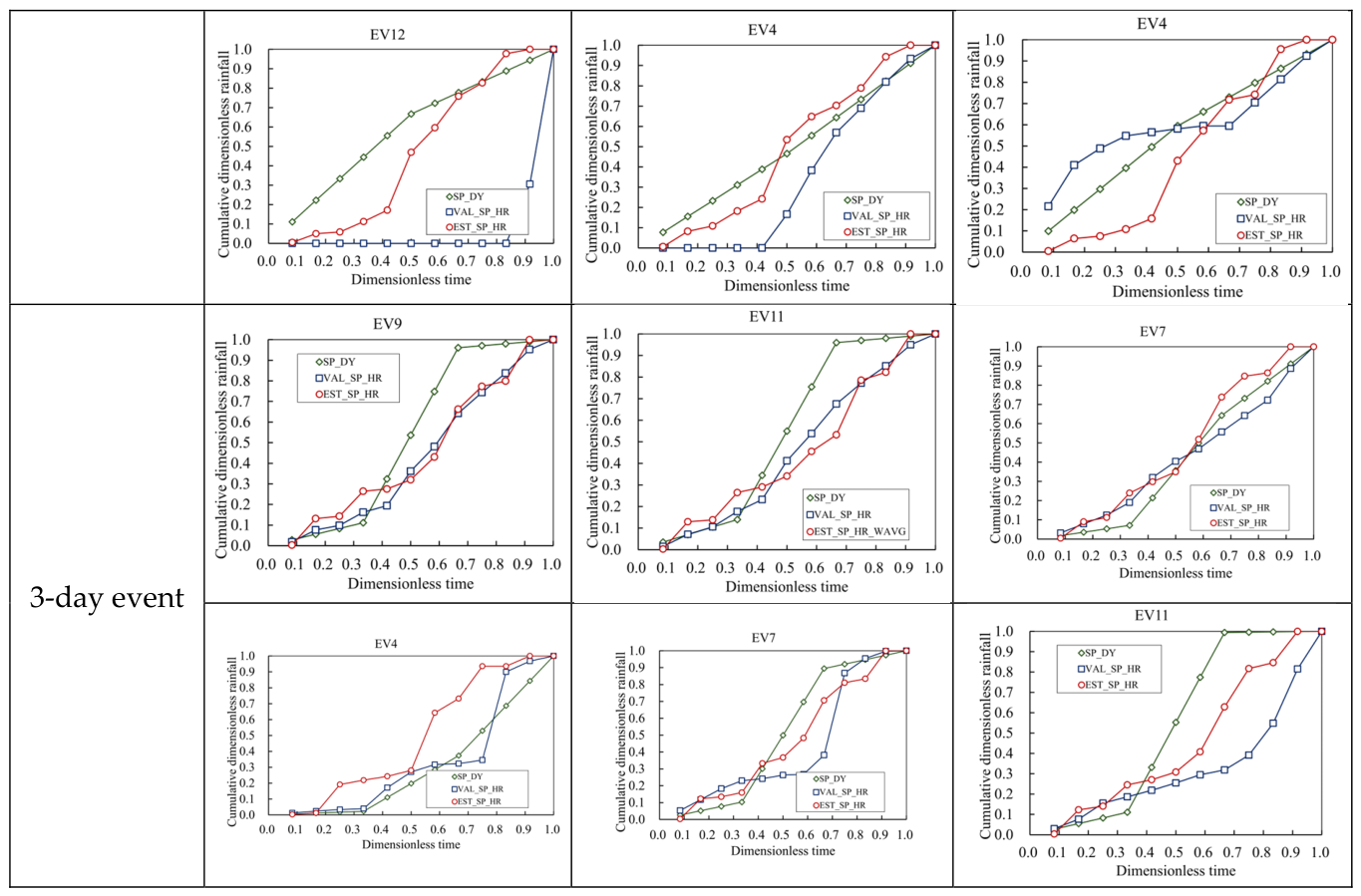
As a result, Figure 7 shows a comparison of the estimated hourly cumulative dimensionless rainfall with validated values for the validation events concerned. In addition to the graphical comparison, the performance indices are calculated using Equations (6) and (7) to assess the accuracy and reliability of the estimated hourly cumulative dimensionless rainfalls from the proposed SM_ESP_HRDY model for all validation events based on the graphical comparison, as shown in Figure 8, and the quantified statistical properties (see Table 7). A detailed model validation is outlined below.

4.4.1. Single-Day Events

Figure 8(1) shows the performance indices of estimated hourly cumulative dimensionless rainfalls, indicating that the RMSE value ranges from 0.2 to 0.5 (mean = 0.275) with a significant standard deviation (about 0.125) (see Table 7); the accuracy of the estimated hourly cumulative rainfalls with validations considerably depends on the validation events. For example, the estimated hourly storm patterns have excellent agreement with the validations for EV19 (storm pattern group 1) and EV9 (storm pattern group 2), with a low RMSE (about 0.15) and high model reliability indices (nearly 1.2). In contrast, for EV4 (storm pattern group 1) and EV15 (storm pattern group 3), the estimated hourly cumulative dimensionless rainfall values noticeably deviate from the validations, with an RMSE of nearly 0.3 and a lower KG index (about 3). This occurs because all 1-day events with identical daily cumulative dimensionless rainfalls poorly reflect changes in hourly storm patterns; despite high RMSE and low KG values, the resulting correlation coefficients are high (nearly 0.9), indicating that the estimated hourly cumulative dimensionless rainfalls exhibit good linear consistency with the validations.

4.4.2. Multi-Day Events

In contrast to the 1-day rainy events, the daily storm patterns could reveal noticeable changes in cumulative dimensionless rainfalls for 2-day and 3-day rainy events (see Figure 7). In Figure 7, the estimated hourly cumulative dimensionless rainfalls subject to the daily storm patterns for 2-day rainy events exhibit a significant match with some validations, such as EV6 (storm pattern group 1), EV7 (storm pattern group 2), and EV23 (storm pattern group 3), with a low RMSE (roughly 0.05). Even for the worst estimates, e.g., EV2 (storm pattern group 1), EV4 (storm pattern group 2), and EV7 (storm pattern group 3), their corresponding RMSE values are merely 0.4. Similar results and conclusions were observed for the 3-day rainy events.
Figure 8(2) represents the performance indices of the estimated hourly cumulative dimensionless rainfalls, indicating that the average RMSE values were approximately 0.193 (2-day and 3-day rainy events) with a low standard deviation (about 0.129), as shown in Table 7. This reveals that the estimated hourly cumulative dimensionless rainfall matches the corresponding validation well, with low bias. In addition, the reliability index (KG) and the correlation coefficient, on average, are less than 1.1 and greater than 0.9, respectively. Moreover, the standard deviations of the above-mentioned performance indices for the 3-day rainy events are considerably lower than those for the 1-day and 2-day rainy events, with the smallest means; this implies that using longer rainy days is advantageous for enhancing the accuracy and reliability of estimated hourly storm patterns with low variability.
Comparing the results for single- and multi-day rainy events, the estimated cumulative dimensionless rainfalls for 2-day and 3-day rainy events show better agreement with the validations than those for 1-day rainy events. The estimated hourly storm pattern could effectively capture the trend of temporally variation in the validated cumulative dimensionless rainfalls with a slight likelihood of lacking a flexible daily storm pattern, especially for 3-day rainy events. In detail, having a higher temporal resolution for daily rainstorms can greatly improve the estimation of hourly storm patterns using the proposed SM_ESP_HRDY model. Overall, the SM_ESP_HRDY model can provide more accurate and reliable hourly cumulative dimensionless rainfall data by integrating daily storm patterns, which exhibit greater variability.

5. Conclusions

In this study, we aim to develop a smart model for estimating hourly storm patterns in terms of cumulative dimensionless rainfalls, integrating the daily rainfall (this model is known as the SM_ESP_HRDY model). The proposed SM_ESP_HRDY model is primarily configured by collaborating the ANN-derived model ANN_GA-SA_MTF [36] with the classified dimensionless storm patterns via cluster analysis. To demonstrate model performance, Miaoli City, located in northern Taiwan, was selected as the study area. In particular, various AR5 climate change-induced rainstorms recorded across the study area are used to train and validate the model.
The model training and validation results indicate that the AR5 rainstorms recorded across the study area can be separated into three types, namely 1-day, 2-day, and 3-day rainy events, based on event-based rainfall duration and depth. Specifically, using cluster analysis of daily and hourly dimensionless cumulative rainfall, the event-based storm patterns could be divided into three groups. As a result, the ANN model-identified relationships between hourly and daily cumulative dimensionless rainfalls can be trained for 1-day, 2-day, and 3-day rainy events, considering the three storm pattern groups. According to the model development results, 91% of AR5-simulated rainstorms could be classified as multi-day rainy events, compared with just 9% of 1-day rainfall events; moreover, of the three classified storm pattern groups, storm pattern group 3 has the most significant probability of occurrence (roughly 0.8). This implies that, due to climate change, rainfall events last more than 24 h and have high rainfall intensities early on during their durations. The model validation results indicate that, for the 2-day and 3-day events, the proposed SM_ESP_HRDY model can provide high-accuracy, hourly cumulative dimensionless rainfall estimates (with RMSE 0.186), and strong temporal correlation (over 0.9). Nevertheless, the estimated hourly storm patterns, integrating the given identical cumulative dimensionless rainfalls for 1-day rainy events, are associated with lower accuracy (RMSE 0.275); they also exhibit acceptable temporal correlation (correlation coefficient 0.84).
Nevertheless, the rainstorms were divided into three groups based on rainfall duration (hours and days). The daily dimensionless cumulative rainfalls at the 12 dimensionless time steps remain constant across all 1-day rainy events. Therefore, for the ANN-derived model ANN_GA-SA_MTF, the relationship between hourly and daily dimensionless rainfalls could be reconfigured by incorporating additional model input factors, such as rainfall depths. Additionally, the AR5-gridded rainfall estimates are used for model training and validation in this study; however, the variation in grid locations and occurrence periods (i.e., Base, MID21, and END21) for the AR5-simulated rainstorms (i.e., spatial and temporal uncertainties) can affect rainfall distribution in time and space [43,44,45]. Therefore, further research could involve evaluating the effect of the spatial and temporal uncertainty on the proposed SM_ESP_HRDY model across all grids using out-of-period and out-of-gird numerical experiments. In time, the daily climate change-induced rainstorms are generally downscaled to hourly hyetographs, which include rainfall duration (hours), amount, and storm patterns. Thus, the proposed SM_ESP_HRDY model could be improved by incorporating the ANN model-generated estimates of the event-based starting time steps and rainfall duration (hours), which could also be trained via ANN-GA-SA_MTF models.

Author Contributions

Conceptualization, S.-J.W.; data curation, Y.-S.L.; methodology, S.-J.W.; validation, S.-J.W. and Y.-S.L.; writing—original draft, S.-J.W. and Y.-S.L.; writing—review and editing, S.-J.W. All authors have read and agreed to the published version of the manuscript.

Funding

This study was funded by Taiwan’s National Science and Technology Council [NSTC 114-2625-M-239-002].

Data Availability Statement

The data are available upon request.

Conflicts of Interest

The authors declare no conflicts of interest.

References

  1. Lyu, H.; Ni, G.; Cao, X.; Ma, Y.; Tian, F. Effect of Temporal Resolution of Rainfall on Simulation of Urban Flood Processes. Water 2018, 10, 880. [Google Scholar] [CrossRef]
  2. Hou, J.; Wang, N.; Guo, K.; Li, D.; Jing, H.; Wang, T.; Hinkelmann, R. Effects of the temporal resolution of storm data on numerical simulations of urban flood inundation. J. Hydrol. 2020, 589, 1251000. [Google Scholar] [CrossRef]
  3. Li, X.; Wang, L.; Zhou, H.; Wang, Y.; Wang, Y.; Niu, K. The Compound Effect of Spatial and Temporal Resolutions on the Accuracy of Urban Flood Simulation. Comput. Intell. Neurosci. 2022, 2022, 3436634. [Google Scholar] [CrossRef]
  4. Gariano, S.L.; Melillo, M.; Peruccacci, S.; Brunetti, M.T. How much does the rainfall temporal resolution affect rainfall thresholds for landslide triggering? Nat. Hazards 2020, 100, 655–670. [Google Scholar] [CrossRef]
  5. Chen, Z.; Luo, J.; Chen, N.; Xu, R.; Shen, G. RFim: A Real-Time Inundation Extent Model for Large Floodplains Based on Remote Sensing Big Data and Water Level Observations. Remote Sens. 2019, 11, 1585. [Google Scholar] [CrossRef]
  6. Wu, S.J. Modeling rainfall-induced 2D inundation simulation based on the ANN-derived models with precipitation and water-level measurements at roadside IoT sensors. Sci. Rep. 2023, 13, 17664. [Google Scholar] [CrossRef]
  7. Wei, J.; Luo, X.; Huang, H.; Liao, W.; Lei, X.; Zhao, J.; Wang, H. Enable high-resolution, real-time ensemble simulation and data assimilation of flood inundation using distributed GPU parallelization. J. Hydrol. 2023, 619, 129277. [Google Scholar] [CrossRef]
  8. Amaguchi, H.; Olsson, J.; Kawamura, A.; Imamura, Y. Evaluation of climate change impacts on urban flooding using high-resolution rainfall data. Proc. IAHS 2024, 386, 133–140. [Google Scholar] [CrossRef]
  9. Chen, L.; Chen, Z.; Chen, N. PDFID: A high-resolution flood inundation dataset with a long time series. J. Hydrol. Reg. Stud. 2024, 52, 101714. [Google Scholar] [CrossRef]
  10. Chiang, S.; Fu, H.S.; Hsiao, S.C.; Hsiao, Y.H.; Chen, W.B. An efficient 2-D flood inundation modelling based on a data-driven approach. J. Hydrol. Reg. Stud. 2024, 52, 101741. [Google Scholar] [CrossRef]
  11. Hsiao, S.C.; Chiang, W.S.; Jang, J.H.; Wu, H.L.; Lu, W.S.; Chen, W.B.; Wu, Y.T. Flood risk influenced by the compound effect of storm surge and rainfall under climate change for low-lying coastal areas. Sci. Total Environ. 2021, 764, 144439. [Google Scholar] [CrossRef]
  12. Bhattacharya, A.; Papakonstantnou, K.G.; Warn, G.P.; McPhillips, L.; Bilec, M.M.; Forest, C.E.; Hasan, R.; Chavda, D. Optimal life-cycle adaptation of coastal infrastructure under climate change. Nat. Commun. 2025, 16, 1076. [Google Scholar] [CrossRef]
  13. Rogers, J.S.; Maneta, M.P.; Sain, S.R.; MAdaus, L.E.; Hacker, J.P. The role of climate and population change in global flood exposure and vulnerability. Nat. Commun. 2023, 16, 1287. [Google Scholar] [CrossRef] [PubMed]
  14. Kamata, Y.; Yoon, S.; Lee, T.; Kang, J.E. Flood Risk and CO2 Mitigation: Analysis of Climate Change Response of Greening Vacant Houses in Old Downtown Metropolitan Areas. Sustainability 2024, 16, 114. [Google Scholar] [CrossRef]
  15. Jang, F.; Ye, Q.; Wang, K.; Sun, L. Successful Precipitation Downscaling Through an Innovative Transformer-Based Model. Remote Sens. 2024, 15, 4292. [Google Scholar] [CrossRef]
  16. Iliadis, C.; Galiatsatou, P.; Glenis, V.; Prinos, P.; Kilsby, C. Urban Flood Modelling under Extreme Rainfall Conditions for Building-Level Flood Exposure Analysis. Hydrology 2023, 10, 172. [Google Scholar] [CrossRef]
  17. Pour, S.H.; Shahid, S.; Chung, E.S. A hybrid model for statistical downscaling of daily rainfall. Procedia Eng. 2016, 154, 1424–1430. [Google Scholar] [CrossRef]
  18. Wu, S.J.; Tung, Y.K.; Yang, J.C. Stochastic generation of hourly rainstorm events. Stoch. Environ. Res. Risk Assess. 2006, 21, 195–212. [Google Scholar] [CrossRef]
  19. Chen, S.T.; Yu, P.S.; Tang, Y.H. Statistical downscaling of daily precipitation using support vector machines and multivariate analysis. J. Hydrol. 2010, 385, 13–22. [Google Scholar] [CrossRef]
  20. Wu, S.-J.; Hsu, C.-T.; Chang, C.-H. Stochastic modeling of gridded short-term rainstorms. Hydrol. Res. 2021, 52, 876–904. [Google Scholar] [CrossRef]
  21. Zhang, Q.; Huang, G.H.; Wang, H.; Li, Y.F.; Liu, Y.R.; Shen, Z.Y. A novel statistical downscaling approach for analyzing daily precipitation and extremes under the impact of climate change: Application to an arid region. J. Hydrol. 2022, 615, 128730. [Google Scholar] [CrossRef]
  22. Jang, J.H.; Chang, T.H.; Wu, Y.M.; Liao, T.E.; Hsu, C.H. Analyzing the Impact of Climate Change on Compound Flooding Under Interdecadal Variations in Rainfall and Tide. Hydrology 2025, 12, 182. [Google Scholar] [CrossRef]
  23. Zhang, F.Y.; Liu, Y.X.; Li, X.B.; Wang, X.; Tan, M.H.; Xin, L.J. Downscaling daily climate data with super-resolution and CMIP6 global climate models to predict the climate in China. Adv. Clim. Change Res. 2026, 17, 79–90. [Google Scholar] [CrossRef]
  24. Coulibaly, P.; Dibike, Y.B.; Anctil, F. Downscaling precipitation and temperature with temporal Neural Network. J. Hydrometeorol. 2005, 6, 483–496. [Google Scholar] [CrossRef]
  25. Deephi, B.; Sivakumar, B. General circulation models for rainfall simulations: Performance assessment using complex networks. Atmos. Res. 2022, 278, 106333. [Google Scholar] [CrossRef]
  26. Hsu, L.H.; Chiang, C.C.; Lin, K.L.; Lin, H.H.; Chu, J.L.; Chu, J.L.; Yu, Y.C.; Fahn, C.S. Downscaling Taiwan precipitation with a residual deep learning approach. Geosci. Lett. 2024, 11, 23. [Google Scholar] [CrossRef]
  27. Ejike, O.; Ndzi, D.; Shakir, M.Z. Comparative study of machine learning-based rainfall prediction in tropical and temperate climates. Climate 2025, 13, 167. [Google Scholar] [CrossRef]
  28. Tanjim, S.K.; Supto, J. Next-Generation Climate Modeling: AI-Enhanced, Machine-Learning, and Hybrid Approaches Beyond Conventional GCMs. Environ. Earth Sci. Proc. 2025, 34, 15. [Google Scholar] [CrossRef]
  29. Li, C.; Ma, L.; Huang, X.; Wang, C.; Liu, X.; Sun, B.; Zang, Q. An artificial intelligence-driven precipitation downscaling method using spatiotemporally coupled multi-source. Atmosphere 2025, 16, 1226. [Google Scholar] [CrossRef]
  30. Glawion, L.; Polz, J.; Kunstmann, H.; Fersch, B.; Chwala, C. Global spatio-temporal ERA5 precipitation downscaling to km and sub hourly scale using generative AI. Clim. Atmos. Sci. 2025, 8, 219. [Google Scholar] [CrossRef]
  31. Inam, S.A.; Umer, S.; Rajput, H. A physics information deep learning framework for rainfall forecasting in diverse climate regions. Discov. Artif. Intellignece 2026, 6, 104. [Google Scholar] [CrossRef]
  32. Zemnazi, O.; Filali, S.E.; Ouahabi, S. Weather forecasting using artificial neural network (ANN): A Review. Procedia Comput. Sci. 2024, 214, 618–623. [Google Scholar] [CrossRef]
  33. Cenobio-Crue, O.; Quintana-Segui, P.; Boone, A.; Moigne, P.L.; Garrote, L. Assessment of the hydrological impact of an hourly precipitation distribution correction method in the SASER modeling system. J. Hydrol. 2024, 635, 131136. [Google Scholar] [CrossRef]
  34. Dunkerley, D. How does sub-hourly rainfall intermittency bias the climatology of hourly and daily rainfalls? Examples from arid and wet tropical Australia. Int. J. Climatol. 2018, 39, 2412–2421. [Google Scholar] [CrossRef]
  35. Ivan Vorobevskii, I.; Park, J.; Kim, D.; Barfus, K.; Kronenberg, R. Simulating sub-hourly rainfall data for current and future periods using two statistical disaggregation models: Case studies from Germany and South Korea. Hydrol. Earth Syst. Sci. 2024, 28, 391–416. [Google Scholar] [CrossRef]
  36. Mehta, D.; Dhabuwala, J.; Yadav, S.; Kumar, V.; Azamathulla, H.W. Improving flood forecasting in Narmada river basin using hierarchical clustering and hydrological modelling. Results Eng. 2023, 20, 101571. [Google Scholar] [CrossRef]
  37. Wu, S.J.; Hsu, C.T.; Chang, C.H. Stochastic modeling of artificial neural networks for real-time hydrological forecasts based on uncertainties in transfer Functions and ANN weights. Hydrol. Res. 2021, 52, 1490–1525. [Google Scholar] [CrossRef]
  38. Wu, S.J.; Lien, H.C.; Chang, C.H. Calibration of a conceptual rainfall–runoff model using a genetic algorithm integrated with runoff estimation sensitivity to parameters. J. Hydroinform. 2012, 14, 497–511. [Google Scholar] [CrossRef]
  39. Cheng, T.C.; Xu, Z.; Yang, H.; Hong, S.; Leitao, J.P. Analysis of Effect of Rainfall Patterns on Urban Flood Process by Coupled Hydrological and Hydrodynamic Modeling. J. Hydrol. Eng. 2019, 25, 04019061. [Google Scholar] [CrossRef]
  40. Leggett, R.V. A reliability index for models. Ecol. Model. 1981, 12, 303–312. [Google Scholar] [CrossRef]
  41. Tung, Y.S.; Wang, C.Y.; Weng, S.P.; Yang, C.D. Extreme index trends of daily gridded rainfall dataset (1960–2017) in Taiwan. Terr. Atmos. Ocean. Sci. 2022, 33, 8. [Google Scholar] [CrossRef]
  42. Lin, L.Y.; Lin, C.T.; Chen, Y.M.; Cheng, C.T.; Li, H.C.; Chen, W.B. The Taiwan Climate Change Projection Information and Adaptation Knowledge Platform: A Decade of Climate Research. Water 2022, 14, 358. [Google Scholar] [CrossRef]
  43. Luini, L.; Capsoni, C. The impact of space and time averaging on the spatial correlation of rainfall. Radio Sci. 2012, 47, RS3013. [Google Scholar] [CrossRef]
  44. Kim, C.; Kim, D.H. Effects of Rainfall Spatial Distribution on the Relationship Between Rainfall Spatiotemporal Resolution and Runoff Prediction Accuracy. Water 2020, 12, 846. [Google Scholar] [CrossRef]
  45. Lu, X.; Wen, T.; Zhang, L.; Zhang, Q. Impact of Spatiotemporal Rainfall Distribution and Underlying Surface Changes on Flood Processes in Meijiang River Basin, China. Water 2025, 17, 466. [Google Scholar] [CrossRef]
Figure 1. Definitions of rainfall characteristics [18].
Water 18 01432 g001
Figure 2. Schematic framework for developing the proposed SM_ESP_HRDY model.
Water 18 01432 g002
Figure 3. The region selected as the study area to assess AR5 typhoon events.
Water 18 01432 g003
Figure 4. The relationship between the rainfall duration and level for daily and hourly AR5 climate change-induced rainstorms.
Water 18 01432 g004
Figure 5. The cumulative dimensionless rainfalls of daily and hourly storm patterns for AR5 climate change-induced rainstorms for three rainy events.
Water 18 01432 g005
Figure 6. The average cumulative dimensionless rainfalls for various storm pattern clusters for 1-day, 2-day, and 3-day rainy events.
Water 18 01432 g006
Figure 7. Comparison of estimated hourly dimensionless rainfalls with validations.
Water 18 01432 g007aWater 18 01432 g007b
Figure 8. Performance indices of the estimated hourly dimensionless cumulative rainfalls assessed via the proposed SM_ESP_HRDY model.
Water 18 01432 g008
Table 1. A list of the well-known activation functions required in the ANN-derived model [37].
Transfer FunctionFormulaDerivative
TF1Logistic (soft step, Sigmoid) f x = 1 1 + e x f x = f ( x ) ( 1 f x )
TF2Tanh f x = tanh x = 2 1 + e 2 x 1 f x = 1 f ( x ) 2
TF3Arctan f x = t a n 1 ( x ) f x = 1 ( x ) 2 + 1
TF4Identityf(x) = xf′(x) =
TF5Rectified linear unit (ReLU) f x = 0   f o r   x < 0 1   f o r   x 0 f x = 0   f o r   x < 0 1   f o r   x 0
TF6Parametric rectified linear unit (PreLU, leaky ReLU) f x = x   f o r   x < 0 x   f o r   x 0 f x = f o r   x < 0 1   f o r   x 0
TF7Exponential linear unit (ELU) f x = e x 1 f o r   x < 0 x   f o r   x 0 f x = f x + f o r   x < 0 1   f o r   x 0
TF8Inverse abs (IA) y ( x ) x 1 + | x | y a = 1 1 + a x 2
TF9Rootsig (RS) y x = x 1 + 1 + ( x ) 2 y x = 1 ( 1 + 1 + ( x ) 2 ) 1 + a ( x ) 2
TF10Sech function (SF) y x = 2 exp x + e x p ( x ) y x = y x t a n h ( x )
Table 2. A summary of AR5-related climate change-induced rainstorms under various weather scenarios.
Climate Change SituationsEvent PeriodNumber of Events Across the Study Area
Base period1979–201594
RCP 8.5Mid 212038–2065370
END 212075–2099310
Table 3. Stochastic properties of rainfall characteristics for various storm pattern clusters for 3-day rainy events.
Storm PatternNumber of EventsStatisticRainfall
Duration (h)
Rainfall Depth (mm)Hourly Cumulative Dimensionless RainfallDaily Cumulative Dimensionless Rainfall
0.0830.1670.2500.3330.4170.5000.5830.6670.7500.8330.9171.0000.0830.1670.2500.3330.4170.5000.5830.6670.7500.8330.9171.000
P1P2P3P4P5P6P7P8P9P10P:P10P11P12P1P2P3P4P5P6P7P8P9P10P11P12
Group 18Mean35.232 469.300 0.024 0.065 0.169 0.344 0.453 0.557 0.630 0.702 0.799 0.876 0.945 1.000 0.027 0.055 0.082 0.110 0.316 0.522 0.728 0.933 0.950 0.967 0.983 1.000
Stdev3.860 88.368 0.020 0.047 0.109 0.200 0.204 0.193 0.176 0.123 0.100 0.088 0.057 0.000 0.016 0.032 0.047 0.063 0.063 0.072 0.087 0.105 0.079 0.053 0.026 0.000
Skewness−0.152 1.151 0.980 0.776 0.445 0.203 −0.301 −0.282 0.068 0.726 −0.088 −0.577 −1.187 −0.337 1.334 1.334 1.334 1.334 0.265 −1.018 −1.640 −1.794 −1.794 −1.794 −1.794 −0.080
Kurtosis1.074 3.292 3.048 2.763 2.265 1.886 1.477 1.816 2.325 2.427 1.870 2.087 3.133 2.332 5.310 5.310 5.310 5.310 3.661 3.863 4.722 5.107 5.107 5.107 5.107 4.303
LB_CI95%31.000 375.499 0.004 0.008 0.023 0.073 0.120 0.193 0.287 0.526 0.620 0.701 0.810 1.000 0.010 0.020 0.030 0.041 0.194 0.342 0.491 0.640 0.730 0.820 0.910 1.000
UB_CI95%39.000 706.763 0.074 0.175 0.413 0.733 0.763 0.811 0.922 0.939 0.952 0.987 0.998 1.000 0.075 0.149 0.224 0.299 0.474 0.649 0.825 1.000 1.000 1.000 1.000 1.000
Group 216Mean38.268 271.721 0.022 0.048 0.089 0.143 0.191 0.234 0.284 0.431 0.626 0.816 0.926 1.000 0.018 0.036 0.054 0.072 0.268 0.465 0.661 0.858 0.893 0.929 0.964 1.000
Stdev1.618 47.803 0.040 0.076 0.120 0.177 0.211 0.236 0.245 0.275 0.268 0.172 0.082 0.000 0.029 0.059 0.088 0.117 0.107 0.114 0.137 0.168 0.126 0.084 0.042 0.000
Skewness−3.230 0.287 2.834 2.007 1.199 0.924 0.809 0.745 0.716 −0.129 −0.299 −0.509 −1.001 0.355 2.169 2.169 2.169 2.169 1.453 −0.238 −1.333 −1.662 −1.662 −1.662 −1.662 0.172
Kurtosis14.442 1.974 10.857 6.153 3.122 2.226 2.068 2.211 2.596 1.745 1.615 1.644 2.868 2.735 7.258 7.258 7.258 7.258 5.527 3.976 4.595 5.198 5.198 5.198 5.197 4.544
LB_CI95%32.599 197.722 0.001 0.002 0.002 0.002 0.003 0.003 0.004 0.033 0.192 0.528 0.737 1.000 0.000 0.001 0.001 0.002 0.104 0.193 0.282 0.370 0.527 0.685 0.842 1.000
UB_CI95%39.000 365.487 0.191 0.313 0.424 0.542 0.635 0.764 0.898 0.943 1.000 1.000 1.000 1.000 0.128 0.256 0.383 0.511 0.633 0.756 0.878 1.000 1.000 1.000 1.000 1.000
Group 3170Mean37.742 37.838 0.061 0.130 0.195 0.280 0.366 0.452 0.542 0.619 0.703 0.793 0.897 1.000 0.044 0.088 0.132 0.176 0.337 0.499 0.660 0.821 0.866 0.911 0.955 1.000
Stdev2.323 43.029 0.103 0.177 0.220 0.266 0.290 0.299 0.298 0.287 0.264 0.224 0.148 0.000 0.052 0.105 0.157 0.210 0.190 0.190 0.210 0.245 0.184 0.122 0.061 0.000
Skewness−2.097 1.688 2.981 2.180 1.673 1.017 0.673 0.336 −0.067 −0.437 −0.807 −1.237 −2.105 −0.030 1.777 1.777 1.777 1.777 1.073 −0.211 −1.207 −1.562 −1.562 −1.562 −1.562 0.004
Kurtosis6.353 5.139 13.650 8.295 5.557 3.020 2.360 1.957 1.868 2.072 2.575 3.645 7.181 2.804 5.903 5.903 5.903 5.903 4.345 3.317 3.846 4.487 4.487 4.487 4.487 5.542
LB_CI95%31.000 0.923 0.000 0.000 0.002 0.003 0.005 0.009 0.023 0.054 0.105 0.239 0.426 1.000 0.000 0.000 0.000 0.000 0.036 0.066 0.096 0.127 0.345 0.563 0.782 1.000
UB_CI95%39.000 180.068 0.3550.7100.9870.9930.9970.9991.0001.0001.0001.0001.0001.0000.0830.1670.2500.3330.4170.5000.5830.6670.7500.8330.9171.000
Table 4. The ANN_GA-SA_MTF parameters at different dimensionless times steps for three storm pattern groups for 3-day rainy events.
Dimensionless
Time
Storm Pattern
Group 1Group 2Group 3
J τ = 2 Water 18 01432 i001Water 18 01432 i002Water 18 01432 i003
J τ = 6 Water 18 01432 i004Water 18 01432 i005Water 18 01432 i006
J τ = 10 Water 18 01432 i007Water 18 01432 i008Water 18 01432 i009
Table 5. Corresponding occurrence probabilities of storm pattern clusters to the 1-day, 2-day, and 3-day rainy events.
Rainy EventsStorm Pattern
Group 1Group 2Group 3
1-day0.081 0.135 0.784
2-day0.2670.0350.698
3-day0.040.0810.879
Table 6. The number of validation events for the three storm pattern groups for the three types of rainy events.
Storm PatternRainy Event
1-Day2-Day3-Day
Group 1203020
Group 2203020
Group 3203020
Table 7. Statistical properties of estimated hourly dimensionless cumulative rainfalls, as determined via the proposed SM_ESP_HRDY model.
Rainy EventStatisticsRMSEKGCorrelation Coefficient
1-day eventMean0.2752.5620.839
Standard deviation0.1070.5130.125
2-day eventMean0.1932.1160.908
Standard deviation0.1080.4760.107
3-day eventMean0.1791.9910.911
Standard deviation0.0970.3650.075
Disclaimer/Publisher’s Note: The statements, opinions and data contained in all publications are solely those of the individual author(s) and contributor(s) and not of MDPI and/or the editor(s). MDPI and/or the editor(s) disclaim responsibility for any injury to people or property resulting from any ideas, methods, instructions or products referred to in the content.