Article

Performance of Two Low-Cost Capacitive Soil Moisture Sensors Under Contrasting Texture and Salinity Conditions

by
Rafida Thelaidjia
1,2,
Mohammed Benkhelifa
3,
Roche Kder Bassouka-Miatoukantama
2,4,5,
Jean-Francois Printanier
2,
Mamadou Gueye
2,
Congduc Pham
6 and
Christian Hartmann
2,*
1
Biotechnology Applied to Agriculture and Environmental Preservation Laboratory, Higher School of Agronomy “Mohamed El Amjed Ben Abdel Malek”, Hall Technology Kharouba, Mostaganem 27000, Algeria
2
Institute of Ecology and Environmental Sciences of Paris (IEES-Paris), Institut de Recherche pour le Développement (IRD), 75005 Paris, France
3
Biochemistry, Molecular Biology, and Environmental Toxicology, University Abdel Hamid ibn Badiss, Mostaganem 27000, Algeria
4
Laboratory of Biodiversity, Ecosystem Management and Environment (LBGE), University Marien Ngouabi, Brazzaville BP 69, Congo
5
Research Laboratory in Geosciences and Environment, University Marien Ngouabi, Brazzaville BP 69, Congo
6
Computer Science Laboratory, University of Pau and the Adour Regions—LIUPPA, 64000 Pau, France
*
Author to whom correspondence should be addressed.
Water 2026, 18(12), 1431; https://doi.org/10.3390/w18121431
Submission received: 8 May 2026 / Revised: 8 June 2026 / Accepted: 9 June 2026 / Published: 11 June 2026
(This article belongs to the Special Issue Sustainable Water Resource Management in Agricultural Irrigation)

Abstract

Efficient irrigation management requires reliable information on soil water content, yet low-cost capacitive sensors often lack proper calibration. This study evaluates the metrological performance of two DF Robot probes, SEN0193 (S1) and SEN0308 (S3), under controlled variations in porous media properties. Glass beads of three size classes (<50 µm, 70–110 µm, and 400–600 µm) were used to simulate fine, medium, and coarse textures. Sensors were tested at four water contents (0, 10, 20, and 30%) and four salinity levels (0, 4, 8, and 16 g NaCl L−1). Results show that the manufacturer-recommended air/water calibration is unsuitable for soils or porous media; calibration should instead be performed under dry and saturated conditions specific to the medium. S1 exhibited stable and homogeneous responses, with intra-unit CV ≤ 2%, but moderate calibration accuracy (R2 = 0.68–0.80; RMSE = 8.9–12.9% VWC across textures). S3 showed a wider signal range (80–90% larger than S1), better fit in coarse texture (R2 = 0.96; RMSE = 3.5% VWC), but higher unit-to-unit variability (CV = 6–14%) and performance degradation in fine and saline media. Although these sensors cannot provide accurate absolute quantification, their ability to track moisture trends makes them useful for irrigation management, provided calibration accounts for medium texture and salinity.

1. Introduction

Improving irrigation management is essential to increase food production while optimizing water-use efficiency [1,2]. Currently, less than 65% of applied water is actually taken up by crops [3], with the remainder lost through evaporation, deep percolation, or runoff (leading to nutrient leaching), groundwater pollution, and soil salinization [4,5,6].
In this context, providing farmers with field-scale soil moisture monitoring tools is increasingly recognized as a key lever for rational irrigation management [1,7], especially as climate disruption continues to intensify [8]. To address this challenge, the development of electronic sensors and the widespread availability of mobile networks able to transmit collected data in real time appear promising, because they make it possible to adjust irrigation on a daily basis according to the actual soil moisture status, thereby reducing unnecessary water applications and improving water-use efficiency.
However, for these technologies to be truly effective, the measurements they provide must be reliable, that is, sufficiently repeatable, reproducible, and accurate to support sound irrigation decisions.
Most in situ soil moisture sensors rely on the electromagnetic response of the soil because the apparent dielectric permittivity of a soil–water–air system varies strongly with water content. After calibration, the sensor output signal can therefore be converted into an empirical estimate of soil water content.
A key difference between sensor technologies is the frequency range over which this dielectric response is assessed. Time Domain Reflectometry (TDR) and Time Domain Transmissometry (TDT) use a broadband electromagnetic signal, with an effective frequency that is often in the high MHz to low GHz range. These sensors are generally considered robust and accurate, partly because their measurement principle is physically well established and standard calibration functions are available [7,8], but their cost limits their use mostly to research, monitoring networks or high-value agricultural systems.
Capacitance sensors operate at fixed and lower frequencies, commonly from a few MHz to several hundred MHz depending on the sensor design [9]. Less expensive electronics are required for such low-frequency operation, which partly explains the low cost of these sensors. However, at these low frequencies, the measured response may be more sensitive to soil-specific properties, including texture and clay mineralogy [10], pore-water salinity, and bulk electrical conductivity, which partly depends on the pore connectivity [11,12,13]. This sensitivity is especially important for the lowest-cost capacitive sensors, whose raw output is an analogue voltage. The latter is consequently an empirical electronic response to changes in the apparent capacitance of the ‘soil-sensor’ system.
Despite this limitation, their extremely low cost and ease of implementation make these sensors attractive for a wide range of applications. They have therefore been evaluated in several studies aiming to optimize their use, both under agricultural conditions and for more precise monitoring in experimental settings [14,15,16,17,18,19].
This is the case for the SEN0193 sensor manufactured by DF Robot. However, the available studies use only a limited number of replicates, or cover a narrow range of soil textures, or provide poor control of salt content, all of which limit the generalizability of their conclusions.
The general objective of our study was to evaluate the performance (defined here as the capacity to deliver consistent readings irrespective of texture and salinity, while remaining sensitive to water-content variations) of this low-cost SEN0193 capacitive soil moisture probe over a wide range of soil textures and salinity levels, and to determine whether it could be used beyond the strictly agricultural applications recommended by the manufacturer, as suggested in some publications. Since DF Robot now markets the SEN0308, a more expensive, higher-performance sensor, we carried out the same tests with this improved version. These tests were not performed on natural soil, but on a model medium made of glass beads, with a packing porosity comparable to that of real soil. Such a model medium was selected because it seemed to be a practical and efficient option to account for a wide range of textures and salinity under controlled conditions. Because this model medium is easy to handle and fully reproducible, not only does it make it possible to increase the number of experimental replicates in any experiment, but it could also be used for facilitating future comparisons among different sensor types and for developing practical recommendations for users.
In this publication (i) we compare the performance of two DF Robot capacitive probes by analyzing their electrical response to variations in soil texture and water salinity; and (ii) we evaluate the validity of our model medium made of glass beads, to assess whether sensors show the performance claimed by the manufacturer or in some publications.

2. Materials and Methods

2.1. Operating Principle of Capacitive Sensors

Capacitive soil moisture sensors estimate the water content of a medium by detecting changes in the apparent capacitance of the ‘sensor-medium’ system. The principle is based on electrodes that form a capacitor, with the surrounding medium contributing to the dielectric. Since the dielectric permittivity of the medium strongly influences sensor capacitance, variations in water content can be inferred from changes in the sensor signal after appropriate calibration.
Soils are composed of elementary particles that differ in size and mineralogical nature. These include sand and silt, which are mineral grains ranging from 2000 to 50 µm and from 50 to 2 µm, respectively, and clay particles, which are organized as sheet-like minerals smaller than 2 µm. The arrangement of these constituents determines the packing porosity of the soil, which is filled with a variable combination of air and water.
Mineral particles typically have a relative permittivity between about 3 and 7, while air has a much lower permittivity, close to 1. In contrast, water has a very high relative permittivity, around 80 at 20 °C. As a result, the effective permittivity of the soil–water–air system is strongly influenced by water content and generally increases as volumetric water content increases. In low-cost capacitive sensors, the electronic circuit converts changes in the apparent capacitance of the sensor–soil system into an empirical output signal, typically an analogue voltage.
In this study, the sensor outputs a raw value read by the Arduino MKR Zero board (Arduino, Turin, Italy). With a 12-bit resolution, this value is converted into voltage using the following equation:
Apparent permittivity or output voltage (V) = (raw value × 3.3 V)/4095,
For the sensors tested in this study, the output voltage decreases as water content increases. A dry medium produces a high voltage, whereas a wet or saturated medium produces a lower voltage. During measurement, good contact between the sensor and the medium is essential, as air gaps or poor insertion can locally affect capacitance and introduce variability unrelated to the actual moisture content.
Two types of capacitive soil moisture sensors from DFRobot (Shanghai, China) were used: model SKU SEN0193 (S1) (Lien product) and model SKU SEN0308 (S3) (Lien product). In total, 10 of each model were installed to account for unit-to-unit variation. The S1 model measures 9.8 cm × 2.3 cm (L × W). The more recent S3 model is larger, with dimensions of 17.5 cm × 3 cm. According to the manufacturer, the longer electrodes allow more accurate moisture measurement by covering a more representative soil volume. In addition, the S3 has a reinforced design with improved waterproofing and better resistance to corrosion. From an electronic perspective, both models include a voltage regulator (operating between 3.3 and 5.5 V) and provide an analogue signal between 0 and 3 V. However, they operate at different frequencies: about 0.5 MHz for the S1 and 1 MHz for the S3.
Technical documentation from the manufacturer indicates that the higher frequency of the S3, combined with an optimized circuit, provides better performance, including improved signal stability and more accurate moisture measurement, with lower sensitivity to environmental interference.
Our data acquisition system consisted of an Arduino MKR Zero microcontroller based on a 48 MHz SAMD21 Cortex-M0+ 32-bit ARM microcontroller and operating at 3.3 V with data logging on a microSD card. The number of input channels was increased using an ADA2717 I2C multiplexer (Adafruit Industries, LLC, Brooklyn, NY, USA) and a 16-channel multiplexer (BOB-09056) (SparkFun Electronics, Niwot, CO, USA). To ensure a stable and continuous power supply, the entire system was connected to a laptop.

2.2. The Model Medium: Texture Variation

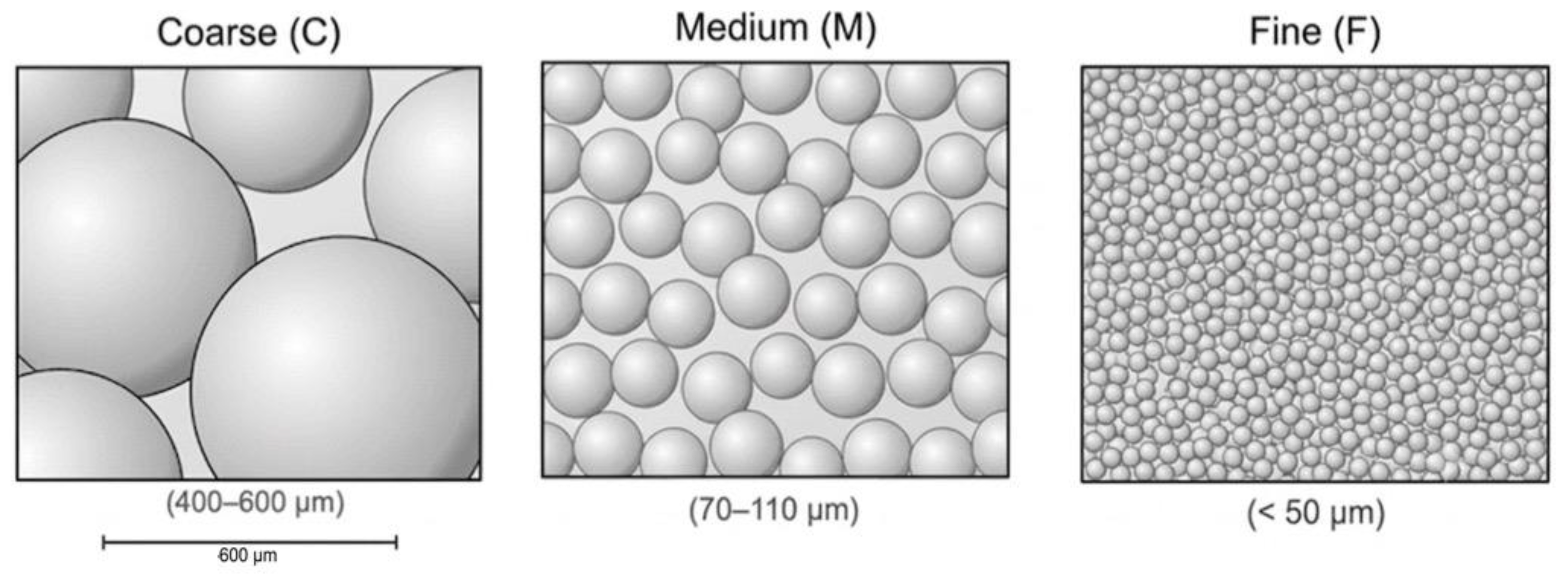
To reproduce the textural diversity of natural soils, spherical glass beads with different diameters were used: fine texture (F) with beads < 50 µm, medium texture (M) with beads of 70–110 µm, and coarse texture (C) with beads of 400–600 µm (Figure 1). The beads used were MBIVER®/GLASS B® microbeads, supplied by the company A.M.P.E.R.E. ALLOYS (Saint-Ouen-l'Aumône, France). Like natural soils, the beads are composed mainly of silica (SiO2: 73%), with secondary components including sodium oxide (Na2O: 14%), lime (CaO: 10%), magnesia (MgO: 3%), alumina (Al2O3), iron oxides (FeO–Fe2O3), and potassium oxide (K2O) (<1%). Their particle density, ranging between 2.45 and 2.55 g/cm3, is close to that of natural soils (approximately 2.64 g/cm3). Their hardness is approximately 6 on the Mohs scale, compared to 7 for quartz sands typically found in soils.

2.3. Wetting Procedure

The measurements were carried out at the soil physics laboratory of Institut de Recherche pour le Développement (IRD), in Paris (France). All experiments were conducted in a temperature-controlled room maintained at 21–22 °C. The glass beads were placed in beakers with a diameter of 9 cm and filled to a height of 20 cm. Bulk density was measured for each grain size fraction, and slight differences were observed between textures. Measured bulk densities were 1.54 g/cm3 for coarse (C), 1.46 g/cm3 for fine (F), and 1.40 g/cm3 for medium (M) fractions. These texture-specific values were used in all subsequent calculations. The model medium was prepared at different water contents using the following procedure: the required mass of dry glass beads for one beaker was weighed, and a defined amount of water was added to obtain gravimetric water contents (θg) of 0%, 10%, 20%, and 30%. The bead/water mixture was thoroughly mixed in a plastic bag by shaking. Finally, the moist beads were then transferred into the beaker and, when necessary, gently packed to reach the target height and thus target bulk density. To prevent moisture loss, the samples were covered with plastic film. After each measurement, the beads were dried in an oven at 105 °C for 2 days to ensure that each experiment started from dry conditions.

2.4. Salinity Treatments

To evaluate the effect of salinity, saline solutions were prepared at concentrations of 4, 8, and 16 g of NaCl per litre of distilled water, which correspond approximately to electrical conductivities of 7, 14 and 27 mS cm−1 at 25 °C, respectively. The samples were prepared following the same procedure described above. At the end of each measurement, the beads were rinsed with tap water, then with distilled water, and dried again in an oven at 105 °C for 2 days. This washing and drying protocol ensured that all experiments started under identical and reproducible conditions.

2.5. Manufacturer Procedure of Calibration in Air and Water

The manufacturer recommends the following calibration procedure: the probe is first placed in air, then immersed in a beaker filled with water. The output signal is recorded under each condition. To account for electronic variability, data were collected every 10 s over a period of 2 min, resulting in 12 values. Each measurement was defined as the mean of these 12 values. To reduce variability in measurement conditions, a 2 min rest period was applied between measurements. A second series of 12 values was then recorded over another 2 min period, and the mean value was calculated. This procedure was repeated five times.

2.6. Calibration in Dry and Saturated Medium

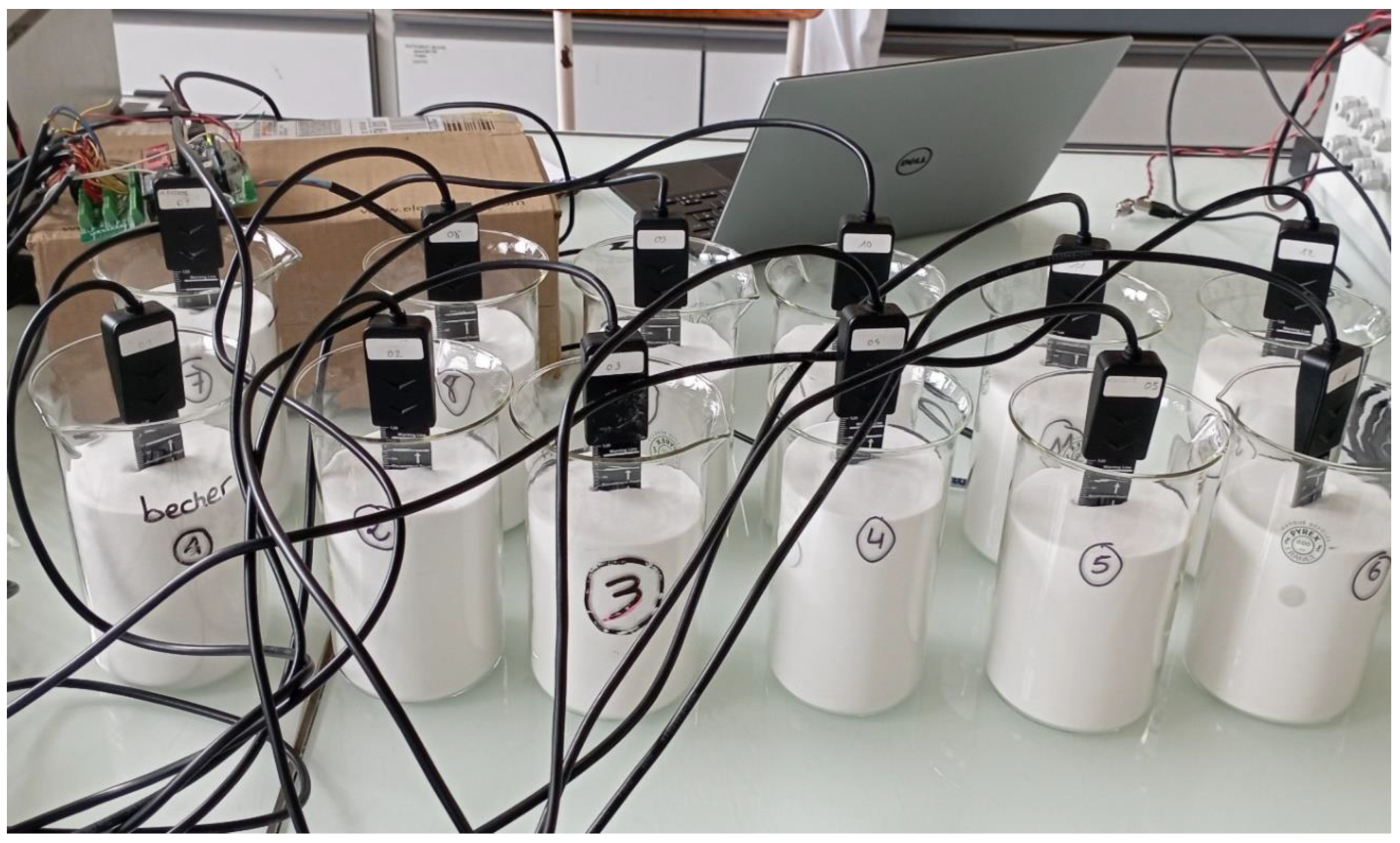
Another calibration was conducted by inserting the sensors in the dry (θg = 0%) and wet (θg = 30%) model soil, for the three textures (FMC), using the same measurement procedure as described in the previous paragraph. At (θg = 30%), the porosity was saturated by water (Figure 2).

2.7. Measurements at Different Water Contents and Salinity Levels

The measurements were conducted using the same measurement procedure as described in the previous paragraphs.

2.8. Sensor Calibration and Validation

Two calibration approaches were compared. First, the manufacturer’s recommended air/water calibration was applied: each sensor was placed in air (0% moisture) and then fully immersed in water (100% moisture), and the output signal was recorded under each condition in the same way as previously described.
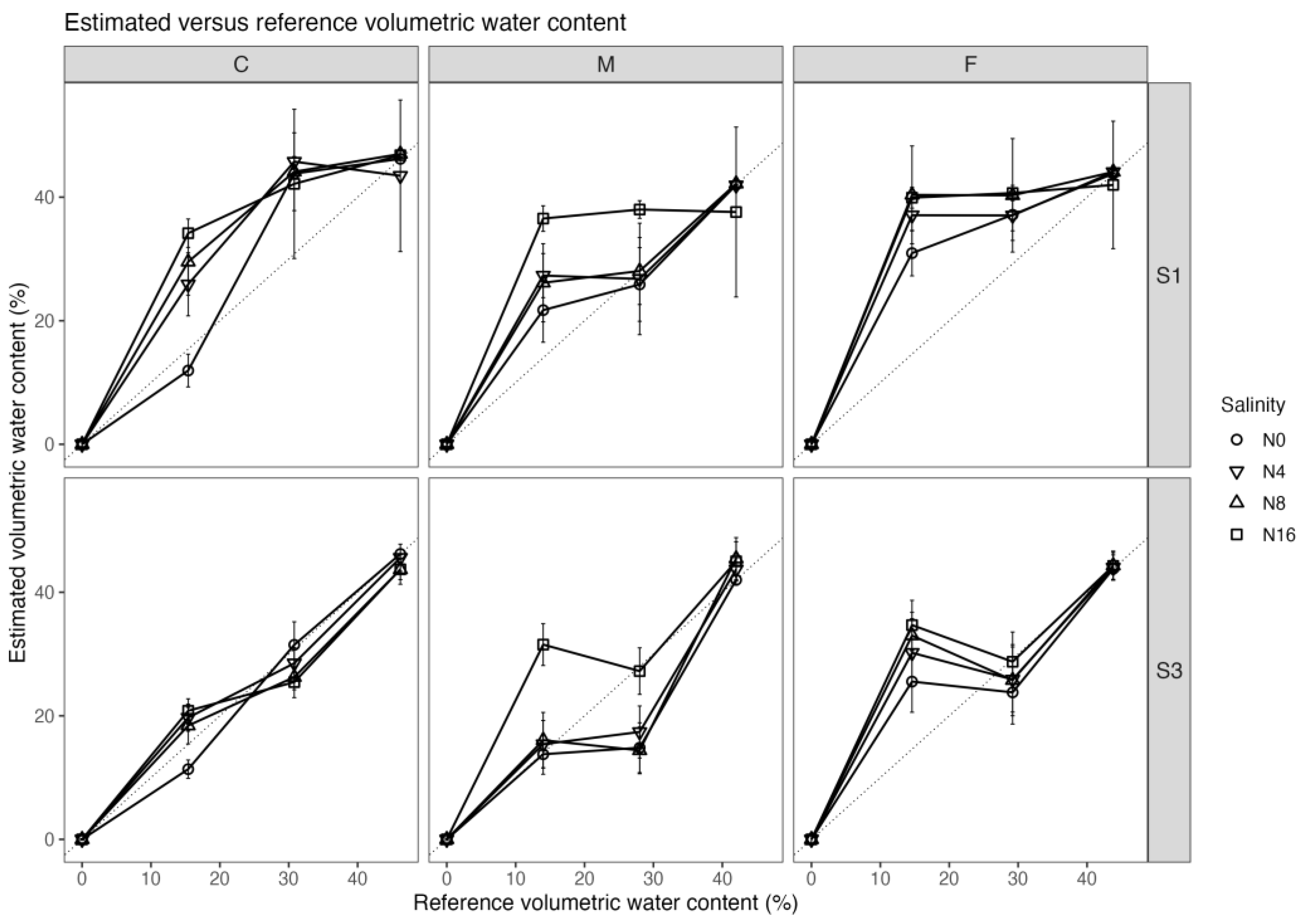
Second, sensor calibration was performed separately for each sensor, sensor type (S1 and S3), and granular texture (C, M and F) using a two-point approach based on dry and saturated conditions. The mean sensor signal measured at 0% gravimetric water content was used as the dry reference, whereas the mean signal measured at 30% gravimetric water content was used as the saturated reference. Gravimetric water contents were converted to volumetric water contents using the bulk density of each texture. Calibration parameters were derived from measurements performed with distilled water. For each experimental condition, twelve consecutive raw readings were averaged. Validation was carried out by applying the calibration obtained with distilled water to measurements collected under different salinity levels and comparing the estimated volumetric water contents with the imposed volumetric water contents. Calibration performance was assessed using the agreement between estimated and imposed values, with the 1:1 line representing perfect estimation.

2.9. Statistical Analyses

All data processing and statistical analyses were performed using R software (version 4.4.3, 2025-02-28; R Core Team, 2025) [20].
Repeatability and reproducibility: For each individual sensor unit, intra-unit repeatability was quantified by computing the median coefficient of variation (CV, %) across the twelve repeated raw readings, pooled over all experimental conditions (texture, salinity, and water content). Inter-sensor reproducibility was assessed by comparing the raw output voltage profiles across the ten units of each model (S1 and S3) under identical conditions of texture and moisture state, and by calculating the mean, standard deviation (SD), and CV (%) for each sensor type and experimental condition.
Voltage range analysis: For each sensor model and condition (air/water reference and three granular textures), the voltage range was defined as the difference between dry and saturated output voltages. Mean, SD, and CV were computed across the ten individual units. To test for significant differences in voltage range among the three particle-size classes (coarse, C; medium, M; fine, F), a one-way analysis of variance (ANOVA) was performed separately for each sensor model. When the F-test indicated significant differences (p < 0.05), a post hoc Tukey’s Honestly Significant Difference (HSD) test was applied to compare means between particle-size classes. A critical difference (CD) was calculated at p < 0.05, and compact letter displays were used to indicate homogeneous groups: means sharing the same letter are not significantly different (p ≥ 0.05), while different letters indicate significant differences (p < 0.05).
Calibration performance: Calibration performance was evaluated using four complementary metrics: the coefficient of determination (R2), the root mean square error (RMSE, expressed in % volumetric water content, VWC), the mean bias (signed mean error, % VWC), and the mean absolute error (MAE, % VWC). These metrics were calculated between imposed and estimated volumetric water contents for each sensor unit, texture, and salinity level. Performance was summarized by texture (n = 800, observations per 10 sensors × 4 water contents × 5 replicates × 4 salinity levels) and by texture × salinity level (n = 200, observations per 10 sensors × 4 water contents × 5 replicates), and measurements based on fewer than three raw readings. Agreement between estimated and imposed values was further examined graphically using the 1:1 line as a reference for perfect estimation.
Effects of water content, texture, and salinity on sensor response: To assess the main and interaction effects of water content, model medium texture, and salinity on the raw output voltage, a Type III mixed-effects linear model ANOVA was fitted separately for S1 and S3 sensors. Individual sensor units were treated as random effects to account for unit-to-unit variability. All main effects (water content, texture, salinity) and their two-way and three-way interactions were included in the model. Significance was assessed at α = 0.05, and results are reported as F-values with associated p-values.
Gemini (version 3 Flash) and Nano Banana 2 were used to generate and refine the illustrative schematics of the glass bead size distributions (Figure 1). Additionally, Claude was used for language translation, as well as spelling and grammar verification, to ensure the clarity and technical accuracy of the text. The authors have reviewed and edited all outputs and take full responsibility for the content of this publication.

3. Results

3.1. Repeatability

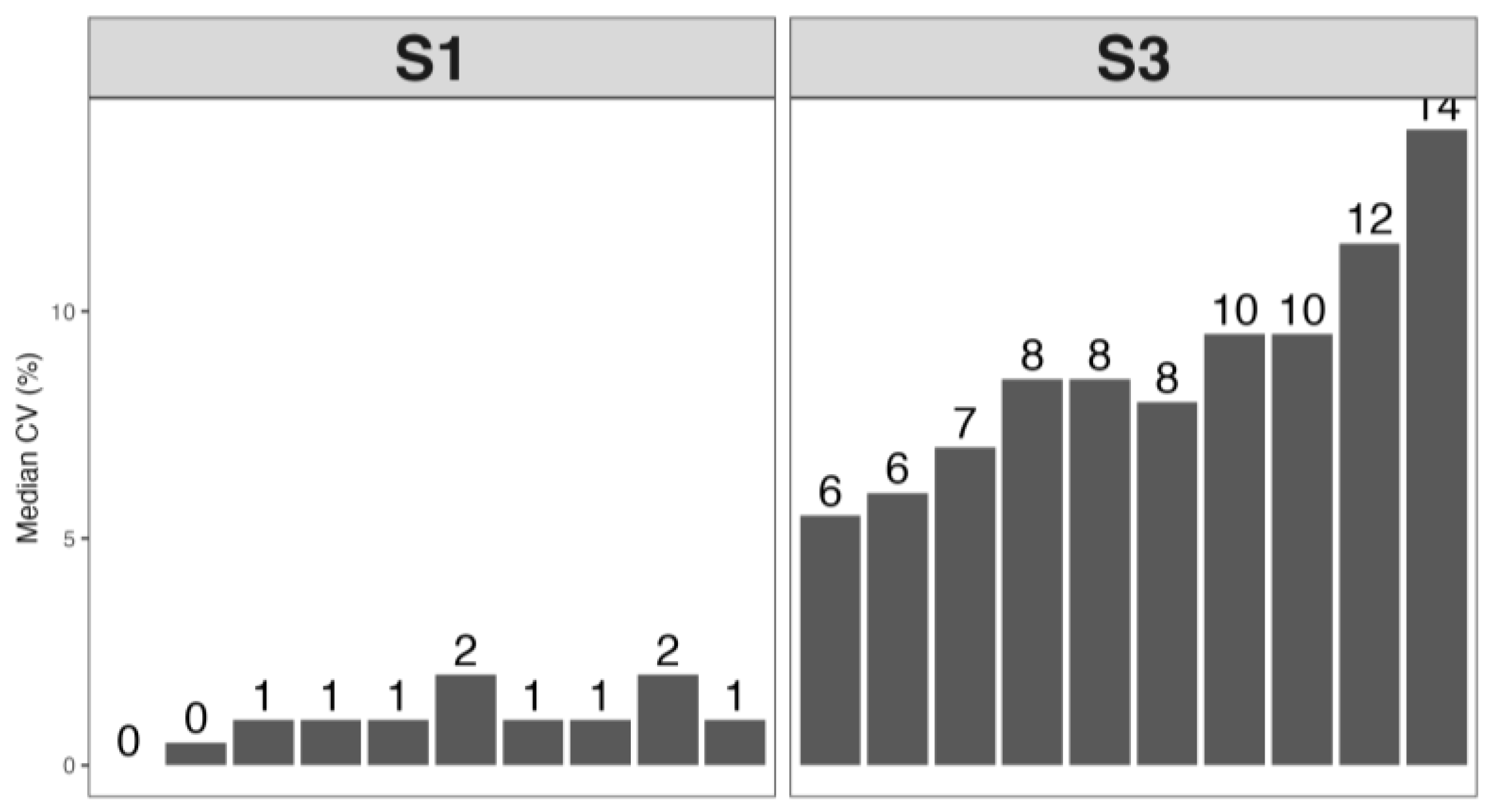
Repeatability measures the dispersion of results produced by a single probe when repeated measurements are made under the same experimental conditions. Repeatability is considered good when this dispersion is low. Figure 3 presents the intra-unit signal stability of each individual probe, quantified by the median coefficient of variation (CV, %).
For S1 sensors, repeatability was excellent across all individual units. The median CV remained at or below 2% for all ten units, with values rounded to 0% for units C1 and C3, indicating very high signal stability across repeated raw measurements (Figure 3). All ten units consistently exhibited very low variability under the tested conditions.
For S3 sensors, dispersion was markedly and systematically higher, i.e., lower repeatability. Median CV values ranged from 6% to 14%, with the majority of units exhibiting values between 7% and 12% (Figure 3). This elevation of CV was consistent across all ten S3 probes, indicating that reduced repeatability is a systematic characteristic of this sensor model under the tested conditions.

3.2. Reproducibility

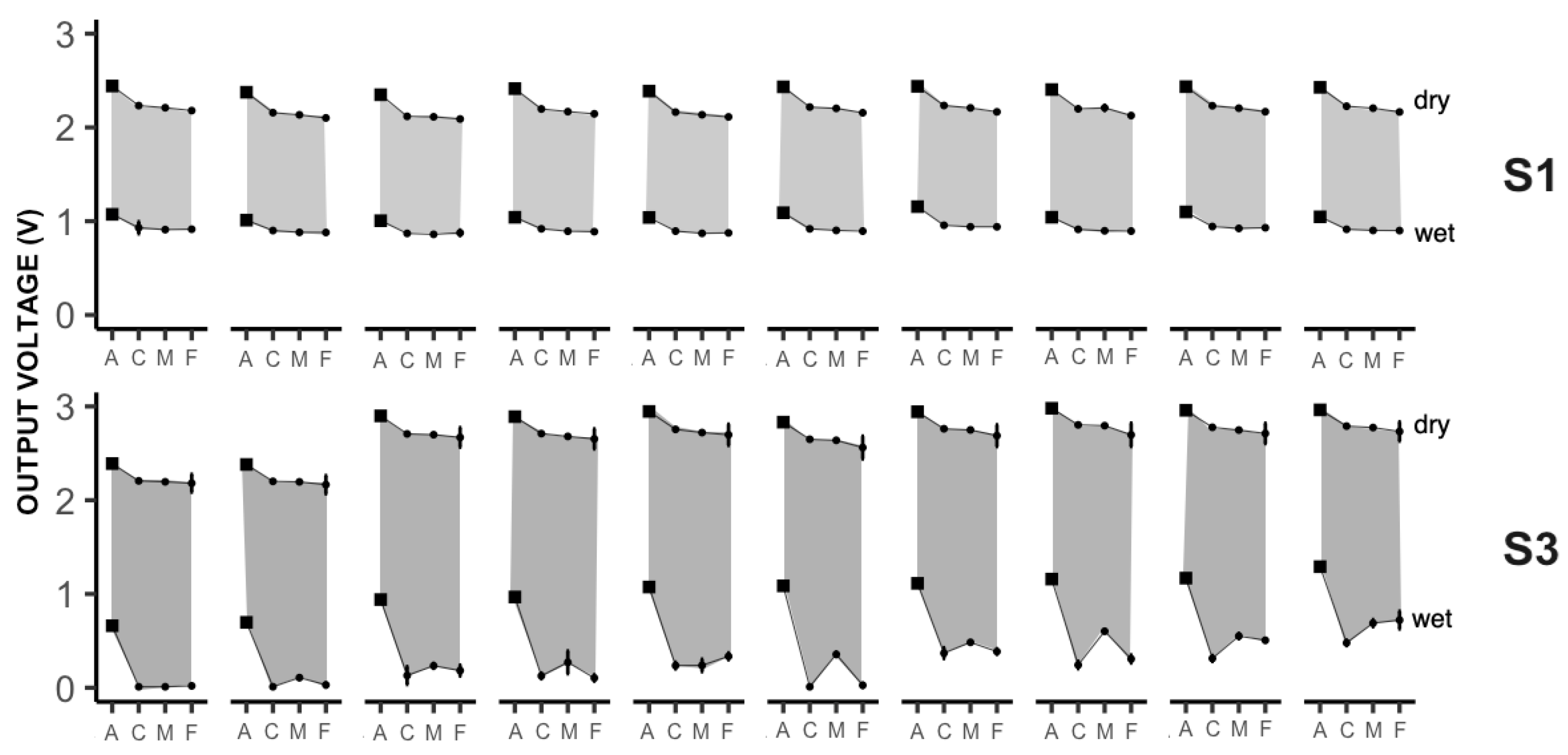
Reproducibility evaluates the dispersion of the results obtained with different individual probes placed under similar experimental conditions. Good reproducibility is achieved when the dispersion between probes is low. Figure 4 enables visual comparison of the raw output voltage profiles across the ten units of each model under dry and saturated conditions in air and in the three-model medium textures (C, M, F).
For S1 sensors, the ten voltage profiles were highly similar under all conditions. In the air/water reference condition, output voltages were nearly identical across all individual sensors, with inter-sensor differences not exceeding 0.1 V. When inserted into the model medium, this homogeneity was maintained across the three particle-size classes and both moisture states. In dry conditions, the slight decrease in output voltage from coarse to fine particle-size class was consistent and uniform across all ten individual sensors. These results indicate good inter-sensor reproducibility for S1 sensors.
For S3 sensors, the ten voltage profiles were clearly less homogeneous than those observed for S1 sensors. In the air/water reference condition, inter-sensor differences were more pronounced than for S1. When inserted into the model medium, reproducibility was also poorer in dry conditions: two individual sensors showed markedly different output voltages from the remaining sensors, and variability was still observed among the other units. In saturated conditions, the dispersion among individual sensors remained substantial and varied with particle-size class. These results indicate poorer inter-sensor reproducibility for S3 sensors than for S1 sensors, both in dry and saturated model media.

3.3. Output Voltage Range

For S1 sensors, the mean voltage range was 1.35 V under the air/water reference condition and decreased slightly in the model medium, with values of 1.28 V for the coarse and medium particle-size classes and 1.24 V for the fine class (Table 1). This decrease in the fine class was statistically significant, but inter-sensor variability remained low, with CV values of 2%. In contrast, S3 sensors showed a higher voltage range, reaching 2.27 to 2.44 V in the model medium, with no significant effect of particle-size class. However, this larger response amplitude was associated with higher inter-sensor variability, with CV values ranging from 6 to 8%. Thus, S3 provided better separation between dry and saturated states, with a range 80 to 90% larger than S1.

3.4. Calibration Performance

Calibration performance was assessed using complementary indicators describing both the agreement between estimated and reference water contents and the magnitude and direction of the estimation errors. These indicators included R2, RMSE, mean bias and MAE, in order to evaluate the strength of the relationship, overall error, systematic over- or underestimation, and absolute error.

3.4.1. Texture-Dependent Calibration Performance

Table 2 summarizes the mean calibration performance of the two sensor types according to the texture of the model medium, after pooling the four salinity levels. For S1, the calibration performance varied among textures. The highest R2 was obtained in the coarse texture (0.80 ± 0.08), followed by the medium texture (0.75 ± 0.16) and the fine texture (0.68 ± 0.11). The lowest error values were observed in the medium texture, with an RMSE of 8.9 ± 3.8% VWC and an MAE of 5.5 ± 2.7% VWC. Higher errors were obtained in the coarse texture (RMSE = 10.3 ± 2.4% VWC; MAE = 7.1 ± 2.0% VWC) and especially in the fine texture (RMSE = 12.9 ± 2.7% VWC; MAE = 8.3 ± 1.7% VWC). The mean bias was positive for all three textures, ranging from 3.6 ± 2.4% VWC in the medium texture to 7.9 ± 1.4% VWC in the fine texture, indicating that the estimated water contents were generally higher than the reference values.
For S3, the best calibration performance was obtained in the coarse texture, with a high R2 value (0.96 ± 0.02), a low RMSE (3.5 ± 0.7% VWC), a low MAE (2.5 ± 0.6% VWC) and a mean bias close to zero (−0.5 ± 0.6% VWC). In the medium texture, R2 decreased to 0.82 ± 0.04, while RMSE and MAE increased to 7.6 ± 1.4% VWC and 4.9 ± 1.0% VWC, respectively. The fine texture showed the lowest R2 for S3 (0.75 ± 0.05) and the highest error values, with an RMSE of 9.1 ± 1.5% VWC and an MAE of 5.9 ± 0.9% VWC. The mean bias remained close to zero in the coarse and medium textures, but became positive in the fine texture (3.3 ± 1.5% VWC).

3.4.2. Salinity-Related Changes in Calibration Performance

Table 3 presents the calibration performance separately for each salinity level.
For S1, the errors generally increased with salinity in all textures. In the coarse texture, RMSE increased from 6.88% VWC at N0 to 12.55% VWC at N16, while MAE increased from 4.27 to 8.92% VWC. A similar pattern was observed in the medium texture, where RMSE increased from 5.60% VWC at N0 to 14.31% VWC at N16, and MAE increased from 3.45 to 9.41% VWC.
In the fine texture, the errors were already higher at N0, with an RMSE of 9.35% VWC and an MAE of 6.18% VWC, and remained high at the highest salinity level, with an RMSE of 14.87% VWC and an MAE of 9.83% VWC. The mean bias was positive for all S1 combinations and increased with salinity in most cases.
For S3, the coarse texture showed consistently high calibration performance across the four salinity levels. R2 decreased slightly from 0.98 at N0 to 0.94 at N16, while RMSE increased from 2.88 to 4.38% VWC and MAE from 1.92 to 3.36% VWC.
In the medium texture, R2 ranged from 0.87 at N4 to 0.77 at N16, and RMSE increased from 6.17% VWC at N4 to 9.38% VWC at N16. The mean bias was negative from N0 to N8, but became positive at N16.
In the fine texture, R2 decreased from 0.82 at N0 to 0.71 at N8 and N16, while RMSE increased from 7.08 to 10.58% VWC and MAE from 4.64 to 6.56% VWC. The mean bias was positive at all salinity levels and increased from 1.38% VWC at N0 to 5.03% VWC at N16.
Overall, S3 showed higher calibration performance than S1, particularly in the coarse texture, where it combined higher R2 values with lower RMSE, MAE and mean bias. The difference between the two sensors was smaller in the medium and fine textures, but S3 still showed lower error values than S1 in all texture groups. For both sensors, the detailed results by salinity showed that calibration performance was generally better at low salinity and decreased at higher salinity levels, although the magnitude of this decrease depended on sensor type and texture.

3.5. Statistical Analysis

The results of the Type III mixed-effects linear model ANOVA for both S1 and S3 sensors are presented in Table 4. For S1, all two-way interactions were significant. The interaction between water content and texture was highly significant, as were the interactions between water content and salinity and between texture and salinity.
However, the three-way interaction between water-content, texture and salinity was not significant. This indicates that, for S1, the effects of texture and salinity on the sensor response were present, but their combined effect did not vary significantly across water content levels. For S3, the interaction between water content and texture was highly significant, while the interaction between water content and salinity was not significant.
The interaction between texture and salinity was significant, and the three-way interaction between water content, texture and salinity was also significant. Thus, for S3, the response pattern depended on a more complex combination of water content, texture and salinity than for S1.

3.6. Application of Calibration to the Experimental Data

Figure 5 shows the relationship between imposed and estimated volumetric water content for S1 and S3 sensors across the three-model medium textures and the four salinity levels. Values located on the 1:1 line indicate agreement between estimated and imposed water content, whereas values above or below this line indicate overestimation or underestimation, respectively.
For S1, at intermediate water contents, the estimated values showed clear deviations from the 1:1 line and were generally overestimated, with differences among salinity levels. In the medium texture, the dispersion among salinity levels was more pronounced, particularly at intermediate water contents, and the estimates tended to be higher than the imposed values. In the fine texture, S1 showed a marked overestimation at low and intermediate water contents, while the estimates at the highest water content were closer to the 1:1 line.
For S3, the estimated values were generally closer to the 1:1 line than for S1, particularly in the coarse texture. In this texture, the points followed the imposed water-content gradient more closely across the four salinity levels. In the medium texture, the response was less regular, with some underestimation or overestimation depending on the salinity level. In the fine texture, S3 also showed overestimation at the lowest non-zero water content, while the estimates became closer to the imposed values at higher water contents.
Overall, the figure shows that both sensors reproduced the imposed water-content gradient, but with texture- and salinity-dependent deviations. S3 showed a closer agreement with the 1:1 line than S1 in the coarse texture, whereas the differences between the two sensors were less regular in the medium and fine textures.

4. Discussion

4.1. Rationale for Using a Simplified Model Medium

The objective of our study was to determine whether, after appropriate calibration, the tested probes were able to provide reliable information on the water content of a granular medium. This first required experimental conditions that were both controlled and reproducible, because dielectric-based sensors do not measure water content directly, but infer it from an electrical response influenced by the apparent permittivity of the medium, probe geometry and sensor electronics [7,8,10,21,22,23,24]. The use of glass beads was therefore relevant because it provided a simplified porous medium with controlled physical properties, allowing the intrinsic response of the probes to be examined while reducing the complexity associated with natural soils. This approach is consistent with previous studies that used glass beads or other granular materials to analyze effective permittivity and to support the calibration or verification of dielectric methods for soil moisture measurement [25,26].
When working over a wide range of textures, water contents and salinity levels, the control and reproducibility of experimental conditions become particularly difficult in clayey materials. This difficulty arises from both mechanical and dielectric constraints. From a mechanical point of view, probe insertion may be difficult in dry clayey materials because of their high resistance, whereas above the plastic limit, the medium may be locally deformed around the probe, altering probe–medium contact and potentially affecting the measured signal. From a dielectric point of view, clay minerals have large specific surface areas, often ranging from several tens to several hundreds of m2 g−1 depending on mineral type. This favours the presence of bound water at mineral surfaces, whose dielectric behaviour differs from that of free water and can therefore modify the apparent permittivity of the medium independently of its total water content [27,28].
Consequently, the interpretation of sensor signals in clayey media generally requires specific corrections or calibrations that account for mineral–water interactions, pore structure and measurement frequency [9,12,13,29,30]. In contrast, the glass beads used in this study have a specific surface area lower than 1 m2 g−1, which strongly limits the contribution of bound water and provides more controlled dielectric conditions for testing the intrinsic response of the probes [25,26]. Additional complexity may also arise in clayey materials under saline conditions because salt concentration and clay mineralogy can modify particle interactions, leading to dispersion or flocculation. These structural changes may affect pore geometry and probe–medium contact, in addition to the direct electrical effect of salinity on the dielectric response [12,13].
Finally, despite its simplicity, the glass bead system preserves one elementary characteristic of soil porosity: a pore network resulting from the packing of mineral particles. Such a medium does not reproduce the full complexity of natural soils, but it provides a controlled granular structure in which pore geometry, phase distribution and water configuration can influence the dielectric response, as shown for aggregated and partially saturated granular porous media [30,31,32]. At low water contents, water is expected to be mainly distributed as menisci and capillary bridges between particles, before progressively forming more continuous water pathways as water content increases. Glass beads have therefore been proposed as useful reference materials for the calibration and verification of dielectric methods and devices used to measure soil moisture [26]. If the tested sensors perform well in this simplified medium, the system could then be progressively made more complex by adding clay, using different types of soil aggregates and varying the degree of compaction. Conversely, if the probes do not provide a clear and robust response in such a simplified medium, moving directly towards more complex experiments using clayey media, soil aggregates, or natural soils would be of limited relevance.

4.2. Behaviour of the Capacitive Sensors Studied

The two sensors showed clearly different behaviours, although S3 is a more recent version of the sensor, described by the manufacturer as having “optimised circuit performance”. S1 had a narrower response range than S3 between dry and saturated conditions, but showed very good signal stability. Intra-sensor repeatability was high, with median CVs always lower than or equal to 2% (Figure 3). Inter-sensor reproducibility was also good, with very homogeneous voltage profiles among the ten tested units (Figure 4). By contrast, S3 showed a much wider response amplitude, with a voltage range 80 to 90% higher than that of S1 in the model medium (Table 1). This indicates a higher apparent sensitivity to changes in water content. However, this higher sensitivity was associated with lower stability. Median CVs for S3 were much higher, ranging from 6 to 14% (Figure 3), and differences among units were more marked than for S1 (Figure 4). This contrast between response amplitude and instrumental stability is consistent with several studies showing that the performance of low-cost capacitive sensors may strongly depend on the sensor model, calibration procedure, substrate and variability among individual units [11,13,15,16,33]. These results confirm that sensor response does not depend only on the water content of the medium but also on model-specific characteristics, probably related to probe geometry, measurement volume, probe–medium contact and internal electronics. Therefore, a larger response amplitude does not necessarily imply better metrological reliability. S3 was more sensitive, but less repeatable and less reproducible than S1, which appeared less sensitive but more robust. This distinction between apparent sensitivity, precision, stability and agronomic usability is consistent with broader assessments of soil moisture sensing technologies in agriculture [4,17].

4.3. Impact of Medium Texture and Solution Salinity

The texture of the model medium influenced sensor response because it modified pore geometry, water distribution and probe–medium contact. Figure 1 shows that the three bead classes had a similar general structure, based on the packing of spherical particles and a highly connected pore network. However, pore size differed strongly among textures. The number of capillary bridges was also likely to vary, increasing as particle diameter decreased. In addition, the size of the beads relative to the probe may have affected local contact conditions. The insertion of a large probe may induce stronger rearrangement of the medium than the insertion of a smaller probe, and this rearrangement may differ according to particle size. These differences in pore geometry, water distribution and probe–medium contact can modify the distribution of the electric field around the electrodes, as shown for different soils, substrates and porous materials used for dielectric moisture measurement [28,34,35]. They may therefore explain why, at the same water content, the apparent permittivity measured by the sensor varies with medium texture. These mechanisms may also contribute to the differences in performance observed among textures, especially the higher errors in the fine texture for both sensors and the better performance of S3 in the coarse texture (Table 2).
Salinity introduced an additional source of complexity. An increase in the ionic conductivity of the solution can cause electrical losses, modify apparent permittivity and disturb the capacitive interpretation of the signal. This effect is well documented for dielectric methods, whose response depends not only on water content, but also on texture, electrical conductivity and measurement frequency [10,12,13,29,30]. Our results show that salinity affected calibration performance, but that this response was not strictly monotonic and depended on both sensor type and texture (Table 3). The statistical analysis confirmed this dependence, with significant effects of texture and salinity for both sensors and a significant texture × salinity interaction (Table 4). For S3, the significant interaction between water content, texture and salinity indicated a more complex response than for S1. Figure 5 illustrates this pattern: both sensors broadly followed the imposed water-content gradient, but deviations from the 1:1 line depended on texture and salinity. These results confirm that the measured signal results from a composite system combining water content, medium geometry, solution conductivity, probe geometry and internal electronics. Calibration that does not account for these factors remains fragile, especially for absolute quantitative estimation of water content, as also reported for low-cost capacitive sensors used in soils or agricultural substrates [15,33,35].

4.4. Value of the Glass Bead System for Testing Capacitance Probes

These results show that, even in a controlled model medium, both sensors had important metrological limitations. After calibration, errors remained substantial, especially for S1 and for fine or saline textures, as shown by the RMSE and MAE values in Table 2 and Table 3. Figure 5 also shows that the estimated values did not always lie on the 1:1 line. This indicates that calibration did not fully correct the effects of texture, salinity, probe–medium contact and sensor-specific electronic characteristics. These limitations are consistent with studies showing that dielectric measurements of water content can be affected by medium structure, electrical conductivity, temperature, sensor geometry and calibration conditions [12,13,28,36]. These results also suggest that low-cost probes are better suited to monitoring trends than to providing rigorous absolute measurements of water content. This interpretation is consistent with several studies showing that low-cost capacitive sensors can be useful for dynamic monitoring of soil moisture, but require specific calibration. Their accuracy remains dependent on the sensor, the soil or substrate, and the conditions of use [11,13,14,15,17].
In this context, the use of glass beads was a relevant methodological choice. This simplified medium made it possible to control the main factors affecting the signal, while limiting the complex effects related to clays, bound water and the structural heterogeneity of natural soils. It also relies on well-characterized granular materials, which have already been used to study dielectric properties and to verify methods for measuring moisture content [25,26]. It therefore helped to isolate more clearly the respective effects of the medium, sensor type and internal electronics.
The limitations observed under these simplified conditions would probably be more difficult to identify in a more heterogeneous natural soil, because of the spatial variability of soil properties and the many interfering factors found in real media. Texture, salinity, temperature, measurement frequency, soil structure and variability in probe–medium contact may interact and complicate interpretation of the measured signal, as widely reported in recent reviews of soil moisture sensing technologies [4,9].

5. Conclusions

This study confirms the value of starting the evaluation of low-cost capacitive sensors in a simplified model medium. This approach made it possible to identify more clearly the main factors controlling the signal and the limitations of the probes. In a more complex medium, these limitations would probably have been more difficult to interpret.
The results also confirm the caution expressed by manufacturers, who present these sensors as tools able to distinguish broad moisture classes, rather than as instruments for precise quantitative measurement. The more detailed relationships reported in some studies probably correspond to specific situations, combining a given sensor, a given medium and a local calibration.
However, our results are consistent with studies showing that calibration must be performed in the medium of use, and not only in air and water. For farmers, these sensors can therefore be useful for detecting drying, comparing irrigation practices or triggering a local alert. In practice, these sensors should be used as decision-support tools rather than as reference instruments.
Their very low cost is an important advantage, provided that a robust classification of the water status, for example, dry, wet or very wet, is preferred over an overly precise absolute estimation of water content.
Finally, the glass bead model medium can serve as a first step for comparing different capacitive sensors under simplified and interpretable conditions. Future work could extend this approach by testing other probe models and then progressively introduce more complex media, including clay, aggregates and different levels of compaction.


Author Contributions

Conceptualization, R.T. and C.H.; methodology, R.T., M.B., R.K.B.-M. and C.H.; software, R.T., R.K.B.-M. and C.H.; validation, R.T., M.B., R.K.B.-M., J.-F.P., M.G., C.P. and C.H.; formal analysis, C.H.; investigation, R.T., J.-F.P. and M.G.; resources, R.K.B.-M. and M.G.; data curation, R.T., R.K.B.-M. and C.H.; writing—original draft preparation, R.T.; writing—review and editing, C.H.; visualization, R.T. and C.H.; supervision, R.T., M.B., R.K.B.-M. and C.H.; project administration, R.T.; funding acquisition, R.T. All authors have read and agreed to the published version of the manuscript.

Funding

This work was partially funded by the EU PRIMA INTEL-IRRIS project, which has received funding from the ANR and PRIMA programme supported by the European Union under project (ID 1560). This research was also supported by the Higher School of Agronomy of Mostaganem and the Embassy of France in Algeria, together with the French Institute of Algeria (Institut Français d’Algérie), through the IFA 2024 program (France–Algeria scientific cooperation) under Grant No. 2024-185.

Data Availability Statement

The data presented in this study are available on request from the corresponding author.

Acknowledgments

The authors would like to express their gratitude to the technical and administrative staff of the Higher School of Agronomy of Mostaganem (ESAM) and the Institute of Ecology and Environmental Sciences of Paris (IEES-Paris) for providing the laboratory facilities and logistical support throughout this study. We also wish to thank the French Embassy in Algeria for its pivotal role in supporting the IFA 2024 program, which fostered this international scientific cooperation. Special thanks are also due to the company A.M.P.E.R.E. ALLOYS for the technical information regarding the glass beads used as model soils. The authors would also like to extend their sincere gratitude to the two anonymous reviewers, whose thorough and highly constructive comments greatly contributed to improving the quality and clarity of this manuscript. During the preparation of this manuscript, the authors used Gemini (version 3 Flash) and Nano Banana 2 to generate and refine the illustrative schematics of the glass bead size distributions (Figure 1). Additionally, Claude was used for language translation, as well as spelling and grammar verification, to ensure the clarity and technical accuracy of the text. The authors have reviewed and edited all outputs and take full responsibility for the content of this publication.

Conflicts of Interest

The authors declare no conflicts of interest.

Abbreviations

The following abbreviations are used in this manuscript:
CDCritical Difference
CVCoefficient of Variation
FDRFrequency Domain Reflectometry
IoTInternet of Things
RMSERoot Mean Square Error
S1SKU SEN0193 capacitive sensor model
S3SKU SEN0308 capacitive sensor model
TDRTime Domain Reflectometry
VWCVolumetric Water Content
θgGravimetric Water Content
θvVolumetric Water Content

References

  1. Bounajra, A.; Guemmat, K.E.; Mansouri, K.; Akef, F. Towards Efficient Irrigation Management at Field Scale Using New Technologies: A Systematic Literature Review. Agric. Water Manag. 2024, 295, 108758. [Google Scholar] [CrossRef]
  2. Alotaibi, M.O.; Gebreel, M.; Ikram, M.; Rekaby, S.A.; AbdElgalil, M.A.; Mahmoud, E.; Moghanm, F.S.; Ghoneim, A.M. Enhancing Water Productivity and Wheat (Triticum aestivum L.) Production through Applying Different Irrigation Manners. BMC Plant Biol. 2025, 25, 331. [Google Scholar] [CrossRef] [PubMed]
  3. Chartzoulakis, K.; Bertaki, M. Sustainable Water Management in Agriculture under Climate Change. Agric. Agric. Sci. Procedia 2015, 4, 88–98. [Google Scholar] [CrossRef]
  4. Yu, L.; Gao, W.; Shamshiri, R.R.; Tao, S.; Ren, Y.; Zhang, Y.; Su, G. Review of Research Progress on Soil Moisture Sensor Technology. Int. J. Agric. Biol. Eng. 2021, 14, 32–42. [Google Scholar] [CrossRef]
  5. Amare, D.G.; Zimale, F.A.; Sulla, G.G. Effect of Irrigation Regimes on Nutrient Uptake and Nitrate Leaching in Maize (Zea mays L.) Production at Birr-Farm, Upper Blue Nile, Ethiopia. Heliyon 2024, 10, e38005. [Google Scholar] [CrossRef] [PubMed]
  6. Shelemew, Z.; Ambomsa, A.; Bati, B.; Husen, D.; Jalde, A. Evaluation of the Effects of Irrigation and Inorganic Fertilizers Management on Yield and Water Productivity of Tomato. J. Water Resour. Ocean Sci. 2025, 14, 107–117. [Google Scholar] [CrossRef]
  7. Topp, G.C.; Davis, J.L.; Annan, A.P. Electromagnetic Determination of Soil Water Content: Measurements in Coaxial Transmission Lines. Water Resour. Res. 1980, 16, 574–582. [Google Scholar] [CrossRef]
  8. He, H.; Zou, W.; Jones, S.B.; Robinson, D.A.; Horton, R.; Dyck, M.; Filipović, V.; Noborio, K.; Bristow, K.; Gong, Y.; et al. Critical Review of the Models Used to Determine Soil Water Content Using TDR-Measured Apparent Permittivity. In Advances in Agronomy; Elsevier: Amsterdam, The Netherlands, 2023; Volume 182, pp. 169–219. ISBN 978-0-443-19268-5. [Google Scholar]
  9. Loconsole, D.; Elia, M.; Conversa, G.; De Lucia, B.; Cristiano, G.; Elia, A. Soil Moisture Sensing Technologies: Principles, Applications, and Challenges in Agriculture. Agronomy 2025, 15, 2788. [Google Scholar] [CrossRef]
  10. Abdulraheem, M.I.; Chen, H.; Li, L.; Moshood, A.Y.; Zhang, W.; Xiong, Y.; Zhang, Y.; Taiwo, L.B.; Farooque, A.A.; Hu, J. Recent Advances in Dielectric Properties-Based Soil Water Content Measurements. Remote Sens. 2024, 16, 1328. [Google Scholar] [CrossRef]
  11. Bogena, H.; Huisman, J.; Schilling, B.; Weuthen, A.; Vereecken, H. Effective Calibration of Low-Cost Soil Water Content Sensors. Sensors 2017, 17, 208. [Google Scholar] [CrossRef]
  12. Szypłowska, A.; Lewandowski, A.; Jones, S.B.; Sabouroux, P.; Szerement, J.; Kafarski, M.; Wilczek, A.; Skierucha, W. Impact of Soil Salinity, Texture and Measurement Frequency on the Relations between Soil Moisture and 20 MHz–3 GHz Dielectric Permittivity Spectrum for Soils of Medium Texture. J. Hydrol. 2019, 579, 124155. [Google Scholar] [CrossRef]
  13. Zawilski, B.M.; Granouillac, F.; Claverie, N.; Lemaire, B.; Brut, A.; Tallec, T. Calculation of Soil Water Content Using Dielectric-Permittivity-Based Sensors—Benefits of Soil-Specific Calibration. Geosci. Instrum. Methods Data Syst. 2023, 12, 45–56. [Google Scholar] [CrossRef]
  14. Adla, S.; Rai, N.K.; Karumanchi, S.H.; Tripathi, S.; Disse, M.; Pande, S. Laboratory Calibration and Performance Evaluation of Low-Cost Capacitive and Very Low-Cost Resistive Soil Moisture Sensors. Sensors 2020, 20, 363. [Google Scholar] [CrossRef] [PubMed]
  15. Gümüser, M.A.; Pichlhöfer, A.; Korjenic, A. A Comparison of Capacitive Soil Moisture Sensors in Different Substrates for Use in Irrigation Systems. Sensors 2025, 25, 1461. [Google Scholar] [CrossRef]
  16. Domínguez-Niño, J.M.; Oliver-Manera, J.; Arbat, G.; Girona, J.; Casadesús, J. Analysis of the Variability in Soil Moisture Measurements by Capacitance Sensors in a Drip-Irrigated Orchard. Sensors 2020, 20, 5100. [Google Scholar] [CrossRef]
  17. Hardie, M. Review of Novel and Emerging Proximal Soil Moisture Sensors for Use in Agriculture. Sensors 2020, 20, 6934. [Google Scholar] [CrossRef]
  18. Kulmány, I.M.; Bede-Fazekas, Á.; Beslin, A.; Giczi, Z.; Milics, G.; Kovács, B.; Kovács, M.; Ambrus, B.; Bede, L.; Vona, V. Calibration of an Arduino-Based Low-Cost Capacitive Soil Moisture Sensor for Smart Agriculture. J. Hydrol. Hydromech. 2022, 70, 330–340. [Google Scholar] [CrossRef]
  19. Raheja, A.; Sharda, R.; Garg, S.; Kaur, S.; Das, S.; Choudhary, O.P. Designing and Field Calibration of Low-Cost Microcontroller-Based Soil Moisture Sensor for Subsurface Drip-Irrigation System. Sci. Rep. 2025, 15, 35948. [Google Scholar] [CrossRef]
  20. R Core Team. R: A Language and Environment for Statistical Computing; R Foundation for Statistical Computing: Vienna, Austria, 2025. [Google Scholar]
  21. Hilhorst, M.A. A Pore Water Conductivity Sensor. Soil Sci. Soc. Am. J. 2000, 64, 1922–1925. [Google Scholar] [CrossRef]
  22. Goodchild, M.S. An Investigation into the Impact of Soil Particle Conductivity and Percolation Threshold on the Hilhorst Model to Estimate Pore Water Conductivity in Soils. Soil Sci. Soc. Am. J. 2023, 87, 1221–1228. [Google Scholar] [CrossRef]
  23. Zemni, N.; Bouksila, F.; Slama, F.; Persson, M.; Berndtsson, R.; Bouhlila, R. Evaluation of Modified Hilhorst Models for Pore Electrical Conductivity Estimation Using a Low-Cost Dielectric Sensor. Arab. J. Geosci. 2022, 15, 1089. [Google Scholar] [CrossRef]
  24. Liu, L.; Xie, X.; Lu, Y.; Ren, T. A New Approach for Estimating Pore Water Electrical Conductivity of Saturated Soils. Geoderma 2025, 462, 117539. [Google Scholar] [CrossRef]
  25. Robinson, D.A.; Friedman, S.P. The Effective Permittivity of Dense Packings of Glass Beads, Quartz Sand and Their Mixtures Immersed in Different Dielectric Backgrounds. J. Non-Cryst. Solids 2002, 305, 261–267. [Google Scholar] [CrossRef]
  26. Szerement, J.; Saito, H.; Furuhata, K.; Yagihara, S.; Szypłowska, A.; Lewandowski, A.; Kafarski, M.; Wilczek, A.; Majcher, J.; Woszczyk, A.; et al. Dielectric Properties of Glass Beads with Talc as a Reference Material for Calibration and Verification of Dielectric Methods and Devices for Measuring Soil Moisture. Materials 2020, 13, 1968. [Google Scholar] [CrossRef]
  27. Robinson, D.A. Measurement of the Solid Dielectric Permittivity of Clay Minerals and Granular Samples Using a Time Domain Reflectometry Immersion Method. Vadose Zone J. 2004, 3, 705–713. [Google Scholar] [CrossRef]
  28. González-Teruel, J.D.; Jones, S.B.; Soto-Valles, F.; Torres-Sánchez, R.; Lebron, I.; Friedman, S.P.; Robinson, D.A. Dielectric Spectroscopy and Application of Mixing Models Describing Dielectric Dispersion in Clay Minerals and Clayey Soils. Sensors 2020, 20, 6678. [Google Scholar] [CrossRef]
  29. Sheng, W.; Ni, W.; González-Teruel, J.D.; Xu, J.; Jones, S.B.; Robinson, D.A. Considerations on Measurement Frequency of Electromagnetic Sensors for Soil Water Content Determination. Geoderma 2025, 457, 117292. [Google Scholar] [CrossRef]
  30. Chen, H.; Li, L.; Awais, M.; Abdulraheem, M.I.; Zhang, W.; Raghavan, V.; Hu, J. Enhancing Accuracy in Soil Water Content Measurement: A Modified Dielectric Model Approach. J. Soil Sci. Plant Nutr. 2024, 24, 8137–8150. [Google Scholar] [CrossRef]
  31. Blonquist, J.M.; Jones, S.B.; Lebron, I.; Robinson, D.A. Microstructural and Phase Configurational Effects Determining Water Content: Dielectric Relationships of Aggregated Porous Media. Water Resour. Res. 2006, 42, W05424. [Google Scholar] [CrossRef]
  32. Chen, Y.; Or, D. Geometrical Factors and Interfacial Processes Affecting Complex Dielectric Permittivity of Partially Saturated Porous Media. Water Resour. Res. 2006, 42, W06423. [Google Scholar] [CrossRef]
  33. Abdelmoneim, A.A.; Al Kalaany, C.M.; Khadra, R.; Derardja, B.; Dragonetti, G. Calibration of Low-Cost Capacitive Soil Moisture Sensors for Irrigation Management Applications. Sensors 2025, 25, 343. [Google Scholar] [CrossRef]
  34. Spelman, D.; Kinzli, K.-D.; Kunberger, T. Calibration of the 10HS Soil Moisture Sensor for Southwest Florida Agricultural Soils. J. Irrig. Drain. Eng. 2013, 139, 965–971. [Google Scholar] [CrossRef]
  35. Pereira, R.M.; Sandri, D.; Silva Júnior, J.J.D. Evaluation of Low-Cost Capacitive Moisture Sensors in Three Types of Soils in the Cerrado, Brazil. Rev. Eng. Na Agric. REVENG 2022, 30, 262–272. [Google Scholar] [CrossRef]
  36. Evett, S.R.; Tolk, J.A.; Howell, T.A. Soil Profile Water Content Determination: Sensor Accuracy, Axial Response, Calibration, Temperature Dependence, and Precision. Vadose Zone J. 2006, 5, 894–907. [Google Scholar] [CrossRef]
Figure 1. Schematic representation of the three particle-size classes of glass beads used as the model medium: fine (F, <50 µm), medium (M, 70–110 µm), and coarse (C, 400–600 µm). The relative bead size within each textural class (C, M, F) and across the three classes was preserved to illustrate the range of particle diameters used in this study.
Water 18 01431 g001
Figure 2. Illustration of the measurement technique used for the analogue capacitive soil moisture sensor SEN0308 (S3 in this article). The manufacturer specifies a range of insertion depths, marked on the probe by minimum and maximum depth indicators (visible in the photo as arrows and horizontal lines). For this experiment, the probes were positioned at the recommended median depth, ensuring optimal contact while complying with the sensor’s tolerances.
Water 18 01431 g002
Figure 3. Median coefficient of variation (CV) of the 12 repeated raw measurements for each individual sensor. Values were calculated across all experimental conditions, including texture, salinity and water content. Each bar represents one sensor, and the value above the bar indicates its median CV (%), rounded to the nearest whole number to improve readability. Higher median CV values indicate lower repeatability of the sensor response.
Water 18 01431 g003
Figure 4. Output voltage measured for S1 and S3 sensors in reference conditions, air and water (A, square symbols), and in dry and saturated granular media for the three particle-size classes (C, M and F, corresponding to coarse, medium and fine glass beads). For each sensor, the upper point corresponds to the dry condition and the lower point to the saturated condition. Each point represents the mean of five replicates, each replicate being calculated as the mean of 12 repeated measurements. Error bars represent the standard deviation (n = 5). Sensors are ordered according to increasing output voltage in the saturated coarse medium.
Water 18 01431 g004
Figure 5. Performance of the polynomial calibration equation. The calibration was established for each individual sensor and texture using N0 dry and saturated points, and then applied to all water content and salinity levels. Points represent the mean estimated volumetric water content for each salinity × water content combination, and error bars represent the standard deviation.
Water 18 01431 g005
Table 1. Output voltage range (V) for S1 and S3 sensors under the air/water reference condition and in the three-model medium particle-size classes: coarse (C), medium (M) and fine (F). Values represent the difference between air and water output voltages for the reference condition, and between dry and saturated output voltages for the model media. Mean, standard deviation (SD) and coefficient of variation (CV %) were calculated across n = 10 individual sensor units. For each sensor model, means followed by different letters differ significantly at p < 0.05 based on pairwise comparison of means among the three particle-size classes. CD: critical difference at p < 0.05. Dashes (-) indicate that the CD was not applicable or not repeated for the corresponding column.
ReplicatesS1S3
Range (V)Range (V)
AIR/WaterCMFAIR/WaterCMF
Mean1.351.28 a1.28 a1.24 b1.82.44 a2.27 a2.31 a
SD0.050.020.020.020.110.160.150.18
CV (%)42226768
CD (p < 0.05)-0.0331---0.1881--
Table 2. Overall calibration performance of S1 and S3 sensors by model medium texture—coarse (C), medium (M), and fine (F). Metrics include the coefficient of determination (R2), root mean square error (RMSE, % volumetric water content), mean bias (% VWC), and mean absolute error (MAE, % VWC), calculated across n = 800 observations per texture × sensor combination (4 salinity levels).
Sensor TypeTextureR2RMSEMean BiasMAE
S1C0.80 ± 0.0810.3 ± 2.45.7 ± 2.47.1 ± 2.0
M0.75 ± 0.168.9 ± 3.83.6 ± 2.45.5 ± 2.7
F0.68 ± 0.1112.9 ± 2.77.9 ± 1.48.3 ± 1.7
S3C0.96 ± 0.023.5 ± 0.7−0.5 ± 0.62.5 ± 0.6
M0.82 ± 0.047.6 ± 1.4−0.6 ± 3.74.9 ± 1.0
F0.75 ± 0.059.1 ± 1.53.3 ± 1.55.9 ± 0.9
Table 3. Mean calibration performance for the two sensor types, S1 and S3, according to the texture of the medium. For each sensor–texture combination, values correspond to the mean ± standard deviation calculated from the four increasing salinity levels, N0, N4, N8 and N16. The coefficient of determination, R2, indicates the goodness of fit between the estimated values and the reference values. RMSE, mean bias and MAE describe the root mean square error, the signed mean error and the mean absolute error, respectively. The total n = 200 corresponds to the number of elementary averaged measurements used for the four salinity levels combined, measurements based on fewer than three raw readings.
Sensor TypeTextureSalinityR2RMSEMean BiasMAE
S1CN00.906.882.394.27
N40.7511.345.687.50
N80.8310.557.067.51
N160.7412.557.688.92
MN00.885.601.403.45
N40.788.233.004.81
N80.837.353.094.43
N160.5314.317.039.41
FN00.839.356.076.18
N40.7212.147.657.80
N80.6015.269.299.35
N160.5914.878.749.83
S3CN00.982.88−0.841.92
N40.973.150.352.19
N80.963.68−1.012.66
N160.944.38−0.603.36
MN00.857.08−3.354.10
N40.876.17−1.874.01
N80.807.84−2.035.34
N160.779.384.946.01
FN00.827.081.384.64
N40.768.893.125.70
N80.7110.043.876.52
N160.7110.585.036.56
Table 4. Results of Type III mixed-effects linear model ANOVA for S1 and S3 sensors. F-values and associated p-values are reported for all main effects and interactions. Significance codes: *** p < 0.001; ** p < 0.01; * p < 0.05; ns: not significant.
Source of VariationS1—F-ValueS1—p-ValueS3—F-ValueS3—p-Value
Water content6823.29<0.001 ***12,692.57<0.001 ***
Model medium texture40.60<0.001 ***99.58<0.001 ***
Salinity21.46<0.001 ***23.27<0.001 ***
Water content × Texture15.39<0.001 ***20.98<0.001 ***
Water content × Salinity4.080.01 **1.790.15 ns
Texture × Salinity2.310.03 *5.33<0.001 ***
Water content × Texture × Salinity0.490.82 ns2.550.02 *
Disclaimer/Publisher’s Note: The statements, opinions and data contained in all publications are solely those of the individual author(s) and contributor(s) and not of MDPI and/or the editor(s). MDPI and/or the editor(s) disclaim responsibility for any injury to people or property resulting from any ideas, methods, instructions or products referred to in the content.