Article

Evaluating Leaf Area and Biomass Relationship in Posidonia oceanica (L.) Delile: A Tool for Non-Destructive Assessment

1
Department of Earth, Environment and Life Sciences (DiSTAV), University of Genova, Corso Europa 26, 16132 Genoa, Italy
2
One Ocean Foundation (OOF), Via Gesù 10, 20121 Milan, Italy
3
Consorzio Nazionale Interuniversitario per le Scienze del Mare (CoNISMa), Piazzale Flaminio 9, 00196 Rome, Italy
4
National Biodiversity Future Center (NBFC), Piazza Marina 61, 90133 Palermo, Italy
*
Author to whom correspondence should be addressed.
Deceased authors.
Water 2026, 18(12), 1419; https://doi.org/10.3390/w18121419
Submission received: 20 April 2026 / Revised: 5 June 2026 / Accepted: 7 June 2026 / Published: 10 June 2026
(This article belongs to the Special Issue Coastal Biodiversity Conservation and Restoration)

Highlights

  • Posidonia oceanica leaves exhibit a power-law relationship between surface area and dry weight.
  • The allometric scaling exponent is consistent across sites and sampling periods in the Ligurian Sea.
  • A validated allometric equation enables non-destructive shoot biomass estimation in P. oceanica.
  • The equation provides a basis for non-invasive meadow-scale canopy biomass estimation.

Abstract

Posidonia oceanica (L.) Delile is a seagrass endemic to the Mediterranean Sea and a significant contributor to human well-being through a variety of ecosystem functions, such as carbon cycling. Despite its ecological significance, most methods for estimating leaf biomass in this species are either destructive or expensive. In this study, 2500 individual leaves from 351 shoots of Posidonia oceanica were collected, across 16 sites in the Ligurian Sea, over two time periods (2016–2018 and 2024–2025), and analyzed for total leaf area and dry weight. An allometric equation following a power-law structure was derived using linear mixed-effects models and it was later validated via 10-fold cross-validation. Although some variations in the intercept term were observed, the allometric scaling structure remained consistent across space and time, providing the first robust species-specific allometric tool to estimate P. oceanica biomass, forming the basis of a proposed non-destructive protocol for meadow-scale biomass estimation.

1. Introduction

Posidonia oceanica (L.) Delile is a seagrass endemic to the Mediterranean Sea and one of the most ecologically significant components of the basin’s carbon cycle [1,2]. A defining feature of these meadows is their capacity for long-term carbon sequestration, achieved through the formation of the matte—a dense matrix of dead rhizomes, roots, and sediment that accumulates over centuries and stores substantial quantities of both organic and inorganic carbon [3,4,5,6,7,8]. The matte stocks vary between 40 and 237 kg C m−2 across the basin [2,3,4,5,6,7,8,9], with the total organic carbon stock trapped in P. oceanica matte estimated at 711–1067 million Mg C [9,10].
The second major contribution of P. oceanica to the carbon cycle lies in its exceptional primary productivity. The leaf blades are the most productive part of the plant, accounting for 79% of the carbon fixed per shoot, followed by sheaths (17%) and rhizomes (4%) [2]. Gross carbon fixation capacity ranges between 33.5 g C m−2 per year, in light-limited environments, to 426 g C m−2 per year, in shallow and well-illuminated areas [2,6]. This high productivity contributes directly to carbon storage carbon storage, since it is estimated that roughly between 10% and 36% of biomass produced in meadows is permanently buried in the matte, constituting a long-term carbon sink [8,11,12].
Given the importance of P. oceanica in Mediterranean carbon budgets, a range of monitoring techniques have been developed to quantify its productivity and carbon fixation. One of the most widely applied direct methods is the leaf marking technique originally described by Zieman (1974), in which divers pierce all leaves at a fixed reference point and, after an interval of 15–30 days, collect shoots and measure new tissue growth from the ligule to the mark, deriving biomass production over the elapsed period of time [13,14,15,16]. An alternative reconstructive technique is lepidochronology, which requires the sampling of cuttings and the analysis of each sheath’s thickness to reconstruct decades of productivity [14,17,18]. More recently, non-destructive methods have been explored with the aim of reducing physical disturbance to the meadow. However, most of these techniques are expensive and require special materials, such as the aquatic eddy covariance, which measures oxygen flux above the canopy through an array of sensors [5].
Alongside these approaches, allometric relationships have been used as a means to derive P. oceanica leaf biomass and primary productivity without the need for destructive sampling [7,19]. Such techniques have been widespread for many years in the field of terrestrial botany [20,21,22,23,24]. Duarte (1991) made the first attempt at establishing an allometric relationship across seagrass species in the Mediterranean [25]. He demonstrated that a power-law relationship exists between morphological traits and biomass. Building on this work, subsequent studies have validated allometric power-law scaling of leaf biomass in terms of leaf area in species such as Zostera marina [26,27,28,29]. For P. oceanica, however, no reliable and validated allometric equation has been developed, with most existing productivity assessments still relying on destructive methods [30].
This gap persists because the biomass-to-area relationship is dependent on a range of site-specific factors, including depth, light availability, hydrodynamics, and nutrient availability, which introduce variability across meadows and seasons [30,31,32]. Establishing such a relationship would represent a significant step toward the development of non-destructive methods for estimating leaf biomass and, subsequently, primary productivity across P. oceanica meadows [33,34]. This prospect carries particular relevance in the current conservation context, where several restoration programs are being implemented across the Mediterranean Sea to prevent the decline of this seagrass [35,36,37,38,39].
The objective of this study is to evaluate whether a robust allometric relationship between P. oceanica leaf area and dry weight can be established and serve as the basis for a non-destructive biomass estimation equation. The derived equation is integrated with current seagrass monitoring techniques to outline a protocol for meadow-scale biomass assessment.

2. Materials and Methods

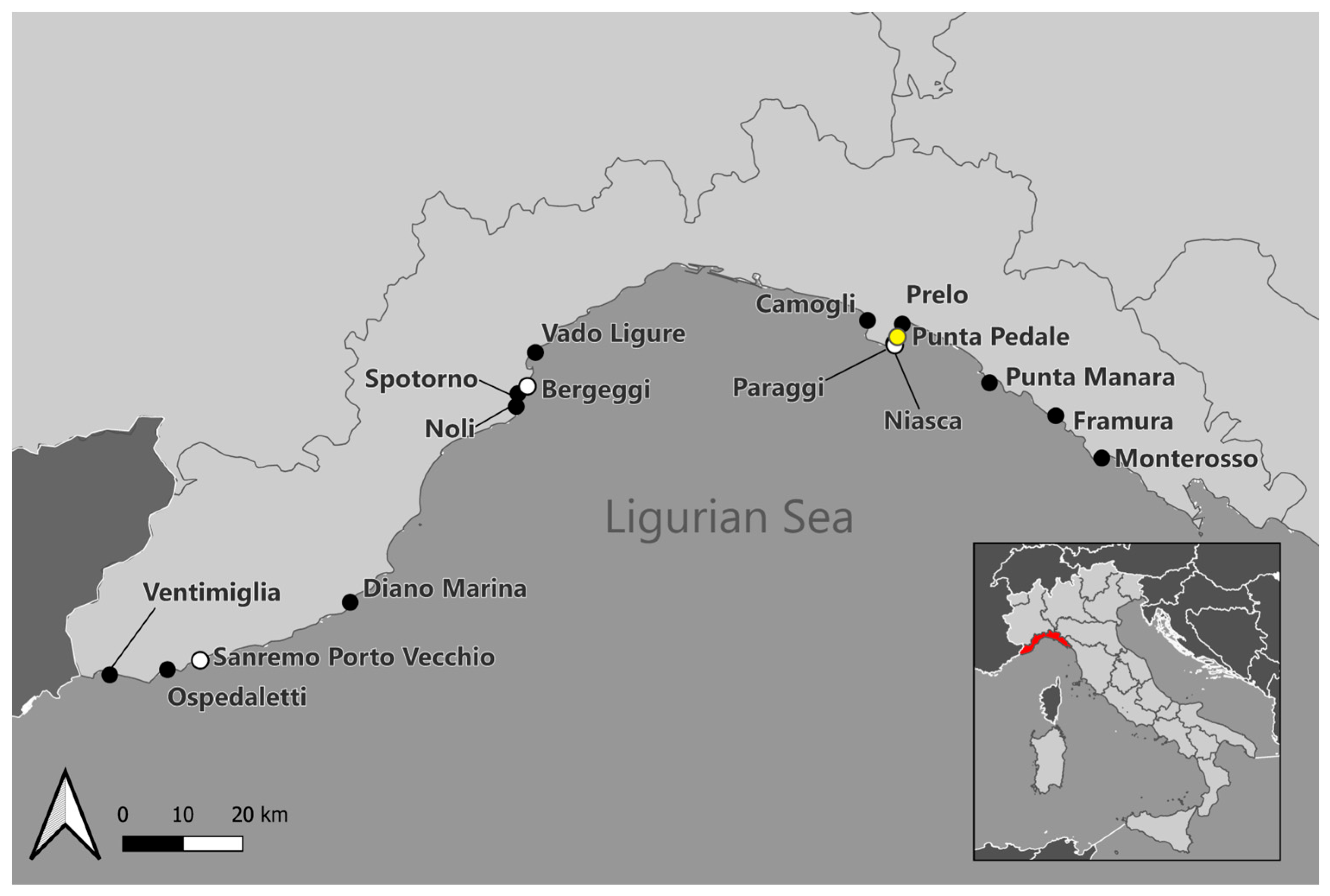
A dataset of roughly 2500 individual Posidonia oceanica leaves was assembled, collected from 351 shoots across 16 different sites, scattered around the region of Liguria, Italy (Figure 1). The Ligurian Sea was chosen as a case study because of its ecological heterogeneity, encompassing meadows at various depths, conservation states and subjected to several anthropic pressures [40,41,42,43,44,45,46,47]. These include physical damage from anchoring, fishing activities or worsening water quality from maritime and fluvial works, such as dredging and beach nourishment [30,40,41]. The sites selected for this study host P. oceanica meadows at various depths, with some located within Marine Protected Areas (MPA) (Table 1). While all sites are subject to differing degrees of anthropogenic pressure, site-specific measures of the nature and extent of these pressures fall outside the scope of this study, as comprehensive historical records are not readily available. Samples were always collected at the center of the meadow, in an area of high shoot density and cover. Shoots were collected across seasons in different proportions, with the highest amount in autumn (135), followed by summer (90), winter (63) and spring (63).

2.1. Sampling Design

At each site, the number of replicates was chosen according to the guidelines given for biomass monitoring by the PREI index (Posidonia Rapid Assessment Index) [14,47]. Accordingly, a total of nine P. oceanica shoots were collected randomly from three different stations by SCUBA divers at each site.
All morphological analyses were performed in the laboratory following standardized procedures [14,17,30,48,49]. For each shoot, juvenile and severely damaged leaves were removed, the remaining leaves were counted, and their length and width were measured, to obtain the following descriptors: the number of leaves per shoot (n_leaves·shoot−1), leaf width (cm) and leaf length (cm). Leaf length was defined as the longest extension of the leaf from apex to base and the leaf width as the longest extension of any two points on the blade parallel to each other and perpendicular to the length axis [50]. After measurements, all the epiphytes were scraped off from the leaves and the clean leaves were dried at 60 °C for 48 h to measure dry biomass (g DW).
For each shoot, we calculated the total leaf area (cm2), mean leaf biomass per shoot (g DW shoot−1), and the mean carbon content per shoot (gC shoot−1). Because leaf area was estimated assuming a perfectly rectangular shape, a correction factor (CF) was calculated and applied using a subset of 160 randomly selected leaves, which were photographed using an OM System Tough TG-7 digital camera (OM Digital Solutions, Tokyo, Japan). The true leaf area was derived through the software Fiji (Version 1.54), National Institutes of Health, Bethesda, MD, USA, and divided by the corresponding rectangular estimate to obtain the CF [50,51,52,53]. Carbon content within shoots was then estimated using conversion coefficients gathered from the literature. The regional Mediterranean leaf tissue typically contains an average of between 37.8 ± 1.6% and 41.3 ± 0.4% carbon for leaf tissue [2,54], although earlier localized studies established lower values (27.4 ± 1.5%) [7]. Within this study, we used the values proposed by Pergent-Martini et al., (2021) [2], as they provide measurements of over a hundred leaves across various sites and depths, allowing the protocol the capacity to estimate carbon content across the whole Mediterranean basin. To finally derive an equation that estimates carbon content, without accounting for seasonal or depth-related variations, the Pergent-Martini et al. (2021) [2] conversion factor was inserted in the equation and the uncertainty of carbon content was calculated by combining the carbon fraction variability (CV = 4.23%) with the allometric absolute error, through propagation of relative errors in quadrature.

2.2. Data Analysis

To quantify the relationship between leaf dry weight (DW) and leaf area in Posidonia oceanica, a log–log allometric model (1) was created:
log D W i j = α + β l o g ( A i j ) + ε i j
where D W i j is the dry weight of leaves in a shoot i at site j, A i j is the corresponding leaf area, and ε i j represents the residual error. For comparison, the linear model of leaf area and dry weight (2) was also considered, expressed as follows:
D W i j = α + β A i j + ε i j
Diagnostics plots were subsequently performed to evaluate model adequacy, to verify assumptions of homoscedasticity and normality of residuals. To test differences in allometric scaling between the two sampling periods (i.e., 2016–2018 and 2024–2025), linear mixed-effect models (LMMs) with Gaussian error distribution were fitted on log-transformed data (Equations (3) and (4)).
l o g D W i j k = β 0 + β 1 l o g A i j k + β 2 D a t a s e t i k j + u 0 j + u 1 j l o g ( A i j ) + ε i j
l o g D W i j = E q u a t i o n   ( 3 ) + β 3 l o g A i j · D a t a s e t i k j  
where D a t a s e t i k j represents the sampling period k at the site j, and u 0 j and u 1 j   are site-specific random intercept and slope, respectively. In the first LMM (3), the sampling period (Datasetikj) and leaf area (Aij) were included as fixed effects. In the second model (4), their interaction was also included. Because multiple leaves were sampled close by or within the same sites, to account for spatial non-independence, the term site was included as a random factor in both LMMs. The significance of the model terms was assessed using the Wald χ2 test analysis of variance. Different combinations of fixed and random factors were compared using the Akaike Information Criterion (AIC) and likelihood ratio tests (LRTs) using maximum likelihood estimation. Fixed effects were evaluated using Kenward–Roger approximated F-tests. To quantify the proportion of variance explained by fixed and random components, marginal and conditional R2 were computed following the Nakagawa and Schielzeth framework. Marginal R2 describes the proportion of variance explained by fixed factors, and conditional R2 includes fixed and random factors [55].
Finally, the predictive performance of the model was assessed using 10-fold cross-validation, as well as the Root of the Mean of Square of Errors (RMSE) and the Mean of Absolute value of Errors (MAE). In addition to predictive performance parameters, a 95% confidence interval was constructed using a parametric bootstrap procedure (999 iterations). For each iteration, the dataset was resampled and the LMM was refitted to extract allometric parameters from the fixed effects, combining them with residual noise drawn from the RMSE. The resulting distribution was used to estimate the 2.5th and the 97.5th percentile as lower and upper bounds of the confidence interval (CI). A last validation of the predictive power of the final equation was achieved through the Concordance Correlation Coefficient (CCC), assessing the agreement between observed and predicted biomass values.
All statistical analyses were conducted in R (version 4.5.0), using R-studio version 4.5.0 and Claude 3.5 Sonnet (Anthropic) as an assistant to generate and de-bug code to (i) compare LMMs using the lme4 and lmerTest packages; (ii) compute performance metrics (RMSE, MAE and CCC); and (iii) produce publication-quality figures using ggplot2. All code generated with AI assistance was reviewed, tested and validated. Claude was not used to interpret results or draw conclusions. All analytical decisions were made independently by the authors.

3. Results

3.1. Shoot Canopy Morphology

A total of 351 shoots were analyzed. Leaf dry weight per shoot ranged from 0.097 g to 2.158 g, with a mean value of 0.719 g (±SD = 0.4221 g). Total shoot leaf area varied between 28.21 cm2 and 663.36 cm2, with a mean of 196.75 cm2 (±SD = 94.46 cm2). The number of leaves per shoot ranged from 3 to 12, with an average of 5.69 leaves per shoot (±SD = 1.37 leaves). The site displaying the greatest total shoot area was Punta Pedale, with a mean area of 391 cm2 (±SD = 155 cm2) and a considerable variation in leaf size over time, going from 101 cm2 to 663 cm2. Diano Marina displayed the lowest mean area of 118 cm2 (±SD = 34.1 cm2), ranging from 54.2 cm2 to 170 cm2. When considering mean leaf area, Vado Ligure had the largest individual leaves, with a mean of 59.4 cm2 per leaf (±SD = 12.8 cm2) and Diano Marina resulted as having the smallest with a mean of 20.1 cm2 (±SD = 4.52 cm2). The correction factor for leaf area had a mean value of 0.996 (±SD = 0.086), indicating that manual measurements slightly underestimated the true leaf area on average.
Based on the measured shoot dry weights and carbon content values reported in the literature for Posidonia oceanica, leaf carbon stocks were estimated for each shoot. Using the most conservative estimate by Pergent et al. (1994), the mean carbon content of shoots was 0.197 ± 0.1162 g C shoot−1, ranging between 0.0265 and 0.5913 g C shoot−1 [7]. Based on the values provided by Pergent-Martini et al. (2021), the mean carbon content of shoots is 0.2717 ± 0.16 g C shoot−1, with a range varying between 0.0366 and 0.8157 g C shoot−1 [2]. As the latter values are derived from a comprehensive dataset compiled from various studies spanning the entire Mediterranean basin, they are considered more representative of regional variability and are therefore preferred for subsequent carbon stock estimates.

3.2. Leaf Area–Dry Weight Allometry

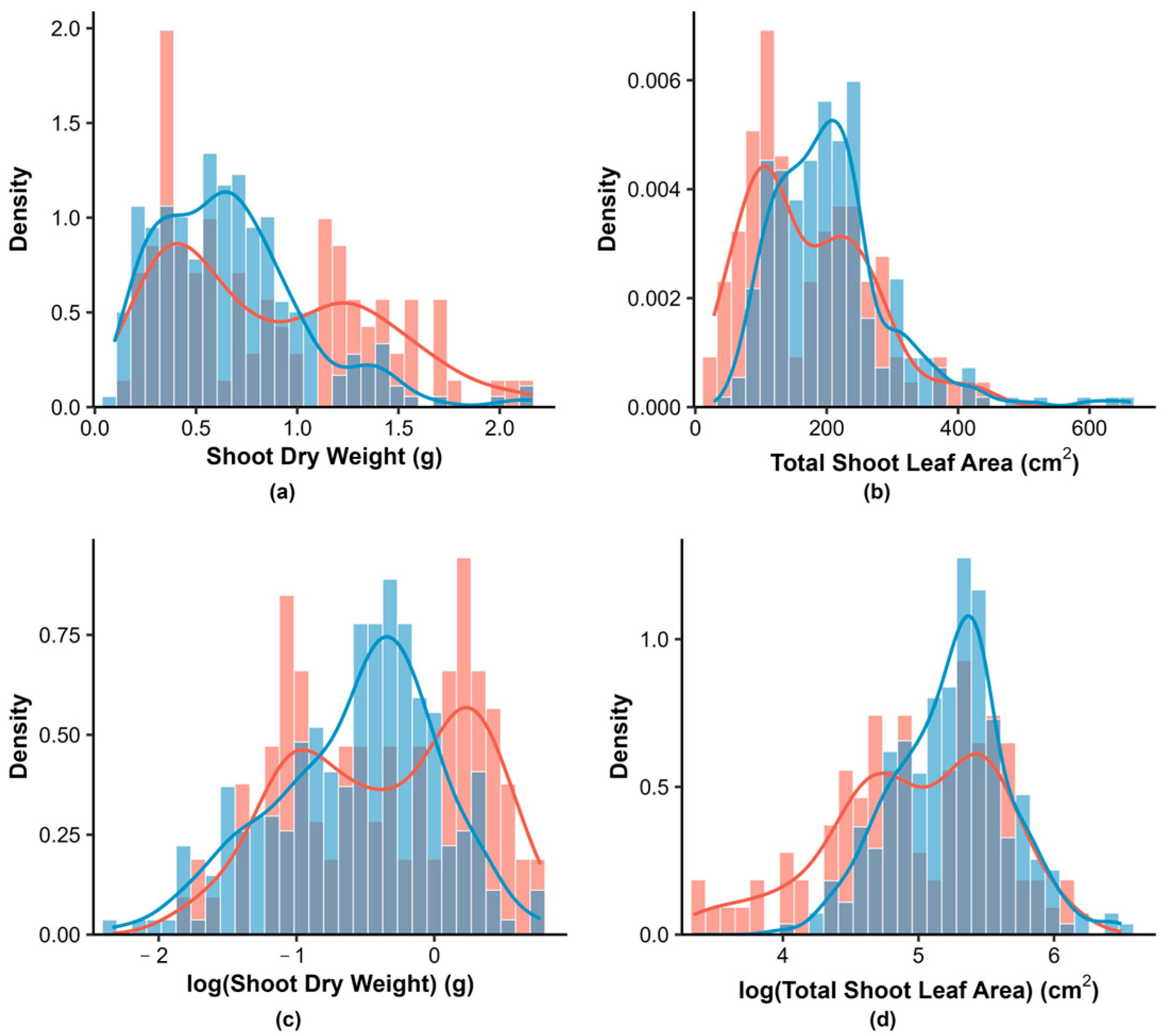
A strong positive relationship was observed between total shoot leaf area and total shoot leaf dry weight. A simple linear regression on raw-scale variables explained 74.4% of the variation in dry weight (R2 = 0.744, p < 0.001). However, because plant size–biomass relationships typically follow power-law scaling [20,23,24,25,26,27,34,56], the relationship was further examined using a log–log transformation. Inspections of the marginal distributions of dry weight revealed a bimodal pattern, likely reflecting underlying a site- and season-specific structure in the data, which motivated the use of LMMs. Accounting for the hierarchical sampling structure, two random-effects structures were compared: a random-intercept model (Model 1, Table 2) and a random-intercept-plus-slope model (Model 2, Table 2).
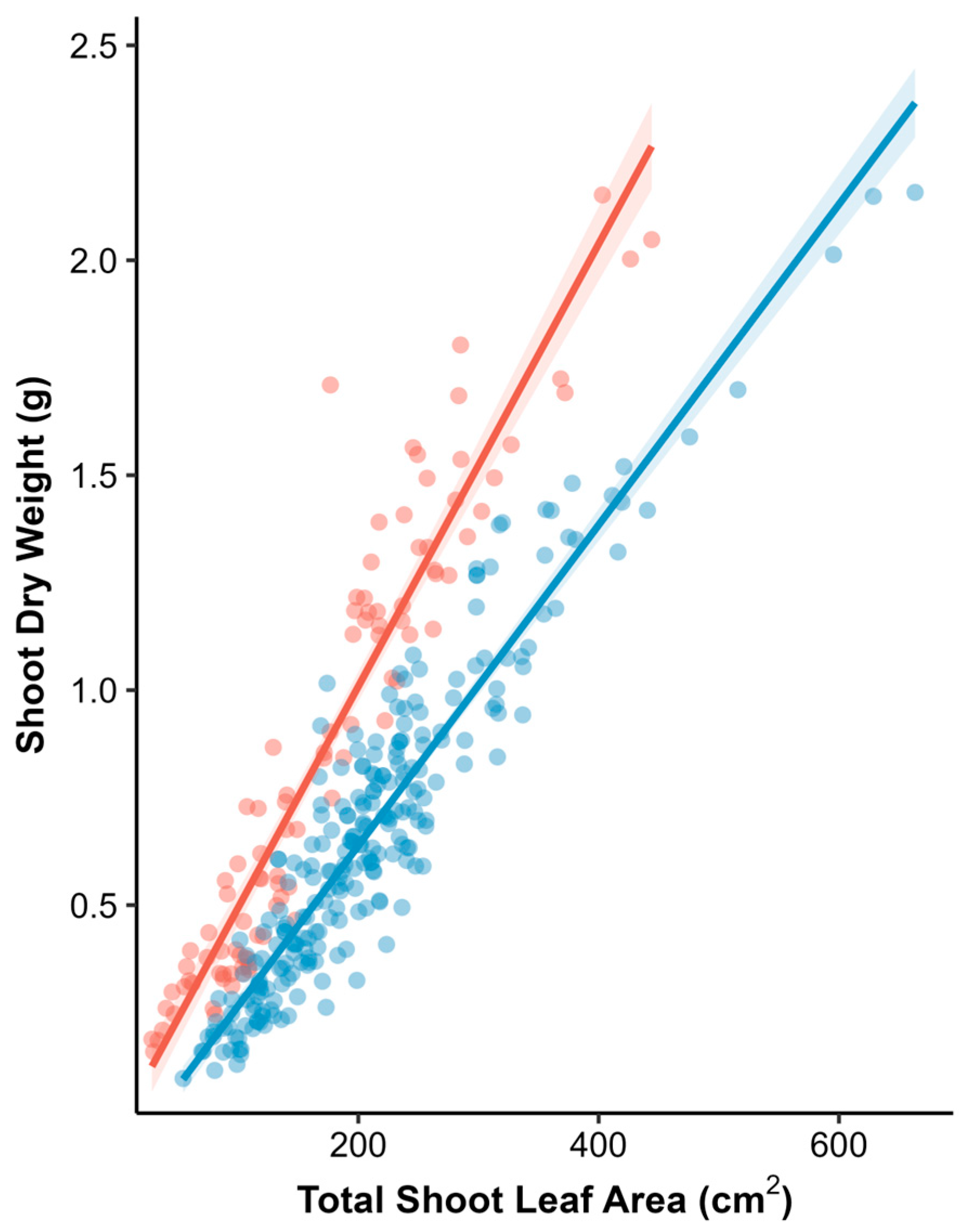
Within the first option, the factor site was inserted as a random intercept, allowing baseline dry weight to vary by site, while, in the second equation, it was inserted as a random slope, allowing the allometric scaling relationship to vary by site. The random-slope model provided a significantly better fit (χ2 = 24.99, p < 0.001) and a lower AIC (−160.2 vs. −139.2) compared with the first model, indicating that the allometric scaling relationship varies significantly among sites. To understand whether the origin of site variation was related to the temporal origin of the data (2016–2018 vs. 2024–2025), mixed-effect models were run including dataset as a fixed effect (Model 3, Table 2), as well as the interaction with log-transformed leaf area (Model 4, Table 2).
ANOVA comparison between Model 3 and Model 4 resulted as marginally non-significant (χ2 = 3.752, p > 0.05) with a very similar AIC (Table 3), leading to the retention of the simpler model without the interaction term. A final comparison, between Model 2 and Model 3, using LRT (χ2 = 17.37, p < 0.001) and Kenward–Roger approximated F-test (F = 19.02, p < 0.001), confirmed that the dataset variable significantly improved model fit, justifying its inclusion as a fixed effect in the final model. Based on these results, the final predictive equation relating leaf area to dry weight is
D W = 0.00248 × A r e a 1.122 × e ϵ ;   with   ϵ N ( 0 , 0.02867 )
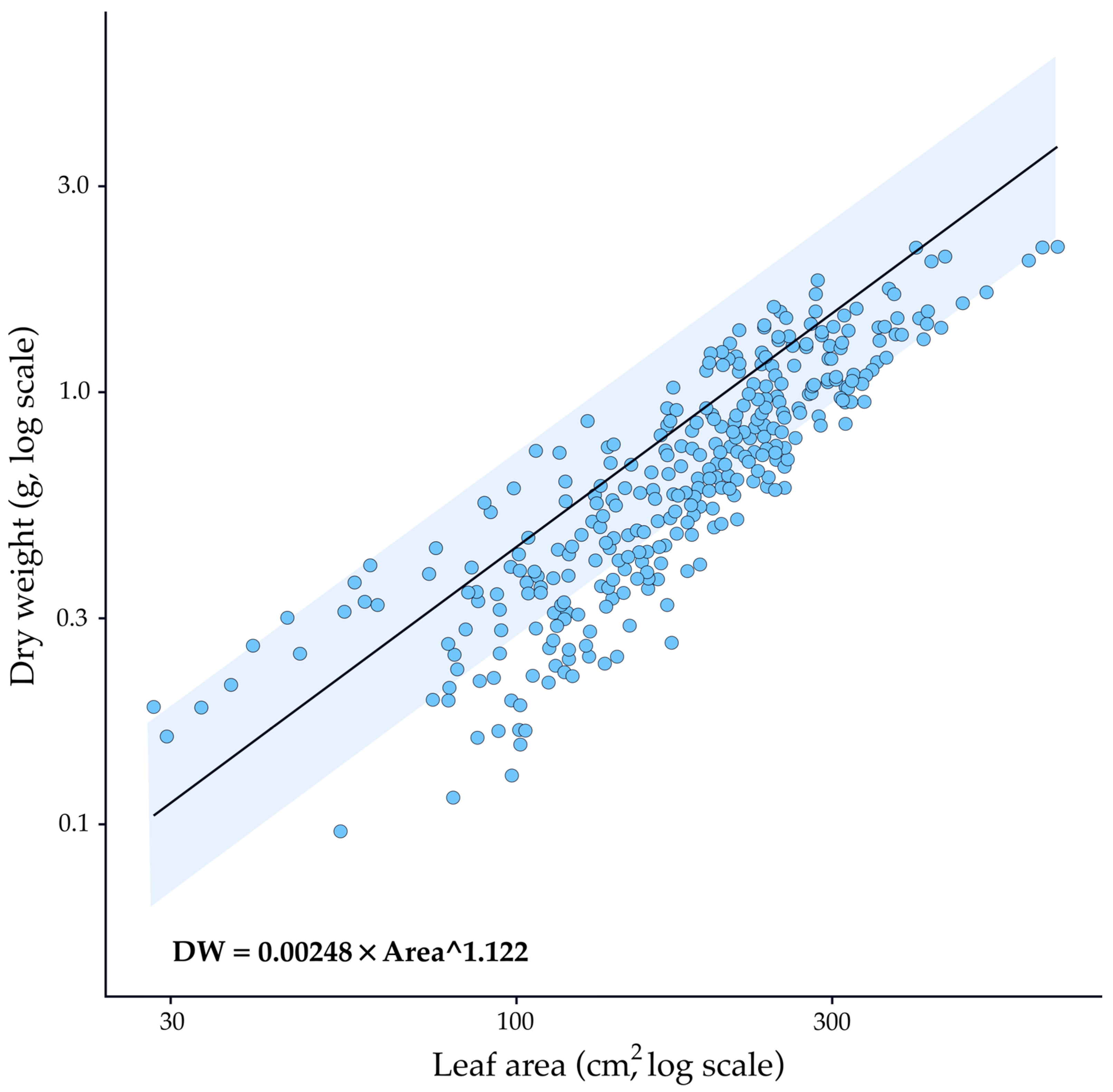
where 0.00248 (95% CI: 0.00141–0.00424) is the baseline coefficient and 1.122 (95% CI: 1.031–1.219) represents the estimated scaling exponent, indicating a slightly superlinear relationship between leaf area and dry weight and a clear deviation from isometric scaling (Figure 2).

3.3. Model Validation

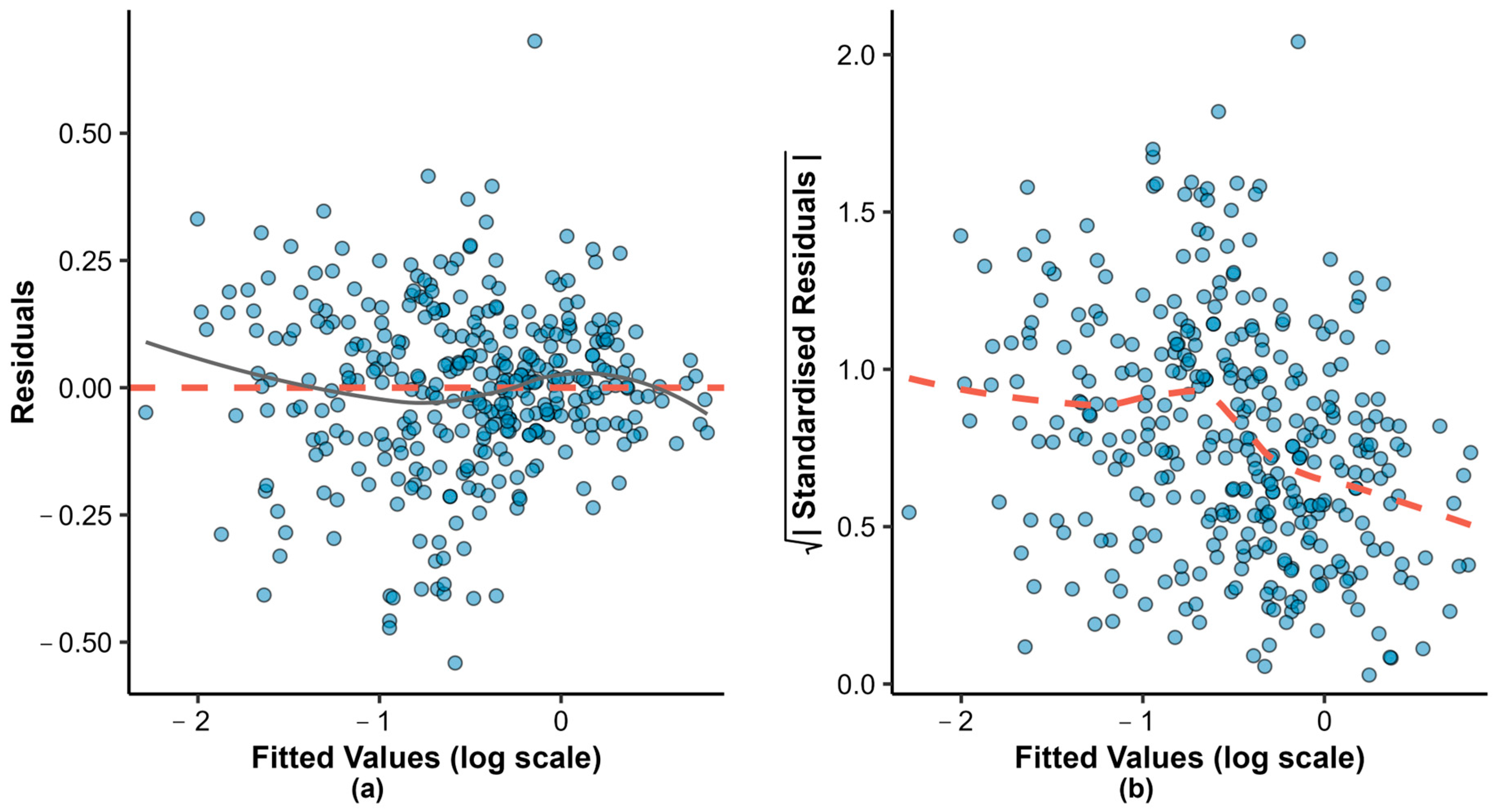
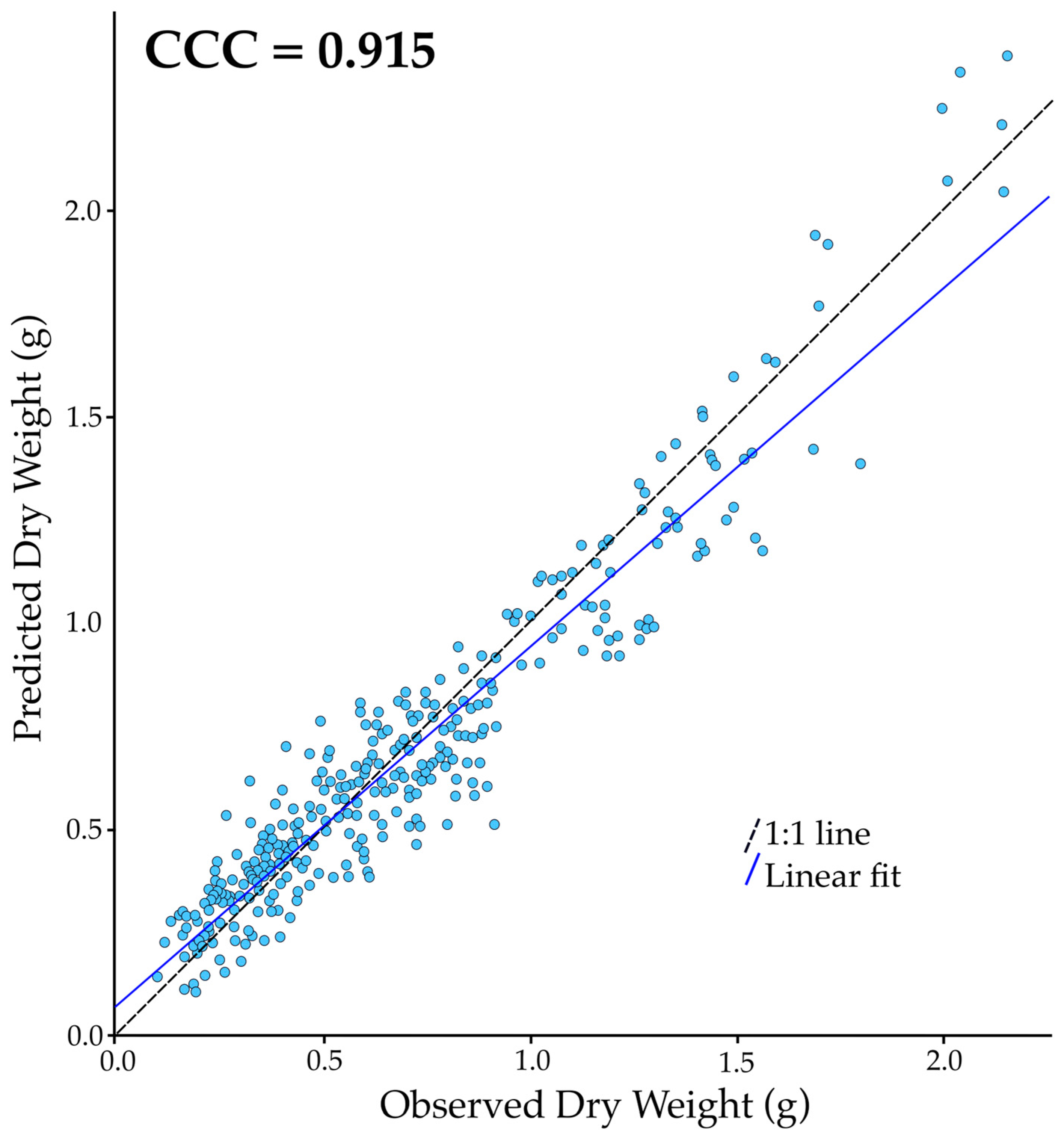
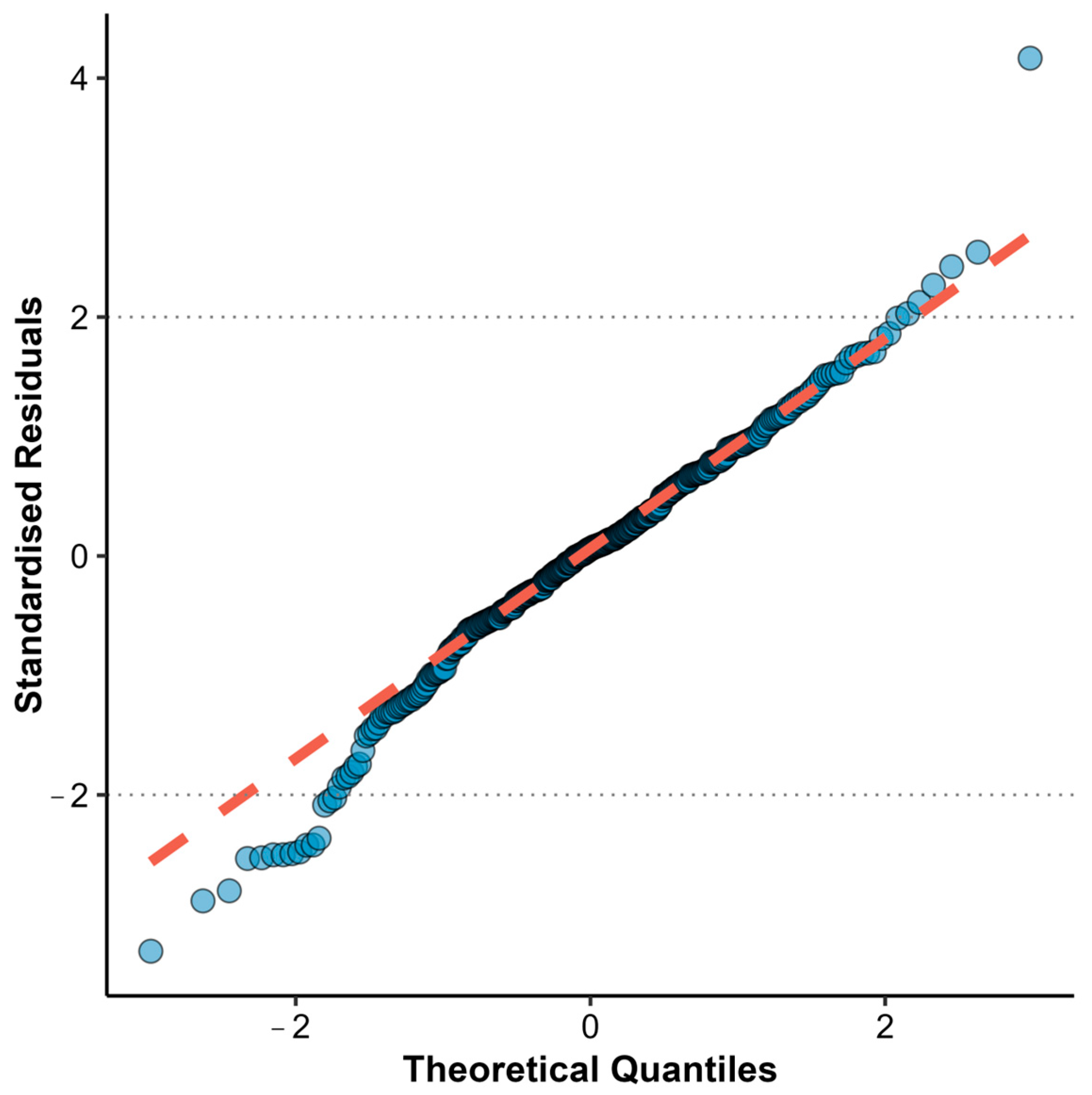
The predictive performance of the model was assessed using 10-fold cross-validation. Predictions were generated using fixed effects only, excluding random site effects to evaluate general predictive capacity. Folds were generated by random partitioning of observations. The model showed good predictive performance, with RMSE = 0.241 (log scale) and MAE = 0.189 (log scale). This corresponds to a multiplicative error of × 1.27 , back-transformed from RMSE, and an absolute error of ±20.8% on the original scale, back-transformed from MAE. Model bias was negligible (bias = −0.0019). Model agreement was further evaluated using the CCC (0.915), indicating a strong reproducibility of biomass estimates derived from the allometric model (Figure 3). Residual diagnostics revealed no major deviations from normality or homoscedasticity, supporting model assumptions (Appendix A).
Combining the allometric equation for leaf biomass and area with the leaf carbon fraction reported by Pergent-Martini et al. (2021) [2] (37.8 ± 1.6%) as a fixed multiplier, an equation estimating carbon content (C) based on leaf area can be derived (Equation (6)). The combined prediction uncertainty of such equation is ±21.2%, propagating from the absolute error (±20.8%) and the variability of the carbon conversion factor (4.23%) [2].
C = 0.000952 × A r e a 1.122 × e ϵ ;   with   ϵ N ( 0 , 0.02867 )

4. Discussion

This study provides one of the first robust allometric characterizations of the relationship between P. oceanica leaf area and dry weight. This relationship is described by an allometric power law equation, where the resulting exponent (β = 1.122) indicates a slightly superlinear relationship, meaning that leaf mass increases proportionally faster than area [31,56,57,58,59]. The validity of this scaling exponent across the two sampling periods was confirmed by the non-significant interaction between leaf area and dataset (p > 0.05), indicating that the departure from isometry is a consistent property of the species rather than a result of sampling period. The allometric factor’s departure from perfect isometry suggests that larger leaves become progressively denser or thicker as they grow, likely reflecting progressive investment in structural tissue with increasing leaf size [25,60]. To account for the not-rectangular shape of P. oceanica leaves, a correction factor was applied (0.996 ± 0.086 SD), following Schrader et al. (2021) [50]. The correction factor indicates a slight underestimation of leaf area probably because P. oceanica leaves present natural irregularities along their blades or small herbivore bite marks, preventing the leaf outline from conforming perfectly to a rectangular approximation [4,14]. The robustness and uncertainty range of the allometric equation across 16 sites and two sampling periods confirms its potential as a reliable predictive tool for estimating P. oceanica leaf biomass from non-destructive area measurements.
The use of power-law allometric models to predict leaf biomass from morphological measurements has precedent across several terrestrial plant taxa [23,25,56,61,62,63,64]. Panayotidis and Simboura (1989) [65] were among the first to study the relationship between leaf surface and biomass in Mediterranean seagrasses, suggesting that the allometric relationship investigated has general value for many species [65]. Other studies, such as Echavarria-Heras et al. (2011), followed up on this approach, using the length ratio as a tool to estimate leaf biomass in Zostera marina through an allometric model [58]. Giovannetti et al. (2008) [30], whose work initially inspired this study, were among the first to test this on P. oceanica leaves and also found a significant relationship between leaf area and weight in the Ligurian Sea using a linear regression. They acknowledged the limits of a linear approach in its capacity to account for seasonal and environmentally influenced biomass peaks, suggesting further mathematical modeling was needed [30].
These limitations are addressed in the present study through the application of LMMs, which explicitly account for site-level variability as a random factor, enabling a more robust allometric characterization. Furthermore, the use of LMMs allowed for the comparison between sampling periods throughout this study. The absence of a significant interaction between the sampling period and the area indicates that the allometric relationship is not dependent on time. However, the significant effect of dataset as a fixed term indicates that for a given leaf area, biomass differs between sampling periods. This pattern suggests that environmental or temporal factors can affect the baseline biomass level between datasets without altering the underlying scaling mechanism. Considering the high concordance score (CCC = 0.915), the low prediction error observed during cross-validation and these results, the allometric model describes the relationship between P. oceanica leaf area and dry weight in a manner that accounts for spatial or temporal constraints, strengthening its value as a broadly applicable predictive tool.
The spatial and temporal independence of the allometric equation positions it as a practical foundation for non-destructive protocols to estimate P. oceanica biomass. Such protocols would involve the non-destructive measurement of leaf area in the field, using underwater measurements of leaf length and width to derive individual leaf area. A minimum of nine randomly selected shoots per station is recommended, consistent with standard P. oceanica monitoring guidelines [14]. The allometric equation derived here is then applied to each shoot to estimate shoot dry weight, which may be scaled to meadow level using shoot density and percentage cover to derive the leaf standing crop (LSC) [14]. Both shoot density and percentage cover can be measured with non-destructive protocols, using standard quadrat-based methods [14,66]. Within the application of allometric equation, the error term must be considered since the multiplicative error structure of the allometric model results in biomass predictions typically within ±20.8% of observed values, a margin that should be accounted for when interpreting meadow-scale estimates.
For large-scale or temporally repeated assessments, spatial heterogeneity in meadow structure must also be considered. Variations in shoot density and percentage cover—both of which influence the scaling from shoot-level to meadow-level biomass—should be monitored at pre-defined stations stratified according to the meadow’s structural heterogeneity [2,14,41,66,67,68]. This stratified approach ensures that spatial gradients in meadow condition are adequately captured rather than averaged out.
Despite these limitations, the promising results observed within this study depict the allometric estimate as an attractive alternative to traditional sampling methods. Lepidochronology, for instance, requires the physical uprooting of shoots or the imposition of physical stress on the plant, potentially harming the meadow. In contrast, the allometric equation derived here provides a non-destructive method to estimate leaf biomass with predictive accuracy, requiring only the measure of leaf dimensions in the field. It must be acknowledged that the non-destructive nature of this approach carries inherent trade-offs. Physical sampling methods such as lepidochronology allow for the potential study of tissue carbon content and the reconstruction of growth patterns through the examination of rhizome scales, information that can be obtained only by physical sampling. The allometric approach is therefore best understood not as a wholesale replacement for destructive methods but as a tool that is especially valuable when the primary objective is biomass estimation and when meadow integrity must be preserved.
The need for such non-invasive monitoring is particularly relevant in restoration contexts. Pansini et al. (2024) and Bacci et al. (2024) both emphasize that restoration projects require monitoring metrics that do not damage transplanted patches, especially given the long timescales over which restoration must be assessed, often exceeding 10 years [16,69]. The allometric equation therefore opens up new possibilities for non-harmful monitoring of biomass, both at a local and seascape scale.
Estimating carbon content within leaves represents a further valuable application of this protocol in restoration and monitoring contexts. In this study, the Mediterranean average carbon content of 37.8% in P. oceanica leaves, reported by Pergent-Martini et al. (2021), is used to derive an equation estimating carbon content from leaf area [2]. It must be acknowledged that this is a general estimate that does not account for seasonal, geographical or ecological variations in leaf carbon content. Consequently, the carbon equation is most reliable when integrating data across multiple seasons and sites, rather than individual shoots sampled at a specific time and depth [32]. Furthermore, the conversion of dry weight to carbon content introduces a layer of uncertainty on top of the allometric confidence interval, as it combines the carbon ratio variability (±1.5–1.6 percentage points) with the equation’s error term, resulting in a combined prediction uncertainty of ±21.2%. The difference in the conversion factors of Pergent-Martini et al. (2021) and Pergent et al. (1994) suggests that carbon content may vary with meadow ecological condition, season, and geographical location, which prompts caution when applying the fixed conversion factors across the dataset [2,7]. Nevertheless, the combination of literature data regarding carbon content and the allometric equation presented here represents a promising first step toward further methodological development of a reliable tool for estimating meadow carbon content in P. oceanica leaves. Such estimates could contribute to the growing body of work on Blue Carbon, providing a basis for carbon credit quantification to support funding of conservation and restoration projects [64], a factor that would greatly benefit restoration programs, in line with the objectives to achieve in the European Union Environmental Action Programme (EAP) [41,64,65,66,67,68,69,70,71]. However, such applications remain limited at the current stage of methodological development, as further applications of the allometric equation derived here are required for a standardized industrial scale of application.
Despite the promising applications of this allometric equation, several limitations must be acknowledged. The most significant one is the failure to account for environmental covariates such as depth or water quality, which can severely influence the morphology of P. oceanica leaves [5,11,30,31,72,73,74]. Instances of this can be found in Jiménez-Casero et al. (2023), where it is shown that the structure of P. oceanica leaves is affected by nutrient discharges through photo-physiological adjustments or the reduction in shoot architectural complexity [75]. Both these features severely affect the plant’s capacity to allocate leaf tissue, thereby impacting the length and width of the leaf, which in turn can alter the allometric relation [76,77,78,79]. This limitation is further exacerbated by the constraints of the dataset, where the size range of leaves in shoots ranged between 28.21 cm2 and 663.36 cm2. This range excludes juvenile leaves or extremely large leaves, as most allometric models rely on mature leaves [2,14,34,64]. Future works should aim to expand the current work and cover a broader size range, including juvenile shoots, providing a greater relevance when applying the non-destructive protocol to restoration sites. Finally, although the Ligurian dataset is robust, further validation across meadows throughout the Mediterranean would help confirm the broader applicability of the derived equation, particularly for meadows subjected to a wider range of stressors that may alter leaf morphology and carbon content [16]. Such future operational field validation of this proposed protocol would include the study of meadow biomass through traditional sampling methods and the comparison of these results to the predictions of the allometric model. Once small-scale implementations have been tested and the protocol is fine-tuned, the large-scale implementation of biomass estimation could be tested. At larger scales, implementation would further require the use of advanced technologies such as remote sensing. For instance, the implementation of a side-scan sonar (SSS) or multibeam echosounder to measure a meadow’s extent and delineate its boundaries provides key information in the creation of a sampling plan and in the accurate estimate of whole-meadow canopy biomass [9,80].

5. Conclusions

The allometric equation developed in this study represents a noteworthy tool for researchers and managers studying Posidonia oceanica leaf biomass from non-destructive measurements of leaf area. Validated across 16 sites and two sampling periods, the model demonstrates a stable allometric structure, with a consistent scaling relationship between leaf area and dry weight despite environmental and spatial variability. While differences in baseline biomass between datasets and sites were observed, the underlying allometric exponent remained constant, preserving a fundamental scaling relationship in P. oceanica leaves across conditions.
Thus, the allometric relationship described here represents an important step towards the development of a non-destructive approach for assessing seagrass biomass. By linking easily measurable morphological traits to dry weight, the model enables the estimation of shoot-level biomass and its subsequent scaling to meadow level using standardized measurements of shoot density and cover. Hence, this work provides one of the first frameworks for integrating individual-level measurements into seascape-scale biomass assessments. Importantly, this approach has not yet been tested in the field at full operational scale. However, this work initiates a body of research that establishes the basis for a non-destructive monitoring protocol, incorporating species-specific growth dynamics and extending this framework towards estimates of primary productivity.
Overall, the results highlight the strength of allometric scaling as a predictive tool in seagrass ecology and support the development of a standardized, low-impact method for long-term monitoring of Posidonia oceanica meadows.

Author Contributions

Conceptualization, F.P. and M.M.; methodology, F.P. and A.O.; software, F.P.; validation, A.O. and M.M.; formal analysis, F.P. and F.C.; investigation, F.P., C.R., E.G., F.C., A.O. and M.O.; resources, M.M.; data curation, F.C. and F.P.; writing—original draft preparation, F.P.; writing—review and editing, C.R., E.G., M.O., F.C. and M.M.; visualization, F.P., E.G.; supervision, M.M.; project administration, M.M. and F.P.; funding acquisition, M.M. Authors Muriel Oddenino and Monica Montefalcone passed away prior to the publication of this manuscript. All authors have read and agreed to the published version of the manuscript.

Funding

Project partially funded under the National Recovery and Resilience Plan (NRRP), Mission 4 Component 2 Investment 1.4—Call for tender No. 3138 of 16 December 2021, rectified by Decree n. 3175 of 18 December 2021 of Italian Ministry of University and Research funded by the European Union—NextGenerationEU; Award Number: Project code CN_00000033, Concession Decree No. 1034 of 17 June 2022 adopted by the Italian Ministry of University and Research, CUP D33C22000960007, Project title “National Biodiversity Future Center—NBFC”. The PhD project of Francesco Pelizza is fully supported by One Ocean Foundation (OOF).

Data Availability Statement

The data presented in this study are available on request from the corresponding author due to privacy.

Acknowledgments

The authors would like to thank OneOcean Foundation for their support and funding of the project, Carlo Nike Bianchi and Carla Morri for their scientific advice and the staff of every diving center that helped us during the process of data collection. During the preparation of this manuscript, the authors used Claude 3.5 Sonnet for the purposes of data analysis and generating graphics. The authors have reviewed and edited the output and take full responsibility for the content of this publication.

Conflicts of Interest

The authors declare no conflicts of interest. The funders had no role in the design of the study; in the collection, analyses, or interpretation of data; in the writing of the manuscript; or in the decision to publish the results.

Abbreviations

The following abbreviations are used in this manuscript:
PREIPosidonia Rapid Assessment Index
SCUBASelf-Contained Underwater Breathing Apparatus
CFCorrection Factor
DWDry Weight
LMMLinear Mixed-Effect Model
AICAkaike Information Criterion
LRTLikelihood Ratio Test
RMSERoot of the Mean of Square of Errors
MAEMean of Absolute value of Errors
CCCConcordance Correlation Coefficient
CIConfidence Interval
SDStandard Deviation
EAPEuropean Union Environmental Action Programme

Appendix A

Appendix A.1. Distributional Diagnostics

Table A1. Per-site descriptive table for number of shoots analyzed and their resulting mean leaf area and dry weight.
SiteN of Shootsµ Area (cm2)µ DW (g)
Bergeggi Isola182661.36
Niasca271350.685
Punta Pedale 2024–2025271470.717
Sanremo Porto Vecchio271640.831
Bergeggi181240.26
Camogli181900.551
Diano Marina181180.26
Framura182030.759
Monterosso181770.686
Noli181910.616
Ospedaletti362070.577
Prelo272060.831
Punta Manara183911.34
Punta Pedale 2016–2018181730.486
Sanremo92000.483
Vado Ligure183021.07
Ventimiglia182080.643
Figure A1. Regressions of datasets based on the time of sampling; in blue are samples collected between 2016 and 2018, and in red are those collected between 2024 and 2025.
Water 18 01419 g0a1
Figure A2. Histogram data distribution for dry weight and area; in blue are samples collected between 2016 and 2018, and in red are those collected between 2024 and 2025. (a) Distribution for shoot dry weight, (b) distribution for shoot leaf area, (c) distribution for log-transformed dry weight, (d) distribution for log-transformed shoot area.
Water 18 01419 g0a2

Appendix A.2. Residual Diagnostics

Figure A3. Q-Q plot of residuals for the final model.
Water 18 01419 g0a3
Figure A4. Linear Mixed Model diagnostic plots: (a) final LMM with residuals vs. fitted values, Equation (3), (b) scale–location plot.
Water 18 01419 g0a4

Appendix A.3. Model Comparison

Table A2. Full LRT output (Model 1 vs. Model 2…), with degrees of freedom, X2 statistics and p-values.
ComparisondfΧ2p-Value
Model 1–Model 2224.993<0.001
Model 2–Model 3113.615<0.001
Model 3–Model 413.7520.053
Table A3. Kenward–Roger F-test output for final model, Equation (3).
Fixed EffectNumerator dfDenominator dfF-Valuep-Value
Log(Area)114.7571.059<0.001
Sampling Period114.119.017<0.001

Appendix A.4. Cross-Validation

Table A4. Fold-by-fold performance table (RMSE and MAE) for each of the 10 folds.
FoldnRMSEMAEBias
1360.26890.20700.0734
2350.23090.1906−0.0369
3350.24980.18130.0472
4350.22680.1630−0.0657
5350.22740.18920.0320
6350.21310.16920.0172
7350.26460.21350.0512
8350.19690.1694−0.0415
9350.24050.1780−0.0483
10350.27950.2244−0.0493
Overall3510.24120.1886−0.0019

References

  1. Boudouresque, C.F.; Bernard, G.; Bonhomme, P.; Charbonnel, E.; Diviacco, G.; Meinesz, A.; Pergent, G.; Pergent-Martini, C.; Ruitton, S.; Tunesi, L. Préservation et Conservation des Herbiers à Posidonia oceanica; Ramoge Pub.: Monaco, 2006. [Google Scholar]
  2. Pergent-Martini, C.; Pergent, G.; Monnier, B.; Boudouresque, C.-F.; Mori, C.; Valette-Sansevin, A. Contribution of Posidonia oceanica meadows in the context of climate change mitigation in the Mediterranean Sea. Mar. Environ. Res. 2021, 165, 105236. [Google Scholar] [CrossRef]
  3. Francour, P.; Magréau, J.F.; Mannoni, P.A.; Cottalorda, J.M.; Gratiot, J. Management Guide for Marine Protected Areas of the Mediterranean Sea: Permanent Ecological Moorings; Université de Nice-Sophia Antipolis & Parc National de Port-Cros: Nice, France, 2006; pp. 1–68. [Google Scholar]
  4. Short, F.T.; Duarte, C.M. Methods for the measurement of seagrass growth and production. In Global Seagrass Research Methods; Elsevier: Amsterdam, The Netherlands, 2001; pp. 155–182. [Google Scholar] [CrossRef]
  5. Koopmans, D.; Holtappels, M.; Chennu, A.; Weber, M.; de Beer, D. High net primary production of Mediterranean seagrass (Posidonia oceanica) meadows determined with aquatic eddy covariance. Front. Mar. Sci. 2020, 7, 118. [Google Scholar] [CrossRef]
  6. Modigh, M.; Lorenti, M.; Mazzella, L. Carbon assimilation in Posidonia oceanica: Biotic determinants. Bot. Mar. 1998, 41, 249–256. [Google Scholar] [CrossRef]
  7. Pergent, G.; Romero, J.; Pergent-Martini, C.; Mateo, M.A.; Boudouresque, C.F. Primary production, stocks and fluxes in the Mediterranean seagrass Posidonia oceanica. Mar. Ecol. Prog. Ser. 1994, 106, 139–146. [Google Scholar] [CrossRef]
  8. Pergent, G.; Rico-Raimondino, V.; Pergent-Martini, C. Fate of primary production in Posidonia oceanica meadows of the Mediterranean. Aquat. Bot. 1997, 59, 307–321. [Google Scholar] [CrossRef]
  9. Monnier, B.; Pergent, G.; Valette-Sansevin, A.; Boudouresque, C.F.; Mateo, M.Á.; Pergent-Martini, C. The Posidonia oceanica matte: A unique coastal carbon sink for climate change mitigation and implications for management. Vie Milieu 2020, 70, 17–24. [Google Scholar]
  10. Mateo, M.; Cebrian, J.; Dunton, K.; Mutchler, T. Carbon flux in seagrass ecosystems. In Seagrasses: Biology, Ecology and Conservation; Larkum, A., Orth, R., Duarte, C., Eds.; Springer: Dordrecht, The Netherlands, 2006; pp. 159–192. [Google Scholar]
  11. Boudouresque, C.F.; Pergent, G.; Pergent-Martini, C.; Ruitton, S.; Thibaut, T.; Verlaque, M. The necromass of the Posidonia oceanica seagrass meadow: Fate, role, ecosystem services and vulnerability. Hydrobiologia 2015, 781, 25–42. [Google Scholar] [CrossRef]
  12. Pergent, G.; Bazairi, H.; Bianchi, C.N.; Boudouresque, C.F.; Buia, M.C.; Clabaut, P.; Harmelin-Vivien, M.; Mateo, M.A.; Montefalcone, M.; Morri, C.; et al. Les Herbiers de Magnoliophytes Marines de Méditerranée: Résilience et Contribution à l’Atténuation des Changements Climatiques; IUCN: Gland, Switzerland, 2012. [Google Scholar]
  13. Zieman, J.C. Methods for the study of the growth and production of turtle grass, Thalassia testudinum König. Aquaculture 1974, 4, 139–143. [Google Scholar] [CrossRef]
  14. Buia, M.C.; Gambi, M.C.; Dappiano, M. I sistemi a fanerogame marine. In Manuale di Metodologie di Campionamento e Studio del Benthos Marino Mediterraneo; Gambi, M.C., Dappiano, M., Eds.; Biologia Marina Mediterranea: Genoa, Italy, 2004; Volume 11, pp. 133–183. [Google Scholar]
  15. Gaeckle, J.L.; Short, F.T. A plastochrone method for measuring leaf growth in eelgrass, Zostera marina L. Bull. Mar. Sci. 2002, 71, 1237–1246. [Google Scholar]
  16. Pansini, A.; Deroma, M.; Guala, I.; Monnier, B.; Pergent-Martini, C.; Piazzi, L.; Stipcich, P.; Ceccherelli, G. The resilience of transplanted seagrass traits encourages detection of restoration success. J. Environ. Manag. 2024, 357, 120744. [Google Scholar] [CrossRef]
  17. Pergent, G. Lepidochronological analysis of the seagrass Posidonia oceanica (L.) Delile: A standardized approach. Aquat. Bot. 1990, 37, 39–54. [Google Scholar] [CrossRef]
  18. Montefalcone, M.; Amigoni, E.; Bianchi, C.N.; Morri, C.; Peirano, A.; Albertelli, G. Multiscale lepidochronological analysis of Posidonia oceanica (L.) Delile rhizome production in a northwestern Mediterranean coastal area. Chem. Ecol. 2008, 24, 93–99. [Google Scholar] [CrossRef]
  19. Tomasello, A.; Sciandra, M.; Muggeo, V.M.R.; Pirrotta, M.; Di Maida, G.; Calvo, S. Reference growth charts for Posidonia oceanica seagrass: An effective tool for assessing growth performance by age and depth. Ecol. Indic. 2016, 69, 50–58. [Google Scholar] [CrossRef]
  20. Bartelink, H. Allometric relationships for biomass and leaf area of beech (Fagus sylvatica L). Ann. Sci. For. 1997, 54, 39–50. [Google Scholar] [CrossRef]
  21. Niklas, K.J. Plant allometry: Is there a grand unifying theory? Biol. Rev. 2004, 79, 871–889. [Google Scholar] [CrossRef]
  22. Weiner, J. Allocation, plasticity and allometry in plants. Perspect. Plant Ecol. Evol. Syst. 2004, 6, 207–215. [Google Scholar] [CrossRef]
  23. Levia, D.F. A generalized allometric equation to predict foliar dry weight on the basis of trunk diameter for eastern white pine (Pinus strobus L.). For. Ecol. Manag. 2008, 255, 1789–1792. [Google Scholar] [CrossRef]
  24. Shao, J.; Zhou, X.; Zhou, L.; Li, Y. Plant biomass-leaf area allometry and ambient plant traits predict biomass responses to global warming. J. Plant Ecol. 2025, 18, rtaf010. [Google Scholar] [CrossRef]
  25. Duarte, C. Allometric scaling of seagrass form and productivity. Mar. Ecol. Prog. Ser. 1991, 77, 289–300. [Google Scholar] [CrossRef]
  26. Leal-Ramírez, C.; Echavarría-Heras, H.; Villa-Diharce, E.; Montesinos-López, A. Temporal and spatial invariance of allometric parameters for predicting leaf biomass in Zostera marina: A theoretical and empirical reassessment. Appl. Sci. 2026, 16, 2445. [Google Scholar] [CrossRef]
  27. Thomson, J.A.; Vercaemer, B.; Wong, M.C. Non-destructive biomass estimation for eelgrass (Zostera marina): Allometric and percent cover-biomass relationships vary with environmental conditions. Aquat. Bot. 2024, 198, 103853. [Google Scholar] [CrossRef]
  28. Hamburg, S.P.; Homann, P.S. Utilization of growth parameters of eelgrass, Zostera marina, for productivity estimation under laboratory and in situ conditions. Mar. Biol. 1986, 93, 299–303. [Google Scholar] [CrossRef]
  29. Jacobs, R. Distribution and aspects of the production and biomass of eelgrass, Zostera marina L., at Roscoff, France. Aquat. Bot. 1979, 7, 151–172. [Google Scholar] [CrossRef]
  30. Giovannetti, E.; Montefalcone, M.; Morri, C.; Bianchi, C.N.; Albertelli, G. Biomassa fogliare ed epifita in una prateria di Posidonia oceanica (Prelo, Mar Ligure): Possibilità di determinazione tramite un metodo indiretto. Atti Assoc. Ital. Oceanol. Limnol. 2008, 19, 229–233. [Google Scholar]
  31. Vieira, V.M.N.C.S.; Lopes, I.E.; Creed, J.C. A model for the biomass–density dynamics of seagrasses developed and calibrated on global data. BMC Ecol. 2019, 19, 4. [Google Scholar] [CrossRef]
  32. Alcoverro, T.; Manzanera, M.; Romero, J. Annual metabolic carbon balance of the seagrass Posidonia oceanica: The importance of carbohydrate reserves. Mar. Ecol. Prog. Ser. 2001, 211, 105–116. [Google Scholar] [CrossRef]
  33. Echavarría-Heras, H.; Leal-Ramírez, C.; Villa-Diharce, E.; Montesinos-López, A. Examination of the effects of curvature in geometrical space on accuracy of scaling derived projections of plant biomass units: Applications to the assessment of average leaf biomass in eelgrass shoots. BioMed Res. Int. 2019, 2019, 3613679. [Google Scholar] [CrossRef] [PubMed]
  34. Echavarría-Heras, H.; Leal-Ramírez, C.; Villa-Diharce, E.; Cazarez-Castro, N. On the suitability of an allometric proxy for nondestructive estimation of average leaf dry weight in eelgrass shoots I: Sensitivity analysis and examination of the influences of data quality, analysis method, and sample size on precision. Theor. Biol. Med. Model. 2018, 15, 4. [Google Scholar] [CrossRef] [PubMed]
  35. Pergent, C.; André, S.; Castejón-Silvo, I.; Deter, J.; Frau, F.; Gerakaris, V.; Mancini, G.; Molenaar, H.; Montefalcone, M.; Oprandi, A.; et al. Guidelines for Posidonia oceanica Restoration; CSIC-UIB–Instituto Mediterráneo de Estudios Avanzados (IMEDEA): Esporles, Spain, 2024; Available online: https://digital.csic.es (accessed on 2 January 2026).
  36. Pansini, A.; Bosch-Belmar, M.; Berlino, M.; Sarà, G.; Ceccherelli, G. Collating evidence on the restoration efforts of the seagrass Posidonia oceanica: Current knowledge and gaps. Sci. Total Environ. 2022, 851, 158320. [Google Scholar] [CrossRef]
  37. Robello, C.; Acunto, S.; Leone, L.M.; Mancini, I.; Oprandi, A.; Montefalcone, M. Large-scale re-implantation efforts for Posidonia oceanica restoration in the Ligurian Sea: Progress and challenges. Diversity 2024, 16, 226. [Google Scholar] [CrossRef]
  38. Montefalcone, M. Challenges in restoring Mediterranean seagrass ecosystems in the Anthropocene. Environments 2024, 11, 86. [Google Scholar] [CrossRef]
  39. Mancini, G.; Ventura, D.; Casoli, E.; Belluscio, A.; Ardizzone, G. Transplantation on a Posidonia oceanica meadow to facilitate its recovery after the Concordia shipwrecking. Mar. Pollut. Bull. 2022, 179, 113683. [Google Scholar] [CrossRef]
  40. Peirano, A.; Damasso, V.; Montefalcone, M.; Morri, C.; Bianchi, C.N. Effects of Climate, Invasive Species and Anthropogenic Impacts on the Growth of the Seagrass Posidonia oceanica (L.) Delile in Liguria (NW Mediterranean Sea). Mar. Pollut. Bull. 2005, 50, 817–822. [Google Scholar] [CrossRef]
  41. Abbate, M.; Peirano, A.; Ugolini, U. Structural Changes in Posidonia oceanica Leaves along the Coast of Liguria (Italy): Response to Environmental Stress? Biol. Mar. Mediterr. 2000, 7, 320–323. [Google Scholar]
  42. Holon, F.; Mouquet, N.; Boissery, P.; Bouchoucha, M.; Delaruelle, G.; Tribot, A.-S.; Deter, J. Fine-Scale Cartography of Human Impacts along French Mediterranean Coasts: A Relevant Map for the Management of Marine Ecosystems. PLoS ONE 2015, 10, e0135473. [Google Scholar] [CrossRef] [PubMed]
  43. Ferrari, M.; Carpi, L.; Montefalcone, M. A Rapid Method to Identify the Effects of Coastal Artificialization on Posidonia oceanica Meadows in Coves. Estuaries Coasts 2024, 48, 16. [Google Scholar] [CrossRef]
  44. Nurra, N.; Belci, F.; Sartor, R.M.; Pessani, D. Monitoring of a Posidonia oceanica Bed (Punta Manara, Eastern Ligurian Sea, Italy) and the Associated Molluscs Twenty Years after: What’s New? Aquat. Bot. 2011, 104, 162–169. [Google Scholar] [CrossRef]
  45. Mancini, I.; Rigo, I.; Oprandi, A.; Montefalcone, M.; Morri, C.; Peirano, A.; Vassallo, P.; Paoli, C.; Bianchi, C.N. What Biotic Indices Tell Us about Ecosystem Change: Lessons from the Seagrass Posidonia oceanica. Vie Milieu 2020, 70, 55–61. [Google Scholar]
  46. Rigo, I.; Montefalcone, M.; Morri, C.; Paoli, C. Use of Ecological Indices to Assess the Health Status of Posidonia oceanica Meadows in Eastern Liguria. In Planning, Nature and Ecosystem Services; FedOAPress: Naples, Italy, 2019. [Google Scholar]
  47. Gobert, S.; Sartoretto, S.; Rico-Raimondino, V.; Andral, B.; Chery, A.; Lejeune, P.; Boissery, P. Assessment of the ecological status of Mediterranean French coastal waters as required by the Water Framework Directive using the Posidonia oceanica Rapid Easy Index: PREI. Mar. Pollut. Bull. 2009, 58, 1727–1733. [Google Scholar] [CrossRef] [PubMed]
  48. Giraud, G. Contribution à la Description et à la Phénologie Quantitative des Herbiers à Posidonia oceanica (L.) Delile. Ph.D. Thesis, Université Aix-Marseille II, Marseille, France, 1977. [Google Scholar]
  49. Azcárate-García, T.; Beca-Carretero, P.; Brun, F.G. Plant and meadow structure characterisation of Posidonia oceanica in its westernmost distribution range. Diversity 2023, 15, 101. [Google Scholar] [CrossRef]
  50. Schrader, J.; Shi, P.; Royer, D.L.; Peppe, D.J.; Gallagher, R.V.; Li, Y.; Wang, R.; Wright, I.J. Leaf size estimation based on leaf length, width and shape. Ann. Bot. 2021, 128, 395–406. [Google Scholar] [CrossRef]
  51. Shi, P.; Li, Y.R.; Niinemets, Ü.; Olson, E.; Niinemets, U. Influence of leaf shape on the scaling of leaf surface area and length in bamboo plants. Trees 2021, 35, 709–715. [Google Scholar] [CrossRef]
  52. Cavallaro, R.J.; Bucek, E.U.; Finzer, J.R.D. Mathematical model for determining the coffee leaf area. Am. Sci. Res. J. Eng. Technol. Sci. 2020, 71, 11–19. [Google Scholar]
  53. Ștef, R.; Carabeț, A.; Manea, D.; Sala, F. Characterization of leaves geometry in Asclepias syriaca L. species. Appl. Ecol. Environ. Res. 2023, 21, 3095–3108. [Google Scholar] [CrossRef]
  54. Rigo, I.; Paoli, C.; Dapueto, G.; Pergent-Martini, C.; Pergent, G.; Oprandi, A.; Montefalcone, M.; Bianchi, C.N.; Morri, C.; Vassallo, P. The natural capital value of the seagrass Posidonia oceanica in the North-Western Mediterranean. Diversity 2021, 13, 499. [Google Scholar] [CrossRef]
  55. Nakagawa, S.; Schielzeth, H. A general and simple method for obtaining R2 from generalized linear mixed-effects models. Methods Ecol. Evol. 2013, 4, 133–142. [Google Scholar] [CrossRef]
  56. Okoma, P.; Akaffou, S.; De Reffye, P.; Hamon, P.; Hamon, S.; Konan, O.; Kouassi, K.H.; Legnate, H.; Letort, V.; Sabatier, S. Estimation of stem and leaf dry biomass using a non-destructive method applied to African Coffea species. Agrofor. Syst. 2018, 92, 667–675. [Google Scholar] [CrossRef]
  57. Hackney, J.W. Morphometric Variability and Allometric Relationships in the Seagrass Thalassia testudinum in Florida Bay. Master’s Thesis, The University of North Carolina at Greensboro, Greensboro, NC, USA, 2009. [Google Scholar]
  58. Echavarria-Heras, H.; Lee, K.; Solana-Arellano, E.; Franco-Vizcaíno, E. Formal analysis and evaluation of allometric methods for estimating above-ground biomass of eelgrass. Ann. Appl. Biol. 2011, 159, 503–515. [Google Scholar] [CrossRef]
  59. Lin, S.; Shao, L.; Hui, C.; Song, Y.; Reddy, G.V.P.; Gielis, J.; Li, F.; Ding, Y.; Wei, Q.; Shi, P. Why does not the leaf weight-area allometry of bamboos follow the 3/2-power law? Front. Plant Sci. 2018, 9, 583. [Google Scholar] [CrossRef]
  60. West, G.B.; Woodruff, W.H.; Brown, J.H. Allometric scaling of metabolic rate from molecules and mitochondria to cells and mammals. Proc. Natl. Acad. Sci. USA 2002, 99, 2473–2478. [Google Scholar] [CrossRef] [PubMed]
  61. Zhou, X.; Yang, M.; Liu, Z.; Li, P.; Xie, B.; Peng, C. Dynamic allometric scaling of tree biomass and size. Nat. Plants 2021, 7, 42–49. [Google Scholar] [CrossRef]
  62. Adinugroho, W.C.; Krisnawati, H.; Imanuddin, R.; Siregar, C.A.; Weston, C.J.; Volkova, L. Developing biomass allometric equations for small trees in mixed-species forests of tropical rainforest ecozone. Trees For. People 2023, 13, 100425. [Google Scholar] [CrossRef]
  63. Ramos-Veintimilla, R.; Andrade, H.J.; Vera-Velez, R.; Esparza-Parra, J.; Panama-Perugachi, P.; Segura, M.; Grijalva-Olmedo, J. Allometric models to estimate aboveground biomass of individual trees of Eucalyptus saligna Sm in young plantations in Ecuador. Int. J. Plant Biol. 2025, 16, 39. [Google Scholar] [CrossRef]
  64. Sileshi, G.W. A critical review of forest biomass estimation models, common mistakes and corrective measures. For. Ecol. Manag. 2014, 329, 237–254. [Google Scholar] [CrossRef]
  65. Panayotidis, P.; Simboura, N. Distribution and phenology of Posidonia oceanica in Saronikos Gulf (Aegean Sea, Greece). In Proceedings of the International Workshop on Posidonia oceanica Beds; Boudouresque, C.F., Meinesz, A., Fresi, E., Gravez, V., Eds.; GIS Posidonie: Marseille, France, 1989; Volume 2, pp. 43–48. [Google Scholar]
  66. Bacci, T.; Rende, S.F.; Rocca, D.; Scalise, S.; Cappa, P.; Scardi, M. Optimizing Posidonia oceanica (L.) Delile shoot density: Lessons learned from a shallow meadow. Ecol. Indic. 2015, 58, 199–206. [Google Scholar] [CrossRef]
  67. Marbà, N.; Cebrian, J.; Enriquez, S.; Duarte, C.M. Growth patterns of Western Mediterranean seagrasses: Species-specific responses to seasonal forces. Mar. Ecol. Prog. Ser. 1996, 133, 203–215. [Google Scholar] [CrossRef]
  68. Gnisci, V.; de Martiis, S.C.; Belmonte, A.; Micheli, C.; Piermattei, V.; Bonamano, S.; Marcelli, M. Assessment of the ecological structure of Posidonia oceanica (L.) Delile on the northern coast of Lazio, Italy (central Tyrrhenian, Mediterranean). Ital. Bot. 2020, 9, 1–19. [Google Scholar] [CrossRef]
  69. Bacci, T.; Scardi, M.; Tomasello, A.; Valiante, L.M.; Piazzi, L.; Calvo, S.; Badalamenti, F.; Di Nuzzo, F.; Raimondi, V.; Assenzo, M.; et al. Long-term response of Posidonia oceanica meadow restoration at the population and plant level: Implications for management decisions. Restor. Ecol. 2024, 32, e14088. [Google Scholar] [CrossRef]
  70. Halmaghi, E. Environmental Action Programmes of the European Union—Programmes supporting the Sustainable Development Strategy of the European Union. Sci. Bull. 2016, 21, 87–90. [Google Scholar] [CrossRef][Green Version]
  71. EEA. European Union 8th Environment Action Programme; European Environment Agency: Copenhagen, Denmark, 2023. Available online: https://www.eea.europa.eu (accessed on 26 February 2026).
  72. Richir, J.; Luy, N.; Lepoint, G.; Rozet, E.; Azcarate, A.A.; Gobert, S. Experimental in Situ Exposure of the Seagrass Posidonia oceanica (L.) Delile to 15 Trace Elements. Aquat. Toxicol. 2013, 140–141, 157–173. [Google Scholar] [CrossRef] [PubMed]
  73. Badraoui, R.; Mannai, G.; Siddiqui, A.J.; Pacioglu, O.; Rudayni, H.A.; Boufahja, F.; Essid, N. How Toxic Is the COVID-19 Drug Azithromycin in the Presence of Posidonia oceanica? Toxicokinetics and Experimental Approach of Meiobenthic Nematodes from a Metallically Pristine Area. Environ. Pollut. 2023, 319, 121007. [Google Scholar] [CrossRef]
  74. Balestri, E.; Benedetti-Cecchi, L.; Lardicci, C. Variability in Patterns of Growth and Morphology of Posidonia oceanica Exposed to Urban and Industrial Wastes: Contrasts with Two Reference Locations. J. Exp. Mar. Biol. Ecol. 2004, 308, 1–21. [Google Scholar] [CrossRef]
  75. Jiménez-Casero, J.; Belando, M.D.; Bernardeau-Esteller, J.; Marín-Guirao, L.; García-Muñoz, R.; Sánchez-Lizaso, J.L.; Ruiz, J.M. A Critical Gap in Seagrass Protection: Impact of Anthropogenic Off-Shore Nutrient Discharges on Deep Posidonia oceanica Meadows. Plants 2023, 12, 457. [Google Scholar] [CrossRef]
  76. Romero, J.; Martínez-Crego, B.; Alcoverro, T.; Pérez, M. A Multivariate Index Based on the Seagrass Posidonia oceanica (POMI) to Assess Ecological Status of Coastal Waters under the Water Framework Directive (WFD). Mar. Pollut. Bull. 2006, 55, 196–204. [Google Scholar] [CrossRef]
  77. Ruiz, J.M.; Pérez, M.; Romero, J. Effects of Fish Farm Loadings on Seagrass (Posidonia oceanica) Distribution, Growth and Photosynthesis. Mar. Pollut. Bull. 2001, 42, 749–760. [Google Scholar] [CrossRef] [PubMed]
  78. Ruiz, J.M.; Romero, J. Effects of Disturbances Caused by Coastal Constructions on Spatial Structure, Growth Dynamics and Photosynthesis of the Seagrass Posidonia oceanica. Mar. Pollut. Bull. 2003, 46, 1523–1533. [Google Scholar] [CrossRef] [PubMed]
  79. Boumaza, S.; Boudefoua, N.; Boumaza, R.; Semroud, R. Effects of Urban Effluents on Spatial Structure, Morphology and Total Phenols of Posidonia oceanica: Comparison with a Reference Site. J. Exp. Mar. Biol. Ecol. 2014, 457, 113–119. [Google Scholar] [CrossRef]
  80. Pasqualini, V.; Clabaut, P.; Pergent, G.; Benyoussef, L.; Pergent-Martini, C. Contribution of Side Scan Sonar to the Management of Mediterranean Littoral Ecosystems. Int. J. Remote Sens. 2000, 21, 367–378. [Google Scholar] [CrossRef]
Figure 1. Map of the study area and location of the sampled meadows. On the bottom right, in red, the region of Liguria is highlighted. On the larger map, the black dots are all the meadows sampled between 2016 and 2018, in white are the meadows sampled between 2024 and 2025, and in yellow is Punta Pedale, the only site sampled in both periods.
Water 18 01419 g001
Figure 2. Relationship between log-transformed total shoot leaf area (cm2) and log-transformed shoot dry weight (g), as defined by the power-law equation D W = 0.00248 × A r e a 1.122 , with the 95% CI as the blue band.
Water 18 01419 g002
Figure 3. Predicted vs. observed leaf dry weight (g) from 10-fold cross-validation of the allometric model. The dashed 1:1 line represents perfect agreement between predicted and observed values, and the solid blue line that represents linear fit between predicted and observed values. The CCC indicates a strong agreement between predicted and observed values.
Water 18 01419 g003
Table 1. Sites selected for the study, with coordinates, sampling depth, and conservation status, indicating sites located within a Marine Protected Area (MPA). Anthropogenic pressures are classified following Holon et al. (2015) [42] and their references are indicated. TU = touristic facilities; A = boat anchoring; ANT = coastline anthropization (intensive urbanization and high usage of coastal areas); CE = coastal erosion; WQ = water quality degradation due to urbanization and coastal runoff; FI = recreational fishing; n.a. = data not available.
SiteLongitudeLatitudeDepth (m)ProtectionPressures
Punta Pedale44°19′15.4956″ N9°12′56.5662″ E12NoTU, A, ANT, FI [43,44]
Paraggi44°18′39.4164″ N9°12′34.9164″ E8YesTU [43,44]
Niasca44°18′30.6612″ N9°12′37.9038″ E7YesTU [43]
Sanremo Porto Vecchio43°48′45.4602″ N7°46′37.6206″ E13NoA, ANT [43]
Bergeggi44°14′15.9072″ N8°26′39.3252″ E12YesTU, WQ [43]
Punta Manara44°15′11.037″ N9°24′32.2056″ E15NoWQ, ANT [45]
Monterosso44°8′26.901″ N9°38′38.6946″ E18YesWQ [46]
Prelo44°20′25.3746″ N9°13′32.0766″ E14NoANT, TU [41,46]
Framura44°12′15.1302″ N9°32′51.954″ E13NoTU, A, ANT [47]
Camogli44°20′42.6402″ N9°9′10.1088″ E15NoWQ, ANT, TU [44,47]
Diano Marina43°54′22.6188″ N8°5′6.1758″ E12Non.a.
Ventimiglia43°47′11.7492″ N7°35′25.998″ E15NoA, ANT, WQ [41]
Noli44°12′25.128″ N8°25′17.9646″ E11NoWQ, ANT [47]
Spotorno44°13′35.5974″ N8°25′28.3218″ E16NoWQ, ANT [47]
Vado Ligure44°17′20.079″ N8°27′34.3368″ E15NoWQ, ANT [47]
Ospedaletti43°47′49.8624″ N7°42′35.0598″ E10Non.a.
Table 2. List of modeling equations employed in this study.
ModelDependent VariableFixed StructureRandom Structure
1Log(DW)Log(Area)1|Site
2Log(DW)Log(Area)1 + log(Area)|Site
3Log(DW)Log(Area) + Dataset1 + log(Area)|Site
4Log(DW)Equation (3) + Log(Area) · Dataset1 + log(Area)|Site
Table 3. Comparison of model performances for LMM employed in this study, including Akaike Information Criterion (AIC), log-likelihood (LogLik), marginal R2 and conditional R2.
ModelAICLogLikR2marginalR2conditional
1−139.2173.6060.7270.919
2−160.2086.1020.7540.932
3−171.8292.9090.8350.921
4−173.5794.7850.8410.918
Disclaimer/Publisher’s Note: The statements, opinions and data contained in all publications are solely those of the individual author(s) and contributor(s) and not of MDPI and/or the editor(s). MDPI and/or the editor(s) disclaim responsibility for any injury to people or property resulting from any ideas, methods, instructions or products referred to in the content.