Article

Synergetic Micellar-Enhanced Membrane System for the Removal of Cobalt from Wastewater

by
Raghava R. Kommalapati
1,2,*,
Prakriti Sapkota
1,2 and
Sunith B. Madduri
1
1
Center for Energy and Environmental Sustainability, Prairie View A&M University, Prairie View, TX 77446, USA
2
Department of Civil and Environmental Engineering, Prairie View A&M University, Prairie View, TX 77446, USA
*
Author to whom correspondence should be addressed.
Water 2026, 18(12), 1418; https://doi.org/10.3390/w18121418 (registering DOI)
Submission received: 21 April 2026 / Revised: 30 May 2026 / Accepted: 8 June 2026 / Published: 10 June 2026

Abstract

The increasing discharge of cobalt-containing effluents from metallurgical, electroplating, and battery-related industries necessitates the development of efficient and stable separation technologies. In this study, a sodium dodecyl sulfate (SDS)-assisted micellar-enhanced ultrafiltration (MEUF) process was systematically evaluated for the removal of Co2+ from aqueous solutions using a flat-sheet polyethersulfone (PES) membrane operated under crossflow conditions. The effects of surfactant concentration, initial solution pH, cobalt concentration, background electrolyte, and extended filtration time were examined to assess process performance and operational stability. Direct ultrafiltration of 50 mg L−1 Co2+ without surfactant resulted in limited rejection (~18%). The introduction of SDS markedly improved removal efficiency, achieving >99% rejection at and above 1 critical micelle concentration (CMC). An SDS dosage of 1 CMC provided an optimal balance between permeate flux (~155 L m−2 h−1) and cobalt removal (>99%). The system maintained high rejection efficiency across a pH range of 3–9, demonstrating robust cobalt–micelle interactions. Increasing the initial cobalt concentration from 10 to 50 mg L−1 caused a moderate decline in flux but did not significantly affect rejection efficiency. In contrast, elevated ionic strength due to NaNO3 addition reduced both flux and cobalt removal, highlighting the influence of competing ions on micelle-mediated separation. Long-term continuous operation for 40 h showed stable permeate flux and sustained cobalt rejection above 99%, indicating minimal fouling. FTIR and SEM–EDS analyses confirmed membrane chemical stability and negligible cobalt deposition. These findings demonstrate that SDS-based MEUF is an effective and operationally stable approach for cobalt removal from contaminated water systems.

1. Introduction

The accelerated expansion of metallurgical, electrochemical, mining, and battery manufacturing industries has led to the generation of large volumes of metal-laden industrial wastewater [1,2]. Among the transition metals of concern, cobalt (Co2+) is of particular importance due to its extensive use in lithium-ion batteries, superalloys, catalysts, electroplating, ceramics, and magnetic materials [3,4]. The rapid growth of electric vehicle production and energy storage technologies has further intensified cobalt consumption, thereby increasing the likelihood of cobalt discharge into aquatic systems during mining, refining, and manufacturing [5,6]. Although cobalt is an essential micronutrient at trace levels, elevated levels in water bodies can cause toxic effects in aquatic organisms and humans, including cardiomyopathy, endocrine disruption, and neurological impairment [7]. Moreover, cobalt exhibits moderate persistence and can accumulate in sediments and biological tissues, posing long-term ecological risks. In response to increasingly stringent environmental discharge standards, the development of efficient, selective, and economically feasible technologies for cobalt removal from wastewater has become a critical research priority [7,8].
Conventional treatment strategies for heavy metal removal include chemical precipitation, ion exchange, adsorption, solvent extraction, and electrochemical processes. Chemical precipitation remains widely used due to its operational simplicity and low capital cost; however, it often requires substantial chemical inputs and generates large volumes of metal-laden sludge that require secondary treatment or disposal [9,10]. Ion exchange resins offer higher selectivity but are susceptible to fouling and performance deterioration in complex wastewater matrices that contain competing ions and organic matter [11,12]. Adsorption techniques employing activated carbon, biochar, graphene-based materials, or functionalized polymers have demonstrated promising removal efficiencies; however, adsorption capacity can be limited under high-salinity conditions, and regeneration may reduce material stability over repeated cycles [13,14,15]. Electrochemical methods such as electrocoagulation and electrodeposition offer rapid removal kinetics but are frequently constrained by energy demand and electrode passivation [16,17]. These limitations underscore the need for advanced separation technologies capable of achieving high removal efficiency while minimizing secondary waste generation and operational complexity.
Membrane-based processes have emerged as attractive alternatives due to their modular configuration, relatively low footprint, and compatibility with continuous operation. Pressure-driven membrane systems, including microfiltration (MF), ultrafiltration (UF), nanofiltration (NF), and reverse osmosis (RO), and forward osmosis (FO) are widely implemented in water and wastewater treatment [18,19]. Nanofiltration and reverse osmosis can effectively remove dissolved metal ions through size exclusion and charge-based mechanisms; however, these processes operate at relatively high transmembrane pressures, resulting in elevated energy consumption and increased susceptibility to fouling and scaling. Ultrafiltration, by contrast, operates at moderate pressures, offering higher permeate fluxes and lower operational costs. Traditional UF membranes, typically fabricated from materials such as polyethersulfone (PES), polysulfone (PSf), or polyvinylidene fluoride (PVDF), have nanometer-scale pores and are primarily designed to retain macromolecules, colloids, and suspended solids. Because hydrated metal ions are considerably smaller than UF membrane pores, direct rejection of dissolved cobalt by conventional UF is generally insufficient [18,20].
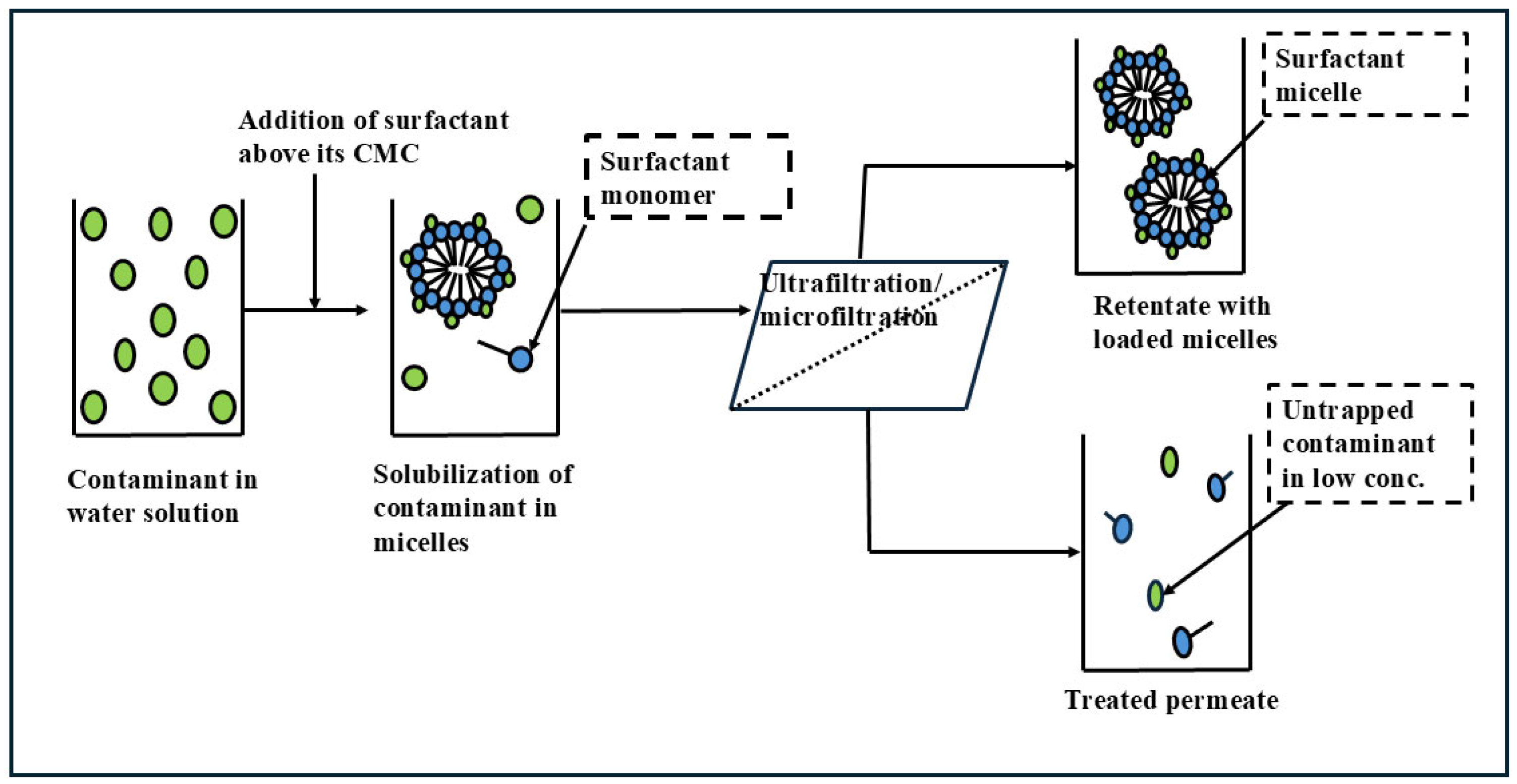
To overcome this intrinsic limitation, hybrid processes have been developed that convert dissolved metal ions into larger complexes that ultrafiltration membranes can retain. Among these approaches, micellar-enhanced ultrafiltration (MEUF) has attracted considerable attention [21,22]. MEUF combines surfactant-mediated solute binding with membrane-based size-exclusion, thereby enabling the removal of low-molecular-weight contaminants that would otherwise permeate the membrane [22]. In this process, a suitable surfactant is added to the contaminated solution at a concentration above its critical micelle concentration (CMC). Above the CMC, surfactant molecules self-assemble into micelles characterized by a hydrophobic core and a hydrophilic shell. Metal ions can associate with these micelles via electrostatic interactions, ion pairing, or coordination mechanisms, forming micelle–metal complexes with hydrodynamic diameters substantially larger than the membrane pore size. These complexes are subsequently retained in the retentate stream during ultrafiltration, while purified water permeates through the membrane.
Sodium dodecyl sulfate (SDS), an anionic surfactant composed of a 12-carbon hydrophobic tail and a sulfate head group, is among the most widely investigated surfactants in MEUF applications [23,24]. SDS is commercially available, relatively inexpensive, and exhibits well-characterized physicochemical behavior in aqueous media. When present above its CMC, SDS forms negatively charged micelles that can interact with divalent metal cations such as Co2+ via electrostatic attraction between the sulfate groups and the positively charged metal species [25,26]. The efficiency of metal removal in SDS-based MEUF systems depends on several operational parameters, including surfactant concentration, solution pH, ionic strength, initial metal concentration, membrane molecular weight cut-off (MWCO), and applied transmembrane pressure [27]. Optimizing these variables is essential to maximize metal rejection while maintaining acceptable permeate flux and minimizing surfactant leakage.
Compared to conventional precipitation or adsorption techniques, MEUF offers several advantages. First, it significantly reduces sludge generation, as metals are concentrated in a retentate stream rather than precipitated as bulky hydroxide solids. Second, the process can be operated continuously and integrated into existing membrane modules. Third, MEUF typically requires lower operating pressures than NF or RO, thereby reducing energy demand [28]. Additionally, the concentrated retentate containing metal–surfactant complexes can potentially be treated to recover valuable metals, aligning with circular economy principles and resource recovery strategies. Nevertheless, challenges remain, including membrane fouling induced by surfactant adsorption, concentration polarization effects, and the need for efficient surfactant regeneration.
Previous studies have demonstrated the feasibility of micellar-enhanced ultrafiltration (MEUF) for cobalt and heavy metal removal using surfactant-assisted separation systems. Earlier investigations reported that anionic surfactants such as sodium dodecyl sulfate (SDS) can effectively bind divalent metal ions and enhance rejection through micelle-mediated ultrafiltration mechanisms. In particular, previous studies have shown that cobalt removal efficiency in MEUF systems is strongly influenced by surfactant concentration, solution chemistry, membrane characteristics, and ionic interactions within the feed solution [29]. While numerous studies have reported MEUF performance for the removal of metals such as cadmium, copper, lead, and chromium, comparatively fewer investigations have explicitly focused on cobalt, particularly under conditions representative of industrial wastewater matrices containing competing ions and variable salinity. Given the strategic importance of cobalt in modern energy technologies and the environmental implications of its discharge, systematic evaluation of MEUF parameters for cobalt removal is warranted. Although MEUF has been previously investigated for the removal of heavy metals such as cadmium, copper, lead, and chromium, studies specifically focused on cobalt removal remain comparatively limited, particularly under systematically varied operational conditions relevant to industrial wastewater treatment. In addition, limited information is available regarding the combined influence of surfactant concentration, ionic strength, pH, cobalt loading, and extended continuous operation on cobalt-specific MEUF performance. The present work addresses these gaps through a comprehensive evaluation of SDS-assisted ultrafiltration for cobalt removal using a PES membrane under crossflow operation. Furthermore, this study combines long-term filtration analysis with membrane characterization through FTIR and SEM–EDS to assess membrane stability and fouling behavior during prolonged operation. The sustained cobalt rejection and stable flux observed in this study highlight the potential applicability of the proposed MEUF system for cobalt-containing wastewater treatment and resource recovery applications.
In this context, the present study investigates the application of a sodium dodecyl sulfate-based micellar-enhanced ultrafiltration system for the removal of cobalt from aqueous solutions. This work aims to (i) evaluate the influence of key operational parameters on cobalt rejection and permeate flux, (ii) elucidate the interaction mechanisms between cobalt ions and SDS micelles under varying physicochemical conditions, and (iii) assess the overall feasibility of MEUF as an efficient and scalable approach for cobalt-containing wastewater treatment. By integrating surfactant chemistry with membrane separation principles, this study aims to advance sustainable, high-performance technologies for heavy metal remediation in industrial effluents.

2. Materials and Methods

2.1. Materials

Cobalt stock solutions were prepared using cobalt(II) nitrate hexahydrate (Co(NO3)2·6H2O, ≥99% purity) (Thermo Fisher Scientific, Waltham, MA, USA), which served as the source of Co2+ ions. The required mass of the salt was accurately weighed and dissolved in deionized (DI) water to obtain the desired initial cobalt concentrations for each experimental run. Sodium dodecyl sulfate (SDS) (CH3(CH2)11OSO3Na+, ≥99% purity) (Fisher Scientific Company, Pittsburgh, PA, USA) was employed as the anionic surfactant for micelle formation in the micellar-enhanced ultrafiltration (MEUF) system. All working solutions were prepared using DI water with a resistivity of 18.2 MΩ·cm to eliminate interference from background ions. Ultrafiltration experiments were conducted using a flat-sheet polyethersulfone (PES) membrane obtained from Sterlitech Corporation (Auburn, WA, USA). The membrane had an effective filtration area of 0.004209 m2 and was supplied pre-cut for insertion into the crossflow membrane cell. The membrane molecular weight cut-off (MWCO) of 30 kDa suitable for retaining surfactant–metal micellar aggregates. All glassware and feed containers were thoroughly rinsed with DI water prior to use to avoid contamination.

2.2. Methodology

2.2.1. Membrane System and Operating Conditions

All ultrafiltration experiments were performed using a CF042D crossflow membrane filtration system (Sterlitech Corporation, Auburn, WA, USA). The system was operated in crossflow mode to minimize concentration polarization and surface fouling. A constant transmembrane pressure (TMP) of approximately 413 kPa was maintained throughout the experiments. The feed solution was circulated at a flow rate of 1.6 gallons per minute (GPM), ensuring adequate turbulence across the membrane surface and stable hydrodynamic conditions. All experiments were conducted at ambient laboratory temperature (25 ± 1 °C) [18].

2.2.2. Membrane Conditioning and Pure Water Flux Measurement

Prior to each experiment, a fresh PES membrane was immersed in DI water for 5 min to remove any preservative chemicals present on the membrane surface. The membrane was then mounted securely within the membrane cell. To determine the baseline permeability, DI water was filtered through the membrane at the operating TMP (~413 kPa) until a stable pure water flux was achieved. This stabilization step ensured consistent membrane compaction and reproducible performance before introducing the cobalt-containing feed solution.
The permeate was collected in a container placed on an analytical balance connected to a data acquisition system. The mass of permeate was recorded continuously, and flux (J) was calculated using:
J = Δ V A   ×   Δ t
where ΔV is the permeate volume (L), A is the effective membrane area (0.004209 m2), and Δt is the filtration time interval t.

2.2.3. Preparation of Simulated Cobalt Wastewater

Synthetic cobalt-contaminated wastewater was prepared by dissolving a calculated amount of Co2+ salt into DI water to achieve the desired initial metal concentration. SDS was subsequently added at concentrations above its critical micelle concentration (CMC) to promote micelle formation. The mixture was magnetically stirred to ensure complete dissolution and uniform micellar distribution before being transferred to the feed tank. Depending on the experimental condition, the feed solution contained either free Co2+ ions or cobalt–SDS micellar complexes.

2.2.4. MEUF Operation

The prepared feed solution was introduced into the feed tank of the crossflow system. During operation, the retentate stream was continuously recirculated back to the feed tank to maintain constant feed composition, while the permeate stream was collected separately. Each experimental run was continued until approximately 0.6 L of solution remained in the feed tank, ensuring sufficient filtration time to reach steady-state conditions. Typically, the permeate flux stabilized within 30 min of operation. After stabilization, data were collected continuously for approximately 4 h to evaluate steady-state flux performance.
Cobalt rejection (R, %) was determined using:
R ( % ) = ( 1 C p C f ) × 100 %
where C p is the cobalt concentration in the permeate and C f is the initial cobalt concentration in the feed solution.
The Initial and final Co2+ concentrations were measured by using Agilent 3510 Atomic Absorption Spectrometry (AAS) (Agilent Technologies, Santa Clara, CA, USA). Following each experiment, the membrane was subjected to a cleaning protocol to restore permeability. The cleaning sequence included: Flushing with DI water for 30 min. Circulation of 0.1 mol·L−1 sodium hydroxide (NaOH) solution for 30 min to remove adsorbed surfactant and metal complexes. Final rinsing with DI water for an additional 30 min. After cleaning, DI water was filtered again under the same TMP to determine the recovered pure water flux and assess membrane permeability restoration. All experiments were conducted in duplicate to ensure reproducibility and data reliability. Average values of permeate flux and cobalt rejection were reported, and deviations between duplicate runs were monitored to confirm experimental consistency. Figure 1 represents the schematic of the micellar-enhanced ultrafiltration mechanism.

2.3. Membrane Characterization

Fourier Transform Infrared (FTIR) spectroscopy was employed to analyze the chemical structure of the ultrafiltration membranes before and after MEUF experiments. Spectra were recorded using a Nicolet FTIR spectrometer (Thermo Electron North America LLC, Madison, WI, USA). Prior to analysis, membrane samples were thoroughly rinsed with deionized water to remove loosely bound residues and then dried at room temperature. The dried membrane specimens were scanned over an appropriate wavenumber range to identify characteristic functional groups and to detect any chemical modifications or adsorption of surfactant–cobalt complexes on the membrane surface following filtration. Comparative analysis of the raw and post-filtration spectra was conducted to assess potential interactions between the membrane material and SDS or cobalt species.
Surface morphology and elemental composition were evaluated using Scanning Electron Microscopy (SEM) coupled with Energy-Dispersive X-ray Spectroscopy (EDS). The analysis was performed using a JSM-6010LA system (JEOL, Tokyo, Japan). Membrane samples were air-dried and mounted on aluminum stubs prior to imaging. SEM micrographs were obtained to examine changes in surface topography, pore structure, and potential fouling layer formation after MEUF operation. EDS analysis was conducted to determine the elemental distribution on the membrane surface and to confirm the presence of cobalt deposits or residual surfactant components following filtration.

3. Results & Discussion

3.1. Membrane Characterization

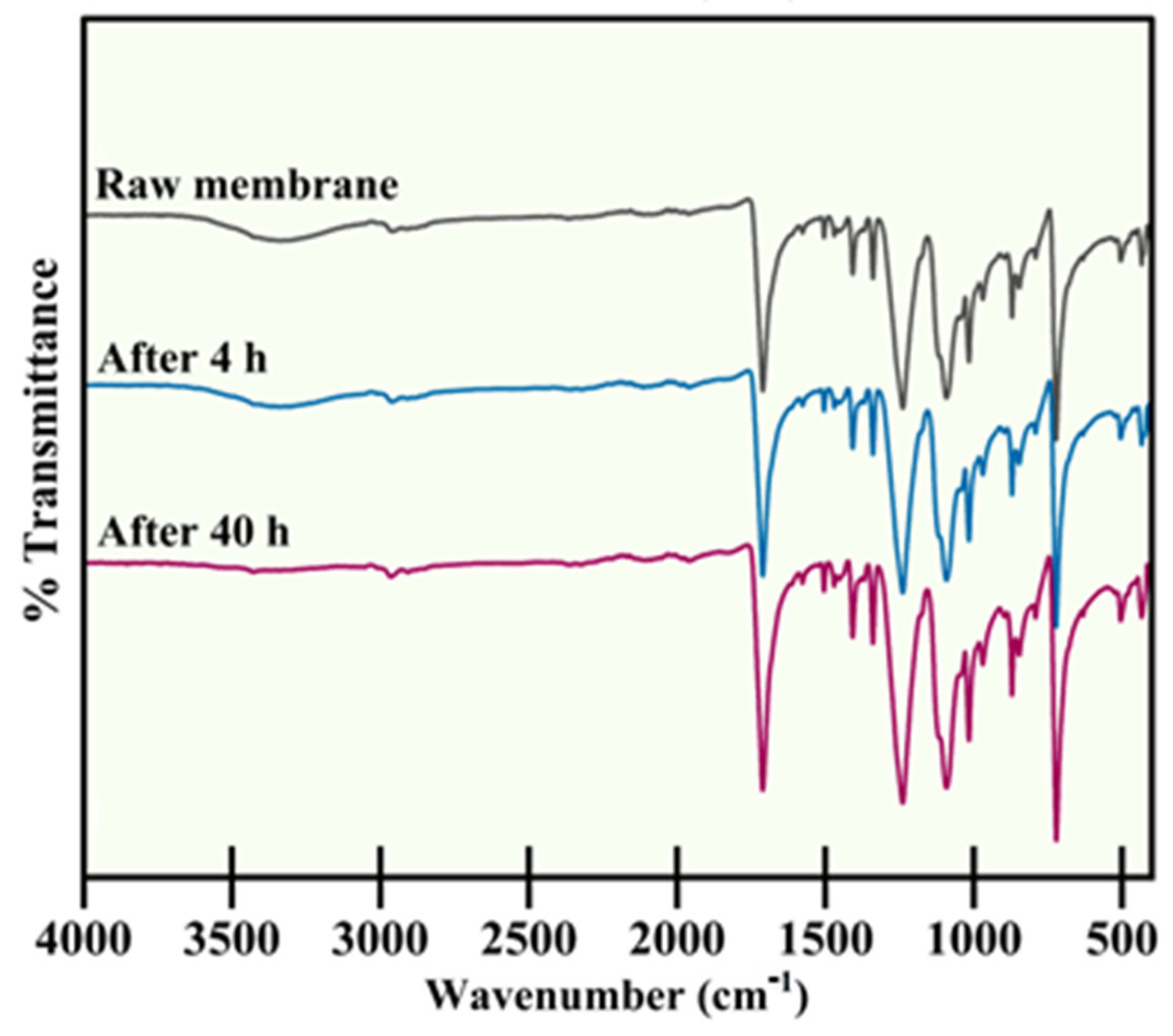
The FTIR spectra of the pristine PES ultrafiltration membrane and membranes recovered after 4 h and 40 h of cobalt removal via MEUF are presented in Figure 2. The spectral profiles of all samples exhibit similar characteristic absorption bands, indicating that the fundamental chemical structure of the membrane remained stable during operation. The raw membrane shows a broad band around 3300–3400 cm−1 corresponding to O–H stretching vibrations, likely associated with adsorbed moisture. Distinct PES-related peaks are observed, including aromatic C–H bending vibrations in the range of 620–870 cm−1, strong sulfone (–SO2–) stretching bands between 1100 and 1200 cm−1, and ether (C–O–C) stretching vibrations at approximately 1230–1270 cm−1 [30]. Aromatic ring skeletal vibrations are also evident in the 1400–1600 cm−1 region, consistent with the polyethersulfone backbone [31]. After 4 h and 40 h of cobalt-containing filtration, no significant shifts or disappearance of these characteristic bands are observed. Minor variations in peak intensity, particularly within the 1000–1200 cm−1 region, may be attributed to surface-associated SDS or cobalt–micelle interactions rather than chemical alteration in the membrane matrix. Given that FTIR primarily reflects bulk functional groups and has limited sensitivity to thin surface deposits, the similarity among spectra suggests that no major chemical modification or degradation of the PES membrane occurred during cobalt removal. Any fouling that developed was likely superficial and insufficient to alter the dominant polymer absorption features.
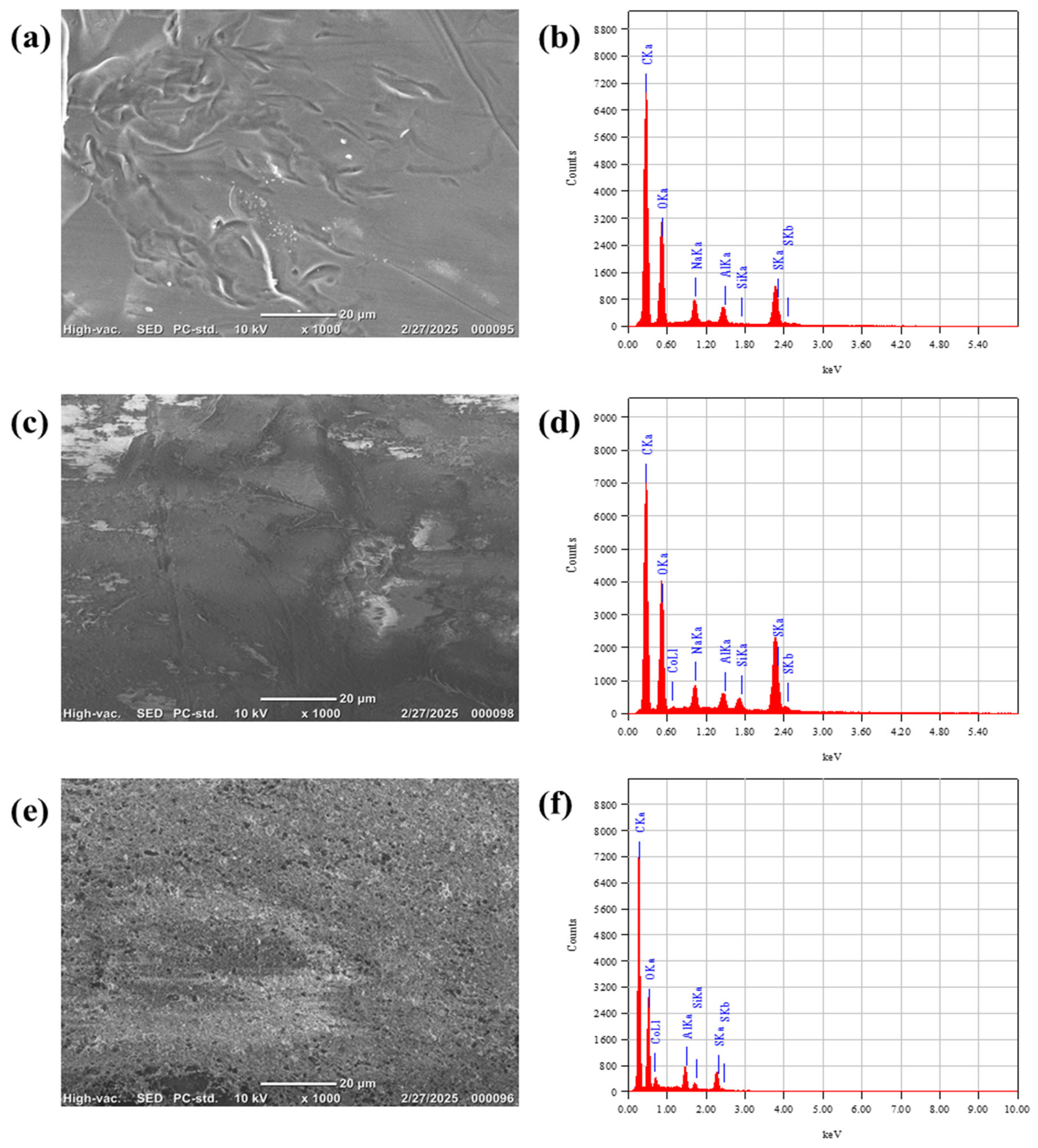
SEM micrographs and corresponding EDS spectra (Figure 3) illustrate the surface characteristics of the pristine PES membrane and membranes operated for cobalt removal after 4 h and 40 h. The raw membrane exhibited a relatively smooth and uniform surface morphology without visible pore obstruction or surface deposits. Following 4 h of MEUF operation with cobalt-containing solution, the membrane surface showed minor scattered particulates, suggesting limited surface interaction or deposition. After 40 h of continuous filtration, localized and thin surface layers were observed; however, these deposits appeared discontinuous and did not form a dense fouling layer. The overall membrane texture and structural integrity remained largely preserved. EDS analysis confirmed that carbon and oxygen were the dominant elements, consistent with the PES polymer structure, while sulfur peaks corresponded to the sulfone groups within the membrane matrix. Importantly, cobalt was not detected in measurable quantities in either the 4 h or 40 h samples. The elemental composition showed only slight variations between raw and operated membranes, indicating that cobalt accumulation on the membrane surface was negligible. Although EDS is semi-quantitative and may not detect ultrathin or highly localized deposits, the absence of a detectable cobalt signal, combined with minimal morphological alteration, suggests limited surface fouling during operation. These findings are consistent with the stable permeate flux observed during filtration, supporting the conclusion that the MEUF process did not induce significant cobalt-related membrane fouling under the studied conditions. The stable permeate flux observed during both short-term and 40 h continuous operation suggests limited membrane fouling under the investigated conditions. Furthermore, SEM observations revealed only minor and discontinuous surface deposition, while EDS analysis showed negligible cobalt accumulation on the membrane surface. These findings collectively indicate that fouling was primarily superficial and did not significantly affect membrane permeability during operation. Future investigations should incorporate quantitative fouling resistance analysis to further characterize membrane fouling behavior and cleaning efficiency under extended operating conditions.

3.2. Ultrafiltration for Removal of Co2+

3.2.1. Effect of SDS Concentrations on Flux and Removal of Co2+

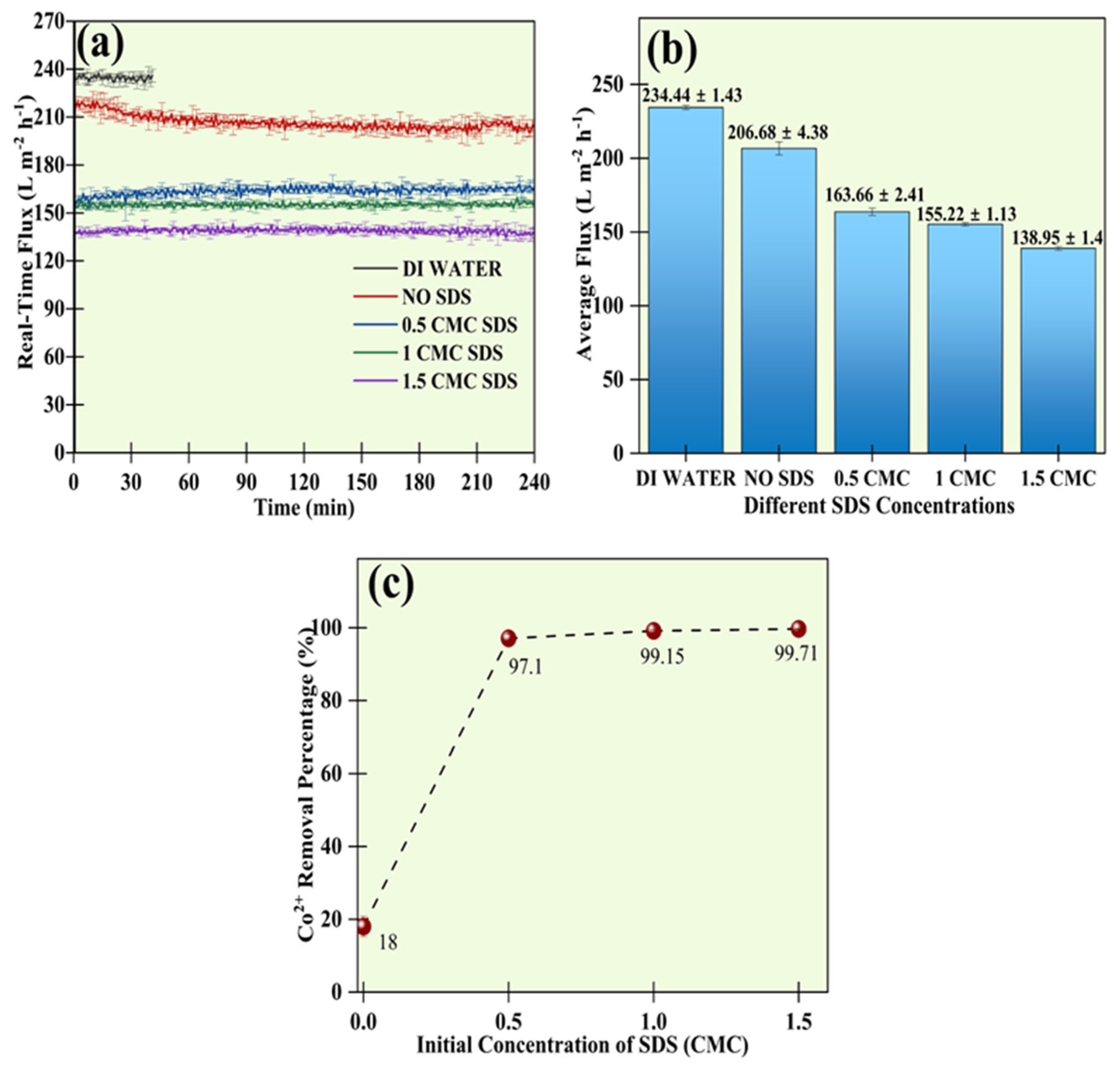
Figure 3 presents real-time permeate flux profiles, average flux values, and Co2+ removal efficiencies at an initial cobalt concentration of 50 mg L−1 under varying SDS concentrations. As shown in Figure 4a, all experiments exhibited stable flux behavior over the 240 min filtration period, with no abrupt decline observed. The pure water flux was 234.44 ± 1.43 L m−2 h−1, while filtration of cobalt solution without SDS resulted in an average flux of 206.68 ± 4.38 L m−2 h−1. Upon addition of SDS, a progressive decrease in flux was observed. At 0.5 CMC, 1 CMC, and 1.5 CMC SDS, the average flux values decreased to 163.66 ± 2.41, 155.22 ± 1.13, and 138.95 ± 1.40 L m−2 h−1, respectively (Figure 4b). The reduction in flux with increasing surfactant concentration is attributed to enhanced concentration polarization and partial accumulation of SDS micelles near the membrane surface, which increases hydraulic resistance. Nevertheless, the absence of severe flux decay indicates that a stable fouling layer did not develop during the experimental duration.
Cobalt removal exhibited strong dependence on SDS concentration (Figure 4c). Without SDS, only 18 ± 2.83% rejection was achieved, likely due to limited adsorption of Co2+ onto the membrane surface. In contrast, the introduction of SDS significantly improved rejection to 97.19 ± 1.12% at 0.5 CMC, 99.15 ± 0.33% at 1 CMC, and 99.71 ± 0.06% at 1.5 CMC. Although micelle formation is expected above the CMC, measurable rejection at 0.5 CMC suggests localized concentration polarization and potential reduction in effective CMC in the presence of cobalt ions. Considering both flux stability and high rejection efficiency, 1 CMC SDS appears to provide an optimal balance between cobalt removal and membrane productivity. The interaction between Co2+ ions and SDS micelles plays a central role in the MEUF separation mechanism. Above the critical micelle concentration (CMC), SDS molecules self-assemble into negatively charged micellar structures with sulfate head groups oriented toward the aqueous phase. Co2+ ions interact electrostatically with these negatively charged sulfate groups, resulting in the formation of cobalt–SDS micellar complexes. The association between cobalt ions and SDS micelles increases the effective hydrodynamic size of the solute species beyond the pore dimensions of the ultrafiltration membrane, thereby enabling efficient retention through size exclusion. In addition to micelle binding, localized concentration polarization and formation of a micelle-rich layer near the membrane surface may further contribute to enhanced cobalt rejection by increasing resistance to solute transport. The strong dependence of rejection efficiency on SDS concentration, particularly the sharp increase observed near and above the CMC, further supports surfactant-mediated cobalt complexation as the dominant separation mechanism.
The dominant mechanism governing cobalt rejection in the MEUF system is primarily attributed to surfactant-mediated micelle binding and subsequent size exclusion by the ultrafiltration membrane. Above the critical micelle concentration, Co2+ ions interact electrostatically with the negatively charged sulfate head groups of SDS micelles, forming cobalt–micelle complexes with significantly larger hydrodynamic dimensions than free metal ions. These complexes are effectively retained by the membrane during filtration. In addition, concentration polarization and formation of a localized micelle-rich layer near the membrane surface may further enhance rejection efficiency by providing additional resistance to solute transport. Electrostatic interactions between cobalt ions and SDS molecules contribute substantially to micelle stabilization, whereas Donnan exclusion is expected to play only a minor role because the PES ultrafiltration membrane itself possesses limited surface charge under the investigated operating conditions.

3.2.2. Effect of pH on the Removal Efficiency of Co2+

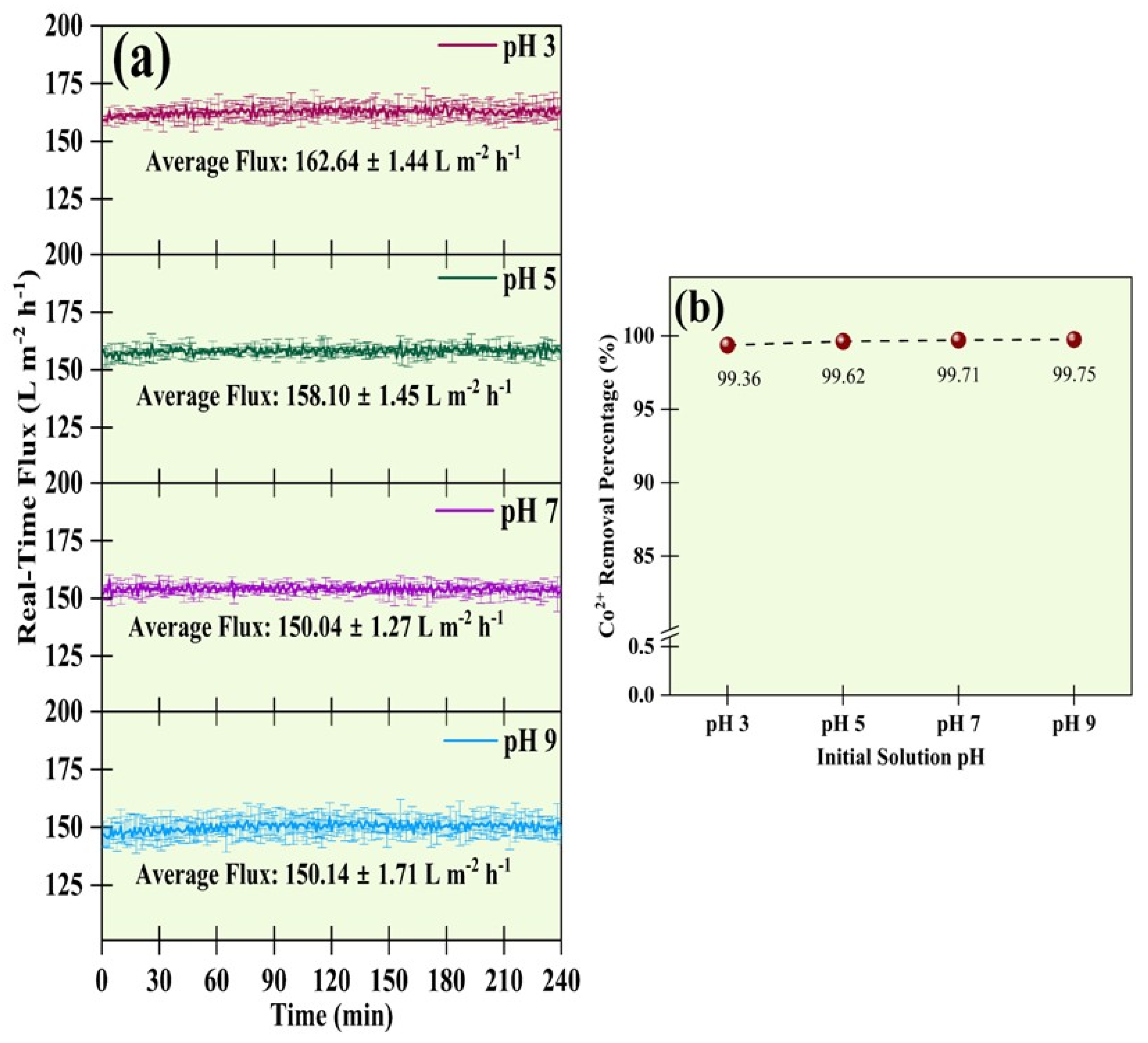
Figure 5 illustrates the influence of initial solution pH on real-time permeate flux and Co2+ removal efficiency at an initial cobalt concentration of 50 mg L−1 and SDS concentration of 8.14 mmol L−1. The feed solution pH was adjusted using 1 mol L−1 HCl or 1 mol L−1 NaOH from its natural pH of approximately 6.95. As shown in Figure 5a, stable flux profiles were observed over the 240 min filtration period for all tested pH values. The average flux at pH 3 was 162.64 ± 1.44 L m−2 h−1, followed by 158.10 ± 1.45 L m−2 h−1 at pH 5, 150.04 ± 1.27 L m−2 h−1 at pH 7, and 150.14 ± 1.71 L m−2 h−1 at pH 9. A slight decline in flux was observed with increasing pH, which may be attributed to changes in micelle structure, ionic interactions, and potential variations in concentration polarization behavior at higher alkalinity. Nevertheless, no abrupt flux deterioration was detected, indicating stable membrane performance across the studied pH range. Cobalt rejection remained consistently high between pH 3 and 9 (Figure 5b). The removal efficiencies were 99.36 ± 0.11%, 99.62 ± 0.27%, 99.71 ± 0.11%, and 99.86 ± 0.14% at pH 3, 5, 7, and 9, respectively. The sustained high rejection suggests strong electrostatic interaction between Co2+ ions and the negatively charged sulfate head groups of SDS micelles. Within this pH interval, competition from H+ ions were insufficient to significantly disrupt cobalt–micelle binding. These results indicate that the MEUF system maintains robust cobalt removal efficiency over a broad pH range.

3.2.3. Evaluation of Membrane Performance and Removal Efficiency for Co2+ over Longer Duration

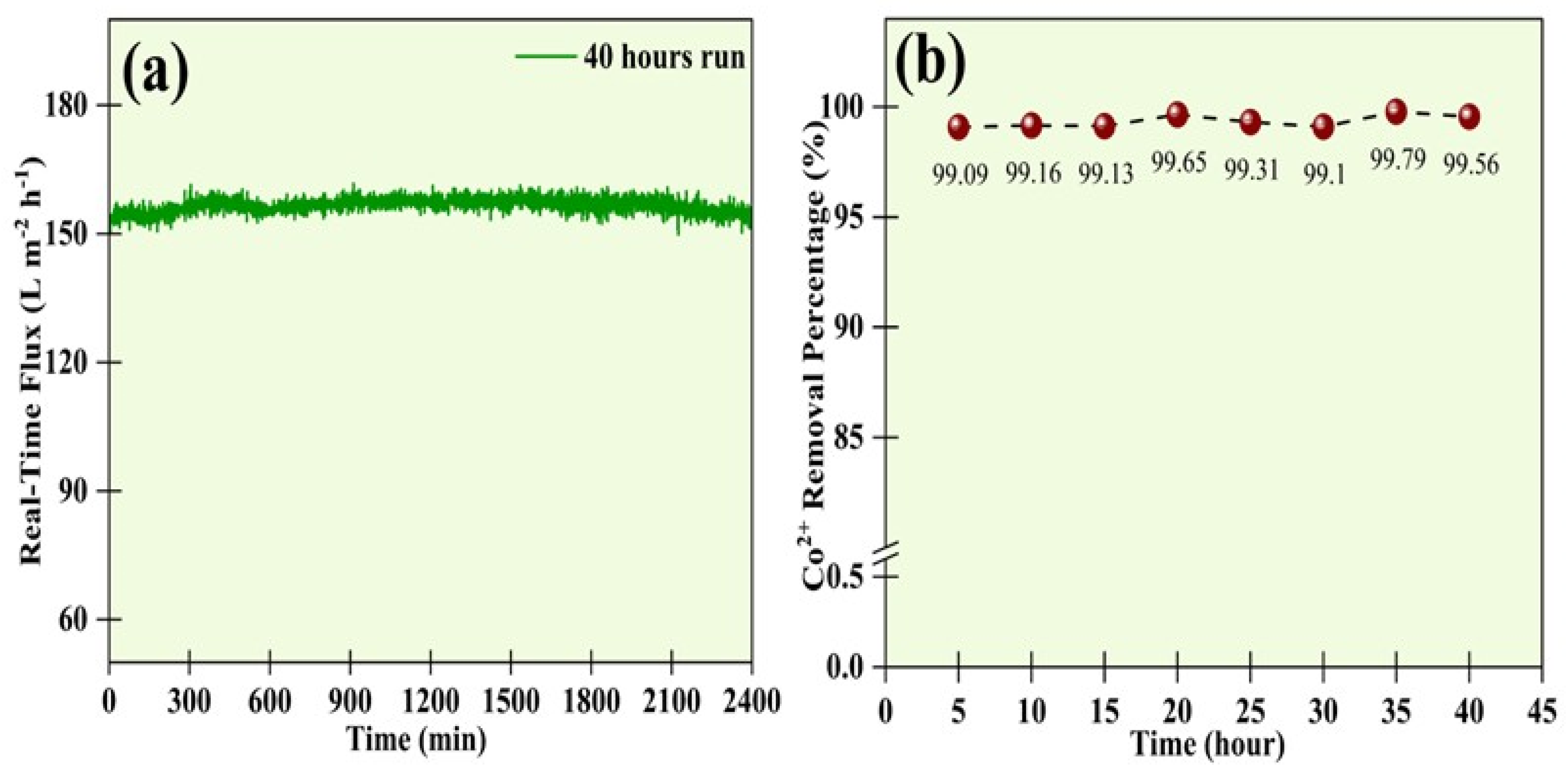
The operational stability of the ultrafiltration membrane was evaluated over a continuous 40 h filtration period at an initial cobalt concentration of 50 mg L−1 and an SDS dosage of 1 CMC. Figure 6a presents the real-time permeate flux profile, while Figure 6b illustrates the corresponding cobalt removal efficiency measured at 5 h intervals. As shown in Figure 4a, the permeate flux remained stable throughout the 2400 min operation, fluctuating within a narrow range around approximately 155 L m−2 h−1. No progressive decline or abrupt reduction in flux was observed, indicating minimal fouling or pore blockage during extended operation. The absence of significant flux deterioration suggests that the formation of cobalt–SDS micellar complexes did not induce substantial hydraulic resistance under the selected operating conditions. Cobalt removal efficiency over the 40 h period consistently exceeded 99%, with recorded values ranging between approximately 99.09% and 99.79% (Figure 6b). The stable rejection performance demonstrates sustained micelle formation and effective retention of cobalt–surfactant complexes by the membrane.

3.2.4. Dose Study on Removal Efficiency of Co2+

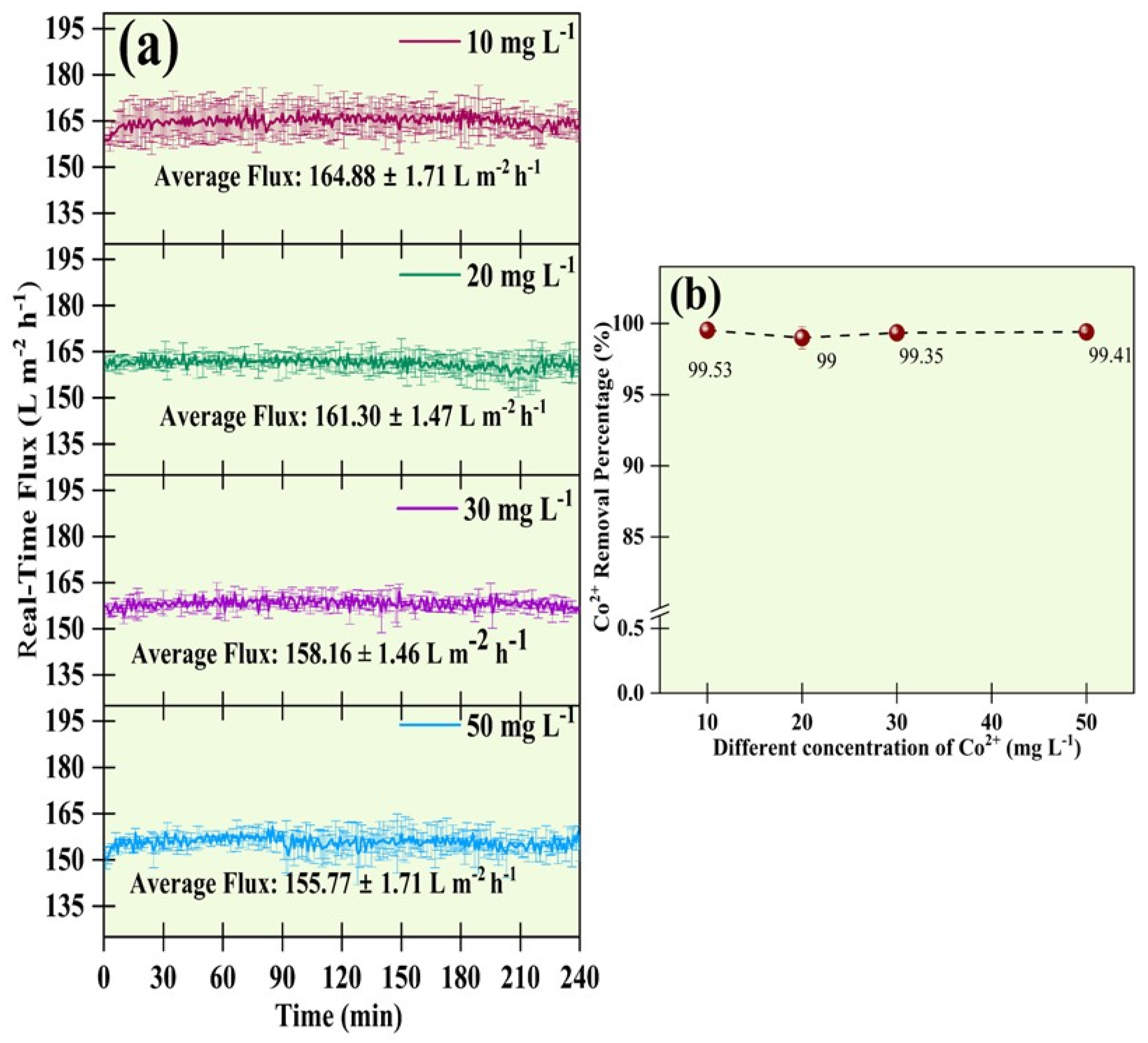
The influence of initial cobalt concentration on membrane performance was evaluated at a fixed SDS concentration of 1 CMC. The Co2+ concentration was varied from 10 to 50 mg L−1 to assess its effect on real-time permeate flux and removal efficiency (Figure 7).
As shown in Figure 7a, stable flux profiles were observed over the 240 min filtration period for all tested concentrations. However, a gradual decline in average flux was recorded with increasing cobalt concentration. The average flux values were 164.88 ± 1.71 L m−2 h−1 at 10 mg L−1, 161.30 ± 1.47 L m−2 h−1 at 20 mg L−1, 158.16 ± 1.46 L m−2 h−1 at 30 mg L−1, and 155.77 ± 1.71 L m−2 h−1 at 50 mg L−1. The reduction in flux at higher cobalt concentrations can be attributed to enhanced formation of cobalt–SDS micellar complexes. Increased metal ion presence may reduce electrostatic repulsion between SDS head groups, promoting micelle aggregation and localized accumulation near the membrane surface, thereby increasing hydraulic resistance.
Despite the slight flux decline, cobalt rejection remained consistently high across the tested concentration range (Figure 7b). Removal efficiencies were 99.53 ± 0.23%, 99.00 ± 0.78%, 99.35 ± 0.21%, and 99.41 ± 0.15% at 10, 20, 30, and 50 mg L−1, respectively. The results demonstrate that at 1 CMC SDS, the MEUF system maintains removal efficiencies above 99% even at elevated cobalt concentrations, indicating strong and stable micelle-mediated complexation and effective membrane retention.

3.2.5. Effect of Ionic Strength on Removal Efficiency of Co2+

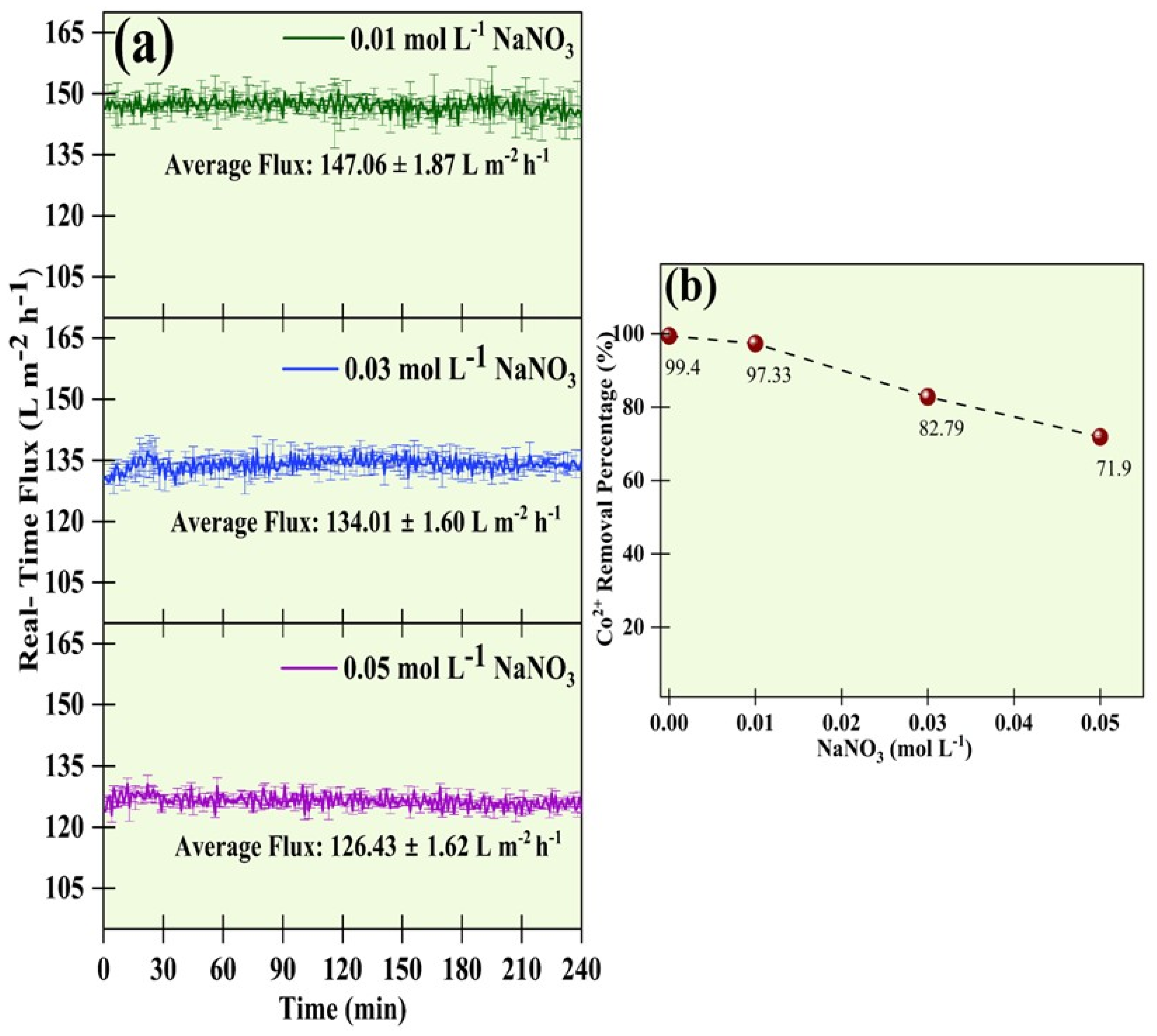
The influence of background electrolyte on MEUF performance was evaluated by introducing NaNO3 at concentrations of 0.01, 0.03, and 0.05 mol L−1 into a feed solution containing 50 mg L−1 Co2+ and 1 CMC SDS (Figure 8).
As shown in Figure 8a, permeate flux decreased progressively with increasing NaNO3 concentration. The average flux was 147.06 ± 1.87 L m−2 h−1 at 0.01 mol L−1 NaNO3, declining to 134.01 ± 1.60 L m−2 h−1 at 0.03 mol L−1 and 126.43 ± 1.62 L m−2 h−1 at 0.05 mol L−1. The reduction in flux is attributed to intensified concentration polarization and increased ionic strength, which promote micelle aggregation and accumulation near the membrane surface, thereby elevating hydraulic resistance.
Cobalt removal efficiency also declined with increasing electrolyte concentration (Figure 8b). The rejection decreased from 97.33 ± 0.16% at 0.01 mol L−1 to 82.79 ± 2.26% at 0.03 mol L−1 and further to 71.90 ± 0.40% at 0.05 mol L−1. The presence of Na+ ions in solution likely introduced competitive interactions with Co2+ for association sites on the negatively charged SDS micelles. This competition reduces effective cobalt–micelle complexation, allowing a greater fraction of unbound Co2+ to permeate through the membrane. Although electrolytes can reduce the critical micelle concentration by screening electrostatic repulsion between surfactant head groups, the competitive binding and increased ionic strength observed here outweighed potential benefits. These findings indicate that elevated background salinity adversely affects MEUF performance for cobalt removal.

3.3. Comparative Evaluation of MEUF with Reported Co2+ Removal Technologies

To further assess the practical applicability of the proposed SDS-assisted micellar-enhanced ultrafiltration (MEUF) system, its performance was qualitatively compared with that of previously reported membrane-based heavy metal removal technologies, particularly MEUF and nanofiltration (NF) systems reported in the literature. The comparison considered cobalt rejection efficiency, operational pressure requirements, and fouling or sludge generation tendencies, which are important parameters influencing process sustainability and industrial feasibility.
As summarized in Table 1, the present study achieved cobalt rejection of approximately 99.5% under moderate-operating-pressure conditions while maintaining stable permeate flux and limited membrane fouling during prolonged operation. Several previously reported MEUF systems also demonstrated high cobalt rejection efficiencies; however, variations in removal performance were observed depending on surfactant concentration, membrane configuration, operating conditions, and feed composition. In some cases, lower rejection efficiencies and increased fouling tendencies were reported due to concentration polarization, surfactant accumulation, or instability of metal–micelle interactions.

4. Conclusions

This study systematically evaluated the performance of a sodium dodecyl sulfate (SDS)-based micellar-enhanced ultrafiltration (MEUF) system for the removal of cobalt (Co2+) from aqueous solutions. The results demonstrate that the integration of surfactant-assisted complexation with ultrafiltration provides an effective and stable approach for cobalt separation. Permeate flux behavior indicated that the introduction of SDS above its critical micelle concentration (CMC) resulted in a moderate decline in flux compared to cobalt solution without surfactant, primarily due to concentration polarization and micelle accumulation near the membrane surface. Structural analyses using FTIR confirmed the chemical stability of the polyethersulfone membrane, while SEM–EDS observations revealed negligible cobalt deposition on the membrane surface. Cobalt rejection exhibited strong dependence on SDS concentration. While direct ultrafiltration achieved limited removal, the presence of SDS significantly enhanced rejection efficiency, exceeding 99% at and above 1 CMC. The system maintained high removal efficiency across a wide pH range (3–9), demonstrating robust cobalt–micelle interactions under varying acidity and alkalinity conditions. Increasing initial cobalt concentration (10–50 mg L−1) caused a slight reduction in flux but did not compromise removal efficiency, which consistently remained above 99%. Overall, the MEUF process proved to be an efficient, stable, and scalable method for cobalt removal, offering high rejection, sustained flux, and resistance to long-term fouling under optimized operating conditions. Future investigations should additionally evaluate surfactant recovery, residual SDS concentration in permeate streams, and retentate regeneration to further assess the environmental and economic feasibility of large-scale MEUF applications.

Author Contributions

Conceptualization, P.S., S.B.M. and R.R.K.; methodology, P.S. and S.B.M.; software, P.S.; data curation, P.S. and S.B.M.; investigation, P.S. and S.B.M.; resources, R.R.K.; writing—original draft preparation, S.B.M.; supervision, S.B.M. and R.R.K.; funding acquisition, R.R.K.; writing—reviewing and editing, S.B.M. and R.R.K. All authors have read and agreed to the published version of the manuscript.

Funding

This work was supported by the National Science Foundation (NSF) through the CREST Center for Energy and Environmental Sustainability-Phase II (CEES) (Award #1914692).

Data Availability Statement

Data are contained within this article.

Acknowledgments

The authors would like to acknowledge the support of the Center for Energy and Environmental Sustainability (CEES) at PVAMU and the Department of Chemistry at PVAMU. The authors acknowledge Bishweshwar Pant, Gabriel Murillo Morales, and Prashan Rodrigo for reviewing this manuscript.

Conflicts of Interest

The authors declare no conflicts of interest.

Abbreviations

The following abbreviations are used in this manuscript:
CMCCritical micelle concentration
SDSSodium dodecyl sulfate
MWCOMolecular weight cutoff
FTIRFourier-transform infrared
AASAtomic Absorption Spectrophotometer

References

  1. Pines Pozo, M.T.; Lopez Fernandez, E.; Villaseñor, J.; Leon-Fernandez, L.F.; Fernandez-Morales, F.J. Metal Recovery from Wastes: A Review of Recent Advances in the Use of Bioelectrochemical Systems. Appl. Sci. 2025, 15, 1456. [Google Scholar] [CrossRef]
  2. Raabe, D. The Materials Science behind Sustainable Metals and Alloys. Chem. Rev. 2023, 123, 2436–2608. [Google Scholar] [CrossRef]
  3. Mansur, M.B.; Guimarães, A.S.; Petraniková, M. An Overview on the Recovery of Cobalt from End-of-life Lithium Ion Batteries. Miner. Process. Extr. Metall. Rev. 2022, 43, 489–509. [Google Scholar] [CrossRef]
  4. Lebrouhi, B.E.; Baghi, S.; Lamrani, B.; Schall, E.; Kousksou, T. Critical materials for electrical energy storage: Li-ion batteries. J. Energy Storage 2022, 55, 105471. [Google Scholar] [CrossRef]
  5. Lehtimäki, H.; Karhu, M.; Kotilainen, J.M.; Sairinen, R.; Jokilaakso, A.; Lassi, U.; Huttunen-Saarivirta, E. Sustainability of the use of critical raw materials in electric vehicle batteries: A transdisciplinary review. Environ. Chall. 2024, 16, 100966. [Google Scholar] [CrossRef]
  6. Das, J.; Kleiman, A.; Rehman, A.U.; Verma, R.; Young, M.H. The Cobalt Supply Chain and Environmental Life Cycle Impacts of Lithium-Ion Battery Energy Storage Systems. Sustainability 2024, 16, 1910. [Google Scholar] [CrossRef]
  7. Genchi, G.; Lauria, G.; Catalano, A.; Carocci, A.; Sinicropi, M.S. Prevalence of Cobalt in the Environment and Its Role in Biological Processes. Biology 2023, 12, 1335. [Google Scholar] [CrossRef] [PubMed]
  8. Ajala, L.O.; Wilson, J.E.H.; Jiru, M.; Iwunze, M.O. Perspective on health and ecological risk assessments of potentially toxic metal(loid)s using aquatic biodiversity as biomonitoring indicators. Toxicol. Rep. 2025, 15, 102086. [Google Scholar] [CrossRef]
  9. Gahrouei, A.E.; Rezapour, A.; Pirooz, M.; Pourebrahimi, S. From classic to cutting-edge solutions: A comprehensive review of materials and methods for heavy metal removal from water environments. Desalin. Water Treat. 2024, 319, 100446. [Google Scholar] [CrossRef]
  10. Oladimeji, T.E.; Oyedemi, M.; Emetere, M.E.; Agboola, O.; Adeoye, J.B.; Odunlami, O.A. Review on the impact of heavy metals from industrial wastewater effluent and removal technologies. Heliyon 2024, 10, e40370. [Google Scholar] [CrossRef]
  11. Tseka, T.; Finkbeiner, P.; Phiri, Z.; Nkambule, T.T.I.; Jarvis, P.; de Kock, L.-A. Comparative evaluation of ion-exchange resins for natural organic matter removal from power plant source waters. J. Water Process Eng. 2025, 78, 108829. [Google Scholar] [CrossRef]
  12. Devaisy, S.; Kandasamy, J.; Aryal, R.; Johir, M.A.; Ratnaweera, H.; Vigneswaran, S. Removal of Organics with Ion-Exchange Resins (IEX) from Reverse Osmosis Concentrate. Membranes 2023, 13, 136. [Google Scholar] [CrossRef]
  13. Madduri, S.; Elsayed, I.; Hassan, E.B. Novel oxone treated hydrochar for the removal of Pb(II) and methylene blue (MB) dye from aqueous solutions. Chemosphere 2020, 260, 127683. [Google Scholar] [CrossRef]
  14. Madduri, S.B.; Kommalapati, R.R. Harnessing Novel Reduced Graphene Oxide-Based Aerogel for Efficient Organic Contaminant and Heavy Metal Removal in Aqueous Environments. Nanomaterials 2024, 14, 1708. [Google Scholar] [CrossRef]
  15. Navarathna, C.M.; Pennisson, J.E.; Dewage, N.B.; Reid, C.; Dotse, C.; Jazi, M.E.; Rodrigo, P.M.; Zhang, X.; Farmer, E.; Watson, C.; et al. Adsorption of Phosphates onto Mg/Al-Oxide/Hydroxide/Sulfate-Impregnated Douglas Fir Biochar. Processes 2023, 11, 111. [Google Scholar] [CrossRef]
  16. Alkhadra, M.A.; Su, X.; Suss, M.E.; Tian, H.; Guyes, E.N.; Shocron, A.N.; Conforti, K.M.; de Souza, J.P.; Kim, N.; Tedesco, M.; et al. Electrochemical Methods for Water Purification, Ion Separations, and Energy Conversion. Chem. Rev. 2022, 122, 13547–13635. [Google Scholar] [CrossRef] [PubMed]
  17. Jo, S.; Kadam, R.; Jang, H.; Seo, D.; Park, J. Recent Advances in Wastewater Electrocoagulation Technologies: Beyond Chemical Coagulation. Energies 2024, 17, 5863. [Google Scholar] [CrossRef]
  18. Sapkota, P.; Madduri, S.B.; Kommalapati, R.R. Advanced Micellar-Enhanced Ultrafiltration for the Removal of Cadmium (Cd2+) from Wastewater. Water 2026, 18, 191. [Google Scholar] [CrossRef]
  19. Madduri, S.B.; Kommalapati, R.R. Forward Osmosis for Produced Water Treatment: Comparative Performance Evaluation of Fabricated and Commercial Membranes. Polymers 2026, 18, 197. [Google Scholar] [CrossRef]
  20. Tan, X.; Rodrigue, D. A Review on Porous Polymeric Membrane Preparation. Part I: Production Techniques with Polysulfone and Poly (Vinylidene Fluoride). Polymers 2019, 11, 1160. [Google Scholar] [CrossRef]
  21. Huang, J.-H.; Zeng, G.-M.; Fang, Y.-Y.; Qu, Y.-H.; Li, X. Removal of cadmium ions using micellar-enhanced ultrafiltration with mixed anionic-nonionic surfactants. J. Membr. Sci. 2009, 326, 303–309. [Google Scholar] [CrossRef]
  22. Lin, W.; Jing, L.; Zhang, B. Micellar-Enhanced Ultrafiltration to Remove Nickel Ions: A Response Surface Method and Artificial Neural Network Optimization. Water 2020, 12, 1269. [Google Scholar] [CrossRef]
  23. Wołowicz, A.; Staszak, K. Study of surface properties of aqueous solutions of sodium dodecyl sulfate in the presence of hydrochloric acid and heavy metal ions. J. Mol. Liq. 2020, 299, 112170. [Google Scholar] [CrossRef]
  24. Kim, A.L.; Musin, E.V.; Dubrovskii, A.V.; Tikhonenko, S.A. Qualitative and quantitative methods detection of SDS based on polyelectrolyte microcapsules. Sci. Rep. 2022, 12, 232. [Google Scholar] [CrossRef] [PubMed]
  25. Zang, C.; Niu, J.; Li, H.; Wang, Z.; Shi, Z. Enhanced removal of hexavalent chromium from contaminated soil using an amphoteric–anionic mixed surfactant (SDAO/SDS): Efficiency, mechanism, and environmental implications. Results Eng. 2025, 28, 107895. [Google Scholar] [CrossRef]
  26. Domínguez, H. Self-Aggregation of the SDS Surfactant at a Solid−Liquid Interface. J. Phys. Chem. B 2007, 111, 4054–4059. [Google Scholar] [CrossRef]
  27. Samper, E.; Rodríguez, M.; De la Rubia, M.A.; Prats, D. Removal of metal ions at low concentration by micellar-enhanced ultrafiltration (MEUF) using sodium dodecyl sulfate (SDS) and linear alkylbenzene sulfonate (LAS). Sep. Purif. Technol. 2009, 65, 337–342. [Google Scholar] [CrossRef]
  28. Azmi, L.S.; Jabit, N.A.; Ismail, S.; Ku Ishak, K.E.H.; Abdullah, T.K. Membrane filtration technologies for sustainable industrial wastewater treatment: A review of heavy metal removal. Desalin. Water Treat. 2025, 323, 101321. [Google Scholar] [CrossRef]
  29. Tortora, F.; Innocenzi, V.; De Michelis, I.; Vegliò, F.; di Celso, G.M.; Prisciandaro, M. Recovery of Anionic Surfactant Through Acidification/Ultrafiltration in a Micellar-Enhanced Ultrafiltration Process for Cobalt Removal. Environ. Eng. Sci. 2018, 35, 493–500. [Google Scholar] [CrossRef]
  30. Cometa, Z.G.G.; De Leon, L.A.O.; Garcia, I.R.D.; Mateo, J.V.P.; Lopez, E.C.R. Optimization of malachite green removal in water using carbonized wild sugarcane (Saccharum spontaneum L.) as an adsorbent. Next Mater. 2025, 9, 101004. [Google Scholar] [CrossRef]
  31. Shen, Q.; Zhang, T.; Zhu, M.-F. A comparison of the surface properties of lignin and sulfonated lignins by FTIR spectroscopy and wicking technique. Colloids Surf. A Physicochem. Eng. Asp. 2008, 320, 57–60. [Google Scholar] [CrossRef]
  32. Juang, R.-S.; Xu, Y.-Y.; Chen, C.-L. Separation and removal of metal ions from dilute solutions using micellar-enhanced ultrafiltration. J. Membr. Sci. 2003, 218, 257–267. [Google Scholar] [CrossRef]
  33. Patil, P.N.; Marathe, K.V. Selective Separation of Nickel (II) and Cobalt (II) from Waste Water by Using Continuous Cross-Flow Micellar Enhanced Ultrafiltration with Addition of Chelating Agent. Sep. Sci. Technol. 2013, 48, 547–553. [Google Scholar] [CrossRef]
  34. Tortora, F.; Innocenzi, V.; Prisciandaro, M.; Mazziotti di Celso, G.; Vegliò, F. Analysis of membrane performance in Ni and Co removal from liquid wastes by means of micellar-enhanced ultrafiltration. Desalin. Water Treat. 2016, 57, 22860–22867. [Google Scholar] [CrossRef]
  35. Karate, V.D.; Marathe, K.V. Simultaneous removal of nickel and cobalt from aqueous stream by cross flow micellar enhanced ultrafiltration. J. Hazard. Mater. 2008, 157, 464–471. [Google Scholar] [CrossRef] [PubMed]
  36. Yusaf, A.; Usman, M.; Ahmad, M.; Siddiq, M.; Mansha, A.; Al-Hussain, S.A.; Zaki, M.E.A.; Rehman, H.F. Highly Selective Methodology for Entrapment and Subsequent Removal of Cobalt (II) Ions under Optimized Conditions by Micellar-Enhanced Ultrafiltration. Molecules 2022, 27, 8332. [Google Scholar] [CrossRef] [PubMed]
  37. Kim, H.-J.; Baek, K.; Kim, B.-K.; Yang, J.-W. Humic substance-enhanced ultrafiltration for removal of cobalt. J. Hazard. Mater. 2005, 122, 31–36. [Google Scholar] [CrossRef]
  38. Choo, K.-H.; Kwon, D.-J.; Lee, K.-W.; Choi, S.-J. Selective Removal of Cobalt Species Using Nanofiltration Membranes. Environ. Sci. Technol. 2002, 36, 1330–1336. [Google Scholar] [CrossRef] [PubMed]
Figure 1. Schematic representation of the micellar-enhanced ultrafiltration mechanism.
Water 18 01418 g001
Figure 2. FTIR spectra of raw UF membrane, after 4 h usage, and after 40 h usage for Co2+ removal.
Water 18 01418 g002
Figure 3. SEM images and its corresponding EDS graphs showing the topography of (a,b) raw UF membrane, (c,d) after 4 h usage and (e,f) after 40 h usage for Co2+ removal.
Water 18 01418 g003
Figure 4. (a) Real-time flux changes, (b) average fluxes, and (c) removal efficiency of 50 mg L−1 of Co2+ at different concentrations of SDS.
Water 18 01418 g004
Figure 5. Effects of pH on (a) real-time flux, and (b) removal efficiency of 50 mg L−1 of Co2+.
Water 18 01418 g005
Figure 6. Evaluation of (a) real-time flux during the ultrafiltration process, and (b) removal efficiency for 50 mg L−1 of Co2+ over 40 h.
Water 18 01418 g006
Figure 7. Effects of change in Co2+ concentration on (a) real-time flux, and (b) removal efficiency at 1 CMC SDS.
Water 18 01418 g007
Figure 8. Effects of Ionic strength on (a) real-time flux with different concentrations of NaNO3, and (b) removal efficiency of 50 mg L−1 of Co2+ at 1 CMC SDS.
Water 18 01418 g008
Table 1. Comparative evaluation of MEUF with reported Co2+ removal.
Removal MethodTypical Co2+ Rejection (%)Operating PressureFouling/Sludge GenerationReference
MEUF99.8ModerateNA[32]
MEUF94.14LowModerate[33]
MEUF53.0Moderate High[34]
MEUF99.0ModerateNA[35]
MEUF96.0ModerateModerate[29]
MEUF99.9ModerateNA[36]
MEUF95.0Low NA[37]
NF85.0LowLow[38]
MEUF99.5ModerateLowThis study
Disclaimer/Publisher’s Note: The statements, opinions and data contained in all publications are solely those of the individual author(s) and contributor(s) and not of MDPI and/or the editor(s). MDPI and/or the editor(s) disclaim responsibility for any injury to people or property resulting from any ideas, methods, instructions or products referred to in the content.