Article

Hydrologic Responses of Angat Dam Watershed, Philippines Using Different Reservoir Configurations in the Soil and Water Assessment Tool (SWAT)

by
Carolyn D. Barrias
,
Kean Michael F. Cabigao
,
Armando A. Apan
,
Lemnuel V. Aragones
and
Mayzonee V. Ligaray
*
Institute of Environmental Science & Meteorology, College of Science, University of the Philippines Diliman, Quezon City 1101, Philippines
*
Author to whom correspondence should be addressed.
Water 2026, 18(12), 1417; https://doi.org/10.3390/w18121417 (registering DOI)
Submission received: 6 April 2026 / Revised: 25 May 2026 / Accepted: 3 June 2026 / Published: 10 June 2026
(This article belongs to the Section Hydrology)

Abstract

Hydrologic modeling helps identify the responses of a watershed under different conditions to understand its dynamics. Angat Dam Watershed is a heavily regulated reservoir in the Philippines, essential for supplying water for domestic use, irrigation, hydropower generation, and flood control. As one of the critical resources in the Philippines, understanding its behavior under different reservoir configurations would further improve resource planning and management. Using the reservoir module of the Soil and Water Assessment Tool (SWAT model), this study highlights how the Angat Dam Watershed responds to different reservoir outflow configurations—using measured outflows and release rate rules (IRESCO = 1 and 3, and 0, respectively). The results show that incorporating measured outflow discharges yielded better reservoir outflow representations (NSE = 0.73 and 0.69), whereas using simple release-rate rules that prioritize water retention in the reservoir resulted in a less accurate representation of actual release dynamics (NSE = 0.20 and −0.09). However, using measured outflows could lead to unrealistic artificial emptying on coarser temporal scales due to flow smoothening and highlighting the outflows exceeding inflows, which is not an issue with using simple release rate rules. Overall, this study emphasized the critical importance of selecting proper reservoir simulation configurations in SWAT to accurately model reservoir dynamics for water resources management in the Philippines.

1. Introduction

Watersheds are prone to any changes in the environment and climate; hence, it is paramount to implement a sustainable water resources management strategy to monitor their current and future conditions [1,2,3]. To assess any changes in the watersheds, the current status or future scenario should be compared with the baseline watershed conditions and characteristics. However, most watersheds in the Philippines lack baseline watershed characteristics that can be used as a comparison when determining the impacts of natural and anthropogenic activities that are present or will be implemented in the target areas [4,5]. Hoey et al. (2024) [6] highlighted the challenges in hydrologic modeling studies in the Philippines due to limited hydrological data. Some rivers and watersheds are ungauged which made it difficult to choose appropriate models when conducting hydrologic studies [7]. Monjardin et al. (2017) [8] emphasized the importance of streamflow data before designing infrastructures in watersheds. This is supported by the study of Rice et al. (2015) [9] where they found that streamflow, geographic location, and internal watershed characteristics can provide useful hydrologic information on watersheds. They also stated that this can be helpful in understanding the impacts caused by any changes in the watershed on its hydrologic cycle which can be beneficial in water resources management. In this regard, there is a need to investigate the baseline conditions and characteristics of watersheds, especially those that provide the basic necessities of the communities such as energy, food, and water supply. The physical template of the watershed includes the climate, geology, and hydrology. Among these components, hydrology is the most affected by changes in the watershed, particularly by natural processes in the hydrologic cycle that support the food-energy-water nexus. One of the most common approaches to determine the impacts brought by the changing climate and environment on watershed hydrology is watershed-scale hydrologic modeling [10,11].
Watershed-scale hydrologic modeling has become increasingly important due to several critical factors related to water security. First, it is a potential solution for understanding watershed responses to projected climate change and a prediction model that can deliver actionable information is necessary. Despite advances in modeling, national agencies in the Philippines require high-resolution, basin-scale observational data for calibration to maintain the predictive accuracy necessary for managing water resource hazards [12]. These models serve as a simplified representation of an existing hydrologic system that helps water resources comprehension, forecasting, and management, especially in the context of urbanization and industrialization, which significantly impacts hydrologic processes [13]. Hydrological forecasts informed by these models are critical for water policy and management decision making. They play a vital role in flood and drought preparedness, reservoir operation, and agricultural planning. The accuracy and reliability of these predictions are crucial and depend on the quality of input data, intricacies of the hydrologic models, parameter and structural uncertainties, and equifinality [10]. Additionally, the hydrological model is an essential tool for understanding the impact of land use/land cover and climate changes, as well as human activities, on rainfall-runoff processes and especially on water resources for humans in a changing environment [14]. Thus, the importance of watershed hydrologic modeling is multifaceted, addressing critical environmental, societal, and management needs in the face of global changes.
This study focused on the Angat Watershed which is a critical resource for the Philippines in providing water for domestic, agricultural, and industrial uses, as well as supporting hydroelectric power generation. While modeling the Angat Watershed is vital for water management, current tools do not fully integrate reservoir behavior with specific dam operations. A more holistic model is required to simulate how physical dam dimensions and the “Water-to-Wire” process respond to changing upstream conditions. Recent studies on Angat Watershed focused more on the impacts of extreme climate and weather events [15,16]. For the dam and reservoir operations, a hydraulic modeling approach was usually implemented using the water and power (WATPOW) and Hydrologic Engineering Center–Hydrologic Modeling System (HEC-HMS) models [15,17]. These models are limited to rigid downstream flow, with the HEC-HMS often described as a box or lumped model while WATPOW is described as a lumped-parameter model. This contrasts with a distributed or layered modeling approach, which simulates watershed heterogeneity by overlaying high-resolution spatial data like pedology, land use, and slope. This framework preserves explicit upstream–downstream connectivity to accurately route water through the system [18].
To evaluate how reservoir dynamics are represented within a watershed framework, the primary objective of this study was to examine the impact of various outflow configurations on the hydrologic behavior of the Angat Dam. Using the Soil and Water Assessment Tool (SWAT), the different operational settings were analyzed to assess the influence of downstream flow and reservoir storage. The Soil and Water Assessment Tool (SWAT) is a watershed-scale hydrologic model that utilizes a specialized reservoir module to simulate operational dynamics. Recent research highlights the efficacy of this approach; for regulated watersheds, Wang et al. (2023) [19] demonstrated that integrating the reservoir module significantly improved streamflow predictions in the Dongjiang River Basin. Similarly, Sánchez-Gómez et al. (2025) [20] found that incorporating complex water transfers and irrigation management in the Upper Tagus River Basin yielded highly accurate outflow and storage data across 31 reservoirs. Building on these global findings, this study applies similar modeling techniques to the Angat Dam in the Philippines. By evaluating measured outflows against simplified release rules, this research demonstrates that reservoir responses vary significantly across different configurations and temporal scales, specifically at daily and monthly intervals. These findings provide a data-driven basis for selecting outflow strategies that enhance water resource management in the Philippines.

2. Materials and Methods

2.1. Study Area

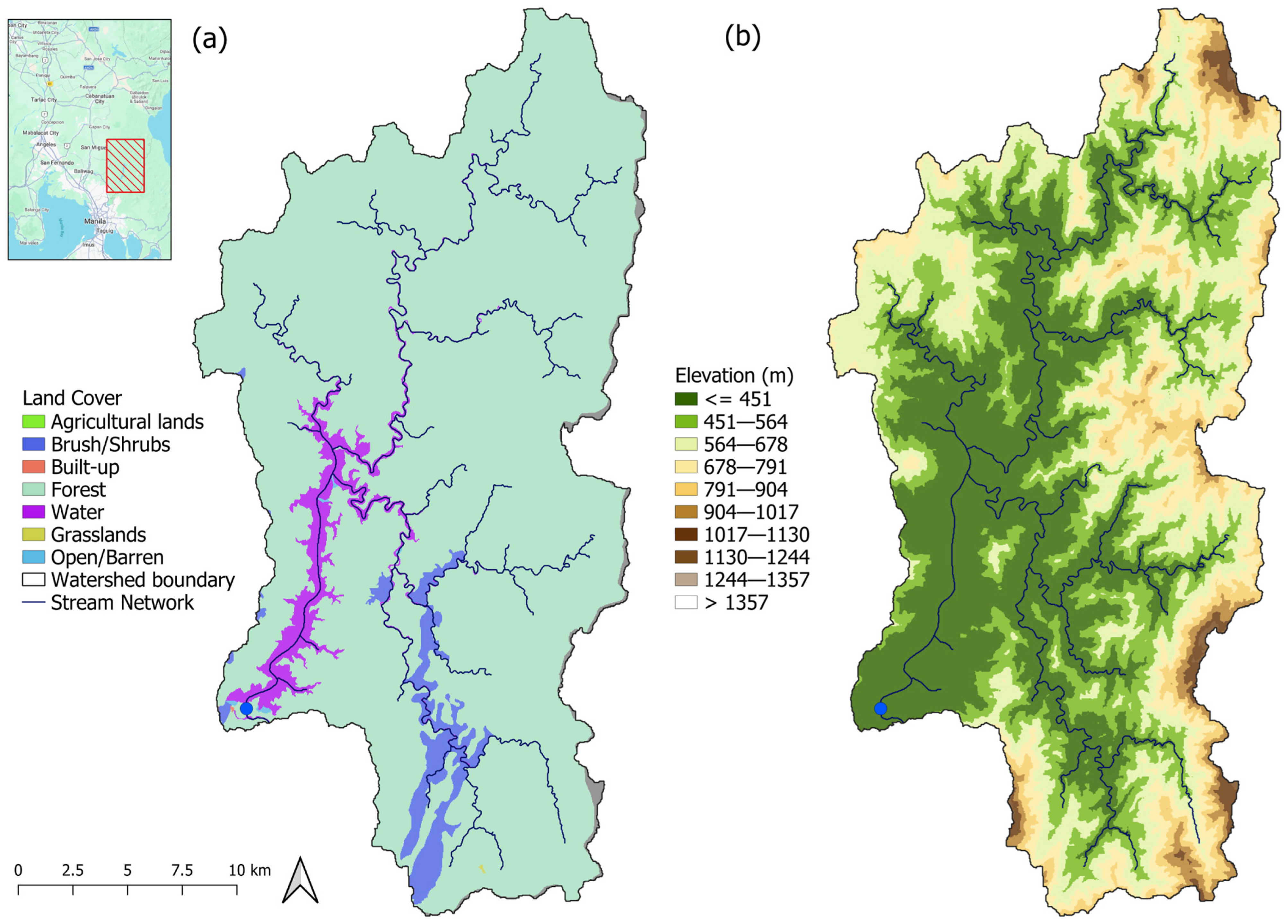
Angat Dam is in the east of the Province of Bulacan as shown in Figure 1. It is a multipurpose water resource system in the Philippines supplying water for irrigation, domestic use, hydropower generation, and flood control storage [21]. The construction of the Angat Dam lasted from 1964 to 1967 and became operational in 1968 [22]. The dam serves more than 90 percent (%) of the domestic water use in Metro Manila and about 24,000 to 28,000 hectares (ha) of rice and vegetable lands in the Province of Bulacan [21,23]. The Angat Reservoir Watershed was covered with 95.5% (506.62 sq. km) of forest and brushlands, while 4.5% (24.20 sq. km) consists of inland waters [24]. Based on the Modified Coronas Classification, most of the watershed is in Climate Type Zone III, which has no distinct maximum rain period, with a dry season from December to February or from March to May. Minor upstream tributaries of the watershed are in Climate Type Zone II, which has no dry season, with a very pronounced maximum rain period from December to February. The watershed is a sub-catchment of the Pampanga River Basin, with a long-term average annual rainfall of 2155 mm/yr and a high runoff ratio of 0.77 due to higher precipitation volumes in the Angat Dam catchment [16].

2.2. SWAT Model

The SWAT model requires various spatial data to represent the physical characteristics of a watershed. The digital elevation used in this model is the Shuttle Radar Topography Mission (SRTM), which has a 30 m resolution. The DEM was downloaded through OpenTopography and was clipped to the study area. The land use data used was the 2015 land-use/land cover (LULC) map acquired from the National Mapping and Resource Information Authority (NAMRIA) through the Geoportal PH website (https://www.geoportal.gov.ph/ accessed on 10 October 2025). Since the SWAT model permits a single LULC dataset for long-term simulations, the 2015 land cover map was assumed to be representative of the Angat Watershed throughout the study period (2000–2017). This assumption introduces uncertainties in hydrologic responses due to dynamic land cover changes that may have occurred during this period, a limitation inherent to SWAT’s discretization of Hydrological Response Units (HRUs). The soil data used was the Digital Soil Map of the World (DSMW) product of the Food and Agriculture Organization of the United Nations (FAO). Due to the unavailability of high-resolution soil data in the Philippines, the DSMW was selected as the best available alternative, though its coarser resolution (1:5,000,000 scale) may introduce uncertainty in soil property characterization. The land cover and soil data were acquired as vector files and were converted to raster files for SWAT compatibility. Overall, these data produced 279 Hydrological Response Units (HRUs).

2.3. Reservoir Module Parameters

The reservoir module of SWAT depends on the reservoir properties to properly simulate dam operations. Table 1 shows the used parameters, their definitions, and the assigned values based on ground-based operations. The mechanism of defining two (2) reservoir volumes is that when the water volume exceeds the emergency spillway volume defined by the modeler, all water in excess of the specified volume will be released [25]. There are various SWAT model reservoir outflow estimation methods (IRESCO), namely measured outflow, release rates, and target releases [26]. Data availability affects the outflow simulation method selection, and the chosen method is expected to significantly affect downstream flow [27]. The measured outflow was used as the IRESCO parameter (IRESCO = 1 or 3) to accurately model monthly reservoir outflows. The emergency spillway volume and surface area (RES_EVOL and RES_ESA, respectively) were based on the normal high water level (NHWL) of the Angat Dam (210 m) [24]. Average release rate (IRESCO = 0) was also used to simulate how the model would respond without forcing measured outflows, which are ideal for uncontrolled reservoirs. These outflow simulation codes were used for the whole simulation period.
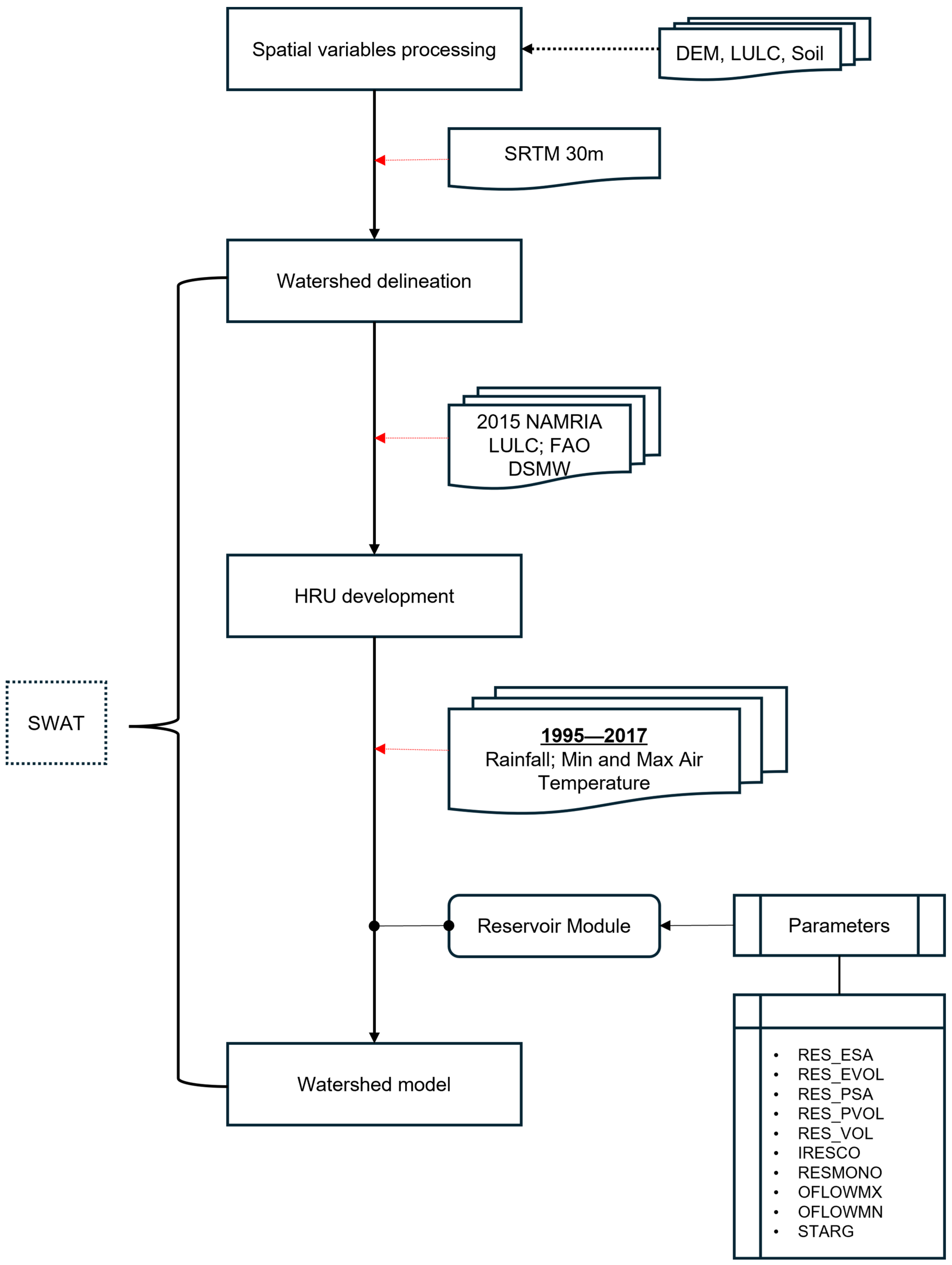
Figure 2 shows the development of the SWAT model to simulate reservoir operations. The Angat Watershed model was driven primarily by rainfall data from the Climate Hazards Group Infrared Precipitation with Stations (CHIRPS) [28] and air temperature data from the Climate Hazards Group Infrared Temperature with Stations (CHIRTS) [29].
Using the parameters presented in Table 1, four (4) SWAT models were produced—two in a daily timestep using IRESCO = 0 and IRESCO = 3, and another two in a monthly time-step (IRESCO = 0, and IRESCO = 1). The watershed model was simulated from 1995 to 2017 and has a 5-year warm-up period. The years 2000 to 2007 were set as the calibration years, while the years 2008 to 2017 were used as the validation years. Ground-based reservoir inflow and total outflow data from the National Power Corporation (NPC) were used for the calibration and validation of the watershed model.

2.4. Sensitivity Analysis and Model Calibration

Sensitivity analysis, calibration, and validation of SWAT model simulations were performed using the Latin Hypercube Sampling (LHS) executed in RSWAT (v1.0.0) [30]. This algorithm is similar to the Sequential Uncertainty Fitting version 2 (SUFI-2) algorithm [31,32] being used in the SWAT Calibration and Uncertainty Program (SWAT-CUP).
The parameters used for calibration, validation, and fitting of the model are presented in Table 2. Using the RSWAT software, the fitted parameters were also utilized to manually calibrate the model, extracting deterministic values of reservoir inflows, outflows, and volume.
The SWAT models were assessed deterministically through the subjective criteria measurements of Moriasi et al. (2007) [33] and Kalin et al. (2010) [34] presented in Table 3 and Table 4 for the evaluation of flows for the monthly and daily timestep, respectively.

3. Results and Discussion

3.1. Sensitivity Analysis

Table 4 presents the list of parameter sensitivities based on p-values (p < 0.05), indicating that changes in their values significantly influence model outputs [35]. For the Angat Watershed, PLAPS and ALPHA_BNK were consistently found to be sensitive to streamflow. This indicates that streamflow simulation, at both monthly and daily timesteps, is strongly influenced by elevation-dependent rainfall variability and bank storage dynamics. Adjustments of these parameters increased baseflow estimates, improving the overall initial accuracy of simulated streamflow. In contrast, parameters related to the temperature lapse rate (TLAPS) and effective hydraulic conductivity in the main channel (CH_K2) exhibited sensitivity primarily in finer-scale streamflow simulations. This indicates that temperature-driven processes and channel flow dynamics play an additional role in capturing short-term streamflow variations and the detailed shape of outflow hydrographs. These parameters were also found to govern streamflow in other hydropower reservoirs and montane watersheds where orographic effects influence elevation-dependent rainfall and temperature, alongside hydraulic conductivity and bank storage [36,37,38].

3.2. Uncertainty Analysis and Model Performance of Reservoir Estimations

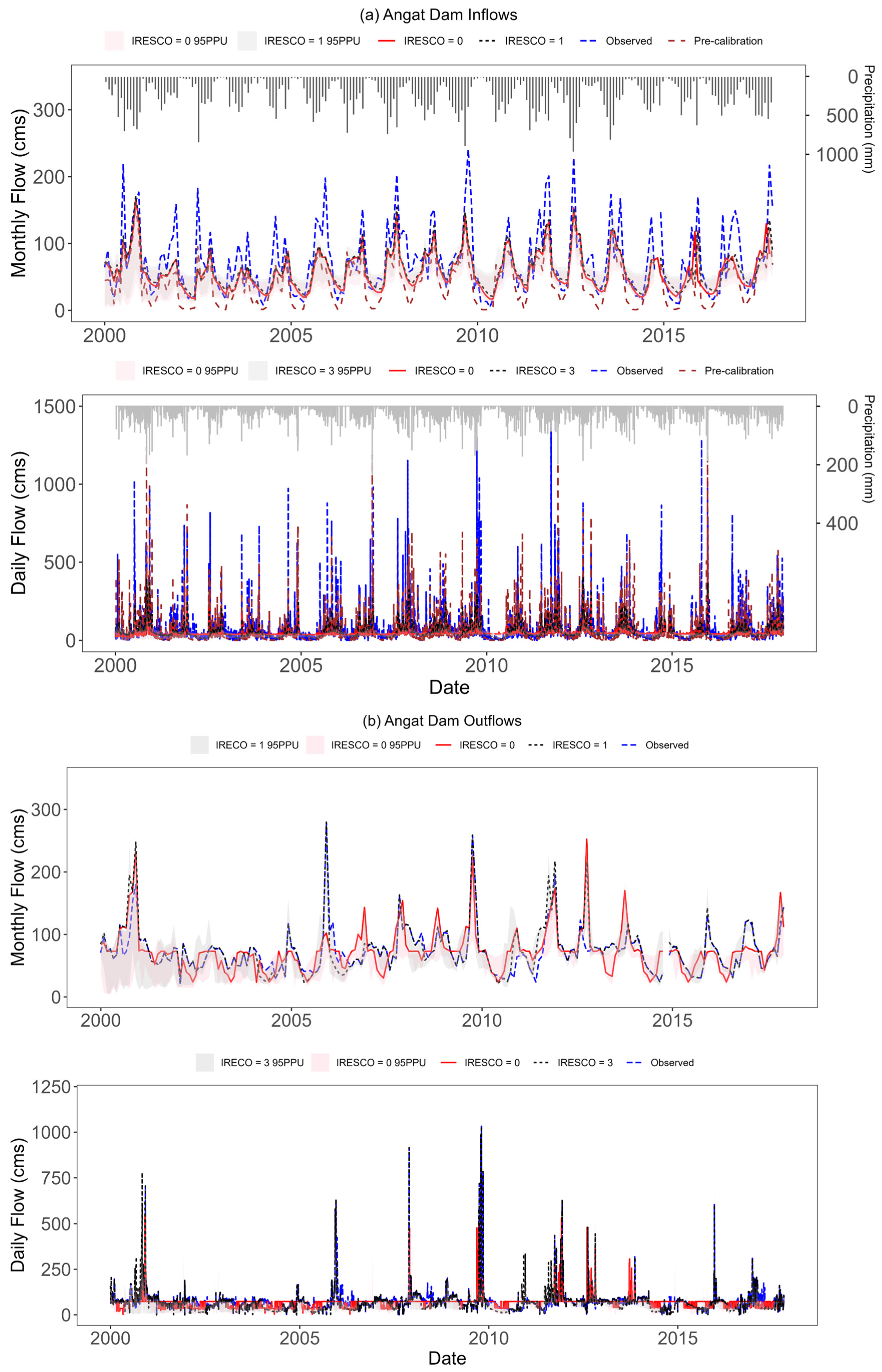
To observe the responses of the Angat Watershed under different reservoir streamflow simulations, reservoir inflows were parameterized and calibrated. Figure 3a shows the observed, pre-calibrated, and calibrated hydrograph of the Angat Dam inflows. In a pre-calibrated scenario, inflows and outflows were already underestimated. However, patterns of peaks and low flows were already captured by the model. Inflow calibration reflected that the model initially underestimated baseflow due to inaccuracies in rainfall representation. However, sensitivity analysis revealed that parameters related to the rainfall lapse rate (PLAPS) and bank storage (ALPHA_BNK) strongly influenced streamflow simulation, especially baseflow estimations, reflective of improved calibration.
Monthly simulated streamflow for the Angat Dam inflows yielded satisfactory performance during model calibration (2000–2007) in both reservoir simulation codes. For IRESCO = 0, the model attained 0.51 NSE, 0.70 RSR, and 21.3 PBIAS, while for IRESCO = 1, performance improved to 0.60 NSE, 0.63 RSR, and 13.0 PBIAS for IRESCO = 1. However, the model experienced a decline in performance during the validation period (2008–2017), with 0.41 NSE, 0.77 RSR, and 27.8 PBIAS for IRESCO = 0, and 0.52 NSE, 0.69 RSR, and 16.4 PBIAS for IRESCO = 1. Overall, both monthly IRESCO models exhibited moderate uncertainty, with P-factors covering 53–59% of observed data and R-factors ranging from 0.73 to 0.78.
Daily simulated streamflow for the Angat inflows showed weaker deterministic performances for both reservoir simulation codes during the calibration period. For IRESCO = 0, the model yielded 0.12 NSE, 0.94 RSR, and 30.8 PBIAS, while IRESCO = 3 showed a slightly improved performance with 0.16 NSE, 0.92 RSR, and 28.3 PBIAS. In contrast, model performance improved during the validation period with 0.14 NSE, 0.93 RSR, and 34.4 PBIAS for IRESCO =0, and 0.19 NSE, 0.90 RSR, and 30.1 PBIAS for IRESCO = 3. Both configurations at the daily timescale also demonstrated moderate uncertainty inflow predictions (P-factor = 0.57) with relatively narrow uncertainty bands (R-factor = 0.46).
To examine how simulated inflows translate into reservoir behavior, the calibrated parameters were applied over the full simulation period (2000–2017) to evaluate long-term outflow conditions. Despite differences in inflow simulations, the estimated reservoir outflows varied across IRESCO configurations (Figure 3b). The use of measured outflows (IRESCO = 1 and IRESCO = 3) provided greater flexibility, allowing the model to more accurately reproduce observed values. This is likely due to simulated inflows being sufficient to meet reservoir release demands, with no inflow deficits represented. The strategy of improving inflow representation has resulted in a strong deterministic and stochastic performance of simulated reservoir outflows with 0.73 NSE, 0.52 RSR, −3.0 PBIAS, 0.95 P-factor, and 1.02 R-factor at the monthly timestep, and 0.69 NSE, 0.56 RSR, 10 PBIAS, 0.91 P-factor, and 0.65 R-factor at the daily timestep. In general, reservoir outflow simulations outperformed inflow simulations, largely due to the pre-defined parameterization of reservoir operations using RESMONO, RESDAYO, OFLOWMN, and OFLOWMX. When simulated inflows and storage volumes (STARG) are sufficient to sustain these prescribed releases, the watershed responds more consistently, resulting in improved outflow estimations.
In comparison, using average release rates (IRESCO = 0) resulted in a different model response in representing reservoir operations. Simulated reservoir outflows showed significantly weaker deterministic and uncertainty performance with 0.20 NSE, 0.89 RSR, −0.7 PBIAS, 0.65 P-factor, and 1.03 R-factor at the monthly timestep, and −0.09 NSE, 1.04 RSR, 7.8 PBIAS, 0.44 P-factor, and 0.62 R-factor at the daily timestep. This is likely due to the model prioritizing achieving target storage volumes (STARG) rather than following the minimum and maximum outflows (OFLOWMN and OFLOWMX), resulting in a less accurate representation of actual release dynamics.
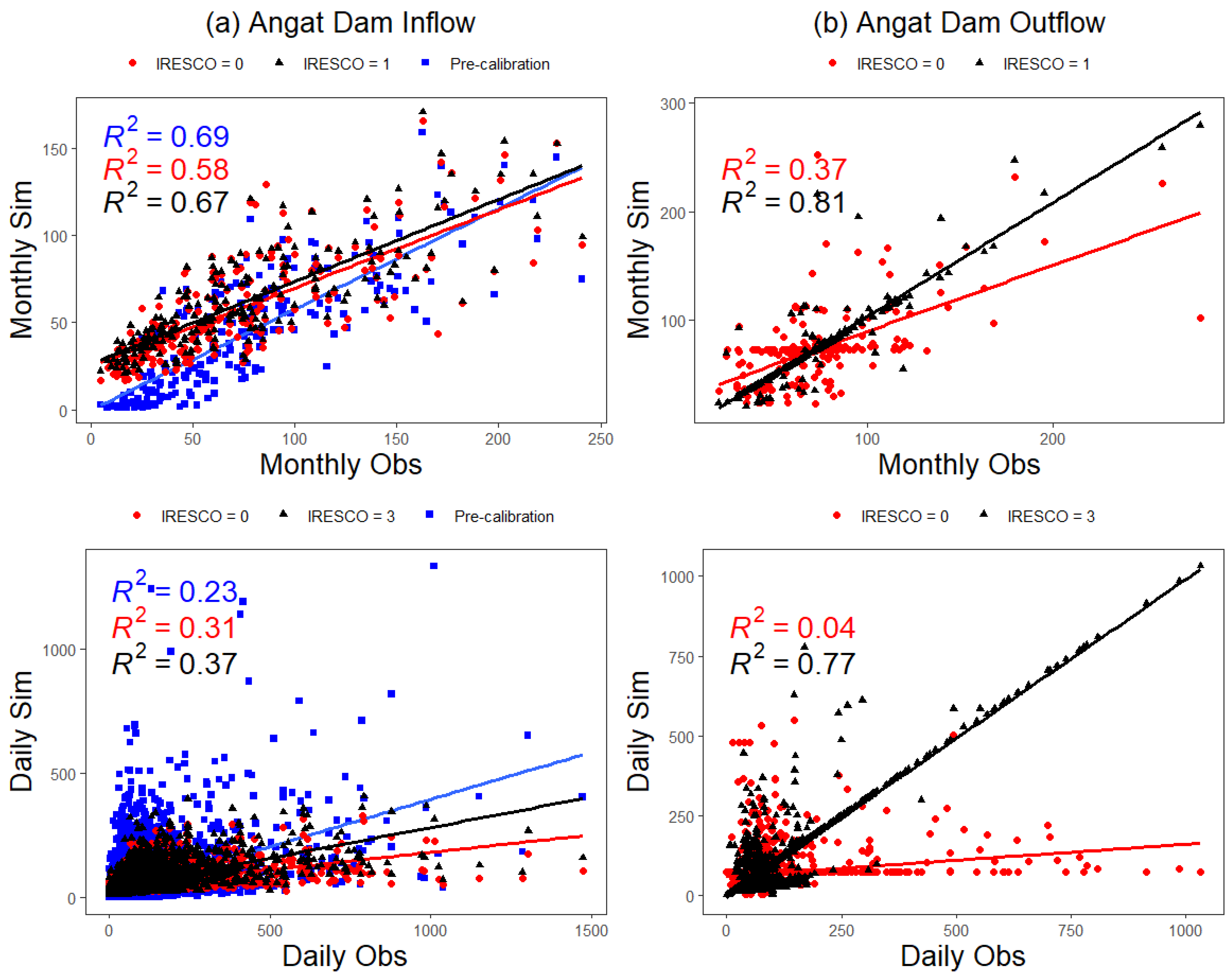
These results highlight the critical role of reservoir simulation configurations in governing streamflow simulation performance in the Angat Watershed. While inflows remain sensitive to rainfall representation and exhibit weaker performance at finer temporal scales, incorporating observed or rule-based reservoir operations could improve outflow estimates. Simplified approaches, such as average release rates (IRESCO = 0), fail to capture the dynamic nature of a heavily regulated reservoir watershed, leading to a weaker model performance, as illustrated in Figure 4. Enhancements to inflow representation through improved parameterization increased simulated water availability in the reservoir, thereby enabling more accurate replication of actual outflow behavior. The coefficient of determination (R2) generally improved following model calibration for most cases, except for the monthly inflow simulation, where R2 decreased slightly from 0.69 to 0.67 or 0.58, depending on the IRESCO configuration. In contrast, the daily inflow simulations showed consistent improvement, with R2 increasing from 0.23 to 0.31 and 0.37 for IRESCO = 0 and IRESCO = 3, respectively.
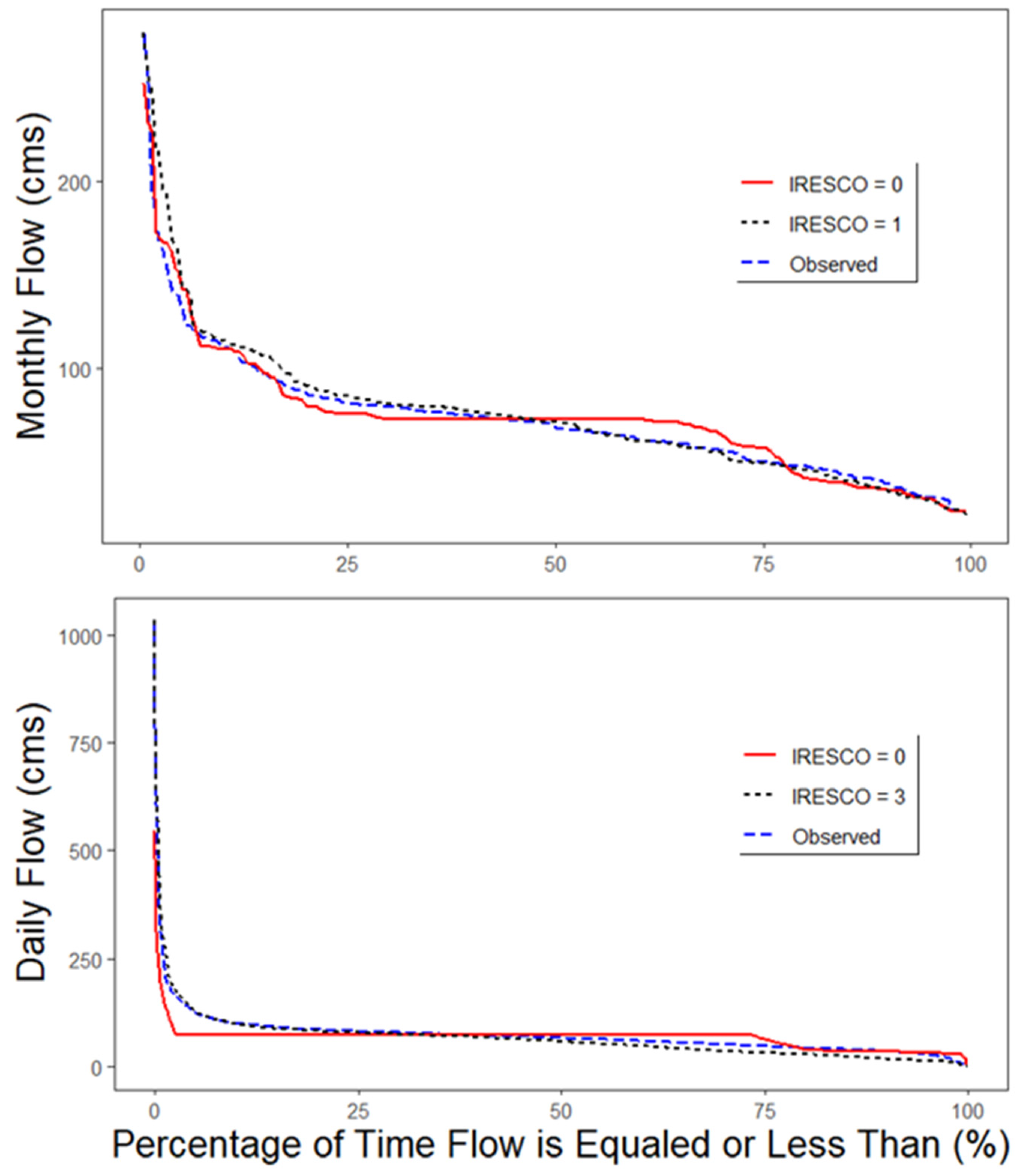
The flow duration curves (FDCs) presented in Figure 5 further show how reservoir simulation configurations (IRESCO) influence the hydrologic response of Angat Dam. For the monthly simulation, observed high flows (0–10%) are more closely reproduced by IRESCO = 1, while IRESCO = 0 shows slight underestimations, indicating that the incorporation of measured reservoir releases improves peak flow representation. In comparison with moderate flows (10–75% exceedance), IRESCO = 0 tends to overestimate flows. This behavior suggests that the simplified reservoir scheme releases water more continuously, prioritizing storage volume balance rather than demand-driven regulation. At the daily scale, IRESCO = 3 provides the best agreement with observed flows, capturing the variability of most release conditions. Meanwhile, simulations using simplified configurations (IRESCO = 0) exhibit pronounced damping, where peak flows are substantially reduced, and the overall range of flows is constrained. This reflects the limitation of simplified release rules, where water is stored and released gradually when exceeding emergency volumes, preventing the model from reproducing extreme discharge events. Generally, the FDCs highlight that while simplified reservoir representations can estimate average conditions, they tend to smooth flow variability on coarser temporal scales and misrepresent extreme event discharges at finer temporal scales.

3.3. Estimation of the Reservoir Volume

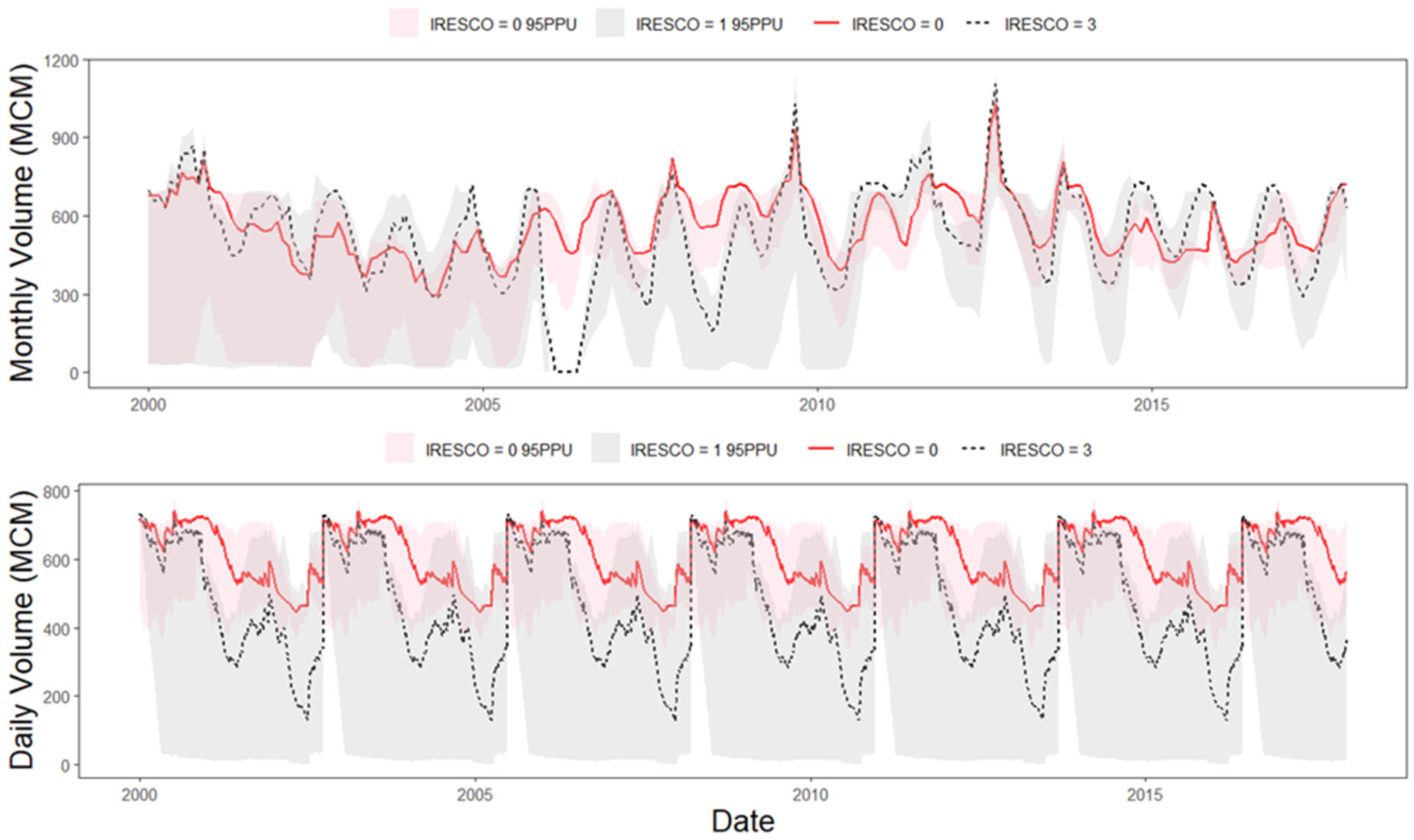
The SWAT reservoir module also simulates storage volumes in Angat Dam, as illustrated in Figure 6. Using the calibrated ranges, only a 95% Prediction Uncertainty (95PPU) will be shown for how different reservoir simulation configurations simulate volumes.
Both the monthly and daily timestep models at all configurations show similar patterns in simulated volumes, with seasonal fluctuations and periodic low levels. Simulations using measured outflow releases (IRESCO = 1 and IRESCO = 3) demonstrate lower volume levels compared to the simple release rate rule (IRESCO = 0). However, at coarser temporal scales, Angat Dam was shown to produce unrealistic estimates of storage volumes, especially during periods when the reservoir storage drops closer to zero, leading to artificial emptying. Reservoir water balance in SWAT consists of quantifying stored water, inflows, outflows, rainfall in the reservoir, evaporation, and seepage [39]. The artificial emptying in the model may inadequately represent reservoir retention because inflow during the specific month is insufficient to offset the high forced outflows governed by the IRESCO, OFLOWMN, and OFLOWMX parameters. Consequently, the model produces a sustained decline in simulated reservoir storage volume. Under coarser (monthly) temporal conditions, the use of average daily flow rates for each month may smooth inflow contributions to the reservoir system, potentially reducing the representation of short-term inflow variability. In addition, previous studies have reported that CHIRPS has limited capability in capturing extreme rainfall events exceeding 100 mm day−1 [40], which may have affected the accuracy of inflow representation. Together, these factors may contribute to the simulated reservoir emptying observed at coarser temporal resolutions. However, this behavior was not evident under finer temporal resolutions.
In contrast, configurations based on release rates (IRESCO = 0) maintain a more consistent storage capacity, as these rules prioritize retaining water within the reservoir rather than allowing the release of maximum or minimum flow limits. This is evident and related to the more muted outflow estimates for IRESCO = 0 across both monthly and daily timesteps.
These results highlight the need for more robust calibration of reservoir parameters, particularly IRESCO, PVOL, and reservoir hydraulic conductivity (RES_K). Incorporating ground-based volume data into the calibrated process would be helpful to replicate actual reservoir behavior and enhance the model’s applicability for water resource management.
Accurately understanding reservoir outflows is critical in understanding the contribution of reservoirs to downstream runoff, which is necessary for effective resource planning. As a limitation, this study only used measured outflow and release rate estimation methods, as the target release configuration responds with flood control capacities during flood and non-flood seasons. This study highlighted that using measured outflow yielded very good deterministic agreements with observed data, while using release rates (non-specific target release) showed unsatisfactory results. Only a few studies examined the influence of IRESCO parameters on reservoir behavior. Kim and Parajuli (2014) [26] reported similar findings, demonstrating that simulations using measured outflows (IRESCO = 1 and 3) achieved good performance at a daily timestep, whereas simulations based on non-specific target releases (IRESCO = 0) produced unsatisfactory results. Similarly, Javed et al. (2024) [40] suggested that using non-specific target releases is better for uncontrolled reservoirs. This explains why the Angat Dam configuration under IRESCO = 0 tends to prioritize water storage than permit maximum and minimum releases as outflows. Such behavior limits the SWAT model’s ability to realistically represent reservoir operations in a heavily regulated watershed. In contrast, Jalowska and Yuan (2019) [41] demonstrated that IRESCO = 0 can still produce satisfactory model performance under certain reservoir conditions. While these studies highlighted the importance of prior reservoir information (regulations and outflow) for improved model performance in regulated watersheds, this paper contributes by emphasizing the need for reduced inflow deficits to achieve measured releases accurately. The SWAT reservoir module also simulates storage volumes in Angat Dam, as illustrated in Figure 6.

4. Conclusions

This study highlights the responses of a heavily regulated watershed, the Angat Dam Watershed, to various reservoir outflow simulation configurations in the SWAT model. As an initial assessment of the SWAT reservoir module in the Philippines, this study demonstrated how different reservoir operation schemes influence the simulation of reservoir inflows, outflows, and internal storage behavior across monthly and temporal scales.
Sensitivity analysis reveals that elevation-dependent rainfall and temperature variability, alongside bank storage and hydraulic conductivity, govern reservoir inflow simulations in the Angat Dam Watershed. The results further showed that the selection of reservoir simulation configuration (IRESCO) significantly affects both inflow and outflow performance. Configurations using measured reservoir releases produced a better representation of reservoir outflows and improved agreement with observed discharge patterns. Using simplified release rate approaches tended to prioritize water retention over operational release constraints, resulting in weaker representation of actual reservoir dynamics. However, despite improved outflow simulations, measured-release configurations produced unrealistic reservoir storage depletion at coarser temporal scales when simulated inflows were insufficient to sustain prescribed releases. These findings highlight the importance of accurately representing upstream hydrologic processes and inflow availability before reservoir operations can be reliably simulated.
This study provides new insight into the interaction between inflow representation, reservoir operation schemes, and temporal resolution in SWAT reservoir simulations. The results indicate that simple release rates are less suitable for heavily regulated reservoirs, where operational releases are strongly controlled by reservoir management objectives. This configuration selection framework could be used as a basis for other regulated reservoir watersheds influenced by strong seasonal rainfall variability and highly complex operational schemes. However, application to other reservoirs would require site-specific calibration, reliable operational and management data, and improved representation of inflow processes. In addition, significant limitations were found to constrain the model results’ reliability. Daily inflow simulations yielded weak deterministic performance (NSE = 0.12–0.19), failing to capture streamflow dynamics necessary for operational planning and forecasting. Mass balance inconsistencies observed at the monthly scale, particularly the artificial emptying of reservoir storage, suggest that satisfactory outflow performance may result from compensating errors rather than a physically realistic hydrologic representation. Consequently, caution is necessary when applying these configurations to analyses sensitive to reservoir storage dynamics, such as water quality modeling and comprehensive water availability assessments.
Overall, the study demonstrates the potential of SWAT as a tool for simulating regulated reservoir systems in the Philippines when reservoir operations and hydrology are parameterized. Model performance was stronger for reservoir outflow estimations than for inflow, particularly at finer temporal resolutions. Future studies should explore alternative reservoir operation approaches, including controlled target release schemes and SWAT-M, alongside improved reservoir information to enhance the reliability of reservoir simulations for water resources planning and management in the Philippines.

Author Contributions

Conceptualization: C.D.B., L.V.A., A.A.A. and M.V.L.; methodology: C.D.B., L.V.A., K.M.F.C. and M.V.L.; formal analysis: C.D.B., K.M.F.C. and M.V.L.; investigation: C.D.B., L.V.A., K.M.F.C., A.A.A. and M.V.L.; resources: C.D.B.; data curation: C.D.B. and K.M.F.C.; writing—original draft preparation, C.D.B., K.M.F.C. and M.V.L.; writing—review and editing: L.V.A., A.A.A. and M.V.L.; visualization: K.M.F.C.; supervision: L.V.A., A.A.A. and M.V.L. All authors have read and agreed to the published version of the manuscript.

Funding

This research received no external funding.

Data Availability Statement

Restrictions apply to the availability of the reservoir inflow and outflow data. Data were obtained from the National Power Corporation (NAPOCOR) and are available from the authors with the permission of NAPOCOR. The rest of the raw data supporting the conclusions of this article will be made available by the authors upon request.

Acknowledgments

During the preparation of this manuscript/study, the author(s) greatly appreciate the National Power Corporation for providing the use of discharge data for the purposes of research. The authors have reviewed and edited the output and take full responsibility for the content of this publication.

Conflicts of Interest

The authors declare no conflicts of interest.

References

  1. Jalali, J.; Ahmadi, A.; Abbaspour, K. Runoff responses to human activities and climate change in an arid watershed of central Iran. Hydrol. Sci. J. 2021, 66, 2280–2297. [Google Scholar] [CrossRef]
  2. Wei, D.; Liu, S.; Wu, Y.; Feng, S.; Gao, H.; Qin, C.; Ren, D.; Tang, W.; Zhang, Y. Impacts of human activities and climate change on water and sediment evolution in four large subtropical river basins in China. Ecol. Indic. 2023, 155, 110958. [Google Scholar] [CrossRef]
  3. Xue, B.; Helman, D.; Wang, G.; Xu, C.Y.; Xiao, J.; Liu, T.; Wang, L.; Li, X.; Duan, L.; Lei, H. The low hydrologic resilience of Asian Water Tower basins to adverse climatic changes. Adv. Water Resour. 2021, 155, 103996. [Google Scholar] [CrossRef]
  4. Rodriguez, B.C.; Palma-Torres, V.M.; Castañeda, T.J.; Codtiyeng, S.K.; Castillo, J.F.; Sasi, A.P.V.; Tercero, M.U.; Andrada, R.T. Drivers and impacts of land use and land cover changes on ecosystem services provided by the watersheds in the Philippines: A systematic literature review. Int. For. Rev. 2023, 25, 473–490. [Google Scholar] [CrossRef]
  5. Guiamel, I.A.; Lee, H.S. Watershed modelling of the Mindanao River Basin in the Philippines using the SWAT for water resource management. Civ. Eng. J. 2020, 6, 626–648. [Google Scholar] [CrossRef]
  6. Hoey, T.B.; Tolentino, P.L.M.; Guardian, E.; Perez, J.E.G.; Williams, R.D.; Boothroyd, R.; David, C.P.C.; Paringit, E.C. Integrating historical archives and geospatial data to revise flood estimation equations for Philippine rivers. Hydrol. Earth Syst. Sci. 2025, 29, 6181–6200. [Google Scholar] [CrossRef]
  7. Gacu, J.G.; Monjardin, C.E.F.; Mangulabnan, R.G.T.; Mendez, J.C.F. Application of Artificial Intelligence in Hydrological Modeling for Streamflow Prediction in Ungauged Watersheds: A Review. Water 2025, 17, 2722. [Google Scholar] [CrossRef]
  8. Edward, C.; Monjardin, F.; Aldrine, F.A.U.; Tan, F.J. Estimation of River Discharge at Ungauged Catchment using GIS Map Correlation Method as Applied in Sta. Lucia River in Mauban, Quezon, Philippines. IOP Conf. Ser. Mater. Sci. Eng. 2017, 216, 012045. [Google Scholar]
  9. Rice, J.S.; Emanuel, R.E.; Vose, J.M. The influence of watershed characteristics on spatial patterns of trends in annual scale streamflow variability in the continental US. J. Hydrol. 2016, 540, 850–860. [Google Scholar] [CrossRef]
  10. Neupane, R.P.; Kumar, S. Estimating the effects of potential climate and land use changes on hydrologic processes of a large agriculture dominated watershed. J. Hydrol. 2015, 529, 418–429. [Google Scholar] [CrossRef]
  11. Fan, M.; Shibata, H. Simulation of watershed hydrology and stream water quality under land use and climate change scenarios in Teshio River watershed, northern Japan. Ecol. Indic. 2015, 50, 79–89. [Google Scholar] [CrossRef]
  12. Lawal, I.M.; Bertram, D.; White, C.J.; Jagaba, A.H. Integrated framework for hydrologic modelling in data-sparse watersheds and climate change impact on projected green and blue water sustainability. Front. Environ. Sci. 2023, 11, 1233216. [Google Scholar] [CrossRef]
  13. Sahu, M.K.; Shwetha, H.R.; Dwarakish, G.S. State-of-the-art hydrological models and application of the HEC-HMS model: A review. Model. Earth Syst. Environ. 2023, 9, 3029–3051. [Google Scholar] [CrossRef]
  14. Siddique, R.; Sharma, S.; McCreight, J. Hydrological modeling, analyses, and predictions: Opportunities and challenges. Front. Water 2023, 4, 1121534. [Google Scholar] [CrossRef]
  15. Robles, K.P.V.; Monjardin, C.E.F. Forecasting Climate Change Impacts on Water Security Using HEC-HMS: A Case Study of Angat Dam in the Philippines. Water 2025, 17, 2085. [Google Scholar] [CrossRef]
  16. Tejada, A.T., Jr.; Sanchez, P.A.J.; Faderogao, F.J.F.; Gigantone, C.B.; Luyun, R.A., Jr. Spatiotemporal Analysis of Extreme Rainfall and Meteorological Drought Events over the Angat Watershed, Philippines. Atmosphere 2023, 14, 1790. [Google Scholar] [CrossRef]
  17. Tabios, G.Q., III. Water Resources Systems of the Philippines: Modeling Studies; Springer Nature: Cham, Switzerland, 2020; Volume 4. [Google Scholar]
  18. Mamidala, R.; Liu, L. Tile-drainage and Crop Rotation Enhanced Cropland Dataset to Improve Spatial Accuracy of Eco-hydrologic Models. Sci. Data 2026, 13, 321. [Google Scholar] [CrossRef]
  19. Wang, Z.; He, Y.; Li, W.; Chen, X.; Yang, P.; Bai, X. A generalized reservoir module for SWAT applications in watersheds regulated by reservoirs. J. Hydrol. 2023, 616, 128770. [Google Scholar] [CrossRef]
  20. Sánchez-Gómez, A.; Arnold, J.G.; Bieger, K.; Čerkasova, N.; Sammons, N.B.; Martínez-Pérez, S.; Molina-Navarro, E. Modelling water management using SWAT+: Application of reservoirs release tables and the new water allocation module in a highly managed river basin. Water Resour. Manag. 2025, 39, 2357–2399. [Google Scholar] [CrossRef]
  21. Liu, Y.; Liu, L.; Li, L.; Li, H.; Xu, H.; Yang, J.; Tao, S.; Zhu, B. Changes in Runoff in the Source Region of the Yellow River Basin Based on CMIP6 Data under the Goal of Carbon Neutrality. Water 2023, 15, 2457. [Google Scholar] [CrossRef]
  22. Rola, A.; Francisco, H.; Liguton, J. (Eds.) Winning the Water War: Watersheds, Water Policies and Water Institutions; Philippine Institute for Development Studies: Quezon City, Philippines, 2014.
  23. Ibañez, S.C.; Dajac, C.V.G.; Liponhay, M.P.; Legara, E.F.T.; Esteban, J.M.H.; Monterola, C.P. Forecasting Reservoir Water Levels Using Deep Neural Networks: A Case Study of Angat Dam in the Philippines. Water 2022, 14, 34. [Google Scholar] [CrossRef]
  24. Tabios, G.Q., III. Angat Multipurpose Reservoir with Increased Water Demand and Future Reservoir Sedimentation. DLSU Bus. Econ. Rev. 2018, 28, 32–39. [Google Scholar] [CrossRef]
  25. JICA. The Study on Integrated Water Resources Management for Poverty Alleviation and Economic Development in the Pampanga River Basin; Japan International Cooperation Agency: Tokyo, Japan, 2011.
  26. Kim, H.; Parajuli, P.B. Impacts of reservoir outflow estimation methods in SWAT model calibration. Trans. ASABE 2014, 57, 1029–1042. [Google Scholar] [CrossRef]
  27. Arnold, J.G.; Kiniry, J.R.; Srinivasan, R.; Williams, J.R.; Haney, E.B.; Neitsch, S.L. SWAT Input/Output Documentation v.2012; Texas Water Resources Institute: College Station, TX, USA, 2012.
  28. Funk, C.C.; Peterson, P.J.; Landsfeld, M.F.; Pedreros, D.H.; Verdin, J.P.; Rowland, J.D.; Romero, B.E.; Husak, G.J.; Michaelsen, J.C.; Verdin, A.P. A Quasi-Global Precipitation Time Series for Drought Monitoring (Nos 2327-638X; Issues 2327-638X); US Geological Survey: Reston, VA, USA, 2014.
  29. Verdin, A.; Funk, C.; Peterson, P.; Landsfeld, M.; Tuholske, C.; Grace, K. Development and validation of the CHIRTS-daily quasi-global high-resolution daily temperature data set. Sci. Data 2020, 7, 303. [Google Scholar] [CrossRef]
  30. Nguyen, T.V.; Dietrich, J.; Dang, T.D.; Tran, D.A.; Van Doan, B.; Sarrazin, F.J.; Abbaspour, K.; Srinivasan, R. An interactive graphical interface tool for parameter calibration, sensitivity analysis, uncertainty analysis, and visualization for the Soil and Water Assessment Tool. Environ. Model. Softw. 2022, 156, 105497. [Google Scholar] [CrossRef]
  31. Abbaspour, K.C.; Johnson, C.A.; van Genuchten, M.T. Estimating Uncertain Flow and Transport Parameters Using a Sequential Uncertainty Fitting Procedure. Vadose Zone J. 2004, 3, 1340–1352. [Google Scholar] [CrossRef]
  32. Abbaspour, K.C.; Yang, J.; Maximov, I.; Siber, R.; Bogner, K.; Mieleitner, J.; Zobrist, J.; Srinivasan, R. Modelling hydrology and water quality in the pre-alpine/alpine Thur watershed using SWAT. J. Hydrol. 2007, 333, 413–430. [Google Scholar] [CrossRef]
  33. Moriasi, D.; Arnold, J.; Van Liew, M.; Bingner, R.; Harmel, R.D.; Veith, T. Model Evaluation Guidelines for Systematic Quantification of Accuracy in Watershed Simulations. Trans. ASABE 2007, 50, 885–900. [Google Scholar] [CrossRef]
  34. Kalin, L.; Isik, S.; Schoonover, J.E.; Lockaby, B.G. Predicting water quality in unmonitored watersheds using artificial neural networks. J. Environ. Qual. 2010, 39, 1429–1440. [Google Scholar] [CrossRef]
  35. Arnold, J.G.; Moriasi, D.N.; Gassman, P.W.; Abbaspour, K.C.; White, M.J.; Srinivasan, R.; Santhi, C.; Harmel, R.; Van Griensven, A.; Van Liew, M.W.; et al. SWAT: Model use, calibration, and validation. Trans. ASABE 2012, 55, 1491–1508. [Google Scholar] [CrossRef]
  36. Liu, X.; Yang, M.; Meng, X.; Wen, F.; Sun, G. Assessing the Impact of Reservoir Parameters on Runoff in the Yalong River Basin using the SWAT Model. Water 2019, 11, 643. [Google Scholar] [CrossRef]
  37. Devkota, N.; Lamichhane, S.; Bhattarai, P.K. Multi-site calibration of the SWAT hydrological model and study of spatio-temporal variation of water balance components in the Narayani River Basin, central part of Nepal. H2Open J. 2024, 7, 114–129. [Google Scholar] [CrossRef]
  38. Duan, Y.; Meng, F.; Liu, T.; Huang, Y.; Luo, M.; Xing, W.; De Maeyer, P. Sub-Daily Simulation of Mountain Flood Processes Based on the Modified Soil Water Assessment Tool (SWAT) Model. Int. J. Environ. Res. Public Health 2019, 16, 3118. [Google Scholar] [CrossRef]
  39. Neitsch, S.L.; Arnold, J.G.; Kiniry, J.R.; Williams, J.R. Soil and Water Assessment Tool Theoretical Documentation Version 2009; Texas Water Resources Institute: College Station, TX, USA, 2011.
  40. Javed, A.; Neumann, A.; Cai, H.; Arnillas, C.A.; Arhonditsis, G.B. A reservoir-based approach of the SWAT hydrological model in the Napanee River and Wilton Creek agricultural watersheds, Bay of Quinte. J. Great Lakes Res. 2024, 50, 102404. [Google Scholar] [CrossRef]
  41. Jalowska, A.M.; Yuan, Y. Evaluation of SWAT impoundment modeling methods in water and sediment simulations. JAWRA J. Am. Water Resour. Assoc. 2019, 55, 209–227. [Google Scholar] [CrossRef]
Figure 1. (a) Land cover and (b) elevation maps of Angat Dam Watershed, Philippines.
Water 18 01417 g001
Figure 2. Generalized SWAT workflow with reservoir module application for the Angat Dam.
Water 18 01417 g002
Figure 3. Monthly and daily (a) inflows and (b) outflows of Angat Dam from the year 2000 to 2020.
Water 18 01417 g003
Figure 4. Scatter plot of the monthly and daily observed and simulated flows for the Angat Dam Watershed: (a) inflow and (b) outflow.
Water 18 01417 g004
Figure 5. Flow duration curves of different reservoir simulation schemes on monthly (top) and daily (bottom) temporal scales.
Water 18 01417 g005
Figure 6. Estimated reservoir volumes in monthly (top) and daily (bottom) timesteps.
Water 18 01417 g006
Table 1. Hydrologic parameters of the SWAT model used for the sensitivity analyses and calibration process: initial (minimum and maximum) and fitted values.
Reservoir ParametersDefinition (Arnold, Kiniry, et al., 2012 [27])Assigned Values (Units)
IRESCOOutflow simulation code
0—Average annual release rate
1—Measured monthly outflow
2—Controlled outflow—target release
3—measured daily outflow
0 (Monthly and daily timestep)
1 (Monthly timestep)
3 (Daily timestep)
RES_ESAReservoir surface area when the reservoir is filled to the emergency spillway21,000 ha
RES_EVOLVolume of water needed to fill the reservoir to the emergency spillway73,788 (104 m3)
RES_PSAReservoir surface area when the reservoir is filled to the principal spillway19,500 ha
RES_PVOLVolume of water needed to fill the reservoir to the principal spillway46,981 (104 m3)
RES_VOLInitial reservoir volume46,981 (104 m3)
RESMONOMonthly reservoir outflow file
RESDAYODaily reservoir outflow file
RES_RRAverage release rate (m3/s)44.5148 (m3/s)
OFLOWMXMaximum outflow for the month (m3/s)Monthly TS
[1] 122.8
[2] 119.49
[3] 97.28
[4] 82.87
[5] 90.32
[6] 102.69
[7] 115.32
[8] 112.84
[9] 110.27
[10] 258.95
[11] 167.91
[12] 279.56
Daily TS
206.44
196.35
140.71
174.15
174.19
155.61
170.03
480.1
584.14
1032.45
915.21
704.87
OFLOWMNMinimum outflow for the month (m3/s)Monthly TS
[1] 68.36
[2] 23.36
[3] 58.34
[4] 39.62
[5] 35.57
[6] 24.04
[7] 30.42
[8] 29.5
[9] 24.42
[10] 30.51
[11] 30.66
[12] 64.08
Daily TS
37.71
10
0
35.06
3.28
6.98
3
0.58
0.96
1.42
15.25
0
STARGTarget reservoir storageSet to RES_PVOL
Table 2. Hydrologic parameters of the SWAT model used for the sensitivity analyses and calibration prove: initial (minimum and maximum) and fitted values.
Parameter NameDefinitionMethodMinMaxFitted Parameters
Monthly TSDaily
TS
ALPHA_BF.gwBaseflow alpha factorReplace00.20.03820.117
GW_DELAY.gwGroundwater delay timeReplace250450364.2421
GW_REVAP.gwGroundwater “revap” coefficientReplace00.30.25770.0885
GWQMN.gwThreshold depth of water in the shallow aquifer required for return flow to occur (mm H2O)Replace5000800078537937
REVAPMN.gwThreshold depth of water in the shallow aquifer for “revap” or percolation to the deep aquifer to occur (mm H2O)Replace200500449.9283.1
RCHRG_DP.gwDeep aquifer percolation fractionReplace0.10.50.2420.2492
EPCO.hruPlant uptake compensation factorReplace0.10.40.26050.2995
CN2.mgtSCS runoff curve numberRelative0.20.80.20660.635
CH_K2.rteEffective hydraulic conductivity in main channel alluviumReplace508057.9550.69
CH_N2.rteManning’s “n” value for the main channelReplace0.10.30.1010.1938
SOL_AWC.solAvailable water capacity of the soilRelative−0.0390.5240.3029350.434663
SOL_K.solSaturated hydraulic conductivityAbsolute101.976524.444460.6515462.3414
CH_N1.subManning’s “n” value for the tributary channelsReplace021.74215.2412321.28553
ESCO.hruSoil evaporation compensation factorReplace0.40.70.55390.5755
SOL_BD.solMoist bulk densityRelative−0.021−0.198−0.13436−0.10015
ALPHA_BNK.rteBaseflow alpha factor for bank storageReplace00.050.033150.04945
LAT_TTIME.hruLateral flow travel timeReplace−0.2230.2910.1282110.051153
SURLAG.hruSurface runoff lag timeRelative−0.10.30.23240.214
TLAPS.subTemperature lapse rate (°C/km)Replace−3−1−2.187−2.187
PLAPS.subPrecipitation lapse rate (mm H2O/km)Replace050.09370.0937
Table 3. Evaluation criteria for the SWAT model performance (calibration and validation) at a monthly and daily timestep.
Performance RatingRSR 1NSE 2PBIAS 3 (%)
Very good PBIAS < ±10
Monthly0.00 ≤ RSR ≤ 0.500.75 < NSE ≤ 1.00
Daily0.00 ≤ RSR ≤ 0.25NSE ≥ 0.70
Good ±10 ≤ PBIAS < ±15
Monthly0.50 < RSR ≤ 0.600.65 < NSE ≤ 0.75
Daily0.25 < RSR ≤ 0.500.50 ≤ NSE < 0.70
Satisfactory ±15 ≤ PBIAS < ±25
Monthly0.60 < RSR ≤ 0.700.50 < NSE ≤ 0.65
Daily0.50 < RSR ≤ 0.700.30 ≤ NSE < 0.50
Unsatisfactory PBIAS ≥ ±25
MonthlyRSR > 0.70NSE ≤ 0.50
DailyRSR > 0.700.3 < NSE
Notes: 1 Ratio of the root mean square error to the standard deviation of measured data 2 Nash-Sutcliffe Efficiency, 3 Percent Bias.
Table 4. Sensitivity analyses results of the SWAT model for the monthly and daily timestep, ranked according to their p-values.
Monthly Timestep ModelDaily Timestep Model
Parametersp-ValueRankingParametersp-ValueRanking
PLAPS.sub3.64 × 10−521PLAPS.sub2.67 × 10−631
ALPHA_BNK.rte1.15 × 10−122ALPHA_BNK.rte1.21 × 10−172
EPCO.hru2.19 × 10−13CH_K2.rte2.52 × 10−23
GW_REVAP.gw2.25 × 10−14TLAPS.sub3.17 × 10−24
CN2.mgt2.36 × 10−15GW_REVAP.gw1.54 × 10−15
SURLAG.hru2.45 × 10−16ESCO.hru2.17 × 10−16
TLAPS.sub2.66 × 10−17EPCO.hru2.23 × 10−17
CH_N1.sub2.70 × 10−18RCHRG_DP.gw2.49 × 10−18
RCHRG_DP.gw3.00 × 10−19SOL_BD().sol3.07 × 10−19
GW_DELAY.gw4.00 × 10−110SOL_AWC().sol4.57 × 10−110
CH_N2.rte4.30 × 10−111LAT_TTIME.hru5.05 × 10−111
GWQMN.gw4.42 × 10−112CH_N1.sub5.30 × 10−112
ESCO.hru4.55 × 10−113GWQMN.gw5.42 × 10−113
SOL_BD().sol4.61 × 10−114SURLAG.hru6.31 × 10−114
CH_K2.rte5.14 × 10−115CN2.mgt6.46 × 10−115
ALPHA_BF.gw6.03 × 10−116GW_DELAY.gw6.89 × 10−116
LAT_TTIME.hru7.21 × 10−117ALPHA_BF.gw8.28 × 10−117
SOL_K().sol8.53 × 10−118REVAPMN.gw8.81 × 10−118
REVAPMN.gw8.62 × 10−119SOL_K().sol8.94 × 10−119
SOL_AWC().sol9.00 × 10−120CH_N2.rte9.82 × 10−120
Disclaimer/Publisher’s Note: The statements, opinions and data contained in all publications are solely those of the individual author(s) and contributor(s) and not of MDPI and/or the editor(s). MDPI and/or the editor(s) disclaim responsibility for any injury to people or property resulting from any ideas, methods, instructions or products referred to in the content.